• About

Sacred Cow Chips

Sacred Cow Chips

Category Archives: Central Planning

The Fascist Roader

04 Thursday Aug 2016

Posted by Nuetzel in Central Planning, fascism

≈ 1 Comment

Tags

Barack Obama, Benito Mussolini, central planning, competition, Dodd-Frank, fascism, Industrial Concentration, Industrial Policy, Innovation, Jonah Goldberg, Obamacare, rent seeking, Sheldon Richman, Socialism, Thomas Sowell

Obamas - fascist world government


President Obama is a believer in centralized social and economic management, despite the repeated disasters that have befallen societies whose leaders have applied that philosophy in the real world. Those efforts have often taken the form of socialism, with varying degrees of government ownership of resources and productive capital. However, it is not necessary for government to own the means of production in order to attempt central planning. You can keep your capital as long as you take direction from the central authority and pay your “fair share” of the public sector burden.

A large government bureaucracy can coexist with heavily regulated, privately-owned businesses, who are rewarded by their administrative overlords for expending resources on compliance and participating in favored activities. The rewards can take the form of rich subsidies, status-enhancing revolving doors between industry and powerful government appointments, and steady profits afforded by monopoly power, as less monied and politically-adept competitors drop out of the competition for customers. We often call this “corporatism”, or “crony capitalism”, but it is classic fascism, as pioneered by Benito Mussolini’s government in Italy in the 1920s. Here is Sheldon Richman on the term’s derivation:

“As an economic system, fascism is socialism with a capitalist veneer. The word derives from fasces, the Roman symbol of collectivism and power: a tied bundle of rods with a protruding ax.“

With that in mind, here’s an extra image:

Mussolini Quote

The meaning of fascism was perverted in the 1930s, as noted by Thomas Sowell:

“Back in the 1920s, however, when fascism was a new political development, it was widely — and correctly — regarded as being on the political left. Jonah Goldberg’s great book ‘Liberal Fascism’ cites overwhelming evidence of the fascists’ consistent pursuit of the goals of the left, and of the left’s embrace of the fascists as one of their own during the 1920s. … 

It was in the 1930s, when ugly internal and international actions by Hitler and Mussolini repelled the world, that the left distanced themselves from fascism and its Nazi offshoot — and verbally transferred these totalitarian dictatorships to the right, saddling their opponents with these pariahs.“

The Obama Administration has essentially followed the fascist playbook by implementing policies that both regulate and reward large corporations, who are only too happy to submit. Those powerful players participate in crafting those policies, which usually end up strengthening their market position at the expense of smaller competitors. So we have transformational legislation under Obama such as Obamacare and Dodd-Frank that undermine competition and encourage concentration in the insurance, health care, pharmaceutical  and banking industries. We see novel regulatory interpretations of environmental laws that destroy out-of-favor industries, while subsidies are lavished on favored players pushing economically questionable initiatives. Again, the business assets are owned by private cronies, but market forces are subjugated to a sketchy and politically-driven central plan designed jointly by cronies inside and outside of government. That is fascism, and that’s the Obama approach. He might be a socialist, and that might even be the end-game he hopes for, but he’s a fascist in practice.

As Sowell points out, Obama gains some crucial advantages from this approach. For starters, he gets a free pass on any claim that he’s a socialist. And however one might judge his success as a policymaker, the approach has allowed him to pursue many of his objectives with the benefit of handy fall-guys for failures along the way:

“… politicians get to call the shots but, when their bright ideas lead to disaster, they can always blame those who own businesses in the private sector.  Politically, it is heads-I-win when things go right, and tails-you-lose when things go wrong. This is far preferable, from Obama’s point of view, since it gives him a variety of scapegoats for all his failed policies, without having to use President Bush as a scapegoat all the time.

Thus the Obama administration can arbitrarily force insurance companies to cover the children of their customers until the children are 26 years old. Obviously, this creates favorable publicity for President Obama. But if this and other government edicts cause insurance premiums to rise, then that is something that can be blamed on the “greed” of the insurance companies.The same principle, or lack of principle, applies to many other privately owned businesses. It is a very successful political ploy that can be adapted to all sorts of situations.“

Obama’s most ardent sycophants are always cooing that he’s the best president EVAH, or the coolest, or something. But the economy has limped along for much of his presidency; labor force participation is now at its lowest point since the late 1970s; and median income has fallen on his watch. He has Federal Reserve policy to thank for stock market gains that are precarious, at least for those companies not on the fascist gravy train. Obama’s budgetary accomplishments are due to a combination of Republican sequestration (though he has taken credit) and backloading program shortfalls for his successors to deal with later. Obamacare is a disaster on a number fronts, as is Dodd-Frank, as is the damage inflicted by questionable environmental and industrial policy, often invoked via executive order.  (His failures in race relations and foreign policy are another subject altogether.)

Fascism is not a prescription for rapid economic growth. It is a policy of regression, and it is fundamentally anti-innovation to the extent that government policymakers create compliance burdens and are poor judges of technological evolution. Fascism is a policy of privilege and is regressive, with rewards concentrated within the political class. That’s what Obama has wrought.

 

Big-Time Regulatory Rewards

26 Tuesday Jul 2016

Posted by Nuetzel in Big Government, Central Planning, Regulation

≈ Leave a comment

Tags

Cronyism, Daniel Mitchell, Glenn Reynolds, Guy Rolnik, Harvard Business Review, Industrial Policy, James Bessen, Matt Ridley, Mercatus Center, Regdata, regressivity

Government Control

Why does regulation of private industry so often inure to the benefit of the regulated at the expense of consumers? In the popular mind, at least, regulating powerful market players restrains “excessive” profits or ensures that their practices meet certain standards. More often than not, however, regulation empowers the strongest market players at the expense of the very competition that would otherwise restrain prices and provide innovative alternatives. The more complex the regulation, the more likely that will be the result. Smaller firms seldom have the wherewithal to deal with complicated regulatory compliance. Moreover, regulatory standards are promulgated by politicians, bureaucrats, and often the most powerful market players themselves. If ever a system was “rigged”, to quote a couple of well-known presidential candidates, it is the regulatory apparatus. Pro-regulation candidates might well have the voters’ best interests at heart, or maybe not, but the losers are usually consumers and the winners are usually the dominant firms in any regulated industry.

The extent to which our wanderings into the regulatory maze have rewarded crony capitalists — rent seekers — is bemoaned by Daniel Mitchell in “A Very Depressing Chart on Creeping Cronyism in the American Economy“. The chart shows that about 40% of the increase in U.S. corporate profits since 1970 was generated by rent-seeking efforts — not by activities that enhance productivity and output. The chart is taken from an article in the Harvard Business Review by James Bessen of Boston University called “Lobbyists Are Behind the Rise in Corporate Profits“. Here are a couple of choice quotes from the article:

“Lobbying and political campaign spending can result in favorable regulatory changes, and several studies find the returns to these investments can be quite large. For example, one study finds that for each dollar spent lobbying for a tax break, firms received returns in excess of $220. …regulations that impose costs might raise profits indirectly, since costs to incumbents are also entry barriers for prospective entrants. For example, one study found that pollution regulations served to reduce entry of new firms into some manufacturing industries.”

“This research supports the view that political rent seeking is responsible for a significant portion of the rise in profits [since 1970]. Firms influence the legislative and regulatory process and they engage in a wide range of activity to profit from regulatory changes, with significant success. …while political rent seeking is nothing new, the outsize effect of political rent seeking on profits and firm values is a recent development, largely occurring since 2000. Over the last 15 years, political campaign spending by firm PACs has increased more than thirtyfold and the Regdata index of regulation has increased by nearly 50% for public firms.“

A good explanation of Bessen’s findings is provided by Guy Rolnik, including an interview with Bessen. Law Professor Glenn Reynolds of the University of Tennessee put his finger on the same issue in an earlier article entitled “Why we still don’t have flying cars“. One can bicker about the relative merits of various regulations, but as Reynolds points out, the expansion of the administrative and regulatory state has led to a massive diversion of resources that is very much a detriment to the intended beneficiaries of regulation:

“… 1970 marks what scholars of administrative law (like me) call the ‘regulatory explosion.’ Although government expanded a lot during the New Deal under FDR, it wasn’t until 1970, under Richard Nixon, that we saw an explosion of new-type regulations that directly burdened people and progress: The Clean Air Act, the Clean Water Act, National Environmental Policy Act, the founding of Occupation Safety and Health Administration, the creation of the Environmental Protection Agency, etc. — all things that would have made the most hard-boiled New Dealer blanch.

Within a decade or so, Washington was transformed from a sleepy backwater (mocked by John F. Kennedy for its ‘Southern efficiency and Northern charm’) to a city full of fancy restaurants and expensive houses, a trend that has only continued in the decades since. The explosion of regulations led to an explosion of people to lobby the regulators, and lobbyists need nice restaurants and fancy houses.“

Matt Ridley hits on a related point in “Industrial Strategy Can Be Regressive“, meaning that government planning and industrial regulation have perverse effects on prices and economic growth that hit the poor the hardest. Ridley, who is British, discusses regressivity in the context of his country’s policy environment, but the lessons are general:

“The history of industrial strategies is littered with attempts to pick winners that ended up picking losers. Worse, it is government intervention, not laissez faire, that has done most to increase inequality and to entrench wealth and privilege. For example, the planning system restricts the supply of land for housebuilding, raising property prices to the enormous benefit of the haves (yes, that includes me) at the expense of the have-nots. … 

Why are salaries so high in financial services? Because there are huge barriers to entry erected by government, which hands incumbent firms enormous quasi-monopoly advantages and thereby shelters them from upstart competition. Why are cancer treatments so expensive? Because governments give monopolies called patents to the big firms that invent them. Why are lawyers so rich? Because there is a government-licensed cartel restricting the supply of them.“

Ridley’s spirited article gives emphasis to the fact that the government cannot plan the economy any more than it can plan the way our tastes and preferences will evolve and respond to price incentives; it cannot plan production any more than it can anticipate changes in resource availability; it cannot dictate technologies wisely any more than it can predict the innumerable innovations brought forth by private initiative and market needs; it almost never can regulate any better than the market can regulate itself! But government is quite capable of distorting prices, imposing artificial rules, picking suboptimal technologies, consuming resources, and rewarding cronies. One should never underestimate the potential for regulation, and government generally, to screw things up!

Central Banks Stumble Into Negative Rates, Damn the Savers

01 Tuesday Mar 2016

Posted by Nuetzel in Central Planning, Monetary Policy

≈ 1 Comment

Tags

Bank of Japan, central planning, Federal Reserve, Helicopter Drop, Income Effect vs. Substitution Effect, Interest Rate Manipulation, Intertemporal Tradeoffs, Malinvestment, Mises Institute, Monetary policy, negative interest rates, NIRP, Printing Money, Privacy Rights, QE, Quantitative Easing, Reach For Yield, regulation, War on Cash, Zero Interest Rate Policy, ZIRP

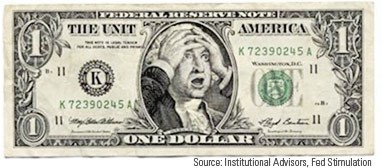
Dollar Cartoon

Should government actively manipulate asset prices in an effort to “manage ” economic growth? The world’s central bankers, otherwise at their wit’s end, are attempting just that. Hopes have been pinned on so-called quantitative easing (QE), which simply means that central banks like the U.S. Federal Reserve (the Fed) buy assets (government and private bonds) from the public to inject newly “printed” money into the economy. The Fed purchased $4.5 trillion of assets between the last financial crisis and late 2014, when it ended its QE. Other central banks are actively engaged in QE, however, and there are still calls from some quarters for the Fed to resume QE, despite modest but positive economic growth. The goals of QE are to drive asset prices up and interest rates down, ultimately stimulating demand for goods and economic growth. Short-term rates have been near zero in many countries (and in the U.S. until December), and negative short-term interest rates are a reality in the European Union, Japan and Sweden.

Does anyone really have to pay money to lend money, as indicated by a negative interest rate? Yes, if a bank “lends” to the Bank of Japan, for example, by holding reserves there. The BOJ is currently charging banks for the privilege. But does anyone really “earn” negative returns on short-term government or private debt? Not unless you buy a short-term bill and hold it till maturity. Central banks are buying those bills at a premium, usually from member banks, in order to execute QE, and that offsets a negative rate. But the notion is that when these “captive” member banks are penalized for holding reserves, they will be more eager to lend to private borrowers. That may be, but only if there are willing, credit-worthy borrowers; unfortunately, those are scarce.

Thus far, QE and zero or negative rates do not seem to be working effectively, and there are several reasons. First, QE has taken place against a backdrop of increasingly binding regulatory constraints. A private economy simply cannot flourish under such strictures, with or without QE. Moreover, government makes a habit of manipulating investment decisions, partly through regulatory mandates, but also by subsidizing politically-favored activities such as ethanol, wind energy, post-secondary education, and owner-occupied housing. This necessarily comes at the sacrifice of opportunities for physical investment that are superior on economic merits.

The most self-defeating consequence of QE and rate manipulation, be that zero interest rate policy (ZIRP) or negative interest rate policy (NIRP), is the distortion of inter-temporal tradeoffs that guide decisions to save and invest in productive assets. How, and how much, should individuals save when returns on relatively safe assets are very low? Most analysts would conclude that very low rates prompt a strong substitution effect toward consuming more today and less in the future. However, the situation may well engender a strong “income effect”, meaning that more must be saved (and less consumed in the present) in order to provide sufficient resources in the future. The paradox shouldn’t be lost on central bankers, and it may undermine the stimulative effects of ZIRP or NIRP. It might also lead to confusion in the allocation of productive capital, as low rates could create a mirage of viability for unworthy projects. Central bank intervention of this sort is disruptive to the healthy transformation of resources across time.

Savers might hoard cash to avoid a negative return, which would further undermine the efficacy of QE in creating monetary stimulus. This is at the root of central bank efforts to discourage the holding of currency outside of the banking system: the “war on cash“. (Also see here.) This policy is extremely offensive to anyone with a concern for protecting the privacy of individuals from government prying.

Another possible response for savers is to “reach for yield”, allocating more of their funds to high-risk assets than they would ordinarily prefer (e.g., growth funds, junk bonds, various “alternative” investments). So the supply of saving available for adding to the productive base in various sectors is twisted by central bank manipulation of interest rates. The availability of capital may be constrained for relatively safe sectors but available at a relative discount to risky sectors. This leads to classic malinvestment and ultimately business failures, displaced workers, and harsh adjustment costs.

With any luck, the Fed will continue to move away from this misguided path. Zero or negative interest rates imposed by central banks penalize savers by making the saving decision excessively complex and fraught with risk. Business investment is distorted by confusing signals as to risk preference and inflated asset prices. Central economic planning via industrial policy, regulation, and price controls, such as the manipulation of interest rates, always ends badly. Unfortunately, most governments are well-practiced at bungling in all of those areas.


ZIRP’s Over, But Fed Zombies Linger Over Seed Corn

24 Thursday Dec 2015

Posted by Nuetzel in Central Planning, Monetary Policy, Price Controls

≈ Leave a comment

Tags

Capital investment, Central Bank Intervention, central planning, negative interest rates, Price Ceilings, Price Controls, Ronald-Peter Stoferle, Saving Incentives, The Federal Reserve, Time Preference, Zero Interest Rate Policy, ZIRP, Zombie Banks

Fed Rate Cuts

The Federal Reserve plans a few more increases in short-term interest rates in 2016, which should be welcome to savers who are not overexposed to market risk. The Fed took its first step away from the seven-year zero-interest-rate policy (ZIRP) last week, increasing its target rate on overnight loans between banks (“federal” funds) for the first time in almost ten years. ZIRP was grounded in the Fed’s desire to stimulate the economy after the last financial crisis, an objective that met with limited success. ZIRP’s most profound “success” was to distort prices, with negative consequences for conservative savers, those dependent on retirement assets, and the long-term growth of the economy.

ZIRP necessarily constitutes a price ceiling when expected inflation is positive. It implies negative real rates of return, but real rates of time preference are not and cannot be negative. Given the choice, no one intends to forego present pleasure to purposefully suffer a loss later. The imperative to earn positive real returns does not end simply because the Fed and ZIRP make it more difficult. 

Anyone with funds parked in near zero-return assets, such as money market funds and certificates of deposit, earned a negative real return during the ZIRP regime, as inflation remained positive despite misplaced fears to the contrary. Those kinds of savings vehicles earn relatively low returns and should carry little risk to savers.

What are savers and retirees to do under a ZIRP regime? If they absolutely must defer consumption, they can accept the predicament and leave funds to decay in real value. They can dis-save in response to the disincentive, consuming their accumulated wealth. Some, for whom retirement is near, might even put more aside with the full knowledge that it will erode in real terms. But many will seek out yield in other ways, investing in assets bearing greater risk than they would otherwise prefer. All of these alternatives are likely to be less-preferred by the public than rates of saving and portfolios constructed in the absence of the Fed’s rate distortions.

The Fed’s policies and zero rates have contributed to inflated equity prices over the past six years as savers sought enhanced returns, and those valuations are certainly vulnerable. Over the past week, market jitters have shown the extent to which traders and investors feel threatened by the Fed’s tightening move.

The impact of ZIRP on the well-being of savers is only part of the story, however. Such a regime compromises the fundamental process of aligning preferences with the physical transformation of present resources into future consumption. Like any price distortion, ZIRP misallocates resources, but it misallocates across time and across sectors of the economy. When discounted at ultra-low rates, the values of future financial flows are grossly inflated, diminishing the need to set additional amounts aside today. At the same time, zero or near-zero rate borrowing confuses the evaluation of alternative capital investment projects. Resources may be committed to projects that would be rejected given accurate price signals. The artificially-enabled bidding for resources prompted by ZIRP, and the distortion of the risk-return trade off, might even cause more worthy projects to be rejected. And there is every reason to expect that saving by some individuals will be channeled into immediate consumption by others.

Who would do such wasteful things, undertaking projects with low or nonexistent future returns? Those facing distorted price signals, most prominently government technocrats for whom meaningful price signals are seldom a concern. And that also goes for the subsidy-hungry private beneficiaries of the state’s tax-extracted and borrowed largess. The ultimate consequence of this behavior is a deterioration in the economy’s growth potential.

Ronald-Peter Stoferle provides a short catalogue of ZIRP’s destructive impacts in the “Unseen Consequences of ZIRP“. One of his more interesting statements is the following, with reference to “zombie” banks:

“Low interest rates prevent the healthy process of creative destruction. Banks are enabled to roll over potentially non-performing loans practically indefinitely and can thus lower their write-off requirements.“

Thus, ZIRP promotes economic rot in several ways. Last week’s rate move by the Fed is a step in the right direction, away from zero rates and drastic overvaluation of consumption flows now and in the future. However, the monetary excesses of the past six years will not be reversed by this one move. The Fed is still imposing an artificial ceiling on rates. Even if that restriction is eased in further steps during 2016, the Fed is committed for the long-term to the manipulation of interest rates in the execution of policy. That sort of activist market manipulation is likely to continue; like all forms of central planning, it will be based on woefully incomplete information, a poor understanding of individual and market behavior, and bad timing. It will degrade economic conditions and have the classic boom-and-bust repercussions typical of central bank intervention.

Would You Tax Coastal Development?

14 Monday Dec 2015

Posted by Nuetzel in Central Planning, Global Warming

≈ Leave a comment

Tags

Carbon forcing, central planning, Climate Alarmism, Climate Change, Coastal development, Coastal tax, Federal Flood Insurance, FEMA, Glacier Melts, Glenn Reynolds, Pigouvian subsidies, Pigouvian Taxes, Robin Hanson, Sea Ice Extent, Strait of Gibraltar, Subsidies, Taxing development

Sea Level

If sea levels are truly rising due to climate change, then public policy should stop encouraging new development in coastal areas. Stipulating that this threat is real for the moment, serious and damaging encroachment of the seas might be 50 years away or more. By that time, many of today’s coastal buildings will be gone, or at least candidates for replacement, under realistic assumptions about the average lives of structures. A relatively low-cost approach to the threat of rising seas would be to stop building along the most vulnerable coasts right now and move new development inland. Yet no one wants to do that, least of all coastal property owners. But there is little discussion of this alternative even among the true believers of a coming global warming apocalypse. Why not?

This and related questions have been asked recently by several writers, including Glenn Reynolds and economist Robin Hanson. There are alternatives to discouraging new construction along coasts. Other expensive abatement projects can be pursued, now and later, such as sea walls or even adding land mass excavated from the sea floor or inland. In fact, the prospect of damming the Strait of Gibraltar to protect Mediterranean coastlines has been discussed. The expense of such an unprecedented public works project is what prompted Hanson’s post. To the extent that such remedial projects are not funded privately, they represent social costs arising from coastal development.

The federal government still subsidizes flood insurance on many coastal properties, though efforts to phase-out this FEMA program have been underway for a few years. However, governments seem only too willing to undertake the investment in public infrastructure and ongoing maintenance made necessary by new coastal development. And like other development projects, tax abatements and other subsidies are still granted for coastal development. Why do these policies escape notice from coastal green elites?  Public outlays with private beneficiaries along threatened coasts are an immediate drain on resources, relieving private developers and property buyers of shoreline risk.

Reynolds (perhaps tongue-in-cheek) and Hanson suggest that new development should be taxed in coastal areas. That, and ending subsidies for development along coasts, is an economically and ecologically defensible alternative to the public expense of ubiquitous sea walls. However, a coastal tax might not be in the immediate interests of elites  who claim that mankind faces an insurmountable global warming problem. Better to put off these sorts of remedial measures, especially while you can tax and regulate fossil fuels, and maybe live on the coast!

The position of the warmist community is that carbon emitters must cease and desist, in the hope that the seas will stop rising. They are willing to destroy entire industries (fossil fuels) in pursuit of their goals, but are unlikely to achieve them without inflicting drastic economic harm. If greens are so amenable to central control of economic activity and individual behavior (so long as they are at the controls), it would be prudent to take precautions now that will help to minimize the damage later. Discouraging coastal development with taxes and denial of subsidies is the sort of classic intervention that any Pigouvian planner should love. There is even evidence that sea levels have been much higher at times in the past. An earnest central planner might say that coastal development should always be discouraged to mitigate the risk of destruction.

I am skeptical of alarmist claims, including those related to rising sea levels. In fact, the connection between carbon emissions, global temperatures and sea levels is not well established, and whether sea levels are rising due to human activity is a matter of some dispute. Furthermore, global sea ice extent is not declining dramatically, if at all, and the storied glacier melts have been greatly exaggerated. Climate activists pursue their agenda despite the gross inaccuracy of past carbon-forcing forecasts, the gaping uncertainty surrounding model predictions going forward, and the crushing expense of the measures they advocate. The expense, however, is not one that activists expect to compromise their own standard of living. They either assume that it will be borne by others or that their draconian prescriptions will usher in an era of “sustainability”, powered by new, renewable energy sources. Not many of these alarmists would boast that their policies can quickly reverse the sea level rises they’ve told us to fear, but they dare not suggest taxes on coastal development until they see more convincing evidence. At least that much is sensible, if ironic!

Government Economy; Government Science: You Wanted Growth?

28 Wednesday Oct 2015

Posted by Nuetzel in Central Planning, Regulation, Technology

≈ Leave a comment

Tags

Basic Science, economic growth, Innovation, John Cochrane, Matt Ridley, Productivity Growth, Public Funding of Science, regulation, Technological advance

science1

Economic growth allows us to enjoy an improving material existence and the wealth to pursue other goals as a society, such as a clean environment. Yet we often pursue other goals in ways that strangle growth, when in fact those goals and growth are fundamentally compatible.

Two articles that caught my attention today approach this issue from different but complementary perspectives. One is by John Cochrane of the University of Chicago, a lengthy piece called simply “Economic Growth“. At the outset, Cochrane asserts that the one, ultimate source of economic growth in the long-run is through advancing productivity. He notes, however, that the U.S. has been falling short in that department of late. Re-establishing growth should start with a clean-up of the many harmful public policies that have cluttered the economic landscape, especially over the last few decades. Unfortunately, politics makes this easier said than done:

“The golden rule of economic policy is: Do not transfer incomes by distorting prices or slowing competition and innovation. The golden rule of political economics seems to be: Transfer incomes by distorting prices and regulating away competition. Doing so attracts a lot less attention than on-budget transfers or subsidies. It takes great political leadership to force the political process to obey the economic rule.“

Cochrane’s discussion is wide ranging, covering a number of areas of public policy that require “weeding”, as he puts it: the regulatory arena (finance, health care, energy and the environment), tax policy, debt and deficits, the design of social programs and entitlements, labor law and regulation, immigration, education, agricultural policy, trade, and the process of infrastructure investment. There may be a year’s worth of blog posts to be drawn from Cochrane’s essay, but I think “weeding” understates the difficulty of the tasks outlined by Cochrane to reignite growth.

The second article that interested me today dealt with technological advance, which is a primary driver of productivity growth. Economists and pundits often prescribe policies that they believe will lead to transformational breakthroughs in technology. This usually manifests in advocacy for increased public funding for basic scientific research. This is a mistake, according to Matt Ridley’s great article, “The Myth of Basic Science“. In fact, one might say that he’s identified another government-nourished weed for Cochrane to pull. I found Ridley’s opening paragraph intriguing:

“Innovation is a mysteriously difficult thing to dictate. Technology seems to change by a sort of inexorable, evolutionary progress, which we probably cannot stop—or speed up much either. And it’s not much the product of science. Most technological breakthroughs come from technologists tinkering, not from researchers chasing hypotheses. Heretical as it may sound, “basic science” isn’t nearly as productive of new inventions as we tend to think.“

Ridley’s thesis (actually, he credits several others for formulating this line of thinking) is that technology growth is very much an independent process, impossible to push or steer effectively. He goes so far as to say that it can’t be stopped, but he also cites ways in which it can be inhibited.

This perspective on technology has implications for patent law, a subject that Ridley explores to some extent. It also reflects badly on government efforts to direct and stimulate advances by granting subsidies to favored technologies and more aggressive funding of  “basic science”. Government, in Ridley’s view, is largely impotent in spawning technological advance. By pushing technologies that are uneconomic, government distorts price signals, diverts resources from more productive investments, and embeds inferior technologies in the economy’s productive capital base.

But Ridley’s point has more to do with the futility of basic science as a driver of technological advance, and the strong possibility that causation often runs in the other direction:

“It is no accident that astronomy blossomed in the wake of the age of exploration. The steam engine owed almost nothing to the science of thermodynamics, but the science of thermodynamics owed almost everything to the steam engine. The discovery of the structure of DNA depended heavily on X-ray crystallography of biological molecules, a technique developed in the wool industry to try to improve textiles.

Technological advances are driven by practical men who tinkered until they had better machines; abstract scientific rumination is the last thing they do. As Adam Smith, looking around the factories of 18th-century Scotland, reported in ‘The Wealth of Nations’: ‘A great part of the machines made use in manufactures…were originally the inventions of common workmen,’ and many improvements had been made ‘by the ingenuity of the makers of the machines.’

It follows that there is less need for government to fund science: Industry will do this itself. Having made innovations, it will then pay for research into the principles behind them. Having invented the steam engine, it will pay for thermodynamics. This conclusion … is so heretical as to be incomprehensible to most economists, to say nothing of scientists themselves.“

It’s good to qualify that “industry will do this itself” only if it isn’t severely hamstrung by meddling politicians and regulators.

Ridley goes on to cite a few inconvenient historical facts that run counter to the narrative that public funding of science is a necessary condition for technical advance. He also cites empirical work suggesting that the return on publicly-funded R&D is paltry. In fact, he allows that government involvement in “basic science” may inhibit more economically viable advances and their adoption. There is no question that government often chooses unwisely without the discipline of market incentives. If it gets funded, then bad science, politically-driven “science” and ultimately nonproductive science might very well crowd-out better private science and innovation.

In a time of strained government budgets, public funding for basic science should be subjected to as much scrutiny as any other spending category. Like Ridley, I have much more faith in private tinkerers to choose wisely when it comes to the development of new technologies. Intimacy with actual markets and with the production process itself improve the odds that private developers and technologists will be more effective at boosting productivity.

Obamacare’s Left-Handed Monkey Wrench

20 Tuesday Oct 2015

Posted by Nuetzel in Central Planning, Obamacare

≈ Leave a comment

Tags

ACA, Accountable Care Organizations, Bending the Cost Curve, central planning, David Henderson, Exchange Enrollment, Ezra Klein, John C. Goodman, Medicare Advantage, Megan McArdle, Michael Schaus, Obamacare, Obamacare Coops, Obamacare Replacement, Pay For Performance, Risk corridors, Wharton ACA Study

ACA Zombies

Distorted overtures celebrating the great success of Obamacare continue, but no one who cares about the facts is buying the blather. Megan McArdle reminds us that even if we stipulate that the 9.9 million now enrolled on the exchanges have gained something, Obamacare has delivered far less than promised. McArdle also notes the high-risk skew of the population within the risk pools. That’s why insurers are losing money on Obamacare coverage, though their losses have been covered via government “risk corridors” thus far. In “Obamacare Bear Market” at wsj.com (links to a Google search result to get around the paywall — or just search “wsj Obamacare Bear”), we hear about the dismal financial performance of the Obamacare coops, which sell plans on the exchanges. The WSJ also reflects on a new working paper from Wharton economists:

“They conclude that, ‘even under the most optimistic assumptions,’ half of the formerly uninsured take on both a higher financial burden and lower welfare, and on net ‘average welfare for the uninsured population would be estimated to decline after the ACA [Affordable Care Act] if all members of that population obtained coverage.’

In other words, ObamaCare harms the people it is supposed to help. This is not a prescription for a healthy, durable program.“

Health economist John C. Goodman gives more detail on the Wharton study in “Obamacare is bad for the middle class“. Even Ezra Klein admits that the health plan is a failure. Whether Klein really gets it or not, the result is just another failure of central planning. Here’s a quote from Michael Schaus from the last link:

“The same people who failed miserably at launching a website will soon be regulating the sophisticated day-to-day decisions of hospitals, insurers and doctors.“

Anticipating another year of disappointing enrollments ahead, the White House now is low-balling its enrollment target for 2016. This an apparent attempt to present a better face to the public when the bad numbers roll in.

Another piece by Goodman explains that “bending the cost curve” with Obamacare was always a fool’s errand. Again, it has a lot to do with the folly of central planning:

“In a normal market, the entrepreneurs wake up every morning and ask themselves: How can I make costs lower, quality higher, and access to my product better today?

But in a bureaucratic system – where revenues are determined not by customer satisfaction, but by complicated payment formulas – they tend to wake up and ask: How can I get more money out of the payment formulas today?“

Goodman explains that an insurance firm providing coverage through Medicare Advantage would have nothing to gain by introducing cost-saving innovations: all of the extra profit would be turned over to Medicare. Incentives matter, but bureaucrats often fail to understand incentives and their power to improve performance. Goodman also describes the poor results of the so-called Accountable Care Organizations, the futile pilot programs and demonstration projects related to the practice of medicine, and the gaming that has taken place within the hospital “pay-for-performance” program. Ironically, the most certain outcome of any attempt to impose central planning on an industry is that there will be unintended and undesirable consequences.

Goodman has written a book proposing an Obamacare replacement, entitled “A Better Choice: Healthcare Solutions For America“. Here is David Henderson’s favorable review, in which he focuses on the negative labor market effects of Obamacare, including poor incentives for employers and work effort, among other things. To close, here’s an excerpt from Henderson’s introduction:

“If you think that the Patient Protection and affordable Care act (ACA, also known as Obamacare) is bad because of its expense, the distortions it causes in the labor market, its failure to provide people what they really want, and its highly unequal treatment of people in similar situations, wait until you read John C. Goodman’s A Better Choice: Healthcare Solutions for America. You will likely conclude that the ACA is even worse than you thought.

That’s the bad news. The good news is that Goodman … proposes reforms that would do more for the uninsured than the ACA does, and at lower cost, and also would make things better for the currently insured. and it would do all this while avoiding mandates, creating more real competition among insurers, and making the health care sector more responsive to consumers….“

Hillary’s Got Some Promises and a Rat’s Nest

03 Monday Aug 2015

Posted by Nuetzel in Big Government, Central Planning

≈ Leave a comment

Tags

Andrew Napolitano, Capital Gains Tax, central planning, Clinton renewable energy plan, Friedrich Hayek, Half a billion solar panels, Hillary Clinton, Hillarycare, Ira Stoll, Jeffrey Tucker, Larry Kudlow, Obamacare employer mandate

Hillary

Hillary Clinton is an advocate for governmentalizing the social order, and asks America to trust that central control, under her command, will accomplish great things such as upward mobility for the middle class, a rising standard of living, green energy for all, a “fix” for Obamacare, and much else. Jeffrey Tucker writes of Hillary’s delusions in “Hillary Clinton’s Ideological Vortex of Power and Planning” and her assurances that she’ll take measures with predictable impacts on the global climate, measures that will direct all details of energy production and use.

Tucker throws cold water on Hillary’s promises by viewing them in the context of F.A. Hayek warnings about the ruinous effects of central planning and control:

“That brilliant economist spent 50 years explaining, in book after book, that the greatest danger humanity faced, now and always, was a presumption on the part of intellectuals, politicians, and bureaucrats that they know better than the emergent and evolving wisdom of social forces.

This presumption might seem like science but it is really pretense. Civilization arises from, is protected by, and advances through the dispersed knowledge of billions of individual decision makers and the institutions that arise from them.

Hayek called the issue he was investigating the knowledge problem. Society needs to know how to use scarce resources, how to navigate a world of uncertainty, how to form rules that turn struggle into peace. It is a problem solved through freedom alone. No ruler, no scientist, no intellectual can substitute for the evolving process of decentralized decision making and trial and error.“

I discussed the fatuous presumptions of the left in an earlier SCC post entitled: “Conscious Design, the Collective Mind and Social Decline“. In that post, I used the wonderful Hayek quote:

“We flatter ourselves undeservedly if we represent human civilization as entirely the product of conscious reason or as the product of human design, or when we assume that it is necessarily in our power deliberately to re-create or to maintain what we have built without knowing what we were doing.“

More specifically, on energy policy, Clinton says she will set an agenda for the country to produce enough renewable energy within 10 years to power every American home, and to install half a billion solar panels across the country by the end of her first term. As Ira Stoll says at Reason.com, this is “central planning at its worst“.

“Clinton assumes that man-made climate change is a risk serious enough to try to mitigate, and that America should try to mitigate it by reducing its carbon emissions. These are big ‘ifs,’ but ones I will grant for argument’s sake. Even granting those assumptions, there is a humongous logical leap to the conclusion that the appropriate policy response is setting a national target for the number of solar panels installed.

For one thing, it’s a classic error of measuring inputs rather than outputs. If the goal is the reduction of dangerous emissions, why not set a goal for that, and support any energy method—solar, wind, algae, hydroelectric, nuclear, hydrofracturing—that gets America closer to that goal? Why privilege solar over all the other technologies, including some that may not even be invented yet?“

Certainly, proposals like this create tremendous opportunities for rewarding cronies. Stoll also notes that solar technology will improve over time, but rushing to install millions of panels, undoubtedly encouraged by heavy subsidies, would saddle users in the long-term with less efficient versions. With future improvements in efficiency and cost, the technology will gradually draw users in without the need for subsidies. That’s what rational economic decision-making looks like!

A specific economic proposal from the Clinton camp would increase the capital gains tax rate on asset sales held from 364 days up to six years. The rate would double if the asset was held up to two years. The increases become gradually smaller for two-to-six year holding periods. Hillary’s is somehow unaware that the government has already made it incredibly difficult for businesses to raise capital to invest in new buildings, equipment, and technology. Capital gains taxes are punitive: they represent double taxation of income to investors and they further distort rates of return by taxing assets on inflationary increases in value, which diminish their real value. Larry Kudlow wrote a good opinion piece on this proposal, called “Hillary’s Inconceivably Stupid Capital-Gains Tax Scheme“. He focuses on Hillary’s attack on the alleged “short-termism” in the economy, but this is a little odd, because her plan essentially discourages saving.

On health care, Clinton has pledged to “improve” Obamacare, but not repeal it. Too bad. It is similar to the plan she put forward as a Senator, including the individual mandate. The only piece of good news here is that she has discussed eliminating the employer mandate, which has been deferred by the Obama Administration twice already. However, some effects of the employer mandate have been felt, as it has tended to discourage employers from taking on full-time employees.

On foreign policy, Clinton is probably more hawkish than President Obama. Her stint as Obama’s Secretary of State was not marked by any noteworthy accomplishment.

Then there is the question of Clinton’s integrity. She’s been tainted by scandals before (e.g., Whitewater). She told a Brian Williams-like lie about being fired upon in Bosnia. The role of the Clinton Foundation, and whether it served as a mechanism for influence-buying, has also been in question, not to mention its seeming role as a personal slush fund for the Clintons. Her ties to Wall Street probably exceed Obama’s. And she maintained a private email server while Secretary of State, which was imprudent at best, and depending on the the classification of what went through that server, criminal at worst. Finally, her involvement in the Benghazi tragedy has been in question from the beginning. On some events related to Benghazi, including Hillary’s potential involvement in suspicious arms trading activity, Andrew Napolitano insists that “Hillary Keeps Lying“.

And here is Jeffrey Tucker waxing sarcastic about Hillary in another context: “Just trust her. Truly, just trust her …” 

Newer posts →
Follow Sacred Cow Chips on WordPress.com

Recent Posts

  • The Case Against Interest On Reserves
  • Immigration and Merit As Fiscal Propositions
  • Tariff “Dividend” From An Indigent State
  • Almost Looks Like the Fed Has a 3% Inflation Target
  • Government Malpractice Breeds Health Care Havoc

Archives

  • January 2026
  • December 2025
  • November 2025
  • October 2025
  • September 2025
  • August 2025
  • July 2025
  • June 2025
  • May 2025
  • April 2025
  • March 2025
  • February 2025
  • January 2025
  • December 2024
  • November 2024
  • October 2024
  • September 2024
  • August 2024
  • July 2024
  • June 2024
  • May 2024
  • April 2024
  • March 2024
  • February 2024
  • January 2024
  • December 2023
  • November 2023
  • August 2023
  • July 2023
  • June 2023
  • May 2023
  • April 2023
  • March 2023
  • February 2023
  • January 2023
  • December 2022
  • November 2022
  • October 2022
  • September 2022
  • August 2022
  • July 2022
  • June 2022
  • May 2022
  • April 2022
  • March 2022
  • February 2022
  • January 2022
  • December 2021
  • November 2021
  • October 2021
  • September 2021
  • August 2021
  • July 2021
  • June 2021
  • May 2021
  • April 2021
  • March 2021
  • February 2021
  • January 2021
  • December 2020
  • November 2020
  • October 2020
  • September 2020
  • August 2020
  • July 2020
  • June 2020
  • May 2020
  • April 2020
  • March 2020
  • February 2020
  • January 2020
  • December 2019
  • November 2019
  • October 2019
  • September 2019
  • August 2019
  • July 2019
  • June 2019
  • May 2019
  • April 2019
  • March 2019
  • February 2019
  • January 2019
  • December 2018
  • November 2018
  • October 2018
  • September 2018
  • August 2018
  • July 2018
  • June 2018
  • May 2018
  • April 2018
  • March 2018
  • February 2018
  • January 2018
  • December 2017
  • November 2017
  • October 2017
  • September 2017
  • August 2017
  • July 2017
  • June 2017
  • May 2017
  • April 2017
  • March 2017
  • February 2017
  • January 2017
  • December 2016
  • November 2016
  • October 2016
  • September 2016
  • August 2016
  • July 2016
  • June 2016
  • May 2016
  • April 2016
  • March 2016
  • February 2016
  • January 2016
  • December 2015
  • November 2015
  • October 2015
  • September 2015
  • August 2015
  • July 2015
  • June 2015
  • May 2015
  • April 2015
  • March 2015
  • February 2015
  • January 2015
  • December 2014
  • November 2014
  • October 2014
  • September 2014
  • August 2014
  • July 2014
  • June 2014
  • May 2014
  • April 2014
  • March 2014

Blogs I Follow

  • Passive Income Kickstart
  • OnlyFinance.net
  • TLC Cholesterol
  • Nintil
  • kendunning.net
  • DCWhispers.com
  • Hoong-Wai in the UK
  • Marginal REVOLUTION
  • Stlouis
  • Watts Up With That?
  • Aussie Nationalist Blog
  • American Elephants
  • The View from Alexandria
  • The Gymnasium
  • A Force for Good
  • Notes On Liberty
  • troymo
  • SUNDAY BLOG Stephanie Sievers
  • Miss Lou Acquiring Lore
  • Your Well Wisher Program
  • Objectivism In Depth
  • RobotEnomics
  • Orderstatistic
  • Paradigm Library
  • Scattered Showers and Quicksand

Blog at WordPress.com.

Passive Income Kickstart

OnlyFinance.net

TLC Cholesterol

Nintil

To estimate, compare, distinguish, discuss, and trace to its principal sources everything

kendunning.net

The Future is Ours to Create

DCWhispers.com

Hoong-Wai in the UK

A Commonwealth immigrant's perspective on the UK's public arena.

Marginal REVOLUTION

Small Steps Toward A Much Better World

Stlouis

Watts Up With That?

The world's most viewed site on global warming and climate change

Aussie Nationalist Blog

Commentary from a Paleoconservative and Nationalist perspective

American Elephants

Defending Life, Liberty and the Pursuit of Happiness

The View from Alexandria

In advanced civilizations the period loosely called Alexandrian is usually associated with flexible morals, perfunctory religion, populist standards and cosmopolitan tastes, feminism, exotic cults, and the rapid turnover of high and low fads---in short, a falling away (which is all that decadence means) from the strictness of traditional rules, embodied in character and inforced from within. -- Jacques Barzun

The Gymnasium

A place for reason, politics, economics, and faith steeped in the classical liberal tradition

A Force for Good

How economics, morality, and markets combine

Notes On Liberty

Spontaneous thoughts on a humble creed

troymo

SUNDAY BLOG Stephanie Sievers

Escaping the everyday life with photographs from my travels

Miss Lou Acquiring Lore

Gallery of Life...

Your Well Wisher Program

Attempt to solve commonly known problems…

Objectivism In Depth

Exploring Ayn Rand's revolutionary philosophy.

RobotEnomics

(A)n (I)ntelligent Future

Orderstatistic

Economics, chess and anything else on my mind.

Paradigm Library

OODA Looping

Scattered Showers and Quicksand

Musings on science, investing, finance, economics, politics, and probably fly fishing.

  • Subscribe Subscribed
    • Sacred Cow Chips
    • Join 128 other subscribers
    • Already have a WordPress.com account? Log in now.
    • Sacred Cow Chips
    • Subscribe Subscribed
    • Sign up
    • Log in
    • Report this content
    • View site in Reader
    • Manage subscriptions
    • Collapse this bar
 

Loading Comments...