
• About

Sacred Cow Chips

Sacred Cow Chips

Category Archives: Markets

Behold Our Riches! Quality, Prices, Income, and the Purchasing Power of Labor

12 Tuesday Sep 2017

Posted by Nuetzel in Human Welfare, Markets

≈ 1 Comment

Tags

Affordability, Consumer Surplus, Don Boudreaux, Human Progress, Income Statistics, John D. Rockefeller, Marian Tupy, Martin Feldstein, Measures of Economic Welfare, Middle Class Stagnation, Non-Wage Benefits, Quality Adjustment, Wage Stagnation

coffeemaker

A steady refrain among pundits is that the American middle class can’t get ahead. The standard of living of average Americans has stagnated over the past 30 years, according to this view. It’s bolstered by government measures of average wage growth relative to consumer prices. But Martin Feldstein describes the flaws in constructing these measures; he says they may have led to an understatement of real income growth of more than 2% per year! Here is a link to Feldstein’s piece in the Wall Street Journal: “We’re Richer Than We Realize“. (If the link doesn’t work, an ungated link can be found on the WSJ Facebook page, posted at 10:30 a.m. on Saturday, Sept. 9th.)

Here are some of Feldstein’s observations:

“If there is no increase in the cost of production, the government concludes that there has been no increase in quality. And if the manufacturer reports an increase in the cost of production, the government assumes that the value of the product to consumers has increased in the same proportion.

That’s a very narrow—and incorrect—way to measure quality change. In reality companies improve products in ways that don’t cost more to produce and may even cost less. That’s been true over the years for familiar products like television sets and audio speakers. The government therefore doesn’t really measure the value to consumers of the improved product, only the cost of the increased inputs. The same approach, based on measuring the cost of inputs rather than the value of output, is also used for services.

The official estimates of quality change are therefore mislabeled and misinterpreted. When it comes to quality change, what is called the growth of real output is really the growth of real inputs. The result is a major underestimation of the increase in real output and in the growth of real incomes that occurs through quality improvements.

The other source of underestimation of growth is the failure to capture the benefit of new goods and services. Here’s how the current procedure works: When a new product is developed and sold to the public, its market value enters into nominal gross domestic product. But there is no attempt to take into account the full value to consumers created by the new product per se.“

It goes well beyond that, however, as great swaths of consumer value are completely ignored by government statistics:

“A basic government rule of GDP measurement is to count only goods and services that are sold in the market. Services like Google and Facebook are therefore excluded from GDP even though they are of substantial value to households. The increasing importance of such free services implies a further understatement of real income growth.“

Some of these criticisms are unfair to the extent that income statistics correspond to what consumers can purchase in terms of market value. That is a fundamentally different concept than the total value consumers assign to goods and services (market value plus consumer surplus). Nevertheless, there are efforts to adjust for quality in these statistics, but they fall far short of their objective. Also, GDP and income statistics purport to be measures of economic welfare, though it’s well known that they fall short of that ideal. It might be more fair to say that that official income statistics are reliable in tracking short-term changes in well being, but not so much over long periods of time.

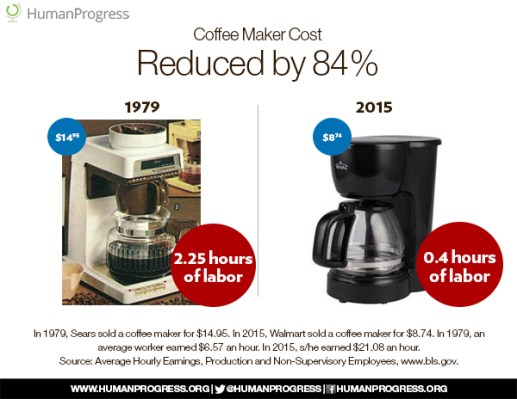
The graphic at the top of this post is taken from Marian L. Tupy’s “Cost of Living and Wage Stagnation in the United States, 1979-2015“, on the CATO Institute‘s web site:

“… many, perhaps most, big-ticket items used by a typical American family on a daily basis have decreased in price. Over at Human Progress, we have been comparing the prices of common household items as advertised in the 1979 Sears catalog and prices of common household items as sold by Walmart in 2015.

We have divided the 1979 nominal prices by 1979 average nominal hourly wages and 2015 nominal prices by 2015 average nominal hourly wages, to calculate the “time cost” of common household items in each year (i.e., the number of hours the average American would have to work to earn enough money to purchase various household items at the nominal prices). Thus, the ‘time cost’ of a 13 Cu. Ft. refrigerator fell by 52 percent in terms of the hours of work required at the average hourly nominal wage, etc.“

Tupy’s post also covers the huge increases in non-wage benefits enjoyed by many workers over the past several decades, which are not captured in average wage statistics.

It’s clear that standard measures of income growth are distorted by the failure to properly account for changes in the quality of goods and services at our disposal. The narrative of middle class stagnation is flawed in that respect. As Don Boudreaux has said, most ordinary Americans are richer today than John D. Rockefeller was a century ago. The availability and quality of goods and many services today, affordable to ordinary Americans, are vastly superior to what Rockefeller had then or could even imagine. And many of those advancements occurred since the 1970s.

Sharing Apps and Market Benefits

24 Saturday Jun 2017

Posted by Nuetzel in Markets, Transaction Costs

≈ Leave a comment

Tags

Airbnb, Allocative efficiency, competition, Double Coincidence of Wants, Medium of Exchange, Michael Munger, Property Rights, Ride sharing, Sharing economy, Transaction Costs, Transactions Technology, Uber

Transaction costs prevent lots of trades. So many that we often aren’t aware of their potentiality. Michael Munger asserts that transaction costs are so prohibitive that we tend to accumulate a lot of stuff that we could otherwise do without. That’s what he says in “Why we can’t break up with our stuff — yet“.

Transaction costs of all kinds have fallen dramatically over time. One of the greatest innovations in “transactions technology” was the avoidance of barter with the broad acceptance of a medium of exchange (money). Without a medium of exchange, trade requires a “double coincidence of wants”, which often makes the effort to engage in trade impractical. No less important was the establishment of secure property rights such that the integrity of a contract or transaction was protected, whether enforced by possible repercussions from other traders or through the police power of the state. Secure property rights and the use of money facilitated the development of markets and pricing that conveyed better information about scarcity. Other historical developments that reduced transaction costs include better transportation, communication, packaging, and more efficient distribution and supply chain management. In a variety of complex transactions, such as real estate, standardization of contracts has reduced transaction costs.

Those costs have been reduced dramatically of late by new communication and computing technologies. The size of these reductions is difficult to quantify in such prominent examples as Uber ride-sharing and Airbnb home-sharing, but there is no question that the new supplies of rides and accommodations would not have materialized absent the enabling on-line “apps”. The ease, low-cost and minimal risk of these transactions is incredible.

Suppose that hotels in Soho average $400 per night for a suite and that Airbnb rentals in Soho average $300. It’s fair to say that the average Airbnb host in Soho, without Airbnb, faced transaction costs in arranging for qualified occupants of at least $100 plus Airbnb’s fees. Probably much more. Now, it’s true that the hotel suites and the Airbnb rentals are fundamentally different “products”, but they are alternatives for meeting a particular need.

Similar reductions in transaction costs are occurring across a wide variety of sectors besides transportation and vacation rentals: trading in new and used goods, handymen, concierge services, snow plowing, home-sitting, food delivery, and hook-ups are but a few examples.

Munger’s twist on this story is that dramatically lower transaction costs will mean we’ll all need to own much less “stuff” on average, because we can “share”, or at least buy what we need at minimal transaction cost. Or, what we have will be used more intensively because we can share it profitably.

Munger mentions the high cost of owning an auto that he uses for about 5 out of 168 total hours in a week. The costs include dedicated “storage” space, both at home and at work, and sometimes the extra cost of “storing” it in airport parking. He could certainly afford to arrange alternative forms of transportation. Is owning the auto worthwhile because the transaction costs of the alternatives are too high? Well, Munger owns a nice car and he probably likes to drive it, so there is more to it than transaction costs. Still, if we mention the “convenience” of having a car at one’s disposal, that is really an expression of transaction costs avoided via ownership.

If the cost of arranging an acceptable and ready alternative is minimal, why own a car? This decision is very real in certain congested locales with costly real estate (e.g., parking New York City). In short, Munger believes even fewer individuals will bother to own personal autos, or that those cars will be less idle (rented to users), as technology reduces transaction costs:

“Why do I pay to store my car rather than let other people use it and collect rent? Transaction costs. …But we are living in the beginning of a pivotal era that will transform our relationship to ‘stuff’ (we’ll need less of it) and to each other (we’ll share more). For all of human history until about 1995, the desire to reduce transaction costs was tied to the desire to sell a particular product. Now, entrepreneurs are combining three things — mobile platforms, software apps, and internet connections — to sell reductions in transaction costs with no product attached. And that combination will change everything.“

Will that also mean fewer personally-owned kitchen appliances? Home furnishings? Clothing? Power tools? Stereo components? Probably not. Even if it’s easy to find a willing renter for my power tools or stereo components from time-to-time, I might not want to bother with the required exchanges (at pick-up and return). I use power tools from time-to-time, but I won’t want to shlep back and forth to rent them from someone when I could own them myself at relatively low cost. Perhaps I’ll rent a tiller or a power washer, but not a power drill. Maybe I could hire a gopher on the Air-gopher app to get the tools I need and return them when I’m done, but that adds back to my transaction costs. So there are certain limits to how far this can go in reducing our “stuff”.

Nevertheless, there is no question that there will be many new trades and competitive opportunities to exploit as transaction costs fall, and that implies more choice, lower prices, and less waste in the larger allocative sense. Those, I believe, are the major benefits of sharing technologies. For example, if you enjoy cooking but are the sole member of your household, imagine an app that allows you to sell your extra preparations to other individuals, or to give them away at a minimal transaction cost. Or, if you are able to perform odd jobs but prefer to take them at your convenience, you will likely be able to bid for projects of your choice. If you have a talent for teaching guitar, you could solicit business and even provide the lessons remotely through an on-line app. The major impediment to the development of such market innovations is potential interference by government or other entrenched interests who wish to prevent competition. Licensing laws and various forms of regulation and taxes could easily smother or eliminate the benefits of sharing technologies, and that would be a shame.

I’ll close with a digression on Munger’s hypothesis: why do I own or keep a lot of “stuff? It’s not all about transaction costs. Most people harbor nostalgic feelings for their “stuff”. I hate parting with my old shirts, old drivers licenses, theater programs, and ticket stubs. Most of those things have approximately zero market value. Some people believe it’s just plain wasteful to pitch something that can be put back into working order, like an old lawnmower. Transaction costs might be to blame, but the failure to junk the mower in the first place may be driven by a depression-era instinct for penny-pinching. The hoarder might simply underestimate the benefits of a new mower, or perhaps they deserve credit for undertaking a restoration project they enjoy.

I find myself hoarding all kinds of things that I think might be useful to me somehow, someday. Particularly things like miscellaneous nuts & bolts, sundry pieces of hardware, wire, old fixtures, pieces of lumber, and my late Dad’s old tools. I’m certain I won’t ever use 95%+ of these items, but it’s reassuring to have the inventory. Then again, every time I need an odd item, I find myself in my basement work room searching through all that stuff. Invariably, I end up on my way to the hardware store to get what I need. So much for minimizing transaction costs. What would it cost me to pitch all of it? An afternoon of painful evaluation… yet that too represents a transaction cost!

Markets and Mobility

25 Thursday May 2017

Posted by Nuetzel in Markets, Poverty

≈ Leave a comment

Tags

Arnold Kling, Benefit Mandates, Collective Mind, Consumer Consensus, Don Boudreaux, Drug Laws, Foreign Aid, Jeffrey Tucker, Ludwig von Mises, Market Interactions, Minimum Wage, Occupational Licensing, Price Controls, Private Property, Public Aid, regulation, Wage controls, War on Poverty

Government aid programs tend to perform poorly, especially in developmental terms. In the U.S., anti-poverty programs keep the poor running in place, at best. Yes, they provide minimal income, but they seldom offer a way out and usually discourage it. Moreover, the administration of such programs diverts a significant share of funds to well-heeled civil servants and away from the intended recipients. Foreign aid programs are probably even worse, functioning as catch basins for funding corrupt officials. Progressives, in particular, persist in taking the paternalistic view that we must rely on government action to “care for” and “protect” the poor, able or not. Markets, on the other hand, are held to offer no promise in fighting poverty. In fact, the general assumption made by the progressive left is that markets exploit them.

The truth is that markets offer great promise for encouraging economic mobility. Arnold Kling offers a good conceptual construct in a recent post: while humans are often subject to irrational tendencies in their assessment of choices, their interactions in markets offer a way of smoothing irregularities and disparate bits of information, providing useful signals about the availability of resources and demands for their use. The result is a flow of information that best signals opportunity. Kling calls the process of market interactions the “collective mind”. Rather than encouraging individuals to fully participate in effective markets, free of intervention, we instead deny them the best opportunities for gain. The notion that the poor must be “protected” from markets is embedded in policies like wage and price controls, benefit mandates, overtime rules, drug laws, occupational licensing, and innumerable other harmful regulations. The poor should have the unfettered ability to avail themselves of the social efficiencies of Kling’s collective mind.

Last Thursday, Don Beaudroux’s “Quotation of the Day” was taken from an essay by Ludwig von Mises in which he characterized private property in a market economy as “property by consumer consensus”. In other words, consumers reward sellers who create value, and those rewards accumulate in the form of private property. Likewise, consumers punish poor performance, which has a cumulative negative impact on one’s ability to accumulate or hold onto private property. The benefits conferred by consumer preference do not stop with the owners of the firm. Others productively affiliated with the firm also reap gains in rewards, allowing them to accumulate private property. And of course, consumers are the beneficiaries in the first place: in their judgement the firm delivers value in excess of price. The key here is that free market rewards and penalties are deserved and based on productivity in meeting desires, and only the market can distribute property so efficiently. The able poor can certainly add value and thereby accumulate property, if only given the opportunity.

Jeffrey Tucker has stated that “Only Markets Can Win the War on Poverty” (ellipses are my edits):

“The default state of the world is grueling poverty, universal insecurity, and short lives. When governments do come along, they nearly always serve themselves first. … Capitalism made huge progress toward the conquest of poverty. For the first time in history, the productive resources of society turned from serving mainly the elites toward serving the common person. This change alone began to flip the power narrative of social evolution.

And this revolution continued for two some two-hundred years, during which time the average life span expanded dramatically, infant mortality collapsed, incomes rose, and the great project of universal ennoblement achieved an unprecedented boost. And this trend continues today wherever markets are given freedom to function, property rights are secure, and people can associate and trade without molestation by the elites. … In short, capitalism made huge progress toward the conquest of poverty.“

Markets are not harmful to the poor. To the contrary, as Tucker says, they have helped lift billions out of poverty around the globe. But government increasingly plays the role of big provider and arbiter of what can and can’t be traded, by whom, and at what price. The suspension of the market mechanism by this process denies the poor the opportunities made possible via participation in free markets, whereby Kling’s “collective mind” processes massive quantities of information and acts upon it spontaneously. But the “collective mind” concept, as a description of market interactions, is too simple: we know that individuals act on the signals provided by the market and are rewarded based on how effectively they do so. There is no doubt that the poor can do that too. It’s time to cast aside the paternalistic and destructive notion that the able poor must be insulated from markets.

The Looting Wage and Its Ultimate Victims

15 Wednesday Feb 2017

Posted by Nuetzel in Living Wage, Markets, Minimum Wage

≈ 1 Comment

Tags

Aaron Bailey, Apprenticeship Wages, Automation, Black Market Activity, Capital Controls, Capital investment, Education, Immigrant Labor, Living Wage, Minimum Wage, Price Controls, Productivity, Property Rights, Social Justice, Takings, Unskilled Labor

img_3920

Like children asking their peers to exchange quarters for nickels, advocates of a “living wage” hope that the government and voters will agree that workers should be paid by private employers at a rate the activists deem appropriate, regardless of skills. (The “living wage” is left-speak for a very high minimum wage.) Even worse, those advocates actually believe that such a trade can be justified. Or do they? The simple economics of the claim is undermined by assertions that a living wage is simply a matter of social justice. But social justice cannot be served in this way unless one’s definition is so bound up in virtue signaling that you don’t know the difference. It’s even too charitable to say that the left’s definition of social justice is simply bound up in the present and the short-term interests of specific groups. The unfortunate truth is that the “living wage” sacrifices the very well-being of a large number of individuals in those groups, now and in the future. Here’s why:

Suppose the government mandates a “living wage” as well as a series of measures intended to neutralize all of its unintended consequences. These measures would include a complete prohibition of involuntary terminations, investments in automation, price hikes, movement of capital abroad, and immigration. The measures must also include subsidies for failing employers. Just imagine the burden of compliance costs related to these measures, and the complex task of carving out exceptions, such as the allowable price hike in the wake of an increase in the cost of raw materials. What about the additional workers who would enter the labor force to seek employment at the higher wage? Should they be prohibited from doing so, or should employers be required to hire them, or should they be subsidized to hire them? And how will taxpayers afford all of these government subsidies?

Clearly, the situation described thus far is not sustainable. Both the initial wage hike and many of the other steps, ostensibly intended to cushion the blow on various parties, represent flagrant abridgments of private property rights, or rather, property takings! Of course, the real intent is for private parties to pay for the “living wage”. Presumably, employers are to pay the costs, especially large employers and their wealthy investors, like you when the value of those shares in your IRA, pension or 401k plan begins to tank. The reality is, however, that the unintended consequences will spread the cost in a variety of unpleasant ways.

Those in the coalition for living-wage legislation have not given much thought to the reverberations of such a change. At the most basic level, some people cannot command a high wage because they lack higher-order skills. Some have not learned the importance of reliability, of making sure they arrive at work by a specific time every day. Some have not learned the importance of concentrated work effort, of demonstrating that effort and avoiding excessive slack time. Some communicate poorly, or fail to comport themselves in a manner that commands trust. Some have a sketchy work record, presenting a risk to prospective employers. Living wage advocates assert that all of this is irrelevant, but it means everything to an employer.

How would employers attempt to to survive under a living wage? One doesn’t have to think too deeply to realize that wage floors lead to a loss of jobs for several reasons. Those lacking the skills to justify the higher wage will be out the door. Some employers will fail, finding it impossible to pay the hike in their labor costs or to pass it along to their cost-conscious clientele. The living wage is likely to lead to premature automation of many tasks otherwise requiring unskilled to more moderately-skilled workers. The capital investment needed to automate any manual process may well become worthwhile given such a shock to wage rates. Moreover, while some in the living wage movement complain that U.S. employers seek-out lower wage rates abroad, the living wage itself would lead to more of this substitution. The living wage also creates opportunities for those willing to work illegally at sub-minimum wages, including many undocumented immigrants. By driving a larger wedge between the wages of other home countries and the U.S., the living wage creates an incentive migrate In pursuit of the enlarged set of black-market opportunities for labor.

So just imagine having the government mandate a wage that is nearly double the market-clearing level. The quanity of labor demanded declines and the quantity supplied increases, leaving a surplus of workers at the mandated wage. The demand for labor declines still more as the weakest firms close shop. And it declines still more over horizons long enough to enable investment in automation and relocation of production to foreign shores. Add to the mix an expanded flow of workers from abroad. Not all of these surplus workers, native and immigrant, would be willing to take “underground” work at a rate below the living wage, but some will.

So, which of the measures listed in the second paragraph would mitigate the costs imposed by the living wage? In reality, none of them would succeed without spreading the cost more widely. Prohibiting involuntary terminations? Businesses will fail and/or prices will rise. Prohibiting investment in automation? The same. Prohibiting price hikes? Business failures, terminations, and premature automation. Prohibiting movement of capital abroad? An outright revocation of property rights and a distortion of incentives for productive investment, which would also discourage the movement of capital into the country, not just out.

Are there measures that could make the “living wage” a sustainable outcome? Yes, but they cannot be accomplished immediately by decree. Indeed, doing so would thwart the achievement of the objective. In short, productivity must increase. While productivity is multi-dimensional, education, training and work experience all foster improvement in a worker’s ability to add value. Unfortunately, our system of public primary and secondary education has been unsuccessful in producing graduates who can compete in the labor market, even at today’s minimum wage. Wholesale reforms are needed, but even the best educational reforms will take time to come to fruition. In the workplace itself, apprenticeship programs could provide under-skilled workers an avenue toward greater competitiveness at higher wages. Again, apprenticeships may only make economic sense to employers at a legalized sub-minimum wage, as Australia allows.

Second, productivity is dependent on the quality and quality of the capital invested in a business. The key to improving this capital is profitability. It’s ironic that living-wage advocates fail to see that their proposal runs directly counter to steps that would contribute to  productivity and wages. Instead, they seem intent on killing the geese that lay golden eggs! Far better to allow those eggs to be transformed into new capital assets that can enhance worker productivity and justify higher wages. Some jobs will be replaced by automation, but capital and new technology tend to create new kinds of jobs and inevitably boost worker productivity. (See “Will Automation Make Us Poor?” by Aaron Bailey.) Employers will still have an interest in seeking out, if not developing, new talent. The automation should take place as part of a more natural evolution, not one prematurely hastened by unrealistically high wage mandates.

The living wage is a prescription for failure and a death-knell for the private economy. It will fail the least-skilled workers and even some semi-skilled workers who cannot compete for jobs at the living wage. It will automate jobs before the natural time dictated by the market-driven process of technical evolution. It will lead to higher prices, which drive down the real value of any wage gains that workers manage to capture. It will lead to business failures, especially among small businesses. It will offer false hope to unskilled immigrants. It will reduce capital investment among smaller firms struggling to meet the higher wage bill. It may well lead to a slew of even more destructive public policies, such as business subsidies and other price controls. And it will create dependency on the state. The living wage is a destructive policy and ultimately a prescription for the death of self-sufficiency. It  cannot foster real social justice.

Government As Hazard

10 Friday Feb 2017

Posted by Nuetzel in Big Government, Markets

≈ Leave a comment

Tags

Asymmetric Hyperbole, Bryan Caplan, Coercive Power, Corporatism, Federalism, Limited government, Pareto Optimal, Public Employee Unions, Supermajority, Vilfredo Pareto

national-bird

Lots of people think government can do good things, even if its always in fashion to wink about the state’s legendary incompetence. It can do lots of things, but the only way it can do them is by exercising its power to coerce. It’s simply impossible to form an effective government without granting it that power. We must hope it will do only good things, and there is reasonable consensus that its basic functions are good, at least in kind: national defense, law enforcement and protection of basic rights, and a judicial system. The mere performance of those functions requires coercive power, and funding them requires the coercive power of taxation.

To make things simple, for now let’s stipulate that all agree on both the necessary functions of government, some minimal scale and scope of those functions, and the taxes necessary to pay for them. We may all feel that we are better off. Anything in excess of that minimal portfolio as might be desired by an individual or group would necessarily make some feel better off and some feel worse off. Additional taxes would have to be collected to pay for it, and the activities themselves might be seen in some quarters as inappropriate, wasteful, or intrusive. Now, the coercion of the state becomes more binding on some individuals and groups. We no longer have a win-win proposition, and that is what  distinguishes marginal government activity from marginal private exchange. The latter is always predicated on mutual benefits for the transacting parties. In the jargon of economics, these voluntary, private trades are Pareto-improving moves, meaning that some individuals are made better off and no one is made worse off. In general, if all mutually beneficial trades are exploited, the final result is Pareto optimal (after Vilfredo Pareto), because no further activity can make anyone better off without making someone else worse off.

The limited government described in the hypothetical sounds as if it might be Pareto optimal, but let’s add a little more realism. Are there additional government functions that would improve well being without doing harm to anyone? There is general agreement that government should provide for other “public goods”, which would otherwise be under-demanded in the market, and under-provided, due the nonexclusive nature of their benefits (think public parks). Once those are provisioned, the outcome may be Pareto optimal. There may be unanimous agreement, as well, that government should take actions to mitigate certain external costs arising from private activity. (If some of the costs of private activity are not internalized, then those market transactions fail the test of Pareto improvement). These additional government functions require coercive power, of course. Now we are into more complex issues of public choice. The provision of goods with at least some public benefits requires judgement as to degree, and judgement is necessary as to the appropriate degree of mitigation of external costs when they are an issue. In other words, Pareto-improving moves get scarce once government assumes responsibilities beyond those described in our original hypothetical.

As the scale and scope of government grow, its coercive force must advance as well. Therefore, unanimous consent for this growth, and even widespread consensus, will be impossible to achieve. Its size will reach a level at which a substantial share of the population will assume the roles of “public servants”, all having a vested interest in the state’s continued growth, if only to boost their own pay. The potential conflict of those personal interests with the public interest could not be clearer. That’s a good reason to support strict limits on the size and power of government, not to mention restrictions on the power of public employees to unionize.

Those who wish for government to play a dominant role in society might think it’s all for the good. They might support changes in the rules of governance that facilitate the dominance and coercive power it confers upon them. That might include, for example, pushing the use of executive authority to extreme levels based on interpretations of complex, but often vague, legislation. It might include changes in parliamentary rules that make it easier for thin majorities of legislators to work their will. No doubt these rule  changes will lead to Pareto-degrading actions, though the ruling faction will be quite happy with their new powers.

But what happens when a shift in the balance of public opinion brings new leaders to power? Those leaders will inherit rules that facilitate their agenda and authority to exercise coercive power. No one at any point along the ideological spectrum should dismiss this sort of risk. That’s the spirit of a recent Bryan Caplan post, “Limited Government as Insurance“. Stretching powers in the service of particular policy goals may well backfire when those powers become available to an opposing faction:

“Imagine going back in time to January 20, 2009. Obama’s Inauguration Day. You’re a cheering fan. On that day, an angel appears and makes you this offer: If you give up on Obama’s best ideas, none of Trump’s worst ideas will happen either. Obamacare will never happen – but neither will Trump’s immigration policies. Would you take that deal?

I know, it’s a galling hypothetical. You want the good stuff without the bad stuff.“

Caplan characterizes strict limits on government as a form of insurance against the risk of swings in the balance of power. He also considers plausible reasons for rejecting such a deal: “the arc of the moral universe”, or, you think your side will ultimately win, and will win for all time; and “asymmetric hyperbole”, or, the greatness of your policies outweighs any damage the other side can do with the same powers. If you really believe those things, it might seem reasonable to take your chances on an expansive state with expansive powers! A preference for limited government, however, does not require the contorted logic required to reject this insurance.

The U.S. Constitution includes many provisions originally intended to limit government and the exercise of coercive power. Those protections from the state have eroded over time, a process hastened by increasingly flexible judicial interpretations of the founding document. Caplan notes that there are a number of mechanisms by which limited government can be made durable:

“Supermajority rules require more than a majority to act. Division of powers makes it hard for government bodies to accomplish anything on their own. Judicial review allows judges to invalidate acts of government. Federalism greatly reduces the cost of “voting with your feet.” If you think these institutions aren’t working, the obvious solution is to strengthen them. Impose more supermajority requirements. Divide more powers. Overturn legislation that fails to get support from six, seven, eight, or all nine Supreme Court Justices. Make states pay for their own spending with their own taxes, not federal grants.“

Then comes the most insightful, but most disheartening, part of Caplan’s post: real steps to limit government will never be taken:

“Limited government helps everyone in the long-run, but immediately hurts the ruling party. They fought hard to win power; now that they have it, they yearn to flex their muscles.“

We might see a federal department abolished here or there, and we might see certain regulations rolled back, but those steps will be selective. The powers that put them there in the first place can be reapplied in the future. We might see more “business-friendly” actions, but those will be selective as well. In other words, corporatism will persist. And we might see tax cuts, but that won’t reduce the government’s absorption of resources, which is driven by the spending side. While this sounds discouraging, I nevertheless admire Caplan’s characterization of limited government as insurance against the other side’s bad policies. If only we could pull it off!

Private Incentives and Infrastructure

10 Tuesday Jan 2017

Posted by Nuetzel in infrastructure, Markets

≈ 2 Comments

Tags

central planning, Donald Trump, Exclusivity of Benefits, infrastructure, Infrastructure Tax Credit, Lawrence Summers, Material Infrastructure, Private Infrastructure, Public goods, Public-Private Partnership, Randall O'Toole, Trump Infrastructure Plan, Tyler Cowen, User Fees, Walter Buhr

motorway-to-hell


Material infrastructure is fixed plant and equipment providing services considered basic to the functioning of society. That definition leaves plenty of room for interpretation, however. For example, it does not limit the meaning of “infrastructure” to facilities necessary for the provision of “public goods”, for which benefits are non-exclusive. And it encompasses facilities used by firms in certain competitive markets, such as some forms of telecommunication. The character of infrastructure tends to change over time, as new technologies lead to changes in our way of life (e.g., the cellular network). That’s even more evident when infrastructure is defined more broadly, as Walter Buhr does in “What Is Infrastructure?” His definition of material infrastructure encompasses all facilities enabling “the activation or mobilization of the economic agents’ potentialities.”

Infrastructure ≠ Government

There is a popular fallacy that infrastructure is the exclusive province of government. Infrastructure often does provide some public, non-exclusive benefits, but the willingness of users to pay is the key test of private benefits. As it happens, most infrastructure needs can be met privately and partly, if not fully, supported by user fees. That follows from the high degree of exclusivity of benefits yielded by the infrastructure. Today, privately-owned infrastructure includes communication networks, power generation and distribution, some water and sewer systems, toll roads, ports, and landfills. The presumed monopolistic nature of some infrastructural services probably encourages the notion that infrastructure must be public, but that view is largely unjustified: the services may be “monopolized” only to the extent that the relevant market is defined narrowly, such as road travel, rather than transportation. Indeed, certain kinds of infrastructure functions in markets that are fairly competitive (e.g., wireless networks).

The great thing about most private infrastructure is that owner-operators have an incentive to put it up and keep it up. So it kind of takes care of itself. I say “kind of” because there is always a degree of public involvement, from land use and environmental approval to construction permits, to licensing, to spectrum auctions, to rate regulation, and many other varieties of oversight. Aside from those considerations, if there is a need for infrastructure that is commercially-viable, the project is likely to be proposed by private interests. The funds necessary to pay for construction can be raised from private investors, rather than taxpayers. It’s not at all strange to say that private infrastructure is highly advantageous from a public finance perspective.

There are risks to private infrastructure developers, but those risks are too often borne publicly. A new facility, be it a water treatment plant or a road, might not prove to be profitable once a new revenue stream or reduction in operating costs is realized. Given those circumstances, private interests might seek additional incentives from public authorities to ensure profitbility. To the extent that the shortfall is due to an error in pricing administered by a public regulatory authority, it might be reasonable to make adjustments in the owner-operator’s favor. However, to the extent that demand falls short of the owner-operator’s expectations, it might be better to let the firm fail. That would allow the assets to be sold at a discount to a new operator who can make the cheaper investment profitable. No bailouts!

Trumpian Infrastructure Incentives

The coming Trump Administration is known to have certain steps in mind for encouraging infrastructure development. While the tax plan that has been discussed has a few questionable features, any policy that reduces corporate tax rates would increase the return to existing and prospective private infrastructure, and the profitability of private operation of public infrastructure. In addition, a proposal mentioned explicitly by Trump is a corporate tax credit for infrastructure development.

Here is where a more precise definition of infrastructure would be helpful. Would traditional categories of infrastructure investment by power, telecommunication, and water treatment companies qualify automatically? Moreover, the long timelines required in the planning and installation of most infrastructure might make it difficult to distinguish between new plans and those already in the works. Will the administration establish a bright line between infrastructure investment and run-of-the-mill corporate spending on new plant and equipment? Perhaps any form of corporate investment will qualify. These are questions that remain unanswered as we await Trump’s inauguration.

There is another public-finance dimension of the Trump infrastructure credit. Public infrastructure projects, such as roads, are frequently difficult for governments to fund because they face limits on the debt they can issue. This is emphasized by Randall O’Toole in a recent piece on the Trump credit. Instead of issuing its own debt, a government can take advantage of a large private road builder’s ability to raise funds in the capital market, agreeing to compensate the contractor over time. Thus, taxpayers will be obligated to pay-off the contractor’s debt. The term “Public-Private Partnership” has been invoked in this connection.

Private Incentives Or Central Planning?

I am never averse to reduced tax rates to the extent that taxation always distorts economic incentives. However, selective targeting of tax benefits at certain industries, specific forms of business organization (like corporations), or specific activities like capital investment is overt central planning. Overriding market incentives in this way is not desirable. (Neither are proposals to subsidize exporters and penalize importers. Tyler Cowen at the Marginal Revolution provides some salient quotes from Lawrence Summers on this point.) At this stage, Trump’s tax plan looks like central planning gone berserk.

Ideally, private investment and private infrastructure should be judged on its real merits, not on the prejudices of a central authority. To that end, I believe the Trump Administration’s intent to roll back regulatory distortions is commendable. A case in point is nuclear power generation. Despite the constant outcry against the burning of fossil fuels, there has been little emphasis on encouraging investment in new nuclear capacity. The lengthy approval process and costly regulatory requirements discourage this zero-carbon form of energy production relative to other forms of energy investment.

Users Are the Cost-Causers

I should note that O’Toole speaks favorably of “targeting” certain kinds of public infrastructure, but I think his point is that private operation of infrastructure, if not ownership, will allow markets to do the targeting more efficiently than government ever could. In particular, he notes that politicians tend to prefer new projects to the maintenance and repair of existing infrastructure, independent of the actual merit. Would relying on private operation and user fees encourage better maintenance?

“Unlike infrastructure paid for out of tax dollars, user-fee-funded projects tend to be well maintained because the agencies that manage them know they have to keep them in good shape to continue earning revenues.“

The cartoon above satirizes the consequences of providing free access to a costly facility. User fees encourage more rational patterns of use. For example, it is folly to think that projects like light rail can be financially viable when free alternatives exist. Specific highway routes under high demand must be priced in order for commuters to make rational decisions about the alternatives available to them, and for providers of transportation facilities, whether public or private, to rationally balance the resources dedicated to supporting various modes of travel.

Lower tax and regulatory burdens under the Trump infrastructure plan offer some encouragement for private development and operation of infrastructure projects. As a by-product, the plan might encourage greater reliance on user fees as a method of defraying the costs of infrastructure and promoting a more efficient allocation of resources toward infrastructure needs. However, there are unanswered questions about the details of the plan, and some of its heavy-handy features should be dispensed with.

Markets, Ingenuity and Genuine Sustainability

22 Thursday Dec 2016

Posted by Nuetzel in Environment, Markets, Scarcity

≈ 1 Comment

Tags

Atmospheric CO2, Decoupling, Factor Productivity, Global Greening, Human Ingenuity, James Ward, Jesse Ausubel, Malthusian, Reason.com, Resource Efficiency, Ronald Bailey, Sustainability, Technical Change, Technology Diffusion, Thomas Malthus

img_3778

Will mankind drain the world of resources and ruin the environment? Must we curtail economic growth in order to ensure our long-term survival? Only if we give up on markets and give-in to central economic direction and control. Ronald Bailey at Reason.com covers the technical assumptions underlying a recent piece of neo-Malthusian “research” purporting to demonstrate the impossibility of environmentally-sustainable economic growth. Bailey’s article makes a great follow-up to my last post, “The Greening-Carbon Nexus“, in which I discussed the bloom in vegetation taking place around the globe attributable to greater levels of atmospheric CO2.

Bailey describes the concept of “decoupling” resource use from economic growth as fundamental to long-term environmental sustainability. This is another twist on good old-fashioned growth in factor productivity. In the new research cited by Bailey, Australian hydrologist James Ward and his co-authors assert that population growth and consumption will eventually overwhelm technological advance. However, it has long been recognized by demographers that freedom from need and growth in material comfort reduces fertility. Bailey notes that world population growth has been decelerating for many years, and the global population is likely to stabilize within a couple of decades.

Ward, et al lean heavily on assumptions about how various classes of resources are not substitutable, and that mankind will run-up against hard production requirements for minimum resource use, a point at which many tradeoffs become impossible. Bailey summarizes their results:

“They crank the notion that there are nonsubstitutable physical limits on material and energy resources through their equations until 2100, and they find that eventually consumption of both rise at the same rate as economic growth. QED: Economic growth is unsustainable. Or as they report, ‘Permanent decoupling (absolute or relative) is impossible for essential, non-substitutable resources because the efficiency gains are ultimately governed by physical limits.’“

Bailey proceeds to pick apart the assumptions made by Ward and his co-authors. First, even if true, those assumptions would apply with much more force to physical outputs, as opposed to service outputs. The latter are likely to continue on a path garnering an increasing share of world output over time. More fundamentally, Ward, et al give short-shrift to the limitless potential of human ingenuity. A few specific examples of the physical limits they contemplate are already verifiably false, having been overcome by technological breakthroughs. This includes agricultural productivity related to enhancements in plant photosynthesis, new manufacturing methods requiring dramatically fewer raw materials, and methods of energy production that are already available, if not yet heavily relied upon. A glaring assumption made by Ward, et al is that the use of fossil fuels will continue to grow through at least the year 2100. In fact, existing alternatives such as nuclear power might well be more economical. Ironically, greater adoption of nuclear power is held hostage by the political resistance of groups who oppose the burning of fossil fuels.

Bailey also cites the work of Jesse Ausubel, whom I cited at length in a post on “rewilding” in 2015. Ausubel’s work shows that Americans’ use of a variety of productive inputs already has “decoupled absolutely” from production, or is approaching that point. That includes farmland, water, timber, plastics, aluminum and steel. Our use of all of those things has peaked and is now in decline. Ausubel’s work implies that “decoupling” is just a matter of time for many other resources for which use is growing at rates declining relative to production. These trends will spread overseas with continued economic development.

Efficiencies like these are a direct effect of technological advance, but the process of technical change is dependent on incentives, which are, in turn, dependent on market prices, profit opportunities, and secure property rights. First, the funding of research into new techniques and methods is driven in large part by market incentives. That’s the real mechanism at play when we marvel that “necessity is the mother of invention”. Necessity, of course, is often manifest in scarcity of existing productive inputs and high input prices.

New technologies present profit opportunities by promising lower input costs, greater production, or other competitive advantages. The adoption of a new technology nearly always entails short-run costs and long-term rewards, both of which are driven by market prices. As the pace of adoption accelerates, the costs of new technologies tend to decrease along with scale economies and sheer experience, reinforcing the process of diffusion. The driving force in all cases is the competitive market and freedom to trade for one’s own benefit. The increasing efficiency of resource use embodied in the “decoupling” phenomena is dependent on the existence of accurate market incentives and secure rights to the rewards that efficiencies in production can bring.

And what if government responds to political pressure by imposing bureaucratically-established production limits, market quotas, efficiency standards, process rules, regulatory reporting, and tax penalties. Apart from direct confiscation and the additional confiscatory risk these actions entail, compliance requires producers to ignore market incentives to one degree or another. These measures force adoption of  less efficient technologies than the market would dictate and add resource costs that would otherwise be absent. The inescapable fact is that market incentives are blunted or destroyed in the process; the consequent waste of resources prevents the kind of natural improvements in factor productivity that lead to decoupling and sustainability.

Sadly, such regulatory actions are often borne out of private rent-seeking efforts. Dominant market players believe that smaller competitors will struggle under the compliance burden created by regulation, so they work with government officials in an effort to have these rules promulgated. This adds a greater degree of market concentration and monopoly power, which implies an efficiency loss relative to competition. Under the protection of regulators, dominant players can survive for too long using wasteful techniques and inputs. Fortunately, with time, new technologies often outpace even these dominant players and the outmoded regulatory rules they rely upon.

Just as wasteful are authoritarian efforts to promote new technologies before the market is ready to adopt them. Picking technological winners and losers is fraught with peril for society. The government usually lacks the foresight possessed by the market, forcibly redirecting resources from one use to another with little consequence for failure except at the taxpayer’s expense. The premature investment is prone to burdening society with stale or defective early versions of new technology. This is not a reliable way to achieve efficiency in resource use. One of the sure signs that such efforts entail waste is the propensity for insiders to be awarded subsidies for promoting politically-favored technologies. Government is invariably drawn to such opportunities for graft.

I conclude with a quote of my earlier post on Ausubel’s work (linked above):

“It’s worth emphasizing that the nature rebound already taking place in the developed world is largely a product of free market capitalism and the growth in wealth and technology they have made possible. A great benefit of secure property rights for society, and for the environment, is that owners have powerful incentives to husband their resources. Likewise, the profit motive gives producers strong incentives to reduce waste and improve productivity. As economic development becomes more widespread, these incentives are promoting a healthier balance between man and nature.“


Robots and Tradeoffs

31 Wednesday Aug 2016

Posted by Nuetzel in Living Wage, Markets, Technology

≈ 1 Comment

Tags

AI, Artificial Intelligence, Biohacking, Capital Intensity, Collaborative Automation, Cyborgization, David Autor, Don Boudreaux, Exoskeletons, Factor Substitution, Farmbots, George Selgin, gier.org, Hal Varian, Human Augmentation, Labor Productivity, Minimum Wage, Owning Machines, Pew Research Center, Resource Allocation, Robert Samuelson, Robotics, Scarcity, Singularity Hub, Superabundance, Work-Leisure Tradeoff

image

The other day, a few colleagues were lamenting the incipient robot domination of the workplace. It is true that advances in automation and robotics are likely to displace workers in a variety of fields over the next few decades. However, the substitution of capital for labor is not a new phenomenon. It’s been happening since the start of the industrial age. At the same time, capital has been augmenting labor, making it more productive and freeing it up for higher-valued uses, many of which were previously unimagined. The large-scale addition of capital to the production process has succeeded in raising labor productivity dramatically, and labor income has soared as a consequence. That is likely to continue as increasingly sophisticated robots assume certain tasks entirely and collaborate with workers on others, even in the service sector.

Advanced forms of automation are another step in the progression of technology. The process itself, however, and the adoption of robotics, might well be hastened by public policy that pushes labor costs to levels not commensurate with productivity. I wrote about this process in “Automate No Job Before Its Time” on Sacred Cow Chips late last year. The point of that essay was that government-imposed wage floors create an incentive for automation. Because a wage floor has its impact at the bottom of the wage scale, at which workers are the least-skilled, this form of government intervention creates a regrettable and unnatural acceleration in the automation process. Other mandated benefits and workplace regulations can have similar effects.

Robert Samuelson makes the same points in “Our Robot Panic Is Overblown“. He notes the effectiveness of the U.S. economy in creating jobs over time in the presence of increasing capital-intensity. But he also warns of potential missteps, including the dangers of government activism:

“There are two dangers for the future. One is that the new jobs created by new technologies will require knowledge and skills that are in short supply, leaving unskilled workers without income and the economy with skill scarcities. … The second danger is that government will damage or destroy the job creation process. We live in a profit-making economic system. Government’s main role is to maintain the conditions that make hiring profitable. … If we make it too costly for private firms to hire (through high minimum wages, mandated costs and expensive regulations) — or too difficult to fire — guess what? They won’t hire. That’s what ought to worry us, not the specter of more robots.“

Historically, automation has actually created more jobs than it has destroyed. In general, however, the new jobs have required higher levels of skills than the jobs lost. In “Why Are There Still So Many Jobs? The History and Future of Workplace Automation“, David Autor of MIT says it this way:

“Automation does indeed substitute for labor—as it is typically intended to do. However, automation also complements labor, raises output in ways that lead to higher demand for labor, and interacts with adjustments in labor supply. … journalists and even expert commentators tend to overstate the extent of machine substitution for human labor and ignore the strong complementarities between automation and labor that increase productivity, raise earnings, and augment demand for labor.“

As with almost all automation, robots will replace workers in the most routine tasks. Tasks involving less routine will not be as readily assumed by robots. To a large degree, people misunderstand the nature of automation in the workplace. The introduction of robots often requires collaboration with humans, but again, these humans must have more highly-developed skills than a typical line worker.

Hal Varian, who is the chief economist at Google, describes the positive implications of the ongoing trend to automate (see the link in the last paragraph of this post), namely, less drudgery and more leisure:

“If ‘displace more jobs’ means ‘eliminate dull, repetitive, and unpleasant work,’ the answer would be yes. How unhappy are you that your dishwasher has replaced washing dishes by hand, or your vacuum cleaner has replaced hand cleaning? My guess is this ‘job displacement’ has been very welcome, as will the ‘job displacement’ that will occur over the next 10 years. The work week has fallen from 70 hours a week to about 37 hours now, and I expect that it will continue to fall. This is a good thing. Everyone wants more jobs and less work. Robots of various forms will result in less work, but the conventional work week will decrease, so there will be the same number of jobs (adjusted for demographics, of course).“

An extreme version of the “robot domination” narrative is that one day in the not-too-distant future, human labor will be obsolete. Automation is not limited to repetitive or menial tasks by any means. A wide variety of jobs requiring advanced skills have the potential to be automated. Already, robots are performing certain tasks formerly done only by the likes of attorneys, surgeons, and computer programmers. Robots have the potential to repair each other, to self-replicate, to solve high-order analytical problems and to engage in self-improvement. With advances in artificial intelligence (AI), might humans one day become wholly obsolete for productive tasks? What does that portend for the future of so many human beings and their dependents who, heretofore, have relied only on their labor to earn a living?

There are any number of paths along which the evolution of technology, and its relationship to workers and consumers, might play out. The following paragraphs examine some of the details:

The Human Touch: There will probably always be consumers who prefer to transact with humans, as opposed machines. This might be limited to a subsegment of the population, and it might be limited to the manufacture of certain artisan goods, such as hand-rolled cigars, or certain services. Some of these services might require qualities that are more uniquely human, such as empathy, and the knowledge that one is dealing with a human would be paramount. This niche market might be willing to pay premium prices, much as consumers of organic foods are willing to pay an extra margin. However, it will be necessary to retain the perceived quality of the human touch and to remain reasonably competitive with automated alternatives on price.

Human Augmentation: Another path for the development of technology is the cyborgization of labor. This might seem rather distasteful to current sensibilities, but it’s a change that is probably inevitable. At least some will choose it. Here is an interesting definition offered by geir.org:

“Cyborgization is the enhancement of a biological being with mechanical or non-genetically delivered biological devices or capabilities. It includes organ or limb replacements, internal electronics, advanced nanomachines, and enhanced or additional capabilities, limbs, or senses.“

These types of modifications can make “enhanced” humans competitive with machines in all kinds of tasks. The development of these kinds of technologies is taking place within the context of rehabilitative medical care and even military technology, such as powerful exoskeletons, but the advances will make their way into normal civilian life. There is also development activity taking place among extreme hobbyists underground, such as “biohackers” who perform self-experimentation, embedding magnets or electronic chips in their bodies in attempts to develop a “sixth sense” or enhanced physical abilities. Even these informal efforts, while potentially risky to the biohackers themselves, might lead to changes that will benefit mankind, much like the many great garage tinkerers who have been important to innovation in the past.

Owning Machines: Ownership of capital will take on a greater role in providing for lifetime earnings. Can the distribution of capital ever be broadened to the extent needed to replace lost labor income? There are ways in which this can occur. The first thing to note is that the transition to a labor-free economy, were that to transpire, would play out over many years. Second, we have witnessed an impressive diffusion of advanced technologies in recent decades. Today, consumers across the income spectrum hold computers in their pockets that are more than the equivalent of the supercomputers that existed 50 years ago. Today’s little computers are far more useful in many ways, given wireless internet connectivity. There are many individuals for whom these devices are integral to earning an income. Thus, the rate of return on these machines can be quite impressive. The same is true of computers, software (sometimes viewed as capital) and printers, not to mention other “modern” contrivances with income-earning potential such as cars, trucks and a vast array of other tools and hardware. Machines with productive potential will continue to make their way into our lives, both as consumers and as individual producers. This also will include value-added production of goods at home, even for use or consumption within the household (think 3D printers, or backyard “farmbots”).

Saving Constructs: Most of the examples above involve machines that require some degree of human collaboration. Of course, even the act of consuming involves labor: I must lift the fork to my mouth for every bite! But in terms of earning income from machines, are there other ways in which ownership of capital can be broadened? The first answer is an old one: saving! But there is no way most individuals at the start of their “careers” can garner a significant share of income from capital. Other social arrangements are probably necessary. One of great importance is the family and family continuity. Many who have contemplated a zero-labor future imagine a world in which there are only two kinds of actors: individuals and the state. Stable families, however, hold the potential for accumulating capital over time to provide a flow of income for their members. Other forms of social organization can fill this role, but they must be able to accumulate capital endowments across generations. Of course, in an imagined world with minimal opportunities for labor, some have concluded that society must collectively provide a guaranteed income. To indulge that view for just a moment, a world of complete automation would almost certainly be a world of superabundance, so goods would be extremely cheap. That means a safety net could be provided at a very low cost. Nonetheless, it would be far preferable to do so by distributing a minimal number of shares of ownership in machines. These shares would have some value, and to improve resource allocation, it should be the individual’s responsibility to manage those shares.

Economic Transition: The dynamics of the transition to robot-dominated production raise some interesting economic questions. Should the advancement of robotics and artificial intelligence create a massive substitution away from labor, it will be spurred by 1) massive upward shifts in the productivity of capital relative to its cost; and 2) real wages that exceed labor’s marginal productivity. There will be stages of surging demand for the kinds of advanced labor skills that are complementary to robots. The demand for less advanced labor services does not have to fall to zero, however. There will be new opportunities that cannot be predicted today. Bidding for scarce capital resources and the flow of available saving will drive up capital costs, slowing the transition. And as long as materials, energy and replacement parts have a cost, and as long as savers demand a positive real return, there will be a margin along which it will be profitable to employ various forms of labor. But downward adjustment of real wages will be required. Government wage-floor policies must be abandoned. That will not be as difficult as it might sound: the kind of automation envisioned here would have profound effects on overall costs and the supply of goods, leading to deflation in the prices of consumables. As long as real factor prices can adjust, there will almost certainly remain a balance between the amounts of capital and labor employed.

In “Robots Are Nothing New“, Don Boudreaux passes along this comment from George Selgin:

“I’ve always been aghast at finding many otherwise intelligent economists arguing as if technology had a mind of its own, developing willy-nilly, or even perversely, in relation to the relative scarcity of available factors, including labor. Only thus can it happen that labor-saving technology develops to a point where labor, instead of being relatively scarce, becomes superabundant!

The fundamental problem, I believe, is confusion of the role of technological change with that of government interference with the pricing of labor services that is among the things to which technology in turn responds. Labor-saving technology becomes associated with unemployment, not because the last is a consequence of the former, but because both are contemporaneous consequences of a common cause, to wit: minimum wage laws and other such interference that sets wage rates above their market-clearing levels.“

There is much disagreement on the implications of automation. This excellent survey of experts by the Pew Research Center contains a number of insights. Also, visit Singularity Hub for a number of great articles on automation and AI, some of which are surprising. I believe that these technologies hold a great deal of promise for humanity. The process will not take place as suddenly as some fear, but ill-conceived policies such as a mandated “living wage” would put us on an unnaturally speedy trajectory. Opportunities for the least-skilled workers will be foreclosed too soon, before those individuals can develop skills and improve their odds of establishing a life free of dependency. Too rapid an adoption of advanced automation and AI would increase the likelihood of choosing suboptimal production methods that might be difficult to change later, and it would leave little time for education and training for workers who might otherwise leverage new technologies. The benefits of automation and their diffusion can be maximized by allowing advances to take a natural course, guided by market forces, with as little interference from government as possible.

Pay and Productivity

05 Sunday Jun 2016

Posted by Nuetzel in Living Wage, Markets, Minimum Wage

≈ 1 Comment

Tags

Automation, Carwasheros, central planning, Ecomomic Policy Institute, James Sherk, Labor Productivity, Labor Saving Technology, Living Wage, Low-Skilled Workers, Minimum Wage, Productivity and Wages, Resource Allocation, Veronique de Rugy

allaboutproductivity

Remember, the real minimum wage is zero, and state-imposed unemployment is not justice. In the private economy, wages rise with productivity, and that’s true across workers at any point in time, for workers over time, and for workers in different industries over time. Don’t think so? Contrary to the blithe pronouncements of Barack Obama and reports by the union-backed Economic Policy Institute (EPI), there has been no divergence in productivity and pay since the early 1970s. This is shown convincingly by James Sherk in “Workers’ Compensation: Growing Along With Productivity“. Sherk’s work shows that hourly productivity increased by 81% since 1973, while average employee compensation increased 78%. In contrast, the EPI has claimed that productivity grew 91% since 1973, but  employee compensation grew just 10%.

How did the EPI (and Obama) reach such a faulty conclusion? Sherk breaks the error into three major parts: 1) comparing the pay of a subset of workers to the productivity of all workers; 2) excluding the pay growth of the self-employed; and 3) inconsistent adjustments of pay and productivity for inflation.

The link between wages and productivity is immutable in a market economy. The state can attempt to short-circuit the relationship, but such intervention comes at the cost of dislocations in resource utilization and damage to well-being. Veronique de Rugy discusses Sherk’s findings and emphasizes the folly in thinking that the government can somehow divorce the pay of workers from their underlying contribution to the value of output:

“One of the assets of the American economic model is a relatively flexible labor market, especially when compared with labor markets in many European countries. It explains some of the consistently lower U.S. unemployment rates and higher economic growth. Unfortunately, this flexibility is increasingly threatened by government policies that would increase the cost of employing workers.“

Populists and statists share some destructive tendencies, such as a fixation on increasing the cost of labor to employers. The current debate over a “living wage” of $15 per hour involves more than doubling the minimum wage in many parts of the country. This is so far out of line with the productivity of low-skilled workers as to make absurd claims that it won’t have a serious impact on their employment. There are employers who won’t be able to survive under those circumstances. There are others who will have to scale back operations. Employers having access to capital in industries such as car washes and fast food know that automation is more than viable as a substitute for low-skilled labor. And new labor-saving innovations are inevitable when creative entrepreneurs are confronted with an obstacle like high-cost labor: necessity is the mother of invention. But premature automation is not an obvious consequence to living-wage advocates. And that’s to say nothing of the futures destroyed when low-skilled workers are denied opportunities for work experience.

The connection between wages and productivity is part of a well-functioning economy and it is just as alive and well in today’s economy as ever. The “right” wage cannot be determined by central planners, bureaucrats or legislators apart from productive reality, and the adverse consequences of their attempts to do so cannot be wished away. Only markets that price the real value of productive contributions can put resources such as low-skilled labor to their best use, avoiding the waste inherent in regulation that is always ignorant of dynamic preferences and resource availability.


Socialism Is Concentrated Power

10 Thursday Mar 2016

Posted by Nuetzel in Big Government, Capitalism, Markets

≈ 1 Comment

Tags

Charles Tiebout, Chelsea German, Concentrated Power, crony capitalism, Don Boudreaux, FEE, Foundation for Economic Education, John D. Rockefeller, Marian Tupy, monopoly, Police Power, Privilege, rent seeking, Richard Rahn, State Control, Tiebout Hypothesis, Vote With Their Feet

Power

Nobody likes to defend concentrated power, yet socialists earnestly crave power concentrated in the state. And state power is absolute power. They must imagine that those wielding state power, now and always, will be the sort of nice, benevolent folks they imagine themselves to be. Well, if only more power can be concentrated in the state, it will be alright. Good luck with that! Once granted, watch out.

While this sort of magical thinking might seem naive, another paradox of leftist thinking is even more befuddling: the never-yielding distrust of capitalism and private initiative, a system under which power is largely dispersed. The attitude is more than a little misanthropic. It’s as if socialists expect us to believe that someone forces us to engage in transactions with private sellers, transactions that are always unfavorable in some way. But every transaction in a private economy is voluntary, dependent only on how both parties assess benefits relative to costs. Anyone can make a bad deal, of course, and you might get ripped off by an unscrupulous buyer or seller from time-to-time. But you are free to perform due diligence. You are free to assess risks.

The left goes so far as to blame capitalism for poverty, demonstrating a complete disconnect with reality. For a better perspective on the economic miracles made possible by capitalism, I  recommend a few timely pieces of reading: economist Richard Rahn makes note of the incredible bounty of products and technology brought to us by capitalism. This includes transformative breakthroughs in almost every area of life: communication, computing, transportation, refrigeration, safety, food, medicine and on and on:

“Almost all of the great innovations came from those in the private sector who created them out of the desire for more wealth or just intellectual curiosity. The socialist countries have produced almost nothing — except for bread lines, coercive and destructive taxation and regulation, and gulags. Yet politicians all over the world proudly proclaim themselves to be socialists and attack the capitalist wealth creators and innovators — as if the real world had never existed.“

At the Foundation for Economic Education (FEE), Chelsea German and Marian L. Tupy offer ample evidence of capitalism’s successes as they shred an absurd opinion piece in Forbes magazine claiming that  capitalism “will starve humanity“:

“Throughout most of human history, almost everyone lived in extreme poverty. Only in the last two centuries has wealth dramatically increased. Early adopters of capitalism, such as the United States, have seen their average incomes skyrocket.“

German and Tupy have a more detailed post here with statistics showing dramatic increases in the standard of living enjoyed by poor households in the U.S., increases for which capitalism is largely responsible.

Last month, Don Boudreaux reflected on the well being of average Americans today compared to an individual at the extreme high end of the wealth distribution 100 years ago. Boudreaux catalogues the many ways in which John D. Rockefeller’s comforts were drastically inferior to those available today. He concludes that trading places with Rockefeller would be a questionable deal:

“Honestly, I wouldn’t be remotely tempted to quit the 2016 me so that I could be a one-billion-dollar-richer me in 1916. This fact means that, by 1916 standards, I am today more than a billionaire. It means, at least given my preferences, I am today materially richer than was John D. Rockefeller in 1916. And if, as I think is true, my preferences here are not unusual, then nearly every middle-class American today is richer than was America’s richest man a mere 100 years ago.“

I maintain that even when power is concentrated in large private companies, the situation is far preferable to concentrated power in government. First, private companies do not have the police power necessary for absolute government authority. They cannot force you to do anything. Second, private companies do not simply shuffle resources and up-charge, as the left might have you believe; they innovate and create value as an inducement to trade, a concept that is rare in state-controlled activities. When any form of competition is present, private companies discipline each other, encouraging better quality and restraint on the prices charged for their wares. Even trading with a monopolist confers gains from trade, despite its drawbacks relative to trade in competitive markets.

Of course, government is generally not confronted with competition, unless it’s prompted by citizens who “vote with their feet”, as described by Charles Tiebout. That kind of responsiveness argues for decentralized government, however. Government services are typically monopolized, but the “terms of trade” are often worse than a monopolist would offer. It’s difficult to refuse a government service or your obligation to pay, no matter how much you abhor it, and quality usually suffers due to the extreme lack of accountability to citizen-consumers.

Capitalism gets a bad rap when private businesses engage in rent-seeking. That behavior is characterized by attempts to influence government policy for the business’ own benefit, promoting subsidies, other public spending or tax policies that go to the bottom line, and regulatory actions that disproportionally harm competitors. Those efforts put the crony in crony capitalism. But note that rent seeking is not an inherent feature of capitalism. It is enabled by the existence of activist government, its control over resources and its police power. What this means is that cronyism is fostered by power concentrated within the halls of government. In other words, private power becomes more concentrated and more impervious to competitive forces when it is favored by government. That is pure privilege.

If you dislike concentrated power, then vote for small government!


← Older posts
Newer posts →
Follow Sacred Cow Chips on WordPress.com

Recent Posts

  • The Case Against Interest On Reserves
  • Immigration and Merit As Fiscal Propositions
  • Tariff “Dividend” From An Indigent State
  • Almost Looks Like the Fed Has a 3% Inflation Target
  • Government Malpractice Breeds Health Care Havoc

Archives

  • January 2026
  • December 2025
  • November 2025
  • October 2025
  • September 2025
  • August 2025
  • July 2025
  • June 2025
  • May 2025
  • April 2025
  • March 2025
  • February 2025
  • January 2025
  • December 2024
  • November 2024
  • October 2024
  • September 2024
  • August 2024
  • July 2024
  • June 2024
  • May 2024
  • April 2024
  • March 2024
  • February 2024
  • January 2024
  • December 2023
  • November 2023
  • August 2023
  • July 2023
  • June 2023
  • May 2023
  • April 2023
  • March 2023
  • February 2023
  • January 2023
  • December 2022
  • November 2022
  • October 2022
  • September 2022
  • August 2022
  • July 2022
  • June 2022
  • May 2022
  • April 2022
  • March 2022
  • February 2022
  • January 2022
  • December 2021
  • November 2021
  • October 2021
  • September 2021
  • August 2021
  • July 2021
  • June 2021
  • May 2021
  • April 2021
  • March 2021
  • February 2021
  • January 2021
  • December 2020
  • November 2020
  • October 2020
  • September 2020
  • August 2020
  • July 2020
  • June 2020
  • May 2020
  • April 2020
  • March 2020
  • February 2020
  • January 2020
  • December 2019
  • November 2019
  • October 2019
  • September 2019
  • August 2019
  • July 2019
  • June 2019
  • May 2019
  • April 2019
  • March 2019
  • February 2019
  • January 2019
  • December 2018
  • November 2018
  • October 2018
  • September 2018
  • August 2018
  • July 2018
  • June 2018
  • May 2018
  • April 2018
  • March 2018
  • February 2018
  • January 2018
  • December 2017
  • November 2017
  • October 2017
  • September 2017
  • August 2017
  • July 2017
  • June 2017
  • May 2017
  • April 2017
  • March 2017
  • February 2017
  • January 2017
  • December 2016
  • November 2016
  • October 2016
  • September 2016
  • August 2016
  • July 2016
  • June 2016
  • May 2016
  • April 2016
  • March 2016
  • February 2016
  • January 2016
  • December 2015
  • November 2015
  • October 2015
  • September 2015
  • August 2015
  • July 2015
  • June 2015
  • May 2015
  • April 2015
  • March 2015
  • February 2015
  • January 2015
  • December 2014
  • November 2014
  • October 2014
  • September 2014
  • August 2014
  • July 2014
  • June 2014
  • May 2014
  • April 2014
  • March 2014

Blogs I Follow

  • Passive Income Kickstart
  • OnlyFinance.net
  • TLC Cholesterol
  • Nintil
  • kendunning.net
  • DCWhispers.com
  • Hoong-Wai in the UK
  • Marginal REVOLUTION
  • Stlouis
  • Watts Up With That?
  • Aussie Nationalist Blog
  • American Elephants
  • The View from Alexandria
  • The Gymnasium
  • A Force for Good
  • Notes On Liberty
  • troymo
  • SUNDAY BLOG Stephanie Sievers
  • Miss Lou Acquiring Lore
  • Your Well Wisher Program
  • Objectivism In Depth
  • RobotEnomics
  • Orderstatistic
  • Paradigm Library
  • Scattered Showers and Quicksand

Blog at WordPress.com.

Passive Income Kickstart

OnlyFinance.net

TLC Cholesterol

Nintil

To estimate, compare, distinguish, discuss, and trace to its principal sources everything

kendunning.net

The Future is Ours to Create

DCWhispers.com

Hoong-Wai in the UK

A Commonwealth immigrant's perspective on the UK's public arena.

Marginal REVOLUTION

Small Steps Toward A Much Better World

Stlouis

Watts Up With That?

The world's most viewed site on global warming and climate change

Aussie Nationalist Blog

Commentary from a Paleoconservative and Nationalist perspective

American Elephants

Defending Life, Liberty and the Pursuit of Happiness

The View from Alexandria

In advanced civilizations the period loosely called Alexandrian is usually associated with flexible morals, perfunctory religion, populist standards and cosmopolitan tastes, feminism, exotic cults, and the rapid turnover of high and low fads---in short, a falling away (which is all that decadence means) from the strictness of traditional rules, embodied in character and inforced from within. -- Jacques Barzun

The Gymnasium

A place for reason, politics, economics, and faith steeped in the classical liberal tradition

A Force for Good

How economics, morality, and markets combine

Notes On Liberty

Spontaneous thoughts on a humble creed

troymo

SUNDAY BLOG Stephanie Sievers

Escaping the everyday life with photographs from my travels

Miss Lou Acquiring Lore

Gallery of Life...

Your Well Wisher Program

Attempt to solve commonly known problems…

Objectivism In Depth

Exploring Ayn Rand's revolutionary philosophy.

RobotEnomics

(A)n (I)ntelligent Future

Orderstatistic

Economics, chess and anything else on my mind.

Paradigm Library

OODA Looping

Scattered Showers and Quicksand

Musings on science, investing, finance, economics, politics, and probably fly fishing.

  • Subscribe Subscribed
    • Sacred Cow Chips
    • Join 128 other subscribers
    • Already have a WordPress.com account? Log in now.
    • Sacred Cow Chips
    • Subscribe Subscribed
    • Sign up
    • Log in
    • Report this content
    • View site in Reader
    • Manage subscriptions
    • Collapse this bar
 

Loading Comments...