• About

Sacred Cow Chips

Sacred Cow Chips

Category Archives: Uncategorized

The Decline and Fall of a Virus

19 Tuesday May 2020

Posted by Nuetzel in Uncategorized

≈ 4 Comments

Tags

Heterogeneity, Inhomogeneity

Asymptomatic cases of coronavirus have some important implications, both good and bad. Of course, it’s great that so many people are asymptomatic. It demonstrates an innate immunity or some other kind of acquired immunity to the virus. On the other hand, these individuals can still spread the virus while infected, and they are hard to identify.

Estimates of the share of asymptomatic cases vary tremendously, some reaching almost 90%. But being asymptomatic is a matter of degree: in some cases there might be no symptoms whatsoever, from initial infection to complete suppression. In others, the symptoms are mild and may not raise any alarm in one’s mind. That distinction implies that testing criteria should be broadened, especially as the cost of testing declines.

Here I show two simple examples of viral spread to demonstrate that some level of asymptomatic “pre-immunity” in the population reduces the threshold at which the impact of the virus reverses. Both examples involve a population of 100 people. In both cases, social interactions are such that an infected person infects an average of two others. That is, the initial reproduction rate (known as R0) is equal to two. In both examples, the process starts with one infected individual:

Example #1:

Everyone is susceptible, meaning that the virus will cause symptoms and illness in anyone who catches it. Condensing the timeline, let’s just say we go from the first infection to three infections; then #2 and #3 each infect two more, and we have a total of seven infections; then the extra four pass the virus along to another eight victims and we’re up to 15; and so on. This is the exponential growth that is characteristic of the early stage of an epidemic. But then other dynamics start to kick in: most of the infected people recover with adaptive immunity, though a few may die. By now, however, only 85 susceptible people remain in the population, so each infected person infects an average of less than two more. The reproduction rate R must fall from it’s initial value of R0 as the susceptible population shrinks. By the time 50 people are infected and 50 susceptible people remain, the value of R is halved. In this example, that’s where herd immunity is achieved: when 50% of the population has been infected.

For those who enjoy math, here is a useful relation:

Herd Immunity Threshold (HIT) = 1 – 1/R0.

The higher is R0, the initial reproduction rate, the more people must be infected to achieve herd immunity. The coronavirus is said to have an R0 somewhere in the mid-2s. If it’s 2.5, then 60% of the population must be infected to achieve herd immunity under the assumption of universal susceptibility. When 60% are infected, R is equal to one. More people will be infected beyond that time, but fewer and fewer. R continues to fall, and the contagion wanes.

While I’ve abstracted from the time dimension, the total number of people who will be infected depends on factors like the duration of an infection. It takes time for an infected individual to come into contact with new, susceptible hosts for the virus, and fewer hosts will be available as time passes. That means the virus will die out well before the full population has been infected.

Example #2:

Let’s say 40 of the 100 people are not susceptible to the virus, meaning they will experience few if any symptoms if they catch it. Those 40 are innately immune, or perhaps they retain some adaptive immunity from previous exposure to a non-novel coronavirus. Strictly speaking, the entire population can catch the virus and can transmit it to others, but only 60% the population is susceptible to illness. It’s still true that each infected person would infect two others at the start. However, only 1.2 of those newly infected people would get sick on average. I will call that value the effective R0, which is net of the immune cohort. By the time 17 people have been infected, and about 10 of them get sick, there are only 50 susceptible people remaining. The effective R is already down to one. Herd immunity is effectively achieved after less than 20 infections. The HIT is just 17% (rounded)! That means the number of symptomatic infections will begin declining beyond that point. In this case, again depending on the average duration of an infection, it’s likely that much less than half of the population is ultimately sickened by the virus.

To summarize thus far, what example #2 demonstrates is that the existence of prior immunity in some individuals reduces the effective HIT. We know that sub-groups have differing levels of prior immunity / susceptibility to the coronavirus. In fact, for the coronavirus, we know the non-susceptible share of the population is substantial, given the large number of individuals who have been exposed but were asymptomatic.

Other Impacts on Reproduction Rate

Other influences can inhibit the spread of a virus. Weather, for example (see the nice interactive tool in “Weather and Transmission Rates“). Social distancing, including avoidance of “super-spreader events“, reduces the average number of people anyone can come into contact with. Masks might reduce the spread to others as well. Quarantining infected individuals obviously eliminates contacts with other individuals. Quarantining susceptible individuals prevents them from being exposed. In all of these cases, R is reduced more drastically over time from it’s initial value R0. This reduces the effective HIT and the ultimate number of individuals infected. Those effects are incremental to the impact of a large, non-susceptible sub-group, as in example #2, And there are variations on the appeal to heterogeneity that are equally convincing, as described below.

New HIT Literature

So herd immunity is not as far out of reach as many believe. That question is now being addressed more intensively in the academic world. Herd immunity occurs in the context of a virus’s ability to spread from host to host, which is summarized by R. In my limited review, most of the articles addressing a lower HIT emphasize distancing or other practices that reduce R. However, herd immunity really means that given a set of social conditions, enough of the population has either an innate or an acquired immunity to cause the impact of a contagion to recede. Both the level of immunity and the social conditions can alter the effective HIT.

Jacob Sullum offers a nice summary of some of this work. One paper describing the impact of heterogeneity emphasizes the order in which individuals become infected. Here is Sullum’s description with a link to the paper:

“A couple of new reports speculatively lower the possible herd immunity threshold for the coronavirus to just 10 to 20 percent of the population. This conjecture depends chiefly on assumptions about just how susceptible and connected members of the herd are. In their preprint, a team of European epidemiologists led by the Liverpool School of Tropical Medicine mathematical bioscientist Gabriela Gomes explains how this might work.

If highly susceptible herd members become infected and thus immune first, the preprint says, their subsequent interactions with the still-uninfected will not result in additional cases. Basically, the virus stymies itself by disproportionately removing those most useful to it from contributing to its future transmission. In addition, if herd members are very loosely connected and interact with one another rarely, the virus will have a much harder time jumping to its next victims. Sustained social distancing aimed at flattening the curve of coronavirus infections and cases mimics this effect.”

The sequential explanation is of obvious importance, But don’t it’s not the fundamental mechanism at play in example #2, which is strictly the heterogeneity of the population.

Nick Spyropoulas of the Alma Economics Group describes reductions in the herd immunity threshold in “Notes on the Dynamics of Subsequent Epidemic Waves“. It’s a very nice write-up, but it only emphasizes social distancing.

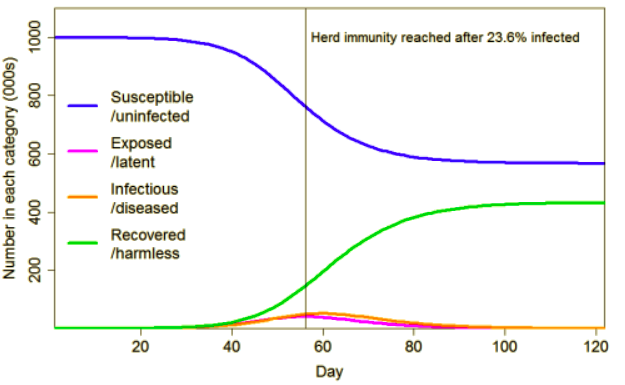
Judith Curry provides an excellent and well-referenced exposition of some herd immunity experiments. They are based on an even more extended approach to heterogeneity introducing: 1) variation in susceptibility across individuals; and 2) variation in the dispersion of transmission. The latter means, “… the extent to which infection happens through many spreaders or just a few“. She uses these mechanisms to modify a standard epidemiological model using prior estimates of variability to calibrate the model. Both experiments arrive at drastically lower HITs and total infections than her baseline experiment, which uses the standard model. The chart below shows her results with moderate heterogeneity. Her results with more extreme (though realistic) values of the heterogeneity metrics are even more remarkable. See the link above.
Check Against Real World

How does all this square with our experience to-date with the coronavirus? It’s difficult to tell with case counts, as the volume of testing keeps increasing and so many infected individuals are asymptomatic and remain undiagnosed. Estimates of R vary, but most states appear to have an R currently less than one. That means the virus is receding almost everywhere in the U.S. The same is true in much of the developed world, where the virus was most prevalent. Even Sweden, where achieving herd immunity is policy, diagnosed cases and deaths have been largely confined to vulnerable groups, and in total are less than many other (though not all) European countries.

Does that mean many areas in the U.S. and elsewhere have reached herd immunity? Locales that have had serological testing have thus far shown infection rates of anywhere from 2% to 10%, though New York City, where the outbreak was most severe, may have had more than 20% of its population infected as of a month ago. Different regions may have different HITs, so there is a chance that some areas, including NYC, are close to herd immunity.

Unfortunately, some of the reductions in R and in the effective HIT were won by social distancing, which will be reversed to some extent as the economy reopens. That’s the flip side of the “flat curve” we’ve managed to experience. The value of R may drift back toward or above one for a time. Diminished sunlight and humidity in the fall might have a similar effect. A second wave is not likely to be as bad as the first, however. That’s because: 1) we’ll now have more adaptive immunity in the population; 2) the most susceptible people are among those who already have acquired immunity or, more sadly, have died; 3) we’ll be better at coping with an outbreak in multiple ways; and 4) more speculatively, we’ll have identified the most effective treatments and, with less likelihood, a vaccine for those who want it.

Policy Lessons

In any outbreak, keeping R below one at least-cost is the objective. Given the alternatives, that rules out full-scale lockdowns because we know a large share of the population already has innate or acquired immunity. Forced shutdowns are unnecessarily costly relative to a targeted approach. But what form does that take?

Infected individuals must be quarantined until they recover, and their close contacts should be quarantined for up to a full incubation period. Large gatherings must be suspended temporarily. Testing capacity must be such that anyone with a fever or any symptom, mild or otherwise, can be tested. Regular testing of certain individuals like health care workers, teachers, and other first responders should take place. Simple screenings using infrared thermometers will be useful in high-traffic establishments. Precautions must be targeted at the most susceptible, and it’s pretty easy to identify them: the elderly and those with co-morbidities such as heart disease, diabetes, and lung conditions.

There are questions of civil liberties that must be addressed as well. Many high-risk individuals can live independently, so their freedoms must be weighed against their safety. Keeping this cohort quarantined is out of the question unless it’s voluntary. Regular testing should take place, and a subset of this group might already have the markers of immunity. Another question of civil liberties involves detailed contact tracing, which requires the establishment of an apparatus capable of great intrusion and abuse. I believe identification of close contacts should be an adequate precaution, though there may be degrees of tracing that I would find acceptable. Finally, a vaccine would be welcome, but it should not be mandatory


Private Social Distancing, Private Reversal

04 Monday May 2020

Posted by Nuetzel in Liberty, Pandemic, Uncategorized

≈ 1 Comment

Tags

Andrew Cuomo, Anthony Fauci, Apple Mobility, Bill De Blasio, Centre for Economic Policy Research, Donald Trump, Externalities, Forbes, Foursquare, Heterogeneity, John Koetsier, Laissez Faire, Lockdowns, Nancy Pelosi, Points of Interest, Private Governance, Safegraph, Social Distancing, Social Welfare, Stay-at-Home Orders, Vitamin D, Wal Mart, WHO

My original post on the dominance of voluntary social distancing over the mandated variety appears below. That dominance is qualified by the greater difficulty of engaging in certain activities when they are outlawed by government, or when the natural locations of activities are declared off-limits. Nevertheless, as with almost all regulation, people make certain “adjustments” to suit themselves (sometimes involving kickbacks to authorities, because regulation does nothing so well as creating opportunities for graft). Those “adjustments” often lead to much less desirable outcomes than the original, unregulated state. In the case of a pandemic, however, it’s tempting to view such unavoidable actions as a matter of compromise.

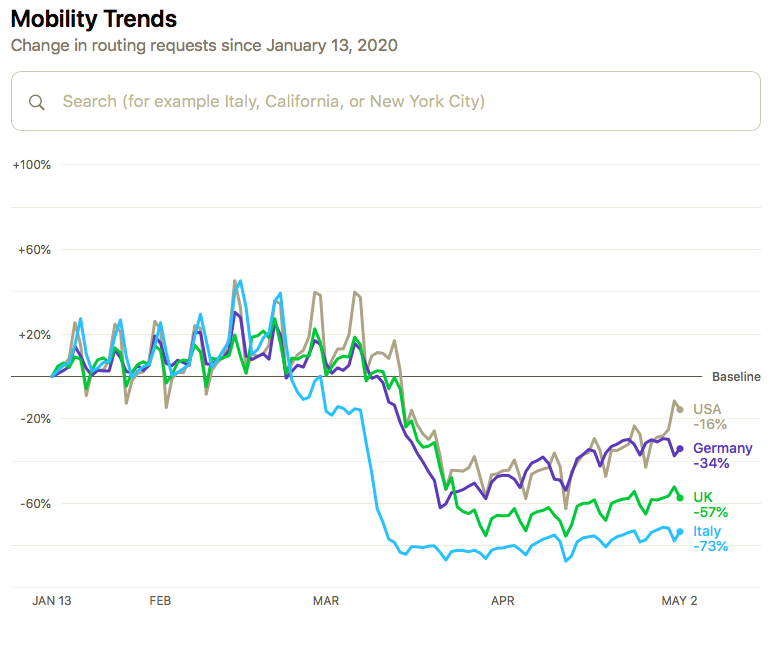
I say this now because the voluntary social distancing preceding most government lockdown orders in March (discussed in the post below) is subject to a degree of self-reversal. Apple Mobility Data suggests that something like that was happening throughout much of April, as shown in the chart at the top of this post. Now, in early May, the trend is likely to continue as some of the government lockdown mandates are being lifted, or at least loosened.

An earlier version of the chart above appeared in a Forbes article entitled, “Apple Data Shows Shelter-In-Place Is Ending, Whether Governments Want It To Or Not“. The author, John Koetsier, noted the Apple data are taken from map searches, so they may not be reliable indicators of actual movement. But he also featured some charts from Foursquare, which showed actual visits to various kinds of destinations, and some of theoe demonstrate the upward trend in activity.

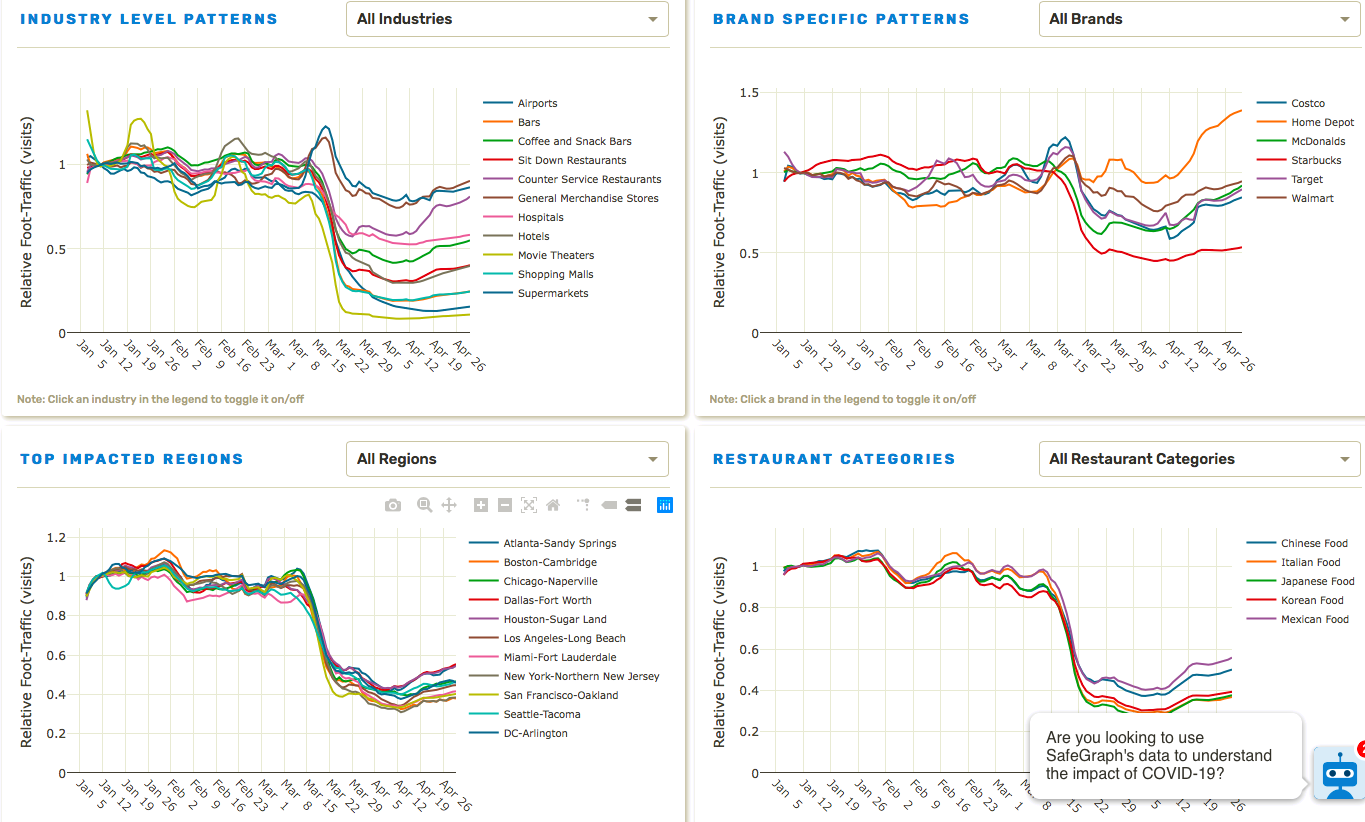
In the original post below, I used SafeGraph charts lifted from a paper I described there. The four charts below are available on the SafeGraph website, which offered the services of the friendly little robot in the lower right-hand corner, but I demurred. You’ll probably need to click on the image to read the detail. They show more granular information by industry, brand, region, and restaurant categories. The upward trends are evident in quite a few of the series.

I should qualify my interpretation of the charts above and those in my original post: First, nine states did not have stay-at-home orders, though a few of those had varying restrictions on individuals and on the operation of “non-essential” businesses. The five having no orders of any kind (that I can tell) are lightly-populated, very low-density states, so the vast majority of the U.S. population was subject to some sort of lockdown measure. Second, eight states began to ease or lift orders in the last few days of April, Georgia and Colorado being the largest. Therefore, at the tail end, a small part of the increase in activity could be related to those liberalizations. Then again, it might have happened anyway.

The authoritarian impulse to shut everything down was largely unnecessary, and it did not accomplish much that voluntary distancing hadn’t accomplished already (again, see below). Healthy people need to stop cowering and take action. That includes the non-elderly and those free of underlying health conditions. Sure, take precautions, keep your distance, but get out of your home if you can. Get some sunny Vitamin D.

Committing yourself to the existence of a shut-in is not healthy, not wise, and it might destroy whatever wealth you possess if you are a working person. The data above show that people are recognizing that fact. As much as the Left wishes it were so, government seldom “knows better”. It is least effective when it uses force to suppress voluntary behavior; it is most effective when it follows consensus, and especially when it protects the rights of individuals to make their own choices where no consensus exists.

Last week’s post follows:

~~~~~~~~~~~~~~~~~~~~~~~~~~~~~~~

How much did state and local governments accomplish when they decided to issue stay-at-home orders? Perhaps not much. That’s the implication of data presented by the authors of “Internal and external effects of social distancing in a pandemic” (starts on page 22 in the linked PDF). Social distancing began in the U.S. in a series of voluntary, private actions. Government orders merely followed and, at best, reinforced those actions, but often in ham-handed ways.

The paper has a broader purpose than the finding that social distancing is often a matter of private initiative. I’ll say a bit more about it, but you can probably skip the rest of this paragraph without loss of continuity. The paper explores theoretical relationships between key parameters (including a social distancing construct) and the dynamics of a pandemic over time in a social welfare context. The authors study several alternatives: a baseline in which behavior doesn’t change in any way; a “laissez faire” path in which actions are all voluntary; and a “socially optimal” path imposed by a benevolent and all-knowing central authority (say what???). I’d offer more details, but I’ll await the coming extension promised by the authors to a world in which susceptible populations are heterogenous (e.g., like Covid-19, where children are virtually unaffected, healthy working age adults are roughly as at-risk as they are to the flu, and a population of the elderly and health-compromised individuals for which the virus is much more dangerous than the flu). In general, the paper seems to support a more liberalized approach to dealing with the pandemic, but that’s a matter of interpretation. Tyler Cowen, who deserves a hat-tip, believes that reading is correct “at the margin”.

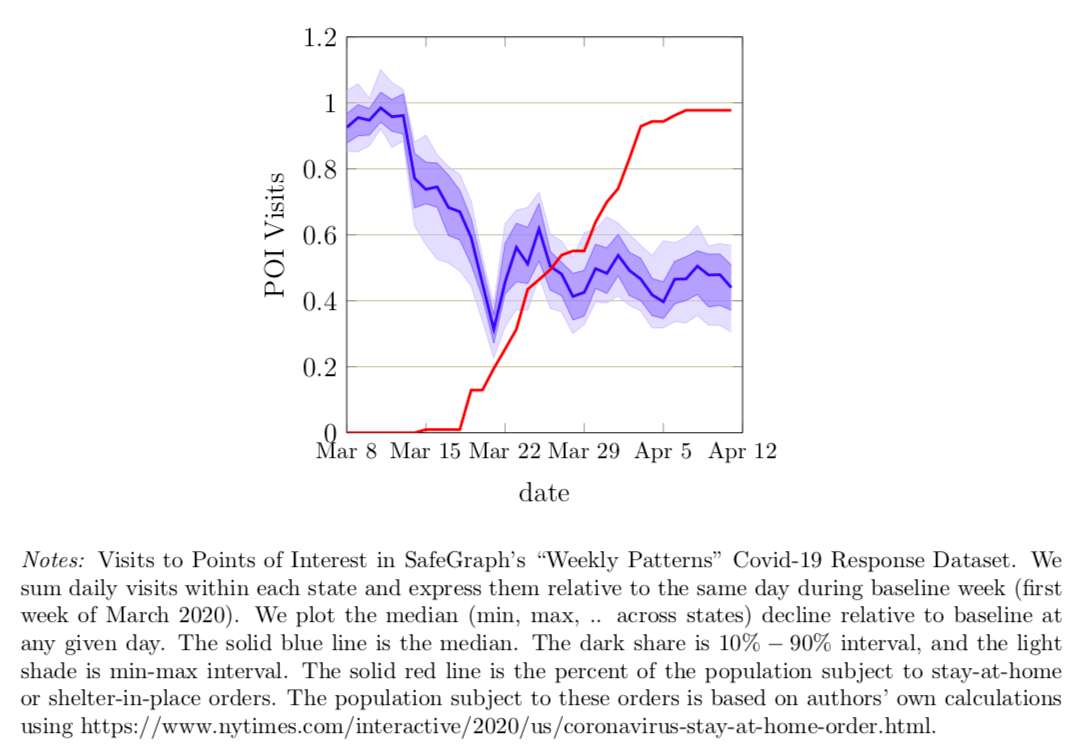
Let’s look at some of the charts the authors present early in the paper. The data on social distancing behavior comes from Safegraph, a vendor of mobility data taken from cell phone location information. This data can be used to construct various proxies for aggregate social activity. The first chart below shows traffic at “points of interest” (POI) in the U.S. from March 8 to April 12, 2020. That’s the blue line. The red line is the percentage of the U.S. population subject to lockdown orders on each date. The authors explain the details in the notes below the chart:

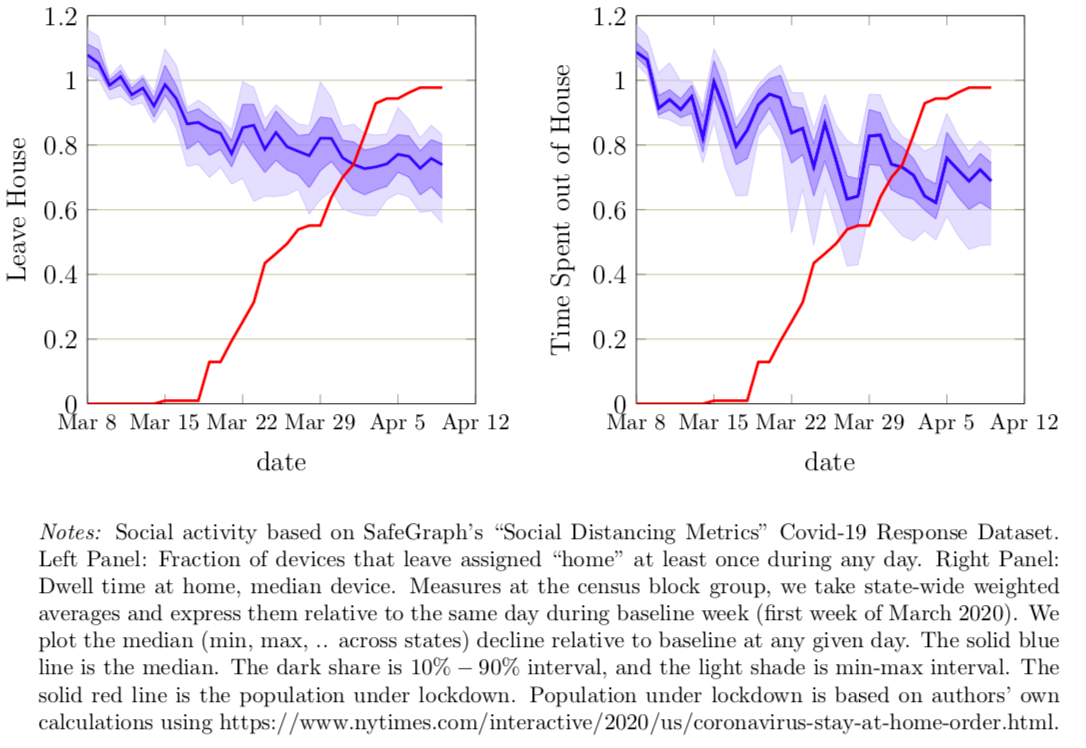
Clearly POI visits were declining sharply before any governments imposed their own orders. The next two charts show similar declines in the percent of mobile devices that leave “home” each day (“home” being the device’s dominant location during nighttime hours) and the duration over which devices were away from “home”, on average.

So all of these measures of social activity began declining well ahead of the government orders. The authors say private social distancing preceded government action in all 50 states. POI traffic was down almost 40% by the time 10% of the U.S. population was subject to government orders, and those early declines accounted for the bulk of the total decline through April 12. The early drops in the two away-from-home measures were 15-20%, again accounting for well over half of the total decline.

The additional declines beyond that time, to the extent they can be discerned, could be either trends that would have continued even in the absence of government orders or reinforcing effects the orders themselves. This does not imply that lockdown orders have no effects on specific activities. Rather, it means that those orders have minor incremental effects on measures of aggregate social activity than the voluntary actions already taken. In other words, the government lockdowns are largely a matter of rearranging the deck chairs, or, that is to say, their distribution.

Many private individuals and institutions acted early in response to information about the virus, motivated by concerns about their own safety and the safety of family and friends. The public sector in the U.S. was not especially effective in providing information, with such politicos as President Donald Trump, Nancy Pelosi, Andrew Cuomo, Bill De Blasio, and the mayor of New Orleans minimizing the dangers into the month of March, and some among them encouraging people to get out and celebrate at public events. Even Anthony Fauci minimized the danger in late February (not to mention the World Health Organization). In fact, “the scientists” were as negligent in their guidance as anyone in the early stages of the pandemic.

When lockdown orders were issued, they were often arbitrary and nonsensical. Grocery stores, liquor stores, and Wal Mart were allowed to remain open, but department stores and gun shops were not. Beaches and parks were ordered closed, though there is little if any chance of infection outdoors. Lawn care services, another outdoor activity, were classified as non-essential in some jurisdictions and therefore prohibited. And certain personal services seem to be available to public officials, but not to private citizens. The lists of things one can and can’t buy truly defies logic.

In March, John W. Whitehead wrote:

“We’re talking about lockdown powers (at both the federal and state level): the ability to suspend the Constitution, indefinitely detain American citizens, bypass the courts, quarantine whole communities or segments of the population, override the First Amendment by outlawing religious gatherings and assemblies of more than a few people, shut down entire industries and manipulate the economy, muzzle dissidents, ‘stop and seize any plane, train or automobile to stymie the spread of contagious disease,’…”

That is fearsome indeed, and individuals can accomplish distancing without it. If you are extremely risk averse, you can distance yourself or take other precautions to remain protected. You can either take action to isolate yourself or you can decide to be in proximity to others. The more risk averse among us will internalize most of the cost of voluntary social distancing. The less risk averse will avoid that cost but face greater exposure to the virus. Of course, this raises questions of public support for vulnerable segments of the population for whom risk aversion will be quite rational. That would certainly be a more enlightened form of intervention than lockdowns, though support should be offered only to those highly at-risk individuals who can’t support themselves.

Christopher Phelan writes of three rationales for the lockdowns: buying time for development of a vaccine or treatments; reducing the number of infected individuals; and to avoid overwhelming the health care system. Phelan thinks all three are of questionable validity at this point. A vaccine might never arrive, and Phelan is pessimistic about treatments (I have more hope in that regard). Ultimately a large share of the population will be infected, lockdowns or not. And of course the health care system is not overwhelmed at this point. Yes, those caring for Covid patients are under a great stress, but the health care system as a whole, and patients with other maladies, are currently suffering from massive under-utilization.

If you wish to be socially distant, you are free to do so on your very own. Individuals are quite capable of voluntary risk mitigation without authoritarian fiat, as the charts above show. While private actors might not internalize all of the external costs of their activities, government is seldom capable of making the appropriate corrections. Coercion to enforce the kinds of crazy rules that have been imposed during this pandemic is the kind of abuse of power the nation’s founders intended to prevent. Reversing those orders can be difficult, and the precedent itself becomes a threat to future liberty. Nevertheless, we see mounting efforts to resist by those who are harmed by these orders, and by those who recognize the short-sighted nature of the orders. Private incentives for risk reduction, and private evaluation of the benefits of social and economic activity, offer superior governance to the draconian realities of lockdowns.

Social Distancing Largely a Private Matter

26 Sunday Apr 2020

Posted by Nuetzel in Liberty, Pandemic, Uncategorized

≈ 1 Comment

Tags

Andrew Cuomo, Anthony Fauci, Bill De Blasio, Centre for Economic Policy Research, Donald Trump, Externalities, Heterogeneity, Laissez Faire, Lockdowns, Nancy Pelosi, Points of Interest, Private Governance, Safegraph, Social Distancing, Social Welfare, Stay-at-Home Orders, Wal Mart, WHO

How much did state and local governments accomplish when they decided to issue stay-at-home orders? Perhaps not much. That’s the implication of data presented by the authors of “Internal and external effects of social distancing in a pandemic” (starts on page 22 in the linked PDF). Social distancing began in the U.S. in a series of voluntary, private actions. Government orders merely followed and, at best, reinforced those actions, but often in ham-handed ways.

The paper has a broader purpose than the finding that social distancing is often a matter of private initiative. I’ll say a bit more about it, but you can probably skip the rest of this paragraph without loss of continuity. The paper explores theoretical relationships between key parameters (including a social distancing construct) and the dynamics of a pandemic over time in a social welfare context. The authors study several alternatives: a baseline in which behavior doesn’t change in any way; a “laissez faire” path in which actions are all voluntary; and a “socially optimal” path imposed by a benevolent and all-knowing central authority (say what???). I’d offer more details, but I’ll await the coming extension promised by the authors to a world in which susceptible populations are heterogenous (e.g., like Covid-19, where children are virtually unaffected, healthy working age adults are roughly as at-risk as they are to the flu, and a population of the elderly and health-compromised individuals for which the virus is much more dangerous than the flu). In general, the paper seems to support a more liberalized approach to dealing with the pandemic, but that’s a matter of interpretation. Tyler Cowen, who deserves a hat-tip, believes that reading is correct “at the margin”.

Let’s look at some of the charts the authors present early in the paper. The data on social distancing behavior comes from Safegraph, a vendor of mobility data taken from cell phone location information. This data can be used to construct various proxies for aggregate social activity. The first chart below shows traffic at “points of interest” (POI) in the U.S. from March 8 to April 12, 2020. That’s the blue line. The red line is the percentage of the U.S. population subject to lockdown orders on each date. The authors explain the details in the notes below the chart:

Clearly POI visits were declining sharply before any governments imposed their own orders. The next two charts show similar declines in the percent of mobile devices that leave “home” each day (“home” being the device’s dominant location during nighttime hours) and the duration over which devices were away from “home”, on average.

So all of these measures of social activity began declining well ahead of the government orders. The authors say private social distancing preceded government action in all 50 states. POI traffic was down almost 40% by the time 10% of the U.S. population was subject to government orders, and those early declines accounted for the bulk of the total decline through April 12. The early drops in the two away-from-home measures were 15-20%, again accounting for well over half of the total decline.

The additional declines beyond that time, to the extent they can be discerned, could be either trends that would have continued even in the absence of government orders or reinforcing effects the orders themselves. This does not imply that lockdown orders have no effects on specific activities. Rather, it means that those orders have minor incremental effects on measures of aggregate social activity than the voluntary actions already taken. In other words, the government lockdowns are largely a matter of rearranging the deck chairs, or, that is to say, their distribution.

Many private individuals and institutions acted early in response to information about the virus, motivated by concerns about their own safety and the safety of family and friends. The public sector in the U.S. was not especially effective in providing information, with such politicos as President Donald Trump, Nancy Pelosi, Andrew Cuomo, Bill De Blasio, and the mayor of New Orleans minimizing the dangers into the month of March, and some among them encouraging people to get out and celebrate at public events. Even Anthony Fauci minimized the danger in late February (not to mention the World Health Organization). In fact, “the scientists” were as negligent in their guidance as anyone in the early stages of the pandemic.

When lockdown orders were issued, they were often arbitrary and nonsensical. Grocery stores, liquor stores, and Wal Mart were allowed to remain open, but department stores and gun shops were not. Beaches and parks were ordered closed, though there is little if any chance of infection outdoors. Lawn care services, another outdoor activity, were classified as non-essential in some jurisdictions and therefore prohibited. And certain personal services seem to be available to public officials, but not to private citizens. The lists of things one can and can’t buy truly defies logic.

In March, John W. Whitehead wrote:

“We’re talking about lockdown powers (at both the federal and state level): the ability to suspend the Constitution, indefinitely detain American citizens, bypass the courts, quarantine whole communities or segments of the population, override the First Amendment by outlawing religious gatherings and assemblies of more than a few people, shut down entire industries and manipulate the economy, muzzle dissidents, ‘stop and seize any plane, train or automobile to stymie the spread of contagious disease,’…”

That is fearsome indeed, and individuals can accomplish distancing without it. If you are extremely risk averse, you can distance yourself or take other precautions to remain protected. You can either take action to isolate yourself or you can decide to be in proximity to others. The more risk averse among us will internalize most of the cost of voluntary social distancing. The less risk averse will avoid that cost but face greater exposure to the virus. Of course, this raises questions of public support for vulnerable segments of the population for whom risk aversion will be quite rational. That would certainly be a more enlightened form of intervention than lockdowns, though support should be offered only to those highly at-risk individuals who can’t support themselves.

Christopher Phelan writes of three rationales for the lockdowns: buying time for development of a vaccine or treatments; reducing the number of infected individuals; and to avoid overwhelming the health care system. Phelan thinks all three are of questionable validity at this point. A vaccine might never arrive, and Phelan is pessimistic about treatments (I have more hope in that regard). Ultimately a large share of the population will be infected, lockdowns or not. And of course the health care system is not overwhelmed at this point. Yes, those caring for Covid patients are under a great stress, but the health care system as a whole, and patients with other maladies, are currently suffering from massive under-utilization.

If you wish to be socially distant, you are free to do so on your very own. Individuals are quite capable of voluntary risk mitigation without authoritarian fiat, as the charts above show. While private actors might not internalize all of the external costs of their activities, government is seldom capable of making the appropriate corrections. Coercion to enforce the kinds of crazy rules that have been imposed during this pandemic is the kind of abuse of power the nation’s founders intended to prevent. Reversing those orders can be difficult, and the precedent itself becomes a threat to future liberty. Nevertheless, we see mounting efforts to resist by those who are harmed by these orders, and by those who recognize the short-sighted nature of the orders. Private incentives for risk reduction, and private evaluation of the benefits of social and economic activity, offer superior governance to the draconian realities of lockdowns.

Don’t Be Cowed: Shelter, But Get Outside

29 Sunday Mar 2020

Posted by Nuetzel in Pandemic, Uncategorized

≈ 5 Comments

Tags

Absolute Humidity, Air Conditioning, Civil Liberties, Coronavirus, Forced Air Heating, Park Closures, Public Health, Shelter In Place, Unauthorized Walking, Vitamin D

As the coronavirus ordeal continues, it’s astonishing to hear the refrain from government officials, celebrities, talking heads, and social media scolds to “stay inside“. President Trump did it again today at his press conference. WTF? In northern England a man was arrested for “unauthorized walking”. Orders to “shelter in place” are often interpreted to mean “don’t go outside your home” except when necessary, as if active shooters are marauding through neighborhoods. In fairness, I don’t think anyone in the U.S. has yet been arrested for taking a walk, except for this incident, which is bad enough. Still, the misplaced emphasis of such rhetoric is confusing to people. The threat to civil liberties is one thing, but the suggestion that we should all stay inside is itself a threat to public health.

If you can get out of your home without coming face-to-face with others, you SHOULD get outside whenever you can! Get out in the sun and out of the forced-air, dehumidified environment that is your dwelling unit. Get some vitamin D and breath some fresh, humid air.

Here’s a personal anecdote: My yard backs-up to an extensive wooded area of a huge corporate campus. It was built years ago, and ever since, the company has welcomed residents of our neighborhood to walk the grounds. The company even maintains an access road that connects our street to a route that is often more convenient than our main entrance. A very good neighbor. I was out walking along one of the roads through the campus yesterday. Employees have not reported to work there for three weeks due to an employee’s diagnosis with the virus, so it was very quiet. A security guard drove by and stopped to tell me that I could no longer walk the campus due to the coronavirus. “That’s corporate policy now with this thing…”, he trailed off. As if my solitary stroll through the campus would contribute to the spread of the virus! Again, WTF? Of course, it is private property and they are entitled to make their own rules. I’m okay with that, but the virus is nonsensical as a rationale.

Public parks are closed in many areas. I understand the wisdom of discouraging people from mingling and preventing the virus’s spread via surfaces like park benches and playground equipment. Nevertheless, I believe parks should remain open to individuals or families for walking, running or resting. Just keep your distance.

You are highly unlikely to catch the virus outside unless you are in close proximity to an individual with the virus. Even then it’s unlikely. Yes, it can survive in air for about three hours, carried along in fine, exhaled aerosols. That is of much greater concern indoors, where the air is still and its volume limited. It is quickly dispersed outdoors into the vast atmosphere. And again, the virus is likely to degrade quickly in warm temperatures (> 54 degrees), direct sunlight, and high absolute humidity. All three are covered in this report. So enjoy your yard, your porch, your street, or at least open your windows when you can.

High U.S. Income Drives Health Spending

05 Thursday Mar 2020

Posted by Nuetzel in Uncategorized

≈ Leave a comment

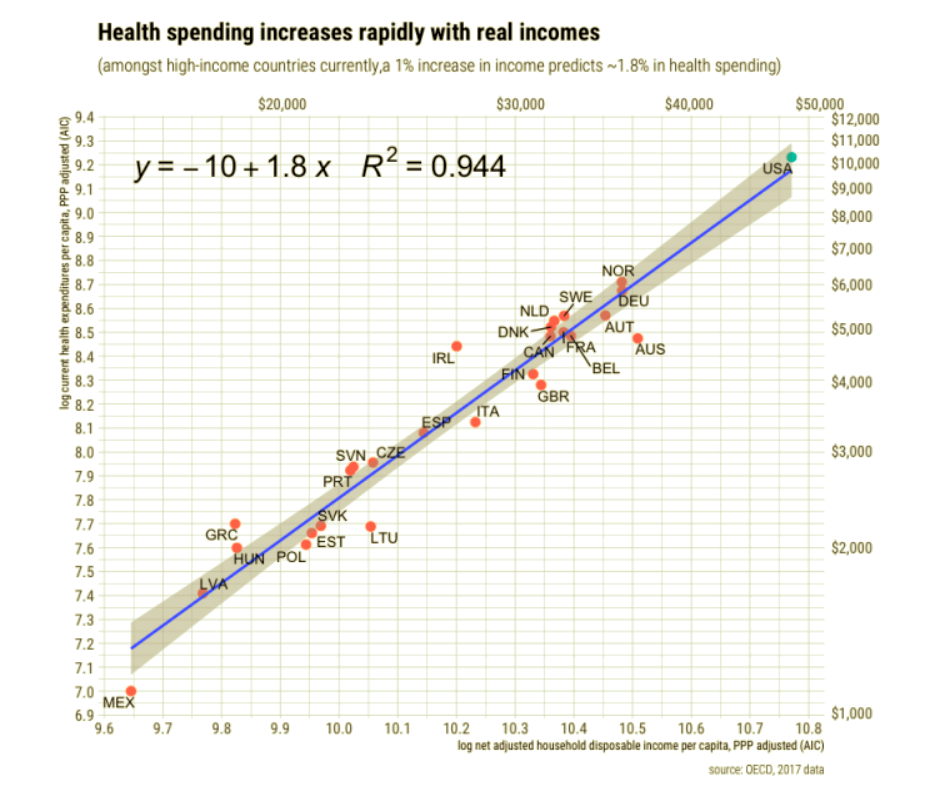
U.S. health care spending is not out-of-line internationally, despite whatever shortfalls our health care system might embody. By that, I mean that health care spending is almost exactly what U.S. income levels would predict based on cross-country statistical evidence. Other countries are certain to spend more as their own incomes grow. Take another look at the relationship shown in the chart above: it predicts that health care spending per capita grows 1.8% for every 1% increase in household income. In fact, the share of consumption devoted to health care rises as income rises. Quite simply, the slope of that curve means that health care qualifies as a luxury good.

The chart and conclusions above come from an exhaustive analysis at the Random Critical Analysis (RCA) blog, which is also summarized nicely by Alex Tabarrok at Marginal Revolution (to whom I owe a debt of gratitude for several great topics of late). The analysis goes further in asserting that income causes health care spending.

“When real income changes, health spending responds in a manner that is consistent with cross-sectional results…. It takes 3-4 years for payers and for providers to completely respond through reimbursement policy, premiums, services offered, and so on. Still, the strength of the long-run relationship is nonetheless readily apparent in the US time series. … Comparable results are obtained in OECD data with similar household income measures.”

So we spend more on health care because we can and, in a strong sense, because we want to. And here is an interesting wrinkle: we actually consume more health care services, we don’t just pay higher prices. Health care prices do increase with income, but at a slower rate than income. This implies that higher quantities of health care are delivered in high-income countries. As the post at RCA notes, health care prices in the U.S. are not “inexplicably high”.

If you visit the post at RCA, note that it’s very easy to browse between sub-topics from the list of sub-links on the right. The analysis covers many other nuances. I’ll mention one more very important one, which is emphasized by Tabarrok: our high level of health care consumption does not involve a loss of goods consumed from other sectors. In fact, quite the opposite. The prices of most goods and services have declined relative to income over the years:

“The typical American household is much better fed today than in prior generations despite spending a much smaller share of their income on groceries and working fewer hours. I submit this is primarily a direct result of productivity. We can produce food so much more efficiently that we don’t need to prioritize it as we once did. The food productivity dividend, as it were, has been and is being spent on higher-order wants and needs like cutting edge healthcare, higher amenity education, and leisure activities. … Similar patterns have doubtless been playing out in other essential consumption categories.

… these trends indicate that the rising health share is robustly linked with a generally constant long-term of increasing in real consumption across essentially all other major consumption categories.”

The share of income dedicated to health care in the U.S. is not a dysfunction in the health care sector, nor is it reflective of any dysfunction. That doesn’t mean there are no dysfunctions, however: our health insurance system severs the economic link between consumers and providers, nullifying the price incentives that normally yield effective market outcomes. price transparency is a casualty of the system as well; flaws in the Affordable Care Act create incentives for consolidation in health care delivery, undermining competitive forces; and tax deductibility of employer-provided coverage is a subsidy to those best able to pay for medical expenses and health care coverage.

There is no doubt that these peculiarities lead to suboptimal combinations of services and outcomes. I have written about that in several posts, including “Hospital Price Insanity” in December of 2019. Certain services are vastly overpriced; utilization levels suggest that expensive technology is unnecessarily duplicated; resources are over-allocated to medical tests as well as emergency rooms; and certain markets are underserved. As for outcomes, comparisons are difficult given the lifestyle issues that feed demand for health care in the U.S., such as obesity and smoking. This point too is treated in the long post at Random Critical Analysis.

Other health care systems certainly have their own dysfunctions (see my post “Single Payer: Queue Up and Die Already“, from January). There are undoubtedly wasteful  misallocations of resources and lost opportunities for improvements in care in all these systems. But in terms of the share of resources we dedicate to health care, our system places us at a point along the same locus toward which other developed nations converge: health care spending is reliably related to income. There are problems, but that is not one of them.


Statism and Self-Harm

18 Tuesday Feb 2020

Posted by Nuetzel in Free markets, Government Failure, Uncategorized

≈ Leave a comment

Tags

Andre Schleifer, Autocracy, Chinese Interment Camps, Friedrich Hayek, Kazakh Muslims, New York Times, P.J. O'Rourke, Reason.com Nick Gillespie, Reeducation, rent seeking, statism, The Road To Serfdom, Tom Friedman, Uighur Muslims


Some have a tendency to think their problems can be solved only through the intervention of some powerful, external force. That higher power might be God, but at a more temporal level, government is often presumed to be a force to fix all things that need fixing. “There oughta be a law” is a gut reaction to things we find injurious or that offend; government has the resources, or the coercive power to get the resources, to undertake big, appealing projects; and of course government has the coercive power to “rearrange the deck chairs” in ways that might satisfy anyone’s sense of justice and fairness, so long as they get their way. Whenever people perceive some need they believe to be beyond their private capacity, or mere convenience, government action is the default option, and that’s partly because many think it’s the only option.

That’s the appeal of “democratic socialism”, to use a name that unintentionally emphasizes a very real danger of democracy: the tyranny of the majority. It’s a dismal way station along the road to serfdom, to borrow a phrase from Hayek.

Government, however, repeatedly demonstrates it’s sheer incompetence and its expedience as a vehicle for graft. And it’s not as if these failures go unrecognized. Everyone knows it! This is nowhere more true than when the state interferes with private markets or attempts to steer the economy’s direction at either an aggregate or industry level. But here we have a dark irony, as told by Nick Gillespie at Reason:

“Again and again—and in countries all over the world—declines in trust of government correlate strongly with calls for more government regulation in more parts of our lives. ‘Individuals in low-trust countries want more government intervention even though they know the government is corrupt,’ explain the authors of a 2010 Quarterly Journal of Economics paper. That’s certainly the case in the United States, where the size, scope, and spending of government has vastly increased over exactly the same period in which trust and confidence in the government has cratered. In 2018, I talked with one of the paper’s authors, Andrei Shleifer, a Harvard economist who grew up in the Soviet Union before coming to America. Why do citizens ask a government they don’t believe in to bring order? ‘They want regulation,’ he said. ‘They want a dictator who will bring back order.'”

Against all historical evidence and forebodings, the wish for a benevolent dictator! As if it’ll be different this time! Are we all statists? Certainly not me, but the Left is full of them. One prominent example is columnist Tom Friedman of the New York Times, who has expressed the sometimes fashionable view that “things get done” under dictatorships:

“One-party autocracy certainly has its drawbacks. But when it is led by a reasonably enlightened group of people, as China is today, it can also have great advantages. … That one party can just impose the politically difficult but critically important policies needed to move a society forward in the 21st century.”

Tell it to the interred Kazakh and Uighur Muslims undergoing “reeducation” in China. The Right has its share of statists as well, and it is typically expressed in desires for enforced social conservatism.

People seem to have a vague idea that everyone else must either be misbehaving or in misery. And despite the well-tested fallibility and lack of trust in government, people persist in believing that the public sector can conjure magic to solve their problems. But the state gets bigger and bigger while solving few problems and exacerbating others. In fact, as government grows, it makes rent seeking a more viable alternative to productive effort. Like the giant zero-sum game that it is, the expansion of government provides the very means to pick away at the wealth of others. When faced with these incentives, people most certainly will misbehave on small and large scales!

The truth is that individuals hold the most potent regulatory force in their own hands: the voluntary nature of trade. It protects against over-pricing, under-pricing, and inferior quality along many dimensions, but it demands discipline and a willingness to walk away. It also demands a willingness to put forth productive effort, rather than coveting the property of others, and taking from others via political action. To paraphrase P.J. O’Rourke, if you think things are expensive now, wait till they’re free!

End of Snowfalls Is Greatly Exaggerated

03 Monday Feb 2020

Posted by Nuetzel in Uncategorized

≈ Leave a comment

Tags

Baby Boomers, Climate Change, Climate models, Gen X, global warming, Millenials, NOAA, Snowfalls, The Independent, Thomas Jefferson

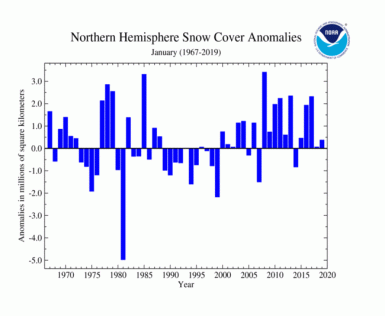
Snowcover Anomoly

Everyone seems to think it snowed more in their youth than in recent years, but that’s generally incorrect, at least for for late-stage baby boomers, Gen Xers, and Millenials. Gregory Wrightstone thought the same thing as he reflected on his youth in Pittsburgh, but after checking snowfall records he was surprised to find an upward trend. In “Warming and the Snows of Yesteryear“, Wrightstone says his look at the records from other areas showed similar upward trends. The chart above from NOAA shows the Northern Hemisphere has experienced mostly positive snowfall anomalies over the past 20 years. So, the truth is that snowfalls have not decreased over the last 50+ years, contrary to our fond memories of big snows in childhood. Interestingly, Thomas Jefferson thought the same thing in 1801, but I’m not sure whether he was right.

We’ve been told by climate alarmists that “snowfalls are a thing of the past” due to global warming (The Independent in March, 2000). If anything, however, snowfalls have increased, and big snowfalls still happen. As with so many climate predictions over the years, this too is a bust. Most of those predictions have relied on predictive models fitted with an inadequate historical record of data, and the models are inadequately specified to capture the complexities of global climate trends. Don’t bet the house on them, and don’t presume to bet my house on them either, please!

Bernie Sanders and the Brutal Bros

24 Friday Jan 2020

Posted by Nuetzel in Collectivism, Leftism, Tyranny, Uncategorized

≈ Leave a comment

Tags

Antifa, Barack Obama, Bernie Bros, Bernie Sanders, Black Lives Matter, Che Guevara, David Burge, Fidel Castro, Gulags, Hillary Clinton, Iowahawk, James Hodgekinson, John Hinderaker, Joseph Stalin, Leftism, Mao Zedong, Pol Pot, PowerLineblog.com, Project Veritas, Re-Education, Steve Scalise

Some of Bernie Sanders’ most devoted fans have an unfortunate brutalitarian streak. The violent strain of so-called Bernie Bros aren’t as isolated as one might hope. First, of course, there was James Hodgkinson, the BB who attempted to assassinate Republican members of Congress at a congressional baseball game practice, seriously injuring Rep. Steve Scalise. Now, campaign field organizers for Sanders in Iowa and South Carolina have been captured on film proposing gulags, re-education camps, sentencing billionaires to hard labor, and shooting or beheading those opposed to Sanders’ policies. And much more. And they say this in all seriousness. What nice people have been assigned positions of responsibility within the Sanders campaign organization! Watch it for yourself at the link above.

Should we be surprised? No: these are advocates of forced collectivism, and if their favorable perspective on coercive power wasn’t enough of a tip-off, recent history suggests that many among them are truly ready and willing to do violence. The brutal and murderous history of collectivist regimes the world over demonstrates the tendency well enough. Stalin, Mao, Pol Pot, Castro and too many other leftist tyrants left bodies strewn in their wake as they sought to enforce their ideology. It’s no coincidence that the American Left holds the murderous Che Guevara in such high esteem. Black Lives Matter and Antifa have both perpetrated violent acts, and members of the Leftist media have openly advocated physical attacks on their political opponents. And then we have these Bernie Bros.

I feel compelled to review a bit of background on Bernie Sanders, the batty old communist who has managed to convince large numbers of poorly educated “intellectuals” that he knows the path to utopia. The nicer ones imagine that he’s a man of the people, though he hasn’t worked a day in his life at anything except agitation and rent seeking. He is an inveterate public mooch. His life history as a politician and as a person is rather unflattering.

I’ve used this Iowahawk (David Burge) quote about Sanders before:

“Who better to get America back to work than a guy who was actually fired from a Vermont hippie commune for being too lazy.”

Apparently, Barack Obama is not a Bernie Bro:

“Obama has told people in private that Sanders is both temperamentally and politically unfit to beat Trump in the 2020 general election, these people say. Among his concerns are Sanders’ strident form of politics and confrontational manners where he was known not to seek compromise during his long years in the US senate.”

And say what you will about Hillary Clinton, but her opinion of Sanders comports with much of what we know about The Bern:

“He was in Congress for years. He had one senator support him. Nobody likes him, nobody wants to work with him, he got nothing done.”

At least the Bernie Bros have taken their masks off before getting too far. Give Leftists power and they all will.

Poverty Propaganda Smears the U.S.

03 Friday Jan 2020

Posted by Nuetzel in Uncategorized

≈ 2 Comments

Fake poverty statistics are a popular tool among America’s critics, both internal and external. Warren Meyer has a great post on these misleading metrics, which seem to be presented with the utmost sincerity by their proponents. Or are they?

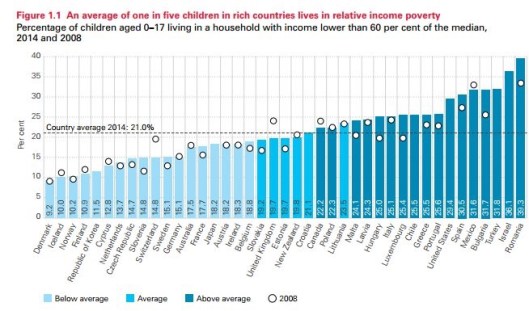
A mis-step in these calculations is in taking relativism to absurd lengths: Relative median incomes are of interest across countries, of course, or at any fixed percentile. But how about comparisons of incomes relative to median income across countries? As Meyer ably explains, that kind of comparison is not only meaningless but actually misleading.  The chart at the top of this post is an example of what he means, taken from statistics published by the World Economic Forum (WEF):

“Relative child poverty is a metric based on the country’s median income — how many kids live in families with income that is X% of the median. 

If you click on the source [WEF], the headline presents this as ‘These rich countries have high levels of child poverty.’ The implication is that the US has more child poverty than Latvia or Poland or Cyprus or Korea and only slightly less child poverty than Mexico and Turkey.  But does it really mean this? No. This chart is a measure of income equality, NOT the absolute well-being of children.

Many of the countries ahead of the US are there not because their poor are well off, but because their median income is so much lower than ours. In fact, you will notice the lack of African and Asian countries in this. I will bet a lot of money that certain countries in Africa and Asia everyone knows to be dirt poor would beat out the US in this, thus making the bankruptcy of this metric obvious.

Take Denmark in the #1 spot. It looks like 20% more kids in the US live in poverty than in Denmark. But per the OECD, the US has a median income 41% higher than Denmark. So what it really means is the US has 20% more kids living under an income bar that is set 41% higher. How can this possibly have any meaning whatsoever, except to someone who wants to make the US look bad?”

So the metric seems designed to take advantage of the compression of incomes in poor countries to make them look better than they really are in terms of child poverty.

This is not an isolated example. Meyer offers other examples of distorted poverty statistics that would show 0% relative poverty if everyone earned exactly $1 per year! He also cites Census Bureau statistics showing roughly constant levels of poverty in the U.S. over 60 years while ignoring the impact of taxes and transfer payments. Correcting that “oversight” results in substantial declines in poverty.

Meyer closes with a postscript reminding us of the ongoing human progress in overcoming penury:

“Well, in 1820, 94 percent of the world’s population lived in extreme poverty (less than $1.90 per day adjusted for purchasing power). In 1990 this figure was 34.8 percent, and in 2015, just 9.6 percent. … In the last quarter century, more than 1.25 billion people escaped extreme poverty – that equates to over 138,000 people … being lifted out of poverty every day.

The credit goes to free market capitalism.

Keeping My Resolution Starts With the Bee

01 Wednesday Jan 2020

Posted by Nuetzel in Blogging, Fake News, Uncategorized

≈ Leave a comment

Tags

Alternative Facts, Barack Obama, Donald Trump, Facebook, Fact Checkers, Fake News, Google, Inaugural Crowds, Kellyanne Conway, Relativism, Resolutions, Selective News, The Babylon Bee

I’m too lazy to check the archives right now, but I’m sure I’ve said this once before: I resolve to mix in more brief posts in the new year. My blogging hours (sometimes minutes) are limited on a day-to-day basis, so it’s taking too many days to wrap-up posts. My son says I should break them into parts. Maybe, but that won’t reduce the time I spend on a given topic.

Another motive for my resolution: I see so many items I’d like to share here, but I put them off in order to get back to a draft. I have to go where the whiffs of inspiration take me in a given session. But then… I either forget the short items or something else comes along to excite my long-windedness.

So, here is my first “short-form” blog share of 2020, from the Babylon Bee in early 2017:  

“Culture In Which All Truth Is Relative Suddenly Concerned About Fake News”

The piece reminded me of when poor Kellyanne Conway was castigated by the Left for using the expression “alternative facts” in reference to attendance at Trump’s inauguration. She’ll be fine, of course, but the photo comparison favored by the Left used an early pre-ceremony photo for Trump in 2017 and a peak-crowd photo for Obama in 2009. The Obama crowd was almost certainly larger than the real Trump crowd, but the whole thing was sort of a big “so what?”, especially given the well known political leanings of the local population.

Both Left and Right have been selectively reporting and distorting news (and editing photos) for a long time, the rise of so-called “fact checkers” notwithstanding. Alternative “facts” indeed! But our leftist friends are constant champions of relativism, often to the point of kookiness, while blissfully unaware that their “truths” and “facts” are severely shaded.

This was supposed to be short! Gah! More fake news! With that, here are some choice quotes from the Bee:

“One Oregon man, who rejects the idea that humanity can even be sure the universe exists in any meaningful sense, was nonetheless disturbed by the idea that websites could publish completely false information, for anyone in the world to read. …

Tech conglomerates such as Facebook and Google have vowed to meet the trend head-on, assuring the public that they are taking bold steps to filter out any news that contradicts the version of truth that they decide is acceptable.”

← Older posts
Newer posts →
Follow Sacred Cow Chips on WordPress.com

Recent Posts

  • A Warsh Policy Scenario At the Federal Reserve
  • The Coexistence of Labor and AI-Augmented Capital
  • The Case Against Interest On Reserves
  • Immigration and Merit As Fiscal Propositions
  • Tariff “Dividend” From An Indigent State

Archives

  • February 2026
  • January 2026
  • December 2025
  • November 2025
  • October 2025
  • September 2025
  • August 2025
  • July 2025
  • June 2025
  • May 2025
  • April 2025
  • March 2025
  • February 2025
  • January 2025
  • December 2024
  • November 2024
  • October 2024
  • September 2024
  • August 2024
  • July 2024
  • June 2024
  • May 2024
  • April 2024
  • March 2024
  • February 2024
  • January 2024
  • December 2023
  • November 2023
  • August 2023
  • July 2023
  • June 2023
  • May 2023
  • April 2023
  • March 2023
  • February 2023
  • January 2023
  • December 2022
  • November 2022
  • October 2022
  • September 2022
  • August 2022
  • July 2022
  • June 2022
  • May 2022
  • April 2022
  • March 2022
  • February 2022
  • January 2022
  • December 2021
  • November 2021
  • October 2021
  • September 2021
  • August 2021
  • July 2021
  • June 2021
  • May 2021
  • April 2021
  • March 2021
  • February 2021
  • January 2021
  • December 2020
  • November 2020
  • October 2020
  • September 2020
  • August 2020
  • July 2020
  • June 2020
  • May 2020
  • April 2020
  • March 2020
  • February 2020
  • January 2020
  • December 2019
  • November 2019
  • October 2019
  • September 2019
  • August 2019
  • July 2019
  • June 2019
  • May 2019
  • April 2019
  • March 2019
  • February 2019
  • January 2019
  • December 2018
  • November 2018
  • October 2018
  • September 2018
  • August 2018
  • July 2018
  • June 2018
  • May 2018
  • April 2018
  • March 2018
  • February 2018
  • January 2018
  • December 2017
  • November 2017
  • October 2017
  • September 2017
  • August 2017
  • July 2017
  • June 2017
  • May 2017
  • April 2017
  • March 2017
  • February 2017
  • January 2017
  • December 2016
  • November 2016
  • October 2016
  • September 2016
  • August 2016
  • July 2016
  • June 2016
  • May 2016
  • April 2016
  • March 2016
  • February 2016
  • January 2016
  • December 2015
  • November 2015
  • October 2015
  • September 2015
  • August 2015
  • July 2015
  • June 2015
  • May 2015
  • April 2015
  • March 2015
  • February 2015
  • January 2015
  • December 2014
  • November 2014
  • October 2014
  • September 2014
  • August 2014
  • July 2014
  • June 2014
  • May 2014
  • April 2014
  • March 2014

Blogs I Follow

  • Passive Income Kickstart
  • OnlyFinance.net
  • TLC Cholesterol
  • Nintil
  • kendunning.net
  • DCWhispers.com
  • Hoong-Wai in the UK
  • Marginal REVOLUTION
  • Stlouis
  • Watts Up With That?
  • Aussie Nationalist Blog
  • American Elephants
  • The View from Alexandria
  • The Gymnasium
  • A Force for Good
  • Notes On Liberty
  • troymo
  • SUNDAY BLOG Stephanie Sievers
  • Miss Lou Acquiring Lore
  • Your Well Wisher Program
  • Objectivism In Depth
  • RobotEnomics
  • Orderstatistic
  • Paradigm Library
  • Scattered Showers and Quicksand

Blog at WordPress.com.

Passive Income Kickstart

OnlyFinance.net

TLC Cholesterol

Nintil

To estimate, compare, distinguish, discuss, and trace to its principal sources everything

kendunning.net

The Future is Ours to Create

DCWhispers.com

Hoong-Wai in the UK

A Commonwealth immigrant's perspective on the UK's public arena.

Marginal REVOLUTION

Small Steps Toward A Much Better World

Stlouis

Watts Up With That?

The world's most viewed site on global warming and climate change

Aussie Nationalist Blog

Commentary from a Paleoconservative and Nationalist perspective

American Elephants

Defending Life, Liberty and the Pursuit of Happiness

The View from Alexandria

In advanced civilizations the period loosely called Alexandrian is usually associated with flexible morals, perfunctory religion, populist standards and cosmopolitan tastes, feminism, exotic cults, and the rapid turnover of high and low fads---in short, a falling away (which is all that decadence means) from the strictness of traditional rules, embodied in character and inforced from within. -- Jacques Barzun

The Gymnasium

A place for reason, politics, economics, and faith steeped in the classical liberal tradition

A Force for Good

How economics, morality, and markets combine

Notes On Liberty

Spontaneous thoughts on a humble creed

troymo

SUNDAY BLOG Stephanie Sievers

Escaping the everyday life with photographs from my travels

Miss Lou Acquiring Lore

Gallery of Life...

Your Well Wisher Program

Attempt to solve commonly known problems…

Objectivism In Depth

Exploring Ayn Rand's revolutionary philosophy.

RobotEnomics

(A)n (I)ntelligent Future

Orderstatistic

Economics, chess and anything else on my mind.

Paradigm Library

OODA Looping

Scattered Showers and Quicksand

Musings on science, investing, finance, economics, politics, and probably fly fishing.

  • Subscribe Subscribed
    • Sacred Cow Chips
    • Join 128 other subscribers
    • Already have a WordPress.com account? Log in now.
    • Sacred Cow Chips
    • Subscribe Subscribed
    • Sign up
    • Log in
    • Report this content
    • View site in Reader
    • Manage subscriptions
    • Collapse this bar
 

Loading Comments...