• About

Sacred Cow Chips

Sacred Cow Chips

Category Archives: Uncategorized

Inequality and Inequality Propaganda

21 Saturday Dec 2019

Posted by Nuetzel in Income Distribution, Inequality, Uncategorized

≈ Leave a comment

Tags

Alexandria Ocasio-Cortez, Bernie Sanders, Capitalism, Consumer Surplus, David Splinter, Declaration of Independence, Declination blog, Diffusion of Technology, Economic Mobility, Edward F. Leamer, Elizabeth Warren, Gerald Auten, Income Distribution, Inequality, J. Rodrigo Fuentes, Jeff Jacoby, Luddite, Marginal cost, Mark Perry, Marriage Rates, Pass-Through Income, Redistribution, Robert Samuelson, Scalability, Thales, Uber, Workaholics

I’m an “inequality skeptic”, first, with respect to its measurement and trends; and second, with respect to its consequences. Economic inequality in the U.S. has not increased over the past 60 years as often claimed. And some degree of ex post inequality, in and of itself, has no implication for real economic well-being at any point on the socioeconomic spectrum, the growls of class-warmongers aside. So I’m not just a skeptic. I’m telling you the inequality narrative is BS! The media has been far too eager to promote distorted metrics that suggest widening disparities and presumed injustice. Left-wing politicians such as Bernie Sanders, Elizabeth Warren, and Alexandra Ocasio-Cortez pounce on these reports with opportunistic zeal, fueling the flames of class warfare among their sycophants.

Measurement

Comparisons of income groups and their gains over time have been plagued by a number of shortcomings. Jeff Jacoby reviews issues underlying the myth of a widening income gap. Today, the top 1% earns about the same share of income as in the early 1960s, according to a recent study by two government economists, Gerald Auten and David Splinter.

Jacoby recounts distortions in the standard measures of income inequality:

  • The comparisons do not account for tax burdens and redistributive government transfer payments, which level incomes considerably. As for tax burdens, the top 1% paid more taxes in 2018 than the bottom 90% combined.
  • The focus of inequality metrics is typically on households, the number of which has expanded drastically with declines in marriage rates, especially at lower income levels. Incomes, however, are more equal on a per capital basis.
  • The use of pension and retirement funds like IRAs and 401(k) plans has increased substantially over the years. The share of stock market value owned by retirement funds increased from just 4% in 1960 to more than 50% now. As Jacoby says, this has “democratized” gains in asset prices.
  • A change in the tax law in 1986 led to reporting of more small business income on individual returns, which exaggerated the growth of incomes at the high-end. That income had already been there.
  • People earn less when they are young and more as they reach later stages of their careers. That means they move up through the income distribution over time, yet the usual statistics seem to suggest that the income groups are static. Jacoby says:

“Contrary to progressive belief, America is not divided into rigid economic strata. The incomes of the wealthy often decline, while many taxpayers go from being poor at one point to not-poor at another. Research shows that more than one-tenth of Americans will make it all the way to the top 1 percent for at least one year during their working lives.”

Mark Perry recently discussed America’s record middle-class earnings, emphasizing some of the same subtletles listed above. A middle income class ($35k-$100k in constant dollars) has indeed shrunk over the past 50 years, but most of that decrease was replaced by growth in the high income strata (>$100k), and the lower income class (<$35k) shrank almost as much as the middle group in percentage terms.

Causes

What drives the inequality we actually observe, after eliminating the distortions mentioned above? The reflexive answer from the Left is capitalism, but capitalism fosters great social and economic mobility relative to authoritarian or socialist regimes. That a few get fabulously rich under capitalism is often a positive attribute. A friend of mine contends that most of the great fortunes made in recent history involve jobs for which the product or service produced is highly scalable. So, for example, on-line software and networks “scale” and have produced tremendous fortunes. Another way of saying this is that the marginal cost of serving additional customers is near zero. However, those fortunes are earned because consumers extract great value from these products or services: they benefit to an extent exceeding price. So while the modern software tycoon is enriched in a way that produces inequality in measured income, his customers are enriched in ways that aren’t reflected in inequality statistics.

Mutually beneficial trade creates income for parties on only one side of a given transaction, but a surplus is harvested on both sides. For example, an estimate of the consumer surplus earned in transactions with the Uber ride-sharing service in 2015 was $1.60 for every dollar of revenue earned by Uber! That came to a total of $18 billion of consumer surplus in 2015 from Uber alone. These benefits of free exchange are difficult to measure, and are understandably ignored by official statistics. They are real nevertheless, another reason to take those statistics, and inequality metrics, with a grain of salt.

Certain less lucrative jobs can also scale. For example, the work of a systems security manager at a bank produces benefits for all customers of the bank, and at very low marginal cost for new customers. Conversely, jobs that don’t scale can produce great wealth, such as the work of a highly-skilled surgeon. While technology might make him even more productive over time, the scalability of his efforts are clearly subject to limits. Yet the demand for his services and the limited supply of surgical skills leads to high income. Here again, both parties at the operating table make gains (if all goes well), but only one party earns income from the transaction. These examples demonstrate that standard metrics of economic inequality have severe shortcomings if the real objective is to measure differences in well-being. 

Economist Robert Samuelson asserts that “workaholics drive inequality“, citing a recent study by Edward E. Leamer and J. Rodrigo Fuentes that appeals to statistics on incomes and hours worked. They find the largest income gains have accrued to earners with high educational attainment. It stands to reason that higher degrees, and the longer hours worked by those who possess them, have generated relatively large income gains. Samuelson also cites the ability of these workers to harness technology. So far, so good: smart, hard-working students turn into smart, hard workers, and they produce a disproportionate share of value in the marketplace. That seems right and just. And consumers are enriched by those efforts. But Samuelson dwells on the negative. He subscribes to the Ludditical view that the gains from technology will accrue to the few:

“The Leamer-Fuentes study adds to our understanding by illuminating how these trends are already changing the way labor markets function. … The present trends, if continued, do not bode well for the future. If the labor force splits between well-paid workaholics and everyone else, there is bound to be a backlash — there already is — among people who feel they’re working hard but can’t find the results in their paychecks.“

That conclusion is insane in view of the income trends reviewed above, and as a matter of economic logic: large income gains might accrue to the technological avant guarde, but those individuals buy things, generating additional demand and income gains for other workers. And new technology diffuses over time, allowing broader swaths of the populace to capture value both in consumption and production. Does technology displace some workers? Of course, but it also creates new, previously unimagined opportunities. The history of technological progress gives lie to Samuelson’s perspective, but there will always be pundits to say “this time it’s different”, and it probably sounds heroic to their ears.

Consequences

The usual discussions of economic inequality in media and politics revolve around an egalitarian ideal, that somehow we should all be equal in an absolute and ex post sense. That view is ignorant and dangerous. People are not equal in terms of talent and their willingness to expend effort. In a free society, the most talented and motivated individuals will produce and capture more value. Attempts to make it otherwise can only interfere with freedoms and undermine social welfare across the spectrum. This post on the Declination blog, “The Myth of Equality“, is broader in its scope but makes the point definitively. It quotes the Declaration of Independence:

“We hold these truths to be self-evident, that all men are created equal, that they are endowed by their Creator with certain unalienable Rights, that among these are Life, Liberty and the Pursuit of Happiness.”

The poster, “Thales”, goes on to say:

“The context of this was within an implied legal framework of basic rights. All men have equal rights granted by God, and a government is unjust if it seeks to deprive a man of these God-given rights. … This level of equality is both the basis for a legal framework limiting the power of government, and a reference to the fact that we all have souls; that God may judge them. God, being omniscient, can be an absolute neutral arbiter of justice, having all the facts, and thus may treat us with absolute equality. No man could ever do this, though justice is often better served by man at least making a passing attempt at neutrality….”

Attempts to go beyond this concept of ex ante equality are doomed to failure. To accept that inequalities must always exist is to acknowledge reality, and it serves to protect rights and opportunities broadly. To do otherwise requires coercion, which is violent by definition. In any case, inequality is not as extreme as standard metrics would have us believe, and it has not grown more extreme.


April 22: Happy Human Achievement Day!

21 Sunday Apr 2019

Posted by Nuetzel in Free markets, Free Trade, Human Welfare, Uncategorized

≈ Leave a comment

Tags

Disease, Don Boudreaux, Earth Day, Fossil fuels, Free Markets, Human Ingenuity, Human Progress, Literacy, Marion Tupy, Paul Driessen, Poverty

By way of celebrating human ingenuity, I’ll be driving 600 miles on Monday in a beautiful sedan powered by high-octane fuel. I’ll be clothed in incredibly comfortable fibers and have access to a great variety of listening amusements via satellite. The celebration will continue when I arrive home. I’ll enjoy the comfort of climate-control, electric power, modern plumbing, a refrigerator and pantry full of agricultural bounty, delicious wine, and even more incredible access to entertainment and intellectual pursuits. But it’s not just the goods and technology I’ll celebrate. I’ll also raise a glass to the fabulous, free-market institutions that have made all this possible, effectively allowing us to trade with specialized producers all around the world at low cost, and at prices that signal the true scarcities of resources… ill-considered tariffs aside.

In honor of mankind’s great achievements, I bring you additional testimony from Don Boudreaux, who provides some juicy tidbits to mark our progress. Here is more from Marion Tupy at humanprogess.org. And one more link is from Paul Driessen, who last Thanksgiving wrote of the the many developments since 1800 that have drastically improved human well being, including the ability to exploit fossil fuels that are extremely clean-burning and efficient relative to primitive energy sources.

What riches we enjoy today! Contrary to the claims of doomsayers, busybodies, and self-appointed enforcers of an austere existence, our prospects for continued improvement in human standards of living are excellent. The long arc of technological progress has made the effective abundance of resources greater and more sustainable than ever. As the many charts in Tupy’s article demonstrate, long-term trends in real incomes, poverty, literacy, longevity and the incidence of disease are quite favorable. We owe all that to the spread of human ingenuity, freedom, and voluntary exchange. That’s truly progressive!

In Defense of College Admission for Pay

20 Wednesday Mar 2019

Posted by Nuetzel in competition, Education, Markets, School Choice, Uncategorized

≈ Leave a comment

Tags

Admission Standards, Bryan Caplan, College Admissions, competition, FBI, grade inflation, K-12 education, Non-Price Rationing, School Choice, Varsity Blues

The college admissions scandal revealed by the FBI last week exposed the willingness of some very wealthy people to lie and cheat to enhance the status of their children. It also resulted in charges against several employees of testing services and prestigious universities, who sold-out their institutions for pure financial gain. These actions may have harmed more deserving applicants to the defrauded academic institutions. Perhaps as sad, the children whose parents cheated are bound to suffer life-long consequences.

Strong prosecution of these crimes will deter other parents entertaining similarly crooked avenues in pursuit of ambitions for their kids. The schools and testing organizations should be motivated to tighten their internal governance processes. My hope, however, is that legislative bodies will refrain from passing new laws in an effort to regulate college admissions. Many schools accept a small percentage of students, legacy or otherwise, who do not meet their academic standards but whose wealthy families make substantial, above-board donations that benefit other students. Putting an abrupt end to these transactions might not be helpful to anyone.

With certain conditions, I do not object to wealthy parents wishing to pay an above-board premium to get their kids into the college of their choice, nor do I object to schools that are free to name their price. First, the school should always receive consideration in an amount adequate to benefit other students or deserving applicants. Second, the acceptance of a privileged but academically inferior student should represent an increment to the school’s freshman class, never taking a coveted slot otherwise filled by a better student. Third, an institution should never guarantee successful completion of a degree program in exchange for such an offer. Fourth, I’d like to see schools make public the number of students falling short of academic qualification whom they accept in exchange for such offers, as well as the aggregate remuneration they receive in all those cases. Fifth and finally, I see no reason why these practices should be limited to private schools. However, a public school’s remuneration must be more than sufficient to make unnecessary any taxpayer subsidies attributable to a new matriculant.

I don’t believe any of these conditions should be a matter of law. Private and public educational institutions are market participants, even if they do engage in non-price rationing. Market incentives should guide institutions to protect the integrity of their brands by awarding degrees only for real academic achievement. This bears on my third and fourth conditions above: no school can guarantee to parents that a degree will be awarded to their child without compromising its integrity. Also, a school’s academic reputation should reflect the extent to which it accepts applicants lacking the school’s minimum standards.

One of the thorniest problems with my conditions has to do with the poor academic standards that actually exist in certain degree programs. These make it possible for bad students to earn diplomas. Grade inflation is all too pervasive, and grade-point averages are notoriously high in some fields, such as education. It may be exceptionally difficult to monitor and prevent instructors from allowing poor students to skate through classes with decent grades. And too obviously and sadly, it’s often the diploma itself that matters to people as a status symbol, rather than real educational achievement. If employers are content to rely on mere signals of that kind, so much the worse.

There’s nothing to be done if that’s all that is demanded of a college education. I think that, more than anything else, is what inflames the passions of Bryan Caplan, who calls the entire system of higher education wasteful. More demanding disciplines have some immunity to this form of decay. Competitive markets might punish schools and employers having weak standards. But wherever the importance of real merit is discounted due to classist loyalties, legal impediments, professions lacking in academic rigor, or any other form of compromise, the diploma signal is paramount, and that is lamentable.

The admissions scandal has prompted howls of indignation directed not only at the cheaters ensnared by the FBI’s “Varsity Blues” operation, but more broadly at the perceived injustices of college admissions in general. The process is said to be unfair because it tolerates admissions for scions of wealthy families and even those who can pay for multiple rounds of standardized tests, multiple application fees, interview “coaches” and the like. These advantages are not unlike those endemic to any market in which ability-to-pay impinges on demand. Yet generally markets do an excellent job of facilitating the development of affordable substitutes. College education is no different, and longstanding mechanisms are in place offering means of payment for academically-qualified applicants who lack adequate resources. The conditions I listed above would enhance that support.

Nevertheless, critics say that the disadvantaged do not get adequate preparation in primary and secondary education to be competitive in college admissions. They are largely correct, but the solutions have more to do with fixing public K-12 education than the college admissions process. Primary and secondary education are almost devoid of competition and real parental choice in disadvantaged communities. There are many other social problems that aggravate the poor performance of public education in preparing students who might otherwise be candidates for higher learning. Realistically, however, the college admissions process cannot be blamed for those problems.

The Oddly Cherished Tax Refund

13 Wednesday Feb 2019

Posted by Nuetzel in Taxes, Uncategorized

≈ Leave a comment

Tags

#GOPTaxScam, Alex Tabarrok, GOP Tax Law, Hot Air, IRS, Itemized Deductions, Jazz Shaw, Over-Withholding, Standard Deduction, Tax Refunds, Washington Post

Lately I’ve heard people complain bitterly that their federal tax refunds will be smaller this year. It’s as if they expected the 2017 tax package to lead to a larger refund on taxes paid in 2018, rather than a lower tax liability. Yes, those are two different things. About 80% of U.S. taxpayers are expected to see a net reduction in their federal taxes for 2018, but they might or might not receive refunds. Was your withholding reduced by the new tax law? Then you might receive a smaller refund even if your taxes are lower. Likewise, if you reduced your withholding too much, you will receive a smaller refund. Did your income rise? Then maybe you’ll pay more taxes and see a smaller refund.

The withholding tables were adjusted by the IRS in early 2018 based on the changes dictated by the tax package. Lower withholding was applied to many taxpayers, but it is often possible to manage one’s withholding rate within certain limits. How many of those pining for a refund took action to preserve a higher level of withholding? Let’s hope it was zero, for their sake.

Don’t get me wrong: if you’re not sure whether you’ll owe taxes when you file, it’s always nice to hear that a refund is coming. Moreover, the withholding allowance calculation is a very imprecise guide to one’s tax liability. Clearly the tax package did not benefit every taxpayer, especially high earners and small business people. Those in high-tax states lost a chunk of their state and local tax deduction. And another thing was somewhat irritating: continuing high compliance costs. Even under this so-called tax simplification, it remains necessary for many taxpayers to collect information related to potential deductions. After all, how else would you know whether it makes more sense to itemize rather than take the larger standard deductions now available? Small business people have some other compelling reasons to complain about this “simplification”.

Jazz Shaw at Hot Air observed that this Washington Post article about reduced tax refunds was crafted as if to inflame resentment among taxpayers:

“This is certainly a clever bit of ‘coverage’ of a story based primarily on people bitching on Twitter. Notice how the WaPo manages to promote a hashtag denigrating the tax cuts in the second paragraph. [#GOPTaxScam] The premise here is clearly that the tax cuts reduced some people’s refunds, only Republicans voted for the tax cuts, therefore the tax cuts must be bad and so are the Republicans.”

I don’t have the link now, but yesterday Alex Tabarrok had this sarcastic reaction to the WaPo article:

“Voters irate because the government didn’t force them to give it an interest-free loan…”

Perhaps no explanation is required, but the government has free use of your funds whenever too much is withheld from your regular paycheck — it pays you no interest on the “loan” as part of your ultimate refund. If getting that refund is the only way you can save, you’re doing it wrong.


Closing “Nonessential” Government

19 Saturday Jan 2019

Posted by Nuetzel in Big Government, Regulation, Uncategorized

≈ Leave a comment

Tags

Adam Brandon, Border Wall, Council of Economic Advisors, Deep State, Federal Compensation, Government Output, Government Shutdown, John Tamny, Matthew Walther, Nonessential Functions, Reductions in Force

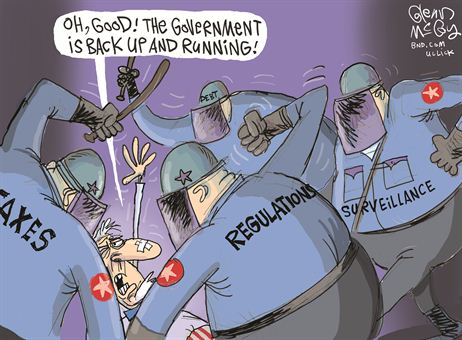
Contrary to the cartoon above, it’s not back up and running, though tax withholding and the impacts of regulatory rules continue unabated, and almost assuredly surveillance as well. After all (!), the federal government shutdown affects only “nonessential” activities of the federal government. Federal workers who are furloughed will receive back pay when the partial shutdown ends, but for now, federal spending is down roughly 25%.

The very real inconveniences for furloughed workers are regrettable. TSA employees continue to work while their paychecks are deferred indefinitely, though rates of absenteeism are high. So, we have slowdowns in security lines at airports, a lack of services at national parks (at least those not managed by private firms collecting revenue from visitors on-site), and a variety of other disruptions. For the time being, however, the lives of most Americans are largely unaffected. Except for the news coverage, my life hasn’t changed in any way, though I haven’t traveled during the shutdown.

Unfounded rumors about the shutdown have been rampant. For instance, I’ve heard that Social Security checks and weather forecasts would be suspended. Nancy Pelosi said the Secret Service would be unable to protect the President at the State of the Union address in the House chamber, a statement which the Department of Homeland Security promptly refuted. Many of the federal agencies with the highest shares of furloughed employees are regulators whose services are arguably counter-productive.

The White House Council of Economic Advisors (CEA) estimates that each additional week of the shutdown will reduce first quarter GDP growth by 0.13%. That means the interruption would take about 0.5% off first quarter growth if it lasts through January (say, from an annual rate of 2.5% to 2.0%). To the extent that people view the shutdown as temporary, and most do, the so-called “multiplier effects” of the shutdown should be relatively minor.

GDP is intended to measure of the value of the economy’s physical output. It is calculated in two independent ways based on 1) all income earned, and 2) the total of all spending on final (not intermediate) goods and services. Most components of final spending are well defined by the values assigned to goods and services traded in markets. Likewise, most incomes are based on the value assigned by labor markets to a given productive effort. Government “output”, however, is rather suspect as a component of spending because it is generally not subject to a market test of value. On the income side of the ledger, do government workers produce actual outputs? Some do, of course, but those outputs cannot be measured except by assigning a value based on what the workers are paid, and the payer is spending other peoples’ money! It’s not too speculative to suggest that the government’s output is a fraction of its spending. If that’s the case, the actual reduction in output caused by the shutdown is much smaller than the measured reduction in GDP. Therefore, the CEA’s estimates are a fiction.

To put an even finer point on it, many nonessential functions absorb resources while contributing very little to the nation’s wealth. Adam Brandon and John Tamny assert that private economic growth gives us the luxury of a large government sector, not the other way around. Government absorbs resources when it spends, but only by virtue of the taxes it imposes on private activity that is otherwise more highly productive. In the long run, as Brandon and Tamny argue, a smaller government (given a permanent shutdown of certain functions) might well yield greater economic output, not less.

Read this interesting essay for a discussion of the wasted, even counterproductive, utilization of human resources in government:

“They do nothing that warrants punishment and nothing of external value. That is their workday: errands for the sake of errands — administering, refining, following and collaborating on process. ‘Process is your friend’ is what delusional civil servants tell themselves. Even senior officials must gain approval from every rank across their department, other agencies and work units for basic administrative chores.

Process is what we serve, process keeps us safe, process is our core value. It takes a lot of people to maintain the process. Process provides jobs. In fact, there are process experts and certified process managers who protect the process. Then there are the 5 percent with moxie (career managers).

Again, many and perhaps most Americans view the shutdown itself with a certain degree of cynicism. In “America’s shutdown indifference“, Matthew Walther recalls this entertaining aspect of the last shutdown under President Obama:

“…of barriers being erected around various D.C.-area landmarks, including open-air war memorials. To this day I cannot think of any good reason for this save sheer caprice. If the idea was that 550-foot obelisks made of granite simply could not be meaningfully serviced during those lean two weeks in 2013, then who was responsible for putting up the rent-a-fence barricades around them? Civic-minded volunteers? The U.S. Marine Corps? Barack Obama himself? It was beautifully cynical, and I congratulate whoever came up with it.”

Both sides of the aisle play politics at the expense of the federal workforce. I certainly don’t wish to denigrate all federal workers. They perform varied functions and many are hard-working individuals. But still, it’s hard to feel very sorry for them given that they out-earn their private sector counterparts at almost every education level. Again, here’s Walther:

“Government employees, at both the state and federal level, are among the only workers in the United States who continue to be represented by powerful unions, despite the fact that by definition they’re not bargaining against capital but against their fellow citizens.”

I haven’t even mentioned the debate over open borders and the proposed wall, but that’s not my purpose here. All parties to that debate seem to think the shutdown is unlikely to harm their side politically. That’s either because the shutdown isn’t perceived as very impactful, or the “other” side can be blamed. One theory making the rounds is that the shutdown is part of a larger plan to institute permanent Reductions in Force (RIFs) at federal agencies, which are permissible after a furlough of 30 days or more (by January 19th). The argument plausibly suggests that some federal agencies might operate more effectively once the bureaucracy is pruned back via furloughs and/or RIFs. That’s especially true if “deep-state” sabotage of efforts to roll-back regulations are as common as the author asserts. Is the shutdown therefore a trap for unsuspecting congressional Democrats? Who knows, but to my way of thinking, government RIFs might even be worth the trouble of building a wall!

You’re Welcome: Charitable Gifts Prompt Statist Ire

14 Friday Dec 2018

Posted by Nuetzel in Central Planning, Charity, Uncategorized

≈ 1 Comment

Tags

Amazon, American Institute for Economic Research, central planning, Charity, Cloe Anagnos, Day 1 Fund, Doug Bandow, Forced Charity, Gaby Del Valle, Homelessness, Jeff Bezos, Redistribution, Russ Roberts, Scientism, Seattle Employment Tax, War on Charity

Charitable acts are sometimes motivated by a desire to cultivate a favorable reputation, or even to project intelligence. Perhaps certain charitable acts are motivated by guilt of one kind or another. Tax deduction are nice, too. But sometimes a charitable gift is prompted by no more than a desire to help others less fortunate. It’s likely a combination of motives in many cases, but to gainsay the purity of anyone’s charitable motives is rather unseemly. Yet Gaby Del Valle does just that in Vox, casting a skeptical eye at Jeff Bezos’ efforts to help the homeless through his Day 1 Fund.

“Last week, Amazon founder and CEO Jeff Bezos announced that he and his wife, MacKenzie Bezos, were donating $97.5 million to 24 organizations that provide homeless services across the country. The donation is part of Bezos’s $2 billion ‘Day 1 Fund, a philanthropic endeavor … that, according to Bezos, focuses on establishing ‘a network of new, non-profit, tier-one preschools in low-income communities’ and funding existing nonprofits that provide homeless services.”

Del Valle says Bezos deserves little credit for his big gift for several reasons. First, Amazon very publicly opposed a recent initiative for a $275 per employee tax on large employers in Seattle. The proceeds would have been used to fund public programs for the homeless. This allegation suggests that Bezos feels guilty, or that the gift is a cynical attempt to buy-off critics. That might have an element of truth, but the tax was well worthy of opposition on economic grounds — almost as if it was designed to stunt employment and economic growth in the city.

Second, because Amazon has been an engine of growth for Seattle, Del Valle intimates that the company and other large employers are responsible for the city’s high cost of housing and therefore homelessness. Of course, growth in a region’s economy is likely to lead to higher housing prices if the supply of housing does not keep pace, but forsaking economic growth is not a solution. Furthermore, every large city in the country suffers from some degree of homelessness. And not all of those homeless individuals have been “displaced”, as Del Valle would have it. Some have relocated voluntarily without any guarantee or even desire for employment. As for the housing stock, government environmental regulations, zoning policies and rent control (in some markets) restrains expansion, leading to higher costs.

Finally, Del Valle implies that private efforts to help the homeless are somehow inferior to “leadership by elected officials”. Further, she seems to regard these charitable acts as threatening to “public” objectives and government control. At least she doesn’t disguise her authoritarian impulses. Del Valle also quotes a vague allegation that one of the charities beholden to Amazon is less than a paragon of charitable virtue. Well, I have heard similar allegations that government isn’t celebrated for rectitude in fulfilling its duties. Like all statists, Del Valle imagines that government technocrats possess the best vision of how to design aid programs. That attitude is an extension of the scientism and delusions of efficacy typical of central planners. Anyone with the slightest awareness of the government’s poor track record in low-income housing would approach such a question with trepidation. In contrast, private efforts often serve as laboratories in which to test innovative programs that can later be adopted on a broader scale.

While selfishness might motivate private acts of charity in some cases, only voluntary, private charity can ever qualify as real charity. Government benefits for the homeless are funded by taxes, which are compulsory. Such public programs might be justifiable as an extension of social insurance, but it is not charity in any pure sense; neither are it advocates engaged in promoting real charity, despite their conveniently moralistic positioning. And unlike private charity, government redistribution programs can be restrained only through a political process in which substantial payers are a distinct minority of the voting population.

Public aid and private charity have worked alongside each other for many years in the U.S. According to Russ Roberts, private giving to the poor began to be “crowded-out” during the Great Depression by a dramatic increase in public assistance programs. (Also see Doug Bandow’s “War On Charity“.) It’s certainly more difficult to make a case for gifts to the poor when donors are taxed by the government in order to redistribute income.

The statist war on private charity can take other forms. The regulatory apparatus can crowd-out private efforts to extend a helping hand. Chloe Anagnos of the American Institute for Economic Research (AIER) writes of a charity in Kansas City that wanted to provide home-cooked soup to the homeless, but health officials intervened, pouring bleach into the soup. I am aware of similar but less drastic actions in St. Louis, where organizations attempting to hand-out sandwiches to the poor were recently prohibited by health authorities.

Private charity has drawn criticism because its source has driven economic growth, its source has opposed policies that stunt comic growth, and because it might interfere with the remote possibility that government would do it better. But private charity plays a critical role in meeting the needs of the disadvantaged, whether as a substitute for public aid where it falls short, or as a supplement. It can also play a productive role in identifying the most effective designs for aid programs. Of course, there are corrupt organizations and individuals purporting to do charitable work, which argues for a degree of public supervision over private charities. But unfortunately, common sense is too often lost to overzealous enforcement. In general, the public sector should not stand in the way of private charities and charitable acts, but real generosity has little value to those who press for domination by the state.

Missouri Prop B: the Unintended Consequences of Wishful Thinking

04 Sunday Nov 2018

Posted by Nuetzel in Labor Markets, Living Wage, Minimum Wage, Uncategorized

≈ Leave a comment

Tags

Anti-Poverty Programs, Automation, David Macpherson, Disparate impact, Fringe Benefits, Living Wage, Marginal Productivity, Minimum Wage, Missouri Proposition B, The Show Me Institute, Unskilled Labor, William Evan

Proposition B sounds really good to many Missouri voters: all we have to do to help low-wage workers is declare that they must be paid a higher wage. That’s the pitch, of course. But voters should hear the cruel truth about the unintended consequences of this well-intentioned and ill-considered proposition on the ballot this week:

  1. Businesses are likely to increase prices to compensate for a higher mandated wage, which hurts all consumers, but especially the poor.
  2. Some low-skilled job losses or lost hours are assured, and they will hit the very least-skilled the hardest. No matter the legal minimum, the real minimum wage is always zero.
  3. Such job losses have long-term consequences: lost job experience that the least-skilled desperately need to get ahead.
  4. The harms will have a disparate impact on minorities.
  5. Large employers can substitute capital for low-skilled labor: automated kiosks to take orders and increasingly sophisticated robots to perform tasks. Again, the real minimum wage is always zero. As I’ve said before on this blog, automate no job before its time. But that’s what Prop B will encourage.
  6. Employers can make other compensatory changes. That includes reduced fringe benefits and break times, increased production quotas, and less desirable shifts for minimum wage workers.
  7. A large share of the presumed beneficiaries of a higher minimum wage are not impoverished. Many are teenagers or young adults living with their parents.
  8. All of the preceding points argue that an increase in the minimum wage is not an effective method of targeting poverty reduction. In fact, the harm it inflicts is targeted at the most needy. 
  9. Small employers have less flexibility than large employers, and Prop B would place them at a competitive disadvantage. To that extent, a higher wage floor is most damaging to “mom & pop”, locally-owned businesses, and their employees. Again, the real minimum wage is always zero.

At least 24 earlier posts appear on this blog covering the topic of minimum wages. You can see most of them here. The points above are explored in more detail in those posts.

William Evan and David MacPherson of the Show-Me Institute have estimated the magnitude of the harms that are likely to result if Prop B is approved by voters on November 6, and they are significant. The voters of Missouri should not be seeking ways to make the state’s business environment less competitive.

Voters should keep in mind that wages in an unfettered market reflect the realities of labor demand and labor supply. Wages and other forms of compensation reflect the actual quantity, quality and productivity of available labor supplies. And for unskilled labor, which is often supplied by those who lack experience, a wage that matches their marginal productivity is one that provides that valuable experience. The last thing they need is for tasks requiring little skill to be performed by more experienced employees, or by machines. We cannot wish away these realities, and we cannot declare them suspended by law. Such efforts will have winners and losers, of course, though the former might not ever recognize the ephemeral nature of their gains. And as long as there is freedom of private decision-making, the consequences of such legal efforts will cause harm to those least able to withstand it.

Injecting Competition Into Health Care

12 Friday Oct 2018

Posted by Nuetzel in competition, Health Care, Uncategorized

≈ Leave a comment

Tags

Ameriflex, Anna Wilde Mathews, competition, Cross Subsidies, CVS, John C. Goodman, John Cochrane, MediBid, Medicaid, Medicare, MinuteClinic, Obamacare, Third-Party Payers, Transparent Pricing

Competitive pressures in U.S. health care delivery are weak to nonexistent, and their absence is among the most important drivers of our country’s high medical costs. Effective competition requires multiple providers and/or substitutes, transparent prices, and budget-conscious buyers, but all three are missing or badly compromised in most markets for health care services. This was exacerbated by Obamacare, but even now there are developments in “retail” health care that show promise for the future of competition in health care markets. The situation is not irreversible, but some basic policy issues must be addressed.

John Cochrane maintains that the question of “who will pay” for health care, while important, has distracted us from the matter of fostering more competition among providers:

“The discussion over health policy rages over who will pay — private insurance, companies, “single payer,” Obamacare, VA, Medicare, Medicaid, and so on — as if once that’s decided everything is all right — as if once we figure out who is paying the check, the provision of health care is as straightforward a service as the provision of restaurant food, tax advice, contracting services, airline travel, car repair, or any other reasonably functional market for complex services.”

We face a severe tradeoff in health care: how to provide for the needs of more patients (e.g., the uninsured, or a growing elderly population) without driving up the cost of care? As a policy matter, provider resources should not be viewed as fixed; their quantity and the efficiency with which those resources are utilized are responsive to forces that can be harnessed. Fixing the supply side of the health care market by improving the competitive environment is the one sure way to deliver more care at lower cost.

Fishy Hospital Contracts

Cochrane discusses some anti-competitive arrangements in health care delivery, quoting liberally from an article by Anna Wilde Mathews in The Wall Street Journal, “Behind Your Rising Health-Care Bills: Secret Hospital Deals That Squelch Competition“:

“Dominant hospital systems use an array of secret contract terms to protect their turf and block efforts to curb health-care costs. As part of these deals, hospitals can demand insurers include them in every plan and discourage use of less-expensive rivals. Other terms allow hospitals to mask prices from consumers, limit audits of claims, add extra fees and block efforts to exclude health-care providers based on quality or cost.”

Mathews’ article is gated, but Cochrane quotes enough of its content to convey the dysfunction described there. Also of interest is Cochrane’s speculation that the hospital contract arrangements are driven largely by cross subsidies mandated by government:

“The government mandates that hospitals cover indigent care, and medicare and medicaid below cost. The government doesn’t want to raise taxes to pay for it. So the government allows hospitals to overcharge insurance (i.e. you and me, eventually). But overcharges can’t withstand competition, so the government allows, encourages, and even requires strong limits on competition.”

The Role of Cross Subsidies

In this connection, Cochrane notes the perverse ways in which Medicare and Medicaid compensate providers, allowing large provider organizations to charge more than small  ones for the same services. Again, that helps the hospitals cover the costs of mandated care, regulatory costs, and the high administrative and physical costs of running large facilities. It also creates an obvious incentive to consolidate, reaping higher charges on an expanded flow of services and squelching potential competition. And of course the cross subsidies create incentives for large providers to lock-in business from insurers under restrictive contract agreements. Such acts restrain trade, pure and simple.

Cross subsidies, or building subsidies into the prices that buyers must pay, are thus an impediment to competition in health care, beyond the poor incentives they create for subsidized and non-subsidized buyers. So the “who pays” question rears it’s head after all. When subsidies are necessary to provide for those truly unable to pay for care, it is far better to compensate those individuals directly without distorting prices. That represents a huge policy change, but it would also help restore competition.

Competitive Sprouts

John C. Goodman provides a number of examples of how well competition in health care delivery can work. Most of them are about “retail medicine”, as it’s been called. This includes providers like MinuteClinic (CVS), LASIK and cosmetic surgery, concierge doctors, and “retail” surgical services. Goodman also mentions MediBid, a platform on which doctors bid to provide services for patients, and Ameriflex, which matches employers with concierge doctors. These services, which either bypass third-party payers or connect employer-payers with competitive providers, are having a real impact on the ability of patients to obtain care at a lower cost. Goodman says:

“I am often asked if the free market can work in health care. My quick reply is: That is the only thing that works. At least, it is the only thing that works well.”

Conclusion

Some of the most pernicious Obamacare cross subsidies have been dismantled via elimination of the individual mandate and allowing individuals to purchase short-term insurance. Nonetheless, U.S. health care delivery is still riddled with cross subsidies and excessive regulation of providers, including all the distortions caused by third-party payments and the tax code. Many buyers lack an incentive for price sensitivity. They face restrictions on their choice of providers, they don’t know the prices being charged, and they often don’t care because at the margin, someone else is paying. Fostering competition in health care delivery does not necessarily require an end to third-party payments, but the cross subsidies must go, employers should actively seek competitive solutions to controlling health care costs, price transparency must improve, and consumers must face incentives that encourage economies.

School Discipline, Disparate Impact, and Disparate Justice

05 Friday Oct 2018

Posted by Nuetzel in Discrimination, Education, Uncategorized

≈ 2 Comments

Tags

Alison Somin, Civil Rights Act, Department of Education, discrimination, Disparate impact, Disparate Justice, Disparate Treatment, Education Week, Gail Herriot, Office of Civil Rights, Title VI, Walter Williams

Sad to say, there are racial disparities in victimization by misbehavior in schools, and African American children are the most victimized in terms of their safety and academic environment. Yet since 2014, the Department of Education (DOE) has been enforcing rules against “disparate impact” in school disciplinary policies, often aggravating that victimization. In a paper entitled “The Department of Education’s Obama-Era Initiative on Racial Disparities in School Discipline: Wrong For Students and Teachers, Wrong on the Law“, authors Gail Heriot and Alison Somin expose these unfortunate policies and the distortion of actual law they represent. These policies and actions are presumed by the DOE and the Office of Civil Rights (OCR) to be authorized under Title VI of the Civil Rights Act of 1964, but Heriot and Somin show that Title VI is not a disparate impact law and that enforcement of strictures against disparate impacts exceed the authority of the OCR.

When are disciplinary policies discriminatory? Disparate treatment occurs when a student from a “protected class” is punished more severely than other students for an identical misdeed. That is obviously discriminatory and unfair. A disparate impact, however, is a statistical difference in the punishments meted out to a protected class relative to others, which is not prima facie evidence of discrimination. Given consistent application of disciplinary policies — identical treatment for all classes under those policies — disparate impact is possible only when there are differences in the actual behavior of students across classes. Of course, such a difference does not mean that the protected class is “less worthy” in any absolute sense; instead, it probably indicates that those students face disadvantages that manifest in misbehavior in greater proportion within a school environment. The consequences of refusing to punish that behavior are bad for everyone, including and perhaps especially the miscreants themselves.

Disparate impact enforcement rules are fundamentally flawed, as Heriot and Somin explain. Almost any decision rule applied in business or other social interaction has a disparate impact on some parties. Defining qualifications for many jobs will almost always involve a disparate impact when protected classes lack those skills in greater proportion than unprotected classes. In schools, such rules lead to more lenient disciplinary policies or a lack of enforcement, either of which are likely to bring even greater disciplinary problems.

In schools with large minority populations, these perverse effects penalize the very minority students that the DOE hopes to protect. And they often have harsh consequences for minority teachers as well. Walter Williams bemoans the difficulties faced by many teachers:

“For example, after the public school district in Oklahoma City was investigated by the OCR, there was a 42.5 percent decrease in the number of suspensions. According to an article in The Oklahoman, one teacher said, ‘Students are yelling, cursing, hitting and screaming at teachers, and nothing is being done, but teachers are being told to teach and ignore the behaviors.’ According to Chalkbeat, new high school teachers left one school because they didn’t feel safe. There have been cases in which students have assaulted teachers and returned to school the next day. …

An article in Education Week earlier this year, titled ‘When Students Assault Teachers, Effects Can Be Lasting,’ discusses the widespread assaults of teachers across the country: ‘In the 2015-16 school year, 5.8 percent of the nation’s 3.8 million teachers were physically attacked by a student. Almost 10 percent were threatened with injury, according to federal education data.'”

To state the obvious, this undermines the ability of teachers do their jobs, let alone enjoy teaching. For many, quitting is an increasingly tempting option. And Williams, an African American, goes on to say “… when black students are not held accountable for misbehaving, they are set up for failure in life.”

When it comes to misbehavior, equalizing discipline by subgroup is almost certain to be unjust. And disparate impacts are almost certain to be a byproduct of a just disciplinary system when other social forces lead to differences in preparation for schooling. When the focus is placed on a by-product of Justice, rather than justice itself, as when disparate impacts are penalized or prohibited, everyone loses. It obviously harms unprotected classes, but ultimately it harms protected classes even more harshly by subjecting them to degraded school environments, less educational opportunity, and fewer rewards in life.

The “Judicial Temperament” Ruse

02 Tuesday Oct 2018

Posted by Nuetzel in Uncategorized

≈ Leave a comment

Tags

Brett Kavanaugh, Chstine Blasey Ford, False Accusation, Impartiality, Judicial Temperament, Ken Starr, Randy Barnett, Supreme Court, The Clintons

“Judicial temperament” applies to situations in which an impartial third party is or would be acting as a judge, weighing evidence that might support one side of a case or the other. It cannot apply to one of the parties to a dispute or allegation of wrongdoing, nor can it reasonably be inferred in other matters from the attitude or statements of one of the first two parties with respect to the accusation. Of course, an individual accused of a misdeed for which they KNOW they are innocent can be expected to react angrily. That would be natural and understandable, and it has nothing to do with the individual’s judgement in other realms. Any victim of wrongdoing has a right to be angry, and a false accusation is no exception.

Christine Blasey Ford has accused Brett Kavanaugh of a sexual assault that she says took place 36 years ago when the two were in high school, but without corroboration of any kind. The Left has characterized Kavanaugh’s righteous indignation as a “temper tantrum” unbefitting a Supreme Court Justice. “Oh, but why are you so angry?”, they ask. Really.

Assuming that he is indeed innocent of the charge, and there are many reasons to doubt its veracity, Kavanaugh’s reaction was well-justified. The allegation was unveiled by the minority on the Senate Judiciary Committee at the eleventh hour as they prepared to vote on bringing his name to the floor of the Senate for confirmation. A much earlier disclosure was possible and would have permitted an investigation weeks before the Committee hearings. Not only that, the minority presumed his guilt, he was called “evil” by one senator, he received death threats against his family, and he was forced to field a host of probative questions about his teenage scribblings in a high school yearbook. Only a Vulcan would greet such sabotage of character with equanimity, and I’ll gladly give Kavanaugh a pass on it. I mostly enjoyed his fire and emotional at the hearing last Friday.

Another dimension of judicial temperament is impartiality. The meaning of that term can be manipulated, of course. For example, one’s views on constitutional interpretation are at the very root of many political disagreements, yet when convenient, some pretend that the two are mutually exclusive. Shall we disqualify anyone with a specific constitutional philosophy? Does it somehow depend on which seat is open? Of course not.

On the other hand, Kavanaugh voiced what many knew to be true at the hearing last Friday: the Leftist minority on the Committee had prepared an ambush to destroy him. He also noted the possibility of lingering resentment for his role on Ken Starr’s staff investigating the Clintons in the 1990s. Perhaps Kavanaugh was unchaste to express what was obvious, and the Left has seized on those statements as evidence of a disqualifying political bias. But again, he stated what he knows to be true.

Kavanaugh’s is widely viewed as an impartial jurist, and he has a history of collegiality with judicial peers from across the political spectrum. As Randy Barnett states at the link above:

“His 300 opinions have been thoughtful and well reasoned. His reasoning has repeatedly been adopted by majorities of the Supreme Court. He gets high marks from, well, from everyone for his intelligence, decency, and judicial temperament.”

It is my conviction that Kavanaugh would rely on his legal scholarship and constitutional philosophy, as he has in the past, in deciding his positions on issues that come before the Court, rather than hearing cases with a view toward malice against particular individuals or one end of the political spectrum. I also believe he is wise enough to know that he should recuse himself in cases of obvious personal conflict. The charge that he lacks judicial temperament is an additional attack based on his judicial philosophy, and it is an opportunistic attempt to discredit him on the basis of his strong and understandable response to a smear campaign.

← Older posts
Newer posts →
Follow Sacred Cow Chips on WordPress.com

Recent Posts

  • A Warsh Policy Scenario At the Federal Reserve
  • The Coexistence of Labor and AI-Augmented Capital
  • The Case Against Interest On Reserves
  • Immigration and Merit As Fiscal Propositions
  • Tariff “Dividend” From An Indigent State

Archives

  • February 2026
  • January 2026
  • December 2025
  • November 2025
  • October 2025
  • September 2025
  • August 2025
  • July 2025
  • June 2025
  • May 2025
  • April 2025
  • March 2025
  • February 2025
  • January 2025
  • December 2024
  • November 2024
  • October 2024
  • September 2024
  • August 2024
  • July 2024
  • June 2024
  • May 2024
  • April 2024
  • March 2024
  • February 2024
  • January 2024
  • December 2023
  • November 2023
  • August 2023
  • July 2023
  • June 2023
  • May 2023
  • April 2023
  • March 2023
  • February 2023
  • January 2023
  • December 2022
  • November 2022
  • October 2022
  • September 2022
  • August 2022
  • July 2022
  • June 2022
  • May 2022
  • April 2022
  • March 2022
  • February 2022
  • January 2022
  • December 2021
  • November 2021
  • October 2021
  • September 2021
  • August 2021
  • July 2021
  • June 2021
  • May 2021
  • April 2021
  • March 2021
  • February 2021
  • January 2021
  • December 2020
  • November 2020
  • October 2020
  • September 2020
  • August 2020
  • July 2020
  • June 2020
  • May 2020
  • April 2020
  • March 2020
  • February 2020
  • January 2020
  • December 2019
  • November 2019
  • October 2019
  • September 2019
  • August 2019
  • July 2019
  • June 2019
  • May 2019
  • April 2019
  • March 2019
  • February 2019
  • January 2019
  • December 2018
  • November 2018
  • October 2018
  • September 2018
  • August 2018
  • July 2018
  • June 2018
  • May 2018
  • April 2018
  • March 2018
  • February 2018
  • January 2018
  • December 2017
  • November 2017
  • October 2017
  • September 2017
  • August 2017
  • July 2017
  • June 2017
  • May 2017
  • April 2017
  • March 2017
  • February 2017
  • January 2017
  • December 2016
  • November 2016
  • October 2016
  • September 2016
  • August 2016
  • July 2016
  • June 2016
  • May 2016
  • April 2016
  • March 2016
  • February 2016
  • January 2016
  • December 2015
  • November 2015
  • October 2015
  • September 2015
  • August 2015
  • July 2015
  • June 2015
  • May 2015
  • April 2015
  • March 2015
  • February 2015
  • January 2015
  • December 2014
  • November 2014
  • October 2014
  • September 2014
  • August 2014
  • July 2014
  • June 2014
  • May 2014
  • April 2014
  • March 2014

Blogs I Follow

  • Passive Income Kickstart
  • OnlyFinance.net
  • TLC Cholesterol
  • Nintil
  • kendunning.net
  • DCWhispers.com
  • Hoong-Wai in the UK
  • Marginal REVOLUTION
  • Stlouis
  • Watts Up With That?
  • American Elephants
  • The View from Alexandria
  • The Gymnasium
  • A Force for Good
  • Notes On Liberty
  • troymo
  • SUNDAY BLOG Stephanie Sievers
  • Miss Lou Acquiring Lore
  • Your Well Wisher Program
  • Objectivism In Depth
  • RobotEnomics
  • Orderstatistic
  • Paradigm Library
  • Scattered Showers and Quicksand
  • Jam Review

Blog at WordPress.com.

Passive Income Kickstart

OnlyFinance.net

TLC Cholesterol

Nintil

To estimate, compare, distinguish, discuss, and trace to its principal sources everything

kendunning.net

The Future is Ours to Create

DCWhispers.com

Hoong-Wai in the UK

A Commonwealth immigrant's perspective on the UK's public arena.

Marginal REVOLUTION

Small Steps Toward A Much Better World

Stlouis

Watts Up With That?

The world's most viewed site on global warming and climate change

American Elephants

Defending Life, Liberty and the Pursuit of Happiness

The View from Alexandria

In advanced civilizations the period loosely called Alexandrian is usually associated with flexible morals, perfunctory religion, populist standards and cosmopolitan tastes, feminism, exotic cults, and the rapid turnover of high and low fads---in short, a falling away (which is all that decadence means) from the strictness of traditional rules, embodied in character and inforced from within. -- Jacques Barzun

The Gymnasium

A place for reason, politics, economics, and faith steeped in the classical liberal tradition

A Force for Good

How economics, morality, and markets combine

Notes On Liberty

Spontaneous thoughts on a humble creed

troymo

SUNDAY BLOG Stephanie Sievers

Escaping the everyday life with photographs from my travels

Miss Lou Acquiring Lore

Gallery of Life...

Your Well Wisher Program

Attempt to solve commonly known problems…

Objectivism In Depth

Exploring Ayn Rand's revolutionary philosophy.

RobotEnomics

(A)n (I)ntelligent Future

Orderstatistic

Economics, chess and anything else on my mind.

Paradigm Library

OODA Looping

Scattered Showers and Quicksand

Musings on science, investing, finance, economics, politics, and probably fly fishing.

Jam Review

"If you get confused, listen to the music play."

  • Subscribe Subscribed
    • Sacred Cow Chips
    • Join 128 other subscribers
    • Already have a WordPress.com account? Log in now.
    • Sacred Cow Chips
    • Subscribe Subscribed
    • Sign up
    • Log in
    • Report this content
    • View site in Reader
    • Manage subscriptions
    • Collapse this bar
 

Loading Comments...