Pricing Wizards Baffle Public Officials

Tags

, , , , , , , , , ,

traffic-cartoon

When government invests in physical infrastructure, voters are led to believe that the resources invested will enhance their well being and safety as well as the productivity of the nation’s economy. In any particular instance, however, there is a strong chance that confidence in such assurances is misplaced. Allocation of public monies is always subject to a high likelihood of mismanagement, not least because decision-making in this arena is highly politicized. Government efficiency is always compromised because its actions are not guided by a profit motive. And it is well known that politicians and bureaucrats often act on their own private motives, rather than as purely disinterested public servants.

Another primary shortcoming of government infrastructure investment is that it is mis-priced. Highways are a perfect example. They are often congested because they are free. A weak objection to the last statement is that “pricing” is accomplished through gas taxes, which should provide incentives for curtailing the use of automobiles, but that is true only in the most general sense. The marginal cost to a driver of using a specific route is zero all day long. This leads to greater congestion, higher maintenance costs and, invariably, calls for expanding highway infrastructure.

Robert Krol has an excellent essay on the e21 website in which he lays out the strong case for congestion pricing:

Although current federal law prohibits charging tolls on existing interstates, states may apply for permission to charge tolls on new lanes. This has occurred on a limited basis in Southern California. Variable tolls have been used outside the United States to successfully reduce congested highways. Before we spend more on highways, we need to change how we price highways.

… the revenues could be used for highway maintenance and construction. Most importantly, by pricing roads correctly, we may actually find that we don’t need to spend more on highways. …

Economists Gilles Duranton and Matthew Turner have shown that building more highway capacity in U.S. cities results in residents driving more, greater commercial traffic, and population in-migration. Congestion remains, resulting in wasted time. A recent estimate from the Texas A&M Transportation Institute shows that these delays cost drivers $121 billion per year. Congestion also increases air pollution in neighborhoods near the congested highways.

Public transit proposals are almost always boondoggles, including light rail. These systems usually generate fare revenue that falls short of operating costs (with zero contribution to capital costs). But at least fares are non-zero! The ability of mass transit systems to charge fares that pay for themselves is seriously undermined by the ongoing expansion of “free” urban highways.

Reihan Salam reinforces these points in a post about Hillary Clinton’s infrastructure proposals. Clinton pushes the general idea that more infrastructure spending is a must, going so far as to promote a public / private “infrastructure bank” for a wide range of projects that quite possibly are unnecessary, given more rational pricing. She doesn’t promote the latter and she probably doesn’t even think about it, or whether scarcity should be priced.

If new infrastructure is to be financed with private capital, investors are going to expect spending discipline and, eventually, a meaningful return. Will this return be extracted from taxpayers or from users of the infrastructure service in question? The Obama administration, to its credit, supports allowing state government to collect tolls on their Interstate highway segments if they choose. Would Clinton favor giving states the freedom to make greater use of user fees? ….

I don’t think our main problem is that we’re not spending enough on highways, as Clinton seems to believe. If anything, I think our highway system is overbuilt. ​… The chief problem with our airports is not … that they’re not as sleek and modern as the vast white elephants you’ll find in East Asia. Rather, it is that they are congested, and the reason they are congested is that the federal government doesn’t provide for market-rate pricing for take-off and landing slots. This straightforward reform would greatly increase the productivity, not to mention the pleasantness, of our aviation system. Yet it doesn’t involve spending billions of dollars and cutting ribbons, so politicians are by and large not interested.

Voters should not grant free points to politicians who merely utter the I-word: infrastructure. A more creative approach involves efficient, market pricing of highways and other public assets. The technology to price highways efficiently is now available. That may involve some loss of privacy, as it requires detecting the presence of individual vehicles on the roads, but privacy could be protected to some extent by using private firms to manage billing.

Leftists Propose New Ministry of Speech Approval

Tags

, , , , , , , ,

FactCheckers

I witness so many calls for censorship on a day-to-day basis that I find it astonishing. This in a free society, and from people who fancy themselves liberal. They prefer a form of censorship that carries criminal penalties for speech that does not meet with approval by media “fact checkers”. Which fact checkers shall we choose? Will they be fact-checking juries of our peers, or a new cadre of officials donning armbands?

Does anyone truly believe that the branch of the media engaged in “fact-checking” is objective? Andrew Gripp covers this topic, demonstrating that the assessment of “facts” often doesn’t stand the test of time. Fact checkers will call a statement false, only to rule otherwise years later, or vice versa. That’s just how it went down with President Obama’s pronouncement that “if you like your plan, you can keep your plan”. True in 2008, false in 2013. Would Obama receive an exemption under this approach?

But that is just one way in which the fact checkers go wrong. More basic is the fact that the assessments they make are essentially opinions! Gripp puts his finger on the primary weakness of the fact-checking industry:

… it is important to remember that old Enlightenment figure Giambattista Vico’s verum factum principle: the truth is made — made by people with their own biases, limitations, and subjective standards.

As part of the same censorious narrative, I sometimes hear that Canada “bans” Fox News. This is patently false, as Snopes asserts. Another trope is that Fox News lies 50% of the time, or 82% of the time, or some such claim that should immediately set off the BS alarm of any discerning observer. I get aggravated with certain things I hear on Fox too, but as an empiricist, this just smells like BS. Kevin Williamson shreds these reports as exercises in bias in a piece entitled “How Stupid Happens“:

The most obvious problem — though certainly not the only problem, not even close — is selection bias: PolitiFact is a readership-driven online publication, and thus it exercises a great deal of discretion about which statements it chooses to evaluate and why. The most obvious factor is that it evaluates only statements that are disputed. Specifically, it evaluates only statements that are disputed and that its editors believe will be of some interest or benefit to its readers. …

But the fact is that unsupportable, boneheaded claims … will live forever, because people are mostly interested in having their biases confirmed and their values affirmed rather than learning new things about the world and how it works. True, much as I like yelling at people on television, it is pretty hard to feel too bad for Fox News and MSNBC over an exercise in confirmation bias, but this sort of sloppy thinking and malicious manipulation does have the effect of leaving the polity a little dumber than it absolutely has to be. And that is an unforgivable sin.

In many respects, it feels like this topic is hardly worth a blog post, because the wannabe censors exist in an impenetrable ideological bubble. But on the other hand, they are little tyrants, not merely content to seek a monopoly over the market place of ideas, which is bad enough. They also seek to criminalize statements with which they happen to disagree. There is no doubt that they would burn books. Their ideas are dangerous and should not be treated with respect in a free society.


Nice Splice: New & Old GMO Varieties Blossom

Tags

, , , , , , , , , , , , , , , , ,

image

Good for Bill Nye the Science Guy! And separately, good for Slate! First, the pop “scientist” Nye has turned the corner and now understands that genetic engineering (GE) and genetically modified organisms (GMOs) represent wonderful technology, holding great promise for humanity. Here is what he describes as the key:

This is what changed my mind, is being able to do [sequence genes] 10 million times faster than they used to be able to do it … and being able to eliminate the ones not suitable for farming and susceptible to diseases and so on. We’re farmers, and we want them to come out the way we want them.

Lydia Ramsey, whose post at Business Insider is linked above, distills Nye’s position this way:

We are a society of farmers, and for thousands of years, farmers have been doing everything in their power to get the most product from their labor. Genetically modified crops are a way to do that.

Apparently Nye is also impressed with the lengthy selection process and careful testing  that takes place before GMOs are ever brought to market. That contrasts with the nonexistent testing that is typical of conventional cross-breeding and irradiation, which can result in millions of gene mutations.

Nye, a mechanical engineer by training, probably knows enough science to recognize that there is a massive volume of literature that testifies to the safety of GMO crops (see here and here).

In Slate, William Saletan has written an excellent report entitled “Unhealthy Fixation“, and subtitled “The war against genetically modified organisms is full of fearmongering, errors, and fraud. Labeling them will not make you safer.”  Saletan emphasizes that GE is not any one single “thing”, but instead is a process. He discusses the histories of four distinct GMO issues:

  1. Overcoming the devastation of the papaya ringspot virus;
  2. Crops with a single Bt gene inserted versus Bt insecticides used on organics;
  3. Malnutrition, childhood blindness, and Golden Rice;
  4. Herbicide tolerance, farm productivity and herbicide overuse;

The fourth issue is an unfortunate aspect of our experience with GMOs, even to this day: much of it has related to strains of GE crops that are resistant to herbicides, glyphosate being the most prominent (until the patent expired in 2000, Monsanto’s Roundup was the only brand). In the public imagination, GMOs are almost synonymous with “Roundup-ready” crops. Glyphosate is only one type of herbicide, however, and there are significant benefits to herbicide-resistant crops, some of which are created without the help of GE. But herbicide-resistant crops are only one type of GMO. There are many other GMO varieties, and Saletan provides a long list of varieties in the pipeline:

… drought-tolerant corn, virus-resistant plums, non-browning apples, potatoes with fewer natural toxins [and fewer carcinogens when fried], and soybeans that produce less saturated fat. … virus-resistant beans, heat-tolerant sugarcane, salt-tolerant wheat, disease-resistant cassava, high-iron rice, and cotton that requires less nitrogen fertilizer. … high-calcium carrots, antioxidant tomatoes, nonallergenic nuts, bacteria-resistant oranges, water-conserving wheat, corn and cassava loaded with extra nutrients, and a flaxlike plant that produces the healthy oil formerly available only in fish.

Saletan bemoans the dominance of the herbicide industry in commercial applications of GMOs. He wants the food industry and regulators to move forward with the many other promising GE applications like those listed in the quote above. He also rightly blames anti-GMO activists for holding up promising varieties:

First, it’s true that the issue is complicated. But the deeper you dig, the more fraud you find in the case against GMOs. It’s full of errors, fallacies, misconceptions, misrepresentations, and lies. The people who tell you that Monsanto is hiding the truth are themselves hiding evidence that their own allegations about GMOs are false. They’re counting on you to feel overwhelmed by the science and to accept, as a gut presumption, their message of distrust.

There is a lot about GE technology for farmers and consumers to love. Many detractors seem unaware that life-saving products like insulin are made with GMOs, or that GMOs are in widespread use in the production of products like cheesebeer, and wine. The anti-GMO drumbeat goes on, however, promoting myths like the five discussed here by Dan Charles at NPR. This includes the fallacy that farmers saved their own seeds for planting until Monsanto came along. A particularly egregious piece of recent propaganda was a video promoted by the huckster David Wolfe. It involved a family who ate only organic food for two weeks and saw the trace levels of pesticides in their urine vanish. Of course, the researchers did not test for organic pesticides, such as Bt, but that escapes the notice of Wolfe’s uncritical acolytes.

You’ll find eight earlier posts related to GMOs on Sacred Cow Chips at this link.

A Cooked-Up Climate Consensus

Tags

, , , , , , , , , , , ,

Settled-Science

Consensus: the world is flat; the science is settled. Consensus: the earth is at the center of the universe; the science is settled. Consensus: bloodletting can cure diseases; the science is settled. Did these ideas truly represent scientific consensus? They probably thought so at the time, but it’s more likely that they derived from long- and widely-held assumptions that had never been tested adequately via scientific methods. It might have been difficult, if not impossible, to test those propositions using the methods available at the time. There are certainly other examples of  “settled science” that were later revised, such as certain aspects of Newtonian physics.

The so-called “consensus” on climate change is similar to the first few “scientistic” assertions above, except that it’s a much less honest mistake. The most prominent claim about it is that 97% of climate scientists agree that humans have contributed to global warming. That is incorrect in several ways. Its genesis is a 2013 paper by John Cook of the University of Queensland. Richard Tol of the University of Sussex examines the facts surrounding the Cook paper in “Global warming consensus claim does not stand up“. The claim itself is a misrepresentation of Cook’s findings, according to Tol:

The 97% refers to the number of papers, rather than the number of scientists. The alleged consensus is about any human role in climate change, rather than a dominant role….

It is well known that the peer review process in the climate research community was fundamentally corrupt during the period covered by Cook’s examination of the literature. Papers submitted to academic journals by climate “dissenters” were often shut out, which would have biased Cook’s findings even if his review had been conducted honestly. Tol goes on to note the distortions introduced by Cook’s research, including a non-representative sample of papers:

The sample was padded with irrelevant papers. An article about TV coverage on global warming was taken as evidence for global warming. In fact, about three-quarters of the papers counted as endorsements had nothing to say about the subject matter.

It gets even worse:

Cook enlisted a small group of environmental activists to rate the claims made by the selected papers. Cook claims that the ratings were done independently, but the raters freely discussed their work. There are systematic differences between the raters. Reading the same abstracts, the raters reached remarkably different conclusions – and some raters all too often erred in the same direction. Cook’s hand-picked raters disagreed what a paper was about 33% of the time. In 63% of cases, they disagreed about the message of a paper with the authors of that paper.

On top of all that, Cook was uncooperative when asked to make his data available to other researchers. Apparently a hacker obtained the data, which revealed a highly questionable data collection process (and that Cook had lied regarding the existence of time stamps on the surveys):

After collecting data for 8 weeks, there were 4 weeks of data analysis, followed by 3 more weeks of data collection. The same people collected and analysed the data. After more analysis, the paper classification scheme was changed and yet more data collected.

In short, the Cook research upon which the 97% claim is based is trash. There are a number of points upon which climate researchers can largely agree in principle, including the fact that greenhouse gases would warm the planet, but only if ceteris paribus is invoked. There are many feedback effects and confounding influences that change the relationship, and the actual time span of data that can be brought to bear on the issue is strikingly short to justify bold conclusions. Unfortunately, the research environment is so politicized that even the data itself is subject to manipulation. Astonishingly, many assertions about the actual climate are, in fact, based on model output, not actual data!

There is strong disagreement at the highest levels of the scientific community regarding the balance of the evidence on climate change and whether it justifies radical policy change. Matt Ridley examines this issue in “The Climate Wars’ Damage To Science“:

Today’s climate science, as Ian Plimer points out in his chapter in The Facts, is based on a ‘pre-ordained conclusion, huge bodies of evidence are ignored and analytical procedures are treated as evidence’. Funds are not available to investigate alternative theories. Those who express even the mildest doubts about dangerous climate change are ostracised, accused of being in the pay of fossil-fuel interests or starved of funds; those who take money from green pressure groups and make wildly exaggerated statements are showered with rewards and treated by the media as neutral.

Ridley goes on to recount the litany of scandals that have erupted within the climate establishment over the past few years. It is well worth reading, but ultimately these developments can’t help but damage science, its reputation with the public, and its usefulness to mankind.

Public Monopolists Say “Don’t Be Choosy”

Tags

, , , , , , , , ,

choice better schools

Imagine a food distribution system that mirrored the organization of K-12 education in the U.S. How do you think it would work out? That thought exercise was conducted four years ago by Don Boudreaux in his Wall Street Journal op-ed: “If Supermarkets Were Like Public Schools”(gated). Boudreaux has helpfully reblogged this op-ed at Cafe Hayek as part of his post “Separate School From State“. Read the whole thing! Because this is a topic in economics and I am so very pedantic, I prefer not to use the term “market” at all in this context. After all, a public “supermarket”, as discussed by Boudreaux, is no more a market than a public school is a market. I will use the term “public grocery store” instead, except when quoting Boudreaux.

The comparison of grocery stores to schools involves outputs that are both considered essential. In fact, there should be no argument that food is the more essential of the two. Yet the essential nature of educating children in a modern society is thought to be an important rationale for the existence of a public school system. Would supporters of public education care to apply the argument that “market forces can’t supply quality education” to another essential product, like food?

Boudreaux invokes several features of K-12 education in “designing” his hypothetical food distribution system:

  • Residents of each county would pay taxes on their properties.
  • Each family would be assigned to a particular supermarket according to its home address. And each family would get its weekly allotment of groceries—’for free’—from its neighborhood public supermarket.
  • No family would be permitted to get groceries from a public supermarket outside of its district.
  • “... families would be free to shop at private supermarkets that charge directly for the groceries they offer. Private-supermarket families, however, would receive no reductions in their property taxes.

Economic theory predicts that the monopoly status held by public grocery stores over the provision of “free food” within their districts would cause the quality and variety offered at those stores to suffer. This is just a form of restraining trade, which is what monopolists do. The classic monopolist charges a higher price and produces less output. Exactly the same is predicted in Boudreaux’s experiment.

One difference in comparing food stores to schools is that families, presumably, could purchase some of their groceries from private stores and meet the rest of their food needs from their district grocery store at no marginal cost, whereas the school selection is all public or all private. However, this does not invalidate Boudreaux’s assertion that the quality offered by the monopoly provider will suffer.

Like public schools, there would be massive variations in quality across public grocery stores due to variation in the tax base from one district to another. This would tend to reinforce differences in the value of property across districts, because it is so desirable to live in a district with a good public grocery.

Here’s an extended excerpt from Boudreaux:

Being largely protected from consumer choice, almost all public supermarkets would be worse than private ones. In poor counties the quality of public supermarkets would be downright abysmal. ….

Responding to these failures, thoughtful souls would call for ‘supermarket choice’ fueled by vouchers or tax credits. Those calls would be vigorously opposed by public-supermarket administrators and workers.

Opponents of supermarket choice would accuse its proponents of demonizing supermarket workers (who, after all, have no control over their customers’ poor eating habits at home). Advocates of choice would also be accused of trying to deny ordinary families the food needed for survival. Such choice, it would be alleged, would drain precious resources from public supermarkets whose poor performance testifies to their overwhelming need for more public funds.

As for the handful of radicals who call for total separation of supermarket and state—well, they would be criticized by almost everyone as antisocial devils indifferent to the starvation that would haunt the land if the provision of groceries were governed exclusively by private market forces.

In the face of calls for supermarket choice, supermarket-workers unions would use their significant resources for lobbying—in favor of public-supermarkets’ monopoly power and against any suggestion that market forces are appropriate for delivering something as essential as groceries.

That sounds all too familiar. Even with massive state redistribution of public grocery store funding from wealthy to poor districts, the result would be much the same, as it is with public schools. Increased grocery store funding cannot correct the larger problems plaguing the community, many of which are created by the welfare state itself. And increased funding does not correct fundamental dislocations created by a monopoly, especially a public monopoly. The entrenched, politicized interests that infest public institutions always resist changes that might improve quality. They are typified by bloated administrative machinery and a general lack of responsiveness to the community. Only competition and choice can eliminate these tendencies and drive improvement.

An objection that might be raised to Boudreaux’s comparison is that public schools must accommodate a student population with wide variations in learning ability. It may be claimed that this variation strains the resources of public relative to private schools. However, that burden is due in large part to the structure of the education system. A benefit of competition and choice is the extent to which it can accommodate diverse needs, and there is no reason why education should prove to be an exception. In fact, diverse needs are already met very well by private education, but they serve only “private school families.” Empowering all families to choose the schools that best accommodate their needs would bring higher quality to our K-12 education system.

Balancing Gay Rights and Religious Rights

Tags

, , , , , , , , , , ,

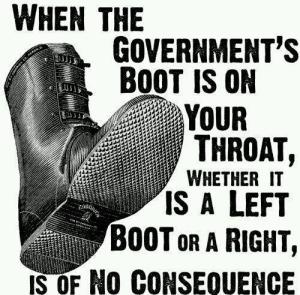
Government boot

Gay marriage rights are considered a big win among libertarians, but there are thorny issues on the horizon as LGBT activists contest certain liberties of other groups. Last month’s landmark Supreme Court decision in Obergefell v. Hodges established that same-sex marriage is protected by the 14th Amendment to the Constitution. Unfortunately, the established rights of different groups are sometimes in conflict; recognition of one individual right under the Constitution does not invalidate the established rights of others. Rather, these rights exist pari-passu unless some intractable conflict exists. Any challenge to a right of one party by another must be resolved based upon whether the courts find a compelling reason, under the circumstances of the case, to favor one right over another. Depending on the details, the result may establish a narrow or a broad precedent.

Last week, Reason carried a good discussion of several areas of possible conflict between the positions of certain LGBT activists and the libertarian view: “Is This Where Libertarians and the Gay Community Part Ways?“, by Scott Shackford, covered each of the general issues listed below, which I’ll attempt to summarize. The libertarian resolution to most of these issues is dependent upon whether the challenge is against a government entity or a private party. This dichotomy follows from a constitutional philosophy under which the powers of government are strictly enumerated and the presumed rights of private individuals are broad and unenumerated. Many libertarians, Shackford included, believe that conflicts are often easily resolved when all alternatives for both parties are considered. For that reason, simply allowing private social arrangements to evolve is superior to intrusion by government aimed at righting perceived wrongs.

Employment Nondiscrimination: Shackford is skeptical that congressional passage of the long-debated federal Employment Non-Discrimination Act (ENDA) would accomplish much because there has already been such a significant shift in the cultural acceptance of homosexuality. Nevertheless, he is supportive of laws prohibiting anti-gay discrimination by government employers.

The ENDA would grant gay and transgender individuals the same status as other protected classes under federal law. With certain exceptions, it would require private employers to offer employment and benefits to LGBTs and same-sex married couples on the same basis as heterosexuals. This is meaningless unless gay individuals self-identify on job applications. It would also require that employers collect data on sexual preference and transgender status, which is costly, likely to be somewhat unreliable and disturbingly intrusive. But the most vexing aspect of federal law prohibiting discrimination by private employers against LGBTs is the potential conflict with the employer’s religious convictions.

The ENDA exempts religious organizations. The real challenge is balancing the rights of homosexuals with those of private employers having deeply-held religious beliefs opposing homosexuality. Should the rights of gays take precedence over the religious rights of private employers? There should certainly be no presumption that gays are dependent upon religious private employers for work. And there should be no presumption of “hate” on the part of a religious employer who does not wish to offer  any pecuniary support to homosexuals. Thus, it is difficult to argue that the employment rights of gays trump the religious rights of private employers, and because alternatives exist for gays, many libertarians see this as a simple issue of live and let live.

Religious Freedom Exemptions: This is about the asserted freedom to decide not to do  business with LGBTs based on religious convictions. Examples are the Muslim baker and the Christian photographer who do not wish to take business related to same-sex weddings. As I noted in “Suit Me or Face a Lawsuit: Adventures in Litigation Land“, compulsion to practice an art or to engage in any act of expression against one’s religious convictions is not acceptable from a libertarian perspective. That does not justify discrimination in a business’s public accommodations, however, where the doors of the business are open for purchases by the general public. The public at large, protected groups and otherwise, should have the freedom to transact there.

Shackford makes some good points in this section, including a rebuttal of the argument that to be engaged in “doing business” somehow disqualifies an individual from refusing an order based on religion:

This argument flips the idea of civil liberties completely on its head and attributes the source of our rights to the government, a contradiction of the spirit of our own Constitution.

Transgender Recognition: Most libertarians believe that individuals should have the right to identify publicly as the gender with which they identify privately:

Fundamental to liberty is the right to personal identity and expression. This includes gender. Transgender citizens have the same right as everybody else to live their lives as they please without unnecessary government interference.

Shackford again draws the crucial distinction between government and private sector accommodation for the needs of transgender individuals:

In the private sector, it’s all a matter of cultural negotiation and voluntary agreements. The law should not be used to mandate private recognition of transgender needs, whether it’s requiring insurance companies cover gender reassignment surgeries or requiring private businesses to accommodate their bathroom choices. The reverse is also true: It would be inappropriate for the government to forbid insurance coverage or to require private businesses to police their own bathrooms to keep transgender folks out.

Adoption: Shackford notes that gay couples can now adopt children in any state, including a partner’s child. But conflicts arise involving religious adoption agencies that are unwilling to work with homosexuals wishing to adopt. Activists would like to stop the flow of public funds to these institutions, but that position is indefensible on several grounds: adoption is foremost about helping children, and it is counter-productive to undermine an agency with a track record of positive performance. There are secular alternatives for adoption as well. Second, placing children in homes undoubtedly provides benefits to taxpayers that exceed the funds supporting these agencies. Finally, the activist position is indefensible as an attack on religious liberty.

Bullying in Schools: Cultural acceptance of gays or any other difference might not extend readily to the schoolyard. Bullying should always be dealt with firmly, but new legal protections for gays should not give way to policies that may be excessively harsh:

… whatever is done to try to curtail bullying needs to be managed with the understanding that we are dealing with children on both sides of the issue…. 

The libertarian concern here is, just as with the other issues, using the state or the law to punish people—in this case, children—when there are better social tools for this battle… before considering new policies or laws with the intention of fighting bullying, activists need to remind themselves that public schools now have … oppressive disciplinary policies that they use to discard students at the first sign of trouble. The last thing we need is more ‘zero tolerance’ policies. As it stands, we have children and teenagers being arrested by police for common school misconduct and their families forced to deal with costly and time-wasting court systems. It is an absurd outcome that actually threatens children’s futures.

Shackford closes with a few thoughts about the usefulness of school choice for helping parents find the most hospitable school environment for their children.

Libertarians have been consistent supporters of gay marriage rights, nondiscrimination by public institutions and in the public accommodations of private businesses. However, libertarians are unlikely to support LGBT activists in attempts to curtail religious liberties. This includes the liberty to run a business in a manner consistent with one’s religious beliefs, whether or not that conflicts with the ideals of the LGBT community. Conflicting rights must be balanced in a way that is most neutral and least harmful. Libertarians generally believe that there is no remedy for a violation of religious rights. When the religious rights of private business owners are protected with respect to their non-public accommodations, any imposition this might inflict on other parties is usually mitigated by the existence of willing competitors. Alas, there is no right to a life free of insults, unintended or otherwise.

Corporatists of the World Unite!

Tags

, , , , , , , , , , , ,

Corporatism Santa

As a classical liberal, I’m fascinated by the ongoing confusion of the Progressive Left over the meaning of the word liberalism. To be “liberal” is to support individual autonomy, self-determination, and freedom from coercion by the state. True liberalism necessarily implies a minimal state apparatus because the state can only derive authority from its power to coerce. Confusion over the meaning of liberalism was covered in “Labels For the Authoritarian Left” on Sacred Cow Chips last year.

A similar confusion surrounds use of the word corporatism and its relationship to progressivism on the one hand, and liberalism on the other. I came across this excellent essay by Max Borders in The Freeman that begins with a discussion of the term neoliberalism. Lately this has been invoked as an derogatory reference to classical liberalism, except that the users don’t really understand the latter. In fact, as Borders points out, one prominent author describes free market advocacy as something more akin to cronyism, complete with state support and bailouts, which is contradictory on its face. But it is consistent with the doctrine of corporatism. Borders offers this quote from Thayer Watkins:

In the last half of the 19th century people of the working class in Europe were beginning to show interest in the ideas of socialism and syndicalism. Some members of the intelligentsia, particularly the Catholic intelligentsia, decided to formulate an alternative to socialism which would emphasize social justice without the radical solution of the abolition of private property.

The result was called Corporatism. The name had nothing to do with the notion of a business corporation except that both words are derived from the Latin word for body, corpus.

Sounds like innocent beginnings, but enforcing “social justice” within this framework demands a substantial role for the state and an intricate set of relationships between the state and private parties. That provides opportunities for accumulating economic power and wealth by manipulating any arm of government that legislates, adjudicates, purchases, licenses, regulates or levies taxes. That is, any arm of government! Such rent-seeking activity gives rise to a symbiosis between the state and powerful private economic actors, and that is the essence of modern corporatism as practiced by Mussolini, George W. Bush and Obama and their governments. Borders quotes economics Nobel laureate Edmund Phelps:

The managerial state has assumed responsibility for looking after everything from the incomes of the middle class to the profitability of large corporations to industrial advancement. This system . . . is . . . an economic order that harks back to Bismarck in the late nineteenth century and Mussolini in the twentieth: corporatism.

Borders closes with a discussion of Jason Brennan’s admonition: “Dear Left: Corporatism is Your Fault”, which dishes the bald truth.

When you create complicated tax codes, complicated regulatory regimes, and complicated licensing rules, these regulations naturally select for larger and larger corporations. We told you that would happen. Of course, these increasingly large corporations then capture these rules, codes, and regulations to disadvantage their competitors and exploit the rest of us.

Corporatism has nothing to do with the corporate form of business organization per se. Granted, limited liability is an artificial construct created by the state, and it is a hallmark of that form, so it’s fair to cite it as an example of corporatism. But corporatism in its systemic sense represents the larger web of non-market dependencies between the state and powerful economic actors, corporate in form or not. Both sides benefit from these relationships and, in many direct and indirect ways, compromise the integrity of the voluntary market mechanism and harm smaller actors who rely on it.

This is not a state of affairs that meets with the approval of classical liberals, free marketeers and fans of real capitalism, the so-called “neoliberals” of Leftist fiction. The Left purports to hate corporatism too, but they don’t understand its genesis and are fully oblivious to the real reasons for its progression. Instead, in their ignorance, they pass the blame onto “neoliberals”.

Borkians Preserve Federal Obamacare Subsidies

Tags

, , , , , , , , , , , , , , ,

ACA Supremes cartoon

I have mixed feelings about the Supreme Court’s King vs. Burwell decision upholding federal subsidies for health insurance purchased in states that did not establish their own exchanges. My biggest concerns are that the decision gives a pass to the unchecked exercise of executive fiat as well as congressional carelessness (“lassitude”, to use Justice Scalia’s term), and the smearing of the separation of legislative and judicial powers. I admit that I was eager to see the exchanges unravel under the weight of their own lousy economics. However, the economics remain lousy even with the ruling, which will become more evident as major subsidies to health insurers expire over the next 18 months. It will be interesting to watch as the process of escalating premia plays out. I’m relieved that the Obamacare opposition in Congress (primarily Republicans) is now off the hook. These legislators never coalesced around an alternative and would have received a good portion of the blame for any further disruptions in the insurance “market” had the decision gone the other way. Probably their best approach would have been to extend the subsidies to all exchanges, at least for the remainder of Obama’s term. As Tyler Cowen notes, an extension would have occurred:

… only after a lot of political stupidity and also painful media coverage. So on net I take this to be good news, although arguably it is bad news that it is good news.

On the merits of health care policy, given the failure to put forward a better plan, what would have been gained over the next 18 months from a ruling for the plaintiffs? Not much.

Cowen links to a Robert Laszlewski post emphasizing the fragile economic and political condition of Obamacare:

Obamacare has only enrolled about 40% of the subsidy eligible market in two years worth of open enrollments. That level of consumer support does not make Obamacare either financially sustainable or politically sustainable. The surveys say the 40% who have enrolled like their plans. Of course they do, they are the poorest with the biggest subsidies and the lowest deductibles. The working and middle-class have most often not signed up for Obamacare because it costs too much and delivers too little.

That Obamacare is not financially sustainable is evidenced by the first wave of big 2016 rate increases by so many large market share insurers. The next wave of rate increases a year from now will also be large and will be in the middle of the 2016 election.

The SCOTUS decision flies in the face of the roles and responsibilities assigned to the branches of government by the Constitution. The implication of the ruling is that a law means whatever the executive branch says it means, even when it says the opposite unambiguously. This goes too far in granting executive power to “reimagine” legislation, and the Left may well come to regret it as a precedent. Executive rulings in implementing laws is nothing new, but one hopes for the courts to keep a tight rein on this discretion in an era when the regulatory environment is growing increasingly complex.

A Randy Barnett post at SCOTUSblog quotes Chief Justice Roberts’ opinion:

Congress passed the Affordable Care Act to improve health insurance markets, not to destroy them. If at all possible, we must interpret the Act in a way that is consistent with the former, and avoids the latter.

Improve health care markets? Not destroy them? Wait… I’m confused! But seriously, at this point in the process, Justice Roberts must be confused about actual outcomes. An objective assessment of Obamacare would include an accounting for the many individuals whose policies were cancelled against their wishes, premium escalation, and the fact that the ACA has fallen well short of expectations for reducing the number of uninsured; the law has certainly not improved markets. Barnett describes Roberts’ apparent philosophy on this point thusly:

“... the Chief Justice seems to be telling us that he is once again putting a thumb on the scale for the government here as he did in his solo opinion in NFIB. Rather than assessing the constitutionality of the law as written – or enforcing it according to its terms – the court will rewrite the law to suit the government.” 

This is not merely “legislative deference”, it is legislative rescue and a rewriting of the law. And Barnett points out that the Courts should provide a check on bad legislation, not serve as enablers.

Damon Root offers an excellent clarification of Roberts’ thinking: the strand of conservative judicial philosophy calling for deference to legislative intent is often attributed to Robert Bork. This obviously conflicts with the notion that conservatives are judicial activists. I discussed judicial activism here a few months ago, including Randy Barnett’s assertion that the term seems to be invoked as a pejorative almost any time someone doesn’t like a court decision. If it means preserving the Constitution, then count me as an activist.

Ilya Shapiro sums up the “intent” of the legislation and the “deferential” position taken by the court in King vs. Burwell:

Roberts explains his transmogrification by finding it ‘implausible that Congress meant the Act to operate in this manner,’ to deny subsidies to millions of people as part of legislation intended to expanded coverage. But it’s hardly implausible to think that legislation that still says that states ‘shall’ set up exchanges—the drafters forgot to fix this bit after lawyers pointed out that Congress can’t command states to do anything—would effectively give states an offer nobody thought they’d refuse. It was supposed to be a win-win: states rather than the federal government would run health care exchanges (yay federalism!) and all those who need subsidies to afford Obamacare policies would get them (yay universal healthcare!).

But a funny thing happened on the way to utopia, and only 14 states (plus D.C.) took that too-tempting offer, perhaps having been burned too many times before by the regulations that accompany any pots of “free” federal money. And that’s why we ended up with King v. Burwell: Obamacare the reality doesn’t accomplish Obamacare the dream.

We’ll watch to see how badly Obamacare fares over the next two years. And we’ll hope that eventually Congress can fashion a new health care plan that creates more choice, reduces taxes, increases competition and reduces coercive rules and regulatory burdens.

Federally-Mandated Regionalism

Tags

, , , , , , , , , , , , ,

Adam Zyglis Cartoon

Quietly creeping into our lives is a regulatory framework from the Obama Administration dubbed “regionalism”. That might sound innocuous enough. On one level, we can think of regionalism as a pooling of resources in order to accomplish things that would be difficult at more fragmented levels, such as small municipalities. That could take various forms, such as annexation of an adjacent municipality or the formation of regional districts tasked with providing services such as special schools, transportation, utilities, or certain law enforcement functions. Obviously, any of these  steps involves a loss of local control — for someone.

Regionalism as redefined by the Obama regime is more radical and involves not just other regional jurisdictions, but the federal government. The key elements of one proposed rule are federal data collection, federal diversity objectives and federal purse strings. The new rule, to be issued by the Department of Housing and Urban Development (HUD), is described in a WaPo opinion piece by Marc A. Thiessen, “Obama wants to reengineer your neighborhood“:

Under Obama’s proposed rule, the federal government will collect massive amounts of data on the racial, ethnic and socioeconomic makeup of thousands of local communities, looking for signs of ‘disparities by race, color, religion, sex, familial status, national origin, or disability in access to community assets.’ Then the government will target communities with results it doesn’t like and use billions of dollars in federal grant money to bribe or blackmail them into changing their zoning and housing policies.

The clause “...in access to community assets” is subject to broad interpretation. As Thiessen notes later, housing and lending discrimination are already prohibited on all of the bases listed above. However, this rule has socioeconomic implications apart from the protected classes. The rule may well hold a community responsible for the aggregate disparate impact of what HUD calls “… the operation of housing markets, [and] investment choices by holders of capital.” The upshot is that a community could be penalized if HUD determines that private builders, developers and investors offer insufficient units of affordable housing within its borders.

By what standard will any such disparate impact be judged? A group’s non-representation within the borders of a subject community would frequently obviate the rule. Clearly, the reference area for any single community would have to encompass a larger regional geography, but that is likely to be decided by federal regulators. The scheme will become very arbitrary if regulators have much flexibility on a case-by-case basis.

I have been a critic of zoning laws and other local building restrictions that artificially restrict the supply of housing and inflate housing costs. It is possible that the HUD rule would weaken such restrictions, but it is more likely that local communities would leave those rules largely intact and instead carve out affordable housing “districts”. They might even find it convenient to do so via eminent domain. In any case, I do not support the kind of federal oversight and control of local communities envisioned by the Obama Administration.

Obama regionalism is much broader than the new HUD rule. Stanley Kurtz warned of this encroachment two years ago in “Regionalism: Obama’s Quiet Anti-Suburban Revolution“, and in an earlier book on the threat of Obama regionalism to American suburbs. The new HUD rule:

… is part of a broader suite of initiatives designed to block suburban development, press Americans into hyper-dense cities, and force us out of our cars. Government-mandated ethnic and racial diversification plays a role in this scheme, yet the broader goal is forced ‘economic integration.’ The ultimate vision is to make all neighborhoods more or less alike, turning traditional cities into ultra-dense Manhattans, while making suburbs look more like cities do now. In this centrally-planned utopia, steadily increasing numbers will live cheek-by-jowl in ‘stack and pack’ high-rises close to public transportation, while automobiles fall into relative disuse.

Much of Kurtz’s focus is on the San Francisco region’s “Plan Bay Area”. Under the guise of “sustainable development”, this initiative limits new development in the Bay Area, restricts new single-family home construction, and shoe-horns new housing and business expansion into districts near transportation hubs. Kurtz also discusses a 2012 award to Plan Bay Area of a “Sustainable Communities Grant” by the Obama Administration. The rules surrounding the use of such grants contribute to the further politicization of local development.

Wendell Cox elaborates on Kurtz’s book and the threat of regionalism to suburban life in a New Geography article entitled “Spreading the Fiscal Irresponsibility“. Obama’s regionalism entails greater local dependence on federal funds and an extreme loss of local control. Cox emphasizes the negative implications of that loss for fiscal restraint at local levels.

A more recent example of regionalism in action is in Minneapolis and St. Paul, MN, where a 30-year master plan called “Thrive MSP 2040” has been promulgated by a regional planning council. Katherine Kersten weighs in on the plan in the Wall Street Journal in “Turning the Twin Cities Into Sim City” (or you may need to use this Google search to get past the pay wall):

While minority residents have been streaming into the Twin Cities’ suburbs for the past 15 years, the Met Council wants to make sure there is a proper race-and-income mix in each. Thus it recently mapped every census tract in the 2,800 square-mile, seven-county region by race, ethnicity and income. The purpose was to identify ‘racially concentrated areas of poverty’ and ‘high opportunity clusters.’ The next step is for the council to lay out what the region’s 186 municipalities must do to disperse poverty throughout the metro area.

HUD and HUD grant money is assisting in this effort. To quote Kersten, HUD

“… says that mapping is intended, in part, to identify suburban land-use and zoning practices that allegedly deny opportunity and create ‘barriers’ for low-income and minority people.

The Thrive plan also calls for “Transit-oriented development” and evaluation of “all future development policies through the ‘lens’ of climate change.” From Kersten’s closing paragraph:

“… Twin Cities residents will likely realize that Thrive MSP 2040’s centralized decision-making and Orwellian appeals to ‘equity’ and ‘sustainability’ are a serious threat to their democratic traditions of individual liberty and self-government. Let’s hope that realization comes sooner rather than later.

Frittered Freedoms and Secular Stagnation

Tags

, , , , , , , , , ,

Dying Economy

Economic freedom is strongly associated with higher living standards, but the United States is steadily working to reverse its historical gains. That conclusion is supported by the work of W. Michael Cox and Richard Alm from the William J. O’Neil Center for Global Markets and Freedom at the SMU Cox School of Business. They make use of an index of economic freedom published by Canada’s Fraser Institute, which is available for 94 countries going back to 1970. It incorporates 43 components such as tax rates, inflation, trade barriers, various regulations and the availability of credit.

Hong Kong and Singapore, two former British outposts in Asia, have the highest freedom capital stocks, followed by the United States. India and China have adopted market-oriented reforms in recent years, but they’re still among the countries ranking low in freedom capital — a hangover from decades of central planning. Populism left Venezuela with a meager freedom capital stock.

Cox and Alm fit a cross-country statistical model linking the freedom index to annual per capita consumption, which is a measure of the average standard of living. The data can be explored here. (I was hoping to see interactive scatter plots, but that may require the additional inconvenience of a download).

That freedom should be strongly associated with a society’s ability to consume may not be obvious to everyone, but it follows from some basic axioms: a more productive capital stock generates more choices and more consumables, and the capital will be more highly valued as a result. More freedom means broader choice and more flexibility over the use of capital, which enhances its value. There are many ways that freedoms can enhance the value of capital, such as lower taxes, fewer regulatory burdens and compliance costs, low inflation, and well-developed markets for capital funding. So it should be easy to recognize that the stock and value of a country’s capital are dependent on the freedoms under which it was cultivated. Cox and Alm refer to this contribution as “freedom capital”.

Comparing a country’s actual consumption to the level predicted by the freedom index measures the extent to which the county is consuming over or under a budget defined by its freedom capital. An under-prediction implies that the country’s actual level of consumption is not sustainable given the freedoms and/or constraints embedded in its institutions. A negative trend in the freedom index may also portend declines in the country’s standard of living.

The U.S. does not fare well based on these criteria. According to Cox and Alm, the U.S. consumes at a level 22% above what is afforded by its freedom index, and the index has declined over the past eight years. These facts do not bode well for our future standard of living.

The Cox and Alm research is also reviewed by J.D. Tuccille in Reason. He adds some interesting details from the Fraser Institute’s “Economic Freedom of the World” report showing the dramatic way in which the poor around the world are affected by economic freedoms:

Annual per capita income is $11,610 in ‘most free’ countries, abruptly falling off to $3,929 in the second quartile, and declining from there [to $1,358 in the lowest quartile].

Economic freedom is also closely connected with civil liberties. Relatively free countries tend to respect people’s autonomy across the board. Authoritarian governments don’t confine their predations to any one area of human life. Freedom is a package deal.

So, if the United States is in for economic stagnation because of decayed economic freedom, we should expect that the poor will be hit hardest.

I wish that Cox and Alm could arrange an audience with Pope Francis, whose ideas about helping the poor run precisely counter to these lessons.