• About

Sacred Cow Chips

Sacred Cow Chips

Tag Archives: Consumer Sovereignty

Attack Private Sector With Tariffs, Then Attack Pricing

26 Saturday Jul 2025

Posted by Nuetzel in Tariffs, Tax Incidence

≈ 1 Comment

Tags

Amazon, Beige Book, Capitalism, Chad Wolf, Consumer Sovereignty, Costco, Eating Tariffs, Free Markets, Import Competing Goods, Mussolini, New Right, Price Gouging, Profit Motive, Protectiinism, Retail Margins, Target, Tariffs, Tax Incidence, WalMart
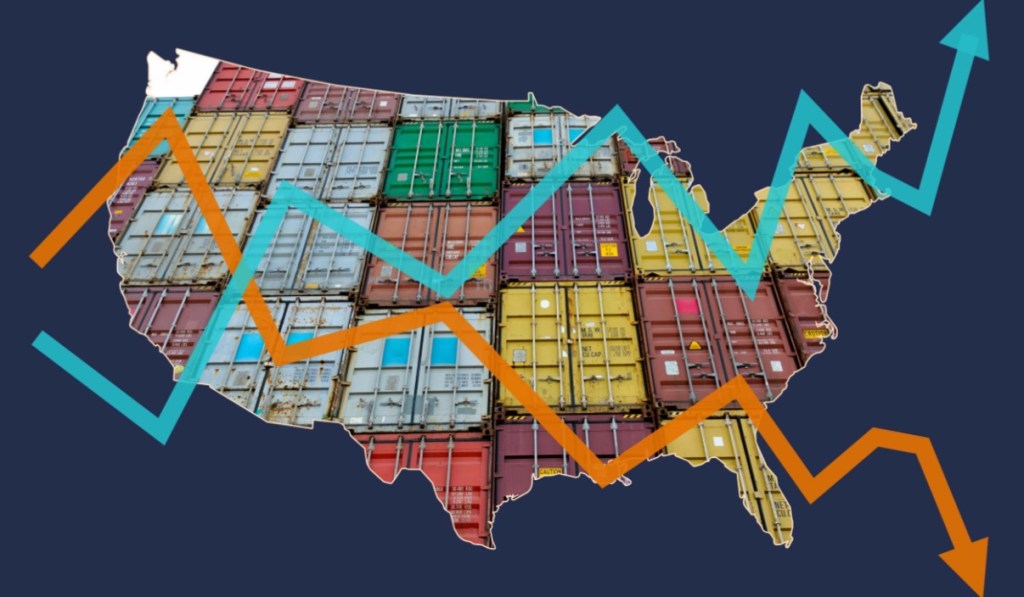
An opinion piece caught my eye written by one Chad Wolf. It’s entitled: “Retailers caught red-handed using Trump’s tariffs as cover for price gouging”. A good rule is to approach allegations of “price gouging” with a strong suspicion of economic buffoonery. You tend to hear such gripes just when prices should rise to discourage over-consumption and encourage production. The Wolf article, however, typifies the kind of attack on capitalism we hear increasingly from the “new right” (and see this).

Wolf, a former Homeland Security official in the first Trump Administration, says that large retailers like Walmart and Target are ripping off American consumers by raising prices on goods that are, in his judgement, “unaffected” by tariffs.

We’ll get into that, but first a quick disclaimer: I have no connection to Walmart or Target. Sure, I’ve shopped at those stores and I’ve filled a few prescriptions at a Walmart pharmacy. Maybe I have an ETF with an interest, but I have no idea.

Competition and Consumer Choice

Of course, no one forces consumers to shop at Walmart or Target. Those stores compete with a wide variety of outlets, including Costco and Amazon, the latter just a few clicks away. In a market, sellers price goods at what the market will bear, which ultimately serves to signal scarcity: a balancing between the cost of required resources and the value assigned by buyers. Unfortunately, in the case of tariffs, buyers and sellers of imports must deal with an artificial form of scarcity designed to extract revenue while benefitting other interests.

Wolf touts the “gift” of a free market for American businesses, as if private rights flow from government beneficence. He then decries a so-called betrayal by large retailers who would “price gouge” the American consumer in an effort to protect their profit margins. The free market is indeed a great thing! But his indignance is highly ironic as a pretext for defending tariffs and protectionism, given their destructive effect on the free operation of markets.

Broader Impacts

Wolf might be unaware that tariffs have an impact on a large number of domestically-produced goods that are not imported, but nevertheless compete with imports. When a tariff is charged to buyers of imports, producers of domestic substitutes experience greater demand for their products. That means the prices of these import-competing goods must rise. Furthermore, the effect can manifest even before tariffs go into effect, as consumers begin to seek out substitutes and as producers anticipate higher input costs.

Obviously, tariffs also impinge on producers who rely on imports as inputs to production. It’s not clear that Wolf understands how much tariffs, which represent a direct increase in costs, hurt these firms and their competitive positions.

“Expected” Does Not Mean “Unaffected”

Wolf cites the Federal Reserve’s Beige Book report (which he calls a “study”) to support his claim that businesses are gouging buyers for goods “unaffected” by tariffs. Here is one quote he employs:

“A heavy construction equipment supplier said they raised prices on goods unaffected by tariffs to enjoy the extra margin before tariffs increased their costs,” the Beige Book report said.“

Read that again carefully! Apparently Wolf, and whoever added this to the Fed’s Beige Book, thinks that being “unaffected by tariffs” includes firms whose future costs, including replacement of inventories, will be affected by tariffs! He goes on to say:

“… Walmart has already issued price hikes under the guise of tariff costs.“

The examples at his “price hikes” link were for Chinese goods in April and May, after Trump announced 145% tariffs on China in April. In mid-May, Trump said China would face a lower 30% tariff rate during a 90-day “pause” while a trade agreement was negotiated. It is now 55%, but the point is that retailers were forced to play a guessing game with respect to inventory replacement costs due to uncertainty imposed by Trump. They had a sound reason for marking up those items.

Fibbing on the Margin

Here’s an excerpt from Wolf’s diatribe that demonstrates his cluelessness even more convincingly:

“We all know many of these large retailers are sitting on comfortable, even expanded, profit margins because of the price hikes from COVID-19 that never came down. But it’s not enough for them. They want to fleece the American consumer and blame it on President Trump’s America First agenda.“

So let’s take a look at those profit margins that “never came down” after the pandemic, but in a longer historical context. Here are gross margins for Walmart since 2010:
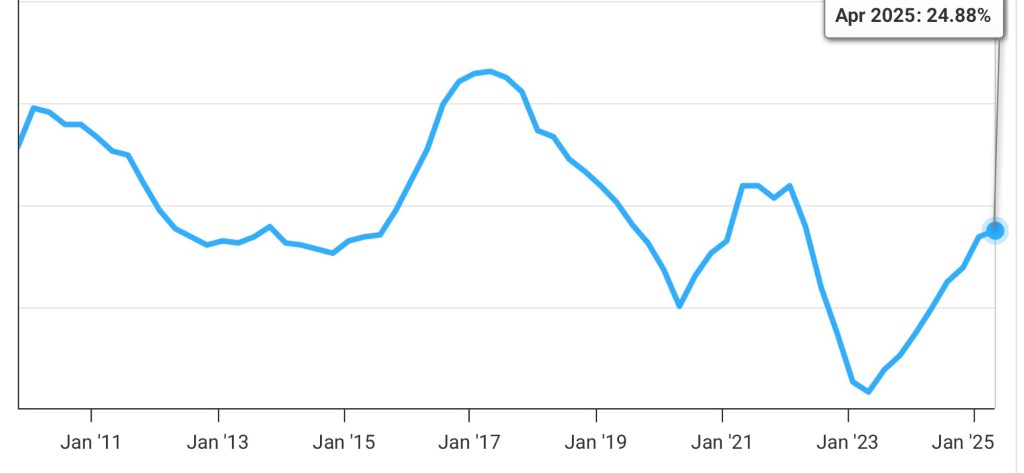
Walmart’s margin today is about the same as the average for discount stores, and it is lower than for department stores, retailers of household and personal products, groceries, and footwear. Furthermore, it is lower today than it was ten years ago. While the margin increased a little during the pandemic, it fell in its aftermath, contrary to Wolf’s assertion. That the company has rebuilt margins steadily since 2023 should be viewed not as an indictment, but perhaps as a testament to improved managerial performance.

Wolf goes on to quote a former Walmart CEO who says that the 25 basis point increase in the gross margin in the latest quarter (from ~24.7% to 24.94%) indicates that the chain can “manage” the tariff impact. Of course it can, but that would not constitute “price gouging”.

A Trump Lackey

Of course, Wolf is taking his cues from Donald Trump, who has been bullying American businesses to “eat” the cost of his tariff onslaught, rather than passing them along to the ultimate buyers of imported goods. However, private businesses should not be expected to take orders from the President. This is not Mussolini’s Italy. Moreover, anyone familiar with tax incidence will understand that sellers are likely to eat some portion of a tariff (sharing the burden with buyers) without jawboning from the executive branch. That’s because buyers demand less at higher prices and sellers wish to avoid losing profitable sales, to the extent they can. But the dynamics of this adjustment process might take time to play out.

It’s also worth noting that a retailer might attempt to hold the line on certain prices in an uncertain cost environment. This uncertainty is a real cost inflicted by Trump. Meanwhile, pointing to increased prices for domestic goods, even if they are truly unaffected by tariffs, proves nothing without knowledge of the relevant cost and market conditions for those goods. It certainly doesn’t prove an “unpatriotic” attempt to cross subsidize imported goods.

In fact, one might say it’s unpatriotic for the federal government to restrict the market choices faced by American consumers and businesses, and for the President to tell American sellers that they better “eat” the cost of tariffs (or else?). And say, what happened to the contention that tariffs aren’t taxes?

Conclusion

Attacks on sellers attempting to recoup tariff costs are unfair and anti-capitalist. They are also somewhat disdainful of the economic sovereignty of American consumers, though not as much as the tariffs themselves. In the case described above, Chad Wolf would have us believe that sellers should not act on their expectations of near-term tariff increases. He also fails to recognize the impact of tariffs on import-competing goods and the cost of tariffs borne by producers who must rely on imported goods as inputs to production. Even worse, Wolf misrepresents some of the evidence he uses to make his case.

More generally, American businesses should not be bullied into taking a hit just because they serve customers who wish to buy imported goods. There is nothing unpatriotic about the freedom to choose what to goods to buy, what goods to stock, and how to maintain profitability in the face of government interference.
Free Trade or Tariffs: Sow Wealth or Lay Waste

12 Tuesday Nov 2024

Posted by Nuetzel in Free Trade, Liberty, Tariffs

≈ 1 Comment

Tags

AI Industry, Consumer Sovereignty, Donald Trump, Favoritism, Foreign Direct Investment, Free trade, Noah Smith, Open Economy, Protectionism, Purchasing Power, rent seeking, Retaliatory Tariffs, Specialization, Tariffs

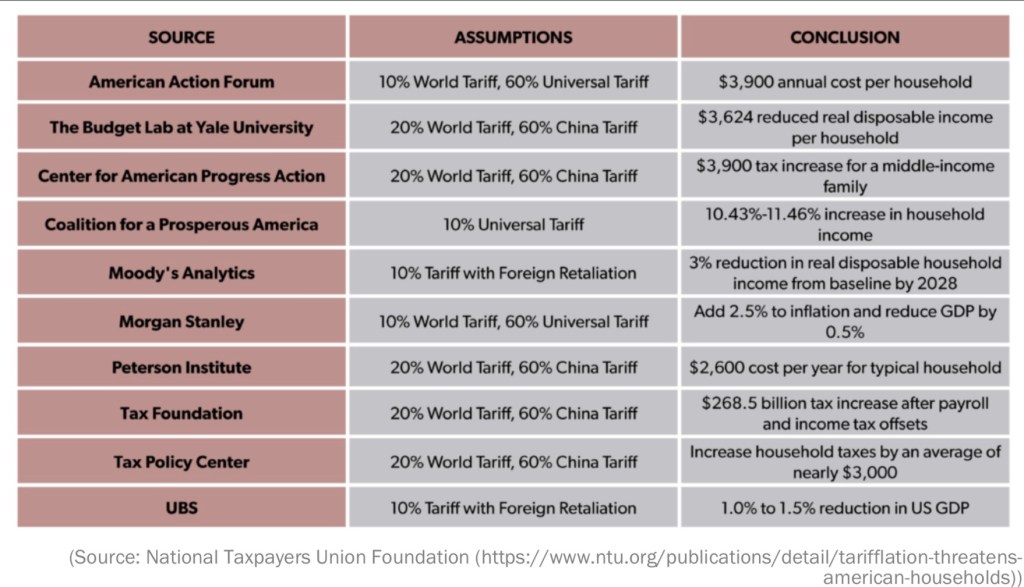
The table above is from Eric Boehm at Reason.com. It shows a variety of negative economic projections based on the likely imposition of tariffs by the incoming Trump Administration. Donald Trump’s protectionist agenda is motivated in large part by the notion that imports of foreign goods and services harm the U.S. economy. This misapprehension is common on both the populist left and the nationalist right, but it is also fueled by special interests averse to competition. Especially puzzling are those who extol the virtues of capitalism and free markets while claiming that free markets across borders are inimical to our nation’s economic interests.

Imports and Domestic Spending

Many assume that imports directly reduce GDP. In fact, on this point, some might be led astray by a superficial exposure to macroeconomics. As Noah Smith has noted, they might think back to the simple spending definition of GDP they learned as college freshmen:

GDP = C + I + G + (X – M),

where C is consumer spending on final goods and services, I is investment spending, G is government spending, X is foreign spending on U.S. exports, and M is U.S. spending on imports from abroad. So imports are subtracted! Doesn’t that mean imports directly reduce GDP?

The key here is to recognize that C, I, and G already include spending on imported goods. Therefore, imports must be subtracted from the spending totals to find the value spent on domestically-produced final goods and services. No, imports are not a direct, net subtraction from GDP.

Your Loathsome Foreign Car

Of course the domestic impact of imports goes deeper than this simple accounting framework. If someone decides to purchase an imported good instead of a close substitute produced domestically, what happens to GDP? If the decision has an immediate impact on production, then U.S. GDP declines. Otherwise, the domestic good is new inventory investment (part of I above), and there is no change. But if the import decision is repeated, the result is permanently lower U.S. GDP relative to the alternative, as producers won’t want to add to inventories indefinitely. The same is true if a domestic producer decides to purchase a component or raw material produced overseas rather than one produced at home.

The import decision causes a domestic producer to lose a sale along with the profit that sale would have earned. That puts pressure on the firm’s workers and wages as well. The firm still has the value of the unit in inventory, but if the import decision is repeated there will be more substantial follow-on effects on production, employment, spending, and saving.

Not So Fast

There is still more to the story, of course. By purchasing the foreign good,,which in the buyer’s estimation delivers greater value at that point in time, there is a gain in consumer surplus that is very real. To the buyer, that gain is perhaps equivalent to dollars in the bank. Their real wealth has increased relative to the surplus value of the foregone domestic purchase. This, too, will likely have follow-on effects in terms of spending and saving, but positive effects.

Therefore, to a first approximation, the immediate effects of an import purchase on total domestic welfare are ambiguous. Consumers of imports gain value; producers of import-competing goods lose value.

As to the loss of the domestic sale, competition is tough, but it greatly contributes to the efficiency of the free market system and to the well being of consumers. Let’s face it: ultimately, the whole point of economic activity is to enable consumption. Production has no other purpose. So producers must react to competition and strive to improve value for buyers along any margins they can. That, in turn, is unequivocally positive for potential buyers both here and abroad.

It’s also true that the purchase of foreign goods means that dollars must be sold in exchange for foreign currency. That weakens the dollar, but those “excess dollars” are generally used to purchase U.S. assets, including physical capital. That direct investment promotes economic growth.

Open Economy, Open Mind

No matter what you believe about the net benefits or costs of a single import transaction like the one described above, it is misleading to draw conclusions about the benefits of foreign trade based on a single transaction, or even a series of repeated transactions.

First, consumer sovereignty is based on freedom of choice, including the freedom to purchase from any seller, domestic or foreign. Consumers greatly benefit from that broad freedom. Add to that the benefit of producers who are free to purchase inputs from any source they believe to offer the greatest value (a benefit that ultimately flows through to consumers). These freedoms ultimately enhance productivity and well being.

Trade across borders leverages the same economic advantages as trade within borders. People tend to accept the latter as truth without giving it a thought, yet the former is often rejected reflexively. The question is inappropriately bound up in issues like patriotism and, over time, an excessive focus on high-visibility job losses in traditional industries.

Trade allows people and their countries to specialize in producing things at which they are comparatively efficient, i.e., in which they are lower-cost producers. This is at the very heart of mutually beneficial exchange: no party to a voluntary transaction expects to suffer a loss. And in trade, when an external, domestic party sustains a lost sale, for example, they have the opportunity to improve or reallocate their resources to endeavors to which they are better suited. So there are direct gains from trade and there are indirect gains via the discipline of competition, including the benefits of reallocating scarce resources from inefficient to efficient uses.

Tariff Gains

Now we shift gears to tariffs: interventions having benefits that are more concentrated than costs, and which tend to be more ephemeral:

— Domestic producers who compete with imports gain through the grant of additional market power, given the tax on foreign goods and services. These producers now have more pricing flexibility, and what is often more pertinent, survivability.

— Workers at domestic firms will benefit to the extent that their employers face reduced foreign competition. Some combination of employment, hours, and wages may rise.

— Some firms have mixed gains and losses, with more pricing power over final product but elevated costs due to the use of taxed foreign components.

Tariff Losses

Who pays when government succumbs to irrational protectionist pressure and attempts to restrict imports via tariffs?

— Domestic consumers suffer a loss of freedom and bear a large part of the burden of the tariff tax.

— Higher prices for imports lead to higher prices for competing domestic goods, causing consumers to experience a loss of purchasing power.

— Domestic businesses suffer a loss of control over input decisions. Those already utilizing foreign inputs (and their buyers downstream) bear some of the burden of the tariff tax. For example, tariffs could be quite damaging to the U.S. AI industry, a result that would run strongly contrary to Trump’s promise to promote American AI.

— The U.S. suffers a loss of foreign investment, which could engender higher interest rates, lower productivity growth, and lower real wages.

— As Tyler Cowen puts it in a review of this paper, “… lobbying, logrolling and political horse-trading were essential features of the shift toward higher US tariffs. A lot of the tariffs of the time [1870 -1909] depended on which party controlled Congress, rather than economic rationality.“

— Tariffs tend to reduce economic growth due to diminished productivity in tariff-protected industries, which also erodes real wages. Less productive firms capture a significant share of the benefits of tariffs, so that economic growth falls due to a compositional effect. Higher prices for imports and import-competing goods undermine the real gains of import-protected workers.

— Finally, tariffs invariably beget retaliatory tariffs by erstwhile friendly trading partners. Export industries and their employees take a direct hit. This retaliation damages the prospects of the most productive exporters, while weaker exporting firms might be forced to close shop unnecessarily.

One other note: the discussion of gains and losses above is essentially the same for policies that reward the use of American labor via tax breaks. This not only penalizes imports of final and intermediate foreign goods, it subsidizes high-cost domestic labor. Obviously, the upshot is a less competitive U.S. economy.

Tariff-Threat Policy

To be fair, Donald Trump has said he’d use the threat of tariffs strategically to achieve a variety of objectives, not all of which are directly related to trade. We can hope that many of those threats won’t be acted upon. On one hand, that’s more appealing than general tariffs, with potential foreign policy gains and less in the way of general damage to the economy. On the other hand, the discretionary application of tariffs could invite political favoritism and foster a corrupt rent-seeking environment.

Conclusion

Trade protectionism protects weak and strong producers alike. The weak should not be given artificial incentives to produce goods inefficiently. That’s simply a waste of resources. Protecting the strong is unnecessary and discourages the drive for efficiency as well as real value creation. It lends market power to already powerful firms, leading to higher prices and penalizing domestic consumers.

One last aside: tariffs cannot raise anywhere close to the revenue necessary to replace the income tax, an absurd claim made by Trump on the campaign trail.

Only free trade is consistent with the values of a free society. It enhances choice, makes markets more competitive, creates incentives for efficiency, and cultivates opportunities for economic growth, That would serve Trump and the nation much better than the fixation on tariffs.

That Word “Liberal” … I Don’t Think That Means What You Think It Means

03 Wednesday Jan 2024

Posted by Nuetzel in Conservatism, Liberalism, Socialism

≈ Leave a comment

Tags

Adam Smith, Capitalism, Classical Liberal, Conservatism, Consumer Sovereignty, Corporatism, Free Markets, Freedom of Speech, Friedrich Hayek, Liberalism, Libertarianism, MAGA, monopoly, Monopsony, Nate Silver, Natural Rights, Non-Aggression Principle, Perfect Competition, Progressivism, Property Rights, Public goods, Religious Freedom, Right to Life, Scott Sumner, social engineering, Socialism, State Capacity, State Religion, statism, The Wealth of Nations

Leftism has taken on new dimensions amid its preoccupation with identity politics, victimhood, and “wokeness”. Traditional socialists are still among us, of course, but “wokeists” and “identitarians” have been on the progressive vanguard of late, rooting for the deranged human butchers of Hamas and the dismantling of liberal institutions. This didn’t happen overnight, of course, and traditional socialists are mostly fine with it.

An older story is the rebranding of leftism that took place in the U.S. during the first half of the 20th century, when the word “liberal” was co-opted by leftists. Before that, a liberal orientation was understood to be antithetical to the collectivist mindset long associated with the Left. Note also that liberalism retains its original meaning even today in much of Europe. Often we hear the term “classical liberal” to denote the “original” meaning of liberalism, but the modifier should be wholly unnecessary.

Liberalism Is Not “In-Betweenism”

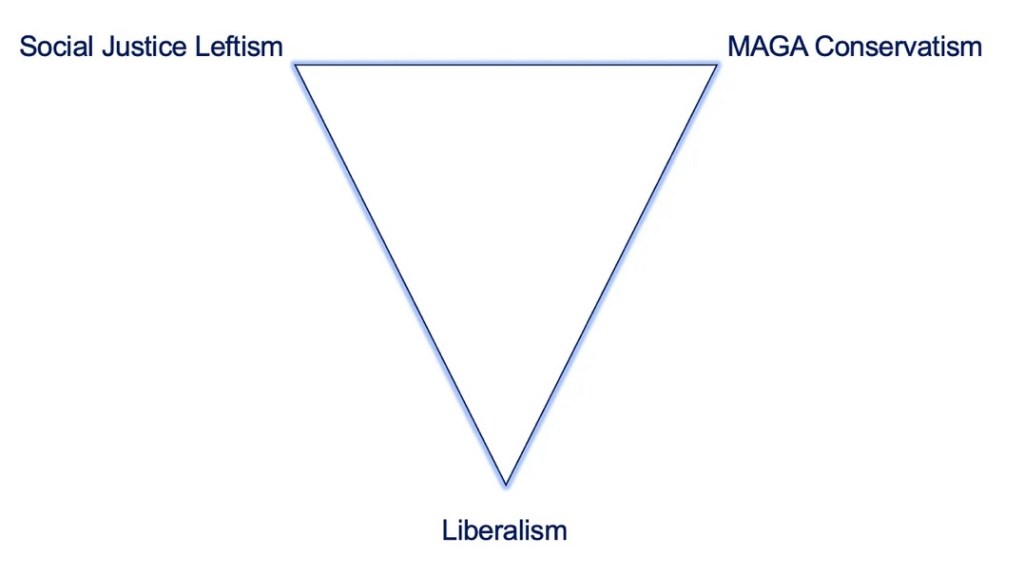
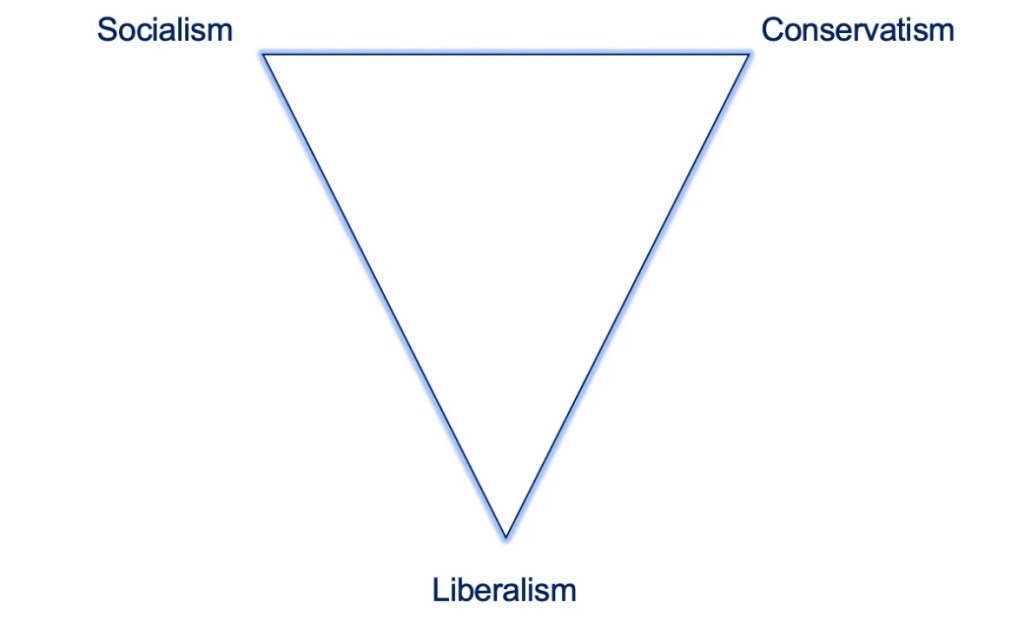
In this vein, Nate Silver presents a basic taxonomy of political orientation in a recent Substack post. It includes the diagram above, which distinguishes between socialism, conservatism, and liberalism. Silver draws on a classic essay written by Friedrich Hayek in 1945, “Why I am Not a Conservative”, in which Hayek discussed the meaning of the word “liberal” (and see here). Liberalism’s true emphasis is a tolerance for individual rights and freedoms, subject to varying articulations of the “nonaggression principle”. That is, “do as you like, but do no harm to others”.

We often see a linear representation distinguishing between so-called progressives on the left and conservatives on the right. Of course, a major hallmark of leftist thinking is extreme interventionism. Leftists or progressives are always keen to detect the slightest whiff of an externality or the slightest departure from the perfectly competitive market ideal. They seem eager to find a role for government in virtually every area of life. While it’s not a limiting case, we can substitute socialism or statism for progressivism on the far left, as Silver does, whereby the state takes primacy in economic and social affairs.

Conservatism, on the other hand, is a deep resistance to change, whether institutional, social, and sometimes economic. Conservatives too often demonstrate a willingness to use the coercive power of the state to prevent change. Hayek noted the willingness of both socialists and conservatives to invoke state power for their own ends.

Similarly, religious conservatives often demand state support beyond that afforded by the freedom to worship in the faith of one’s choice. They might strongly reject certain freedoms held to be fundamental by liberals. Meanwhile, socialists often view mere religious freedom as a threat to the power of the state, or at least they act like it (e.g. see here for an example).

Like conservatives, dedicated statists would doubtless resist change if it meant a loss of their own power. That is, they’d wish to preserve socialist institutions. On this point, witness the vitriol from the Left over what it perceives as threats to the public school monopoly. Witness also the fierce resistance among public employees to reducing the scale of the administrative state, and how advocates of entitlements fiercely resist decreases in the growth rate of those expenditures.

Silver, like Hayek, objects to the traditional, linear framework in which liberals are thought to occupy a range along a line between socialism and conservatism. He objects to that because real liberals value individual liberty as a natural human right, a viewpoint typically abhored by both socialists and conservatives. There is nothing “in between” about it! And of course, conservatives and progressives are equally guilty in their mistaken use of the word “liberal”.

Mapping Political Preferences

Liberty, statism, and conservatism are not exactly orthogonal political dimensions. Larger government almost always means less economic liberty. At a minimum, state dominance implies a social burden associated with public monopoly and monopsony power, as well as tax and welfare-state incentive problems. These features compromise or corrupt the exercise of basic rights. On the other hand, capitalism and its concomitant reliance on consumer sovereignty, individual initiative, free exchange and secure property rights is most in harmony with true liberalism.

For conservatives, resistance to change in support of a traditionally free market economy might offer something of a contradiction. In one sense, it corresponds to upholding market institutions. However, free markets allow new competitors and new technologies to undermine incumbents, who conservatives sometimes wish to defend through regulatory or protectionist measures. And conservatives are almost always too happy to join in the chorus of “price gouging” in response to the healthy operation of the free market in bringing forth supplies.

All that is to say that preferences involving liberty, statism, and traditionalism are not independent of one another. They cannot simply be mapped onto a three-dimensional space. At least the triangular representation gets liberalism out of the middle, but it’s difficult to visualize other ideological positions there. For example, “state religionism” could lie anywhere along the horizontal line at the top or even below it if certain basic liberties are preserved. Facism combines elements of socialism and a deformed version of capitalism that is properly called corporatism, but where would it fall within the triangle?

Big Government Liberalism?

Silver says he leans heavily toward a “big government” version of liberalism, but big government is hard to square with broad liberties. Granted, any well-functioning society must possess a certain level of “state capacity” to defend against private or public violations of individual rights, adjudicate disputes, and provide true public goods. It’s not clear whether Silver’s preferences lie within the bounds of those ambitions. Still, he deserves credit for his recognition that liberalism is wholly different from the progressive, socialist vision. It is the opposite.

The “New” Triangle

Silver attempts to gives the triangular framework a more contemporary spin by replacing conservatism with “MAGA Conservatism” and socialism with “Social Justice Leftism” (SJL), or “wokeism”. Here, I’m treating MAGA as a “brand”. Nothing below is intended to imply that America should not be a great nation.

The MAGA variant of conservatism emphasizes nationalism, though traditional conservatives have never been short on love of nation. For that matter, as a liberal American, it’s easier to forgive nationalist sentiments than it is the “Death to America” refrain we now hear from some SJLs.

The MAGA brand is also centered around a single individual, Donald Trump, whose rhetoric strikes many as nativistic. And Trump is a populist whose policy proposals are often nakedly political and counterproductive.

SJL shares with socialism an emphasis on various forms of redistribution and social engineering, but with a new focus on victimhood based on classes of identity. Of SJL, Silver says:

“Proponents of SJL usually dislike variations on the term ‘woke’, but the problem is that they dislike almost every other term as well. And we need some term for this ideology, because it encompasses quite a few distinctive features that differentiate it both from liberalism and from traditional, socialist-inflected leftism. In particular, SJL is much less concerned with the material condition of the working class, or with class in general. Instead, it is concerned with identity — especially identity categories involving race, gender and sexuality, but sometimes also many others as part of a sort of intersectional kaleidoscope.”

The gulf between liberals and SJLs couldn’t be wider on issues like free speech and “equity”, and equality of opportunity. MAGAns, on the other hand, have some views on individual rights and responsibility that are largely consistent with liberals, but reflexive populism often leads them to advocate policies protecting rents, corporate welfare, and protectionism.

Divided Liberalism

Liberalism emphasizes limited government, individual autonomy, and free exchange. However, there are issues upon which true liberals are of divided opinion. For example, one such area of controversy is the conflict between a woman’s right to choose and the fetal right to life. Many true liberals disagree over whether the rights of a fetus outweigh its mother’s right to choose, but most would concede that the balance shifts to the fetus at some point well short of birth (putting aside potential dangers to the mother’s life). Open borders is another area that can divide true liberals. On one side, the right to unrestricted mobility is thought to supersede any public interest in enforcing borders and limiting the flow of immigrants. On the other side, questions of national sovereignty, national security, as well as social and state capacity to absorb immigrants take primacy.

Don’t Call Lefties “Liberal”… They’re Not!

True liberalism (including most strains of libertarianism) recognizes various roles that a well-functioning state should play, but it also recognizes the primacy of the individual and individual rights as a social underpinning. As Hayek noted, true liberals are not resistant to change per se, unlike conservatives. But modern progressives demand changes of the worst kind: that the state should intervene to pursue their favored objectives, laying claim to an ever-greater share of private resources. This requires government coercion on a massive scale, the antithesis of liberalism. It’s time to recognize that “progressives” aren’t liberals in any sense of the word. For that matter, they don’t even stand for progress.

I’ll close with a quote from Adam Smith that I cribbed from Scott Sumner. Unfortunately, Sumner does not give the full reference, but I’ll take his word that Smith wrote this 20 years before the publication of The Wealth of Nations:

“Little else is requisite to carry a state to the highest degree of opulence from the lowest barbarism, but peace, easy taxes, and a tolerable administration of justice; all the rest being brought about by the natural course of things. All governments which thwart this natural course, which force things into another channel, or which endeavour to arrest the progress of society at a particular point, are unnatural, and to support themselves are obliged to be oppressive and tyrannical.”

Health Care & Education: Slow Productivity Growth + Subsidies = Jacked Prices

14 Sunday May 2023

Posted by Nuetzel in Education, Health Care, Priductivity

≈ Leave a comment

Tags

Abundance Agenda, Alex Tabarrok, Baumol's Disease, Beethoven’s String Quartet No. 14, CHIPS, competition, Consumer Sovereignty, Education Cost, Education Grants, Education Productivity, Employer-Paid Coversge, Eric Helland, Exchange subsidies, health care costs, Health Care Productivity, Industrial Concentration, Mark Perry, Medicaid, Medical Technology, Medicare, Obamacare, Peter Suderman, Relative Prices, Slow Productivity Growth, Student Loans, Subsidies, Tax Subsidies, third-party payments, Willian Baumol

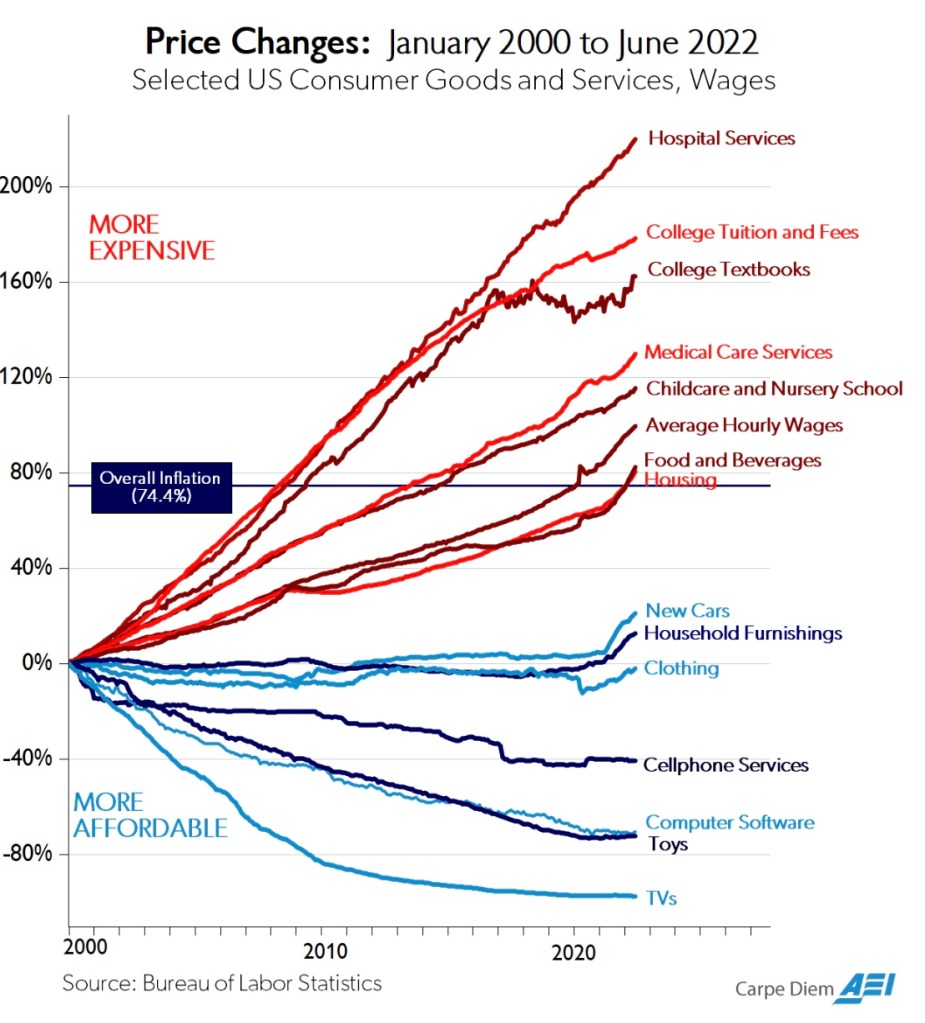
This post is about relative prices in two major sectors of the U.S. economy, both of which are hindered by slow productivity growth while being among the most heavily subsidized: education and health care. Historically, both sectors have experienced rather drastic relative price increases, as illustrated for the past 20 years in the chart from Mark Perry above.

Baumol’s Cost Disease

These facts are hardly coincidental, though it’s likely the relative costs education and health care would have risen even in the absence of subsidies. Over long periods of time, the forces primarily guiding relative price movements are differentials in productivity growth. The tendency of certain industries to suffer from slow growth in productivity is the key to something known among economists as Baumol’s Disease, after the late William Baumol, who first described the phenomenon’s impact on relative prices.

Standards of living improve when a sufficient number of industries enjoy productivity growth. That creates a broad diffusion of new demands across many industries, including those less amenable to productivity growth, such as health care and education. But slow productivity growth and rising demand in these industries are imbalances that push their relative prices upward.

Alex Tabarrok and Eric Helland noted a few years ago that it took four skilled musicians 44 minutes to play Beethoven’s String Quartet No. 14 in 1826 and also in 2010, but the inflation-adjusted cost was 23 times higher. Services involving a high intensity of skilled labor are more prone to Baumol’s Disease than manufactured goods. As well, services for which demand is highly responsive to income or sectors characterized by monopoly power may be more prone to Baumol’s disease.

Tabarrok wonders whether we should really consider manifestations of Baumol’s Disease a blessing, because they show the extent to which productivity and real incomes have grown across the broader economy. So, rather than blame low productivity growth in certain services for their increasing relative prices, we should really blame (or thank) the rapid productivity growth in other sectors.

The Productivity Slog

There are unavoidable limits to the productivity growth of skilled educators, physicians, and other skilled workers in health care. Again, in a growing economy, prices of things in relatively fixed supply or those registering slow productivity gains will tend to rise more rapidly.

Technology offers certain advantages in some fields of education, but it’s hard to find evidence of broad improvement in educational success in the U.S. at any level. In the health care sector, new drugs often improve outcomes, as do advances in technologies such as drug delivery systems, monitoring devices, imaging, and robotic surgery. However, these advances don’t necessarily translate into improved capacity of the health care system to handle patients except at higher costs.

There’s been some controversy over the proper measurement of productivity in the health care sector. Some suggest that traditional measures of health care productivity are so flawed in capturing quality improvements that the meaning of prices themselves is distorted. They conclude that adjusting for quality can actually yield declines in effective health care prices. I’d interject, however, that patients and payers might harbor doubts about that assertion.

Other investigators note that while real advances in health care productivity should reduce costs, the degree of success varies substantially across different types of innovations and care settings. In particular, innovations in process and protocols seem to be more effective in reducing health care expenditures than adding new technologies to existing protocols or business models. All too often, medical innovations are of the latter variety. Ultimately, innovations in health care haven’t allowed a broader population of patients to be treated at low cost.

Superior Goods

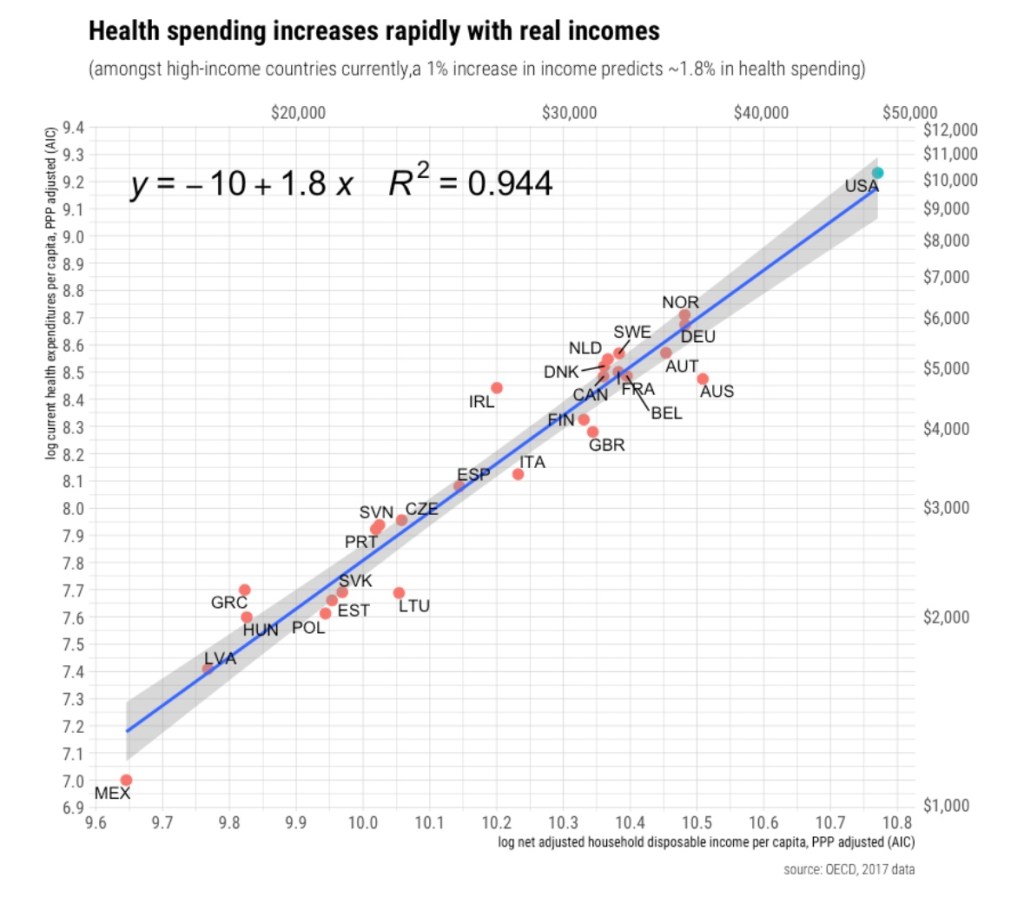
Therefore, it appears that increases in the relative prices of education and health care over time have arisen as a natural consequence of the interplay between disparities in productivity growth and rising demand. Indeed, this goes a long way toward explaining the high cost of health care in the U.S. compared to other developed nations, as standards of living in the U.S. are well above nearly all others. In that respect, the cost of health care in the U.S. is not necessarily alarming. People demand more health care and education as their incomes rise, but delivering more health care isn’t easy. To paraphrase Tabarrok, turning steelworkers into doctors, nurses and teachers is a costly proposition.

The Role of Subsidies

In the clamor for scarce educational and health care resources, natural tensions over access have spilled into the political sphere. In pursuit of distributing these resources more equitably, public policy has relied heavily on subsidies. It shouldn’t surprise anyone that subsiding a service resistant to productivity gains will magnify the Baumol effect on relative price. One point is beyond doubt: the amounts of these subsidies is breathtaking.

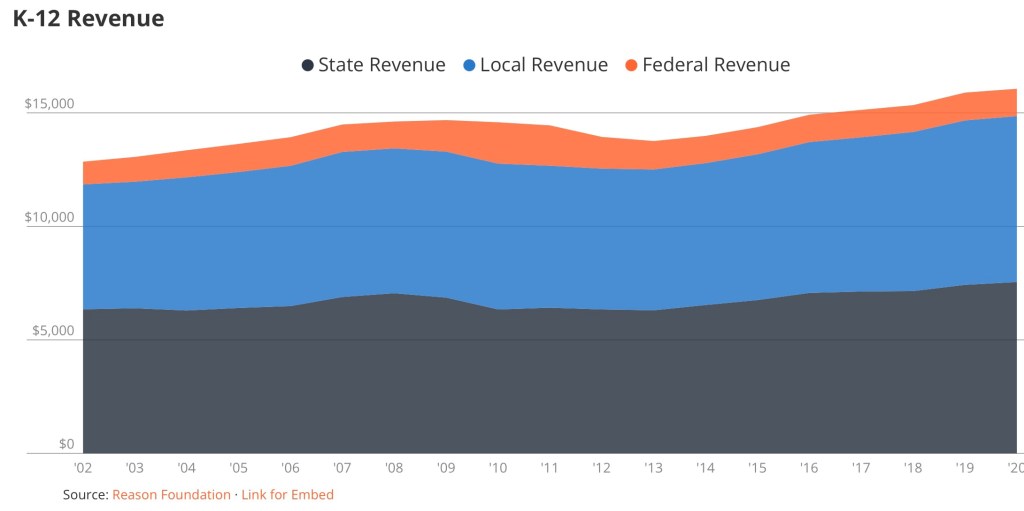
Education: Public K -12 schools are largely funded by local taxpayers. Taxpayer-parents of school-aged children pay part of this cost whether they send their children to public schools or not. If they don’t, they must pay the additional cost of private or home schooling. This severely distorts the link between payments and the value assigned by actual users of public schools. It also confers a huge degree of market power to public schools, thus insulating them economically from performance pressures.

Public K – 12 schools are also heavily subsidized by state governments and federal grants. The following chart shows the magnitude and growth of K – 12 revenue per student over the past couple of decades.

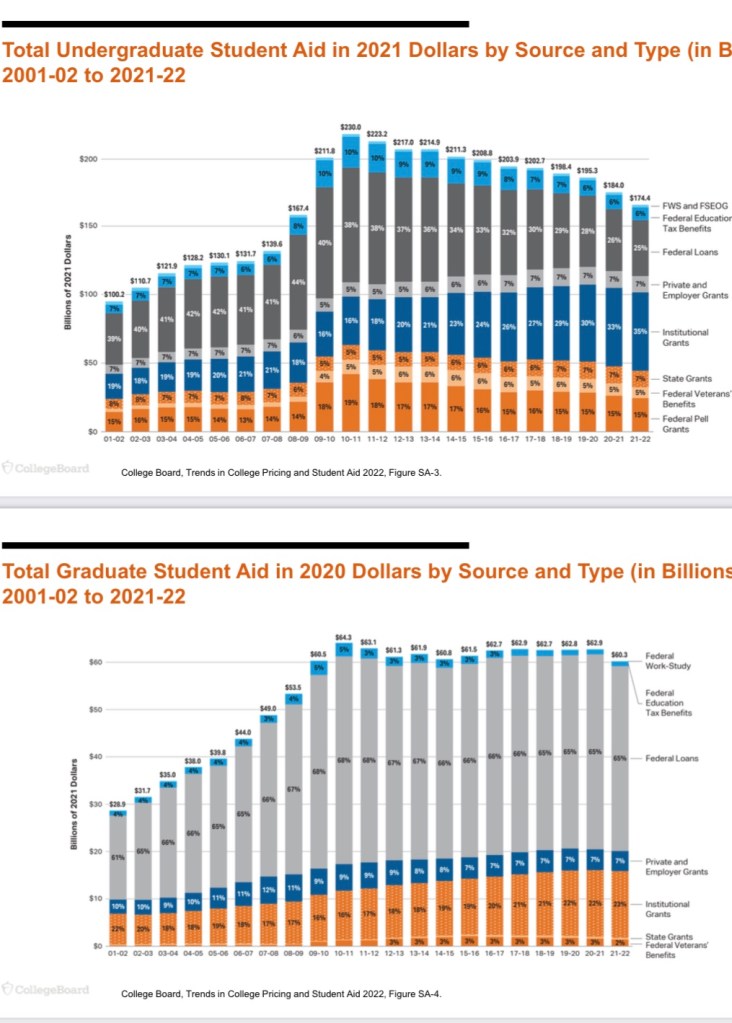
Subsidies for higher education take the form of student aid, including federal student loans, grants to institutions, as well as a variety of tax subsidies. Here’s a nice breakdown:

This represents a mix of buyer and seller subsidies. That suggests less upward pressure on price and more stimulus to output, but we still run up against the limits to productivity growth noted above. Moreover, other constraints limit the effectiveness of these subsidies, such as lower academic qualifications in a broader student population and the potential for rewards in the job market to diminish with a potential excess of graduates.

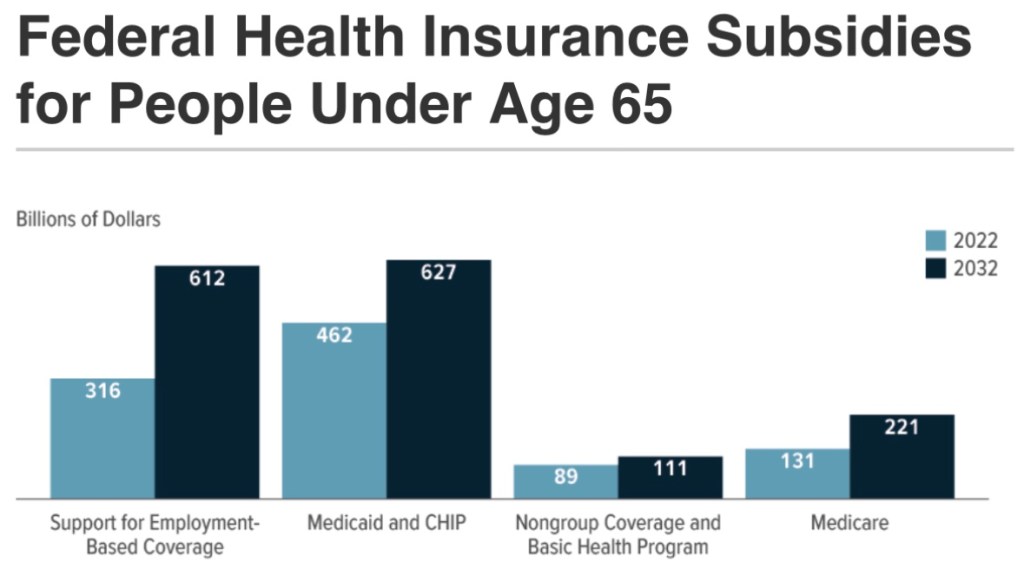
Health care: Subsidies here are massive and come in a variety of forms. They often directly provide or reduce the cost of health insurance coverage: Medicaid, the Children’s Health Insurance Program (CHIP), Obamacare exchange subsidies, Medicare savings programs, tax-subsidies on employer-paid health coverage, and medical expense tax deductions. Within limits, these subsidies reduce the marginal cost of care patients are asked to pay, thus contributing to over-utilization of various kinds of care.

The following are CBO projections from June 2022. They are intended here to give an idea of the magnitude of health care insurance subsidies:

Still Other Dysfunctions

There are certainly other drivers of high costs in the provision of health care and education beyond a Baumol effect magnified by subsidies. The third-party payment system has contributed to a loss of price discipline in health care. While consumers are often responsible for paying at least part of their health insurance premiums, the marginal cost of health care to consumers is often zero, so they have little incentive to manage their demands.

Another impediment to cost control is a regulatory environment in health care that has led to a sharply greater concentration of hospital services and the virtual disappearance of independent provider practices. Competition has been sorely lacking in education as well. Subsidies flowing to providers with market power tend to exacerbate behaviors that would be punished in competitive markets, and not just pricing.

Summary

Baumol’s Disease can explain a lot about the patterns of relative prices shown in the chart at the top of this post. That pattern is a negative side effect of general growth in productivity. Unfortunately, it also reflects a magnification engendered by the payment of subsidies to sectors with slow productivity growth. The intent of these subsidies is to distribute health care and education more equitably, but the impact on relative prices undermines these objectives. The approach forces society to exert wasted energy, like an idiotic dog chasing its tail.

Peter Suderman wrote an excellent piece in which he discussed health care and education subsidies in the context of the so-called “abundance agenda”. His emphasis is on the futility of this agenda for the middle class, for which quality education and affordable health care always seem just out of reach. The malign effects of “abundance” policies are reinforced by anti-competitive regulation and payment mechanisms, which subvert market price discipline and consumer sovereignty. We’d be far better served by policies that restore consumer responsibility, deregulate providers, and foster competition in the delivery of health care and education.

Tariffs, Content Quotas, and What Passes for Patriotism

10 Friday Mar 2023

Posted by Nuetzel in Free Trade, Protectionism

≈ Leave a comment

Tags

budget deficits, Buy American, CCP, CHIPS Act, Comparative advantage, Consumer Sovereignty, Content Restrictions, Critical Supply Chains, Domestic Content, Donald Trump, Dumping, Export Markets, Federal Procurement, Foreign Trade, Free trade, George Will, Import Waivers, Joe Biden, Made-In-America Laws, Mercantilism, National Security, Nationalism, Patriotism, Price Competition, Price Preference, Protectionism, Tariffs, Trade Retaliation, Universal Baseline Tariffs, Uyghur Muslims

If there’s one simple lesson in economics that’s hard to get across it’s the destructive nature of protectionism. The economics aren’t hard to explain, but for many, the lessons of protectionist failure just don’t want to sink in. Putting aside matters of national security, the harms of protectionism to the domestic economy are greater than any gains that might inure to protected firms and workers. Shielding home industries and workers from foreign competition is generally not smart nor an act of patriotism, but that sentiment seems fairly common nonetheless.

The Pathology of Protectionism

Jingoistic slogans like “Buy American” are a pitch for voluntary loyalty to American brands. I’m all for voluntary action. Still, that propaganda relies on shaming those who find certain foreign products to have superior attributes or to be more economical. This feeds a psychology of economic insularity and encourages those who favors trade barriers, which is one of the earliest species of failed central planning.

The cognitive resistance to a liberal trade regime might have to do with the concentrated benefits of protectionist measures relative to the more diffuse (but high) costs it imposes on society. Some of the costs of protectionism manifest only with time, which makes the connection to policy less obvious to observers. Or again, obstructing trade and taxing “others” in the hope of helping ourselves may simply inflame nationalist passions.

Both Democrats and Republicans rally around policy measures that tilt the playing field in favor of domestic producers, often severely. And again, this near unanimity exists despite innumerable bouts with the laws of economics. I mean, how many times do you have to be beaten over the head to realize that this is a mistake? Unfortunately, politicians just don’t live in the long-term, they leap to defend powerful interests, and they seldom pay the long-term consequences of their mistakes.

Joe Biden’s “Buy American”

The Biden Administration has pushed a “Made In America” agenda since the President took office, It’s partly a sop to unions for their election support. Much of it had to do with tightening waivers granted under made-in-America laws (dating back to 1933) governing foreign content in goods procured by the federal government. The most recent change by Biden is an increase in the requirement for domestic content to 60% immediately and gradually to 75% from there. Also, “price preferences” will be granted to domestic producers of goods to strengthen supply chains identified as “critical”, including active pharmaceutical ingredients, certain minerals including rare earths and carbon fibers, semiconductors and their advanced packaging, and large capacity batteries such as those used in EVs.

There’s a strong case to be made for developing domestic supplies of certain goods based on national security considerations. That can play a legitimate role where defense goods or even some kinds of civilian infrastructure are involved, but Biden’s order applies much more broadly, including protections for industries that are already heavily subsidized by taxpayers. For example, the CHIPS Act of 2022 included $76 billion of subsidies and tax credits to the semiconductor industry.

George Will describes the cost of protectionism and Biden’s “Buy American”:

“‘Buy American,’ like protectionism generally, can protect some blue-collar jobs — but at a steep price: A Peterson Institute for International Economics study concludes that it costs taxpayers $250,000 annually for each job saved in a protected industry. And lots of white-collar jobs are created for lawyers seeking waivers from the rules. And for accountants tabulating U.S. content in this and that, when, say, an auto component might cross international borders (U.S., Canadian, Mexican) five times before it is ready for installation in a vehicle.”

Biden’s new rules will increase the cost of federal procurement. They will squeeze out contracts with foreign suppliers whose wares are sometimes the most price-competitive or best-suited to a project. This is not a prescription for spending restraint, and it comes at a time when the federal budget is under severe strain. Here’s George Will again:

“This will mean more borrowing, not fewer projects. Federal spending is not constrained by a mere shortage of revenue. So, Biden was promising to increase the deficit. And this policy, which elicited red-and-blue bonhomie in the State of the Union audience, also will give other nations an excuse to retaliate (often doing what they want to do anyway) by penalizing U.S. exporters of manufactured goods. ….. Washington lobbyists for both will prosper.”

Domestic manufacturers who find their contracting status “protected” from foreign competition will face less incentive to perform efficiently. They can relax, rather than improve or even maintain productivity levels, and they’ll feel less pressure to price competitively. Those domestic firms providing goods designated by the government as “critical” will be advantaged by the “price preferences” granted in the rules, leading to a less competitive landscape and higher prices. Thus, Biden’s “Buy American” order is likely to mean higher prices and more federal spending. This is destructive and counter to our national interests.

Donald Trump’s Tariffs

In a recent set of proposals trialed for his presidential election campaign, Donald Trump called for “Universal Baseline Tariffs” on imported goods. In a testament to how far Trump has stumbled down the path of economic ignorance, his campaign mentions “patriotic protectionism” and “mercantilism for the 21st century”. Good God! Trump might be worse than Biden!

This isn’t just about China, though there are some specific sanctions against China in the proposal. After all, these new tariffs would be “universal”. Nevertheless, the Trump campaign took great pains to cloak the tariffs in anti-China rhetoric. Now, I’m very unfavorably disposed to the CCP and to businesses who serve or rely on China and (by implication) the CCP. Certainly, in the case of China, national security may dictate the imposition of certain forms of protectionism, slippery slope though it might be. Nevertheless, that is not what universal tariffs are about.

One destructive consequence of imposing tariffs or import quotas is that foreign governments are usually quick to retaliate with tariffs and quotas of their own. Thus, export markets are shut off to American producers in an escalating trade conflict. That creates serious recession risks or might reinforce other recessionary forces. Lost production for foreign markets and job losses in the affected export industries are the most obvious examples of protectionist harm.

Then consider what happens in protected industries in the U.S. and the negative repercussions in other sectors. The prices charged for protected goods by domestic producers rise for two reasons: more output is demanded of them, and protected firms have less incentive to restrain pricing. Just what the protectionists wanted! In turn, with their new-found, government-granted market power, protected firms will compete more aggressively for workers and other inputs. That puts non-protected firms in a bind, as they’ll be forced to pay higher wages to compete with protected firms for labor. Other inputs may be more costly as well, particularly if they are imported. These distortions lead to reduced output and jobs in non-protected industries. It also means American consumers pay higher prices for both protected and unprotected goods.

Consumers not only lose on price. They also suffer a loss of consumer sovereignty to a government wishing to manipulate their choices. When choices are curtailed, consumers typically lose on other product attributes they value. It also curtails capital inflows to the U.S. from abroad, which can have further negative repercussions for U.S. productivity growth.

When imports constitute a large share of a particular market, it implies that foreign nations have a comparative advantage in producing the good in question. In other words, they sacrifice less to produce the good than we would sacrifice to produce it in the U.S. But if country X has a comparative advantage in producing good X, it means it must have a comparative disadvantage in producing certain other goods, let’s say good Y. (That is, positive tradeoffs in one direction necessarily imply negative tradeoffs in the other.) It makes more economic sense for other countries (country Y, or perhaps the U.S.) to produce good Y, rather than country X, since country Y sacrifices less to do so. And that is why countries engage in trade with each other, or allow their free citizens to do so. It is mutually beneficial. It makes economic sense!

To outlaw or penalize opportunities for mutually beneficial trade will only bring harm to both erstwhile trading partners, though it might well benefit specific interests, including some third parties. Those third parties include opportunistic politicians wishing to leverage nationalist sentiments, their cronies in protected industries, and the bureaucrats, attorneys, and bean counters who manage compliance.

When Is Trade Problematic?

Protectionists often accuse other nations of subsidizing their export industries, giving them unfair advantages or dumping their exports below cost on the U.S. market. There are cases in which this happens, but all such self-interested claims should be approached with a degree of skepticism. There are established channels for filing complaints (and see here) with government agencies and trade organizations, and specific instances often prompt penalties or formal retaliatory actions.

There are frequently claims that foreign producers and even prominent American businesses are beneficiaries of foreign slave labor. A prominent example is the enslavement of Uyghur Muslims in China, who reportedly have been used in the manufacture of goods sold by a number of big-name American companies. This should not be tolerated by these American firms, their customers, or by the U.S. government. Unfortunately, there is a notable lack of responsiveness among many of these parties.

Much less compelling are assertions of slave labor based on low foreign wage rates without actual evidence of compulsion. This is a case of severely misplaced righteousness. Foreign wage rates may be very low by American standards, but they typically provide for a standard of living in the workers’ home country that is better than average. There is no sin in providing jobs to foreign workers at a local wage premium or even a discount, depending on the job. In fact, a foreign wage that is low relative to American wages is often the basis for their comparative advantage in producing certain goods. Under these innocent circumstances, there is no rational argument for producing those goods at much higher cost in the U.S.

Very troublesome are the national security risks that are sometimes attendant to foreign trade. When dealing with a clear adversary nation, there is no easy “free trade” answer. It is not always clear or agreed, however, when international relations have become truly adversarial, and whether trade can be usefully leveraged in diplomacy.

Conclusion

As I noted earlier, protectionism has appeal from a nationalist perspective, but it is seldom a legitimate form of patriotism. It’s not patriotic to limit the choices and sovereignty of the individual, nor to favor certain firms or workers by shielding them from competition while penalizing firms requiring inputs from abroad. We want our domestic industries to be healthy and competitive. Shielding them from competition is the wrong approach.

So much of the “problem” we have with trade is the infatuation with goals tied to jobs and production. Those things are good, but protectionists focus primarily on first-order effects without considering the damaging second-order consequences. And of course, jobs and production are not the ultimate goals of economic activity. In the end, we engage in economic activity in order to consume. We are a rich nation, and we can afford to consume what we like from abroad. It satisfies wants, it brings market discipline, and it leads to foreign investment in the American economy.

Biden and Trump share the misplaced objectives of mercantilism. They are both salesmen in the end, though with strikingly different personas. Salesmen want to sell, and I’m almost tempted to say that their compulsion causes them see trade as a one-way street. Biden is selling his newest “Buy American” rules not only as patriotic, but as a national security imperative. The former is false and the latter is largely false. In fact, obstructions to trade make us weaker. They will also contribute to our fiscal imbalances, and that contributes to monetary and price instability.

Like “Buy American”, Trump’s tariffs are misguided. Apparently, Trump and other protectionists wish to tax the purchases of foreign goods by American consumers and businesses. In fact, they fail to recognize tariffs as the taxes on Americans that they are! And tariffs represent a pointed invitation to foreign trading partners to impose tariffs of their own on American goods. You really can’t maximize anything by foreclosing opportunities for gain, but that’s what protectionism does. It’s astonishing that such a distorted perspective sells so well.

Who Are the Zero-Sum Winners?

09 Monday Sep 2019

Posted by Nuetzel in Big Government, rent seeking

≈ 2 Comments

Tags

Caveat Emptor, Compliance Costs, Consumer Sovereignty, Drug Prohibition, Economic Rents, Energy subsidies, Farm Subsidies, Monopoly Rents, Mutually Beneficial Trade, Public Aid, Public goods, Public Lottery, Public Trough, Regulatory Rents, rent seeking, Social Security, Subsidies, Tax Deductibility, Zero-Sum Economics

Productive effort seldom goes unrewarded, but all too often rewards are directed to nonproductive activities and secured in ways that are outright takings of resources and rights from others. These are zero-sum propositions at best, as the rewards come only at equivalent or greater costs to others. Gains from zero-sum activities are often purely consumptive in nature and tend to foster more destructive behavior. A clear-cut example is outright thievery, but there are many cases in which, by matters of degree, the perpetrators are not even dimly aware that their gains bring harm to others.

Sadly, our society has undergone a transition to a state in which everyone collects ongoing streams of zero-sum rewards, which are, by definition, at someone else’s (and often our own) expense. The turbulence caused by this unnecessary and avoidable mix of costs and rewards is all too real for consumers and businesses, but again, they don’t always fully grasp its dysfunctional nature.

The Way To Positive Sums

Of course, there are winners and losers in almost any area of economic life. Even when two individuals engage in mutually beneficial exchange, an otherwise win-win situation, other traders might regret missing out on the deal. Pleasing buyers more effectively than one’s competitors might force those rivals to turn to other pursuits. That’s all for the best from a social point of view, unless they can come up with an even better idea to win back customers. In this way, things can keep getting better and better for everyone, even for the one-time losers who are free to compete in trades to which they are better suited. Winners, then, are defined by their success in creating value for others. These are the productive winners. But again, material success doesn’t always come so honorably.

Bobbing For Booty?

Purely “consumptive” or zero-sum winners might be simple crooks who are able to avoid apprehension, or perhaps they are dishonest business-people who sell goods with hidden defects or inferior workmanship. There are many degrees here: a talented salesperson with shoddy merchandise might compromise on price. A clever product manager might reduce the size of a package slightly without reducing price.

A simple gamble is zero-sum in a purely monetary sense, but both gamblers do it for enjoyment, so there are psychic gains involved. A successful gambler might be a zero-sum winner in a monetary sense, but luck usually runs out on honest players. A cheater qualifies as a zero-sum winner. Conversely, it’s not correct to say that casinos are strictly zero-sum winners, though the odds are always stacked in favor of the house and everyone knows it. Casino patrons enjoy the experience, including other amusements available in casinos, so they are often happy customers despite their losses. They are engaging in mutually beneficial exchange.

Private Affairs Made Public

A short-hand description encompassing much of our zero-sum havoc is “the public trough”. Many zero-sum rewards have arisen out of legislative battles, court cases, and regulatory actions restricting private decision-making and encroaching on private property rights. The unremitting tendency is for expansion of these kinds of actions. Where there are zero-sum winners at the public trough, or an opportunity to expand the trough itself, there are always more covetous seekers of zero-sum winnings, otherwise known as rent seekers. They are reliable promoters of “do-something-ism” relative to the outrage du jour through more legislation, lawsuits, and regulatory filings. The tragic thing about rent seeking is that the process itself consumes resources and undermines private incentives, thereby transforming zero-sum outcomes into wasteful, negative-sum outcomes.

Winners At the Trough

There are many kinds of zero-sum winners at the public trough. The winning and losing often occur separately and asynchronously, connected only by an enabling authority who sets rules and funds winners from proceeds taken from losers. For this reason, it is easy for citizens to lose track of the “zero-sumness” of the many benefits they receive. After all, the government can deliver things for “free”, right? And the connection between one’s obligations, losses, and the gains reaped by others is not always obvious.

All of the following involve some degree of zero-sum activity, and all attract rent seekers:

  • Public aid in exchange for no contribution to output, funded by zero-sum losing taxpayers.
  • Subsidies for politically-favored technologies that are otherwise uneconomic, funded by zero-sum losing taxpayers.
  • Farm subsidies when too much is produced and the output is not highly valued, leading to an overallocation of resources to agricultural activity and rents for farmers funded by zero-sum losing taxpayers.
  • Complex regulatory and tax rules generate income for compliance advisors such as attorneys, accountants, and consultants. Those are rents, pure and simple, paid for by parties who must comply under penalty of law.
  • Regulatory advantage conferred upon firms sufficiently large or dominant to afford compliance. That penalizes smaller competitors and undermines their market position. The additional profit large firms may earn as a consequence is a rent, funded by zero-sum losing consumers and weaker competitors.
  • The award of government contracts is often as much political as it is economic. Such a process is not subject to the market discipline imposed on private contracts, so there is ample opportunity for rents via cost-padding and graft, again funded by zero-sum losing taxpayers.
  • More generally, government purchases of any kind are subject to weak market discipline, like any buyer spending someone else’s money. Thus, government has a tendency to pay prices not supported by economic value, offering rents to suppliers, funded by zero-sum losing taxpayers.
  • The tax deduction afforded to employer-provided health care is a targeted subsidy that leads employees to over-insure. More fundamentally, these employees and their employers are zero-sum winners. It also creates profits for health insurers and drives up health care costs. The zero-sum spoils are to the detriment of other taxpayers and participants in the individual insurance market.
  • Drug prohibition drives up black market profits, creating zero-sum winnings at the expense and safety of users.
  • Social Security creates zero-sum winnings for those who will not or cannot save. But this is a mixed bag to the extent that some people are unable to save privately: their ability to do so is largely usurped via payroll taxes, both on them and on their employer. The many zero-sum losers would otherwise have no difficulty earning better returns on private investments.

There are many other examples. And almost everyone ends up on one side or the other of many different zero-sum outcomes. Show me a government action and I’ll show you zero-sum winners and losers. This is not to say there are no welfare gains associated with government action. Public aid, for example, is intended as social insurance and surely has some value in mitigating the risks of personal economic calamity. Nonetheless, the overextension and poor incentives of aid programs create a significant zero-sum component. Likewise, government spending on public goods creates social benefits, but government is insufficiently incented to economize, creating a zero-sum win for contractors and losses for taxpayers.

Not Zero Sum

While zero-sum winners collect economic rents, the existence of economic rents does not imply a zero-sum winning. For example, members of the so-called rentier class collect passive investment income. Those investments represent a supply of current resources to other parties hoping to transform them into a greater supply of future resources. That’s productive, and so the gains enjoyed by rentiers are not zero-sum winnings, but payments for the use of transformational capital.

Economic profits are those exceeding the owner’s opportunity cost, and they too are called rents. They should not necessarily be classified as zero-sum gains, however. Only sometimes. Successful innovators and first movers often earn economic profits as a reward for their efforts, as do alert entrepreneurs deploying their resources where they are most demanded. This “positive-sumness” applies to monopolists with a hot product just as surely as it applies to a firm facing nascent competition. But economic profits gained through political connections, outright graft, and government-enabled monopoly are zero-sum, enabled by non-market, authoritarian forces. Members of the political class tend to share in these zero-sum gains, and there are many losers.

Zero-Sum Psyche

Unfortunately, zero-sum thinking is deeply ingrained in the human psyche, despite our transition to a higher plane of social cooperation via markets. Even in those markets, certain outcomes might seem zero-sum in the moment. Witness the widespread denigration of the profit motive, which produces efficient outcomes in the long-run. As noted above, over time, the biggest winners tend to be those capable of creating the most value.

If you ask school children today how to get rich, many will say “win the lottery” without hesitation. I know, I know, government-sponsored lotteries are a relatively new phenomenon, and some of the lottery proceeds may benefit schools or other public programs, but the idea that a game of chance is so indelibly ingrained in the minds of children is a manifestation of the psychology of zero-sum success.

The Tangled Mess

So we have the zero-sum winners: successful gamblers, thieves, and rent seekers. The latter root deeply for gains made possible by government intervention in private affairs, actions that always leave room for enduring rents. They always lobby fiercely for new public interventions that might confer private advantages. And then we have the hapless public, stumbling through a series of zero-sum gains and losses made possible by the Leviathan they know and obey. They should look in the mirror, because every law and every program they have allowed their political leaders to hatch, reliably sold as good and just, creates more zero-sum activity to the detriment of long-term economic welfare. Roll it back!

Insuring Health Insurability

22 Saturday Dec 2018

Posted by Nuetzel in Health Insurance

≈ Leave a comment

Tags

Community Rating, Consumer Sovereignty, Death Spiral, Eugene Volokh, Health Insurance Options, Health Status Insurance, Individual Mandate, John C. Goodman, John Cochrane, Obamacare, Pre-Existing Conditions, Premium Subsidies, Tax Subsidies

The latest blow to Obamacare went down just before the holidays when a federal judge in Texas ruled that the individual mandate was unconstitutional. The decision will be appealed, so it will have no immediate impact on the health-care law or insurance markets. But as Eugene Volokh noted, the mandate itself became meaningless from an enforcement perspective after the repeal of the penalty tax for non-coverage in 2017, despite the fact that some individuals might still opt for coverage out of “respect for the law”. What will really matter, when and if the decision is upheld, is the nullification of the complex web of regulations created by Obamacare, officially known as the Affordable Care Act or ACA. Perhaps most important among these is the requirement that buyers in good health and those in poor health must be charged the same price for coverage. That is “community rating” and it is the chief reason for the escalation of insurance premiums under Obamacare.

One Size Misfits All

Community rating means that everyone pays the same premium regardless of health. Those in good health must pay higher than actuarially fair premiums to subsidize the sick or high-risk with premiums that are less than actuarially fair. Two provisions of the ACA were intended to make this work: first, the individual mandate required everyone to remain in the game (and paying the subsidies) rather than going uninsured and paying the “tax” penalty. But the penalty was so light that many preferred it to actually buying insurance. Now, of course, the penalty has been repealed. Second, individuals with incomes below 250% of poverty line receive premium subsidies from the federal government to offset the high cost of coverage. That means low-income buyers do not have to confront the high premiums, which was hoped to keep them in the game.

Community rating caused premiums in the individual insurance market to increase dramatically. This was compounded by the law’s minimum coverage requirements, which are more comprehensive than many consumers would have preferred. Lots of younger, healthier consumers opted out while the sick opted in, or even worse, opted in only when they became sick. This deterioration in the “risk pool” is the so-called insurance “death spiral”. The pool of insureds becomes increasingly risky, premiums escalate, more healthy consumers opt out, and the process repeats. At the root of it is the distortion in the way that risk is priced by community rating.

Tailored Coverage

The coverage and pricing of risk is better left to markets. That means consumers and insurers will reach agreement on policy provisions that are mutually beneficial ex ante. Insurers will offer to cover risks up to the point at which the expected marginal cost of underwriting is equal to value, or the buyer’s willingness to pay. An insurer who offers unattractive policies or charges too much will find its business undercut by competitors. But when risk is priced by government fiat and community rating, this natural form of market information discovery is impossible.

Tax vs. Premium Subsidies

Many in the high-risk population will be unable to afford coverage in the absence of community rating. There are only two general options: they pay what they can for care but otherwise go without insurance coverage, accepting charity care if they are willing; or, taxpayers pay, as under Medicaid. Most lack coverage because they simply cannot afford it, even when they earn too much to qualify for Medicaid.

That situation can be resolved in the long-term (as I’ll describe below), but an overhang of individuals with pre-existing conditions in need of subsidies will persist for a period of years. Under Obamacare, subsidies were paid by charging higher premia to healthy individuals through community rating. Again, that distorted signals about risk and value, creating unhealthy incentives among insurance buyers. The death spiral is the outcome. Subsidies funded by general taxation do not create these price distortions, however, and should be relied upon for assisting the high-risk population, at least those who are determined to qualify.

Health Status Insurance

The overhang of individuals with pre-existing conditions requiring subsidies can never be eliminated entirely—every day there are children born with critical, unanticipated health needs. However, the overhang can shrink drastically over time under certain conditions. A development that is already receiving meaningful attention in the market is the sale of health insurance options, as described by John Cochrane. I have written about this method of protecting future insurability here.

Cochrane raises the subject within the context of new HHS rules allowing insurance companies to offer “temporary” insurance coverage up to a year, but with guaranteed renewability through a total of 36 months of coverage. Unfortunately, if you get sick before the end of the 36th month, you’ll have to give up your policy and pay more elsewhere.  But Cochrane speculates:

“Unless, perhaps, they really are letting insurance companies offer the right to buy health insurance as a separate product, and that can have as long a horizon as you want? If they haven’t done that, I suggest they do so! I don’t think the ACA forbids the selling of options on health insurance of arbitrary duration.”

Cochrane links to this earlier article in which John C. Goodman discusses the ruling allowing the sale of temporary plans:

“The ruling pertains to ‘short-term, limited duration’ health plans. These plans are exempt from Obamacare regulations, including mandated benefits and a prohibition on pricing based on expected health expenses. Although they typically last up to 12 months, the Obama administration restricted them to 3 months and outlawed renewal guarantees that protect people who develop a costly health condition from facing a big premium hike on their next purchase.

The Trump administration has now reversed those decisions, allowing short-term plans to last up to 12 months and allowing guaranteed renewals up to three years. The ruling also allows the sale of a separate plan, call ‘health status insurance,’ that protects people from premium increases due to a change in health condition should they want to buy short-term insurance for another 3 years.”

That is far from permanent insurability, but the concept has nevertheless taken hold. An active market in health status insurance would reduce the pre-existing conditions problem to a bare minimum. The financial risks of deteriorating health would be underwritten in advance. Once stricken with illness, those unlucky individuals would then have coverage at standard rates by virtue of the earlier pooling of the risk of future changes in health status. At standard rates, relatively few high-risk individuals would require subsidies in order to afford coverage .

Will healthy, temporarily insured or uninsured individuals buy these options? Some, but not all, so subsidies will never disappear entirely. Still, the population of uninsured individuals with pre-existing conditions will shrink drastically. In the meantime, a healthy market for health insurance coverage should flourish, reestablishing the authority of the consumer over the kind of health care coverage they wish to purchase and the kinds of financial risks they are willing to bear.


Put Consumers In Charge

25 Wednesday Feb 2015

Posted by Nuetzel in Markets

≈ Leave a comment

Tags

Comparative advantage, competition, Consumer Sovereignty, Contrived Scarcity, Free trade, Legalized Restraint of Trade, Markets, Matt Ridley, regulation, rent seeking, Richard Ebeling, Transatlantic Trade and Investment Partnership

Washington

The interests of consumers should always be placed first. That’s what happens in a free market economy, with the consent of competitive producers, and that is how public policy should be crafted.  Too often, however, regulations and the laws on which they are based are  written primarily with producer interests in mind. Don’t be cowed by the appealing names given to pieces of legislation or their ostensible purposes. These may be couched in terms of consumer protections, but more often than not they create barriers to entry, stifle innovation and confer advantages to big players, thus restricting competition. A case in point is occupational licensing, which inflates prices by preventing the entry of innovative and less costly competitors. In this political exchange, consumers gain “protections” that are often of questionable value, especially when incentives for improved service are blunted by the licensing rules.

Consumer primacy is of value in a general sense, as Richard Ebeling explains in “Consumers’ Sovereignty and Natural Vs. Contrived Scarcities“. When consumers are sovereign in their ability to decide for themselves among competing alternatives, including their own personal comparison of value to price, they essentially take charge of the flow of resources into and out of various uses. And they capture a positive gap between value and price as a personal gain in any transaction to which they are (by definition) a voluntary party. At the same time, producers must reckon with real costs, which reflect natural scarcities. But, by virtue of competition, it is in the interests of producers to deliver the best values to consumers at the lowest prices compatible with costs. Here is part of Ebeling’s introduction:

“One of the great myths about the capitalist system is the presumption that businessmen make profits at the expense of the consumers and workers in society. Nothing could be further from the truth. … In the free market, consumers are the sovereign rulers who determine what gets produced, and with what qualities and features. … The ‘captains of industry’ are not the businessmen, but the buying public who steer the directions into which production is taken.”

Ebeling gives a number of good examples demonstrating the ways in which this efficient market process is compromised by the hand of government. Regulations, mandates, licensure, price floors and ceilings, taxes and subsidies all act to distort the normal workings of the market, creating direct and indirect scarcities. The perverse effect is to generate a flow of economic rents to producer interests at the expense of consumers (and taxpayers). And that is why is those same producer interests are often inclined to seek market interventions. The successful rent-seeking effort ends in legally-sanctioned restraint of trade.

An example of contrived scarcity given by Ebeling results from protectionist trade policy, which ostensibly “protects” domestic producers and workers from “cutthroat” foreign competition. The plight of workers seems to be an easy sell to the public, though historically protectionism has inured to the benefit of relatively highly-paid workers, often unionized, who have an interest in restricting competition. Consistent with Ebeling’s point of view, Matt Ridley writes that trade policy should be driven by the benefits to domestic consumers, rather than producers. Ridley focuses on the UK’s interests in negotiating a free trade agreement between the United States and the European Union: the Transatlantic Trade and Investment Partnership. The following thoughts from Ridley should be taken to heart by anyone with an interest in trade policy, and especially those who fancy themselves liberal:

“The argument for free trade is paradoxical and much misunderstood. Free trade benefits consumers because it is the scourge of expensive or monopolistic national suppliers. It benefits both sides: yet it works unilaterally. Your citizens benefit if you let them buy cheap goods from abroad, while foreigners are punished if their government does not reciprocate. This creates more demand for local services and hence more growth and jobs in the importing country. 

Contrary to what most people think, therefore, it is imports that bring the greatest benefit, not exports — which are the price we have to pay to get the imports. At the centre of the debate lies David Ricardo’s beautiful yet counterintuitive idea of comparative advantage — that it will always pay a country (or a person) to import some goods from another, even if the first country or person is better at making everything. Truly free trade cannot be a predatory phenomenon.“

Follow Sacred Cow Chips on WordPress.com

Recent Posts

  • Immigration and Merit As Fiscal Propositions
  • Tariff “Dividend” From An Indigent State
  • Almost Looks Like the Fed Has a 3% Inflation Target
  • Government Malpractice Breeds Health Care Havoc
  • A Tax On Imports Takes a Toll on Exports

Archives

  • December 2025
  • November 2025
  • October 2025
  • September 2025
  • August 2025
  • July 2025
  • June 2025
  • May 2025
  • April 2025
  • March 2025
  • February 2025
  • January 2025
  • December 2024
  • November 2024
  • October 2024
  • September 2024
  • August 2024
  • July 2024
  • June 2024
  • May 2024
  • April 2024
  • March 2024
  • February 2024
  • January 2024
  • December 2023
  • November 2023
  • August 2023
  • July 2023
  • June 2023
  • May 2023
  • April 2023
  • March 2023
  • February 2023
  • January 2023
  • December 2022
  • November 2022
  • October 2022
  • September 2022
  • August 2022
  • July 2022
  • June 2022
  • May 2022
  • April 2022
  • March 2022
  • February 2022
  • January 2022
  • December 2021
  • November 2021
  • October 2021
  • September 2021
  • August 2021
  • July 2021
  • June 2021
  • May 2021
  • April 2021
  • March 2021
  • February 2021
  • January 2021
  • December 2020
  • November 2020
  • October 2020
  • September 2020
  • August 2020
  • July 2020
  • June 2020
  • May 2020
  • April 2020
  • March 2020
  • February 2020
  • January 2020
  • December 2019
  • November 2019
  • October 2019
  • September 2019
  • August 2019
  • July 2019
  • June 2019
  • May 2019
  • April 2019
  • March 2019
  • February 2019
  • January 2019
  • December 2018
  • November 2018
  • October 2018
  • September 2018
  • August 2018
  • July 2018
  • June 2018
  • May 2018
  • April 2018
  • March 2018
  • February 2018
  • January 2018
  • December 2017
  • November 2017
  • October 2017
  • September 2017
  • August 2017
  • July 2017
  • June 2017
  • May 2017
  • April 2017
  • March 2017
  • February 2017
  • January 2017
  • December 2016
  • November 2016
  • October 2016
  • September 2016
  • August 2016
  • July 2016
  • June 2016
  • May 2016
  • April 2016
  • March 2016
  • February 2016
  • January 2016
  • December 2015
  • November 2015
  • October 2015
  • September 2015
  • August 2015
  • July 2015
  • June 2015
  • May 2015
  • April 2015
  • March 2015
  • February 2015
  • January 2015
  • December 2014
  • November 2014
  • October 2014
  • September 2014
  • August 2014
  • July 2014
  • June 2014
  • May 2014
  • April 2014
  • March 2014

Blogs I Follow

  • Passive Income Kickstart
  • OnlyFinance.net
  • TLC Cholesterol
  • Nintil
  • kendunning.net
  • DCWhispers.com
  • Hoong-Wai in the UK
  • Marginal REVOLUTION
  • Stlouis
  • Watts Up With That?
  • Aussie Nationalist Blog
  • American Elephants
  • The View from Alexandria
  • The Gymnasium
  • A Force for Good
  • Notes On Liberty
  • troymo
  • SUNDAY BLOG Stephanie Sievers
  • Miss Lou Acquiring Lore
  • Your Well Wisher Program
  • Objectivism In Depth
  • RobotEnomics
  • Orderstatistic
  • Paradigm Library
  • Scattered Showers and Quicksand

Blog at WordPress.com.

Passive Income Kickstart

OnlyFinance.net

TLC Cholesterol

Nintil

To estimate, compare, distinguish, discuss, and trace to its principal sources everything

kendunning.net

The Future is Ours to Create

DCWhispers.com

Hoong-Wai in the UK

A Commonwealth immigrant's perspective on the UK's public arena.

Marginal REVOLUTION

Small Steps Toward A Much Better World

Stlouis

Watts Up With That?

The world's most viewed site on global warming and climate change

Aussie Nationalist Blog

Commentary from a Paleoconservative and Nationalist perspective

American Elephants

Defending Life, Liberty and the Pursuit of Happiness

The View from Alexandria

In advanced civilizations the period loosely called Alexandrian is usually associated with flexible morals, perfunctory religion, populist standards and cosmopolitan tastes, feminism, exotic cults, and the rapid turnover of high and low fads---in short, a falling away (which is all that decadence means) from the strictness of traditional rules, embodied in character and inforced from within. -- Jacques Barzun

The Gymnasium

A place for reason, politics, economics, and faith steeped in the classical liberal tradition

A Force for Good

How economics, morality, and markets combine

Notes On Liberty

Spontaneous thoughts on a humble creed

troymo

SUNDAY BLOG Stephanie Sievers

Escaping the everyday life with photographs from my travels

Miss Lou Acquiring Lore

Gallery of Life...

Your Well Wisher Program

Attempt to solve commonly known problems…

Objectivism In Depth

Exploring Ayn Rand's revolutionary philosophy.

RobotEnomics

(A)n (I)ntelligent Future

Orderstatistic

Economics, chess and anything else on my mind.

Paradigm Library

OODA Looping

Scattered Showers and Quicksand

Musings on science, investing, finance, economics, politics, and probably fly fishing.

  • Subscribe Subscribed
    • Sacred Cow Chips
    • Join 128 other subscribers
    • Already have a WordPress.com account? Log in now.
    • Sacred Cow Chips
    • Subscribe Subscribed
    • Sign up
    • Log in
    • Report this content
    • View site in Reader
    • Manage subscriptions
    • Collapse this bar
 

Loading Comments...