• About

Sacred Cow Chips

Sacred Cow Chips

Tag Archives: Disparate impact

Diversity and Despotism

14 Friday Feb 2020

Posted by Nuetzel in Affirmative Action, Diversity, Identity Politics

≈ Comments Off on Diversity and Despotism

Tags

Bias, Disparate impact, Diversity, Diversity Administrators, Emory University, Impartiality, Inclusion, Jerry Coyne, John Cochrane, Mark Bauerlein, Overt Discrimination, Political Test, Superficiality, University of California, University of Montana, Walter Williams, Wokeademia

Diversity is a fine thing, but who can define it precisely, and along what dimensions? It is essentially an amorphous concept, defined in ways that vary with context and often by political fiat. In my view, the best diversity outcome is always that which results from impartial decisions. That goes for hiring, firing, admission, and the like; in distributing rewards; in making loans; and in price or non-price rationing decisions. And by “impartiality” I mean those decisions should be made without respect to superficial qualities such as skin color, country of origin, sexual preference, religious faith, and political philosophy.

“Superficiality”, however, depends on the context of the decision at hand, or it might describe an outcome that is superficial to the decision criteria: an impartial selection of candidates for jobs that require great physical strength is likely to be skewed toward males. Likewise, an impartial selection of candidates for jobs that require strong English language skills is likely to favor those whose first language is English. And an impartial selection of a new physics professor should be the candidate having the strongest expertise in physics. The point is that impartiality can seldom guarantee outcomes that are consistent with the demands of diversity activists. In fact, to the extent that diversity objectives may emphasize qualities that are superficial to the decision at hand, they undermine impartiality.

Should research physicists devote their energies to dreaming up ways to promote diversity within their field? Electrical engineers? Will that help them advance the state of knowledge in their disciplines? As a member of an alumni board, I have personally witnessed the department of economics at a state university grapple with diversity reviews and/or mandates in hiring, class enrollment, and curriculum. Economics is actually a field that has strong things to say about the negative consequences of bias and discrimination, and the department should not have to jump through hoops proving it to “diversity administrators” who may well lack the qualifications necessary to assess that part of the curriculum. There is no question that devoting energy and resources to these bureaucratic pursuits is wasteful of faculty time as well as resources furnished by taxpayers. But that isn’t even the worst of it.

The amorphous nature of diversity confers power on its enforcers in business, government, and academia. We know that rank-ordering alternatives in pursuit of an objective may conflict with the selection that best satisfies the diversity fashion du jour. But today our society has devolved to the point at which corporate HR departments insist that individuals be browbeaten into “recognizing their bias” and evaluated on “promoting diversity”. Hiring and promotions at universities in fields as “diverse” as physics and language arts are dependent on a candidate’s ability to convince diversity administrators of their sincere and inventive strategies to promote diversity.

In a post titled “Wokeademia“, John Cochrane comments on these “diversity political tests”:

“It’s not about whether you are ‘diverse,’ meaning belonging to a racial, gender, or sexual-preference group the University wishes to hire. It is a statement, as it says, of your active participation in a political movement.”

He quotes Jerry Coyne on the “diversity equity and inclusion statement” required by the University of California:

“Why is it a political test? Politics are a reflection of how you believe society should be organized. Classical liberals aspire to treat every person as a unique individual, not as a representative of their gender or their ethnic group. The sample rubric dictates that in order to get a high diversity score, a candidate must have actively engaged in promoting different identity groups as part of their professional life…. Requiring candidates to believe that people should be treated differently according to their identity is indeed a political test…The idea of using a political test as a screen for job applicants should send a shiver down our collective spine….”

Cochrane sheds additional light on this phenomenon in a follow-up post:

“I started this series impressed by the obvious political and free speech ramifications. There is a much simpler economic explanation however. As the quotes from the UC system make clear, the central requirement of the diversity statements is to document past active participation in, and require future approval and participation in all the programs produced by the diversity staff.

Jerry Coyne may have nailed it: ‘By hiring large numbers of deans and administrators whose job is to promote initiatives like the above, colleges like Berkeley have guaranteed that this kind of process will only get more onerous and more invidious. After all, those people have to keep ratcheting up the process to keep their jobs going.'”

Here is one more follow-up from Cochrane on the spread of Wokeadamia in which he offers a sampling of academic job descriptions from schools around the country. The heavy emphasis on one’s track record in promoting diversity, and on one’s future plans to do so, may well eclipse a candidate’s actual qualifications for the job!

It’s fair to say the misplaced emphasis on diversity has reached crazy proportions. Mark Bauerlein, a professor of English at Emory University, reports on a recent episode at the University of Montana in which the school held an essay contest for Martin Luther King Day as part of its effort to respond to complaints of a lack of racial diversity on campus. The population of the state of Montana is just 0.4% African American, so it should come as no surprise that there are relatively few blacks on the campus of the state university. The nine-member prize selection committee had a non-white majority, but only six students entered the contest, all of whom were white. All four winners were white females. Not only were the selections condemned by activists, but the winners were threatened and the university effectively negated the whole contest.

Until such time as thought, feelings, personal preferences, and technical expertise are officially outlawed, people will make decisions that seem arbitrary to others. That’s often because others don’t understand the decision parameters and are in no position to judge its impartiality. But sometimes personal preferences will reflect bias against superficial characteristics. Economists have noted that such bias nearly always comes at a cost to the decision maker. For example, if the best job candidate is black, then the decision to hire a white is economically inferior and will harm the firm’s competitiveness. And of course there are laws prohibiting overt discrimination in many aspects of economic life. Beyond that, we can condemn such bias as might exist, but it is often impossible to discern except as an often errant appeal to statistical genera or “disparate impact”, and it cannot be prevented while maintaining a free society. Political tests, in particular, are not consistent with a free society and should themselves be prohibited.

Open Borders or Racism: a False Dichotomy

27 Thursday Jun 2019

Posted by Nuetzel in Immigration, racism

≈ Leave a comment

Tags

Amnesty, Barack Obama, DACA, Disparate impact, Dog Whistles, Donald Trump, Dreamers, Eugenics, ICE, James Taranto, Jim Crow Laws, Mark Steyn, Minimum Wage, Open Borders, Path to Citizenship, Protected Class, Public Aid, racism, Taxpayer Sovereignty

What are you, a racist? To avoid that charge, apparently you must support fully open borders with absolutely no restrictions on crossings. The basis of that bizarre claim is that most immigrants are not of the ethnic majority, or rather most illegal immigrants are not of the ethnic majority. Thus, if you favor border controls of any kind, you must hate ethnic minorities. You are a racist! This hasty generalization is commonly made by reactionary minions of the Left, and it is standard rhetoric of leftist propaganda.

As many have noted, the U.S. benefitted for many years from a relatively liberal immigration regime, but policy became increasingly restrictive over a period of six or seven decades starting in the 1870s, sometimes in ways that were racially motivated. A few reforms began to take place in the 1940s, though various quotas remained a fixture. More recently, the threat of terrorism prompted restrictions, and the large population of illegal immigrants in the country, including immigrant children, stimulated debate over deportation vs. a path to citizenship.

Disparate Impacts

A real outcome of border controls takes the form of a “disparate impact”, a phenomenon prominent in areas of the law such as employment, fair lending, and fair housing. For example, standards like degree requirements or minimum credit scores tend to disqualify minority or “protected class” applicants disproportionately. Those standards, however, are not targeted explicitly at any class of individuals. Likewise, minorities represent a disproportionate share of those disqualified under immigration quotas. And minorities represent a vastly disproportionate share of illegal entrants apprehended by ICE because, as a practical matter, most border controls are targeted at country of origin, but not at specific minorities. Almost all illegal U.S. immigrants are members of populations that are ethnic minorities within the U.S. The top 10 countries of birth for all U.S. immigrants also have predominantly Hispanic or Asian population. These countries accounted for roughly 57% of legal immigrants in 2017.

The courts have generally ruled that business standards having a disparate impact are defensible based on business necessity and the absence of effective alternatives having less disparate impact. So the issue here is whether border controls meet a compelling need having nothing to do with racial or ethnic preferences, and whether any adverse impact on protected classes can be minimized.

The simple fact is that most Americans opposing illegal immigration simply want those entrants to go through a liberalized legal process, which would of course reduce the disparate impact of tight border controls. So the worst that can be said about a preference for legal over illegal immigration is that it might have a disparate impact on prospective minority entrants, and that is uncertain under a liberalized regime of legal immigration. This preference is not racist, and it is not racist to demand that all entrants be vetted and identified, whether you believe it is economically sensible or that immigrants are more or less likely to engage in criminal or even terrorist activity.

Public Resources

Again, there are strong rationales for controlling immigration and enforcing the border that have nothing to do with racial preference. Borders are a critical aspect of national sovereignty, of course, including taxpayer sovereignty. There is no question that large numbers of immigrants strain scarce public resources in a variety of ways including public aid, education, law enforcement, housing, and other public services. In fact, the mere existence of aid programs provides incentives that encourage immigration, especially as activists push for broader accessibility of program benefits. The consequent strain on public resources escalates costs to taxpayers and compromises the quality of public programs for the qualified citizen-beneficiaries for whom they are intended. There is nothing racist about asserting that those strains should be minimized for the benefit of taxpayers and beneficiaries. Indeed, a recent poll found that a majority of Hispanics favor controls on immigration, including a border wall.

A further consequence is that citizens might perceive an unhealthy opportunism or exploitation by illegal immigrants availing themselves of what might seem like very generous public benefits. Rightly or wrongly, that perception tends to encourage forms of “otherism”. This is an example of how public policy can undermine social cohesion and the successful assimilation of immigrants.

The Labor Force

In general, immigration is a positive economic force. At a macro level, it supplements the growth of the labor force, traditionally a major driver of output gains. At the more fundamental micro level, it represents a movement of productive resources in response to incentives guiding them to higher-valued uses. The most productive workers tend to migrate away from low-wage economies toward high-wage economies. Again, however, low-productivity workers are attracted by the bundle of public benefits available, including our minimum wage laws. Those immigrants do not contribute to output gains at all if their productivity is less than the minimum wage. They will, however, attempt to compete for jobs at the minimum wage or even below that wage if their employers are willing to cheat.

Obviously, the legal minimum wage does not adjust to market conditions such as excess supplies of labor. The development of such a surplus would mean unemployment, including job losses among low-skilled legal residents. That is unfortunate not just for those losing jobs, but because these effects create more fertile ground for racism among both groups. This is another example of how public policy can create barriers to social cohesion.

So Who’s a Racist, Anyway?

Those casting aspersions of racism are often guilty of of losing historical perspective, and sometimes worse. A recent example is the refusal of democrats to deal with “the racist” Trump on the DACA bill he proposed in early 2018. That bill would have offered amnesty and a path to citizenship for 1.8 million Dreamers, individuals who arrived in the U.S. as undocumented child immigrants. How easy it is for progressives to forget that President Obama dithered away four years during which he could have proposed legislation to end the prosecution of Dreamers.

A more cogent example of selective memory among progressives is the history of the Democrat Party as one of racism, Jim Crow, and eugenics. The contention that the Republican Party has a history of racism is categorically false. We constantly hear that Republicans are guilty of using “dog whistles” to appeal to racist sentiment, but Mark Steyn provides a marvelous quote of James Taranto in which he gets at the truth of these divisive claims: “… if you can hear the whistle, you’re the dog.” There is great truth in that statement.

No one should forget that immigrants attempting to enter the country illegally are exposed to real dangers, and it should be discouraged. Natural conditions are harsh along the southern U.S. border, and many of those wishing to cross must contract for the services of guides who are often dangerous and untrustworthy. The risks for families and children should not be trivialized by those who would encourage massive flows of illegal entrants as a tool of policy change.

Border security is important to Americans because of the risks inherent in an uncontrolled border. These risks span national security, drug policy, taxpayer sovereignty, and other economic concerns. While racists might hate most immigrants, opposition to illegal immigration is often paired with support for liberalized legal immigration. That fact does not square with accusations of racism. Perhaps most importantly, encouraging an uncontrolled flow of immigrants in defiance of existing law creates harsh risks for the immigrants themselves, and especially the children who become innocent human collateral in the process. That the same shortsighted individuals who encourage such flows make a blanket charge of racism against those who demand a more rational and even liberalized process is grotesque and an affront to decency.

The Push for Extreme Suffrage

29 Friday Mar 2019

Posted by Nuetzel in Voting Rights

≈ Leave a comment

Tags

Conscription, Disparate impact, Felony Disenfranshisement, Illegal immigrants, Jim Crow Laws, Privacy Rights, Suffrage, Universal Suffrage, Vietnam War, Voter ID Laws, Voting Age, Well-Informed Electorate

People aren’t required to know anything about issues or candidates to vote. While that might create challenges to the rationality of electoral outcomes, in the U.S. we’ve at least agreed that competent adults holding citizenship should have the opportunity to vote (with state-by-state exceptions for felons). Thus, over time, the nation has gravitated toward fairly broad suffrage rights, despite setbacks along the way created by Jim Crow laws in the South. Today, the voting rights debate centers around screening issues like voter identification laws, whether to allow undocumented immigrants to vote, and the voting age. The Left tends to oppose voter screening of almost any kind, prompting allegations that their motives are less than pure, and similar allegations are leveled at the Right for its resistance to expanded suffrage. What, then, are the merits of some of these screening mechanisms?

Require Identification?

There are at least two sources of opposition to voter ID laws. One is a Libertarian argument: the very idea of government-issued IDs is anathema to some privacy rights activists. I sympathize with this view, but I’ve always been troubled by the resistance it represents to the establishment and maintenance of trust in a modern society. It might or might not be any consolation that these laws would almost certainly be administered at the state or local level. It’s also not clear that voter ID laws would lead to an increment in the various forms of government-issued identification. On its face, these laws would simply require the voter to produce a valid ID at their polling place confirming that they do, in fact, appear on the roll of registered voters, and that they are not attempting to vote under a fraudulent identity or acting as someone’s stooge.

The second and more common objection to voter ID laws comes from the Left: almost any limit on voting rights can and will be construed as unfairly exclusionary. The argument usually relies on the existence of a disparate impact of the kind described in civil rights legislation. Voter ID laws do not overtly discriminate against minorities, but they are said to place a burden on the disadvantaged and therefore on racial minorities. Presumably, it is considered too burdensome to obtain, carry, or be asked to present some form of identification, even one issued free-of-charge by the government. There is evidence, however, that voter ID laws do not suppress minority voting. And let’s be blunt: individuals excluded by this so-called burden are self-excluded, they are unlikely to be well-informed voters, and they might be vulnerable to opportunists who would pay for their vote. But instead, the public is asked to accept the proposition that obtaining an ID is just too difficult for some people, and to accept the risk that those arriving to vote on election day might not be registered, might have voted already, and might not be the persons they purport to be. These things happen. (Also see here and here.)

Reduce the Voting Age?

It’s impossible to define a measurable threshold above which people can be trusted to cast well-considered votes. Recently, there have been calls from the Left to reduce the voting age to 16 from 18 years. Then why not 14? Or even 12? Well, they’d say, because 12 or even 14 year-olds are not sufficiently mature.

So we all agree that a line must be drawn somewhere. Voting rights were extended to those aged 18-20 in 1971 in response to charges that it was unfair to deny the right to vote to young adults who were eligible for conscription to fight in Vietnam. The age-18 threshold aligns with the legal age of majority in most states. We know that the vast bulk of teenagers of 16 or 17 years are not well-prepared to fight in foreign wars, or to fend for themselves in the world for that matter. Right or wrong, at 18 you can volunteer for military service, get married, you are legally eligible as a sex partner, you can buy alcohol in many states, and you no longer qualify for child support.

Most adults would agree that there are substantial differences in the maturity of 16 and 18 year-olds. The latter are better-educated and will tend to have many times the job experience of 16 year-olds (which is often zero). Will 16 year-old children have a sufficient grasp of the issues they will confront in the voting booth? Most of these kids are still essentially hungry mouths, and it is unlikely that they can make well-informed judgements about the costs of pleasant-sounding public benefits versus the attendant costs. Some will vote exactly the way their parents and teachers tell them, but that sort of vote replication is hardly the desired outcome.

One can also view the voting-age debate through the lens of disparate impact: minority populations tend to have younger demographic profiles with more children per household. Therefore, keeping children out of the voting booth could have a larger impact on votes cast by minorities. But this effect is incidental to the choice of any line one might draw. It does not provide an adequate rationale for giving weight to the preferences held by a class of children.

Suffrage for Illegals?

Another proposal offered by the Left is to allow illegal immigrants to vote. It goes without saying that along with illegals, other resident aliens would get to vote. They are all subject to public policy, so the argument goes, and many of them actually pay taxes. Yes, well, many of them draw on public benefits as well. The statist bet is that suffrage for illegals will undergird support for expansion of the welfare state. That’s bad enough, but the risks are not limited to a fiscal imbalance between taxes paid and public aid. More important is to avoid policies that create rewards and incentives for additional illegal entry. Suffrage for illegals would heighten those incentives. It would also devalue U.S. citizenship and reward those who have already entered illegally, many of whom have little knowledge of our system of government

Conclusions

Eligibility to vote should not be a matter of political gamesmanship. Voter ID laws serve to thwart efforts intended to subvert democratic outcomes, which are common enough to be of concern. And voting is a privilege that should be reserved for citizens, not offered to mere visitors or anyone who has disregarded U.S. sovereignty by entering the country illegally, possibly seeking economic rents from our generous public aid programs.

Voter eligibility should also relate to the individual’s ability to evaluate public policy choices based on some degree of experience and knowledge of the world. As a rule of thumb, high school sophomores and juniors fail that test. If you think “the children are leading the conversation”, then you’re probably having the wrong conversation. But no matter what voting age we choose, there will always be voters having a tenuous grasp of issues. Fortunately, most of those lacking relevant knowledge of ballot issues tend not to care and choose not to vote. They are free to vote should they develop an interest, and so much the better. 


Evil HR: Organizational Fetters, Social Fabians

27 Wednesday Feb 2019

Posted by Nuetzel in Identity Politics, Progressivism, Social Justice

≈ Leave a comment

Tags

Best Practices, Centers of Excellence, Core Competencies, Corporate Social Responsibility, Corporatism, Disparate impact, Diversity Training, Fast Company, Glenn Reynolds, Human Resources, Jordan Peterson, Kyle Smith, Social Justice, Stakeholders

It is with deepest apologies to my friends in Human Resources (HR) that I admit to a long-standing bias: HR can exert a corrosive influence on a company’s ability to serve customers well and profit at it. I’m sure there are exceptions, but HR often pursues missions that are incompatible with the firm’s primary objectives. I’ve had my own difficulties with HR at employers for whom I’ve worked, and those have been of a mere bureaucratic variety. Today, the dysfunction goes much deeper. Many HR departments are engaged in a sort of Fabian gradualism, subverting free enterprise from within and promoting the doctrine of social justice.

Here are a few reasons for casting a skeptical eye on the contributions of HR:

  • It adds little value in screening applicants for certain kinds of jobs, helping to explain why so many job matches occur via professional networks and external recruiters.
  • I have witnessed HR scuttle simple plans to add interns, paid or unpaid, asserting that our department had no authority to institute such a program.
  • HR dreams up ridiculously ambiguous and complex performance assessment methods, which in the end make very little difference in the structure of rewards.
  • HR insists that “promoting diversity” is a key component of every job assessment, forcing staff to engage in written exercises of creative fluffery.
  • It creates incentives that distort hiring and firing decisions based on demographic characteristics rather than actual job qualifications and performance.
  • HR requires staff time for “diversity training”, an effort that is often resented as an insulting and patronizing intrusion on the time employees have to do their jobs.
  • HR emphasizes rewards to “stakeholders”, with little deference to the primacy of shareholders. It’s one thing for a company to maximize its value proposition to customers and prospects and to provide employees with handsome incentives. Those are fully consistent with maximizing the value of the firm. But “stakeholders” includes … just about everyone. Come and get it!
  • And HR relentlessly promotes the creed of “corporate social responsibility“, which ultimately involves a high order of virtue signaling on environmental and other social issues having little to do with the firm’s business.

It is true that HR is tasked with responsibilities that include minimizing a company’s exposure to various legal and regulatory risks. For example, one objective is to avoid any appearance of “disparate impact”. Even policies having a legitimate business purpose might be challenged if results have a statistical association with demographic characteristics. It’s an unfortunate fact that through efforts to manage that risk, HR serves as a spearhead of government intrusion into the affairs of private companies.

HR has thus become a tool through which collectivist ideals infiltrate business practices, to the detriment of the firm’s performance. These are exactly the kinds of things meant by Fast Company when they say HR isn’t working for you.  

Kyle Smith makes no bones about it: companies should simply fire their HR departments. And many can do just that by outsourcing HR functions. Smith’s arguments are couched in the most practical of terms:

“They speak gibberish.” Yes they do. Nowhere is corporate-speak more pervasive than in HR, where they’ll tell you that the organization’s “core competences” must be “leveraged” via “best practices” by “empowered contributors” within “centers of excellence”.

“They revel in red tape.” To paraphrase Smith, HR could rightfully be renamed “Compliance Resources”. These “paper pushing” functions are drivers of bloat and cost escalation, a manifestation of the familiar cost disease endemic to all bureaucracies.

“They live in a bubble.” HR managers have an inflated view of their role in the organization. Smith quotes an HR executive: ”The organization reports to us. It must meet our demands for information, documents, numbers.” Sounds like a classic central planner. Unfortunately, many companies acquiesce to the tyranny of HR bureaucrats, much to their detriment. But Smith’s point here is that HR executives are often out of touch with the way employees truly feel about the company for whom they work, with an exaggerated view of employee enthusiasm. Yet those executives are given responsibilities for which they should know better.

“They aren’t really in your business.” The skill emphasized as most important for success in HR is communications skills, according to Smith (“… what you and I call talking.“) Knowledge of finance, engineering or technology is noncritical. Fair enough, you might say: their role is different, but this goes a long way toward explaining why HR generally fails so miserably in evaluating job candidates. Can you really expect them to craft policies designed to optimize a business’ use of professional talent?

Jordan Peterson takes an extremely dim view of HR. I share his concern that HR, and HR policies, have a tendency to become heavily politicized. Ultimately, this cannot be of value to a competitive firm. As Glenn Reynolds likes to say, “Get woke, go broke“. Peterson’s perspective is societal, however, and he goes so far as to say HR departments are “dangerous”:

“I see that the social justice etiology that’s destroyed a huge swath of academia is on the march in a major way through corporate America. …

… they’ve become ethics departments. And people who take to themselves the right to determine the propriety of ethical conduct end up with a lot more power — especially if you cede it to them — than you think. And that’s happening at a very rapid rate.

The doctrines that are driving hiring decisions, for example — any emphasis, for example, on equity, or equality of outcome — it’s unbelievably dangerous. You don’t just pull that in and signal to society that you’re now acting virtuously without bringing in the whole pathological ideology.”

The value extracted from firms in the service of achieving “social justice” is essentially stolen from its rightful owners. The penalties don’t end with shareholders; employees and suppliers lose a measure of security from a weakened firm, and customers may suffer a loss in the quality of the product. It is as if reparations must be made to parties who are completely external to, and completely unharmed by, the success of the business.

It’s little wonder that companies are outsourcing their HR functions. A classic case is the use of recruiting firms that specialize in identifying talent in particular professions. Another is the outsourcing of benefits management, and there are other functions that can be farmed out. Eliminating bureaucratic bloat is often a focus of firms seeking to rationalize HR. Ultimately, a leaner HR department improves cost control, and keeping it lean reduces its latitude to divert company resources toward endeavors that promote the philosophy of collectivism.

Missouri Prop B: the Unintended Consequences of Wishful Thinking

04 Sunday Nov 2018

Posted by Nuetzel in Labor Markets, Living Wage, Minimum Wage, Uncategorized

≈ Leave a comment

Tags

Anti-Poverty Programs, Automation, David Macpherson, Disparate impact, Fringe Benefits, Living Wage, Marginal Productivity, Minimum Wage, Missouri Proposition B, The Show Me Institute, Unskilled Labor, William Evan

Proposition B sounds really good to many Missouri voters: all we have to do to help low-wage workers is declare that they must be paid a higher wage. That’s the pitch, of course. But voters should hear the cruel truth about the unintended consequences of this well-intentioned and ill-considered proposition on the ballot this week:

  1. Businesses are likely to increase prices to compensate for a higher mandated wage, which hurts all consumers, but especially the poor.
  2. Some low-skilled job losses or lost hours are assured, and they will hit the very least-skilled the hardest. No matter the legal minimum, the real minimum wage is always zero.
  3. Such job losses have long-term consequences: lost job experience that the least-skilled desperately need to get ahead.
  4. The harms will have a disparate impact on minorities.
  5. Large employers can substitute capital for low-skilled labor: automated kiosks to take orders and increasingly sophisticated robots to perform tasks. Again, the real minimum wage is always zero. As I’ve said before on this blog, automate no job before its time. But that’s what Prop B will encourage.
  6. Employers can make other compensatory changes. That includes reduced fringe benefits and break times, increased production quotas, and less desirable shifts for minimum wage workers.
  7. A large share of the presumed beneficiaries of a higher minimum wage are not impoverished. Many are teenagers or young adults living with their parents.
  8. All of the preceding points argue that an increase in the minimum wage is not an effective method of targeting poverty reduction. In fact, the harm it inflicts is targeted at the most needy. 
  9. Small employers have less flexibility than large employers, and Prop B would place them at a competitive disadvantage. To that extent, a higher wage floor is most damaging to “mom & pop”, locally-owned businesses, and their employees. Again, the real minimum wage is always zero.

At least 24 earlier posts appear on this blog covering the topic of minimum wages. You can see most of them here. The points above are explored in more detail in those posts.

William Evan and David MacPherson of the Show-Me Institute have estimated the magnitude of the harms that are likely to result if Prop B is approved by voters on November 6, and they are significant. The voters of Missouri should not be seeking ways to make the state’s business environment less competitive.

Voters should keep in mind that wages in an unfettered market reflect the realities of labor demand and labor supply. Wages and other forms of compensation reflect the actual quantity, quality and productivity of available labor supplies. And for unskilled labor, which is often supplied by those who lack experience, a wage that matches their marginal productivity is one that provides that valuable experience. The last thing they need is for tasks requiring little skill to be performed by more experienced employees, or by machines. We cannot wish away these realities, and we cannot declare them suspended by law. Such efforts will have winners and losers, of course, though the former might not ever recognize the ephemeral nature of their gains. And as long as there is freedom of private decision-making, the consequences of such legal efforts will cause harm to those least able to withstand it.

School Discipline, Disparate Impact, and Disparate Justice

05 Friday Oct 2018

Posted by Nuetzel in Discrimination, Education, Uncategorized

≈ 2 Comments

Tags

Alison Somin, Civil Rights Act, Department of Education, discrimination, Disparate impact, Disparate Justice, Disparate Treatment, Education Week, Gail Herriot, Office of Civil Rights, Title VI, Walter Williams

Sad to say, there are racial disparities in victimization by misbehavior in schools, and African American children are the most victimized in terms of their safety and academic environment. Yet since 2014, the Department of Education (DOE) has been enforcing rules against “disparate impact” in school disciplinary policies, often aggravating that victimization. In a paper entitled “The Department of Education’s Obama-Era Initiative on Racial Disparities in School Discipline: Wrong For Students and Teachers, Wrong on the Law“, authors Gail Heriot and Alison Somin expose these unfortunate policies and the distortion of actual law they represent. These policies and actions are presumed by the DOE and the Office of Civil Rights (OCR) to be authorized under Title VI of the Civil Rights Act of 1964, but Heriot and Somin show that Title VI is not a disparate impact law and that enforcement of strictures against disparate impacts exceed the authority of the OCR.

When are disciplinary policies discriminatory? Disparate treatment occurs when a student from a “protected class” is punished more severely than other students for an identical misdeed. That is obviously discriminatory and unfair. A disparate impact, however, is a statistical difference in the punishments meted out to a protected class relative to others, which is not prima facie evidence of discrimination. Given consistent application of disciplinary policies — identical treatment for all classes under those policies — disparate impact is possible only when there are differences in the actual behavior of students across classes. Of course, such a difference does not mean that the protected class is “less worthy” in any absolute sense; instead, it probably indicates that those students face disadvantages that manifest in misbehavior in greater proportion within a school environment. The consequences of refusing to punish that behavior are bad for everyone, including and perhaps especially the miscreants themselves.

Disparate impact enforcement rules are fundamentally flawed, as Heriot and Somin explain. Almost any decision rule applied in business or other social interaction has a disparate impact on some parties. Defining qualifications for many jobs will almost always involve a disparate impact when protected classes lack those skills in greater proportion than unprotected classes. In schools, such rules lead to more lenient disciplinary policies or a lack of enforcement, either of which are likely to bring even greater disciplinary problems.

In schools with large minority populations, these perverse effects penalize the very minority students that the DOE hopes to protect. And they often have harsh consequences for minority teachers as well. Walter Williams bemoans the difficulties faced by many teachers:

“For example, after the public school district in Oklahoma City was investigated by the OCR, there was a 42.5 percent decrease in the number of suspensions. According to an article in The Oklahoman, one teacher said, ‘Students are yelling, cursing, hitting and screaming at teachers, and nothing is being done, but teachers are being told to teach and ignore the behaviors.’ According to Chalkbeat, new high school teachers left one school because they didn’t feel safe. There have been cases in which students have assaulted teachers and returned to school the next day. …

An article in Education Week earlier this year, titled ‘When Students Assault Teachers, Effects Can Be Lasting,’ discusses the widespread assaults of teachers across the country: ‘In the 2015-16 school year, 5.8 percent of the nation’s 3.8 million teachers were physically attacked by a student. Almost 10 percent were threatened with injury, according to federal education data.'”

To state the obvious, this undermines the ability of teachers do their jobs, let alone enjoy teaching. For many, quitting is an increasingly tempting option. And Williams, an African American, goes on to say “… when black students are not held accountable for misbehaving, they are set up for failure in life.”

When it comes to misbehavior, equalizing discipline by subgroup is almost certain to be unjust. And disparate impacts are almost certain to be a byproduct of a just disciplinary system when other social forces lead to differences in preparation for schooling. When the focus is placed on a by-product of Justice, rather than justice itself, as when disparate impacts are penalized or prohibited, everyone loses. It obviously harms unprotected classes, but ultimately it harms protected classes even more harshly by subjecting them to degraded school environments, less educational opportunity, and fewer rewards in life.

Inferior Schools, Venom For Reformers

28 Monday May 2018

Posted by Nuetzel in Regulation, School Choice, Socialism, Uncategorized

≈ Leave a comment

Tags

Betsy DeVos, charter schools, Common Core, Corey A. DeAngelis, Disparate impact, Don Boudreaux, Education Week, Educational Equity, Every Student Succeeds Act, Henry Brown, Horace Mann, John Stossel, Kevin Currie-Knight, monopoly, Nancy Thorner, No Child Left Behind Act, Public Schools, Robert P. Murphy, School Choice

We all want better K-12 education in the U.S., which has an extremely uneven — even dismal — record of student outcomes. The U.S. ranks below the OECD average in both math and science scores, despite spending 35% more per student than the OECD average. Yet there is a faction that leaps to the defense of the status quo with such viciousness that its members deride sensible reform proposals as classist and racist. Then, of course, they call for additional spending! These antics reveal their self-interest in doubling down on the status quo.

An obvious starting point for reform, and one that would save taxpayers roughly $40 billion (K-12), is to dismantle a federal education bureaucracy that adds little value to educational outcomes. Another element is expanding the set of alternatives available to parents over the way their children are educated. Betsy DeVos, President Trump’s Secretary of Education, favors both of these steps as general principles, though she lacks direct control over either, especially school choice.

Both of these steps are fiercely resisted by the public educational establishment and teachers unions. And no wonder! Who wants to lose their privileged monopoly power over a local market? The public school establishment does not wish to be troubled by demands that schools respond to competitive forces, that teachers be rewarded based on performance, or that schools should be answerable to parents and taxpayers. As for the federal role, the public school cartel seems to welcome federal money, even if it means that the feds impose control in the process.

Choice

For those skeptical of reforming public schools by allowing choice, Don Boudreaux proposed a useful thought experiment that I discussed in my earlier post “Public Monopolists Say Don’t Be Choosy“. It examines a hypothetical world in which supermarkets are structured like public schools. Consumers pay for their food via local taxes and must shop at one local public supermarket, and only one, at which food products are available at no additional marginal cost. However, parents are free to pay their taxes and pay for food elsewhere, at a private supermarket. Most thinking people would probably agree that this is a spectacularly bad idea. Public supermarkets would deteriorate relative to private supermarkets. Rural and inner city supermarkets would likely suffer the most. Public supermarket worker unions would lobby for higher food taxes. And of course proposals for supermarket choice would be met with hysteria. Read the earlier post for more discussion of the likely consequences.

One of the arguments often made in favor of today’s public school monopoly is that K-12 education should be regarded as a necessity, but few would take that as a compelling reason to grant government a monopoly in the retail food business. A better argument for government schools, were it strictly true, would be that education is a public good, yielding significant non-exclusive benefits to the community. And in truth there are some external benefits to society from an educated citizenry. The primary benefits of an education, however, are exclusive to the student. Kevin Currie-Knight offers an excellent treatment of the education-as-public-good question, and he concludes otherwise. And the public-good argument does not imply that parents should be denied choice in their selection of a school for their children. Ultimately, the policy question hinges on whether government schools, as currently structured, do a good job in educating students, and as Corey A. DeAngelis points out, they do not.

There is no shortage of evidence that school choice is beneficial for students and society in several respects, including academic outcomes for students and schools, racial integration, fiscal impacts, and parental satisfaction. This paper by MIT researchers found that school choice improved educational outcomes for special education students and those who were not proficient in English. This essay in Education Week, signed by nine educational researchers, emphasized the preponderance of positive findings on school choice and some additional dimensions of improvement on which they hope the education research community will focus.

The promise of choice is seldom greeted objectively by the public education establishment and its reflexive allies. To their dishonor, distortions of fact and ad hominem attacks on choice advocates are almost the rule. For example, John Stossel writes the following in “Why the Left Hates Betsy DeVos“:

“When she spoke at the Kennedy School of Government, students held up signs calling her a ‘white supremacist.’ … When she tried to visit a school, activists physically blocked her way. … The haters claim DeVos knows little about education, only got her job because she gave money to Republican politicians, and hates free public education.“

Of course, public education is not free! But it is a disgrace that someone so dedicated to the cause of improved education should be treated this way. The DeVos family has given over a billion dollars to various causes over the years, much of it to educational initiatives, and even those gifts, somehow, are seen by critics as a pretext for vilifying Betsy DeVos. But she knows much more about the poor performance of public schools than her critics care to discuss, as well as the dynamism and improvement that choice and competition can bring to education. Her critics disparage the performance of charter schools in DeVos’s home state of Michigan even while the facts show that they have performed well.

The idea that charter schools “hurt” public schools by creating educational choice is the very weakest protest a monopolist can put forward. These critics conveniently overlook the fact that most charter schools are in fact public schools! More importantly, an erstwhile monopolist must respond by adding value for consumers! If it fails to do so, it must be closed or reorganized. THAT is a good idea!

Monopoly public schools do not earn a profit in the way of monopolistic business enterprises, but remember that perhaps the greatest social costs imposed by monopolies are languid effort and a poor product. This is not to dismiss the great efforts of many teachers who toil under trying circumstances, though the current system also tends to protect bad teachers. And much of the waste in government schools is caused by bloated bureaucracy and costs imposed on teachers and schools of complying with regulation. 

The Federal Bureaucracy

Another priority of Secretary DeVos is to reduce the federal role in education. Hurry, please! The unpopular Common Core standards, implemented in 2009, proved a failure. Test scores declined for student cohorts expected to benefit the most (those in the lowest percentiles). At the last link, Nancy Thorner discusses more recent legislation:

“It was in December of 2015 that Congress passed the Every Student Succeeds Act (ESSA), that replaced the often criticized No Child Left Behind Act (NCLB). ESSA, in contrast to NCLB, signified a clear move away from federally prescribed standards. In fact, ESSA expressly forbid federal regulators from attempting to ‘influence, incentivize, or coerce’ states to adopt the Common Core.”

That’s progress, but 36 states plus DC still use those standards. Curriculum mandates are only one area of federal school regulation that must be addressed. “Educational equity” is also mandated along several dimensions, requiring schools to devote a disproportionate share of resources to various subsets of students who might not benefit from the extra instructional intensity. Then there are the administrative costs of demonstrating compliance with these mandates, not to mention the virtual prohibition under these mandates of developing innovative, local solutions to the problem of educating their charges.

There is well-deserved pushback against federal control over school discipline, which requires schools to implement policies that avoid disparate impacts on certain minorities (African Americans, Latino, and special-ed children) such that they are no more likely to receive detention, suspension, or expulsion than the general student population. This is an absurdity, potentially requiring schools to go light on offenders should they happen to belong to a minority. Even worse, if the enforcement of discipline results in an observable bias in favor of any minority, it is likely to be noticed by the minority students themselves, creating a negative behavioral incentive and potentially stoking resentment among non-minority students.

In April, President Trump signed an executive order authorizing a review of federal education rules imposed on states and local school districts. Again, central regulation is costly: it involves rule-making at the federal level to interpret enabling legislation, then review by state departments of education where specific policies are designed, which are then passed down to school districts and individual schools, who must review and attempt to implement the policies, and who then must report back on their success or failure in meeting the mandates. Resources are consumed at every level. In the end, the process creates increased complexity, and the policies have proven to be of questionable value to the goal of good education. While spending on education has soared over the past 30 years, student achievement has remained static, and the same disparities of outcome remain.

Secular Statism

Robert P. Murphy provides a brief history of U.S. public schooling. It is a fascinating take on the history of secularization of education in America. It is the story of the substitution of state for private institutions, including family and church, in the development and socialization of children. Murphy offers a telling quote:

“Thus Henry Brown, second only to Horace Mann in championing state education, commented, ‘No one at all familiar with the deficient household arrangements and deranged machinery of domestic life, of the extreme poor, and ignorant, to say nothing of the intemperate—of the examples of rude manners, impure and profane language, and all the vicious habits of low bred idleness—can doubt, that it is better for children to be removed as early and as long as possible from such scenes and examples.'”

Whoa! The K – 12 public education system, as it now stands, is striking in its failure to benefit the children and families it is intended to serve. Critics of meaningful reform do not acknowledge the abysmal condition and performance of many government schools in America today, except to insist that they need more money. These critics, including the educational bureaucracy, teachers unions, and misguided statists generally, behave as if they accept the attitudes expressed by Henry Brown. They have no respect for private decision makers — families, churches, private schools of any stripe, and private markets in general. They do not understand the power of incentives and competition to allocate resources efficiently and maximize well-being. But they know how to disparage, defame, and propagate hateful rhetoric for those with a true interest in creating a better educational system for all.

Federally-Mandated Regionalism

25 Thursday Jun 2015

Posted by Nuetzel in Big Government, Regulation

≈ 1 Comment

Tags

Affirmatively Furthering Fair Housing, Disparate impact, Housing and Urban Development, HUD, Katherine Kersten, Marc A. Thiessen, New Geography, Plan Bay Area, Regionalism, Stanley Kurtz, Sustainable Communities Grants, Thrive MSP 2040, Transit-oriented development, Wendell Cox

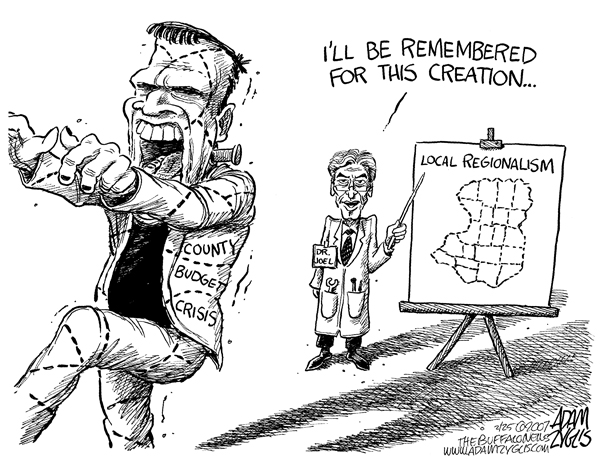
Adam Zyglis Cartoon

Quietly creeping into our lives is a regulatory framework from the Obama Administration dubbed “regionalism”. That might sound innocuous enough. On one level, we can think of regionalism as a pooling of resources in order to accomplish things that would be difficult at more fragmented levels, such as small municipalities. That could take various forms, such as annexation of an adjacent municipality or the formation of regional districts tasked with providing services such as special schools, transportation, utilities, or certain law enforcement functions. Obviously, any of these  steps involves a loss of local control — for someone.

Regionalism as redefined by the Obama regime is more radical and involves not just other regional jurisdictions, but the federal government. The key elements of one proposed rule are federal data collection, federal diversity objectives and federal purse strings. The new rule, to be issued by the Department of Housing and Urban Development (HUD), is described in a WaPo opinion piece by Marc A. Thiessen, “Obama wants to reengineer your neighborhood“:

“Under Obama’s proposed rule, the federal government will collect massive amounts of data on the racial, ethnic and socioeconomic makeup of thousands of local communities, looking for signs of ‘disparities by race, color, religion, sex, familial status, national origin, or disability in access to community assets.’ Then the government will target communities with results it doesn’t like and use billions of dollars in federal grant money to bribe or blackmail them into changing their zoning and housing policies.“

The clause “...in access to community assets” is subject to broad interpretation. As Thiessen notes later, housing and lending discrimination are already prohibited on all of the bases listed above. However, this rule has socioeconomic implications apart from the protected classes. The rule may well hold a community responsible for the aggregate disparate impact of what HUD calls “… the operation of housing markets, [and] investment choices by holders of capital.” The upshot is that a community could be penalized if HUD determines that private builders, developers and investors offer insufficient units of affordable housing within its borders.

By what standard will any such disparate impact be judged? A group’s non-representation within the borders of a subject community would frequently obviate the rule. Clearly, the reference area for any single community would have to encompass a larger regional geography, but that is likely to be decided by federal regulators. The scheme will become very arbitrary if regulators have much flexibility on a case-by-case basis.

I have been a critic of zoning laws and other local building restrictions that artificially restrict the supply of housing and inflate housing costs. It is possible that the HUD rule would weaken such restrictions, but it is more likely that local communities would leave those rules largely intact and instead carve out affordable housing “districts”. They might even find it convenient to do so via eminent domain. In any case, I do not support the kind of federal oversight and control of local communities envisioned by the Obama Administration.

Obama regionalism is much broader than the new HUD rule. Stanley Kurtz warned of this encroachment two years ago in “Regionalism: Obama’s Quiet Anti-Suburban Revolution“, and in an earlier book on the threat of Obama regionalism to American suburbs. The new HUD rule:

“… is part of a broader suite of initiatives designed to block suburban development, press Americans into hyper-dense cities, and force us out of our cars. Government-mandated ethnic and racial diversification plays a role in this scheme, yet the broader goal is forced ‘economic integration.’ The ultimate vision is to make all neighborhoods more or less alike, turning traditional cities into ultra-dense Manhattans, while making suburbs look more like cities do now. In this centrally-planned utopia, steadily increasing numbers will live cheek-by-jowl in ‘stack and pack’ high-rises close to public transportation, while automobiles fall into relative disuse.“

Much of Kurtz’s focus is on the San Francisco region’s “Plan Bay Area”. Under the guise of “sustainable development”, this initiative limits new development in the Bay Area, restricts new single-family home construction, and shoe-horns new housing and business expansion into districts near transportation hubs. Kurtz also discusses a 2012 award to Plan Bay Area of a “Sustainable Communities Grant” by the Obama Administration. The rules surrounding the use of such grants contribute to the further politicization of local development.

Wendell Cox elaborates on Kurtz’s book and the threat of regionalism to suburban life in a New Geography article entitled “Spreading the Fiscal Irresponsibility“. Obama’s regionalism entails greater local dependence on federal funds and an extreme loss of local control. Cox emphasizes the negative implications of that loss for fiscal restraint at local levels.

A more recent example of regionalism in action is in Minneapolis and St. Paul, MN, where a 30-year master plan called “Thrive MSP 2040” has been promulgated by a regional planning council. Katherine Kersten weighs in on the plan in the Wall Street Journal in “Turning the Twin Cities Into Sim City” (or you may need to use this Google search to get past the pay wall):

“While minority residents have been streaming into the Twin Cities’ suburbs for the past 15 years, the Met Council wants to make sure there is a proper race-and-income mix in each. Thus it recently mapped every census tract in the 2,800 square-mile, seven-county region by race, ethnicity and income. The purpose was to identify ‘racially concentrated areas of poverty’ and ‘high opportunity clusters.’ The next step is for the council to lay out what the region’s 186 municipalities must do to disperse poverty throughout the metro area.“

HUD and HUD grant money is assisting in this effort. To quote Kersten, HUD

“… says that mapping is intended, in part, to identify suburban land-use and zoning practices that allegedly deny opportunity and create ‘barriers’ for low-income and minority people.“

The Thrive plan also calls for “Transit-oriented development” and evaluation of “all future development policies through the ‘lens’ of climate change.” From Kersten’s closing paragraph:

“… Twin Cities residents will likely realize that Thrive MSP 2040’s centralized decision-making and Orwellian appeals to ‘equity’ and ‘sustainability’ are a serious threat to their democratic traditions of individual liberty and self-government. Let’s hope that realization comes sooner rather than later.“

Enabling Disparate Impact Seekers

21 Tuesday Oct 2014

Posted by Nuetzel in Uncategorized

≈ Leave a comment

Tags

ABA, Disparate impact, Inclusive Community Project, Investors Business Daily, Racial Discrimination, Section 8 Housing, Supreme Count

State Gobbles Man

The cause of racial unity is not well-served by abusive application of the “disparate impact” doctrine. A dispute has reached the U.S. Supreme Court over tax credits for Section 8 (low income) housing in the Dallas area, which are dispensed by the Texas Department of Housing. The Inclusive Community Project (ICP) alleges that too many permits are issued in low-income areas, leading to segregation of minorities. Of course, housing prices may limit the feasibility of Section 8 housing in higher-income communities, so the result is a natural consequence of reasonable decision-making. The case is of  broad importance, however, as discussed in this IBD opinion.

Established business and social practices based on sound principles may have, as a by-product, a disproportionate or disparate impact on disadvantaged minorities. For example, if a minority population has less savings, on average, than non-minorities, they will tend to require higher loan-to-value ratios when applying to lenders for similar mortgage amounts. They are therefore more likely to have their applications declined or priced less favorably. This obviously differs from outright discrimination against the minority, and it should not rise to a cause of action against a lender who merely attempts to protect investors from excessive risk or to comply with regulations against excessive risk-taking. From the IBD opinion piece:

“‘The risk of disparate-impact lawsuits, in the absence of guidance from the court, pressures the residential mortgage lending industry to arrive at particular outcomes and end numbers to avoid such lawsuits,’ the American Bankers Association wrote the high bench in a joint amicus brief. …

Such pressure can force lenders to water down underwriting standards and take on more risk, since ‘down-payment requirements, debt-to-income requirements, loan-to-value requirements, and other neutral, risk-based underwriting requirements can all affect various racial and ethnic groups differently,’ ABA added.”

Policy goals should be at least compatible. Whether or not the plight of disadvantaged populations justifies some form of redistributive “justice,” there is no reasonable excuse for undermining prudent business practices that are otherwise free of any intent to discriminate against minorities. And in any case, a less efficient economy diminishes society’s capacity to redress such ills. Indeed, it’s more likely to aggravate them and allow disharmony to fester.

The Disparate Impact Racket

10 Monday Mar 2014

Posted by Nuetzel in Uncategorized

≈ 2 Comments

Tags

Disparate impact

Post hoc ergo propter hoc: turnabout better be fair play when the rules of conduct are based on one-dimensional, post-hoc results.

http://m.us.wsj.com/articles/SB10001424052702303824204579423721516531650?ref=/home-page

Newer posts →
Follow Sacred Cow Chips on WordPress.com

Recent Posts

  • The Case Against Interest On Reserves
  • Immigration and Merit As Fiscal Propositions
  • Tariff “Dividend” From An Indigent State
  • Almost Looks Like the Fed Has a 3% Inflation Target
  • Government Malpractice Breeds Health Care Havoc

Archives

  • January 2026
  • December 2025
  • November 2025
  • October 2025
  • September 2025
  • August 2025
  • July 2025
  • June 2025
  • May 2025
  • April 2025
  • March 2025
  • February 2025
  • January 2025
  • December 2024
  • November 2024
  • October 2024
  • September 2024
  • August 2024
  • July 2024
  • June 2024
  • May 2024
  • April 2024
  • March 2024
  • February 2024
  • January 2024
  • December 2023
  • November 2023
  • August 2023
  • July 2023
  • June 2023
  • May 2023
  • April 2023
  • March 2023
  • February 2023
  • January 2023
  • December 2022
  • November 2022
  • October 2022
  • September 2022
  • August 2022
  • July 2022
  • June 2022
  • May 2022
  • April 2022
  • March 2022
  • February 2022
  • January 2022
  • December 2021
  • November 2021
  • October 2021
  • September 2021
  • August 2021
  • July 2021
  • June 2021
  • May 2021
  • April 2021
  • March 2021
  • February 2021
  • January 2021
  • December 2020
  • November 2020
  • October 2020
  • September 2020
  • August 2020
  • July 2020
  • June 2020
  • May 2020
  • April 2020
  • March 2020
  • February 2020
  • January 2020
  • December 2019
  • November 2019
  • October 2019
  • September 2019
  • August 2019
  • July 2019
  • June 2019
  • May 2019
  • April 2019
  • March 2019
  • February 2019
  • January 2019
  • December 2018
  • November 2018
  • October 2018
  • September 2018
  • August 2018
  • July 2018
  • June 2018
  • May 2018
  • April 2018
  • March 2018
  • February 2018
  • January 2018
  • December 2017
  • November 2017
  • October 2017
  • September 2017
  • August 2017
  • July 2017
  • June 2017
  • May 2017
  • April 2017
  • March 2017
  • February 2017
  • January 2017
  • December 2016
  • November 2016
  • October 2016
  • September 2016
  • August 2016
  • July 2016
  • June 2016
  • May 2016
  • April 2016
  • March 2016
  • February 2016
  • January 2016
  • December 2015
  • November 2015
  • October 2015
  • September 2015
  • August 2015
  • July 2015
  • June 2015
  • May 2015
  • April 2015
  • March 2015
  • February 2015
  • January 2015
  • December 2014
  • November 2014
  • October 2014
  • September 2014
  • August 2014
  • July 2014
  • June 2014
  • May 2014
  • April 2014
  • March 2014

Blogs I Follow

  • Passive Income Kickstart
  • OnlyFinance.net
  • TLC Cholesterol
  • Nintil
  • kendunning.net
  • DCWhispers.com
  • Hoong-Wai in the UK
  • Marginal REVOLUTION
  • Stlouis
  • Watts Up With That?
  • Aussie Nationalist Blog
  • American Elephants
  • The View from Alexandria
  • The Gymnasium
  • A Force for Good
  • Notes On Liberty
  • troymo
  • SUNDAY BLOG Stephanie Sievers
  • Miss Lou Acquiring Lore
  • Your Well Wisher Program
  • Objectivism In Depth
  • RobotEnomics
  • Orderstatistic
  • Paradigm Library
  • Scattered Showers and Quicksand

Blog at WordPress.com.

Passive Income Kickstart

OnlyFinance.net

TLC Cholesterol

Nintil

To estimate, compare, distinguish, discuss, and trace to its principal sources everything

kendunning.net

The Future is Ours to Create

DCWhispers.com

Hoong-Wai in the UK

A Commonwealth immigrant's perspective on the UK's public arena.

Marginal REVOLUTION

Small Steps Toward A Much Better World

Stlouis

Watts Up With That?

The world's most viewed site on global warming and climate change

Aussie Nationalist Blog

Commentary from a Paleoconservative and Nationalist perspective

American Elephants

Defending Life, Liberty and the Pursuit of Happiness

The View from Alexandria

In advanced civilizations the period loosely called Alexandrian is usually associated with flexible morals, perfunctory religion, populist standards and cosmopolitan tastes, feminism, exotic cults, and the rapid turnover of high and low fads---in short, a falling away (which is all that decadence means) from the strictness of traditional rules, embodied in character and inforced from within. -- Jacques Barzun

The Gymnasium

A place for reason, politics, economics, and faith steeped in the classical liberal tradition

A Force for Good

How economics, morality, and markets combine

Notes On Liberty

Spontaneous thoughts on a humble creed

troymo

SUNDAY BLOG Stephanie Sievers

Escaping the everyday life with photographs from my travels

Miss Lou Acquiring Lore

Gallery of Life...

Your Well Wisher Program

Attempt to solve commonly known problems…

Objectivism In Depth

Exploring Ayn Rand's revolutionary philosophy.

RobotEnomics

(A)n (I)ntelligent Future

Orderstatistic

Economics, chess and anything else on my mind.

Paradigm Library

OODA Looping

Scattered Showers and Quicksand

Musings on science, investing, finance, economics, politics, and probably fly fishing.

  • Subscribe Subscribed
    • Sacred Cow Chips
    • Join 128 other subscribers
    • Already have a WordPress.com account? Log in now.
    • Sacred Cow Chips
    • Subscribe Subscribed
    • Sign up
    • Log in
    • Report this content
    • View site in Reader
    • Manage subscriptions
    • Collapse this bar
 

Loading Comments...