• About

Sacred Cow Chips

Sacred Cow Chips

Tag Archives: economic stimulus

No Radar, No Rudder: Fiscal & Monetary Destabilization

31 Wednesday May 2023

Posted by Nuetzel in Fiscal policy, Monetary Policy

≈ 1 Comment

Tags

budget deficits, Credible Committments, crowding out, David Beckworth, David Henderson, Discretionary Spending, economic stimulus, Federal Reserve, Great Depression, Housing Bubble, Inflation Reduction Act, Long and Variable Lags, Lucas Critique, Mortgage Crisis, Pandemic Relief, Rational Expectations, Robert Lucas, Shovel-Ready Projects, Spending Multipliers, Stabilization policy, Tyler Cowen

Policy activists have long maintained that manipulating government policy can stabilize the economy. In other words, big spending initiatives, tax cuts, and money growth can lift the economy out of recessions, or budget cuts and monetary contraction can prevent overheating and inflation. However, this activist mirage burned away under the light of experience. It’s not that fiscal and monetary policy are powerless. It’s a matter of practical limitations that often cause these tools to be either impotent or destabilizing to the economy, rather than smoothing fluctuations in the business cycle.

The macroeconomics classes seem like yesterday: Keynesian professors lauded the promise of wise government stabilization efforts: policymakers could, at least in principle, counter economic shocks, particularly on the demand side. That optimistic narrative didn’t end after my grad school days. I endured many client meetings sponsored by macro forecasters touting the fine-tuning of fiscal and monetary policy actions. Some of those economists were working with (and collecting revenue from) government policymakers, who are always eager to validate their pretensions as planners (and saviors). However, seldom if ever do forecasters conduct ex post reviews of their model-spun policy scenarios. In fairness, that might be hard to do because all sorts of things change from initial conditions, but it definitely would not be in their interests to emphasize the record.

In this post I attempt to explain why you should be skeptical of government stabilization efforts. It’s sort of a lengthy post, so I’ve listed section headings below in case readers wish to scroll to points of most interest. Pick and choose, if necessary, though some context might get lost in the process.

  • Expectations Change the World
  • Fiscal Extravagance
  • Multipliers In the Real World
  • Delays
  • Crowding Out
  • Other Peoples’ Money
  • Tax Policy
  • Monetary Policy
  • Boom and Bust
  • Inflation Targeting
  • Via Rate Targeting
  • Policy Coordination
  • Who Calls the Tune?
  • Stable Policy, Stable Economy

Expectations Change the World

There were always some realists in the economics community. In May we saw the passing of one such individual: Robert Lucas was a giant intellect within the economics community, and one from whom I had the pleasure of taking a class as a graduate student. He was awarded the Nobel Prize in Economic Science in 1995 for his applications of rational expectations theory and completely transforming macro research. As Tyler Cowen notes, Keynesians were often hostile to Lucas’ ideas. I remember a smug classmate, in class, telling the esteemed Lucas that an important assumption was “fatuous”. Lucas fired back, “You bastard!”, but proceeded to explain the underlying logic. Cowen uses the word “charming” to describe the way Lucas disarmed his critics, but he could react strongly to rude ignorance.

Lucas gained professional fame in the 1970s for identifying a significant vulnerability of activist macro policy. David Henderson explains the famous “Lucas Critique” in the Wall Street Journal:

“… because these models were from periods when people had one set of expectations, the models would be useless for later periods when expectations had changed. While this might sound disheartening for policy makers, there was a silver lining. It meant, as Lucas’s colleague Thomas Sargent pointed out, that if a government could credibly commit to cutting inflation, it could do so without a large increase in unemployment. Why? Because people would quickly adjust their expectations to match the promised lower inflation rate. To be sure, the key is government credibility, often in short supply.”

Non-credibility is a major pitfall of activist macro stabilization policies that renders them unreliable and frequently counterproductive. And there are a number of elements that go toward establishing non-credibility. We’ll distinguish here between fiscal and monetary policy, focusing on the fiscal side in the next several sections.

Fiscal Extravagance

We’ve seen federal spending and budget deficits balloon in recent years. Chronic and growing budget deficits make it difficult to deliver meaningful stimulus, both practically and politically.
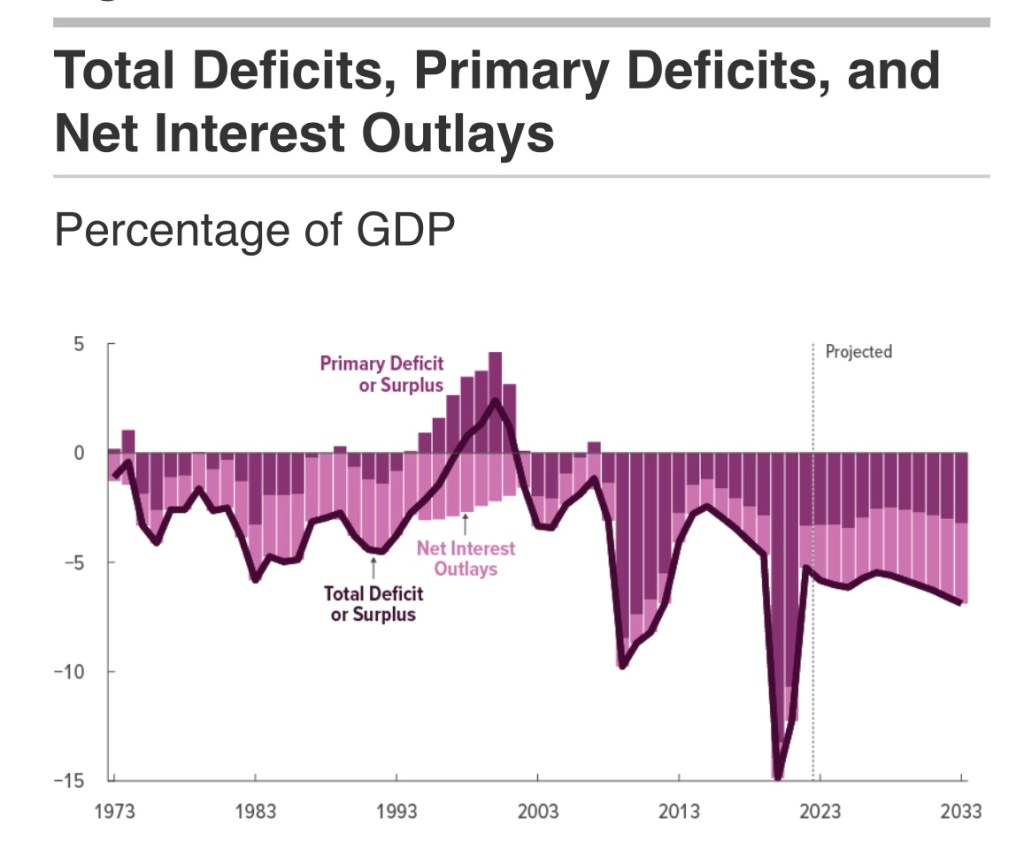
The next chart is from the most recent Congressional Budget Office (CBO) report. It shows the growing contribution of interest payments to deficit spending. Ever-larger deficits mean ever-larger amounts of debt on which interest is owed, putting an ever-greater squeeze on government finances going forward. This is particularly onerous when interest rates rise, as they have over the past few years. Both new debt is issued and existing debt is rolled over at higher cost.
Relief payments made a large contribution to the deficits during the pandemic, but more recent legislation (like the deceitfully-named Inflation Reduction Act) piled-on billions of new subsidies for private investments of questionable value, not to mention outright handouts. These expenditures had nothing to do with economic stabilization and no prayer of reducing inflation. Pissing away money and resources only hastens the debt and interest-cost squeeze that is ultimately unsustainable without massive inflation.

Hardly anyone with future political ambitions wants to address the growing entitlements deficit … but it will catch up with them. Social Security and Medicare are projected to exhaust their respective trust funds in the early- to mid-2030s, which will lead to mandatory benefit cuts in the absence of reform.

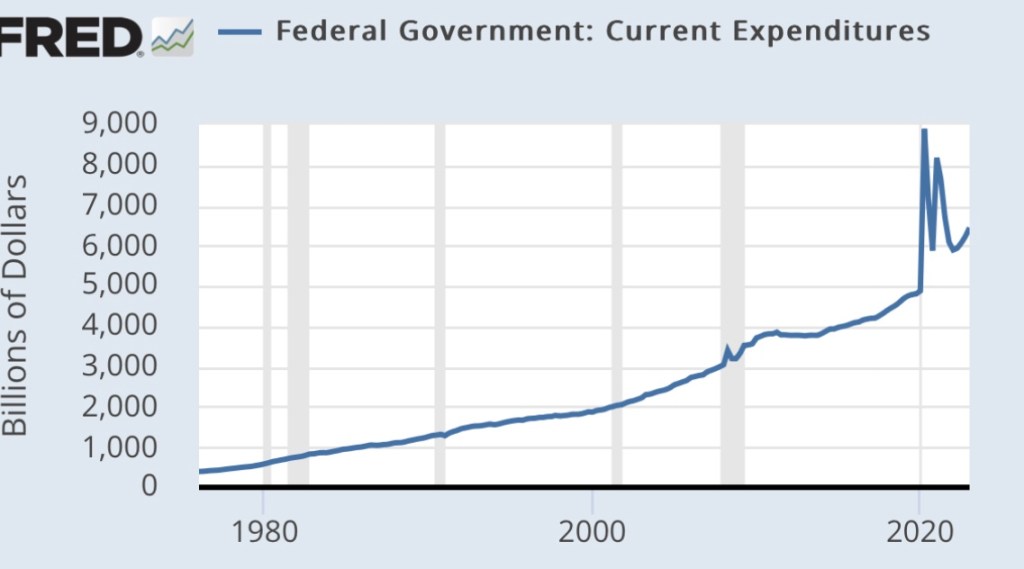
If it still isn’t obvious, the real problem driving the budget imbalance is spending, not revenue, as the next CBO chart demonstrates. The “emergency” pandemic measures helped precipitate our current stabilization dilemma. David Beckworth tweets that the relief measures “spurred a rapid recovery”, though I’d hasten to add that a wave of private and public rejection of extreme precautions in some regions helped as well. And after all, the pandemic downturn was exaggerated by misdirected policies including closures and lockdowns that constrained both the demand and supply sides. Beckworth acknowledges the relief measures “propelled inflation”, but the pandemic also seemed to leave us on a permanently higher spending path. Again, see the first chart below.

The second chart below shows that non-discretionary spending (largely entitlements) and interest outlays are how we got on that path. The only avenue for countercyclical spending is discretionary expenditures, which constitute an ever-smaller share of the overall budget.
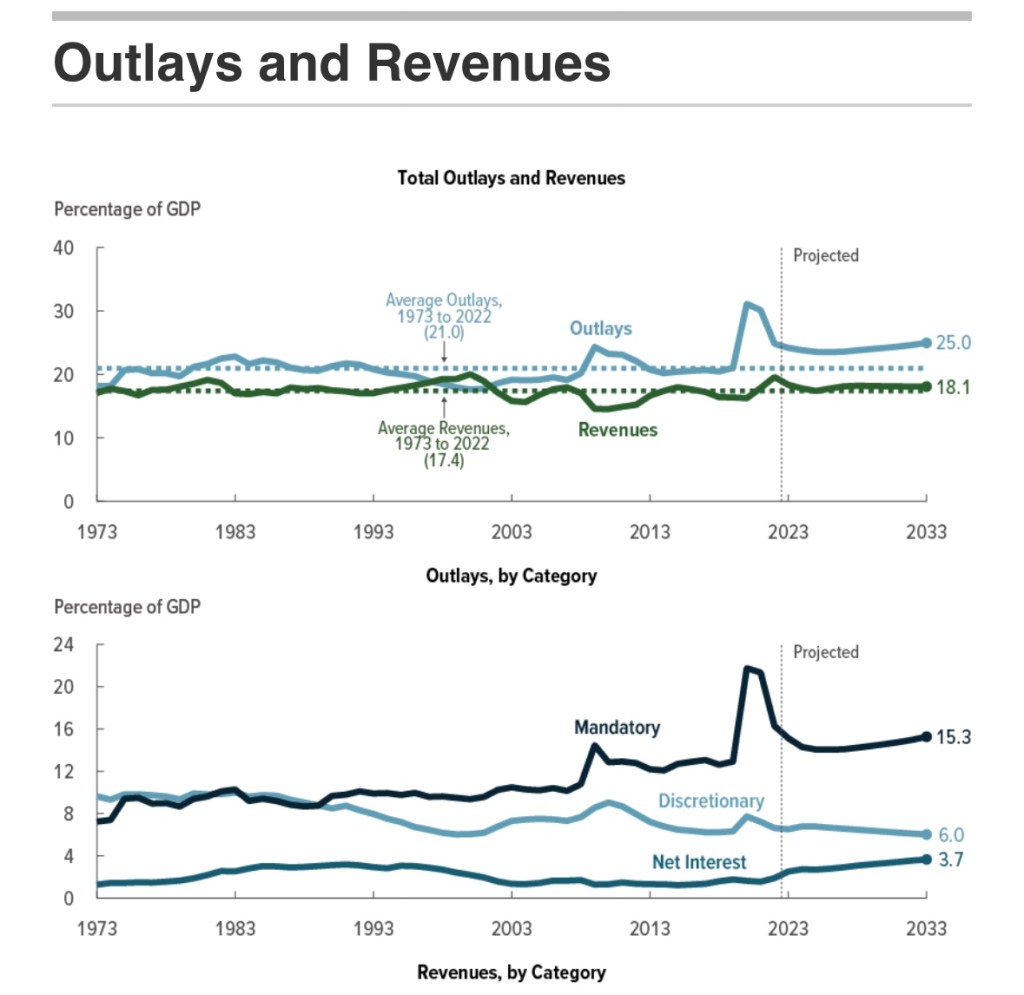
We’ve had chronic deficits for years, but we’ve shifted to a much larger and continuing imbalance. With more deficits come higher interest costs, especially when interest rates follow a typical upward cyclical pattern. This creates a potentially explosive situation that is best avoided via fiscal restraint.

Putting other doubts about fiscal efficacy aside, it’s all but impossible to stimulate real economic activity when you’ve already tapped yourself out and overshot in the midst of a post-pandemic economic expansion.

Multipliers In the Real World

So-called spending multipliers are deeply beloved by Keynesians and pork-barrel spenders. These multipliers tell us that every dollar of extra spending ultimately raises income by some multiple of that dollar. This assumes that a portion of every dollar spent by government is re-spent by the recipient, and a portion of that is re-spent again by another recipient. But spending multipliers are never what they’re cracked up to be for a variety of reasons. (I covered these in “Multipliers Are For Politicians”, and also see this post.) There are leakages out of the re-spending process (income taxes, saving, imports), which trim the ultimate impact of new spending on income. When supply constraints bind on economic activity, fiscal stimulus will be of limited power in real terms.

If stimulus is truly expected to be counter-cyclical and transitory, as is generally claimed, then much of each dollar of extra government spending will be saved rather than spent. This is the lesson of the permanent income hypothesis. It means greater leakages from the re-spending stream and a lower multiplier. We saw this with the bulge in personal savings in the aftermath of pandemic relief payments.

Another side of this coin, however, is that cutting checks might be the government’s single-most efficient activity in execution, but it can create massive incentive problems. Some recipients are happy to forego labor market participation as long as the government keeps sending them checks, but at least they spend some of the income.

Delays

Another unappreciated and destabilizing downside of fiscal stimulus is that it often comes too late, just when the economy doesn’t need stimulus. That’s because a variety of delays are inherent in many spending initiatives: legislative, regulatory, legal challenges, planning and design, distribution to various spending authorities, and final disbursement. As I noted here:

“Even government infrastructure projects, heralded as great enhancers of American productivity, are often subject to lengthy delays and cost overruns due to regulatory and environmental rules. Is there any such thing as a federal ‘shovel-ready’ infrastructure project?”

Crowding Out

The supply of savings is limited, but when government borrows to fund deficits, it directly competes with private industry for those savings. Thus, funds that might otherwise pay for new plant, equipment, and even R&D are diverted to uses that should qualify as government consumption rather than long-term investment. Government competition for funds “crowds-out” private activity and impedes growth in the economy’s productive capacity. Thus, the effort to stimulate economic activity is self-defeating in some respects.

Other Peoples’ Money

Government doesn’t respond to price signals the way self-interested private actors do. This indifference leads to mis-allocated resources and waste. It extends to the creation of opportunities for graft and corruption, typically involving diversion of resources into uses that are of questionable productivity (corn ethanol, solar and wind subsidies).

Consider one other type of policy action perceived as counter-cyclical: federal bailouts of failing financial institutions or other troubled businesses. These rescues prop up unproductive enterprises rather than allowing waste to be flushed from the system, which should be viewed as a beneficial aspect of recession. The upshot is that too many efforts at economic stabilization are misdirected, wasteful, ill-timed, and pro-cyclical in impact.

Tax Policy

Like stabilization efforts on the spending side, tax changes may be badly timed. Tax legislation is often complex and can take time for consumers and businesses to adjust. In terms of traditional multiplier analysis, the initial impact of a tax change on spending is smaller than for expenditures, so tax multipliers are smaller. And to the extent that a tax change is perceived as temporary, it is made less effective. Thus, while changes in tax policy can have powerful real effects, they suffer from some of the same practical shortcomings for stabilization as changes in spending.

However, stimulative tax cuts, if well crafted, can boost disposable incomes and improve investment and work incentives. As temporary measures, that might mean an acceleration of certain kinds of activity. Tax increases reduce disposable incomes and may blunt incentives, or prompt delays in planned activities. Thus, tax policy may bear on the demand side as well as the timing of shifts in the economy’s productive potential or supply side.

Monetary Policy

Monetary policy is subject to problems of its own. Again, I refer to practical issues that are seemingly impossible for policy activists to overcome. Monetary policy is conducted by the nation’s central bank, the Federal Reserve (aka, the Fed). It is theoretically independent of the federal government, but the Fed operates under a dual mandate established by Congress to maintain price stability and full employment. Therein lies a basic problem: trying to achieve two goals that are often in conflict with a single policy tool.

Make no mistake: variations in money supply growth can have powerful effects. Nevertheless, they are difficult to calibrate due to “long and variable lags” as well as changes in money “velocity” (or turnover) often prompted by interest rate movements. Excessively loose money can lead to economic excesses and an overshooting of capacity constraints, malinvestment, and inflation. Swinging to a tight policy stance in order to correct excesses often leads to “hard landings”, or recession.

Boom and Bust

The Fed fumbled its way into engineering the Great Depression via excessively tight monetary policy. “Stop and go” policies in the 1970s led to recurring economic instability. Loose policy contributed to the housing bubble in the 2000s, and subsequent maladjustments led to a mortgage crisis (also see here). Don’t look now, but the inflationary consequences of the Fed’s profligacy during the pandemic prompted it to raise short-term interest rates in the spring of 2022. It then acted with unprecedented speed in raising rates over the past year. While raising rates is not always synonymous with tightening monetary conditions, money growth has slowed sharply. These changes might well lead to recession. Thus, the Fed seems given to a pathology of policy shifts that lead to unintentional booms and busts.

Inflation Targeting

The Fed claims to follow a so-called flexible inflation targeting policy. In reality, it has reacted asymmetrically to departures from its inflation targets. It took way too long for the Fed to react to the post-pandemic surge in inflation, dithering for months over whether the surge was “transitory”. It wasn’t, but the Fed was reluctant to raise its target rates in response to supply disruptions. At the same time, the Fed’s own policy actions contributed massively to demand-side price pressures. Also neglected is the reality that higher inflation expectations propel inflation on the demand side, even when it originates on the supply side.

Via Rate Targeting

At a more nuts and bolts level, today the Fed’s operating approach is to control money growth by setting target levels for several key short-term interest rates (eschewing a more direct approach to the problem). This relies on price controls (short-term interest rates being the price of liquidity) rather than allowing market participants to determine the rates at which available liquidity is allocated. Thus, in the short run, the Fed puts itself into the position of supplying whatever liquidity is demanded at the rates it targets. The Fed makes periodic adjustments to these rate targets in an effort to loosen or tighten money, but it can be misdirected in a world of high debt ratios in which rates themselves drive the growth of government borrowing. For example, if higher rates are intended to reduce money growth and inflation, but also force greater debt issuance by the Treasury, the approach might backfire.

Policy Coordination

While nominally independent, the Fed knows that a particular monetary policy stance is more likely to achieve its objectives if fiscal policy is not working at cross purposes. For example, tight monetary policy is more likely to succeed in slowing inflation if the federal government avoids adding to budget deficits. Bond investors know that explosive increases in federal debt are unlikely to be repaid out of future surpluses, so some other mechanism must come into play to achieve real long-term balance in the valuation of debt with debt payments. Only inflation can bring the real value of outstanding Treasury debt into line. Continuing to pile on new debt simply makes the Fed’s mandate for price stability harder to achieve.

Who Calls the Tune?

The Fed has often succumbed to pressure to monetize federal deficits in order to keep interest rates from rising. This obviously undermines perceptions of Fed independence. A willingness to purchase large amounts of Treasury bills and bonds from the public while fiscal deficits run rampant gives every appearance that the Fed simply serves as the Treasury’s printing press, monetizing government deficits. A central bank that is a slave to the spending proclivities of politicians cannot make credible inflation commitments, and cannot effectively conduct counter-cyclical policy.

Stable Policy, Stable Economy

Activist policies for economic stabilization are often perversely destabilizing for a variety of reasons. Good timing requires good forecasts, but economic forecasting is notoriously difficult. The magnitude and timing of fiscal initiatives are usually wrong, and this is compounded by wasteful planning, allocative dysfunction, and a general absence of restraint among political leaders as well as the federal bureaucracy..

Predicting the effects of monetary policy is equally difficult and, more often than not, leads to episodes of over- and under-adjustment. In addition, the wrong targets, the wrong operating approach, and occasional displays of subservience to fiscal pressure undermine successful stabilization. All of these issues lead to doubts about the credibility of policy commitments. Stated intentions are looked upon with doubt, increasing uncertainty and setting in motion behaviors that lead to undesirable economic consequences.

The best policies are those that can be relied upon by private actors, both as a matter of fulfilling expectations and avoiding destabilization. Federal budget policy should promote stability, but that’s not achievable institutions unable to constrain growth in spending and deficits. Budget balance would promote stability and should be the norm over business cycles, or perhaps over periods as long as typical 10-year budget horizons. Stimulus and restraint on the fiscal side should be limited to the effects of so-called automatic stabilizers, such as tax rates and unemployment compensation. On the monetary side, the Fed would do more to stabilize the economy by adopting formal rules, whether a constant rate of money growth or symmetric targeting of nominal GDP.


Trump’s Payroll Tax Ploy

15 Tuesday Sep 2020

Posted by Nuetzel in Fiscal policy, Taxes

≈ Leave a comment

Tags

and Wells Fargo, Coronavirus, Coyote Blog, CVS, Donald Trump, economic stimulus, Election Politics, Employer’s Share, FICA, Hiring Incentives, Home Depot, JP Morgan Chase, payroll taxes, Permanent Income, Social Security, Steve Mnuchin, Tax Deferral, UPS, Warren Meyer

President Trump’s memorandum to Treasury Secretary Steve Mnuchin on payroll tax deferral is bad economic policy, but it might ultimately prove useful as a political weapon. The memo, released in August, instructed the Treasury to allow employers to suspend withholding of the employee’s share of FICA taxes (6.2%) until the end of the year, but it does not forgive the taxes. Only Congress (with the President’s signature) can eliminate the tax obligation. There are several reasons I don’t like it:

  1. Assuming the tax obligation is forgiven, it would provide some relief to those who are already employed (and earning less than $4,000 every two weeks), but not to the unemployed. Thus, as relief from coronavirus-induced job losses, this doesn’t cut it.
  2. It does not reduce the cost of hiring, as would a permanent reduction in the employer’s share, so it does not improve hiring incentives.
  3. The deferral creates uncertainty: will the tax bill be forgiven? If not, will the employee be on the hook? Or the employer? What if an employee leaves the company having received a deferral?
  4. The measure will not be an effective stimulus to spending. It is not an addition to workers’ permanent income since it is a temporary “holiday”. Income perceived as temporary adds little to consumer spending. And it doesn’t constitute a temporary tax break unless employers participate (see below), and even then only if Trump is re-elected and if Congress agrees to forgive the tax.
  5. Trump suggested that the tax will be forgiven if he is re-elected. It’s a rather unsavory proposition: create an immediate tax benefit paired with a matching future obligation with forgiveness contingent upon re-election!
  6. Long-term funding of Social Security is already problematic. Adding a payroll tax holiday on top of that, assuming the taxes are forgiven, only aggravates the situation. Yes, I can imagine various “long-game” reform proposals that might attempt to leverage such a break, but I consider that highly unlikely.

It’s no surprise that a number of large employers are not participating in the tax deferral. such as CVS, JP Morgan Chase, UPS, Home Depot, and Wells Fargo.

Small employers have an even bigger problem to the extent that they lack sophisticated accounting systems to handle such deferrals. Here’s Warren Meyers’ take on the payroll tax suspension:

“We have 400 employees today, but since we are a summer seasonal business we will have fewer than 100 in January. If there is a catch-up repayment in January (meaning Congress chooses not to forgive the taxes altogether), most of my employees who would need to repay the tax will be gone. Do you think the government is just going to say, ‘oh well, I guess we lost that money’? Hah! You don’t know how the government works with tax liens. My guess is that for every employee no longer on the payroll for whom back employment taxes need to be collected, the government is going to say our company is responsible for those payments instead. We could be out hundreds of thousands of extra dollars. President Biden will just say, ‘well I guess you should not have participated in a Trump program.’

So this is the vise we are in: Either we participate in the program, and risk paying a fortune in extra taxes at some future date, or we don’t participate, and have every employee screaming at us for deducting payroll taxes when President Trump told them they did not have to pay it anymore. And what happens if Congress does come along later and forgive the taxes, what kind of jerk am I for not allowing my employees to benefit from the tax break?

A payroll tax rollback was considered for the Republican stimulus packages that failed in Congress this summer, but that provision was said to be “negotiable”. In any case, nothing passed. Surely Trump’s economic advisors know that the economics of the payroll tax memo are lousy, even if Trump doesn’t get it.

I can’t decide whether the whole thing is Machiavellian or just a goof. Perhaps Trump is so eager to be seen as a tax cutter that he is willing to gloss over the distinction between a tax cut and a deferral. If the taxes owed are not forgiven, it won’t be on his watch. And Trump might believe he can weaponize the payroll tax deferral against obstinate Democrats in Congress as well as Joe Biden. Maybe he can.

Zero Cost Stimulus: Risky Business

21 Sunday Jun 2020

Posted by Nuetzel in Uncategorized

≈ Leave a comment

Tags

Alex Tabarrok, Contingent Wage Subsidies, economic stimulus, Fiscal policy, Low Employment Equilibrium, Payroll Tax Holiday, Robertas Zubrickas

When the federal government intervenes to stimulate the economy, it generally means a big spending program or tax reduction and an increase in the federal deficit. This year we’ve witnessed the largest single-year fiscal policy effort in U.S. history, an effort to aid individuals whose jobs were lost and to stimulate the suddenly depressed economy. The coronavirus lockdowns in most states brought federal legislation enhancing unemployment compensation, one-time support payments to most adults, emergency business “loans” that are largely to be forgiven, and many other elements. The cost of these packages is expected to be about $2.4 trillion. And there will be more legislation this summer intended to stimulate hiring, including a probable infrastructure bill. President Trump still supports what the Administration calls a “hiring subsidy”, which is in fact a payroll tax holiday. As described, it would not explicitly target new hires, but would grant the holiday to all workers regardless of employment status. All these programs will ultimately be quite costly to taxpayers.

But what if there is a way to stimulate hiring without adding a dime to the federal deficit? (And I’m not talking about monetary policy, which inflicts costs of its own.) One inventive idea would create hiring incentives on a contingent basis, but with the beautiful feature that the program itself eliminates the contingency. Alex Tabarrok recently devoted a post to this idea, for which credit goes to Robertas Zubrickas. Here’s how it works, in Zubrickas’ words:

“… we propose a policy that offers firms wage subsidies for new hires payable only if the total number of new hires made in the economy does not exceed a prespecified threshold. An example would be a promise to cover all new labor costs contingent on that less than, say, 100,000 new jobs are created in total. From a firm’s perspective two outcomes can occur from this policy. One outcome is when the number of new jobs is less than the threshold, in which case the firm has its additional labor costs covered while keeping all the additional revenue. The second outcome is when the threshold is met and no subsidies are paid.”

If enough firms hire in order to reap the subsidies, then aggregate hiring exceeds the threshold and no wage subsidies are paid, but the additional employment boosts demand sufficiently to justify the hiring. Fiscal stimulus without any budget impact! Incredible, right?

There are problems, of course. The simple program described would carry big risks for many businesses. Just because aggregate hiring exceeds the threshold doesn’t mean demand for your firm’s offerings will increase. To take an obvious example, can a rural employer count on an increase in demand? The program could be designed to hinge on different regional hiring thresholds, or different industry hiring thresholds, but that quickly gets complicated.

Moreover, firms will have an incentive to free ride on other businesses who hire up-front. The timing of cash flows would also be critical. Are the subsidies to be paid upon proof of hiring, with repayment later if the aggregate hiring threshold is reached? If not, I suspect many employers would rather scramble to hire workers upon the realization of any increase in demand as might occur, but unwilling to risk hiring given the possibility that the subsidy will be lost and that their own sales will remain weak. That might be especially true for small firms. And if the subsidy is paid up front, good luck getting it back on behalf of taxpayers! So there are substantial fiscal risks, whether or not the aggregate hiring threshold is met. But perhaps those risks could be minimized with some limited tests of such a program.

Finally, this sort of plan would be much less likely to succeed with repetition. Then again, a one-time contingent hiring subsidy might be well suited to the so-called “low-employment equilibrium” that many believe we face today. The contingent subsidy is certainly a market distortion, but one hopes it would be a temporary distortion.

Zubrickas’ contingent wage subsidies are fascinating. The pandemic and the social distancing imperative have increased the cost of doing business, and the infection risk perceived by consumers is a potential drag on demand. Wage subsidies would reduce hiring costs, but if enough firms hire, those costs would be restored while demand would be stronger. But additional sales might not materialize for your firm! Designing a program of this type so as to minimize the risks faced by individual firms and taxpayers is tough, but it is an idea worth exploring in more detail. In concept, it’s certainly preferable to fiscal programs that carry huge costs and usually end in permanently larger government.        


Politicians and Infra-Hucksters

05 Thursday Jan 2017

Posted by Nuetzel in Government, infrastructure, Technology

≈ 2 Comments

Tags

Border Wall, Congestion, Donald Trump, Dynamic Message Boards, economic stimulus, Efficient Pricing, Elon Musk, eminent domain, Heritage Foundation, High speed rail, Hyperloop, infrastructure, Jerry L. Jordan, Job Creation, Keystone Pipeline, Michael Sargent, Private Infrastructure, Reason Foundation, Solar Roads, St. Louis MO, Steven Horowitz, T. Norman Van Cott, Trolleys, Tunnel Boring, User Fees

img_3863

We’ll soon have a new president and already we’ve heard new promises of infrastructure investment. Once again, a chorus of politicians and pundits decries the woeful state of America’s road, bridges, sewers and airport terminals. Then, there are hosannas in adoration of the economic stimulus and job creation promised by large public works projects. And of course there are proposals to integrate politically-favored technologies with new infrastructure. All three rationales for a publicly-financed infrastructure program are flawed. Our infrastructure is not as inadequate as many believe; it is bad public policy to justify infrastructure decisions on the basis of the construction jobs required; and new infrastructure should not be treated as a vehicle for large-scale deployment of unproven technologies.

Ownership

Much of our nation’s infrastructure is privately owned. This includes, but is not limited to, power generation and the power grid, communication networks, many water systems and sewer systems, most rail lines, some toll roads and bridges, and some river, sea and space ports. Maintenance and upgrades to private facilities, and to some public facilities, depend on the adequacy of the rates or fees charged to users. On the other hand, the quantity and quality of publicly-owned and operated infrastructure is often left up to taxpayers rather than users. Proposals for federal infrastructure investment are largely about these public facilities, but they might also involve subsidies for the development of private infrastructure.

Crisis or Crock?

In a Heritage Foundation research report, Michael Sargent notes that the poor state of the country’s public infrastructure is wildly exaggerated:

“The notion that America’s infrastructure is ‘crumbling’ and in uniquely poor condition is not supported by data. The percentage of the nation’s bridges deemed ‘structurally deficient (not necessarily unsafe, but requiring extensive maintenance) has declined annually since 1990 and now sits at under 10 percent, well under half of what it was 25 years ago. Similarly, analyses of highway pavement quality conclude that the nation’s major roads have been steadily improving in quality and are likely in their best shape ever. Our airports and airways safely move more people and goods than those of any other nation. Overall, the U.S. ranks near the top of G-7 nations for infrastructure quality.“

The usual poster child of the infrastructure “crisis” is the nation’s transportation system, but this report from the Reason Foundation shows that those troubles are something of a myth.

Nevertheless, there are always repairs, maintenance and replacement projects to be considered, as well as possible expansion and new facilities. Infrastructural shortfalls and expansion must be prioritized, but as Sargent emphasizes, an even larger number of projects should and probably would be handled privately if not for burdensome federal regulations. In addition, an irrational mistrust of privately-operated facilities among some segments of the public creates pressure to burden taxpayers with costs, rather than users. Complaints about congestion on roads offer a case in point: the best solutions involve efficient (and positive) pricing of existing capacity, rather than continued expansion of a “free” good. The avoidance of rational solutions like efficient pricing underscores the extent to which demands for increased public investment in infrastructure are driven by hyperbole, rather than sound analysis.

It’s About the Infrastructure, Not the Jobs 

Public infrastructure projects are also pitched as effective engines of economic stimulus and job creation. Both of those claims are questionable. Most importantly, the real rationale for infrastructure investment is the value of the infrastructure itself and the needs it serves going forward. The public expense and the jobs required to produce it are cost items! This point was made recently by economist T. Norman Van Cott, who rightfully asserts that a given output is of greater benefit when its costs are low and when it requires less labor input. (Van Cott’s piece uses the Keystone pipeline as an example, a controversial private project that I find objectionable for its dependence on eminent domain actions.) The sharp distinction between creating value and creating jobs is also made here by Jerry L. Jordon and here by Steven Horowitz. Here is Horowitz:

“Creating jobs is easy; it’s creating value that’s hard. We could create millions of jobs quite easily by destroying every piece of machinery on U.S. farms. The question is whether we are actually better off by creating those jobs—and the answer is a definite no.“

Yet this is how so many infrastructure projects are pitched at the national, state and local levels. It’s also puzzling that economic stimulus is used as a rationale even when the economy is operating near its potential output. Even by the standards of traditional Keynesian economic analysis, that is the wrong time for stimulus. Infrastructure projects should be evaluated on their own merits, not on how many construction workers must be hired, or on how much of their paychecks those workers will spend. Many of them must be bid away from competing projects anyway.

The Public Investment Trough

Here’s a brief anecdote from my own experience with an “advanced” public infrastructure project. Some years ago in the region around my city, St. Louis, Missouri, transportation agencies began to install a network of electronic highway message boards to convey real-time information to drivers on road conditions, congestion, and various public service announcements. The 100+ signs in the area today are connected to operators in a central office via fiber optic cable. This type of system is used elsewhere, and it is partly funded by the federal government.

I seriously question the benefits of this system relative to cost. The signs themselves cost well in excess of $100,000 each. The fiber network is undoubtedly costly, and there are other fixed and variable system costs. The signs have an anachronistic look, vaguely the quality of old high school scoreboards. The information they provide generally adds little to what I already know (“12 minutes to I-270”). The signs are in fixed positions, so the occasional report of an accident or congestion usually comes too late to give motorists decent alternatives. The information the signs provide on road conditions is obvious. Missives such as “buckle up” are of questionable value. Before I depart on a commute, or if I have a passenger, we can consult maps and other apps on cell phones to avail ourselves of far better information. Other, more flexible technologies were outpacing the message boards even before they could be fully deployed, and the boards are still being deployed. This is a project that might have sounded brilliant to highway engineers 20 years ago, but it represented something of a luxury relative to other needs, and it still got funded. Today, it looks like waste.

The politics of infrastructure often means that the enabling legislation gets loaded with poorly-planned projects and shiny jewels to dangle before home constituencies. Legislators are so eager to demonstrate their sophistication that they fall over themselves to approve taxpayer funds for unproven but politically-favored technologies. For example, a recent post by Warren Meyer notes the technical folly of solar roads. These are unlikely to attract much private money because they represent such a monumentally stupid idea. Proponents will go after tax money instead. The same is true of ideas like Elon Musk’s tunnel boring project, for which he hopes to collect massive taxpayer subsidies. Musk claims that tunnels will eliminate road congestion, but efficient pricing would do much to eliminate this problem without tunnels, and other technologies like automated vehicles are likely to reduce congestion by the time Musk over-invests tax money in tunnel-boring equipment, roads and hyper-loops inside tunnels.

In general, taxpayers should be wary of “green infrastructure” proposals. A large number of bike lanes, pedestrian bridges and greenways sound wonderful, but they are serious cost inflators. Federal dollars are regularly squandered on charming but wasteful projects such as trolleys. Even worse are ongoing efforts to subsidize the construction of high-speed rail systems. All of these bright ideas should be resisted.

Let’s Be Rational

The country certainly has infrastructural needs, but claims that we face a crisis are greatly exaggerated. With a new administration and what are likely to be supporting majorities in both houses of Congress, the danger of rushing into big funding commitments is heightened. The sponsors of this kind of legislation will herald massive job creation, but that is incidental to the cost side of the ledger. The benefits of individual projects should be evaluated carefully in comparison to costs. Then they can be prioritized if deemed of sufficient value. Finally, large scale deployment of unproven technologies should be avoided on the public dime.

I haven’t even mentioned one very large infrastructure project that has been proposed by President-Elect Donald Trump: the border wall. I suspect that it would be easier and less expensive to solve the problem of border security using more advanced and flexible technologies, but the permanence and symbolism of a wall appeals to many of Mr. Trump’s supporters. The benefits of a wall in terms of border security and control of immigration flows are difficult if not impossible to evaluate, as are the costs to taxpayers, with Trump promising to extract some form of payment from Mexico. The wall, however, is being “sold” to the American public in emotional terms. Come to think of it, that’s how too many other infrastructure proposals are sold by politicians!

There are promising opportunities to improve the nation’s infrastructure through the private sector, where the value of projects is subject to evaluation by parties who must put “skin in the game”. This will be addressed in my next post.

Stimulus and The Infrastructural Itch

06 Friday Feb 2015

Posted by Nuetzel in infrastructure

≈ Leave a comment

Tags

autonomous vehicles, budget deficits, Countercyclical Fiscal Policy, crowding out, economic stimulus, Holman Jenkins, infrastructure, John Cochrane, Obama budget, transportation infrastructure, Warren Meyer

govBrownCartoon

Politicians may be rightly convinced that to utter the phrase “investment in infrastructure” is to goose the dopamine levels of voters and political reporters. It is an hypnotic mantra, especially if it can be paired with “economic stimulus”. And it seemingly matters not whether the benefits of an actual project exceed costs. The time-lines involved in infrastructure investment, legislative, planning, and construction, almost guarantee an absence of political accountability for projects that end badly.

Apparently, it doesn’t even matter whether an infrastructure project actually gets underway. President Obama knows that the promised spending can go to any pet initiative. This is driven home in “Infrastructure Bait and Switch” by Warren Meyer. He distinguishes between two types of this “B&S”:

“The first time around [Obama] sold the stimulus bill as mainly an infrastructure spending bill — remember all that talk of shovel-ready projects? Only a trivial percentage of that bill was infrastructure. At most 6% was infrastructure, and in practice a lot less since Obama admitted later there were no shovel-ready projects. … The rest of it was mainly stuff like salary support for state government officials. Do you think he would have as easily sold the ‘wage support for state government officials’ bill in the depth of a recession? No way, so he called it, falsely, an infrastructure bill.

The other bait and switch that occurs is within the infrastructure category. We have seen this at the state level in AZ several times. Politicians love light rail, for some reason I do not understand, perhaps because it increases their personal power in a way that individual driving does not. Anyway, they always want money for light rail projects, but bills to fund light rail almost always fail. So they tack on a few highway projects, that people really want, call it a highway bill and pass it that way. But it turns out most of the money is for non-highway stuff.”

Meyer links to this post in support of his “6%-was-infrastructure” claim, and he is right.

Holman Jenkins makes the same basic point in “The Infrastructure Medicine Show“, noting that the temptation to misallocate resources into boondoggles is made worse by the perception that “free money” is available by virtue of the Federal Reserves’s zero interest rates policy:

“In the U.S., why does top-down infrastructure enthusiasm always seem to turn to California-style bullet trains—i.e., projects certain to lose money but beloved by politicians and pork-barreling interest groups?”

I disagree with Jenkins’ assertion that public infrastructure investment should only follow economic growth. Rather, it should occur on an ongoing basis to meet important needs as they arise, and the threshold for any project’s benefits should match the opportunity cost of private capital investment. To some approximation, this might help protect against crowding out of the sort decried by John Cochrane.

The supposed infrastructure crisis, so often invoked by politicians, appeals to any motorist who has ever encountered a pothole. But in terms of basic transportation infrastructure, the “crisis” is something of a myth. In fact, if the widely anticipated revolution in autonomous vehicles transpires, it will greatly diminish needs for expanded transportation infrastructure of all kinds.

President Obama touts infrastructure investment in his new budget proposal using the Keynesian language of economic stimulus. But in another interesting post, Warren Meyer points out that a proposal to run budget deficits of $500+ billion going forward, in the middle of an economic expansion, is not exactly sensible as countercyclical fiscal policy. When might the U.S. government run a budget surplus? In a mild fit of sarcasm, Meyer highlights an irony:

“While those evil private short-term-focused private actors have used the improving economy to de-leverage back below 2007 levels, governments have increased their debt as a percentage of GDP by just over 50% since just before the last recession.”

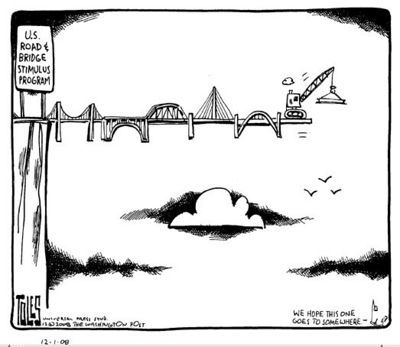
P.S.: Jerry Brown wasn’t the focus here, but I love the cartoon above. It’s a nice depiction of the boondoggling impulse common to so many politicians.

Follow Sacred Cow Chips on WordPress.com

Recent Posts

  • Immigration and Merit As Fiscal Propositions
  • Tariff “Dividend” From An Indigent State
  • Almost Looks Like the Fed Has a 3% Inflation Target
  • Government Malpractice Breeds Health Care Havoc
  • A Tax On Imports Takes a Toll on Exports

Archives

  • December 2025
  • November 2025
  • October 2025
  • September 2025
  • August 2025
  • July 2025
  • June 2025
  • May 2025
  • April 2025
  • March 2025
  • February 2025
  • January 2025
  • December 2024
  • November 2024
  • October 2024
  • September 2024
  • August 2024
  • July 2024
  • June 2024
  • May 2024
  • April 2024
  • March 2024
  • February 2024
  • January 2024
  • December 2023
  • November 2023
  • August 2023
  • July 2023
  • June 2023
  • May 2023
  • April 2023
  • March 2023
  • February 2023
  • January 2023
  • December 2022
  • November 2022
  • October 2022
  • September 2022
  • August 2022
  • July 2022
  • June 2022
  • May 2022
  • April 2022
  • March 2022
  • February 2022
  • January 2022
  • December 2021
  • November 2021
  • October 2021
  • September 2021
  • August 2021
  • July 2021
  • June 2021
  • May 2021
  • April 2021
  • March 2021
  • February 2021
  • January 2021
  • December 2020
  • November 2020
  • October 2020
  • September 2020
  • August 2020
  • July 2020
  • June 2020
  • May 2020
  • April 2020
  • March 2020
  • February 2020
  • January 2020
  • December 2019
  • November 2019
  • October 2019
  • September 2019
  • August 2019
  • July 2019
  • June 2019
  • May 2019
  • April 2019
  • March 2019
  • February 2019
  • January 2019
  • December 2018
  • November 2018
  • October 2018
  • September 2018
  • August 2018
  • July 2018
  • June 2018
  • May 2018
  • April 2018
  • March 2018
  • February 2018
  • January 2018
  • December 2017
  • November 2017
  • October 2017
  • September 2017
  • August 2017
  • July 2017
  • June 2017
  • May 2017
  • April 2017
  • March 2017
  • February 2017
  • January 2017
  • December 2016
  • November 2016
  • October 2016
  • September 2016
  • August 2016
  • July 2016
  • June 2016
  • May 2016
  • April 2016
  • March 2016
  • February 2016
  • January 2016
  • December 2015
  • November 2015
  • October 2015
  • September 2015
  • August 2015
  • July 2015
  • June 2015
  • May 2015
  • April 2015
  • March 2015
  • February 2015
  • January 2015
  • December 2014
  • November 2014
  • October 2014
  • September 2014
  • August 2014
  • July 2014
  • June 2014
  • May 2014
  • April 2014
  • March 2014

Blogs I Follow

  • Passive Income Kickstart
  • OnlyFinance.net
  • TLC Cholesterol
  • Nintil
  • kendunning.net
  • DCWhispers.com
  • Hoong-Wai in the UK
  • Marginal REVOLUTION
  • Stlouis
  • Watts Up With That?
  • Aussie Nationalist Blog
  • American Elephants
  • The View from Alexandria
  • The Gymnasium
  • A Force for Good
  • Notes On Liberty
  • troymo
  • SUNDAY BLOG Stephanie Sievers
  • Miss Lou Acquiring Lore
  • Your Well Wisher Program
  • Objectivism In Depth
  • RobotEnomics
  • Orderstatistic
  • Paradigm Library
  • Scattered Showers and Quicksand

Blog at WordPress.com.

Passive Income Kickstart

OnlyFinance.net

TLC Cholesterol

Nintil

To estimate, compare, distinguish, discuss, and trace to its principal sources everything

kendunning.net

The Future is Ours to Create

DCWhispers.com

Hoong-Wai in the UK

A Commonwealth immigrant's perspective on the UK's public arena.

Marginal REVOLUTION

Small Steps Toward A Much Better World

Stlouis

Watts Up With That?

The world's most viewed site on global warming and climate change

Aussie Nationalist Blog

Commentary from a Paleoconservative and Nationalist perspective

American Elephants

Defending Life, Liberty and the Pursuit of Happiness

The View from Alexandria

In advanced civilizations the period loosely called Alexandrian is usually associated with flexible morals, perfunctory religion, populist standards and cosmopolitan tastes, feminism, exotic cults, and the rapid turnover of high and low fads---in short, a falling away (which is all that decadence means) from the strictness of traditional rules, embodied in character and inforced from within. -- Jacques Barzun

The Gymnasium

A place for reason, politics, economics, and faith steeped in the classical liberal tradition

A Force for Good

How economics, morality, and markets combine

Notes On Liberty

Spontaneous thoughts on a humble creed

troymo

SUNDAY BLOG Stephanie Sievers

Escaping the everyday life with photographs from my travels

Miss Lou Acquiring Lore

Gallery of Life...

Your Well Wisher Program

Attempt to solve commonly known problems…

Objectivism In Depth

Exploring Ayn Rand's revolutionary philosophy.

RobotEnomics

(A)n (I)ntelligent Future

Orderstatistic

Economics, chess and anything else on my mind.

Paradigm Library

OODA Looping

Scattered Showers and Quicksand

Musings on science, investing, finance, economics, politics, and probably fly fishing.

  • Subscribe Subscribed
    • Sacred Cow Chips
    • Join 128 other subscribers
    • Already have a WordPress.com account? Log in now.
    • Sacred Cow Chips
    • Subscribe Subscribed
    • Sign up
    • Log in
    • Report this content
    • View site in Reader
    • Manage subscriptions
    • Collapse this bar
 

Loading Comments...