• About

Sacred Cow Chips

Sacred Cow Chips

Tag Archives: Milton Friedman

The Fed Tiptoes Through Lags and an Endless Fiscal Thicket

04 Wednesday Sep 2024

Posted by Nuetzel in Inflation, Monetary Policy

≈ Leave a comment

Tags

Ample Reserves, CBO, Fed Balance Sheet, Federal Debt, Federal Funds Rate Target, Federal Reserve, FOMC, Inflation Target, Jackson Hole, Jerome Powell, Long and Variable Lags, Milton Friedman, Monetize Debt, Quantitative Tightening

The late, great Milton Friedman said monetary policy has “long and variable lags” in its effect on the economy. Easy money might not spark an inflation in goods prices for two years or more, though the typical lag is thought to be more like 15-20 months. Tight money seems to have similar lags in its effects. Debates surround the division and timing of these effects between inflation and real GDP, and too many remain convinced that a reliable tradeoff exists between inflation and unemployment.

With that preface, where do we stand today? The Fed executed a veritable helicopter drop of cash during the pandemic, in concert with support payments by the Treasury, with predictable inflationary results. It was also, in part, an accommodation to supply-side pressures. Then the tightening of policy began in the spring of 2022. How will the timing and strength of these shifting policies ultimately play out, as well as the impact of expectations regarding future policy moves?

Help On the Way?

Federal Reserve Chairman Jerome Powell and the Fed’s Open Market Committee (FOMC) are now poised to ease policy after three-plus years of a tighter policy stance. The FOMC is widely expected to cut its short-term interest rate target by a quarter point at the next FOMC on September 17-18. There is an outside chance that the Fed will cut the target by a half point, depending on the strength of new data to be released over the next couple of weeks. In particular, this Friday’s employment report looms large.

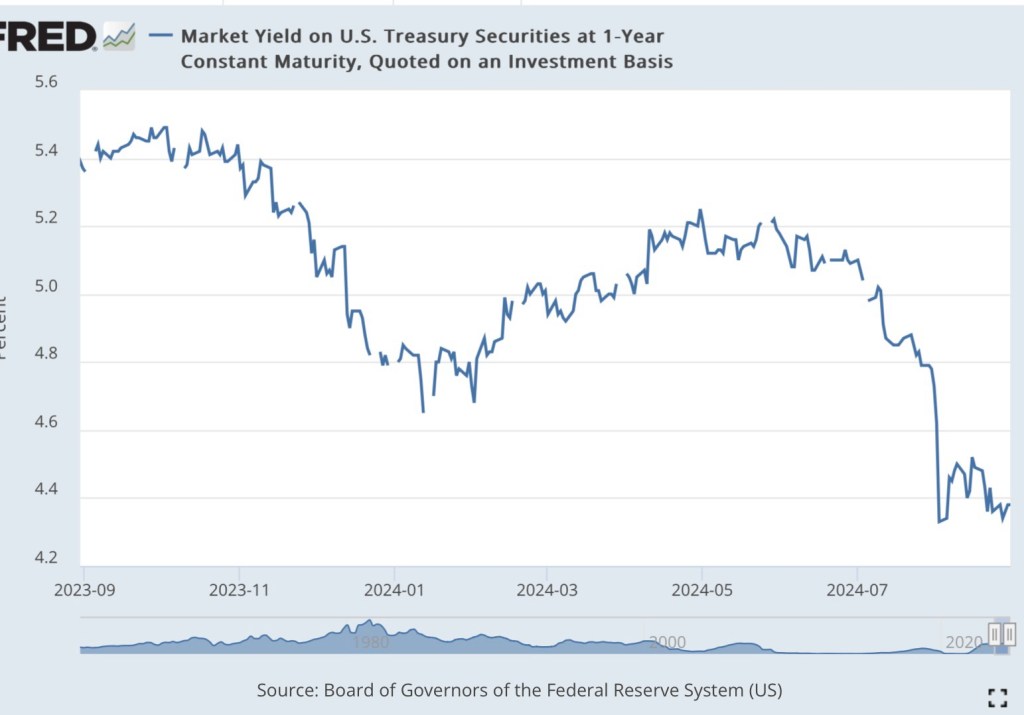
What sometimes goes unacknowledged is that the Fed will be following market rates downward, not leading them. The chart below shows the steep drop in the one-year Treasury yield over the past couple of months. Other rates have declined as well. Granted, longer rates are determined in large part by expectations of future short-term rates over which the Fed has more control.

And yet the softening of market rates may well be a signal of weaker economic activity. There is certainly concern among investors that a failure by the Fed to ease policy might jeopardize the much hoped-for “soft landing”. The lagged effects of the Fed’s tighter policy stance may drag on, with damage to the real economy and the labor market. Indeed, some assert that a recession remains a strong possibility (and see here), and the manufacturing sector has been in a state of contraction for five months.

On the other hand, the Fed has fallen short of its 2% inflation goal. The core PCE deflator, the Fed’s preferred inflation gauge, was up 2.6% for the year ending in July. Some observers fear that easing policy prematurely will lead to a new acceleration of inflation.

Powell Gives the Nod

Nevertheless, markets were relieved when Jerome Powell, in his recent speech in Jackson Hole, Wyoming, indicated his determination that a shift in policy was appropriate. From Bloomberg:

“Federal Reserve Chair Jerome Powell said ‘the time has come’ for the central bank to start cutting interest rates.

“Powell’s comments cemented expectations for a rate cut at the central bank’s next gathering in September. The Fed chief said the cooling of the labor market is ‘unmistakable,’ adding, ‘We do not seek or welcome further cooling in labor market conditions.’ Powell also said his confidence has grown that inflation is on a ‘sustainable path’ back to the Fed’s goal of 2%.“

The “sustainable path back to … 2%” might imply a view inside Fed that policy will remain somewhat restrictive even after a quarter or half-point rate cut in September. Or perhaps the “sustainable path” has to do with the aforementioned lags, which might continue to be operative regardless of any immediate change in policy. The feasibility of a “soft landing” depends on whether policy is indeed still restrictive or on how benign those lagged effects turn out to be. But if we take the lags seriously, an easing of policy wouldn’t have real economic force for perhaps 15 months. Still, the market puts great hope in the salutary effects of a move by the Fed to ease policy.

Big Balance Sheet

It can be argued that the Fed already took a step toward easing policy in May when it reduced the rate at which it was allowing runoff in its portfolio of Treasury and mortgage-backed securities. Prior to that, it had been redeeming $95 billion of maturing securities a month. The new runoff amount is $60 billion per month. Unless neutralized in other ways, the runoff has a contractionary effect on bank reserves and the money supply. It is known as “quantitative tightening” (QT). but then the May announcement was a de facto easing in the degree of QT.

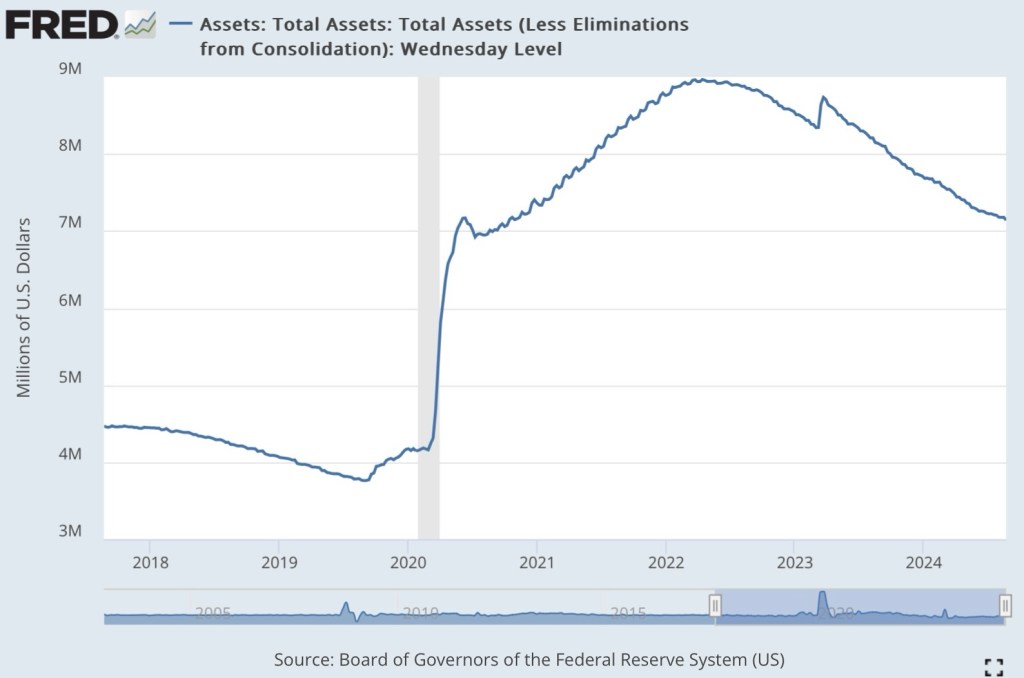
Thus far, the total reduction in the Fed’s portfolio has amounted to only $1.7 trillion from the original high-water mark of $8.9 trillion. Here is a chart showing the recent evolution in the size of the Fed’s securities holdings.

The Fed’s current balance sheet of $7.2 trillion is gigantic by historical standards. It’s reasonable to ask why the Fed considers what we have now to be a more “normalized” portfolio, and whether its size (and correspondingly, the money supply) represents potential “dry tinder” for future inflation. It remains to be seen whether the Fed will further pare the rate of portfolio runoff in the months ahead.

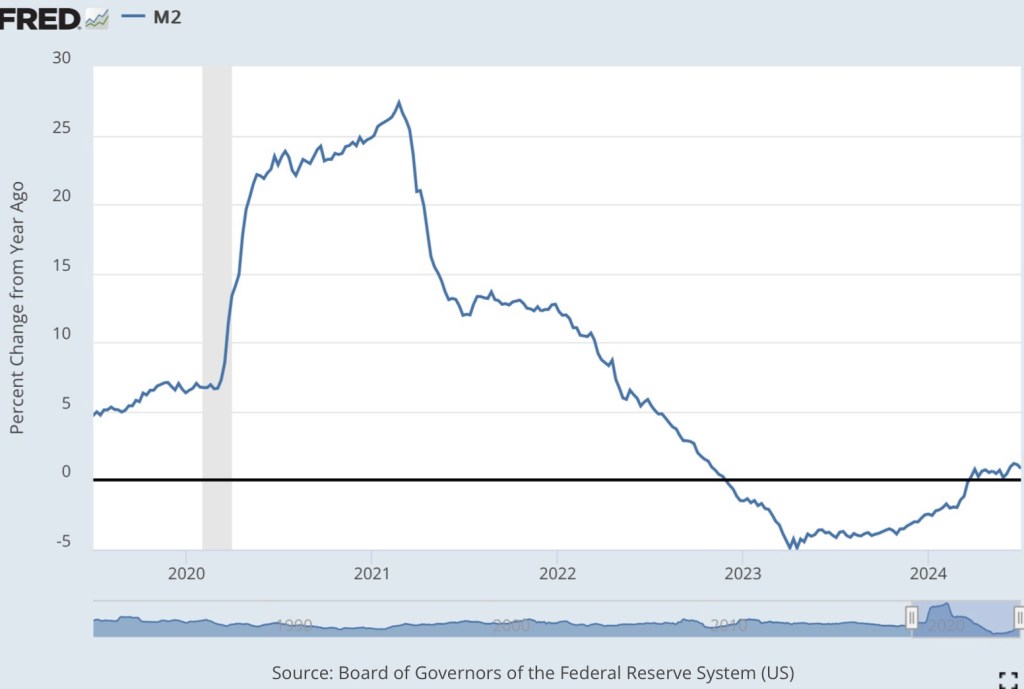
Money growth had been running negative for roughly a year and a half, but it edged closer to zero in late 2023 before accelerating to a slow, positive rate a few months into 2024. The timing didn’t exactly correspond to the Fed’s slowing of portfolio runoff. Nevertheless, the Fed’s strong preference is to supply the banking system with “ample reserves”, and reserves drive money growth. Thus, the Fed’s reaction to conditions in the market for reserves was a factor allowing money growth to accelerate.

A Cut Too Soon?

A rate cut later this month will make reserves still more ample and support additional money growth. And again, this will be an effort to mediate the negative impact of earlier policy tightness, but the effect of this move on the economy will be subject to similar lags.

A danger is that the Fed might be easing too soon, so that inflation will fail to taper to the 2% goal and possibly accelerate again. And perhaps policy was not quite as tight as it needed to be to achieve the 2% goal. Now, new supply bottlenecks are cropping up, including a near shutdown of shipping through the Suez Canal and a potential strike by east coast dockworkers.

Fiscal Incontinence

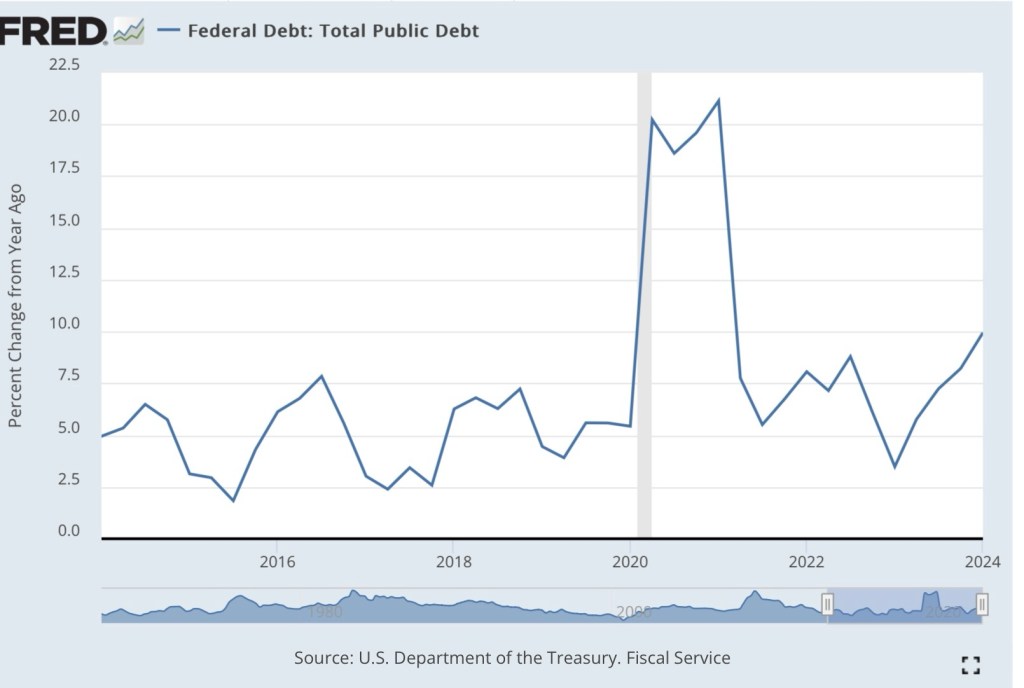
An even greater threat now, and in the years ahead, is the massive pressure placed on the economy and the Fed by excessive federal spending and Treasury borrowing. The growth of federal debt over the 12 months ending in July was almost 10%. Total federal debt stands at about $35 trillion. According to the Congressional Budget Office (CBO) projections, federal debt held by the public will be almost $28 trillion by the end of 2024 (the rest the public debt is held by the Fed or federal agencies). The CBO also projects that the federal budget deficit will average almost $1.7 trillion annually through 2027 before rising to $2.6 trillion by 2034. That would bring federal debt held by the public to more than $48 trillion.

Inflation is receding ever so slowly for now, but it’s unclear that investors will remain comfortable that growth in the public debt can be paid down by future surpluses. If not, the only way its real value can be reduced is through higher prices. Most observers believe such an inflation requires that the Fed monetize federal debt (buy it from the public with printed money). Tighter credit markets will increase pressure on the Fed to do so, but the growing debt burden is likely to exert upward pressure on the prices of goods with or without accommodation by the Fed.

Hard, Soft, Or Aborted Landing?

Some economists are convinced that the Fed has successfully engineered a “soft landing”. I might have to eat some crow…. I felt that a “hard landing” was inevitable from the start of this tightening phase. Even now I would not discount the possibility of a recession late this year or in early 2025. And perhaps we’ll get no “landing” at all. The Fed’s expected policy shift together with the fiscal outlook could presage not just a failure to get inflation down to the Fed’s 2% target, but a subsequent resurgence in price inflation.

So When Can We Expect That Hard Landing, Hmmm?

13 Wednesday Dec 2023

Posted by Nuetzel in Economic Outlook, Monetary Policy

≈ Leave a comment

Tags

Consumer Sentiment, Core PCE, Federal Funds Rate Target, Federal Open Market Committee, Hard Landing, Inflation, Jamie Diamond, Labor Market, Leading Indicators, Long and Variable Lags, Milton Friedman, Money Growth, Neutral Real Rate, Quantitative Tightening, Real Interest Rates, Real Wages, Recession, Scott Sumner, Soft Landing, Tight Money

The joke’s on me, but my “out” on the question above is “long and variable lags” in the impact of monetary policy, a description that goes back to the work of Milton Friedman. If you call me out on my earlier forebodings of a hard landing or recession, I’ll plead that I repeatedly quoted Friedman on this point as a caveat! That is, the economic impact of a monetary tightening will be lagged by anywhere from 9 to 24 months. So maybe we’re just not there yet.

Of course, maybe I’m wrong and we won’t have to get “there”: the rate of inflation has indeed tapered over the past year. A soft landing now seems like a more realistic possibility. Still, there’s a ways to go, and as Scott Sumner says, when it comes to squeezing inflation out of the system, “It’s the final percentage point that’s the toughest.” One might say the Federal Reserve is hedging its bets, avoiding further increases in its target federal funds rate absent evidence of resurging price pressures.

Strong Growth or Mirage?

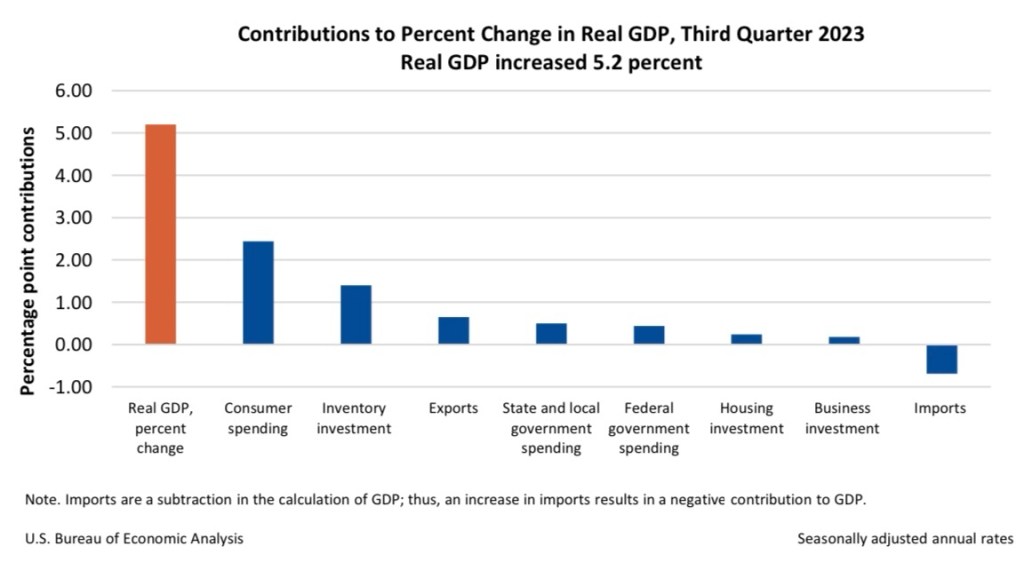
Economic growth is still strong. Real GDP in the third quarter grew at an astonishing 5.2% annual rate. A bulge in inventories accounted for about a quarter of the gain, which might lead to some retrenchment in production plans. Government spending also accounted for roughly a quarter, which corresponds to a literal liability as much as a dubious gain in real output. Unfortunately, fiscal policy is working at cross purposes to the current thrust of monetary policy. Profligate spending and burgeoning budget deficits might artificially prop up the economy for a time, but it adds to risks going forward, not to mention uncertainty surrounding the strength and timing in the effects of tight money.

Consumers accounted for almost half of the third quarter growth despite a slim 0.1% increase in real personal disposable income. That reinforces the argument that consumers are depleting their pandemic savings and becoming more deeply indebted heading into the holidays.

The economy continues to produce jobs at a respectable pace. The November employment report was slightly better than expected, but it was buttressed by the return of striking workers, and retail and manufacturing jobs declined. Still, the unemployment rate fell slightly, so the labor market has remained stronger than expected by most economists.

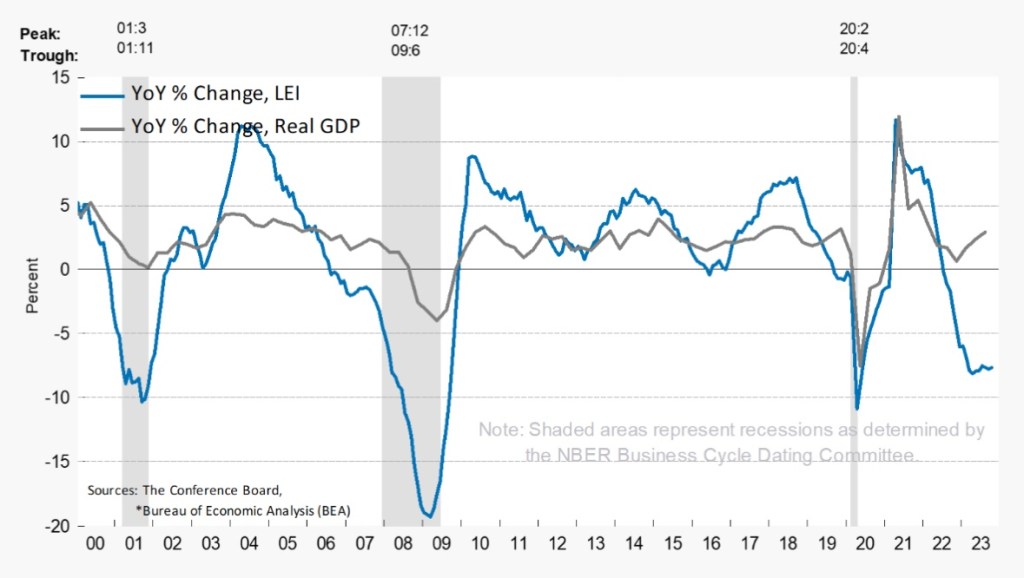
Consumer sentiment had been in the dumps until the University of Michigan report for December, which erased four months of declines. The expectations index is one component of the leading economic indicators, which has been at levels strongly suggesting a recession ahead for well over a year now. See the chart below:

But expectations improved sharply in November, and that included a decline in inflation expectations.

Another component of the LEI is the slope of the yield curve (measured by the difference between the 10-year Treasury bond yield and the federal funds rate). This spread has been a reliable predictor of recessions historically. The 10-year bond yield has declined by over 90 basis points since mid-October, a sign that bond investors think the inflation threat is subsiding. However, that drop steepened the negative slope of the yield curve, meaning that the recession signal has strengthened.

Disinflation, But Still Inflation

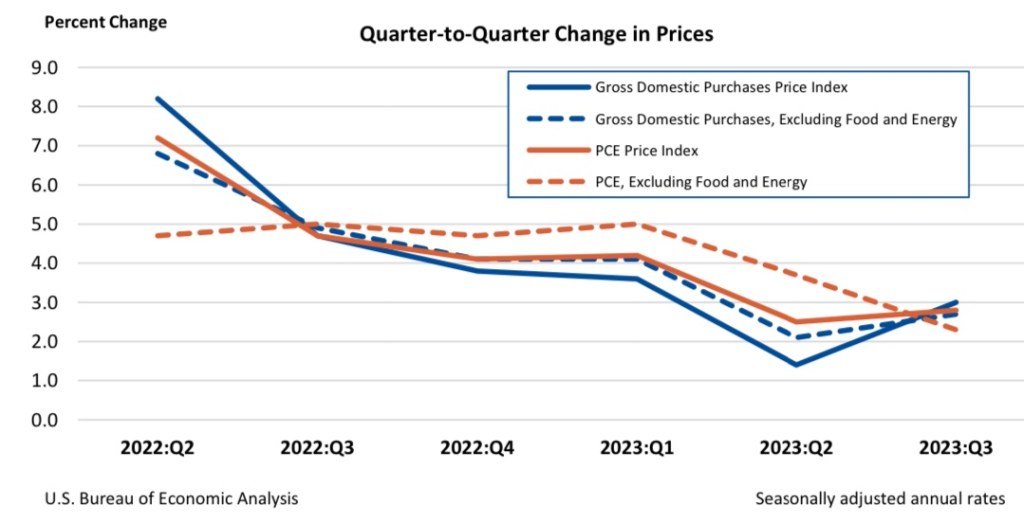
Inflation measures have been slowing, and the Fed’s “target” inflation rate of 2% appears within reach. In the Fed’s view, the most important inflation gauge is the personal consumption expenditures deflator excluding food and energy prices (the “core” PCE). The next chart shows the extent to which it has tapered over the past two quarters. While it’s encouraging that inflation has edged closer to the Fed’s target, it does not mean the inflation fight is over. Still, the decision taken at the December meeting of the Fed’s Open Market Committee (FOMC) to leave its interest rate target unchanged is probably wise.

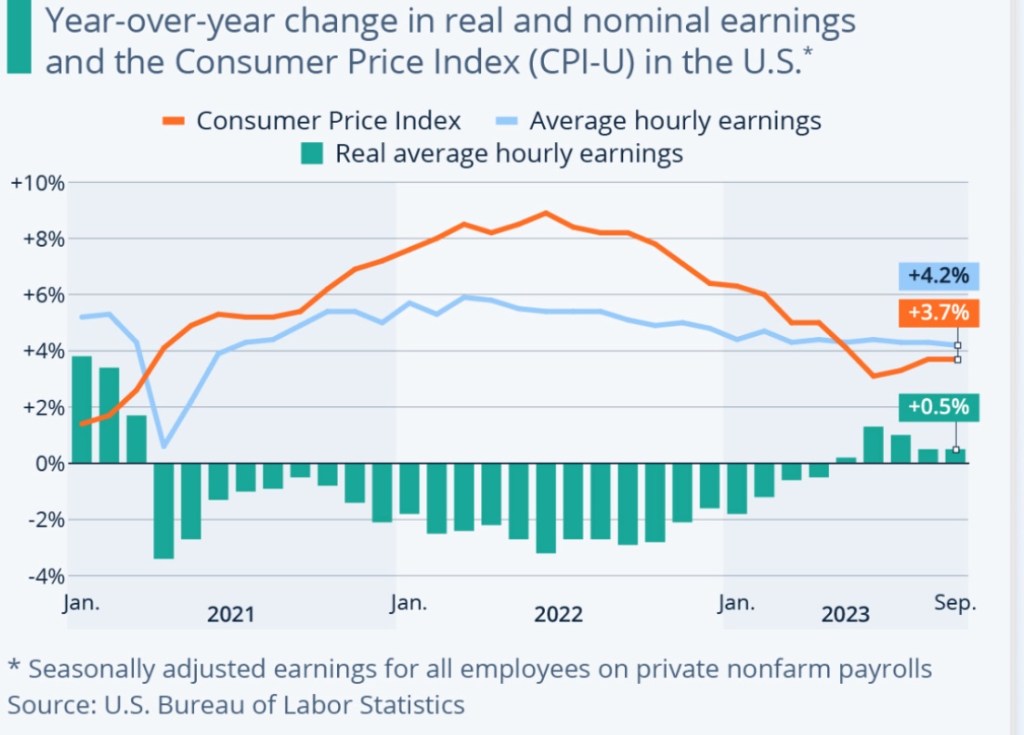
Real wages declined during most of the past three years with the surge in price inflation (see next chart). Some small gains occurred over the past few months, but the earlier declines reinforce the view that consumers need to tighten their belts to maintain savings or avoid excessive debt.

Has Policy Really Been “Tight“?

The prospect of a hard landing presupposes that policy is “tight” and has been tight for some months, but there is disagreement over whether that is, in fact, the case. Scott Sumner, at the link above in the second paragraph, is skeptical that policy is “tight” even now. That’s despite the fact that the Fed hiked its federal funds rate target 11 times between March 2022 and July 2023 (by a total of 5.25%). The Fed waited too long to get started on its upward rate moves, which helps explain the continuing strength of the economy right now.

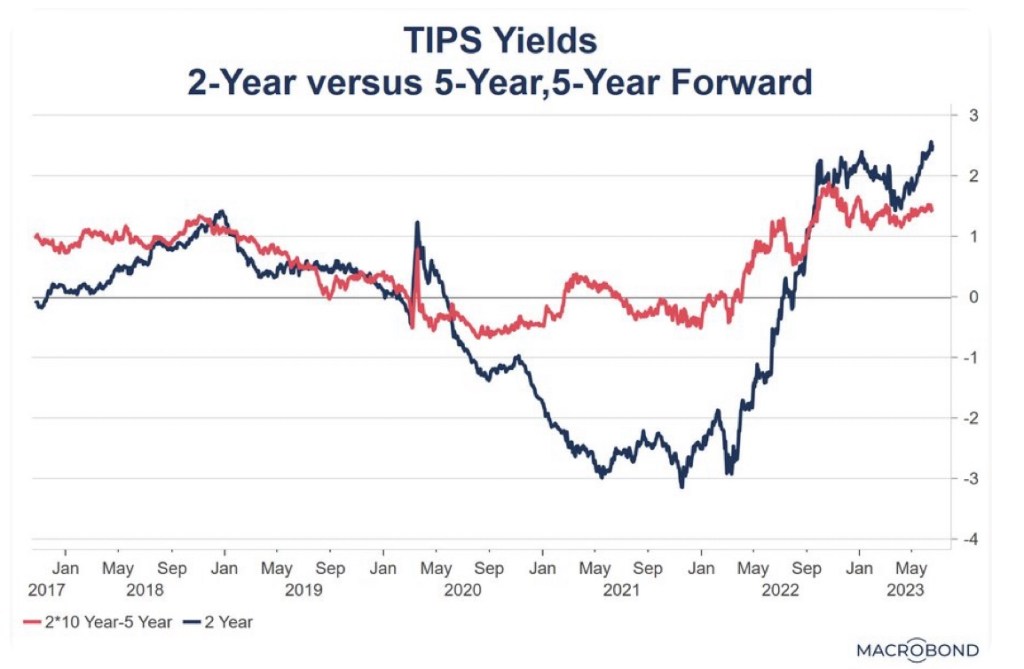
The real fed funds rate turned positive (arguably) as early as last winter as the rate rose and as expected inflation began to decline. There is also solid evidence that real interest rates on the short-end of the maturity spectrum are higher than “neutral” real rates and have been for well over a year (see chart below). If the Fed leaves its rate target unchanged over the next few months, assuming expected inflation continues to taper, the real rate will rise passively and the Fed’s policy stance will have tightened further.

Another view is that the Fed’s policy became “tight” when the monetary aggregates began to decrease (April 2022 for M2). A few months later the Fed began so-called “quantitative tightening” (QT—selling securities to reduce its balance sheet). Thus far, QT has reversed only a portion of the vast liquidity provided by the Fed during the pandemic. However, markets do grow accustomed to generous ongoing flows of liquidity. Cutting them off creates financial tensions that have real economic effects. No doubt the Fed’s commitment to QT established some credibility that a real policy shift was underway. So it’s probably fair to say that policy became “tight” as this realization took hold, which might place the date demarcating “tight” policy around 15 – 18 months ago.

Back to the Lags

Again, changes in monetary policy have a discernible impact only with a lag. The broad range of timing discussed among monetary experts (again, going back to Milton Friedman) is 9 – 24 months. We’re right in there now, which adds to the conviction among many forecasters that the onset of recession is likely during the first half of 2024. That’s my position, and while the tapering of inflation we’ve witnessed thus far is quite encouraging, it might take sustained monetary restraint before we’re at or below the Fed’s 2% target. That also increases the risk that we’ll ultimately suffer through a hard landing. In fact, there are prominent voices like hedge fund boss Bill Ackman who predict the Fed must begin to cut the funds rate soon to avoid a hard landing. Jamie Diamond, CEO of JP Morgan, says the U.S. is headed for a hard landing in 2024.

Looking Forward

If new data over the next few months is consistent with a “soft landing” (and it would take much more than a few months to be conclusive), or especially if the data more strongly indicate an incipient recession, the Fed certainly won’t raise its target rate again. The Fed is likely to begin to cut the funds rate sometime next year, and sooner if a recession seems imminent. Otherwise, my guess is the Fed waits at least until well into the second quarter. The average of FOMC member forecasts at the December meeting works out to three quarter-point rate cuts by year-end 2024. When the Fed does cut its target rate, I hope it won’t at the same time abandon QT, the continuing sales of securities from its currently outsized portfolio. Reducing the Fed’s holdings of securities will restrain money growth and give the central bank more flexibility over future policy actions. QT will also put pressure on Congress and the President to reduce budget deficits.

Broken Windows: Destroying Wealth To Create Green Jobs

25 Saturday Feb 2023

Posted by Nuetzel in Industrial Policy, Renewable Energy

≈ Leave a comment

Tags

Broken Windows Fallacy, Consumer Surplus, Dispatchable Power, Fossil fuels, Frederic Bastiat, Green Energy, Green Jobs, Job Creation, Keynesians, London’s Great Fire, Market Intervention, Michael Munger, Milton Friedman, Planned Obsolescence, Renewable Power, Societal Wealth

Investments in “green energy” create jobs, just like any other form of investment in physical assets. We’re told, however, that the transition to renewable energy sources will create a veritable jobs bonanza! Apparently, this is believed to be a great selling point for everyone to get behind. Sure, promoting job creation is always popular with politicians, and it is very popular with private actors seeking to win public funding of one kind or another.

The heavy emphasis on jobs creation brings to mind an old Milton Friedman story about a visit to China during which dignitaries brought him to a construction site, no doubt thinking he’d be impressed with their progressive investments in infrastructure. At the site, Friedman noticed workers digging a large trench or arroyo with shovels. When he asked why bulldozers or backhoes weren’t used, he was told that the jobs were too valuable. His response was something like, “Then have them use spoons!” The lesson, of course, is that merely creating jobs is not a prescription for building wealth and prosperity. But there is more at stake here than the low productivity of construction workers who lack the best tools.

There are some bad rationales for heavy investment in renewable energy sources, and I’ve addressed those at length previously. The appeal to job creation, however, is awful on simple economic grounds. It emphasizes a thing that is easily counted while ignoring massive costs that are generally untallied.

In the U.S. we have a huge base of productive capital that meets our energy needs, the bulk of which is built to utilize fossil fuels. That plant constitutes wealth to society, and not just to those with an ownership interest. Dispatchable power is available to the public at a rate below that at which they value the power. That ability to deliver consumer surplus on demand is a major aspect qualifying power capacity as societal wealth. The push for renewables, if wholly successful, would make the existing base of generating capacity redundant. There is no doubt that the ultimate goal of renewable energy advocates is to destroy existing capacity reliant on fossil fuels. They simply have not come to grips with the reality that it meets energy needs far more efficiently than intermittent renewables like wind and solar power. In spirit, the effort bears a strong similarity to destroying bulldozers to replace them with shovels, or spoons!

Recently, Michael Munger discussed the mistaken notion that renewable investments are justified based on job creation. He noted that with a coincident dismantling of the existing base of power generation, it amounts to exactly what Frederic Bastiat called the broken window fallacy, which insists that breaking windows is a great way to keep glaziers fully employed. There are many examples and variations on this idea, including so-called “planned obsolescence”.

Bastiat poked fun at an elite French government official who had marveled at the economic gains reaped in England with the rebuilding of London following the “Great Fire” of 1666. Bastiat engaged in some satire by suggesting that France could greatly benefit from burning Paris to the ground. But his point was serious: we often hear that reconstruction provides a silver lining for workers following hurricanes or other disasters. Fair enough: rebuild we must. The Keynesians among us would say it works out well for workers who are otherwise unemployed. Disasters destroy wealth, however, and often lives, not to mention opportunities for incremental wealth creation that are lost forever. The reconstruction jobs are not “good news”!

Unfortunately, people get carried away with broken windows arguments, using them to justify their own pet projects. The addition of new competing products and technologies is unquestionably healthy, but not when one side enlists the state as a partner in destroying viable incumbents and existing public or private wealth. For that matter, the state and its allies seem intent on destroying invested physical capital even before it’s services can come on line… if it’s viewed as the “wrong” kind of capital.

The costs of a transition to renewables is massive. The “big ask” for green energy involves not just taxpayer support for the build and usage, with all the inefficiencies endemic to taxation and market interventions. So-called green energy also entails huge environmental costs, and it calls for the wholesale destruction of an embedded industry. That means decommissioning invested assets having many years of useful life. And that goes for physical plant all the way from the wellhead to final use, including the destruction of stoves, cars, and other machines too numerous to mention. Those machines, by the way, still account for roughly 80% of our power use.

I leave you with part of Munger’s closing:

“Once you are duped into believing destruction is productive, almost everything that a rational public policy would label as a cost becomes, by some judo move of seraphic intuition, a benefit. … The problem is that jobs are not wealth. Wealth is access to the goods, products, and services that make our lives better. It is true that ‘studies show’ that wiping out all our productive wealth based on fossil fuels … would create jobs. Those ‘studies’ are among the best arguments against doing anything of the sort.”

The Dirt On the Corporate Income Tax

23 Tuesday Mar 2021

Posted by Nuetzel in Fiscal policy, Tax Incidence

≈ 2 Comments

Tags

Alan D. Viard, Biden Administration, Compliance Costs, corporate income tax, Edward Lane, Investment Incentives, Joseph Sullivan, L. Randall Wray, Milton Friedman, Off-Shoring, Peggy Musgrave, Physical Capital, Pricing Power, Regressive Tax, Richard Musgrave, Shifting the Burden, Tax Avoidance, Tax Foundation, Transfer Pricing, Transparency

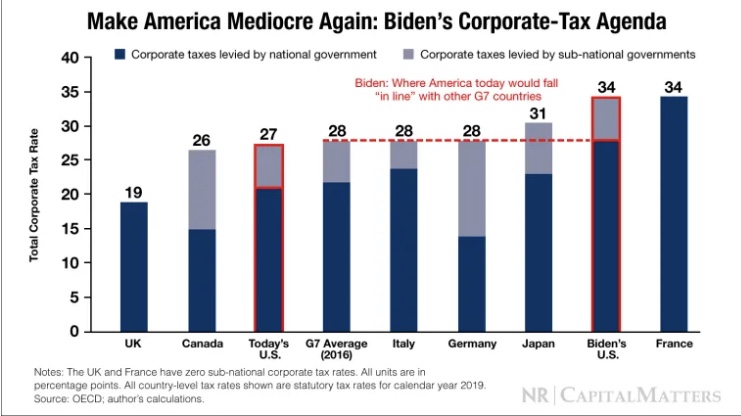
The Biden Administration is proposing a substantial increase in the corporate income tax rate from 21% to 28%. This is another case of a self-destructive policy that serves as a virtue signal to the progressive Left. See? We’re taxing the rich and their powerful corporations! What none of them realize is that the tax on corporate income is actually a regressive tax on consumers and workers; it is a disincentive to the formation of productive capital; and it is a highly wasteful tax due to compliance costs and the impact of avoidance. And the Biden proposal would make the U.S. less competitive internationally, as the chart above from Joseph Sullivan demonstrates. Maybe some of the proponents realize it, but they still like it because it sounds so good to their base!

It’s not as if all these unhealthy characteristics of the corporate tax are new findings. Milton Friedman explained some of the basics in 1971 when he said:

“The elementary fact is that ‘business’ does not and cannot pay taxes. Only people can pay taxes. Corporate officials may sign the check, but the money that they forward to Internal Revenue comes from the corporation’s employees, customers or stockholders. A corporation is a pure intermediary through which its employees, customers and stockholders cooperate for their mutual benefit.”

In 1984, two giants of public finance economics, Richard and Peggy Musgrave, investigated how the corporate tax was shifted to households. Here’s a description of their findings from a recent paper by Edward Lane and L. Randall Wray:

“… the bottom quintile pays 4.6–5.5 percent of its income toward the corporate profits tax, the top decile pays 2.5–3.7 percent of its income, and the ninth decile pays 2.4–2.9 percent of its income. They conclude that the corporate profits tax is largely regressive while the federal personal income tax is progressive.”

The incidence of the corporate tax rate falls primarily on workers in the form of lower wages and lost jobs, and on consumers in the form of higher prices. Lane and Wray cite several influential studies over the years showing a substantial negative association between corporate taxes and wages. As the authors note, major corporations often have pricing power in both product and labor markets, at least relative to their power in capital markets where they must raise capital. Capital markets are highly competitive, so they don’t provide much opportunity for shifting the burden of the tax to owners of equity and debt. There are limits on a firm’s ability to pass the tax along to customers and workers as well, of course, but shareholders are relatively well-insulated from the burden of the tax.

There are still other reasons to avoid increasing the corporate income tax rate. It currently raises about $200 billion annually for the U.S. Treasury, or about 7% of estimated federal tax revenue for the 2021 fiscal year. It also has extremely high compliance costs. Lane and Wray quote a 2016 Tax Foundation estimate that U.S. businesses face tax compliance costs on the order of $193 billion a year. Not all of that figure applies to corporations, and not all of it is for federal tax compliance, but a great deal of it is. There are also a number of ways the tax can be avoided, such as off-shoring operations and using overstated transfer prices of inputs obtained from units overseas. This is not an economically efficient way to generate tax revenue.

Moreover, the corporate income tax creates perverse incentives. When new investment in productive, physical capital is penalized at the margin, you can expect less capital investment, lower wages, and fewer jobs. Alan D. Viard explains that the dynamics of this mechanism take time to play out, but the longer-run decay in the capital stock is perhaps the most damaging aspect of a high corporate tax rate. And indeed, while there are probably short-run effects, the reduction in the incentive to invest is the real mechanism linking a higher corporate tax to reduced wages and higher prices, not to mention reduced economic growth.

Finally, there is a pernicious political-economic aspect of the corporate income tax owing to the difficulty for the general public in identifying its true incidence. This was also discussed by Milton Friedman:

“… Indirect effects make it difficult to know who ‘really’ pays any tax. But this difficulty is greatest for taxes levied on business. That fact is at one and the same time the chief political appeal of the corporation income tax, and its chief political defect. The politician can levy taxes, as it appears, on no one, yet obtain revenue. The result is political irresponsibility. Levying most taxes directly on individuals would make it far clearer who pays for government programs.

If the government intends to tax the owners of corporate wealth (a significant share of which is held in retirement savings accounts), it should be honest about doing so. That would mean taxing capital income in a more consolidated way, as Lane and Wray put it, at the individual level. That kind of transparency might be too much to hope for because the politics of doing so are much less favorable.

Meanwhile, the Biden Administration wants to have it all: higher corporate taxes and higher taxes on relatively high-earning individuals. But a significant burden of the corporate tax increase ultimately is shifted to individual workers and consumers. It is a regressive tax, and it is an inefficient tax with outrageously high compliance costs. It is a destructive tax because it undermines the economy’s growth in productive capacity. And it offers tax revenue to politicians who have little budgetary resolve, and with little political consequence.

Multipliers Are For Politicians

02 Wednesday May 2018

Posted by Nuetzel in Big Government, Fiscal policy, Stimulus

≈ 1 Comment

Tags

Countercyclical Policy, Fiscal Stimulus, Flexible Wages, Frederic Bastiat, Jakina R. Debnam, James Buchanan, Keynesian School, Matthew D. Mitchell, Milton Friedman, Multiplier Effect, Permanent Income Hypothesis, Procyclical Policy, Ricardian Equivalence, Richard Wagner, Spending Leakages, Underconsumption

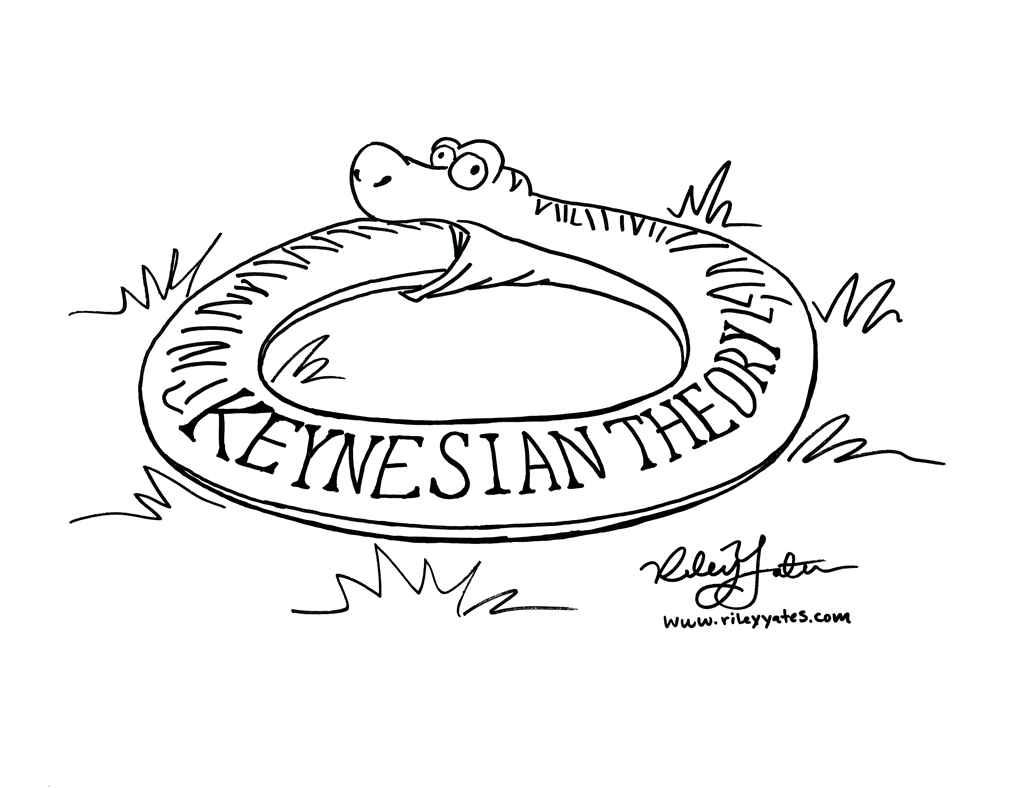
Here’s a major macroeconomic sacred cow among professional economists and the politicians whose fiscal profligacy they enable: the presumed salutary effect of an increase in government spending on economic activity, including its so-called “multiplier effect”. Government fiscal stimulus is prescribed by the Keynesian school of economics to remedy any decline in the total demand for goods. A classic case is “underconsumption”, or excess saving, such that labor and capital resources are in excess supply. The idea is that government will mop-up some of this excess saving by borrowing and spending the proceeds on goods and services, putting resources back to work. In the standard telling, digging holes and refilling them is as effective as anything else. The increased income earned by those resources will be re-spent, creating income for the recipients and leading to repeated rounds of re-spending, each successively smaller due to “leakage” into saving. Adding up all these rounds of extra spending yields a multiple of the original government stimulus, hence the Keynesian multiplier effect. The stimulation of the demand for goods and services pushes the economy back in the direction of full employment, thus correcting the original problem of underconsumption. Nice story.

Keynesian economics is a short-run, demand-based framework that delineates behavior by the constructs of national income accounting, segmenting demand into consumer spending, investment in productive capital, government spending, and net foreign spending (net exports). Except for the limit imposed by full employment, the supply side of the economy and the processes giving rise to growth in productive capacity are ignored.

Within the Keynesian framework, can offer many qualifications to the story of a shortfall in demand to which even a dyed-in-the-wool Keynesian would agree. First, government stimulus cannot have an effect on the real economy at a time when the economy is operating at full capacity, or full employment. The increased government spending will only lead to bidding against other uses of the same resources, increasing the level of wages and prices.

Another qualification within the Keynesian framework is that the leakage from spending at each round of re-spending is made greater by taxes on marginal income, thus reducing the magnitude of the multiplier. In addition, some of the extra income will be spent on foreign goods — another leakage that reduces the multiplier effect on the domestic economy. In fact, this is why multipliers for spending at local levels are thought to be relatively small. The more local the analysis, the more income will be re-spent outside the locality at each round. More fundamentally, private parties should know that increased government borrowing must be repaid eventually. At some level, they know that additional taxes (or an inflation tax) will be necessary to do so. Therefore, their reaction to the additional income derived from government demand will be muted by the need to save for those future liabilities. Put differently, consumers do not view the gain as an increase in their permanent income. That’s essentially the mechanism underlying the “Ricardian equivalence” between methods of funding government spending (government debt or taxes).

In the “real world” there are many other practical problems that lead to ineffectual and even counter-productive government stimulus. One is the problem of cost control endemic to the public sector. Related to this are seemingly unavoidable timing issues. These factors have a strong tendency to make counter-cyclical fiscal programs too costly and too late. There is also the tendency toward graft and cronyism wherever the government spreads its largess. The “perfectibility of man” is certainly not evident in the execution of government stimulus programs. Their economic impacts often become pro-cyclical, or even worse, they become permanent increases in spending authority. More on the latter below.

Deeper objections to the Keynesian framework have to do with its demand-side orientation and the conceit that government, solely by borrowing and spending, can contribute to “real demand” and add to a nation’s output. And even if government spending takes up slack at a time of unemployed resources or excess supplies, it is unlikely to resolve the conditions that led to the decline in private demand. Therefore, even if government stimulus is successful in spurring a temporary increase in actual production and utilization of resources, it is likely to delay or prevent the downward wage and price adjustments necessary to permanently do so.

Recessions are typically characterized by an effort to work off over-investment in various sectors: housing, commercial structures, oil and gas extraction and processing, technology assets, inventories, or factories. Over-inflation of asset values is usually at the root of malinvestment, often accompanied by overinflation of wages and prices. These dislocations do not occur evenly, but the market process acts to correct misallocations and mispricing precisely where they occur. It might take time, but if government steps in to prop-up weak sectors, forgive the economic consequences of mistakes, and place more upward pressure on wages and prices, the dislocations will persist. So again, even if stimulus and the multiplier effect offer a short-term palliative, the benefits are illusory in a real sense. The long-run consequences of failing to allow markets to repair the damage will be negative.

One of the greatest skills that economists should possess is the ability to discern the most plausible counterfactual in a given situation: the world as it would have played out in the absence of a particular event, often a policy initiative. This is a great shortcoming among those who subscribe to the efficacy of government stimulus programs. In the scenario just described, there will be a decline in capital investment, consumption, and saving, but that saving, whatever its level, will still be channeled into capital investments unless the funds sit idle in bank vaults. If the saving is instead absorbed by the government’s effort to fund a stimulus program, even that reduced level of investment will not take place. The net effect is zero! Thus, the Keynesian stimulus and multiplier effect represent a failure of the economics profession to “see the unseen”, as Frederic Bastiat would have put it. Unless government can produce something of value to generate income, perhaps something that improves private returns, it will not contribute to income growth.

Permanent displacement of private capital investment is the most fundamental detriment of government fiscal activism. That it might well supplant private production should come as no surprise. Matthew D. Mitchell and Jakina R. Debnam describe the phenomenon this way:

“The tendency for ostensibly temporary spending to become permanent spending helps explain why policy makers fail to take the Keynesians’ advice when it comes to surpluses. Though governments invariable go into deficit during recessionary periods, they rarely run surpluses during expansionary periods.”

Mitchell and Debnam provide an interesting quote:

“… Richard Wagner and Nobel Laureate James Buchanan concluded: ‘Keynesian economics has turned the politicians loose; it has destroyed the effective constraint on politicians’ ordinary appetites. Armed with the Keynesian message, politicians can spend and spend without the apparent necessity to tax.'”

In a footnote, Mitchell and Debnam note that Milton Friedman once said, “Nothing is so permanent as a temporary government program.” The Keynesian prescription for stimulus allows politicians to assert that they are empowered to rescue the unemployed or those suffering a loss of income. They want you to believe that they can do something. The multiplier gives license to still greater mischief on the part of politicians, because it can help politicians sell almost any pork-barrel project. But continuing government expansion requires that it extract resources from the private economy. That’s true whether the government spends directly on goods or redistributes, and the mechanics of these processes involve additional resource costs. As long as government can borrow private savings, politicians will disguise the true cost of their munificence to constituents. Economists should not be their enablers.

Bankers, Risk and the Rents of Slippery Skin

12 Monday Mar 2018

Posted by Nuetzel in Banking, rent seeking

≈ Leave a comment

Tags

Deposit Insurance, Fannie Mae. Freddie Mac, Fat Tails, FDIC, Fractional Reserves, Frank Hollenbeck, GSEs, Guatam Mukunda, Gvernment Sponsored Enterprises, Irving Fisher, It's a Wonderful Life, John Cochrane, Laurence Kotlikoff, Milton Friedman, Nassim Taleb, Ralph Musgrave, rent seeking, Skin in the Game, Too big to fail

Risk taking is important to the economic success of a nation. Creative energy demands it, and it is critical to achieving economic growth and wealth creation. But it’s obviously possible to take too much risk or risks that are ill-considered, and that is all the more likely when risk-takers are absolved of the consequences of their actions. That is, healthy risk-taking and responsibility are inextricably linked. One can’t truly be said to take a risk if the cost of failure is borne by another party. It’s easy to understand why risk-taking becomes excessive or misdirected when that is the case.

Risk Shifting

There are various ways in which a party can parlay risky undertakings into easy gains by shifting the risks to others. For example, any piece of merchandise comes with the risk that it will not perform as advertised. Some traders might be tempted to sell unreliable merchandise and shift risk to the buyer without recourse. This is an area in which we must rely on a bulwark of private governance: caveat emptor. On the other hand, government tends to subsidize risk-taking in various ways: limited liability under the corporate form of business organization, bank deposit insurance, bankruptcy laws, the implicit government guarantee on mortgage assets, and the “too-big-to-fail” mentality of government bailouts.

Whose Skin In the Game?

These are examples of what Nassim Taleb bemoans as the failure to have “skin in the game”. The quoted expression happens to be the title of his new book. I have both praised and castigated Taleb’s work in the past. He made an interesting contribution about the nature and risk of extreme events in his book “Black Swan”, such as his application of so-called “fat tails” in probability distributions, though some have claimed the ideas were anything but original. I was highly critical of Taleb’s alarmist hyperbole on the effects of GMOs. In the present case, however, he considers “the asymmetry of risk bearing” to be a major social problem, and I’m generally in agreement with the point. The most interesting part of the brief discussion at the link is the following:

“In Taleb’s universe, the fieriest circle of hell is reserved for bankers and neoconservatives. ‘The best thing that could happen to society is the bankruptcy of Goldman Sachs,’ he tells me. ‘Banking is rent-seeking of industrial proportions.’ Taleb, who became rich as a derivatives trader, is not a foe of capitalism but of ‘cronyism’. ‘If you’re taking risks, God bless you. This is why I accept inequality. I’ve seen people go from trader to cab driver and back again.’“

Banks are a prominent example of the risk-shifting phenomenon. First of all, banking institutions are not required to hold much capital against their assets. In fact, recently banks have had average equity of less than 6% of assets. That’s much higher than during the financial crisis of ten years ago, but it is still rather thin and hardly represents much “skin in the game”.

Fractional Reserves

It should come as no surprise that a bank’s assets are funded largely by account balances held by depositors (liabilities), and not by equity capital. But your bank balance is not kept as cash in the vault. Instead, it is loaned out to the bank’s credit clients or used to purchase securities. This is facilitated by “fractional reserve banking”, whereby banks need only keep a fraction of their depositors’ money on hand as cash (or in their own reserve deposit accounts with the Federal Reserve). This generally works well on a day-to-day basis because depositors seldom ask to redeem more than a small fraction of their money on a given day.

Reserve requirements are set by the Federal Reserve and range from 0-10%, depending on the size of a banks’ deposit account balances. At the upper figure, a dollar of new cash deposits would allow a bank to extend new loans of up to $0.90. This legal practice divides many in the economics profession. Some believe it represents fraud rather than sound banking. This article by Frank Hollenbeck at the Mises Canada web site states that it is improper for a bank to lend a depositor’s money to others:

“Suppose you lived in the 18th century and had 100 ounces of gold. It’s heavy and you do not live in a safe neighborhood, so you decide to bring it to a goldsmith for safekeeping. In exchange for this gold, the goldsmith gives you ten tickets where eachis clearly marked as claims against 10 ounces. …

… Quickly the goldsmith realizes there is an easy, fraudulent, way to get rich: just lend out the gold to someone else by creating another 10 tickets. Since the tickets are rarelyredeemed, the goldsmith figures he can run this scam for a very long time. Of course, it is not his gold, but since it is in his vault, he can act as though it is his money to use. This is fractional reserve banking with a voluntary reserve requirement of 50%. Today, modern US banks have a reserve requirement of between 0% and 10%. This is also how the banking systemcan create money out of thin air, or basically counterfeit money, and steal the purchasing power from others without actually having to produce real goods and services.”

Another aspect of the argument against fractional reserves is that it creates economic instability, fueling booms and busts as the quantity of money in circulation sometimes exceeds or falls short of the needs of the public. Many authorities have taken a negative view of fractional reserve banking through the years: Irving Fisher, Milton Friedman, John Cochrane, Ralph Musgrave, and Laurence Kotlikoff, to name a few prominent economists (see this recent paper by Musgrave).

In Defense of Fractional Reserves

Others have defended fractional reserves as a practice that has and would again arise in a free market environment. According to this view, depositors would accept the logic of allowing banks to lend a portion of the funds in their accounts in order to generate income, rather than charging larger fees for “storage” and administration. If the depositing public is aware of the risk and has competing choices among banks, then the argument that banks expose depositors to excessive risk via fractional reserves is moot. Fractional reserves can exist in a private money economy in which competitive pressures reward banks (and their privately circulating notes) having sound lending practices. In fact, some would say that the very idea of a 100% reserve requirement is an unacceptable government intrusion into the private relationship between banks and their customers. All of that is true.

Some have compared fractional reserve banking to the sale of insurance. Consumers buy insurance to take advantage of pooled risk, but they have no expectation of a refund unless they incur the kind of insured loss in question. Bank depositors, on the other hand, expect a return of their funds in-full. Yes, low risk is an attribute they desire, and pooling across the withdrawal needs of many depositors is one reason why banks can invest and pass a part of the return on to depositors, both in interest and reduced fees. So, despite the differing needs and expectations of their customers, there is some validity to the comparison of insurers to fractional-reserve bankers.

Amplification of Shifted Risks

Do fractional reserves allow banks to take risks without having skin in the game? Absolutely! With as little as 6% equity at risk, banks have relatively little to lose relative to depositors. Yes, banks pay the FDIC to insure deposits, and premiums are higher for riskier banks. However, not all deposits are insured by the FDIC. More importantly, at the end of 2017, the entire FDIC deposit insurance fund was about 0.7% of commercial bank assets. One big bank failure would wipe it out, or a few hundred small ones. That’s well within the realm of possibility and historical experience. So, where does that leave depositors? Their skin is very much in the game, and the game is about the risks taken by banks in investing depositors’ funds.

We now live in the era of “too-big-to-fail” (TBTF), whereby large banks (and sometimes industrial firms) are viewed as so “systemically important” that they cannot be allowed to fail. Taxpayers must bail them out in the event they become insolvent. Thus, taxpayers have skin in the game. Banks collect rents to the extent that their returns exceed those commensurate with the risks for which they are actually “on the hook”.

Another avenue through which banks off-load risk is the extent to which Fannie Mae and Freddie Mac are still presumed to have the federal government’s implicit guarantee against default on the mortgage debt they purchase from banks. That is beyond the scope of the present discussion, however. And I have not discussed the role of large investment banks in the capital markets. That’s a whole other dimension of the story. This article by Guatam Mukunda in the Harvard Business Review provides a perspective on rent seeking in investment banking.

Conclusion

The combination of deposit insurance, TBTF and other risk-insulating subsidies, layered on top of a fractional reserve banking system, places banks into Taleb’s “fieriest circle of hell”. These factors blunt bank incentives to manage risk effectively as well as consumer incentives to conduct adequate due diligence in their banking relationships. It means that risk is not priced properly, because banks are likely to ignore risks from which they are shielded. Therefore, banks may allocate resources into excessively risky uses. The consequences for depositors and taxpayers can be dramatic.

Fractional reserves are not “fraud” in the sense that the system has unsuspecting victims. Anyone who has watched “It’s a Wonderful Life” knows that banks lend your deposits to others. But fractional reserves magnify the risk-mitigating privileges conferred upon the banking industry by government through various mechanisms. This “risk-cleansing” is converted to rents and collected by banks for their shareholders, but the risks are still borne by society. To the extent that fractional reserves create instability, deposit insurance is viewed as a necessity, but banks should pay a market premium to an insurer to cover the actual risk inherent in the system. Too-big-to-fail should end, as should the implicit subsidy collected by banks through the government-sponsored enterprises.

Our Homicidal Drug War

17 Tuesday Oct 2017

Posted by Nuetzel in Prohibition, War On Drugs

≈ 4 Comments

Tags

Britigne Shaffer, CATO Institute, Controlled Substances Act, Dan Kahan, DEA, Donald Trump, Drug War, Jeff Sessions, Jeffrey Miron, Mandatory Minimum Sentences, Michael Owen, Milton Friedman, On the Banks, Prohibition, Scott Sumner

Drug prohibition and the war on drugs are destructive policies and most burdensome to communities that can least afford it: impoverished and often minority neighborhoods. Drug laws and their enforcement likely account for the bulk of homicides that occur there, directly or indirectly. A post on SacredCowChips last week discussed the violence that frequently beleaguers communities that are home to unassimilated minorities. Drug prohibition compounds the tragedy in several ways: deadly rivalry among supplier organizations; violent confrontations with law enforcement; user criminality; drug-related incarceration; degraded user productivity; and tainted supplies that exacerbate health risks for users.

Ultimately, bad laws are distinguished by their failure to achieve broad compliance. The thing is, people who want to do drugs will do so regardless of their legality. Most recreational users are sufficiently imbued with a survival instinct and the self-control to govern their use effectively, without ostensible harm. Nearly all recreational users believe they are engaging in a harmless activity, and most of them are right. That is, quite simply, why the drug war just doesn’t work, and it won’t ever work. It doesn’t work for pot, LSD, cocaine, or anything else, including opioids and heroin. (Also see this.)

Prohibition, however, delivers the drug trade into the hands of gangs and mobsters. The supply side of the business attracts individuals having few legitimate market opportunities, who happen to be concentrated in economically depressed neighborhoods. The drug trade’s illegality transforms it into a risky and violent enterprise, and efforts to enforce prohibition magnify those dangers and expose law enforcement to great risk as well. Then, there are the effects of mass incarceration on individuals and their home communities. The situation is self-reinforcing, adding to the instability of these struggling areas.

There is ample evidence that drug prohibition is a driver of crime and responsible for a large number of homicides in the U.S. A Chicago prosecutor was quoted by HuffPo in 2013 as saying that 80% of homicides in the city were gang-related, and therefore primarily drug-related. Economist Jeffrey Miron has linked drug prohibition to international differences in violent crime rates. Scott Sumner has this take on the drug war and crime rates, including a brief analysis of the drop in homicides (40%) after alcohol prohibition was repealed. In 1991, Milton Friedman stated that the repeal of drug laws would eliminate about 10,000 U.S. homicides every year, which at the time would have been about a 40% reduction. And here is Yale’s Dan Kahan on the subject of drug laws and homicide:

“The weight of the evidence pretty convincingly shows that drug-related homicides generated as a consequence of drug prohibition are tremendously high and account for much of the difference in the homicide rates in the U.S. and those in comparable liberal market societies.“

In my last post on the U.S. homicide rate, I drew on Britigne Shaffer’s On the Banks blog post entitled “Michael Owen Nails the Gun Debate“. As log as we have prohibition and a drug war, the U.S. homicide rate is likely to exceed most other industrialized countries:

“We have a system in place where the government subsidizes poverty in urban areas, imposes economic blight in those same areas through heavy taxes and regulations, renders the residents permanently unemployable via the ‘criminal justice’ (sic) system, and creates a lucrative black market in drugs by restricting supply (not to mention increasing demand as people are desperate to escape their circumstances by getting high), meaning the only game in town is often entering the drug trade. The drug trade is violent because those in it have no access to courts to settle disputes. Powerful industries lobby to keep the drug war going; the top spenders are law enforcement unions, the prison industry, big alcohol, tobacco, and pharma.“

The CATO Institute‘s Handbook for Policymakers, Issue #23, advocates the following: repeal of the Controlled Substances Act; allowing states to pursue their own initiatives without federal interference; complete repeal of mandatory minimum sentences; and termination of the Drug Enforcement Administration (DEA). These actions would allow the federal government to focus its resources on real threats, rather than fighting an unending war with an underworld empowered by those very laws, and with Americans who wish to exercise freedom over their use of drugs for medicinal or recreational use. From the CATO Handbook:

“Repeal of prohibition would take the astronomical profits out of the drug business and destroy the drug kingpins who terrorize parts of our cities. It would reduce crime even more dramatically than did the repeal of alcohol prohibition. Not only would there be less crime: reform would also free federal agents to concentrate on terrorism and espionage and would free local police agents to concentrate on robbery, burglary, and violent crime. … The war on drugs has lasted longer than Prohibition, longer than the Vietnam War. Prohibition has failed, again, and should be repealed, again.”

Despite the destructive effects of prohibition, a great many Americans—and politicians—base their opinions about drug laws on flawed moral reasoning that somehow it is more “wrong” or more “dangerous” to do drugs than to drink alcohol, itself a drug posing great danger to abusers, but a legal one. Responsible drug use, like responsible drinking, is a victimless act, or would be without the engagement of underworld suppliers. But it’s clear that President Donald Trump and Attorney General Jeff Sessions are committed to a continuation of the failed drug war, as are a majority of both Democrats and Republicans in Congress. The drug-related killings will continue, as will the ongoing damage to so many American families and communities. The refusal to end the drug war is a tragedy of many tragedies past and future.

Infrastructure: Public Waste & Private Rationality

25 Tuesday Jul 2017

Posted by Nuetzel in infrastructure, Privatization

≈ Leave a comment

Tags

American Society of Civil Engineers, Border Wall, capital costs, Donald Trump, infrastructure, Infrastructure Tax Credits, Jeffrey Harding, Milton Friedman, P3s, Private Benefits, Public benefits, Public-Private Partnerships, Reason Foundation, Underpricing, User Charges

The exaggerated deterioration of American infrastructure is the basis of a perfect bipartisan spending coalition. Proposed public spending on capital such as roads, bridges, high-speed rail, locks, dams, and water and wastewater systems is of obvious value to those who would build it, but the benefits for the public are not always beyond question. As Jeffrey Harding notes at the link, the American Society of Civil Engineers (ASCE) rates U.S. infrastructure as seriously deficient, but it is in their interests to do so. The news media finds the kind of horror story promoted by ASCE hard to resist:

“What they don’t tell you is that if you look at transportation issues over time, things have been getting better, not worse. … The Reason Foundation’s studies on state-owned highways (they are widely recognized as being leaders in this field) and other studies on highways and bridges reveal that there have been significant improvements of infrastructure measures like road and bridge quality and fatalities over the past 20 or 30 years. The facts are that, on the state level, overall spending on highways doubled during that period, and overall measures of highway transportation have improved.“

The point of building new infrastructure is the future flow of service it can offer. Creating construction jobs is not the point. If it were, the government could hire workers to dig holes with spoons, to paraphrase Milton Friedman. Nor should the timing of infrastructure investment be dependent on employment conditions. Unworthy projects are not made worthy by high unemployment. Politicians often attempt to sell projects to the public on exactly that basis, yet as Harding points out, increases in public spending on infrastructure seldom happen in a timely manner, and they often fail to create jobs in any case. This is partly due to the regulatory morass that must be navigated to get approval for new infrastructure, and also because the skilled labor required to repair or add infrastructure is usually occupied already, even when the jobless rate is elevated. In addition, expensive infrastructure projects are vulnerable to graft, which is compounded by the many layers of approval that are typically required.

Harding questions the ASCE’s insistence that inadequacy of our infrastructure is inhibiting U.S. productivity growth. If there is any truth to this assertion, it is probably more strongly related to how infrastructure is priced to users than to the state of the facilities themselves. For example, road congestion in certain areas is a chronic problem that can only be solved via efficient pricing, not by endless attempts to expand capacity. Not only does efficient pricing ease congestion, it enhances the profitability of improvements as well as other modes of transportation. A proposal to add infrastructure that is destined to be mis-priced to users is a plan to waste resources.

Donald Trump conveniently bought into and re-sold the notion that America’s infrastructure is unsound, and he is likely to garner support for an infrastructure initiative on both sides of the aisle. He would undoubtedly include the proposed wall at the Mexican border as an infrastructural need, but we’ll leave the wisdom (and payback) of that project aside for purposes of this discussion. As I’ve discussed before on Sacred Cow Chips, President Trump has at least learned that infrastructure is not and should not be the exclusive domain of the public sector. Trump’s infrastructure proposal calls for tax credits for “public-private partnerships” (Harding’s acronym: P3s). As Harding says:

“P3s let private companies design, build, and operate new infrastructure projects. According to Bob Poole, the Reason Foundation’s expert on privatization, P3s will result in projects that will be more economically productive (no bridges to nowhere) and would be much more cost effective. … These projects would be based on privatized systems which generate an income stream, and are financed by revenue bonds. Thus, the risks of these projects are shifted to private companies rather than to taxpayers.“

P3s solve several problems: they allocate private resources toward facilities for which developers expect high demand and user willingness to pay; they avoid higher levels of general taxation, instead allocating costs to the cost causers (i.e., the users); they give users a more accurate measure of opportunity costs when considering alternatives; and they avoid overuse. Too often, users of public infrastructure pay nothing, or at most they pay enough to cover operating costs with very little contribution to capital costs. Ultimately, that makes the quality and service level delivered by the infrastructure unsustainable. Private developers are unlikely to invest in such boondoggles as long as taxpayers are not obliged to subsidize them.

The P3 tax credits in the Administration’s proposal would certainly represent a public contribution to the funding of a project, but the incentive provided by those credits helps avoid a much more substantial committment of public funds. Moreover, the credits do not create the degree of forced economic stimulus that publicly executed projects often do. Rather, the availability of credits means that projects will be initiated when and if they are economically viable and profitable to do so. We can therefore dispense with the nonsensical goal of “job creation” and focus on the real problems that infrastructure investment can solve.

Some would argue that many types of infrastructure are too public in nature to be left to P3s. In other words, projects with pure public benefits would be under-provided by P3s due an unwillingness to pay by users of “the commons”. Yet there is no rule limiting the public role in the design of a public-private partnership, whether that refers to physical development, operation, or funding. Presumably, the more “public” (and non-exclusive) the benefits, the greater the share of development and maintenance costs that should be funded by government. Whether a piece of true public infrastructure should be funded is a standard question of public finance. Assuming it should, there is likely to be a significant role for private builders and operators. Finally, P3’s do not eliminate the potential for graft. Public review and ongoing regulation would still be demanded. In a sense, P3s are all formalized corporatist efforts, but a key difference relative to current practice is the use and risk of private capital rather than public funds. Ultimately, that won’t matter if failed developments are bailed out by public “partners”. The assets of a failed infrastructure project must be sold off to the highest bidder, presumably at a steep discount.

The standard narrative is that America suffers from substandard infrastructure is highly misleading. There are certainly needs that should be met, many with urgency, and there will always be a series of worthwhile repairs and replacements that require funding. Using P3s to accomplish these objectives demands recognition that 1) users typically derive significant private benefits from infrastructure; and 2) use is often underpriced, especially with respect to allocating capital costs. Infrastructure development can be encouraged by inducing private firms to put “skin in the game”. High-risk but potentially valuable projects might have trouble attracting private funds, of course, and that is as it should be. Politicians might ask taxpayers to fund such a project rather than shopping it to private developers. It therefore behooves voter/taxpayers to evaluate the benefits and sustainability of the project with the utmost skepticism.

Postscript: The image at the top of this post prompts me to reflect on whether a starship is infrastructure. It is certainly a transportation system. Is it a public good? In a large sense, the diversification offered by spreading humanity across multiple worlds can be viewed as a benefit to mankind in the future. But rides on the starship would offer private benefits, depending on one’s sense of adventure as well as the prospects for the home planet. Those private benefits, and the voluntary payments they induce, just might get it done.

Mobility, Safety Nets & Sticky Webs

23 Thursday Jun 2016

Posted by Nuetzel in Big Government, Welfare State

≈ Leave a comment

Tags

Affordable Care Act, Andrei Schleifer, Basic Income Guarantee, Christopher Jencks, Curley Effect, David Henderson, Dependent Class, Don Boudreaux, Earned Income Tax Credit, Edward Glaeser, Employment Incentives, Extreme Poverty, Henry Hazlitt, Kathryn Edin, Labor Force Participation, Luke Shaefer, Marginal Revolution, Medicaid expansion, Michael Tanner, Milton Friedman, Mises Wire, Obamacare, Social Safety Net, Tyler Cowan, Universal Basic Income, Veronique de Rugy, War on Poverty, Welfare State, work incentives

image

We’re unlikely to reduce the share of the U.S. population living in economic dependency under the current policy regime. So many aspects of tax law, regulation and aid programs are designed as if to perpetuate or perhaps even worsen the situation. I’ve discussed this topic before on Sacred Cow Chips in “Degrees of Poverty and the Social Safety Trap“, and “Minority Politics and the Redistributionist Honey Trap“.

Many supporters of aggressive anti-poverty efforts take umbrage at any suggestion that government aid might discourage the poor from engaging in productive activities. They imagine an implication that the poor are “lazy”, perfidious or otherwise undeserving of assistance. Whether that is a misunderstanding or merely rhetorical bite-back, the fact is that it is rational to respond to incentives and there is no shame in doing so. Unfortunately, many assistance programs contain incentive traps or income “cliffs” that discourage work effort. This applies to food stamps, rent subsidies, Obamacare subsidies, and many more of the 120+ federal aid programs and other state and local programs.

Here’s a new example from a research abstract posted at Marginal Revolution: The Medicaid expansion had very negative effects on labor force participation. The funding for Medicaid expansion at the state level was authorized by the Affordable Care Act (ACA) — aka Obamacare, but only about half the states went along with it. From the abstract:

“I find a significant negative relationship between Medicaid expansion and labor force participation, in which expanding Medicaid is associated with 1.5 to 3 percentage point drop in labor force participation.“

The direction of impact is hardly unique, and as Tyler Cowen notes at the link:

“Work is good for most people, and it is even better for their future selves, and their future children too.“

The negative impact of Obamacare is more massive than the estimate above might suggest. Veronique de Rugy at Reason.com discusses how “Federal Programs Keep People Poor“. While most of her article is about the negative impact of high marginal tax rates on the employment prospects of the poor, she also recalls an ugly CBO estimate of the ACA’s impact:

“In 2014, the Congressional Budget Office—Congress’ official fiscal scorekeeper—revised its original estimate to report that because of the law, by 2024 the equivalent of 2.5 million Americans who were otherwise willing and able to work will have exited the labor force.“

There are several different channels through which the negative effects of the ACA operate: Small employers are incented to limit their hiring and the hours of employees, and federal subsidies (and sometimes state benefits) are available to individuals only so long as they remain below certain income thresholds. Again, this is typical of many government aid programs (the Earned Income Tax Credit (EITC) being an exception). More from de Rugy:

“When the government takes away a person’s benefits as his income goes up, it has the same effect as a direct tax. And remember, when you tax something, you usually get less of it. That means these programs can actually hinder income mobility: In order to continue receiving their government cash, individuals are forced to limit the amount they earn. Thus, they have an incentive not to try to climb the income ladder by putting in extra hours or signing up for job training and educational programs.“

Mises Wire recently carried a reprint of an essay by the great Henry Hazlitt, “How To Cure Poverty“. The gist of Hazlitt’s argument is that government largess simply cannot create wealth for society, but only diminish it. The mere process of redistributing the current “pie” consumes resources, but that is minor compared to the future reduction in the size of the pie brought on by the terrible incentives inherent in income taxation and many government benefit programs:

“The problem of curing poverty is difficult and two-sided. It is to mitigate the penalties of misfortune and failure without undermining the incentives to effort and success. … The way to cure poverty is … through … the adoption of a system of private property, freer trade, free markets, and free enterprise. It was largely because we adopted this system more fully than any other country that we became the most productive and hence the richest nation on the face of the globe. Through this system more has been done to wipe out poverty in the last two centuries than in all previous history.“

Harvard professors Edward Glaeser and Andrei Schleifer have written about “The Curley Effect: The Economics of Shaping the Electorate“, which posits that redistributive policies that are harmful to constituents can be rewarding to politicians. The paper deals with policies that encourage emigration of affluent voters away from cities, but which nevertheless reward politicians by increasing the proportion of their political base in the remaining constituency. It seems to apply very well to many major cities in the U.S. However, it certainly applies more broadly, across states and nations, when affluent people and their capital are mobile while the less affluent are not, especially when benefits are at stake. It’s no secret that promises of benefits are often attractive to voters in the short run, even if they are harmful and unsustainable in the long run.

The welfare state appears to have helped to sustain many of the poor at an improved standard of living after accounting for benefits, or it has prevented them from falling into “deep poverty”. However, it hasn’t succeeded in lifting the poor out of dependency on the state. Pre-benefit poverty rates are about the same as they were the late 1960s. In addition, Christopher Jencks observes that the “Very Poor” have in fact become poorer. That’s discussed in his review of “$2.00 a Day: Living on Almost Nothing in America” by Kathryn Edin and Luke Shaefer. Jencks presents statistics showing that those in the lowest two percentiles of the income distribution have suffered a fairly sharp decline in income since 1999. Many of these extremely poor individuals do not avail themselves of benefits for which they could qualify. In addition, the EITC requires earned income. A job loss is a wage loss and, if it goes on, a loss of EITC benefits. Unfortunately, work requirements are more difficult to meet in the presence of wage floors and other distortions imposed by heavy-handed regulation.

A guaranteed national income has become a hot topic recently. Michael Tanner weighs in on “The Pros and Cons…” of such a program. There are many things to like about the idea inasmuch as it could sweep away many of the wasteful programs piled upon each other over the years. It is possible to construct a sliding-scale guarantee that would retain positive incentives for all, as Milton Friedman demonstrated years ago with his negative income tax concept. However, as Tanner points out, there are many details to work out, and the benefits of the switch would depend upon the incentive structure built into the guarantee. As a political plaything, it could still be dangerous to the health of the economy and an impediment to income mobility. Don Boudreaux has registered objections to a guaranteed income, one of which is based on strengthening the wrongheaded argument that we derive all rights from government. Even more interesting is David Henderson’s take on a basic income guarantee. He finds that the budgetary impact of a $10,000 guarantee would equate to a 30% increase in government spending, and that assumes that it replaces all other assistance programs! Henderson also discusses the public choice aspects of income guarantees, as well as moral objections, and he concludes that there are strong reasons to reject the idea on libertarian grounds.

The economy is riddled with too many subsidies, penalties and bad incentives that distort the behavior of various groups. The well-to-do often benefit from subsidies that are every bit as distortionary as those inherent in many public assistance programs. They should all be swept away to restore a dynamic economy with the potential to lift even more out of poverty. There could be a role for a guaranteed income on the grounds that it is better than what we’ve got. But we should recall the words of Hazlitt, who reminded us that we’ve come so far on the strength of property rights, private initiative, and free trade. Left unfettered, those things can take us much farther than the ugly pairing of beneficence and coercion of the government behemoth.


Wanna Help People? End the Drug War!

03 Tuesday Nov 2015

Posted by Nuetzel in War On Drugs

≈ Leave a comment

Tags

Black Markets, Colorado Legalization, Colorado Pot Legalization, Drug Abuse, Drug Cartels, Gangland Violence, Individual Liberty, Jacob Sullum, Milton Friedman, Prohibition, Prostitution, Victimless Crimes, War on Drugs

August 20, 2013

We’re taught that illegal drugs are a scourge on humanity, that their use is immoral and that legalization is out of the question. Yet far more of us, our friends, and our loved ones have been intimate with the destructive effects of alcohol and dependency on legal drugs than on illegal drugs. Pharmacologically, the “worst effects” of illegal drugs are no worse than the well-known effects of alcohol abuse. In fact, the “worst effects” have more to do with prohibition than with the illegal drugs themselves.

Rules are codified into law successfully when widespread agreement exists among the citizenry that a rule is sensible. This should trouble drug prohibitionists: a substantial proportion of the population has used illegal drugs as adults, indicating a strong lack of consensus that recreational drugs should be illegal. For this reason alone, drug prohibition is and always will be ineffectual.

The great economist Milton Friedman was a long-time critic of the drug war. Several of his articles on the topic are linked at this site. One of the links is this interview from 1992, which is lengthy but sticks primarily to the issue of the drug war. I’m not sure that all of the facts Friedman cites have held up over time, especially with respect to trends in alcohol consumption. Nevertheless, it is a great interview:

“There are [sic] an enormous number of innocent victims now. You’ve got the people whose purses are stolen, who are bashed over the head by people trying to get enough money for their next fix. You’ve got the people killed in the random drug wars. You’ve got the corruption of the legal establishment. You’ve got the innocent victims who are taxpayers who have to pay for more and more prisons, and more and more prisoners, and more and more police. You’ve got the rest of us who don’t get decent law enforcement because all the law enforcement officials are busy trying to do the impossible.“

Here is a brief list of the pernicious effects of drug prohibition:

  • Prices are driven upward by the legal risk inherent in black market trade;
  • High prices lead to more crime as heavy users seek means of payment;
  • Impure and more dangerous variants are traded in attempts to stretch quantities and increase potency;
  • Dealers advance “samples” to gain trust and cultivate dependency among users;
  • Addiction is stubbornly resistant to legal barriers;
  • Unnecessary deaths from impure and excessively potent drug varieties;
  • Black market trade leads to violent crime as underworld elements seek to control markets and enforce discipline in their organizations;
  • Unnecessary deaths from gangland violence;
  • Arrest, imprisonment and ruined lives for victimless crimes;
  • A huge burden on taxpayers;
  • A huge burden on the criminal justice system;
  • Inevitable corruption in law enforcement as officials face hefty rewards for protecting the drug trade;
  • Innocent people become casualties of violence instigated by gangs and sometimes by police actions.

A fascinating dynamic of the black market in drugs is the tendency toward monopolization at the top: Large cartels dominate the importation of supplies due to the risk and expense of such operations. As Friedman noted, the war on drugs contributes to the difficulty of entering into competition with established players. At the same time, the drug war guarantees huge rewards to the cartels by inflating drug prices:

“What more could a monopolist want? He’s got a government who makes it very hard for all his competitors and who keeps the price of his products high.“

The drug war creates greater danger for users. In “Prohibition Kills“, Jacob Sullum discusses four recent examples of more dangerous and even deadly drug variants that have been developed as a direct consequence of prohibition. Friedman is often quoted as saying that crack cocaine was a direct consequence of the drug war. Sullum asks whether this could be an intentional strategy by drug warriors for discouraging consumption. I’m not convinced they are quite so nefarious, but it’s something to ponder.

More dangerous varieties of drugs would not vanish overnight if drugs were legalized, though the incentive to develop them would diminish. Of course, if legalization brings prices and risks down, as we’d expect, it would encourage greater recreational use. That should not be viewed as a “bad” any more than better access to cocktails at happy hour. Abuse is unlikely to increase because problem users tend to be undeterred by prohibition. And as unsavory as an increase in recreational drug use might seem to the temperance faction, it would still represent only a small fraction of the real costs of ruined lives imposed by prohibition and the drug war.

Legalization would bring other complexities, as Colorado’s experience with marijuana shows. For example, rules with respect to driving under the influence must be updated, as well as laws prohibiting possession by minors. Colorado went so far as to regulate packaging, and tax treatment of the drug trade will stoke debate, as governments will hope for something of a tax bonanza. But the more that government attempts to regulate and tax drugs, the more that problems similar to those associated with drug prohibition will persist, albeit on a smaller scale.

Economically, legalization should eliminate a burden on taxpayers. It would free up law enforcement resources to battle real crime and should make more funds available for treatment programs. It would also help to improve lives and safety in inner cities and other areas ravaged by black market drug trade and the violence it foments. And of course, legalization would put an end to the ruin of lives caused by the arrest of individuals for victimless crimes.

Prohibition of drugs belongs to a larger class of social problems brought on by efforts to bring the police power of government to bear on private behavior. I already mentioned that alcohol prohibition had similar consequences. To lesser degrees, similar harmful consequences are associated with laws against prostitution, large soft drink containers, sugary foods, and practicing almost any commercial art without a license. The same can be said for price regulations like rent control and the minimum wage. The former has led to the destruction of vast quantities of housing; the latter harms low-skilled workers along non-wage dimensions and makes it difficult for unskilled workers to gain valuable experience in the job market. Government interference with individual liberty might well restrain certain activities deemed “undesirable” by busybodies, but it it also leads to higher prices, greater risk, black market activity, violence, unnecessary legal actions against individuals, and greater expense for society.

← Older posts
Follow Sacred Cow Chips on WordPress.com

Recent Posts

  • Immigration and Merit As Fiscal Propositions
  • Tariff “Dividend” From An Indigent State
  • Almost Looks Like the Fed Has a 3% Inflation Target
  • Government Malpractice Breeds Health Care Havoc
  • A Tax On Imports Takes a Toll on Exports

Archives

  • December 2025
  • November 2025
  • October 2025
  • September 2025
  • August 2025
  • July 2025
  • June 2025
  • May 2025
  • April 2025
  • March 2025
  • February 2025
  • January 2025
  • December 2024
  • November 2024
  • October 2024
  • September 2024
  • August 2024
  • July 2024
  • June 2024
  • May 2024
  • April 2024
  • March 2024
  • February 2024
  • January 2024
  • December 2023
  • November 2023
  • August 2023
  • July 2023
  • June 2023
  • May 2023
  • April 2023
  • March 2023
  • February 2023
  • January 2023
  • December 2022
  • November 2022
  • October 2022
  • September 2022
  • August 2022
  • July 2022
  • June 2022
  • May 2022
  • April 2022
  • March 2022
  • February 2022
  • January 2022
  • December 2021
  • November 2021
  • October 2021
  • September 2021
  • August 2021
  • July 2021
  • June 2021
  • May 2021
  • April 2021
  • March 2021
  • February 2021
  • January 2021
  • December 2020
  • November 2020
  • October 2020
  • September 2020
  • August 2020
  • July 2020
  • June 2020
  • May 2020
  • April 2020
  • March 2020
  • February 2020
  • January 2020
  • December 2019
  • November 2019
  • October 2019
  • September 2019
  • August 2019
  • July 2019
  • June 2019
  • May 2019
  • April 2019
  • March 2019
  • February 2019
  • January 2019
  • December 2018
  • November 2018
  • October 2018
  • September 2018
  • August 2018
  • July 2018
  • June 2018
  • May 2018
  • April 2018
  • March 2018
  • February 2018
  • January 2018
  • December 2017
  • November 2017
  • October 2017
  • September 2017
  • August 2017
  • July 2017
  • June 2017
  • May 2017
  • April 2017
  • March 2017
  • February 2017
  • January 2017
  • December 2016
  • November 2016
  • October 2016
  • September 2016
  • August 2016
  • July 2016
  • June 2016
  • May 2016
  • April 2016
  • March 2016
  • February 2016
  • January 2016
  • December 2015
  • November 2015
  • October 2015
  • September 2015
  • August 2015
  • July 2015
  • June 2015
  • May 2015
  • April 2015
  • March 2015
  • February 2015
  • January 2015
  • December 2014
  • November 2014
  • October 2014
  • September 2014
  • August 2014
  • July 2014
  • June 2014
  • May 2014
  • April 2014
  • March 2014

Blogs I Follow

  • Passive Income Kickstart
  • OnlyFinance.net
  • TLC Cholesterol
  • Nintil
  • kendunning.net
  • DCWhispers.com
  • Hoong-Wai in the UK
  • Marginal REVOLUTION
  • Stlouis
  • Watts Up With That?
  • Aussie Nationalist Blog
  • American Elephants
  • The View from Alexandria
  • The Gymnasium
  • A Force for Good
  • Notes On Liberty
  • troymo
  • SUNDAY BLOG Stephanie Sievers
  • Miss Lou Acquiring Lore
  • Your Well Wisher Program
  • Objectivism In Depth
  • RobotEnomics
  • Orderstatistic
  • Paradigm Library
  • Scattered Showers and Quicksand

Blog at WordPress.com.

Passive Income Kickstart

OnlyFinance.net

TLC Cholesterol

Nintil

To estimate, compare, distinguish, discuss, and trace to its principal sources everything

kendunning.net

The Future is Ours to Create

DCWhispers.com

Hoong-Wai in the UK

A Commonwealth immigrant's perspective on the UK's public arena.

Marginal REVOLUTION

Small Steps Toward A Much Better World

Stlouis

Watts Up With That?

The world's most viewed site on global warming and climate change

Aussie Nationalist Blog

Commentary from a Paleoconservative and Nationalist perspective

American Elephants

Defending Life, Liberty and the Pursuit of Happiness

The View from Alexandria

In advanced civilizations the period loosely called Alexandrian is usually associated with flexible morals, perfunctory religion, populist standards and cosmopolitan tastes, feminism, exotic cults, and the rapid turnover of high and low fads---in short, a falling away (which is all that decadence means) from the strictness of traditional rules, embodied in character and inforced from within. -- Jacques Barzun

The Gymnasium

A place for reason, politics, economics, and faith steeped in the classical liberal tradition

A Force for Good

How economics, morality, and markets combine

Notes On Liberty

Spontaneous thoughts on a humble creed

troymo

SUNDAY BLOG Stephanie Sievers

Escaping the everyday life with photographs from my travels

Miss Lou Acquiring Lore

Gallery of Life...

Your Well Wisher Program

Attempt to solve commonly known problems…

Objectivism In Depth

Exploring Ayn Rand's revolutionary philosophy.

RobotEnomics

(A)n (I)ntelligent Future

Orderstatistic

Economics, chess and anything else on my mind.

Paradigm Library

OODA Looping

Scattered Showers and Quicksand

Musings on science, investing, finance, economics, politics, and probably fly fishing.

  • Subscribe Subscribed
    • Sacred Cow Chips
    • Join 128 other subscribers
    • Already have a WordPress.com account? Log in now.
    • Sacred Cow Chips
    • Subscribe Subscribed
    • Sign up
    • Log in
    • Report this content
    • View site in Reader
    • Manage subscriptions
    • Collapse this bar
 

Loading Comments...