• About

Sacred Cow Chips

Sacred Cow Chips

Tag Archives: Monopsony

That Word “Liberal” … I Don’t Think That Means What You Think It Means

03 Wednesday Jan 2024

Posted by Nuetzel in Conservatism, Liberalism, Socialism

≈ Leave a comment

Tags

Adam Smith, Capitalism, Classical Liberal, Conservatism, Consumer Sovereignty, Corporatism, Free Markets, Freedom of Speech, Friedrich Hayek, Liberalism, Libertarianism, MAGA, monopoly, Monopsony, Nate Silver, Natural Rights, Non-Aggression Principle, Perfect Competition, Progressivism, Property Rights, Public goods, Religious Freedom, Right to Life, Scott Sumner, social engineering, Socialism, State Capacity, State Religion, statism, The Wealth of Nations
Leftism has taken on new dimensions amid its preoccupation with identity politics, victimhood, and “wokeness”. Traditional socialists are still among us, of course, but “wokeists” and “identitarians” have been on the progressive vanguard of late, rooting for the deranged human butchers of Hamas and the dismantling of liberal institutions. This didn’t happen overnight, of course, and traditional socialists are mostly fine with it.

An older story is the rebranding of leftism that took place in the U.S. during the first half of the 20th century, when the word “liberal” was co-opted by leftists. Before that, a liberal orientation was understood to be antithetical to the collectivist mindset long associated with the Left. Note also that liberalism retains its original meaning even today in much of Europe. Often we hear the term “classical liberal” to denote the “original” meaning of liberalism, but the modifier should be wholly unnecessary.

Liberalism Is Not “In-Betweenism”

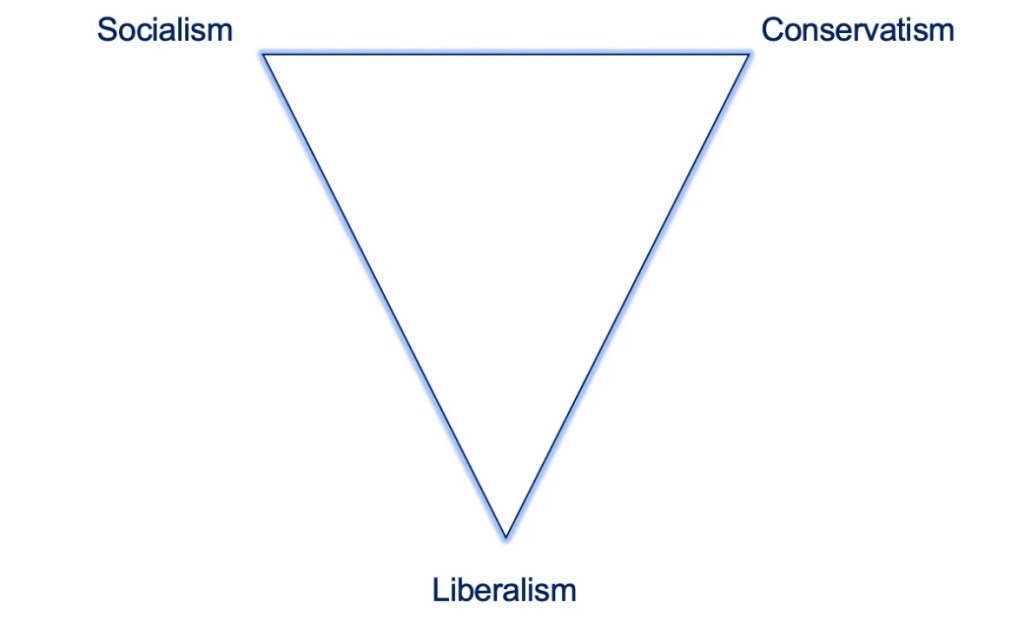
In this vein, Nate Silver presents a basic taxonomy of political orientation in a recent Substack post. It includes the diagram above, which distinguishes between socialism, conservatism, and liberalism. Silver draws on a classic essay written by Friedrich Hayek in 1945, “Why I am Not a Conservative”, in which Hayek discussed the meaning of the word “liberal” (and see here). Liberalism’s true emphasis is a tolerance for individual rights and freedoms, subject to varying articulations of the “nonaggression principle”. That is, “do as you like, but do no harm to others”.

We often see a linear representation distinguishing between so-called progressives on the left and conservatives on the right. Of course, a major hallmark of leftist thinking is extreme interventionism. Leftists or progressives are always keen to detect the slightest whiff of an externality or the slightest departure from the perfectly competitive market ideal. They seem eager to find a role for government in virtually every area of life. While it’s not a limiting case, we can substitute socialism or statism for progressivism on the far left, as Silver does, whereby the state takes primacy in economic and social affairs.

Conservatism, on the other hand, is a deep resistance to change, whether institutional, social, and sometimes economic. Conservatives too often demonstrate a willingness to use the coercive power of the state to prevent change. Hayek noted the willingness of both socialists and conservatives to invoke state power for their own ends.

Similarly, religious conservatives often demand state support beyond that afforded by the freedom to worship in the faith of one’s choice. They might strongly reject certain freedoms held to be fundamental by liberals. Meanwhile, socialists often view mere religious freedom as a threat to the power of the state, or at least they act like it (e.g. see here for an example).

Like conservatives, dedicated statists would doubtless resist change if it meant a loss of their own power. That is, they’d wish to preserve socialist institutions. On this point, witness the vitriol from the Left over what it perceives as threats to the public school monopoly. Witness also the fierce resistance among public employees to reducing the scale of the administrative state, and how advocates of entitlements fiercely resist decreases in the growth rate of those expenditures.

Silver, like Hayek, objects to the traditional, linear framework in which liberals are thought to occupy a range along a line between socialism and conservatism. He objects to that because real liberals value individual liberty as a natural human right, a viewpoint typically abhored by both socialists and conservatives. There is nothing “in between” about it! And of course, conservatives and progressives are equally guilty in their mistaken use of the word “liberal”.

Mapping Political Preferences

Liberty, statism, and conservatism are not exactly orthogonal political dimensions. Larger government almost always means less economic liberty. At a minimum, state dominance implies a social burden associated with public monopoly and monopsony power, as well as tax and welfare-state incentive problems. These features compromise or corrupt the exercise of basic rights. On the other hand, capitalism and its concomitant reliance on consumer sovereignty, individual initiative, free exchange and secure property rights is most in harmony with true liberalism.

For conservatives, resistance to change in support of a traditionally free market economy might offer something of a contradiction. In one sense, it corresponds to upholding market institutions. However, free markets allow new competitors and new technologies to undermine incumbents, who conservatives sometimes wish to defend through regulatory or protectionist measures. And conservatives are almost always too happy to join in the chorus of “price gouging” in response to the healthy operation of the free market in bringing forth supplies.

All that is to say that preferences involving liberty, statism, and traditionalism are not independent of one another. They cannot simply be mapped onto a three-dimensional space. At least the triangular representation gets liberalism out of the middle, but it’s difficult to visualize other ideological positions there. For example, “state religionism” could lie anywhere along the horizontal line at the top or even below it if certain basic liberties are preserved. Facism combines elements of socialism and a deformed version of capitalism that is properly called corporatism, but where would it fall within the triangle?

Big Government Liberalism?

Silver says he leans heavily toward a “big government” version of liberalism, but big government is hard to square with broad liberties. Granted, any well-functioning society must possess a certain level of “state capacity” to defend against private or public violations of individual rights, adjudicate disputes, and provide true public goods. It’s not clear whether Silver’s preferences lie within the bounds of those ambitions. Still, he deserves credit for his recognition that liberalism is wholly different from the progressive, socialist vision. It is the opposite.

The “New” Triangle

Silver attempts to gives the triangular framework a more contemporary spin by replacing conservatism with “MAGA Conservatism” and socialism with “Social Justice Leftism” (SJL), or “wokeism”. Here, I’m treating MAGA as a “brand”. Nothing below is intended to imply that America should not be a great nation.

The MAGA variant of conservatism emphasizes nationalism, though traditional conservatives have never been short on love of nation. For that matter, as a liberal American, it’s easier to forgive nationalist sentiments than it is the “Death to America” refrain we now hear from some SJLs.

The MAGA brand is also centered around a single individual, Donald Trump, whose rhetoric strikes many as nativistic. And Trump is a populist whose policy proposals are often nakedly political and counterproductive.

SJL shares with socialism an emphasis on various forms of redistribution and social engineering, but with a new focus on victimhood based on classes of identity. Of SJL, Silver says:

“Proponents of SJL usually dislike variations on the term ‘woke’, but the problem is that they dislike almost every other term as well. And we need some term for this ideology, because it encompasses quite a few distinctive features that differentiate it both from liberalism and from traditional, socialist-inflected leftism. In particular, SJL is much less concerned with the material condition of the working class, or with class in general. Instead, it is concerned with identity — especially identity categories involving race, gender and sexuality, but sometimes also many others as part of a sort of intersectional kaleidoscope.”
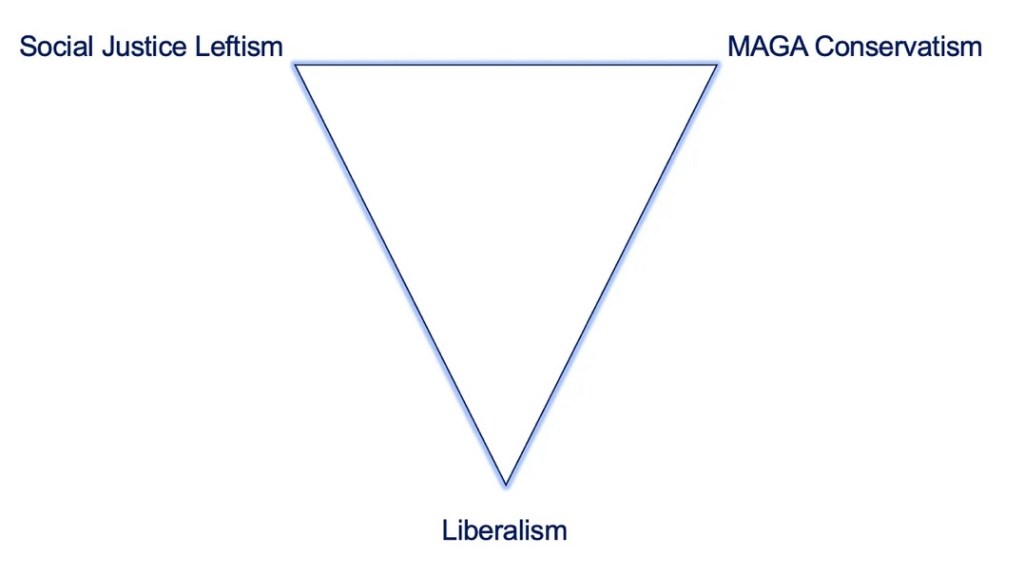
The gulf between liberals and SJLs couldn’t be wider on issues like free speech and “equity”, and equality of opportunity. MAGAns, on the other hand, have some views on individual rights and responsibility that are largely consistent with liberals, but reflexive populism often leads them to advocate policies protecting rents, corporate welfare, and protectionism.

Divided Liberalism

Liberalism emphasizes limited government, individual autonomy, and free exchange. However, there are issues upon which true liberals are of divided opinion. For example, one such area of controversy is the conflict between a woman’s right to choose and the fetal right to life. Many true liberals disagree over whether the rights of a fetus outweigh its mother’s right to choose, but most would concede that the balance shifts to the fetus at some point well short of birth (putting aside potential dangers to the mother’s life). Open borders is another area that can divide true liberals. On one side, the right to unrestricted mobility is thought to supersede any public interest in enforcing borders and limiting the flow of immigrants. On the other side, questions of national sovereignty, national security, as well as social and state capacity to absorb immigrants take primacy.

Don’t Call Lefties “Liberal”… They’re Not!

True liberalism (including most strains of libertarianism) recognizes various roles that a well-functioning state should play, but it also recognizes the primacy of the individual and individual rights as a social underpinning. As Hayek noted, true liberals are not resistant to change per se, unlike conservatives. But modern progressives demand changes of the worst kind: that the state should intervene to pursue their favored objectives, laying claim to an ever-greater share of private resources. This requires government coercion on a massive scale, the antithesis of liberalism. It’s time to recognize that “progressives” aren’t liberals in any sense of the word. For that matter, they don’t even stand for progress.

I’ll close with a quote from Adam Smith that I cribbed from Scott Sumner. Unfortunately, Sumner does not give the full reference, but I’ll take his word that Smith wrote this 20 years before the publication of The Wealth of Nations:

“Little else is requisite to carry a state to the highest degree of opulence from the lowest barbarism, but peace, easy taxes, and a tolerable administration of justice; all the rest being brought about by the natural course of things. All governments which thwart this natural course, which force things into another channel, or which endeavour to arrest the progress of society at a particular point, are unnatural, and to support themselves are obliged to be oppressive and tyrannical.”
Health Insurance Profits Are Not the Problem

08 Thursday Jul 2021

Posted by Nuetzel in Health Insurance, Profit Motive

≈ Leave a comment

Tags

Capitalization, COBRA, Community Rating, Cronyism, Death Spiral, Economies of Scale, Health Insurance, Medical Loss Ratio, Monopsony, Obamacare, Premium Subsidies, Profit, Profit Motive, Single-Payer System

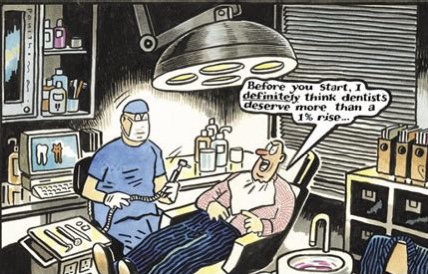
My dentist said, “Oh well, these days it’s really only about whether the insurance company makes a profit….” A giant appliance was in my mouth at the time, propping it open, so I couldn’t respond. But I made a mental note because it reminded me of the hypocrisy so common in how people regard the concept of profit. That’s especially true of the Left, and I happen to know that my dentist, whom I personally like very much, stands well to my left. 

Profit Is Income

It’s worth pointing out that profit is merely compensation. My dentist collects revenue, often paid to him by insurers. If he runs an efficient practice, then he earns an income after paying staff, office rent, various suppliers, and for equipment, including interest on any debt outstanding. You wouldn’t be wrong to call that profit, and he does pretty well for himself, but somehow he thinks it’s different.

My dentist probably feels locked into an adversarial position with my insurer, and of course he is in the short run. He says his price is $750; the insurer says, “Sorry Charlie, you get $250”. So as far as he’s concerned, it’s a zero-sum game. Not so in the long run, however. He needs to partner with insurers to get and keep patients, so the exchange is mutually beneficial. And while he might do some picking and choosing among insurers, he’s essentially a price taker. His “price” of $750 is something of a fiction, as he’s clearly willing to do the work for the insurer’s reimbursement. 

I think the key qualitative difference between my dentist’s income and that of any wage earner is that his income is always at risk. After all, profit is often regarded as a return to entrepreneurial risk-taking. As it happens, he’s taking a loss on my new crown because it cracked as soon as he put it in. Then, he had to start from scratch with new impressions, after painstakingly removing the cemented, cracked pieces with what felt like a tiny circular saw.

Middling Profitability

But what about those profit-hungry health insurers? In fact, they are not known for outrageously high profits, and their earnings are typically not valued as highly by the market as those of other industries, dollar for dollar. Competition helps restrain pricing and enhance performance, of course. And since the advent of Obamacare, profits have been subject to a loose “cap” (more on that below).

The profitability of health insurers improved in 2020, however, because so many tests and elective procedures were postponed or foregone due to the coronavirus pandemic. That also prompted the government to make more generous subsidies available to consumers to pay COBRA insurance premiums.

Profits Drive Efficiency

I’ll put aside concerns about the crony capitalism inherent in the health system-insurer-regulator nexus, at least for a moment. The profit motive is the fundamental driver of efficiency in the production of insurance contracts and pooling of risks, as well as efficient servicing and administration of those contracts. Absent the possibility of profit, these tasks would become mere bureaucratic functions with little regard for cost and resource allocation. Furthermore, managing risk requires a deep pool of capital to ensure the ability of the insurer to meet future claims. Reinvestment and growth of the enterprise also requires capital. That capital is always at risk and it is costly because its owners demand a return as fair compensation. 

Poor Alternatives

Eliminating profit from the insurance function implies that resources must be put at risk without compensation. That’s one of the reasons why non-profit insurers, over the years, have tended to be thinly capitalized and unstable, or limited in their offerings to “health maintenance” benefits, like primary or preventative care, as opposed to insuring against catastrophic events. Capital grants to non-profits (private or governmental) usually come with strings attached, which can severely limit the effectiveness of the capital for meeting existing or future needs of the operation. Growth requires reinvestment, so a profit margin must be earned in order to grow with internal funds. Where non-profits are concerned, you can call the “margin” whatever you want, but it is functionally equivalent to a profit margin. 

On the other hand, insurance provided by the public sector puts the taxpayer at risk, and the potential liability to taxpayer “capital” is never rewarded nor indemnified. But it is not free. Now, you might insist that we’d all benefit from government-sponsored health insurance because of the broader risk pool. The problem with that perspective is that it turns the pricing of risk into a political exercise. We’ve already seen the destructive effects of community rating. Younger, healthier, but budget-constrained individuals tend to opt out due to excessive premiums, leading to a systemic “death spiral” of the pool.

Administrative Costs

A puzzling contention is that private insurers drive up administrative costs, presumably when compared to a single-payer system. Obamacare regulations limit the so-called Medical Loss Ratio of a health plan. To simplify a bit, this requires rebates to customers if premiums exceed claims by a certain threshold, which varies across individual, small, and large group markets. This regulation obviously places a loose cap on profits. It is also arbitrary and probably has hampered competition in the individual market. And of course there have always been suspicions that the ratio can be “gamed”. 

Nevertheless, under a single-payer system, it would be shocking if economies of scale were sufficient to reduce administrative costs to levels below those incurred by private insurers (especially if we exclude profit!). After all, scale is seldom a prescription for government efficiency, and that’s largely due to the absence of a profit motive and any semblance of competition! What administrative savings might be achieved by a monopsony public payer are likely to derive mainly from “one-size-fits-all” decision-making and product design, with little heed to consumer preferences and choice.

I’ll Take the Profit-Maker’s Coverage

There is plenty to criticize about the health insurance industry. In important ways, it has already succeeded in shifting risks to taxpayers with the help of its policy-making cronies. The insurers are further protected by a flow of government premium subsidies to the individual market; and the largest insurers have benefitted from Obamacare regulations, which encourages increased market power by large hospital networks, which are happy to negotiate charges that benefit themselves and insurers. All else equal, however, I’d rather have a few choices from profit-making health insurers than a single, community-rated choice from the government. I’d rather see risk priced correctly, with direct subsidies made available to individuals in high-risk segments unable to afford their premiums. And I’d rather see less government involvement in health care delivery and insurance. We’d all be better off, including my dentist!

Amazon, Happy Users Face Lust for Antitrust

02 Thursday May 2019

Posted by Nuetzel in Antitrust, Capitalism, Regulation

≈ Leave a comment

Tags

Amazon, Amazon Marketplace, Apple, e-Commerce, eBay, Elizabeth Warren, Home Depot, Jeff Bezos, Lina M. Kahn, Market Concentration, monopoly, Monopsony, Predatory Pricing, QVC, Was Mart, Wayfair

It’s almost always best to resist the temptation to “fix” perceived market failures, perceptions that are often incorrect to begin with. An equivalent truism is that government intervention in any market will almost always damage outcomes for consumers and producers alike. So it is with ill-advised calls to bring antitrust action against Amazon. Elizabeth Warren is a prominent voice among the would-be meddlers. She tells the story of a hypothetical pillow manufacturer reliant on sales through Amazon’s platform. But alas, the small company is squeezed out of its market because Amazon gives its own brand of pillows superior placement and pricing. Is this a clear case of anti-competitive behavior? And if so, what’s to be done?

In this Yale Law Journal article Lina M. Kahn asserts that there is an antitrust case against Amazon. From the abstract:

“We cannot cognize the potential harms to competition posed by Amazon’s dominance if we measure competition primarily through price and output. Specifically, current doctrine underappreciates the risk of predatory pricing and how integration across distinct business lines may prove anticompetitive. These concerns are heightened in the context of online platforms for two reasons. First, the economics of platform markets create incentives for a company to pursue growth over profits, a strategy that investors have rewarded. Under these conditions, predatory pricing becomes highly rational—even as existing doctrine treats it as irrational and therefore implausible. Second, because online platforms serve as critical intermediaries, integrating across business lines positions these platforms to control the essential infrastructure on which their rivals depend. This dual role also enables a platform to exploit information collected on companies using its services to undermine them as competitors.”

A basic argument against anti-trust action is that the retail market and e-commerce market are not as concentrated as Kahn and Warren suggest. Amazon’s share of U.S. retail sales was an estimated 5% in 2018, but its share of e-commerce is the more worrisome to modern-day trust busters: Amazon is estimated to have controlled about 49% of U.S. online sales in 2018.

Obviously 49% is not close to monopolization, but the company is far ahead of other on-line rivals: eBay’s share was slightly less than 7%; Apple and Walmart each had less than 4%, and an assortment of sellers such as Home Depot, QVC and Wayfair, had shares of 1.5% share or less. The point is, however, that there are prominent rivals, some with aggressive plans to compete in the space. For example, apart from its traditional auction model, eBay is instituting a number of changes to its platform and offerings that it hopes will help it to compete with Amazon, some of which are very much like the practices for which Amazon is now criticized, such as preferential placement for big advertisers. Wal Mart is investing heavily in an effort to expand its online sales.

Companies like these rivals have the resources and access to capital to pose a legitimate threat to Amazon’s online dominance. That sort of competitive pressure, or even its mere possibility, imposes a far more effective form of market discipline than government regulators can hope to achieve, assuming they wouldn’t break the market. The governance imposed by the market itself keeps the focus squarely on bringing value to customers, which for Amazon means both buyers and third-party sellers. And while Amazon’s business model and platform are highly successful, no one, including Amazon management, can anticipate the shape of new technological developments that could lead to the next revolution in retail. Again, there are potent incentives for those who might be in a position to foment such a revolution.

But what about those sellers who rely so heavily on Amazon’s platform? Does Amazon exercise monopsony power to the detriment of these sellers, as Kahn and Warren contend? Again, sellers have alternatives. While it might be a burden for the smallest startups to compete on several different platforms, they do have choices. Therefore, the monopsony story just doesn’t hold up. Amazon has a large marketplace precisely because so many third-party sellers have chosen to compete there. But they can compete elsewhere.

If barriers to entry are created by Amazon’s platform management, it would involve a loss of revenue earned from hosting third-party sellers and create market opportunities for competitive platforms. The same can be said of “predatory placement” of Amazon’s own first-party product offerings. This practice bears a similarity to grocery stores giving preferred placement to certain brands in exchange for fees, which allow grocers to offer those products at lower prices. Indeed, few if any grocery stores carry all national brands, but those brands are usually available at competing stores. If anything, it would seem that getting a product listed on an online platform is relatively easy compared to getting space on grocery shelves, though like grocery brands, preferred placement is another matter. Building a brand has never been easy, and it may be necessary for less established products to be marketed on multiple platforms, including platforms based on auction models.

It would be very difficult to prove that Amazon engages in predatory pricing of their own offerings (also see here). That involves pricing below cost (including the loss of revenue from third-party sellers). Amazon might practice what has been described as loss leadership: offering products below cost from time-to-time in oder to spur sales of other products, which is a time-honored marketing tradition. The following quote, taken from the first link in this paragraph, is from a judge in a recent price fixing case involving Apple and Amazon:

“… the Complaint asserts that Amazon’s e-books business was ‘consistently profitable.’ Moreover, to hold a competitor liable for predatory pricing under the Sherman Act, one must prove more than simply pricing ‘below an appropriate measure of . . . costs.’ There must also be a ‘dangerous probability’ that the alleged predator will ‘recoup its investment in below-cost prices’ in the future. None of the comments demonstrate that either condition for predatory pricing by Amazon existed or will likely exist. Indeed, while the comments complain that Amazon’s $9.99 price for newly-released and bestselling e-books was ‘predatory,’ none of them attempts to show that Amazon’s e-book prices as a whole were below its marginal costs.” 

The basic considerations discussed above are couched in terms of traditional anti-trust thinking: monopoly, concentration, competitive threats, and predatory pricing. However, there is another, more fundamental point to be made: Amazon’s massive success is due precisely to the popularity of their platform as well as service to consumers and third-party sellers. That’s capitalism, baby! Does Amazon extract a price from users? Yes, it engages in mutually beneficial trade! If it tries to extract too much, it will suffer at its own hands by creating market opportunities for others. It is Amazon’s platform, asset, and private property. The Amazon Marketplace belongs to Amazon, and the company is free to manage it as shareholders allow. There is no social value in interfering with private property and voluntary arrangements that bring unambiguous benefits to customers on both sides of the transactions sponsored on the platform. Such interference would diminish those benefits and destroy private value belonging to Amazon shareholders.

Jeff Bezos’ recent letter to Amazon shareholders tells of third-party sellers “kicking our first-part butt.” Amazon’s total sales have grown fast over the past two decades, and while its sales in first-party transactions have grown at a robust 20% a year, third-party sales on the platform have grown at a rate of 52%! The last link provides this Bezos quote:

“Why did independent sellers do so much better selling on Amazon than they did on eBay? And why were independent sellers able to grow so much faster than Amazon’s own highly organized first-party sales organization? There isn’t one answer, but we do know one extremely important part of the answer: We helped independent sellers compete against our first-party business by investing in and offering them the very best selling tools we could imagine and build.”

Bezos also tells of the heavy investments Amazon makes in efforts to improve its platform, which have brought tremendous successes and a few noteworthy failures. His letter is obviously self-serving, both as an effort to engage shareholders and as an implicit appeal against anti-trust action. Nevertheless, it is hard to deny the company’s outstanding performance, the benefits it brings to the consuming public, and the opportunities it creates for enterprising sellers and entrepreneurs. The unfortunate fact is we must always be vigilant for the itchy fingers of leftists grasping for the value created by private effort.

Right-To-Work Prop A: Freedom of Speech, Association and Contract

30 Monday Jul 2018

Posted by Nuetzel in Labor Markets, Right to Work, Unions

≈ Leave a comment

Tags

Andrew Wilson, Daniel J. Mitchell, Fifth Amendment, First Amendment, Fourteenth Amendment, Freedom of Association, Freedom of Contract, Freedom of Speech, Missouri 2018 Proposition A, Monopsony, Political Action Committees, Right to Work, Show-Me Institute, Steve Spillman, Union Activism, Union Dues

I’d be angry if my employer forced me to contribute to the company’s Political Action Committee (PAC), and that view is shared by many of my colleagues. It would be illegal, of course, at least as a condition of employment. I love my job, but I give nothing to the PAC because I do not trust it to properly represent my political preferences. That goes for political contributions and lobbying activity that might benefit the company and, by extension, my own economic interests. I simply do not believe the company will refrain from corporatist practices, and I do not under any circumstances want my contributions lavished on politicians with whom I have policy differences.

In my home state of Missouri, unions and their political allies insist that union dues payments should be a condition of employment in unionized workplaces. Like PACs, unions are major political contributors, and I’d be surprised if there weren’t a large number of union members who object to the use of their dues for political contributions and activism. Of course, most of that activism is broadly anti-capitalist. This, quite simply, constitutes compelled speech and is a violation of employees’ First Amendment free-speech rights. Forced membership is a violation of the worker’s freedom of association under the Fourteenth Amendment.

Unions are also presumed to represent the interests of workers in negotiating with management, but not everyone wants that representation, especially given the corruption that has often plagued unions over the years and the poor economic performance of unionized industries in general. That last statement applies to public employee unions no less than private sector unions. Prohibiting non-union workers from employment at a unionized firm violates their freedom of contract under the Fifth and Fourteenth Amendments. I agree, however, that an employee refusing to join a union should not automatically be entitled to the wages and benefits negotiated by the union in collective bargaining with the employer. That should be strictly between the non-union employee and the firm.

Missouri Proposition A, which is on the state’s August 7 ballot, is a referendum on a right-to-work (RtW) law already passed by the general assembly and signed by the governor last year. I’ve discussed reasons why some libertarians have expressed disagreement with this kind of legislation—primarily because it denies an employer the right to hire workers exclusively from a unionized pool of labor. As Daniel J. Mitchell has noted, right-to-work laws are a second-best, compensatory solution to other forms of government intervention in labor markets that essentially grant unions monopsony privileges. Furthermore, giving primacy to an employer’s right to deal exclusively with a union ignores the rights of non-union workers and the rights of union members who do not wish to contribute to a union’s political activities. Trampling on the latter stands in contrast to the established protection of my rights against coerced contributions to my employer’s PAC.

The standard economic argument in favor of RtW laws hinges on the favorability of a state’s business environment and its competitiveness with other states. Andrew Wilson explains how and why Prop A will create jobs in Missouri. He notes that over the ten years ending in 2014:

“…average job growth in the 22 states with RTW laws in place for most or all of that time was more than twice as fast (at 9.1 percent) as in the 28 forced-union states. The RTW states also had considerably faster growth in personal income (at 54.7 percent compared to 43.5 percent) and a much stronger economic growth (50.7 percent compared to 38.0 percent).”

Wilson also remarks on a historical phenomenon which pro-union forces refuse to acknowledge: unions have undermined the competitive position of the industries upon which their members rely. It’s a classic principal-agent problem. Workers appoint an agent for representation, but the agent acts independently to maximize its own gains, often at the expense of the workers. RtW applies discipline to the process, reinforcing the union’s incentive to put members’ interests above of its own. After all, nearly all employers have to compete for workers, and private employers have to compete in product markets. Union workers have been exempt from competition only to the extent that their wage demands have not undermined the business’ competitive position, but they frequently have.

The real rub, according to RtW opponents, is that business interests will simply “crush” unions under RtW and impose lower wages and poor work conditions on workers. But as I alluded above, there are employers that prefer to work with a union for a variety of reasons. Second, suppose that new employees of a unionized firm refuse to join the union, or that some union members opt out. That’s a pretty strong indication that union membership is an unattractive proposition. Whose fault is that?

I favor Proposition A because workers should not be forced to accept representation by any third party, firms should not be forced to hire exclusively from those willing to do so, and because workers should not be required to contribute to union political initiatives. But as Steve Spellman writes, unions could do much to enhance their value to both workers and firms, attracting membership and gaining advantages in bargaining with employers:

“If unions focused on providing helpful, outsourced H.R. functions to companies, such as worker recruitment, drug screening and taking care of all that labor-law-compliance paperwork, it would sure change their reputation. As would standing up for its members, while also taking necessary (and fair) disciplinary actions instead of covering up for the occasional bad apple (even if that is only one worker out of 1,000). … If we can dream a little here, unions could also be best positioned to stand up for workers who are discriminated against, for whatever reason, rather than waiting on the law to catch up with our evolving society.”

Labor Shares the Burden of the Corporate Income Tax

03 Friday Nov 2017

Posted by Nuetzel in Taxes

≈ 4 Comments

Tags

Alex Tabarrok, corporate income tax, Greg Mankiw, John Cochrane, Lawrence Summers, monopoly, Monopsony, Pass-Through Income, Paul Krugman, Tax Burden, Tax Discounting, Tax Incidence, Tax Reform

As expected, a reduction of the corporate income tax rate from 35% to 20% is included in the GOP’s tax reform bill, a summary of which was released today. That rate cut would be a welcome development for workers, consumers, and corporate shareholders. It should be no surprise that the burden of the U.S. corporate income tax is not borne exclusively by owners of capital. In fact, it might hurt workers and consumers substantially while imposing relatively little burden on shareholders.

John Cochrane’s post on the incidence of the tax on corporate income is very interesting, though by turns it rambles and may be too technical for some tastes. He notes that the incidence of the corporate tax can fall on only three different groups: shareholders, workers and customers:

“As an accounting matter, every cent [of taxes] corporations pay comes from higher prices, lower wages, or lower payments to shareholders. The only question is which one.“

Cochrane quotes Lawrence Summers and Paul Krugman, both of whom are of the belief that the incidence of the corporate tax must fall primarily on capital and not on labor. That’s consistent with their view that a reduction in corporate taxes amounts to a gift to shareholders. But Cochrane isn’t at all convinced:

“The usual principle is that he or she bears the burden who can’t get out of the way. So, how much room do companies, as a whole, have to raise prices, lower wages, lower interest payments, or lower dividends?”

In fact, owners of capital can get out of the way. Capital is very mobile relative to labor. Here’s a counterfactual exercise Cochrane steps through in order to illustrate the implications of ownership bearing the incidence of the tax: if equity markets are efficient, share prices reflect all available information about the firm. If wages and product prices are unchanged after the imposition of the tax, then shareholders would suffer an immediate loss. Once the tax is discounted into share prices, there would be no further impact on current or future shareholders. Thus, future buyers of shares would escape the tax burden entirely. As a first approximation, the share price must fall to the point at which the ongoing return on the stock is restored to its value prior to imposition of the tax.

Cochrane notes that evidence on the reaction of stock prices to corporate tax changes is mixed at best, which implies that the incidence of corporate taxation falls more weakly on shareholders than many believe. That leaves consumers or workers to bear a significant part of the burden. Workers and consumers are mostly one and the same: economy-wide, higher prices mean lower real wages; lower wages also mean lower real wages. So I’ll continue to speak as if the incidence of the tax falls on either labor or capital, and we can leave aside consumers as a separate category. Cochrane says:

“It used to be thought that it was easy to lower payments to shareholders — ‘the supply of savings is inelastic’ — so that’s where the tax would come from. The newer consensus is that companies as a whole have very little power to pay less to investors, … so the corporate tax comes from lower wages or, equivalently, higher prices. Then, indirectly, reducing the corporate tax would increase capital, which would result in higher wages.”

Cochrane’s post and another on his blog were prompted by an earlier piece by Greg Mankiw showing that real wages, in an open economy, will have a strong negative response to a corporate tax increase. Here is the reasoning: the tax reduces the return earned from invested capital in the short run. Ideally, capital is deployed only up to the point at which its return no longer exceeds the opportunity cost needed to attract it. Given time to adjust, less capital must be deployed after the imposition of the tax in order to force the return on a marginal unit of capital back up to the given opportunity cost. That means less capital deployed per worker, and that, in turn, reduces labor productivity and wages.

Another issue addressed by Cochrane has to do with assertions that monopoly power in the corporate sector is a good rationale for a high tax on corporate income. You can easily convince me that the “average” firm in the corporate sector earns a positive margin over marginal cost. However, a microeconomic analysis of monopoly behavior by the entire corporate sector would be awkward, to say the least. Despite all that, Cochrane notes that monopolists have more power than firms in competitive sectors to raise prices, and monopsonists have more power to reduce wages. Therefore, the “tax the monopolists” line of argument does not suggest that labor will avoid a significant burden of a corporate tax. A safer bet is that firms in the U.S. corporate sector are price-takers in capital markets, but to some degree may be price-makers in product and labor markets.

Cochrane also emphasizes the inefficiency of the corporate tax as a redistributional mechanism, even if shareholders bear a significant share of its burden. It is still likely to harm workers via lost productivity, as discussed above. It is also true that many workers hold corporate equities in their retirement funds, so a corporate tax harms them directly in their dual role as owners of capital.

The cut in the corporate tax rate is but one element of many in the GOP bill, but a related provision is that so-called “pass-through” income, of the type earned via many privately-owned businesses, would be taxed at a maximum rate of 25%. These businesses generate more income than C-corporations. Currently, pass-through income is taxed as ordinary income, so capping the top rate at 25% represents a very large tax cut. As Alex Tabarrok points out at the last link, tax treatment should be neutral with respect to the form of business organization, but under the GOP bill, the effective gap between the top rate for pass-throughs versus corporate income would be even larger than it is now.

Critics of a reduction in corporate taxes should bear in mind that its incidence falls at least partly on labor, perhaps mainly on labor. The U.S. has the highest corporate tax rate in the industrialized world. That undermines U.S. competitiveness, as does the complexity of corporate tax rules. Tax planning and compliance burn up massive resources while drastically reducing the tax “take”, i.e., the revenue actually collected. The corporate income tax is something of a “show” tax that exists to appease populist and leftist elements in the electorate who consistently fail to recognize the unexpectedly nasty consequences of their own advocacy.


“Freedom of Representation” Is a Better Name Than “Right To Work”

15 Friday Sep 2017

Posted by Nuetzel in Right to Work, Unions

≈ 1 Comment

Tags

Agency Fees, Compelled Riders, Competitive Enterprise Institute, David Boaz, David Henderson, Eric Greitens, Exclusive Representation, Free Riders, Gary Chartier, Holman Jenkins, Ivan Osorio, Joe Lehman, Mackinac Center for Public Policy, Missouri Right to Work, monopoly, Monopsony, National Labor Relations Board, Right to Work, Sheldon Richman, Taft-Hartley Act, Vinnie Vernuccio, Wagner Act

Missouri’s Right-to-Work (RtW) legislation, signed into law by Governor Eric Greitens in February of 2016, essentially states that no employee or prospective employee, with certain exceptions, can be required to join a union or to pay union dues or agency fees. But before the RtW law’s effective date on August 28th, well over 300,000 signatures were collected in opposition, which is believed to meet state requirements for a referendum on the issue. As a consequence, the law was put on hold, pending a vote in November.

A casual look at a variety of statistics by state “right-to-work” status shows an impressive advantage for RtW states, though that doesn’t imply causality. One can certainly think of reasons why the causality might be operative, and I find some of them plausible, but that’s not the line of argument I want to pursue here.

The Libertarian Divide

Libertarians are of divided opinion on the desirability of RtW laws. David Boaz wrote about this division back in 2012. On one side, it’s clearly an abrogation of an individual workers’ rights to require, as a condition of employment, entry into a third-party association against their will, or to coerce payment of dues or fees for collective bargaining and ongoing representation on a variety of job-related issues. Such a requirement would violate the constitutional protections on freedom of association, freedom of speech, and freedom of contract. Boaz quotes Vinnie Vernuccio and Joe Lehman of the Mackinac Center for Public Policy:

“Right to work does not change any aspect of collective bargaining other than preventing employees from getting fired for choosing not to join or remain in a union and pay union dues or agency fees, which may go toward political causes they don’t support. Collective bargaining still exists in right-to-work states, and workers are of course free to organize.“

This may overstate the consequences for workers who would rather not join a union. Non-union workers have so-called Beck rights, which allow them to opt out of “core membership” and  pay reduced dues covering only representation. An appropriate accounting for that portion of dues might not be straightforward, however, and it is still likely to represent an involuntary payment. Moreover, awareness of Beck rights is far from universal, and asserting them might not be straightforward.

Libertarians who disagree with the perspective expressed in the quote above emphasize the employers’ freedom of contract as though it takes primacy over worker autonomy in the shaping of voluntary and mutually beneficial employment relationships. The thinking is that an employer might actually prefer to host a union shop. There are presumed efficiencies of collective bargaining, standard and agreed-upon work rules, lower turnover, and perhaps even worker loyalty. Among this group of libertarians are Holman Jenkins, Sheldon Richman, and Gary Chartier:

“When a legislature interferes with voluntary employment contracts, it infringes people’s freedom to bargain with their own labor and possessions. Treating this kind of interference as acceptable means licensing arbitrary interventions into the market by politicians, who are ill-equipped to second-guess the decisions made by the real people making work agreements with one another.“

Labor Law

One could be forgiven for thinking that Chartier and the others view RtW as a form of government intervention in otherwise free labor markets. These critics acknowledge, however, that there is already intervention in labor relations via the Wagner Act (1935), which among other things prohibits any refusal “to bargain collectively with the representative of the employer’s employees.” Under the Act, the National Labor Relations Board (NLRB) is charged with:

“… overseeing the process by which employees decide whether to be represented by a labor organization and prosecuting violations. ... issue rules interpreting the labor legislation. This will generally be binding, unless a court deems it to have acted outside its authority. … prevent unfair labor practices, lead investigations, collect evidence, issue subpoenas, and require witnesses to give evidence.“

So, the NLRB is empowered to force employers, if it so chooses, to bargain collectively and even to rule on whether a vote by employees was “fair”. RtW laws are defended as a force to countervail against this federal power. The Wagner Act was later amended by the Taft-Hartley Act (1947) to curb union power and abuses. It created more balance in the relations between unions and employers and it offered some protection to non-union job seekers by prohibiting closed shops. It also allowed states to pass RtW laws to proscribe the forced payment of agency fees by non-union employees, if states so choose. Nevertheless, labor law continues to support monopoly union privileges and abusive tactics. Moreover, restrictions on unions’ use of dues and agency fees for political activities are difficult to enforce in the absence greater requirements for union financial transparency. The response from libertarian critics of RtW laws is that there are avenues for additional reform at the federal level without adding additional interventions (RtW) at the state level.

One of the clearest rebuttals to the above arguments against RtW laws comes from Ivan Osorio of the Competitive Enterprise Institute, who first quotes Chartier on prospective legislation in Indiana:

“‘If employers choose to conclude union-shop contracts with unions, what gives the Indiana legislature the right to interfere?‘”

Here is Osorio’s rejoinder:

“... there is no jurisdiction anywhere in the United States where there is no such interference at all. Simply replace “union shop” with “open shop,” and the one-sidedness of Chartier’s query … becomes clear. Why should the government forbid an employer from negotiating a voluntary membership agreement with a union?“

Exclusive Representation

Another side of the RtW debate is the contention that non-union workers receive the same benefits achieved via collective bargaining if they are employed by a firm having an otherwise unionized work force. Thus, the non-union workers are said to be “free riding” on the union’s efforts. This framing is highly misleading, however. Under the Wagner Act, a firm’s non-union workers are not entitled to pay for benefits negotiated by the union unless the union has opted for exclusive representation. In that case, those non-union workers are not so much free riders as “compelled riders“, who may be forced to accept certain terms, working conditions and particular representation in grievances against their wishes. The union’s exclusive power is thus flexed in two ways: as a monopoly seller of labor to the firm, and as a monopoly seller of agency services to the worker, extracting dues or agency fees in the process.

Balancing Rights

David Henderson’s perspective on the RtW issue is appealing, as he accounts for the tradeoff between emphasizing the rights of workers and employers:

“It’s true that [RtW] laws make it illegal for employers to do what some of them might want to do: namely hire only union workers, require everyone who works for them to join unions, or require everyone who works for them to pay dues to a union. But are there really likely to be many such employers? I don’t think so. …

Now, I don’t know that there are no such employers. Maybe there are some. If so, then it becomes a tradeoff. On the one hand, preserve the rights of many non-union workers, many union workers, and unionized employers but trample on the rights of those few unionized employers. On the other hand, trample on the rights of many union workers, non-union workers, and unionized employers but preserve the rights of those few unionized employers. I choose the first option because I think it tramples on way fewer people’s rights. And, remember, that if you say right-to-work is wrong and you get your way just on that issue, the federal government will continue to trample on many people’s rights. …

… the best solution is to abolish the law that gives government-enforced monopoly power to unions. Sheldon [Richman] and I agree on this. The issue here is whether we should just settle for saying that and pushing for that or do something else meanwhile.“

Union representation can protect workers from an imbalance of power between a large employer and individual workers. But it is not all sweetness and light for unionized workers, not to mention consumers who pay for the influence of unions on prices in general. While unions played a critical role in establishing and defending workers’ rights over the years, they have increasingly presented agency problems for their constituencies. They have also hastened declines in industries facing competitive pressures, which in turn have hastened the decline of union representation generally. (Public sector unions present a different set of problems involving conflicts of interest with taxpayers, but those are beyond the scope of this post.) In general, worker rights in the private sector are better served by allowing self-determination in the matter of union representation. To the extent that state RtW laws protect that autonomy, they are probably worthwhile at this point in the evolution of labor relations. However, if that is the primary effect, RtW is something of a misnomer.

Major Mistake: The Minimum Opportunity Wage

06 Saturday Jun 2015

Posted by Nuetzel in Price Controls

≈ 1 Comment

Tags

Alan Krueger, Brian Doherty, competition, Coyote Blog, David Card, Don Boudreaux, Economic justice, Fast food robots, Mark Perry, Minimum Wage, Monopsony, Reason Magazine, Rise of the Machines, Robert Reich, Robot replacements, Show-Me Institute, Steve Chapman, Substitutability, Tim Worstall, Unintended Consequences, Wage compression, Warren Meyer

government-problem

City leaders in St. Louis and Kansas City are the latest to fantasize that market manipulation can serve as a pathway to “economic justice”. They want to raise the local minimum wage to $15 by 2020, following similar actions in Los Angeles, Oakland  and Seattle. They will harm the lowest-skilled workers in these cities, not to mention local businesses, their own local economies and their own city budgets. Like many populists on the national level with a challenged understanding of market forces (such as Robert Reich), these politicians won’t recognize the evidence when it comes in. If they do, they won’t find it politically expedient to own up to it. A more cynical view is that the hike’s gradual phase-in may be a deliberate attempt to conceal its negative consequences.

There are many reasons to oppose a higher minimum wage, or any minimum wage for that matter. Prices (including wages) are rich with information about demand conditions and scarcity. They provide signals for owners and users of resources that guide them toward the best decisions. Price controls, such as a wage floor like the minimum wage, short-circuit those signals and are notorious for their disastrous unintended (but very predictable) consequences. Steve Chapman at Reason Magazine discusses the mechanics of such distortions here.

Supporters of a higher minimum wage usually fail to recognize the relationship between wages and worker productivity. That connection is why the imposition of a wage floor leads to a surplus of low-skilled labor. Those with the least skills and experience are the most likely to lose their jobs, work fewer hours or not be hired. In another Reason article, Brian Doherty explains that this is a thorny problem for charities providing transitional employment to workers with low-skills or employability. He also notes the following:

“All sorts of jobs have elements of learning or training, especially at the entry level. Merely having a job at all can have value down the line worth enormously more than the wage you are currently earning in terms of a proven track record of reliable employability or moving up within a particular organization.“

The negative employment effects of a higher wage floor are greater if the employer cannot easily pass higher costs along to customers. That’s why firms in highly competitive markets (and their workers) are more vulnerable. This detriment is all the worse when a higher wage floor is imposed within a single jurisdiction, such as the city of St. Louis. Bordering municipalities stand to benefit from the distorted wage levels in the city, but the net effect will be worse than a wash for the region, as adjustments to the new, artificial conditions are not costless. Again, it is likely that the least capable workers and least resourceful firms will be harmed the most.

The negative effects of a higher wage floor are also greater when substitutes for low-skilled labor are available. Here is a video on the robot solution for fast food order-taking. In fact, today there are robots capable of preparing meals, mopping floors, and performing a variety of other menial tasks. Alternatively, more experienced workers may be asked to perform more menial tasks or work longer hours. Either way, the employer takes a hit. Ultimately, the best alternative for some firms will be to close.

The impact of the higher minimum on the wage rates of more skilled workers is likely to be muted. A correspondent of mine mentioned the consequences of wage compression. From the link:

“In some cases, compression (or inequity) increases the risk of a fight or flee phenomonon [sic]–disgruntlement culminating in union organizing campaigns or, in the case of flee, higher turnover as the result of employees quitting. … all too often, companies are forced to address the problem by adjusting their entire compensation systems–usually upward and across-the-board. .. While wage adjustments may sound good for those who do not have to worry about profits and losses, the real impact for a company typically means it must either increase productivity or lay people off.“

For those who doubt the impact of the minimum wage hike on employment decisions, consider this calculation by Mark Perry:

“The pending 67% minimum wage hike in LA (from $9 to $15 per hour by 2020), which is the same as a $6 per hour tax (or $12,480 annual tax per full-time employee and more like $13,500 per year with increased employer payroll taxes…)….“

Don Boudreaux offers another interesting perspective, asking whether a change in the way the minimum wage is enforced might influence opinion:

“... if these policies were enforced by police officers monitoring workers and fining those workers who agreed to work at hourly wages below the legislated minimum – would you still support minimum wages?“

Proponents of a higher minimum wage often cite a study from 1994 by David Card and Alan Krueger purporting to show that a higher minimum wage in New Jersey actually increased employment in the fast food industry. Tim Worstall at Forbes discussed a severe shortcoming of the Card/Krueger study (HT: Don Boudreaux): Card and Krueger failed to include more labor-intensive independent operators in their analysis, instead focusing exclusively on employment at fast-food chain franchises. The latter were likely to benefit from the failure of independent competitors.

Another common argument put forward by supporters of higher minimum wages is that economic theory predicts positive employment effects if employers have monopsony power in hiring labor, or power to influence the market wage. This is a stretch: it describes labor market conditions in very few localities. Of course, any employer in an unregulated market is free to offer noncompetitive wages, but they will suffer the consequences of taking less skilled and less experienced hires, higher labor turnover and ultimately a competitive disadvantage. Such forces lead rational employers to offer competitive wages for the skills levels they require.

Minimum wages are also defended as an anti-poverty program, but this is a weak argument. A recent post at Coyote Blog explains “Why Minimum Wage Increases are a Terrible Anti-Poverty Program“. Among other points:

“Most minimum wage earners are not poor. The vast majority of minimum wage jobs are held as second jobs or held by second earners in a household or by the kids of affluent households. …

Most people in poverty don’t make the minimum wage. In fact, the typically [sic] hourly income of the poor appears to be around $14 an hour. The problem is not the hourly rate, the problem is the availability of work. The poor are poor because they don’t get enough job hours. …

Many young workers or poor workers with a spotty work record need to build a reliable work history to get better work in the future…. Further, many folks without much experience in the job market are missing critical skills — by these I am not talking about sophisticated things like CNC machine tool programming. I am referring to prosaic skills you likely take for granted (check your privilege!) such as showing up reliably each day for work, overcoming the typical frictions of working with diverse teammates, and working to achieve management-set goals via a defined process.”

Some of the same issues are highlighted by the Show-Me Institute, a Missouri think tank, in “Minimum Wage Increases Not Effective at Fighting Poverty“.

A higher minimum wage is one of those proposals that “sound good” to the progressive mind, but are counter-productive in the extreme. The cities of St. Louis and Kansas City would do well to avoid market manipulation that is likely to backfire.

Follow Sacred Cow Chips on WordPress.com

Recent Posts

  • The Case Against Interest On Reserves
  • Immigration and Merit As Fiscal Propositions
  • Tariff “Dividend” From An Indigent State
  • Almost Looks Like the Fed Has a 3% Inflation Target
  • Government Malpractice Breeds Health Care Havoc

Archives

  • January 2026
  • December 2025
  • November 2025
  • October 2025
  • September 2025
  • August 2025
  • July 2025
  • June 2025
  • May 2025
  • April 2025
  • March 2025
  • February 2025
  • January 2025
  • December 2024
  • November 2024
  • October 2024
  • September 2024
  • August 2024
  • July 2024
  • June 2024
  • May 2024
  • April 2024
  • March 2024
  • February 2024
  • January 2024
  • December 2023
  • November 2023
  • August 2023
  • July 2023
  • June 2023
  • May 2023
  • April 2023
  • March 2023
  • February 2023
  • January 2023
  • December 2022
  • November 2022
  • October 2022
  • September 2022
  • August 2022
  • July 2022
  • June 2022
  • May 2022
  • April 2022
  • March 2022
  • February 2022
  • January 2022
  • December 2021
  • November 2021
  • October 2021
  • September 2021
  • August 2021
  • July 2021
  • June 2021
  • May 2021
  • April 2021
  • March 2021
  • February 2021
  • January 2021
  • December 2020
  • November 2020
  • October 2020
  • September 2020
  • August 2020
  • July 2020
  • June 2020
  • May 2020
  • April 2020
  • March 2020
  • February 2020
  • January 2020
  • December 2019
  • November 2019
  • October 2019
  • September 2019
  • August 2019
  • July 2019
  • June 2019
  • May 2019
  • April 2019
  • March 2019
  • February 2019
  • January 2019
  • December 2018
  • November 2018
  • October 2018
  • September 2018
  • August 2018
  • July 2018
  • June 2018
  • May 2018
  • April 2018
  • March 2018
  • February 2018
  • January 2018
  • December 2017
  • November 2017
  • October 2017
  • September 2017
  • August 2017
  • July 2017
  • June 2017
  • May 2017
  • April 2017
  • March 2017
  • February 2017
  • January 2017
  • December 2016
  • November 2016
  • October 2016
  • September 2016
  • August 2016
  • July 2016
  • June 2016
  • May 2016
  • April 2016
  • March 2016
  • February 2016
  • January 2016
  • December 2015
  • November 2015
  • October 2015
  • September 2015
  • August 2015
  • July 2015
  • June 2015
  • May 2015
  • April 2015
  • March 2015
  • February 2015
  • January 2015
  • December 2014
  • November 2014
  • October 2014
  • September 2014
  • August 2014
  • July 2014
  • June 2014
  • May 2014
  • April 2014
  • March 2014

Blogs I Follow

  • Passive Income Kickstart
  • OnlyFinance.net
  • TLC Cholesterol
  • Nintil
  • kendunning.net
  • DCWhispers.com
  • Hoong-Wai in the UK
  • Marginal REVOLUTION
  • Stlouis
  • Watts Up With That?
  • Aussie Nationalist Blog
  • American Elephants
  • The View from Alexandria
  • The Gymnasium
  • A Force for Good
  • Notes On Liberty
  • troymo
  • SUNDAY BLOG Stephanie Sievers
  • Miss Lou Acquiring Lore
  • Your Well Wisher Program
  • Objectivism In Depth
  • RobotEnomics
  • Orderstatistic
  • Paradigm Library
  • Scattered Showers and Quicksand

Blog at WordPress.com.

Passive Income Kickstart

OnlyFinance.net

TLC Cholesterol

Nintil

To estimate, compare, distinguish, discuss, and trace to its principal sources everything

kendunning.net

The Future is Ours to Create

DCWhispers.com

Hoong-Wai in the UK

A Commonwealth immigrant's perspective on the UK's public arena.

Marginal REVOLUTION

Small Steps Toward A Much Better World

Stlouis

Watts Up With That?

The world's most viewed site on global warming and climate change

Aussie Nationalist Blog

Commentary from a Paleoconservative and Nationalist perspective

American Elephants

Defending Life, Liberty and the Pursuit of Happiness

The View from Alexandria

In advanced civilizations the period loosely called Alexandrian is usually associated with flexible morals, perfunctory religion, populist standards and cosmopolitan tastes, feminism, exotic cults, and the rapid turnover of high and low fads---in short, a falling away (which is all that decadence means) from the strictness of traditional rules, embodied in character and inforced from within. -- Jacques Barzun

The Gymnasium

A place for reason, politics, economics, and faith steeped in the classical liberal tradition

A Force for Good

How economics, morality, and markets combine

Notes On Liberty

Spontaneous thoughts on a humble creed

troymo

SUNDAY BLOG Stephanie Sievers

Escaping the everyday life with photographs from my travels

Miss Lou Acquiring Lore

Gallery of Life...

Your Well Wisher Program

Attempt to solve commonly known problems…

Objectivism In Depth

Exploring Ayn Rand's revolutionary philosophy.

RobotEnomics

(A)n (I)ntelligent Future

Orderstatistic

Economics, chess and anything else on my mind.

Paradigm Library

OODA Looping

Scattered Showers and Quicksand

Musings on science, investing, finance, economics, politics, and probably fly fishing.

  • Subscribe Subscribed
    • Sacred Cow Chips
    • Join 128 other subscribers
    • Already have a WordPress.com account? Log in now.
    • Sacred Cow Chips
    • Subscribe Subscribed
    • Sign up
    • Log in
    • Report this content
    • View site in Reader
    • Manage subscriptions
    • Collapse this bar
 

Loading Comments...