• About

Sacred Cow Chips

Sacred Cow Chips

Author Archives: Nuetzel

Climate Change and Disorders of the Mind

13 Sunday Jan 2019

Posted by Nuetzel in Environment, Global Warming, Socialism

≈ 1 Comment

Tags

Alexandria Ocasio-Cortez, Discount Rate, Gale Pooley, Green New Deal, Ingrid Newkirk, Julian Simon. Simon Abundance Index, Marian Tupy, Michael Bastasch, Modern Monetary Theory, Paul Erlich, PETA, Socialism, Tim Ball, Tom Harris, University of Missouri, Voluntary Human Extinction Movement, Yellow Vests

Let’s hear from an environmentalist and radical animal-rights activist:

“… the extinction of Homo Sapiens would mean survival for millions if not billions, of Earth-dwelling species. Phasing out the human race will solve every problem on earth, social and environmental.”

Okay then, you first! That is an actual quote of Ingrid Newkirk, the misanthropic president of People for the Ethical Treatment of Animals (PETA), as documented by Tom Harris and Tim Ball in “Extreme Environmentalists Are Anti-Human“. I’m no psychologist, but I believe most shrinks would categorize misanthropy as a condition of general dislike for humanity that usually poses no real threat to others. Not always, however, and by my reckoning the sentiments expressed by Newkirk are the ramblings of a disturbed individual. But she’s not alone in her psychosis, by any means.

The sheer lunacy of the environmental Left is nowhere more evident than in the call for mankind’s extinction, and it is not unusual to hear it these days. Here’s a similarly deranged and tyrannical statement from the Voluntary Human Extinction Movement:

“Phasing out the human race by voluntarily ceasing to breed will allow Earth’s biosphere to return to good health … the hopeful alternative to the extinction of millions of species of plants and animals is the voluntary extinction of one species: Homo sapiens … us.“

The policies advocated by many environmentalists don’t go quite that far, but they nevertheless tend to be anti-human, as Harris and Ball demonstrate. In particular, the emphasis on eliminating the use of fossil fuels over the next three decades would consign most people , but especially those in developing countries, to ongoing lives of penury. Here are Harris and Ball:

“Of course, the poor and disadvantaged would be most affected by the inevitable huge rise in energy costs that would accompany the end of fossil fuels. … By promoting the idea that CO2 emissions must be reduced, climate mitigation activists are supporting the expanded use of biofuels. This is resulting in vast quantities of the world’s grain being diverted to fuel instead of food, causing food prices to rise — also causing the most pain among the world’s poor.“

I am highly skeptical of the risks presented by climate change. The magnitude of climate changes on both global and regional scales, even to the present, are subject to so much uncertainty in measurement as to be largely unworthy of policy action. Climate models based on “carbon forcings” have been increasingly in error, and the risks about which we are warned are based on forecasts from the same models far into the future — taking little account of the potential benefits of warming. The purported risks, and the benefits of mitigating actions, are translated into economic terms by models that are themselves subject to tremendous uncertainty. Then, the future calamitous outcomes and the benefits of mitigation are discounted so lightly as to make the lives of future human beings… and plants and animals, and their hypothetical preferences, almost just as important as those of actual human beings who, in the present, are asked to bear the very certain costs of mitigation. The entire pursuit is madness.

Last spring I had a brief discussion with an economist engaged in research on the economics of climate change at the University of Missouri. I mentioned the uncertainties in measuring and aggregating temperatures over time and place (here is one example). He said, with a straight face, that those uncertainties should be disregarded or else “we can’t say anything”. Well yes, as a matter of scientific principle, a high variance always means a greater likelihood that one must accept the null hypothesis! Yet the perspective adopted by the alarmist community is that a disastrous outcome is the null hypothesis — the sky is falling! If it weren’t for government grant money, I’m sure the sense of impending doom would be psychologically debilitating.

And now we are presented with a “Green New Deal” (GND), courtesy of a certain congressional freshman, Alexandria Ocasio-Cortez, whose apparent media appeal is disproportionately greater than her intellectual acumen. The GND would eliminate fossil fuels and nuclear power (which emits zero carbon) from the U.S. energy mix by the impossibly early 2035. That would require the replacement of 88% of U.S. energy sources in about 17 years, which would cripple the U.S. economy and real incomes. The poor would suffer the most, but of course the GND promises much more than a makeover of our energy sources. In fact, it would mandate the replacement of “non-essential individual means of transport with high-quality and modern mass transit”. Welcome to the new authoritarian paradise! All transportation and anything else requiring power would be electrified, a massive infrastructural investment. Oh, and the proposal calls for a slew of socialist programs: a federal job guarantee, a living wage, universal health care, and of course income redistribution. Interestingly, this proposal is consistent with the agenda described in the most widely-reported climate paper in 2018, which Michael Bastasch describes as a call for global socialism.

Cortez’s desperate hope is that all this can be paid for via reductions in defense spending, high taxes on the rich, and “Modern Monetary Theory”. She really doesn’t understand the latter except that it sounds expedient. Like many other leftist numbskulls, she undoubtedly thinks that printing money offers society a free lunch. But printing money simply cannot be transformed into real resources, and such attempts generally have destructive consequences. So the GND might not reflect mental illness so much as sheer stupidity. Anyone familiar with the history of socialism and the realities of public finance knows that the GND would have punishing consequences for everyday people. The so-called Yellow Vests in France should serve to warn of the affront taken by those oppressed by over-reaching government: their protests were originally motivated by a proposed increase in the fuel tax on top of already high energy taxes and other policies that artificially increase the cost of energy.

The environmental lobby has long promoted doomsday scenarios: population growth would outstrip the globe’s capacity for producing food, and resources would become increasingly scarce. In fact, the opposite has occurred. This is demonstrated by Gale L. Pooley and Marian L. Tupy in “The Simon Abundance Index: A New Way to Measure Availability of Resources“. The index is named after the brilliant Julian Simon, who famously made a bet with the doomsayer Paul Erlich on the likely course of prices for five metals. Simon was correct in predicting that markets and human ingenuity would lead to greater abundance, and that prices would fall. But the deep paranoia of the environmental Left continues today. They are oblivious to the lessons of history and the plain market solutions that lie before them. Indeed, those solutions are rejected because they rely on positive action by the presumed villains in their delusional tale: free people. The demonization of mankind, private action, and markets is not just symptomatic of misanthropy; it reflects a deeply paranoid and manipulative psychological state. These would-be tyrants are a real danger to the human race.

Insuring Health Insurability

22 Saturday Dec 2018

Posted by Nuetzel in Health Insurance

≈ Leave a comment

Tags

Community Rating, Consumer Sovereignty, Death Spiral, Eugene Volokh, Health Insurance Options, Health Status Insurance, Individual Mandate, John C. Goodman, John Cochrane, Obamacare, Pre-Existing Conditions, Premium Subsidies, Tax Subsidies

The latest blow to Obamacare went down just before the holidays when a federal judge in Texas ruled that the individual mandate was unconstitutional. The decision will be appealed, so it will have no immediate impact on the health-care law or insurance markets. But as Eugene Volokh noted, the mandate itself became meaningless from an enforcement perspective after the repeal of the penalty tax for non-coverage in 2017, despite the fact that some individuals might still opt for coverage out of “respect for the law”. What will really matter, when and if the decision is upheld, is the nullification of the complex web of regulations created by Obamacare, officially known as the Affordable Care Act or ACA. Perhaps most important among these is the requirement that buyers in good health and those in poor health must be charged the same price for coverage. That is “community rating” and it is the chief reason for the escalation of insurance premiums under Obamacare.

One Size Misfits All

Community rating means that everyone pays the same premium regardless of health. Those in good health must pay higher than actuarially fair premiums to subsidize the sick or high-risk with premiums that are less than actuarially fair. Two provisions of the ACA were intended to make this work: first, the individual mandate required everyone to remain in the game (and paying the subsidies) rather than going uninsured and paying the “tax” penalty. But the penalty was so light that many preferred it to actually buying insurance. Now, of course, the penalty has been repealed. Second, individuals with incomes below 250% of poverty line receive premium subsidies from the federal government to offset the high cost of coverage. That means low-income buyers do not have to confront the high premiums, which was hoped to keep them in the game.

Community rating caused premiums in the individual insurance market to increase dramatically. This was compounded by the law’s minimum coverage requirements, which are more comprehensive than many consumers would have preferred. Lots of younger, healthier consumers opted out while the sick opted in, or even worse, opted in only when they became sick. This deterioration in the “risk pool” is the so-called insurance “death spiral”. The pool of insureds becomes increasingly risky, premiums escalate, more healthy consumers opt out, and the process repeats. At the root of it is the distortion in the way that risk is priced by community rating.

Tailored Coverage

The coverage and pricing of risk is better left to markets. That means consumers and insurers will reach agreement on policy provisions that are mutually beneficial ex ante. Insurers will offer to cover risks up to the point at which the expected marginal cost of underwriting is equal to value, or the buyer’s willingness to pay. An insurer who offers unattractive policies or charges too much will find its business undercut by competitors. But when risk is priced by government fiat and community rating, this natural form of market information discovery is impossible.

Tax vs. Premium Subsidies

Many in the high-risk population will be unable to afford coverage in the absence of community rating. There are only two general options: they pay what they can for care but otherwise go without insurance coverage, accepting charity care if they are willing; or, taxpayers pay, as under Medicaid. Most lack coverage because they simply cannot afford it, even when they earn too much to qualify for Medicaid.

That situation can be resolved in the long-term (as I’ll describe below), but an overhang of individuals with pre-existing conditions in need of subsidies will persist for a period of years. Under Obamacare, subsidies were paid by charging higher premia to healthy individuals through community rating. Again, that distorted signals about risk and value, creating unhealthy incentives among insurance buyers. The death spiral is the outcome. Subsidies funded by general taxation do not create these price distortions, however, and should be relied upon for assisting the high-risk population, at least those who are determined to qualify.

Health Status Insurance

The overhang of individuals with pre-existing conditions requiring subsidies can never be eliminated entirely—every day there are children born with critical, unanticipated health needs. However, the overhang can shrink drastically over time under certain conditions. A development that is already receiving meaningful attention in the market is the sale of health insurance options, as described by John Cochrane. I have written about this method of protecting future insurability here.

Cochrane raises the subject within the context of new HHS rules allowing insurance companies to offer “temporary” insurance coverage up to a year, but with guaranteed renewability through a total of 36 months of coverage. Unfortunately, if you get sick before the end of the 36th month, you’ll have to give up your policy and pay more elsewhere.  But Cochrane speculates:

“Unless, perhaps, they really are letting insurance companies offer the right to buy health insurance as a separate product, and that can have as long a horizon as you want? If they haven’t done that, I suggest they do so! I don’t think the ACA forbids the selling of options on health insurance of arbitrary duration.”

Cochrane links to this earlier article in which John C. Goodman discusses the ruling allowing the sale of temporary plans:

“The ruling pertains to ‘short-term, limited duration’ health plans. These plans are exempt from Obamacare regulations, including mandated benefits and a prohibition on pricing based on expected health expenses. Although they typically last up to 12 months, the Obama administration restricted them to 3 months and outlawed renewal guarantees that protect people who develop a costly health condition from facing a big premium hike on their next purchase.

The Trump administration has now reversed those decisions, allowing short-term plans to last up to 12 months and allowing guaranteed renewals up to three years. The ruling also allows the sale of a separate plan, call ‘health status insurance,’ that protects people from premium increases due to a change in health condition should they want to buy short-term insurance for another 3 years.”

That is far from permanent insurability, but the concept has nevertheless taken hold. An active market in health status insurance would reduce the pre-existing conditions problem to a bare minimum. The financial risks of deteriorating health would be underwritten in advance. Once stricken with illness, those unlucky individuals would then have coverage at standard rates by virtue of the earlier pooling of the risk of future changes in health status. At standard rates, relatively few high-risk individuals would require subsidies in order to afford coverage .

Will healthy, temporarily insured or uninsured individuals buy these options? Some, but not all, so subsidies will never disappear entirely. Still, the population of uninsured individuals with pre-existing conditions will shrink drastically. In the meantime, a healthy market for health insurance coverage should flourish, reestablishing the authority of the consumer over the kind of health care coverage they wish to purchase and the kinds of financial risks they are willing to bear.


You’re Welcome: Charitable Gifts Prompt Statist Ire

14 Friday Dec 2018

Posted by Nuetzel in Central Planning, Charity, Uncategorized

≈ 1 Comment

Tags

Amazon, American Institute for Economic Research, central planning, Charity, Cloe Anagnos, Day 1 Fund, Doug Bandow, Forced Charity, Gaby Del Valle, Homelessness, Jeff Bezos, Redistribution, Russ Roberts, Scientism, Seattle Employment Tax, War on Charity

Charitable acts are sometimes motivated by a desire to cultivate a favorable reputation, or even to project intelligence. Perhaps certain charitable acts are motivated by guilt of one kind or another. Tax deduction are nice, too. But sometimes a charitable gift is prompted by no more than a desire to help others less fortunate. It’s likely a combination of motives in many cases, but to gainsay the purity of anyone’s charitable motives is rather unseemly. Yet Gaby Del Valle does just that in Vox, casting a skeptical eye at Jeff Bezos’ efforts to help the homeless through his Day 1 Fund.

“Last week, Amazon founder and CEO Jeff Bezos announced that he and his wife, MacKenzie Bezos, were donating $97.5 million to 24 organizations that provide homeless services across the country. The donation is part of Bezos’s $2 billion ‘Day 1 Fund, a philanthropic endeavor … that, according to Bezos, focuses on establishing ‘a network of new, non-profit, tier-one preschools in low-income communities’ and funding existing nonprofits that provide homeless services.”

Del Valle says Bezos deserves little credit for his big gift for several reasons. First, Amazon very publicly opposed a recent initiative for a $275 per employee tax on large employers in Seattle. The proceeds would have been used to fund public programs for the homeless. This allegation suggests that Bezos feels guilty, or that the gift is a cynical attempt to buy-off critics. That might have an element of truth, but the tax was well worthy of opposition on economic grounds — almost as if it was designed to stunt employment and economic growth in the city.

Second, because Amazon has been an engine of growth for Seattle, Del Valle intimates that the company and other large employers are responsible for the city’s high cost of housing and therefore homelessness. Of course, growth in a region’s economy is likely to lead to higher housing prices if the supply of housing does not keep pace, but forsaking economic growth is not a solution. Furthermore, every large city in the country suffers from some degree of homelessness. And not all of those homeless individuals have been “displaced”, as Del Valle would have it. Some have relocated voluntarily without any guarantee or even desire for employment. As for the housing stock, government environmental regulations, zoning policies and rent control (in some markets) restrains expansion, leading to higher costs.

Finally, Del Valle implies that private efforts to help the homeless are somehow inferior to “leadership by elected officials”. Further, she seems to regard these charitable acts as threatening to “public” objectives and government control. At least she doesn’t disguise her authoritarian impulses. Del Valle also quotes a vague allegation that one of the charities beholden to Amazon is less than a paragon of charitable virtue. Well, I have heard similar allegations that government isn’t celebrated for rectitude in fulfilling its duties. Like all statists, Del Valle imagines that government technocrats possess the best vision of how to design aid programs. That attitude is an extension of the scientism and delusions of efficacy typical of central planners. Anyone with the slightest awareness of the government’s poor track record in low-income housing would approach such a question with trepidation. In contrast, private efforts often serve as laboratories in which to test innovative programs that can later be adopted on a broader scale.

While selfishness might motivate private acts of charity in some cases, only voluntary, private charity can ever qualify as real charity. Government benefits for the homeless are funded by taxes, which are compulsory. Such public programs might be justifiable as an extension of social insurance, but it is not charity in any pure sense; neither are it advocates engaged in promoting real charity, despite their conveniently moralistic positioning. And unlike private charity, government redistribution programs can be restrained only through a political process in which substantial payers are a distinct minority of the voting population.

Public aid and private charity have worked alongside each other for many years in the U.S. According to Russ Roberts, private giving to the poor began to be “crowded-out” during the Great Depression by a dramatic increase in public assistance programs. (Also see Doug Bandow’s “War On Charity“.) It’s certainly more difficult to make a case for gifts to the poor when donors are taxed by the government in order to redistribute income.

The statist war on private charity can take other forms. The regulatory apparatus can crowd-out private efforts to extend a helping hand. Chloe Anagnos of the American Institute for Economic Research (AIER) writes of a charity in Kansas City that wanted to provide home-cooked soup to the homeless, but health officials intervened, pouring bleach into the soup. I am aware of similar but less drastic actions in St. Louis, where organizations attempting to hand-out sandwiches to the poor were recently prohibited by health authorities.

Private charity has drawn criticism because its source has driven economic growth, its source has opposed policies that stunt comic growth, and because it might interfere with the remote possibility that government would do it better. But private charity plays a critical role in meeting the needs of the disadvantaged, whether as a substitute for public aid where it falls short, or as a supplement. It can also play a productive role in identifying the most effective designs for aid programs. Of course, there are corrupt organizations and individuals purporting to do charitable work, which argues for a degree of public supervision over private charities. But unfortunately, common sense is too often lost to overzealous enforcement. In general, the public sector should not stand in the way of private charities and charitable acts, but real generosity has little value to those who press for domination by the state.

Relieving the U.S. Public Toilet Shortage: User Fees

12 Wednesday Dec 2018

Posted by Nuetzel in Price Mechanism, Social Costs

≈ 1 Comment

Tags

Alex Tabarrok, Broadway, Charmin Van-GO, CityLab, Cross Subsidies, EBT Cards, Externalities, Free Ridership, Internalized Costs, Pay Toilet Bans, Pay Toilets, Price mechanism, Public Restrooms, Public Urination, Sophie House, Toilet Sharing, Urinetown, User Fees

The musical comedy Urinetown opened in 2001 and ran for 965 performances, not a bad run by Broadway standards. The show, which is still performed in theaters around the country, is a melodramatic farce: a town tries to deal with a water shortage by mandating that all townspeople use pay toilets controlled by a malevolent private utility. Despite the play’s premise, pay toilets are a solution to the very real problem of finding decent facilities, or any facility, in which to relieve oneself in public places. Anyone who has ever strolled the streets of a city has encountered this problem from time-to-time. But in the U.S., where local budgets are typically strapped, the choice is often between scarce and decrepit free toilets or no toilets at all. Otherwise, those seeking relief must rely on the kindness business owners or pass laws allowing non-patrons to commandeer businesses’ bathrooms at will. Toilets with user fees, however, are an alternative that should get more emphasis.

In part, the theme of Urinetown reflects a longstanding notion among anti-capitalists that pay toilets are a disgustingly unfair solution to these urgent needs. One can imagine the logic: everyone has a need and a right to make waste, so we should all have access to sparkling public toilets for free! There is also the presumed misogyny of charging at stalls but not urinals (which are cheaper to maintain, after all), but overcoming that problem should not present a great technical hurdle. And surely pay toilets could be made to accept EBT cards, or locally-issued pee-for-free cards for the homeless.

Yes, we all make waste. However, most of us are so modest and fastidious that we quite literally “internalize the externality” we’d otherwise impose on others were we to seek relief in the street or behind trees in the park. We hold it and sometimes incur high costs in search of a restroom. Those are costs many of us would willingly pay to avoid.

As Alex Tabarrok says in “Legalize Pay Toilets“, outrage over pay toilets, very much like the kind expressed in Urinetown, is what led to outright bans on pay toilets in America during the 1970s (also see Sophie House’s discussion of the need for pay toilets at Citylab). According to Tabarrok, “In 1970 there were some 50,000 pay toilets in America and by 1980 there were almost none.” Many travelers know, however, that pay toilets are fairly commonplace in Europe.

In the wake of pay-toilet bans in America, and without the flow of revenue, those one-time pay toilets were not well-maintained nor replaced. In that sense, hostility to the concept of pay toilets is responsible for the paucity and abysmal condition of most public restrooms today. Public restrooms are often plagued by a tragedy of the commons. And when you do see a “free” public restroom in relatively good condition (in an airport, on a turnpike, or elsewhere), it is usually because its costs are cross-subsidized by payments for other goods and services offered in those facilities. It’s not as if you don’t pay for the bathrooms.

There is no question of a willingness to pay, but legal obstacles to pay toilets remain. Pay toilets are still very uncommon. New York City actually decriminalized public urination a few years ago, an odd way to deal with the shortage of restrooms. Some cities, such as Philadelphia, have initiated efforts to bring back pay toilets, but they have made little headway. Just last year, the toilet paper producer Charmin ran a successful publicity campaign in New York City by testing a mobile toilet-sharing service (à la Uber ride-sharing) called Charmin Van-GO. The company described the test as a big success in terms of publicity, but apparently the service has not been offered on a continuing basis.

The economic problem posed by full bladders and bowels on the public square can be solved with relative efficiency using the price mechanism: pay toilets. The flow of revenue can defray the costs of restrooms and their maintenance, easing the strain on public budgets and covering the cost of keeping them clean. Pay toilets can be provided publicly or built and operated by private providers. Pricing the use of toilets, whether offered publicly or privately, helps focus resources at the point of need. Free public toilets, in contrast, are scarce and typically unsanitary. Funding public restrooms through taxation, rather than user fees, involves a loss of efficiency because taxpayers are often distinct from actual users. Forcing purveyors of food and drink (or anything of value) to offer bathroom access to “free riders” creates another obvious source of inefficiency. Allowing the use of EBT cards at pay toilets, while overcoming certain objections, would also involve inefficiencies, but at least they’d be limited to subsidies for a small proportion of the bathroom-going public. Given the alternatives under the status quo, our cities would be far more pleasant if they were flush with pay toilets.

Certainty Laundering and Fake Science News

05 Wednesday Dec 2018

Posted by Nuetzel in Global Warming, Risk, Science

≈ Leave a comment

Tags

Ashe Schow, Certainty Laundering, Ceteris Paribus, Fake News, Fake Science, Fourth Annual Climate Assessment, Money Laundering, Point Estimates, Statistical Significance, Warren Meyer, Wildfires

Intriguing theories regarding all kinds of natural and social phenomena abound, but few if any of those theories can be proven with certainty or even validated at a high level of statistical significance. Yet we constantly see reports in the media about scientific studies purporting to prove one thing or another. Naturally, journalists pounce on interesting stories, and they can hardly be blamed when scientists themselves peddle “findings” that are essentially worthless. Unfortunately, the scientific community is doing little to police this kind of malpractice. And incredible as it seems, even principled scientists can be so taken with their devices that they promote uncertain results with few caveats.

Warren Meyer coined the term “certainty laundering” to describe a common form of scientific malpractice. Observational data is often uncontrolled and/or too thin to test theories with any degree of confidence. What’s a researcher to do in the presence of such great uncertainties? Start with a theoretical model in which X is true by assumption and choose parameter values that seem plausible. In all likelihood, the sparse data that exist cannot be used to reject the model on statistical grounds. The data are therefore “consistent with a model in which X is true”. Dramatic headlines are then within reach. Bingo!

The parallel drawn by Meyer between “certainty laundering” and the concept of money laundering is quite suggestive. The latter is a process by which economic gains from illegal activities are funneled through legal entities in order to conceal their subterranean origins. Certainty laundering is a process that may encompass the design of the research exercise, its documentation, and its promotion in the media. It conceals from attention the noise inherent in the data upon which the theory of X presumably bears.

Another tempting exercise that facilitates certainty laundering is to ask how much a certain outcome would have changed under some counterfactual circumstance, call it Z. For example, while atmospheric CO2 concentration increased by roughly one part per 10,000 (0.01%) over the past 60 years, Z might posit that the change did not take place. Then, given a model that embodies a “plausible” degree of global temperature sensitivity to CO2, one can calculate how different global temperatures would be today under that counterfactual. This creates a juicy but often misleading form of attribution. Meyer refers to this process as a way of “writing history”:

“Most of us are familiar with using computer models to predict the future, but this use of complex models to write history is relatively new. Researchers have begun to use computer models for this sort of retrospective analysis because they struggle to isolate the effect of a single variable … in their observational data.”

These “what-if-instead” exercises generally apply ceteris paribus assumptions inappropriately, presuming the dominant influence of a single variable while ignoring other empirical correlations which might have countervailing effects. The exercise usually culminates in a point estimate of the change “implied” by X, without any mention of possible errors in the estimated sensitivity nor any mention of the possible range of outcomes implied by model uncertainty. In many such cases, the actual model and its parameters have not been validated under strict statistical criteria.

Meyer goes on to describe a climate study from 2011 that was quite blatant about its certainty laundering approach. He provides the following quote from the study:

“These question cannot be answered using observations alone, as the available time series are too short and the data not accurate enough. We therefore used climate model output generated in the ESSENCE project, a collaboration of KNMI and Utrecht University that generated 17 simulations of the climate with the ECHAM5/MPI-OM model to sample the natural variability of the climate system. When compared to the available observations, the model describes the ocean temperature rise and variability well.”

At the time, Meyer wrote the following critique:

“[Note the first and last sentences of this paragraph] First, that there is not sufficiently extensive and accurate observational data to test a hypothesis. BUT, then we will create a model, and this model is validated against this same observational data. Then the model is used to draw all kinds of conclusions about the problem being studied.

This is the clearest, simplest example of certainty laundering I have ever seen. If there is not sufficient data to draw conclusions about how a system operates, then how can there be enough data to validate a computer model which, in code, just embodies a series of hypotheses about how a system operates?”

In “Imprecision and Unsettled Science“, I wrote about the process of calculating global surface temperatures. That process is plagued by poor quality and uncertainties, yet many climate scientists and the media seem completely unaware of these problems. They view global and regional temperature data as infallible, but in reality these aggregated readings should be recognized as point estimates with wide error bands. Those bands imply that the conclusions of any research utilizing aggregate temperature data are subject to tremendous uncertainty. Unfortunately, that fact doesn’t get much play.

As Ashe Schow explains, junk science is nothing new. Successful replication rates of study results in most fields are low, and the increasing domination of funding sources by government tends to promote research efforts supporting the preferred narratives of government bureaucrats.

But perhaps we’re not being fair to the scientists, or most scientists at any rate. One hopes that the vast majority theorize with the legitimate intention of explaining phenomena. The unfortunate truth is that adequate data for testing theories is hard to come by in many fields. Fair enough, but Meyer puts his finger on a bigger problem: One simply cannot count on the media to apply appropriate statistical standards in vetting such reports. Here’s his diagnosis of the problem in the context of the Fourth National Climate Assessment and its estimate of the impact of climate change on wildfires:

“The problem comes further down the food chain:

  1. When the media, and in this case the US government, uses this analysis completely uncritically and without any error bars to pretend at certainty — in this case that half of the recent wildfire damage is due to climate change — that simply does not exist
  2. And when anything that supports the general theory that man-made climate change is catastrophic immediately becomes — without challenge or further analysis — part of the ‘consensus’ and therefore immune from criticism.”

That is a big problem for science and society. A striking point estimate is often presented without adequate emphasis on the degree of noise that surrounds it. Indeed, even given a range of estimates, the top number is almost certain to be stressed more heavily. Unfortunately, the incentives facing researchers and journalists are skewed toward this sort of misplaced emphasis. Scientists and other researchers are not immune to the lure of publicity and the promise of policy influence. Sensational point estimates have additional value if they support an agenda that is of interest to those making decisions about research funding. And journalists, who generally are not qualified to make judgements about the quality of scientific research, are always eager for a good story. Today, the spread of bad science, and bad science journalism, is all the more virulent as it is propagated by social media.

The degree of uncertainty underlying a research result just doesn’t sell, but it is every bit as crucial to policy debate as a point estimate of the effect. Policy decisions have expected costs and benefits, but the costs are often front-loaded and more certain than the hoped-for benefits. Any valid cost-benefit analysis must account for uncertainties, but once a narrative gains steam, this sort of rationality is too often cast to the wind. Cascades in public opinion and political momentum are all too vulnerable to the guiles of certainty laundering. Trends of this kind are difficult to reverse and are especially costly if the laundered conclusions are wrong.

Human Potential Exceeds the Human Burden

30 Friday Nov 2018

Posted by Nuetzel in Abortion, Mobility, Redistribution

≈ Leave a comment

Tags

Abortion, Border Control, central planning, dependency, Economic Burden, Economic Freedom, Eugenics, Human Footprint, Human Ingenuity, Immigration, Left Tail, Margaret Sanger, Open Borders, Planned Parenthood, Population Control, Private charity, Public Safety Net

Are human beings a burden, and in what way? Between two camps of opinion on this question are many shades of thought, and some inconsistencies. But whether the discussion is centered on the macro-societal level or the family level, the view of people and population growth as burdensome promotes centralized social control and authoritarian rule, with an attendant imposition of burdens on human freedom and productive effort.

Naysaying Greens

The environmental Left views people as a net burden on resources while failing to recognize their resource value, without which our world would yield little in the way of food and other comforts. It is mankind’s ability to process and transform raw materials that makes the planet so hospitable.

The world’s human population has increased by a factor of 18 times in the last 400 years, but food supplies have grown even faster. Each person has potential as a resource capable of a net positive contribution to societal and global well being. If we wrongly conclude that people are burdensome, however, it offers a rationale to statists for regulating the lives of individuals, preventing them from producing and consuming as they would otherwise choose.

Sirens of Dependency

There will always be individuals who cannot provide for themselves, sometimes due to temporary circumstances and sometimes as a permanent condition. If the latter, these individuals find themselves in the lower tail of the distribution of human productive capacity. The undeniable burden of this lower tail for humanity can be dealt with through various social support structures, including family, religious organizations, private social organizations, and the public safety net.

People of true compassion have always helped to fill this need privately and voluntarily, but “compassionate” motives can be a false and corrupting when the public sector becomes the tool of choice. Actual and potential beneficiaries of public largess can vote for their alms at the expense of others, along with those well-meaning partisans who confuse forced redistribution with compassion. And benefits and taxes often create disincentives that undermine a society’s productive dynamic. Under such circumstances, the lower tail and its burden of dependency grows larger than necessary, and society’s ability to carry that burden is diminished.

Burdensome Children

Children are unable to provide for themselves up to varying ages, so they do create an economic burden for their parents. That burden might loom large in the event of an unexpected pregnancy, but most parents find the burden well worth bearing, whether planned or unplanned, ex ante and ex post, and for reasons that often have little to do with material concerns. But many individuals and families in the lower tail simply cannot bear the economic burden on their own; others not in the lower tail might simply find the prospective burden of an unexpected pregnancy a bit too heavy or inconvenient for non-economic reasons.

Solutions are available, of course. They range from sexual abstinence and prophylactics to adoption services, as well as hard sacrifice by new parents. And then there is abortion. The pro-choice Left makes the argument that children are so burdensome as to justify the termination of pregnancies at almost any stage. The ease with which they make that argument and traffic in the imposition of that burden upon the innocent is horrific. Furthermore, regimes dominated by the Left have often instituted formal population control measures, and Western leftists such as the late Margaret Sanger, founder of Planned Parenthood, have advocated strenuously for eugenics.

Burdens at the Border

Are migrants a burden or a blessing? In general, the latter, because mobility allows individuals to exploit economic opportunities, with consequent gains to themselves and to those who demand their services. This is generally true from the perspective of nations; it is the basis of the traditional economic argument in favor of liberalized, legal immigration to which I subscribe. But some partisans on both sides of the immigration debate accept the idea that immigrants impose a burden. That may be correct under some circumstances.

Opponents of immigration reform certainly identify immigrants as a burden to productive citizens and taxpayers. Critics of border control, on the other hand, are motivated by compassion for political refugees or economically disadvantaged immigrants, whether employment opportunities exist for them or not. In fact, would-be immigrants are often attracted by generous public benefits in the receiving country, and so they are likely to add to a country’s lower-tail burden, as I’ve described it. But the no-borders crowd insists that society must shoulder any burden created by the combined effect of an open border with generous public benefits, and even immediate voting rights.

The Burdens of Overbearance

The Left imagines that people create many burdens, but the Left is happy to impose many burdens in pursuit of their “ideal” society: planned by experts, egalitarian, highly regulated, profit-free, and green. They wish to “save the planet” by imposing burdens, regulating and restricting economic growth and sparing no expense to minimize the human “footprint”. They wish to fund redistributive social programs by burdening productive resources with taxes, while crowding-out private efforts to provide charitable relief. They wish to prevent the perceived burden of children by offering, and even funding publicly, the “choice” to impose an ultimate burden on those too weak to register a protest. And they wish to burden taxpayers by availing all potential migrants, without question, of generous public benefits.

Burdens are a fact of life, but people with the freedom to exploit their own effort and ingenuity for gain have increasingly shouldered their own burdens and much more. Over the last few centuries, human ingenuity has expanded the effective quantity of all resources by many orders of magnitude. In so doing, the scale and scope of real poverty have been reduced dramatically. But those who would deign to manage our burdens for us, under the authority of the state, are more threatening to our well being than beneficent.

The Disastrous Boomerang Effect of Fire Suppression

15 Thursday Nov 2018

Posted by Nuetzel in Environment, Wildfires

≈ Leave a comment

Tags

Biomass Harvesting, Camp Fire, Climate Change, Donald Trump, Fire Suppression, Forest Fires, Forest Management, George E. Gruell, PG&E, Prescribed Burns, Sierra Nevada, Spontaneous Combustion, Timber Harvest, U.S. Forest Service, Warren Meyer, Wildfires

We can lament the tragic forest fires burning in California, but a discussion of contributing hazards and causes is urgent if we are to minimize future conflagrations. The Left points the finger at climate change. Donald Trump, along with many forestry experts, point at forest mismanagement. Whether you believe in climate change or not, Trump is correct on this point. However, he blames the state of California when in fact a good deal of the responsibility falls on the federal government. And as usual, Trump has inflamed passions with unnecessarily aggressive rhetoric and threats:

“There is no reason for these massive, deadly and costly forest fires in California except that forest management is so poor. Billions of dollars are given each year, with so many lives lost, all because of gross mismanagement of the forests. Remedy now or no more Fed payments.”

Trump was condemned for his tone, of course, but also for the mere temerity to discuss the relationship between policy and fire hazards at such a tragic moment. Apparently, it’s a fine time to allege causes that conform to the accepted wisdom of the environmental Left, but misguided forest management strategy is off-limits.

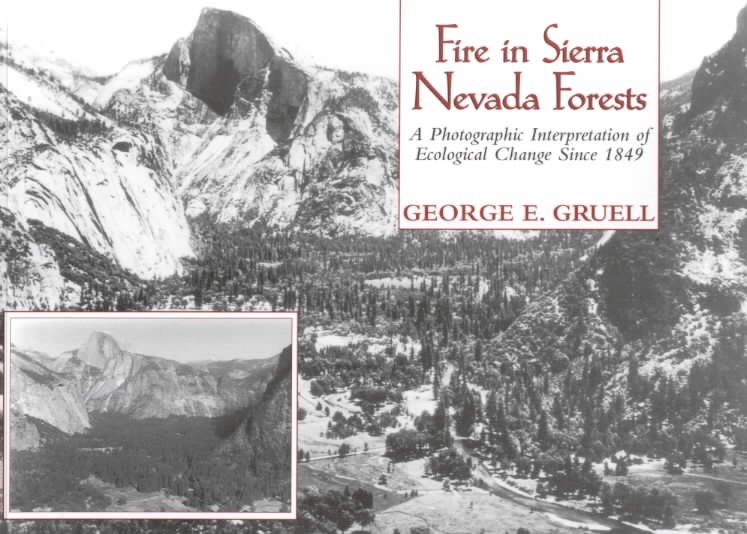
The image at the top of this post is from the cover of a book by wildlife biologist George E. Gruell, published in 2001. The author includes hundreds of historical photos of forests in the Sierra Nevada range from as early as 1849. He pairs them with photos of the same views in the late 20th century, such as the photo inset on the cover shown above. The remarkable thing is that the old forests were quite thin by comparison. The following quote is from a review of the book on Amazon:

“Even the famed floor of Yosemite is now mostly forested with conifers. I myself love conifers but George makes an interesting point that these forests are “man made” and in many ways are unhealthy from the standpoint that they lead to canopy firestorms that normally don’t exsist when fires are allowed to naturally burn themselves out. Fire ecology is important and our fear of forest fires has led to an ever worsening situation in the Sierra Nevada.”

I posted this piece on forest fires and climate change three months ago. There is ample reason to attribute the recent magnitude of wildfires to conditions influenced by forest management policy. The contribution of a relatively modest change in average temperatures over the past several decades (but primarily during the 1990s) is rather doubtful. And the evidence that warming-induced drought is the real problem is weakened considerably by the fact that the 20th century was wetter than normal in California. In other words, recent dry conditions represent something of a return to normal, making today’s policy-induced overgrowth untenable.

Wildfires are a natural phenomenon and have occurred historically from various causes such as lightning strikes and even spontaneous combustion of dry biomass. They are also caused by human activity, both accidental and intentional. In centuries past, Native Americans used so-called controlled or prescribed burns to preserve and restore grazing areas used by game. In the late 19th and early 20th centuries, fire suppression became official U.S. policy, leading to an unhealthy accumulation of overgrowth and debris in American forests over several decades. This trend, combined with a hot, dry spell in the 1930s, led to sprawling wildfires. However, Warren Meyer says the data on burnt acreage during that era was exaggerated because the U.S. Forest Service insisted on counting acres burned by prescribed burns in states that did not follow its guidance against the practice.

The total acreage burned by wildfires in the U.S. was minimal from the late 1950s to the end of the century, when a modest uptrend began. In California, while the number of fires continued to decline over the past 30 years, the trend in burnt acreage has been slightly positive. Certainly this year’s mega-fires will reinforce that trend. So the state is experiencing fewer but larger fires.

The prior success in containing fires was due in part to active logging and other good forest management policies, including prescribed burns. However, the timber harvest declined through most of this period under federal fire suppression policies, California state policies that increased harvesting fees, and pressure from environmentalists. The last link shows that the annual “fuel removed” from forests in the state has declined by 80% since the 1950s. But attitudes could be changing, as both the state government and environmentalists (WSJ, link could be gated) are beginning to praise biomass harvesting as a way to reduce wildfire risk. Well, yes!

The reason wildfire control ever became a priority is the presence of people in forest lands, and human infrastructure as well. Otherwise, the fires would burn as they always have. Needless to say, homes or communities surrounded by overgrown forests are at great risk. In fact, it’s been reported that the massive Camp Fire in Northern California was caused by a PG&E power line. If so, it’s possible that the existing right-of-way was not properly maintained by PG&E, but it may also be that rights-of-way are of insufficient width to prevent electrical sparks from blowing into adjacent forests, and that’s an especially dangerous situation if those forests are overgrown.

Apparently Donald Trump is under the impression that state policies are largely responsible for overgrown and debris-choked forests. In fact, both federal and state environmental regulations have played a major role in discouraging timber harvesting and prescribed burns. After all, the federal government owns about 57% of the forested land in California. Much of the rest is owned privately or is tribal land. Trump’s threat to withhold federal dollars was his way of attempting to influence state policy, but the vast bulk of federal funds devoted to forest management is dedicated to national forests. A relatively small share subsidizes state and community efforts. Disaster-related funding is and should be a separate matter, but Trump made the unfortunate suggestion that those funds are at issue. Nevertheless, he was correct to identify the tremendous fire hazard posed by overgrown forests and excessive debris on the forest floor. Changes to both federal and state policy must address these conditions.

For additional reading, I found this article to give a balanced treatment of the issues.

If You’re Already Eligible, Your Benefits Are Safe

06 Tuesday Nov 2018

Posted by Nuetzel in Medicare, Social Security

≈ Leave a comment

Tags

Asset Sales, COLA, Defined Benefits, Defined Contributions, Entitlement Reform, Federal Borrowing, Medicare, Medicare Advantage, Pay-As-You-Go, Paygo, payroll taxes, Social Security, Social Security Trust Fund, Swedish Public Pensions

I’m always hearing fearful whines from several left-of-center retirees in my circle of my acquaintances: they say the GOP wants to cut their Social Security and Medicare benefits. That expression of angst was reprised as a talking point just before the midterm election, and some of these people actually believe it. Now, I’m as big a critic of these entitlement programs as anyone. They are in very poor financial shape and in dire need of reform. However, I know of no proposal for broad reductions in Social Security and Medicare benefits for now-eligible retirees. In fact, thus far President Trump has refused to consider substantive changes to these programs. And let’s not forget: it was President Obama who signed into law the budget agreement that ended spousal benefits for “file and suspend” Social Security claimants.

Both Social Security (SS) and Medicare are technically insolvent and reform of some kind should happen sooner rather than later. It does not matter that their respective trust funds still have positive balances — balances that the federal government owes to these programs. The trust fund balances are declining, and every dollar of decline is a dollar the government pays back to the programs with new borrowing! So the trust funds should give no comfort to anyone concerned with the health of either of these programs or federal finances.

Members of both houses of Congress have proposed steps to shore up SS and Medicare. A number of the bills are summarized and linked here. The range of policy changes put forward can be divided into several categories: tax hikes, deferred benefit cuts, and other, creative reforms. Future retirees will face lower benefits under many of these plans, but benefit cuts for current retirees are not on the table, except perhaps for expedient victims at high income levels.

There is some overlap in the kinds of proposals put forward by the two parties. One bipartisan proposal in 2016 called for reduced benefits for newly-eligible retired workers starting in 2022, among a number of other steps. Republicans have proposed other types of deferred benefit cuts. These include increasing the age of full eligibility for individuals reaching initial (and partial) eligibility in some future year. Generally, if these kinds of changes were to become law now, they would have their first effects on workers now in their mid-to-late fifties.

Another provision would switch the basis of the cost-of-living adjustment (COLA) to an index that more accurately reflects how consumers shift their purchases in response to price changes (see the last link). The COLA change would cause a small reduction in the annual adjustment for a typical retiree, but that is not a future benefit reduction: it is a reduction in the size of an annual benefit increase. However, one Republican proposal would eliminate the COLA entirely for high-income beneficiaries (see the last link) beginning in several years. A few other proposals, including the bipartisan one linked above, would switch to an index that would yield slightly more generous COLAs.

Democrats have favored increased payroll taxes on current high earners and higher taxes on the benefits of wealthy retirees. Republicans, on the other hand, seem more willing to entertain creative reforms. For example, one recent bill would have allowed eligible new parents to take benefits during a period of leave after childbirth, with a corresponding reduction in their retirement benefits (in present value terms) via increases in their retirement eligibility ages. That would have almost no impact on long-term solvency, however. Another proposal would have allowed retirees a choice to take a portion of any deferred retirement credits (for declining immediate benefits) as a lump sum. According to government actuaries, the structure of that plan had little impact on the system’s insolvency, but there are ways to present workers with attractive tradeoffs between immediate cash balances and future benefits that would reduce insolvency.

The important point is that enhanced choice can be in the best interests of both future retirees and long-term solvency. That might include private account balances with self-directed investment of contributions or a voluntary conversion to a defined contribution system, rather than the defined benefits we have now. The change to defined contributions appears to have worked well in Sweden, for example. And thus far, Republicans seem more amenable to these creative alternatives than Democrats.

As for Medicare, the only truth to the contention that the GOP, or anyone else, has designs on reducing the benefits of current retirees is confined the to the possibility of trimming benefits for the wealthy. The thrust of every proposal of which I am aware is for programmatic changes for future beneficiaries. This snippet from the Administration’s 2018 budget proposal is indicative:

“Traditional fee-for-service Medicare would always be an option available to current seniors, those near retirement, and future generations of beneficiaries. Fee-for-service Medicare, along with private plans providing the same level of health coverage, would compete for seniors’ business, just as Medicare Advantage does today. The new program, however, would also adopt the competitive structure of Medicare Part D, the prescription drug benefit program, to deliver savings for seniors in the form of lower monthly premium costs.”

There was a bogus claim last year that pay-as-you-go (Paygo) rules would force large reductions in Medicare spending, but Medicare is subject to cuts affecting only 4% of the budgeted amounts under the Paygo rules, and Congress waived the rules in any case. Privatization of Medicare has provoked shrieks from certain quarters, but that is merely the expansion of Medicare Advantage, which has been wildly popular among retirees.

Both Social Security and Medicare are in desperate need of reform, and while rethinking the fundamental structures of these programs is advisable, the immediate solutions offered tend toward reduced benefits for future retirees, later eligibility ages,  and higher payroll taxes from current workers. The benefits of currently eligible retirees are generally “grandfathered” under these proposals, the exception being certain changes related to COLAs and Medicare benefits for high-income retirees. The tendency of politicians to rely on redistributive elements to enhance solvency is unfortunate, but with that qualification, my retiree friends need not worry so much about their benefits. I suspect at least some of them know that already.

Missouri Prop B: the Unintended Consequences of Wishful Thinking

04 Sunday Nov 2018

Posted by Nuetzel in Labor Markets, Living Wage, Minimum Wage, Uncategorized

≈ Leave a comment

Tags

Anti-Poverty Programs, Automation, David Macpherson, Disparate impact, Fringe Benefits, Living Wage, Marginal Productivity, Minimum Wage, Missouri Proposition B, The Show Me Institute, Unskilled Labor, William Evan

Proposition B sounds really good to many Missouri voters: all we have to do to help low-wage workers is declare that they must be paid a higher wage. That’s the pitch, of course. But voters should hear the cruel truth about the unintended consequences of this well-intentioned and ill-considered proposition on the ballot this week:

  1. Businesses are likely to increase prices to compensate for a higher mandated wage, which hurts all consumers, but especially the poor.
  2. Some low-skilled job losses or lost hours are assured, and they will hit the very least-skilled the hardest. No matter the legal minimum, the real minimum wage is always zero.
  3. Such job losses have long-term consequences: lost job experience that the least-skilled desperately need to get ahead.
  4. The harms will have a disparate impact on minorities.
  5. Large employers can substitute capital for low-skilled labor: automated kiosks to take orders and increasingly sophisticated robots to perform tasks. Again, the real minimum wage is always zero. As I’ve said before on this blog, automate no job before its time. But that’s what Prop B will encourage.
  6. Employers can make other compensatory changes. That includes reduced fringe benefits and break times, increased production quotas, and less desirable shifts for minimum wage workers.
  7. A large share of the presumed beneficiaries of a higher minimum wage are not impoverished. Many are teenagers or young adults living with their parents.
  8. All of the preceding points argue that an increase in the minimum wage is not an effective method of targeting poverty reduction. In fact, the harm it inflicts is targeted at the most needy. 
  9. Small employers have less flexibility than large employers, and Prop B would place them at a competitive disadvantage. To that extent, a higher wage floor is most damaging to “mom & pop”, locally-owned businesses, and their employees. Again, the real minimum wage is always zero.

At least 24 earlier posts appear on this blog covering the topic of minimum wages. You can see most of them here. The points above are explored in more detail in those posts.

William Evan and David MacPherson of the Show-Me Institute have estimated the magnitude of the harms that are likely to result if Prop B is approved by voters on November 6, and they are significant. The voters of Missouri should not be seeking ways to make the state’s business environment less competitive.

Voters should keep in mind that wages in an unfettered market reflect the realities of labor demand and labor supply. Wages and other forms of compensation reflect the actual quantity, quality and productivity of available labor supplies. And for unskilled labor, which is often supplied by those who lack experience, a wage that matches their marginal productivity is one that provides that valuable experience. The last thing they need is for tasks requiring little skill to be performed by more experienced employees, or by machines. We cannot wish away these realities, and we cannot declare them suspended by law. Such efforts will have winners and losers, of course, though the former might not ever recognize the ephemeral nature of their gains. And as long as there is freedom of private decision-making, the consequences of such legal efforts will cause harm to those least able to withstand it.

Economic Freedom and Mobility Reduce Poverty; Alms Are Impotent

02 Friday Nov 2018

Posted by Nuetzel in Free markets, Immigration, Property Rights

≈ Leave a comment

Tags

Direct Aid, Direct Assistance, Economic Freedom, Growth Accelerations, Immigration Quotas, Labor Markets, Labor Mobility, Lant Pritchard, Migration, Open Borders, Poverty Reduction, Property Rights

It’s very difficult to lift people out of poverty via redistribution or philanthropy. Small gains in income can be expected at best, but there are far more powerful ways to improve well being. These have to do with expanding the fundamental freedoms, rights and rewards available to private individuals. Harvard’s Lant Pritchard divides these efforts into two broad categories: policies that improve labor mobility, and those that lead to gains in-place via economic growth. His working paper, “Alleviating Global Poverty: Labor Mobility, Direct Assistance, and Economic Growth”, is available here.

Economic Benefits of Migration 

Pritchard first explains that the freedom to migrate across borders in pursuit of economic opportunity allows workers from low-productivity countries to contribute much greater output in high productivity countries. In so doing, the workers gain far more than can be practically accomplished via direct aid, and according to Pritchard, at zero or little cost. So granting this freedom is a much more effective anti-poverty measure than aid payments.

Pritchard seems to imply that this is a persuasive economic argument for open borders. On that question, I take the position that countries are sovereign entities and that their citizens possess the right to determine the extent of immigration flows. And in fact, there are real costs of immigration flows that must be considered. Pritchard’s paper offers a powerful rationale for liberalizing immigration quotas, but here again, he dismisses certain issues that limit even that more narrow argument.

The prospective economic gains of the immigrants themselves are important, of course, but the economic needs of the destination country matter too. In the U.S., employers in many markets face a shortage of low-skilled labor, so immigration quotas bind on those markets. Making them less binding would certainly encourage economic growth. A greater influx of younger workers from abroad would also help America weather its demographic crisis, narrowing the shortfall in funding entitlement programs like Social Security and Medicare. Unfortunately, to those who do not already recognize these needs, Pritchard’s contribution is likely to carry little weight.

Still, Pritchard’s assertion that the cost of liberalized immigration is zero needs further examination. First, there are the very real costs of vetting and processing new immigrants. Second, unless all immigrants and employers are matched ex ante, which is virtually impossible, there will be adjustment costs that continue at least until the matching is complete. In the interim, and even post-employment, new immigrants might well require public aid to support themselves and their families. It is also quite likely that new tax revenue generated by immigrants will be insufficient to pay the full incremental costs of public resources consumed in providing marginal infrastructure, education, and other public subsidies.

Pritchard employs static calculations of the net benefits to be gained through greater labor mobility “at the margin”, but as the absorption of new immigrants into the workforce takes place, excess demands for low-skilled workers may turn into excess supplies, creating downward pressure on wages. In the presence of a minimum wage, that implies unemployment and a probable drain on public resources. So the source of the benefits discussed by Pritchard should not be viewed as limitless. He offers some mild rebuttals of this point and references one of his own papers in so doing, but the possibility cannot and should not be dismissed.

Economic Benefits of Economic Freedom

Pritchard’ second major point of emphasis involves the effectiveness of different kinds of private and public direct assistance, or “treatments”, in producing income gains over time. He offers evidence that the gains are relatively weak. He contrasts this with the potential gains from “growth accelerations” stemming from a variety of causes. The upside of a normal business cycle is one form, but that doesn’t really count if the gains are lost on the downside.

The most profound form of growth acceleration occurs upon the advent of a liberalized social order. This may accompany the downfall of an authoritarian government, the stabilization of a formerly unsound monetary regime, or as more sophisticated market institutions take hold in a formerly primitive economy. The main point is that there are fundamental social underpinnings of growth. These are the many dimensions of economic freedom: secure property rights, freedom of contract, minimal regulatory interference, low taxes, and competitive markets for goods and capital. These conditions are so straightforward that in developed economies we take many of them for granted, through they are threatened even there. But these conditions are sadly lacking in much of the under-developed world.

Conclusion

Allowing workers to migrate freely in search of the best opportunities is undoubtedly more powerful in improving their welfare than any form of direct assistance. That is a fundamental truth put forward by Lant Pritchard. However, in-migration can come with significant costs for the destination country. Therefore, immigration laws should allow sufficient flexibility with respect to flows to enable the capture of economic gains from immigration when they exist. Pritchard also emphasizes that economic freedom and the growth acceleration it makes possible do far more to reduce poverty than massive private and public efforts at direct assistance, however well-intentioned. Several earlier posts on Sacred Cow Chips have highlighted the impotency of redistribution for eliminating poverty. The Left has a tendency to dismiss such views as mere ideological assertion, but it is much more than that: it is the difference between penury and prosperity.

← Older posts
Newer posts →
Follow Sacred Cow Chips on WordPress.com

Recent Posts

  • Grading Trump II, So Far
  • A Warsh Policy Scenario At the Federal Reserve
  • The Coexistence of Labor and AI-Augmented Capital
  • The Case Against Interest On Reserves
  • Immigration and Merit As Fiscal Propositions

Archives

  • March 2026
  • February 2026
  • January 2026
  • December 2025
  • November 2025
  • October 2025
  • September 2025
  • August 2025
  • July 2025
  • June 2025
  • May 2025
  • April 2025
  • March 2025
  • February 2025
  • January 2025
  • December 2024
  • November 2024
  • October 2024
  • September 2024
  • August 2024
  • July 2024
  • June 2024
  • May 2024
  • April 2024
  • March 2024
  • February 2024
  • January 2024
  • December 2023
  • November 2023
  • August 2023
  • July 2023
  • June 2023
  • May 2023
  • April 2023
  • March 2023
  • February 2023
  • January 2023
  • December 2022
  • November 2022
  • October 2022
  • September 2022
  • August 2022
  • July 2022
  • June 2022
  • May 2022
  • April 2022
  • March 2022
  • February 2022
  • January 2022
  • December 2021
  • November 2021
  • October 2021
  • September 2021
  • August 2021
  • July 2021
  • June 2021
  • May 2021
  • April 2021
  • March 2021
  • February 2021
  • January 2021
  • December 2020
  • November 2020
  • October 2020
  • September 2020
  • August 2020
  • July 2020
  • June 2020
  • May 2020
  • April 2020
  • March 2020
  • February 2020
  • January 2020
  • December 2019
  • November 2019
  • October 2019
  • September 2019
  • August 2019
  • July 2019
  • June 2019
  • May 2019
  • April 2019
  • March 2019
  • February 2019
  • January 2019
  • December 2018
  • November 2018
  • October 2018
  • September 2018
  • August 2018
  • July 2018
  • June 2018
  • May 2018
  • April 2018
  • March 2018
  • February 2018
  • January 2018
  • December 2017
  • November 2017
  • October 2017
  • September 2017
  • August 2017
  • July 2017
  • June 2017
  • May 2017
  • April 2017
  • March 2017
  • February 2017
  • January 2017
  • December 2016
  • November 2016
  • October 2016
  • September 2016
  • August 2016
  • July 2016
  • June 2016
  • May 2016
  • April 2016
  • March 2016
  • February 2016
  • January 2016
  • December 2015
  • November 2015
  • October 2015
  • September 2015
  • August 2015
  • July 2015
  • June 2015
  • May 2015
  • April 2015
  • March 2015
  • February 2015
  • January 2015
  • December 2014
  • November 2014
  • October 2014
  • September 2014
  • August 2014
  • July 2014
  • June 2014
  • May 2014
  • April 2014
  • March 2014

Blogs I Follow

  • Passive Income Kickstart
  • OnlyFinance.net
  • TLC Cholesterol
  • Nintil
  • kendunning.net
  • DCWhispers.com
  • Hoong-Wai in the UK
  • Marginal REVOLUTION
  • Stlouis
  • Watts Up With That?
  • American Elephants
  • The View from Alexandria
  • The Gymnasium
  • A Force for Good
  • Notes On Liberty
  • troymo
  • SUNDAY BLOG Stephanie Sievers
  • Miss Lou Acquiring Lore
  • Your Well Wisher Program
  • Objectivism In Depth
  • RobotEnomics
  • Orderstatistic
  • Paradigm Library
  • Scattered Showers and Quicksand
  • Jam Review

Blog at WordPress.com.

Passive Income Kickstart

OnlyFinance.net

TLC Cholesterol

Nintil

To estimate, compare, distinguish, discuss, and trace to its principal sources everything

kendunning.net

The Future is Ours to Create

DCWhispers.com

Hoong-Wai in the UK

A Commonwealth immigrant's perspective on the UK's public arena.

Marginal REVOLUTION

Small Steps Toward A Much Better World

Stlouis

Watts Up With That?

The world's most viewed site on global warming and climate change

American Elephants

Defending Life, Liberty and the Pursuit of Happiness

The View from Alexandria

In advanced civilizations the period loosely called Alexandrian is usually associated with flexible morals, perfunctory religion, populist standards and cosmopolitan tastes, feminism, exotic cults, and the rapid turnover of high and low fads---in short, a falling away (which is all that decadence means) from the strictness of traditional rules, embodied in character and inforced from within. -- Jacques Barzun

The Gymnasium

A place for reason, politics, economics, and faith steeped in the classical liberal tradition

A Force for Good

How economics, morality, and markets combine

Notes On Liberty

Spontaneous thoughts on a humble creed

troymo

SUNDAY BLOG Stephanie Sievers

Escaping the everyday life with photographs from my travels

Miss Lou Acquiring Lore

Gallery of Life...

Your Well Wisher Program

Attempt to solve commonly known problems…

Objectivism In Depth

Exploring Ayn Rand's revolutionary philosophy.

RobotEnomics

(A)n (I)ntelligent Future

Orderstatistic

Economics, chess and anything else on my mind.

Paradigm Library

OODA Looping

Scattered Showers and Quicksand

Musings on science, investing, finance, economics, politics, and probably fly fishing.

Jam Review

"If you get confused, listen to the music play."

  • Subscribe Subscribed
    • Sacred Cow Chips
    • Join 128 other subscribers
    • Already have a WordPress.com account? Log in now.
    • Sacred Cow Chips
    • Subscribe Subscribed
    • Sign up
    • Log in
    • Report this content
    • View site in Reader
    • Manage subscriptions
    • Collapse this bar
 

Loading Comments...