• About

Sacred Cow Chips

Sacred Cow Chips

Author Archives: Nuetzel

Government Output: Illusions and Handicaps

09 Sunday Sep 2018

Posted by Nuetzel in Big Government

≈ Leave a comment

Tags

Daniel J. Mitchell, Education, GDP, Heritage Foundation, Industrial Policy, infrastructure, Market Test, National Income Accounting, Redistribution, Spending Aggregates, Taxes Incentives

Building a big government is thought to be a luxury that prosperous nations can afford, but such efforts have a systematically negative effect on their ability to generate income, much as eating the seed corn delivers a farmer to poverty. Daniel J. Mitchell puts it bluntly in a piece entitled “Rich Nations That Enact Big Government Don’t Remain Rich“. This is nowhere more obvious than in Argentina and Venezuela, two nations that were prosperous 50 years ago and are now economically feeble, or in Venezuela’s case, imploding. Government, in the final analysis, extracts resources from the private economy, often contributing negatively to productivity. Yet the idea that government is a tonic for economic growth persists, and it persists even in the face of weakness induced by excessive government.

Government statistics on Gross Domestic Product (GDP) exaggerate the contribution of government to income in at least a couple of ways. To understand why, it’s necessary to distinguish between spending aggregates and income aggregates, which add up to the same total GDP. The former  include consumption, investment, and government spending. Income aggregates are the other side of the GDP “coin”: payments made to factors of production, which represent GDP as a measure of output value.

A dissociation between these alternative views of GDP with respect to government’s contribution is that government payments count as spending and income regardless of the recipient’s contribution to output. Even if nothing is accomplished, nothing is produced, it is measured as income and spending and it is an increment to GDP. Payments to dig holes and refill them contribute to GDP as long as the government does the “job”. By contrast, if a worker in the private sector is paid but produces nothing of value, the firm’s owners suffer a loss of income corresponding to the worker’s pay, and GDP is unchanged! So increased factor payments by government cause an implicit bias in the measurement of output.

A second government bias implicit in GDP statistics is that public spending and government labor payments are often not subjected to a “market test” of value. The activity is “mandated”, so there is no correspondence to a willingness to pay or real value. Public employee unions exaggerate these distortions. There are generally no competitors for government provision of services, few incentives for efficiency, and often little discipline in government procurement processes. So the pricing of government transactions tends to be inflated. And yet when the government gets ripped off by overcharges or cronyist kickbacks, the excess payments contribute positively to GDP. In contrast, when a private firm gets ripped off, its income is correspondingly reduced and the transaction generally will not contribute to GDP.

It takes taxes to fund government, either immediate or deferred, and the taxes are either explicit or implicit in the form of eroded purchasing power. This creates negative incentives that retard private investment incentives, work incentives, and thereby private economic growth. Redistributional efforts retard work incentives as well because welfare–state beneficiaries often face high marginal tax rates on earned income.

Does big government represent a good investment for the wealth of a prosperous nation? In view of the above, one can hardly trust official statistics in rendering a judgement on that question. But despite these distortions, big government and measured economic growth are still negatively correlated. Mitchell provides more detailed analysis of government and economic growth at Heritage, including a set of references to academic papers on the topic.

One important way that government may contribute to economic growth is through the provision of physical infrastructure, which theoretically improves efficiency in private production. However, public infrastructure spending is subject to the same upward cost pressures discussed above, it is often tied to bumbling industrial policy efforts, its utilization by the public is usually mis-priced, and governments are congenitally inept at operating facilities efficiently. It is not clear that private developers could be counted upon to fill the void without some form of partnership with government, however, which has its own pitfalls. There are certainly reforms that could make private and public infrastructure investment and operation more viable, such as eliminating regulatory roadblocks to the installation of new facilities.

Another area in which government may generate a positive economic return is public investment in education, but that return is far from guaranteed. The success of public education investment depends on a wide range of cultural, political, and economic factors. For example, Cuba has the third largest proportion of government education spending to GDP, but the country’s ability to profit from that investment is severely crimped by its totalitarian economic and political system. I have been a frequent critic of public education in general, and I am not persuaded that education is truly a public good, despite some degree of spillover benefit. And while education may be a worthwhile national priority in many circumstances, it is not clear that government should necessarily fund education, let alone “run” education. Public education spending certainly doesn’t automatically translate to effective education outcomes, and it does not guarantee economic growth.

There is great exaggeration regarding the success of certain nations that have allowed government to absorb a large share of resources. That includes many of the European states, for which average incomes are roughly comparable to the Mississippi Delta. Only Luxembourg, Norway and Switzerland have income levels that are respectable relative to the U.S., and Norway relies heavily on oil extraction. Attributing economic power to government in the Nordic countries is especially misleading because the strength of those economies has always stemmed from their fundamentally capitalist underpinnings. Sweden built its wealth on capitalism, but it has cannibalized that strength over several decades with a burgeoning welfare state and high taxes. It only recently has begun attempting to reverse course.

Economic progress is unlikely to be achieved by “investing” in a larger public sector. Instead, encouraging private activity via positive incentives and minimal regulatory interference is a better route to success. The measured economic benefits of government spending are illusory to a significant degree. Even those activities thought to be the most productive avenues for government involvement, like investment in infrastructure and education, are plagued by cost inflation and incompetent execution. Finally, cross-country empirical evidence confirms that a more dominant public sector is associated with lower income growth. And yet there will always be a faction subscribing to the infantile, “free-lunch” belief that big government can deliver growth, and deliver it in excess of the predictable damage it inflicts on the private economy.
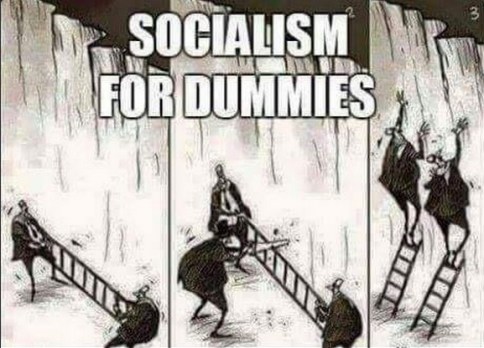
New Socialists Fail Socialism 101

02 Sunday Sep 2018

Posted by Nuetzel in Big Government, Socialism

≈ Leave a comment

Tags

Alexandria Ocasio-Cortez, Authoritarian, Compassion, Democratic Socialism, Exclusivity, Free Rider Problem, Imprimis, Jeffrey Tucker, Maine Wire, Matthew Gagnon, Means of Production, Private Goods, Public goods, Safety Net, Socialism, The Claremont Review of Books, William Vogeli

Not many self-styled socialists can actually provide a proper definition of socialism these days. That includes the celebrated Alexandria Ocasio-Cortez, the New York congressional candidate who has proven herself to be an incredible stumble-bum in numerous media appearances since her primary victory over incumbent democrat Joe Crowley. Maine Wire‘s Matthew Gagnon calls her “belligerently ignorant” as she tweets what she believes to be examples of democratic socialism. Gagnon dissects some of her flakey assertions. The sad truth is that Ocasio-Cortez is fairly typical of her generation, despite her dual college majors in economics and political science.

Gagnon notes that socialism is public ownership of the means of production. But socialism is somehow regarded as a “soft” version of communism: less authoritarian, perhaps. That premise deserves closer examination. There is only one way that the public sector can take possession of private property: by force. A new, authoritarian regime might simply commandeer property, nationalize it, and revoke prior ownership claims at the point of a gun or a club. The government would ultimately impose new rules under which management of formerly private enterprises must operate, and it would engage in centralized decision-making and planning to a large extent. This is essentially communism. Some personal freedoms might be preserved, but they are likely to be severely curtailed; dissidence is not likely to be tolerated.

There is another mechanism by which society can declare public ownership of productive resources that is nominally less authoritarian: democracy. Citizens or their elected representatives simply vote for the state to acquire particular resources and enterprises, in whole or in part. Enabling legislation might authorize administrative agencies to determine how the former private owners of these enterprises are to be compensated. To one extent or another, this involves takings of private property and rights, and it boils down to a very real tyranny of the majority: we will vote to take possession of your business; we will vote to create a bureau that will determine its worth and your compensation; we will vote that henceforth you may not operate this business on your own behalf, but only in the service of the people; and we will vote on what rights you possess. This is the ugly tyranny of democratic socialism, and it still requires force.

Self-proclaimed socialists are fond of proclaiming that we already have socialism in many sectors of the economy. They cite public parks, roads, bridges, K-12 education, and other goods and services sometimes provided by the public sector. There is a key distinction, however, that separates many of these examples from actual socialism: whether a good is actually a “public good”, meaning that its benefits are non-exclusive, as opposed to a private good that yields exclusive benefits. A more precise definition of socialism, in my view, is public ownership of the means of producing private goods.

The typical example of a public good is national defense: the benefits I receive do not reduce the benefits you receive, so those benefits are non-exclusive. I have little personal incentive to pay for national defense if anyone else is willing to pay for it, as I’ll receive the benefits anyway. But who will pay if everyone tries to free-ride on others? That’s why the provision of public goods is an appropriate function of government, and it is not generally what is meant by socialism. Gagnon is correct that government involvement in an activity is not the same as socialism, and he correctly ridicules some examples of governmental activities (and non-governmental activities like cooperatives) that Ocasio-Cortez believes to be socialism.

In contrast to public goods, private goods are exclusive in their benefits. The development of a private market can be counted upon to fulfill demands for such goods because private individuals are willing to pay. However, when government grants itself an advantaged position as a provider in such a market, such as a monopoly franchise, we can safely describe it as socialism. Many goods are not purely private, having some degree of non-exclusivity in their benefits. This is commonly asserted to be the case for K-12 education, but the matter is not as clear-cut as the public education establishment would have you believe. The bulk of the benefits to education accrue privately. Therefore, it is fair to describe public K-12 education in the U.S. as socialism. And it is largely a disaster.

Is a social safety net rightly described as socialism? Gagnon thinks not and, strictly speaking, the welfare state does not require public ownership of the means of production, only a means of redistribution. It requires funding, so private resources will be extracted via taxes, and the same is true of public goods. Taxes do not make it “socialism”. Let’s stipulate for the moment that there is a true safety net supporting only those unable to support themselves, either on a temporary or a permanent basis. This may yield non-exclusive benefits to the extent that such a “lifeline” reduces crime, begging, and our personal discomfort with the possibility that other individuals might starve. However, on an ex ante basis, some of these benefits represent a form of risk reduction that, in principle, could be arranged privately. To the extent that we vote to provide these potentially private benefits, those parts of the safety net can be construed as democratic socialism. In practice, our “safety net” covers a large number of able-bodied individuals. Unfortunately, it does a poor job of encouraging self-sufficiency. Like most public benefit programs, it is expansive, poorly designed, and has pernicious effects on the private economy that act to the long-term detriment of its intended beneficiaries.

Leftists fancy that socialism is “compassionate” and righteous, despite its predictably harsh outcomes. The misleading conceit that universal alms-giving by the state is always empowering to individual recipients, and potential voters, is an extremely corrosive element of democratic socialism. William Voegeli, Senior Editor of The Claremont Review of Books, writing in Imprimis makes “The Case Against Liberal Compassion“. (I dislike his misuse of the word “liberal” — too many conservatives are willing to cede that label to the Left.) Voegeli notes the “never enough” mentality of welfare statists, who refuse to acknowledge that the expansive growth of the welfare state over the past five decades has failed to reduce rates of poverty. The programs are rife with fraud, waste and bad incentives. If leftists are truly compassionate, Voegeli insists, they ought to take more interest in fixing problems that leave less for the truly needy and create dependencies rather than simply increasing the flow of funding.

Many well-meaning individuals are careless about affiliating with socialist causes because they do not understand what it actually means, and they often lack any historical and theoretical perspective on the implications of socialism. The flirtation is dangerous, and we can only attempt to educate and reason with them. Some will grow into greater wisdom. Some, like Bernie Sanders, will never come around. While we educate, let’s keep their hands away from the reins of power.

Handy Q+A: Policing For Whiffs of Racism/Sexism

25 Saturday Aug 2018

Posted by Nuetzel in Identity Politics

≈ Leave a comment

Tags

Cultural Appropriation, Identity Politics, Kendrick Lamar, Manhattan Contrarian, Meritocracy, racism, Sexism, Victimhood, Zionism

ααα

Too many folks today are disquieted by the possibility of uttering some erstwhile harmless expression that might conceivably offend peoples of various identity groups. As a service to my readers, I have decided to share a link to this thoughtful guide, actually a quiz, from the Manhattan Contrarian: “How To Identify Racist And Sexist Remarks And Slurs“. It is a short field guide, as it were, but one that may be applied to the “field of the mind” to fend off impurities of thought. In this day and age, one can’t be too careful!

Those who wish to score themselves on the quiz without exposure to spoilers should proceed directly to the link. I hope others, after reading just two of the questions and answers I quote below, will be so moved by the spirit of the exercise that they will go to the link to read the quiz in its entirety. Here are two of the questions and answers:

Q: “You say, ‘I believe the most qualified person should get the job.'”

A: “Obviously, this is racist, and probably sexist as well. … This statement demonstrates the ‘myth of meritocracy‘ and ‘assert[s] that race does not play a role in life successes.‘ It conveys the ‘message‘ that ‘[p]eople of color are given extra unfair benefits because of their race.‘”

Q: “I don’t give a, I don’t give a, I don’t give a fuck. I’m willin’ to die for this shit.  I done cried for this shit, might take a life for this shit. Put the Bible down and go eye to eye for this shit … If I gotta slap a pussy-ass nigga, I’ma make it look sexy.”

A: “Racist? Are you kidding????? These are lyrics from the song “Element,” from the album DAMN, by Kendrick Lamar, that won the Pulitzer Prize for music back in March. Obviously, if you had written this first, you would have won the Pulitzer Prize instead of Lamar.”

You must be attuned to the logic and politics of identity. Do NOT stumble into any implication that a thing matters that could be associated with an identity group, no matter how coincidentally. And do NOT under any circumstances attempt to adopt an element of the culture of another identity group, be it food, dress, music, or language. At the same time, however, do NOT forget that nothing matters more than honoring and paying restitution to each and every identity group that might have a claim to victimhood. Except for Jews, especially Zionists. Hope you like your straightjacket extra-tight.

Liz Warren Pitches Another Goofball

23 Thursday Aug 2018

Posted by Nuetzel in Central Planning, Property Rights, Regulation

≈ Leave a comment

Tags

Accountable Capitalism Act, Board Activism, Don Boudreaux, Elizabeth Warren, Fifth Amendment, Kevin Williamson, Matt Yglesias, Richard Epstein, Unconstitutional Conditions

Elizabeth Warren wants to nationalize all private businesses with more than $1 billion in annual revenue. She plans to introduce legislation called the “Accountable Capitalism Act” that would, if enacted, authorize an outright theft of private property from the owners of these companies. Among other things, her plan would require large companies to obtain a federal charter and set aside 40% of their board seats for members to be elected by employees. In addition, henceforth these businesses would be answerable not merely to shareholders, but to employees along with a limitless array of other “stakeholders”. That’s because under their federal charters, firms would have a duty to create a “general public benefit”. The operative assumption here is that merely creating a product or service does not produce adequate value for society, regardless of the benefits to buyers, income to employees and suppliers, taxes paid, and the returns earned by millions of working people who have invested in these companies via pension and 401(k) plans.

In the very first place, Warren’s bill is unconstitutional, as Richard Epstein points out. Owning a business is protected as a property right under several amendments to the U.S. Constitution, but particularly the Fifth Amendment. Warren would place unconstitutional conditions on this right via the requirements for a federal charter and the so-called public benefit. If enacted, her bill would quite likely be ruled unconstitutional by the courts. But if it stood, capital would quickly take flight from the U.S., depressing asset values.

Don Boudreaux notes that absent ownership, vaguely-defined “stakeholders” have risked nothing in the success of the company. Shareholders bear the financial risk that the company will fail to produce adequate earnings, lose value, or fail. Management has a fiduciary duty to protect the funds that shareholders invest in the firm, including a duty to protect the firm’s ability to acquire credit. Warren’s legislation would compromise these duties by elevating the objectives of non-owners to the same or greater status than those who have provided the equity capital. Again, this would happen in at least two ways: required representation of employee-elected board members, and the vague public-benefit mandate under the firm’s federal charter.

Significant employee representation on the board is likely to distort decisions about labor compensation and virtually any decision affecting employment. While 40% is short of a board majority, union pension funds already purchase shares in companies both as investments and as a way of driving labor issues before shareholders and into boardrooms. Those votes, along with the 40% board representation and oversight from federal bureaucrats, would give additional leverage to labor in influencing the firm’s decision-making. To take the simplest case, economic efficiency requires that the rate of labor compensation be the same as the marginal value of labor productivity. Warren’s proposal would surely result in wage payments exceeding this threshold, diminishing the economic value of the firm and its ability to raise capital. And by reducing the efficiency of the production process, it would raise costs to consumers and/or business customers.

There any number of other worker demands that would gain viability. For example, extended break times or extra paid-time-off would certainly raise costs, and such demands from a plurality of the board would be unrestrained by the need to negotiate other terms. Or how about a plant-closing decision? The upshot is that mandated board representation for labor would create instability and lead to a decline in the firm’s performance, competitiveness, and attractiveness to suppliers of capital. Ultimately, the very jobs on which labor depends would be threatened.

Further dilution of business objectives would arise from the requirement under the federal charter to produce a “public benefit”. Serving customers is not enough, but what will satisfy federal overseers that the firm has fulfilled its social obligations? And what are the limits of those social obligations? Again, these amorphous requirements would constitute a theft of resources from the business owners, requiring the payment of alms in order to produce something of value. There is already evidence that board activism in pursuit of non-business, social objectives destroys business value:

“Labor-affiliated pensions regularly file shareholder proposals, usually involving social and political concerns. Those social and political shareholder-proposal campaigns are associated with lower shareholder value. These labor investors also tend to attack companies facing ongoing union-organizing campaigns, as well as companies with political action committees that support Republicans.”

In time, the dilution of objectives undermines a firm’s viability, its health of its suppliers, and its ability to employ workers and hire other resources. Many of the suppliers hurt by Warren’s proposal would be smaller firms. It would ripple through the ranks of consultants, repair shops, electricians, plumbers, accounting firms, janitorial services, and any number of other businesses. But even before that, Warren’s proposal would send capital scrambling overseas.

I share Don Boudreaux’s astonishment that writers such as Matt Yglesias in Vox can assert that the Warren plan would have no costs. It might or might not have an impact on the federal budget, but the cost of destroyed economic value in the business sector would be massive, not to mention the jobs that ultimately would be lost in the process. It’s also astonishing that proponents can pretend that Warren’s bill would “save capitalism” when in fact it would do great harm.

Finally, here is Kevin Williamson expressing his disdain for Warren’s true intent in putting her bill forward:

“Warren’s proposal is dishonestly called the ‘Accountable Capitalism Act.’ Accountable to whom?  you might ask. That’s a reasonable question. The answer is — as it always is — accountable to politicians, who desire to put the assets and productivity of private businesses under political discipline for their own selfish ends. It is remarkable that people who are most keenly attuned to the self-interest of CEOs and shareholders and the ways in which that self-interest influences their decisions apparently believe that members of the House, senators, presidents, regulators, Cabinet secretaries, and agency chiefs somehow are liberated from self-interest when they take office through some kind of miracle of transcendence.”

The Due Process Right To Plea Bargain

16 Thursday Aug 2018

Posted by Nuetzel in Criminal Justice, Over-Criminalization

≈ Leave a comment

Tags

Civil Justice, Criminal Justice, Due Process, Glenn Reynolds, Ham Sandwich Nation, Jeffrey Stein, Kevin Sharp, Minimum Sentences, Over-criminalization, p-value, Plea Bargaining, Sixth Amendment, Stephen L. Carter, Trial Penalty, Walter Pavlo

Our criminal justice system is not the exemplar of due process we’d like to think. Instead, the deck is often stacked against defendants because prosecutorial incentives, mandatory minimum sentences and plea bargaining interact in perverse ways. This is exacerbated by our tendency to demand laws against every behavior that offends us, some that are redundant, some with lower burdens of proof, and some that are just silly. Civil justice is subject to excesses as well, as claims of victimhood are bounded only by the fertile imaginations of plaintiffs’ attorneys, but that’s a subject for another day.

Prosecutors tend to be ambitious, which is not necessarily a bad thing. But the U.S. is unique in electing prosecutors, and a “tough-on-crime” message is often successful at the polls. This magnifies the incentive for aggressive prosecution to achieve a high rate of conviction and lengthy sentences. Of course, defendants are often at a disadvantage in terms of the quality of their legal representation, but beyond that are a variety of prosecutorial tactics that can be used in pursuit of these goals.

A nexus between several factors has made the criminal justice system much harsher for defendants. Multiple charges on related and even unrelated crimes, often with harsh mandatory minimum sentences, can help secure a guilty plea on the original charge. The prosecution gets a conviction and avoids the cost of a trial, but the due process rights of the defendant are compromised in the process. Former Federal District Court Judge Kevin Sharp resigned from the bench because he could no longer tolerate the abuses done by mandatory minimum sentences. He offers a couple of examples:

“Antonio was driving down the street and, without being too graphic, he and his girlfriend were engaged in an activity that caused him to cross slightly over the double-yellow line. The police saw it and pulled him over. The police suspected his girlfriend was a prostitute, so they split Antonio and his girlfriend up and asked them questions. The police realized based on her answers that she in fact was Antonio’s girlfriend. Then, the police said, ‘OK, we are going to let you go. Oh, by the way, do you mind if we search your car?’ Antonio, forgetting that he had an unloaded pistol under the front seat of his car, responded, ‘No, go ahead.’ Antonio was charged with being a felon in possession of a firearm. Because he was convicted as an adult in his prior crimes, his mandatory minimum sentence was 15 years. …

Members of Congress, in their desire to be elected and reelected, often show how tough on crime they can be, and they say, ‘Look, mandatory minimums are necessary so that we can take discretion away from the judges.’ But these legislators have not taken away discretion, they have just moved it to the prosecutor, who has a dog in the hunt.“

The so-called “trial penalty” is the subject of a study on the disparate sentences offered in plea deals versus those likely to be imposed if the defendant goes to trial. This disparity is truly a threat to the Sixth Amendment right to a fair trial. Over 97% of federal criminal cases are now settled by plea, and again, rejecting a plea deal can carry considerable risk for a defendant. In fact, in discussing this study, Walter Pavlo puts things starkly: innocent people are pleading guilty. He quotes this finding:

“There is ample evidence that federal criminal defendants are being coerced to plead guilty because the penalty for exercising their constitutional rights is simply too high to risk.”

“How to make an innocent client plead guilty” is the topic of Jeffrey Stein’s confessional on the topic:

“... according to the National Registry of Exonerations, 15 percent of all exonerees — people convicted of crimes later proved to be innocent — originally pleaded guilty. That share rises to 49 percent for people exonerated of manslaughter and 66 percent for those exonerated of drug crimes.

You tell your client that they would probably win at trial, but if they lose, they will go to prison. The plea promises some meaningful benefit: getting out of jail sooner, avoiding deportation, not losing a job, seeing a daughter before her next birthday. But your client would have to accept responsibility for a crime they may not have committed.

The final stage happens in court. Your client has signed the paperwork admitting to something you believe in your gut they did not do. Maybe they acted in self-­defense. Maybe they were standing near the actual perpetrator and were presumed guilty by association because of the color of their skin. Maybe they were the victim of an honest misidentification.”

An episode in South Carolina indicating possible manipulation by prosecutors involved a grand jury, which is convened to hear preliminary evidence in a case and decide whether the defendant should be indicted on charges brought by the prosecution. This particular grand jury approved 904 indictments in a single day, averaging 39 seconds per indictment! In response, 27 defense attorneys filed a motion to have the indictments thrown out. It’s impossible to imagine that all of those cases received serious deliberation. Instead, the grand jury appears to have served as a rubber-stamp for the prosecution.

Over-criminalization is another major factor contributing to the erosion of due process rights. As Glenn Reynolds says, the next step should be fewer laws. This earlier paper by Reynolds made the point more forcefully: “Ham Sandwich Nation: Due Process When Everything Is a Crime” (free download):

“Overcriminalization has thus left us in a peculiar place: Though people suspected of a crime have extensive due process rights in dealing with the police, and people more charged with a crime have even more extensive due process rights in court, the actual decision whether or not to charge a person with a crime is almost completely unconstrained. Yet, because of overcharging and plea bargains, that decision is probably the single most important event in the chain of criminal procedure.

Reynolds offers a number of remedies, including replacement of absolute immunity for prosecutors with “qualified good-faith immunity”, pro-rata allocation of defense costs based on the ratio of convictions to the number of charges, and requiring that earlier plea offers be revealed to the jury at trial.

Today, the many laws we have against victimless behavior overburden the justice system. Have you ever: purchased a large soda? Used recreational drugs? Purchased raw milk? Engaged in oral sex? Played fantasy sports? Used a plastic straw? Vaped? Paid for a sex toy? Sold lemonade from a stand without a permit? Purchased a Happy Meal? Given food to a homeless person? These are just a few activities that are, or soon-to-be, illegal in certain jurisdictions, and I mentioned only one case having to do with licensure. I have not even mentioned crimes promulgated by federal regulators.

In “Enforcing the Law Is Inherently Violent“, Conor Friedersdorf quotes Yale Law Professor Stephen L. Carter:

“Every law is violent. We try not to think about this, but we should.  On the first day of law school, I tell my Contracts students never to argue for invoking the power of law except in a cause for which they are willing to kill. They are suitably astonished, and often annoyed. But I point out that even a breach of contract requires a judicial remedy; and if the breacher will not pay damages, the sheriff will sequester his house and goods; and if he resists the forced sale of his property, the sheriff might have to shoot him.

This is by no means an argument against having laws. … It is an argument for a degree of humility as we choose which of the many things we may not like to make illegal. Behind every exercise of law stands the sheriff – or the SWAT team – or if necessary the National Guard. Is this an exaggeration? Ask the family of Eric Garner, who died as a result of a decision to crack down on the sale of untaxed cigarettes. That’s the crime for which he was being arrested. Yes, yes, the police were the proximate cause of his death, but the crackdown was a political decree.”

Yes, we need “a degree of humility as we choose which of the many things we may not like to make illegal.” We have over-crowded prisons and we have failed to protect the due process rights of the accused. A conviction should require proof of guilt beyond a reasonable doubt. In statistical terms, that would mean a very low p-value. Instead, our system has devolved into one in which defendants presumed innocent are forced to reckon with myriad risks, exaggerated by “kitchen sink” prosecutors and mandatory minimum sentences. The tradeoffs facing defendants are so unfavorable that few cases ever go to trial. The plea bargaining system often reduces the burden of proof to a matter of gamesmanship. For prosecutors, it’s like shooting fish in a barrel.

Forest Fires Ignite Climate Change Delusions

10 Friday Aug 2018

Posted by Nuetzel in Global Warming, Wildfires

≈ 5 Comments

Tags

Arson, Bob Zybach, Cal Fire, Controlled Burns, Dust Bowl, Fire Suppression, Forest Fires, Forest Management, Grazing, High Pressure System, Logging, Megafires, Mendocino Complex Fire, Thomas Fire, Wildfires

The geographic extent of this summer’s forest fires won’t come close to the aggregate record for the U.S. Far from it. Yes, there are some terrible fires now burning in California, Oregon, and elsewhere, and the total burnt area this summer in the U.S. is likely to exceed the 2017 total. But as the chart above shows, the burnt area in 2017 was less than 20% of the record set way back in 1930. The same is true of the global burnt area, which has declined over many decades. In fact, this 2006 paper reported the following:

“Analysis of charcoal records in sediments [31] and isotope-ratio records in ice cores [32] suggest that global biomass burning during the past century has been lower than at any time in the past 2000 years. Although the magnitude of the actual differences between pre-industrial and current biomass burning rates may not be as pronounced as suggested by those studies [33], modelling approaches agree with a general decrease of global fire activity at least in past centuries [34]. In spite of this, fire is often quoted as an increasing issue around the globe [11,26–29].”

People have a tendency to exaggerate the significance of current events. Perhaps the youthful can be forgiven for thinking hot summers are a new phenomenon. Incredibly, more “seasoned” folks are often subject to the same fallacies. The fires in California have so impressed climate alarmists that many of them truly believe global warming is the cause of forest fires in recent years, including the confused bureaucrats at Cal Fire, the state’s firefighting agency. Of course, the fires have given fresh fuel to self-interested climate activists and pressure groups, an opportunity for greater exaggeration of an ongoing scare story.

This year, however, and not for the first time, a high-pressure system has been parked over the West, bringing southern winds up the coast along with warmer waters from the south, keeping things warm and dry inland. It’s just weather, though a few arsonists and careless individuals always seem to contribute to the conflagrations. Beyond all that, the impact of a warmer climate on the tendency for biomass to burn is considered ambiguous for realistic climate scenarios.

And what of the “mega-fires” burning in the West, like the huge Mendocino Complex Fire and last year’s Thomas Fire? Unfortunately, many decades of fire suppression measures — prohibitions on logging, grazing, and controlled burns — have left the forests with too much dead wood and debris, especially on public lands. From the last link:

“Oregon, like much of the western U.S., was ravaged by massive wildfires in the 1930s during the Dust Bowl drought. Megafires were largely contained due to logging and policies to actively manage forests, but there’s been an increasing trend since the 1980s of larger fires.

Active management of the forests and logging kept fires at bay for decades, but that largely ended in the 1980s over concerns too many old growth trees and the northern spotted owl. Lawsuits from environmental groups hamstrung logging and government planners cut back on thinning trees and road maintenance.

[Bob] Zybach [a forester] said Native Americans used controlled burns to manage the landscape in Oregon, Washington and northern California for thousands of years. Tribes would burn up to 1 million acres a year on the west coast to prime the land for hunting and grazing, Zybach’s research has shown.

‘The Indians had lots of big fires, but they were controlled,’ Zybach said. ‘It’s the lack of Indian burning, the lack of grazing’ and other active management techniques that caused fires to become more destructive in the 19th and early 20th centuries before logging operations and forest management techniques got fires under control in the mid-20th Century.”

The annual burnt area from wildfires has declined over the past ninety years both in the U.S. and globally. Even this year’s wildfires are unlikely to come close to the average burn extent of the 1930s. The large wildfires this year are due to a combination of decades of poor forest management along with a weather pattern that has trapped warm, dry air over the West. The contention that global warming has played a causal role in the pattern is balderdash, but apparently that explanation seems plausible to the uninformed, and it is typical of the propaganda put forward by climate change interests.

Success In The Enlightened West

08 Wednesday Aug 2018

Posted by Nuetzel in Free markets, Liberalism, Liberty

≈ Leave a comment

Tags

Constitution, Enlightenment, Individual Rights, Joe Lonsdale, Liberalism, Patriarchy, The Cicero Institute, The Economist, Western Civilization

The Left is engaged in a full attack on true liberalism and it is an attack on the rights of the individual: life, liberty, property, speech, due process of law, and other enumerated and unenumerated rights enshrined in the U.S. Constitution. These rights are themselves the very underpinnings of Western civilization and are together an unambiguous force for good in the world. Joe Lonsdale has written a declaration regarding the powerful legal, political, and economic philosophies that have served as the bases of Western civilization and its successes and which have, as a consequence, been adopted around the globe. Lonsdale, in his mid-30s, is an “American entrepreneur and technology investor” and founder of The Cicero Institute, an organization dedicated to encouraging “public-sector entrepreneurship to address America’s most pressing problems.”

I love Lonsdale’s full-throated advocacy for Western principles. Their articulation over three centuries ago by an enlightened “patriarchy” (as today’s social justice warriors might call them) managed to upset an entrenched and rapacious oligarchy, over time lifting whole populations out of subjugation and penury. Ultimately, this upheaval made possible the legal recognition of the same rights for all individuals, regardless of race and gender. Lonsdale’s insistence on the appropriate use of the word “liberal” is refreshing. It should (but won’t) serve as a corrective to the towering ignorance of those who accept “liberalism” when used as a cover for statism.

I’m going to quote “liberally” from Lonsdale’s piece because it speaks so well for itself, but if you’ve made it this far then you should read Lonsdale’s essay in its entirety.

“[John] Locke’s moral insight is ‘liberalism’, a principle of mutual restraint inspired by the inviolable rights of others to design their own lives. Freedom is life in accordance with reason; reason compels us to respect the freedoms of others. By respecting the rights of others, we guarantee our own.

This Enlightenment thinking was put into practice in the Glorious Revolution in 1688 in Britain, and especially in the founding of America, where Locke’s liberalism formed the backbone of the new republic. To be sure, in practice there were deep contradictions—the founders were simultaneously freedom fighters and slave-owners—but the institutional architecture was in place. The West’s new framework of property rights and political freedoms unleashed a surge of creative energy, enabling a three-century miracle of growth, prosperity and unimaginable wonders of innovation.

It didn’t have to happen that way. The natural order of things is for life to be ‘solitary, poor, nasty, brutish and short’ (in the words of Thomas Hobbes, a contemporary of Locke). Western civilisation is a great artifice: a liberal framework that enshrines property rights, allowing us to restrain most forms of tribalism, participate in free markets and prosper by serving others regardless of their identities.

These political rights of treating people equally and letting them get on with their business had a hugely beneficial effect on society and the economy. Consider that historically speaking, it is actually unnatural for the best ideas to dominate and spread, thus allowing entrepreneurs to displace incumbent, vested interests. More common is for force or hierarchy, not the meritocracy of ideas, to win. However, the West established a cultural and legal environment where a competition of clever ideas and activities could flourish. 

Lonsdale offers several examples of the malignant effects of forsaking these Western ideals. The hallmark of all these failures is an abandonment of the individual as the true and natural rights-holder and productive force. Here are Lonsdale’s  closing paragraphs:

“As pre-Enlightenment modes of value-signaling, tribalism and power-politics come to the fore on campus and social media, we must reaffirm our commitment to Western liberal values by actually putting them into practice. Only a rational order which enshrines individual rights to person and property, and expands opportunities for all, will create the stability and economic progress necessary to quell populist discontent.  

Unsurprisingly the anti-liberal, top-down parts of our society are experiencing cost-disease and decay. The West enabled a market order where the best ideas win, no matter whose idea it was. We need to remind ourselves of how unusual the miracle of our political economy is and enact its lessons. Only then can we save the concept of ‘Western civilisation’ and spread its benefits of freedom and prosperity—not just for people in the West, but for everyone.”

Right-to-Work Promotes Employment, Wage Growth

06 Monday Aug 2018

Posted by Nuetzel in Labor Markets, Right to Work

≈ Leave a comment

Tags

Bryan Caplan, Don Boudreaux, Economic Policy Institute, Gallup, James Sherk, Jeffrey Eisenach, Mark Mix, Missouri Right to Work, Proposition A, Right to Work, Union Density, Unions, Wages

The economic evidence is quite clear that state right-to-work (RtW) laws do not reduce wages, though a few seem desperate to convince us otherwise. In fact, RtW has proven to be an unambiguous economic tonic for states that have enacted such laws (though perhaps not for union lobbyists). Note that this has nothing to do with comparisons of nominal wage levels in RtW vs. non-RtW states, as organizations like the left-wing Economic Policy Institute (EPI) are wont to make. Adjusting for the cost of living often shows a different result. Either way, the recency of RTW laws in many states means that those differences tend to be legacy effects and are not useful as a gauge of the incremental impact of RtW laws.

It’s no coincidence that RtW laws have gained favor as a mechanism for encouraging economic growth in historically low-wage states. The efforts have been largely successful. Jeffrey Eisenach reported the following findings in 2015:

  • “RTW laws directly affect economic performance through their impact on business location decisions, especially in heavily unionized industries such as manufacturing. Other things being equal, businesses are more likely to locate in states with RTW laws. There is also evidence that RTW laws have a direct, positive effect on employment, output, and personal income.
  • RTW laws do not lead to lower average wages in either unionized or non-unionized industries. There is some evidence that the long-run effect of RTW laws is to raise wage rates as a result of increased productivity.
  • RTW laws also affect economic performance indirectly through lower rates of union density. The weight of the evidence indicates that lower union density is associated with higher levels of employment, increased investment and R&D spending, and increased innovation.”

Mark Mix reports similar evidence, including more rapid employment growth and larger wage gains in RtW states. And James Sherk addresses some of the myths surrounding RtW, including the misleading narrative that RtW reduces wages and that RtW is unpopular among the American public. Indeed, Sherk quotes a Gallup poll finding that Americans support right-to-work laws by more than a 3 to 1 margin, though it’s not clear how well the average American understands the issue.

A disturbing aspect of the opposition to RtW is an effort to disparage the business community by characterizing private enterprise as exploitative. I leave you with some wisdom from Bran Caplan on that point (HT: Don Boudreaux):

“Businesses produce and deliver virtually all of the wonderful, affordable products that we enjoy. Contrary to millennia of economic illiterates, businesses rarely do so by ‘exploiting’ their workers. Instead, businesses provide gentle but much-needed leadership. Left to our own economic devices, most of us are virtually useless; we don’t know how to produce much, and we don’t know how to find customers.  Businesspeople solve these problems: They recruit workers, organize them to vastly raise their productivity, then put these products in the hands of customers all over the world. Yes, they’re largely in it for the money; but – unlike every government on Earth – business rarely puts a gun to your head. Businesses assemble teams of volunteers to meet the needs of willing consumers – and succeed wildly.” (emphasis Caplan’s)

Perspective on U.S. Health Care Spending & Outcomes

05 Sunday Aug 2018

Posted by Nuetzel in Health Care, Health Insurance

≈ Leave a comment

Tags

Bernie Sanders, Charles Blahous, John Cochrane, Joseph Walker, Life Expectancy, Mahdi Barakat, Medicare For All, Mercatus Center, Obesity, Random Critical Analysis, SwedenCare

The U.S. spends a lot on health care, and our health care system is frequently criticized for poor health outcomes. The chart below is an example of evidence used to buttress this argument. It shows combinations of health care spending and life expectancy over time for the OECD countries. The U.S. appears to be a severe outlier and inferior to the other countries. A variation on this chart appeared on the home page of The Wall Street Journal this week. It accompanied (but was not part of) a good article by Joseph Walker in which he used 12 other charts in an effort to explain why the U.S. spends so much on health care. (Sorry, this link is probably gated.) Walker discusses several important cost factors, including third-party payments, tax treatment, and the deployment of expensive technology in the U.S. However, the claim that the U.S. is really an outlier is worth examining on other grounds.

The chart’s construction suggests that a reliable link should exist between health care spending and life expectancy, but there are several reasons to question whether that is the case. U.S. life expectancy has been held down historically by high rates of smoking, but reduced smoking rates should help moderate the U.S. life expectancy gap in coming years. Obesity in the U.S. is a more persistent problem, especially for the poor, and an even bigger contributor to low U.S. life expectancy than smoking at present. (See this report for evidence on the contributions of smoking and obesity to shorter life expectancy for older adults.) Other contributors to low life expectancy in the U.S. include high motor-vehicle deaths and homicides, the latter attributable in large part to the war on drugs. All of these factors contribute to higher health care spending and directly reduce life expectancy.

The status of the U.S. as an outlier in terms of health care spending is questioned on the Random Critical Analysis blog (RCA). The author’s detailed analysis includes the following points among many others of interest:

  • Health care is a superior good: as income rises, spending on health care rises faster;
  • The U.S. has a much higher standard of living than any of its peer nations;
  • U.S. consumption spending relative to GDP is an “outlier”, like health care spending relative to GDP;
  • Consumption is a stronger predictor of health care spending than income;
  • Relative to consumption, health care spending in the U.S. is not an outlier, nor is spending on pharmaceuticals, physician/nursing compensation, and the levels of health price indices.

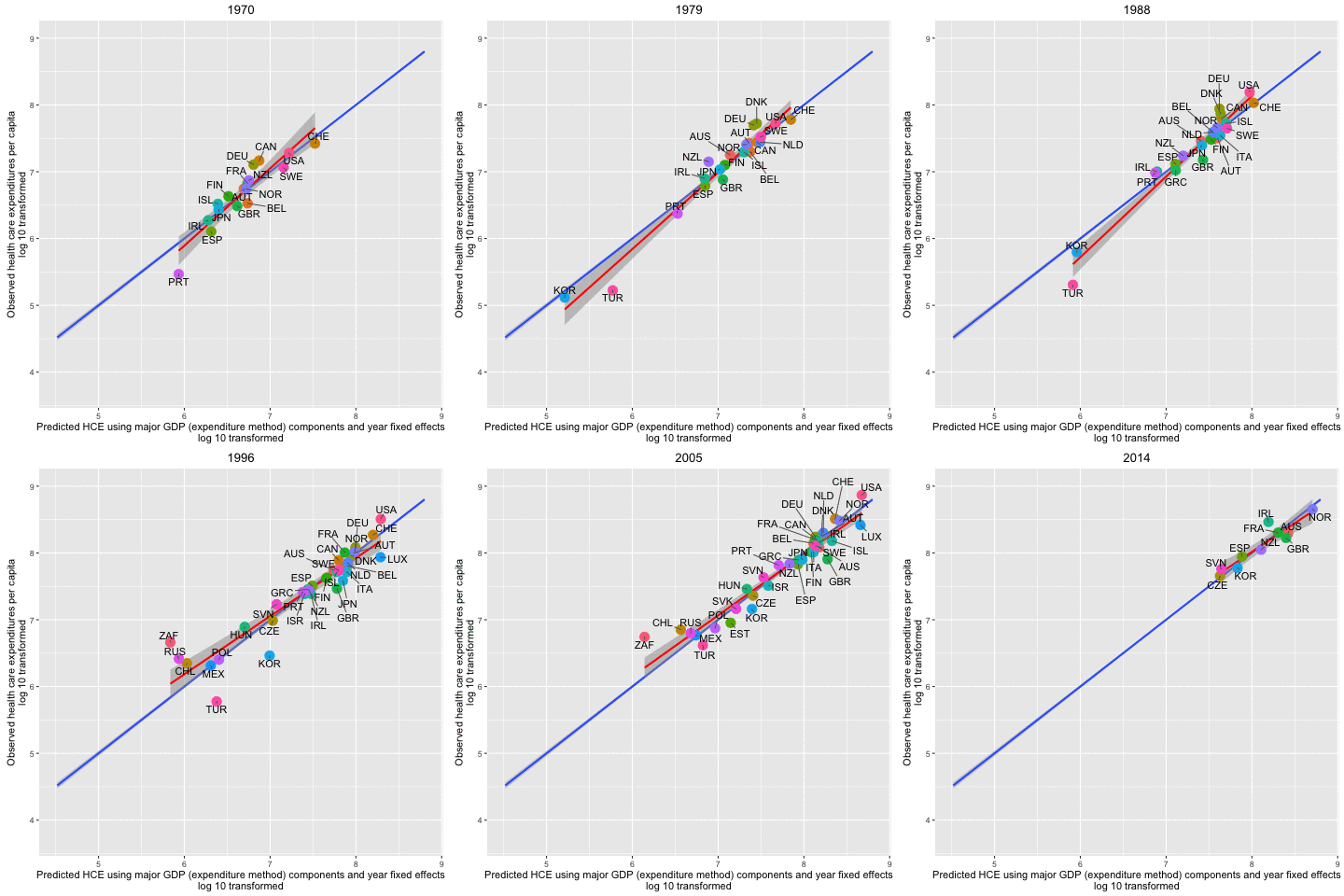
Take a look at the following sequence from the RCA blog linked above (the animation might not be visible on a phone):

So the argument that the U.S. health care system is inferior to peer countries based on cross-county spending comparisons and life expectancy, to the extent that it holds up at all, is subject to strong qualifications. Inferior lifestyle choices, diets, and lack of exercise might be problematic in the U.S., but the healthcare system cannot be faulted based on spending levels relative to other OECD countries.

In fact, the superiority of the U.S. health care system in many areas is not even in dispute. As Mahdi Barakat points out, wait times for care, cancer survival rates, and stroke mortality are all clearly better in the U.S. than in many peer countries:

“Lives are indeed saved by the many types of superior medical outcomes that are often unique to the US. This is not to mention the innumerable lives saved each year around the world due to medical innovations that are made possible through vibrant US markets.”

Barakat compares dubious progressive claims that up to 45,000 American lives are lost each year due to a lack of insurance with the likely incremental lives lost if various performance measures in the U.S. were equivalent to those in other countries:

  • 25,000 additional female deaths per year with Canada’a wait times for care (no estimate for additional male deaths is given by Mahdi’s source);
  • 64,000 additional stroke deaths each year with the UK’s overall stroke mortality;
  • 72,000 additional cancer deaths each year with the UKs survival rates.

Theoretically, the national spending figures could be adjusted for the cost of queuing, i.e. wait times. While Obamacare certainly increased wait times in the U.S., the adjustment would likely reduce or eliminate the spending advantages that several OECD countries appear to have over the U.S.

The performance of health care systems in many countries with single-payer systems or universal care is subject to challenge, as some of the statistics offered by Barakat demonstrate. In “The Truth About SwedenCare“, Klaus Bernpaintner expresses his dismay at the romanticized view of health care in Sweden among so many Americans. His effort to convey the truth about Sweden’s stultifying health care bureaucracy is illuminating. There are few private physician practices in Sweden. Care is generally rationed and waits are lengthy, and it is delivered by disinterested, centrally-assigned providers.

“For non-emergency cases in Sweden, you must go to the public ‘Healthcare Central.’ This is always the starting point for anything from the common flu to brain tumors. You must go to your assigned Central, according to your healthcare district. Admission is by appointment only. Usually they have a 30-minute window every morning, when you call to claim one of the budgeted slots. Make sure to call early or they run out. Rarely will you get an appointment for the same day. You will be assigned a general practitioner, probably one you have never met before; likely one who does not speak fluent Swedish; and very likely one who hates his job. If you have a serious condition, you will be started on a path of referrals to experts. This process can take months.”

Bernpaintner calls this Sweden’s health care “bread line”, where people go to die. He mentions several other nightmarish features of health care in Sweden that Americans should hope to avoid. In particular, we should resist calls for a single-payer system, like Bernie Sanders’ Medicare-For-All proposal. An analysis by Charles Blahous of the Mercatus Center at George Mason University has shown that it would increase federal spending by $32.6 trillion over ten years. This estimate is basically in-line with others mentioned by Blahous. Much of the additional federal spending would represent a transition away from private spending, a process that would be massively disruptive. However, the study gives the plan the benefit of several doubts by accepting the assumptions made by Sanders: 1) a huge saving in prescription drug costs; 2) a huge saving in administrative costs; 3) providers will happily accept Medicare reimbursement levels; and 4) new immigrants will not be attracted by an essentially free health care program. Fat chance. But given all of these questionable assumptions, total health care spending would fall even as the government takes on the massive new outlays. Take away just fantasy #3 and total national health care spending would rise, a swing of $700 billion by 2031.

John Cochrane makes a useful distinction between two conceptions of universally-accessible coverage: one that all must use vs. one that all can use. (He calls them both forms of single-payer systems, though that usage sounds a bit awkward to me.) The voluntary form is preferable for several reasons: it can preserve choice in terms of coverage and providers; while the public-payer’s share must be funded, it demands little or nothing in the way of cross-subsidized pricing; and it does not imply that government must act as a single “price setter”. Cochrane warns of the possible consequences of a universally-mandated single payer:

“Not only is there some sort of single easy to access health care and insurance scheme for poor or unfortunate people, but you and I are forbidden to escape it, to have private doctors, private hospitals, or private insurance outside the scheme. Doctors are forbidden to have private cash paying customers. That truly is a nightmare, and it will mean the allocation of good medical care by connections and bribes.”

The presumption that universal health care will improve quality and save lives is unsupported by any real evidence. Its proponents incorrectly assume that the uninsured do not get care at all. Providers might go uncompensated, but the uninsured can often get needed care with more immediacy than they could with the lengthy wait times typical of many single-payer systems. The quality of care is likely to deteriorate under a single-payer system given the stresses placed on providers, the highly regulated conditions under which they would be forced to operate, and restricted treatment options. And of course a single-payer system would suspend the price mechanism and any semblance of competition in the health care marketplace.

The health care system in the U.S. has massive problems, but they were created and exacerbated by a series of governmental intrusions on the marketplace over many years. A flourishing market requires choice for consumers and competition between providers—in both health care delivery and insurance coverage. It also requires a roll-back of regulation on providers and insurers. But as Cochrane emphasizes, such a marketplace can exist apart from a voluntary, tax-funded payer-of-last-resort.

Right-To-Work Prop A: Freedom of Speech, Association and Contract

30 Monday Jul 2018

Posted by Nuetzel in Labor Markets, Right to Work, Unions

≈ Leave a comment

Tags

Andrew Wilson, Daniel J. Mitchell, Fifth Amendment, First Amendment, Fourteenth Amendment, Freedom of Association, Freedom of Contract, Freedom of Speech, Missouri 2018 Proposition A, Monopsony, Political Action Committees, Right to Work, Show-Me Institute, Steve Spillman, Union Activism, Union Dues

I’d be angry if my employer forced me to contribute to the company’s Political Action Committee (PAC), and that view is shared by many of my colleagues. It would be illegal, of course, at least as a condition of employment. I love my job, but I give nothing to the PAC because I do not trust it to properly represent my political preferences. That goes for political contributions and lobbying activity that might benefit the company and, by extension, my own economic interests. I simply do not believe the company will refrain from corporatist practices, and I do not under any circumstances want my contributions lavished on politicians with whom I have policy differences.

In my home state of Missouri, unions and their political allies insist that union dues payments should be a condition of employment in unionized workplaces. Like PACs, unions are major political contributors, and I’d be surprised if there weren’t a large number of union members who object to the use of their dues for political contributions and activism. Of course, most of that activism is broadly anti-capitalist. This, quite simply, constitutes compelled speech and is a violation of employees’ First Amendment free-speech rights. Forced membership is a violation of the worker’s freedom of association under the Fourteenth Amendment.

Unions are also presumed to represent the interests of workers in negotiating with management, but not everyone wants that representation, especially given the corruption that has often plagued unions over the years and the poor economic performance of unionized industries in general. That last statement applies to public employee unions no less than private sector unions. Prohibiting non-union workers from employment at a unionized firm violates their freedom of contract under the Fifth and Fourteenth Amendments. I agree, however, that an employee refusing to join a union should not automatically be entitled to the wages and benefits negotiated by the union in collective bargaining with the employer. That should be strictly between the non-union employee and the firm.

Missouri Proposition A, which is on the state’s August 7 ballot, is a referendum on a right-to-work (RtW) law already passed by the general assembly and signed by the governor last year. I’ve discussed reasons why some libertarians have expressed disagreement with this kind of legislation—primarily because it denies an employer the right to hire workers exclusively from a unionized pool of labor. As Daniel J. Mitchell has noted, right-to-work laws are a second-best, compensatory solution to other forms of government intervention in labor markets that essentially grant unions monopsony privileges. Furthermore, giving primacy to an employer’s right to deal exclusively with a union ignores the rights of non-union workers and the rights of union members who do not wish to contribute to a union’s political activities. Trampling on the latter stands in contrast to the established protection of my rights against coerced contributions to my employer’s PAC.

The standard economic argument in favor of RtW laws hinges on the favorability of a state’s business environment and its competitiveness with other states. Andrew Wilson explains how and why Prop A will create jobs in Missouri. He notes that over the ten years ending in 2014:

“…average job growth in the 22 states with RTW laws in place for most or all of that time was more than twice as fast (at 9.1 percent) as in the 28 forced-union states. The RTW states also had considerably faster growth in personal income (at 54.7 percent compared to 43.5 percent) and a much stronger economic growth (50.7 percent compared to 38.0 percent).”

Wilson also remarks on a historical phenomenon which pro-union forces refuse to acknowledge: unions have undermined the competitive position of the industries upon which their members rely. It’s a classic principal-agent problem. Workers appoint an agent for representation, but the agent acts independently to maximize its own gains, often at the expense of the workers. RtW applies discipline to the process, reinforcing the union’s incentive to put members’ interests above of its own. After all, nearly all employers have to compete for workers, and private employers have to compete in product markets. Union workers have been exempt from competition only to the extent that their wage demands have not undermined the business’ competitive position, but they frequently have.

The real rub, according to RtW opponents, is that business interests will simply “crush” unions under RtW and impose lower wages and poor work conditions on workers. But as I alluded above, there are employers that prefer to work with a union for a variety of reasons. Second, suppose that new employees of a unionized firm refuse to join the union, or that some union members opt out. That’s a pretty strong indication that union membership is an unattractive proposition. Whose fault is that?

I favor Proposition A because workers should not be forced to accept representation by any third party, firms should not be forced to hire exclusively from those willing to do so, and because workers should not be required to contribute to union political initiatives. But as Steve Spellman writes, unions could do much to enhance their value to both workers and firms, attracting membership and gaining advantages in bargaining with employers:

“If unions focused on providing helpful, outsourced H.R. functions to companies, such as worker recruitment, drug screening and taking care of all that labor-law-compliance paperwork, it would sure change their reputation. As would standing up for its members, while also taking necessary (and fair) disciplinary actions instead of covering up for the occasional bad apple (even if that is only one worker out of 1,000). … If we can dream a little here, unions could also be best positioned to stand up for workers who are discriminated against, for whatever reason, rather than waiting on the law to catch up with our evolving society.”

← Older posts
Newer posts →
Follow Sacred Cow Chips on WordPress.com

Recent Posts

  • Grading Trump II, So Far
  • A Warsh Policy Scenario At the Federal Reserve
  • The Coexistence of Labor and AI-Augmented Capital
  • The Case Against Interest On Reserves
  • Immigration and Merit As Fiscal Propositions

Archives

  • March 2026
  • February 2026
  • January 2026
  • December 2025
  • November 2025
  • October 2025
  • September 2025
  • August 2025
  • July 2025
  • June 2025
  • May 2025
  • April 2025
  • March 2025
  • February 2025
  • January 2025
  • December 2024
  • November 2024
  • October 2024
  • September 2024
  • August 2024
  • July 2024
  • June 2024
  • May 2024
  • April 2024
  • March 2024
  • February 2024
  • January 2024
  • December 2023
  • November 2023
  • August 2023
  • July 2023
  • June 2023
  • May 2023
  • April 2023
  • March 2023
  • February 2023
  • January 2023
  • December 2022
  • November 2022
  • October 2022
  • September 2022
  • August 2022
  • July 2022
  • June 2022
  • May 2022
  • April 2022
  • March 2022
  • February 2022
  • January 2022
  • December 2021
  • November 2021
  • October 2021
  • September 2021
  • August 2021
  • July 2021
  • June 2021
  • May 2021
  • April 2021
  • March 2021
  • February 2021
  • January 2021
  • December 2020
  • November 2020
  • October 2020
  • September 2020
  • August 2020
  • July 2020
  • June 2020
  • May 2020
  • April 2020
  • March 2020
  • February 2020
  • January 2020
  • December 2019
  • November 2019
  • October 2019
  • September 2019
  • August 2019
  • July 2019
  • June 2019
  • May 2019
  • April 2019
  • March 2019
  • February 2019
  • January 2019
  • December 2018
  • November 2018
  • October 2018
  • September 2018
  • August 2018
  • July 2018
  • June 2018
  • May 2018
  • April 2018
  • March 2018
  • February 2018
  • January 2018
  • December 2017
  • November 2017
  • October 2017
  • September 2017
  • August 2017
  • July 2017
  • June 2017
  • May 2017
  • April 2017
  • March 2017
  • February 2017
  • January 2017
  • December 2016
  • November 2016
  • October 2016
  • September 2016
  • August 2016
  • July 2016
  • June 2016
  • May 2016
  • April 2016
  • March 2016
  • February 2016
  • January 2016
  • December 2015
  • November 2015
  • October 2015
  • September 2015
  • August 2015
  • July 2015
  • June 2015
  • May 2015
  • April 2015
  • March 2015
  • February 2015
  • January 2015
  • December 2014
  • November 2014
  • October 2014
  • September 2014
  • August 2014
  • July 2014
  • June 2014
  • May 2014
  • April 2014
  • March 2014

Blogs I Follow

  • Passive Income Kickstart
  • OnlyFinance.net
  • TLC Cholesterol
  • Nintil
  • kendunning.net
  • DCWhispers.com
  • Hoong-Wai in the UK
  • Marginal REVOLUTION
  • Stlouis
  • Watts Up With That?
  • American Elephants
  • The View from Alexandria
  • The Gymnasium
  • A Force for Good
  • Notes On Liberty
  • troymo
  • SUNDAY BLOG Stephanie Sievers
  • Miss Lou Acquiring Lore
  • Your Well Wisher Program
  • Objectivism In Depth
  • RobotEnomics
  • Orderstatistic
  • Paradigm Library
  • Scattered Showers and Quicksand
  • Jam Review

Blog at WordPress.com.

Passive Income Kickstart

OnlyFinance.net

TLC Cholesterol

Nintil

To estimate, compare, distinguish, discuss, and trace to its principal sources everything

kendunning.net

The Future is Ours to Create

DCWhispers.com

Hoong-Wai in the UK

A Commonwealth immigrant's perspective on the UK's public arena.

Marginal REVOLUTION

Small Steps Toward A Much Better World

Stlouis

Watts Up With That?

The world's most viewed site on global warming and climate change

American Elephants

Defending Life, Liberty and the Pursuit of Happiness

The View from Alexandria

In advanced civilizations the period loosely called Alexandrian is usually associated with flexible morals, perfunctory religion, populist standards and cosmopolitan tastes, feminism, exotic cults, and the rapid turnover of high and low fads---in short, a falling away (which is all that decadence means) from the strictness of traditional rules, embodied in character and inforced from within. -- Jacques Barzun

The Gymnasium

A place for reason, politics, economics, and faith steeped in the classical liberal tradition

A Force for Good

How economics, morality, and markets combine

Notes On Liberty

Spontaneous thoughts on a humble creed

troymo

SUNDAY BLOG Stephanie Sievers

Escaping the everyday life with photographs from my travels

Miss Lou Acquiring Lore

Gallery of Life...

Your Well Wisher Program

Attempt to solve commonly known problems…

Objectivism In Depth

Exploring Ayn Rand's revolutionary philosophy.

RobotEnomics

(A)n (I)ntelligent Future

Orderstatistic

Economics, chess and anything else on my mind.

Paradigm Library

OODA Looping

Scattered Showers and Quicksand

Musings on science, investing, finance, economics, politics, and probably fly fishing.

Jam Review

"If you get confused, listen to the music play."

  • Subscribe Subscribed
    • Sacred Cow Chips
    • Join 128 other subscribers
    • Already have a WordPress.com account? Log in now.
    • Sacred Cow Chips
    • Subscribe Subscribed
    • Sign up
    • Log in
    • Report this content
    • View site in Reader
    • Manage subscriptions
    • Collapse this bar
 

Loading Comments...