Now, What About Trump?

Tags

, , , , , , , , , , , , , , , , , , , , , , , , , , , ,

donald-trump-hair-force-1

This guy I voted for… Hoo boy! I’m tellin’ ya’, this guy’s a real beaut! But now, it’s time for me to make an accounting of the good and the bad I see in a Donald Trump presidency. I’ll cover a number of policy areas and how well I think, at this point, the Trump Administration will match my preferences, which are generally libertarian. In posting this list, I’m reminded of a wonderful quote of the late guitarist Jerry Garcia on his ideas for a new project: “I’m shopping around for something to do that no one will like.” I certainly don’t expect many to agree with the entirety of my “scorecard”, but here it is. But before getting to it, a few preliminaries:

First, I’ve had mixed feelings about Trump since he first announced that he’d seek the republican nomination. A basic concern was the difficulty of knowing his real philosophy about the role of government and fundamental constitutional rights. Trump has a history of contradictory positions on big issues like taxes, health care, and gun rights. It was a gamble to count on him to follow any particular idealogical course, and some of it remains unclear even now. My misgivings about Trump’s inclinations as a whirligig were discussed on Sacred Cow Chips in “Trump Flaunts Shape-Shifting Powers” in 2015. Uncertainty still colors my views, though his cabinet picks and other alliances have served to clarify the direction of policy. My discussion below reflects this uncertainty. Also, Trump shows every intention of moving fast on a number of fronts, so I hope the relevance of this post isn’t too perishable.

Second, it’s worth noting that Trump’s policy statements and predilection to “keep-’em-guessing” are probably a by-product of his instincts as a negotiator. His bellicosity may be something of a ploy to negotiate more favorable compromises in international affairs, trade and domestic issues. Still, I can’t know that. Should I evaluate all those statements at face value as policy positions? I have to make some allowance for the reasonability of a bargaining position, but I’ll try to be consistent in my approach.

Third, revelations during the campaign of Trump’s past remarks about women, and some in-campaign remarks like his attack on Megyn Kelly, were highly offensive. I’ve heard plenty of “locker-room talk” over my years, but some of Trump’s statements were made well outside the locker room and well beyond the age at which “youthful indiscretion” could be taken as a mitigating factor. Trump has plenty of female defenders, however, and he has a record of placing women in key roles within the Trump organization and for paying them well. While I do not condone the remarks, and I doubt that complete reform is possible, he cannot change his history and he is now the president. Evaluating his policy positions is now an entirely separate matter. I only hope the exposure has taught him to be more respectful.

Finally, I do not buy the narrative that Trump is a racist. This “Crying Wolf” essay on Scott Alexander’s Slate Star Codex blog demonstrates that Trump’s rhetoric and behavior during his campaign was not racist when viewed in the broader context of his record of denigrating anyone who opposes him. He seems to be an equal opportunity offender! In fact, Trump made strong attempts to appeal to minority voters and succeeded to some extent. His positions on border security and immigration were boisterous, but they were not truly about race or ethnicity. Instead, they were rooted in concerns about illegal immigration and public safety. Efforts by the left to characterize those points as de facto evidence of racism are simply not credible. Nor are claims that he practiced racial discrimination at his apartment buildings early in his career. Today, I would call those cases garden-variety disparate impact actions, as when a business is challenged on the use of screening criteria that might be correlated with race, such as credit rating. A legitimate business purpose is generally a valid defense, though Trump did agree to settle out of court.

So what about Trump from a policy perspective? Here is what I expect of his administration thus far:

I’m Pretty Sure of the Following, Which I Rate As Bad

Trump is a protectionist. He is extremely ignorant of trade principles and favors import duties to punish those who wish to purchase goods from abroad. This would raise both domestic and import prices and directly harm employment in import-dependent industries. It would also discourage innovation by domestic producers, who would face less competition. I cover these protectionist tendencies here as an unqualified negative, but I have a more mixed view on his opposition to certain government-negotiated trade agreements (e.g., the Trans-Pacific Partnership ), which are covered below.

Trump is likely to be a drug warrior. He could do much to restore order in inner cities by ending the drug war, but he will not. He will thereby encourage activity in the black market for drugs, which produces both violence and more dangerous varieties of drugs. He might well interfere with the rights of states to determine their own policies toward relatively benign substances like marijuana, including medical marijuana, by choosing to enforce destructive federal drug laws. The possible appointment of marijuana legalization advocate Jim O’Neil to head the FDA looks decreasingly likely. That might be a game changer, but I doubt it will happen.

Big public infrastructure outlays. This is distinct from private infrastructure, to be discussed below. The latter is motivated by private willingness-to-pay. Rushing into a large public construction program with questionable economic justification will bring waste, and it will probably be sold as an economic stimulus package, which is unnecessary and dangerous at a time when the economy is finally operating near capacity. The decrepitude of American infrastructure is greatly exaggerated by those with a private interest in such projects, and the media eats it up. The breathless promotion of massive but noneconomic projects like high-speed rail is also greeted with enthusiasm by the media. And politicians love to boast to constituents of their efforts to secure federal funds for big local projects. We also know that Trump wants to build a massive border wall, but I’m convinced that border security could be achieved at lower cost by leveraging surveillance technology and other, less costly barriers.

Deficits: Increased defense outlays, a big infrastructure package, a “great” wall, tax credits and lower tax rates will almost certainly add up to ballooning federal deficits in the years ahead. That fiscal combination will be unsustainable if accompanied by higher interest rates and could very well have inflationary consequences.

Trump favors public and private eminent domain and believes it should be treated as a hallowed institution. He truly thinks that a “higher-valued use” is a superior claim to existing ownership of property. This is perverse. I have trouble accepting eminent domain action even for a public purpose, let alone a private purpose; it should only be motivated by the most compelling public interest, as a last resort, and with handsome compensation to the existing property owner. We can only hope that Trump’s public and private infrastructure programs do not lead to many takings of this kind.

Industrial policy. This is the essence of government central planning, picking winners and losers by granting tax and loan subsidies, lenient reviews, and other advantages. The most obvious example of Trump’s amenability to industrial policy is his penchant for trade protectionism, but I fear it will go much deeper. For some reason, Trump believes that manufacturing activity creates private and public benefits far beyond its market value. Moreover, manufacturers require far fewer workers now than they did in his youth, so the sector is not the job engine it once was. His appointee for Commerce Secretary is Wilbur Ross, an investor with a history of trading on prospects for government assistance. This article provides disturbing background on Ross, along with this quote: “We ought, as a country, to decide which industries are we going to really promote — the so-called industries of the future.” Trump’s plan to meet regularly with leaders of giant corporations is a sure sign that corporatism will be alive and well for at least the next four years… as long as they tow The Donald’s line.

Restricting Legal Immigration. I’m all for securing the border, but legal immigration is a major driver of economic growth. Many industries rely on a flow of skilled and unskilled workers from abroad, a need that will be more intense given Trump’s plan to tax outsourcing. Moreover, the country will face a low ratio of workers to retirees over the next few decades; short of massive entitlement reform, immigration is perhaps the only real chance of meeting public obligations to retirees.

Endangered Privacy Rights: As a “law and order” guy, Donald Trump might not be a reliable defender of the privacy protections enshrined in the Fourth Amendment. He has expressed a willingness to repeal the USA Freedom Act, which restricts the bulk collection of metadata and provides other privacy protections. Trump also has expressed an interest in forcing technology companies to enable “back doors” into the devices and programs they sell to the public. I’m concerned that we’ll see the creation of security databases with an excessively broad scope. As a likely drug warrior, Trump will support the sort of privacy violations in law enforcement that have become all too common.

I’m Pretty Sure of the Following, Which I Rate As Good

He’s not Hillary Clinton, and he is not a statist in the mold of Clinton and Barack Obama, though he does embody some statist tendencies as described above.  I thought I would vote for Gary Johnson, but he made crucial mistakes, such as choosing Bill Weld as his running mate and fumbling at attempts to explain libertarian philosophy. At some point, my distaste for Clinton’s criminality and her advocacy of big government in so many aspects of life convinced me she had to be defeated, and that Trump was the only real possibility. But whether he can actually reduce the resources that the federal government absorbs is hard to say, as he has his own spending priorities.

Trump favors deregulation generally, as it places an enormous burden on society’s ability to improve well being. This covers aspects of the Affordable Care Act and reducing the role of the federal government in education. He opposes the costly Paris Climate Accord and other intrusive federal environmental measures, such as wetlands regulation.

Obamacare repeal and replacement with market-oriented delivery of health care, insurance with broad choices, and equalized tax treatment across the employer and individual market segments via refundable tax credits. There is a chance that Trump’s preferred alternative will assign excessive responsibility to the federal government rather than markets, but I’m optimistic on this point.

Entitlement reform is a possibility. Social Security and Medicare are insolvent. Ideas about how future retirees might take advantage of market opportunities should be explored. This includes private retirement accounts with choices of investment direction and greater emphasis on alternatives like Medicare Advantage.

Tax reform of some kind is on Trump’s agenda. This is likely to involve lower corporate and individual tax rates and some tax simplification. It is likely to stimulate economic growth from both the demand and the supply sides. In the short-run, traditional demand-side macroeconomic analysis would suggest that upward price pressures could arise. However, by encouraging saving and investment, the economy’s production capacity would increase, mitigating price pressure in the longer run.

Trump favors border security. No mystery here. My enthusiasm for this is not based on a physical wall at the border. That might come and it might be very costly. I favor a liberalized but controlled flow of immigration and vetting of all immigrants. The recent order of a temporary hold on refugees from a short list of countries will be of concern if it is not short-lived, and it remains to be seen what “extreme vetting” will entail. Nevertheless, I support enhanced integrity of our borders and our right as a nation to be cautious about who enters.

Education reform and school choice. Increased spending on public education, especially at the federal level, has made no contribution to educational productivity, and the country is burdened with too many failing schools.

Encouraging private infrastructure. This relies on private incentives to build and finance  infrastructure based on users’ willingness to pay, thereby avoiding stress on public funding capacity.

Deregulating energy: This includes encouraging zero-carbon nuclear power, deregulation of fossil fuels, and lower energy costs.

Deregulating financial institutions. Repeal of the burdensome Dodd-Frank Act, which has imposed costs on both banks and consumers with little promise of a benefit in terms of financial stability.

Unabashed support for Israel. I strongly favor repairing our damaged ties with Israel and the proposed move of our embassy to West Jerusalem, which has been a part of Israel proper since its founding. Israel is the only real democracy in the middle east and a strong ally in an extremely dangerous part of the globe.

Trump supports Second Amendment rights. This is fundamental. Private gun ownership is the single-best line of self-defense, especially for those with the misfortune to live in areas rife with black market drug activity.

States’ rights and federalism. On a range of issues, Trump seems amenable to transferring more responsibility to states, rather than asserting federal supremacy on issues that are unsettled from region-to-region.

Ending federal funding for abortion. Tax dollars should not be used for a purpose that is morally abhorrent to a large segment of the population. This is not the same as the “right” to abort a child, as settled by Roe vs. Wade.

Putting the screws to the UN. This organization is not aligned with U.S. interests, yet the U.S. foots a large part of the bill for its activities. Sharp reductions in funding would be a powerful message.

Reduced federal funding for the arts. I’ve never been comfortable with allowing the federal government to disburse funds in support of the arts. Lower levels of government are less objectionable, where there is greater accountability to local voters. Dependence on federal purse strings creates a powerful line of influence that usurps authority and may conflict with the desires of local taxpayers. Individuals pay for art voluntarily if they find it of value, and people give privately to support the arts for the same reason. Federal taxpayers certainly have other valued uses for the funds. Art is not a “public good” in a strict sense, and its external benefits, to the extent they exist, do not justify a federal role.

Reversing the FCC’s net neutrality rules. Trump has appointed Ajit Pai as the new chairman of the FCC. Pai is no fan of net neutrality, a policy that rewards heavy users of network capacity and is likely to discourage the growth of network infrastructure.

I’m Not Sure How To Rate the Following

Foreign policy reset. I welcome several likely foreign policy initiatives from the Trump Administration, such as deemphasizing our role in the UN, restoring our relationship with Israel, and taking a harder line on nuclear development by Iran. I also favor greater scrutiny of outlays for foreign aid, much of which is subject to graft by recipient governments. However, I would not welcome a continuation of foreign policy designed around U.S. strategic interests that are, in fact, private investments.

Defense build-up. Our armed forces have suffered a decline in their ability to defend the country during the Obama years. I favor some restoration of the defense budget, but I am concerned that Trump will go on a defense binge. I’m also concerned about how aggressively he’ll wish to project American power overseas. Let’s not go to war!

Upending Trade Partnerships. I am a free-trader, and I abhor Trump’s belligerent talk about erecting trade barriers. So how could I be “unsure” about anything that promotes trade? Formal trade partnerships between nations are an aggravation to me because governments don’t trade… people do! And they do because they reap unambiguous benefits from trade. I’d much rather the U.S. simply eliminated all trade barriers unilaterally than get entangled in complicated trade agreements. These agreements are rats nests. They stipulate all sorts of conditions that are not trade related, such as environmental rules and labor policy. I therefore view them as a compromise to sovereignty and a potential impediment to economic growth. To the extent that trade agreements can be renegotiated in our favor, I should not complain. And to the extent that we’ll never see a government allow completely free and open trade, I should probably hope for agreements that at least reduce trade barriers.

The Keystone pipeline. I am happy with Trump’s decision to approve completion of the pipeline on its merits for energy delivery, and also because it is environmentally less risky than rail, barge and container ships. And yes, it is private infrastructure. But I am unhappy about the heavy application of eminent domain against landowners in the path of the pipeline. The Standing Rock Sioux tribe’s opposition is suspect because the path does not cross its tribal land, and the tribe originally gave its consent to the project. The tribe’s recent position could be an effort to extract rents from the process.

Executive authority. I am somewhat wary of Trump’s aggressiveness thus far. He seems eager to take actions that are questionable under existing law, such as seizing wire-transfer remittances by undocumented immigrants. Granted, he is busy “undoing” some of Obama’s actions, but let’s hope he doesn’t get carried away.

Summary

What we have here is a very mixed bag of policies. On the whole, I’m still pleased that Trump was elected. I believe he favors a smaller role for government in most affairs. But while the balance of considerations listed above seems to be in Trump’s favor, the negatives have the potential to be disastrous. He certainly wants to spend. My biggest fears, however, are that Trump will not respect the Constitution, that he will govern as a cronyist, and that he will succumb to the notion that he can actively manage the economy like a casino build.

Toodle-oo, President Cool Fool

Tags

, , , , , , , , , , , , , , , , , , , , , ,

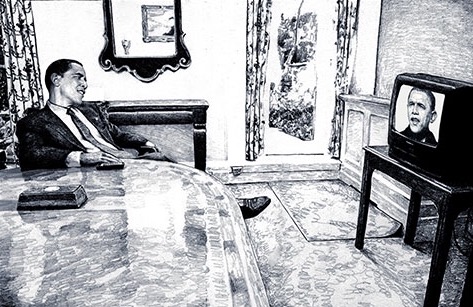
img_3887

The durability of Barack Obama’s achievements as President of the United States will go down in history as … an oxymoron. He will likely be remembered more for his failures in social, economic, foreign policy and political leadership. Obama has himself to blame for the lack of a durable legacy. From the beginning of his administration, Obama’s mentality with respect to policymaking was always “my way or the highway” (“The election’s over, and I won”), and his consequent failure to achieve legislative victories during his last six years in office was always Congress’ fault. He would share no blame. But it was cool, ’cause Obama had “a pen and a phone” and was willing to act by executive fiat to affect changes he desired. His hope, I suppose, was that his regulatory diktats would become so ingrained in our way of life that rescinding them would be political suicide, much like some of the programs of the New Deal and the Great Society. Well, that backfired! Most of Obama’s executive actions can be undone by executive or legislative action, and while it won’t be costless, it will happen.

The fact of the matter is that Obama’s policies were not productive and not popular. Not only did they contribute to the election of Donald Trump, but they helped fuel the massive losses suffered by Democrats in state houses and governorships over the past eight years. But Obama was always right as rain.

The Planner’s Conceit: A big believer in the power and goodness of government, Obama attempted to usher in a great wave of new regulation and social planning. Here is David Harsanyi in Reason:

The president’s central case for government’s existence rests on the notion of the state being society’s moral center, engine of prosperity and arbiter of fairness. Obama speaks of government as a theocrat might speak of church, and his fans return the favor by treating him like a pope.

Obama is a man who lacks any understanding of the causes of prosperity: personal and economic freedoms, individual initiative, and healthy private markets. Jeffrey Tucker makes this point eloquently in “Why Obama Failed“:

Despite his vast knowledge on seemingly everything, and endless amounts of charm to sell himself to the public, he missed the one crucial thing. He never understood wealth is not a given; it must be created through enterprise and innovation, trade and experimentation, by real people who need the freedom to try, unencumbered by a regulatory and confiscatory state. This doesn’t happen just because there is a nice and popular guy in the White House. It happens because the institutions are right.

Obama’s results underscore his ignorance regarding the fundamental drivers of material well-being: economic growth during the post-recession years has been very sluggish, and while the unemployment rate has declined, it is not as impressive as it might appear: many workers have been forced into part-time jobs, and the decline in the jobless rate was exaggerated with declines in labor force participation to levels not seen since the late 1970s. Perhaps not coincidentally, the number of workers claiming Social Security disability benefits happened to soar as employment prospects remained grim. Slow growth in the economy and budget sequestration (an action Obama blames on republicans despite having proposed it himself as a cudgel) have reduced the annual budget deficit, but the nation’s outstanding debt under Obama has increased by $10 trillion, doubling the total outstanding over his eight years. Future annual deficits are projected to soar under his policies, according to the Congressional Budget Office.

Two factors that would contribute to ballooning deficits, if allowed to stand, are the Paris Climate Accord, signed by Obama without the Senate’s consent, and Obamacare. The climate treaty would do little to change global temperatures, but would impose heavy costs on the U.S. in terms of subsidies for foreign energy projects, regulatory burdens, and energy bills.

Failing Health Care: The future budget impact of the Paris Accord could be minor compared to Obama’s greatest source of pride: the Affordable Care Act (ACA), a.k.a. Obamacare. Recent scare stories have softened public opinion regarding the ACA, but so unpopular was this “landmark” legislation that Donald Trump was elected in part because he promised, along with congressional republicans (who played no part in its passage) to “repeal and replace” the law. The failures of the ACA were covered in my last post, “Death By Obamacare“.

Foreign FUBARs: The foreign policy foibles of the Obama Administration are legend. From Benghazi to the Syrian “red line”, from the botched deal on nuclear weapons development by Iran to the weak stand on Russian expansionism, American foreign policy has never been such an embarrassment. Obama, the recipient of a dubious Nobel Peace Prize, has been an avid drone warrior, collateral damage be damned. Our continued involvement in Afghanistan and the reentry of U.S. forces into Iraq must be sorely disappointing to the anti-war constituency Obama once courted. He has alienated our longstanding allies and cooed in the ears of avowed enemies. His grants of clemency in recent days to the likes of the treasonous Chelsea Manning and terrorists like Oscar Lopez Rivera are symbolic of the contempt in which he holds the lives lost at their hands. Our weakness abroad has led to a loss of respect for the U.S., signaled vividly by our exclusion from peace talks in Syria. Recent events have increased public awareness of our vulnerability to cyber-attack from foreign enemies, but Obama has failed to provide leadership on the issue.

Scandalous: Obama’s tenure as president has been marked by a number of scandals, contrary to what his admirers would have us believe. The Fast and Furious operation by ATF agents put guns in the hands of criminals and drug cartels, resulting in the death of a border control agent, but the Obama Justice Department sought to obstruct an investigation. The massacre at the U.S. consulate in Benghazi, Libya led to the death of four Americans, including Ambassador Chris Stephens. The White House and State Department sought to create a misleading story line, claiming an anti-Muslim video was responsible for a protest gone-wrong, when in fact they were well aware that it was a planned terrorist action. A deeper question is whether Stephens was in Benghazi attempting to arrange arms sales to “Syrian rebels”. Then there are the attempts by the IRS to target opposition to Obama, and conservative groups generally, and an apparent effort to conceal that activity, as well as cases in which it appeared that the administration was targeting members of the press whom they considered unfriendly. There were a number of other scandals and events such as the Solyndra subsidies, which suggested high corruption and cronyism. Here is an excellent discussion of a variety of dubious antics by the Obama Administration, and the shady efforts to keep them quiet.

Racial Muckraking: Ironically, Obama’s greatest failing might well have been the racial discord that boiled up during his two terms. As the first African-American president of the U.S., there was a considerable expectation that his legacy would be one of racial healing. Instead, it was as if he deliberately sought to encourage discord. Here is Joel Kotkin’s description of the president’s missteps on race relations:

Whenever race-related issues came up — notably in the area of law enforcement — Obama and his Justice Department have tended to embrace the narrative that America remains hopelessly racist. As a result, he seemed to embrace groups like Black Lives Matter and, wherever possible, blame law enforcement, even as crime was soaring in many cities, particularly those with beleaguered African American communities.

Eight years after his election, more Americans now consider race relations to be getting worse, and we are more ethnically divided than in any time in recent history. As has been the case for several decades, African Americans’ economic equality has continued to slip, and is lower now than it was when Obama came into office in 2009, according to a 2016 Urban League study.

The Liar: Obama is an unrepentant liar. Even the Washington Post felt it necessary to catalog some of the Obama lies that made it into their headlines (through many did not). There was the infamous Benghazi deception; the “Like Your Plan, Keep Your Plan” fib; he quoted enrollment numbers on the Obamacare exchanges that were greatly exaggerated; he publicly denied that domestic surveillance was a reality; he claimed that he was not responsible for our withdrawal from Iraq… what? There were efforts to cover and dissemble regarding details of all the scandals referenced above. By now, Obama’s insistence that his would be the “most transparent administration in history” is rather humorous. Most of Obama’s lies were motivated by ideology, and that might make it worse in my book. What’s particularly galling is the lie that Obama has any respect for the Constitution. He has attempted to subvert it with regularity.

I, Barack Obama: Another common trait among politicians is narcissism, but few are as obvious about it as Barack Obama. He has a habit of self-referencing that may be unequaled in political oratory. In fact, last July at the Democratic National Convention, he mentioned himself 119 times in a speech about Hillary Clinton. He is always eager to invoke his personal story as a possible source of inspiration for others. He is seemingly preoccupied with his legacy, going out his way to issue additional executive orders in the waning days of his term, and giving a “final” address in which he glorified his accomplishments. And then there was a final-final press conference at which he did the same. He has always encouraged the perception that Barack Obama is the “smartest guy in the room”. Of course, he is never wrong, and everything is cool. Obama seems to believe that he can make reality conform to his every assertion –oh yeah, I already talked about lies!

Did Obama’s narcissism contribute to his failed presidency? It’s plausible because he invested too much in his own ability to teach, influence others,  and control events. Collaboration with important stakeholders was unnecessary, and indeed, it was often better to demonize anyone who stood in the way of the world according to Barack. That world was a sad self-delusion.

Death By Obamacare

Tags

, , , , , , , , , , , , , , , , , , , , , , , , ,

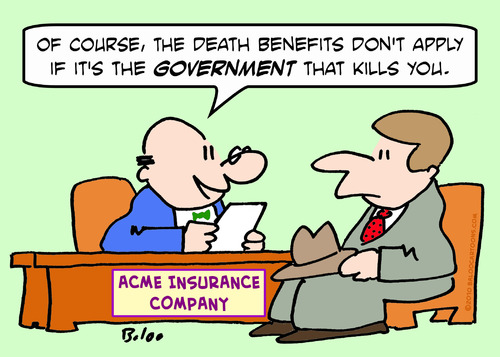
goverment_kills

People will die if we don’t repeal and replace Obamacare! That right, and I’ll tell you why: First, the “Affordable” Care Act (ACA) creates terrible incentives for physicians. Among other provisions, it has chopped reimbursement rates on Medicare and Medicaid. As a result, physicians are declining patients under those plans, exposing the “access” myth under Obamacare as one of several cruel deceptions. Second, “physician feedback” reports and hospital “performance scores” reward providers who avoid the sickest and neediest patients. Third, provisions of the ACA encourage the monopolization of health care delivery and consequently inflate costs. That makes it less likely that needy individuals will insure or seek care, especially given the high deductibles they face. And greater market concentration in health care delivery often means patients have nowhere to go when they are denied care. Fourth, Obamacare has increased the regulatory burden on providers, which invariably reduces the quality of care. Other ACA regulatory burdens placed on employers have forced them to reduce employees’ hours and new hiring in order to control costs. This has limited the number insured under employer plans, leaving them to grapple with the exchanges, or on government plans from which physicians feel stiffed, or to be uninsured. All of these developments lead to undesirable health care outcomes. And there is more.

The ACA Disaster

Obamacare was a complete sham and destined to fail from the start, but the law’s now certain demise is greeted with indignance by the economic illiterati of the left. There are many counts upon which the law has failed: almost 29 million remain uninsured; millions of others in the individual market lost the coverage and doctors they preferred; only a single insurance option is available on many exchanges; the individual mandate is widely-ignored; the exchanges are serving a sickly risk pool; insurance premia are skyrocketing; health care delivery has trended toward monopoly; low Medicaid reimbursement rates have reduced actual access to providers; negative employment effects have arisen as firms adjusted to the employer mandates; and the law has imposed stiff regulatory compliance costs on providers of health care. Obamacare is also a significant budget item, despite early claims to the contrary (also see here): according to the Congressional Budget Office (CBO), the law’s contribution to the federal budget deficit is expected to be almost $2 trillion over the next ten years. What a law! It’s many invasive tendrils are destroying the vitality of the health care and insurance sectors, and it must be eliminated.

There are better ways to achieve the goals originally put forward under the aegis of the ACA. Those who fear repeal either believe that the law will not be replaced, which is unlikely, or that the replacement plan will lead to the loss of health care coverage for a large number of individuals. My contention is that the ACA can be replaced with a plan that would correct its massive deficiencies without creating other death traps.

The single truthful claim that supporters of Obamacare can make is a reduction in the number of uninsured since its implementation, but the numbers reported are exaggerated. A typical quote is that 20 million have gained coverage, an estimate, but we’ll go with that. The link gives a rough but meaningful accounting. Most of the increase in the number of insured, about 13 million, came from expanded Medicaid enrollment. That could have been accomplished without the ACA, and most of those enrollees were already eligible for Medicaid before the ACA’s expansion in eligibility. Perhaps the law had some beneficial effects on the awareness of individuals who were previously eligible but unenrolled.

The quoted gains in the insured population also include several million who were forced off their previous coverage in the individual market by the ACA. These do not represent net increases in the insured population. There have also been gains among young adults who remained on their parents policies. And yes, there have been gains in coverage among those with pre-existing conditions, but this totals less than half a million even counting those already covered under state “high-risk pools”. Needless to say, outright repeal of the ACA without replacement would not lead to a 20 million increase in the uninsured population, as many have argued. With replacement, it is conceivable that losses in coverage could be zero or negative.

Replacement Bills

What are the likely features of an ACA replacement bill? There are as many as nine different proposals or bills introduced by republicans, including one from Rep. Tom Price, who has been nominated to serve as President-Elect Trump’s Secretary of Health and Human Services (HHS). Rep. Pete Sessions and Sen. Bill Cassidy have introduced a bill endorsed by economist John C. Goodman. Rep. Phil Roe introduced a bill just last week. Sen. Orin Hatch and Sen. Richard Burr have proposed health care legislation. House Speaker Paul Ryan has also proposed a plan that received muted praise from noted health-care expert Avik Roy. These plans have some commonalities. In broad strokes, the proposed legislative actions call for less regulation, greater choice in the design of health insurance policies, more patient-centered care, a shift to market orientation, efforts to equalize the tax treatment of insurance premia for employer and individually-sponsored plans, retention of the ACA’s continuance of family coverage for young adults, and tax credits to support universal availability of insurance coverage.

There are several ways in which an ACA replacement plan can reduce the cost of health care delivery and the cost of health care insurance. The low-hanging fruit, as it were, involves steps to reduce the regulatory burden on health care providers, eliminating the ACA’s Minimum Essential Coverage and Essential Heath Benefits requirements (and allowing wider choice of coverage types and levels), and allowing competition among insurers across state lines.

The reduction in costs and subsidies that can achieved by allowing simple catastrophic-only policies in both the individual and employer markets is obvious. These policies would have low premia and correspondingly high deductibles. Regular checkups and routine health maintenance would not be covered under such basic policies. Those benefits would be optional, along with others like mental health coverage, maternity and reproductive health. The basic policies would represent real insurance, not paid-in-advance services. It’s more difficult, however, to anticipate the magnitude of cost savings and efficiency gains from eliminating regulatory requirements, encouraging competition among providers, and legalizing interstate insurance competition. That means the total gain from “low-hanging fruit” is hard to quantify, but it is real. Here are comments by David Brooks in The New York Times on the promise of market-oriented reforms.

Several of the GOP plans seek to provide universal availability of health insurance coverage by allowing refundable tax credits on insurance costs combined with expanded availability of Health Savings Accounts (HSAs). These steps would help to equalize the tax benefits of health insurance across the employer and individual markets. This is a crucial step due to the historically damaging effects of employer-provided coverage, as noted by A. Barton Hinkle here. Several of the GOP plans would allow non-employers like church groups, fraternal and professional associations to offer coverage.

Here is Avik Roy on the handling of high-risk individuals under the Ryan plan:

Obamacare-style guaranteed issue and community rating would be gone and replaced by high risk pools, guaranteed issue for continuously held coverage, and a default requirement that insurers had to price their plans for older enrollees no higher than 5 times how they price them for younger enrollees (a significant improvement from Obamacare’s stricter 3:1 ratio).

Other proposals in some of the GOP plans involve reform of the FDA, more support for private Medicare plans, and a change in the federal portion of Medicaid funding to block grants to states (who actually manage the program). The latter will be the subject of a future post.

Opportunities and Minefields

The kinds of steps described above can lead to greater reductions in the number of uninsured, and at a lower cost, than Obamacare. However, many partisans are agitating to convince republicans that this is impossible. Here is Roy’s opinion (he refers to his 2014 book, Transcending Obamacare):

… many would-be reformers have convinced themselves that no Republican replacement for Obamacare can cover as many Americans as Obamacare will. Put simply, this is flat-out wrong. As Transcending Obamacare showed, you absolutely can achieve universal coverage with less spending and less government intervention, because we spend way too much subsidizing health coverage for the wealthy, and because our government-driven employer-based health care system inflates wasteful spending across the board.

John C. Goodman discusses four “minefields” that republicans should avoid, the first of which seems obvious:

  1. Don’t repeal and delay: All indications are that congressional republicans have avoided this minefield, and Trump has stated that he won’t accept anything short of “simultaneous” repeal and replace.
  2. ACA revenue should not be “given away”: Goodman lists negotiated fee reductions from the AMA under the ACA, AARP’s agreement to Medicare cuts, and taxes on pharmaceutical companies, insurers, big labor and big business. Eliminating these sources of savings and tax revenue can be afforded only by reducing other costs. I’m dubious that the fee reductions and taxes haven’t had counterproductive effects, but point taken.
  3. Don’t impose a Cadillac tax: The Cadillac tax applies to expensive plans offered by employers. This point is an exception to #2 above, but Goodman says several GOP plans impose forms of Cadillac taxes despite widespread opposition.
  4. Don’t ignore employers: Here is Goodman on employers:

Virtually all of the new government spending for private health insurance under Obamacare is going to what has become the most dysfunctional part of the healthcare system – the individual market. This is where premiums are spiraling and there is a race to the bottom on quality and access to care. Almost every Republican plan to replace Obamacare makes the same mistake. But why throw good money after bad?

Almost 30 million Americans are still uninsured (largely because the products in the Obamacare exchanges are so expensive and unattractive) and 85% of these live in a household with someone in the labor market. A tax credit that could be used by employers to help employees enroll in a group plan would give them access to lower premiums and better coverage.

Goodman strongly endorses the replacement plan put forward by Rep. Pete Sessions and Sen. Bill Cassidy. It is the only GOP plan advanced thus far that avoids the four pitfalls identified by Goodman.

Markets Can Save Lives

My statement at the top of this piece might strike some as outrageous, but it is less outrageous than statements by Sen. Harry Reid and others that “people will die” if Obamacare is repealed. Of course, my assertion would be hard to defend unless conditioned on a replacement plan to improve access to quality care. But it is wrong to say that repeal will lead to incremental deaths without reference to a replacement plan. The claim that there is unlikely to be a replacement is disingenuous.

The usual defense of the ACA is grounded in the increased number of insureds it has achieved, combined with appeals to the expense of catastrophic health events. A weaker defense is the presumption that Obamacare codifies a “right” to health care. Even if we stipulate that such a right exists, there are better ways to accomplish the ends desired by the ACA’s proponents. The alternatives now under consideration are encouraging, as they are largely geared toward leveraging the efficiency of the market with less reliance on information-deficient government planners and rule-makers.


Read This Post a Little Later

Tags

, , ,

editing-humor

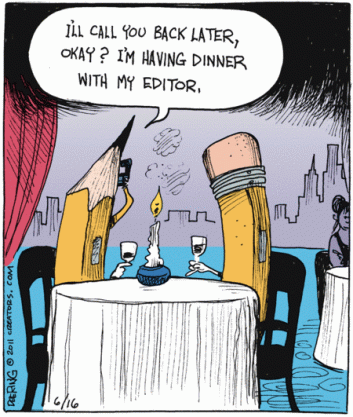
I love blogging, but invariably I find a few typos and readability issues when I publish a new post. It drives me crazy! I try to fix them as soon as possible, but it’s often difficult to get to it immediately. That was a problem last night. It was late when I posted and I had to hit the sack. This morning, to my horror, I found several such issues, and a number of readers had already clicked through from a link in social media.

Worse yet, when I pulled-up the edit screen, I was prompted to choose a “saved version of the file,” a pop-up prompt that I see occasionally. I was a little foggy then, and I’m a little foggy now as to the sequence of events, but somehow the media file I added last night at the top of the post  — the cartoon — was not in the “saved version”. I did not notice. That was unfortunate because I referenced the cartoon explicitly in the text. I made several edits and other additions, then unsuspectingly clicked “Update.” A friend emailed this afternoon to inform me that there was NO CARTOON in the post!

The missing cartoon was probably a consequence of editing drafts on both a laptop and a phone, depending on my location. I’ve long been aware of the potential this creates for version control problems, but I’m unlikely to end the practice. I just have to be more careful. Sure!

I always reread my posts multiple times before clicking “publish”, but it helps to get away from the draft for a while. One quirk I have is that it seems much easier to spot problems when a post is in the final format, as opposed to viewing it the editing screen in WordPress. There is a “Preview” option, which shows the post in the final format. For some reason, however, I seldom avail myself of that capability. I think it’s because I’m always too eager to get my posts out there, to be timely, yet so often I lament typos, mangled sentences, discontinuities, and omissions of pertinent thoughts that I’d intended to cover.

Occasionally, following one or two of these episodes, I have gone so far as to offer a veiled repentance on the link to a post in social media. Something like: “Fixed typos and improved readability”. I assume the readers will know I messed up, and I want them to know that I know it. I also have imagined giving my contacts a disclaimer at the time of initial posting: “You might want to wait a few hours before you read this, or check back in the morning…  I need a chance to review.” But of course I won’t ever do that. Except right now!

I must start using the preview option. I’ll start with this very post, tonight, but I will still review it in the morning and I’ll probably change something. Then I’ll hope there no typos within my new fixes! It happens. I’m not sure I can check my eagerness to post, so this post is a meta-repentance for my past and future blogging blemishes. So sorry! I’ll let this post serve as my umbrella disclaimer. I might not find every glitch, but I’ll try. If it’s within a day of the original posting, check back later for an improved experience.

Private Incentives and Infrastructure

Tags

, , , , , , , , , , , , , ,

motorway-to-hell


Material infrastructure is fixed plant and equipment providing services considered basic to the functioning of society. That definition leaves plenty of room for interpretation, however. For example, it does not limit the meaning of “infrastructure” to facilities necessary for the provision of “public goods”, for which benefits are non-exclusive. And it encompasses facilities used by firms in certain competitive markets, such as some forms of telecommunication. The character of infrastructure tends to change over time, as new technologies lead to changes in our way of life (e.g., the cellular network). That’s even more evident when infrastructure is defined more broadly, as Walter Buhr does in “What Is Infrastructure?” His definition of material infrastructure encompasses all facilities enabling “the activation or mobilization of the economic agents’ potentialities.

Infrastructure ≠ Government

There is a popular fallacy that infrastructure is the exclusive province of government. Infrastructure often does provide some public, non-exclusive benefits, but the willingness of users to pay is the key test of private benefits. As it happens, most infrastructure needs can be met privately and partly, if not fully, supported by user fees. That follows from the high degree of exclusivity of benefits yielded by the infrastructure. Today, privately-owned infrastructure includes communication networks, power generation and distribution, some water and sewer systems, toll roads, ports, and landfills. The presumed monopolistic nature of some infrastructural services probably encourages the notion that infrastructure must be public, but that view is largely unjustified: the services may be “monopolized” only to the extent that the relevant market is defined narrowly, such as road travel, rather than transportation. Indeed, certain kinds of infrastructure functions in markets that are fairly competitive (e.g., wireless networks).

The great thing about most private infrastructure is that owner-operators have an incentive to put it up and keep it up. So it kind of takes care of itself. I say “kind of” because there is always a degree of public involvement, from land use and environmental approval to construction permits, to licensing, to spectrum auctions, to rate regulation, and many other varieties of oversight. Aside from those considerations, if there is a need for infrastructure that is commercially-viable, the project is likely to be proposed by private interests. The funds necessary to pay for construction can be raised from private investors, rather than taxpayers. It’s not at all strange to say that private infrastructure is highly advantageous from a public finance perspective.

There are risks to private infrastructure developers, but those risks are too often borne publicly. A new facility, be it a water treatment plant or a road, might not prove to be profitable once a new revenue stream or reduction in operating costs is realized. Given those circumstances, private interests might seek additional incentives from public authorities to ensure profitbility. To the extent that the shortfall is due to an error in pricing administered by a public regulatory authority, it might be reasonable to make adjustments in the owner-operator’s favor. However, to the extent that demand falls short of the owner-operator’s expectations, it might be better to let the firm fail. That would allow the assets to be sold at a discount to a new operator who can make the cheaper investment profitable. No bailouts!

Trumpian Infrastructure Incentives

The coming Trump Administration is known to have certain steps in mind for encouraging infrastructure development. While the tax plan that has been discussed has a few questionable features, any policy that reduces corporate tax rates would increase the return to existing and prospective private infrastructure, and the profitability of private operation of public infrastructure. In addition, a proposal mentioned explicitly by Trump is a corporate tax credit for infrastructure development.

Here is where a more precise definition of infrastructure would be helpful. Would traditional categories of infrastructure investment by power, telecommunication, and water treatment companies qualify automatically? Moreover, the long timelines required in the planning and installation of most infrastructure might make it difficult to distinguish between new plans and those already in the works. Will the administration establish a bright line between infrastructure investment and run-of-the-mill corporate spending on new plant and equipment? Perhaps any form of corporate investment will qualify. These are questions that remain unanswered as we await Trump’s inauguration.

There is another public-finance dimension of the Trump infrastructure credit. Public infrastructure projects, such as roads, are frequently difficult for governments to fund because they face limits on the debt they can issue. This is emphasized by Randall O’Toole in a recent piece on the Trump credit. Instead of issuing its own debt, a government can take advantage of a large private road builder’s ability to raise funds in the capital market, agreeing to compensate the contractor over time. Thus, taxpayers will be obligated to pay-off the contractor’s debt. The term “Public-Private Partnership” has been invoked in this connection.

Private Incentives Or Central Planning?

I am never averse to reduced tax rates to the extent that taxation always distorts economic incentives. However, selective targeting of tax benefits at certain industries, specific forms of business organization (like corporations), or specific activities like capital investment is overt central planning. Overriding market incentives in this way is not desirable. (Neither are proposals to subsidize exporters and penalize importers. Tyler Cowen at the Marginal Revolution provides some salient quotes from Lawrence Summers on this point.) At this stage, Trump’s tax plan looks like central planning gone berserk.

Ideally, private investment and private infrastructure should be judged on its real merits, not on the prejudices of a central authority. To that end, I believe the Trump Administration’s intent to roll back regulatory distortions is commendable. A case in point is nuclear power generation. Despite the constant outcry against the burning of fossil fuels, there has been little emphasis on encouraging investment in new nuclear capacity. The lengthy approval process and costly regulatory requirements discourage this zero-carbon form of energy production relative to other forms of energy investment.

Users Are the Cost-Causers

I should note that O’Toole speaks favorably of “targeting” certain kinds of public infrastructure, but I think his point is that private operation of infrastructure, if not ownership, will allow markets to do the targeting more efficiently than government ever could. In particular, he notes that politicians tend to prefer new projects to the maintenance and repair of existing infrastructure, independent of the actual merit. Would relying on private operation and user fees encourage better maintenance?

Unlike infrastructure paid for out of tax dollars, user-fee-funded projects tend to be well maintained because the agencies that manage them know they have to keep them in good shape to continue earning revenues.

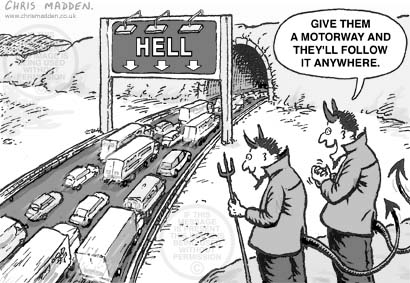
The cartoon above satirizes the consequences of providing free access to a costly facility. User fees encourage more rational patterns of use. For example, it is folly to think that projects like light rail can be financially viable when free alternatives exist. Specific highway routes under high demand must be priced in order for commuters to make rational decisions about the alternatives available to them, and for providers of transportation facilities, whether public or private, to rationally balance the resources dedicated to supporting various modes of travel.

Lower tax and regulatory burdens under the Trump infrastructure plan offer some encouragement for private development and operation of infrastructure projects. As a by-product, the plan might encourage greater reliance on user fees as a method of defraying the costs of infrastructure and promoting a more efficient allocation of resources toward infrastructure needs. However, there are unanswered questions about the details of the plan, and some of its heavy-handy features should be dispensed with.

Politicians and Infra-Hucksters

Tags

, , , , , , , , , , , , , , , , , , , , , , , ,

img_3863

We’ll soon have a new president and already we’ve heard new promises of infrastructure investment. Once again, a chorus of politicians and pundits decries the woeful state of America’s road, bridges, sewers and airport terminals. Then, there are hosannas in adoration of the economic stimulus and job creation promised by large public works projects. And of course there are proposals to integrate politically-favored technologies with new infrastructure. All three rationales for a publicly-financed infrastructure program are flawed. Our infrastructure is not as inadequate as many believe; it is bad public policy to justify infrastructure decisions on the basis of the construction jobs required; and new infrastructure should not be treated as a vehicle for large-scale deployment of unproven technologies.

Ownership

Much of our nation’s infrastructure is privately owned. This includes, but is not limited to, power generation and the power grid, communication networks, many water systems and sewer systems, most rail lines, some toll roads and bridges, and some river, sea and space ports. Maintenance and upgrades to private facilities, and to some public facilities, depend on the adequacy of the rates or fees charged to users. On the other hand, the quantity and quality of publicly-owned and operated infrastructure is often left up to taxpayers rather than users. Proposals for federal infrastructure investment are largely about these public facilities, but they might also involve subsidies for the development of private infrastructure.

Crisis or Crock?

In a Heritage Foundation research report, Michael Sargent notes that the poor state of the country’s public infrastructure is wildly exaggerated:

The notion that America’s infrastructure is ‘crumbling’ and in uniquely poor condition is not supported by data. The percentage of the nation’s bridges deemed ‘structurally deficient (not necessarily unsafe, but requiring extensive maintenance) has declined annually since 1990 and now sits at under 10 percent, well under half of what it was 25 years ago. Similarly, analyses of highway pavement quality conclude that the nation’s major roads have been steadily improving in quality and are likely in their best shape ever. Our airports and airways safely move more people and goods than those of any other nation. Overall, the U.S. ranks near the top of G-7 nations for infrastructure quality.

The usual poster child of the infrastructure “crisis” is the nation’s transportation system, but this report from the Reason Foundation shows that those troubles are something of a myth.

Nevertheless, there are always repairs, maintenance and replacement projects to be considered, as well as possible expansion and new facilities. Infrastructural shortfalls and expansion must be prioritized, but as Sargent emphasizes, an even larger number of projects should and probably would be handled privately if not for burdensome federal regulations. In addition, an irrational mistrust of privately-operated facilities among some segments of the public creates pressure to burden taxpayers with costs, rather than users. Complaints about congestion on roads offer a case in point: the best solutions involve efficient (and positive) pricing of existing capacity, rather than continued expansion of a “free” good. The avoidance of rational solutions like efficient pricing underscores the extent to which demands for increased public investment in infrastructure are driven by hyperbole, rather than sound analysis.

It’s About the Infrastructure, Not the Jobs 

Public infrastructure projects are also pitched as effective engines of economic stimulus and job creation. Both of those claims are questionable. Most importantly, the real rationale for infrastructure investment is the value of the infrastructure itself and the needs it serves going forward. The public expense and the jobs required to produce it are cost items! This point was made recently by economist T. Norman Van Cott, who rightfully asserts that a given output is of greater benefit when its costs are low and when it requires less labor input. (Van Cott’s piece uses the Keystone pipeline as an example, a controversial private project that I find objectionable for its dependence on eminent domain actions.) The sharp distinction between creating value and creating jobs is also made here by Jerry L. Jordon and here by Steven Horowitz. Here is Horowitz:

Creating jobs is easy; it’s creating value that’s hard. We could create millions of jobs quite easily by destroying every piece of machinery on U.S. farms. The question is whether we are actually better off by creating those jobs—and the answer is a definite no.

Yet this is how so many infrastructure projects are pitched at the national, state and local levels. It’s also puzzling that economic stimulus is used as a rationale even when the economy is operating near its potential output. Even by the standards of traditional Keynesian economic analysis, that is the wrong time for stimulus. Infrastructure projects should be evaluated on their own merits, not on how many construction workers must be hired, or on how much of their paychecks those workers will spend. Many of them must be bid away from competing projects anyway.

The Public Investment Trough

Here’s a brief anecdote from my own experience with an “advanced” public infrastructure project. Some years ago in the region around my city, St. Louis, Missouri, transportation agencies began to install a network of electronic highway message boards to convey real-time information to drivers on road conditions, congestion, and various public service announcements. The 100+ signs in the area today are connected to operators in a central office via fiber optic cable. This type of system is used elsewhere, and it is partly funded by the federal government.

I seriously question the benefits of this system relative to cost. The signs themselves cost well in excess of $100,000 each. The fiber network is undoubtedly costly, and there are other fixed and variable system costs. The signs have an anachronistic look, vaguely the quality of old high school scoreboards. The information they provide generally adds little to what I already know (“12 minutes to I-270”). The signs are in fixed positions, so the occasional report of an accident or congestion usually comes too late to give motorists decent alternatives. The information the signs provide on road conditions is obvious. Missives such as “buckle up” are of questionable value. Before I depart on a commute, or if I have a passenger, we can consult maps and other apps on cell phones to avail ourselves of far better information. Other, more flexible technologies were outpacing the message boards even before they could be fully deployed, and the boards are still being deployed. This is a project that might have sounded brilliant to highway engineers 20 years ago, but it represented something of a luxury relative to other needs, and it still got funded. Today, it looks like waste.

The politics of infrastructure often means that the enabling legislation gets loaded with poorly-planned projects and shiny jewels to dangle before home constituencies. Legislators are so eager to demonstrate their sophistication that they fall over themselves to approve taxpayer funds for unproven but politically-favored technologies. For example, a recent post by Warren Meyer notes the technical folly of solar roads. These are unlikely to attract much private money because they represent such a monumentally stupid idea. Proponents will go after tax money instead. The same is true of ideas like Elon Musk’s tunnel boring project, for which he hopes to collect massive taxpayer subsidies. Musk claims that tunnels will eliminate road congestion, but efficient pricing would do much to eliminate this problem without tunnels, and other technologies like automated vehicles are likely to reduce congestion by the time Musk over-invests tax money in tunnel-boring equipment, roads and hyper-loops inside tunnels.

In general, taxpayers should be wary of “green infrastructure” proposals. A large number of bike lanes, pedestrian bridges and greenways sound wonderful, but they are serious cost inflators. Federal dollars are regularly squandered on charming but wasteful projects such as trolleys. Even worse are ongoing efforts to subsidize the construction of high-speed rail systems. All of these bright ideas should be resisted.

Let’s Be Rational

The country certainly has infrastructural needs, but claims that we face a crisis are greatly exaggerated. With a new administration and what are likely to be supporting majorities in both houses of Congress, the danger of rushing into big funding commitments is heightened. The sponsors of this kind of legislation will herald massive job creation, but that is incidental to the cost side of the ledger. The benefits of individual projects should be evaluated carefully in comparison to costs. Then they can be prioritized if deemed of sufficient value. Finally, large scale deployment of unproven technologies should be avoided on the public dime.

I haven’t even mentioned one very large infrastructure project that has been proposed by President-Elect Donald Trump: the border wall. I suspect that it would be easier and less expensive to solve the problem of border security using more advanced and flexible technologies, but the permanence and symbolism of a wall appeals to many of Mr. Trump’s supporters. The benefits of a wall in terms of border security and control of immigration flows are difficult if not impossible to evaluate, as are the costs to taxpayers, with Trump promising to extract some form of payment from Mexico. The wall, however, is being “sold” to the American public in emotional terms. Come to think of it, that’s how too many other infrastructure proposals are sold by politicians!

There are promising opportunities to improve the nation’s infrastructure through the private sector, where the value of projects is subject to evaluation by parties who must put “skin in the game”. This will be addressed in my next post.

Charitable Intent

Tags

, , , , , , , , , , ,

charity

I’m not accustomed to writing about religious matters, but I must say that I’ve never been persuaded that Jesus himself approved or advocated for socialism and state-enforced redistribution of wealth. Instead, I believe that Jesus would have endorsed the message above: charity inheres to individuals, and it lives in their hearts. It is not a concern that individuals can ever satisfy by promoting public tax and transfer policies, pressing claims on the resources of others.

This week, an essay on this topic caught my eye. It appeared in Lawrence Reed’s “Cliches of Progressivism“, at the Foundation for Economic Education: “#42 – ‘Jesus Was a Progressive Because He Advocated Income Redistribution  to Help the Poor’“. It covers a number of Biblical scriptures sometimes quoted in support of this notion, and Reed’s considered refutation of each. I provide just a few of Reed’s examples below, but read the whole thing, as they say:

Make my brother share the wealth“:

In Luke 12: 13-15, Christ is confronted with a redistribution request. A man with a grievance approaches him and demands, ‘Master, speak to my brother and make him divide the inheritance with me.’ The Son of God, the same man who wrought miraculous healings and calmed the waves, replies thusly: ‘Man, who made me a judge or divider over you? Take heed and beware of covetousness, for a man’s wealth does not consist of the material abundance he possesses.’ Wow! He could have equalized the wealth between two men with a wave of His hand but he chose to denounce envy instead.

Sell all your goods and share“:

What about the reference, in the Book of Acts, to the early Christians selling their worldly goods and sharing communally in the proceeds? … In his contributing chapter to the 2014 book, ‘For the Least of These: A Biblical Answer to Poverty,’ Art Lindsley of the Institute for Faith, Work and Economics writes,

‘Again, in this passage from Acts, there is no mention of the state at all. These early believers contributed their goods freely, without coercion, voluntarily. Elsewhere in Scripture we see that Christians are even instructed to give in just this manner, freely, for “God loves a cheerful giver” (2 Corinthians 9:7). There is plenty of indication that private property rights were still in effect….’

Render Unto Caesar…“:

‘Wait a minute,’ you say. ‘Didn’t He answer, “Render unto Caesar the things that are Caesar’s, and unto God the things that are God’s’ when the Pharisees tried to trick Him into denouncing a Roman-imposed tax?” … It’s found first in the Gospel of Matthew, chapter 22, verses 15-22 and later in the Gospel of Mark, chapter 12, verses 13-17. But notice that everything depends on just what did truly belong to Caesar and what didn’t, which is actually a rather powerful endorsement of property rights. Christ said nothing like ‘It belongs to Caesar if Caesar simply says it does, no matter how much he wants, how he gets it, or how he chooses to spend it.’

The fact is, one can scour the Scriptures with a fine-tooth comb and find nary a word from Christ that endorses the forcible redistribution of wealth by political authorities. None, period.

While I generally agree with Reed’s analysis of this last point, I believe he missed the real message regarding any legitimate claims Caesar might have possessed. It is a statement about the value of material goods relative to faith and acts in the name of God. Obviously, as Reed says, it is not an endorsement of a power to tax and transfer.

The teachings of charity in the Bible have to do with the goodness of voluntary, self-motivated generosity. There are no lessons advocating compulsory taxes and transfer payments. If you say that Jesus would have supported such programs as deeds of a caring society, I would question your logic on several grounds. First, there are always political motives at play in crafting such policies, which usually include vote-buying and scapegoating. In that respect, those policies fall short of the standard for “good works”. Second, as already noted, the power to tax is backed by the police power of government, not quite the sort of “giving” about which Jesus preached. And, by extracting resources from those in a position to give unto others, tax and transfer policies reduce the capacity for private generosity. Granted, a charitable tax deduction might establish an incentive strong enough to encourage a level of continued giving. But then, the “noble” social deed becomes the hostage of tax policy, administrative definitions, rulings relative to recipient organizations, and the whims of self-interested politicians. A presumption is that individuals will not perform good works in sufficient amounts. Therefore, the state must step in, along with an army of bureaucrats and lobbyists who can be counted upon to feed off the taxpayers’ largess. The individual acts of charity encouraged in Jesus’s teachings could hardly be subject to greater convolution.

Equality of Economic Freedom and the End of Poverty

Tags

, , , , , , , , , , , ,

poverty-econ-freedom

Should any form of equality be a central goal of society? Most certainly, but answers to this question often presume that government can set ground rules, ex ante, to ensure some form of ex post equality. Equality is a thing that can exist ex ante, as when rules are applied equally, and ex post, as when there are no differences in outcomes. The latter, however, always requires coercion and force of one form or another.

The great economist Deirdre McCloskey writes in the New York Times that forced equality will not save the poor; only growth can do it. Those who put their faith in the state to eliminate poverty lack an understanding of the underlying conditions and causes of the drastic improvements in the standard of living for even the world’s most impoverished inhabitants. It is all about economic freedom and capitalism. McCloskey explains:

Eliminating poverty is obviously good. And, happily, it is already happening on a global scale. The World Bank reports that the basics of a dignified life are more available to the poorest among us than at any time in history, by a big margin. … Even in the rich countries, the poor are better off than they were in 1970, with better food and health care and, often, amenities like air-conditioning. …

… Free adults get what they need by working to make goods and services for other people, and then exchanging them voluntarily. They don’t get them by slicing up manna from Mother Nature in a zero-sum world. …

… We had better focus directly on the equality that we actually want and can achieve, which is equality of social dignity and equality before the law.

Achievable equality has to do with ground rules, in the first instance. The rules must establish freedoms to which all participants are entitled. Many of these freedoms are enshrined in the U.S. Constitution, for example. With regard to strictly economic rules, we have: the right to private property, including the fruits of one’s own labor; the freedom to engage in exchange on terms of our choosing, and enter into contracts in pursuit of self-interest; and the freedom to take risks with real consequences.

Around the world, ex ante freedoms like these have been instrumental in lifting masses from the grips of poverty, not temporarily and artificially, but by encouraging self-sufficiency. That is the very ex post outcome that’s been so elusive for socialized economies and state-sponsored anti-poverty transfer schemes. By encouraging economic growth and an enhanced standard of living for those at the lowest end of the socioeconomic spectrum, ex ante freedoms achieve a crucial type of ex post equality: a life above penury.

McCloskey contrasts these kinds of equality with the utter failure of redistributive schemes to accomplish anything comparable:

An all-wise central plan could force the right people into the right jobs. But such a solution, like much of the case for a compelled equality, is violent and magical. The magic has been tried, in Stalin’s Russia and Mao’s China. So has the violence.”

Not to mention the social and economic failures in Cuba, Venezuela, East Germany, Cambodia, Bulgaria, Ethiopia, Mozambique, Somalia, Romania, North Vietnam, North Korea, and too many others. And the sluggish growth to which many “social democracies” consign themselves by ceding dominance to the state. McCloskey continues:

As a matter of arithmetic, expropriating the rich to give to the poor does not uplift the poor very much. If we took every dime from the top 20 percent of the income distribution and gave it to the bottom 80 percent, the bottom folk would be only 25 percent better off. If we took only from the superrich, the bottom would get less than that. And redistribution works only once. You can’t expect the expropriated rich to show up for a second cutting. In a free society, they can move to Ireland or the Cayman Islands. And the wretched millionaires can hardly re-earn their millions next year if the state has taken most of the money.

The following quote about poverty in the U.S. seems appropriate in this context. It is from Robert Sowell’s final column (having just announced his retirement from regular syndication):

Most people living in officially defined poverty in the 21st century have things like cable television, microwave ovens and air-conditioning. Most Americans did not have such things, as late as the 1980s. People whom the intelligentsia continue to call the ‘have-nots’ today have things that the ‘haves’ did not have, just a generation ago.

A sound argument can be made for the public provision of a safety net to cushion the blow of job losses in a market economy, or from the effects of catastrophic events on individuals or families. However, permanent status as a state-dependent must be discouraged for those capable of readjustment and self-reliance. Some such losses can and should be self-insured, not least by a willingness to pursue new opportunities, even those offering lower immediate rewards or requiring new training. Voluntary saving is another obvious form of self-insurance, of course. Nevertheless, few would deny the need for some form of social insurance to enable more comfortable transitions for those in need following certain kinds of losses.

McCloskey’s most powerful message involves the matter of value. Individuals trade with one another voluntarily only when it is of mutual benefit, which is dependent on the ex ante freedoms discussed above. There are mistakes in which parties are left unsatisfied by certain exchanges, but no one is compelled to repeat those mistakes. And they have every reason to innovate and seek alternatives. Participants may be happy to adjust the terms on which they are willing to trade, and they have every reason to imitate and repeat successes. These are the ways in which economic growth occurs:

It is growth from exchange-tested betterment, not compelled or voluntary charity, that solves the problem of poverty.

Capitalism and the market system have, by far, the best record of eliminating poverty in the sense of self-reliance. The only success against poverty that can be claimed by redistributionists is the substitution of lasting dependence on the state. Capitalism and the market hold the only real promise for eliminating poverty entirely.

Markets, Ingenuity and Genuine Sustainability

Tags

, , , , , , , , , , , , , ,

img_3778

Will mankind drain the world of resources and ruin the environment? Must we curtail economic growth in order to ensure our long-term survival? Only if we give up on markets and give-in to central economic direction and control. Ronald Bailey at Reason.com covers the technical assumptions underlying a recent piece of neo-Malthusian “research” purporting to demonstrate the impossibility of environmentally-sustainable economic growth. Bailey’s article makes a great follow-up to my last post, “The Greening-Carbon Nexus“, in which I discussed the bloom in vegetation taking place around the globe attributable to greater levels of atmospheric CO2.

Bailey describes the concept of “decoupling” resource use from economic growth as fundamental to long-term environmental sustainability. This is another twist on good old-fashioned growth in factor productivity. In the new research cited by Bailey, Australian hydrologist James Ward and his co-authors assert that population growth and consumption will eventually overwhelm technological advance. However, it has long been recognized by demographers that freedom from need and growth in material comfort reduces fertility. Bailey notes that world population growth has been decelerating for many years, and the global population is likely to stabilize within a couple of decades.

Ward, et al lean heavily on assumptions about how various classes of resources are not substitutable, and that mankind will run-up against hard production requirements for minimum resource use, a point at which many tradeoffs become impossible. Bailey summarizes their results:

They crank the notion that there are nonsubstitutable physical limits on material and energy resources through their equations until 2100, and they find that eventually consumption of both rise at the same rate as economic growth. QED: Economic growth is unsustainable. Or as they report, ‘Permanent decoupling (absolute or relative) is impossible for essential, non-substitutable resources because the efficiency gains are ultimately governed by physical limits.’

Bailey proceeds to pick apart the assumptions made by Ward and his co-authors. First, even if true, those assumptions would apply with much more force to physical outputs, as opposed to service outputs. The latter are likely to continue on a path garnering an increasing share of world output over time. More fundamentally, Ward, et al give short-shrift to the limitless potential of human ingenuity. A few specific examples of the physical limits they contemplate are already verifiably false, having been overcome by technological breakthroughs. This includes agricultural productivity related to enhancements in plant photosynthesis, new manufacturing methods requiring dramatically fewer raw materials, and methods of energy production that are already available, if not yet heavily relied upon. A glaring assumption made by Ward, et al is that the use of fossil fuels will continue to grow through at least the year 2100. In fact, existing alternatives such as nuclear power might well be more economical. Ironically, greater adoption of nuclear power is held hostage by the political resistance of groups who oppose the burning of fossil fuels.

Bailey also cites the work of Jesse Ausubel, whom I cited at length in a post on “rewilding” in 2015. Ausubel’s work shows that Americans’ use of a variety of productive inputs already has “decoupled absolutely” from production, or is approaching that point. That includes farmland, water, timber, plastics, aluminum and steel. Our use of all of those things has peaked and is now in decline. Ausubel’s work implies that “decoupling” is just a matter of time for many other resources for which use is growing at rates declining relative to production. These trends will spread overseas with continued economic development.

Efficiencies like these are a direct effect of technological advance, but the process of technical change is dependent on incentives, which are, in turn, dependent on market prices, profit opportunities, and secure property rights. First, the funding of research into new techniques and methods is driven in large part by market incentives. That’s the real mechanism at play when we marvel that “necessity is the mother of invention”. Necessity, of course, is often manifest in scarcity of existing productive inputs and high input prices.

New technologies present profit opportunities by promising lower input costs, greater production, or other competitive advantages. The adoption of a new technology nearly always entails short-run costs and long-term rewards, both of which are driven by market prices. As the pace of adoption accelerates, the costs of new technologies tend to decrease along with scale economies and sheer experience, reinforcing the process of diffusion. The driving force in all cases is the competitive market and freedom to trade for one’s own benefit. The increasing efficiency of resource use embodied in the “decoupling” phenomena is dependent on the existence of accurate market incentives and secure rights to the rewards that efficiencies in production can bring.

And what if government responds to political pressure by imposing bureaucratically-established production limits, market quotas, efficiency standards, process rules, regulatory reporting, and tax penalties. Apart from direct confiscation and the additional confiscatory risk these actions entail, compliance requires producers to ignore market incentives to one degree or another. These measures force adoption of  less efficient technologies than the market would dictate and add resource costs that would otherwise be absent. The inescapable fact is that market incentives are blunted or destroyed in the process; the consequent waste of resources prevents the kind of natural improvements in factor productivity that lead to decoupling and sustainability.

Sadly, such regulatory actions are often borne out of private rent-seeking efforts. Dominant market players believe that smaller competitors will struggle under the compliance burden created by regulation, so they work with government officials in an effort to have these rules promulgated. This adds a greater degree of market concentration and monopoly power, which implies an efficiency loss relative to competition. Under the protection of regulators, dominant players can survive for too long using wasteful techniques and inputs. Fortunately, with time, new technologies often outpace even these dominant players and the outmoded regulatory rules they rely upon.

Just as wasteful are authoritarian efforts to promote new technologies before the market is ready to adopt them. Picking technological winners and losers is fraught with peril for society. The government usually lacks the foresight possessed by the market, forcibly redirecting resources from one use to another with little consequence for failure except at the taxpayer’s expense. The premature investment is prone to burdening society with stale or defective early versions of new technology. This is not a reliable way to achieve efficiency in resource use. One of the sure signs that such efforts entail waste is the propensity for insiders to be awarded subsidies for promoting politically-favored technologies. Government is invariably drawn to such opportunities for graft.

I conclude with a quote of my earlier post on Ausubel’s work (linked above):

It’s worth emphasizing that the nature rebound already taking place in the developed world is largely a product of free market capitalism and the growth in wealth and technology they have made possible. A great benefit of secure property rights for society, and for the environment, is that owners have powerful incentives to husband their resources. Likewise, the profit motive gives producers strong incentives to reduce waste and improve productivity. As economic development becomes more widespread, these incentives are promoting a healthier balance between man and nature.


The Greening-Carbon Nexus

Tags

, , , , , , , , , , , ,

carbon_sequestration

Satellite records show that our world is experiencing a remarkable “greening” in the 21st century, to the seeming chagrin of the environmental left. There is now more vegetation than two decades ago, and greener vegetation, across as much as 50% of the Earth’s vegetated surface area. That area is expanding as well, and the creeping greenery has improved soil moisture levels in some drylands. This bodes well for agricultural productivity, putting another nail in Malthus’ coffin. The satellite studies have concluded that most of the enhanced vegetation is attributable to greater concentration of CO2 in the atmosphere, as opposed to warming or other possible causes. An interesting feedback is that the enhanced vegetation increases natural absorption of CO2, providing an enhanced carbon sink. This, in turn, has caused a pause in the growth of atmospheric carbon cencentration.

The environmental left knows these developments tend to undermine their preferred narrative that human emissions of CO2 must be reduced — at any cost. In fact, already there are warnings that global greening will “outgrow its benefit” as the greater volume of plants begins to decay, releasing carbon. You just can’t make some people happy! But not all of the carbon release from plant decay adds to atmospheric carbon — some is soil-bound — so the greening should provide a fairly durable carbon sink.

Global greening was one of the major motifs in Matt Ridley’s 2016 Global Warming Policy Foundation Lecture. Ridley covered various evidence of greening, but he also discussed the failure of a large contingent of climate researchers to follow a legitimate scientific approach to the study of climate change. Instead, they have politicized their field of study, committing a few noteworthy frauds along the way:

It is irresponsible not to challenge the evidence properly, especially if the policies pursued in its name are causing suffering. Increasingly, many people would like to outlaw, suppress, prosecute and censor all discussion of what they call ‘the science’ rather than engage in debate. …

No wonder that I talk frequently to scientists who are skeptical, but dare not say so openly. That is a ridiculous state of affairs. We’re told that it’s impertinent to question “the science” and that we must think as we are told. But arguments from authority are the refuge of priests. Thomas Henry Huxley put it this way: ‘The improver of natural knowledge absolutely refuses to acknowledge authority, as such. For him, scepticism is the highest of duties; blind faith the one unpardonable sin’. 

What keeps science honest, what stops it from succumbing entirely to confirmation bias, is that it is decentralized, allowing one lab to challenge another.

It is all too true that policies advanced in the interests of curbing a slight warming trend cause real suffering, and the pain is heavily concentrated on the most impoverished. The presumed benefits of activist climate-change policies are speculative, at best. They have little chance of reversing atmospheric carbon concentration on their own.

Ridley makes note of the substantial evidence that sensitivity of the climate to airborne carbon concentration is low. This has become increasingly evident with the unfolding of a consistent record of over-forecasts of global temperatures by climate forcing models. Roy Spencer provides insights about these models in a recent discussion of global warming and “dodgy science” on his blog.

There is a widespread myth that 97 percent of climate scientists believe human activity is the main cause of global warming. In fact, that claim was based on a paper counting citations, not scientists; the methods used in the study and the citations themselves were also questionable. I have reviewed that evidence here on Sacred Cow Chips. David Henderson reviewed it hereA large number of studies find fault with so-called “consensus” pronouncements. They should always be viewed with suspicion.

There is also a lively debate underway over whether CO2 should be considered a pollutant! I exhale, therefore I pollute? To the extent that fecal matter is considered a pollutant, is it fair that to say that CO2 is, too? After all, both are anthropogenic. No, they are not even close in terms of an immediate threat to human health. As a philosophical matter, the idea that anything done by man is “unnatural” denies the fact that we are a very part of nature. Obviously, CO2 is not in the same class as pollutants like sulfur dioxide, ammonia, carbon monoxide or toxic metals. Today, these pollutants are very common in many parts of the world, and they are very threatening to human life. Effective mitigation technologies are available, but instead, in the developed West, we fixate on an increase in CO2 concentration of 100 parts per million over many decades, the climate implications of which are de minimis.

Rand Paul’s Facebook page has an ungated link to a WSJ.com commentary by Rodney W. Nichols and Harrison H. Schmitt on “The Phony War Against CO2”. Their commentary provokes questions as to the motives of the environmental left, and certain members of the research community, in shilling for the cause. That we would fight the greening of the globe, and the potential agricultural benefit it could bring, is bizarre. To devote enormous resources to an endeavor that is largely futile is a waste and a tragedy.