• About

Sacred Cow Chips

Sacred Cow Chips

Tag Archives: Antigenic Drift

Fall Coronavirus Season

16 Friday Oct 2020

Posted by Nuetzel in Coronavirus, Pandemic, Uncategorized

≈ Leave a comment

Tags

Antigenic Drift, CARES Act, Coronavirus, Covid-19, Death Laundering, Europe, False Positives, Hospital Reimbursement, IFR, Immunity, Infection Fatality Rate, Kyle Lamb, Medicare, Seasonality, Second Wave, Twitter, Vitamin D, WHO

We’ve known for some times that COVID-19 (C19) follows seasonal patterns typical of the flu, though without the flu’s frequent antigenic drift. Now that we’re moving well into autumn, we’ve seen a surge in new C19 case counts in Europe and in a number of U.S. states, especially along the northern tier of the country.

The new case surge began in early to mid-September, depending on the state, and it’s been coincident with another surge in tests. From late July through early October, we had a near doubling in the number of tests per positive in the U.S. An increase in tests also accompanied the previous surge during the summer, which claimed far fewer lives than the initial wave in the early spring. In the summer, infections were much more prevalent among younger people than in the spring. Vitamin D levels were almost certainly higher during the summer months, our ability to treat the virus had also improved, and immunities imparted by prior infections left fewer susceptible individuals in the population. We have many of those advantages now, but D levels will fade as the fall progresses.

As for the new surge in cases, another qualification is that false positives are still a major testing problem; they inflate both case counts and C19-attributed deaths. In the absence of any improvement in test specificity, of which there is no evidence, the exaggeration caused by false positives grows larger as testing increases and positivity rates fall. So take all the numbers with that as a caveat.

How deadly will the virus be this fall? So far in Europe, the trends look very promising. Kyle Lamb provided the following charts from WHO on Twitter yesterday. (We should all be grateful that Twitter hasn’t censored Kyle yet, because he’s been a force in exposing alarmism in the mainstream media and among the public health establishment.) Take a look at these charts, and note particularly the lag between the first wave of infections and deaths, as well as the low counts of deaths now:

If the lag between diagnosis and death is similar now to the spring, Europe should have seen a strong upward trend in deaths by now, yet it’s hardly discernible in most of those countries. The fatality rates are low as well:

As Lamb notes, the IFRs in the last column look about like the flu, though again, the reporting of deaths and their causes are often subject to lags.

What about the U.S.? Nationwide, C19 cases and attributed death reports declined after July. See the chart below. More recently, reported deaths have stabilized at under 700 per day. Note again the relatively short lags between turns in cases and deaths in both the spring and summer waves.

Clearly, there has been no acceleration in C19 deaths corresponding to the recent trend in new cases. Northeastern states that had elevated death rates in the spring saw no resurgence in the summer; southern states that experienced a surge in the summer have now enjoyed taperings of both cases and deaths. But with each season, the virus seems to roll to regions that have been relatively unscathed to that point. Now, cases are surging in the upper Midwest and upper mountain states, though some of these states are lightly populated and their data are thin.

A few state charts are shown below, but trends in deaths are very difficult to tease out in some cases. First, here are new cases and reported deaths in Michigan, Wisconsin, and Minnesota. There is a clear uptrend in cases in these states along with a very slight rise in deaths, but reported deaths are very low.

Next are Idaho, Montana, North Dakota, and South Dakota. A slight uptrend in cases began as early as August. Idaho and Montana have had few deaths, so they are not plotted in the second chart. The Dakotas have had days with higher reported deaths, and while the data are thin and volatile, the visual impression is definitely of an uptrend in deaths.

The following states are somewhat more central in latitude: Colorado, Illinois, and Ohio. There is a slight upward trend in new cases, but not deaths. Illinois is experiencing its own second wave in cases.

Out of curiosity, I also plotted Massachusetts, Pennsylvania, and New Jersey, all of which suffered in the first wave during the spring. They are now experiencing uptrends in cases, especially Massachusetts, but deaths have been restrained thus far.

The upshot is that states having little previous exposure to the virus are seeing an uptrend in deaths this fall. The same does not seem to be happening in states with significant prior exposure, at least not yet.

There are major questions about the reasons for the lingering death counts in the U.S.. But consider the following: first, the infection fatality rate (IFR) keeps falling, despite the stubborn level of daily reported deaths. Second, deaths reported have increasingly been pulled forward from deaths that actually occurred in the more distant past. This sort of “laundering” lends the appearance of greater persistence in deaths than is real. Third, again, false positives exaggerate not just cases, but also C19 deaths. Hospitals test everyone admitted, and patients who test positive for C19 are reimbursed at higher rates under the CARES Act; Medicare reimburses at a higher rates for C19 patients as well.

We’re definitely seeing a seasonal upswing in C19 infections in the US., now going on five weeks. In Europe, the surge in cases began slightly earlier. However, in both Europe and the U.S., these new cases have not yet been associated with a meaningful surge in deaths. The exceptions in the U.S. are the low-density upper mountain states, which have had little prior exposure to the virus. The lag between cases and deaths in the spring and summer was just two to three weeks, and while it’s too early to draw conclusions, the absence of a surge in deaths thus far bodes well for the IFR going forward. If we’re so fortunate, we can thank a combination of factors: a younger set of infecteds, earlier detection, better treatment and therapeutics, lower viral loads, and a subset of individuals who have already gained immunity.
COVID Seasonality and Latitudes

23 Sunday Aug 2020

Posted by Nuetzel in Pandemic

≈ 2 Comments

Tags

Air Conditioning, Antibodies, Antigenic Drift, Bimodal, Coronavirus, Covid-19, Ethical Skeptic, Heidi J Zapata, Herd Immunity, Herd Immunity Threshold, Humidity, Immune Response, Justin Hart, Latitude and Seasonality, Proofreading enzymes, Robert Edgar Hope-Simpson, SARS, SARS-CoV-2, Seasonality, Sunlight, T-Cell Immunity, Temperature, Tropical Latitudes, Viral Load, Viral Mutation, Vitamin D Deficiency

The coronavirus (C19), or SARS-CoV-2, has a strong seasonal component that appears to closely match that of earlier SARS viruses as well as seasonal influenza. This includes the two distinct caseloads we’ve experienced in the U.S. 1) in the late winter/early spring; and 2) the smaller bump we witnessed this summer in some southern states and tropics. 

COVID Seasonal Patterns and Latitude

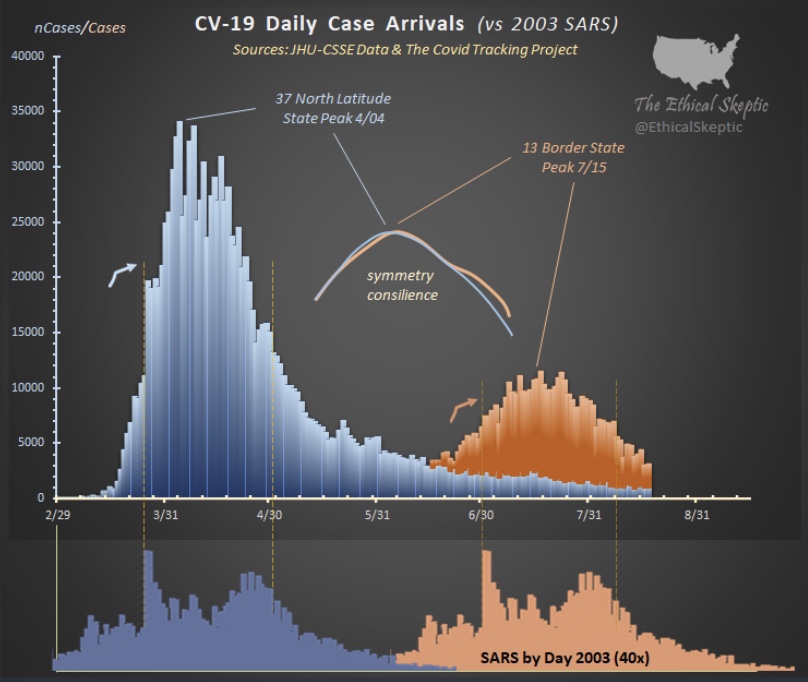
The Ethical Skeptic on Twitter recently featured the chart below. It shows the new case count of C19 in the U.S. in the upper panel, and the 2003 SARS virus in the lower panel. Both viruses had an initial phase at higher latitudes and a summer rebound at lower latitudes.


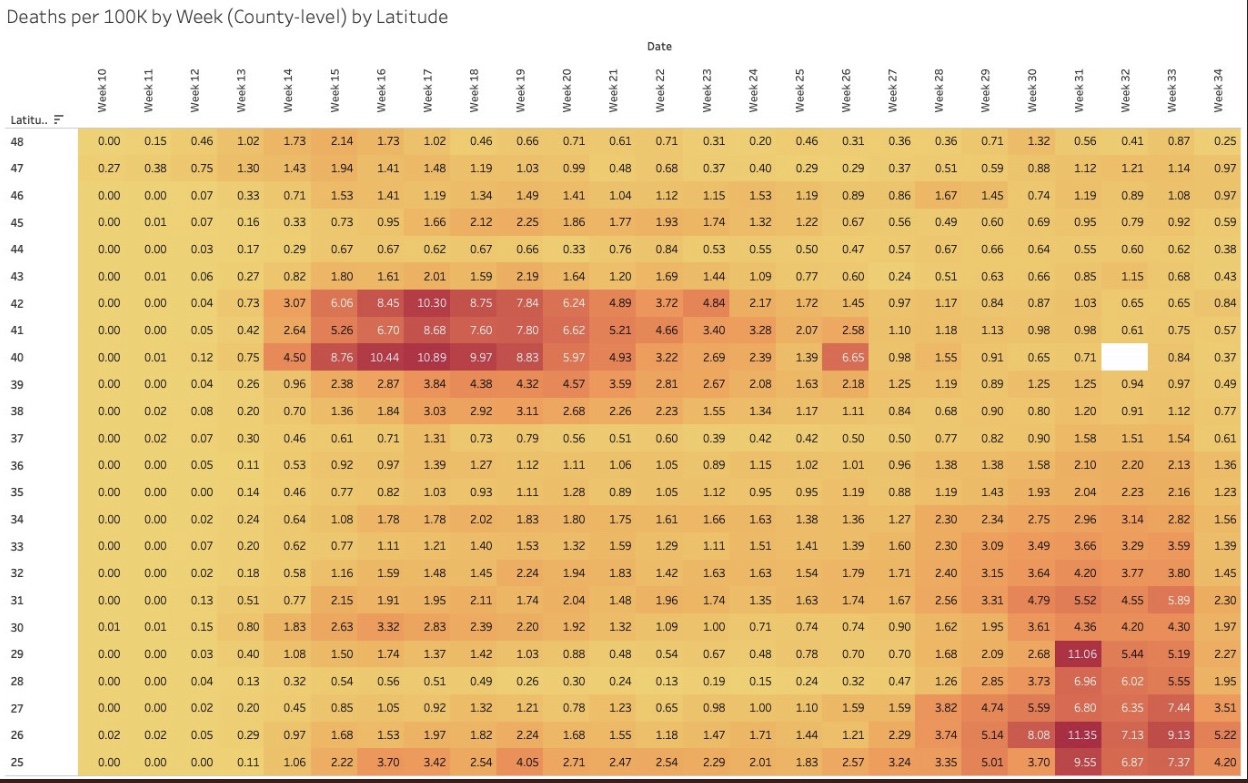
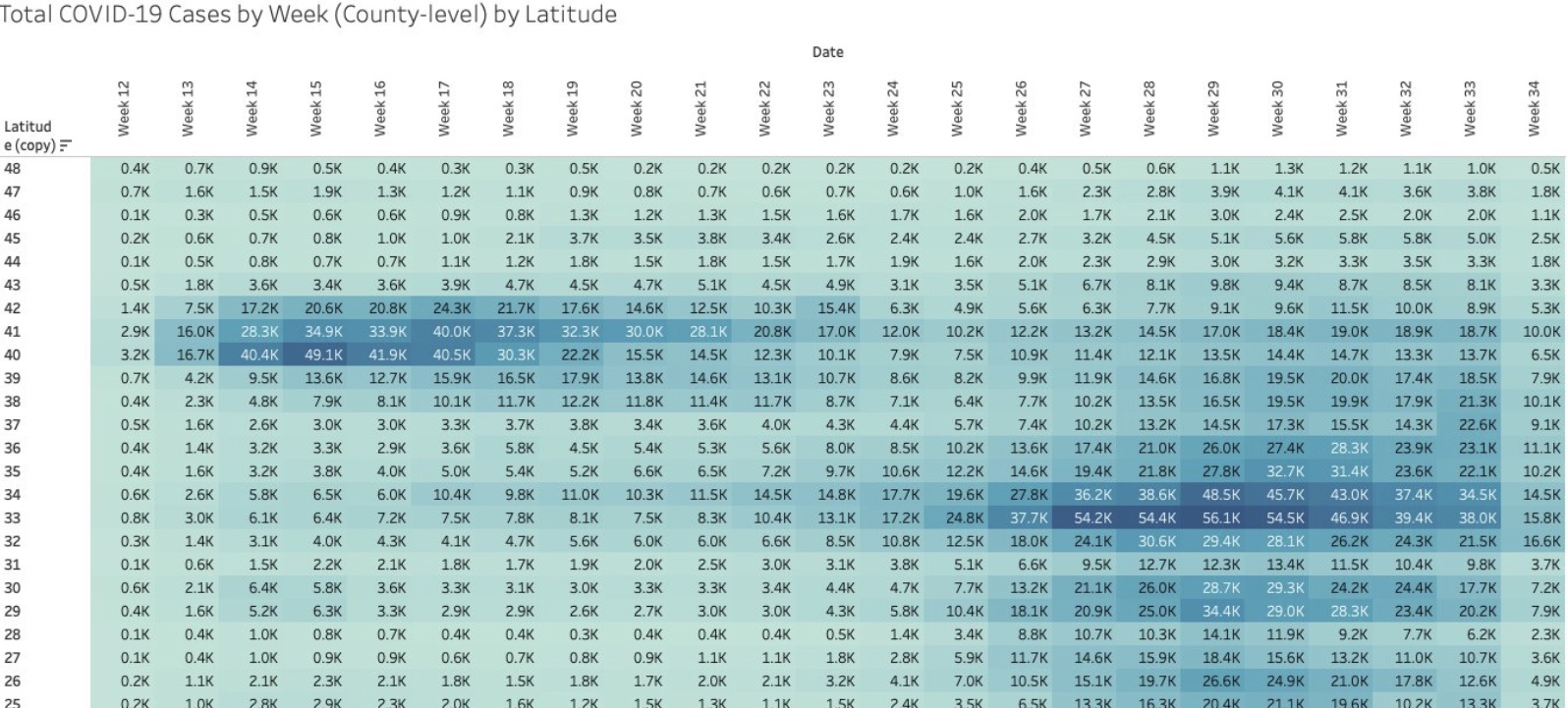
I particularly like the following visualizations from Justin Hart demonstrating the pandemic’s pattern at different latitudes (shown in the leftmost column). The first table shows total cases by week of 2020. The second shows deaths per 100,000 of population by week. Again, notice that lower latitudes have had a crest in the contagion this summer, while higher latitudes suffered the worst of their contagion in the spring. Based on deaths in the second table, the infections at lower latitudes have been less severe.

Viral Patterns in the South

Many expected the pandemic to abate this summer, including me, as it is well known that viruses don’t thrive in higher temperatures and humidity levels, and in more direct sunlight. So it is a puzzle that southern latitudes experienced a surge in the virus during the warmest months of the year. True, the cases were less severe on average, and sunlight and humidity likely played a role in that, along with the marked reduction in the age distribution of cases. However, the SARS pandemic of 2003 followed the same pattern, and the summer surge of C19 at southern latitudes was quite typical of viruses historically.

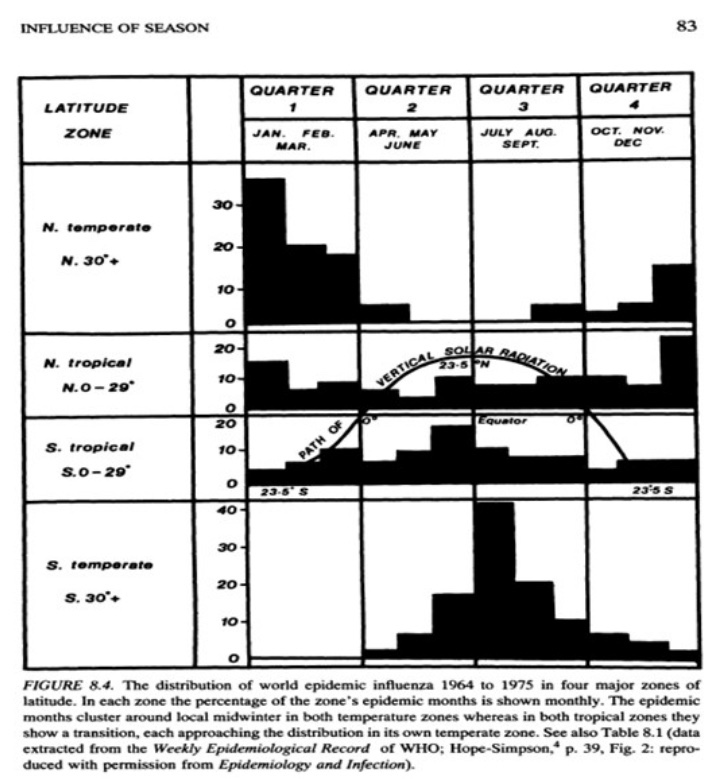
A classic study of the seasonality of viruses was published in 1981 by Robert Edgar Hope-Simpson. The next chart summarized his findings on influenza, seasonality, and latitude based on four groups of latitudes. Northern and southern latitudes above 30° are shown in the top and bottom panels, respectively. Both show wintertime contagions with few infections during the summer months. Tropical regions are different, however. The second and third panels of the chart show flu infections at latitudes less than 30°. Influenza seems to lurk at relatively low levels through most of the year in the tropics, but the respective patterns above and below the equator look almost like very muted versions of activity further to the north and south. However, some researchers describe the tropical pattern as bimodal, meaning that there are two peaks over the course of a year.   

So the “puzzle” of the summer surge at low latitudes appears to be more of an empirical regularity. But what gives rise to this pattern in the tropics, given that direct sunlight, temperature, and humidity subdue viral activity?

There are several possible explanations. One is that the summer rainy season in the tropics leads to less sunlight as well as changes in behavior: more time spent indoors and even less exposure to sunlight. In fact, today, in tropical areas where air conditioning is more widespread, it doesn’t have to be rainy to bring people indoors, just hot. Unfortunately, air conditioning dries the air and creates a more hospitable environment for viruses. Moreover, low latitudes are populated by a larger share of dark-skinned peoples, who generally are more deficient in vitamin D. That might magnify the virulence associated with the flight indoors brought on by hot and or rainy weather.   

Mutations and Seasonal Patterns

What makes the seasonal patterns noted above so reliable in the face of successful immune responses by recovered individuals? And shouldn’t herd immunity end these seasonal repetitions? The problem is the flu is highly prone to viral mutation, having segments of genes that are highly interchangeable (prompting so-called “antigenic drift“). That’s why flu vaccines are usually different each year: they are customized to prompt an immune response to the latest strains of the virus. Still, the power of these new viral strains are sufficient to propagate the kinds of annual flu cycles documented by Hope-Simpson.

With C19, we know there have been up to 100 mutations, mostly quite minor. Two major strains have been dominant. The first was more common in Southeast Asia near the beginning of the pandemic. It was less virulent and deadly than the strain that hit much of Europe and the U.S. Of course, in July the media misrepresented this strain as “new”, when in fact it had become the most dominant strain back in March and April.

What Lies Ahead

By now, it’s possible that the herd immunity threshold has been surpassed in many areas, which means that a surge this coming fall or winter would be limited to a smaller subset of still-susceptible individuals. The key question is whether C19 will be prone to mutations that pose new danger. If so, it’s possible that the fall and winter will bring an upsurge in cases in northern latitudes both among those still susceptible to existing strains, and to the larger population without immune defenses against new strains.

Fortunately, less dangerous variants are more more likely to be in the interest of the virus’ survival. And thus far, despite the number of minor mutations, it appears that C19 is relatively stable as viruses go. This article quotes Dr. Heidi J. Zapata, an infectious disease specialist and immunologist at Yale, who says that C19:

“… has shown to be a bit slow when it comes to accumulating mutations … Coronaviruses are interesting in that they carry a protein that ‘proofreads’ [their] genetic code, thus making mutations less likely compared to viruses that do not carry these proofreading proteins.”

The flu, however, does not have such a proofreading enzyme, so there is little to check its prodigious tendency to mutate. Ironically, C19’s greater reliability in producing faithful copies of itself should help ensure more durable immunity among those already having acquired defenses against C19.

This means that C19 might not have a strong seasonal resurgence in the fall and winter. Exceptions could include: 1) the remaining susceptible population, should they be exposed to a sufficient viral load; 2) regions that have not yet reached the herd immunity threshold; and 3) the advent of a dangerous new mutation, though existing T-cell immunity may effectively cross-react to defend against such a mutation in many individuals.


Follow Sacred Cow Chips on WordPress.com

Recent Posts

  • Immigration and Merit As Fiscal Propositions
  • Tariff “Dividend” From An Indigent State
  • Almost Looks Like the Fed Has a 3% Inflation Target
  • Government Malpractice Breeds Health Care Havoc
  • A Tax On Imports Takes a Toll on Exports

Archives

  • December 2025
  • November 2025
  • October 2025
  • September 2025
  • August 2025
  • July 2025
  • June 2025
  • May 2025
  • April 2025
  • March 2025
  • February 2025
  • January 2025
  • December 2024
  • November 2024
  • October 2024
  • September 2024
  • August 2024
  • July 2024
  • June 2024
  • May 2024
  • April 2024
  • March 2024
  • February 2024
  • January 2024
  • December 2023
  • November 2023
  • August 2023
  • July 2023
  • June 2023
  • May 2023
  • April 2023
  • March 2023
  • February 2023
  • January 2023
  • December 2022
  • November 2022
  • October 2022
  • September 2022
  • August 2022
  • July 2022
  • June 2022
  • May 2022
  • April 2022
  • March 2022
  • February 2022
  • January 2022
  • December 2021
  • November 2021
  • October 2021
  • September 2021
  • August 2021
  • July 2021
  • June 2021
  • May 2021
  • April 2021
  • March 2021
  • February 2021
  • January 2021
  • December 2020
  • November 2020
  • October 2020
  • September 2020
  • August 2020
  • July 2020
  • June 2020
  • May 2020
  • April 2020
  • March 2020
  • February 2020
  • January 2020
  • December 2019
  • November 2019
  • October 2019
  • September 2019
  • August 2019
  • July 2019
  • June 2019
  • May 2019
  • April 2019
  • March 2019
  • February 2019
  • January 2019
  • December 2018
  • November 2018
  • October 2018
  • September 2018
  • August 2018
  • July 2018
  • June 2018
  • May 2018
  • April 2018
  • March 2018
  • February 2018
  • January 2018
  • December 2017
  • November 2017
  • October 2017
  • September 2017
  • August 2017
  • July 2017
  • June 2017
  • May 2017
  • April 2017
  • March 2017
  • February 2017
  • January 2017
  • December 2016
  • November 2016
  • October 2016
  • September 2016
  • August 2016
  • July 2016
  • June 2016
  • May 2016
  • April 2016
  • March 2016
  • February 2016
  • January 2016
  • December 2015
  • November 2015
  • October 2015
  • September 2015
  • August 2015
  • July 2015
  • June 2015
  • May 2015
  • April 2015
  • March 2015
  • February 2015
  • January 2015
  • December 2014
  • November 2014
  • October 2014
  • September 2014
  • August 2014
  • July 2014
  • June 2014
  • May 2014
  • April 2014
  • March 2014

Blogs I Follow

  • Passive Income Kickstart
  • OnlyFinance.net
  • TLC Cholesterol
  • Nintil
  • kendunning.net
  • DCWhispers.com
  • Hoong-Wai in the UK
  • Marginal REVOLUTION
  • Stlouis
  • Watts Up With That?
  • Aussie Nationalist Blog
  • American Elephants
  • The View from Alexandria
  • The Gymnasium
  • A Force for Good
  • Notes On Liberty
  • troymo
  • SUNDAY BLOG Stephanie Sievers
  • Miss Lou Acquiring Lore
  • Your Well Wisher Program
  • Objectivism In Depth
  • RobotEnomics
  • Orderstatistic
  • Paradigm Library
  • Scattered Showers and Quicksand

Blog at WordPress.com.

Passive Income Kickstart

OnlyFinance.net

TLC Cholesterol

Nintil

To estimate, compare, distinguish, discuss, and trace to its principal sources everything

kendunning.net

The Future is Ours to Create

DCWhispers.com

Hoong-Wai in the UK

A Commonwealth immigrant's perspective on the UK's public arena.

Marginal REVOLUTION

Small Steps Toward A Much Better World

Stlouis

Watts Up With That?

The world's most viewed site on global warming and climate change

Aussie Nationalist Blog

Commentary from a Paleoconservative and Nationalist perspective

American Elephants

Defending Life, Liberty and the Pursuit of Happiness

The View from Alexandria

In advanced civilizations the period loosely called Alexandrian is usually associated with flexible morals, perfunctory religion, populist standards and cosmopolitan tastes, feminism, exotic cults, and the rapid turnover of high and low fads---in short, a falling away (which is all that decadence means) from the strictness of traditional rules, embodied in character and inforced from within. -- Jacques Barzun

The Gymnasium

A place for reason, politics, economics, and faith steeped in the classical liberal tradition

A Force for Good

How economics, morality, and markets combine

Notes On Liberty

Spontaneous thoughts on a humble creed

troymo

SUNDAY BLOG Stephanie Sievers

Escaping the everyday life with photographs from my travels

Miss Lou Acquiring Lore

Gallery of Life...

Your Well Wisher Program

Attempt to solve commonly known problems…

Objectivism In Depth

Exploring Ayn Rand's revolutionary philosophy.

RobotEnomics

(A)n (I)ntelligent Future

Orderstatistic

Economics, chess and anything else on my mind.

Paradigm Library

OODA Looping

Scattered Showers and Quicksand

Musings on science, investing, finance, economics, politics, and probably fly fishing.

  • Subscribe Subscribed
    • Sacred Cow Chips
    • Join 128 other subscribers
    • Already have a WordPress.com account? Log in now.
    • Sacred Cow Chips
    • Subscribe Subscribed
    • Sign up
    • Log in
    • Report this content
    • View site in Reader
    • Manage subscriptions
    • Collapse this bar
 

Loading Comments...