• About

Sacred Cow Chips

Sacred Cow Chips

Tag Archives: Donald Trump

Clinton Corruption Remedy: Keep Her Out

07 Monday Nov 2016

Posted by Nuetzel in Corruption, statism

≈ Leave a comment

Tags

Broomstick One, Clinton Foundation, Constitutional Remedy, Cronyism, Department of Justice, Department of State, Deroy Murdock, DOJ, Donald Trump, FBI, Gary Johnson, Government Corruption, Hillary Clinton, Impeachent, Independent Women's Forum, Influence Buying, Jason Chaffetz, Jeffrey Epstein, Lisa Schiffren, Loretta Lynch, Money Laudering, Pay to Play, statism, Trey Gowdy, Wikileaks

clinton-family-corruption

Would I ever vote for Donald Trump? I’ve been critical of Trump’s positions on foreign trade, immigration policy and eminent domain. I think he’s an extremely risky candidate for any supporter of small government. But I’ve been much more critical of Hillary Clinton: she is a statist through and through, and she so often finds herself in close proximity to corruption and some other highly suspicious circumstances. I consider myself a libertarian, and I like Gary Johnson. Unfortunately, Johnson has disappointed me with his selection of Bill Weld as a running mate, his goofs on foreign policy and his often poor presentation of libertarian principles.

FBI Director James Comey has again concluded that there was no intent on Clinton’s part to violate national security with her private email server, but he also concluded that she was reckless in conducting sensitive government business, including the transmission of classified information, on that server. Unfortunately, Comey limited his investigation to the period during which she was Secretary of State. The server, however, was put in place before she was confirmed by Congress. The question of intent makes that time period relevant, but Comey ignored it. She broke the law concerning the handling of classified documents, there is no question about that. No less than five of Clinton’s aides took the Fifth Amendment to avoid prosecution. Evidently, Mr. Comey has been under pressure from a highly-politicized Justice Department. There are other investigations underway at the FBI and by Congress involving the Clintons, however.

The deluge of information via Wikileaks over the past month reflects horribly on the Clintons. I don’t care whether the leaks came from government sources, the Russians, or from other foreign actors. No one has challenged the authenticity of these leaks. Again, Hillary Clinton compromised national security by conducting her duties as Secretary of State on a private computer server. That’s what got her into the email mess. Now, we’ve learned that she gave her housekeeper access to her computer to print documents! At least five foreign intelligence services hacked into that server. Clinton also obstructed justice on the matter by destroying evidence and perjuring herself before Congress.

Wikileaks has shed additional light on the Clinton Foundation as well. The foundation functions as a money laundering scheme intended to disguise influence-buying as charitable giving, with the Clinton’s and their cronies as the real beneficiaries. Foreign governments, including several middle eastern powers, funneled money to the foundation while Hillary served as Secretary of State. Here’s Deroy Murdock on the Foundation:

“… its 2014 IRS filings show that it spent a whopping 5.76 percent of its funds on actual charitable activities — far below the 65 percent that the Better Business Bureau calls kosher. That paltry figure also mocks Hillary’s Las Vegas lie, uttered at the final presidential debate on October 19: ‘We at the Clinton Foundation spend 90 percent — 90 percent of all the money that is donated on behalf of programs of people around the world and in our own country.’ The Clinton Slush Fund . . . uh . . . Foundation seems to be mainly a travel and full-employment program for Hillary’s government in waiting. It’s also a bribe pump that sucks in money and spews out favors.“

The Clintons also have had strong ties to individuals with criminal histories, such as the notorious child predator Jeffrey Epstein. And Hillary Clinton’s reputation for contemptuous behavior toward others was so strong that State Department security personnel requested reassignment. It’s been reported that members of her Secret Service detail called her plane “Broomstick One“.

A Hillary Clinton victory in the president election will not end the investigations. Congressional leaders such as Jason Chaffetz and Trey Gowdy have vowed to press on aggressively, given that Clinton lied before their committees and to the American people about the existence of classified emails on her server. Impeachment by the House might occur, though Clinton’s offenses have occurred prior to her term in office, and the Senate would never attain the two-thirds majority necessary to convict.

It is possible that the FBI investigation into the Clinton Foundation will be damaging, but it is unlikely to bring an indictment. The DOJ under Clinton would be headed by Loretta Lynch or some other Hillary/Obama sycophant. There will be no DOJ indictment or special prosecutor as long as the Attorney General reports to the criminal herself. (The FBI cannot indict; it can only recommend indictment.) There would hardly be a real opportunity to render justice to Hillary at the federal level.

A local jurisdiction could bring an indictment for criminal activity. The Anthony Weiner laptop investigation by the NYPD could be troublesome for Clinton, depending on the extent to which any Clinton dealings with Jeffrey Epstein were recorded there.

There remains only one sure constitutional remedy for Hillary Clinton’s corruption: Tuesday’s election. Preventing her from taking office must be priority one. Hillary Clinton’s days of insider dealing would then be over, as would the politicized government created by Barack Obama, who was just recorded encouraging illegal aliens to vote! But Gary Johnson obviously won’t beat Clinton… the only real option is Donald Trump.

Yes, Trump is risky, and I’ll have plenty to criticize on my blog if he takes office. He is plainspoken but sometimes crude and offensive. Naturally, that “style” is especially offensive to the tender snowflakes who cling to identity politics, but I do not believe Trump is a racist. It’s true, I don’t know exactly what we’d get with Trump. I suspect he has some statist tendencies of his own, but I prefer that risk to the corruption and certain statism of Hillary Clinton.

So I must vote for Donald Trump. Putting Hillary Clinton in the White House would compromise our system of government. She is an accomplished grafter and cronyist, expert at leveraging her position of power for personal enrichment, and she is prone to taking retribution against enemies. The IRS, the DOJ and other agencies have already become partisan organizations under Obama. And as I mentioned earlier, Clinton is a statist who desires centralized power. That is always dangerous.

Read this excellent essay: “The Case Against Hillary Clinton“, by Lisa Schiffren of the Independent Women’s Forum.

Here is a page with a number of past posts about Hillary Clinton on Sacred Cow Chips.
Trumpist In a Taxpot

06 Thursday Oct 2016

Posted by Nuetzel in Taxes

≈ Leave a comment

Tags

Bronte Capital Management, consumption tax, Debt Paeking, Donald Trump, Hillary Clinton, John Cochrane, John Hempton, Megan McArdle, New York Times, Plaza Hotel, Tax Loss Carry Forward

img_3194

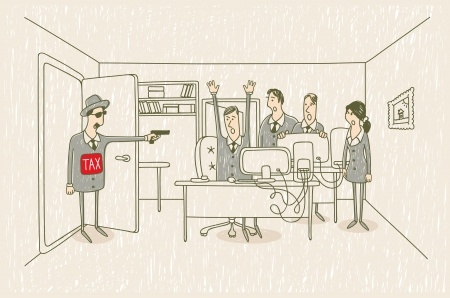
The media narrative around Donald Trump’s 1995 tax deduction of a business loss would have you think it had been the crime of the century. Last weekend, the New York Times presented an analysis of a Trump tax return from 1995 showing a loss of $916 million, which was eligible for “carry forward” to reduce taxes on his business income in future years. The Times characterized it as something of a scandal, and the Clinton campaign was quick to jump on board. However, the ability to deduct losses or carry them forward to deduct in future years are basic features of the U.S. income tax code. Hillary Clinton used the same tax provisions as recently as 2015, albeit on a smaller scale than Trump, and the Clinton’s have engaged in other forms of tax avoidance. The point here is that if your business realizes gains from some winning investments, but suffers losses on a few others, a basic and reasonable feature of the tax code is to allow the losses to offset a like amount of gains for tax purposes. Similarly, your winnings at the casino (assuming you report them) are not taxed without first netting out the bad bet you made at the roulette table. So far, so good.

When you or your business suffers a loss in a given year, the income tax code allows that loss to be carried forward to offset taxable income in subsequent years. Since the Times article, the term “net operating loss” has been thrown around in some circles as if it’s an arcane tax loophole, but it’s simply good tax policy. John Cochrane provides an example of an entity which alternately reaps gains of $1,000,000 in one year and losses of $900,000 in the next, with an average pre-tax income of $50,000. Without loss carry-forward, this entity would be forced out of business in short order by the IRS. The use of this provision is not uncommon, and it prevents the tax code, such as it is, from being even more threatening to enterprises and jobs that are otherwise viable. Suggesting the elimination of this provision leaves tax experts in disbelief. The effects would be punitive to many businesses, not just corporate behemoths, and would be destructive to the economy.

Cochrane also puts the “blame” for this much-maligned deduction where it should be: the existence of the income tax itself! A consumption tax would not be as sensitive to changes in income, as people tend to smooth their consumption levels over time.

Another question related to the Trump tax revelations would be more controversial, if true: that he might have engaged in so-called “debt parking“. That’s unproven, but Bronte Capital Management‘s John Hempton blogged that it’s highly likely that he did. The alleged sequence of events is as follows: Trump borrowed money and invested it in assets that resulted in massive losses. The losses meant the debt held by Trump’s lender was nearly worthless. If that debt had been forgiven and written off by the original lender, Trump would have been forced to report a large gain, offsetting the tax benefit of the loss on his assets. But as Hempton’s story goes, the lender did not write it off. Rather, in the meantime, Trump created an entity that bought the debt from the lender for pennies on the dollar. After the sale, the write-down taken by the lender was not attributable to Trump as income. Trump’s “entity” simply served as a place to “park” the debt, protecting Trump’s tax benefits via loss carry-forward.

Megan McArdle addresses this issue, but she first reinforces the policy wisdom of the loss provisions in the tax code. McArdle ridicules the notion that businesses seek to generate losses in order to obtain tax deductions. She then  debunks the debt-parking theory of Donald Trump’s tax management:

“This theory seemed to have a lot of credibility among folks on social media. Among the tax professionals I spoke to, it had none: the IRS would treat this sort of structure just as it would if a third party had forgiven the debt.

‘Look,’ says [tax attorney Ron] Kovacev, ‘you put a $900 million loss on your tax return, that’s audit bait. The IRS is going to look into it. The notion that you could just move the money and the IRS wouldn’t ask questions?’ There was a sort of incredulous pause before he finally said: ‘That’s hard to fathom.’“

One other question about the 1995 tax return is whether the $916 million loss proves that Trump is a lousy businessman. In fact, there is speculation that Trump’s losses around that time might well have been much larger than that. He suffered staggering failures in his casino business, his airline, and his investment in New York’s Plaza Hotel. It might not be so remarkable, however, to see a few losses on this scale for a developer investing in a variety of large projects. Big risk goes with the territory. Nevertheless, it doesn’t appear that Trump, having begun his business career with large amounts of family money, has achieved tremendous success with that capital over the years, on balance. Rather, it looks more like the kind of success an average investor would have achieved under the same initial circumstances. The losses claimed on his 1995 tax return obviously restrained his overall gains, but they don’t prove he’s a terrible businessman. He’s probably fairly average.

Both Trump and Clinton have exploited a rule in the income tax code that helps smooth after-tax profits and is a basic element of income tax rationality (given that it exists in the first place). It’s rather absurd for anyone to condemn them for it. Even more absurd for either of them to cast aspersions at the other on these grounds. Would Hillary Clinton do anything to restrict the longstanding ability to carry forward losses to deduct against future taxes? I’m thankful that I haven’t heard her say so!


Are The Native-Born Idle By Choice?

21 Wednesday Sep 2016

Posted by Nuetzel in Immigration, Labor Markets, Minimum Wage

≈ Leave a comment

Tags

Cash Compensation, Donald Trump, Erik Hurst, High-School Dropouts, Idle Time, Illegal Employment, Immigration, James Pethokoukis, Low-skilled labor, Minimum Wage, Native-born Americans, Reservation Wage, Robert Verbruggen, Underground Economy, Undocumented Workers, Video Games and Young Men, work incentives, Work-Leisure Tradeoff

idle-hands

Native-born Americans don’t seem to want low-skilled work, even when they have no skills. Immigrants, on the other hand, seem more than happy to take those jobs. The fact is that hours worked by native high-school dropouts have declined relative to the hours of immigrant dropouts, as noted by Robert Verbruggen in “When Young Men Don’t Work“.

Of course, American men in general are working less, with fewer jobs in occupations and sectors traditionally dominated by men, such as manufacturing. The total demand for manual labor may be decreasing due to automation. Among the youngest cohort, hours spent in educational activities have increased. However, another contributing factor may be that the supply of labor is held down by negative work incentives created by government policy. In any case, the changing composition of the low-skilled work force is a curiosity. Many of the native-born appear to be opting out of work, but not the foreign-born:

“Native high-school dropouts of ‘prime age’ (25–54) work only about 35 weeks per year, on average; comparable immigrant dropouts work 49 weeks. Native dropouts are the outliers. Immigrant dropouts work roughly as much as both native and immigrant men with higher levels of education—and they do 60 percent of the work performed by dropouts in America, despite being less than half of the dropout population.“

Clearly low-skilled work exists , and immigrants are doing a disproportionate share of it. Are some of these low-wage jobs simply inaccessible to the native-born? I doubt it. The argument that immigrants are taking low-wage jobs from Americans implies that immigrants have lower reservation wages. But if that’s so, it confirms the hypothesis that natives are less willing to take low-skilled jobs.

In fact, the native-born might have better leisure alternatives than many of the foreign-born. Verbruggen reviews the work of Erik Hurst of the University of Chicago, who argues that technology such as video games and the internet have increased the value of leisure relative to work. Perhaps natives are better situated than immigrants to draw on other resources to finance an idle, gaming existence. Whatever they do to occupy their time, those resources might include relationships with family having the means to support them, and even a familial tolerance for idleness.

It’s also possible that natives have better access to the bounty of the welfare state. Undocumented foreign workers are at a disadvantage in this regard, but that handicap is eroding. Whatever the reason, it appears that native-born Americans are spared the need to bid aggressively on work they consider undesirable. That decision will often be costly in the longer-run, given the lost opportunity to develop skills on the job.

Another possible explanation for the disparity in average working hours is that more immigrants are willing to work (illegally) in sub-minimum wage jobs. That might well be true for undocumented foreign workers, even in occupations that would otherwise be legal. One could argue that this is unlikely to reduce opportunities for work at or above the minimum wage because wage offers tend to align with skill level. However, sub-minimum wage offers to illegals are probably driven by the risk faced by the employer in making such hires. Just the same, illegal opportunities to work below minimum wage are not the exclusive domain of immigrants. Cash compensation can allow an employer to pay sub-minimum wages to anyone willing to work. Moreover, many natives work in the underground economy in areas such as illicit drug distribution, which might or might not involve sub-minimum wages.

Of course, an individual working at a lower wage must work more hours to earn the same income as one earning a higher wage. Subsistence for the immigrants might require the extra hours. That would explain the disparity in average hours if natives and immigrants truly can be sorted by wage rate, but if that is the case, then the natives must have less interest in low-wage jobs, as postulated, and the natives are content to live at the same subsistence level as the low-wage immigrants by working fewer hours.

Thus, it is difficult to escape the conclusion that native-born Americans are less willing to work in low-wage jobs than the foreign-born. Further increases in the minimum wage would have a tendency to create more idle time among the low-skilled, both native and immigrant. The total legal demand for low-skilled labor would decline. More natives might be willing to supply labor at the higher minimum, but incumbents have an advantage in holding onto jobs that remain after the increase. A higher minimum would certainly convert some formerly legal opportunities into illegal opportunities (at wages below the new minimum), attenuating the total increase in idleness.

Growth in the labor force is a fundamental driver of economic growth, and immigration has always been an important source of labor for the U.S. economy. Low-skilled, native-born Americans seem less willing to offer their services at wages matching their skill levels, but immigrants help to fill that gap and are usually happy for the opportunity. A higher minimum wage will not make their lives easier in the U.S. It should also be noted that greater tolerance for immigration at the low-end of the socioeconomic spectrum need not imply a sacrifice in border security or careful vetting, but it would provide a supply of able and willing workers eager to improve their standard of living.

On a related note, I add the following: James Pethokoukis points to an interesting irony with respect to Donald Trump’s policy positions: “Trump wants 4% (or higher) US growth. Easy. Just massively increase immigration“.

The Progressive Underclass

09 Friday Sep 2016

Posted by Nuetzel in Poverty, Welfare State

≈ 2 Comments

Tags

Andrew Lundeen, Ban the Box, Bernie Sanders, Brian Doherty, CATO Institute, Climate Change Policy, Daniel Mitchell, Donald Trump, Earned Income Tax Credit, Kurt Williamsen, Land-Use Regulation, Leigh Franke, Protectionism, Redistribution, San Francisco, Scott Beyer, TANF, The Federalist Papers, The Tax Foundation, The Urban Institute, Vanessa Brown Colder, Watt's Up With That?

filling-out-forms

The underclass has not fared well under government policies enacted in explicit efforts to improve its members’ well being. If there is any one point on which I agree with Donald Trump, it is his recent assertion that “progressive” policies have been disastrous for minorities. Indeed, there is evidence that many public programs have been abject failures, even in terms of achieving basic goals. Some programs have managed to improve the immediate lot of the impoverished, but they have done so without freeing the beneficiaries of long-term dependency,  and perhaps have encouraged it. An underlying question is whether there is something endemic to these public initiatives that guarantees failure.

Arguments that public programs have such weaknesses are often based on the negative incentives they create, either for the intended beneficiaries (certain anti-poverty programs) or for employers who might otherwise work with them (absent minimum or “living” wages or regulatory obstacles). Then, of course, there are public services that are effectively monopolized (public schools) because they are “too important” to leave in the hands of private enterprise, with little recognition of the shoddy performance that is typical of institutions operating free of competitive pressure. And government action such as environmental policy often has a regressive impact, costing the poor a far greater share of income than the rich, and causing direct job losses in certain targeted industries.

A post from The Federalist Papers on “The Top 5 Ways Liberal Policies Hurt The Poor” is instructive. In addition to the welfare incentive trap, it highlights the failure of public schools to serve the educational needs of the poor, the minimum wage as a system of marginalization, urban gun control as a sacrifice of defenseless victims, and the extension of rights to illegal immigrants at the expense of U.S. citizens, especially low-skilled workers.

A fine essay by Kurt Williamsen entitled “Do Progressive Policies Hurt Black Americans?” focuses on three general areas of failure: public education, the workplace and welfare. He notes that certain educational innovations have met with success, yet are ridiculed by the progressive left because they promote competition.  He cites the dismal consequences for blacks of various labor and employment laws: “prevailing wage rates, the minimum wage, union bargaining power, occupational and business licensing laws, and affirmative action laws to comply with federal and state contracting requirements“. Even more astonishing is that the original motive for some of these policies, such as minimum wages and prevailing wage laws, was to keep unskilled blacks from competing with white union labor. They still work that way. Williamsen also discusses the fact that the welfare state has essentially left low-income blacks running in place, rather than lifting them out of dependency. Unfortunately, those programs have also inflicted large social costs, such as the disintegration of family in the black community:

“Welfare programs had an insidious effect on black culture — more so than white culture — because of the way they were designed. With dramatically more blacks than whites being in poverty and with less future prospects when the War on Poverty got started, young black women often had children out of wedlock, beginning a cycle of enduring poverty and welfare wherein they relied on welfare as a main source of income, as did their children. Welfare provided more money for young women with fatherless children, on average, than the same young women could have made if they were employed. If a woman became married, she would lose benefits, making it beneficial for her to either just hook up with men or cohabitate, rather than marry.“

Redistributionist policies have long been criticized for creating incentive problems among recipients of aid. Some of those problems have been corrected with the Earned Income Tax Credit, which operates as something of a negative income tax, and Temporary Assistance for Needy Families (TANF), which incorporates work requirements. However, as Vanessa Brown Colder at the CATO Institute points out, there is a need for further reforms to the many underperforming programs.

Like any large government program, redistribution also damages incentives for those who must pay the tab, generally those at higher income levels. High taxes ultimately discourage investment in capital and in new businesses that could improve the employment and income prospects of low-income segments. Here is Andrew Lundeen at The Tax Foundation:

“When fewer people are willing to invest, two things happen. First, the capital stock (i.e. the amount of computers, factories, equipment) shrinks over time, which makes workers less productive and decreases future wages.“

Redistributionists do their intended beneficiaries no favor by advocating for steeply progressive tax structures, which simply discourage investment in productive risk capital, impairing growth in labor income. This chart from Dan Mitchell shows a cross-country comparison of capital per worker and labor compensation. Not surprisingly, the relationship is quite strong. The lesson is that we should do everything we can to improve investment incentives. Punitive taxes on those who earn capital income is counterproductive.

Mitchell emphasizes a few other statist obstacles to empowering the disadvantaged here, including a brief discussion of how land-use regulations harm the poor. He quotes Leigh Franke of The Urban Institute:

“Restrictive land-use regulations, including zoning laws, are partially to blame for the stagnant growth… Land-use regulations may be intended to protect the environment or people’s health and safety, and even to enhance the supply of affordable housing, but in excess, they restrict housing supply, drive up home prices, and limit mobility. …More and more zoning restrictions meant less construction, fewer permits, and a restricted housing supply that drove up prices even further. …cities often have stringent zoning laws, a restricted housing supply, and high prices, making it nearly impossible for lower-income residents and newcomers, who would likely benefit most from the opportunities available, to find affordable housing.“

On the topics of local housing, labor laws, services, and regulatory burdens, Scott Beyer covers the maladies of that most progressive of cities, San Francisco. The city’s policies have helped create one of the nation’s most expensive housing markets  and have made the city’s distribution of income highly unequal. It is no coincidence that the politics of most of our declining cities are dominated by the progressive left.

Here is another fascinating example of negative unintended consequences arising from intervention on behalf of a disadvantaged group: so-called “Ban the Box” (BTB) initiatives. These laws prevent employers from inquiring about a job applicant’s  crime record, at least until late in the hiring process. Mitchell recently cited a study finding that BTB laws are associated with a reduction in employment opportunities for minorities. This disparate impact might be the result of more subtle screening by employers, demonstrating a reluctance to interview individuals belonging to groups with high crime rates. Apparently, employers are willing to give minorities a better chance when information on crime history is disclosed up-front.

Deleterious forms of intervention may vary from one disadvantaged group to another. For example, Native Americans have long been handicapped by federal control of their lands and their natural resources. Regulation of activity taking place on reservations is particularly burdensome, including a rule under which title to land must:

“… be passed in equal shares to multiple heirs. After several generations, these lands have become so fractionated that there are often hundreds of owners per parcel. Managing these fractionated lands is nearly impossible, and much of the land remains idle.“

Progressives often vouch for interventionism on the belief that thpse policies are ethically beyond question, such as climate change regulation. Of course, the science of whether anthropomorphic climate change is serious enough to warrant drastic and costly action is far from settled. The existence of high costs is deemed virtually irrelevant by proponents of activist environmental laws. Those costs fall heavily on the poor by raising the cost of energy-intensive necessities and by raising business costs, in turn diminishing employment opportunities. This is more pronounced from a global perspective than it is for the U.S., as emphasized in “Protect the poor – from climate change policies“, at the Watts Up With That? blog.

The world’s poor secure massive benefits from trade, but progressive policies often seek to inhibit trade based on misguided notions of “fairness” to workers in low-wage countries. And trade restrictions tend to benefit relatively high-wage workers by shielding them from competitive pressure. Brian Doherty in Reason talks about the nationalism of the Bernie Sanders brand, and how it undermines the poor. Donald Trump’s trade agenda has roughly the same implications. Protectionism should be rejected by the under-privileged, as it increases the prices they pay and ultimately reduces employment opportunities.

Certainly progressives always hope to assist the disadvantaged, but their policies have created a permanent dependent class. The simple lessons are these: working, producing and hiring must be rewarded at the margin, not penalized; interfering with wages and prices is counterproductive; all forms of regulation are costly; programs must be neutral in their impact on personal decisions; and property rights must be secure. Historically, economic freedom has lifted humanity from the grips of poverty. In virtually every instance, government micro-management has done the opposite. Unfortunately, it is difficult for progressives to overcome their reflexive tendency to “do something” about the poor by invoking the ever-klutzy power of the state.

Trade Enragement Syndrome

31 Sunday Jul 2016

Posted by Nuetzel in Free Trade, Protectionism

≈ Leave a comment

Tags

Bernie Sanders, Capital Account Surplus, Don Boudreaux, Donald Trump, Free trade, Geocentrism, Heliocentrism, Import Competition, monopoly power, NAFTA, Protectionism, Trade Deficit, Trans-Pacific Partnership

tradebarriers

Trade makes us richer, not poorer. The anti-trade rhetoric spouted by neo-mercantilists like Donald Trump and Bernie Sanders is about as sensible as a boycott on goods produced in the next town, or for that matter, on anyone with whom one might otherwise choose to trade. Don Boudreaux perfectly captures my feelings about the rising trend of protectionist sentiment by comparing it to geocentrism:

“Lately I feel as I imagine an astronomer would today feel if, centuries after Copernicus and Galileo proved beyond a shadow of a doubt that the earth isn’t the center of the solar system, large numbers of people – including popular media pundits and politicians – began to insist that the sun and the planets and the stars do indeed all revolve around a stationary earth that is situated in the center of the universe.“

The very motivation for trade is to obtain something of value that one did not produce, to acquire that which one cannot easily acquire without trade, or to acquire it on more favorable terms than otherwise. It recognizes the reality that one’s productive efforts should be focused in an area that best suits their skills or natural talents. That’s better for the individual and better for society! Countries should produce what they are best at producing, which gives them a cost advantage in their areas of specialization. Trade allows individuals and nations to specialize in production but diversify in consumption, allowing them to enjoy access to the broadest possible range of goods and services produced worldwide.

The consummation of any trade heralds the attainment of mutual benefits to the parties: one produces and employs at a profit; the other consumes a thing of greater value than the price paid. The payments for foreign goods must come from either domestically-produced goods or from foreign investment in domestic real estate, buildings, factories or other real and financial assets. That is, if we purchase more goods from abroad than we export, then foreigners must either hold the dollars they receive or invest them in other ways. The latter represent trades in assets, and those trades, too, are mutually beneficial. The result is that U.S. investors gain and/or the economy benefits from new, productivity-enhancing plant and equipment, not terrible outcomes. Trade deficits are balanced by capital surpluses, and trade surpluses are balanced by capital deficits. Taken together, trade in goods and capital (assets) always balance and are mutually beneficial in every case, whether we run a trade deficit or a surplus.

That said, it’s worth emphasizing that so-called free trade agreements are something of a sham. Countries don’t trade. People do. Unfortunately, I have indulged the notion of national trade negotiation in the past, if only implicitly, by vouching for trade agreements like NAFTA and TPP as sort of second-best solutions to the horrid reality of trade restrictions promulgated by protectionist politicians. I reasoned that dismantling those barriers, one-country (or region) at-a-time was preferable to doing nothing. However, negotiations like these become mired in extraneous issues such as environmental policies, labor laws, immigration rules and other commercial policies. Nor do those negotiations always inhibit domestic subsidies to politically-favored activities. Indeed, they might actually encourage subsidies for value-eroding projects. Again, the entire process of trade negotiations is extraneous to the extent that trade takes place between individuals. Unfettered gains from trade require the absence of trade barriers. Dropping them unilaterally would benefit consumers, encourage efficiency by domestic producers, and provide a great example for other nations.

Opponents of trade, like Messrs. Trump and Sanders, lack a basic understanding of the reasons why individuals engage in cooperative exchange. Or at least they fail to acknowledge, for political reasons or sheer density, that what improves well-being at home is freedom to transact, across our borders as well as within our borders. To prevent this activity is to forcibly deny individual freedom. Boudreaux makes this point be asking trade opponents a series of questions, the first few of which are listed below:

“– Are you made richer if the supermarket … at which you once shopped hires armed goons to force you to start shopping there again?

– Do you believe that the owners and the employees of [that store] are so ethically entitled to your continuing patronage as a consumer that they are justified in employing armed goons to prevent you from shopping elsewhere?

– Do you believe that, now that [the store] has successfully forced you not to shop at competing supermarkets, that the owners and employees … will work as diligently and as creatively as possible to keep the prices they charge low and the quality of their service high?

– Do you believe that the higher profits and higher wages reaped by [the store’s] owners and workers as a result of their holding you hostage as a customer make you more prosperous?

– Do you believe that the higher profits and higher wages reaped by [the store’s] owners and workers as a result of their holding you hostage as a customer make your community more prosperous, even though [the store’s] higher profits and higher wages are necessarily funded by money that you and other … ‘customers’ are forced not to spend on other goods, services, or investment options?

– If you believe that [the store] has a right to force you not to shop for food at other supermarkets, do you believe also that [the store] has a right to force you not to grow more of your own food, or not to eat out more often at restaurants, or not to go on a diet?“

It is difficult to believe that educated people believe restrictions on the freedom of individuals to cooperate with others will improve their well being. Of course, those educated people are often politicians who stand to benefit from frightening voters, and who have no interest in reminding them that a flow of foreign goods broadens choices, reduces prices, and provides valuable discipline to domestic businesses. Without competitive discipline, we forgo important benefits and instead allow quality and price to come under the arrogant power of monopolists. There are, of course, many producers who are willing to provide meaningful support to politicians who will protect them from foreign competition. That’s not capitalism. Its cronyism!


Good Leaders Aren’t Trade Warriors

30 Wednesday Mar 2016

Posted by Nuetzel in Free Trade, Protectionism

≈ 1 Comment

Tags

Bernie Sanders, CATO Institute, Currency Manipulation, Daniel J. Ikenson, Direct Foreign Investment, Don Boudreaux, Donald Trump, Dumping, Federal Reserve, Free trade, Hillary Clinton, NAFTA, Open Trade, Paul Krugman, People's Bank of China, Predatory Pricing, Protectionism, Reserve Currency, Ted Cruz, TPP, Trade Deficit, Trade War, Unfair Competition

Protectionism

The protectionist foreign trade rhetoric issued by the major-party presidential candidates is intended to appeal to ignorant economic instincts. Donald Trump and Bernie Sanders come to mind most readily, but Ted Cruz and Hillary Clinton are jumping in with similar campaign positioning. The thrust of these populist, anti-trade appeals is that America is losing jobs to “unfair” foreign competition, an argument that distorts the very objective of trade: consumers take part in exchange in order to consume; they capture value from high quality, unique merchandise and competitive terms. Ultimately, producers engage in trade to gain the wherewithal to consume. Consumption is the real end-game.

It can be misleading to talk about “nations” engaging in trade with each other, despite the emphasis placed on trade agreements like NAFTA and TPP. In the first place, it is better to stress consumers and producers, rather than “nations”, because most foreign trade is private, cooperative activity, not national decision-making. But the candidates persist in characterizing trade as a “contest”. That misleading notion is what prompts governments to muck up the trade environment by imposing restrictions on the free flow of goods and services. Trade agreements have been heralded as great achievements, but they never approximate a regime of truly liberalized trade because the latter requires no formal agreement whatsoever, merely a hands-off approach by government. And trade agreements tend to entangle trade issues with other policy objectives, holding consumers hostage in the process.

We hear from opportunistic candidates that jobs are lost to trade with foreigners. But again, consumption, not “jobs” per se, is the real objective of economic activity. If domestic jobs are lost, it is generally because consumers judge the value produced inferior to what’s offered from abroad. American consumers should not be obliged to support inferior value, domestic market power unchecked by competition, monopoly prices and limited choices. Patriotic jingoism attempts to blind us from these economic imperatives.

The standard protectionist narrative is that foreign “nations” cheat on trade with the U.S. via currency manipulation, predatory pricing or “dumping”, “unfair” wages or other unfair labor practices. Do any of these objections to free trade hold water?

The “fairness” of foreign wages and labor practices is a matter of perspective. Wages cannot be considered unfair merely because they are low relative to U.S. wages. Wages paid to workers by foreign exporters tend to be consistent with the standard of living in those societies, and they are often some of the best income opportunities available there. This is economic dynamism that lifts masses from the grips of poverty. It’s absurd to caste it as “exploitation”.

Is it “unfair” to competitors in the U.S.? Not if they know how to compete and are allowed to do so. Unfortunately, government regulatory policies in the U.S. often present obstacles to the competitiveness of domestic producers. This is well-illustrated by Daniel J. Ikenson of The CATO Institute in “Crucifying Trade For The Sins Of Domestic Policy“. He emphasizes that trade promotes economic growth, but when it causes job losses for some workers, U.S. economic policies make it difficult for those workers to find new jobs.

“Incentivize businesses to hire people to train them in exchange for their commitment to work for the company for a period of time. Reform a corporate tax system that currently discourages repatriation of an estimated $2 trillion of profits parked in U.S. corporate coffers abroad, deterring domestic investment, which is needed for job creation. Curb excessive and superfluous regulations that raise the costs of establishing and operating businesses without any marginal improvements in social, safety, environmental, or health outcomes. Permanently eliminate imports duties on intermediate goods to reduce production costs and make U.S.-based businesses more globally competitive. Advocate the retirement of protectionist occupational licensing practices.“

So-called “dumping” by foreign producers, or selling below cost, is an unsustainable practice, by definition. Pricing below cost is difficult to prove, especially if local wages are low and raw inputs are plentiful. If dumping can be proven, retaliation might feel good but would punish American consumers. A foreign producer might be subsidized by its government as a matter of industrial policy and economic planning, an unhealthy policy to begin with, and possibly to facilitate a long-run market advantage in foreign trade. The U.S. itself is thick with subsidized industry, however, so arguing for retaliation on those grounds is more than a little hypocritical.

I rarely quote Paul Krugman, but when I do, it’s from work he’s done as an actual economist, not as an agenda-driven pundit. So we have the following Krugman quote courtesy of Don Boudreaux:

“I believe that if the rhetoric that portrays international trade as a struggle continues to dominate the discourse, then policy debate will in the end be dominated by men like [James] Goldsmith, who are willing to take that rhetoric to its logical conclusion. That is, trade will be treated as war, and the current system of relatively open world markets will disintegrate because nobody but a few professors believes in the ideology of free trade.

And that will be a shame, because for all their faults the professors are right. The conflict among nations that so many policy intellectuals imagines prevails is an illusion; but it is an illusion that can destroy the reality of mutual gains from trade.“

David Harsanyi asks how American consumers will like more restrictive trade policy when forced to pay more for smart phones, laptops, HDTVs, cars, food, and any number of other goods. The usual anti-trade narrative is that foreign producers have harmed the manufacturing sector disproportionately, but in another article, Ikenson lays bare the fallacy that U.S. manufacturing has been victimized by trade.

The consequences of trade restrictions are higher prices, reduced production and reduced consumption, an undesirable combination of outcomes. This means higher prices of imported goods as well as domestic goods, whose producers will face less competition by virtue of the trade barriers. With reduced availability of imported goods, economic theory predicts that domestic producers will not fully meet the frustrated demands. This is a classic response of producers with monopoly power: restraint of trade. The negative consequences are compounded when foreign governments impose retaliatory measures against the U.S., harming American exporters.

A further misgiving expressed by politicians regarding free trade is that America’s trade deficit implies greater indebtedness to the rest of the world. This argument has been made by a few leftist economists who misunderstand the nature of direct investment, and who tend to think erroneously of economic outcomes as zero-sum. It’s true that foreign producers who receive dollars in exchange for goods often invest those proceeds in U.S. assets. A fairly small share of that investment is in debt issued by U.S. governments and private companies. But a much larger share is invested in U.S. equities and real assets, which are not U.S. debts. As Don Boudreaux points out, the domestic sellers of those assets generally reinvest in other U.S. assets, so private U.S. ownership of global capital is not diminished by increased foreign investment in the U.S.

An interesting aspect of the trade debate is that the dollar’s role as a global reserve currency implies that the U.S. must run a chronic trade deficit. The rest of the world uses dollars to trade goods and assets, but to acquire dollars, foreigners must sell things to holders of dollars in the U.S. This keeps the foreign exchange value of the dollar elevated, which makes imports cheaper to Americans and U.S. exports more costly to foreigners. Those dollars are a form of U.S. debt, but it is debt for which we should feel flattered, as long as confidence in the dollar remains. A diminished role for the dollar in world trade would lead to a surplus of dollars, undermining its value and promoting inflation in the U.S. Let’s hope for a gradual transition to that world.

Finally, the presidential candidates allege that foreign currency manipulation is another reason for American job losses. One prominent example occurred last year when China allowed the renminbi to decline to more realistic levels on foreign exchange markets. Donald Trump called this an unfair trade tactic, but apparently the People’s Bank felt that it couldn’t support the renminbi without undermining economic growth. The earlier dollar peg also helped to keep Chinese inflation in check. Contrary to Trump’s assertions, if China stopped manipulating its currency altogether, the renminbi would go even lower!

Beyond the opportunistic political arguments, the point is that central banks (including the U.S. Federal Reserve) manage their currencies to achieve a variety of objectives, not merely to promote exports. That is not an endorsement of such policies. It is an objective fact. Anyone can argue that a foreign currency is “too low” if their objective is to demonize a country and it’s exports to the U.S., but the assertion may not be grounded in facts as markets assess them.

The arguments against open trade policies are generally specious, hypocritical or grounded in a mentality of victimhood. Vibrant producers who are free of government restrictions should welcome the expanded markets available to them abroad and should not seek redress against competition via government protection. Liberalized trade has engendered tremendous economic benefits over the years, while protectionist policies have only brought severe contractions. Let’s be free and trade freely!


Bernie, Donald and Ignatius?

29 Friday Jan 2016

Posted by Nuetzel in Immigration, Socialism, Uncategorized

≈ Leave a comment

Tags

Bernie Sanders, BK Marcus, Corporatism, Donald Trump, eminent domain, fascism, Godwin's Law, Immigration, Individual Liberty, Mark Forsyth, National Socialism, National Socialist German Workers’ Party, Nationalism, Nazi Etymology, Private Markets, Socialism, State's Rights, Steve Horwitz, The Freeman, Trade Policy

BernieTrump

We have candidates vying for the nominations of both major U.S. political parties with tendencies toward nationalism: Bernie Sanders and Donald Trump. They both oppose liberalized immigration and they are both anti-trade, playing on economic fears in articulating their views. Sanders has attempted to soften his rhetoric on immigration since last summer, when he alleged that it harms U.S. workers.

There are differences between Sanders and Trump on the treatment of existing illegal immigrants. Despite Trump’s protests to the contrary, his nationalism has had ethnic overtones.

Trump’s positions on immigration and trade protectionism are not necessarily at odds with Republican tradition, which is a mixed bag, but they are consistent with a faith in big government and central planning. An anti-immigration and anti-trade platform is certainly no contradiction for Sanders, because central planning is integral to his avowed socialism.

Sanders has been called a “socialist with nationalistic tendencies”. He favors government provision of free health care and higher education, heavy redistribution, and severe restrictions on property rights via high taxation. Trump, on the other hand, has been called a “nationalist with socialist tendencies.” He too has called for nationalized health care, increasing certain transfer payments, as well as compromises to state rights. It would probably be more accurate to describe Trump as a corporatist, a system under which large business entities both serve and control government for their own benefit. For example, Trump has used and favors eminent domain to secure land for private projects, generous bankruptcy laws to eliminate business risks, and “deal-making” between government and private enterprise in order to “get things done.” Corporatism is a flavor of fascism, and it is perfectly consistent with a statist agenda.

Thus, each party has candidates who are by degrees both nationalist and socialist. In using these labels, however, I plead innocent to a violation of Godwin’s Law. Of course they are not Nazis, but they are nationalistic socialists. The distinction is explained nicely by B.K Marcus in The Freeman. Both candidates take positions that are consistent with the platform of the National Socialist German Workers Party, circa 1920.

As an aside, Marcus provides some fascinating etymology of the word “Nazi”, quoting Steve Horwitz:

“The standard butt of German jokes at the beginning of the twentieth century were stupid Bavarian peasants. And just as Irish jokes always involve a man called Paddy, so Bavarian jokes always involved a peasant called Nazi. That’s because Nazi was a shortening of the very common Bavarian name Ignatius. This meant that Hitler’s opponents had an open goal. He had a party filled with Bavarian hicks and the name of that party could be shortened to the standard joke name for hicks.“

Marcus also quotes Mark Forsyth on this topic:

“To this day, most of us happily go about believing that the Nazis called themselves Nazis, when, in fact, they would probably have beaten you up for saying the word.“

Back on point, I’ve written about both of these candidates before: Trump here and here; Sanders here. To keep things even, here is one more interesting take on Bernie.

“His family managed to send him to the University of Chicago. Despite a prestigious degree, however, Sanders failed to earn a living, even as an adult. It took him 40 years to collect his first steady paycheck — and it was a government check.”

Read the whole thing!

It’s difficult for me to take these two candidates seriously because they do not take individual liberty seriously, nor do they understand the power of private markets to promote human welfare. I also have strong reservations about their understanding of constitutional principles, and I suspect that either would have few qualms about taking Mr. Obama’s cue in stretching executive authority.

Instead of the headline above, it would have been more accurate to say “Bernie, Donald and Ignoramus!” Unfortunately, one of these guys could be our next president. Well, it won’t be Sanders.

Bernie Sanders: Just a Regular Looter

17 Thursday Sep 2015

Posted by Nuetzel in Free markets, Poverty, Socialism

≈ 1 Comment

Tags

Bernie Sanders, Capital-Labor Substitution, Citizens United, Donald Trump, Economic illiteracy, Ed Krayewski, Energy Policy, Feel the Bern, infrastructure, Kevin D. Williamson, Minimum Wage, Police Brutality, Poverty, Racial exclusion, Socialism, Universal Health Care, War on Drugs

Bernie

Economic illiteracy is getting to be a central theme in the early stages of the 2016 presidential race. The two candidates with whom the public and media are most fascinated at the moment are Bernie Sanders and Donald Trump. Both are veritable case studies in delusional economic reasoning. I have already devoted two posts to Trump, the current frontrunner for the Republican nomination (both posts appear at the link in reverse order). At the time of the second of those posts, I recall hoping desperately that someone or something would rescue my blog from him. I have managed, since then, to resist devoting more attention to his campaign. In this post, I’ll focus on Senator Bernie Sanders of Vermont, currently the top rival to Hillary Clinton for the Democrat nomination.

It’s ironic that Sanders, a self-proclaimed socialist, shares several areas of acute economic illiteracy with Donald Trump. There is a strong similarity between Sanders and Trump on foreign trade (and both candidates are pro-Second Amendment). Like Trump, Sanders demonstrates no understanding of the reasons for trade, as Kevin Williamson notes:

“The incessant reliance on xenophobic (and largely untrue) tropes holding that the current economic woes of the United States are the result of scheming foreigners, especially the wicked Chinese, “stealing our jobs” and victimizing his class allies…. He describes the normalization of trade relations with China as “catastrophic” — Sanders and Jesse Helms both voted against the Clinton-backed China-trade legislation — and heaps scorn on every other trade-liberalization pact. That economic interactions with foreigners are inherently hurtful and exploitative is central to his view of how the world works.“

Sanders lacks an understanding of trade’s real function: allowing consumers and businesses to freely engage in mutually beneficial exchanges with partners abroad, and vice versa. Trade thereby allows our total consumption and standard of living to expand. It is not based on “beating” your partners, as Sanders imagines. It is cooperative behavior.

Opposition to free trade nearly always boils down to one thing: avoiding competition. That goes for businesses seeking to protect or gain some degree of monopoly power and for unions wishing to keep wages, benefits and work rules elevated above levels that can otherwise be justified by productivity. The result is that consumers pay higher prices, have access to fewer goods and less variety, and have a lower standard of living. It is no accident that trade wars deepened the severity of the Great Depression domestically and globally. But Sanders, like Trump, has failed to learn from the historical record.

Another area of Sanders’ deep economic ignorance is his position on wage controls. He advocates a mandatory $15 federal minimum wage with no recognition of the potential damage of such a change. Kevin Williamson has this to say:

“Prices [and wages] in markets are not arbitrary — they are reflections of how real people actually value certain goods and services in the real world. Arbitrarily changing the dollar numbers attached to those preferences does not change the underlying reality any more than trimming Cleveland off a map of the United States actually makes Cleveland disappear.“

The minimum wage was the subject of a recent post on Sacred Cow Chips. A higher minimum is a favorite policy of well-meaning leftists and social justice warriors, but they fail to address the realities that the least-skilled suffer adverse employment effects, that a higher minimum wage hastens the substitution of capital for unskilled labor, and that the policy often benefits non-primary workers from middle and upper-income households. It’s a lousy way to help the impoverished. Moreover, minimum wages were originally conceived as a tool of racial exclusion and in all likelihood still act that way. Most of the research supporting minimum wage increases focuses on short-run effects or on sectors that are less capital-intensive. Findings about long-run effects are much more negative (see here, too). It’s a given that Sanders understands none of this.

Other elements of Sanders’ platform are essentially freebies for all: universal health care (see the first link from this Bing search), free college tuition for all, and expanded social security benefits. And of course there is a promise to rebuild our crumbling infrastructure, taking full advantage of the myth that our infrastructure is so decrepit that it must be replaced now. All of these ideas are costly, to say the least, and there is nothing adequate in Sanders’ platform to pay for them. He’ll raise taxes on the 1%, he says. Just watch the capital fly away. Ed Krayewski of Reason discusses Sander’s rich promises and the lack of resources to pay for them in “Bernie Sanders, the 18 Trillion Dollar Man“:

“The Wall Street Journal spoke with an economist at the liberal Center on Budget and Policy Priorities, who acknowledged taxes would have to go up for the middle class too to pay for Sanders programs.“

Middle class tax hikes would undoubtedly be accompanied by a lot more public debt, and ultimately inflation. Freebies for whom? As Krayewski says, Sanders “wants taxpayers to ‘feel the Bern’“.

In fairness, Sanders suggests that some of the needed revenue can be diverted from military spending. Possibly, but the military budget has already been reduced significantly, and it is not clear that much fat remains for Sanders to cut. There will certainly be demands for greater military spending given the significant threats we are likely to face from rogue states.

Sanders’ promise to transform our energy system is another one that will come with high costs. What Sanders imagines is a widespread fallacy that green energy can be produced at little cost. However, we know that renewables carry relatively high distributed costs and their contributions to load are intermittent, requiring base load backup from more traditional sources like fossil fuels or nuclear energy. Like President Obama, Sanders would impose new costs on fossil fuels, but the poor will suffer the most without offsetting assistance. And subsidies are also required to incent greater adoption of expensive alternatives like home solar and electric vehicles. Sanders would authorize this massive diversion of resources for the purpose of mitigating a risk based on carbon-forcing climate models with consistent track records of poor accuracy.

If free speech is your hot button, then Sanders’ promise to “overturn” Citizen’s United won’t make you happy. Why should an association of individuals, like a union or a corporation, be denied the right to use pooled resources for the purpose of expressing views that are important to their mission? Sanders is proposing an outright abridgment of liberty. From the first Kevin Williamson link above:

“… criminalizing things is very much on Bernie’s agenda, beginning with the criminalization of political dissent. At every event he swears to introduce a constitutional amendment reversing Supreme Court decisions that affirmed the free-speech protections of people and organizations filming documentaries, organizing Web campaigns, and airing television commercials in the hopes of influencing elections or public attitudes toward public issues.“

It is hard to take issue with Sanders’ call for an end to police brutality without a clear sense of his attitude toward law enforcement. I believe all fair-minded people wish for zero police brutality, but critics often minimize the difficulty of police work. No doubt there are gray areas in the practice of law enforcement; some police officers take their powers too far, which cannot be condoned. If institutional reforms can help, so much the better. But the police must be given the latitude to do a difficult job without fear of unreasonable legal reprisal.

On a related note, Sanders advocates an end to the war on drugs, a reform that I wholeheartedly support. Go you Bernie!

Finally, here is a more general illustration of Bernie Sanders’ backward views on economics. It is a Sanders quote I repeat from the second Kevin Willamson link above:

“You don’t necessarily need a choice of 23 underarm spray deodorants or of 18 different pairs of sneakers when children are hungry in this country. I don’t think the media appreciates the kind of stress that ordinary Americans are working on.“

Sanders’ complaint about the plethora of choices in consumer goods fails to recognize that they reflect real differences in consumer preferences, as well as an economy dynamic enough to provide for those preferences. Far from causing hunger and poverty, that dynamism has lifted standards of living over the years across the entire income distribution, even among the lowest income groups, to levels that would astonish our forebears. And it created the wealth that enables our society to make substantial transfers of resources to low income groups. Unfortunately, those very transfer programs are rife with incentives that encourage continued dependency. Other government interventions such as the minimum wage have diminished opportunities for work for individuals with little experience and skills. Meanwhile, regulation and high business and personal taxes undermine the continued growth and dynamism of the economy that could otherwise lift more families out of dependency. Sanders would do better to study the history of socialism in practice, and to look in his own socialist mirror to identify the reasons for persistently high levels of poverty.

Trump Tower of Babble

09 Sunday Aug 2015

Posted by Nuetzel in Big Government, Marketplace of Ideas, Obamacare

≈ 2 Comments

Tags

Andrew Popkin, Bankruptcy, Brett Baier, crony capitalism, Donald Trump, eminent domain, GOP Debate, Hillary Clinton, Megyn Kelly, Obamacare, Peter Suderman, Rand Paul, single-payer plan, Vox

Presidential candidate, Donald Trump, has been critical of fellow Replubicans including Sen. John McCain. Some voters are curious about his "daffy" behavior.

Here’s a post-debate follow-up on Donald Trump the Shape Shifter: I’m surprised to hear anyone praising his performance after that debacle. He came off as a dick, and that’s really The Donald. I thought so before I heard that he suggested Megyn Kelly was menstruating that evening. Megan was tough, but please…. Trump is a loud-mouthed, offensive, and often incoherent bully.

Two Trump moments that I thought were amazing were his exchange with Brett Baier about political donations and his dust-up with Rand Paul over a single-payer health care system.

On donations, Trump seemed to take satisfaction in the fact that Hillary Clinton “had no choice” but to attend his wedding after he gave to her Senate campaign. He then made the following statement, which made me laugh:

“I will tell you that our system is broken. I gave to many people. Before this, before two months ago, I was a businessman. I give to everybody. When they call, I give. And you know what? When I need something from them, two years later, three years later, I call them. They are there for me. And that’s a broken system.“

Should I love him or hate him for that statement? He admits with no shame that he participates in crony capitalism, and he realizes that it’s corrupt. Andrew Popkin at Vox has a good analysis:

“Something Trump identifies that doesn’t always get mentioned is the way transactional politics transcend partisanship and ideology. Trump gave to Democrats and he gave to Republicans. He didn’t care what they believed. He cared what they could do for him. He wasn’t supporting them — he was buying them, and that’s completely different.“

It’s convenient for Trump to brag that he doesn’t need donations from others when campaigning. When he’s on the other side of the table, he’s happy to participate in the corruption. Did Trump buy the politicians who helped him arrange eminent domain actions against property owners who were in the way of his developments? He’s also quite proud of his use of bankruptcy laws allowing him to stiff lenders and investors in his enterprises. By the way, in comparing his four corporate bankruptcies to the many “deals” he’s executed over the years, he’d have you believe that the “deal” is always the relevant unit for a bankruptcy proceeding. That’s loose and misleading jargon.

I have said that Trump’s supporters really don’t know what their getting. Perhaps he won’t tell anyone because he’d lose “leverage”. A prime example of Trump’s shiftiness was his response to the following question on single-payer health care systems, including his attempt to embarrass Rand Paul:

Baier: “Now, 15 years ago, you called yourself a liberal on health care. You were for a single-payer system, a Canadian-style system. Why were you for that then and why aren’t you for it now?“

As Peter Suderman noted, Trump’s response to this question about health care began with his views on the war in Iraq. Donald’s rules…. But eventually, he addressed the health care question with a stream of words that thinking people might have been tempted to process logically in order to divine a coherent “Trump” position on the issue, but that would have been a mistake:

“As far as single payer, it works in Canada. It works incredibly well in Scotland. It could have worked in a different age, which is the age you’re talking about here.

What I’d like to see is a private system without the artificial lines around every state. I have a big company with thousands and thousands of employees. And if I’m negotiating in New York or in New Jersey or in California, I have like one bidder. Nobody can bid. You know why? Because the insurance companies are making a fortune because they have control of the politicians, of course, with the exception of the politicians on this stage. But they have total control of the politicians. They’re making a fortune.“

This is not a great moment of clarity for Trump. We still don’t know what he has in mind. He demonstrates that he doesn’t quite understand the inherent flaws in single-payer. If his complaint is with consolidation of the health insurance industry, single-payer would imply an even greater consolidation, indeed, a monopoly. A “private system” does not rule out single-payer. While the insurance companies have undoubtedly influenced politicians, just as Trump has, why is he complaining about a lack of choice, having just asserted that single-payer could work so well? And artificial lines have to do with non-price rationing, a typical feature of government intervention in markets. Thus far, the profits of under-pricing insurers have been protected by so-called “risk corridors” built into Obamacare. Would Trump allow health care providers and insurers to reprice in order to eliminate “artificial lines”? Trump’s words did not settle any questions about his position.

The end of Trump’s response is this:

“And then we have to take care of the people that can’t take care of themselves. And I will do that through a different system.“

So… was Trump still talking about single-payer or not? I forgive Rand Paul for imagining that he was. It was the only solid statement that one could cling to in Trump’s ramble.

Here is Suderman’s summary of Trump’s response with an account of the exchange with Rand Paul that followed:

“What matters is that [Trump] would be different. Different how? So very, very different—and definitely not a moron/loser/dummy/incompetent (pick one) like this other guy.

This is how Trump responds to almost everything: By not answering the question, by babbling out some at-best semi-relevant references, by promising to somehow be different and better without explaining how or why, and then by lobbing an insult.

An insult is how Trump finishes the Obamacare exchange as well. After Trump finishes answering the question, Sen. Rand Paul cuts in, saying, ‘News flash, the Republican Party’s been fighting against a single-payer system for a decade. So I think you’re on the wrong side of this if you’re still arguing for a single-payer system.’ [SCC’s bolding]

Trump’s comeback: ‘I’m not—I’m not are—I don’t think you heard me. You’re having a hard time tonight.’

The gist, as always, is that someone else—indeed, practically everyone else—is a dummy, a loser, a politician. Trump is the only one who really gets it, whatever it is.“

While I thought Rand Paul’s interjectory approach to debating was unwise, his comment to Trump was on-target, and he even qualified it. Trump responded with snark. Trump has yet to take a real position on health care in this campaign, but he has supported single-payer in the past. He doesn’t want to go to the trouble of deciding or revealing a specific plan just yet. Perhaps he’s “maintaining leverage”, keeping his options open, because he’s such a smart businessman. If you want to treat politics like a business deal, fine, but smart voters should be your partners, and they will expect you to reveal your terms.

Trump Flaunts Shape-Shifting Powers

06 Thursday Aug 2015

Posted by Nuetzel in Government, Liberty, Tyranny

≈ 5 Comments

Tags

Andy Kroll, Common Core, Donald Trump, eminent domain, FreedomFest, Immigration policy, Jeffrey Tucker, On the Issues, Peter Suderman, Politico, Populism, Reason, Trump campaign, Trump Policies, Trump Policy Positions, Trumpism, Wealth Tax

trump characature

Donald Trump could take just about any position on any issue and defend it with conviction and blustery passion… until he changes his mind. At this point in his presidential bid, there is nothing on his campaign web site in the way of specific policy statements. Here is an “On The Issues” post showing the evolution of Trump’s positions in a number of policy areas. Just about anyone on the left or the right should be able to get a few chuckles out of this list. It’s truly astonishing.

A few of Trump’s current policy positions are discussed below, but before getting into that, it’s interesting to consider the overall tenor of his rhetoric. Most observers will happily admit that they find his bombast entertaining, and I do too. He’s outspoken and unapologetic, confronting his critics head-on, often to powerful effect. Many are drawn to this sort of candidate, and his popular image as a skilled businessman doesn’t hurt. But while all politicians are capable of disappointing supporters, Trump fans do not know, and cannot know, what they’re getting.

Trump is almost always critical but rarely suggests actual solutions, making it difficult to discern whether he really has policy positions. So much so that it’s incredible to hear praise for his “clarity”. For a more sober take, read Andy Kroll’s account of frustrated attempts to get direct responses on a few policy issues from the Trump campaign, and of Trump’s bizarre tour of Laredo, Texas. A related piece by Peter Suderman appears at Reason.com. Politico has emphasized the same point in “Will the real Donald Trump please stand up?“. Kroll says this:

“I have zero to report about Trump’s plans for actually being president—except that, from all available evidence, he hasn’t given it a moment’s thought.“

An interesting piece on Trump comes from Jeffrey Tucker in “What is Trumpism?“. A longer version appeared as “Trumpism: The Ideology“. Here is one bit from Tucker, written after hearing “The Donald” speak at FreedomFest:

“The speech lasted an hour, and my jaw was on the floor most of the time. I’ve never before witnessed such a brazen display of nativistic jingoism, along with a complete disregard for economic reality. It was an awesome experience, a perfect repudiation of all good sense and intellectual sobriety. …

His speech was like an interwar séance of once-powerful dictators who inspired multitudes, drove countries into the ground, and died grim deaths.“

Here are a few examples of Trump’s “nativism”, as described by Tucker:

“I did laugh as he denounced the existence of tech support in India that serves American companies (‘how can it be cheaper to call people there than here?’ — as if he still thinks that long-distance charges apply). 

When a Hispanic man asked a question, Trump interrupted him and asked if he had been sent by the Mexican government. He took it a step further, dividing blacks from Hispanics by inviting a black man to the microphone to tell how his own son was killed by an illegal immigrant.“

Two issues on which Trump has been outspoken are international trade and immigration. As an aside, I note that he is always quick to qualify any aggressive statements he makes on these topics with a quick “I love the Chinese”, or “I love the Mexicans”. Tucker, at the link above, highlights Trump’s backward views on trade, which focus almost exclusively on U.S. producers without considering the benefits of trade to U.S. consumers. He sees big ships coming into port, and thinks only of cash flowing abroad: “What do we get?” Well, we get nice foreign goods, thank you very much. But Trump blames foreign trading partners for many ills, despite the fact that his Trump-label ties are made in China! Are we somehow being cheated on those ties? Trump says we need smarter people negotiating “these deals”. Okay… is that a policy?

We don’t need trade wars if we want to avoid a much weaker economy. Yet Trump’s trade rhetoric suggests that he would be tempted to employ trade restrictions like tariffs as a bludgeon. For example, consider one of his other big talking points: illegal immigration (despite the fact that the inflow of illegals has slowed to a trickle over the past few years). Trump wants to build a wall across the length of the U.S.-Mexican border, and he says he’ll make Mexico pay for it. To get a wall built, Trump might well decide that he can raise tariffs on Mexican goods to prohibitive levels as a way of twisting Mexican arms. That sort of action is likely to be very costly for U.S. consumers, and ultimately producers as well.

Trump’s latest pronouncements on immigration policy have been described as confusing. In a nutshell, he wants to deport “the criminals” (and not just those already doing time) and deport all other undocumented aliens; create an expedited process whereby we can let “the good ones” back into the country with legal status; “maybe” create some sort of path to citizenship (because “who knows what’s going to happen”), but not right away; and “we’re going to do something” for the “DREAMers”. Trump says he’ll know how to identify the “good ones”. If he’s so confident of that, then why would he, a smart “business guy”, allow the country to incur the expense of deporting millions of them?

Who knows what Trump will propose in terms of tax reform, health care and gun control? Ditto on welfare policy, defense, the drug war, foreign policy and energy. He wisely spoke against the drug war in 1990, but I’m not aware of any recent statements on the issue. Also in his favor, he does not accept the “consensus” on climate change and opposes Common Core. He has criticized crony capitalism but has undoubtedly benefited from cronyism, enlisting governments in the pursuit of eminent domain action. He is said to favor cuts in federal spending, but he has opposed cuts in Social Security and Medicare. He opposes an increase in the minimum wage, but he has proposed a wealth tax in the past.

Trump has not offered many specifics in this campaign, and the GOP debate this Thursday night will not provide a decent forum for articulating policy. In general, his positioning is a very mixed bag. One gets the sense that he is doing his best to appeal to a sort of populist conservatism. Unfortunately, his signature “positioning” on trade and immigration qualify him as something of a statist. He has certainly held a number of other statist views in the past, though he has disavowed at least some of those.

In closing, here are two more quotes from Jeffrey Tucker about Trump that I found both ominous and plausible:

“What’s distinct about Trumpism, and the tradition of thought it represents, is that it is not leftist in its cultural and political outlook (see how he is praised for rejecting “political correctness”), and yet still totalitarian in the sense that it seeks total control of society and economy and demands no limits on state power.“

“These people are all the same. They purport to be populists, while loathing the decisions people actually make in the marketplace (such as buying Chinese goods or hiring Mexican employees).“

Newer posts →
Follow Sacred Cow Chips on WordPress.com

Recent Posts

  • A Warsh Policy Scenario At the Federal Reserve
  • The Coexistence of Labor and AI-Augmented Capital
  • The Case Against Interest On Reserves
  • Immigration and Merit As Fiscal Propositions
  • Tariff “Dividend” From An Indigent State

Archives

  • February 2026
  • January 2026
  • December 2025
  • November 2025
  • October 2025
  • September 2025
  • August 2025
  • July 2025
  • June 2025
  • May 2025
  • April 2025
  • March 2025
  • February 2025
  • January 2025
  • December 2024
  • November 2024
  • October 2024
  • September 2024
  • August 2024
  • July 2024
  • June 2024
  • May 2024
  • April 2024
  • March 2024
  • February 2024
  • January 2024
  • December 2023
  • November 2023
  • August 2023
  • July 2023
  • June 2023
  • May 2023
  • April 2023
  • March 2023
  • February 2023
  • January 2023
  • December 2022
  • November 2022
  • October 2022
  • September 2022
  • August 2022
  • July 2022
  • June 2022
  • May 2022
  • April 2022
  • March 2022
  • February 2022
  • January 2022
  • December 2021
  • November 2021
  • October 2021
  • September 2021
  • August 2021
  • July 2021
  • June 2021
  • May 2021
  • April 2021
  • March 2021
  • February 2021
  • January 2021
  • December 2020
  • November 2020
  • October 2020
  • September 2020
  • August 2020
  • July 2020
  • June 2020
  • May 2020
  • April 2020
  • March 2020
  • February 2020
  • January 2020
  • December 2019
  • November 2019
  • October 2019
  • September 2019
  • August 2019
  • July 2019
  • June 2019
  • May 2019
  • April 2019
  • March 2019
  • February 2019
  • January 2019
  • December 2018
  • November 2018
  • October 2018
  • September 2018
  • August 2018
  • July 2018
  • June 2018
  • May 2018
  • April 2018
  • March 2018
  • February 2018
  • January 2018
  • December 2017
  • November 2017
  • October 2017
  • September 2017
  • August 2017
  • July 2017
  • June 2017
  • May 2017
  • April 2017
  • March 2017
  • February 2017
  • January 2017
  • December 2016
  • November 2016
  • October 2016
  • September 2016
  • August 2016
  • July 2016
  • June 2016
  • May 2016
  • April 2016
  • March 2016
  • February 2016
  • January 2016
  • December 2015
  • November 2015
  • October 2015
  • September 2015
  • August 2015
  • July 2015
  • June 2015
  • May 2015
  • April 2015
  • March 2015
  • February 2015
  • January 2015
  • December 2014
  • November 2014
  • October 2014
  • September 2014
  • August 2014
  • July 2014
  • June 2014
  • May 2014
  • April 2014
  • March 2014

Blogs I Follow

  • Passive Income Kickstart
  • OnlyFinance.net
  • TLC Cholesterol
  • Nintil
  • kendunning.net
  • DCWhispers.com
  • Hoong-Wai in the UK
  • Marginal REVOLUTION
  • Stlouis
  • Watts Up With That?
  • Aussie Nationalist Blog
  • American Elephants
  • The View from Alexandria
  • The Gymnasium
  • A Force for Good
  • Notes On Liberty
  • troymo
  • SUNDAY BLOG Stephanie Sievers
  • Miss Lou Acquiring Lore
  • Your Well Wisher Program
  • Objectivism In Depth
  • RobotEnomics
  • Orderstatistic
  • Paradigm Library
  • Scattered Showers and Quicksand

Blog at WordPress.com.

Passive Income Kickstart

OnlyFinance.net

TLC Cholesterol

Nintil

To estimate, compare, distinguish, discuss, and trace to its principal sources everything

kendunning.net

The Future is Ours to Create

DCWhispers.com

Hoong-Wai in the UK

A Commonwealth immigrant's perspective on the UK's public arena.

Marginal REVOLUTION

Small Steps Toward A Much Better World

Stlouis

Watts Up With That?

The world's most viewed site on global warming and climate change

Aussie Nationalist Blog

Commentary from a Paleoconservative and Nationalist perspective

American Elephants

Defending Life, Liberty and the Pursuit of Happiness

The View from Alexandria

In advanced civilizations the period loosely called Alexandrian is usually associated with flexible morals, perfunctory religion, populist standards and cosmopolitan tastes, feminism, exotic cults, and the rapid turnover of high and low fads---in short, a falling away (which is all that decadence means) from the strictness of traditional rules, embodied in character and inforced from within. -- Jacques Barzun

The Gymnasium

A place for reason, politics, economics, and faith steeped in the classical liberal tradition

A Force for Good

How economics, morality, and markets combine

Notes On Liberty

Spontaneous thoughts on a humble creed

troymo

SUNDAY BLOG Stephanie Sievers

Escaping the everyday life with photographs from my travels

Miss Lou Acquiring Lore

Gallery of Life...

Your Well Wisher Program

Attempt to solve commonly known problems…

Objectivism In Depth

Exploring Ayn Rand's revolutionary philosophy.

RobotEnomics

(A)n (I)ntelligent Future

Orderstatistic

Economics, chess and anything else on my mind.

Paradigm Library

OODA Looping

Scattered Showers and Quicksand

Musings on science, investing, finance, economics, politics, and probably fly fishing.

  • Subscribe Subscribed
    • Sacred Cow Chips
    • Join 128 other subscribers
    • Already have a WordPress.com account? Log in now.
    • Sacred Cow Chips
    • Subscribe Subscribed
    • Sign up
    • Log in
    • Report this content
    • View site in Reader
    • Manage subscriptions
    • Collapse this bar
 

Loading Comments...