• About

Sacred Cow Chips

Sacred Cow Chips

Tag Archives: fascism

Trump’s New Corporatist Plunder Will Cost U.S.

05 Friday Sep 2025

Posted by Nuetzel in Central Planning, Protectionism, Socialism

≈ Leave a comment

Tags

AMD, central planning, CHIPS Act, Corporatism, Don Boudreaux, Donald Trump, Extortion, fascism, Golden Share, Howard Lutnick, Intel, MP Materials, National Security, Nippon Steel, NVIDIA, Protectionism, Public debt, Scott Bessent, Socialism, Tad DeHaven, TikTok, U.S. Steel, Unfunded Obligations, Veronique de Rugy
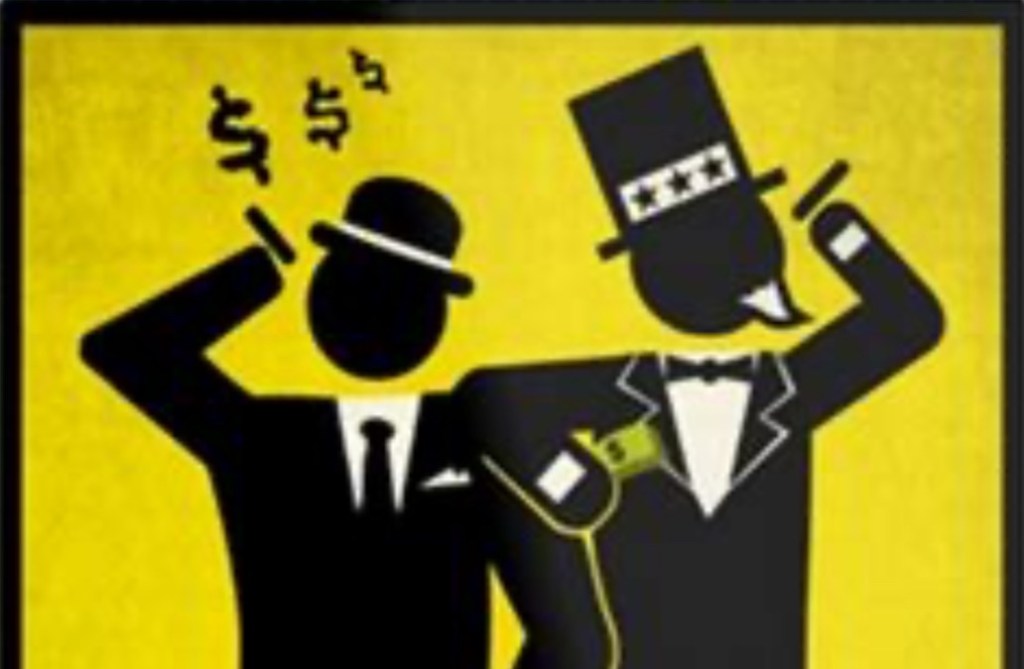
Since his inauguration, Donald Trump has been busy finding ways for the government to extort payments and ownership shares from private companies. This has taken a variety of forms. Tad DeHaven summarizes the major pieces of booty extracted thus far in the following bullet points (skipping the quote marks here):

  • June 13: Trump issues an executive order allowing the Nippon Steel-US Steel deal contingent on giving the government a “golden share” that enables the president to exert extensive control over US Steel’s operations.
  • July 10: The Department of Defense (DoD) unveils a multi-part package with convertible preferred stock, warrants, and loan guarantees, making it the top shareholder of rare earth metals producer MP Materials.
  • July 23: The White House claims an agreement with Japan to reduce the president’s so-called reciprocal tariff rate on Japanese imports comes with a $550 billion Japanese “investment fund” that Trump will control.
  • July 31: Trump claims an agreement with South Korea to reduce the so-called reciprocal tariff on South Korean imports comes with a $350 billion South Korean-financed investment in projects “owned and controlled by the United States” that he will select.
  • August 11: The White House confirms an “unprecedented” deal with Nvidia and AMD that allows them to sell particular chips to China in exchange for 15 percent of the sales.
  • August 12: In a Fox Business interview, Bessent points to the alleged investments from Japan, South Korea, and the EU “to some extent” and says, “Other countries, in essence, are providing us with a sovereign wealth fund.”
  • August 22: Fifteen days after calling for Intel CEO Lip-Bu Tan to resign, Trump announces that the US will take a 10 percent equity stake in Intel using the CHIPS Act and DoD funds, becoming Intel’s largest single shareholder.

Each of these “deals” has a slightly different back story, but national security is a common theme. And Trump says they’ll all make America great again. They are touted as a way for American taxpayers to benefit from the investment he claims his policies are attracting to the U.S. However, all of these are ill-advised for several reasons, some of which are common to all. That includes the extortionary nature of each and every one of them.

Short Background On “Deals”

The June 13 deal (Nippon/US Steel), the July 10 deal (MP Materials), and the August 22 deal (Intel) all involve U.S. government equity stakes in private companies. The August 11 deal (NVIDIA/AMD) diverts a stream of private revenue to the government. The July 23 and July 31 deals (Japan and South Korea) both involve “investment funds” that Trump will control to one extent or another.

The August 12 entry adds “expected” EU investments with some qualification, but that bullet quotes Treasury Secretary Bessent referring to these investments as part of a sovereign wealth fund (SWF). Secretary of Commerce Lutnick now denies that an SWF will exist. My objections might be tempered slightly (but only slightly) by an SWF because it would probably need to place constraints on an Administation’s control. That might give you a hint as to why Lutnick is now downplaying the creation of an SWF.

I object to the Nippon/US Steel “deal” in part (and only in part) because it was extortion on its face. There is no valid anti-trust argument against the deal (US Steel is the nation’s third largest steelmaker and is broke), and the national security concerns that were voiced (Japan! for one thing) were completely bogus. Even worse, the “Golden Share” would give the federal government authority, if it chose to exercise it, over a variety of the company’s decisions.

The Intel “deal” is another highly questionable transaction. Intel was to receive $11 billion under the CHIPS Act, a fine example of corporate welfare, as Veronique de Rugy once described the law. However, Intel was to receive its grants only if it stood up four fabrication facilities. But it did not. Now, instead of demanding reimbursement of amounts already paid, the government offered to pay the remainder in exchange for a 9.9% stake in the company. And there is no apparent requirement that Intel meet the original committment! This could turn out a bust!

The MP Materials transaction with the Department of Defense has also been rationalized on national security grounds. This excuse comes a little closer to passing the smell test, but the equity stake is objectionable for other reasons (to follow).

The Nvidia/AMD deal has been justified as compensation for allowing the companies to sell chips to China, which is competing with the U.S. to lead the world in AI development. This is another form of selective treatment, here applied to an export license. The chips in question do not have the same advanced specifications as those sold by the companies in the U.S., but let’s not let that get in the way of a revenue opportunity.

While nothing about TikTok appears on the list above, I fear that a resolution of its operational status in the U.S. presents another opportunity for extortion by the Trump Administration. I’m sure there will be many other cases.

Root Cause: Protectionism

The so-called investment funds described in the timeline above are nearly all the result of trade terms negotiated by a dominant and belligerent trading partner: the U.S. My objections to tariffs are one thing, but here we are extorting investment pledges for reductions in the taxes we’ll impose on our own citizens! Additionally, the belief that these investments will somehow prevent a general withdrawal of foreign investment in the U.S. is misguided. In fact, a smaller trade deficit dictates less foreign investment. The difference here is that the government will wrest ownership control over a greater share of less foreign investment.

Trump the Socialist?

Needless to say, I don’t favor government ownership of the means of production. That’s socialism, but do matters of national security offer a rationale for public ownership? For example, rare earth minerals are important to national defense. Therefore, it’s said that we must ensure a domestic supply of those minerals. I’m not convinced that’s true, but in any case, fat defense contracts should create fat profit opportunities in mining rare earths (enter MP Materials). None of that means public ownership is necessary or a good idea.

All of these federal investments are construed, to one extent or another, as matters of national security, but that argument for market intervention is much too malleable. Must we ensure a domestic supply of semiconductors for national security reasons? And public ownership? Is the same true of steel? Is the same true of our “manufacturing security”? It can go on and on. The next thing you know, someone will argue that grocery stores should be owned by the government in the name of “food security”! Oh, wait…

Trump the Central Planner

Government ownership takes the notion of industrial planning a huge step beyond the usual conception of that term. Ordinarily, when government takes the role of encouraging or discouraging activity in particular industries or technologies, it attempts to select winners and losers. The very idea presumes that the market is not allocating resources in an optimal way, as if the government is in any position to gainsay the decisions of private market participants who have skin in the game. This is a foolhardy position with predictably negative consequences. (For some examples, see the first, second, and fourth articles linked here by Don Boudreaux.) The fundamental flaw in central planning always comes down to the inability of planners to collect, process, and act on the information that the market handles with marvelous efficiency.

When government invests taxpayer funds in exchange for ownership positions in private concerns, the potential levers of control are multiplied. One danger is that political guidance will replace normal market incentives. And as de Rugy points out, the government’s potential role as a regulator creates a clear conflict of interest. In a strong sense, a government ownership stake is worse for private owners than a mere dilution of their interests. It looms as a possible taking, as private owners and managers surrender to creeping government extortion.

Financial Malfeasance

In addition to the objections above, I maintain that these investments represent poor stewardship of public funds. The U.S. public debt currently stands at $37 trillion with an entitlement disaster still to come. In fact, according to one estimate, the federal government’s total unfunded obligations amount to additional $121 trillion! Putting aside the extortion we’re witnessing, any spare dollar should be put toward retiring debt, rather than allowing its upward progression.

As I’ve noted before, paying off a dollar of debt entails a risk-free “return” in the form of interest cost avoidance, let’s say 3.5% for the sake of argument. If instead the dollar is “invested” in risk assets by the government, the interest cost is still incurred. To earn a net return as high as the that foregone from interest avoidance, the government must consistently earn at least 7% on its invested dollar. But of course that return is not risk-free!

A continuing failure to pay down the public debt will ultimately poison the debt market’s assessment of the government’s will to stay within its long-run budget constraint. That would ultimately manifest in an inflation, shrinking the real value of the public debt even as it undermines the living standards of many Americans.

One final thought: Though few MAGA enthusiasts would admit it even if they understood, we’re witnessing a bridging of two ends of the idealogical “horseshoe”. Right-wing populism and protectionism meet the left-wing ideal of central planning and public ownership. There is a name for this particular form of corporatist state, and it is fascism.

Promises and Policies: Grading the Candidates

29 Tuesday Oct 2024

Posted by Nuetzel in Election

≈ Leave a comment

Tags

2024 Election, Abortion, Abraham Accords, Barack Obama, Capitalism, Climate Change, Corporatism, DEI, Dobbs, Donald Trump, Elon Musk, fascism, Federal Reserve, First Amendment, Fossil fuels, Housing, Hysteria, Immigration, Inflation, Israel, Joe Biden, Kamala Harris, Medicaid, Medicare, Obamacare, Renewable energy, Second Amendment, Social Security, Supreme Court, Tariffs, Tax Policy, Ukraine, Vladimir Putin

Wow! We’re less than a week from Election Day! I’d hoped to write a few more detailed posts about the platforms and policies of Kamala Harris and Donald Trump, but I was waylaid by Hurricane Milton. It sent us scrambling into prep mode, then we evacuated to the Florida Panhandle. The drive there and back took much longer than expected due to the mass exodus. On our return we found the house was fine, but there was significant damage to an exterior structure and a mess in the yard. We also had to “de-prep” the house, and we’ve been dealing with contractors ever since. It was an exhausting episode, but we feel like we were very lucky.

Now, with less than a week left till the election, I’ll limit myself to a summary of the positions of the candidates in a number of areas, mostly but not all directly related to policy. I assign “grades” in each area and calculate an equally-weighted “GPA” for each candidate. My summaries (and “grades”) are pretty off-the-cuff and not adequate treatments on their own. Some of these areas are more general than others, and I readily admit that a GPA taken from my grade assignments is subject to a bit of double counting. Oh well!

Role of Government: Kamala Harris is a statist through and through. No mystery there. Trump is more selective in his statist tendencies. He’ll often favor government action if it’s politically advantageous. However, in general I think he is amenable to a smaller role for the public than the private sector. Harris: F; Trump: C

Regulation: There is no question that Trump stands for badly needed federal regulatory reform. This spans a wide range of areas, and it extends to a light approach to crypto and AI regulation. Trump plans to appoint Elon Musk as his “Secretary of Cost Cutting”. Harris, on the other hand, seems to favor a continuation of the Biden Administration’s heavy regulatory oversight. This encourages a bloated federal bureaucracy, inflicts high compliance costs on the private sector, stifles innovation, and tends to concentrate industrial power. Harris: F; Trump: A

Border Policy: Trump wants to close the borders (complete the wall) and deport illegal immigrants. Both are easier said than done. Except for criminal elements, the latter will be especially controversial. I’d feel better about Trump’s position if it were accompanied by a commitment to expanded legal immigration. We need more legal immigrants, especially the highly skilled. For her part, Harris would offer mass amnesty to illegals. She’d continue an open border policy, though she claims to want certain limits on illegal border crossings going forward. She also claims to favor more funds for border control. However, it is not clear how well this would translate into thorough vetting of illegal entrants, drug interdiction at the border, or sex trafficking. Harris: D; Trump: B-

Antitrust: Accusations of price gouging by American businesses? Harris! Forty three corporations in the S&P 500 under investigation by the DOJ? The Biden-Harris Administration. This reflects an aggressively hostile and manipulative attitude toward the business community. Trump, meanwhile, might wheedle corporations to act on behalf of certain of his agendas, but he is unlikely to take such a broadly punitive approach. Harris: F; Trump: B-

Foreign Policy: Harris is likely to continue the Biden Administration’s conciliatory approach to dealing with America’s adversaries. The other side of that coin is an often tepid commitment to longtime allies like Israel. Trump believes that dealing from a position of strength is imperative, and he’s willing to challenge enemies with an array of economic and political sticks and carrots. He had success during his first term in office promoting peace in the Middle East. A renewed version of the Abraham Accords that strengthened economic ties across the region would do just that. Ideally, he would like to restore the strength of America’s military, about which Harris has less interest. Trump has also shown a willingness to challenge our NATO partners in order to get them to “pay their fair share” toward the alliance’s shared defense. My major qualification here has to do with the candidates’ positions with respect to supporting Ukraine in its war against Putin’s mad aggression. Harris seems more likely than Trump to continue America’s support for Ukraine. Harris: D+; Trump: B-

Trade: Nations who trade with one another tend to be more prosperous and at peace. Unfortunately, neither candidate has much recognition of these facts. Harris is willing to extend the tariffs enforced during the Biden Administration. Trump, however, is under the delusion that tariffs can solve almost anything that ails the country. Of course, tariffs are a destructive tax on American consumers and businesses. Part of this owes to the direct effects of the tax. Part owes to the pricing power tariffs grant to domestic producers. Tariffs harm incentives for efficiency and the competitiveness of American industry. Retaliatory action by foreign governments is a likely response, which magnifies the harm.

To be fair, Trump believes he can use tariffs as a negotiating tool in nearly all international matters, whether economic, political, or military. This might work to achieve some objectives, but at the cost of damaging relations more broadly and undermining the U.S. economy. Trump is an advocate for not just selective, punitive tariffs, but for broad application of tariffs. Someone needs to disabuse him of the notion that tariffs have great revenue-raising potential. They don’t. And Trump is seemingly unaware of another basic fact: the trade deficit is mirrored by foreign investment in the U.S. economy, which spurs domestic economic growth. Quashing imports via tariffs will also quash that source of growth. I’ll add one other qualification below in the section on taxes, but I’m not sure it has a meaningful chance.

Harris: C-; Trump: F

Inflation: This is a tough one to grade. The President has no direct control over inflation. Harris wants to challenge “price gougers”, which has little to do with actual inflation. I expect both candidates to tolerate large deficits in order to fulfill campaign promises and other objectives. That will put pressure on credit markets and is likely to be inflationary if bond investors are surprised by the higher trajectory of permanent government indebtedness, or if the Federal Reserve monetizes increasing amounts of federal debt. Deficits are likely to be larger under Trump than Harris due in large part to differences in their tax plans, but I’m skeptical that Harris will hold spending in check. Trump’s policies are more growth oriented, and these along with his energy policies and deregulatory actions could limit the inflationary consequences of his spending and tax policies. Higher tariffs will not be of much help in funding larger deficits, and in fact they will be inflationary. Harris: C; Trump: C

Federal Reserve Independence: Harris would undoubtedly like to have the Fed partner closely with the Treasury in funding federal spending. Her appointments to the Board would almost certainly lead to a more activist Fed with a willingness to tolerate rapid monetary expansion and inflation. Trump might be even worse. He has signaled disdain for the Fed’s independence, and he would be happy to lean on the Fed to ease his efforts to fulfill promises to special interests. Harris: D; Trump: F

Entitlement Reform: Social Security and Medicare are both insolvent and benefits will be cut in 2035 without reforms. Harris would certainly be willing to tax the benefits of higher-income retirees more heavily, and she would likely be willing to impose FICA and Medicare taxes on incomes above current earning limits. These are not my favorite reform proposals. Trump has been silent on the issue except to promise no cuts in benefits. Harris: C-; Trump: F

Health Care: Harris is an Obamacare supporter and an advocate of expanded Medicaid. She favors policies that would short-circuit consumer discipline for health care spending and hasten the depletion of the already insolvent Medicare and Medicaid trust funds. These include a $2,000 cap on health care spending for Americans on Medicare, having Medicare cover in-home care, and extending tax credits for health insurance premia. She supports funding to address presumed health care disparities faced by black men. She also promises efforts to discipline or supplant pharmacy benefit managers. Trump, for his part, has said little about his plans for health care policy. He is not a fan of Obamacare and he has promised to take on Big Pharma, whatever that might mean. I fear that both candidates would happily place additional controls of the pricing of pharmaceuticals, a sure prescription for curtailed research and development and higher mortality. Harris: F; Trump: D+

Abortion: The Supreme Court’s 2022 decision in Dobbs v. Jackson essentially relegated abortion law to individual states. That’s consistent with federalist principles, leaving the controversial balancing of abortion vs. the unborn child’s rights up to state voters. Geographic differences of opinion on this question are dramatic, and Dobbs respects those differences. Trump is content with it. Meanwhile, Harris advocates for the establishment of expanded abortion rights at the federal level, including authorization of third trimester abortions by “care providers”. And Harris does not believe there should be religious exemptions for providers who do not wish to offer abortion services. No doubt she also approves of federally funded abortions. Harris: F; Trump: A

Housing: The nation faces an acute housing shortage owing to excessive regulation that limits construction of new or revitalized housing. These excessive rules are primarily imposed at the state and local level. While the federal government has little direct control over many of these decisions, it has abetted this regulatory onslaught in a variety of ways, especially in the environmental arena. Harris is offering stimulus to the demand side through a $25,000 housing tax credit for first-time home buyers. This will succeed in raising the cost of housing. She has also called for heavier subsidies for developers of low-income housing. If past is prologue, this might do more to line the pockets of developers than add meaningfully to the stock of affordable housing. Harris also favors rent controls, a sure prescription for deterioration in the housing stock, and she would prohibit software allowing landlords to determine competitive neighborhood rents. Trump has called for deregulation generally and would not favor rent controls. Harris: F; Trump B

Taxes: Harris has broached several wildly destructive tax proposals. Perhaps the worst of these is to tax unrealized capital gains, and while she promises it would apply only to extremely wealthy taxpayers, it would constitute a wealth tax. Once that line is crossed, the threat of widening the base becomes a very slippery slope. It would also be a strong detriment to domestic capital investment and economic growth. Harris would increase the top marginal personal tax rate and the corporate tax rate, which would discourage investment and undermine real wage growth. She’d also increase estate tax rates. As discussed above, she unwisely calls for a $25,000 tax credit for first-time homebuyers. She also wants to expand the child care tax credit to $6,000 for families with newborns. A proposed $50,000 small business tax credit would allow the federal government to subsidize and encourage risky entrepreneurial activity at taxpayers’ expense. I’m all for small business, but this style of industrial planning is bonkers. She would sunset the Trump (TCJA) tax cuts in 2026.

Finally, Harris has mimicked Trump in calling for no taxes on tips. Treating certain forms of income more favorably than others is a recipe for distortions in economic activity. Employers of tip-earning workers will find ways to shift employees’ income to tips that are mandatory for patrons. It will also skew labor supply decisions toward occupations that would otherwise have less economic value. But Trump managed to find an idea so politically seductive that Harris couldn’t resist.

Trump’s tax plans are a mixed bag of good and bad ideas. They include extending his earlier tax cuts (TCJA) and restoring the SALT deduction. The latter is an alluring campaign tidbit for voters in high-tax states. He would reduce the corporate tax rate, which I strongly favor. Corporate income is double-taxed, which is a detriment to growth as well as a weight on real wages. He would eliminate taxes on overtime income, another example of favoring a particular form of income over others. Wage earners would gain at the expense of salaried employees, so one could expect a transition in the form employees are paid over time. Otherwise, the classification of hours as “overtime” would have to be standardized. One could expect existing employees to work longer hours, but at the expense of new jobs. Finally, Trump says Social Security benefits should not be taxed, another kind of special treatment by form of income. This might encourage early retirement and become an additional drain on the Social Security Trust Fund.

The higher tariffs promised by Trump would collect some revenue. I’d be more supportive of this plank if the tariffs were part of a larger transition from income taxes to consumption taxes. However, Trump would still like to see large differentials between tariffs and taxes imposed on the consumption of domestically-produced goods and services.

Harris: F; Trump C+

Climate Policy: This topic has undergone a steep decline in relative importance to voters. Harris favors more drastic climate interventions than Trump, including steep renewable subsidies, EV mandates, and a panoply of other initiatives, many of which would carry over from the Biden Administration. Harris: F; Trump: B

Energy: Low-cost energy encourages economic growth. Just ask the Germans! Consistent with the climate change narrative, Harris wishes to discourage the use of fossil fuels, their domestic production, and even their export. She has been very dodgy with respect to restrictions on fracking. Her apparent stance on energy policy would be an obvious detriment to growth and price stability (or I should say a continuing detriment). Trump wishes to encourage fossil fuel production. Harris: F; Trump: A

Constitutional Integrity: Harris has supported the idea of packing the Supreme Court, which would lead to an escalating competition to appoint more and more justices with every shift in political power. She’s also disparaged the Electoral College, without which many states would never have agreed to join the Union. Under the questionable pretense of “protecting voting rights”, she has opposed steps to improve election integrity, such voter ID laws. And operatives within her party have done everything possible to register non-citizens as voters. Harris: F; Trump: A

First Amendment Rights: Harris has called for regulation and oversight of social media content and moderation. A more descriptive word for this is censorship. Trump is generally a free speech advocate. Harris: F; Trump A-

Second Amendment Rights: Harris would like to ban so-called “assault weapons” and high-capacity magazines, and she backs universal background checks for gun purchases. Trump has not called for any new restrictions on gun rights. Harris: F; Trump: A

DEI: Harris is strongly supportive of diversity and equity initiatives, which have undermined social cohesion and the economy. That necessarily makes her an enemy of merit-based rewards. Trump has no such confusion. Harris: F; Trump: A

Hysteria: The Harris campaign has embraced a strategy of demonizing Donald Trump. Of course, that’s not a new approach among Democrats, who have fabricated bizarre stories about Trump escapades in Russia, Trump as a pawn of Vladimir Putin, and Russian manipulation of the 2016 Trump campaign. Congressional democrats spent nearly all of Trump’s first term in office trying to find grounds for impeachment. Concurrently, there were a number of other crazy and false stories about Trump. The current variation on “Orange Man Bad” is that Trump is a fascist and a Nazi, and that all of his supporters are Nazis. And that Trump will use the military against his domestic political opponents, the so-called “enemy within”. And that Trump will send half the country’s populace to labor camps. The nonsense never ends, but could anything more powerfully ignite the passions of violent extremists than this sort of hateful rhetoric? Would it not be surprising if at least a few leftists weren’t interested in assassinating “Hitler” himself. This is hysteria, and one has to wonder if that is not, in fact, the intent.

Can any of these people actually define the term fascist? Most fundamentally, a fascist desires the use of government coercion for private gain (of wealth or power) for oneself and/or one’s circle of allies. By that definition, we could probably categorize a great many American politicians as fascists, including Barack Obama, Joe Biden, Donald Trump, and a majority of both houses of Congress. That only demonstrates that corporatism is fundamental to fascist politics. Less-informed definitions of fascism conflate it with everything from racism (certainly can play a part) and homophobia (certainly can play a part) to mere capitalism. But take a look at the demographics of Trump’s supporters and you can see that most of these definitions are inapt.

Is the Trump campaign suffering from any form of hysteria? It’s shown great talent at poking fun at the left. Of course, Trump’s reactions to illegal immigration, crime, and third-trimester abortions are construed by leftists to be hysterical. I mean, why would anyone get upset about those kinds of things?

Harris: F; Trump: A

“Grade Point Average”

I’m sure I forgot an area or two I should have covered. Anyway, the following are four-point “GPAs” calculated over 20 categories. I’m deducting a quarter point for a “minus” grade and adding a quarter point for a “plus” grade. Here’s what I get:

Harris: 0.44; Trump: 2.68

Hmmm

Containing An Online Viper Pit of Antisemites

05 Thursday Jan 2023

Posted by Nuetzel in Free Speech, Social Media

≈ Leave a comment

Tags

Andrew Torba, Antisemitism, Christian Nationalism, Corporatism, Dan Frankel, fascism, Fighting Words, Free Speech, Gab, GabPro, Israel, Judeo-Bolshevism, Kanye West, Kristallnach, Pittsburgh Jewish Chronicle, racism, Religious Liberty, Rothschild Family, Theocracy, Zionism

This post is about a particular social media platform and a terrible oversight on my part. I signed up for Gab at least two years ago as I tried to find social media platforms that respected free speech rights and on which I could promote my blog. I haven’t paid for a subscription to “GabPro”, but I’m embarrassed to have completely missed some of the stink emanating from within the platform until recently. It’s not as if it hadn’t been reported, but somehow, I was oblivious.

I knew pretty quickly that Gab was an odd fit for me because so many posters there are on the very religious right. That’s fine, as I’m a strong believer in religious liberty and free speech. My views sometimes conflict with the religious right, but we’re in alignment on some key issues.

I never really scrolled Gab for more than a few moments at any time, having maintained my account there primarily for cross-posting my blog. I joined a particular Gab “fan” group of a band I love, and I have an old friend who happens to be on Gab. I also joined the “Libertarians of Gab” group. Occasionally, something raised my antennae right at the top of my feed, prompting me to look more closely, but I knew this much: like many other social media platforms, Gab is a meme-fest with lots of repetition, so I seldom wasted time scrolling there.

A year or so ago, a Jewish acquaintance on Gab mentioned a few antisemitic posts he’d seen there, but he’s a staunch free-speech advocate and had other reasons to stick with it. At the time, I might have begun to notice a few posters on Gab who were clearly anti-Zionist, but there’s a real distinction between anti-Zionism and antisemitism. Antisemites are bound to be anti-Zionist; the reverse doesn’t always follow. But again, I hadn’t yet found any real fault with Gab itself at that time.

(Note: I’m not hyphenating “antisemitism”, nor am I capitalizing “semitism”, because there is no such thing as a “semite” or “semitism”. The word was concocted by political factions in 19th century Germany in an attempt to “other” German Jews as “Orientals”.)

Over the next several months, however, at the top of my feed, I began to see a few antisemitic posts. Sometimes these amounted to silly assertions, such as the Rothschild family’s supposed world domination, a claim that would be harmless enough if not for indignation that the Rothschilds happen to be Jewish. A few posts were much worse. My knee-jerk reaction to offensive content is to block the poster, as I did a few times.

More recently, in the wake of Kanye West’s crazy tweets about Jews, I was a recipient of a group email from Andrew Torba, the founder and CEO of Gab. Torba, as it happens, is a self-styled “Christian Nationalist”. His email essentially portrayed West as a messenger from God. Here are some excerpts:

“God is using Ye, formerly known as Kanye West, for a big purpose…. He talks about the need for our leaders to uphold Christian values, not Zionist ones. … Ye is using the influence and talents that God has given him to speak the Truth and glorify Jesus Christ.”

It’s interesting that Torba referred to “Zionist” values. Though he is almost certainly anti-Zionist, that’s not really what he meant here. This bit of nut-jobbery, as I learned, had been preceded by many other wild statements from Torba over the years. For instance, over a year ago he tweeted the following and then disabled his Twitter account, a stunt he’s repeated several times:

“We’re building a parallel Christian society because we are fed up and done with the Judeo-Bolshevik one.”

The author at the link above, who reviewed some of Torba’s antics, noted that Judeo-Bolshevism was a term thrown around by the Nazis in the 1930s. But even putting that aside, Torba has an unfortunate tendency to paint with an extremely broad brush in promoting his very own brand of identity politics. That point is established clearly in this “Open Letter” to Torba from a “Hebraic-oriented evangelical Christian attorney”. If anything, the letter is far too gentle with Torba. The writer concludes:

“… I do hope you will reconsider your gratuitous exclusionary rhetoric regarding our spiritual cousins in the House of Judah, treating at least the many who share our cultural values and all-important Creationist paradigm with the same basic respect and camaraderie you show to atheists in the MAGA and conservative movements.”

Torba’s perspective seems to be that all Jews are unworthy, or worse. Here’s one of his posts:

From my perspective, Torba’s recent email regarding “Ye” served as a permission slip to antisemites on Gab to engage in blatant hatred of Jews. Since then, I’ve seen truly antisemitic content appear in my feed with increasing frequency, as if it’s being promoted by the platform. I’m not sure it always sinks to the level of brown-shirts on Kristallnach, but it has that nauseating flavor. Much to my dismay, a few of these posts were from users with whom I’d established earlier connections, or it was content they reposted. Others might have appeared on my feed courtesy of an effort to “introduce” users to one another and to promote certain content.

I didn’t save screenshots of the offensive posts I’ve seen on Gab. I probably should have, but here’s a sampling of a few of the wholesome users I’ve blocked:

One recent post expressed anger with so-called “elites”, an understandable sentiment shared by many in an age of corporatist fascism with the imposition of “woke” ideology in many institutions. However, the poster’s real point was to admonish others for not identifying the target of their anger as “the Jews”.

I became aware of another piece of disturbing information about the perpetrator of a mass killing in Pittsburgh a few years ago, and I can’t believe I missed it:

“The man accused of killing 11 Jews in the Tree of Life building posted antisemitic messages on Gab before the Oct. 27, 2018, massacre. In his Gab bio, he described Jews as the ‘children of satan.’”

Related to these murders, Torba reposted this article on Gab not long ago, from the Pittsburgh Jewish Chronicle. It stated that Pennsylvania Representative Dan Frankel was the target of hateful and threatening posts on the platform. Some of the posts quoted at the link are awful.

But why did Torba repost that article? Well, it motivated a large number of Torba’s followers on Gab to subject the Chronicle to a series of antisemitic replies. This would appear to have been Torba’s intent, but he subsequently removed the repost of the article (along with the hateful replies). That’s a familiar pattern.

Torba’s original comments on the Chronicle article included the following:

“People are done caring about your eternal victimhood complex … Free speech means the right to offend…Stop conflating offensive memes with ‘threats’…Gab is what free speech looks like, the good, the bad, and the ugly are all included.”

Well, you’re right about free speech, Mr. Torba, but subject to an important qualification: “fighting words” are not protected speech under the Constitution. Maybe that’s why you took down your repost, and most importantly the replies. Did you come to your senses relative to the limits of free speech?

It’s not surprising, but the hatred on Gab is not reserved solely for Jews. Since I’ve been on the lookout, I’ve witnessed overt racism of several other varieties on Gab, and I’ve duly blocked those posters. There is also a complement of hatred for individuals falling under the LGBTQ+ banner.

Gab is not the only province of this sort of behavior on social media, but it might be a hotbed. Is it that easy to learn to hate others? Is the distinction between arguing policy versus revilement and ad hominem too subtle for them?

I have Jewish friends across the political spectrum and Jews in my extended family. Few of them are deeply religious. Likewise, many of my friends raised as Christians are not deeply religious. These individuals are entitled to the liberty to practice any or no religion at all. Their choices are no cause for hostility unless they make some effort to impose their views or will upon others. But that kind of theocratic, coercive power seems to be precisely what Andrew Torba and his Christian Nationalist followers on Gab wish to have for themselves.

I’m happy to report that I’ve seen far fewer offensive posts since blocking a number of antisemitic and racist posters. Maybe the platform is “learning” about me. However, there are many well-intentioned people on Gab, and even a few who actively call-out the bigots. I might have to join in that effort. I support Torba’s right to express his views, short of threats or incitement of violence. I have no desire to be affiliated with Torba, however, and I’ll never pay him for GabPro. I’ll remain on Gab for the time being, and we’ll see how the content evolves.

Great Moments In Projection: Il Doofe Says His Opponents Are Anti-Democratic, Fascist

06 Tuesday Sep 2022

Posted by Nuetzel in Democracy, fascism, Uncategorized

≈ Leave a comment

Tags

Administrative State, Angelo M. Codaville, Babylon Bee, Benito Mussolini, Classical Liberal, Constitutional Republic, Corporatism, crony capitalism, Dan Klein, Democracy, fascism, FDR, Federalism, Friedrich Hayek, G.W.F. Hegel, Hitler, Il Duce, Joe Biden, Joseph Stalin, Majoritarianism, Nationalism, New Deal, Semi-Fascism, Sheldon Richman, Socialism

When partisans want to make sure they get their way, perhaps we shouldn’t be surprised to hear them claim their opponents are “anti-democratic”. Well, one-party rule is not democratic, just in case that’s unclear to leftists prattling about “hunting down” the opposition. We now have those forces hurling cries of “fascism” and “semi-fascism” at political adversaries for opposing their use of the state’s coercive power to get their way and to punish political enemies.

Restrained Democracy

The U.S. is not a democracy; it is a constitutional republic. The reason it’s not a democracy is that the nation’s founders were wary of the dangers of majoritarianism. There are many checks on unbridled majoritarianism built into our system of government, including the many protections and guarantees of individual rights in the Constitution, as well as federalism and three branches of government intended as coequals.

In a short essay on democracy, Dan Klein refers to a mythology that has developed around the presumed democratic ideal, quoting Friedrich Hayek on the “fantasy of consensus” that tends to afflict democratic absolutists. Broad consensus is possible on many issues, but it might have been an imperative within small bands of primitive humans, when survival of the band was of paramount concern. That’s not the case in modern societies, however. Classical liberals are often derided as “anti-democratic”, but like the founders, their distaste for pure democracy stems from a recognition of the potential for tyrannies of the majority. Klein notes that the liberal emphasis on individual rights is naturally at tension with democracy. Obviously, a majority might selfishly prefer actions that would be very much to the detriment of individuals in the minority, so certain safeguards are necessary.

However, the trepidation of classical liberals for democracy also has to do with the propensity for majorities to “governmentalize” affairs so as to codify their preferences. As Klein says, this often means regulation of many details of life and social interactions. These are encroachments to which classical liberals have a strong aversion. One might fairly say “small government” types like me are “anti-pure democracy”, and as the founders believed, democratic processes are desirable if governing power is distributed and restrained by constitutional principles and guarantees of individual rights.

Democracy has vulnerabilities beyond the danger posed by majoritarian dominance, however. Elections mean nothing if they can be manipulated, and they are easily corrupted at local levels by compromises to the administration of the election process. Indeed, today powerful national interests are seeking to influence voting for local election officials across the country, contributing substantial sums to progressive candidates. It’s therefore ironic to hear charges of racism and anti-democracy leveled at those who advocate measures to protect election integrity or institutions such as federalism.

And here we have the White House Press Secretary insisting that those in the “minority” on certain issues (dependent, of course, on how pollsters phrase the question) are “extremists”! To charge that someone or some policy is “anti-democratic” usually means you didn’t get your way or you’re otherwise motivated by political animus.

Fascism

Biden and others are throwing around the term fascism as well, though few of these partisans can define the term with any precision. Most who pretend to know its meaning imagine that fascism evokes some sort of conservative authoritarianism. Promoting that impression has been the purpose of many years of leftist efforts to redefine fascism to suit their political ends. Stalin actually promoted the view that anything to the right of the Communist Party was inherently fascist. But today, fascism is an accurate description of much of Western governance, dominated as it is by the administrative state.

I quote here from my post “The Fascist Roader” from 2016:

“A large government bureaucracy can coexist with heavily regulated, privately-owned businesses, who are rewarded by their administrative overlords for expending resources on compliance and participating in favored activities. The rewards can take the form of rich subsidies, status-enhancing revolving doors between industry and powerful government appointments, and steady profits afforded by monopoly power, as less monied and politically-adept competitors drop out of the competition for customers. We often call this “corporatism”, or “crony capitalism”, but it is classic fascism, as pioneered by Benito Mussolini’s government in Italy in the 1920s. Here is Sheldon Richman on the term’s derivation:

‘As an economic system, fascism is socialism with a capitalist veneer. The word derives from fasces, the Roman symbol of collectivism and power: a tied bundle of rods with a protruding ax.’”

Meanwhile, Hitler’s style of governing shared some of the characteristics of Mussolini’s fascism, but there were important differences: Hitler persecuted Jews, blaming them for all manner of social problems, and he ultimately had them slaughtered across much of Europe. Mussolini was often brutal with his political enemies. At the same time, he sought to unite an Italian people who were otherwise a fairly diverse lot, but once Mussolini was under Hitler’s thumb, Italian Jews were persecuted as well.

Angelo M. Codevilla provides an excellent account of Mussolini’s political career and the turns in his social philosophy over the years. He always considered himself a dedicated socialist, but the views he professed evolved as dictated by political expediency. So did his definition of fascism. As he took power in Italy with the aid of “street fighters”, fascism came to mean nationalism combined with rule by the administrative state and a corresponding preemption of legislative authority. And there were concerted efforts by Mussolini to control the media and censor critics. Sound familiar? Here’s a quote from Il Duce himself on this matter:

“Because the nature of peoples is variable, and it is easy to persuade them of things, but difficult to keep them thus persuaded. Hence one must make sure that, when they no longer believe, one may be able then to force them to believe.”

Here is Codevilla quoting Mussolini from 1919 on his philosophy of fascism:

“The fascist movement, he said, is ‘a group of people who join together for a time to accomplish certain ends.’ ‘It is about helping any proletarian groups who want to harmonize defense of their class with the national interest.’ ‘We are not, a priori, for class struggle or for class-cooperation. Either may be necessary for the nation according to circumstances.’”

This framing underlies another basic definition of fascism: a system whereby government coercion is used to extract private benefits, whether by class or individual. Codevilla states that Mussolini was focused on formal “representation of labor” in policy-making circles. Today, western labor unions seem to have an important, though indirect, influence on policy, and labor is of course the presumed beneficiary of many modern workplace regulations.

Modern corporatism is directly descended from Mussolini’s fascist state. The symbiosis that exists between large corporations and government has several dimensions, including regulatory capture, subsidies and taxes to direct flows of resources, high rates of government consumption, rich government contracts, and of course cronyism. This carries high social costs, as government dominance of economic affairs gives rise to a culture of rent seeking and diminished real productivity. Here is Codevilla’s brief description of the transition:

“Hegel, as well as the positivist and Progressive movements, had argued for the sovereignty of expert administrators. Fascist Italy was the first country in which the elected legislature gave up its essential powers to the executive, thus abandoning the principle, first enshrined in the Declaration of Independence and the U.S. Constitution, by which people are rightly governed only through laws made by elected representatives. By the outbreak of World War II, most Western countries’ legislatures—the U.S. Congress included—had granted the executive something like ‘full powers,’ each by its own path, thus establishing the modern administrative state.”

Mussolini saw Italian fascism as the forerunner to FDR’s New Deal and took great pride in that. On this point, he said:

“… the state is responsible for the people’s economic well-being, it no longer allows economic forces to run according to their own nature.”

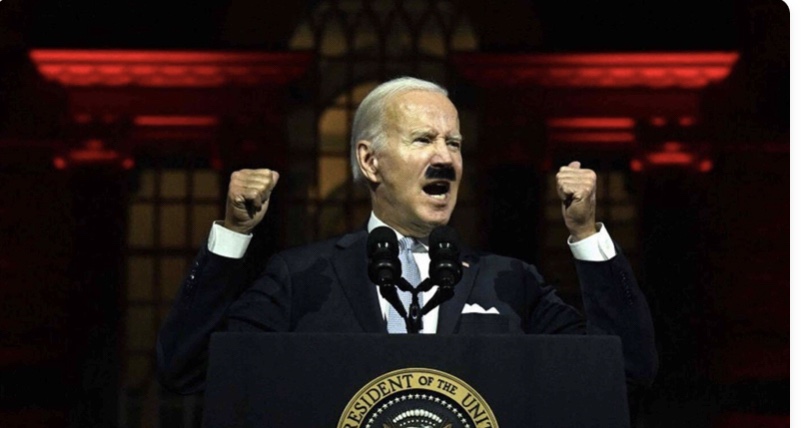
The Babylon Bee’s take on Biden and fascism would have been more accurate had it alluded to Mussolini, but not nearly as funny! The following link (and photoshopped image) is obviously satire, but it has a whiff of eerie truth.

Biden Condemns Fascism in Speech While Also Debuting Attractive New Mustache

Conclusion

Biden’s slur that Republicans are “anti-democratic” is an obvious distortion, and it’s rather ironic at that. The nation’s support for democratic institutions has always been qualified for good reasons: strict majoritarianism tends to disenfranchise voters in the minority, and in fact it can pose real dangers to their lives and liberties. Our constitutional republic offers “relief valves”, such as “voting with your feet”, constitutional protections, and seeking recourse in court. Biden’s party, however, has a suspicious advantage via control of election supervision in many key urban areas of the country. This can be exploited in national elections to win more races as long as the rules on election administration are sufficiently lax. This is a true corruption of democracy, unlike the earnest efforts to improve election integrity now condemned by democrats.

Joe Biden hasn’t the faintest understanding of what fascism means. He uses the term mostly to suggest that Trump, and perhaps most Republicans, have authoritarian and racist sympathies. Meanwhile, he works to entrench the machinery and the breadth of our own fascist state, usurping legislative authority. He is buttressed by a treacherous security apparatus, “street fighters” under the guise of Antifa and BLM, and the private media acting as a propaganda arm of the administration. Joe Biden, you’re our fascist now.

Socialism and Authoritarianism: Perfectly Complementary

19 Wednesday Sep 2018

Posted by Nuetzel in Socialism, Tyranny

≈ Leave a comment

Tags

Adolf Hitler, Authoritarianism, Bernie Sanders, Bolshevism, Capitalism, Corporatism, Elizabeth Warren, fascism, German Reich, Marxism, National Socialism, Nazi Party, Paul Jossey, Socialism, The Federalist

The socialist left and the Marxist hard left both deny their authoritarian progenitors. Leftists are collectivists, many of whom subscribe to an explicit form of corporatism with the state having supreme power, whether as a permanent or transitional arrangement on the path to full state ownership of the means of production. Collectivism necessarily requires force and the abrogation of individual rights. At this link, corporatism, with its powerful and interventionist state, is aptly described as “de facto nationalization without being de jure nationalization” of industry. To the extent that private ownership is maintained (for the right people), it is separated from private control and is thus a taking. But the word corporatism itself is confusing to some: it is not capitalism by any means. It essentially means “to group”, and it is a form of social control by the state. (And by the way, it has nothing to do with the legal business definition of a corporation.)

Of course, leftists distance themselves from the brutality of many statist regimes by asserting that authoritarianism is exclusively a right-wing phenomenon, conveniently ignoring Stalin, Castro, Mao, Pol Pot, and other hard lefties too numerous to mention. In fact, leftists assert that fascism must be right-wing because it is corporatist and relies on the force of authority. But again, both corporatism and fascism are collectivist philosophies and historically have been promoted as such by their practitioners. Furthermore, these leftist denials fly in the face of the systemic tendency of large governments to stanch dissent. I made several of these points four years ago in “Labels For the Authoritarian Left“.

I find this link from The Federalist fascinating because the author, Paul Jossey, provides quotes of Hitler and others offering pretty conclusive proof that the Nazi high command was collectivist in the same vein as the leftists of today. Here are a few of Jossey’s observations:

“Hitler’s first ‘National Workers’ Party’ meeting while he was still an Army corporal featured the speech ‘How and by What Means is Capitalism to be Eliminated?’

The Nazi charter published a year later and coauthored by Hitler is socialist in almost every aspect. It calls for ‘equality of rights for the German people’; the subjugation of the individual to the state; breaking of ‘rent slavery’; ‘confiscation of war profits’; the nationalization of industry; profit-sharing in heavy industry; large-scale social security; the ‘communalization of the great warehouses and their being leased at low costs to small firms’; the ‘free expropriation of land for the purpose of public utility’; the abolition of ‘materialistic’ Roman Law; nationalizing education; nationalizing the army; state regulation of the press; and strong central power in the Reich.”

Are you feeling the Bern? Does any of this remind you of the “Nasty Woman”, Liz Warren? Here is more from Jossey:

“Hitler repeatedly praised Marx privately, stating he had ‘learned a great deal from Marxism.’ The trouble with the Weimar Republic, he said, was that its politicians ‘had never even read Marx.’ He also stated his differences with communists were that they were intellectual types passing out pamphlets, whereas ‘I have put into practice what these peddlers and pen pushers have timidly begun.’

It wasn’t just privately that Hitler’s fealty for Marx surfaced. In ‘Mein Kampf,’ he states that without his racial insights National Socialism ‘would really do nothing more than compete with Marxism on its own ground.’ Nor did Hitler eschew this sentiment once reaching power. As late as 1941, with the war in bloom, he stated ‘basically National Socialism and Marxism are the same’ in a speech published by the Royal Institute of International Affairs.

Nazi propaganda minister and resident intellectual Joseph Goebbels wrote in his diary that the Nazis would install ‘real socialism’ after Russia’s defeat in the East. And Hitler favorite Albert Speer, the Nazi armaments minister whose memoir became an international bestseller, wrote that Hitler viewed Joseph Stalin as a kindred spirit, ensuring his prisoner of war son received good treatment, and even talked of keeping Stalin in power in a puppet government after Germany’s eventual triumph.”

Some contend that the Nazis used the term “socialist” in a purely cynical way, and that they hoped to undermine support for “real socialists” by promising a particular (and perverse) vision of social justice to those loyal to the Reich and the German nation. After all, the Bolsheviks were political rivals who lacked Hitler’s nationalistic fervor. Hitler must have thought that his brand of “socialism” was better suited to his political aspirations, not to mention his expansionist visions. Those not loyal to the Reich, including Jews and other scapegoats, would become free slave labor to the regime and its loyal corporate cronies. (It’s striking that much of today’s Left, obviously excepting Bernie Sanders, seems to share the Nazis’ antipathy for Jews.)

Socialism, corporatism and fascism are close cousins and are overlapping forms of statism, and they are all authoritarian by their practical nature. It’s incredible to behold leftists as they deny that the National Socialists Workers Party practiced a brand of socialism. Perhaps the identification of the Nazis as a fascist regime has led to confusion regarding their true place along the ideological spectrum, but that too is puzzling. In their case, a supreme corporatist state enabled its most privileged advocates to exploit government power for private gain, and that’s the essence of fascism and the archetypical outcome of socialism.

The Fascist Roader

04 Thursday Aug 2016

Posted by Nuetzel in Central Planning, fascism

≈ 1 Comment

Tags

Barack Obama, Benito Mussolini, central planning, competition, Dodd-Frank, fascism, Industrial Concentration, Industrial Policy, Innovation, Jonah Goldberg, Obamacare, rent seeking, Sheldon Richman, Socialism, Thomas Sowell

Obamas - fascist world government


President Obama is a believer in centralized social and economic management, despite the repeated disasters that have befallen societies whose leaders have applied that philosophy in the real world. Those efforts have often taken the form of socialism, with varying degrees of government ownership of resources and productive capital. However, it is not necessary for government to own the means of production in order to attempt central planning. You can keep your capital as long as you take direction from the central authority and pay your “fair share” of the public sector burden.

A large government bureaucracy can coexist with heavily regulated, privately-owned businesses, who are rewarded by their administrative overlords for expending resources on compliance and participating in favored activities. The rewards can take the form of rich subsidies, status-enhancing revolving doors between industry and powerful government appointments, and steady profits afforded by monopoly power, as less monied and politically-adept competitors drop out of the competition for customers. We often call this “corporatism”, or “crony capitalism”, but it is classic fascism, as pioneered by Benito Mussolini’s government in Italy in the 1920s. Here is Sheldon Richman on the term’s derivation:

“As an economic system, fascism is socialism with a capitalist veneer. The word derives from fasces, the Roman symbol of collectivism and power: a tied bundle of rods with a protruding ax.“

With that in mind, here’s an extra image:

Mussolini Quote

The meaning of fascism was perverted in the 1930s, as noted by Thomas Sowell:

“Back in the 1920s, however, when fascism was a new political development, it was widely — and correctly — regarded as being on the political left. Jonah Goldberg’s great book ‘Liberal Fascism’ cites overwhelming evidence of the fascists’ consistent pursuit of the goals of the left, and of the left’s embrace of the fascists as one of their own during the 1920s. … 

It was in the 1930s, when ugly internal and international actions by Hitler and Mussolini repelled the world, that the left distanced themselves from fascism and its Nazi offshoot — and verbally transferred these totalitarian dictatorships to the right, saddling their opponents with these pariahs.“

The Obama Administration has essentially followed the fascist playbook by implementing policies that both regulate and reward large corporations, who are only too happy to submit. Those powerful players participate in crafting those policies, which usually end up strengthening their market position at the expense of smaller competitors. So we have transformational legislation under Obama such as Obamacare and Dodd-Frank that undermine competition and encourage concentration in the insurance, health care, pharmaceutical  and banking industries. We see novel regulatory interpretations of environmental laws that destroy out-of-favor industries, while subsidies are lavished on favored players pushing economically questionable initiatives. Again, the business assets are owned by private cronies, but market forces are subjugated to a sketchy and politically-driven central plan designed jointly by cronies inside and outside of government. That is fascism, and that’s the Obama approach. He might be a socialist, and that might even be the end-game he hopes for, but he’s a fascist in practice.

As Sowell points out, Obama gains some crucial advantages from this approach. For starters, he gets a free pass on any claim that he’s a socialist. And however one might judge his success as a policymaker, the approach has allowed him to pursue many of his objectives with the benefit of handy fall-guys for failures along the way:

“… politicians get to call the shots but, when their bright ideas lead to disaster, they can always blame those who own businesses in the private sector.  Politically, it is heads-I-win when things go right, and tails-you-lose when things go wrong. This is far preferable, from Obama’s point of view, since it gives him a variety of scapegoats for all his failed policies, without having to use President Bush as a scapegoat all the time.

Thus the Obama administration can arbitrarily force insurance companies to cover the children of their customers until the children are 26 years old. Obviously, this creates favorable publicity for President Obama. But if this and other government edicts cause insurance premiums to rise, then that is something that can be blamed on the “greed” of the insurance companies.The same principle, or lack of principle, applies to many other privately owned businesses. It is a very successful political ploy that can be adapted to all sorts of situations.“

Obama’s most ardent sycophants are always cooing that he’s the best president EVAH, or the coolest, or something. But the economy has limped along for much of his presidency; labor force participation is now at its lowest point since the late 1970s; and median income has fallen on his watch. He has Federal Reserve policy to thank for stock market gains that are precarious, at least for those companies not on the fascist gravy train. Obama’s budgetary accomplishments are due to a combination of Republican sequestration (though he has taken credit) and backloading program shortfalls for his successors to deal with later. Obamacare is a disaster on a number fronts, as is Dodd-Frank, as is the damage inflicted by questionable environmental and industrial policy, often invoked via executive order.  (His failures in race relations and foreign policy are another subject altogether.)

Fascism is not a prescription for rapid economic growth. It is a policy of regression, and it is fundamentally anti-innovation to the extent that government policymakers create compliance burdens and are poor judges of technological evolution. Fascism is a policy of privilege and is regressive, with rewards concentrated within the political class. That’s what Obama has wrought.


Bernie, Donald and Ignatius?

29 Friday Jan 2016

Posted by Nuetzel in Immigration, Socialism, Uncategorized

≈ Leave a comment

Tags

Bernie Sanders, BK Marcus, Corporatism, Donald Trump, eminent domain, fascism, Godwin's Law, Immigration, Individual Liberty, Mark Forsyth, National Socialism, National Socialist German Workers’ Party, Nationalism, Nazi Etymology, Private Markets, Socialism, State's Rights, Steve Horwitz, The Freeman, Trade Policy

BernieTrump

We have candidates vying for the nominations of both major U.S. political parties with tendencies toward nationalism: Bernie Sanders and Donald Trump. They both oppose liberalized immigration and they are both anti-trade, playing on economic fears in articulating their views. Sanders has attempted to soften his rhetoric on immigration since last summer, when he alleged that it harms U.S. workers.

There are differences between Sanders and Trump on the treatment of existing illegal immigrants. Despite Trump’s protests to the contrary, his nationalism has had ethnic overtones.

Trump’s positions on immigration and trade protectionism are not necessarily at odds with Republican tradition, which is a mixed bag, but they are consistent with a faith in big government and central planning. An anti-immigration and anti-trade platform is certainly no contradiction for Sanders, because central planning is integral to his avowed socialism.

Sanders has been called a “socialist with nationalistic tendencies”. He favors government provision of free health care and higher education, heavy redistribution, and severe restrictions on property rights via high taxation. Trump, on the other hand, has been called a “nationalist with socialist tendencies.” He too has called for nationalized health care, increasing certain transfer payments, as well as compromises to state rights. It would probably be more accurate to describe Trump as a corporatist, a system under which large business entities both serve and control government for their own benefit. For example, Trump has used and favors eminent domain to secure land for private projects, generous bankruptcy laws to eliminate business risks, and “deal-making” between government and private enterprise in order to “get things done.” Corporatism is a flavor of fascism, and it is perfectly consistent with a statist agenda.

Thus, each party has candidates who are by degrees both nationalist and socialist. In using these labels, however, I plead innocent to a violation of Godwin’s Law. Of course they are not Nazis, but they are nationalistic socialists. The distinction is explained nicely by B.K Marcus in The Freeman. Both candidates take positions that are consistent with the platform of the National Socialist German Workers Party, circa 1920.

As an aside, Marcus provides some fascinating etymology of the word “Nazi”, quoting Steve Horwitz:

“The standard butt of German jokes at the beginning of the twentieth century were stupid Bavarian peasants. And just as Irish jokes always involve a man called Paddy, so Bavarian jokes always involved a peasant called Nazi. That’s because Nazi was a shortening of the very common Bavarian name Ignatius. This meant that Hitler’s opponents had an open goal. He had a party filled with Bavarian hicks and the name of that party could be shortened to the standard joke name for hicks.“

Marcus also quotes Mark Forsyth on this topic:

“To this day, most of us happily go about believing that the Nazis called themselves Nazis, when, in fact, they would probably have beaten you up for saying the word.“

Back on point, I’ve written about both of these candidates before: Trump here and here; Sanders here. To keep things even, here is one more interesting take on Bernie.

“His family managed to send him to the University of Chicago. Despite a prestigious degree, however, Sanders failed to earn a living, even as an adult. It took him 40 years to collect his first steady paycheck — and it was a government check.”

Read the whole thing!

It’s difficult for me to take these two candidates seriously because they do not take individual liberty seriously, nor do they understand the power of private markets to promote human welfare. I also have strong reservations about their understanding of constitutional principles, and I suspect that either would have few qualms about taking Mr. Obama’s cue in stretching executive authority.

Instead of the headline above, it would have been more accurate to say “Bernie, Donald and Ignoramus!” Unfortunately, one of these guys could be our next president. Well, it won’t be Sanders.

Labels For The Authoritarian Left

08 Monday Dec 2014

Posted by Nuetzel in Uncategorized

≈ 2 Comments

Tags

Adolph Hitler, Authoritarian, Benito Mussolini, Daniel Hannan, fascism, Godwin's Law, Left wing, Leninism, Liberal, Liberalism, Marxism, National Socialist German Workers’ Party, Nazis, Right wing, Socialism, Stalinism

nolabels

Who said this? “I have put into practice what these peddlers and pen pushers have timidly begun … the whole of National Socialism [was] based on Marx.” And this? “What Marxism, Leninism and Stalinism failed to accomplish, we shall be in a position to achieve.” And this? “How, as a socialist, can you not be an anti-Semite?”

You probably know or can guess that it was none other than Adolf Hitler. But if you persist in thinking that the National Socialist German Workers’ Party was not really, truly a party of socialists, you are wrong. Daniel Hannan discusses the connection at length in “Leftists become incandescent when reminded of the socialist roots of Nazism.” Before you accuse Hannan (or me) of violating Godwin’s Law, read his piece. He’s simply noting an historical fact. He’s most sensitive about use of the term “right-wing” as a synonym for “authoritarian,” but in fact it may be authoritarian along some dimensions.

Still, it shouldn’t be much of a surprise to learn that the authoritarian Nazi regime was packed with socialists. Socialism is a philosophy based on the preeminence of society over the individual, emphasizing public provision of goods and services, and control (if not ownership) of the means of production. In such a regime, central authority must supplant decentralized decision-making to a significant extent. The word “authoritarian” is fitting. From Hannan:

“In fact, authoritarianism was the common feature of socialists of both National and Leninist varieties, who rushed to stick each other in prison camps or before firing squads. Each faction loathed the other as heretical, but both scorned free-market individualists as beyond redemption. …

Authoritarianism – or, to give it a less loaded name, the belief that state compulsion is justified in pursuit of a higher goal, such as scientific progress or greater equality – was traditionally a characteristic of the social democrats as much as of the revolutionaries.”

The Italian etymology of “fascism”, implying the strength of a “bundle” relative to individual pieces, also suggests the socialist roots of the totalitarian regimes in Nazi Germany and in Italy under Mussolini. Left-wing fascists or right-wing socialists? Take your pick. In a strong sense, the labels applied today make no sense, including the modern misuse of the term “liberal” to describe a preference for a strong central government. Perhaps labels are unavoidable, but words usually have meaning apart from the latest political usage. Unfortunately, distorting or co-opting words for political purposes has a long and dishonorable tradition.

Celebrating Gains In Human Welfare

16 Saturday Aug 2014

Posted by Nuetzel in Uncategorized

≈ Leave a comment

Tags

fascism, Human Achievement, Mark Perry, Matt Ridley

human_achievement

It’s easy to be a pessimist, but step back with Matt Ridley and take a look at the accomplishments and advances in living conditions that the world continues to experience. You’ll feel much better! I could take issue with certain points: Ridley acts as if fascism is confined to a few despotic regimes worldwide, yet fascism has its roots in the subversion of specific government powers for private gain, what would usually be classified as successful rent-seeking behavior. In that sense, I believe the world is doing pretty well despite the commonality of fascist tendencies, but we could do much better.

Nevertheless, Ridley makes a number of excellent points. Here are a few of my favorites:

The average person on the planet earns roughly three times as much as he or she did 50 years ago, corrected for inflation. If anything, this understates the improvement in living standards because it fails to take into account many of the incredible improvements in the things you can buy with that money. However rich you were in 1964 you had no computer, no mobile phone, no budget airline, no Prozac, no search engine, no gluten-free food.

The average person lives about a third longer than 50 years ago and buries two thirds fewer of his or her children (and child mortality is the greatest measure of misery I can think of).

The amount of food available per head has gone up steadily on every continent, despite a doubling of the population. Famine is now very rare.

Despite what you may have read, there is no global increase in floods, cyclones, tornadoes, blizzards and wild fires — and there has been a decline in the severity of droughts. 

Globally, your probability of dying as a result of a drought, flood or storm is 98 per cent lower than it was in the 1920s.

As Steven Pinker documented in his book The Better Angels of Our Nature, the number of deaths in warfare is also falling, though far more erratically.

As for inequality, the world as a whole is getting rapidly more equal in income, because people in poor countries are getting richer at a more rapid pace than people in rich countries.

All true. Mark Perry has a good summary list of Ridley’s points. Ridley, author of The Rational Optimist, is no Pollyanna, though he knows that he risks being branded as such. He recognizes that there are significant threats to prosperity and that many challenges remain. Still, naysayers who lose sight of the extent of human achievement, and the conditions that give rise to it, often prescribe policies that would stand as obstacles to continued gains.

A Dumb Tax Code Tests Loyalty

07 Thursday Aug 2014

Posted by Nuetzel in Uncategorized

≈ 1 Comment

Tags

Corporate Form, corporate taxes, fascism, IRS, J.D. Tuccille, Jonathan Alter, regulation, tax inversion, TaxProf

taxes

The complex and punitive tax treatment of U.S. corporate income creates incentives for firms to seek relief through various maneuvers. According to the TaxProf Blog, quoting KPMG, the U.S. corporate tax rate is the highest among industrialized countries and the second highest in the world. U.S. corporations are taxed on profits earned overseas, which is disadvantageous relative to so-called “territorial” tax systems. Corporate income is taxed twice, as well: once as corporate income and again when income is paid to shareholders, though often at a favorable “qualified dividend” rate (and double taxation of dividends is not uncommon internationally). Of course, there are myriad provisions in the tax code that reduce the severity of the corporate tax bite by providing deductions (some of which are mentioned at the first link). But the code is quite complex and it creates unnecessary compliance costs; on balance, it provides compelling reasons for corporations to attempt to shift income overseas to obtain more favorable treatment. A growing number of firms have engaged in so-called corporate “tax inversions,” which involve shifting ownership to an overseas corporate parent. This is said to represent a threat to the U.S. tax base, and it has recently captured the attention of the media.

What should be done about this trend? The first link above, from the TaxProf, discusses two options: “… a general reform of the U.S. corporate tax and specific provisions to deal with tax-motivated international mergers.” The first option would involve a vastly simpler tax code, with fewer and less generous deductions and lower tax rates. That change would be desirable if only to reduce compliance costs, but it could also be used to make the U.S. tax code more competitive internationally. A strong case can be made for eliminating the corporate income tax entirely, based on the likely favorable impact on employment, wages and international competitiveness that it would engender.

The second option mentioned in connection with reducing tax inversions involves more targeted measures which do nothing to reduce the complexity of the tax code. Apparently, the Treasury is investigating a “long list” of alternative administrative actions to discourage inversions. Again, from the TaxProf:

The President’s FY2015 budget proposes to treat all mergers as U.S. firms if the U.S. firm’s shareholders have 50% or more ownership of the combined firm or maintains management and control in the United States. Similar legislation has also been introduced in the 113th Congress.

Public attention may have discouraged Walgreens from pursuing an inversion, and the Obama administration is clearly “jawboning” in an effort to stop the activity.

Finally, Jonathan Alter wants U.S. corporations to take “loyalty oaths” to prevent them from seeking out inversion opportunities. This proposal is certainly “creepy,” as noted by J.D. Tuccille in Reason Magazine. Loyalty oaths? Seriously? From Tuccille:

… this whole “economic patriotism” crusade starts at a bad place and spirals down into a cesspool. So, if that’s the model you work from…

To make it clear where this all goes, the National Recovery Administration once boasted, “The Fascist Principles are very similar to those we have been evolving here in America.” Its head, Hugh Johnson, noted about the adoption or rejection of the blue eagle symbol and its code, “Those who are not with us are against us.”

Where else might this go? Will “buy American” form the basis of a loyalty oath of some kind? What tax consequences might await violators? What other forms of cooperation with intrusive authorities might be enforced in this way? David Harsanyi has some interesting thoughts on the question of “properly channeled nationalism”:

It’s worth remembering that when Alter proposes that Obama discipline companies that have done nothing illegal or illegitimate, he’s simply taking Obama’s “economic patriotism” to its next logical step. He wants the administration to threaten the close “easy access to American markets” companies enjoy. And really, haven’t we all suffered enough with all this unhindered access to affordable goods, exotic merchandise and cool gadgets? Samsung. Honda. Toyota. Nestle. GlaxoSmithKline. Do you believe shoppers concern themselves with the fact that Food Lion is subsidiary of a Belgium company? I suspect that most Americans, in their everyday lives, don’t care where their favorite companies are situated, because intuitively they understand the benefits of trade.

Too many times already, I have heard statements implying disloyalty after daring to criticize the president’s initiatives. That’s a very bad sign. The U.S. achieved greatness in large part because it offered basic freedoms in personal, social and economic life. Decisions about what and with whom to do business, though not completely free of government interference, must be a person’s own, even in voluntary association with others (as in the corporate form). People should be free to transfer their assets abroad or to sell their assets to anyone, regardless of domicile. If this is a desirable place to live and do business, such freedoms should never be a source of concern. In fact, with a tax code that is simpler and more competitive, it could never be anything but a source of strength.

Follow Sacred Cow Chips on WordPress.com

Recent Posts

  • Immigration and Merit As Fiscal Propositions
  • Tariff “Dividend” From An Indigent State
  • Almost Looks Like the Fed Has a 3% Inflation Target
  • Government Malpractice Breeds Health Care Havoc
  • A Tax On Imports Takes a Toll on Exports

Archives

  • December 2025
  • November 2025
  • October 2025
  • September 2025
  • August 2025
  • July 2025
  • June 2025
  • May 2025
  • April 2025
  • March 2025
  • February 2025
  • January 2025
  • December 2024
  • November 2024
  • October 2024
  • September 2024
  • August 2024
  • July 2024
  • June 2024
  • May 2024
  • April 2024
  • March 2024
  • February 2024
  • January 2024
  • December 2023
  • November 2023
  • August 2023
  • July 2023
  • June 2023
  • May 2023
  • April 2023
  • March 2023
  • February 2023
  • January 2023
  • December 2022
  • November 2022
  • October 2022
  • September 2022
  • August 2022
  • July 2022
  • June 2022
  • May 2022
  • April 2022
  • March 2022
  • February 2022
  • January 2022
  • December 2021
  • November 2021
  • October 2021
  • September 2021
  • August 2021
  • July 2021
  • June 2021
  • May 2021
  • April 2021
  • March 2021
  • February 2021
  • January 2021
  • December 2020
  • November 2020
  • October 2020
  • September 2020
  • August 2020
  • July 2020
  • June 2020
  • May 2020
  • April 2020
  • March 2020
  • February 2020
  • January 2020
  • December 2019
  • November 2019
  • October 2019
  • September 2019
  • August 2019
  • July 2019
  • June 2019
  • May 2019
  • April 2019
  • March 2019
  • February 2019
  • January 2019
  • December 2018
  • November 2018
  • October 2018
  • September 2018
  • August 2018
  • July 2018
  • June 2018
  • May 2018
  • April 2018
  • March 2018
  • February 2018
  • January 2018
  • December 2017
  • November 2017
  • October 2017
  • September 2017
  • August 2017
  • July 2017
  • June 2017
  • May 2017
  • April 2017
  • March 2017
  • February 2017
  • January 2017
  • December 2016
  • November 2016
  • October 2016
  • September 2016
  • August 2016
  • July 2016
  • June 2016
  • May 2016
  • April 2016
  • March 2016
  • February 2016
  • January 2016
  • December 2015
  • November 2015
  • October 2015
  • September 2015
  • August 2015
  • July 2015
  • June 2015
  • May 2015
  • April 2015
  • March 2015
  • February 2015
  • January 2015
  • December 2014
  • November 2014
  • October 2014
  • September 2014
  • August 2014
  • July 2014
  • June 2014
  • May 2014
  • April 2014
  • March 2014

Blogs I Follow

  • Passive Income Kickstart
  • OnlyFinance.net
  • TLC Cholesterol
  • Nintil
  • kendunning.net
  • DCWhispers.com
  • Hoong-Wai in the UK
  • Marginal REVOLUTION
  • Stlouis
  • Watts Up With That?
  • Aussie Nationalist Blog
  • American Elephants
  • The View from Alexandria
  • The Gymnasium
  • A Force for Good
  • Notes On Liberty
  • troymo
  • SUNDAY BLOG Stephanie Sievers
  • Miss Lou Acquiring Lore
  • Your Well Wisher Program
  • Objectivism In Depth
  • RobotEnomics
  • Orderstatistic
  • Paradigm Library
  • Scattered Showers and Quicksand

Blog at WordPress.com.

Passive Income Kickstart

OnlyFinance.net

TLC Cholesterol

Nintil

To estimate, compare, distinguish, discuss, and trace to its principal sources everything

kendunning.net

The Future is Ours to Create

DCWhispers.com

Hoong-Wai in the UK

A Commonwealth immigrant's perspective on the UK's public arena.

Marginal REVOLUTION

Small Steps Toward A Much Better World

Stlouis

Watts Up With That?

The world's most viewed site on global warming and climate change

Aussie Nationalist Blog

Commentary from a Paleoconservative and Nationalist perspective

American Elephants

Defending Life, Liberty and the Pursuit of Happiness

The View from Alexandria

In advanced civilizations the period loosely called Alexandrian is usually associated with flexible morals, perfunctory religion, populist standards and cosmopolitan tastes, feminism, exotic cults, and the rapid turnover of high and low fads---in short, a falling away (which is all that decadence means) from the strictness of traditional rules, embodied in character and inforced from within. -- Jacques Barzun

The Gymnasium

A place for reason, politics, economics, and faith steeped in the classical liberal tradition

A Force for Good

How economics, morality, and markets combine

Notes On Liberty

Spontaneous thoughts on a humble creed

troymo

SUNDAY BLOG Stephanie Sievers

Escaping the everyday life with photographs from my travels

Miss Lou Acquiring Lore

Gallery of Life...

Your Well Wisher Program

Attempt to solve commonly known problems…

Objectivism In Depth

Exploring Ayn Rand's revolutionary philosophy.

RobotEnomics

(A)n (I)ntelligent Future

Orderstatistic

Economics, chess and anything else on my mind.

Paradigm Library

OODA Looping

Scattered Showers and Quicksand

Musings on science, investing, finance, economics, politics, and probably fly fishing.

  • Subscribe Subscribed
    • Sacred Cow Chips
    • Join 128 other subscribers
    • Already have a WordPress.com account? Log in now.
    • Sacred Cow Chips
    • Subscribe Subscribed
    • Sign up
    • Log in
    • Report this content
    • View site in Reader
    • Manage subscriptions
    • Collapse this bar
 

Loading Comments...