• About

Sacred Cow Chips

Sacred Cow Chips

Tag Archives: Glenn Reynolds

All The President’s Chutzpah

18 Friday Mar 2016

Posted by Nuetzel in Judicial Branch, Separation of Powers

≈ Leave a comment

Tags

Advise and Consent, Barack Obama, Constitutional Norms, David Berstein, Glenn Reynolds, Jonathan Adler, Judicial Appointments, Merrick Garland, Separation of Powers, The Volokh Conspiracy

159394_600

So, President Obama can repeatedly arrogate the authority to write and rewrite legislation, then insist that the legislature must convene hearings on his Supreme Court nominee in an election year. David Bernstein at The Volokh Conspiracy asserts that Obama is in no position to argue the virtue of Senate hearings on his nominee. That Obama condemns the Senate GOP leadership for refusing to act, which is consistent with the so-called “Biden rule“, after his own misadventures in executive ordering is particularly hypocritical. As Glenn Reynolds says in his link to the Bernstein piece:

“When they hold the whip hand, norms and traditions are stuffy and outdated. When they don’t, it’s all ‘have you no decency, sir?’“

Bernstein’s post has the lengthy but descriptive title “Re: Merrick Garland, it’s a bit late for the Obama administration and its supporters to appeal to constitutional norms requiring Senate consideration“. He first discusses an earlier post by Jonathan Adler noting that the text of the Constitution includes no requirement on the Senate to act on a judicial nominee with whom they disapprove. Instead, the customary hearings and votes on all nominees are a constitutional norm, a procedure that evolved over time in acting on the text of the Constitution:

“… as Adler has repeatedly documented, norms surrounding presidential appointments, especially judicial appointments, have increasingly been stressed and undermined in recent years by both parties. It’s not clear, if I were a Republican senator, why I’d use this particular opportunity to call for a cease-fire, especially one that the other side may not honor in the future.“

Obama’s disrespect for the constitution and constitutional norms is well known, if not always acknowledged. Bernstein cites a number of cases in which the President has acted without legislative authority (though Bernstein and I might approve of certain policy positions underlying those actions, not the actions themselves):

“More generally, President Obama has repeatedly promised to try to circumvent Congress using any arguably legal means available, on the rather extra-constitutional grounds, contrary to the norms attendant to the separation of powers, that ‘we can’t wait’ for Congress to pass legislation that the president favors.”

As I’ve long maintained, President Obama’s constitutional “scholarship” is dubious. In any case, he has no particular respect for the document. Perhaps I should not sell short his understanding of constitutional principles, since he knows all to well how to subvert them. But his real talents are political. It’s been suggested that Obama’s selection of a relatively “moderate” nominee is highly Machiavelian, intended to torture the GOP, as it were. Judge Garland might well be the best choice the GOP will have, depending on the outcome of the November elections. That might not be of much consolation. To quote Reynolds again:

“I think [Garland’s] a ‘moderate’ in the sense that he approves of government invasions that come from the left and the right.“
Hamburger Nation: An Administrative Nightmare

04 Friday Mar 2016

Posted by Nuetzel in Big Government, Judicial Branch, Legislative Branch, Regulation

≈ 4 Comments

Tags

Administrative Law, Administrative State, Constitutional convention, Delegated Powers, Due Process, Extralegal Powers, Fourth Branch, George Akerlof, Glenn Reynolds, Ham Sandwich Nation, Ilya Somin, IRS Targeting, Ivan Carrino, Joseph Postell, Marginal Revolution, Mia Love, Michael Ramsey, Philip Hamburger, Richard Epstein, Robert Shiller, Rule of Consent, Takings, The Originalism Blog, Volokh Conspiracy

nanny-state

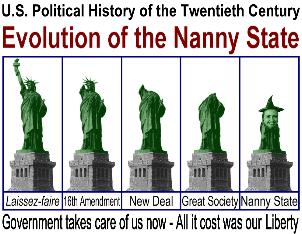
By what authority do unelected bureaucrats in administrative agencies increasingly make laws, enforce those laws and adjudicate violations? The fact that all of these activities take place within the executive branch of government appears to be an obvious contradiction of the separation of powers required by the first three articles of the Constitution, the principle of “Rule By Consent” of the governed, and protections of individual liberty. In a strong sense, the regulatory apparatus has grown so unwieldy that the powers routinely exercised by administrative agencies today seem beyond even the reach of elected executives. The rules promulgated by this “fourth branch” of government are essentially extralegal, a point discussed at length in Philip Hamburger’s “Is Administrative Law Unlawful“. He has also explained these issues at the Volokh Conspiracy blog in “Extralegal power, delegation, and necessity“, and “The Constitution’s repudiation of extralegal power“.

Hamburger examines the assertion that rule-making must be delegated by Congress to administrative agencies because legislation cannot reasonably be expected to address the many details and complexities encountered in the implementation of new laws. Yet this is a delegation of legislative power. Once delegated, this power has a way of metastasizing at the whim of agency apparatchiks, if not at the direction of the chief executive. If you should want to protest an administrative ruling, your first stop will not be a normal court of law, but an administrative review board or a court run by the agency itself! You’ll be well advised to hire an administrative attorney to represent you. Eventually, and at greater expense, an adverse decision can be appealed to the judicial branch proper.

This adds up to a dangerous lack of accountability and power. Marginal Revolution points out that critics of Hamburger’s book overlook the potential for harm that could be done by a “vindictive” president. But we should not lose sight of the fact that bureaucrats themselves, at any level, can be vindictive, as the IRS targeting scandal has shown. But that is only one motive for abuse of power; another motive may be more pervasive: the ability to reward those in a position to promote the self-interests of those who populate the administrative state. These are dangers that are endemic to big government. In a post entitled “Are Government Regulators More Virtuous than Everyone Else” (No!), Ivan Carrino highlights the weakness of arguments like those made by George Akerlof and Robert Shiller in “Phishing For Phools“, who call for greater government regulation on the grounds that consumers are vulnerable to manipulation by businesses. Carrino says:

“One can’t help but notice the central contradiction in this analysis. On the one hand, it is assumed that markets fail because of ‘normal human weakness.’ On the other hand, it is assumed that regulation, which must necessarily be implemented by human beings with equal or greater ‘weaknesses,’ will somehow solve the problem.

Akerlof and Shiller simultaneously demonize human beings who operate in the private sector while idealizing human beings who operate in the public sector.“

Glenn Reynolds has been a prominent critic of the administrative state. As a consequence of the vast and growing body of regulatory rules, it’s become increasingly difficult for individuals, acting on their own or as businesspeople, to know whether they are in acting in violation of administrative law. Reynolds discusses regulatory crime and over-criminalization in “You May Be Breaking The Law Right Now“, and in his great paper “Ham Sandwich Nation: Due Process When Everything is a Crime” (free download).

Hamburger’s main position is that law should be made by elected representatives, not by bureaucrats who lack direct accountability to voters. Ilya Somin believes that with time, Hamburger will have great influence on legal theorists in this regard. He compares Hamburger’s insights on administrative law to Richard Epstein’s work on takings. Epstein insisted that “almost all regulations that restrict property rights should be considered ‘takings’ that require compensation under the Fifth Amendment.” Somin notes that Epstein’s position, despite harsh criticism from certain quarters, has influenced legal thinking in a dramatic way over the years.

What’s to be done? Can a line reasonably be drawn between constitutional legislative power and delegated rule-making authority? Somin is skeptical that absolute restrictions on lawmaking by the administrative state are practical, in the sense that there will always be details that cannot be addressed in enabling legislation. Others have suggested practical paths forward: Joseph Postell attempts to give a roadmap in “From Administrative State to Constitutional Government“. A recent Glenn Reynolds op-ed, “Blow Up The Administrative State“, gives a qualified defense of Texas Governor Greg Abbot’s proposed amendments to the Constitution. Among other things, Abbot proposes to:

“–Prohibit administrative agencies … from creating federal law.
  –Prohibit administrative agencies … from preempting state law.
  –Give state officials the power to sue in federal court when … officials overstep their bounds.
  –Allow a two-thirds majority of the states to override a federal law or regulation.”

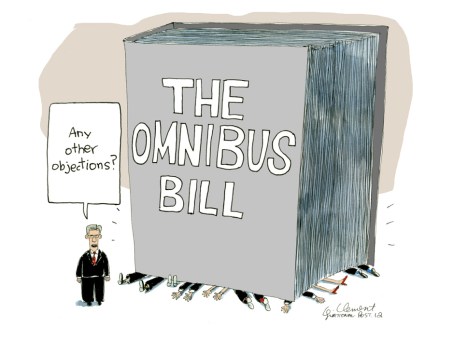
I would add that administrative review and adjudication should be independent of the agencies themselves. Also, Representative Mia Love (R-UT) has proposed legislation that would restrict Congress to bills focused on points directly related to a single issue (i.e., no omnibus bills), which would help to check the growth of the administrative state.

All of these measures seem consistent with Hamburger’s views. Reynolds is fully cognizant of the dangers of a constitutional convention. Nevertheless, he recognizes that Abbot’s proposals would impose harder limits on the size of government, and defends them in colorful fashion:

“A smaller government would mean fewer phony-baloney jobs for college graduates with few marketable skills but demonstrated political loyalty. It would mean fewer opportunities for tax dollars to be directed to people and entities with close ties to people in power. It would mean less ability to engage in social engineering and ‘nudges’ aimed at what are all-too-often seen as those dumb rubes in flyover country. The smaller the government, the fewer the opportunities for graft and self-aggrandizement — and graft and self-aggrandizement are what our political class is all about.“

For further reading, Michael Ramsey at The Originalism Blog posts links to several other essays by Hamburger at The Volokh Conspiracy, where he acted as a guest-blogger.


Omnibusted: Make Congress Stick To Single-Subject Bills

04 Thursday Feb 2016

Posted by Nuetzel in Big Government, Legislative Branch

≈ 3 Comments

Tags

Committee Review, Cronyism, Federal Profligacy, Glenn Reynolds, Mia Love, Omnibus Legislation, Public debt, Single-Subject Legislation

Omnibus-Bill

Here’s a great idea for making the federal government more transparent and accountable: force Congress to stick to single-subject legislation. Every bill should focus on a single issue with a clear statement of that issue. There would be no last-minute, unrelated amendments to legislation, and no omnibus bills as thick as several phone directories. This is the purpose of a three-page bill to be introduced by Representative Mia Love (R-UT). Glenn Reynolds explains the bill in more detail in “Want To Know Why Voters Are So Mad? Mia Love Has The Answer“. I’ll quote Reynolds at length, but do read the whole thing:

“A bill that’s so long that nobody can read it is, naturally, pretty likely to escape scrutiny. With thousands of pages and hundreds or thousands of provisions in the bill, what’s the chance that any particular provision will be noticed or criticized?

And even if a few provisions are criticized, when they’re tied to a bill that rewards literally hundreds of constituencies, there’s not much chance they’ll be shot down. Legislators, and special interests, have a vested interest in sticking together and being sure that the whole bill passes. Individually, most of these lousy provisions wouldn’t pass, but when banded together for mutual protection they can.   .…

Often, most of the provisions are written by lobbyists and inserted by tame members of Congress. The public isn’t really represented at all. That’s not an accident — it’s by design.“

No wonder the federal government and the public debt have grown to outrageous proportions. Reynolds would prefer a constitutional amendment on this issue similar to some state constitutions, but he supports Love’s bill as a second-best solution. The bill would also enable judicial review of potentially unrelated provisions of legislation, should they be challenged as such. Reynolds notes that cronyism often relies on the ability to sneak provisions into legislation to avoid scrutiny. Love’s bill might even encourage a return to the older congressional practice of subjecting appropriations to more thorough review in committee before going to the floor.

The tendency for legislation to grow seemingly misplaced appendages is also one of the reasons for the confusing accusations heard in the debates for the presidential nominations. Apparently, it’s possible for sponsors of legislation to be unaware of certain provisions attached to their bills. At the very least, it facilitates a less transparent form of political “horse trading”: I’ll vote for your bill if you allow me to attach an unrelated  provision that won’t be noticed.

The Love single-issue bill is a great idea, but there is likely to be strong resistance given the extenuatory pressures faced by many members of Congress, and their predictable reluctance to change the status quo. Hmm, perhaps Love can get her bill attached to another piece of legislation. Wouldn’t that be sweet irony!

Minority Politics and The Redistributionist Honey Trap

22 Friday Jan 2016

Posted by Nuetzel in Big Government, Free markets

≈ Leave a comment

Tags

Affirmative Action, Economic justice, Glenn Reynolds, Homeownership, Housing Subsidies, Joel Kotkin, Living Wage, Minority Interests, Old Confederacy, Political or Economic, Rent Control, Reynolds' Law, School Choice, The View From Alexandria

obama-zombie-hope-change

Minorities are not well-served by political, big-government solutions to social and economic advancement. Joel Kotkin weighs in on this point in “What’s the Best Way Up For Minorities?” He discusses the experiences of African Americans and Hispanics with two starkly different approaches to moving up:

“Throughout American history, immigrants and minorities have had two primary pathways to success. One, by using the political system, seeks to redirect resources to a particular group and also to protect it from majoritarian discrimination, something particularly necessary in the case of the formerly enslaved African Americans.

The other approach, generally less well-covered, has defined social uplift through such things as education, hard work and familial values. This path was embraced by early African American leaders such as Booker T. Washington and Marcus Garvey. Today, the most successful ethnic groups – Koreans, Middle Easterners, Jews, Greeks and Russians – demonstrate the validity of this method through high levels of both entrepreneurial and educational achievement.“

Minorities have largely succeeded in achieving political stature, and minority politicians garnering the most support from minority constituencies have advocated statist solutions, as opposed to emphasizing individual initiative. A leader advocating for public provision of transfers or any form of “economic justice” is undoubtedly attractive to many disadvantaged voters. Unfortunately, those policies offer little more than support. They are incapable of lifting the disadvantaged out of poverty.

“From 2007-13, African Americans have experienced a 9 percent drop in incomes, far worse than the 6 percent decline for the rest of the population. In 2013, African American unemployment remained twice that of whites, and, according to the Urban League, the black middle class has conceded many of the gains made over the past 30 years. Concentrated urban poverty – on the decline in the booming 1990s – now appears to be growing.“

Kotkin notes that blacks are in worsening economic straits in cities that are considered “exemplars of black political power and redistributionist politics”, and even in more affluent but “progressive” coastal cities. And paradoxically, according to Kotkin, African Americans have achieved greater economic gains in the “old Confederacy”, and that is where they are moving. The same is true of Hispanics, though most of their population growth in the south is from immigration. African Americans are reversing an older pattern of migration to the north.

Kotkin cites statistics on minority homeownership and educational performance in the south relative to northern cities, and he compares results for Texas and California. The south wins convincingly. He emphasizes the role of education and housing policies in helping minorities overcome disadvantages, but he is rightly critical of housing subsidies and affirmative action. Bad housing policies, such as rent control and zoning ordinances, hurt minorities by limiting the stock of good housing, ultimately raising its cost. The public education system, usually shielded from competitive pressures in urban areas, has often failed minorities and the urban poor.

Unfortunately, calls to expand government support extend well beyond the optimal size and scope of the social safety net: free college education, subsidized home ownership, proportional representation in virtually any occupation, and “living wage” demands are very much a part of the economic justice narrative. Supporters of these policies among the poor, convinced that they are deserving, cannot be expected to understand the implications of Reynolds’ Law, named by The View From Alexandria blog after Instapundit‘s Glenn Reynolds:

“Subsidizing the markers of status doesn’t produce the character traits that result in that status; it undermines them.“

Higher education is not a birthright. It is for those who demonstrate sufficient learning skills, and it is often free to the most promising students. The value of education provides a powerful incentive to those possessing the “trait” of prescience. Homeownership is a choice that should follow from resources earned by hard work or from one’s long-term prospects. Representation in certain occupational categories, and higher pay, reflect “traits” (skills, effort and reliability) that must be developed or demonstrated. As Reynolds says, subsidies destroy incentives by creating the illusion of  success, a thin simulacrum revealed by long-term dependency. Subsidies do not create self-sustaining success. They do not create the real thing. And the resources confiscated to pay for subsidies punish those those bearing the most positive traits.

Minority voters, especially African Americans, placed great hope in the Obama Administration to improve their economic success. Unfortunately, Obama favors the political route to minority material gains, not the economic route. The results have been dismal (and see this) in terms of poverty, dependency, labor force participation, wages, income, and wealth:

“On every leading economic issue, in the leading economic issues Black Americans have lost ground in every one of those leading categories. So in the last ten years it hasn’t been good for black folk. This is the president’s most loyal constituency that didn’t gain any ground in that period.“

The answer to promoting economic gains for minorities lies in encouraging market opportunities, freedom and the rule of law. This includes wage and price flexibility, labor rights, choice in schools, even-handed law enforcement and criminal justice, secure property rights, low taxes, and ending prohibitions that promote black markets and crime. The political route to success undermines the vibrancy of the economy, opportunities faced by minorities, and their ability to capitalize on them.

Would You Tax Coastal Development?

14 Monday Dec 2015

Posted by Nuetzel in Central Planning, Global Warming

≈ Leave a comment

Tags

Carbon forcing, central planning, Climate Alarmism, Climate Change, Coastal development, Coastal tax, Federal Flood Insurance, FEMA, Glacier Melts, Glenn Reynolds, Pigouvian subsidies, Pigouvian Taxes, Robin Hanson, Sea Ice Extent, Strait of Gibraltar, Subsidies, Taxing development

Sea Level

If sea levels are truly rising due to climate change, then public policy should stop encouraging new development in coastal areas. Stipulating that this threat is real for the moment, serious and damaging encroachment of the seas might be 50 years away or more. By that time, many of today’s coastal buildings will be gone, or at least candidates for replacement, under realistic assumptions about the average lives of structures. A relatively low-cost approach to the threat of rising seas would be to stop building along the most vulnerable coasts right now and move new development inland. Yet no one wants to do that, least of all coastal property owners. But there is little discussion of this alternative even among the true believers of a coming global warming apocalypse. Why not?

This and related questions have been asked recently by several writers, including Glenn Reynolds and economist Robin Hanson. There are alternatives to discouraging new construction along coasts. Other expensive abatement projects can be pursued, now and later, such as sea walls or even adding land mass excavated from the sea floor or inland. In fact, the prospect of damming the Strait of Gibraltar to protect Mediterranean coastlines has been discussed. The expense of such an unprecedented public works project is what prompted Hanson’s post. To the extent that such remedial projects are not funded privately, they represent social costs arising from coastal development.

The federal government still subsidizes flood insurance on many coastal properties, though efforts to phase-out this FEMA program have been underway for a few years. However, governments seem only too willing to undertake the investment in public infrastructure and ongoing maintenance made necessary by new coastal development. And like other development projects, tax abatements and other subsidies are still granted for coastal development. Why do these policies escape notice from coastal green elites?  Public outlays with private beneficiaries along threatened coasts are an immediate drain on resources, relieving private developers and property buyers of shoreline risk.

Reynolds (perhaps tongue-in-cheek) and Hanson suggest that new development should be taxed in coastal areas. That, and ending subsidies for development along coasts, is an economically and ecologically defensible alternative to the public expense of ubiquitous sea walls. However, a coastal tax might not be in the immediate interests of elites  who claim that mankind faces an insurmountable global warming problem. Better to put off these sorts of remedial measures, especially while you can tax and regulate fossil fuels, and maybe live on the coast!

The position of the warmist community is that carbon emitters must cease and desist, in the hope that the seas will stop rising. They are willing to destroy entire industries (fossil fuels) in pursuit of their goals, but are unlikely to achieve them without inflicting drastic economic harm. If greens are so amenable to central control of economic activity and individual behavior (so long as they are at the controls), it would be prudent to take precautions now that will help to minimize the damage later. Discouraging coastal development with taxes and denial of subsidies is the sort of classic intervention that any Pigouvian planner should love. There is even evidence that sea levels have been much higher at times in the past. An earnest central planner might say that coastal development should always be discouraged to mitigate the risk of destruction.

I am skeptical of alarmist claims, including those related to rising sea levels. In fact, the connection between carbon emissions, global temperatures and sea levels is not well established, and whether sea levels are rising due to human activity is a matter of some dispute. Furthermore, global sea ice extent is not declining dramatically, if at all, and the storied glacier melts have been greatly exaggerated. Climate activists pursue their agenda despite the gross inaccuracy of past carbon-forcing forecasts, the gaping uncertainty surrounding model predictions going forward, and the crushing expense of the measures they advocate. The expense, however, is not one that activists expect to compromise their own standard of living. They either assume that it will be borne by others or that their draconian prescriptions will usher in an era of “sustainability”, powered by new, renewable energy sources. Not many of these alarmists would boast that their policies can quickly reverse the sea level rises they’ve told us to fear, but they dare not suggest taxes on coastal development until they see more convincing evidence. At least that much is sensible, if ironic!

In Praise of Refugee Aid and Precautions

23 Monday Nov 2015

Posted by Nuetzel in Immigration, Terrorism

≈ Leave a comment

Tags

Davis Bier, Director of National Intelligence, Foundation for Economic Education, Glenn Reynolds, Homeland Security, Ian Tuttle, ISIS, James Comey, National Counterterrorism Center, National Security, National Sovereignty, Open Borders, Paris Attacks, Pew Research, Private Refugee Sponsorship, Refugee Vetting Process, Syrian refugees, Terrorism, Virtue Signalling

118792_600

Libertarians differ from conservatives on the Syrian refugee issue and on immigration policy in general. I’m in favor of liberalized immigration because it confers powerful economic advantages. That does not imply, however, a willingness to sacrifice border security and control over the flow of immigrants. Border security is critical to the notion of U.S. sovereignty, and though I am loath to do so, I will credit Donald Trump for asking two pertinent questions: “Do we have a country? Or do we not have a country?” This is all the more important in an age when terror on the scale of a 9/11, Paris, or terrorist use of WMDs is a threat.

One of the few legitimate functions of government is national security, and the U.S. Constitution sought to assure that security would be provided without compromising the liberties of individual citizens. I’d like outsiders to feel welcome to join us and partake of those liberties, but only subject to precautions related to security. Given current threats, it is reasonable to insist on deliberation and caution in admitting new immigrants and refugees. That should include a careful vetting process and possibly post-entry safeguards such as mandatory touch-points with immigration and security officials.

Recent commentary on both sides of the Syrian refugee debate has featured conservatives waxing enthusiastic over police-state security measures and cavalier dismissal of security concerns by the Left, including a moment of apparent delusion from The Daily Kos when it weighed-in on refugees and certain principles of religious ethics, probably not that outlet’s strong suit. The Left’s usual approach to commentary on social media amounts to an exercise in “virtue signaling” (HT: Glenn Reynolds) without much critical thought, and this is no exception.

Refugees or asylum-seekers may need expedited initial handling for their own safety and protection. The tumultuous experience of fleeing a hostile regime without adequate planning, and possibly involving the loss of loved ones and possessions, suggests a need for greater assistance for refugees than for typical immigrants. The expense of a large influx of refugees is likely to be high. A solution used successfully by Canada involves private sponsorship of refugees, and there are apparently a large number of Americans willing to serve as sponsors. It is possible to vet the sponsors, of course, and might provide more reliable follow-up with the refugees themselves.

Certain classes of immigrants may be considered high-risk, though refugees have not been high-risk historically. This is one of several points made by Davis Bier at the Foundation for Economic Education in “Six Reasons To Welcome Refugees“. Bier provides a good perspective, but I don’t accept all of his assertions. He says (italicized):

  • The Paris attackers were not refugees: No, but at least one of them seems to have taken advantage of the European refugee process.
  • U.S. refugees don’t become terrorists: You can certainly vouch for this in the past tense, but it’s less certain going forward. The complete lack of documentation of many Syrian refugees complicates the vetting process.
  • Other migration channels are easier to exploit: Probably true, if the claimed thoroughness of the refugee vetting process is to be believed. Also, the resettlement from temporary camps can take two years or more, but that kind of delay is not required.
  • ISIS sees Syrian refugees as traitors: This reinforces the need to protect refugees, but it strikes me as irrelevant to the question of terrorist infiltration. A better question is whether ISIS is capable of passing-off one of their own as a refugee.
  • Turning away allies will make us less safe: It certainly won’t win us friends.
  • We should demonstrate moral courage: Helping legitimate refugees is certainly an honorable thing to do. The author points to American resistance to accepting Jewish refugees prior to World War II for fear they might be German spies. This is addressed in more detail below.

A different perspective is given in “There Are Serious, Unbigoted Reasons to Be Wary of a Flood of Syrian Refugees“, by Ian Tuttle in National Review. He asserts that the comparison of current Syrian refugees to Jewish refugees prior to WWII is inappropriate, and I largely agree. The infiltration of German spies into the Jewish refugee population was a perceived threat, but no one thought the Jews represented a risk of terror on our shores. There is nothing incompatible about feeling regret for the attitude many took toward the Jewish refugees of that era while exercising caution in the face of new risks.

Tuttle cites a recent Pew Research poll of Muslims in various countries finding that 4% to 14% of respondents approve of ISIS. Can you imagine a similar level of support for terrorism in the U.S.? This is an unfortunate social malignancy that should give us pause. Another Pew Research poll of Muslims in various countries found that the minority who believe that suicide bombing was justified ranges from 3% to 45%. It is therefore difficult to argue with Tuttle when he says:

“A non-trivial minority of refugees who support a murderous, metastatic caliphate is a reason for serious concern.“

Tuttle notes that Syrian refugees will not arrive on our shores directly from Syria.  Thus, the urgency of accepting those refugees comes into question. It is curious that such wealthy middle eastern countries as Kuwait and Saudi Arabia have not accepted refugees from Syria.

Given the immediacy of terrorist threats, the lack of even basic documents for many Syrian refugees, and the Obama Administration’s record of failure in the Middle East, it is reasonable to question their assurances as to the adequacy of the refugee vetting process. Indeed, as this article warns:

“The director of the National Counterterrorism Center admitted that terrorist groups are very interested in using refugee programs to slip operatives into Europe and the United States. … 

The director of Homeland Security had no answer when asked if the “vetting” process amounted to anything more than asking refugees to fill out an application, asking them a few questions in a verbal interview, and assuming they answer honestly….

FBI Director James Comey famously admitted last month that the U.S. government has no real way to conduct background checks on refugees.”

A substantial majority of American voters oppose the administration’s plan to accept Syrian refugees, at least under the current process. Last week, the U.S. House of Representatives passed a bill requiring that:

“… the heads of the FBI, Homeland Security Department and the Office of the Director of National Intelligence certify that each refugee being admitted would not pose a threat.“

It would be nice to have our security agencies accept some accountability for, well,  national security. The House bill would put the ball in their court with respect to high-risk refugees.

I concur with the general position of Libertarians who support a more open U.S. immigration policy and acceptance of refugees. I also believe that private sponsorship of refugees should be legalized in the U.S. to reduce their fiscal impact. And I believe we should welcome Syrian refugees provided that they can be thoroughly vetted. In the parlance of economics, transacting with refugees may involve severely asymmetric information. It is not advisable to make risky “trades” when due diligence is impossible. Short-cuts in the vetting process do not help to assure a mutually beneficial outcome. We must therefore temper our humanitarian impulse. Under the present circumstances, including an acceptance of terrorism by a “nontrivial minority” of Muslins, it is reasonable to proceed with caution, and only with caution.

But They Mean Well: Authoritarian, Anti-Gun Champs of Inefficacy

07 Wednesday Oct 2015

Posted by Nuetzel in Gun Control

≈ 1 Comment

Tags

Common-Sense Gun Laws, Damon Root, FBI Uniform Crime Report, Glenn Reynolds, Gun Control, Gun violence, Individual Right to Bear Arms, Lawrence Tribe, Magical Thinking, Moms Demand Action for Gun Sense in America, Ordinary Constitutional Law, Sanford Levinson, Second Amendment, Sheldon Richman

gun-laws

How would “common-sense gun laws” reduce the incidence of mass shootings, total homicides or gun violence in general? Many believe it to be true, but convincing explanations are hard to come by. That’s because reasoned thinking does not produce those explanations. Nevertheless, words are cheap, and the sheer flow of weak memes and bad journalism appears to wash the brains of those with a vulnerability to gun hysteria. Sheldon Richman addresses the feeble logic of gun control proposals in the wake of last week’s tragic shootings in Oregon. He states flatly that the claims of gun control advocates rely on “magical thinking”, and that “common sense” supports other policies. (Richman is quite a guy, having been featured in two consecutive posts on this blog).

As a preface, the recent FBI Uniform Crime Report for 2014 shows another in a long series of reductions in homicides and gun violence. This has occurred despite a trend of rising gun ownership. Previous posts on Sacred Cow Chips have dealt with the evidence on gun violence and the efficacy of gun control measures, including “A Farewell To Firearms Control“, “Causal Confusion In The Gun Debate“, and “When Government Prohibits Self Defense“. Among other issues, these posts note the overwhelming evidence that defensive gun uses far outweigh gun homicides.

Advocates of stricter gun control measures assert that they would somehow reduce the frequency of mass shootings. Richman picks apart the claim that universal background checks would help. In fact, it’s clear from the circumstances that additional restrictions on the sale of guns would not have prevented any of the high-profile mass shootings in recent memory, including New Town, Charleston and Roseburg. Some of those killers passed background checks. Furthermore, more restrictions on gun sales would do nothing to prevent illegal trade in guns.

“We can have no reasonable expectation that people who intend to commit violent offenses against others will be deterred by mere restrictions on gun purchases and possession. Stubbornly ignoring that self-evident truth is the sign of a magical disposition.“

Hillary Clinton proposes universal background checks, confiscation of weapons from domestic abusers and holding gun manufacturers and dealers liable for crimes perpetrated with weapons they made or sold. Those last two proposals are an affront to liberty, and the last is likely to be counterproductive by pricing low-income buyers out of the market, who are arguably most in need of guns for self-defense.

Richman ridicules the notion that gun violence can be reduced by devoting more resources to mental health care. I don’t agree with him 100% on this — improved mental health care might have a small effect — but he argues the point effectively. It is difficult to see how any reasonable initiative in this area could have more than a minor impact on gun violence, and by that I mean an initiative that respects individual liberty. Proponents might imagine lovely rest homes and caring personal psychiatric consultations for those identified as psychotic, along with lots of nice drugs. Perhaps they’ll get the drugs, but as often articulated, the concept smacks too much of a “lock ’em up” mentality. The accuracy with which murderers can be properly diagnosed will be close to zero, and it may cost some of the eccentric among us dearly. Richman  asks facetiously whether the police should form “pre-crime” units.

As an aside, I must make note of the gun control “meme-of-the-day”: for me, it was one from “Moms Demand Action for Gun Sense in America“. It suggested that guns should be regulated just as motor vehicles are regulated, including a requirement for liability insurance coverage. The comparison is laughable. The creation of public thoroughfares allows the state to assert that driving is a privilege, not a constitutional right. However, the individual right to bear arms is firmly protected by the Second Amendment and has been upheld by the Supreme Court as recently as 2008. It is not a privilege granted by the state. Moreover, how would one define an “insurable” gun death? Those would be accidents, which are quite small in number relative to motor vehicle deaths. It would not include suicides. Most gun incidents involve criminals who will not bother to arrange insurance coverage. Only the law-abiding will do so, and their insurers will have to grapple with the difficulty of handling claims against defensive gun users. Guns are much easier to hide than cars, so effective enforcement doesn’t stand a chance; nor do annual inspections. The expense and abridgment of personal liberty inherent in this proposal would be massive, with little if any effect on gun violence.

I’d be remiss if I failed to mention Damon Root’s excellent article on the Second Amendment. As noted above, it protects the individual right to bear arms, not merely our right as a collective. As Glenn Reynolds has written, the Second Amendment should be viewed as “ordinary constitutional law“. Root emphasizes the extent to which prominent legal minds on the Left have concluded the same. He quotes Sanford Levinson (among others such as Lawrence Tribe):

“The embarrassment, Levinson argued, came from the legal left’s refusal to take the Second Amendment seriously. ‘I cannot help but suspect that the best explanation for the absence of the Second Amendment from the legal consciousness of the elite bar,’ he wrote, ‘is derived from a mixture of sheer opposition to the idea of private ownership of guns and the perhaps subconscious fear that altogether plausible, and perhaps even ‘winning’ interpretations would present real hurdles to those of us supporting prohibitory regulation.’“

If the usual gun control proposals won’t work, what can be done to reduce mass shootings and gun victimhood in general? Richman discusses the elimination of “gun-free zones” and rebuts the typical objections to doing so. (He is critical of police, who surely deserve blame for certain gun deaths, but Richman may have an inadequate appreciation for the difficulty of police work.) Richman also promotes ending restrictions on concealed and open-carry of handguns. Here is part of his closing, but read the whole thing:

“Believers in gun-control magic refuse to acknowledge that one cannot effectively delegate one’s right to or responsibility for self-defense. With enough money, one might arrange for assistance in self-defense, but few will be able to afford protection 24/7. … The only defender guaranteed to be present at any attack against you is: you.

Those who believe in the right to bear arms have common sense on their side in the matter of ending mass shootings. Magic won’t do it.“

You Probably Broke The Law Today

15 Wednesday Apr 2015

Posted by Nuetzel in Over-Criminalization

≈ 1 Comment

Tags

Due Process, Glenn Reynolds, Ham Sandwich Nation, Michael Anthony Cottone, Over-criminalization, Over-regulation, Presumed Knowledge of the law, Prodecutorial Discretion, Regulatory Crime, Volokh Conspiracy

RegulatoryCartoon

More widespread ignorance of “the law” is an implication of a regulatory state growing in size and complexity. The tendency of expanding regulation to over-criminalize prompted this reexamination of the legal doctrine of “presumed knowledge of the law”, by Michael Anthony Cottone (abstract at the link, but it offers a free download of the full paper). I believe the cause of justice compels additional protections for individuals or companies against administrative accusers. Not only does this appeal to my sense of fair play, it also should incent bureaucrats to write clear rules and minimize conflicts with existing regulations. And it may discourage overaggressive bureaucrats from pursuing charges over disputes whose resolution might be subject to more reasonable compromise.

Over-criminalization was also the impetus for Glenn Reynolds’ “Ham Sandwich Nation: Due Process When Everything is a Crime” (another abstract with a free download available):

“Though extensive due process protections apply to the investigation of crimes, and to criminal trials, perhaps the most important part of the criminal process — the decision whether to charge a defendant, and with what — is almost entirely discretionary. Given the plethora of criminal laws and regulations in today’s society, this due process gap allows prosecutors to charge almost anyone they take a deep interest in.”

The “due process gap” is said to give rise to the expression, “a good prosecutor can get an indictment against a ham sandwich.” Here is a good discussion of the Reynolds paper at The Volokh Conspiracy, with additional links. Reynolds offers a number of possible remedies, including the creation of certain forms of liability for prosecutors, banning plea bargains, and limiting criminal prosecution for regulatory crimes. There are a few other interesting suggestions at the last link.

Heavy regulation of economic and social affairs places burdens on a society’s ability to prosper economically and culturally. It requires real resources to administer and imposes compliance costs on those it regulates. There are unnecessarily high social costs to a system of detailed rule-making by unelected bureaucrats who have incentives to both increase their dominion and to enhance their long-term career prospects. The latter is often accomplished via “partnership” with some of the largest regulated entities, which leads to rules favoring those entities at the expense of smaller competitors. And a large regulatory complex also offers an avenue through which the executive branch can promulgate rules based on expansive interpretations of existing law, circumventing checks on executive power enshrined in the Constitution. To these drawbacks we can add the consequences of over-criminalization. These should be addressed through limits on prosecutorial discretion and a more neutral perspective on presumed knowledge of administrative law.

Can Water Markets Drive the Nuts From California?

14 Tuesday Apr 2015

Posted by Nuetzel in Price Mechanism, Secondary Markets, Shortage

≈ 1 Comment

Tags

Agricultural water use, Arizona water planning, California drought, California water shortage, Delta Smelt water diversion, desalinization, Glenn Reynolds, Indoor plumbing, Jerry Brown, Marginal Revolution, Marketable use permits, Mother Jones, Price mechanism, Recycling and water use, wastewater recycling, Water restrictions

Water Use CA

Leaders in California seem determined to deal with the state’s water shortage in the least effective and most intrusive ways possible. Governor Jerry Brown has ordered such “bold”, yet ultimately weak, actions as restricting urban water usage, fines on “water wasters”, and xeriscaping of public property. The plan includes additional state intrusions such as rebates for high-efficiency appliances, bans on certain types of faucets, toilets and residential lawn irrigation systems, and more rigorous monitoring of water use, which could ultimately include shower time. A $1 billion state investment in wastewater recycling and desalinization plants is also planned, and pundits advocate other huge projects such as new reservoirs. These efforts are costly, but they are also beguiling to politicians seeking the appearance of positive action.

Overlooked is a straightforward and relatively costless way to achieve effective conservation and relief from the shortage: use the price mechanism! This simple approach encourages conservation in many large and small ways that are beyond the  discernment of government planners. Obviously, it can also address the profligacy of certain agricultural uses. A market mechanism is the one sure way to find the most rational price for water, and it is sorely needed in the face of such a significant shortage.

The misallocation of water rights in California is truly staggering, as demonstrated by the graphic at the top of this post, which is from a post at Marginal Revolution (originally from Mother Jones):

“… as farmers are watering their almonds, San Diego is investing in an energy-intensive billion-dollar desalination plant which will produce water at a much higher cost than the price the farmer are paying. That is a massive and costly misallocation of water. … In short, we are spending thousands of dollars worth of water to grow hundreds of dollars worth of almonds and that is truly nuts.”

The Mises Daily blog makes the same point in an article entitled, “Drought and the Failure of Big Government in California“.

“When crops like pecans, which are native to Louisiana where it rains over fifty inches per year, are being grown in central California, we will have to ask ourselves if there is true comparative advantage at work here, or if the industry is really sitting upon a shaky foundation of government-subsidized and -allocated resources.

The rhetoric that’s coming out of the growers, of course, is that California growers are essential to the American food supply. Some will even suggest that it’s a national security issue. Without California growers, we’re told, we’ll all starve in case of foreign embargo. … But let’s not kid ourselves. North America is in approximately zero danger of having too little farmland for staple crops.” [Emphasis added.]

Last month, my post “Scarcity, Scarcity Everywhere, And Water Pricing Stinks” addressed the mispricing of water and the promise of marketable use permits for water conservation. Details may vary, but in this sort of arrangement, residential, industrial and agricultural users would receive a base assignment of water rights at a relatively low, uniform price. The base assignment can be a function of historical usage. A secondary market then allows consumers and other users to purchase additional use permits or to sell permits exceeding their own usage:

“The price of water on the secondary market will rise to the point at which users no longer perceive a benefit to marginal flows of water above cost. A higher price encourages voluntary conservation in two ways: it is a direct cash cost of use above one’s base water rights, and it is an opportunity cost of foregoing the sale of permits on water use up to the base assignment. Those best-prepared to conserve can sell excess rights to those least prepared to conserve.”

Price incentives and their power for conservation are discussed in this post at Marginal Revolution. Market pricing is the single-most effective method of fostering sustainable patterns of resource use. Increasingly scarce conditions naturally lead to higher prices, which both discourage excessive use and create incentives for investments in reuse and other efficiencies. Yet politicians are highly averse to the idea of pricing resources rationally via the market. Instead, as exemplified by Governor Brown’s restrictions, they promulgate a seemingly endless series of measures that play on “green guilt” without adequate consideration of alternatives.

A colorful example of this misguided philosophy is the low-flow toilet, as described in this post entitled “Americans Destroyed Indoor Plumbing“. Mandatory recycling presents a classic case of conflicting policy goals: another sacred cow of environmental dogma, it increases water use in California because containers must be washed before they go to the curb. And there are other conflicting environmental goals, such as an effort to protect the Delta Smelt in San Francisco Bay by diverting over 300 billion gallons of water away from the Central Valley.

Meanwhile, big government Republicans are thumping their chests over their self-described success in planning for water needs in Arizona. This consists of infrastructure projects that capture runoff and store water in underground reservoirs, which are fine as far as they go (and, if available, better than above-ground storage subject to evaporation). However, these projects involve considerable public expense, and they have not prevented the imposition of mandatory conservation requirements. It should also be mentioned that current drought conditions in Arizona are mild compared to California. The point here is that market-oriented pricing and conservation reduces the need for such costly projects and intrusions. Administered water prices are expected to rise in Arizona, and they probably should. But it’s noteworthy that the last link, a summary of what is purported to be a careful study of water pricing issues, makes no mention of trade in water use permits and market pricing. As Glenn Reynolds might say, unlike big infrastructure and intrusive regulations, market-oriented policies and efficient pricing may not entice politicians with sufficient opportunities for graft.

The Dire Wolf’s Collectivist Dues

24 Saturday Jan 2015

Posted by Nuetzel in Taxes

≈ Leave a comment

Tags

529 Plans, Capital Gains Tax, Collectivism, Dire Wolf, Glenn Reynolds, Inequality, Market Inequality, Megan McArdle, Obama Tax Plan, Redistribution, Robert Higgs, Sheldon Richman, State of the Union, Statist Inequality

wolf mask

Inequality does not imply poverty for anyone, and inequality is a reasonable outcome of voluntary economic interactions between individuals who vary in their ability to create value. But inequality arising from artificial advantages conferred by the force of government and cronyism is indefensible. Sheldon Richman draws this useful distinction between the market’s distribution of rewards, which is a consequence of an unequal distribution of value-creating energy, ingenuity and talent, as opposed to the unequal rewards of a system of centralized control in which subsidies flow to cronies, monopolists are protected, barriers to activity are erected and political elites enjoy the fruits of value-destroying privilege. Here’s a sample from Richman’s post:

“Unlike market inequality, political-economic inequality is unjust and should be eliminated. … How? By abolishing all direct and indirect subsidies; artificial scarcities, such as those created by so-called intellectual property; regulations, which inevitably burden smaller and yet-to-be-launched firms more than lawyered-up big businesses; eminent domain; and permit requirements, zoning, and occupational licensing, which all exclude competition. …

Instead of symbolically tweaking the tax code to appear to be addressing inequality—the politicians’ charade—political-economic inequality should be ended by repealing all privileges right now.”

And yet we get fatuous rants from Obama about the ravages of market inequality and more tweaking of the tax code. Tweaking is too kind a word. The State of the Union address last week was a collectivist’s wet dream, replete with visions of central planning and a long list of non-neutral incentives and favors for the president’s base. He did his best to stoke the flames of class division and envy. One must ask: how long can the surviving market economy and a shrinking share of actual taxpayers support the growing dependent class and the nonproductive state apparatus?

In “Uncle Sam Is Coming After Your Savings?“, Megan McArdle warns of the dire wolf waiting at the door of every hopeful saver and middle class taxpayer. She cites Obama’s proposed tax on college savings plans (529s) as one piece of evidence, and asks “How would you feel if they did this to Roth IRAs”?

“… the very fact that we are discussing taxation of educational savings — redistributing educational subsidies downward — indicates that the administration has started scraping the bottom of the barrel when seeking out money to fund new programs. Why target a tax benefit that goes to a lot of your supporters (and donors), that tickles one of the sweetest spots in American politics (subsidizing higher education), and that will hit a lot of people who make less than the $250,000 a year that has become the administration’s de facto definition of ‘rich’?”

Then there’s the proposed elimination of the stepped-up tax basis at death, covered a few days ago at this blog, and the increase in the tax rate on capital gains and already double-taxed dividends from 24% to 28%. Of this, and the more general issue of investment incentives and efficient revenue generation, McArdle says:

“… we don’t try to tax the bejesus out of capital income, much as many would like to; old capital flees, and new capital doesn’t get formed, as savers decide it’s not worth it.”

No we don’t, for now, but that lack of capital formation is a dire implication of heavier taxes for the economy. It is an achilles heal of the redistributionist policy agenda, as a lack of new capital undermines productivity, income growth and opportunity across the board. Middle-class economics? Please, no. Glenn Reynolds has some additional thoughts on McArdle’s column:

“The truth is, in our redistributionist system politicians make their careers mostly by taking money from one group of citizens that won’t vote for them and giving it to another that will. If they run short of money from traditional sources, they’ll look for new revenue wherever they can find it. And if that’s the homes and savings of the middle class, then that’s what they’ll target.

For the moment, Americans are safe. With both houses of Congress controlled by the GOP, Obama’s proposals are DOA. But over the long term, the appetite for government spending is effectively endless, while the sources of revenue are limited. Keep that in mind as you think about where to invest your money … and your votes.”

Statistics on inequality are brandished by progressives as if to prove the existence of a great market malfunction, but as Richman points out at the link given above, an extreme form of inequality is an inevitable outcome of privilege conferred by the state. On the other hand, market inequality is no tragedy for humankind. It is an artifact of the most peaceful, productive system of social coordination ever devised. Market inequality is not related in any way to the absolute welfare of the median earning family or the least fortunate, as Robert Higgs explains in this interesting essay:

“Probably no subject in the social sciences has created so much unnecessary heat. Yet, at the same time, economists actually know a great deal about it and can dispel the public’s confusion about it if they try.” [Emphasis added]

← Older posts
Newer posts →
Follow Sacred Cow Chips on WordPress.com

Recent Posts

  • A Warsh Policy Scenario At the Federal Reserve
  • The Coexistence of Labor and AI-Augmented Capital
  • The Case Against Interest On Reserves
  • Immigration and Merit As Fiscal Propositions
  • Tariff “Dividend” From An Indigent State

Archives

  • February 2026
  • January 2026
  • December 2025
  • November 2025
  • October 2025
  • September 2025
  • August 2025
  • July 2025
  • June 2025
  • May 2025
  • April 2025
  • March 2025
  • February 2025
  • January 2025
  • December 2024
  • November 2024
  • October 2024
  • September 2024
  • August 2024
  • July 2024
  • June 2024
  • May 2024
  • April 2024
  • March 2024
  • February 2024
  • January 2024
  • December 2023
  • November 2023
  • August 2023
  • July 2023
  • June 2023
  • May 2023
  • April 2023
  • March 2023
  • February 2023
  • January 2023
  • December 2022
  • November 2022
  • October 2022
  • September 2022
  • August 2022
  • July 2022
  • June 2022
  • May 2022
  • April 2022
  • March 2022
  • February 2022
  • January 2022
  • December 2021
  • November 2021
  • October 2021
  • September 2021
  • August 2021
  • July 2021
  • June 2021
  • May 2021
  • April 2021
  • March 2021
  • February 2021
  • January 2021
  • December 2020
  • November 2020
  • October 2020
  • September 2020
  • August 2020
  • July 2020
  • June 2020
  • May 2020
  • April 2020
  • March 2020
  • February 2020
  • January 2020
  • December 2019
  • November 2019
  • October 2019
  • September 2019
  • August 2019
  • July 2019
  • June 2019
  • May 2019
  • April 2019
  • March 2019
  • February 2019
  • January 2019
  • December 2018
  • November 2018
  • October 2018
  • September 2018
  • August 2018
  • July 2018
  • June 2018
  • May 2018
  • April 2018
  • March 2018
  • February 2018
  • January 2018
  • December 2017
  • November 2017
  • October 2017
  • September 2017
  • August 2017
  • July 2017
  • June 2017
  • May 2017
  • April 2017
  • March 2017
  • February 2017
  • January 2017
  • December 2016
  • November 2016
  • October 2016
  • September 2016
  • August 2016
  • July 2016
  • June 2016
  • May 2016
  • April 2016
  • March 2016
  • February 2016
  • January 2016
  • December 2015
  • November 2015
  • October 2015
  • September 2015
  • August 2015
  • July 2015
  • June 2015
  • May 2015
  • April 2015
  • March 2015
  • February 2015
  • January 2015
  • December 2014
  • November 2014
  • October 2014
  • September 2014
  • August 2014
  • July 2014
  • June 2014
  • May 2014
  • April 2014
  • March 2014

Blogs I Follow

  • Passive Income Kickstart
  • OnlyFinance.net
  • TLC Cholesterol
  • Nintil
  • kendunning.net
  • DCWhispers.com
  • Hoong-Wai in the UK
  • Marginal REVOLUTION
  • Stlouis
  • Watts Up With That?
  • Aussie Nationalist Blog
  • American Elephants
  • The View from Alexandria
  • The Gymnasium
  • A Force for Good
  • Notes On Liberty
  • troymo
  • SUNDAY BLOG Stephanie Sievers
  • Miss Lou Acquiring Lore
  • Your Well Wisher Program
  • Objectivism In Depth
  • RobotEnomics
  • Orderstatistic
  • Paradigm Library
  • Scattered Showers and Quicksand

Blog at WordPress.com.

Passive Income Kickstart

OnlyFinance.net

TLC Cholesterol

Nintil

To estimate, compare, distinguish, discuss, and trace to its principal sources everything

kendunning.net

The Future is Ours to Create

DCWhispers.com

Hoong-Wai in the UK

A Commonwealth immigrant's perspective on the UK's public arena.

Marginal REVOLUTION

Small Steps Toward A Much Better World

Stlouis

Watts Up With That?

The world's most viewed site on global warming and climate change

Aussie Nationalist Blog

Commentary from a Paleoconservative and Nationalist perspective

American Elephants

Defending Life, Liberty and the Pursuit of Happiness

The View from Alexandria

In advanced civilizations the period loosely called Alexandrian is usually associated with flexible morals, perfunctory religion, populist standards and cosmopolitan tastes, feminism, exotic cults, and the rapid turnover of high and low fads---in short, a falling away (which is all that decadence means) from the strictness of traditional rules, embodied in character and inforced from within. -- Jacques Barzun

The Gymnasium

A place for reason, politics, economics, and faith steeped in the classical liberal tradition

A Force for Good

How economics, morality, and markets combine

Notes On Liberty

Spontaneous thoughts on a humble creed

troymo

SUNDAY BLOG Stephanie Sievers

Escaping the everyday life with photographs from my travels

Miss Lou Acquiring Lore

Gallery of Life...

Your Well Wisher Program

Attempt to solve commonly known problems…

Objectivism In Depth

Exploring Ayn Rand's revolutionary philosophy.

RobotEnomics

(A)n (I)ntelligent Future

Orderstatistic

Economics, chess and anything else on my mind.

Paradigm Library

OODA Looping

Scattered Showers and Quicksand

Musings on science, investing, finance, economics, politics, and probably fly fishing.

  • Subscribe Subscribed
    • Sacred Cow Chips
    • Join 128 other subscribers
    • Already have a WordPress.com account? Log in now.
    • Sacred Cow Chips
    • Subscribe Subscribed
    • Sign up
    • Log in
    • Report this content
    • View site in Reader
    • Manage subscriptions
    • Collapse this bar
 

Loading Comments...