• About

Sacred Cow Chips

Sacred Cow Chips

Tag Archives: infrastructure

Politicians and Infra-Hucksters

05 Thursday Jan 2017

Posted by Nuetzel in Government, infrastructure, Technology

≈ 2 Comments

Tags

Border Wall, Congestion, Donald Trump, Dynamic Message Boards, economic stimulus, Efficient Pricing, Elon Musk, eminent domain, Heritage Foundation, High speed rail, Hyperloop, infrastructure, Jerry L. Jordan, Job Creation, Keystone Pipeline, Michael Sargent, Private Infrastructure, Reason Foundation, Solar Roads, St. Louis MO, Steven Horowitz, T. Norman Van Cott, Trolleys, Tunnel Boring, User Fees
img_3863

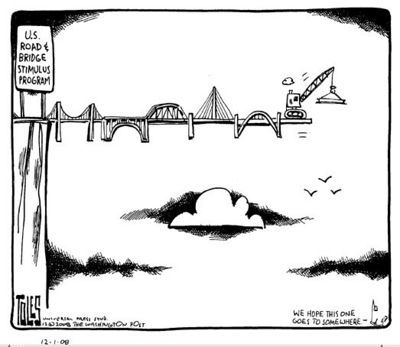
We’ll soon have a new president and already we’ve heard new promises of infrastructure investment. Once again, a chorus of politicians and pundits decries the woeful state of America’s road, bridges, sewers and airport terminals. Then, there are hosannas in adoration of the economic stimulus and job creation promised by large public works projects. And of course there are proposals to integrate politically-favored technologies with new infrastructure. All three rationales for a publicly-financed infrastructure program are flawed. Our infrastructure is not as inadequate as many believe; it is bad public policy to justify infrastructure decisions on the basis of the construction jobs required; and new infrastructure should not be treated as a vehicle for large-scale deployment of unproven technologies.

Ownership

Much of our nation’s infrastructure is privately owned. This includes, but is not limited to, power generation and the power grid, communication networks, many water systems and sewer systems, most rail lines, some toll roads and bridges, and some river, sea and space ports. Maintenance and upgrades to private facilities, and to some public facilities, depend on the adequacy of the rates or fees charged to users. On the other hand, the quantity and quality of publicly-owned and operated infrastructure is often left up to taxpayers rather than users. Proposals for federal infrastructure investment are largely about these public facilities, but they might also involve subsidies for the development of private infrastructure.

Crisis or Crock?

In a Heritage Foundation research report, Michael Sargent notes that the poor state of the country’s public infrastructure is wildly exaggerated:

“The notion that America’s infrastructure is ‘crumbling’ and in uniquely poor condition is not supported by data. The percentage of the nation’s bridges deemed ‘structurally deficient (not necessarily unsafe, but requiring extensive maintenance) has declined annually since 1990 and now sits at under 10 percent, well under half of what it was 25 years ago. Similarly, analyses of highway pavement quality conclude that the nation’s major roads have been steadily improving in quality and are likely in their best shape ever. Our airports and airways safely move more people and goods than those of any other nation. Overall, the U.S. ranks near the top of G-7 nations for infrastructure quality.“

The usual poster child of the infrastructure “crisis” is the nation’s transportation system, but this report from the Reason Foundation shows that those troubles are something of a myth.

Nevertheless, there are always repairs, maintenance and replacement projects to be considered, as well as possible expansion and new facilities. Infrastructural shortfalls and expansion must be prioritized, but as Sargent emphasizes, an even larger number of projects should and probably would be handled privately if not for burdensome federal regulations. In addition, an irrational mistrust of privately-operated facilities among some segments of the public creates pressure to burden taxpayers with costs, rather than users. Complaints about congestion on roads offer a case in point: the best solutions involve efficient (and positive) pricing of existing capacity, rather than continued expansion of a “free” good. The avoidance of rational solutions like efficient pricing underscores the extent to which demands for increased public investment in infrastructure are driven by hyperbole, rather than sound analysis.

It’s About the Infrastructure, Not the Jobs 

Public infrastructure projects are also pitched as effective engines of economic stimulus and job creation. Both of those claims are questionable. Most importantly, the real rationale for infrastructure investment is the value of the infrastructure itself and the needs it serves going forward. The public expense and the jobs required to produce it are cost items! This point was made recently by economist T. Norman Van Cott, who rightfully asserts that a given output is of greater benefit when its costs are low and when it requires less labor input. (Van Cott’s piece uses the Keystone pipeline as an example, a controversial private project that I find objectionable for its dependence on eminent domain actions.) The sharp distinction between creating value and creating jobs is also made here by Jerry L. Jordon and here by Steven Horowitz. Here is Horowitz:

“Creating jobs is easy; it’s creating value that’s hard. We could create millions of jobs quite easily by destroying every piece of machinery on U.S. farms. The question is whether we are actually better off by creating those jobs—and the answer is a definite no.“

Yet this is how so many infrastructure projects are pitched at the national, state and local levels. It’s also puzzling that economic stimulus is used as a rationale even when the economy is operating near its potential output. Even by the standards of traditional Keynesian economic analysis, that is the wrong time for stimulus. Infrastructure projects should be evaluated on their own merits, not on how many construction workers must be hired, or on how much of their paychecks those workers will spend. Many of them must be bid away from competing projects anyway.

The Public Investment Trough

Here’s a brief anecdote from my own experience with an “advanced” public infrastructure project. Some years ago in the region around my city, St. Louis, Missouri, transportation agencies began to install a network of electronic highway message boards to convey real-time information to drivers on road conditions, congestion, and various public service announcements. The 100+ signs in the area today are connected to operators in a central office via fiber optic cable. This type of system is used elsewhere, and it is partly funded by the federal government.

I seriously question the benefits of this system relative to cost. The signs themselves cost well in excess of $100,000 each. The fiber network is undoubtedly costly, and there are other fixed and variable system costs. The signs have an anachronistic look, vaguely the quality of old high school scoreboards. The information they provide generally adds little to what I already know (“12 minutes to I-270”). The signs are in fixed positions, so the occasional report of an accident or congestion usually comes too late to give motorists decent alternatives. The information the signs provide on road conditions is obvious. Missives such as “buckle up” are of questionable value. Before I depart on a commute, or if I have a passenger, we can consult maps and other apps on cell phones to avail ourselves of far better information. Other, more flexible technologies were outpacing the message boards even before they could be fully deployed, and the boards are still being deployed. This is a project that might have sounded brilliant to highway engineers 20 years ago, but it represented something of a luxury relative to other needs, and it still got funded. Today, it looks like waste.

The politics of infrastructure often means that the enabling legislation gets loaded with poorly-planned projects and shiny jewels to dangle before home constituencies. Legislators are so eager to demonstrate their sophistication that they fall over themselves to approve taxpayer funds for unproven but politically-favored technologies. For example, a recent post by Warren Meyer notes the technical folly of solar roads. These are unlikely to attract much private money because they represent such a monumentally stupid idea. Proponents will go after tax money instead. The same is true of ideas like Elon Musk’s tunnel boring project, for which he hopes to collect massive taxpayer subsidies. Musk claims that tunnels will eliminate road congestion, but efficient pricing would do much to eliminate this problem without tunnels, and other technologies like automated vehicles are likely to reduce congestion by the time Musk over-invests tax money in tunnel-boring equipment, roads and hyper-loops inside tunnels.

In general, taxpayers should be wary of “green infrastructure” proposals. A large number of bike lanes, pedestrian bridges and greenways sound wonderful, but they are serious cost inflators. Federal dollars are regularly squandered on charming but wasteful projects such as trolleys. Even worse are ongoing efforts to subsidize the construction of high-speed rail systems. All of these bright ideas should be resisted.

Let’s Be Rational

The country certainly has infrastructural needs, but claims that we face a crisis are greatly exaggerated. With a new administration and what are likely to be supporting majorities in both houses of Congress, the danger of rushing into big funding commitments is heightened. The sponsors of this kind of legislation will herald massive job creation, but that is incidental to the cost side of the ledger. The benefits of individual projects should be evaluated carefully in comparison to costs. Then they can be prioritized if deemed of sufficient value. Finally, large scale deployment of unproven technologies should be avoided on the public dime.

I haven’t even mentioned one very large infrastructure project that has been proposed by President-Elect Donald Trump: the border wall. I suspect that it would be easier and less expensive to solve the problem of border security using more advanced and flexible technologies, but the permanence and symbolism of a wall appeals to many of Mr. Trump’s supporters. The benefits of a wall in terms of border security and control of immigration flows are difficult if not impossible to evaluate, as are the costs to taxpayers, with Trump promising to extract some form of payment from Mexico. The wall, however, is being “sold” to the American public in emotional terms. Come to think of it, that’s how too many other infrastructure proposals are sold by politicians!

There are promising opportunities to improve the nation’s infrastructure through the private sector, where the value of projects is subject to evaluation by parties who must put “skin in the game”. This will be addressed in my next post.
Enduring A Dead-Weight Dominion

13 Wednesday Jan 2016

Posted by Nuetzel in Big Government, Macroeconomics

≈ Leave a comment

Tags

Anthony de Jasay, Automatic Stabilizers, Big government, Boom and Bust Cycle, central planning, Code of Federal Regulations, Double Taxation, Federal Reserve, Final Output, Government intervention, infrastructure, Intermediate Transactions, John Maynard Keynes, Keynesian Economics, Malinvestment, Mark Skousen, Mercatus Center, Shovel-Ready Projects, Spontaneous Order, Stabilization policy, Too big to fail, Underconsumption

government-intervention

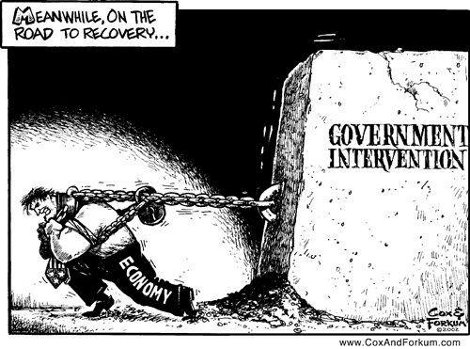
If you hope for government to solve economic problems, try to maintain some perspective: the state has unique abilities to botch it, and its power to distort and degrade the economy in the process of “helping” is vast. Government spending at all levels copped about 18% of the U.S.  economy’s final output in 2014, but the public sector’s impact is far more pervasive than that suggests. Private fixed investment in new structures and equipment accounted for only about 16% of Gross Domestic Product (GDP); the nonresidential portion of fixed investment was less than 13% of GDP. I highlight these two components of GDP because no one doubts the importance of capital investment as a determinant of the economy’s productive capacity. But government is a larger share of spending, it can divert saving away from investment, and it creates a host of other impediments to productivity and efficient resource allocation.

The private economy is remarkable in its capacity to satisfy human wants. The market is a manifestation of spontaneous order, lacking the conscious design of any supreme authority. It is able to adjust to dynamic shifts in desires and resource constraints; it provides reliable feedback in the form of changing prices to modulate and guide the responses of participants through all stages of production. Most forms of government activity, however, are not guided by these signals. Instead, the state imposes binding and sometimes immediate constraints on the decisions of market participants. The interference takes a number of forms, including price controls, but they all have the power to damage the performance and outcomes of markets.

The productive base at each stage of the market process is a consequence of the interplay of perceived business opportunities and acts of saving or deferred consumption. The available flow of saving depends on its rewards, which are heavily influenced by taxes and government intervention in financial markets. It’s worth noting here that the U.S. has the highest corporate tax rates in the developed world, as well as double taxation of corporate income paid out to owners. In addition, the tax system is used as a tool to manipulate the allocation of resources, drawing them into uses that are politically favored and punishing those in disfavor. The damaging impact is compounded by the fact that changes in taxes are often unknown ex ante. This adds a degree of political risk to any investment decision, thus discouraging capital spending and growth in the economy’s productive base.

The government is also a massive and growing regulator of economic activity. Over 100,000 new regulatory restrictions were added to the Code of Federal Regulations between 2008 and 2012. Regulation can have prohibitive compliance costs and may forbid certain efficiencies, often based on flimsy or nonexistent cost/benefit comparisons. It therefore damages the value and returns on embedded capital and discourages new investment. It is usually uneven in its effects across industries and it typically reduces the level of competition in markets because small firms are less capable of surviving the costs it imposes. Innovation is stifled and prices are higher as a result.

From a philosophical perspective, even the best cost/benefit comparisons are suspect as tools for evaluating government intervention. Don Boudreaux quotes Anthony de Jasay’s The State on this point:

“What could be more innocuous, more unexceptional than to refrain from intervening unless the cost-benefit comparison is favourable? Yet it treats the balancing of benefits and costs, good and bad consequences, as if the logical status of such balancing were a settled matter, as if it were technically perhaps demanding but philosophically straightforward. Costs and benefits, however, stretch into the future (problems of predictability) and benefits do not normally or exclusively accrue to the same persons who bear the costs (problems of externality). … Treating it as a pragmatic question of factual analysis, one of information and measurement, is tacitly taking the prior and much larger questions as having been somehow, somewhere resolved. Only they have not been.“

Poorly-executed and inappropriate stabilization policy is another way in which government distorts decisions at all stages of production. There are many reasons why these policies tend to be ineffective and potentially destructive, especially in the long run. Keynesian economics, based on ideas articulated by John Maynard Keynes, offers prescriptions for government action during times of instability. That means “expansionary” policy when the economy is weak and “contractionary” policy when it is strong.  At least that is the intent. This framework relies on the notion that components of aggregate demand determine the economy’s output, prices and employment.

The major components of GDP in the National Income and Product Accounts are consumer spending, private investment, government spending, and net foreign spending. In a Keynesian world, these are treated as four distinct parts of aggregate “demand”, and each is governed by particular kinds of assumed behavior. Supply effects are treated with little rigor, if at all, and earlier stages of production are considered only to the extent that their value added is included, and that the finished value of  investment (including new inventories) is one of the components of aggregate demand.

Final spending on goods and services (GDP) may be convenient because it corresponds to GDP, but that is simply an accounting identity. In fact, GDP represents less than 45% of all transactions. (See the end note below.) In other words, intermediate transactions for raw materials, business-to-business (B2B) exchange of services and goods in a partly fabricated state, and payments for distributional services are not counted, but they exceed GDP. They are also more variable than GDP over the course of the business cycle. Income is generated and value is added at each stage of production, not only in final transactions. To say that “value-added” is counted across all stages is a restatement of the accounting identity. It does not mean that those stages are treated behaviorally. Technology, capital, employees, and complex decision-making are required at each stage to meet demands in competitive markets. Aggregation at the final goods level glosses over all this detail.

The focus of the media and government policymakers in a weak economy is usually on “underconsumption”. The claim is often heard that consumer spending represents “over two-thirds of the economy”, but it is only about one-third of total transactions at all levels. It is therefore not as powerful an engine as many analysts assert. Government efforts to stimulate consumption are often thwarted by consumers themselves, who behave in ways that are difficult for models to capture accurately.

Government spending to combat weakness is another typical prescription, but such efforts are usually ill-timed and are difficult to reverse as the economy regains strength. The value of most government “output” is not tested in markets and it is not subject to competitive pressure, so as the government absorbs additional resources, the ability of the economy to grow is compromised. Programmatic ratcheting is always a risk when transfer payments are expanded. (Fixed programs that act as “automatic stabilizers”, and that are fiscally neutral over the business cycle, are less objectionable on these grounds, but only to the extent that they are not manipulated by politicians or subject to fraud.) Furthermore, any measure that adds to government deficits creates competition for the savings available for private capital investment. Thus, deficits can reduce the private economy’s productive capacity.

Government investment in infrastructure is a common refrain, but infrastructure spending should be tied to actual needs, not to the business cycle. Using public infrastructure spending for stabilization policy creates severe problems of timing. Few projects are ever “shovel-ready”, and rushing into them is a prescription for poor management, cost overruns and low quality.

Historically, economic instability has often been a consequence of poorly-timed monetary policy actions. Excessive money growth engineered by the Federal Reserve has stimulated excessive booms and inflation in the prices of goods and assets. These boom episodes were followed by market busts and recessions when the Fed attempted to course-correct by restraining money growth. Booms tend to foster misjudgments about risk that end in over-investment in certain assets. This is especially true when government encourages risk-taking via implicit “guarantees” (Fannie Mae and Freddie Mac) and “too-big-to-fail” promises, or among individuals who can least afford it, such as low-income homebuyers.

Given a boom-and-bust cycle inflicted by monetary mismanagement, attempts to stimulate demand are usually the wrong prescription for a weak economy. Unemployed resources during recessions are a direct consequence of the earlier malinvestment. It is better to let asset prices and wages adjust to bring them into line with reality, while assisting those who must transition to new employment. The best prescription for instability is a neutral stance toward market risks combined with stable policy, not more badly-timed countercyclical efforts. The best prescription for economic growth is to shrink government’s absorption of resources, restoring their availability to those with incentives to use them optimally.

The more that central authorities attempt to guide the economy, the worse it gets. The torpid recovery from the last recession, despite great efforts at stimulus, demonstrates the futility of demand-side stabilization policy. The sluggishness of the current expansion also bears witness to the counterproductive nature of government activism. It’s a great credit to the private market that it is so resilient in the face of long-standing government economic and regulatory mismanagement. A bureaucracy employing a large cadre of technocrats is a “luxury” that only a productive, dynamic economy can afford. Or can it?

~~~~~~~~~~~~~~~~~~~~~~~~~~~~~~~~~~~~~~~~~~~~~~~~~~~~~~~~~~~~~~~~~~~~

A Note On Output Measures

More complete aggregations of economic activity than GDP are gross output (GO) and gross domestic expenditures (GDE). These were developed in detail by economist Mark Skousen in his book “The Structure of Production“, published in 1990. GO includes all final transactions plus business-to-business (B2B) transactions, while GDE adds the costs of wholesale and retail distribution to GO. Or as Skousen says in this paper:

“GDE is defined as the value of all transactions (sales) in the production of new goods and services, both finished and unfinished, at all stages of production inside a country during a calendar year.“

GO and GDE show the dominance of business transactions in economic activity. GDE is more than twice as large as GDP, and B2B transactions plus business investment are twice the size of consumer spending. According to Skousen, GDE varies with the business cycle much more than GDP. Many economic indicators focus on statistics at earlier stages of production, yet real final spending is often assumed to be the only measure of transactions that matters.


Bernie Sanders: Just a Regular Looter

17 Thursday Sep 2015

Posted by Nuetzel in Free markets, Poverty, Socialism

≈ 1 Comment

Tags

Bernie Sanders, Capital-Labor Substitution, Citizens United, Donald Trump, Economic illiteracy, Ed Krayewski, Energy Policy, Feel the Bern, infrastructure, Kevin D. Williamson, Minimum Wage, Police Brutality, Poverty, Racial exclusion, Socialism, Universal Health Care, War on Drugs

Bernie

Economic illiteracy is getting to be a central theme in the early stages of the 2016 presidential race. The two candidates with whom the public and media are most fascinated at the moment are Bernie Sanders and Donald Trump. Both are veritable case studies in delusional economic reasoning. I have already devoted two posts to Trump, the current frontrunner for the Republican nomination (both posts appear at the link in reverse order). At the time of the second of those posts, I recall hoping desperately that someone or something would rescue my blog from him. I have managed, since then, to resist devoting more attention to his campaign. In this post, I’ll focus on Senator Bernie Sanders of Vermont, currently the top rival to Hillary Clinton for the Democrat nomination.

It’s ironic that Sanders, a self-proclaimed socialist, shares several areas of acute economic illiteracy with Donald Trump. There is a strong similarity between Sanders and Trump on foreign trade (and both candidates are pro-Second Amendment). Like Trump, Sanders demonstrates no understanding of the reasons for trade, as Kevin Williamson notes:

“The incessant reliance on xenophobic (and largely untrue) tropes holding that the current economic woes of the United States are the result of scheming foreigners, especially the wicked Chinese, “stealing our jobs” and victimizing his class allies…. He describes the normalization of trade relations with China as “catastrophic” — Sanders and Jesse Helms both voted against the Clinton-backed China-trade legislation — and heaps scorn on every other trade-liberalization pact. That economic interactions with foreigners are inherently hurtful and exploitative is central to his view of how the world works.“

Sanders lacks an understanding of trade’s real function: allowing consumers and businesses to freely engage in mutually beneficial exchanges with partners abroad, and vice versa. Trade thereby allows our total consumption and standard of living to expand. It is not based on “beating” your partners, as Sanders imagines. It is cooperative behavior.

Opposition to free trade nearly always boils down to one thing: avoiding competition. That goes for businesses seeking to protect or gain some degree of monopoly power and for unions wishing to keep wages, benefits and work rules elevated above levels that can otherwise be justified by productivity. The result is that consumers pay higher prices, have access to fewer goods and less variety, and have a lower standard of living. It is no accident that trade wars deepened the severity of the Great Depression domestically and globally. But Sanders, like Trump, has failed to learn from the historical record.

Another area of Sanders’ deep economic ignorance is his position on wage controls. He advocates a mandatory $15 federal minimum wage with no recognition of the potential damage of such a change. Kevin Williamson has this to say:

“Prices [and wages] in markets are not arbitrary — they are reflections of how real people actually value certain goods and services in the real world. Arbitrarily changing the dollar numbers attached to those preferences does not change the underlying reality any more than trimming Cleveland off a map of the United States actually makes Cleveland disappear.“

The minimum wage was the subject of a recent post on Sacred Cow Chips. A higher minimum is a favorite policy of well-meaning leftists and social justice warriors, but they fail to address the realities that the least-skilled suffer adverse employment effects, that a higher minimum wage hastens the substitution of capital for unskilled labor, and that the policy often benefits non-primary workers from middle and upper-income households. It’s a lousy way to help the impoverished. Moreover, minimum wages were originally conceived as a tool of racial exclusion and in all likelihood still act that way. Most of the research supporting minimum wage increases focuses on short-run effects or on sectors that are less capital-intensive. Findings about long-run effects are much more negative (see here, too). It’s a given that Sanders understands none of this.

Other elements of Sanders’ platform are essentially freebies for all: universal health care (see the first link from this Bing search), free college tuition for all, and expanded social security benefits. And of course there is a promise to rebuild our crumbling infrastructure, taking full advantage of the myth that our infrastructure is so decrepit that it must be replaced now. All of these ideas are costly, to say the least, and there is nothing adequate in Sanders’ platform to pay for them. He’ll raise taxes on the 1%, he says. Just watch the capital fly away. Ed Krayewski of Reason discusses Sander’s rich promises and the lack of resources to pay for them in “Bernie Sanders, the 18 Trillion Dollar Man“:

“The Wall Street Journal spoke with an economist at the liberal Center on Budget and Policy Priorities, who acknowledged taxes would have to go up for the middle class too to pay for Sanders programs.“

Middle class tax hikes would undoubtedly be accompanied by a lot more public debt, and ultimately inflation. Freebies for whom? As Krayewski says, Sanders “wants taxpayers to ‘feel the Bern’“.

In fairness, Sanders suggests that some of the needed revenue can be diverted from military spending. Possibly, but the military budget has already been reduced significantly, and it is not clear that much fat remains for Sanders to cut. There will certainly be demands for greater military spending given the significant threats we are likely to face from rogue states.

Sanders’ promise to transform our energy system is another one that will come with high costs. What Sanders imagines is a widespread fallacy that green energy can be produced at little cost. However, we know that renewables carry relatively high distributed costs and their contributions to load are intermittent, requiring base load backup from more traditional sources like fossil fuels or nuclear energy. Like President Obama, Sanders would impose new costs on fossil fuels, but the poor will suffer the most without offsetting assistance. And subsidies are also required to incent greater adoption of expensive alternatives like home solar and electric vehicles. Sanders would authorize this massive diversion of resources for the purpose of mitigating a risk based on carbon-forcing climate models with consistent track records of poor accuracy.

If free speech is your hot button, then Sanders’ promise to “overturn” Citizen’s United won’t make you happy. Why should an association of individuals, like a union or a corporation, be denied the right to use pooled resources for the purpose of expressing views that are important to their mission? Sanders is proposing an outright abridgment of liberty. From the first Kevin Williamson link above:

“… criminalizing things is very much on Bernie’s agenda, beginning with the criminalization of political dissent. At every event he swears to introduce a constitutional amendment reversing Supreme Court decisions that affirmed the free-speech protections of people and organizations filming documentaries, organizing Web campaigns, and airing television commercials in the hopes of influencing elections or public attitudes toward public issues.“

It is hard to take issue with Sanders’ call for an end to police brutality without a clear sense of his attitude toward law enforcement. I believe all fair-minded people wish for zero police brutality, but critics often minimize the difficulty of police work. No doubt there are gray areas in the practice of law enforcement; some police officers take their powers too far, which cannot be condoned. If institutional reforms can help, so much the better. But the police must be given the latitude to do a difficult job without fear of unreasonable legal reprisal.

On a related note, Sanders advocates an end to the war on drugs, a reform that I wholeheartedly support. Go you Bernie!

Finally, here is a more general illustration of Bernie Sanders’ backward views on economics. It is a Sanders quote I repeat from the second Kevin Willamson link above:

“You don’t necessarily need a choice of 23 underarm spray deodorants or of 18 different pairs of sneakers when children are hungry in this country. I don’t think the media appreciates the kind of stress that ordinary Americans are working on.“

Sanders’ complaint about the plethora of choices in consumer goods fails to recognize that they reflect real differences in consumer preferences, as well as an economy dynamic enough to provide for those preferences. Far from causing hunger and poverty, that dynamism has lifted standards of living over the years across the entire income distribution, even among the lowest income groups, to levels that would astonish our forebears. And it created the wealth that enables our society to make substantial transfers of resources to low income groups. Unfortunately, those very transfer programs are rife with incentives that encourage continued dependency. Other government interventions such as the minimum wage have diminished opportunities for work for individuals with little experience and skills. Meanwhile, regulation and high business and personal taxes undermine the continued growth and dynamism of the economy that could otherwise lift more families out of dependency. Sanders would do better to study the history of socialism in practice, and to look in his own socialist mirror to identify the reasons for persistently high levels of poverty.

Pricing Wizards Baffle Public Officials

22 Wednesday Jul 2015

Posted by Nuetzel in infrastructure

≈ Leave a comment

Tags

Congestion pricing, e21, Highway spending, Hillary Clinton, infrastructure, Infrastructure bank, Market pricing, Mass Transit, Mis-allocation of resources, Reihan Salam, robert Krol

traffic-cartoon

When government invests in physical infrastructure, voters are led to believe that the resources invested will enhance their well being and safety as well as the productivity of the nation’s economy. In any particular instance, however, there is a strong chance that confidence in such assurances is misplaced. Allocation of public monies is always subject to a high likelihood of mismanagement, not least because decision-making in this arena is highly politicized. Government efficiency is always compromised because its actions are not guided by a profit motive. And it is well known that politicians and bureaucrats often act on their own private motives, rather than as purely disinterested public servants.

Another primary shortcoming of government infrastructure investment is that it is mis-priced. Highways are a perfect example. They are often congested because they are free. A weak objection to the last statement is that “pricing” is accomplished through gas taxes, which should provide incentives for curtailing the use of automobiles, but that is true only in the most general sense. The marginal cost to a driver of using a specific route is zero all day long. This leads to greater congestion, higher maintenance costs and, invariably, calls for expanding highway infrastructure.

Robert Krol has an excellent essay on the e21 website in which he lays out the strong case for congestion pricing:

“Although current federal law prohibits charging tolls on existing interstates, states may apply for permission to charge tolls on new lanes. This has occurred on a limited basis in Southern California. Variable tolls have been used outside the United States to successfully reduce congested highways. Before we spend more on highways, we need to change how we price highways. …

… the revenues could be used for highway maintenance and construction. Most importantly, by pricing roads correctly, we may actually find that we don’t need to spend more on highways. …

Economists Gilles Duranton and Matthew Turner have shown that building more highway capacity in U.S. cities results in residents driving more, greater commercial traffic, and population in-migration. Congestion remains, resulting in wasted time. A recent estimate from the Texas A&M Transportation Institute shows that these delays cost drivers $121 billion per year. Congestion also increases air pollution in neighborhoods near the congested highways.“

Public transit proposals are almost always boondoggles, including light rail. These systems usually generate fare revenue that falls short of operating costs (with zero contribution to capital costs). But at least fares are non-zero! The ability of mass transit systems to charge fares that pay for themselves is seriously undermined by the ongoing expansion of “free” urban highways.

Reihan Salam reinforces these points in a post about Hillary Clinton’s infrastructure proposals. Clinton pushes the general idea that more infrastructure spending is a must, going so far as to promote a public / private “infrastructure bank” for a wide range of projects that quite possibly are unnecessary, given more rational pricing. She doesn’t promote the latter and she probably doesn’t even think about it, or whether scarcity should be priced.

“If new infrastructure is to be financed with private capital, investors are going to expect spending discipline and, eventually, a meaningful return. Will this return be extracted from taxpayers or from users of the infrastructure service in question? The Obama administration, to its credit, supports allowing state government to collect tolls on their Interstate highway segments if they choose. Would Clinton favor giving states the freedom to make greater use of user fees? ….

I don’t think our main problem is that we’re not spending enough on highways, as Clinton seems to believe. If anything, I think our highway system is overbuilt. ​… The chief problem with our airports is not … that they’re not as sleek and modern as the vast white elephants you’ll find in East Asia. Rather, it is that they are congested, and the reason they are congested is that the federal government doesn’t provide for market-rate pricing for take-off and landing slots. This straightforward reform would greatly increase the productivity, not to mention the pleasantness, of our aviation system. Yet it doesn’t involve spending billions of dollars and cutting ribbons, so politicians are by and large not interested.“

Voters should not grant free points to politicians who merely utter the I-word: infrastructure. A more creative approach involves efficient, market pricing of highways and other public assets. The technology to price highways efficiently is now available. That may involve some loss of privacy, as it requires detecting the presence of individual vehicles on the roads, but privacy could be protected to some extent by using private firms to manage billing.

High-Speed Third Rail For Taxpayers

15 Friday May 2015

Posted by Nuetzel in Big Government, infrastructure, Taxes

≈ 3 Comments

Tags

Amtrak, Bullet trains, California, capital costs, Carbon Emissions, fare revenue, Frederic Bastiat, High speed rail, infrastructure, Malinvestment, Megabus, operating costs, Privatization, profitability, Public benefits, Public boondoggles, Randall O'Toole, Sean Davis, The Federalist, Transit subsidies

bullet train

Public boondoggles come in many forms, including sports stadiums and entertainment venues, convention centers, local trolly lines, light rail, superhighways, “gold-plated” public offices, and even subsidies for politically-favored (as opposed to market-favored) industries. Anything involving “infrastructure” has an almost perverse  political appeal. The many varieties of boondoggles have much in common from a public finance perspective: ultimately, they are almost always funded by taxpayers; when they confer benefits to private parties (and they usually do), they are underpriced to those users. Taxpayers are often lucky if these projects cover their operating costs, let alone capital costs, via direct revenue generation. Taxpayers are usually on the hook for the bonds. Pure public benefits might offer some justication for this burden, but those cited by project proponents are often unconvincing on that basis. Let’s face it: projects are seldom evaluated against something approximating the true opportunity costs faced by the public or taxpayers.

A prominent example of such a project that seems to capture the political imagination is high-speed rail (HSR). My friend John Crawford emailed the following link: “Doing the math on California’s bullet train fares“. John provided this summary:

“Not surprisingly, today’s fare estimate has risen 72% over the estimate that was cited during planning. That’s telling but probably not surprising to anyone, even those that tried to change opinions by citing the $50 fare. What I think is most interesting follows.

CA-HSR price of 86 is about 20c/mile. Comparable prices are 22c for a Chinese train that everybody agrees to be subsidized, 54c for a French train that is profitable and 50c for the Amtrak corridor on the East coast, which is probably profitable; 46c in Germany. Somehow, they think they can do what nobody else in the world can do…profit at 20c/mile.“

The California authority is either spectacularly arrogant or stupid. Probably the former, because they are doing what self-interested bureaucrats and politicians always do. They want the project to get done, thus creating an empire, kicking a can-full of fare increases and taxpayer liabilities down the road, beyond the time when anyone will hold them accountable for the malinvestment. But the true extent of the malinvestment will never be obvious, because the counter-factual will remain in the unseen world of lost opportunity.

Something I find exasperating about articles like this are references to “profitability”, as in “… state officials say the system will quickly become profitable“, when the meaning is not actual profitability. My friend John did it too, but I forgive him because he knew the score, and because he’ll forgive me for being a pedant (I hope). But this is important! What the California officials mean by “profitability” (and it is a misuse of the term) is fare revenue in excess of operating costs. The latter do not include initial capital costs, so these officials are not making claims about actual profitability. Profitability means that revenue exceeds ALL costs, including capital costs. Many observers consider the California authority’s estimates of operating costs to be suspect, so it’s not even clear that revenue will cover the future costs of capital replacement, let alone the initial installation costs. Construction and planning costs are expected to be $68 billion for Phase 1 only, and you can safely bet on significant additional overruns by the projected completion of Phase 1 in 2029.

Fares calibrated to cover operating costs are not defensible in terms of long-run marginal cost pricing. While an incremental rider does not cause the capital cost of the system to increase in the short run, incremental riders absolutely do have an impact on long-run capital costs. In any case, there are many incremental riders at start-up. The long run is now. Yet, like many public projects, the burden of uncovered costs is justified in terms of other benefits of a supposedly public nature. Here is a vague description of such benefits from the CA HSR Authority:

“California high-speed rail will connect the mega-regions of the state, contribute to economic development and a cleaner environment, create jobs and preserve agricultural and protected lands.“

Let’s take these one at a time:

  • connecting “mega-regions”, if that is a real benefit of HSR relative to alternative modes of transportation, will largely accrue to riders, not the general public.
  • Economic development benefits are possible along the route or near stations, but that is hardly a pure public benefit, and it is likely to come at the expense of development elsewhere.
  • The trains will be powered, at least in part, by energy from fossil fuels. If HSR produces less carbon than equivalent airplanes, autos and other alternatives, that might represent a pure public benefit (according to the carbonphobic), but this is a costly way to achieve a minor reduction in carbon emissions. It is of value only to the extent that HSR brings real substitution away from other, higher carbon modes.
  • Construction jobs are part of the cost of the project, but this is a common ploy and very handy way to sell the project. Gains for the workers are certainly not a pure public benefit. To paraphrase Bastiat, calling construction jobs from malinvested capital a “public benefit” is like calling a broken window beneficial because it provides work for the glazier.
  • As for preserving agricultural and public lands, I do not believe that HSR will make much of a dent in future, land-gobbling highway construction (and if it did, it would offset those vaunted HSR job gains).

The public should always view large public projects like HSR with skepticism and insist that private benefits should be paid privately. There are always alternative uses of taxpayer funds, including the possibility that taxpayers should keep them. Too many public projects become funding disasters. In many cases, private parties would not be willing to buy the facilities for more than 10 cents on the dollar.of original cost.  Without access to tax revenue, only a low purchase price would allow them to operate at a profit.

At the national level, this week’s tragic Amtrak crash near Philadelphia was the context for misguided calls to provide additional funding to the rail service. Sean Davis in The Federalist has a more logical proposal, even if it is a bit radical: not only should Amtrak be privatized, its assets should be given away! And how could anyone reach such a conclusion?

“Amtrak lost nearly $1.3 billion in 2013. Since its creation, Amtrak has racked up over $31 billion in accumulated losses. And every penny of those losses has been covered by federal taxpayers.

… Hand over the entire enterprise to whichever rail company wants it. ‘But that’s crazy!’ you might say. ‘Giving it away for free makes no cents [sic]!’

Well, neither does keeping it on the taxpayers’ books. The status quo costs taxpayers at least a billion dollars each year.“

Davis makes a fair point, though a give-away might attract multiple takers. Ultimately, bidding just might be necessary! Or, perhaps it would be necessary to PAY a private rail operator to take Amtrak off the federal government’s hands. A fairly high payment would still be worthwhile to taxpayers.

Randall O’Toole provides this excellent discussion of privatizing transit in a video  of approximately 17 minutes. He discusses trends in ridership, the inefficiencies inherent in public transportation systems, and compares various market structures and types of private transportation systems, including private intercity buses (Megabus). He also addresses concerns that private transportation systems will not meet the needs of the poor by proposing the substitution of “transit stamps” for the huge subsidies currently paid into transportation bureaucracies.

Stimulus and The Infrastructural Itch

06 Friday Feb 2015

Posted by Nuetzel in infrastructure

≈ Leave a comment

Tags

autonomous vehicles, budget deficits, Countercyclical Fiscal Policy, crowding out, economic stimulus, Holman Jenkins, infrastructure, John Cochrane, Obama budget, transportation infrastructure, Warren Meyer

govBrownCartoon

Politicians may be rightly convinced that to utter the phrase “investment in infrastructure” is to goose the dopamine levels of voters and political reporters. It is an hypnotic mantra, especially if it can be paired with “economic stimulus”. And it seemingly matters not whether the benefits of an actual project exceed costs. The time-lines involved in infrastructure investment, legislative, planning, and construction, almost guarantee an absence of political accountability for projects that end badly.

Apparently, it doesn’t even matter whether an infrastructure project actually gets underway. President Obama knows that the promised spending can go to any pet initiative. This is driven home in “Infrastructure Bait and Switch” by Warren Meyer. He distinguishes between two types of this “B&S”:

“The first time around [Obama] sold the stimulus bill as mainly an infrastructure spending bill — remember all that talk of shovel-ready projects? Only a trivial percentage of that bill was infrastructure. At most 6% was infrastructure, and in practice a lot less since Obama admitted later there were no shovel-ready projects. … The rest of it was mainly stuff like salary support for state government officials. Do you think he would have as easily sold the ‘wage support for state government officials’ bill in the depth of a recession? No way, so he called it, falsely, an infrastructure bill.

The other bait and switch that occurs is within the infrastructure category. We have seen this at the state level in AZ several times. Politicians love light rail, for some reason I do not understand, perhaps because it increases their personal power in a way that individual driving does not. Anyway, they always want money for light rail projects, but bills to fund light rail almost always fail. So they tack on a few highway projects, that people really want, call it a highway bill and pass it that way. But it turns out most of the money is for non-highway stuff.”

Meyer links to this post in support of his “6%-was-infrastructure” claim, and he is right.

Holman Jenkins makes the same basic point in “The Infrastructure Medicine Show“, noting that the temptation to misallocate resources into boondoggles is made worse by the perception that “free money” is available by virtue of the Federal Reserves’s zero interest rates policy:

“In the U.S., why does top-down infrastructure enthusiasm always seem to turn to California-style bullet trains—i.e., projects certain to lose money but beloved by politicians and pork-barreling interest groups?”

I disagree with Jenkins’ assertion that public infrastructure investment should only follow economic growth. Rather, it should occur on an ongoing basis to meet important needs as they arise, and the threshold for any project’s benefits should match the opportunity cost of private capital investment. To some approximation, this might help protect against crowding out of the sort decried by John Cochrane.

The supposed infrastructure crisis, so often invoked by politicians, appeals to any motorist who has ever encountered a pothole. But in terms of basic transportation infrastructure, the “crisis” is something of a myth. In fact, if the widely anticipated revolution in autonomous vehicles transpires, it will greatly diminish needs for expanded transportation infrastructure of all kinds.

President Obama touts infrastructure investment in his new budget proposal using the Keynesian language of economic stimulus. But in another interesting post, Warren Meyer points out that a proposal to run budget deficits of $500+ billion going forward, in the middle of an economic expansion, is not exactly sensible as countercyclical fiscal policy. When might the U.S. government run a budget surplus? In a mild fit of sarcasm, Meyer highlights an irony:

“While those evil private short-term-focused private actors have used the improving economy to de-leverage back below 2007 levels, governments have increased their debt as a percentage of GDP by just over 50% since just before the last recession.”

P.S.: Jerry Brown wasn’t the focus here, but I love the cartoon above. It’s a nice depiction of the boondoggling impulse common to so many politicians.

Big Tax & Spend Party In Obama’s Head

04 Wednesday Feb 2015

Posted by Nuetzel in Big Government, Taxes

≈ Leave a comment

Tags

corporate income tax reform, corporate taxes, defense spending, estate taxes, government deficit, government spending, infrastructure, Investors Business Daily, Obama budget, Reason, Sequestration, stepped-up basis, tax inversion, Timothy Taylor

Obamas_budget

President Obama has thoughtfully dangled lots of freebies before the eyes of Americans in his proposed budget under the guise of “middle-class economics.” It’s not clear that the middle class will benefit over the long haul, but this certainly isn’t about forsaking present pleasure for future gain. It’s just about politics. Obama hopes his budget establishes a superior negotiating position with Republicans, and he hopes that the opposition to many of his giveaways will allow Democrats to tar the GOP as hard-hearted. In introducing his proposal, the president derided what he called the “mindless austerity” of the sequestration spending caps (which his budget would exceed by a mere $74 billion), but as Reason notes, the “sequestration process was the White House’s idea in the first place.”

Investor’s Business Daily has this to say in their editorial:

“The era of big government would be back with a vengeance. Obama wants a preposterous 7% spending hike this year for government agencies — with more nanny-state money for schools, early-childhood education, roads and bridges, child care, green energy and corporate welfare for manufacturers.”

All of these priorities are behaviorally non-neutral, heavily cross-subsidized and of questionable value, at best. Of course, everybody wants a high-speed rail line as long as the fare is heavily subsidized. Beyond that yearning, the poor state of American transportation infrastructure is something of a myth. Just as stupefying is the proposed increase in defense spending, which will end up as the most popular provision among hawks in Congress. From Reason:

“President Obama’s budget requests $561 billion for defense spending, which includes the biggest baseline Pentagon budget ever. Sequestration caps for military were already loosened from initial levels in a budget deal made in 2013. And the Pentagon has managed to keep spending freely on boondoggles like the Joint Strike Fighter—a $400 billion futuristic fighter that has serious trouble with basic functionality, like flying—and a program to build new nuclear bombers and subs expected to cost about $350 billion. This is not a picture of a fighting force that is desperately starving for cash.”

On the revenue side, the Obama budget would increase taxes by $1.6 trillion over 10 years. Some of the details are discussed here, including $200 billion in corporate tax reform. As explained by Timothy Taylor, the so-called reform is a hodge-podge of 67 different provisions. For the 2017 budget year, these would add revenue of about $19 billion, but when Taylor totals the top ten provision, those come to $49 billion. The $30 billion difference consists of various items such as “simplification and tax relief for small business,” which might represent sensible changes, and “incentives for manufacturing, research, and clean energy.” Those are tax breaks and subsidies. From Taylor: “Clearly, the temptation to redistribute the “special deductions, credits, and other tax preferences,” rather than ending them, remains strong.”

The current 35% U.S. corporate income tax rate is the highest in the industrialized world. The idea of corporate tax reform is to reduce the tax rate in exchange for eliminating various deductions, which is laudable in itself. Unfortunately, the Obama plan also proposes a tax on corporate profits earned and held abroad (not repatriated). Taylor explains the rub:

“Here, I’ll juse [sic] make the point that the U.S. is unique among the major economies in that it claims the right to tax the profits of U.S. corporations wherever in the world they are earned. Other countries only tax profits earned within their borders. Of course, this is one reason why U.S. companies sometimes seek to merge with a foreign firm and transfer their official ownership abroad. A foreign-controlled domestic company in the United States is taxed only on its U.S. profits; in contrast, if a company with the same structure is a U.S.-controlled firm, then the U.S. government claims the right to tax its foreign profits as well. This is a real issue for US corporate tax reform in a globalizing economy, and the approach in this budget document bascially just doubles down on going after revenue from abroad.”

Other tax increases proposed by Obama include an increase in the rate on dividends (already double-taxed) and capital gains (with its implicit inflation tax on wealth), capital gains taxation of assets at death (elimination of stepped-up basis), higher estate taxes, limits on itemized deductions, and several others. All of these complexities in the tax code could be eliminated entirely with real tax reform and simplification, but that would prevent the president’s beneficent “middle-class economics,” more appropriately called middle-class pandering. Higher taxes undermine economic growth: first, by reducing disposable income and spending, the traditional Keynesian explanation; second, and more fundamentally, by reducing incentives to work, invest and take risks that increase the economy’s productive potential over time. When it all plays out, a budget with a $1.6 trillion increase in taxes, no matter where the direct burden falls, will not help the middle class.

Finally, the Obama budget includes optimistic assumptions about economic growth. Even under that outlook, the budget deficit is expected to rise from  $474 billion in 2016 to $687 billion in 2025. The debt will keep expanding, absorbing private saving, leaving a smaller pool of capital available for private investment.

The president’s efforts to grow the state apparatus continue with this budget proposal. It might be “toast” as a package, but the political bidding war continues. Much depends on the ability of Americans to resist the goodies dangled before them by the White House candyman. That much is required to reverse the ongoing slide into dependency on the state.

Strangling By Stimulus

01 Sunday Feb 2015

Posted by Nuetzel in Government

≈ Leave a comment

Tags

Austerity, Countercyclical Fiscal Policy, crowding out, Fiscal Stimulus, Growth in government, infrastructure, John Cochrane, Mercatus Center, Mises Institute, regulation, Robert Higgs, Scott Sumner, Sequestration, Timely Targeted Temporary

Stimulus-Credit-Card

Will more government spending fix a weak economy? That is certainly a common refrain heard from economists and other pundits, including prominent members of the private business community. The historical record suggests otherwise, however, and there are practical reasons to doubt the efficacy of this sort of “fiscal stimulus.” Some of these are explored in “‘Timely, Targeted and Temporary?’ An Analysis of Government Expansions Over the Past Century“, from the Mercatus Center. In particular, countercyclical spending efforts have violated the “three Ts” often said to be required for successful demand-side policies. These efforts have been systematically late, badly targeted, and have resulted in permanent expansions in the resources absorbed by the government sector.

“Fiscal stimulus efforts going back to the 1930s consistently fail to meet the three Ts objective:

  • Improper timing. Policymakers have consistently struggled to properly time fiscal stimulus spending. In every postwar recession in the 20th century where stimulus spending was attempted, government spending peaked well after the economy was already in recovery. Policy lags—recognition, decision-making, implementation, and impact—are largely responsible for this fact.
  • Inefficient targeting. Going back to the New Deal, policymakers have targeted stimulus funds on the basis of politics rather than what delivers the most bang for the taxpayer buck. Further, individual policymakers cannot possess all the collective knowledge required to allocate and direct economic resources in the most efficient and effective manner, as markets do.
  • Permanent expansion of government. Stimulus funding has almost always led to permanent expansion in the size and scope of government. Indeed, the alleged need for immediate stimulus opens the door for expansions in government that might not have occurred under normal circumstances. On the rare occasions that the increased spending has been temporary, the costs have generally outweighed the benefits.“

As for inefficient targeting, I often hear that our nation’s infrastructural needs clinch the argument for stimulus spending. But those needs should be the focus of long-term planning and addressed on a continuing basis, not in bursts dictated by the state of the business cycle. Good projects should not be neglected in good times or bad, and there is no justification for undertaking a project if is not worthwhile on its merits. If increased spending can stabilize a weak economy, government should simply do something it does well: write checks. Who does infrastructure spending  help in those bad times? It certainly fails to address the basic human needs left unmet in a weak economic environment; it may or may not add high-paying construction jobs. (An aside: in the last recession, the stimulus program didn’t so much add construction jobs as it did accelerate certain “shovel-ready” projects.)

Proponents of government stimulus always have a culprit in mind for the economy’s ills: weak demand or under-consumption. They say government can lead the way out with more spending. This post on Sacred Cow Chips, “Keynesian Bull Chips“, disputes this point of view and provides some links on the topic, including this post by John Cochrane that is now ungated on his blog. Stimulus efforts are usually billed as temporary but rarely are. The expanded budgets always seem to remain expanded, and government absorbs an increasing share of the nation’s spending. Meanwhile, the value of government’s contribution to output is overstated, since most of the output is not subject to a market test or valuation.

The growth of government increasingly burdens private sector. Apart from tax distortions, the resources available to the private sector are gradually crowded and squeezed by the growth of public spending. Private investment is curtailed as government deficits absorb a growing share of private saving. Increasingly detailed regulation diminishes the private sector’s productivity. Robert Higgs at the Mises Institute asks: “How Much Longer Can the U.S. Economy Bear the Burdens?” That’s a very good question.

The opposite of expansionary fiscal policy is fiscal austerity: lower spending, and lower deficits. The budget sequester, originally passed in 2011, is a good example. Keynesians typically contend that austerity will weaken the economy, but the evidence often suggests the contrary. Here is a Scott Sumner post on that point. For robust economic growth, cut spending broadly, cut taxes, and deregulate.

Keynesian Bull Chips

23 Tuesday Dec 2014

Posted by Nuetzel in Uncategorized

≈ 2 Comments

Tags

CATO Institute, Christopher Casey, Deflation, infrastructure, Jerry Jordan, John Cochrane, Keynes, Keynesianism, Productivity and Money, Sound Money Project, von Mises Institute

stimulus-bull

Keynesians have some unfortunate propensities. Quick to blame insufficient private demand for economic ills, they propose to ratchet government to higher levels to make up for the supposed shortfall. That diagnosis is often debatable; the prescription may be a palliative at best and destructive at worst. A fashion among Keynesians is to invoke warnings about the dangers of deflation, a hobgoblin providing additional cover for expansionary monetary and fiscal policy. Then, the mantra of infrastructure spending is invoked, ignoring the many political, regulatory and technical obstacles to efficient execution of favored infrastructure initiatives, even as promising but disfavored private infrastructure projects are blocked. This form of activism is thus revealed as simple statist, agenda-driven politics.

John Cochrane covers these and other pathologies of the Keynesian mindset in “An Autopsy for the Keynesians.” His wsj.com op-ed might be gated, but you can also try the first link given here. From Cochrane:

“Stimulus advocates: Can you bring yourselves to say that the Keystone XL pipeline, LNG export terminals, nuclear power plants and dams are infrastructure? Can you bring yourselves to mention that the Environmental Protection Agency makes it nearly impossible to build anything in the U.S.? How can you assure us that infrastructure does not mean “crony boondoggle,” or high-speed trains to nowhere?”

Keynesians warn that policymakers must actively mitigate the risk of deflation, but there are strong reasons to believe that deflation is more friend than foe. Cochrane makes that point in this post on the CATO Institute web site, distinguishing between deflations precipitated by financial crises and those induced by gains in productivity or other positive shifts in aggregate supply, such as the current oil supply boom, which involve healthy declines in the price level

This post by Christopher Casey at the von Mises Institute discusses the monetary causes of “bad” deflations. Jerry Jordan emphasizes some conceptualizations of money as a factor of production here, noting that stable money, as an input complementary to capital and labor, tends to boost the economy’s productivity (and reduces prices):

“It is important to note that a condition of “rising purchasing power of money” is most commonly described by the pejorative “deflation.” This unfortunate custom has caused most observers to believe that a gradually falling “price level” is as bad, or even worse than, a gradually rising “price level.” Our analysis concludes there can be—and historical experience has demonstrated—“virtuous deflations” during periods of rapidly rising productivity.“

Can White Elephants Cheer the Public?

12 Sunday Oct 2014

Posted by Nuetzel in Uncategorized

≈ Leave a comment

Tags

Big Dig, economic growth, infrastructure, Neal Stephenson, optimism, Peter Theil, Precautionary Principle, quality of life, regulation, Technology, Virginia Postrel

infrastructure bridge

Has the American public’s sense of progress been diminished by the lack of “big projects” in recent memory? No moon shots or space elevators, no Hoover dams, no ubiquitous high-speed rail? Would these types of massive projects bring with them a new sense of optimism? Virginia Postrel doubts it, quite aside from whether such efforts would be successful in technical or economic terms. In her critique of business icon Peter Theil and science fiction writer Neal Stephenson on this point, Postrel says they confuse satisfaction from an improved quality of life in the mid-twentieth century with optimism about the future impact of iconic public investments in infrastructure and technology:

“People believed the future would be better than the present because they believed the present was better than the past. They constantly heard stories — not speculative, futuristic stories but news stories, fashion stories, real-estate stories, medical stories — that reinforced this belief. They remembered epidemics and rejoiced in vaccines and wonder drugs. They looked back on crowded urban walk-ups and appreciated neat suburban homes. They recalled ironing on sweaty summer days and celebrated air conditioning and wash-and-wear fabrics. They marveled at tiny transistor radios and dreamed of going on airplane trips.”

Postrel also points out that technology has always provoked some anxiety about the future, just as it does today. In addition, Theil and Stephenson under-appreciate noteworthy projects of the not so distant past, both public and private. That’s not to say that all of those projects were well-executed (the Big Dig?) or economically successful.

Postrel’s argument suggests that the current sense of malaise has more to do with weak economic growth and its causes. She emphasizes an excessive application of the precautionary principle. The growth of the regulatory state and arbitrary, czarist rule-making is an outgrowth of this phenomenon. As I said earlier this week, “Life’s Bleak When Your Goal Is Compliance.” Poor results of most public initiatives (e.g., public education, student loans, the war on poverty) do nothing to inspire confidence, with an increasing proportion of the population dependent on public support. Meanwhile, rewards seem to flow to well-connected cronies, a result that seems assured when resources are allocated to big public projects. There is a growing sense that not much can be accomplished without privilege or luck.

Above all, let’s hope we never take to evaluating massive projects based on their potential to foster a renewed sense of public optimism.

Newer posts →
Follow Sacred Cow Chips on WordPress.com

Recent Posts

  • A Warsh Policy Scenario At the Federal Reserve
  • The Coexistence of Labor and AI-Augmented Capital
  • The Case Against Interest On Reserves
  • Immigration and Merit As Fiscal Propositions
  • Tariff “Dividend” From An Indigent State

Archives

  • February 2026
  • January 2026
  • December 2025
  • November 2025
  • October 2025
  • September 2025
  • August 2025
  • July 2025
  • June 2025
  • May 2025
  • April 2025
  • March 2025
  • February 2025
  • January 2025
  • December 2024
  • November 2024
  • October 2024
  • September 2024
  • August 2024
  • July 2024
  • June 2024
  • May 2024
  • April 2024
  • March 2024
  • February 2024
  • January 2024
  • December 2023
  • November 2023
  • August 2023
  • July 2023
  • June 2023
  • May 2023
  • April 2023
  • March 2023
  • February 2023
  • January 2023
  • December 2022
  • November 2022
  • October 2022
  • September 2022
  • August 2022
  • July 2022
  • June 2022
  • May 2022
  • April 2022
  • March 2022
  • February 2022
  • January 2022
  • December 2021
  • November 2021
  • October 2021
  • September 2021
  • August 2021
  • July 2021
  • June 2021
  • May 2021
  • April 2021
  • March 2021
  • February 2021
  • January 2021
  • December 2020
  • November 2020
  • October 2020
  • September 2020
  • August 2020
  • July 2020
  • June 2020
  • May 2020
  • April 2020
  • March 2020
  • February 2020
  • January 2020
  • December 2019
  • November 2019
  • October 2019
  • September 2019
  • August 2019
  • July 2019
  • June 2019
  • May 2019
  • April 2019
  • March 2019
  • February 2019
  • January 2019
  • December 2018
  • November 2018
  • October 2018
  • September 2018
  • August 2018
  • July 2018
  • June 2018
  • May 2018
  • April 2018
  • March 2018
  • February 2018
  • January 2018
  • December 2017
  • November 2017
  • October 2017
  • September 2017
  • August 2017
  • July 2017
  • June 2017
  • May 2017
  • April 2017
  • March 2017
  • February 2017
  • January 2017
  • December 2016
  • November 2016
  • October 2016
  • September 2016
  • August 2016
  • July 2016
  • June 2016
  • May 2016
  • April 2016
  • March 2016
  • February 2016
  • January 2016
  • December 2015
  • November 2015
  • October 2015
  • September 2015
  • August 2015
  • July 2015
  • June 2015
  • May 2015
  • April 2015
  • March 2015
  • February 2015
  • January 2015
  • December 2014
  • November 2014
  • October 2014
  • September 2014
  • August 2014
  • July 2014
  • June 2014
  • May 2014
  • April 2014
  • March 2014

Blogs I Follow

  • Passive Income Kickstart
  • OnlyFinance.net
  • TLC Cholesterol
  • Nintil
  • kendunning.net
  • DCWhispers.com
  • Hoong-Wai in the UK
  • Marginal REVOLUTION
  • Stlouis
  • Watts Up With That?
  • Aussie Nationalist Blog
  • American Elephants
  • The View from Alexandria
  • The Gymnasium
  • A Force for Good
  • Notes On Liberty
  • troymo
  • SUNDAY BLOG Stephanie Sievers
  • Miss Lou Acquiring Lore
  • Your Well Wisher Program
  • Objectivism In Depth
  • RobotEnomics
  • Orderstatistic
  • Paradigm Library
  • Scattered Showers and Quicksand

Blog at WordPress.com.

Passive Income Kickstart

OnlyFinance.net

TLC Cholesterol

Nintil

To estimate, compare, distinguish, discuss, and trace to its principal sources everything

kendunning.net

The Future is Ours to Create

DCWhispers.com

Hoong-Wai in the UK

A Commonwealth immigrant's perspective on the UK's public arena.

Marginal REVOLUTION

Small Steps Toward A Much Better World

Stlouis

Watts Up With That?

The world's most viewed site on global warming and climate change

Aussie Nationalist Blog

Commentary from a Paleoconservative and Nationalist perspective

American Elephants

Defending Life, Liberty and the Pursuit of Happiness

The View from Alexandria

In advanced civilizations the period loosely called Alexandrian is usually associated with flexible morals, perfunctory religion, populist standards and cosmopolitan tastes, feminism, exotic cults, and the rapid turnover of high and low fads---in short, a falling away (which is all that decadence means) from the strictness of traditional rules, embodied in character and inforced from within. -- Jacques Barzun

The Gymnasium

A place for reason, politics, economics, and faith steeped in the classical liberal tradition

A Force for Good

How economics, morality, and markets combine

Notes On Liberty

Spontaneous thoughts on a humble creed

troymo

SUNDAY BLOG Stephanie Sievers

Escaping the everyday life with photographs from my travels

Miss Lou Acquiring Lore

Gallery of Life...

Your Well Wisher Program

Attempt to solve commonly known problems…

Objectivism In Depth

Exploring Ayn Rand's revolutionary philosophy.

RobotEnomics

(A)n (I)ntelligent Future

Orderstatistic

Economics, chess and anything else on my mind.

Paradigm Library

OODA Looping

Scattered Showers and Quicksand

Musings on science, investing, finance, economics, politics, and probably fly fishing.

  • Subscribe Subscribed
    • Sacred Cow Chips
    • Join 128 other subscribers
    • Already have a WordPress.com account? Log in now.
    • Sacred Cow Chips
    • Subscribe Subscribed
    • Sign up
    • Log in
    • Report this content
    • View site in Reader
    • Manage subscriptions
    • Collapse this bar
 

Loading Comments...