• About

Sacred Cow Chips

Sacred Cow Chips

Tag Archives: Noah Smith

Beware of Government Health Care Yet To Come

02 Sunday Feb 2025

Posted by Nuetzel in Health Care

≈ Leave a comment

Tags

adverse selection, Affordable Care Act, Arnold Kling, Bryan Caplan, Claim Denials, David Chavous, Donald Trump, Employer-Provided Coverage, Essential Benefits, Hospital Readmissions, Joel Zinberg, Liam Sigaud, Make America Healthy Again, Matt Margolis, Michael F. Cannon, Moral Hazard, Noah Smith, Obamacare, Peter Earle, Pharmacy Benefit Managers, Portability, Pre-Authorization Rules, Pre-Existing Conditions, Premium Subsidies, Robert F. Kennedy Jr, Sebastian Caliri, Steven Hayward, Tax-Deductible Premiums, third-party payments, Universal Health Accounts

Ongoing increases in the resources dedicated to health care in the U.S., and their prices, are driven primarily by the abandonment of market forces. We have largely eliminated the incentives that markets create for all buyers and sellers of health care services as well as insurers. Consumers bear little responsibility for the cost of health care decisions when third parties like insurers and government are the payers. A range of government interventions have pushed health care spending upward, including regulation of insurers, consumer subsidies, perverse incentives for consolidation among health care providers, and a mechanism by which pharmaceutical companies negotiate side payments to insurers willing to cover their drugs.

It’s not yet clear whether the Trump Administration and its “Make America Healthy Again” agenda will serve to liberate market forces in any way. Skeptics can be forgiven for worrying that MAHA will be no more than a cover for even more centrally-planned health care, price controls, and regulation of the pharmaceutical and food industries, not to mention consumer choices. Robert F. Kennedy Jr., who is likely to be confirmed by the Senate as Donald Trump’s Secretary of Health and Human Services, has strong and sometimes defensible opinions about nutrition and public health policies. He is, however, an inveterate left-winger and is not an advocate for market solutions. Trump himself has offered only vague assurances on the order of “You won’t lose your coverage”.

Government Control

The updraft in health care inflation coincided with government dominance of the sector. Steven Hayward points out that the cost pressure began at about the same time as Medicare came into existence in 1965. This significantly pre-dates the trend toward aging of the population, which will surely exacerbate cost pressures as greater concentrations of baby boomers approach or exceed life expectancy over the next decade.

Government now controls or impinges on about 84% of health care spending in the U.S., as noted by Michael F. Cannon. The tax deductibility of employer-provided health insurance is a massive example of federal manipulation and one that is highly distortionary. It reinforces the prevalence of third-party payments, which takes decision-making out of consumers’ hands. Equalizing the tax treatment of employer-provided health coverage would obviously promote tax equity. Just as importantly, however, tax-subsidized premiums create demand for inflated coverage levels, which raise prices and quantities. And today, the federal government requires coverages for routine care, going beyond the basic function of insurance and driving the cost of care and insurance upward.

The traditional non-portability of employer-provided coverage causes workers with uninsurable pre-existing conditions to lose coverage when they leave a job. Thus, Cannon states that the tax exclusion for employer coverage penalizes workers who instead might have chosen portable individual coverage in a market setting without tax distortions. Cannon proposes a reform whereby employer coverage would be replaced with deposits into tax-free Universal Health Accounts owned by workers, who could then purchase their own insurance.

In 2024, federal subsidies for health insurance coverage were about $2 trillion, according to the Congressional Budget Office (CBO). Those subsidies are projected to grow to $3.5 trillion by 2034 (8.5% of GDP). Joel Zinberg and Liam Sigaud emphasize the wasteful nature of premium subsidies for exchange plans mandated by the Affordable Care Act (ACA), better known as Obamacare. Subsidies were temporarily expanded in 2021, but only until 2026. They should be allowed to expire. These subsidies increase the demand for health care, but they are costly to taxpayers and are offered to individuals far above the poverty line. Furthermore, as Zinberg and Sigaud discuss, subsidized coverage for the previously uninsured does very little to improve health outcomes. That’s because almost all of the health care needs of the formerly uninsured were met via uncompensated care at emergency rooms, clinics, medical schools, and physician offices.

Proportionate Consumption

Perhaps surprisingly, and contrary to popular narratives, health care spending in the U.S. is not really out-of-line with other developed countries relative to personal income and consumption expenditures (as opposed to GDP). We spend more on health care because we earn and consume more of everything. This shouldn’t allay concern over health care spending because our economic success has not been matched by health outcomes, which have lagged or deteriorated relative to peer nations. Better health might well have allowed us to spend proportionately less on health care, but this has not been the case. There are explanations based on obesity levels and diet, but important parts of the explanation can be found elsewhere.

It should also be noted that a significant share of our decades-long increases in health care spending can be attributed to quantities, not just prices, as explained at the last link above.

Health Consequences

The ACA did nothing to slow the rise in the cost of health care coverage. In fact, if anything, the ACA cemented government dominance in a variety of ways, reinforcing tendencies for cost escalation. Even worse, the ACA had negative consequences for patient care. David Chavous posted a good X thread in December on some of the health consequences of Obamacare:

1) The ACA imposed penalties on certain hospital readmissions, which literally abandoned people at death’s door.

2) It encouraged consolidation among providers in an attempt to streamline care and reduce prices. This reduced competitive pressures, however, which had the “unforeseen” consequence of raising prices and discouraging second opinions. The former goes against all economic logic while the latter goes against sound medical decision-making.

3) The ACA forced insurers to offer fewer options, increasing the cost of insurance by encouraging patients to wait until they had a pre-existing condition to buy coverage. Care was almost certainly deferred as well. Ultimately, that drove up premiums for healthy people and worsened outcomes for those falling ill.

4) It forced drug companies to negotiate with Pharmacy Benefit Managers (PBMs) to get their products into formularies. The PBMs have acted as classic middlemen, accomplishing little more than driving up drug prices and too often forcing patients to skimp on their prescribed dosage, or worse yet, increasing their vulnerability to lower-priced quackery.

The Insurers

So the ACA drastically increased the insured population (including the new burden of covering pre-existing conditions). It also forced insurers to meet draconian cost-control thresholds. Little wonder that claim rejection increased, a phenomenon often at the root of public animosity toward health insurers. Peter Earle cites several reasons for the increase in denial rates while noting that claim rejection has made little difference in insurer profit margins.

Matt Margolis points out that under the ACA, we’ve managed to worsen coverage in exchange for higher premiums and deductibles. All while profits have been capped. Claim denials or delays due to pre-authorization rules (which delay care) have become routine following the implementation of Obamacare.

Perhaps the biggest mistake was forcing insurers to cover pre-existing conditions without allowing them to price for risk. Rather than forcing healthy individuals to pay for risks they don’t face, it would be more economically sensible to directly subsidize coverage for those in high-risk pools.

Noah Smith also defends the health insurers. For example, while UnitedHealth Group has the largest market share in the industry, its net profit margin of 6.1% is only about half of the average for the S&P 500. Other major insurers earn even less by this metric. Profits just don’t explain why American health care spending is so high. Ultimately, the services delivered and charges assessed by providers explain high U.S. health care spending, not insurer profits or administrative costs.

Under the ACA, insurance premiums pay the bulk of the cost of health care delivery, including the cost of services more reasonably categorized as routine health maintenance. The latter is like buying insurance for oil changes. Furthermore, there are no options to decline any of the ten so-called “essential benefits” under the ACA, thus increasing the cost of coverage.

Medical Records

Arnold Kling argues that the ACA’s emphasis on uniform, digitized medical records is not a productive avenue for achieving efficiencies in health care delivery. Moreover, it’s been a key factor driving the increasing concentration in the health care industry. Here is Kling:

“My point is that you cannot do this until you tighten up the health care delivery process, making it more rigid and uniform. And I would not try to do that. Health care does not necessarily lend itself to being commoditized. You risk making health care in America less open to innovation and less responsive to the needs of people.

“So far, all that has been accomplished by the electronic medical records drive has been to put small physician practices out of business. They have not been able to absorb the overhead involved in implementing these systems, so that they have been forced to lose their independence, primarily to hospital-owned conglomerates.”

Separating Health and State

The problem of rising health care costs in the U.S. is capsulized by Bryan Caplan in his call for the separation of health and state. The many policy-driven failures discussed above offer more than adequate rationale for reform. The alternative suggested by Caplan is to “pull the plug” on government involvement in health care, relying instead on the free market.

Caplan debunks a few popular notions regarding the appropriate role for markets in health care and health insurance. In particular, it’s often alleged that moral hazard and adverse selection would encourage unhealthy behaviors and encourage the worst risks to over-insure, causing insurance markets to fail. But these problems arise only when risk is not priced efficiently, precisely what the government has accomplished by attempting to equalizing rates.

Pulling the plug on government interference in health care would also mean deregulating both insurance offerings and pricing, encouraging the adoption of portable coverage, expediting drug approvals based on peer-country approvals, reforming pharmacy benefit management, ending deadly Medicare drug price controls, and encouraging competition among health care providers.

Value Vs. Volume

There are a host of other reforms that could bring more sanity to our health care system. Many of these are covered here by Sebastian Caliri, with some emphasis on the potential role of AI in improving health care. Some of these are at odds with Kling’s skepticism regarding digitized health records.

Perhaps the most fundamental reforms entertained by Caliri have to do with health care payments. One is to make payments dependent on outcomes rather than diagnostic codes established and priced by the American Medical Association. To paraphrase Caliri, it would be far better for Americans to pay for value rather than volume.

Another payment reform discussed by Caliri is expanding direct payments to providers such as capitation fees, whereby patients pay to subscribe to a bundle of services for a fixed fee. Finally, Caliri discusses the importance of achieving “site-neutral payments”, eliminating rules that allow health systems to charge a higher premium relative to independent providers for identical services.

For what it’s worth, Arnold Kling disagrees that changing payment metrics would be of much help because participants will learn to game a new system. Instead, he emphasizes the importance of reducing consumer incentives for costly treatments having little benefit. No dispute there!

Avoid the Single-Payer Calamity

I’ll close this jeremiad with a quote from Caliri’s piece in which he contrasts the knee-jerk, leftist solution to our nation’s health care dilemma with a more rational, market-oriented approach:

“Single payer solutions and government control favored by the left are no solutions at all. Moving to a monopsonist system like Canada is a recipe for strangling innovation and rationing access. Just ask our neighbors to the north who have to wait a year for orthopedic surgery. The UK’s National Health Service (NHS) is teetering on the brink of collapse. We need to sort out some other way forward.

“Other parts of the economy provide inspiration for what may actually work. In the realm of information technology, for example, fifty years has taken us from expensive four operation calculators to ubiquitous, free, artificial intelligence capable of passing the Turing Test. We can argue about the precise details but most of this miracle came from profit-seeking enterprises competing in a free market to deliver the best value for the buyer’s dollar.“

Free Trade or Tariffs: Sow Wealth or Lay Waste

12 Tuesday Nov 2024

Posted by Nuetzel in Free Trade, Liberty, Tariffs

≈ 1 Comment

Tags

AI Industry, Consumer Sovereignty, Donald Trump, Favoritism, Foreign Direct Investment, Free trade, Noah Smith, Open Economy, Protectionism, Purchasing Power, rent seeking, Retaliatory Tariffs, Specialization, Tariffs

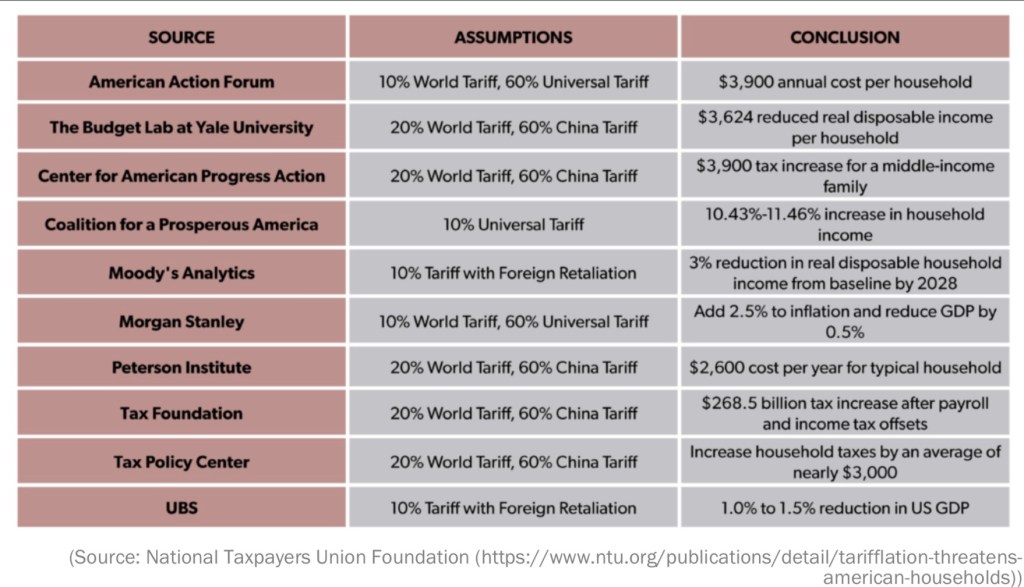
The table above is from Eric Boehm at Reason.com. It shows a variety of negative economic projections based on the likely imposition of tariffs by the incoming Trump Administration. Donald Trump’s protectionist agenda is motivated in large part by the notion that imports of foreign goods and services harm the U.S. economy. This misapprehension is common on both the populist left and the nationalist right, but it is also fueled by special interests averse to competition. Especially puzzling are those who extol the virtues of capitalism and free markets while claiming that free markets across borders are inimical to our nation’s economic interests.

Imports and Domestic Spending

Many assume that imports directly reduce GDP. In fact, on this point, some might be led astray by a superficial exposure to macroeconomics. As Noah Smith has noted, they might think back to the simple spending definition of GDP they learned as college freshmen:

GDP = C + I + G + (X – M),

where C is consumer spending on final goods and services, I is investment spending, G is government spending, X is foreign spending on U.S. exports, and M is U.S. spending on imports from abroad. So imports are subtracted! Doesn’t that mean imports directly reduce GDP?

The key here is to recognize that C, I, and G already include spending on imported goods. Therefore, imports must be subtracted from the spending totals to find the value spent on domestically-produced final goods and services. No, imports are not a direct, net subtraction from GDP.

Your Loathsome Foreign Car

Of course the domestic impact of imports goes deeper than this simple accounting framework. If someone decides to purchase an imported good instead of a close substitute produced domestically, what happens to GDP? If the decision has an immediate impact on production, then U.S. GDP declines. Otherwise, the domestic good is new inventory investment (part of I above), and there is no change. But if the import decision is repeated, the result is permanently lower U.S. GDP relative to the alternative, as producers won’t want to add to inventories indefinitely. The same is true if a domestic producer decides to purchase a component or raw material produced overseas rather than one produced at home.

The import decision causes a domestic producer to lose a sale along with the profit that sale would have earned. That puts pressure on the firm’s workers and wages as well. The firm still has the value of the unit in inventory, but if the import decision is repeated there will be more substantial follow-on effects on production, employment, spending, and saving.

Not So Fast

There is still more to the story, of course. By purchasing the foreign good,,which in the buyer’s estimation delivers greater value at that point in time, there is a gain in consumer surplus that is very real. To the buyer, that gain is perhaps equivalent to dollars in the bank. Their real wealth has increased relative to the surplus value of the foregone domestic purchase. This, too, will likely have follow-on effects in terms of spending and saving, but positive effects.

Therefore, to a first approximation, the immediate effects of an import purchase on total domestic welfare are ambiguous. Consumers of imports gain value; producers of import-competing goods lose value.

As to the loss of the domestic sale, competition is tough, but it greatly contributes to the efficiency of the free market system and to the well being of consumers. Let’s face it: ultimately, the whole point of economic activity is to enable consumption. Production has no other purpose. So producers must react to competition and strive to improve value for buyers along any margins they can. That, in turn, is unequivocally positive for potential buyers both here and abroad.

It’s also true that the purchase of foreign goods means that dollars must be sold in exchange for foreign currency. That weakens the dollar, but those “excess dollars” are generally used to purchase U.S. assets, including physical capital. That direct investment promotes economic growth.

Open Economy, Open Mind

No matter what you believe about the net benefits or costs of a single import transaction like the one described above, it is misleading to draw conclusions about the benefits of foreign trade based on a single transaction, or even a series of repeated transactions.

First, consumer sovereignty is based on freedom of choice, including the freedom to purchase from any seller, domestic or foreign. Consumers greatly benefit from that broad freedom. Add to that the benefit of producers who are free to purchase inputs from any source they believe to offer the greatest value (a benefit that ultimately flows through to consumers). These freedoms ultimately enhance productivity and well being.

Trade across borders leverages the same economic advantages as trade within borders. People tend to accept the latter as truth without giving it a thought, yet the former is often rejected reflexively. The question is inappropriately bound up in issues like patriotism and, over time, an excessive focus on high-visibility job losses in traditional industries.

Trade allows people and their countries to specialize in producing things at which they are comparatively efficient, i.e., in which they are lower-cost producers. This is at the very heart of mutually beneficial exchange: no party to a voluntary transaction expects to suffer a loss. And in trade, when an external, domestic party sustains a lost sale, for example, they have the opportunity to improve or reallocate their resources to endeavors to which they are better suited. So there are direct gains from trade and there are indirect gains via the discipline of competition, including the benefits of reallocating scarce resources from inefficient to efficient uses.

Tariff Gains

Now we shift gears to tariffs: interventions having benefits that are more concentrated than costs, and which tend to be more ephemeral:

— Domestic producers who compete with imports gain through the grant of additional market power, given the tax on foreign goods and services. These producers now have more pricing flexibility, and what is often more pertinent, survivability.

— Workers at domestic firms will benefit to the extent that their employers face reduced foreign competition. Some combination of employment, hours, and wages may rise.

— Some firms have mixed gains and losses, with more pricing power over final product but elevated costs due to the use of taxed foreign components.

Tariff Losses

Who pays when government succumbs to irrational protectionist pressure and attempts to restrict imports via tariffs?

— Domestic consumers suffer a loss of freedom and bear a large part of the burden of the tariff tax.

— Higher prices for imports lead to higher prices for competing domestic goods, causing consumers to experience a loss of purchasing power.

— Domestic businesses suffer a loss of control over input decisions. Those already utilizing foreign inputs (and their buyers downstream) bear some of the burden of the tariff tax. For example, tariffs could be quite damaging to the U.S. AI industry, a result that would run strongly contrary to Trump’s promise to promote American AI.

— The U.S. suffers a loss of foreign investment, which could engender higher interest rates, lower productivity growth, and lower real wages.

— As Tyler Cowen puts it in a review of this paper, “… lobbying, logrolling and political horse-trading were essential features of the shift toward higher US tariffs. A lot of the tariffs of the time [1870 -1909] depended on which party controlled Congress, rather than economic rationality.“

— Tariffs tend to reduce economic growth due to diminished productivity in tariff-protected industries, which also erodes real wages. Less productive firms capture a significant share of the benefits of tariffs, so that economic growth falls due to a compositional effect. Higher prices for imports and import-competing goods undermine the real gains of import-protected workers.

— Finally, tariffs invariably beget retaliatory tariffs by erstwhile friendly trading partners. Export industries and their employees take a direct hit. This retaliation damages the prospects of the most productive exporters, while weaker exporting firms might be forced to close shop unnecessarily.

One other note: the discussion of gains and losses above is essentially the same for policies that reward the use of American labor via tax breaks. This not only penalizes imports of final and intermediate foreign goods, it subsidizes high-cost domestic labor. Obviously, the upshot is a less competitive U.S. economy.

Tariff-Threat Policy

To be fair, Donald Trump has said he’d use the threat of tariffs strategically to achieve a variety of objectives, not all of which are directly related to trade. We can hope that many of those threats won’t be acted upon. On one hand, that’s more appealing than general tariffs, with potential foreign policy gains and less in the way of general damage to the economy. On the other hand, the discretionary application of tariffs could invite political favoritism and foster a corrupt rent-seeking environment.

Conclusion

Trade protectionism protects weak and strong producers alike. The weak should not be given artificial incentives to produce goods inefficiently. That’s simply a waste of resources. Protecting the strong is unnecessary and discourages the drive for efficiency as well as real value creation. It lends market power to already powerful firms, leading to higher prices and penalizing domestic consumers.

One last aside: tariffs cannot raise anywhere close to the revenue necessary to replace the income tax, an absurd claim made by Trump on the campaign trail.

Only free trade is consistent with the values of a free society. It enhances choice, makes markets more competitive, creates incentives for efficiency, and cultivates opportunities for economic growth, That would serve Trump and the nation much better than the fixation on tariffs.

On Noah Smith’s Take Re: Human/AI Comparative Advantage

13 Thursday Jun 2024

Posted by Nuetzel in Artificial Intelligence, Comparative advantage, Labor Markets

≈ 3 Comments

Tags

Absolute Advantage, Agentic AI, Alignment, Andrew Mayne, Artificial Intelligence, Comparative advantage, Compute, Decreasing Costs, Dylan Matthews, Fertility, Floating Point Operations Per Second, Generative AI, Harvey Specter, Inequality, National Security, Noah Smith, Opportunity cost, Producer Constraints, Substitutability, Superabundance, Tyler Cowen

I was happy to see Noah Smith’s recent post on the graces of comparative advantage and the way it should mediate the long-run impact of AI on job prospects for humans. However, I’m embarrassed to have missed his post when it was published in March (and I also missed a New York Times piece about Smith’s position).

I said much the same thing as Smith in my post two weeks ago about the persistence of a human comparative advantage, but I wondered why the argument hadn’t been made prominently by economists. I discussed it myself about seven years ago. But alas, I didn’t see Smith’s post until last week!

I highly recommend it, though I quibble on one or two issues. Primarily, I think Smith qualifies his position based on a faulty historical comparison. Later, he doubles back to offer a kind of guarantee after all. Relatedly, I think Smith mischaracterizes the impact of energy costs on comparative advantages, and more generally the impact of the resources necessary to support a human population.

We Specialize Because…

Smith encapsulates the underlying phenomenon that will provide jobs for humans in a world of high automation and generative AI: “… everyone — every single person, every single AI, everyone — always has a comparative advantage at something!” He tells technologists “… it’s very possible that regular humans will have plentiful, high-paying jobs in the age of AI dominance — often doing much the same kind of work that they’re doing right now …”

… often, but probably transformed in fundamental ways by AI, and also doing many other new kinds of work that can’t be foreseen at present. Tyler Cowen believes the most important macro effects of AI will be from “new” outputs, not improvements in existing outputs. That emphasis doesn’t necessarily conflict with Smith’s narrative, but again, Smith thinks people will do many of the same jobs as today in a world with advanced AI.

Smith’s Non-Guarantee

Smith hedges, however, in a section of his post entitled “‘Possible’ doesn’t mean guaranteed”. This despite his later assertion that superabundance would not eliminate jobs for humans. That might seem like a separate issue, but it’s strongly intertwined with the declining AI cost argument at the basis of his hedge. More on that below.

On his reluctance to “guarantee” that humans will have jobs in an AI world, Smith links to a 2013 Tyler Cowen post on “Why the theory of comparative advantage is overrated”. For example, Cowen says, why do we ever observe long-term unemployment if comparative advantage rules the day? Of course there are many reasons why we observe departures from the predicted results of comparative advantage. Incentives are often manipulated by governments and people differ drastically in their capacities and motivation.

But Cowen cites a theoretical weakness of comparative advantage: that inputs are substitutable (or complementary) by degrees, and the degree might change under different market conditions. An implication is that “comparative advantages are endogenous to trade”, specialization, and prices. Fair enough, but one could say the same thing about any supply curve. And if equilibria exist in input markets it means these endogenous forces tend toward comparative advantages and specializations balancing the costs and benefits of production and trade. These processes might be constrained by various frictions and interventions, and their dynamics might be complex and lengthy, but that doesn’t invalidate their role in establishing specializations and trade.

The Glue Factory

Smith concerns himself mainly with another one of Cowen’s “failings of comparative advantage”: “They do indeed send horses to the glue factory, so to speak.” The gist here is that when a new technology, motorized transportation, displaced draft horses, there was no “wage” low enough to save the jobs performed by horses. Smith says horses were too costly to support (feed, stables, etc…), so their comparative advantage at “pulling things” was essentially worthless.

True, but comparing outmoded draft horses to humans in a world of AI is not quite appropriate. First, feedstock to a “glue factory” better not be an alternative use for humans whose comparative advantages become worthless. We’ll have to leave that question as an imperative for the alignment community.

Second, horses do not have versatile skill sets, so the comparison here is inapt due to their lack of alternative uses as capital assets. Yes, horses can offer other services (racing, riding, nostalgic carriage rides), but sadly, the vast bulk of work horses were “one-trick ponies”. Most draft horses probably had an opportunity cost of less than zero, given the aforementioned costs of supporting them. And it should be obvious that a single-use input has a comparative advantage only in its single use, and only when that use happens to be the state-of-the-art, or at least opportunity-cost competitive.

The drivers, on the other hand, had alternatives, and saw their comparative advantage in horse-driving occupations plunge with the advent of motorized transport. With time it’s certain many of them found new jobs, perhaps some went on to drive motorized vehicles. The point is that humans have alternatives, the number depending only on their ability to learn a crafts and perhaps move to a new location. Thus, as Smith says, “… everyone — every single person, every single AI, everyone — always has a comparative advantage at something!” But not draft horses in a motorized world, and not square pegs in a world of round holes.

AI Producer Constraints

That brings us to the topic of what Smith calls producer-specific constraints, which place limits on the amount and scope of an input’s productivity. For example, in my last post, there was only one super-talented Harvey Specter, so he’s unlikely to replace you and keep doing his own job. Thus, time is a major constraint. For Harvey or anyone else, the time constraint affects the slope of the tradeoff (and opportunity costs) between one type of specialization versus another.

Draft horses operated under the constraints of land, stable, and feed requirements, which can all be viewed as long-run variable costs. The alternative use for horses at the glue factory did not have those costs.

Humans reliant on wages must feed and house themselves, so those costs also represent constraints, but they probably don’t change the shape of the tradeoff between one occupation and another. That is, they probably do not alter human comparative advantages. Granted, some occupations come with strong expectations among associates or clients regarding an individual’s lifestyle, but this usually represents much more than basic life support. In the other end of the spectrum, displaced workers will take actions along various margins: minimize living costs; rely on savings; avail themselves of charity or any social safety net as might exist; and ultimately they must find new positions at which they maintain comparative advantages.

The Compute Constraint

In the case of AI agents, the key constraint cited by Smith is “compute”, or computer resources like CPUs or GPUs. Advancements in compute have driven the AI revolution, allowing AI models to train on increasingly large data sets and levels of compute. In fact, by one measure of compute, floating point operations per second (FLOPs), compute has become drastically cheaper, with FLOPs per dollar almost doubling every two years. Perhaps I misunderstand him, but Smith seems to assert the opposite: that compute costs are increasing. Regardless, compute is scarce, and will always be scarce because advancements in AI will require vast increases in training. This author explains that while lower compute costs will be more than offset by exponential increases in training requirements, there nevertheless will be an increasing trend in capabilities per compute.

Every AI agent will require compute, and while advancements are enabling explosive growth in AI capabilities, scarce compute places constraints on the kinds of AI development and deployment that some see as a threat to human jobs. In other words, compute scarcity can change the shape of the tradeoffs between various AI applications and thus, comparative advantages.

The Energy Constraint

Another producer constraint on AI is energy. Certainly highly complex applications, perhaps requiring greater training, physical dexterity, manipulation of materials, and judgement, will require a greater compute and energy tradeoff against simpler applications. Smith, however, at one point dismisses energy as a differential producer constraint because “… humans also take energy to run.” That is a reference to absolute energy requirements across inputs (AI vs. human), not differential requirements for an input across different outputs. Only the latter impinge on tradeoffs or opportunity costs facing an inputs. Then, the input having the lowest opportunity cost for a particular output has a comparative advantage for that output. However, it’s not always clear whether an energy tradeoff across outputs for humans will be more or less skewed than for AI, so this might or might not influence a human comparative advantage.

Later, however, Smith speculates that AI might bid up the cost of energy so high that “humans would indeed be immiserated en masse.” That position seems inconsistent. In fact, if AI energy demands are so intensive, it’s more likely to dampen the growth in demand for AI agents as well as increase the human comparative advantage because the most energy-intensive AI applications will be disadvantaged.

And again, there is Smith’s caution regarding the energy required for human life support. Is that a valid long-run variable cost associated with comparative advantages possessed by humans? It’s not wrong to include fertility decisions in the long-run aggregate human labor supply function in some fashion, but it doesn’t imply that energy requirements will eliminate comparative advantages. Those will still exist.

Hype, Or Hyper-Growth?

AI has come a long way over the past two years, and while its prospective impact strikes some as hyped thus far, it has the potential to bring vast gains across a number of fields within just a few years. According to this study, explosive economic growth on the order of 30% annually is a real possibility within decades, as generative AI is embedded throughout the economy. “Unprecedented” is an understatement for that kind of expansive growth. Dylan Matthews in Vox surveys the arguments as to how AI will lead to super-exponential economic growth. This is the kind of scenario that would give rise to superabundance.

I noted above that Smith, despite his unwillingness to guarantee that human jobs will exist in a world of generative AI, asserts (in an update) at the bottom of his post that a superabundance of AI (and abundance generally) would not threaten human comparative advantages. This superabundance is a case of decreasing costs of compute and AI deployment. Here Smith says:

“The reason is that the more abundant AI gets, the more value society produces. The more value society produces, the more demand for AI goes up. The more demand goes up, the greater the opportunity cost of using AI for anything other than its most productive use. 

“As long as you have to make a choice of where to allocate the AI, it doesn’t matter how much AI there is. A world where AI can do anything, and where there’s massively huge amounts of AI in the world, is a world that’s rich and prosperous to a degree that we can barely imagine. And all that fabulous prosperity has to get spent on something. That spending will drive up the price of AI’s most productive uses. That increased price, in turn, makes it uneconomical to use AI for its least productive uses, even if it’s far better than humans at its least productive uses. 

“Simply put, AI’s opportunity cost does not go to zero when AI’s resource costs get astronomically cheap. AI’s opportunity cost continues to scale up and up and up, without limit, as AI produces more and more value.”

This seems as if Smith is backing off his earlier hedge. Some of that spending will be in the form of fabulous investment projects of the kinds I mentioned in my post, and smaller ones as well, all enabled by AI. But the key point is that comparative advantages will not go away, and that means human inputs will continue to be economically useful.

I referenced Andrew Mayne in my last post. He contends that the income growth made possible by AI will ensure that plenty of jobs are available for humans. He mentions comparative advantage in passing, but he centers his argument around applications in which human workers and AI will be strong complements in production, as will sometimes be the case.

A New Age of Worry

The economic success of AI is subject to a number of contingencies. Most important is that AI alignment issues are adequately addressed. That is, the “self-interest” of any agentic AI must align with the interests of human welfare. Do no harm!

The difficulty of universal alignment is illustrated by the inevitability of competition among national governments for AI supremacy, especially in the area of AI-enabled weaponry and espionage. The national security implications are staggering.

A couple of Smith‘s biggest concerns are the social costs of adjusting to the economic disruptions AI is sure to bring, as well as its implications for inequality. Humans will still have comparative advantages, but there will be massive changes in the labor market and transitions that are likely to involve spells of unemployment and interruptions to incomes for some. The speed and strength of the AI revolution may well create social upheaval. That will create incentives for politicians to restrain the development and adoption of AI, and indeed, we already see the stirrings of that today.

Finally, Smith worries that the transition to AI will bring massive gains in wealth to the owners of AI assets, while workers with few skills are likely to languish. I’m not sure that’s consistent with his optimism regarding income growth under AI, and inequality matters much less when incomes are rising generally. Still, the concern is worthy of a more detailed discussion, which I’ll defer to a later post.

Price Stability: Are We There Yet?

22 Thursday Dec 2022

Posted by Nuetzel in Inflation, Liberty, Monetary Policy

≈ Leave a comment

Tags

Adam Shapiro, Bloomberg, Cleveland Fed, Demand-Driven Inflation, Federal Reserve, Great Recession, Inflation Targets, Joe Wiesenthal, Median CPI, Modern Monetary Theory, Money Printing, Noah Smith, Omnibus Spending Bill, Optimal Rate of Inflation, Pay-As-You-Go Law, PCE Deflator, Price Stability, Quantitative Easing, Rate Targets, Strategic Petroleum Reserve, Supply-Driven Inflation, Team Transitory, Trading Economics, Trimmed CPI

The answer to that question, kids, is a resounding no! The Federal Reserve created far too much liquidity during and after the pandemic and waited too long to reverse that policy. That’s a common view among the “monetarazzi”, but far too many analysts, in the next breath, assert that the Fed is going too far in tightening policy. Sorry, but you can’t have it both ways! Thus far, the reductions we’ve seen in the monetary aggregates (M1, M2, M3) represent barely a trickle out of the ocean of liquidity released during the previous two years. The recent slight moderation in the rate of inflation is unlikely to gain momentum without persistence by the Fed.

This Could Be Easier

I humbly concede, however, that a different approach by the Fed might have been less disruptive. A better alternative would have involved more aggressive reductions in the gigantic portfolio of securities it acquired via “quantitative easing” (QE) during the pandemic while avoiding direct intervention to raise short-term interest rates. In fact, allowing interest rates to be determined by the market, rather than via central bank intervention, is more sensible in terms of pricing debt of any duration. It also suggests a more direct and sensible approach to managing the growth of the money supply. Of course, had the Fed unwound QE more aggressively, short-term rates would surely have risen anyway, but to levels appropriate to rationing liquidity more efficiently. Furthermore, those rates could have served as a useful indicator of the market’s ability to digest a particular volume of sales from the Fed’s portfolio.

Getting Tight

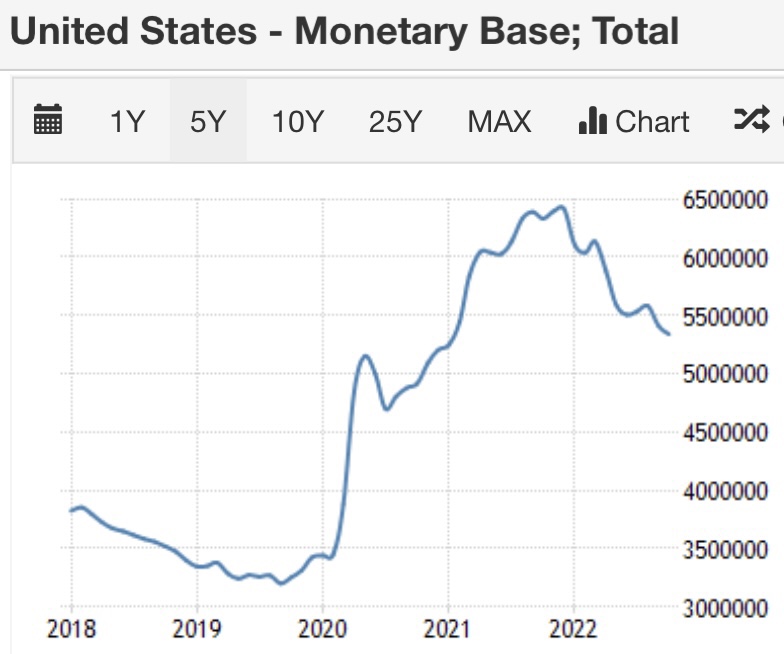
The chart below shows the level of the monetary base (bank reserves plus currency) over the past five years from the Trading Economics site. The monetary base is the narrow monetary aggregate supporting growth of the money stock and is under fairly direct control of the Fed.

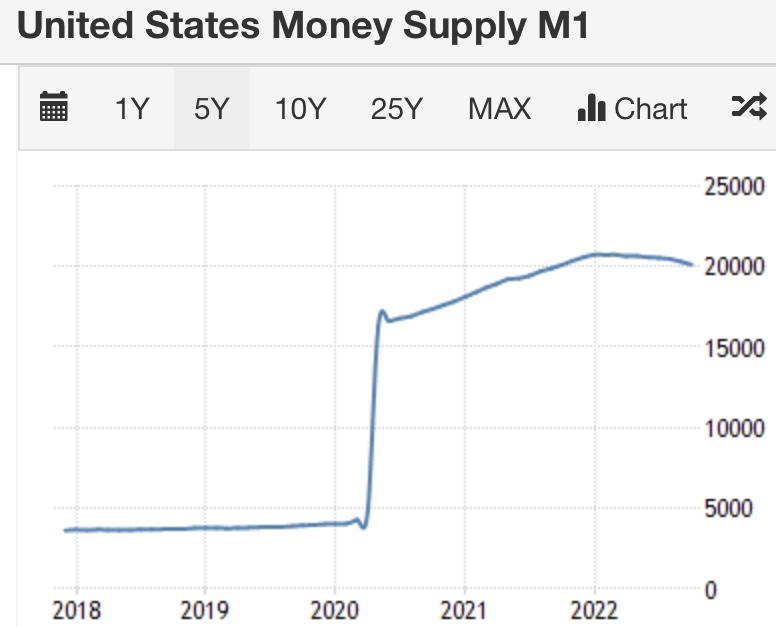
The base has declined substantially during 2022 largely as a consequence of the Fed’s restrictive policies. However, it has retraced only about a third of the massive expansion engineered by the Fed over the two prior years. Here is the corresponding plot of the M1 money stock (currency plus checking deposits):

So the reductions in the base have yet to translate into much of a reduction in the money stock, though growth in all of the aggregates has certainly declined. No one thinks this will be a walk in the park. Withdrawing liquid capital from markets accustomed to swilling in excesses will have consequences, particularly for investors who’ve grown undisciplined in their approach to evaluating prospective assets. Investors and society at large inevitably pay the price for the malinvestment encouraged by unbridled money growth (not to mention misdirected industrial policies … that’s a different can of worms).

But the squeamish resist! I got a kick out of this tweet by Noah Smith in which he pokes fun at those who insist that the surge in inflation was a mere transitory phenomenon:

“Team Transitory: OMG inflation is just going to go away, you don’t need to raise interest rates.

Fed: *raises interest rates*

Inflation: *goes down a bit*

Team Transitory: SEE, I told you inflation was going away and that you didn’t need to raise interest rates!!”

Well, in fairness, “Team Transitory” has been fixated on supply disruptions that very well should resolve with private efforts over time. Some have resolved already. And again, we’ve yet to feel much impact from the Fed’s tighter policy, but I’m amused by the tweet nevertheless.

In fact, the surge in inflation has been driven by both supply and demand factors, and it’s true the Fed can do very little about the former. But stalling the effort to purge excess liquidity and demand-side inflation risks allowing expectations of inflation to edge higher, creating an environment in which price pressures are more resistant to policy actions.

Inflation And Its Proximate Sources

It is indeed good news that inflation has tapered slightly over the past few months, or at least the “headline” inflation numbers have tapered. Weaker energy prices helped a great deal, though releases from the Strategic Petroleum Reserve aren’t sustainable. Measures of “core” inflation that exclude food and energy prices, and more central measures of inflation within the spectrum of goods and services, have moved sideways or perhaps shown signs of a slight moderation.

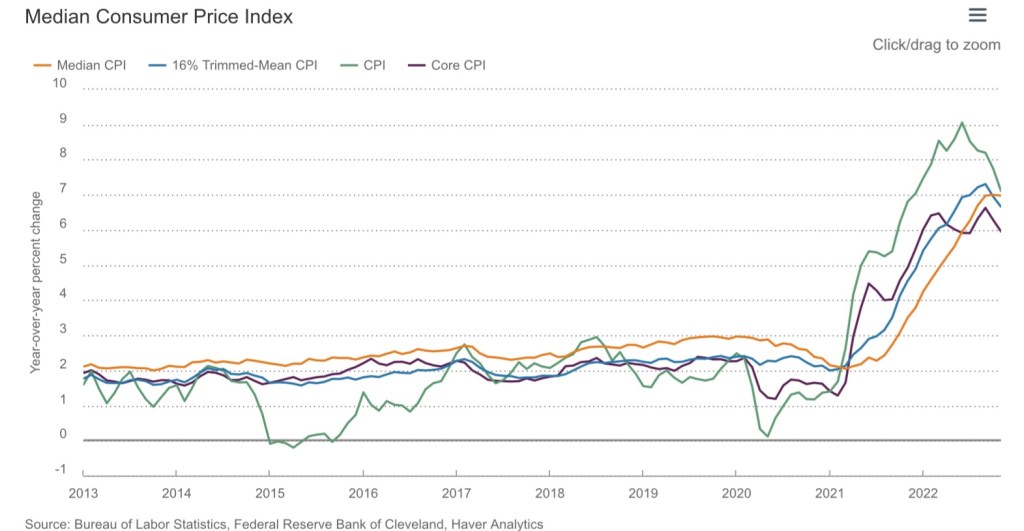
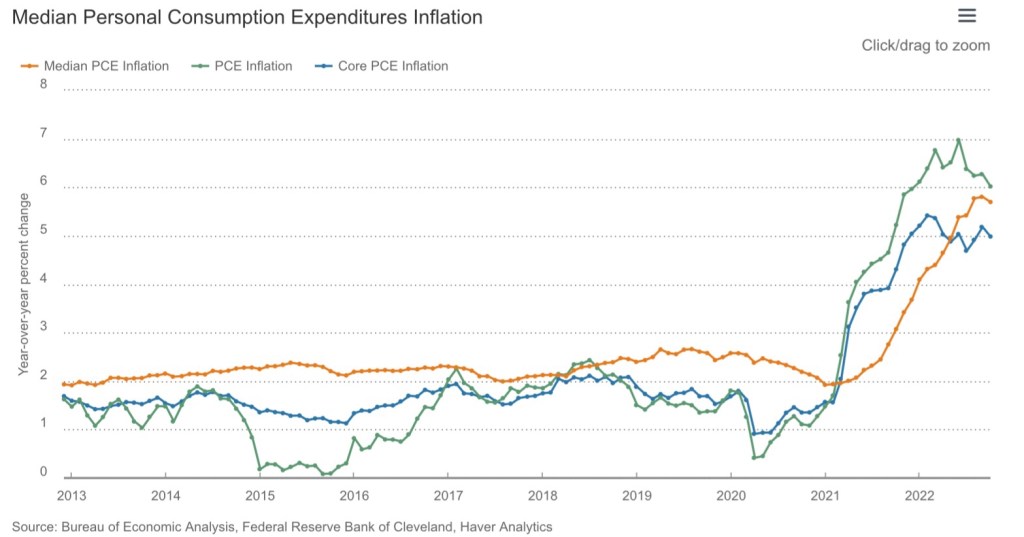
Here’s a plot of several measures of CPI inflation taken from the Cleveland Fed’s web site. Note that the median component of the CPI has finally hit a plateau, and a “trimmed” measure that excludes CPI components with extreme changes has dipped slightly. The Core CPI has fluctuated in a range just above 6% for most of the year.

The deflator for personal consumption expenditures (PCE) gets more emphasis from the Fed in its policy deliberations. The latest release at the start of December showed patterns similar to the CPI:

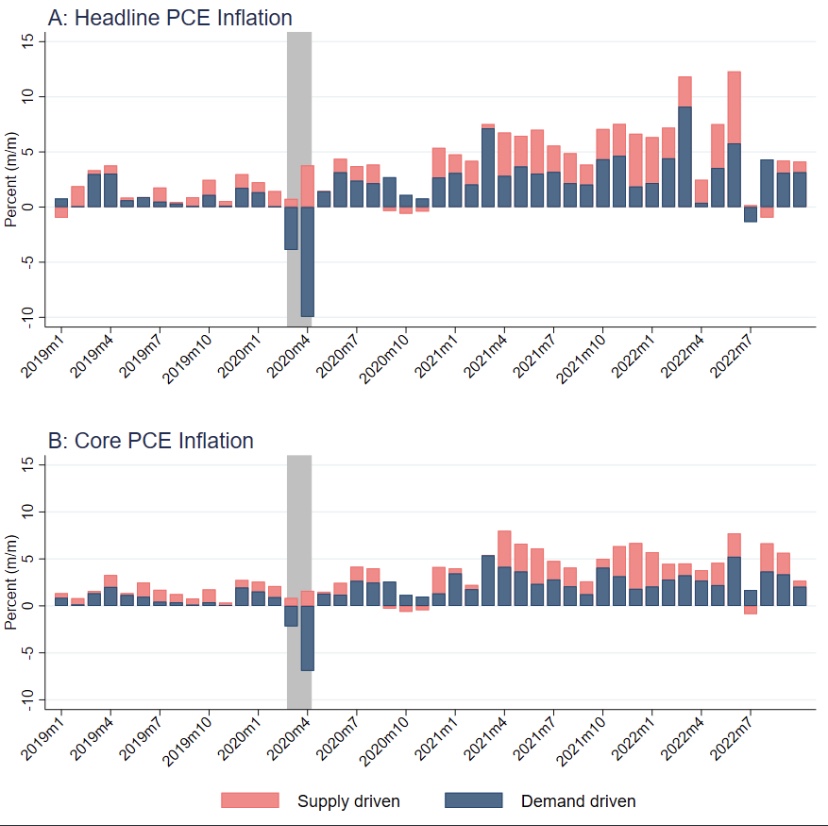
With respect to the PCE deflator, the slight dampening of price pressure we’ve seen recently came primarily from the supply side, with some progress on the demand side as well. Energy was one factor on the supply side, but even the core PCE deflator shows less supply pressure. Adam Shapiro has a decomposition of the PCE deflator into supply-driven and demand-driven components (but the chart only goes through October):

First, without endorsing Shapiro’s construction of this dichotomy, I note that the impact of monetary policy is primarily through the demand side of the economy. Of course, monetary instability isn’t good for producers, and excessive money growth and inflation create uncertainty that inhibits supply. But what we’ve seen recently has more to do with the curing of supply chain bottlenecks that cropped up during the pandemic (or in its wake), and Shapiro attempts to capture that kind of phenomenon here.

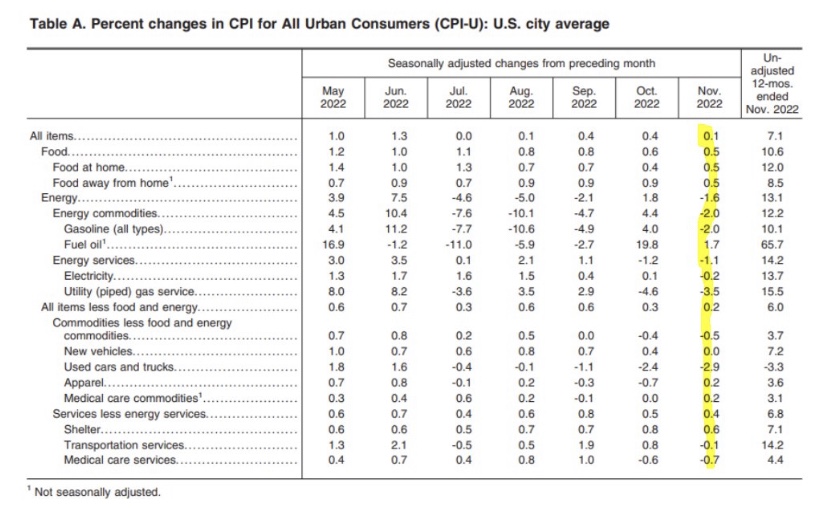
Still, many would argue that the November CPI showed sufficient progress for the Fed to pause its tightening campaign. The reductions in the monthly price increases were fairly widespread, as shown by this table from the CPI report:

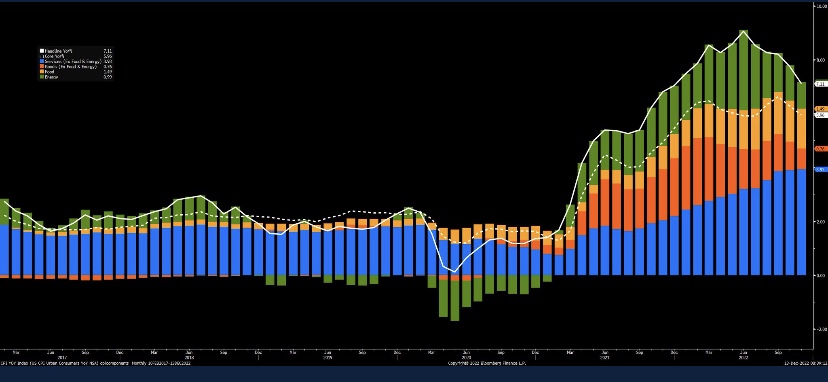
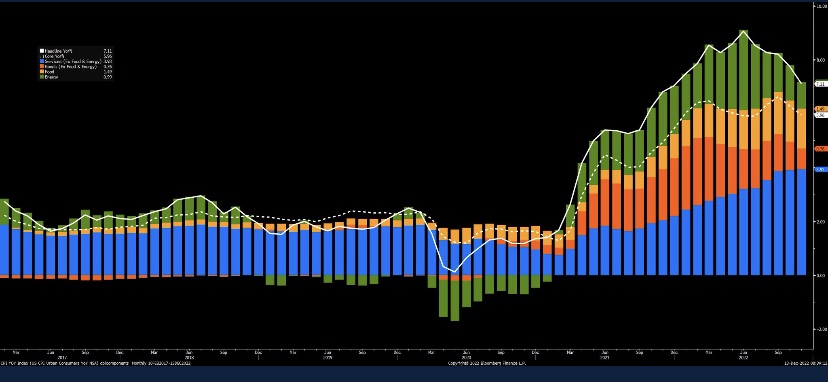
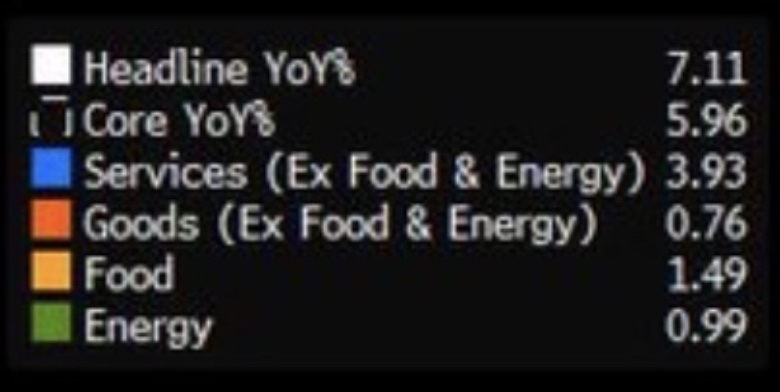
The next chart from Joe Wiesenthal (via Bloomberg) displays trends in broad CPI categories, but it shows vividly that the reductions were concentrated in energy components and goods prices, while services and food inflation did not really abate. (The legend is so hard to read that I took the liberty of blowing it up a bit below the chart itself):

Playing Catch-Up

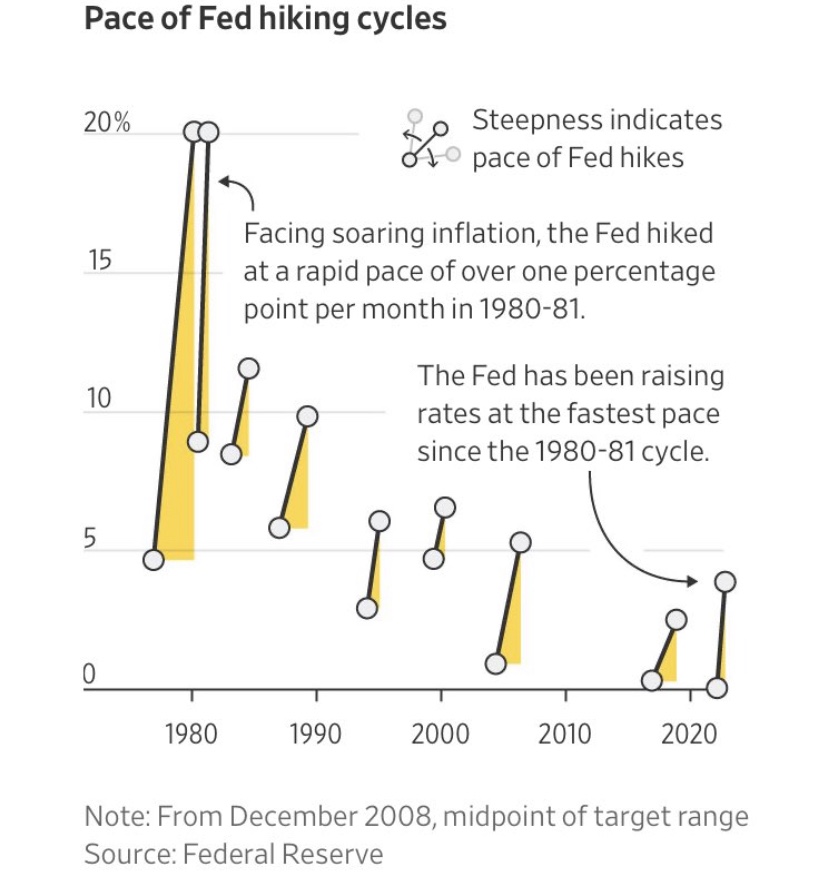
While the Fed’s effort to restrain inflation began in earnest in the spring of this year, it lifted the federal funds rate target rapidly. Here’s another chart from Adam Shapiro, via the Wall Street Journal: the Fed’s current tightening cycle is the fastest in 40 years in terms of those rate hikes:

Fast, yes, but they got a late start in the face of a rapid acceleration of inflation, and for what it’s worth, the Fed’s rate target remains below the rate of inflation. Yes, I’m forced to acknowledge here that the Fed’s preference for rate intervention and targeting is just what they do, for now. In any case, top-line inflation and strictly demand-side inflation are still above the Fed’s 2% target.

Fabian Fiscal Expansionists

One “fix” recommended in some circles suggests that the Fed’s inflation target is too low, as if price stability had nothing to do with its mandate! The idea that low-grade inflation is a healthy thing has never been convincingly demonstrated. In fact, the monetary literature leans strongly in the direction of price stability and an optimal rate of inflation of zero! That the Fed should aim for higher inflation seems like a cop-out intended to appease those who still subscribe to the discredited notion that there exists a reliable long-run tradeoff between inflation and unemployment.

In fact, proposals to increase the central bank’s inflation target would enable more deficit spending financed with the “printing press”, which is at the root of the demand-side inflation problem we now face. A major justifications for ballooning levels of federal spending has been so-called Modern Monetary Theory (MMM), which has gained adherents among statists in the years since the Great Recession. MMM holds that “important” initiatives can simply be paid for with new money creation, rather than interest bearing debt, or God forbid, taxes! “Partisan” is probably a better description than “theorist” for any fan of MMM, and they have convinced themselves that money financed deficits are without inflationary consequences. Of course, this represents a complete suspension of the law of resource scarcity, not to mention years of monetary history. Raising the Fed’s inflation target plays well with the same free-lunch advocates who rally behind MMM.

The Fed’s Unfaithful Fiscal Partner

Federal budget control is likely to take another hit this week with passage of the $1.7 omnibus spending bill. It includes spending increases with no immediate offsets as required under the pay-as-you-go budget law. It delays those offsets to 2025 and increases deficits in the interim by hundreds of billions of dollars. It also sets a new, higher baseline for discretionary appropriations in future years. The federal deficit has already risen dramatically compared to a year ago under the fiscal profligacy of Congress and the Administration. Another contributing factor, however, is that the interest cost of servicing the national debt has spiked as interest rates have risen. Needless to say, none this makes the Fed’s job any easier, especially as it seeks to reverse QE.

Say Uncle!?

When will the Fed begin to take its foot off the brake? It “only” raised the Fed funds target by 50 basis points at its meeting last week (after four 75 bps moves in a row. It is expected to raise the target another 50 bps in early February and perhaps another 25 in March. Strong signals of imminent recession would be needed for the Fed to call it off any sooner, and we’re definitely seeing more hints of a weakening economy in the data (and see here, here, here, and here). More definitive declines in inflation would obviously help settle things. Otherwise, the Fed may pause after March in order to gauge progress toward its goal of 2% inflation.

Inflation: The Leftist “Tax the Poor” Policy

23 Thursday Sep 2021

Posted by Nuetzel in Deficits, Inflation, Redistribution

≈ 2 Comments

Tags

Asymmetric Information, Bank of International Settlements, Biden Administration, budget deficits, Budget Reconcilation Bill, Claudio Bario, Confiscation, dependency, Federal Reserve, Fixed-Rate Debt, Inflation, infrastructure, Joe Biden, John Maynard Keynes, MMT, Moderm Monetary Theory, Money Illusion, Money Printing, Noah Smith, Patrick Horan, Redistribution, Regressive Tax, Scott Sumner, Social Infrastructure, Unexpected Inflation

Recent years have seen explosive growth in federal deficits along with growth rates in the money supply that would have made John Maynard Keynes blush. It’s no coincidence that a new school of thought has developed among certain “monetary economists”. But as someone trained in monetary economics, I wish I could make those quote marks larger. This new school of thought is known as Modern Monetary Theory (MMT), and it asserts that the money spigot is a perfectly legitimate means of financing government spending and, furthermore, that it is not necessarily inflationary. Here is how Scott Sumner and Patrick Horan describe MMT:

“A central idea of MMT is that a government that issues its own fiat currency can pay its bills in that same currency. These governments need not worry about budget deficits when contemplating additional spending. Thus because the US government has a monopoly on money creation, our federal government does not need to raise all its revenue through tax or bond finance. A government with its own currency cannot go bankrupt because it can always issue more currency to cover any budget deficit. … MMT advocates argue that this why the US government can afford expensive programs such as a jobs guarantee and universal healthcare.”

Spend and Print

Joe Biden’s $3.5 trillion “social infrastructure” package would be just a start, but that’s likely to be more like $5.5T once the budget gimmicks are stripped out. We can be somewhat hopeful, because that initiative looks increasingly likely to fail in Congress, at least this time around. But the tax side of that bill was already $2.6T short of the latter spending figure, and the tax provisions keep shrinking. Now, it’s looking more like a shortfall of $3.5T would require financing. Moderate Democrats may not support this crazy bill in the end, but Dems from deep blue states want to reinstate state and local tax deductibility, which would cut the tax component still more. Well who cares? Print the money, say the brave MMT advocates.

Sumner gets to the heart of the problem in this piece. Progressives, with false assurance from MMT, want loose monetary policy to make their expansive programs “affordable”. As he explains, if this happens while the economy is near its production potential, inflation is a sure thing. These lessons were learned long ago, but have been conveniently forgotten by the political class (or they simply prefer to ignore them), instead jumping onto the MMT bandwagon.

Inflation Is Taxation

No conscientious observer of government finance should ever forget that inflation is a form of taxation. Assets whose values are either fixed or subject to some inertia are devalued by inflation in terms of purchasing power, or in real terms, as economists put it. Strictly speaking, this is true when inflation is unexpected… if it is expected, then lenders and borrowers can negotiate terms that will compensate for these changes in real value. But when inflation is unexpected, the losses to lenders are offset by gains to borrowers. Of course the federal government is a gigantic borrower, so inflation can represent a confiscation of wealth from the public.

It’s not small potatoes. Currently, about $22T of U.S. Treasury debt is held by the public, and its average maturity is more than 5 years. If the Federal Reserve engineers an unexpected 1% jump in the rate of inflation, it shaves over $1T off the real value of that debt before it’s repaid, and it reduces the real interest cost of that debt as well. Of course, the holders of that debt will suffer an immediate loss if they are forced to sell prior to maturity for any reason, since new buyers will be demanding higher yields to compensate for higher inflation if it is expected to persist.

The Poor Losers

Inflation causes redistributions to take place, especially when it is unexpected inflation. We’ve already discussed lenders and borrowers, but similar considerations apply to anyone entering into fixed price contracts for goods or labor. Here’s what Claudio Bario of the Bank of International Settlements (BIS) has to say about these shifts:

“Inflation shifts income and wealth away from those who are least aware of it, or least able to protect against it. These segments of the population often coincide with lower-income groups, which explains why inflation has often been portrayed as a most regressive form of tax. The ‘inflation tax’ takes its toll through the erosion of the value of financial assets and contracts fixed in nominal terms.”

Inflation is a regressive tax! In this respect, economist Noah Smith echos Bario in a recent op-ed in which he discusses “money illusion”, or the confusion of real and nominal income:

“Workers … who are slow to perceive the rise in prices they pay for goods like cars and groceries, won’t realize this, and will be happy with their unusually large raises. But companies, whose accountants and managers certainly know the true inflation rate, will also be happy, because they know they’re not actually paying more for labor.

That information asymmetry between workers and employers may be exactly what keeps wages from rising faster than inflation. If workers take a year to realize how much prices have gone up, they may be satisfied with the raises they got during the time of high inflation — even if that inflation ultimately turns out to be transitory. By then, it might be too late to negotiate for a real, inflation-adjusted raise.”

Inflation taxes and redistributions become more acute at higher rates of inflation, but any unexpected escalation in the rate of inflation will take a toll on the poor. Bario elaborates on the mechanisms by which inflation inflicts budgetary pain on the those at the lower end of the socioeconomic spectrum.

“As regards wealth distribution, the financial assets that are most vulnerable to inflation are cash and bank accounts – the typical savings vehicles held by the poorest segments of the population. This is mostly because the poorest have access only to limited investment options to protect their savings. …

… wages and pensions – the main sources of income for a large majority of households and even more so for the poorest half of the population – are typically fixed in nominal terms and hence vulnerable to inflation. Indexation mechanisms, such as those adopted in many [advanced economies] in the 1970s, are no panacea: they may fail to keep pace as inflation accelerates; …”

In addition to the inflationary gains reaped by government, it’s clear that inflation gives rise to redistributions between private parties: generally from those with lower incomes and wealth to their employers, producers, financial institutions, and pension payers (businesses, state and local governments). An exception is some low income debtors might benefit if they owe long term obligations at fixed interest rates, but low income individuals are often constrained from obtaining this form of credit.

Causing, Then Exploiting, Inequality

Another especially galling aspect of the Left’s focus on money finance is how its consequences fly in the face of their concerns about income and wealth inequality. Inflation is typically manifested in rising equity prices: nominal stock values tend to escalate in an inflationary environment, protecting their owners from losses to the real value of their investments. Stocks are generally a good inflation hedge. Yet we know that stocks are disproportionately owned by those in the highest strata of the income and wealth distributions. Later, of course, the Left will seek to level the burgeoning inequality wrought by their own policies by “taxing the rich”! Apparently, for the Left, consistency is never considered a virtue. This is not unlike another trick, which is to blame “greedy corporations” for the inflation wrought by Leftist policies.

It’s a great irony that the Left, which purports to support the poor and working people, would propose a form of government finance that is so regressive in its effects. To be generous, perhaps it’s just another case of “progressives” unknowingly hurting the ones they love. The expansive programs they advocate will confer government benefits to many individuals in higher income brackets, not just the poor, but those government alms will help to compensate for higher inflation. But this too takes advantage of money illusion, because those benefits might well buy progressives the loyalty of beneficiaries unable to recognize the ongoing erosion in their standard of living, and who are unwilling to come to grips with their increasing dependency.

But Tut, Tut, They Say

Advocates of MMT, in combination with expansive government, also have a tendency to deny that inflation has ever been a consequence of such policies. As Sumner points out, they have forgotten historical episodes that run contrary to the theory, and most “popular” advocates of MMT fail to recognize the important role played by limits on the economy’s production potential. When money growth outruns the economy’s ability to produce real goods and services, the prices of goods will rise.

Jordan Peterson Is Not Complacent

23 Tuesday Jan 2018

Posted by Nuetzel in Identity Politics, Individualism

≈ Leave a comment

Tags

Dan Sanchez, Freedom of Expression, Human Action, Identity Politics, Individualism, Jordan Peterson, Noah Smith, rent seeking, Tyler Cowen, University of Toronto, White Privilege

It’s a hoot to watch Jordan Peterson‘s videos — he stands before crowds doing … crisply-articulated philosophy, seemingly on the fly. He is an outspoken psychologist at the University of Toronto who covers a lot of intellectual ground with an impactful delivery. One of Peterson’s primary messages is so simple as to seem trite: take control of yourself, because you can and you should for your own sake and those around you! But his treatment is an empowering tonic for both men and women, and many are listening. He has toiled away as a professional psychologist, a professor, an author and a philosopher for many years; his ascent to notoriety has been recent and fairly meteoric. Luminaries like Tyler Cowen and Noah Smith now call Peterson one of the top public intellectuals in the western world.

However, Peterson takes positions that are seemingly hard for the Left to swallow: he believes in the power of individual action; that freedom of expression is the basis of personal and academic freedom; that identity politics is destructive (whether on the Right or the Left); and that white privilege is a lie.

Predictably, the Left has attacked Peterson and attempted to characterize him as a spokesman for the far-right. He meets challenges of this kind with a kind of charged equanimity, exposing falsehoods with quick-footed logic, empirics, and honest reflection. Dan Sanchez has written a nice summary of the attacks on Peterson and shows them to be wholly without foundation. He has critics in both ends of the political spectrum, as Sanchez observes:

“[Far right] critics don’t understand what Peterson is saying, because they are mired in the mindsets of politics and war. The way of politics and war is to confront an enemy horde by amassing your own horde: whether it be on the battlefield, in street demonstrations, or in voting booths. It is to fight tribal barbarism by tending toward the tribal and the barbaric yourself. But the way of the heroic, civilized individual is to lead by example and to lead by appealing to the interests of those whose behavior you want to influence.”

And in Peterson’s own words, quoted by Sanchez, tribal barbarism is the way to social ruin:

“…where we’re making your group identity the most important thing about you. I think that’s reprehensible. I think it’s devastating. I think it’s genocidal in its ultimate expression. I think it will bring down our civilization if we pursue it. We shouldn’t be playing that game.“

On those assertions, Sanchez notes the following:

“… Peterson’s claim that identity politics is ‘genocidal in its ultimate expression’ is no exaggeration. Hitler’s military invasions and death camps were the ultimate expression of the racialist and nationalist identity politics that spiritually drove Nazism. And Stalin’s weaponized famines and ‘gulag archipelago’ were the ultimate expression of the class warfare identity politics that spiritually drove Soviet communism.”

So Peterson clearly condemns groupthink on both the Left and Right. He celebrates the value of people as individuals, and he urges us all to realize our value through individual responsibility and productive effort. Help yourself, help those you love, and help others. That’s a call to real human action, as distinct from the seeking of rents through the political process. Peterson is both a fascinating personality and thinker. His ideas and passion can be a powerful antidote to the complacency that plagues so many today. I hope he continues to gain prominence.

Follow Sacred Cow Chips on WordPress.com

Recent Posts

  • Immigration and Merit As Fiscal Propositions
  • Tariff “Dividend” From An Indigent State
  • Almost Looks Like the Fed Has a 3% Inflation Target
  • Government Malpractice Breeds Health Care Havoc
  • A Tax On Imports Takes a Toll on Exports

Archives

  • December 2025
  • November 2025
  • October 2025
  • September 2025
  • August 2025
  • July 2025
  • June 2025
  • May 2025
  • April 2025
  • March 2025
  • February 2025
  • January 2025
  • December 2024
  • November 2024
  • October 2024
  • September 2024
  • August 2024
  • July 2024
  • June 2024
  • May 2024
  • April 2024
  • March 2024
  • February 2024
  • January 2024
  • December 2023
  • November 2023
  • August 2023
  • July 2023
  • June 2023
  • May 2023
  • April 2023
  • March 2023
  • February 2023
  • January 2023
  • December 2022
  • November 2022
  • October 2022
  • September 2022
  • August 2022
  • July 2022
  • June 2022
  • May 2022
  • April 2022
  • March 2022
  • February 2022
  • January 2022
  • December 2021
  • November 2021
  • October 2021
  • September 2021
  • August 2021
  • July 2021
  • June 2021
  • May 2021
  • April 2021
  • March 2021
  • February 2021
  • January 2021
  • December 2020
  • November 2020
  • October 2020
  • September 2020
  • August 2020
  • July 2020
  • June 2020
  • May 2020
  • April 2020
  • March 2020
  • February 2020
  • January 2020
  • December 2019
  • November 2019
  • October 2019
  • September 2019
  • August 2019
  • July 2019
  • June 2019
  • May 2019
  • April 2019
  • March 2019
  • February 2019
  • January 2019
  • December 2018
  • November 2018
  • October 2018
  • September 2018
  • August 2018
  • July 2018
  • June 2018
  • May 2018
  • April 2018
  • March 2018
  • February 2018
  • January 2018
  • December 2017
  • November 2017
  • October 2017
  • September 2017
  • August 2017
  • July 2017
  • June 2017
  • May 2017
  • April 2017
  • March 2017
  • February 2017
  • January 2017
  • December 2016
  • November 2016
  • October 2016
  • September 2016
  • August 2016
  • July 2016
  • June 2016
  • May 2016
  • April 2016
  • March 2016
  • February 2016
  • January 2016
  • December 2015
  • November 2015
  • October 2015
  • September 2015
  • August 2015
  • July 2015
  • June 2015
  • May 2015
  • April 2015
  • March 2015
  • February 2015
  • January 2015
  • December 2014
  • November 2014
  • October 2014
  • September 2014
  • August 2014
  • July 2014
  • June 2014
  • May 2014
  • April 2014
  • March 2014

Blogs I Follow

  • Passive Income Kickstart
  • OnlyFinance.net
  • TLC Cholesterol
  • Nintil
  • kendunning.net
  • DCWhispers.com
  • Hoong-Wai in the UK
  • Marginal REVOLUTION
  • Stlouis
  • Watts Up With That?
  • Aussie Nationalist Blog
  • American Elephants
  • The View from Alexandria
  • The Gymnasium
  • A Force for Good
  • Notes On Liberty
  • troymo
  • SUNDAY BLOG Stephanie Sievers
  • Miss Lou Acquiring Lore
  • Your Well Wisher Program
  • Objectivism In Depth
  • RobotEnomics
  • Orderstatistic
  • Paradigm Library
  • Scattered Showers and Quicksand

Blog at WordPress.com.

Passive Income Kickstart

OnlyFinance.net

TLC Cholesterol

Nintil

To estimate, compare, distinguish, discuss, and trace to its principal sources everything

kendunning.net

The Future is Ours to Create

DCWhispers.com

Hoong-Wai in the UK

A Commonwealth immigrant's perspective on the UK's public arena.

Marginal REVOLUTION

Small Steps Toward A Much Better World

Stlouis

Watts Up With That?

The world's most viewed site on global warming and climate change

Aussie Nationalist Blog

Commentary from a Paleoconservative and Nationalist perspective

American Elephants

Defending Life, Liberty and the Pursuit of Happiness

The View from Alexandria

In advanced civilizations the period loosely called Alexandrian is usually associated with flexible morals, perfunctory religion, populist standards and cosmopolitan tastes, feminism, exotic cults, and the rapid turnover of high and low fads---in short, a falling away (which is all that decadence means) from the strictness of traditional rules, embodied in character and inforced from within. -- Jacques Barzun

The Gymnasium

A place for reason, politics, economics, and faith steeped in the classical liberal tradition

A Force for Good

How economics, morality, and markets combine

Notes On Liberty

Spontaneous thoughts on a humble creed

troymo

SUNDAY BLOG Stephanie Sievers

Escaping the everyday life with photographs from my travels

Miss Lou Acquiring Lore

Gallery of Life...

Your Well Wisher Program

Attempt to solve commonly known problems…

Objectivism In Depth

Exploring Ayn Rand's revolutionary philosophy.

RobotEnomics

(A)n (I)ntelligent Future

Orderstatistic

Economics, chess and anything else on my mind.

Paradigm Library

OODA Looping

Scattered Showers and Quicksand

Musings on science, investing, finance, economics, politics, and probably fly fishing.

  • Subscribe Subscribed
    • Sacred Cow Chips
    • Join 128 other subscribers
    • Already have a WordPress.com account? Log in now.
    • Sacred Cow Chips
    • Subscribe Subscribed
    • Sign up
    • Log in
    • Report this content
    • View site in Reader
    • Manage subscriptions
    • Collapse this bar
 

Loading Comments...