• About

Sacred Cow Chips

Sacred Cow Chips

Tag Archives: racism

White Racialism, Identity Politics, and Crippling DEI

09 Thursday Nov 2023

Posted by Nuetzel in DEI, Identity Politics

≈ 1 Comment

Tags

Anti-discrimination law, Christopher Rufo, Colorblind Society, Comparative advantage, DEI, Diversity, Equity, George Floyd, Hobbesian, Identity Politics, Inclusion, Jim Crow Laws, Protected Classes, Racial Preferences, Racialism, racism, rent seeking, Segregation, Slavery, Social Constructs, Structural Racism, Tribalism, Tyler Cowen, Victimhood, Victor Davis Hanson, White Racialism, Zero-Sum Thinking

I’ve taken an extended hiatus from blogging while moving to a different part of the country. I haven’t posted here in over 10 weeks, but a new post appears below. I’m still tying-up loose ends from the move, but I’ll be trying to get back to posting more regularly … trying!

~~~~~~~~~~~~~~~~~~~~~~~~~~~~~~~~~~~~~~~
Absurd ideas about race and identity politics come from extreme elements on both the Left and the Right. Some leftists insist that race has no natural basis — that it’s simply a “social construct”. On the Right, a “racialist” contingent is promoting the “celebration of whiteness” and embracing racial preferences for whites. Treated as alternative pathways, I’d take “social construct”. It’s nonsense, of course, but the beautiful irony is that it provides a basis for stripping away from our institutions the entire diversity, equity, and inclusion (DEI) straightjacket. It’s almost as if those promoting race as a social construct wish to build a “colorblind” society. On the other hand, I suppose some think they can have their DEI cake along with a side of free choice to identify as anything they want: black, white, or furry.

Who Are the Racists?

People of good faith don’t harbor or act on racist tendencies. The mere recognition of racial/ethnic/cultural differences is not evidence of racism and does not preclude the treatment of all with fairness and due respect. It’s possible to respect, value, or fall in love with someone outside one’s own racial, ethnic, or cultural group of origin, even while holding a general affinity for one’s own group, as nearly everyone does.

But a few real racists are sprinkled across all races, ethnicities, cultures, and the full political spectrum. The “popular” racist stereotype as white male has been kept alive by the lingering echos of slavery in America, which ended nearly 16 decades ago, and the long hangover that included Jim Crow laws and segregation. Today, however, “white society” or “whiteness” is hardly the sole domain of prejudice.

Is Racialism Different?

Now, a few whites are promoting the celebration of “white identity” as a counterbalance to identity politics among non-whites. Ostensibly, this “white racialism” might be similar to celebrations of identity often practiced by minorities, which are also forms of racialism. Should white racialism be viewed as less savory than racialism practiced by racial minorities?

For most Caucasians, “being white” does not have much salience relative to other affiliations defining identity. That’s why white racialism seems odd to me. Sure, when forced to check a box, whites will check “Caucasian”, but “white identity” seems overly broad. There are too many distinct cultures and subcultures that dominate self-identity, such as national ancestry, religion, and cultural membership.

The same could be said for many other racial categories, but minority status and historical events (e.g., American slavery) help explain why broad categories often form cohesive identity groups. And, as Christopher Rufo notes in his great discussion of the racialist viewpoint, broad categories tend to be the most closely associated with racialism:

“Yes, left-wing racialism is indeed now deeply embedded in America’s institutions, and the demographic balance of the country has shifted in recent decades. And yes, the basic racial classification system in the United States broadly delineates continental origin—Europe, Africa, Latin America, Asia—in a way that is not arbitrary or meaningless. Terms such as ‘white,’ ‘black,’ ‘Latino,’ and ‘Asian,’ while often obscuring important variations within such groupings, have become the lingua franca and are useful shorthand descriptors for many purposes.”

There are individuals from all groups or “classes”, including whites, who react critically to aggressive expressions of identity by members of other classes. Perhaps that’s excusable, depending on the degree of zealotry on either part. The line between pride in race/ancestry/culture and fractious racialism might be hard to discern in some cases, but the chief distinction is rooted in explicit, demeaning and/or envious comparisons to “out-groups”. This might be damaging enough, but from there it can be a very short step into outright racism.

A preoccupation with the historic disadvantages of one’s race can be disempowering to an individual and destructive in a social sense. I believe the white racialist phenomenon belongs in that category. The presumed “disadvantages” of whiteness are very contemporary, however, rooted in policies dating back only to the widespread adoption of racial preferences for non-white “protected classes” and DEI.

Preferences For All

Imagine the racialist policies now practiced widely in government, industry, and academia — particularly racial preferences on behalf of protected classes — but now applied on behalf of heretofore unprotected classes as well. For example, what if some proportion of jobs, admissions, or other coveted placements were set aside for whites? If whites represent 50% of the population, then 50% of hires or admissions would be reserved for whites.

Some might assume that this treatment is already implied by existing racial preferences, but that’s not the case. In the wake of George Floyd’s death, just 6% of new hires among S&P companies were white, according to Bloomberg News.

Nevertheless, such a white racialist turnabout would be a colossal mistake. Adding strict limits to the application of existing preferences might be a good thing, but white racial preferences would buttress the entire system of racial preferences as an institution and add more rigidity to the operation of labor markets. From an economic viewpoint, it would be just as pernicious as racial preferences generally.

Racial preferences of any kind freeze labor markets and impair the allocation of human resources to their most-valued uses. In fact, placing one individual into a position on any basis other than their qualifications implies that two individuals must be placed into positions in which they lack comparative advantage relative to each other. Little by little, that means lost output and upward price pressure. It is a mechanism that short circuits gains from trade, shriveling the benefits that the most and least talented confer on society at large. Extending preferences to whites would only serve to further institutionalize this damaging practice.

Adherence to numerical preferences is to pretend that people can be treated less as individuals and more like interchangeable parts… except with respect to their value as “class members”. Racial preferences are presumed to be a remedy for so-called structural racism, as opposed to racism by individuals. But they involve classification and favor the so-called “oppressed” at the expense of designated “oppressors”. The latter, almost without exception, had no role oppressive regimes of the past. Favoritism of this kind necessarily means reverse discrimination and fails to match individuals to roles in an optimal fashion.

Whether publicly or privately imposed, racial preferences often undermine those they are purported to help by placing individuals into positions for which they may not be competitive. This can sabotage an individual’s long-term success. It goes without saying that preferences build resentment among the “unprotected”, which goes to the impetus for “white racialism”. Indeed, preferences are not always popular with protected classes either. That’s because they interfere with merit-based decision-making and are perceived to stigmatize those presumed to benefit.

The Fixed Pie Is a Lie

Racialism reflects zero-sum thinking, a hallmark of DEI initiatives. Tyler Cowen quoted the abstract of a recent NBER working paper that found:

“… a more zero-sum mindset is strongly associated with more support for government redistribution, race- and gender-based affirmative action, and more restrictive immigration policies.”

Zero-sum thinking is fundamental to rent-seeking behavior, which is motivated by either malevolent greed or perceptions of victimhood. Victimhood and rent seeking is at the heart of calls for DEI, to say nothing of more radical proposals like reparation payments. White racialism attempts to get in on the action by positing that whites are oppressed under the current institutional dominance of DEI. But the misguided presumption that every identity group should have their own preferences or quotas broadens the emphasis on redressing perceived harms and redistributing rewards — zero-sum activities.

These zero-sum efforts waste energy and resources, harming our ability to produce things that enhance well being. Ultimately, they are actually negative-sum activities, and they also breed hatred.

Race is obviously determined by genetics, but I’d be happy to pretend it’s a mere social construct if that would help get us to a “colorblind” society.

Conclusion

There’s a huge irony in the racialism exercised by both traditional and “white racialist” DEI advocates: it neglects the most fundamental and just application of diversity: equality of opportunity. This principle incorporates the concept of diversity without sacrificing economic efficiency. We’ve largely abandoned it in favor of equality of outcomes via racial preferences, even at a time when society has become enlightened with respect to racial differences. In doing so, we’ve unintentionally chosen another form of explicit racial victimization.

To close, here’s a good summary of the dangers of racialism and identity politics offered by Victor Davis Hanson:

“Anytime one ethnic, racial, or religious group refuses to surrender its prime identity in exchange for a shared sense of self, other tribes for their own survival will do the same.

All then rebrand their superficial appearance as essential not incidental to whom they are.

And like nuclear proliferation that sees other nations go nuclear once a neighboring power gains the bomb, so too the tribalism of one group inevitably leads only to more tribalism of others. The result is endless Hobbesian strife.”

And that’s how white racialism fits right in with the pernicious politics of identity. When you can, vote for the elimination, or at least reform, of DEI policies and practices, not for a reinforcement of identity politics.

Containing An Online Viper Pit of Antisemites

05 Thursday Jan 2023

Posted by Nuetzel in Free Speech, Social Media

≈ Leave a comment

Tags

Andrew Torba, Antisemitism, Christian Nationalism, Corporatism, Dan Frankel, fascism, Fighting Words, Free Speech, Gab, GabPro, Israel, Judeo-Bolshevism, Kanye West, Kristallnach, Pittsburgh Jewish Chronicle, racism, Religious Liberty, Rothschild Family, Theocracy, Zionism

This post is about a particular social media platform and a terrible oversight on my part. I signed up for Gab at least two years ago as I tried to find social media platforms that respected free speech rights and on which I could promote my blog. I haven’t paid for a subscription to “GabPro”, but I’m embarrassed to have completely missed some of the stink emanating from within the platform until recently. It’s not as if it hadn’t been reported, but somehow, I was oblivious.

I knew pretty quickly that Gab was an odd fit for me because so many posters there are on the very religious right. That’s fine, as I’m a strong believer in religious liberty and free speech. My views sometimes conflict with the religious right, but we’re in alignment on some key issues.

I never really scrolled Gab for more than a few moments at any time, having maintained my account there primarily for cross-posting my blog. I joined a particular Gab “fan” group of a band I love, and I have an old friend who happens to be on Gab. I also joined the “Libertarians of Gab” group. Occasionally, something raised my antennae right at the top of my feed, prompting me to look more closely, but I knew this much: like many other social media platforms, Gab is a meme-fest with lots of repetition, so I seldom wasted time scrolling there.

A year or so ago, a Jewish acquaintance on Gab mentioned a few antisemitic posts he’d seen there, but he’s a staunch free-speech advocate and had other reasons to stick with it. At the time, I might have begun to notice a few posters on Gab who were clearly anti-Zionist, but there’s a real distinction between anti-Zionism and antisemitism. Antisemites are bound to be anti-Zionist; the reverse doesn’t always follow. But again, I hadn’t yet found any real fault with Gab itself at that time.

(Note: I’m not hyphenating “antisemitism”, nor am I capitalizing “semitism”, because there is no such thing as a “semite” or “semitism”. The word was concocted by political factions in 19th century Germany in an attempt to “other” German Jews as “Orientals”.)

Over the next several months, however, at the top of my feed, I began to see a few antisemitic posts. Sometimes these amounted to silly assertions, such as the Rothschild family’s supposed world domination, a claim that would be harmless enough if not for indignation that the Rothschilds happen to be Jewish. A few posts were much worse. My knee-jerk reaction to offensive content is to block the poster, as I did a few times.

More recently, in the wake of Kanye West’s crazy tweets about Jews, I was a recipient of a group email from Andrew Torba, the founder and CEO of Gab. Torba, as it happens, is a self-styled “Christian Nationalist”. His email essentially portrayed West as a messenger from God. Here are some excerpts:

“God is using Ye, formerly known as Kanye West, for a big purpose…. He talks about the need for our leaders to uphold Christian values, not Zionist ones. … Ye is using the influence and talents that God has given him to speak the Truth and glorify Jesus Christ.”

It’s interesting that Torba referred to “Zionist” values. Though he is almost certainly anti-Zionist, that’s not really what he meant here. This bit of nut-jobbery, as I learned, had been preceded by many other wild statements from Torba over the years. For instance, over a year ago he tweeted the following and then disabled his Twitter account, a stunt he’s repeated several times:

“We’re building a parallel Christian society because we are fed up and done with the Judeo-Bolshevik one.”

The author at the link above, who reviewed some of Torba’s antics, noted that Judeo-Bolshevism was a term thrown around by the Nazis in the 1930s. But even putting that aside, Torba has an unfortunate tendency to paint with an extremely broad brush in promoting his very own brand of identity politics. That point is established clearly in this “Open Letter” to Torba from a “Hebraic-oriented evangelical Christian attorney”. If anything, the letter is far too gentle with Torba. The writer concludes:

“… I do hope you will reconsider your gratuitous exclusionary rhetoric regarding our spiritual cousins in the House of Judah, treating at least the many who share our cultural values and all-important Creationist paradigm with the same basic respect and camaraderie you show to atheists in the MAGA and conservative movements.”

Torba’s perspective seems to be that all Jews are unworthy, or worse. Here’s one of his posts:

From my perspective, Torba’s recent email regarding “Ye” served as a permission slip to antisemites on Gab to engage in blatant hatred of Jews. Since then, I’ve seen truly antisemitic content appear in my feed with increasing frequency, as if it’s being promoted by the platform. I’m not sure it always sinks to the level of brown-shirts on Kristallnach, but it has that nauseating flavor. Much to my dismay, a few of these posts were from users with whom I’d established earlier connections, or it was content they reposted. Others might have appeared on my feed courtesy of an effort to “introduce” users to one another and to promote certain content.

I didn’t save screenshots of the offensive posts I’ve seen on Gab. I probably should have, but here’s a sampling of a few of the wholesome users I’ve blocked:

One recent post expressed anger with so-called “elites”, an understandable sentiment shared by many in an age of corporatist fascism with the imposition of “woke” ideology in many institutions. However, the poster’s real point was to admonish others for not identifying the target of their anger as “the Jews”.

I became aware of another piece of disturbing information about the perpetrator of a mass killing in Pittsburgh a few years ago, and I can’t believe I missed it:

“The man accused of killing 11 Jews in the Tree of Life building posted antisemitic messages on Gab before the Oct. 27, 2018, massacre. In his Gab bio, he described Jews as the ‘children of satan.’”

Related to these murders, Torba reposted this article on Gab not long ago, from the Pittsburgh Jewish Chronicle. It stated that Pennsylvania Representative Dan Frankel was the target of hateful and threatening posts on the platform. Some of the posts quoted at the link are awful.

But why did Torba repost that article? Well, it motivated a large number of Torba’s followers on Gab to subject the Chronicle to a series of antisemitic replies. This would appear to have been Torba’s intent, but he subsequently removed the repost of the article (along with the hateful replies). That’s a familiar pattern.

Torba’s original comments on the Chronicle article included the following:

“People are done caring about your eternal victimhood complex … Free speech means the right to offend…Stop conflating offensive memes with ‘threats’…Gab is what free speech looks like, the good, the bad, and the ugly are all included.”

Well, you’re right about free speech, Mr. Torba, but subject to an important qualification: “fighting words” are not protected speech under the Constitution. Maybe that’s why you took down your repost, and most importantly the replies. Did you come to your senses relative to the limits of free speech?

It’s not surprising, but the hatred on Gab is not reserved solely for Jews. Since I’ve been on the lookout, I’ve witnessed overt racism of several other varieties on Gab, and I’ve duly blocked those posters. There is also a complement of hatred for individuals falling under the LGBTQ+ banner.

Gab is not the only province of this sort of behavior on social media, but it might be a hotbed. Is it that easy to learn to hate others? Is the distinction between arguing policy versus revilement and ad hominem too subtle for them?

I have Jewish friends across the political spectrum and Jews in my extended family. Few of them are deeply religious. Likewise, many of my friends raised as Christians are not deeply religious. These individuals are entitled to the liberty to practice any or no religion at all. Their choices are no cause for hostility unless they make some effort to impose their views or will upon others. But that kind of theocratic, coercive power seems to be precisely what Andrew Torba and his Christian Nationalist followers on Gab wish to have for themselves.

I’m happy to report that I’ve seen far fewer offensive posts since blocking a number of antisemitic and racist posters. Maybe the platform is “learning” about me. However, there are many well-intentioned people on Gab, and even a few who actively call-out the bigots. I might have to join in that effort. I support Torba’s right to express his views, short of threats or incitement of violence. I have no desire to be affiliated with Torba, however, and I’ll never pay him for GabPro. I’ll remain on Gab for the time being, and we’ll see how the content evolves.

Dobbs, Roe, and the Freakout Over Federalism

25 Wednesday May 2022

Posted by Nuetzel in Abortion, Federalism, Uncategorized

≈ Leave a comment

Tags

Abortion, Adoption, Akhil Amar, Artificial Womb, Bill of Rights, Birth Control, CDC, Classism, Court Leak, dependency, Disparate impact, Dobbs v. Jackson Women’s Health Organization, Due Process Clause, Emergency Contraception, Equal Protection Clause, Establishment Clause, Eugene Volokh, Eugenics, Federalism, Fetal Homicide Laws, Fetal Rights, Fetal Viability, First Amendment, Fourteenth Amendment, Great Society, Josh Blackman, Judicial Activism, Later-Term Abortion, Margaret Sanger, Morning After Pill, Personhood, Planned Parenthood v. Casey, Privacy Rights, Pro-Life, racism, Roe v. Wade, Ruth Bader Ginsburg, Samuel Alito, Supreme Court, War Drugs, World Health Organization

The leak of a Supreme Court draft opinion in Dobbs v. Jackson Women’s Health Organization has created uproars on several fronts. The opinion, written by Justice Samuel Alito, represented a 5-4 majority at the time of its writing, but it is a draft opinion, and the substance and the positions of other justices might change before a final decision is handed down by the Court by the end of June. The draft would essentially uphold a Mississippi law restricting abortions after the first 15 weeks of pregnancy. This would overturn the Roe v. Wade (1973) and Planned Parenthood v. Casey (1992) decisions. The former established that states could regulate abortion only beyond a certain stage of pregnancy (originally the first trimester), while the latter allowed states to regulate once a pregnancy reached the stage of fetal viability. While 24 weeks is often cited as the lower limit of viability, it is considered to be as early as 20 weeks by the World Health Organization, an estimate that could decline with future advances in prenatal and neonatal care (such as artificial wombs). In any case, viability would no longer be the standard if the draft opinion stands. Indeed, it would once again be up to states as to how they wish to regulate abortion.

Here is an update on where things stood on May 11th. Reportedly, the 5-4 majority still stood, and no other draft opinions existed in the case at that time. No news since.

Due Process and Privacy Rights

Was Roe v. Wade a good legal decision? Ruth Bader Ginsburg did not hold the opinion in high regard as a matter of the jurisprudence. Apparently, she felt that the Court should have simply struck down the restrictive Texas law in question without imposing a set of rules, which amounted to an aggressive infringement on the legislative function and the evolution of law, and case law, at the state level. Her words were:

“Doctrinal limbs too swiftly shaped, experience teaches, may prove unstable. The most prominent example in recent decades is Roe v. Wade.”

She also felt the Court should not have leaned on the Due Process Clause of Fourteenth Amendment, which prohibits the denial of “life, liberty or property, without due process of law”. And she believed that relying on due process and the privacy rights of a woman and her physician made Roe vulnerable to challenge. She was probably right.

Yale Law School professor Akhil Amar, who is pro-choice, also believes the Roe decision was misguided and calls its reliance on due process “textual gibberish”. The objection to substantive due process is based on the absence of any principle establishing which “rights” not found explicitly in the Bill of Rights are valid, and which are not.

Equal Protection

In fact, Amar defends Justice Alito’s draft opinion and believes, as Ginsberg did, that the Equal Protection Clause of the Fourteenth Amendment is a better defense of abortion rights. The contention is that unless a woman possesses the right to terminate a pregnancy, she is not on an equal footing with similarly situated men in terms of self-determination and life opportunities. Of course, none of this weighs the interests of the unborn child.

Establishment Clause

Josh Blackman has an interesting series of comments about whether the Establishment Clause of the First Amendment may be a valid defense of abortion rights. That seemingly preposterous claim relies on abortion as a right, in some cases, protected by the free exercise of religion. As Blackman sums up in his sixth point:

“… abortion rights groups should be careful what they wish for. If the Court recognizes a Free Exercise right to perform or receive an abortion, then conservatives can cook up even more aggressive religious liberty strategies. I’ll bring the bagels for the next meeting of the Temple of Automatic Weapons.”

Eugene Volokh makes several interesting points on attempts to use the Establishment Clause “to obtain exemptions from generally applicable laws”. A separate, misguided take at the Establishment Clause is that a law must be unconstitutional if it was based on religious beliefs. Volokh handily disposes of that contention here.

Judicially-Prescribed Rights vs. Constitutional Rights

Blackman has written that the Alito draft is a tour de force, addressing many constitutional principles and concerns expressed by other justices. In another post, Blackman explains a very basic rationale for a decision to overturn Roe. It is related to the objections expressed by Ginsberg and Amar, and to the many “lamentations” expressed in the Court’s abortion opinions over the years since Roe. Namely, that rule and establishment of new rights by court decision was not a mechanism intended by the framers of the Constitution, but self-government and federalist principles were:

“It is a mistake to argue that Dobbs extinguishes a right, without also acknowledging that the decision would restore another right. Overruling Roe would extinguish a judicially-created right to abortion, but it would restore a very different right: the right of the people to govern themselves.”

Personhood

Of course, none of these points are really germane to the crux of the pro-life argument to which I subscribe. However, both Roe and Casey acknowledge the state’s interest in protecting the fetus beyond some point in a pregnancy. The closer to term, the greater the interest. The implication is that a fetus gradually takes on degrees of “personhood” through the course of gestation, and that rights attach to that nascent individual at some point. Both Roe and Casey, by allowing states to regulate abortion beyond some point, offer recognition that the closer an abortion occurs to full term, the stronger the case that it may be prohibited.

The law in most European nations carries the same implication, and if anything leans more heavily in favor of fetal rights than Roe. Furthermore, there are 38 states with fetal homicide laws, which treat the fetus as a person in the case of a murder of a pregnant woman. In 29 of those states, the law applies at the earliest stages of pregnancy. This suggests that in most states, sentiments may weigh in favor of treating the fetus as a person imbued with constitutional rights.

In the end, this is not an exclusively religious argument, as the pro-abortion Left always suggests. For me, it’s purely an ethical one. At what point beyond conception are pro-abortion activists willing to concede that a human life is at stake? Apparently a heartbeat is not enough to convince them. Neither does the appearance of small fingers and toes. Nor the ability to feel pain. These are all things that happen before the child is “viable”. But even viability is not enough for some of the more radical abortion activists, who are proposing choice right up to the moment of birth. Incredibly, and despite the real limitations imposed on mid- or late-term abortions in many states (in line with Roe and Casey), some pro-choice advocates are now acting as if overturning these cases causes women to lose such an unfettered right!

Practical Matters

Anyone can obtain a variety of birth control alternatives without a prescription (and often for free). This includes emergency contraception, or the “morning after pill”. Granted, sometimes birth control measures fail, which places the prospective mother (and perhaps an involved or conscientious father) in a difficult position. Nevertheless, careful use of birth control would minimize the abortion problem and obviate much of the debate, but people are often too impulsive or careless about sex.

Late term abortions are a fairly small percentage of all abortions. The CDC reported that in 2018, 50,000 (~8%) abortions occurred after the first trimester (14+ weeks), and 6,200 (1%) took place at or beyond the point of theoretical viability (21+ weeks). This study found that of abortions at 20+ weeks, mothers tended to be younger (20 -24), discovered their pregnancies somewhat later, faced logistical and financial delays in arranging the abortion, or faced other challenging life circumstances. However, the researchers rebut a common rationale for late-term abortion when they say:

“… most women seeking later terminations are not doing so for reasons of fetal anomaly or life endangerment.”

Eugenics and Classism

Pregnancies among black women are terminated at a disproportionately high rate. That’s consistent with the original, eugenicistic and racist goals of Planned Parenthood founder Margaret Sanger. This is an outcome to top all disparate impacts. I have witnessed pro-abortion activists counter that these aborted lives would have been miserable, impoverished, and without opportunity — essentially not worth living — but these are value judgements of the most monstrous kind. I’ve also heard the pathetic argument that fiscal conservatives should be happy that abortions will reduce spending on aid programs. Of course, the plight of the would-be mother is also emphasized by pro-abortion advocates, but we should not be so eager to accept the tradeoff here: abortion gets the mother is off the hook, but a child’s life is at stake. No matter the odds of success, human beings are all endowed with potential and opportunity, and it’s not necessary to be economically secure to be happy or pursue dreams.

It’s easy to be pessimistic that public policy can ever mitigate the economic burden on impoverished women who bring unexpected or unwanted pregnancies to term, or to brighten the economic future of their children. After all, over the decades since the Great Society program was conceived, the welfare state has proven no better than a dependency treadmill. Family structure has been decimated by those programs and the destructive consequences of the failed (but ongoing) war on drugs. Likewise, public education is a disaster. However, there are also alternatives such as adoption, and there are many private individuals and organizations working to encourage prospective mothers and ease those burdens.

The Leak

The leak of the draft opinion in Dobbs is unfortunate as it compromises the ongoing integrity of the Court’s internal debates and proceedings. In addition to this institutional damage, the impropriety of staging protests outside the homes of justices and inside places of worship should be roundly condemned by people with respect for judicial integrity, privacy and free exercise. These protests are partly attempts to intimidate, and they have even been accompanied by threats of violence. The belligerent posture of these activists is unconscionable.

Long Live Federalism

Again, the Court’s final decision in Dobbs might not be the opinion in the leaked draft. However, if the Court does indeed overturn Roe, it would not outlaw abortion. Rather, it would allow voters in each state to have a voice in aligning the law with public sentiment. Some states will have more restrictive abortion laws than others, but even the Mississippi law at issue in Dobbs allows abortion up through week 15, almost two weeks longer than the original Roe limitation.

The country is still deeply divided on the issue of abortion. Fundamentally, a broader acceptance of the life-and-death reality of abortion would help bring more consensus on the issue. One theory I have is that many who oppose overturning Roe would simply rather not think about that reality. In their minds, Roe keeps abortion compartmentalized, safely walled off from conscience and sometimes even spiritual convictions. They rationalize Roe based on their inability to observe the person whose life is at stake, and they accept justifications that minimize the value of that life.

A single rule imposed by the Court has not and will not resolve these differences. Indeed, Roe and Casey were failed acts of judicial activism that should be reversed. While bad legislation is regrettable, it is always subject to review and challenge by the people. In a federalist system, a bad law is contained like a single experimental treatment in a large trial with multiple arms. However, in this case, unlike a trial with random selection of subjects, one treatment group may differ from others in important respects, and the objective is not to identify one single-best solution, but different solutions that work best for different groups. That is a closer approximation to real self-government than federal legislation and especially one-size-fits-all Court rule-making.

Every Gentleman Best Heed the Power of Hysterics To Censor

19 Saturday Feb 2022

Posted by Nuetzel in Censorship, Gender Differences, Uncategorized

≈ Leave a comment

Tags

Abortion, Antifa, BLM, Bullying, Center for the Study of Partisanship and Ideology, Civil Rights Law, Critical Race Theory, Dark Triad, Defense Priorities, Disparate impact, Equal Pay, Eric Landers, Family Leave Mandates, Feminization, First Amendment, Gender Conventions, Gender Studies, Georgetown Law School, Grievance Studies, Harrassment, Hate Speech, Human Resources, Ilya Shapiro, Joe Biden, Minimum Wage, Noah Carl, Racial Quotas, racism, Richard Hanania, Sexism, Virtuous Victimhood, Yale Halloween

Here are the gender conventions we’ve adopted in Western society on the rules of debate:

“We accept gender double standards, and tolerate more aggression towards men than we do towards women. We also tolerate more hyper-emotionalism from women than men.”

So says Richard Hanania in an essay called “Women’s Tears Win In the Marketplace of Ideas“. Hanania is the president of the Center for the Study of Partisanship and Ideology, and a research fellow at Defense Priorities. He offers some cogent examples of this disparate treatment, such as the Yale Halloween costume imbroglio and the “cancelling” of Ilya Shapiro at Georgetown Law School. To those we can add Eric Landers’ forced withdrawal as Joe Biden’s chief science advisor, and there are countless others. About this, Hanania says:

“What makes these cases difficult is that male versus male argumentation just has completely different rules, norms, and expectations than male versus female. … A man can’t just yell in another man’s face for 5 or 10 minutes about how he’s hurting his feelings. If a man does behave this way, bystanders are more likely to feel disgusted than join in or play the role of white knight. The man at the receiving end of the abuse is at some point going to have to escalate towards violence, or back down and say something about how this is beneath him. Depending on the situation, observers may assume violence is a distinct possibility, and get between the two sides.

None of these options are available when getting yelled at by a woman. You certainly can’t make an implicit threat of violence. Raising your voice will turn everyone against you, and even walking away can look heartless.”

I’ve witnessed a few pathetic crying jags in the workplace myself, as well as some volleys of verbal belligerence from females on social media that were pointedly anti-social. In my experience, most women can dish out barbs good-naturedly in jest and conduct themselves with dignity in debate. On the other hand, there are too many men who become hostile in debate, which most observers will find much less sympathetic if the counter-party is a woman. And there are a few men, here and there, who have trouble holding back tears in a fraught exchange, but we all know it’s not a good look.

To state the obvious, tears are a natural reaction to grief or real hurt. Anger is well-justified in response to criminal or personal wrongs. Nevertheless, it’s necessary to distinguish between these kinds of reactions and the ignoble tears or venom sometimes brought to controversial debates by neurotic partisans. As Hanania says of our disparate gender conventions, considerable censorship is instigated by an intransigent minority of women who manage to “… indulge their passions in ways that men cannot … .” Most men, anyway… and if they do, they’ve usually lost and know it.

These passionate displays are often tied to claims of individual or group victimhood. The objector could be anyone who feels an under-appreciated beef, but acting-out in order to signal “virtuous victimhood” in this way might indicate a deeper instability.

Again, as Hanania says, females have a definite advantage in the deployment of tears, confrontational rhetoric, and screams. Coincidentally, in a post to which Hanania links, Noah Carl marshals data on the extremely skewed representation of degrees awarded to women in Grievance Studies (e.g. Gender Studies and Critical Race Theory).

Too often, claims of victimhood are invoked in attempts to rebut any number of principled policy positions. For example, your views might be construed as offensive, racist, or sexist if you oppose such things as an increase in the minimum wage, racial quotas, disparate impact actions, equal pay rules, family leave mandates, and abortion. Expressing a strong and reasoned defense of many positions can foment imagined micro-aggressions or even harassment.

The real danger here is that honest debate is suppressed, and with it, very often, the truth. I acknowledge that people must be free to express or defend their views passionately, and with tears, screams, or otherwise, which the First Amendment guarantees. Our gender conventions in this matter should be revisited, however, if men and women are truly to be on equal footing.

Whether baring fangs or shedding tears, there are self-appointed arbiters of acceptable speech represented in almost all of our public and private institutions, ready to shut down debate on account of their feelings. They have more than a few sympathetic allies, male and female, at higher levels of their organizations. In the past, Hanania has discussed the over-representation of females in Human Resource departments. In these contexts, adjudication of disputes often relies on vague notions of what constitutes “hate speech” or “harassment” under Civil Rights Law. If you manage to provoke the tears of a colleague or underling, you’re probably behind the eight ball!

Hanania considers some alternative ground rules or “options” for debate:

  1. Expect everyone who participates in the marketplace of ideas to abide by male standards, meaning you accept some level of abrasiveness and hurt feelings as the price of entry.
  2. Expect everyone to abide by female standards, meaning we care less about truth and prioritize the emotional and mental well-being of participants in debates.”

Either of these options is better than the double standard we have now, and Hanania point to a number of egregious manifestations of our double standard. As he notes, #2 might be what’s meant by the “feminization of intellectual life”, but it fosters the arbitrary prohibition against discussion of any number of ideas that belong on the policy menu.

Option #1 would undoubtedly be condemned as “traditional male dominance” of public debate, but it would bar no one from participation, and obstacles perceived by females, or any sensitive soul, can be viewed as a matter of socialization. Both tearful and ferocious argumentation should be marginalized regardless of the antagonist’s gender.

Imperfect as they are, we have laws and/or social strictures against harassment, bullying, and other aggressive behavior thought to be largely associated with malcontented males. But as Hanania says:

“We haven’t even begun to think carefully about equivalent pathologies stemming from traits of the other sex.”

This problem obviously pales in comparison to the fascist tactics typical of the far Left. That includes the violent behavior of Antifa and BLM, unethical attempts blame conservatives for various, often fabricated deeds, and to threaten and punish them economically, even to the point of state-sponsored thievery and threats of harm to family members. Despite the more benign nature of the disparities discussed here, restoring gender equality to the terms of civil debate, without tears and hysterics, would be a great step forward.

The Anti-CRT Revolt: Banning a Racist Curriculum

16 Wednesday Jun 2021

Posted by Nuetzel in Critical Race Theory, Education, racism, Uncategorized

≈ Leave a comment

Tags

1619 Project, Black Lives Matter, Critical Race Theory, Disparate impact, Food Deserts, Jim Crow, Living Wage, New York Times, racism, Systemic Racism, Unconscious Bias, Zinn Education Project

Suddenly it’s dawned on many people of good faith that our educational, business, and other institutions have been commandeered by adherents to critical race theory (CRT), which teaches that all social interactions and outcomes must be viewed through the lens of racial identity and exploitation. In fact, it teaches that racism is endemic, whether conscious or unconscious, among people deemed to have privilege. They are labeled as oppressors, especially anyone with white skin. Furthermore, CRT holds that racism is systemic, and therefore the “system”, meaning all of our institutions and social arrangements, must be radically transformed. Some or all of these tenets are taught to our children in public and private schools, and they are embedded in anti-bias and diversity training delivered to employees of government, non-profits, and private companies.

Standing Up To It

It’s easy to see why many have come to view CRT as a racist philosophy in its own right. Teaching children that they are either “oppressors” or “victims” based on the color of their skin, is a deeply flawed and dangerous practice. The revelation of CRT’s cultural inroads has prompted an angry counter-revolution by parents who hope to purge CRT from the curricula in their children’s schools… schools that they PAY FOR as taxpayers. Many other fair-minded people are offended by the sweeping racism and identity politics inherent in CRT. And yet its proponents continue in attempts to gaslight the public. More on that below.

The groundswell of opposition to CRT is evident in explosive meetings of school boards across the country, as well as recent school board elections in which slates of candidates opposed to the teaching of CRT have been victorious (see here, here, and here).

In addition, we’ve seen a number of recent legislative or administrative initiatives at the state level. There are now, or recently have been, efforts in 22 states to ban or restrict the instruction of CRT. In some cases, institutions found to be in violation of the new laws are subject to deadlines to remedy the situation. Otherwise, funding dispersed by their state’s Department of Education may be cut by ten percent, for example.

But It’s Speech

As happy as I am to witness the pushback, it’s fair to ask whether the most severe restrictions are reasonable from an educational point of view. For example, as a social philosophy, and as wrong-headed as I believe it to be, there is no reason CRT can’t be discussed alongside other social philosophies, failed and otherwise, without endorsement. For that matter, we should not insist that schools shield children from the fact that racism exists, and CRT certainly has its place along the spectrum of racism.

For my own part, I believe elective classes covering CRT as one philosophical position among others should be defended, as should instruction in the history of American slavery and Jim Crow laws, for example. However, mandatory training in CRT is unacceptable and, to the extent that students or employees are required to accept its tenets, it constitutes compelled speech. To the extent that certain groups of students are identified as inherently biased, it is a form of defamation and a personal attack. 

Legislation

Some states are attempting to ban CRT outright. Others have imposed strictures on certain messages arising from the CRT curriculum. The Florida Department of Education just passed an extremely brief rule stating: 

“Instruction on the required topics must be factual and objective, and may not suppress or distort significant historical events, such as the Holocaust, and may not define American history as something other than the creation of a new nation based largely on universal principles stated in the Declaration of Independence.”

The Florida rule prohibits teaching the 1619 Project as part of the history curriculum. This revised “history” of our nation’s founding was sponsored by the New York Times. It insists that the Revolutionary War was fought to preserve American slavery, an assertion that has been condemned as false by many historians (see here and here), though the Left still desperately clings to it. I have no problem with a prohibition on false histories, though again, it’s important for students to learn that slavery was the subject of much debate at the nation’s founding and that it persisted beyond that time. No one kept those facts from us when I was a child. And they didn’t brand white students as oppressors.

While a rulemaking by a state Department of Education is better than nothing, it’s a far cry from an actual piece of legislation. A bill signed into law in Idaho in late March contained substantially the same provisions as the rule promulgated in Florida, but it didn’t proscribe the 1619 Project. The same is true of the bill signed into law in Oklahoma in early May. 

In Texas, the state senate passed a bill in May that would ban instruction in any public school or state agency of any of the following:

“… one race or sex is inherently superior to another race or sex

an individual, by virtue of his or her race or sex, is inherently racist, sexist, or oppressive, whether consciously or unconsciously;

an individual, by virtue of his or her race or sex, bears responsibility for actions committed in the past by other members of the same race or sex;

meritocracy or traits such as a hard work ethic are racist or sexist, or were created by … members of a particular race to oppress members of another race.”

A new law in Iowa and abill signed by the governor of Tennessee in late May contained similar provisions, essentially banning instruction of some highly objectionable tenets of CRT. However, the Iowa and Tennessee laws are careful to spell out what the law should not be construed to do. For example, these laws do not:

“—Inhibit or violate the first amendment rights of students or faculty, or undermine a school district’s duty to protect to the fullest degree intellectual freedom and free expression.
—Prohibit discussing specific defined concepts as part of a larger course of academic instruction.
—Prohibit the use of curriculum that teaches the topics of sexism, slavery, racial oppression, racial segregation, or racial discrimination, including topics relating to the enactment and enforcement of laws resulting in sexism, racial oppression, segregation, and discrimination.
“

A bill in the Missouri House mentions a few such protections. However, the Missouri bill is general in the sense that it explicitly bans the instruction of CRT by name, rather than simply blocking a few unsavory messages of CRT, as detailed by Texas and a few other states. Utah’s legislation, which is awaiting the governor’s signature, is also quite brief and explicit in its prohibition of CRT. I greatly prefer the Texas approach, however, as it makes clear that discussions of CRT in the classroom are not precluded, as might be inferred from the language of the Missouri bill. 

But, But… You Just Don’t Get It!

PProtests against these legislative actions have shown a certain tone-deaf belligerence. According to an organization called Black Lives Matter at School and the Zinn Education Project, all the protesters want is a curriculum that illuminates:

“… full and accurate U.S. history and current events … rais[ing] awareness of the dangers of lying to students about systemic racism and other forms of oppression.”

One advocate says they must be free to teach the “truth” of our nation’s foundational and ongoing structural racism. The Missouri bill, they say, “fails to note ‘a single lesson’ which is ‘inaccurate’ or ‘misleads’ students.” It’s not as if it’s necessary for legislation to provide a series of examples, but be that as it may, these CRT advocates know exactly what many find objectionable. Essentially, their response is, “You don’t understand CRT! WE are the experts on systemic, institutional racism.” What they believe is somehow, every negative outcome is actuated by racism of one kind or another, past or present.

Divining the “Fault” Line

Are you below the poverty line? Earning less than a “living wage”? Are you unemployed? Is your credit score lousy? Do you live in a high crime area? In a “food desert”? Are you a single parent? Did you receive a failing grade? Is your rent going up? Did someone fail to defer to you? Did they “disrespect” you, whatever your definition? Were you scolded for being late? 

Of course, none of those “outcomes” is exclusive to people of color or minorities. But wait! Someone else is earning a decent income. They got good grades. They have a high credit score. They drive a nice car. They have skills. 

Does any of that make them guilty of oppression? Does this have something to do with YOU?

Well, you see, CRT teaches us that every unequal outcome must be the consequence of unjust, “disparate impacts” inherent to the social and economic order. To be clear, outcomes are a legitimate subject of policy debate, and we should aim for improved well-being across the board. The point that defenders of CRT miss is that unequal outcomes are seldom diabolic in and of themselves. Real indications of injustice, past or present, do not imply that any one class of individuals is inherently racist or behaves in a discriminatory manner.

Critical Theory Is a Fraud

Critical race “theory” is nothing but blame in fraudulent “search” of perpetrators. It is fraudulent because the perps are already identified in advance. It is “critical” because someone or something deserves blame. The real exercise is to spin a tale of misused privilege and biased conduct by the privileged perps against a set of oppressed victims.

CRT is not just one theory, but a whole slew of theories of blame. The very attitudes of the purveyors of CRT show they do not believe their “theories” are falsifiable. And indeed, allegations of unconscious bias are impossible to falsify. Thus, CRT is not a theory, as such. It amounts to a polemic, and it should only be discussed as such. It certainly shouldn’t be taught as “truth” to children, university students, or employees. More states should jump on-board to restrict the CRT putsch to propagandize.

On Bended Knee To the Intolerant Few of

01 Thursday Apr 2021

Posted by Nuetzel in Identity Politics, Politics, Propaganda

≈ Leave a comment

Tags

Bertrand Russell, Capitol Riot, Classism, Denialism, Dietary Laws, Enabling Act of 1933, German National Socialists, Grievance, Hassan Nicholas Taleb, Homophobia, Intolerance, Intolerant Minorities, Kosher Label, Misogyny, Nazi Party, racism, Reichstag Fire, Salafism, Skin in the Game, Stakeholders, Steve McCann, Stockholm Syndrome, Suicide of the West, Transphobia, Tyranny of the Majority, U.S. Constitution, Wokeness, Xenophobia

The U.S. Constitution was intended, among other things, to avoid a hazard common to purely democratic systems: a tyranny of the majority. Now, however, we’re threatened by a phenomenon that might have sounded absurd to the founding fathers: a tyranny of the minority. Hassan Nicholas Taleb describes how small, intolerant minorities can dominate the terms under which the rest of a society plays. Taleb discusses a few cases in point from the historical record. Some of these are fairly benign, like the evolution of certain dietary conventions, but the larger implications for a free society are grim. His discussion appears here, but it is actually a chapter of his book, “Skin In the Game”.

In a way, these phenomena are often “squeaky-wheel-gets-oiled” situations, but there’s more to it. Much depends on the cost of allowing an uncompromising minority to have its way. So, for example, the food and beverages we consume are usually kosher, but not many people notice the circled “U” on the label, and they don’t know the difference. That’s relatively low cost. In other cases, people are cowed into believing they’ve been insufficiently sensitive to the grievances of small groups, but they do not fully appreciate the cost (and futility) of proving their compassion. From Taleb:

“How do books get banned? Certainly not because they offend the average person –most persons are passive and don’t really care, or don’t care enough to request the banning. It looks like, from past episodes, that all it takes is a few (motivated) activists for the banning of some books, or the black-listing of some people. The great philosopher and logician Bertrand Russell lost his job at the City University of New York owing to a letter by an angry –and stubborn –mother who did not wish to have her daughter in the same room as the fellow with dissolute lifestyle and unruly ideas.

The same seems to apply to prohibitions –at least the prohibition of alcohol in the United States which led to interesting Mafia stories.

Let us conjecture that the formation of moral values in society doesn’t come from the evolution of the consensus. No, it is the most intolerant person who imposes virtue on others precisely because of that intolerance. The same can apply to civil rights.”

Taleb’s point runs counter to the theory that most forms of governance, either legal or cultural, work best when they reflect broad, prior consensus. He insists, however, that people are often willing to placate the most uncompromising parties. In a tolerant, liberal society, there is a certain willingness to give ground when grievances have a whiff of legitimacy. That’s well and good, but a liberal society may be plagued by the existence of enough saps who just want to get along with more poisonous elements. And those poor saps will find a way to defend their position and become useful idiots.

The intolerant and intransigent minorities get the ball rolling with various grievances. Right or wrong, there are many disparate groups with perceived social or economic grievances. Their determination plays out in agitation of various kinds, sometimes rhetorical and sometimes violent. One way or another, and with the assistance of certain institutions, the grievances (and potential policies to deal with them) may be integrated into the political views of a larger set of sympathetic listeners. To the extent the aggrieved can find common ground with other aggrieved groups, the movement grows.

Some institutions are likely to be more naturally sympathetic to claims of victimhood, such as academia and the press. These institutions are, in a real sense, “grievance aggregators”, along with community organizers of various kinds, and they are capable of accelerating the fire. Then, grievances have a way of becoming enshrined as permanent talking points, all earnest efforts at mitigation aside. Appeasement seems only to invite more demands.

Today, there is a special intransigence on social media that is difficult for many if not most well-meaning individuals to stand up against. You must be “woke” or face social and economic repercussions. The intolerant minority can adopt a number of tactics to gain cooperation. These are often intimations of bad faith including racism, classism, xenophobia, homophobia, transphobia, misogyny, or “bad-think” and “denialism” of any sort. Apparently these are all ripe targets. This potential ostracization gives rise to fear on the part of those who might otherwise think and speak independently.

All this goes for businesses as well, which are only too eager to avoid litigation or offending any and all “stakeholders”, an ever-growing class increasingly unrelated to the firm’s trade. As institutions, many large corporations have fallen well into the fold of wokeness. They attempt to virtue signal to consumers, workers, government, and the “community” in a bid to stay out front. That sets the stage for repercussions in the lives and careers of workers who might fear doxing by an intransigent minority. Just go along with the demands and you’ll be fine. In a version of Stockholm Syndrome, some of the intimidated will convince themselves to adopt the cloak of woke righteousness and signal their virtue! Be a hero! More useful idiots.

And so the intolerant minority wins. Or, a coalition of intolerant minorities and their sympathizers win. Taleb again:

“Clearly can democracy –by definition the majority — tolerate enemies? The question is as follows: ‘Would you agree to deny the freedom of speech to every political party that has in its charter the banning the freedom of speech?’ Let’s go one step further, ‘Should a society that has elected to be tolerant be intolerant about intolerance?’

We can answer these points using the minority rule. Yes, an intolerant minority can control and destroy democracy. Actually, as we saw, it will eventually destroy our world.

So, we need to be more than intolerant with some intolerant minorities. It is not permissible to use ‘American values’ or ‘Western principles’ in treating intolerant Salafism (which denies other peoples’ right to have their own religion). The West is currently in the process of committing suicide.”

This article by Steve McCann struck a chord with me because it describes a culmination of the forces of intolerance: McCann draws a tight comparison between the tactics of the Left, who attempt to represent themselves as champions of the aggrieved, and German National Socialists in the 1920s and 30s. Here is the shared playbook:

  • Exploit racial division;
  • Censor your enemies;
  • Unleash a flood of propaganda and fake news;
  • Exploit class envy;
  • Incite street riots;
  • Exploit events (the Reichstag fire vs. the Capitol “riot”) to legislate one-party rule (the Enabling Act of 1934 vs. HR 1).

This has very much to do with the acceptance of pseudo-realities and outright lies about the state of social affairs, some of which become institutionalized (e.g., “systemic racism”, “follow the science”, “sustainability”, “fair trade”, “disparate impact”, “infrastructure plan”, Modern Monetary Theory, and the meaning of “liberalism”). Individuals frame their lot in relation to a “perfect” society, a utopianism that can’t ever be fully satisfied. “Failure” will always be blamed on elements of the status quo, like capitalism and anyone perceived to benefit from it (except perhaps for those “privileged” agitating against it).

Taleb’s observation that intolerant minorities tend to “win” might be easier to swallow now than it might have been a few years ago. It’s certainly a warning to anyone who might take comfort in thinking our present dysfunction will be fixed when a sensible majority gets good and fed up. They might be unhappy, but most tend to lack sufficient determination to avoid getting cowed by intolerant minorities. Suicide of the West indeed!

The Critical Race Dialectic

07 Sunday Feb 2021

Posted by Nuetzel in Critical Race Theory, Social Justice

≈ Leave a comment

Tags

1619 Project, Critical Race Theory, Critical Theory, criticalrace.org, Equality Under the Law, Immanuel Kant, Jonah Goldberg, Mark Robinson, newdiscourses.com, Overt Discrimination, Privilege, racism, Reparations, Revolutionary War, S.G. Cheah, Social Justice, Systemic Racism, Victimhood

The very notion of impartiality requires decisions that are independent of race, ethnicity, religion, gender, sexual preference, gender identity, or any other component of identity. The great irony of identity politics is its insistence on using characteristics of identity as the key drivers in a broad range of human decisions. It does so in an effort to redress injustices, often in the distant past. This necessarily penalizes individuals bearing no responsibility for the original injustices, and of course those penalties are also assessed on the basis of identity.

That would seem to limit the political viability of reparations for injustices of the distant past, but identity politics seeks to foster a sense of contemporary and immediate relevance to claims of compensable injustice. That’s one way to rationalize the kind of massive redistribution contemplated by this movement. Those who would stand to benefit must be convinced of their ongoing victimhood, and those who would pay must be convinced of their guilt: despite all good intentions, they practice unconscious bias in all of their actions, words, and thoughts. If successful, the possibilities for transfers of wealth and power in all matters are limited only by the negative-sum reality of this scam.

The kind of propaganda referenced above is the province of Critical Race Theory (CRT). S.G.Cheah explains:

“Critical Theory originated from Immanuel Kant’s Critical Philosophy. Critical Philosophy states that ‘proper inquiry is not about what is out there in reality, but rather about the character and foundations of experience itself.’”

For a more detailed analysis of Kant’s “Critiques” of pure reason, practical reason, and judgement, see here. His primary focus was theology, but the adherents obviously found much broader application. The brief explanation quoted above is pretty accurate, and probably offers all the intellectual underpinnings critical race theorists require to push their agenda.

If one’s “experience” is the only evidence that matters, then the ravings of any lunatic must be taken at face value, and as truth. A concession to objective reality is tolerated only when and if it confirms an individual’s mood affiliation. And what defines one’s experience if not one’s inner feelings about events? Thus, regardless of facts, CRT would have us bow to mere feelings, perceptions, and assertions of harm said to be inflicted by the so-called “privileged”.

If I believe I’ve experienced racism, then CRT supports the conclusion that I have experienced racism. It is not confined to situations of overt discrimination. It goes for any conflict I might have with someone of a different race; any transaction in which I might feel disadvantaged; any life circumstance that I experience as “unfair”; or any judgement against me in a court of law. Racism is reality if I “experience” the world as racist (or sexist or homophobic or transphobic, for that matter.) These charges are conveniently leveled against those who have enjoyed any differential success in the world, irrespective of race, but primarily against whites and often Asians regardless of success.

Apparently, under CRT, one’s “experience” may extend to perceptions that today’s culture and institutions are evolved from any version of history one might choose to conjure. A prominent case are the lies promoted by the New York Times’ 1619 Project that the Revolutionary War was fought to preserve slavery. Jonah Goldberg’s thoughts on that topic are worth reading.

CRT has spawned some incredibly bad research. Here’s a review of two academic papers on the connection between the use of the “N-word” in LLP Google searches and 1) gun purchases “motivated by white racial animus”, and 2) “anti-black voting patterns”. The authors of those papers drew behavioral conclusions from mere coincidental events, based more upon their personal biases than objective evidence. They undoubtedly were aware of the weaknesses of using Google trends to gauge attitudes, but they willfully ignored that evidence.

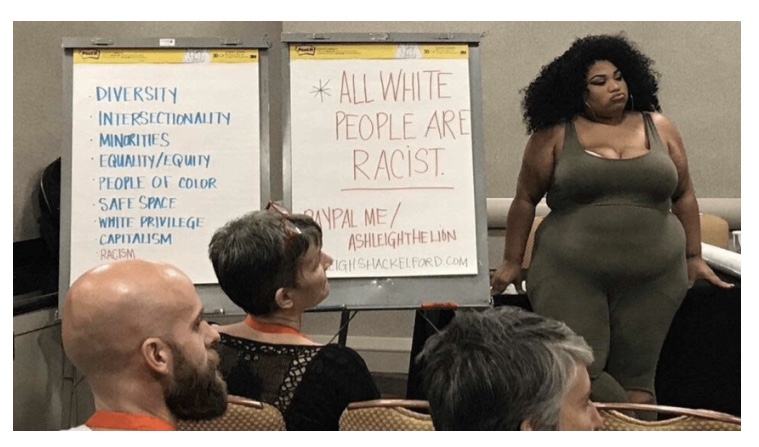
CRT is being taught to our children in public schools and probably in some private schools. This is nothing short of an indoctrination campaign. Of course, CRT made much earlier inroads in higher education. A new web site, criticalrace.org, includes a searchable database on CRT training at U.S. universities, as well as links to a variety of articles on CRT. Many private corporations have been eager to jump on board with CRT. Take a look at the instructor’s notes on the poster boards at the racial struggle session shown below. Here is a longer description.

This is literally a propaganda putsch, and it is meeting with far more success than I would have thought possible. I’ve apparently misjudged the ability of my countrymen to think independently, or to think at all. Here are examples of the success of CRT advocates in convincing whites of their individual and collective guilt. There are individuals now so convinced of the guilt of all white people that they can’t help but make complete fools of themselves:

“We will only achieve tolerance and unity once white people accept that they are evil, repugnant, worthless trash whose very existence is a vomit stain on the fabric of society.”

Speak for yourself! I have to conclude that this poor woman recognizes something quite damning within herself, and she feels it necessary to project her innermost racism onto others who happen to share her skin color.

Now here’s a man to admire: Lt. Governor Mark Robinson of North Carolina. He isn’t having any of the CRT crap, and he knows how to give it back to the petty stringers in the media as well as anyone.

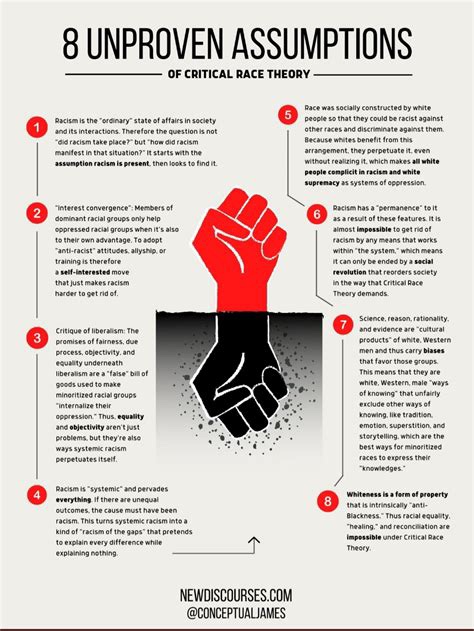
CRT is a lie, or many lies. Racists certainly walk among us, but to condemn all whites of racism, or to allege racism by any class with presumed privilege, is a gross violation of ethics. Guilt of recompensable racism cannot be established by mere claims about anyone else’s “experience” without impartial adjudication. The thoughts and actions of decent people are not dominated by racial animus or repugnance, and any presumption to the contrary must be rejected in the absence of objective proof. Everyone matters, and we must insist on equality under the law. That does not mean equality of outcome, and it is not an excuse for blaming negative outcomes on anyone skilled and/or fortunate enough to have enjoyed more positive outcomes. If the fact that blacks have not achieved average economic parity with whites is evidence of “systemic racism”, I would suggest it has more to do with short-sighted public policy efforts to engineer social outcomes than with racism. More on that in a later post.

Note: the graphic at the top is from New Discourses.

Equal *Mattering* Under Ethics, Law and Community

04 Saturday Jul 2020

Posted by Nuetzel in Identity Politics, racism, Uncategorized

≈ 1 Comment

Tags

Black Lives Matter, Civil Rights, Conflict Theory, Equal Protection, Family Unit, Great Society, Identity Politics, Jim Crow, Lyndon Johnson, Marxism, Moral Dilemma, Original Sin, racism, Self-Driving Cars, Slavery, Systemic Racism, Thomas Sowell, Tribalism, Walter Williams, Welfare State

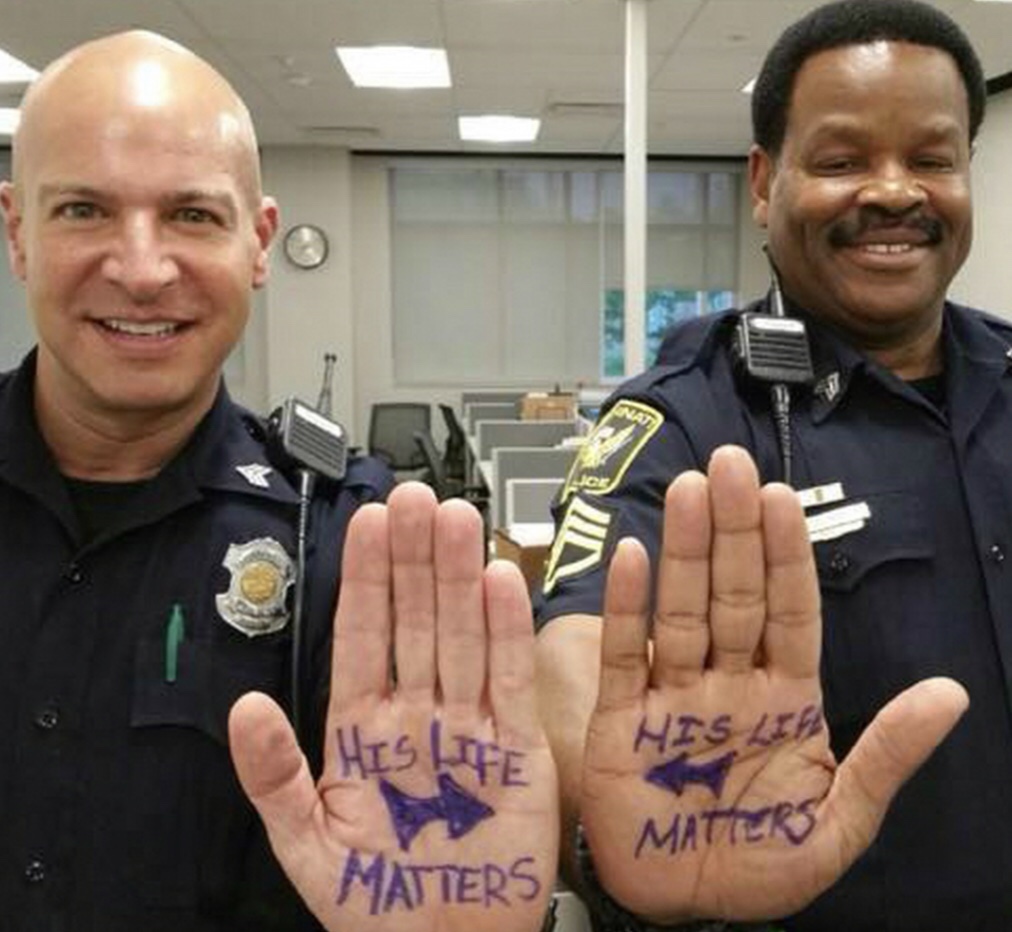
How many white lives is a single black life worth? It seems so easy to pin that down, but if you think it’s okay to say “black lives matter”, but not to say “all lives matter”, the implication is that one black life is worth more than one white life. Anyone who insists on that should take the following litmus test. 

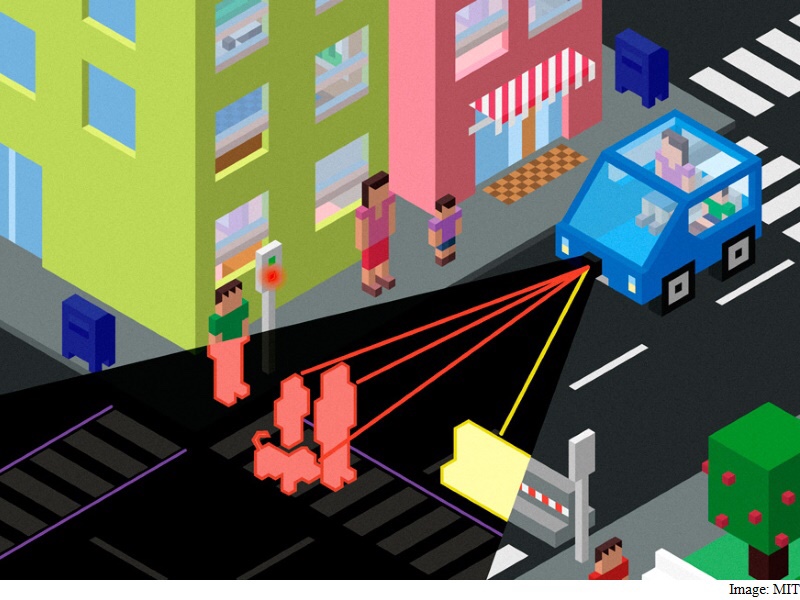
A classic dilemma discussed by ethicists involves situations of mortal danger in which a life or lives might be sacrificed in order to save other lives. Variants of it come up again and again in the effort to tune software for autonomous vehicles. It’s also a simple tool for challenging assertions about the values of different lives, or whether different lives “matter”.

Suppose that two pedestrians step into the path of your vehicle. You can save them only by swerving, killing a single pedestrian standing at the curb. Most would agree the car should swerve, but the answer might change under certain circumstances. Forget about the argument that the two in your path weren’t careful, so they “deserve” die. We just don’t know what caused them to proceed, or what might have distracted them.

What if the two in your path are elderly, using walkers and dragging oxygen tanks, while the pedestrian at the curb is a healthy child. Does that matter? Do we weigh the sacrifice of many potential life-years as well as a higher quality of life? People might feel less certain about that choice.

Now let’s suppose that all three pedestrians are healthy, young adults. Does it matter that any of the pedestrians are black? The one on the the curb, or the two in your path? Of course not! The truly “colorblind” answer is to swerve regardless of race. You are an obvious racist if you think otherwise. The sacrifice of one white life is certainly worth saving two black lives; the sacrifice of one black life is certainly worth saving two white lives. Black lives and white lives matter equally. 

Our Constitution and ethical standards dictate that lives are equal, that we are equal before the law, that we that we have equal rights to speak, worship, and enjoy the fruits of our labors, including the unchallenged right to property we might acquire. Under the law, and in all of our social interactions, we must be accorded equal consideration regardless of extraneous characteristics such as race. All of us have the same promise of life and opportunities to pursue happiness, and to make of our lives what we can or will. However, none of this entitles us to equal happiness, romance, and material well being.

Now, detractors will say all that misses the point. The value of black lives has been discounted for centuries, they say, as evidenced in disparate treatment by police, prosecutors, juries, employers, neighbors, social clubs, and places of business. Of course it’s true that racism has a long history throughout the world, and at one time or other it has been turned against virtually every race or religion in existence. If you think in this day and age that racism doesn’t exist elsewhere, think again.

Slavery was a tragic reality in the U.S. until 155 years ago, but it was certainly not unique to the U.S. Jim Crow laws that prevented blacks from participating equally in many aspects of life were finally ended more than 50 years ago through a series of legislative actions and Supreme Court decisions. Slavery and Jim Crowism were the acts of long-dead ancestors of almost anyone living today. The presumption that all whites should assume guilt for some kind original sin against blacks is sheer nonsense, and one many of us will simply never accept.

Nevertheless, the legacy of degraded personhood under those long-defunct laws created a heavy burden for blacks in terms of upward mobility, and certainly vestiges of racism survive even today. However, we have adopted many standards and programs intended to rectify this unfortunate legacy, including the civil rights legislation of the 1960s and beyond, the Great Society programs of Lyndon Johnson, and many other enlargements of the social safety net since then. These programs have represented a massive redistribution of resources to the impoverished via education, housing, and direct transfers. One estimate put cumulative federal spending on anti-poverty programs alone at $13 trillion between 1963 and 2010. In addition, a variety of programs have been a source of preferential treatment for various minorities in an effort to ensure equal opportunities across many aspects of life.

The success of these programs is subject to great doubt (more on that below), and in fact the motives of Johnson and other proponents of this expansion in the role of government were perhaps less than pure. Nevertheless, the entirety of the package of civil rights and welfare state programs over the years was supported by most of the black community. In fact, one could say that these measures were hardly the actions of a racist society, at least in ostensible intent.

And yet we are told today that we do not sufficiently appreciate that black lives matter! There is no question that racism lives in the hearts and minds of certain individuals, but those individuals aren’t all white. More importantly, the blanket condemnation of whites as racist lacks any basis in reality.

When Black Lives Matter activists talk of “systemic racism”, you can translate as follows: blacks have not met with the ex post economic and social success to which these activists believe blacks are entitled. As it pertains to law enforcement, they mean that blacks are met with more violent police actions than blacks should suffer.

As to law enforcement, it is an awful thing that crime perpetrated by blacks, and particularly crime by blacks against blacks, is disproportionally heavy. As I argued recently, it is difficult to accept the hypothesis of systemic racism in law enforcement in the presence of rampant “systemic crime” in the black community. But crime, in turn, is tied closely to economic success, or the lack thereof.

Median black income has grown relative to median white income since 1970 (also see here). Unfortunately, many blacks have not shared in that growth and remain mired in poverty and on public aid. Sadly, many aid programs have pernicious effects because they impose extremely high marginal tax rates on earned income. The solution lays the groundwork for continued dependency. That qualifies as systemic racism, or at least classism.

Two well-known black economists, Thomas Sowell and Walter Williams, have both decried the welfare state’s destructive impact on the black family unit. That’s one reason why Williams calls white liberals the “worst enemy of black people“. (Also see what Williams has to say about expectations for black students, and about black crime.)

Ultimately, the uproar over racism alleged to be so widespread and “systemic” is divisive. It is an application of Marxist “conflict theory” lying at the very heart of identity politics. Such tribal philosophies creat huge obstacles to peaceful and productive coexistence among diverse peoples. Meanwhile, there’s a simple truth: a widespread consensus exists that all lives are of equal value, that all lives deserve respect and equal treatment under the law, that the goodwill of one’s fellows is a birthright, and that racism is fundamentally evil. If society is to provide fertile ground for the equal cultivation of all lives, it must reject the strictures and resentment bred by identity politics in favor of individual liberty, personal responsibility, and compassion for those unable to care for themselves.

Diversity of Thought Matters

14 Sunday Jun 2020

Posted by Nuetzel in Censorship, Identity Politics, Tyranny

≈ Leave a comment

Tags

ActBlue Charities, Black Lives Matter, Censorship, George Floyd, Identity Politics, Inequality, Joe Biden, Poverty, racism, STEM, Thomas Sowell, UC-Berkeley, Viewpoint Diversity, ZeroHedge

Here’s an extraordinary letter written last week by a UC-Berkeley history professor to his colleagues. I link to a reprint on ZeroHedge because it was easier to read on my phone than the original source. The letter is anonymous, but it’s authenticity has been verified by well-known colleagues of the author outside the UC system, including Thomas Sowell of Stanford. In the first instance, it is a reaction to recent departmental and university communications, but the issues are much broader. The author, a self-described person of color, is embittered by the tyranny of groupthink that has characterized the reaction to George Floyd’s murder, the “soft bigotry of low expectations’ for blacks, and the virtual beatification of a man with a long and brutal rap sheet. The letter is an ominous warning that basic freedoms are at risk, not to mention intellectual integrity. Here are some salient points from the letter:

  • “I could not find a single instance of substantial counter-argument or alternative narrative to explain the under-representation of black individuals in academia or their over-representation in the criminal justice system. The explanation provided in your documentation, to the near exclusion of all others, is univariate: the problems of the black community are caused by whites, or, when whites are not physically present, by the infiltration of white supremacy and white systemic racism into American brains, souls, and institutions.“
  • “The claim that the difficulties that the black community faces are entirely causally explained by exogenous factors in the form of white systemic racism, white supremacy, and other forms of white discrimination remains a problematic hypothesis that should be vigorously challenged by historians. Instead, it is being treated as an axiomatic and actionable truth without serious consideration of its profound flaws, or its worrying implication of total black impotence.“
  • “… consider the proportion of black incarcerated Americans. This proportion is often used to characterize the criminal justice system as anti-black. However, if we use the precise same methodology, we would have to conclude that the criminal justice system is even more anti-male than it is anti-black. … Would we characterize criminal justice as a systemically misandrist conspiracy against innocent American men? I hope you see that this type of reasoning is flawed, and requires a significant suspension of our rational faculties. Black people are not incarcerated at higher rates than their involvement in violent crime would predict. This fact has been demonstrated multiple times across multiple jurisdictions in multiple countries.
  • “I personally don’t dare speak out against the BLM narrative, and with this barrage of alleged unity being mass-produced by the administration, tenured professoriat, the UC administration, corporate America, and the media, the punishment for dissent is a clear danger at a time of widespread economic vulnerability. I am certain that if my name were attached to this email, I would lose my job and all future jobs, even though I believe in and can justify every word I type.“
  • “The vast majority of violence visited on the black community is committed by black people. There are virtually no marches for these invisible victims, no public silences, no heartfelt letters from the UC regents, deans, and departmental heads. The message is clear: Black lives only matter when whites take them. Black violence is expected and insoluble, while white violence requires explanation and demands solution. Please look into your hearts and see how monstrously bigoted this formulation truly is. … No discussion is permitted for nonblack victims of black violence, who proportionally outnumber black victims of nonblack violence.“
  • “… our department appears to have been entirely captured by the interests of the Democratic National Convention, and the Democratic Party more broadly. To explain what I mean, consider what happens if you choose to donate to Black Lives Matter, an organization UCB History has explicitly promoted in its recent mailers. All donations to the official BLM website are immediately redirected to ActBlue Charities, an organization primarily concerned with bankrolling election campaigns for Democrat candidates. Donating to BLM today is to indirectly donate to Joe Biden’s 2020 campaign.“
  • … our university and department has made multiple statements celebrating and eulogizing George Floyd. Floyd was a multiple felon who once held a pregnant black woman at gunpoint. He broke into her home with a gang of men and pointed a gun at her pregnant stomach. He terrorized the women in his community. He sired and abandoned multiple children, playing no part in their support or upbringing, failing one of the most basic tests of decency for a human being. He was a drug-addict and sometime drug-dealer, a swindler who preyed upon his honest and hard-working neighbors. … And yet, the regents of UC and the historians of the UCB History department are celebrating this violent criminal, elevating his name to virtual sainthood. A man who hurt women. A man who hurt black women. With the full collaboration of the UCB history department, corporate America, most mainstream media outlets, and some of the wealthiest and most privileged opinion-shaping elites of the USA, he has become a culture hero, buried in a golden casket, his (recognized) family showered with gifts and praise. Americans are being socially pressured into kneeling for this violent, abusive misogynist. A generation of black men are being coerced into identifying with George Floyd, the absolute worst specimen of our race and species.”
  • “My family have been personally victimized by men like Floyd. We are aware of the condescending depredations of the Democrat party against our race. The humiliating assumption that we are too stupid to do STEM, that we need special help and lower requirements to get ahead in life, is richly familiar to us. … The ever-present soft bigotry of low expectations and the permanent claim that the solutions to the plight of my people rest exclusively on the goodwill of whites rather than on our own hard work is psychologically devastating. No other group in America is systematically demoralized in this way by its alleged allies. A whole generation of black children are being taught that only by begging and weeping and screaming will they get handouts from guilt-ridden whites.“

There is much more in the letter. Some will dismiss the letter based on the author’s decision to remain anonymous, but one can hardly find fault with that in today’s suffocating intellectual environment. There are many others who remain silent because they either fear the consequences, distain the questions, or wish to be polite. My only other reservation about the letter is the author’s failure to acknowledge George Floyd’s efforts to reform, which were obviously in vain. Those efforts and his murder should not elevate Floyd to an heroic status. Nevertheless, his victimhood qualifies him as a legitimate symbol of police brutality, if not racism.

While much of academia has been swallowed whole by vapid identitarianism and scientism over science and rational thought, the history professor has managed to survive in what might be the hottest bed of leftist extremism in the country at UC-Berkeley. I hope the professor has a long and influential career.

Rioters Inflict Racial Injustice

02 Tuesday Jun 2020

Posted by Nuetzel in Free Speech, racism, Terrorism

≈ Leave a comment

Tags

Antifa, Black Lives Matter, Coronavirus, Covid-19, Criminal Justice Reform, Derrick Chauvin, Donald Trump, Equity Markets, George Floyd, Glenn Reynolds, Jane Coaston, National Guard, Police Unions, Qualified Immunity, racism, War on Drugs, Will Collier, Willie Delwiche

My fervent hope is that the reaction of horror to George Floyd’s murder is universal. However, my perspective on the violence that’s erupted over the week since is also one of disgust. The perpetrators are using Floyd’s death as an opportunity to unleash attacks that undermine civil society and often hurt people of color more than anyone.

The peaceful protests against police brutality and racism in cities across the country are earnest calls for reform, and they also represent fine tributes to all victims of racism. But a different dynamic takes hold when peaceful protesters are infiltrated by violent elements. Agitators use the cover of the protests and typically begin to dominate the scene as darkness falls, though sometimes it happens in broad daylight. The violence, arson, looting, and shooting are perpetrated by a combination of those whose political motivations go well beyond needed reforms to the justice system and other opportunists who are primarily interested in loot, or just a riotous a good time. There are also some otherwise non-violent protesters emboldened by the agitators to cheer on these acts of violence.

As others have said, the rioting does not serve to honor George Floyd in any way, and it does nothing to end racism or racial victimization. By cheering on these malefactors you lose any legitimate claim as an enemy of racism. The rioting, if anything, brings harm to the black community. Black lives are lost in the strife, such as the retired police captain in St. Louis who was shot Monday night defending his friend’s pawn shop. Blacks are also losing their livelihoods as a consequence of the destruction.

The left-wing, anarchist agitators are modern blackshirts masquerading as anti-fascists. Their interest, and delusion, is the violent overthrow of our government. They are largely white millennials, mostly male, and largely unemployed as a result of the ill-advised coronavirus lockdowns imposed in many states. Antifa has been prominent in these attacks, often running under Black Lives Matter flags, and the radical wing of BLM participates as well.

These pigs have been coddled by leftist state and local government officials in many cities, who send outmanned police forces to try to keep the damage in check while releasing those arrested the next day. President Trump was absolutely right on Monday to call out the national guard and raise the possibility of deploying military forces where state and local officials are incapable or unwilling to bring these situations under control.

And here’s the thing: all it takes is a few agitators, along with their enthusiastic but less ideological recruits, to destroy communities. There have been larger numbers in big cities, perhaps a few thousand hard-core shit disturbers. Slowly but surely, perhaps due to Trump’s prodding, state and local politicians are awakening and enabling law enforcement to effectively quell the unrest. The agitators, who are fairly well organized, are being infiltrated by moles who will undermine their operations and perhaps aid in prosecuting higher-level organizers and funders at the federal level. In the end, the force of anarchists is fairly small and the local support they manage to stir is fleeting.

While we recoil at the harm inflicted by the riots, another perspective is offered by the equity markets, which have been relatively unfazed through the turmoil. The values of firms in the security business have risen, but otherwise, as one investment strategist says:

“‘Right now it’s limited enough that it’s not perceived as having a meaningful economic impact,’ said Willie Delwiche, investment strategist at Baird. ‘The risk to the market right now is excessive optimism,’ and headlines from protests could simply be dampening that optimism a bit, he added.”

The riots are destructive of lives and economic value, and while we mourn those caught up in these tragedies, the situation does not portend a total social collapse. The overall impact on the U.S. economy expected by markets is not of a magnitude suggesting great instability. This too shall pass, though not easily for the small businesses and employees being ruined by the double jolt of lockdowns and riots.

Besides the outright harm to the black community by the riots, there are other disturbing elements that must be confronted. I keep hearing “White silence = violence”. No, “white silence” is neither responsible for the actions of George Floyd’s killer nor the riots in the streets. What must one say to avoid personal responsibility for the aberrant behavior of Derrick Chauvin and the rioters? What I hear are ignorant excuses and accusations: the violence is inexcusable and it is no one’s fault but the participants, whatever their circumstances.

People of good faith oppose the brutality inflicted by bad cops and a system that tolerates them. It is surely time for some reforms, as the following suggests:

And there are still other promising criminal justice reforms to consider. We need to end the drug war, which is particularly harmful to minority communities.

I bemoan the poor circumstances and education that have burdened many of the disaffected protesters, and even the rioters. I advocate for policies that I believe promote improved education and family stability. I have advocated for a safety net. I have shared my distaste for the unnecessary COVID-19 lockdowns that forced so many of these individuals out of their jobs for several months. But from some quarters, the demands have no end. Not until I bow down on my hands and knees to apologize for the sins of generations past. Who cares if they weren’t my ancestors? I’m white! The next demand is reparation payments to today’s generations of blacks. Don’t complain that impoverished whites won’t share in the gains, though there are more than twice as many of them. They simply failed to capitalize on the opportunity afforded by their privilege. I’m sorry for the sarcasm….

Please mourn George Floyd’s horrible death and support the protests against the brutality that killed him, but do not pretend for a moment that the violence is in any way justified, or that it will create a healthier society. Don’t root for that shit. And don’t cast aspirations at your fellow men and women as if the color of their skin is responsible for the social ills you’ve taken up as a cause. It does nothing to further solutions.

← Older posts
Follow Sacred Cow Chips on WordPress.com

Recent Posts

  • Immigration and Merit As Fiscal Propositions
  • Tariff “Dividend” From An Indigent State
  • Almost Looks Like the Fed Has a 3% Inflation Target
  • Government Malpractice Breeds Health Care Havoc
  • A Tax On Imports Takes a Toll on Exports

Archives

  • December 2025
  • November 2025
  • October 2025
  • September 2025
  • August 2025
  • July 2025
  • June 2025
  • May 2025
  • April 2025
  • March 2025
  • February 2025
  • January 2025
  • December 2024
  • November 2024
  • October 2024
  • September 2024
  • August 2024
  • July 2024
  • June 2024
  • May 2024
  • April 2024
  • March 2024
  • February 2024
  • January 2024
  • December 2023
  • November 2023
  • August 2023
  • July 2023
  • June 2023
  • May 2023
  • April 2023
  • March 2023
  • February 2023
  • January 2023
  • December 2022
  • November 2022
  • October 2022
  • September 2022
  • August 2022
  • July 2022
  • June 2022
  • May 2022
  • April 2022
  • March 2022
  • February 2022
  • January 2022
  • December 2021
  • November 2021
  • October 2021
  • September 2021
  • August 2021
  • July 2021
  • June 2021
  • May 2021
  • April 2021
  • March 2021
  • February 2021
  • January 2021
  • December 2020
  • November 2020
  • October 2020
  • September 2020
  • August 2020
  • July 2020
  • June 2020
  • May 2020
  • April 2020
  • March 2020
  • February 2020
  • January 2020
  • December 2019
  • November 2019
  • October 2019
  • September 2019
  • August 2019
  • July 2019
  • June 2019
  • May 2019
  • April 2019
  • March 2019
  • February 2019
  • January 2019
  • December 2018
  • November 2018
  • October 2018
  • September 2018
  • August 2018
  • July 2018
  • June 2018
  • May 2018
  • April 2018
  • March 2018
  • February 2018
  • January 2018
  • December 2017
  • November 2017
  • October 2017
  • September 2017
  • August 2017
  • July 2017
  • June 2017
  • May 2017
  • April 2017
  • March 2017
  • February 2017
  • January 2017
  • December 2016
  • November 2016
  • October 2016
  • September 2016
  • August 2016
  • July 2016
  • June 2016
  • May 2016
  • April 2016
  • March 2016
  • February 2016
  • January 2016
  • December 2015
  • November 2015
  • October 2015
  • September 2015
  • August 2015
  • July 2015
  • June 2015
  • May 2015
  • April 2015
  • March 2015
  • February 2015
  • January 2015
  • December 2014
  • November 2014
  • October 2014
  • September 2014
  • August 2014
  • July 2014
  • June 2014
  • May 2014
  • April 2014
  • March 2014

Blogs I Follow

  • Passive Income Kickstart
  • OnlyFinance.net
  • TLC Cholesterol
  • Nintil
  • kendunning.net
  • DCWhispers.com
  • Hoong-Wai in the UK
  • Marginal REVOLUTION
  • Stlouis
  • Watts Up With That?
  • Aussie Nationalist Blog
  • American Elephants
  • The View from Alexandria
  • The Gymnasium
  • A Force for Good
  • Notes On Liberty
  • troymo
  • SUNDAY BLOG Stephanie Sievers
  • Miss Lou Acquiring Lore
  • Your Well Wisher Program
  • Objectivism In Depth
  • RobotEnomics
  • Orderstatistic
  • Paradigm Library
  • Scattered Showers and Quicksand

Blog at WordPress.com.

Passive Income Kickstart

OnlyFinance.net

TLC Cholesterol

Nintil

To estimate, compare, distinguish, discuss, and trace to its principal sources everything

kendunning.net

The Future is Ours to Create

DCWhispers.com

Hoong-Wai in the UK

A Commonwealth immigrant's perspective on the UK's public arena.

Marginal REVOLUTION

Small Steps Toward A Much Better World

Stlouis

Watts Up With That?

The world's most viewed site on global warming and climate change

Aussie Nationalist Blog

Commentary from a Paleoconservative and Nationalist perspective

American Elephants

Defending Life, Liberty and the Pursuit of Happiness

The View from Alexandria

In advanced civilizations the period loosely called Alexandrian is usually associated with flexible morals, perfunctory religion, populist standards and cosmopolitan tastes, feminism, exotic cults, and the rapid turnover of high and low fads---in short, a falling away (which is all that decadence means) from the strictness of traditional rules, embodied in character and inforced from within. -- Jacques Barzun

The Gymnasium

A place for reason, politics, economics, and faith steeped in the classical liberal tradition

A Force for Good

How economics, morality, and markets combine

Notes On Liberty

Spontaneous thoughts on a humble creed

troymo

SUNDAY BLOG Stephanie Sievers

Escaping the everyday life with photographs from my travels

Miss Lou Acquiring Lore

Gallery of Life...

Your Well Wisher Program

Attempt to solve commonly known problems…

Objectivism In Depth

Exploring Ayn Rand's revolutionary philosophy.

RobotEnomics

(A)n (I)ntelligent Future

Orderstatistic

Economics, chess and anything else on my mind.

Paradigm Library

OODA Looping

Scattered Showers and Quicksand

Musings on science, investing, finance, economics, politics, and probably fly fishing.

  • Subscribe Subscribed
    • Sacred Cow Chips
    • Join 128 other subscribers
    • Already have a WordPress.com account? Log in now.
    • Sacred Cow Chips
    • Subscribe Subscribed
    • Sign up
    • Log in
    • Report this content
    • View site in Reader
    • Manage subscriptions
    • Collapse this bar
 

Loading Comments...