• About

Sacred Cow Chips

Sacred Cow Chips

Tag Archives: Redistribution

Suspending the Economic Problem With Free Stuff

27 Saturday Aug 2016

Posted by Nuetzel in Central Planning, Socialism, Subsidies

≈ Leave a comment

Tags

Bernie Sanders, central planning, Confiscation, Contrived Scarcity, Don Boudreaux, Free Stuff, Hillary Clinton, incentives, Jeffrey Tucker, Nonprice Rationing, Overuse of Resources, Property Rights, Redistribution, Scarcity Deniers, Socialism

denial

When things are scarce, they can’t be free. That’s an iron law of economics. It’s true of everything we ever wish for and almost everything we take for granted. Things are naturally scarce, but when we are told that things can be free, it always comes from likes of whom Jeffrey Tucker calls “scarcity deniers”. Bernie Sanders and Hillary Clinton have told America that a college education should be free, and a large number of people take that seriously. They are scarcity deniers. On one level, the Sanders/Clinton claim is like any other promise that simply cannot be met at the stated cost — a rather garden-variety phenomenon among politicians. These promises are not harmless, as such initiatives usually involve budget overruns, compromised markets, underproduction and wasted resources.

The Sanders/Clinton claim, however, is a form of scarcity-denial that comes almost exclusively from the political left. That is really the point of Tucker’s article:

“This claim seems to confirm everything I’ve ever suspected about socialism. It’s rooted in a very simple error, one so fundamental that it denies a fundamental feature of the world. It denies the existence and the persistence of scarcity itself. That is to say, it denies that producing and allocating is even a problem. If you deny that, it’s hardly surprising that you have no regard for economics as a discipline of the social sciences.“

Our socialist friends (who otherwise claim to be defenders of science) contend that free things can be offered to a broad swath of the population with little consequence. The least cynical among them (perhaps including Sanders) believe that the costs can be shouldered by the wealthy and/or big corporations and banks. Others (including Clinton) know that the cost of “free things” must be met by higher taxes on a broader share of the population. Doesn’t that mean they recognize scarcity? Only superficially, because they fail to grasp the dynamics of resource allocation, the subtle forms in which costs are imposed, and the true magnitude of those costs.

If a thing is scarce, available supplies must be balanced against demand. The reward to suppliers at the margin must match the willingness of buyers to pay. That means there is no surplus and waste, nor any loss attendant to shortage and non-price rationing. The price creates an incentive for consumers to conserve and an incentive for producers to bring additional supplies to market when they are demanded.

A crucial prerequisite for this to work is the establishment of secure property rights. Then, absent coercion, one can’t overuse what isn’t theirs. One can’t simply take a thing from those who create it without a mutually agreeable payment. Creators cannot be forced to respond on demand without compensation. No one can be required to husband resources for others to simply take. No one can be asked to pay for a thing that will be commandeered by others. The establishment of property rights serves these purposes. Incentives become meaningful because they can be internalized by all actors — those consuming and those producing. And the incentives solve the problem of scarcity by balancing the availability of things with needs and desires, and balance them against all other competing uses of resources. Then, the market-clearing price of a thing reflects its degree of scarcity relative to other goods.

The socialist bluster holds that all this is nonsense. Would-be central planners propose that more of a thing be produced because they deem it to be of high value. Furthermore, it must be made available to buyers at a price the planners deem acceptable, or quite possibly for free to their intended constituency! Property rights are violated here in several ways: first, the owner/producer’s authority over their own resources is declared void; second, the owner has no incentive to care for their resources in a responsible and sustainable way; third, a confiscation of resources from others is required to pay at least some of the costs; fourth, the beneficiaries overuse and degrade the resource.

We know a scarce thing cannot be provided for free. Here are some consequences of trying:

  • Overuse of resources. When the buffet is free, the food disappears.
  • The “free thing” will be over-allocated to those who benefit and value it the least. (Example: the education of students for whom there are better alternatives.)
  • Supplies will evaporate unless producers are fully compensated. Otherwise, quality and quantity will deteriorate. This is a form of “contrived scarcity” (HT: Don Boudreaux).
  • If supplies dwindle, new forms of rationing will be necessary. This might involve time-consuming queues, arbitrary allocations, bribes, side payments and favoritism.
  • If suppliers are compensated, someone must pay. That means taxes, public borrowing or money printing.
  • Taxes weaken productive incentives and chase resources away. The consequent deterioration in productive capacity undermines the original goal of providing  something “for free” and inflicts costs on the outcomes of all other markets. This creates more contrived scarcity.
  • So-called progressive taxes tend to hit the most productive classes with the greatest negative force.
  • Government borrowing to fund “free stuff” today inflicts costs on future taxpayers. More fundamentally, it misallocates resources toward the present and away from the future.
  • Printing money to pay for a “free thing” might well cause a general rise in prices. This is a classic, hidden inflation tax, and it may involve the distortion of interest rates, leading to an inter-temporal misallocation of resources.

Scarcity denial is a carrot, but it inevitably becomes a stick. To voters, and to naive shoppers in the marketplace of ideas, the indignant assertion that things can and should be free is powerful rhetoric. Producers, too, might happily accept “free-stuff” policies if they expect to be fully compensated by the government, and they might be pleased to have the opportunity to serve more customers if they think they can do so profitably. However, serving all takers of “free stuff” will escalate costs and is likely to compromise quality. It is also likely to create unpleasant circumstances for customers, such as long waiting times and unfulfilled orders. The stick, on the other hand, will be brandished by the state, blaming and penalizing suppliers for their failure to meet expectations that were unrealistic from the start. The fault for contrived conditions of scarcity lies with the policy itself, not with producers, except to the extent that they allowed themselves to be duped by scarcity deniers. Tucker notes the following:

“Things can be allocated by arbitrary decision backed by force, or they can be allocated through agreement, trading, and gifting. The forceful way is what socialism has always become.“

Politicians and would-be planners with the arrogance to claim that naturally scarce things should be free are dangerous to your welfare. These scarcity deniers cannot provide for human needs more effectively than the free market, and ultimately their efforts will make you subservient and poor.

Pawning Growth For Redistribution

15 Monday Feb 2016

Posted by Nuetzel in Equality, Redistribution

≈ Leave a comment

Tags

Alan D. Viard, American Enterprise Institute, Angela Ranchidi, Bernie Sanders, Chelsea German, Dan Mitchell, Double Taxation, Economic Mobility, Fallacy of Redistribution, First Theorem of Government, Gallup, Household structure, Income Growth, John Cochrane, Minimum Wage, Poverty, Progressive Taxes, Redistribution, Third Way, Thomas Sowell, Welfare State

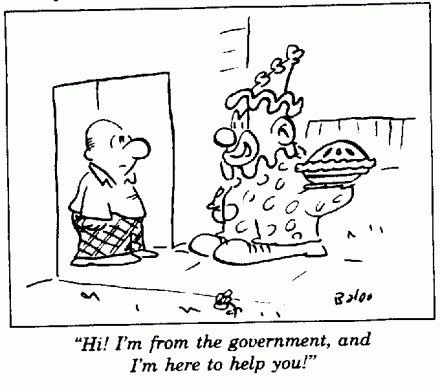
govt here to help

The following is no mystery: if you want prosperity, steer clear of policies that inhibit production and physical investment. This too: if you want to lift people out of poverty and dependency, don’t promote policies that discourage hiring and work incentives. Yet those are exactly the implications of policies repeatedly advocated by so-called redistributionists. The ignorance flows, in large part, from a distraction, a mere byproduct of economic life that has no direct relation to economic welfare, but upon which followers of Bernie Sanders are absolutely transfixed: income and wealth inequality. Attempts to manipulate the degree of inequality via steeply progressive taxes, transfers and market intervention is a suckers game of short-termism. It ultimately reduces the value of the economy’s capital stock, chases away productive activity, destroys jobs, and leaves us all poorer.

Absolute income growth is a better goal, and encouraging production is the best way to raise incomes in the long-run. Unless envy is your thing, income inequality is largely irrelevant as a policy goal. In “Why and How We Care About Inequality“, John Cochrane emphasizes that inequality may be a symptom of other problems, or perhaps no problem at all. His point is that treating a symptom won’t fix the underlying problem:

“A segment of America is stuck in widespread single motherhood … terrible early-child experiences, awful education, substance abuse, and criminality. 70% of male black high school dropouts will end up in prison, hence essentially unemployable and poor marriage prospects. Less than half are even looking for legal work.

This is a social and economic disaster. And it has nothing to do with whether hedge fund managers fly private or commercial. It is immune to floods of Government cash, and, as Casey Mulligan reminded us, Government programs are arguably as much of the problem as the solution. So are drug laws….“

The writers of the center-left Third Way blog give some details on income growth that might disappoint some progressives. They agree that the emphasis on redistribution is misplaced. Solving economic problems requires a different approach:

“From 1980 to 2010, income gains (after taxes and government transfers are included) favored the wealthy but were still spread across all income brackets: a 53% increase for the bottom quintile; a 41% increase for the next two; a 49% increase for the 4th; and a 90% increase for the richest fifth. Thus, while income inequality may offend our sense of justice, its actual impact on the middle class may be small.

With a singular focus on income inequality, the left’s main solutions are greater re-distribution and a re-writing of the rules to ‘un-rig’ the system. But, however well motivated, some of the biggest ideas into which they are directing their energy do not remotely address the underlying ‘Kodak’ conundrum—how do Americans find their place in a rapidly changing world? In fact, some would actually make the task of increasing shared prosperity significantly harder.“

The hubbub over inequality and redistribution is fueled by misconceptions. One is that the rich face low tax burdens, often lower than the middle class, a mistaken notion that Alan D. Viard debunks using 2013 data from a report from the Congressional Budget Office. The CBO report accounts for double taxation of dividends and capital gains at the corporate level and at the personal level (though capital gains are taxed to individuals now, while the anticipated corporate income is taxed later). The CBO study also accounts for employers’ share of payroll taxes (because it reduces labor income) so as to avoid exaggerating the tax system’s progressivity. Before accounting for federal benefits, which offset the tax burden, the middle 20% of income earners paid an average tax rate of less than 15%, while “the 1%” paid more than 29%. However, after correcting for federal benefits, the middle quintile paid a negative average tax rate, while the top 1% still paid almost 29%. That is a steeply graduated impact.

Rising income inequality in the U.S. is more a matter of changes in household structure than in the distribution of rewards. This conclusion is based on the fact that income inequality has risen steadily over the past 50 years for households, but there has been no change in inequality across individuals. An increasing number of single-person households, primarily women over the age of 65, accounts for rising inequality at the household level. The greedy corporate CEOs of the “occupier” imagination are really not to blame for this trend, though I won’t defend corporate rent-seeking activities intended to insulate themselves from competition.

Measures of income inequality hide another important fact: one’s position in the income distribution is not static. Chelsea German notes that Americans have a high degree of economic mobility. According to a Cornell study, only 6% of individuals in the top 1% in a given year remain there in the following year. German adds that over half of income earners in the U.S. find themselves in the top 10% for at least one year of their working lives.

There are several reasons why redistributionist policies fail to meet objectives and instead reduce opportunities for the presumed beneficiaries to prosper. Dan Mitchell covers several of these issues, citing work on: the rational response of upper-income taxpayers to  punitive taxes; the insufficiency of funding an expanded welfare state by merely taxing “the rich”; the diversion of most anti-poverty funds to service providers (rather than directly to the poor); the meager valuation of benefits from recipients of Medicaid, and the fact that the program lacks any favorable impact on mortality and health measures. Mitchell features the “First Theorem of Government” in a sidebar:

“Above all else, the public sector is a racket for the enrichment of insiders, cronies, bureaucrats and interest groups.“

A few years back, the great Thomas Sowell explained “The Fallacy of Redistribution” thusly:

“You can only confiscate the wealth that exists at a given moment. You cannot confiscate future wealth — and that future wealth is less likely to be produced when people see that it is going to be confiscated.“

That future wealth can and should be enjoyed across the income spectrum, but punitive taxes destroy productive capital and jobs.

A great truth about poverty comes from Angela Ranchidi of the American Enterprise Institute: low wages are not at the root of poverty; it’s a lack of jobs. She quotes a Gallup report on this point, relative to the working-age poor in 2014:

“Census data show that, 61.7% did not work at all and another 26.6% worked less than full-time for the entire year. Only 11.7% of poor working-age adults worked full-time for the entire year in 2014. Low wages are not the primary cause of poverty; low work rates are. And if Gallup is correct, the full-time work rate may already be peaking.“

More than 88.3% of the working-age poor were either unemployed or underemployed! And here’s the kicker: redistributionists clamor for policies that would place an even higher floor on wage rates, yet the floor already in place has succeeded in compromising the ability of low-skilled workers to find full-time work.

Cochrane sums up the inequality debate by noting the obvious political motives of progressive redistributionists:

“Finally, why is “inequality” so strongly on the political agenda right now? Here I am not referring to academics. … All of economics has been studying various poverty traps for a generation…. 

[The] answer seems pretty clear. Because [the politicians and pundits] don’t want to talk about Obamacare, Dodd-Frank, bailouts, debt, the stimulus, the rotten cronyism of energy policy, denial of education to poor and minorities, the abject failure of their policies to help poor and middle class people, and especially sclerotic growth. Restarting a centuries-old fight about “inequality” and “tax the rich,” class envy resurrected from a Huey Long speech in the 1930s, is like throwing a puppy into a third grade math class that isn’t going well. You know you will make it to the bell.

That observation, together with the obvious incoherence of ideas the political inequality writers bring us leads me to a happy thought that this too will pass, and once a new set of talking points emerges we can go on to something else.“

Egalitarian Aggression

15 Thursday Oct 2015

Posted by Nuetzel in Big Government, Equality, Liberty

≈ Leave a comment

Tags

Comparative advantage, Dylan Matthews, Egalitarianism, Equality of Opportunity, Inequality, Integrity of the Family, John Rawls, Llewellyn Rockwell Jr., Mises Institute, Redistribution, Robert Nisbet, The Mises Daily, Vox, Wilt Chamberlain Problem

communism Lady liberty in rear view mirror

In what sense is “equality” a rational objective? Can it ever be achieved without aggression? It’s certainly admirable for individuals to treat all others fairly and without bias against personal traits. A society composed of individuals possessing that kind of integrity is one in which “equal opportunity” exists in an intuitive sense. Such a society would yield market outcomes that are free from personal discrimination.

There are many social pitfalls when central authorities attempt to enforce this sort of equality. There will always be minor and even random cases of treatment that someone considers unfair. Any effort to adjudicate such incidents comes at a great resource cost. The potential for moral hazard in pursuing grievances is also strong, and the enforcement authority may well have biases of its own.

Stronger forms of equality are even more difficult to achieve in a free society. There are many barriers to “equality” that most people would regard as natural, like genetics and the integrity of the family. And like family, many other barriers to equality are cultural virtues, such as educational and occupational rewards based on merit. The institution of strong private property rights provides an effective system of incentives that fosters efficient resource allocation, promoting economic growth and human well-being, but it’s rewards will not be distributed equally.

Institutionalized tampering with any of these features for the sake of equality tends to legitimize envy as a cause of social action. And the intrusions require design and enforcement of a system of social “overrides” by a central authority possessing police power. Needless to say, this must involve elements of aggression and tyranny. These overrides introduce significant risks to individual freedom and the functioning of markets, and are likely to cause widespread destruction of welfare. In that sense, forced equality cannot be a rational objective.

These points are developed more fully in “The Menace of Egalitarianism“, a piece by Llewellyn Rockwell Jr. at the Mises Daily blog.

“A libertarian is perfectly at peace with the universal phenomenon of human difference. He does not wish it away, he does not shake his fist at it, he does not pretend not to notice it. It affords him another opportunity to marvel at a miracle of the market: its ability to incorporate just about anyone into the division of labor. … Indeed the division of labor is based on human difference.“

Rockwell goes on to explain the law of comparative advantage, which allows more productive and less productive individuals to profit by specializing in areas for which each has the lowest opportunity cost. And when producers compete for rewards, as Rockwell notes, average consumers (and rich ones and poor ones) are the ultimate beneficiaries.

Outcomes such as the inequality of wealth and income are not only impossible to avoid, they are natural consequences of economic freedom. Several earlier posts on Sacred Cow Chips have dealt with this topic, and can be viewed from the Home page by typing “inequality” into the search box near the top. For his part, Rockwell discusses the “Wilt Chamberlain” problem, whereby private demand to witness great athletic prowess results in a shift towards an unequal distribution of income:

“… the pattern of wealth distribution is disturbed as soon as anyone engages in any exchange at all. Are we to cancel the results of all these exchanges and return everyone’s money to the original owners? Is Chamberlain to be deprived of the money people freely chose to gave [sic] him in exchange for the entertainment he provided?“

The fact that “equality” is seldom well-defined as an actual objective should be met with skepticism. Here’s more Rockwell:

“It is precisely this lack of clarity that makes the idea of equality so advantageous for the state. No one is entirely sure what the principle of equality commits him to. And keeping up with its ever-changing demands is more difficult still. … Equality is a concept that cannot and will not be kept restrained or nailed down.”  

He takes a dismal view of “cultural inequality” and “equality of opportunity” as worthwhile causes for invoking the power of the state. For example, two families in different economic circumstances will generally confer different opportunities to their children. Dylan Matthews at Vox makes the same point in “Equality of Opportunity“, though Matthews’ analysis is weak in several respects. The point here is that there is only so much that can be done to correct for unequal family-related endowments without undermining the integrity of the family (not to mention property rights). This has long been a bone of contention with respect to the design of U.S. welfare programs. But the problem is much deeper:

“In the course of working toward equality, the state expands its power at the expense of other forms of human association, including the family itself. The family has always been the primary obstacle to the egalitarian program. The very fact that parents differ in their knowledge, skill levels, and devotion to their offspring means that children in no two households can ever be raised ‘equally.’

Robert Nisbet, the Columbia University sociologist, openly wondered if [John] Rawls would be honest enough to admit that his system, if followed to its logical conclusion, had to lead to the abolition of the family. ‘I have always found treatment of the family to be an excellent indicator of the degree of zeal and authoritarianism, overt or latent, in a moral philosopher or political theorist,’ Nisbet said.“

And here is Rawls himself expressing doubts, as quoted by Rockwell:

“It seems that when fair opportunity (as it has been defined) is satisfied, the family will lead to unequal chances between individuals. Is the family to be abolished then? Taken by itself and given a certain primacy, the idea of equal opportunity inclines in this direction.“

The quest for “equality” is a creeping force. It infects economic life in a way that makes widespread gains in welfare difficult to achieve, diminishes expectations and fosters social devolution. It also leads to demands for eliminating useful distinctions, which can only be erased though aggression by the state. This forces a convergence toward the least common denominator throughout the culture. I believe the following statement by Rockwell rings true:

“The obsession with equality… undermines every indicator of health we might look for in a civilization. It involves a madness so complete that although it flirts with the destruction of the family…. It leads to the destruction of standards — scholarly, cultural, and behavioral. It is based on assertion rather than evidence, and it attempts to gain ground not through rational argument but by intimidating opponents into silence. There is nothing honorable or admirable about any aspect of the egalitarian program.“

Public Monopolists Say “Don’t Be Choosy”

12 Sunday Jul 2015

Posted by Nuetzel in Markets, School Choice

≈ 3 Comments

Tags

Cafe Hayek, Don Boudreaux, K-12 education, monopoly, Politicized interests, Private education, Public education, Redistribution, Restraint of Trade, School Choice

choice better schools

Imagine a food distribution system that mirrored the organization of K-12 education in the U.S. How do you think it would work out? That thought exercise was conducted four years ago by Don Boudreaux in his Wall Street Journal op-ed: “If Supermarkets Were Like Public Schools”(gated). Boudreaux has helpfully reblogged this op-ed at Cafe Hayek as part of his post “Separate School From State“. Read the whole thing! Because this is a topic in economics and I am so very pedantic, I prefer not to use the term “market” at all in this context. After all, a public “supermarket”, as discussed by Boudreaux, is no more a market than a public school is a market. I will use the term “public grocery store” instead, except when quoting Boudreaux.

The comparison of grocery stores to schools involves outputs that are both considered essential. In fact, there should be no argument that food is the more essential of the two. Yet the essential nature of educating children in a modern society is thought to be an important rationale for the existence of a public school system. Would supporters of public education care to apply the argument that “market forces can’t supply quality education” to another essential product, like food?

Boudreaux invokes several features of K-12 education in “designing” his hypothetical food distribution system:

  • “Residents of each county would pay taxes on their properties.“
  • “Each family would be assigned to a particular supermarket according to its home address. And each family would get its weekly allotment of groceries—’for free’—from its neighborhood public supermarket.“
  • “No family would be permitted to get groceries from a public supermarket outside of its district.“
  • “... families would be free to shop at private supermarkets that charge directly for the groceries they offer. Private-supermarket families, however, would receive no reductions in their property taxes.“

Economic theory predicts that the monopoly status held by public grocery stores over the provision of “free food” within their districts would cause the quality and variety offered at those stores to suffer. This is just a form of restraining trade, which is what monopolists do. The classic monopolist charges a higher price and produces less output. Exactly the same is predicted in Boudreaux’s experiment.

One difference in comparing food stores to schools is that families, presumably, could purchase some of their groceries from private stores and meet the rest of their food needs from their district grocery store at no marginal cost, whereas the school selection is all public or all private. However, this does not invalidate Boudreaux’s assertion that the quality offered by the monopoly provider will suffer.

Like public schools, there would be massive variations in quality across public grocery stores due to variation in the tax base from one district to another. This would tend to reinforce differences in the value of property across districts, because it is so desirable to live in a district with a good public grocery.

Here’s an extended excerpt from Boudreaux:

“Being largely protected from consumer choice, almost all public supermarkets would be worse than private ones. In poor counties the quality of public supermarkets would be downright abysmal. ….

Responding to these failures, thoughtful souls would call for ‘supermarket choice’ fueled by vouchers or tax credits. Those calls would be vigorously opposed by public-supermarket administrators and workers.

Opponents of supermarket choice would accuse its proponents of demonizing supermarket workers (who, after all, have no control over their customers’ poor eating habits at home). Advocates of choice would also be accused of trying to deny ordinary families the food needed for survival. Such choice, it would be alleged, would drain precious resources from public supermarkets whose poor performance testifies to their overwhelming need for more public funds.

As for the handful of radicals who call for total separation of supermarket and state—well, they would be criticized by almost everyone as antisocial devils indifferent to the starvation that would haunt the land if the provision of groceries were governed exclusively by private market forces.

In the face of calls for supermarket choice, supermarket-workers unions would use their significant resources for lobbying—in favor of public-supermarkets’ monopoly power and against any suggestion that market forces are appropriate for delivering something as essential as groceries.“

That sounds all too familiar. Even with massive state redistribution of public grocery store funding from wealthy to poor districts, the result would be much the same, as it is with public schools. Increased grocery store funding cannot correct the larger problems plaguing the community, many of which are created by the welfare state itself. And increased funding does not correct fundamental dislocations created by a monopoly, especially a public monopoly. The entrenched, politicized interests that infest public institutions always resist changes that might improve quality. They are typified by bloated administrative machinery and a general lack of responsiveness to the community. Only competition and choice can eliminate these tendencies and drive improvement.

An objection that might be raised to Boudreaux’s comparison is that public schools must accommodate a student population with wide variations in learning ability. It may be claimed that this variation strains the resources of public relative to private schools. However, that burden is due in large part to the structure of the education system. A benefit of competition and choice is the extent to which it can accommodate diverse needs, and there is no reason why education should prove to be an exception. In fact, diverse needs are already met very well by private education, but they serve only “private school families.” Empowering all families to choose the schools that best accommodate their needs would bring higher quality to our K-12 education system.

The Government Inequality Machine

17 Wednesday Jun 2015

Posted by Nuetzel in Big Government

≈ Leave a comment

Tags

Beautiful Anarchy, Cronyism, Export-Import Bank, Housing Policy, Inequality, Intellectual Property Rights, Jeffrey Tucker, Kevin Erdmann, National Review, Redistribution, regulation, rent seeking, Robert P. Murphy, Scott Sumner, The Freeman, Thomas Piketty, Welfare for the Rich

Cronyism cartoon

Some perceive the government as an ideal agent of redistribution, but they fail to apprehend the many ways in which government policy undermines equality. Scott Sumner and Kevin Erdmann have written an excellent essay on this point entitled “Here’s What’s Driving Inequality” at National Review. They focus on three areas of government action with the unavoidable side-effect of upward redistribution: housing policy (at all levels of government), regulation, and excessive protections for intellectual property.

Sumner and Erdmann briefly cover Thomas Piketty’s controversial view that wealth becomes increasingly concentrated under conditions of secular stagnation. However, they note that over the past few decades:

“... almost the entire change in the share of domestic income going to capital in major developed economies was explained by rising rents on residential real estate. Non-rental capital income (including the corporate sector) still has a fairly stable share of domestic income.“

Housing policy has driven rents upward in myriad ways. For example, restrictive zoning laws, environmental regulation of new building and regulation of bank lending have all made homeownership less feasible and renting more expensive. If you’re already in your own home, you’re safe! If not, welcome to the have-nots! Here’s a story on government insurance programs that offer massive subsidies to wealthy homeowners. All these redistributional effects are compounded by a tax code that has inflated housing prices through the home mortgage interest deduction, and at the same time inflated rents via the incidence of higher taxes on rental income and real estate capital gains.

Regulation of private business activity is often viewed naively as a necessary, protective function of government, but regulation acts in perverse ways:

“Unfortunately, many government regulations tend to favor larger firms. In recent years we have seen the passage of some extremely complex regulations involving thousands of pages of rules, such as Sarbanes-Oxley, Dodd-Frank, and the Affordable Care Act. The Food and Drug Administration, the Department of Defense, and the public health-care complex tend to create opportunities for uber-firms within industries, which act as clearinghouses for public contracts and regulatory demands.”

Large firms tend to pay higher wages and salaries than small firms. By favoring large firms, regulation in turn favors their relatively high-income workers. In addition, regulation such as occupational licensing, labor regulations and local wage controls damage the health and growth potential of small firms and the mobility of individuals at the bottom of the economic ladder.

Finally, Sumner and Erdmann discuss the often bizarre extension of intellectual-property (IP) rights and the way it favors large firms:

“Copyright protections once lasted for 14 years, applied only to maps and books, and could be renewed once if the author was still alive. Now they’ve been extended to many other products, extend for 50 years after the death of the author, and last for at least 95 years for corporations. These extensions are widely seen as reflecting the lobbying power of companies such as Disney. In the high-tech sector, patents are often granted for seemingly minor and obvious innovations.“

Sacred Cow Chips featured a piece on IP several months ago called “Is The Patent a Perversion?” The Libertarian view of IP is skeptical, to say the least, and favors limited protection at most. In that post, I quoted Jeffrey Tucker of the Beautiful Anarchy blog:

“Through intellectual property laws, the state literally assigned ownership to ideas that are the source of innovation, thereby restricting them and entangling entrepreneurs in endless litigation and confusion. Products are kept off the market. Firms that would come into existence do not. Profits that would be earned never appear. Intellectual property has institutionalized slow growth and landed the economy in a thicket of absurdity.“

There is little doubt that economic mobility is not well served by excessive grants of IP rights that extend monopolies indefinitely.

Government fosters inequality in many other ways. The mere existence of a confiscatory mechanism for legal revenue collection, and a complex bureaucracy in charge of distributing the spoils and making rules, will always attract high-powered rent-seeking resources and encourage cronyism. It is a graft machine. The very complexity of the tax code creates fertile ground for transfers via obscure breaks and carve-outs, while higher tax rates on others are required to fund the exceptions. Here’s another: the Export-Import Bank, which subsidizes exports for large corporations. A nice run-down of some of the many areas of “Welfare for the Rich” was provided a few years ago by Robert P. Murphy in The Freeman.

Unfortunately, direct efforts by the government to help the poor are often mere palliatives. At the same time, many of these programs are notorious for destroying work incentives, which undermines equality and economic mobility.

Government is simply not as well-suited to promoting equality as well-functioning markets, free of government meddling and government grants of monopoly. Profits in such markets attract new resources that compete away excess returns and bid prices downward, actions that tend to promote equality. The opportunity to compete without restraint not only vitiates artificial or permanent claims to profits; along with strong property rights, it encourages invention, economic mobility and growth.

Medicaid and Value Mislaid

12 Friday Jun 2015

Posted by Nuetzel in Obamacare

≈ 1 Comment

Tags

Amy Finkelstein, Earned Income Tax Credit, Erzo F.P. Luttmer, Implicit insurance, Marginal Revolution, Medicaid, Megan McArdle, Moral Hazard, Nathaniel Hendren, Obamacare, Oregon Health Insurance Experiment, Redistribution, Relative Value Units, Uncompensated care, Welfare value

Medicaid-Agency-Cartoon

A new paper on the MIT Econ department web site finds that the “welfare benefit to recipients from Medicaid per dollar of government spending range from $0.2 to $0.4, depending on the framework ….” Those estimates are from “The Value of Medicaid: Interpreting Results from the Oregon Health Insurance Experiment” by Amy Finkelstein, Nathaniel Hendren, and Erzo F.P. Luttmer (Hat Tips: Marginal Revolution, John Crawford). A major share of the increase in the number of insured individuals under Obamacare stems from Medicaid enrollments, so the efficacy of the program is of great interest as the nation considers possible changes to the health care law.

The value of Medicaid to recipients is low in part because the coverage is incremental to the uncompensated medical care they would have received without coverage. So perhaps it’s not too surprising that if “… Medicaid recipients had to pay the government’s average cost of Medicaid, they would rather be uninsured.” That’s why I think some of the commentary on this result is a little unfair, such as the way it’s presented by Megan McArdle. There are clearly other reasons why Medicaid receives a low valuation by recipients, however. For example, the authors find that the program entails substantial costs of moral hazard, which may mean that recipients are in poor health relative to reimbursement levels, take risks that they would avoid in the absence of coverage, or simply over-utilize services for which they would be unwilling to pay, even if the cash were made directly available. While it doesn’t receive much focus from the authors, low reimbursement rates discourage providers from accepting Medicaid patients. That would certainly reduce one’s willingness to pay for the coverage.

Finkelstein, Hendren and Luttmer estimate that 40% to 80% of Medicaid’s welfare value derives from “a transfer component, as opposed to its ability to move resources across states of the world.” The transfers go to providers who, in the absence of Medicaid coverage, would offer “implicit insurance” in the form of uncompensated care. As noted above, that’s a good thing. Providers should be compensated rather than relied upon as a charities, though there are strong indications that compensation is inadequate.

The authors also estimate the value of Medicaid as a “redistribution tool” relative to the earned income tax credit (EITC). At best, they find that recipients would slightly prefer Medicaid cuts to equivalent reductions in the EITC (though the comparison suffers from some conceptual shortcomings). Unsurprisingly, the outcome depends upon how highly the “transfers” to health care providers are valued by enrollees. So the program seems to do poorly in the eyes of recipients, who would likely prefer outright transfers of cash. I would speculate that many recipients would prefer a voucher with which they could purchase coverage levels of their choice, retaining any excess not spent.

The “Value of Medicaid” study suggests that the program is unsuccessful in delivering value to recipients and taxpayers. Obamacare reform should include fundamental changes to the Medicaid program, measures that restore individual choice and the private market for health coverage, and provisions to increase competition in the health care and insurance markets. Eliminating prohibitions on the sale of health insurance across state lines would be a good start. Reforms should also combat excessive regulation of health care providers, such as eliminating the electronic health records mandate and reforming the inflexible system of compensation based on relative value units. Market-oriented reforms and competition can reduce costs and make health care more affordable, aiding in the delivery of greater benefits to all segments of society.

Lucky Barack: Let Me “Invest” Your Winnings

22 Friday May 2015

Posted by Nuetzel in Big Government, Taxes, Welfare State

≈ Leave a comment

Tags

Barack Obama, Curtis Dubay, Investment, Redistribution, Society's lottery winners, Thomas Sowell

lucky obama

Ask a group of teenagers how to get rich and a significant share will say to win the lottery. The truth is that NOT buying lottery tickets and instead saving the ticket money is a far better approach. That, and hard work, are much more likely to get you there. Of course, that’s how many of the rich got that way, but President Obama now refers to them as “society’s lottery winners”. No doubt this description serves his redistributionist policy agenda by appealing to the ignorance of his base. I am tempted to say that his use of the phrase is a testament to his own ignorance, as his only real experience is in the political realm, as opposed to the world of actual production and wealth creation.

Thomas Sowell offers remarks on Obama’s smug characterization of the wealthy, highlighting the President’s disingenuous assertion that redistributionists merely “‘ask from society’s lottery winners’ that they make a ‘modest investment’ in government programs to help the poor.” Sowell notes that “asking” is not what the U.S. government will do:

“Despite pious rhetoric on the left about ‘asking’ the more fortunate for more money, the government does not ‘ask’ anything. It seizes what it wants by force. If you don’t pay up, it can take not only your paycheck, it can seize your bank account, put a lien on your home and/or put you in federal prison.“

Sowell also decries Obama’s continued abuse of the term “investment”. Everything is now an “investment”, whether it pays for consumption or new physical capital. You can feel Sowell’s frustration:

“... please don’t call the government’s pouring trillions of tax dollars down a bottomless pit ‘investment.’ Remember the soaring words from Barack Obama, in his early days in the White House, about “investing in the industries of the future”? After Solyndra and other companies in which he ‘invested’ the taxpayers’ money went bankrupt, we haven’t heard those soaring words so much.“

In The World According to Barack, wealth is created by luck, the government merely requests the cooperation of those paying the vast bulk of federal taxes, and redistribution itself and the consumption it pays for is “investment”.

The Dire Wolf’s Collectivist Dues

24 Saturday Jan 2015

Posted by Nuetzel in Taxes

≈ Leave a comment

Tags

529 Plans, Capital Gains Tax, Collectivism, Dire Wolf, Glenn Reynolds, Inequality, Market Inequality, Megan McArdle, Obama Tax Plan, Redistribution, Robert Higgs, Sheldon Richman, State of the Union, Statist Inequality

wolf mask

Inequality does not imply poverty for anyone, and inequality is a reasonable outcome of voluntary economic interactions between individuals who vary in their ability to create value. But inequality arising from artificial advantages conferred by the force of government and cronyism is indefensible. Sheldon Richman draws this useful distinction between the market’s distribution of rewards, which is a consequence of an unequal distribution of value-creating energy, ingenuity and talent, as opposed to the unequal rewards of a system of centralized control in which subsidies flow to cronies, monopolists are protected, barriers to activity are erected and political elites enjoy the fruits of value-destroying privilege. Here’s a sample from Richman’s post:

“Unlike market inequality, political-economic inequality is unjust and should be eliminated. … How? By abolishing all direct and indirect subsidies; artificial scarcities, such as those created by so-called intellectual property; regulations, which inevitably burden smaller and yet-to-be-launched firms more than lawyered-up big businesses; eminent domain; and permit requirements, zoning, and occupational licensing, which all exclude competition. …

Instead of symbolically tweaking the tax code to appear to be addressing inequality—the politicians’ charade—political-economic inequality should be ended by repealing all privileges right now.”

And yet we get fatuous rants from Obama about the ravages of market inequality and more tweaking of the tax code. Tweaking is too kind a word. The State of the Union address last week was a collectivist’s wet dream, replete with visions of central planning and a long list of non-neutral incentives and favors for the president’s base. He did his best to stoke the flames of class division and envy. One must ask: how long can the surviving market economy and a shrinking share of actual taxpayers support the growing dependent class and the nonproductive state apparatus?

In “Uncle Sam Is Coming After Your Savings?“, Megan McArdle warns of the dire wolf waiting at the door of every hopeful saver and middle class taxpayer. She cites Obama’s proposed tax on college savings plans (529s) as one piece of evidence, and asks “How would you feel if they did this to Roth IRAs”?

“… the very fact that we are discussing taxation of educational savings — redistributing educational subsidies downward — indicates that the administration has started scraping the bottom of the barrel when seeking out money to fund new programs. Why target a tax benefit that goes to a lot of your supporters (and donors), that tickles one of the sweetest spots in American politics (subsidizing higher education), and that will hit a lot of people who make less than the $250,000 a year that has become the administration’s de facto definition of ‘rich’?”

Then there’s the proposed elimination of the stepped-up tax basis at death, covered a few days ago at this blog, and the increase in the tax rate on capital gains and already double-taxed dividends from 24% to 28%. Of this, and the more general issue of investment incentives and efficient revenue generation, McArdle says:

“… we don’t try to tax the bejesus out of capital income, much as many would like to; old capital flees, and new capital doesn’t get formed, as savers decide it’s not worth it.”

No we don’t, for now, but that lack of capital formation is a dire implication of heavier taxes for the economy. It is an achilles heal of the redistributionist policy agenda, as a lack of new capital undermines productivity, income growth and opportunity across the board. Middle-class economics? Please, no. Glenn Reynolds has some additional thoughts on McArdle’s column:

“The truth is, in our redistributionist system politicians make their careers mostly by taking money from one group of citizens that won’t vote for them and giving it to another that will. If they run short of money from traditional sources, they’ll look for new revenue wherever they can find it. And if that’s the homes and savings of the middle class, then that’s what they’ll target.

For the moment, Americans are safe. With both houses of Congress controlled by the GOP, Obama’s proposals are DOA. But over the long term, the appetite for government spending is effectively endless, while the sources of revenue are limited. Keep that in mind as you think about where to invest your money … and your votes.”

Statistics on inequality are brandished by progressives as if to prove the existence of a great market malfunction, but as Richman points out at the link given above, an extreme form of inequality is an inevitable outcome of privilege conferred by the state. On the other hand, market inequality is no tragedy for humankind. It is an artifact of the most peaceful, productive system of social coordination ever devised. Market inequality is not related in any way to the absolute welfare of the median earning family or the least fortunate, as Robert Higgs explains in this interesting essay:

“Probably no subject in the social sciences has created so much unnecessary heat. Yet, at the same time, economists actually know a great deal about it and can dispel the public’s confusion about it if they try.” [Emphasis added]

Well-Intentioned Souls For Sale

04 Thursday Dec 2014

Posted by Nuetzel in Uncategorized

≈ Leave a comment

Tags

Ayn Rand Institute, Big government, incentives, Inequality, John Cochrane, Police Power, Political contributions, Redistribution, rent seeking, statism, Steve Simpson, Thomas Piketty, Wall Street Journal

Paint_the_town_red_1885

Most would agree that power corrupts. Some believe that greater wealth begets power, yet they cling to a naive hope that larger government can protect against “evil” private accretion. These well-intentioned souls forget that those holding power in government will not always have preferences that match their own. More importantly, they fail to account for the real-world implications of concentrating power in the public sector, conveniently forgetting that “control” itself is a problematic solution to the perceived “problem” of private power. They would grant ever more controlling authority to an entity possessing the police power, managed by politicians, employees and technocrats with their own incentives for accretion. Public administrative power is often exercised by rule-making, asserting more control over private affairs. It usually results in the granting of favors and favorable treatment, compensable in various ways, to certain private parties. Big government begets big rent seeking and the subjugation of market discipline in favor of privilege. It’s a devil’s playground.

The confusion of the statists, if I can be so charitable, now extends to the desire for control over the related issues of wealth inequality and political contributions. John Cochrane, an economist from the University of Chicago, has an interesting piece on these topics on wsj.com entitled “What the Inequality Warriors Really Want” (if this is gated, try googling the author and title). He points out some of the obvious hypocrisies of those calling for more government control, including limits on political spending:

“… the inequality warriors want the government to confiscate wealth and control incomes so that wealthy individuals cannot influence politics in directions they don’t like. Koch brothers, no. Public-employee unions, yes. This goal, at least, makes perfect logical sense. And it is truly scary.”

The presumption that redistribution of income and wealth can be achieved at low cost ignores the terrible incentives that such policies create for both the nominal losers and winners. In the real world, redistribution is not zero-sum; it is negative sum with compounding. Steve Simpson of the Ayn Rand Institute has some further thoughts on Cochrane’s piece as well as the work of Thomas Piketty, the new intellectual light of the redistributive statists.

Fractured Households, Echoes of War, and Inequality

03 Friday Oct 2014

Posted by Nuetzel in Uncategorized

≈ Leave a comment

Tags

Distribution of income, Gini coefficient, Household structure, income inequality, Inequality, Political Calculations, Redistribution, World War II

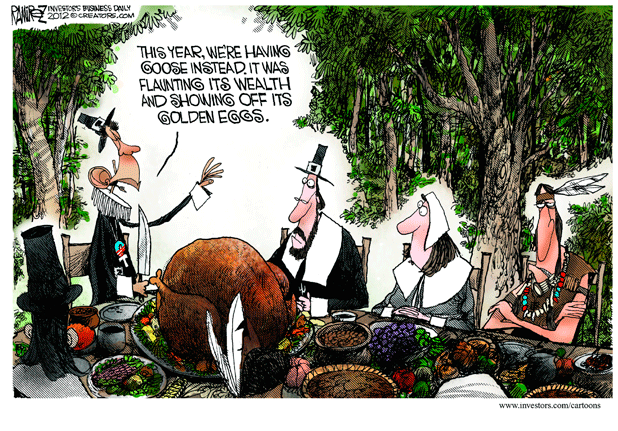
goose dinner

A friend sent me this interesting link to the “Political Calculations” blog in response to my recent post on distorted metrics of changing income inequality. The PC link is from about 10 months ago, but it is very timely nevertheless. It compares trends in three versions of the “gini coefficient” for the U.S., a common measure of inequality. A gini of zero indicates absolute equality of income across quantiles. A gini of one indicates that all income flows exclusively to the top quantile. The most interesting feature of this comparison is that the gini calculated for individual income earners has shown no trend up or down since about 1960, while the gini for households has trended upward since about 1970. This difference implies that the much-bemoaned increase in inequality is actually the result of changes in household structure, as opposed to earnings increasingly skewed toward elite individual earners.

In two follow-up posts (“The Widow’s Peak” and “The Men Who Weren’t There“), the author(s) identifies some demographic factors that were important in creating the upward trend in the household gini. Single-person households grew dramatically throughout this period, as did the number of seniors (aged 65+) living alone. The number of senior, female single-person households grew even more dramatically. Many of these women were either widows or never had good opportunities to marry because so many males in their age cohort were killed in World War II. Unfortunately, they constituted a group of very low-income households. There were other reasons for growth in the number of low-income, single-person households, such as increases in the divorce rate and perverse welfare-state incentives. The following lament by the author(s) in the last follow-up post is noteworthy:

“To us, it’s more remarkable that so many economists and politicians insist on focusing on the opposite end of the income spectrum in attempting to blame the highest income-earning Americans for that increase.”

Of course, the trends in ginis shown at the links above are subject to the same criticism made by the sabermatrician discussed in my earlier post: the comparisons over time implicitly assume that the quantiles used in the calculations are static, composed of the same sets of households or individuals, but they are not. Therefore, they tend to overstate trends toward greater inequality.

The fact that household structure has so much to do with trends measured by standard household gini coefficients, that the gini for individual earners has no trend, and that in any case, fixed quantile comparisons overstate trends in inequality, all suggest that redistributionist policies are misguided and unnecessary. And those kinds of policies tend to undermine the growth of the economy. Only policies designed to boost economic growth can help households across the income distribution to prosper. Moreover, unraveling the negative incentives built into current social programs would help to stabilize household and family structure.

← Older posts
Newer posts →
Follow Sacred Cow Chips on WordPress.com

Recent Posts

  • The Case Against Interest On Reserves
  • Immigration and Merit As Fiscal Propositions
  • Tariff “Dividend” From An Indigent State
  • Almost Looks Like the Fed Has a 3% Inflation Target
  • Government Malpractice Breeds Health Care Havoc

Archives

  • January 2026
  • December 2025
  • November 2025
  • October 2025
  • September 2025
  • August 2025
  • July 2025
  • June 2025
  • May 2025
  • April 2025
  • March 2025
  • February 2025
  • January 2025
  • December 2024
  • November 2024
  • October 2024
  • September 2024
  • August 2024
  • July 2024
  • June 2024
  • May 2024
  • April 2024
  • March 2024
  • February 2024
  • January 2024
  • December 2023
  • November 2023
  • August 2023
  • July 2023
  • June 2023
  • May 2023
  • April 2023
  • March 2023
  • February 2023
  • January 2023
  • December 2022
  • November 2022
  • October 2022
  • September 2022
  • August 2022
  • July 2022
  • June 2022
  • May 2022
  • April 2022
  • March 2022
  • February 2022
  • January 2022
  • December 2021
  • November 2021
  • October 2021
  • September 2021
  • August 2021
  • July 2021
  • June 2021
  • May 2021
  • April 2021
  • March 2021
  • February 2021
  • January 2021
  • December 2020
  • November 2020
  • October 2020
  • September 2020
  • August 2020
  • July 2020
  • June 2020
  • May 2020
  • April 2020
  • March 2020
  • February 2020
  • January 2020
  • December 2019
  • November 2019
  • October 2019
  • September 2019
  • August 2019
  • July 2019
  • June 2019
  • May 2019
  • April 2019
  • March 2019
  • February 2019
  • January 2019
  • December 2018
  • November 2018
  • October 2018
  • September 2018
  • August 2018
  • July 2018
  • June 2018
  • May 2018
  • April 2018
  • March 2018
  • February 2018
  • January 2018
  • December 2017
  • November 2017
  • October 2017
  • September 2017
  • August 2017
  • July 2017
  • June 2017
  • May 2017
  • April 2017
  • March 2017
  • February 2017
  • January 2017
  • December 2016
  • November 2016
  • October 2016
  • September 2016
  • August 2016
  • July 2016
  • June 2016
  • May 2016
  • April 2016
  • March 2016
  • February 2016
  • January 2016
  • December 2015
  • November 2015
  • October 2015
  • September 2015
  • August 2015
  • July 2015
  • June 2015
  • May 2015
  • April 2015
  • March 2015
  • February 2015
  • January 2015
  • December 2014
  • November 2014
  • October 2014
  • September 2014
  • August 2014
  • July 2014
  • June 2014
  • May 2014
  • April 2014
  • March 2014

Blogs I Follow

  • Passive Income Kickstart
  • OnlyFinance.net
  • TLC Cholesterol
  • Nintil
  • kendunning.net
  • DCWhispers.com
  • Hoong-Wai in the UK
  • Marginal REVOLUTION
  • Stlouis
  • Watts Up With That?
  • Aussie Nationalist Blog
  • American Elephants
  • The View from Alexandria
  • The Gymnasium
  • A Force for Good
  • Notes On Liberty
  • troymo
  • SUNDAY BLOG Stephanie Sievers
  • Miss Lou Acquiring Lore
  • Your Well Wisher Program
  • Objectivism In Depth
  • RobotEnomics
  • Orderstatistic
  • Paradigm Library
  • Scattered Showers and Quicksand

Blog at WordPress.com.

Passive Income Kickstart

OnlyFinance.net

TLC Cholesterol

Nintil

To estimate, compare, distinguish, discuss, and trace to its principal sources everything

kendunning.net

The Future is Ours to Create

DCWhispers.com

Hoong-Wai in the UK

A Commonwealth immigrant's perspective on the UK's public arena.

Marginal REVOLUTION

Small Steps Toward A Much Better World

Stlouis

Watts Up With That?

The world's most viewed site on global warming and climate change

Aussie Nationalist Blog

Commentary from a Paleoconservative and Nationalist perspective

American Elephants

Defending Life, Liberty and the Pursuit of Happiness

The View from Alexandria

In advanced civilizations the period loosely called Alexandrian is usually associated with flexible morals, perfunctory religion, populist standards and cosmopolitan tastes, feminism, exotic cults, and the rapid turnover of high and low fads---in short, a falling away (which is all that decadence means) from the strictness of traditional rules, embodied in character and inforced from within. -- Jacques Barzun

The Gymnasium

A place for reason, politics, economics, and faith steeped in the classical liberal tradition

A Force for Good

How economics, morality, and markets combine

Notes On Liberty

Spontaneous thoughts on a humble creed

troymo

SUNDAY BLOG Stephanie Sievers

Escaping the everyday life with photographs from my travels

Miss Lou Acquiring Lore

Gallery of Life...

Your Well Wisher Program

Attempt to solve commonly known problems…

Objectivism In Depth

Exploring Ayn Rand's revolutionary philosophy.

RobotEnomics

(A)n (I)ntelligent Future

Orderstatistic

Economics, chess and anything else on my mind.

Paradigm Library

OODA Looping

Scattered Showers and Quicksand

Musings on science, investing, finance, economics, politics, and probably fly fishing.

  • Subscribe Subscribed
    • Sacred Cow Chips
    • Join 128 other subscribers
    • Already have a WordPress.com account? Log in now.
    • Sacred Cow Chips
    • Subscribe Subscribed
    • Sign up
    • Log in
    • Report this content
    • View site in Reader
    • Manage subscriptions
    • Collapse this bar
 

Loading Comments...