• About

Sacred Cow Chips

Sacred Cow Chips

Tag Archives: Wind Power

Ravaging Cropland, Vistas, and Energy Efficiency

25 Thursday Jul 2024

Posted by Nuetzel in Renewable Energy

≈ Leave a comment

Tags

Agrivoltaics, AI Energy Demand, Battery Technology, Energy Density, Intermittency, Matt Ridley, Nuclear power, Solar Farms, Subsidies, Wind Power

There is no better example of environmental degradation and waste than the spread of solar farms around the world, spurred on by short-sighted public policy and abetted by a subsidy-hungry investors. As a resource drain, wind farms are right up there, but I’ll focus here on the waste and sheer ugliness of solar farms, inspired by a fine article on their inefficiency by Matt Ridley.

What An Eyesore!

On a drive through the countryside you’ll see once bucolic fields now blanketed with dark solar panels. Hulking windmills are bad enough, but the panels can obliterate an entire landscape. If this objection strikes you as superficial, then your sensibilities run strangely counter to those of traditional environmentalists. It would be a bit less aesthetically offensive if solar farms actually solved a problem, but they don’t, and they impose other costs to boot.

Paltry Power

In terms of power generation, solar collection panels represent an inefficient use of land and other resources. Solar power has very low energy density relative to other sources. As Ridley says:

“Solar power needs around 200 times as much land as gas per unit of energy and 500 times as much as nuclear. Reducing the land we need for human civilisation is surely a vital ecological imperative. The more concentrated the production, the more land you spare for nature.“

The intermittency of solar power means that its utilization or capacity factor is far less than nameplate capacity, yet the latter is usually quoted by promoters and investors. The mismatch in timing between power demand and power generated by solar will not be overcome by battery technology any time soon.

And yet governments coerce taxpayers in order to create artificially high returns on the construction and operation of solar farms, a backward intervention that puts more efficient sources of power at a disadvantage.

Seduction On the Farm

Solar farms installed on erstwhile cropland reflect confused public priorities. Land that is well-suited to growing crops or grazing livestock is probably better left available for those purposes. Granted, rural landowners who add solar panels probably limit installations to their least productive crop- or rangeland, but not always. Private incentives are distorted by the firehose of subsidies available for solar installations. Regardless, lands left fallow, dormant or forested still put the sun’s energy to good ecological use.

Capital invested in solar power entails unutilized capacity at night and under-utilized capacity over much of the day. Peaks in solar collection generally occur when power demand is low during daylight hours, but it is unavailable when power demand is high in the evening. Battery technology remains woefully inadequate for effective storage, necessitating a steep ramp in back-up power sources at night. And those back-up sources are, in turn, underutilized during daylight hours. The over-investment made necessary by renewables is staggering.

Landowners can try to grow certain crops underneath or between panels, or grass and weeds for grazing livestock, on what sunlight reaches ground level. This is known as Agrivoltaics. It comes with extra costs, however, and it is a bit of a dive for crumbs. Ridley says agrivoltaics is a zero-sum game, but the federal government offers subsidized funding for “experiments” of this nature. Absent subsidies, agrivoltaics might well be negative-sum in an economic sense.

Environmental Hazards

Ridley discusses the severe environmental costs and add-on risks of solar farming to local environments. Fabrication of the panels themselves requires intensive mining, processing and energy consumption. In the field, the underlying structural requirements are massive. The panels raise air temperatures within their vicinity and present a hazard to waterfowl. Panels damaged by storms, birds, or deterioration due to age are pollution hazards. Furthermore, panels have heavy disposal costs at the end of their useful lives. and old panels are often toxic. Adding today’s inefficient battery technology to solar installations only compounds these environmental risks.

Better Alternatives

Solar and renewable energy advocates seem to have little interest in the efficiency advantages of dispatchable, zero-carbon nuclear power. Nor will they wait for prospective space-based solar collection. Instead, they continue to push terrestrial solar and the idle capital it entails.

It’s worth asking why advocates of energy planning tolerate the obvious ugliness and inefficiencies of solar farming. Of course, they are preoccupied with climate risk, or at least they’d like for you to be so preoccupied. They prescribe measures against climate risk that seem to offer immediacy, but these measures are ineffectual at best and damaging in other ways. There are better technologies for producing zero-carbon energy, and it looks as if the power demands of the AI revolution might finally provide the impetus for a renaissance in nuclear power investment.
Wind and Solar Power: Brittle, Inefficient, and Destructive

03 Thursday Nov 2022

Posted by Nuetzel in Environment, Nuclear power, Renewable Energy, Uncategorized

≈ 1 Comment

Tags

@MartialData1, @Mining_Atoms, B. F. Randall, Baseload Power, Blake Lovewall, Carbon Credits, Carbon Sink, Dispatchable Power, Fossil fuels, Greenwashing, Grid Stability, Intermittency, Land Use, Martian Data, Nuclear power, Plant Life Cycle, Polysilicons, Renewable energy, Solar Power, Turbine Blades, Wind Power, Zero-Carbon

Just how renewable is “renewable” energy, or more specifically solar and wind power? Intermittent though they are, the wind will always blow and the sun will shine (well, half a day with no clouds). So the possibility of harvesting energy from these sources is truly inexhaustible. Obviously, it also takes man-made hardware to extract electric power from sunshine and wind — physical capital— and it is quite costly in several respects, though taxpayer subsidies might make it appear cheaper to investors and (ultimately) users. Man-made hardware is damaged, wears out, malfunctions, or simply fails for all sorts of reasons, and it must be replaced from time to time. Furthermore, man-made hardware such as solar panels, wind turbines, and the expansions to the electric grid needed to bring the power to users requires vast resources and not a little in the way of fossil fuels. The word “renewable” is therefore something of a misnomer when it comes to solar and wind facilities.

Solar Plant

B. F. Randall (@Mining_Atoms) has a Twitter thread on this topic, or actually several threads (see below). The first thing he notes is that solar panels require polysilicon, which not recyclable. Disposal presents severe hazards of its own, and to replace old solar panels, polysilicon must be produced. For that, Randall says you need high-purity silica from quartzite rock, high-purity coking coal, diesel fuel, and large flows of dispatchable (not intermittent) electric power. To get quartzite, you need carbide drilling tools, which are not renewable. You also need to blast rock using ammonium nitrate fuel oil derived from fossil fuels. Then the rock must be crushed and often milled into fine sand, which requires continuous power. The high temperatures required to create silicon are achieved with coking coal, which is also used in iron and steel making, but coking coal is non-renewable. The whole process requires massive amounts of electricity generated with fossil fuels. Randall calls polysilicon production “an electricity beast”.

Greenwashing

The resulting carbon emissions are, in reality, unlikely to be offset by any quantity of carbon credits these firms might purchase, which allow them to claim a “zero footprint”. Blake Lovewall describes the sham in play here:

“The biggest and most common Carbon offset schemes are simply forests. Most of the offerings in Carbon marketplaces are forests, particularly in East Asian, African and South American nations. …

The only value being packaged and sold on these marketplaces is not cutting down the trees. Therefore, by not cutting down a forest, the company is maintaining a ‘Carbon sink’ …. One is paying the landowner for doing nothing. This logic has an acronym, and it is slapped all over these heralded offset projects: REDD. That is a UN scheme called ‘Reduce Emissions from Deforestation and Forest Degradation’. I would re-name it to, ‘Sell off indigenous forests to global investors’.”

Lovewall goes on to explain that these carbon offset investments do not ensure that forests remain pristine by any stretch of the imagination. For one thing, the requirements for managing these “preserves” are often subject to manipulation by investors working with government; as such, the credits are often vehicle for graft. In Indonesia, for example, carbon credited forests have been converted to palm oil plantations without any loss of value to the credits! Lovewall also cites a story about carbon offset investments in Brazil, where the credits provided capital for a massive dam in the middle of the rainforest. This had severe environmental and social consequences for indigenous peoples. It’s also worth noting that planting trees, wherever that might occur under carbon credits, takes many years to become a real carbon sink.

While I can’t endorse all of Lovewall’s points of view, he makes a strong case that carbon credits are a huge fraud. They do little to offset carbon generated by entities that purchase them as offsets. Again, the credits are very popular with the manufacturers and miners who participate in the fabrication of physical capital for renewable energy installations who wish to “greenwash” their activities.

Wind Plant

Randall discusses the non-renewability of wind turbines in a separate thread. Turbine blades, he writes, are made from epoxy resins, balsa wood, and thermoplastics. They wear out, along with gears and other internal parts, and must be replaced. Land disposal is safe and cheap, but recycling is costly and requires even greater energy input than the use of virgin feedstocks. Randall’s thread on turbines raised some hackles among wind energy defenders and even a few detractors, and Randall might have overstated his case in one instance, but the main thrust of his argument is irrefutable: it’s very costly to recycle these components into other usable products. Entrepreneurs are still trying to work out processes for doing so. It’s not clear that recycling the blades into other products is more efficient than sending them to landfills, as the recycling processes are resource intensive.

But even then, the turbines must be replaced. Recycling the old blades into crates and flooring and what have you, and producing new wind turbines, requires lots of power. And as Randall says, replacement turbines require huge ongoing quantities of zinc, copper, cement, and fossil fuel feedstocks.

The Non-Renewability of Plant

It shouldn’t be too surprising that renewable power machinery is not “renewable” in any sense, despite the best efforts of advocates to convince us of their ecological neutrality. Furthermore, the idea that the production of this machinery will be “zero carbon” any time in the foreseeable future is absurd. In that respect, this is about like the ridiculous claim that electric vehicles (EVs) are “zero emission”, or the fallacy that we can achieve a zero carbon world based on renewable power.

It’s time the public came to grips with the reality that our heavy investments in renewables are not “renewable” in the ecological sense. Those investments, and reinvestments, merely buy us what Randall calls “garbage energy”, by which he means that it cannot be relied upon. Burning garbage to create steam is actually a more reliable power source.

Highly Variable With Low Utilization

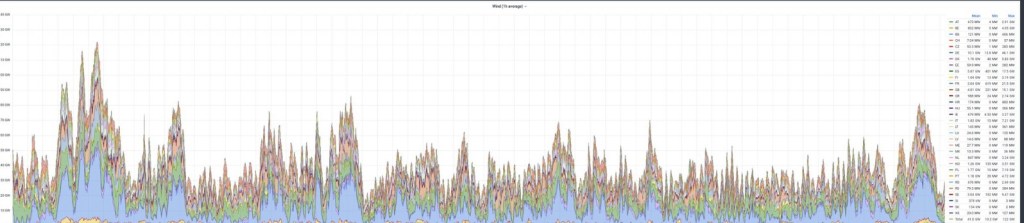
Randall links to information provided by Martian Data (@MartianManiac1) on Europe’s wind energy generation as of September 22, 2022 (see the tweet for Martian Data’s sources):

“Hourly wind generation in Europe for past 6 months:
Max: 122GW
Min: 10.2GW
Mean: 41.0
Installed capacity: ~236GW
”

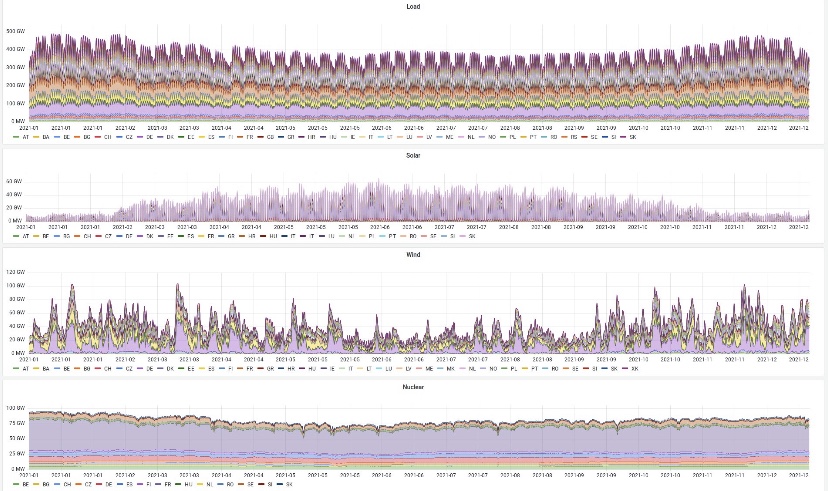
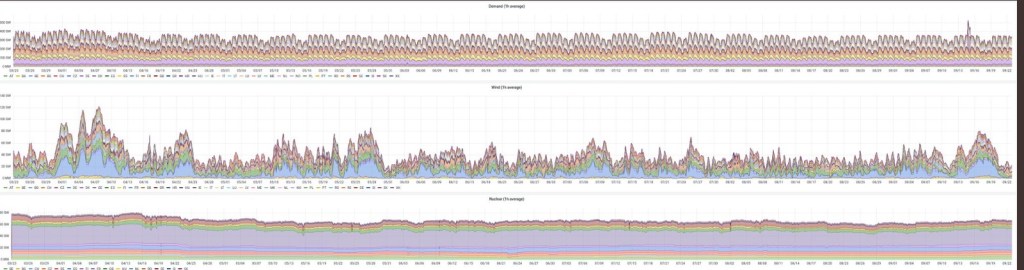
That’s a whopping 17.4% utilization factor! That’s pathetic, and it means the effective cost is quintuple the value at nameplate capacity. Take a look at this chart comparing the levels and variations in European power demand, nuclear generation, and wind generation over the six months ending September 22nd (if you have trouble zooming in here, try going to the thread):

The various colors represent different countries. Here’s a larger view of the wind component:

A stable power grid cannot be built upon this kind of intermittency. Here is another comparison that includes solar power. This chart is daily covering 2021 through about May 26, 2022.

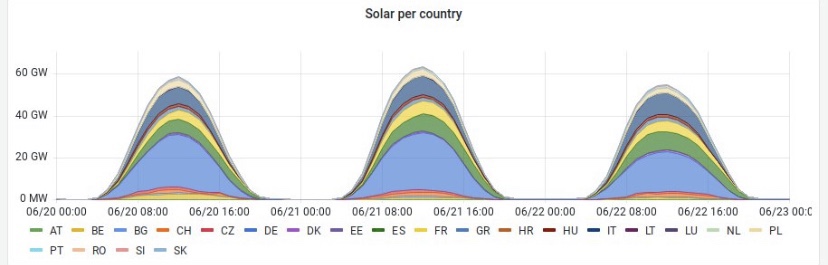
As for solar capacity utilization, it too is unimpressive. Here is Martian Data’s note on this point, followed by a chart of solar generation over the course of a few days in June:

“so ~15% solar capacity is whole year average. ~5% winter ~20% summer. And solar is brief in summer too…, it misses both both morning and evening peaks in demand.”

Like wind, the intermittency of solar power makes it an impractical substitute for traditional power sources. Check out Martian Data’s Twitter feed for updates and charts from other parts of the world.

Nuclear Efficiency

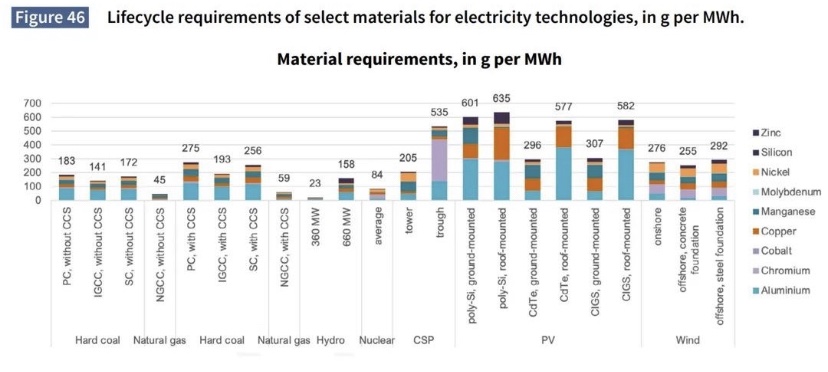
Nuclear power generation is an excellent source of baseload power. It is dispatchable and zero carbon except at plant construction. It also has an excellent safety record, and newer, modular reactor technologies are safer yet. It is cheaper in terms of generating capacity and it is more flexible than renewables. In fact, in terms of the resource costs of nuclear power vs. renewables over plant cycles, it’s not even close. Here’s a chart recently posted by Randall showing input quantities per megawatt hour produced over the expected life of each kind of power facility (different power sources are labeled at bottom, where PV = photovoltaic (solar)):

In fairness, I’m not completely satisfied with these comparisons. They should be stated in terms of current dollar costs, which would neutralize differences in input densities and reflect relative scarcities. Nevertheless, the differences in the chart are stark. Nuclear produces cheap, reliable power.

The Real Dirt

Solar and wind power are low utilization power sources and they are intermittent. Heavy reliance on these sources creates an extremely brittle power grid. Also, we should be mindful of the vast environmental degradation caused by the mining of minerals needed to produce solar panels and wind turbines, including their inevitable replacements, not to mention the massive land use requirements of wind and solar power. Also disturbing is the hazardous dumping of old solar panels from the “first world” now taking place in less developed countries. These so-called clean-energy sources are anything but clean or efficient.

Net Zero: It Ain’t Gonna Happen

15 Thursday Sep 2022

Posted by Nuetzel in Central Planning, Environmental Fascism, Renewable Energy

≈ 4 Comments

Tags

Backup Capacity, Brad Allenby, Carbon Capture, Cost Parity, Decarbonization, El Hierro, Ezra Klein, Francis Minton, Geothermal, Green Energy, Green Mandates, Hydrocarbons, Intermittancy, Joseph Sternberg, Land Use Requirements, Legal Insurrection, Lithium Batteries, Manhattan Contrarian, Mark P. Mills, Murtaza Hussain, Net Zero, Rare Earth Minerals, Renewable, Solar Power, The Intercept, Tuomas Malinen, Walter Jacobson, Wind Power

A number of countries have targeted net zero carbon dioxide emissions, to be achieved within various “deadlines” over the next few decades. The target dates currently range from 2030 -2050. Political leaders around the world are speaking in the tongues favored by climate change fundamentalism, as Brad Allenby aptly named the cult some years ago. The costly net zero goal is a chimera, however. The effort to completely substitute renewables — wind and solar — for fossil fuels will fail without question. In fact, net zero carbon emissions is unlikely to be achieved anywhere in this century without massive investments in nuclear power. Wind and solar energy suffer from a fatal flaw: intermittency. They will never be able to provide for all energy needs without a drastic breakthrough in battery technology, which is not on the horizon. Geothermal power might make a contribution, but it won’t make much of a dent in our energy needs any time soon. Likewise, carbon capture technology is still in its infancy, and it cannot be expected to offset much of the carbon released by our unavoidable reliance on fossil fuels.

Exposing Green Risks

The worst of it is that net zero mandates will inflict huge costs on society. Indeed, various efforts to force conversion to “green” energy technologies have already raised costs and exposed humanity to immediate threats to health and well being. These realities are far more palpable than the risks posed by speculative model predictions of climate change decades ahead. As Joseph Sternberg notes at the link above, climate policies:

“… have created an energy system of dangerous rigidity and inefficiency incapable of adapting to a blow such as Russia’s partial exit from the European gas market. It’s almost inevitable that the imminent result will be a recession in Europe. We can only hope that it won’t also trigger a global financial crisis.”

Escalating energy costs are inflicting catastrophic harm on businesses large and small throughout the West, but especially in Europe and the UK. A Finnish economist recently commented on these conditions, as quoted by Walter Jacobson at the Legal Insurrection blog:

“I saw this tweet thread by Finnish economist and professor Tuomas Malinen:

I am telling you people that the situation in #Europe is much worse than many understand. We are essentially on the brink of another banking crisis, a collapse of our industrial base and households, and thus on the brink of the collapse of our economies.”

Jacobson also offers the following quote from Murtaza Hussain of The Intercept:

“If you turned the electricity off for a few months in any developed Western society 500 years of supposed philosophical progress about human rights and individualism would quickly evaporate like they never happened.”

Where’s the Proof of Concept?

This is not all about Russian aggression, however. We’ve seen the cost consequences of “green” mandates and forced conversion to wind and solar in places like California, Texas, and Germany even before Russia invaded Ukraine and began starving Europe of natural gas.

Frances Minton at the Manhattan Contrarian blog points to one of the most remarkable aspects of the singular focus on net zero: the complete absence of any successful demonstration project anywhere on the globe! The closest things to such a test are cited by Minton. One is on El Hierro in Spain’s Canary Islands, which has wind turbine capacity of more than double average demand, It also has pumped storage with hydro generators for more than double average demand. In 2020, however, El Hierro took all of its power from the combined wind/storage system only about 15% of the time. 2021 didn’t look much better. Diesel power is used to fill in the frequent “shortfalls”.

Land Use

The land use requirements of a large scale transition to wind and solar are incredible, given projected technological capabilities. Ezra Klein explains:

“The center of our decarbonization strategy is an almost unimaginably large buildup of wind and solar power. To put some numbers to that: A plausible path to decarbonization, modeled by researchers at Princeton, sees wind and solar using up to 590,000 square kilometers – which is roughly equal to the land mass of Connecticut, Illinois, Indiana, Kentucky, Massachusetts, Ohio, Rhode Island and Tennessee put together. ‘The m footprint is very, very large, and people don’t really understand that,’ Danny Cullenward, co author of ‘Making Climate Policy Work’, told me.”

That’s a major obstacle to accelerating the transition to wind and solar power, but there are many others.

A Slap of Realism

Mark P. Mills elaborates on the daunting complexity and costs of the transition, and like land use requirements, they are all potential show stoppers. It’s a great article excepting a brief section that reveals a poor understanding of monetary theory. Putting that aside, it’s first important to reemphasize what should be obvious: shutting down production of fossil fuels makes them scarce and more costly,. This immediately reduces our standard of living and hampers our future ability to respond to tumultuous circumstances as are always likely to befall us. Mills makes that abundantly clear:

“… current policies and two decades of mandates and spending on a transition have led to escalating energy prices that help fuel the destructive effects of inflation. The price of oil, which powers nearly 97% of all transportation, is on track to reach or exceed half-century highs, and gasoline prices have climbed. The price of natural gas, accounting for 40% of all industrial energy use and one-fourth of global electricity, has soared past a decadal high. Coal prices are also at a decadal high. Coal fuels 40% of global electricity; it is also used to make 70% of all steel and accounts for half its cost of production.

It bears noting that energy prices started soaring, and oil breached $100 a barrel, well before Russia invaded Ukraine in late February. The fallout from that invasion has hardened, not resolved, the battle lines between those advocating for and those skeptical of government policies directed at accelerating an energy transition. …

Civilization still depends on hydrocarbons for 84% of all energy, a mere two percentage points lower than two decades ago. Solar and wind technologies today supply barely 5% of global energy. Electric vehicles still offset less than 0.5% of world oil demand.”

As Mills says, it surprises most people that today’s high tech sectors, such as electronic devices like phones and computers, and even drugs, require much more energy relative to product size and weight than traditional manufactured goods. Even the cloud uses vast quantities of energy. Yet U.S. carbon intensity per dollar of GDP has declined over the past 20 years. That’s partly due to the acquisition of key components from abroad, mitigation efforts here at home, and the introduction of renewables. However, the substitution of natural gas for other fossil fuels played a major role. Still, our thirst for energy intensive technologies will cause worldwide demand for energy to continue to grow, and renewables won’t come close to meeting that demand.

Capacity Costs

Policy makers have been deceived by cost estimates associated with additions of renewable capacity. That’s due to the fiction that renewables can simply replace hydrocarbons, but the intermittency of solar and wind power mean that demand cannot be continuously matched by renewables capacity. Additions to renewables capacity requires reliable and sometimes redundant backup capacity. At the risk of understatement, this necessity raises the marginal cost of renewable additions significantly if the hope is to meet growth in demand.

Furthermore, as Mills points out, renewables have not reached cost parity with fossil fuels, contrary to media hype and an endless flow of propaganda from government and the “green” investors seeking rents from government. Subsidies to renewables have created an illusion that costs that are lower than they are in reality.

So Many Snags

From Mills, here are a few of the onerous cost factors that will present severe obstacles to even a partial transition to renewables:

  • Even with the best battery technology now available, using lithium, storing power is still extremely expensive. Producing and storing it at scale for periods long enough to serve as a true source of power redundancy is prohibitive.
  • The infrastructure buildout required for a hypothetical transition to zero-carbon is massive. The quantity of raw materials needed would be far in excess of those used in our investments in energy infrastructure over at least the past 60 years.
  • Even the refueling infrastructure required for a large increase in the share of electronic vehicles on the road would require a massive investment, including more land and at much greater expense than traditional service stations. That’s especially true considering the grid enhancements needed to deliver the power.
  • The transition would place a huge strain on the world’s ability to mine minerals such as lithium, graphite, nickel, and rare earths. Mills puts the needed increases in supply at 4,200%, 2,500%, 1,900%, and 700%, respectively, by 2040. In fact, the known global reserves of these minerals are inadequate to meet these demands.
  • Mining today is heavily reliant on hydrocarbon power, of course. Moreover, all this mining activity would have devastating effects on the environment, as would disposal of “green” components as they reach their useful lives. The latter is a disaster we’re already seeing played out in the third world, where we are exporting much of our toxic, high-tech waste.
  • The time it would take to make the transition to zero carbon would far exceed the timetable specified in the mandates already in place. It’s realistic to admit that development of new mines, drastic alterations of land use patterns, construction of new generating capacity, and the massive infrastructure buildout will stretch out for many decades.
  • Given U.S. dependence on imports of a large number of minerals now considered “strategic”, decarbonization will require a major reconfiguration of supply chains. In fact, political instability in parts of the world upon which we currently rely for supplies of these minerals makes the entire enterprise quite brittle relative to reliance on fossil fuels.

Conclusion

The demands for raw materials, physical capital and labor required by the imagined transition to net zero carbon dioxide emissions will put tremendous upward pressure on prices. The coerced competition for resources will mean sacrifices in other aspects of our standard of living, and it will have depressing effects on other markets, causing their relative prices to decline.

For all the effort and cost of the mandated transition, what will we get? Without major investments in reliable but redundant backup capacity, we’ll get an extremely fragile electric grid, frequent power failures, a diminished standard of living, and roughly zero impact on climate. In other words, it will be a major but unnecessary and predictably disastrous exercise in central planning. We’ve already seen the futility of this effort in the few, small trials that have been undertaken, but governments, rent-seeking investors, and green activists can’t resist plunging us headlong into the economic abyss. Don’t let them do it!

Bill Gates, Wayward Climate Nerd

17 Wednesday Nov 2021

Posted by Nuetzel in Climate, Energy

≈ Leave a comment

Tags

Abortion, Anti-Vaxers, Battery Technology, Bill Gates, Carbon Capture, Carbon Concentration, Carbon Efficiency, Carbon Emissions, CO2, David Solway, Fossil fuels, Gates Foundation, Green Premium, Health and Fertility, Hydrogen Power, Industrial Policy, Kaya Identity, Lockdowns, Median Voter, Natural Gas, Net Zero Carbon, Non-Pharmaceutical interventions, Nuclear power, Power Storage, Renewable energy, Reproductive Health Services, Solar Power, TED Talks, Thomas Malthus, Vaccine Passports, Wind Power, World Health Organization

Bill Gates’ considerable philanthropic efforts through the Gates Foundation are well known. Much of the foundation’s activity has focused on disease control and nutrition around the globe. Education reform has also been a priority. Many of these projects are laudable, though I’m repulsed by a few (see here and here). During the coronavirus pandemic, Gates has spoken approvingly of Non-Pharmaceutical Interventions (lockdown measures), which are both coercive and ineffective (and see here). He has earned the enmity of anti-vaxers, of course, though I’m not anti-vax as long as the jabs are voluntary. The Gates Foundation funded the World Health Organization’s effort to provide guidance on digital vaccine passports, which is a de facto endorsement of discrimination based on vaccination status. His priorities for addressing climate change also raise some troubling issues, a few of which I address below.

Squeezing Policy from a Definition

Gates put a special Malthusian twist on a TED Talk he did back in 2010 using an equation for carbon dioxide emissions, which he’s reprised over the years. It gained a lot of notice in 2016 when a few sticklers noticed that his claim to have “discovered” the equation was false. The equation is:

CO2 = P x S x E x C,

where P = People, S = Services per person, E = Energy per service, and C = CO2 per energy unit.

This equation first appeared as the so-called Kaya Identity in a scientific review in 2002. Such an equation can be helpful in organizing one’s thoughts, but it has no operational implications in and of itself. At one level it is superficial: we could write a similar identity for almost anything, like the quantity of alcohol consumed in a year, which must equal the population times the ounces of alcohol per drink times the number of drinks per person. At a deeper level, it can be tempting to build theories around such equations, and there is no question that any theory about CO2 must at least preserve the identity.

There’s an obvious temptation to treat an equation like this as something that can be manipulated by policy, despite the possibility of behavioral links across components that might lead to unintended consequences. This is where Gates gets into trouble.

Reality Checks

As David Solway writes, Gates’ jumped to the conclusion that population drives carbon emissions, reinforcing a likely perspective that the human population is unsustainable. His benevolent solution? A healthier population won’t breed as fast, so he prescribes more vaccinations (voluntary?) and improved health care. For good measure, he added a third prong: better “reproductive health services”. Let’s see… what share of the 0.9 -1.4 billion reduction in world population Gates prescribed in 2016 would have come from terminated pregnancies?

In fact, healthier people might or might not want more children, but lower child mortality in the developing world would reduce certain economic incentives for high fertility. Another reliable association is between income and child bearing: an increase in “services per person” is likely to lead to smaller families, but that wasn’t given any emphasis by Gates. Income growth is simply not part of the narrative! Yet income growth does something else: it allows us to more easily afford the research and investments required for advanced technologies, including cleaner energy. These things take time, however.

Solway points to other weaknesses in Gates’ interpretation of the Kaya Identity. For example, efforts to slow population growth are not reliably associated with “services per person”, fuel efficiency, or carbon efficiency. In other words, carbon emissions may be powerfully influenced by factors other than population. China is a case in point.

Centralized industrial and social planning is generally ill-suited to advancing human well being. It’s especially suspect if the sole objective is to reduce carbon emissions. But Gates knows that lowering emissions without a corresponding drop in real income requires continuing technological advances and/or more efficient decisions about which technologies to deploy. He is a big advocate of developing cheap hydrogen power, which is far from a reality. He is also excited about carbon capture technologies, which are still in their infancy.

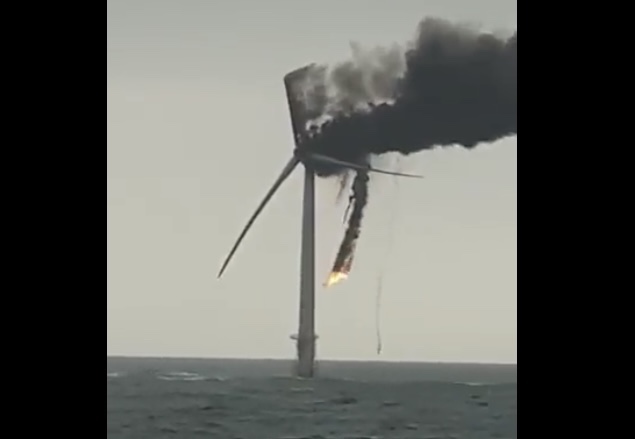
Renewables like wind and solar power play a large part in Gates’ vision. Those technologies cannot deliver a reliable flow of power, however, without either adequate backup capacity or a dramatic advance in battery technology. Gates over-promotes wind and solar, but I give him credit for acknowledging their intermittency. He attempts to come to grips with it by advocating nuclear backup, but it’s just not clear that he has integrated the incremental cost of the necessary backup capacity with other direct costs of these renewables… not to mention the considerable environmental costs imposed by wind and solar (see the “back-to-nature” photo at the top for a cogent illustration). Power storage at scale is still a long way off, and its cost will be significant as well.

We could deploy existing energy technologies to greater advantage with respect to carbon efficiency. We’ve already reduced CO2 emissions in the U.S. by substituting natural gas for less carbon-efficient fuels, but the Biden Administration would rather discourage its use. Gates deserves credit for recognizing the huge role that nuclear energy can play in providing zero-carbon power. Despite that, he still can’t quite bring himself to admit the boneheadedness of heavy reliance on intermittent renewables.

Bill’s “Green Premium”

Gates seems to have deemphasized the Kaya Identity more recently. Instead, his focus has shifted to the so-called “green premium”, or the incremental cost of using zero-carbon technology relative to a traditional source. Needless to say, the premium is large for truly zero-carbon sources, but Gates emphasizes the importance of using the green premium to guide development even in the here and now.

That’s fine, but it’s not clear that he gives adequate consideration to cases in which emissions, while not eliminated, can be reduced at a negative incremental cost via appropriate substitution. That describes the transition to natural gas from other fuels. This is something that markets can do without the assistance of ham-handed interventionists. Gates prefers nuclear power and says natural gas is “not a real bridge technology” to a zero carbon future. That’s short-sighted and reflects an absolutist mindset that ignores both the economic and political environment. The thinking is that if it’s not zero emissions, it’s not worth doing.

Gates emphasizes the need to sharply reduce the range of green premia on various technologies to achieve net-zero carbon emissions by 2050. But the goal of net-zero emissions 2050 is based on the highly unlikely proposition that global catastrophe awaits failing net-zero. In fact, the predicted consequences of doing nothing are based on drastic and outdated carbon growth scenarios and rudimentary carbon-forcing models that have proven to be severely biased to the upside in terms of predicting global temperature trends.

The idea that 2050 is some kind of “deadline” is a wholly arbitrary determination. Furthermore, the absolutism with which such goals are stated belies a failure to properly assess the true costs and benefits of carbon-based energy. If we so much as accept the notion that fossil fuels have external costs, we are then expected to accept that zero carbon emissions is optimal. This is not “science”; it is doctrine propped-up by bizarre and false scare stories. It involves massive efforts to manipulate opinion and coerce behavior based upon shoddy forecasts produced by committee. Even carbon capture technology is considered “problematic” because it implies that someone, somewhere, will use a process that emits CO2. That’s a ridiculous bogeyman, of course, and even Gates supports development of carbon capture.

Conclusion

I’ve never felt any real antipathy for Bill Gates as a person. He built a fortune, and I used his company’s software for most of my career. In some ways I still prefer it to macOS. I believe Gates is sincere in his efforts to help humanity even if his efforts are misdirected. He seems to reside on the less crazy end of the spectrum of climate alarmists. He’s putting a great deal of his private resources toward development of technologies that, if successful, might actually lead to less coercion by those attempting to transform private energy decisions. Nevertheless, there is menace in some of the solutions to which Gates clings. They require concerted action on the part of central authorities that would commandeer private resources and abrogate liberty. His assertion that the world is over-populated is both dubious and dangerous. You can offer free health care, but a conviction that the population must be thinned can lead to far more radical and monstrous initiatives.

The “green premium” promoted by Gates is an indirect measure of how far we must go to achieve parity in the pricing of carbon and non-carbon energy sources, as if parity should be an objective of public policy. That proposition is based on bad economics, fraudulent analyses of trends in carbon concentrations and climate trends, and a purposely incomplete menu of technological alternatives. Yes, the green premium highlights various technological challenges, but it is also a direct measure of how much intervention via taxes or subsidies are necessary to achieve parity. Is that a temptation to policymakers? Or does it represent a daunting political barrier? It’s pretty clear that the “median voter” does not view climate change as the only priority.

Renewable Power Gains, Costs, and Fantasies

01 Thursday Jul 2021

Posted by Nuetzel in Electric Power, Renewable Energy

≈ 2 Comments

Tags

Baseload, Blackouts, California, Combined-Cycle Gas, Dispatchable Power, Disposal Costs, Dung Burning, Energy Information Administration, External Costs, Fossil fuels, Francis Menton, Germany, Green Propaganda, Interrmittency, Levelized Costs, Modern Renewables, Peak Demand, Plant Utilization, Renewable energy, Solar Power, Texas, The Manhattan Contrarian, Willis Eschenbach, Wind Power

“Modern” renewable energy sources made large gains in providing for global energy consumption over the ten years from 2009-19, according to a recent report, but that “headline” is highly misleading. So is a separate report on the costs of solar and wind power, which claims those sources are now cheaper than any fossil fuel. The underlying facts will receive little critical examination by a hopelessly naive press, nor among analysts with more technical wherewithal. Of course, “green” activists will go on using misinformation like this to have their way with policy makers.

Extinguishing Dung Fires

The “Renewables Global Status Report” was published in mid-June by an organization called REN21: Renewables Now. Francis Menton has a good discussion of the report on his blog, The Manhattan Contrarian. The big finding is a large increase in the global use of “modern” renewable energy sources, from 8.7% of total consumption in 2009 to 11.2% in 2019. The “modern” qualifier is critical: it distinguishes renewables that made gains from those that might be considered antiquated, like dung chips, the burning of which is an energy staple in many underdeveloped parts of the world. In fact, the share of those “non-modern renewables” declined from 11.0% to 8.7%, almost fully accounting for the displacement caused by “modern renewables”. The share of fossil fuels was almost unchanged, down from 80.3% in 2009 to 80.2% in 2019. Whatever the benefits of wind, solar, and other modern green power sources, they did not make much headway in displacing reliable fossil fuel energy.

I certainly can’t argue that replacing dung power with wind, solar, or hydro is a bad thing (but there are more sophisticated ways of converting dung to energy than open flame). However, I contend that replacing open dung fires with fossil-fuel or nuclear capacity would be better than renewables from both a cost and an environmental perspective. Be that as it may, the adoption of “modern renewables” over the ten-year period was not at the expense of fossil fuels, as might be expected if the latter was at a cost disadvantage, and remember that renewables were already given an edge via intense government efforts to subsidize and even require the use of wind and solar power.

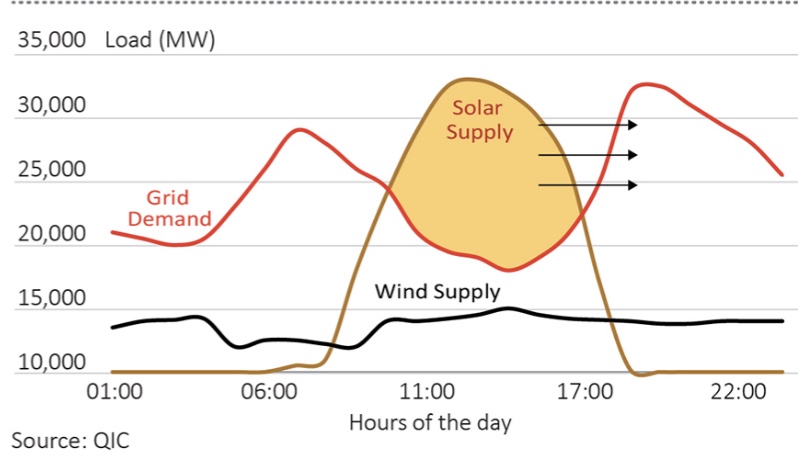
The near-term limits on our ability to substitute renewables for fossil fuels should be fairly obvious. For one thing, renewable power is intermittent, so it cannot be relied upon for baseload generation. The chart at the top of this post demonstrates this reality, though the chart is “optimistic” in the sense that planners have to consider worst-case intermittency, not merely average production by time-of-day. Reliable power sources must be maintained in order to prevent the kinds of disasters like we saw in Texas last winter when demand spiked and output from renewables plunged. This is an area of considerable denialism: a search on “intermittent renewables” gets you an unending list of rosy assessments of energy storage technologies, and very little realistic commentary on today’s needs for meeting base-load or weather-induced demands.

While renewables account for about 29% of global electricity generation, there is another limit on adoption: certain jobs just can’t be done with renewables short of major advances in battery technology. As Menton says:

“Steel mills and tractor trailer trucks and airplanes powered by solar panels? Not happening. … I think these people really believe that if governments will just do the right thing and require airplanes to run on solar panels, then it will promptly happen.”

Cost and Intermittency

Again, we’d expect to see more rapid conversion to renewable energy, at least in compatible applications, as the cost of renewables drops relative to fossil fuels. And major components of their costs have indeed dropped, so much so that the U.S. Energy Information Administration (EIA) now says they are cheaper than fossil fuels in terms of the “levelized cost” of new electric generating capacity. That’s the average cost per megawatt-hour produced over the life of a new installation. The EIA’s calculations are distorted on at least two counts, however, as Willis Eschenbach ably explains here.

The EIA’s cost figures reflect a “capacity factor” that adjusts the megawatts produced to presumed “real world” conditions. It’s more like a utilization adjustment made necessary by a variety of realities (intermittency as well as other technical imperfections) that cause output to run lower than the maximum under ideal conditions. Eschenbach reports that the factors applied by the EIA for solar and wind, at 30% and 41%, respectively, are overstated drastically, which reduces their cost estimates by overstating output. For solar, he cites a more realistic value of 14%, which would more than double the levelized cost of solar. For wind, he quotes a figure of 30%, which would increase the cost of wind power by more than a third. That puts the cost of those renewables well above that of a “combined-cycle gas” plant, which uses exhaust from gas turbines to generate additional power via steam.

The true costs of renewables are likely much higher than nuclear power as well, based on earlier comparisons of nuclear to combined-cycle gas. The EIA does not report a cost for nuclear power, however, because the report is for new capacity, and no additions of nuclear capacity are expected.

The Cost of Back-Up Capacity

Eschenbach notes a second major problem with the EIA cost comparisons. As discussed above, the intermittency of solar and wind power means that their deployment cannot provide for base loads. Other “dispatchable” power technologies, on which production can be ramped up or down at discretion, must be available to meet power needs when renewables are off-line, as is frequently the case. The more we attempt to rely on renewables, the more significant the intermittency problem becomes, as Germany, Texas, and California are discovering.

How to account for the extra cost of dispatchable power required to smooth production or meet peak demand? Renewables are simply incapable of doing so reliably, and back-up capacity ain’t free! Meeting demand at all times requires equivalent dispatchable capacity in the power mix. It requires not just dispatchable baseload capacity, but surge capacity! Meeting long-term growth in demand with renewables implies that new back-up capacity is required as well, and the levelized cost should reflect it. After all, those costs won’t be saved by virtue of adding renewable capacity, unless you plan on blackouts. Thus, the EIA’s levelized cost comparisons of wind, solar and fossil fuel electricity generation are completely phony.

Conclusion

Growth in wind and solar power increased their contribution to global energy needs to more than 11% in 2019, but their gains over the previous ten years came largely at the expense of more “primitive” renewable energy sources, not fossil fuels. And despite impressive declines in the installation costs of wind and solar power, and despite low variable costs, the economics of power generation still favors fossil fuels rather substantially. In popular discussions, this point is often obscured by the heavy subsidies granted to renewables. 

In truth, the “name-plate” capacities of wind and solar installations far exceed typical output, so installation costs are spread over less output than is widely believed. Furthermore, the intermittency of production from these renewable sources means that back-up capacity is still required, almost always from plants fired by fossil fuels. Properly considered, this represents a significant incremental cost of renewable power sources, but it is one that is routinely ignored by environmentalists and even in official reports. It’s also worth noting that “modern” renewables carry significant external costs to the environment both during the useful life of plant and at disposal (and see here). It’s tempting to say all these distortions and omissions are deliberate contributions to the propaganda in favor of government mandates for renewables.

Texas Cold Snap Scarcity: Don’t Blame Markets!

18 Thursday Mar 2021

Posted by Nuetzel in Electric Power, Price Mechanism, Renewable Energy, Shortage

≈ 4 Comments

Tags

Blackouts, Electric Reliability Council of Texas, ERCOT, February Cold Spell, Federal Energy Subsidies, Fixed-Rate Plans, Fossil fuels, Interconnection Agreements, Market Efficiency, Price Ceilings, Price Gouging, Renewable energy, Shortages, Solar Power, Supply Elasticity, Texas, Variable-Rate Plans, Wind Power, Winterization

People say the darnedest things about markets, even people who seem to think markets are good, as I do. For example, when is a market “too efficient”? In the real world we tend to see markets that lack perfect efficiency for a variety of reasons: natural frictions, imperfect information, taxes, subsidies, regulations, and too few sellers or buyers. In such cases, we know that market prices don’t properly reflect the true scarcity of a good, as they would under the competitive ideal. Nevertheless, we are usually best-off allowing market forces to approximate true conditions in guiding the allocation of resources. But what does it mean when someone asserts that a market is “too efficient”.

Not long ago I posted about the failure of Texas utility planners to maintain surge capacity. Instead, they plowed resources into renewable energy, which is intermittent and unable to provide for reliable baseline power loads. That spelled disaster when temperatures plunged in February. Wind and solar output plunged while demand spiked. Even gas- and coal-fired power generation hit a pause due to a lack of adequate winterization of generators. The result was blackouts and a huge jump in wholesale power prices, which are typically passed on to customers. The price to some consumers rose to the ceiling of $9/kwh for a time, compared to an average winter rate of 12c/kwh. A bill in the Texas Senate would reverse those charges retroactively.

I cross-linked my post on a few platforms, and a friendly commenter opined that the jump in prices occurred because “markets were too efficient”. For a moment I’ll set aside the fact that what we have here is a monopoly grid operator: “market efficiency” is not a real possibility, despite elements of competition at the retail level. There is, however, a price mechanism in play at the wholesale level and for retail customers on variable rate plans. Prices are supposed to respond to scarcity, and there is no question that power became scarce during the Texas cold snap. Higher prices are both an incentive to curtail consumption and to increase production or attract product from elsewhere. So, rather than saying the “market was too efficient”, the commenter should have said “power was too scarce”! Well duh…

If anything, the episode underscores how un-market-like were the conditions created by the Texas grid operator, the ironically-named Electric Reliability Council of Texas (ERCOT): it allowed massive resources to be diverted to unreliable power sources; it skimped on winterization; it failed to arrange interconnection agreements with power grids outside of Texas; and it charged customers on fixed-rate plans too little to provide for adequate surge capacity, while giving them no incentive to conserve under a stress scenario. ERCOT can be said to have created a situation in which power supply was highly inelastic, which means that a normal market force was short-circuited at a time when it was most needed.

ERCOT‘s mismanagement of power resources is partly a result of incentives created by the federal government. The installation of wind and solar power generation came with huge federal subsidies, which distort the cost of the energy they produce. Thus, not only were incentives in place to invest in unreliable power sources, but ERCOT forced electricity produced by fossil fuels to compete at unrealistically low prices. This predatory pricing forced several power producers into bankruptcy, compromising the state’s baseline and surge capacity.

There are plenty of distortions plaguing the “market” for electric power in Texas, all of which worsened the consequences of the cold snap. This was far from a case of “market efficiency”, as the comment on my original post asserted.

The very idea that markets and the price mechanism are “ruthlessly efficient” is a concession to those who say high prices are always “unfair” in times of crises and shortages. We hear about “price-gougers”, and the media and politicians are almost always willing to join in this narrative. Higher prices help to ease shortages, and they do so far more quickly and effectively than governments or charities can provide emergency supplies (unless, of course, a monopoly grid operator leaves the state more vulnerable to stress conditions than necessary). Conversely, price ceilings only serve to exacerbate shortages and the suffering they cause. So let’s not blame markets, which are never “too efficient”; sometimes the things we trade are just too scarce, and sometimes they are made more scarce by inept planners.

Everything’s Big In Texas Except Surge Capacity

01 Monday Mar 2021

Posted by Nuetzel in Electric Power, Price Mechanism, Shortage

≈ 3 Comments

Tags

Austin Vernon, Blackouts, Climate Change, Coal Power, Dolar Power, Electric Reliability Council of Texas, ERCOT, Gas Power, Green Energy, H. Sterling Burnett, Heartland Institute, Judith Curry, Lynn Kiesling, Nuclear power, Renewables, Surge Capacity, Texas, Tyler Cowen, Variable-Rate Pricing, Vernon L. Smith, Wind Power

The February cold snap left millions of Texas utility customers without power. I provide a bit of a timeline at the bottom of this post. What happened? Well, first, don’t waste your time arguing with alarmists about whether “climate change” caused the plunge in temperatures. Whether it was climate change (it wasn’t) or anything else, the power shortage had very nuts-and-bolts causes and was avoidable.

Texas has transitioned to producing a significant share of its power with renewables: primarily wind and solar, which is fine across a range of weather conditions, though almost certainly uneconomic in a strict sense. The problem in February was that the state lacks adequate capacity to meet surges under extreme weather conditions. But it wasn’t just that the demand for power surged during the cold snap: renewables were not able to maintain output due to frozen wind turbines and snow-covered solar panels, and even some of the gas- and coal-fired generators had mechanical issues. The reliability problem is typical of many renewables, however, which is why counting on it to provide base loads is extremely risky.

Judith Curry’s web site featured an informative article by a planning engineer this week: “Assigning Blame for the Blackouts in Texas”. The Electric Reliability Council of Texas (ERCOT) is the independent, non-profit operator of the state’s electric grid, with membership that includes utilities, electric cooperatives, other sellers, and consumers. Apparently ERCOT failed to prepare for such an extreme weather event and the power demand it engendered:

“… unlike utilities under traditional models, they don’t ensure that the resources can deliver power under adverse conditions, they don’t require that generators have secured firm fuel supplies, and they don’t make sure the resources will be ready and available to operate.”

ERCOT’s emphasis on renewables was costly, draining resources that otherwise might have been used to provide an adequate level of peak capacity and winterization of existing capacity. Moreover, it was paired with a desire to keep the price of power low. ERCOT has essentially “devalued capacity”:

“Texas has stacked the deck to make wind and solar more competitive than they could be in a system that better recognizes the value of dependable resources which can supply capacity benefits. … capacity value is a real value. Ignoring that, as Texas did, comes with real perils. … In Texas now we are seeing the extreme shortages and market price spikes that can result from devaluing capacity. “

Lest there be any doubt about the reliance on renewables in Texas, the Heartland Institutes’s H. Sterling Burnett notes that ERCOT data:

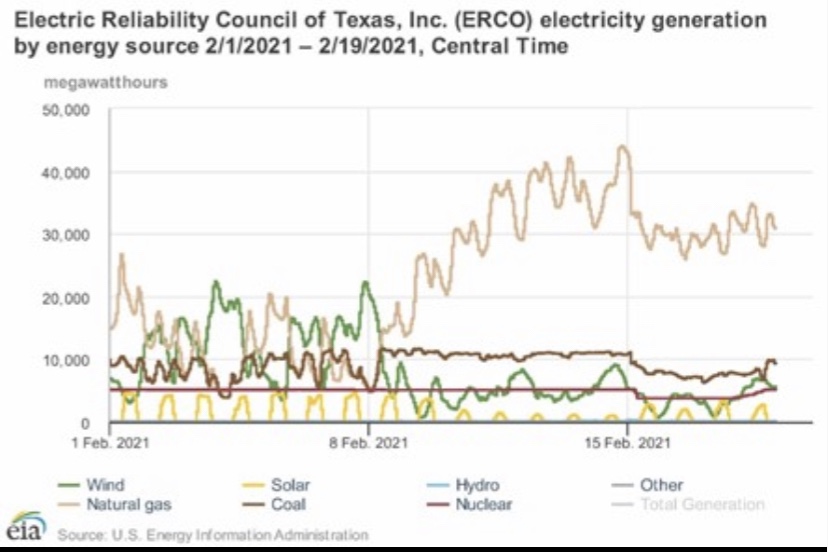
“… shows that five days before the first snowflake fell, wind and solar provided 58% of the electric power in Texas. But clouds formed, temperatures dropped and winds temporarily stalled, resulting in more than half the wind and solar power going offline in three days never to return during the storm, when the problems got worse and turbines froze and snow and ice covered solar panels.”

Power prices must cover the cost of meeting “normal” energy needs as well as the cost of providing for peak loads. That means investment in contracts that guarantee fuel supplies as well as peak generating units. It also means inter-connectivity to other power grids. Instead, ERCOT sought to subsidize costly renewable power in part by skimping on risk-mitigating assets.

Retail pricing can also help avert crises of this kind. Texas customers on fixed-rate plans had no incentive to conserve as temperatures fell. Consumers can be induced to lower their thermostats with variable-rate plans, and turning it down by even a degree can have a significant impact on usage under extreme conditions. The huge spike in bills for variable-rate customers during the crisis has much to do with the fact that too few customers are on these plans to begin with. Among other things, Lynne Kiesling and Vernon L. Smith discuss the use of digital devices to exchange information on scarcity with customers or their heating systems in real time, allowing quick adjustment to changing incentives. And if a customer demands a fixed-rate plan, the rate must be high enough to pay the customer’s share of the cost of peak capacity.

Price incentives make a big difference, but there are other technological advances that might one day allow renewables to provide more reliable power, as discussed in Tyler Cowen’s post on the “energy optimism” of Austin Vernon”. I find Vernon far too optimistic about the near-term prospects for battery technology. I am also skeptical of wind and solar due to drawbacks like land use and other (often ignored) environmental costs, especially given the advantages of nuclear power to provide “green energy” (if only our governments would catch on). The main thing is that sufficient capacity must be maintained to meet surges in demand under adverse conditions, and economic efficiency dictates that that it is a risk against which ratepayers cannot be shielded.

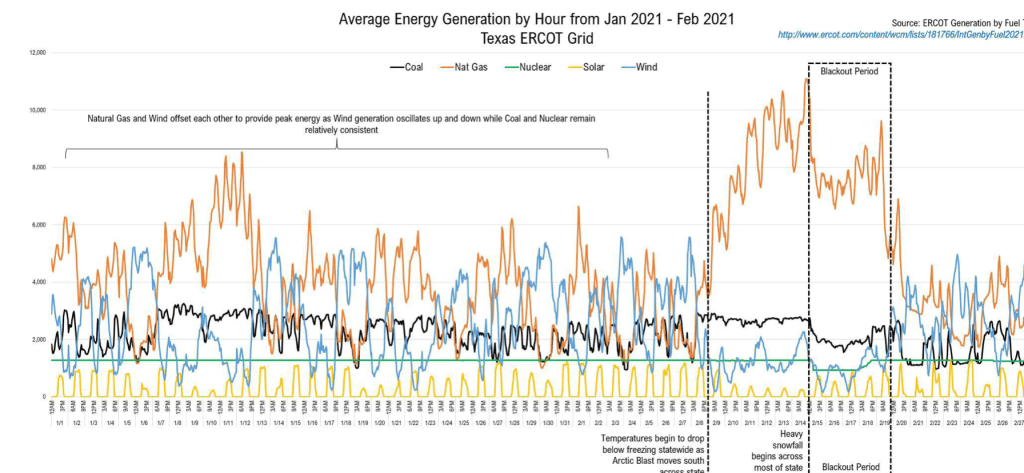
Note: For context on the chart at the top of this post, temperatures in much of Texas fell on the 9th of February, and then really took a dive on the 14th before recovering on the 19th. Wind generation fell immediately, and solar power diminished a day or two later. Gas and coal helped to offset the early reductions, but it took several days for gas to ramp up. Even then there were shortages. Then, on the 16th, there were problems maintaining gas and coal generation. Gas was still carrying a higher than normal load, but not enough to meet demand.

Follow Sacred Cow Chips on WordPress.com

Recent Posts

  • The Case Against Interest On Reserves
  • Immigration and Merit As Fiscal Propositions
  • Tariff “Dividend” From An Indigent State
  • Almost Looks Like the Fed Has a 3% Inflation Target
  • Government Malpractice Breeds Health Care Havoc

Archives

  • January 2026
  • December 2025
  • November 2025
  • October 2025
  • September 2025
  • August 2025
  • July 2025
  • June 2025
  • May 2025
  • April 2025
  • March 2025
  • February 2025
  • January 2025
  • December 2024
  • November 2024
  • October 2024
  • September 2024
  • August 2024
  • July 2024
  • June 2024
  • May 2024
  • April 2024
  • March 2024
  • February 2024
  • January 2024
  • December 2023
  • November 2023
  • August 2023
  • July 2023
  • June 2023
  • May 2023
  • April 2023
  • March 2023
  • February 2023
  • January 2023
  • December 2022
  • November 2022
  • October 2022
  • September 2022
  • August 2022
  • July 2022
  • June 2022
  • May 2022
  • April 2022
  • March 2022
  • February 2022
  • January 2022
  • December 2021
  • November 2021
  • October 2021
  • September 2021
  • August 2021
  • July 2021
  • June 2021
  • May 2021
  • April 2021
  • March 2021
  • February 2021
  • January 2021
  • December 2020
  • November 2020
  • October 2020
  • September 2020
  • August 2020
  • July 2020
  • June 2020
  • May 2020
  • April 2020
  • March 2020
  • February 2020
  • January 2020
  • December 2019
  • November 2019
  • October 2019
  • September 2019
  • August 2019
  • July 2019
  • June 2019
  • May 2019
  • April 2019
  • March 2019
  • February 2019
  • January 2019
  • December 2018
  • November 2018
  • October 2018
  • September 2018
  • August 2018
  • July 2018
  • June 2018
  • May 2018
  • April 2018
  • March 2018
  • February 2018
  • January 2018
  • December 2017
  • November 2017
  • October 2017
  • September 2017
  • August 2017
  • July 2017
  • June 2017
  • May 2017
  • April 2017
  • March 2017
  • February 2017
  • January 2017
  • December 2016
  • November 2016
  • October 2016
  • September 2016
  • August 2016
  • July 2016
  • June 2016
  • May 2016
  • April 2016
  • March 2016
  • February 2016
  • January 2016
  • December 2015
  • November 2015
  • October 2015
  • September 2015
  • August 2015
  • July 2015
  • June 2015
  • May 2015
  • April 2015
  • March 2015
  • February 2015
  • January 2015
  • December 2014
  • November 2014
  • October 2014
  • September 2014
  • August 2014
  • July 2014
  • June 2014
  • May 2014
  • April 2014
  • March 2014

Blogs I Follow

  • Passive Income Kickstart
  • OnlyFinance.net
  • TLC Cholesterol
  • Nintil
  • kendunning.net
  • DCWhispers.com
  • Hoong-Wai in the UK
  • Marginal REVOLUTION
  • Stlouis
  • Watts Up With That?
  • Aussie Nationalist Blog
  • American Elephants
  • The View from Alexandria
  • The Gymnasium
  • A Force for Good
  • Notes On Liberty
  • troymo
  • SUNDAY BLOG Stephanie Sievers
  • Miss Lou Acquiring Lore
  • Your Well Wisher Program
  • Objectivism In Depth
  • RobotEnomics
  • Orderstatistic
  • Paradigm Library
  • Scattered Showers and Quicksand

Blog at WordPress.com.

Passive Income Kickstart

OnlyFinance.net

TLC Cholesterol

Nintil

To estimate, compare, distinguish, discuss, and trace to its principal sources everything

kendunning.net

The Future is Ours to Create

DCWhispers.com

Hoong-Wai in the UK

A Commonwealth immigrant's perspective on the UK's public arena.

Marginal REVOLUTION

Small Steps Toward A Much Better World

Stlouis

Watts Up With That?

The world's most viewed site on global warming and climate change

Aussie Nationalist Blog

Commentary from a Paleoconservative and Nationalist perspective

American Elephants

Defending Life, Liberty and the Pursuit of Happiness

The View from Alexandria

In advanced civilizations the period loosely called Alexandrian is usually associated with flexible morals, perfunctory religion, populist standards and cosmopolitan tastes, feminism, exotic cults, and the rapid turnover of high and low fads---in short, a falling away (which is all that decadence means) from the strictness of traditional rules, embodied in character and inforced from within. -- Jacques Barzun

The Gymnasium

A place for reason, politics, economics, and faith steeped in the classical liberal tradition

A Force for Good

How economics, morality, and markets combine

Notes On Liberty

Spontaneous thoughts on a humble creed

troymo

SUNDAY BLOG Stephanie Sievers

Escaping the everyday life with photographs from my travels

Miss Lou Acquiring Lore

Gallery of Life...

Your Well Wisher Program

Attempt to solve commonly known problems…

Objectivism In Depth

Exploring Ayn Rand's revolutionary philosophy.

RobotEnomics

(A)n (I)ntelligent Future

Orderstatistic

Economics, chess and anything else on my mind.

Paradigm Library

OODA Looping

Scattered Showers and Quicksand

Musings on science, investing, finance, economics, politics, and probably fly fishing.

  • Subscribe Subscribed
    • Sacred Cow Chips
    • Join 128 other subscribers
    • Already have a WordPress.com account? Log in now.
    • Sacred Cow Chips
    • Subscribe Subscribed
    • Sign up
    • Log in
    • Report this content
    • View site in Reader
    • Manage subscriptions
    • Collapse this bar
 

Loading Comments...