• About

Sacred Cow Chips

Sacred Cow Chips

Author Archives: Nuetzel

Opioids and The War On Pain Treatment

08 Friday Mar 2019

Posted by Nuetzel in Prohibition, War On Drugs

≈ 1 Comment

Tags

Annals of Internal Medicine, CATO Institute, Chronic Pain, Dr. Ted Noel, FDA, Fentanyl, Geraldo Rivera, Heroin, Imported Opioids, Jacob Sullum, Jeffrey Miron, Opioid Addiction, Opioid Deaths, Opioid Prescription, Opioid Production Quotas, OxyContin, PDMPs, Portugal Decriminalization, Prescription Drug Monitoring Programs, Prohibition, Purdue Pharma, Scientific American

I repeatedly hear the bogus claim that prescription pain killers are a primary cause of opioid addiction. Twice this week I heard Geraldo Rivera prattling about it, blaming the drug companies for the opioid epidemic, expressing his view of the righteousness of the many lawsuits faced by Purdue Pharma and other firms. But these cases are hardly sure wins for the plaintiffs, and for good reason. The idea that pharmaceutical companies misleadingly promoted the effectiveness of drugs like Oxycontin for pain relief, and minimized their addictive potential, might appear credible, but there are a number of factors that argue strongly against these claims. Of course, opioids are legal prescription drugs, approved for pain relief by the FDA, and are generally marketed by drug companies under guidelines established by the FDA at the time of approval. And sadly, the narrative promoted by Rivera and many others is at tension with the needs of patients suffering from chronic pain.

In fact, opioids are effective for temporary and chronic pain relief, and they have been used for those purposes for many decades. In “The Other Opioid Problem“, anesthesiologist Dr. Ted Noel asserts that few chronic pain patients have overdosed or been killed by ODs. According to Scientific American:

“A Cochrane review of opioid prescribing for chronic pain found that less than one percent of those who were well-screened for drug problems developed new addictions during pain care; a less rigorous, but more recent review put the rate of addiction among people taking opioids for chronic pain at 8-12 percent [but less than 1% abuse].”

Those prescribed opioids for temporary relief after an injury or surgical procedure are even less likely to develop an addiction. The large majority of addicts are self-selected out of a population of individuals who want to get high. And most of them feed their addictions on opioids obtained illegally, often from imported heroin and fentanyl. Yes, opioids are stolen from legitimate patients, pharmacies, or elsewhere, and sometimes they are prescribed illegally by unscrupulous physicians. That might be the way many addicts get started, but most of the illegal opioid supply in the U.S. is imported heroin and fentanyl.

A causal linkage between opioid prescriptions, addiction and opioid deaths would imply a strong, positive correlation between prescription and death rates. However, Jacob Sullum reports that there is no correlation across states between prescription rates and death rates from opioids. As Sullum notes, this result offers “more reason to doubt that pain pill restrictions will save lives”.

In fact, in a separate article, Sullum writes of other evidence strongly suggesting that those restrictions may have counterproductive effects on opioid deaths, in addition to denying some patients access to the pain pills they legitimately need for treatment. According to Sullum, all 50 states have Prescription Drug Monitoring Programs (PDMPs) that monitor controlled substances and keep tabs on prescribers and pharmacies. These have succeeded in discouraging opioid prescriptions, but research appearing in the Annals of Internal Medicine suggests that the programs might be doing more harm than good:

“Fink et al found six studies that included heroin overdoses, half of which reported a statistically significant association between adoption of PDMPs and increases in such incidents. … To the extent that PDMPs succeed in making pain pills harder to obtain, they encourage nonmedical users to seek black-market substitutes. ‘Changes to either the supply or cost of prescription opioids after a PDMP is instituted,’ Fink et al. observe, ‘might reasonably drive opioid-dependent persons to substitute their preferred prescription opioid with heroin or nonpharmaceutical fentanyl.’

The FDA has enforced quotas on the production of legal opioids. According to the CATO Institute:

“The tight quotas on opioid production contributed to the acute shortage of injectable opioids being felt in hospitals across the nation. It is not only making patients suffer needlessly but places them at increased risk for adverse drug reactions or overdose.”

The FDA’s restrictions were eased somewhat after complaints from the medical community, but the harm continues. At the time of CATO’s report, opioid prescriptions had declined by 41% since 2010, while the overdose rate continued to escalate.

This pattern is all too familiar to those who have been arguing against drug prohibition for years. The flood of fentanyl into the country, and into what is sold as street heroin, is a direct consequence of prohibitions on supplies of legal heroin and other narcotics. But breaking through the puritanical and bumptious mentality of drug warriors is almost impossible. The worse the situation gets, the tighter they turn the screws, doubling down on the policies that have repeatedly failed in the past. Here I repeat the concluding paragraph of a Sacred Cow Chips post from January 2018 on the opioid epidemic:

“There are solutions to the deadly nature of the opioid epidemic, but prohibition is not one of them and never will be. If anything, prohibition in varying degrees has aggravated the dangers of opioids. To truly solve the problem, we should eliminate restrictions on the production and distribution of legal opioids for pain management, legalize heroin, and stop interfering in markets. That would be merciful for patients in real pain, make recreational use of opioids dramatically safer, and put an end to the gangland violence associated with underground competition. Second, redirect those resources into … harm reduction programs. [Jeffrey] Miron notes that legalization has worked in other countries, like Portugal and France, to reduce overdoses and opioid deaths. As a political matter, however, these steps might not be feasible unless we get over the cultural bias stigmatizing recreational opioid use as ‘evil’, and the idea that laws and enforcement can actually prevent people from trying to get high.

A Carbon Tax Would Be Fine, If Only …

01 Friday Mar 2019

Posted by Nuetzel in Environment, Global Warming, Taxes

≈ Leave a comment

Tags

A.C. Pigou, Carbon Dividend, Carbon Tax, Climate Change, Economic Development, External Cost, Fossil fuels, Green New Deal, IPCC, John Cochrane, Michael Shellenberger, Pigouvian Tax, Quillette, Renewable energy, Revenue Neutrality, Robert P. Murphy, Social Cost of Carbon, Warren Meyer, William D. Nordhaus

I’ve opposed carbon taxes on several grounds, but I admit that it might well be less costly as a substitute for the present mess that is U.S. climate policy. Today, we incur enormous costs from a morass of energy regulations and mandates, prohibitions on development of zero-carbon nuclear power, and subsidies to politically-connected industrialists investing in corn ethanol, electric cars, and land- and wildlife-devouring wind and solar farms. (For more on these costly and ineffective efforts, see Michael Shellenberger’s “Why Renewables Can’t Save the Planet” in Quillette.) Incidentally, the so-called Green New Deal calls for a complete conversion to renewables in unrealistically short order, but with very little emphasis on a carbon tax.

The Carbon Tax

Many economists support the carbon tax precisely because it’s viewed as an attractive substitute for many other costly policies. Some support using revenue from the tax to pay a flat rebate or “carbon dividend” to everyone each year (essentially a universal basic income). Others have pitched the tax as a revenue-neutral replacement for other taxes that are damaging to economic growth, such as payroll taxes or taxes on capital. Economic growth would improve under the carbon tax, or so the story goes, because the carbon tax is a tax on a “bad”, as opposed to taxes on “good” factors of production. I view these ideas as politically naive. If we ever get the tax, we’ll be lucky to get much regulatory relief in the bargain, and the revenue is not likely to be offset by reductions in other taxes.

But let’s look a little closer at the concept of the carbon tax, and I beg my climate-skeptic friends to stick with me for a few moments and keep a straight face. The tax is a way to attach an explicit price to the use of fuels that create carbon emissions. The emissions are said to inflict social or external costs on other parties, costs which are otherwise ignored by consumers and businesses in their many decisions involving energy use. The carbon tax is a so-called Pigouvian tax: a way to “internalize the externality” by making fossil fuels more expensive to burn. The tax itself involves no prohibitions on behavior of any kind. Certain behaviors are taxed to encourage more “desirable” behavior.

Setting the Tax

But what is the appropriate level of the tax? At what level will it approximate the true “social cost of carbon”? Any departure from that cost would be sub-optimal. Robert P. Murphy contrasts William D. Nordhaus’ optimal carbon tax with more radical levels, which Nordhaus believes would be needed to meet the goals of the United Nation’s Intergovernmental Panel on Climate Change (IPCC). Nordhaus won the 2018 Nobel Prize in economics for his work on climate change. Whatever one might think of the real risks of climate change, Nordhaus’ clearly recognizes the economic downsides to mitigating against those risks.

Nordhaus has estimated that the social cost of carbon will be $44/ton in 2025 (about $0.39 per gallon of gas). He claims that a carbon tax at that level would limit increases in global temperature to 3.5º Celsius by 2100. He purports to show that the costs of a $44 carbon tax in terms of reduced economic output would be balanced by the gains from limiting climate warming. Less warming would require a higher tax with fewer incremental rewards, and even more incremental lost output. The costs of the tax would then outweigh benefits. For perspective, according to Nordhaus, a stricter limit of 2.5º C implies a carbon tax equivalent to $2.50 per gallon of gas. The IPCC, however, prescribes an even more radical limit of 1.5º C. That would inflict a huge cost on humanity far outweighing the potential benefits of less warming.

A Carbon Tax, If…

Many economists have come down in favor of a carbon tax under certain qualifications: revenue-neutrality, a “carbon dividend”, or as a pre-condition to deregulation of carbon sources and de-subsidization of alternatives. John Cochrane discusses a carbon tax in the context of the “Economists’ Statement on Carbon Dividends” (Cochrane’s more recent thoughts are here):

“It’s short, sweet, and signed by, as far as I can tell, every living CEA chair, every living Fed Chair, both Democrat and Republican, and most of the living Nobel Prize winners. … It offers four principles 1. A carbon tax, initially $40 per ton. 2. The carbon tax substitutes for regulations and subsidies and (my words) the vast crony-capitalist green boondoggle swamp, which is chewing up money and not saving carbon. 3. Border adjustment like VAT have [sic] 4. ‘All the revenue should be returned directly to U.S. citizens through equal lump-sum rebates.'”

Rather than a carbon dividend, Warren Meyer proposes that a carbon tax be accompanied by a reduction in the payroll tax, an elimination of all subsidies, mandates, and prohibitions, development of more nuclear power-generating capacity, and contributions to a cleanup of Chinese and Asian coal-power generation. That’s a lot of stuff, and I think it exceeds Meyer’s normal realism with respect to policy issues.

My Opposition

Again, I oppose the adoption of a carbon tax for several reasons, despite my sympathy for the logic of Pigouvian taxation of externalities. At the risk of repeating myself, here I elaborate on my reasons for opposition:

Government Guesswork: First, Nordhaus’ estimates notwithstanding, we do not and cannot know the climate/economic tradeoffs with any precision. We can barely measure global climate, and the history of what measures we have are short and heavily manipulated. Models purporting to show the relationship between carbon forcing and global climate climate change are notoriously unreliable. So even if we can agree on the goal (1.5º, 2.5º, 3.5º), and we won’t, the government will get the tradeoffs wrong. I took the following from a comment on Cochrane’s blog, a quote from A.C. Pigou himself:

“It is not sufficient to contrast the imperfect adjustments of unfettered enterprise with the best adjustment that economists in their studies can imagine. For we cannot expect that any State authority will attain, or even wholeheartedly seek, that ideal. Such authorities are liable alike to ignorance, to sectional pressure, and to personal corruption by private interest. A loud-voiced part of their constituents, if organized for votes, may easily outweigh the whole.”

Political Hazards: Second, we won’t get the hoped-for political horse trade made explicit in the “Economists’ Statement …” discussed above. As a political matter, the setting of the carbon tax rate will almost assuredly get us a rate that’s too high. Experiences with carbon taxes in Australia, British Columbia, and France have been terrible thus far, sowing widespread dissatisfaction with the resultant escalation of energy prices.

Economic Growth: Neither is it a foregone conclusion that a revenue-neutral carbon tax will stimulate economic growth, and it might actually reduce output. As Robert P. Murphy explains in another post, the outcome depends on the structure of taxes prior to the change. The substitution of the carbon tax will increase output only if it replaces taxes on a factor of production (labor or capital) that is overtaxed prior to the change. That undermines a key selling point: that the carbon tax would necessarily produce a “double dividend”: a reduction in carbon emissions and higher economic growth. Nevertheless, I’d allow that revenue neutrality combined with elimination of carbon regulation and “green” subsidies would be a good bet from an economic growth perspective.

Overstated Risks: Finally, I oppose carbon taxes because I’m unconvinced that the risk and danger of global warming are as great as even Nordhaus would have it. In other words, the external costs of carbon don’t amount to much. Our recorded temperature history is extremely short and is therefore not a reliable guide to the long-term nature of the systemic relationships at issue. Even worse, temperature records are manipulated to exaggerate the trend in temperatures (also see here, here and here). There is no evidence of an uptrend in severe weather events, and the dangers of sea level rise associated with increasing carbon concentrations also have been greatly exaggerated. Really, at some point one must take notice of the number of alarming predictions and doomsday headlines from the past that have not been borne out even remotely. Furthermore, higher carbon concentrations and even warming itself would be of some benefit to humanity. In addition to a greener environment, the benefits include more rapid economic growth, improved agricultural yields, and a reduction in the salient danger of cold-weather deaths.

Economic Development: The use of fossil fuels has helped to enable strong growth in incomes in developed economies. It has also given us energy alternatives such as nuclear power as well as research into other alternatives, albeit with very mixed success thus far. And while a carbon tax would create an additional incentive to develop such alternatives, a U.S. tax would not accomplish much if any global temperature reduction. Such a tax would have to be applied on a global scale. Talk about a political long-shot! Increasing the price of carbon emissions also has enormous downsides for the less developed world. These fragile economies would benefit greatly from development of fossil fuel energy, enabling reductions in poverty and the income growth necessary to someday join in the prosperity of the developed economies. This, along with liberalization of markets, is the affordable way to bring economic success to these countries, which in turn will enable them to consider the energy alternatives that might come to fruition by that time. Fighting the war on fossil fuels in the underdeveloped world is nothing if not cruel.


Evil HR: Organizational Fetters, Social Fabians

27 Wednesday Feb 2019

Posted by Nuetzel in Identity Politics, Progressivism, Social Justice

≈ Leave a comment

Tags

Best Practices, Centers of Excellence, Core Competencies, Corporate Social Responsibility, Corporatism, Disparate impact, Diversity Training, Fast Company, Glenn Reynolds, Human Resources, Jordan Peterson, Kyle Smith, Social Justice, Stakeholders

It is with deepest apologies to my friends in Human Resources (HR) that I admit to a long-standing bias: HR can exert a corrosive influence on a company’s ability to serve customers well and profit at it. I’m sure there are exceptions, but HR often pursues missions that are incompatible with the firm’s primary objectives. I’ve had my own difficulties with HR at employers for whom I’ve worked, and those have been of a mere bureaucratic variety. Today, the dysfunction goes much deeper. Many HR departments are engaged in a sort of Fabian gradualism, subverting free enterprise from within and promoting the doctrine of social justice.

Here are a few reasons for casting a skeptical eye on the contributions of HR:

  • It adds little value in screening applicants for certain kinds of jobs, helping to explain why so many job matches occur via professional networks and external recruiters.
  • I have witnessed HR scuttle simple plans to add interns, paid or unpaid, asserting that our department had no authority to institute such a program.
  • HR dreams up ridiculously ambiguous and complex performance assessment methods, which in the end make very little difference in the structure of rewards.
  • HR insists that “promoting diversity” is a key component of every job assessment, forcing staff to engage in written exercises of creative fluffery.
  • It creates incentives that distort hiring and firing decisions based on demographic characteristics rather than actual job qualifications and performance.
  • HR requires staff time for “diversity training”, an effort that is often resented as an insulting and patronizing intrusion on the time employees have to do their jobs.
  • HR emphasizes rewards to “stakeholders”, with little deference to the primacy of shareholders. It’s one thing for a company to maximize its value proposition to customers and prospects and to provide employees with handsome incentives. Those are fully consistent with maximizing the value of the firm. But “stakeholders” includes … just about everyone. Come and get it!
  • And HR relentlessly promotes the creed of “corporate social responsibility“, which ultimately involves a high order of virtue signaling on environmental and other social issues having little to do with the firm’s business.

It is true that HR is tasked with responsibilities that include minimizing a company’s exposure to various legal and regulatory risks. For example, one objective is to avoid any appearance of “disparate impact”. Even policies having a legitimate business purpose might be challenged if results have a statistical association with demographic characteristics. It’s an unfortunate fact that through efforts to manage that risk, HR serves as a spearhead of government intrusion into the affairs of private companies.

HR has thus become a tool through which collectivist ideals infiltrate business practices, to the detriment of the firm’s performance. These are exactly the kinds of things meant by Fast Company when they say HR isn’t working for you.  

Kyle Smith makes no bones about it: companies should simply fire their HR departments. And many can do just that by outsourcing HR functions. Smith’s arguments are couched in the most practical of terms:

“They speak gibberish.” Yes they do. Nowhere is corporate-speak more pervasive than in HR, where they’ll tell you that the organization’s “core competences” must be “leveraged” via “best practices” by “empowered contributors” within “centers of excellence”.

“They revel in red tape.” To paraphrase Smith, HR could rightfully be renamed “Compliance Resources”. These “paper pushing” functions are drivers of bloat and cost escalation, a manifestation of the familiar cost disease endemic to all bureaucracies.

“They live in a bubble.” HR managers have an inflated view of their role in the organization. Smith quotes an HR executive: ”The organization reports to us. It must meet our demands for information, documents, numbers.” Sounds like a classic central planner. Unfortunately, many companies acquiesce to the tyranny of HR bureaucrats, much to their detriment. But Smith’s point here is that HR executives are often out of touch with the way employees truly feel about the company for whom they work, with an exaggerated view of employee enthusiasm. Yet those executives are given responsibilities for which they should know better.

“They aren’t really in your business.” The skill emphasized as most important for success in HR is communications skills, according to Smith (“… what you and I call talking.“) Knowledge of finance, engineering or technology is noncritical. Fair enough, you might say: their role is different, but this goes a long way toward explaining why HR generally fails so miserably in evaluating job candidates. Can you really expect them to craft policies designed to optimize a business’ use of professional talent?

Jordan Peterson takes an extremely dim view of HR. I share his concern that HR, and HR policies, have a tendency to become heavily politicized. Ultimately, this cannot be of value to a competitive firm. As Glenn Reynolds likes to say, “Get woke, go broke“. Peterson’s perspective is societal, however, and he goes so far as to say HR departments are “dangerous”:

“I see that the social justice etiology that’s destroyed a huge swath of academia is on the march in a major way through corporate America. …

… they’ve become ethics departments. And people who take to themselves the right to determine the propriety of ethical conduct end up with a lot more power — especially if you cede it to them — than you think. And that’s happening at a very rapid rate.

The doctrines that are driving hiring decisions, for example — any emphasis, for example, on equity, or equality of outcome — it’s unbelievably dangerous. You don’t just pull that in and signal to society that you’re now acting virtuously without bringing in the whole pathological ideology.”

The value extracted from firms in the service of achieving “social justice” is essentially stolen from its rightful owners. The penalties don’t end with shareholders; employees and suppliers lose a measure of security from a weakened firm, and customers may suffer a loss in the quality of the product. It is as if reparations must be made to parties who are completely external to, and completely unharmed by, the success of the business.

It’s little wonder that companies are outsourcing their HR functions. A classic case is the use of recruiting firms that specialize in identifying talent in particular professions. Another is the outsourcing of benefits management, and there are other functions that can be farmed out. Eliminating bureaucratic bloat is often a focus of firms seeking to rationalize HR. Ultimately, a leaner HR department improves cost control, and keeping it lean reduces its latitude to divert company resources toward endeavors that promote the philosophy of collectivism.

The Fast Trains That Can’t

17 Sunday Feb 2019

Posted by Nuetzel in Air Travel, infrastructure

≈ Leave a comment

Tags

capital costs, Cost Per Passenger Mile, Elon Musk, eminent domain, Environmental Costs, Freight Traffic, High speed rail, Hyperloop, infrastructure, Megan McArdle, Rolling Resistance, Warren Meyer

High-speed rail will remain a pipe-dream in the U.S. except for the development of a few limited routes. However, statists continue to push for large-scale adoption. That would represent a triumph of big government, if realized, and it is very appealing to the public imagination. But high-speed rail (HSR) is something of a fraud. Projected fares do not include the massive capital costs required to build it, which must be funded by taxpayers. Like most big public projects, HSR presents ample opportunities for graft by privileged insiders. And apparently it’s easy to rationalize HSR by repeating the questionable mantra that it is environmentally superior to autos or even air travel.

California recently confronted the harsh reality of HSR costs by scaling back its ambitious plans to a single line traversing a portion of the central valley. Now, the federal government has acknowledged that the state has violated the terms of past federal grants, essentially for non-performance. Those grants totaled $2.5 billion, and another grant of almost $1 billion might be withheld. Better not to throw good money after bad.

Megan McArdle wisely debunks the viability of HSR in the U.S. based on four potent factors: distance, wealth, legal obstacles, and cost. Unlike Europe, Japan and even the eastern Chinese seaboard, the distances involved in the U.S. make widespread development of HSR infrastructure quite challenging. Even on shorter routes, the U.S. has too much valuable property in and between population centers that would have to be repurposed for placement of relatively straight-line routes to facilitate high speeds. An authoritarian government can commandeer property, but wresting property from private owners in the U.S. is not straightforward, even when obtrusive bureaucrats attempt to invoke eminent domain. McArdle says:

“… the U.S. legal system offers citizens an unparalleled number of veto points at which they can attempt to block government projects. Any infrastructure project bigger than painting a schoolhouse thus has to either fight out the reviews and court cases for years, or buy off the opponents, or more likely, both.”

Another downside for HSR: the cost of installing and operating U.S. infrastructure is inflated by a number of factors, including high U.S. wage levels, unions, overlapping regulatory agencies, and the distances and other cost factors discussed earlier. Even worse, the extensive planning and lengthy time lines of such a project virtually assure cost overruns, as California has learned the hard way. So high-speed rail has a lot going against it.

Warren Meyer raises another issue: rail in the U.S. is dominated by freight, and it is very difficult for freight and passenger traffic to share the same system. That means freight traffic cannot be used to help defray the cost of installing HSR. Meyer makes an interesting comparison between the efficiency of passenger trains relative to freight: much more energy is needed to pull a heavy passenger train car than to pull the actual passengers inside. In contrast, the cargo inside a typical freight car weighs far more than the car itself. But the efficiency of freight transportation in the U.S. seems to have no allure for many critics of U.S. transportation policy.

“Freight is boring and un-sexy. Its not a government function in the US. So intellectuals tend to ignore it, even though it is the far more important, from and energy and environmental standpoint, portion of transport to put on the rails. … We have had huge revolutions in transportation over the last decades during the same period that European nations were sinking billions of dollars into pretty high-speed passenger rails systems for wealthy business travelers.”   

Comparisons of efficiency across modes of passenger transportation are typically limited to operating costs, including energy costs, per passenger mile. That narrow focus yields a distorted view of the relative advantages of different passenger modes. In particular, the massive incremental capital costs of HSR are often ignored. Moreover, weight must be assigned to the very real economic costs of passenger time, not to mention the external costs imposed on the viability of farmland, nearby property owners, and wildlife.

In the long-term, all modes of transportation have infrastructure costs, but HSR lines don’t yet exist in this country. It is therefore relevant to ask whether the cost comparison is intended to address an ongoing transportation need or an incremental need. HSR is often promoted as a replacement for other modes of transportation, so the lack of an installed base of infrastructure is a huge incremental cost relative to modes already in place.

Air travel has some obvious advantages over high-speed trains. First, it requires much less support infrastructure, and a significant base of that capital is already installed. Again, the massive, up-front infrastructure costs of HSR are incremental. Also, airports tend to be well-integrated with local transportation options. New passenger train terminals would require additional investment in local ground transportation such as light rail or subway extensions, highway access, and the like. In addition, planes require less passenger time than trains over lengthy routes.

How about autos vs. HSR? Autos have the pre-installed base of road infrastructure. They provide hard-to-value flexibility for the traveler as well, but parking costs must be dealt with, and cars have extremely high accident rates. Travel time is a disadvantage for autos relative to HSR, even at moderate distances. In terms of operating costs, however, autos are not necessarily at a disadvantage: they weigh much less per passenger than trains, but that advantage is offset by trains’ low “rolling resistance” and other factors. The best choice for travelers would vary with the value they place on their time, specific plans at the destination, preference for flexibility, and the operating costs of their vehicle relative to the high-speed train fare.

Supporters of HSR contend that it is less costly to the environment than other modes of transportation. That case is easier to make if you focus solely on operating costs and exclude the impact of generating the electricity needed to power trains, which will require emissions of greenhouse gases for many years to come. A second fundamental omission is the environmental cost of the rail infrastructure itself. It’s very existence is disruptive to local environments, but perhaps most importantly, producing and installing the steel, concrete, and other materials needed for HSR will carry a steep environmental cost.

HSR is unlikely to achieve widespread adoption in the U.S. The distances of many routes and high infrastructure costs are obstacles that will be nearly impossible to overcome. Projected fares would be outrageously high were they to cover the full cost of the infrastructure. A typical argument is that taxpayers should fund the infrastructure due to the social benefits that rail is presumed to confer, but that presumption is far-fetched given the impact of producing the infrastructure itself, as well as the power needed to run the trains. I don’t expect adherents of rail to put aside their dreams quickly, however: there is something so romantic about the notion of having the state provide a massive rail network that the idea will never die the death it deserves. And don’t be fooled by Elon Musk’s hyperloop. It remains a distant technological hope and it too will have enormous resource costs along with an attendant call for public subsidies (a call which has already begun). After all, public subsidies are a hallmark of most of Musk’s business ventures.


The Oddly Cherished Tax Refund

13 Wednesday Feb 2019

Posted by Nuetzel in Taxes, Uncategorized

≈ Leave a comment

Tags

#GOPTaxScam, Alex Tabarrok, GOP Tax Law, Hot Air, IRS, Itemized Deductions, Jazz Shaw, Over-Withholding, Standard Deduction, Tax Refunds, Washington Post

Lately I’ve heard people complain bitterly that their federal tax refunds will be smaller this year. It’s as if they expected the 2017 tax package to lead to a larger refund on taxes paid in 2018, rather than a lower tax liability. Yes, those are two different things. About 80% of U.S. taxpayers are expected to see a net reduction in their federal taxes for 2018, but they might or might not receive refunds. Was your withholding reduced by the new tax law? Then you might receive a smaller refund even if your taxes are lower. Likewise, if you reduced your withholding too much, you will receive a smaller refund. Did your income rise? Then maybe you’ll pay more taxes and see a smaller refund.

The withholding tables were adjusted by the IRS in early 2018 based on the changes dictated by the tax package. Lower withholding was applied to many taxpayers, but it is often possible to manage one’s withholding rate within certain limits. How many of those pining for a refund took action to preserve a higher level of withholding? Let’s hope it was zero, for their sake.

Don’t get me wrong: if you’re not sure whether you’ll owe taxes when you file, it’s always nice to hear that a refund is coming. Moreover, the withholding allowance calculation is a very imprecise guide to one’s tax liability. Clearly the tax package did not benefit every taxpayer, especially high earners and small business people. Those in high-tax states lost a chunk of their state and local tax deduction. And another thing was somewhat irritating: continuing high compliance costs. Even under this so-called tax simplification, it remains necessary for many taxpayers to collect information related to potential deductions. After all, how else would you know whether it makes more sense to itemize rather than take the larger standard deductions now available? Small business people have some other compelling reasons to complain about this “simplification”.

Jazz Shaw at Hot Air observed that this Washington Post article about reduced tax refunds was crafted as if to inflame resentment among taxpayers:

“This is certainly a clever bit of ‘coverage’ of a story based primarily on people bitching on Twitter. Notice how the WaPo manages to promote a hashtag denigrating the tax cuts in the second paragraph. [#GOPTaxScam] The premise here is clearly that the tax cuts reduced some people’s refunds, only Republicans voted for the tax cuts, therefore the tax cuts must be bad and so are the Republicans.”

I don’t have the link now, but yesterday Alex Tabarrok had this sarcastic reaction to the WaPo article:

“Voters irate because the government didn’t force them to give it an interest-free loan…”

Perhaps no explanation is required, but the government has free use of your funds whenever too much is withheld from your regular paycheck — it pays you no interest on the “loan” as part of your ultimate refund. If getting that refund is the only way you can save, you’re doing it wrong.


The Abolition of Wealth

12 Tuesday Feb 2019

Posted by Nuetzel in Free markets, Redistribution, Taxes

≈ Leave a comment

Tags

Abolish Billionaires, Don Boudreaux, Joseph Schumpetet, Negative-Sum Policy, Nick Gillespie, Paul McCartney, Redistribution, Scarcity, Wealth Creation, Wealth Taxes

Few weep for the wealthy when they are attacked by redistributionists, but perhaps we should. Recent expressions of hatred for the so-called super-rich extend to the merely affluent, of course, but billionaires are much less likely to find sympathy. Those proposing to “abolish billionaires” by laying public claim to their assets and incomes have little reason to expect a popular backlash. Nevertheless, there are strong reasons to defend the wealthy and their right to control the riches they accumulate. Don Boudreaux has some words we should all take to heart:

“While exceptions no doubt exist, the people who get rich in our economy are overwhelmingly people who have made the rest of us richer.”

Boudreaux is correct in noting that “anti-billionaire” sentiment is marked in people who know little of the complexities of actually producing things. Wealth creation is a two-way street. On one end is a cadre of innovators and risk-takers whose rewards are often concentrated. On the other end are the many beneficiaries of those innovations: eager buyers of value-enhanced products whose rewards are relatively diffuse but very meaningful nonetheless. The same dynamic takes place in generating lower levels of wealth, among hard-working small entrepreneurs and savers. Eliminate one set of rewards and the other will vanish.

Redistributionists are aware of scarcity at a basic level, but it’s as if they take for granted that a certain quantity of product will be on the shelves irrespective of the policy environment, incentives, and basic guarantees of economic liberty. As Boudreaux says:

“If food, clothing, medical care, automobiles, houses, diamond rings, airplane seats, rolls of paper towels, and all other good and services were randomly rained down onto earth by some heavenly being, it would then be true that the more of these goodies that I manage to grab, the fewer are the goodies available for you to grab, and vice versa. … And so if through simple luck or sinister cunning I grab more than you grab, then the resulting inequality in our wealth has no good justification. If the government seizes from me a chunk of ‘my’ stuff and gives it to you, no ethical offense is committed.”

That’s not how it works in a world in which effort and resourcefulness are required to satisfy wants. Under a truly liberal order, such efforts are voluntary, motivated by the promise and prospect of secure rewards. And so, as consumers, we can possess the riches made possible through the efforts of innovators and risk-takers. If successful, their rewards are earned by producing value that not only exceeds their own costs, but exceeds the prices buyers are asked to pay. Today’s most prominent billionaires have brought to market products, services, and ways of transacting that we’d never have imagined even a few years prior to their introduction. Computer operating systems, smart phones, on-line retailing, and room- and ride-sharing are just a few examples.

Nick Gillespie makes much the same point in quoting Joseph Schumpeter:

“The capitalist engine is first and last an engine of mass production which unavoidably also means production for the masses. . . . It is the cheap cloth, the cheap cotton and rayon fabric, boots, motorcars and so on that are the typical achievements of capitalist production, and not as a rule improvements that would mean much to the rich man. Queen Elizabeth owned silk stockings. The capitalist achievement does not typically consist in providing more silk stockings for queens but in bringing them within reach of factory girls.”

Then there are the highly popular musicians and actors of the day, with wealth approaching (and in a few cases exceeding) $1 billion. Gillespie uses Paul McCartney as a case in point. Rather than “cheating” his way to wealth, McCartney’s fans would heartily agree that his talents are well worth the wealth he’s managed to accumulate. Would advocates of “abolishing” billionaires deny all this? They contend, in their own arbitrary judgment, that the market’s objective assessment cannot justify wealth of this magnitude.

Redistributionists also resent that anyone of wealth might have the gall to hold it or invest it rather than give it away. First, as noted above, secure rights provide the necessary incentives to create, produce, and take risks ex ante, which help enrich us all ex post. But those rights also must be secure ex post, and not subject to the whims of the next generation of socialist nitwits. In addition, as Gillespie says:

“Would there be less suffering in the world if [McCartney’s] money is expropriated and transferred to the wretched of the earth via higher taxes rather than through his own charitable donations and investments? Probably not, especially when you think about how much suffering, especially in the developing world, is the direct result of government action.”

Gillespie also marshals statistics on changes in measures of inequality that do not support the claims of redistributionists. In a separate post, Boudreaux makes that case here. Furthermore, the U.S. already has arguably the most progressive tax system in the developed world, even if transfers to the poor are not as generous as in some countries.

The sheer ignorance of many progressives is well illustrated by the “war against billionaires“. These critics of wealth demonstrate all the economic sophistication of preening high-school social studies students. Unfortunately, they are now coddled by certain established officeholders too eager to seek approval from the fringe left than to bother with responsible policy analysis.

It’s a short rhetorical step from condemning billionaires to condemning mere millionaires and sub-millionaires, and coveting their wealth. The victims here will ultimately include successful small business people and professionals who not only employ large segments of the population but also provide many of the services and wares we rely on in our day-to-day lives. Their success is not only well-earned: it is continuously exposed to risk from competitive forces. Rapacious politicians will never cease in their efforts to apply confiscatory taxes to the wealth of the very affluent. Soon enough, tax policy will reach farther down into the wealth distribution. These are games better suited to children or even vicious animals. Redistributionists think in zero-sum terms, with no appreciation for the positive-sum outcomes enabled by secure rights and free markets. Their failure to grasp the dynamics of free markets is at the root of their advocacy for disastrously negative-sum policies.


How Empowered Bleeding Hearts Do Harden

01 Friday Feb 2019

Posted by Nuetzel in Collectivism, Socialism, The Road To Serfdom, Tyranny

≈ Leave a comment

Tags

Authoritarianism, Banality of Evil, Bleeding Hearts, Bryan Caplan, Collectivism, Confiscation, Free Markets, Hugo Chavez, Natural Rights, Social Democracy, Tyranny of the Majority, Venezuela

Here’s an empirical regularity: altruists attaining power to collectivize society’s productive machinery do not stay nice for long. In fact, aggressive pursuit of their goals might compel them to participate in brutal tyranny. But why? What happens to these sweet egalitarians who are, after all, imbued with the most earnest desire to elevate the common man by equalizing the fruits of society’s bounty?

Bryan Caplan offers Venezuela as Exhibit A in “A Short Hop from Bleeding Heart to Mailed Fist“:

“When Hugo Chavez began ruling Venezuela, he sounded like a classic bleeding-heart – full of pity for the poor and downtrodden. Plenty of people took him at his words – not just Venezuelans, but much of the international bleeding-heart community. … Almost every Communist dictatorship launches with mountains of humanitarian propaganda. Yet ultimately, almost everyone who doesn’t fear for his life wakes up and smells the tyranny.”

Venezuela’s collapse is merely the most recent in a long history of socialist debacles. Authoritarians certainly come in other stripes, but collectivists seem especially prone to the development of vicious alter-egos. But again, why?

Caplan knows the answer, and in something of a dialectical exercise, he proposes several explanations for the nice-to-nasty phenomenon. It’s not the infiltration of “bad guys”. Plenty of evidence suggests that the same people are at both ends of the transition, and for now let’s give the benefit of the doubt to the nicest elements of the avant guarde, or even those who go simply along on the basis of their idealism. It’s implausible that such humanitarian souls could believe it will be necessary, at the outset, to crush their opposition by force. Moreover, that approach risks immediate outcomes that are far too dire. Might an authoritarian or militaristic turn be necessary to deter hostile foreign actors who might attempt to foil collectivization? If so, it still doesn’t explain why subjugation of domestic citizens is ultimately accepted as a legitimate use of force by sincere altruists.

Caplan moves on to more compelling explanations of the disorder. Perhaps the expression of bleeding heart intentions is propaganda from the very start. Perhaps the rhetoric is really just hate speech disguised as noble intent. Surely those two explanations comport with the behavior of those having uglier motives for collectivism: envy and vengeance. And while those elements are certain to be active in any socialist front, they don’t explain why the bleeders also abecome beaters.

The best explanation for the horrid metamorphosis of empowered altruists is that egalitarian policies simply do not work very well. Caplan says:

“Bleeding-heart policies work so poorly that only the mailed fist can sustain them. In this story, the bleeding hearts are at least initially sincere. If their policies worked well enough to inspire broad support, the bleeding hearts would play nice. Unfortunately, bleeding-heart policies are exorbitantly expensive and often directly counter-productive. Pursued aggressively, they predictably lead to disaster. At this point, a saintly bleeding heart will admit error and back off. A pragmatic bleeding heart will compromise. The rest, however, respond to their own failures with rage and scapegoating. Once you institutionalize that rage and scapegoating, the mailed fist has arrived.” [Caplan’s emphasis]

The compulsory nature of policies advocated by leftists makes their system of social organization inherently unstable. With the imposition of every rule limiting the operation of private markets, with every compromise of the price mechanism, and with every new confiscatory policy, the economy becomes more feeble and inflexible. As several commenters on Caplan’s post note, socialists are people who simply do not understand economics.

The path to collectivism always involves promises that are impossible to keep. Personal concerns must be renounced in favor of the collective. Individuals are denied their freedom to act on creative impulses and their ability to cooperate freely with others in pursuit of personal well-being. Those are human rights that are quite unnatural to part with. That means it is impossible to achieve the collective without an implicit or explicit threat of enforcement through violent police power. Bleeding hearts will actually participate in the inevitable tyranny because they are so convinced of the righteousness of their cause.

Whether you call it socialism or social democracy makes no difference. The latter merely cloaks tyranny in a majoritarian dominance that would have enraged our nation’s founders. They understood the despotism inherent in allowing a majority to dictate the existence of basic rights. However, the bleeding hearts are always sure they know “what’s right” without weighing implications beyond the injustice du jour. That demands the application of force. And when confronted with the catastrophic results of their peremptory whimsy, they have no choice but to use still more force.

The banality of evil is truly a progressive disease. Fortunately, we have a preventive vaccine: the U.S. Constitution. But it will work only if we’re wise enough to rely on the framer’s original intent.


“Othered” By the Left

31 Thursday Jan 2019

Posted by Nuetzel in fascism, Identity Politics, Progressivism

≈ Leave a comment

Tags

#ExposeChristianSchools, anti-Semitism, Antifa, Black Hebrew Israelites, Brett Kavanaugh, Caroline Lewis, Christian Education, Covington Catholic High School, David French, Eliminationist Rhetoric, Glenn Reynolds, Identity Politics, Joel Kotkin, MAGA, Nathan Phillips, Otherism

Progressivism certainly has its discards. The photo showed a trash bin labeled “CATHOLIC DUMPSTER”. Dead bodies were hanging out of the top. A “friend” had posted it on Facebook, ostensibly as humor. I thought it was in poor taste and had the temerity to say so in a comment; naturally I was immediately castigated by a mob for expressing that opinion. The “friend” said that if I really knew him, I’d realize that he loves everyone. That claim was quickly undermined by his partner, who joined the exchange to spew vitriol for Christians. A wiser person on the thread, perhaps detecting a whiff of hypocrisy, noted the likely outrage had the label on the trash bin said “JEWISH DUMPSTER”. Well yes…. Er, maybe. The political Left, it seems, is drifting ever closer to anti-Semitism as well as radical intolerance for Christians. This in addition to outright hostility toward whites, men, or anyone perceived as having “privilege”. The rhetoric is becoming increasingly hateful, vile, and violent.

A recent confrontation in front of the Lincoln Memorial wrapped together several objects of leftist hatred. It involved boys from Covington Catholic High School and left-wing activist Nathan Phillips, an Omaha Indian, as well as a group of black nationalists called the Black Hebrew Israelites. The Covington boys are white, male, Catholic, pro-life, and they wore MAGA caps. They were passive except for chants intended to drown-out shouts of “faggots” from the Black Israelites, but the media almost uniformly portrayed the boys as racist villains in the immediate aftermath, based on incomplete video evidence. It is difficult to ascertain who released the original video, but a longer version proved that the boys were not at fault. Meanwhile, Phillips proved to be a bald-faced liar. He lied about the sequence of events, the behavior of the boys, and about having served in Vietnam. But those lies fueled a media narrative as well as the fertile imaginations of many leftists. The full video reveals that Phillips marched from some distance straight up to one of the teenagers and proceeded to bang a drum in the kid’s face. The boy maintained his composure and kept a calm smile on his face. Later, however, that smile was cited as proof of racism!

A few members of the media retracted the awful things they said about the teenagers and the incident, but others continue to allege that the Covington teenagers were at fault, or that they at least share the blame. Some of the rhetoric is no less hateful than before the full video became available. This is a far cry from the heartfelt entreaties to avoid criticism of any controversial opinions expressed by “the children” in the wake of the Parkland High School shooting. In the present case. the kids have been targeted with a slew of insults and threats to themselves and their families.

Regarding the MAGA caps, I am by no means a Trump enthusiast, but I root for him to do well as our president despite my strong disapproval of some of his policies. You won’t ever catch me in a MAGA cap. However, I do not believe that he and his political base are racist. Trump is an equal opportunity denigrator, but he’s called a racist every time his target happens to be a person of color, as though people of color are always above criticism. Trump is called a racist for his promise to build a wall along the Mexican border to stem illegal crossings, though the same proposal has been offered by many Democrats over the years, including Barack Obama and Check Schumer. Therefore, the very idea that wearing a MAGA cap is a racist signal is transparently political and absurd. That some of the Covington boys wore MAGA caps has reinforced other excuses to target them for vicious criticism.

A further issue is that the Covington boys are privileged, you see, guilty of possessing white, male privilege, even as they defended a black classmate harangued by the Black Israelites. They attend a private school, and so they must be from wealthy families and worthy of progressive hatred. They were in DC for the March for Life, so they are opposed to reproductive choice and must hate women. In fact, it’s been alleged that they were in DC only to oppose the Women’s March. Misogynists!

Hatred for Catholics and for anyone who has attended private schools is always de rigueur on the Left. That was quite clear during the Brett Kavanaugh confirmation hearings. Hatred gushed from the Left not only because they were satisfied of Judge Kavanaugh’s guilt based on unsubstantiated, 11th-hour allegations leveled against him by an SJW, but apparently also because he attended a Catholic boys school! Oh, and he is male. I have another “friend” whose Facebook feed was littered with smears of Kavanaugh, including characterizations of private school kids as “smug little weasels”. As Caroline Lewis said at the time, these “critics” are barbarians. Do you think they don’t want to hurt those they’ve “othered”, or want someone else to hurt them in one way or another? The boundaries of grievance always expand, and will keep expanding until they eat their own.

David French claims that his defense of Christian education prompted an activist to start the #ExposeChristianSchools hashtag. Now, I’m sure everyone who has attended public or private schools can repeat a litany of stories about a few awful teachers they were forced to endure, not to mention the hostile environment that school children often create for one another. But private schools, and religious schools, are often superior options for parents and children. If you don’t like the curriculum, don’t send your kids there. If you don’t think the policies are sufficiently inclusive, or the environment will be unhealthy for your child, then send them elsewhere. But the vilification of an entire segment of the population based on how they choose to educate their children is despicable. They’d ban Christian education if they could… and religion!

Note that the Left’s insistence on state domination is itself a threat of violence. While capitalism and free markets are cooperative in nature, socialism is at its core authoritarian and coercive. If you resist you become an enemy of “the people”, and such enemies will have consequences to pay.

Antifa is unashamedly violent, but it might be only the tip of the iceberg. The rhetoric of the Left has become increasingly hostile toward Christians, Jews, males, whites, Republicans, and of course anyone achieving material success. There is no forgiveness nor genuine love of others in leftist doctrine. Indeed, the “otherism” inherent in leftist identity politics is dangerous and a source of increasing social instability. Their “eliminationist rhetoric” is becoming all too common (scroll down at the link).

For now I’ll continue to engage in the marketplace of ideas. Perhaps it’s becoming a war. Us “others” need to keep voting and never back down. And by all means, be prepared to defend ourselves and our loved ones by any means necessary.


Bad Idea: Campaign Finance Reform

25 Friday Jan 2019

Posted by Nuetzel in Campaign Finance, Free Speech

≈ Leave a comment

Tags

501(c) Organizations, Campaign Finance Reform, Citizens United, Dark Money, David Harsanyi, Disclosure Requirements, Federal Election Commission, First Amendment, Free Speech, Glenn Reynolds, Independent Expenditure Committees, Jeffrey Milyo, Nancy Pelosi, Revolving Door Tax, Ron Paul, Social Welfare Organizations, Super PACs, Term Limits

Everyone seems to hate money in politics, and nearly everyone says campaign finance reform is needed to eliminate political corruption… nearly. Money in politics is blamed for allowing powerful interests to “buy” seats in the legislature, or in executive positions, as well as “tit-for-tat” influence over pieces of legislation. But not so fast: attempts at campaign finance regulation in the past have been largely unsuccessful in achieving their goals. Furthermore, campaign finance reforms may have perverse consequences, which I’ll discuss below. More importantly, while “taking money out of politics” sounds noble to many, it starkly implies abrogation of First Amendment rights. Far from “leveling the playing field”, there is a great danger that it would lead to suppression of minority opinions. For those reasons. it’s better to consider other means of ensuring that elected officials behave even-handedly in attending to their duties.

Protected Speech

Former Congressman Ron Paul is highly skeptical that any good can come of campaign finance legislation:

“…campaign finance reform legislation does not limit the influence of powerful special interests. Instead, it violates the First Amendment and burdens those seeking real change in government.”

Here is David Harsanyi on the same point:

“Reducing the power of ‘special interests’ in Washington is always a popular issue with voters. The problem, of course, is that every voter considers another group a special interest. … specific campaign finance reform legislation is always about inhibiting someone’s speech.”

Government attempts to curb speech are bad enough, but there is also interest in subsidizing speech arising from certain quarters. Harsanyi is rightly critical of a House bill that proposes to do just that, and Nancy Pelosi has promised to bring the bill to the floor. Among other things, it would authorize a 6-to-1 federal match of small-dollar campaign donations so as to promote “grass-roots” electoral efforts. It is quite simply a bad idea to create a mechanism whereby government bureaucrats can manipulate campaign funding, potentially favoring certain kinds of speech, via the explicit use of funds from taxpayers who might well blanche at the thought of funding certain campaigns.

The bill would also impose new disclosure requirements on large contributions to 501(c)(4) organizations, which qualify as “social welfare” groups under the tax code, and whose “primary” purpose is not campaign-related. To this he says:

“… this obsession with eliminating anonymity is also a transparent attempt to chill speech and undermine minority opinions.”

Let’s face it: to complain about the use of money in promoting speech is to complain about speech itself. We can all speak out loud, but one can’t hope to spread a message broadly without bringing resources to bear on the effort. That’s true whether you are printing, broadcasting, or spreading messages on social media. It almost always takes staff, including creative talent, equipment, media buying power, and usually office space. If you don’t have the requisite resources then you must hustle, press flesh, cajole members of the media, and join with other like-minded individuals, especially those who might agree to commit resources.

Barring a monopoly on speech, choosing a particular scale at which speech becomes unacceptable is itself a denial of the right to free speech. And that right can be exercised by individuals and by associations of individuals. As to the latter, the form of association makes no difference: the union, nonprofit, and for-profit corporate forms are all valid associations through which individuals can speak as one, just as all for-profit media corporations have always exercised their First Amendment rights. That was the Supreme Court’s ruling in Citizen’s United vs. Federal Election Commission (FEC) in 2009, which remains oddly controversial. Again, if you think the ability to speak from a large platform is too much, then you are also willing to restrict speech by for-profit newspapers and television networks, and you are a tyrant.

Money and Electoral Success

In any case, virtually all campaign contributions originating in the for-profit corporate sector come from employee political action committees (PACs), not from corporations themselves. And since Citizen’s United, there’s been little uptick in campaign contributions from for-profit corporations. In fact, according to this report on campaign finance, unions have been much more aggressive than businesses in leveraging the Citizen’s United decision. The report also demonstrates the unsurprising fact that incumbents tend to spend much more on elections than their challengers. However, the authors note that across incumbents, greater spending is associated with lower vote shares, while the reverse is true across challengers. That just means, however, that incumbents must spend a lot to defeat a serious challenger.

Jeffrey Milyo made the last point more than 15 years ago:

“Most systematic studies, however, find no effect of marginal campaign spending on the electoral success of candidates … How can this be so? The best explanation to date is that competent candidates are adept at both convincing contributors to give money and convincing voters to give their vote. Consequently, the finding that campaign spending and electoral success are highly correlated exaggerates the importance of money to a candidate’s chances of winning.”

There is also a lack of evidence that politicians trade their votes for campaign contributions:

“… donors tend to give to like-minded candidates. Of course, if candidates choose their policy positions in anticipation of a subsequent payoff in campaign contributions, there would be no real distinction between accepting bribes and accepting contributions from like-minded voters. However, studies of legislative behavior indicate that the most important determinants of an incumbent’s voting record are constituent interests, party, and personal ideology.”

A tremendous disparity exists between public perceptions of the importance of money in political campaigns and the actual magnitude of campaign spending. Again, from Milyo:

“If campaign contributions do not buy favors, then why is so much money spent on politics? In fact, scholars of American politics have long noted how little is spent on politics. Consider that large firms spend ten times as much on lobbying as their employees spend on campaign contributions through PACs, as individuals, or in the form of unregulated contributions to political parties (i.e., soft money).”

Milyo’s article was written well before the Citizen’s United decision. At the time it was still illegal for corporations to make campaign contributions, but that seems to have made little difference.

In an Appeals Court decision in 2010, Independent Expenditure Committees (Super PACs) won the right to accept contributions from corporations and individuals beyond federal limits. Super PACs, however, are technically prohibited from coordinating their activities with political candidates for federal office. In fact, Super PACs have been known at times to work at cross-purposes to the political parties whose candidates they generally favor. Furthermore, there is very little evidence that corporate contributions provide more than a small share of Super PAC funds, not even via “dark money” contributions via 501(c) organizations.

Futile Reforms 

Ron Paul (linked above) notes that powerful interests will always find ways to support policies by which they stand to profit. Those interests often benefit from regulatory policies that create burdens for smaller competitors, spending programs that bring fat government contracts, and subsidies in support of favored activities or technologies. However, restricting campaign finance is a particularly troubling and ineffective approach to combating these efforts. As Milyo says:

“The consensus among academic researchers is that money is far less important in determining either election or policy outcomes than conventional wisdom holds it to be. Consequently, the benefits of campaign finance reforms have also been exaggerated.”

Beyond the lack of evidence that reform is needed, Milyo argues that restrictions on campaign contributions may have nasty unintended consequences. First, cross-sectional studies across states have shown that limits on contributions lead to less electoral competition and lower voter turnout. Second, less campaign advertising reduces interest and awareness of candidate positions among voters, also suppressing turnout. Finally, there is a real danger that incumbents can manipulate reform legislation in order to create electoral barriers to potential challengers.

Alternatives

There may be better ways to reduce the influence of moneyed interests on policy than campaign finance reforms. Term limits obviously shorten the duration of the incumbent advantage as well as corrupt actions by any office-holder who is somehow “bought and paid-for”. Most Libertarians favor term limits to reduce corruption and encourage the kinds of “citizen legislators” idealized by the nation’s founders. Others make an opposing argument that it is our electoral duty to remove legislators from office at the ballot box, and therefore term limits were left out of the Constitution for good reason. Still others say that term limits might make corrupt politicians too keen to act quickly.

Another idea is based on the “revolving door tax” often mentioned by Glenn Reynolds. Not infrequently, government bureaucrats are offered lucrative positions with firms whom they regulate, or they take on these firms as private clients once they leave government. Needless to say, this creates perverse incentives for self-interested public servants. Reynolds suggests an additional tax on subsequent income earned after accepting such an offer. Extending the idea to politicians would mean an additional tax on income earned by any former office-holder accepting work for a firm or industry specifically targeted for benefits under legislation they sponsored during their term. There is much detail to be fleshed out, but the idea is fascinating.

Conclusion

Campaign finance reform is futile: there will always be creative ways around it, so it generally doesn’t reap rewards. Campaign funding itself is rather ineffectual at the margin in generating electoral gains. Moreover, campaign finance reform is an endeavor that is almost guaranteed to run afoul of our First Amendment protections of free speech. In addition, the result may a reversion to a less-informed and less interested electorate, lower voter turnout, as well as manipulation of the reform process itself.

Closing “Nonessential” Government

19 Saturday Jan 2019

Posted by Nuetzel in Big Government, Regulation, Uncategorized

≈ Leave a comment

Tags

Adam Brandon, Border Wall, Council of Economic Advisors, Deep State, Federal Compensation, Government Output, Government Shutdown, John Tamny, Matthew Walther, Nonessential Functions, Reductions in Force

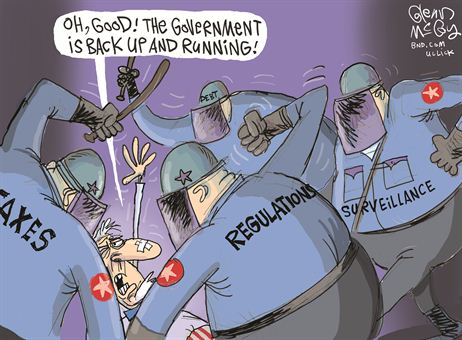
Contrary to the cartoon above, it’s not back up and running, though tax withholding and the impacts of regulatory rules continue unabated, and almost assuredly surveillance as well. After all (!), the federal government shutdown affects only “nonessential” activities of the federal government. Federal workers who are furloughed will receive back pay when the partial shutdown ends, but for now, federal spending is down roughly 25%.

The very real inconveniences for furloughed workers are regrettable. TSA employees continue to work while their paychecks are deferred indefinitely, though rates of absenteeism are high. So, we have slowdowns in security lines at airports, a lack of services at national parks (at least those not managed by private firms collecting revenue from visitors on-site), and a variety of other disruptions. For the time being, however, the lives of most Americans are largely unaffected. Except for the news coverage, my life hasn’t changed in any way, though I haven’t traveled during the shutdown.

Unfounded rumors about the shutdown have been rampant. For instance, I’ve heard that Social Security checks and weather forecasts would be suspended. Nancy Pelosi said the Secret Service would be unable to protect the President at the State of the Union address in the House chamber, a statement which the Department of Homeland Security promptly refuted. Many of the federal agencies with the highest shares of furloughed employees are regulators whose services are arguably counter-productive.

The White House Council of Economic Advisors (CEA) estimates that each additional week of the shutdown will reduce first quarter GDP growth by 0.13%. That means the interruption would take about 0.5% off first quarter growth if it lasts through January (say, from an annual rate of 2.5% to 2.0%). To the extent that people view the shutdown as temporary, and most do, the so-called “multiplier effects” of the shutdown should be relatively minor.

GDP is intended to measure of the value of the economy’s physical output. It is calculated in two independent ways based on 1) all income earned, and 2) the total of all spending on final (not intermediate) goods and services. Most components of final spending are well defined by the values assigned to goods and services traded in markets. Likewise, most incomes are based on the value assigned by labor markets to a given productive effort. Government “output”, however, is rather suspect as a component of spending because it is generally not subject to a market test of value. On the income side of the ledger, do government workers produce actual outputs? Some do, of course, but those outputs cannot be measured except by assigning a value based on what the workers are paid, and the payer is spending other peoples’ money! It’s not too speculative to suggest that the government’s output is a fraction of its spending. If that’s the case, the actual reduction in output caused by the shutdown is much smaller than the measured reduction in GDP. Therefore, the CEA’s estimates are a fiction.

To put an even finer point on it, many nonessential functions absorb resources while contributing very little to the nation’s wealth. Adam Brandon and John Tamny assert that private economic growth gives us the luxury of a large government sector, not the other way around. Government absorbs resources when it spends, but only by virtue of the taxes it imposes on private activity that is otherwise more highly productive. In the long run, as Brandon and Tamny argue, a smaller government (given a permanent shutdown of certain functions) might well yield greater economic output, not less.

Read this interesting essay for a discussion of the wasted, even counterproductive, utilization of human resources in government:

“They do nothing that warrants punishment and nothing of external value. That is their workday: errands for the sake of errands — administering, refining, following and collaborating on process. ‘Process is your friend’ is what delusional civil servants tell themselves. Even senior officials must gain approval from every rank across their department, other agencies and work units for basic administrative chores.

Process is what we serve, process keeps us safe, process is our core value. It takes a lot of people to maintain the process. Process provides jobs. In fact, there are process experts and certified process managers who protect the process. Then there are the 5 percent with moxie (career managers).

Again, many and perhaps most Americans view the shutdown itself with a certain degree of cynicism. In “America’s shutdown indifference“, Matthew Walther recalls this entertaining aspect of the last shutdown under President Obama:

“…of barriers being erected around various D.C.-area landmarks, including open-air war memorials. To this day I cannot think of any good reason for this save sheer caprice. If the idea was that 550-foot obelisks made of granite simply could not be meaningfully serviced during those lean two weeks in 2013, then who was responsible for putting up the rent-a-fence barricades around them? Civic-minded volunteers? The U.S. Marine Corps? Barack Obama himself? It was beautifully cynical, and I congratulate whoever came up with it.”

Both sides of the aisle play politics at the expense of the federal workforce. I certainly don’t wish to denigrate all federal workers. They perform varied functions and many are hard-working individuals. But still, it’s hard to feel very sorry for them given that they out-earn their private sector counterparts at almost every education level. Again, here’s Walther:

“Government employees, at both the state and federal level, are among the only workers in the United States who continue to be represented by powerful unions, despite the fact that by definition they’re not bargaining against capital but against their fellow citizens.”

I haven’t even mentioned the debate over open borders and the proposed wall, but that’s not my purpose here. All parties to that debate seem to think the shutdown is unlikely to harm their side politically. That’s either because the shutdown isn’t perceived as very impactful, or the “other” side can be blamed. One theory making the rounds is that the shutdown is part of a larger plan to institute permanent Reductions in Force (RIFs) at federal agencies, which are permissible after a furlough of 30 days or more (by January 19th). The argument plausibly suggests that some federal agencies might operate more effectively once the bureaucracy is pruned back via furloughs and/or RIFs. That’s especially true if “deep-state” sabotage of efforts to roll-back regulations are as common as the author asserts. Is the shutdown therefore a trap for unsuspecting congressional Democrats? Who knows, but to my way of thinking, government RIFs might even be worth the trouble of building a wall!

← Older posts
Newer posts →
Follow Sacred Cow Chips on WordPress.com

Recent Posts

  • Grading Trump II, So Far
  • A Warsh Policy Scenario At the Federal Reserve
  • The Coexistence of Labor and AI-Augmented Capital
  • The Case Against Interest On Reserves
  • Immigration and Merit As Fiscal Propositions

Archives

  • March 2026
  • February 2026
  • January 2026
  • December 2025
  • November 2025
  • October 2025
  • September 2025
  • August 2025
  • July 2025
  • June 2025
  • May 2025
  • April 2025
  • March 2025
  • February 2025
  • January 2025
  • December 2024
  • November 2024
  • October 2024
  • September 2024
  • August 2024
  • July 2024
  • June 2024
  • May 2024
  • April 2024
  • March 2024
  • February 2024
  • January 2024
  • December 2023
  • November 2023
  • August 2023
  • July 2023
  • June 2023
  • May 2023
  • April 2023
  • March 2023
  • February 2023
  • January 2023
  • December 2022
  • November 2022
  • October 2022
  • September 2022
  • August 2022
  • July 2022
  • June 2022
  • May 2022
  • April 2022
  • March 2022
  • February 2022
  • January 2022
  • December 2021
  • November 2021
  • October 2021
  • September 2021
  • August 2021
  • July 2021
  • June 2021
  • May 2021
  • April 2021
  • March 2021
  • February 2021
  • January 2021
  • December 2020
  • November 2020
  • October 2020
  • September 2020
  • August 2020
  • July 2020
  • June 2020
  • May 2020
  • April 2020
  • March 2020
  • February 2020
  • January 2020
  • December 2019
  • November 2019
  • October 2019
  • September 2019
  • August 2019
  • July 2019
  • June 2019
  • May 2019
  • April 2019
  • March 2019
  • February 2019
  • January 2019
  • December 2018
  • November 2018
  • October 2018
  • September 2018
  • August 2018
  • July 2018
  • June 2018
  • May 2018
  • April 2018
  • March 2018
  • February 2018
  • January 2018
  • December 2017
  • November 2017
  • October 2017
  • September 2017
  • August 2017
  • July 2017
  • June 2017
  • May 2017
  • April 2017
  • March 2017
  • February 2017
  • January 2017
  • December 2016
  • November 2016
  • October 2016
  • September 2016
  • August 2016
  • July 2016
  • June 2016
  • May 2016
  • April 2016
  • March 2016
  • February 2016
  • January 2016
  • December 2015
  • November 2015
  • October 2015
  • September 2015
  • August 2015
  • July 2015
  • June 2015
  • May 2015
  • April 2015
  • March 2015
  • February 2015
  • January 2015
  • December 2014
  • November 2014
  • October 2014
  • September 2014
  • August 2014
  • July 2014
  • June 2014
  • May 2014
  • April 2014
  • March 2014

Blogs I Follow

  • Passive Income Kickstart
  • OnlyFinance.net
  • TLC Cholesterol
  • Nintil
  • kendunning.net
  • DCWhispers.com
  • Hoong-Wai in the UK
  • Marginal REVOLUTION
  • Stlouis
  • Watts Up With That?
  • American Elephants
  • The View from Alexandria
  • The Gymnasium
  • A Force for Good
  • Notes On Liberty
  • troymo
  • SUNDAY BLOG Stephanie Sievers
  • Miss Lou Acquiring Lore
  • Your Well Wisher Program
  • Objectivism In Depth
  • RobotEnomics
  • Orderstatistic
  • Paradigm Library
  • Scattered Showers and Quicksand
  • Jam Review

Blog at WordPress.com.

Passive Income Kickstart

OnlyFinance.net

TLC Cholesterol

Nintil

To estimate, compare, distinguish, discuss, and trace to its principal sources everything

kendunning.net

The Future is Ours to Create

DCWhispers.com

Hoong-Wai in the UK

A Commonwealth immigrant's perspective on the UK's public arena.

Marginal REVOLUTION

Small Steps Toward A Much Better World

Stlouis

Watts Up With That?

The world's most viewed site on global warming and climate change

American Elephants

Defending Life, Liberty and the Pursuit of Happiness

The View from Alexandria

In advanced civilizations the period loosely called Alexandrian is usually associated with flexible morals, perfunctory religion, populist standards and cosmopolitan tastes, feminism, exotic cults, and the rapid turnover of high and low fads---in short, a falling away (which is all that decadence means) from the strictness of traditional rules, embodied in character and inforced from within. -- Jacques Barzun

The Gymnasium

A place for reason, politics, economics, and faith steeped in the classical liberal tradition

A Force for Good

How economics, morality, and markets combine

Notes On Liberty

Spontaneous thoughts on a humble creed

troymo

SUNDAY BLOG Stephanie Sievers

Escaping the everyday life with photographs from my travels

Miss Lou Acquiring Lore

Gallery of Life...

Your Well Wisher Program

Attempt to solve commonly known problems…

Objectivism In Depth

Exploring Ayn Rand's revolutionary philosophy.

RobotEnomics

(A)n (I)ntelligent Future

Orderstatistic

Economics, chess and anything else on my mind.

Paradigm Library

OODA Looping

Scattered Showers and Quicksand

Musings on science, investing, finance, economics, politics, and probably fly fishing.

Jam Review

"If you get confused, listen to the music play."

  • Subscribe Subscribed
    • Sacred Cow Chips
    • Join 128 other subscribers
    • Already have a WordPress.com account? Log in now.
    • Sacred Cow Chips
    • Subscribe Subscribed
    • Sign up
    • Log in
    • Report this content
    • View site in Reader
    • Manage subscriptions
    • Collapse this bar
 

Loading Comments...