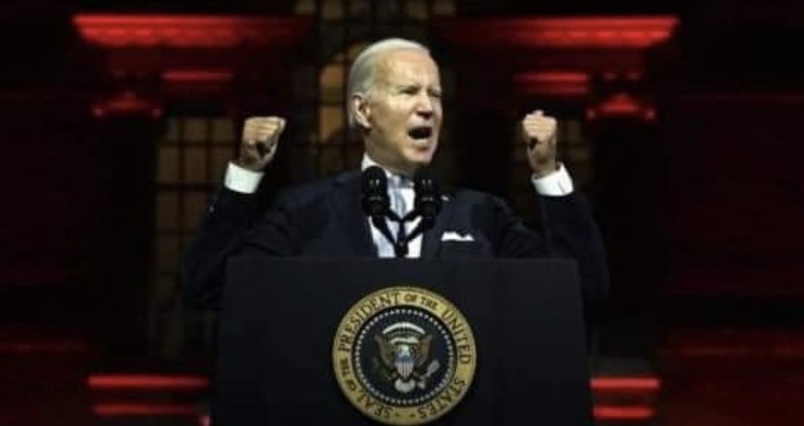
Great Moments In Projection: Il Doofe Says His Opponents Are Anti-Democratic, Fascist

Tags

, , , , , , , , , , , , , , , , , , , , , , , ,

When partisans want to make sure they get their way, perhaps we shouldn’t be surprised to hear them claim their opponents are “anti-democratic”. Well, one-party rule is not democratic, just in case that’s unclear to leftists prattling about “hunting down” the opposition. We now have those forces hurling cries of “fascism” and “semi-fascism” at political adversaries for opposing their use of the state’s coercive power to get their way and to punish political enemies.

Restrained Democracy

The U.S. is not a democracy; it is a constitutional republic. The reason it’s not a democracy is that the nation’s founders were wary of the dangers of majoritarianism. There are many checks on unbridled majoritarianism built into our system of government, including the many protections and guarantees of individual rights in the Constitution, as well as federalism and three branches of government intended as coequals.

In a short essay on democracy, Dan Klein refers to a mythology that has developed around the presumed democratic ideal, quoting Friedrich Hayek on the “fantasy of consensus” that tends to afflict democratic absolutists. Broad consensus is possible on many issues, but it might have been an imperative within small bands of primitive humans, when survival of the band was of paramount concern. That’s not the case in modern societies, however. Classical liberals are often derided as “anti-democratic”, but like the founders, their distaste for pure democracy stems from a recognition of the potential for tyrannies of the majority. Klein notes that the liberal emphasis on individual rights is naturally at tension with democracy. Obviously, a majority might selfishly prefer actions that would be very much to the detriment of individuals in the minority, so certain safeguards are necessary.

However, the trepidation of classical liberals for democracy also has to do with the propensity for majorities to “governmentalize” affairs so as to codify their preferences. As Klein says, this often means regulation of many details of life and social interactions. These are encroachments to which classical liberals have a strong aversion. One might fairly say “small government” types like me are “anti-pure democracy”, and as the founders believed, democratic processes are desirable if governing power is distributed and restrained by constitutional principles and guarantees of individual rights.

Democracy has vulnerabilities beyond the danger posed by majoritarian dominance, however. Elections mean nothing if they can be manipulated, and they are easily corrupted at local levels by compromises to the administration of the election process. Indeed, today powerful national interests are seeking to influence voting for local election officials across the country, contributing substantial sums to progressive candidates. It’s therefore ironic to hear charges of racism and anti-democracy leveled at those who advocate measures to protect election integrity or institutions such as federalism.

And here we have the White House Press Secretary insisting that those in the “minority” on certain issues (dependent, of course, on how pollsters phrase the question) are “extremists”! To charge that someone or some policy is “anti-democratic” usually means you didn’t get your way or you’re otherwise motivated by political animus.

Fascism

Biden and others are throwing around the term fascism as well, though few of these partisans can define the term with any precision. Most who pretend to know its meaning imagine that fascism evokes some sort of conservative authoritarianism. Promoting that impression has been the purpose of many years of leftist efforts to redefine fascism to suit their political ends. Stalin actually promoted the view that anything to the right of the Communist Party was inherently fascist. But today, fascism is an accurate description of much of Western governance, dominated as it is by the administrative state.

I quote here from my post “The Fascist Roader” from 2016:

A large government bureaucracy can coexist with heavily regulated, privately-owned businesses, who are rewarded by their administrative overlords for expending resources on compliance and participating in favored activities. The rewards can take the form of rich subsidies, status-enhancing revolving doors between industry and powerful government appointments, and steady profits afforded by monopoly power, as less monied and politically-adept competitors drop out of the competition for customers. We often call this “corporatism”, or “crony capitalism”, but it is classic fascism, as pioneered by Benito Mussolini’s government in Italy in the 1920s. Here is Sheldon Richman on the term’s derivation:

‘As an economic system, fascism is socialism with a capitalist veneer. The word derives from fasces, the Roman symbol of collectivism and power: a tied bundle of rods with a protruding ax.’

Meanwhile, Hitler’s style of governing shared some of the characteristics of Mussolini’s fascism, but there were important differences: Hitler persecuted Jews, blaming them for all manner of social problems, and he ultimately had them slaughtered across much of Europe. Mussolini was often brutal with his political enemies. At the same time, he sought to unite an Italian people who were otherwise a fairly diverse lot, but once Mussolini was under Hitler’s thumb, Italian Jews were persecuted as well.

Angelo M. Codevilla provides an excellent account of Mussolini’s political career and the turns in his social philosophy over the years. He always considered himself a dedicated socialist, but the views he professed evolved as dictated by political expediency. So did his definition of fascism. As he took power in Italy with the aid of “street fighters”, fascism came to mean nationalism combined with rule by the administrative state and a corresponding preemption of legislative authority. And there were concerted efforts by Mussolini to control the media and censor critics. Sound familiar? Here’s a quote from Il Duce himself on this matter:

Because the nature of peoples is variable, and it is easy to persuade them of things, but difficult to keep them thus persuaded. Hence one must make sure that, when they no longer believe, one may be able then to force them to believe.

Here is Codevilla quoting Mussolini from 1919 on his philosophy of fascism:

The fascist movement, he said, is ‘a group of people who join together for a time to accomplish certain ends.’ ‘It is about helping any proletarian groups who want to harmonize defense of their class with the national interest.’ ‘We are not, a priori, for class struggle or for class-cooperation. Either may be necessary for the nation according to circumstances.’

This framing underlies another basic definition of fascism: a system whereby government coercion is used to extract private benefits, whether by class or individual. Codevilla states that Mussolini was focused on formal “representation of labor” in policy-making circles. Today, western labor unions seem to have an important, though indirect, influence on policy, and labor is of course the presumed beneficiary of many modern workplace regulations.

Modern corporatism is directly descended from Mussolini’s fascist state. The symbiosis that exists between large corporations and government has several dimensions, including regulatory capture, subsidies and taxes to direct flows of resources, high rates of government consumption, rich government contracts, and of course cronyism. This carries high social costs, as government dominance of economic affairs gives rise to a culture of rent seeking and diminished real productivity. Here is Codevilla’s brief description of the transition:

Hegel, as well as the positivist and Progressive movements, had argued for the sovereignty of expert administrators. Fascist Italy was the first country in which the elected legislature gave up its essential powers to the executive, thus abandoning the principle, first enshrined in the Declaration of Independence and the U.S. Constitution, by which people are rightly governed only through laws made by elected representatives. By the outbreak of World War II, most Western countries’ legislatures—the U.S. Congress included—had granted the executive something like ‘full powers,’ each by its own path, thus establishing the modern administrative state.

Mussolini saw Italian fascism as the forerunner to FDR’s New Deal and took great pride in that. On this point, he said:

“… the state is responsible for the people’s economic well-being, it no longer allows economic forces to run according to their own nature.

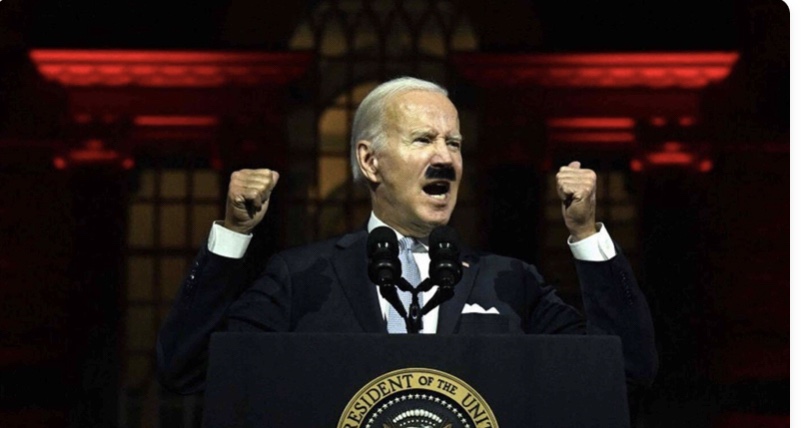
The Babylon Bee’s take on Biden and fascism would have been more accurate had it alluded to Mussolini, but not nearly as funny! The following link (and photoshopped image) is obviously satire, but it has a whiff of eerie truth.

Biden Condemns Fascism in Speech While Also Debuting Attractive New Mustache

Conclusion

Biden’s slur that Republicans are “anti-democratic” is an obvious distortion, and it’s rather ironic at that. The nation’s support for democratic institutions has always been qualified for good reasons: strict majoritarianism tends to disenfranchise voters in the minority, and in fact it can pose real dangers to their lives and liberties. Our constitutional republic offers “relief valves”, such as “voting with your feet”, constitutional protections, and seeking recourse in court. Biden’s party, however, has a suspicious advantage via control of election supervision in many key urban areas of the country. This can be exploited in national elections to win more races as long as the rules on election administration are sufficiently lax. This is a true corruption of democracy, unlike the earnest efforts to improve election integrity now condemned by democrats.

Joe Biden hasn’t the faintest understanding of what fascism means. He uses the term mostly to suggest that Trump, and perhaps most Republicans, have authoritarian and racist sympathies. Meanwhile, he works to entrench the machinery and the breadth of our own fascist state, usurping legislative authority. He is buttressed by a treacherous security apparatus, “street fighters” under the guise of Antifa and BLM, and the private media acting as a propaganda arm of the administration. Joe Biden, you’re our fascist now.

Anatomy of a Scam on Taxpayers: Biden Plumps Up IDRs

Tags

, , , , , , , , , ,

In my last post I discussed the difficulty faced by potential challengers to President Biden’s student loan forgiveness program in establishing legal standing in court. I also mentioned an estimate of the cost of the plan to taxpayers of around $600 billion over ten years. That was from the Penn-Wharton Budget Model, but now the model’s estimate ranges to more than $1 trillion! The difference is a reassessment of the changes to increasingly popular income-driven repayment (IDR) plans and uncertainty around behavioral assumptions like plan uptake over the ten-year budget window. The changes to IDRs are separate from the $10,000 – $20,000 short-term loan forgiveness component of Biden’s plan, and they are a perfect basis for a legal scam on taxpayers.

IDRs are not new. Under these plans, a borrower pays 10% of their income toward the outstanding balance of their student loans for a period of 10 to 20 years, depending on the plan, after which any remaining balance is forgiven. This may or may not make sense for borrowers with high student loan payments relative to income. In fact, there are some who warn that IDRs are a ripoff. However, only income above 150% of the poverty line is subject to IDR payments. For some students borrowing heavily, IDRs can make tuition hikes irrelevant beyond a certain loan balance: just borrow it! Living expenses can be borrowed as well! These plans almost completely eliminate price sensitivity among consumers of college educations, and it may make sense for certain students to borrow as much as possible. It’s also a prescription for escalating tuition.

Law graduates who work in the public sector have long received favorable treatment via IDRs: they pay 10% of their discretionary income for only 10 years. The so-called Public Service Loan Forgiveness (PSLF) program is leveraged by law schools, which offer deals for students called Loan Repayment Assistance Programs (LRAP). For an explanation, I’ll defer to Matt Bruenig and his interesting post on the topic (with hat tip to Alex Tabarrok):

The LRAP schemes work as follows:

  1. The school increases their tuition.
  2. The student takes out federal loans to cover the tuition increase.
  3. The school squirrels away the debt-financed tuition increase into an LRAP fund.
  4. The school disburses money from the LRAP fund to cover PSLF repayments.

Through this roundabout process, the law schools effectively use student debt to pay off student debt and make their schools free or nearly free, at least for these particular students.

The school knows the student’s debt payments are limited by income. Tuition hikes can be paid with additional loans, and the LRAPs future obligations are limited by the student’s income after graduation. Not only is the tuition hike “free” to the student, but the school might be able to pocket a share of the new loan and invest the whole nut for returns in the interim. That’s the gist of Tabarrok’s simple example. Needless to say, IDRs and PSLF create some very bad incentives! Farewell to cost control!

Biden’s plan extends IDRs in ways that make them far more attractive to students, including undergraduates. Here are the changes, again from Bruenig:

The IDR changes are four-fold:

  1. Increase the amount of income not subject to IDR from 150 percent of the federal poverty line to 225 percent of the federal poverty line.
  2. Eliminate any accrual of interest on IDR-enrolled loans.
  3. For undergraduate debt, reduce the IDR rate from 10 percent of income beyond the threshold in (1) to 5 percent of income beyond the threshold in (1).
  4. For IDR-enrolled debts with original loan balances below $12,000, reduce the repayment period from 20 years to 10 years.”

Smaller payments and zero interest! This is what led to Penn-Wharton’s revision in the high-side cost estimates of Biden’s student loan forgiveness plan:

“‘Depending on future details of the actual IDR program and concomitant behavioral changes, the IDR program could add another $450 billion or more,’ the analysis found. ‘Thereby raising total plan costs to over $1 trillion.’”

The incentives are for schools to offer LRAPs more broadly, and to abuse them. Rent-seeking vendors have lined up to design and manage these programs. Students and even parents are encouraged to borrow up to the maximum limits, which conceivably allows the loan proceeds to be used outside of the ostensible educational purpose of the loan, potentially for investment gains. See Tabarrok’s post for some links to creative schemes to which part of the loan proceeds might be put by borrowers.

This is a huge scam! It’s hard to square the Administration’s action with any effort to apply economic logic to program design. But that’s not really the point of the student loan forgiveness program. Instead, it’s designed to warm the hearts of Biden’s political base among students and young college graduates. And it will further enrich the heavily endowed universities that can be counted upon to inculcate students with leftist dogma. Apparently, the rest of us, who lack standing to formally challenge these schemes, can just suck it.

Harms Dismissed In “Standing Dead Zone” of Executive Action

Tags

, , , , , , , , , , , , , , , , , , ,

I hate to contribute to the deluge of ink spilled over Joe Biden’s latest executive action, which forgives massive amounts of federal student loan debt, but there’s an angle that hasn’t received adequate treatment. Of course, Biden’s action is an abridgment of taxpayer rights, a violation of the separation of powers, and an affront to borrowers who already paid off their student loans, but it will be nearly impossible for any challenger(s) to show that they have standing in court. Writing in the Virginia Law Review earlier this year, Jack V. Hoover says this kind of action lies within what he calls a “standing dead zone” created by the courts.

I’ll start with a few preliminaries. Note that student loan forgiveness was NOT legislated, unlike the Paycheck Protection Program, which the Administration keeps referencing in defense of the action. And I’d be remiss if I failed to mention that Biden’s action looks like a pathetic attempt to salvage votes ahead of what some democrats fear could be a disastrous midterm election. In addition, the action is regressive, with benefits weighted heavily toward high-income debtors with graduate degrees. The cost (write down, loss) to the federal government was originally said to be near $300 billion, depending on uptake, but independent estimates now put the full cost at $600 billion. This wipes out the hoped-for deficit reduction in the ridiculous but much ballyhooed “Inflation Reduction Act”, and yes, student loan forgiveness may well be inflationary. At a minimum, it makes the Fed’s job of restraining inflation by tamping down demand that much harder. Loan forgiveness will not solve the underlying problem of runaway cost escalation in higher education. In fact, it will exacerbate the problem by encouraging non-payment and additional borrowing, while tuition to colleges and universities will escalate all the more. So this is really bad policy all the way around!

Biden’s action is clearly a huge stretch on statutory grounds. In particular, the Administration invoked the HEROES Act, which authorizes the Secretary of Education to waive loan requirements during periods of national emergency. In this case, the Administration appeals to hardships caused by the pandemic for individuals with student debt. Of course, just two weeks ago, the CDC rolled back their emergency pandemic guidelines on social distancing and quarantines, so the “emergency” seems to be over, officially. Also, the Administration recently ended the “return to Mexico” policy at the border on the pretext that it had only been necessary because of the pandemic! Pardon my incredulity, but playing the “pandemic card” at this point is both dishonest and hypocritical.

“Standing” in the legal sense can’t be found in the text of the Constitution. It was itself created by the courts. Even so, why do taxpayers, Congress, or past borrowers lack standing to challenge the action on student loans through the judicial system? How can that be when the harms are so obvious? Well, courts tend to avoid interfering with the executive branch, and they’d rather leave such disputes up to the political system to hash out. That doesn’t seem like a terribly effective way to practice the game of “checks and balances”. Nevertheless, for many years the courts have relied on a strict test for establishing plaintiff standing promulgated in the Supreme Court decision in Lujan v. Defenders of Wildlife. In that majority opinion, Justice Antonin Scalia laid out a three-part test, which Hoover describes thusly:

“… (1) injury in fact that is actual, concrete, and particularized; (2) a causal connection between the injury and the conduct complained of; and (3) a likelihood that exercise of judicial power will redress the injury.28 The Court furthermore differentiated between cases in which government regulation targets the plaintiff and cases where the plaintiff complains about ‘unlawful regulation (or lack of regulation) of someone else,’ in which case “much more is needed” for standing to exist.29 The Court has regularly reaffirmed this formulation of its standing requirements.3”

Hoover discusses the executive’s authority to cancel debt under the Higher Education Act (HEA) of 1965. In terms of the impregnability of Biden’s action to legal challenge, Hoover implies that the president might just as well have fallen back on HEA as HEROES. However, the Department of Education (DOE) opined last year that it lacked the power to forgive debt. Here’s what the DOE said in 2021:

… the Secretary does not have statutory authority to provide blanket or mass cancellation, compromise, discharge, or forgiveness of student loan principal balances, and/or materially modify the repayment amounts or terms thereof, whether due to the COVID-19 pandemic or for any other reason.

Hoover seems to be saying that it is all but impossible to challenge Biden’s bald assertion of extra-legal power in forgiving student loans. Hoover goes on to discuss all classes of potential litigants who might challenge student loan forgiveness: taxpayers, former borrowers, Congress, state governments, and loan servicers. He is skeptical of all those, citing various reasons for their lack of standing, but I’ll focus on only the first three classes.

Taxpayers: The logic of denying taxpayers standing is at least two-fold. First, taxpayers cannot show direct harm from the action, though they are likely to pay a higher inflation tax over time as a consequence. Second, Congress appropriated funds for student loans, but it did so as an entitlement, and it did not restrict loan amounts nor the executive’s ability to waive “the government’s claim that borrowers must return the funds to the Treasury”. Hoover believes that the courts would defer to the political branches of government in settling such issues. The whole thing sounds rather thin to my ears, but precedent will probably hold sway unless the Supreme Court revisits its position on standing.

Congress: The standing of Congress is another matter. If, in the view of the legislature, an executive agency has exceeded its statutory authority, the matter might reflect as much on Congress as elsewhere, in failing to provide adequate limitations, guideposts, or oversight. However, in this case:,

Congress duly appropriated funds for student loans,83 and the Executive is responsible for the funding’s disbursement. This means that any claim of standing due to institutional injury from compromising Congress’s control of the federal purse would fail.

Here again, it will be left to settle by the political branches of government. To avoid such conflicts, it is up to the legislature to write laws that bind the discretion of the executive to varying degrees. Unrestrained entitlements are a damn good way to cede control of the “keys to the Treasury”.

Other borrowers who’ve managed their student loan debt responsibly will also lack standing, according to Hoover. Like taxpayers, they cannot show any direct harm or injury. In addition, standing is difficult to establish when an action or inaction by an executive agency pertains to someone else.

It’s my hope that a court challenge will be brought all the way to the Supreme Court, and at some level a court will define a new standard or test under which plaintiffs can attempt to establish standing against executive or agency actions. This is sorely needed as a check on the explosive growth of the administrative state. Furthermore, the “standing dead zone” allows all sorts of politically-motivated mischief by the executive branch, and the Biden Administration seems more than willing to push executive authority to extremes. However, I’m not too optimistic about the possibility of a new test for standing. Before all is said and done, Biden is likely to expand student loan forgiveness well beyond $20,000 per borrower. Federal finance is looking more precarious with Biden’s every step, and many of those steps cannot be walked back by Congress, no matter who holds the majority.

Interventionists Love You and Demand You Change, or Else

Tags

, , , , , , , , , , , , ,

Statistics and measurement might not be critical to the exercise of the authoritarian impulse, but they have served to enable the technocratic tyranny idealized by contemporary statists. Certain influential thinkers have claimed our ability to compile statistics helps give rise to the bureaucratized state. I ran across a great post that led with that topic: “The Brutalization of Compassion” by David McGrogan. The mere ability to compile relevant statistics on a population and its well being (income, jobs, wages, inequality, mortality, suicide, etc… ) can motivate action by authorities to “improve” matters. The purpose might be to get ahead of rival states, or the action might be rationalized as compassion. But watch out! McGrogan quotes a bit of cautionary wisdom from Lionel Trilling:

“‘When once we have made our fellow men the objects of our enlightened interest,’ he put it, something within us causes us to then ‘go on and make them the objects of our pity, then of our wisdom, ultimately of our coercion.’”

Ultimately, to pursue their vision, interventionists must impose controls on behaviors. In practice, that means any variance or attempted variance must be penalized. Here’s McGrogan’s description of the steps in this process:

The conceptualisation of the population as a field of action, and the measurement of statistical phenomenon within it – the taking of an ‘enlightened interest’ in it – gives rise to both ‘pity,’ or compassion, and the application of ‘wisdom’ to resolve its problems. What is left, of course, is coercion, and we do not need to look far to identify it in the many means by which the modern state subjects the population to a kind of Tocquevillian ‘soft despotism,’ constantly manipulating, cajoling and maneuvering it this way and that for its own good, whether through compulsory state education or ‘sin taxes’ or anything in between.

Follow the Scientism

I can’t neglect to mention another important condition: the hubris among apparatchiks who imagine the state can improve upon private institutions to achieve social betterment. They will always fail in attempts to replace the action of the private markets and the price mechanism to process information relating to scarcities and preferences. Absent that facility, human planners cannot guide flows of resources to their most valued uses. In fact, they nearly always botch it!

Government provision of public goods is one concession worth making, but the state capacity needed to fulfill this legitimate function is subject to severe mission creep: we frequently see efforts to characterize goods and service as “public” despite benefits that are almost wholly private (e.g. education). Likewise, we often hear exaggerated claims of “harms” requiring state intervention (e.g. carbon emissions). These situations often hinge purely on politics. Even when legitimate external benefits or costs can be identified, there is a pretension that they can be accurately measured and corrected via subsidies or taxes. This is far-fetched. At best, it’s possible to vouch for the directional appropriateness of some interventions, but the magnitude of corrective measures is variable and essentially unknowable. Too often we see government failure via over-subsidization of politically favored activities and over-penalization of politically disfavored activities.

One of the most egregious errors of intervention is the over-application of the precautionary principle: if risks are associated with an activity, then it must be curtailed. This often relies on measurements of highly uncertain causes and effects, and it involves aggregation subject to its own biases.

Just as questionable is the ability of “experts” to model natural or behavioral processes such that outcomes can be “predicted” over horizons extending many decades forward. That interventionists tend to ignore the uncertainties of these predictions is the most blatant and damaging conceit of all, not least because the public and the media usually have limited knowledge with which to assess the phenomenon in question.

Public Health Tyranny

The Covid pandemic presented a compelling excuse for precautionists in government and even private institutions to impose radical controls under a set of claims they called “the science”. These claims were often false and really antithetical to the principles of scientific inquiry, which calls for continually questioning hypotheses, even when they represent “consensus”. Yet a series of questionable scientific claims were used to justify abridgment of basic freedoms for the general population, most of whom faced little risk from the virus. This included lockdowns of schools and churches, business closures, cancellation of public events (except of course for protests and riots by Leftists), deferred medical care, vaccine mandates, and mask mandates. The damage these measures inflicted was fierce, and in the end we know that it was almost entirely unnecessary. Still, the public health establishment seems all too willing to ignore the facts in its readiness to repeat the whole range of mistakes at the slightest uptick in what’s now an endemic infection.

Standard Issue Cronyism

In the wake of the pandemic, we’ve witnessed a surge in calls for government to enhance the security of our nation’s supply chains. Too large a share of the critical goods required by domestic industries are produced overseas, which has made supply disruptions, and the threat of future disruptions, especially acute. Right on cue, advocates of industrial policy and planning have arranged for the federal government to provide $85 billion to domestic producers of semiconductors under the so-called CHIPS Act. But semiconductor producers are in no need of government incentives to “re-shore” production:

“… there has been even more chipmaking investment dedicated to the U.S. market, even as federal subsidies have languished. Construction is now underway at four major U.S. facilities and will continue with or without subsidies—something even Intel reluctantly acknowledged when it delayed the groundbreaking ceremony on its much‐ballyhooed Ohio facility to protest congressional inaction. This is because, as numerous experts have explained over the last year, there are real economic and geopolitical reasons to invest in additional U.S. semiconductor production—no federal subsidies needed.”

Moreover, the global shortage of computer chips appears to be ending. The subsidies will unnecessarily enrich industrialists and their shareholders, provide a source of graft to bureaucrats and various middle men, and likely over-allocate resources to domestic production of chips. Industrial planning of this kind has a long history of failure, and this time won’t be different.

Climate Fascists

We also see repeated over-application of the precautionary principle and rising dominance of industrial policy in climate and energy policy. Enormous sacrifices are imposed on consumers for the sake of minuscule changes in global carbon emissions and the “expected” long-term path of future “global” temperatures. The interventions taken in pursuit of these objectives are draconian, limiting choices and raising the cost of virtually everything produced and consumed. They distort the direction of physical investment, disfavoring reliable sources of base load capacity needed for growth, and also disfavoring the safest and most reliable zero-carbon alternative: nuclear power. The renewable energy sources foolishly pushed by the state and the ESG establishment are environmentally costly in their own right, and they don’t work when natural conditions are unfavorable. As one wag says about the climate provisions of the ironically named Inflation Reduction Act, “Gonna be a lot more Solyndras coming”.

And talk about sloppy! Our “trusted representatives” in Congress could hardly be bothered to pretend they’d done their homework. They neglected to provide any quantitative carbon and temperature impacts of the legislation. This must be a case of true honesty, because they really have no idea!

Delusions of Central Planning

One great weakness (among many) of arguments for state industrial planning is the assumption that government agents are somehow more competent, efficient, and “pure of heart” than agents in the private sector. Nothing could be more laughable. On this point, some of the most incisive commentary I’ve seen is provided by the masterful Don Boudreaux, first quoting Georgetown philosopher Jason Brennan before adding his own entertaining thoughts:

The typical way the left argues for the state is to describe what economists in the 1850s thought markets would be like under monopoly or monopsony, and then compare that to a state run by angels. Both halves of the argument are bad, and yet philosophy treats this as if it were rigorous and sophisticated.

“Far too many policy proposals are nothing more than prayers to the state-god. ‘We entreat you, Oh Powerful and Sacred One, to relieve our people of this or that misery, blemish, and market imperfection! We beseech you to bestow upon us – your faithful servants – cosmic justice, safety from new pathogens, unkind thoughts, and microaggressions, and protection from each and every burden of reality that we can imagine being cured by an omniscient, benevolent, and omnipotent deity! If we obey – and sacrifice to you without complaint our treasure and our freedoms – you will provide!’

I do not exaggerate. Pick at random any proposed government intervention offered by the likes of Progressives or national conservatives, and you’ll discover that the workability of this proposed intervention, when evaluated honestly, rests on nothing more solid than the above absurd faith that the state is – or, when in the right hands, will be – a secular god.

On the idealization of government’s ability to “plan the economy” rationally, here is more from Boudreaux, first quoting the great Deirdre McCloskey:

Deep in left-wing thought about the economy, and in a good deal of right-wing thought, too, is the premise, as Isaiah Berlin once put it with a sneer, that government can accomplish whatever it rationally proposes to do. As has been often observed about leftists even as sweet as John Rawls, the left has no theory of the behavior of the government. It assumes that the government is a perfect expression of the will of The People.

And nothing is more unscientific – indeed, more mystical – than is this still-commonplace practice of most Progressives, and also of very many conservatives, to analyze the economy and society, and to offer policy recommendations, using such a juvenile ‘understanding’ of the state. Yet such an ‘understanding’ of the state permeates the work even of some Nobel laureates in economics – laureates such as Paul Krugman and Joseph Stiglitz. This ‘understanding’ of the state is inseparable also from the work of pundits too many to count…

That these professors and pundits think of themselves as scientific – and are widely regarded as being especially intelligent, thoughtful, and scientific – testifies to the strength of the cult of democratically rubber-stamped coercion.

Conclusion

Humans have proven to be incredible documentarians. The advent of measurement techniques and increasingly sophisticated methods of accounting for various phenomena has enabled better ways of understanding our world and our well being. Unfortunately, a by-product was the birth of scientism, the belief that men in authority are capable not only of measuring, but of fine-tuning, the present and future details of society and social interaction. Those pretensions are terribly mistaken. However, the actions of Congress and the Biden Administration prove that it’s adherents will never be persuaded, despite repeated demonstrations of the futility of central planning. Their words of compassion are no comfort — they must coerce the ones they “love”.

Let’s Suppress Fraudulent Votes

Tags

, , , , , , , , , , , , , , , , , , , , , , , , , , , ,

No matter how you feel about the 2020 presidential election, whether you think it was conducted fairly or that it was “stolen” from Donald Trump, you should at least come to grips with the reality that our electoral process is quite vulnerable to manipulation. Most voters agree that election fraud is a problem. A recent poll found that 56% of likely voters agree that “every state should require that ballots be available immediately after elections for bipartisan voter reviews to enhance election confidence and transparency. Only 23% are against ballot reviews…”. So these respondents also agree that compromises to the integrity of elections should be addressed.

Local Fraud, National Scope

There is plenty of evidence that the 2020 election was manipulated by agents both inside and outside the government, if only the mainstream press could be bothered to look at it. Nuts and bolts election fraud is largely a local phenomenon, though there is likely some coordination at higher levels. Robert Zimmerman provides this summary of the election fraud in the 2020 election in Fulton County (Atlanta), Georgia:

Fulton County and its elections are controlled by democrats, much as in other large cities. Localized fraud in deep blue urban centers doesn’t have much if any effect on local races, but it throws statewide and national races into doubt. Of these deep blue enclaves, Zimmerman says:

“… the government is essentially a one-party Democrat operation. Many election districts in these cities have no Republican election judges at all. If the Democrats wish to commit election fraud, there is no one looking over their shoulder to question them, with some districts actually taking aggressive action in 2020 to illegally keep Republican poll watchers out. … Thus we saw strong evidence in all of these cities of pro-Democrat ballot-stuffing, of all types, from fake ballots to ballots counted multiple times to evidence the votes on the ballots themselves were changed by computer.

In Wisconsin, the State Supreme Court finally ruled last month that the placement of hundreds of drop boxes in its largest cities was illegal. Those unsupervised drop boxes made it a simple matter for hundreds of “mules” to deposit stacks of fraudulent ballots, not to mention enabling other kinds of ballot harvesting on a massive scale. This was not limited to Wisconsin. Zimmerman also discusses Arizona’s Maricopa County (Phoenix), where there were a host of different issues casting doubt on the legitimacy of the 2020 election results. The race in Arizona was very close, and this kind of vote tampering likely threw the state into Biden’s column:

If you doubt the ease with which “mishaps” occur when ballots are counted, take a look at the following tweet from three weeks ago:

The point is that it’s amazingly easy for fraud to occur given the lax standards of accountability often seen in elections, particularly in one-party jurisdictions.

The New Front

Will the Left seize control of elections or leverage that control more aggressively, particularly in deep blue areas? With that control, they can reinforce their ability to swing elections for statewide offices and electoral votes, and they are certainly trying. The link just above describes some well-funded organizations channeling funds to support progressive candidates running for down-ballot positions with supervisory authority over local elections and their procedures. Charities founded by billionaire George Soros, Hilary Clinton, and Mark Zuckerberg are just some of the players involved. This activity has its parallel in Soros’ successful efforts to fund the campaigns of radical leftists for prosecutor jobs in many cities.

There is also the matter of private grants to local election offices, ostensibly to support the “health” of voters and election workers, but mostly used to “get out the vote”. This was the approach used by the activist group funded by Zuckerberg and his wife, Priscilla Chan:

In 2020, the Chan Zuckerberg Initiative gave $350 million to the Center for Tech and Civic Life, a left-leaning group that distributed grants to mostly Democrat-dominated precincts, driving up the vote. The Zuckerbergs’ grants, dubbed Zuckerbucks, helped finance drop boxes and expanded mail-in balloting, among other activities.

Pennsylvania recently prohibited private election grants in order to reduce outside influence on elections, a wise response to the violations of state law that occurred in the 2020 election. The ban covers nonprofits like the Center for Tech and Civic Life. Zuckerberg asserts that the organization distributed more grants to Republican jurisdictions (anywhere Trump won in 2020) than elsewhere, but that claim is dubious based on the amounts of those donations:

“… Republican jurisdictions were far more likely to receive grants of less than $50,000, which would likely not be enough to materially change election practices in the recipient jurisdiction.

Pennsylvania is not alone in its bid to restore integrity by banning these grants. At least 20 states have passed similar laws since the 2020 election, with varying degrees of stringency. That’s good news, but it won’t stop tampering by officials elected with the aid of organizations intent on controlling election procedures.

Corrupting Federal Institutions

There have been, and still are, machinations at levels much higher than local election authorities. The FBI engaged in election sabotage in 2020 to destroy Donald Trump, a sitting U.S. President. This occurred on at least two fronts. There was the staged plot to kidnap Michigan Governor Gretchen Windmere in October 2020, with all hands attempting to implicate Trump and his supporters. Trump’s prospects fell in Michigan after the announcement of this foiled “kidnapping”, which was subsequently discovered to be a plot by the FBI to entrap a few rubes. Equally disturbing was the flagrant attempt by the Justice Department before the election to discount evidence that Hunter Biden had been engaged in influence peddling for years. That discounting continues to this day, of course.

These maneuvers followed the FBI’s complicity in the Russia Hoax, which was conceived in opposition research by Hillary Clinton’s campaign in 2016. The agency made use of a dossier compiled by ex-British spy Christopher Steele on behalf of a Clinton campaign contractor. Despite strong suspicions that the dossier was fabricated as well as politically motivated, it was used to obtain clearance from a FISA Court to surveil Trump’s presidential campaign. The FBI continued its misrepresentation of the Steele dossier throughout the Mueller investigation, which ultimately found no evidence of collusion between the Trump campaign and Russia

Today, we know the FBI and the Department of Justice are still at it. Their attempts to destroy Trump, just 80 days ahead of the 2022 midterms, are transparently motivated by politics, culminating in the raid on Trump’s private residence at Mar-a-Lago in search of “classified documents”. It is also likely a fishing expedition that they hope might turn up evidence of a “planned insurrection”. Note that neither Hillary Clinton nor Sandy Berger (President Clinton’s National Security Advisor) had their private residences raided despite personal and illegal possession of classified documents. The hypocrisy is jaw dropping, but it seems clear the Mar-a-Lago raid was another example of efforts within federal law enforcement to influence elections.

Another recent example of likely election influencing within a federal institution is how the Census Bureau managed to “significantly” miscount the populations of 14 states in the 2020 Census. Five of the six undercounted states were “red” states. Six of the eight over-counted states were “blue” states, including New York. The admission of the miscount by the Census Bureau occurred after redistricting took place, a process that surely would have been impacted by the count. So the Democrats picked up congressional seats by virtue of the miscounting. In addition, according to Matt Margolis, the miscounts will give the next democrat presidential candidate nine extra votes in the Electoral College.

Efforts to wholly eliminate the Electoral College are another example of the Left’s efforts to seize control of the Executive Branch, once and for all. The popular vote would be replaced and control ceded to a group of highly populated coastal states. As I’ve written before, the Electoral College was an arrangement necessary to obtain the agreement of all states to join the union. There is no doubt that many states would insist upon a similar arrangement today if we were to do it all over again.

Conclusion

There is very real potential for ongoing election tampering and vote fraud in elections, and the Left has demonstrated a wholehearted willingness to engage in this effort. Much of this activity takes place at the local level in jurisdictions in which election supervision is controlled by one party. The looser the rules, the greater potential there is for abuse. This also explains the motivation to pour resources into electing certain candidates to offices with supervisory power over elections. Also disturbing is the complicity of federal law enforcement in attempts to influence presidential elections. Our Republic cannot withstand the unbridled partisanship we’ve witnessed in the election process. Addressing these problems is likely to require a major clean-up and reorganization of the FBI and possibly the DOJ, but restoring the integrity of those institutions will probably require significant election successes for Republicans in 2022 and 2024. Yes, there really is a deep state!

Fiscal Foolishness a Costly Salve For Midterm Jitters

Tags

, , , , , , , , , , , , , , , , , , , , , , , ,

The “Inflation Reduction Act” (IRA) is about as fatuous a name for pork-barrel spending and taxes as its proponents could have dreamt up! But that’s the preposterous appellation given to the reconciliation bill congressional Democrats hope to approve. Are we to believe that Congress suddenly recognizes the inflationary effects of governments deficits? Well, the trouble is the projected revenue enhancements (taxes) and cost savings are heavily backloaded. It’s mostly spending up front, which is exactly how we got to this point. There are a number of provisions intended to increase domestic energy production in the hope of easing cost-push, supply-side price pressures. However, provisions relating to fossil fuel production are dependent on green energy projects in the same locales. So, even if we get more oil, we’ll still be pissing away resources on wind and solar technologies that will never be reliable sources of power. Even worse, the tax provisions in the bill will have burdens falling heavily on wage earners, despite the Administration’s pretensions of taxing only rich corporations and their shareholders.

The Numbers

The IRA (itself an irritating acronym) would add $433 billion of new federal outlays through 2031 (*investments*, because seemingly every federal outlay is an “investment” these days). At least that’s the deal that Chuck Schumer and Joe Manchin agreed to. As the table below shows, these outlays are mostly for climate initiatives, but the figure includes almost $70 billion of extended Obamacare subsidies. There is almost $740 billion of revenue enhancements, which are weighted toward the latter half of the ten-year budget window.

The deal reduces the federal budget deficit by about $300 billion over ten years, but that takes a while… somewhat larger deficits are projected through 2026. I should note that the Congressional Budget Office has issued a new score this week that puts the savings at a much lower $102 billion. However, that “new” score does not reflect the changes demanded by Kyrsten Sinema (R-AZ).

Spending

Budget projections are usually dependent on assumptions about the duration of various measures, among many other things like economic growth. For example, the increased Obamacare subsidies are an extension, and the scoring assumes they end in 2026. It’s hard to believe they won’t be extended again when the time comes. Over ten years, that would cut the deficit reduction roughly in half.

The bill is laden with green energy subsidies intended to reduce CO2 emissions. They will accomplish little in that respect, but what the subsidies will do is enrich well-healed cronies while reducing the stability of the electric grid. Tax credits for electric vehicles will be utilized primarily by wealthier individuals, though there are tax credits for energy-efficient appliances and the like, which might benefit a broader slice of the population. And while there are a few provisions that might address supplies of fossil fuels and investment in nuclear energy, these are but a sop to Joe Manchin and misdirection against critics of Joe Biden’s disastrous energy policies.

Revenue

Should we be impressed that the Democrats have proposed a bill that raises revenue more than spending? For their part, the Democrats insist that the bill will impose no new taxes on those with taxable incomes less than $400,000. That’s unlikely, as explained below. As a matter of macroeconomic stability, with the economy teetering on the edge of recession, it’s probably not a great time to raise taxes on anyone. However, Keynesians could say the same thing about my preferred approach to deficit reduction: cutting spending! So I won’t press that point too much. However, the tax provisions in the IRA are damaging not so much because they depress demand, but because they distort economic incentives. Let’s consider the three major tax components:

1. IRS enforcement: this would provide about $80 billion in extra IRS funding over 10 years. It is expected to result in a substantial number of additional IRS tax audits (placed as high as 1.2 million). Democrats assert that it will raise an additional $400 billion, but the CBO says it’s likely to be much lower($124 billion). This will certainly ensnare a large number of taxpayers earning less than $400,000 and impose substantial compliance costs on individuals and businesses. A simplified tax code would obviate much of this wasteful activity, but our elected representatives can’t seem to find their way to that obvious solution. In any case, pardon my suspicions that this increase in funding to enforce a Byzantine tax code might be used to weaponize the IRS against parties harboring disfavored political positions. Shades of Lois Lerner!

2. Carried Interest: Oops! Apparently the Democrat leadership just bought off Kyrsten Sinema by eliminating this provision and replacing it with another awful tax…. See #3 below. The next paragraph briefly discusses what the tax change for carried interest would have entailed:

The original bill sought to end the favorable tax treatment of “carried interest”, which is earned by private equity managers but is akin to the “sweat equity” earned by anyone making a contribution to the value of an investment without actually contributing a proportionate amount of capital. I’ve written about this before here. Carried interest income is taxed at the long-term capital gains tax rate, which is usually lower than tax rates on ordinary income. This treatment is really the same as for any partnership that allocates gains to partners, but populist rhetoric has it that it is used exclusively by nasty private equity managers. Changing this treatment for private equity firms would represent gross discrimination against firms that make a valuable contribution to the market for the ownership control of business enterprises, which helps to discipline the management of resources in the private sector.

3. Tax on Corporate Stock Buy-Backs: it’s not uncommon for firms to use cash they’ve generated from operations to repurchase shares of stock issued in past. Unaccountably, Democrats regard this as a “wasteful” activity designed to unfairly enrich shareholders. However, it is a perfectly legitimate way for firms to return capital to owners. The tax would create an incentive for managers to choose less efficient alternatives for the use of excess funds. In any case, the unrestricted freedom of owners to empower managers to repurchase shares is a fundamental property right.

A tax on corporate stock buybacks can result in the triple taxation of corporate profits. Profits are taxed at the firm level, and if the firm uses after-tax profits to repurchases shares, then the profits are taxed again, and further, any gain to shareholders would be subject to capital gains tax. This is one more violation of the old principle that income should be taxed once and only once.

The proposed excise tax on buy-backs now added to the IRA is *expected* to raise more revenue than the carried interest revision would have, but adjustments to behavior have a way of stymying expectations. Research has demonstrated that firms who buy back their shares often outperform their peers. But again, there are always politicians who wish to create more frictions in capital markets because firms and investors are easy political marks, and because these politocos do not understand the key role of capital markets in allocating resources efficiently between uses and across time.

4. Corporate taxes: Imposing a minimum tax rate of 15% on corporate book income above $1 billion is a highly controversial part of the IRA. While supporters contend that the burden would fall only on wealthy shareholders, in fact the burden would be heavily distributed across lower income ranges. First, a great many working people are corporate shareholders through their individual or employer-sponsored savings plans. Second, corporate employees shoulder a large percentage of the burden of corporate taxes via reduced wages and benefits. Here’s Brad Polumbo on the incidence of the corporate tax burden:

William C. Randolph of the Congressional Budget Office found that for every dollar raised by the corporate tax, approximately 70 cents comes out of workers’ wages. Further confirming this finding, research from the Kansas City Federal Reserve concluded that a 10% increase in corporate taxes reduces wages by 7%.”

This again demonstrates the dishonesty of claims that no one with an income below $400,000 will be taxed under the IRA. In addition, almost 50% of the revenue from this minimum tax will come from the manufacturing sector:

As Eric Boehm states at the last link, “So much for improving American manufacturers’ competitiveness!” Incidentally, it’s estimated that the bill would cause differential increases in the effective corporate tax on investments in equipment, structures, and inventories. This is not exactly a prescription for deepening the stock of capital or for insulating the American economy from supply shocks!

5. Medicare Drug Prices: A final source of deficit reduction is the de facto imposition of price controls on certain prescription drugs under Medicare Part D. A small amount of savings to the government are claimed to begin in 2023. However, the rules under which this will be administered probably won’t be established for some time, so the savings may well be exaggerated. It’s unclear when the so-called “negotiations” with drug companies will begin, but they will take place under the threat of massive fines for failing to agree to CMS’s terms. And as with any price control, it’s likely to impinge on supply — the availability of drugs to seniors, and it is questionable whether seniors will reap any savings on drugs that will remain available.

Do Words Have No Meaning?

The IRA’s vaunted anti-inflationary effects are a pipe dream. A Wharton Study found that the reduction in inflation would be minuscule:

We estimate that the Inflation Reduction Act will produce a very small increase in inflation for the first few years, up to 0.05 percent points in 2024. We estimate a 0.25 percentage point fall in the PCE price index by the late 2020s. These point estimates, however, are not statistically different than zero, thereby indicating a very low level of confidence that the legislation will have any impact on inflation.

Over 230 economists have weighed in on the poor prospects that the IRA will achieve what its name suggests. And let’s face it: not even the general public has any confidence that the IRA will actually reduce inflation:

Conclusion

The Inflation Reduction Act is a destructive piece of legislation and rather galling in its many pretenses. I’m all for deficit reduction, but the key to doing so is to cut the growth in spending! Reducing the government’s coerced absorption of resources relative to the size of the economy prevents “crowding out” of private, voluntary, market-tested activity. It also prevents the need for greater tax distortions that undermine economic performance.

The federal government has played host to huge pandemic relief bills over the past two years. Then we have Joe Biden’s move to forgive student debt, a benefit flowing largely to higher income individuals having accumulated debt while in graduate programs. And then, Congress passed a bill to subsidize chip manufacturers who were already investing heavily in domestic production facilities. All the while, the Biden Administration was doing everything in its power to destroy the fossil fuel industry. So now, Democrats hope to follow-up on all that with a bill stuffed with rewards for cronies in the form of renewable energy subsidies, financed largely on the backs of the same individuals who they’ve sworn they won’t tax! The dishonesty is breathtaking! This crowd is so eager to do anything before the midterm elections that they’ll shoot for the nation’s feet!

Relax: Natural Variability Causes Heatwaves

Tags

, , , , , , , , , , , , , , ,

Lately almost any passing weather phenomenon is said to have been rooted in climate change and higher carbon concentrations. The recent heatwaves that seared parts of Europe and the U.S. are no exception, and climate change activists always find heat spells ripe for rhetorical exploitation. But while these would-be Cassandras and Gretas push their fearful narrative, there are strong reasons to doubt that these weather events are any cause for alarm. This summer’s heat waves, like all others, were of limited geographic scope, and they certainly weren’t the most severe heat waves on record in terms of either duration or magnitude. More on that below.

Data Problems

Temperature measurements tend to be exaggerated these days because so many “official” temperature records come from local airports or other urban sites rich in impervious cover and heat absorbing building materials. This gives rise to the so-called “urban heat island effect”, which refers to the elevated temperatures measured in urban versus rural areas. It’s even worse than that, however, as the vast majority of active weather stations in the U.S. are sited at “hot spots”, and many of them are poorly maintained. Data problems plague European temperature records as well.

Furthermore, official temperature records are extremely short on climatological scales, going back only about 150 years in the U.S. And these records have been “adjusted” by weather authorities like the National Oceanographic and Atmospheric Administration (NOAA), usually with the early records “cooled” relative to more recent readings. That means the long-term trend in temperatures is biased upward.

Climate Catastrophists

Nevertheless, Joe Biden has been threatening to declare a wholly unjustified “climate emergency“, perhaps thinking these dog days are the perfect time to assume a host of new emergency powers. It’s unclear whether the new “Build Back” bill making its way through Congress will be enough to satisfy the appetite of Biden’s handlers for costly and ultimately ineffective climate measures.

It’s tempting to think delirium from the heat waves is what prompted Al Gore to compare climate change skeptics to the dithering police officers in Uvalde, TX, but Gore’s fever is nothing new. We’re still waiting for the world to end, which he once predicted would occur by 2016.

Even weather reporters on TV are breathless in their descriptions of the heatwaves. They’ve certainly become dramatists for the climate-change cause. And people love good scare stories. It gives them an excuse to polish up their pitchforks! Or to be lazy and stay inside. It’s telling that so many people now quote heat index values (which combine heat and humidity), rather than actual temperatures, in the warm summer months. After all, it’s more thrilling to say it’s 105 outside than it is to say 95.

Anyway, compare the paired maps in each of the graphics below (here are links to sources for the first and second):

The temperatures are comparable, but the use of RED colors on the 2022 maps is so much more frightening! This post from Anthony Watts provides a list of links to news sources taking alarmist perspectives on the heatwaves in the U.S. and Europe, and falsely attributing the heatwaves to CO2.

Same Old High Pressure Domes

Cliff Mass offers a bone to the climate change community. He thinks perhaps 5% – 10% of the recent temperature anomaly in the UK is attributable to greenhouse gases. An effect of that magnitude is hardly worthy of government action, let alone panic. Mass says:

Natural variability of the atmosphere was the proximate cause of the warmth and does not represent an existential threat to the population of Europe.

The heat wave phenomenon is typical of slow-moving high-pressure systems that often develop during the summer months. These domes of high pressure vary in temperature and geographic breadth, and they are sandwiched between or adjacent to low-pressure systems with cooler temperatures. That’s been the case in both Europe and the U.S. during this summer’s heat waves, as illustrated by the following graphics, The northern hemisphere is not entirely enveloped in a heat wave.

And the rest of the globe? In the tropics (below 20 degrees latitude), June 2022 was the coolest June in 22 years, according to satellite temperature readings! Furthermore, the monthly anomaly in June was the coolest in 10 years. In the Southern Hemisphere, Australia and South America have had extremely cold winters. Antarctica had its coldest winter on record in 2021. Yet Joe Biden is under the misapprehension that we’re experiencing “a climate emergency”.

These are not the worst heat waves on record. Both the U.S. and Europe experienced higher temperatures and prolonged heat waves during the 1930s. For example, St.Louis, Missouri matched or exceeded 110 degrees four times in the 1930s, and twice in 1954, whereas the city topped out at 102 so far this year, and that was after a cool spring. There was an extreme European heat wave in 1976 that was drier and much lengthier, and others occurred in 1911 and 1906. Of course, available temperature comparisons are distorted because the early readings weren’t as impacted by urban heat islands. There are historical accounts of drastic heat waves much earlier, such as the 1500s and 1700s. Here is more heatwave history, in case you’re interested.

We’ll Be Fine

Heat isn’t the only story, of course. A wide range of other disastrous events are blamed on climate change. Wildfires are a prime example, but as we know, wildfires are not new, and the worst wildfires have more to do with poor forest management than anything else. Likewise, there is little if any association between extreme weather events and climate change. In that context, it’s also worth noting that cold weather is much deadlier than hot weather. The climate today, and going forward, presents far fewer dangers to humanity than in the past.

I did a lot of dirty, outdoor work in my youth, and it was hot! There were times just as hot as this summer, if not worse, I’d venture to say. Anyone old enough to have lived through the 1970s or even the 1950s should recognize the heatwave Chicken Littles as such.

The Vampiric Nature of “Stakeholder” Capitalism

Tags

, , , , , , , , , , , , , , , , ,

When so-called “stakeholders” are in charge of a company, or when non-owner “stakeholders” receive deference to their various goals from management, the actual owners have been displaced and no longer have control. That represents a kind of taking in which managers are complicit, failing to keep proper vigilance in their duty to maximize value for shareholders.

Ceding control to stakeholders represents a severe dislocation in the principle-agent relationship between owners and corporate management. Virginia Postrel is on-point in her discussion of the failures of “stakeholder capitalism”, but she might as well just say that it isn’t capitalism at all! And she’d be right!

Stakeholder capitalism represents a “theory” of the firm that accepts an array of different goals that often stand in conflict. This is the key point raised by Postrel. She cites Michael C. Jenner’s 2010 paper on stakeholder theory in which he notes the impossibility of maximizing any single-valued objective in the presence of a multi-dimensional corporate objective function. Thus, stakeholder objectives nearly always subvert management’s most important responsibility: maximizing value for owners.

And just who are these “stakeholders”? The designation potentially includes just about anyone and everyone: managers, customers and potential customers, suppliers and potential suppliers, employees, the pool of potential job applicants, union organizers, regulators, community members and organizations, local governing bodies, “underserved” populations, anyone with a grievance, environmental activists, and the children of tomorrow. Sure, owners are part of the broad set of stakeholders as well, but as Jenner more or less noted, who’s got time to maximize profits in the face of the myriad “claims” on company resources by the larger, blood-sucking hoard?

George Will aptly refers to stakeholder capitalism as “parasitic progressivism”. In fact, in his opening sentence, he notes that the very term “stakeholder” is a form of semantic infiltration, whereby the innocent (and ignorant) adoption of the term is a gateway to accepting the agenda. Will also notes that management deference to stakeholders violates fiduciary laws intended to protect owners, which include worker pensions and 401(k)s, as well as small investor IRAs, charitable organizations, and insurance companies funding life insurance policies and annuities.

This behavior is not merely parasitic — it is truly vampiric. Once bitten by the woke zombie corpses of stakeholder capitalism, either from within the organization or without, the curse of this deadly economic philosophy spreads. Human resource organizations impose diversity, equity, and inclusion training, rules, and hiring practices on operations. Suppliers might be imposed upon to not only deliver valued inputs, but to do so in a way that pleases multiple stakeholders. Woke fund managers, upon whom the firm might rely for capital, will insist on actions that promote social and environmental “justice”. It can go on and on, and no amount of appeasement is ever sufficient.

Unfortunately, there really are activist investors — actual stockholders — who encourage this misguided philosophy. If the majority of a firm’s owners wish to be accountable to the whims of particular non-owner stakeholders, that’s their right. Other investors would be wise to sell their shares… fast! Wastrels and incompetents have blown many a great and small fortune over the years, but capital markets are well-equipped to punish them, and eventually they will. Get woke, go broke!

The best way for a firm to maximize its contribution to society is to do its job well. That task involves producing a good or service that is valued by customers. By doing it well and efficiently, shareholders, customers, employees and society all win. This is the magic of mutually beneficial trade! Produce something that customers value highly while being mindful of tradeoffs that allow resource costs to be minimized. In general, the customers extract surplus value; shareholders extract surplus value; suppliers extract surplus value; and employees extract a surplus value because they receive wages at least as high as the lowest “reservation” wages they’d find acceptable. Here are some comments from Don Boudreaux on this general point:

“… regardless of how well or poorly managers are at running their companies in ways that maximize share values, there’s every reason to believe that managers will be much less competent at running their companies in ways that adequately satisfy ‘stakeholder’ interests. Not only is the definition of ‘stakeholder’ inherently open-ended and ambiguous, even the most skilled managers have no way to know how to trade-off the well-being of one set of ‘stakeholders’ for that of another set.

This is very nearly a restatement of Jenner’s conclusion, but Jenner’s applies even when managers know specifics about the tradeoffs. Generally they don’t! Remember too that the firm, its shareholders, suppliers, and its employees are all subject to taxes on their surplus values, so their contribution to society exceeds their own gain. Moreover, many firms are already regulated precisely because lawmakers believe government has an interest in protecting larger classes of “stakeholders”. But beyond meeting regulatory requirements, to further insist that firms devote less than their remaining energies and resources to doing their jobs well, and to ask them to focus instead on the varied interests of external parties, whomever they might be, is ultimately a prescription for social harm.

A monster child of stakeholder theory is so-called ESG scoring. ESG stands for Environmental, Social, and Governance, and the scores are intended as “grades” for how well a firm is addressing these concerns. Proponents claim that high ESG’s are predictive of future returns, but that’s true only if lawmakers and regulators look upon these firms with favor and upon others with disfavor. ESG is basically a political tool. Otherwise, it is an economically illiterate notion foisted upon investors by political activists embedded in “woke” financial institutions like Blackrock and Bank of America. There be some real vampires! As David Henderson and Marc Joffe write, ESG fuels higher prices and obstructs economic growth. That’s because it formalizes the effort to serve “stakeholders”, thus raising the cost of actually producing and delivering the good or service one naturally presumes to be the firm’s primary mission. The shareholders pay the cost, as do customers and employees.

When I hear business people talk reverently about serving their “stakeholders” (and when I hear naive investment advisors wax glowingly about ESG scores), it sends up huge red flags. These individuals have lost sight of their valid objectives. They should be trying to run a business, not serving as a grab-bag for other interests. Serve your customers well and efficiently so as to maximize value for shareholders. Do so within the bounds of the law and ethics, but stick to your business mission and the parties to whom you are ultimately accountable!

Fueled, Ignored, Misdiagnosed in DC, Inflation Broadens

Tags

, , , , , , , , , , , ,

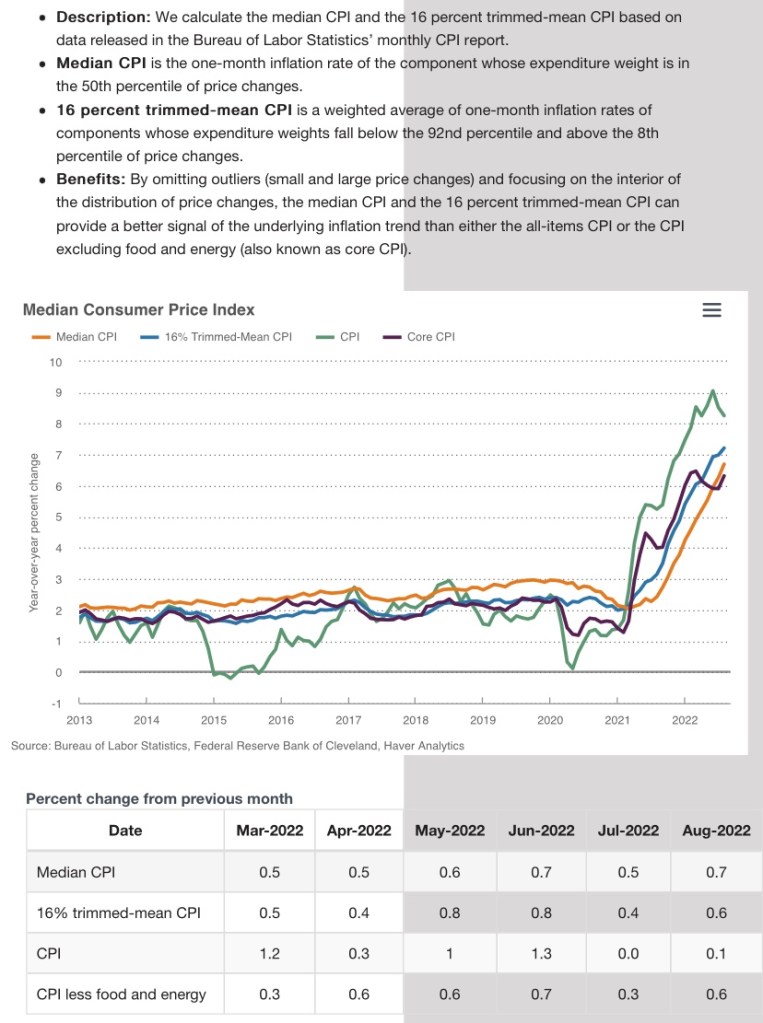
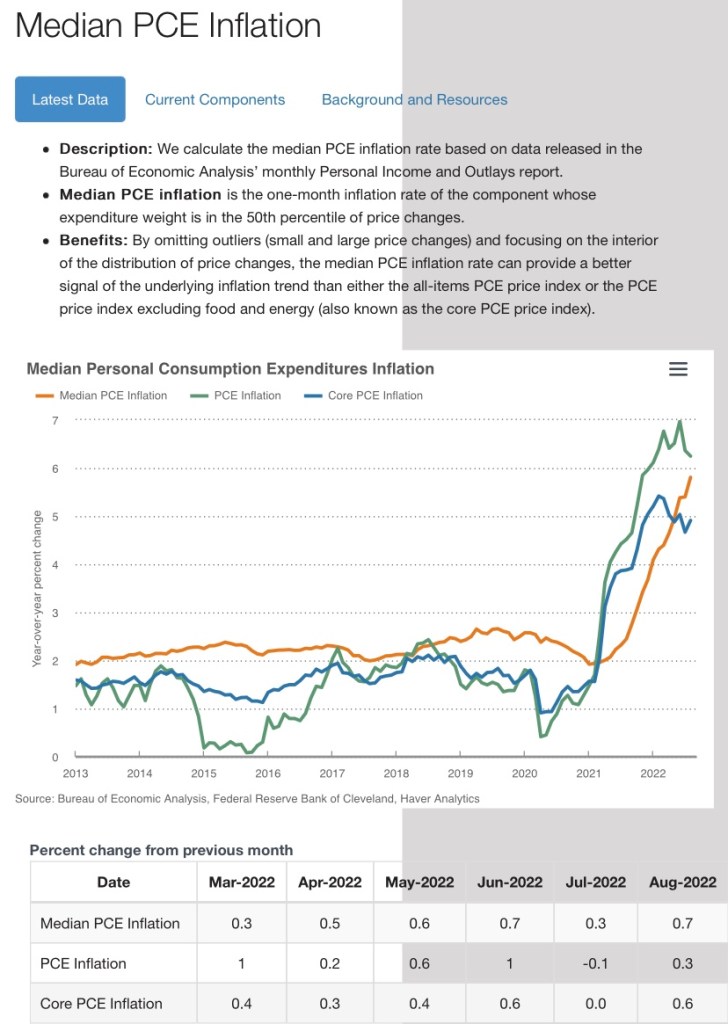
Inflation accelerated at the consumer level in June and the advances continued to broaden. That’s confirmed by the median item in the Consumer Price Index (CPI) and a measure of the CPI that “trims” out items with the largest and smallest price hikes (see chart above from the Cleveland Fed). Wholesale inflation also picked up in June. At this point, there’s a very real danger that increasing expectations of future inflation are getting embedded into current pricing decisions. Once that happens, the cycle is very hard to break. And wage rates are not keeping pace, so inflation is reducing real incomes for many workers. The sad fact is that inflation takes its greatest toll on the well being of low income earners.

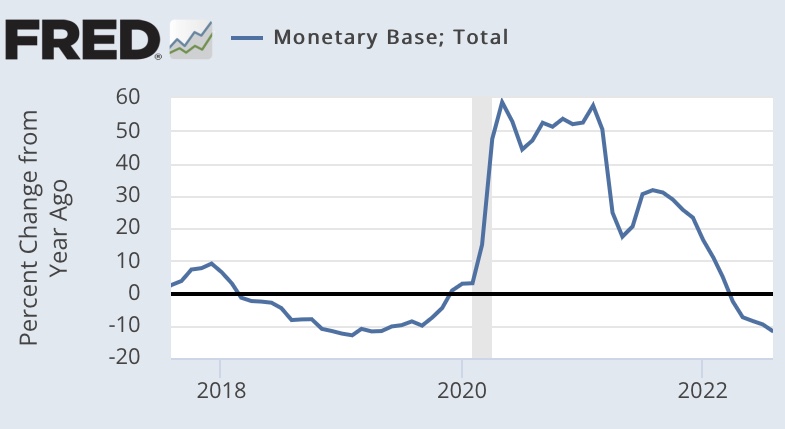
And why did inflation accelerate from 1.4% in January 2021 to 9.2% in June? Don’t ask Joe Biden, at least not if you want a straight answer. He’s been changing his tune almost every month, with a rotating cast of the characters coming in for blame. First, the story was that higher inflation was just transitory; then too, the Administration said it only hurt the rich, a wholly preposterous assertion; the blame then shifted to the oil companies; then to Putin; and then big corporations generally; more recently, it’s independent gas retailers! Nothing is said about Biden’s early pledge to shut down fossil fuels. Nothing is said about the federal government’s profligate spending and the money printing that paid for it. Nothing is said about the extended payment of unemployment benefits, which pinched labor supply. More generally, nothing is said about the extension of Biden’s pandemic emergency powers, which allows continued Medicaid and food stamp benefits to many who are otherwise ineligible. The federal spigot has been wide open!

So here’s a quick synopsis of events leading to our inflationary surge: demand strengthened as pandemic restrictions were lifted across the country. Unfortunately, businesses were not ready to meet that level of demand. Operations had been sharply curtailed during the pandemic all along business supply chains. Hiring staff was next to impossible for many firms, especially given the Biden Administration’s ineptitude with respect to labor incentives. The Administration also set out to starve the fossil fuel industry of capital and to shut down drilling and refining operations through restrictions and binding regulations. The price of oil began to soar early in the Administration, which has been working its way into the prices of other goods and services, including food and transportation. Reinforcing these ill effects was the broader regulatory onslaught instigated at many agencies by Biden, actions which tend to increase costs while limiting competition in many industries.

Most of the factors just listed were limitations on supply. However, the price pressure was accelerated on the demand side by government stimulus payments. And in fact, none of this inflation would be sustainable without easy monetary policy — and monetization of government debt.

Later, of course, Vladimir Putin’s invasion of Ukraine exacerbated worldwide energy and food shortages. Meanwhile, Democrat efforts to push through additional social spending, née “infrastructure”, were unrelenting. They are still pushing for more climate change regulation, not to mention funding “investments” intended to improve the “equity” of highways! Thank God for Joe Manchin for shutting it down, though even he seems intent on imposing drug price controls. Biden now says he’ll impose green energy policy via executive order.

Until about March of this year, Federal Reserve policy remained extremely accommodative, despite the central bank having completely missed its so-called inflation target rate of 2% well before that. Take another look at the chart at the top of this post. CPI inflation shot above 2% in early 2021. The Fed did not really react until March 2022. The chart below shows that growth in the GDP deflator was slightly more muted than the CPI, but it too was above 2% in the first quarter of 2021 and accelerated from there. It’s as if there had been no Fed target at all!

The story, again, was “not to worry, it’s transitory”. Moreover, the Fed was convinced the inflation was driven entirely by supply problems. In fairness, it’s true that tighter monetary policy won’t stop inflation from supply shocks without great cost in terms of lost output. But monetary accommodation, which is what happened in 2021, simply validates inflation and runs the risk of allowing inflation expectations to become embedded in pricing. And again, that’s hard to undo.

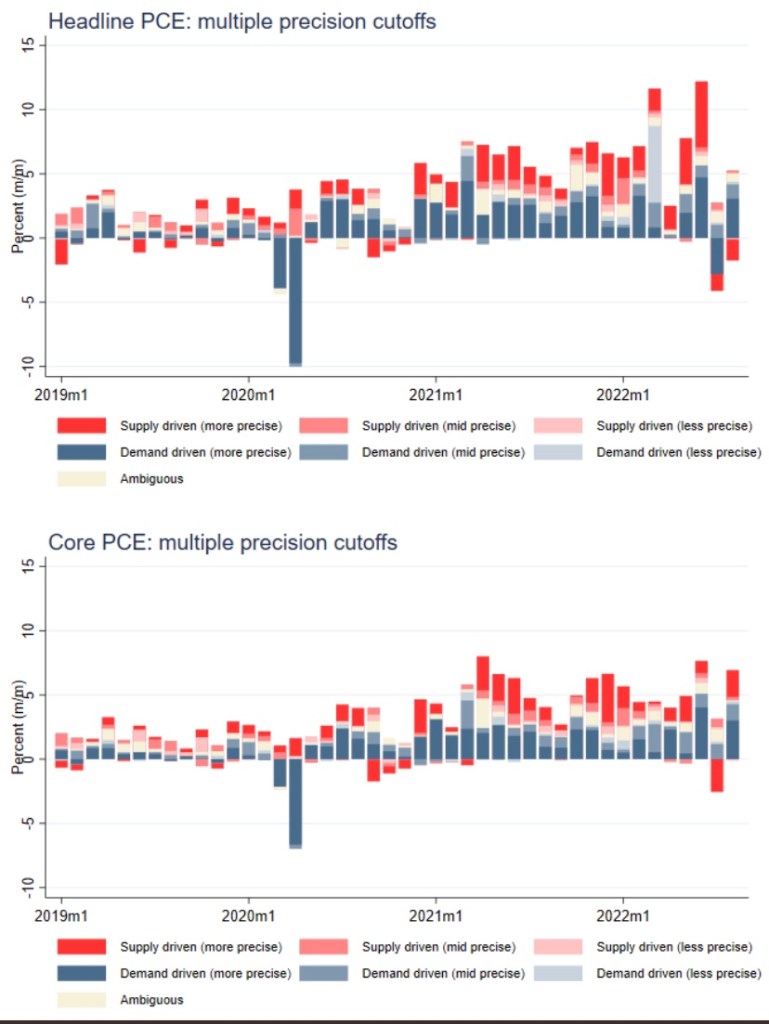
Despite the dominance of supply-side inflation pressures early in 2021, it’s no wonder that a different kind of pressure has cropped up since then. The following chart from David Beckworth is helpful:

We now have primarily demand-side inflation fueled by the earlier accommodation of supply constraints and the monetization of government deficits. Sure, there remain significant supply constraints, whether induced by the actions of Russia, Biden, or lingering pandemic dysfunctions. But supply-side inflation cannot sustain without monetary accommodation. An early reading for the second-quarter GDP deflator will be available in late July, but it may well show accelerating pressures from both the demand side and the supply side.

There is no way to eliminate the inflation surge without curtailing the growth of liquidity. Unfortunately, the risk that monetary tightening by the Fed will induce a recession is already very high, even a likelihood at this point. A fairly reliable signal of recession is an inversion of the yield curve, and we now see two-year Treasury debt yielding 15 – 20 basis points more than 10-year bonds. Again, real wages are declining. Real retail sales are down two months in a row and down from a year ago. Here’s a chart showing the most recent dismal reading on the index of consumer sentiment:

Whether a recession has already begun is not clear, but inflation certainly hasn’t abated, and the Fed is expected to continue tightening, albeit belatedly. Meanwhile, the Biden Administration and key Democrats don’t seem to want to make the Fed’s job any easier. They simply don’t comprehend the reality and their role in fostering the upward price trends we’re experiencing. They still cling to hopes of another big spending package that would add to deficits and the inflation tax, despite contemplating tax hikes on private employers, but so far Manchin has put the kabash on that. Still, we’re nowhere close to putting our fiscal and monetary houses in order.

Lawyers Sowing Legal Chaos

Tags

, , , , , , , , , , , , , , , ,

It goes without saying that the legal profession played a huge role in the development and growth of the administrative state. I reviewed some history about that growth in my last post, which dealt primarily with the Supreme Court’s recent ruling in West Virginia v. EPA. It’s certainly clear that courtrooms have served as venues for many of the steps in creating the federal Leviathan we know too well today. So has a large representation of attorneys in Congress. Environmental law? Tax law? Antitrust? Labor law? Civil Rights? Bank regulation? The examples and sub-examples are numerous, and while all might have laudable dimensions, there is no question that all present lucrative opportunities for attorneys… and for manipulative abuses. The burgeoning domain of administrative law enforced and adjudicated by federal agencies was itself a by-product of growth in the array of economic and social regulation, and it too was abetted by the legal profession. Moreover, it’s not inaccurate to say that the active rent-seeking efforts of private special interests, which undergird the “demand” for public intervention and regulation, are likely as not to have been spearheaded by corporate legal departments.

Ex post losses of various kinds are effective drivers of public intervention. Obviously, trial attorneys seek redress against various harms to clients who come their way, and they manage to stretch monetary damages to absurd levels. Public intervention, however, often takes the form of ex ante risk avoidance, and attorneys frequently take lead roles in agitating for ever-greater precautions against risk. A key characteristic of these measures is that they tend to be zero- and even negative-sum in nature. That is, in this kind of world, it is not atypical for one person’s gain to be less than another’s loss. This dynamic creates a formidable obstacle to economic growth.

Country Club Subversives

John O. McGinnis puts all this into a tidy nutshell in “Lawyers for Radical Change”:

Since the birth of the modern regulatory state, lawyers are no longer primarily the allies of commercial classes, as they were in the early republic, but instead the technocrats and enablers of regulation and redistribution. The more the nation intervenes in economic affairs to regulate and redistribute, the greater slice of compliance costs and transfer payments lawyers can expect to receive. Thus, they cannot be counted on as supporters of property rights or even of a stable rule of law. Their interest lies frequently in dynamic forms of legal transformation and the uncertainty they bring. Far from supporting a sound, established social order, they are likely to seek to undermine it.

McGinnis highlights the legal profession’s remarkable transition from once-active guardians of personal liberty, property rights, and the rule of law to active agitators for a nation grounded in non-productive rent seeking. The populist penchant for “do-something-ism” in response to every perceived risk, injustice, or grievance plays right into their skill set. And there are vast opportunities for attorneys in regulatory and fiscal matters. Compliance and legal work-arounds are enormously profitable to attorneys, to say nothing of the many forms of litigation. In all cases, one might say, “follow the fees”.

This is not exclusively a pecuniary matter, however. It’s also one of raw political ambition and status. A spectacular and perverse phenomenon has been the legal profession’s agitation for dismantling the rule of law, denying certain rights enumerated in the Constitution (e.g., free speech, gun rights) and insisting upon the enforcement of imagined rights through novel interpretations of the Bill of Rights and its amendments (e.g, guaranteed income, “equity”), even so-called rights and demands involving demonstrable harm to others (reparations, no bail laws, abortion).

Here’s McGinnis on the legal profession’s nearly complete sellout of the original text of the Constitution:

Under living constitutionalism, lawyers and judges are not simply servants of the law but potentially tribunes of the people, because they can choose to create new rights and discard others. In a legal world without the formal anchoring in text and precedents that characterized the lawyer’s craft of the past, innovation and, indeed, radicalism are prized as sources of power.

Legal “Realism”

There are other dimensions to the aberrant drift in the interests of the mainstream legal profession. Over 20 years ago, Mark Pulliam discussed some of these issues in “The Lawyer’s War on Law”. In that article, he decried so-called “legal realism”, which elevates prevailing attitudes about social policy and justice over legal formalism and originalism. This philosophy is used to justify what amounts to predation among trial lawyers seeking to smear the defense, especially those who suffer from unpopularity among current elites or the media. Gone is the idea of fighting for what is right under the law; instead the goal is to “win at all costs”. Here is Pulliam on this phenomenon:

“… lawsuits succeed without credible proof of injury or causation–‘junk science’ experts, paid by the hour, provide whatever pretext a jury requires–because of a combination of judge-made liability rules that tilt the playing field in favor of plaintiffs’ gripes, trial judges determined to redistribute wealth, and the brute force of endless dishonest lawsuits that seek unlimited, bankruptcy-threatening damages. Many businesses, having lost faith in courts’ ability or willingness to make rational rulings, routinely pay the equivalent of ransom just to escape the system. Most ominously, the trial lawyers have recently joined forces with state and local governments to loot unpopular industries for political purposes. Litigation is no longer just a way to bilk opponents; it is a political weapon.

The legal realist school of thought is used as a ready excuse for nearly any form of judicial activism, including nullification of controlling statutes in election procedures, allowing lawyers and judges to run elections.

Pro Bono Subversion

More recently, Pulliam provided another example of a perverse activity sponsored by the legal profession, and in particular large law firms. InLawyers Cause Homelessness”, he discusses pro bono litigation and its paradoxical harms. Of course, pro bono work sounds so very good and generous. And, in fact, it can be very nice, as when attorneys offer free legal advice to those who cannot otherwise afford it. However, it is not uncommon to see these efforts used in the service of political activism. Pulliam contends that prestigious law firms use pro bono litigation as an inducement to attract young associates, fresh out of law school and full of the social justice blather taught there. How exciting to be offered a position at an elite firm with the opportunity to work on activist causes!

The case used by Pulliam to illustrate this dynamic is Martin v. Boise, decided by the Ninth Circuit Court in 2018, which he describes thusly:

“Martin v. Boise … declared unconstitutional—as ‘cruel and unusual punishment,’ of all things—any city ordinances that prohibit homeless people from sleeping or camping overnight on public property (such as parks, sidewalks, and, in California, beaches) unless the jurisdiction provides enough shelter beds to house every single ‘person experiencing homelessness,’ a burden no city will ever be able to meet.

With a wave of the activist wand, the Ninth Circuit relieved vagrants of any responsibility to provide their own shelter. Society has this duty, and it must accept the consequences of its failure to provide cradle-to-grave care, no matter how improvident the lifestyle decisions of individual actors. In one fell swoop, in the absence of any relevant Supreme Court precedent, three unelected judges on the Ninth Circuit rendered more than 1,600 municipalities within the court’s jurisdiction powerless to curb urban homeless encampments.”

According to Pulliam, the Washington DC law firm Latham and Watkins dedicated more than 7,000 hours of attorney time to the case:

Latham … publicly bragged about its ‘major Ninth Circuit victory’ and was honored for it by the Legal Services Corporation’s Board of Directors with a Pro Bono Service Award.

This is a stark illustration of the depths of activism to which the legal profession has descended. And the case is hardly unique, as Pulliam goes on to illustrate. Despite the literal meaning of the term pro bono, this kind of activity is anything but for “the public good”.

Conclusion

Who really benefits from the kind of legalistic mayhem we see today? The written words of the Constitution are now said to mean things that are often diametrically opposed to the framers’ intent. The federal government absorbs ever greater shares of the nation’s resources. Private parties use federal power to petition for rents that could never have been gained in private markets. Laws are made by federal agencies who, in turn, internally adjudicate disputes between those very agencies and private parties. Litigation runs rampant in search of deep pockets. And elite law firms are somehow deemed praiseworthy for working to undermine safety, cleanliness, property rights, and the enumerated rights guaranteed under the Constitution.

Who benefits? Perhaps most of all it is the attorneys! The more chaotic, the better! Then again, if you’re at risk of legal trouble, you better damn well consult an attorney. We can’t seem to live without lawyers, but sadly, we can’t live free with them.