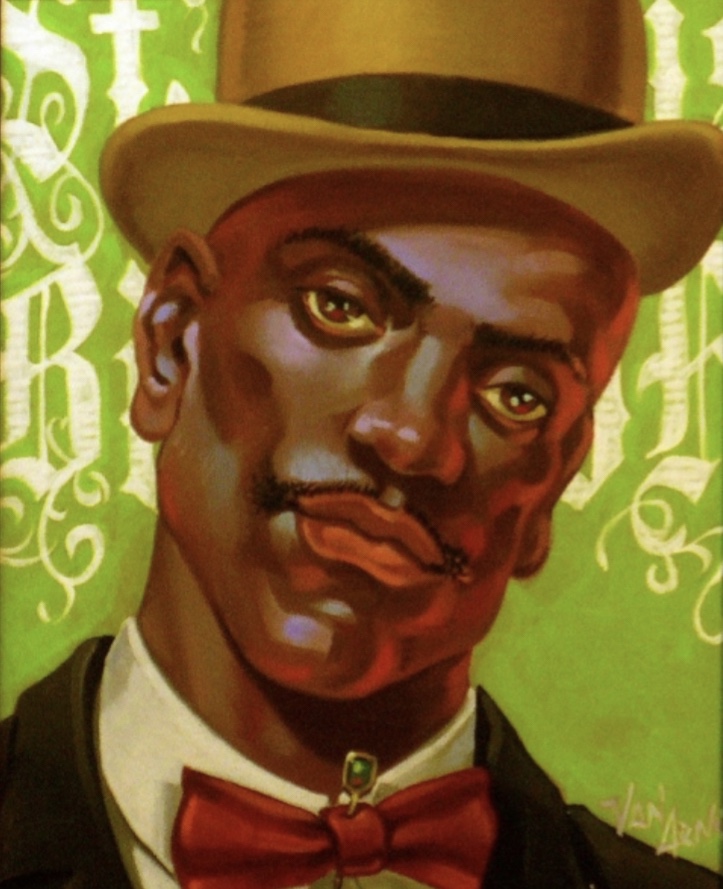
My Christmas With Stagger Lee and Billy DeLyon

Tags

, , , , , , , , , , , , , , , , , , , , , , , , , , , , , , , , , , , ,

I made an small addition to this post in early 2026. It appears in a paragraph about the name of the lawman to whom Delia DeLyon appealed after the killing of Billy DeLyon.

________________________________________

The true story of Stagger Lee is something I’ve known in a vague way for years. Maybe I heard about it once because the “incident” took place in my hometown of St. Louis, Missouri. I’ve always been fond of Robert Hunter’s colorful version of the story, put to song by Jerry Garcia and performed by the Grateful Dead (some great live versions here). There are many other Stagger Lee songs, however, going back to the end of the 19th century, though no recordings seem to exist from before the 1920s.

I was working out the Dead’s version of the song on the guitar when I got curious about a couple of things and went down a proverbial rabbit hole. I’ll get into a few details about Hunter’s version of the story below, but all the entries in this long tradition in song are about how the title character killed a man at a bar (or in a cave, an alley, and maybe elsewhere).

The Facts of the Case

The true story is this: Lee Shelton had a dispute with one Billy Lyons at a bar named Clark’s in the “Deep Morgan” neighborhood of St. Louis, Missouri. It happened on Christmas night of 1895 (not 1932, 1940, or 1948). It’s said to have started with a political argument, not a new phenomenon by any means! Shelton “grabbed Lyons’ derby and broke the form”. Lyons then snatched Shelton’s Stetson hat. Shelton demanded it back, and when Lyons refused, he hit Lyons over the head with the butt of his gun. Lyons pulled a knife and Shelton backed away, shooting Lyons in the abdomen. Shelton “cooly” picked up his hat, according to witnesses, left the bar, and strolled a few blocks to the home of a girlfriend, where he crashed for the night. He was arrested a few hours later, at around 3 a.m. on the 26th.

Lee Shelton was a carriage driver and rumored to be a pimp. He also worked as a political organizer for local democrats, whose “club” met at Clark’s saloon. Shelton had a record as a violent criminal, but he was nevertheless well-connected to powerful players on the local scene. He was also said to be quite a dandy, and went by the alias of Stack Lee. One theory is that Shelton, a mulatto, intimated that he was the illegitimate son of the steamboat captain Stacker Lee, whose dad owned a line of riverboats. Lyons, an African American levee hand, also participated in politics, but at a republican “club” centered at another saloon a few blocks away from Clark’s, so the two men were rivals in some respects.

Shelton’s first trial ended in a hung jury. Later he was convicted to serve 25 years at the state penitentiary in Jefferson City, Mo. He was paroled in 1909 but sent back to prison in 1911 for another crime. He died of tuberculosis in the prison hospital in 1912, at the age of 47.

The Legend and Tradition

At least one song was written about Shelton while he was in jail awaiting his first trial for murder, Many others followed, including levee work songs and field calls. His legend caught on and became part of African American folklore, sometimes with Stagger Lee cast as the hero of the story, but more often as the bad guy. He was, however, mythologized as a powerful black man who did what he pleased, which was understandably appealing to a people who, by then, had been nominally free for 30 years but still suffered various forms of subjugation.

Robert Hunter’s version of Stagger Lee is consistent with several aspects of the sung tradition of the legend. But like all other versions of which I’m aware, Hunter’s story differs from the facts of the case in several ways. His is a unique imagining of a set of events in the immediate aftermath the shooting. Hunter performed his original version of the song himself, called “Delia DeLyon and Stagger Lee”. I hadn’t known until last week that Jerry Garcia “re-ordered” Hunter’s lyrics in composing the Dead’s music for the song. Garcia cut a few of Hunter’s lines and made some other small changes. Of course, when you actually start singing a tune, the words can fall out in new ways!

Hunter must have had a good understanding of the song’s tradition, or maybe he did some deep research. I’m impressed either way, but researching a topic like this is a lot easier now than it was in the 1970s. Some of Hunter’s lyrics contain strong echoes of earlier versions as well as other legendary songs, and they share a cadence in phrasing and even pieces of specific lines from earlier variations of Stagger Lee.

The Songs, and Hunter’s Song

Here are a few points about the legend of Stagger Lee in song, and particularly Hunter’s (and Garcia’s) version. These are listed in more or less random order. They are interesting to me in part because I think they reflect the knowledge and study Hunter brought to bear on his song-writing effort.


The Biggest Hit: Versions have been recorded by a number of great artists over the years, including Cab Calloway, James Brown, Fats Domino, Elvis Presley, Taj Mahal, Doc Watson, Bob Dylan, The Clash, Nick Cave, and many others. However, in 1958 Lloyd Price released a version of the song, and maybe the only version, that garnered broad popularity. His R&B tune is nothing like the Hunter/Garcia effort, but Price speaks of the moon, a dice game, the Stetson hat, and he refers to the victim Billy as “that poor boy”. Other versions reference Billy as a “poor boy” as well, including Hunter’s. But many traditional songs have used “poor boy” to describe victimized or sympathetic male characters, so this isn’t a big coincidence.


Mississippi John Hurt: Recorded in 1928, Hurt’s version is said to be the “standard”. His lyrics refer to the victim as Billy de Lyon, rather than Lyons. DeLyon is the name used by Hunter. I’m not sure Hurt was the first to use “de Lyon”, but his version was influential. Here is another part of Hurt’s lyrics:

Gentleman’s of the jury, what do you think of that?
Stack O’ Lee killed Billy de Lyon about a five-dollar Stetson hat.”

And here’s Hunter:

Do you know what he shot him for? What do you make of that?
‘Cause Billy de Lyon threw the lucky dice. Won Stagger Lee’s Stetson hat
.”


He’s a Bad Man! The refrain, “He’s a bad man, oh cruel Stagolee”, is repeated many times in Hurt’s early version. However, the refrain Hunter used at the end of each verse was simply “He’s a mad man”. Garcia must have removed Hunter’s “mad man” refrain from the Dead’s version, and it’s easy to see why it wouldn’t have worked as well there. But there’s still the line: “Stagger Lee is a mad man and he shot my Billy dead”.

Interestingly, Hunter’s original “Delia DeLyon and Stagger Lee” is sung to Hurt’s country blues melody (with a few differences – compare here and here). That means, in turn, that the same lyrical cadence is used in both Hurt’s and the Dead’s versions, despite completely different melodies.


Did He Pack a .45… Or a .44? Shelton apparently used a .44 Smith & Wessen revolver to kill Lyons, and almost all versions of the song refer to a .44. Perhaps Hunter simply liked the rhyme of “I won’t come back alive” with “He packs a .45.”

Cowardly Cops? Or Just Corrupt?: The corruption theme was common to many versions of the song. That might have been a product of black resentment in that era against a lackadaisical (and probably racist) attitude toward prosecuting crimes against blacks. Here are a few lines from the 1927 song by Little Harvey Hull and The Down Home Boys, casting Billy as a cop:

“How can it be,
You arrest a man that’s as bad as me,
But you won’t arrest Stack O’Lee?

Here’s a verse from one of the traditional versions reprinted at this site:

The woman asked the sheriff, said ‘How can this be?
You got all them bad men, but you can’t get Stagolee’
Deputies took their badges and they laid them on the shelf
‘If you want to get that bad man, you get him by yourself’

Those deputies sound scared! Either way, Hurt followed Hull in describing a cop who wouldn’t do his job:

Police officer, how can it be?
You can ‘rest everybody but cruel Stack O’ Lee”

These words will ring familiar to anyone who’s heard Hunter’s version. Hunter’s cop was definitely frightened. The lines from “The Annotated Grateful Dead Lyrics” are:

Baio, Baio, tell me how can this be?
You arrest the girls for turning tricks
but you’re scared of Staggerlee
Staggerlee is a madman and he shot my Billy dead
Baio you go get him or give the job to me

I should note that there are a few slight differences between the “Annotated” lyrics and those on dead.net.


Nearer My God To Thee: This reference appeared in a tale about a different St. Louis murder taking place in either 1890 or 1899, depending on the source. Like the Lyons shooting, it was remembered in song. Quite a few songs, as a matter of fact. Many were called Frankie and Albert, though many others were called Frankie and Johnny. Same story. Basically, Frankie killed her man Albert (Johnny) for cheating on her.

The following is from Leadbelly’s long 1939 version of Frankie and Albert, followed by a corresponding Hunter reference in Stagger Lee:

Little Frankie went down Broadway
As far as she could see
And all she could hear was a two-string bow
Playing, ‘Nearer, My God To Thee’…

And here’s Hunter:

Delia went a walkin’
Down on Singapore Street
Where a three-piece band on a corner played
‘Nearer, My God To Thee’…


Singapore Street? I thought perhaps Hunter placed the location of the story in San Francisco, but there is no evidence of a street by that name historically. Maybe elsewhere, but there is no Singapore Street in the U.S. at present.


Christmas Day or Eve? Hunter placed the murder on “X-mas Eve” (Garcia sang “Christmas Eve” at least once), but the shooting actually occurred on Christmas night at about 10 p.m.

I only found one other reference to Christmas Eve in the versions I checked out (not even close to half of the total), and I’m not sure it would have influenced Hunter. These lines are from a traditional version with lyrics at this site:

“Stagalee, Stagalee — you must-a been a sinner
Ev’ry- Christmas eve they give Stagalee a dinner”


The Dice Game: Many versions of the song have the dispute between Stagger Lee and Billy arising from a dice game. That seems to have been an embellishment prompted by a newspaper article that ran more than six months after the killing (and one day before Shelton’s first trial). It stated that Shelton and Lyons had been shooting craps, but there’s no evidence that dice were involved that night. Here is Paul Slade on that point:

In fact, there’s no mention of gambling in either the earlier newspaper reports or the inquest statements. Either the reporter responsible was genuinely confused, or he could not resist embellishing the story with one extra little colourful detail. Whatever its beginnings, the gambling is now an immovable part of the song”.

The Bucket of Blood: In 1967, a black inmate at the New York State Pen named “Big Stick” recited a “toast” that contained the following:


He walked through rain and he walked through mud, Till he came to a place called the Bucket of Blood.”

Apparently Nick Cave’s lyrics were taken in large part from the Big Stick toast, and that, in turn, was based on “traditional” versions going back to at least 1911.

The “Bucket of Blood” was another St.Louis bar in the 1890s where some versions of the song have incorrectly placed the shooting. Perhaps it’s a stretch, but the name of that bar has such a gratuitous ring that it seems reminiscent of Hunter’s lines:

She waded to De Lyon’s club through Billy De Lyon’s blood

Minor point, but Lyons‘ “club” actually met at a bar called Bridgewater’s, which was just a few blocks down the street from Clark’s. It would have been odd for Delia to look for Stagger Lee at Bridgewater’s in order to exact her revenge, but I’m getting picky!


The Gallows: Shelton was not sent to the gallows, but many versions have it that way, including Hunter’s (if we’re to presume that Delia’s wishes were honored).


Delia DeLyon: Billy Lyons was likely married, but not to anyone named Delia. However, there is another murder song called “Delia’s Gone” about a shooting that took place in Savannah, Georgia on Christmas Eve in 1900! I somehow doubt that Hunter’s choice of “Delia” was coincidental.


The Cop’s Name: The name of the lawman in Hunter’s version seemed like a curiosity to me. It’s written as “Baio” in The Annotated Grateful Dead Lyrics. “Bayou” is probably what most people imagine they hear, and I’ve seen it that way on guitar charts. I poked around to see if I could learn of any historical basis for that name. There are a few people here and there who’ve gone by the name of Bayou… it might be confined to the lower Mississippi Valley. Nowhere could I find any reference to that name in the true story of Stagger Lee or in any other versions of the song. Woodie Guthrie’s rendition has the line “The bayou calls”, which doesn’t seem pertinent. The Rulers recorded a song about Stagger Lee called “Wrong ‘Em Boyo”, later covered by The Clash, but that’s apparently coincidental because “Boyo” is a reference to Stagger Lee himself. So I couldn’t find a source for the name of the cop in Hunter’s story.

I came across the Spanish surname Bayeu while reading a book about the great artist Francisco Goya in early 2026. Francisco Bayeu was Goya‘s brother-in-law, and he was also a great artist. The Bayeu surname was prominent in Spain around the time of the Inquisition. Who knows whether this name popped into Hunter‘s mind while composing the lyrics, or if it had some connection to the actual facts of the story, as St. Louis had a modest Spanish population in its early days.


Wrap Up

The music of many Stagger Lee songs could be described as old country blues, but there have been ragtime, swing, R&B, folk, reggae, and punk versions as well, not to mention spoken “toasts”. I like Garcia’s Stagger Lee melody for several reasons. It’s catchy, and it also has an “old-timey” or even “rag-timey” feel, despite its electricity.

It’s a fascinating Christmas tale, but probably not one you’ll want to tell your children as you tuck them in next Christmas Eve! Of course, Hunter’s lyrics describe something well beyond the actual facts of the Stagger Lee case. Nevertheless, he respects much of the tradition common to so many versions of the story. Meanwhile, his focus on Delia’s passion, revenge, and righteousness in avenging Stagger Lee’s brutality gives a whole different flavor to the story.


In case I failed to provide links to some of the source articles I drew on, here’s a list:

Several articles by Patrick Blackman on Singout.org

The Baddest Man In Town”, by Eric McHenry

A Brief History of Stagger Lee and Billy Lyons”, by Matt Marshall

A Christmas Killing: Stagger Lee”, by Paul Slade

The murder ballad of ‘Stagger Lee’ created a gruesome legend”, by Jeff Terich

Price Stability: Are We There Yet?

Tags

, , , , , , , , , , , , , , , , , , , , , , ,

The answer to that question, kids, is a resounding no! The Federal Reserve created far too much liquidity during and after the pandemic and waited too long to reverse that policy. That’s a common view among the “monetarazzi”, but far too many analysts, in the next breath, assert that the Fed is going too far in tightening policy. Sorry, but you can’t have it both ways! Thus far, the reductions we’ve seen in the monetary aggregates (M1, M2, M3) represent barely a trickle out of the ocean of liquidity released during the previous two years. The recent slight moderation in the rate of inflation is unlikely to gain momentum without persistence by the Fed.

This Could Be Easier

I humbly concede, however, that a different approach by the Fed might have been less disruptive. A better alternative would have involved more aggressive reductions in the gigantic portfolio of securities it acquired via “quantitative easing” (QE) during the pandemic while avoiding direct intervention to raise short-term interest rates. In fact, allowing interest rates to be determined by the market, rather than via central bank intervention, is more sensible in terms of pricing debt of any duration. It also suggests a more direct and sensible approach to managing the growth of the money supply. Of course, had the Fed unwound QE more aggressively, short-term rates would surely have risen anyway, but to levels appropriate to rationing liquidity more efficiently. Furthermore, those rates could have served as a useful indicator of the market’s ability to digest a particular volume of sales from the Fed’s portfolio.

Getting Tight

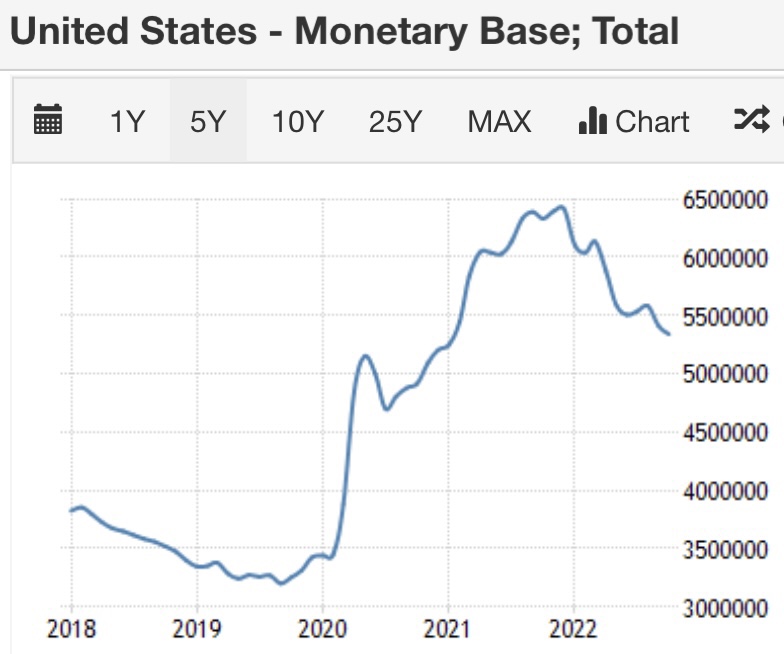
The chart below shows the level of the monetary base (bank reserves plus currency) over the past five years from the Trading Economics site. The monetary base is the narrow monetary aggregate supporting growth of the money stock and is under fairly direct control of the Fed.

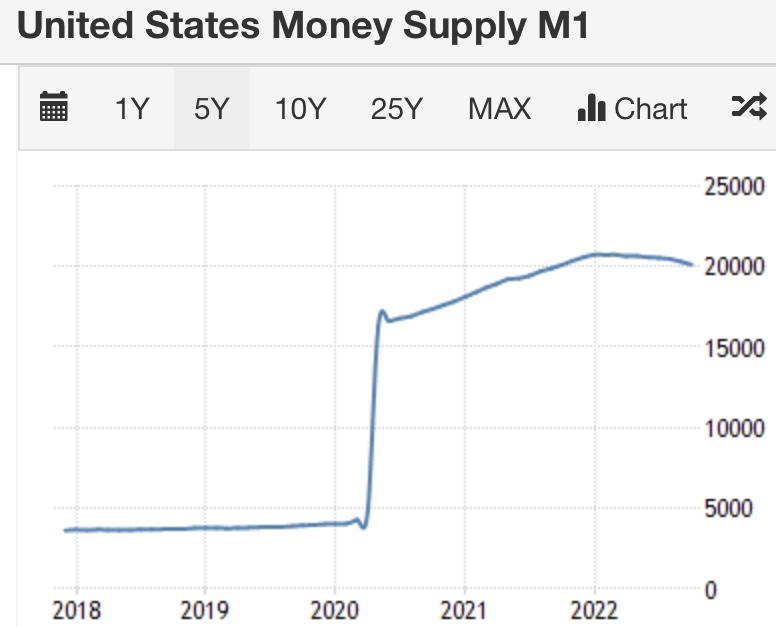
The base has declined substantially during 2022 largely as a consequence of the Fed’s restrictive policies. However, it has retraced only about a third of the massive expansion engineered by the Fed over the two prior years. Here is the corresponding plot of the M1 money stock (currency plus checking deposits):

So the reductions in the base have yet to translate into much of a reduction in the money stock, though growth in all of the aggregates has certainly declined. No one thinks this will be a walk in the park. Withdrawing liquid capital from markets accustomed to swilling in excesses will have consequences, particularly for investors who’ve grown undisciplined in their approach to evaluating prospective assets. Investors and society at large inevitably pay the price for the malinvestment encouraged by unbridled money growth (not to mention misdirected industrial policies … that’s a different can of worms).

But the squeamish resist! I got a kick out of this tweet by Noah Smith in which he pokes fun at those who insist that the surge in inflation was a mere transitory phenomenon:

Team Transitory: OMG inflation is just going to go away, you don’t need to raise interest rates.

Fed: *raises interest rates*

Inflation: *goes down a bit*

Team Transitory: SEE, I told you inflation was going away and that you didn’t need to raise interest rates!!

Well, in fairness, “Team Transitory” has been fixated on supply disruptions that very well should resolve with private efforts over time. Some have resolved already. And again, we’ve yet to feel much impact from the Fed’s tighter policy, but I’m amused by the tweet nevertheless.

In fact, the surge in inflation has been driven by both supply and demand factors, and it’s true the Fed can do very little about the former. But stalling the effort to purge excess liquidity and demand-side inflation risks allowing expectations of inflation to edge higher, creating an environment in which price pressures are more resistant to policy actions.

Inflation And Its Proximate Sources

It is indeed good news that inflation has tapered slightly over the past few months, or at least the “headline” inflation numbers have tapered. Weaker energy prices helped a great deal, though releases from the Strategic Petroleum Reserve aren’t sustainable. Measures of “core” inflation that exclude food and energy prices, and more central measures of inflation within the spectrum of goods and services, have moved sideways or perhaps shown signs of a slight moderation.

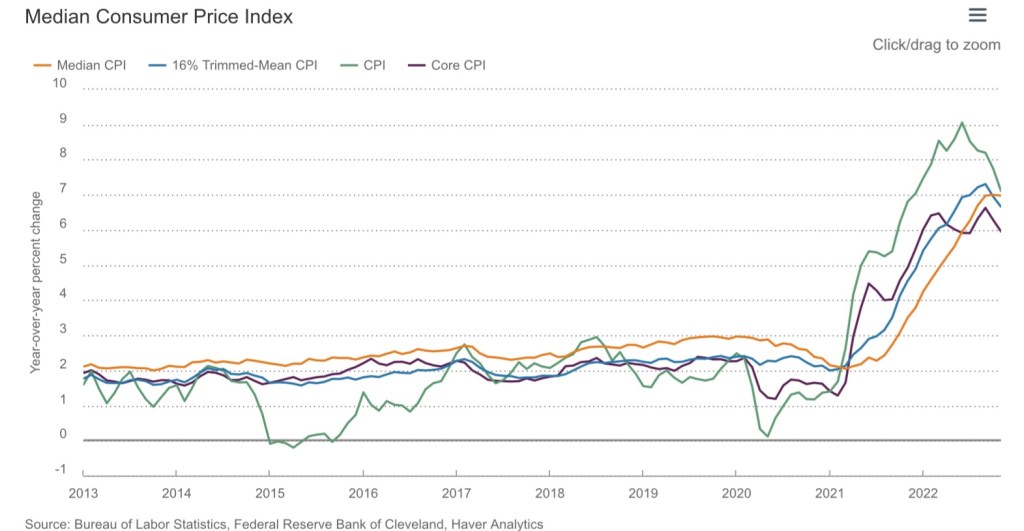
Here’s a plot of several measures of CPI inflation taken from the Cleveland Fed’s web site. Note that the median component of the CPI has finally hit a plateau, and a “trimmed” measure that excludes CPI components with extreme changes has dipped slightly. The Core CPI has fluctuated in a range just above 6% for most of the year.

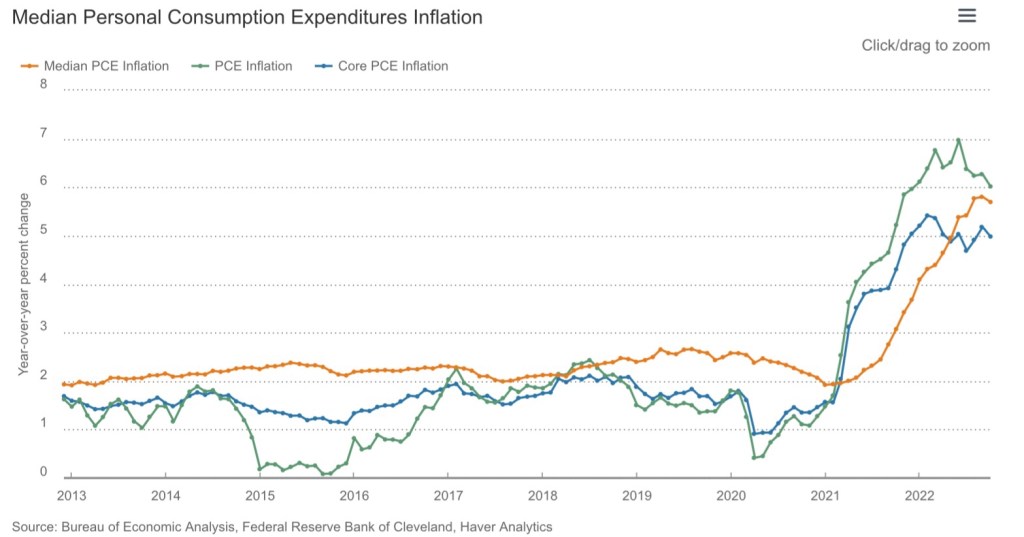
The deflator for personal consumption expenditures (PCE) gets more emphasis from the Fed in its policy deliberations. The latest release at the start of December showed patterns similar to the CPI:

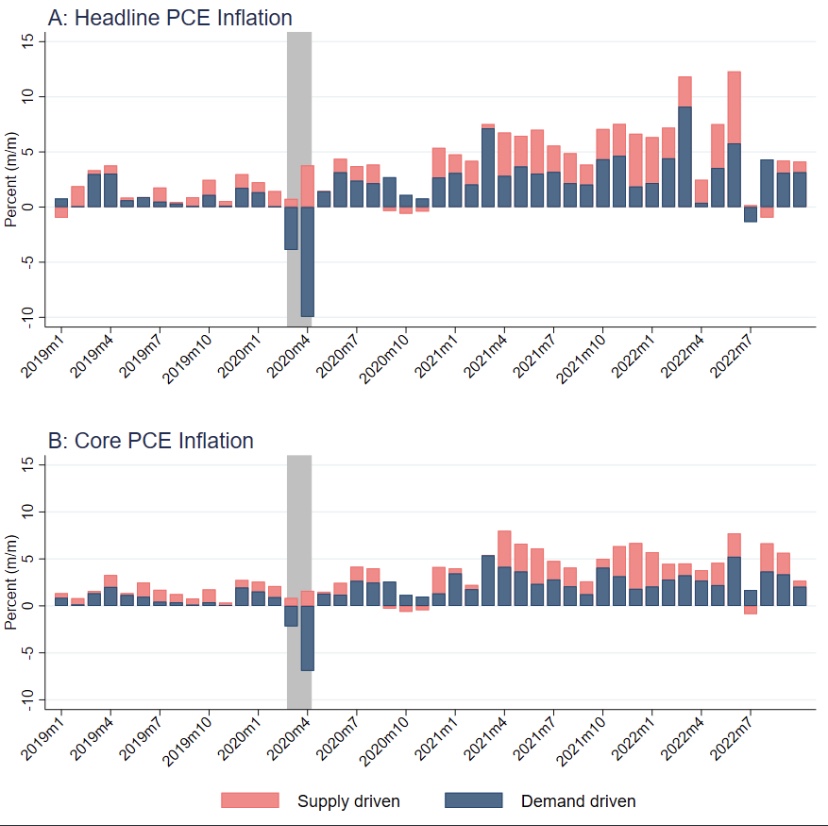
With respect to the PCE deflator, the slight dampening of price pressure we’ve seen recently came primarily from the supply side, with some progress on the demand side as well. Energy was one factor on the supply side, but even the core PCE deflator shows less supply pressure. Adam Shapiro has a decomposition of the PCE deflator into supply-driven and demand-driven components (but the chart only goes through October):
First, without endorsing Shapiro’s construction of this dichotomy, I note that the impact of monetary policy is primarily through the demand side of the economy. Of course, monetary instability isn’t good for producers, and excessive money growth and inflation create uncertainty that inhibits supply. But what we’ve seen recently has more to do with the curing of supply chain bottlenecks that cropped up during the pandemic (or in its wake), and Shapiro attempts to capture that kind of phenomenon here.

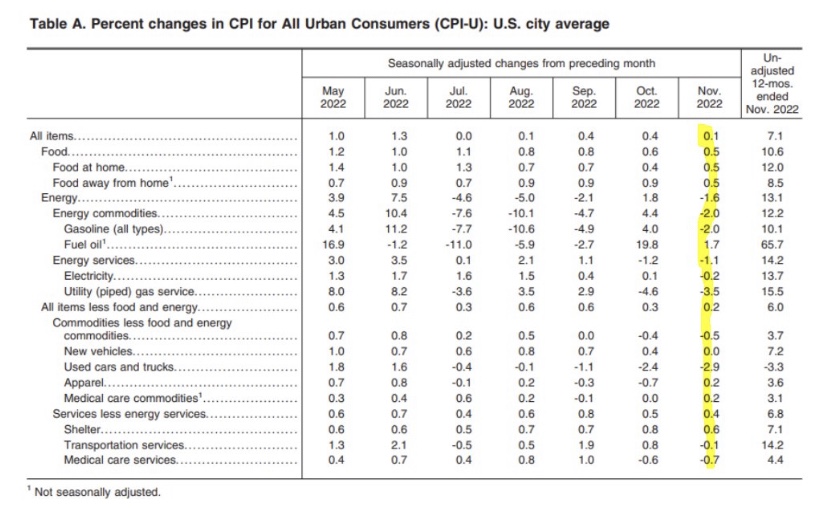
Still, many would argue that the November CPI showed sufficient progress for the Fed to pause its tightening campaign. The reductions in the monthly price increases were fairly widespread, as shown by this table from the CPI report:

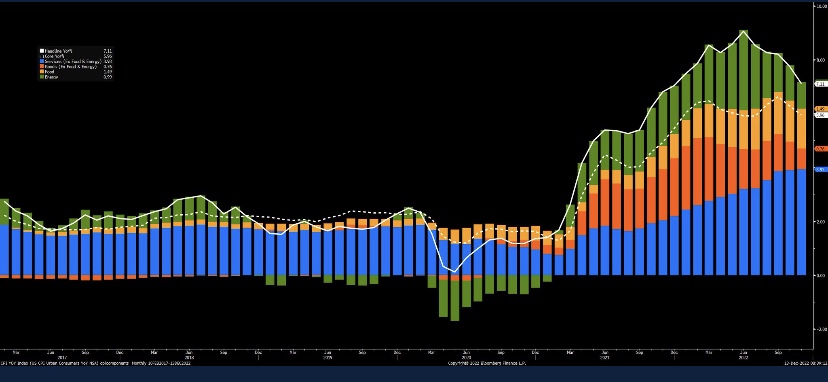
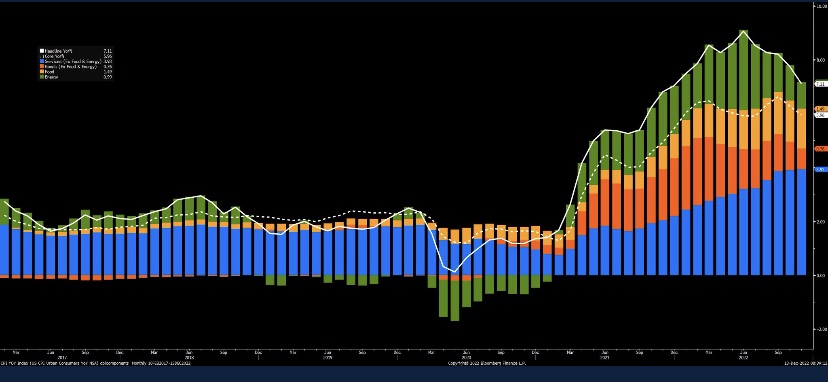
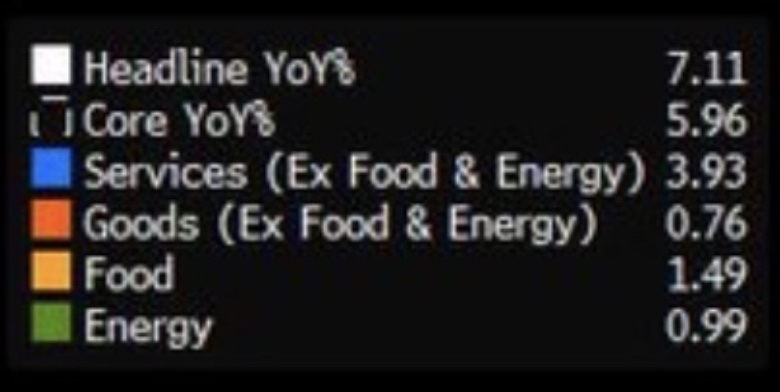
The next chart from Joe Wiesenthal (via Bloomberg) displays trends in broad CPI categories, but it shows vividly that the reductions were concentrated in energy components and goods prices, while services and food inflation did not really abate. (The legend is so hard to read that I took the liberty of blowing it up a bit below the chart itself):

Playing Catch-Up

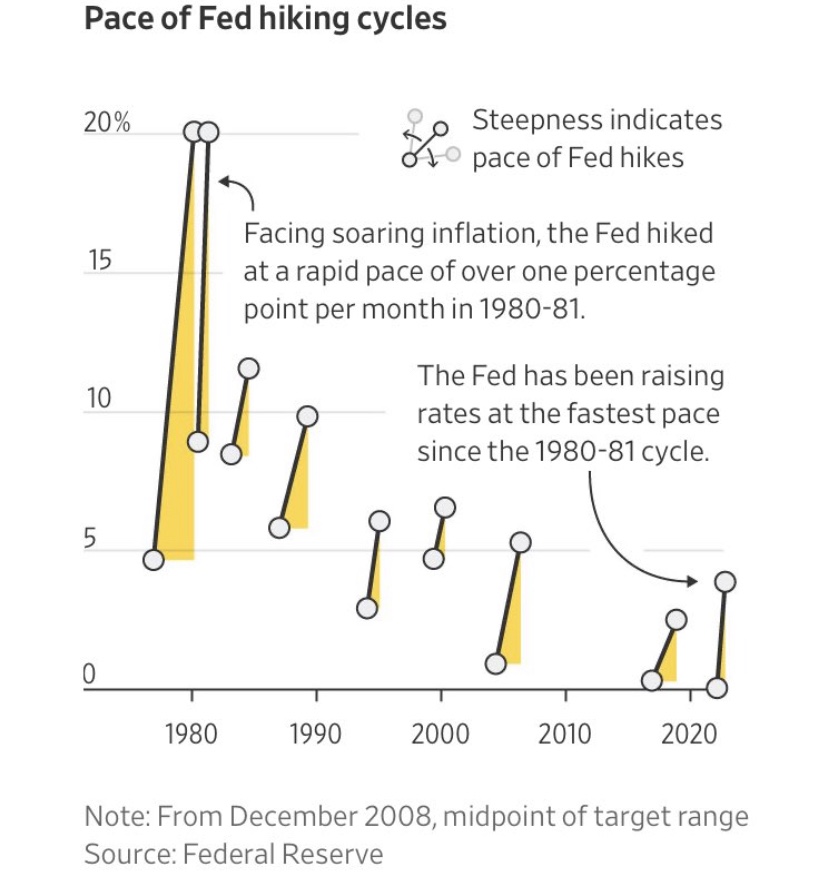
While the Fed’s effort to restrain inflation began in earnest in the spring of this year, it lifted the federal funds rate target rapidly. Here’s another chart from Adam Shapiro, via the Wall Street Journal: the Fed’s current tightening cycle is the fastest in 40 years in terms of those rate hikes:

Fast, yes, but they got a late start in the face of a rapid acceleration of inflation, and for what it’s worth, the Fed’s rate target remains below the rate of inflation. Yes, I’m forced to acknowledge here that the Fed’s preference for rate intervention and targeting is just what they do, for now. In any case, top-line inflation and strictly demand-side inflation are still above the Fed’s 2% target.

Fabian Fiscal Expansionists

One “fix” recommended in some circles suggests that the Fed’s inflation target is too low, as if price stability had nothing to do with its mandate! The idea that low-grade inflation is a healthy thing has never been convincingly demonstrated. In fact, the monetary literature leans strongly in the direction of price stability and an optimal rate of inflation of zero! That the Fed should aim for higher inflation seems like a cop-out intended to appease those who still subscribe to the discredited notion that there exists a reliable long-run tradeoff between inflation and unemployment.

In fact, proposals to increase the central bank’s inflation target would enable more deficit spending financed with the “printing press”, which is at the root of the demand-side inflation problem we now face. A major justifications for ballooning levels of federal spending has been so-called Modern Monetary Theory (MMM), which has gained adherents among statists in the years since the Great Recession. MMM holds that “important” initiatives can simply be paid for with new money creation, rather than interest bearing debt, or God forbid, taxes! “Partisan” is probably a better description than “theorist” for any fan of MMM, and they have convinced themselves that money financed deficits are without inflationary consequences. Of course, this represents a complete suspension of the law of resource scarcity, not to mention years of monetary history. Raising the Fed’s inflation target plays well with the same free-lunch advocates who rally behind MMM.

The Fed’s Unfaithful Fiscal Partner

Federal budget control is likely to take another hit this week with passage of the $1.7 omnibus spending bill. It includes spending increases with no immediate offsets as required under the pay-as-you-go budget law. It delays those offsets to 2025 and increases deficits in the interim by hundreds of billions of dollars. It also sets a new, higher baseline for discretionary appropriations in future years. The federal deficit has already risen dramatically compared to a year ago under the fiscal profligacy of Congress and the Administration. Another contributing factor, however, is that the interest cost of servicing the national debt has spiked as interest rates have risen. Needless to say, none this makes the Fed’s job any easier, especially as it seeks to reverse QE.

Say Uncle!?

When will the Fed begin to take its foot off the brake? It “only” raised the Fed funds target by 50 basis points at its meeting last week (after four 75 bps moves in a row. It is expected to raise the target another 50 bps in early February and perhaps another 25 in March. Strong signals of imminent recession would be needed for the Fed to call it off any sooner, and we’re definitely seeing more hints of a weakening economy in the data (and see here, here, here, and here). More definitive declines in inflation would obviously help settle things. Otherwise, the Fed may pause after March in order to gauge progress toward its goal of 2% inflation.

The Employment Situation: Where’s the Recession?

Tags

, , , , , , , , , , , , , , , , , , , , , , ,

It’s always hard to foresee dramatic turns in the economy and their timing. One day, way back in grad school, a professor of mine went on about how the Great Depression seemed to surprise people at the time. He felt they should have known it was coming, and he emphasized that housing had been in a downturn starting around 1926. Well, hindsight’s 20/20, and I’m not sure how timely and accurate economic reporting was at the time, but today it’s not any easier to call recessions in advance.

An Array of Weak Signals

We’ve seen a downturn in housing this year, and for that and several other reasons many forecasters are predicting a recession in 2023. Consumers are depleting their savings and running up debt, and in November consumer confidence dropped for a fourth month in a row. In October, the Index of Leading Economic Indicators declined for an eighth straight month. A slump in business confidence has been underway for 12 months. Businesses are accumulating debt at much higher interest rates, and the earnings outlook (excluding energy) is bleak.

Buttressing that negative outlook is the inverted yield curve, which has been reliable (though not infallible) as a recession signal in the past. We now have a gap between the one-year Treasury yield and the 10-year Treasury yield of well over 100 basis points, which is as high as it’s been since 1981. That looks rather ominous.

The Fed’s Mission

Perhaps most importantly, the Federal Reserve has succeeded in reducing the money supply. That shift to tightening policy really only began in the late spring, however, and as Milton Friedman emphasized, the impact of money supply growth on the real economy is subject to “long and variable lags”. That could mean an economic slowdown or recession any time from now into 2024, but many analysts believe it will begin in the first half of 2023.

Denialists

Yet a few observers claim things are rosy, not least of all those within the Biden Administration. They insist the economy is in fine shape, pointing to the continuing strength in some of the employment numbers. Those gains have also been a preoccupation of the media, but employment statistics aren’t especially good predictors of changes in economic growth. Job growth and unemployment are lagging indicators, so we shouldn’t expect to see obvious signals of recession from employment data, at least until a downturn is underway. Even the Fed’s official economic forecast still calls for something of a “soft landing”, but Chairman Jerome Powell is wary of placing much confidence in particular outcomes, and with good reason.

The Employment Situation

There are unusual patterns in recent employment data that might portend a weaker economy, but first, the statistics most widely followed are changes in non-farm employment (from the Bureau of Labor Statistics’ Survey of Business Establishments) and the unemployment rate (from the BLS Household Survey). The chart below shows monthly changes in nonfarm payrolls over the past year. There was a still-healthy gain in payrolls in November, but the pace of job growth slowed over the last twelve months as we came off the post-pandemic rebound.

One factor partly offsetting recent gains in non-farm employment is a decrease in the average workweek. Average weekly hours declined slightly in November and it was down 0.4 hours from a year earlier.

There are sectors of the economy that have shown recent weakness in payroll jobs. There was a decline in goods-producing employment in November, and layoffs are underway in the tech sector, a first for some of the big tech firms. Job reductions have also been announced at a few prominent financial firms.

The next chart shows that the unemployment rate has remained near post-pandemic lows since early this year. An ongoing factor helping to keep it low, however, is that labor force participation is still running below pre-pandemic levels (despite rebounding well off pandemic lows during 2021). You aren’t counted as unemployed if you don’t participate in the labor force by seeking work.

One negative sign here is an uptick over the past two months in the share of job losers among the unemployed (as opposed to quitters or new entrants). That’s a pattern that would become more pronounced when and if a recession takes hold.

Keep in mind that these statistics are derived from surveys and extrapolated to the universe of households or non-farm employees. The Household Survey samples 60,000 households, whereas the Establishment Survey samples 131,000 employers, accounting for 670,000 employees. So the Household Survey is much smaller. Nevertheless, sample sizes of these magnitudes should be highly reliable, even for most subcategories.

Contradictory BLS Surveys

There are a few other possible signs of a weakening labor market in recent employment data. One such development is a gap between new job numbers from the Establishment Survey (non-farm payrolls) and the Household Survey (total employment). The following table (taken from the December 2nd BLS Report for households) is from a series of tweets by Elise Gould:

Total employment from the Household Survey has actually declined by almost 470,000 the past two months, while non-farm payrolls have increased by a total of over 500,000. Turning points in employment from the Household Survey tend to lead non-farm payrolls, so this could foretell a softening. While the Household Survey is smaller than the Establishment Survey, it is broader in some respects, covering several categories of workers who aren’t counted on non-farm payrolls, including agricultural workers and the self-employed. The latter are a more significant part of the employed population given the rise in the so-called gig economy. Self-employed workers (unincorporated) have declined by more than 170,000 over the past two months. However, it’s not clear that these workers would be affected earlier than others around turning points.

A separate employment report by ADP Research noted a sharp slowdown in private sector hiring in November, with the most weakness in construction and interest rate sensitive industries. The report also noted that fewer workers are leaving jobs voluntarily.

Is the Labor Market Tight Or Loose?

Nominal wages are rising at an accelerating pace, which might make it more difficult for the Fed to rein-in inflation. However, wages are still rising less than prices — as of October, real hourly earnings had declined 1.9% over the past year. November will mark 20 straight months of declines in the real wage. The drop in real weekly earnings is even steeper, given a slight decline in the average workweek. If we’re looking for a silver lining, inflation and declines in real earnings mean that employers have gained additional incentive to hire. Perhaps that can be offered as one reason for persistent strength in the payroll numbers.

There are still more than 10 million job openings across the country, but only 6 million workers are unemployed. Again, many would-be job candidates are sitting things out. (Perhaps they are mostly terrible candidates, given their apparent disinterest in work.) Some observers assume this means that the labor market is extremely tight, yet real wages are declining, as if there were an excess supply of workers! The answer to this “puzzle” is that many vacancies are ultimately filled by candidates who were already employed. Also, there is a large number of underemployed workers. Thus, the available pool of candidates is much larger than the number available due to unemployment. It’s not outlandish to think that there is actually an excess supply of labor at the moment, rather than excess demand, but that doesn’t bode well for real wage gains going forward.

Conclusion

Despite an ostensibly strong labor market, there are reasons to think that strength is waning, even without appeal to other economic and financial indicators. The BLS household survey showed recent declines in employment, as did the ADP survey, and we’ve seen an increase in the share of job losers among the unemployed. High-profile layoff announcements should also give pause. The recessionary outlook is reinforced by a number of other indicators, but most of all, the Federal Reserve’s tightening of the money supply is bound to have a stronger impact on the economy in 2023, and the Fed is not finished tightening yet.

The Twitter Files and Political Exploitation of Social Media

Tags

, , , , , , , , , , , , , , , , , , , , , , , ,

I’ve been cheering for Elon Musk in his effort to remake Twitter into the kind of “public square” it always held the promise to be. He’s standing up for free expression, against one-party control of speech on social media, and especially against government efforts to control speech. That’s a great and significant thing, yet as Duke economist Michael Munger notes, we hear calls from the Biden Administration and congressional Democrats to “keep an eye on Twitter”, a not-so-veiled threat of future investigative actions or worse.

Your Worst Enemy Test, Public or Private

As a disclaimer, I submit that I’m not an unadulterated fan of Musk’s business ventures. His business models too often leverage wrong-headed government policy for profitability. It reeks of rent seeking behavior, whatever Musk’s ideals, and the availability of those rents, primarily subsidies, violates the test for good governance I discussed in my last post. That’s the Munger Test (the “Your Worst Enemy” Test), formally:

You can only give the State power that you favor giving to your worst enemy.

On the other hand, Musk’s release of the “Twitter Files” last weekend, with more to come, is certainly a refreshing development. Censorship at the behest of political organizations, foreign governments, or our own government are all controversial and possibly illegal. While we’d ordinarily hope to transact privately at arms length with free exchange being strictly an economic proposition, one might even apply the Munger Test to the perspective of a user of a social media platform: would you trust your worst enemy to exercise censorship on that platform on the basis of politics? Like Donald Trump? Or Chuck Schumer? If not, then you probably won’t be happy there! Now, add to that your worst enemy’s immunity to prosecution for any content they deem favorable!

Cloaked Government Censorship?

Censorship runs afoul of the First Amendment if government actors are involved. In an interesting twist in the case of the Twitter Files, the two independent journalists working with the files, Matt Taibbi and Bari Weiss, learned that some of the information had been redacted by one James Baker, Twitter’s Deputy General Counsel. Perhaps not coincidentally, Baker was also formerly General Counsel of the FBI and a key figure in the Trump-Russia investigation. Musk promptly fired Baker from Twitter over the weekend. We might see, very soon, just how coincidental Baker’s redactions were.

Mark Zuckerberg himself recently admitted that Facebook was pressured by the FBI to censor the Hunter Biden laptop story, which is a key part of the controversy underlying the Twitter Files. The Biden Administration had ambitious plans for working alongside social media on content moderation, but the Orwellian-sounding “Disinformation Governance Board” has been shelved, at least for now. Furthermore, activity performed for a political campaign may represent an impermissible in-kind campaign donation, and Twitter falsely denied to the FEC that it had worked with the Biden campaign.

Solutions?

What remedies exist for potential social media abuses of constitutionally-protected rights, or even politically-driven censorship? Elon Musk’s remaking of Twitter is a big win, of course, and market solutions now seem more realistic. Court challenges to social media firms are also possible, but there are statutory obstacles. Court challenges to the federal government are more likely to succeed (if its involvement can be proven).

The big social media firms have all adopted a fairly definitive political stance and have acted on it ruthlessly, contrary to their professed role in the provision of an open “public square”. For that reason, I have in the past supported eliminating social media’s immunity from prosecution for content posted on their networks. A cryptic jest by Musk might just refer to that very prospect:

Anything anyone says will be used against me in a court of law.

Or maybe not … even with the sort of immunity granted to social media platforms, the Twitter Files might implicate his own company in potential violations of law, and he seems to be okay with that.

Immunity was granted to social media platforms under Section 230 of the Communications Decency Act (DCA). It was something many thought “the state should do” in the 1990s in order to foster growth in the internet. And it would seem that a platform’s immunity for content shared broadly should be consistent with promoting free speech. So the issue of revoking immunity is thorny for free speech advocates.

Section 230 And Content Moderation

There have always been legal restrictions on speech related to libel and “fighting words”. In addition, the CDA, which is a part of the Telecommunications Act, restricts “obscene” or “offensive” speech and content in various ways. The problem is that social media firms seem to have used the CDA as a pretext for censoring content more generally. It’s also possible they felt as if immunity from liability made them legally impervious to objections of any sort, including aggressive political censorship and user bans on behalf of government.

The social value of granting immunity depends on the context. There are two different kinds of immunity under Section 230: subsection (c)(1) grants immunity to so-called common carriers (e.g. telephone companies) for the content of private messages or calls on their networks; subsection (c)(2) grants immunity to social media companies for content posted on their platforms as long as those companies engage in content moderation consistent with the provisions of the CDA.

Common carrier immunity is comparatively noncontroversial, but with respect to 230(c)(2), I go back to the question: would I want my worst enemy to have the power to grant this kind of immunity? Not if it meant the power to forgive political manipulation of social media content with the heavy involvement of one political party! The right to ban users is completely unlike the “must serve” legal treatment of “public accommodations” provided by most private businesses. And immunity is inconsistent with other policies. For example, if social media acts to systematically host and to amplify some viewpoints and suppress others, it suggests that they are behaving more like publishers, who are liable for material they might publish, whether produced on their own or by third-party contributors.

Still, social media firms are private companies and their user agreements generally allow them to take down content for any reason. And if content moderation decisions are colored by input from one side of the political aisle, that is within the rights of a private firm (unless its actions are held to be illegal in-kind contributions to a political campaign). Likewise, it is every consumer’s right not to join such a platform, and today there are a number of alternatives to Twitter and Facebook.

Again, political censorship exercised privately is not the worst of it. There are indications that government actors have been complicit in censorship decisions made by social media. That would be a clear violation of the First Amendment for which immunity should be out of the question. I’d probably cut a platform considerable slack, however, if they acted under threat of retaliation by government actors, if that could be proven.

Volokh’s Quid Pro Quo

Rather than simply stripping away Section 230 protection for social media firms, another solution has been suggested by Eugene Volokh in “Common Carrier Status as Quid Pro Quo for § 230(c)(1) Immunity”. He proposes the following choice for these companies:

(1) Be common carriers like phone companies, immune from liability but also required to host all viewpoints, or

(2) be distributors like bookstores, free to pick and choose what to host but subject to liability (at least on a notice-and-takedown basis).

Option 2 is the very solution discussed in the last section (revoke immunity). Option 1, however, would impinge on a private company’s right to moderate content in exchange for continued immunity. Said differently, the quid pro quo offers continued rents created by immunity in exchange for status as a public utility of sorts, along with limits on the private right to moderate content. Common carriers often face other regulatory rules that bear on pricing and profits, but since basic service on social media is usually free, this is probably not at issue for the time being.

Does Volokh’s quid pro quo pass the Munger Test? Well, at least it’s a choice! For social media firms to host all viewpoints isn’t nearly as draconian as the universal service obligation imposed on local phone companies and other utilities, because the marginal cost of hosting an extra social media user is negligible.

Would I give my worst enemy the power to impose this choice? The CDA would still obligate social media firms selecting Option 1 to censor obscene or offensive content. Option 2 carries greater legal risks to firms, who might respond by exercising more aggressive content moderation. The coexistence of common carriers and more content-selective hosts might create competitive pressures for restrained content moderation (within the limits of the CDA) and a better balance for users. Therefore, Volokh’s quid pro quo option seems reasonable. The only downside is whether government might interfere with social media common carriers’ future profitability or plans to price user services. Then again, if a firm could reverse its choice at some point, that might address the concern. The CDA itself might not have passed the “Worst Enemy” Munger Test, but at least within the context of established law, I think Volokh’s quid pro quo probably does.

We’ll Know More Soon

More will be revealed as new “episodes” of the Twitter Files are released. We may well hear direct evidence of government involvement in censorship decisions. If so, it will be interesting to see the fallout in terms of legal actions against government censorship, and whether support coalesces around changes in the social media regulatory environment.

Government Action and the “Your Worst Enemy” Test

Tags

, , , , , , , , , , ,

A couple of weeks back I posted an admittedly partial list of the disadvantages, dysfunctions, and dangers of the Big Government Mess seemingly wished upon us by so many otherwise reasonable people. A wise addition to that line of thinking is the so-called Munger Test articulated by Michael Munger of Duke University. Here, he applies the test to government involvement in social media content regulation:

If someone says “The STATE should do X” (in this case, decide what is true and what can be published in a privately-owned space), they need to make a substitution.

Instead of “The STATE” substitute “Donald Trump,” and see if you still belief it. (Or “Nancy Pelosi”, if you want).

If approached honestly, Munger’s test is sure to make a partisan think twice about having government “do something”, or do anything! In a another tweet, Munger elaborates on the case of Twitter, which is highly topical at the moment:

In fact, the reporters and media moguls who are calling for the state to hammer Twitter, and censor all those other ‘liars’, naively believe that they have a 1000 Year Reich.

You don’t. 𝙔𝙤𝙪 𝙘𝙖𝙣 𝙤𝙣𝙡𝙮 𝙜𝙞𝙫𝙚 𝙩𝙝𝙚 𝙎𝙩𝙖𝙩𝙚 𝙥𝙤𝙬𝙚𝙧𝙨 𝙩𝙝𝙖𝙩 𝙮𝙤𝙪 𝙛𝙖𝙫𝙤𝙧 𝙜𝙞𝙫𝙞𝙣𝙜 𝙩𝙤 𝙮𝙤𝙪𝙧 𝙬𝙤𝙧𝙨𝙩 𝙚𝙣𝙚𝙢𝙮. Deal with it.”

The second sentence in that last paragraph is an even more concise statement of the general principle behind the Munger Test, which we might dub the “Worst Enemy Test” with no disrespect to Munger. He proposed the test (immodestly named, he admits) in his 2014 article, “Unicorn Governance”, in which he offered a few other examples of its application. The article is subtitled:

Ever argued public policy with people whose State is in fantasyland?

The answer for me is yes, almost every time I talk to anyone about public policy! And as Munger says, that’s because:

Everybody imagines that ‘The STATE’ is smart people who agree with them. Once MY team controls the state, order will be restored to the Force.

So go ahead! Munger-test all your friends’ favorite policy positions the next time you talk!

But what about the case of “regulating” Twitter or somehow interfering with its approach to content moderation? More on that in my next post.

The Dubious 1917 Redemption of Karl Marx

Tags

, , , , , , , , , , , , , , , ,

Karl Marx has long been celebrated by the Left as a great intellectual, but the truth is that his legacy was destined to be of little significance until his writings were lauded, decades later, by the Bolsheviks during their savage October 1917 revolution in Russia. Vladimir Lenin and his murderous cadre promoted Marx and brought his ideas into prominence as political theory. That’s the conclusion of a fascinating article by Phil Magness and Michael Makovi (M&M) appearing in the Journal of Political Economy. The title: “The Mainstreaming of Marx: Measuring the Effect of the Russian Revolution on Karl Marx’s Influence“.

The idea that the early Soviet state and other brutal regimes in its mold were the main progenitors of Marxism is horrifying to its adherents today. That’s the embarrassing historical reality, however. It’s not really clear that Marx himself would have endorsed those regimes, though I hesitate to cut him too much slack.

A lengthy summary of the M&M paper is given by the authors in “Das Karl Marx Problem”. The “problem”, as M&M describe it, is in reconciling 1) the nearly complete and well-justified rejection of Marx’s economic theories during his life and in the 34 years after his death, with 2) the esteem in which he’s held today by so many so-called intellectuals. A key piece of the puzzle, noted by the authors, is that praise for Marx comes mainly from outside the economics profession. The vast majority of economists today recognize that Marx’s labor theory of value is incoherent as an explanation of the value created in production and exchange.

The theoretical rigors might be lost on many outside the profession, but a moments reflection should be adequate for almost anyone to realize that value is contributed by both labor and non-labor inputs to production. Of course, it might have dawned on communists over the years that mass graves can be dug more “efficiently” by combining labor with physical capital. On the other hand, you can bet they never paid market prices for any of the inputs to that grisly enterprise.

Marx never thought in terms of decisions made at the margin, the hallmark of the rational economic actor. That shortcoming in his framework led to mistaken conclusions. Second, and again, this should be obvious, prices of goods must incorporate (and reward) the value contributed by all inputs to production. That value ultimately depends on the judgement of buyers, but Marx’s theory left him unable to square the circle on all this. And not for lack of trying! It was a failed exercise, and M&M provide several pieces of testimony to that effect. Here’s one example:

By the time Lenin came along in 1917, Marx’s economic theories were already considered outdated and impractical. No less a source than John Maynard Keynes would deem Marx’s Capital ‘an obsolete economic textbook . . . without interest or application for the modern world’ in a 1925 essay.

Marxism, with its notion of a “workers’ paradise”, gets credit from intellectuals as a highly utopian form of socialism. In reality, it’s implementation usually takes the form of communism. The claim that Marxism is “scientific” socialism (despite the faulty science underlying Marx’s theories) is even more dangerous, because it offers a further rationale for authoritarian rule. A realistic transition to any sort of Marxist state necessarily involves massive expropriations of property and liberty. Violent resistance should be expected, but watch the carnage when the revolutionaries gain the upper hand.

What M&M demonstrate empirically is how lightly Marx was cited or mentioned in printed material up until 1917, both in English and German. Using Google’s Ngram tool, they follow a group of thinkers whose Ngram patterns were similar to Marx’s up to 1917. They use those records to construct an expected trajectory for Marx for 1917 forward and find an aberrant jump for Marx at that time, again both in English and in German material. But Ngram excludes newspaper mentions, so they also construct a database from Newspapers.com and their findings are the same: newspaper references to Marx spiked after 1917. There was nothing much different when the sample was confined to socialist writers, though M&M acknowledge that there were a couple of times prior to 1917 during which short-lived jumps in Marx citations occurred among socialists.

To be clear, however, Marx wasn’t unknown to economists during the 3+ decades following his death. His name was mentioned here and there in the writings of prominent economists of the day — just not in especially glowing terms.

“… absent the events of 1917, Marx would have continued to be an object of niche scholarly inquiry and radical labor activism. He likely would have continued to compete for attention in those same radical circles as the main thinker of one of its many factions. After the Soviet boost to Marx, he effectively crowded the other claimants out of [the] socialist-world.

Magness has acknowledged that he and Makovi aren’t the first to have noticed the boost given to Marx by the Bolsheviks. Here, Magness quotes Eric Hobsbawm’s take on the subject:

This situation changed after the October Revolution – at all events, in the Communist Parties. … Following Lenin, all leaders were now supposed to be important theorists, since all political decisions were justified on grounds of Marxist analysis – or, more probably, by reference to textual authority of the ‘classics’: Marx, Engels, Lenin, and, in due course, Stalin. The publication and popular distribution of Marx’s and Engels’s texts therefore become far more central to the movement than they had been in the days of the Second International [1889 – 1914].”

Much to the chagrin of our latter day Marxists and socialists, it was the advent of the monstrous Soviet regime that led to Marx’s “mainstream” ascendency. Other brutal regimes arising later reinforced Marx’s stature. The tyrants listed by M&M include Joseph Stalin, Mao Zedong, Fidel Castro, and Pol Pot, and they might have added several short-lived authoritarian regimes in Africa as well. Today’s Marxists continue to assure us that those cases are not representative of a Marxist state.

Perhaps it’s fair to say that Marx’s name was co-opted by thugs, but I posit something a little more consistent with the facts: it’s difficult to expropriate the “means of production” without a fight. Success requires massive takings of liberty and property. This is facilitated by means of a “class struggle” between social or economic strata, or it might reflect divisions based on other differences. Either way, groups are pitted against one another. As a consequence, we witness an “othering” of opponents on one basis or another. Marxists, no matter how “pure of heart”, find it impossible to take power without demanding ideological purity. Invariably, this requires “reeducation”, cleansing, and ultimately extermination of opponents.

Karl Marx had unsound ideas about how economic value manifests and where it should flow, and he used those ideas to describe what he thought was a more just form of social organization. The shortcomings of his theory were recognized within the economics profession of the day, and his writings might have lived on in relative obscurity were it not for the Bolshevik’s intellectual pretensions. Surely obscurity would have been better than a legacy shaped by butchers.

It’s a Big Government Mess

Tags

, , , , , , , , , , , , , , , , , , , , ,

I’m really grateful to have the midterm elections behind us. Well, except for the runoff Senate race in Georgia, the cockeyed ranked-choice Senate race in Alaska, and a few stray House races that remain unsettled after almost two weeks. I’m tired of campaign ads, including the junk mail and pestering “unknown” callers — undoubtedly campaign reps or polling organizations.

It’s astonishing how much money is donated and spent by political campaigns. This year’s elections saw total campaign spending (all levels) hit $16.7 billion, a record for a mid-term. The recent growth in campaign spending for federal offices has been dramatic, as the chart below shows:

Do you think spending of a few hundred million dollars on a Senate campaign is crazy? Me too, though I don’t advocate for legal limits on campaign spending because, for better or worse, that issue is entangled with free speech rights. Campaigns are zero-sum events, but presumably a big donor thinks a success carries some asymmetric reward…. A success rate of better than 50% across several campaigns probably buys much more…. And donors can throw money at sure political bets that are probably worth a great deal…. Many donors spread their largess across both parties, perhaps as a form of “protection”. But it all seems so distasteful, and it’s surely a source of waste in the aggregate.

My reservations about profligate campaign spending include the fact that it is a symptom of big government. Donors obviously believe they are buying something that government, in one way or another, makes possible for them. The greater the scope of government activity, the more numerous are opportunities for rent seeking — private gains through manipulation of public actors. This is the playground of fascists!

There are people who believe that placing things in the hands of government is an obvious solution to the excesses of “greed”. However, politicians and government employees are every bit as self-interested and “greedy” as actors in the private sector. And they can do much more damage: government actors legally exercise coercive power, they are not subject in any way to external market discipline, and they often lack any form of accountability. They are not compelled to respect consumer sovereignty, and they make correspondingly little contribution to the nation’s productivity and welfare.

Actors in the private sector, on the other hand, face strong incentives to engage in optimizing behavior: they must please customers and strive to improve performance to stay ahead of their competition. That is, unless they are seduced by what power they might have to seek rents through public sector activism.

A people who grant a wide scope of government will always suffer consequences they should expect, but they often proceed in abject ignorance. So here is my rant, a brief rundown on some of the things naive statists should expect to get for their votes. Of course, this is a short list — it could be much longer:

  • Opportunities for graft as bureaucrats administer the spending of others’ money and manipulate economic activity via central planning.
  • A ballooning and increasingly complex tax code seemingly designed to benefit attorneys, the accounting profession, and certainly some taxpayers, but at the expense of most taxpayers.
  • Subsidies granted to producers and technologies that are often either unnecessary or uneconomic (and see here), leading to malinvestment of capital. This is often a consequence of the rent seeking and cronyism that goes hand-in-hand with government dominance and ham-handed central planning.
  • Redistribution of existing wealth, a zero- or even negative-sum activity from an economic perspective, is prioritized over growth.
  • Redistribution beyond a reasonable safety net for those unable to work and without resources is a prescription for unnecessary dependency, and it very often constitutes a surreptitious political buy-off.
  • Budgetary language under which “budget cuts” mean reductions in the growth of spending.
  • Large categories of spending, known in the U.S. as non-discretionary entitlements, that are essentially off limits to lawmakers within the normal budget appropriations process.
  • Fiscal illusion” is exploited by politicians and statists to hide the cost of government expansion.
  • The strained refrain that too many private activities impose external costs is stretched to the point at which government authorities externalize internalities via coercive taxes, regulation, or legal actions.
  • Massive growth in regulation (see chart at top) extending to puddles classified as wetlands (EPA), the ”disparate impacts” of private hiring practices (EEOC), carbon footprints of your company and its suppliers (EPA, Fed, SEC), outrageous energy efficiency standards (DOE), and a multiplicity of other intrusions.
  • Growth in the costs of regulatory compliance.
  • A nearly complete lack of responsiveness to market prices, leading to misallocation of resources — waste.
  • Lack of value metrics for government activities to gauge the public’s “willingness to pay”.
  • Monopoly encouraged by regulatory capture and legal / compliance cost barriers to competition. Again, cronyism.
  • Monopoly granted by other mechanisms such as import restrictions and licensure requirements. Again, cronyism.
  • Ruination of key industries as government control takes it’s grip.
  • Shortages induced by price controls.
  • Inflation and diminished buying power stoked by monetized deficits, which is a long tradition in financing excessive government.
  • Malinvestment of private capital created by monetary excess and surplus liquidity.
  • That malinvestment of private capital creates macroeconomic instability. The poorly deployed capital must be written off and/or reallocated to productive uses at great cost.
  • Funding for bizarre activities folded into larger budget appropriations, like holograms of dead comedians, hamster fighting experiments, and an IHOP for a DC neighborhood.
  • A gigantic public sector workforce in whose interest is a large and growing government sector, and who believe that government shutdowns are the end of the world.
  • Attempts to achieve central control of information available to the public, and the quashing of dissent, even in a world with advanced private information technology. See the story of Hunter Biden’s laptop. This extends to control of scientific narratives to ensure support for certain government programs.
  • Central funding brings central pursestrings and control. This phenomenon is evident today in local governance, education, and science. This is another way in which big government fosters dependency.
  • Mission creep as increasing areas of economic activity are redefined as “public” in nature.
  • Law and tax enforcement, security, and investigative agencies pressed into service to defend established government interests and to compromise opposition.

I’ve barely scratched the surface! Many of the items above occur under big government precisely because various factions of the public demand responses to perceived problems or “injustices”, despite the broader harms interventions may bring. The press is partly responsible for this tendency, being largely ignorant and lacking the patience for private solutions and market processes. And obviously, those kinds of demands are a reason government gets big to begin with. In the past, I’ve referred to these knee-jerk demands as “do somethingism”, and politicians are usually too eager to play along. The squeaky wheel gets the oil.

I mentioned cronyism several times in the list. The very existence of broad public administration and spending invites the clamoring of obsequious cronies. They come forward to offer their services, do large and small “favors”, make policy suggestions, contribute to lawmakers, and to offer handsomely remunerative post-government employment opportunities. Of course, certaIn private parties also recognize the potential opportunities for market dominance when regulators come calling. We have here a perversion of the healthy economic incentives normally faced by private actors, and these are dynamics that gives rise to a fascist state.

It’s true, of course, that there are areas in which government action is justified, if not necessary. These include pure public goods such as national defense, as well as public safety, law enforcement, and a legal system for prosecuting crimes and adjudicating disputes. So a certain level of state capacity is a good thing. Nevertheless, as the list suggests, even these traditional roles for government are ripe for unhealthy mission creep and ultimately abuse by cronies.

The overriding issue motivating my voting patterns is the belief in limited government. Both major political parties in the U.S. violate this criterion, or at least carve out exceptions when it suits them. I usually identify the Democrat Party with statism, and there is no question that democrats rely far too heavily on government solutions and intervention in private markets. The GOP, on the other hand, often fails to recognize the statism inherent in it’s own public boondoggles, cronyism, and legislated morality. In the end, the best guide for voting would be a political candidate’s adherence to the constitutional principles of limited government and individual liberty, and whether they seem to understand those principles. Unfortunately, that is often too difficult to discern.

Sweden’s Pandemic Policy: Arguably Best Practice

Tags

, , , , , , , , , , , , , , , , , , ,

When Covid-19 began its awful worldwide spread in early 2020, the Swedes made an early decision that ultimately proved to be as protective of human life as anything chosen from the policy menu elsewhere. Sweden decided to focus on approaches for which there was evidence of efficacy in containing respiratory pandemics, not mere assertions by public health authorities (or anyone else) that stringent non-pharmaceutical interventions (NPIs) were necessary or superior.

The Swedish Rationale

The following appeared in an article in Stuff in late April, 2020,

Professor Johan Giesecke, who first recruited [Sweden’s State epidemiologist Anders] Tegnell during his own time as state epidemiologist, used a rare interview last week to argue that the Swedish people would respond better to more sensible measures. He blasted the sort of lockdowns imposed in Britain and Australia and warned a second wave would be inevitable once the measures are eased. ‘… when you start looking around at the measures being taken by different countries, you find very few of them have a shred of evidence-base,’ he said.

Giesecke, who has served as the first Chief Scientist of the European Centre for Disease Control and has been advising the Swedish Government during the pandemic, told the UnHerd website there was “almost no science” behind border closures and school closures and social distancing and said he looked forward to reviewing the course of the disease in a year’s time.

Giesecke was of the opinion that there would ultimately be little difference in Covid mortality across countries with different pandemic policies. Therefore, the least disruptive approach was to be preferred. That meant allowing people to go about their business, disseminating information to the public regarding symptoms and hygiene, and attempting to protect the most vulnerable segments of the population. Giesecke said:

I don’t think you can stop it. It’s spreading. It will roll over Europe no matter what you do.

He was right. Sweden had a large number of early Covid deaths primarily due to its large elderly population as well as its difficulty in crafting effective health messages for foreign-speaking immigrants residing in crowded enclaves. Nevertheless, two years later, Sweden has posted extremely good results in terms of excess deaths during the pandemic.

Excess Deaths

Excess deaths, or deaths relative to projections based on historical averages, are a better metric than Covid deaths (per million) for cross-country or jurisdictional comparisons. Among other reasons, the latter are subject to significant variations in methods of determining cause of death. Moreover, there was a huge disparity between excess deaths and Covid deaths during the pandemic, and the gap is still growing:

Excess deaths varied widely across countries, as illustrated by the left-hand side of the following chart:

Interestingly, most of the lowest excess death percentages were in Nordic countries, but especially Sweden and Norway. That might be surprising in terms of high Nordic latitudes, which may have created something of a disadvantage in terms of sun exposure and potentially low vitamin D levels. Norway enacted more stringent public policies during the pandemic than Sweden. Globally, however, lockdown measures showed no systematic advantage in terms of excess deaths. Notably, the U.S. did quite poorly in terms of excess deaths at 8X the Swedish rate,

Covid Deaths

The right-hand side of the chart above shows that Sweden experienced a significant number of Covid deaths per million residents. The figure still compares reasonably well internationally, despite the country’s fairly advanced age demographics. Most Covid deaths occurred in the elderly and especially in care settings. Like other places, that is where the bulk of Sweden’s Covid deaths occurred. Note that U.S. Covid deaths per million were more than 50% higher than in Sweden.

NPIs Are Often Deadly

Perhaps a more important reason to emphasize excess deaths over Covid deaths is that public policy itself had disastrous consequences in many countries. In particular, strict NPIs like lockdowns, including school and business closures, can undermine public health in significant ways. That includes the inevitably poor consequences of deferred health care, the more rapid spread of Covid within home environments, the physical and psychological stress from loss of livelihood, and the toll of isolation, including increased use of alcohol and drugs, less exercise, and binge eating. Isolation is particularly hard on the elderly and led to an increase in “deaths of despair” during the pandemic. These were the kinds of maladjustments caused by lockdowns that led to greater excess deaths. Sweden avoided much of that by eschewing stringent NPIs, and Iceland is sometimes cited as a similar case.

Oxford Stringency Index

I should note here, and this is a digression, that the most commonly used summary measure of policy “stringency” is not especially trustworthy. That measure is an index produced by Oxford University that is available on the Our World In Data web site. Joakim Book documented troubling issues with this index in late 2020, after changes in the index’s weightings dramatically altered its levels for Nordic countries. As Book said at that time:

Until sometime recently, Sweden, which most media coverage couldn’t get enough of reporting, was the least stringent of all the Nordics. Life was freer, pandemic restrictions were less invasive, and policy responses less strong; this aligned with Nordic people’s experience on the ground.

Again, Sweden relied on voluntary action to limit the spread of the virus, including encouragement of hygiene, social distancing, and avoiding public transportation when possible. Book was careful to note that “Sweden did not ‘do nothing’”, but it’s policies were less stringent than its Nordic neighbors in several ways. While Sweden had the same restrictions on arrivals from outside the European Economic Area as the rest of the EU, it did not impose quarantines, testing requirements, or other restrictions on travelers or on internal movements. Sweden’s school closures were short-lived, and its masking policies were liberal. The late-2020 changes in the Oxford Stringency Index, Book said, simply did not “pass the most rudimentary sniff test”.

Economic Stability

Sweden’s economy performed relatively well during the pandemic. The growth path of real GDP was smoother than most countries that succumbed to the excessive precautions of lockdowns. However, Norway’s economy appears to have been the most stable of those shown on the chart, at least in terms of real output, though it did suffer a spike in unemployment.

The Bottom Line

The big lesson is that Sweden’s “light touch” during the pandemic proved to be at least as effective, if not more so, than comparatively stringent policies imposed elsewhere. Covid deaths were sure to occur, but widespread non-Covid excess deaths were unanticipated by many countries practicing stringent intervention. That lack of foresight is best understood as a consequence of blind panic among public health “experts” and other policymakers, who too often are rewarded for misguided demonstrations that they have “done something”. Those actions failed to stop the spread in any systematic sense, but they managed to do great damage to other aspects of public health. Furthermore, they undermined economic well being and the cause of freedom. Johan Giesecke was right to be skeptical of those claiming they could contain the virus through NPIs, though he never anticipated the full extent to which aggressive interventions would prove deadly.

Biden’s Rx Price Controls: Cheap Politics Over Cures

Tags

, , , , , , , , , , , , , , , , , , , , , , ,

You can expect dysfunction when government intervenes in markets, and health care markets are no exception. The result is typically over-regulation, increased industry concentration, lower-quality care, longer waits, and higher costs to patients and taxpayers. The pharmaceutical industry is one of several tempting punching bags for ambitious politicians eager to “do something” in the health care arena. These firms, however, have produced many wonderful advances over the years, incurring huge research, development, and regulatory costs in the process. Reasonable attempts to recoup those costs often means conspicuously high prices, which puts a target on their backs for the likes of those willing to characterize return of capital and profit as ill-gotten.

Biden Flunks Econ … Again

Lately, under political pressure brought on by escalating inflation, Joe Biden has been talking up efforts to control the prices of prescription drugs for Medicare beneficiaries. Anyone with a modicum of knowledge about markets should understand that price controls are a fool’s errand. Price controls don’t make good policy unless the goal is to create shortages.

The preposterously-named Inflation Reduction Act is an example of this sad political dynamic. Reducing inflation is something the Act won’t do! Here is Wikipedia’s summary of the prescription drug provisions, which is probably adequate for now:

Prescription drug price reform to lower prices, including Medicare negotiation of drug prices for certain drugs (starting at 10 by 2026, more than 20 by 2029) and rebates from drug makers who price gouge… .”

The law contains provisions that cap insulin costs at $35/month and will cap out-of-pocket drug costs at $2,000 for people on Medicare, among other provisions.

Unpacking the Blather

“Price gouging”, of course, is a well-worn term of art among anti-market propagandists. In this case it’s meaning appears to be any form of non-compliance, including those for which fees and rebates are anticipated.

The insulin provision is responsive to a long-standing and misleading allegation that insulin is unavailable at reasonable prices. In fact, insulin is already available at zero cost as durable medical equipment under Medicare Part B for diabetics who use insulin pumps. Some types and brands of insulin are available at zero cost for uninsured individuals. A simple internet search on insulin under Medicare yields several sources of cheap insulin. GoodRx also offers brands at certain pharmacies at reasonable costs.

As for the cap on out-of-pocket spending under Part D, limiting the patient’s payment responsibility is a bad way to bring price discipline to the market. Excessive third-party shares of medical payments have long been implicated in escalating health care costs. That reality has eluded advocates of government health care, or perhaps they simply prefer escalating costs in the form of health care tax burdens.

Negotiated Theft

The Act’s adoption of the term “negotiation” is a huge abuse of that word’s meaning. David R. Henderson and Charles Hooper offer the following clarification about what will really happen when the government sits down with the pharmaceutical companies to discuss prices:

Where CMS is concerned, ‘negotiations’ is a ‘Godfather’-esque euphemism. If a drug company doesn’t accept the CMS price, it will be taxed up to 95% on its Medicare sales revenue for that drug. This penalty is so severe, Eli Lilly CEO David Ricks reports that his company treats the prospect of negotiations as a potential loss of patent protection for some products.

The first list of drugs for which prices will be “negotiated” by CMS won’t take effect until 2026. However, in the meantime, drug companies will be prohibited from increasing the price of any drug sold to Medicare beneficiaries by more than the rate of inflation. Price control is the correct name for these policies.

Death and Cost Control

Henderson and Hooper chose a title for their article that is difficult for the White House and legislators to comprehend: “Expensive Prescription Drugs Are a Bargain“. The authors first note that 9 out of 10 prescription drugs sold in the U.S. are generics. But then it’s easy to condemn high price tags for a few newer drugs that are invaluable to those whose lives they extend, and those numbers aren’t trivial.

Despite the protestations of certain advocates of price controls and the CBO’s guesswork on the matter, the price controls will stifle the development of new drugs and ultimately cause unnecessary suffering and lost life-years for patients. This reality is made all too clear by Joe Grogan in the Wall Street Journal in “The Inflation Reduction Act Is Already Killing Potential Cures” (probably gated). Grogan cites the cancellation of drugs under development or testing by three different companies: one for an eye disease, another for certain blood cancers, and one for gastric cancer. These cancellations won’t be the last.

Big Pharma Critiques

The pharmaceutical industry certainly has other grounds for criticism. Some of it has to do with government extensions of patent protection, which prolong guaranteed monopolies beyond points that may exceed what’s necessary to compensate for the high risk inherent in original investments in R&D. It can also be argued, however, that the FDA approval process increases drug development costs unreasonably, and it sometimes prevents or delays good drugs from coming to market. See here for some findings on the FDA’s excessive conservatism, limiting choice in dire cases for which patients are more than willing to risk complications. Pricing transparency has been another area of criticism. The refusal to release detailed data on the testing of Covid vaccines represents a serious breach of transparency, given what many consider to have been inadequate testing. Big pharma has also been condemned for the opioid crisis, but restrictions on opioid prescriptions were never a logical response to opioid abuse. (Also see here, including some good news from the Supreme Court on a more narrow definition of “over-prescribing”.)

Bad policy is often borne of short-term political objectives and a neglect of foreseeable long-term consequences. It’s also frequently driven by a failure to understand the fundamental role of profit incentives in driving innovation and productivity. This is a manifestation of the short-term focus afflicting many politicians and members of the public, which is magnified by the desire to demonize a sector of the economy that has brought undeniable benefits to the public over many years. The price controls in Biden’s Inflation Reduction Act are a sure way to short-circuit those benefits. Those interventions effectively destroy other incentives for innovation created by legislation over several decades, as Joe Grogan describes in his piece. If you dislike pharma pricing, look to reform of patenting and the FDA approval process. Those are far better approaches.

Conclusion

Note: The image above was created by “Alexa” for this Washington Times piece from 2019.

Wind and Solar Power: Brittle, Inefficient, and Destructive

Tags

, , , , , , , , , , , , , , , , , , , , ,

Just how renewable is “renewable” energy, or more specifically solar and wind power? Intermittent though they are, the wind will always blow and the sun will shine (well, half a day with no clouds). So the possibility of harvesting energy from these sources is truly inexhaustible. Obviously, it also takes man-made hardware to extract electric power from sunshine and wind — physical capital— and it is quite costly in several respects, though taxpayer subsidies might make it appear cheaper to investors and (ultimately) users. Man-made hardware is damaged, wears out, malfunctions, or simply fails for all sorts of reasons, and it must be replaced from time to time. Furthermore, man-made hardware such as solar panels, wind turbines, and the expansions to the electric grid needed to bring the power to users requires vast resources and not a little in the way of fossil fuels. The word “renewable” is therefore something of a misnomer when it comes to solar and wind facilities.

Solar Plant

B. F. Randall (@Mining_Atoms) has a Twitter thread on this topic, or actually several threads (see below). The first thing he notes is that solar panels require polysilicon, which not recyclable. Disposal presents severe hazards of its own, and to replace old solar panels, polysilicon must be produced. For that, Randall says you need high-purity silica from quartzite rock, high-purity coking coal, diesel fuel, and large flows of dispatchable (not intermittent) electric power. To get quartzite, you need carbide drilling tools, which are not renewable. You also need to blast rock using ammonium nitrate fuel oil derived from fossil fuels. Then the rock must be crushed and often milled into fine sand, which requires continuous power. The high temperatures required to create silicon are achieved with coking coal, which is also used in iron and steel making, but coking coal is non-renewable. The whole process requires massive amounts of electricity generated with fossil fuels. Randall calls polysilicon production “an electricity beast”.

Greenwashing

The resulting carbon emissions are, in reality, unlikely to be offset by any quantity of carbon credits these firms might purchase, which allow them to claim a “zero footprint”. Blake Lovewall describes the sham in play here:

The biggest and most common Carbon offset schemes are simply forests. Most of the offerings in Carbon marketplaces are forests, particularly in East Asian, African and South American nations. …

The only value being packaged and sold on these marketplaces is not cutting down the trees. Therefore, by not cutting down a forest, the company is maintaining a ‘Carbon sink’ …. One is paying the landowner for doing nothing. This logic has an acronym, and it is slapped all over these heralded offset projects: REDD. That is a UN scheme called ‘Reduce Emissions from Deforestation and Forest Degradation’. I would re-name it to, ‘Sell off indigenous forests to global investors’.

Lovewall goes on to explain that these carbon offset investments do not ensure that forests remain pristine by any stretch of the imagination. For one thing, the requirements for managing these “preserves” are often subject to manipulation by investors working with government; as such, the credits are often vehicle for graft. In Indonesia, for example, carbon credited forests have been converted to palm oil plantations without any loss of value to the credits! Lovewall also cites a story about carbon offset investments in Brazil, where the credits provided capital for a massive dam in the middle of the rainforest. This had severe environmental and social consequences for indigenous peoples. It’s also worth noting that planting trees, wherever that might occur under carbon credits, takes many years to become a real carbon sink.

While I can’t endorse all of Lovewall’s points of view, he makes a strong case that carbon credits are a huge fraud. They do little to offset carbon generated by entities that purchase them as offsets. Again, the credits are very popular with the manufacturers and miners who participate in the fabrication of physical capital for renewable energy installations who wish to “greenwash” their activities.

Wind Plant

Randall discusses the non-renewability of wind turbines in a separate thread. Turbine blades, he writes, are made from epoxy resins, balsa wood, and thermoplastics. They wear out, along with gears and other internal parts, and must be replaced. Land disposal is safe and cheap, but recycling is costly and requires even greater energy input than the use of virgin feedstocks. Randall’s thread on turbines raised some hackles among wind energy defenders and even a few detractors, and Randall might have overstated his case in one instance, but the main thrust of his argument is irrefutable: it’s very costly to recycle these components into other usable products. Entrepreneurs are still trying to work out processes for doing so. It’s not clear that recycling the blades into other products is more efficient than sending them to landfills, as the recycling processes are resource intensive.

But even then, the turbines must be replaced. Recycling the old blades into crates and flooring and what have you, and producing new wind turbines, requires lots of power. And as Randall says, replacement turbines require huge ongoing quantities of zinc, copper, cement, and fossil fuel feedstocks.

The Non-Renewability of Plant

It shouldn’t be too surprising that renewable power machinery is not “renewable” in any sense, despite the best efforts of advocates to convince us of their ecological neutrality. Furthermore, the idea that the production of this machinery will be “zero carbon” any time in the foreseeable future is absurd. In that respect, this is about like the ridiculous claim that electric vehicles (EVs) are “zero emission”, or the fallacy that we can achieve a zero carbon world based on renewable power.

It’s time the public came to grips with the reality that our heavy investments in renewables are not “renewable” in the ecological sense. Those investments, and reinvestments, merely buy us what Randall calls “garbage energy”, by which he means that it cannot be relied upon. Burning garbage to create steam is actually a more reliable power source.

Highly Variable With Low Utilization

Randall links to information provided by Martian Data (@MartianManiac1) on Europe’s wind energy generation as of September 22, 2022 (see the tweet for Martian Data’s sources):

Hourly wind generation in Europe for past 6 months:
Max: 122GW
Min: 10.2GW
Mean: 41.0
Installed capacity: ~236GW

That’s a whopping 17.4% utilization factor! That’s pathetic, and it means the effective cost is quintuple the value at nameplate capacity. Take a look at this chart comparing the levels and variations in European power demand, nuclear generation, and wind generation over the six months ending September 22nd (if you have trouble zooming in here, try going to the thread):

The various colors represent different countries. Here’s a larger view of the wind component:

A stable power grid cannot be built upon this kind of intermittency. Here is another comparison that includes solar power. This chart is daily covering 2021 through about May 26, 2022.

As for solar capacity utilization, it too is unimpressive. Here is Martian Data’s note on this point, followed by a chart of solar generation over the course of a few days in June:

so ~15% solar capacity is whole year average. ~5% winter ~20% summer. And solar is brief in summer too…, it misses both both morning and evening peaks in demand.

Like wind, the intermittency of solar power makes it an impractical substitute for traditional power sources. Check out Martian Data’s Twitter feed for updates and charts from other parts of the world.

Nuclear Efficiency

Nuclear power generation is an excellent source of baseload power. It is dispatchable and zero carbon except at plant construction. It also has an excellent safety record, and newer, modular reactor technologies are safer yet. It is cheaper in terms of generating capacity and it is more flexible than renewables. In fact, in terms of the resource costs of nuclear power vs. renewables over plant cycles, it’s not even close. Here’s a chart recently posted by Randall showing input quantities per megawatt hour produced over the expected life of each kind of power facility (different power sources are labeled at bottom, where PV = photovoltaic (solar)):

In fairness, I’m not completely satisfied with these comparisons. They should be stated in terms of current dollar costs, which would neutralize differences in input densities and reflect relative scarcities. Nevertheless, the differences in the chart are stark. Nuclear produces cheap, reliable power.

The Real Dirt

Solar and wind power are low utilization power sources and they are intermittent. Heavy reliance on these sources creates an extremely brittle power grid. Also, we should be mindful of the vast environmental degradation caused by the mining of minerals needed to produce solar panels and wind turbines, including their inevitable replacements, not to mention the massive land use requirements of wind and solar power. Also disturbing is the hazardous dumping of old solar panels from the “first world” now taking place in less developed countries. These so-called clean-energy sources are anything but clean or efficient.