Vax Results, Biden Boosters, Delta, and the Mask Charade

Tags

, , , , , , , , , , , , , , , , , , , , , ,

If this post has an overarching theme, it might be “just relax”! That goes especially for those inclined to prescribe behavioral rules for others. People can assess risks for themselves, though it helps when empirical information is presented without bias. With that brief diatribe, here are a few follow-ups on COVID vaccines, the Delta wave, and the ongoing “mask charade”.

Israeli Vax Protection

Here is Jeffrey Morris’ very good exposition as to why the Israeli reports of COVID vaccine inefficacy are false. First, he shows the kind of raw data we’ve been hearing about for weeks: almost 60% of the country’s severe cases are in vaccinated individuals. This is the origin of the claim that the vaccines don’t work. 

Next, Morris notes that 80% of the Israeli population 12 years and older are vaccinated (predominantly if not exclusively with the Pfizer vaccine). This causes a distortion that can be controlled by normalizing the case counts relative to the total populations of the vaccinated and unvaccinated subgroups. Doing so shows that the unvaccinated are 3.1 times more likely to have contracted a severe case than the vaccinated. Said a different way, this shows that the vaccines are 67.5% effective in preventing severe disease. But that’s not the full story!

Morris goes on to show case rates in different age strata. For those older than 50 (over 90% of whom are vaccinated and who have more co-morbidities), there are 23.6 times more severe cases among the unvaccinated than the vaccinated. That yields an efficacy rate of 85.2%. Vaccine efficacy is even better in the younger age group: 91.8%. 

These statistics pertain to the Delta variant. However, it’s true they are lower than the 95% efficacy rate achieved in the Pfizer trials. Is Pfizer’s efficacy beginning to fade? That’s possible, but this is just one set of results and declining efficacy has not been proven. Israel’s vaccination program got off to a fast start, so the vaccinated population has had more time for efficacy to decay than in most countries. And as I discussed in an earlier post, there are reasons to think that the vaccines are still highly protective after a minimum of seven months.

Biden Boosters

IIn the meantime, the Biden Administration has recommended that booster shots be delivered eight months after original vaccinations. There is empirical evidence that boosters of similar mRNA vaccine (Pfizer and Moderna) might not be a sound approach, both due to side effects and because additional doses might reduce the “breadth” of the antibody response. We’ll soon know whether the first two jabs are effective after eight months, and my bet is that will be the case.

Is Delta Cresting?

Meanwhile, the course of this summer’s Delta wave appears to be turning a corner. The surge in cases has a seasonal component, mimicking the summer 2020 wave as well as the typical Hope-Simpson pattern, in which large viral waves peak in mid-winter but more muted waves occur in low- to mid-latitudes during the summer months.

Therefore, we might expect to see a late-summer decline in new cases. There are now 21 states with COVID estimated reproduction rates less than one (this might change by the time you see the charts at the link). In other words, each new infected person transmits to an average of less than one other person, which shows that case growth may be near or beyond a peak. Another 16 states have reproduction rates approaching or very close to one. This is promising.

Maskholes

Finally, I’m frustrated as a resident of a county where certain government officials are bound and determined to impose a mask mandate, though they have been slowed by a court challenge. The “science” does NOT support such a measure: masks have not been shown to mitigate the spread of the virus, and they cannot stop penetration of aerosols in either direction. This recent article in City Journal by Jeffrey H. Anderson is perhaps the most thorough treatment I’ve seen on the effectiveness of masks. Anderson makes this remark about the scientific case made by mask proponents:

Mask supporters often claim that we have no choice but to rely on observational studies instead of RCTs [randomized control trials], because RCTs cannot tell us whether masks work or not. But what they really mean is that they don’t like what the RCTs show.”

Oh, how well I remember the “follow-the-science” crowd insisting last year that only RCTs could be trusted when it came to evaluating certain COVID treatments. In any case, the observational studies on masks are quite mixed and by no means offer unequivocal support for masking. 

A further consideration is that masks can act to convert droplets to aerosols, which are highly efficient vehicles of transmission. The mask debate is even more absurd when it comes to school children, who are at almost zero risk of severe COVID infection (also see here), and for whom masks are highly prone to cause developmental complications.

Closing Thoughts

The vaccines are still effective. Data purporting to show otherwise fails to account for the most obvious of confounding influences: vaccination rates and age effects. In fact, the Biden Administration has made a rather arbitrary decision about the durability of vaccine effects by recommending booster shots after eight months. The highly transmissible Delta variant has struck quickly but the wave now shows signs of cresting, though that is no guarantee for the fall and winter season. However, Delta cases have been much less severe on average than earlier variants. Masks did nothing to protect us from those waves, and they won’t protect us now. I, for one, won’t wear one if I can avoid it.

Herd Immunity To Public Health Bullshitters and To COVID

Tags

, , , , , , , , , , , , , , , , , , , , , , , ,

My last post had a simple message about the meaning of immunity: you won’t get very sick or die from an infection to which you are immune, including COVID-19. Like any other airborne virus, that does NOT mean you won’t get it lodged in your eyeballs, sinuses, throat, or lungs. If you do, you are likely to test positive, though your immunity means the “case” is likely to be inconsequential.

As noted in that last post, we’ve seen increasing COVID case counts with the so-called Delta variant, which is more highly transmissible than earlier variants. (This has been abetted by an uncontrolled southern border as well.) However, as we’d expect with a higher level of immunity in the population, the average severity of these cases is low relative to last year’s COVID waves. But then I saw this article in ScienceAlert quoting Sir Andrew Pollard, a scientist affiliated AstraZeneca and the University of Oxford. He says with Delta, herd immunity “is not a possibility” — everyone will get it.

Maybe everyone will, but that doesn’t mean everyone will get sick. His statement raises an obvious question about the meaning of herd immunity. If our working definition of the term is that the virus simply disappears, then Pollard is correct: we know that COVID is endemic. But the only virus that we’ve ever completely eradicated is polio. Would Pollard say we’ve failed to achieve herd immunity against all other viruses? I doubt it. Endemicity and herd immunity are not mutually exclusive. The key to herd immunity is whether a virus does or does not remain a threat to the health of the population generally.

Active COVID infections will be relatively short-lived in individuals with “immunity”. Moreover, viral loads tend to be lower in immune individuals who happen to get infected. Therefore, the “infected immune” have less time and less virus with which to infect others. That creates resistance to further contagion and contributes to what we know as herd immunity. While immune individuals can “catch” the virus, they won’t get sick. Likewise, a large proportion of the herd can be immune and still catch the virus without getting sick. That is herd immunity.

One open and controversial question is whether uninfected individuals will require frequent revaccination to maintain their immunity. A further qualification has to do with asymptomatic breakthrough infections. Those individuals won’t see any reason to quarantine, and they may unwittingly transmit the virus.

I also acknowledge that the concept of herd immunity is often discussed strictly in terms of transmission, or rather its failure. The more contagious a new virus, like the Delta variant, the more difficult it is to achieve herd immunity. Models predicting low herd immunity thresholds due to heterogeneity in the population are predicated on a given level of transmissibility. Those thresholds would be correspondingly higher given greater transmissibility.

A prominent scientist quoted in this article is Paul Hunter of the University of East Anglia. After backing-up Pollard’s dubious take on herd immunity, Hunter drops this bit of real wisdom:

We need to move away from reporting infections to actually reporting the number of people who are ill. Otherwise we are going to be frightening ourselves with very high numbers that don’t translate into disease burden.”

Here, here! Ultimately, immunity has to do with the ability of our immune systems to fight infections. Vaccinations, acquired immunity from infections, and pre-existing immunity all reduce the severity of later infections. They are associated with reductions in transmission, but those immune responses are more basic to herd immunity than transmissability alone. Herd immunity does not mean that severe cases will never occur. In fact, more muted seasonal waves will come and go, inflicting illness on a limited number of vulnerables, but most people can live their lives normally while viral reproduction is contained. Herd immunity!

Sadly, we’re getting accustomed to hearing misstatements and bad information from public health officials on everything from mask mandates, lockdowns, and school closings to hospital capacity and vaccine hesitancy. Dr. Pollard’s latest musing is not unique in that respect. It’s almost as if these “experts” have become victims of their own flawed risk assessments insofar as their waning appeal to “the herd” is concerned. Professor Hunter’s follow-up is refreshing, however. Public health agencies should quit reporting case counts and instead report only patients who present serious symptoms, COVID ER visits, or hospitalizations.

Effective Immunity Means IF YOU CATCH IT, You Won’t Get Sick

Tags

, , , , , , , , , , , , , , , , , , , ,

Listen very carefully: immunity does NOT mean you won’t get COVID, though an infection is less likely. Immunity simply means your immune system will be capable of dealing with an infection successfully. This is true whether the immunity is a product of vaccination or a prior infection. Immunity means you are unlikely to have worse than mild symptoms, and you are very unlikely to be hospitalized. (My disclaimer: I am opposed to vaccine mandates, but vaccination is a good idea if you’ve never been infected.)

I emphasize this because the recent growth in case numbers has prompted all sorts of nonsensical reactions. People say, “See? The vaccines don’t work!” That is a brazenly stupid response to the facts. Even more dimwitted are claims that the vaccines are killing everyone! Yes, there are usually side effects, and the jabs carry a risk of serious complications, but it is minuscule.

Vaccine Efficacy

Right out of the gate, we must recognize that our PCR testing protocol is far too sensitive to viral remnants, so the current surge in cases is probably exaggerated by false positives, as was true last year. Second, if a large share of the population is vaccinated, then vaccinated individuals will almost certainly account for a large share of infected individuals even if they have a lower likelihood of being infected. It’s simple math, as this explanation of base rate bias shows. In fact, according to the article at the link:

… vaccination confers an eightfold reduction in the risk of getting infected in the first place; a 25-fold reduction in risk of getting hospitalized; and a 25-fold reduction in the risk for death.

The upshot is that if you are vaccinated, or if you have acquired immunity from previous exposure, or if you have pre-existing immunity from contact with an earlier COVID strain, you can still “catch” the virus AND you can still spread it. Both are less likely, and you don’t have as much to worry about for your own health as those having no immunity.

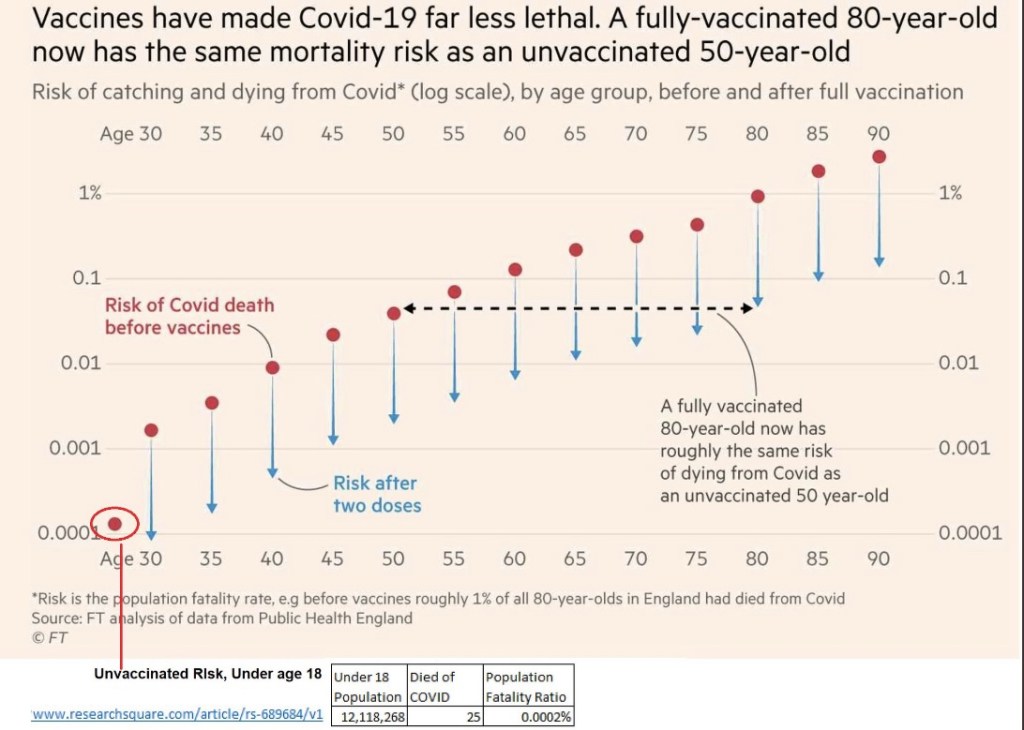
As for overall vaccine efficacy in preventing death, here are numbers from the UK, courtesy of Phil Kerpen:

The vertical axis is a log scale, so each successive gridline is a fatality rate 100x as large as the one below it. Obviously, as the chart title asserts, the “vaccines have made COVID-19 far less lethal.” Also, at the bottom, see the information on fatality among children under age 18: it is almost zero! This reveals the absurdity of claims that children must be masked for schools to reopen! In any case, masks offer little protection to anyone against a virus that spreads via fine aerosols. Nevertheless, many school officials are pushing unnecessary but politically expedient masking policies

Delta

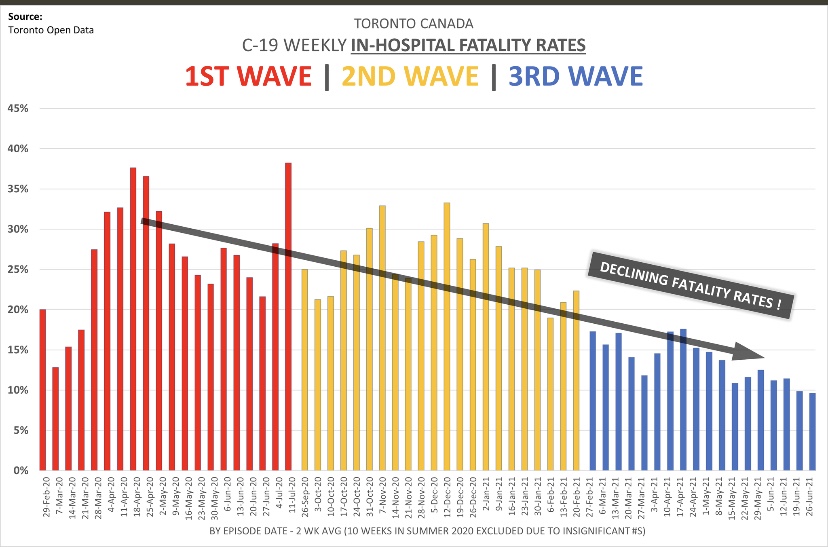
Ah, but we have the so-called Delta variant, which is now dominant and said to be far more transmissible than earlier variants. Yet the Delta variant is not as dangerous as earlier strains, as this UK report demonstrates. Delta had a case fatality rate among unvaccinated individuals that was at least 40% less than the so-called Alpha variant. This is a typical pattern of virus mutation: the virus becomes less dangerous because it wants to survive, and it can only survive in the long run by NOT killing its hosts! The decline in lethality is roughly demonstrated by Kelly Brown with data on in-hospital fatality rates from Toronto, Canada:

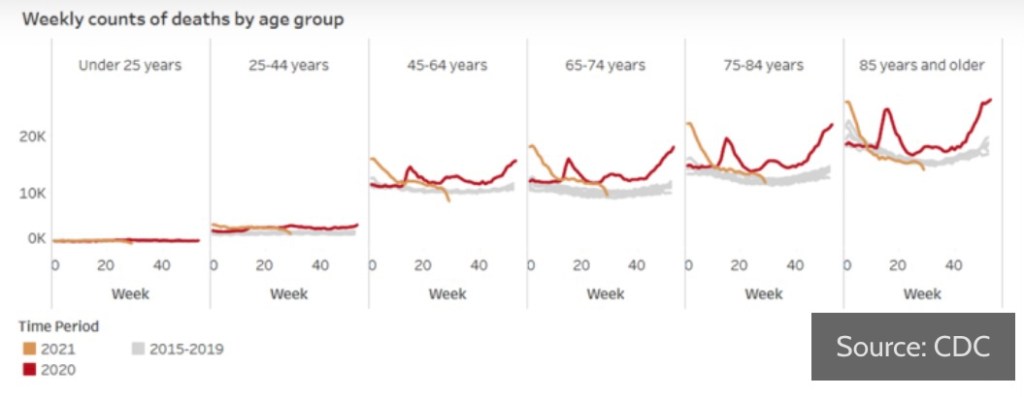
The case numbers in the U.S. have been climbing over the past few weeks, but as epidemiologist Larry Brilliant of WHO said recently, Delta spreads so fast it essentially “runs out of candidates.” In other words, the current surge is likely to end quickly. This article in Issues & Insights shows the more benign nature of recent infections. I think a few of their charts contain biases, but the one below on all-cause mortality by age group is convincing:

The next chart from Our World In Data shows the infection fatality rate continuing its decline in the U.S. The great majority of recent infections have been of the Delta variant, which also was much less virulent in the UK than earlier variants.

Furthermore, it turns out that the vaccines are roughly as effective against Delta and other new variants as against earlier strains. And the newest “scary” variants, Kappa and Lambda, do not appear to be making strong inroads in the U.S. 

Fading Efficacy?

There have been questions about whether the effectiveness of the vaccines is waning, which is behind much of the hand-wringing about booster shots. For example, Israeli health officials are insisting that the effectiveness of vaccines is “fading”, though I’ll be surprised if there isn’t some sort of confounding influence on the data they’ve cited, such as age and co-morbidities. 

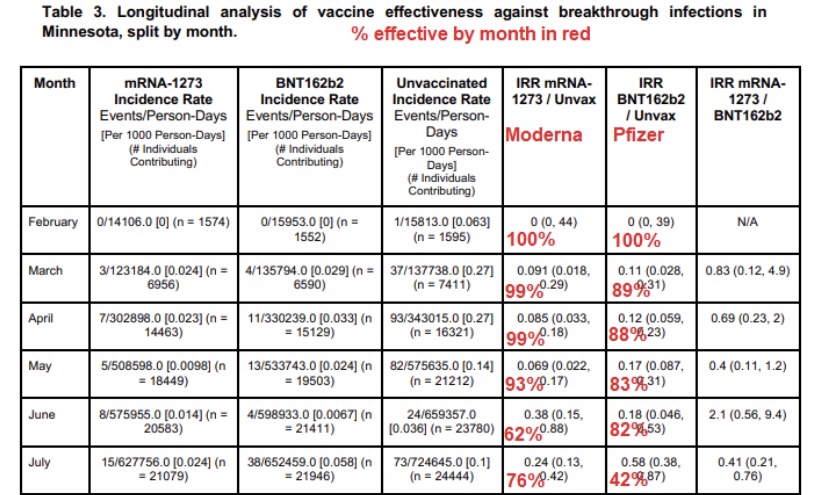
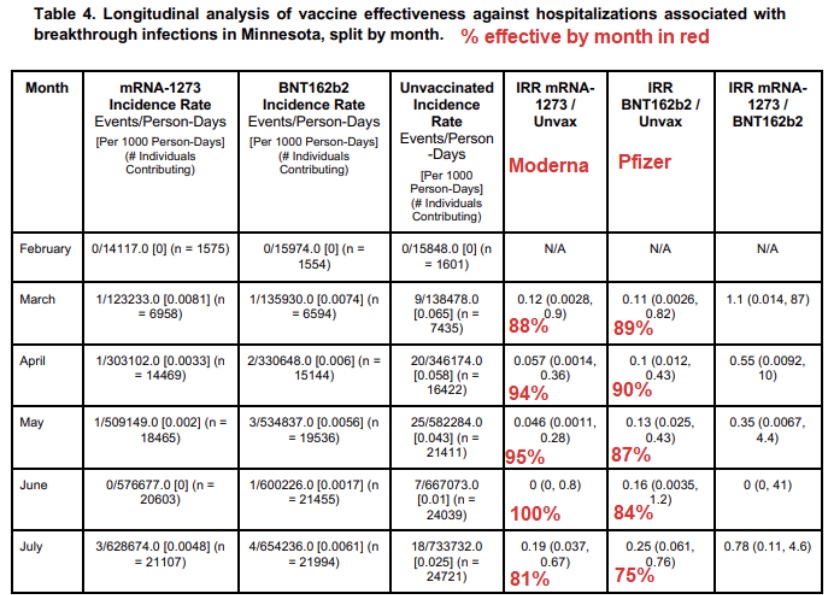
Here is a new Mayo Clinic study of so-called “breakthrough” cases in the vaccinated population in Minnesota. It essentially shows that the rate of case diagnosis among the vaccinated rose between February and July of this year (first table below, courtesy of Phil Kerpen). However, the vaccines appear only marginally less effective against hospitalization than in March (second table below).

The bulk of the vaccinated population in the U.S. received their jabs three to six months ago, and according to this report, evidence of antibodies remains strong after seven months. In addition, T-cell immunity may continue for years, as it does for those having acquired immunity from an earlier infection. 

Breakthroughs

It’s common to hear misleading reports of high numbers of “breakthrough” cases. Not only will these cases be less menacing, but the reports often exaggerate their prevalence by taking the numbers out of context. Relative to the size of the vaccinated population, breakthrough cases are about where we’d expect based on the original estimates of vaccine efficacy. This report on Massachusetts breakthrough hospitalizations and deaths confirms that the most vulnerable among the vaxed population are the same as those most vulnerable in the unvaxed population: elderly individuals with comorbidities. But even that subset is at lower risk post-vaccination. It just so happens that the elderly are more likely to have been vaccinated in the first place, which implies that the vaccinated should be over-represented in the case population.

Conclusion

The COVID-19 vaccines do what they are supposed to do: reduce the dangers associated with infection. The vaccines remain very effective in reducing the severity of infection. However, they cannot and were not engineered to prevent infection. They also pose risks, but individuals should be able to rationally assess the tradeoffs without coercion. Poor messaging from public health authorities and the crazy distortions promoted in some circles does nothing to promote public health. Furthermore, there is every reason to believe that the current case surge in Delta infections will be short-lived and have less deadly consequences than earlier variants.

Woke Activist Inroads In School Books & “Charities”

Tags

, , , , , , , , , , , , , , , , , , , , , ,

Not long ago I wrote about the “woke middlemen” who are corrupting our institutions, especially education. A few related and disturbing stories have come to my attention since then, upon which I’ll elaborate below.

Lefty School Books

One of these stories has to do with the most obvious of educational middlemen: book publishers. Some of them have joined forces with the #DisruptTexts movement among leftist teachers, helping it to gain headway. These teachers are eliminating great literature from the curriculum on the thin pretext that those books are “too white” or involve “white saviors”, like Atticus Finch of “To Kill a Mockingbird”. The publishers are only too happy to help, offering Zoom seminars on teaching “anti-bias literacy” for a fee and selling new texts for the classroom and guidebooks for teachers that promise to help them make the transition to a curriculum focusing on “advocacy”. That includes a fat dollop of “LGBTQIA” advocacy. One example:

“… replacing ‘The Great Gatsby’ with ‘Juliet Takes a Breath’–a book about a ‘queer Latinx woman’ interning under a feminist writer in Portland.”

Tony Kinnett, co-founder of The Chalkboard Review, is quoted extensively at the link above. He says:

Take all the racial stuff and set it aside. The Western canon is just objectively better literature. It is a higher form of language. It requires you to think. The plots aren’t spoon-fed to you. The moral of the story isn’t so black and white that it’s like watching a PBS after-school special. … In the #DisruptTexts movement, the big thing you’re going to see is ‘Culturally Relevant Pedagogy’, which is, at best, a pandering concept, and at worst, a horribly racist concept”

This is not confined to middle or high school. The idea is to inculcate “woke activism” from K-12 and beyond. To put it bluntly, the #DisruptTexts crowd promotes activist dumb-assery to our children to the exclusion of traditional lessons and the great writers of the past.

As Tom Knighton warns, the effort to get critical race theory (CRT) into schools is sometimes made with a cunning, as if designed to escape parents’ attention. It might be called by names other than CRT, but it is a danger to your child’s education and well being.

Not on Our Backs

Better news came in a recent article about a college that thumbed its nose at an accrediting association by simply eliminating a social work program, rather than complying with requirements that compromised the school’s values. Cairn University, a Christian school near Philadelphia, rejected the demands for accreditation by the Council on Social Work Education (CSWE). Accreditors like CSWE are middlemen organizations that sometimes attempt to leverage educational institutions as tools for advocacy. A statement from Cairn explained that the CSWE standards are objectionable because they embody:

… a set of critical theory and intersectionality assumptions and values inconsistent with our biblical view of humanity, human nature, and the world.”

In May, the CSWE claimed that Cairn’s president was exaggerating the changes in the Council’s requirements, and noted that it was aware of efforts in various states to limit education in “racism, diversity, and equity”. Apparently, Cairn’s response was SO WHAT? The new standards are what they are, as noted at the link above. Good for Cairn U!

Big Charity

Finally, I previously overlooked another obvious set of “woke middlemen”: the charitable establishment, which often serves to promote and fund leftist causes, including election activism. The article at the link, by Hayden Ludwig, focuses primarily on the Silicon Valley Community Foundation (SVCF), which he describes as a 501(c)(3) “pass-through” philanthropy. It is funded by still other donor-funded vehicles and supported by such Big Tech luminaries as Mark Zuckerberg and Jack Dorsey, among others. And to whom does SVCF “pass” these tax-privileged funds? According to Ludwig, some of the recipient organizations are local universities and arts organizations. However, billions of dollars have been awarded to the likes of the following left-wing nonprofits:

Voter Turnout

Political Dark Money

Other Leftist Political Grants

Ludwig rightly warns about the potential that large donors can alter election results by providing funds to activist organizations like these, quite apart from the pernicious leftist influence of their social media, news, or other business organizations:

Those are just the seven-figure grants from a single year, from a single organization. The left has dozens of mega-funders just like it, feeding hundreds of activist groups. Can the right boast the same? In my experience, the answer is a resounding ‘no.’ … Too few realize that the professional left in this country is the best-funded, most well-coordinated political machine in the world, thanks to its weaponization of America’s generous nonprofit sector.

These days, leftist mega-donors like George Soros and Tom Steyer are even helping to field “fake-Rs” in Republican primaries in districts that Dems could never win. Fortunately, they haven’t prevailed … yet!

Conclusion

The kinds of “woke middlemen” I’ve discussed here and previously are too easy to overlook, often flying “under the radar” of both libertarians and conservatives. Unfortunately, they are highly effective and extremely dangerous to the education of our children and the information available to potential voters. They are a threat to our election process, and ultimately to all of our political institutions, not to mention individual freedom. Our republic’s saving grace is that the people often recognize when elites are pushing bad ideas or trying to gaslight them. But ultimately, the fight to preserve election integrity, educational balance, free speech, and individual rights is likely to require greater firepower.

Notes From the Spousal Shotgun Seat

Tags

, , , , , , , , , , , , , , , , ,

I’m on a road trip with my spouse and it means some time for me in the passenger seat. That’s because we are such an enlightened, sharing couple. I have mostly resisted temptations to offer driving tips to my spouse, but it can be very challenging. This time, I decided to catalogue my spouse’s driving “issues” as a simple exercise in the interest of preserving my sanity.

Much of what you’ll see below takes the form of advice, only I cannot say much of it out loud without blowing our domestic tranquility to smithereens! Bad move on a long trip! So despite frustrations, the reticent approach is probably all for the good. After all, even troops of baboons are said to move at speeds less than ergonomically optimalin order to maintain social cohesion”. And it is just so in my marriage. Of course, this is about more than speed, but if I condense all of the issues into the single-most convenient dimension, it would come down to slower speeds. Like a long-striding baboon tolerating an angst similar to my own, I’m willing to sacrifice speed in order to keep the troop happy and together.

General Advice

Lest I be accused of favoring a certain recklessness, I’ll start by asserting that defensive driving does not mean you have to be timid. You’re not being hunted. Don’t constantly imagine a need for deference. Watch out for other vehicles, but take charge! Be deliberate. And fucking GO!

Ignore irrelevant information! If you’re trying to follow I-75, don’t freak every time you see signs for other roads or interstates, unless of course you’re trapped in an exit-only lane! You might not think this is a “thing” unless you’ve been on the road with a driver who’s unable to filter information!

Look Ahead

You wouldn’t walk down the sidewalk with your eyes fixed only on the area immediately before your feet. Don’t drive that way either! Plan and execute smooth transitions as circumstances and opportunities dictate. Look ahead!

My general mantra is, “The right lane is for losers!” Say it aloud! I actually managed to get a laugh out of my spouse with that line. Alright, when the right lane is empty, you should stay there, but…

Don’t get trapped in the right lane when you know traffic is entering the road just ahead of you.

Don’t get trapped in the right lane when you know it’s full of people planning to turn right, which is frequently the case!

Don’t get trapped in an exit-only lane! In general, if there’s a middle lane, you can improve your “optionality” by staying there.

If you’re changing to a middle lane, glance two lanes over before you move, not just one! This is exactly when drivers in different lanes don’t need a coincidence of wants. And don’t rely solely on your side mirrors.

Look Back

I can’t recount the number of times my spouse has been startled, dangerously, by drivers passing her at high speeds. “OhMyGOD!” This has happened to me too, and it can be quite dangerous. Try to glance in the rear view mirror on a regular basis to avoid nasty surprises like this, and don’t make sudden moves as other vehicles approach from behind unless you really want to confuse them!

Turns

Dual left turn lanes are especially tough for my spouse to negotiate. I think this stems from a failure to “look ahead”. Get a fix on the end point, and try to think of the whole turn… a sweeping curve. Do not search for each dashed line along the path. Just give cars turning alongside you a fair berth.

Right turns on red can be quick and painless. If, when you arrive at an intersection, the “oncoming” vehicles to your left are at a dead stop, then fucking GO! They will NOT suddenly leap across the intersection and smash into you. Of course, watch out for pedestrians near your corner!

And regarding right turns, if left-turning “blockers” are moving in the opposite direction, fucking GO!

You do not have to come to a near stop as you approach an empty roundabout! “Yield” matters only when there is someone to whom you might yield. So fucking GO!

When you have a dedicated or open lane to take after your turn, take it! Fucking GO!

Turn smoothly!! If you’re turning right, don’t get yourself out in the middle of the damn road before turning your wheels! I can’t tell you how many times I’ve had my heart in my throat over this issue.

If you want to change lanes on a busy road, use your damn turn signal to indicate your intention to other drivers!

Stop Lights

As you approach a red light, always choose the lane with the fewest cars. PLEASE!

Never brake as you approach a green light. Fucking GO!

In a long line of cars at a light, don’t stop car-lengths behind the one in front of you (making allowances when on a steep incline). You probably do want to make the next green light, as do all the poor saps behind you.

When the light turns green, if you can go, fucking GO!

Make judicious use of your horn! Don’t be afraid to give it a little tap to rouse the distracted shmuck in front of you when the light turns green.

Parking and “Unparking”

Don’t park like an idiot! Park in one space between the fucking lines!

If you have a choice, don’t ever park next to anyone parked like an idiot.

On a hot day, don’t drive past shaded parking places in favor of spots in the blazing sun!

Refine your spacial orientation. It’s amazing how many two-point turns are made into three-plus point turns by drivers lacking these bearings. Get a handle on the fucking dimensions of your vehicle!

Use your rear camera and figure out what the colored lines mean.

Passing

Don’t linger alongside large tractor trailers, or any other vehicle for that matter. Especially do not linger toward the rear of those vehicles! Fucking pass them. Shoot the gap! GO!

And never linger on anyone’s right rear side … they don’t call it a blind spot for nothing!

When you pass, don’t shake the steering wheel back and forth as if you must thread a jumping needle!

If you are forced to pass on the right, get it done! Fucking GO!

Do NOT attempt to pass on the right if there’s an even slower vehicle ahead of you! You’ll get fucking trapped!

Don’t be shaken by drivers who would very much like to get around you. Use your turn signal and get out of the way at your earliest convenience.

Silence Not Always Golden

I don’t always suffer in silence while my spouse is behind the wheel, but I try to choose my spots wisely. Not that it’s easy! I react when I perceive danger, but there are times I regret it. And to be fair, my spouse hasn’t had an accident or a traffic citation of any kind in quite some time. That’s a big plus! My own driving record has a few … ahem … blemishes, but mostly speeding tickets, and it’s been a while.

I also note that this has nothing to do with gender. I have a few pals who are awful drivers. The difference is I can get in their ear about it without getting hours of the silent treatment!

We are hitting the road for home in a few days, and I’ll do my best to keep my nose out of the spouse’s driving when I’m riding shotgun. Hey, she’s my babe!!

Banished Illusions: They Screwed the People and the Country

Tags

, , , , , , , , , , , , , , , , ,

There’s no shortage of nincompoops buying into the legitimacy of the Biden presidency and the bullshit narrative about “an insurrection” at the U.S. Capitol building on January 6th. I’m sure they’re quite content in their ignorance — they refuse to even consider the evidence available regarding the lack of ballot integrity in Arizona, Georgia, Pennsylvania, Texas, and elsewhere, and they continue to pretend the January 6th debacle was a real threat to our democracy, rather than a largely peaceful group of wide-eyed goofballs who were mostly waved through the barricades by the Capitol Police.

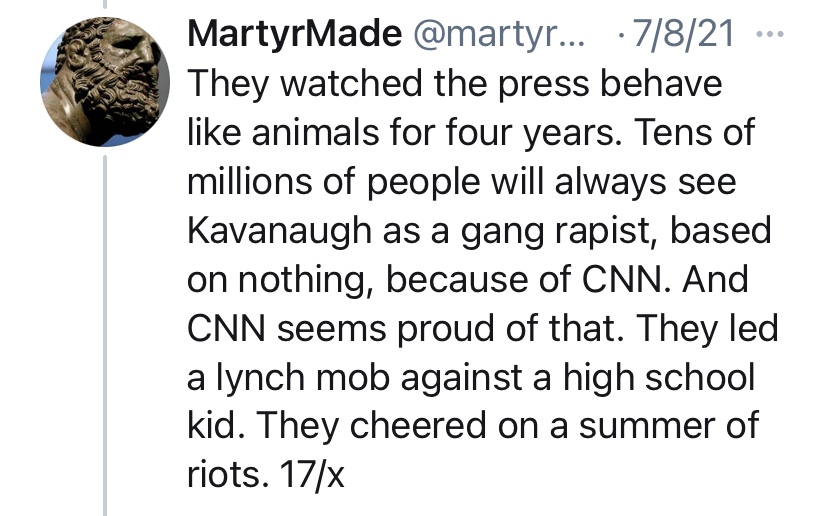
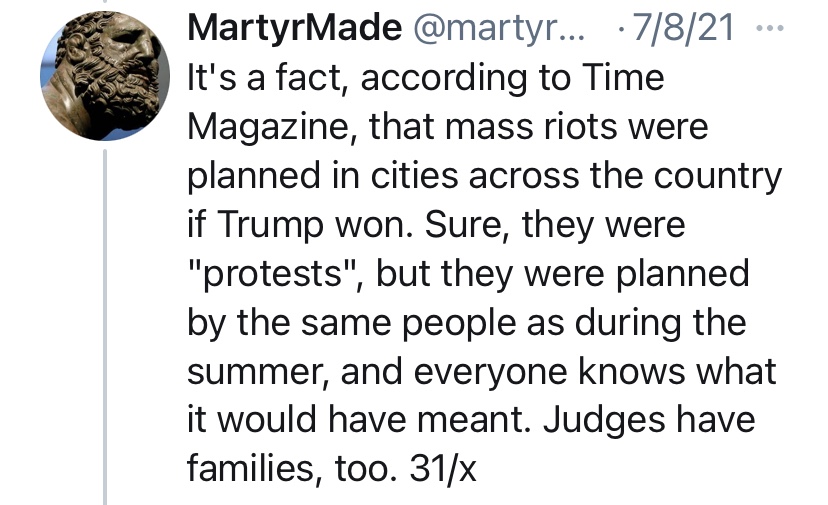
One of the best summaries I’ve read about the attitudes of those who feel disenfranchised by the 2020 election is this series of tweets by the of the MartyrMade podcast, Darryl Cooper. His tweets are also discussed here by Tyler O’Neil. It is Cooper’s “general theory” on the perspective of “Boomer tier” Trump supporters, as he calls them. Last year’s fraudulent election was only the culmination of events going back to the investigation of Donald Trump’s 2016 campaign. The whole thread is interesting, but you must get past a little “soft cover” at the start that might have been intended to distract the speech police at Twitter. I’ll try to summarize here:

  • The intelligence community spied on the Trump campaign in 2016, and that’s a major transgression! The DNC was involved too, actually paying for fabricated evidence. James Comey falsely denied any knowledge of that fact. John Brennan and Adam Schiff also lied shamelessly in this affair.
  • By the time Trump supporters realized all the noise was fake, they naively expected justice to be served. But no, and so their faith in certain institutions was shaken.
  • The gaslighting continued, and the whole thing consumed energy and had a chilling effect on participation in the Trump Administration. This was an active kind of subversion crossing “all institutional boundaries”.
  • The participation of the press was the poison icing on the cake. The press is now viewed by much of the country as a propaganda arm of “The Regime”.
  • Many aren’t sure whether the election was fixed, but if it was, they know they’d be lied to about it. 
  • Voting procedures in many jurisdictions were changed using COVID as a pretext. 
  • The press smoke-screened the Biden, Inc. scandals, including evidence of pay-for-play and incredibly lurid information on Hunter Biden’s laptop. Instead, the press played-up gossip about Trump. 
  • Trump people rightly felt betrayed by the very institutions they’ve always trusted, but they voted in record numbers, and we’re not convinced all were counted.
  • “But when the four critical swing states went dark at midnight, they knew.
  • Conspiracy theories abounded, but media and tech shut down discussion of real anomalies. Had the election gone Trump’s way, they would have cried foul! 
  • The courts were handcuffed by fear of political violence and retribution.

I agree with substantially all of Cooper’s thread. Our experience since Donald Trump became an active politician has been disillusioning in several respects: it has shown how flimsy our constitutional rights and our republic are when the wrong actors come to dominate certain institutions. It also shows how malleable are the “facts” that we are asked to accept by these actors. We are seemingly helpless to defend the rule of law, the Constitution, and social norms when an intransigent minority decides it can simply ignore them. This is how tyranny is borne.

Election integrity is not an outlandish objective. Neither is demanding fair treatment of diverse viewpoints from social media, Big Tech, and educational institutions. And neither is it outlandish to demand safe communities and adequate police protection; that our borders be enforced; that our public health officials speak honestly about risks; and that we should never, under any circumstances, be judged, punished, or rewarded based on the color of our skin. These are just a few of the things we must demand, and never take “no” for an answer.

Health Insurance Profits Are Not the Problem

Tags

, , , , , , , , , , , , ,

My dentist said, “Oh well, these days it’s really only about whether the insurance company makes a profit….” A giant appliance was in my mouth at the time, propping it open, so I couldn’t respond. But I made a mental note because it reminded me of the hypocrisy so common in how people regard the concept of profit. That’s especially true of the Left, and I happen to know that my dentist, whom I personally like very much, stands well to my left. 

Profit Is Income

It’s worth pointing out that profit is merely compensation. My dentist collects revenue, often paid to him by insurers. If he runs an efficient practice, then he earns an income after paying staff, office rent, various suppliers, and for equipment, including interest on any debt outstanding. You wouldn’t be wrong to call that profit, and he does pretty well for himself, but somehow he thinks it’s different.

My dentist probably feels locked into an adversarial position with my insurer, and of course he is in the short run. He says his price is $750; the insurer says, “Sorry Charlie, you get $250”. So as far as he’s concerned, it’s a zero-sum game. Not so in the long run, however. He needs to partner with insurers to get and keep patients, so the exchange is mutually beneficial. And while he might do some picking and choosing among insurers, he’s essentially a price taker. His “price” of $750 is something of a fiction, as he’s clearly willing to do the work for the insurer’s reimbursement. 

I think the key qualitative difference between my dentist’s income and that of any wage earner is that his income is always at risk. After all, profit is often regarded as a return to entrepreneurial risk-taking. As it happens, he’s taking a loss on my new crown because it cracked as soon as he put it in. Then, he had to start from scratch with new impressions, after painstakingly removing the cemented, cracked pieces with what felt like a tiny circular saw.

Middling Profitability

But what about those profit-hungry health insurers? In fact, they are not known for outrageously high profits, and their earnings are typically not valued as highly by the market as those of other industries, dollar for dollar. Competition helps restrain pricing and enhance performance, of course. And since the advent of Obamacare, profits have been subject to a loose “cap” (more on that below).

The profitability of health insurers improved in 2020, however, because so many tests and elective procedures were postponed or foregone due to the coronavirus pandemic. That also prompted the government to make more generous subsidies available to consumers to pay COBRA insurance premiums.

Profits Drive Efficiency

I’ll put aside concerns about the crony capitalism inherent in the health system-insurer-regulator nexus, at least for a moment. The profit motive is the fundamental driver of efficiency in the production of insurance contracts and pooling of risks, as well as efficient servicing and administration of those contracts. Absent the possibility of profit, these tasks would become mere bureaucratic functions with little regard for cost and resource allocation. Furthermore, managing risk requires a deep pool of capital to ensure the ability of the insurer to meet future claims. Reinvestment and growth of the enterprise also requires capital. That capital is always at risk and it is costly because its owners demand a return as fair compensation. 

Poor Alternatives

Eliminating profit from the insurance function implies that resources must be put at risk without compensation. That’s one of the reasons why non-profit insurers, over the years, have tended to be thinly capitalized and unstable, or limited in their offerings to “health maintenance” benefits, like primary or preventative care, as opposed to insuring against catastrophic events. Capital grants to non-profits (private or governmental) usually come with strings attached, which can severely limit the effectiveness of the capital for meeting existing or future needs of the operation. Growth requires reinvestment, so a profit margin must be earned in order to grow with internal funds. Where non-profits are concerned, you can call the “margin” whatever you want, but it is functionally equivalent to a profit margin. 

On the other hand, insurance provided by the public sector puts the taxpayer at risk, and the potential liability to taxpayer “capital” is never rewarded nor indemnified. But it is not free. Now, you might insist that we’d all benefit from government-sponsored health insurance because of the broader risk pool. The problem with that perspective is that it turns the pricing of risk into a political exercise. We’ve already seen the destructive effects of community rating. Younger, healthier, but budget-constrained individuals tend to opt out due to excessive premiums, leading to a systemic “death spiral” of the pool.

Administrative Costs

A puzzling contention is that private insurers drive up administrative costs, presumably when compared to a single-payer system. Obamacare regulations limit the so-called Medical Loss Ratio of a health plan. To simplify a bit, this requires rebates to customers if premiums exceed claims by a certain threshold, which varies across individual, small, and large group markets. This regulation obviously places a loose cap on profits. It is also arbitrary and probably has hampered competition in the individual market. And of course there have always been suspicions that the ratio can be “gamed”. 

Nevertheless, under a single-payer system, it would be shocking if economies of scale were sufficient to reduce administrative costs to levels below those incurred by private insurers (especially if we exclude profit!). After all, scale is seldom a prescription for government efficiency, and that’s largely due to the absence of a profit motive and any semblance of competition! What administrative savings might be achieved by a monopsony public payer are likely to derive mainly from “one-size-fits-all” decision-making and product design, with little heed to consumer preferences and choice.

I’ll Take the Profit-Maker’s Coverage

There is plenty to criticize about the health insurance industry. In important ways, it has already succeeded in shifting risks to taxpayers with the help of its policy-making cronies. The insurers are further protected by a flow of government premium subsidies to the individual market; and the largest insurers have benefitted from Obamacare regulations, which encourages increased market power by large hospital networks, which are happy to negotiate charges that benefit themselves and insurers. All else equal, however, I’d rather have a few choices from profit-making health insurers than a single, community-rated choice from the government. I’d rather see risk priced correctly, with direct subsidies made available to individuals in high-risk segments unable to afford their premiums. And I’d rather see less government involvement in health care delivery and insurance. We’d all be better off, including my dentist!

Renewable Power Gains, Costs, and Fantasies

Tags

, , , , , , , , , , , , , , , , , , , , , , ,

“Modern” renewable energy sources made large gains in providing for global energy consumption over the ten years from 2009-19, according to a recent report, but that “headline” is highly misleading. So is a separate report on the costs of solar and wind power, which claims those sources are now cheaper than any fossil fuel. The underlying facts will receive little critical examination by a hopelessly naive press, nor among analysts with more technical wherewithal. Of course, “green” activists will go on using misinformation like this to have their way with policy makers.

Extinguishing Dung Fires

The “Renewables Global Status Report” was published in mid-June by an organization called REN21: Renewables Now. Francis Menton has a good discussion of the report on his blog, The Manhattan Contrarian. The big finding is a large increase in the global use of “modern” renewable energy sources, from 8.7% of total consumption in 2009 to 11.2% in 2019. The “modern” qualifier is critical: it distinguishes renewables that made gains from those that might be considered antiquated, like dung chips, the burning of which is an energy staple in many underdeveloped parts of the world. In fact, the share of those “non-modern renewables” declined from 11.0% to 8.7%, almost fully accounting for the displacement caused by “modern renewables”. The share of fossil fuels was almost unchanged, down from 80.3% in 2009 to 80.2% in 2019. Whatever the benefits of wind, solar, and other modern green power sources, they did not make much headway in displacing reliable fossil fuel energy.

I certainly can’t argue that replacing dung power with wind, solar, or hydro is a bad thing (but there are more sophisticated ways of converting dung to energy than open flame). However, I contend that replacing open dung fires with fossil-fuel or nuclear capacity would be better than renewables from both a cost and an environmental perspective. Be that as it may, the adoption of “modern renewables” over the ten-year period was not at the expense of fossil fuels, as might be expected if the latter was at a cost disadvantage, and remember that renewables were already given an edge via intense government efforts to subsidize and even require the use of wind and solar power.

The near-term limits on our ability to substitute renewables for fossil fuels should be fairly obvious. For one thing, renewable power is intermittent, so it cannot be relied upon for baseload generation. The chart at the top of this post demonstrates this reality, though the chart is “optimistic” in the sense that planners have to consider worst-case intermittency, not merely average production by time-of-day. Reliable power sources must be maintained in order to prevent the kinds of disasters like we saw in Texas last winter when demand spiked and output from renewables plunged. This is an area of considerable denialism: a search on “intermittent renewables” gets you an unending list of rosy assessments of energy storage technologies, and very little realistic commentary on today’s needs for meeting base-load or weather-induced demands.

While renewables account for about 29% of global electricity generation, there is another limit on adoption: certain jobs just can’t be done with renewables short of major advances in battery technology. As Menton says:

Steel mills and tractor trailer trucks and airplanes powered by solar panels? Not happening. … I think these people really believe that if governments will just do the right thing and require airplanes to run on solar panels, then it will promptly happen.

Cost and Intermittency

Again, we’d expect to see more rapid conversion to renewable energy, at least in compatible applications, as the cost of renewables drops relative to fossil fuels. And major components of their costs have indeed dropped, so much so that the U.S. Energy Information Administration (EIA) now says they are cheaper than fossil fuels in terms of the “levelized cost” of new electric generating capacity. That’s the average cost per megawatt-hour produced over the life of a new installation. The EIA’s calculations are distorted on at least two counts, however, as Willis Eschenbach ably explains here.

The EIA’s cost figures reflect a “capacity factor” that adjusts the megawatts produced to presumed “real world” conditions. It’s more like a utilization adjustment made necessary by a variety of realities (intermittency as well as other technical imperfections) that cause output to run lower than the maximum under ideal conditions. Eschenbach reports that the factors applied by the EIA for solar and wind, at 30% and 41%, respectively, are overstated drastically, which reduces their cost estimates by overstating output. For solar, he cites a more realistic value of 14%, which would more than double the levelized cost of solar. For wind, he quotes a figure of 30%, which would increase the cost of wind power by more than a third. That puts the cost of those renewables well above that of a “combined-cycle gas” plant, which uses exhaust from gas turbines to generate additional power via steam.

The true costs of renewables are likely much higher than nuclear power as well, based on earlier comparisons of nuclear to combined-cycle gas. The EIA does not report a cost for nuclear power, however, because the report is for new capacity, and no additions of nuclear capacity are expected.

The Cost of Back-Up Capacity

Eschenbach notes a second major problem with the EIA cost comparisons. As discussed above, the intermittency of solar and wind power means that their deployment cannot provide for base loads. Other “dispatchable” power technologies, on which production can be ramped up or down at discretion, must be available to meet power needs when renewables are off-line, as is frequently the case. The more we attempt to rely on renewables, the more significant the intermittency problem becomes, as Germany, Texas, and California are discovering.

How to account for the extra cost of dispatchable power required to smooth production or meet peak demand? Renewables are simply incapable of doing so reliably, and back-up capacity ain’t free! Meeting demand at all times requires equivalent dispatchable capacity in the power mix. It requires not just dispatchable baseload capacity, but surge capacity! Meeting long-term growth in demand with renewables implies that new back-up capacity is required as well, and the levelized cost should reflect it. After all, those costs won’t be saved by virtue of adding renewable capacity, unless you plan on blackouts. Thus, the EIA’s levelized cost comparisons of wind, solar and fossil fuel electricity generation are completely phony.

Conclusion

Growth in wind and solar power increased their contribution to global energy needs to more than 11% in 2019, but their gains over the previous ten years came largely at the expense of more “primitive” renewable energy sources, not fossil fuels. And despite impressive declines in the installation costs of wind and solar power, and despite low variable costs, the economics of power generation still favors fossil fuels rather substantially. In popular discussions, this point is often obscured by the heavy subsidies granted to renewables. 

In truth, the “name-plate” capacities of wind and solar installations far exceed typical output, so installation costs are spread over less output than is widely believed. Furthermore, the intermittency of production from these renewable sources means that back-up capacity is still required, almost always from plants fired by fossil fuels. Properly considered, this represents a significant incremental cost of renewable power sources, but it is one that is routinely ignored by environmentalists and even in official reports. It’s also worth noting that “modern” renewables carry significant external costs to the environment both during the useful life of plant and at disposal (and see here). It’s tempting to say all these distortions and omissions are deliberate contributions to the propaganda in favor of government mandates for renewables.

The Left Always Hurts the Ones They “Love”

Tags

, , , , , , , , , , , , , , , , , ,

The policies foisted upon the country by the Left always hurt those constituencies they think they’ll help, and they backfire in very predictable ways. There are too many instances of that truism to recount, but just a couple of examples follow.

Economic Perils of Precaution

We can start with the interminable non-pharmaceutical interventions (NPIs) imposed in many states during the pandemic. These included shelter-at-home orders, limits on public gatherings, school closures, and the like. These lockdown measures were more severe in so-called blue states controlled by the Democrat Party. But NPIs were a policy failure and did little to stem the pandemic or excess deaths. Moreover, they resulted in the closure of many businesses and massive job losses. The economic burden fell especially hard on low wage earners, as the following chart shows:

For high earners (the red line), the employment decline at the start of the pandemic was small and relatively brief. Less fortunate were those earning under $27,000 annually (the blue line). They suffered a much larger initial decline in employment and had a continuing loss of almost 24% of jobs. While those who lost jobs ultimately received enhanced unemployment compensation and other benefits, the idleness and loss of work experience inflicted long-term damage to health, psyches, and future prospects. Thus, the party with pretensions of championing the cause of the downtrodden was pleased to intervene with policies that undercut the working poor.

But Some Precautions Are “Racist”

Another prominent case in which leftists have harmed those for whom they claim to advocate is the effort to “defund the police”. Low income and minority populations do not favor such a policy because they understand the value of protection against criminal elements who victimize their communities. The residents of these communities are most at risk from gangland violence and homicide. Furthermore, nearly all “victims” of police homicides are armed, and police homicides are closely associated with crime. And again, the sad fact is that crime is heavily concentrated in minority neighborhoods. The statistics do not support assertions of bias in policing. Obviously, these citizens have taken notice that the riots cheered on by the Left have been destructive to their communities.

Crime has spiked in Minneapolis and elsewhere since last summer, when George Floyd’s death sparked interest in the “defund the police” mantra promoted by the Left. And there followed a reduction in police budgets of about 5.2% in aggregate in the 50 largest cities in the country (though not all of these cities made cuts). Moreover, the effectiveness of policing has been undercut more broadly by the substantial legal risk now facing officers who earnestly attempt to enforce the law, as well as more restrictive use-of-force policies.

These changes are an unambiguous disaster for so many good people having the misfortune to live in high-crime areas. And the political disaster is starting to sink in among Democrats, who are already attempting to change the narrative (and see here). It’s pretty transparent that the “black lives matter” dialectic appeals to Democrats primarily as a selling point of convenience, and not so much when there’s actual blood in the streets.

Only the Obvious Matters

Destructive lockdowns and efforts to “defund the police” are just two examples of a perverse phenomenon. It’s well known to keen observers of the history of Marxism in action that it usually victimizes its presumed beneficiaries. That dynamic is at play under school discipline policies that seek to avoid “disparate impacts” on minority students, leaving other minority school children in disruptive learning environments; gun control initiatives making it difficult for minority residents and businesses to protect themselves; rent controls leading to a deteriorating stock of low-cost housing; wage floors causing low-skilled workers to lose hours, benefits, and jobs; energy policies with regressive impacts on household budgets; tax policies destroying incentives for job creation; and a welfare state creating disincentives to work and promoting family instability. This list goes on and on.

The difficulty leftists have in coming to grips with these unintended consequences is that they can’t see past first-order effects. Like spoiled children, they grasp only the ostensible benefits of their demands. And like bad parents, they behave as if to seek approval of the most spoiled among their presumed charges.