• About

Sacred Cow Chips

Sacred Cow Chips

Tag Archives: Bernie Sanders

The Progressive Underclass

09 Friday Sep 2016

Posted by Nuetzel in Poverty, Welfare State

≈ 2 Comments

Tags

Andrew Lundeen, Ban the Box, Bernie Sanders, Brian Doherty, CATO Institute, Climate Change Policy, Daniel Mitchell, Donald Trump, Earned Income Tax Credit, Kurt Williamsen, Land-Use Regulation, Leigh Franke, Protectionism, Redistribution, San Francisco, Scott Beyer, TANF, The Federalist Papers, The Tax Foundation, The Urban Institute, Vanessa Brown Colder, Watt's Up With That?

filling-out-forms

The underclass has not fared well under government policies enacted in explicit efforts to improve its members’ well being. If there is any one point on which I agree with Donald Trump, it is his recent assertion that “progressive” policies have been disastrous for minorities. Indeed, there is evidence that many public programs have been abject failures, even in terms of achieving basic goals. Some programs have managed to improve the immediate lot of the impoverished, but they have done so without freeing the beneficiaries of long-term dependency,  and perhaps have encouraged it. An underlying question is whether there is something endemic to these public initiatives that guarantees failure.

Arguments that public programs have such weaknesses are often based on the negative incentives they create, either for the intended beneficiaries (certain anti-poverty programs) or for employers who might otherwise work with them (absent minimum or “living” wages or regulatory obstacles). Then, of course, there are public services that are effectively monopolized (public schools) because they are “too important” to leave in the hands of private enterprise, with little recognition of the shoddy performance that is typical of institutions operating free of competitive pressure. And government action such as environmental policy often has a regressive impact, costing the poor a far greater share of income than the rich, and causing direct job losses in certain targeted industries.

A post from The Federalist Papers on “The Top 5 Ways Liberal Policies Hurt The Poor” is instructive. In addition to the welfare incentive trap, it highlights the failure of public schools to serve the educational needs of the poor, the minimum wage as a system of marginalization, urban gun control as a sacrifice of defenseless victims, and the extension of rights to illegal immigrants at the expense of U.S. citizens, especially low-skilled workers.

A fine essay by Kurt Williamsen entitled “Do Progressive Policies Hurt Black Americans?” focuses on three general areas of failure: public education, the workplace and welfare. He notes that certain educational innovations have met with success, yet are ridiculed by the progressive left because they promote competition.  He cites the dismal consequences for blacks of various labor and employment laws: “prevailing wage rates, the minimum wage, union bargaining power, occupational and business licensing laws, and affirmative action laws to comply with federal and state contracting requirements“. Even more astonishing is that the original motive for some of these policies, such as minimum wages and prevailing wage laws, was to keep unskilled blacks from competing with white union labor. They still work that way. Williamsen also discusses the fact that the welfare state has essentially left low-income blacks running in place, rather than lifting them out of dependency. Unfortunately, those programs have also inflicted large social costs, such as the disintegration of family in the black community:

“Welfare programs had an insidious effect on black culture — more so than white culture — because of the way they were designed. With dramatically more blacks than whites being in poverty and with less future prospects when the War on Poverty got started, young black women often had children out of wedlock, beginning a cycle of enduring poverty and welfare wherein they relied on welfare as a main source of income, as did their children. Welfare provided more money for young women with fatherless children, on average, than the same young women could have made if they were employed. If a woman became married, she would lose benefits, making it beneficial for her to either just hook up with men or cohabitate, rather than marry.“

Redistributionist policies have long been criticized for creating incentive problems among recipients of aid. Some of those problems have been corrected with the Earned Income Tax Credit, which operates as something of a negative income tax, and Temporary Assistance for Needy Families (TANF), which incorporates work requirements. However, as Vanessa Brown Colder at the CATO Institute points out, there is a need for further reforms to the many underperforming programs.

Like any large government program, redistribution also damages incentives for those who must pay the tab, generally those at higher income levels. High taxes ultimately discourage investment in capital and in new businesses that could improve the employment and income prospects of low-income segments. Here is Andrew Lundeen at The Tax Foundation:

“When fewer people are willing to invest, two things happen. First, the capital stock (i.e. the amount of computers, factories, equipment) shrinks over time, which makes workers less productive and decreases future wages.“

Redistributionists do their intended beneficiaries no favor by advocating for steeply progressive tax structures, which simply discourage investment in productive risk capital, impairing growth in labor income. This chart from Dan Mitchell shows a cross-country comparison of capital per worker and labor compensation. Not surprisingly, the relationship is quite strong. The lesson is that we should do everything we can to improve investment incentives. Punitive taxes on those who earn capital income is counterproductive.

Mitchell emphasizes a few other statist obstacles to empowering the disadvantaged here, including a brief discussion of how land-use regulations harm the poor. He quotes Leigh Franke of The Urban Institute:

“Restrictive land-use regulations, including zoning laws, are partially to blame for the stagnant growth… Land-use regulations may be intended to protect the environment or people’s health and safety, and even to enhance the supply of affordable housing, but in excess, they restrict housing supply, drive up home prices, and limit mobility. …More and more zoning restrictions meant less construction, fewer permits, and a restricted housing supply that drove up prices even further. …cities often have stringent zoning laws, a restricted housing supply, and high prices, making it nearly impossible for lower-income residents and newcomers, who would likely benefit most from the opportunities available, to find affordable housing.“

On the topics of local housing, labor laws, services, and regulatory burdens, Scott Beyer covers the maladies of that most progressive of cities, San Francisco. The city’s policies have helped create one of the nation’s most expensive housing markets  and have made the city’s distribution of income highly unequal. It is no coincidence that the politics of most of our declining cities are dominated by the progressive left.

Here is another fascinating example of negative unintended consequences arising from intervention on behalf of a disadvantaged group: so-called “Ban the Box” (BTB) initiatives. These laws prevent employers from inquiring about a job applicant’s  crime record, at least until late in the hiring process. Mitchell recently cited a study finding that BTB laws are associated with a reduction in employment opportunities for minorities. This disparate impact might be the result of more subtle screening by employers, demonstrating a reluctance to interview individuals belonging to groups with high crime rates. Apparently, employers are willing to give minorities a better chance when information on crime history is disclosed up-front.

Deleterious forms of intervention may vary from one disadvantaged group to another. For example, Native Americans have long been handicapped by federal control of their lands and their natural resources. Regulation of activity taking place on reservations is particularly burdensome, including a rule under which title to land must:

“… be passed in equal shares to multiple heirs. After several generations, these lands have become so fractionated that there are often hundreds of owners per parcel. Managing these fractionated lands is nearly impossible, and much of the land remains idle.“

Progressives often vouch for interventionism on the belief that thpse policies are ethically beyond question, such as climate change regulation. Of course, the science of whether anthropomorphic climate change is serious enough to warrant drastic and costly action is far from settled. The existence of high costs is deemed virtually irrelevant by proponents of activist environmental laws. Those costs fall heavily on the poor by raising the cost of energy-intensive necessities and by raising business costs, in turn diminishing employment opportunities. This is more pronounced from a global perspective than it is for the U.S., as emphasized in “Protect the poor – from climate change policies“, at the Watts Up With That? blog.

The world’s poor secure massive benefits from trade, but progressive policies often seek to inhibit trade based on misguided notions of “fairness” to workers in low-wage countries. And trade restrictions tend to benefit relatively high-wage workers by shielding them from competitive pressure. Brian Doherty in Reason talks about the nationalism of the Bernie Sanders brand, and how it undermines the poor. Donald Trump’s trade agenda has roughly the same implications. Protectionism should be rejected by the under-privileged, as it increases the prices they pay and ultimately reduces employment opportunities.

Certainly progressives always hope to assist the disadvantaged, but their policies have created a permanent dependent class. The simple lessons are these: working, producing and hiring must be rewarded at the margin, not penalized; interfering with wages and prices is counterproductive; all forms of regulation are costly; programs must be neutral in their impact on personal decisions; and property rights must be secure. Historically, economic freedom has lifted humanity from the grips of poverty. In virtually every instance, government micro-management has done the opposite. Unfortunately, it is difficult for progressives to overcome their reflexive tendency to “do something” about the poor by invoking the ever-klutzy power of the state.

Suspending the Economic Problem With Free Stuff

27 Saturday Aug 2016

Posted by Nuetzel in Central Planning, Socialism, Subsidies

≈ Leave a comment

Tags

Bernie Sanders, central planning, Confiscation, Contrived Scarcity, Don Boudreaux, Free Stuff, Hillary Clinton, incentives, Jeffrey Tucker, Nonprice Rationing, Overuse of Resources, Property Rights, Redistribution, Scarcity Deniers, Socialism

denial

When things are scarce, they can’t be free. That’s an iron law of economics. It’s true of everything we ever wish for and almost everything we take for granted. Things are naturally scarce, but when we are told that things can be free, it always comes from likes of whom Jeffrey Tucker calls “scarcity deniers”. Bernie Sanders and Hillary Clinton have told America that a college education should be free, and a large number of people take that seriously. They are scarcity deniers. On one level, the Sanders/Clinton claim is like any other promise that simply cannot be met at the stated cost — a rather garden-variety phenomenon among politicians. These promises are not harmless, as such initiatives usually involve budget overruns, compromised markets, underproduction and wasted resources.

The Sanders/Clinton claim, however, is a form of scarcity-denial that comes almost exclusively from the political left. That is really the point of Tucker’s article:

“This claim seems to confirm everything I’ve ever suspected about socialism. It’s rooted in a very simple error, one so fundamental that it denies a fundamental feature of the world. It denies the existence and the persistence of scarcity itself. That is to say, it denies that producing and allocating is even a problem. If you deny that, it’s hardly surprising that you have no regard for economics as a discipline of the social sciences.“

Our socialist friends (who otherwise claim to be defenders of science) contend that free things can be offered to a broad swath of the population with little consequence. The least cynical among them (perhaps including Sanders) believe that the costs can be shouldered by the wealthy and/or big corporations and banks. Others (including Clinton) know that the cost of “free things” must be met by higher taxes on a broader share of the population. Doesn’t that mean they recognize scarcity? Only superficially, because they fail to grasp the dynamics of resource allocation, the subtle forms in which costs are imposed, and the true magnitude of those costs.

If a thing is scarce, available supplies must be balanced against demand. The reward to suppliers at the margin must match the willingness of buyers to pay. That means there is no surplus and waste, nor any loss attendant to shortage and non-price rationing. The price creates an incentive for consumers to conserve and an incentive for producers to bring additional supplies to market when they are demanded.

A crucial prerequisite for this to work is the establishment of secure property rights. Then, absent coercion, one can’t overuse what isn’t theirs. One can’t simply take a thing from those who create it without a mutually agreeable payment. Creators cannot be forced to respond on demand without compensation. No one can be required to husband resources for others to simply take. No one can be asked to pay for a thing that will be commandeered by others. The establishment of property rights serves these purposes. Incentives become meaningful because they can be internalized by all actors — those consuming and those producing. And the incentives solve the problem of scarcity by balancing the availability of things with needs and desires, and balance them against all other competing uses of resources. Then, the market-clearing price of a thing reflects its degree of scarcity relative to other goods.

The socialist bluster holds that all this is nonsense. Would-be central planners propose that more of a thing be produced because they deem it to be of high value. Furthermore, it must be made available to buyers at a price the planners deem acceptable, or quite possibly for free to their intended constituency! Property rights are violated here in several ways: first, the owner/producer’s authority over their own resources is declared void; second, the owner has no incentive to care for their resources in a responsible and sustainable way; third, a confiscation of resources from others is required to pay at least some of the costs; fourth, the beneficiaries overuse and degrade the resource.

We know a scarce thing cannot be provided for free. Here are some consequences of trying:

  • Overuse of resources. When the buffet is free, the food disappears.
  • The “free thing” will be over-allocated to those who benefit and value it the least. (Example: the education of students for whom there are better alternatives.)
  • Supplies will evaporate unless producers are fully compensated. Otherwise, quality and quantity will deteriorate. This is a form of “contrived scarcity” (HT: Don Boudreaux).
  • If supplies dwindle, new forms of rationing will be necessary. This might involve time-consuming queues, arbitrary allocations, bribes, side payments and favoritism.
  • If suppliers are compensated, someone must pay. That means taxes, public borrowing or money printing.
  • Taxes weaken productive incentives and chase resources away. The consequent deterioration in productive capacity undermines the original goal of providing  something “for free” and inflicts costs on the outcomes of all other markets. This creates more contrived scarcity.
  • So-called progressive taxes tend to hit the most productive classes with the greatest negative force.
  • Government borrowing to fund “free stuff” today inflicts costs on future taxpayers. More fundamentally, it misallocates resources toward the present and away from the future.
  • Printing money to pay for a “free thing” might well cause a general rise in prices. This is a classic, hidden inflation tax, and it may involve the distortion of interest rates, leading to an inter-temporal misallocation of resources.

Scarcity denial is a carrot, but it inevitably becomes a stick. To voters, and to naive shoppers in the marketplace of ideas, the indignant assertion that things can and should be free is powerful rhetoric. Producers, too, might happily accept “free-stuff” policies if they expect to be fully compensated by the government, and they might be pleased to have the opportunity to serve more customers if they think they can do so profitably. However, serving all takers of “free stuff” will escalate costs and is likely to compromise quality. It is also likely to create unpleasant circumstances for customers, such as long waiting times and unfulfilled orders. The stick, on the other hand, will be brandished by the state, blaming and penalizing suppliers for their failure to meet expectations that were unrealistic from the start. The fault for contrived conditions of scarcity lies with the policy itself, not with producers, except to the extent that they allowed themselves to be duped by scarcity deniers. Tucker notes the following:

“Things can be allocated by arbitrary decision backed by force, or they can be allocated through agreement, trading, and gifting. The forceful way is what socialism has always become.“

Politicians and would-be planners with the arrogance to claim that naturally scarce things should be free are dangerous to your welfare. These scarcity deniers cannot provide for human needs more effectively than the free market, and ultimately their efforts will make you subservient and poor.

Trade Enragement Syndrome

31 Sunday Jul 2016

Posted by Nuetzel in Free Trade, Protectionism

≈ Leave a comment

Tags

Bernie Sanders, Capital Account Surplus, Don Boudreaux, Donald Trump, Free trade, Geocentrism, Heliocentrism, Import Competition, monopoly power, NAFTA, Protectionism, Trade Deficit, Trans-Pacific Partnership

tradebarriers

Trade makes us richer, not poorer. The anti-trade rhetoric spouted by neo-mercantilists like Donald Trump and Bernie Sanders is about as sensible as a boycott on goods produced in the next town, or for that matter, on anyone with whom one might otherwise choose to trade. Don Boudreaux perfectly captures my feelings about the rising trend of protectionist sentiment by comparing it to geocentrism:

“Lately I feel as I imagine an astronomer would today feel if, centuries after Copernicus and Galileo proved beyond a shadow of a doubt that the earth isn’t the center of the solar system, large numbers of people – including popular media pundits and politicians – began to insist that the sun and the planets and the stars do indeed all revolve around a stationary earth that is situated in the center of the universe.“

The very motivation for trade is to obtain something of value that one did not produce, to acquire that which one cannot easily acquire without trade, or to acquire it on more favorable terms than otherwise. It recognizes the reality that one’s productive efforts should be focused in an area that best suits their skills or natural talents. That’s better for the individual and better for society! Countries should produce what they are best at producing, which gives them a cost advantage in their areas of specialization. Trade allows individuals and nations to specialize in production but diversify in consumption, allowing them to enjoy access to the broadest possible range of goods and services produced worldwide.

The consummation of any trade heralds the attainment of mutual benefits to the parties: one produces and employs at a profit; the other consumes a thing of greater value than the price paid. The payments for foreign goods must come from either domestically-produced goods or from foreign investment in domestic real estate, buildings, factories or other real and financial assets. That is, if we purchase more goods from abroad than we export, then foreigners must either hold the dollars they receive or invest them in other ways. The latter represent trades in assets, and those trades, too, are mutually beneficial. The result is that U.S. investors gain and/or the economy benefits from new, productivity-enhancing plant and equipment, not terrible outcomes. Trade deficits are balanced by capital surpluses, and trade surpluses are balanced by capital deficits. Taken together, trade in goods and capital (assets) always balance and are mutually beneficial in every case, whether we run a trade deficit or a surplus.

That said, it’s worth emphasizing that so-called free trade agreements are something of a sham. Countries don’t trade. People do. Unfortunately, I have indulged the notion of national trade negotiation in the past, if only implicitly, by vouching for trade agreements like NAFTA and TPP as sort of second-best solutions to the horrid reality of trade restrictions promulgated by protectionist politicians. I reasoned that dismantling those barriers, one-country (or region) at-a-time was preferable to doing nothing. However, negotiations like these become mired in extraneous issues such as environmental policies, labor laws, immigration rules and other commercial policies. Nor do those negotiations always inhibit domestic subsidies to politically-favored activities. Indeed, they might actually encourage subsidies for value-eroding projects. Again, the entire process of trade negotiations is extraneous to the extent that trade takes place between individuals. Unfettered gains from trade require the absence of trade barriers. Dropping them unilaterally would benefit consumers, encourage efficiency by domestic producers, and provide a great example for other nations.

Opponents of trade, like Messrs. Trump and Sanders, lack a basic understanding of the reasons why individuals engage in cooperative exchange. Or at least they fail to acknowledge, for political reasons or sheer density, that what improves well-being at home is freedom to transact, across our borders as well as within our borders. To prevent this activity is to forcibly deny individual freedom. Boudreaux makes this point be asking trade opponents a series of questions, the first few of which are listed below:

“– Are you made richer if the supermarket … at which you once shopped hires armed goons to force you to start shopping there again?

– Do you believe that the owners and the employees of [that store] are so ethically entitled to your continuing patronage as a consumer that they are justified in employing armed goons to prevent you from shopping elsewhere?

– Do you believe that, now that [the store] has successfully forced you not to shop at competing supermarkets, that the owners and employees … will work as diligently and as creatively as possible to keep the prices they charge low and the quality of their service high?

– Do you believe that the higher profits and higher wages reaped by [the store’s] owners and workers as a result of their holding you hostage as a customer make you more prosperous?

– Do you believe that the higher profits and higher wages reaped by [the store’s] owners and workers as a result of their holding you hostage as a customer make your community more prosperous, even though [the store’s] higher profits and higher wages are necessarily funded by money that you and other … ‘customers’ are forced not to spend on other goods, services, or investment options?

– If you believe that [the store] has a right to force you not to shop for food at other supermarkets, do you believe also that [the store] has a right to force you not to grow more of your own food, or not to eat out more often at restaurants, or not to go on a diet?“

It is difficult to believe that educated people believe restrictions on the freedom of individuals to cooperate with others will improve their well being. Of course, those educated people are often politicians who stand to benefit from frightening voters, and who have no interest in reminding them that a flow of foreign goods broadens choices, reduces prices, and provides valuable discipline to domestic businesses. Without competitive discipline, we forgo important benefits and instead allow quality and price to come under the arrogant power of monopolists. There are, of course, many producers who are willing to provide meaningful support to politicians who will protect them from foreign competition. That’s not capitalism. Its cronyism!


Bernie, Breadlines and Bumpkins

05 Tuesday Apr 2016

Posted by Nuetzel in Capitalism, Socialism

≈ Leave a comment

Tags

Bernie Sanders, Breadlines, Chronic Shortages, First Amendment, Food Rationing, Free College Tuition, Free Markets, Gains From Trade, Living Wage, Matt Welch, Medicare, Press Crackdown, Reason.com, Sandanistas, Scandinavia, Totalitarian Regimes, Universal Pre-K

12923208_223278574701995_2096558007828525663_n

For sheer stupidity, you can’t top the remarks made in this video by Bernie Sanders, uttered as an adult, praising the fact that consumers in socialist countries must stand in line to receive food rations! Here is his distorted logic:

“It’s funny, sometimes American journalists talk about how bad a country is, that people are lining up for food. That is a good thing! In other countries people don’t line up for food: the rich get the food and the poor starve to death.“

I try to avoid derogation of individuals in favor of demonstrating the weakness of their words or ideas. I must admit that it’s hard to maintain both ends of that policy in Mr. Sanders’ case. He’s never availed himself of the well-known laws of economics that invalidate his primitive views. For example, he doesn’t grasp that the price system in a market economy provides incentives for conservation and for extra production when supplies are short. In Sanders’ mind, that mechanism is unacceptable because it means someone will profit. Of course, the cooperative nature of markets and voluntary exchange is lost on Sanders. Part of that cooperation is the willingness of buyers to reward able sellers, giving them the incentive to meet future demands. And they do!

Sanders doesn’t understand the universal tendency of government to waste resources. The state’s command over resources derives from coercive power, and it lacks the discipline and incentives for efficiency that are always present in markets. Sanders has not reflected on the shackles the regulatory state places on the productive, private sector. He imagines that government can be trusted because good-hearted people, like him, will always be in charge under a socialist state, and they will design the way forward. Yes, with the aid of their coercive power.

As for breadlines, Sanders has never assimilated the fact that the widespread, plentiful food supplies available in capitalist societies are unprecedented historically. Or that socialist systems have always been typified by chronic shortages of food and other consumer goods. Those are simply empirical facts, on one hand, but they are not accidents. Sanders hasn’t noticed these “details”, remaining immersed in a wild fantasy that prosperity is possible under socialism. Don’t point to Scandinavia as a counterargument, as Sanders supporters are wont to do. There, democratic socialism has wrongly been credited for prosperity that owes more to wealth created under capitalism, before those countries began to feed on themselves.

Bread lines are awful, but they aren’t the worst of it. Mr. Sanders has also praised certain tyrannical regimes, as well as the crackdown on the press under the communist Sandinista regime in Nicaragua. Here is a quote in Reason from Michael Moynihan, a former Reason editor who has uncovered a treasure trove of material on Sanders’ past pronouncements:

“When challenged on the Sandinistas’ incessant censorship, Sanders had a disturbing stock answer: Nicaragua was at war with counterrevolutionary forces, funded by the United States, and wartime occasionally necessitated undemocratic measures.“

Well, the First Amendment may be passe, and the revolution is at hand, eh?

Another Reason article by Matt Welch covers ten of “Bernie’s Bad Ideas“, most of which are grounded in an understanding of economics that can only be described as child-like: the “living” wage, free college tuition, universal pre-K education, opposition to international trade, and Medicare for all are just a few of Sanders’ nitwitted plans. I’ve written about many of these topics on Sacred Cow Chips in the past (a few of those posts are linked in the last sentence). Sanders’ supporters are seduced by the falsehood that government can reward the “deserving” justly for something, in some way, by some miracle, without destroying the incredible font of (under-appreciated) prosperity that is the market economy.

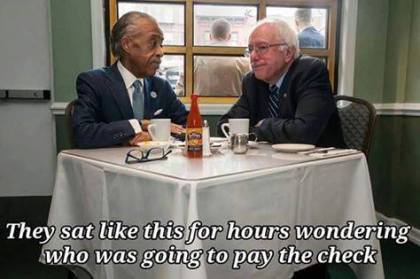
To end on a high note, as it were, here’s a fun Facebook page called “Bernie Sanders Bread Line” with some interesting takes on the lunatic ravings of the socialist candidate. All of those memes ring true, including the one at the top of this post.


Good Leaders Aren’t Trade Warriors

30 Wednesday Mar 2016

Posted by Nuetzel in Free Trade, Protectionism

≈ 1 Comment

Tags

Bernie Sanders, CATO Institute, Currency Manipulation, Daniel J. Ikenson, Direct Foreign Investment, Don Boudreaux, Donald Trump, Dumping, Federal Reserve, Free trade, Hillary Clinton, NAFTA, Open Trade, Paul Krugman, People's Bank of China, Predatory Pricing, Protectionism, Reserve Currency, Ted Cruz, TPP, Trade Deficit, Trade War, Unfair Competition

Protectionism

The protectionist foreign trade rhetoric issued by the major-party presidential candidates is intended to appeal to ignorant economic instincts. Donald Trump and Bernie Sanders come to mind most readily, but Ted Cruz and Hillary Clinton are jumping in with similar campaign positioning. The thrust of these populist, anti-trade appeals is that America is losing jobs to “unfair” foreign competition, an argument that distorts the very objective of trade: consumers take part in exchange in order to consume; they capture value from high quality, unique merchandise and competitive terms. Ultimately, producers engage in trade to gain the wherewithal to consume. Consumption is the real end-game.

It can be misleading to talk about “nations” engaging in trade with each other, despite the emphasis placed on trade agreements like NAFTA and TPP. In the first place, it is better to stress consumers and producers, rather than “nations”, because most foreign trade is private, cooperative activity, not national decision-making. But the candidates persist in characterizing trade as a “contest”. That misleading notion is what prompts governments to muck up the trade environment by imposing restrictions on the free flow of goods and services. Trade agreements have been heralded as great achievements, but they never approximate a regime of truly liberalized trade because the latter requires no formal agreement whatsoever, merely a hands-off approach by government. And trade agreements tend to entangle trade issues with other policy objectives, holding consumers hostage in the process.

We hear from opportunistic candidates that jobs are lost to trade with foreigners. But again, consumption, not “jobs” per se, is the real objective of economic activity. If domestic jobs are lost, it is generally because consumers judge the value produced inferior to what’s offered from abroad. American consumers should not be obliged to support inferior value, domestic market power unchecked by competition, monopoly prices and limited choices. Patriotic jingoism attempts to blind us from these economic imperatives.

The standard protectionist narrative is that foreign “nations” cheat on trade with the U.S. via currency manipulation, predatory pricing or “dumping”, “unfair” wages or other unfair labor practices. Do any of these objections to free trade hold water?

The “fairness” of foreign wages and labor practices is a matter of perspective. Wages cannot be considered unfair merely because they are low relative to U.S. wages. Wages paid to workers by foreign exporters tend to be consistent with the standard of living in those societies, and they are often some of the best income opportunities available there. This is economic dynamism that lifts masses from the grips of poverty. It’s absurd to caste it as “exploitation”.

Is it “unfair” to competitors in the U.S.? Not if they know how to compete and are allowed to do so. Unfortunately, government regulatory policies in the U.S. often present obstacles to the competitiveness of domestic producers. This is well-illustrated by Daniel J. Ikenson of The CATO Institute in “Crucifying Trade For The Sins Of Domestic Policy“. He emphasizes that trade promotes economic growth, but when it causes job losses for some workers, U.S. economic policies make it difficult for those workers to find new jobs.

“Incentivize businesses to hire people to train them in exchange for their commitment to work for the company for a period of time. Reform a corporate tax system that currently discourages repatriation of an estimated $2 trillion of profits parked in U.S. corporate coffers abroad, deterring domestic investment, which is needed for job creation. Curb excessive and superfluous regulations that raise the costs of establishing and operating businesses without any marginal improvements in social, safety, environmental, or health outcomes. Permanently eliminate imports duties on intermediate goods to reduce production costs and make U.S.-based businesses more globally competitive. Advocate the retirement of protectionist occupational licensing practices.“

So-called “dumping” by foreign producers, or selling below cost, is an unsustainable practice, by definition. Pricing below cost is difficult to prove, especially if local wages are low and raw inputs are plentiful. If dumping can be proven, retaliation might feel good but would punish American consumers. A foreign producer might be subsidized by its government as a matter of industrial policy and economic planning, an unhealthy policy to begin with, and possibly to facilitate a long-run market advantage in foreign trade. The U.S. itself is thick with subsidized industry, however, so arguing for retaliation on those grounds is more than a little hypocritical.

I rarely quote Paul Krugman, but when I do, it’s from work he’s done as an actual economist, not as an agenda-driven pundit. So we have the following Krugman quote courtesy of Don Boudreaux:

“I believe that if the rhetoric that portrays international trade as a struggle continues to dominate the discourse, then policy debate will in the end be dominated by men like [James] Goldsmith, who are willing to take that rhetoric to its logical conclusion. That is, trade will be treated as war, and the current system of relatively open world markets will disintegrate because nobody but a few professors believes in the ideology of free trade.

And that will be a shame, because for all their faults the professors are right. The conflict among nations that so many policy intellectuals imagines prevails is an illusion; but it is an illusion that can destroy the reality of mutual gains from trade.“

David Harsanyi asks how American consumers will like more restrictive trade policy when forced to pay more for smart phones, laptops, HDTVs, cars, food, and any number of other goods. The usual anti-trade narrative is that foreign producers have harmed the manufacturing sector disproportionately, but in another article, Ikenson lays bare the fallacy that U.S. manufacturing has been victimized by trade.

The consequences of trade restrictions are higher prices, reduced production and reduced consumption, an undesirable combination of outcomes. This means higher prices of imported goods as well as domestic goods, whose producers will face less competition by virtue of the trade barriers. With reduced availability of imported goods, economic theory predicts that domestic producers will not fully meet the frustrated demands. This is a classic response of producers with monopoly power: restraint of trade. The negative consequences are compounded when foreign governments impose retaliatory measures against the U.S., harming American exporters.

A further misgiving expressed by politicians regarding free trade is that America’s trade deficit implies greater indebtedness to the rest of the world. This argument has been made by a few leftist economists who misunderstand the nature of direct investment, and who tend to think erroneously of economic outcomes as zero-sum. It’s true that foreign producers who receive dollars in exchange for goods often invest those proceeds in U.S. assets. A fairly small share of that investment is in debt issued by U.S. governments and private companies. But a much larger share is invested in U.S. equities and real assets, which are not U.S. debts. As Don Boudreaux points out, the domestic sellers of those assets generally reinvest in other U.S. assets, so private U.S. ownership of global capital is not diminished by increased foreign investment in the U.S.

An interesting aspect of the trade debate is that the dollar’s role as a global reserve currency implies that the U.S. must run a chronic trade deficit. The rest of the world uses dollars to trade goods and assets, but to acquire dollars, foreigners must sell things to holders of dollars in the U.S. This keeps the foreign exchange value of the dollar elevated, which makes imports cheaper to Americans and U.S. exports more costly to foreigners. Those dollars are a form of U.S. debt, but it is debt for which we should feel flattered, as long as confidence in the dollar remains. A diminished role for the dollar in world trade would lead to a surplus of dollars, undermining its value and promoting inflation in the U.S. Let’s hope for a gradual transition to that world.

Finally, the presidential candidates allege that foreign currency manipulation is another reason for American job losses. One prominent example occurred last year when China allowed the renminbi to decline to more realistic levels on foreign exchange markets. Donald Trump called this an unfair trade tactic, but apparently the People’s Bank felt that it couldn’t support the renminbi without undermining economic growth. The earlier dollar peg also helped to keep Chinese inflation in check. Contrary to Trump’s assertions, if China stopped manipulating its currency altogether, the renminbi would go even lower!

Beyond the opportunistic political arguments, the point is that central banks (including the U.S. Federal Reserve) manage their currencies to achieve a variety of objectives, not merely to promote exports. That is not an endorsement of such policies. It is an objective fact. Anyone can argue that a foreign currency is “too low” if their objective is to demonize a country and it’s exports to the U.S., but the assertion may not be grounded in facts as markets assess them.

The arguments against open trade policies are generally specious, hypocritical or grounded in a mentality of victimhood. Vibrant producers who are free of government restrictions should welcome the expanded markets available to them abroad and should not seek redress against competition via government protection. Liberalized trade has engendered tremendous economic benefits over the years, while protectionist policies have only brought severe contractions. Let’s be free and trade freely!


Educational Free Fail

07 Monday Mar 2016

Posted by Nuetzel in Education, Subsidies

≈ 1 Comment

Tags

Accreditation Agencies, Ariel Deschapell, Bernie Sanders, College Admission Standards, Community Colleges, Diversity Goals, Dropout Rates, Federal Accreditation, Federal Reserve Bank of New York, Free Tuition, Graduation Rates, National Bureau of Economic Research, NBER, Socialized Costs, Student Debt, Subsidized Loans, Tuition Bubble

image

Free college tuition would undermine the quality of higher education and increase its real cost to society. In fact, it may well cost many subsidized students more than its worth in lost work experience, wages and self-esteem. Those foregone opportunities are very real costs despite their consignment as “unseen” counterfactuals. They are mostly incremental to costs that are more obvious to the minds of statists promoting free post-secondary education.

Basic supply and demand analysis is the only requirement for understanding the tuition bubble in U.S. higher education, and the absurdity of heavy subsidies as a solution. Ariel Deschapell calls subsidies “worse than nothing“, comparing the approach to “throwing gasoline on a fire“. He’s quite right.

There is no question that increased subsidies lead to higher tuition and ultimately greater student debt. A recent paper published by the National Bureau of Economic Research (NBER) found that loan subsidies “fully account” for the increase in college tuition costs from 1987 – 2010. Another 2015 study published by the Federal Reserve Bank of New York reached broadly similar conclusions:

“We find that institutions more exposed to changes in the subsidized federal loan program increased their tuition disproportionately around these policy changes, with a sizable pass-through effect on tuition of about 65 percent. We also find that Pell Grant aid and the unsubsidized federal loan program have pass-through effects on tuition, although these are economically and statistically not as strong. The subsidized loan effect on tuition is most pronounced for expensive, private institutions that are somewhat, but not among the most, selective.“

As Deschapell points out, most schools turn away a significant share of their applicants. How can that sort of demand exist, given the sky-high tuition charged by many colleges and universities? Subsidies. Subsidized tuition. Subsidized loans. When the cost to the end user of educational services is reduced at a given price, demand for those services increases. The papers linked above demonstrate the strength of the response.

Unfortunately, the supply of higher education is subject to relatively hard limits. Traditionally, the supply of educators, facilities and other learning resources has not been especially elastic. Technology has arguably made education more scalable, but only in terms of enrollment, and not at a zero incremental cost. Outcomes are more dependent than ever on a student’s intelligence, preparation and ability to remain engaged.

The supply of education is limited by still other factors. The long-term impact of inflation on costs is often more severe for service industries such as education, as they generally do not share in the productivity growth enjoyed by goods-producing sectors. Moreover, the increasing complexity of administrative functions, including education finance and regulatory compliance in an astonishing number of areas such as health, environmental and diversity goals (and certainly some self-inflicted administrative bloat), imposes cost escalation at many schools. Worst of all, the supply of education and acceptance of federally-subsidized student loans by certain institutions is restricted by federally-appointed accreditation agencies. This puts a lid on competitive pressures in higher education and inflates costs.

Higher demand and limited supply mean that some form of rationing is necessary. What mechanisms for rationing educational opportunities are available? Higher admission standards are sometimes a possibility, but public institutions may have little flexibility to raise standards, especially for resident students. Interestingly, diversity goals can lead to a de facto tightening of admission standards for some applicants even as standards for others are overridden or compromised. Declining quality of education is a “relief valve” to be avoided, but it is a very real possibility.

Higher tuition to the payer is an almost unavoidable consequence. That is why Deschapell likens free, givernment-paid tuition to an accelerant. Supporters of free tuition fail to recognize this relatively simple, causal chain.

When student debt is subsidized, it tends to mount faster than educational achievement and job prospects allow, leading to high rates of default. It also distorts the choices of would-be individual payers by inflating tuition costs. Passing the cost of education along to taxpayers, or “socializing the cost” as Deschapell says, completely severs the responsibility for marginal costs from the marginal benefit of education, an obvious prescription for a misallocation of resources. The decision to pursue more education, and the responsibility, should be in the hands of the same individuals: those in the best position to know whether it is viable: prospective students and their families. They know better than anyone the real opportunities foregone in terms of lost wages and the skills and experience that can be gained by staying out of school. Eliminating tuition from the decision would divert many more individuals into pursuits for which they are ill-suited.

College graduation or completion rates are disappointingly low, and correspondingly, dropout rates are very high, especially at community colleges. Moreover, profiles of the dropout population show that colleges have no business admitting a significant share of those individuals. This is damning evidence that we are already over-allocating resources to this activity. Additional subsidies won’t fix the problem.

There is no doubt that cross-sectionally, advanced education is associated with better employment prospects and higher incomes. And higher education can provide “social benefits” in excess of its direct value to students. Those facts do not imply, however, that generous inducements to questionable prospects will create positive outcomes. Quite the contrary. And in fact, the quality of education is vulnerable to dilution with increases in the number of poorly-qualified students.

A better way to improve the lifetime prospects of more people is to encourage production and employment opportunities with flexible wage policies, light taxes and less intrusive regulation. Competition at all levels of education should also be promoted; those steps would do more to improve outcomes than subsidies ever can. Throwing public money at education is generally unproductive, inflates tuition and drains the productive sector of resources. After all, the strength of that very sector must be relied upon to keep public education afloat. Individuals cannot be absolved of facing the real trade-offs inherent in their choices. Ultimately, by distorting decisions, free tuition cannot truly empower individuals and improve well being.


Pawning Growth For Redistribution

15 Monday Feb 2016

Posted by Nuetzel in Equality, Redistribution

≈ Leave a comment

Tags

Alan D. Viard, American Enterprise Institute, Angela Ranchidi, Bernie Sanders, Chelsea German, Dan Mitchell, Double Taxation, Economic Mobility, Fallacy of Redistribution, First Theorem of Government, Gallup, Household structure, Income Growth, John Cochrane, Minimum Wage, Poverty, Progressive Taxes, Redistribution, Third Way, Thomas Sowell, Welfare State

govt here to help

The following is no mystery: if you want prosperity, steer clear of policies that inhibit production and physical investment. This too: if you want to lift people out of poverty and dependency, don’t promote policies that discourage hiring and work incentives. Yet those are exactly the implications of policies repeatedly advocated by so-called redistributionists. The ignorance flows, in large part, from a distraction, a mere byproduct of economic life that has no direct relation to economic welfare, but upon which followers of Bernie Sanders are absolutely transfixed: income and wealth inequality. Attempts to manipulate the degree of inequality via steeply progressive taxes, transfers and market intervention is a suckers game of short-termism. It ultimately reduces the value of the economy’s capital stock, chases away productive activity, destroys jobs, and leaves us all poorer.

Absolute income growth is a better goal, and encouraging production is the best way to raise incomes in the long-run. Unless envy is your thing, income inequality is largely irrelevant as a policy goal. In “Why and How We Care About Inequality“, John Cochrane emphasizes that inequality may be a symptom of other problems, or perhaps no problem at all. His point is that treating a symptom won’t fix the underlying problem:

“A segment of America is stuck in widespread single motherhood … terrible early-child experiences, awful education, substance abuse, and criminality. 70% of male black high school dropouts will end up in prison, hence essentially unemployable and poor marriage prospects. Less than half are even looking for legal work.

This is a social and economic disaster. And it has nothing to do with whether hedge fund managers fly private or commercial. It is immune to floods of Government cash, and, as Casey Mulligan reminded us, Government programs are arguably as much of the problem as the solution. So are drug laws….“

The writers of the center-left Third Way blog give some details on income growth that might disappoint some progressives. They agree that the emphasis on redistribution is misplaced. Solving economic problems requires a different approach:

“From 1980 to 2010, income gains (after taxes and government transfers are included) favored the wealthy but were still spread across all income brackets: a 53% increase for the bottom quintile; a 41% increase for the next two; a 49% increase for the 4th; and a 90% increase for the richest fifth. Thus, while income inequality may offend our sense of justice, its actual impact on the middle class may be small.

With a singular focus on income inequality, the left’s main solutions are greater re-distribution and a re-writing of the rules to ‘un-rig’ the system. But, however well motivated, some of the biggest ideas into which they are directing their energy do not remotely address the underlying ‘Kodak’ conundrum—how do Americans find their place in a rapidly changing world? In fact, some would actually make the task of increasing shared prosperity significantly harder.“

The hubbub over inequality and redistribution is fueled by misconceptions. One is that the rich face low tax burdens, often lower than the middle class, a mistaken notion that Alan D. Viard debunks using 2013 data from a report from the Congressional Budget Office. The CBO report accounts for double taxation of dividends and capital gains at the corporate level and at the personal level (though capital gains are taxed to individuals now, while the anticipated corporate income is taxed later). The CBO study also accounts for employers’ share of payroll taxes (because it reduces labor income) so as to avoid exaggerating the tax system’s progressivity. Before accounting for federal benefits, which offset the tax burden, the middle 20% of income earners paid an average tax rate of less than 15%, while “the 1%” paid more than 29%. However, after correcting for federal benefits, the middle quintile paid a negative average tax rate, while the top 1% still paid almost 29%. That is a steeply graduated impact.

Rising income inequality in the U.S. is more a matter of changes in household structure than in the distribution of rewards. This conclusion is based on the fact that income inequality has risen steadily over the past 50 years for households, but there has been no change in inequality across individuals. An increasing number of single-person households, primarily women over the age of 65, accounts for rising inequality at the household level. The greedy corporate CEOs of the “occupier” imagination are really not to blame for this trend, though I won’t defend corporate rent-seeking activities intended to insulate themselves from competition.

Measures of income inequality hide another important fact: one’s position in the income distribution is not static. Chelsea German notes that Americans have a high degree of economic mobility. According to a Cornell study, only 6% of individuals in the top 1% in a given year remain there in the following year. German adds that over half of income earners in the U.S. find themselves in the top 10% for at least one year of their working lives.

There are several reasons why redistributionist policies fail to meet objectives and instead reduce opportunities for the presumed beneficiaries to prosper. Dan Mitchell covers several of these issues, citing work on: the rational response of upper-income taxpayers to  punitive taxes; the insufficiency of funding an expanded welfare state by merely taxing “the rich”; the diversion of most anti-poverty funds to service providers (rather than directly to the poor); the meager valuation of benefits from recipients of Medicaid, and the fact that the program lacks any favorable impact on mortality and health measures. Mitchell features the “First Theorem of Government” in a sidebar:

“Above all else, the public sector is a racket for the enrichment of insiders, cronies, bureaucrats and interest groups.“

A few years back, the great Thomas Sowell explained “The Fallacy of Redistribution” thusly:

“You can only confiscate the wealth that exists at a given moment. You cannot confiscate future wealth — and that future wealth is less likely to be produced when people see that it is going to be confiscated.“

That future wealth can and should be enjoyed across the income spectrum, but punitive taxes destroy productive capital and jobs.

A great truth about poverty comes from Angela Ranchidi of the American Enterprise Institute: low wages are not at the root of poverty; it’s a lack of jobs. She quotes a Gallup report on this point, relative to the working-age poor in 2014:

“Census data show that, 61.7% did not work at all and another 26.6% worked less than full-time for the entire year. Only 11.7% of poor working-age adults worked full-time for the entire year in 2014. Low wages are not the primary cause of poverty; low work rates are. And if Gallup is correct, the full-time work rate may already be peaking.“

More than 88.3% of the working-age poor were either unemployed or underemployed! And here’s the kicker: redistributionists clamor for policies that would place an even higher floor on wage rates, yet the floor already in place has succeeded in compromising the ability of low-skilled workers to find full-time work.

Cochrane sums up the inequality debate by noting the obvious political motives of progressive redistributionists:

“Finally, why is “inequality” so strongly on the political agenda right now? Here I am not referring to academics. … All of economics has been studying various poverty traps for a generation…. 

[The] answer seems pretty clear. Because [the politicians and pundits] don’t want to talk about Obamacare, Dodd-Frank, bailouts, debt, the stimulus, the rotten cronyism of energy policy, denial of education to poor and minorities, the abject failure of their policies to help poor and middle class people, and especially sclerotic growth. Restarting a centuries-old fight about “inequality” and “tax the rich,” class envy resurrected from a Huey Long speech in the 1930s, is like throwing a puppy into a third grade math class that isn’t going well. You know you will make it to the bell.

That observation, together with the obvious incoherence of ideas the political inequality writers bring us leads me to a happy thought that this too will pass, and once a new set of talking points emerges we can go on to something else.“

Gagging On Campaign Finance Reform

10 Wednesday Feb 2016

Posted by Nuetzel in Big Government, Campaign Finance

≈ Leave a comment

Tags

Bernie Sanders, Bipartisan Campaign Reform Act, Buckley v. Valeo, Bundler Disclosure, Campaign Contributions, Campaign Finance, Citizens United, Eigene Volokh, Elena Kagan, Federal Election Commission, First Amendment Protections, Hillary Clinton, Ilya Shapiro, Influence Spending, Jacob Sullum, Jeb Bush, Jeffrey Milyo, Jonathan Adler, Legislative Dysfunction, McCain-Feingold, McCutcheon v. FEC, Michael McConnell, Press Clause, rent-seeking behavior, Speechnow.org v. FEC, Spending Limits

campaign-finance-reform

Campaign finance is an area of internal conflict for some libertarians. On one hand, they do not believe in restrictions of any kind on freedom of expression. That implies no limits on what an individual can spend in support of a political cause, by themselves or in association with others, and whether it merely promotes a point of view or supports a political candidate. At the same time, libertarians are strongly opposed to rent-seeking activity, or efforts to use government power to promote private interests. Political spending is seen by many as an avenue for rent seeking, which suggests to them a need for limits on campaign contributions.

In fact, full-throated support of free speech and opposition to campaign limits do not stand in conflict. The reasons are: 1) such limits are an assault on free speech; 2) campaign contributions represent “small change” in the larger scheme of rent-seeking pursuits; 3) contributions seldom represent direct efforts to influence policy; and 4) imposed limits have a detrimental effect on the ability of elected officials to do their jobs.

Speech

Free speech, long interpreted by the courts more broadly as free expression, is protected by the First Amendment to the U.S. Constitution. This includes political expression, but traditionally it included campaign contributions as well, the latter being an obvious mechanism by which one can express views. However, the Supreme Court has upheld statutory limits on individual contributions to specific campaigns, as well as disclosure rules, on the grounds that they prevent corruption (Buckley v. Valeo and more recently McCutcheon v. Federal Election Commission(FEC)). I view the contribution limits as a contravention of the First Amendment, denying an enumerated right on the grounds that it “might” lead to corruption. If preventing corruption is the sole rationale for these limits, then government itself should be sharply limited, as it most certainly leads to graft and corruption at the expense of relatively powerless taxpayers.

Citizens United

A well-known Supreme Court case decided in 2010 involved independent political speech, as opposed to expression of political preference revealed by campaign spending. This was Citizens United v FEC, in which the Court ruled that political speech cannot be restricted on any basis other than corruption. As described by Ilya Shapiro, the case is widely misunderstood. One point of interest here is that the case related to speech by an organization rather than an individual. The Court ruled that a corporation (a nonprofit in the case) could not be prevented from airing a film critical of Hillary Clinton, striking down provisions of the Bipartisan Campaign Reform Act of 1990 (McCain-Feingold) under the First Amendment.

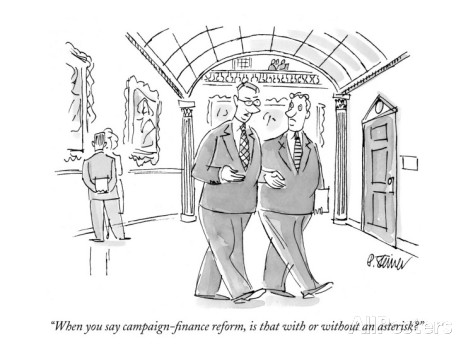
The Citizens United decision was NOT about campaign contributions. As an interesting aside, in a search of cartoons related to campaign finance, a great many imply that the Supreme Court abolished such limits in Citizens United. It did not. Even given some level of disaffection, it is hard to account for the near-complete lack of understanding about the case.

More informed critics of the decision bemoan that fact that it allows speech by corporations (and unions and other associations) to go unlimited, though they don’t seem to mind the absence of limits on political speech by media corporations. (See Eugene Volokh’s view in the Brown Daily Herald and Michael McConnell’s reinterpretation of Citizen’s United as a Press Clause case in the Yale Law Journal.) The critics also fail to recognize that corporations are associations of individuals, who are otherwise subject to no restrictions on independent speech or on what they can spend to speak independent of any political candidate (as established in Speechnow.org v. FEC in 2010). The technical treatment of a corporation as a “person”, which many find objectionable, is beside the point. Only by distorting the meaning of the First Amendment can any limitation be placed on the freedom of individuals to speak in association with others.

Jacob Sullum covers the confused legal thinking of leading Democrats Hillary Clinton and Bernie Sanders on campaign finance reform, and on Citizens United in particular. Jeb Bush is no better. Most of the opposition to the decision centers around the notion of “balancing” speech, but Sullum offers a piece of wisdom from a 1996 quote of future Supreme Court Justice Elena Kagan: “the government may not restrict the speech of some to enhance the speech of others.”

Corporate Campaign Spending

Another point raised by Ilya Shapiro is that corporate spending growth has neither accelerated nor decelerated in the wake of Citizens United. Moreover, restrictions on direct campaign contributions are still in place. However, campaign contributions are a relatively small percentage of corporate “influence spending”, averaging roughly 10% of the total between 2007 and 2012 for 200 large “politically active” corporations. Thus, direct campaign contributions are unlikely to be the primary avenue for rent-seeking activity. They might help buy “access” to politicians, but they may not be especially effective in influencing policy. These points are supported by University of Missouri economist Jeffrey Milyo in “Politics Ain’t Broke, So Reforms Won’t Fix It“. Milyo marshals empirical evidence that should make us skeptical of campaign finance reform efforts.

Incapacitated Legislators

Jonathan Adler of Case Western emphasizes the legislative dysfunction created by campaign finance reforms. McCain-Feingold places limits on funds candidates can receive from their political parties and other sources, forcing them to spend a large proportion of their time on fundraising (and placing incumbents at a distinct advantage). If there is a shred of sincerity in the populist insistence that members of Congress be subject to tighter term limits, or that Congress is woefully unproductive, then full repeal of these limitations should be a priority.

Visibility Versus Effectiveness

The chief advantage of combatting corruption through regulating campaign finance is that it is a visible target. However, it is a target too rich with free speech implications. Disclosure requirements are one thing (through arguments can be made against infringements on the privacy of contributors as well). Limiting forms of expression outright is draconian, and reformers are unlikely to be satisfied until campaigns are funded entirely by taxpayers. Attacking “corruption” via limits on campaign contributions presumes a need to protect both contributor and recipient from their own guilt. Even if contributions help gain better access to an elected representative, it does not imply that the representative will act on motives counter to the perceived public merits of an issue. Moreover, the argument that limits on direct contributions to candidates “keep money out of politics” is flawed. Limits simply change the distribution of political spending, increasing the reliance on bundlers and organizations like Super PACs, and shifting the tables in favor of incumbents.

There are far better ways to combat corruption among legislators and others in government, some with more severe drawbacks than others. Term limits are one possibility, but would deny voters of legitimate choices. Another option is to allow candidates to have unrestricted access to campaign funds through central organizations, rather than forcing them to rely on independent Super PACs, which cannot always be relied upon to craft a candidate’s preferred messages. Immediate disclosure of contributors and amounts would help to bring more transparency to the campaign finance process. Stiffer disclosure requirements for “bundlers” would also help. Perhaps elected executives could be prohibited from appointing bundlers to positions of authority, though a precise definition of “bundler” might become contentious. There are other reform possibilities related to limiting permissible lobbying activity.

The libertarian’s dilemma with respect to campaign finance is easily resolved once the focus is placed squarely on protecting individual rights. In the end, the best defense of individual rights and against corruption in government is to limit government. It’s wise to place strong reigns on an institution that operates by virtue of coercive authority. The danger was well-acknowledged by the limits on government power enshrined in the Constitution.

Authoritarian Designs

31 Sunday Jan 2016

Posted by Nuetzel in Progressivism, racism, Uncategorized

≈ Leave a comment

Tags

Bernie Sanders, Child Quotas, CRISPR, Davis Bacon Act, Eugenics, Friedrich Hayek, John Stewart Mill, Jonah Goldberg, Kevin Drum, Minimum Wage, Mother Jones, Obamacare Effectiveness Research, Progressivism, racism, Scientism, Sterilization, Tyler Cowen

eugenics certificate

Why condemn today’s progressives for their movement’s early endorsement of eugenics? Kevin Drum at Mother Jones thinks this old association is now irrelevant. He furthermore believes that eugenics is not an important issue in the modern world. Drum’s remarks were prompted by Jonah Goldberg’s review of Illiberal Reformers, a book by Thomas Leonard on racism and eugenicism in the American economics profession in the late 19th century. Tyler Cowen begs to differ with Drum on both counts, but for reasons that might not have been obvious to Drum. Eugenics is not a bygone, and its association with progressivism is a reflection of the movement’s broader philosophy of individual subservience to the state and, I might add, the scientism that continues to run rampant among progressives.

Cowen cites John Stewart Mill, one of the great social thinkers of the 19th century, who was an advocate for individual liberty and a harsh critic of eugenics. Here is a great paragraph from Cowen:

“The claim is not that current Progressives are evil or racist, but rather they still don’t have nearly enough Mill in their thought, and not nearly enough emphasis on individual liberty. Their continuing choice of label seems to indicate they are not much bothered by that, or maybe not even fully aware of that. They probably admire Mill’s more practical reform progressivism quite strongly, or would if they gave it more thought, but they don’t seem to relate to the broader philosophy of individual liberty as it surfaced in the philosophy of Mill and others. That’s a big, big drawback and the longer history of Progressivism and eugenics is perhaps the simplest and most vivid way to illuminate the point. This is one reason why the commitment of the current Left to free speech just isn’t very strong.“

Eugenics is not confined to the distant past, as Cowen notes, citing more recent “progressive” sterilization programs in Sweden and Canada, as well as the potential use of DNA technologies like CRISPR in “designing” offspring. That’s eugenics. So is the child quota system practiced in China, sex-selective abortion, and the easy acceptance of aborting fetuses with congenital disorders. Arguably, Obamacare “effectiveness research” guidelines cut close to eugenicism by proscribing certain treatments to individuals based upon insufficient “average benefit”, which depends upon age, disability, and stage of illness. Obamacare authorizes that the guidelines may ultimately depend on gender, race and ethnicity. All of these examples illustrate the potential for eugenics to be practiced on a broader scale and in ways that could trample individual rights.

Jonah Goldberg also responded to Drum in “On Eugenics and White Privilege“. (You have to scroll way down at the link to find the section with that title.) Goldberg’s most interesting points relate to the racism inherent in the minimum wage and the Davis-Bacon Act, two sacred cows of progressivism with the same original intent as eugenics: to weed out “undesirables”, either from the population or from competing in labor markets. It speaks volumes that today’s progressives deny the ugly economic effects of these policies on low-skilled workers, yet their forebears were counting on those effects.

Scientism is a term invoked by Friedrich Hayek to describe the progressive fallacy that science and planning can be used by the state to optimize the course of human affairs. However, the state can never command all the information necessary to do so, particularly in light of the dynamism of information relating to scarcity and preferences; government has trouble enough carrying out plans that merely match the static preferences of certain authorities. Historically, such attempts at planning have created multiple layers of tragedy, as individual freedoms and material well-being were eroded. Someone should tell Bernie Sanders!

Eugenics fit nicely into the early progressive view, flattering its theorists with the notion that the human race could be made… well, more like them! Fortunately, eugenics earned its deservedly bad name, but it continues to exist in somewhat more subtle forms today, and it could take more horrific forms in the future.

Two earlier posts on Sacred Cow Chips dealt at least in part with eugenics: “Child Quotas: Family as a Grant of Privilege“, and “Would Heterosexuals Select For Gay Genes?“.


.

Bernie, Donald and Ignatius?

29 Friday Jan 2016

Posted by Nuetzel in Immigration, Socialism, Uncategorized

≈ Leave a comment

Tags

Bernie Sanders, BK Marcus, Corporatism, Donald Trump, eminent domain, fascism, Godwin's Law, Immigration, Individual Liberty, Mark Forsyth, National Socialism, National Socialist German Workers’ Party, Nationalism, Nazi Etymology, Private Markets, Socialism, State's Rights, Steve Horwitz, The Freeman, Trade Policy

BernieTrump

We have candidates vying for the nominations of both major U.S. political parties with tendencies toward nationalism: Bernie Sanders and Donald Trump. They both oppose liberalized immigration and they are both anti-trade, playing on economic fears in articulating their views. Sanders has attempted to soften his rhetoric on immigration since last summer, when he alleged that it harms U.S. workers.

There are differences between Sanders and Trump on the treatment of existing illegal immigrants. Despite Trump’s protests to the contrary, his nationalism has had ethnic overtones.

Trump’s positions on immigration and trade protectionism are not necessarily at odds with Republican tradition, which is a mixed bag, but they are consistent with a faith in big government and central planning. An anti-immigration and anti-trade platform is certainly no contradiction for Sanders, because central planning is integral to his avowed socialism.

Sanders has been called a “socialist with nationalistic tendencies”. He favors government provision of free health care and higher education, heavy redistribution, and severe restrictions on property rights via high taxation. Trump, on the other hand, has been called a “nationalist with socialist tendencies.” He too has called for nationalized health care, increasing certain transfer payments, as well as compromises to state rights. It would probably be more accurate to describe Trump as a corporatist, a system under which large business entities both serve and control government for their own benefit. For example, Trump has used and favors eminent domain to secure land for private projects, generous bankruptcy laws to eliminate business risks, and “deal-making” between government and private enterprise in order to “get things done.” Corporatism is a flavor of fascism, and it is perfectly consistent with a statist agenda.

Thus, each party has candidates who are by degrees both nationalist and socialist. In using these labels, however, I plead innocent to a violation of Godwin’s Law. Of course they are not Nazis, but they are nationalistic socialists. The distinction is explained nicely by B.K Marcus in The Freeman. Both candidates take positions that are consistent with the platform of the National Socialist German Workers Party, circa 1920.

As an aside, Marcus provides some fascinating etymology of the word “Nazi”, quoting Steve Horwitz:

“The standard butt of German jokes at the beginning of the twentieth century were stupid Bavarian peasants. And just as Irish jokes always involve a man called Paddy, so Bavarian jokes always involved a peasant called Nazi. That’s because Nazi was a shortening of the very common Bavarian name Ignatius. This meant that Hitler’s opponents had an open goal. He had a party filled with Bavarian hicks and the name of that party could be shortened to the standard joke name for hicks.“

Marcus also quotes Mark Forsyth on this topic:

“To this day, most of us happily go about believing that the Nazis called themselves Nazis, when, in fact, they would probably have beaten you up for saying the word.“

Back on point, I’ve written about both of these candidates before: Trump here and here; Sanders here. To keep things even, here is one more interesting take on Bernie.

“His family managed to send him to the University of Chicago. Despite a prestigious degree, however, Sanders failed to earn a living, even as an adult. It took him 40 years to collect his first steady paycheck — and it was a government check.”

Read the whole thing!

It’s difficult for me to take these two candidates seriously because they do not take individual liberty seriously, nor do they understand the power of private markets to promote human welfare. I also have strong reservations about their understanding of constitutional principles, and I suspect that either would have few qualms about taking Mr. Obama’s cue in stretching executive authority.

Instead of the headline above, it would have been more accurate to say “Bernie, Donald and Ignoramus!” Unfortunately, one of these guys could be our next president. Well, it won’t be Sanders.

← Older posts
Newer posts →
Follow Sacred Cow Chips on WordPress.com

Recent Posts

  • A Warsh Policy Scenario At the Federal Reserve
  • The Coexistence of Labor and AI-Augmented Capital
  • The Case Against Interest On Reserves
  • Immigration and Merit As Fiscal Propositions
  • Tariff “Dividend” From An Indigent State

Archives

  • February 2026
  • January 2026
  • December 2025
  • November 2025
  • October 2025
  • September 2025
  • August 2025
  • July 2025
  • June 2025
  • May 2025
  • April 2025
  • March 2025
  • February 2025
  • January 2025
  • December 2024
  • November 2024
  • October 2024
  • September 2024
  • August 2024
  • July 2024
  • June 2024
  • May 2024
  • April 2024
  • March 2024
  • February 2024
  • January 2024
  • December 2023
  • November 2023
  • August 2023
  • July 2023
  • June 2023
  • May 2023
  • April 2023
  • March 2023
  • February 2023
  • January 2023
  • December 2022
  • November 2022
  • October 2022
  • September 2022
  • August 2022
  • July 2022
  • June 2022
  • May 2022
  • April 2022
  • March 2022
  • February 2022
  • January 2022
  • December 2021
  • November 2021
  • October 2021
  • September 2021
  • August 2021
  • July 2021
  • June 2021
  • May 2021
  • April 2021
  • March 2021
  • February 2021
  • January 2021
  • December 2020
  • November 2020
  • October 2020
  • September 2020
  • August 2020
  • July 2020
  • June 2020
  • May 2020
  • April 2020
  • March 2020
  • February 2020
  • January 2020
  • December 2019
  • November 2019
  • October 2019
  • September 2019
  • August 2019
  • July 2019
  • June 2019
  • May 2019
  • April 2019
  • March 2019
  • February 2019
  • January 2019
  • December 2018
  • November 2018
  • October 2018
  • September 2018
  • August 2018
  • July 2018
  • June 2018
  • May 2018
  • April 2018
  • March 2018
  • February 2018
  • January 2018
  • December 2017
  • November 2017
  • October 2017
  • September 2017
  • August 2017
  • July 2017
  • June 2017
  • May 2017
  • April 2017
  • March 2017
  • February 2017
  • January 2017
  • December 2016
  • November 2016
  • October 2016
  • September 2016
  • August 2016
  • July 2016
  • June 2016
  • May 2016
  • April 2016
  • March 2016
  • February 2016
  • January 2016
  • December 2015
  • November 2015
  • October 2015
  • September 2015
  • August 2015
  • July 2015
  • June 2015
  • May 2015
  • April 2015
  • March 2015
  • February 2015
  • January 2015
  • December 2014
  • November 2014
  • October 2014
  • September 2014
  • August 2014
  • July 2014
  • June 2014
  • May 2014
  • April 2014
  • March 2014

Blogs I Follow

  • Passive Income Kickstart
  • OnlyFinance.net
  • TLC Cholesterol
  • Nintil
  • kendunning.net
  • DCWhispers.com
  • Hoong-Wai in the UK
  • Marginal REVOLUTION
  • Stlouis
  • Watts Up With That?
  • American Elephants
  • The View from Alexandria
  • The Gymnasium
  • A Force for Good
  • Notes On Liberty
  • troymo
  • SUNDAY BLOG Stephanie Sievers
  • Miss Lou Acquiring Lore
  • Your Well Wisher Program
  • Objectivism In Depth
  • RobotEnomics
  • Orderstatistic
  • Paradigm Library
  • Scattered Showers and Quicksand
  • Jam Review

Blog at WordPress.com.

Passive Income Kickstart

OnlyFinance.net

TLC Cholesterol

Nintil

To estimate, compare, distinguish, discuss, and trace to its principal sources everything

kendunning.net

The Future is Ours to Create

DCWhispers.com

Hoong-Wai in the UK

A Commonwealth immigrant's perspective on the UK's public arena.

Marginal REVOLUTION

Small Steps Toward A Much Better World

Stlouis

Watts Up With That?

The world's most viewed site on global warming and climate change

American Elephants

Defending Life, Liberty and the Pursuit of Happiness

The View from Alexandria

In advanced civilizations the period loosely called Alexandrian is usually associated with flexible morals, perfunctory religion, populist standards and cosmopolitan tastes, feminism, exotic cults, and the rapid turnover of high and low fads---in short, a falling away (which is all that decadence means) from the strictness of traditional rules, embodied in character and inforced from within. -- Jacques Barzun

The Gymnasium

A place for reason, politics, economics, and faith steeped in the classical liberal tradition

A Force for Good

How economics, morality, and markets combine

Notes On Liberty

Spontaneous thoughts on a humble creed

troymo

SUNDAY BLOG Stephanie Sievers

Escaping the everyday life with photographs from my travels

Miss Lou Acquiring Lore

Gallery of Life...

Your Well Wisher Program

Attempt to solve commonly known problems…

Objectivism In Depth

Exploring Ayn Rand's revolutionary philosophy.

RobotEnomics

(A)n (I)ntelligent Future

Orderstatistic

Economics, chess and anything else on my mind.

Paradigm Library

OODA Looping

Scattered Showers and Quicksand

Musings on science, investing, finance, economics, politics, and probably fly fishing.

Jam Review

"If you get confused, listen to the music play."

  • Subscribe Subscribed
    • Sacred Cow Chips
    • Join 128 other subscribers
    • Already have a WordPress.com account? Log in now.
    • Sacred Cow Chips
    • Subscribe Subscribed
    • Sign up
    • Log in
    • Report this content
    • View site in Reader
    • Manage subscriptions
    • Collapse this bar
 

Loading Comments...