• About

Sacred Cow Chips

Sacred Cow Chips

Tag Archives: Donald Trump

Toodle-oo, President Cool Fool

20 Friday Jan 2017

Posted by Nuetzel in Government

≈ Leave a comment

Tags

Barack Obama, Benghazi Attack, Black Lives Matter, Chelsea Manning, Chris Stephens, David Harsanyi, Donald Trump, Drone Attacks, Fast and Furious, Guantanamo, Hillary Clinton, Iran Nuclear Deal, Jeffrey Tucker, Joel Kotkin, Narcissism, Nobel Peace Prize, Obamacare, Oscar Lopez Rivera, Paris Climate Accord, Racial Healing, racism, Solyndra, Syria
img_3887

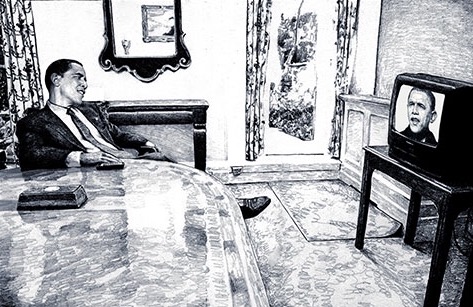
The durability of Barack Obama’s achievements as President of the United States will go down in history as … an oxymoron. He will likely be remembered more for his failures in social, economic, foreign policy and political leadership. Obama has himself to blame for the lack of a durable legacy. From the beginning of his administration, Obama’s mentality with respect to policymaking was always “my way or the highway” (“The election’s over, and I won”), and his consequent failure to achieve legislative victories during his last six years in office was always Congress’ fault. He would share no blame. But it was cool, ’cause Obama had “a pen and a phone” and was willing to act by executive fiat to affect changes he desired. His hope, I suppose, was that his regulatory diktats would become so ingrained in our way of life that rescinding them would be political suicide, much like some of the programs of the New Deal and the Great Society. Well, that backfired! Most of Obama’s executive actions can be undone by executive or legislative action, and while it won’t be costless, it will happen.

The fact of the matter is that Obama’s policies were not productive and not popular. Not only did they contribute to the election of Donald Trump, but they helped fuel the massive losses suffered by Democrats in state houses and governorships over the past eight years. But Obama was always right as rain.

The Planner’s Conceit: A big believer in the power and goodness of government, Obama attempted to usher in a great wave of new regulation and social planning. Here is David Harsanyi in Reason:

“The president’s central case for government’s existence rests on the notion of the state being society’s moral center, engine of prosperity and arbiter of fairness. Obama speaks of government as a theocrat might speak of church, and his fans return the favor by treating him like a pope.“

Obama is a man who lacks any understanding of the causes of prosperity: personal and economic freedoms, individual initiative, and healthy private markets. Jeffrey Tucker makes this point eloquently in “Why Obama Failed“:

“Despite his vast knowledge on seemingly everything, and endless amounts of charm to sell himself to the public, he missed the one crucial thing. He never understood wealth is not a given; it must be created through enterprise and innovation, trade and experimentation, by real people who need the freedom to try, unencumbered by a regulatory and confiscatory state. This doesn’t happen just because there is a nice and popular guy in the White House. It happens because the institutions are right.“

Obama’s results underscore his ignorance regarding the fundamental drivers of material well-being: economic growth during the post-recession years has been very sluggish, and while the unemployment rate has declined, it is not as impressive as it might appear: many workers have been forced into part-time jobs, and the decline in the jobless rate was exaggerated with declines in labor force participation to levels not seen since the late 1970s. Perhaps not coincidentally, the number of workers claiming Social Security disability benefits happened to soar as employment prospects remained grim. Slow growth in the economy and budget sequestration (an action Obama blames on republicans despite having proposed it himself as a cudgel) have reduced the annual budget deficit, but the nation’s outstanding debt under Obama has increased by $10 trillion, doubling the total outstanding over his eight years. Future annual deficits are projected to soar under his policies, according to the Congressional Budget Office.

Two factors that would contribute to ballooning deficits, if allowed to stand, are the Paris Climate Accord, signed by Obama without the Senate’s consent, and Obamacare. The climate treaty would do little to change global temperatures, but would impose heavy costs on the U.S. in terms of subsidies for foreign energy projects, regulatory burdens, and energy bills.

Failing Health Care: The future budget impact of the Paris Accord could be minor compared to Obama’s greatest source of pride: the Affordable Care Act (ACA), a.k.a. Obamacare. Recent scare stories have softened public opinion regarding the ACA, but so unpopular was this “landmark” legislation that Donald Trump was elected in part because he promised, along with congressional republicans (who played no part in its passage) to “repeal and replace” the law. The failures of the ACA were covered in my last post, “Death By Obamacare“.

Foreign FUBARs: The foreign policy foibles of the Obama Administration are legend. From Benghazi to the Syrian “red line”, from the botched deal on nuclear weapons development by Iran to the weak stand on Russian expansionism, American foreign policy has never been such an embarrassment. Obama, the recipient of a dubious Nobel Peace Prize, has been an avid drone warrior, collateral damage be damned. Our continued involvement in Afghanistan and the reentry of U.S. forces into Iraq must be sorely disappointing to the anti-war constituency Obama once courted. He has alienated our longstanding allies and cooed in the ears of avowed enemies. His grants of clemency in recent days to the likes of the treasonous Chelsea Manning and terrorists like Oscar Lopez Rivera are symbolic of the contempt in which he holds the lives lost at their hands. Our weakness abroad has led to a loss of respect for the U.S., signaled vividly by our exclusion from peace talks in Syria. Recent events have increased public awareness of our vulnerability to cyber-attack from foreign enemies, but Obama has failed to provide leadership on the issue.

Scandalous: Obama’s tenure as president has been marked by a number of scandals, contrary to what his admirers would have us believe. The Fast and Furious operation by ATF agents put guns in the hands of criminals and drug cartels, resulting in the death of a border control agent, but the Obama Justice Department sought to obstruct an investigation. The massacre at the U.S. consulate in Benghazi, Libya led to the death of four Americans, including Ambassador Chris Stephens. The White House and State Department sought to create a misleading story line, claiming an anti-Muslim video was responsible for a protest gone-wrong, when in fact they were well aware that it was a planned terrorist action. A deeper question is whether Stephens was in Benghazi attempting to arrange arms sales to “Syrian rebels”. Then there are the attempts by the IRS to target opposition to Obama, and conservative groups generally, and an apparent effort to conceal that activity, as well as cases in which it appeared that the administration was targeting members of the press whom they considered unfriendly. There were a number of other scandals and events such as the Solyndra subsidies, which suggested high corruption and cronyism. Here is an excellent discussion of a variety of dubious antics by the Obama Administration, and the shady efforts to keep them quiet.

Racial Muckraking: Ironically, Obama’s greatest failing might well have been the racial discord that boiled up during his two terms. As the first African-American president of the U.S., there was a considerable expectation that his legacy would be one of racial healing. Instead, it was as if he deliberately sought to encourage discord. Here is Joel Kotkin’s description of the president’s missteps on race relations:

“Whenever race-related issues came up — notably in the area of law enforcement — Obama and his Justice Department have tended to embrace the narrative that America remains hopelessly racist. As a result, he seemed to embrace groups like Black Lives Matter and, wherever possible, blame law enforcement, even as crime was soaring in many cities, particularly those with beleaguered African American communities.

Eight years after his election, more Americans now consider race relations to be getting worse, and we are more ethnically divided than in any time in recent history. As has been the case for several decades, African Americans’ economic equality has continued to slip, and is lower now than it was when Obama came into office in 2009, according to a 2016 Urban League study.“

The Liar: Obama is an unrepentant liar. Even the Washington Post felt it necessary to catalog some of the Obama lies that made it into their headlines (through many did not). There was the infamous Benghazi deception; the “Like Your Plan, Keep Your Plan” fib; he quoted enrollment numbers on the Obamacare exchanges that were greatly exaggerated; he publicly denied that domestic surveillance was a reality; he claimed that he was not responsible for our withdrawal from Iraq… what? There were efforts to cover and dissemble regarding details of all the scandals referenced above. By now, Obama’s insistence that his would be the “most transparent administration in history” is rather humorous. Most of Obama’s lies were motivated by ideology, and that might make it worse in my book. What’s particularly galling is the lie that Obama has any respect for the Constitution. He has attempted to subvert it with regularity.

I, Barack Obama: Another common trait among politicians is narcissism, but few are as obvious about it as Barack Obama. He has a habit of self-referencing that may be unequaled in political oratory. In fact, last July at the Democratic National Convention, he mentioned himself 119 times in a speech about Hillary Clinton. He is always eager to invoke his personal story as a possible source of inspiration for others. He is seemingly preoccupied with his legacy, going out his way to issue additional executive orders in the waning days of his term, and giving a “final” address in which he glorified his accomplishments. And then there was a final-final press conference at which he did the same. He has always encouraged the perception that Barack Obama is the “smartest guy in the room”. Of course, he is never wrong, and everything is cool. Obama seems to believe that he can make reality conform to his every assertion –oh yeah, I already talked about lies!

Did Obama’s narcissism contribute to his failed presidency? It’s plausible because he invested too much in his own ability to teach, influence others,  and control events. Collaboration with important stakeholders was unnecessary, and indeed, it was often better to demonize anyone who stood in the way of the world according to Barack. That world was a sad self-delusion.
Private Incentives and Infrastructure

10 Tuesday Jan 2017

Posted by Nuetzel in infrastructure, Markets

≈ 2 Comments

Tags

central planning, Donald Trump, Exclusivity of Benefits, infrastructure, Infrastructure Tax Credit, Lawrence Summers, Material Infrastructure, Private Infrastructure, Public goods, Public-Private Partnership, Randall O'Toole, Trump Infrastructure Plan, Tyler Cowen, User Fees, Walter Buhr

motorway-to-hell


Material infrastructure is fixed plant and equipment providing services considered basic to the functioning of society. That definition leaves plenty of room for interpretation, however. For example, it does not limit the meaning of “infrastructure” to facilities necessary for the provision of “public goods”, for which benefits are non-exclusive. And it encompasses facilities used by firms in certain competitive markets, such as some forms of telecommunication. The character of infrastructure tends to change over time, as new technologies lead to changes in our way of life (e.g., the cellular network). That’s even more evident when infrastructure is defined more broadly, as Walter Buhr does in “What Is Infrastructure?” His definition of material infrastructure encompasses all facilities enabling “the activation or mobilization of the economic agents’ potentialities.”

Infrastructure ≠ Government

There is a popular fallacy that infrastructure is the exclusive province of government. Infrastructure often does provide some public, non-exclusive benefits, but the willingness of users to pay is the key test of private benefits. As it happens, most infrastructure needs can be met privately and partly, if not fully, supported by user fees. That follows from the high degree of exclusivity of benefits yielded by the infrastructure. Today, privately-owned infrastructure includes communication networks, power generation and distribution, some water and sewer systems, toll roads, ports, and landfills. The presumed monopolistic nature of some infrastructural services probably encourages the notion that infrastructure must be public, but that view is largely unjustified: the services may be “monopolized” only to the extent that the relevant market is defined narrowly, such as road travel, rather than transportation. Indeed, certain kinds of infrastructure functions in markets that are fairly competitive (e.g., wireless networks).

The great thing about most private infrastructure is that owner-operators have an incentive to put it up and keep it up. So it kind of takes care of itself. I say “kind of” because there is always a degree of public involvement, from land use and environmental approval to construction permits, to licensing, to spectrum auctions, to rate regulation, and many other varieties of oversight. Aside from those considerations, if there is a need for infrastructure that is commercially-viable, the project is likely to be proposed by private interests. The funds necessary to pay for construction can be raised from private investors, rather than taxpayers. It’s not at all strange to say that private infrastructure is highly advantageous from a public finance perspective.

There are risks to private infrastructure developers, but those risks are too often borne publicly. A new facility, be it a water treatment plant or a road, might not prove to be profitable once a new revenue stream or reduction in operating costs is realized. Given those circumstances, private interests might seek additional incentives from public authorities to ensure profitbility. To the extent that the shortfall is due to an error in pricing administered by a public regulatory authority, it might be reasonable to make adjustments in the owner-operator’s favor. However, to the extent that demand falls short of the owner-operator’s expectations, it might be better to let the firm fail. That would allow the assets to be sold at a discount to a new operator who can make the cheaper investment profitable. No bailouts!

Trumpian Infrastructure Incentives

The coming Trump Administration is known to have certain steps in mind for encouraging infrastructure development. While the tax plan that has been discussed has a few questionable features, any policy that reduces corporate tax rates would increase the return to existing and prospective private infrastructure, and the profitability of private operation of public infrastructure. In addition, a proposal mentioned explicitly by Trump is a corporate tax credit for infrastructure development.

Here is where a more precise definition of infrastructure would be helpful. Would traditional categories of infrastructure investment by power, telecommunication, and water treatment companies qualify automatically? Moreover, the long timelines required in the planning and installation of most infrastructure might make it difficult to distinguish between new plans and those already in the works. Will the administration establish a bright line between infrastructure investment and run-of-the-mill corporate spending on new plant and equipment? Perhaps any form of corporate investment will qualify. These are questions that remain unanswered as we await Trump’s inauguration.

There is another public-finance dimension of the Trump infrastructure credit. Public infrastructure projects, such as roads, are frequently difficult for governments to fund because they face limits on the debt they can issue. This is emphasized by Randall O’Toole in a recent piece on the Trump credit. Instead of issuing its own debt, a government can take advantage of a large private road builder’s ability to raise funds in the capital market, agreeing to compensate the contractor over time. Thus, taxpayers will be obligated to pay-off the contractor’s debt. The term “Public-Private Partnership” has been invoked in this connection.

Private Incentives Or Central Planning?

I am never averse to reduced tax rates to the extent that taxation always distorts economic incentives. However, selective targeting of tax benefits at certain industries, specific forms of business organization (like corporations), or specific activities like capital investment is overt central planning. Overriding market incentives in this way is not desirable. (Neither are proposals to subsidize exporters and penalize importers. Tyler Cowen at the Marginal Revolution provides some salient quotes from Lawrence Summers on this point.) At this stage, Trump’s tax plan looks like central planning gone berserk.

Ideally, private investment and private infrastructure should be judged on its real merits, not on the prejudices of a central authority. To that end, I believe the Trump Administration’s intent to roll back regulatory distortions is commendable. A case in point is nuclear power generation. Despite the constant outcry against the burning of fossil fuels, there has been little emphasis on encouraging investment in new nuclear capacity. The lengthy approval process and costly regulatory requirements discourage this zero-carbon form of energy production relative to other forms of energy investment.

Users Are the Cost-Causers

I should note that O’Toole speaks favorably of “targeting” certain kinds of public infrastructure, but I think his point is that private operation of infrastructure, if not ownership, will allow markets to do the targeting more efficiently than government ever could. In particular, he notes that politicians tend to prefer new projects to the maintenance and repair of existing infrastructure, independent of the actual merit. Would relying on private operation and user fees encourage better maintenance?

“Unlike infrastructure paid for out of tax dollars, user-fee-funded projects tend to be well maintained because the agencies that manage them know they have to keep them in good shape to continue earning revenues.“

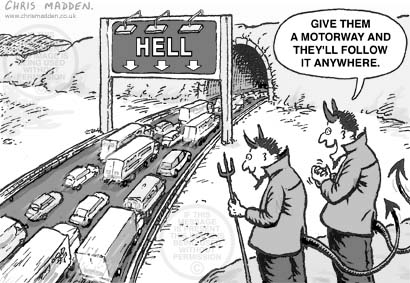
The cartoon above satirizes the consequences of providing free access to a costly facility. User fees encourage more rational patterns of use. For example, it is folly to think that projects like light rail can be financially viable when free alternatives exist. Specific highway routes under high demand must be priced in order for commuters to make rational decisions about the alternatives available to them, and for providers of transportation facilities, whether public or private, to rationally balance the resources dedicated to supporting various modes of travel.

Lower tax and regulatory burdens under the Trump infrastructure plan offer some encouragement for private development and operation of infrastructure projects. As a by-product, the plan might encourage greater reliance on user fees as a method of defraying the costs of infrastructure and promoting a more efficient allocation of resources toward infrastructure needs. However, there are unanswered questions about the details of the plan, and some of its heavy-handy features should be dispensed with.

Politicians and Infra-Hucksters

05 Thursday Jan 2017

Posted by Nuetzel in Government, infrastructure, Technology

≈ 2 Comments

Tags

Border Wall, Congestion, Donald Trump, Dynamic Message Boards, economic stimulus, Efficient Pricing, Elon Musk, eminent domain, Heritage Foundation, High speed rail, Hyperloop, infrastructure, Jerry L. Jordan, Job Creation, Keystone Pipeline, Michael Sargent, Private Infrastructure, Reason Foundation, Solar Roads, St. Louis MO, Steven Horowitz, T. Norman Van Cott, Trolleys, Tunnel Boring, User Fees

img_3863

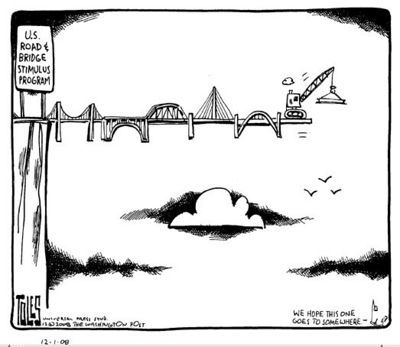
We’ll soon have a new president and already we’ve heard new promises of infrastructure investment. Once again, a chorus of politicians and pundits decries the woeful state of America’s road, bridges, sewers and airport terminals. Then, there are hosannas in adoration of the economic stimulus and job creation promised by large public works projects. And of course there are proposals to integrate politically-favored technologies with new infrastructure. All three rationales for a publicly-financed infrastructure program are flawed. Our infrastructure is not as inadequate as many believe; it is bad public policy to justify infrastructure decisions on the basis of the construction jobs required; and new infrastructure should not be treated as a vehicle for large-scale deployment of unproven technologies.

Ownership

Much of our nation’s infrastructure is privately owned. This includes, but is not limited to, power generation and the power grid, communication networks, many water systems and sewer systems, most rail lines, some toll roads and bridges, and some river, sea and space ports. Maintenance and upgrades to private facilities, and to some public facilities, depend on the adequacy of the rates or fees charged to users. On the other hand, the quantity and quality of publicly-owned and operated infrastructure is often left up to taxpayers rather than users. Proposals for federal infrastructure investment are largely about these public facilities, but they might also involve subsidies for the development of private infrastructure.

Crisis or Crock?

In a Heritage Foundation research report, Michael Sargent notes that the poor state of the country’s public infrastructure is wildly exaggerated:

“The notion that America’s infrastructure is ‘crumbling’ and in uniquely poor condition is not supported by data. The percentage of the nation’s bridges deemed ‘structurally deficient (not necessarily unsafe, but requiring extensive maintenance) has declined annually since 1990 and now sits at under 10 percent, well under half of what it was 25 years ago. Similarly, analyses of highway pavement quality conclude that the nation’s major roads have been steadily improving in quality and are likely in their best shape ever. Our airports and airways safely move more people and goods than those of any other nation. Overall, the U.S. ranks near the top of G-7 nations for infrastructure quality.“

The usual poster child of the infrastructure “crisis” is the nation’s transportation system, but this report from the Reason Foundation shows that those troubles are something of a myth.

Nevertheless, there are always repairs, maintenance and replacement projects to be considered, as well as possible expansion and new facilities. Infrastructural shortfalls and expansion must be prioritized, but as Sargent emphasizes, an even larger number of projects should and probably would be handled privately if not for burdensome federal regulations. In addition, an irrational mistrust of privately-operated facilities among some segments of the public creates pressure to burden taxpayers with costs, rather than users. Complaints about congestion on roads offer a case in point: the best solutions involve efficient (and positive) pricing of existing capacity, rather than continued expansion of a “free” good. The avoidance of rational solutions like efficient pricing underscores the extent to which demands for increased public investment in infrastructure are driven by hyperbole, rather than sound analysis.

It’s About the Infrastructure, Not the Jobs 

Public infrastructure projects are also pitched as effective engines of economic stimulus and job creation. Both of those claims are questionable. Most importantly, the real rationale for infrastructure investment is the value of the infrastructure itself and the needs it serves going forward. The public expense and the jobs required to produce it are cost items! This point was made recently by economist T. Norman Van Cott, who rightfully asserts that a given output is of greater benefit when its costs are low and when it requires less labor input. (Van Cott’s piece uses the Keystone pipeline as an example, a controversial private project that I find objectionable for its dependence on eminent domain actions.) The sharp distinction between creating value and creating jobs is also made here by Jerry L. Jordon and here by Steven Horowitz. Here is Horowitz:

“Creating jobs is easy; it’s creating value that’s hard. We could create millions of jobs quite easily by destroying every piece of machinery on U.S. farms. The question is whether we are actually better off by creating those jobs—and the answer is a definite no.“

Yet this is how so many infrastructure projects are pitched at the national, state and local levels. It’s also puzzling that economic stimulus is used as a rationale even when the economy is operating near its potential output. Even by the standards of traditional Keynesian economic analysis, that is the wrong time for stimulus. Infrastructure projects should be evaluated on their own merits, not on how many construction workers must be hired, or on how much of their paychecks those workers will spend. Many of them must be bid away from competing projects anyway.

The Public Investment Trough

Here’s a brief anecdote from my own experience with an “advanced” public infrastructure project. Some years ago in the region around my city, St. Louis, Missouri, transportation agencies began to install a network of electronic highway message boards to convey real-time information to drivers on road conditions, congestion, and various public service announcements. The 100+ signs in the area today are connected to operators in a central office via fiber optic cable. This type of system is used elsewhere, and it is partly funded by the federal government.

I seriously question the benefits of this system relative to cost. The signs themselves cost well in excess of $100,000 each. The fiber network is undoubtedly costly, and there are other fixed and variable system costs. The signs have an anachronistic look, vaguely the quality of old high school scoreboards. The information they provide generally adds little to what I already know (“12 minutes to I-270”). The signs are in fixed positions, so the occasional report of an accident or congestion usually comes too late to give motorists decent alternatives. The information the signs provide on road conditions is obvious. Missives such as “buckle up” are of questionable value. Before I depart on a commute, or if I have a passenger, we can consult maps and other apps on cell phones to avail ourselves of far better information. Other, more flexible technologies were outpacing the message boards even before they could be fully deployed, and the boards are still being deployed. This is a project that might have sounded brilliant to highway engineers 20 years ago, but it represented something of a luxury relative to other needs, and it still got funded. Today, it looks like waste.

The politics of infrastructure often means that the enabling legislation gets loaded with poorly-planned projects and shiny jewels to dangle before home constituencies. Legislators are so eager to demonstrate their sophistication that they fall over themselves to approve taxpayer funds for unproven but politically-favored technologies. For example, a recent post by Warren Meyer notes the technical folly of solar roads. These are unlikely to attract much private money because they represent such a monumentally stupid idea. Proponents will go after tax money instead. The same is true of ideas like Elon Musk’s tunnel boring project, for which he hopes to collect massive taxpayer subsidies. Musk claims that tunnels will eliminate road congestion, but efficient pricing would do much to eliminate this problem without tunnels, and other technologies like automated vehicles are likely to reduce congestion by the time Musk over-invests tax money in tunnel-boring equipment, roads and hyper-loops inside tunnels.

In general, taxpayers should be wary of “green infrastructure” proposals. A large number of bike lanes, pedestrian bridges and greenways sound wonderful, but they are serious cost inflators. Federal dollars are regularly squandered on charming but wasteful projects such as trolleys. Even worse are ongoing efforts to subsidize the construction of high-speed rail systems. All of these bright ideas should be resisted.

Let’s Be Rational

The country certainly has infrastructural needs, but claims that we face a crisis are greatly exaggerated. With a new administration and what are likely to be supporting majorities in both houses of Congress, the danger of rushing into big funding commitments is heightened. The sponsors of this kind of legislation will herald massive job creation, but that is incidental to the cost side of the ledger. The benefits of individual projects should be evaluated carefully in comparison to costs. Then they can be prioritized if deemed of sufficient value. Finally, large scale deployment of unproven technologies should be avoided on the public dime.

I haven’t even mentioned one very large infrastructure project that has been proposed by President-Elect Donald Trump: the border wall. I suspect that it would be easier and less expensive to solve the problem of border security using more advanced and flexible technologies, but the permanence and symbolism of a wall appeals to many of Mr. Trump’s supporters. The benefits of a wall in terms of border security and control of immigration flows are difficult if not impossible to evaluate, as are the costs to taxpayers, with Trump promising to extract some form of payment from Mexico. The wall, however, is being “sold” to the American public in emotional terms. Come to think of it, that’s how too many other infrastructure proposals are sold by politicians!

There are promising opportunities to improve the nation’s infrastructure through the private sector, where the value of projects is subject to evaluation by parties who must put “skin in the game”. This will be addressed in my next post.

Busting the K-12 Monopoly

12 Monday Dec 2016

Posted by Nuetzel in Education, School Choice

≈ Leave a comment

Tags

Betsy DeVos, Cafe Hayek, Don Boudreaux, Donald Trump, Education Funding, GI Bill, Opportunity cost, Public School Monopoly, Racial Segregation, School Choice, School Vouchers, Teachers Unions

school-choice

Public school teachers are highly sensitive to any suggestion that their schools should “compete” for students, but it’s difficult to rationalize restrictions on competition faced by any institution that trades with consumers. Education is certainly not a natural monopoly. But in the U.S., K-12 public schools are granted an effective service monopoly over large segments of their local markets. Their monopoly status is a legacy and usually taken for granted, but that does not make the arrangement a natural state of affairs, or a healthy one.

The idea that education is a “public good”, or nonexclusive in the benefits it confers, is true only in a weak sense. Yes, there are external benefits from the education of children, but those are secondary to the personal benefits reaped by the children themselves as they go through life. And even strong public spillover benefits do not imply that government should provision the education itself, free of competition. Economic theory justifying intervention in markets implies only that the public sector should attempt to augment supply; direct production by the public sector is unnecessary and often unwise. Competition among schools will bring forth more of the private and public benefits than a monopoly.

But the public schools are free, and that doesn’t sound like a monopoly, right? Well, no, they aren’t free! Not to taxpayers, of course, but also, not to families with children who are denied the right to fully internalize the true opportunity cost of the resources claimed by public schools. The option to move to a school district with better academic performance is unavailable to many families. What would those families decide given a greater degree of empowerment to consider alternatives?

About 18 months ago, the topic of the K-12 monopoly was the subject of a favorite post on Sacred Cow Chips called: “Public Monopolists Say “Don’t Be Choosy“. It called attention to a thought exercise featured by economist Don Boudreaux on Cafe Hayek. Consumers are very choosy about their food, and they should be. Why shouldn’t they be just as choosy about another essential: the school for their children? Because the government won’t let them! Boudreaux lists factors that would make consumer grocery distribution just like the structure of K-12 education. That includes property taxes to pay for “public” grocery stores and the allotments of food they distribute, assignment of each family to a single public grocery store, but freedom to shop at “private” grocery stores at additional expense. He then asks how the food distribution system would perform. Here’s Boudreaux:

“Being largely protected from consumer choice, almost all public supermarkets would be worse than private ones. In poor counties the quality of public supermarkets would be downright abysmal. ….

Responding to these failures, thoughtful souls would call for ‘supermarket choice’ fueled by vouchers or tax credits. Those calls would be vigorously opposed by public-supermarket administrators and workers.

Opponents of supermarket choice would accuse its proponents of demonizing supermarket workers (who, after all, have no control over their customers’ poor eating habits at home). Advocates of choice would also be accused of trying to deny ordinary families the food needed for survival. Such choice, it would be alleged, would drain precious resources from public supermarkets whose poor performance testifies to their overwhelming need for more public funds.

As for the handful of radicals who call for total separation of supermarket and state—well, they would be criticized by almost everyone as antisocial devils indifferent to the starvation that would haunt the land if the provision of groceries were governed exclusively by private market forces.

In the face of calls for supermarket choice, supermarket-workers unions would use their significant resources for lobbying—in favor of public-supermarkets’ monopoly power and against any suggestion that market forces are appropriate for delivering something as essential as groceries.“

That’s exactly the behavior we see from the teacher’s unions, from which sanctimony flows liberally as to “public service”. Remember that the classic monopolist actively engages in denying choice and restraining trade through private actions, public relations and various other political means. But why would any sane observer have concluded that these “protected markets” would lead to successful outcomes?

It’s no secret that public schools in the U.S. face severe challenges. They are highly uneven in their results. A recent report in U.S. News said the following:

“Since World War II, inflation-adjusted spending per student in American public schools has increased by 663 percent. Where did all of that money go? One place it went was to hire more personnel. Between 1950 and 2009, American public schools experienced a 96 percent increase in student population. During that time, public schools increased their staff by 386 percent – four times the increase in students. The number of teachers increased by 252 percent, over 2.5 times the increase in students. The number of administrators and other staff increased by over seven times the increase in students.“

Federal efforts to improve K-12 education have been remarkably fruitless. Despite the massive increases in staffing over the past 50 years at all levels, graduation rates are still miserable in minority districts; schools are more segregated today than 50 years ago; huge gaps exist between the achievement of students in high and low-income districts; and math scores on standardized tests rank near the bottom of OECD countries, (science and reading scores are closer to the average).

The usual rejoinder from the public school establishment is that still greater funding is needed. Always more…. But families are exercising their right to opt-out. The number of home-schooled children is likely to exceed two million by 2020. There are now programs in 32 states facilitating choice through vouchers, tax credits, tax deductions, and education savings accounts. The body of research surrounding the effects of school choice is overwhelmingly positive: choice has improved academic outcomes in both private schools and the public schools that are forced to compete, it has a positive fiscal impact, and it reduces racial segregation. The constant drumbeat of additional funding requests looks unnecessary and wasteful in view of the options.

As for federal dollars, one suggestion is to pare back sharply the number of bureaucrats at the education department, putting the savings toward a program that would emulate the hugely successful GI Bill, under which beneficiaries chose how to spend the money.

Donald Trump’s nominee for education secretary is school choice advocate Betsy DeVos. Obviously, the new administration will not view the public school monopoly as untouchable. But let’s get one thing straight: no one is trying to “ruin” public schools. The objective is to fix something that’s been broken for a long time and, in so doing, to improve educational outcomes across all segments of society. The medicine delivered thus far, including top-down planning and profligate spending, has been expensive and ineffective, and even counterproductive in some respects. A few bad schools will fail under a competitive regime, but they already do. Bad schools have no sacred right to survive. Most struggling schools will improve, leveraging innovative techniques as well as their natural advantages, which often include proximity to a base of prospective students. It’s time to tackle the education problem by vesting consumers with sovereignty in the choice of schools.


Gains From Medicare Trade

08 Thursday Dec 2016

Posted by Nuetzel in Medicare, Privatization, Profit Motive

≈ 2 Comments

Tags

ACA, American Enterprise Institute, CMS, Donald Trump, Health Savings Accounts, HHS, IPAB, John C. Goodman, MACRA, Medicare, Medicare Advantage, Medicare Part C, Medigap, Obamacare, Original Medicare, Premium Support Plan, Privatization, Tom Price

Boomers and Medicare

Here’s a bit of zero-sum ignorance: private profits are robbed from consumers; only non-profits or government can deliver full value, or so this logic goes. Those who subscribe to this notion dismiss the function of private incentives in creating value, yet those incentives are responsible for nearly all of the material blessings of modern life. What the government seems to do best, on the other hand, is writing checks. It’s not really clear it does that very well, of course, but it does have the coercive power of taxation required to do so. Capital employed by government is not a “free” input. It bears opportunity costs and incentive costs that are seldom considered by critics of the private sector.

The role of private profit and the zero-sum fallacy come up in the context of proposals to privatize government services. In what follows, I discuss a case in point: privatization of Medicare. Rep. Tom Price, the Chairman of the House Budget Committee, is Donald Trump’s nominee to head HHS. In November, Price said Congress would attempt to pass legislation overhauling Medicare in the first year of the Trump Administration. James Capretta of the American Enterprise Institute (AEI) explains some of the features of the possible reforms. Price has supported the concept of a premium support plan whereby seniors would purchase their own coverage from private insurers, paid at least in part by the government (also see here).

Medicare and Its Ills

The Medicare program is beset with problems: it has huge unfunded liabilities; it’s cash flows are being undermined by demographic trends; fraud and bureaucratic waste run rampant; it’s unpopular with doctors; and the regulations imposed on healthcare providers are often misguided.

Writing checks to health care providers is really the primary “good” created by the federal government in the administration of Medicare. The Centers for Medicare & Medicaid Services (CMS), a branch of the Department of Health and Human Services (HHS), also performs regulatory functions mandated by legislation, such as the Affordable Care Act (ACA).

More recently, CMS has been implementing the Medicare Access and Chip Reauthorization Act of 2015 (MACRA), which will introduce changes to the payment formulas for physician compensation under the plan. Economist John C. Goodman offers a cogent explanation of the ill-conceived economic planning at the heart of Medicare regulation and its implementation of MACRA in particular:

“…the government’s current payment formulas create perverse economic incentives — to maximize income against the formulas instead of putting patient welfare first. The goal is to change those incentives, so that providers will get paid more if they lower costs and raise quality.

But after the new formulas replace the old ones, provider incentives in a very real sense will be unchanged. They will still have an economic incentive to maximize income by exploiting the formulas, even if that is at the expense of their patients.“

After describing several ways in which Medicare regulation, now and prospectively, leads to perverse results, Goodman advances the powerful argument that the market can regulate health care delivery to seniors more effectively than CMS.

“If the government’s metrics are sound, why not allow health plans to advertise their metrics to potential enrollees and compete on these quality measures. Right now, they cannot. Every communication from health plans to Medicare enrollees must be approved by CMS. … Under MACRA, health plans profit by satisfying the government, not their customers. … Better yet, why not let the market (rather than government) decide on the quality metrics?“

Private Medicare Exists

Wait a minute: profit? But isn’t Medicare a government program, free from the presumed evils of profit-seekers? Well, here’s the thing: almost all of the tasks of managing the provision of Medicare coverage are handled by the private sector under contract with CMS, subject to CMS regulation, of course. That is true even for Part A and Part B benefits, or “original Medicare”, as it’s sometimes called.

Under “original” Medicare, private insurers process “fee-for-service” claims and payments, provide call center services, manage clinician enrollment, and perform fraud investigations. Yes, these companies can earn a profit on these services. Unfortunately, CMS regulation probably serves to insulate them from real competition, subverting efficiency goals. Goodman’s suggestion would refocus incentives on providing value to the consumers these insurers must ultimately serve.

Then there are “Medigap” or Medicare Supplement policies that cover out-of-pocket costs not covered under Parts A and B. These policies are designed by CMS, but they are sold and managed by private insurers.

And I haven’t even mentioned Medicare Parts C and D, which are much more significantly privatized than original Medicare or Medigap. The Part C program, also known as Medicare Advantage, allows retirees to choose from a variety of privately-offered plans as an alternative to traditional Medicare. At a minimum, these plans must cover benefits that are the equivalent to Parts A and B, as judged by CMS, though apparently “equivalency” still allows some of those benefits to be declined in exchange for a rebate on the premium. More optional benefits are available for an additional premium under these plans, including a reduced out-of-pocket maximum, a lower deductible, and reduced copays. Part C has grown dramatically since its introduction in 1996 and now covers 32% of Medicare enrollees. Apparently these choices are quite popular with seniors. So why, then, is privatization such a bogeyman with the left, and with seniors who are cowed by the anti-choice narrative?

What’s To Privatize?

Not privatized are the following Medicare functions: the collection of payroll-tax contributions of current workers; accounting and reporting functions pertaining to the Trust Fund; decisions surrounding eligibility criteria; the benefit designs and pricing of Part A (hospitalization) and Part B (optional out-patient medical coverage, including drugs administered by a physician); approval of provider plan designs and pricing under Parts C; regulation and oversight of all other aspects of Medicare, including processes managed by private administrative contractors and providers of optional coverage; and regulation of health care providers. 

The Independent Payment Advisory Board (IPAB) was created under the Affordable Care Act (ACA), aka Obamacare, to achieve Medicare costs savings under certain conditions, beginning in 2015. Its mandate is rather confusing, however, as IPAB is ostensibly restricted by the ACA from meddling with health care coverage and quality. Proposals from IPAB are expected to cover such areas as government negotiation of drug prices under Part D, a Part B formulary, restrictions on the “protected status” of certain drugs, and increasing incentives for diagnostic coding for Part C plans. Note that these steps are confined to optional or already-private parts of Medicare. They are extensions of the administrative and regulatory functions described above. Despite the restrictions on IPAB’s activities under the ACA, these steps would have an impact on coverage and quality, and they mostly involve functions for which market solutions are better-suited than one-size-fits-all regulatory actions.

The opportunities for privatization are in 1) creating more choice and flexibility in Parts A and B, or simply migrating them to Parts C and D, along with premium support; 2) eliminating regulatory burdens, including the elimination of IPAB.

Impacts On Seniors Now and Later

Privatization is unlikely to have any mandatory impact on current or near-future Medicare beneficiaries. That it might is a scare story circulating on social media (i.e., fake news), but I’m not aware of any privatization proposal that would make mandatory changes affecting anyone older than their mid-50s. Voluntary benefit choices, such as Part C and D plans, would be given more emphasis.

There should be an intensive review of the regulatory costs imposed on providers and, in turn, patients. Many providers simply refuse to accept patients with Medicare coverage, and regulation encourages health care delivery to become increasingly concentrated into large organizations, reducing choices and often increasing costs. Lightening the regulatory burden is likely to bring immediate benefits to seniors by improving access to care and allowing providers to be more patient-focused, rather than compliance-focused.

Again, the most heavily privatized parts of Medicare are obviously quite popular with seniors. The benefits are also provided at lower cost, although the government pays the providers of those plans extra subsidies, which may increase their cost to taxpayers. Enrollees should be granted more flexibility through the private market, including choices to limit coverage, even down to catastrophic health events. Consumers should be given at least limited control over the funds used to pay their premia. That would include choice over whether to choose lower premia and put the excess premium support into consumer-controlled Health Saving Account (HSA) contributions.

Other Reforms

Pricing is a controversial area, but that’s where the terms of mutually beneficial trades are made, and it’s what markets do best. Pricing flexibility for private plans would be beneficial from the standpoint of matching consumer needs with the appropriate level of coverage, especially with fewer regulatory restrictions. Such flexibility need not address risk rating in order to have beneficial effects.

Regulations imposed on physicians and other providers should be limited to those demanded by private plans and the networks to which they belong, as well as clear-cut legislative rules and standards of practice imposed by professional licensing boards. The better part of future contributions to the Trust Fund by younger workers (i.e., those not grandfathered into the existing program) should be redirected toward the purchase today of future benefits in retirement, based on actuarial principles.

Perhaps the best cost-control reform would be repeal of the tax deductibility of insurance premia on employer-paid insurance plans. This provision of the tax code has already inflated health care costs for all consumers, including seniors, via demand-side pressure, and it has inflated their insurance premia as well. If extended to all consumers, tax deductibility would be less discriminatory toward consumers in the individual market and most seniors, but it would inflate costs all the more, with unevenly distributed effects. Unfortunately, rather than eliminating it entirely, qualification for the tax deduction is very likely to be broadened.

Conclusions

The Medicare program is truly in need of an overhaul, but reform proposals, and especially proposals that would put decision-making power into the hands of consumers, are always greeted with reflexive shrieks from sanctimonious worshippers of the state. The most prominent reform under consideration now would offer more of what’s working best in the Medicare program: private choices in coverage and costs. Solving the long-term funding issues will be much easier without a centralized regime that encourages escalating costs.

Earning a profit is usually the mark of a job well done. It is compensation for the use of capital and the assumption of risk (i.e., no bailouts). Physicians, nurses, chiropractors, insurance agents and customer service reps all earn compensation for their contributions. Providers of capital should too, including the owners of health insurance companies who do well by their customers. And if you think the absence of profit in the public sector creates value, remember the damage inflicted by taxes. Capital isn’t “free” to society just because it can be confiscated by the government.

Fraud-Free Voting Fallacy

01 Thursday Dec 2016

Posted by Nuetzel in Democracy

≈ Leave a comment

Tags

ACORN, DiscoverTheNetworks.org, Donald Trump, Ed Driscoll, Electoral College, Electoral Studies, Fake News, Glenn Reynolds, Hillary Clinton, Immigration policy, Instapundit, Pew Center on the States, Voter Fraud, Voter ID


acorn-voter-fraud

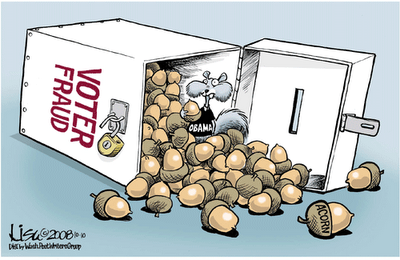
Democrats have long asserted that voter fraud is rare. Recently, we heard from them that questioning the results of an election would “undermine democracy”. In fact, voter fraud is routinely characterized by the left as “fake news“, and even worse, as a racist narrative! How convenient. But in the wake of the Donald Trump victory, we’ve been hearing about electronic voter fraud from the same crowd that’s been imagining Ruskiis under their beds for months (to steal a phrase from Glenn Reynolds). Fear not: voting machines are not connected to the internet!

This week, however, Donald Trump stirred the pot once again by tweeting that he would have won the popular vote if not for the “millions” of illegal votes for Hillary Clinton. Hilarity ensued, and not only on the left. All the pundits say that Trump has no data to support his claim. He probably never looked for it, and he probably doesn’t care. As Ed Driscoll notes at Instapundit, perhaps “stray voltage” is simply part of his plan.

Trump’s claim really does sound outrageous, but a review of the recent history of actual and potential election fraud shows that it might not be as radically far-fetched as we’ve been told. DiscovertheNetworks.org (DTN) provides a three-part compilation of voter fraud research and cases spanning the last 30 years. Pertinent detail on each case or finding is provided, and each item is sourced. The cases span the country and include fraudulent voter registration efforts, dead and ineligible voters (including pets) on the rolls, multiple registrations across jurisdictions, homeless voters casting multiple votes, fraudulent absentee ballots, vote buying, voter impersonation, and failure to provide absentee ballots to deployed military personnel. ACORN, by the way, is well-represented on the list.

Many of the cases on DTN’s list involve anywhere from a handful of fraudulent votes to several hundred. Of course, it’s likely that only a small percentage of fraudulent votes are ever detected. But there are cases on the list of fraudulent registrations numbering in the thousands, and counts of ineligible voters appearing on voter rolls numbering in the hundreds of thousands and even millions.

One of the studies cited by DTN was commissioned by The Pew Center on the States, published in 2012. It found that there were 24 million invalid or “significantly inaccurate” voter registrations in the U.S. And just before every election, said the report, election officials are inundated with a flood of new and often questionable registrations.

Another study cited by DTN appeared in the journal Electoral Studies in 2014. It said “… based upon extrapolations from the portion of the sample with a verified vote … 6.4 percent of non-citizens voted in 2008 ….” The authors admit that there are reasons to think 6.4% is an under-estimate. That’s especially true given the focus on immigration policy in this year’s presidential campaign. But if that percentage was repeated in this year’s election, and given 24 million non-citizen residents in the U.S. (legal and illegal), then roughly 1.4 million non-citizen votes would be included to the 2016 popular vote total. The researchers acknowledge that this group tends to vote heavily for democrats. The overlap between these votes and those arising from the other kinds of voter fraud by Pew is certainly not complete, so the fraudulent vote total is likely to be well north of 1.4 million.

The electoral college was designed to discourage voter fraud in states dominated by a single party. Vote margins beyond a simple majority provide no incremental reward in the electoral college, the reasoning goes. That doesn’t mean election fraud doesn’t occur in those states or that it isn’t motivated in part by presidential politics. Moreover, state and local races can still be contested in so-called “one-party” states and may be subject to manipulative efforts. In such cases, presidential votes might well ride on the coattails of candidates for state and local offices.

The recent tide of republican success in congressional races and at the state level does not suggest that election fraud is benefitting democrats in more highly contested states. Perhaps it goes the other way or is roughly balanced between the parties in those states. But most people who believe Trump’s tweet would probably say that fraud must be concentrated in heavily “blue” states like California and New York. If so, it would be unbalanced fraud.

The magnitude of voter fraud in the presidential election is plausibly in the range of 1 – 2 million and it could be even higher based on the research and other information cited above. That total, however, is split between the parties. For the sake of argument, if 2 million fraudulent ballots are cast and republicans garner 30%, or 600,000 fraudulent votes, then the contribution to the democrat vote margin is just 800,000. Hillary Clinton’s popular vote margin was 2.1 million (less than the margin in California alone). Given that total, Trump’s claim is a real stretch, but his “guess” at the number of fraudulent votes is probably well within an order of magnitude. That might be surprising to some detractors.

What should be obvious is that voter fraud is a major problem in the U.S., and it undoubtedly swings some races at state and local levels. I have been lukewarm with respect to voter ID laws, but I am persuaded that they are a necessary step in the quest for electoral integrity. (Whether IDs must be government-issued is a separate matter.) The argument that these laws are discriminatory is true to the extent that we wish to prevent ineligible individuals from voting. That’s a good thing. The argument that it is racist is sheer stupidity: citizenship should bring privileges. That is not a position on immigration policy. Voter ID laws place a simple burden on citizens to prove that they are legitimately entitled to full participation in the democratic process. If you can’t be troubled to identify yourself, you should expect multiple obstacles to sharing in the fruits of modern society.

Postscript: I just ran across this post, which makes some of the same points I’ve discussed above, but it says that there are roughly 20 million adult non-citizens in the U.S. today.

Fake News and Fake Virtue

28 Monday Nov 2016

Posted by Nuetzel in Free Speech, Propaganda

≈ 2 Comments

Tags

A. Barton Hinkle, Censorship, Donald Trump, Dumb News, Edward Morrissey, Facebook, Fake News, Fidel Castro, Free Speech, Hamilton, Hate Speech, Mark Zuckerberg, Melissa Zimdars, Mike Pence, Noah Rothman, Propaganda, Roger Simon, Scott Shackford

hillary-clinton-tells-the-truth

Suddenly, since the election, “fake news” has become all the rage. Not that it’s a new phenomenon. All of us have come across it on social media. Most of us think we know it when we see it, and the recent election probably sensitized a great many of us to its cheap seduction. Some of it is satire, some is sincerely-held conspiracy theory, some is cooked-up, milli-penny click bait, and some of it is intended to drive an agenda.

Those forms of “fake news” are only the most obvious. I believe, for example, that the dangers of positively fake news are no greater than those posed by omission or demotion of news. It was rather obvious during the recent election campaign that news networks often ignored important stories that did not favor their own points of view. And since the death of the tyrant Fidel Castro, we’ve heard pronouncements that he was a “great leader” from a variety of sources who should know better; we’ve heard very little from them about his oppressive and murderous regime.

News as reported, and not reported, is often manipulated or mischaracterized to suit particular agendas. Reporters have their sources, and sources usually have agendas and stratagems in mind, which include rewarding reporters to get the coverage they desire. The manipulation even extends to news about science: grant-hungry and media-savvy members of the scientific community, and the pop-science community, know how to leverage it to their advantage.

Given the universal human capacity for bias, Roger Simon asks, only half in jest, whether all news is fake news. You can rely on so-called fact-checkers in an attempt to verify stories you find suspicious, but choose your fact checkers wisely because they are no better than the biases they bring to their duties. Let’s face it: facts are not always as clear-cut as we’d like. Simon makes his advisory on bias in reporting in the context of Mark Zuckerberg’s new-found passion to identify “fake news” and purveyors of “fake news”, and potentially to ban them from Facebook. No doubt his concern stems from accusations from angry Hillary Clinton supporters that Facebook failed to control the flow of “fake news” during the presidential campaign. He wants users to “flag” fake stories, but he knows that won’t always yield definitive conclusions. Simon quotes the Wall Street Journal:

“Facebook is turning to outside groups for help in fact-checking… It is also exploring a product that would label stories as false if they have been flagged as such by third-parties or users, and then show warnings to users who read or share the articles.

‘The problems here are complex, both technically and philosophically,’ [Zuckerberg] wrote. ‘We believe in giving people a voice, which means erring on the side of letting people share what they want whenever possible.’“

Well, that’s a relief! But what kind of chilling effect might be inflicted when the fact priests assign their marks? And what kind of fact-check/flagging escalation might be engendered among users? In the end, users and third-party “authorities” have biases. You can’t take any proscriptive action that will please them all. Better for hosts to keep their fingers off the scale, avoid censorship, and let users please themselves!

Zuckerberg should know better than to think that “facts” are always easily discerned, that “fake” news is solely the province of crank blogs and flakey “new media” organizations, or that “fake news” has any political affiliation. Consider the following examples offered by A. Barton Hinkle at Reason.com:

“The [New York] Times’ record for disseminating agitprop dates back at least to the early 1930s, when Walter Duranty won a Pulitzer for his reporting that denied the existence of famines in Soviet Russia—during a period when millions were dying of starvation.

More recently, The Times has given the nation the Jayson Blair fabrications—which it followed up with the infamous 2004 story, ‘Memos on Bush Are Fake But Accurate, Typist Says.’ It followed that up four years later with a story implying that GOP presidential candidate John McCain had had an affair with a lobbyist. (The lobbyist sued, and reached a settlement with the paper.)

Over the years other pillars of the media also have fallen on their faces. NBC News had to confess that it rigged GM trucks with incendiary devices for an explosive Dateline segment. The Washington Post gave up a Pulitzer after learning that Janet Cooke’s reporting about an 8-year-old heroin addict was false. In 1998 the Cincinnati Enquirer renounced its own series alleging dark doings by the Chiquita banana company. That same year, CNN retracted its story alleging ‘that the U.S. military used nerve gas in a mission to kill American defectors in Laos during the Vietnam War.’ The San Jose Mercury News had to denounce its own series alleging that the CIA was to blame for the crack cocaine epidemic. Rolling Stone just got hit with a big libel judgment for its now-retracted story about a rape at U.Va. And so on.“

Retractions are good, of course, but they aren’t always forthcoming, and they often receive little notice after the big splash of an initial report. The damage cannot be fully undone. Yet no one proposes to censor “the paper of record” or, with the exception of Fox News, the major television networks.

Edward Morrissey, writing at The Week, notes that the Trump election represented such a total breakdown in the accepted political wisdom that the identification of scapegoats was inevitable:

“Over the past week, the consensus Unified Theory from the media is this: Blame fake news. This explanation started with BuzzFeed’s analysis of Facebook over the past three months, which claimed that the top 20 best-performing ‘fake news’ articles got more engagement than the top 20 ‘mainstream news’ stories. …

There are also serious problems with the evidence BuzzFeed presents. As Timothy Carney points out at the Washington Examiner, the “real news” that Silverman uses for comparison are, in many cases, opinion pieces from liberal columnists. The top ‘real’ stories — which BuzzFeed presented in a graphic to compare against the top ‘fake’ stories — consist of four anti-Trump opinion pieces and a racy exposé of Melania Trump’s nude modeling from two decades ago.“

In Reason, Scott Shackford considers a proposed list of “fake news” sources compiled by a communications professor. Shackford says:

“… [Professor] Zimdars’ list is awful. It includes not just fake or parody sites; it includes sites with heavily ideological slants like Breitbart, LewRockwell.com, Liberty Unyielding, and Red State. These are not “fake news” sites. They are blogs that—much like Reason—have a mix of opinion and news content designed to advance a particular point of view. Red State has linked to pieces from Reason on multiple occasions, and years ago I wrote a guest commentary for Breitbart attempting to make a conservative case to support gay marriage recognition.“

Warren Meyer rightfully identifies the “fake news” outrage as an exercise in idealogical speech suppression, much like the left’s cavalier use of the term “hate speech”:

“The reason it is such a dangerous term for free speech is that there is no useful definition of hate speech, meaning that in practice it often comes to mean, ‘confrontational speech that I disagree with.’“

Worries about “fake” news are one thing, but perhaps we should be just as concerned about the “scourge of dumb news“, and the way it often supplants emphasis on more serious developments. Did the fracas over the Hamilton cast’s treatment of Mike Pence distract the media, and the public, from stories about Donald Trump’s potential conflicts of interest around the globe, which broke at about the same time? Here are some other examples of “dumb” news offered by Noah Rothman, the author of the last link:

“Colin Kaepernick, the Black Lives Matter movement, college-age adults devolving into their childlike selves, or pretentious celebrities politicizing otherwise apolitical events; for the right, these and other similar stories masquerade as and suffice for intellectual stimulation and political engagement. The left is similarly plagued by mock controversies. The faces printed on American currency notes, minority representation in film adaptations of comic books, and astrophysicists insensitive enough to announce feats of human engineering while wearing shirts with cartoon depictions of scantily clad women on them. This isn’t politics but, for many, it’s close enough.“

Okay, so what? We all choose news sources we prefer or discern to be reliable, interesting, or entertaining, and that’s wonderful. No one should presume to question the degree to which news and entertainment ought to intersect. I do not want protection from “fake news”, “dumb news”, or any news source that I prefer, least of all from the government. After all, if there is any entity that might wish to “control the narrative” it’s the government, or anyone who stands to gain from it’s power to coerce.

Stumbling Into the Hamilton Safe Space

21 Monday Nov 2016

Posted by Nuetzel in Constitution, Progressivism

≈ Leave a comment

Tags

Alexander Hamilton, Brandon Dixon, Donald Trump, Fourth Wall, Hamilton The Musical, Mike Pence, Reese Waters, Sanctuary Cities, St. Patrick's Day, Steven Van Zant, Tendentious Art, The E-Street Band, Thomas Jefferson

img_3741

An incident at the curtain call of Friday night’s performance of Hamilton, The Musical in New York has attracted more attention than it deserves, or perhaps it’s attracted attention for the wrong reasons. Vice President-Elect Mike Pence attended the show, and the word spread to the cast. One of the actors, Brandon Dixon, read a message to Pence from the stage which had been written by the show’s producers. By that time, Pence’s Secret Service detail was ushering him out of The Richard Rogers Theater, apparently the usual protocol, but one of the producers said Pence stopped to listen. Here is the message that Dixon read, according to this Twitter link:

“You know, we have a guest in the audience this evening — Vice President-elect Pence, I see you walking out but I hope you hear just a few more moments. There’s nothing to boo, ladies and gentlemen, There’s nothing to boo. We’re all here sharing a story of love. We have a message for you, sir, we hope that you will hear us out. And I encourage everyone to pull out you phones and tweet and post because this message needs to be spread far and wide.

Vice President-elect Pence, we welcome you and we truly thank you for joining us here at ‘Hamilton: An American Musical.’ We really do. We, sir, we are the diverse America who are alarmed and anxious that your new administration will not protect us, our planet, our children, our parents or defend us and uphold our inalienable rights, sir. But we truly hope this show has inspired you to uphold our American values and work on behalf of all of us. All of us.

Thank you truly for seeing this show. this wonderful American story told by a diverse group of men, women of different colors, creeds and orientations.“

Donald Trump overreacted to the situation, tweeting that Dixon and the cast should apologize to Pence. This is typical Trump, making a bigger story of something that could have passed with less controversy. Pence, left to his own devices,  would have let it pass. He said later that he was not offended. And I’m sure the cast of Hamilton was under no illusion that Pence would accept their advice on anything.

Dixon’s message itself was respectful, more or less, though it was not “a conversation”, as he later claimed. It was a lecture. It seemed designed to show Pence up, but Pence listened politely. Less “respectful” were audience members who greeted Pence with boos as he entered the theater (there were cheers as well), and when Dixon mentioned his name at the curtain call. At least Dixon admonished them. However, there are reports, which I’ve been unable to confirm, that some of the show’s actors directed their lines at Pence. If true, such a confrontational delivery broke the “fourth wall” for purposes that do not elevate the show. On something of a light note, someone suggested that the incident might prompt Trump to build a “fourth wall”. Heh! No, Dixon’s lecture did not break the fourth wall — he read the statement after the show had ended.

Some artists thought the Hamilton cast went too far. Here is Steven Van Zant, guitarist for The E-Street Band and an avowed progressive who, for what it’s worth, happens to agree with Trump that the cast should apologize to Pence:

“When artists perform the venue becomes your home. The audience are your guests. It is nothing short of the same bullying tactic we rightly have criticized Trump for in the past. It’s taking unfair advantage of someone who thought they were a protected guest in your home. You don’t single out an audience member and embarrass him from the stage. [This was] a terrible precedent to set.“

I have a number of friends and acquaintances in my city’s theatre community. Their opinion is divided, but a clear majority are defending the cast of Hamilton. They stress that theatre has always been a vehicle for social commentary and social change. There is certainly an extent to which that’s true, and Hamilton is nothing if not a social statement. Of course, the lecture was not part of the show, but for what it’s worth, my view is that such commentary is more successful as art, and more likely to provoke sincere thought, when it is weaved into the art or story in subtle ways. I also believe that approach is truer to the history of theatrical social commentary. Personally, I don’t like tendentious art, and I’ve always felt that artists who make their political views too explicit cheapen their work. But that’s just me. One theatre friend thought that Dixon (and the producers) had crossed a line, using the curtain call to get on a soapbox to instruct a single member of the audience as to the proper interpretation of the art he had just witnessed.

Another theatre friend commented that theater should educate, entertain and edify, a view that probably gives the average playwright credit for more knowledge than they deserve. As it happens, there are several historical distortions in the book of Hamilton, which I covered in this post on Sacred Cow Chips about five months ago. While the show is a smashing success as entertainment, it contains some unadulterated propaganda about Alexander Hamilton, Thomas Jefferson, the meaning of the Constitution, and certain events that took place around the time of our nation’s founding. It is a failure at educating.

Incidentally, Brandon Dixon is not quite the virtuous SJW that many would have us believe. His Twitter history shows a rather aggressive attitude toward women, and white women in particular:

“St. Patty’s day weekend is like Christmas for black dudes who like white chicks. Happy holidays boys.
@reesewaters
#seasonsgreetings
“

Evidentally, Brandon fancies himself quite the stallion, a sure sign of his deep respect for women.

The incident at The Richard Rogers is most interesting to me because it reveals an irony: the extent to which the writer, producers and actors of Hamilton lack an understanding of our system of government and individual rights. The president (and especially the vice president) do not hold the power to strip individuals of their rights. Granted, the GOP will have a slight majority in Congress and on the Supreme Court, but that does not mean that Trump will be unrestrained. The divisions of power and the constitutional checks and balances promulgated by the likes of Jefferson and Hamilton will serve to protect the rights of diverse Americans. And in two years, control of either the Senate or the House of Representatives might swing back to Democrats.

The Hamilton cast has an insufficient grasp of another fact: one person’s constitutional rights can come into conflict with the rights of others. If they so infringe, it is not enough to assert that you must have the freedom to exercise your rights. You can try, but these are matters for the courts to decide, and those decisions usually hinge on possible accommodations and whether the government has a “compelling interest” in protecting one right at the expense of another.

One other note to the Hamilton cast: while illegal immigrants share in many of the individual rights protected under the Constitution, they do not share fully in all of those rights. In particular, Trump might not need congressional support or help from the courts to enforce existing immigration law. If it’s any reassurance, he seems to have moderated his position on illegals, focusing his rhetoric on “sanctuary cities” and illegals having criminal records.

Perhaps the “elite” Broadway theatre kids of Hamilton can be forgiven if they have the wrong impression about executive power after watching Barack Obama over the last eight years. Hamilton would not have approved. Thankfully, what can be done with “a pen and a phone” can probably be undone with “a pen and a phone”. Now get back out there and have fun, kids!

Futile Hope for Faithless Electors

16 Wednesday Nov 2016

Posted by Nuetzel in Federalism

≈ Leave a comment

Tags

Donald Trump, Electoral College, Faithless Electors, Hillary Clinton

trump-go-round

Just who are these electors, anyway? Might they elect Hillary Clinton after all? Or switch en masse to someone else? The answer: slim to no chance. After my post on the Electoral College, it occurred to me that I should have addressed those questions. After all, every leftist clinging to hope of political redemption seems to think it could happen. But here’s the thing: if a Republican wins a state’s popular vote, then a slate of Republican electors is appointed. Electors at the state level are not appointed randomly or in proportion to the vote, as some apparently imagine. Only the Maine and Nebraska electoral slates bear any semblance of proportionality, since congressional districts in those states get one elector each, while two others go with the state vote. Here is a U.S. government web page on the Electoral College describing the selection process for electors.

It appears likely that Donald Trump will win Michigan’s 16 electoral votes, though the results probably won’t be certified until the end of the month. That would give him 36 more electors than the 270 required to win the presidency. The likelihood that 36 Republican electors will refuse to back Trump, or even 20 electors if he loses Michigan, is infinitesimal. Such “faithless electors” can be penalized in 29 states, but those laws have never been enforced due to the rarity of faithless electors. In some states, the vote of a faithless elector is voided, so it would reduce Trump’s total but not add to Clinton’s. And Clinton might have two faithless electors of her own in Washington state, who have said they will vote for Bernie Sanders and pay a $1,000 fine.

Broken-hearted leftists will almost certainly have to satisfy themselves with marching, or rioting, and simply demonizing Trump, his appointees, and his supporters.

Post-Election Thoughts: The “Idiocracy”

11 Friday Nov 2016

Posted by Nuetzel in Free Speech, Liberty, Tyranny

≈ Leave a comment

Tags

Barack Obama, Carly Fiorina, Donald Trump, Hillary Clinton, Homophobia, Identity Politics, Misogyny, Peter Thiel, Political Correctness, racism, Robby Soave, Walter Williams

racism

I keep reading about “idiots” in my news feed, directed by angry supporters of Hillary Clinton at anyone who voted for Donald Trump. These crestfallen partisans do not appreciate an irony: their very arrogance and desire to proscribe the freedom of others to speak and act freely actually helped to coalesce Trump’s support. So smug are they in their beliefs and attitudes that they are able to render high-handed judgements as to whether certain beliefs are socially acceptable. That there are many dimensions to social problems is lost on this crowd: it’s all or nothing. You are an idiot, a racist, a misogynist, or a homophobe if you support free speech (because it might offend), private property (you are greedy), free markets (capitalist pig), law enforcement (racist), gun rights (violent), or if you hold attitudes that are “traditional” or religious. In fact, you are probably suspect if you are white, asian, or in any way successful: you are too privileged to understand the negative consequences of your privilege.

Here’s my disclaimer: I don’t particularly like Donald Trump and some of his antics. I strongly disagree with a few of his most prominent policy proposals. Nevertheless, I voted for him because Hillary Clinton is so obviously a devotee of centralized power and she is irredeemably crooked. I was repelled by the identity politics she celebrated, and I found a certain aspect of Donald Trump’s disregard for political correctness to be refreshing.

The fact is that many voters are sick and tired of the name-calling by the left, and of the proscriptive behavior it enables. I’m one of them. Robby Soave at Reason just wrote an excellent article on this point:

“The leftist drive to enforce a progressive social vision was relentless, and it happened too fast. I don’t say this because I’m opposed to that vision—like most members of the under-30 crowd, I have no problem with gender neutral pronouns—I say this because it inspired a backlash that gave us Trump….

There is a cost to depriving people of the freedom (in both the legal and social senses) to speak their mind. The presidency just went to the guy whose main qualification, according to his supporters, is that he isn’t afraid to speak his.“

In the wake of an election that didn’t go their way, the identity politickers are proving themselves to be petulant and vulgar creeps. They decry the Trump election as racist by placing entire demographics and regions into an “idiot” trick bag. They cry racism on counties in which the majority voted for Barack Obama in 2012, but flipped to Donald Trump in 2016.

But no one is shamed. I’d have loved it if Carly Fiorina had been nominated. I’d vote for Walter Williams if he ran for president. I have great respect for Peter Thiel but I don’t know whether I’d vote for him. I might. In the end, it’s usually about policies, and if your policy portfolio has an excessive basis in identity politics and political correctness, and if you are strident about it, don’t be surprised if you stir some resentment. The idiots just might be the ones shooting themselves in the foot.

Note: Yes, I’ve used that cartoon before. I like it!

← Older posts
Newer posts →
Follow Sacred Cow Chips on WordPress.com

Recent Posts

  • A Warsh Policy Scenario At the Federal Reserve
  • The Coexistence of Labor and AI-Augmented Capital
  • The Case Against Interest On Reserves
  • Immigration and Merit As Fiscal Propositions
  • Tariff “Dividend” From An Indigent State

Archives

  • February 2026
  • January 2026
  • December 2025
  • November 2025
  • October 2025
  • September 2025
  • August 2025
  • July 2025
  • June 2025
  • May 2025
  • April 2025
  • March 2025
  • February 2025
  • January 2025
  • December 2024
  • November 2024
  • October 2024
  • September 2024
  • August 2024
  • July 2024
  • June 2024
  • May 2024
  • April 2024
  • March 2024
  • February 2024
  • January 2024
  • December 2023
  • November 2023
  • August 2023
  • July 2023
  • June 2023
  • May 2023
  • April 2023
  • March 2023
  • February 2023
  • January 2023
  • December 2022
  • November 2022
  • October 2022
  • September 2022
  • August 2022
  • July 2022
  • June 2022
  • May 2022
  • April 2022
  • March 2022
  • February 2022
  • January 2022
  • December 2021
  • November 2021
  • October 2021
  • September 2021
  • August 2021
  • July 2021
  • June 2021
  • May 2021
  • April 2021
  • March 2021
  • February 2021
  • January 2021
  • December 2020
  • November 2020
  • October 2020
  • September 2020
  • August 2020
  • July 2020
  • June 2020
  • May 2020
  • April 2020
  • March 2020
  • February 2020
  • January 2020
  • December 2019
  • November 2019
  • October 2019
  • September 2019
  • August 2019
  • July 2019
  • June 2019
  • May 2019
  • April 2019
  • March 2019
  • February 2019
  • January 2019
  • December 2018
  • November 2018
  • October 2018
  • September 2018
  • August 2018
  • July 2018
  • June 2018
  • May 2018
  • April 2018
  • March 2018
  • February 2018
  • January 2018
  • December 2017
  • November 2017
  • October 2017
  • September 2017
  • August 2017
  • July 2017
  • June 2017
  • May 2017
  • April 2017
  • March 2017
  • February 2017
  • January 2017
  • December 2016
  • November 2016
  • October 2016
  • September 2016
  • August 2016
  • July 2016
  • June 2016
  • May 2016
  • April 2016
  • March 2016
  • February 2016
  • January 2016
  • December 2015
  • November 2015
  • October 2015
  • September 2015
  • August 2015
  • July 2015
  • June 2015
  • May 2015
  • April 2015
  • March 2015
  • February 2015
  • January 2015
  • December 2014
  • November 2014
  • October 2014
  • September 2014
  • August 2014
  • July 2014
  • June 2014
  • May 2014
  • April 2014
  • March 2014

Blogs I Follow

  • Passive Income Kickstart
  • OnlyFinance.net
  • TLC Cholesterol
  • Nintil
  • kendunning.net
  • DCWhispers.com
  • Hoong-Wai in the UK
  • Marginal REVOLUTION
  • Stlouis
  • Watts Up With That?
  • Aussie Nationalist Blog
  • American Elephants
  • The View from Alexandria
  • The Gymnasium
  • A Force for Good
  • Notes On Liberty
  • troymo
  • SUNDAY BLOG Stephanie Sievers
  • Miss Lou Acquiring Lore
  • Your Well Wisher Program
  • Objectivism In Depth
  • RobotEnomics
  • Orderstatistic
  • Paradigm Library
  • Scattered Showers and Quicksand

Blog at WordPress.com.

Passive Income Kickstart

OnlyFinance.net

TLC Cholesterol

Nintil

To estimate, compare, distinguish, discuss, and trace to its principal sources everything

kendunning.net

The Future is Ours to Create

DCWhispers.com

Hoong-Wai in the UK

A Commonwealth immigrant's perspective on the UK's public arena.

Marginal REVOLUTION

Small Steps Toward A Much Better World

Stlouis

Watts Up With That?

The world's most viewed site on global warming and climate change

Aussie Nationalist Blog

Commentary from a Paleoconservative and Nationalist perspective

American Elephants

Defending Life, Liberty and the Pursuit of Happiness

The View from Alexandria

In advanced civilizations the period loosely called Alexandrian is usually associated with flexible morals, perfunctory religion, populist standards and cosmopolitan tastes, feminism, exotic cults, and the rapid turnover of high and low fads---in short, a falling away (which is all that decadence means) from the strictness of traditional rules, embodied in character and inforced from within. -- Jacques Barzun

The Gymnasium

A place for reason, politics, economics, and faith steeped in the classical liberal tradition

A Force for Good

How economics, morality, and markets combine

Notes On Liberty

Spontaneous thoughts on a humble creed

troymo

SUNDAY BLOG Stephanie Sievers

Escaping the everyday life with photographs from my travels

Miss Lou Acquiring Lore

Gallery of Life...

Your Well Wisher Program

Attempt to solve commonly known problems…

Objectivism In Depth

Exploring Ayn Rand's revolutionary philosophy.

RobotEnomics

(A)n (I)ntelligent Future

Orderstatistic

Economics, chess and anything else on my mind.

Paradigm Library

OODA Looping

Scattered Showers and Quicksand

Musings on science, investing, finance, economics, politics, and probably fly fishing.

  • Subscribe Subscribed
    • Sacred Cow Chips
    • Join 128 other subscribers
    • Already have a WordPress.com account? Log in now.
    • Sacred Cow Chips
    • Subscribe Subscribed
    • Sign up
    • Log in
    • Report this content
    • View site in Reader
    • Manage subscriptions
    • Collapse this bar
 

Loading Comments...