• About

Sacred Cow Chips

Sacred Cow Chips

Tag Archives: Federal Reserve

Infrastructure Or Infra-Stricture? The Democrats’ $3.5 Trillion Reconciliation Bill

16 Thursday Sep 2021

Posted by Nuetzel in Big Government, Central Planning, infrastructure, Uncategorized

≈ 3 Comments

Tags

Antonia Ocasio-Cortez, Bernie Sanders, Biden Administration, Budget Reconcilation Bill, Capital Gains, Civilian Climate Corps, Clean Energy, corporate income tax, dependency, Federal Reserve, Fossil fuels, Green Cards, infrastructure, Joe Manchin, Legal Permanent Residency, Paid Family Leave, Physical Investment, Productivity Growth, Social Infrastructure, Tax the Rich, Tragedy of the Commons, Universal Pre-School, Welfare State

The Socialist Party faithful once known as Democrats are pushing a $3.5 trillion piece of legislation they call an “infrastructure” bill. They hope to pass it via budget reconciliation rules with a simple majority in the Senate. The Dems came around to admitting that the bill is not about infrastructure in the sense in which we usually understand the term: physical installations like roads, bridges, sewer systems, power lines, canals, port facilities, and the like. These kinds of investments generally have a salutary impact on the nation’s productivity. Some “traditional” infrastructure, albeit with another hefty wallop of green subsidies, is covered in the $1.2 trillion “other” infrastructure bill already passed by the Senate but not the House. The reconciliation bill, however, addresses “social infrastructure”, which is to say it would authorize a massive expansion in the welfare state.

What Is Infrastructure?

Traditionally, public and private infrastructure are underlying assets that facilitate production or consumption in one way or another, consistent with the prefix “infra”, meaning below or within. For example, a new factory requires physical access by roads and/or rail, as well as sewer service, water, gas and/or electric supply. All of the underlying physical components that enable that factory to operate may be thought of as private infrastructure, which has largely private benefits. Therefore, it is often privately funded, though certainly not always.

Projects having many beneficiaries, such as highways, municipal sewers, water, gas and electrical trunk lines, canals, and ports may be classified as public infrastructure, though they can be provided and funded privately. Pure public infrastructure provides services that are non-rivalrous and non-excludable, but examples are sparse. Nevertheless, the greater the public nature of benefits, the greater the rationale for government involvement in their provision. In practice, a great deal of “public” infrastructure is funded by user fees. In fact, a failure to charge user fees for private benefits often leads to a tragedy of the commons, such as the overuse of free roads, imposing a heavier burden on taxpayers.

The use of the term “infrastructure” to describe forms of public support is not new, but the scope of government interventions to which the term is applied has mushroomed during the Biden Administration. Just about any spending program you can think of is likely to be labeled “infrastructure” by so-called progressives. The locution is borrowed somewhat questionably, seemingly motivated by the underlying structure of political incentives. More bluntly, it sounds good as a sales tactic!

$3.5 Trillion and Chains

Among other questionable items, the so-called budget reconciliation “infrastructure” bill allocates funds toward meeting:

“… the President’s climate change goals of 80% clean electricity and 50% economy-wide carbon emissions by 2030, while advancing environmental justice and American manufacturing. The framework would fund:
• Clean Energy Standard
• Clean Energy and Vehicle Tax Incentives
• Civilian Climate Corps
• Climate Smart Agriculture, Wildfire Prevention and Forestry
• Federal procurement of clean technologies
• Weatherization and Electrification of Buildings
• Clean Energy Accelerator
”

The resolution would also institute “methane reduction and polluter import fees”. Thus, we must be prepared for a complete reconfiguration of our energy sector toward a portfolio of immature and uneconomic technologies. This amounts to an economic straightjacket.

Next we have a series of generous programs and expansions that would encourage dependence on government:

“• Universal Pre-K for 3 and 4-year old children
• High quality and affordable Child Care
•
[free] Community College, HBCUs and MSIs, and Pell Grants
• Paid Family and Medical Leave
• Nutrition Assistance
• Affordable Housing
”

If anything, pre-school seems to have cognitive drawbacks for children. Several of these items, most obviously the family leave mandate, would entail significant regulatory and cost burdens on private businesses.

There are more generous provisions on the health care front, which are good for further increasing the federal government’s role in directing, regulating, and funding medical care:

“• new Dental, Vision, and Hearing benefit to Medicare
• Home and Community-Based Services expansion
• Extend the Affordable Care Act Expansion from the ARP
• Close the Medicaid “Coverage Gap” in the States that refused to expand
• Reduced patient spending on prescription drugs
”

Finally, we have a series of categories intended to “help workers and communities across the country recover from the COVID-19 pandemic and reverse trends of economic inequality.”

“• Housing Investments
• Innovation and R & D Upgrades
• American Manufacturing and Supply Chains Funding
• LPRs for Immigrants and Border Mangt. • Pro-Worker Incentives and Penalties
• Investment in Workers and Communities • Small Business Support

I might suggest that a recovery from the pandemic would be better served by getting the federal government out of everyone’s business. The list includes greater largess and more intrusions by the federal government. The fourth item above, grants of legal permanent residency (LPR) or green cards, would legalize up to 8 million immigrants, allowing them to qualify for a range of federal benefits. It would obviously legitimize otherwise illegal border crossings and prevent any possibility of eventual deportation.

Screwing the Pooch

How many of those measures really sound like infrastructure? This bill goes on for more than 10,000 pages, so the chance that lawmakers will have an opportunity to rationally assess all of its provisions is about nil! And the reconciliation bill doesn’t stop at $3.5T. There are a few budget gimmicks being leveraged that could add as much as $2T of non-infrastructure spending to the package. One cute trick is to add certain provisions affecting revenue or spending years from now in order to cut the bill’s stated price tag.

A number of the bill’s generous giveaways will have negative effects on productive incentives. It’s also clear that some items in the bill will supplement the far Left’s educational agenda, which is seeped in critical theory. And the bill will increase the dominance of the federal government over not only the private sector, but state and local sovereignty as well. This is another stage in the metastasis of the federal bureaucracy and the dependency fostered by the welfare state.

Taxing the Golden Goose

But here’s the really big rub: the whole mess has to be paid for. The flip side of our growing dependency on government is the huge obligation to fund it. Check this out:

“American ‘consumer units,’ as BLS calls them, spent a net total of $17,211.12 on taxes last year while spending only $16,839.89 on food, clothing, healthcare and entertainment combined,”

Democrats continue to dicker over the tax provisions of the bill, but the most recent iteration of their plan is to cover about $2.9 trillion of the cost via tax hikes. Naturally, the major emphasis is on penalizing corporations and “the rich”. The latest plan includes:

  • increasing the corporate income tax from 21% to 26.8%;
  • increasing the top tax rate on capital gains from 20% to 25%;
  • an increase in the tax rate for incomes greater than $400,000 ($450,000 if married filing jointly)
  • adding a 3% tax surcharge for those with adjusted gross incomes in excess of $5 million;
  • Higher taxes on tobacco and nicotine products;
  • halving the estate and gift tax exemption;
  • limiting deductions for executive compensation;
  • changes in rules for carried interest and crypto assets.

There are a few offsets, including the promise of tax reductions for individuals earning less than $200,000 and businesses earning less than $400,000. We’ll see about that. Those cuts would expire by 2027, which reduces their “cost” to the government, but it will be controversial when the time comes.

The Dem sell job includes the notion that corporate income belongs to the “rich”, but as I’ve noted before, the burden of the corporate income tax falls largely on corporate workers and consumers. Lower wages and higher prices are almost sure to follow. This would deepen the blade of the Democrats’ political hari-kari, but they pin their hopes on the power of alms. Once bestowed, however, those will be difficult if not impossible to revoke, and the Dems know this all too well.

The assault on the “rich” in the reconciliation bill is both ill-advised and unlikely to yield the levels of revenue projected by Democrats. Like it or not, the wealthy provide the capital for most productive investment. Taxing their returns and their wealth more heavily can only reduce incentive to do so. Those investors will seek out more tax-advantaged uses for their funds. That includes investments in non-productive but federally-subsidized alternatives. Capital gains can often be deferred, of course. These penalties also ensure that more resources will be consumed in compliance and tax-avoidance efforts. The solutions offered by armies of accountants and tax attorneys will tend to direct funds to uses that are suboptimal in terms of growth in economic capacity.

What isn’t funded by new taxes will be borrowed by the federal government or simply printed by the Federal Reserve. Thus, the federal government will not only compete with the private sector for additional resources, but the monetary authority will provide fuel for more inflation.

Fracturing Support?

Fortunately, a few moderate Democrats in both the House and the Senate are balking at the exorbitance of the reconciliation bill. Senator Joe Manchin of West Virginia has said he would like to see a package of no more than $1.5 trillion. That still represents a huge expansion of government, but at least Manchin has offered a whiff of sanity. Equally welcome are threats from radical Democrats like Senator Bernie Sanders and Rep. Antonia Ocasio-Cortez that a failure to pass the full reconciliation package will mean a loss of their support for the original $1.2 trillion infrastructure bill, much of which is wasteful. We should be so lucky! But that’s a lot of pork for politicians to walk away from.

Infra-Shackles

The so-called infrastructure investments in the reconciliation bill represent a range of constraints on economic growth and consumer well being. Increasing the government’s dominance is never a good prescription for productivity, whether due to regulatory and compliance costs, bureaucratization of decision-making, minimizing the role of price signals, pure waste through bad incentives and graft, and public vs. private competition for resources. The destructive tax incentives for funding the bill are an additional layer of constraints on growth. Let’s hope the moderate Democrats hold firm, or even better, that the tantrum-prone radical Democrats are forced to make good on their threats.

Inflation Doomsayers and Downplayers

25 Friday Jun 2021

Posted by Nuetzel in Inflation, Monetary Policy

≈ 2 Comments

Tags

Consumer Price Index, Core CPI, Cryptocurrencies, Deficits, Energy Policy, Federal Reserve, Financial Velocity, Fisher Effect, Helicopter Money, Housing Costs, Import Prices, Inflation, Inflation Premium, Irving Fisher, M1, Median CPI, Monetary policy, Monetization, Shrinkflation, Trading Volume, Trimmed CPI, Velocity of Money

There’s a big disconnect between recent news about escalating inflation and market expectations of inflation. In fact, there’s a big disconnect between market expectations and what we’re hearing from some conservative economists. The latter are predicting more inflation based on the recent spurt in prices and the expansionary policy of the Federal Reserve. Can these disparate views be reconciled?

Market Predictions

Market interest rates are considered pretty good predictors of inflation, at least relative to surveys and macroeconomic models. That’s because a fixed interest return is eroded by inflation, and fixed income investors will bid up interest rates to incorporate a premium to compensate for perceptions of increased inflation risk. This is known as the Fisher Effect, after the economist Irving Fisher. In fact, investors should bid rates up more than one-for-one with expected inflation, because the inflation premium will be taxed. A higher return must compensate for both higher expected inflation and taxes on the increased inflation premium.

After rising by about 1.2% from last summer through mid-March, interest rates on Treasury notes have declined slightly. The earlier run-up anticipated a strengthening economy, but if the increase was due to higher expected inflation, we could say it represented an added premium of about 1%, and that’s roughly in-line with changes in some other market-based gauges of expected inflation (ignoring pandemic lows).

Recent Inflation News

Meanwhile, measured inflation certainly has increased in 2021. I say “measured” because 1) “true” price changes are measured imperfectly, and 2) there is a difference between real inflation, which is a continuing process, and month-to-month changes in prices. Here, we’re really talking about the latter and hoping it doesn’t turn into a bad case of the former!

The green line in the chart below is the percent change in the consumer price index (CPI) from a year earlier. After declining during the pandemic, it rebounded sharply this year to almost 5% in May. The purple line is the increase in the CPI excluding food and energy prices, otherwise known as the “core” CPI. The jumps shown in the chart are well in excess of the market’s assessment of inflation trends.  

Both versions of the CPI have jumped in the past few months, but it turns out that durable goods like washing machines, TVs, and (probably) Pelotons have jumped the most sharply. Most of the weakness in prices during the pandemic was in non-durable goods, which stands to reason because so many activities away from home were curtailed. Also noteworthy about these price movements: when measured over a span of two years, prices excluding food and energy have risen at an annualized rate of only 2.6%. 

There are two other lines in the chart above that demonstrate much less alarming changes in prices: the orange line is so-called “median” inflation, which is the price change in the median component of the CPI. That is, half of all price components included in the CPI rose faster and half rose slower than the median. It has barely accelerated this year and stood at only about 2.1% higher in May than a year earlier. The blue line is the so-called “trimmed” CPI, or the average price change of the middle 84% of all CPI components. While it has accelerated in 2021, the year-over-year increase was only 2.6% in May. 

Thus, the breadth of the jump in prices was limited. The Federal Reserve and a lot of market participants insist that the uptick is narrow and temporary — a transitional phenomenon related to the sluggish recovery of supplies in the post-pandemic environment.

But again, the accuracy of price measures is always in question. For example, the housing cost component of the CPI was up only 2.2% in May from a year ago, but it is calibrated to actual survey data only twice a year, the survey is a weak data source, and we know home prices and rents have risen aggressively. Quality and quantity adjustments are always in question as well. An old approach for businesses dealing with rising costs is to reduce package size, which has been called “shrinkflation”. It seems to be back in vogue.

Inflation Drivers

It’s not yet clear how much wage pressure is occurring now. The economy-wide average hourly earnings data has been distorted over the past 15 months by the changing mix of employment, first shifting toward greater concentration in high-wage (work-at-home) occupations and now shifting back toward lower-wage jobs as the economy reopens. But we know many employers are facing a labor shortage, due in large part to extended unemployment benefits and other pandemic-related aid, so this puts upward pressure on wages. In 2021, minimum wage rates are undergoing substantial increases in 17 states, and a number of large employers such as Amazon have increased their minimum pay rates. That creates competitive pressure for smaller employers to boost pay as well.

The fundamental cause of an “honest-to-goodness” inflation is “too much money chasing too few goods”. The Federal Reserve has certainly given us enough to worry about in that regard. The basic money stock (M1) increased by four-fold in the late winter and early spring of 2020, just as the pandemic was spreading. Today, it is almost five times greater than in early 2020, so growth in the money stock remains quite fast even as the recovery proceeds. No wonder: the U.S. Treasury is issuing about $1 trillion of new debt every four-to-six weeks, and the Fed is essentially monetizing these deficits by purchasing a huge chunk of that debt.

That’s a lot of “helicopter” money… new money! But are there too few goods for it to chase? Or is it really chasing anything? Is it just sitting idle? First, GDP is likely to exceed its pre-pandemic level in the second quarter, despite the fact that private payrolls are still down by about 7 million employees. Of course, that doesn’t eliminate the ostensible imbalance between money and goods, and one might expect a veritable explosion in price inflation under these circumstances.

So far that seems unlikely. The so-called velocity of money (its rate of turnover) has plunged since the start of the pandemic, with no discernible rebound through the first quarter of 2021. That means a lot of the cash is not being used in transactions for real goods, but financial transaction volume has been quite strong in 2020-21. Daily stock trading volume was up by more than 50% in 2020 from 2019, and in the first quarter of 2021 it stood another 34% higher than the 2020 average (though volume tapered in April). This is to say nothing of the increased frenzy in cryptocurrency trading. So, while some money is turning over, the expansion of the money stock remains daunting and pressure might well spill-over into goods prices.

Caution Is a Virtue

So long as the Fed keeps printing money, and assuring investors that it will keep printing money, the equity markets are likely to remain strong. There are mixed signals coming from Fed officials, but the over-riding message is that the recent uptick in prices is largely temporary and limited in scope. That is, they assert that certain prices are being squeezed temporarily by rebounding demand for goods while suppliers play catch-up. 

Market expectations of inflation seem to agree with that view, but I have strong trepidations. There are cash reserves held in the private sector to support more aggressive spending. Large companies, consumers, and banks are still holding significant amounts of cash. The Biden Administration is doing its best to spend hand-over-fist. This administration’s energy policy is causing fuel bills to escalate. Home prices and rents are strong. The dollar is down somewhat from pre-pandemic levels, which increases import prices. Finally, the Fed is reluctant to reverse the huge increase in the money supply it engineered during the pandemic. If the recent surge in prices continues, and if higher inflation embeds itself into expectations, it will be all the more difficult for the Fed to correct. 

The market and the Fed might be correct in predicting that the spike in measured inflation is temporary. The recent data show that these worrisome price trends have not been broad. Just the same, I don’t want to hold fixed income investments right now: if higher expectations of inflation cause market interest rates to rise, the value of those assets will fall. Stock values should generally keep pace with inflation barring stronger signals of tightening by the Fed. Unfortunately, however, many would suffer in an inflationary environment as wages, fixed assets, and benefits are devalued by rising prices.

NFT Assets, Artists, and Con Games

08 Saturday May 2021

Posted by Nuetzel in Art, Corruption

≈ 2 Comments

Tags

000 Days, Aeriel, Asset Inflation, Beeple, Beeple Crap, Blockchain, Carbon Offsets, Christie’s, Copyright, Crypto-Currency, Digital Racehorses, Ergreifungen, Everdays: The First 5, Face, Federal Reserve, Jerry Garcia, Jerry Garcia Foundation, Katy Perry, Long Con, Metakoven, Metapurse, Mike Winkelmann, NFTs, Non-Fungible Tokens, Remodern Review, Richard Bledsoe, Roper, Royalties, Shill, The American Reveille, Tokenomics

The art world is buzzing about “non-fungible tokens” (NFTs), or digital files in which ownership is secured by blockchain technology. As the name suggests, such a crypto-asset can exist only as a whole piece. That’s unlike crypto currency, which is infinitely divisible and, well, fungible. NFTs are diverse in their features and functions, and various kinds of art are now being traded as NFTs: digital images, GIFs, and audio clips, for example.

Beeple Crap

A digital artist named Mike Winkelmann, otherwise known as Beeple, makes digital “Beeple-crap”, as he calls it, like the giant “Xi-bot” shown above. He has successfully monetized the digital images he’s posted on his web site over the last 13 years, and in a coup de grace, he recently aggregated all those images into a one-file mashup NFT for which a buyer paid $69.3 million in Ethereum (less a substantial fee to Christie’s auction house). And Beeple isn’t the only one making big bucks on NFTs!

Beeple’s “collage” is available for anyone to see or copy on the web. It’s called “Everdays: The First 5000 Days”. But precisely what are the rights now held by the buyer of “5000 Days”? Apparently, they are limited to the satisfaction of knowing digital proof of ownership is his, and whatever that smug feeling might be worth on potential resale! In fact, Beeple himself retains the copyright to 5000 Days, so it’s not as if the buyer is the only guy who can ever print a high-resolution copy. But here’s what Beeple says the buyer got:

“The biggest thing he actually bought is a relationship with me to promote his purchase. He and I are very aligned. I want to see this artwork go up in value. He wants to see the artwork go up in value, which benefits me. So the idea that he bought nothing is kind of misleading.”

The buyer, known as Metakovan, is the founder of Metapurse.fund, a highly influential player in crypto ventures and NFTs. But Metakovan’s purchase of 5000 Days is not his first collaboration with Beeple. They already had a significant “relationship”, and this transaction obviously won’t be their last.

If this smells a bit like a con game to you, you’re not alone. Don’t get me wrong: Beeple does produce art … very striking images, in fact. They might not be your cup of tea, and many are a bit cartoonish, but Beeple has computer skills and a real creative streak. He also has a knack for self-promotion unequalled, in relative terms, by perhaps any of the old masters or impressionists.

I’m perfectly happy to know there is a vibrant market in anything people call art. Whatever floats your boat, baby! However, I have trouble believing that long-term growth can occur on top of this kind of “valuation” without an escalating monetary inflation. Between the Federal Reserve’s open-spigot policy of near-zero interest rates and the advent of crypto-currencies with supply limits, dollars are getting cheap. Asset markets, still denominated in dollars, usually receive more than their fair share of bidding as excess dollars accumulate on balance sheets. So the outlook might be bright for NFTs as an asset class, such as it is.

Art In the Ersatz

The most regrettable thing about NFTs like 5000 Days might be what they reflect about the state of the art world itself. Richard Bledsoe of the Remodern Review has a lively take on 5000 Days and NFTs as a new stage in the long decline in the quality of what is called art. Bledsoe is no fan of contemporary art, which he argues has been enabled by elites who have successfully corrupted the art market.

I’m no expert, but I generally view contemporary art as less ambitious and requiring less skill than earlier forms. I think that’s easy to prove (see here and here), but it’s outside the scope of this post. I have wondered whether the emergence of contemporary art was impelled by the tremendous increase in prosperity during the late 19th and 20th centuries and the attendant expansion in the market for original art. Artists such as painters and sculptors, whose labor productivity did not greatly benefit from technology growth (we can argue about the last several decades), might have adjusted to this reality by focusing on simpler and more abstract forms. This is a digression, but it’s surely worthy of a much longer treatment. 

There’s no accounting for tastes, of course, and while I like some contemporary art, I’m definitely sympathetic to Bledsoe’s views. As for NFTs, he quotes from his book, “Remodern America: How the Renewal of Art Will Change the Course of Western Civilization”:

“Billions are being spent on unskilled and intangible contemporary art. Just like in the good old days, many of the suckers are the newly rich or globalists looking for social credibility and a fast buck. There’s a lot of money laundering and tax evasion in the equation as well.

How does the art world convince well-heeled fools to part with their money, when they are offering so little real value in return? Simple. The art market follows the tried and true methods honed by generations of confidence tricksters: the elaborate pantomime known as the long con…”

Don’t You Let That Deal Go Down

Bledsoe gives a brief sketch of the mechanics of the “long con” and how it’s practiced in the art market. He describes players such as the “Shill” (a promoter who avoids revealing a personal stake), the “Face” (a celebrity whose presence helps to “guarantee buzz will exceed rationality), and the lastly the “Roper”:

“… whose affluence leads to influence, a savvy and powerful individual whose participation gives credibility to the whole enterprise. What is ignored is how much moguls like this manipulate the market to serve personal interests, using insider trading, shady financing and backroom deals to inflate the value of their own collections.

In any other industry, common practices of the establishment art market could probably lead to criminal charges. But in the unregulated free-for-all of the art world, it’s very hard to bring these cases of potential white-collar crime to justice, and the victims here are less than sympathetic. After all, the buyers are people who have so much money it’s meaningless to them. Who cares if a bunch of billionaires are getting ripped off?”

All of these players seem well ensconced in the world of promoting NFT art: Beeple in particular, and the “art experts” at Christie’s, Beeple’s celebrity pals (OMG! Katy Perry!!), and finally Metakovan’s stature as an authority on NFTs and “tokenomics”. By the way, his considered opinion is that 5000 Days is “worth a billion dollars”. Well, okay then!

Carbon Indulgences

Another insane aspect of NFTs and the crypto-currencies used to buy them is the pushback over the carbon footprint of crypto-currency mining. This is discussed briefly by Bledsoe as well. While the electricity used in mining is significant, the amount attributable to any given transaction is minuscule. Yet now, sales of high-value NFTs are accompanied by the purchase of carbon credits. Read this description of an auction to be held for a piece of art created by Jerry Garcia on a Mac in 1990. It says “… carbon offsetting to be provided by a company called Aerial.” Now, Jerry Garcia was a talented visual artist on canvas and on his early Mac, not to mention his considerable magic as a guitarist and songwriter. God bless his family, and no offense to the Garcia Foundation, but they were perfect suckers for what has quickly become a standardized virtue signal or buy-off. The fact is that carbon offsets generally don’t have an impact for many years, and there are doubts as to their efficacy in permanently reducing carbon when the time comes.

Redeeming Potential

While the artistic value of NFTs like 5000 Days can be debated, my doubts about their value as assets center around the lack of real ownership rights conferred to buyers. Work is underway, however, on new NFT standards that would allow an NFT buyer to collect royalties, which would obviously carry real value. So, for example, a musician or band could immediately monetize a recording’s future royalties by selling it as an NFT. No one should have qualms about that, and good for the musicians.

I believe other kinds of NFTs have real value, in principle, such as the digital racehorses discussed in this article. Apparently, virtual horse races have already achieved a degree of popularity. These crypto-horses actually win prize money and collect stud fees, based on their digital bloodlines. Another example: NFTs can be concert tickets, electronic possession of which entitles the bearer to a particular seat at the venue; or, an NFT might remain in your “digital wallet” as a season ticket to sporting events. Among the claimed advantages over “normal” electronic ticketing is security, and NFT tickets live on as tradeable memorabilia as well.

Conclusion

It’s still early days for crypto-currencies and especially for NFTs. I can’t object to a free individual spending their hard-earned crypto-wealth on crypto-art like 5000 Days. Unfortunately, the market for NFT art does seem to embody aspects of a confidence game. And like Richard Bledsoe, I’m a skeptic when it comes to most contemporary art. However, there are circumstances under which the value of NFTs can be compelling, and the development of more “use-cases” will increase the value of digital currencies. New NFT standards and applications might well revolutionize certain industries. Continuing asset inflation instigated by central banks, and especially the Federal Reserve, will cause the dollar value of crypto-assets to rise. Big institutions like investment banks are starting to jump on the crypto bandwagon as well. So, while some NFTs might be short-term plays and might even be dangerous swindles, crypto and NFTs in general should not be dismissed as an asset class.

The Federal Reserve and Coronatative Easing

09 Monday Mar 2020

Posted by Nuetzel in Monetary Policy, Pandemic

≈ Leave a comment

Tags

Caronavirus, Covid-19, Donald Trump, Externality, Federal Reserve, Fiscal Actions, Flight to Safety, Glenn Reynolds, Influenza, Liquidity, Michael Fumento, Monetary policy, Network Effects, Nonpharmaceutical Intervention, Paid Leave, Pandemic, Payroll Tax, Quarantines, Scott Sumner, Solvency, Wage Assistance

Laughs erupted all around when the Federal Reserve reduced its overnight lending rate by 50 basis points last week: LIKE THAT’LL CURE THE CORANAVIRUS! HAHAHA! It’s easy to see why it seemed funny to people, even those who think the threat posed by Covid-19 is overblown. But it should seem less silly with each passing day. That’s not to say I think we’re headed for disaster. My own views are aligned with this piece by Michael Fumento: it will run its course before too long, and “viruses hate warm weather“. Nevertheless, the virus is already having a variety of economic effects that made the Fed’s action prudent.

Of course, the Fed did not cut its rate to cure the virus. The rate move was intended to deal with some of the economic effects of a pandemic. The spread of the virus has been concentrated in a few countries thus far: China, Iran, Italy, and South Korea. Fairly rapid growth is expected in the number of cases in the U.S. and the rest of the world over the next few weeks, especially now with the long-awaited distribution of test kits. But already in the U.S., we see shortages of supplies hitting certain industries, as shipments from overseas have petered. And now efforts to control the spread of the virus will involve more telecommuting, cancellation of public events, less travel, less dining out, fewer shopping trips, missed work, hospitalizations, and possibly widespread quarantines.

The upshot is at least a temporary slowdown in economic activity and concomitant difficulties for many private businesses. We’ve been in the midst of a “flight to safety”, as investors incorporate these expectations into stock prices and interest rates. Firms in certain industries will need cash to pay bills during a period of moribund demand, and consumers will need cash during possible layoffs. All of this suggests a need for liquidity, but even worse, it raises the specter of a solvency crisis.

The Fed’s power can attempt to fill the shortfall in liquidity, but insolvency is a different story. That, unfortunately, might mean either business failures or bailouts. Large firms and some small ones might have solid business continuation plans to help get them through a crisis, at least one of short to moderate duration, but many businesses are at risk. President Trump is proposing certain fiscal and regulatory actions, such as a reduction in the payroll tax, wage payment assistance, and some form of mandatory paid leave for certain workers. Measures might be crafted so as to target particular industries hit hard by the virus.

I do not object to these pre-emptive measures, even as an ardent proponent of small government, because the virus is an externality abetted by multiplicative network effects, something that government has a legitimate role in addressing. There are probably other economic policy actions worth considering. Some have suggested a review of laws restricting access to retirement funds to supplement inadequate amounts of precautionary savings.

Last week’s Fed’s rate move can be viewed as pre-emptive in the sense that it was intended to assure adequate liquidity to the financial sector and payment system to facilitate adjustment to drastic changes in risk appetites. It might also provide some relief to goods suppliers who find themselves short of cash, but their ability to benefit depends on their relationships to lenders, and lenders will be extremely cautious about extending additional credit as long as conditions appear to be deteriorating.

In an even stronger sense, the Fed’s action last week was purely reactive. Scott Sumner first raised an important point about ten days before the rate cut: if the Fed fails to reduce its overnight lending target, it represents a de facto tightening of U.S. monetary policy, which would be a colossal mistake in a high-risk economic and social environment:

“When there’s a disruption to manufacturing supply chains, that tends to reduce business investment, puts downward pressure on demand for credit. That will tend to reduce equilibrium interest rates. In addition, with the coronavirus, there’s also a lot of uncertainty in the global economy. And when there’s uncertainty, there’s sort of a rush for safe assets, people buy treasury bonds, that puts downward pressure on interest rates. So you have this downward pressure on global interest rates. Now while this is occurring, if the Fed holds constant its policy rate, it targets the, say fed funds rate at a little over 1.5 percent. While the equilibrium rates are falling, then essentially the Fed will be making monetary policy tighter.

… what I’m saying is, if the Fed actually wants to maintain a stable monetary policy, they may have to move their policy interest rate up and down with market conditions to keep the effective stance of monetary policy stable. So again, it’s not trying to solve the supply side problem, it’s trying to prevent it from spilling over and also impacting aggregate demand.”

The Fed must react appropriately to market rates to maintain the tenor of its policy, as it does not have the ability to control market rates. Its powers are limited, but it does have a responsibility to provide liquidity and to avoid instability in conducting monetary policy. Fiscal actions, on the other hand, might prove crucial to restoring economic confidence, but ultimately controlling the spread of the virus must be addressed at local levels and within individual institutions. While I am strongly averse to intrusions on individual liberty and I desperately hope it won’t be necessary, extraordinary measures like whole-city quarantines might ultimately be required. In that context, this post on the effectiveness of “non-pharmaceutical interventions” such as school closures, bans on public gatherings, and quarantines during the flu pandemic of 1918-19 is fascinating.


Not Obama’s Economy

01 Sunday Mar 2020

Posted by Nuetzel in economic growth, Macroeconomics

≈ Leave a comment

Tags

Barack Obama, Caronavirus, Chuck Jones, Donald Trump, Federal Reserve, Forbes, Great Recession, Joe Biden, Minority Unemployment, Minority Wage Growth, Monetary policy, NPR.org, Shovel-Ready Projects, Trump Economy

The “Trump economy” hasn’t been half bad, though one can’t attribute all of the results to the economic policies of his administration. In fact, the economy was growing when he took office, though it took several years after the Great Recession to recover under Barack Obama, and various sectors were showing strains before Trump took office. And yes, Obama inherited a very bad economy, but he went off the rails a few weeks ago in a pathetic attempt to take credit for ten-plus years of economic growth. Here is one of his tweets:

“Eleven years ago today, near the bottom of the worst recession in generations, I signed the Recovery Act, paving the way for more than a decade of economic growth and the longest streak of job creation in American history,”

The tweet was immediately ridiculed by Trump, as is his habit, but at best Obama received lukewarm support from his usually adoring media outlets. How interesting, however, that just a few days before Obama’s tweet, Chuck Jones, a regular Forbes contributor who really needn’t prove he’s an Obama hack, submitted a scorecard of economic performance covering President Trump’s first three years in office. It was an exercise in throwing shade at a series of good numbers. Then, a week later, Jones had the chutzpah to claim the Obama’s “shovel-ready” stimulus program of a decade ago, which proved anemic in its effects, was the proximate cause of healthy growth under Trump’s watch. Who gave him that idea?

Jones’ effort to diminish Trump’s economic accomplishments is music to the ears of leftists wistful for the days of Obama. They fancy Jones’ appearance in what they assume to be a right-leaning outlet as an enhancement to the credibility of his claims. Forbes, however, is certainly not the bastion of conservatism the Left would have you believe. Their model pays contributors who drive circulation, which has little to do with political alignment. To the extent that Jones is able to stroke the predilections of the Left, he probably can play well at that game.

The truth is it’s difficult to attribute variations in economic growth to different presidential administrations. This fairly well-balanced piece at NPR.org gives one very simple reason:

“Let’s stipulate that presidents of both parties often get more credit and blame for economic conditions than they deserve, given that much of what happens is outside their control.”

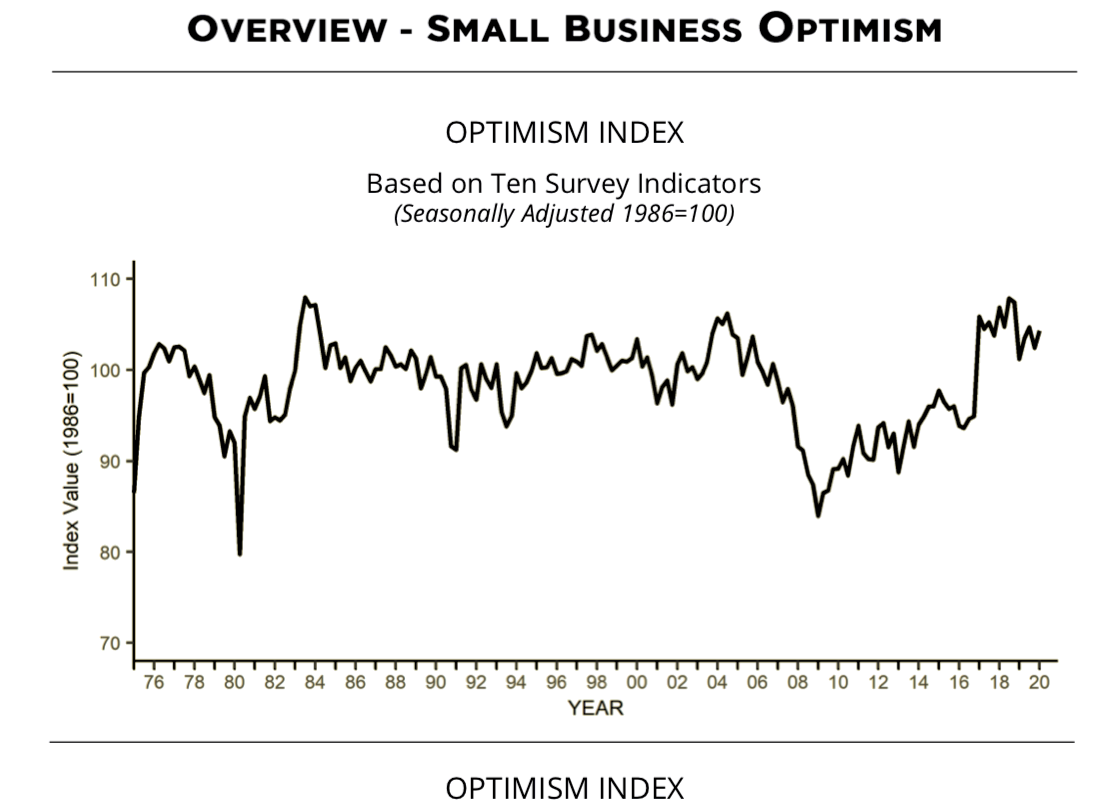
It is true that a new administration inherits economic conditions and policies from its predecessor. Trump inherited an economy that was growing, but there were plenty of strains, including sluggish wage growth, low labor force participation, weak business startups, and a languid housing sector, as this link makes clear. Moreover, economic expansions have lasted an average of only about five years in the post-WW2 era. The current expansion was about 90 months running at the time of Trump’s inauguration, a stage at which vulnerabilities might develop. But new policies often lead to new economic realities. In Trump’s case, that included tax cuts, and especially corporate tax cuts that spurred hiring and wage growth, and more liberalized regulation. Accommodative monetary policy by the Federal Reserve also provided an assist. As the chart at the top shows, Trump’s platform lifted small business enthusiasm considerably, which is a broad indicator of economic vibrancy. Of course, his trade initiatives have probably had negative effects thus far, but his way of negotiating new trade agreements might well end up making a positive contribution, on balance.

Now, the danger of a caronavirus pandemic is presenting major economic challenges. It’s unlikely to produce as many deaths as a bad flu season in the U.S., in part because the Trump Administration took quick action to limit domestic exposure. Nevertheless, the economic consequences of the virus and attempts to control its spread will be significant. At least the economy was strong when the shock occurred, so it is reasonable to expect a rebound if the outbreak runs its course over the next month or two.

The economic record since Trump took office has been impressive given the stage of the business cycle at which he took office. Not only that, but minority wage growth has surged, and minority unemployment has fallen substantially. Let’s face it: Obama and Joe Biden are eager to neutralize any plaudits a strong economy might earn Trump in an election year, but they shouldn’t embarrass themselves by trying to take credit for it, and Chuck Jones could do better than carrying their water.


Negative Rates and the Thrift Imperative

18 Thursday Aug 2016

Posted by Nuetzel in Monetary Policy

≈ Leave a comment

Tags

Central Banking, Federal Reserve, Income effect, negative interest rates, Nominal Interest Rates, Rate Normalization, Reach For Yield, Real Interest Rates, Retained Earnings, Saving and Negative Interest Rates, saving behavior, Steven R. Beckman, Substitution effect, Supriya Guru, Thrift, Time Preference, Undistributed Corporate Profits, W. James Smith, Wall Street Journal, Working Capital

image

An article of faith among central bankers is that negative interest rates will stimulate spending by consumers and businesses, ending the stagnant growth that has plagued many of the world’s biggest economies. Short-term rates are zero or negative in much of Europe and Japan, and even the Federal Reserve holds out the possibility of bringing rates below zero in the event of a downturn. This policy is almost assuredly counter-productive. It very likely stimulates saving, especially in the context of an aging population, and it distorts the allocation of resources over time and across the risk classes to which saving is applied.

Real vs. Nominal Rates

A preliminary consideration is the distinction between the so-called nominal or stated interest rates, those quoted by banks and bond sellers, and real interest rates, which are net of expected inflation. If the short-term nominal interest rate is zero, but expected inflation is -2%, then the real interest rate is +2%. If expected inflation is +2%, then the real interest rate is -2%. When negative rates are discussed in the media, they generally refer to nominal rates, and central bank interest rate targets are discussed in nominal terms. Again, some central banks are targeting very low or slightly negative nominal rates today. In most of these cases, inflation is low but positive, indicating that real interest rates are negative. With that said, it’s important to note that the discussion below relates to real interest rates, not nominal rates, despite the fact that central banks explicitly target the latter.

Saving Behavior

Most macroeconomists casually assume that lower interest rates discourage saving and thus stimulate spending. However, this is being called into question by observers of recent central bank actions around the world. Those actions have been relatively futile in stimulating spending thus far. In fact, data suggest that the negative-rate policies might be increasing saving rates. These points are discussed in “Are Negative Rates Backfiring? Here’s Some Early Evidence” in the Wall Street Journal (or this Google search if the first link fails).

An examination of the microeconomic foundations of the standard treatment of saving behavior shows that it requires some limiting assumptions. We all face constraints in meeting our future income goals: our current income imposes a limit on what we can save, and the rate of return we can earn on our funds limits what we can accumulate over time from a given level of saving. Those constraints must be balanced against an individual’s preferences for present pleasure relative to future gain.

Time Preference

The rate at which agents are willing to sacrifice future for present consumption is often called the rate of time preference. This differs from one individual to another. A high rate of time preference means that the individual requires a large future reward to induce them to set aside resources today, foregoing present consumption. A low rate of time preference means that little inducement is necessary for saving, so the individual is “thrifty”. It’s generally impossible to directly observe differing rates of time preference across individuals, but they reveal their preferences for present and future consumption via their saving (or borrowing) behavior. If an individual saves more than another with an equal income, it implies that the first has a lower rate of time preference at a given level of present consumption.

Substitution and Income Effects

A lower interest rate always creates a tendency to substitute present for future consumption. That’s because the change is akin to an increase in the price of future consumption. However, that substitution might be offset, or more than offset, by the fact that total achievable lifetime income is diminished: the lower rate at which the individual’s use of resources can be transferred from the present to the future means that some sacrifice is necessary. In other words, the negative “income effect” might cause consumers to reduce consumption in the future and in the present! Thus, saving may increase in response to a lower interest rate. Perhaps that tendency will be exaggerated if rates turn negative, but it all depends on the shape of preferences for present versus future consumption.

Which of these two effects will dominate? The substitution effect, which increases present consumption and reduces saving? Or the income effect, which does the opposite? Again, consumers are diverse in their rates of time preference. There are borrowers who prefer to have more now and less later, and savers who might wish to equalize consumption over time or accumulate assets in pursuit of other goals, such as bequests. A shift from a positive to a negative interest rate would reward borrowers who wish to consume more now and less later. Both their substitution and income effects on present consumption would be positive! In fact, spending by that segment might be the only unambiguously stimulative effect from negative rates. But individuals with low rates of time preference are more likely to spend less in the present, and save more, after the change. Two individuals with identical substitution effects in response to the shift to negative rates may well differ in their income effects: the largest saver of the two will suffer the largest negative income effect.

Ugly Intervention

These uneven impacts on saving are a testament to the pernicious effects of central bank intervention leading to negative rates. Savers are punished, while those who care little about self-reliance and planning for the future are rewarded. Of course, at an aggregate level, saving out of income is positive, so on balance, agents demonstrate  that they have sufficiently low rates of time preference to qualify for some degree of punishment via negative rates. After all, savers will unambiguously suffer a decline in lifetime income given the shift to negative rates.

The Necessity of Thrift

The fact that a standard macroeconomic treatment of saving ignores negative income effects at very low rates of interest is surprising given the very nature of thrift. Savers obviously view future consumption as something of a necessity, especially as they approach retirement. Present and future consumption are locally substitutable, but large substitutions come only with great pain, either now or later. Another way of saying this is that present and future consumption behave more like complements than substitutes. (A more technical treatment of this distinction is given in “Complementarity, Necessity and Preferences“, by Steven R. Beckman and W. James Smith.) This provides a basic rationale for a conflicting assumption often made in macroeconomic literature: that economic agents attempt to “smooth” their consumption over time. If present and future consumption are treated as strict complements, there is no question that the income effect of a shift to negative  rates will increase saving by those who already save.

This is not to imply that savers always respond to lower rates by saving more. In “Choice between Present Consumption and Future Consumption“, Supriya Guru asserts that empirical evidence for the U.S. suggests that the substitution effect dominates. However, extremely low or negative interest rates are a recent phenomenon, and empirical evidence is predominantly from periods of history with much higher rates. Moreover, the advent of very low rates is coincident with demographic shifts favoring more intense efforts to save. The aging populations in the U.S., Europe and Japan might reinforce the tendency to respond to negative rates by saving more out of current income.

Risk As a Relief Valve

Another complexity regarding the shape of preferences is that consumers might never be willing to substitute present consumption for less in the future. That is, their rate of time preference may be bounded at zero, even if the interest rate imposed by the central bank is negative. An earlier post on Sacred Cow Chips dealt with this issue. In that case, saving will increase with a shift to negative rates under two conditions: 1) there is a minimal level of future consumption deemed a necessity by consumers; and 2) that level exceeds the consumption that is possible without saving (endowed or received via transfers). That outcome represents a “corner solution”, however. Chances are that consumers, having been forced to accept an unacceptable tradeoff at negative “risk-free” rates, will lean more heavily on other margins along which they can optimize, such as risk and return.

That eventuality suggests another reason to suspect that very low or negative rates are not stimulative: savers face a range of vehicles in which to place their funds, not simply deposits and short-term money market funds earning low or negative yields. Some of these alternatives earn much higher returns, but only at significant risk. Nevertheless, the poor returns on safe alternatives will lead some savers to “reach for yield” by accepting high risks. That is a rational response to the conditions imposed by central banks, but it leads consumers to accept risk that is otherwise not desired, with a certain number of consumers suffering dire ex post outcomes. It also leads to an allocation of the economy’s capital that is riskier than would otherwise occur.

Furthermore, as mentioned in the WSJ article linked above, consumers might regard negative rates as a foreboding signal about the economic future. The negative rates are bad enough, but even reduced levels of future consumption might be under threat. Thus, risk aversion might lead to greater saving in the context of a shift to negative rates.

Corporate Saving and Capital Investment

A great deal of saving in the economy is done by corporate entities in the form of “undistributed corporate profits”, or retained earnings. It must be said that these flows are not especially dependent on short-term yields, even if those yields have a slight influence on corporate management’s view of the opportunity cost of equity capital. Rather, those flows are more dependent on the firm’s current profitability. To the extent that very low or negative interest rates discourage consumption, their effect on current profitability and the perceived profitability of new business capital projects cannot be positive. To the extent that very low or negative rates portend risk, their effect on capital investment decisions will be negative. Savings out of personal income and from retained earnings is likely to exceed the amount required to fund desired capital investment. The funds accumulated in this way will remain idle (excess working capital) or be put toward unproductive uses, as befits an environment in which real returns are negative.

We Gotta Get Out of This Place

Central banks will be disappointed that the primary rationale for their reliance on negative interest rates lacks validity, and that the policy is counterproductive. Statements from Federal Reserve officials indicate that the next expected move in their interest rate target will be upward. However, they have not ruled out negative rates in the event that economic growth turns down. Perhaps the debate over negative rates is still raging inside the Fed. With any luck, and as evidence piles up from overseas on the futility of negative rates, those arguing for a “normalization” of rates at higher levels will carry the day.

Good Leaders Aren’t Trade Warriors

30 Wednesday Mar 2016

Posted by Nuetzel in Free Trade, Protectionism

≈ 1 Comment

Tags

Bernie Sanders, CATO Institute, Currency Manipulation, Daniel J. Ikenson, Direct Foreign Investment, Don Boudreaux, Donald Trump, Dumping, Federal Reserve, Free trade, Hillary Clinton, NAFTA, Open Trade, Paul Krugman, People's Bank of China, Predatory Pricing, Protectionism, Reserve Currency, Ted Cruz, TPP, Trade Deficit, Trade War, Unfair Competition

Protectionism

The protectionist foreign trade rhetoric issued by the major-party presidential candidates is intended to appeal to ignorant economic instincts. Donald Trump and Bernie Sanders come to mind most readily, but Ted Cruz and Hillary Clinton are jumping in with similar campaign positioning. The thrust of these populist, anti-trade appeals is that America is losing jobs to “unfair” foreign competition, an argument that distorts the very objective of trade: consumers take part in exchange in order to consume; they capture value from high quality, unique merchandise and competitive terms. Ultimately, producers engage in trade to gain the wherewithal to consume. Consumption is the real end-game.

It can be misleading to talk about “nations” engaging in trade with each other, despite the emphasis placed on trade agreements like NAFTA and TPP. In the first place, it is better to stress consumers and producers, rather than “nations”, because most foreign trade is private, cooperative activity, not national decision-making. But the candidates persist in characterizing trade as a “contest”. That misleading notion is what prompts governments to muck up the trade environment by imposing restrictions on the free flow of goods and services. Trade agreements have been heralded as great achievements, but they never approximate a regime of truly liberalized trade because the latter requires no formal agreement whatsoever, merely a hands-off approach by government. And trade agreements tend to entangle trade issues with other policy objectives, holding consumers hostage in the process.

We hear from opportunistic candidates that jobs are lost to trade with foreigners. But again, consumption, not “jobs” per se, is the real objective of economic activity. If domestic jobs are lost, it is generally because consumers judge the value produced inferior to what’s offered from abroad. American consumers should not be obliged to support inferior value, domestic market power unchecked by competition, monopoly prices and limited choices. Patriotic jingoism attempts to blind us from these economic imperatives.

The standard protectionist narrative is that foreign “nations” cheat on trade with the U.S. via currency manipulation, predatory pricing or “dumping”, “unfair” wages or other unfair labor practices. Do any of these objections to free trade hold water?

The “fairness” of foreign wages and labor practices is a matter of perspective. Wages cannot be considered unfair merely because they are low relative to U.S. wages. Wages paid to workers by foreign exporters tend to be consistent with the standard of living in those societies, and they are often some of the best income opportunities available there. This is economic dynamism that lifts masses from the grips of poverty. It’s absurd to caste it as “exploitation”.

Is it “unfair” to competitors in the U.S.? Not if they know how to compete and are allowed to do so. Unfortunately, government regulatory policies in the U.S. often present obstacles to the competitiveness of domestic producers. This is well-illustrated by Daniel J. Ikenson of The CATO Institute in “Crucifying Trade For The Sins Of Domestic Policy“. He emphasizes that trade promotes economic growth, but when it causes job losses for some workers, U.S. economic policies make it difficult for those workers to find new jobs.

“Incentivize businesses to hire people to train them in exchange for their commitment to work for the company for a period of time. Reform a corporate tax system that currently discourages repatriation of an estimated $2 trillion of profits parked in U.S. corporate coffers abroad, deterring domestic investment, which is needed for job creation. Curb excessive and superfluous regulations that raise the costs of establishing and operating businesses without any marginal improvements in social, safety, environmental, or health outcomes. Permanently eliminate imports duties on intermediate goods to reduce production costs and make U.S.-based businesses more globally competitive. Advocate the retirement of protectionist occupational licensing practices.“

So-called “dumping” by foreign producers, or selling below cost, is an unsustainable practice, by definition. Pricing below cost is difficult to prove, especially if local wages are low and raw inputs are plentiful. If dumping can be proven, retaliation might feel good but would punish American consumers. A foreign producer might be subsidized by its government as a matter of industrial policy and economic planning, an unhealthy policy to begin with, and possibly to facilitate a long-run market advantage in foreign trade. The U.S. itself is thick with subsidized industry, however, so arguing for retaliation on those grounds is more than a little hypocritical.

I rarely quote Paul Krugman, but when I do, it’s from work he’s done as an actual economist, not as an agenda-driven pundit. So we have the following Krugman quote courtesy of Don Boudreaux:

“I believe that if the rhetoric that portrays international trade as a struggle continues to dominate the discourse, then policy debate will in the end be dominated by men like [James] Goldsmith, who are willing to take that rhetoric to its logical conclusion. That is, trade will be treated as war, and the current system of relatively open world markets will disintegrate because nobody but a few professors believes in the ideology of free trade.

And that will be a shame, because for all their faults the professors are right. The conflict among nations that so many policy intellectuals imagines prevails is an illusion; but it is an illusion that can destroy the reality of mutual gains from trade.“

David Harsanyi asks how American consumers will like more restrictive trade policy when forced to pay more for smart phones, laptops, HDTVs, cars, food, and any number of other goods. The usual anti-trade narrative is that foreign producers have harmed the manufacturing sector disproportionately, but in another article, Ikenson lays bare the fallacy that U.S. manufacturing has been victimized by trade.

The consequences of trade restrictions are higher prices, reduced production and reduced consumption, an undesirable combination of outcomes. This means higher prices of imported goods as well as domestic goods, whose producers will face less competition by virtue of the trade barriers. With reduced availability of imported goods, economic theory predicts that domestic producers will not fully meet the frustrated demands. This is a classic response of producers with monopoly power: restraint of trade. The negative consequences are compounded when foreign governments impose retaliatory measures against the U.S., harming American exporters.

A further misgiving expressed by politicians regarding free trade is that America’s trade deficit implies greater indebtedness to the rest of the world. This argument has been made by a few leftist economists who misunderstand the nature of direct investment, and who tend to think erroneously of economic outcomes as zero-sum. It’s true that foreign producers who receive dollars in exchange for goods often invest those proceeds in U.S. assets. A fairly small share of that investment is in debt issued by U.S. governments and private companies. But a much larger share is invested in U.S. equities and real assets, which are not U.S. debts. As Don Boudreaux points out, the domestic sellers of those assets generally reinvest in other U.S. assets, so private U.S. ownership of global capital is not diminished by increased foreign investment in the U.S.

An interesting aspect of the trade debate is that the dollar’s role as a global reserve currency implies that the U.S. must run a chronic trade deficit. The rest of the world uses dollars to trade goods and assets, but to acquire dollars, foreigners must sell things to holders of dollars in the U.S. This keeps the foreign exchange value of the dollar elevated, which makes imports cheaper to Americans and U.S. exports more costly to foreigners. Those dollars are a form of U.S. debt, but it is debt for which we should feel flattered, as long as confidence in the dollar remains. A diminished role for the dollar in world trade would lead to a surplus of dollars, undermining its value and promoting inflation in the U.S. Let’s hope for a gradual transition to that world.

Finally, the presidential candidates allege that foreign currency manipulation is another reason for American job losses. One prominent example occurred last year when China allowed the renminbi to decline to more realistic levels on foreign exchange markets. Donald Trump called this an unfair trade tactic, but apparently the People’s Bank felt that it couldn’t support the renminbi without undermining economic growth. The earlier dollar peg also helped to keep Chinese inflation in check. Contrary to Trump’s assertions, if China stopped manipulating its currency altogether, the renminbi would go even lower!

Beyond the opportunistic political arguments, the point is that central banks (including the U.S. Federal Reserve) manage their currencies to achieve a variety of objectives, not merely to promote exports. That is not an endorsement of such policies. It is an objective fact. Anyone can argue that a foreign currency is “too low” if their objective is to demonize a country and it’s exports to the U.S., but the assertion may not be grounded in facts as markets assess them.

The arguments against open trade policies are generally specious, hypocritical or grounded in a mentality of victimhood. Vibrant producers who are free of government restrictions should welcome the expanded markets available to them abroad and should not seek redress against competition via government protection. Liberalized trade has engendered tremendous economic benefits over the years, while protectionist policies have only brought severe contractions. Let’s be free and trade freely!


Central Banks Stumble Into Negative Rates, Damn the Savers

01 Tuesday Mar 2016

Posted by Nuetzel in Central Planning, Monetary Policy

≈ 1 Comment

Tags

Bank of Japan, central planning, Federal Reserve, Helicopter Drop, Income Effect vs. Substitution Effect, Interest Rate Manipulation, Intertemporal Tradeoffs, Malinvestment, Mises Institute, Monetary policy, negative interest rates, NIRP, Printing Money, Privacy Rights, QE, Quantitative Easing, Reach For Yield, regulation, War on Cash, Zero Interest Rate Policy, ZIRP

Dollar Cartoon

Should government actively manipulate asset prices in an effort to “manage ” economic growth? The world’s central bankers, otherwise at their wit’s end, are attempting just that. Hopes have been pinned on so-called quantitative easing (QE), which simply means that central banks like the U.S. Federal Reserve (the Fed) buy assets (government and private bonds) from the public to inject newly “printed” money into the economy. The Fed purchased $4.5 trillion of assets between the last financial crisis and late 2014, when it ended its QE. Other central banks are actively engaged in QE, however, and there are still calls from some quarters for the Fed to resume QE, despite modest but positive economic growth. The goals of QE are to drive asset prices up and interest rates down, ultimately stimulating demand for goods and economic growth. Short-term rates have been near zero in many countries (and in the U.S. until December), and negative short-term interest rates are a reality in the European Union, Japan and Sweden.

Does anyone really have to pay money to lend money, as indicated by a negative interest rate? Yes, if a bank “lends” to the Bank of Japan, for example, by holding reserves there. The BOJ is currently charging banks for the privilege. But does anyone really “earn” negative returns on short-term government or private debt? Not unless you buy a short-term bill and hold it till maturity. Central banks are buying those bills at a premium, usually from member banks, in order to execute QE, and that offsets a negative rate. But the notion is that when these “captive” member banks are penalized for holding reserves, they will be more eager to lend to private borrowers. That may be, but only if there are willing, credit-worthy borrowers; unfortunately, those are scarce.

Thus far, QE and zero or negative rates do not seem to be working effectively, and there are several reasons. First, QE has taken place against a backdrop of increasingly binding regulatory constraints. A private economy simply cannot flourish under such strictures, with or without QE. Moreover, government makes a habit of manipulating investment decisions, partly through regulatory mandates, but also by subsidizing politically-favored activities such as ethanol, wind energy, post-secondary education, and owner-occupied housing. This necessarily comes at the sacrifice of opportunities for physical investment that are superior on economic merits.

The most self-defeating consequence of QE and rate manipulation, be that zero interest rate policy (ZIRP) or negative interest rate policy (NIRP), is the distortion of inter-temporal tradeoffs that guide decisions to save and invest in productive assets. How, and how much, should individuals save when returns on relatively safe assets are very low? Most analysts would conclude that very low rates prompt a strong substitution effect toward consuming more today and less in the future. However, the situation may well engender a strong “income effect”, meaning that more must be saved (and less consumed in the present) in order to provide sufficient resources in the future. The paradox shouldn’t be lost on central bankers, and it may undermine the stimulative effects of ZIRP or NIRP. It might also lead to confusion in the allocation of productive capital, as low rates could create a mirage of viability for unworthy projects. Central bank intervention of this sort is disruptive to the healthy transformation of resources across time.

Savers might hoard cash to avoid a negative return, which would further undermine the efficacy of QE in creating monetary stimulus. This is at the root of central bank efforts to discourage the holding of currency outside of the banking system: the “war on cash“. (Also see here.) This policy is extremely offensive to anyone with a concern for protecting the privacy of individuals from government prying.

Another possible response for savers is to “reach for yield”, allocating more of their funds to high-risk assets than they would ordinarily prefer (e.g., growth funds, junk bonds, various “alternative” investments). So the supply of saving available for adding to the productive base in various sectors is twisted by central bank manipulation of interest rates. The availability of capital may be constrained for relatively safe sectors but available at a relative discount to risky sectors. This leads to classic malinvestment and ultimately business failures, displaced workers, and harsh adjustment costs.

With any luck, the Fed will continue to move away from this misguided path. Zero or negative interest rates imposed by central banks penalize savers by making the saving decision excessively complex and fraught with risk. Business investment is distorted by confusing signals as to risk preference and inflated asset prices. Central economic planning via industrial policy, regulation, and price controls, such as the manipulation of interest rates, always ends badly. Unfortunately, most governments are well-practiced at bungling in all of those areas.


Enduring A Dead-Weight Dominion

13 Wednesday Jan 2016

Posted by Nuetzel in Big Government, Macroeconomics

≈ Leave a comment

Tags

Anthony de Jasay, Automatic Stabilizers, Big government, Boom and Bust Cycle, central planning, Code of Federal Regulations, Double Taxation, Federal Reserve, Final Output, Government intervention, infrastructure, Intermediate Transactions, John Maynard Keynes, Keynesian Economics, Malinvestment, Mark Skousen, Mercatus Center, Shovel-Ready Projects, Spontaneous Order, Stabilization policy, Too big to fail, Underconsumption

government-intervention

If you hope for government to solve economic problems, try to maintain some perspective: the state has unique abilities to botch it, and its power to distort and degrade the economy in the process of “helping” is vast. Government spending at all levels copped about 18% of the U.S.  economy’s final output in 2014, but the public sector’s impact is far more pervasive than that suggests. Private fixed investment in new structures and equipment accounted for only about 16% of Gross Domestic Product (GDP); the nonresidential portion of fixed investment was less than 13% of GDP. I highlight these two components of GDP because no one doubts the importance of capital investment as a determinant of the economy’s productive capacity. But government is a larger share of spending, it can divert saving away from investment, and it creates a host of other impediments to productivity and efficient resource allocation.

The private economy is remarkable in its capacity to satisfy human wants. The market is a manifestation of spontaneous order, lacking the conscious design of any supreme authority. It is able to adjust to dynamic shifts in desires and resource constraints; it provides reliable feedback in the form of changing prices to modulate and guide the responses of participants through all stages of production. Most forms of government activity, however, are not guided by these signals. Instead, the state imposes binding and sometimes immediate constraints on the decisions of market participants. The interference takes a number of forms, including price controls, but they all have the power to damage the performance and outcomes of markets.

The productive base at each stage of the market process is a consequence of the interplay of perceived business opportunities and acts of saving or deferred consumption. The available flow of saving depends on its rewards, which are heavily influenced by taxes and government intervention in financial markets. It’s worth noting here that the U.S. has the highest corporate tax rates in the developed world, as well as double taxation of corporate income paid out to owners. In addition, the tax system is used as a tool to manipulate the allocation of resources, drawing them into uses that are politically favored and punishing those in disfavor. The damaging impact is compounded by the fact that changes in taxes are often unknown ex ante. This adds a degree of political risk to any investment decision, thus discouraging capital spending and growth in the economy’s productive base.

The government is also a massive and growing regulator of economic activity. Over 100,000 new regulatory restrictions were added to the Code of Federal Regulations between 2008 and 2012. Regulation can have prohibitive compliance costs and may forbid certain efficiencies, often based on flimsy or nonexistent cost/benefit comparisons. It therefore damages the value and returns on embedded capital and discourages new investment. It is usually uneven in its effects across industries and it typically reduces the level of competition in markets because small firms are less capable of surviving the costs it imposes. Innovation is stifled and prices are higher as a result.

From a philosophical perspective, even the best cost/benefit comparisons are suspect as tools for evaluating government intervention. Don Boudreaux quotes Anthony de Jasay’s The State on this point:

“What could be more innocuous, more unexceptional than to refrain from intervening unless the cost-benefit comparison is favourable? Yet it treats the balancing of benefits and costs, good and bad consequences, as if the logical status of such balancing were a settled matter, as if it were technically perhaps demanding but philosophically straightforward. Costs and benefits, however, stretch into the future (problems of predictability) and benefits do not normally or exclusively accrue to the same persons who bear the costs (problems of externality). … Treating it as a pragmatic question of factual analysis, one of information and measurement, is tacitly taking the prior and much larger questions as having been somehow, somewhere resolved. Only they have not been.“

Poorly-executed and inappropriate stabilization policy is another way in which government distorts decisions at all stages of production. There are many reasons why these policies tend to be ineffective and potentially destructive, especially in the long run. Keynesian economics, based on ideas articulated by John Maynard Keynes, offers prescriptions for government action during times of instability. That means “expansionary” policy when the economy is weak and “contractionary” policy when it is strong.  At least that is the intent. This framework relies on the notion that components of aggregate demand determine the economy’s output, prices and employment.

The major components of GDP in the National Income and Product Accounts are consumer spending, private investment, government spending, and net foreign spending. In a Keynesian world, these are treated as four distinct parts of aggregate “demand”, and each is governed by particular kinds of assumed behavior. Supply effects are treated with little rigor, if at all, and earlier stages of production are considered only to the extent that their value added is included, and that the finished value of  investment (including new inventories) is one of the components of aggregate demand.

Final spending on goods and services (GDP) may be convenient because it corresponds to GDP, but that is simply an accounting identity. In fact, GDP represents less than 45% of all transactions. (See the end note below.) In other words, intermediate transactions for raw materials, business-to-business (B2B) exchange of services and goods in a partly fabricated state, and payments for distributional services are not counted, but they exceed GDP. They are also more variable than GDP over the course of the business cycle. Income is generated and value is added at each stage of production, not only in final transactions. To say that “value-added” is counted across all stages is a restatement of the accounting identity. It does not mean that those stages are treated behaviorally. Technology, capital, employees, and complex decision-making are required at each stage to meet demands in competitive markets. Aggregation at the final goods level glosses over all this detail.

The focus of the media and government policymakers in a weak economy is usually on “underconsumption”. The claim is often heard that consumer spending represents “over two-thirds of the economy”, but it is only about one-third of total transactions at all levels. It is therefore not as powerful an engine as many analysts assert. Government efforts to stimulate consumption are often thwarted by consumers themselves, who behave in ways that are difficult for models to capture accurately.

Government spending to combat weakness is another typical prescription, but such efforts are usually ill-timed and are difficult to reverse as the economy regains strength. The value of most government “output” is not tested in markets and it is not subject to competitive pressure, so as the government absorbs additional resources, the ability of the economy to grow is compromised. Programmatic ratcheting is always a risk when transfer payments are expanded. (Fixed programs that act as “automatic stabilizers”, and that are fiscally neutral over the business cycle, are less objectionable on these grounds, but only to the extent that they are not manipulated by politicians or subject to fraud.) Furthermore, any measure that adds to government deficits creates competition for the savings available for private capital investment. Thus, deficits can reduce the private economy’s productive capacity.

Government investment in infrastructure is a common refrain, but infrastructure spending should be tied to actual needs, not to the business cycle. Using public infrastructure spending for stabilization policy creates severe problems of timing. Few projects are ever “shovel-ready”, and rushing into them is a prescription for poor management, cost overruns and low quality.

Historically, economic instability has often been a consequence of poorly-timed monetary policy actions. Excessive money growth engineered by the Federal Reserve has stimulated excessive booms and inflation in the prices of goods and assets. These boom episodes were followed by market busts and recessions when the Fed attempted to course-correct by restraining money growth. Booms tend to foster misjudgments about risk that end in over-investment in certain assets. This is especially true when government encourages risk-taking via implicit “guarantees” (Fannie Mae and Freddie Mac) and “too-big-to-fail” promises, or among individuals who can least afford it, such as low-income homebuyers.

Given a boom-and-bust cycle inflicted by monetary mismanagement, attempts to stimulate demand are usually the wrong prescription for a weak economy. Unemployed resources during recessions are a direct consequence of the earlier malinvestment. It is better to let asset prices and wages adjust to bring them into line with reality, while assisting those who must transition to new employment. The best prescription for instability is a neutral stance toward market risks combined with stable policy, not more badly-timed countercyclical efforts. The best prescription for economic growth is to shrink government’s absorption of resources, restoring their availability to those with incentives to use them optimally.

The more that central authorities attempt to guide the economy, the worse it gets. The torpid recovery from the last recession, despite great efforts at stimulus, demonstrates the futility of demand-side stabilization policy. The sluggishness of the current expansion also bears witness to the counterproductive nature of government activism. It’s a great credit to the private market that it is so resilient in the face of long-standing government economic and regulatory mismanagement. A bureaucracy employing a large cadre of technocrats is a “luxury” that only a productive, dynamic economy can afford. Or can it?

~~~~~~~~~~~~~~~~~~~~~~~~~~~~~~~~~~~~~~~~~~~~~~~~~~~~~~~~~~~~~~~~~~~~

A Note On Output Measures

More complete aggregations of economic activity than GDP are gross output (GO) and gross domestic expenditures (GDE). These were developed in detail by economist Mark Skousen in his book “The Structure of Production“, published in 1990. GO includes all final transactions plus business-to-business (B2B) transactions, while GDE adds the costs of wholesale and retail distribution to GO. Or as Skousen says in this paper:

“GDE is defined as the value of all transactions (sales) in the production of new goods and services, both finished and unfinished, at all stages of production inside a country during a calendar year.“

GO and GDE show the dominance of business transactions in economic activity. GDE is more than twice as large as GDP, and B2B transactions plus business investment are twice the size of consumer spending. According to Skousen, GDE varies with the business cycle much more than GDP. Many economic indicators focus on statistics at earlier stages of production, yet real final spending is often assumed to be the only measure of transactions that matters.


ZIRP: Zero Interest Retirement Poverty

22 Wednesday Apr 2015

Posted by Nuetzel in Macroeconomics

≈ 2 Comments

Tags

Austrian Economics, Barron's, Ben Bernanke, EconoMonitor, Federal Reserve, Income effect, Keynesianism, Phoenix Capital Management, Randall Forsyth, rate of time preference, saving behavior, Substitution effect, The Economist, Thorsten Polliet, Trust Your Instincts, ZIRP

seniors

Far be it from me to make a Keynesian economic argument, but I will play devil’s advocate and do so at the risk of alienating any Austrian friends in the audience. They might or might not appreciate the point before I’m done. Writing in Barron’s, Randall Forsyth argues that a zero or negative real interest rate, or specifically a zero interest rate policy (ZIRP), will backfire on central banks precisely because low rates add to the pressure on consumers to save. If that is the case, in the Keynesian paradigm, the policy would undermine consumer demand and lead to weaker growth.

I find it plausible that savers might react to extremely low interest rates by increasing saving. With an aging population and baby boomers fast approaching their retirement years, low interest rates mean diminished opportunities to build on existing assets. The only way to bring more assets into retirement safely is to save more. There has been much said about the impact of quantitative easing and ZIRP on asset values, and the tendency of investors to “reach” for higher, but risker, returns. However, a decent, safe return is hard to come by.

This kind of saving behavior is easy enough to demonstrate for a consumer who must choose between present and future consumption. Present consumption is limited by what the consumer can earn now. Future consumption is limited by what the consumer saves now (does not consume) and the real return or interest rate that can be earned on that saving. The consumer maximizes well being by choosing the most-preferred “bundle” of present consumption and future consumption attainable. But when the interest rate falls to zero, for example, the consumer must reallocate the bundle.

First, the “effective price” of present consumption has declined, since less future consumption must be sacrificed in order to to consume now. So there is a tendency to reallocate the bundle toward more present consumption as a pure “substitution effect”. However, the consumer’s lifetime income has declined precisely because the real rate at which present saving can be transformed into future consumption has decreased. The bundles available for the consumer to choose from are now unambiguously less preferred than the original bundle. Faced with this worsened constraint, the consumer may choose to divide the sacrifice between present consumption and future consumption. The negative income effect on present consumption may well outweigh the substitution effect.

This is standard economics, but relatively little has been said about the possibility. Instead, it is widely assumed that ZIRP must reduce saving, but there have been a few writers making the argument that saving may increase. In 2010, the Buttonwood column in The Economist made this argument in a piece entitled “Another Paradox of Thrift“. In 2012, the Trust Your Instincts blog ran this interesting piece on ZIRP and saving behavior in which the possibility is discussed. For the same reason, Phoenix Capital Management asserted that “QE and ZIRP Are Deflationary“, And the same thing is mentioned in EconoMonitor.

Continuing to indulge Forsyth’s possibility, it does not imply that increased saving from ZIRP will be channeled into productive investment. That’s because governments continue to absorb private saving by running historically large deficits. But I must note that the possibility of increased saving in response to ZIRP may contradict a couple of points made in an earlier post on Sacred Cow Chips: “Taking The Air Out of the Deflation Scare“. That post quotes Thorsten Polliet in support of the notion that the rate of time preference underlying consumer behavior cannot be zero or negative. Does that conclusion change when consumers order bundles rationally with a budget constraint that implies a negative return? In fact, the macroeconomic concept of a time preference “parameter” appears to be inconsistent with the normal micro theory of consumer utility maximization.

Increased saving from ZIRP leads to a second apparent contradiction of Polliet, who says:

“Should a central bank really succeed in making all market interest rates negative in real terms, savings and investment would come to a shrieking halt: as time preference and the originary interest rate are always positive, “capitalistic saving” — the accumulation of goods designed for improving the production process — would come to an end.”

But again, the possibility that saving may increase does not imply that capital investment will increase as well, as long as the government is absorbing the increased saving. In fact, the adoption of ZIRP policies around the developed world seems in large part intended to accommodate large government deficits by keeping interest costs low.

The evidence that ZIRP encourages saving is mixed. Japanese saving rates tended to edge up over the country’s many years of ZIRP (since 1999). More recent experience in the EU seems mixed. In the U.S., saving rates increased during the financial crisis even before ZIRP began, moved down during the recovery, but have since returned to relatively high levels. The Federal Reserve claims that consumers continue to unwind the excessive leverage that built up prior to the recession, and of course that is saving. Paying down debt certainly carries a higher and safer return than many other options. ZIRP cannot be counted upon to encourage consumer spending, and it may well do the opposite.

← Older posts
Newer posts →
Follow Sacred Cow Chips on WordPress.com

Recent Posts

  • A Warsh Policy Scenario At the Federal Reserve
  • The Coexistence of Labor and AI-Augmented Capital
  • The Case Against Interest On Reserves
  • Immigration and Merit As Fiscal Propositions
  • Tariff “Dividend” From An Indigent State

Archives

  • February 2026
  • January 2026
  • December 2025
  • November 2025
  • October 2025
  • September 2025
  • August 2025
  • July 2025
  • June 2025
  • May 2025
  • April 2025
  • March 2025
  • February 2025
  • January 2025
  • December 2024
  • November 2024
  • October 2024
  • September 2024
  • August 2024
  • July 2024
  • June 2024
  • May 2024
  • April 2024
  • March 2024
  • February 2024
  • January 2024
  • December 2023
  • November 2023
  • August 2023
  • July 2023
  • June 2023
  • May 2023
  • April 2023
  • March 2023
  • February 2023
  • January 2023
  • December 2022
  • November 2022
  • October 2022
  • September 2022
  • August 2022
  • July 2022
  • June 2022
  • May 2022
  • April 2022
  • March 2022
  • February 2022
  • January 2022
  • December 2021
  • November 2021
  • October 2021
  • September 2021
  • August 2021
  • July 2021
  • June 2021
  • May 2021
  • April 2021
  • March 2021
  • February 2021
  • January 2021
  • December 2020
  • November 2020
  • October 2020
  • September 2020
  • August 2020
  • July 2020
  • June 2020
  • May 2020
  • April 2020
  • March 2020
  • February 2020
  • January 2020
  • December 2019
  • November 2019
  • October 2019
  • September 2019
  • August 2019
  • July 2019
  • June 2019
  • May 2019
  • April 2019
  • March 2019
  • February 2019
  • January 2019
  • December 2018
  • November 2018
  • October 2018
  • September 2018
  • August 2018
  • July 2018
  • June 2018
  • May 2018
  • April 2018
  • March 2018
  • February 2018
  • January 2018
  • December 2017
  • November 2017
  • October 2017
  • September 2017
  • August 2017
  • July 2017
  • June 2017
  • May 2017
  • April 2017
  • March 2017
  • February 2017
  • January 2017
  • December 2016
  • November 2016
  • October 2016
  • September 2016
  • August 2016
  • July 2016
  • June 2016
  • May 2016
  • April 2016
  • March 2016
  • February 2016
  • January 2016
  • December 2015
  • November 2015
  • October 2015
  • September 2015
  • August 2015
  • July 2015
  • June 2015
  • May 2015
  • April 2015
  • March 2015
  • February 2015
  • January 2015
  • December 2014
  • November 2014
  • October 2014
  • September 2014
  • August 2014
  • July 2014
  • June 2014
  • May 2014
  • April 2014
  • March 2014

Blogs I Follow

  • Passive Income Kickstart
  • OnlyFinance.net
  • TLC Cholesterol
  • Nintil
  • kendunning.net
  • DCWhispers.com
  • Hoong-Wai in the UK
  • Marginal REVOLUTION
  • Stlouis
  • Watts Up With That?
  • American Elephants
  • The View from Alexandria
  • The Gymnasium
  • A Force for Good
  • Notes On Liberty
  • troymo
  • SUNDAY BLOG Stephanie Sievers
  • Miss Lou Acquiring Lore
  • Your Well Wisher Program
  • Objectivism In Depth
  • RobotEnomics
  • Orderstatistic
  • Paradigm Library
  • Scattered Showers and Quicksand
  • Jam Review

Blog at WordPress.com.

Passive Income Kickstart

OnlyFinance.net

TLC Cholesterol

Nintil

To estimate, compare, distinguish, discuss, and trace to its principal sources everything

kendunning.net

The Future is Ours to Create

DCWhispers.com

Hoong-Wai in the UK

A Commonwealth immigrant's perspective on the UK's public arena.

Marginal REVOLUTION

Small Steps Toward A Much Better World

Stlouis

Watts Up With That?

The world's most viewed site on global warming and climate change

American Elephants

Defending Life, Liberty and the Pursuit of Happiness

The View from Alexandria

In advanced civilizations the period loosely called Alexandrian is usually associated with flexible morals, perfunctory religion, populist standards and cosmopolitan tastes, feminism, exotic cults, and the rapid turnover of high and low fads---in short, a falling away (which is all that decadence means) from the strictness of traditional rules, embodied in character and inforced from within. -- Jacques Barzun

The Gymnasium

A place for reason, politics, economics, and faith steeped in the classical liberal tradition

A Force for Good

How economics, morality, and markets combine

Notes On Liberty

Spontaneous thoughts on a humble creed

troymo

SUNDAY BLOG Stephanie Sievers

Escaping the everyday life with photographs from my travels

Miss Lou Acquiring Lore

Gallery of Life...

Your Well Wisher Program

Attempt to solve commonly known problems…

Objectivism In Depth

Exploring Ayn Rand's revolutionary philosophy.

RobotEnomics

(A)n (I)ntelligent Future

Orderstatistic

Economics, chess and anything else on my mind.

Paradigm Library

OODA Looping

Scattered Showers and Quicksand

Musings on science, investing, finance, economics, politics, and probably fly fishing.

Jam Review

"If you get confused, listen to the music play."

  • Subscribe Subscribed
    • Sacred Cow Chips
    • Join 128 other subscribers
    • Already have a WordPress.com account? Log in now.
    • Sacred Cow Chips
    • Subscribe Subscribed
    • Sign up
    • Log in
    • Report this content
    • View site in Reader
    • Manage subscriptions
    • Collapse this bar
 

Loading Comments...