• About

Sacred Cow Chips

Sacred Cow Chips

Tag Archives: National Security

Trump’s New Corporatist Plunder Will Cost U.S.

05 Friday Sep 2025

Posted by Nuetzel in Central Planning, Protectionism, Socialism

≈ Leave a comment

Tags

AMD, central planning, CHIPS Act, Corporatism, Don Boudreaux, Donald Trump, Extortion, fascism, Golden Share, Howard Lutnick, Intel, MP Materials, National Security, Nippon Steel, NVIDIA, Protectionism, Public debt, Scott Bessent, Socialism, Tad DeHaven, TikTok, U.S. Steel, Unfunded Obligations, Veronique de Rugy

Since his inauguration, Donald Trump has been busy finding ways for the government to extort payments and ownership shares from private companies. This has taken a variety of forms. Tad DeHaven summarizes the major pieces of booty extracted thus far in the following bullet points (skipping the quote marks here):

  • June 13: Trump issues an executive order allowing the Nippon Steel-US Steel deal contingent on giving the government a “golden share” that enables the president to exert extensive control over US Steel’s operations.
  • July 10: The Department of Defense (DoD) unveils a multi-part package with convertible preferred stock, warrants, and loan guarantees, making it the top shareholder of rare earth metals producer MP Materials.
  • July 23: The White House claims an agreement with Japan to reduce the president’s so-called reciprocal tariff rate on Japanese imports comes with a $550 billion Japanese “investment fund” that Trump will control.
  • July 31: Trump claims an agreement with South Korea to reduce the so-called reciprocal tariff on South Korean imports comes with a $350 billion South Korean-financed investment in projects “owned and controlled by the United States” that he will select.
  • August 11: The White House confirms an “unprecedented” deal with Nvidia and AMD that allows them to sell particular chips to China in exchange for 15 percent of the sales.
  • August 12: In a Fox Business interview, Bessent points to the alleged investments from Japan, South Korea, and the EU “to some extent” and says, “Other countries, in essence, are providing us with a sovereign wealth fund.”
  • August 22: Fifteen days after calling for Intel CEO Lip-Bu Tan to resign, Trump announces that the US will take a 10 percent equity stake in Intel using the CHIPS Act and DoD funds, becoming Intel’s largest single shareholder.

Each of these “deals” has a slightly different back story, but national security is a common theme. And Trump says they’ll all make America great again. They are touted as a way for American taxpayers to benefit from the investment he claims his policies are attracting to the U.S. However, all of these are ill-advised for several reasons, some of which are common to all. That includes the extortionary nature of each and every one of them.

Short Background On “Deals”

The June 13 deal (Nippon/US Steel), the July 10 deal (MP Materials), and the August 22 deal (Intel) all involve U.S. government equity stakes in private companies. The August 11 deal (NVIDIA/AMD) diverts a stream of private revenue to the government. The July 23 and July 31 deals (Japan and South Korea) both involve “investment funds” that Trump will control to one extent or another.

The August 12 entry adds “expected” EU investments with some qualification, but that bullet quotes Treasury Secretary Bessent referring to these investments as part of a sovereign wealth fund (SWF). Secretary of Commerce Lutnick now denies that an SWF will exist. My objections might be tempered slightly (but only slightly) by an SWF because it would probably need to place constraints on an Administation’s control. That might give you a hint as to why Lutnick is now downplaying the creation of an SWF.

I object to the Nippon/US Steel “deal” in part (and only in part) because it was extortion on its face. There is no valid anti-trust argument against the deal (US Steel is the nation’s third largest steelmaker and is broke), and the national security concerns that were voiced (Japan! for one thing) were completely bogus. Even worse, the “Golden Share” would give the federal government authority, if it chose to exercise it, over a variety of the company’s decisions.

The Intel “deal” is another highly questionable transaction. Intel was to receive $11 billion under the CHIPS Act, a fine example of corporate welfare, as Veronique de Rugy once described the law. However, Intel was to receive its grants only if it stood up four fabrication facilities. But it did not. Now, instead of demanding reimbursement of amounts already paid, the government offered to pay the remainder in exchange for a 9.9% stake in the company. And there is no apparent requirement that Intel meet the original committment! This could turn out a bust!

The MP Materials transaction with the Department of Defense has also been rationalized on national security grounds. This excuse comes a little closer to passing the smell test, but the equity stake is objectionable for other reasons (to follow).

The Nvidia/AMD deal has been justified as compensation for allowing the companies to sell chips to China, which is competing with the U.S. to lead the world in AI development. This is another form of selective treatment, here applied to an export license. The chips in question do not have the same advanced specifications as those sold by the companies in the U.S., but let’s not let that get in the way of a revenue opportunity.

While nothing about TikTok appears on the list above, I fear that a resolution of its operational status in the U.S. presents another opportunity for extortion by the Trump Administration. I’m sure there will be many other cases.

Root Cause: Protectionism

The so-called investment funds described in the timeline above are nearly all the result of trade terms negotiated by a dominant and belligerent trading partner: the U.S. My objections to tariffs are one thing, but here we are extorting investment pledges for reductions in the taxes we’ll impose on our own citizens! Additionally, the belief that these investments will somehow prevent a general withdrawal of foreign investment in the U.S. is misguided. In fact, a smaller trade deficit dictates less foreign investment. The difference here is that the government will wrest ownership control over a greater share of less foreign investment.

Trump the Socialist?

Needless to say, I don’t favor government ownership of the means of production. That’s socialism, but do matters of national security offer a rationale for public ownership? For example, rare earth minerals are important to national defense. Therefore, it’s said that we must ensure a domestic supply of those minerals. I’m not convinced that’s true, but in any case, fat defense contracts should create fat profit opportunities in mining rare earths (enter MP Materials). None of that means public ownership is necessary or a good idea.

All of these federal investments are construed, to one extent or another, as matters of national security, but that argument for market intervention is much too malleable. Must we ensure a domestic supply of semiconductors for national security reasons? And public ownership? Is the same true of steel? Is the same true of our “manufacturing security”? It can go on and on. The next thing you know, someone will argue that grocery stores should be owned by the government in the name of “food security”! Oh, wait…

Trump the Central Planner

Government ownership takes the notion of industrial planning a huge step beyond the usual conception of that term. Ordinarily, when government takes the role of encouraging or discouraging activity in particular industries or technologies, it attempts to select winners and losers. The very idea presumes that the market is not allocating resources in an optimal way, as if the government is in any position to gainsay the decisions of private market participants who have skin in the game. This is a foolhardy position with predictably negative consequences. (For some examples, see the first, second, and fourth articles linked here by Don Boudreaux.) The fundamental flaw in central planning always comes down to the inability of planners to collect, process, and act on the information that the market handles with marvelous efficiency.

When government invests taxpayer funds in exchange for ownership positions in private concerns, the potential levers of control are multiplied. One danger is that political guidance will replace normal market incentives. And as de Rugy points out, the government’s potential role as a regulator creates a clear conflict of interest. In a strong sense, a government ownership stake is worse for private owners than a mere dilution of their interests. It looms as a possible taking, as private owners and managers surrender to creeping government extortion.

Financial Malfeasance

In addition to the objections above, I maintain that these investments represent poor stewardship of public funds. The U.S. public debt currently stands at $37 trillion with an entitlement disaster still to come. In fact, according to one estimate, the federal government’s total unfunded obligations amount to additional $121 trillion! Putting aside the extortion we’re witnessing, any spare dollar should be put toward retiring debt, rather than allowing its upward progression.

As I’ve noted before, paying off a dollar of debt entails a risk-free “return” in the form of interest cost avoidance, let’s say 3.5% for the sake of argument. If instead the dollar is “invested” in risk assets by the government, the interest cost is still incurred. To earn a net return as high as the that foregone from interest avoidance, the government must consistently earn at least 7% on its invested dollar. But of course that return is not risk-free!

A continuing failure to pay down the public debt will ultimately poison the debt market’s assessment of the government’s will to stay within its long-run budget constraint. That would ultimately manifest in an inflation, shrinking the real value of the public debt even as it undermines the living standards of many Americans.

One final thought: Though few MAGA enthusiasts would admit it even if they understood, we’re witnessing a bridging of two ends of the idealogical “horseshoe”. Right-wing populism and protectionism meet the left-wing ideal of central planning and public ownership. There is a name for this particular form of corporatist state, and it is fascism.

My Foolish Hopes For Free Trade Bargaining

24 Saturday May 2025

Posted by Nuetzel in Central Planning, Free Trade

≈ 2 Comments

Tags

Balance of Payments, Big Beautiful Bill, central planning, Coercion, Cronyism, Donald Trump, Eric Boehm, Fiscal Restraint, Foreign Investment, Free trade, Liberation Day, National Security, Non-Tariff Barriers, Price Pressures, Punitive Tariffs, Reciprocal Tariffs, Retaliatory Tariffs, Selective Tariffs, Tariff Exceptions, Tariff Incidence, Trade Deals, Trade Deficit

Just a few weeks back I engaged in wishful speculation that Trump’s drastic imposition of “reciprocal” and punitive tariffs could actually prove to be a free-trade play, but only if the U.S. used its universally dominant position in trade wisely at the bargaining table. I worried, however, that any notion Trump might have along those lines was eclipsed by his antipathy for otherwise harmless trade deficits. Another bad indicator was his conviction that manipulating tariffs could restore “fairness” in trade relations while raising revenue to pay for the selective tax cuts he promised for tips, overtime wages, and social security benefits.

Aside from that, I won’t repeat all of Trump’s fallacies about trade (and see here and here) except where they’ve impinged on recent developments.

One Raw Deal

My hopes for reduced trade barriers were dashed when the first “deal” (or really a “Memorandum of Understanding”) was announced with the United Kingdom. The U.S. runs a trade surplus with the UK, so one might think Trump would find it unnecessary to levy tariffs on U.S. imports from the UK. No dice! Clearly this was not motivated by the trade deficit bogeyman of Trump’s fever dreams. The White House stated that buyers of goods from the UK will pay the minimum 10% tariff (up from 3.3% before Trump took office).

Trump simply likes tariffs. Apparently he’s never given much thought to their incidence, which falls largely on domestic consumers and businesses. The MAGA faithful are in blissful denial that such a burden exists, despite ample evidence of its reality.

As Eric Boehm notes, the U.S. received a few concessions on British tariffs under the deal, but the reductions only amount to about a 2% equivalent. There are sharp reductions in special tariffs on U.S. agricultural products, especially meat. There are also exceptions to tariffs on certain British goods, like autos (up to 100,000 units). The selective nature of the concessions on both sides underscores the cronyist underpinnings of this style of economic governance, which amounts to ad hoc central planning.

Also troubling is the misleading spin the Administration attempted to put on news coverage of the deal. They claimed to have reduced tariffs of goods imported from the UK, which is true only in comparison to post-“Liberation Day” tariff levels established in early April. In fact, the baseline tariff now applied to most UK goods sold in the U.S. has more than tripled since last year! As Boehm states, American consumers and businesses are paying a lot more for this “deal” than their British counterparts.

Raw Deals To Be?

The “deal” with China is worse, partly because it’s only a 90-day pause in implementation (pending negotiation), and partly because the “reciprocal” tariff rate of 30% applied to Chinese goods is much higher than before Trump imposed the punitive rates. Still worse, the 10% tariff on U.S. exports to China applied during the pause is also much higher. What a deal! And it could get worse. These tariff hikes have little to do with “national security” and they are regressive, having disproportionately large burdens on lower-income consumers and small businesses.

The only other agreement announced thus far is with India. It is not a “trade deal” at all, but a so-called “Terms of Reference On Bilateral Trade Agreement”. It is a “roadmap” for future negotiations. Perhaps it will come together quickly, but it’s hard to expect much after the UK agreement.

Uniting Western Civilization

Just this week we had another hardball move by Trump: a 50% tariff on goods from the European Union starting in June, up from an average of about 3.8% on a trade-weighted basis. The new tariff rate is also higher than the 10% baseline tariff in place since the 90-day pause was announced in April. Trump claims the EU has been levying tariffs of 39% on U.S. goods, which might include what the Administration would call effective tariffs from non-tariff barriers to trade. Or it might refer to retaliatory tariffs announced by the EU in response to Trump’s Liberation Day announcement, but all of those have been paused. In any case, the World Trade Organization says EU tariffs on US goods average 4.8%. Quite a difference!

The move against the EU is much like Trump’s earlier ploy with China, but he says he’s “not looking for a deal”. He also says talks with the EU are “going nowhere”, though the Polish Trade Minister reassures that talks are “ongoing”. The outcome is likely to be a disappointment for anyone (like me) hoping for freer trade. The EU will probably make commitments to buy something from the U.S., maybe beef or liquified natural gas. But U.S. tariffs on EU goods will be higher than in the past.

So, thus far we have only one “deal” (such as it is), one roadmap for negotiations to follow, and a bunch of pauses pending negotiation (China included). The Trump team says about 100 countries hope to negotiate trade deals, but that is a practical impossibility. Even Trump says “… it’s not possible to meet the number of people that want to see us.” But it could be easy: just drop all U.S. trade barriers and allow protectionist countries to tax their own citizens, denying them access to free choice.

Bullying Enemies, Allies and Producers

Higher U.S. tariffs will put some upward pressure on the prices of imports and import-competing goods. We haven’t seen this play out just yet, but it’s early. In a defensive move, Trump is attempting to bully and shame domestic companies such as WalMart for attempting to protect their bottom lines in the face of tariffs. He also warned automakers about their pricing before carving out an exception for them. And now Apple has been singled-out by Trump for a special 25% tariff after it had announced plans to move assembly of iPhones to India, rather than in the U.S.

You better stay on Trump’s good side. This is a loathsome kind of interference. It encourages firms to seek favors in the form of tariff exemptions or to accept what amounts to state expropriation of profits. Cronyism and coercion reign.

Swamped By Spendthrifts?

The market seems to believe the negative impact of tariffs on economic growth will be more than offset by other stimulative forces. This includes the extension of Trump’s 2017 tax cuts. The so-called “big beautiful bill” passed by the House of Representatives also includes new tax breaks on tip and overtime pay, and an increase in the deduction for state and local taxes. While the bill reduces the growth of federal spending, there is disappointment that spending wasn’t reduced. The Senate might pass a version with more cuts, but the market sees nothing but deficits going forward. This is not the sort of “fiscal restraint” the market hoped for, particularly with escalating interest costs on the burgeoning federal debt.

Conflicting Goals

Trump has bargained successfully for some major investments in the U.S. by wealthy nations like Saudi Arabia and Dubai, as well as a few major manufacturing and technology firms. That’s wonderful. He doesn’t understand, however, that strong foreign investment in the U.S. will encourage larger trade deficits. That’s because foreign capital inflows raise incomes, which increase demand for imports. In addition, the capital inflows cause the value of the dollar to appreciate, making imports cheaper but exports more expensive for foreigners. It would be a shame if Trump reacted to these eventualities by doubling down on tariffs.

Conclusion

Alas, my hopes that Trump’s bellicose trade rhetoric was mere posturing were in vain. He could have used our dominant trading position to twist arms for lower trade barriers all around. While I worried that he massively misunderstood the meaning of trade deficits, and that he viewed higher tariffs as a magic cure, I should have worried much more!

A Cooked-Up “Crisis” In U.S. Manufacturing

05 Monday May 2025

Posted by Nuetzel in Liberty

≈ 1 Comment

Tags

Brian Albrecht, Data Security, Don Boudreaux, Donald Trump, Economic Security, Health Security, Jeff Jacoby, Job Security, National Security, Protectionism, Ross Douthat, Strategic Goods, Tariffs, Trade Barriers, Tyler Cowen, Veronique de Rugy

Supporters of President Trump’s hard line on trade make so many false assertions that it’s hard to keep up. I’ve addressed several of these in earlier posts and I’ll address two more fallacies here: 1) that the U.S. manufacturing sector is in a state of crisis; and 2) that tariffs played a key role in promoting economic growth in the U.S. during the so-called gilded age of the late 19th and early 20th centuries.

Security

First, let’s revisit one tenet of protectionism: national security demands self-sufficiency. This undergirds the story that we must produce physical “things”, in addition to often higher-valued services, to be a great nation, or even to survive!

Of course, protecting industries critical to national security might seems like a natural concession to make, even for those supportive of liberalized trade. Ross Douthat says this:

“I think trying to reshore some manufacturing and decouple more from China makes sense from a national security standpoint, even if it costs something to G.D.P. and the stock market.“

Unfortunately, this kind of rationale is far too malleable. There is never a clearly defined limiting principle. Someone decides which goods are “critical” to national security, and this deliberation becomes the subject of much political jockeying and favor-seeking. But wait! Economic security is also cited as an adequate excuse for trade protections! And how about data security? Health security? Job security? Always there is insistence that “security” of one sort or another demands that we provide for our own needs. For definitive proof, take a look at this nonsense! Give them an inch and they’ll take a mile.

Pretty soon you “protect” such a wide swath of industries in a quest for self-sufficiency that the entire economy is unmoored from opportunity costs, comparative advantages, and the information about scarcities provided by market prices. Absolute “security” comes at the cost of transforming the economy’s productive machinery into a complacent hulk rivaling the inefficiency of Soviet industrial planning. Competition is the solution, but not limited to firms under the same set of protective trade barriers.

Manufacturing Is Mostly Fine

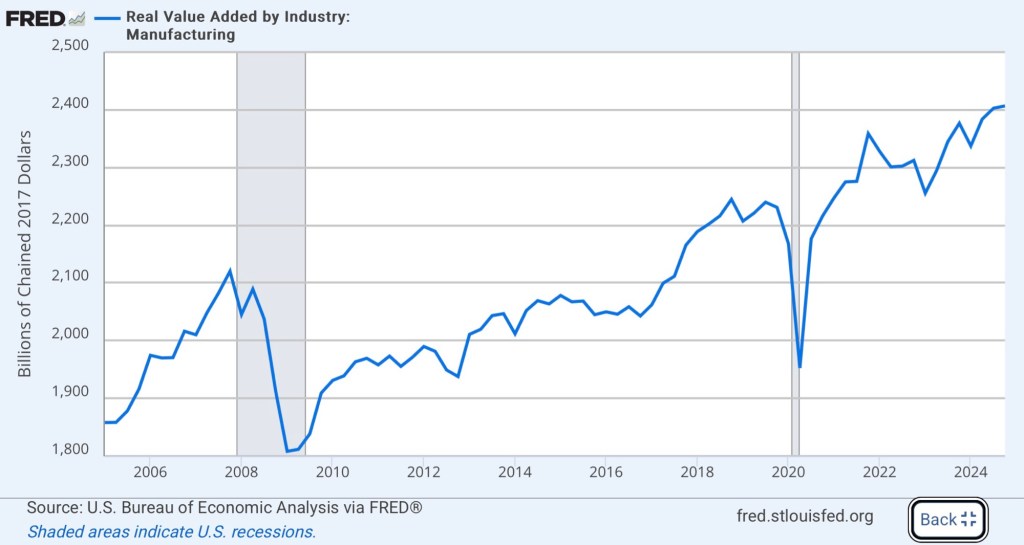
Trade warriors, including members of Trump’s team, insist that our decline as a nation is being hastened by a crisis in manufacturing. However, value added in U.S. manufacturing is at an all-time high.

There has been a long-term decline in manufacturing employment, but not manufacturing output. In fact, manufacturing output has doubled since 1980. As Jeff Jacoby notes, “the purpose of manufacturing is to make things, not jobs.” If our overarching social goal was job security, we’d have revolted long ago against the tremendous reduction in agricultural employment experienced over the past century. We’d rely on switchboard operators to load web pages, and we’d dig trenches and tunnels with spoons (to paraphrase Milton Friedman).

The secular decline in manufacturing employment is a consequence of growth in manufacturing productivity. Economy-wide, this phenomenon allows real income and our standard of living to grow.

Take That Job and …

It’s also significant that few Americans have much interest in factory work. It’s typically less dangerous than in times past, but many of today’s factory jobs are still physically challenging and relatively risky. Perhaps that helps explain why nearly half-a-million jobs in manufacturing are unfilled.

Jacoby describes the transition that has changed the face of American manufacturing:

“… US plants have largely turned away from making many of the low-tech, labor-intensive consumer items they once specialized in — sneakers, T-shirts, small appliances, toys. Those jobs have mostly gone overseas, and trying to bring them back by means of a trade war would be ruinous. Yet America remains a global manufacturing powerhouse — highly skilled, highly innovative, and highly efficient.“

And yet, even as wages in manufacturing have grown, many factory jobs do not pay as well as positions requiring far less strenuous toil in the services sector. It’s also true that the best manufacturing jobs in the U.S. today require high-level skills, which are in short supply. These factors help explain why manufacturers believe finding qualified workers is one of their biggest challenges.

Isolating Weak Sectors

There are specific sectors within manufacturing that have fared poorly, including textiles, furniture, metals, and low-end electronics. The loss of competitiveness that drove those sectoral declines is not a new development. It has, however, devastated communities in the U.S. that were heavily dependent on these industries. These misfortunes are regrettable, but trade barriers are not an effective prescription for revitalizing depressed areas.

Meanwhile, other manufacturing sectors have enjoyed growth, such as computers, aerospace, and EVs. While we’ve seen a decline in the number of manufacturing firms, the performance of U.S. manufacturing in the 21st century can be described as mixed at the very worst.

The author of this piece seems to accept the false notion that U.S. manufacturing is moribund, but he knows tariffs aren’t an effective way to strengthen domestic goods production. He has a number of better suggestions, including a commitment to infrastructure investment, reforms to education and health, and reconfiguring certain corporate income tax policies. Unfortunately, his ideas on tariffs are sometimes as mistaken as Trump’s,

The Gilded Age

Finally, the other false assertion noted in the opening paragraph is that tariffs somehow spurred economic growth in the late 19th and early 20th centuries. Brian Albrecht corrects this protectionist fallacy, which lies at the root of many defenses of Trump’s tariffs. Albrecht cites favorable conditions for growth that were sufficient to overwhelm the negative effects of tariffs, including:

“… explosive population growth, mass European immigration, rapid technological innovation, westward expansion, abundant natural resources, high literacy rates, and stable property rights.”

While cross-country comparisons indicate a positive correlation between tariffs and growth during the 1870 – 1920 period, those differences were caused by other forces that dominated tariffs. Cross-industry research discussed by Albrecht indicates that tariffs on manufactured goods during the gilded era reduced labor productivity and stimulated the entry of smaller, less productive firms. Likewise, natural experiments find that tariffs allowed inefficient firms to survive and discouraged innovation.

Conclusion

The U.S. manufacturing sector is not in any sort of crisis, and its future growth won’t be powered by attempts to restore the sort of low-value production offshored over the past several decades. What protectionists interpret as failure is the natural progression of a technically advanced market-based civilization, where high-value services account for greater shares of growing total output. Of course, low-value production is sometimes “crowded out” in this process, depending on its trade-ability and comparative advantages. The logic of the process is encapsulated by Veronique de Rugy’s recent discussion of iPhone production (HT: Don Boudreaux):

“Then there’s [Commerce Secretary Howard] Lutnick, pining for a world where Americans flood back into massive factories to assemble iPhones. This is nostalgic industrial cosplay masquerading as economic strategy. Yes, iPhones aren’t assembled by Americans. But this isn’t a failure; it’s a feature of smart economic specialization. We design the iPhone here. That’s the high-value, high-margin part. The sophisticated chips, software, architecture, and intellectual property are all created in the U.S. The marketing is done here, too. That’s most of the value of the iPhone. The lower-value labor-intensive assembly work is done abroad because those tasks are more efficiently performed abroad.“

There is certainly no crisis in U.S. manufacturing. That narrative is driven by a combination of politics, rent seeking, and misplaced nostalgia.

On Noah Smith’s Take Re: Human/AI Comparative Advantage

13 Thursday Jun 2024

Posted by Nuetzel in Artificial Intelligence, Comparative advantage, Labor Markets

≈ 3 Comments

Tags

Absolute Advantage, Agentic AI, Alignment, Andrew Mayne, Artificial Intelligence, Comparative advantage, Compute, Decreasing Costs, Dylan Matthews, Fertility, Floating Point Operations Per Second, Generative AI, Harvey Specter, Inequality, National Security, Noah Smith, Opportunity cost, Producer Constraints, Substitutability, Superabundance, Tyler Cowen

I was happy to see Noah Smith’s recent post on the graces of comparative advantage and the way it should mediate the long-run impact of AI on job prospects for humans. However, I’m embarrassed to have missed his post when it was published in March (and I also missed a New York Times piece about Smith’s position).

I said much the same thing as Smith in my post two weeks ago about the persistence of a human comparative advantage, but I wondered why the argument hadn’t been made prominently by economists. I discussed it myself about seven years ago. But alas, I didn’t see Smith’s post until last week!

I highly recommend it, though I quibble on one or two issues. Primarily, I think Smith qualifies his position based on a faulty historical comparison. Later, he doubles back to offer a kind of guarantee after all. Relatedly, I think Smith mischaracterizes the impact of energy costs on comparative advantages, and more generally the impact of the resources necessary to support a human population.

We Specialize Because…

Smith encapsulates the underlying phenomenon that will provide jobs for humans in a world of high automation and generative AI: “… everyone — every single person, every single AI, everyone — always has a comparative advantage at something!” He tells technologists “… it’s very possible that regular humans will have plentiful, high-paying jobs in the age of AI dominance — often doing much the same kind of work that they’re doing right now …”

… often, but probably transformed in fundamental ways by AI, and also doing many other new kinds of work that can’t be foreseen at present. Tyler Cowen believes the most important macro effects of AI will be from “new” outputs, not improvements in existing outputs. That emphasis doesn’t necessarily conflict with Smith’s narrative, but again, Smith thinks people will do many of the same jobs as today in a world with advanced AI.

Smith’s Non-Guarantee

Smith hedges, however, in a section of his post entitled “‘Possible’ doesn’t mean guaranteed”. This despite his later assertion that superabundance would not eliminate jobs for humans. That might seem like a separate issue, but it’s strongly intertwined with the declining AI cost argument at the basis of his hedge. More on that below.

On his reluctance to “guarantee” that humans will have jobs in an AI world, Smith links to a 2013 Tyler Cowen post on “Why the theory of comparative advantage is overrated”. For example, Cowen says, why do we ever observe long-term unemployment if comparative advantage rules the day? Of course there are many reasons why we observe departures from the predicted results of comparative advantage. Incentives are often manipulated by governments and people differ drastically in their capacities and motivation.

But Cowen cites a theoretical weakness of comparative advantage: that inputs are substitutable (or complementary) by degrees, and the degree might change under different market conditions. An implication is that “comparative advantages are endogenous to trade”, specialization, and prices. Fair enough, but one could say the same thing about any supply curve. And if equilibria exist in input markets it means these endogenous forces tend toward comparative advantages and specializations balancing the costs and benefits of production and trade. These processes might be constrained by various frictions and interventions, and their dynamics might be complex and lengthy, but that doesn’t invalidate their role in establishing specializations and trade.

The Glue Factory

Smith concerns himself mainly with another one of Cowen’s “failings of comparative advantage”: “They do indeed send horses to the glue factory, so to speak.” The gist here is that when a new technology, motorized transportation, displaced draft horses, there was no “wage” low enough to save the jobs performed by horses. Smith says horses were too costly to support (feed, stables, etc…), so their comparative advantage at “pulling things” was essentially worthless.

True, but comparing outmoded draft horses to humans in a world of AI is not quite appropriate. First, feedstock to a “glue factory” better not be an alternative use for humans whose comparative advantages become worthless. We’ll have to leave that question as an imperative for the alignment community.

Second, horses do not have versatile skill sets, so the comparison here is inapt due to their lack of alternative uses as capital assets. Yes, horses can offer other services (racing, riding, nostalgic carriage rides), but sadly, the vast bulk of work horses were “one-trick ponies”. Most draft horses probably had an opportunity cost of less than zero, given the aforementioned costs of supporting them. And it should be obvious that a single-use input has a comparative advantage only in its single use, and only when that use happens to be the state-of-the-art, or at least opportunity-cost competitive.

The drivers, on the other hand, had alternatives, and saw their comparative advantage in horse-driving occupations plunge with the advent of motorized transport. With time it’s certain many of them found new jobs, perhaps some went on to drive motorized vehicles. The point is that humans have alternatives, the number depending only on their ability to learn a crafts and perhaps move to a new location. Thus, as Smith says, “… everyone — every single person, every single AI, everyone — always has a comparative advantage at something!” But not draft horses in a motorized world, and not square pegs in a world of round holes.

AI Producer Constraints

That brings us to the topic of what Smith calls producer-specific constraints, which place limits on the amount and scope of an input’s productivity. For example, in my last post, there was only one super-talented Harvey Specter, so he’s unlikely to replace you and keep doing his own job. Thus, time is a major constraint. For Harvey or anyone else, the time constraint affects the slope of the tradeoff (and opportunity costs) between one type of specialization versus another.

Draft horses operated under the constraints of land, stable, and feed requirements, which can all be viewed as long-run variable costs. The alternative use for horses at the glue factory did not have those costs.

Humans reliant on wages must feed and house themselves, so those costs also represent constraints, but they probably don’t change the shape of the tradeoff between one occupation and another. That is, they probably do not alter human comparative advantages. Granted, some occupations come with strong expectations among associates or clients regarding an individual’s lifestyle, but this usually represents much more than basic life support. In the other end of the spectrum, displaced workers will take actions along various margins: minimize living costs; rely on savings; avail themselves of charity or any social safety net as might exist; and ultimately they must find new positions at which they maintain comparative advantages.

The Compute Constraint

In the case of AI agents, the key constraint cited by Smith is “compute”, or computer resources like CPUs or GPUs. Advancements in compute have driven the AI revolution, allowing AI models to train on increasingly large data sets and levels of compute. In fact, by one measure of compute, floating point operations per second (FLOPs), compute has become drastically cheaper, with FLOPs per dollar almost doubling every two years. Perhaps I misunderstand him, but Smith seems to assert the opposite: that compute costs are increasing. Regardless, compute is scarce, and will always be scarce because advancements in AI will require vast increases in training. This author explains that while lower compute costs will be more than offset by exponential increases in training requirements, there nevertheless will be an increasing trend in capabilities per compute.

Every AI agent will require compute, and while advancements are enabling explosive growth in AI capabilities, scarce compute places constraints on the kinds of AI development and deployment that some see as a threat to human jobs. In other words, compute scarcity can change the shape of the tradeoffs between various AI applications and thus, comparative advantages.

The Energy Constraint

Another producer constraint on AI is energy. Certainly highly complex applications, perhaps requiring greater training, physical dexterity, manipulation of materials, and judgement, will require a greater compute and energy tradeoff against simpler applications. Smith, however, at one point dismisses energy as a differential producer constraint because “… humans also take energy to run.” That is a reference to absolute energy requirements across inputs (AI vs. human), not differential requirements for an input across different outputs. Only the latter impinge on tradeoffs or opportunity costs facing an inputs. Then, the input having the lowest opportunity cost for a particular output has a comparative advantage for that output. However, it’s not always clear whether an energy tradeoff across outputs for humans will be more or less skewed than for AI, so this might or might not influence a human comparative advantage.

Later, however, Smith speculates that AI might bid up the cost of energy so high that “humans would indeed be immiserated en masse.” That position seems inconsistent. In fact, if AI energy demands are so intensive, it’s more likely to dampen the growth in demand for AI agents as well as increase the human comparative advantage because the most energy-intensive AI applications will be disadvantaged.

And again, there is Smith’s caution regarding the energy required for human life support. Is that a valid long-run variable cost associated with comparative advantages possessed by humans? It’s not wrong to include fertility decisions in the long-run aggregate human labor supply function in some fashion, but it doesn’t imply that energy requirements will eliminate comparative advantages. Those will still exist.

Hype, Or Hyper-Growth?

AI has come a long way over the past two years, and while its prospective impact strikes some as hyped thus far, it has the potential to bring vast gains across a number of fields within just a few years. According to this study, explosive economic growth on the order of 30% annually is a real possibility within decades, as generative AI is embedded throughout the economy. “Unprecedented” is an understatement for that kind of expansive growth. Dylan Matthews in Vox surveys the arguments as to how AI will lead to super-exponential economic growth. This is the kind of scenario that would give rise to superabundance.

I noted above that Smith, despite his unwillingness to guarantee that human jobs will exist in a world of generative AI, asserts (in an update) at the bottom of his post that a superabundance of AI (and abundance generally) would not threaten human comparative advantages. This superabundance is a case of decreasing costs of compute and AI deployment. Here Smith says:

“The reason is that the more abundant AI gets, the more value society produces. The more value society produces, the more demand for AI goes up. The more demand goes up, the greater the opportunity cost of using AI for anything other than its most productive use. 

“As long as you have to make a choice of where to allocate the AI, it doesn’t matter how much AI there is. A world where AI can do anything, and where there’s massively huge amounts of AI in the world, is a world that’s rich and prosperous to a degree that we can barely imagine. And all that fabulous prosperity has to get spent on something. That spending will drive up the price of AI’s most productive uses. That increased price, in turn, makes it uneconomical to use AI for its least productive uses, even if it’s far better than humans at its least productive uses. 

“Simply put, AI’s opportunity cost does not go to zero when AI’s resource costs get astronomically cheap. AI’s opportunity cost continues to scale up and up and up, without limit, as AI produces more and more value.”

This seems as if Smith is backing off his earlier hedge. Some of that spending will be in the form of fabulous investment projects of the kinds I mentioned in my post, and smaller ones as well, all enabled by AI. But the key point is that comparative advantages will not go away, and that means human inputs will continue to be economically useful.

I referenced Andrew Mayne in my last post. He contends that the income growth made possible by AI will ensure that plenty of jobs are available for humans. He mentions comparative advantage in passing, but he centers his argument around applications in which human workers and AI will be strong complements in production, as will sometimes be the case.

A New Age of Worry

The economic success of AI is subject to a number of contingencies. Most important is that AI alignment issues are adequately addressed. That is, the “self-interest” of any agentic AI must align with the interests of human welfare. Do no harm!

The difficulty of universal alignment is illustrated by the inevitability of competition among national governments for AI supremacy, especially in the area of AI-enabled weaponry and espionage. The national security implications are staggering.

A couple of Smith‘s biggest concerns are the social costs of adjusting to the economic disruptions AI is sure to bring, as well as its implications for inequality. Humans will still have comparative advantages, but there will be massive changes in the labor market and transitions that are likely to involve spells of unemployment and interruptions to incomes for some. The speed and strength of the AI revolution may well create social upheaval. That will create incentives for politicians to restrain the development and adoption of AI, and indeed, we already see the stirrings of that today.

Finally, Smith worries that the transition to AI will bring massive gains in wealth to the owners of AI assets, while workers with few skills are likely to languish. I’m not sure that’s consistent with his optimism regarding income growth under AI, and inequality matters much less when incomes are rising generally. Still, the concern is worthy of a more detailed discussion, which I’ll defer to a later post.

Tangled Up In Green Industrial Policy: Joe Biden’s Electrification

28 Thursday Mar 2024

Posted by Nuetzel in Government Failure, Industrial Policy, Liberty

≈ 1 Comment

Tags

Adam Smith, Administrative State, Arnold Kling, Battery Fires, Battery Replacement, Biden EPA Mandates, BYD, Carbon Credits, central planning, Charging Stations, Chevron Deference, Electric Stoves, Electric Vehicles, Electrification, Energiewende, EV Range, EV Rich-Man Subsidy, EV Tire Wear, Fossil fuels, Friedrich Hayek, Grid Capacity, Industrial Policy, Infrastructure Investment and Jobs Act, Joel Kotkin, John Mozena, Legislative Deference, Long Tailpipe, Ludwig von Mises, National Security, Net Zero, Offshore Wind, Rare Earth Minerals, Trade Intervention

Industrial policy allows government planners to select favored and disfavored industries or sectors. It thereby bypasses and distorts impersonal market signals that would otherwise direct scarce resources to the uses most valued by market participants. Instead, various forms of aid and penalties are imposed on different sectors in order to accomplish the planners’ objectives, This includes interventions in foreign trade and attempts to steer technological development. Industrial policy often comes under the guise of enhanced national security. Of course, it can also be used to reward cronies. And it has a poor record of accomplishing its objectives and avoiding unintended consequences.

The Sausage Factory

The executive and legislative branches of the U.S. government are loaded with economic interventionists, regardless of party affiliation. In an age of (Chevron) judicial deference to “experts” within the administrative state, it is not uncommon for legislative language to give abundant leeway to those who implement policy within the executive branch (though a couple of upcoming Supreme Court decisions might change that balance). Increasingly, bills are stuffed so full of provisions that lawmakers find it all but impossible to read them in full, let alone make an accurate assessment of their virtues, drawbacks, and internal contradictions.

Even worse is the fact that bills are, in great part, written by relatively youthful legislative staffers with little real world experience in industry, and who harbor the naive belief that whatever is wished, government can make it so. But their work also proceeds under guidance from lawmakers, administration officials, consultants, and lobbyists who have their own agendas and axes to grind. This is how industrial policy is promulgated in the U.S., and it is through this ugly prism that we must view environmental policy.

The Left dictates environmental and energy policy in several states, especially California, where energy costs have soared under renewable energy initiatives. California households now pay almost triple the rate per kilowatt-hour paid in Washington, and more than double what’s paid in Oregon. Something similar may happen in New York, which has highly ambitious goals for renewable energy even as the costs of the state’s offshore wind projects are out of control. These and other state-level “laboratories” are demonstrating that a renewable energy agenda can carry very high costs to the populace. The same is true of the painful experience in Germany with its much-heralded Energiewende.

Net Zero

The Left is also pulling the strings within the federal bureaucracy and the Biden Administration. The objective is an industrial policy to achieve “net zero” CO2 emissions, a practical impossibility for at least several decades (unless it’s faked, of course). Nevertheless, that policy calls for phasing out the use of fossil fuels. Under this agenda, mandates and subsidies are bestowed upon the use of renewable electric power sources, while restrictions and penalties are imposed on the production and use of fossil fuels. A subsequent post on the subject of power generation will address this prototypical failure of central planning.

Electrification

Here, I discuss another key objective of our industrial planners: electrify whatever is not electrified in order to advance the net zero agenda. Of course, for some time to come, more than half of electric power will be generated using fossil fuels (currently about 60%, with another 18% nuclear), so the policy is largely a sham on its face, but we’ll return to that point below. The EV tailpipe is very long, as they say.

Electrification means, among other things, the forced adoption of electronic vehicles (EVs). President Biden’s EPA has issued rules on auto emissions that are expected to require, by 2032, that 60% or more of cars and light trucks sold will be EVs. The USA Today article at the link offers this rich aside:

“…the original proposal — which was always technology-neutral in theory, meaning automakers could sell any cars and light-duty trucks they wanted as long as they hit the fleetwide reductions….”

Technology neutral? Hahaha! We aren’t forcing you to choose technologies as long as you meet our technological requirements!

EV Doldrums

Anyway, the EPA’s targets are completely impractical, partly because the value for drivers is lacking. Not coincidentally, the market for EVs seems to have chilled of late. Hertz has soured on heavy use of EVs in its fleet, and Ford has announced reductions in EV production. The new UAW agreements will make it difficult for some domestic producers to turn a profit on EVs. Fisker is just about broke. Apple has cancelled development of its EV, and several other automakers have reduced their production plans. Toyota was the first producer to raise the red flag on the breakneck transition to EVs in favor of a measured reliance on hybrids. Of course, there are other prominent voices cautioning against rapid attempts at electrification in general.

To be fair, some EVs are marvelous machines, but they and their supporting infrastructure are not yet well-suited to the mass market.

A Tangled Web

Here are some drawbacks of EVs that have yet to be adequately addressed:

  • They are expensive, even with the rich-man’s subsidy to buyers paid by the government and carbon credit subsidies granted to producers.
  • Costly battery replacement is an eventuality that looms over the wallets of EV owners.
  • EVs have limited range given the state of battery technology, especially when the weather is cold.
  • There presently exist far too few charging stations to make EVs workable for many people. In any case, charging away from home can be extremely time consuming and the charges vary widely.
  • The purchase and installation of EV chargers at home is a separate matter, and can cost $4,000 or more if an upgrade to the service panel is necessary. Installed costs commonly range from $1,175 to $3,300, depending on the type of charger and the region.
  • EVs are much heavier than vehicles powered by internal combustion engines. As a result, EV tire wear can be a surprising cost causer and pollutant.
  • Used EVs are not in demand, given all of the above, so resale value is questionable.
  • Battery fires in EVs are extremely difficult to extinguish, creating a new challenge for emergency responders.
  • Reliance on EVs for local emergency services would be dangerous without duplicative investment by local jurisdictions to offset the down-time required for charging.
  • For decades to come, the power grid will be unable to handle the load required for widespread adoption of EVs. A rapid conversion would be impossible without a great expansion in generating and transmission capacity, including transformer availability.
  • Domestically we lack the natural resources to produce the batteries required by EVs in a quantity that would satisfy the Administration’s goals. This forces dependence on China, our chief foreign adversary.
  • The mining of those resources is destructive to the environment. Much of it is done in China due to the country’s abundance of rare earth minerals, but wherever the mining occurs, it relies heavily on diesel power.
  • Joel Kotkin points out that China now hosts the world’s largest EV producer, BYD. Biden’s mandates might very well allow China to dominate the U.S. auto market, even as its own CO2 emissions are soaring,,
  • Producers of EVs earn carbon credits for each vehicle sold, which they can sell to other auto producers who fall short of their required mix of EVs in total production. Tesla, for example, earned revenue of $1.8 billion from carbon credit sales in 2022. But note again that these so-called zero-emission vehicles use electricity generated with an average of 60% fossil fuels. Thus, the scheme is largely a sham.

The push for EVs has been hampered by the botched rollout of (non-Tesla) charging stations under a huge Biden initiative in the Infrastructure Investment and Jobs Act. Progress has been bogged down by sheer complexity and expense, including the cost of bringing adequate power supplies to the chargers as well as the difficulty of meeting contracting requirements and operating standards. This is exemplary of the failures that usually await government efforts to engineer outcomes contrary to market forces.

Electric Everything?

Like EVs, electric stoves have drawbacks that limit their popularity, including price and the nature of the heat needed for quality food preparation. In addition to autos and stoves, wholesale electrification would require the replacement or costly reconfiguration of a huge stock of business and household capital that is now powered by fossil fuels, like gas furnaces, tractors, chain saws, and many other tools and appliances. This set of legacy investment choices was guided by market prices that reflect the scarcity and efficiency of the resources, yet government industrial planners propose to lay much of it to waste.

Central Planning: a False Conceit

John Mozena quotes Adam Smith on the social and economic hazards of rejecting the market mechanism and instead accepting governmental authority over the allocation of resources:

“All governments which thwart this natural course, which force things into another channel, or which endeavour to arrest the progress of society at a particular point, are unnatural, and to support themselves are obliged to be oppressive and tyrannical.”

And Arnold Kling gives emphasis to the disadvantages faced by even the most benevolent central planner:

“As Ludwig von Mises and Friedrich Hayek pointed out during the socialist calculation debate, central planners lack the information that is produced by markets. By over-riding market prices and substituting their own judgment, regulators incur the same loss of information.”

Advocates of EV industrial policy have failed to appreciate the large gaps between the technology they are determined to dictate and basic consumer requirements. These gaps are along such margins as range, charging time, tire and battery wear, and perhaps most importantly, affordability. The planners have failed to foresee the massive demands on the power grid of a forced replacement of the internal combustion auto stock with EVs. The planners elide the true nature of EV-driven emissions, which are never zero carbon but instead depend on the mix of power sources used to charge EV batteries. Finally, EV mandates show that the industrial planners are oblivious to other environmental burdens inherent in EVs, whatever their true carbon footprint might be.

Continue reading →

Fix TikTok? Or Nix It? The Authoritarian RESTRICT Act

08 Saturday Apr 2023

Posted by Nuetzel in anti-Semitism, Big Government, Liberty, Technology

≈ 1 Comment

Tags

AI, Artificial Intelligence, Attention Span, ByteDance, CATO Institute, Caveat Emptor, ChatGPT, Community Standards, Data Privacy, Elon Musk, First Amendment, Free Speech, Hate Speech, L. Frank Baum, Munger Test, National Security, Open Source, PATRIOT Act, People’s Republic of China, Philip Hamburger, Protectionism, RESTRICT Act, Scott Lincicome, Separation of Powers, The Land of Oz, TikTok, Twitter

There’s justifiable controversy surrounding TikTok, the social media app. I find much to dislike about TikTok but also much to dislike about the solutions some have proposed, such as a complete ban on the app in the United States. Such proposals would grant the federal executive branch powers that most of us wouldn’t grant to our worst enemy (i.e., they fail the “Munger test”).

Congressional Activity

The proposed RESTRICT Act (Restricting the Emergence of Security Threats that Risk Information and Communications Technology) is a bipartisan effort to eliminate the perceived threats to national security posed by technologies like TikTok. That would include a ban on the app. Proponents of a ban go further than national security concerns, arguing that TikTok represents a threat to the health and productivity of users. However, an outright ban on the app would be a drastic abridgment of free speech rights, and it would limit Americans’ access to a popular platform for creativity and entertainment. In addition, the proposed legislation would authorize intrusions into the privacy of Americans and extend new executive authority into the private sphere, such as tampering with trade and commerce in ways that could facilitate protectionist actions. In fact, so intrusive is the RESTRICT Act that it’s been called a “Patriot Act for the digital age.” From Scott Lincicome and several coauthors at CATO:

“… the proposal—at least as currently written—raises troubling and far‐reaching concerns for the First Amendment, international commerce, technology, privacy, and separation of powers.”

Bad Company

TikTok is owned by a Chinese company, ByteDance, and there is understandable concern about the app’s data collection practices and the potential for the Chinese government to access user data for nefarious purposes. The Trump administration cited these concerns when it attempted to ban TikTok in 2020, and while the ban was ultimately blocked by a federal judge, the Biden administration has also expressed concerns about the app’s data security.

TikTok has also been accused of promoting harmful content, including hate speech, misinformation, and sexually explicit material. Critics argue that the app’s algorithm rewards provocative and controversial content, which can lead to the spread of harmful messages and the normalization of inappropriate behavior. Of course, those are largely value judgements, including labels like “provocative”, “inappropriate”, and many interpretations of content as “hate speech”. With narrow exceptions, such content is protected under the First Amendment.

Unlike L. Frank Baum’s Tik-Tok machine in the land of Oz, the TikTok app might not always qualify as a “faithful servant”. There are some well-founded health and performance concerns related to TikTok, however. Some experts have expressed reservations about the effects of the app on attention span. The short-form videos typical of TikTok, and endless scrolling, suggest that the app is designed to be addictive, though I’m not aware of studies that purport to prove its “addictive nature. Of course, it can easily become a time sink for users, but so can almost all social media platforms. Nevertheless, some experts contend that heavy use of TikTok may lead to a decrease in attention span and an increase in distraction, which can have negative implications for productivity, learning, and mental health.

Bad Government

The RESTRICT Act, or a ban on TikTok, would drastically violate free speech rights and limit Americans’ access to a popular platform for creativity and self-expression. TikTok has become a cultural phenomenon, with millions of users creating and sharing content on the app every day. This is particularly true of more youthful individuals, who are less likely to be persuaded by their elders’ claims that the content available on TikTok is “inappropriate”. And they’re right! At the very least, “appropriateness” depends on an individual’s age, and it is generally not an area over which government should have censorship authority, “community standards” arguments notwithstanding. Furthermore, allowing access for children is a responsibility best left in the hands of parents, not government.

Likewise, businesses should be free to operate without undue interference from government. The RESTRICT Act would violate these principles, as it would limit individual choice and potentially harm innovation within the U.S. tech industry.

A less compelling argument against banning TikTok is that it could harm U.S.-China relations and have broader economic consequences. China has already warned that a TikTok ban could prompt retaliation, and such a move could escalate tensions between the two countries. That’s all true to one degree or another, but China has already demonstrated a willingness and intention to harm U.S.-China relations. As for economic repercussions, do business with China at your own risk. According to this piece, U.S. investment in the PRC’s tech industry has fallen by almost 80% since 2018, so the private sector is already taking strong steps to reduce that risk.

Like it or not, however, many software companies are subject to at least partial Chinese jurisdiction. The means the RESTRICT Act would do far more than simply banning TikTok in the U.S. First, it would subject on-line activity to much greater scrutiny. Second, it would threaten users of a variety of information or communications products and services with severe penalties for speech deemed to be “unsafe”. According to Columbia Law Professor Philip Hamburger:

“Under the proposed statute, the commerce secretary could therefore take ‘any mitigation measure to address any risk’ arising from the use of the relevant communications products or services, if the secretary determines there is an ‘undue or unacceptable risk to the national security of the United States or the safety of United States persons.’

We live in an era in which dissenting speech is said to be violence. In recent years, the Federal Bureau of Investigation has classified concerned parents and conservative Catholics as violent extremists. So when the TikTok bill authorizes the commerce secretary to mitigate communications risks to ‘national security’ or ‘safety,’ that means she can demand censorship.”

A Lighter Touch

The RESTRICT Act is unreasonably broad and intrusive and an outright ban of TikTok is unnecessarily extreme. There are less draconian alternatives, though all may involve some degree of intrusion. For example, TikTok could be compelled to allow users to opt out of certain types of data collection, and to allow independent audits of its data handling practices. TikTok could also be required to store user data within the U.S. or in other countries that have strong data privacy laws. While this option would represent stronger regulation of TikTok, it could also be construed as strengthening the property rights of users.

To address concerns about TikTok’s ownership by a Chinese company, its U.S. operations could be required to partner with a U.S. company. Perhaps this could satisfied by allowing a U.S. company to acquire a stake in TikTok, or by having TikTok spin off its U.S. operations into a separate company that is majority-owned by a U.S. entity.

Finally, perhaps political or regulatory pressure could persuade TikTok to switch to using open-source software, as Elon Musk has done with Twitter. Then, independent developers would have the ability to audit code and identify security vulnerabilities or suspicious data handling practices. From there, it’s a matter of caveat emptor.

Restrain the Restrictive Impulse

The TikTok debate raises important questions about the role of government in regulating technology and free speech. Rather than impulsively harsh legislation like the RESTRICT Act or an outright ban on TikTok, an enlightened approach would encourage transparency and competition in the tech industry. That, in turn, could help address concerns about data security and promote innovation. Additionally, individuals should take personal responsibility for their use of technology by being mindful of the content they consume and what they reveal about themselves on social media. That includes parental responsibility and supervision of the use of social media by children. Ultimately, the TikTok debate highlights tensions between national security, technological innovation, and individual liberty. and it’s important to find a balance that protects all three.

Note: The first draft of this post was written by ChatGPT, based on an initial prompt and sequential follow-ups. It was intended as an experiment in preparation for a future post on artificial intelligence (AI). While several vestiges of the first draft remain, what appears above bears little resemblance to what ChatGPT produced. There were many deletions, rewrites, and supplements in arriving at the final draft.

My first impression of the ChatGPT output was favorable. It delineated a few of the major issues surrounding a TikTok ban, but later I was struck by its repetition of bland generalities and its lack of information on more recent developments like the RESTRICT Act. The latter shortfall was probably due to my use of ChatGPT 3.5 rather than 4.0. On the whole, the exercise was fascinating, but I will limit my use of AI tools like ChatGPT to investigation of background on certain questions.

Tariffs, Content Quotas, and What Passes for Patriotism

10 Friday Mar 2023

Posted by Nuetzel in Free Trade, Protectionism

≈ Leave a comment

Tags

budget deficits, Buy American, CCP, CHIPS Act, Comparative advantage, Consumer Sovereignty, Content Restrictions, Critical Supply Chains, Domestic Content, Donald Trump, Dumping, Export Markets, Federal Procurement, Foreign Trade, Free trade, George Will, Import Waivers, Joe Biden, Made-In-America Laws, Mercantilism, National Security, Nationalism, Patriotism, Price Competition, Price Preference, Protectionism, Tariffs, Trade Retaliation, Universal Baseline Tariffs, Uyghur Muslims

If there’s one simple lesson in economics that’s hard to get across it’s the destructive nature of protectionism. The economics aren’t hard to explain, but for many, the lessons of protectionist failure just don’t want to sink in. Putting aside matters of national security, the harms of protectionism to the domestic economy are greater than any gains that might inure to protected firms and workers. Shielding home industries and workers from foreign competition is generally not smart nor an act of patriotism, but that sentiment seems fairly common nonetheless.

The Pathology of Protectionism

Jingoistic slogans like “Buy American” are a pitch for voluntary loyalty to American brands. I’m all for voluntary action. Still, that propaganda relies on shaming those who find certain foreign products to have superior attributes or to be more economical. This feeds a psychology of economic insularity and encourages those who favors trade barriers, which is one of the earliest species of failed central planning.

The cognitive resistance to a liberal trade regime might have to do with the concentrated benefits of protectionist measures relative to the more diffuse (but high) costs it imposes on society. Some of the costs of protectionism manifest only with time, which makes the connection to policy less obvious to observers. Or again, obstructing trade and taxing “others” in the hope of helping ourselves may simply inflame nationalist passions.

Both Democrats and Republicans rally around policy measures that tilt the playing field in favor of domestic producers, often severely. And again, this near unanimity exists despite innumerable bouts with the laws of economics. I mean, how many times do you have to be beaten over the head to realize that this is a mistake? Unfortunately, politicians just don’t live in the long-term, they leap to defend powerful interests, and they seldom pay the long-term consequences of their mistakes.

Joe Biden’s “Buy American”

The Biden Administration has pushed a “Made In America” agenda since the President took office, It’s partly a sop to unions for their election support. Much of it had to do with tightening waivers granted under made-in-America laws (dating back to 1933) governing foreign content in goods procured by the federal government. The most recent change by Biden is an increase in the requirement for domestic content to 60% immediately and gradually to 75% from there. Also, “price preferences” will be granted to domestic producers of goods to strengthen supply chains identified as “critical”, including active pharmaceutical ingredients, certain minerals including rare earths and carbon fibers, semiconductors and their advanced packaging, and large capacity batteries such as those used in EVs.

There’s a strong case to be made for developing domestic supplies of certain goods based on national security considerations. That can play a legitimate role where defense goods or even some kinds of civilian infrastructure are involved, but Biden’s order applies much more broadly, including protections for industries that are already heavily subsidized by taxpayers. For example, the CHIPS Act of 2022 included $76 billion of subsidies and tax credits to the semiconductor industry.

George Will describes the cost of protectionism and Biden’s “Buy American”:

“‘Buy American,’ like protectionism generally, can protect some blue-collar jobs — but at a steep price: A Peterson Institute for International Economics study concludes that it costs taxpayers $250,000 annually for each job saved in a protected industry. And lots of white-collar jobs are created for lawyers seeking waivers from the rules. And for accountants tabulating U.S. content in this and that, when, say, an auto component might cross international borders (U.S., Canadian, Mexican) five times before it is ready for installation in a vehicle.”

Biden’s new rules will increase the cost of federal procurement. They will squeeze out contracts with foreign suppliers whose wares are sometimes the most price-competitive or best-suited to a project. This is not a prescription for spending restraint, and it comes at a time when the federal budget is under severe strain. Here’s George Will again:

“This will mean more borrowing, not fewer projects. Federal spending is not constrained by a mere shortage of revenue. So, Biden was promising to increase the deficit. And this policy, which elicited red-and-blue bonhomie in the State of the Union audience, also will give other nations an excuse to retaliate (often doing what they want to do anyway) by penalizing U.S. exporters of manufactured goods. ….. Washington lobbyists for both will prosper.”

Domestic manufacturers who find their contracting status “protected” from foreign competition will face less incentive to perform efficiently. They can relax, rather than improve or even maintain productivity levels, and they’ll feel less pressure to price competitively. Those domestic firms providing goods designated by the government as “critical” will be advantaged by the “price preferences” granted in the rules, leading to a less competitive landscape and higher prices. Thus, Biden’s “Buy American” order is likely to mean higher prices and more federal spending. This is destructive and counter to our national interests.

Donald Trump’s Tariffs

In a recent set of proposals trialed for his presidential election campaign, Donald Trump called for “Universal Baseline Tariffs” on imported goods. In a testament to how far Trump has stumbled down the path of economic ignorance, his campaign mentions “patriotic protectionism” and “mercantilism for the 21st century”. Good God! Trump might be worse than Biden!

This isn’t just about China, though there are some specific sanctions against China in the proposal. After all, these new tariffs would be “universal”. Nevertheless, the Trump campaign took great pains to cloak the tariffs in anti-China rhetoric. Now, I’m very unfavorably disposed to the CCP and to businesses who serve or rely on China and (by implication) the CCP. Certainly, in the case of China, national security may dictate the imposition of certain forms of protectionism, slippery slope though it might be. Nevertheless, that is not what universal tariffs are about.

One destructive consequence of imposing tariffs or import quotas is that foreign governments are usually quick to retaliate with tariffs and quotas of their own. Thus, export markets are shut off to American producers in an escalating trade conflict. That creates serious recession risks or might reinforce other recessionary forces. Lost production for foreign markets and job losses in the affected export industries are the most obvious examples of protectionist harm.

Then consider what happens in protected industries in the U.S. and the negative repercussions in other sectors. The prices charged for protected goods by domestic producers rise for two reasons: more output is demanded of them, and protected firms have less incentive to restrain pricing. Just what the protectionists wanted! In turn, with their new-found, government-granted market power, protected firms will compete more aggressively for workers and other inputs. That puts non-protected firms in a bind, as they’ll be forced to pay higher wages to compete with protected firms for labor. Other inputs may be more costly as well, particularly if they are imported. These distortions lead to reduced output and jobs in non-protected industries. It also means American consumers pay higher prices for both protected and unprotected goods.

Consumers not only lose on price. They also suffer a loss of consumer sovereignty to a government wishing to manipulate their choices. When choices are curtailed, consumers typically lose on other product attributes they value. It also curtails capital inflows to the U.S. from abroad, which can have further negative repercussions for U.S. productivity growth.

When imports constitute a large share of a particular market, it implies that foreign nations have a comparative advantage in producing the good in question. In other words, they sacrifice less to produce the good than we would sacrifice to produce it in the U.S. But if country X has a comparative advantage in producing good X, it means it must have a comparative disadvantage in producing certain other goods, let’s say good Y. (That is, positive tradeoffs in one direction necessarily imply negative tradeoffs in the other.) It makes more economic sense for other countries (country Y, or perhaps the U.S.) to produce good Y, rather than country X, since country Y sacrifices less to do so. And that is why countries engage in trade with each other, or allow their free citizens to do so. It is mutually beneficial. It makes economic sense!

To outlaw or penalize opportunities for mutually beneficial trade will only bring harm to both erstwhile trading partners, though it might well benefit specific interests, including some third parties. Those third parties include opportunistic politicians wishing to leverage nationalist sentiments, their cronies in protected industries, and the bureaucrats, attorneys, and bean counters who manage compliance.

When Is Trade Problematic?

Protectionists often accuse other nations of subsidizing their export industries, giving them unfair advantages or dumping their exports below cost on the U.S. market. There are cases in which this happens, but all such self-interested claims should be approached with a degree of skepticism. There are established channels for filing complaints (and see here) with government agencies and trade organizations, and specific instances often prompt penalties or formal retaliatory actions.

There are frequently claims that foreign producers and even prominent American businesses are beneficiaries of foreign slave labor. A prominent example is the enslavement of Uyghur Muslims in China, who reportedly have been used in the manufacture of goods sold by a number of big-name American companies. This should not be tolerated by these American firms, their customers, or by the U.S. government. Unfortunately, there is a notable lack of responsiveness among many of these parties.

Much less compelling are assertions of slave labor based on low foreign wage rates without actual evidence of compulsion. This is a case of severely misplaced righteousness. Foreign wage rates may be very low by American standards, but they typically provide for a standard of living in the workers’ home country that is better than average. There is no sin in providing jobs to foreign workers at a local wage premium or even a discount, depending on the job. In fact, a foreign wage that is low relative to American wages is often the basis for their comparative advantage in producing certain goods. Under these innocent circumstances, there is no rational argument for producing those goods at much higher cost in the U.S.

Very troublesome are the national security risks that are sometimes attendant to foreign trade. When dealing with a clear adversary nation, there is no easy “free trade” answer. It is not always clear or agreed, however, when international relations have become truly adversarial, and whether trade can be usefully leveraged in diplomacy.

Conclusion

As I noted earlier, protectionism has appeal from a nationalist perspective, but it is seldom a legitimate form of patriotism. It’s not patriotic to limit the choices and sovereignty of the individual, nor to favor certain firms or workers by shielding them from competition while penalizing firms requiring inputs from abroad. We want our domestic industries to be healthy and competitive. Shielding them from competition is the wrong approach.

So much of the “problem” we have with trade is the infatuation with goals tied to jobs and production. Those things are good, but protectionists focus primarily on first-order effects without considering the damaging second-order consequences. And of course, jobs and production are not the ultimate goals of economic activity. In the end, we engage in economic activity in order to consume. We are a rich nation, and we can afford to consume what we like from abroad. It satisfies wants, it brings market discipline, and it leads to foreign investment in the American economy.

Biden and Trump share the misplaced objectives of mercantilism. They are both salesmen in the end, though with strikingly different personas. Salesmen want to sell, and I’m almost tempted to say that their compulsion causes them see trade as a one-way street. Biden is selling his newest “Buy American” rules not only as patriotic, but as a national security imperative. The former is false and the latter is largely false. In fact, obstructions to trade make us weaker. They will also contribute to our fiscal imbalances, and that contributes to monetary and price instability.

Like “Buy American”, Trump’s tariffs are misguided. Apparently, Trump and other protectionists wish to tax the purchases of foreign goods by American consumers and businesses. In fact, they fail to recognize tariffs as the taxes on Americans that they are! And tariffs represent a pointed invitation to foreign trading partners to impose tariffs of their own on American goods. You really can’t maximize anything by foreclosing opportunities for gain, but that’s what protectionism does. It’s astonishing that such a distorted perspective sells so well.

The Court and Kavanaugh

08 Monday Oct 2018

Posted by Nuetzel in Supreme Court

≈ Leave a comment

Tags

Anthony Kennedy, Brett Kavanaugh, Due Process, Glenn Reynolds, Metadata Collection, National Security, PATRIOT Act, Privacy, Roev. Wade, Second Amendment, Supreme Court

There are both great and hysterically negative expectations for Brett Kavanaugh’s seating on the Supreme Court, depending on one’s perspective. The changes are likely to be much less dramatic than many think, however, according to Glenn Reynolds in his Sunday column. As he says, most cases before the Supreme Court are decided by easy majorities, and that won’t change. On split decisions, Kavanaugh will be less of a “swing vote” than Anthony Kennedy, no doubt, and he will have influence over the choice of cases to be heard by the Court because the selection of a case requires only four justices.

Reynolds thinks Kavanaugh is not as conservative as partisans hope or fear. For example, Reynolds believes he is unlikely to vote to overturn Roe vs. Wade, when and if that question comes before the Court. There may be shifts on narrower questions, such as an earlier definition of fetal viability (in recognition of improved medical technology) and greater protection against arrangements that facilitate illegal funding of abortions by federal taxpayers. Reynolds acknowledges, however, that Kavanaugh is a stronger advocate of Second Amendment rights than Kennedy, so those protections are less likely to be eroded.

Reynolds’ also notes a shift that is likely to take place in legal academia:

“Strange new respect for judicial minimalism. As Harvard Law professor Adrian Vermeule remarked, ‘Law review editors: brace for a tidal wave of legal academic theories supporting judicial minimalism, Thayerianism, and strong — very strong — theories of precedent. Above all: the Court must do nothing without bipartisan agreement, otherwise it is illegitimate.’ The past half-century’s enthusiasm for judicial activism will vanish, as legal academia turns on a dime to promote theories that will constrain the court until a left-leaning majority returns, at which point they’ll turn on a dime again.”

That is all too likely. My liberal friends insist that the four justices on the left are free of political bias. Don’t laugh! I’ll be happy if Kavanaugh, as a justice, sticks to his traditional originalist philosophy on constitutional interpretation. I’m under no illusion that the left side of the bench takes the original meaning of the Constitution seriously.

My own concerns about Kavanaugh have to do with his earlier work in the Bush White House on issues related to national security, including work on the PATRIOT Act. In fairness, that work took place at a time when the horrors of 9/11 were still fresh in our minds. However, years later he wrote a favorable judicial opinion on metadata collection by the government. It’s disturbing that Kavanaugh has ever shown a willingness to relinquish the rights to privacy and due process as a routine matter of national security. The founders’ intent was to protect individual rights from the threat of tyranny, so they expressly limited the power of government through the Constitution. Those who would claim that threats to national security are so compelling as to supersede individual rights are perhaps the very tyrants the Constitution was meant to foil. Nevertheless, my hope is that Kavanaugh, having come face-to-face with those who would prefer to deny privacy and due process rights when it suits them, has gained additional respect for these protections.

The Master Negotiator: I’ll Beat Myself Till You Accept My Terms!

07 Wednesday Mar 2018

Posted by Nuetzel in Free Trade, Tariffs, Trump Administration

≈ Leave a comment

Tags

Balance of Trade, Chinese Trade Policy, Coyote Blog, Cronyism, Donald Trump, Dumping, NAFTA, National Security, Panda Blog, Peter Navarro, Pierre Lenieux, Protectionism, Stephen Mihm, Tariffs, Trade Retaliation, Trade War, Warren Meyer, Wilbur Ross

As if you needed more evidence that governments are incompetent, look no further than trade policy: public officials the world over are almost universally ignorant regarding the effects of international trade and trade imbalances. In this sense, the Trump Administration’s new tariffs on imported steel and aluminum are in keeping with the long history of public sector foibles on trade. This phenomenon stems from an unhealthy and obsessive focus on the well-being of producers without regard to the implications of policy for consumers. Warren Meyer of Coyote Blog offers an evaluation of Chinese trade policy, which he mischievously (I believe) claims was written by a Chinese blogger on a “sister blog” called “Panda Blog“. Despite Meyer’s playfulness, the post is instructive:

“Our Chinese government continues to pursue a policy of export promotion, patting itself on the back for its trade surplus in manufactured goods with the United States. The Chinese government does so through a number of avenues, … each and every one of these government interventions subsidizes US citizens and consumers at the expense of Chinese citizens and consumers. A low yuan makes Chinese products cheap for Americans but makes imports relatively dear for Chinese. So-called ‘dumping’ represents an even clearer direct subsidy of American consumers over their Chinese counterparts. And limiting foreign exchange re-investments to low-yield government bonds has acted as a direct subsidy of American taxpayers and the American government, saddling China with extraordinarily low yields on our nearly $1 trillion in foreign exchange. Every single step China takes to promote exports is in effect a subsidy of American consumers by Chinese citizens.“

The very idea of a trade deficit is often used to intimate a threat to a nation’s economic health. Conversely, a trade surplus is used to suggest that a nation is achieving great economic success. Both contentions are nonsense. Here is more from “Panda Blog“:

“We at Panda Blog believe it is insane for our Chinese government to continue to chase the chimera of ever-growing foreign exchange and trade surpluses. These achieved nothing lasting for Japan and they will achieve nothing for China. In fact, the only thing that amazes us more than China’s subsidize-Americans strategy is that the Americans seem to complain about it so much. They complain about their trade deficits, which are nothing more than a reflection of their incredible wealth. … They complain about China buying their government bonds, which does nothing more than reduce the costs of their Congress’s insane deficit spending. They even complain about dumping, which is nothing more than a direct subsidy by China of lower prices for American consumers.

And, incredibly, the Americans complain that it is they that run a security risk with their current trade deficit with China! This claim is so crazy, we at Panda Blog have come to the conclusion that it must be the result of a misdirection campaign by CIA-controlled American media. After all, the fact that China exports more to the US than the US does to China means that by definition, more of China’s economic production is dependent on the well-being of the American economy than vice-versa.“

By the way, those “quotes” from “Panda Blog” appeared on Coyote Blog 12 years ago!

All nations tend to play these trade games to one extent or another. But protectionist actions always harm a nation’s consumers more than they help producers, a proposition that is easy to demonstrate using a simple supply and demand diagram. While the class of consumers is broader than the class of producers, ultimately “producer” and “consumer” are different roles played by the same individuals. So protectionism is always harmful to a nation, on balance. Furthermore, retaliation against another nation for its dim-witted trade barriers also harms the retaliating nation’s consumers more than it helps its producers, and that’s true regardless of whether retaliation begets reciprocal actions.

Of course, producers are generally in a better position than consumers to grease the political skids in their favor. In a separate post, Meyer notes that protectionist trade policies are rooted in cronyism. The costs to society are very real, but they tend to be diffuse and therefore less obvious to most consumers.

“A lot of the media seems to believe the biggest reason they are bad is that they will incite retaliatory tariffs from other countries, which they almost certainly will.  But even if no one retaliated, even if the tariffs were purely unilateral, they would still be bad. In case after case, they are justified as increasing the welfare of a certain number of workers in targeted industries, but they hurt the welfare of perhaps 100x more people who consume or work for companies that consume the targeted products. Prices will rise for everyone and choices will be narrowed.“

A couple of points deserve emphasis in relation to my last post on Trump’s tariff action:

  • In terms of jobs, the tariffs announced by President Trump present a very poor risk-reward tradeoff (WSJ article is gated):

“The policy point is that Mr. Trump’s tariffs are trying to revive a world of steel production that no longer exists. He is taxing steel-consuming industries that employ 6.5 million and have the potential to grow more jobs to help a declining industry that employs only 140,000.“

  • Stephen Mihm discusses ways in which the U.S. steel industry squandered its superiority in the post-World War II era. Much of Mihm’s article is devoted to the industry’s failure to upgrade to new production technologies. Interestingly, however, it fails to mention the damaging role played by unions in the process. “Dumping” had very little to do with it.
  • Finally, Pierre Lemieux takes a closer look at the national security argument for trade barriers. He concludes that it is fallacious. Of course, it is an excuse for cronyism. Protectionism harms the competitiveness of the protected industries, which actually undermines national security. And protectionism is usually unnecessary on close examination. In the case of steel, for example, national defense and homeland security use only about 3% of American steel production. Beyond that simple fact, the argument is dangerously open-ended. Almost anything can be represented as critical to national security: steel, food, clothing, and many other categories. Even human resources.

Today, Trump announced that Canada and Mexico will be exempt from the new tariffs while a renegotiation of the North American Free Trade Agreement (NAFTA) is underway. That’s better, but this carve-out exempts only 25% of U.S. steel imports. Perhaps Australia will be granted an exemption as well, but additional carve-outs will prompt further increases in tariffs on non-exempt imports. Trump also said that U.S. flexibility in applying the new tariffs to allies will depend on their commitments for military spending!

Thus, rather than maintaining the pretense that trade relationships are about economics, the administration has conceded that the tariffs and the exemption process will be transparently political, never a prescription for efficient resource allocation. Moreover, U.S. trading partners are likely to be reluctant to test the politics of modifying their own trade manipulations at home. Indeed, the politics may dictate retaliation, rather than concessions. In any case, the governments of our trading partners are as clueless on trade as Trump, his Commerce Secretary Wilbur Ross, and his economic advisor Peter Navarro, or they would never intervene in private trade decisions to begin with.

In Praise of Refugee Aid and Precautions

23 Monday Nov 2015

Posted by Nuetzel in Immigration, Terrorism

≈ Leave a comment

Tags

Davis Bier, Director of National Intelligence, Foundation for Economic Education, Glenn Reynolds, Homeland Security, Ian Tuttle, ISIS, James Comey, National Counterterrorism Center, National Security, National Sovereignty, Open Borders, Paris Attacks, Pew Research, Private Refugee Sponsorship, Refugee Vetting Process, Syrian refugees, Terrorism, Virtue Signalling

118792_600

Libertarians differ from conservatives on the Syrian refugee issue and on immigration policy in general. I’m in favor of liberalized immigration because it confers powerful economic advantages. That does not imply, however, a willingness to sacrifice border security and control over the flow of immigrants. Border security is critical to the notion of U.S. sovereignty, and though I am loath to do so, I will credit Donald Trump for asking two pertinent questions: “Do we have a country? Or do we not have a country?” This is all the more important in an age when terror on the scale of a 9/11, Paris, or terrorist use of WMDs is a threat.

One of the few legitimate functions of government is national security, and the U.S. Constitution sought to assure that security would be provided without compromising the liberties of individual citizens. I’d like outsiders to feel welcome to join us and partake of those liberties, but only subject to precautions related to security. Given current threats, it is reasonable to insist on deliberation and caution in admitting new immigrants and refugees. That should include a careful vetting process and possibly post-entry safeguards such as mandatory touch-points with immigration and security officials.

Recent commentary on both sides of the Syrian refugee debate has featured conservatives waxing enthusiastic over police-state security measures and cavalier dismissal of security concerns by the Left, including a moment of apparent delusion from The Daily Kos when it weighed-in on refugees and certain principles of religious ethics, probably not that outlet’s strong suit. The Left’s usual approach to commentary on social media amounts to an exercise in “virtue signaling” (HT: Glenn Reynolds) without much critical thought, and this is no exception.

Refugees or asylum-seekers may need expedited initial handling for their own safety and protection. The tumultuous experience of fleeing a hostile regime without adequate planning, and possibly involving the loss of loved ones and possessions, suggests a need for greater assistance for refugees than for typical immigrants. The expense of a large influx of refugees is likely to be high. A solution used successfully by Canada involves private sponsorship of refugees, and there are apparently a large number of Americans willing to serve as sponsors. It is possible to vet the sponsors, of course, and might provide more reliable follow-up with the refugees themselves.

Certain classes of immigrants may be considered high-risk, though refugees have not been high-risk historically. This is one of several points made by Davis Bier at the Foundation for Economic Education in “Six Reasons To Welcome Refugees“. Bier provides a good perspective, but I don’t accept all of his assertions. He says (italicized):

  • The Paris attackers were not refugees: No, but at least one of them seems to have taken advantage of the European refugee process.
  • U.S. refugees don’t become terrorists: You can certainly vouch for this in the past tense, but it’s less certain going forward. The complete lack of documentation of many Syrian refugees complicates the vetting process.
  • Other migration channels are easier to exploit: Probably true, if the claimed thoroughness of the refugee vetting process is to be believed. Also, the resettlement from temporary camps can take two years or more, but that kind of delay is not required.
  • ISIS sees Syrian refugees as traitors: This reinforces the need to protect refugees, but it strikes me as irrelevant to the question of terrorist infiltration. A better question is whether ISIS is capable of passing-off one of their own as a refugee.
  • Turning away allies will make us less safe: It certainly won’t win us friends.
  • We should demonstrate moral courage: Helping legitimate refugees is certainly an honorable thing to do. The author points to American resistance to accepting Jewish refugees prior to World War II for fear they might be German spies. This is addressed in more detail below.

A different perspective is given in “There Are Serious, Unbigoted Reasons to Be Wary of a Flood of Syrian Refugees“, by Ian Tuttle in National Review. He asserts that the comparison of current Syrian refugees to Jewish refugees prior to WWII is inappropriate, and I largely agree. The infiltration of German spies into the Jewish refugee population was a perceived threat, but no one thought the Jews represented a risk of terror on our shores. There is nothing incompatible about feeling regret for the attitude many took toward the Jewish refugees of that era while exercising caution in the face of new risks.

Tuttle cites a recent Pew Research poll of Muslims in various countries finding that 4% to 14% of respondents approve of ISIS. Can you imagine a similar level of support for terrorism in the U.S.? This is an unfortunate social malignancy that should give us pause. Another Pew Research poll of Muslims in various countries found that the minority who believe that suicide bombing was justified ranges from 3% to 45%. It is therefore difficult to argue with Tuttle when he says:

“A non-trivial minority of refugees who support a murderous, metastatic caliphate is a reason for serious concern.“

Tuttle notes that Syrian refugees will not arrive on our shores directly from Syria.  Thus, the urgency of accepting those refugees comes into question. It is curious that such wealthy middle eastern countries as Kuwait and Saudi Arabia have not accepted refugees from Syria.

Given the immediacy of terrorist threats, the lack of even basic documents for many Syrian refugees, and the Obama Administration’s record of failure in the Middle East, it is reasonable to question their assurances as to the adequacy of the refugee vetting process. Indeed, as this article warns:

“The director of the National Counterterrorism Center admitted that terrorist groups are very interested in using refugee programs to slip operatives into Europe and the United States. … 

The director of Homeland Security had no answer when asked if the “vetting” process amounted to anything more than asking refugees to fill out an application, asking them a few questions in a verbal interview, and assuming they answer honestly….

FBI Director James Comey famously admitted last month that the U.S. government has no real way to conduct background checks on refugees.”

A substantial majority of American voters oppose the administration’s plan to accept Syrian refugees, at least under the current process. Last week, the U.S. House of Representatives passed a bill requiring that:

“… the heads of the FBI, Homeland Security Department and the Office of the Director of National Intelligence certify that each refugee being admitted would not pose a threat.“

It would be nice to have our security agencies accept some accountability for, well,  national security. The House bill would put the ball in their court with respect to high-risk refugees.

I concur with the general position of Libertarians who support a more open U.S. immigration policy and acceptance of refugees. I also believe that private sponsorship of refugees should be legalized in the U.S. to reduce their fiscal impact. And I believe we should welcome Syrian refugees provided that they can be thoroughly vetted. In the parlance of economics, transacting with refugees may involve severely asymmetric information. It is not advisable to make risky “trades” when due diligence is impossible. Short-cuts in the vetting process do not help to assure a mutually beneficial outcome. We must therefore temper our humanitarian impulse. Under the present circumstances, including an acceptance of terrorism by a “nontrivial minority” of Muslins, it is reasonable to proceed with caution, and only with caution.

Follow Sacred Cow Chips on WordPress.com

Recent Posts

  • Immigration and Merit As Fiscal Propositions
  • Tariff “Dividend” From An Indigent State
  • Almost Looks Like the Fed Has a 3% Inflation Target
  • Government Malpractice Breeds Health Care Havoc
  • A Tax On Imports Takes a Toll on Exports

Archives

  • December 2025
  • November 2025
  • October 2025
  • September 2025
  • August 2025
  • July 2025
  • June 2025
  • May 2025
  • April 2025
  • March 2025
  • February 2025
  • January 2025
  • December 2024
  • November 2024
  • October 2024
  • September 2024
  • August 2024
  • July 2024
  • June 2024
  • May 2024
  • April 2024
  • March 2024
  • February 2024
  • January 2024
  • December 2023
  • November 2023
  • August 2023
  • July 2023
  • June 2023
  • May 2023
  • April 2023
  • March 2023
  • February 2023
  • January 2023
  • December 2022
  • November 2022
  • October 2022
  • September 2022
  • August 2022
  • July 2022
  • June 2022
  • May 2022
  • April 2022
  • March 2022
  • February 2022
  • January 2022
  • December 2021
  • November 2021
  • October 2021
  • September 2021
  • August 2021
  • July 2021
  • June 2021
  • May 2021
  • April 2021
  • March 2021
  • February 2021
  • January 2021
  • December 2020
  • November 2020
  • October 2020
  • September 2020
  • August 2020
  • July 2020
  • June 2020
  • May 2020
  • April 2020
  • March 2020
  • February 2020
  • January 2020
  • December 2019
  • November 2019
  • October 2019
  • September 2019
  • August 2019
  • July 2019
  • June 2019
  • May 2019
  • April 2019
  • March 2019
  • February 2019
  • January 2019
  • December 2018
  • November 2018
  • October 2018
  • September 2018
  • August 2018
  • July 2018
  • June 2018
  • May 2018
  • April 2018
  • March 2018
  • February 2018
  • January 2018
  • December 2017
  • November 2017
  • October 2017
  • September 2017
  • August 2017
  • July 2017
  • June 2017
  • May 2017
  • April 2017
  • March 2017
  • February 2017
  • January 2017
  • December 2016
  • November 2016
  • October 2016
  • September 2016
  • August 2016
  • July 2016
  • June 2016
  • May 2016
  • April 2016
  • March 2016
  • February 2016
  • January 2016
  • December 2015
  • November 2015
  • October 2015
  • September 2015
  • August 2015
  • July 2015
  • June 2015
  • May 2015
  • April 2015
  • March 2015
  • February 2015
  • January 2015
  • December 2014
  • November 2014
  • October 2014
  • September 2014
  • August 2014
  • July 2014
  • June 2014
  • May 2014
  • April 2014
  • March 2014

Blogs I Follow

  • Passive Income Kickstart
  • OnlyFinance.net
  • TLC Cholesterol
  • Nintil
  • kendunning.net
  • DCWhispers.com
  • Hoong-Wai in the UK
  • Marginal REVOLUTION
  • Stlouis
  • Watts Up With That?
  • Aussie Nationalist Blog
  • American Elephants
  • The View from Alexandria
  • The Gymnasium
  • A Force for Good
  • Notes On Liberty
  • troymo
  • SUNDAY BLOG Stephanie Sievers
  • Miss Lou Acquiring Lore
  • Your Well Wisher Program
  • Objectivism In Depth
  • RobotEnomics
  • Orderstatistic
  • Paradigm Library
  • Scattered Showers and Quicksand

Blog at WordPress.com.

Passive Income Kickstart

OnlyFinance.net

TLC Cholesterol

Nintil

To estimate, compare, distinguish, discuss, and trace to its principal sources everything

kendunning.net

The Future is Ours to Create

DCWhispers.com

Hoong-Wai in the UK

A Commonwealth immigrant's perspective on the UK's public arena.

Marginal REVOLUTION

Small Steps Toward A Much Better World

Stlouis

Watts Up With That?

The world's most viewed site on global warming and climate change

Aussie Nationalist Blog

Commentary from a Paleoconservative and Nationalist perspective

American Elephants

Defending Life, Liberty and the Pursuit of Happiness

The View from Alexandria

In advanced civilizations the period loosely called Alexandrian is usually associated with flexible morals, perfunctory religion, populist standards and cosmopolitan tastes, feminism, exotic cults, and the rapid turnover of high and low fads---in short, a falling away (which is all that decadence means) from the strictness of traditional rules, embodied in character and inforced from within. -- Jacques Barzun

The Gymnasium

A place for reason, politics, economics, and faith steeped in the classical liberal tradition

A Force for Good

How economics, morality, and markets combine

Notes On Liberty

Spontaneous thoughts on a humble creed

troymo

SUNDAY BLOG Stephanie Sievers

Escaping the everyday life with photographs from my travels

Miss Lou Acquiring Lore

Gallery of Life...

Your Well Wisher Program

Attempt to solve commonly known problems…

Objectivism In Depth

Exploring Ayn Rand's revolutionary philosophy.

RobotEnomics

(A)n (I)ntelligent Future

Orderstatistic

Economics, chess and anything else on my mind.

Paradigm Library

OODA Looping

Scattered Showers and Quicksand

Musings on science, investing, finance, economics, politics, and probably fly fishing.

  • Subscribe Subscribed
    • Sacred Cow Chips
    • Join 128 other subscribers
    • Already have a WordPress.com account? Log in now.
    • Sacred Cow Chips
    • Subscribe Subscribed
    • Sign up
    • Log in
    • Report this content
    • View site in Reader
    • Manage subscriptions
    • Collapse this bar
 

Loading Comments...