• About

Sacred Cow Chips

Sacred Cow Chips

Tag Archives: Opportunity cost

AI Won’t Repeal Scarcity, Tradeoffs, Or Jobs

04 Monday Aug 2025

Posted by Nuetzel in Artificial Intelligence, Labor Markets

≈ 1 Comment

Tags

Absolute Advantage, AI Capital, Artificial Intelligence, Baby Bonds, Comparative advantage, Complementary Inputs, Human Touch, Opportunity cost, Robitics, Scarcity, Tradeoffs, Type I Civilization, Universal Basic Income, Universal Capital Endowments

Every now and then I grind my axe against the proposition that AI will put humans out of work. It’s a very fashionable view, along with the presumed need for government to impose “robot taxes” and provide everyone with a universal basic income for life. The thing is, I sense that my explanations for rejecting this kind of narrative have been a little abstruse, so I’m taking another crack at it now.

Will Human Workers Be Obsolete?

The popular account envisions a world in which AI replaces not just white-collar technocrats, but by pairing AI with advanced robotics, it replaces workers in the trades as well as manual laborers. We’ll have machines that cure, litigate, calculate, forecast, design, build, fight wars, make art, fix your plumbing, prune your roses, and replicate. They’ll be highly dextrous, strong, and smart, capable of solving problems both practical and abstract. In short, AI capital will be able to do everything better and faster than humans! The obvious fear is that we’ll all be out of work.

I’m here to tell you it will not happen that way. There will be disruptions to the labor market, extended periods of joblessness for some individuals, and ultimately different patterns of employment. However, the chief problem with the popular narrative is that AI capital will require massive quantities of resources to produce, train, and operate.

Even without robotics, today’s AIs require vast flows of energy and other resources, and that includes a tremendous amount of expensive compute. The needed resources are scarce and highly valued in a variety of other uses. We’ll face tradeoffs as a society and as individuals in allocating resources both to AI and across various AI applications. Those applications will have to compete broadly and amongst themselves for priority.

AI Use Cases

There are many high-value opportunities for AI and robotics, such as industrial automation, customer service, data processing, and supply chain optimization, to name a few. These are already underway to a significant extent. To that, however, we can add medical research, materials research, development of better power technologies and energy storage, and broad deployment in delivering services to consumers and businesses.

In the future, with advanced robotics, AI capital could be deployed in domains that carry high risks for human labor, such as construction of high rise buildings, underwater structures, and rescue operations. This might include such things as construction of solar platforms and large transports in space, or the preparation of space habitats for humans on other worlds.

Scarcity

There is no end to the list of potential applications of AI, but neither is there an end to the list of potential wants and aspirations of humanity. Human wants are insatiable, which sometimes provokes ham-fisted efforts by many governments to curtail growth. We have a long way to go before everyone on the planet lives comfortably. But even then, peoples’ needs and desires will evolve once previous needs are satisfied, or as technology changes lifestyles and practices. New approaches and styles drive fashions and aesthetics generally. There are always individuals who will compete for resources to experiment and to try new things. And the insatiability of human wants extends beyond the strictly private level. Everyone has an opinion about unsatisfied needs in the public sphere, such as infrastructure, maintenance, the environment, defense, space travel, and other dimensions of public activity.

Futurists have predicted that the human race will seek to become a so-called Type I civilization, capable of harnessing all of the energy on our planet. Then there will be the quest to harness all the energy within our solar system (a Type II civilization). Ultimately, we’ll seek to go beyond that by attempting to exploit all the energy in the Milky Way galaxy. Such an expansion of our energy demands would demonstrate how our wants always exceed the resources we have the ability to exploit.

In other words, scarcity will always be with us. The necessity of facing tradeoffs won’t ever be obviated, and prices will always remain positive. The question of dedicating resources to any particular application of AI will bring tradeoffs into sharper relief. The opportunity cost of many “lesser” AI and robotics applications will be quite high relative to their value to investors. Simply put, many of those applications will be rejected because there will be better uses for the requisite energy and other resources.

Tradeoffs

Again, it will be impossible for humans to accomplish many of the tasks that AI’s will perform, or to match the sheer productivity of AIs in doing so. Therefore, AI will have an absolute advantage over humans in all of those tasks.

However, there are many potential applications of AI that are of comparatively low value. These include a variety of low-skill tasks, but also tasks that require some dexterity or continuous judgement and adjustment. Operationalizing AI and robots to perform all these tasks, and diverting the necessary capital and energy away from other uses, would have a tremendously high opportunity cost. Human opportunity costs will not be so high. Thus, people will have a comparative advantage in performing the bulk if not all of these tasks.

Sure, there will be novelty efforts and test cases to train robots to do plumbing or install burglar alarm systems, and at some point buyers might wish to have robots prune their roses. Some people are already amenable to having humanoid robots perform sex work. Nevertheless, humans will remain competitive at these tasks due to the comparatively high opportunity costs faced by AI capital.

There will be many other domains in which humans will remain competitive. Once more, that’s because the opportunity costs for AI capital and other resources will be high. This includes many of the skilled trades, caregivers, and a great many management functions, especially at small companies. Their productivity will be enhanced by AI tools, but those jobs will not be decimated.

The key here is understanding that 1) capital and resources generally are scarce; 2) high value opportunities for AI are plentiful; and 3) the opportunity cost of funding AI in many applications will be very high. Humans will still have a comparative advantage in many areas.

Who’s the Boss?

There are still other ways in which human labor will always be required. One in particular involves the often complementary nature of AI and human inputs. People will have roles in instructing and supervising AIs, especially in tasks requiring customization and feedback. A key to assuring AI alignment with the objectives of almost any pursuit is human review. These kinds of roles are likely to be compensated in line with the complexity of the task. This extends to the necessity of human leadership of any organization.

That brings me to the subject of agentic and fully autonomous AI. No matter how sophisticated they get, AIs will always be the product of machines. They’ll be a kind of capital for which ownership should be confined to humans or organizations representing humans. We must be their masters. Disclaiming ownership and control of AIs, and granting agentic AIs the same rights and freedoms as people (as many have imagined) is unnecessary and possibly dangerous. AIs will do much productive work, but that work should be on behalf of human owners, and human labor will be deployed to direct and assess that work.

AIs (and People) Needing People

The collaboration between AIs and humans described above will manifest more broadly than anything task-specific, or anything we can imagine today. This is typical of technological advance. First-order effects often include job losses as new innovations enhance productivity or replace workers outright, but typically new jobs are created as innovations generate new opportunities for complementary products and services both upstream in production or downstream among ultimate users. In the case of AI, while much of this work might be performed by other AIs, at a minimum these changes will require guidance and supervision by humans.

In addition, consumers tend to have an aesthetic preference for goods and services produced by humans: craftsmen, artists, and entertainers. For example, if you’ve ever shopped for an oriental rug, you know that hand-knotted rugs are more expensive than machine-weaved rugs. Durability is a factor as well as uniqueness, the latter being a hallmark of human craftspeople. AI might narrow these differences over time, but the “human touch” will always have value relative to “comparable” AI output, even at a significant disadvantage in terms of speed and uncertainty regarding performance. The same is true of many other forms, such as sports, dance, music, and the visual arts. People prefer to be entertained by talented people, rather than highly-engineered machines. The “human touch” also has advantages in customer-facing transactions, including most forms of service and high-level sales/financial negotiations.

Owning the Machines

Finally, another word about AI ownership. An extension of the fashionable narrative that AIs will wholly replace human workers is that government will be called upon to tax AI and provide individuals with a universal basic income (UBI). Even if human labor were to be replaced by AIs, I believe that a “classic” UBI would be the wrong approach. Instead, all humans should have an ownership stake in the capital stock. This is wealth that yields compound growth over time and produces returns that make humans less reliant on streams of labor income.

Savings incentives (and negative consumption incentives) are a big step in encouraging more widespread ownership of capital. However, if direct intervention is necessary, early endowments of capital would be far preferable to a UBI because they will largely be saved, fostering economic growth, and they would create better incentives than a UBI. Along those lines, President Trump’s Big Beautiful Bill, which is now law, has established “Baby Bonds” for all American children born in 2025 – 2028, initially funded by the federal government with $1,000. Of course, this is another unfunded federal obligation on top of the existing burden of a huge public debt and ongoing deficits. Given my doubts about the persistence of AI-induced job losses, I reject government establishment of both a UBI and universal endowments of capital.

Summary

Capital and energy are scarce, so the tremendous resource requirements of AI and robotics means that the real world opportunity costs of many AI applications will remain impractically high. The tradeoffs will be so steep that they’ll leave humans with comparative advantages in many traditional areas of employment. Partly, these will come down to a difference in perceived quality owing to a preference for human interaction and human performance in a variety of economic interactions, including patronization of the art and athleticism of human beings. In addition, AIs will open up new occupations never before contemplated. We won’t be out of work. Nevertheless, it’s always a good idea to accumulate ownership in productive assets, including AI capital, and public policy should do a better job of supporting the private initiative to do so.

On Noah Smith’s Take Re: Human/AI Comparative Advantage

13 Thursday Jun 2024

Posted by Nuetzel in Artificial Intelligence, Comparative advantage, Labor Markets

≈ 3 Comments

Tags

Absolute Advantage, Agentic AI, Alignment, Andrew Mayne, Artificial Intelligence, Comparative advantage, Compute, Decreasing Costs, Dylan Matthews, Fertility, Floating Point Operations Per Second, Generative AI, Harvey Specter, Inequality, National Security, Noah Smith, Opportunity cost, Producer Constraints, Substitutability, Superabundance, Tyler Cowen

I was happy to see Noah Smith’s recent post on the graces of comparative advantage and the way it should mediate the long-run impact of AI on job prospects for humans. However, I’m embarrassed to have missed his post when it was published in March (and I also missed a New York Times piece about Smith’s position).

I said much the same thing as Smith in my post two weeks ago about the persistence of a human comparative advantage, but I wondered why the argument hadn’t been made prominently by economists. I discussed it myself about seven years ago. But alas, I didn’t see Smith’s post until last week!

I highly recommend it, though I quibble on one or two issues. Primarily, I think Smith qualifies his position based on a faulty historical comparison. Later, he doubles back to offer a kind of guarantee after all. Relatedly, I think Smith mischaracterizes the impact of energy costs on comparative advantages, and more generally the impact of the resources necessary to support a human population.

We Specialize Because…

Smith encapsulates the underlying phenomenon that will provide jobs for humans in a world of high automation and generative AI: “… everyone — every single person, every single AI, everyone — always has a comparative advantage at something!” He tells technologists “… it’s very possible that regular humans will have plentiful, high-paying jobs in the age of AI dominance — often doing much the same kind of work that they’re doing right now …”

… often, but probably transformed in fundamental ways by AI, and also doing many other new kinds of work that can’t be foreseen at present. Tyler Cowen believes the most important macro effects of AI will be from “new” outputs, not improvements in existing outputs. That emphasis doesn’t necessarily conflict with Smith’s narrative, but again, Smith thinks people will do many of the same jobs as today in a world with advanced AI.

Smith’s Non-Guarantee

Smith hedges, however, in a section of his post entitled “‘Possible’ doesn’t mean guaranteed”. This despite his later assertion that superabundance would not eliminate jobs for humans. That might seem like a separate issue, but it’s strongly intertwined with the declining AI cost argument at the basis of his hedge. More on that below.

On his reluctance to “guarantee” that humans will have jobs in an AI world, Smith links to a 2013 Tyler Cowen post on “Why the theory of comparative advantage is overrated”. For example, Cowen says, why do we ever observe long-term unemployment if comparative advantage rules the day? Of course there are many reasons why we observe departures from the predicted results of comparative advantage. Incentives are often manipulated by governments and people differ drastically in their capacities and motivation.

But Cowen cites a theoretical weakness of comparative advantage: that inputs are substitutable (or complementary) by degrees, and the degree might change under different market conditions. An implication is that “comparative advantages are endogenous to trade”, specialization, and prices. Fair enough, but one could say the same thing about any supply curve. And if equilibria exist in input markets it means these endogenous forces tend toward comparative advantages and specializations balancing the costs and benefits of production and trade. These processes might be constrained by various frictions and interventions, and their dynamics might be complex and lengthy, but that doesn’t invalidate their role in establishing specializations and trade.

The Glue Factory

Smith concerns himself mainly with another one of Cowen’s “failings of comparative advantage”: “They do indeed send horses to the glue factory, so to speak.” The gist here is that when a new technology, motorized transportation, displaced draft horses, there was no “wage” low enough to save the jobs performed by horses. Smith says horses were too costly to support (feed, stables, etc…), so their comparative advantage at “pulling things” was essentially worthless.

True, but comparing outmoded draft horses to humans in a world of AI is not quite appropriate. First, feedstock to a “glue factory” better not be an alternative use for humans whose comparative advantages become worthless. We’ll have to leave that question as an imperative for the alignment community.

Second, horses do not have versatile skill sets, so the comparison here is inapt due to their lack of alternative uses as capital assets. Yes, horses can offer other services (racing, riding, nostalgic carriage rides), but sadly, the vast bulk of work horses were “one-trick ponies”. Most draft horses probably had an opportunity cost of less than zero, given the aforementioned costs of supporting them. And it should be obvious that a single-use input has a comparative advantage only in its single use, and only when that use happens to be the state-of-the-art, or at least opportunity-cost competitive.

The drivers, on the other hand, had alternatives, and saw their comparative advantage in horse-driving occupations plunge with the advent of motorized transport. With time it’s certain many of them found new jobs, perhaps some went on to drive motorized vehicles. The point is that humans have alternatives, the number depending only on their ability to learn a crafts and perhaps move to a new location. Thus, as Smith says, “… everyone — every single person, every single AI, everyone — always has a comparative advantage at something!” But not draft horses in a motorized world, and not square pegs in a world of round holes.

AI Producer Constraints

That brings us to the topic of what Smith calls producer-specific constraints, which place limits on the amount and scope of an input’s productivity. For example, in my last post, there was only one super-talented Harvey Specter, so he’s unlikely to replace you and keep doing his own job. Thus, time is a major constraint. For Harvey or anyone else, the time constraint affects the slope of the tradeoff (and opportunity costs) between one type of specialization versus another.

Draft horses operated under the constraints of land, stable, and feed requirements, which can all be viewed as long-run variable costs. The alternative use for horses at the glue factory did not have those costs.

Humans reliant on wages must feed and house themselves, so those costs also represent constraints, but they probably don’t change the shape of the tradeoff between one occupation and another. That is, they probably do not alter human comparative advantages. Granted, some occupations come with strong expectations among associates or clients regarding an individual’s lifestyle, but this usually represents much more than basic life support. In the other end of the spectrum, displaced workers will take actions along various margins: minimize living costs; rely on savings; avail themselves of charity or any social safety net as might exist; and ultimately they must find new positions at which they maintain comparative advantages.

The Compute Constraint

In the case of AI agents, the key constraint cited by Smith is “compute”, or computer resources like CPUs or GPUs. Advancements in compute have driven the AI revolution, allowing AI models to train on increasingly large data sets and levels of compute. In fact, by one measure of compute, floating point operations per second (FLOPs), compute has become drastically cheaper, with FLOPs per dollar almost doubling every two years. Perhaps I misunderstand him, but Smith seems to assert the opposite: that compute costs are increasing. Regardless, compute is scarce, and will always be scarce because advancements in AI will require vast increases in training. This author explains that while lower compute costs will be more than offset by exponential increases in training requirements, there nevertheless will be an increasing trend in capabilities per compute.

Every AI agent will require compute, and while advancements are enabling explosive growth in AI capabilities, scarce compute places constraints on the kinds of AI development and deployment that some see as a threat to human jobs. In other words, compute scarcity can change the shape of the tradeoffs between various AI applications and thus, comparative advantages.

The Energy Constraint

Another producer constraint on AI is energy. Certainly highly complex applications, perhaps requiring greater training, physical dexterity, manipulation of materials, and judgement, will require a greater compute and energy tradeoff against simpler applications. Smith, however, at one point dismisses energy as a differential producer constraint because “… humans also take energy to run.” That is a reference to absolute energy requirements across inputs (AI vs. human), not differential requirements for an input across different outputs. Only the latter impinge on tradeoffs or opportunity costs facing an inputs. Then, the input having the lowest opportunity cost for a particular output has a comparative advantage for that output. However, it’s not always clear whether an energy tradeoff across outputs for humans will be more or less skewed than for AI, so this might or might not influence a human comparative advantage.

Later, however, Smith speculates that AI might bid up the cost of energy so high that “humans would indeed be immiserated en masse.” That position seems inconsistent. In fact, if AI energy demands are so intensive, it’s more likely to dampen the growth in demand for AI agents as well as increase the human comparative advantage because the most energy-intensive AI applications will be disadvantaged.

And again, there is Smith’s caution regarding the energy required for human life support. Is that a valid long-run variable cost associated with comparative advantages possessed by humans? It’s not wrong to include fertility decisions in the long-run aggregate human labor supply function in some fashion, but it doesn’t imply that energy requirements will eliminate comparative advantages. Those will still exist.

Hype, Or Hyper-Growth?

AI has come a long way over the past two years, and while its prospective impact strikes some as hyped thus far, it has the potential to bring vast gains across a number of fields within just a few years. According to this study, explosive economic growth on the order of 30% annually is a real possibility within decades, as generative AI is embedded throughout the economy. “Unprecedented” is an understatement for that kind of expansive growth. Dylan Matthews in Vox surveys the arguments as to how AI will lead to super-exponential economic growth. This is the kind of scenario that would give rise to superabundance.

I noted above that Smith, despite his unwillingness to guarantee that human jobs will exist in a world of generative AI, asserts (in an update) at the bottom of his post that a superabundance of AI (and abundance generally) would not threaten human comparative advantages. This superabundance is a case of decreasing costs of compute and AI deployment. Here Smith says:

“The reason is that the more abundant AI gets, the more value society produces. The more value society produces, the more demand for AI goes up. The more demand goes up, the greater the opportunity cost of using AI for anything other than its most productive use. 

“As long as you have to make a choice of where to allocate the AI, it doesn’t matter how much AI there is. A world where AI can do anything, and where there’s massively huge amounts of AI in the world, is a world that’s rich and prosperous to a degree that we can barely imagine. And all that fabulous prosperity has to get spent on something. That spending will drive up the price of AI’s most productive uses. That increased price, in turn, makes it uneconomical to use AI for its least productive uses, even if it’s far better than humans at its least productive uses. 

“Simply put, AI’s opportunity cost does not go to zero when AI’s resource costs get astronomically cheap. AI’s opportunity cost continues to scale up and up and up, without limit, as AI produces more and more value.”

This seems as if Smith is backing off his earlier hedge. Some of that spending will be in the form of fabulous investment projects of the kinds I mentioned in my post, and smaller ones as well, all enabled by AI. But the key point is that comparative advantages will not go away, and that means human inputs will continue to be economically useful.

I referenced Andrew Mayne in my last post. He contends that the income growth made possible by AI will ensure that plenty of jobs are available for humans. He mentions comparative advantage in passing, but he centers his argument around applications in which human workers and AI will be strong complements in production, as will sometimes be the case.

A New Age of Worry

The economic success of AI is subject to a number of contingencies. Most important is that AI alignment issues are adequately addressed. That is, the “self-interest” of any agentic AI must align with the interests of human welfare. Do no harm!

The difficulty of universal alignment is illustrated by the inevitability of competition among national governments for AI supremacy, especially in the area of AI-enabled weaponry and espionage. The national security implications are staggering.

A couple of Smith‘s biggest concerns are the social costs of adjusting to the economic disruptions AI is sure to bring, as well as its implications for inequality. Humans will still have comparative advantages, but there will be massive changes in the labor market and transitions that are likely to involve spells of unemployment and interruptions to incomes for some. The speed and strength of the AI revolution may well create social upheaval. That will create incentives for politicians to restrain the development and adoption of AI, and indeed, we already see the stirrings of that today.

Finally, Smith worries that the transition to AI will bring massive gains in wealth to the owners of AI assets, while workers with few skills are likely to languish. I’m not sure that’s consistent with his optimism regarding income growth under AI, and inequality matters much less when incomes are rising generally. Still, the concern is worthy of a more detailed discussion, which I’ll defer to a later post.

AGIs, Human Labor, and the Reciprocal Nature of Comparative Advantages

28 Tuesday May 2024

Posted by Nuetzel in Artificial Intelligence, Labor Markets

≈ 3 Comments

Tags

Absolute Advantage, AGI, Andrew Mayne, Artificial General Intelligence, Comparative advantage, Dyson Spheres, Energy Demand, Fusion Reactors, Megastructures, Opportunity cost, Production Possibilities Curve, Reason Magazine, Reciprocality, Scarcity, Specialization, Super-Abundance

You might know someone so smart and multi-talented that they are objectively better at everything than you. Let’s call him Harvey Specter. Harvey’s prospects on the labor market are very good. Economists would say he has an absolute advantage over you in every single pursuit! What a bummer! But obviously that doesn’t mean Harvey can or should do everything, while you do nothing.

Fears of Human Obsolescence

That’s the very situation many think awaits workers with the advent of artificial general intelligence (AGI), and especially with the marriage of AGI and advanced robotics (also see here). Any job a human can do, AGI or AGI robots of various kinds will be able to do better, faster, and in far greater quantity. The humanoid AGI robots will be like your talented acquaintance Harvey, but exponentiated. They won’t need much “sleep” or downtime, and treating wear and tear on their “health” will be a simple matter of replacing components. AGI and its robotic manifestations will have an absolute advantage in every possible endeavor.

But even with the existence of super-human AGI robots, I claim that work will be available to you if you want or need it. You won’t face the same set of pre-AGI opportunities, but there will be many opportunities for humans nonetheless. How can that be if AGI robots can do everything better? Won’t they be equipped to meet all of our material needs and wants?

Specter of the Super Productive

Let’s return to the example of you and Harvey, your uber-talented acquaintance. You’ll each have an area of specialization, but on what basis? Harvey has his pick of very lucrative and stimulating opportunities. You, however, are limited to a less dazzling array of prospects. There might be some overlap, and hard work or luck can make up for large differences, but chances are you’ll specialize in something that requires less talent than Harvey. You might wind up in the same profession, but Harvey will be a star.

Where will you end up? The answer is you and Harvey will find your respective areas of specialization based on comparative advantages, not absolute advantages. Relative opportunity cost is the key here, or its inverse: how much do you expect to gain from a certain area of specialization relative to the rewards you must forego.

For example, Harvey doesn’t sacrifice much by shunning less challenging areas of specialization. That is, he faces a low opportunity cost, while his chosen area offers great rewards for his talent.

You, on the other hand, might not have much to gain in Harvey’s line of work, if you can get it. You might be a flop if you do! Realistically, you forego very little if you instead pursue more achievable success in a less daunting area. You’ll be better off choosing an option for which your relative gains are highest, or said differently, where your relative opportunity cost is low.

A Quick Illustration

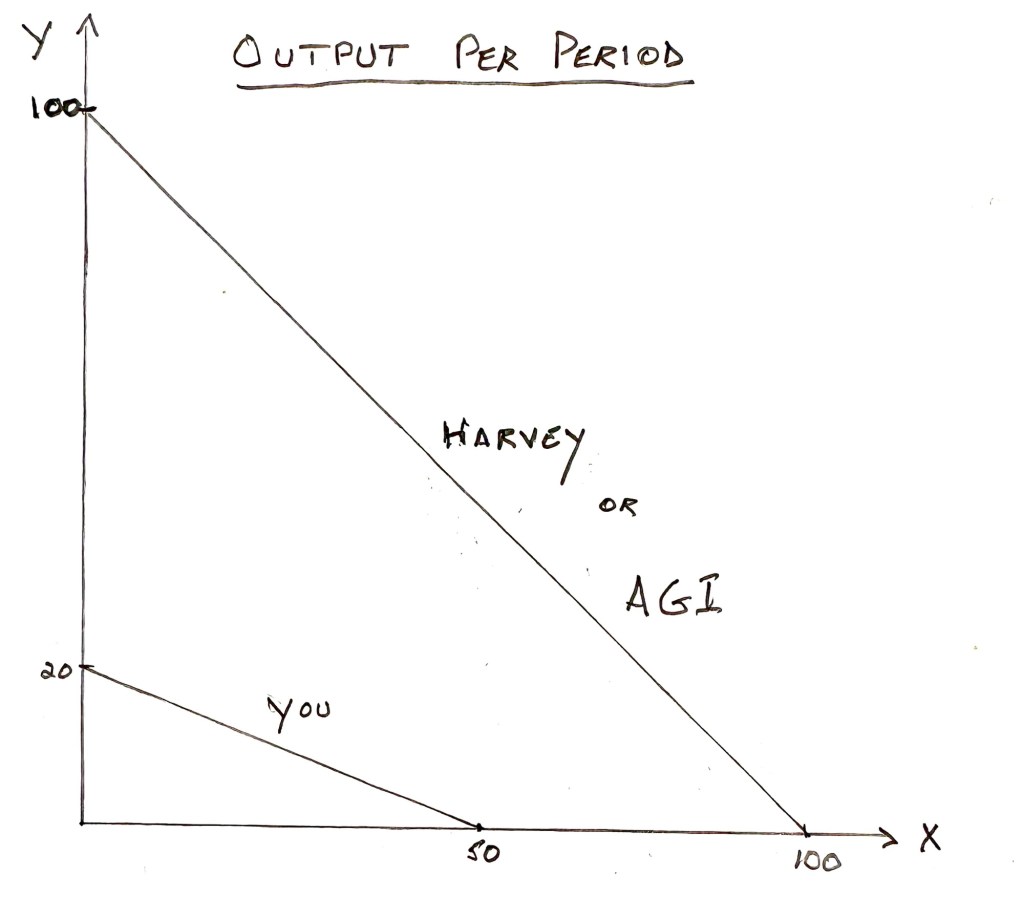
If you’re unwilling to slog through a simple numerical example, skip this section and the graph below. The graph was produced the old fashioned way: by a human being with a pencil, paper, ruler, and smart phone camera.

Here goes: Harvey can produce up to 100 units of X per period or 100 units of Y, or some linear combination of the two. Harvey’s opportunity costs are constant along this tradeoff between X and Y because it’s a straight line. It costs him one unit of Y output to produce every additional unit of X, and vice versa.

You, on the other hand, cannot produce X or Y as well as Harvey in an absolute sense. At most, you can produce up to 50 units of X per period, 20 units of Y, or some combination of the two along your own constant cost (straight line) tradeoff. You sacrifice 5/2 = 2.5 units of X to produce each unit of Y, so Harvey has the lower opportunity cost and a comparative advantage for Y. But it only costs you 2/5 = 0.4 units of Y to produce each additional unit of X, so you have a comparative advantage over Harvey in X production.

Reciprocal Advantages

In the end, you and Harvey specialize in the respective areas for which each has their lowest relative opportunity cost and a comparative advantage. If he has a comparative advantage in one area of production, and unless your respective tradeoffs have identical slopes (unlikely), the reciprocal nature of opportunity costs dictates that you have a comparative advantage in the other area of production.

Obviously, Harvey’s formidable absolute advantage over you in everything doesn’t impinge on these choices. In the real world, of course, comparative advantages play out across many dimensions of output, but the principle is the same. And once we specialize, we can trade with one another to mutual advantage.

No Such Thing As a Free AGI Robot

That brings us back to AGI and AGI robots. Like Harvey, they might well have an absolute advantage in every area of specialization, or they can learn quickly to achieve such an advantage, but that doesn’t mean they should do everything!

Just as in times preceding earlier technological breakthroughs, we cannot even imagine the types of jobs that will dominate the human and AGI work forces in the future. We already see complementarity between humans and AGI in many applications. AGI makes those workers much more productive, which leads to higher wages.

However, substitution of AGIs for human labor is a dominant theme of the many AGI “harm” narratives. In fact, substitution is already a reality in many occupations, like coding, and substitution is likely to broaden and intensify as the marriage of AGI and robotics gains speed. But that will occur only in industries for which the relative opportunity costs of AGIs, including all of the ancillary resources needed to produce them, are favorable. Among other things, AGI will require a gigantic expansion in energy production and infrastructure, which necessitates a massive exploitation of resources. Relative opportunity costs in the use of these resources will not always favor the dominance of AGIs in production. Like Harvey, AGIs and their ancillary resources cannot do everything because they cannot have comparative advantages without reciprocal comparative disadvantages.

Super-Abundance vs. Scarcity

Some might insist that AGIs will lead to such great prosperity that humans will no longer need to work. All of our material wants will be met in a new age of super-abundance. Despite the foregoing, that might suggest to some that AGIs will do everything! But here I make another claim: our future demands on resources will not be satisfied by whatever abundance AGIs make possible. We will still want to do more, whether we choose to construct fusion reactors, megastructures in space (like Dyson spheres or ring worlds), terraform Mars, undertake interstellar travel, perfect asteroid defense, battle disease, extend longevity, or improve our lives in ways now imagined or unimagined.

As a result, scarcity will remain a major force. To that extent, resources will have competing uses, they will face opportunity costs, and they will have comparative advantages vis a vis alternative uses to which they can be put. Scarcity is a reality that governs opportunity costs, and that means humans will always have roles to play in production.

Concluding Remarks

I wrote about human comparative advantages once before, about seven years ago. I think I was groping along the right path. The only other article I’ve seen to explicitly mention a comparative advantage of human labor vs. AGIs in the correct context is by Andrew Mayne in the most recent issue of Reason Magazine. It’s almost a passing reference, but it deserves more because it is foundational.

Harvey Specter shouldn’t occupy his scarce time performing tasks that compromise his ability to deliver his most rewarding services. Likewise, before long it will become apparent that highly productive AGI assets, and the resources required to build and operate them, should not be tied up in activities that humans can perform at lesser sacrifice. That’s a long way of saying that humans will still have productive roles to play, even when AGI achieves an absolute advantage in everything. Some of the roles played by humans will be complimentary to AGIs in production, but human labor will also be valuable as a substitute for AGI assets in other applications. As long as AGI assets have any comparative advantages, humans will have reciprocal comparative advantages as well.

The Impotence of AI for the Socialist Calculation Debate

05 Monday Jun 2023

Posted by Nuetzel in Artificial Intelligence, Central Planning, Markets

≈ Leave a comment

Tags

Allocative efficiency, CATO Institute, central planning, Don Boudreaux, F.A. Hayek, incentives, Industrial Policy, Invisible Hand, Jason Kuznicki, Jesús Fernández-Villaverde, Knowledge Problem, Libertarianism.org, Machine Learning, Michael Munger, Opportunity cost, Protectionism, Robert Lucas, Socialist Calculation Debate

Recent advances in artificial intelligence (AI) are giving hope to advocates of central economic planning. Perhaps, they think, the so-called “knowledge problem” (KP) can be overcome, making society’s reliance on decentralized market forces “unnecessary”. The KP is the barrier faced by planners in collecting and using information to direct resources to their most valued uses. KP is at the heart of the so-called “socialist calculation debate”, but it applies also to the failures of right-wing industrial policies and protectionism.

Apart from raw political motives, run-of-the-mill government incompetence, and poor incentives, the KP is an insurmountable obstacle to successful state planning, as emphasized by Friedrich Hayek and many others. In contrast, market forces are capable of spontaneously harnessing all sources of information on preferences, incentives, resources, as well as existing and emergent technologies in allocating resources efficiently. In addition, the positive sum nature of mutually beneficial exchange makes the market by far the greatest force for voluntary social cooperation known to mankind.

Nevertheless, the hope kindled by AI is that planners would be on an equal footing with markets and allow them to intervene in ways that would be “optimal” for society. This technocratic dream has been astir for years along with advances in computer technology and machine learning. I guess it’s nice that at least a few students of central planning understood the dilemma all along, but as explained below, their hopes for AI are terribly misplaced. AI will never allow planners to allocate resources in ways that exceed or even approximate the efficiency of the market mechanism’s “invisible hand”.

Michael Munger recently described the basic misunderstanding about the information or “data” that markets use to solve the KP. Markets do not rely on a given set of prices, quantities, and production relationships. They do not take any of those as givens with respect to the evolution of transactions, consumption, production, investment, or search activity. Instead, markets generate this data based on unobservable and co-evolving factors such as the shape of preferences across goods, services, and time; perceptions of risk and its cost; the full breadth of technologies; shifting resource availabilities; expectations; locations; perceived transaction costs; and entrepreneurial energy. Most of these factors are “tacit knowledge” that no central database will ever contain.

At each moment, dispersed forces are applied by individual actions in the marketplace. The market essentially solves for the optimal set of transactions subject to all of those factors. These continuously derived solutions are embodied in data on prices, quantities, and production relationships. Opportunity costs and incentives are both an outcome of market processes as well as driving forces, so that they shape the transactional footprint. And then those trades are complete. Attempts to impose the same set of data upon new transactions in some repeated fashion, freezing the observable components of incentives and other requirements, would prevent the market from responding to changing conditions.

Thus, the KP facing planners isn’t really about “calculating” anything. Rather, it’s the impossibility of matching or replicating the market’s capacity to generate these data and solutions. There will never be an AI with sufficient power to match the efficiency of the market mechanism because it’s not a matter of mere “calculation”. The necessary inputs are never fully unobservable and, in any case, are unknown until transactions actually take place such that prices and quantities can be recorded.

In my 2020 post “Central Planning With AI Will Still Suck”, I reviewed a paper by Jesús Fernández-Villaverde (JFV), who was skeptical of AI’s powers to achieve better outcomes via planning than under market forces. His critique of the “planner position” anticipated the distinction highlighted by Munger between “market data” and the market’s continuous generation of transactions and their observable footprints.

JFV emphasized three reasons for the ultimate failure of AI-enabled planning: impossible data requirements; the endogeneity of expectations and behavior; and the knowledge problem. Again, the discovery and collection of “data” is a major obstacle to effective planning. If that were the only difficulty, then planners would have a mere “calculation” problem. This shouldn’t be conflated with the broader KP. That is, observable “data” is a narrow category relative the arrays of unobservables and the simultaneous generation of inputs and outcomes that takes place in markets. And these solutions are found by market processes subject to an array of largely unobservable constraints.

An interesting obstacle to AI planning cited by JFV is the endogeneity of expectations. It too can be considered part of the KP. From my 2020 post:

“Policy Change Often Makes the Past Irrelevant: Planning algorithms are subject to the so-called Lucas Critique, a well known principle in macroeconomics named after Nobel Prize winner Robert Lucas. The idea is that policy decisions based on observed behavior will change expectations, prompting responses that differ from the earlier observations under the former policy regime. … If [machine learning] is used to “plan” certain outcomes desired by some authority, based on past relationships and transactions, the Lucas Critique implies that things are unlikely to go as planned.”

Again, note that central planning and attempts at “calculation” are not solely in the province of socialist governance. They are also required by protectionist or industrial policies supported at times by either end of the political spectrum. Don Boudreaux offers this wisdom on the point:

“People on the political right typically assume that support for socialist interventions comes uniquely from people on the political left, but this assumption is mistaken. While conservative interventionists don’t call themselves “socialists,” many of their proposed interventions – for example, industrial policy – are indeed socialist interventions. These interventions are socialist because, in their attempts to improve the overall performance of the economy, proponents of these interventions advocate that market-directed allocations of resources be replaced with allocations carried out by government diktat.”

The hope that non-market planning can be made highly efficient via AI is a fantasy. In addition to substituting the arbitrary preferences of planners and politicians for those of private agents, the multiplicity of forces bearing on individual decisions will always be inaccessible to AIs. Many of these factors are deeply embedded within individual minds, and often in varying ways. That is why the knowledge problem emphasized by Hayek is much deeper than any sort of “calculation problem” fit for exploitation via computer power.

~~~~~~~~~~~~~~~~~~~~~~~~~~~~~~~~~~~~~

Note: The image at the top of this post is attributed by Bing to the CATO Institute-sponsored website Libertarianism.org and an article that appeared there in 2013, though that piece, by Jason Kuznicki, no longer seems to feature that image.

Electric Vehicle Fueling Costs in the Real World

31 Sunday Oct 2021

Posted by Nuetzel in Electric Vehicles, Renewable Energy

≈ 1 Comment

Tags

Anderson Economic Group, Biomass, Charging Time, Commercial Power Rates, Deadhead Miles, Dispatchable Capacity, Disposal Costs, Electric Vehicles, EVangelists, Fast Chargers, Fueling Cost, Intermittency, Internal Combustion Engines, Joe Biden, Nuclear Energy, Opportunity cost, Phantom Drain, Power Failures, Power Grid, Recharging Costs, Renewable Power, Thermal Energy

While the photo above exaggerates, honest electric vehicle (EV) owners will tell you that “refueling” is often not cheap or convenient. However, less jaded EV drivers and enthusiasts seem to view recharging costs through an oversimplified economic lens. A realistic accounting involves a variety of cost factors, including the implicit cost of the time needed to recharge when away from home. An analysis recently published by Anderson Economic Group (AEG) provides a thorough comparison of the costs of fueling EVs relative to vehicles powered by internal combustion engines (ICEs).

Promoting the Narrow Focus

AEG notes the shortcomings of most cost studies quoted by “EVangelists” (not AEG’s term):

“Many commonly-cited studies of the cost of driving EVs include only the cost of electric power for EVs, but compare this with the total cost of fueling an ICE vehicle. Moreover, many presume drivers can routinely charge at favorable residential rates, ignoring the much higher costs of the commercial chargers EV drivers must use when they are away from a residential charger (if they have one).”

The kind of incomplete assays to which AEG refers can lead to statements like the following, from none other than Joe Biden:

“When you buy an electric vehicle, you can go across America on a single tank of gas, figuratively speaking. It’s not gas. You plug it in.”

Well no, it’s not a single tank of “gas”. You still have to stop, plug into a source of power mostly generated by fossil fuels, and it might take a while to get back on the road.

Cost Categories

The AEG report concludes that vehicles powered by ICEs are far cheaper to fuel on average than EVs. The analysis considers several categories of fueling costs including:

  • Gasoline Prices vs. Commercial & Residential Power Rates: EV drivers recharging away from home often pay more costly commercial rates.
  • Registration Taxes: applied at EV charging stations, but bundled in fuel price for ICEs;
  • EV Charging Equipment: upgraded “Level 2” chargers are generally “encouraged” at purchase of an EV;
  • Deadhead Miles: usage costs on fueling/charging runs; there are far fewer EV charging stations than gas stations in the U.S., which can lead to costly “excursions”;
  • Charging/Refueling Time: much higher for EV drivers away from home;

Direct Costs

AEG performed their analysis using electric rates, gas prices, and other cost factors as of mid-2021. They did so for six “representative” vehicle classes: entry level, mid-priced and luxury EVs and ICEs. Direct monetary costs account for the first four factors listed above; they do not include the time costs of refueling.

AEG calculates that the direct monetary costs of driving 100 miles in a mid-priced ICE vehicle is $8.95, while the cost in a mid-priced EV using a high proportion of commercial charging is $12.95, about 50% more. The direct cost in a luxury ICE is $12.60, but for a luxury EV it is $14.15 (12% more) for mostly home charging and $15.52 (23% more) for mostly commercial charging.

In addition, AEG finds that the direct cost of EV fueling is far more variable than ICE fueling. This is due to widely varying rates for commercial and residential power, including time-of-day variation, differences in charger efficiency, and the varied structure of pricing at different commercial charging stations.

Implicit Time Cost

It should be obvious that the time costs of refueling EVs are more significant than for ICE vehicles. However, I believe AEG’s report might over-estimate the difference. They say:

“… it takes substantially longer to fuel EVs than for comparable ICE cars. Real world conditions often impose additional burdens, including these two:

  1. Driving and charging time: … it often takes about 20 minutes to drive to a reliable DC fast charger. It often takes another 20 to 30 minutes for the charging process to complete. Of course, this is for fast DC chargers. Slower L2 chargers are much more common …
  2. Recurrent reliability problems: EV drivers face recurring problems at chargers such as breakdowns, software bugs, delays in syncing the mobile application with the charger, charger output being significantly lower than advertised, and outright failures. This is in addition to the problem of vehicles blocking (or “icing”) EV charging spots.

Online forums are full of comments from drivers expressing frustration about these problems.”

All true, as far as it goes. The implicit value of this time depends on the driver’s opportunity cost. Whether valued at the minimum wage or at a much higher opportunity cost, AEG’s straightforward valuation of the time cost is five to six times as high for EV drivers than for ICE drivers, depending on the vehicle class. For EVs, the time cost AEG calculates can be more than $200 a month, or about $20 per 100 miles for a someone who drives 1,000 miles a month, versus about $4 for a similar ICE driver. Adding those values to the direct monetary costs (which AEG does not do) yields a total cost per 100 miles of $33 for a mid-priced EV versus about $13 for an ICE vehicle in that class. That’s 2.5 times more to fuel an EV than a comparable ICE vehicle!

However, I would discount the cost of EV fueling time, because many drivers can use this waiting time productively, whether performing certain work tasks remotely or simply enjoying it as an extension of their leisure time, reading or viewing/listening to content on their mobile devices, for example.

Other Qualifications

AEG acknowledges that their cost comparisons use commercial power rates to account for “free” chargers offered by some stores to shoppers and by some employers to workers as benefits. That’s because stores and employers compensate for that kind of service along pricing and other margins.

AEG does not account for “phantom drain” (the loss of EV battery power while not in use) and the costs of battery degradation over time. Nor do they attempt to quantify the use of battery power while charging takes place (which inflates charging time but also increases direct costs per mile).

I would also note that many of the EV cost disadvantages described by AEG are likely to diminish going forward. More charging stations are being added as the fleet of EVs grows. Battery technology is improving as well, and chargers will become faster on average. In addition, EV “engines” have far less complexity and fewer parts than ICEs, which undoubtedly confers maintenance cost advantages over a period of time.

The Green Itch

Finally, while some consumers might find that EVs scratch a certain green itch, these vehicles are not carbon neutral, as noted above. The vast bulk of the power they use comes from fossil fuels. Higher energy prices in general might or might not work to their advantage, but electric power availability is becoming less reliable as the push toward renewable power generation continues. As we have seen repeatedly, reliance on intermittent power sources has drastic consequences for users in the absence of adequate, dispatchable baseload capacity.

To put a somewhat finer point on the difficulties posed by the intermittency of renewable power, a great deal of EV charging is done at night, when solar panels are not harvesting energy. Wind turbines can harvest a greater proportion of their power at night, but they must be fairly tall to do so (the minimum height ranges from 30 to 100 meters, depending on local conditions). That requirement means that the manufacture and construction of these turbines and their towers is all the more carbon intensive. Furthermore, disposal of both solar panels and wind turbines at the end of their useful lives creates serious environmental issues that green energy advocates have been all too willing to ignore.

Ultimately, until our ability to store power at scale advances dramatically, the issue of renewable intermittency can only be dealt with via adequate baseload power. Growth in the number of EVs will require growth in the dispatchable capacity of the power grid, which means either more plants burning fossil fuels, nuclear power, hydroelectric, biomass, or thermal energy. The alternative is an increasing frequency of blackouts, which would drastically reduce the utility of EVs.

The Social Security Filing Dilemma

19 Monday Apr 2021

Posted by Nuetzel in Risk, Social Security

≈ Leave a comment

Tags

Deferred Benefits, Full Retirement Age, Life Expectancy, Opportunity cost, Retirement Savings, Risk Tolerance, Social Security, Time Preference

A 67-year-old friend told me he won’t file for Social Security (SS) benefits until he turns 70 because “it will pay off as long as I live to at least 81”. Okay, so benefit levels increase by about 8% for each year they’re deferred after your “full retirement age” (probably about 66 for him), and he has no doubt he’ll live more than the extra 11 years. Yes, his decision will “pay off” in a “break-even” sense if he lives that long: he’ll collect more incremental dollars of benefits beyond his 70th birthday than he’ll lose during the three-year deferral (but actually, he’d have to live till he’s 81.5 to break even). But that does not mean his decision is “optimal”.

Good things come to those who wait. I’ll simplify here just a bit, but let’s say an 8% increase in benefits is uniform for every year deferred beyond age 62. (It’s actually a bit more than that after full retirement age, but it’s less than 8% in some years prior to full retirement age.) 8% is a very good, “safe” return, assuming you don’t mind putting your faith in the government to make good.

The Reaper approaches: Unlike your personal savings, SS benefits end at death (a surviving spouse would continue to receive the higher of your respective benefit payments). That means the “safe” 8% return is eroded by diminishing life expectancy with each passing year. For example, average life expectancy at age 62 is 25.4 years, but it falls to 24.5 years at age 63. That’s a decline of 3.5% in the number of years one can expected to receive those higher, deferred benefits. At ages 69 and 70, remaining life expectancy is 19.6 and 18.8 years, respectively. Therefore, waiting the extra year to age 70 means a 4.1% decline in future years of benefits. So rather than a safe, 8% return, subtract about 4%. You’re looking at roughly a 4% uncertain return for deferral of benefits between age 62 and age 70. If you have health issues, it’s obviously worse.

Opportunity Cost: It would be fine to take an expected 4% annual return for deferring SS benefits if you had no immediate use for the extra funds. But you could take the early benefits and invest them! If you’re still working, you could possibly save a like amount of funds from your employment income tax-deferred. So taking the early benefits would be worthwhile if you can earn at least 4% on the funds. Sure, investment returns are uncertain, but over a few years, a 4% annualized return (which I’ll call the “hurdle” rate) should not be hard to beat.

The same logic applies to an already retired individual who would withdraw funds from savings to afford the deferral of SS benefits. Instead, if he or she takes the benefits immediately, leaving a like amount invested, any return in excess of about 4% will have made it worthwhile. But of course, all of this is beside the point if you really just want to retire and the early benefits allow you to do so. You value the benefits now!

But what about taxes? Investment income will generally be taxed, and it’s possible the incremental benefits from deferred SS benefits won’t be. That might swing the calculus in favor of waiting a few extra years to file. And taking benefits early, while still employed, might mean a larger share of the early benefits will be taxed. If 80% of your benefits are taxed at a marginal rate of 25%, state and federal, you’re out 20% of your early benefits. Also, if you expect to be in a lower tax bracket in the future (good luck!), or if you plan to move to a low-tax state at some point in the future, deferring benefits might be more advantageous.

On the other hand, if you’re subject to tax on a portion of your early benefits, you’re likely to be subject to tax on benefits you defer as well. If you’re SS benefits and investment income are both taxed, the issue might be close to a wash, but that hurdle return I mentioned above might have to be a bit higher than 4% to justify early benefits.

Optimal? So what is an “optimal” decision about when to file for SS benefits? For anyone in their 60s today who has not yet filed for SS benefits, it depends on your tolerance for market risk and your tax status.

—You can likely earn more than the rough 4% annual hurdle discussed over a few years in the market, so taking benefits as early as 62 might be a reasonable decision. That’s especially true if you already have some cash set aside to ride out market downturns.

—If you are an extremely conservative investor then you are unlikely to achieve a 4% return, so the “safe” return from deferring SS benefits is your best bet.

—If you believe your tax status will be more favorable later, that might swing the pendulum in favor of deferral, again depending on risk tolerance.

—If you are afraid that failing health and death might come prematurely, filing early is a reasonable decision.

—If you simply want to retire early and the benefits will enable you to do that, filing early is simply a matter of personal time preference.

So my friend who is deferring his SS benefits until age 70 might or might not be optimizing: 1) he is supremely confident in his long-term health, but that’s not something he should count on; 2) he might be an extremely cautious investor (okay…); and 3) he’s still working, and he might expect his tax status to improve by age 70 (I doubt it).

I plan to retire before I turn 65, and I think I’ll be happy to take the benefits and leave more of my money invested. As for Social Security generally, I’d be happy to take a steeply discounted lump sum immediately and invest it, rather than wait for retirement, but that ain’t gonna happen!

The Comparative Human Advantage

10 Thursday Aug 2017

Posted by Nuetzel in Automation, Technology, Tradeoffs

≈ 1 Comment

Tags

Absolute Advantage, Automation, Comparative advantage, Elon Musk, Kardashev Scale, Minimum Wage, Opportunity cost, Scarcity, Specialization, Superabundance, Trade

There are so many talented individuals in this world, people who can do many things well. In fact, they can probably do everything better than most other people in an absolute sense. In other words, they can produce more of everything at a given cost than most others. Yet amazingly, they still find it advantageous to trade with others. How can that be?

It is due to the law of comparative advantage, one of the most important lessons in economics. It’s why we specialize and trade with others for almost all of ours needs and wants, even if we are capable of doing all things better than them. Here’s a simple numerical example… don’t bail out on me (!):

  • Let’s say that you can produce either 1,000 bushels of barley or 500 bushels of hops in a year, or any combination of the two in those proportions. Each extra bushel of hops you produce involves the sacrifice of two bushels of barley.
  • Suppose that I can produce only 500 bushels of barley and 400 bushels of hops in a year, or any combination in those proportions. It costs me only 1.25 bushels of barley to produce an extra bushel of hops.
  • You can produce more hops than I can, but hops are costlier for you at the margin: 2 bushels of barley to get an extra bushel of hops, more than the 1.25 bushels it costs me.
  • That means you can probably obtain a better combination (for you) of barley and hops by specializing in barley and trading some of it to me for hops. You don’t have to do everything yourself. It’s just not in your self-interest even if you have an absolute advantage over me in everything!

This is not a coincidental outcome. Exploiting opportunities for trade with those who face lower marginal costs effectively increases our real income. In production, we tend to specialize — to do what we do — because we have a comparative advantage. We specialize because our costs are lower at the margin in those activities. And that’s also what motivates trade with others. That’s why nations should trade with others. And, as I mentioned about one week ago here, that’s why we have less to fear from automation than many assume.

Certain tasks will be automated as increasingly productive “robots” (or their equivalents) justify the costs of the resources required to produce and deploy them. This process will be accelerated to the extent that government makes it appear as if robots have a comparative advantage over humans via minimum wage laws and other labor market regulations. As a general rule, employment will be less vulnerable to automation if wages are flexible. 

What if one day, as Elon Musk has asserted, robots can do everything better than us? Will humans have anywhere to work? Yes, if human labor is less costly at the margin. Once deployed, a robot in any application has other potential uses, and even a robot has just 24 hours in a day. Diverting a robot into another line of production involves the sacrifice of its original purpose. There will always be uses in which human labor is less costly at the margin, even with lower absolute productivity, than repurposing a robot or the resources needed to produce a new robot. That’s comparative advantage! That will be true for many of the familiar roles we have today, to say nothing of the unimagined new roles for humans that more advanced technology will bring.

Some have convinced themselves that a fully-automated economy will bring an end to scarcity itself. Were that to occur, there would be no tradeoffs except one kind: how you use your time (barring immortality). Superabundance would cause the prices of goods and services to fall to zero; real incomes would approach infinity. In fact, income as a concept would become meaningless. Of course, you will still be free to perform whatever “work” you enjoy, physical or mental, as long as you assign it a greater value than leisure at the margin.

Do I believe that superabundance is realistic? Not at all. To appreciate the contradictions inherent in the last paragraph, think only of the scarcity of talented human performers and their creativity. Perhaps people will actually enjoy watching other humans “perform” work. They always have! If the worker’s time has any other value (and it is scarce to them), what can they collect in return for their “performance”? Adulation and pure enjoyment of their “work”? Some other form of payment? Not everything can be free, even in an age of superabundance.

Scarcity will always exist to one extent or another as long as our wants are insatiable and our time is limited. As technology solves essential problems, we turn our attention to higher-order needs and desires, including various forms of risk reduction. These pursuits are likely to be increasingly resource intensive. For example, interplanetary or interstellar travel will be massively expensive, but they are viewed as desirable pursuits precisely because resources are, and will be, scarce. Discussions of the transition of civilizations across the Kardashev scale, from “Type 0” (today’s Earth) up to “Type III” civilizations, capable of harnessing the energy equivalent of the luminosity of its home galaxy, are fundamentally based on presumed efforts to overcome scarcity. Type III is a long way off, at best. The upshot of ongoing scarcity is that opportunity costs of lines of employment will remain positive for both robots and humans, and humans will often have a comparative advantage.

Sell the Interstates and Poof — Get a Universal Basic Income

11 Tuesday Jul 2017

Posted by Nuetzel in Automation, Universal Basic Income

≈ 3 Comments

Tags

Artificial Intelligence, Basic Income, James P. Murphy, Jesse Walker, Minimum Wage, Opportunity cost, Private Infrastructure, Private Roads, Public Lands, Rainy Day Funds, Universal Basic Income, Vernon Smith, work incentives

Proposals for a universal basic income (UBI) seem to come up again and again. Many observers uncritically accept the notion that robots and automation will eliminate labor as a factor of production in the not-too-distant future. As a result, they cannot imagine how traditional wage earners, and even many salary earners, will get along in life without the helping hand of government. Those who own capital assets — machines, buildings and land — will have to be taxed to support UBI payments, according to this logic.

Even with artificial intelligence added to the mix, I view robot anxiety as overblown, but it makes for great headlines. The threat is likely no greater than the substitution of capital for labor that’s been ongoing since the start of the industrial revolution, and which ultimately led to the creation of more jobs in occupations that were never before imagined. See below for more on my skepticism for robot dystopia. For now, I’ll stipulate that human obsolescence will happen someday, or that a great many workers will be displaced by automation over an extended period. How will society manage with minimal rewards for labor? The question of distributing goods and services will depend more exclusively on the ownership of capital, or else it will be charity and/or government redistribution.

The UBI, as typically framed, is an example of the latter. However, a UBI needn’t require government to tax and redistribute income on an ongoing basis. Nobel Prize winner Vernon Smith suggests that the government owns salable assets sufficient to fund a permanent UBI. He suggests privatizing the interstate highway system and selling off federal lands in the West. The proceeds could then be invested in a variety of assets to generate growth and income. Every American would receive a dividend check each year, under this plan.

Why a UBI?

Given the stipulation that human labor will become obsolete, the UBI is predicated on the presumption that the ownership of earning capital cannot diffuse through society to the working class in time to provide for them adequately. Working people who save are quite capable of accumulating assets, though government does them no favors via tax policy and manipulation of interest rates. But accumulating assets takes time, and it is fair to say that today’s distribution of capital would not support the current distribution of living standards without opportunities to earn labor income.

Still, a UBI might not be a good reason to auction public assets. That question depends more critically on the implicit return earned by those assets via government ownership relative to the gains from privatization, including the returns to alternative uses of the proceeds from a sale.

Objections to the UBI often center on the generally poor performance of government in managing programs, the danger of entrusting resources to the political process, and the corrosive effect of individual dependency. However, if government can do anything well at all, one might think it could at least cut checks. But even if we lay aside the simple issue of mismanagement, politics is a different matter. Over time, there is every chance that a UBI program will be modified as the political winds shift, that exceptions will be carved out, and that complex rules will be established. And that brings us back to the possibility of mismanagement. Even worse, it creates opportunities for rent seekers to skim funds or benefit indirectly from the program. In the end, these considerations might mean that the UBI will yield a poor return for society on the funds placed into the program, much as returns on major entitlements like Social Security are lousy.

Another area of concern is that policy should not discourage work effort while jobs still exist for humans. After all, working and saving is traditionally the most effective route to accumulating capital. Recipients of a UBI would not face the negative marginal work incentives associated with means-tested transfer payments because the UBI would not (should not) be dependent on income. It would go to the rich and poor alike. A UBI could still have a negative impact on labor supply via an income effect, however, depending on how individuals value incremental leisure versus consumption at a higher level of money income. On the whole, the UBI does not impart terrible incentive effects, but that is hardly a rationale for a UBI, let alone a reason to sell public assets.

Funding the UBI

We usually think of funding a UBI via taxes, and it’s well known that taxes harm productive incentives. If the trend toward automation is a natural response to a high return on capital, taxes on capital will retard the transition and might well inhibit the diffusion of capital ownership into lower economic strata. If your rationale for a UBI is truly related to automation and the obsolescence of labor, then funding a UBI should somehow take advantage of the returns to private capital short of taxing those returns away. This makes Smith’s idea more appealing as a funding mechanism.

Will there be a private investment appetite for highways and western land? Selling these assets would take time, of course, and it is difficult to know what bids they could attract. There is no question that toll roads can be profitable. Robert P. Murphy provides an informative discussion of private roads and takes issue with arguments against privatization, such as the presumptions of monopoly pricing and increased risk to drivers. Actually, privatization holds promise as a way of improving the efficiency of infrastructure use and upkeep. In fact, government mispricing of roads is a primary cause of congestion, and private operators have incentives to maintain and improve road safety and quality. Public land sales in the West are complex to the extent that existing mineral and grazing rights could be subject to dispute, and those sales might be unpopular with other landowners.

Once the assets are sold to investors, who will manage the UBI fund? Whether managed publicly or privately, the best arrangement would be no active trading management. Nevertheless, the appropriate mix of investments would be the subject of endless political debate. Every market downturn would bring new calls for conservatism. The level of distributions would also be a politically contentious issue. Dividend yields and price appreciation are not constant, and so it is necessary to determine a sustainable payout rate as well as if and when adjustments are needed. Furthermore, there must be some allowance to assure fund growth over time so that population growth, whatever the source, will not diminish the per capita payout.

Jesse Walker has a good retrospective on the history of “basic income” proposals and programs over time. He demonstrate that economic windfalls have frequently been the impetus for establishment of “rainy day” programs. Alaska, enabled by oil revenue, is unique in establishing a fund paying dividends to residents:

“From time to time a state will find itself awash in riches from natural resources. Some voices will suggest that the government not spend the new money at once but put some away for a rainy day. Some fraction of those voices will suggest it create a sovereign wealth fund to invest the windfall. And some fraction of that fraction will want the fund to pay dividends.

Now, there are all sorts of potential problems with government-run investment portfolios, as anyone who has followed California’s pension troubles can tell you. If you’re wary about mismanagement, you’ll be wary about states playing the market; they won’t all invest as conservatively as Alaska has.

Still, several states have such funds already—the most recent additions to the list are North Dakota and West Virginia—and the number may well grow. None has followed Juneau’s example and started paying dividends, but it is hardly unimaginable that someone else will eventually adopt an Alaska-style system.”

Human-Machine Collaboration

A world without human labor is unlikely to evolve. Automation, for the foreseeable future, can improve existing processes such as line tasks in manufacturing, order taking in fast food outlets, and even burger flipping. Declines in retail employment can also be viewed in this context, as internet sales have grown as a share of consumer spending. However, innovation itself cannot be automated. In today’s applications, the deployment and ongoing use of robots often requires human collaboration. Like earlier increases in capital intensity, automation today spurs the creation of new kinds of jobs. Operational technology now exists alongside information technology as an employment category.

I have addressed concerns about human obsolescence several times in the past (most recently here, and also here). Government must avoid policies that hasten automation, like drastic hikes in the minimum wage (see here and here). U.S. employment is at historic highs even though the process of automation has been underway in industry for a very long time. Today there are almost 6.4 million job vacancies in the U.S., so plenty of work is available. Again, new technologies certainly destroy some jobs, but they tend to create new jobs that were never before imagined and that often pay more than the jobs lost. Human augmentation will also provide an important means through which workers can add to their value in the future. And beyond the new technical opportunities, there will always be roles available in personal service. The human touch is often desired by consumers, and it might even be desirable on a social-psychological level.

Opportunity Costs

Finally, is a UBI the best use of the proceeds of public asset sales? That’s doubtful unless you truly believe that human labor will be obsolete. It might be far more beneficial to pay down the public debt. Doing so would reduce interest costs and allow taxpayer funds to flow to other programs (or allow tax reductions), and it would give the government greater borrowing capacity going forward. Another attractive alternative is to spend the the proceeds of asset sales on educational opportunities, especially vocational instruction that would enhance worker value in the new world of operational technology. Then again, the public assets in question have been funded by taxpayers over many years. Some would therefore argue that the proceeds of any asset sale should be returned to taxpayers immediately and, to the extent possible, in proportion to past taxes paid. The UBI just might rank last.

Good Profits and Bad Profits

18 Thursday May 2017

Posted by Nuetzel in Health Care, Profit Motive

≈ Leave a comment

Tags

ACA, Affordable Care Act, Big government, Corporatism, Cronyism, Economic Rents, Health Insurance, Opportunity cost, Profit Motive, Regulatory Capture, Reinsurance, rent seeking, Risk corridors, Supra-Normal Profit

Toles-on-Regulatory-Capture

There are two faces of profit. It’s always the fashion on the left to denigrate profits and the profit motive generally, as if it serves no positive social function. This stems partly from a failure to examine the circumstances under which profits are earned: is it through competitive performance, innovation, hard-won customer loyalty, and the skill or even luck to spot an underpriced asset? Such a “good” profit might even exceed what economists call a “normal profit”, or one that just covers the opportunity cost of the owners’ capital. On the other hand, profit can be derived from what economists call “rent seeking”. That’s the dark side, but the unrecognized spirit of rent seeking seems to lurk within many discussions, as if the word profit was exclusively descriptive of evil. The “rent” in rent seeking derives from “economic rent”, which traditionally meant profit in excess of opportunity cost, or a “supra-normal” profit. But it’s impossible to know exactly how much of any given profit is extracted by rent seeking; a high profit in and of itself is not prima facie evidence of rent seeking, even though we might argue the social merits of a firm’s dominant market position.

Rent seeking takes many forms. Collusion between ostensible competitors is one, as is any predatory attempt to monopolize a market, but the term is most often associated with cronyism in government. For example, lobbying efforts might involve favors to individuals in hopes of swaying votes on regulatory matters or lucrative government contracts. Sometimes, a rent seeker wants lighter regulation. At others, a rent seeker might work the political system for more regulation in the knowledge that smaller competitors will be incapable of surviving the heavy compliance costs. Government administrators also have the authority to change fortunes with their rulings, and they are subject to the same temptations as elected officials. In fact, in the aggregate, administrative rule-making and even enforcement might outweigh prospective legislation as attractors of intense rent-seeking.

Rent seeking is big-time and it is small-time. It takes place at all levels of government, from attempts to influence zoning decisions, traffic patterns, contract awards, and even protection from law enforcement. When it’s big time, rent seeking is the very essence of what some call corporatism and more generally fascism: the enlistment of coercive government power for private gain. A pretty reliable rule is that where there’s government, there is rent-seeking behavior.

Otherwise, the profit motive serves a valuable and massive social function: resources are attracted to profitable uses because they signal the desires of potential buyers. In this way, profits assure that resources are drawn into the most-valued uses. The market interactions between new competitors, drawn by the prospect of profits, and willing buyers leads to a self-correction: supra-normal profits get competed away over time. In this way, the spontaneous actions of voluntary market participants lead to a great achievement: all mutually beneficial trades are exhausted. Profit makes this possible in the short-run and it assures that trades evolve optimally with changes in tastes, technology and resource availability. By comparison, government fares poorly when it attempts to plan outcomes in the short- or the long-run. Rent seeking is an attempt to influence and even encourage such planning, and the profits it enables impose costs on society.

Good and Bad Profits In Health Insurance

I’ve written a few posts about health insurance reform recently (see the left margin). Health care is scarce. If relying on government is the preferred alternative to private insurance, don’t count on better access to care: you won’t get it unless you’re connected. Profits earned by health insurance carriers are roundly condemned by the left. It is as if private capital utilized in arranging coverage and carrying the risk on pools of customers deserves zero compensation, that only public capital raised by coercive taxation is morally acceptable for this purpose. But aside from this obvious hogwash, is there a reason to question the insurers’ route to profitability based upon rent seeking?

The health insurers played a role in shaping the Affordable Care Act (ACA, i.e., Obamacare) and certainly had hoped to benefit from several of its provisions, even while sacrificing autonomy over product, price, coverage decisions, and payout ratios. The individual and employer mandates would force low-risk individuals to purchase extensive coverage, and essential benefits requirements would earn incremental margins. Sounds like a nice deal, but those policies were regarded by the ACA’s proponents as necessary for universal coverage, stabilizing risk, and promoting adequate coverage levels. There were other provisions, however, designed to safeguard the profitability of insurers. These included an industry risk adjustment mechanism, temporary reinsurance to help defray the cost of  covering high-risk patients, and so-called risk corridors (also temporary).

As it turned out, the ACA was not a great bet for insurers, as their risk pools deteriorated more than many expected. With the expiration of the temporary protections in Obamacare, it became evident that offering policies on the exchanges would not be profitable without large premium hikes. A number of carriers have stopped offering policies on the exchanges.

It should be no surprise that health insurance profitability has been anything but impressive over the past three years. The average industry return on equity was just 5.6% during that time frame, and it was a slightly better 6.2% in 2016, about 60% of the market-wide average. It’s difficult to conclude that insurers benefitted greatly from rent seeking activity with regard to the ACA’s passage, but perhaps that activity had a sufficient influence on policy to stabilize what otherwise might have been disastrous performance.

The critics of insurance profits are primarily interested in scapegoating as a means to promote a single-payer health care system. While some are aware of the favors granted to the industry in the design of the ACA, most are oblivious to the actual results. Even worse, they wish to throw-out the good with the bad.

The left is almost universally ignorant of the social function served by the profit motive. Profits stimulate supply, competition and innovation in virtually every area of economic life. To complain about profits in general is to wish for a primitive existence. Unfortunately, the potential for government to change the rules of the market makes it a ripe target for rent-seeking, and it creates a fog through which few discern the good from the bad.

Busting the K-12 Monopoly

12 Monday Dec 2016

Posted by Nuetzel in Education, School Choice

≈ Leave a comment

Tags

Betsy DeVos, Cafe Hayek, Don Boudreaux, Donald Trump, Education Funding, GI Bill, Opportunity cost, Public School Monopoly, Racial Segregation, School Choice, School Vouchers, Teachers Unions

school-choice

Public school teachers are highly sensitive to any suggestion that their schools should “compete” for students, but it’s difficult to rationalize restrictions on competition faced by any institution that trades with consumers. Education is certainly not a natural monopoly. But in the U.S., K-12 public schools are granted an effective service monopoly over large segments of their local markets. Their monopoly status is a legacy and usually taken for granted, but that does not make the arrangement a natural state of affairs, or a healthy one.

The idea that education is a “public good”, or nonexclusive in the benefits it confers, is true only in a weak sense. Yes, there are external benefits from the education of children, but those are secondary to the personal benefits reaped by the children themselves as they go through life. And even strong public spillover benefits do not imply that government should provision the education itself, free of competition. Economic theory justifying intervention in markets implies only that the public sector should attempt to augment supply; direct production by the public sector is unnecessary and often unwise. Competition among schools will bring forth more of the private and public benefits than a monopoly.

But the public schools are free, and that doesn’t sound like a monopoly, right? Well, no, they aren’t free! Not to taxpayers, of course, but also, not to families with children who are denied the right to fully internalize the true opportunity cost of the resources claimed by public schools. The option to move to a school district with better academic performance is unavailable to many families. What would those families decide given a greater degree of empowerment to consider alternatives?

About 18 months ago, the topic of the K-12 monopoly was the subject of a favorite post on Sacred Cow Chips called: “Public Monopolists Say “Don’t Be Choosy“. It called attention to a thought exercise featured by economist Don Boudreaux on Cafe Hayek. Consumers are very choosy about their food, and they should be. Why shouldn’t they be just as choosy about another essential: the school for their children? Because the government won’t let them! Boudreaux lists factors that would make consumer grocery distribution just like the structure of K-12 education. That includes property taxes to pay for “public” grocery stores and the allotments of food they distribute, assignment of each family to a single public grocery store, but freedom to shop at “private” grocery stores at additional expense. He then asks how the food distribution system would perform. Here’s Boudreaux:

“Being largely protected from consumer choice, almost all public supermarkets would be worse than private ones. In poor counties the quality of public supermarkets would be downright abysmal. ….

Responding to these failures, thoughtful souls would call for ‘supermarket choice’ fueled by vouchers or tax credits. Those calls would be vigorously opposed by public-supermarket administrators and workers.

Opponents of supermarket choice would accuse its proponents of demonizing supermarket workers (who, after all, have no control over their customers’ poor eating habits at home). Advocates of choice would also be accused of trying to deny ordinary families the food needed for survival. Such choice, it would be alleged, would drain precious resources from public supermarkets whose poor performance testifies to their overwhelming need for more public funds.

As for the handful of radicals who call for total separation of supermarket and state—well, they would be criticized by almost everyone as antisocial devils indifferent to the starvation that would haunt the land if the provision of groceries were governed exclusively by private market forces.

In the face of calls for supermarket choice, supermarket-workers unions would use their significant resources for lobbying—in favor of public-supermarkets’ monopoly power and against any suggestion that market forces are appropriate for delivering something as essential as groceries.“

That’s exactly the behavior we see from the teacher’s unions, from which sanctimony flows liberally as to “public service”. Remember that the classic monopolist actively engages in denying choice and restraining trade through private actions, public relations and various other political means. But why would any sane observer have concluded that these “protected markets” would lead to successful outcomes?

It’s no secret that public schools in the U.S. face severe challenges. They are highly uneven in their results. A recent report in U.S. News said the following:

“Since World War II, inflation-adjusted spending per student in American public schools has increased by 663 percent. Where did all of that money go? One place it went was to hire more personnel. Between 1950 and 2009, American public schools experienced a 96 percent increase in student population. During that time, public schools increased their staff by 386 percent – four times the increase in students. The number of teachers increased by 252 percent, over 2.5 times the increase in students. The number of administrators and other staff increased by over seven times the increase in students.“

Federal efforts to improve K-12 education have been remarkably fruitless. Despite the massive increases in staffing over the past 50 years at all levels, graduation rates are still miserable in minority districts; schools are more segregated today than 50 years ago; huge gaps exist between the achievement of students in high and low-income districts; and math scores on standardized tests rank near the bottom of OECD countries, (science and reading scores are closer to the average).

The usual rejoinder from the public school establishment is that still greater funding is needed. Always more…. But families are exercising their right to opt-out. The number of home-schooled children is likely to exceed two million by 2020. There are now programs in 32 states facilitating choice through vouchers, tax credits, tax deductions, and education savings accounts. The body of research surrounding the effects of school choice is overwhelmingly positive: choice has improved academic outcomes in both private schools and the public schools that are forced to compete, it has a positive fiscal impact, and it reduces racial segregation. The constant drumbeat of additional funding requests looks unnecessary and wasteful in view of the options.

As for federal dollars, one suggestion is to pare back sharply the number of bureaucrats at the education department, putting the savings toward a program that would emulate the hugely successful GI Bill, under which beneficiaries chose how to spend the money.

Donald Trump’s nominee for education secretary is school choice advocate Betsy DeVos. Obviously, the new administration will not view the public school monopoly as untouchable. But let’s get one thing straight: no one is trying to “ruin” public schools. The objective is to fix something that’s been broken for a long time and, in so doing, to improve educational outcomes across all segments of society. The medicine delivered thus far, including top-down planning and profligate spending, has been expensive and ineffective, and even counterproductive in some respects. A few bad schools will fail under a competitive regime, but they already do. Bad schools have no sacred right to survive. Most struggling schools will improve, leveraging innovative techniques as well as their natural advantages, which often include proximity to a base of prospective students. It’s time to tackle the education problem by vesting consumers with sovereignty in the choice of schools.


← Older posts
Follow Sacred Cow Chips on WordPress.com

Recent Posts

  • Immigration and Merit As Fiscal Propositions
  • Tariff “Dividend” From An Indigent State
  • Almost Looks Like the Fed Has a 3% Inflation Target
  • Government Malpractice Breeds Health Care Havoc
  • A Tax On Imports Takes a Toll on Exports

Archives

  • December 2025
  • November 2025
  • October 2025
  • September 2025
  • August 2025
  • July 2025
  • June 2025
  • May 2025
  • April 2025
  • March 2025
  • February 2025
  • January 2025
  • December 2024
  • November 2024
  • October 2024
  • September 2024
  • August 2024
  • July 2024
  • June 2024
  • May 2024
  • April 2024
  • March 2024
  • February 2024
  • January 2024
  • December 2023
  • November 2023
  • August 2023
  • July 2023
  • June 2023
  • May 2023
  • April 2023
  • March 2023
  • February 2023
  • January 2023
  • December 2022
  • November 2022
  • October 2022
  • September 2022
  • August 2022
  • July 2022
  • June 2022
  • May 2022
  • April 2022
  • March 2022
  • February 2022
  • January 2022
  • December 2021
  • November 2021
  • October 2021
  • September 2021
  • August 2021
  • July 2021
  • June 2021
  • May 2021
  • April 2021
  • March 2021
  • February 2021
  • January 2021
  • December 2020
  • November 2020
  • October 2020
  • September 2020
  • August 2020
  • July 2020
  • June 2020
  • May 2020
  • April 2020
  • March 2020
  • February 2020
  • January 2020
  • December 2019
  • November 2019
  • October 2019
  • September 2019
  • August 2019
  • July 2019
  • June 2019
  • May 2019
  • April 2019
  • March 2019
  • February 2019
  • January 2019
  • December 2018
  • November 2018
  • October 2018
  • September 2018
  • August 2018
  • July 2018
  • June 2018
  • May 2018
  • April 2018
  • March 2018
  • February 2018
  • January 2018
  • December 2017
  • November 2017
  • October 2017
  • September 2017
  • August 2017
  • July 2017
  • June 2017
  • May 2017
  • April 2017
  • March 2017
  • February 2017
  • January 2017
  • December 2016
  • November 2016
  • October 2016
  • September 2016
  • August 2016
  • July 2016
  • June 2016
  • May 2016
  • April 2016
  • March 2016
  • February 2016
  • January 2016
  • December 2015
  • November 2015
  • October 2015
  • September 2015
  • August 2015
  • July 2015
  • June 2015
  • May 2015
  • April 2015
  • March 2015
  • February 2015
  • January 2015
  • December 2014
  • November 2014
  • October 2014
  • September 2014
  • August 2014
  • July 2014
  • June 2014
  • May 2014
  • April 2014
  • March 2014

Blogs I Follow

  • Passive Income Kickstart
  • OnlyFinance.net
  • TLC Cholesterol
  • Nintil
  • kendunning.net
  • DCWhispers.com
  • Hoong-Wai in the UK
  • Marginal REVOLUTION
  • Stlouis
  • Watts Up With That?
  • Aussie Nationalist Blog
  • American Elephants
  • The View from Alexandria
  • The Gymnasium
  • A Force for Good
  • Notes On Liberty
  • troymo
  • SUNDAY BLOG Stephanie Sievers
  • Miss Lou Acquiring Lore
  • Your Well Wisher Program
  • Objectivism In Depth
  • RobotEnomics
  • Orderstatistic
  • Paradigm Library
  • Scattered Showers and Quicksand

Blog at WordPress.com.

Passive Income Kickstart

OnlyFinance.net

TLC Cholesterol

Nintil

To estimate, compare, distinguish, discuss, and trace to its principal sources everything

kendunning.net

The Future is Ours to Create

DCWhispers.com

Hoong-Wai in the UK

A Commonwealth immigrant's perspective on the UK's public arena.

Marginal REVOLUTION

Small Steps Toward A Much Better World

Stlouis

Watts Up With That?

The world's most viewed site on global warming and climate change

Aussie Nationalist Blog

Commentary from a Paleoconservative and Nationalist perspective

American Elephants

Defending Life, Liberty and the Pursuit of Happiness

The View from Alexandria

In advanced civilizations the period loosely called Alexandrian is usually associated with flexible morals, perfunctory religion, populist standards and cosmopolitan tastes, feminism, exotic cults, and the rapid turnover of high and low fads---in short, a falling away (which is all that decadence means) from the strictness of traditional rules, embodied in character and inforced from within. -- Jacques Barzun

The Gymnasium

A place for reason, politics, economics, and faith steeped in the classical liberal tradition

A Force for Good

How economics, morality, and markets combine

Notes On Liberty

Spontaneous thoughts on a humble creed

troymo

SUNDAY BLOG Stephanie Sievers

Escaping the everyday life with photographs from my travels

Miss Lou Acquiring Lore

Gallery of Life...

Your Well Wisher Program

Attempt to solve commonly known problems…

Objectivism In Depth

Exploring Ayn Rand's revolutionary philosophy.

RobotEnomics

(A)n (I)ntelligent Future

Orderstatistic

Economics, chess and anything else on my mind.

Paradigm Library

OODA Looping

Scattered Showers and Quicksand

Musings on science, investing, finance, economics, politics, and probably fly fishing.

  • Subscribe Subscribed
    • Sacred Cow Chips
    • Join 128 other subscribers
    • Already have a WordPress.com account? Log in now.
    • Sacred Cow Chips
    • Subscribe Subscribed
    • Sign up
    • Log in
    • Report this content
    • View site in Reader
    • Manage subscriptions
    • Collapse this bar
 

Loading Comments...