• About

Sacred Cow Chips

Sacred Cow Chips

Tag Archives: Peter Suderman

Health Care & Education: Slow Productivity Growth + Subsidies = Jacked Prices

14 Sunday May 2023

Posted by Nuetzel in Education, Health Care, Priductivity

≈ Leave a comment

Tags

Abundance Agenda, Alex Tabarrok, Baumol's Disease, Beethoven’s String Quartet No. 14, CHIPS, competition, Consumer Sovereignty, Education Cost, Education Grants, Education Productivity, Employer-Paid Coversge, Eric Helland, Exchange subsidies, health care costs, Health Care Productivity, Industrial Concentration, Mark Perry, Medicaid, Medical Technology, Medicare, Obamacare, Peter Suderman, Relative Prices, Slow Productivity Growth, Student Loans, Subsidies, Tax Subsidies, third-party payments, Willian Baumol
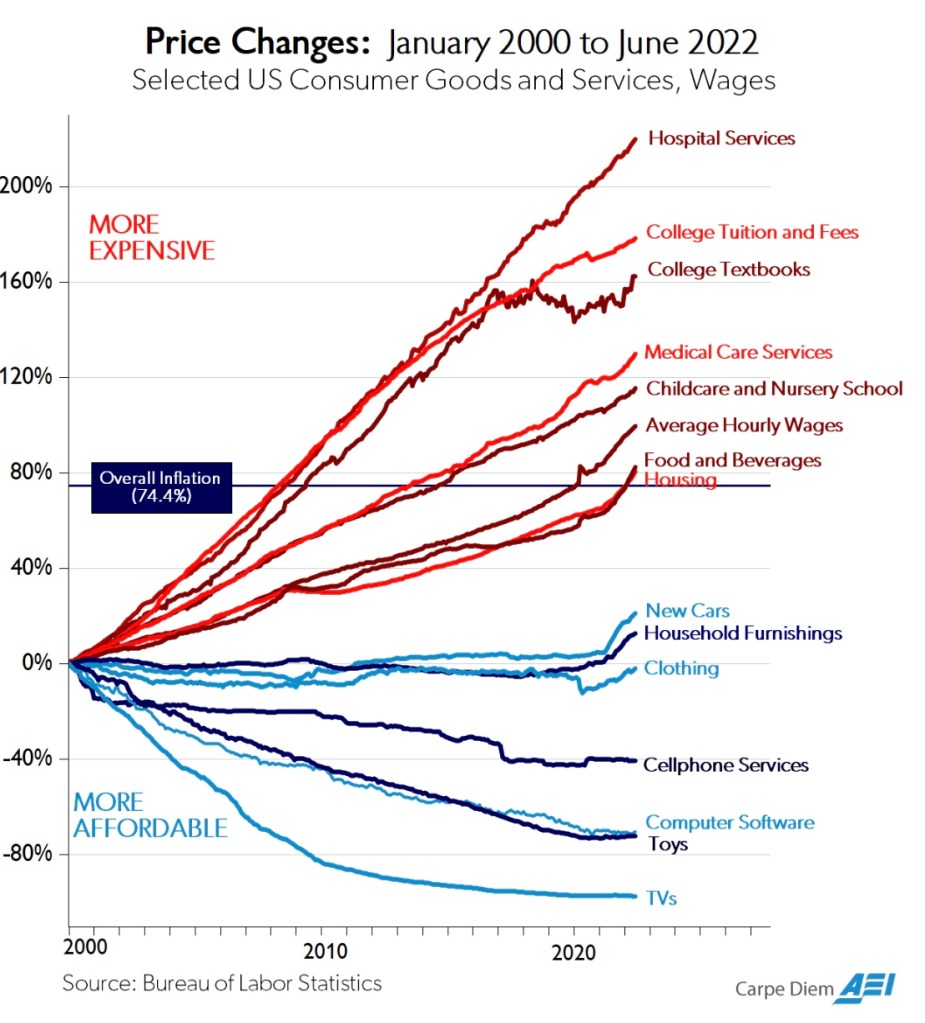
This post is about relative prices in two major sectors of the U.S. economy, both of which are hindered by slow productivity growth while being among the most heavily subsidized: education and health care. Historically, both sectors have experienced rather drastic relative price increases, as illustrated for the past 20 years in the chart from Mark Perry above.

Baumol’s Cost Disease

These facts are hardly coincidental, though it’s likely the relative costs education and health care would have risen even in the absence of subsidies. Over long periods of time, the forces primarily guiding relative price movements are differentials in productivity growth. The tendency of certain industries to suffer from slow growth in productivity is the key to something known among economists as Baumol’s Disease, after the late William Baumol, who first described the phenomenon’s impact on relative prices.

Standards of living improve when a sufficient number of industries enjoy productivity growth. That creates a broad diffusion of new demands across many industries, including those less amenable to productivity growth, such as health care and education. But slow productivity growth and rising demand in these industries are imbalances that push their relative prices upward.

Alex Tabarrok and Eric Helland noted a few years ago that it took four skilled musicians 44 minutes to play Beethoven’s String Quartet No. 14 in 1826 and also in 2010, but the inflation-adjusted cost was 23 times higher. Services involving a high intensity of skilled labor are more prone to Baumol’s Disease than manufactured goods. As well, services for which demand is highly responsive to income or sectors characterized by monopoly power may be more prone to Baumol’s disease.

Tabarrok wonders whether we should really consider manifestations of Baumol’s Disease a blessing, because they show the extent to which productivity and real incomes have grown across the broader economy. So, rather than blame low productivity growth in certain services for their increasing relative prices, we should really blame (or thank) the rapid productivity growth in other sectors.

The Productivity Slog

There are unavoidable limits to the productivity growth of skilled educators, physicians, and other skilled workers in health care. Again, in a growing economy, prices of things in relatively fixed supply or those registering slow productivity gains will tend to rise more rapidly.

Technology offers certain advantages in some fields of education, but it’s hard to find evidence of broad improvement in educational success in the U.S. at any level. In the health care sector, new drugs often improve outcomes, as do advances in technologies such as drug delivery systems, monitoring devices, imaging, and robotic surgery. However, these advances don’t necessarily translate into improved capacity of the health care system to handle patients except at higher costs.

There’s been some controversy over the proper measurement of productivity in the health care sector. Some suggest that traditional measures of health care productivity are so flawed in capturing quality improvements that the meaning of prices themselves is distorted. They conclude that adjusting for quality can actually yield declines in effective health care prices. I’d interject, however, that patients and payers might harbor doubts about that assertion.

Other investigators note that while real advances in health care productivity should reduce costs, the degree of success varies substantially across different types of innovations and care settings. In particular, innovations in process and protocols seem to be more effective in reducing health care expenditures than adding new technologies to existing protocols or business models. All too often, medical innovations are of the latter variety. Ultimately, innovations in health care haven’t allowed a broader population of patients to be treated at low cost.

Superior Goods

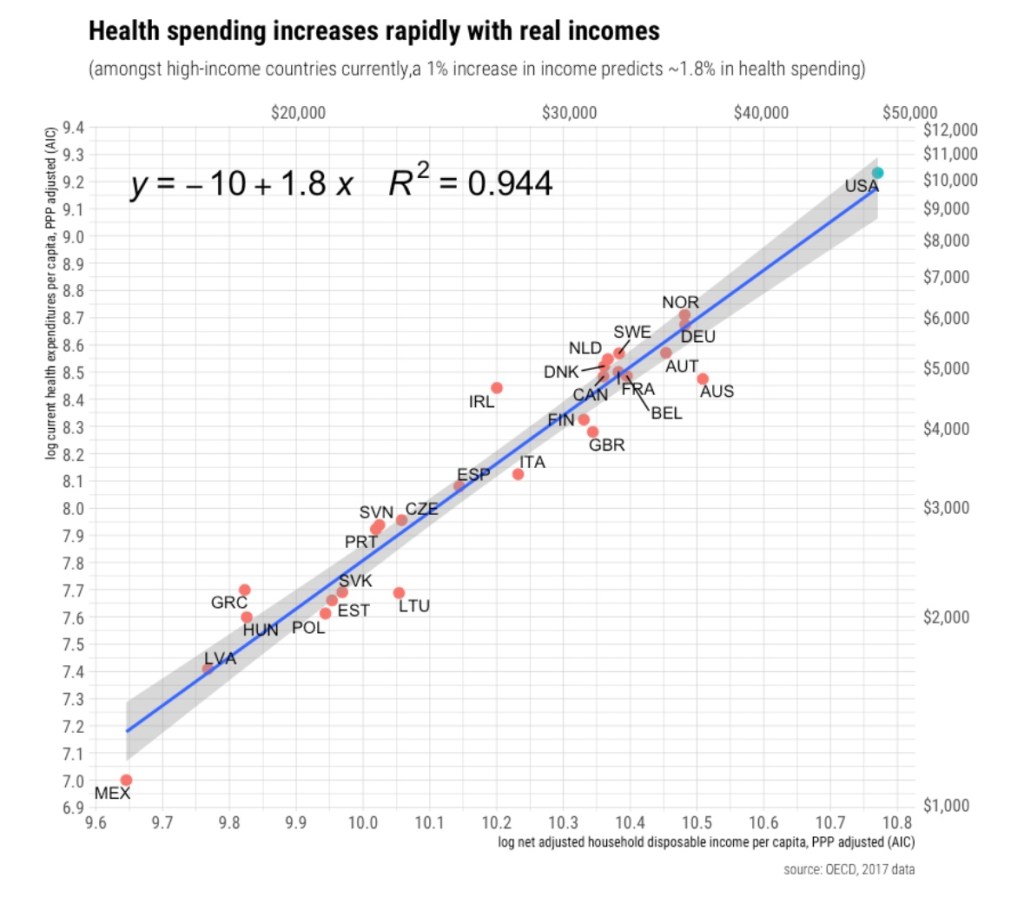
Therefore, it appears that increases in the relative prices of education and health care over time have arisen as a natural consequence of the interplay between disparities in productivity growth and rising demand. Indeed, this goes a long way toward explaining the high cost of health care in the U.S. compared to other developed nations, as standards of living in the U.S. are well above nearly all others. In that respect, the cost of health care in the U.S. is not necessarily alarming. People demand more health care and education as their incomes rise, but delivering more health care isn’t easy. To paraphrase Tabarrok, turning steelworkers into doctors, nurses and teachers is a costly proposition.
The Role of Subsidies

In the clamor for scarce educational and health care resources, natural tensions over access have spilled into the political sphere. In pursuit of distributing these resources more equitably, public policy has relied heavily on subsidies. It shouldn’t surprise anyone that subsiding a service resistant to productivity gains will magnify the Baumol effect on relative price. One point is beyond doubt: the amounts of these subsidies is breathtaking.

Education: Public K -12 schools are largely funded by local taxpayers. Taxpayer-parents of school-aged children pay part of this cost whether they send their children to public schools or not. If they don’t, they must pay the additional cost of private or home schooling. This severely distorts the link between payments and the value assigned by actual users of public schools. It also confers a huge degree of market power to public schools, thus insulating them economically from performance pressures.

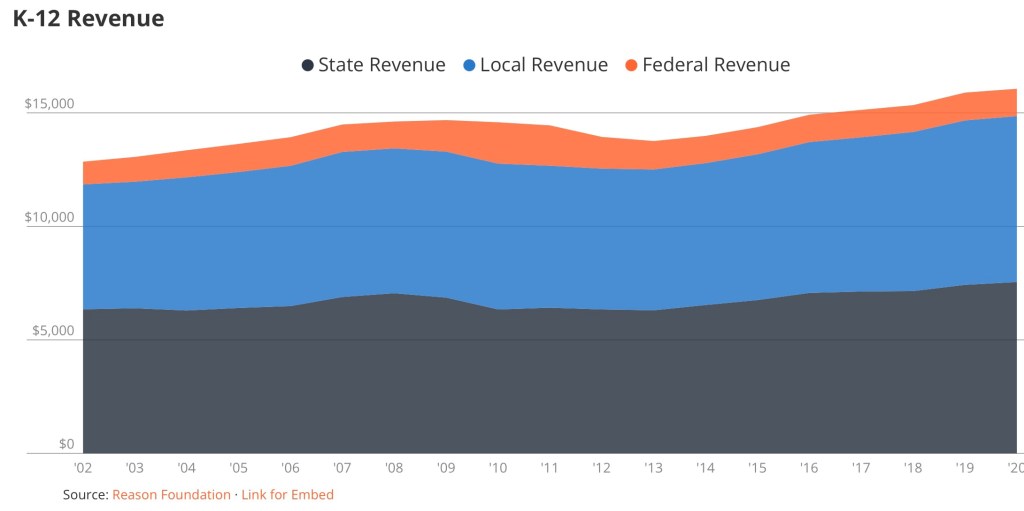
Public K – 12 schools are also heavily subsidized by state governments and federal grants. The following chart shows the magnitude and growth of K – 12 revenue per student over the past couple of decades.
Subsidies for higher education take the form of student aid, including federal student loans, grants to institutions, as well as a variety of tax subsidies. Here’s a nice breakdown:
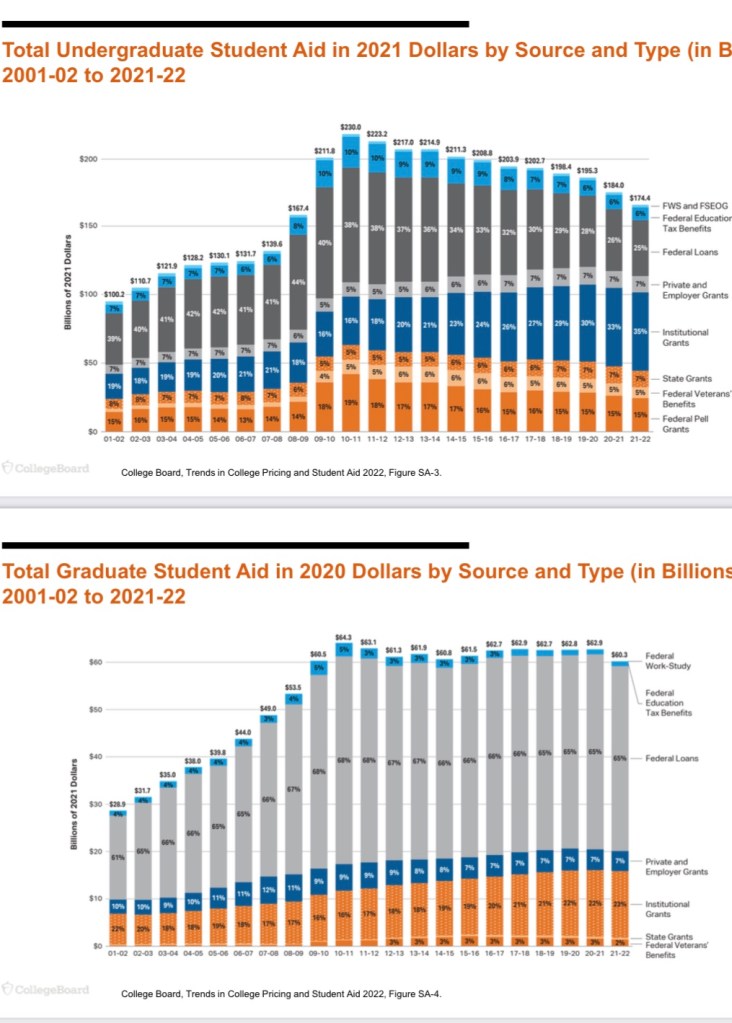
This represents a mix of buyer and seller subsidies. That suggests less upward pressure on price and more stimulus to output, but we still run up against the limits to productivity growth noted above. Moreover, other constraints limit the effectiveness of these subsidies, such as lower academic qualifications in a broader student population and the potential for rewards in the job market to diminish with a potential excess of graduates.

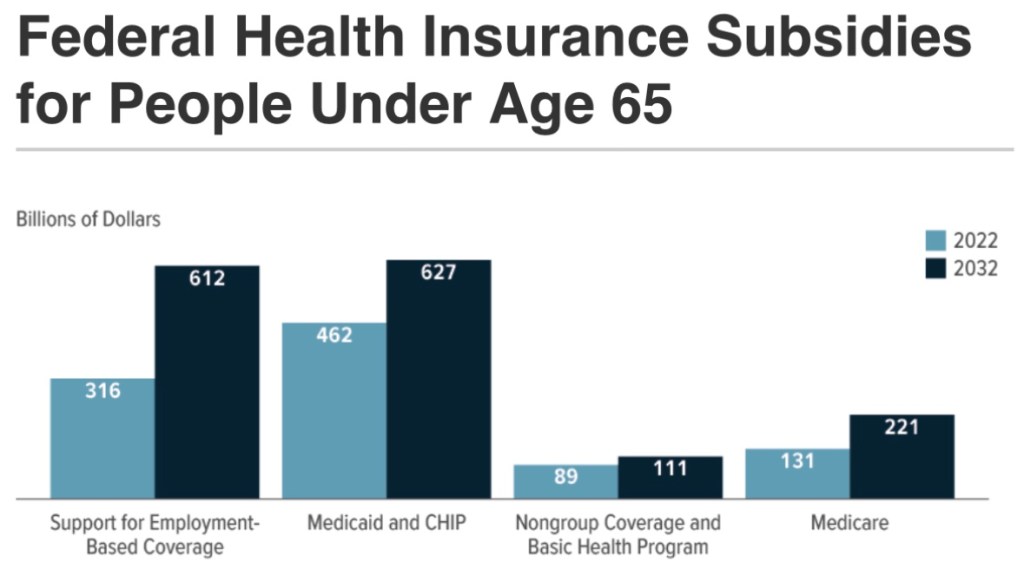
Health care: Subsidies here are massive and come in a variety of forms. They often directly provide or reduce the cost of health insurance coverage: Medicaid, the Children’s Health Insurance Program (CHIP), Obamacare exchange subsidies, Medicare savings programs, tax-subsidies on employer-paid health coverage, and medical expense tax deductions. Within limits, these subsidies reduce the marginal cost of care patients are asked to pay, thus contributing to over-utilization of various kinds of care.

The following are CBO projections from June 2022. They are intended here to give an idea of the magnitude of health care insurance subsidies:
Still Other Dysfunctions

There are certainly other drivers of high costs in the provision of health care and education beyond a Baumol effect magnified by subsidies. The third-party payment system has contributed to a loss of price discipline in health care. While consumers are often responsible for paying at least part of their health insurance premiums, the marginal cost of health care to consumers is often zero, so they have little incentive to manage their demands.

Another impediment to cost control is a regulatory environment in health care that has led to a sharply greater concentration of hospital services and the virtual disappearance of independent provider practices. Competition has been sorely lacking in education as well. Subsidies flowing to providers with market power tend to exacerbate behaviors that would be punished in competitive markets, and not just pricing.

Summary

Baumol’s Disease can explain a lot about the patterns of relative prices shown in the chart at the top of this post. That pattern is a negative side effect of general growth in productivity. Unfortunately, it also reflects a magnification engendered by the payment of subsidies to sectors with slow productivity growth. The intent of these subsidies is to distribute health care and education more equitably, but the impact on relative prices undermines these objectives. The approach forces society to exert wasted energy, like an idiotic dog chasing its tail.

Peter Suderman wrote an excellent piece in which he discussed health care and education subsidies in the context of the so-called “abundance agenda”. His emphasis is on the futility of this agenda for the middle class, for which quality education and affordable health care always seem just out of reach. The malign effects of “abundance” policies are reinforced by anti-competitive regulation and payment mechanisms, which subvert market price discipline and consumer sovereignty. We’d be far better served by policies that restore consumer responsibility, deregulate providers, and foster competition in the delivery of health care and education.

Tax Cuts Yes, Simplification a Mixed Bag

18 Monday Dec 2017

Posted by Nuetzel in Taxes, Trump Administration

≈ 2 Comments

Tags

Alternative Minimum Tax, AMT, AT&T, Chris Edwards, Comcast, Fifth-Third Bank, Joint Committee on Taxation, Pass-Through Income, Peter Suderman, Reason.com, Ricardian Equivalence, SALT, Tax Cuts and Jobs Act, Tax Deductions, Tax Reform, Tax Simplification, TCJA, Territorial Taxes, Wells Fargo

President Trump signed the Tax Cuts and Jobs Act (TCJA) this morning, the GOP tax bill with an acronym that simply won’t roll off my tongue. A useful summary of the Act produced by the House -Senate conference, and the full text of the Act, appear at this link. The TCJA hews more toward the earlier Senate bill than the House version. I’ve written about both (the House bill here and both here). Here is a good summary of the Act from Peter Suderman at Reason.com.

In my earlier assessments, I relied upon the principle of tax reform and real simplification as a justification for a tax cut without revenue neutrality. There are a few reforms and partial reforms, and the bill may simplify taxes for a number of individual taxpayers. However, on the whole I’m disappointed with the progress made by the GOP in those areas.

Notwithstanding my disappointment with the overall reform effort, the TCJA cuts taxes for most Americans and is likely to have salutary effects on economic growth and the job market. In fact, one of the most remarkable things about  the Act is the claim made by its adversaries on the Democrat side of the aisle. They apparently believe that the benefits of the TCJA flow primarily or even exclusively to the rich. This is a huge mistake for them. High-income taxpayers will receive greater benefits in absolute dollars, but not proportionally. This is shown by the table above, prepared by Chris Edwards from data produced by the Joint Committee on Taxation (JCT). In fact, the TCJA will extend tax reductions to a larger share of the middle class than either of its predecessor bills would have done. You cannot meaningfully reduce the taxes generated by a steeply progressive tax system without reducing the absolute dollars paid by high-income taxpayers. And you can’t lay the groundwork for sustainable economic growth without improving the investment incentives faced by high-income taxpayers and producers.

Here are some additional additional thoughts on the bill:

Yeah, I like me some tax cuts: The Act reduces taxes for many individuals and families by doubling the standard deduction and reducing tax rates. More importantly, perhaps, it will also reduce taxes for C-corporations, providing some relief from double taxation of corporate income, as will the switch to a territorial tax system on U.S. corporations doing business abroad. The latter is a real reform, while I consider the former a partial reform. Investment incentives are improved via the corporate rate cut and elimination of the corporate Alternative Minimum Tax (AMT) — a real reform, as well as the ability to write-off spending on new equipment immediately. As I argued last month, lower corporate taxes are likely to benefit both workers and consumers. The actions of few companies (AT&T, Comcast, Wells Fargo, and Fifth-Third) seem to demonstrate that this is the case: they have announced bonuses and increases in their base wage rates in the immediate wake of the TCJA’s massage.

Pass-through tax cuts are iffy: One of the most difficult parts of the TCJA to evaluate involves the implications for pass-through business entities like sole proprietorships, partnerships and S-corporations. Some might not receive significant cuts. The Act includes a maximum 25% rate on business income, but that is dependent on the proportion of the owner’s income deemed to be business income under the new rules. It also allows a flat deduction of 20% against business income. These provisions will be of benefit to very successful and very capital-intensive pass-throughs. Owners of smaller or less profitable firms will get the benefit of lower individual tax rates and the higher standard deduction, but might not have income high enough to benefit from the 25% rate cap.

Simpler for some, but it is not simplification: The doubled standard deduction will mean fewer taxpayers claiming itemized deductions. That sounds like simplification, but many will find it reassuring to calculate their taxes both ways, so a compliance burden remains. The Act retains or partially retains a number of deductions and credits slated for elimination in earlier versions, failing a simple principle held by reformers: eliminate deductions in exchange for lower rates. Along the same lines, the individual AMT is retained, but the exemption amount is increased, so fewer taxpayers will pay the AMT. Again, simpler for some, but not real simplification.

Elimination of the corporate AMT is simplification, as are immediate expensing of equipment purchases and territorial tax treatment. However, most of the complexities of corporate taxes remain, as do certain tax breaks targeted at specific industries. What a shame. And unfortunately, taxes for pass-through entities are anything but simplified under the Act. Complex new rules would govern the division of income into business income and the owners’ wage income.

Reducing deductions and bad incentives: The mortgage interest deduction encourages over-investment in housing and subsidizes the wealthiest homebuyers. The TCJA leaves it intact for existing mortgages, but allows the deduction to be claimed on new mortgage loans of up to $750,000. So the bad incentive largely remains, though the very worst of it will be eliminated. There have been complaints that this change could reduce home prices in states with the highest real estate prices. Good — they have been inflated by the subsidy at the expense of other taxpayers.

The tax write-off for state and local taxes (SALT) will be limited to $10,000 a year under the TCJA, though it adds some flexibility by allowing that sum to be met by any combination of state or local income, sales or property taxes. This change will reduce the subsidies from federal taxpayers residents of high-tax states, and should make leaders in those states more circumspect about the size of government.

The TCJA preserves and even expands a number of individual deductions and credits, subsidizing families with children, medical expenses, student loans, graduate students, educational saving, retirement saving, and the working poor. The interests benefiting from these breaks will be relieved, but this is not simplification.

Yet another case of “simpler for some” is the estate tax: it remains, but the exemption amounts are doubled. The estate tax does not produce much revenue, but it is fundamentally unjust: it ensnares the families of deceased property owners, farmers and small businesses; planning for it is costly; and it often forces survivors to sell assets quickly, sustaining losses, in order to meet a tax liability. The TCJA will significantly reduce this burden, but the tax framework will remain in place and will be an ongoing temptation to ravenous sponsors of future tax legislation.

Individual cuts are temporary: The corporate tax changes in the TCJA are permanent. They won’t have to be revisited (though they might be), and permanence is a desirable feature for sustaining the impact of positive incentives. The individual cuts and reforms, however, all expire within eight to ten years. The sun-setting of these provisions is, as some have said, a gimmick to reduce the revenue impact of the Act, but sunsetting means another politically fractious battle down the road. It is also a device to ensure compliance with the Byrd Act, which limits the deficit effects of legislation under Senate reconciliation rules. Eight years is a fairly long “temporary” tax cut, as those things go; for now, the impermanence of the cuts might not weaken the influence on spending. However, that influence is likely to wane as the cuts approach expiration.

Deficit Effects: The TCJA’s impact on the deficit and federal borrowing is likely to be somewhere north of $500 billion, possibly as much as $1.4 trillion. Deficits must be funded by government debt, which competes with private debt for the available pool of savings and must be serviced, repaid via future taxes or inflated away. In the latter sense, government borrowing is not really different from current taxes, a proposition known as Ricardian equivalence.

Nonetheless, the incentives, complexities and compliance costs of our current tax code are damaging, and the TCJA at least accomplishes some measure of reform. Moreover, the incremental debt is small relative to the impact of prior estimates of government borrowing over the next decade, with or without extension of the individual tax cuts. The most fundamental problem that remains is excessive government spending and its competing demands for, and absorption of, resources, with no market guidance as to the value of those uses.

Can Health Care Bill Get GOP Off the Schneid?

29 Thursday Jun 2017

Posted by Nuetzel in Health Insurance, Obamacare

≈ Leave a comment

Tags

AHCA, Avik Roy, BCRA, Better Care Reconciliation Act, CATO Institute, CBO, Community Rating, Corporatism, David Harsanyi, John C. Goodman, Means Testing, Medicaid Reform, Michael Cannon, Obamacare Exchanges, Peter Suderman, Planned Parenthood, Refundable Tax Credits, Seth Chandler, Stabilization Funds, State Waivers, The CATO Institute, Yuval Levin

health insurer bailout

For those who are “woke” to Obamacare’s failures, the Senate GOP’s health insurance reform bill has plenty to hate and maybe some things to love. There are likely to be some changes in the bill before it goes to a vote, which now has been delayed until sometime after Congress’ July 4th recess. Known as the Better Care Reconciliation Act of 2017 (BCRA), the bill is another mixed bag of GOP health care reforms and non-reforms. It is the Senate Republicans’ effort to improve upon the bill passed by the House of Representatives in May. The non-reforms are tied to an inability to repeal all aspects of Obamacare (the Affordable Care Act, or ACA) within the context of budget reconciliation, a process which permits a simple majority for approval of changes linked in some way to the budget (the so-called Byrd rule). Yuval Levin offers an excellent discussion of the bill and the general motivations for the form it has taken:

“They are choosing to address discrete problems with Obamacare within the framework it created and to pursue some significant structural reforms to Medicaid beyond that, and they should want the merits of their proposal judged accordingly. Their premise is politically defensible — it is probably more so than my premise — and the proposal they have developed makes some sense in light of it.“

It’s necessary to get one thing out of the way at the outset: the CBO’s scoring of the Senate bill is flawed in a massive way, like the earlier score of the House bill. The estimate of lost coverage for 22 million individuals is based on the CBO’s errant predictions of Obamacare coverage levels. (See here and here, and see Avik Roy’s latest entry on this topic.) Does anyone believe that enrollment on the exchanges will decline by 15 million in 2018 due to the elimination of the individual mandate? That’s over 40% more than total enrollment in 2017, by the way. Even if we attribute the CBO’s prediction to the elimination of both the individual and employer mandates, it would be an incredible plunge, especially given the means-tested tax credits in the BCRA. Does anyone believe that coverage levels under Obamacare would increase by 18 – 19 million by 2026 (mostly on account of the individual mandate)? That is the baseline assumed by the CBO in its scoring of the BCRA, which is laughable. A more realistic estimate of lost coverage under the BCRA might be 2 to 3 million, but remember that many of those coverage losses would not be “forced” in any sense. Rather, they would be purposeful refusals to take coverage with the demise of the individual mandate. But they would tend to be the healthiest of the current, coerced enrollees.

A related point has to do with hysterical claims that the BCRA will “kill thousands of people”. Someone cooked-up this talking (screaming?) point to rally the ignorant left and perhaps frighten the ignorant right (including a few GOP Senators). As Ira Stoll explains, there are several reasons to dismiss these assertions, not least of which is its tradeoff-free conceit. More ugly detail on the basis of these claims can be found here.

Will the BCRA “gut” Medicaid, as Charles Schumer, Nancy Pelosi and other have claimed? Program spending would not decline by any means, only its growth rate. Enrollment would decline with tougher eligibility rules, but as noted above, tax credits more generous than the Medicaid savings (relative to Obamacare) would help replace lost Medicaid coverage with private insurance. Steve Chapman has contributed one of the most nitwitted commentaries on Medicaid reform that I have seen. Not only do critics consistently ignore the proposed tax credits for coverage at low incomes, but they never address the monumental waste in the program., something that would likely improve under the budgeting requirements and additional discretion given to states by the BCRA.

An even crazier scare story going around is that the Senate bill will cut Medicare benefits. That is not the case, though the bill repeals an Obamacare Medicare tax increase on the self-employed.

Getting back to the broader BCRA, here are some of the major provisions:

  • Medicaid reform to replace the budgetary disaster of federal matching with per capita caps or block grants, and state program control.
  • Means-tested tax credits for insurance purchases would extend to low-income individuals who might otherwise lose their expanded Medicaid eligibility. According to Levin, this group is heavily weighted toward the unmarried and childless.
  • Greater state authority over regulation of the individual insurance market. This is accomplished through the availability of state waivers from many Obamacare regulations, including essential health benefits.
  • Almost all Obamacare tax provisions would be repealed. One exception is the “Cadillac” tax on high-cost employer plans starting in 2026 (after a temporary hiatus). Many of these repeals would benefit individuals broadly as taxpayers, employees, business people, and patients.
  • Expanded allowable age rating to 5/1 from 3/1. This helps limit adverse selection by pricing more risk where it exists, and the means-tested credits would help offset higher premiums for older individuals with low incomes.
  • Provides about $130 billion in “stabilization” funds for insurers over a three-year period. This is an attempt to keep premiums down during a transition over which the GOP probably hopes to enact additional deregulatory measures. Is this a practical maneuver? Yes, but it also reflects a bit of “corporatism-when-it’s-convenient” hypocrisy.
  • Eliminates funding for Planned Parenthood. Presumably funding could be restored later were the organization to split off its abortion services into a financially distinct division, which the Hyde Amendment would seem to require.
  • Retains coverage for pre-existing conditions.
  • Elimination of the individual and employer mandates, including the tax penalty. However, individuals who go without coverage for two months would face a six-month waiting period before they could re-qualify for coverage.

Eliminating the mandates is great from a libertarian and an economic perspective. The coercion inherent in those requirements is bad enough. In practice, the individual mandate has proven less effective in encouraging enrollment than Obamacare’s architects had hoped, which makes the CBO’s conclusions all the more puzzling. The employer mandate gives firms an incentive to reduce hours and employment, so it has extremely undesirable labor-market implications.

Most criticism of the BCRA from the right has centered on its failure to fully repeal Obamacare insurance and health care regulations. The continuation of Obamacare community rating is a major shortcoming of the bill, as it distributes the financial risks of medical needs in ways that do not correspond to the actual distribution of health risks. The result is the very same adverse selection problem we have witnessed on the Obamacare exchanges. Unfortunately, this raises the specter that we’ll be stuck with some form of community rating in the long-term, along with employer-provided coverage and the ill-advised premium tax deductions, which tend to inflate premium levels.

Michael F. Cannon of the CATO Institute calls the BCRA an Obamacare rescue package. John C. Goodman is largely in agreement with Cannon, stating that Republicans have no real desire to repeal Obamacare. Peter Suderman at Reason has many of the same concerns. In addition to community rating, Cannan (and Senator Rand Paul) are unhappy that Medicaid spending continues to grow under the bill with a new program of subsidies (tax credits) to boot! They also condemn the so-called “stabilization” or “cost-sharing” subsidies that would be paid to insurers under the bill. While a broader range of plans would become available, there is little confidence that insurers will be able to  bring down premiums and/or deductibles substantially without the added subsidies.

Avik Roy has defended the Senate bill for its proposed reforms to Medicaid, replacement of Obama’s Medicaid expansion with tax credits for private coverage, and transitional tax credits to smooth jumps in premium levels as income rises from low levels. This is an improvement over the House bill. However, marginal tax rates would be high under the BCRA for individuals in the range of income over which the credits phase out, which is a legitimate “welfare trap” criticism.

David Harsanyi also believes the bill is a good start:

“If Republican leadership had told conservatives in 2013 that they could pass a bill that would eliminate the individual and employer mandates, phase out Obamacare’s Medicaid expansion, cut an array of taxes, and lay out the conditions for full repeal later, I imagine most would have said ‘Sign me up!’“

Naturally, most critics of Obamacare have strong misgivings about a bill that would leave major components of the ACA’s structure in place. That includes Obamacare’s regulation of health care delivery itself, not just health insurance coverage. The BCRA might incorporate signifiant changes before it goes to a vote, however. One can only hope! Rand Paul has suggested breaking the bill into two parts: repeal of the ACA and other spending provisions, though it’s not clear how a repeal bill would qualify under the Byrd rule. Either way, the GOP intends to follow-up with additional health care legislation and administrative changes. Were a bill enacted soon, there is some chance that additional legislation could garner limited bi-partisan support. Long-term stability of the health insurance and health care markets would be better-served by a stronger semblance of political equilibrium than we have seen in the years since Obama was elected.


Hillaryeconomics: Swelling the State

30 Sunday Oct 2016

Posted by Nuetzel in statism

≈ Leave a comment

Tags

Affordable Care Act, Anthony Weiner, Bill Clinton, Buffet Rule, Carried Interest Rule, Clinton Foundation, Daniel J. Mitchell, Exit Tax, Hillary Clinton, Hugo Chavez, Infrastructure bank, Joseph Stiglitz, Minimum Wage, Paid Family Leave, Peter Suderman, Public Option, Redistribution, Solyndra, Venezuela

14523095_10207590802749873_5458832984536437934_n

Who cares about Hillary Clinton’s economic plan while her campaign quivers in the shadow of Weiner’s hard drive? Despite all the hubbub over Mrs. Clinton’s sloppy security practices, and her lies and destruction of evidence regarding those practices, it’s a good idea to remind ourselves of some of the frontrunner’s policy proposals and the general philosophy that informs them. Daniel J. Mitchell must have been feeling jovial when he took a crack at deciphering Hillary Clinton’s economic plan. He offered translations of each of 42 Hillary catch-phrases, but the translations were identical:

“Notwithstanding all the previous failures of government, both in America and elsewhere in the world, I’m going to make American more like Greece and Venezuela by using coercion to impose more spending, taxes, and regulation.“

Mitchell highlights two general themes at the start: one is the left’s constant misuse of the term “investment’ to describe spending on almost any government initiative; the other is the still fashionable Keynesian theory that a low-productivity government can make the economy grow by a multiple of any claim on resources it deigns to make.

I’ll try to do Mitchell one better. Here’s a run-down of the catch-phrases he cites along with my own interpretations:

  • “…support advanced manufacturing” — because the government is adept at picking winners with taxpayer money, like Solyndra. Does “advanced manufacturing” involve politically-favored outputs, as opposed to market-favored outputs? Does it involve robots, or workers? Is it somehow preferable to “advanced services”?
  • “a lot of urgent and important work to do” — there oughtta’ be more laws;
  • “go out and make that happen” — we must impose the heavy hand of the state;
  • “enormous capacity for clean energy production” — …if only we can provide our cronies with enough subsidies on your dime;
  • “if we do it together” — …kumbaya; we’ll wreck the private economy together;
  • “things that your government could do” — like, wreck everything;
  • “I will have your back every single day” — …with a sharp knife, in case it’s in my interest to betray you;
  • “make our economy work for everyone” — we’ll redistribute your wealth;
  • “restore fairness to our economy” — be prepared to share your success;
  • “go to bat for working families” — …by punishing your employer; but look, we have freebies!
  • “pass the biggest investment” — mandatory campaign promise;
  • “modernizing our roads, our bridges” — shovel-ready” projects;
  • “help cities like Detroit and Flint” — redistribute resources to poorly-governed communities and impose federal oversight;
  • “repair schools and failing water systems” — because local needs and the federal government are a perfect match;
  • “we should be ambitious” — about government domination;
  • “connect every household in America to broadband” — even if they don’t want it, and even if they’ve chosen to live in the badlands; at your cost, of course;
  • “build a cleaner, more resilient power grid” — reduce carbon emissions by inflating your utility bill; dismantle markets and direct energy resources centrally;
  • “creating an infrastructure bank” — we need another big federal agency, extending control and conjuring opportunities for cronyism and graft;
  • “we’re going to invest $10 billion” — Whew! I thought you were going to say $100 billion. But… can you define “investment”?
  • “bring business, government, and communities together” — …we’ll be as one at the federal level;
  • “fight to make college tuition-free” — so that even the least qualified have a strong incentive to enroll, on your dime;
  • “liberate millions of people who already have student debt” — because meeting the terms of a contract is a form of enslavement;
  • “support high-quality union training programs” — with federal subsidies on your dime; non-union training programs would be so …exploitative;
  • “We will do more” — …cause we’re from the government, and we’re here to help!
  • “Investments at home” — Invest? Can you define that? Do you mean “spend”?
  • “we need to make it fairer” — … by redistributing your income to others;
  • “we will fight for a more progressive…tax code” — reduce those ugly private work incentives and quash the bourgeois tendency to save and invest in physical capital;
  • “pay a new exit tax” — don’t get the idea it’s YOUR company; you didn’t build that;
  • “Wall Street, corporations, and the super-rich, should finally pay their fair share” –because the highest corporate tax rate in the industrialized world is not high enough, and besides, we can pass the booty back to elites in myriad ways, as long as they give to the Clinton Foundation;
  • “I support the so-called ‘Buffett Rule'” — …to quench the thirst of class warriors;
  • “add a new tax on multi-millionaires” — we must tax wealth because a high income tax rate just isn’t enough to encourage capital flight;
  • “close the carried interest loophole” — cause we think that loophole actually exists, and hey, it sounds good to class warriors;
  • “I want to invest” — Invest? Can you define that? Do you mean “spend”?
  • “affordable childcare available to all Americans” — …so that no parent need pay any attention to price; but your tax credit will diminish if you earn extra income, so don’t earn too much, for God’s sake!
  • “Paid family leave” — …because it isn’t expensive enough to hire you already;
  • “Raising the federal minimum wage” — … so the least skilled will be jobless and dependent on the state;
  • “expanding Social Security” — …so what if it’s already insolvent? Oh, you must mean “expanding” payroll taxes!!
  • “strengthening unions” — …because we mean to kill the sharing economy, and it isn’t expensive enough to hire you already;
  • “improve the Affordable Care Act” — if it’s broke, break it more thoroughly;
  • “a public option health insurance plan” — …shhh… don’t say single payer!
  • “build a new future with clean energy” — in our judgement, your inflated utility bills will help all mankind; besides, we want to take control, and wreck something.
  • Bonus: “wage equality once and for all” — because it should be illegal for employers to pay based on occupational risk, demands for paid leave and flexible hours, skill differentials and available supplies.

Lest you think my interpretation of that bonus quotation is unfair, remember: the so-called gender wage gap is almost entirely explained by the factors I’ve listed.

Hillary Clinton’s economic view is straight out of the statist theater of the absurd. Joseph Stiglitz, one of Hillary’s economic advisors, in 2007 endorsed Venezuelan socialism under Hugo Chavez, which proved to be disastrous. Was she forced to the left by Bernie Sanders? To some extent, perhaps. But Peter Suderman notes that Clinton’s current policy agenda constitutes a thorough rejection of Bill Clinton’s economic policies. The irony!

Trump Tower of Babble

09 Sunday Aug 2015

Posted by Nuetzel in Big Government, Marketplace of Ideas, Obamacare

≈ 2 Comments

Tags

Andrew Popkin, Bankruptcy, Brett Baier, crony capitalism, Donald Trump, eminent domain, GOP Debate, Hillary Clinton, Megyn Kelly, Obamacare, Peter Suderman, Rand Paul, single-payer plan, Vox

Presidential candidate, Donald Trump, has been critical of fellow Replubicans including Sen. John McCain. Some voters are curious about his "daffy" behavior.

Here’s a post-debate follow-up on Donald Trump the Shape Shifter: I’m surprised to hear anyone praising his performance after that debacle. He came off as a dick, and that’s really The Donald. I thought so before I heard that he suggested Megyn Kelly was menstruating that evening. Megan was tough, but please…. Trump is a loud-mouthed, offensive, and often incoherent bully.

Two Trump moments that I thought were amazing were his exchange with Brett Baier about political donations and his dust-up with Rand Paul over a single-payer health care system.

On donations, Trump seemed to take satisfaction in the fact that Hillary Clinton “had no choice” but to attend his wedding after he gave to her Senate campaign. He then made the following statement, which made me laugh:

“I will tell you that our system is broken. I gave to many people. Before this, before two months ago, I was a businessman. I give to everybody. When they call, I give. And you know what? When I need something from them, two years later, three years later, I call them. They are there for me. And that’s a broken system.“

Should I love him or hate him for that statement? He admits with no shame that he participates in crony capitalism, and he realizes that it’s corrupt. Andrew Popkin at Vox has a good analysis:

“Something Trump identifies that doesn’t always get mentioned is the way transactional politics transcend partisanship and ideology. Trump gave to Democrats and he gave to Republicans. He didn’t care what they believed. He cared what they could do for him. He wasn’t supporting them — he was buying them, and that’s completely different.“

It’s convenient for Trump to brag that he doesn’t need donations from others when campaigning. When he’s on the other side of the table, he’s happy to participate in the corruption. Did Trump buy the politicians who helped him arrange eminent domain actions against property owners who were in the way of his developments? He’s also quite proud of his use of bankruptcy laws allowing him to stiff lenders and investors in his enterprises. By the way, in comparing his four corporate bankruptcies to the many “deals” he’s executed over the years, he’d have you believe that the “deal” is always the relevant unit for a bankruptcy proceeding. That’s loose and misleading jargon.

I have said that Trump’s supporters really don’t know what their getting. Perhaps he won’t tell anyone because he’d lose “leverage”. A prime example of Trump’s shiftiness was his response to the following question on single-payer health care systems, including his attempt to embarrass Rand Paul:

Baier: “Now, 15 years ago, you called yourself a liberal on health care. You were for a single-payer system, a Canadian-style system. Why were you for that then and why aren’t you for it now?“

As Peter Suderman noted, Trump’s response to this question about health care began with his views on the war in Iraq. Donald’s rules…. But eventually, he addressed the health care question with a stream of words that thinking people might have been tempted to process logically in order to divine a coherent “Trump” position on the issue, but that would have been a mistake:

“As far as single payer, it works in Canada. It works incredibly well in Scotland. It could have worked in a different age, which is the age you’re talking about here.

What I’d like to see is a private system without the artificial lines around every state. I have a big company with thousands and thousands of employees. And if I’m negotiating in New York or in New Jersey or in California, I have like one bidder. Nobody can bid. You know why? Because the insurance companies are making a fortune because they have control of the politicians, of course, with the exception of the politicians on this stage. But they have total control of the politicians. They’re making a fortune.“

This is not a great moment of clarity for Trump. We still don’t know what he has in mind. He demonstrates that he doesn’t quite understand the inherent flaws in single-payer. If his complaint is with consolidation of the health insurance industry, single-payer would imply an even greater consolidation, indeed, a monopoly. A “private system” does not rule out single-payer. While the insurance companies have undoubtedly influenced politicians, just as Trump has, why is he complaining about a lack of choice, having just asserted that single-payer could work so well? And artificial lines have to do with non-price rationing, a typical feature of government intervention in markets. Thus far, the profits of under-pricing insurers have been protected by so-called “risk corridors” built into Obamacare. Would Trump allow health care providers and insurers to reprice in order to eliminate “artificial lines”? Trump’s words did not settle any questions about his position.

The end of Trump’s response is this:

“And then we have to take care of the people that can’t take care of themselves. And I will do that through a different system.“

So… was Trump still talking about single-payer or not? I forgive Rand Paul for imagining that he was. It was the only solid statement that one could cling to in Trump’s ramble.

Here is Suderman’s summary of Trump’s response with an account of the exchange with Rand Paul that followed:

“What matters is that [Trump] would be different. Different how? So very, very different—and definitely not a moron/loser/dummy/incompetent (pick one) like this other guy.

This is how Trump responds to almost everything: By not answering the question, by babbling out some at-best semi-relevant references, by promising to somehow be different and better without explaining how or why, and then by lobbing an insult.

An insult is how Trump finishes the Obamacare exchange as well. After Trump finishes answering the question, Sen. Rand Paul cuts in, saying, ‘News flash, the Republican Party’s been fighting against a single-payer system for a decade. So I think you’re on the wrong side of this if you’re still arguing for a single-payer system.’ [SCC’s bolding]

Trump’s comeback: ‘I’m not—I’m not are—I don’t think you heard me. You’re having a hard time tonight.’

The gist, as always, is that someone else—indeed, practically everyone else—is a dummy, a loser, a politician. Trump is the only one who really gets it, whatever it is.“

While I thought Rand Paul’s interjectory approach to debating was unwise, his comment to Trump was on-target, and he even qualified it. Trump responded with snark. Trump has yet to take a real position on health care in this campaign, but he has supported single-payer in the past. He doesn’t want to go to the trouble of deciding or revealing a specific plan just yet. Perhaps he’s “maintaining leverage”, keeping his options open, because he’s such a smart businessman. If you want to treat politics like a business deal, fine, but smart voters should be your partners, and they will expect you to reveal your terms.

Trump Flaunts Shape-Shifting Powers

06 Thursday Aug 2015

Posted by Nuetzel in Government, Liberty, Tyranny

≈ 5 Comments

Tags

Andy Kroll, Common Core, Donald Trump, eminent domain, FreedomFest, Immigration policy, Jeffrey Tucker, On the Issues, Peter Suderman, Politico, Populism, Reason, Trump campaign, Trump Policies, Trump Policy Positions, Trumpism, Wealth Tax

trump characature

Donald Trump could take just about any position on any issue and defend it with conviction and blustery passion… until he changes his mind. At this point in his presidential bid, there is nothing on his campaign web site in the way of specific policy statements. Here is an “On The Issues” post showing the evolution of Trump’s positions in a number of policy areas. Just about anyone on the left or the right should be able to get a few chuckles out of this list. It’s truly astonishing.

A few of Trump’s current policy positions are discussed below, but before getting into that, it’s interesting to consider the overall tenor of his rhetoric. Most observers will happily admit that they find his bombast entertaining, and I do too. He’s outspoken and unapologetic, confronting his critics head-on, often to powerful effect. Many are drawn to this sort of candidate, and his popular image as a skilled businessman doesn’t hurt. But while all politicians are capable of disappointing supporters, Trump fans do not know, and cannot know, what they’re getting.

Trump is almost always critical but rarely suggests actual solutions, making it difficult to discern whether he really has policy positions. So much so that it’s incredible to hear praise for his “clarity”. For a more sober take, read Andy Kroll’s account of frustrated attempts to get direct responses on a few policy issues from the Trump campaign, and of Trump’s bizarre tour of Laredo, Texas. A related piece by Peter Suderman appears at Reason.com. Politico has emphasized the same point in “Will the real Donald Trump please stand up?“. Kroll says this:

“I have zero to report about Trump’s plans for actually being president—except that, from all available evidence, he hasn’t given it a moment’s thought.“

An interesting piece on Trump comes from Jeffrey Tucker in “What is Trumpism?“. A longer version appeared as “Trumpism: The Ideology“. Here is one bit from Tucker, written after hearing “The Donald” speak at FreedomFest:

“The speech lasted an hour, and my jaw was on the floor most of the time. I’ve never before witnessed such a brazen display of nativistic jingoism, along with a complete disregard for economic reality. It was an awesome experience, a perfect repudiation of all good sense and intellectual sobriety. …

His speech was like an interwar séance of once-powerful dictators who inspired multitudes, drove countries into the ground, and died grim deaths.“

Here are a few examples of Trump’s “nativism”, as described by Tucker:

“I did laugh as he denounced the existence of tech support in India that serves American companies (‘how can it be cheaper to call people there than here?’ — as if he still thinks that long-distance charges apply). 

When a Hispanic man asked a question, Trump interrupted him and asked if he had been sent by the Mexican government. He took it a step further, dividing blacks from Hispanics by inviting a black man to the microphone to tell how his own son was killed by an illegal immigrant.“

Two issues on which Trump has been outspoken are international trade and immigration. As an aside, I note that he is always quick to qualify any aggressive statements he makes on these topics with a quick “I love the Chinese”, or “I love the Mexicans”. Tucker, at the link above, highlights Trump’s backward views on trade, which focus almost exclusively on U.S. producers without considering the benefits of trade to U.S. consumers. He sees big ships coming into port, and thinks only of cash flowing abroad: “What do we get?” Well, we get nice foreign goods, thank you very much. But Trump blames foreign trading partners for many ills, despite the fact that his Trump-label ties are made in China! Are we somehow being cheated on those ties? Trump says we need smarter people negotiating “these deals”. Okay… is that a policy?

We don’t need trade wars if we want to avoid a much weaker economy. Yet Trump’s trade rhetoric suggests that he would be tempted to employ trade restrictions like tariffs as a bludgeon. For example, consider one of his other big talking points: illegal immigration (despite the fact that the inflow of illegals has slowed to a trickle over the past few years). Trump wants to build a wall across the length of the U.S.-Mexican border, and he says he’ll make Mexico pay for it. To get a wall built, Trump might well decide that he can raise tariffs on Mexican goods to prohibitive levels as a way of twisting Mexican arms. That sort of action is likely to be very costly for U.S. consumers, and ultimately producers as well.

Trump’s latest pronouncements on immigration policy have been described as confusing. In a nutshell, he wants to deport “the criminals” (and not just those already doing time) and deport all other undocumented aliens; create an expedited process whereby we can let “the good ones” back into the country with legal status; “maybe” create some sort of path to citizenship (because “who knows what’s going to happen”), but not right away; and “we’re going to do something” for the “DREAMers”. Trump says he’ll know how to identify the “good ones”. If he’s so confident of that, then why would he, a smart “business guy”, allow the country to incur the expense of deporting millions of them?

Who knows what Trump will propose in terms of tax reform, health care and gun control? Ditto on welfare policy, defense, the drug war, foreign policy and energy. He wisely spoke against the drug war in 1990, but I’m not aware of any recent statements on the issue. Also in his favor, he does not accept the “consensus” on climate change and opposes Common Core. He has criticized crony capitalism but has undoubtedly benefited from cronyism, enlisting governments in the pursuit of eminent domain action. He is said to favor cuts in federal spending, but he has opposed cuts in Social Security and Medicare. He opposes an increase in the minimum wage, but he has proposed a wealth tax in the past.

Trump has not offered many specifics in this campaign, and the GOP debate this Thursday night will not provide a decent forum for articulating policy. In general, his positioning is a very mixed bag. One gets the sense that he is doing his best to appeal to a sort of populist conservatism. Unfortunately, his signature “positioning” on trade and immigration qualify him as something of a statist. He has certainly held a number of other statist views in the past, though he has disavowed at least some of those.

In closing, here are two more quotes from Jeffrey Tucker about Trump that I found both ominous and plausible:

“What’s distinct about Trumpism, and the tradition of thought it represents, is that it is not leftist in its cultural and political outlook (see how he is praised for rejecting “political correctness”), and yet still totalitarian in the sense that it seeks total control of society and economy and demands no limits on state power.“

“These people are all the same. They purport to be populists, while loathing the decisions people actually make in the marketplace (such as buying Chinese goods or hiring Mexican employees).“

Consequentialists Dismiss Obamacare Consequences

15 Sunday Feb 2015

Posted by Nuetzel in Obamacare

≈ Leave a comment

Tags

ACA, Burr Hatch Upton plan, Consequentialism, Exchange subsidies, Federal exchanges, Health care mandates, Jonathan Gruber, King vs. Burwell, Laurence Tribe, Michael Cannon, Obamacare, Peter Suderman, Reason, Robert Laszewski, SCOTUS, Washington Free Beacon

supreme-court-obama

The King vs. Burwell case now before the U.S. Supreme Court turns on whether the Affordable Care Act (ACA, or Obamacare) authorizes the payment of federal subsidies to consumers in states that do not sponsor their own state health insurance exchanges (up to 37 states, by some counts, depending on how certain “hybrid” exchanges are treated). In those states, Obamacare must be purchased on the federal (or a hybrid) exchange. Proponents of the law strongly desire the court to uphold the subsidies. However, the “plain language” of the law states that tax credits apply only to insurance purchased “through an Exchange established by the state.” That language does not appear to support the governments position in the case. In addition, one of the chief architects of the ACA, Jonathan Gruber, seemingly exposed the real intent of this provision:

“What’s important to remember politically about this is if you’re a state and you don’t set up an exchange, that means your citizens don’t get their tax credits — but your citizens still pay the taxes that support this bill. So you’re essentially saying [to] your citizens you’re going to pay all the taxes to help all the other states in the country. I hope that that’s a blatant enough political reality that states will get their act together and realize there are billions of dollars at stake here in setting up these exchanges.”

Who could have given a better description of the motive?

Others insist that the awkward language in the ACA on this point might have been a typographical error, that the tax credits were intended to subsidize purchases on any exchange, and that other wording in the legislation makes the legislative intent “ambiguous” at worst. Harvard law professor Laurence Tribe subscribes to this view. Tribe argues elsewhere that a ruling which finds federal-exchange subsidies illegal would throw the health insurance market into turmoil. Thus, taking a “consequentialist” approach, Tribe argues that the court should be reluctant to disrupt the market by ruling that subsidies were intended to be unavailable to states without exchanges under the ACA. This conveniently dismisses the fact that Obamacare itself has had and will continue to have so many negative “consequences.”

Obviously, not all agree that a ruling against the government would be such a travesty. A victory for the King plaintiffs would not increase anyone’s premiums. What it would do is prevent the IRS from shifting the burden of those premiums from enrollees to taxpayers. According to  Michael Cannon,  arguments against the plaintiff’s case have:

“… misrepresented the impact of a potential ruling for the plaintiffs by ignoring three crucial facts: (1) a victory for the Halbig [and King] plaintiffs would increase no one’s premiums, (2) if federal-Exchange enrollees lose subsidies, it is because those subsidies are, and always were, illegal, and (3) the winners under such a ruling would outnumber the losers by more than ten to one.”

Nevertheless, the  consequentialist argument suggests that the court might be reluctant to rule against the government in the absence of a viable and immediate alternative to Obamacare. That belief helped motivate the most recent GOP plan, sponsored by Senators Richard Burr, Orin Hatch and Representative Fred Upton, which is due for a vote in the House of Representatives next week. This alternative has been called “Obamacare Lite” by some GOP critics, and it does retain a few of the most popular Obamacare provisions. However, it eliminates some highly intrusive aspects of the ACA (the individual and employer mandates) and attempts greater reliance on markets to control costs. This review in the Washington Free Beacon is mostly favorable. Peter Suderman at Reason explains that the proposal would involve tax credits designed to promote affordability, but they would be less distorting and less generous than under the ACA. Here is a fairly complete but mixed review of the GOP alternative.by Robert Laszewski:

“My sense is that voters will end up liking parts of both Republican and Democratic ideas. They might ask a reasonable question: Why can’t we take the best from both sides? If Democrats would just admit Obamacare needs some pretty big fixes, and Republicans would be willing to work on making those fixes by putting some of these good ideas on the table, the American people would be a lot better off. In fact, I am hopeful that this is eventually what will happen once Obamacare’s failings become even more clear (particularly the real premium costs) and both sides come to understand that neither will have a unilateral political upper hand.”

Laszewski is critical of the plan’s potential for creating a new set of winners and losers, but his objection losses sight of the fact that distortions in the ACA create so many winners and losers as to be indefensible. For example, the ACA limits differences in age rating, effectively transferring wealth from younger premium payers to much wealthier seniors, while the GOP plan loosens those limits. Similar distortions were created by Obamacare’s mandates, taxes, lack of choice in health coverage, revocation of individual coverage, poorly designed provider incentives and reduced physician reimbursements, to give a short list.

I like many of the ideas in the Republican plan, but it is a compromise. Its reforms should reduce the cost of coverage. It increases choice, leverages market incentives, and reduces tax distortions, including the tax advantage of employer-provided coverage. At the same time, it wholly or partially retains ACA provisions that make coverage more affordable at low incomes and provide continuous coverage for those with pre-existing conditions. It also encourages the creation of state pools for high-risk individuals. These provisions might or might not  mollify “consequentialist” sentiment on the Supreme Court, leading to a majority ruling against the government in King vs. Burwell. If not, and while the question before the court is more narrow, the irony would be for the court to uphold the many destructive consequences of Obamacare.

Can Federal Regulation Enrich Your Web? What?

05 Thursday Feb 2015

Posted by Nuetzel in Net neutrality

≈ 2 Comments

Tags

Broadband service, Common Carrier, Coyote Blog, elasticity of demand, FCC, incentives, Internet Service Providers, Net Neutrality, Peter Suderman, regulation, Tom Wheeler, Warren Meyer

fcc-internet

Do you really believe that government regulation of the internet will keep it “open”, fast and innovative? Really? Then you will be happy with today’s FCC decision to reclassify broadband internet service providers (ISPs) as “common carriers.” (The link above will take you to a Google search page with another link to “Washington Conquers the Internet“.) This puts the ISPs on the same regulatory footing as land-line and wireless voice services. The FCC’s action is a legal move that will pave the way for regulation of rates and service rules with the supposed aim of “net neutrality”.

The FCC chairman, Tom Wheeler, has recently argued that because the wireless carriers have enjoyed tremendous growth under the common carrier rules, there is no reason to fear that the broadband industry would suffer under the reclassification. However, as Peter Suderman explains, the common carrier rules applied only to wireless voice services, not to rapidly growing wireless data services. Wheeler’s argument is therefore misleading:

“... it suggests that Wheeler wants to pursue reclassification not because the wireless sector has been successful under Title II, but because of the service that has been successful without it.”

The FCC would almost assuredly reclassify wireless data as well as broadband as common carrier services.

Net neutrality is a misnomer, as Sacred Cow Chips has noted in the past here, here, and here. These posts cover shortcomings of so-called net neutrality such as mis-pricing of services, subverting incentives for network maintenance and growth, massive non-neutral subsidies for network hogs, the potential threat to free speech, and a negative impact on the poor. Warren Meyer at Coyote Blog expresses his dismay at the utter naivete of those who think that “net neutrality” sounds appealing:

“Here is my official notice — you have been warned, time and again. There will be no allowing future statements of “I didn’t mean that” or “I didn’t expect that” or “that’s not what I intended.” There is no saying that you only wanted this one little change, that you didn’t buy into all the other mess that is coming. You let the regulatory camel’s nose in the tent and the entire camel is coming inside. I guarantee it.”

Today’s FCC decision will also expose unsuspecting internet users to federal and local fees and taxes averaging about $49 per year. According to this calculation, that’s an increase in average broadband cost of about 9%. I believe that the estimate of the negative impact on subscribership given at the link is mistaken and too large (even in the update at the bottom), but there will certainly be a negative impact that could run into the millions of subscribers.

Finally, there is little doubt that FCC Chairman Wheeler felt strong pressure from the White House (another link at a Google search page) to reclassify ISPs as common carriers. President Obama is one of those souls who find “net neutrality” appealing, but I’m cynical enough to think that he merely finds the politics of “net neutrality” appealing. Big government can’t wait to control your “open internet”.

Postscript: This video is a lighthearted take on what the FCC is getting us into.

Big Daddy Wants To Neutralize Your Net

09 Friday Jan 2015

Posted by Nuetzel in Uncategorized

≈ 4 Comments

Tags

AEI, Bureaucracy, central planning, Common Carrier, Cronyism, Don Boudreaux, FCC, Google, Internet REgulation, ISPs, Jeffrey Eisenach, Market Solutions, Net Neutrality, Netflix, Peter Suderman, Reason, Ronald Coase, Tom Wheeler, Wired

Net-Neutrality

Once again, President Obama is trying his hand as populist candyman, now pressing the FCC to adopt “net neutrality” rules for regulating internet service providers (ISPs) as common carriers. Net neutrality refers to regulations on ISPs that would prohibit different treatment of different types of internet content, matters that are better left to market participants. Obama has no idea what he’s doing or who he’ll be hurting (hint: internet users of all stripes). The candy is an illusion. Peter Suderman’ has an aptly titled article on this topic at Reason: “Will 2015 Be the Year the FCC Regulates the Internet Back to 1934?” He offers some background on the history of U.S. telecommunications regulation and explains the context within which FCC Chairman Tom Wheeler and the Commission will deal with the issue. Suderman closes with this thought:

“If Wheeler does take this route (reclassification of ISPs as common carriers], as he now seems to determined (sic), we’ll end up with an Internet that is more regulated, more subject to regulatory uncertainty in the near-term, and more like a public utility from another era than an information delivery service for the modern age. It’ll be 2015—but for the Internet, it’ll be 1934 all over again.”

Wired also gives its perspective but implies that Wheeler is seeking ways to reclassify the ISPs, impose neutrality rules, while also creating sufficient exceptions to mollify the ISPs, avoiding litigation as well as market disruption. That would be nice as far as it goes.

Net neutrality is a misnomer, as Sacred Cow Chips has discussed on two previous occasions in “The Non-Neutrality of Network Hogs“, and “Net Neutrality: A Tangled Web“. A lowlight is the corporate cronyism inherent in calls for net neutrality. The biggest beneficiaries are not consumers, but large content providers such as Netflix and Google, though the latter has altered its position on neutrality now that it is entering the market as an ISP. Another lowlight is the disincentive for network expansion created by forced subsidies to the large content providers, who are extremely heavy users of internet capacity.

Jeffrey Eisenach at AEI picks apart the arguments in favor of internet regulation. He also counters assertions that consumers are likely to benefit from internet regulation. Here are two choice quotes:

“And while much is made of consumers’ limited choices, the broadband market is actually less concentrated than the markets for search engines, social networks, and over-the-top video services: discriminatory regulation of ISPs cannot be justified on the basis of market power.”

“Finally, there’s the argument about fast lanes and slow lanes, or, in regulatory jargon, “paid prioritization.” The simple reality is that edge providers like Netflix require prioritization for their services to work. It’s just the “paid” part they don’t like.”

Finally, Don Boudreaux provides two relevant quotes on regulation, one from the great Ronald Coase, along with some of his own thoughts. I close with Boudreaux’s summation:

“Government imposition of “net neutrality” will substitute bureaucrats’ politically poisoned judgments on what are and what are not appropriate business practices for the market-tested judgments of legions of suppliers competing for the patronage of hundreds of millions – indeed, often billions – of consumers.“

The Incredible Glibness of Being Gruber

16 Tuesday Dec 2014

Posted by Nuetzel in Uncategorized

≈ Leave a comment

Tags

ACA, Darrell Issa, federal subsidies, House Oversight Committee, Jonathan Gruber, King vs. Burwell, Obamacare, Peter Suderman, Reason, Transparency

Gruber Comic

Jonathan Gruber is apparently a man of contradictions. He told a congressional committee last week that he “did not write any part of the Affordable Care Act.” He was asked at the hearing why he had claimed in 2012 that he did write part of the law. According to Peter Suderman, writing in Reason, Gruber replied “that it was ‘an effort to seem more important than I was,’ and that he was ‘speaking glibly.’” Video evidence of Gruber’s glibbery keeps stacking up in the wake of his sworn testimony.  He made the same “glib” claim at least twice in 2010 and again in 2012. In those videos, Gruber seemed pleased to issue disclaimers to his econ classes at MIT and other audiences that he “helped write” the ACA (Obamacare). From Suderman:

“There is no way to reconcile his multiple past statements with the statements he made this week while under oath. Either Gruber spent two years lying about his role in writing the law, or he was lying this week in his sworn congressional testimony.”

Now, Gruber has been subpoenaed again by the House Oversight Committee, this time in relation to his work and the income he earned as an Obamacare advisor. However, the subpoena covers all documents and exchanges with government employees, including work product, the results of economic model simulations, and any communications related to contracts and the funding of his research. Poor Gruber is in hot water. Lying to Congress, if that charge were pressed, could earn him up to five years in prison.

Of greater importance is that he very likely furnished the administration, as the law was being drafted, with economic projections showing that some existing private health plans would be cancelled. In his testimony last week, he admitted that his model simulations showed as much. Of course, President Obama was quite glib in his repeated assertions that “if you like your health plan, you can keep your health plan.” From Reason:

“Shouldn’t that mean that Gruber knew that administration’s repeated promises that those who like their health plans could keep their plans under the law weren’t true? 

Gruber was asked about the promise…. ‘I interpreted the administration’s comments as saying that for the vast majority of Americans the law would not affect the productive health insurance arrangements that they have,’ he said. ‘I did not see a problem with the administration’s statement.’

Of course he didn’t. Gruber is, after all, someone who argued that ‘lack of transparency’ was key to passing the health law.”

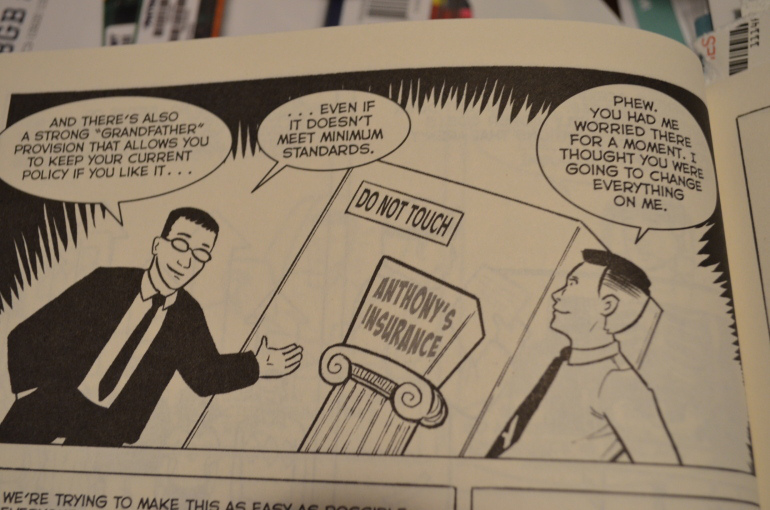
In fact, on the question of lost coverage, Gruber’s own comic book on the ACA made the same assurances as the Administration. See the frame at the top of this post! More contradiction.

Another crucial point is that Gruber claimed to have written the part of the ACA related to state health insurance exchanges. He stated on multiple occasions (captured on video) that the federal health insurance subsidies created by the ACA were intended as incentives for states to create their own exchanges. The “plain language of the law” is consistent with that claim; it is explicit in providing for subsidies only when a policy is purchased through a state exchange, not a federal exchange. Next year, the Supreme Court will hear the case King vs. Burwell, which turns upon whether the law itself disqualifies ACA insurance buyers in 36 states from collecting federal subsidies. Gruber’s videos appear to be quite damaging to the government’s case.

Follow Sacred Cow Chips on WordPress.com

Recent Posts

  • The Case Against Interest On Reserves
  • Immigration and Merit As Fiscal Propositions
  • Tariff “Dividend” From An Indigent State
  • Almost Looks Like the Fed Has a 3% Inflation Target
  • Government Malpractice Breeds Health Care Havoc

Archives

  • January 2026
  • December 2025
  • November 2025
  • October 2025
  • September 2025
  • August 2025
  • July 2025
  • June 2025
  • May 2025
  • April 2025
  • March 2025
  • February 2025
  • January 2025
  • December 2024
  • November 2024
  • October 2024
  • September 2024
  • August 2024
  • July 2024
  • June 2024
  • May 2024
  • April 2024
  • March 2024
  • February 2024
  • January 2024
  • December 2023
  • November 2023
  • August 2023
  • July 2023
  • June 2023
  • May 2023
  • April 2023
  • March 2023
  • February 2023
  • January 2023
  • December 2022
  • November 2022
  • October 2022
  • September 2022
  • August 2022
  • July 2022
  • June 2022
  • May 2022
  • April 2022
  • March 2022
  • February 2022
  • January 2022
  • December 2021
  • November 2021
  • October 2021
  • September 2021
  • August 2021
  • July 2021
  • June 2021
  • May 2021
  • April 2021
  • March 2021
  • February 2021
  • January 2021
  • December 2020
  • November 2020
  • October 2020
  • September 2020
  • August 2020
  • July 2020
  • June 2020
  • May 2020
  • April 2020
  • March 2020
  • February 2020
  • January 2020
  • December 2019
  • November 2019
  • October 2019
  • September 2019
  • August 2019
  • July 2019
  • June 2019
  • May 2019
  • April 2019
  • March 2019
  • February 2019
  • January 2019
  • December 2018
  • November 2018
  • October 2018
  • September 2018
  • August 2018
  • July 2018
  • June 2018
  • May 2018
  • April 2018
  • March 2018
  • February 2018
  • January 2018
  • December 2017
  • November 2017
  • October 2017
  • September 2017
  • August 2017
  • July 2017
  • June 2017
  • May 2017
  • April 2017
  • March 2017
  • February 2017
  • January 2017
  • December 2016
  • November 2016
  • October 2016
  • September 2016
  • August 2016
  • July 2016
  • June 2016
  • May 2016
  • April 2016
  • March 2016
  • February 2016
  • January 2016
  • December 2015
  • November 2015
  • October 2015
  • September 2015
  • August 2015
  • July 2015
  • June 2015
  • May 2015
  • April 2015
  • March 2015
  • February 2015
  • January 2015
  • December 2014
  • November 2014
  • October 2014
  • September 2014
  • August 2014
  • July 2014
  • June 2014
  • May 2014
  • April 2014
  • March 2014

Blogs I Follow

  • Passive Income Kickstart
  • OnlyFinance.net
  • TLC Cholesterol
  • Nintil
  • kendunning.net
  • DCWhispers.com
  • Hoong-Wai in the UK
  • Marginal REVOLUTION
  • Stlouis
  • Watts Up With That?
  • Aussie Nationalist Blog
  • American Elephants
  • The View from Alexandria
  • The Gymnasium
  • A Force for Good
  • Notes On Liberty
  • troymo
  • SUNDAY BLOG Stephanie Sievers
  • Miss Lou Acquiring Lore
  • Your Well Wisher Program
  • Objectivism In Depth
  • RobotEnomics
  • Orderstatistic
  • Paradigm Library
  • Scattered Showers and Quicksand

Blog at WordPress.com.

Passive Income Kickstart

OnlyFinance.net

TLC Cholesterol

Nintil

To estimate, compare, distinguish, discuss, and trace to its principal sources everything

kendunning.net

The Future is Ours to Create

DCWhispers.com

Hoong-Wai in the UK

A Commonwealth immigrant's perspective on the UK's public arena.

Marginal REVOLUTION

Small Steps Toward A Much Better World

Stlouis

Watts Up With That?

The world's most viewed site on global warming and climate change

Aussie Nationalist Blog

Commentary from a Paleoconservative and Nationalist perspective

American Elephants

Defending Life, Liberty and the Pursuit of Happiness

The View from Alexandria

In advanced civilizations the period loosely called Alexandrian is usually associated with flexible morals, perfunctory religion, populist standards and cosmopolitan tastes, feminism, exotic cults, and the rapid turnover of high and low fads---in short, a falling away (which is all that decadence means) from the strictness of traditional rules, embodied in character and inforced from within. -- Jacques Barzun

The Gymnasium

A place for reason, politics, economics, and faith steeped in the classical liberal tradition

A Force for Good

How economics, morality, and markets combine

Notes On Liberty

Spontaneous thoughts on a humble creed

troymo

SUNDAY BLOG Stephanie Sievers

Escaping the everyday life with photographs from my travels

Miss Lou Acquiring Lore

Gallery of Life...

Your Well Wisher Program

Attempt to solve commonly known problems…

Objectivism In Depth

Exploring Ayn Rand's revolutionary philosophy.

RobotEnomics

(A)n (I)ntelligent Future

Orderstatistic

Economics, chess and anything else on my mind.

Paradigm Library

OODA Looping

Scattered Showers and Quicksand

Musings on science, investing, finance, economics, politics, and probably fly fishing.

  • Subscribe Subscribed
    • Sacred Cow Chips
    • Join 128 other subscribers
    • Already have a WordPress.com account? Log in now.
    • Sacred Cow Chips
    • Subscribe Subscribed
    • Sign up
    • Log in
    • Report this content
    • View site in Reader
    • Manage subscriptions
    • Collapse this bar
 

Loading Comments...