• About

Sacred Cow Chips

Sacred Cow Chips

Tag Archives: Quantitative Easing

The Case Against Interest On Reserves

05 Monday Jan 2026

Posted by Nuetzel in Interest Rates, Monetary Policy

≈ Leave a comment

Tags

Ample Reserves, Basel III, Brian Wesbury, Capital Requirementd, Debt Monetization, Dodd-Frank, Fed Independence, Federal Reserve, Interbank Borrowing, Interest on Reserves, John Cochrane, Modern Monetary Theory, Nationalization, Nominal GDP Targeting, Operation Twist, Quantitative Easing, Reserve Requirements, Scarce Reserves, Scott Sumner, Socialized Risk
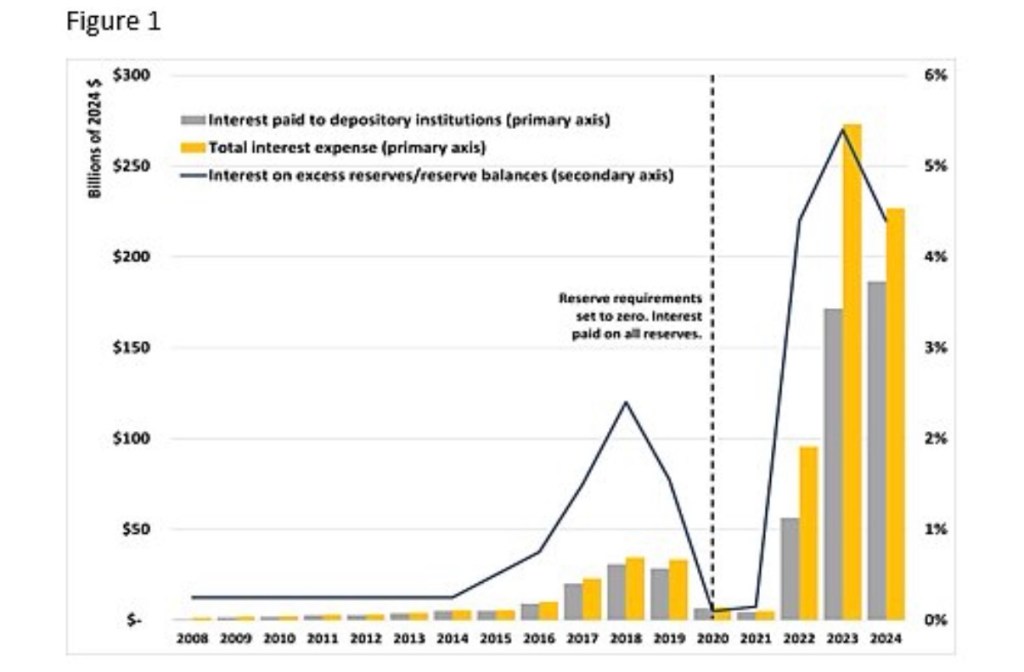
This topic flared up in 2025, with legislation proposing to end the Federal Reserve’s payment of interest on bank reserves (IOR). The bills have not yet advanced in Congress, however. As a preliminary on IOR and its broader implications, consider two hypotheticals:

First, imagine banks that take deposits, make loans, and invest in assets like government securities (i.e., Treasury debt). Banks are required to hold some percentage of reserves against their deposits at the central bank (the Fed), but the reserves earn nothing.

Now consider a world in which the Fed pays banks a risk-free interest rate on reserves. Banks will opt to hold plentiful reserves and relatively less in Treasuries. But in this scenario, the Fed itself holds large amounts of Treasuries and other securities, earns interest, and in turn pays interest to banks on their reserves.

The first scenario held sway in the U.S. until 2008, when Congress authorized the Fed to pay IOR. Since that time, we’ve had the second scenario: the IOR monetary order.

Socialized Risk

The central bank can basically print money, so there is no danger that banks won’t be paid IOR, despite some risk inherent in assets held by the Fed in its portfolio. While the rate paid on reserves can change, and banks are paid IOR every 14 days, they do not face the rate risk (and a modicum of default risk) inherent in holding Treasuries and mortgage securities, which have varying maturities. Instead, the Fed and ultimately taxpayers shoulder that risk, despite the Fed’s assurances that any portfolio losses and negative net interest income are economically irrelevant. These risks have been socialized, so we now share them.

This means that an essential function of the banking system, assessing and rationally pricing risks associated with certain assets, has been nationalized. It is a suspension of the market mechanism and an invitation to misallocated capital. Why bother to critically assess the risks inherent in assets if the Fed is happy to take them off your hands, possibly at a small premium, and then pay you a risk-free return on your cash to boot.

Bank Subsidies

IOR is a subsidy to banks. They get a return with zero risk, while taxpayers provide a funding bridge for any losses on the Fed’s holdings of securities on its balance sheet or any shortfall in the Fed’s net interest income. Banks, however, can’t lose money on their ample reserves.

The subsidy may come at a greater cost to some banks than others. This regime has been accompanied by significantly more regulation of bank balance sheets, such as capital and liquidity requirements (Basel III and Dodd-Frank). Not only is IOR a significant step toward nationalizing banks, but the attendant regulatory regime tends to favor large banks.

On the other hand, zero IOR with a positive reserve requirement amounts to a tax on banks, which is ultimately paid by bank customers. Allowing banks to hold zero reserves is out of the question, so we could view the implicit reserve-requirement tax as a cost of achieving some monetary stability and promoting safer depository institutions.

Quantitative Easing

Again, the advent of IOR created an incentive for banks to hold more reserves and relatively less in Treasuries and other assets (even some loans). Rather than “scarce reserves”, banks were encouraged by IOR to hold “ample reserves”. Of course, this is thought to promote stability and a safer banking system, but as Scott Sumner notes, it represents a contractionary policy owing to the increase in the demand for base money (reserves) by banks.

The Fed took up the slack in the debt markets, buying mortgage-backed securities and Treasuries for its own portfolio in large amounts. That kind of expansion in the Fed’s balance sheet is called quantitative easing (QE). which adds to the money supply as the Fed pays for the assets.

QE helped to neutralize the contractionary effect of IOR. And QE itself can be neutralized by other measures, including regulations governing bank capital and liquidity levels.

Fed Balance Sheet Policies

QE can’t go on forever… or can it? Perhaps no more than expanding federal deficits can go on forever! The Fed’s balance sheet topped out in 2022 at about $9 trillion. It stood at just over $6.5 trillion in November 2025.

Quantitative tightening (QT) occurs when the Fed sells assets or allows run-off in its portfolio as securities mature. Nevertheless, the Fed’s mere act of holding large amounts of debt securities (whether accompanied by QE, QT, or stasis) is essentially part of the ample reserves/IOR monetary regime: without it, the demand for debt securities would be undercut (because banks get a sweeter deal from the Fed, and so disintermediation occurs).

In terms of monetary stimulus, QE was more or less offset during the financial crisis leading into the Great Recession via higher demand for bank reserves (IOR) and stricter banking regulation. Higher capital requirements were justified as necessary to stabilize the financial system, but critics like Brian Wesbury stress that the real destabilizing culprit was mark-to-market valuation requirements.

During the Covid pandemic, however, aggressive QE was intended to stabilize the economy and was not neutralized, so the Fed’s balance sheet and the money supply expanded dramatically. A surge in inflation followed.

Rates and Monetary Policy

The IOR regime severs the connection between overnight rates and monetary policy, while artificially fixing the price of reserves. There is little interbank borrowing of reserves under this “ample reserves” policy. But if there is little or no volume, what’s the true level of the Fed funds rate? Some critics (like Wesbury) claim it’s basically made up by the Fed! In any case, there is no longer any real connection between the fed funds rate and the tenor of monetary policy.

Instead, the rate paid to banks on reserves essentially sets a floor on short-term interest rates. And whenever the Fed seeks to tighten policy via IOR rate actions, it faces a potential loss on its interest spread. That represents a conflict of interest for Fed policymaking.

Sumner dislikes the IOR arrangement because, he say, it reinforces the false notion that interest rates are key to understanding monetary policy. For example, higher short-term rates are not always consistent with lower inflation. Sumner prefers controlling the monetary base as a means of targeting the level of nominal GDP, allowing interest rates to signal reserve scarcity. All of that is out of the question as long as the Fed is manipulating the IOR rate.

The Fed As Treasury Lapdog

With IOR and ample reserves, the Fed’s management of a huge portfolio of securities puts it right in the middle of the debt market across a range of maturities. As implied above, that distorts pricing and creates tension between fiscal policy and “independent” monetary policy. Such tension is especially troubling given ongoing, massive federal deficits and increasing Administration pressure on the Fed to reduce rates.

Of course, when the Fed engages in QE, or actively turns over and replaces its holdings of maturing Treasuries with new ones, it is monetizing deficits and creating inflationary pressure. It’s one kind of money printing, the mechanism by which an inflation tax is traditionally understood to reduce the real value of federal debt.

The IOR monetary regime is not the first time the Fed has intervened in the debt markets at longer maturities. In 1961, the Fed ran “Operation Twist”, selling short-term Treasuries and buying long-term Treasuries in an effort to reduce long-term rates and stimulate economic activity. However, the operation did not result in an increase in the Fed’s balance sheet holdings and cannot be interpreted as debt monetization.

Fed Adventurism

The Fed earned positive net interest income from 2008-2023, enabling it to turn over profits to the Treasury. This had a negative effect on federal deficits. However, some contend that the Fed’s net interest income over those years fostered mission creep. Wesbury notes that the Fed dabbled in “… research on climate change, lead water pipes and all kinds of other issues like ‘inequality’ and ‘racism.’” These topics are far afield of the essential functions of a central bank, monetary authority, or bank regulator. One can hope that keeping the Fed on a tight budgetary leash by ending the IOR monetary regime would limit this kind of adventurism.

A Contrary View

John Cochrane insists that IOR is a “lovely innovation”. In fact, he wonders whether the opposition to IOR is grounded in nostalgic, Trumpian hankering for zero interest rates. Cochrane also asserts that IOR is “usually” costless because longer-term rates on the Fed’s portfolio tend to exceed the short-term rate earned on reserves. That’s not true at the moment, of course, and the value of securities in the Fed’s portfolio tanked when interest rates rose. The Fed treats the shortfall in net interest as an increment to a “deferred asset”, but the negative profit, in the interim, must be met by taxpayers (who would normally benefit from the Fed’s profit) or printing money. The Fed shoulders ongoing interest-rate risk, freeing banks of the same to the extent that they hold reserves. Again, this subsidy has a real cost.

I’m surprised that Cochrane doesn’t see the strong potential for monetary lapdoggery under the IOR regime. Sure, the Fed can always print money and load up on new issues of Treasury debt. But IOR and an ongoing “quantitative” portfolio create an institutional bias toward supporting fiscal incontinence.

I’m also surprised that Cochrane would characterize an attempt to end IOR as easier monetary policy. Such a change would be accompanied by an unwinding of the Fed’s mammoth portfolio (QT). That might or might not mean tighter policy, on balance. Such an unwinding would be neutralized by lower demand for bank reserves and a lighter regulatory touch, and it should probably be phased in over several years.

Conclusion

Norbert Michel summarizes the problems created by IOR (the chart at the top of this post is from Michel). Here is a series of bullet points from his December testimony before the Senate Homeland Security and Governmental Affairs Committee (no quote marks below, as I paraphrase his elaborations):

  • The economic cost of the Fed’s losses is high. Periodic or even systemic failures to turn profits over to the Treasury means more debt, taxes, or inflation.
  • The IOR framework creates a conflict of interest with the Fed’s mandate to stabilize prices. The IOR rate set by the Fed has an impact on its profitability, which can be inconsistent with sound monetary policy actions.
  • The IOR system facilitates government support for the private financial sector. Banks get a risk-free return and the Fed acquiesces to bearing rate risk.
  • More accessible money spigot. The Fed can buy and hold Treasury debt, helping to fund burgeoning deficits, while paying banks to hold the extra cash that creates.

The money spigot enables wasteful expansion of government. Unfortunately, far too many partisans are under the delusion that more government is the solution to every problem, rather than the root cause of so much dysfunction. And of course advocates of so-called Modern Monetary Theory are all for printing the money needed to bring about the “warmth of collectivism”.
Price Stability: Are We There Yet?

22 Thursday Dec 2022

Posted by Nuetzel in Inflation, Liberty, Monetary Policy

≈ Leave a comment

Tags

Adam Shapiro, Bloomberg, Cleveland Fed, Demand-Driven Inflation, Federal Reserve, Great Recession, Inflation Targets, Joe Wiesenthal, Median CPI, Modern Monetary Theory, Money Printing, Noah Smith, Omnibus Spending Bill, Optimal Rate of Inflation, Pay-As-You-Go Law, PCE Deflator, Price Stability, Quantitative Easing, Rate Targets, Strategic Petroleum Reserve, Supply-Driven Inflation, Team Transitory, Trading Economics, Trimmed CPI

The answer to that question, kids, is a resounding no! The Federal Reserve created far too much liquidity during and after the pandemic and waited too long to reverse that policy. That’s a common view among the “monetarazzi”, but far too many analysts, in the next breath, assert that the Fed is going too far in tightening policy. Sorry, but you can’t have it both ways! Thus far, the reductions we’ve seen in the monetary aggregates (M1, M2, M3) represent barely a trickle out of the ocean of liquidity released during the previous two years. The recent slight moderation in the rate of inflation is unlikely to gain momentum without persistence by the Fed.

This Could Be Easier

I humbly concede, however, that a different approach by the Fed might have been less disruptive. A better alternative would have involved more aggressive reductions in the gigantic portfolio of securities it acquired via “quantitative easing” (QE) during the pandemic while avoiding direct intervention to raise short-term interest rates. In fact, allowing interest rates to be determined by the market, rather than via central bank intervention, is more sensible in terms of pricing debt of any duration. It also suggests a more direct and sensible approach to managing the growth of the money supply. Of course, had the Fed unwound QE more aggressively, short-term rates would surely have risen anyway, but to levels appropriate to rationing liquidity more efficiently. Furthermore, those rates could have served as a useful indicator of the market’s ability to digest a particular volume of sales from the Fed’s portfolio.

Getting Tight

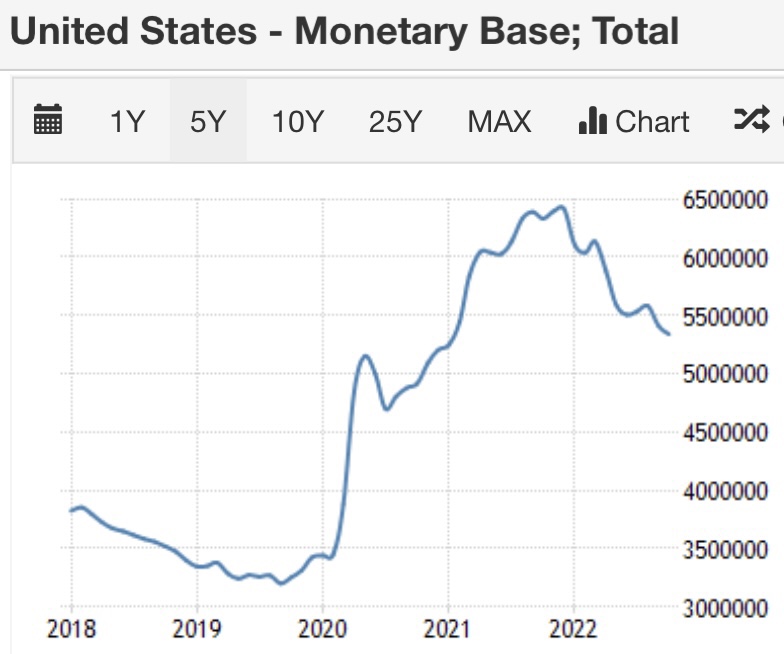
The chart below shows the level of the monetary base (bank reserves plus currency) over the past five years from the Trading Economics site. The monetary base is the narrow monetary aggregate supporting growth of the money stock and is under fairly direct control of the Fed.

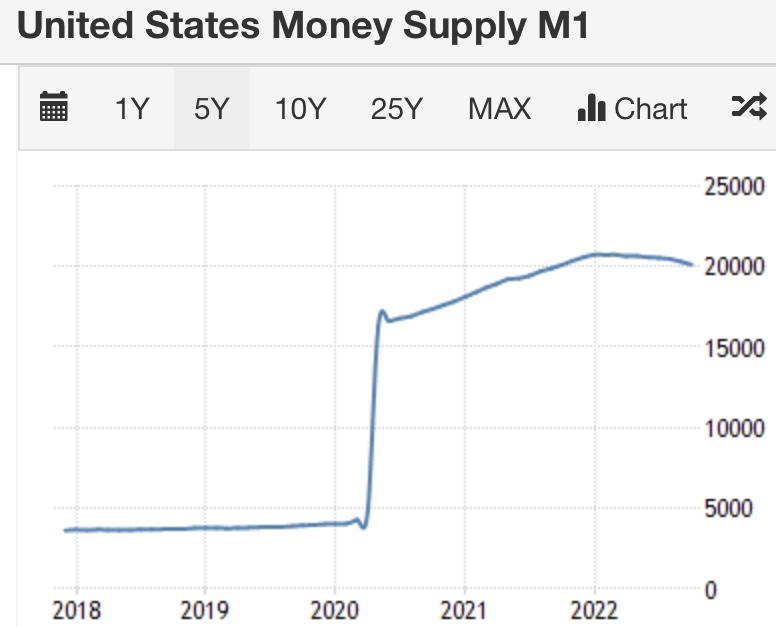
The base has declined substantially during 2022 largely as a consequence of the Fed’s restrictive policies. However, it has retraced only about a third of the massive expansion engineered by the Fed over the two prior years. Here is the corresponding plot of the M1 money stock (currency plus checking deposits):

So the reductions in the base have yet to translate into much of a reduction in the money stock, though growth in all of the aggregates has certainly declined. No one thinks this will be a walk in the park. Withdrawing liquid capital from markets accustomed to swilling in excesses will have consequences, particularly for investors who’ve grown undisciplined in their approach to evaluating prospective assets. Investors and society at large inevitably pay the price for the malinvestment encouraged by unbridled money growth (not to mention misdirected industrial policies … that’s a different can of worms).

But the squeamish resist! I got a kick out of this tweet by Noah Smith in which he pokes fun at those who insist that the surge in inflation was a mere transitory phenomenon:

“Team Transitory: OMG inflation is just going to go away, you don’t need to raise interest rates.

Fed: *raises interest rates*

Inflation: *goes down a bit*

Team Transitory: SEE, I told you inflation was going away and that you didn’t need to raise interest rates!!”

Well, in fairness, “Team Transitory” has been fixated on supply disruptions that very well should resolve with private efforts over time. Some have resolved already. And again, we’ve yet to feel much impact from the Fed’s tighter policy, but I’m amused by the tweet nevertheless.

In fact, the surge in inflation has been driven by both supply and demand factors, and it’s true the Fed can do very little about the former. But stalling the effort to purge excess liquidity and demand-side inflation risks allowing expectations of inflation to edge higher, creating an environment in which price pressures are more resistant to policy actions.

Inflation And Its Proximate Sources

It is indeed good news that inflation has tapered slightly over the past few months, or at least the “headline” inflation numbers have tapered. Weaker energy prices helped a great deal, though releases from the Strategic Petroleum Reserve aren’t sustainable. Measures of “core” inflation that exclude food and energy prices, and more central measures of inflation within the spectrum of goods and services, have moved sideways or perhaps shown signs of a slight moderation.

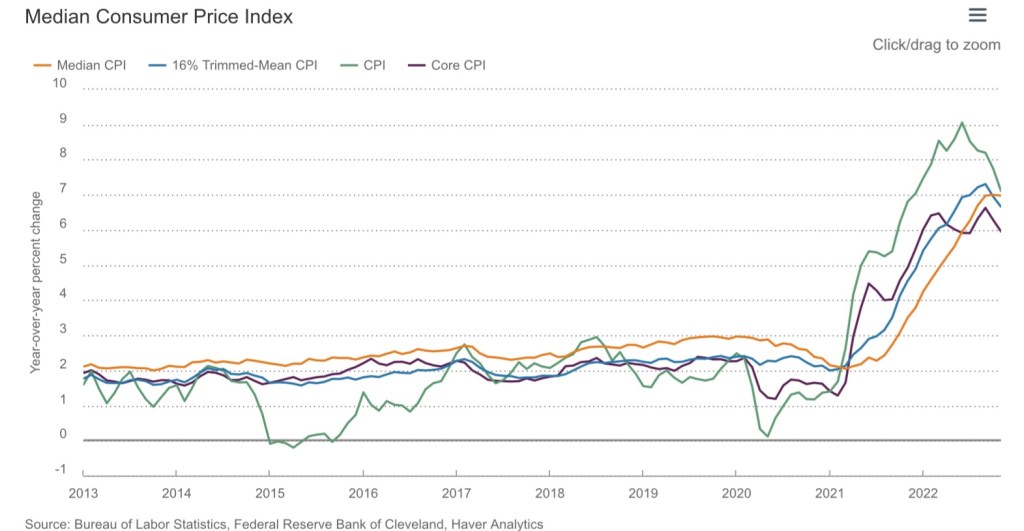
Here’s a plot of several measures of CPI inflation taken from the Cleveland Fed’s web site. Note that the median component of the CPI has finally hit a plateau, and a “trimmed” measure that excludes CPI components with extreme changes has dipped slightly. The Core CPI has fluctuated in a range just above 6% for most of the year.

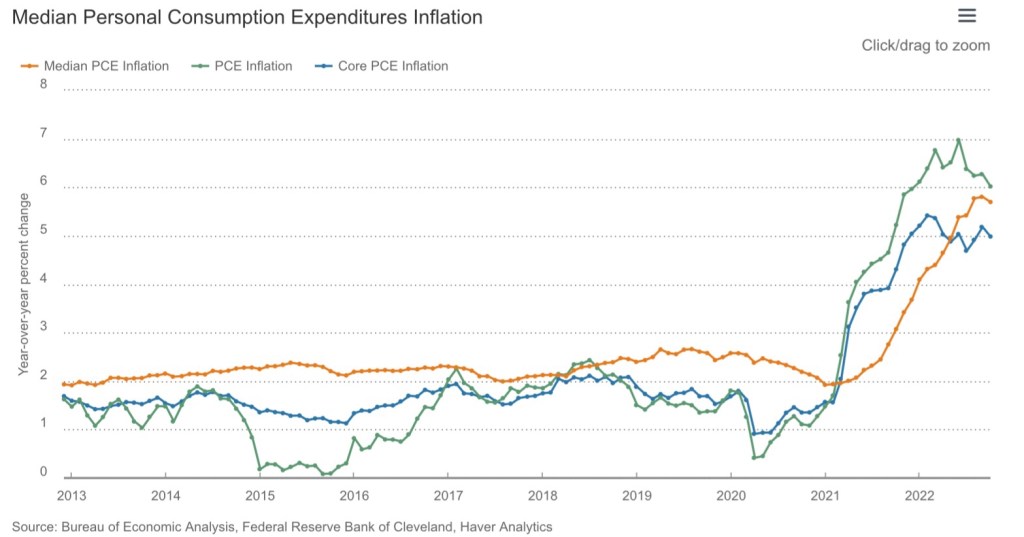
The deflator for personal consumption expenditures (PCE) gets more emphasis from the Fed in its policy deliberations. The latest release at the start of December showed patterns similar to the CPI:

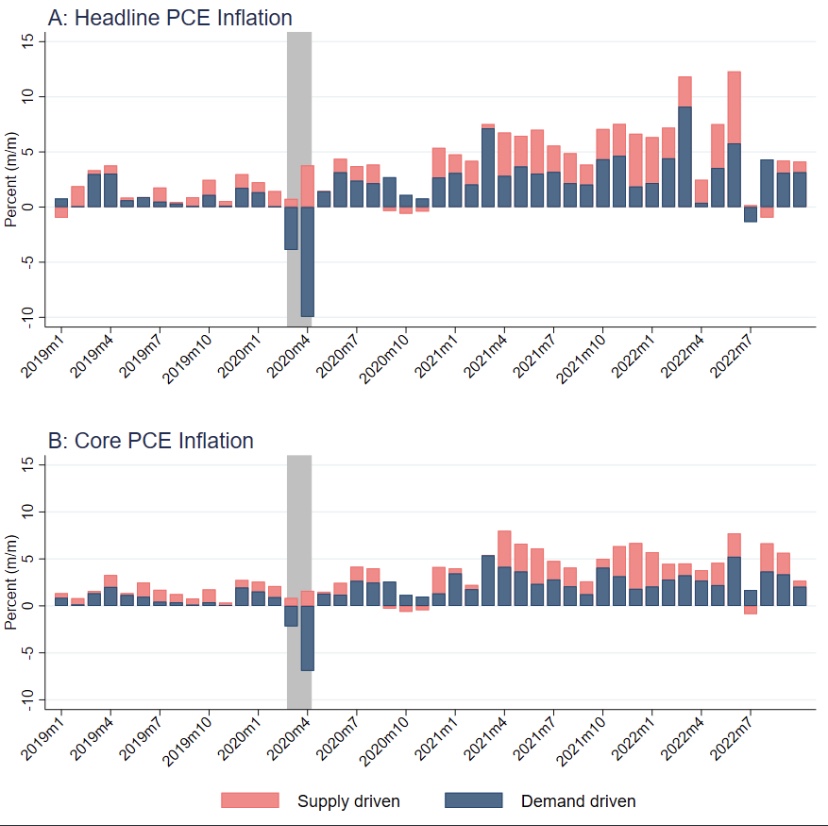
With respect to the PCE deflator, the slight dampening of price pressure we’ve seen recently came primarily from the supply side, with some progress on the demand side as well. Energy was one factor on the supply side, but even the core PCE deflator shows less supply pressure. Adam Shapiro has a decomposition of the PCE deflator into supply-driven and demand-driven components (but the chart only goes through October):

First, without endorsing Shapiro’s construction of this dichotomy, I note that the impact of monetary policy is primarily through the demand side of the economy. Of course, monetary instability isn’t good for producers, and excessive money growth and inflation create uncertainty that inhibits supply. But what we’ve seen recently has more to do with the curing of supply chain bottlenecks that cropped up during the pandemic (or in its wake), and Shapiro attempts to capture that kind of phenomenon here.

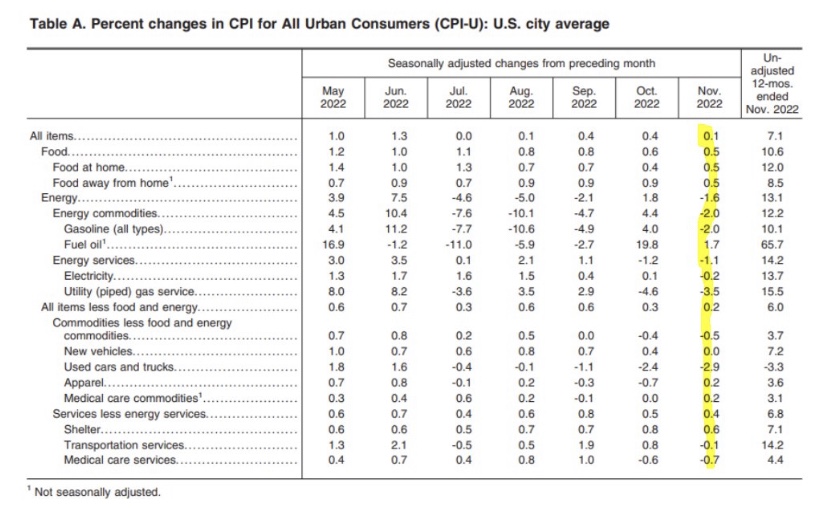
Still, many would argue that the November CPI showed sufficient progress for the Fed to pause its tightening campaign. The reductions in the monthly price increases were fairly widespread, as shown by this table from the CPI report:

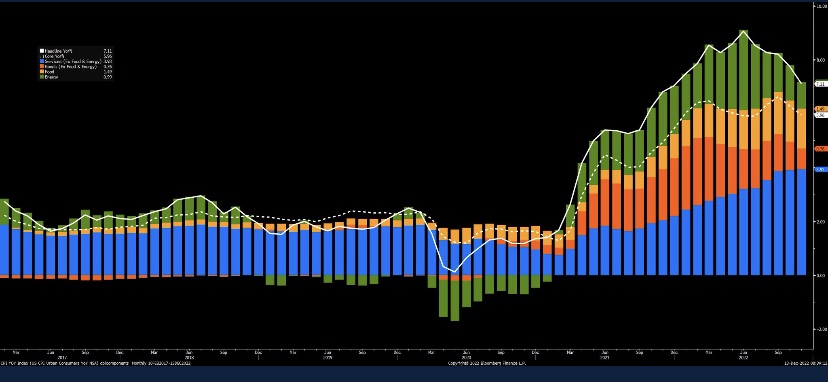
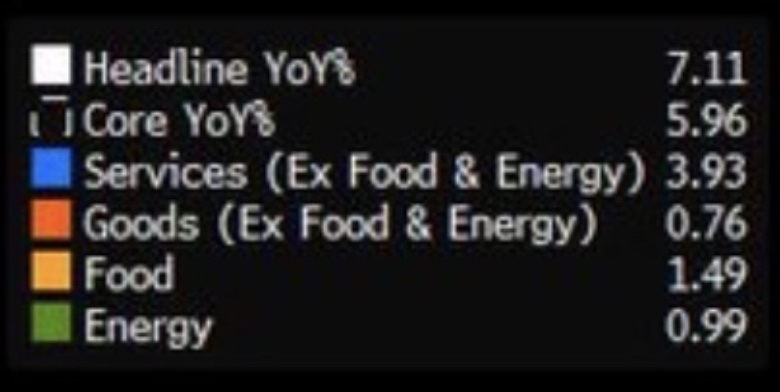
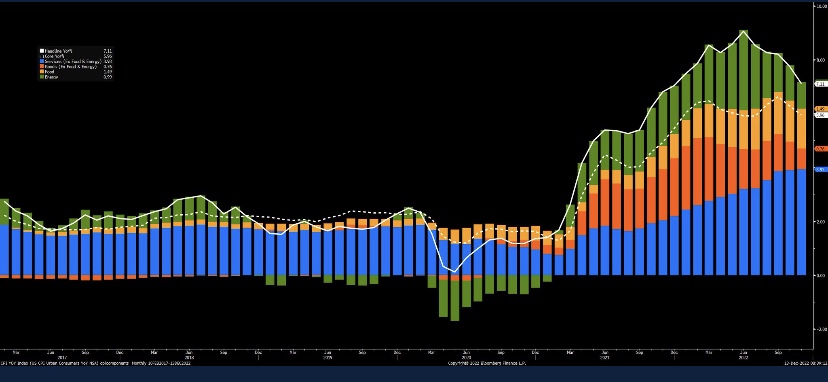
The next chart from Joe Wiesenthal (via Bloomberg) displays trends in broad CPI categories, but it shows vividly that the reductions were concentrated in energy components and goods prices, while services and food inflation did not really abate. (The legend is so hard to read that I took the liberty of blowing it up a bit below the chart itself):

Playing Catch-Up

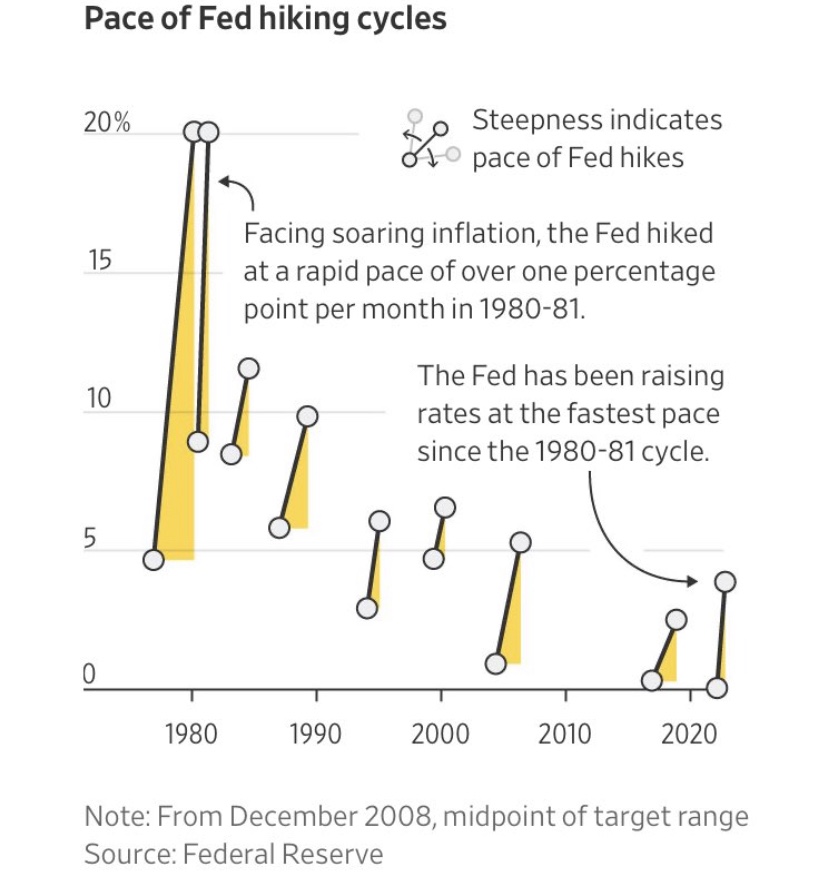
While the Fed’s effort to restrain inflation began in earnest in the spring of this year, it lifted the federal funds rate target rapidly. Here’s another chart from Adam Shapiro, via the Wall Street Journal: the Fed’s current tightening cycle is the fastest in 40 years in terms of those rate hikes:

Fast, yes, but they got a late start in the face of a rapid acceleration of inflation, and for what it’s worth, the Fed’s rate target remains below the rate of inflation. Yes, I’m forced to acknowledge here that the Fed’s preference for rate intervention and targeting is just what they do, for now. In any case, top-line inflation and strictly demand-side inflation are still above the Fed’s 2% target.

Fabian Fiscal Expansionists

One “fix” recommended in some circles suggests that the Fed’s inflation target is too low, as if price stability had nothing to do with its mandate! The idea that low-grade inflation is a healthy thing has never been convincingly demonstrated. In fact, the monetary literature leans strongly in the direction of price stability and an optimal rate of inflation of zero! That the Fed should aim for higher inflation seems like a cop-out intended to appease those who still subscribe to the discredited notion that there exists a reliable long-run tradeoff between inflation and unemployment.

In fact, proposals to increase the central bank’s inflation target would enable more deficit spending financed with the “printing press”, which is at the root of the demand-side inflation problem we now face. A major justifications for ballooning levels of federal spending has been so-called Modern Monetary Theory (MMM), which has gained adherents among statists in the years since the Great Recession. MMM holds that “important” initiatives can simply be paid for with new money creation, rather than interest bearing debt, or God forbid, taxes! “Partisan” is probably a better description than “theorist” for any fan of MMM, and they have convinced themselves that money financed deficits are without inflationary consequences. Of course, this represents a complete suspension of the law of resource scarcity, not to mention years of monetary history. Raising the Fed’s inflation target plays well with the same free-lunch advocates who rally behind MMM.

The Fed’s Unfaithful Fiscal Partner

Federal budget control is likely to take another hit this week with passage of the $1.7 omnibus spending bill. It includes spending increases with no immediate offsets as required under the pay-as-you-go budget law. It delays those offsets to 2025 and increases deficits in the interim by hundreds of billions of dollars. It also sets a new, higher baseline for discretionary appropriations in future years. The federal deficit has already risen dramatically compared to a year ago under the fiscal profligacy of Congress and the Administration. Another contributing factor, however, is that the interest cost of servicing the national debt has spiked as interest rates have risen. Needless to say, none this makes the Fed’s job any easier, especially as it seeks to reverse QE.

Say Uncle!?

When will the Fed begin to take its foot off the brake? It “only” raised the Fed funds target by 50 basis points at its meeting last week (after four 75 bps moves in a row. It is expected to raise the target another 50 bps in early February and perhaps another 25 in March. Strong signals of imminent recession would be needed for the Fed to call it off any sooner, and we’re definitely seeing more hints of a weakening economy in the data (and see here, here, here, and here). More definitive declines in inflation would obviously help settle things. Otherwise, the Fed may pause after March in order to gauge progress toward its goal of 2% inflation.

The Fed’s Balance Sheet: What’s the Big Deal?

08 Sunday May 2022

Posted by Nuetzel in Government Failure, Inflation, Monetary Policy

≈ Leave a comment

Tags

Allocation of Capital, Bank Reserves, crowding out, Debt Monetization, Fed Balance Sheet, Federal Funds, Federal Reserve, Fiscal Inflation, Inflation tax, Interest Rate Targeting, MBS, Monetary policy, Mortgage Backed Securities, QE, Quantitative Easing, Scarcity, Tapering

The Federal Reserve just announced tighter monetary policy in an attempt to reduce inflationary pressures. First, it raised its target range for the federal funds rate (on overnight loans between banks) by 0.5%. The new range is 0.75% – 1%. Second, on June 1, the Fed will begin taking steps to reduce the size of its $9 trillion portfolio of securities. These holdings were acquired during periods of so-called quantitative easing (QE) beginning in 2008, including dramatic expansions in 2020-21. A shorthand reference for this portfolio is simply the Fed’s “balance sheet”. It includes government debt the Fed has purchased as well as privately-issued mortgage-backed securities (MBS).

What Is This Balance Sheet You Speak Of?

Talk of the Fed’s balance sheet seems to mystify lots of people. During the 2008 financial crisis, the Fed began to inject liquidity into the economy by purchasing large amounts of assets to be held on its balance sheet. This was QE. It’s scope was unprecedented and a departure from the Fed’s pre-crisis reliance on interest rate targeting. QE had the effect of increasing bank reserves, which raised the possibility of excessive money supply growth. That’s when the Fed began to pay interest to banks on reserves, so they might be content to simply hold some of the reserves over and above what they are required to hold, rather than using all of that excess to support new loans and deposits (and thus money growth). However, that interest won’t stop banks from lending excess reserves if better opportunities present themselves.

The Fed has talked about reducing, “normalizing”, or “tapering” its balance sheet for some time, but it only recently stopped adding to it. With inflation raging and monetary policy widely viewed as too “dovish”, analysts expected the Fed to stop reinvesting proceeds from maturing securities, which amounts to about $95 billion per month. That would shrink or “taper” the balance sheet at a rate of about $1.1 trillion per year. Last week the Fed decided to cap the “runoff” at $47.5 billion per month for the first three months, deferring the $95 billion pace until September. Monetary policy “hawks” were disappointed by this announcement.

Monetizing Government

So, one might ask, what’s the big deal? Why must the Fed taper its securities holdings? Well, first, the rate of inflation is far above the Fed’s target range, and it’s far above the “average Joe’s” comfort range. Inflation imposes significant costs on the economy and acts as a regressive form of taxation, harming the poor disproportionately. To the extent that the Fed’s huge balance sheet (and the corresponding bank reserves) are supporting incremental money growth and fueling inflation, the balance sheet must be reduced.

In that connection, the Fed’s investment in government debt represents monetized federal debt. That means the Fed is essentially printing money to meet the Treasury’s financing needs. Together with profligate spending by the federal government, nothing could do more to convince investors that government debt will never be repaid via future budget surpluses. This dereliction of the government’s “full faith and credit”, and the open-armed acceptance of the inflation tax as a financing mechanism (à la Modern Monetary Theory), is the key driver of fiscal inflation. Reducing the balance sheet would represent de-monetization, which might help to restore faith in the Fed’s ability to push back against fiscal recklessness.

Buyer of First Resort

Perhaps just as critically, the Fed’s heavy investment in government debt and MBS represents an ongoing distortion to the pricing of financial assets and the allocation of capital. Some call this interference in the “price discovery process”. That’s because the Fed has represented a market-altering presence, a willing and inelastic buyer of government debt and MBS. Given that presence, it’s difficult for buyers and sellers to discern the true values of alternative uses of capital, or to care.

QE was, among other things, a welcome institutional development for the U.S. Treasury and for those who fancy that fresh money printing is an ever-valid form of government payment for scarce resources. The Fed’s involvement also means that other potential buyers of Treasury debt need not worry about interest rate risk, making public debt relatively more attractive than private debt. This is a dimension of the “crowding out” phenomenon, whereby the allocation of capital and flows of real resources between public and private uses are distorted.

The Fed’s presence as a buyer of MBS depresses mortgage rates and makes mortgage lending less risky for lenders and investors. As a result, it encourages an over-investment in housing and escalating home prices. This too distorts the allocation of capital and real resources, at the margin, toward housing and away from uses with greater underlying value.

Conclusion

The magnitude of the Fed’s balance sheet is an ongoing testament to an increasingly dominant role of central authorities in the economy. In this case, the Fed has served as a conduit for the inflation tax. In addition, it has unwittingly facilitated crowding out of private capital investment. The Fed’s purchases of MBS have distorted the incentives (and demand) for residential investment. These are subtle effects that the average citizen might not notice, just as one might not notice the early symptoms of a debilitating disease. The long-term consequences of the Fed’s QE activities, including the inflation tax and distorted allocations of capital, are all too typical of failures of government intervention and attempts at central planning. But don’t expect anyone at the Fed to admit it.

Central Banks Stumble Into Negative Rates, Damn the Savers

01 Tuesday Mar 2016

Posted by Nuetzel in Central Planning, Monetary Policy

≈ 1 Comment

Tags

Bank of Japan, central planning, Federal Reserve, Helicopter Drop, Income Effect vs. Substitution Effect, Interest Rate Manipulation, Intertemporal Tradeoffs, Malinvestment, Mises Institute, Monetary policy, negative interest rates, NIRP, Printing Money, Privacy Rights, QE, Quantitative Easing, Reach For Yield, regulation, War on Cash, Zero Interest Rate Policy, ZIRP

Dollar Cartoon

Should government actively manipulate asset prices in an effort to “manage ” economic growth? The world’s central bankers, otherwise at their wit’s end, are attempting just that. Hopes have been pinned on so-called quantitative easing (QE), which simply means that central banks like the U.S. Federal Reserve (the Fed) buy assets (government and private bonds) from the public to inject newly “printed” money into the economy. The Fed purchased $4.5 trillion of assets between the last financial crisis and late 2014, when it ended its QE. Other central banks are actively engaged in QE, however, and there are still calls from some quarters for the Fed to resume QE, despite modest but positive economic growth. The goals of QE are to drive asset prices up and interest rates down, ultimately stimulating demand for goods and economic growth. Short-term rates have been near zero in many countries (and in the U.S. until December), and negative short-term interest rates are a reality in the European Union, Japan and Sweden.

Does anyone really have to pay money to lend money, as indicated by a negative interest rate? Yes, if a bank “lends” to the Bank of Japan, for example, by holding reserves there. The BOJ is currently charging banks for the privilege. But does anyone really “earn” negative returns on short-term government or private debt? Not unless you buy a short-term bill and hold it till maturity. Central banks are buying those bills at a premium, usually from member banks, in order to execute QE, and that offsets a negative rate. But the notion is that when these “captive” member banks are penalized for holding reserves, they will be more eager to lend to private borrowers. That may be, but only if there are willing, credit-worthy borrowers; unfortunately, those are scarce.

Thus far, QE and zero or negative rates do not seem to be working effectively, and there are several reasons. First, QE has taken place against a backdrop of increasingly binding regulatory constraints. A private economy simply cannot flourish under such strictures, with or without QE. Moreover, government makes a habit of manipulating investment decisions, partly through regulatory mandates, but also by subsidizing politically-favored activities such as ethanol, wind energy, post-secondary education, and owner-occupied housing. This necessarily comes at the sacrifice of opportunities for physical investment that are superior on economic merits.

The most self-defeating consequence of QE and rate manipulation, be that zero interest rate policy (ZIRP) or negative interest rate policy (NIRP), is the distortion of inter-temporal tradeoffs that guide decisions to save and invest in productive assets. How, and how much, should individuals save when returns on relatively safe assets are very low? Most analysts would conclude that very low rates prompt a strong substitution effect toward consuming more today and less in the future. However, the situation may well engender a strong “income effect”, meaning that more must be saved (and less consumed in the present) in order to provide sufficient resources in the future. The paradox shouldn’t be lost on central bankers, and it may undermine the stimulative effects of ZIRP or NIRP. It might also lead to confusion in the allocation of productive capital, as low rates could create a mirage of viability for unworthy projects. Central bank intervention of this sort is disruptive to the healthy transformation of resources across time.

Savers might hoard cash to avoid a negative return, which would further undermine the efficacy of QE in creating monetary stimulus. This is at the root of central bank efforts to discourage the holding of currency outside of the banking system: the “war on cash“. (Also see here.) This policy is extremely offensive to anyone with a concern for protecting the privacy of individuals from government prying.

Another possible response for savers is to “reach for yield”, allocating more of their funds to high-risk assets than they would ordinarily prefer (e.g., growth funds, junk bonds, various “alternative” investments). So the supply of saving available for adding to the productive base in various sectors is twisted by central bank manipulation of interest rates. The availability of capital may be constrained for relatively safe sectors but available at a relative discount to risky sectors. This leads to classic malinvestment and ultimately business failures, displaced workers, and harsh adjustment costs.

With any luck, the Fed will continue to move away from this misguided path. Zero or negative interest rates imposed by central banks penalize savers by making the saving decision excessively complex and fraught with risk. Business investment is distorted by confusing signals as to risk preference and inflated asset prices. Central economic planning via industrial policy, regulation, and price controls, such as the manipulation of interest rates, always ends badly. Unfortunately, most governments are well-practiced at bungling in all of those areas.


Central Bank Bubbles Pop On Our Heads

09 Wednesday Sep 2015

Posted by Nuetzel in Big Government, Macroeconomics, Monetary Policy

≈ Leave a comment

Tags

Asset Bubble, Asset Price Distortion, Boom and bust, capital costs, Capital investment, Easy Money, Jim Grant, Market Manipulation, Martin Feldstein, Quantitative Easing, Ryan McMaken, Seigniorage, Supportive Earnings, Zero Interest Rate Policy, ZIRP

boom_and_bust

Printing money is a temptation that central banks can’t resist. And they distort prices when they do it. The new “liquidity” finds its way into higher asset values: stocks, bonds, real estate, even art. But as Jim Grant points out (as quoted by Ryan McMaken), the inflated prices are artificial, decoupled from the actual value those assets are capable of generating. The high asset prices are unsustainable:

“The idea is that you put the cart of asset values before the horse of enterprise. By raising up asset values, you mobilize spending by people who have assets… It was otherwise known as trickle-down economics before the enlightenment, then it became something much fancier in economic lingo. But that’s essentially the idea. So what you have seen is an artificial structure of prices worldwide.”

This comports with the general drift one gets from chatting with financial market professionals about the Federal Reserve and other central banks. These advisors usually add a reflexive assurance that corporate earnings are adequate to support stock prices. So which is it? Those very earnings might reflect trading gains on assets held by financial institutions and others, so the “supportive earnings” argument is circular to some degree. That aside, it’s suggestive that the recent market selloff has been centered on tighter monetary conditions:

“‘The risk of global liquidity conditions swinging is real for the markets, justifying a significant reduction in exposure for all asset classes,’ said Didier Saint-Georges, managing director at Carmignac, in a note to clients.“

Likewise, significant rebounds have been attributed, at least in part, to softening expectations that the Fed will move to increase short-term interest rates next week. If asset values are so heavily dependent on a continuation of a zero-interest rate, easy-money policy at this stage of an economic expansion, then it looks like a bubble is waiting to pop. More liquidity might delay the inevitable.

How did we get here? Martin Feldstein describes the policy of “quantitative easing” (QE) in “The Fed’s Stock Price Correction“:

“When the Obama administration’s poorly designed 2009 stimulus legislation failed to produce a strong economic turnaround, then-Fed Chairman Ben Bernanke announced that the central bank would pursue an ‘unconventional monetary policy’ by purchasing immense amounts of long-term bonds and promising to hold short-term interest rates near zero for an extended period.

Mr. Bernanke explained that the Fed’s policy was designed to drive down long-term interest rates, inducing portfolio investors to shift from bonds to stocks. This ‘portfolio substitution’ strategy, as he labeled it, would increase share prices, raising household wealth and therefore consumer spending.“

Feldstein does not buy the contention that “earnings are supportive”. Despite his conventional demand-side approach to macroeconomics, he too emphasizes that loose monetary policy has distorted asset prices.

The process is exacerbated by the bloated federal government’s appetite for funds. The Treasury is able to float debt at very low interest rates, thanks to the Fed’s willingness to provide liquidity to the banking system. By that, I mean the Fed’s willingness to buy Treasury bonds and monetize federal deficit spending.

Jim Grant’s argument regarding price distortion goes further. Increases in the prices of financial assets artificially deflate the cost of raising new capital, translating into over-investment in physical assets such as office buildings and machinery. Here’s Grant:

The prices themselves are the cosmetic evidence of underlying difficulty. So if you misprice something, it’s not just the price that’s wrong. It’s the thing itself that has been financed by the price. So you have perhaps too many oil derricks, too many semi-conductor fabs. We have too much of something, which is financed by an excess of credit or debt.“

Thus, the boom feeds the inevitable bust. That is certainly a danger. I’m sympathetic to Grant’s reasoning, but we have not experienced much of a boom in physical capital investment in the U.S., except perhaps for commercial real estate and in capital-intensive oil and gas extraction, and the latter is now on the skids. China, however, has been aggressively over-investing, and that is coming to an end.

While asset values have likely been inflated, it is fair to ask why the Fed’s accommodative policy has not led to a more general inflation in the prices of goods and services. For one thing, the strong dollar has held import prices down. (The international value of the dollar has been buttressed by the view that dollar-denominated assets are relatively safe, despite the risks created by the Fed.) More importantly, aging baby boomers have contributed to relatively strong saving activity (and less spending). Paradoxically, it’s possible that saving has been reinforced by the zero-rate policy of the Fed, as noted before on Sacred Cow Chips. Buying extra comfort in retirement requires greater set-asides if rates are low.

I am not optimistic about the direction of asset values, but I am not adjusting my own investment profile. Market timing is generally a bad strategy, and I will do my best to ride out the market’s ups and downs, even if they are manipulated by the Fed. However, we should all demand more discipline from the federal government and more restraint from the Fed. Better yet, limit the Fed’s discretion in the conduct of monetary policy by relying on a monetary standard that is less prone to manipulation and seigniorage.

Mortgage Mania at the Fed

09 Thursday Oct 2014

Posted by Nuetzel in Uncategorized

≈ Leave a comment

Tags

Fannie Mae, Federal Reserve, Freddie Mac, Industrial Policy, Monetary Stimulus, Mortgage Interest Deduction, Mortgage Securities, Quantitative Easing, Richmond Fed, Wall Street Journal

bernanke-fed-qe

The Federal Reserve has no business distorting incentives by dabbling with billions in markets for private debt. Kudos to two officials at the Richmond Fed for making this point forcefully in the Wall Street Journal** today.

Normally, the Fed conducts monetary policy by buying or selling Treasury debt, which is thought to be neutral with respect to relative private interest rates. In other words, the Fed’s impact on the Treasury market, whatever that might be, does not encourage investment in housing at the expense of factory investment or vice versa. Since 2009, however, the Fed has attempted to support the housing and mortgage markets via massive purchases  of mortgage securities originally issued by Fannie Mae and Freddie Mac. This has the effect of reducing mortgage interest rates relative to rates on other kinds of private debt. It also constitutes a form of bailout for mortgage investors, who tend to receive favorable bids from the Fed for these assets. Free money! And more free money is dolled out by the Fed when it pays banks interest on the new reserve balances these transactions ultimately create.

One might object that the struggling mortgage market needed the Fed’s support in the wake of the housing crash. I do not accept that view because the mortgage and housing markets needed to unwind their excesses and monetary stimulus did not require mortgage purchases. But this also begs the question: what gave rise to the crisis? Over-investment in housing and a home price bubble fueled by tax-deductible interest, easy Fed monetary policy, regulatory capital standards that favored mortgage lending, prospective bailouts in case of failure, and loose bank credit standards. Those should all sound familiar. Now, the Fed believes it’s necessary to re-inflate the mortgage market via continuing asset purchases.

The Fed’s policies can be criticized on other grounds, but interfering in private debt markets should be avoided. It is an example of industrial policy that is clearly not even part of the Fed’s so-called mandate, and it ultimately means a continuing massive misallocation of resources into housing at the expense of other forms of investment.

** The article at the link should be ungated. If not, try Googling “wsj Fed’s Mortgage Favoritism.”

Follow Sacred Cow Chips on WordPress.com

Recent Posts

  • The Case Against Interest On Reserves
  • Immigration and Merit As Fiscal Propositions
  • Tariff “Dividend” From An Indigent State
  • Almost Looks Like the Fed Has a 3% Inflation Target
  • Government Malpractice Breeds Health Care Havoc

Archives

  • January 2026
  • December 2025
  • November 2025
  • October 2025
  • September 2025
  • August 2025
  • July 2025
  • June 2025
  • May 2025
  • April 2025
  • March 2025
  • February 2025
  • January 2025
  • December 2024
  • November 2024
  • October 2024
  • September 2024
  • August 2024
  • July 2024
  • June 2024
  • May 2024
  • April 2024
  • March 2024
  • February 2024
  • January 2024
  • December 2023
  • November 2023
  • August 2023
  • July 2023
  • June 2023
  • May 2023
  • April 2023
  • March 2023
  • February 2023
  • January 2023
  • December 2022
  • November 2022
  • October 2022
  • September 2022
  • August 2022
  • July 2022
  • June 2022
  • May 2022
  • April 2022
  • March 2022
  • February 2022
  • January 2022
  • December 2021
  • November 2021
  • October 2021
  • September 2021
  • August 2021
  • July 2021
  • June 2021
  • May 2021
  • April 2021
  • March 2021
  • February 2021
  • January 2021
  • December 2020
  • November 2020
  • October 2020
  • September 2020
  • August 2020
  • July 2020
  • June 2020
  • May 2020
  • April 2020
  • March 2020
  • February 2020
  • January 2020
  • December 2019
  • November 2019
  • October 2019
  • September 2019
  • August 2019
  • July 2019
  • June 2019
  • May 2019
  • April 2019
  • March 2019
  • February 2019
  • January 2019
  • December 2018
  • November 2018
  • October 2018
  • September 2018
  • August 2018
  • July 2018
  • June 2018
  • May 2018
  • April 2018
  • March 2018
  • February 2018
  • January 2018
  • December 2017
  • November 2017
  • October 2017
  • September 2017
  • August 2017
  • July 2017
  • June 2017
  • May 2017
  • April 2017
  • March 2017
  • February 2017
  • January 2017
  • December 2016
  • November 2016
  • October 2016
  • September 2016
  • August 2016
  • July 2016
  • June 2016
  • May 2016
  • April 2016
  • March 2016
  • February 2016
  • January 2016
  • December 2015
  • November 2015
  • October 2015
  • September 2015
  • August 2015
  • July 2015
  • June 2015
  • May 2015
  • April 2015
  • March 2015
  • February 2015
  • January 2015
  • December 2014
  • November 2014
  • October 2014
  • September 2014
  • August 2014
  • July 2014
  • June 2014
  • May 2014
  • April 2014
  • March 2014

Blogs I Follow

  • Passive Income Kickstart
  • OnlyFinance.net
  • TLC Cholesterol
  • Nintil
  • kendunning.net
  • DCWhispers.com
  • Hoong-Wai in the UK
  • Marginal REVOLUTION
  • Stlouis
  • Watts Up With That?
  • Aussie Nationalist Blog
  • American Elephants
  • The View from Alexandria
  • The Gymnasium
  • A Force for Good
  • Notes On Liberty
  • troymo
  • SUNDAY BLOG Stephanie Sievers
  • Miss Lou Acquiring Lore
  • Your Well Wisher Program
  • Objectivism In Depth
  • RobotEnomics
  • Orderstatistic
  • Paradigm Library
  • Scattered Showers and Quicksand

Blog at WordPress.com.

Passive Income Kickstart

OnlyFinance.net

TLC Cholesterol

Nintil

To estimate, compare, distinguish, discuss, and trace to its principal sources everything

kendunning.net

The Future is Ours to Create

DCWhispers.com

Hoong-Wai in the UK

A Commonwealth immigrant's perspective on the UK's public arena.

Marginal REVOLUTION

Small Steps Toward A Much Better World

Stlouis

Watts Up With That?

The world's most viewed site on global warming and climate change

Aussie Nationalist Blog

Commentary from a Paleoconservative and Nationalist perspective

American Elephants

Defending Life, Liberty and the Pursuit of Happiness

The View from Alexandria

In advanced civilizations the period loosely called Alexandrian is usually associated with flexible morals, perfunctory religion, populist standards and cosmopolitan tastes, feminism, exotic cults, and the rapid turnover of high and low fads---in short, a falling away (which is all that decadence means) from the strictness of traditional rules, embodied in character and inforced from within. -- Jacques Barzun

The Gymnasium

A place for reason, politics, economics, and faith steeped in the classical liberal tradition

A Force for Good

How economics, morality, and markets combine

Notes On Liberty

Spontaneous thoughts on a humble creed

troymo

SUNDAY BLOG Stephanie Sievers

Escaping the everyday life with photographs from my travels

Miss Lou Acquiring Lore

Gallery of Life...

Your Well Wisher Program

Attempt to solve commonly known problems…

Objectivism In Depth

Exploring Ayn Rand's revolutionary philosophy.

RobotEnomics

(A)n (I)ntelligent Future

Orderstatistic

Economics, chess and anything else on my mind.

Paradigm Library

OODA Looping

Scattered Showers and Quicksand

Musings on science, investing, finance, economics, politics, and probably fly fishing.

  • Subscribe Subscribed
    • Sacred Cow Chips
    • Join 128 other subscribers
    • Already have a WordPress.com account? Log in now.
    • Sacred Cow Chips
    • Subscribe Subscribed
    • Sign up
    • Log in
    • Report this content
    • View site in Reader
    • Manage subscriptions
    • Collapse this bar
 

Loading Comments...