• About

Sacred Cow Chips

Sacred Cow Chips

Tag Archives: statism

That Word “Liberal” … I Don’t Think That Means What You Think It Means

03 Wednesday Jan 2024

Posted by Nuetzel in Conservatism, Liberalism, Socialism

≈ Leave a comment

Tags

Adam Smith, Capitalism, Classical Liberal, Conservatism, Consumer Sovereignty, Corporatism, Free Markets, Freedom of Speech, Friedrich Hayek, Liberalism, Libertarianism, MAGA, monopoly, Monopsony, Nate Silver, Natural Rights, Non-Aggression Principle, Perfect Competition, Progressivism, Property Rights, Public goods, Religious Freedom, Right to Life, Scott Sumner, social engineering, Socialism, State Capacity, State Religion, statism, The Wealth of Nations
Leftism has taken on new dimensions amid its preoccupation with identity politics, victimhood, and “wokeness”. Traditional socialists are still among us, of course, but “wokeists” and “identitarians” have been on the progressive vanguard of late, rooting for the deranged human butchers of Hamas and the dismantling of liberal institutions. This didn’t happen overnight, of course, and traditional socialists are mostly fine with it.

An older story is the rebranding of leftism that took place in the U.S. during the first half of the 20th century, when the word “liberal” was co-opted by leftists. Before that, a liberal orientation was understood to be antithetical to the collectivist mindset long associated with the Left. Note also that liberalism retains its original meaning even today in much of Europe. Often we hear the term “classical liberal” to denote the “original” meaning of liberalism, but the modifier should be wholly unnecessary.

Liberalism Is Not “In-Betweenism”

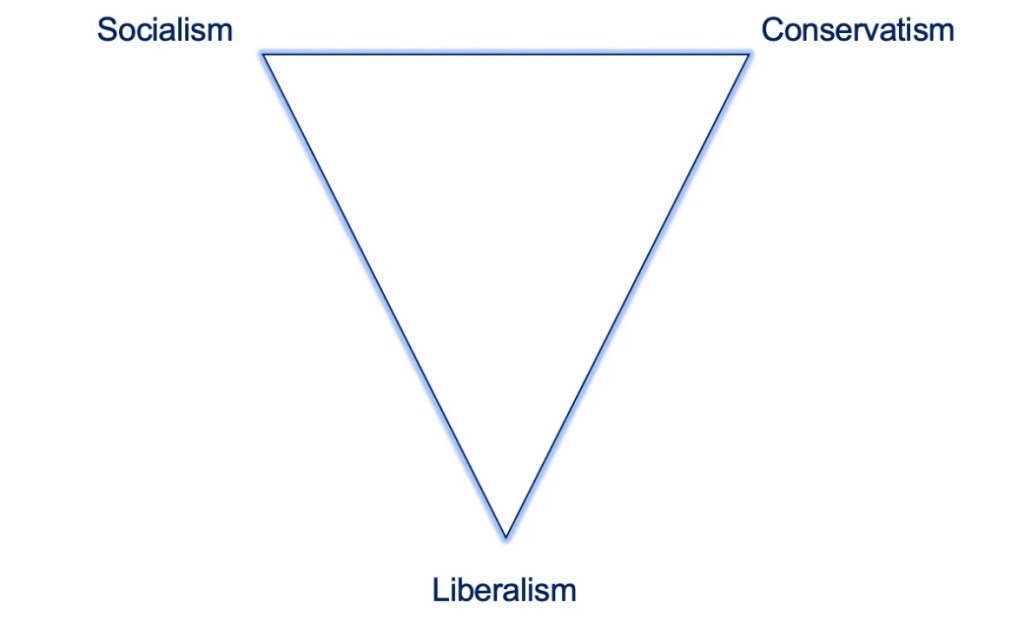
In this vein, Nate Silver presents a basic taxonomy of political orientation in a recent Substack post. It includes the diagram above, which distinguishes between socialism, conservatism, and liberalism. Silver draws on a classic essay written by Friedrich Hayek in 1945, “Why I am Not a Conservative”, in which Hayek discussed the meaning of the word “liberal” (and see here). Liberalism’s true emphasis is a tolerance for individual rights and freedoms, subject to varying articulations of the “nonaggression principle”. That is, “do as you like, but do no harm to others”.

We often see a linear representation distinguishing between so-called progressives on the left and conservatives on the right. Of course, a major hallmark of leftist thinking is extreme interventionism. Leftists or progressives are always keen to detect the slightest whiff of an externality or the slightest departure from the perfectly competitive market ideal. They seem eager to find a role for government in virtually every area of life. While it’s not a limiting case, we can substitute socialism or statism for progressivism on the far left, as Silver does, whereby the state takes primacy in economic and social affairs.

Conservatism, on the other hand, is a deep resistance to change, whether institutional, social, and sometimes economic. Conservatives too often demonstrate a willingness to use the coercive power of the state to prevent change. Hayek noted the willingness of both socialists and conservatives to invoke state power for their own ends.

Similarly, religious conservatives often demand state support beyond that afforded by the freedom to worship in the faith of one’s choice. They might strongly reject certain freedoms held to be fundamental by liberals. Meanwhile, socialists often view mere religious freedom as a threat to the power of the state, or at least they act like it (e.g. see here for an example).

Like conservatives, dedicated statists would doubtless resist change if it meant a loss of their own power. That is, they’d wish to preserve socialist institutions. On this point, witness the vitriol from the Left over what it perceives as threats to the public school monopoly. Witness also the fierce resistance among public employees to reducing the scale of the administrative state, and how advocates of entitlements fiercely resist decreases in the growth rate of those expenditures.

Silver, like Hayek, objects to the traditional, linear framework in which liberals are thought to occupy a range along a line between socialism and conservatism. He objects to that because real liberals value individual liberty as a natural human right, a viewpoint typically abhored by both socialists and conservatives. There is nothing “in between” about it! And of course, conservatives and progressives are equally guilty in their mistaken use of the word “liberal”.

Mapping Political Preferences

Liberty, statism, and conservatism are not exactly orthogonal political dimensions. Larger government almost always means less economic liberty. At a minimum, state dominance implies a social burden associated with public monopoly and monopsony power, as well as tax and welfare-state incentive problems. These features compromise or corrupt the exercise of basic rights. On the other hand, capitalism and its concomitant reliance on consumer sovereignty, individual initiative, free exchange and secure property rights is most in harmony with true liberalism.

For conservatives, resistance to change in support of a traditionally free market economy might offer something of a contradiction. In one sense, it corresponds to upholding market institutions. However, free markets allow new competitors and new technologies to undermine incumbents, who conservatives sometimes wish to defend through regulatory or protectionist measures. And conservatives are almost always too happy to join in the chorus of “price gouging” in response to the healthy operation of the free market in bringing forth supplies.

All that is to say that preferences involving liberty, statism, and traditionalism are not independent of one another. They cannot simply be mapped onto a three-dimensional space. At least the triangular representation gets liberalism out of the middle, but it’s difficult to visualize other ideological positions there. For example, “state religionism” could lie anywhere along the horizontal line at the top or even below it if certain basic liberties are preserved. Facism combines elements of socialism and a deformed version of capitalism that is properly called corporatism, but where would it fall within the triangle?

Big Government Liberalism?

Silver says he leans heavily toward a “big government” version of liberalism, but big government is hard to square with broad liberties. Granted, any well-functioning society must possess a certain level of “state capacity” to defend against private or public violations of individual rights, adjudicate disputes, and provide true public goods. It’s not clear whether Silver’s preferences lie within the bounds of those ambitions. Still, he deserves credit for his recognition that liberalism is wholly different from the progressive, socialist vision. It is the opposite.

The “New” Triangle

Silver attempts to gives the triangular framework a more contemporary spin by replacing conservatism with “MAGA Conservatism” and socialism with “Social Justice Leftism” (SJL), or “wokeism”. Here, I’m treating MAGA as a “brand”. Nothing below is intended to imply that America should not be a great nation.

The MAGA variant of conservatism emphasizes nationalism, though traditional conservatives have never been short on love of nation. For that matter, as a liberal American, it’s easier to forgive nationalist sentiments than it is the “Death to America” refrain we now hear from some SJLs.

The MAGA brand is also centered around a single individual, Donald Trump, whose rhetoric strikes many as nativistic. And Trump is a populist whose policy proposals are often nakedly political and counterproductive.

SJL shares with socialism an emphasis on various forms of redistribution and social engineering, but with a new focus on victimhood based on classes of identity. Of SJL, Silver says:

“Proponents of SJL usually dislike variations on the term ‘woke’, but the problem is that they dislike almost every other term as well. And we need some term for this ideology, because it encompasses quite a few distinctive features that differentiate it both from liberalism and from traditional, socialist-inflected leftism. In particular, SJL is much less concerned with the material condition of the working class, or with class in general. Instead, it is concerned with identity — especially identity categories involving race, gender and sexuality, but sometimes also many others as part of a sort of intersectional kaleidoscope.”
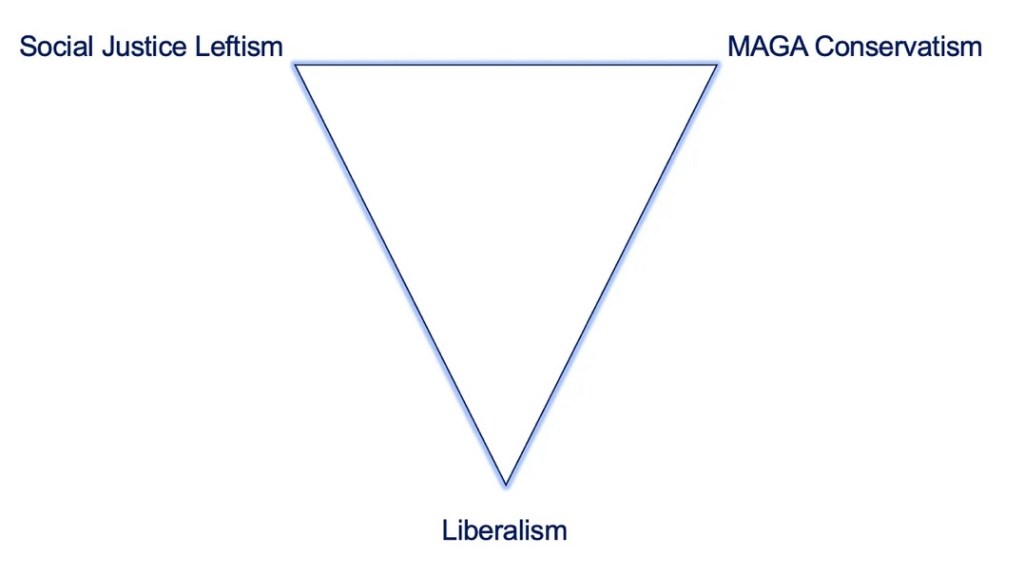
The gulf between liberals and SJLs couldn’t be wider on issues like free speech and “equity”, and equality of opportunity. MAGAns, on the other hand, have some views on individual rights and responsibility that are largely consistent with liberals, but reflexive populism often leads them to advocate policies protecting rents, corporate welfare, and protectionism.

Divided Liberalism

Liberalism emphasizes limited government, individual autonomy, and free exchange. However, there are issues upon which true liberals are of divided opinion. For example, one such area of controversy is the conflict between a woman’s right to choose and the fetal right to life. Many true liberals disagree over whether the rights of a fetus outweigh its mother’s right to choose, but most would concede that the balance shifts to the fetus at some point well short of birth (putting aside potential dangers to the mother’s life). Open borders is another area that can divide true liberals. On one side, the right to unrestricted mobility is thought to supersede any public interest in enforcing borders and limiting the flow of immigrants. On the other side, questions of national sovereignty, national security, as well as social and state capacity to absorb immigrants take primacy.

Don’t Call Lefties “Liberal”… They’re Not!

True liberalism (including most strains of libertarianism) recognizes various roles that a well-functioning state should play, but it also recognizes the primacy of the individual and individual rights as a social underpinning. As Hayek noted, true liberals are not resistant to change per se, unlike conservatives. But modern progressives demand changes of the worst kind: that the state should intervene to pursue their favored objectives, laying claim to an ever-greater share of private resources. This requires government coercion on a massive scale, the antithesis of liberalism. It’s time to recognize that “progressives” aren’t liberals in any sense of the word. For that matter, they don’t even stand for progress.

I’ll close with a quote from Adam Smith that I cribbed from Scott Sumner. Unfortunately, Sumner does not give the full reference, but I’ll take his word that Smith wrote this 20 years before the publication of The Wealth of Nations:

“Little else is requisite to carry a state to the highest degree of opulence from the lowest barbarism, but peace, easy taxes, and a tolerable administration of justice; all the rest being brought about by the natural course of things. All governments which thwart this natural course, which force things into another channel, or which endeavour to arrest the progress of society at a particular point, are unnatural, and to support themselves are obliged to be oppressive and tyrannical.”

Musings and Misgivings of a Likely Trump Voter

24 Thursday Aug 2023

Posted by Nuetzel in Politics

≈ 2 Comments

Tags

Comparative advantage, corporate taxes, Corporatism, Donald Trump, eminent domain, Energy Production, Entitlement Reform, Illegal Immigration, Industrial Policy, Inflation tax, Legal Immigration, Medicare, Modern Monetary Theory, Nationalism, Populism, Protectionism, Social Security, Spending Growth, statism, The Wall

Choosing between the lesser of evils is a bummer, but that’s often the reality for voters. That goes almost without saying… our choices are politicians! I’ll certainly be in that quandary if Donald Trump is the Republican nominee for president in 2024, which looks increasingly likely. I held my nose and voted for him — twice — primarily because the Big Government solutions promoted consistently by Democrats are so awful.

At this point I’m not fully on board with any GOP candidate. That could change, but not yet. Now, if you’re a Trump supporter and you think the rambling opinions below are too critical of your guy, cut me some slack. I’m not a “Never Trumper”. I’m a “Never Statist”. And while I’ve never had much faith that Trump is with me on that count, he will almost surely be the lesser of evils.

The Abused Politician

Trump has been subjected to despicable treatment by political opponents since well before his inauguration in 2016, and his abusers in and out of government never let up. Many of the charges and accusations against him have been pure fiction and at this point represent obvious election interference. So I’m somewhat sympathetic to him despite some of his positions and often disagreeable manner. Still, I credit him for being a fighter, and as an aside, I’ll add that I actually enjoy some of his rants. He has the style of a nasty stand-up comic, which gives me some occasional laughs.

I agree with Trump on certain policy matters. On others, including some fundamental points, I find it hard to trust him as a leader, and I said that long before he was elected in 2016. He claims not to be a politician, but he is a politician through and through. He’s also a populist. And while populism can serve as a valuable check on certain excesses of government, it often cuts the wrong way, favoring what I like to call “do-somethingism”. That usually means public intervention. Populism is a perfectly natural home for a “pick-and-choose” statist like Trump, however. Moreover, I’m not happy that he refused to debate his opponents, and that too was a purely political decision.

Malign Neglect

If you need proof of Trump’s base instincts as a politician, look no further than his refusal to engage on the subject of entitlement reform. It’s no secret that both Social Security (SS) and Medicare are technically insolvent. This is probably the most important fiscal issue the country will face in the foreseeable future.

Without reform, SS benefits will be cut 23% in 2034. That would bring certain outrage among seniors and anyone approaching retirement. Sure, it’s a decade down the road, but addressing it sooner would be far less painful. Does Trump favor a huge cut in benefits? Probably not. Does he think benefits can simply continue without additional funding or reform of some kind? Does he prefer a greater inflation tax, rather than reform? Does he secretly favor “just print the money” like the modern monetary theorists of the Left? There are much better alternatives, but where is his leadership on this issue?

His unwillingness to discuss entitlements, and indeed, his denigration of anyone who so much as mentions the need for serious reforms, is a disgrace. He knows the train wreck is coming, but his focus is squarely on short-term politics. Why are so many on the Right willing to fall for this? Maybe they too understand it’s an elephant in the room, but an elephant that must not be named. After all, it’s not as if the Democrats have done a thing to address the issue.

False Fealty to Workers

Trump is a protectionist, given to the mercantilist fallacy that only exports are good and imports are bad. We import heavily because we are a high-income nation. The other side of that coin is that the world craves our assets, including the U.S. dollar (which is in absolutely no danger of losing its dominance as the primary currency of international transactions).

Here’s a little truth from “Trade Flows 101”: U.S. imports of goods and services correspond to purchases of U.S. assets by the rest of the world. In other words, U.S. trade deficits present opportunities for foreign investors to supply us with capital. That helps foster greater U.S. productive capacity, greater worker productivity, and higher wages.

On the other hand, government intervention to discourage imports via quotas or tariffs increases domestic prices and erodes real wages in the U.S. Furthermore, to favor certain industries (exporters) over others (importers) is a grotesque application of corporatist industrial policy. Why does the Right tolerate Trump’s advocacy for this sort of government central planning? Part of the answer is national security, which I accept to a limited extent, but not when “critical industries” are extended favors by government that are redundant to already powerful market forces.

Protectionism owes some of its popularity to the appeal of nationalism, as distinct from patriotism. However, it promotes sclerosis among domestic producers by shielding them from competition, causing direct harm to U.S. consumers. There is nothing patriotic about protectionism.

Real Stuff

A fallacy closely related to protectionism, and one to which Trump subscribes, is that the U.S. must produce more “things” — more commodities and manufactured goods. That’s not the market’s judgement, but one that appeals to the instincts of interventionists. In any case, services are often more highly valued than physical goods. If your comparative advantage is in producing a highly-valued service, don’t beat yourself up over neglecting to produce hard goods at which you’re comparatively lousy. Specialization and trade are under-appreciated as true social and economic miracles.

That said, we certainly have an advantage in the production of fossil fuels and should continue to produce them without interference. I’m with Trump on that. One day, reliable sources of “clean” energy will be economic, but we’re not there yet.

Corporate State

Well before his presidential run, Trump had a history of leveraging government to achieve his private ends. Eminent domain actions were useful to his development projects and expanding his own property rights at the expense of others. Naturally, he claimed his projects were in the public interest. Ah, the mindset of a rent seeker: government exists to actively facilitate the acquisitive interests of private business, or at least the “winners”. That thinking is thoroughly contrary to the libertarian view of the state’s role in establishing a neutral social environment under the rule-of-law.

In other ways, as President, Trump sought to bring major corporations under his political sway. Trump’s protectionist leanings as president were a prime example of corporatism in action. And read this account of a public meeting (and watch it at the link) at which one CEO after another, under Trump’s furrowed gaze, took turns describing something great they were doing for the country and committing to do more. It was one big, weird suck-up session intended to make the puffed-up Trump look like a great leader. As the author at the link says:

“These are corporate executives doing the President’s bidding for fear or favour.”

I supported Trump’s tax cuts, though they were certainly designed to reduce taxes on corporate income. Was this corporatist largess? That might have been part of his motivation. However, as I’ve argued before, corporate income is largely double-taxed. Moreover, shareholders do not bear the full burden of corporate taxes. Workers bear a significant portion of the burden, so Trump’s corporate tax cuts encouraged growth in real wages, whether he understood it or not.

It’s Still So Big

Tax cuts paired with reduced spending would have been a welcome approach. Unfortunately, Trump was a fairly big spender during his term in office, even if you exclude Covid emergency spending. Growth in the government’s dominance over resources did not slow on his watch. Fiscally disciplined he’s not!

It’s true that his administration made efforts to curtail regulation, but in retrospect, those steps at best arrested the growth of regulation, rather than achieving reductions. The hope of seeing any real deconstruction of the administrative state under Trump was fleeting.

Migration

Immigration is a complicated issue when it comes to assessing Trump’s candidacy. I’m strongly in favor of greater legal immigration because it would improve our demographics and labor supply while shrinking our entitlements deficits. Legal migrants are often technically proficient and many come with sponsorships. On the whole, legal migrants tend to be ready and willing to work,

This position is often condemned by Trump’s most ardent cheerleaders, however. I’ve generally supported Trump’s position on illegal immigration as a matter of national security, to eliminate human trafficking, and to reduce burdens on public aid and support systems. Unfortunately, during Trump’s presidency, he did more to reduce legal immigration than illegal immigration. I have no qualms about “the Wall” except for its expense and the likelihood that cheaper and superior technologies could be deployed for border security. Trump might prefer the Wall’s symbolic value.

Rightly or wrongly, Trump’s messaging on immigration strikes many as nativist, providing an easy excuse for the Left to accuse him of racism. That certainly won’t help his election prospects.

Conclusion

Trump will almost surely be the GOP nominee, unless Democrats succeed in putting him behind bars by then. If the choice is Trump vs. almost any Democrat I can imagine, I’ll have to vote for him. For all his faults and wild card qualities, I still consider him a safer alternative than the devils we know on the Left. But I’d feel much better about him if he’d take a responsible position on Social Security and Medicare reform, abandon protectionism except in cases of critical national security needs (and without overkill), commit to spending reductions, and adopt a more productive approach to legal immigration.

Debt Ceiling Stopgaps and a Weak Legal Challenge

07 Sunday May 2023

Posted by Nuetzel in Federal Budget, Public debt

≈ Leave a comment

Tags

Bank Liquidity, Biden Administration, Bing, Capital Gains Income, Chuck Schumer, Civil War, Debt Ceiling, Debt Limit Suspension, Default, Discharge Petition, Extraordinary Measures, Federal Deficits, Fourteenth Amendment, Google, Janet Yellen, Kevin McCarthy, Minting Coin, Modern Monetary Theary, Par Value, Perpetuities, Premium Bonds, Spending Restraint, statism

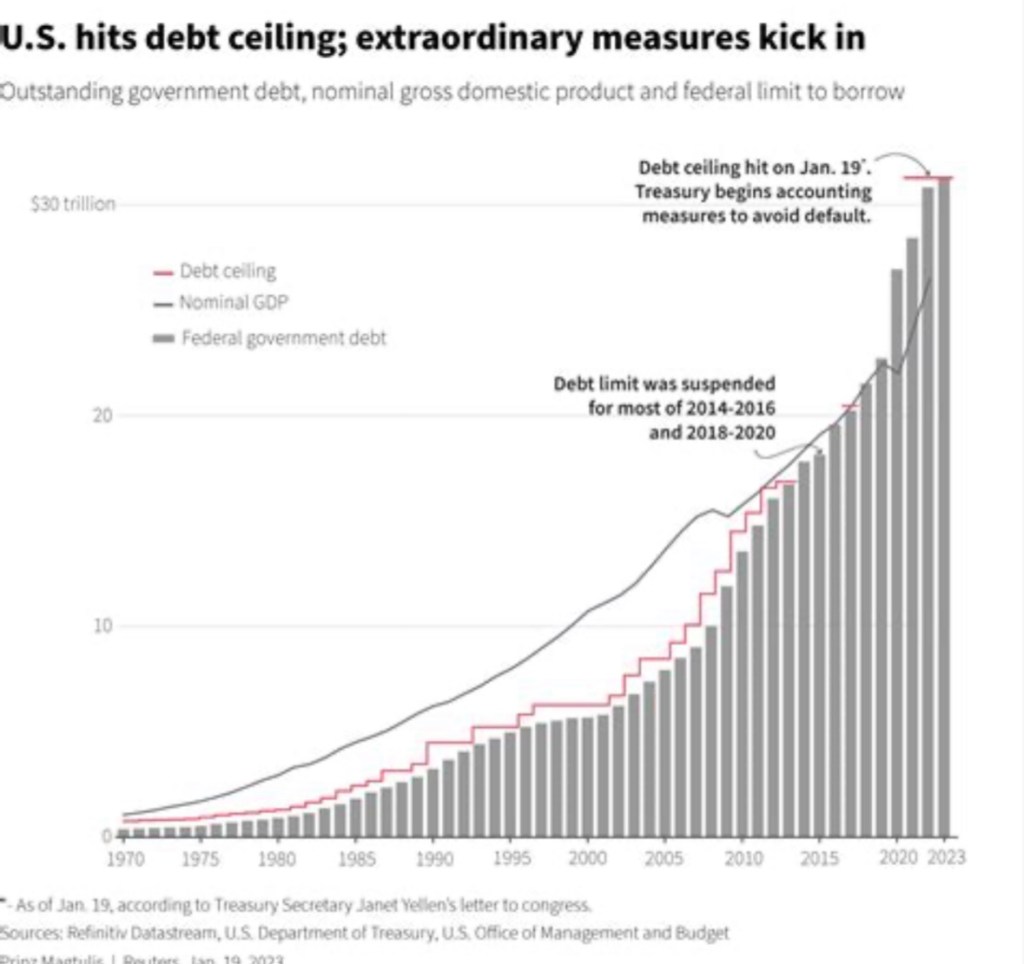
Long-awaited developments in the federal debt limit standoff shook loose in late April when Republicans passed a debt limit bill in the House of Representatives. Were it signed into law, the bill would extend the debt ceiling by about $1.5 trillion while incorporating elements of spending restraint. That approach is highly unpopular with democrats, but the zero-hour looms: Treasury Secretary Janet Yellen says the Treasury will run out of funds to pay all of the government’s obligations in early June. Soon we’ll have a better fix on President Biden’s response to the republicans, as he’s invited congressional leaders to the White House this Tuesday, May 8th to discuss the issue.

Biden wants a “clean” debt limit bill without changes impacting the budget path or existing appropriations. Senate Majority Leader Chuck Schumer would like to see a “clean” suspension of the debt limit. Republicans would like to use a debt limit extension to impose some spending restraint. They’ve focused only on the discretionary side of the budget, however, while much-needed reforms of mandatory programs like Social Security and Medicare were left aside. In fairness, both political parties have made massive contributions over the years to the burgeoning public debt, so not many are free of blame. But any time is a good time to try to enforce some fiscal discipline.

The Extraordinary Has Its Limits

Three months ago I wrote that the Treasury’s “extraordinary measures” to avoid breaching the debt limit would probably allow adequate time to break the impasse. In other words, accounting maneuvers allowed spending to continue without the sale of new debt. That bought some time, but perhaps not as much as hoped … tax filing season has revealed that revenue is coming in short of expectations, probably because weak asset markets have not generated anticipated levels of taxable capital gains income. In any case, very little progress was made over the past three months on settling the debt limit issue until the House passed the plan pushed by McCarthy. So we await the results of the pow-wow at the White House this week.

A Legislative Trick?

There’s been talk that House democrats will try to push through a “clean” debt limit bill of one sort or another by using a so-called discharge petition. They conveniently snuck this measure into an unrelated piece of legislation back in January. The upshot is that a bill meeting certain conditions must go to the floor for a vote if the discharge petition on the issue has at least 218 signatures. That means at least five republicans must join the democrats to force a vote and then join them again to pass a clean debt limit bill. That’s a long shot for democrats. Given the odds, will Biden deign to negotiate with House Speaker Kevin McCarthy? Even if he does, Biden will probably stall a while longer to extend the game of chicken. His hope would be for a few House republicans to lose their resolve for budget discipline in the face of looming default.

An Aside On Some Falsehoods

There’s a good measure of jingoistic BS surrounding the public debt. For example, you’ve probably heard from prominent voices in the debate that the U.S. has never defaulted on its debt and dad-gummit, it won’t start now! But the federal government has defaulted on its debt four times in the past! In three of those cases, the government reneged on commitments to convert bills or certificates into precious metals. The first default occurred during the Civil War, however, when the Union was unable to pay its war costs and subsequently went on a money printing binge. Unfortunately, we’re now engaged in a civil war of public versus private claims on resources, but the government can’t pay its bills without piling on debt. The statist forces now in control of the executive branch continue to insist that every American should demand more federal borrowing.

Here’s more BS in the form of linguistics that seemingly pervade all budget discussions these days: the House bill includes modest spending restraints, but mostly these are reductions in the growth of spending. Yet these are routinely described by democrats and the media as spending cuts. We could use another bill in the House demanding clear language that abides by the commonly accepted meaning of words. Fat chance!

The Trillion Dollar Coin

In my earlier debt limit post, I discussed two unconventional solutions to the Treasury’s financing dilemma. Both are conceived as short-term workarounds.

One is the minting of a $1 trillion platinum coin by the Treasury, which would deposit the coin at the Federal Reserve. The Fed would then sell back to the public (banks) existing Treasury bonds out of its massive holdings (> $8 trillion). The Treasury could then use the proceeds to pay the government’s bills. Thus, the Fed would do what the Treasury is prohibited from doing under the debt ceiling: selling debt.

When the debt ceiling is ultimately lifted, the “coin” process would be reversed (and the coin melted) without any impact on the money supply. As described, this is wholly different from earlier proposals to mint coins that would feed growth in the stock of money. Those were the brainchildren of so-called Modern Monetary Theorists and a few left-wing members of Congress.

There hasn’t been much discussion of “the coin” in recent months. In any case, the Fed would not be obligated to cooperate with the Treasury on this kind of workaround. The Fed has urged fiscal discipline, and it could simply refuse to take the coin if it felt that debt limit negotiations should be settled between Congress and the President.

Premium Bonds

The other workaround I discussed earlier is the sale by the Treasury of premium bonds or even perpetuities. This involves a little definitional trickery, as the debt limit is expressed in terms of the par value of debt. An example of premium bonds is given at the link above. High interest, low par bonds could be issued by the Treasury with the proceeds used to pay off older discounted bonds and pay the government’s bills. Perpetuities are an extreme case of premium bonds because they have zero par value and would not count against the debt limit at all. They simply pay interest forever with no return of principle. Paradoxically, perpetuities might also be less controversial because they would not involve payments to retire older debt.

Constitutional Challenge

The Biden Administration has pondered another way out of the jam, one that is perhaps more radical than either premium bonds or minting a big coin: challenge the debt ceiling on constitutional grounds. The idea is based on a clause in the Fourteenth Amendment stating that the: “validity of the public debt of the United States… shall not be questioned.” That’s an extremely vague provision. Presumably, as an amendment to the Constitution, this “rule” applies to the federal government itself, not to anyone dumping Treasury debt because its value is at risk. Any fair interpretation would dictate that the government should do nothing to undermine the value of outstanding public debt.

Let’s put aside the significant degree to which the real value of the public debt has been eroded historically by inflationary fiscal and monetary policy. That leaves us with the following questions:

  • Does a legislated debt limit (in and of itself) undermine the value of the public debt? Why would restraining the growth of debt or setting a limit on its quantity do such a thing?
  • Would a refusal to legislate an increase in the debt limit undermine or “question” the debt’s value? No, because belt-tightening is always a valid alternative to default. The Fourteenth Amendment is not a rationale for fiscal over-extension.
  • If we frame this as a question of default vs. fiscal restraint, only the former undermines the value of the debt.

From here, it looks like the blame for bringing the value of the public debt into question is squarely on the spendthrifts. Profligacy undermines the value of one’s commitments, so one can hardly blame those wishing to use the debt ceiling to promote fiscal responsibility. Any challenge to the debt ceiling based on the Fourteenth Amendment is likely to be guffawed out of court.

The Market’s Likely Rebuke

The market will probably react harshly if the debt ceiling impasse continues. That would bring higher yields on outstanding Treasury debt and a sharp worsening of the liquidity crisis for banks holding devalued Treasury debt. Naturally, Biden will attempt to blame the GOP for any bad outcome. His Treasury could attempt to buy more time by announcing the minting of a large coin or the sale of premium bonds, including perpetuities. Ultimately, neither of those moves would do much to stem the damage. The real problem is fiscal incontinence.

Do You Chronically Feel Cheated?

24 Tuesday Aug 2021

Posted by Nuetzel in Markets

≈ Leave a comment

Tags

Buyer’s Remorse, Classism, Comparative advantage, Consumer Surplus, Excise Taxes, Frank C. Keil, Free Markets, Intervention, Jiewen Zhang, Marxism, Mercantilism, monopoly, Producer Surplus, Reservation Price, Samuel B.G. Johnson, statism, Subsidies, Surplus, Use Value, Zero-Sum Thinking

Economists are rightfully astonished when people act as if they’ve come up losers in almost every transaction they make. It’s often when they’re on the buying end, but here’s the paradox: almost all transactions are voluntary, a major exception being the coerced payment of taxes. There are few private transactions in which free choice is absent. A truly voluntary choice is an absolute proof of gain. In those trades, buyers reveal that they assign less value to choices not made, and foregone choices almost always exist, including the possibility of doing nothing. By their very nature, voluntary transactions are mutually beneficial. So why do people feel cheated so often?

Free To Lose?

Yes, we are free to choose and free to lose! But this isn’t about cases in which a product proves defective or quickly becomes obsolete. Nor is it about making a purchase only to learn of a discount later. Those are ex post events that might have been impossible to foresee. Here, I refer only to the decision made on the day and hour of the purchase, including any assessment of risk. 

A recent study confirmed a pervasive “loser’s” mentality in transactions: “Win–win denial: The psychological underpinnings of zero-sum thinking”, by Samuel B.G. Johnson, Jiewen Zhang, and Frank C. Keil. They also found that people judge the seller as the “winner” in most transactions. The authors considered a few explanations for these findings discussed in psychological literature, such as socially-ingrained mercantilist attitudes and a tendency to zero-sum thinking.

Roots of “Never-a-Buyer-Be” Phobia

Mercantilism was borne of zero-sum thinking — a belief in a hard limit to total wealth. Under those circumstances, accumulating gold or other hard assets was seen as preferable to spending on imports of goods from other nations. Imports meant gold had to be shipped out, but exports of goods brought it in. 

That uncompromising view led to efforts by government on behalf of domestic industries to stanch imports, and it ultimately led to decline. One nation cannot buy another’s goods indefinitely without corresponding flows of goods in the other direction. Nations gain from trade only by producing things in which they have a comparative advantage and selling them to others. In turn, they must purchase goods from others in which they do NOT have a comparative advantage. It’s cheaper that way! And it’s a win-win prescription for building worldwide wealth.

If You Gotta Have It…

People do have a tendency to regret money spent on things they reluctantly feel they must have. They suffer a kind of advance buyer’s remorse, but it stems from having to part with money, which represents all those other nice things one might have had, covering an infinite range of possibilities. This is the same fallacy inherent in mercantilism. The fact is, we purchase things we must have because they represent greater value than doing without. The phantom satisfaction of opportunities foregone are simply not large enough to keep us from doing the “right” thing in these situations.

The Contest For Surplus

There’s a more basic reason why people feel swindled after having engaged in mutually beneficial trade. The seller collects more revenue than marginal cost, and the buyer pays less than the item’s full “use value”. The latter is the buyer’s reservation price: the most they’d be willing to pay under the circumstances. The seller’s gain (over cost) plus the buyer’s gain (under reservation price) is the total “surplus” earned in the exchange. It’s the surplus that’s up for grabs, and both buyer and seller might view the exchange as a contest over its division. Competitive instincts and thrift being what they are, both sides want a larger share of the spoils!

So there truly is a sort of zero-sum game in play. You can try to bargain to capture more of the surplus, but not every seller will do so, often as a matter of policy or reputation. Or you can spend more time and incur greater personal cost by shopping around. Ultimately, if the offer you face is less than your “reservation price”, you’ll extract an absolute benefit from the exchange. Both you and the seller are better off than without it. You both do it voluntarily, and it’s mutually beneficial. Whatever the division of the surplus, you haven’t really lost anything, even if you have the gnawing feeling you might have been able to find a better bargain and captured more surplus.

Exceptions?

You might think the parties to a stock trade cannot both win. However, buyers and sellers have different reasons for making stock trades, which usually involve other needs and differing expectations. Ex ante, both sides of these trades earn a surplus, unless either the seller or buyer is at the losing end of a previous option trade now forcing them to buy or sell the stock.

There are other cases worthy of debate: buyers in monopolized or captive markets are unlikely to collect much of the surplus. Buyers at an informational disadvantage will gain less surplus as well, and they might incur greater risk to any gain whatsoever. Excise taxes allow government to capture some of the surplus, while government subsidies deliver “fake” surplus to the buyer and seller that comes at the expense of taxpayers. Now I feel cheated!

Beware Marxist Sympathies

Buyers and sellers both benefit by virtue of voluntary exchange. The gains might not be divided equally, but the false perception that buyers always get the “short end of the bargain” is a fundamental misunderstanding about how markets work. It also undermines support for basic freedoms allowing autonomous economic decisions and activity, and it strengthens the hand of statists who would fetter the operation of free markets. Like short-sighted mercantilists, those who would intervene in markets create obstacles to human cooperation and the creation of wealth. In fact, the idea that buyers are always cheated is a classist, Marxist notion. Policies acting upon that bias are rife with unintended consequences: small and large market interventions often strike at property rights, which ultimately inhibits the supply of goods and harms consumers. 

TikTok Tax: The Heavy Wants a Cut

05 Wednesday Aug 2020

Posted by Nuetzel in Industrial Policy, Regulation, Trump Administration

≈ Leave a comment

Tags

AOC, Barack Obama, CCP, Chinese Communist Party, Coyote Blog, Cronyism, Donald Trump, Hong Kong, Larry Kudlow, Likee, Microsoft, Muslim Uighurs, Peter Navarro, Regulatory State, statism, Steve Bannon, Taiwan, TikTok, Varney & Co, Video Sharing, Warren Meyer

I have a certain ambivalence toward Donald Trump, and I could go on and on about why it’s so “complicated” for me. One thing for which I’ve credited the Trump Administration is its effort to “deconstruct the administrative state”, as Steve Bannon so aptly put it shortly after the 2016 election. Of course, the progress thus far hasn’t always lived up to my hopes, but the effort to deregulate continues. And after all, the regulatory state is deeply entrenched and difficult to uproot.

Then my eyes glazed over as Trump floated an idea so bad, an intervention so awful, that I can hardly gather it in! It has to do with TikTok, the Chinese video sharing service that has gained popularity worldwide. Crazy as this might sound, it’s not so much Trump’s threat to shut down TikTok’s U.S. operations. Like most libertarians, I’d find that appalling in and of itself, except for the legitimate data security issues at stake. The company’s ties to the Chinese Communist Party (CCP) are a national security concern and an ethical blot on the company, given the CCP’s brutal treatment of Muslim Uighurs, its roughshod treatment of Hong Kong, and its threats to Taiwan. In any case, at least Trump said he’s amenable to a sale of the company’s U.S. operations to a domestic firm. Several large tech firms have expressed strong interest, including Microsoft. So, while any government imposed shutdown or forced sale makes me squirm, it’s not my main issue here.

What really stunned me was to hear Trump say the U.S. Treasury must get a cut of the deal! This is “Hall-of-Fame” statism. Where in the hell does the U.S. government get a legitimate financial claim to the value of any private business that changes hands? Well, Trump seems to think the federal government is adding value as the heavy:

“But if you buy [TicTok], the United States, which is making it possible to buy, because without us they can’t do anything, should be compensated.”

Yes, the buyer would be the beneficiary of a shakedown, and the demand is another poke in the eye to the Chinese. Of course, it might well threaten the transaction, and I’m not even sure it’s in Trump’s interest politically. But that’s not even the worst of it: as Warren Meyer explains, it would be hard to think of a better way to weaponize financial regulation than having the Treasury at the bargaining table in private negotiations for corporate control:

“Already there are too many regulatory hurdles to doing about anything, and Trump wants agencies to use regulatory approvals to hold up corporations for payments. And you can be sure this is a precedent the Democrats will be only too happy to latch onto — want a pipeline built, where’s our vig? Who wants [this to be] the first Trump decision AOC comes out in support of? The Republican Party sure has come a long way in my lifetime.”

The Left would certainly love to exercise this kind of coercion as a revenue source, as a cudgel of industrial policy to wield against disfavored firms and industries, and as a way to favor cronies. It’s a ready extension of Barack Obama’s deranged “You-didn’t-build-that” theme.

Is this one of trade advisor Peter Navarro‘s brainstorms? I was relieved to see Trump economic advisor Larry Kudlow cast some doubt on whether the government would follow through on Trump’s idea:

“‘I don’t know if that’s a key stipulation. …. A lot of options here,’ Kudlow told ‘Varney & Co.’ on Tuesday. ‘Not sure it’s a specific concept that will be followed through.’“

I think Trump would really like to kill TikTok. Maybe his grudge is driven in part by the presumptive role that TikTok played in his under-attended Tulsa rally. But there are domestic competitors to TikTok, so consumers will have alternatives. The most popular of those seems to be another Chinese app called Likee. In any case, downloads of other video sharing apps have spiked over the past few weeks. If Trump’s real aim is simply to shut down TikTok in the U.S., I’d almost rather see him do that than start making a practice of horse trading with cronies over shares of corporate booty.

Cuomo Denies Tradeoffs, Cries Scarcity

12 Tuesday May 2020

Posted by Nuetzel in Pandemic, statism, Virtue Signaling

≈ 1 Comment

Tags

Andrew Cuomo, BMI, Coronavirus, Cost-Benefit Analysis, Covid-19, Economic Value of Life, European Virus, Javits Center, Lockdown, New York Virus, Shadow Price, statism, The Nation, Ventilators, Who Shall Live?, Wuhan Virus

Here’s an all-time dumbass bromide: “If it saves only one life, it’s worth it.” New York Governor Andrew Cuomo said it last week in a bit of sanctimonious posturing intended for consumption by the unthinking. A variant on this is, “You can’t put a value on a human life,” and Cuomo said that too. But of course we do that every day. Yes, we weigh lives against costs, and we must. Each and every decision involving any personal or public health risk entails an implicit and sometimes explicit valuation of human life. There are few costless decisions in a world of scarce resources, and lives are often one of those costs. These might be matters of probability in an ex ante sense, which might make it more palatable. Ex post, they add up to real lives.

Imagine a world in which we spared no expense to save lives. We’d shift massive resources into health care to the detriment of all production and consumption that does not save lives. No precaution would be too conservative. No driving or biking, because those prohibitions would save many lives. Many risky construction and maintenance jobs would be off limits. No smoking, of course, and no drinking! No chips! Every BMI greater than 25 and you’re off to mandatory fat camp. Sadly, the effort to save a life is sometimes fruitless, but as long as there’s a chance, we’d try and try, providing mechanical life support to every patient hanging on by a tattered thread. No, we don’t do these things because it’s too damn costly.

We face an infinite number of tradeoffs in medical care and in public health more generally. The question “Who Shall Live?” must be answered every day when deciding how health care resources are to be allocated. No matter how you answer that question, certain lives will be lost as the cost of meeting your preferred medical objectives. You can’t meet them all. Resources are scarce — or in more everyday language, budgets are tight.

So human life is often assigned an implicit or shadow value in decision making. But even explicit assignment of economic value to human life is not uncommon. Valuing lives is a standard practice in cost-benefit analysis. It’s also quite common for life values to be estimated as part of forensic analyses in support of legal proceedings.

Andrew Cuomo surely knows all this. That makes his statements all the more disingenuous. This article in The Nation from the end of March implies that Cuomo has valued life all too cheaply in light of his past budget proposals for health care programs. Along the same lines, see this eye-opening critique of the policies Cuomo has pursued that left NY poorly prepared for a pandemic. And now, he’d like to keep his costly lockdown order in place even if it saves “just one life”.

Beyond all that, Cuomo is a stupendous hypocrite, asserting that life is too precious to spare any expense after signing an order in March requiring nursing homes to accept individuals with active Covid infections. Nursing homes have been the very hottest of spots for Covid infections and deaths, so the order was glaringly dismissive in valuing the lives of vulnerable nursing home residents. The rationale for the order was to save hospital beds, but there was no shortage. 

In fairness, Cuomo was also clamoring for assistance to add hospital capacity. Millions were spent to convert the Javits Center to a temporary field hospital and to bring a U.S. Navy hospital ship up the Hudson, but they went almost completely unused. Why not send the elderly patients there, instead of back to the nursing homes?

Finally, he pouted for weeks about his state’s shortage of ventilators, only to quickly reverse course as it became apparent that the state had a surplus of ventilators.

Recently, Cuomo felt it necessary to demonstrate his anti-Western bona fides by labeling the coronavirus the “European Virus“. He must think that’s a clever poke in the eye to those who prefer “Wuhan Virus”, though it is quite correct (and not the least bit “racist”) to note that the virus originated in Wuhan, China. For what it’s worth, the genome of the European strain, like the others that hit New York, differs by less than 12 out of 30,000 base-pairs of DNA from the original Wuhan strain. And of course the New York metropolitan area has made a massive contribution to the U.S. case load and death toll from the virus. Travelers from New York did much to spread Covid-19 to the rest of the country. So, as some have suggested, perhaps a better name might be “New York Virus”.

Andrew Cuomo is nothing if not a politician, and I suppose he’s just behaving like one. I probably wouldn’t gripe were it not for the minions who fall for Cuomo’s sham virtue. But it’s worse than that: the claim that public intervention at any cost is worthwhile if it saves “just one life” is a deeply statist sentiment.

Statism and Self-Harm

18 Tuesday Feb 2020

Posted by Nuetzel in Free markets, Government Failure, Uncategorized

≈ Leave a comment

Tags

Andre Schleifer, Autocracy, Chinese Interment Camps, Friedrich Hayek, Kazakh Muslims, New York Times, P.J. O'Rourke, Reason.com Nick Gillespie, Reeducation, rent seeking, statism, The Road To Serfdom, Tom Friedman, Uighur Muslims


Some have a tendency to think their problems can be solved only through the intervention of some powerful, external force. That higher power might be God, but at a more temporal level, government is often presumed to be a force to fix all things that need fixing. “There oughta be a law” is a gut reaction to things we find injurious or that offend; government has the resources, or the coercive power to get the resources, to undertake big, appealing projects; and of course government has the coercive power to “rearrange the deck chairs” in ways that might satisfy anyone’s sense of justice and fairness, so long as they get their way. Whenever people perceive some need they believe to be beyond their private capacity, or mere convenience, government action is the default option, and that’s partly because many think it’s the only option.

That’s the appeal of “democratic socialism”, to use a name that unintentionally emphasizes a very real danger of democracy: the tyranny of the majority. It’s a dismal way station along the road to serfdom, to borrow a phrase from Hayek.

Government, however, repeatedly demonstrates it’s sheer incompetence and its expedience as a vehicle for graft. And it’s not as if these failures go unrecognized. Everyone knows it! This is nowhere more true than when the state interferes with private markets or attempts to steer the economy’s direction at either an aggregate or industry level. But here we have a dark irony, as told by Nick Gillespie at Reason:

“Again and again—and in countries all over the world—declines in trust of government correlate strongly with calls for more government regulation in more parts of our lives. ‘Individuals in low-trust countries want more government intervention even though they know the government is corrupt,’ explain the authors of a 2010 Quarterly Journal of Economics paper. That’s certainly the case in the United States, where the size, scope, and spending of government has vastly increased over exactly the same period in which trust and confidence in the government has cratered. In 2018, I talked with one of the paper’s authors, Andrei Shleifer, a Harvard economist who grew up in the Soviet Union before coming to America. Why do citizens ask a government they don’t believe in to bring order? ‘They want regulation,’ he said. ‘They want a dictator who will bring back order.'”

Against all historical evidence and forebodings, the wish for a benevolent dictator! As if it’ll be different this time! Are we all statists? Certainly not me, but the Left is full of them. One prominent example is columnist Tom Friedman of the New York Times, who has expressed the sometimes fashionable view that “things get done” under dictatorships:

“One-party autocracy certainly has its drawbacks. But when it is led by a reasonably enlightened group of people, as China is today, it can also have great advantages. … That one party can just impose the politically difficult but critically important policies needed to move a society forward in the 21st century.”

Tell it to the interred Kazakh and Uighur Muslims undergoing “reeducation” in China. The Right has its share of statists as well, and it is typically expressed in desires for enforced social conservatism.

People seem to have a vague idea that everyone else must either be misbehaving or in misery. And despite the well-tested fallibility and lack of trust in government, people persist in believing that the public sector can conjure magic to solve their problems. But the state gets bigger and bigger while solving few problems and exacerbating others. In fact, as government grows, it makes rent seeking a more viable alternative to productive effort. Like the giant zero-sum game that it is, the expansion of government provides the very means to pick away at the wealth of others. When faced with these incentives, people most certainly will misbehave on small and large scales!

The truth is that individuals hold the most potent regulatory force in their own hands: the voluntary nature of trade. It protects against over-pricing, under-pricing, and inferior quality along many dimensions, but it demands discipline and a willingness to walk away. It also demands a willingness to put forth productive effort, rather than coveting the property of others, and taking from others via political action. To paraphrase P.J. O’Rourke, if you think things are expensive now, wait till they’re free!

Clinton Corruption Remedy: Keep Her Out

07 Monday Nov 2016

Posted by Nuetzel in Corruption, statism

≈ Leave a comment

Tags

Broomstick One, Clinton Foundation, Constitutional Remedy, Cronyism, Department of Justice, Department of State, Deroy Murdock, DOJ, Donald Trump, FBI, Gary Johnson, Government Corruption, Hillary Clinton, Impeachent, Independent Women's Forum, Influence Buying, Jason Chaffetz, Jeffrey Epstein, Lisa Schiffren, Loretta Lynch, Money Laudering, Pay to Play, statism, Trey Gowdy, Wikileaks

clinton-family-corruption

Would I ever vote for Donald Trump? I’ve been critical of Trump’s positions on foreign trade, immigration policy and eminent domain. I think he’s an extremely risky candidate for any supporter of small government. But I’ve been much more critical of Hillary Clinton: she is a statist through and through, and she so often finds herself in close proximity to corruption and some other highly suspicious circumstances. I consider myself a libertarian, and I like Gary Johnson. Unfortunately, Johnson has disappointed me with his selection of Bill Weld as a running mate, his goofs on foreign policy and his often poor presentation of libertarian principles.

FBI Director James Comey has again concluded that there was no intent on Clinton’s part to violate national security with her private email server, but he also concluded that she was reckless in conducting sensitive government business, including the transmission of classified information, on that server. Unfortunately, Comey limited his investigation to the period during which she was Secretary of State. The server, however, was put in place before she was confirmed by Congress. The question of intent makes that time period relevant, but Comey ignored it. She broke the law concerning the handling of classified documents, there is no question about that. No less than five of Clinton’s aides took the Fifth Amendment to avoid prosecution. Evidently, Mr. Comey has been under pressure from a highly-politicized Justice Department. There are other investigations underway at the FBI and by Congress involving the Clintons, however.

The deluge of information via Wikileaks over the past month reflects horribly on the Clintons. I don’t care whether the leaks came from government sources, the Russians, or from other foreign actors. No one has challenged the authenticity of these leaks. Again, Hillary Clinton compromised national security by conducting her duties as Secretary of State on a private computer server. That’s what got her into the email mess. Now, we’ve learned that she gave her housekeeper access to her computer to print documents! At least five foreign intelligence services hacked into that server. Clinton also obstructed justice on the matter by destroying evidence and perjuring herself before Congress.

Wikileaks has shed additional light on the Clinton Foundation as well. The foundation functions as a money laundering scheme intended to disguise influence-buying as charitable giving, with the Clinton’s and their cronies as the real beneficiaries. Foreign governments, including several middle eastern powers, funneled money to the foundation while Hillary served as Secretary of State. Here’s Deroy Murdock on the Foundation:

“… its 2014 IRS filings show that it spent a whopping 5.76 percent of its funds on actual charitable activities — far below the 65 percent that the Better Business Bureau calls kosher. That paltry figure also mocks Hillary’s Las Vegas lie, uttered at the final presidential debate on October 19: ‘We at the Clinton Foundation spend 90 percent — 90 percent of all the money that is donated on behalf of programs of people around the world and in our own country.’ The Clinton Slush Fund . . . uh . . . Foundation seems to be mainly a travel and full-employment program for Hillary’s government in waiting. It’s also a bribe pump that sucks in money and spews out favors.“

The Clintons also have had strong ties to individuals with criminal histories, such as the notorious child predator Jeffrey Epstein. And Hillary Clinton’s reputation for contemptuous behavior toward others was so strong that State Department security personnel requested reassignment. It’s been reported that members of her Secret Service detail called her plane “Broomstick One“.

A Hillary Clinton victory in the president election will not end the investigations. Congressional leaders such as Jason Chaffetz and Trey Gowdy have vowed to press on aggressively, given that Clinton lied before their committees and to the American people about the existence of classified emails on her server. Impeachment by the House might occur, though Clinton’s offenses have occurred prior to her term in office, and the Senate would never attain the two-thirds majority necessary to convict.

It is possible that the FBI investigation into the Clinton Foundation will be damaging, but it is unlikely to bring an indictment. The DOJ under Clinton would be headed by Loretta Lynch or some other Hillary/Obama sycophant. There will be no DOJ indictment or special prosecutor as long as the Attorney General reports to the criminal herself. (The FBI cannot indict; it can only recommend indictment.) There would hardly be a real opportunity to render justice to Hillary at the federal level.

A local jurisdiction could bring an indictment for criminal activity. The Anthony Weiner laptop investigation by the NYPD could be troublesome for Clinton, depending on the extent to which any Clinton dealings with Jeffrey Epstein were recorded there.

There remains only one sure constitutional remedy for Hillary Clinton’s corruption: Tuesday’s election. Preventing her from taking office must be priority one. Hillary Clinton’s days of insider dealing would then be over, as would the politicized government created by Barack Obama, who was just recorded encouraging illegal aliens to vote! But Gary Johnson obviously won’t beat Clinton… the only real option is Donald Trump.

Yes, Trump is risky, and I’ll have plenty to criticize on my blog if he takes office. He is plainspoken but sometimes crude and offensive. Naturally, that “style” is especially offensive to the tender snowflakes who cling to identity politics, but I do not believe Trump is a racist. It’s true, I don’t know exactly what we’d get with Trump. I suspect he has some statist tendencies of his own, but I prefer that risk to the corruption and certain statism of Hillary Clinton.

So I must vote for Donald Trump. Putting Hillary Clinton in the White House would compromise our system of government. She is an accomplished grafter and cronyist, expert at leveraging her position of power for personal enrichment, and she is prone to taking retribution against enemies. The IRS, the DOJ and other agencies have already become partisan organizations under Obama. And as I mentioned earlier, Clinton is a statist who desires centralized power. That is always dangerous.

Read this excellent essay: “The Case Against Hillary Clinton“, by Lisa Schiffren of the Independent Women’s Forum.

Here is a page with a number of past posts about Hillary Clinton on Sacred Cow Chips.

Willing Exchange With Capitalists

18 Wednesday May 2016

Posted by Nuetzel in Capitalism, Marxism

≈ Leave a comment

Tags

Capitalism, competition, Free Markets, Gary Galles, Government Monopoly, Karl Marx, Labor Theory of Value, Legitimized Coercion, Leonard Read, Liberalism, Limits on Government, Market Power, Marxism, Misuse of Words, Patrick Barron, Robert Murphy, Social Organization, statism, The Beacon, Voluntary Exchange, Willing Exchange

marx1

Now and then I’m inspired to blog on the misshapen language of political discourse. I recently wrote about the misuse of words by the American left, including their use of the term “liberalism”. This time, the particular word in play is “capitalism”, which I use to describe the ideal laissez faire economic order. I have always viewed it as a force for good. Real capitalism means free markets, consumer choice, strong private property rights, rewards to private initiative, and competition among producers. Even under conditions of concentrated market power, capitalism is preferable to government monopoly. Nevertheless, Gary Galles writes at The Beacon that capitalism is an inferior description of the laissez-faire ideal than”willing exchange“, or alternatively, unforced or voluntary exchange. Perhaps he has a point.

Capital and labor are the primary factors of production and both must be compensated. Labor earns a wage and capital earns a profit. Generally, the more capital a worker has available on the job, the greater the worker’s productivity and the greater the worker’s wage. However, any profit or return to capital is viewed by the left as an undeserved rent. The question of compensation is quite aside from the valuable social role profits play in directing resources to their most valued uses. Robert Murphy’s drives this home in an excellent recent essay entitled “There’s No Such Thing As Excessive Profits“. Here, here! In another post related to the crucial social role played by capital and profit, Patrick Barron explains “Why We Need Private Property To Deal With Scarce Resources“.

Again, any return to capital, normal or extra-normal, is seen by the left as a reward that should flow to labor in a just world. That is the upshot of Karl Marx’s labor theory of value. Thus, owners of capital are characterized as “takers”. Galles notes the belief that Marx coined the term “capitalism” in order to:

“…falsely imply that the system benefited capitalists at others’ expense, when, in fact, workers have been the greatest gainers from all the productivity enhancements the system has generated.“

He quotes Leonard Read on the value of “willing versus unwilling exchange” as an effective way to delineate and contrast the positions of adherents of laissez faire and statism:

“Standing for willing exchange, on the one hand, or for unwilling exchange, on the other, more nearly accents our ideological differences than does the employment of the terms in common usage…there is a minimum of verbal facade to hide behind.

Willing exchange…has not yet been saddled with emotional connotations …Further, its antithesis, unwilling exchange…no one, not even a protagonist, proudly acknowledges he favors that; it does offense to his idealism.

If we cut through all the verbiage used to report and analyze political and economic controversy…much of it boils down to a denial of willing and the insistence upon unwilling exchange. …

The concept of willing exchange unseats Napoleonic behavior—all forms of authoritarianism—and enthrones the individual. The consumer becomes king. Individual freedom of choice rules economic affairs… [It] is for me, and a willing seller, to decide; it is no one else’s business!“

The hallmark of the state as an actor is coercion. After all, it derives its power via “legitimized” coercion. Individuals are bound under its authority to participate in involuntary exchanges and to make do with a constrained set of willing exchanges. As much as we might amuse ourselves with the notion that our Constitution keeps the state in check, it grows and grows, and where it stops, nobody knows. One wonders how strongly the demonization of so-called “capitalists” plays into this process.

I often refer to voluntary exchange in one form or another. The term recommends itself by virtue of its implication of mutual benefit among parties. Nevertheless, I would have a difficult time abandoning the term “capitalism” in my writing. Here’s the thing: capitalism and free markets have had tremendous success over the last two centuries in improving material conditions and ending human poverty around the globe. Meanwhile, Marxism as a philosophy, and collectivism as a form of social organization, have done nothing to recommend themselves to humankind. So the joke’s on Marx, though we haven’t heard the last of the efforts to besmirch capitalism.

Don’t Call Leftists “Liberal”; They’re Not!

29 Wednesday Jul 2015

Posted by Nuetzel in Liberty

≈ 1 Comment

Tags

Collectivism, Daniel Klein, Governmentalization of Social Affairs, Intercollegiate Review, Kevin Williamson, Left wing, Liberalism, Modern Age, N-Gram Viewer, Neoliberalism, New Liberalism, Progressivism, Social Democracy, Socialism, Spontaneous Social Order, statism

Lenin_Got_Rope_Capitalists

Nor are statists, collectivists and socialists, but I repeat myself. The simple plea above is made by Daniel Klein in an essay appearing in the Intercollegiate Review and in Modern Age. He asserts that libertarians (and conservatives) fall into a semantic trap when they use the term as a pejorative for leftists. I have touched on the mangled, modern usage of “liberalism” several times on Sacred Cow Chips, but Klein brings some interesting empiricism into consideration and makes several points worth emphasizing.

First, Klein traces the historical record of appearances of certain words related to liberalism in published literature using the “n-gram viewer” on Google. He shows that the political use of “liberal” began around 1770. For the next 110 years, liberalism referred to a philosophy and policies associated with small government and individual autonomy. In the U.S., however, the term began to be co-opted by the political left in the late 1800s. Around the turn of the twentieth century, references to “New Liberalism” and “Old Liberalism” became more frequent. So the term was subverted in that time frame, a decade or two before the term “left-wing” came into use.

“The literature of the so-called New Liberals declaimed openly against individual liberty and in favor of state collectivism and socialistic reform.“

Today, the association of “liberalism” with the left is confined mostly to the U.S. and Canada:

“…when we step outside North America, we see that, by and large, liberal still means liberal (in the UK, usage is in-between). …

Where liberal still means liberal, such as in Europe and Latin America, leftists have no reluctance in calling their imaginary bogeyman ‘neoliberalism.’“

By way of suggestion, Klein reviews a few alternative labels for the left. In doing so, he notes that in general, the left supports the “governmentalization of social affairs”. For that reason, one of my favorite labels is “statism”. Oddly, Klein never mentions this as a possibility. (Klein concedes that the left supports liberty on a few issues, which happen to be issues upon which most libertarians are in agreement.) He does refer to the old standby “collectivists” in passing.

Klein likes the label “Progressivism” for the left, despite the positive associations some might make with that term. He argues with some merit that progressivism implies activist, goal-directed policy, as opposed to non-intervention and the spontaneous social order favored by true liberals.

“That collectivists should join together for what they imagine to be progress is perfectly fitting. For them the term progressive is suitable. By contrast, conservatives and libertarians look to, not progress, but improvement. …

Another fitting term for leftism is social democracy, which is standard in Europe. Social democracy is a compromise between democratic socialism and a tepid liberalism. The socialistic penchant is foremost, but a vacillating liberalism gnaws at the social democrat’s conscience.”

I fully agree with Klein that we should never refer to leftists as liberals. They are completely undeserving of the description, and doing so concedes a glaringly false premise. Every leftist I know advocates the increasing governmentalization of social affairs and a naive acceptance of an impossible proposition: that government can ever possess the detailed knowledge necessary to successfully regulate individual actors from above. And leftists are foolishly willing to place faith in the benevolence and wisdom of political agents and central controllers. Klein mentions a recent editorial by Kevin Williamson in National Review:

“Williamson ends the piece by quoting two leftist authors writing in The Nation, one decrying ‘unbridled individualism,’ the other ‘unfettered capitalism.’ Williamson concludes: ‘A ‘liberalism’ that is chiefly concerned with the many clever uses of bridles and fetters does not deserve the name. It never has.’”

← Older posts
Follow Sacred Cow Chips on WordPress.com

Recent Posts

  • Immigration and Merit As Fiscal Propositions
  • Tariff “Dividend” From An Indigent State
  • Almost Looks Like the Fed Has a 3% Inflation Target
  • Government Malpractice Breeds Health Care Havoc
  • A Tax On Imports Takes a Toll on Exports

Archives

  • December 2025
  • November 2025
  • October 2025
  • September 2025
  • August 2025
  • July 2025
  • June 2025
  • May 2025
  • April 2025
  • March 2025
  • February 2025
  • January 2025
  • December 2024
  • November 2024
  • October 2024
  • September 2024
  • August 2024
  • July 2024
  • June 2024
  • May 2024
  • April 2024
  • March 2024
  • February 2024
  • January 2024
  • December 2023
  • November 2023
  • August 2023
  • July 2023
  • June 2023
  • May 2023
  • April 2023
  • March 2023
  • February 2023
  • January 2023
  • December 2022
  • November 2022
  • October 2022
  • September 2022
  • August 2022
  • July 2022
  • June 2022
  • May 2022
  • April 2022
  • March 2022
  • February 2022
  • January 2022
  • December 2021
  • November 2021
  • October 2021
  • September 2021
  • August 2021
  • July 2021
  • June 2021
  • May 2021
  • April 2021
  • March 2021
  • February 2021
  • January 2021
  • December 2020
  • November 2020
  • October 2020
  • September 2020
  • August 2020
  • July 2020
  • June 2020
  • May 2020
  • April 2020
  • March 2020
  • February 2020
  • January 2020
  • December 2019
  • November 2019
  • October 2019
  • September 2019
  • August 2019
  • July 2019
  • June 2019
  • May 2019
  • April 2019
  • March 2019
  • February 2019
  • January 2019
  • December 2018
  • November 2018
  • October 2018
  • September 2018
  • August 2018
  • July 2018
  • June 2018
  • May 2018
  • April 2018
  • March 2018
  • February 2018
  • January 2018
  • December 2017
  • November 2017
  • October 2017
  • September 2017
  • August 2017
  • July 2017
  • June 2017
  • May 2017
  • April 2017
  • March 2017
  • February 2017
  • January 2017
  • December 2016
  • November 2016
  • October 2016
  • September 2016
  • August 2016
  • July 2016
  • June 2016
  • May 2016
  • April 2016
  • March 2016
  • February 2016
  • January 2016
  • December 2015
  • November 2015
  • October 2015
  • September 2015
  • August 2015
  • July 2015
  • June 2015
  • May 2015
  • April 2015
  • March 2015
  • February 2015
  • January 2015
  • December 2014
  • November 2014
  • October 2014
  • September 2014
  • August 2014
  • July 2014
  • June 2014
  • May 2014
  • April 2014
  • March 2014

Blogs I Follow

  • Passive Income Kickstart
  • OnlyFinance.net
  • TLC Cholesterol
  • Nintil
  • kendunning.net
  • DCWhispers.com
  • Hoong-Wai in the UK
  • Marginal REVOLUTION
  • Stlouis
  • Watts Up With That?
  • Aussie Nationalist Blog
  • American Elephants
  • The View from Alexandria
  • The Gymnasium
  • A Force for Good
  • Notes On Liberty
  • troymo
  • SUNDAY BLOG Stephanie Sievers
  • Miss Lou Acquiring Lore
  • Your Well Wisher Program
  • Objectivism In Depth
  • RobotEnomics
  • Orderstatistic
  • Paradigm Library
  • Scattered Showers and Quicksand

Blog at WordPress.com.

Passive Income Kickstart

OnlyFinance.net

TLC Cholesterol

Nintil

To estimate, compare, distinguish, discuss, and trace to its principal sources everything

kendunning.net

The Future is Ours to Create

DCWhispers.com

Hoong-Wai in the UK

A Commonwealth immigrant's perspective on the UK's public arena.

Marginal REVOLUTION

Small Steps Toward A Much Better World

Stlouis

Watts Up With That?

The world's most viewed site on global warming and climate change

Aussie Nationalist Blog

Commentary from a Paleoconservative and Nationalist perspective

American Elephants

Defending Life, Liberty and the Pursuit of Happiness

The View from Alexandria

In advanced civilizations the period loosely called Alexandrian is usually associated with flexible morals, perfunctory religion, populist standards and cosmopolitan tastes, feminism, exotic cults, and the rapid turnover of high and low fads---in short, a falling away (which is all that decadence means) from the strictness of traditional rules, embodied in character and inforced from within. -- Jacques Barzun

The Gymnasium

A place for reason, politics, economics, and faith steeped in the classical liberal tradition

A Force for Good

How economics, morality, and markets combine

Notes On Liberty

Spontaneous thoughts on a humble creed

troymo

SUNDAY BLOG Stephanie Sievers

Escaping the everyday life with photographs from my travels

Miss Lou Acquiring Lore

Gallery of Life...

Your Well Wisher Program

Attempt to solve commonly known problems…

Objectivism In Depth

Exploring Ayn Rand's revolutionary philosophy.

RobotEnomics

(A)n (I)ntelligent Future

Orderstatistic

Economics, chess and anything else on my mind.

Paradigm Library

OODA Looping

Scattered Showers and Quicksand

Musings on science, investing, finance, economics, politics, and probably fly fishing.

  • Subscribe Subscribed
    • Sacred Cow Chips
    • Join 128 other subscribers
    • Already have a WordPress.com account? Log in now.
    • Sacred Cow Chips
    • Subscribe Subscribed
    • Sign up
    • Log in
    • Report this content
    • View site in Reader
    • Manage subscriptions
    • Collapse this bar
 

Loading Comments...