• About

Sacred Cow Chips

Sacred Cow Chips

Category Archives: Big Government

Choosing DOGE Over a Prodigal State Apparatus

03 Thursday Apr 2025

Posted by Nuetzel in Big Government, DOGE

≈ Leave a comment

Tags

Al Gore, Barack Obama, Bernie Sanders, Bill Clinton, Border Security, Chuck Schumer, DEI, Department of Education, Department of Government Efficiency, Department of Interior, Discretionary Budget, DOGE, Donald Trump, Elon Musk, entitlements, FDA, Force Reductions, Fourth Branch, Fraud, Graft, HHS, Indirect Costs, Jimmy Carter, Joe Biden, Mandatory Budget, Medicaid, Medicare, Nancy Pelosi, NIH Grants, Obamacare, Provisional Employees, Public debt, Severance Packages, Social Security, U.S. Digital Service, U.S. Postal Service, USAID, Voluntary Separations, Waste
I prefer a government that is limited in size and scope, sticking closely to the provision of public goods without interfering in private markets. Therefore, I’m delighted with the mission of the Department of Government Efficiency (DOGE), a rebranded version of the U.S. Digital Service created by Barack Obama in 2014 to clean up technical issues then plaguing the Obamacare web site. The “new” DOGE is fanning out across federal agencies to upgrade systems and eliminate waste and fraud.

A Strawman

For years, democrats such as Barack Obama and Joe Biden have advocated for eliminating waste in government. So did Bill Clinton, Al Gore, Bernie Sanders, Chuck Schumer, and Nancy Pelosi. Here’s Mark Cuban on the same point. Were these exhortations made in earnest? Or were they just lip service? Now that a real effort is underway to get it done, we’re told that only fascists would do such a thing.

I’m seeing scary posts about DOGE even on LinkedIn, such as the plight of Americans unable to get federal public health communications due to layoffs at HHS, while failing to mention the thousands of new HHS employees hired by Biden in recent years. As if HHS was particularly effective in dispensing good public health advice during the pandemic!

Those kinds of assertions are hard to take seriously. For reasons like these and still others, I tend to dismiss nearly all of the horror stories I hear about DOGE’s activities as nitwitted virtue signals or propaganda.

Many on the left claim that DOGE’s work is careless, and especially the force reductions they’ve spearheaded. For example, they claim that DOGE has failed to identify key employees critical to the functioning of the bureaucracy. The tone of this argument is that “this would not pass muster at a well-managed business”. A “sober” effort to achieve efficiencies within the federal bureaucracy, the argument goes, would involve much more consideration. In other words, given political realities, it would not get done, and they really don’t want it to get done.

The best rationale for the ostensible position of these critics might be situations like the dismissal of several thousand provisional employees at the FDA, a few of whom were later rehired to help manage the work load of reviewing and approving drugs. However, thus far, only a tiny percentage of the federal force reductions under consideration have involved immediate layoffs.

Of course, DOGE is not being tasked to review the practices of a well-managed business or a well-managed governmental organization. What we have here is a dysfunctional government. It is a bloated, low productivity Leviathan run by management and staff who, all too frequently, seem oblivious to the predicament. Large force reductions at all levels are probably necessary to make headway against entrenched interests that have operated as a fourth branch of government.

Thus, I see the leftist critique of Trump’s force reductions as something of a strawman, and it falls flat for several other reasons. First, the vast bulk of the prospective reduction in headcount will be voluntary, as the separating employees have been offered attractive severance packages. Second, force reductions in the private sector always feel chaotic, and they often are. And they are sometimes executed without regard to the qualifications of specific employees. Tough luck!

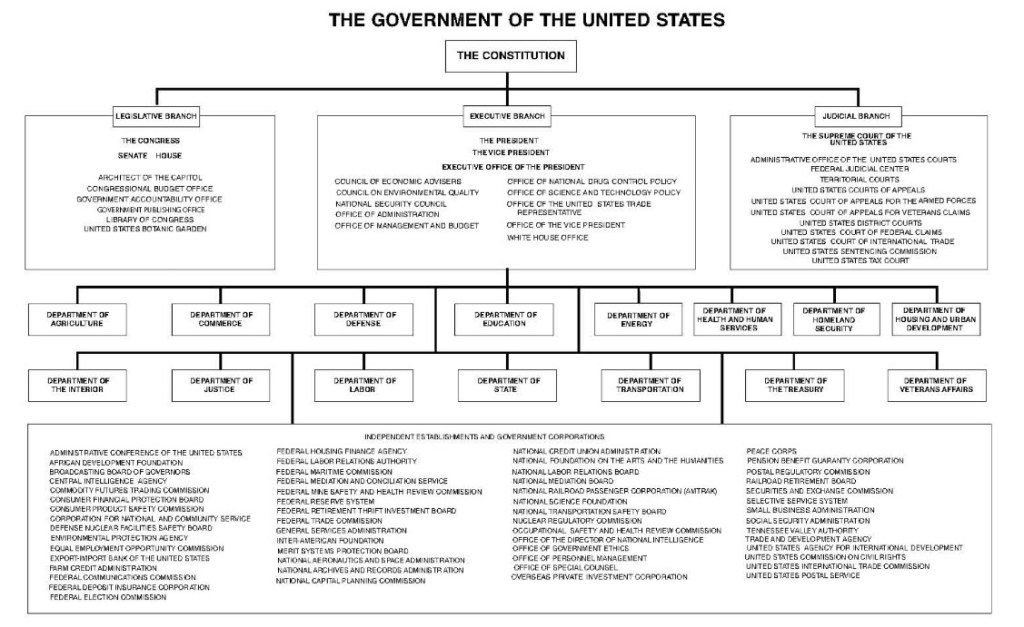
Duplicative functions, poor data systems, and a lack of control have led to massive misappropriations of funds. The dysfunction has been enabled by a metastasization of nests of administrative authority inside agencies with “incomprehensible” org charts, often having multiple departments with identical functions that do not communicate. These departments frequently use redundant but unconnected systems. A related problem is the inadequacy of documentation for outgoing payments. Needless to say, this is a hostile environment for effective spending controls.

It’s worth emphasizing, by the way, DOGE’s “open book” transparency. It’s not as if Elon Musk and DOGE are attempting to sabotage the deep state in the dark of night. Indeed, they are shouting from the rooftops!

Doing It Fast

Every day we have a new revelation from DOGE of incredible waste in the federal bureaucracy. Check out this story about a VA contact for web site maintenance. All too ironically, what we call government waste tends to have powerful, self-interested, and deeply corrupt constituencies. This makes speed an imperative for DOGE. In a highly politicized and litigious environment, the extent to which the Leviathan can be brought to heel is partly a function of how quickly the deconstruction takes place. One must pardon a few temporary dislocations that otherwise might be avoided in a world free of rent seeking behavior. Otherwise, the graft (no, NOT “grift”) will continue unabated.

The foregoing offers sufficient rationale not only for speedy force reductions, but also for system upgrades, dissolution of certain offices, and consolidation of core functions under single-agency umbrellas.

The Bloody Budget

It’s difficult to know when budget legislation will begin to reflect DOGE’s successes. The actual budget deficit might be affected in fiscal year 2025, but so far the savings touted by DOGE are chump change compared to the expected $2 trillion deficit, and only a fraction of those savings contribute to ongoing deficit reduction.

Uncontrolled spending is the root cause of the deficit, as opposed to insufficient tax revenue, as evidenced by a relatively stable ratio of taxes to GDP. The spending problem was exacerbated by the pandemic, but Congress and the Biden Administration never managed to scale outlays back to their previous trend once the economy recovered. Balancing the budget is made impossible when the prevailing psychology among legislators and the media is that reductions in the growth of spending represent spending cuts.

Federal spending is excessive on both the discretionary and mandatory sides of the budget. Ultimately, eliminating the budget deficit without allowing the 2017 Trump tax cuts to expire will require reform to mandatory entitlements like Social Security, Medicare, and Medicaid, as well as reductions across an array of discretionary programs.

DOGE’s focus on fraud and waste extends to entitlements. At a minimum, the data and tracking systems in place at HHS and SSA are antiquated, sometimes inaccurate, and are highly susceptible to manipulation and fraud. Systems upgrades are likely to pay for themselves many times over.

But all indications are that it’s much worse than that. Social security numbers were issued to millions of illegal immigrants during the Biden Administration, and those enrollees were cleared for maximum benefits. There were a significant number of illegals enrolled in Medicaid and registered to vote. While some of these immigrants might be employed and contributing to the entitlement system, they should not be employed without legal status. Of course, one can defend these entitlement benefits on purely compassionate grounds, but the availability of benefits has served to attract a massive flow of illegal border crossings. This illustrates both the extent to which the entitlement system has been compromised as well as the breakdown of border security.

On the discretionary side of the budget, DOGE has identified an impressive array programs that were not just wasteful, but by turns ridiculous or politically motivated (for example, the bulk of USAID’s budget). Many of these funding initiatives belong on the chopping block, and components that might be worthwhile have been moved to agencies with related missions. In addition, authorized but unspent allocations have been identified that seem to have been held in reserve, and which now can be used to reduce the public debt.

Research Grants?

Of course, like the initial scale of the FDA layoffs, a few mistakes have and will be made by DOGE and agencies under DOGE’s guidance. Many believe another powerful argument against DOGE is the Trump Administration’s 15% limit on indirect costs as an add-on to NIH grants. Critics assert that this limit will hamstring U.S. scientific advancement. However, it won’t “kill” publicly funded research. As this article in Reason points out, historically public funding has not been critical to scientific advancement in the U.S. In fact, private funding accounts for the vast bulk of U.S. R&D, according to the Congressional Research Service. Moreover, it’s broadly acknowledged that indirect costs are subject to distortion, and that generous funding of those costs creates bad incentives and raises thorny questions about cross-subsidies across funders (15% is the rate at which charities typically fund indirect costs).

No doubt some elite research universities will suffer declines in grants, but their case is weakened politically by a combination of lax control over anti-Semitic protests on campus, the growing unpopularity of DEI initiatives in education, and public awareness of the huge endowments over which these universities preside. Nevertheless, I won’t be surprised to see the 15% limit on indirect research costs revised upward somewhat.

More DOGE Please

I’ve criticized the numbers posted on DOGE’s website elsewhere. They could do a much better job of categorizing and reporting the savings they’ve achieved, and they have far to go before meeting the goals stated by Elon Musk. Be that as it may, DOGE is making progress. Here is a report on a few of the latest cuts.

As I’ve emphasized on numerous occasions, the federal government is a strangling mass of tentacles, squeezing excessive resources out of the private sector and suffocating producers with an endless catalogue of burdensome rules. There are many examples of systemic waste taking place within the federal bureaucracy. For example, since its creation by Jimmy Carter, the Department of Education has managed to piss away trillions of dollars while student performance has declined. The Small Business Administration has doled out millions of dollars in subsidized loans to super-centenarians as well as children. The U.S. Postal Service keeps losing money and mail while deliveries slow to a crawl. Big projects become mired in endless iterations of reviews and revisions, such as Obama’s infrastructure plan and Joe Biden’s infrastructure and rural broadband initiative.

And again, regulatory agencies are often our worst enemies, imposing burdensome requirements with which only the largest industry players can afford to comply. Indeed, the savings achieved through the DOGE process might pale in comparison to the resources that could be liberated by rationalizing the tangle of regulations now choking private business.

A significant narrowing of the budget deficit would be a major accomplishment for DOGE. Even one-time savings to help pay down the public debt are worthwhile. In this latter regard, I hope DOGE’s work with the Department of Interior helps facilitate the sale of dormant federal assets. This includes land (not parks) and buildings worth literally trillions of dollars, and sometimes costing billions annually to maintain.

Biden OMB Suggests Minimal Discounts of Future Benefits

28 Wednesday Jun 2023

Posted by Nuetzel in Big Government, Risk, Tradeoffs

≈ Leave a comment

Tags

Administrative State, Certainty Equivalent, Consumer Price Index, Discount Rate, John Cochrane, Joshua Rauh, MIT, Modernizing Regulatory Review, Office of Management and Budget, Present Value, Real Interest Rate, Regulatory Impact Analysis, Risk-Free Rate, TIPS, Tradeoffs, Treasury Bonds, Unintended Consequences

Tweaks to the projected costs and benefits of prospective regulations or programs can be a great way to encourage domination of resources and society by the state. Of course, public policy ideas will never receive serious consideration unless their “expected” benefits exceed costs. It’s therefore critical that the validity of cost and benefit estimates — to say nothing of their objectivity — are always subject to careful review. By no means does that ensure that the projections are reasonable, however.

Traditionally less scrutinized is the rate at which the future costs and benefits of a program or regulation are discounted into present value terms. The discount rate can have a tremendous impact on the comparison of costs and benefits when their timing differs significantly, which is usually the case.

Intertemporal Tradeoffs

People generally aren’t willing to forsake present pleasure without at least a decent prospect of future gain. Thus, we observe that the deferral of $1 of consumption today generally brings a reward of more than $1 of future consumption. That’s made possible by the existence of productive opportunities for the use of resources. These opportunities, and the freedom to exploit them, allow a favorable tradeoff at which we transform resources across time for the benefit of both our older selves and our progeny. The interaction of savers and investors in such opportunities results in an equilibrium interest rate balancing the supply and demand for saving.

We can restate the tradeoff to demonstrate the logic of discounting. That is, the promise of $1 in the future induces the voluntary deferral of less than $1 of consumption today. To arrive at the amount of the deferral, the promised $1 in the future is discounted at the consumer’s rate of time preference. The promised $1 must cover the initial deferral of consumption plus the consumer’s perceived opportunity cost of lost consumption in the present, or else the “trade” won’t happen.

Discounting practices are broadly embedded in the economy. They provide a rational basis of evaluating inter-temporal tradeoffs. The calculation of net present values (NPVs) and internal rates of return (the discount rate at which NPV = 0) are standard practices for capital budgeting decisions in the private sector. Public-sector cost-benefit analysis often makes use of discounting methodology as well, which is unequivocally good as long as the process is not rigged.

Government Discounting

The Office of Management and Budget (OMB) provides guidance to federal agencies on matters like cost-benefit analysis. As part of a recent proposal that was prompted by executive orders on “Modernizing Regulatory Review” from the Biden Administration, the OMB has recommended revisions to a 2003 Circular entitled “Regulatory Analysis”. A major aspect of the proposal is a downward adjustment to recommended discount rates, largely dressed up as an update for “changes in market conditions”.

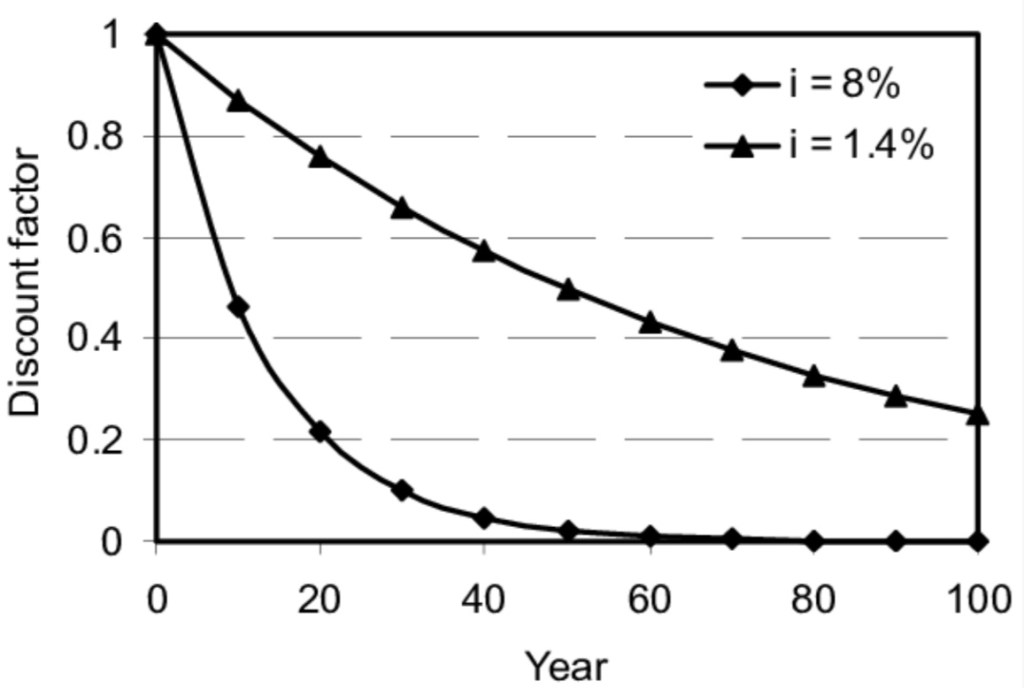
Since 2003, the OMB’s guidance on discount rates called for use of a historical average rate on 10-year government bonds. Before averaging, the rate was converted to a “real rate” in each period by subtracting the rate of increase in the Consumer Price Index (CPI). The baseline discount rate of 3% was taken from the average of that real rate over the 30 years ending in 2002. There has been an alternative discount rate of 7% under the existing guidance intended as a nod to the private costs of capital, but it’s not clear how seriously agencies took this higher value.

The new proposal seeks to update the calculation of recommended discount rates by using more recent data on Treasury rates and inflation. One aspect of the proposal is to utilize the rate on 10-year inflation-indexed Treasury bonds (TIPS) for the years in which it is available (2003-2022). The first ten years of the “new” 30-year average would use the previous methodology. However, the proposal gives examples of how other methods would change the resulting discount rate and requests comments on the most appropriate method of updating the calculation of the 30-year average.

The new baseline discount rate proposed by OMB is 1.7%, and it is lower still for very distant flows of benefits. This is intended as a real, after-tax discount rate on Treasury bonds. It represents an average (and ex post) risk-free rate on bonds held to maturity over the historical period in question, calculated as described by OMB. However, like the earlier guidance, it is not prospective in any sense. And of course it is quite low!

Our Poor Little Rich Ancestors

The projected benefits of regulations or other public initiatives can be highly dubious in the first place. Unintended consequences are the rule rather than the exception. Furthermore, even modest economic growth over several generations will leave our ancestors with far more income and wealth than we have at our disposal today. That means their ability to adapt to changes will be far superior, and they will have access to technologies making our current efforts seem quaint.

Now here’s the thing: discounting the presumed benefits of government intervention at a low rate would drastically inflate their present value. John Cochrane uses an extreme case to illustrate the point. Suppose a climate policy is projected to avoid costs equivalent to 5% of GDP 100 years from now. Those avoided costs would represent a gigantic sum! By then, at just 2% growth, real GDP will be over seven times larger than this year’s output. Cochrane calculates that 5% of real GDP in 2123 is equivalent to 37% of 2023 real GDP. And the presumed cost saving goes on forever.

We can calculate the present value of the climate policy’s benefits to determine whether it’s greater than the proposed cost of the policy. Let’s choose a fairly low discount rate like … oh, say zero. In that case, the present value is infinite, and it is infinite at any discount rate below 2% (such as 1.7%). That’s because the benefits grow at 2% (like real GDP) and go on forever! That’s faster than the diminishing effect of discounting on present value. In mathematical terms, the series does not converge. Of course, this is not discounting. It is non-discounting. Cochrane’s point, however, is that if you take these calculations seriously, you’d be crazy not to implement the policy at any finite cost! You shouldn’t mind the new taxes at all! Or the inflation tax induced by more deficit spending! Or higher regulatory costs passed along to you as a consumer! So just stop your bitching!

Formal Comments to OMB

If Cochrane’s example isn’t enough to convince you of the boneheadedness of the OMB proposal, there are several theoretical reasons to balk. Cochrane provides links to a couple of formal comments submitted to OMB. Joshua Rauh of the Stanford Business School details a few fundamental objections. His first point is that a regulatory impact analysis (RIA), or the evaluation of any other initiative, “should be based on market conditions that prevail at the time of the RIA”. In other words, the choice of a discount rate should not rely on an average over a lengthy historical period. Second, it is unrealistic to assume that the benefits and costs of proposed regulations are risk-free. In fact, unlike Treasury securities, these future streams are quite risky, and they are not tradable, and they are not liquid.

Rauh also notes that the OMB’s proposed decline in discount rates to be applied to benefits or cash flows in more distant periods has no reliable empirical basis. He believes that results based on a constant discount rate should at least be reported. Moreover, agencies should be required to offer justification for their choice of a discount rate relative to the risks inherent in the streams of costs and benefits on any new project or rule.

Rauh is skeptical of recommendations that agencies should add a theoretical risk premium to a risk-free rate, however, despite the analytical superiority of that approach. Instead, he endorses the simplicity of the OMB’s previous guidance for discount rates of 3% and 7%. But he also proposes that RIAs should always include “the complete undiscounted streams of both benefits and costs…”. If there are distributions of possible cost and benefit streams, then multiple streams should be included.

Furthermore, Rauh says that agencies should not recast streams of benefits in the form of certainty equivalents, which interpose various forms of objective functions in order to calculate a “fair guarantee”, rather than a range of actual outcomes. Instead, Rauh insists that straightforward expected values should be used, This is for the sake of transparency and to enable independent assessment of RIAs.

Another comment on the OMB proposal comes from a group of economists at MIT. They have fewer qualms than Rauh regarding the use of risk-adjusted discount rates by government agencies. In addition, they note that risk in the private sector can often be ameliorated by diversification, whereas risks inherent in public policy must be absorbed by changes in taxes, government spending, or unintended costs inflicted on the private sector. Taxpayers, those having stakes in other programs, and the general public bear these risks. Using Treasury rates for discounting presumes that bad outcomes have no cost to society!

Conclusion

Discounting the costs and benefits of proposed regulations and other government programs should be performed with discount rates that reflect risks. Treasury rates are wholly inappropriate as they are essentially risk-free over time horizons often much shorter than the streams of benefits and costs to be discounted. The OMB proposal might be a case of simple thoughtlessness, but I doubt it. To my mind, it aligns a little too neatly with the often expansive agenda of the administrative state. It would add to what is already a strong bias in favor of regulatory action and government absorption of resources. Champions of government intervention are prone to exaggerate the flow of benefits from their pet projects, and low discount rates exaggerate the political advantages they seek. That bias comes at the expense of the private sector and economic growth, where inter-temporal tradeoffs and risks are exploited only at more rational discounts and then tested by markets.

Fix TikTok? Or Nix It? The Authoritarian RESTRICT Act

08 Saturday Apr 2023

Posted by Nuetzel in anti-Semitism, Big Government, Liberty, Technology

≈ 1 Comment

Tags

AI, Artificial Intelligence, Attention Span, ByteDance, CATO Institute, Caveat Emptor, ChatGPT, Community Standards, Data Privacy, Elon Musk, First Amendment, Free Speech, Hate Speech, L. Frank Baum, Munger Test, National Security, Open Source, PATRIOT Act, People’s Republic of China, Philip Hamburger, Protectionism, RESTRICT Act, Scott Lincicome, Separation of Powers, The Land of Oz, TikTok, Twitter

There’s justifiable controversy surrounding TikTok, the social media app. I find much to dislike about TikTok but also much to dislike about the solutions some have proposed, such as a complete ban on the app in the United States. Such proposals would grant the federal executive branch powers that most of us wouldn’t grant to our worst enemy (i.e., they fail the “Munger test”).

Congressional Activity

The proposed RESTRICT Act (Restricting the Emergence of Security Threats that Risk Information and Communications Technology) is a bipartisan effort to eliminate the perceived threats to national security posed by technologies like TikTok. That would include a ban on the app. Proponents of a ban go further than national security concerns, arguing that TikTok represents a threat to the health and productivity of users. However, an outright ban on the app would be a drastic abridgment of free speech rights, and it would limit Americans’ access to a popular platform for creativity and entertainment. In addition, the proposed legislation would authorize intrusions into the privacy of Americans and extend new executive authority into the private sphere, such as tampering with trade and commerce in ways that could facilitate protectionist actions. In fact, so intrusive is the RESTRICT Act that it’s been called a “Patriot Act for the digital age.” From Scott Lincicome and several coauthors at CATO:

“… the proposal—at least as currently written—raises troubling and far‐reaching concerns for the First Amendment, international commerce, technology, privacy, and separation of powers.”

Bad Company

TikTok is owned by a Chinese company, ByteDance, and there is understandable concern about the app’s data collection practices and the potential for the Chinese government to access user data for nefarious purposes. The Trump administration cited these concerns when it attempted to ban TikTok in 2020, and while the ban was ultimately blocked by a federal judge, the Biden administration has also expressed concerns about the app’s data security.

TikTok has also been accused of promoting harmful content, including hate speech, misinformation, and sexually explicit material. Critics argue that the app’s algorithm rewards provocative and controversial content, which can lead to the spread of harmful messages and the normalization of inappropriate behavior. Of course, those are largely value judgements, including labels like “provocative”, “inappropriate”, and many interpretations of content as “hate speech”. With narrow exceptions, such content is protected under the First Amendment.

Unlike L. Frank Baum’s Tik-Tok machine in the land of Oz, the TikTok app might not always qualify as a “faithful servant”. There are some well-founded health and performance concerns related to TikTok, however. Some experts have expressed reservations about the effects of the app on attention span. The short-form videos typical of TikTok, and endless scrolling, suggest that the app is designed to be addictive, though I’m not aware of studies that purport to prove its “addictive nature. Of course, it can easily become a time sink for users, but so can almost all social media platforms. Nevertheless, some experts contend that heavy use of TikTok may lead to a decrease in attention span and an increase in distraction, which can have negative implications for productivity, learning, and mental health.

Bad Government

The RESTRICT Act, or a ban on TikTok, would drastically violate free speech rights and limit Americans’ access to a popular platform for creativity and self-expression. TikTok has become a cultural phenomenon, with millions of users creating and sharing content on the app every day. This is particularly true of more youthful individuals, who are less likely to be persuaded by their elders’ claims that the content available on TikTok is “inappropriate”. And they’re right! At the very least, “appropriateness” depends on an individual’s age, and it is generally not an area over which government should have censorship authority, “community standards” arguments notwithstanding. Furthermore, allowing access for children is a responsibility best left in the hands of parents, not government.

Likewise, businesses should be free to operate without undue interference from government. The RESTRICT Act would violate these principles, as it would limit individual choice and potentially harm innovation within the U.S. tech industry.

A less compelling argument against banning TikTok is that it could harm U.S.-China relations and have broader economic consequences. China has already warned that a TikTok ban could prompt retaliation, and such a move could escalate tensions between the two countries. That’s all true to one degree or another, but China has already demonstrated a willingness and intention to harm U.S.-China relations. As for economic repercussions, do business with China at your own risk. According to this piece, U.S. investment in the PRC’s tech industry has fallen by almost 80% since 2018, so the private sector is already taking strong steps to reduce that risk.

Like it or not, however, many software companies are subject to at least partial Chinese jurisdiction. The means the RESTRICT Act would do far more than simply banning TikTok in the U.S. First, it would subject on-line activity to much greater scrutiny. Second, it would threaten users of a variety of information or communications products and services with severe penalties for speech deemed to be “unsafe”. According to Columbia Law Professor Philip Hamburger:

“Under the proposed statute, the commerce secretary could therefore take ‘any mitigation measure to address any risk’ arising from the use of the relevant communications products or services, if the secretary determines there is an ‘undue or unacceptable risk to the national security of the United States or the safety of United States persons.’

We live in an era in which dissenting speech is said to be violence. In recent years, the Federal Bureau of Investigation has classified concerned parents and conservative Catholics as violent extremists. So when the TikTok bill authorizes the commerce secretary to mitigate communications risks to ‘national security’ or ‘safety,’ that means she can demand censorship.”

A Lighter Touch

The RESTRICT Act is unreasonably broad and intrusive and an outright ban of TikTok is unnecessarily extreme. There are less draconian alternatives, though all may involve some degree of intrusion. For example, TikTok could be compelled to allow users to opt out of certain types of data collection, and to allow independent audits of its data handling practices. TikTok could also be required to store user data within the U.S. or in other countries that have strong data privacy laws. While this option would represent stronger regulation of TikTok, it could also be construed as strengthening the property rights of users.

To address concerns about TikTok’s ownership by a Chinese company, its U.S. operations could be required to partner with a U.S. company. Perhaps this could satisfied by allowing a U.S. company to acquire a stake in TikTok, or by having TikTok spin off its U.S. operations into a separate company that is majority-owned by a U.S. entity.

Finally, perhaps political or regulatory pressure could persuade TikTok to switch to using open-source software, as Elon Musk has done with Twitter. Then, independent developers would have the ability to audit code and identify security vulnerabilities or suspicious data handling practices. From there, it’s a matter of caveat emptor.

Restrain the Restrictive Impulse

The TikTok debate raises important questions about the role of government in regulating technology and free speech. Rather than impulsively harsh legislation like the RESTRICT Act or an outright ban on TikTok, an enlightened approach would encourage transparency and competition in the tech industry. That, in turn, could help address concerns about data security and promote innovation. Additionally, individuals should take personal responsibility for their use of technology by being mindful of the content they consume and what they reveal about themselves on social media. That includes parental responsibility and supervision of the use of social media by children. Ultimately, the TikTok debate highlights tensions between national security, technological innovation, and individual liberty. and it’s important to find a balance that protects all three.

Note: The first draft of this post was written by ChatGPT, based on an initial prompt and sequential follow-ups. It was intended as an experiment in preparation for a future post on artificial intelligence (AI). While several vestiges of the first draft remain, what appears above bears little resemblance to what ChatGPT produced. There were many deletions, rewrites, and supplements in arriving at the final draft.

My first impression of the ChatGPT output was favorable. It delineated a few of the major issues surrounding a TikTok ban, but later I was struck by its repetition of bland generalities and its lack of information on more recent developments like the RESTRICT Act. The latter shortfall was probably due to my use of ChatGPT 3.5 rather than 4.0. On the whole, the exercise was fascinating, but I will limit my use of AI tools like ChatGPT to investigation of background on certain questions.

Government Action and the “Your Worst Enemy” Test

03 Saturday Dec 2022

Posted by Nuetzel in Big Government, Censorship

≈ 3 Comments

Tags

Big government, Censorship, Donald Trump, Elon Musk, Michael Munger, Munger Test, Nancy Pelosi, regulation, Social Media, Twitter, Unicorn Governance, Your Worst Enemy Test

A couple of weeks back I posted an admittedly partial list of the disadvantages, dysfunctions, and dangers of the Big Government Mess seemingly wished upon us by so many otherwise reasonable people. A wise addition to that line of thinking is the so-called Munger Test articulated by Michael Munger of Duke University. Here, he applies the test to government involvement in social media content regulation:

“If someone says “The STATE should do X” (in this case, decide what is true and what can be published in a privately-owned space), they need to make a substitution.

Instead of “The STATE” substitute “Donald Trump,” and see if you still belief it. (Or “Nancy Pelosi”, if you want).”

If approached honestly, Munger’s test is sure to make a partisan think twice about having government “do something”, or do anything! In a another tweet, Munger elaborates on the case of Twitter, which is highly topical at the moment:

“In fact, the reporters and media moguls who are calling for the state to hammer Twitter, and censor all those other ‘liars’, naively believe that they have a 1000 Year Reich.

You don’t. 𝙔𝙤𝙪 𝙘𝙖𝙣 𝙤𝙣𝙡𝙮 𝙜𝙞𝙫𝙚 𝙩𝙝𝙚 𝙎𝙩𝙖𝙩𝙚 𝙥𝙤𝙬𝙚𝙧𝙨 𝙩𝙝𝙖𝙩 𝙮𝙤𝙪 𝙛𝙖𝙫𝙤𝙧 𝙜𝙞𝙫𝙞𝙣𝙜 𝙩𝙤 𝙮𝙤𝙪𝙧 𝙬𝙤𝙧𝙨𝙩 𝙚𝙣𝙚𝙢𝙮. Deal with it.”

The second sentence in that last paragraph is an even more concise statement of the general principle behind the Munger Test, which we might dub the “Worst Enemy Test” with no disrespect to Munger. He proposed the test (immodestly named, he admits) in his 2014 article, “Unicorn Governance”, in which he offered a few other examples of its application. The article is subtitled:

“Ever argued public policy with people whose State is in fantasyland?”

The answer for me is yes, almost every time I talk to anyone about public policy! And as Munger says, that’s because:

“Everybody imagines that ‘The STATE’ is smart people who agree with them. Once MY team controls the state, order will be restored to the Force.”

So go ahead! Munger-test all your friends’ favorite policy positions the next time you talk!

But what about the case of “regulating” Twitter or somehow interfering with its approach to content moderation? More on that in my next post.

It’s a Big Government Mess

22 Tuesday Nov 2022

Posted by Nuetzel in Big Government, Uncategorized

≈ 1 Comment

Tags

Campaign Spending, Carbon Footprint, central planning, Climate Risk, Compliance Costs, Cronyism, Debt Monetization, dependency, Diversity, Do-Somethingism, External Costs, Fiscal Illusion, Limited government, Malinvestment, monopoly, Price Controls, Public goods, Redistribution, Regulatory Capture, rent seeking, Wetlands, Willingness To Pay

I’m really grateful to have the midterm elections behind us. Well, except for the runoff Senate race in Georgia, the cockeyed ranked-choice Senate race in Alaska, and a few stray House races that remain unsettled after almost two weeks. I’m tired of campaign ads, including the junk mail and pestering “unknown” callers — undoubtedly campaign reps or polling organizations.

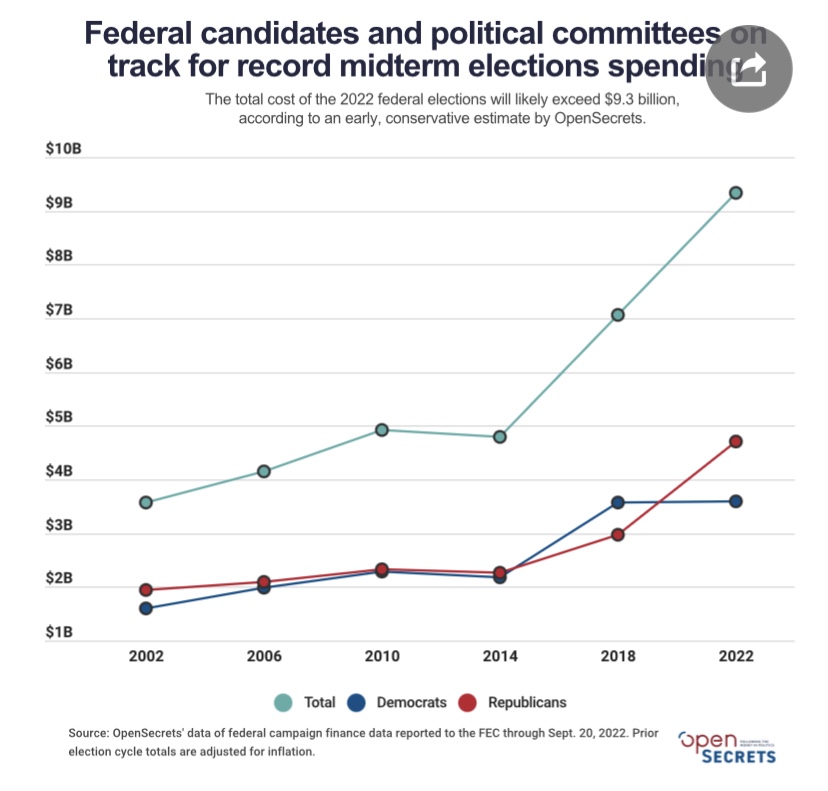
It’s astonishing how much money is donated and spent by political campaigns. This year’s elections saw total campaign spending (all levels) hit $16.7 billion, a record for a mid-term. The recent growth in campaign spending for federal offices has been dramatic, as the chart below shows:

Do you think spending of a few hundred million dollars on a Senate campaign is crazy? Me too, though I don’t advocate for legal limits on campaign spending because, for better or worse, that issue is entangled with free speech rights. Campaigns are zero-sum events, but presumably a big donor thinks a success carries some asymmetric reward…. A success rate of better than 50% across several campaigns probably buys much more…. And donors can throw money at sure political bets that are probably worth a great deal…. Many donors spread their largess across both parties, perhaps as a form of “protection”. But it all seems so distasteful, and it’s surely a source of waste in the aggregate.

My reservations about profligate campaign spending include the fact that it is a symptom of big government. Donors obviously believe they are buying something that government, in one way or another, makes possible for them. The greater the scope of government activity, the more numerous are opportunities for rent seeking — private gains through manipulation of public actors. This is the playground of fascists!

There are people who believe that placing things in the hands of government is an obvious solution to the excesses of “greed”. However, politicians and government employees are every bit as self-interested and “greedy” as actors in the private sector. And they can do much more damage: government actors legally exercise coercive power, they are not subject in any way to external market discipline, and they often lack any form of accountability. They are not compelled to respect consumer sovereignty, and they make correspondingly little contribution to the nation’s productivity and welfare.

Actors in the private sector, on the other hand, face strong incentives to engage in optimizing behavior: they must please customers and strive to improve performance to stay ahead of their competition. That is, unless they are seduced by what power they might have to seek rents through public sector activism.

A people who grant a wide scope of government will always suffer consequences they should expect, but they often proceed in abject ignorance. So here is my rant, a brief rundown on some of the things naive statists should expect to get for their votes. Of course, this is a short list — it could be much longer:

  • Opportunities for graft as bureaucrats administer the spending of others’ money and manipulate economic activity via central planning.
  • A ballooning and increasingly complex tax code seemingly designed to benefit attorneys, the accounting profession, and certainly some taxpayers, but at the expense of most taxpayers.
  • Subsidies granted to producers and technologies that are often either unnecessary or uneconomic (and see here), leading to malinvestment of capital. This is often a consequence of the rent seeking and cronyism that goes hand-in-hand with government dominance and ham-handed central planning.
  • Redistribution of existing wealth, a zero- or even negative-sum activity from an economic perspective, is prioritized over growth.
  • Redistribution beyond a reasonable safety net for those unable to work and without resources is a prescription for unnecessary dependency, and it very often constitutes a surreptitious political buy-off.
  • Budgetary language under which “budget cuts” mean reductions in the growth of spending.
  • Large categories of spending, known in the U.S. as non-discretionary entitlements, that are essentially off limits to lawmakers within the normal budget appropriations process.
  • “Fiscal illusion” is exploited by politicians and statists to hide the cost of government expansion.
  • The strained refrain that too many private activities impose external costs is stretched to the point at which government authorities externalize internalities via coercive taxes, regulation, or legal actions.
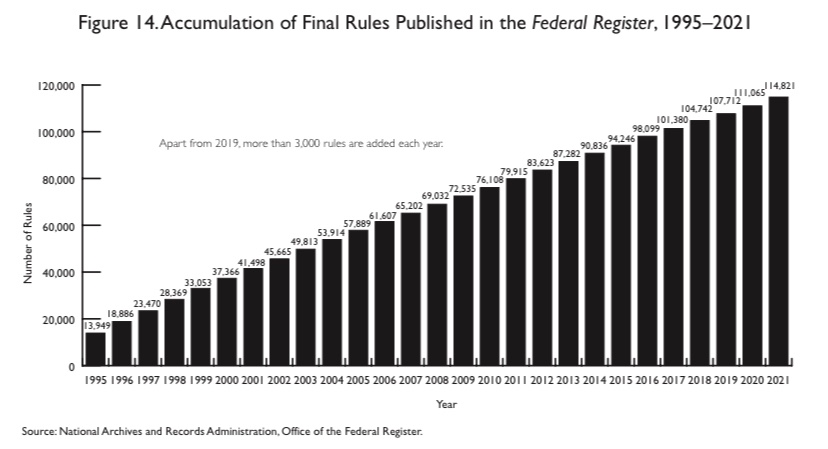
  • Massive growth in regulation (see chart at top) extending to puddles classified as wetlands (EPA), the ”disparate impacts” of private hiring practices (EEOC), carbon footprints of your company and its suppliers (EPA, Fed, SEC), outrageous energy efficiency standards (DOE), and a multiplicity of other intrusions.
  • Growth in the costs of regulatory compliance.
  • A nearly complete lack of responsiveness to market prices, leading to misallocation of resources — waste.
  • Lack of value metrics for government activities to gauge the public’s “willingness to pay”.
  • Monopoly encouraged by regulatory capture and legal / compliance cost barriers to competition. Again, cronyism.
  • Monopoly granted by other mechanisms such as import restrictions and licensure requirements. Again, cronyism.
  • Ruination of key industries as government control takes it’s grip.
  • Shortages induced by price controls.
  • Inflation and diminished buying power stoked by monetized deficits, which is a long tradition in financing excessive government.
  • Malinvestment of private capital created by monetary excess and surplus liquidity.
  • That malinvestment of private capital creates macroeconomic instability. The poorly deployed capital must be written off and/or reallocated to productive uses at great cost.
  • Funding for bizarre activities folded into larger budget appropriations, like holograms of dead comedians, hamster fighting experiments, and an IHOP for a DC neighborhood.
  • A gigantic public sector workforce in whose interest is a large and growing government sector, and who believe that government shutdowns are the end of the world.
  • Attempts to achieve central control of information available to the public, and the quashing of dissent, even in a world with advanced private information technology. See the story of Hunter Biden’s laptop. This extends to control of scientific narratives to ensure support for certain government programs.
  • Central funding brings central pursestrings and control. This phenomenon is evident today in local governance, education, and science. This is another way in which big government fosters dependency.
  • Mission creep as increasing areas of economic activity are redefined as “public” in nature.
  • Law and tax enforcement, security, and investigative agencies pressed into service to defend established government interests and to compromise opposition.

I’ve barely scratched the surface! Many of the items above occur under big government precisely because various factions of the public demand responses to perceived problems or “injustices”, despite the broader harms interventions may bring. The press is partly responsible for this tendency, being largely ignorant and lacking the patience for private solutions and market processes. And obviously, those kinds of demands are a reason government gets big to begin with. In the past, I’ve referred to these knee-jerk demands as “do somethingism”, and politicians are usually too eager to play along. The squeaky wheel gets the oil.

I mentioned cronyism several times in the list. The very existence of broad public administration and spending invites the clamoring of obsequious cronies. They come forward to offer their services, do large and small “favors”, make policy suggestions, contribute to lawmakers, and to offer handsomely remunerative post-government employment opportunities. Of course, certaIn private parties also recognize the potential opportunities for market dominance when regulators come calling. We have here a perversion of the healthy economic incentives normally faced by private actors, and these are dynamics that gives rise to a fascist state.

It’s true, of course, that there are areas in which government action is justified, if not necessary. These include pure public goods such as national defense, as well as public safety, law enforcement, and a legal system for prosecuting crimes and adjudicating disputes. So a certain level of state capacity is a good thing. Nevertheless, as the list suggests, even these traditional roles for government are ripe for unhealthy mission creep and ultimately abuse by cronies.

The overriding issue motivating my voting patterns is the belief in limited government. Both major political parties in the U.S. violate this criterion, or at least carve out exceptions when it suits them. I usually identify the Democrat Party with statism, and there is no question that democrats rely far too heavily on government solutions and intervention in private markets. The GOP, on the other hand, often fails to recognize the statism inherent in it’s own public boondoggles, cronyism, and legislated morality. In the end, the best guide for voting would be a political candidate’s adherence to the constitutional principles of limited government and individual liberty, and whether they seem to understand those principles. Unfortunately, that is often too difficult to discern.

Lawyers Sowing Legal Chaos

11 Monday Jul 2022

Posted by Nuetzel in Big Government, Litigation, Living Constitution

≈ Leave a comment

Tags

Activism, Administrative State, Bill of Rights, Homelessness, John O. McGinnis, Legal Formalism, Legal Realism, Leviathan, Living Constitution, Mark Pulliam, Martin v. Boise, Ninth Circuit Court, Originalism, Pro Bono Litigation, Supreme Court, Trial Lawyers, West Virginia v. EPA

It goes without saying that the legal profession played a huge role in the development and growth of the administrative state. I reviewed some history about that growth in my last post, which dealt primarily with the Supreme Court’s recent ruling in West Virginia v. EPA. It’s certainly clear that courtrooms have served as venues for many of the steps in creating the federal Leviathan we know too well today. So has a large representation of attorneys in Congress. Environmental law? Tax law? Antitrust? Labor law? Civil Rights? Bank regulation? The examples and sub-examples are numerous, and while all might have laudable dimensions, there is no question that all present lucrative opportunities for attorneys… and for manipulative abuses. The burgeoning domain of administrative law enforced and adjudicated by federal agencies was itself a by-product of growth in the array of economic and social regulation, and it too was abetted by the legal profession. Moreover, it’s not inaccurate to say that the active rent-seeking efforts of private special interests, which undergird the “demand” for public intervention and regulation, are likely as not to have been spearheaded by corporate legal departments.

Ex post losses of various kinds are effective drivers of public intervention. Obviously, trial attorneys seek redress against various harms to clients who come their way, and they manage to stretch monetary damages to absurd levels. Public intervention, however, often takes the form of ex ante risk avoidance, and attorneys frequently take lead roles in agitating for ever-greater precautions against risk. A key characteristic of these measures is that they tend to be zero- and even negative-sum in nature. That is, in this kind of world, it is not atypical for one person’s gain to be less than another’s loss. This dynamic creates a formidable obstacle to economic growth.

Country Club Subversives

John O. McGinnis puts all this into a tidy nutshell in “Lawyers for Radical Change”:

“Since the birth of the modern regulatory state, lawyers are no longer primarily the allies of commercial classes, as they were in the early republic, but instead the technocrats and enablers of regulation and redistribution. The more the nation intervenes in economic affairs to regulate and redistribute, the greater slice of compliance costs and transfer payments lawyers can expect to receive. Thus, they cannot be counted on as supporters of property rights or even of a stable rule of law. Their interest lies frequently in dynamic forms of legal transformation and the uncertainty they bring. Far from supporting a sound, established social order, they are likely to seek to undermine it.”

McGinnis highlights the legal profession’s remarkable transition from once-active guardians of personal liberty, property rights, and the rule of law to active agitators for a nation grounded in non-productive rent seeking. The populist penchant for “do-something-ism” in response to every perceived risk, injustice, or grievance plays right into their skill set. And there are vast opportunities for attorneys in regulatory and fiscal matters. Compliance and legal work-arounds are enormously profitable to attorneys, to say nothing of the many forms of litigation. In all cases, one might say, “follow the fees”.

This is not exclusively a pecuniary matter, however. It’s also one of raw political ambition and status. A spectacular and perverse phenomenon has been the legal profession’s agitation for dismantling the rule of law, denying certain rights enumerated in the Constitution (e.g., free speech, gun rights) and insisting upon the enforcement of imagined rights through novel interpretations of the Bill of Rights and its amendments (e.g, guaranteed income, “equity”), even so-called rights and demands involving demonstrable harm to others (reparations, no bail laws, abortion).

Here’s McGinnis on the legal profession’s nearly complete sellout of the original text of the Constitution:

“Under living constitutionalism, lawyers and judges are not simply servants of the law but potentially tribunes of the people, because they can choose to create new rights and discard others. In a legal world without the formal anchoring in text and precedents that characterized the lawyer’s craft of the past, innovation and, indeed, radicalism are prized as sources of power.”

Legal “Realism”

There are other dimensions to the aberrant drift in the interests of the mainstream legal profession. Over 20 years ago, Mark Pulliam discussed some of these issues in “The Lawyer’s War on Law”. In that article, he decried so-called “legal realism”, which elevates prevailing attitudes about social policy and justice over legal formalism and originalism. This philosophy is used to justify what amounts to predation among trial lawyers seeking to smear the defense, especially those who suffer from unpopularity among current elites or the media. Gone is the idea of fighting for what is right under the law; instead the goal is to “win at all costs”. Here is Pulliam on this phenomenon:

“… lawsuits succeed without credible proof of injury or causation–‘junk science’ experts, paid by the hour, provide whatever pretext a jury requires–because of a combination of judge-made liability rules that tilt the playing field in favor of plaintiffs’ gripes, trial judges determined to redistribute wealth, and the brute force of endless dishonest lawsuits that seek unlimited, bankruptcy-threatening damages. Many businesses, having lost faith in courts’ ability or willingness to make rational rulings, routinely pay the equivalent of ransom just to escape the system. Most ominously, the trial lawyers have recently joined forces with state and local governments to loot unpopular industries for political purposes. Litigation is no longer just a way to bilk opponents; it is a political weapon.”

The legal realist school of thought is used as a ready excuse for nearly any form of judicial activism, including nullification of controlling statutes in election procedures, allowing lawyers and judges to run elections.

Pro Bono Subversion

More recently, Pulliam provided another example of a perverse activity sponsored by the legal profession, and in particular large law firms. In “Lawyers Cause Homelessness”, he discusses pro bono litigation and its paradoxical harms. Of course, pro bono work sounds so very good and generous. And, in fact, it can be very nice, as when attorneys offer free legal advice to those who cannot otherwise afford it. However, it is not uncommon to see these efforts used in the service of political activism. Pulliam contends that prestigious law firms use pro bono litigation as an inducement to attract young associates, fresh out of law school and full of the social justice blather taught there. How exciting to be offered a position at an elite firm with the opportunity to work on activist causes!

The case used by Pulliam to illustrate this dynamic is Martin v. Boise, decided by the Ninth Circuit Court in 2018, which he describes thusly:

“Martin v. Boise … declared unconstitutional—as ‘cruel and unusual punishment,’ of all things—any city ordinances that prohibit homeless people from sleeping or camping overnight on public property (such as parks, sidewalks, and, in California, beaches) unless the jurisdiction provides enough shelter beds to house every single ‘person experiencing homelessness,’ a burden no city will ever be able to meet. …

With a wave of the activist wand, the Ninth Circuit relieved vagrants of any responsibility to provide their own shelter. Society has this duty, and it must accept the consequences of its failure to provide cradle-to-grave care, no matter how improvident the lifestyle decisions of individual actors. In one fell swoop, in the absence of any relevant Supreme Court precedent, three unelected judges on the Ninth Circuit rendered more than 1,600 municipalities within the court’s jurisdiction powerless to curb urban homeless encampments.”

According to Pulliam, the Washington DC law firm Latham and Watkins dedicated more than 7,000 hours of attorney time to the case:

“Latham … publicly bragged about its ‘major Ninth Circuit victory’ and was honored for it by the Legal Services Corporation’s Board of Directors with a Pro Bono Service Award.”

This is a stark illustration of the depths of activism to which the legal profession has descended. And the case is hardly unique, as Pulliam goes on to illustrate. Despite the literal meaning of the term pro bono, this kind of activity is anything but for “the public good”.

Conclusion

Who really benefits from the kind of legalistic mayhem we see today? The written words of the Constitution are now said to mean things that are often diametrically opposed to the framers’ intent. The federal government absorbs ever greater shares of the nation’s resources. Private parties use federal power to petition for rents that could never have been gained in private markets. Laws are made by federal agencies who, in turn, internally adjudicate disputes between those very agencies and private parties. Litigation runs rampant in search of deep pockets. And elite law firms are somehow deemed praiseworthy for working to undermine safety, cleanliness, property rights, and the enumerated rights guaranteed under the Constitution.

Who benefits? Perhaps most of all it is the attorneys! The more chaotic, the better! Then again, if you’re at risk of legal trouble, you better damn well consult an attorney. We can’t seem to live without lawyers, but sadly, we can’t live free with them.

Infrastructure Or Infra-Stricture? The Democrats’ $3.5 Trillion Reconciliation Bill

16 Thursday Sep 2021

Posted by Nuetzel in Big Government, Central Planning, infrastructure, Uncategorized

≈ 3 Comments

Tags

Antonia Ocasio-Cortez, Bernie Sanders, Biden Administration, Budget Reconcilation Bill, Capital Gains, Civilian Climate Corps, Clean Energy, corporate income tax, dependency, Federal Reserve, Fossil fuels, Green Cards, infrastructure, Joe Manchin, Legal Permanent Residency, Paid Family Leave, Physical Investment, Productivity Growth, Social Infrastructure, Tax the Rich, Tragedy of the Commons, Universal Pre-School, Welfare State

The Socialist Party faithful once known as Democrats are pushing a $3.5 trillion piece of legislation they call an “infrastructure” bill. They hope to pass it via budget reconciliation rules with a simple majority in the Senate. The Dems came around to admitting that the bill is not about infrastructure in the sense in which we usually understand the term: physical installations like roads, bridges, sewer systems, power lines, canals, port facilities, and the like. These kinds of investments generally have a salutary impact on the nation’s productivity. Some “traditional” infrastructure, albeit with another hefty wallop of green subsidies, is covered in the $1.2 trillion “other” infrastructure bill already passed by the Senate but not the House. The reconciliation bill, however, addresses “social infrastructure”, which is to say it would authorize a massive expansion in the welfare state.

What Is Infrastructure?

Traditionally, public and private infrastructure are underlying assets that facilitate production or consumption in one way or another, consistent with the prefix “infra”, meaning below or within. For example, a new factory requires physical access by roads and/or rail, as well as sewer service, water, gas and/or electric supply. All of the underlying physical components that enable that factory to operate may be thought of as private infrastructure, which has largely private benefits. Therefore, it is often privately funded, though certainly not always.

Projects having many beneficiaries, such as highways, municipal sewers, water, gas and electrical trunk lines, canals, and ports may be classified as public infrastructure, though they can be provided and funded privately. Pure public infrastructure provides services that are non-rivalrous and non-excludable, but examples are sparse. Nevertheless, the greater the public nature of benefits, the greater the rationale for government involvement in their provision. In practice, a great deal of “public” infrastructure is funded by user fees. In fact, a failure to charge user fees for private benefits often leads to a tragedy of the commons, such as the overuse of free roads, imposing a heavier burden on taxpayers.

The use of the term “infrastructure” to describe forms of public support is not new, but the scope of government interventions to which the term is applied has mushroomed during the Biden Administration. Just about any spending program you can think of is likely to be labeled “infrastructure” by so-called progressives. The locution is borrowed somewhat questionably, seemingly motivated by the underlying structure of political incentives. More bluntly, it sounds good as a sales tactic!

$3.5 Trillion and Chains

Among other questionable items, the so-called budget reconciliation “infrastructure” bill allocates funds toward meeting:

“… the President’s climate change goals of 80% clean electricity and 50% economy-wide carbon emissions by 2030, while advancing environmental justice and American manufacturing. The framework would fund:
• Clean Energy Standard
• Clean Energy and Vehicle Tax Incentives
• Civilian Climate Corps
• Climate Smart Agriculture, Wildfire Prevention and Forestry
• Federal procurement of clean technologies
• Weatherization and Electrification of Buildings
• Clean Energy Accelerator
”

The resolution would also institute “methane reduction and polluter import fees”. Thus, we must be prepared for a complete reconfiguration of our energy sector toward a portfolio of immature and uneconomic technologies. This amounts to an economic straightjacket.

Next we have a series of generous programs and expansions that would encourage dependence on government:

“• Universal Pre-K for 3 and 4-year old children
• High quality and affordable Child Care
•
[free] Community College, HBCUs and MSIs, and Pell Grants
• Paid Family and Medical Leave
• Nutrition Assistance
• Affordable Housing
”

If anything, pre-school seems to have cognitive drawbacks for children. Several of these items, most obviously the family leave mandate, would entail significant regulatory and cost burdens on private businesses.

There are more generous provisions on the health care front, which are good for further increasing the federal government’s role in directing, regulating, and funding medical care:

“• new Dental, Vision, and Hearing benefit to Medicare
• Home and Community-Based Services expansion
• Extend the Affordable Care Act Expansion from the ARP
• Close the Medicaid “Coverage Gap” in the States that refused to expand
• Reduced patient spending on prescription drugs
”

Finally, we have a series of categories intended to “help workers and communities across the country recover from the COVID-19 pandemic and reverse trends of economic inequality.”

“• Housing Investments
• Innovation and R & D Upgrades
• American Manufacturing and Supply Chains Funding
• LPRs for Immigrants and Border Mangt. • Pro-Worker Incentives and Penalties
• Investment in Workers and Communities • Small Business Support

I might suggest that a recovery from the pandemic would be better served by getting the federal government out of everyone’s business. The list includes greater largess and more intrusions by the federal government. The fourth item above, grants of legal permanent residency (LPR) or green cards, would legalize up to 8 million immigrants, allowing them to qualify for a range of federal benefits. It would obviously legitimize otherwise illegal border crossings and prevent any possibility of eventual deportation.

Screwing the Pooch

How many of those measures really sound like infrastructure? This bill goes on for more than 10,000 pages, so the chance that lawmakers will have an opportunity to rationally assess all of its provisions is about nil! And the reconciliation bill doesn’t stop at $3.5T. There are a few budget gimmicks being leveraged that could add as much as $2T of non-infrastructure spending to the package. One cute trick is to add certain provisions affecting revenue or spending years from now in order to cut the bill’s stated price tag.

A number of the bill’s generous giveaways will have negative effects on productive incentives. It’s also clear that some items in the bill will supplement the far Left’s educational agenda, which is seeped in critical theory. And the bill will increase the dominance of the federal government over not only the private sector, but state and local sovereignty as well. This is another stage in the metastasis of the federal bureaucracy and the dependency fostered by the welfare state.

Taxing the Golden Goose

But here’s the really big rub: the whole mess has to be paid for. The flip side of our growing dependency on government is the huge obligation to fund it. Check this out:

“American ‘consumer units,’ as BLS calls them, spent a net total of $17,211.12 on taxes last year while spending only $16,839.89 on food, clothing, healthcare and entertainment combined,”

Democrats continue to dicker over the tax provisions of the bill, but the most recent iteration of their plan is to cover about $2.9 trillion of the cost via tax hikes. Naturally, the major emphasis is on penalizing corporations and “the rich”. The latest plan includes:

  • increasing the corporate income tax from 21% to 26.8%;
  • increasing the top tax rate on capital gains from 20% to 25%;
  • an increase in the tax rate for incomes greater than $400,000 ($450,000 if married filing jointly)
  • adding a 3% tax surcharge for those with adjusted gross incomes in excess of $5 million;
  • Higher taxes on tobacco and nicotine products;
  • halving the estate and gift tax exemption;
  • limiting deductions for executive compensation;
  • changes in rules for carried interest and crypto assets.

There are a few offsets, including the promise of tax reductions for individuals earning less than $200,000 and businesses earning less than $400,000. We’ll see about that. Those cuts would expire by 2027, which reduces their “cost” to the government, but it will be controversial when the time comes.

The Dem sell job includes the notion that corporate income belongs to the “rich”, but as I’ve noted before, the burden of the corporate income tax falls largely on corporate workers and consumers. Lower wages and higher prices are almost sure to follow. This would deepen the blade of the Democrats’ political hari-kari, but they pin their hopes on the power of alms. Once bestowed, however, those will be difficult if not impossible to revoke, and the Dems know this all too well.

The assault on the “rich” in the reconciliation bill is both ill-advised and unlikely to yield the levels of revenue projected by Democrats. Like it or not, the wealthy provide the capital for most productive investment. Taxing their returns and their wealth more heavily can only reduce incentive to do so. Those investors will seek out more tax-advantaged uses for their funds. That includes investments in non-productive but federally-subsidized alternatives. Capital gains can often be deferred, of course. These penalties also ensure that more resources will be consumed in compliance and tax-avoidance efforts. The solutions offered by armies of accountants and tax attorneys will tend to direct funds to uses that are suboptimal in terms of growth in economic capacity.

What isn’t funded by new taxes will be borrowed by the federal government or simply printed by the Federal Reserve. Thus, the federal government will not only compete with the private sector for additional resources, but the monetary authority will provide fuel for more inflation.

Fracturing Support?

Fortunately, a few moderate Democrats in both the House and the Senate are balking at the exorbitance of the reconciliation bill. Senator Joe Manchin of West Virginia has said he would like to see a package of no more than $1.5 trillion. That still represents a huge expansion of government, but at least Manchin has offered a whiff of sanity. Equally welcome are threats from radical Democrats like Senator Bernie Sanders and Rep. Antonia Ocasio-Cortez that a failure to pass the full reconciliation package will mean a loss of their support for the original $1.2 trillion infrastructure bill, much of which is wasteful. We should be so lucky! But that’s a lot of pork for politicians to walk away from.

Infra-Shackles

The so-called infrastructure investments in the reconciliation bill represent a range of constraints on economic growth and consumer well being. Increasing the government’s dominance is never a good prescription for productivity, whether due to regulatory and compliance costs, bureaucratization of decision-making, minimizing the role of price signals, pure waste through bad incentives and graft, and public vs. private competition for resources. The destructive tax incentives for funding the bill are an additional layer of constraints on growth. Let’s hope the moderate Democrats hold firm, or even better, that the tantrum-prone radical Democrats are forced to make good on their threats.

Four More Years to MAGAA

28 Wednesday Oct 2020

Posted by Nuetzel in Big Government, Liberty, Politics

≈ Leave a comment

Tags

Abraham Accords, Affordable Care Act, Amy Coney Barrett, Brett Kavanaugh, corporate taxes, Covid-19, Critical Race Theorist, David E. Bernstein, Deregulation, Donald Trump, Dreamers, Election Politics, Federalism, Free trade, Gun Rights, Immigration, Impeachment, Individual Mandate, Joe Biden, Joel Kotkin, Living Constitution, Medicare, Middle East Peace, Nancy Pelosi, National Defense, Nationalism, NATO, Neil Gorsuch, Originalism, Paris Climate Accord, Pass Through Business, Penalty Tax, Social Security, United Nations

As a “practical” libertarian, my primary test for any candidate for public office is whether he or she supports less government dominance over private decisions than the status quo. When it comes to Joe Biden and his pack of ventriloquists, the answer is a resounding NO! That should clinch it, right? Probably, but Donald Trump is more complicated….

I’ve always viewed Trump as a corporatist at heart, one who, as a private businessman, didn’t give a thought to free market integrity when he saw rent-seeking opportunities. Now, as a public servant, his laudable desire to “get things done” can also manifest to the advantage of cronyists, which he probably thinks is no big deal. Unfortunately, that is often the way of government, as the Biden family knows all too well. On balance, however, Trump generally stands against big government, as some of the points below will demonstrate.

Trump’s spoken “stream of consciousness” can be maddening. He tends to be inarticulate in discussing policy issues, but at times I enjoy hearing him wonder aloud about policy; at other times, it sounds like an exercise in self-rationalization. He seldom prevaricates when his mind is made up, however.

Not that Biden is such a great orator. He needs cheat sheets, and his cadence and pitch often sound like a weak, repeating loop. In fairness, however, he manages to break it up a bit with an occasional “C’mon, man!”, or “Here’s the deal.”

I have mixed feelings about Trump’s bumptiousness. For example, his verbal treatment of leftists is usually well-deserved and entertaining. Then there are his jokes and sarcasm, for which one apparently must have an ear. He can amuse me, but then he can grate on me. There are times when he’s far too defensive. He tweets just a bit too much. But he talks like a tough, New York working man, which is basically in his DNA. He keeps an insane schedule, and I believe this is true: nobody works harder.

With that mixed bag, I’ll now get on to policy:

Deregulation: Trump has sought to reduce federal regulation and has succeeded to an impressive extent, eliminating about five old regulations for every new federal rule-making. This ranges from rolling back the EPA’s authority to regulate certain “waters” under the Clean Water Act, to liberalized future mileage standards on car manufacturers, to ending destructive efforts to enforce so-called net neutrality. By minimizing opportunities for over-reach by federal regulators, resources can be conserved and managed more efficiently, paving the way for greater productivity and lower costs.

And now, look! Trump has signed a new executive order making federal workers employees-at-will! Yes, let’s “deconstruct the administrative state”. And another new executive order prohibits critical race theory training both in the federal bureaucracy and by federal contractors. End the ridiculous struggle sessions!

Judicial Appointments: Bravo! Neil Gorsuch, Brett Kavanaugh, Amy Coney Barrett, and over 200 federal judges have been placed on the bench by Trump in a single term. I like constitutional originalism and I believe a “living constitution” is a corrupt judicial philosophy. The founding document is as relevant today as it was at its original drafting and at the time of every amendment. I think Trump understands this.

Corporate Taxes: Trump’s reductions in corporate tax rates have promoted economic growth and higher labor income. In 2017, I noted that labor shares the burden of the corporate income tax, so a reversal of those cuts would be counterproductive for labor and capital.

At the same time, the 2017 tax package was a mixed blessing for many so-called “pass-through” businesses (proprietors, partnerships, and S corporations). It wasn’t exactly a simplification, nor was it uniformly a tax cut.

Individual Income Taxes: Rates were reduced for many taxpayers, but not for all, and taxes were certainly not simplified in a meaningful way. The link in the last paragraph provides a few more details.

I am not a big fan of Trump’s proposed payroll tax cut. Such a temporary move will not be of any direct help to those who are unemployed, and it’s unlikely to stimulate much spending from those who are employed. Moreover, without significant reform, payroll tax cuts will directly accelerate the coming insolvency of the Social Security and Medicare Trust Funds.

Nonetheless, I believe permanent tax cuts are stimulative to the economy in ways that increased government spending is not: they improve incentives for effort, capital investment, and innovation, thus increasing the nation’s productive capacity. Trump seems to agree.

Upward Mobility: Here’s Joel Kotkin on the gains enjoyed by minorities under the Trump Administration. The credit goes to strong private economic growth, pre-pandemic, as opposed to government aid programs.

Foreign Policy: Peace in the Middle East is shaping up as a real possibility under the Abraham Accords. While the issue of coexisting, sovereign Palestinian and Zionist homelands remains unsettled, it now seems achievable. Progress like this has eluded diplomatic efforts for well over five decades, and Trump deserves a peace prize for getting this far with it.

Iran is a thorn, and the regime is a terrorist actor. I support a tough approach with respect to the ayatollahs, which a Trump has delivered. He’s also pushed for troop withdrawals in various parts of the world. He has moved U.S. troops out of Germany and into Poland, where they represent a greater deterrent to Russian expansionism. Trump has pushed our NATO allies to take responsibility for more of their own defense needs, all to the better. Trump has successfully managed North Korean intransigence, though it is an ongoing problem. We are at odds with the leadership in mainland China, but the regime is adversarial, expansionist, and genocidal, so I believe it’s best to take a tough approach with them. At the UN, some of our international “partners” have successfully manipulated the organization in ways that make continued participation by the U.S. of questionable value. Like me, Trump is no fan of UN governance as it is currently practiced.

Gun Rights: Trump is far more likely to stand for Second Amendment rights than Joe Biden. Especially now, given the riots in many cities and calls to “defund police”, it is vitally important that people have a means of self-defense. See this excellent piece by David E. Bernstein on that point.

National Defense: a pure public good; I’m sympathetic to the argument that much of our “defense capital” has deteriorated. Therefore, Trump’s effort to rebuild was overdue. The improved deterrent value of these assets reduces the chance they will ever have to be used against adversaries. Of course, this investment makes budget balance a much more difficult proposition, but a strong national defense is a priority, as long as we avoid the role of the world’s policeman.

Energy Policy: The Trump Administration has made efforts to encourage U.S. energy independence with a series of deregulatory moves. This has succeeded to the extent the U.S. is now a net energy exporter. At the same time, Trump has sought to eliminate subsidies for wasteful renewable energy projects. Unfortunately, ethanol is still favored by energy policy, which might reflect Trump’s desire to assuage the farm lobby.

Climate Policy: Trump kept us out of the costly Paris Climate Accord, which would have cost the U.S. trillions of dollars in lost GDP and subsidies to other nations. Trump saw through the accord as a scam under which leading carbon-emitting nations (such as China) face few real obligations. Meanwhile, the U.S. has led the world in reductions in carbon emissions during Trump’s term, even pre-pandemic. That’s partly a consequence of increased reliance on natural gas relative to other fossil fuels. Trump has also supported efforts to develop more nuclear energy capacity, which is the ultimate green fuel.

COVID-19 Response: As I’ve written several times, in the midst of a distracting and fraudulent impeachment attempt, Trump took swift action to halt inbound flights from China. He marshaled resources to obtain PPE, equipment, and extra hospital space in hot spots, and he kick-started the rapid development of vaccines. He followed the advice of his sometimes fickle medical experts early in the pandemic, which was not always a good thing. In general, his policy stance honored federalist principles by allowing lower levels of government to address local pandemic conditions on appropriate terms. If the pandemic has you in economic straits, you probably have your governor or local officials to thank. As for the most recent efforts to pass federal COVID relief, Nancy Pelosi and House Democrats have insisted on loading up the legislation with non-COVID spending provisions. They have otherwise refused to negotiate pre-election, as if to blame the delay on Trump.

Immigration: My libertarian leanings often put me at odds with nationalists, but I do believe in national sovereignty and the obligation of the federal government to control our borders. Trump is obviously on board with that. My qualms with the border wall are its cost and the availability of cheaper alternatives leveraging technological surveillance. I might differ with Trump in my belief in liberalizing legal immigration. I more strongly differ with his opposition to granting permanent legal residency to so-called Dreamers, individuals who arrived in the U.S. as minors with parents who entered illegally. However, Trump did offer a legal path to citizenship for Dreamers in exchange for funding of the border wall, a deal refused by congressional Democrats.

Health Care: No more penalty (tax?) to enforce the individual mandate, and the mandate itself is likely to be struck down by the Supreme Court as beyond legislative intent. Trump also oversaw a liberalization of insurance offerings and competition by authorizing short-term coverage of up to a year and enabling small businesses to pool their employees with others in order to obtain better rates, among other reforms. Trump seems to have deferred work on a full-fledged plan to replace the Affordable Care Act because there’s been little chance of an acceptable deal with congressional Democrats. That’s unfortunate, but I count it as a concession to political reality.

Foreign Trade: I’m generally a free-trader, so I’m not wholeheartedly behind Trump’s approach to trade. However, our trade deals of the past have hardly constituted “free trade” in action, so tough negotiation has its place. It’s also true that foreign governments regularly apply tariffs and subsidize their home industries to place them at a competitive advantage vis-a-vis the U.S. As the COVID pandemic has shown, there are valid national security arguments to be made for protecting domestic industries. But make no mistake: ultimately consumers pay the price of tariffs and quotas on foreign goods. I cut Trump some slack here, but this is an area about which I have concerns.

Executive Action: Barack Obama boasted that he had a pen and a phone, his euphemism for exercising authority over the executive branch within the scope of existing law. Trump is taking full advantage of his authority when he deems it necessary. It’s unfortunate that legislation must be so general as to allow significant leeway for executive-branch interpretation and rule-making. But there are times when the proper boundaries for these executive actions are debatable.

Presidents have increasingly pressed their authority to extremes over the years, and sometimes Trump seems eager to push the limits. Part of this is born out of his frustration with the legislative process, but I’m uncomfortable with the notion of unchecked executive authority.

•••••••••••••••••••••••••••••••••••••••••••••••••

Of course I’ll vote for Trump! I had greater misgivings about voting for him in 2016, when I couldn’t be sure what we’d get once he took office. After all, his politics had been all over the map over preceding decades. But in many ways I’ve been pleasantly surprised. I’m much more confident now that he is our best presidential bet for peace, prosperity, and liberty.

Regulation, Crowding Out, and Malformed Capital

19 Saturday Oct 2019

Posted by Nuetzel in Big Government, Regulation

≈ Leave a comment

Tags

Bentley Coffey, Compliance Costs, Congressional Budget Office, Consumer Financial Protection Bureau, Conversable Economist, crowding out, Gold Plating, James Whitford, Kieth Carlson, Mandated Investment, Mercatus Center, Patrick A. McLaughlin, Pietro Peretto, Real Clear Markets, Regulatory Burden, Regulatory State, Return on Capital, Robert Higgs, Roger Spencer, Susan E. Dudley, Timothy Taylor, Tyler Richards, Wayne Brough, Zero-Sum Economics

Expanding regulation of the private sector is perhaps the most pernicious manifestation of “crowding out”, a euphemism for the displacement of private activity by government activity. The idea that government “crowds out” private action, or that government budget deficits “crowd out” private investment, has been debated for many years: government borrowing competes with private demand to fund investment projects, bidding interest rates and the cost of capital upward, thus reducing business investment, capital intensity, and the economy’s productive capacity. Taxes certainly discourage capital investment as well. That is the traditional fiscal analysis of the problem.

The more fundamental point is that as government competes for resources and absorbs more resources, whether financed by borrowing or taxation, fewer resources remain available for private activity, particularly if government is less price-sensitive than private-sector buyers.

Is It In the Data?

Is crowding out really an issue? Private net fixed investment spending, which represents the dollar value of additions to the physical stock of private capital (and excludes investments that merely replace worn out capital), has declined relative to GDP over many decades, as the first chart below shows. The second chart shows that meanwhile, the share of GDP dedicated to government spending (at all levels) has grown, but with less consistency: it backtracked in the 1990s, rebounded during the early years of the Bush Administration, and jumped significantly during the Great Recession before settling at roughly the highs of the 1980s and early 1990s. The short term fluctuations in both of these series can be described as cyclical, but there is certainly an inverse association in both the short-term fluctuations and the long-term trends in the two charts. That is suggestive but far from dispositive.

Timothy Taylor noted several years ago that the magnitude of crowding out from budget deficits could be substantial, based on a report from the Congressional Budget Office. That is consistent with many of the short-term and long-term co-movements in the charts above, but the explanation may be incomplete.

Regulatory Crowding Out

Regulatory dislocation is not the mechanism traditionally discussed in the context of crowding out, but it probably exacerbates the phenomenon and changes its complexion. To the extent that growth in government is associated with increased regulation, this form of crowding out discourages private capital formation for wholly different reasons than in the traditional analysis. It also encourages malformation — either non-productive or misallocated capital deployment.

I acknowledge that regulation may be necessary in some areas, and it is reasonable to assert that voters demand regulation of certain activities. However, the regulatory state has assumed such huge proportions that it often seems beyond the reach of higher authorities within the executive branch, not to mention other branches of government. Regulations typically grow well beyond their original legislative mandates, and challenges by parties to regulatory actions are handled in a separate judicial system by administrative law judges employed by the very regulatory agencies under challenge!

Measures of regulation and the regulatory burden have generally increased over the years with few interruptions. As a budgetary matter, regulation itself is costly. Robert Higgs says that not only has regulation been expanding for many years, the growth of government spending and regulation have frequently had common drivers, such as major wars, the Great Depression of the 1930s, and the financial crisis and Great Recession of the 2000s. In all of these cases, the size of government ratcheted upward in tandem with major new regulatory programs, but the regulatory programs never seem to ratchet downward.

While government competes with the private sector for financial capital, its regulatory actions reduce the expected rewards associated with private investment projects. In other words, intrusive regulation may reduce the private demand for financial capital. Assuming there is no change in the taxation of suppliers of financing, we have a “coincidence” between an increase in the demand for capital by government and a decrease in the demand for capital by business owing to regulatory intrusions. The impact on interest rates is ambiguous, but the long-run impact on the economy’s growth is negative, as in the traditional case. In addition, there may be a reallocation of the capital remaining available from more regulated to less regulated firms.

The Costs of Regulation

Regulation imposes all sorts of compliance costs on consumers and businesses, infringing on many erstwhile private areas of decision-making. The Mercatus Center, a think tank on regulatory matters based at George Mason University, issued a 2016 report on “The Cumulative Cost of Regulations“, by Bentley Coffey, Patrick A. McLaughlin, and Pietro Peretto. It concluded in part:

“… the effect of government intervention on economic growth is not simply the sum of static costs associated with individual interventions. Instead, the deterrent effect that intervention can have on knowledge growth and accumulation can induce considerable deceleration to an economy’s growth rate. Our results suggest that regulation has been a considerable drag on economic growth in the United States, on the order of 0.8 percentage points per year. Our counterfactual simulation predicts that the economy would have been about 25 percent larger than it was in 2012 if regulations had been frozen at levels observed in 1980. The difference between observed and counterfactually simulated GDP in 2012 is about $4 trillion, or $13,000 per capita.”

In another Mercatus Center post, Tyler Richards discusses the link between declining “business dynamism” and growth in regulation and lobbying activity. Richards measures dynamism by the rate of entry into industries with relatively high profit potential. This is consistent with the notion that regulation diminishes the rewards and demand for private capital, thus crowding out productive investment.

Regulation, Rent Seeking, and Misallocation

Some forms of regulation entail mandates or incentives for more private investment in specific forms of physical capital. Of course, that’s no consolation if those investments happen to be less productive than projects that would have been chosen freely in the pursuit of profit. This often characterizes mandates for alternative energy sources, for example, and mandated investments in worker safety that deliver negligible reductions in workplace injuries. Some forms of regulation attempt to assure a particular rate of return to the regulated firm, but this may encourage non-productive investment by incenting managers to “gold plate” facilities to capture additional cash flows.

Regulations may, of course, benefit the regulated in certain ways, such as burdening weaker competitors. If this makes the economy less competitive by driving weak firms out of existence, surviving firms may have less incentive to invest in their physical capital. But far worse is the incentive created by the regulatory state to invest in political and administrative influence. That’s the thrust of an essay by Wayne Brough in Real Clear Markets: “Political Entrepreneurs Are Crowding Out the Entrepreneurs“. The possibility of garnering regulations favorable to a firm reinforces  the destructive focus on zero-sum outcomes, as I’ve gone to pains to point out on this blog.

Crowding out takes still other forms: the growth of the welfare state and regulatory burdens tend to displace private institutions traditionally seeking to improve the lives of the poor and disenfranchised. It also disrupts incentives to work and to seek help through those private aid organizations. That is a subject addressed by James Whitford in “Crowding Out Compassion“.

Just Stop It!

President Trump has made some progress in slowing the regulatory trend. One example of the Administration’s efforts is the two-year-old Trump executive order demanding that two regulatory rules be eliminated for each new rule. Thus far, many of the discarded regulations had become obsolete for one reason or another, so this is a clean-up long overdue. Other inventive efforts at reform include moving certain agency offices out of the Washington DC area to locales more central to their “constituencies”, which inevitably would mean attrition from the ranks of agency employees and with any luck, less rule-making. The judicial branch may also play a role in defanging the bureaucracy, like this case involving the Consumer Financial Protection Bureau now before the Supreme Court. Unfortunately, tariffs represent taxation of consumers and firms who use foreign goods as inputs, so Trump’s actions on the regulatory front aren’t all positive.

Conclusion

The traditional macroeconomic view of crowding out involves competition for funds between government and private borrowers, higher borrowing costs, and reduced private investment in productive capital. The phenomenon can be couched more broadly in terms of competition for a wide variety of goods and services, including labor, leaving less available for private production and consumption. The growth of the regulatory state provides another piece of the crowding-out puzzle. Regulation imposes significant costs on private parties, including small businesses that can ill-afford compliance. The web of rules and reporting requirements can destroy the return on private capital investment. To the extent that regulation reduces the demand for financing, interest rates might not come under much upward pressure, as the traditional view would hold. But either way, it’s bad news, especially when the regulatory state seems increasingly unaccountable to the normal checks and balances enshrined in our Constitution.

Who Are the Zero-Sum Winners?

09 Monday Sep 2019

Posted by Nuetzel in Big Government, rent seeking

≈ 2 Comments

Tags

Caveat Emptor, Compliance Costs, Consumer Sovereignty, Drug Prohibition, Economic Rents, Energy subsidies, Farm Subsidies, Monopoly Rents, Mutually Beneficial Trade, Public Aid, Public goods, Public Lottery, Public Trough, Regulatory Rents, rent seeking, Social Security, Subsidies, Tax Deductibility, Zero-Sum Economics

Productive effort seldom goes unrewarded, but all too often rewards are directed to nonproductive activities and secured in ways that are outright takings of resources and rights from others. These are zero-sum propositions at best, as the rewards come only at equivalent or greater costs to others. Gains from zero-sum activities are often purely consumptive in nature and tend to foster more destructive behavior. A clear-cut example is outright thievery, but there are many cases in which, by matters of degree, the perpetrators are not even dimly aware that their gains bring harm to others.

Sadly, our society has undergone a transition to a state in which everyone collects ongoing streams of zero-sum rewards, which are, by definition, at someone else’s (and often our own) expense. The turbulence caused by this unnecessary and avoidable mix of costs and rewards is all too real for consumers and businesses, but again, they don’t always fully grasp its dysfunctional nature.

The Way To Positive Sums

Of course, there are winners and losers in almost any area of economic life. Even when two individuals engage in mutually beneficial exchange, an otherwise win-win situation, other traders might regret missing out on the deal. Pleasing buyers more effectively than one’s competitors might force those rivals to turn to other pursuits. That’s all for the best from a social point of view, unless they can come up with an even better idea to win back customers. In this way, things can keep getting better and better for everyone, even for the one-time losers who are free to compete in trades to which they are better suited. Winners, then, are defined by their success in creating value for others. These are the productive winners. But again, material success doesn’t always come so honorably.

Bobbing For Booty?

Purely “consumptive” or zero-sum winners might be simple crooks who are able to avoid apprehension, or perhaps they are dishonest business-people who sell goods with hidden defects or inferior workmanship. There are many degrees here: a talented salesperson with shoddy merchandise might compromise on price. A clever product manager might reduce the size of a package slightly without reducing price.

A simple gamble is zero-sum in a purely monetary sense, but both gamblers do it for enjoyment, so there are psychic gains involved. A successful gambler might be a zero-sum winner in a monetary sense, but luck usually runs out on honest players. A cheater qualifies as a zero-sum winner. Conversely, it’s not correct to say that casinos are strictly zero-sum winners, though the odds are always stacked in favor of the house and everyone knows it. Casino patrons enjoy the experience, including other amusements available in casinos, so they are often happy customers despite their losses. They are engaging in mutually beneficial exchange.

Private Affairs Made Public

A short-hand description encompassing much of our zero-sum havoc is “the public trough”. Many zero-sum rewards have arisen out of legislative battles, court cases, and regulatory actions restricting private decision-making and encroaching on private property rights. The unremitting tendency is for expansion of these kinds of actions. Where there are zero-sum winners at the public trough, or an opportunity to expand the trough itself, there are always more covetous seekers of zero-sum winnings, otherwise known as rent seekers. They are reliable promoters of “do-something-ism” relative to the outrage du jour through more legislation, lawsuits, and regulatory filings. The tragic thing about rent seeking is that the process itself consumes resources and undermines private incentives, thereby transforming zero-sum outcomes into wasteful, negative-sum outcomes.

Winners At the Trough

There are many kinds of zero-sum winners at the public trough. The winning and losing often occur separately and asynchronously, connected only by an enabling authority who sets rules and funds winners from proceeds taken from losers. For this reason, it is easy for citizens to lose track of the “zero-sumness” of the many benefits they receive. After all, the government can deliver things for “free”, right? And the connection between one’s obligations, losses, and the gains reaped by others is not always obvious.

All of the following involve some degree of zero-sum activity, and all attract rent seekers:

  • Public aid in exchange for no contribution to output, funded by zero-sum losing taxpayers.
  • Subsidies for politically-favored technologies that are otherwise uneconomic, funded by zero-sum losing taxpayers.
  • Farm subsidies when too much is produced and the output is not highly valued, leading to an overallocation of resources to agricultural activity and rents for farmers funded by zero-sum losing taxpayers.
  • Complex regulatory and tax rules generate income for compliance advisors such as attorneys, accountants, and consultants. Those are rents, pure and simple, paid for by parties who must comply under penalty of law.
  • Regulatory advantage conferred upon firms sufficiently large or dominant to afford compliance. That penalizes smaller competitors and undermines their market position. The additional profit large firms may earn as a consequence is a rent, funded by zero-sum losing consumers and weaker competitors.
  • The award of government contracts is often as much political as it is economic. Such a process is not subject to the market discipline imposed on private contracts, so there is ample opportunity for rents via cost-padding and graft, again funded by zero-sum losing taxpayers.
  • More generally, government purchases of any kind are subject to weak market discipline, like any buyer spending someone else’s money. Thus, government has a tendency to pay prices not supported by economic value, offering rents to suppliers, funded by zero-sum losing taxpayers.
  • The tax deduction afforded to employer-provided health care is a targeted subsidy that leads employees to over-insure. More fundamentally, these employees and their employers are zero-sum winners. It also creates profits for health insurers and drives up health care costs. The zero-sum spoils are to the detriment of other taxpayers and participants in the individual insurance market.
  • Drug prohibition drives up black market profits, creating zero-sum winnings at the expense and safety of users.
  • Social Security creates zero-sum winnings for those who will not or cannot save. But this is a mixed bag to the extent that some people are unable to save privately: their ability to do so is largely usurped via payroll taxes, both on them and on their employer. The many zero-sum losers would otherwise have no difficulty earning better returns on private investments.

There are many other examples. And almost everyone ends up on one side or the other of many different zero-sum outcomes. Show me a government action and I’ll show you zero-sum winners and losers. This is not to say there are no welfare gains associated with government action. Public aid, for example, is intended as social insurance and surely has some value in mitigating the risks of personal economic calamity. Nonetheless, the overextension and poor incentives of aid programs create a significant zero-sum component. Likewise, government spending on public goods creates social benefits, but government is insufficiently incented to economize, creating a zero-sum win for contractors and losses for taxpayers.

Not Zero Sum

While zero-sum winners collect economic rents, the existence of economic rents does not imply a zero-sum winning. For example, members of the so-called rentier class collect passive investment income. Those investments represent a supply of current resources to other parties hoping to transform them into a greater supply of future resources. That’s productive, and so the gains enjoyed by rentiers are not zero-sum winnings, but payments for the use of transformational capital.

Economic profits are those exceeding the owner’s opportunity cost, and they too are called rents. They should not necessarily be classified as zero-sum gains, however. Only sometimes. Successful innovators and first movers often earn economic profits as a reward for their efforts, as do alert entrepreneurs deploying their resources where they are most demanded. This “positive-sumness” applies to monopolists with a hot product just as surely as it applies to a firm facing nascent competition. But economic profits gained through political connections, outright graft, and government-enabled monopoly are zero-sum, enabled by non-market, authoritarian forces. Members of the political class tend to share in these zero-sum gains, and there are many losers.

Zero-Sum Psyche

Unfortunately, zero-sum thinking is deeply ingrained in the human psyche, despite our transition to a higher plane of social cooperation via markets. Even in those markets, certain outcomes might seem zero-sum in the moment. Witness the widespread denigration of the profit motive, which produces efficient outcomes in the long-run. As noted above, over time, the biggest winners tend to be those capable of creating the most value.

If you ask school children today how to get rich, many will say “win the lottery” without hesitation. I know, I know, government-sponsored lotteries are a relatively new phenomenon, and some of the lottery proceeds may benefit schools or other public programs, but the idea that a game of chance is so indelibly ingrained in the minds of children is a manifestation of the psychology of zero-sum success.

The Tangled Mess

So we have the zero-sum winners: successful gamblers, thieves, and rent seekers. The latter root deeply for gains made possible by government intervention in private affairs, actions that always leave room for enduring rents. They always lobby fiercely for new public interventions that might confer private advantages. And then we have the hapless public, stumbling through a series of zero-sum gains and losses made possible by the Leviathan they know and obey. They should look in the mirror, because every law and every program they have allowed their political leaders to hatch, reliably sold as good and just, creates more zero-sum activity to the detriment of long-term economic welfare. Roll it back!

← Older posts
Follow Sacred Cow Chips on WordPress.com

Recent Posts

  • Immigration and Merit As Fiscal Propositions
  • Tariff “Dividend” From An Indigent State
  • Almost Looks Like the Fed Has a 3% Inflation Target
  • Government Malpractice Breeds Health Care Havoc
  • A Tax On Imports Takes a Toll on Exports

Archives

  • December 2025
  • November 2025
  • October 2025
  • September 2025
  • August 2025
  • July 2025
  • June 2025
  • May 2025
  • April 2025
  • March 2025
  • February 2025
  • January 2025
  • December 2024
  • November 2024
  • October 2024
  • September 2024
  • August 2024
  • July 2024
  • June 2024
  • May 2024
  • April 2024
  • March 2024
  • February 2024
  • January 2024
  • December 2023
  • November 2023
  • August 2023
  • July 2023
  • June 2023
  • May 2023
  • April 2023
  • March 2023
  • February 2023
  • January 2023
  • December 2022
  • November 2022
  • October 2022
  • September 2022
  • August 2022
  • July 2022
  • June 2022
  • May 2022
  • April 2022
  • March 2022
  • February 2022
  • January 2022
  • December 2021
  • November 2021
  • October 2021
  • September 2021
  • August 2021
  • July 2021
  • June 2021
  • May 2021
  • April 2021
  • March 2021
  • February 2021
  • January 2021
  • December 2020
  • November 2020
  • October 2020
  • September 2020
  • August 2020
  • July 2020
  • June 2020
  • May 2020
  • April 2020
  • March 2020
  • February 2020
  • January 2020
  • December 2019
  • November 2019
  • October 2019
  • September 2019
  • August 2019
  • July 2019
  • June 2019
  • May 2019
  • April 2019
  • March 2019
  • February 2019
  • January 2019
  • December 2018
  • November 2018
  • October 2018
  • September 2018
  • August 2018
  • July 2018
  • June 2018
  • May 2018
  • April 2018
  • March 2018
  • February 2018
  • January 2018
  • December 2017
  • November 2017
  • October 2017
  • September 2017
  • August 2017
  • July 2017
  • June 2017
  • May 2017
  • April 2017
  • March 2017
  • February 2017
  • January 2017
  • December 2016
  • November 2016
  • October 2016
  • September 2016
  • August 2016
  • July 2016
  • June 2016
  • May 2016
  • April 2016
  • March 2016
  • February 2016
  • January 2016
  • December 2015
  • November 2015
  • October 2015
  • September 2015
  • August 2015
  • July 2015
  • June 2015
  • May 2015
  • April 2015
  • March 2015
  • February 2015
  • January 2015
  • December 2014
  • November 2014
  • October 2014
  • September 2014
  • August 2014
  • July 2014
  • June 2014
  • May 2014
  • April 2014
  • March 2014

Blogs I Follow

  • Passive Income Kickstart
  • OnlyFinance.net
  • TLC Cholesterol
  • Nintil
  • kendunning.net
  • DCWhispers.com
  • Hoong-Wai in the UK
  • Marginal REVOLUTION
  • Stlouis
  • Watts Up With That?
  • Aussie Nationalist Blog
  • American Elephants
  • The View from Alexandria
  • The Gymnasium
  • A Force for Good
  • Notes On Liberty
  • troymo
  • SUNDAY BLOG Stephanie Sievers
  • Miss Lou Acquiring Lore
  • Your Well Wisher Program
  • Objectivism In Depth
  • RobotEnomics
  • Orderstatistic
  • Paradigm Library
  • Scattered Showers and Quicksand

Blog at WordPress.com.

Passive Income Kickstart

OnlyFinance.net

TLC Cholesterol

Nintil

To estimate, compare, distinguish, discuss, and trace to its principal sources everything

kendunning.net

The Future is Ours to Create

DCWhispers.com

Hoong-Wai in the UK

A Commonwealth immigrant's perspective on the UK's public arena.

Marginal REVOLUTION

Small Steps Toward A Much Better World

Stlouis

Watts Up With That?

The world's most viewed site on global warming and climate change

Aussie Nationalist Blog

Commentary from a Paleoconservative and Nationalist perspective

American Elephants

Defending Life, Liberty and the Pursuit of Happiness

The View from Alexandria

In advanced civilizations the period loosely called Alexandrian is usually associated with flexible morals, perfunctory religion, populist standards and cosmopolitan tastes, feminism, exotic cults, and the rapid turnover of high and low fads---in short, a falling away (which is all that decadence means) from the strictness of traditional rules, embodied in character and inforced from within. -- Jacques Barzun

The Gymnasium

A place for reason, politics, economics, and faith steeped in the classical liberal tradition

A Force for Good

How economics, morality, and markets combine

Notes On Liberty

Spontaneous thoughts on a humble creed

troymo

SUNDAY BLOG Stephanie Sievers

Escaping the everyday life with photographs from my travels

Miss Lou Acquiring Lore

Gallery of Life...

Your Well Wisher Program

Attempt to solve commonly known problems…

Objectivism In Depth

Exploring Ayn Rand's revolutionary philosophy.

RobotEnomics

(A)n (I)ntelligent Future

Orderstatistic

Economics, chess and anything else on my mind.

Paradigm Library

OODA Looping

Scattered Showers and Quicksand

Musings on science, investing, finance, economics, politics, and probably fly fishing.

  • Subscribe Subscribed
    • Sacred Cow Chips
    • Join 128 other subscribers
    • Already have a WordPress.com account? Log in now.
    • Sacred Cow Chips
    • Subscribe Subscribed
    • Sign up
    • Log in
    • Report this content
    • View site in Reader
    • Manage subscriptions
    • Collapse this bar
 

Loading Comments...