• About

Sacred Cow Chips

Sacred Cow Chips

Category Archives: Big Government

The Special Olympics and Tax-Funded Philanthropy

30 Saturday Mar 2019

Posted by Nuetzel in Big Government, Education, Federal Budget

≈ Leave a comment

Tags

Betsy DeVos, Common Core, Department of Education, Federal Budget, federal subsidies, High-Need Students, Nick Gillespie, Public Safety Net, Social Insurance, Special Olympics, U.S. Olympic Committee

The federal government’s contribution to funding the Special Olympics (SO) illustrates the widespread view of government as a limitless font of subsidies for appealing causes. People were up in arms over the elimination of $17.6 million dollars in federal grants for the SO in President Trump’s budget proposal. Granted, that’s a pittance as budget items go. Later, Trump promised to restore the funding. That is, of course, in addition to the millions in federal tax subsidies already granted on private gifts to the SO.  As Nick Gillespie explains, SO funding is like so many other things people want from government that government has no business doing. Why, exactly, should the federal government, or any level of government, fund the SO? It is a wonderful program, but it simply does not have the character of a public good, nor is it a safety net issue.

The SO certainly benefits the athletes and families that take part, but those benefits are strictly private. Perhaps the larger population of disabled individuals takes inspiration from watching the SO, along with good-hearted people everywhere. Most everyone is happy to know that the SO happen, but those are no more public benefits than the good vibes you get from viewing an inspirational film or theatrical production. For that matter, sports fans and patriots are inspired by great efforts on the part of the U.S. Olympic team, but the federal government does not fund the U.S. Olympic Committee. It’s therefore absurd to assert that the public bears an obligation to pay for the most athletic of disabled individuals to have opportunities to compete and win medals just like Olympic athletes.

Gillespie explains a little about the history and funding of the SO:

“Founded in 1968 by Eunice Kennedy Shriver, the Special Olympics is a 501(c)3 nonprofit, meaning that deductions to it are tax deductible. According to its 2017 financials (the most-recent available on the web), the organization had total revenues of about $149 million, including $15.5 million in federal grants. It’s not a stretch to assume that if federal funding disappears, the resulting outcry would lead to record donations.”

And again, let’s not forget that corporate gifts to the SO are tax deductible up to certain limits. Gillespie also quotes Secretary of Education Betsy DeVos:

“There are dozens of worthy nonprofits that support students and adults with disabilities that don’t get a dime of federal grant money. But given our current budget realities, the federal government cannot fund every worthy program, particularly ones that enjoy robust support from private donations.”

Families with disabled children have extraordinary needs. It’s probably better to think of federal support for those needs as a safety net issue, a form of social insurance. There are several federal programs that provide funds to support low-income families with disabled kids. And while the cut to SO funding was in the budget originally submitted by Secretary DeVos, Gillespie notes that the DOE’s budget “allocates over $32 billion for ‘high-need students,’ which includes intellectually disabled students.” 

DeVos was widely criticized for her budget, but as Gillespie says, she sets a fine example for anyone in a position to help rein in the growth of federal spending and ultimately the federal budget deficit. Given the DOE’s track record of poor programmatic guidance (Common Core), counter-productive school disciplinary mandates, and it’s complete lack of impact on educational outcomes after 40 years of existence and many billions of dollars spent, the continued existence of the DOE is difficult to rationalize.

Once a program appears in the federal budget, no matter how inappropriate as a public priority, and no matter how ineffective, its constituency will always defend its funding with rabid enthusiasm. That defense is multiplied by a chorus of statists in the media and elsewhere who, in their benevolent intentions for the taxes paid by others, can be counted upon to call out the “cruelty” of any proposed cuts, or even mere cuts in a program’s projected growth. The Special Olympics episode, and the DOE, are cases in point.
Closing “Nonessential” Government

19 Saturday Jan 2019

Posted by Nuetzel in Big Government, Regulation, Uncategorized

≈ Leave a comment

Tags

Adam Brandon, Border Wall, Council of Economic Advisors, Deep State, Federal Compensation, Government Output, Government Shutdown, John Tamny, Matthew Walther, Nonessential Functions, Reductions in Force

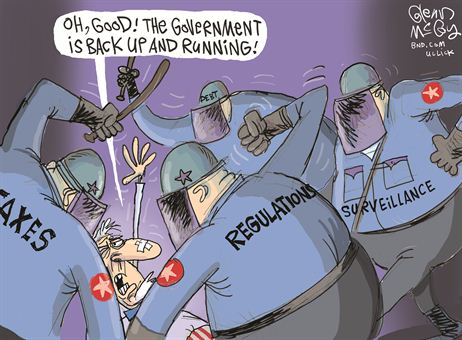
Contrary to the cartoon above, it’s not back up and running, though tax withholding and the impacts of regulatory rules continue unabated, and almost assuredly surveillance as well. After all (!), the federal government shutdown affects only “nonessential” activities of the federal government. Federal workers who are furloughed will receive back pay when the partial shutdown ends, but for now, federal spending is down roughly 25%.

The very real inconveniences for furloughed workers are regrettable. TSA employees continue to work while their paychecks are deferred indefinitely, though rates of absenteeism are high. So, we have slowdowns in security lines at airports, a lack of services at national parks (at least those not managed by private firms collecting revenue from visitors on-site), and a variety of other disruptions. For the time being, however, the lives of most Americans are largely unaffected. Except for the news coverage, my life hasn’t changed in any way, though I haven’t traveled during the shutdown.

Unfounded rumors about the shutdown have been rampant. For instance, I’ve heard that Social Security checks and weather forecasts would be suspended. Nancy Pelosi said the Secret Service would be unable to protect the President at the State of the Union address in the House chamber, a statement which the Department of Homeland Security promptly refuted. Many of the federal agencies with the highest shares of furloughed employees are regulators whose services are arguably counter-productive.

The White House Council of Economic Advisors (CEA) estimates that each additional week of the shutdown will reduce first quarter GDP growth by 0.13%. That means the interruption would take about 0.5% off first quarter growth if it lasts through January (say, from an annual rate of 2.5% to 2.0%). To the extent that people view the shutdown as temporary, and most do, the so-called “multiplier effects” of the shutdown should be relatively minor.

GDP is intended to measure of the value of the economy’s physical output. It is calculated in two independent ways based on 1) all income earned, and 2) the total of all spending on final (not intermediate) goods and services. Most components of final spending are well defined by the values assigned to goods and services traded in markets. Likewise, most incomes are based on the value assigned by labor markets to a given productive effort. Government “output”, however, is rather suspect as a component of spending because it is generally not subject to a market test of value. On the income side of the ledger, do government workers produce actual outputs? Some do, of course, but those outputs cannot be measured except by assigning a value based on what the workers are paid, and the payer is spending other peoples’ money! It’s not too speculative to suggest that the government’s output is a fraction of its spending. If that’s the case, the actual reduction in output caused by the shutdown is much smaller than the measured reduction in GDP. Therefore, the CEA’s estimates are a fiction.

To put an even finer point on it, many nonessential functions absorb resources while contributing very little to the nation’s wealth. Adam Brandon and John Tamny assert that private economic growth gives us the luxury of a large government sector, not the other way around. Government absorbs resources when it spends, but only by virtue of the taxes it imposes on private activity that is otherwise more highly productive. In the long run, as Brandon and Tamny argue, a smaller government (given a permanent shutdown of certain functions) might well yield greater economic output, not less.

Read this interesting essay for a discussion of the wasted, even counterproductive, utilization of human resources in government:

“They do nothing that warrants punishment and nothing of external value. That is their workday: errands for the sake of errands — administering, refining, following and collaborating on process. ‘Process is your friend’ is what delusional civil servants tell themselves. Even senior officials must gain approval from every rank across their department, other agencies and work units for basic administrative chores.

Process is what we serve, process keeps us safe, process is our core value. It takes a lot of people to maintain the process. Process provides jobs. In fact, there are process experts and certified process managers who protect the process. Then there are the 5 percent with moxie (career managers).

Again, many and perhaps most Americans view the shutdown itself with a certain degree of cynicism. In “America’s shutdown indifference“, Matthew Walther recalls this entertaining aspect of the last shutdown under President Obama:

“…of barriers being erected around various D.C.-area landmarks, including open-air war memorials. To this day I cannot think of any good reason for this save sheer caprice. If the idea was that 550-foot obelisks made of granite simply could not be meaningfully serviced during those lean two weeks in 2013, then who was responsible for putting up the rent-a-fence barricades around them? Civic-minded volunteers? The U.S. Marine Corps? Barack Obama himself? It was beautifully cynical, and I congratulate whoever came up with it.”

Both sides of the aisle play politics at the expense of the federal workforce. I certainly don’t wish to denigrate all federal workers. They perform varied functions and many are hard-working individuals. But still, it’s hard to feel very sorry for them given that they out-earn their private sector counterparts at almost every education level. Again, here’s Walther:

“Government employees, at both the state and federal level, are among the only workers in the United States who continue to be represented by powerful unions, despite the fact that by definition they’re not bargaining against capital but against their fellow citizens.”

I haven’t even mentioned the debate over open borders and the proposed wall, but that’s not my purpose here. All parties to that debate seem to think the shutdown is unlikely to harm their side politically. That’s either because the shutdown isn’t perceived as very impactful, or the “other” side can be blamed. One theory making the rounds is that the shutdown is part of a larger plan to institute permanent Reductions in Force (RIFs) at federal agencies, which are permissible after a furlough of 30 days or more (by January 19th). The argument plausibly suggests that some federal agencies might operate more effectively once the bureaucracy is pruned back via furloughs and/or RIFs. That’s especially true if “deep-state” sabotage of efforts to roll-back regulations are as common as the author asserts. Is the shutdown therefore a trap for unsuspecting congressional Democrats? Who knows, but to my way of thinking, government RIFs might even be worth the trouble of building a wall!

Government Output: Illusions and Handicaps

09 Sunday Sep 2018

Posted by Nuetzel in Big Government

≈ Leave a comment

Tags

Daniel J. Mitchell, Education, GDP, Heritage Foundation, Industrial Policy, infrastructure, Market Test, National Income Accounting, Redistribution, Spending Aggregates, Taxes Incentives

Building a big government is thought to be a luxury that prosperous nations can afford, but such efforts have a systematically negative effect on their ability to generate income, much as eating the seed corn delivers a farmer to poverty. Daniel J. Mitchell puts it bluntly in a piece entitled “Rich Nations That Enact Big Government Don’t Remain Rich“. This is nowhere more obvious than in Argentina and Venezuela, two nations that were prosperous 50 years ago and are now economically feeble, or in Venezuela’s case, imploding. Government, in the final analysis, extracts resources from the private economy, often contributing negatively to productivity. Yet the idea that government is a tonic for economic growth persists, and it persists even in the face of weakness induced by excessive government.

Government statistics on Gross Domestic Product (GDP) exaggerate the contribution of government to income in at least a couple of ways. To understand why, it’s necessary to distinguish between spending aggregates and income aggregates, which add up to the same total GDP. The former  include consumption, investment, and government spending. Income aggregates are the other side of the GDP “coin”: payments made to factors of production, which represent GDP as a measure of output value.

A dissociation between these alternative views of GDP with respect to government’s contribution is that government payments count as spending and income regardless of the recipient’s contribution to output. Even if nothing is accomplished, nothing is produced, it is measured as income and spending and it is an increment to GDP. Payments to dig holes and refill them contribute to GDP as long as the government does the “job”. By contrast, if a worker in the private sector is paid but produces nothing of value, the firm’s owners suffer a loss of income corresponding to the worker’s pay, and GDP is unchanged! So increased factor payments by government cause an implicit bias in the measurement of output.

A second government bias implicit in GDP statistics is that public spending and government labor payments are often not subjected to a “market test” of value. The activity is “mandated”, so there is no correspondence to a willingness to pay or real value. Public employee unions exaggerate these distortions. There are generally no competitors for government provision of services, few incentives for efficiency, and often little discipline in government procurement processes. So the pricing of government transactions tends to be inflated. And yet when the government gets ripped off by overcharges or cronyist kickbacks, the excess payments contribute positively to GDP. In contrast, when a private firm gets ripped off, its income is correspondingly reduced and the transaction generally will not contribute to GDP.

It takes taxes to fund government, either immediate or deferred, and the taxes are either explicit or implicit in the form of eroded purchasing power. This creates negative incentives that retard private investment incentives, work incentives, and thereby private economic growth. Redistributional efforts retard work incentives as well because welfare–state beneficiaries often face high marginal tax rates on earned income.

Does big government represent a good investment for the wealth of a prosperous nation? In view of the above, one can hardly trust official statistics in rendering a judgement on that question. But despite these distortions, big government and measured economic growth are still negatively correlated. Mitchell provides more detailed analysis of government and economic growth at Heritage, including a set of references to academic papers on the topic.

One important way that government may contribute to economic growth is through the provision of physical infrastructure, which theoretically improves efficiency in private production. However, public infrastructure spending is subject to the same upward cost pressures discussed above, it is often tied to bumbling industrial policy efforts, its utilization by the public is usually mis-priced, and governments are congenitally inept at operating facilities efficiently. It is not clear that private developers could be counted upon to fill the void without some form of partnership with government, however, which has its own pitfalls. There are certainly reforms that could make private and public infrastructure investment and operation more viable, such as eliminating regulatory roadblocks to the installation of new facilities.

Another area in which government may generate a positive economic return is public investment in education, but that return is far from guaranteed. The success of public education investment depends on a wide range of cultural, political, and economic factors. For example, Cuba has the third largest proportion of government education spending to GDP, but the country’s ability to profit from that investment is severely crimped by its totalitarian economic and political system. I have been a frequent critic of public education in general, and I am not persuaded that education is truly a public good, despite some degree of spillover benefit. And while education may be a worthwhile national priority in many circumstances, it is not clear that government should necessarily fund education, let alone “run” education. Public education spending certainly doesn’t automatically translate to effective education outcomes, and it does not guarantee economic growth.

There is great exaggeration regarding the success of certain nations that have allowed government to absorb a large share of resources. That includes many of the European states, for which average incomes are roughly comparable to the Mississippi Delta. Only Luxembourg, Norway and Switzerland have income levels that are respectable relative to the U.S., and Norway relies heavily on oil extraction. Attributing economic power to government in the Nordic countries is especially misleading because the strength of those economies has always stemmed from their fundamentally capitalist underpinnings. Sweden built its wealth on capitalism, but it has cannibalized that strength over several decades with a burgeoning welfare state and high taxes. It only recently has begun attempting to reverse course.

Economic progress is unlikely to be achieved by “investing” in a larger public sector. Instead, encouraging private activity via positive incentives and minimal regulatory interference is a better route to success. The measured economic benefits of government spending are illusory to a significant degree. Even those activities thought to be the most productive avenues for government involvement, like investment in infrastructure and education, are plagued by cost inflation and incompetent execution. Finally, cross-country empirical evidence confirms that a more dominant public sector is associated with lower income growth. And yet there will always be a faction subscribing to the infantile, “free-lunch” belief that big government can deliver growth, and deliver it in excess of the predictable damage it inflicts on the private economy.

New Socialists Fail Socialism 101

02 Sunday Sep 2018

Posted by Nuetzel in Big Government, Socialism

≈ Leave a comment

Tags

Alexandria Ocasio-Cortez, Authoritarian, Compassion, Democratic Socialism, Exclusivity, Free Rider Problem, Imprimis, Jeffrey Tucker, Maine Wire, Matthew Gagnon, Means of Production, Private Goods, Public goods, Safety Net, Socialism, The Claremont Review of Books, William Vogeli

Not many self-styled socialists can actually provide a proper definition of socialism these days. That includes the celebrated Alexandria Ocasio-Cortez, the New York congressional candidate who has proven herself to be an incredible stumble-bum in numerous media appearances since her primary victory over incumbent democrat Joe Crowley. Maine Wire‘s Matthew Gagnon calls her “belligerently ignorant” as she tweets what she believes to be examples of democratic socialism. Gagnon dissects some of her flakey assertions. The sad truth is that Ocasio-Cortez is fairly typical of her generation, despite her dual college majors in economics and political science.

Gagnon notes that socialism is public ownership of the means of production. But socialism is somehow regarded as a “soft” version of communism: less authoritarian, perhaps. That premise deserves closer examination. There is only one way that the public sector can take possession of private property: by force. A new, authoritarian regime might simply commandeer property, nationalize it, and revoke prior ownership claims at the point of a gun or a club. The government would ultimately impose new rules under which management of formerly private enterprises must operate, and it would engage in centralized decision-making and planning to a large extent. This is essentially communism. Some personal freedoms might be preserved, but they are likely to be severely curtailed; dissidence is not likely to be tolerated.

There is another mechanism by which society can declare public ownership of productive resources that is nominally less authoritarian: democracy. Citizens or their elected representatives simply vote for the state to acquire particular resources and enterprises, in whole or in part. Enabling legislation might authorize administrative agencies to determine how the former private owners of these enterprises are to be compensated. To one extent or another, this involves takings of private property and rights, and it boils down to a very real tyranny of the majority: we will vote to take possession of your business; we will vote to create a bureau that will determine its worth and your compensation; we will vote that henceforth you may not operate this business on your own behalf, but only in the service of the people; and we will vote on what rights you possess. This is the ugly tyranny of democratic socialism, and it still requires force.

Self-proclaimed socialists are fond of proclaiming that we already have socialism in many sectors of the economy. They cite public parks, roads, bridges, K-12 education, and other goods and services sometimes provided by the public sector. There is a key distinction, however, that separates many of these examples from actual socialism: whether a good is actually a “public good”, meaning that its benefits are non-exclusive, as opposed to a private good that yields exclusive benefits. A more precise definition of socialism, in my view, is public ownership of the means of producing private goods.

The typical example of a public good is national defense: the benefits I receive do not reduce the benefits you receive, so those benefits are non-exclusive. I have little personal incentive to pay for national defense if anyone else is willing to pay for it, as I’ll receive the benefits anyway. But who will pay if everyone tries to free-ride on others? That’s why the provision of public goods is an appropriate function of government, and it is not generally what is meant by socialism. Gagnon is correct that government involvement in an activity is not the same as socialism, and he correctly ridicules some examples of governmental activities (and non-governmental activities like cooperatives) that Ocasio-Cortez believes to be socialism.

In contrast to public goods, private goods are exclusive in their benefits. The development of a private market can be counted upon to fulfill demands for such goods because private individuals are willing to pay. However, when government grants itself an advantaged position as a provider in such a market, such as a monopoly franchise, we can safely describe it as socialism. Many goods are not purely private, having some degree of non-exclusivity in their benefits. This is commonly asserted to be the case for K-12 education, but the matter is not as clear-cut as the public education establishment would have you believe. The bulk of the benefits to education accrue privately. Therefore, it is fair to describe public K-12 education in the U.S. as socialism. And it is largely a disaster.

Is a social safety net rightly described as socialism? Gagnon thinks not and, strictly speaking, the welfare state does not require public ownership of the means of production, only a means of redistribution. It requires funding, so private resources will be extracted via taxes, and the same is true of public goods. Taxes do not make it “socialism”. Let’s stipulate for the moment that there is a true safety net supporting only those unable to support themselves, either on a temporary or a permanent basis. This may yield non-exclusive benefits to the extent that such a “lifeline” reduces crime, begging, and our personal discomfort with the possibility that other individuals might starve. However, on an ex ante basis, some of these benefits represent a form of risk reduction that, in principle, could be arranged privately. To the extent that we vote to provide these potentially private benefits, those parts of the safety net can be construed as democratic socialism. In practice, our “safety net” covers a large number of able-bodied individuals. Unfortunately, it does a poor job of encouraging self-sufficiency. Like most public benefit programs, it is expansive, poorly designed, and has pernicious effects on the private economy that act to the long-term detriment of its intended beneficiaries.

Leftists fancy that socialism is “compassionate” and righteous, despite its predictably harsh outcomes. The misleading conceit that universal alms-giving by the state is always empowering to individual recipients, and potential voters, is an extremely corrosive element of democratic socialism. William Voegeli, Senior Editor of The Claremont Review of Books, writing in Imprimis makes “The Case Against Liberal Compassion“. (I dislike his misuse of the word “liberal” — too many conservatives are willing to cede that label to the Left.) Voegeli notes the “never enough” mentality of welfare statists, who refuse to acknowledge that the expansive growth of the welfare state over the past five decades has failed to reduce rates of poverty. The programs are rife with fraud, waste and bad incentives. If leftists are truly compassionate, Voegeli insists, they ought to take more interest in fixing problems that leave less for the truly needy and create dependencies rather than simply increasing the flow of funding.

Many well-meaning individuals are careless about affiliating with socialist causes because they do not understand what it actually means, and they often lack any historical and theoretical perspective on the implications of socialism. The flirtation is dangerous, and we can only attempt to educate and reason with them. Some will grow into greater wisdom. Some, like Bernie Sanders, will never come around. While we educate, let’s keep their hands away from the reins of power.

Multipliers Are For Politicians

02 Wednesday May 2018

Posted by Nuetzel in Big Government, Fiscal policy, Stimulus

≈ 1 Comment

Tags

Countercyclical Policy, Fiscal Stimulus, Flexible Wages, Frederic Bastiat, Jakina R. Debnam, James Buchanan, Keynesian School, Matthew D. Mitchell, Milton Friedman, Multiplier Effect, Permanent Income Hypothesis, Procyclical Policy, Ricardian Equivalence, Richard Wagner, Spending Leakages, Underconsumption

Here’s a major macroeconomic sacred cow among professional economists and the politicians whose fiscal profligacy they enable: the presumed salutary effect of an increase in government spending on economic activity, including its so-called “multiplier effect”. Government fiscal stimulus is prescribed by the Keynesian school of economics to remedy any decline in the total demand for goods. A classic case is “underconsumption”, or excess saving, such that labor and capital resources are in excess supply. The idea is that government will mop-up some of this excess saving by borrowing and spending the proceeds on goods and services, putting resources back to work. In the standard telling, digging holes and refilling them is as effective as anything else. The increased income earned by those resources will be re-spent, creating income for the recipients and leading to repeated rounds of re-spending, each successively smaller due to “leakage” into saving. Adding up all these rounds of extra spending yields a multiple of the original government stimulus, hence the Keynesian multiplier effect. The stimulation of the demand for goods and services pushes the economy back in the direction of full employment, thus correcting the original problem of underconsumption. Nice story.

Keynesian economics is a short-run, demand-based framework that delineates behavior by the constructs of national income accounting, segmenting demand into consumer spending, investment in productive capital, government spending, and net foreign spending (net exports). Except for the limit imposed by full employment, the supply side of the economy and the processes giving rise to growth in productive capacity are ignored.

Within the Keynesian framework, can offer many qualifications to the story of a shortfall in demand to which even a dyed-in-the-wool Keynesian would agree. First, government stimulus cannot have an effect on the real economy at a time when the economy is operating at full capacity, or full employment. The increased government spending will only lead to bidding against other uses of the same resources, increasing the level of wages and prices.

Another qualification within the Keynesian framework is that the leakage from spending at each round of re-spending is made greater by taxes on marginal income, thus reducing the magnitude of the multiplier. In addition, some of the extra income will be spent on foreign goods — another leakage that reduces the multiplier effect on the domestic economy. In fact, this is why multipliers for spending at local levels are thought to be relatively small. The more local the analysis, the more income will be re-spent outside the locality at each round. More fundamentally, private parties should know that increased government borrowing must be repaid eventually. At some level, they know that additional taxes (or an inflation tax) will be necessary to do so. Therefore, their reaction to the additional income derived from government demand will be muted by the need to save for those future liabilities. Put differently, consumers do not view the gain as an increase in their permanent income. That’s essentially the mechanism underlying the “Ricardian equivalence” between methods of funding government spending (government debt or taxes).

In the “real world” there are many other practical problems that lead to ineffectual and even counter-productive government stimulus. One is the problem of cost control endemic to the public sector. Related to this are seemingly unavoidable timing issues. These factors have a strong tendency to make counter-cyclical fiscal programs too costly and too late. There is also the tendency toward graft and cronyism wherever the government spreads its largess. The “perfectibility of man” is certainly not evident in the execution of government stimulus programs. Their economic impacts often become pro-cyclical, or even worse, they become permanent increases in spending authority. More on the latter below.

Deeper objections to the Keynesian framework have to do with its demand-side orientation and the conceit that government, solely by borrowing and spending, can contribute to “real demand” and add to a nation’s output. And even if government spending takes up slack at a time of unemployed resources or excess supplies, it is unlikely to resolve the conditions that led to the decline in private demand. Therefore, even if government stimulus is successful in spurring a temporary increase in actual production and utilization of resources, it is likely to delay or prevent the downward wage and price adjustments necessary to permanently do so.

Recessions are typically characterized by an effort to work off over-investment in various sectors: housing, commercial structures, oil and gas extraction and processing, technology assets, inventories, or factories. Over-inflation of asset values is usually at the root of malinvestment, often accompanied by overinflation of wages and prices. These dislocations do not occur evenly, but the market process acts to correct misallocations and mispricing precisely where they occur. It might take time, but if government steps in to prop-up weak sectors, forgive the economic consequences of mistakes, and place more upward pressure on wages and prices, the dislocations will persist. So again, even if stimulus and the multiplier effect offer a short-term palliative, the benefits are illusory in a real sense. The long-run consequences of failing to allow markets to repair the damage will be negative.

One of the greatest skills that economists should possess is the ability to discern the most plausible counterfactual in a given situation: the world as it would have played out in the absence of a particular event, often a policy initiative. This is a great shortcoming among those who subscribe to the efficacy of government stimulus programs. In the scenario just described, there will be a decline in capital investment, consumption, and saving, but that saving, whatever its level, will still be channeled into capital investments unless the funds sit idle in bank vaults. If the saving is instead absorbed by the government’s effort to fund a stimulus program, even that reduced level of investment will not take place. The net effect is zero! Thus, the Keynesian stimulus and multiplier effect represent a failure of the economics profession to “see the unseen”, as Frederic Bastiat would have put it. Unless government can produce something of value to generate income, perhaps something that improves private returns, it will not contribute to income growth.

Permanent displacement of private capital investment is the most fundamental detriment of government fiscal activism. That it might well supplant private production should come as no surprise. Matthew D. Mitchell and Jakina R. Debnam describe the phenomenon this way:

“The tendency for ostensibly temporary spending to become permanent spending helps explain why policy makers fail to take the Keynesians’ advice when it comes to surpluses. Though governments invariable go into deficit during recessionary periods, they rarely run surpluses during expansionary periods.”

Mitchell and Debnam provide an interesting quote:

“… Richard Wagner and Nobel Laureate James Buchanan concluded: ‘Keynesian economics has turned the politicians loose; it has destroyed the effective constraint on politicians’ ordinary appetites. Armed with the Keynesian message, politicians can spend and spend without the apparent necessity to tax.'”

In a footnote, Mitchell and Debnam note that Milton Friedman once said, “Nothing is so permanent as a temporary government program.” The Keynesian prescription for stimulus allows politicians to assert that they are empowered to rescue the unemployed or those suffering a loss of income. They want you to believe that they can do something. The multiplier gives license to still greater mischief on the part of politicians, because it can help politicians sell almost any pork-barrel project. But continuing government expansion requires that it extract resources from the private economy. That’s true whether the government spends directly on goods or redistributes, and the mechanics of these processes involve additional resource costs. As long as government can borrow private savings, politicians will disguise the true cost of their munificence to constituents. Economists should not be their enablers.

The Bad News Industrial Complex

20 Friday Apr 2018

Posted by Nuetzel in Big Government, Corruption, Risk Management

≈ Leave a comment

Tags

Beepocalypse, Cronyism, Matt Ridley, NASA, News Media, Oxfam, Precautionary Principle, rent-seeking behavior, Risk Aversion, Risk Mitigation, The Lancet

Matt Ridley had an interesting piece on his blog last month entitled “Bad News Is Sudden, Good News Is Gradual“. It’s about the timing of news, as stated, and it’s about our bias toward bad news more generally. There is no question that bad news tends to be more dramatic than good news. But with steadily increasingly lifespans, growing prosperity, and world poverty at an all-time low, surely good news must come as much or more frequently than bad. But good news can be inconvenient to certain narratives. It is therefore often ignored, and some other purported disaster is found as a substitute:

“Poverty and hunger are the business Oxfam is in, but has it shouted the global poverty statistics from the rooftops? Hardly. It has switched its focus to inequality. When The Lancet published a study in 2010 showing global maternal mortality falling, advocates for women’s health tried to pressure it into delaying publication ‘fearing that good news would detract from the urgency of their cause’, The New York Times reported. The announcement by Nasa in 2016 that plant life is covering more and more of the planet as a result of carbon dioxide emissions was handled like radioactivity by most environmental reporters.“

Tales of bad outcomes can be alluring, especially if they haven’t happened yet. In fact, bad things might even happen gradually, but dark visions of a world beyond the horizon impart a spooky sense of immediacy, and indeed, urgency. Ridley notes the tendency of people to regard pessimists as “wise”, while optimists are viewed as Pollyannas. And he recognizes that risk aversion plays an important role in this psychology. That brings me to the point I found most interesting in Ridley’s piece: the many vested interests in disasters, and disasters foretold.

Risk management is big business in an affluent society. There is a lot to lose, and a squeamish populace is easily cowed by good scare stories. The risk management and disaster-prevention narrative can be wrapped around any number of unlikely or exaggerated threats, serving the interests of the administrative state and private rent-seekers. One particular tool that has been most useful to this alliance is the precautionary principle. It is invoked to discourage or regulate activities presumed to pose risks to the public or to the environment. But there are three dimensions to the application of the precautionary principle: it provides a rationale for public funding of research into the risk-du-jour, for funding projects designed to mitigate its consequences, and for subsidizing development of alternative technologies that might help avoid or reduce the severity of the risk, often at great expense. The exaggeration of risk serves to legitimize these high costs. Of course, the entire enterprise would be impossible without the machinery of the state, in all its venality. Where money flows, graft is sure to follow.

Well-publicized disaster scenarios are helpful to statists in other ways. Risk, its causes, and its consequences are not distributed evenly across regions and populations. A risk thought to be anthropomorphic in nature implies that wealthier and more productive communities and nations must shoulder the bulk of the global costs of mitigation. Thus, the risk-management ethic requires redistribution. Furthermore, wealthier regions are better situated to insulate themselves locally against many risks. Impoverished areas, on the other hand, must be assisted. Finally, an incredible irony of our preoccupation with disaster scenarios is the simultaneous effort to subsidize those deemed most vulnerable even while executing other policies that harm them.

Media organizations and their newspeople obviously benefit greatly from the subtle sensationalism of creeping disaster. As Ridley noted, the gradualism of progress is no match for a scare story on the nightly news. There is real money at stake here, but the media is driven not only by economic incentives. In fact, the dominant leftist ideology in media organizations means that they are more than happy to spread alarm as part of a crusade for state solutions to presumed risks. There are even well-meaning users of social media who jump at the chance to signal their virtue by reposting memes and reports that are couched not merely in terms of risks, but as dire future realities.

Mitigating social risks is a legitimate function of government. Unfortunately, identifying and exaggerating risks, and suppressing contradictory evidence, is in the personal interest of politicians, bureaucrats, crony capitalists, and many members of the media. Everything seems to demand government intervention. Carbon concentration, global warming and sea level changes are glaring examples of exaggerated risks. As Ridley says,

“The supreme case of unfalsifiable pessimism is climate change. It has the advantage of decades of doom until the jury returns. People who think the science suggests it will not be as bad as all that, or that humanity is likely to mitigate or adapt to it in time, get less airtime and a lot more criticism than people who go beyond the science to exaggerate the potential risks. That lukewarmers have been proved right so far cuts no ice.”

Other examples include the “beepocalypse“, genetic modification, drug use, school shootings, and certain risks to national security. Ridley offers the consequences of Brexit as well. There, I’ve listed enough sacred cows to irritate just about everyone.

In many cases, the real crises have more to do with government activism than the original issue with which they were meant to reckon. Which brings me to a discomfiting vision of my own: having allowed the administrative state to metastasize across almost every social organ and every aspect of our lives, a huge risk to our future well-being is continuing erosion of personal and economic liberties and our ability to prosper as a society. Here’s Ridley’s close:

“Activists sometimes justify the focus on the worst-case scenario as a means of raising consciousness. But while the public may be susceptible to bad news they are not stupid, and boys who cry ‘wolf!’ are eventually ignored. As the journalist John Horgan recently argued in Scientific American: ‘These days, despair is a bigger problem than optimism.'”

Federal Unaccountability Beyond My Wildest Dreams

06 Friday Apr 2018

Posted by Nuetzel in Big Government, Federal Budget

≈ Leave a comment

Tags

Accounting Adjustments, Black Projects, Catherine Austin Fitts, Congressional Budget Office, Department of Defense, Department of Housing and Urban Development, Forbes, General Accounting Office, Government Waste, Graft, Journal Vouchers, Laurence Kotlikoff, Mark Skidmore, Office of the Inspector General, Special Access Programs, The Solari Report

In December, Laurence Kotlikoff wrote in Forbes about large chunks of federal spending over many years that have not been reconciled with known accounting transactions. (The link is to a cached version of Kotlikoff’s article because Forbes blocks its site to those using adblockers). I first learned of these massive discrepancies at The Solari Report, which covered the issue in February. At first, I was so dumbfounded by the numbers that I thought it might have been a joke, or worse: fake news on Solari? But the story is real and it is shocking: $21 TRILLION of spending that cannot be explained, spanning the years 1998-2015! That’s more than five times the level of federal spending in 2017. It’s also shocking that the gap has gone almost unnoticed by the news media, though a few specifics have garnered attention at different stages of the disgorgement, as demonstrated by the various links provided in the Solari article.

The discrepancies are concentrated mainly in two departments of the federal government: Defense (DOD) and Housing and Urban Development (HUD). Kotlikoff quotes a description of the “accounting adjustments” from the Comptroller General of the General Accounting Office (GAO). These adjustments are akin to the entries people make in their checkbook registers when the balance can’t be reconciled to their bank statement:

“‘Journal vouchers are summary-level accounting adjustments made when balances between systems cannot be reconciled. Often these journal vouchers are unsupported, meaning they lack supporting documentation to justify the adjustment or are not tied to specific accounting transactions…. For an auditor, journal vouchers are a red flag for transactions not being captured, reported, or summarized correctly.'”

The article at Solari makes the following observations:

“There appear to be at least five possibilities: 1-The missing money was spent appropriately, but existing accounting infrastructure is incapable of tracking it. 2-The money was “wasted,” i.e. spent unwisely. 3-The money was directed into black projects and Special Access Programs in massive amounts outside the Constitutional appropriations process, and therefore without the knowledge of Congress and the citizenry, for purposes unknown. 4-The money was used to manipulate markets to maintain the reserve status of the dollar. 5-The money is being stolen by fraud and collusion between government and private interests. Or perhaps a combination of all of these.“

All five explanations represent a form of failure of governance or government administration. Some are more nefarious than others. While #1 might seem fairly innocuous, it nevertheless would demonstrate a slovenly approach to record-keeping and accountability as well as a ripe temptation to anyone seeking opportunities for graft. Furthermore, one cannot trust that #1 is the full explanation. The amounts are so massive that they far exceed the waste in government that even I thought possible. And no one in the federal agencies seems to have an explanation. Mark Skidmore, a Michigan State University economist who has studied the issue and made inquiries with these agencies, describes what sounds like a runaround. In December, however, the DOD announced a positive step: it’s first-ever department-wide independent audit. The Office of the Inspector General (OIG), the Congressional Budget Office, and the General Accounting Office are certainly aware of the discrepancies. Links to supporting documentation at the OIG and DOD web sites appear in both the Solari and Kotlikoff articles.

If these funds have been wasted or misused, taxpayers are the victims, of course. There are a few well-known examples of private and even public companies that have victimized investors to perhaps a similar (proportionate) extent over the years. Bernie Madoff and Exxon come to mind. But in general, public companies cannot escape demands that their books be in order and that they produce value over time. The federal government, however, has received a pass for this fecklessness over many years. Perhaps it’s because the public has such low expectations for the government’s effective use of tax dollars. Federal agencies such as HUD and DOD seem almost as budgetary “black holes” into which tax dollars are sucked, with an apparent lack of scrutiny.

Kotlikoff closes by urging a thorough investigation into the government’s cockeyed accounts:

“Taken together these reports point to a failure to comply with basic Constitutional and legislative requirements for spending and disclosure. We urge the House and Senate Budget Committee to initiate immediate investigations of unaccounted federal expenditures as well as the source of their payment.”

The Solari piece is no less emphatic in demanding a full probe of the causes of the budgetary discrepancies:

“We must recognize the possibility that massive fraud is being perpetrated against the American people. If that is not the case, it would take relatively little effort and expense to put that concern to rest. On the other hand, what malfeasance might investigation reveal, and who might be responsible?

At the very least, we should be asking the secretaries of DOD, HUD, and the Treasury, the chairman of the Federal Reserve, and the President of the NY Fed what they know, and we need independent audits of all those entities plus the Exchange Stabilization Fund. Anything less will be to acquiesce in an ongoing financial coup d’état.“

Deficits Are a Symptom of Statist Excess

12 Monday Feb 2018

Posted by Nuetzel in Big Government, Taxes

≈ 4 Comments

Tags

central planning, crowding out, Dead Weight Loss, Debt Financing, Economic Rents, Government Waste, Inflation tax, Price Incentives, Ricardian Equivalence, Tax Cuts & Jobs Act, TCJA, Trump Budget Proposal

One thing’s clear with respect to President Trump’s budget proposal and the ongoing debate over appropriations: federal spending will increase and add to future budget deficits. This follows the Tax Cuts and Jobs Act (TCJA) enacted late last year, which many expect to add upwards of $1 trillion to deficits over the next 10 years. I have offered mixed praise of some of the reforms and rate cuts in the TCJA, though it does not accomplish much in the way of tax simplification and it will almost certainly require a large increase in federal borrowing. Ultimately, however, dollar for dollar, a tax cut giving rise to a deficit inflicts lower (or even negative) costs on the private sector than an unfunded spending binge, which is costly in the most basic terms: resources devoured by government.

Cost of Spending

The cost of an extra dollar of government spending at the most basic level is the value of lost opportunities to which the resources absorbed by government otherwise could have been put. When the government spends an extra dollar, and if the government pays a competitive market price, the goods and services exchanged for that dollar by private party “A” would be valued at more than one dollar by other private parties who lost the opportunity to trade with “A” for those same goods and services.

There might be a strong case for incremental spending in any particular instance, of course. Can we benefit from more national defense? Infrastructure? Grants of foreign aid? Subsidies for this industry or that? This technology or that? This cultural program or that? Public aid? Primary research? Regulatory budgets? I’d favor very few of those as general spending priorities. However, there are many subcategories and so many special interests that it is difficult to control spending as long as compromise is needed to accomplish anything.

The Trump budget is a mix of cuts in non-defense spending and large increases in defense, infrastructure outlays, and border security. On balance, it would lead to substantially higher budget deficits over the next ten years. He won’t get all of what he wants, but it would be astonishing if larger deficits are not an outcome.

Unfortunately, government is typically inefficient in the execution of its tasks and it is less responsive to price incentives than private buyers, who are fully vested in “ownership” of the dollars they spend. Government agents, no matter how honorable, simply do not have the same kind of stake in the outcome as a private owner. Obviously, spending by federal agencies is influenced by the political process, which creates opportunities for side rewards for those who direct or influence spending and those who receive the payments. These side rewards are pure private rents arising from public largess. For a private party, the profitability of transacting with government may well exceed the normal return to capital or entrepreneurship. The efficiency of government spending is compromised by its political nature and the uneconomic behavior of government agents. I therefore have strong doubts about the cost-benefit comparison of almost any public initiative.

Un-Taxing

The government ultimately acquires its funds from taxes enforced via coercive power. After all, tax collection requires a considerable enforcement effort. A tax payment of one dollar requires the sacrifice of things that would have been acquired, now or in the future, in voluntary, private transactions valued more highly than one dollar by the taxpayer. That is the nature of gains from voluntary trade foregone. The result is that one dollar of taxation extracts more than one dollar of value from the private sector. Conversely, a reduced tax liability of one dollar means that private parties can engage in an extra dollar of voluntary trade and benefit from the surplus.

There are few forms of taxes that don’t distort incentives in the private market. Taxes may blunt incentives for work, saving, and deployment of capital in productive uses. To the extent that these private decisions are twisted by taxes in ways that differ from fully voluntary decisions, there is a further loss of value and resource waste. Eliminating these distortions is always a worthy goal.

Funding Deficits

Government has ways other than immediate taxation of paying for excess spending. One is to borrow from the public, domestic or foreign. Those who purchase the government’s debt, loaning their money to the government, do so voluntarily. That debt carries an interest obligation by the government, and it must repay the principle some day. That will require new taxes and their attendant distortions, even more borrowing, and/or some other method of extracting value from the private sector. A principle known as Ricardian equivalence holds that the effects of government outlays are the same whether financed by taxes or borrowing, because taxpayers know that future taxes will be owed to pay off government debt, and so they discount that liability into their behavioral calculus.

Additional borrowing can create an unstable financial environment if borrowing occurs at interest rates higher than the economy’s rate of growth. Borrowing might also “crowd out” private borrowers, absorbing saving that would otherwise be used to finance investment in the economy’s productive capacity. In other words, the resources acquired with that extra dollar of government spending will lead to less private investment and a sacrifice of future production.

Sneaky Inflation Tax

Another way that government can pay for spending is by imposing an inflation tax. This amounts to a devaluation of privately-held assets accomplished by inducing unexpected inflation. It allows government debt to be extinguished in the future with dollars having reduced purchasing power. Essentially, more currency (or its electronic equivalent) is placed into circulation: money printing, if you like. That sets up the “too-much-money-chasing-too-few-goods” inflation cycle. But like any other tax, the inflation tax is involuntary and creates waste by inducing the public to respond to distorted incentives.

Summary

An additional dollar of government spending absorbs a dollar of resources, and destroys more value than that given lost surplus to those who would otherwise have benefited from those resources. Moreover, the spending often fails to return a full dollar in benefits, often lining the pockets of elite grifters in the process. Ultimately, the funding for incremental spending must be commandeered from private parties via taxes or an inflationary taking of assets. Public borrowing might conceal the reality of taxes for a time, but it may crowd out productive investment that would otherwise enhance economic growth. So a case against incrementally larger government can be made in terms of resource costs as well as the distortionary effects of taxes and dissipation of future private growth.

By the same token, an ostensible reduction in taxes might be illusory, to the extent that future taxes or an inflationary taking will be necessary to cover the debt one day. On the other hand, there is no direct resource cost involved, and a tax reduction unbinds constraints and distortions on private incentives, which is unambiguously beneficial. And that’s true as long as the tax reductions aren’t targeted to benefit particular sectors, parties or technologies in any new misadventures in government central planning.

Deficits, in and of themselves, are either irrelevant or possibly damaging to long-term economic growth. You’ll get them with either tax cuts or spending hikes. But spending hikes absorb real resources, whereas tax cuts release resources by transforming a dead weight loss in private markets into proper gains from trade. If deficits are a problem, and if eliminating them requires costly tax distortions, then the real problem is the expanse of the state.

Progressives: Paul Doesn’t Want Peter’s Money? What a Hypocrite!

08 Thursday Feb 2018

Posted by Nuetzel in Big Government, Federal Budget

≈ Leave a comment

Tags

Blue States, Federal Transfers, Medicaid, Medicare, Megan McArdle, Mortgage Interest Deduction, Progressive Income Tax, Red States, Social Security, State and Local Tax Deduction, Tax Cuts and Jobs Act

Red & Blue States

I’ve heard the following assertion over and over: blue states are “doners” of federal tax revenue and red states are donees. In other words, states dominated by Democrats contribute more than they take from the federal budget, while Republican states take more than they contribute. But the facts are somewhat ambiguous. And to the extent that it is true, policies that would improve the net position of blue states would be very unpopular with the progressive Left. Furthermore, progressives expose their confusion regarding the ethics of sound governance by calling the red state opposition to an expansive  federal government “hypocritical”.

The relative positions of red and blue states in terms of federal dollars is the topic of an excellent article by Megan McArdle, whom I haven’t featured on this blog for a while. Originally, the claim that blue states “gave” to red states via the federal budget was based on data from 2005, but a lot of fiscal water has passed under (and over) the bridge since then. Also, the original presentation used state totals of federal outlays minus revenues without accounting for differences in the size of state populations. Many blue states are relatively populous, so some the state rankings may shift when expressed on a per capita basis. McArdle reproduces a chart from a report by the New York State Comptroller using 2013 data:

“… deep-blue New Jersey is the biggest donor state. But red-blooded Wyoming is the next biggest, and North Dakota makes the list too. There is certainly a preponderance of blue states at that end of the spectrum, but it’s not a clear ‘Donor states are blue’ story. And if we match the 2013 data to the closest election (2012) we find that New Mexico, the biggest net recipient, went for Obama in 2012, as did Virginia, Maryland, Maine and Hawaii. What’s driving the net subsidies isn’t anything as simple as political identification.“

Wyoming and North Dakota contributed lots of federal revenue from taxes arising from the fracking boom.

McArdle goes on to consider policies that would reduce the flow of budget dollars to donee states:

“Most of the transfers do not come from ‘red state welfare’ like agricultural subsidies. They derive from Social Security, Medicare, Medicaid, unemployment insurance, food stamps, welfare, the maintenance of the national highway system, the purchase of goods and services for the federal government, and the operation of federal facilities and lands.

If blue state liberals consider this out of whack, what do they want to change?

  • Do they want to move toward a flatter, less progressive federal tax code?
  • Do they want to cut Social Security, Medicare and Medicaid?
  • Do they want to return unemployment insurance and similar entitlement programs entirely to the states?
  • Do they want to hand over the national parks to the states, or privatize them?
  • Would they like to downsize the federal workforce?
  • Should we redistribute military bases from red states to blue? (Those relocations might meaningfully alter the state electorate, making it easier for Republicans to get elected. …)“

Of course not! But like McArdle, I’m of the opinion that many of the policy changes on that list, or at least reforms of existing policies, are in order. Perhaps the allure of steeply progressive federal taxes has faded for blue state Democrats with the new reality of the Tax Cuts and Jobs Act. The law restricts deductions for mortgage interest, a hit on those borrowing against high-end homes. It also limits deductions for state and local taxes, eliminating a federal tax subsidy to high-earners living in states with high taxes. State and local politicians who support high taxes will no longer receive a “discount”, courtesy of taxpayers in  other states, on the natural political liability of high taxes.

The categorization of blue states and red states as federal donors and donees is not quite as unambiguous as most Leftists imagine. Be that as it may, the flows of revenue and spending between the federal government and states is a consequence of demographics, regional business environments, and many other factors, but most of all the set of policies promulgated over the years in Washington DC. An objective assessment of the federal government’s largess indicates that most of those policies are in need of drastic reform, yet statists resist, demand more, and act as if “red states rubes” should be grateful for the dysfunction and the federal cash it brings. To progressives, it is hypocritical to oppose an expansive federal government on this basis. The absurdity of that claim is self-evident, but such is the confused state of progressive discourse. Perhaps a better adjective for red state opposition to federal profligacy would be “principled”.


A Trump Tax Reform Tally

03 Wednesday May 2017

Posted by Nuetzel in Big Government, Taxes, Trump Administration

≈ 1 Comment

Tags

Alternative Minimum Tax, Border Adjustment Tax, C-Corporation, Capex Expensing, Capital Tax, Carry Forward Rules, Child Care Tax Credit, Don Boudreaux, Double Taxation, Goldman Sachs, Immigration, Interest Deductibility, Kevin D. Williamson, Mortgage Interest Deduction, Pass-Through Income, Protectionism, Qualified Dividends, Revenue Neutrality, S-Corporation, Shikha Dalmia, Standard Deduction, Tax Burden, Tax Incentives, tax inversion, Tax Reform, Tax Subsidies, Territorial Taxes, Thomas Sowell, Trump Tax Plan

IMG_4199

The Trump tax plan has some very good elements and several that I dislike strongly. For reference, this link includes the contents of an “interpretation” of the proposal from Goldman Sachs, based on the one-page summary presented by the Administration last week as well as insights that the investment bank might have gleaned from its connections within the administration. At the link, click on the chart for an excellent summary of the plan relative to current law and other proposals.

At the outset, I should state that most members of the media do not understand economics, tax burdens, or the dynamic effects of taxes on economic activity. First, they seem to forget that in the first instance, taxpayers do not serve at the pleasure of the government. It is their money! Second, Don Boudreaux’s recent note on the media’s “taxing” ignorance is instructive:

“In recent days I have … heard and read several media reports on Trump’s tax plan…. Nearly all of these reports are juvenile: changes in tax rates are evaluated by the media according to changes in the legal tax liabilities of various groups of people. For example, Trump’s proposal to cut the top federal personal income-tax rate from 39.6% to 35% is assessed only by its effect on high-income earners. Specifically, of course, it’s portrayed as a ‘gift’ to high-income earners.

… taxation is not simply a slicing up of an economic pie the size of which is independent of the details of the system of taxation. The core economic case for tax cuts is that they reduce the obstacles to creative and productive activities.“

Boudreaux ridicules those who reject this “supply-side” rationale, despite its fundamental and well-established nature. Thomas Sowell makes the distinction between tax rates and tax revenues, and provides some history on tax rate reductions and particularly “tax cuts for the rich“:

“… higher-income taxpayers paid more — repeat, MORE tax revenues into the federal treasury under the lower tax rates than they had under the previous higher tax rates. … That happened not only during the Reagan administration, but also during the Coolidge administration and the Kennedy administration before Reagan, and under the G.W. Bush administration after Reagan. All these administrations cut tax rates and received higher tax revenues than before.

More than that, ‘the rich’ not only paid higher total tax revenues after the so-called ‘tax cuts for the rich,’ they also paid a higher percentage of all tax revenues afterwards. Data on this can be found in a number of places …“

In some cases, a proportion of the increased revenue may have been due to short-term incentives for asset sales in the wake of tax rate reductions. In general, however, Sowell’s point stands.

Kevin Williamson offers thoughts that could be construed as exactly the sort of thing about which Boudreaux is critical:

“It is nearly impossible to cut federal income taxes in a way that primarily benefits low-income Americans, because high-income Americans pay most of the federal income taxes. … The 2.4 percent of households with incomes in excess of $250,000 a year pay about half of all federal income taxes; the bottom half pays about 3 percent.”

The first sentence of that quote highlights the obvious storyline pounced upon by simple-minded journalists, and it also emphasizes the failing political appeal of tax cuts when a decreasing share of the population actually pays taxes. After all, there is some participatory value in spreading the tax burden in a democracy. I believe Williamson is well aware of the second-order, dynamic consequences of tax cuts that spread benefits more broadly, but he is also troubled by the fact that significant spending cuts are not on the immediate agenda: the real resource cost of government will continue unabated. We cannot count on that from Trump, and that should not be a big surprise. Greater accumulation of debt is a certainty without meaningful future reductions in the growth rate of spending.

Here are my thoughts on the specific elements contained in the proposal, as non-specific as they might be:

What I like about the proposal:

  • Lower tax rate on corporate income (less double-taxation): The U.S. has the highest corporate tax rates in the developed world, and the corporate income tax represents double-taxation of income: it is taxed at the corporate level and again at the individual level, perhaps not all at once, but when it is actually received by owners.
  • Adoption of a territorial tax system on corporate income: The U.S. has a punishing system of taxing corporate income wherever it is earned, unlike most of our trading parters. It’s high time we shifted to taxing only the corporate income that is earned in the U.S., which should discourage the practice of tax inversion, whereby firms transfer their legal domicile overseas.
  • No Border Adjustment Tax (BAT): What a relief! This was essentially the application of taxes on imports but tax-free exports. Whatever populist/nationalist appeal this might have had would have quickly evaporated with higher import prices and the crushing blow to import-dependent businesses. Let’s hope it doesn’t come back in congressional negotiations.
  • Lower individual tax rates: I like it.
  • Fewer tax brackets: Simplification, and somewhat lower compliance costs.
  • Fewer deductions from personal income, a broader tax base, and lower compliance costs. Scrapping deductions for state and local taxes in exchange for lower rates will end federal tax subsidies from low-tax to high-tax states.
  • Elimination of the Alternative Minimum Tax: This tax can be rather punitive and it is a nasty compliance cost-causer.

What I dislike about the proposal:

  • The corporate tax rate should be zero (with no double taxation).
  • Taxation of cash held abroad, an effort to encourage repatriation of the cash for reinvestment in the U.S. Taxes on capital of any kind are an act of repeated taxation, as the income used to accumulate capital is taxed to begin with. And such taxes are destructive of capital, which represents a fundamental engine for productivity and economic growth.
  • Retains the mortgage interest and charitable deductions: Both are based on special interest politics. The former leads to an overallocation of resources to owner-occupied housing. Certainly the latter has redeeming virtues, but it subsidizes activities conferring unique benefits to large donors.
  • Increase in the standard deduction: This means fewer “interested” taxpayers. See the  discussion of the Kevin Williamson article above.
  • We should have just one personal income tax bracket, not three: A flat tax would be simpler and would reduce distortions to productive incentives.
  • Tax relief for child-care costs: More special interest politics. Subsidizing market income relative to home activity, hired child care relative to parental care, and fertility is not an appropriate role for government. To the extent that public aid payments are made, they should not be contingent on how the money is spent.
  • Many details are missing: Almost anything could happen with this tax “plan” when the real negotiations begin, but that’s politics, I suppose.

Mixed Feelings:

  • Descriptions of the changes to treatment of pass-through” income seem confused. There is only one kind of tax applied to the income of pass-through entities like S-corporations, and it is the owner’s individual tax rate. Income from C-corporations, on the other hand, is taxed twice: once at a 15% corporate tax rate under the Trump plan, and a second time when it is paid to investors at an individual tax rate, which now range from 15% to almost 24% for “qualified dividends” (most dividend payments), but are likely to range up to 35% for “ordinary” dividends under the plan. So effectively, double-taxed C-corporate income would be taxed at total rates ranging from 30% to 50% after tallying both the C-corp tax and the individual tax. (This is a simplification: C-corp income paid as dividends would be taxed to the corporation and then immediately to the shareholder at their individual rate, while retained corporate income would be taxed later).

Presumably, the Trump tax plan is to reduce the rate on “pass-through” income to just 15% at the individual level, regardless of other income. (It is not clear how that would effect brackets or the rate of taxation on other components of individual income.) Is that good? Yes, to the extent that lower tax rates allow individuals to keep more of their hard-earned income, and to the extent that such a change would help small businesses. S-corps have always had an advantage in avoiding double taxation, however, and this would not end the differential taxation of S and C income, which is distortionary. It might incent business owners to shift income away from salary payments to profit, however, which would increase the negative impact on tax revenue.

  • Interest deductibility and expensing of capital expenditures are in question. Interest deductibility puts debt funding on an equal footing with equity funding only if the double tax on C-corp income is fully repealed. Immediate expensing of “capex” would certainly provide an investment incentive (as long as “excess” expenses can be carried forward), and for C-corporations, it would certainly bring us closer to elimination of the double-tax on income (the accounting matching principle be damned!).
  • There is no commitment to shrink government, but that’s partly (only partly) a function of having abandoned revenue neutrality. It’s also something that has been promised for the next budget year.
  • The tax reform proposal represents a departure from insistence on revenue neutrality: On the whole, I find this appealing, not because I like deficits better than taxes, but because there may be margins along which tax policy can be improved if unconstrained by neutrality, assuming that the incremental deficits are less damaging to the economy than the gains. The political landscape may dictate that desirable changes in tax policy can be made more easily in this way.

Shikha Dalmia wonders whether a real antidote for “Trumpism” might be embedded within the tax reform proposal. If the reforms are successful in stimulating non-inflationary economic growth, a “big if” on the first count, the popular preoccupations inspired by Trump with immigration policy, the “wall” and protectionism might just fade away. But don’t count on it. On the whole, I think the tax reform proposal has promise, though some of the good parts could vanish before a bill hits Trump’s desk, and some of the bad parts could get worse!

← Older posts
Newer posts →
Follow Sacred Cow Chips on WordPress.com

Recent Posts

  • The Case Against Interest On Reserves
  • Immigration and Merit As Fiscal Propositions
  • Tariff “Dividend” From An Indigent State
  • Almost Looks Like the Fed Has a 3% Inflation Target
  • Government Malpractice Breeds Health Care Havoc

Archives

  • January 2026
  • December 2025
  • November 2025
  • October 2025
  • September 2025
  • August 2025
  • July 2025
  • June 2025
  • May 2025
  • April 2025
  • March 2025
  • February 2025
  • January 2025
  • December 2024
  • November 2024
  • October 2024
  • September 2024
  • August 2024
  • July 2024
  • June 2024
  • May 2024
  • April 2024
  • March 2024
  • February 2024
  • January 2024
  • December 2023
  • November 2023
  • August 2023
  • July 2023
  • June 2023
  • May 2023
  • April 2023
  • March 2023
  • February 2023
  • January 2023
  • December 2022
  • November 2022
  • October 2022
  • September 2022
  • August 2022
  • July 2022
  • June 2022
  • May 2022
  • April 2022
  • March 2022
  • February 2022
  • January 2022
  • December 2021
  • November 2021
  • October 2021
  • September 2021
  • August 2021
  • July 2021
  • June 2021
  • May 2021
  • April 2021
  • March 2021
  • February 2021
  • January 2021
  • December 2020
  • November 2020
  • October 2020
  • September 2020
  • August 2020
  • July 2020
  • June 2020
  • May 2020
  • April 2020
  • March 2020
  • February 2020
  • January 2020
  • December 2019
  • November 2019
  • October 2019
  • September 2019
  • August 2019
  • July 2019
  • June 2019
  • May 2019
  • April 2019
  • March 2019
  • February 2019
  • January 2019
  • December 2018
  • November 2018
  • October 2018
  • September 2018
  • August 2018
  • July 2018
  • June 2018
  • May 2018
  • April 2018
  • March 2018
  • February 2018
  • January 2018
  • December 2017
  • November 2017
  • October 2017
  • September 2017
  • August 2017
  • July 2017
  • June 2017
  • May 2017
  • April 2017
  • March 2017
  • February 2017
  • January 2017
  • December 2016
  • November 2016
  • October 2016
  • September 2016
  • August 2016
  • July 2016
  • June 2016
  • May 2016
  • April 2016
  • March 2016
  • February 2016
  • January 2016
  • December 2015
  • November 2015
  • October 2015
  • September 2015
  • August 2015
  • July 2015
  • June 2015
  • May 2015
  • April 2015
  • March 2015
  • February 2015
  • January 2015
  • December 2014
  • November 2014
  • October 2014
  • September 2014
  • August 2014
  • July 2014
  • June 2014
  • May 2014
  • April 2014
  • March 2014

Blogs I Follow

  • Passive Income Kickstart
  • OnlyFinance.net
  • TLC Cholesterol
  • Nintil
  • kendunning.net
  • DCWhispers.com
  • Hoong-Wai in the UK
  • Marginal REVOLUTION
  • Stlouis
  • Watts Up With That?
  • Aussie Nationalist Blog
  • American Elephants
  • The View from Alexandria
  • The Gymnasium
  • A Force for Good
  • Notes On Liberty
  • troymo
  • SUNDAY BLOG Stephanie Sievers
  • Miss Lou Acquiring Lore
  • Your Well Wisher Program
  • Objectivism In Depth
  • RobotEnomics
  • Orderstatistic
  • Paradigm Library
  • Scattered Showers and Quicksand

Blog at WordPress.com.

Passive Income Kickstart

OnlyFinance.net

TLC Cholesterol

Nintil

To estimate, compare, distinguish, discuss, and trace to its principal sources everything

kendunning.net

The Future is Ours to Create

DCWhispers.com

Hoong-Wai in the UK

A Commonwealth immigrant's perspective on the UK's public arena.

Marginal REVOLUTION

Small Steps Toward A Much Better World

Stlouis

Watts Up With That?

The world's most viewed site on global warming and climate change

Aussie Nationalist Blog

Commentary from a Paleoconservative and Nationalist perspective

American Elephants

Defending Life, Liberty and the Pursuit of Happiness

The View from Alexandria

In advanced civilizations the period loosely called Alexandrian is usually associated with flexible morals, perfunctory religion, populist standards and cosmopolitan tastes, feminism, exotic cults, and the rapid turnover of high and low fads---in short, a falling away (which is all that decadence means) from the strictness of traditional rules, embodied in character and inforced from within. -- Jacques Barzun

The Gymnasium

A place for reason, politics, economics, and faith steeped in the classical liberal tradition

A Force for Good

How economics, morality, and markets combine

Notes On Liberty

Spontaneous thoughts on a humble creed

troymo

SUNDAY BLOG Stephanie Sievers

Escaping the everyday life with photographs from my travels

Miss Lou Acquiring Lore

Gallery of Life...

Your Well Wisher Program

Attempt to solve commonly known problems…

Objectivism In Depth

Exploring Ayn Rand's revolutionary philosophy.

RobotEnomics

(A)n (I)ntelligent Future

Orderstatistic

Economics, chess and anything else on my mind.

Paradigm Library

OODA Looping

Scattered Showers and Quicksand

Musings on science, investing, finance, economics, politics, and probably fly fishing.

  • Subscribe Subscribed
    • Sacred Cow Chips
    • Join 128 other subscribers
    • Already have a WordPress.com account? Log in now.
    • Sacred Cow Chips
    • Subscribe Subscribed
    • Sign up
    • Log in
    • Report this content
    • View site in Reader
    • Manage subscriptions
    • Collapse this bar
 

Loading Comments...