• About

Sacred Cow Chips

Sacred Cow Chips

Category Archives: Big Government

Courts and Their Administrative Masters

04 Tuesday Apr 2017

Posted by Nuetzel in Big Government, Regulation

≈ 1 Comment

Tags

Administrative Law, Administrative State, Chevron Deference, Chevron USA, Clyde Wayne Crews, Competitive Enterprise Institute, Ilya Somin, Jonathan Adler, Kent Jordan, Natural Resources Defense Council, Neil Gorsuch, Philip Hamburger, Regulatory Dark Matter, Separation of Powers

IMG_4007

Supreme Court nominee Neil Gorsuch says the judicial branch should not be obliged to defer to government agencies within the executive branch in interpreting law. Gorsuch’s  opinion, however, is contrary to an established principle guiding courts since the 1984 Supreme Court ruling in Chevron USA vs. The Natural Resources Defense Council. In what is known as Chevron deference, courts apply a test of judgement as to whether the administrative agency’s interpretation of the law is “reasonable”, even if other “reasonable” interpretations are possible. This gets particularly thorny when the original legislation is ambiguous with respect to a certain point. Gorsuch believes the Chevron standard subverts the intent of Constitutional separation of powers and judicial authority, a point of great importance in an age of explosive growth in administrative rule-making at the federal level.

Ilya Somin offers a defense of Gorsuch’s position on Chevron deference, stating that it violates the text of the Constitution authorizing the judiciary to decide matters of legal dispute without ceding power to the executive branch. The agencies, for their part, seem to be adopting increasingly expansive views of their authority:

“Some scholars argue that in many situations, agencies are not so much interpreting law, but actually making it by issuing regulations that often have only a tenuous basis in congressional enactments. When that happens, Chevron deference allows the executive to usurp the power of Congress as well as that of the judiciary.”

Jonathan Adler quotes a recent decision by U.S. Appeals Court Judge Kent Jordan in which he expresses skepticism regarding the wisdom of Chevron deference:

Deference to agencies strengthens the executive branch not only in a particular dispute under judicial review; it tends to the permanent expansion of the administrative state. Even if some in Congress want to rein an agency in, doing so is very difficult because of judicial deference to agency action. Moreover, the Constitutional requirements of bicameralism and presentment (along with the President’s veto power), which were intended as a brake on the federal government, being ‘designed to protect the liberties of the people,’ are instead, because of Chevron, ‘veto gates’ that make any legislative effort to curtail agency overreach a daunting task.

In short, Chevron ‘permit[s] executive bureaucracies to swallow huge amounts of core judicial and legislative power and concentrate federal power in a way that seems more than a little difficult to square with the Constitution of the [F]ramers’ design.’

The unchecked expansion of administrative control is a real threat to the stability of our system of government, our liberty, and the health of our economic system. It imposes tremendous compliance costs on society and often violates individual property rights. Regulatory actions are often taken without performing a proper cost-benefit analysis, and the decisions of regulators may be challenged initially only within a separate judicial system in which courts are run by the agencies themselves! I covered this point in more detail one year ago in “Hamburger Nation: An Administrative Nightmare“, based on Philip Hamburger’s book “Is Administrative Law Unlawful?“.

Clyde Wayne Crews of the Competitive Enterprise Institute gives further perspective on the regulatory-state-gone-wild in “Mapping Washington’s Lawlessness: An Inventory of Regulatory Dark Matter“. He mentions some disturbing tendencies that may go beyond the implementation of legislative intent: agencies sometimes choose to wholly ignore some aspects of legislation; agencies tend to apply pressure on regulated entities on the basis of interpretations that stretch the meaning of such enabling legislation as may exist; and as if the exercise of extra-legislative power were not enough, administrative actions have a frequent tendency to subvert the price mechanism in private markets, disrupting the flow of accurate information about resource-scarcity and the operation of incentives that give markets their great advantages. All of these behaviors fit Crews’ description of “regulatory dark matter.”

Chevron deference represents an unforced surrender by the judicial branch to the exercise of power by the executive. As Judge Jordan notes in additional quotes provided by Adler at a link above, this does not deny the usefulness or importance of an agency’s specialized expertise. Nevertheless, the courts should not abdicate their role in reviewing an agency’s developmental evidence for any action, and the reasonability of an agency’s applications of evidence relative to alternative courses of action. Nor should the courts abdicate their role in ruling on the law itself. Judge Gorsuch is right: Chevron deference should be re-evaluated by the courts.

National Endowment for Rich Farts

08 Wednesday Mar 2017

Posted by Nuetzel in Big Government, Charity, Subsidies

≈ Leave a comment

Tags

Cliches of Progressivism, Constitutional convention, Grant Multiplier, Heritage Foundation, Identity Politics, Jeff Jacoby, Lawrence Reed, National Bureau of Economic Research, National Endowment for the Arts, National Public Radio, Politicized Art, Public Arts Funding, Stuart Butler

Wailing has begun over the possible defunding and demise of the National Endowment for the Arts (NEA). How could those cretins propose to eliminate an institution so very critical to promoting artistic expression? If that’s your reaction, you haven’t thought much about the main beneficiaries of federal sinkholes like the NEA. Granted, at $146 million annually, it is not a major federal budget item, but I’d rather not stoop to defend a lousy program because it’s small. So what’s my beef with the NEA, you ask? Read on.

First, any implication that the NEA is the lifeblood of the arts is laughable. No, the arts won’t die if federal funding is denied. Jeff Jacoby quotes figures suggesting that grants from the NEA represented less than 1% of all support for the arts and culture in the U.S. in 2015. Great art was created prior to the establishment of the NEA in 1965. Without the NEA, such bungles as “Piss Christ” would have met with less acclaim. As such a minor funding vehicle, eliminating the NEA won’t make much difference to artists, but it will end a subsidy for wealthy patrons, who can and do provide support for worthy projects, but also derive essentially private benefits from the federal arts spigot.

A large share of NEA grant money goes to non-profit organizations that are already subsidized to the extent that they are not taxed. (Let’s face it: the term “non-profit” itself is often a term of art.) Large arts organizations, which receive a significant share of NEA grants, often have highly-paid administrators and sumptuous facilities. Contributions to those organizations are tax-deductible for the donors. And few of those organizations provide art to the public for free or at a discount. Indeed, as noted at the last link, they often charge significant prices for attendance, and their audiences include a disproportionate percentage of high-income patrons.

Lawrence Reed argues persuasively that government need not subsidize the arts in an article in his series on the Cliches of Progressivism. Here are the highlights:

  • “Government funding of the arts… carries with it all the downsides of dependence on politics.
  • Claims that arts spending is magically “multiplied” are specious and usually self-serving, and never look at alternative uses of the same money.
  • Culture arises naturally and spontaneously among people who chose to interact with each other. Art is part of that, but it also competes with all sorts of other things people choose to do with their time and money.
  • If art is truly important, then the last thing we should want to do is politicize it or divert it toward those things that people with power think we should see or hear.”

Reed’s comment regarding “multipliers” might need some explanation in this context. The NEA’s defenders often claim that each dollar of NEA grant money results in multiple additional grants from other sources, but there is absolutely no evidence to support this claim except for a requirement that NEA grants be matched at the state level (not to mention a requirement for a state-level arts agency). Obviously, that represents another cost to taxpayers. It is quite possible, in fact, that the NEA and matching state grants act as substitutes for, and depress, private arts giving. See this piece in Forbes for more background. This NBER research utilized a large panel data set on individual charities and found only mixed support for the proposition that government grants encourage private contributions. In fact, the estimated effect was ambiguous for individual categories of charitable giving (which did not explicitly address the arts as a category). In any case, a positive cross-sectional effect of government grants on private giving for individual charities is consistent with a negative effect on other charities that do not receive public grants.

In a 20-year-old report from the Heritage Foundation, Stuart Butler offered a list of reasons to defund the NEA, which have held up well. Here, I provide eight that seem relevant:

  1. The arts will have more than enough support without the NEA: See above.
  2. Welfare for cultural elitists: See above. NEA grants fund a number of big and very elite organizations, but they would have you believe that it’s a veritable welfare program for the arts. That is a huge distortion. There is no question that the distribution of patrons of these organizations skews to the wealthy.
  3. Discourages charitable gifts to the arts: See above. Is the award of an NEA grant the equivalent of establishing a credit record to an arts organization? This might hold up for a few small organizations with projects the NEA has funded, but again, the support for this proposition is anecdotal and self-serving, and the numbers are small. And is there an implied stain on the legitimacy of any organization unable to win such a grant?
  4. Lowers the quality of American art: Committee decisions and central planning are not conducive to the spirit of creativity. Public institutions are often guided by political agendas, and government-sanctioned art stands in sharp contradiction to the ideal of free expression. Butler quotes Ralph Waldo Emerson: “Beauty will not come at the call of the legislature…. It will come, as always, unannounced, and spring up between the feet of brave and earnest men.”
  5. Funds pornography: this is not my hot button… it’s an issue only to the extent that public funds should not be used for purposes only flimsily in the public interest that many taxpayers find morally repugnant.
  6. Promotes politically correct art: See #4 above. The merits are then judged on the basis of criteria like race, ethnicity, and gender identity, not the quality of the art itself.
  7. Wastes resources: Butler offers a few examples of the waste at the NEA, a shortcoming common to all bureaucracies. The NEA funds organizations that behave as non-profit cronyists, engaging in lobbying efforts for more support. Butler also cites evidence that recipients of government grants in the UK hire more administrative staff than non-recipients, and tend not to reduce ticket prices.
  8. Funding the NEA disturbs the U.S. tradition of limited government: I suppose this goes without saying….

The federal government in the U.S. was granted a set of enumerated powers in the Constitution, and promoting the arts was not one of them. It wasn’t as if the subject didn’t come up at the Constitutional Convention. It did, and it was voted down. Today, entrenched interests at organizations like the NEA and National Public Radio distort the character of the constituencies they serve. In reality, those constituencies  are heavily concentrated among the cultural and economic elite. The NEA and NPR also promote the fiction that they are all that stand between access to the arts and culture and a bleak, artless dystopia. Give them credit for creating a fantasy about which the political left readily suspends disbelief.

Government As Hazard

10 Friday Feb 2017

Posted by Nuetzel in Big Government, Markets

≈ Leave a comment

Tags

Asymmetric Hyperbole, Bryan Caplan, Coercive Power, Corporatism, Federalism, Limited government, Pareto Optimal, Public Employee Unions, Supermajority, Vilfredo Pareto

national-bird

Lots of people think government can do good things, even if its always in fashion to wink about the state’s legendary incompetence. It can do lots of things, but the only way it can do them is by exercising its power to coerce. It’s simply impossible to form an effective government without granting it that power. We must hope it will do only good things, and there is reasonable consensus that its basic functions are good, at least in kind: national defense, law enforcement and protection of basic rights, and a judicial system. The mere performance of those functions requires coercive power, and funding them requires the coercive power of taxation.

To make things simple, for now let’s stipulate that all agree on both the necessary functions of government, some minimal scale and scope of those functions, and the taxes necessary to pay for them. We may all feel that we are better off. Anything in excess of that minimal portfolio as might be desired by an individual or group would necessarily make some feel better off and some feel worse off. Additional taxes would have to be collected to pay for it, and the activities themselves might be seen in some quarters as inappropriate, wasteful, or intrusive. Now, the coercion of the state becomes more binding on some individuals and groups. We no longer have a win-win proposition, and that is what  distinguishes marginal government activity from marginal private exchange. The latter is always predicated on mutual benefits for the transacting parties. In the jargon of economics, these voluntary, private trades are Pareto-improving moves, meaning that some individuals are made better off and no one is made worse off. In general, if all mutually beneficial trades are exploited, the final result is Pareto optimal (after Vilfredo Pareto), because no further activity can make anyone better off without making someone else worse off.

The limited government described in the hypothetical sounds as if it might be Pareto optimal, but let’s add a little more realism. Are there additional government functions that would improve well being without doing harm to anyone? There is general agreement that government should provide for other “public goods”, which would otherwise be under-demanded in the market, and under-provided, due the nonexclusive nature of their benefits (think public parks). Once those are provisioned, the outcome may be Pareto optimal. There may be unanimous agreement, as well, that government should take actions to mitigate certain external costs arising from private activity. (If some of the costs of private activity are not internalized, then those market transactions fail the test of Pareto improvement). These additional government functions require coercive power, of course. Now we are into more complex issues of public choice. The provision of goods with at least some public benefits requires judgement as to degree, and judgement is necessary as to the appropriate degree of mitigation of external costs when they are an issue. In other words, Pareto-improving moves get scarce once government assumes responsibilities beyond those described in our original hypothetical.

As the scale and scope of government grow, its coercive force must advance as well. Therefore, unanimous consent for this growth, and even widespread consensus, will be impossible to achieve. Its size will reach a level at which a substantial share of the population will assume the roles of “public servants”, all having a vested interest in the state’s continued growth, if only to boost their own pay. The potential conflict of those personal interests with the public interest could not be clearer. That’s a good reason to support strict limits on the size and power of government, not to mention restrictions on the power of public employees to unionize.

Those who wish for government to play a dominant role in society might think it’s all for the good. They might support changes in the rules of governance that facilitate the dominance and coercive power it confers upon them. That might include, for example, pushing the use of executive authority to extreme levels based on interpretations of complex, but often vague, legislation. It might include changes in parliamentary rules that make it easier for thin majorities of legislators to work their will. No doubt these rule  changes will lead to Pareto-degrading actions, though the ruling faction will be quite happy with their new powers.

But what happens when a shift in the balance of public opinion brings new leaders to power? Those leaders will inherit rules that facilitate their agenda and authority to exercise coercive power. No one at any point along the ideological spectrum should dismiss this sort of risk. That’s the spirit of a recent Bryan Caplan post, “Limited Government as Insurance“. Stretching powers in the service of particular policy goals may well backfire when those powers become available to an opposing faction:

“Imagine going back in time to January 20, 2009. Obama’s Inauguration Day. You’re a cheering fan. On that day, an angel appears and makes you this offer: If you give up on Obama’s best ideas, none of Trump’s worst ideas will happen either. Obamacare will never happen – but neither will Trump’s immigration policies. Would you take that deal?

I know, it’s a galling hypothetical. You want the good stuff without the bad stuff.“

Caplan characterizes strict limits on government as a form of insurance against the risk of swings in the balance of power. He also considers plausible reasons for rejecting such a deal: “the arc of the moral universe”, or, you think your side will ultimately win, and will win for all time; and “asymmetric hyperbole”, or, the greatness of your policies outweighs any damage the other side can do with the same powers. If you really believe those things, it might seem reasonable to take your chances on an expansive state with expansive powers! A preference for limited government, however, does not require the contorted logic required to reject this insurance.

The U.S. Constitution includes many provisions originally intended to limit government and the exercise of coercive power. Those protections from the state have eroded over time, a process hastened by increasingly flexible judicial interpretations of the founding document. Caplan notes that there are a number of mechanisms by which limited government can be made durable:

“Supermajority rules require more than a majority to act. Division of powers makes it hard for government bodies to accomplish anything on their own. Judicial review allows judges to invalidate acts of government. Federalism greatly reduces the cost of “voting with your feet.” If you think these institutions aren’t working, the obvious solution is to strengthen them. Impose more supermajority requirements. Divide more powers. Overturn legislation that fails to get support from six, seven, eight, or all nine Supreme Court Justices. Make states pay for their own spending with their own taxes, not federal grants.“

Then comes the most insightful, but most disheartening, part of Caplan’s post: real steps to limit government will never be taken:

“Limited government helps everyone in the long-run, but immediately hurts the ruling party. They fought hard to win power; now that they have it, they yearn to flex their muscles.“

We might see a federal department abolished here or there, and we might see certain regulations rolled back, but those steps will be selective. The powers that put them there in the first place can be reapplied in the future. We might see more “business-friendly” actions, but those will be selective as well. In other words, corporatism will persist. And we might see tax cuts, but that won’t reduce the government’s absorption of resources, which is driven by the spending side. While this sounds discouraging, I nevertheless admire Caplan’s characterization of limited government as insurance against the other side’s bad policies. If only we could pull it off!

Big-Time Regulatory Rewards

26 Tuesday Jul 2016

Posted by Nuetzel in Big Government, Central Planning, Regulation

≈ Leave a comment

Tags

Cronyism, Daniel Mitchell, Glenn Reynolds, Guy Rolnik, Harvard Business Review, Industrial Policy, James Bessen, Matt Ridley, Mercatus Center, Regdata, regressivity

Government Control

Why does regulation of private industry so often inure to the benefit of the regulated at the expense of consumers? In the popular mind, at least, regulating powerful market players restrains “excessive” profits or ensures that their practices meet certain standards. More often than not, however, regulation empowers the strongest market players at the expense of the very competition that would otherwise restrain prices and provide innovative alternatives. The more complex the regulation, the more likely that will be the result. Smaller firms seldom have the wherewithal to deal with complicated regulatory compliance. Moreover, regulatory standards are promulgated by politicians, bureaucrats, and often the most powerful market players themselves. If ever a system was “rigged”, to quote a couple of well-known presidential candidates, it is the regulatory apparatus. Pro-regulation candidates might well have the voters’ best interests at heart, or maybe not, but the losers are usually consumers and the winners are usually the dominant firms in any regulated industry.

The extent to which our wanderings into the regulatory maze have rewarded crony capitalists — rent seekers — is bemoaned by Daniel Mitchell in “A Very Depressing Chart on Creeping Cronyism in the American Economy“. The chart shows that about 40% of the increase in U.S. corporate profits since 1970 was generated by rent-seeking efforts — not by activities that enhance productivity and output. The chart is taken from an article in the Harvard Business Review by James Bessen of Boston University called “Lobbyists Are Behind the Rise in Corporate Profits“. Here are a couple of choice quotes from the article:

“Lobbying and political campaign spending can result in favorable regulatory changes, and several studies find the returns to these investments can be quite large. For example, one study finds that for each dollar spent lobbying for a tax break, firms received returns in excess of $220. …regulations that impose costs might raise profits indirectly, since costs to incumbents are also entry barriers for prospective entrants. For example, one study found that pollution regulations served to reduce entry of new firms into some manufacturing industries.”

“This research supports the view that political rent seeking is responsible for a significant portion of the rise in profits [since 1970]. Firms influence the legislative and regulatory process and they engage in a wide range of activity to profit from regulatory changes, with significant success. …while political rent seeking is nothing new, the outsize effect of political rent seeking on profits and firm values is a recent development, largely occurring since 2000. Over the last 15 years, political campaign spending by firm PACs has increased more than thirtyfold and the Regdata index of regulation has increased by nearly 50% for public firms.“

A good explanation of Bessen’s findings is provided by Guy Rolnik, including an interview with Bessen. Law Professor Glenn Reynolds of the University of Tennessee put his finger on the same issue in an earlier article entitled “Why we still don’t have flying cars“. One can bicker about the relative merits of various regulations, but as Reynolds points out, the expansion of the administrative and regulatory state has led to a massive diversion of resources that is very much a detriment to the intended beneficiaries of regulation:

“… 1970 marks what scholars of administrative law (like me) call the ‘regulatory explosion.’ Although government expanded a lot during the New Deal under FDR, it wasn’t until 1970, under Richard Nixon, that we saw an explosion of new-type regulations that directly burdened people and progress: The Clean Air Act, the Clean Water Act, National Environmental Policy Act, the founding of Occupation Safety and Health Administration, the creation of the Environmental Protection Agency, etc. — all things that would have made the most hard-boiled New Dealer blanch.

Within a decade or so, Washington was transformed from a sleepy backwater (mocked by John F. Kennedy for its ‘Southern efficiency and Northern charm’) to a city full of fancy restaurants and expensive houses, a trend that has only continued in the decades since. The explosion of regulations led to an explosion of people to lobby the regulators, and lobbyists need nice restaurants and fancy houses.“

Matt Ridley hits on a related point in “Industrial Strategy Can Be Regressive“, meaning that government planning and industrial regulation have perverse effects on prices and economic growth that hit the poor the hardest. Ridley, who is British, discusses regressivity in the context of his country’s policy environment, but the lessons are general:

“The history of industrial strategies is littered with attempts to pick winners that ended up picking losers. Worse, it is government intervention, not laissez faire, that has done most to increase inequality and to entrench wealth and privilege. For example, the planning system restricts the supply of land for housebuilding, raising property prices to the enormous benefit of the haves (yes, that includes me) at the expense of the have-nots. … 

Why are salaries so high in financial services? Because there are huge barriers to entry erected by government, which hands incumbent firms enormous quasi-monopoly advantages and thereby shelters them from upstart competition. Why are cancer treatments so expensive? Because governments give monopolies called patents to the big firms that invent them. Why are lawyers so rich? Because there is a government-licensed cartel restricting the supply of them.“

Ridley’s spirited article gives emphasis to the fact that the government cannot plan the economy any more than it can plan the way our tastes and preferences will evolve and respond to price incentives; it cannot plan production any more than it can anticipate changes in resource availability; it cannot dictate technologies wisely any more than it can predict the innumerable innovations brought forth by private initiative and market needs; it almost never can regulate any better than the market can regulate itself! But government is quite capable of distorting prices, imposing artificial rules, picking suboptimal technologies, consuming resources, and rewarding cronies. One should never underestimate the potential for regulation, and government generally, to screw things up!

God Save the Brexit

28 Tuesday Jun 2016

Posted by Nuetzel in Big Government, European Union

≈ Leave a comment

Tags

Bank of England, Brexit, European Union, Joel Kotkin, Liquidity Crisis, Megan McArdle, Paul Craig Roberts, Sohrab Ahmari, Tyler Cowan, U.K. Independence Party, United Kingdom


The British might have a bumpy transition to full independence following last week’s Brexit vote, but the European Union (EU) may now face a challenge to its very existence: the outcome of the British referendum amounts to a revolt against overbearing rule by a distant, authoritarian central government. The vote demonstrates resentment by many Brits to absurd regulation of many aspects of life, to the loss of sovereignty inherent in EU membership, and to the EU’s controversial immigration policies. Other members of the EU may face popular exit movements of their own, as sentiment in France and elsewhere is running strongly against the Union. Economist Joel Kotkin writes the following in his assessment of the Brexit vote:

“In the last economic expansion, something close to 70 percent of all the new jobs created went to non-U.K. citizens. …  In the media and polite circles in both parties, opposition to EU immigration has been widely denounced as racist. But, in reality, UKIP’s [U.K. Independence Party] leader, Nigel Farage, has spoken positively about continuing migration, largely non-white, from the Commonwealth, particularly for skilled workers. In contrast, Cameron’s failure to slow down the largely unregulated EU migration may have been the single largest factor behind the Brexit result.“

This was a vote for self-determination and also a vote for cultural identity. The left has been quick to call it racism, but Tyler Cowan, himself in the Remain camp, thinks that label is misleading in important ways:

 “Quite simply, the English want England to stay relatively English, and voting Leave was the instrument they were given. …  Much has been made of the supposed paradox that opposition to immigration is highest where the number of immigrants is lowest. Yes, some of that is the racism and xenophobia of less cosmopolitan areas, but it would be a big mistake to dismiss it as such or even to mainly frame it as such. Most of all it is an endowment effect. Those are the regions which best remember — and indeed still live — some earlier notion of what England was like. And they wish to hold on to that, albeit with the possibility of continuing evolution along mostly English lines. … The regularity here [comparing England to Denmark and Japan] is that the coherent, longstanding nation states are most protective of their core identities. Should that come as a huge surprise?“

Megan McArdle also takes a stab at illuminating the disconnect between those who believe in forging a European “nation” and those who prefer independence:

“Surrendering traditional powers and liberties to a distant state is a lot easier if you think of that state as run by ‘people like me,’ … particularly if that surrender is done in the name of empowering ‘people who are like me’ in our collective dealings with other, farther ‘strangers who aren’t.’ … The EU never did this work. When asked ‘Where are you from?’ almost no one would answer ‘Europe,’ because after 50 years of assiduous labor by the eurocrats, Europe remains a continent, not an identity.“

Those who had hoped for Britain to remain in the EU include elites who stood to gain from crony capitalism that benefits from heavy regulation, as well as collectivists whose naive ideals dictate government planning and a borderless world. Others may have hoped to profit from another upshot of a remain vote: the U.K., unlike other member states, still has its own currency and its own monetary authority (the Bank of England — BOE); as Paul Craig Roberts says, a British commitment to the EU, and adoption of the euro, would have greatly diminished London as a financial center, bringing potentially significant windfalls to major U.S. financial institutions.

Great Britain has its own economic problems, of course, and there is no guarantee that exit from the EU will pave an easy road to prosperity. The country is attempting to reign in budget deficits, but relatively slow economic growth is making that more difficult. The steep slide in the value of the pound after the Brexit vote will stimulate exports, but it makes imported goods more costly and has inflationary consequences. That makes the BOE’s job of conducting monetary policy tricky. Fears of a post-Brexit liquidity crisis and recession must be balanced against the inflationary impact of the cheaper pound.

Even worse, with or without the EU, politics in the U.K. tends increasingly toward statism. This is from Sohrab Ahmari in his article “Illiberalism: The Worldwide Crisis“:

“Then there is Britain, where the hard-left wing of Labour has taken over the party. Rising to the leadership in the aftermath of last year’s electoral rout, Jeremy Corbyn has broken the party’s peace with free enterprise and individual responsibility—the main reformist achievement of Tony Blair’s New Labour. The party once again longs for socialism and speaks the language of class warfare at home, while anti-Americanism, pacifism, and blame-the-West attitudes dominate its foreign policy. at home.“

From my perspective, the worst-case scenario for Britain is that post-Brexit economic policy will be marked by a continued drift toward government activism, and that “softening the Brexit blow” will be an additional pretext. I believe the British have something to gain from Brexit, but much of it will be frittered away by giving things over to government control. But then again, perhaps homegrown authoritarianism is preferable to imported varieties.

Unfortunately, the exit itself will be a bonanza to the rent-seeking class, as negotiation of its terms with the EU, and implementing the exit, promise to be complex exercises involving an army of technocrats. They should not be too eager to make regulatory concessions to the EU, or anyone else, in order to maintain close ties. The best approach would be to reduce trade barriers unilaterally, blunting the impact of the cheap pound on import prices while enjoying the favorable effect on exports.

My hope is that Brexit will prove to be an economic and cultural tonic for the U.K. in the long run. It would be far better for the country to use its power of self-governance to the good of private individuals, steering clear of government domination of economic activity and excessive regulation. Authorities should cultivate a light touch, allowing markets in the U.K. to do what they do best: promote the general welfare.


Mobility, Safety Nets & Sticky Webs

23 Thursday Jun 2016

Posted by Nuetzel in Big Government, Welfare State

≈ Leave a comment

Tags

Affordable Care Act, Andrei Schleifer, Basic Income Guarantee, Christopher Jencks, Curley Effect, David Henderson, Dependent Class, Don Boudreaux, Earned Income Tax Credit, Edward Glaeser, Employment Incentives, Extreme Poverty, Henry Hazlitt, Kathryn Edin, Labor Force Participation, Luke Shaefer, Marginal Revolution, Medicaid expansion, Michael Tanner, Milton Friedman, Mises Wire, Obamacare, Social Safety Net, Tyler Cowan, Universal Basic Income, Veronique de Rugy, War on Poverty, Welfare State, work incentives

image

We’re unlikely to reduce the share of the U.S. population living in economic dependency under the current policy regime. So many aspects of tax law, regulation and aid programs are designed as if to perpetuate or perhaps even worsen the situation. I’ve discussed this topic before on Sacred Cow Chips in “Degrees of Poverty and the Social Safety Trap“, and “Minority Politics and the Redistributionist Honey Trap“.

Many supporters of aggressive anti-poverty efforts take umbrage at any suggestion that government aid might discourage the poor from engaging in productive activities. They imagine an implication that the poor are “lazy”, perfidious or otherwise undeserving of assistance. Whether that is a misunderstanding or merely rhetorical bite-back, the fact is that it is rational to respond to incentives and there is no shame in doing so. Unfortunately, many assistance programs contain incentive traps or income “cliffs” that discourage work effort. This applies to food stamps, rent subsidies, Obamacare subsidies, and many more of the 120+ federal aid programs and other state and local programs.

Here’s a new example from a research abstract posted at Marginal Revolution: The Medicaid expansion had very negative effects on labor force participation. The funding for Medicaid expansion at the state level was authorized by the Affordable Care Act (ACA) — aka Obamacare, but only about half the states went along with it. From the abstract:

“I find a significant negative relationship between Medicaid expansion and labor force participation, in which expanding Medicaid is associated with 1.5 to 3 percentage point drop in labor force participation.“

The direction of impact is hardly unique, and as Tyler Cowen notes at the link:

“Work is good for most people, and it is even better for their future selves, and their future children too.“

The negative impact of Obamacare is more massive than the estimate above might suggest. Veronique de Rugy at Reason.com discusses how “Federal Programs Keep People Poor“. While most of her article is about the negative impact of high marginal tax rates on the employment prospects of the poor, she also recalls an ugly CBO estimate of the ACA’s impact:

“In 2014, the Congressional Budget Office—Congress’ official fiscal scorekeeper—revised its original estimate to report that because of the law, by 2024 the equivalent of 2.5 million Americans who were otherwise willing and able to work will have exited the labor force.“

There are several different channels through which the negative effects of the ACA operate: Small employers are incented to limit their hiring and the hours of employees, and federal subsidies (and sometimes state benefits) are available to individuals only so long as they remain below certain income thresholds. Again, this is typical of many government aid programs (the Earned Income Tax Credit (EITC) being an exception). More from de Rugy:

“When the government takes away a person’s benefits as his income goes up, it has the same effect as a direct tax. And remember, when you tax something, you usually get less of it. That means these programs can actually hinder income mobility: In order to continue receiving their government cash, individuals are forced to limit the amount they earn. Thus, they have an incentive not to try to climb the income ladder by putting in extra hours or signing up for job training and educational programs.“

Mises Wire recently carried a reprint of an essay by the great Henry Hazlitt, “How To Cure Poverty“. The gist of Hazlitt’s argument is that government largess simply cannot create wealth for society, but only diminish it. The mere process of redistributing the current “pie” consumes resources, but that is minor compared to the future reduction in the size of the pie brought on by the terrible incentives inherent in income taxation and many government benefit programs:

“The problem of curing poverty is difficult and two-sided. It is to mitigate the penalties of misfortune and failure without undermining the incentives to effort and success. … The way to cure poverty is … through … the adoption of a system of private property, freer trade, free markets, and free enterprise. It was largely because we adopted this system more fully than any other country that we became the most productive and hence the richest nation on the face of the globe. Through this system more has been done to wipe out poverty in the last two centuries than in all previous history.“

Harvard professors Edward Glaeser and Andrei Schleifer have written about “The Curley Effect: The Economics of Shaping the Electorate“, which posits that redistributive policies that are harmful to constituents can be rewarding to politicians. The paper deals with policies that encourage emigration of affluent voters away from cities, but which nevertheless reward politicians by increasing the proportion of their political base in the remaining constituency. It seems to apply very well to many major cities in the U.S. However, it certainly applies more broadly, across states and nations, when affluent people and their capital are mobile while the less affluent are not, especially when benefits are at stake. It’s no secret that promises of benefits are often attractive to voters in the short run, even if they are harmful and unsustainable in the long run.

The welfare state appears to have helped to sustain many of the poor at an improved standard of living after accounting for benefits, or it has prevented them from falling into “deep poverty”. However, it hasn’t succeeded in lifting the poor out of dependency on the state. Pre-benefit poverty rates are about the same as they were the late 1960s. In addition, Christopher Jencks observes that the “Very Poor” have in fact become poorer. That’s discussed in his review of “$2.00 a Day: Living on Almost Nothing in America” by Kathryn Edin and Luke Shaefer. Jencks presents statistics showing that those in the lowest two percentiles of the income distribution have suffered a fairly sharp decline in income since 1999. Many of these extremely poor individuals do not avail themselves of benefits for which they could qualify. In addition, the EITC requires earned income. A job loss is a wage loss and, if it goes on, a loss of EITC benefits. Unfortunately, work requirements are more difficult to meet in the presence of wage floors and other distortions imposed by heavy-handed regulation.

A guaranteed national income has become a hot topic recently. Michael Tanner weighs in on “The Pros and Cons…” of such a program. There are many things to like about the idea inasmuch as it could sweep away many of the wasteful programs piled upon each other over the years. It is possible to construct a sliding-scale guarantee that would retain positive incentives for all, as Milton Friedman demonstrated years ago with his negative income tax concept. However, as Tanner points out, there are many details to work out, and the benefits of the switch would depend upon the incentive structure built into the guarantee. As a political plaything, it could still be dangerous to the health of the economy and an impediment to income mobility. Don Boudreaux has registered objections to a guaranteed income, one of which is based on strengthening the wrongheaded argument that we derive all rights from government. Even more interesting is David Henderson’s take on a basic income guarantee. He finds that the budgetary impact of a $10,000 guarantee would equate to a 30% increase in government spending, and that assumes that it replaces all other assistance programs! Henderson also discusses the public choice aspects of income guarantees, as well as moral objections, and he concludes that there are strong reasons to reject the idea on libertarian grounds.

The economy is riddled with too many subsidies, penalties and bad incentives that distort the behavior of various groups. The well-to-do often benefit from subsidies that are every bit as distortionary as those inherent in many public assistance programs. They should all be swept away to restore a dynamic economy with the potential to lift even more out of poverty. There could be a role for a guaranteed income on the grounds that it is better than what we’ve got. But we should recall the words of Hazlitt, who reminded us that we’ve come so far on the strength of property rights, private initiative, and free trade. Left unfettered, those things can take us much farther than the ugly pairing of beneficence and coercion of the government behemoth.


Seeding the Grapes of Graft

23 Saturday Apr 2016

Posted by Nuetzel in Big Government, rent seeking

≈ Leave a comment

Tags

Alex Tabarrok, Barriers to Entry, Corporatism, Free Market Capitalism, Government Protection, Graft, Guy Rolnik, Industrial Concentration, Koch Industries, Marginal Revolution, Natural Monopoly, Pro-Market, rent seeking, Stigler Center

Government-Bounty-Hunter

Are you investing in graft and rent-seeking activity without knowing it? Is a significant share of your saving channeled into sectors that profit from political influence over politicians, regulators and government planners? Maybe it’s no surprise, and you knew all along that your capital backs firms who manipulate the political system to extract resources beyond what they can earn through honest production. You have an interest in the success of the rent seekers, and you might well get a tax benefit to go along with it!

All this is almost certainly true if your savings are in a 401k, an IRA, a public or private pension fund, or in publicly-traded stocks. These sources of investor funding are dominated by firms that rent seek…. an indication of just how far the cancer of corporatism has gone toward completely subverting free market capitalism. It can be turned back only by ending the symbiosis between industry and government and encouraging real competition in markets.

This question of investing in rent seekers is raised by Guy Rolnik at Pro-Market (the blog of the Stigler Center at the University of Chicago Booth School of Business):

“Put another way, are we facing an economic model in which tens of millions of Americans’ pensions are relying on the ability of companies to extract rents from consumers and taxpayers?“

Rolnik’s emphasis is primarily on mergers and acquisitions, industrial concentration, diminished competition, and monopoly profits extracted by the surviving entities. As Alex Tabarrok at Marginal Revolution notes, “The Number of Publicy Traded Firms Has Halved” in the past 20 years. At the same time, the trend in business startups has been decidedly negative. While I strongly believe in the benefits of a healthy market for corporate control, these trends are a sign that the rent seekers and their enablers in government are gaining an upper hand.

Monopoly must be condoned if there are natural barriers to entry in a market, but such monopolists are generally subject to regulation of price and service levels (complex issues in their own right). If there are other legitimate economic barriers to entry such as differentiated products and strong brand reputations, there is no reason for concern, as those are signs of value creation. And given the private freedom to innovate and compete, there is little reason to suspect that above-normal profits can persist in the long run, as new risk-takers are ultimately drawn into the mix. That is how a healthy economy works and how prices direct resources to the highest-valued uses.

Rent seekers, on the other hand, always have one of the following objectives:

Government Protection: Increased concentration in an industry is a concern if there are artificial barriers to entry. One sure way to protect a market is to enlist the government’s help in locking it down. This happens in a variety of ways: tariffs and other restrictions on foreign goods, patent protection, restrictions on entry into geographic markets, implicit government guarantees against risk (too big to fail), union labor laws, and complex regulatory rules and compliance costs that small competitors can’t afford. The upshot is that if we want more competition in markets, we must reduce the size of the administrative state.

Subsidies: Another aspect of rent seeking is the quest for taxpayer subsidies. These are often channeled into politically-favored activities that can’t be sustained otherwise, and the recipients are always politically-favored firms with friends in high places. This is privilege! Look no further than the renewable energy industry to see that politically-favored, subsidized, and uneconomic activities tend to be dominated by firms with political connections. Naturally, good rent-seekers have an affinity for central planning and its plentiful opportunities for graft. With big-government control of resources you get big-time rent seeking.

Contracts: Government largess also means that big contracts are there to be won across a range of industries: construction, defense, transportation equipment, office supplies, computing, accounting and legal services and almost anything else. Because these purchases are made by an entity that uses other people’s money, incentives for efficiency are weak. And while private firms may compete for these contracts, there is no question that political connections play an important role. As government assumes control of more resources, more favorable rent-seeking opportunities always appear.

Influencing public policy is a game that is much easier for large firms to play. Moreover, the revolving door between government and industry is most active among strong players. This is not to say that large corporations don’t engage in many productive activities. They often excel in their areas of specialization and therefore earn profits that are economically legitimate. However, when government is involved as a buyer, subsidizer or regulator, the rewards are not as strongly related to productive effort. These rewards include above-normal profits, a more dominant market position, a long-term pipeline of taxpayer funding, the prestige of running a large operation with armies of highly-skilled employees engaged in compliance activities, and prestigious appointments for officers. Some of these gains from graft are shared by investors… and that’s probably you.

For society, the implications of channeling saving into rent-seeking activities are unambiguously negative. To say it differently, the private return to rent seeking exceeds the social return, and the latter is negative. Successful rent seekers artificially boost their equity returns and may simultaneously undermine returns to smaller competitors. The outcomes entail restraint of trade and misallocation of resources on a massive scale. The public-sector largess that makes it all possible gives us high rates of taxation, which retard incentives to work, save and invest. If taxes aren’t enough to cover the bloat, our central bank (the Fed) is not shy about monetizing government debt, which distorts interest rates, inflates asset prices and  inflates the prices of goods. In the aggregate, these things warp the usual tradeoff between risk and return and worsen society’s provision for the future.

How should you feel about all this? And your portfolio? As an investor, you might not have much choice. It’s not your fault, so take your private returns where you can find them. Some firms swear off rent seeking of any kind, like Koch Industries, but it is not publicly traded. You could invest in a business of your own, but know that you might compete at a disadvantage to rent seekers in the same industry. Most of all, you should vote for lower subsidies, less regulation and less government!

Socialism Is Concentrated Power

10 Thursday Mar 2016

Posted by Nuetzel in Big Government, Capitalism, Markets

≈ 1 Comment

Tags

Charles Tiebout, Chelsea German, Concentrated Power, crony capitalism, Don Boudreaux, FEE, Foundation for Economic Education, John D. Rockefeller, Marian Tupy, monopoly, Police Power, Privilege, rent seeking, Richard Rahn, State Control, Tiebout Hypothesis, Vote With Their Feet

Power

Nobody likes to defend concentrated power, yet socialists earnestly crave power concentrated in the state. And state power is absolute power. They must imagine that those wielding state power, now and always, will be the sort of nice, benevolent folks they imagine themselves to be. Well, if only more power can be concentrated in the state, it will be alright. Good luck with that! Once granted, watch out.

While this sort of magical thinking might seem naive, another paradox of leftist thinking is even more befuddling: the never-yielding distrust of capitalism and private initiative, a system under which power is largely dispersed. The attitude is more than a little misanthropic. It’s as if socialists expect us to believe that someone forces us to engage in transactions with private sellers, transactions that are always unfavorable in some way. But every transaction in a private economy is voluntary, dependent only on how both parties assess benefits relative to costs. Anyone can make a bad deal, of course, and you might get ripped off by an unscrupulous buyer or seller from time-to-time. But you are free to perform due diligence. You are free to assess risks.

The left goes so far as to blame capitalism for poverty, demonstrating a complete disconnect with reality. For a better perspective on the economic miracles made possible by capitalism, I  recommend a few timely pieces of reading: economist Richard Rahn makes note of the incredible bounty of products and technology brought to us by capitalism. This includes transformative breakthroughs in almost every area of life: communication, computing, transportation, refrigeration, safety, food, medicine and on and on:

“Almost all of the great innovations came from those in the private sector who created them out of the desire for more wealth or just intellectual curiosity. The socialist countries have produced almost nothing — except for bread lines, coercive and destructive taxation and regulation, and gulags. Yet politicians all over the world proudly proclaim themselves to be socialists and attack the capitalist wealth creators and innovators — as if the real world had never existed.“

At the Foundation for Economic Education (FEE), Chelsea German and Marian L. Tupy offer ample evidence of capitalism’s successes as they shred an absurd opinion piece in Forbes magazine claiming that  capitalism “will starve humanity“:

“Throughout most of human history, almost everyone lived in extreme poverty. Only in the last two centuries has wealth dramatically increased. Early adopters of capitalism, such as the United States, have seen their average incomes skyrocket.“

German and Tupy have a more detailed post here with statistics showing dramatic increases in the standard of living enjoyed by poor households in the U.S., increases for which capitalism is largely responsible.

Last month, Don Boudreaux reflected on the well being of average Americans today compared to an individual at the extreme high end of the wealth distribution 100 years ago. Boudreaux catalogues the many ways in which John D. Rockefeller’s comforts were drastically inferior to those available today. He concludes that trading places with Rockefeller would be a questionable deal:

“Honestly, I wouldn’t be remotely tempted to quit the 2016 me so that I could be a one-billion-dollar-richer me in 1916. This fact means that, by 1916 standards, I am today more than a billionaire. It means, at least given my preferences, I am today materially richer than was John D. Rockefeller in 1916. And if, as I think is true, my preferences here are not unusual, then nearly every middle-class American today is richer than was America’s richest man a mere 100 years ago.“

I maintain that even when power is concentrated in large private companies, the situation is far preferable to concentrated power in government. First, private companies do not have the police power necessary for absolute government authority. They cannot force you to do anything. Second, private companies do not simply shuffle resources and up-charge, as the left might have you believe; they innovate and create value as an inducement to trade, a concept that is rare in state-controlled activities. When any form of competition is present, private companies discipline each other, encouraging better quality and restraint on the prices charged for their wares. Even trading with a monopolist confers gains from trade, despite its drawbacks relative to trade in competitive markets.

Of course, government is generally not confronted with competition, unless it’s prompted by citizens who “vote with their feet”, as described by Charles Tiebout. That kind of responsiveness argues for decentralized government, however. Government services are typically monopolized, but the “terms of trade” are often worse than a monopolist would offer. It’s difficult to refuse a government service or your obligation to pay, no matter how much you abhor it, and quality usually suffers due to the extreme lack of accountability to citizen-consumers.

Capitalism gets a bad rap when private businesses engage in rent-seeking. That behavior is characterized by attempts to influence government policy for the business’ own benefit, promoting subsidies, other public spending or tax policies that go to the bottom line, and regulatory actions that disproportionally harm competitors. Those efforts put the crony in crony capitalism. But note that rent seeking is not an inherent feature of capitalism. It is enabled by the existence of activist government, its control over resources and its police power. What this means is that cronyism is fostered by power concentrated within the halls of government. In other words, private power becomes more concentrated and more impervious to competitive forces when it is favored by government. That is pure privilege.

If you dislike concentrated power, then vote for small government!


Hamburger Nation: An Administrative Nightmare

04 Friday Mar 2016

Posted by Nuetzel in Big Government, Judicial Branch, Legislative Branch, Regulation

≈ 4 Comments

Tags

Administrative Law, Administrative State, Constitutional convention, Delegated Powers, Due Process, Extralegal Powers, Fourth Branch, George Akerlof, Glenn Reynolds, Ham Sandwich Nation, Ilya Somin, IRS Targeting, Ivan Carrino, Joseph Postell, Marginal Revolution, Mia Love, Michael Ramsey, Philip Hamburger, Richard Epstein, Robert Shiller, Rule of Consent, Takings, The Originalism Blog, Volokh Conspiracy

nanny-state

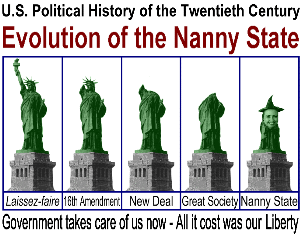
By what authority do unelected bureaucrats in administrative agencies increasingly make laws, enforce those laws and adjudicate violations? The fact that all of these activities take place within the executive branch of government appears to be an obvious contradiction of the separation of powers required by the first three articles of the Constitution, the principle of “Rule By Consent” of the governed, and protections of individual liberty. In a strong sense, the regulatory apparatus has grown so unwieldy that the powers routinely exercised by administrative agencies today seem beyond even the reach of elected executives. The rules promulgated by this “fourth branch” of government are essentially extralegal, a point discussed at length in Philip Hamburger’s “Is Administrative Law Unlawful“. He has also explained these issues at the Volokh Conspiracy blog in “Extralegal power, delegation, and necessity“, and “The Constitution’s repudiation of extralegal power“.

Hamburger examines the assertion that rule-making must be delegated by Congress to administrative agencies because legislation cannot reasonably be expected to address the many details and complexities encountered in the implementation of new laws. Yet this is a delegation of legislative power. Once delegated, this power has a way of metastasizing at the whim of agency apparatchiks, if not at the direction of the chief executive. If you should want to protest an administrative ruling, your first stop will not be a normal court of law, but an administrative review board or a court run by the agency itself! You’ll be well advised to hire an administrative attorney to represent you. Eventually, and at greater expense, an adverse decision can be appealed to the judicial branch proper.

This adds up to a dangerous lack of accountability and power. Marginal Revolution points out that critics of Hamburger’s book overlook the potential for harm that could be done by a “vindictive” president. But we should not lose sight of the fact that bureaucrats themselves, at any level, can be vindictive, as the IRS targeting scandal has shown. But that is only one motive for abuse of power; another motive may be more pervasive: the ability to reward those in a position to promote the self-interests of those who populate the administrative state. These are dangers that are endemic to big government. In a post entitled “Are Government Regulators More Virtuous than Everyone Else” (No!), Ivan Carrino highlights the weakness of arguments like those made by George Akerlof and Robert Shiller in “Phishing For Phools“, who call for greater government regulation on the grounds that consumers are vulnerable to manipulation by businesses. Carrino says:

“One can’t help but notice the central contradiction in this analysis. On the one hand, it is assumed that markets fail because of ‘normal human weakness.’ On the other hand, it is assumed that regulation, which must necessarily be implemented by human beings with equal or greater ‘weaknesses,’ will somehow solve the problem.

Akerlof and Shiller simultaneously demonize human beings who operate in the private sector while idealizing human beings who operate in the public sector.“

Glenn Reynolds has been a prominent critic of the administrative state. As a consequence of the vast and growing body of regulatory rules, it’s become increasingly difficult for individuals, acting on their own or as businesspeople, to know whether they are in acting in violation of administrative law. Reynolds discusses regulatory crime and over-criminalization in “You May Be Breaking The Law Right Now“, and in his great paper “Ham Sandwich Nation: Due Process When Everything is a Crime” (free download).

Hamburger’s main position is that law should be made by elected representatives, not by bureaucrats who lack direct accountability to voters. Ilya Somin believes that with time, Hamburger will have great influence on legal theorists in this regard. He compares Hamburger’s insights on administrative law to Richard Epstein’s work on takings. Epstein insisted that “almost all regulations that restrict property rights should be considered ‘takings’ that require compensation under the Fifth Amendment.” Somin notes that Epstein’s position, despite harsh criticism from certain quarters, has influenced legal thinking in a dramatic way over the years.

What’s to be done? Can a line reasonably be drawn between constitutional legislative power and delegated rule-making authority? Somin is skeptical that absolute restrictions on lawmaking by the administrative state are practical, in the sense that there will always be details that cannot be addressed in enabling legislation. Others have suggested practical paths forward: Joseph Postell attempts to give a roadmap in “From Administrative State to Constitutional Government“. A recent Glenn Reynolds op-ed, “Blow Up The Administrative State“, gives a qualified defense of Texas Governor Greg Abbot’s proposed amendments to the Constitution. Among other things, Abbot proposes to:

“–Prohibit administrative agencies … from creating federal law.
  –Prohibit administrative agencies … from preempting state law.
  –Give state officials the power to sue in federal court when … officials overstep their bounds.
  –Allow a two-thirds majority of the states to override a federal law or regulation.”

I would add that administrative review and adjudication should be independent of the agencies themselves. Also, Representative Mia Love (R-UT) has proposed legislation that would restrict Congress to bills focused on points directly related to a single issue (i.e., no omnibus bills), which would help to check the growth of the administrative state.

All of these measures seem consistent with Hamburger’s views. Reynolds is fully cognizant of the dangers of a constitutional convention. Nevertheless, he recognizes that Abbot’s proposals would impose harder limits on the size of government, and defends them in colorful fashion:

“A smaller government would mean fewer phony-baloney jobs for college graduates with few marketable skills but demonstrated political loyalty. It would mean fewer opportunities for tax dollars to be directed to people and entities with close ties to people in power. It would mean less ability to engage in social engineering and ‘nudges’ aimed at what are all-too-often seen as those dumb rubes in flyover country. The smaller the government, the fewer the opportunities for graft and self-aggrandizement — and graft and self-aggrandizement are what our political class is all about.“

For further reading, Michael Ramsey at The Originalism Blog posts links to several other essays by Hamburger at The Volokh Conspiracy, where he acted as a guest-blogger.


Gagging On Campaign Finance Reform

10 Wednesday Feb 2016

Posted by Nuetzel in Big Government, Campaign Finance

≈ Leave a comment

Tags

Bernie Sanders, Bipartisan Campaign Reform Act, Buckley v. Valeo, Bundler Disclosure, Campaign Contributions, Campaign Finance, Citizens United, Eigene Volokh, Elena Kagan, Federal Election Commission, First Amendment Protections, Hillary Clinton, Ilya Shapiro, Influence Spending, Jacob Sullum, Jeb Bush, Jeffrey Milyo, Jonathan Adler, Legislative Dysfunction, McCain-Feingold, McCutcheon v. FEC, Michael McConnell, Press Clause, rent-seeking behavior, Speechnow.org v. FEC, Spending Limits

campaign-finance-reform

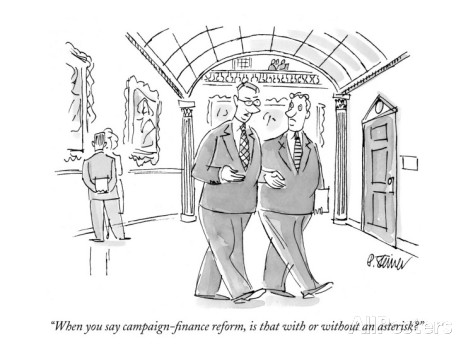
Campaign finance is an area of internal conflict for some libertarians. On one hand, they do not believe in restrictions of any kind on freedom of expression. That implies no limits on what an individual can spend in support of a political cause, by themselves or in association with others, and whether it merely promotes a point of view or supports a political candidate. At the same time, libertarians are strongly opposed to rent-seeking activity, or efforts to use government power to promote private interests. Political spending is seen by many as an avenue for rent seeking, which suggests to them a need for limits on campaign contributions.

In fact, full-throated support of free speech and opposition to campaign limits do not stand in conflict. The reasons are: 1) such limits are an assault on free speech; 2) campaign contributions represent “small change” in the larger scheme of rent-seeking pursuits; 3) contributions seldom represent direct efforts to influence policy; and 4) imposed limits have a detrimental effect on the ability of elected officials to do their jobs.

Speech

Free speech, long interpreted by the courts more broadly as free expression, is protected by the First Amendment to the U.S. Constitution. This includes political expression, but traditionally it included campaign contributions as well, the latter being an obvious mechanism by which one can express views. However, the Supreme Court has upheld statutory limits on individual contributions to specific campaigns, as well as disclosure rules, on the grounds that they prevent corruption (Buckley v. Valeo and more recently McCutcheon v. Federal Election Commission(FEC)). I view the contribution limits as a contravention of the First Amendment, denying an enumerated right on the grounds that it “might” lead to corruption. If preventing corruption is the sole rationale for these limits, then government itself should be sharply limited, as it most certainly leads to graft and corruption at the expense of relatively powerless taxpayers.

Citizens United

A well-known Supreme Court case decided in 2010 involved independent political speech, as opposed to expression of political preference revealed by campaign spending. This was Citizens United v FEC, in which the Court ruled that political speech cannot be restricted on any basis other than corruption. As described by Ilya Shapiro, the case is widely misunderstood. One point of interest here is that the case related to speech by an organization rather than an individual. The Court ruled that a corporation (a nonprofit in the case) could not be prevented from airing a film critical of Hillary Clinton, striking down provisions of the Bipartisan Campaign Reform Act of 1990 (McCain-Feingold) under the First Amendment.

The Citizens United decision was NOT about campaign contributions. As an interesting aside, in a search of cartoons related to campaign finance, a great many imply that the Supreme Court abolished such limits in Citizens United. It did not. Even given some level of disaffection, it is hard to account for the near-complete lack of understanding about the case.

More informed critics of the decision bemoan that fact that it allows speech by corporations (and unions and other associations) to go unlimited, though they don’t seem to mind the absence of limits on political speech by media corporations. (See Eugene Volokh’s view in the Brown Daily Herald and Michael McConnell’s reinterpretation of Citizen’s United as a Press Clause case in the Yale Law Journal.) The critics also fail to recognize that corporations are associations of individuals, who are otherwise subject to no restrictions on independent speech or on what they can spend to speak independent of any political candidate (as established in Speechnow.org v. FEC in 2010). The technical treatment of a corporation as a “person”, which many find objectionable, is beside the point. Only by distorting the meaning of the First Amendment can any limitation be placed on the freedom of individuals to speak in association with others.

Jacob Sullum covers the confused legal thinking of leading Democrats Hillary Clinton and Bernie Sanders on campaign finance reform, and on Citizens United in particular. Jeb Bush is no better. Most of the opposition to the decision centers around the notion of “balancing” speech, but Sullum offers a piece of wisdom from a 1996 quote of future Supreme Court Justice Elena Kagan: “the government may not restrict the speech of some to enhance the speech of others.”

Corporate Campaign Spending

Another point raised by Ilya Shapiro is that corporate spending growth has neither accelerated nor decelerated in the wake of Citizens United. Moreover, restrictions on direct campaign contributions are still in place. However, campaign contributions are a relatively small percentage of corporate “influence spending”, averaging roughly 10% of the total between 2007 and 2012 for 200 large “politically active” corporations. Thus, direct campaign contributions are unlikely to be the primary avenue for rent-seeking activity. They might help buy “access” to politicians, but they may not be especially effective in influencing policy. These points are supported by University of Missouri economist Jeffrey Milyo in “Politics Ain’t Broke, So Reforms Won’t Fix It“. Milyo marshals empirical evidence that should make us skeptical of campaign finance reform efforts.

Incapacitated Legislators

Jonathan Adler of Case Western emphasizes the legislative dysfunction created by campaign finance reforms. McCain-Feingold places limits on funds candidates can receive from their political parties and other sources, forcing them to spend a large proportion of their time on fundraising (and placing incumbents at a distinct advantage). If there is a shred of sincerity in the populist insistence that members of Congress be subject to tighter term limits, or that Congress is woefully unproductive, then full repeal of these limitations should be a priority.

Visibility Versus Effectiveness

The chief advantage of combatting corruption through regulating campaign finance is that it is a visible target. However, it is a target too rich with free speech implications. Disclosure requirements are one thing (through arguments can be made against infringements on the privacy of contributors as well). Limiting forms of expression outright is draconian, and reformers are unlikely to be satisfied until campaigns are funded entirely by taxpayers. Attacking “corruption” via limits on campaign contributions presumes a need to protect both contributor and recipient from their own guilt. Even if contributions help gain better access to an elected representative, it does not imply that the representative will act on motives counter to the perceived public merits of an issue. Moreover, the argument that limits on direct contributions to candidates “keep money out of politics” is flawed. Limits simply change the distribution of political spending, increasing the reliance on bundlers and organizations like Super PACs, and shifting the tables in favor of incumbents.

There are far better ways to combat corruption among legislators and others in government, some with more severe drawbacks than others. Term limits are one possibility, but would deny voters of legitimate choices. Another option is to allow candidates to have unrestricted access to campaign funds through central organizations, rather than forcing them to rely on independent Super PACs, which cannot always be relied upon to craft a candidate’s preferred messages. Immediate disclosure of contributors and amounts would help to bring more transparency to the campaign finance process. Stiffer disclosure requirements for “bundlers” would also help. Perhaps elected executives could be prohibited from appointing bundlers to positions of authority, though a precise definition of “bundler” might become contentious. There are other reform possibilities related to limiting permissible lobbying activity.

The libertarian’s dilemma with respect to campaign finance is easily resolved once the focus is placed squarely on protecting individual rights. In the end, the best defense of individual rights and against corruption in government is to limit government. It’s wise to place strong reigns on an institution that operates by virtue of coercive authority. The danger was well-acknowledged by the limits on government power enshrined in the Constitution.

← Older posts
Newer posts →
Follow Sacred Cow Chips on WordPress.com

Recent Posts

  • The Case Against Interest On Reserves
  • Immigration and Merit As Fiscal Propositions
  • Tariff “Dividend” From An Indigent State
  • Almost Looks Like the Fed Has a 3% Inflation Target
  • Government Malpractice Breeds Health Care Havoc

Archives

  • January 2026
  • December 2025
  • November 2025
  • October 2025
  • September 2025
  • August 2025
  • July 2025
  • June 2025
  • May 2025
  • April 2025
  • March 2025
  • February 2025
  • January 2025
  • December 2024
  • November 2024
  • October 2024
  • September 2024
  • August 2024
  • July 2024
  • June 2024
  • May 2024
  • April 2024
  • March 2024
  • February 2024
  • January 2024
  • December 2023
  • November 2023
  • August 2023
  • July 2023
  • June 2023
  • May 2023
  • April 2023
  • March 2023
  • February 2023
  • January 2023
  • December 2022
  • November 2022
  • October 2022
  • September 2022
  • August 2022
  • July 2022
  • June 2022
  • May 2022
  • April 2022
  • March 2022
  • February 2022
  • January 2022
  • December 2021
  • November 2021
  • October 2021
  • September 2021
  • August 2021
  • July 2021
  • June 2021
  • May 2021
  • April 2021
  • March 2021
  • February 2021
  • January 2021
  • December 2020
  • November 2020
  • October 2020
  • September 2020
  • August 2020
  • July 2020
  • June 2020
  • May 2020
  • April 2020
  • March 2020
  • February 2020
  • January 2020
  • December 2019
  • November 2019
  • October 2019
  • September 2019
  • August 2019
  • July 2019
  • June 2019
  • May 2019
  • April 2019
  • March 2019
  • February 2019
  • January 2019
  • December 2018
  • November 2018
  • October 2018
  • September 2018
  • August 2018
  • July 2018
  • June 2018
  • May 2018
  • April 2018
  • March 2018
  • February 2018
  • January 2018
  • December 2017
  • November 2017
  • October 2017
  • September 2017
  • August 2017
  • July 2017
  • June 2017
  • May 2017
  • April 2017
  • March 2017
  • February 2017
  • January 2017
  • December 2016
  • November 2016
  • October 2016
  • September 2016
  • August 2016
  • July 2016
  • June 2016
  • May 2016
  • April 2016
  • March 2016
  • February 2016
  • January 2016
  • December 2015
  • November 2015
  • October 2015
  • September 2015
  • August 2015
  • July 2015
  • June 2015
  • May 2015
  • April 2015
  • March 2015
  • February 2015
  • January 2015
  • December 2014
  • November 2014
  • October 2014
  • September 2014
  • August 2014
  • July 2014
  • June 2014
  • May 2014
  • April 2014
  • March 2014

Blogs I Follow

  • Passive Income Kickstart
  • OnlyFinance.net
  • TLC Cholesterol
  • Nintil
  • kendunning.net
  • DCWhispers.com
  • Hoong-Wai in the UK
  • Marginal REVOLUTION
  • Stlouis
  • Watts Up With That?
  • Aussie Nationalist Blog
  • American Elephants
  • The View from Alexandria
  • The Gymnasium
  • A Force for Good
  • Notes On Liberty
  • troymo
  • SUNDAY BLOG Stephanie Sievers
  • Miss Lou Acquiring Lore
  • Your Well Wisher Program
  • Objectivism In Depth
  • RobotEnomics
  • Orderstatistic
  • Paradigm Library
  • Scattered Showers and Quicksand

Blog at WordPress.com.

Passive Income Kickstart

OnlyFinance.net

TLC Cholesterol

Nintil

To estimate, compare, distinguish, discuss, and trace to its principal sources everything

kendunning.net

The Future is Ours to Create

DCWhispers.com

Hoong-Wai in the UK

A Commonwealth immigrant's perspective on the UK's public arena.

Marginal REVOLUTION

Small Steps Toward A Much Better World

Stlouis

Watts Up With That?

The world's most viewed site on global warming and climate change

Aussie Nationalist Blog

Commentary from a Paleoconservative and Nationalist perspective

American Elephants

Defending Life, Liberty and the Pursuit of Happiness

The View from Alexandria

In advanced civilizations the period loosely called Alexandrian is usually associated with flexible morals, perfunctory religion, populist standards and cosmopolitan tastes, feminism, exotic cults, and the rapid turnover of high and low fads---in short, a falling away (which is all that decadence means) from the strictness of traditional rules, embodied in character and inforced from within. -- Jacques Barzun

The Gymnasium

A place for reason, politics, economics, and faith steeped in the classical liberal tradition

A Force for Good

How economics, morality, and markets combine

Notes On Liberty

Spontaneous thoughts on a humble creed

troymo

SUNDAY BLOG Stephanie Sievers

Escaping the everyday life with photographs from my travels

Miss Lou Acquiring Lore

Gallery of Life...

Your Well Wisher Program

Attempt to solve commonly known problems…

Objectivism In Depth

Exploring Ayn Rand's revolutionary philosophy.

RobotEnomics

(A)n (I)ntelligent Future

Orderstatistic

Economics, chess and anything else on my mind.

Paradigm Library

OODA Looping

Scattered Showers and Quicksand

Musings on science, investing, finance, economics, politics, and probably fly fishing.

  • Subscribe Subscribed
    • Sacred Cow Chips
    • Join 128 other subscribers
    • Already have a WordPress.com account? Log in now.
    • Sacred Cow Chips
    • Subscribe Subscribed
    • Sign up
    • Log in
    • Report this content
    • View site in Reader
    • Manage subscriptions
    • Collapse this bar
 

Loading Comments...