Joy-Politik: Taxing Unrealized Capital Gains

Tags

, , , , , , , , , , , , ,

Kamala Harris’ campaign platform lifts several tax provisions from Joe Biden’s ill-fated campaign. The most pernicious of these are lauded by observers on the Left for their “fairness”, but they dismiss some rather obvious economic damage these provisions would inflict. Here, I’ll cover Harris’ proposal to tax unrealized capital gains of the rich in two different ways:

  1. A minimum 25% “billionaire tax” on the “incomes” of taxpayers with net worth exceeding $100 million. This definition of income would include unrealized capital gains.
  2. A tax of 28% at the time of death on unrealized capital gains in excess of $5 million ($10 million for joint returns).

Why Bother?

To get a whiff of the complexity involved, take a look at the description on pp. 79 – 85 of this document, to which the Harris proposal seems to correspond. It’s not fully fleshed out, but it’s easy to imagine the lucrative opportunities this would create for tax attorneys and accountants, to say nothing of job openings at the IRS!

On the other hand, there’s little chance these proposals would be approved by Congress, no matter which party holds a majority. Harris knows that, or at least her advisors do. That taxation of unrealized gains is even part of the conversation in a presidential election year tells us how normalized the idea has become within the Democrat Party, which seems to have lost all regard for private property rights. These are classist proposals designed to garner the votes of the “tax-the-rich” crowd, who either aren’t aware or haven’t come to grips with the fact that the U.S. already has a very progressive income tax system. “The rich” already pay a disproportionately high share of taxes.

Taxable Income

These provisions would complicate and corrupt the income tax code by distorting the definition of income for tax purposes. The Internal Revenue Code has always been consistent in defining taxable income as realized income. One might use the expression “mark-to-market taxation” to characterize a tax on unrealized gains from tradable assets. It’s much more difficult to estimate unrealized gains on non-tradable or infrequently traded investments, for which there is no ready market value.

There is one type of income that some believe to be taxed as unrealized. A few weeks ago, in a post about Sam Altman’s infatuation with a wealth tax, I cited a recent Supreme Court decision that has been mistakenly interpreted as favoring income taxation of unrealized gains or a wealth tax. In fact, Moore v. United States involved the undistributed profits of a foreign pass-through entity (i.e., not a C corporation) for purposes of the mandatory repatriation tax. The foreign firm’s profits were realized, and its pass-through status meant that the U.S. owners had also, by definition, realized the profits. So this case did not set a precedent or create an exception to the rule that income taxation applies only to realized income.

Forced Sales

Tradable assets with easily recorded market values will often have unrealized gains in a given year. While tax payments might be spread over the current and future tax years, these taxes could necessitate asset sales to pay the taxes owed. If unrealized losses are treated symmetrically, they would require either future deductions or possibly credits for prior tax payments.

Estimates of unrealized gains on illiquid or private investments like closely-held business interests, artwork, or real estate are highly uncertain and subject to dispute. A large tax liability on such an asset could be especially burdensome. Cash must be raised, which might require a forced sale of other assets. And again, these valuations often come with great complexity and exorbitant administrative costs, not just for the IRS, but especially for taxpayers.

Economic Downsides

As I noted above, additional taxes on unrealized gains would create an obvious need for liquidity, if not immediately then at death. With or without careful planning, sales of assets by wealthy investors to pay the tax would undermine market values of equity (and other assets), producing a broader loss of wealth economy-wide.

Avoidance schemes would be heavily utilized. For example, a wealthy investor could borrow heavily against assets so as to offset unrealized gains with deductible debt-service costs.

Capital flight is likely to be intense if a Harris tax regime began to take shape in Congress. This might be the best avoidance scheme of all. The U.S. is likely to experience massive capital outflows. Furthermore, investment in new physical capital will decline, ultimately leading to lower productivity and real wages.

Entrepreneurial activity would also take a hit. In a critique of Jason Furman’s effort to justify Harris’ proposal, Tyler Cowen asks why we should be so eager to “whack” venture capital. He also quotes an email from Alex Tabarrok on the detrimental policy effects on rapidly growing start-ups:

What’s really going on is that you are divorcing the entrepreneur from their capital at precisely the moment that the team is likely most productive. Separation of capital from entrepreneur could negatively impact the company’s growth or the entrepreneur’s ability to manage effectively. The entrepreneur could lose control, for example. If you wait until the entrepreneur realizes the gain that’s the time that the entrepreneur wants out and is ready to consume so it’s closer to taxing consumption and better timed in the entrepreneurial growth process.

Or the entrepreneur might just decide that a startup would be more rewarding in a tax-friendly environment, perhaps somewhere overseas.

Interest Rates and Tax Receipts

Tabarrok notes in a separate post that much of the variation in stock prices is caused by changes in interest rates. Investors use market rates to determine discount rates at which a firm’s future cash flows can be valued. Thus, changes in rates engender changes in stock prices, capital gains, and capital losses.

A decline in interest rates can raise market valuations without any change in dividends. However, a long-term investor would see no change in pre-tax income or consumption, so the tax could force a series of premature sales. A change in a firm’s expected growth rate would also create an unrealized gain (or loss), but the tax would undermine U.S. equity values. Taxing an actual increase in the dividend is one thing, but taxing a change in expectations of future dividends is another. As Tabarrok puts it, “It’s taxing the chickens before the eggs have hatched.

Dangerous Narrative, Dangerous Policy

A final objection to taxing unrealized capital gains is that it would cross the line into a form of wealth taxation. Assets come in many forms, but the only time realized values can be discerned are when they are traded. That goes for collectibles, homes, boats, and the full array of financial assets. A corollary is that a very large percentage of wealth is unrealized.

A tax on unrealized gains would be the proverbial camel’s nose under the tent and another incursion into the private realm. So often in the history of taxation we’ve seen narrow taxes expand into broad taxes. This is one more opportunity for the state to extend its dominance and control.

I’ve written in the past about the economic dangers of a wealth tax. First, every dollar of income used to purchase capital is already taxed once. In that sense, the cost basis of wealth would be double taxed under a wealth tax. Second, the supply of capital is highly elastic. This implies a high propensity for capital flight, shallowing of productive physical capital, and reduced productivity and real wages. Avoidance schemes would rapidly be put into play. Given these limitations, the revenue raising potential of a wealth tax is unlikely to live up to expectations. Finally, a wealth tax is unconstitutional, but that won’t stop the Left from pushing for one, especially if they first get a tax on unrealized gains. Even if they are unsuccessful now, the conversation tends to normalize the idea of a wealth tax among low-information voters, and that is a shame.

JoyPolitik: Greed, Gouging, and Gullability

Tags

, , , , , , , , , , , , , , , , ,

Economic ignorance and campaign politics seem to go hand-in-hand, especially when it comes to the rhetoric of avowed interventionists. They love “easy” answers. If they get their way, negative but predictable consequences are always “unintended” and/or someone else’s fault. Unfortunately, too many journalists and voters like “easy” answers, and they repeatedly fall for the ploy.

This post highlights one of many bad ideas coming out of the Kamala Harris campaign. I probably won’t have time to cover all of her bad ideas before the election. There are just too many! I hope to highlight a few from the Trump campaign as well. Unfortunately, the two candidates have more than one bad idea in common.

Price Gouging

Here I’ll focus on Harris’ destructive proposal for a federal ban on “price gouging”. Unfortunately, she has yet to define precisely what she means by that term. On its face, she’d apparently support legislation authorizing the DOJ to go after grocers, gas stations, or other sellers in visible industries charging prices deemed excessive by the federal bureaucracy. This is a form of price control and well in keeping with the interventionist mindset.

As Michael Munger has said, when you charge “too much” you are “gouging”; when you charge “too little” you are “predatory”; and when you charge the same price as competitors you’ve engaged in a price fixing conspiracy. The fact that Harris’ proposal is deliberately vague is an even more dangerous invitation to arbitrary caprice by federal enforcers. It might be hard to price a ham sandwich without breaking such a law.

The great advantage of the price system is its impersonal coordination of the actions of disparate agents, creating incentives for both buyers and sellers to direct resources toward their most valued uses. Price controls of any kind short circuit that coordination, inevitably leading to shortages (or surpluses), misallocations, and diminished well being.

Inflation As Aggregate Macro Gouging

Aside from vote buying, Harris has broader objectives than the usual “anti-gouging” sentiment that accompanies negative supply shocks. She’s faced mounting pressure to address prices that have soared during the Biden Administration. The inflation during and after the COVID pandemic was induced by supply shortfalls first and then a spending/money-printing binge by the federal government. The pandemic induced shortages in some key areas, but the Treasury and the Fed together engineered a gigantic cash dump to accommodate that shock. This stimulated demand and turned temporary dislocations into permanently higher prices.

There were howls from the Left that greed in the private sector was to blame, despite plentiful evidence to the contrary. Blaming “price gouging” for inflated prices dovetails with Harris’ proclivity to inveigh against “corporate greed”. It’s typical leftist blather intended to appeal to anyone harboring suspicions of private property and the profit motive.

The profit motive is a compelling force for social good, motivating the performance of large corporations and small businesses alike. Diatribes against “greed” coming from the likes of a career politician with no private sector experience are not only unconvincing. They reveal childlike misapprehensions regarding economic phenomena.

More substantively, some have noted that mark-ups rose during and after the pandemic, but these markups are explained by normal cyclical fluctuations and the growing dominance of services in the spending mix. High margins are difficult to sustain without persistently high levels of demand. The Fed’s shift toward monetary restraint has dissipated much of that excessive demand pressure, but certainly not enough to bring prices back to pre-pandemic levels, which would require a severe economic contraction.

Claims that concentration among sellers has risen in some markets are also cited as evidence that greedy, price-gouging corporations are fueling inflation. If that is a real concern, then we might expect Harris to lean more heavily on antitrust policy. She should be circumspect in that regard: antitrust enforcement is too often used for terrible reasons (and also see here). In any case, rising market concentration does not necessarily imply a reduction in competitive pressures. Indeed, it might reflect the successful efforts of a strong competitor to please customers, delivering better value via quality and price. Moreover, mergers and acquisitions often result in stronger challenges to dominant players, energizing innovation, improved quality, and price competition.

If Harris is serious about minimizing inflation she should advocate for fiscal and monetary restraint. We’ve heard nothing of that from her campaign, however. No credible plans other than vaguely-defined price controls and promises to tax and spend our way to a joyful “opportunity economy”.

Disaster Supply Gouging

There is already a federal law against hoarding “scarce items” in times of war or national crisis and reselling at more than the (undefined) “prevailing market price”. There are also laws in 34 states with varying “anti-gouging” provisions, mostly applicable during emergencies only. These laws are counterproductive as they tend to “gouge” the flow of supplies.

In the aftermath of terrible storms or earthquakes, there are almost always shortages of critical goods like food, water, and fuel, not to mention specialized manpower, machinery, and materials needed for cleanup and restoration. As I pointed out some time ago, retailers often fail to adjust their prices under these circumstances, even as shelves are rapidly emptied. They are sometimes prohibited from repricing aggressively. If not, they are conflicted by the predictable hoarding that empties shelves, the higher costs of replenishing inventory, and the knowledge that price rationing creates undeservedly bad public relations. So retailers typically act with restraint to avoid any hint of “gouging” during crises.

Disasters often disrupt production and create physical barriers that hinder the very movement of goods. When prices are flexible and can respond to scarcity on the ground, suppliers can be very creative in finding ways to deliver badly needed supplies, despite the high costs those are likely to entail. Private sellers can do all this more nimbly and with greater efficiency than government, but they need price incentives to cover the costs and various risks. Price controls prevent that from happening, prolonging shortages at the worst possible time.

The chief complaint of those who oppose this natural corrective mechanism is that higher prices are “unfair”. And it is true that some cannot afford to pay higher prices induced by severe scarcity. The answer here is that government can write checks or even distribute cash, much as the government did nationwide during the pandemic. That’s about the only thing at which the state excels. Then people can afford to pay prices that reflect true levels of scarcity. If done selectively and confined to a regional level, the broader inflationary consequences are easily neutralized.

Instead, the knee-jerk reaction is to short-circuit the price mechanism and insist that available supplies be rationed equally. That might be a fine way for retailers to respond in the short run. Share the misery and prevent hoarding. But supplies will run low. When the shelves are empty, the price is infinite! That’s why sellers must have flexibility, not prohibitions.

Blame Game

Harris is engaged in a facile blame game at both the macro and micro level. She claims that inflation could be controlled if only corporations weren’t so greedy. Forget that they must cover their own rising costs, including the costs of compensating risk-averse investors. For that matter, she probably hasn’t gathered that a return to capital is a legitimate cost. Like many others, Harris seems ignorant of the elevated costs of bringing goods to market following either unpredictable disasters or during a general inflation. She also lacks any understanding of the benefits of relying on unfettered markets to bridge short-term gaps in supply. But none of this is surprising. She follows in a long tradition of ignorant interventionism. Let’s hope we have enough voters who aren’t that gullible.

The Fed Tiptoes Through Lags and an Endless Fiscal Thicket

Tags

, , , , , , , , , , , , ,

The late, great Milton Friedman said monetary policy has “long and variable lags” in its effect on the economy. Easy money might not spark an inflation in goods prices for two years or more, though the typical lag is thought to be more like 15-20 months. Tight money seems to have similar lags in its effects. Debates surround the division and timing of these effects between inflation and real GDP, and too many remain convinced that a reliable tradeoff exists between inflation and unemployment.

With that preface, where do we stand today? The Fed executed a veritable helicopter drop of cash during the pandemic, in concert with support payments by the Treasury, with predictable inflationary results. It was also, in part, an accommodation to supply-side pressures. Then the tightening of policy began in the spring of 2022. How will the timing and strength of these shifting policies ultimately play out, as well as the impact of expectations regarding future policy moves?

Help On the Way?

Federal Reserve Chairman Jerome Powell and the Fed’s Open Market Committee (FOMC) are now poised to ease policy after three-plus years of a tighter policy stance. The FOMC is widely expected to cut its short-term interest rate target by a quarter point at the next FOMC on September 17-18. There is an outside chance that the Fed will cut the target by a half point, depending on the strength of new data to be released over the next couple of weeks. In particular, this Friday’s employment report looms large.

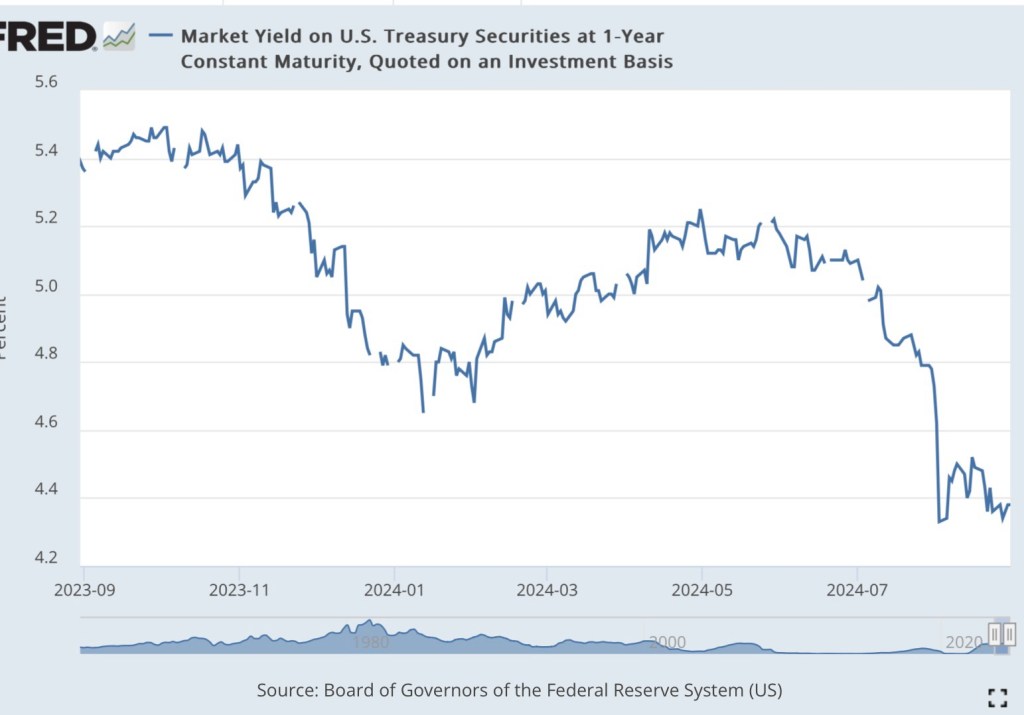
What sometimes goes unacknowledged is that the Fed will be following market rates downward, not leading them. The chart below shows the steep drop in the one-year Treasury yield over the past couple of months. Other rates have declined as well. Granted, longer rates are determined in large part by expectations of future short-term rates over which the Fed has more control.

And yet the softening of market rates may well be a signal of weaker economic activity. There is certainly concern among investors that a failure by the Fed to ease policy might jeopardize the much hoped-for “soft landing”. The lagged effects of the Fed’s tighter policy stance may drag on, with damage to the real economy and the labor market. Indeed, some assert that a recession remains a strong possibility (and see here), and the manufacturing sector has been in a state of contraction for five months.

On the other hand, the Fed has fallen short of its 2% inflation goal. The core PCE deflator, the Fed’s preferred inflation gauge, was up 2.6% for the year ending in July. Some observers fear that easing policy prematurely will lead to a new acceleration of inflation.

Powell Gives the Nod

Nevertheless, markets were relieved when Jerome Powell, in his recent speech in Jackson Hole, Wyoming, indicated his determination that a shift in policy was appropriate. From Bloomberg:

Federal Reserve Chair Jerome Powell said ‘the time has come’ for the central bank to start cutting interest rates.

Powell’s comments cemented expectations for a rate cut at the central bank’s next gathering in September. The Fed chief said the cooling of the labor market is ‘unmistakable,’ adding, ‘We do not seek or welcome further cooling in labor market conditions.’ Powell also said his confidence has grown that inflation is on a ‘sustainable path’ back to the Fed’s goal of 2%.

The “sustainable path back to … 2%” might imply a view inside Fed that policy will remain somewhat restrictive even after a quarter or half-point rate cut in September. Or perhaps the “sustainable path” has to do with the aforementioned lags, which might continue to be operative regardless of any immediate change in policy. The feasibility of a “soft landing” depends on whether policy is indeed still restrictive or on how benign those lagged effects turn out to be. But if we take the lags seriously, an easing of policy wouldn’t have real economic force for perhaps 15 months. Still, the market puts great hope in the salutary effects of a move by the Fed to ease policy.

Big Balance Sheet

It can be argued that the Fed already took a step toward easing policy in May when it reduced the rate at which it was allowing runoff in its portfolio of Treasury and mortgage-backed securities. Prior to that, it had been redeeming $95 billion of maturing securities a month. The new runoff amount is $60 billion per month. Unless neutralized in other ways, the runoff has a contractionary effect on bank reserves and the money supply. It is known as “quantitative tightening” (QT). but then the May announcement was a de facto easing in the degree of QT.

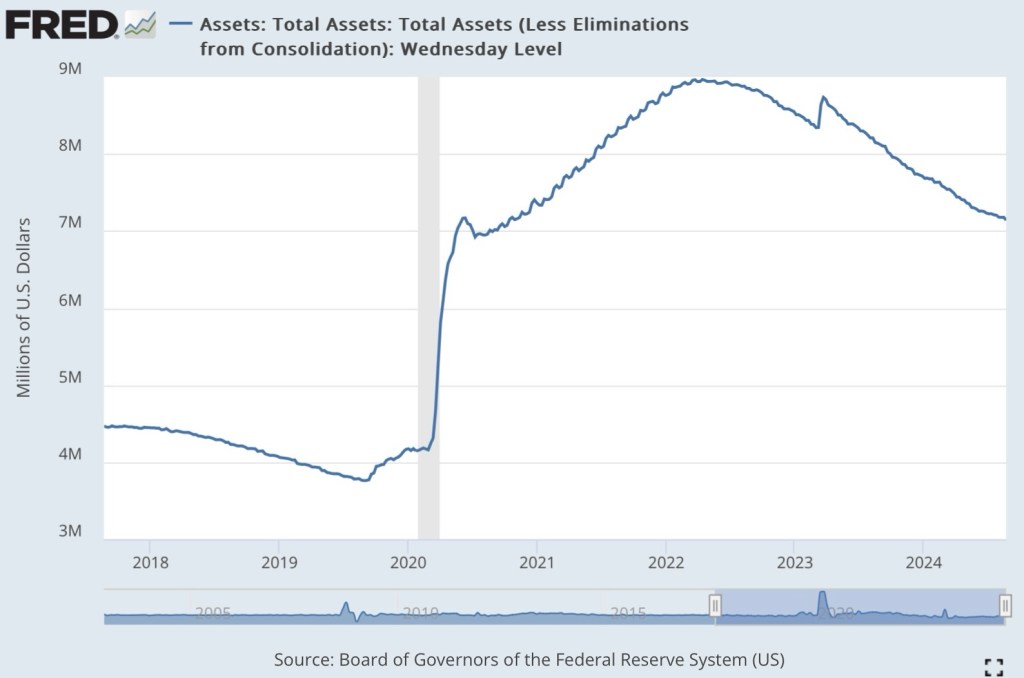
Thus far, the total reduction in the Fed’s portfolio has amounted to only $1.7 trillion from the original high-water mark of $8.9 trillion. Here is a chart showing the recent evolution in the size of the Fed’s securities holdings.

The Fed’s current balance sheet of $7.2 trillion is gigantic by historical standards. It’s reasonable to ask why the Fed considers what we have now to be a more “normalized” portfolio, and whether its size (and correspondingly, the money supply) represents potential “dry tinder” for future inflation. It remains to be seen whether the Fed will further pare the rate of portfolio runoff in the months ahead.

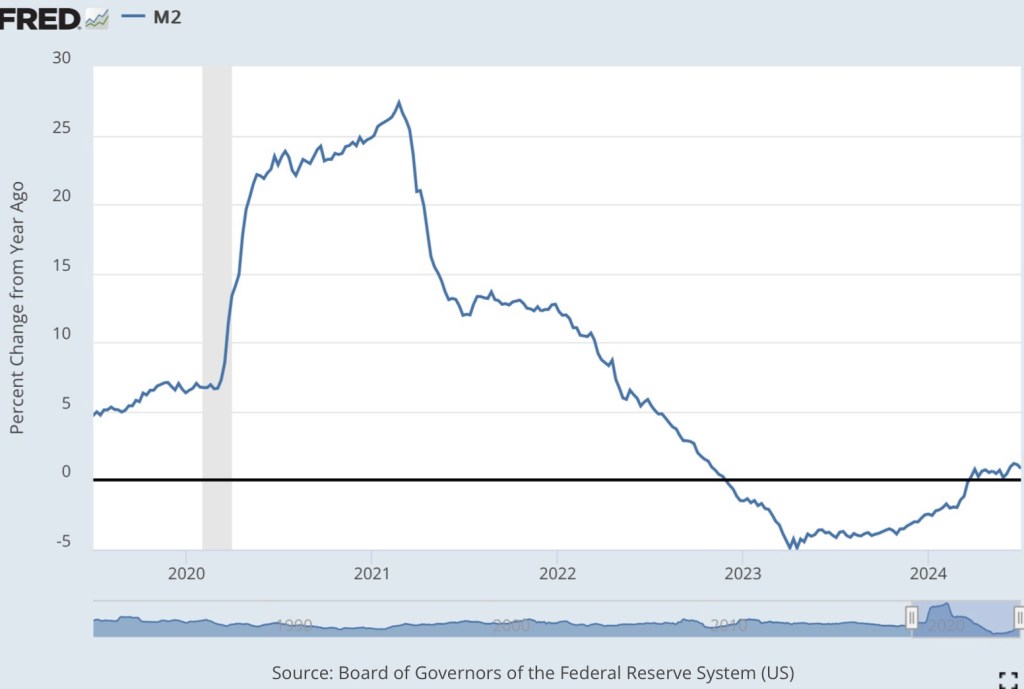
Money growth had been running negative for roughly a year and a half, but it edged closer to zero in late 2023 before accelerating to a slow, positive rate a few months into 2024. The timing didn’t exactly correspond to the Fed’s slowing of portfolio runoff. Nevertheless, the Fed’s strong preference is to supply the banking system with “ample reserves”, and reserves drive money growth. Thus, the Fed’s reaction to conditions in the market for reserves was a factor allowing money growth to accelerate.

A Cut Too Soon?

A rate cut later this month will make reserves still more ample and support additional money growth. And again, this will be an effort to mediate the negative impact of earlier policy tightness, but the effect of this move on the economy will be subject to similar lags.

A danger is that the Fed might be easing too soon, so that inflation will fail to taper to the 2% goal and possibly accelerate again. And perhaps policy was not quite as tight as it needed to be to achieve the 2% goal. Now, new supply bottlenecks are cropping up, including a near shutdown of shipping through the Suez Canal and a potential strike by east coast dockworkers.

Fiscal Incontinence

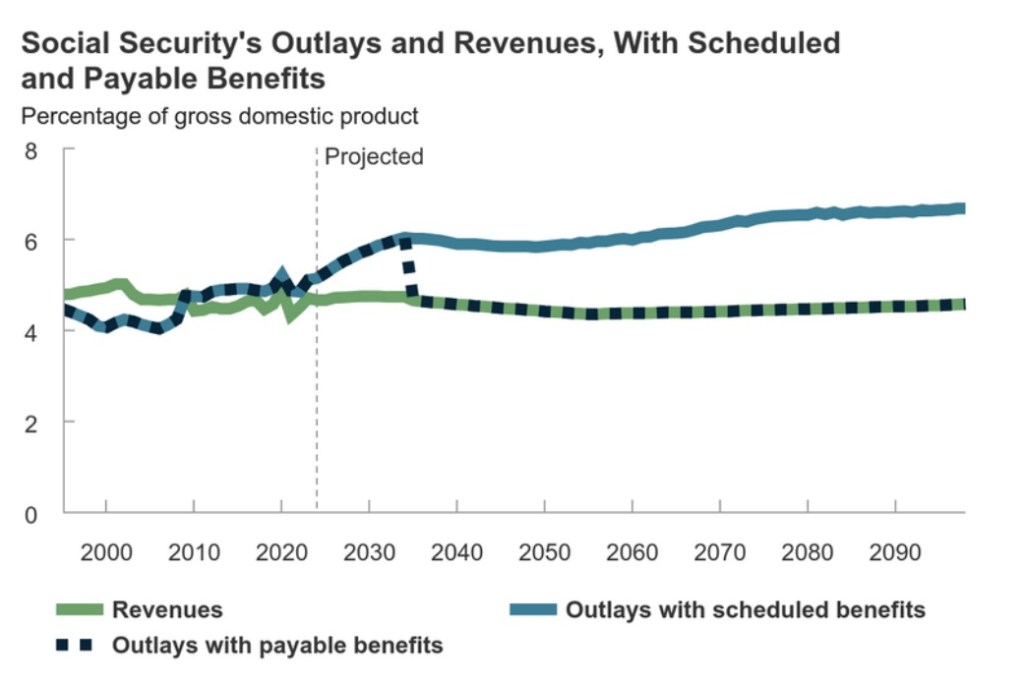
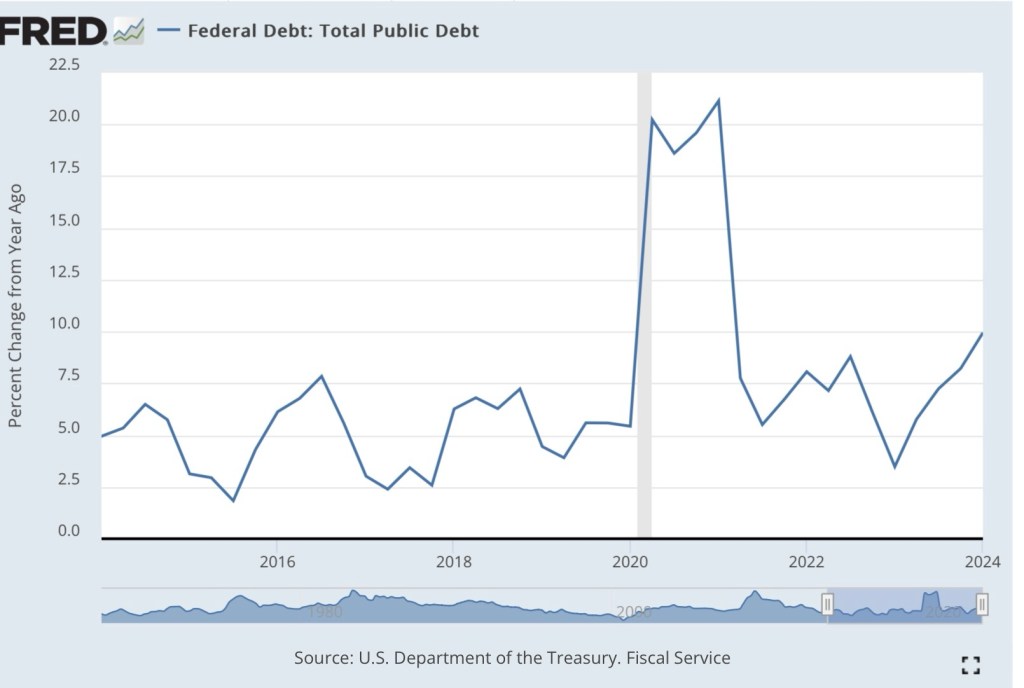
An even greater threat now, and in the years ahead, is the massive pressure placed on the economy and the Fed by excessive federal spending and Treasury borrowing. The growth of federal debt over the 12 months ending in July was almost 10%. Total federal debt stands at about $35 trillion. According to the Congressional Budget Office (CBO) projections, federal debt held by the public will be almost $28 trillion by the end of 2024 (the rest the public debt is held by the Fed or federal agencies). The CBO also projects that the federal budget deficit will average almost $1.7 trillion annually through 2027 before rising to $2.6 trillion by 2034. That would bring federal debt held by the public to more than $48 trillion.

Inflation is receding ever so slowly for now, but it’s unclear that investors will remain comfortable that growth in the public debt can be paid down by future surpluses. If not, the only way its real value can be reduced is through higher prices. Most observers believe such an inflation requires that the Fed monetize federal debt (buy it from the public with printed money). Tighter credit markets will increase pressure on the Fed to do so, but the growing debt burden is likely to exert upward pressure on the prices of goods with or without accommodation by the Fed.

Hard, Soft, Or Aborted Landing?

Some economists are convinced that the Fed has successfully engineered a “soft landing”. I might have to eat some crow…. I felt that a “hard landing” was inevitable from the start of this tightening phase. Even now I would not discount the possibility of a recession late this year or in early 2025. And perhaps we’ll get no “landing” at all. The Fed’s expected policy shift together with the fiscal outlook could presage not just a failure to get inflation down to the Fed’s 2% target, but a subsequent resurgence in price inflation.

Tampons For Men From a Strapped Public Purse

Tags

, , , , , , , , , , , , , , , , , , , , , ,

I had to laugh when I saw this tweet on X the other day:

I actually think she was fishing for sympathetic comments from … anyone. Or it was intended as a rhetorical question, as the poster seems to regard many cis-men as the meanies in this affair. But let’s give her the benefit of the doubt. Maybe she really wanted to engage with men who object to tampon dispensers in men’s public restrooms.

Before getting started, I want to be clear that I’m using the term “public restroom” to mean a restroom available to the general public and furnished by the public sector. I distinguish these from restrooms in commercial establishments intended for use by customers only.

Tampon Dispensing Is Not Cost-Free

So I have a question: who will be asked to pay for the dispensers in men’s public restrooms, their installation, servicing, and the tampons themselves? Will the tampons be dispensed at no charge, as some advocates would like? That’s the case in some public schools, so there might be a tendency to think tampons should be free in other men’s public restrooms. Of course, another possibility is to install pay vending machines for tampons, and I will address that in later sections. Here I note that I’d have no objection if they paid for themselves.

Free tampons in men’s public restrooms, or even priced tampons that don’t cover their costs, would represent a use of public resources. Taxpayers would be on the hook. Alternatively, some other public expenditure might be reduced to make room in government budgets for the new amenity. Public budgets are notoriously strapped, and foregoing other budget needs would carry an opportunity cost. Public resources should be put to the most urgent public needs, which might run the gamut from critical services like law enforcement, sanitation, and street repair to the staffing of mental health facilities.

If this strikes you as economic small-ball, remember that demands for public funds are seemingly without end. Whether taxes are increased or the budget is reallocated, “my life” is affected to a degree by every new demand that is met. To pay for tampon dispensers in men’s public restrooms, resources must be diverted from some other valued use.

Beneficiaries

Surely Ms. Fachner believes that tampons in men’s restrooms confer social benefits. Might those benefits exceed the opportunity cost of the necessary resources?

Well, biological males don’t have ovaries, they can’t get pregnant, and they don’t have periods, so we can scratch them off the list of potential beneficiaries. This is about trans- or intersex men who menstruate or perhaps suffer bleeding from hysterectomies. As I’ll discuss below, this is a small minority of users of men’s public restrooms.

But wait, here’s one advocate:

Our culture does not really acknowledge the diversity of menstruating individuals.

Statements like that lend absolutely no clarity. In fact, it’s a gross obfuscation made in an effort to redefine reality and exaggerate the prevalence of menstruating males.

Estimates of the Trans-Male Population

The transgender population was estimated at about 0.5% – 0.6% of the total U.S. population in 2022, based on two studies. That’s about one in every 200 individuals. However, male-to-female (MTF) transitions are 2 – 4 times more common than female to male (FTM) transitions. Combining these estimates yields one FTM in every 400 – 800 men. Of course, not all FTMs menstruate (and they don’t menstruate over the entirety of a given month). So men who might need a tampon in a public restroom are a small minority.

Nonbinaries?

Some would insist that any such estimate should account for the nonbinary population of individuals who menstruate. Part of this group is the intersex (hermaphrodite) population who identify as males. A number of these individuals have had gender-affirming care and would already have been counted as FTMs in the studies linked above (and I will continue to use “FTM” as inclusive of this group). However, I’m skeptical of the non-binary classification on surveys because some otherwise “straight” individuals use it to signal their participation in the avant guarde of gender identification, perceiving it as something fashionable or even virtuous.

Nevertheless, one 2022 poll found that the trans plus nonbinary population was about 1.6% of all adults. Combining this with the MTF/FTM estimates above, an implied upper bound on the male tampon “market” would be about 3 out of every 400 distinct visitors to a men’s restroom, or less than one out of every hundred. If the nonbinary classification is taken at face value, it’s still a small minority and probably far less than 1/100.

Woe Is We

A great many of us suffer inconveniences in life, some of them terrible, but it would be extremely costly and irrational for the state to attempt to neutralize every one of them. For example, people with overactive bladders are far more common than the trans population. Should the state accommodate them by doubling the number of public restrooms? At some point it’s worth recognizing that claims on public resources can become preposterous.

The economic argument against outfitting all men’s public restrooms with tampon dispensers falls into a broader category of common-sense resistance to eliminating (or compensating) for every tiny cross borne by anyone: every minor strife, inconvenience, or “micro-aggression” individuals might experience. The cumulative effect of this cavalcade of demands on society and on each other, which cannot all be met, is to breed discontent while stifling social and economic progress. We live in the real world where scarcity matters. We must therefore be sensible about where and how we expend our energy and resources.

Costs

I haven’t yet explored the specific costs associated with adding tampon dispensers to men’s public restrooms. Not surprisingly, it’s difficult to pin them down completely, but a few notes are helpful.

The cost of a free-tampon dispenser ranges from about $90 to $140. A pay tampon vending machine ranges from about $300 – $500. Then the dispensers have to be installed, stocked, and serviced, and there is a potentially greater cost of sanitation within each restroom. This article includes cost data from 2017-2019 for a public school district in Massachusetts. It’s ambiguous as to whether installations of free dispensers occurred in women’s restrooms only or all restrooms, but much of the article is written as if it applies to women and girls. To be clear, I don’t take issue with providing free tampon dispensers in school restrooms for females.

The dispensers and receptacles for the school district totaled $33,000, which presumably included the labor cost of installation. The annual cost of keeping the dispensers stocked was just $2.48 per student annually, but it’s not clear whether that average includes labor, or whether the divisor is the female student population or all students. Certainly all of these costs would be greater today.

Don’t Putsch It

The FTM minority is likely to grow, especially in parts of the country where advocates for the gender dysphoric have won legislative battles over gender-affirming care for youths. This is a huge mistake. It’s highly unethical to encourage unalterable, life-changing medical interventions for what often amount to youthful anxieties that usually pass with age. But these initiatives go hand-in-hand with bills requiring free menstrual products in all school restrooms and in all public restrooms. It would be more reasonable to suggest to any biological female considering a gender transition, who must weigh many considerations, that they’ll sometimes be inconvenienced by the need to pack a precautionary tampon.

Crazy Counter-Arguments

There were some interesting comments on Ms. Fachner’s tweet. One contended that men should have tampons available in the event that a female companion happens to need one. Well, it’s so nice to know that chivalry still has a place among the woke! But if a woman needs a tampon while she’s out, and if she has any sense, she’ll try the womens’ restroom herself before asking a male companion to check the men’s room.

Another commenter felt that the availability of tampons in men’s restrooms is the equivalent of condom dispensers in womens’ restrooms. Not quite! A woman out with a male companion might wish to have protection available if she expects to have intercourse. I’m not sure how many public women’s restrooms have condom dispensers, but you might find paid dispensers at truck stops, dance clubs, or other private venues where the sexes meet and greet. In any event, interest in condoms in women’s restrooms might well be a more common phenomenon than FTMs unprepared for the onset of a period.

Market Test

The mere existence of vending machines for condoms and other products in the restrooms of private establishments proves that these offerings satisfy a sort of market test. The charges for those products, including tampons, pads, and condoms in women’s restrooms, might or might not cover all of the associated costs. However, even if they don’t, the machines are provided as a courtesy to customers and/or because competitors provide them. Either way, as a market proposition, the establishments find the machines to be advantageous.

Would private establishments find it profitable to offer tampons and pads in vending machines in men’s restrooms? It’s possible, and businesses catering to non-traditional lifestyles are more likely to offer menstrual products in men’s restrooms, if only as a courtesy to FTM customers. However, it’s uncommon at best among mainstream businesses. Again, the economic logic is dependent on the volume of menstrual products likely to be dispensed. If they add value, the market is likely to provide them. This might be more plausible for machines that vend multiple products.

Successful pricing of tampons in men’s public restrooms would be easier if the probable volume was greater, but it will be quite low relative to women’s restrooms. Thus, the up-front fixed costs are difficult to justify. In any case, vending machines of any type are less common in public restrooms. Perhaps that’s because the items sold would not cover all of the associated costs. Or perhaps it’s because public administrators lack the incentives that motivate actions in the private sector. Enter the activists!

Market Failure?

One might argue that passing the market test is irrelevant because public facilities are intended to offer a range of services which the market can’t be relied upon to provide. That’s not clear cut in the case of restrooms themselves, and I’ve advocated for more pay toilets in the past. However, tampons are very much a private good. A trans-male with an unmet need for a tampon is in a bad spot, and he might generate external costs. However, I maintain that the situation is fairly uncommon, and those hypothetical external costs are fairly easy to internalize. This is not a true market failure nor a public priority.

Finally, I note again that Ms. Fachner addresses her question only to cis-men. I have news for her: like any other form of common sense, the rudimentary economic logic of costs and benefits is inclusive and available to all, regardless of sexual preference and gender identification.

To End War and Poverty in the Middle East

Tags

, , , , , , , , , , , , , , , , , , , , , , , , , , , , , , ,

The timing of this post might be awkward given the escalation of threats by Iran and its client militia groups toward Israel. But I’m posting it anyway because this blog is a way for me to get things off my chest. Read on…

In the West there is fairly broad agreement that the Palestinian people should have a sovereign state of their own. There is much less agreement over the geographic boundaries of such a state and the sequence of events that must take place in order for it to be established. Among Palestinians there is some support for a two-state solution, but it is far from a majority.

The UN Partition Plan

The following map might be helpful in what follows. It shows the proposed boundaries of an Israeli state and an Arab state under the Partition Plan adopted by UN Resolution in 1947. The Resolution called for replacing a League of Nations mandate for British administration of the region requiring the establishment of a Jewish homeland. Likewise, the Arab state was intended to accommodate Palestinian nationalists. Together the two states were expected to comprise an economic union.

What is striking is the discontinuity of the lands assigned to each state, and this surely contributed to almost immediate border challenges. More on that below.

The Gaza Strip is the region along the shore of the Mediterranean on the lower left, which was designated as Palestinian. The Golan Heights is the Israeli region on the upper right. The West Bank is the Palestinian region in the middle. Jerusalem and its vicinity was designated as an international zone to be administered by the UN.

Border Battles

Today, the geography of a prospective Palestinian state would certainly include the Gaza Strip. There doesn’t seem to be any great dispute there, but the West Bank is another story. In this context, it’s important to remember some key details about the history of this region since 1947. David Post writes at the Volokh Conspiracy that the Palestinian state was obliterated by other Arab states in 1948:

The State of Palestine was strangled in its infancy, not by the Israelis, who accepted the U.N. partition plan, but by the neighboring Arab States—Egypt, Syria, and Jordan—who did not. The day after the British pulled their forces out, the Arab armies marched in, and the first Arab-Israeli War began.

The hostilities were formally ended with the signing of three different Armistices in 1949:

The boundaries fixed in those agreements gave to each of the four countries involved more-or-less the territory that their armies had managed to control as of the date that ceasefires had been declared. The West Bank became part of Jordan; Gaza became part of Egypt; the Golan Heights became part of Syria. Israel got—or kept—the rest. The Palestinians, who had no army of their own, got nothing.

Here are the boundaries under the 1949 Armistices:

The three Arab states, which refused to recognize Israel’s right to exist, attacked again in 1967. In a matter of six days and on three fronts, the Israelis drove them back and took Gaza, the West Bank, and retook the Golan Heights. Post asks:

Why is it that only starting then, now that Israel was in control of these areas, did the world rouse itself to Palestinian grievances, and demand that ‘Palestinian lands’ be given back to the Palestinians?

It’s worth noting that these conflicts led to the displacement of a great many Palestinians, but Israel did not provoke the attacks.

Indigenous Populations

Enemies of Israel, including those in the West, go so far as to say the Israelis are not entitled to a homeland in the Levant. Even worse, they chant “from the river to the sea”, often ignorant that it is a thinly veiled call for genocide. But Jews have as great a claim to a homeland in the Levant as the Palestinians. Jacob Sullum wrote of this truth last October, in the wake of the Hamas butchery on October 7, 2023. Israeli Jews are characterized by enemies as “colonizers”. This, as Sullum says:

… is a ‘simplistic morality tale’, that pits white European oppressors against ‘indigenous’ people, eliding Israel’s demographic roots and the ancient Jewish connection to the land. “

Sullum goes on to discuss research on the genetic origins of modern Jewish populations. For example, one paper found that the ancestors of Ashkenazi Jews, who account for almost a third of Jews in Israel, likely descended from a “diverse population in the Middle East.” And Sullum points out that Mizrahim Jews of Middle Eastern and North African origin represent almost 45% of Israeli Jews. Furthermore, another study found that Jews and Arabs in the Middle East both share high percentages of Y chromosomes with a single gene pool, which suggests a common origin. Therefore, both Palestinians and Israeli Jews have legitimate claims to a homeland in the Levant.

Israel and Gaza

Contrary to claims by Hamas supporters, there was no occupation of Gaza by Israel at the time of the October 7th massacre. Israel’s prior occupation of Gaza ended almost 20 years ago, in 2005. However, Israel has restricted the movement of goods in and out of the Gaza Strip since the 1990s. Israel and Egypt tightened the blockade on Gaza in 2007 after Hamas took control there, though it was eased in steps from 2010 – 2013. Given the uncompromising belligerence of Hamas and its proclivity for diverting resources to support aggression against Israel, it’s fair to say the blockade is, and has been, a legitimate instrument of defense, as long as Gaza is “governed” by Hamas.

Last year, less than a week after the October 7th massacre and hostage taking, the Israeli Defense Forces (IDF) began ground operations in Gaza in an effort to root out Hamas fighters, destroy their war-making infrastructure, and rescue hostages held by Hamas in Gaza. Of course, that fight goes on.

Hamas has fought against Israel’s retaliatory action in ways that have propaganda value, especially given the naïveté of much of the Western press. Its fighters are often embedded among civilians within residential areas and facilities like schools and hospitals. The use of human shields is a war crime for which Hamas bears full responsibility, and Hamas has made it clear that their aim is to kill Israelis, civilian and military alike. Hamas has made a practice of exaggerating Palestinian death counts, a distortion that has been more obvious to statisticians than journalists.

The Israeli blockade of the Gaza Strip will be tough to end without a complete surrender by Hamas and release of the hastages. Even then, the current IDF occupation is unlikely to end until efforts are well underway to flesh out the details of a new Palestinian government, if not statehood.

The West Bank

Perhaps even more thorny for an eventual two-state solution is that Israel occupies the West Bank and has established settlements that Palestinians strongly oppose. Jordan might also have designs on retaking West Bank territory, which would once again leave Palestinians as the odd people out. Israel took the land in its own defense during the Six-Day War in 1967 and kept it as a security buffer:

“… Israel insisted that it should not, and would not, simply return to the pre-war situation — the dangerous combination of precarious armistice lines and aggressive neighbors that had prevailed for 19 years. …

The idea that Israeli security depended on continued control over parts of the West Bank was held not only by Israeli officials, but also by the American Joint Chiefs of Staff. … Referring to the West Bank, they argued that Israel required a new boundary that would ‘widen the narrow portion of Israel’ and help protect Tel Aviv.

Israel splits aspects of governance with the Palestinian Authority in parts of the West Bank, but most of the security apparatus is run by Israel.

The continued West Bank occupation is as fraught with controversy as ever. Today there is bitter resentment over new Israeli settlements and the construction of the “Separation Wall” just inside the western border of the West Bank. The situation is made all the more intractable by Hamas’ presence there amid ongoing attacks against Israeli interests.

Withdrawing from the West Bank would create a huge vulnerability for Israel, so one can hardly expect it to cede control of the entire territory. Yet it is hard to imagine an economically viable Palestinian state confined to the Gaza Strip. In fact, some feel that more than the West Bank should be in play for creating a contiguous corridor to Gaza, which would help promote a new Palestinian state’s economic viability.

Iran

Obviously Hamas is not the only threat to Israel’s security. To the north in Lebanon, Hezbollah is a well-armed adversary. And like Hamas, it receives considerable support from Iran. It’s difficult to imagine that Iran could maintain this support, not to mention its nuclear ambitions, without the flow of oil revenue made possible by U.S. acquiescence. Reaching a peaceful resolution to the conflicts between Israel and its neighbors will be very difficult without somehow neutralizing the Iranian threat. Regime change there would be key to this effort.

What Must Happen

The obstacles to establishing a peaceful, two-state solution for Palestinians and Israelis are so steep that the prospect seems almost unimaginable. A complete defeat of both Hamas and Hezbollah would be critical, and the Palestinian Authority or any other successor regime must be counted on to negotiate in good faith and with the legitimate support of the Palestinian people. Likewise, Israel must be willing to negotiate meaningful concessions, at least in terms of its occupied territories in the West Bank.

For a successful resolution, the role of other Arab states can’t be emphasized enough. These states should apply pressure to Israel’s neighbors like Syria and Jordan to rein-in their own territorial ambitions. In a positive sign, there is now growing pressure on Iran from other Arab states to end its belligerence.

A reconstituted Abraham Accords framework could strengthen diplomatic and economic ties across the region, promoting cross-investment, trade, and cultural exchange. The framework should include a mechanism to encourage aid from the Arab states and Israel to help Palestinians build a new, peaceful, and prosperous state.

Finally, a peaceful two-state solution hinges on continued U.S. support for Israel and a new Palestinian homeland. Unfortunately, in recent years we’ve witnessed a drift toward anti-Zionism (and even anti-Semitism) among Democrats. This sort of foolishness on the far Left knows no bounds. If the anti-Zionist position comes to be accepted by the mainstream of the party, it could severely compromise Israel’s leverage in negotiations.

Summary

A resolution that would ultimately bring peace to the Middle East seems remote in the midst of the current hostilities. It would require a dramatic softening of views among nearly all parties to solve the impasse over nation-state homelands for both Jews and Palestinians. In no particular order, the following are all necessary:

  • Israel’s neighboring states must not covet territory originally intended for the Palestinians, or for that matter the state of Israel.
  • Iran must butt out one way or another (in the language of high diplomacy), which would do much to neutralize militant factions like Hamas, Hezbollah, and the Houthis.
  • Other Arab states must come to the table along with the Israelis to negotiate economic and political accords, including aid to the Palestinian people.
  • The U.S. must resist internal calls from the Left to withdraw support for Israel.
  • More immediately, Israel must do its best to root out and defeat Hamas, Hezbollah, and the Houthis.
  • The Palestinian people must decide they want peace and a prosperous civilization.
  • Israel must show a willingness to negotiate concessions to Palestinians in the West Bank, and to aid in the rebuilding of Gaza.

Taken together that’s a very tall order! The U.S. can and should do its part to support Israel and the Palestinian people, penalize Iran, and help to bring all parties to the negotiating table. A refashioning of the Abraham Accords could contribute to peace in the region, including a stable, prosperous, and well-governed Palestinian homeland.

Ravaging Cropland, Vistas, and Energy Efficiency

Tags

, , , , , , , , ,

There is no better example of environmental degradation and waste than the spread of solar farms around the world, spurred on by short-sighted public policy and abetted by a subsidy-hungry investors. As a resource drain, wind farms are right up there, but I’ll focus here on the waste and sheer ugliness of solar farms, inspired by a fine article on their inefficiency by Matt Ridley.

What An Eyesore!

On a drive through the countryside you’ll see once bucolic fields now blanketed with dark solar panels. Hulking windmills are bad enough, but the panels can obliterate an entire landscape. If this objection strikes you as superficial, then your sensibilities run strangely counter to those of traditional environmentalists. It would be a bit less aesthetically offensive if solar farms actually solved a problem, but they don’t, and they impose other costs to boot.

Paltry Power

In terms of power generation, solar collection panels represent an inefficient use of land and other resources. Solar power has very low energy density relative to other sources. As Ridley says:

Solar power needs around 200 times as much land as gas per unit of energy and 500 times as much as nuclear. Reducing the land we need for human civilisation is surely a vital ecological imperative. The more concentrated the production, the more land you spare for nature.

The intermittency of solar power means that its utilization or capacity factor is far less than nameplate capacity, yet the latter is usually quoted by promoters and investors. The mismatch in timing between power demand and power generated by solar will not be overcome by battery technology any time soon.

And yet governments coerce taxpayers in order to create artificially high returns on the construction and operation of solar farms, a backward intervention that puts more efficient sources of power at a disadvantage.

Seduction On the Farm

Solar farms installed on erstwhile cropland reflect confused public priorities. Land that is well-suited to growing crops or grazing livestock is probably better left available for those purposes. Granted, rural landowners who add solar panels probably limit installations to their least productive crop- or rangeland, but not always. Private incentives are distorted by the firehose of subsidies available for solar installations. Regardless, lands left fallow, dormant or forested still put the sun’s energy to good ecological use.

Capital invested in solar power entails unutilized capacity at night and under-utilized capacity over much of the day. Peaks in solar collection generally occur when power demand is low during daylight hours, but it is unavailable when power demand is high in the evening. Battery technology remains woefully inadequate for effective storage, necessitating a steep ramp in back-up power sources at night. And those back-up sources are, in turn, underutilized during daylight hours. The over-investment made necessary by renewables is staggering.

Landowners can try to grow certain crops underneath or between panels, or grass and weeds for grazing livestock, on what sunlight reaches ground level. This is known as Agrivoltaics. It comes with extra costs, however, and it is a bit of a dive for crumbs. Ridley says agrivoltaics is a zero-sum game, but the federal government offers subsidized funding for “experiments” of this nature. Absent subsidies, agrivoltaics might well be negative-sum in an economic sense.

Environmental Hazards

Ridley discusses the severe environmental costs and add-on risks of solar farming to local environments. Fabrication of the panels themselves requires intensive mining, processing and energy consumption. In the field, the underlying structural requirements are massive. The panels raise air temperatures within their vicinity and present a hazard to waterfowl. Panels damaged by storms, birds, or deterioration due to age are pollution hazards. Furthermore, panels have heavy disposal costs at the end of their useful lives. and old panels are often toxic. Adding today’s inefficient battery technology to solar installations only compounds these environmental risks.

Better Alternatives

Solar and renewable energy advocates seem to have little interest in the efficiency advantages of dispatchable, zero-carbon nuclear power. Nor will they wait for prospective space-based solar collection. Instead, they continue to push terrestrial solar and the idle capital it entails.

It’s worth asking why advocates of energy planning tolerate the obvious ugliness and inefficiencies of solar farming. Of course, they are preoccupied with climate risk, or at least they’d like for you to be so preoccupied. They prescribe measures against climate risk that seem to offer immediacy, but these measures are ineffectual at best and damaging in other ways. There are better technologies for producing zero-carbon energy, and it looks as if the power demands of the AI revolution might finally provide the impetus for a renaissance in nuclear power investment.

A, But Not-So-I: Altman’s Plan To Tax Wealth and Redistribute Capital

Tags

, , , , , , , , , , , , , , , , , , , , , , , , , , ,

In this case, the “A” stands for Altman. Now Sam Altman is no slouch, but he’s taken a few ill-considered positions on public policy. Altman, the CEO of Open AI, wrote a blog post back in 2021 entitled “Moore’s Law For Everything” in which he predicted that AI will feed an explosion of economic growth. He also said AI will put a great many people out of work and drive down the price of certain kinds of labor. Furthermore, he fears that the accessibility of AI will be heavily skewed against the lowest socioeconomic classes. In later interviews (see here and here), Altman is somewhat demure about those predictions, but the general outline is the same: despite exceptional growth of GDP and wealth, he envisions job losses, an underclass of AI-illiterates, and a greater degree of income and wealth inequality.

Not Quite Like That

We’ve yet to see an explosion of growth, but it’s still very early in the AI revolution. The next several years will be telling. AI holds the potential to vastly increase our production possibilities over the course of the next few decades. For that and other reasons, I don’t buy the more dismal aspects of Altman’s scenario, as my last two posts make clear (here and here).

There will be plenty of jobs for people because humans will have comparative advantages in various areas of production. AI agents might have absolute advantages across most or even all jobs, but a rational deployment would have AI agents specialize only where they have a comparative advantage.

Scarcity will not be the sort of anachronism envisioned by some AI futurists, Altman included, and scarcity of AI agents (and their inputs) will necessitate their specialization in certain tasks. The demand for AI agents will be quite high, and their energy and “compute” requirements will be massive. AI agents will face extremely high opportunity costs in other tasks, leaving many occupations open for human labor, to say nothing of abundant opportunities for human-AI collaboration.

However, I don’t dismiss the likelihood of disruptions in markets for certain kinds of labor if the AI revolution proceeds as rapidly as Altman thinks it will. Many workers would be displaced, and it would take time, training, and a willingness to adapt for them to find new opportunities. But new kinds of jobs for people will emerge with time as AI is embedded throughout the economy.

Altman’s Rx

Altman’s somewhat pessimistic outlook for human employment and inequality leads him to make a couple of recommendations:

1) Ownership of capital must be more broadly distributed.

2) Capital and land must be taxed, potentially replacing income taxes, but primarily to fund equity investments for all Americans.

Here I agree with the spirit of #1. Broad ownership of capital is desirable. It allows greater participation in the capitalist system, which fosters political and economic stability. And wider access to capital, whether owned or not, allows a greater release of entrepreneurial energy. It also diversifies incomes and reduces economic dependency.

Altman proposes the creation of an American Equity Fund (AEF) to hold the proceeds of taxes on land and corporate assets for the benefit of all Americans. I’ll get to the taxes in a moment, but in discussing the importance of educating the public on the benefits of compounding, Altman seems to imply that assets in AEF would be held in individual accounts, as opposed to a single “public” account controlled by the federal government. Individual accounts would be far preferable, but it’s not clear how much control Altman would grant individuals in managing their accounts.

To Kill a Golden Goose

Taxes on capital are problematic. Capital can only be accumulated over time by saving out of income. Thus, as Michael Munger points out, as a general proposition under an income tax, all capital has already been taxed once. And we tax the income from capital at both the corporate and individual level. So corporate income is already double taxed: corporate profits are taxed along with dividend payments to shareholders.

Altman proposed in his 2021 blog post to levy a tax of 2.5% on the market value of publicly-traded corporations each year. The tax would be payable in cash or in corporate shares to be placed into the AEF. The latter would establish a kind of UnLiquidated Tax Reserve Accounts (ULTRA), which Munger discusses in the article linked above (my bracketed x% in the quote here):

Instead of taking [x%] of the liquidated value of the wealth, the state would simply take ownership of the wealth, in place. An ULTRA is a ‘notional equity interest.’ The government literally takes a portion of the value of the asset; that value will be paid to the state when the asset is sold. Now, it is only a ‘notional’ stake, in the sense that no shared right of control or voting rights exists. But for those who advocate for ULTRAs, in any situation where tax agencies are authorized to tax an asset today, but cannot because there is no evaluation event, the taxpayer could be made to pay with an ULTRA rather than with cash.

This solves all sorts of administrative problems associated with wealth taxes, but it is draconian nevertheless. Munger quotes an example of a successful, privately-held business subject to a 2% wealth tax every year in the form of an ULTRA. After 20 years, the government owns more than a third of the company’s value. That represents a substantial penalty for success! However, the incidence of such a tax might fall more on workers and customers and less on business owners. And Altman would tax corporations more heavily than in Munger’s example.

A tax on wealth essentially penalizes thrift, reduces capital accumulation, and diminishes productivity and real wages. But another fundamental reason that taxes on capital should be low is that the supply of capital is elastic. A tax on capital discourages saving and encourages capital flight. The use of avoidance schemes will proliferate, and there will be intense pressure to carve out special exemptions.

A Regressive Dimension

Another drawback of a wealth tax is its regressivity with respect to returns on capital. To see this, we can convert a tax on wealth to an equivalent income tax on returns. Here is Chris Edwards on that point:

Suppose a person received a pretax return of 6 percent on corporate equities. An annual wealth tax of 2 percent would effectively reduce that return to 4 percent, which would be like a 33 percent income tax—and that would be on top of the current federal individual income tax, which has a top rate of 37 percent.”

… The effect is to impose lower effective tax rates on higher‐yielding assets, and vice versa. If equities produced returns of 8 percent, a 2 percent wealth tax would be like a 25 percent income tax. But if equities produced returns of 4 percent, the wealth tax would be like a 50 percent income tax. People with the lowest returns would get hit with the highest tax rates, and even people losing money would have to pay the wealth tax.

Edwards notes the extreme inefficiency of wealth taxes demonstrated by the experience of a number of OECD countries. There are better ways to increase revenue and the progressivity of taxes. The best alternative is a tax on consumption, which rewards saving and capital accumulation, promoting higher wages and economic growth. Edwards dedicates a lengthy section of his paper to the superiority of a consumption tax.

Is a Wealth Tax Constitutional?

The constitutionality of a wealth tax is questionable as well. Steven Calabresi and David Schizer (C&S) contend that a federal wealth tax would qualify as a direct tax subject to the rule of apportionment, which would also apply to a federal tax on land. That is, under the U.S. Constitution, these kinds of taxes would have to be the same amount per capita in every state. Thus, higher tax rates would be necessary in less wealthy states.

C&S also note a major distinction between taxes on the value of wealth relative to income, excise, import, and consumption taxes. The latter are all triggered by transactions entered into voluntarily. They are avoidable in that sense, but not wealth taxes. Moreover, C&S believe the founders’ intent was to rely on direct taxes only as a backstop during wartime.

The recent Supreme Court decision in Moore v. United States created doubt as to whether the Court had set a precedent in favor of a potential wealth tax. According to earlier precedent, the Constitution forbade the “laying of taxes” on “unrealized” income or changes in wealth. However, in Moore, the Court ruled that undistributed profits from an ownership interest in a foreign business are taxable under the mandatory repatriation tax, signed into law by President Trump in 2017 as part of his tax overhaul package. But Justice Kavanaugh, who wrote the majority opinion, stated that the ruling was based on the foreign company’s status as a pass-through entity. The Wall Street Journal says of the decision:

Five Justices open the door to taxing unrealized gains in assets. Democrats will walk through it.

In a brief post, Calabrisi laments Justice Ketanji Brown Jackson’s expansive view of the federal government’s taxing authority under the Sixteenth Amendment, which might well be shared by the Biden Administration. But the Wall Street Journal piece also describes Kavanaugh’s admonition regarding any expectation of a broader application of the Moore opinion:

Justice Kavanaugh does issue a warning thatthe Due Process Clause proscribes arbitrary attribution’ of undistributed income to shareholders. And he writes that his opinion should notbe read to authorize any hypothetical congressional effort to tax both an entity and its shareholders or partners on the same undistributed income realized by the entity.’

Growth Is the Way, Not Taxes

AI growth will lead to rapid improvements in labor productivity and real wages in many occupations, despite a painful transition for some workers requiring occupational realignment and periods of unemployment and training. However, people will retain comparative advantages over AI agents in a number of existing occupations. Other workers will find that AI allows them to shift their efforts toward higher-value or even new aspects of their jobs. Along the same lines, there will be a huge variety of new occupations made possible by AI of which we’re only now catching the slightest glimpse. Michael Strain has emphasized this aspect of technological diffusion, noting that 60% of the jobs performed in 2018 did not exist in 1940. In fact, few of those “new” jobs could have been imagined in 1940.

AI entrepreneurs and AI investors will certainly capture a disproportionate share of gains from an AI revolution. Of course, they’ll have created a disproportionate share of that wealth. It might well skew the distribution of wealth in their favor, but that does not reflect negatively on the market process driving the outcome, especially because it will also give rise to widespread gains in living standards.

Altman goes wrong in proposing tax-funded redistribution of equity shares. Those taxes would slow AI development and deployment, reduce economic growth, and produce fewer new opportunities for workers. The surest way to effect a broader distribution of equity capital, and of equity in AI assets, is to encourage innovation, economic growth, and saving. Taxing capital more heavily is a very bad way to do that, whether from heavier taxes on income from capital, new taxes on unrealized gains, or (worst of all) from taxes on the value of capital, including ULTRA taxes.

Altman is right, however, to bemoan the narrow ownership of capital. As I mentioned above, he’s also on-target in saying that most people do not fully appreciate the benefits of thrift and the miracle of compounding. That represents both a failure of education and our calamitously high rate of time preference as a society. Perhaps the former can be fixed! However, thrift is a decision best left in private hands, especially to the extent that AI stimulates rapid income growth.

Killer Regulation

Altman also supports AI regulation, and I’ll cut him some slack by noting that his motives might not be of the usual rent-seeking variety. Maybe. Anyway, he’ll get some form of his wish, as legislators are scrambling to draft a “roadmap” for regulating AI. Some are calling for billions of federal outlays to “support” AI development, with a likely and ill-advised effort to “direct” that development as well. That is hardly necessary given the level of private investment AI is already attracting. Other “roadmap” proposals call for export controls on AI and protections for the film and recording industries.

These proposals are fueled by fears about AI, which run the gamut from widespread unemployment to existential risks to humanity. Considerable attention has been devoted to the alignment of AI agents with human interests and well being, but this has emerged largely within the AI development community itself. There are many alignment optimists, however, and still others who decry any race between tech giants to bring superhuman generative AI to market.

The Biden Administration stepped in last fall with an executive order on AI under emergency powers established by the Defense Production Act. The order ranges more broadly than national defense might necessitate, and it could have damaging consequences. Much of the order is redundant with respect to practices already followed by AI developers. It requires federal oversight over all so-called “foundation models” (e.g., ChatGPT), including safety tests and other “critical information”. These requirements are to be followed by the establishment of additional federal safety standards. This will almost certainly hamstring investment and development of AI, especially by smaller competitors.

Patrick Hedger discusses the destructive consequences of attempts to level the competitive AI playing field via regulation and antitrust actions. Traditionally, regulation tends to entrench large players who can best afford heavy compliance costs and influence regulatory decisions. Antitrust actions also impose huge costs on firms and can result in diminished value for investors in AI start-ups that might otherwise thrive as takeover targets.

Conclusion

Sam Altman’s vision of funding a redistribution of equity capital via taxes on wealth suffers from serious flaws. For one thing, it seems to view AI as a sort of exogenous boon to productivity, wholly independent of investment incentives. Taxing capital would inhibit investment in new capital (and in AI), diminish growth, and thwart the very goal of broad ownership Altman wishes to promote. Any effort to tax capital at a global level (which Altman supports) is probably doomed to failure, and that’s a good thing. The burden of taxes on capital at the corporate level would largely be shifted to workers and consumers, pushing real wages down and prices up relative to market outcomes.

Low taxes on income and especially on capital, together with light regulation, promote saving, capital investment, economic growth, higher real wages, and lower prices. For AI, like all capital investment, public policy should focus on encouraging “aligned” development and deployment of AI assets. A consumption tax would be far more efficient than wealth or capital taxes in that respect, and more effective in generating revenue. Policies that promote growth are the best prescription for broadening the distribution of capital ownership.

On Noah Smith’s Take Re: Human/AI Comparative Advantage

Tags

, , , , , , , , , , , , , , , , , , , ,

I was happy to see Noah Smith’s recent post on the graces of comparative advantage and the way it should mediate the long-run impact of AI on job prospects for humans. However, I’m embarrassed to have missed his post when it was published in March (and I also missed a New York Times piece about Smith’s position).

I said much the same thing as Smith in my post two weeks ago about the persistence of a human comparative advantage, but I wondered why the argument hadn’t been made prominently by economists. I discussed it myself about seven years ago. But alas, I didn’t see Smith’s post until last week!

I highly recommend it, though I quibble on one or two issues. Primarily, I think Smith qualifies his position based on a faulty historical comparison. Later, he doubles back to offer a kind of guarantee after all. Relatedly, I think Smith mischaracterizes the impact of energy costs on comparative advantages, and more generally the impact of the resources necessary to support a human population.

We Specialize Because…

Smith encapsulates the underlying phenomenon that will provide jobs for humans in a world of high automation and generative AI: “… everyone — every single person, every single AI, everyone — always has a comparative advantage at something!” He tells technologists “… it’s very possible that regular humans will have plentiful, high-paying jobs in the age of AI dominance — often doing much the same kind of work that they’re doing right now …”

… often, but probably transformed in fundamental ways by AI, and also doing many other new kinds of work that can’t be foreseen at present. Tyler Cowen believes the most important macro effects of AI will be from “new” outputs, not improvements in existing outputs. That emphasis doesn’t necessarily conflict with Smith’s narrative, but again, Smith thinks people will do many of the same jobs as today in a world with advanced AI.

Smith’s Non-Guarantee

Smith hedges, however, in a section of his post entitled “‘Possible’ doesn’t mean guaranteed”. This despite his later assertion that superabundance would not eliminate jobs for humans. That might seem like a separate issue, but it’s strongly intertwined with the declining AI cost argument at the basis of his hedge. More on that below.

On his reluctance to “guarantee” that humans will have jobs in an AI world, Smith links to a 2013 Tyler Cowen post on Why the theory of comparative advantage is overrated”. For example, Cowen says, why do we ever observe long-term unemployment if comparative advantage rules the day? Of course there are many reasons why we observe departures from the predicted results of comparative advantage. Incentives are often manipulated by governments and people differ drastically in their capacities and motivation.

But Cowen cites a theoretical weakness of comparative advantage: that inputs are substitutable (or complementary) by degrees, and the degree might change under different market conditions. An implication is that “comparative advantages are endogenous to trade”, specialization, and prices. Fair enough, but one could say the same thing about any supply curve. And if equilibria exist in input markets it means these endogenous forces tend toward comparative advantages and specializations balancing the costs and benefits of production and trade. These processes might be constrained by various frictions and interventions, and their dynamics might be complex and lengthy, but that doesn’t invalidate their role in establishing specializations and trade.

The Glue Factory

Smith concerns himself mainly with another one of Cowen’s “failings of comparative advantage”: “They do indeed send horses to the glue factory, so to speak.” The gist here is that when a new technology, motorized transportation, displaced draft horses, there was no “wage” low enough to save the jobs performed by horses. Smith says horses were too costly to support (feed, stables, etc…), so their comparative advantage at “pulling things” was essentially worthless.

True, but comparing outmoded draft horses to humans in a world of AI is not quite appropriate. First, feedstock to a “glue factory” better not be an alternative use for humans whose comparative advantages become worthless. We’ll have to leave that question as an imperative for the alignment community.

Second, horses do not have versatile skill sets, so the comparison here is inapt due to their lack of alternative uses as capital assets. Yes, horses can offer other services (racing, riding, nostalgic carriage rides), but sadly, the vast bulk of work horses were “one-trick ponies”. Most draft horses probably had an opportunity cost of less than zero, given the aforementioned costs of supporting them. And it should be obvious that a single-use input has a comparative advantage only in its single use, and only when that use happens to be the state-of-the-art, or at least opportunity-cost competitive.

The drivers, on the other hand, had alternatives, and saw their comparative advantage in horse-driving occupations plunge with the advent of motorized transport. With time it’s certain many of them found new jobs, perhaps some went on to drive motorized vehicles. The point is that humans have alternatives, the number depending only on their ability to learn a crafts and perhaps move to a new location. Thus, as Smith says, “… everyone — every single person, every single AI, everyone — always has a comparative advantage at something!” But not draft horses in a motorized world, and not square pegs in a world of round holes.

AI Producer Constraints

That brings us to the topic of what Smith calls producer-specific constraints, which place limits on the amount and scope of an input’s productivity. For example, in my last post, there was only one super-talented Harvey Specter, so he’s unlikely to replace you and keep doing his own job. Thus, time is a major constraint. For Harvey or anyone else, the time constraint affects the slope of the tradeoff (and opportunity costs) between one type of specialization versus another.

Draft horses operated under the constraints of land, stable, and feed requirements, which can all be viewed as long-run variable costs. The alternative use for horses at the glue factory did not have those costs.

Humans reliant on wages must feed and house themselves, so those costs also represent constraints, but they probably don’t change the shape of the tradeoff between one occupation and another. That is, they probably do not alter human comparative advantages. Granted, some occupations come with strong expectations among associates or clients regarding an individual’s lifestyle, but this usually represents much more than basic life support. In the other end of the spectrum, displaced workers will take actions along various margins: minimize living costs; rely on savings; avail themselves of charity or any social safety net as might exist; and ultimately they must find new positions at which they maintain comparative advantages.

The Compute Constraint

In the case of AI agents, the key constraint cited by Smith is “compute”, or computer resources like CPUs or GPUs. Advancements in compute have driven the AI revolution, allowing AI models to train on increasingly large data sets and levels of compute. In fact, by one measure of compute, floating point operations per second (FLOPs), compute has become drastically cheaper, with FLOPs per dollar almost doubling every two years. Perhaps I misunderstand him, but Smith seems to assert the opposite: that compute costs are increasing. Regardless, compute is scarce, and will always be scarce because advancements in AI will require vast increases in training. This author explains that while lower compute costs will be more than offset by exponential increases in training requirements, there nevertheless will be an increasing trend in capabilities per compute.

Every AI agent will require compute, and while advancements are enabling explosive growth in AI capabilities, scarce compute places constraints on the kinds of AI development and deployment that some see as a threat to human jobs. In other words, compute scarcity can change the shape of the tradeoffs between various AI applications and thus, comparative advantages.

The Energy Constraint

Another producer constraint on AI is energy. Certainly highly complex applications, perhaps requiring greater training, physical dexterity, manipulation of materials, and judgement, will require a greater compute and energy tradeoff against simpler applications. Smith, however, at one point dismisses energy as a differential producer constraint because “… humans also take energy to run.” That is a reference to absolute energy requirements across inputs (AI vs. human), not differential requirements for an input across different outputs. Only the latter impinge on tradeoffs or opportunity costs facing an inputs. Then, the input having the lowest opportunity cost for a particular output has a comparative advantage for that output. However, it’s not always clear whether an energy tradeoff across outputs for humans will be more or less skewed than for AI, so this might or might not influence a human comparative advantage.

Later, however, Smith speculates that AI might bid up the cost of energy so high that “humans would indeed be immiserated en masse.” That position seems inconsistent. In fact, if AI energy demands are so intensive, it’s more likely to dampen the growth in demand for AI agents as well as increase the human comparative advantage because the most energy-intensive AI applications will be disadvantaged.

And again, there is Smith’s caution regarding the energy required for human life support. Is that a valid long-run variable cost associated with comparative advantages possessed by humans? It’s not wrong to include fertility decisions in the long-run aggregate human labor supply function in some fashion, but it doesn’t imply that energy requirements will eliminate comparative advantages. Those will still exist.

Hype, Or Hyper-Growth?

AI has come a long way over the past two years, and while its prospective impact strikes some as hyped thus far, it has the potential to bring vast gains across a number of fields within just a few years. According to this study, explosive economic growth on the order of 30% annually is a real possibility within decades, as generative AI is embedded throughout the economy. “Unprecedented” is an understatement for that kind of expansive growth. Dylan Matthews in Vox surveys the arguments as to how AI will lead to super-exponential economic growth. This is the kind of scenario that would give rise to superabundance.

I noted above that Smith, despite his unwillingness to guarantee that human jobs will exist in a world of generative AI, asserts (in an update) at the bottom of his post that a superabundance of AI (and abundance generally) would not threaten human comparative advantages. This superabundance is a case of decreasing costs of compute and AI deployment. Here Smith says:

The reason is that the more abundant AI gets, the more value society produces. The more value society produces, the more demand for AI goes up. The more demand goes up, the greater the opportunity cost of using AI for anything other than its most productive use. 

As long as you have to make a choice of where to allocate the AI, it doesn’t matter how much AI there is. A world where AI can do anything, and where there’s massively huge amounts of AI in the world, is a world that’s rich and prosperous to a degree that we can barely imagine. And all that fabulous prosperity has to get spent on something. That spending will drive up the price of AI’s most productive uses. That increased price, in turn, makes it uneconomical to use AI for its least productive uses, even if it’s far better than humans at its least productive uses. 

Simply put, AI’s opportunity cost does not go to zero when AI’s resource costs get astronomically cheap. AI’s opportunity cost continues to scale up and up and up, without limit, as AI produces more and more value.”

This seems as if Smith is backing off his earlier hedge. Some of that spending will be in the form of fabulous investment projects of the kinds I mentioned in my post, and smaller ones as well, all enabled by AI. But the key point is that comparative advantages will not go away, and that means human inputs will continue to be economically useful.

I referenced Andrew Mayne in my last post. He contends that the income growth made possible by AI will ensure that plenty of jobs are available for humans. He mentions comparative advantage in passing, but he centers his argument around applications in which human workers and AI will be strong complements in production, as will sometimes be the case.

A New Age of Worry

The economic success of AI is subject to a number of contingencies. Most important is that AI alignment issues are adequately addressed. That is, the “self-interest” of any agentic AI must align with the interests of human welfare. Do no harm!

The difficulty of universal alignment is illustrated by the inevitability of competition among national governments for AI supremacy, especially in the area of AI-enabled weaponry and espionage. The national security implications are staggering.

A couple of Smith‘s biggest concerns are the social costs of adjusting to the economic disruptions AI is sure to bring, as well as its implications for inequality. Humans will still have comparative advantages, but there will be massive changes in the labor market and transitions that are likely to involve spells of unemployment and interruptions to incomes for some. The speed and strength of the AI revolution may well create social upheaval. That will create incentives for politicians to restrain the development and adoption of AI, and indeed, we already see the stirrings of that today.

Finally, Smith worries that the transition to AI will bring massive gains in wealth to the owners of AI assets, while workers with few skills are likely to languish. I’m not sure that’s consistent with his optimism regarding income growth under AI, and inequality matters much less when incomes are rising generally. Still, the concern is worthy of a more detailed discussion, which I’ll defer to a later post.

AGIs, Human Labor, and the Reciprocal Nature of Comparative Advantages

Tags

, , , , , , , , , , , , , , ,

You might know someone so smart and multi-talented that they are objectively better at everything than you. Let’s call him Harvey Specter. Harvey’s prospects on the labor market are very good. Economists would say he has an absolute advantage over you in every single pursuit! What a bummer! But obviously that doesn’t mean Harvey can or should do everything, while you do nothing.

Fears of Human Obsolescence

That’s the very situation many think awaits workers with the advent of artificial general intelligence (AGI), and especially with the marriage of AGI and advanced robotics (also see here). Any job a human can do, AGI or AGI robots of various kinds will be able to do better, faster, and in far greater quantity. The humanoid AGI robots will be like your talented acquaintance Harvey, but exponentiated. They won’t need much “sleep” or downtime, and treating wear and tear on their “health” will be a simple matter of replacing components. AGI and its robotic manifestations will have an absolute advantage in every possible endeavor.

But even with the existence of super-human AGI robots, I claim that work will be available to you if you want or need it. You won’t face the same set of pre-AGI opportunities, but there will be many opportunities for humans nonetheless. How can that be if AGI robots can do everything better? Won’t they be equipped to meet all of our material needs and wants?

Specter of the Super Productive

Let’s return to the example of you and Harvey, your uber-talented acquaintance. You’ll each have an area of specialization, but on what basis? Harvey has his pick of very lucrative and stimulating opportunities. You, however, are limited to a less dazzling array of prospects. There might be some overlap, and hard work or luck can make up for large differences, but chances are you’ll specialize in something that requires less talent than Harvey. You might wind up in the same profession, but Harvey will be a star.

Where will you end up? The answer is you and Harvey will find your respective areas of specialization based on comparative advantages, not absolute advantages. Relative opportunity cost is the key here, or its inverse: how much do you expect to gain from a certain area of specialization relative to the rewards you must forego.

For example, Harvey doesn’t sacrifice much by shunning less challenging areas of specialization. That is, he faces a low opportunity cost, while his chosen area offers great rewards for his talent.

You, on the other hand, might not have much to gain in Harvey’s line of work, if you can get it. You might be a flop if you do! Realistically, you forego very little if you instead pursue more achievable success in a less daunting area. You’ll be better off choosing an option for which your relative gains are highest, or said differently, where your relative opportunity cost is low.

A Quick Illustration

If you’re unwilling to slog through a simple numerical example, skip this section and the graph below. The graph was produced the old fashioned way: by a human being with a pencil, paper, ruler, and smart phone camera.

Here goes: Harvey can produce up to 100 units of X per period or 100 units of Y, or some linear combination of the two. Harvey’s opportunity costs are constant along this tradeoff between X and Y because it’s a straight line. It costs him one unit of Y output to produce every additional unit of X, and vice versa.

You, on the other hand, cannot produce X or Y as well as Harvey in an absolute sense. At most, you can produce up to 50 units of X per period, 20 units of Y, or some combination of the two along your own constant cost (straight line) tradeoff. You sacrifice 5/2 = 2.5 units of X to produce each unit of Y, so Harvey has the lower opportunity cost and a comparative advantage for Y. But it only costs you 2/5 = 0.4 units of Y to produce each additional unit of X, so you have a comparative advantage over Harvey in X production.

Reciprocal Advantages

In the end, you and Harvey specialize in the respective areas for which each has their lowest relative opportunity cost and a comparative advantage. If he has a comparative advantage in one area of production, and unless your respective tradeoffs have identical slopes (unlikely), the reciprocal nature of opportunity costs dictates that you have a comparative advantage in the other area of production.

Obviously, Harvey’s formidable absolute advantage over you in everything doesn’t impinge on these choices. In the real world, of course, comparative advantages play out across many dimensions of output, but the principle is the same. And once we specialize, we can trade with one another to mutual advantage.

No Such Thing As a Free AGI Robot

That brings us back to AGI and AGI robots. Like Harvey, they might well have an absolute advantage in every area of specialization, or they can learn quickly to achieve such an advantage, but that doesn’t mean they should do everything!

Just as in times preceding earlier technological breakthroughs, we cannot even imagine the types of jobs that will dominate the human and AGI work forces in the future. We already see complementarity between humans and AGI in many applications. AGI makes those workers much more productive, which leads to higher wages.

However, substitution of AGIs for human labor is a dominant theme of the many AGI “harm” narratives. In fact, substitution is already a reality in many occupations, like coding, and substitution is likely to broaden and intensify as the marriage of AGI and robotics gains speed. But that will occur only in industries for which the relative opportunity costs of AGIs, including all of the ancillary resources needed to produce them, are favorable. Among other things, AGI will require a gigantic expansion in energy production and infrastructure, which necessitates a massive exploitation of resources. Relative opportunity costs in the use of these resources will not always favor the dominance of AGIs in production. Like Harvey, AGIs and their ancillary resources cannot do everything because they cannot have comparative advantages without reciprocal comparative disadvantages.

Super-Abundance vs. Scarcity

Some might insist that AGIs will lead to such great prosperity that humans will no longer need to work. All of our material wants will be met in a new age of super-abundance. Despite the foregoing, that might suggest to some that AGIs will do everything! But here I make another claim: our future demands on resources will not be satisfied by whatever abundance AGIs make possible. We will still want to do more, whether we choose to construct fusion reactors, megastructures in space (like Dyson spheres or ring worlds), terraform Mars, undertake interstellar travel, perfect asteroid defense, battle disease, extend longevity, or improve our lives in ways now imagined or unimagined.

As a result, scarcity will remain a major force. To that extent, resources will have competing uses, they will face opportunity costs, and they will have comparative advantages vis a vis alternative uses to which they can be put. Scarcity is a reality that governs opportunity costs, and that means humans will always have roles to play in production.

Concluding Remarks

I wrote about human comparative advantages once before, about seven years ago. I think I was groping along the right path. The only other article I’ve seen to explicitly mention a comparative advantage of human labor vs. AGIs in the correct context is by Andrew Mayne in the most recent issue of Reason Magazine. It’s almost a passing reference, but it deserves more because it is foundational.

Harvey Specter shouldn’t occupy his scarce time performing tasks that compromise his ability to deliver his most rewarding services. Likewise, before long it will become apparent that highly productive AGI assets, and the resources required to build and operate them, should not be tied up in activities that humans can perform at lesser sacrifice. That’s a long way of saying that humans will still have productive roles to play, even when AGI achieves an absolute advantage in everything. Some of the roles played by humans will be complimentary to AGIs in production, but human labor will also be valuable as a substitute for AGI assets in other applications. As long as AGI assets have any comparative advantages, humans will have reciprocal comparative advantages as well.

Scarce, Costly Housing as if a Regulatory Objective

Tags

, , , , , , , , , , , , , , , , , , ,

Housing costs are taking a toll on many Americans. Home prices have risen about 47% cumulatively since 2020, while higher mortgage rates have compounded the difficulties faced by potential homebuyers. Meanwhile, rents are up about 23% over the same period. There just aren’t enough homes available, and the primary cause is an extensive set of regulatory obstacles to increasing the supply of homes.

High housing costs are often blamed on various manifestations of greed. Renters tend to resent their landlords, while those suffering from housing sticker-shock sometimes cast paranoid blame on people with second homes, investor properties, Airbnb rentals, and even residential developers, as if those seeking to build new housing are at the root of the problem.

Quite the contrary: we have an acute shortage of housing. The chart below shows how home vacancy rates have fallen to a level that can’t accommodate the normal frictions associated with housing turnover.

Doubts about this shortfall might owe to confusion over the meaning of one statistic: our high current level of housing units per capita. It does not indicate a plentiful stock of housing, as some assume. Alex Tabarrok, in commenting favorably on a lengthier post by Kevin Erdman, offers a simple example demonstrating that units per capita is not a reliable guide to the adequacy of housing supply:

Suppose we have 100 homes and 100 families, each with 2 parents and 2 kids. Thus, there are 100 homes, 400 people and 0.25 homes per capita.  Now the kids grow up, get married, and want homes of their own but they have fewer kids of their own, none for simplicity. Imagine that supply increases substantially, say to 150 homes. The number of homes per capita goes up to 150/400 (.375), an all time high! Supply-side skeptics are right about the numbers, wrong about the meaning. The reality is that the demand for homes has increased to 200 but supply has increased to just 150 leading to soaring prices.

Fewer kids have led to more homes per capita even as we suffer from a shortage of housing. In the long run, lower fertility might make it easier for housing supply to catch up with demand, but not if government continues to hamstring housing construction. Only new construction can rectify this shortfall.

That’s the message of Bryan Caplan’s “Build Baby, Build!”. Caplan has been a prominent advocate of eliminating obstacles to the construction of new housing. His book is rather unique in its contribution to economic literature because it tells the story of counterproductive housing policy in the form of a “graphic novel”, which is to say an elaborate comic book. Caplan appears in the book as protagonist, teacher and persistent gadfly.

Government obstructs additions to the supply of housing in a variety of ways: rent controls, zoning laws, density restrictions, height limits, environmental rules, and compliance paperwork. And very often these interventions are supported by existing occupants and even owners of existing homes as a matter of NIMBYism. Construction of new homes, the sure answer to the problem of an inadequate supply of housing, is actively resisted. These limitations have widespread implications for the health of the economy.

As Caplan points out, the scarcity and expense of housing limits mobility, so workers are often unable to exploit opportunities that require a move, particularly to areas of rapid growth. This makes it difficult for the labor market to adjust to negative shocks or long-term decline that might displace workers in specific locales. The mobility of resources is key to well-functioning economy, but our policies fail miserably on this count.

Rent control is an insidious policy option usually favored in dense urban areas by current renters as well as politicians seeking a visible and easy “fix” to rising rental rates. The problem is obvious: rent control destroys incentives to improve or even maintain properties. Depending on specific rules, it might even discourage development of new rental units. The result is a slow decay of the existing housing stock.

Zoning laws are an old tool of NIMBYism. The objective is to keep multifamily housing (or certain kinds of commercial development) safely away from single-family neighborhoods, or to prevent developments with relatively small lot sizes. There is also agricultural zoning, which can prevent new development along urban peripheries. It’s not difficult to understand how restrictive zoning causes rents and housing prices to escalate.

Similarly, density limits, height restrictions, burdensome filing requirements, and environmental rules all work to limit the supply of new homes.

As if crushing the supply side wasn’t enough, housing costs will come under pressure from the demand side as the Biden Administration pushes new home buying subsidies. They propose tax credits of $400 a month (at least while mortgage rates remain elevated) and an end to title insurance fees on government-backed mortgages. This would drive prices higher still. The Administration also threatens to prosecute landlords who “collude” in utilizing third-party algorithms for information in establishing rental rates. Finally, Biden proposes to dedicate billions to the construction of affordable housing, but the history of affordable housing initiatives and building subsidies is one of drastically inflated costs. This is unlikely to differ in that regard.

As wrongheaded as it is, the fact that the public is often favorably disposed to so much housing regulation is easy to understand. Rent controls prevent increases in rents to existing tenants, an easily “seen” benefit. The deleterious long-term consequences on the stock of housing are “unseen”, in the language of Frederic Bastiat.

As for zoning, homeowners are resistant to the construction of nearby “low-value” units for a variety of reasons, some aesthetic and some practical, like maintaining home values or preventing excessive traffic. “Keeping the riffraff out” is undoubtedly at play as well.

This resistance extends well beyond the limits of enforcing private property rights. It is pure rent seeking behavior in the public sphere for private benefit. Politicians and government officials tend to view the motives behind zoning as sensible, however, despite the long-term consequences of strict zoning for housing supply. Similarly, environmental restrictions sound well and good, but they too have their “unseen” negative consequences.

Most puzzling is the animus with which so many regard private residential developers, who generally build what people want: low-density suburban enclaves. Developers do it for profit, but this alienates voters who are ignorant of the economic role of profit. As in any other pursuit, profit creates a basic incentive for development activity, and to provide the kinds of homes and neighborhood amenities demanded by consumers, and to do so efficiently.

On the other hand, sprawling development inflicts external costs on incumbent residents due to added congestion, and developers and their home buyers benefit from the provision of roads that are free to users. The solution is to internalize the cost of building roads by pricing their use. Homebuyers would then weigh the value of buying in a particular area against the full marginal cost, including road use, while helping to defray the cost of maintenance and upgrades to roads and other infrastructure.

Our housing policies restrict the actions of landlords, developers, and ultimately consumers of housing. The misallocations of resources occur every time a tenant or homeowner feels they can’t afford to move in response to changing circumstances. Here is Veronique de Rugy, in an article inspired by Ryan Bourne’s “The War on Prices”, on the constraints imposed on individuals by one form of misguided intervention (my bracketed additions):

Prices and wages [and housing rents] set on market dynamics reflect underlying economic realities and then send out a signal for help. Price [rent] controls only mask these realities, which inevitably worsens the economy’s ability to respond with what ordinary consumers and workers need.

But our housing problem is not solely caused by interference with the price mechanism. Rather, excessive regulation of rents and a panoply of other details of the legal environment for housing have led to our current shortfall. The lesson is deregulate, and to let developers build (and rehabilitate) the housing that people need.