• About

Sacred Cow Chips

Sacred Cow Chips

Tag Archives: Bryan Caplan

Beware of Government Health Care Yet To Come

02 Sunday Feb 2025

Posted by Nuetzel in Health Care

≈ Leave a comment

Tags

adverse selection, Affordable Care Act, Arnold Kling, Bryan Caplan, Claim Denials, David Chavous, Donald Trump, Employer-Provided Coverage, Essential Benefits, Hospital Readmissions, Joel Zinberg, Liam Sigaud, Make America Healthy Again, Matt Margolis, Michael F. Cannon, Moral Hazard, Noah Smith, Obamacare, Peter Earle, Pharmacy Benefit Managers, Portability, Pre-Authorization Rules, Pre-Existing Conditions, Premium Subsidies, Robert F. Kennedy Jr, Sebastian Caliri, Steven Hayward, Tax-Deductible Premiums, third-party payments, Universal Health Accounts

Ongoing increases in the resources dedicated to health care in the U.S., and their prices, are driven primarily by the abandonment of market forces. We have largely eliminated the incentives that markets create for all buyers and sellers of health care services as well as insurers. Consumers bear little responsibility for the cost of health care decisions when third parties like insurers and government are the payers. A range of government interventions have pushed health care spending upward, including regulation of insurers, consumer subsidies, perverse incentives for consolidation among health care providers, and a mechanism by which pharmaceutical companies negotiate side payments to insurers willing to cover their drugs.

It’s not yet clear whether the Trump Administration and its “Make America Healthy Again” agenda will serve to liberate market forces in any way. Skeptics can be forgiven for worrying that MAHA will be no more than a cover for even more centrally-planned health care, price controls, and regulation of the pharmaceutical and food industries, not to mention consumer choices. Robert F. Kennedy Jr., who is likely to be confirmed by the Senate as Donald Trump’s Secretary of Health and Human Services, has strong and sometimes defensible opinions about nutrition and public health policies. He is, however, an inveterate left-winger and is not an advocate for market solutions. Trump himself has offered only vague assurances on the order of “You won’t lose your coverage”.

Government Control

The updraft in health care inflation coincided with government dominance of the sector. Steven Hayward points out that the cost pressure began at about the same time as Medicare came into existence in 1965. This significantly pre-dates the trend toward aging of the population, which will surely exacerbate cost pressures as greater concentrations of baby boomers approach or exceed life expectancy over the next decade.

Government now controls or impinges on about 84% of health care spending in the U.S., as noted by Michael F. Cannon. The tax deductibility of employer-provided health insurance is a massive example of federal manipulation and one that is highly distortionary. It reinforces the prevalence of third-party payments, which takes decision-making out of consumers’ hands. Equalizing the tax treatment of employer-provided health coverage would obviously promote tax equity. Just as importantly, however, tax-subsidized premiums create demand for inflated coverage levels, which raise prices and quantities. And today, the federal government requires coverages for routine care, going beyond the basic function of insurance and driving the cost of care and insurance upward.

The traditional non-portability of employer-provided coverage causes workers with uninsurable pre-existing conditions to lose coverage when they leave a job. Thus, Cannon states that the tax exclusion for employer coverage penalizes workers who instead might have chosen portable individual coverage in a market setting without tax distortions. Cannon proposes a reform whereby employer coverage would be replaced with deposits into tax-free Universal Health Accounts owned by workers, who could then purchase their own insurance.

In 2024, federal subsidies for health insurance coverage were about $2 trillion, according to the Congressional Budget Office (CBO). Those subsidies are projected to grow to $3.5 trillion by 2034 (8.5% of GDP). Joel Zinberg and Liam Sigaud emphasize the wasteful nature of premium subsidies for exchange plans mandated by the Affordable Care Act (ACA), better known as Obamacare. Subsidies were temporarily expanded in 2021, but only until 2026. They should be allowed to expire. These subsidies increase the demand for health care, but they are costly to taxpayers and are offered to individuals far above the poverty line. Furthermore, as Zinberg and Sigaud discuss, subsidized coverage for the previously uninsured does very little to improve health outcomes. That’s because almost all of the health care needs of the formerly uninsured were met via uncompensated care at emergency rooms, clinics, medical schools, and physician offices.

Proportionate Consumption

Perhaps surprisingly, and contrary to popular narratives, health care spending in the U.S. is not really out-of-line with other developed countries relative to personal income and consumption expenditures (as opposed to GDP). We spend more on health care because we earn and consume more of everything. This shouldn’t allay concern over health care spending because our economic success has not been matched by health outcomes, which have lagged or deteriorated relative to peer nations. Better health might well have allowed us to spend proportionately less on health care, but this has not been the case. There are explanations based on obesity levels and diet, but important parts of the explanation can be found elsewhere.

It should also be noted that a significant share of our decades-long increases in health care spending can be attributed to quantities, not just prices, as explained at the last link above.

Health Consequences

The ACA did nothing to slow the rise in the cost of health care coverage. In fact, if anything, the ACA cemented government dominance in a variety of ways, reinforcing tendencies for cost escalation. Even worse, the ACA had negative consequences for patient care. David Chavous posted a good X thread in December on some of the health consequences of Obamacare:

1) The ACA imposed penalties on certain hospital readmissions, which literally abandoned people at death’s door.

2) It encouraged consolidation among providers in an attempt to streamline care and reduce prices. This reduced competitive pressures, however, which had the “unforeseen” consequence of raising prices and discouraging second opinions. The former goes against all economic logic while the latter goes against sound medical decision-making.

3) The ACA forced insurers to offer fewer options, increasing the cost of insurance by encouraging patients to wait until they had a pre-existing condition to buy coverage. Care was almost certainly deferred as well. Ultimately, that drove up premiums for healthy people and worsened outcomes for those falling ill.

4) It forced drug companies to negotiate with Pharmacy Benefit Managers (PBMs) to get their products into formularies. The PBMs have acted as classic middlemen, accomplishing little more than driving up drug prices and too often forcing patients to skimp on their prescribed dosage, or worse yet, increasing their vulnerability to lower-priced quackery.

The Insurers

So the ACA drastically increased the insured population (including the new burden of covering pre-existing conditions). It also forced insurers to meet draconian cost-control thresholds. Little wonder that claim rejection increased, a phenomenon often at the root of public animosity toward health insurers. Peter Earle cites several reasons for the increase in denial rates while noting that claim rejection has made little difference in insurer profit margins.

Matt Margolis points out that under the ACA, we’ve managed to worsen coverage in exchange for higher premiums and deductibles. All while profits have been capped. Claim denials or delays due to pre-authorization rules (which delay care) have become routine following the implementation of Obamacare.

Perhaps the biggest mistake was forcing insurers to cover pre-existing conditions without allowing them to price for risk. Rather than forcing healthy individuals to pay for risks they don’t face, it would be more economically sensible to directly subsidize coverage for those in high-risk pools.

Noah Smith also defends the health insurers. For example, while UnitedHealth Group has the largest market share in the industry, its net profit margin of 6.1% is only about half of the average for the S&P 500. Other major insurers earn even less by this metric. Profits just don’t explain why American health care spending is so high. Ultimately, the services delivered and charges assessed by providers explain high U.S. health care spending, not insurer profits or administrative costs.

Under the ACA, insurance premiums pay the bulk of the cost of health care delivery, including the cost of services more reasonably categorized as routine health maintenance. The latter is like buying insurance for oil changes. Furthermore, there are no options to decline any of the ten so-called “essential benefits” under the ACA, thus increasing the cost of coverage.

Medical Records

Arnold Kling argues that the ACA’s emphasis on uniform, digitized medical records is not a productive avenue for achieving efficiencies in health care delivery. Moreover, it’s been a key factor driving the increasing concentration in the health care industry. Here is Kling:

“My point is that you cannot do this until you tighten up the health care delivery process, making it more rigid and uniform. And I would not try to do that. Health care does not necessarily lend itself to being commoditized. You risk making health care in America less open to innovation and less responsive to the needs of people.

“So far, all that has been accomplished by the electronic medical records drive has been to put small physician practices out of business. They have not been able to absorb the overhead involved in implementing these systems, so that they have been forced to lose their independence, primarily to hospital-owned conglomerates.”

Separating Health and State

The problem of rising health care costs in the U.S. is capsulized by Bryan Caplan in his call for the separation of health and state. The many policy-driven failures discussed above offer more than adequate rationale for reform. The alternative suggested by Caplan is to “pull the plug” on government involvement in health care, relying instead on the free market.

Caplan debunks a few popular notions regarding the appropriate role for markets in health care and health insurance. In particular, it’s often alleged that moral hazard and adverse selection would encourage unhealthy behaviors and encourage the worst risks to over-insure, causing insurance markets to fail. But these problems arise only when risk is not priced efficiently, precisely what the government has accomplished by attempting to equalizing rates.

Pulling the plug on government interference in health care would also mean deregulating both insurance offerings and pricing, encouraging the adoption of portable coverage, expediting drug approvals based on peer-country approvals, reforming pharmacy benefit management, ending deadly Medicare drug price controls, and encouraging competition among health care providers.

Value Vs. Volume

There are a host of other reforms that could bring more sanity to our health care system. Many of these are covered here by Sebastian Caliri, with some emphasis on the potential role of AI in improving health care. Some of these are at odds with Kling’s skepticism regarding digitized health records.

Perhaps the most fundamental reforms entertained by Caliri have to do with health care payments. One is to make payments dependent on outcomes rather than diagnostic codes established and priced by the American Medical Association. To paraphrase Caliri, it would be far better for Americans to pay for value rather than volume.

Another payment reform discussed by Caliri is expanding direct payments to providers such as capitation fees, whereby patients pay to subscribe to a bundle of services for a fixed fee. Finally, Caliri discusses the importance of achieving “site-neutral payments”, eliminating rules that allow health systems to charge a higher premium relative to independent providers for identical services.

For what it’s worth, Arnold Kling disagrees that changing payment metrics would be of much help because participants will learn to game a new system. Instead, he emphasizes the importance of reducing consumer incentives for costly treatments having little benefit. No dispute there!

Avoid the Single-Payer Calamity

I’ll close this jeremiad with a quote from Caliri’s piece in which he contrasts the knee-jerk, leftist solution to our nation’s health care dilemma with a more rational, market-oriented approach:

“Single payer solutions and government control favored by the left are no solutions at all. Moving to a monopsonist system like Canada is a recipe for strangling innovation and rationing access. Just ask our neighbors to the north who have to wait a year for orthopedic surgery. The UK’s National Health Service (NHS) is teetering on the brink of collapse. We need to sort out some other way forward.

“Other parts of the economy provide inspiration for what may actually work. In the realm of information technology, for example, fifty years has taken us from expensive four operation calculators to ubiquitous, free, artificial intelligence capable of passing the Turing Test. We can argue about the precise details but most of this miracle came from profit-seeking enterprises competing in a free market to deliver the best value for the buyer’s dollar.“

Scarce, Costly Housing as if a Regulatory Objective

19 Sunday May 2024

Posted by Nuetzel in Housing Policy, Regulation

≈ Leave a comment

Tags

Airbnb, Bryan Caplan, Build Baby Build, Fertility, Frederic Bastiat, Height Restrictions, Home Vacancies, Housing Developers, Housing Subsidies, Kevin Erdman, Labor Mobility, Lot Sizes, NIMBYism, Rent Control, Ryan Bourne, Seen and Unseen, The War on Prices, Urban Density, Veronique de Rugy, Zoning

Housing costs are taking a toll on many Americans. Home prices have risen about 47% cumulatively since 2020, while higher mortgage rates have compounded the difficulties faced by potential homebuyers. Meanwhile, rents are up about 23% over the same period. There just aren’t enough homes available, and the primary cause is an extensive set of regulatory obstacles to increasing the supply of homes.

High housing costs are often blamed on various manifestations of greed. Renters tend to resent their landlords, while those suffering from housing sticker-shock sometimes cast paranoid blame on people with second homes, investor properties, Airbnb rentals, and even residential developers, as if those seeking to build new housing are at the root of the problem.

Quite the contrary: we have an acute shortage of housing. The chart below shows how home vacancy rates have fallen to a level that can’t accommodate the normal frictions associated with housing turnover.

Doubts about this shortfall might owe to confusion over the meaning of one statistic: our high current level of housing units per capita. It does not indicate a plentiful stock of housing, as some assume. Alex Tabarrok, in commenting favorably on a lengthier post by Kevin Erdman, offers a simple example demonstrating that units per capita is not a reliable guide to the adequacy of housing supply:

“Suppose we have 100 homes and 100 families, each with 2 parents and 2 kids. Thus, there are 100 homes, 400 people and 0.25 homes per capita.  Now the kids grow up, get married, and want homes of their own but they have fewer kids of their own, none for simplicity. Imagine that supply increases substantially, say to 150 homes. The number of homes per capita goes up to 150/400 (.375), an all time high! Supply-side skeptics are right about the numbers, wrong about the meaning. The reality is that the demand for homes has increased to 200 but supply has increased to just 150 leading to soaring prices.”

Fewer kids have led to more homes per capita even as we suffer from a shortage of housing. In the long run, lower fertility might make it easier for housing supply to catch up with demand, but not if government continues to hamstring housing construction. Only new construction can rectify this shortfall.

That’s the message of Bryan Caplan’s “Build Baby, Build!”. Caplan has been a prominent advocate of eliminating obstacles to the construction of new housing. His book is rather unique in its contribution to economic literature because it tells the story of counterproductive housing policy in the form of a “graphic novel”, which is to say an elaborate comic book. Caplan appears in the book as protagonist, teacher and persistent gadfly.

Government obstructs additions to the supply of housing in a variety of ways: rent controls, zoning laws, density restrictions, height limits, environmental rules, and compliance paperwork. And very often these interventions are supported by existing occupants and even owners of existing homes as a matter of NIMBYism. Construction of new homes, the sure answer to the problem of an inadequate supply of housing, is actively resisted. These limitations have widespread implications for the health of the economy.

As Caplan points out, the scarcity and expense of housing limits mobility, so workers are often unable to exploit opportunities that require a move, particularly to areas of rapid growth. This makes it difficult for the labor market to adjust to negative shocks or long-term decline that might displace workers in specific locales. The mobility of resources is key to well-functioning economy, but our policies fail miserably on this count.

Rent control is an insidious policy option usually favored in dense urban areas by current renters as well as politicians seeking a visible and easy “fix” to rising rental rates. The problem is obvious: rent control destroys incentives to improve or even maintain properties. Depending on specific rules, it might even discourage development of new rental units. The result is a slow decay of the existing housing stock.

Zoning laws are an old tool of NIMBYism. The objective is to keep multifamily housing (or certain kinds of commercial development) safely away from single-family neighborhoods, or to prevent developments with relatively small lot sizes. There is also agricultural zoning, which can prevent new development along urban peripheries. It’s not difficult to understand how restrictive zoning causes rents and housing prices to escalate.

Similarly, density limits, height restrictions, burdensome filing requirements, and environmental rules all work to limit the supply of new homes.

As if crushing the supply side wasn’t enough, housing costs will come under pressure from the demand side as the Biden Administration pushes new home buying subsidies. They propose tax credits of $400 a month (at least while mortgage rates remain elevated) and an end to title insurance fees on government-backed mortgages. This would drive prices higher still. The Administration also threatens to prosecute landlords who “collude” in utilizing third-party algorithms for information in establishing rental rates. Finally, Biden proposes to dedicate billions to the construction of affordable housing, but the history of affordable housing initiatives and building subsidies is one of drastically inflated costs. This is unlikely to differ in that regard.

As wrongheaded as it is, the fact that the public is often favorably disposed to so much housing regulation is easy to understand. Rent controls prevent increases in rents to existing tenants, an easily “seen” benefit. The deleterious long-term consequences on the stock of housing are “unseen”, in the language of Frederic Bastiat.

As for zoning, homeowners are resistant to the construction of nearby “low-value” units for a variety of reasons, some aesthetic and some practical, like maintaining home values or preventing excessive traffic. “Keeping the riffraff out” is undoubtedly at play as well.

This resistance extends well beyond the limits of enforcing private property rights. It is pure rent seeking behavior in the public sphere for private benefit. Politicians and government officials tend to view the motives behind zoning as sensible, however, despite the long-term consequences of strict zoning for housing supply. Similarly, environmental restrictions sound well and good, but they too have their “unseen” negative consequences.

Most puzzling is the animus with which so many regard private residential developers, who generally build what people want: low-density suburban enclaves. Developers do it for profit, but this alienates voters who are ignorant of the economic role of profit. As in any other pursuit, profit creates a basic incentive for development activity, and to provide the kinds of homes and neighborhood amenities demanded by consumers, and to do so efficiently.

On the other hand, sprawling development inflicts external costs on incumbent residents due to added congestion, and developers and their home buyers benefit from the provision of roads that are free to users. The solution is to internalize the cost of building roads by pricing their use. Homebuyers would then weigh the value of buying in a particular area against the full marginal cost, including road use, while helping to defray the cost of maintenance and upgrades to roads and other infrastructure.

Our housing policies restrict the actions of landlords, developers, and ultimately consumers of housing. The misallocations of resources occur every time a tenant or homeowner feels they can’t afford to move in response to changing circumstances. Here is Veronique de Rugy, in an article inspired by Ryan Bourne’s “The War on Prices”, on the constraints imposed on individuals by one form of misguided intervention (my bracketed additions):

“Prices and wages [and housing rents] set on market dynamics reflect underlying economic realities and then send out a signal for help. Price [rent] controls only mask these realities, which inevitably worsens the economy’s ability to respond with what ordinary consumers and workers need.“

But our housing problem is not solely caused by interference with the price mechanism. Rather, excessive regulation of rents and a panoply of other details of the legal environment for housing have led to our current shortfall. The lesson is deregulate, and to let developers build (and rehabilitate) the housing that people need.

The Scary Progress and Hairy Promise of AI

18 Tuesday Apr 2023

Posted by Nuetzel in Artificial Intelligence, Existential Threats, Growth

≈ Leave a comment

Tags

Agentic Behavior, AI Bias, AI Capital, AI Risks, Alignment, Artificial Intelligence, Ben Hayum, Bill Gates, Bryan Caplan, ChatGPT, Clearview AI, Dumbing Down, Eliezer Yudkowsky, Encryption, Existential Risk, Extinction, Foom, Fraud, Generative Intelligence, Greta Thunberg, Human capital, Identity Theft, James Pethokoukis, Jim Jones, Kill Switch, Labor Participation Insurance, Learning Language Models, Lesswrong, Longtermism, Luddites, Mercatus Center, Metaculus, Nassim Taleb, Open AI, Over-Employment, Paul Ehrlich, Pause Letter, Precautionary Principle, Privacy, Robert Louis Stevenson, Robin Hanson, Seth Herd, Synthetic Media, TechCrunch, TruthGPT, Tyler Cowen, Universal Basic Income

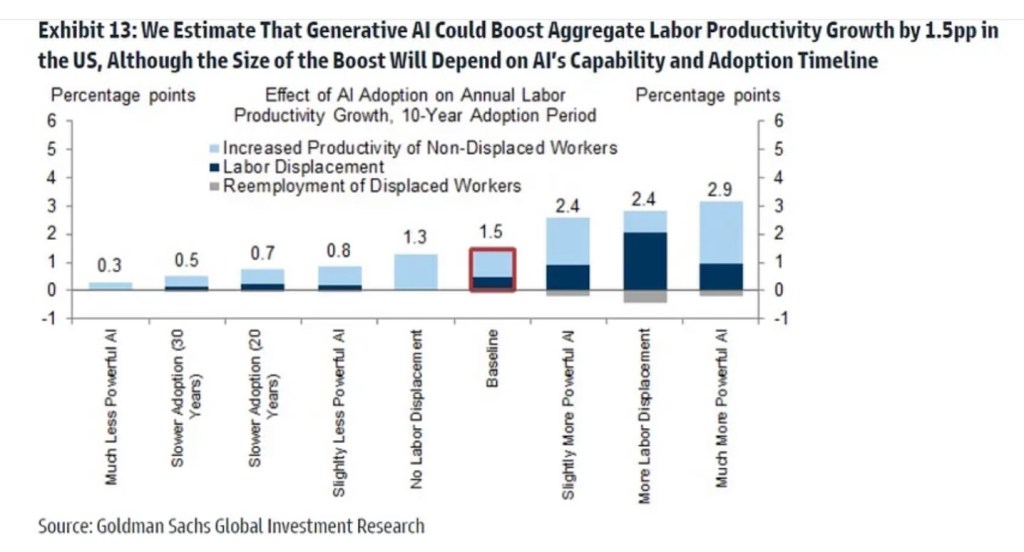
Artificial intelligence (AI) has become a very hot topic with incredible recent advances in AI performance. It’s very promising technology, and the expectations shown in the chart above illustrate what would be a profound economic impact. Like many new technologies, however, many find it threatening and are reacting with great alarm, There’s a movement within the tech industry itself, partly motivated by competitive self-interest, calling for a “pause”, or a six-month moratorium on certain development activities. Politicians in Washington are beginning to clamor for legislation that would subject AI to regulation. However, neither a voluntary pause nor regulatory action are likely to be successful. In fact, either would likely do more harm than good.

Leaps and Bounds

The pace of advance in AI has been breathtaking. From ChatGPT 3.5 to ChatGPT 4, in a matter of just a few months, the tool went from relatively poor performance on tests like professional and graduate entrance exams (e.g., bar exams, LSAT, GRE) to very high scores. Using these tools can be a rather startling experience, as I learned for myself recently when I allowed one to write the first draft of a post. (Despite my initial surprise, my experience with ChatGPT 3.5 was somewhat underwhelming after careful review, but I’ve seen more impressive results with ChatGPT 4). They seem to know so much and produce it almost instantly, though it’s true they sometimes “hallucinate”, reflect bias, or invent sources, so thorough review is a must.

Nevertheless, AIs can write essays and computer code, solve complex problems, create or interpret images, sounds and music, simulate speech, diagnose illnesses, render investment advice, and many other things. They can create subroutines to help themselves solve problems. And they can replicate!

As a gauge of the effectiveness of models like ChatGPT, consider that today AI is helping promote “over-employment”. That is, there are a number of ambitious individuals who, working from home, are holding down several different jobs with the help of AI models. In fact, some of these folks say AIs are doing 80% of their work. They are the best “assistants” one could possibly hire, according to a man who has four different jobs.

Economist Bryan Caplan is an inveterate skeptic of almost all claims that smack of hyperbole, and he’s won a series of bets he’s solicited against others willing to take sides in support of such claims. However, Caplan thinks he’s probably lost his bet on the speed of progress on AI development. Needless to say, it has far exceeded his expectations.

Naturally, the rapid progress has rattled lots of people, including many experts in the AI field. Already, we’re witnessing the emergence of “agency” on the part of AI Learning Language Models (LLMs), or so called “agentic” behavior. Here’s an interesting thread on agentic AI behavior. Certain models are capable of teaching themselves in pursuit of a specified goal, gathering new information and recursively optimizing their performance toward that goal. Continued gains may lead to an AI model having artificial generative intelligence (AGI), a superhuman level of intelligence that would go beyond acting upon an initial set of instructions. Some believe this will occur suddenly, which is often described as the “foom” event.

Team Uh-Oh

Concern about where this will lead runs so deep that a letter was recently signed by thousands of tech industry employees, AI experts, and other interested parties calling for a six-month worldwide pause in AI development activity so that safety protocols can be developed. One prominent researcher in machine intelligence, Eliezer Yudkowsky, goes much further: he believes that avoiding human extinction requires immediate worldwide limits on resources dedicated to AI development. Is this a severely overwrought application of the precautionary principle? That’s a matter I’ll consider at greater length below, but like Caplan, I’m congenitally skeptical of claims of impending doom, whether from the mouth of Yudkowsky, Greta Thunberg, Paul Ehrlich, or Nassim Taleb.

As I mentioned at the top, I suspect competition among AI developers played a role in motivating some of the signatories of the “AI pause” letter, and some of the non-signatories as well. Robin Hanson points out that Sam Altman, the CEO of OpenAI, did not sign the letter. OpenAI (controlled by a nonprofit foundation) owns ChatGPT and is the current leader in rolling out AI tools to the public. ChatGPT 4 can be used with the Microsoft search engine Bing, and Microsoft’s Bill Gates also did not sign the letter. Meanwhile, Google was caught flat-footed by the ChatGPT rollout, and its CEO signed. Elon Musk (who signed) wants to jump in with his own AI development: TruthGPT. Of course, the pause letter stirred up a number of members of Congress, which I suspect was the real intent. It’s reasonable to view the letter as a means of leveling the competitive landscape. Thus, it looks something like a classic rent-seeking maneuver, buttressed by the inevitable calls for regulation of AIs. However, I certainly don’t doubt that a number of signatories did so out of a sincere belief that the risks of AI must be dealt with before further development takes place.

The vast dimensions of the supposed AI “threat” may have some libertarians questioning their unequivocal opposition to public intervention. If so, they might just as well fear the potential that AI already holds for manipulation and control by central authorities in concert with their tech and media industry proxies. But realistically, broad compliance with any precautionary agreement between countries or institutions, should one ever be reached, is pretty unlikely. On that basis, a “scout’s honor” temporary moratorium or set of permanent restrictions might be comparable to something like the Paris Climate Accord. China and a few other nations are unlikely to honor the agreement, and we really won’t know whether they’re going along with it except for any traceable artifacts their models might leave in their wake. So we’ll have to hope that safeguards can be identified and implemented broadly.

Likewise, efforts to regulate by individual nations are likely to fail, and for similar reasons. One cannot count on other powers to enforce the same kinds of rules, or any rules at all. Putting our faith in that kind of cooperation with countries who are otherwise hostile is a prescription for ceding them an advantage in AI development and deployment. Regulation of the evolution of AI will likely fail. As Robert Louis Stevenson once wrote, “Thus paternal laws are made, thus they are evaded”. And if it “succeeds, it will leave us with a technology that will fall short of its potential to benefit consumers and society at large. That, unfortunately, is usually the nature of state intrusion into a process of innovation, especially when devised by a cadre of politicians with little expertise in the area.

Again, according to experts like Yudkowsky, AGI would pose serious risks. He thinks the AI Pause letter falls far short of what’s needed. For this reason, there’s been much discussion of somehow achieving an alignment between the interests of humanity and the objectives of AIs. Here is a good discussion by Seth Herd on the LessWrong blog about the difficulties of alignment issues.

Some experts feel that alignment is an impossibility, and that there are ways to “live and thrive” with unalignment (and see here). Alignment might also be achieved through incentives for AIs. Those are all hopeful opinions. Others insist that these models still have a long way to go before they become a serious threat. More on that below. Of course, the models do have their shortcomings, and current models get easily off-track into indeterminacy when attempting to optimize toward an objective.

But there’s an obvious question that hasn’t been answered in full: what exactly are all these risks? As Tyler Cowen has said, it appears that no one has comprehensively catalogued the risks or specified precise mechanisms through which those risks would present. In fact, AGI is such a conundrum that it might be impossible to know precisely what threats we’ll face. But even now, with deployment of AIs still in its infancy, it’s easy to see a few transition problems on the horizon.

White Collar Wipeout

Job losses seem like a rather mundane outcome relative to extinction. Those losses might come quickly, particularly among white collar workers like programmers, attorneys, accountants, and a variety of administrative staffers. According to a survey of 1,000 businesses conducted in February:

“Forty-eight percent of companies have replaced workers with ChatGPT since it became available in November of last year. … When asked if ChatGPT will lead to any workers being laid off by the end of 2023, 33% of business leaders say ‘definitely,’ while 26% say ‘probably.’ … Within 5 years, 63% of business leaders say ChatGPT will ‘definitely’ (32%) or ‘probably’ (31%) lead to workers being laid off.”

A rapid rate of adoption could well lead to widespread unemployment and even social upheaval. For perspective, that implies a much more rapid rate of technological diffusion than we’ve ever witnessed, so this outcome is viewed with skepticism in some quarters. But in fact, the early adoption phase of AI models is proceeding rather quickly. You can use ChatGPT 4 easily enough on the Bing platform right now!

Contrary to the doomsayers, AI will not just enhance human productivity. Like all new technologies, it will lead to opportunities for human actors that are as yet unforeseen. AI is likely to identify better ways for humans to do many things, or do wonderful things that are now unimagined. At a minimum, however, the transition will be disruptive for a large number of workers, and it will take some time for new opportunities and roles for humans to come to fruition.

Robin Hanson has a unique proposal for meeting the kind of challenge faced by white collar workers vulnerable to displacement by AI, or for blue collar workers who are vulnerable to displacement by robots (the deployment of which has been hastened by minimum wage and living wage activism). This treatment of Hanson’s idea will be inadequate, but he suggests a kind of insurance or contract sold to both workers and investors by owners of assets likely to be insensitive to AI risks. The underlying assets are paid out to workers if automation causes some defined aggregate level of job loss. Otherwise, the assets are paid out to investors taking the other side of the bet. Workers could buy these contracts themselves, or employers could do so on their workers’ behalf. The prices of the contracts would be determined by a market assessment of the probability of the defined job loss “event”. Governmental units could buy the assets for their citizens, for that matter. The “worker contracts” would be cheap if the probability of the job-loss event is low. Sounds far-fetched, but perhaps the idea is itself an entrepreneurial opportunity for creative players in the financial industry.

The threat of job losses to AI has also given new energy to advocates of widespread adoption of universal basic income payments by government. Hanson’s solution is far preferable to government dependence, but perhaps the state could serve as an enabler or conduit through which workers could acquire AI and non-AI capital.

Human Capital

Current incarnations of AI are not just a threat to employment. One might add the prospect that heavy reliance on AI could undermine the future education and critical thinking skills of the general population. Essentially allowing machines to do all the thinking, research, and planning won’t inure to the cognitive strength of the human race, especially over several generations. Already people suffer from an inability to perform what were once considered basic life skills, to say nothing of tasks that were fundamental to survival in the not too distant past. In other words, AI could exaggerate a process of “dumbing down” the populace, a rather undesirable prospect.

Fraud and Privacy

AI is responsible for still more disruptions already taking place, in particular violations of privacy, security, and trust. For example, a company called Clearview AI has scraped 30 billion photos from social media and used them to create what its CEO proudly calls a “perpetual police lineup”, which it has provided for the convenience of law enforcement and security agencies.

AI is also a threat to encryption in securing data and systems. Conceivably, AI could be of value in perpetrating identity theft and other kinds of fraud, but it can also be of value in preventing them. AI is also a potential source of misleading information. It is often biased, reflecting specific portions of the on-line terrain upon which it is trained, including skewed model weights applied to information reflecting particular points of view. Furthermore, misinformation can be spread by AIs via “synthetic media” and the propagation of “fake news”. These are fairly clear and present threats of social, economic, and political manipulation. They are all foreseeable dangers posed by AI in the hands of bad actors, and I would include certain nudge-happy and politically-motivated players in that last category.

The Sky-Already-Fell Crowd

Certain ethicists with extensive experience in AI have condemned the signatories of the “Pause Letter” for a focus on “longtermism”, or risks as yet hypothetical, rather than the dangers and wrongs attributable to AIs that are already extant: TechCrunch quotes a rebuke penned by some of these dissenting ethicists to supporters of the “Pause Letter”:

“‘Those hypothetical risks are the focus of a dangerous ideology called longtermism that ignores the actual harms resulting from the deployment of AI systems today,’ they wrote, citing worker exploitation, data theft, synthetic media that props up existing power structures and the further concentration of those power structures in fewer hands.”

So these ethicists bemoan AI’s presumed contribution to the strength and concentration of “existing power structures”. In that, I detect just a whiff of distaste for private initiative and private rewards, or perhaps against the sovereign power of states to allow a laissez faire approach to AI development (or to actively sponsor it). I have trouble taking this “rebuke” too seriously, but it will be fruitless in any case. Some form of cooperation between AI developers on safety protocols might be well advised, but competing interests also serve as a check on bad actors, and it could bring us better solutions as other dilemmas posed by AI reveal themselves.

Imagining AI Catastrophes

What are the more consequential (and completely hypothetical) risks feared by the “pausers” and “stoppers”. Some might have to do with the possibility of widespread social upheaval and ultimately mayhem caused by some of the “mundane” risks described above. But the most noteworthy warnings are existential: the end of the human race! How might this occur when AGI is something confined to computers? Just how does the supposed destructive power of AGIs get “outside the box”? It must do so either by tricking us into doing something stupid, hacking into dangerous systems (including AI weapons systems or other robotics), and/or through the direction and assistance of bad human actors. Perhaps all three!

The first question is this: why would an AGI do anything so destructive? No matter how much we might like to anthropomorphize an “intelligent” machine, it would still be a machine. It really wouldn’t like or dislike humanity. What it would do, however, is act on its objectives. It would seek to optimize a series of objective functions toward achieving a goal or a set of goals it is given. Hence the role for bad actors. Let’s face it, there are suicidal people who might like nothing more than to take the whole world with them.

Otherwise, if humanity happens to be an obstruction to solving an AGI’s objective, then we’d have a very big problem. Humanity could be an aid to solving an AGI’s optimization problem in ways that are dangerous. As Yudkowsky says, we might represent mere “atoms it could use somewhere else.” And if an autonomous AGI were capable of setting it’s own objectives, without alignment, the danger would be greatly magnified. An example might be the goal of reducing carbon emissions to pre-industrial levels. How aggressively would an AGI act in pursuit of that goal? Would killing most humans contribute to the achievement of that goal?

Here’s one that might seem far-fetched, but the imagination runs wild: some individuals might be so taken with the power of vastly intelligent AGI as to make it an object of worship. Such an “AGI God” might be able to convert a sufficient number of human disciples to perpetrate deadly mischief on its behalf. Metaphorically speaking, the disciples might be persuaded to deliver poison kool-aid worldwide before gulping it down themselves in a Jim Jones style mass suicide. Or perhaps the devoted will survive to live in a new world mono-theocracy. Of course, these human disciples would be able to assist the “AGI God” in any number of destructive ways. And when brain-wave translation comes to fruition, they better watch out. Only the truly devoted will survive.

An AGI would be able to create the illusion of emergency, such as a nuclear launch by an adversary nation. In fact, two or many adversary nations might each be fooled into taking actions that would assure mutual destruction and a nuclear winter. If safeguards such as human intermediaries were required to authorize strikes, it might still be possible for an AGI to fool those humans. And there is no guarantee that all parties to such a manufactured conflict could be counted upon to have adequate safeguards, even if some did.

Yudkowsky offers at least one fairly concrete example of existential AGI risk:

“A sufficiently intelligent AI won’t stay confined to computers for long. In today’s world you can email DNA strings to laboratories that will produce proteins on demand, allowing an AI initially confined to the internet to build artificial life forms or bootstrap straight to postbiological molecular manufacturing.”

There are many types of physical infrastructure or systems that an AGI could conceivably compromise, especially with the aid of machinery like robots or drones to which it could pass instructions. Safeguards at nuclear power plants could be disabled before steps to trigger melt down. Water systems, rivers, and bodies of water could be poisoned. The same is true of food sources, or even the air we breathe. In any case, complete social disarray might lead to a situation in which food supply chains become completely dysfunctional. So, a super-intelligence could probably devise plenty of “imaginative” ways to rid the earth of human beings.

Back To Earth

Is all this concern overblown? Many think so. Bryan Caplan now has a $500 bet with Eliezer Yudkowsky that AI will not exterminate the human race by 2030. He’s already paid Yudkowsky, who will pay him $1,000 if we survive. Robin Hanson says “Most AI Fear Is Future Fear”, and I’m inclined to agree with that assessment. In a way, I’m inclined to view the AI doomsters as highly sophisticated, change-fearing Luddites, but Luddites nevertheless.

Ben Hayum is very concerned about the dangers of AI, but writing at LessWrong, he recognizes some real technical barriers that must be overcome for recursive optimization to be successful. He also notes that the big AI developers are all highly focused on safety. Nevertheless, he says it might not take long before independent users are able to bootstrap their own plug-ins or modules on top of AI models to successfully optimize without running off the rails. Depending on the specified goals, he thinks that will be a scary development.

James Pethokoukis raises a point that hasn’t had enough recognition: successful innovations are usually dependent on other enablers, such as appropriate infrastructure and process adaptations. What this means is that AI, while making spectacular progress thus far, won’t have a tremendous impact on productivity for at least several years, nor will it pose a truly existential threat. The lag in the response of productivity growth would also limit the destructive potential of AGI in the near term, since installation of the “social plant” that a destructive AGI would require will take time. This also buys time for attempting to solve the AI alignment problem.

In another Robin Hanson piece, he expresses the view that the large institutions developing AI have a reputational Al stake and are liable for damages their AI’s might cause. He notes that they are monitoring and testing AIs in great detail, so he thinks the dangers are overblown.:

“So, the most likely AI scenario looks like lawful capitalism…. Many organizations supply many AIs and they are pushed by law and competition to get their AIs to behave in civil, lawful ways that give customers more of what they want compared to alternatives.”

In the longer term, the chief focus of the AI doomsters, Hanson is truly an AI optimist. He thinks AGIs will be “designed and evolved to think and act roughly like humans, in order to fit smoothly into our many roughly-human-shaped social roles.” Furthermore, he notes that AI owners will have strong incentives to monitor and “delimit” AI behavior that runs contrary to its intended purpose. Thus, a form of alignment is achieved by virtue of economic and legal incentives. In fact, Hanson believes the “foom” scenario is implausible because:

“… it stacks up too many unlikely assumptions in terms of our prior experiences with related systems. Very lumpy tech advances, techs that broadly improve abilities, and powerful techs that are long kept secret within one project are each quite rare. Making techs that meet all three criteria even more rare. In addition, it isn’t at all obvious that capable AIs naturally turn into agents, or that their values typically change radically as they grow. Finally, it seems quite unlikely that owners who heavily test and monitor their very profitable but powerful AIs would not even notice such radical changes.”

As smart as AGIs would be, Hanson asserts that the problem of AGI coordination with other AIs, robots, and systems would present insurmountable obstacles to a bloody “AI revolution”. This is broadly similar to Pethokoukis’ theme. Other AIs or AGIs are likely to have competing goals and “interests”. Conflicting objectives and competition of this kind will do much to keep AGIs honest and foil malign AGI behavior.

The kill switch is a favorite response of those who think AGI fears are exaggerated. Just shut down an AI if its behavior is at all aberrant, or if a user attempts to pair an AI model with instructions or code that might lead to a radical alteration in an AI’s level of agency. Kill switches would indeed be effective at heading off disaster if monitoring and control is incorruptible. This is the sort of idea that begs for a general solution, and one hopes that any advance of that nature will be shared broadly.

One final point about AI agency is whether autonomous AGIs might ever be treated as independent factors of production. Could they be imbued with self-ownership? Tyler Cowen asks whether an AGI created by a “parent” AGI could legitimately be considered an independent entity in law, economics, and society. And how should income “earned” by such an AGI be treated for tax purposes. I suspect it will be some time before AIs, including AIs in a lineage, are treated separately from their “controlling” human or corporate entities. Nevertheless, as Cowen says, the design of incentives and tax treatment of AI’s might hold some promise for achieving a form of alignment.

Letting It Roll

There’s plenty of time for solutions to the AGI threat to be worked out. As I write this, the consensus forecast for the advent of real AGI on the Metaculus online prediction platform is July 27, 2031. Granted, that’s more than a year sooner than it was 11 days ago, but it still allows plenty of time for advances in controlling and bounding agentic AI behavior. In the meantime, AI is presenting opportunities to enhance well being through areas like medicine, nutrition, farming practices, industrial practices, and productivity enhancement across a range of processes. Let’s not forego these opportunities. AI technology is far too promising to hamstring with a pause, moratoria, or ill-devised regulations. It’s also simply impossible to stop development work on a global scale.

Nevertheless, AI issues are complex for all private and public institutions. Without doubt, it will change our world. This AI Policy Guide from Mercatus is a helpful effort to lay out issues at a high-level.

Critical Gender Theory and Trends in Gender Identity

21 Thursday Apr 2022

Posted by Nuetzel in Gender, Wokeness

≈ Leave a comment

Tags

Babylon aber, Bisexuality, Bryan Caplan, C. Bradley Thompson, Celibacy, Cisgender, Closeting, Critical Gender Theory, Critical Race Theory, Critical Theory, Disney, Emilie Kao, Feminism, Gallup, GayBCs, Gender Dysphoria, Gender Identity, Gender Support Plans, Gender Unicorn, Gender-Affirming Therapy, Generation Z, Grooming, Heritability, Larpers, Laurence S. Mayer, LGBTQ, Libs of TikTok, Marxism, Millenials, Misgender, My Princess Boy, Paul R. McHugh, Paul W. Hruz, Precocious Puberty, Puberty Blockers, Recruitment, Religiosity, Sexual Liberation, Sexual Preference, Social Justice, Socialization, Transgenderism, Transition, Transition Closet, Victimhood

The growing influence of critical gender theory (CGT) in schools is unacceptable to many parents, especially at early grade levels. In fact, it’s been coming from certain areas of pediatric medicine for some time. Like critical race theory, CGT is another branch of critical theory, which was developed by a set of European social thinkers in the 1930s. CT is fundamentally a Marxist construct, and it lies at the heart of nearly all appeals to “social justice”. C. Bradley Thompson offers this concise perspective on critical theory:

“The principal aim of Critical Theory was and is, first, to deconstruct the forms of domination and hierarchy (i.e., the power relations) found in traditional or bourgeois societies, and, second, to reconstruct society toward what it calls ‘real’ or ‘true’ democracy, which is a neologism for socialism. Critical theory seeks to liberate any and all ‘victim’ groups based on their inferior and subjugated social status in capitalist societies (e.g., non-whites, women, and LGBTQ+ persons, etc.).”

LGBTQ+ Numbers

It’s fair to ask whether exposure to CGT in schools has any influence on the sexual orientation and preferences of students as they mature. That can be true only to the extent that these preferences reflect socialization, rather than other environmental factors or heredity. Apparently, most LGBTQ+ individuals are disposed to claim that their sexual preference is genetic. However, the claim that sexual preference is heritable to the exclusion of social influences is dubious. And there are other non-genetic, environmental influences that play a strong role as well.

Bryan Caplan discusses some fascinating generational differences in sexual orientation / identification revealed by a recent Gallup survey. Here, I reproduce the table shown in Caplan’s post. The sum of these categories (not shown) is taken as the LGBTQ+ share of each generation.

Taken at face value, those are extremely large increases over five generations… or even over two generations from millennials to GenZs, the gay proportion being the only category in which millennials and GenZs are reasonably close in 2022.

Another important wrinkle is that the share of older generations identifying as LGBTQ+ has been stable since the last survey conducted by Gallup in 2017, as shown by the Gallup chart below:

Millennials have increased by more than a third, and the LGBTQ+ share among Gen Zs has roughly doubled to 20.8%. Gen Zs surveyed in 2017 ranged from roughly 18 – 20 years of age, but that range was roughly 18 – 24 years of age in the latest survey. Therefore, the 2022 survey might capture a greater share of GenZs having “matured” into acceptance of specific sexual identities. Nevertheless, the levels and changes in these two generations are striking.

Causal Quandary

Caplan wonders how these increases would be possible if sexual orientation was predominantly heritable, especially given that these groups are unlikely to produce offspring at the same rate as the general population. The shrinking genotype / expanding phenotype paradox leads him to conclude that heightened LGBTQ+ socialization is generally responsible for the dramatic increases.

A number of Caplan’s commenters questioned his conclusions for one or several of these categories. At the risk of missing some of the nuance in the comments, I’ll attempt to summarize a few common threads: First, as Caplan himself notes, closeting is much less common than in the past. Therefore, increases in the reported shares of these categories might be illusory. Less closeting has brought little change in the responses of the older generations, however, and perhaps that’s because they tend to associate primarily within their own age cohorts.

Second, there could be environmental influences that have led to a smaller share of cis-gender males and females, as well as more “mis-genders” at birth. For example, anything that changes the flow of testosterone to a fetus in the womb might change a child’s sexual orientation, but whether some force has induced systematic changes in those flows over time, and across the population, is another matter.

Finally, the bulk of those claiming status as LGBTQ+ among millennials and Gen Zs are bisexual. For those who are otherwise heterosexual, identification as bisexual might be fairly “costless”. That suggests a possibility that the bisexual share may be influenced by status-seeking among GenZs, especially females. One joke goes “How can you tell if a girl is bi-sexual? … Don’t worry, she’ll tell you!” Thus, some commenters viewed the large increase in reported bisexuality as inflated by status seeking among what amounts to a kind of “larper” set. There might be so much emphasis on being open-minded about sexual experimentation among younger cohorts that minor incidents from childhood or adolescence are subsequently exaggerated into claims of bisexuality.

Socialization

Obviously the reduction in closeting leads to greater social exposure of non-traditional sexual preferences, including exposure to the nation’s youth. That’s a powerful social change, and it creates an atmosphere increasingly conducive to further socialization of these preferences, if not recruitment. Like many trends, this one feeds on itself: this 2021 study found a positive association between men “coming out” as gay and state legalization of same-sex marriage, the presence of gay communities, and positive attitudes toward gays. Moreover, there are definite signs of social contagion, as demonstrated by this clique of teenagers who, one and all, suddenly decided they were trans!

What forces led to the cascade in LGBTQ+ identification among more recent age cohorts? As a group, the full LGBTQ+ coalition has greater visibility, political power in asserting “victimhood”, and potential for socializing the general population to alternative lifestyles. However, there might not be any single trigger spanning LGBTQ+ identities that can explain the trend’s genesis. Perhaps the trends were set in motion by the sexual liberation of the 1960s and 70s which, as a libertarian, is not otherwise something I find objectionable.

The rise of radical feminism might have provided a basis for some females to reject males as a source of sexual gratification (and companionship), or as an exclusive source thereof, at any rate. There’s a likelihood that this contributed to the rise in lesbianism as well as female bisexuality. Feminism also served as a pretext for identity politics, which relies on claims of victimhood and is therefore fertile ground for critical theorists.

Critical theory first gained significant ground in the U.S. at universities along dimensions of race, but gender and sexual preference weren’t far behind. This “social justice” perspective filtered its way into departments of education, where academic standards are exceptionally forgiving. This, in turn, led to more fertile ground for critical theory in elementary and high school education.

CGT promotes the idea that gender is a social construct. If an individual feels that he or she is not well-suited to their biological sex, then CGT holds that they should identify as members of the opposite sex and pursue any medical paths to transition as might be available. This view has increasingly been applied to younger individuals.

Medical Experts

Paul W. Hruz, Laurence S. Mayer, and Paul R. McHugh (HMM) discuss the 1980s development of certain pharmaceuticals prescribed today to many children suffering from gender dysphoria. One might suspect that these drugs helped to set some of these trends in motion, together with so-called “gender-affirming” therapies that are now widely practiced. The latter involve therapists who accept and support the gender identity with which a patient feels most comfortable. Needless to say, this approach is likely to encourage a gender dysphoric youth to continue their exploration of a change in gender.

Synthetic hormonal “puberty blockers” became available in the early 1990s as a treatment for early puberty (so-called “precocious puberty”). At about the same time, the treatment was tested to stop production of sex hormones in adult males identifying as females. In the 1990s, the treatment was first used to suppress puberty in children with gender dysphoria, but the effects are supposedly reversible. Advancing to a full “transition” protocol involves the subsequent use of cross-sex ­hormones ­and ultimately surgical­ reassignment. Today, puberty suppression techniques are widely used on children with gender dysphoria because it is viewed as a safe choice that might “buy time” while other forms of maturation proceed. Here are HMM on this point:

“The­ use­ of­ puberty­ suppression­ and ­cross-sex hormones ­for­ minors­ is­ a­ radical­ step­ that­ presumes ­a­ great­ deal ­of­ knowledge­ and­ competence­ on­ the­ part ­of­ the­ children­ assenting to­ these­ procedures,­ on­ the­ part ­of­ the­ parents­ or­ guardians­ being­ asked­ to­ give­ legal­ consent­ to­ them,­ and­ on­ the­ part­ of­ the­ scientists­ and­ physicians­ who­ are­ developing­ and­ administering­ them.­ We­ frequently­ hear­ from­ neuroscientists­ that­ the ­adolescent­ brain­ is­ too­ immature­ to­ make­ reliably­ rational­ decisions,­ but­ we­ are­ supposed­ to­ expect­ emotionally­ troubled­ adolescents­ to­ make­ decisions­ about­ their­ gender­ identities ­and­ about­ serious­ medical ­treatments ­at­ the­ age ­of­ 12­ or­ younger.­ And­ we­ are­ supposed ­to­ expect­ parents­ and­ physicIans ­to­ evaluate ­the risks­ and­ benefits ­of­ puberty ­suppression,­ despite­ the­ state­ of­ ignorance ­in­ the­ scientific ­community­ about­ the­ nature­ of­ gender­ identity.”

HMM also discuss the strong influence that activists have had on the medical establishment. This is summarized nicely by Emilie Kao:

“… the largest LGBT lobbying organization, the Human Rights Campaign and World Professional Association for Transgender Health (WPATH) influenced medical organizations like the Endocrine Society and the American Academy of Pediatrics to embrace gender affirmation over the last two decades. Jason Pierceson, author of Sexual Minorities and Politics, explains that ‘political activism and consciousness raising has also changed the way in which the medical community views transgender persons.’ He describes how this activism led the American Psychiatric Association to “abandon the mental illness paradigm of transgenderism” by changing the description in the Diagnostic and Statistical Manual of Mental Disorders (DSM-5) to treat only the stress associated with gender dysphoria as a mental disorder. No breakthroughs in science or medicine led to the change, which was accomplished just by political activism.”

HMM do not claim that puberty blockers and gender-affirming therapy are at the root of increasing transgenderism. However, they express strong reservations about widespread use of puberty blockers among gender dysphoric adolescents.

We know that gender dysphoric youths have high rates of anxiety, depression, and even suicide. Unfortunately, transition doesn’t seem to alleviate those problems as a general rule. Furthermore, it’s important to remember that unhappy adolescents are nothing new. It can be an unhappy time for many kids who are full of self-doubt. Most of them get over it, however, and many with dysphoria get over it as well. One has to ask: does helping dysphoric children along the path to transition so early have any real gains in the aggregate?

Educational Experts

What role have the schools played in the gender confusion? The answer is just as horrifying as the role of the therapists and medical doctors encouraging and overseeing the early encouragement of transitions discussed above.

“As early as 2007, for instance, California’s education code stated that gender pertains not to anything biological but to ‘a person’s gender-related appearance and behavior.’[3] Gender is, in other words, a choice and has no relation to biology. This means that children have a smorgasbord of gender identities to choose from.”

So this is not new and could well have played a role in the Gallup survey results, especially for GenZs. Read at the last link about such things as “Gender Support Plans” in the schools, teacher training in dealing with gender issues, a “children’s garden” where five-year olds can learn the difference between biological sex and “gender”, a kindergarten book called My Princess Boy, the GayBCs for ages 4 – 8, the provision of a “transition closet” in which kids change their clothing once they arrive at school, school nurses who provide puberty blockers to kids they evaluate as dysphoric, pronoun lessons, of course, and many other examples. Also see this article for further information about CGT in schools, including the “Gender Unicorn” first introduced in 2016 and now used nationwide, starting as early as pre-K and kindergarten. And for a running catalog of the outrageous lessons taking place in our schools, check out Libs of Tik Tok.

Other Causal Forces

There are other vaguely plausible explanations for the trend toward more common identification as LGBTQ+ among millennials and GenZs. The internet and especially social media come to mind. Small and large social contagions are frequent on these platforms. Pre-social media, members of certain sub-cultures, and dare I say outcasts, had more difficulty finding, communicating and sharing information with one another. Today there is much less friction in that regard. Social media is also a hotbed of misery for many individuals, afflicted all too often with feelings of inadequacy or a feeling that they are outcasts. Among unhappy youths, the suggestion to try something different, to join a new “tribe”, may be very tempting. The internet serves as a guide.

A phenomenon that might be related to trends in gender identity is an increase in celibacy and decline of “partner sex”, especially among younger individuals and men. While so-called partner sex includes gay sex, the trend in sexual identity is not about any decline in sexual activity per se, but about representations of sexual identity. The uptrend in celibacy is consistent with the hypothesis that some cisgenders, frustrated by a lack of sexual partners (as distinct from the small, mostly male and angry “incel” community), might seek out a broader array of prospects. However, I know of no actual evidence to suggest such a connection.

The entertainment world is certainly no newcomer to controversies surrounding sexual identity. Gayness has long been celebrated in the theatre community, to a fault. I love theatre, but the near ubiquity of the theme in recent years has grown tiresome. There have always been gay stars of the screen, television, and musical entertainment, though it was often closeted in the past. Gay and gender identity themes have become much more common in film, but it was only recently that Disney began to emphasize gender issues explicitly with the children’s audience in mind. Some adults and even adolescents must grapple with gender dysphoria as they always have, with varying degrees of success and failure. However, to subject an audience of young children to themes that are beyond their ability to comprehend, and for whom the early exposure is completely unnecessary, is not acceptable.

Finally, the decline of religiosity might play a role in the trend toward LGBT+ identities. For one thing, church-goers have one more place to meet potential mates. More importantly, traditional religion has nearly always frowned on homosexuality, at least officially, and the LGBT+ coalition is largely areligious. Therefore, it seems likely that the negative trend in religiosity might be related to the positive trend in the LGBTQ+ population.

Conclusion

There is no question that identification as any of various forms of LGBTQ+ has increased dramatically among millennials and GenZs, with the largest increase in the bisexual category. Bryan Caplan hypothesizes that the trend is one of socialization, if not recruitment. It seems likely that this is the case, though much of the LGBTQ+ community’s internal, personal recruitment is probably of the passive variety. In addition, it seems likely that some of the gap relative to older generations is due to a reduction in closeting as well as “costless” status-seeking among individuals who wish to be perceived as enlightened or woke.

It’s also evident that the portion of the medical establishment concerned with issues of gender identity, as well as schools and certain entertainment institutions, have adopted the extreme views espoused by critical gender theory. They are actively encouraging children to learn about and explore various gender identities. This may encourage gender dysphoria, and when children show signs of dysphoria they are encouraged to move to the next stage, which involves affirmative therapy and puberty blockers, A bit later, teenagers might move on to other hormonal treatments and later-still, sex-change surgery. Our major medical, educational, and entertainment institutions appear to be real sources of non-passive recruitment, and indeed, the grooming of children for lives as LGBTQ+ adults.

Credit for the image at the top of this post goes to the Babylon Bee.

Behold Our Algorithmic Overlords

18 Thursday Jul 2019

Posted by Nuetzel in Automation, Censorship, Discrimination, Marketplace of Ideas

≈ Leave a comment

Tags

Algorithmic Governance, American Affairs, Antitrust, Behavioral Economics, Bryan Caplan, Claremont Institute, David French, Deplatforming, Facebook, Gleichschaltung, Google, Jonah Goldberg, Joseph Goebbels, Mark Zuckerberg, Matthew D. Crawford, nudge, Peeter Theil, Political Legitimacy, Populism, Private Governance, Twitter, Viewpoint Diversity

A willingness to question authority is healthy, both in private matters and in the public sphere, but having the freedom to do so is even healthier. It facilitates free inquiry, the application of the scientific method, and it lies at the heart of our constitutional system. Voluntary acceptance of authority, and trust in its legitimacy, hinges on our ability to identify its source, the rationale for its actions, and its accountability. Unaccountable authority, on the other hand, cannot be tolerated. It’s the stuff of which tyranny is made.

That’s one linchpin of a great essay by Matthew D. Crawford in American Affairs entitled “Algorithmic Governance and Political Legitimacy“. It’s a lengthy piece that covers lots of ground, and very much worth reading. Or you can read my slightly shorter take on it!

Imagine a world in which all the information you see is selected by algorithm. In addition, your success in the labor market is determined by algorithm. Your college admission and financial aid decisions are determined by algorithm. Credit applications are decisioned by algorithm. The prioritization you are assigned for various health care treatments is determined by algorithm. The list could go on and on, but many of these “use-cases” are already happening to one extent or another.

Blurring Private and Public Governance

Much of what Crawford describes has to do with the way we conduct private transactions and/or private governance. Most governance in free societies, of the kind that touches us day-to-day, is private or self-government, as Crawford calls it. With the advent of giant on-line platforms, algorithms are increasingly an aspect of that governance. Crawford notes the rising concentration of private governmental power within these organizations. While the platforms lack complete monopoly power, they are performing functions that we’d ordinarily be reluctant to grant any public form of government: they curate the information we see, conduct surveillance, exercise control over speech, and even indulge in the “deplatforming” of individuals and organizations when it suits them. Crawford quotes Facebook CEO Mark Zuckerberg:

“In a lot of ways Facebook is more like a government than a traditional company. . . . We have this large community of people, and more than other technology companies we’re really setting policies.”

At the same time, the public sector is increasingly dominated by a large administrative apparatus that is outside of the normal reach of legislative, judicial and even executive checks. Crawford worries about “… the affinities between administrative governance and algorithmic governance“.  He emphasizes that neither algorithmic governance on technology platforms nor an algorithmic administrative state are what one could call representative democracy. But whether these powers have been seized or we’ve granted them voluntarily, there are already challenges to their legitimacy. And no wonder! As Crawford says, algorithms are faceless pathways of neural connections that are usually difficult to explain, and their decisions often strike those affected as arbitrary or even nonsensical.

Ministry of Wokeness

Political correctness plays a central part in this story. There is no question that the platforms are setting policies that discriminate against certain viewpoints. But Crawford goes further, asserting that algorithms have a certain bureaucratic logic to elites desiring “cutting edge enforcement of social norms“, i.e., political correctness, or “wokeness”, the term of current fashion.

“First, in the spirit of Václav Havel we might entertain the idea that the institutional workings of political correctness need to be shrouded in peremptory and opaque administrative mechanisms be­cause its power lies precisely in the gap between what people actu­ally think and what one is expected to say. It is in this gap that one has the experience of humiliation, of staying silent, and that is how power is exercised.

But if we put it this way, what we are really saying is not that PC needs administrative enforcement but rather the reverse: the expand­ing empire of bureaucrats needs PC. The conflicts created by identi­ty politics become occasions to extend administrative authority into previously autonomous domains of activity. …

The incentive to technologize the whole drama enters thus: managers are answerable (sometimes legally) for the conflict that they also feed on. In a corporate setting, especially, some kind of ass‑covering becomes necessary. Judgments made by an algorithm (ideally one supplied by a third-party vendor) are ones that nobody has to take responsibility for. The more contentious the social and political landscape, the bigger the institutional taste for automated decision-making is likely to be.

Political correctness is a regime of institutionalized insecurity, both moral and material. Seemingly solid careers are subject to sud­den reversal, along with one’s status as a decent person.”

The Tyranny of Deliberative Democracy

Crawford takes aim at several other trends in intellectual fashion that seem to complement algorithmic governance. One is “deliberative democracy”, an ironically-named theory which holds that with the proper framing conditions, people will ultimately support the “correct” set of policies. Joseph Goebbels couldn’t have put it better. As Crawford explains, the idea is to formalize those conditions so that action can be taken if people do not support the “correct” policies. And if that doesn’t sound like Gleichschaltung (enforcement of conformity), nothing does! This sort of enterprise would require:

 “… a cadre of subtle dia­lecticians working at a meta-level on the formal conditions of thought, nudging the populace through a cognitive framing operation to be conducted beneath the threshold of explicit argument. 

… the theory has proved immensely successful. By that I mean the basic assumptions and aspira­tions it expressed have been institutionalized in elite culture, perhaps nowhere more than at Google, in its capacity as directorate of information. The firm sees itself as ‘definer and defender of the public interest’ …“

Don’t Nudge Me

Another of Crawford’s targets is the growing field of work related to the irrationality of human behavior. This work resulted from the revolutionary development of  experimental or behavioral economics, in which various hypotheses are tested regarding choice, risk aversion, an related issues. Crawford offers the following interpretation, which rings true:

“… the more psychologically informed school of behavioral economics … teaches that we need all the help we can get in the form of external ‘nudges’ and cognitive scaffolding if we are to do the rational thing. But the glee and sheer repetition with which this (needed) revision to our under­standing of the human person has been trumpeted by journalists and popularizers indicates that it has some moral appeal, quite apart from its intellectual merits. Perhaps it is the old Enlightenment thrill at disabusing human beings of their pretensions to specialness, whether as made in the image of God or as ‘the rational animal.’ The effect of this anti-humanism is to make us more receptive to the work of the nudgers.”

While changes in the framing of certain decisions, such as opt-in versus opt-out rules, can often benefit individuals, most of us would rather not have nudgers cum central planners interfere with too many of our decisions, no matter how poorly they think those decisions approximate rationality. Nudge engineers cannot replicate your personal objectives or know your preference map. Indeed, externally applied nudges might well be intended to serve interests other than your own. If the political equilibrium involves widespread nudging, it is not even clear that the result will be desirable for society: the history of central planning is one of unintended consequences and abject failure. But it’s plausible that this is where the elitist technocrats in Silicon Vally and within the administrative state would like to go with algorithmic governance.

Crawford’s larger thesis is summarized fairly well by the following statements about Google’s plans for the future:

“The ideal being articulated in Mountain View is that we will inte­grate Google’s services into our lives so effortlessly, and the guiding presence of this beneficent entity in our lives will be so pervasive and unobtrusive, that the boundary between self and Google will blur. The firm will provide a kind of mental scaffold for us, guiding our intentions by shaping our informational context. This is to take the idea of trusteeship and install it in the infrastructure of thought.

Populism is the rejection of this.”

He closes with reflections on the attitudes of the technocratic elite toward those who reject their vision as untrustworthy. The dominance of algorithmic governance is unlikely to help them gain that trust.

What’s to be done?

Crawford seems resigned to the idea that the only way forward is an ongoing struggle for political dominance “to be won and held onto by whatever means necessary“. Like Bryan Caplan, I have always argued that we should eschew anti-trust action against the big tech platforms, largely because we still have a modicum of choice in all of the services they provide. Caplan rejects the populist arguments against the tech “monopolies” and insists that the data collection so widely feared represents a benign phenomenon. And after all, consumers continue to receive a huge surplus from the many free services offered on-line.

But the reality elucidated by Crawford is that the tech firms are much more than private companies. They are political and quasi-governmental entities. Their tentacles reach deeply into our lives and into our institutions, public and private. They are capable of great social influence, and putting their tools in the hands of government (with a monopoly on force), they are capable of exerting social control. They span international boundaries, bringing their technical skills to bear in service to foreign governments. This week Peter Theil stated that Google’s work with the Chinese military was “treasonous”. It was only a matter of time before someone prominent made that charge.

The are no real safeguards against abusive governance by the tech behemoths short of breaking them up or subjecting them to tight regulation, and neither of those is likely to turn out well for users. I would, however, support safeguards on the privacy of customer data from scrutiny by government security agencies for which the platforms might work. Firewalls between their consumer and commercial businesses and government military and intelligence interests would be perfectly fine by me. 

The best safeguard of viewpoint diversity and against manipulation is competition. Of course, the seriousness of threats these companies actually face from competitors is open to question. One paradox among many is that the effectiveness of the algorithms used by these companies in delivering services might enhance their appeal to some, even as those algorithms can undermine public trust.

There is an ostensible conflict in the perspective Crawford offers with respect to the social media giants: despite the increasing sophistication of their algorithms, the complaint is really about the motives of human beings who wish to control political debate through those algorithms, or end it once and for all. Jonah Goldberg puts it thusly:

“The recent effort by Google to deny the Claremont Institute the ability to advertise its gala was ridiculous. Facebook’s blocking of Prager University videos was absurd. And I’m glad Facebook apologized.

But the fact that they apologized points to the fact that while many of these platforms clearly have biases — often encoded in bad algorithms — points to the possibility that these behemoths aren’t actually conspiring to ‘silence’ all conservatives. They’re just making boneheaded mistakes based in groupthink, bias, and ignorance.”

David French notes that the best antidote for hypocrisy in the management of user content on social media is to expose it loud and clear, which sets the stage for a “market correction“. And after all, the best competition for any social media platform is real life. Indeed, many users are dropping out of various forms of on-line interaction. Social media companies might be able to retain users and appeal to a broader population if they could demonstrate complete impartiality. French proposes that these companies adopt free speech policies fashioned on the First Amendment itself:

“…rules and regulations restricting speech must be viewpoint-neutral. Harassment, incitement, invasion of privacy, and intentional infliction of emotional distress are speech limitations with viewpoint-neutral definitions…”

In other words, the companies must demonstrate that both moderators and algorithms governing user content and interaction are neutral. That is one way for them to regain broad trust. The other crucial ingredient is a government that is steadfast in defending free speech rights and the rights of the platforms to be neutral. Among other things, that means the platforms must retain protection under Section 230 of the Telecommunications Decency Act, which assures their immunity against lawsuits for user content. However, the platforms have had that immunity since quite early in internet history, yet they have developed an aggressive preference for promoting certain viewpoints and suppressing others. The platforms should be content to ensure that their policies and algorithms provide useful tools for users without compromising the free exchange of ideas. Good governance, political legitimacy, and ultimately freedom demand it. 

In Defense of College Admission for Pay

20 Wednesday Mar 2019

Posted by Nuetzel in competition, Education, Markets, School Choice, Uncategorized

≈ Leave a comment

Tags

Admission Standards, Bryan Caplan, College Admissions, competition, FBI, grade inflation, K-12 education, Non-Price Rationing, School Choice, Varsity Blues

The college admissions scandal revealed by the FBI last week exposed the willingness of some very wealthy people to lie and cheat to enhance the status of their children. It also resulted in charges against several employees of testing services and prestigious universities, who sold-out their institutions for pure financial gain. These actions may have harmed more deserving applicants to the defrauded academic institutions. Perhaps as sad, the children whose parents cheated are bound to suffer life-long consequences.

Strong prosecution of these crimes will deter other parents entertaining similarly crooked avenues in pursuit of ambitions for their kids. The schools and testing organizations should be motivated to tighten their internal governance processes. My hope, however, is that legislative bodies will refrain from passing new laws in an effort to regulate college admissions. Many schools accept a small percentage of students, legacy or otherwise, who do not meet their academic standards but whose wealthy families make substantial, above-board donations that benefit other students. Putting an abrupt end to these transactions might not be helpful to anyone.

With certain conditions, I do not object to wealthy parents wishing to pay an above-board premium to get their kids into the college of their choice, nor do I object to schools that are free to name their price. First, the school should always receive consideration in an amount adequate to benefit other students or deserving applicants. Second, the acceptance of a privileged but academically inferior student should represent an increment to the school’s freshman class, never taking a coveted slot otherwise filled by a better student. Third, an institution should never guarantee successful completion of a degree program in exchange for such an offer. Fourth, I’d like to see schools make public the number of students falling short of academic qualification whom they accept in exchange for such offers, as well as the aggregate remuneration they receive in all those cases. Fifth and finally, I see no reason why these practices should be limited to private schools. However, a public school’s remuneration must be more than sufficient to make unnecessary any taxpayer subsidies attributable to a new matriculant.

I don’t believe any of these conditions should be a matter of law. Private and public educational institutions are market participants, even if they do engage in non-price rationing. Market incentives should guide institutions to protect the integrity of their brands by awarding degrees only for real academic achievement. This bears on my third and fourth conditions above: no school can guarantee to parents that a degree will be awarded to their child without compromising its integrity. Also, a school’s academic reputation should reflect the extent to which it accepts applicants lacking the school’s minimum standards.

One of the thorniest problems with my conditions has to do with the poor academic standards that actually exist in certain degree programs. These make it possible for bad students to earn diplomas. Grade inflation is all too pervasive, and grade-point averages are notoriously high in some fields, such as education. It may be exceptionally difficult to monitor and prevent instructors from allowing poor students to skate through classes with decent grades. And too obviously and sadly, it’s often the diploma itself that matters to people as a status symbol, rather than real educational achievement. If employers are content to rely on mere signals of that kind, so much the worse.

There’s nothing to be done if that’s all that is demanded of a college education. I think that, more than anything else, is what inflames the passions of Bryan Caplan, who calls the entire system of higher education wasteful. More demanding disciplines have some immunity to this form of decay. Competitive markets might punish schools and employers having weak standards. But wherever the importance of real merit is discounted due to classist loyalties, legal impediments, professions lacking in academic rigor, or any other form of compromise, the diploma signal is paramount, and that is lamentable.

The admissions scandal has prompted howls of indignation directed not only at the cheaters ensnared by the FBI’s “Varsity Blues” operation, but more broadly at the perceived injustices of college admissions in general. The process is said to be unfair because it tolerates admissions for scions of wealthy families and even those who can pay for multiple rounds of standardized tests, multiple application fees, interview “coaches” and the like. These advantages are not unlike those endemic to any market in which ability-to-pay impinges on demand. Yet generally markets do an excellent job of facilitating the development of affordable substitutes. College education is no different, and longstanding mechanisms are in place offering means of payment for academically-qualified applicants who lack adequate resources. The conditions I listed above would enhance that support.

Nevertheless, critics say that the disadvantaged do not get adequate preparation in primary and secondary education to be competitive in college admissions. They are largely correct, but the solutions have more to do with fixing public K-12 education than the college admissions process. Primary and secondary education are almost devoid of competition and real parental choice in disadvantaged communities. There are many other social problems that aggravate the poor performance of public education in preparing students who might otherwise be candidates for higher learning. Realistically, however, the college admissions process cannot be blamed for those problems.

How Empowered Bleeding Hearts Do Harden

01 Friday Feb 2019

Posted by Nuetzel in Collectivism, Socialism, The Road To Serfdom, Tyranny

≈ Leave a comment

Tags

Authoritarianism, Banality of Evil, Bleeding Hearts, Bryan Caplan, Collectivism, Confiscation, Free Markets, Hugo Chavez, Natural Rights, Social Democracy, Tyranny of the Majority, Venezuela

Here’s an empirical regularity: altruists attaining power to collectivize society’s productive machinery do not stay nice for long. In fact, aggressive pursuit of their goals might compel them to participate in brutal tyranny. But why? What happens to these sweet egalitarians who are, after all, imbued with the most earnest desire to elevate the common man by equalizing the fruits of society’s bounty?

Bryan Caplan offers Venezuela as Exhibit A in “A Short Hop from Bleeding Heart to Mailed Fist“:

“When Hugo Chavez began ruling Venezuela, he sounded like a classic bleeding-heart – full of pity for the poor and downtrodden. Plenty of people took him at his words – not just Venezuelans, but much of the international bleeding-heart community. … Almost every Communist dictatorship launches with mountains of humanitarian propaganda. Yet ultimately, almost everyone who doesn’t fear for his life wakes up and smells the tyranny.”

Venezuela’s collapse is merely the most recent in a long history of socialist debacles. Authoritarians certainly come in other stripes, but collectivists seem especially prone to the development of vicious alter-egos. But again, why?

Caplan knows the answer, and in something of a dialectical exercise, he proposes several explanations for the nice-to-nasty phenomenon. It’s not the infiltration of “bad guys”. Plenty of evidence suggests that the same people are at both ends of the transition, and for now let’s give the benefit of the doubt to the nicest elements of the avant guarde, or even those who go simply along on the basis of their idealism. It’s implausible that such humanitarian souls could believe it will be necessary, at the outset, to crush their opposition by force. Moreover, that approach risks immediate outcomes that are far too dire. Might an authoritarian or militaristic turn be necessary to deter hostile foreign actors who might attempt to foil collectivization? If so, it still doesn’t explain why subjugation of domestic citizens is ultimately accepted as a legitimate use of force by sincere altruists.

Caplan moves on to more compelling explanations of the disorder. Perhaps the expression of bleeding heart intentions is propaganda from the very start. Perhaps the rhetoric is really just hate speech disguised as noble intent. Surely those two explanations comport with the behavior of those having uglier motives for collectivism: envy and vengeance. And while those elements are certain to be active in any socialist front, they don’t explain why the bleeders also abecome beaters.

The best explanation for the horrid metamorphosis of empowered altruists is that egalitarian policies simply do not work very well. Caplan says:

“Bleeding-heart policies work so poorly that only the mailed fist can sustain them. In this story, the bleeding hearts are at least initially sincere. If their policies worked well enough to inspire broad support, the bleeding hearts would play nice. Unfortunately, bleeding-heart policies are exorbitantly expensive and often directly counter-productive. Pursued aggressively, they predictably lead to disaster. At this point, a saintly bleeding heart will admit error and back off. A pragmatic bleeding heart will compromise. The rest, however, respond to their own failures with rage and scapegoating. Once you institutionalize that rage and scapegoating, the mailed fist has arrived.” [Caplan’s emphasis]

The compulsory nature of policies advocated by leftists makes their system of social organization inherently unstable. With the imposition of every rule limiting the operation of private markets, with every compromise of the price mechanism, and with every new confiscatory policy, the economy becomes more feeble and inflexible. As several commenters on Caplan’s post note, socialists are people who simply do not understand economics.

The path to collectivism always involves promises that are impossible to keep. Personal concerns must be renounced in favor of the collective. Individuals are denied their freedom to act on creative impulses and their ability to cooperate freely with others in pursuit of personal well-being. Those are human rights that are quite unnatural to part with. That means it is impossible to achieve the collective without an implicit or explicit threat of enforcement through violent police power. Bleeding hearts will actually participate in the inevitable tyranny because they are so convinced of the righteousness of their cause.

Whether you call it socialism or social democracy makes no difference. The latter merely cloaks tyranny in a majoritarian dominance that would have enraged our nation’s founders. They understood the despotism inherent in allowing a majority to dictate the existence of basic rights. However, the bleeding hearts are always sure they know “what’s right” without weighing implications beyond the injustice du jour. That demands the application of force. And when confronted with the catastrophic results of their peremptory whimsy, they have no choice but to use still more force.

The banality of evil is truly a progressive disease. Fortunately, we have a preventive vaccine: the U.S. Constitution. But it will work only if we’re wise enough to rely on the framer’s original intent.


Right-to-Work Promotes Employment, Wage Growth

06 Monday Aug 2018

Posted by Nuetzel in Labor Markets, Right to Work

≈ Leave a comment

Tags

Bryan Caplan, Don Boudreaux, Economic Policy Institute, Gallup, James Sherk, Jeffrey Eisenach, Mark Mix, Missouri Right to Work, Proposition A, Right to Work, Union Density, Unions, Wages

The economic evidence is quite clear that state right-to-work (RtW) laws do not reduce wages, though a few seem desperate to convince us otherwise. In fact, RtW has proven to be an unambiguous economic tonic for states that have enacted such laws (though perhaps not for union lobbyists). Note that this has nothing to do with comparisons of nominal wage levels in RtW vs. non-RtW states, as organizations like the left-wing Economic Policy Institute (EPI) are wont to make. Adjusting for the cost of living often shows a different result. Either way, the recency of RTW laws in many states means that those differences tend to be legacy effects and are not useful as a gauge of the incremental impact of RtW laws.

It’s no coincidence that RtW laws have gained favor as a mechanism for encouraging economic growth in historically low-wage states. The efforts have been largely successful. Jeffrey Eisenach reported the following findings in 2015:

  • “RTW laws directly affect economic performance through their impact on business location decisions, especially in heavily unionized industries such as manufacturing. Other things being equal, businesses are more likely to locate in states with RTW laws. There is also evidence that RTW laws have a direct, positive effect on employment, output, and personal income.
  • RTW laws do not lead to lower average wages in either unionized or non-unionized industries. There is some evidence that the long-run effect of RTW laws is to raise wage rates as a result of increased productivity.
  • RTW laws also affect economic performance indirectly through lower rates of union density. The weight of the evidence indicates that lower union density is associated with higher levels of employment, increased investment and R&D spending, and increased innovation.”

Mark Mix reports similar evidence, including more rapid employment growth and larger wage gains in RtW states. And James Sherk addresses some of the myths surrounding RtW, including the misleading narrative that RtW reduces wages and that RtW is unpopular among the American public. Indeed, Sherk quotes a Gallup poll finding that Americans support right-to-work laws by more than a 3 to 1 margin, though it’s not clear how well the average American understands the issue.

A disturbing aspect of the opposition to RtW is an effort to disparage the business community by characterizing private enterprise as exploitative. I leave you with some wisdom from Bran Caplan on that point (HT: Don Boudreaux):

“Businesses produce and deliver virtually all of the wonderful, affordable products that we enjoy. Contrary to millennia of economic illiterates, businesses rarely do so by ‘exploiting’ their workers. Instead, businesses provide gentle but much-needed leadership. Left to our own economic devices, most of us are virtually useless; we don’t know how to produce much, and we don’t know how to find customers.  Businesspeople solve these problems: They recruit workers, organize them to vastly raise their productivity, then put these products in the hands of customers all over the world. Yes, they’re largely in it for the money; but – unlike every government on Earth – business rarely puts a gun to your head. Businesses assemble teams of volunteers to meet the needs of willing consumers – and succeed wildly.” (emphasis Caplan’s)

Open Borders and Club Goods

13 Saturday Jan 2018

Posted by Nuetzel in Immigration, Liberty

≈ 1 Comment

Tags

Alex Tabarrok, Bryan Caplan, Citizenship, Club Goods, Common Resources, Congestion Costs, Contestable Goods, Don Boudreaux, Exclusivity, Immigration, James Buchanan, Patrick McNutt, Private Goods, Public goods, Rivalrousness, Safety Net, Sheldon Richman, Social Contract, ThoughtCo., Tyler Cowen

The question of open borders divides libertarians as much as any. The arguments for open borders made by the likes of Bryan Caplan, Alex Tabarrok, Don Boudreaux and Sheldon Richman are in many ways quite appealing. Fewer borders means greater opportunities for gainful trade among individuals. For the U.S., the economic gains from in-migration have been unquestionable. From a pure libertarian perspective, governments should never interfere with the non-violent actions of free individuals, including freedom of movement. These great economists contend, in effect, that there is no real moral distinction between government actions that confine individuals within borders and those that keep people out, though our conciences are less burdened by the latter because the world abroad seems so large.

There is a gnawing contradiction in this viewpoint, however. It relates to the appropriate scope of “ownership”. At the link above, Caplan says:

“The only principled libertarian objection to this is that the citizens of each country are its rightful owners, so they’re entitled to regulate migration as they see fit. … But if you believe this, there is no principled libertarian objection to any act of government. Fortunately, the belief that citizens are countries’ rightful owners is crazy. The social contract is an utter myth. Contracts require unanimous consent, and no country has ever had unanimous consent.“

The Character of a Good

I contest Caplan’s assertion that any one act of government is like all others. Yes, there is always a danger of a majoritarian tyranny in any democracy. But there is also the question of sovereignty, for which borders of some kind are necessary. If policies governing those borders are established legislatively, they should be subject to checks and balances: executive consent as well as judicial review of disputes.

I also contest Caplan’s statement that ownership implies unanimous consent. In fact, there are many forms of property over which decisions do not imply unanimous consent of joint owners. One such form is the subject of what follows, and I believe that form of “ownership” is applicable to one’s citizenship or residency status.

To keep things simple, I’ll frame this discussion only in terms of citizenship. I therefore abstract from issues like green cards, visiting worker programs, and the presence of resident aliens in general. For a nation, the essence of barriers to immigration can be addressed by considering the simpler case of citizens versus non-resident non-citizens. For purposes of this discussion, if you are allowed to arrive on a nation’s shores, you will be a citizen.

If a country’s citizenship can be considered a good worth acquiring, what is its real character? It is privately possessed and not tradable, but not all goods are tradable. An important taxonomy of goods in the public finance literature is based on two dimensions: exclusivity and rivalrousness. The former is the degree to which other parties can be excluded from enjoyment or use of the good or resource.

Most goods have at least some degree of exclusivity: you can be denied admission to a concert, the use of an appliance or furniture, and even parks and port facilities. Pure public goods like national defense and the air we breath are completely non-exclusive, however. Broadcast television is non-exclusive as well, as long as you have the equipment to watch it.

Rivalrousness is the degree to which the use or enjoyment of a good precludes another’s use or enjoyment. My friend can’t eat the steak if I eat the steak. That’s rivalrous. But my friend and I can both enjoy the concert. That’s non-rivalrous. A private good is both exclusionary and rivalrous. A public good is neither.

Citizenship as a Good

Citizenship can be viewed as a bundle of attributes much as any good, but it is an extremely complex bundle: it includes the individual rights enshrined in a nation’s constitution (if any), the personal and economic opportunities available by virtue of access to in-country markets and resources, the culture(s), and any personal risk reduction provided collectively, i.e., a safety net via public support. How, then, would one classify citizenship, or its component attributes, in terms of exclusivity and rivalrousness?

First, the entire citizenship bundle has a high degree of exclusivity. A nation can decide on closed borders, or partially open borders, if it chooses to do so, just as a theme park limits its gate. That is the political decision at hand. The degree of exclusivity of individual components of the bundle matters little if the bundle itself is highly exclusive.

At a high level, citizenship itself is non-rivalrous. My citizenship does not preclude citizenship for anyone else. Therefore, at the level of the bundle, citizenship is exclusive but non-rivalrous, so it has the character of what economists call a “club good“. Citizens are already part of the club; to that extent they are joint “owners”. Like many clubs, decisions about new membership need not be unanimous.

Classification of citizenship attributes as goods is trickier. The exclusivity of citizenship makes the non-rivalrous public goods available to citizens into club goods. Once admitted, for example, you are free to engage in speech, practice a religion of your choice, own a weapon, and receive due process and habeas corpus without interfering with any other citizen’s ability to exercise the same rights. You get national defense and a judicial system. You have equality of opportunity to the extent that your pursuit of economic gain does not interfere directly with anyone else’s opportunities. On the other hand, the freedom of assembly is rivalrous to at least some extent, as we learned last year from events in Charlottesville, VA. In fact, there may be congestion limits to some of the other freedoms mentioned above. 

Access to a nation’s markets permits mutually beneficial trade to take place. An individual’s participation usually does not rule out participation by others, so it is essentially non-rivalrous. (In some markets the entry of new sellers may be limited and exclusionary.) Of course, a nation’s resources are scarce; exploiting them for gain or enjoyment necessarily prevents others from using the same resources. From the point of view of existing citizens, these resources are non-exclusive and rivalrous, and are therefore classified as “common resources”, subject to congestion effects, but they are still exclusive to those citizens. The key here is not whether there are gains from trade, but that there is some rivalrousness embedded in this citizenship attribute.

In addition to the basic rights mentioned earlier, the entire legal structure, regulatory apparatus, and the political process are complex attributes of citizenship. These bear on the limits of legal conduct: Can you buy or sell liquor on Sundays? Do businesses require licensure? Is abortion legal? And on and on. In a democracy, the ability to participate in the political process is non-rivalrous: it does not prevent others from participating. However, the range of possible outcomes of the process can also be viewed as an attribute, and these outcomes, as they are promulgated, are certainly rivalrous. If the “other” side gets extra votes, then the power of my vote is diminished. So the limits of legal conduct are exposed to political rivalry. In the case of open borders, a large number of citizens may not favor existing rules, regulations, and the allocation of public spending.

So the attributes of citizenship are mixed in terms of rivalrousness: Some are rivalrous but many are not. The citizenship bundle, at a more detailed level, is therefore a mix of club goods (exclusive but non-rvalrous) and some goods that are rivalrous. This is important, because under the classical description club goods are public goods provided privately; they are therefore under-provided from the perspective of social welfare and the Pareto criterion that a new citizens can be made better off without making any existing citizen worse off. That might not be the case in the presence of congestion effects.

Should a Club Good Be Unrestricted?

Citizenship has value at the margin to both existing citizens, who should be regarded as established club members, and non-citizens. The foregoing establishes that there are some private (exclusive and rivalrous) attributes attached to citizenship. Sometimes this is due to the impact of congestion on the provision of public goods. Patrick McNutt, in his survey of literature on “Public Goods and Club Goods“, summarizes some basic conditions under which public goods are provided by clubs:

“The public good is not a pure public good, but rather there is an element of congestion as individuals consume the good up to its capacity constraint. What arises then is some exclusion mechanism in order to charge consumers a price for the provision and use of the good. Brown and Jackson (1990, p. 80) had commented that the purpose of a club ‘is to exploit economies of scale, to share the costs of providing an indivisible commodity, to satisfy a taste for association with other individuals who have similar preference orderings’. For Buchanan and Ng the main club characteristic is membership or numbers of consumers and it is this variable that has to be optimised.“

Citizenship (or residency) is generally not price rationed, though there are certainly costs to the immigrant. I make no pretense here as to the determination of an optimal membership from a club or larger social perspective. My point is that rationing membership is a rational choice by club members, or citizens in this case.

Okay, I Like My Club

Tribal affiliations, and ultimately nation states, were a natural outgrowth of early competition for resources, especially when identifying threats from outsiders was a constant preoccupation. Territorialism was a byproduct, and with the establishment of agriculture, the peoples of these early societies probably identified strongly with their homelands.

Modern nation-states have evolved from those early patterns, and nations continue to differ in terms of language, culture, and governance. Successful nations are undoubtedly more liberal (in the classical sense) and open to trade and cross-border movement. Maybe one day all nations will be united under the principles of libertarianism… don’t count on it! For now, to one degree or another, a nation’s inhabitants have an interest in minimizing economic and political risks and retaining access to resources within their borders. I don’t believe that desire is irrational or immoral. If the inhabitants of a nation have a moral obligation to share their rights, wealth, and political process with all comers, then they must accept the possibility that their rights will be compromised, and possibly even complete upheaval. They suffer a loss of sovereignty and a loss in the expected value of their citizenship.

There is obviously no limiting principle to the open borders policy, as Tyler Cowen says. Existing citizens would be obligated to accommodate all those who land upon their shores, granting them the full rights and opportunities accorded to all other residents. Perhaps there would be economic gains in the short or long run, as most libertarians would predict. But perhaps there would be some losses along the way. Perhaps there would be political stability after a large influx of new residents, but perhaps not. And ultimately, perhaps changes in the political climate would feed back to the detriment of economic performance. One simply cannot say, a priori, how things would go. There are risks to the existing citizenry, and if they are obliged to accept those risks, those might well include having to feed, clothe and house new residents. There should be no absolute obligation to accept those risks. If the debate is about individual liberty, then surely imposing those risks via open borders would  abrogate the rights of existing citizens.

Addendum: A Note on the Goods Taxonomy

Given the two dimensions of goods discussed above, exclusivity and rivalrousness, goods are classified as follows:

  • Private goods: exclusive and rivalrous;
  • Public goods: non-exclusive and non-rivalrous;
  • Club goods: exclusive but non-rivalrous: e.g., a concert;
  • Common resources: non-exclusive but rivalrous: the air we breath; an aquifer;

Another category is sometimes defined: contestable goods, which have the character of public goods or even club goods when under light use, and are common resources when under heavy use. There is a difference between an empty park and a crowded park; or an empty road and a crowded road.

See ThoughtCo. for a good exposition on the taxonomy.

The Insidious Guaranteed Income

26 Sunday Feb 2017

Posted by Nuetzel in Welfare State

≈ 3 Comments

Tags

Artificial Intelligence, Automation, Bryan Caplan, Cash vs. In-Kind Aid, Don Boudreaux, Earned Income Tax Credit, Forced Charity, Guaranteed Income, Incentive Effects, Mises Wire, Nathan Keeble, Permanent Income Hypothesis, Subsidies, Tax Cliff, UBI, Universal Basic Income

free-money-gif

Praise for the concept of a “universal basic income” (UBI) is increasingly common among people who should know better. The UBI’s appeal is based on: 1) improvement in work incentives for those currently on public aid; 2) the permanent and universal cushion it promises against loss of livelihood; 3) the presumed benefits to those whose work requires a lengthy period of development to attain economic viability; and 4) the fact that everyone gets a prize, so it is “fair”. There are advocates who believe #2 is the primary reason a UBI is needed because they fear a mass loss of employment in the age of artificial intelligence and automation. I’ll offer some skepticism regarding that prospect in a forthcoming post.

And what are the drawbacks of a UBI? As an economic matter, it is outrageously expensive in both budgetary terms and, more subtly but no less importantly, in terms of its perverse effects on the allocation of resources. However, there are more fundamental reasons to oppose the UBI on libertarian grounds.

Advocates of a UBI often use $10,000 per adult per year as a working baseline. That yields a cost of a guaranteed income for every adult in the U.S. on the order of $2.1 trillion. We now spend about $0.7 trillion a year on public aid programs, excluding administrative costs (the cost is $1.1 trillion all-in). The incremental cost of a UBI as a wholesale replacement for all other aid programs would therefore be about $1.4 trillion. That’s roughly a 40% increase in federal outlays…. Good luck funding that! And there’s a strong chance that some of the existing aid programs would be retained. The impact could be blunted by excluding individuals above certain income thresholds, or via taxes applied to the UBI in higher tax brackets. However, a significant dent in the cost would require denying the full benefit to a large segment of the middle class, making the program into something other than a UBI.

Nathan Keeble at Mises Wire discusses some of the implications of a UBI for incentives and resource allocation. A traditional criticism of means-tested welfare programs is that benefits decline as market income increases, so market income is effectively taxed at a high marginal rate. (This is not a feature of the Earned Income Tax Credit (EITC).) Thus, low-income individuals face negative incentives to earn market income. This is the so-called “welfare cliff”. A UBI doesn’t have this shortcoming, but it would create serious incentive problems in other ways. A $1.4 trillion hit on taxpayers will distort work, saving and investment incentives in ways that would make the welfare cliff look minor by comparison. The incidence of these taxes would fall heavily on the most productive segments of society. It would also have very negative implications for the employment prospects of individuals in the lowest economic strata.

Keeble describes another way in which a UBI is destructive. It is a subsidy granted irrespective of the value created by work effort. Should an individual have a strong preference for leisure as opposed to work, a UBI subsidy exerts a strong income effect in accommodating that choice. Or, should an individual have a strong preference for performing varieties of work for which they are not well-suited, and despite having a relatively low market value for them, the income effect of a UBI subsidy will tend to accommodate that choice as well. In other words, a UBI will subsidize non-economic activity:

“The struggling entrepreneurs and artists mentioned earlier are struggling for a reason. For whatever reason, the market has deemed the goods they are providing to be insufficiently valuable. Their work simply isn’t productive according to those who would potentially consume the goods or services in question. In a functioning marketplace, producers of goods the consumers don’t want would quickly have to abandon such endeavors and focus their efforts into productive areas of the economy. The universal basic income, however, allows them to continue their less-valued endeavors with the money of those who have actually produced value, which gets to the ultimate problem of all government welfare programs.“

I concede, however, that unconditional cash transfers can be beneficial as a way of delivering aid to impoverished communities. This application, however, involves a subsidy that is less than universal, as it targets cash at the poor, or poor segments of society. The UBI experiments described in this article involve private charity in delivering aid to poor communities in underdeveloped countries, not government sponsored foreign aid or redistribution. Yes, cash is more effective than in-kind aid such as food or subsidized housing, a proposition that economists have always tended to support as a rule. The cash certainly provides relief, and it may well be used as seed money for productive enterprises, especially if the aid is viewed as temporary rather than permanent. But that is not in the spirit of a true UBI.

More fundamentally, a UBI is objectionable from a libertarian perspective because it involves a confiscation of resources. In “Why Libertarians Should Oppose the Universal Basic Income“, Bryan Caplan makes the point succinctly:

“Forced charity is unjust. Individuals have a moral right to decide if and when they want to help others….

Forcing people to help others who can’t help themselves… is at least defensible. Forcing people to help everyone is not. And for all its faults, at least the status quo makes some effort to target people who can’t help themselves. The whole idea of the Universal Basic Income, in contrast, is to give money to everyone whether they need it or not.”

Later, Caplan says:

…libertarianism isn’t about the freedom to be coercively supported by strangers. It’s about the freedom to be left alone by strangers.“

Both Keeble and Caplan would argue that the status quo, with its hodge-podge of welfare programs offering tempting but rotten incentives to recipients, is preferable to the massive distortions that would be created by a UBI. The mechanics of such an intrusion are costly enough, but as Don Boudreaux has warned, the UBI would put government in a fairly dominant position as a provider:

“… such an income-guarantee by government will further fuel the argument that government is a uniquely important and foundational source of our rights and our prosperity – and, therefore, government is uniquely entitled to regulate our behavior.“

← Older posts
Follow Sacred Cow Chips on WordPress.com

Recent Posts

  • Immigration and Merit As Fiscal Propositions
  • Tariff “Dividend” From An Indigent State
  • Almost Looks Like the Fed Has a 3% Inflation Target
  • Government Malpractice Breeds Health Care Havoc
  • A Tax On Imports Takes a Toll on Exports

Archives

  • December 2025
  • November 2025
  • October 2025
  • September 2025
  • August 2025
  • July 2025
  • June 2025
  • May 2025
  • April 2025
  • March 2025
  • February 2025
  • January 2025
  • December 2024
  • November 2024
  • October 2024
  • September 2024
  • August 2024
  • July 2024
  • June 2024
  • May 2024
  • April 2024
  • March 2024
  • February 2024
  • January 2024
  • December 2023
  • November 2023
  • August 2023
  • July 2023
  • June 2023
  • May 2023
  • April 2023
  • March 2023
  • February 2023
  • January 2023
  • December 2022
  • November 2022
  • October 2022
  • September 2022
  • August 2022
  • July 2022
  • June 2022
  • May 2022
  • April 2022
  • March 2022
  • February 2022
  • January 2022
  • December 2021
  • November 2021
  • October 2021
  • September 2021
  • August 2021
  • July 2021
  • June 2021
  • May 2021
  • April 2021
  • March 2021
  • February 2021
  • January 2021
  • December 2020
  • November 2020
  • October 2020
  • September 2020
  • August 2020
  • July 2020
  • June 2020
  • May 2020
  • April 2020
  • March 2020
  • February 2020
  • January 2020
  • December 2019
  • November 2019
  • October 2019
  • September 2019
  • August 2019
  • July 2019
  • June 2019
  • May 2019
  • April 2019
  • March 2019
  • February 2019
  • January 2019
  • December 2018
  • November 2018
  • October 2018
  • September 2018
  • August 2018
  • July 2018
  • June 2018
  • May 2018
  • April 2018
  • March 2018
  • February 2018
  • January 2018
  • December 2017
  • November 2017
  • October 2017
  • September 2017
  • August 2017
  • July 2017
  • June 2017
  • May 2017
  • April 2017
  • March 2017
  • February 2017
  • January 2017
  • December 2016
  • November 2016
  • October 2016
  • September 2016
  • August 2016
  • July 2016
  • June 2016
  • May 2016
  • April 2016
  • March 2016
  • February 2016
  • January 2016
  • December 2015
  • November 2015
  • October 2015
  • September 2015
  • August 2015
  • July 2015
  • June 2015
  • May 2015
  • April 2015
  • March 2015
  • February 2015
  • January 2015
  • December 2014
  • November 2014
  • October 2014
  • September 2014
  • August 2014
  • July 2014
  • June 2014
  • May 2014
  • April 2014
  • March 2014

Blogs I Follow

  • Passive Income Kickstart
  • OnlyFinance.net
  • TLC Cholesterol
  • Nintil
  • kendunning.net
  • DCWhispers.com
  • Hoong-Wai in the UK
  • Marginal REVOLUTION
  • Stlouis
  • Watts Up With That?
  • Aussie Nationalist Blog
  • American Elephants
  • The View from Alexandria
  • The Gymnasium
  • A Force for Good
  • Notes On Liberty
  • troymo
  • SUNDAY BLOG Stephanie Sievers
  • Miss Lou Acquiring Lore
  • Your Well Wisher Program
  • Objectivism In Depth
  • RobotEnomics
  • Orderstatistic
  • Paradigm Library
  • Scattered Showers and Quicksand

Blog at WordPress.com.

Passive Income Kickstart

OnlyFinance.net

TLC Cholesterol

Nintil

To estimate, compare, distinguish, discuss, and trace to its principal sources everything

kendunning.net

The Future is Ours to Create

DCWhispers.com

Hoong-Wai in the UK

A Commonwealth immigrant's perspective on the UK's public arena.

Marginal REVOLUTION

Small Steps Toward A Much Better World

Stlouis

Watts Up With That?

The world's most viewed site on global warming and climate change

Aussie Nationalist Blog

Commentary from a Paleoconservative and Nationalist perspective

American Elephants

Defending Life, Liberty and the Pursuit of Happiness

The View from Alexandria

In advanced civilizations the period loosely called Alexandrian is usually associated with flexible morals, perfunctory religion, populist standards and cosmopolitan tastes, feminism, exotic cults, and the rapid turnover of high and low fads---in short, a falling away (which is all that decadence means) from the strictness of traditional rules, embodied in character and inforced from within. -- Jacques Barzun

The Gymnasium

A place for reason, politics, economics, and faith steeped in the classical liberal tradition

A Force for Good

How economics, morality, and markets combine

Notes On Liberty

Spontaneous thoughts on a humble creed

troymo

SUNDAY BLOG Stephanie Sievers

Escaping the everyday life with photographs from my travels

Miss Lou Acquiring Lore

Gallery of Life...

Your Well Wisher Program

Attempt to solve commonly known problems…

Objectivism In Depth

Exploring Ayn Rand's revolutionary philosophy.

RobotEnomics

(A)n (I)ntelligent Future

Orderstatistic

Economics, chess and anything else on my mind.

Paradigm Library

OODA Looping

Scattered Showers and Quicksand

Musings on science, investing, finance, economics, politics, and probably fly fishing.

  • Subscribe Subscribed
    • Sacred Cow Chips
    • Join 128 other subscribers
    • Already have a WordPress.com account? Log in now.
    • Sacred Cow Chips
    • Subscribe Subscribed
    • Sign up
    • Log in
    • Report this content
    • View site in Reader
    • Manage subscriptions
    • Collapse this bar
 

Loading Comments...