An opinion piece caught my eye written by one Chad Wolf. It’s entitled: “Retailers caught red-handed using Trump’s tariffs as cover for price gouging”. A good rule is to approach allegations of “price gouging” with a strong suspicion of economic buffoonery. You tend to hear such gripes just when prices should rise to discourage over-consumption and encourage production. The Wolf article, however, typifies the kind of attack on capitalism we hear increasingly from the “new right” (and see this).
Wolf, a former Homeland Security official in the first Trump Administration, says that large retailers like Walmart and Target are ripping off American consumers by raising prices on goods that are, in his judgement, “unaffected” by tariffs.
We’ll get into that, but first a quick disclaimer: I have no connection to Walmart or Target. Sure, I’ve shopped at those stores and I’ve filled a few prescriptions at a Walmart pharmacy. Maybe I have an ETF with an interest, but I have no idea.
Competition and Consumer Choice
Of course, no one forces consumers to shop at Walmart or Target. Those stores compete with a wide variety of outlets, including Costco and Amazon, the latter just a few clicks away. In a market, sellers price goods at what the market will bear, which ultimately serves to signal scarcity: a balancing between the cost of required resources and the value assigned by buyers. Unfortunately, in the case of tariffs, buyers and sellers of imports must deal with an artificial form of scarcity designed to extract revenue while benefitting other interests.
Wolf touts the “gift” of a free market for American businesses, as if private rights flow from government beneficence. He then decries a so-called betrayal by large retailers who would “price gouge” the American consumer in an effort to protect their profit margins. The free market is indeed a great thing! But his indignance is highly ironic as a pretext for defending tariffs and protectionism, given their destructive effect on the free operation of markets.
Broader Impacts
Wolf might be unaware that tariffs have an impact on a large number of domestically-produced goods that are not imported, but nevertheless compete with imports. When a tariff is charged to buyers of imports, producers of domestic substitutes experience greater demand for their products. That means the prices of these import-competing goods must rise. Furthermore, the effect can manifest even before tariffs go into effect, as consumers begin to seek out substitutes and as producers anticipate higher input costs.
Obviously, tariffs also impinge on producers who rely on imports as inputs to production. It’s not clear that Wolf understands how much tariffs, which represent a direct increase in costs, hurt these firms and their competitive positions.
“Expected” Does Not Mean “Unaffected”
Wolf cites the Federal Reserve’s Beige Book report (which he calls a “study”) to support his claim that businesses are gouging buyers for goods “unaffected” by tariffs. Here is one quote he employs:
“A heavy construction equipment supplier said they raised prices on goods unaffected by tariffs to enjoy the extra margin before tariffs increased their costs,” the Beige Book report said.“
Read that again carefully! Apparently Wolf, and whoever added this to the Fed’s Beige Book, thinks that being “unaffected by tariffs” includes firms whose future costs, including replacement of inventories, will be affected by tariffs! He goes on to say:
“… Walmart has already issued price hikes under the guise of tariff costs.“
The examples at his “price hikes” link were for Chinese goods in April and May, after Trump announced 145% tariffs on China in April. In mid-May, Trump said China would face a lower 30% tariff rate during a 90-day “pause” while a trade agreement was negotiated. It is now 55%, but the point is that retailers were forced to play a guessing game with respect to inventory replacement costs due to uncertainty imposed by Trump. They had a sound reason for marking up those items.
Fibbing on the Margin
Here’s an excerpt from Wolf’s diatribe that demonstrates his cluelessness even more convincingly:
“We all know many of these large retailers are sitting on comfortable, even expanded, profit margins because of the price hikes from COVID-19 that never came down. But it’s not enough for them. They want to fleece the American consumer and blame it on President Trump’s America First agenda.“
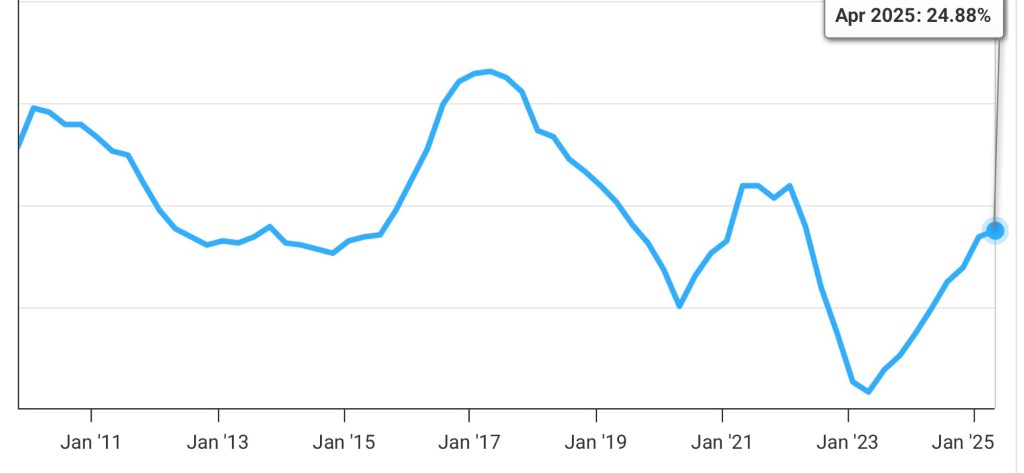
So let’s take a look at those profit margins that “never came down” after the pandemic, but in a longer historical context. Here are gross margins for Walmart since 2010:
Walmart’s margin today is about the same as the average for discount stores, and it is lower than for department stores, retailers of household and personal products, groceries, and footwear. Furthermore, it is lower today than it was ten years ago. While the margin increased a little during the pandemic, it fell in its aftermath, contrary to Wolf’s assertion. That the company has rebuilt margins steadily since 2023 should be viewed not as an indictment, but perhaps as a testament to improved managerial performance.
Wolf goes on to quote a former Walmart CEO who says that the 25 basis point increase in the gross margin in the latest quarter (from ~24.7% to 24.94%) indicates that the chain can “manage” the tariff impact. Of course it can, but that would not constitute “price gouging”.
A Trump Lackey
Of course, Wolf is taking his cues from Donald Trump, who has been bullying American businesses to “eat” the cost of his tariff onslaught, rather than passing them along to the ultimate buyers of imported goods. However, private businesses should not be expected to take orders from the President. This is not Mussolini’s Italy. Moreover, anyone familiar with tax incidence will understand that sellers are likely to eat some portion of a tariff (sharing the burden with buyers) without jawboning from the executive branch. That’s because buyers demand less at higher prices and sellers wish to avoid losing profitable sales, to the extent they can. But the dynamics of this adjustment process might take time to play out.
It’s also worth noting that a retailer might attempt to hold the line on certain prices in an uncertain cost environment. This uncertainty is a real cost inflicted by Trump. Meanwhile, pointing to increased prices for domestic goods, even if they are truly unaffected by tariffs, proves nothing without knowledge of the relevant cost and market conditions for those goods. It certainly doesn’t prove an “unpatriotic” attempt to cross subsidize imported goods.
In fact, one might say it’s unpatriotic for the federal government to restrict the market choices faced by American consumers and businesses, and for the President to tell American sellers that they better “eat” the cost of tariffs (or else?). And say, what happened to the contention that tariffs aren’t taxes?
Conclusion
Attacks on sellers attempting to recoup tariff costs are unfair and anti-capitalist. They are also somewhat disdainful of the economic sovereignty of American consumers, though not as much as the tariffs themselves. In the case described above, Chad Wolf would have us believe that sellers should not act on their expectations of near-term tariff increases. He also fails to recognize the impact of tariffs on import-competing goods and the cost of tariffs borne by producers who must rely on imported goods as inputs to production. Even worse, Wolf misrepresents some of the evidence he uses to make his case.
More generally, American businesses should not be bullied into taking a hit just because they serve customers who wish to buy imported goods. There is nothing unpatriotic about the freedom to choose what to goods to buy, what goods to stock, and how to maintain profitability in the face of government interference.
Wow! We’re less than a week from Election Day! I’d hoped to write a few more detailed posts about the platforms and policies of Kamala Harris and Donald Trump, but I was waylaid by Hurricane Milton. It sent us scrambling into prep mode, then we evacuated to the Florida Panhandle. The drive there and back took much longer than expected due to the mass exodus. On our return we found the house was fine, but there was significant damage to an exterior structure and a mess in the yard. We also had to “de-prep” the house, and we’ve been dealing with contractors ever since. It was an exhausting episode, but we feel like we were very lucky.
Now, with less than a week left till the election, I’ll limit myself to a summary of the positions of the candidates in a number of areas, mostly but not all directly related to policy. I assign “grades” in each area and calculate an equally-weighted “GPA” for each candidate. My summaries (and “grades”) are pretty off-the-cuff and not adequate treatments on their own. Some of these areas are more general than others, and I readily admit that a GPA taken from my grade assignments is subject to a bit of double counting. Oh well!
Role of Government: Kamala Harris is a statist through and through. No mystery there. Trump is more selective in his statist tendencies. He’ll often favor government action if it’s politically advantageous. However, in general I think he is amenable to a smaller role for the public than the private sector. Harris: F; Trump: C
Regulation: There is no question that Trump stands for badly needed federal regulatory reform. This spans a wide range of areas, and it extends to a light approach to crypto and AI regulation. Trump plans to appoint Elon Musk as his “Secretary of Cost Cutting”. Harris, on the other hand, seems to favor a continuation of the Biden Administration’s heavy regulatory oversight. This encourages a bloated federal bureaucracy, inflicts high compliance costs on the private sector, stifles innovation, and tends to concentrate industrial power. Harris: F; Trump: A
Border Policy: Trump wants to close the borders (complete the wall) and deport illegal immigrants. Both are easier said than done. Except for criminal elements, the latter will be especially controversial. I’d feel better about Trump’s position if it were accompanied by a commitment to expanded legal immigration. We need more legal immigrants, especially the highly skilled. For her part, Harris would offer mass amnesty to illegals. She’d continue an open border policy, though she claims to want certain limits on illegal border crossings going forward. She also claims to favor more funds for border control. However, it is not clear how well this would translate into thorough vetting of illegal entrants, drug interdiction at the border, or sex trafficking. Harris: D; Trump: B-
Antitrust: Accusations of price gouging by American businesses? Harris! Forty three corporations in the S&P 500 under investigation by the DOJ? The Biden-Harris Administration. This reflects an aggressively hostile and manipulative attitude toward the business community. Trump, meanwhile, might wheedle corporations to act on behalf of certain of his agendas, but he is unlikely to take such a broadly punitive approach. Harris: F; Trump: B-
Foreign Policy: Harris is likely to continue the Biden Administration’s conciliatory approach to dealing with America’s adversaries. The other side of that coin is an often tepid commitment to longtime allies like Israel. Trump believes that dealing from a position of strength is imperative, and he’s willing to challenge enemies with an array of economic and political sticks and carrots. He had success during his first term in office promoting peace in the Middle East. A renewed version of the Abraham Accords that strengthened economic ties across the region would do just that. Ideally, he would like to restore the strength of America’s military, about which Harris has less interest. Trump has also shown a willingness to challenge our NATO partners in order to get them to “pay their fair share” toward the alliance’s shared defense. My major qualification here has to do with the candidates’ positions with respect to supporting Ukraine in its war against Putin’s mad aggression. Harris seems more likely than Trump to continue America’s support for Ukraine. Harris: D+; Trump: B-
Trade: Nations who trade with one another tend to be more prosperous and at peace. Unfortunately, neither candidate has much recognition of these facts. Harris is willing to extend the tariffs enforced during the Biden Administration. Trump, however, is under the delusion that tariffs can solve almost anything that ails the country. Of course, tariffs are a destructive tax on American consumers and businesses. Part of this owes to the direct effects of the tax. Part owes to the pricing power tariffs grant to domestic producers. Tariffs harm incentives for efficiency and the competitiveness of American industry. Retaliatory action by foreign governments is a likely response, which magnifies the harm.
To be fair, Trump believes he can use tariffs as a negotiating tool in nearly all international matters, whether economic, political, or military. This might work to achieve some objectives, but at the cost of damaging relations more broadly and undermining the U.S. economy. Trump is an advocate for not just selective, punitive tariffs, but for broad application of tariffs. Someone needs to disabuse him of the notion that tariffs have great revenue-raising potential. They don’t. And Trump is seemingly unaware of another basic fact: the trade deficit is mirrored by foreign investment in the U.S. economy, which spurs domestic economic growth. Quashing imports via tariffs will also quash that source of growth. I’ll add one other qualification below in the section on taxes, but I’m not sure it has a meaningful chance.
Harris: C-; Trump: F
Inflation: This is a tough one to grade. The President has no direct control over inflation. Harris wants to challenge “price gougers”, which has little to do with actual inflation. I expect both candidates to tolerate large deficits in order to fulfill campaign promises and other objectives. That will put pressure on credit markets and is likely to be inflationary if bond investors are surprised by the higher trajectory of permanent government indebtedness, or if the Federal Reserve monetizes increasing amounts of federal debt. Deficits are likely to be larger under Trump than Harris due in large part to differences in their tax plans, but I’m skeptical that Harris will hold spending in check. Trump’s policies are more growth oriented, and these along with his energy policies and deregulatory actions could limit the inflationary consequences of his spending and tax policies. Higher tariffs will not be of much help in funding larger deficits, and in fact they will be inflationary. Harris: C; Trump: C
Federal Reserve Independence: Harris would undoubtedly like to have the Fed partner closely with the Treasury in funding federal spending. Her appointments to the Board would almost certainly lead to a more activist Fed with a willingness to tolerate rapid monetary expansion and inflation. Trump might be even worse. He has signaled disdain for the Fed’s independence, and he would be happy to lean on the Fed to ease his efforts to fulfill promises to special interests. Harris: D; Trump: F
Entitlement Reform: Social Security and Medicare are both insolvent and benefits will be cut in 2035 without reforms. Harris would certainly be willing to tax the benefits of higher-income retirees more heavily, and she would likely be willing to impose FICA and Medicare taxes on incomes above current earning limits. These are not my favorite reform proposals. Trump has been silent on the issue except to promise no cuts in benefits. Harris: C-; Trump: F
Health Care: Harris is an Obamacare supporter and an advocate of expanded Medicaid. She favors policies that would short-circuit consumer discipline for health care spending and hasten the depletion of the already insolvent Medicare and Medicaid trust funds. These include a $2,000 cap on health care spending for Americans on Medicare, having Medicare cover in-home care, and extending tax credits for health insurance premia. She supports funding to address presumed health care disparities faced by black men. She also promises efforts to discipline or supplant pharmacy benefit managers. Trump, for his part, has said little about his plans for health care policy. He is not a fan of Obamacare and he has promised to take on Big Pharma, whatever that might mean. I fear that both candidates would happily place additional controls of the pricing of pharmaceuticals, a sure prescription for curtailed research and development and higher mortality. Harris: F; Trump: D+
Abortion: The Supreme Court’s 2022 decision in Dobbs v. Jackson essentially relegated abortion law to individual states. That’s consistent with federalist principles, leaving the controversial balancing of abortion vs. the unborn child’s rights up to state voters. Geographic differences of opinion on this question are dramatic, and Dobbs respects those differences. Trump is content with it. Meanwhile, Harris advocates for the establishment of expanded abortion rights at the federal level, including authorization of third trimester abortions by “care providers”. And Harris does not believe there should be religious exemptions for providers who do not wish to offer abortion services. No doubt she also approves of federally funded abortions. Harris: F; Trump: A
Housing: The nation faces an acute housing shortage owing to excessive regulation that limits construction of new or revitalized housing. These excessive rules are primarily imposed at the state and local level. While the federal government has little direct control over many of these decisions, it has abetted this regulatory onslaught in a variety of ways, especially in the environmental arena. Harris is offering stimulus to the demand side through a $25,000 housing tax credit for first-time home buyers. This will succeed in raising the cost of housing. She has also called for heavier subsidies for developers of low-income housing. If past is prologue, this might do more to line the pockets of developers than add meaningfully to the stock of affordable housing. Harris also favors rent controls, a sure prescription for deterioration in the housing stock, and she would prohibit software allowing landlords to determine competitive neighborhood rents. Trump has called for deregulation generally and would not favor rent controls. Harris: F; Trump B
Taxes: Harris has broached several wildly destructive tax proposals. Perhaps the worst of these is to tax unrealized capital gains, and while she promises it would apply only to extremely wealthy taxpayers, it would constitute a wealth tax. Once that line is crossed, the threat of widening the base becomes a very slippery slope. It would also be a strong detriment to domestic capital investment and economic growth. Harris would increase the top marginal personal tax rate and the corporate tax rate, which would discourage investment and undermine real wage growth. She’d also increase estate tax rates. As discussed above, she unwisely calls for a $25,000 tax credit for first-time homebuyers. She also wants to expand the child care tax credit to $6,000 for families with newborns. A proposed $50,000 small business tax credit would allow the federal government to subsidize and encourage risky entrepreneurial activity at taxpayers’ expense. I’m all for small business, but this style of industrial planning is bonkers. She would sunset the Trump (TCJA) tax cuts in 2026.
Finally, Harris has mimicked Trump in calling for no taxes on tips. Treating certain forms of income more favorably than others is a recipe for distortions in economic activity. Employers of tip-earning workers will find ways to shift employees’ income to tips that are mandatory for patrons. It will also skew labor supply decisions toward occupations that would otherwise have less economic value. But Trump managed to find an idea so politically seductive that Harris couldn’t resist.
Trump’s tax plans are a mixed bag of good and bad ideas. They include extending his earlier tax cuts (TCJA) and restoring the SALT deduction. The latter is an alluring campaign tidbit for voters in high-tax states. He would reduce the corporate tax rate, which I strongly favor. Corporate income is double-taxed, which is a detriment to growth as well as a weight on real wages. He would eliminate taxes on overtime income, another example of favoring a particular form of income over others. Wage earners would gain at the expense of salaried employees, so one could expect a transition in the form employees are paid over time. Otherwise, the classification of hours as “overtime” would have to be standardized. One could expect existing employees to work longer hours, but at the expense of new jobs. Finally, Trump says Social Security benefits should not be taxed, another kind of special treatment by form of income. This might encourage early retirement and become an additional drain on the Social Security Trust Fund.
The higher tariffs promised by Trump would collect some revenue. I’d be more supportive of this plank if the tariffs were part of a larger transition from income taxes to consumption taxes. However, Trump would still like to see large differentials between tariffs and taxes imposed on the consumption of domestically-produced goods and services.
Harris: F; Trump C+
Climate Policy: This topic has undergone a steep decline in relative importance to voters. Harris favors more drastic climate interventions than Trump, including steep renewable subsidies, EV mandates, and a panoply of other initiatives, many of which would carry over from the Biden Administration. Harris: F; Trump: B
Energy: Low-cost energy encourages economic growth. Just ask the Germans! Consistent with the climate change narrative, Harris wishes to discourage the use of fossil fuels, their domestic production, and even their export. She has been very dodgy with respect to restrictions on fracking. Her apparent stance on energy policy would be an obvious detriment to growth and price stability (or I should say a continuing detriment). Trump wishes to encourage fossil fuel production. Harris: F; Trump: A
Constitutional Integrity: Harris has supported the idea of packing the Supreme Court, which would lead to an escalating competition to appoint more and more justices with every shift in political power. She’s also disparaged the Electoral College, without which many states would never have agreed to join the Union. Under the questionable pretense of “protecting voting rights”, she has opposed steps to improve election integrity, such voter ID laws. And operatives within her party have done everything possible to register non-citizens as voters. Harris: F; Trump: A
First Amendment Rights: Harris has called for regulation and oversight of social media content and moderation. A more descriptive word for this is censorship. Trump is generally a free speech advocate. Harris: F; Trump A-
Second Amendment Rights: Harris would like to ban so-called “assault weapons” and high-capacity magazines, and she backs universal background checks for gun purchases. Trump has not called for any new restrictions on gun rights. Harris: F; Trump: A
DEI: Harris is strongly supportive of diversity and equity initiatives, which have undermined social cohesion and the economy. That necessarily makes her an enemy of merit-based rewards. Trump has no such confusion. Harris: F; Trump: A
Hysteria: The Harris campaign has embraced a strategy of demonizing Donald Trump. Of course, that’s not a new approach among Democrats, who have fabricated bizarre stories about Trump escapades in Russia, Trump as a pawn of Vladimir Putin, and Russian manipulation of the 2016 Trump campaign. Congressional democrats spent nearly all of Trump’s first term in office trying to find grounds for impeachment. Concurrently, there were a number of other crazy and false stories about Trump. The current variation on “Orange Man Bad” is that Trump is a fascist and a Nazi, and that all of his supporters are Nazis. And that Trump will use the military against his domestic political opponents, the so-called “enemy within”. And that Trump will send half the country’s populace to labor camps. The nonsense never ends, but could anything more powerfully ignite the passions of violent extremists than this sort of hateful rhetoric? Would it not be surprising if at least a few leftists weren’t interested in assassinating “Hitler” himself. This is hysteria, and one has to wonder if that is not, in fact, the intent.
Can any of these people actually define the term fascist? Most fundamentally, a fascist desires the use of government coercion for private gain (of wealth or power) for oneself and/or one’s circle of allies. By that definition, we could probably categorize a great many American politicians as fascists, including Barack Obama, Joe Biden, Donald Trump, and a majority of both houses of Congress. That only demonstrates that corporatism is fundamental to fascist politics. Less-informed definitions of fascism conflate it with everything from racism (certainly can play a part) and homophobia (certainly can play a part) to mere capitalism. But take a look at the demographics of Trump’s supporters and you can see that most of these definitions are inapt.
Is the Trump campaign suffering from any form of hysteria? It’s shown great talent at poking fun at the left. Of course, Trump’s reactions to illegal immigration, crime, and third-trimester abortions are construed by leftists to be hysterical. I mean, why would anyone get upset about those kinds of things?
Harris: F; Trump: A
“Grade Point Average”
I’m sure I forgot an area or two I should have covered. Anyway, the following are four-point “GPAs” calculated over 20 categories. I’m deducting a quarter point for a “minus” grade and adding a quarter point for a “plus” grade. Here’s what I get:
Leftism has taken on new dimensions amid its preoccupation with identity politics, victimhood, and “wokeness”. Traditional socialists are still among us, of course, but “wokeists” and “identitarians” have been on the progressive vanguard of late, rooting for the deranged human butchers of Hamas and the dismantling of liberal institutions. This didn’t happen overnight, of course, and traditional socialists are mostly fine with it.
An older story is the rebranding of leftism that took place in the U.S. during the first half of the 20th century, when the word “liberal” was co-opted by leftists. Before that, a liberal orientationwas understood to be antithetical to the collectivist mindset long associated with the Left. Note also that liberalism retains its original meaning even today in much of Europe. Often we hear the term “classical liberal” to denote the “original” meaning of liberalism, but the modifier should be wholly unnecessary.
Liberalism Is Not “In-Betweenism”
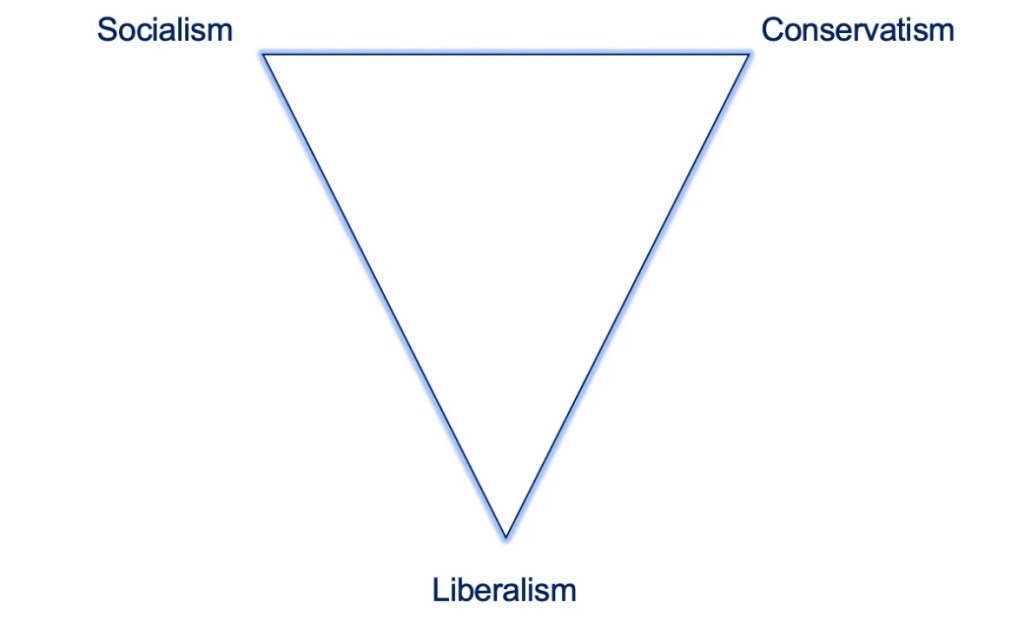
In this vein, Nate Silver presents a basic taxonomy of political orientationin a recentSubstack post. It includes the diagram above, which distinguishes between socialism, conservatism, and liberalism. Silver draws on a classic essay written by Friedrich Hayek in 1945, “Why I am Not a Conservative”, in which Hayek discussed the meaning of the word “liberal” (and see here). Liberalism’s true emphasis is a tolerance for individual rights and freedoms, subject to varying articulations of the “nonaggression principle”. That is, “do as you like, but do no harm to others”.
We often see a linear representation distinguishing between so-called progressives on the left and conservatives on the right. Of course, a major hallmark of leftist thinking is extreme interventionism. Leftists or progressives are always keen to detect the slightest whiff of an externality or the slightest departure from the perfectly competitive market ideal. They seem eager to find a role for government in virtually every area of life. While it’s not a limiting case, we can substitute socialism or statism for progressivism on the far left, as Silver does, whereby the state takes primacy in economic and social affairs.
Conservatism, on the other hand, is a deep resistance to change, whether institutional, social, and sometimes economic. Conservatives too often demonstrate a willingness to use the coercive power of the state to prevent change. Hayek noted the willingness of both socialists and conservatives to invoke state power for their own ends.
Similarly, religious conservatives often demand state support beyond that afforded by the freedom to worship in the faith of one’s choice. They might strongly reject certain freedoms held to be fundamental by liberals. Meanwhile, socialists often view mere religious freedom as a threat to the power of the state, or at least they act like it (e.g. see here for an example).
Like conservatives, dedicated statists would doubtless resist change if it meant a loss of their own power. That is, they’d wish to preserve socialist institutions. On this point, witness the vitriol from the Left over what it perceives as threats to the public school monopoly. Witness also the fierce resistance among public employees to reducing the scale of the administrative state, and how advocates of entitlements fiercely resist decreases in the growth rate of those expenditures.
Silver, like Hayek, objects to the traditional, linear framework in which liberals are thought to occupy a range along a line between socialism and conservatism. He objects to that because real liberals value individual liberty as a natural human right, a viewpoint typically abhored by both socialists and conservatives. There is nothing “in between” about it! And of course, conservatives and progressives are equally guilty in their mistaken use of the word “liberal”.
Mapping Political Preferences
Liberty, statism, and conservatism are not exactly orthogonal political dimensions. Larger government almost always means less economic liberty. At a minimum, state dominance implies a social burden associated with public monopoly and monopsony power, as well as tax and welfare-state incentive problems. These features compromise or corrupt the exercise of basic rights. On the other hand, capitalism and its concomitant reliance on consumer sovereignty, individual initiative, free exchange and secure property rights is most in harmony with true liberalism.
For conservatives, resistance to change in support of a traditionally free market economy might offer something of a contradiction. In one sense, it corresponds to upholding market institutions. However, free markets allow new competitors and new technologies to undermine incumbents, who conservatives sometimes wish to defend through regulatory or protectionist measures. And conservatives are almost always too happy to join in the chorus of “price gouging” in response to the healthy operation of the free market in bringing forth supplies.
All that is to say that preferences involving liberty, statism, and traditionalism are not independent of one another. They cannot simply be mapped onto a three-dimensional space. At least the triangular representation gets liberalism out of the middle, but it’s difficult to visualize other ideological positions there. For example, “state religionism” could lie anywhere along the horizontal line at the top or even below it if certain basic liberties are preserved. Facism combines elements of socialism and a deformed version of capitalism that is properly called corporatism, but where would it fall within the triangle?
Big Government Liberalism?
Silver says he leans heavily toward a “big government” version of liberalism, but big government is hard to square with broad liberties. Granted, any well-functioning society must possess a certain level of “state capacity” to defend against private or public violations of individual rights, adjudicate disputes, and provide true public goods. It’s not clear whether Silver’s preferences lie within the bounds of those ambitions. Still, he deserves credit for his recognition that liberalism is wholly different from the progressive, socialist vision. It is the opposite.
The “New” Triangle
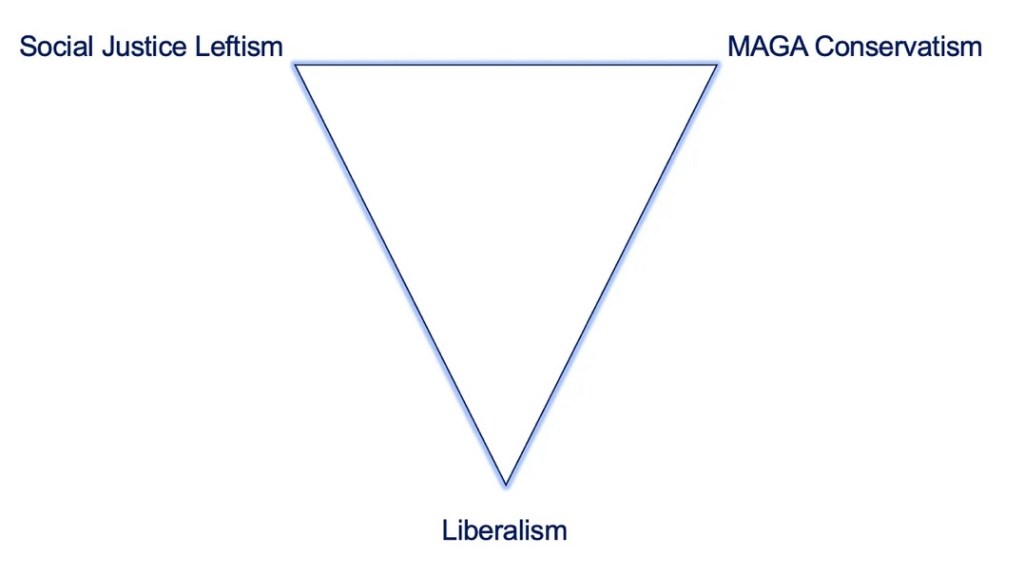
Silver attempts to gives the triangular framework a more contemporary spin by replacing conservatism with “MAGA Conservatism” and socialism with “Social Justice Leftism” (SJL), or “wokeism”. Here, I’m treating MAGA as a “brand”. Nothing below is intended to imply that America should not be a great nation.
The MAGA variant of conservatism emphasizes nationalism, though traditional conservatives have never been short on love of nation. For that matter, as a liberal American, it’s easier to forgive nationalist sentiments than it is the “Death to America” refrain we now hear from some SJLs.
The MAGA brand is also centered around a single individual, Donald Trump, whose rhetoric strikes many as nativistic. And Trump is a populistwhosepolicy proposals are often nakedly political and counterproductive.
SJL shares with socialism an emphasis on various forms of redistribution and social engineering, but with a new focus on victimhood based on classes of identity. Of SJL, Silver says:
“Proponents of SJL usually dislike variations on the term ‘woke’, but the problem is that they dislike almost every other term as well. And we need some term for this ideology, because it encompasses quite a few distinctive features that differentiate it both from liberalism and from traditional, socialist-inflected leftism. In particular, SJL is much less concerned with the material condition of the working class, or with class in general. Instead, it is concerned with identity — especially identity categories involving race, gender and sexuality, but sometimes also many others as part of a sort of intersectional kaleidoscope.”
The gulf between liberals and SJLs couldn’t be wider on issues like free speech and “equity”, and equality of opportunity. MAGAns, on the other hand, have some views on individual rights and responsibility that are largely consistent with liberals, but reflexive populism often leads them to advocate policies protecting rents, corporate welfare, and protectionism.
Divided Liberalism
Liberalism emphasizes limited government, individual autonomy, and free exchange. However, there are issues upon which true liberals are of divided opinion. For example, one such area of controversy is the conflict between a woman’s right to choose and the fetal right to life. Many true liberals disagree over whether the rights of a fetus outweigh its mother’s right to choose, but most would concede that the balance shifts to the fetus at some point well short of birth (putting aside potential dangers to the mother’s life). Open borders is another area that can divide true liberals. On one side, the right to unrestricted mobility is thought to supersede any public interest in enforcing borders and limiting the flow of immigrants. On the other side, questions of national sovereignty, national security, as well as social and state capacity to absorb immigrants take primacy.
Don’t Call Lefties “Liberal”… They’re Not!
True liberalism (including most strains of libertarianism) recognizes various roles that a well-functioning state should play, but it also recognizes the primacy of the individual and individual rights as a social underpinning. As Hayek noted, true liberals are not resistant to change per se, unlike conservatives. But modern progressives demand changes of the worst kind: that the state should intervene to pursue their favored objectives, laying claim to an ever-greater share of private resources. This requires government coercion on a massive scale, the antithesis of liberalism. It’s time to recognize that “progressives” aren’t liberals in any sense of the word. For that matter, they don’t even stand for progress.
I’ll close with a quote from Adam Smith that I cribbed from Scott Sumner. Unfortunately, Sumner does not give the full reference, but I’ll take his word that Smith wrote this 20 years before the publication of The Wealth of Nations:
“Little else is requisite to carry a state to the highest degree of opulence from the lowest barbarism, but peace, easy taxes, and a tolerable administration of justice; all the rest being brought about by the natural course of things. All governments which thwart this natural course, which force things into another channel, or which endeavour to arrest the progress of society at a particular point, are unnatural, and to support themselves are obliged to be oppressive and tyrannical.”
There is a great myth that primitive man was some sort of “noble savage”, perfectly attuned to the natural environment and disposed to an egalitarian principle. All that, of course, is balderdash. A related myth is that primitive societies were essentially collectivist and that private property was largely an unrecognized institution. This is something I’ve heard too often from individuals wishing to characterize leftist ideals as natural and wholesome. So I welcomed a recent piece in Aeon called “Primitive Communism”, by Manvir Singh, which reviews evidence on a number of hunter-gatherer societies and cites several scholars on the subject of ownership and the distribution of goods among those peoples. A preponderance of the evidence suggests that private property and private rewards were (and are) quite common in primitive societies, and those practices predated agriculture.
The assertion that the advent of private property and trade was somehow unnatural for mankind, or even unjust, might owe its widespread acceptance to Friedrich Engels’ “The Origin of the Family, Private Property and the State”. Singh summarizes one of the book’s primary arguments thusly:
“Once upon a time, private property was unknown. Food went to those in need. Everyone was cared for. Then agriculture arose and, with it, ownership over land, labour and wild resources. The organic community splintered under the weight of competition.”
While there were a few primitive societies in which economic output was shared, it is not clear whether any central authority was relied upon for determining the distribution of output. Instead, in those cases, sharing seems to have been a matter of social convention. Singh posits that interdependence played a major role in motivating output sharing, but mechanisms for dealing with interdependence differed in societies with stronger property rights, including voluntary sharing, which was often but not always based on reciprocity. Volunteerism still has a strong role in modern, developed economies, but for better or worse, social insurance is increasingly viewed as a function of the state, with its monopoly on legal coercion.
And how “natural” is social insurance? Not very in a world of extreme scarcity. One of the more interesting passages in Singh’s article has to do with the brutality of subsistence-level societies. The weak were often abandoned or killed, which Singh discusses in the context of the collectivist Aché people of Paraguay. This “culling” applied variously to orphans, the disabled, the unsightly, and the aged. It’s unclear whether these decisions were collective or left up to individual families. Noble savages indeed!
It’s astonishing how often Engels’ faulty premise is accepted as historical fact. The argument, however, often serves as a subtext for collectivist rationales in the modern era. As Singh says:
“For anyone hoping to critique existing institutions, primitive communism conveniently casts modern society as a perversion of a more prosocial human nature.”
I’m not sure whether it’s possible to marshall evidence that primitive societies with strong property rights were more successful than their collectivist counterparts. That would be a good topic of further research, but it would be tough to control for the difficulties posed by varying natural conditions faced by these societies.
On the other hand, suppose we stipulate that property rights developed as a consequence of, or in tandem with, organized production, as Engels would have had it. We’d have to categorize that development as a kind of technological breakthrough in its own right. By aligning incentives with production, property rights were critical to the phenomenal growth in prosperity the world has enjoyed over the past several centuries. Nevertheless, the evidence on primitive societies suggests that the alignment came more “naturally”.
It’s about time to put the fiction of “primitive communism” to rest. Private property was sensible for the denizens of most primitive societies. Even the most collectivist of the those societies made certain concessions to that reality. These facts comport with a view of property ownership as a natural right.
My theme in “What’s To Like About Income Inequality?” was the existence of natural drivers of an unequal distribution of income, as where institutions reward merit and legal systems assign strong property rights. I also discussed trends in income and wealth inequality and how standard measures of inequality are distorted by income taxes and transfer payments, including differences in unrealized and realized capital gains. Furthermore, income mobility makes “snapshots” of inequality less compelling, as individuals are not “stuck” for all time at a point in the income distribution, but are typically moving across the distribution and usually upward as they age through their working years.
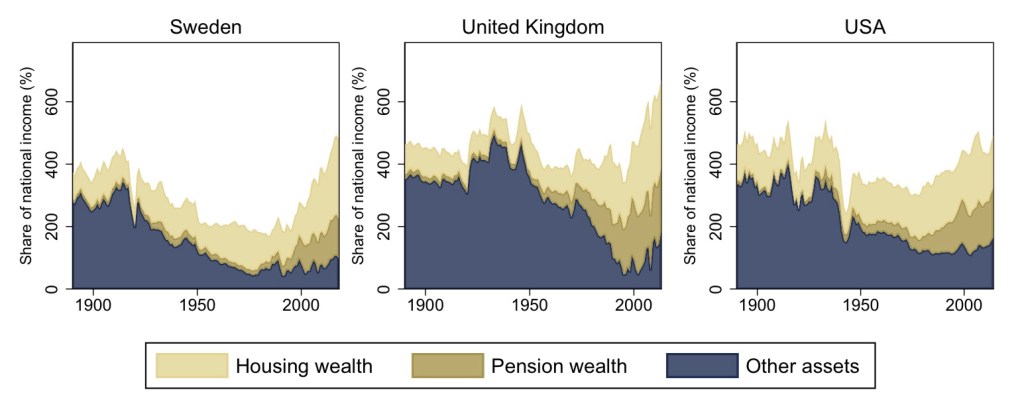
Wealth inequality is another matter, but a new paper by Daniel Waldenström entitled “Wealth and History: An Update” shows that wealth concentration, which he defines as the share of wealth held by the top 1%, declined markedly between 1920 and 1970 in Europe and the U.S. After 1970, however, the share remained flat in Europe and was flat in the U.S. as well if unfunded pensions and Social Security benefits are valued as wealth. However, the near-entirety of the earlier decline in U.S. wealth concentration occurred by about 1950.
So a great thinning in the fat right tail of the wealth distribution occurred during the middle years of the 20th century. Waldenström attributes this transition to growth of homeownership and pension assets. These are so-called “popular assets” because they are held more broadly than the legacy wealth of the 1800s and early twentieth century:
“… the structure of private wealth has changed over the twentieth century, from being dominated by elite fortunes in agriculture or businesses to consisting mainly of widely dispersed assets in housing and funded pensions.”
Waldenström concludes that the facts run contrary to claims that wealth inequality has worsened in Western, capitalist economies over the years:
“These new findings have implications for the historiography of Western wealth accumulation and wealth concentration. They cast doubt over the view that an unfettered capitalism, such as in pre-democratic and pre-taxation nineteenth-century Europe, generates extreme levels of capital accumulation. The new findings also question the pivotal role of wars, crises and progressive taxation as the sole important factors behind the wealth equalization of the twentieth century.
Waldenström considers the role of progressive taxation in equalizing wealth, but he acknowledges that taxes undermined wealth accumulation at all levels, so the effect was ambiguous. A point on which I’d take issue with Waldenström is the role of regulation, which he believes “curbed the growth of large fortunes”. That might be true in some cases, but this effect is also subject to ambiguity. Regulation is often welcomed by powerful market players as a way of consolidating market position and hindering new competition. The regulatory state has long been considered a primary channel for rent seeking, so the impact on the wealth distribution is likely to be mixed.
Market institutions, together with rising education levels, labor reforms, and gains in productivity enabled this broadening in the accumulation and distribution of wealth. Social Security certainly played a part as well, though we don’t know how private pensions might have evolved in its absence. Of course, Social Security has a terrible record as an “investment” of payroll taxes. Private control over the investment direction of those funds would have done far better, and still could, which would be a further boon to wealth for the lower 99%.
It is true that inequality in both income and wealth is to be expected under merit-based systems of rewards. However, Daniel Waldenström’s paper offers evidence that markets do not merely concentrate wealth at the expense of workers. Rather, they deliver gains to all participants, who are in turn free to accumulate wealth in the kinds of “popular assets” discussed by Waldenström.
I like interesting “shapes” as much as the next guy, but I have to agree with this piece in Current Affairs: much about modern architecture has gone badly wrong. Brianna Rennix and Nathan J. Robinson’s (R&R) entertaining piece decries what they call “blobitecture”, among other errant aesthetic trends in the design of modern buildings. The article includes a number of great photos depicting very good and very bad architecture, along with a few amusing captions like the following:
“If It doesn’t make you feel desperately, crushingly alone, it’s probably not a piece of prize-winning contemporary architecture.”
“Oh my fucking God, just look at it. Look at it! Does this make you happy? Does it nourish your spirit? What’s with all the little random protrusions? Aaaaagghh.”
Calling of the Moderns
By “modern”, R&R really mean a philosophy of design having roots in the early twentieth century. “Form follows function” was the dictum set down by the famed architect Louis Sullivan. R&R quickly aver that Sullivan did not intend to condemn all ornamentation, but his statement was often interpreted as such. The misunderstanding was reinforced by Adolph Loos, who likened more austere designs to demonstrations of “spiritual strength”. So, modern design was not only superior from a practical perspective, but it was “honest”, imbued with a kind of valor and perhaps devine aspiration.
Form, and To Hell With Function
A delicious irony in R&R’s discussion is the fact that modern architecture has subverted its objectives in at least one fundamental respect. The utilitarian emphasis, with few or starkly simplified adornments, morphed into a celebration of asymmetry, then shape-shifted into a brave new world of three-dimensional manifolds. But buildings with unusual shapes can present difficulties in using the space effectively. So much for “form follows function”! As an illustration, R&R offer this vignette about Peter Eisenman:
“… one Eisenman-designed house so departed from the normal concept of a house that its owners actually wrote an entire book about the difficulties they experienced trying to live in it. For example, Eisenman split the master bedroom in two so the couple could not sleep together, installed a precarious staircase without a handrail, and initially refused to include bathrooms. In his violent opposition to the very idea that a real human being might actually attempt to live (and crap, and have sex) in one of his houses, Eisenman recalls the self-important German architect from Evelyn Waugh’s novel Decline and Fall, who becomes exasperated [by] the need to include a staircase between floors: ‘Why can’t the creatures stay in one place? The problem of architecture is the problem of all art: the elimination of the human element from the consideration of form. The only perfect building must be the factory, because that is built to house machines, not men.’”
But Sometimes It’s Okay
My tastes must be more eclectic than R&R’s, because when it comes to modern buildings, my opinion is “it all depends….” I’ve never liked the boxy international style that still dominates most skylines, but some modern buildings really are interesting. Sometimes I like asymmetry and sometimes I don’t. The shapes of buildings, whatever they are, might contribute to a city-scape in appealing ways. But it probably depends on the presence of certain things like surrounding greenery, which R&R value highly, or even a stylized nod to classical aesthetics. A building — the whole of a structure— can have an ornamental quality of its own, even if it lacks the kind of minutia R&R yearn for. Some skyscrapers, which R&R find so damnable, do indeed soar gracefully.
Cost, From Both Sides of the Mouth
One of the more interesting points made by R&R has to do with cost. They contend that architects are reluctant to propose ornamentation and aesthetic minutia because of the presumed addition to cost of the final design. And likewise, clients are presumed to view those elements as lacking a return on investment. But as R&R note, this logic does not always stand up to scrutiny: unusual structural elements can be extremely expensive to engineer. In the end, a more traditional structure with decorative elements might be far less costly.
Is Capitalism To Blame?
Finally, I take issue with a point R&R make more strongly toward the end of their essay: that capitalism is a primary driver of the ugliness of modern design. They seem to equate capitalism with the sort of corporatist fascism that relies so heavily on government for its viability. This is the meaning of capitalism only in the imagination of the Left, even as the Left increasingly embraces the state-dominated mechanics of corporatism.
The large private entities that thrive under such a regime might well be inclined to build the sort of stark monoliths assailed by R&R. An ancient, didactic finance professor once cautioned me against investing in companies that build glitzy offices, essentially monuments to themselves. He said it’s a sure sign of trouble ahead, of managerial waste. Fair enough, but today, in a world of “too big to fail”, it might be more symbolic of prospective bailouts from ravaged taxpayers. The problem is these corporate managers don’t pay enough attention to ROI precisely because they are protected from downside risks by public policy makers. So they bring on the monoliths!
In contrast, capitalism means truly private enterprise with no guarantee against failure. It relies on the sovereignty of individual actors in pursuit of their self-interest. Yes, costs matter, but they must be balanced against benefits in order to reach rational, efficient outcomes. In this sense, tastes guide decisions, including decisions about design. The abominations of modern architecture are not purely cost-driven, capitalist phenomena, independent of tastes. Whether it is an office, a storefront, or a home, tastes matter, not just costs. People and businesses are usually willing to pay more for things they find attractive. But again, there’s no accounting for tastes.
Of course, commercial developers can and sometimes do make bad design choices, but that’s hardly uniform. At the same time, to label better design choices “pastiche” or “Disneyfied” sounds like a bit of a cop-out when we’re entertaining thoughts of ornamentation and adornment. Perhaps it’s a thin line. But I find a great deal of variety in the design of residential and commercial construction today, and I quite like some of it.
Tyranny of the Critics
R&R give frequent nods to “democratic” ideals, as if some sort of majoritarian principle should guide design. The ideal is more closely approximated by the free market in which people can express their preferences through purchase decisions, whether those be residential or commercial structures, or even simple decisions about which stores to frequent. Sure, most people might hate contemporary architecture, but alternatives are available. I very much enjoyed R&R’s article and agree with many of their sentiments, but what they really crave is the hand of a central planner who thinks just like them.
I don’t think I’ve ever linked to anything on Captain Capitalism’s site. I know I’ve been tempted. The Captain is Aaron Clarey, a lively writer who is so politically incorrect he’s almost guaranteed to offend the faint of heart. His consulting company is known as Asshole Consulting because his gig, he says, is to be a truth-telling asshole so he can save you from yourself. I check his blog from time-to-time because he’s unabashedly pro-capitalist (not to be confused with corporatist!), he has interesting points of view, and well, he can be very entertaining.
Corporate gifts to Black Lives Matter and similar organizations dedicated to black causes are a mere pittance relative to the trillions of disproportionate benefits that have been paid by the government to aid blacks over the years. By “disproportionate” Clarey means the excess of those benefits above the black share of the population.
The disproportionate government benefits have been gloriously unproductive as a permanent solution to end black poverty. Clarey says, “… the multiple trillions of dollars [spent by government] has not closed the:
wage health income savings life expectancy
gaps between black and white“
The comparatively tiny corporate donations “may enrich some black activists who sit on the boards of these non-profits, butit will not do one damn thingto tangibly improve the lives of black people in the US.”
Clarey thenchallenges “anybody of any political or racial stripe to be intellectually honest with themselves and acknowledge what this laughable joke of “corporate donations” are – Marketing. Placating. Danegeld. Virtue-signaling. These corporations do not care about black people, they care about themselves and are capitalizing off of a tragedy to profit.“
I’ve worked for some large corporations over the years and they all play these games: not only are shareholder resources dolled out to every special interest under the sun, who are now deemed “stakeholders”, but employees are constantly harangued because they just might have less than appropriate consciousness of these interests. Staff time is dedicated to training employees in “right-think”, and they are asked to bend and twist their objectives and job descriptions in order that they appear to revolve around those interests. It’s patently ridiculous. And now, some of these corporations have been cowed into withdrawing advertising dollars to sites that might offend those whom the corporations don’t wish to offend, or sites that might support the First Amendment rights of those whom their intimidators wish to silence.
Clarey’s use of the term “Danegeld” is particularly interesting. He means that the primary interest of these corporations is in buying off potentially hostile forces. That‘s exactly what’s going on here! The cowardly upper management of these companies would be better off taking Rudyard Kipling’s advice on the matter (with apologies to my Danish friends):
“It is always a temptation to an armed and agile nation To call upon a neighbour and to say: — ‘We invaded you last night–we are quite prepared to fight, Unless you pay us cash to go away.‘
And that is called asking for Dane-geld, And the people who ask it explain That you’ve only to pay ’em the Dane-geld And then you’ll get rid of the Dane!
It is always a temptation for a rich and lazy nation, To puff and look important and to say: — ‘Though we know we should defeat you, we have not the time to meet you. We will therefore pay you cash to go away.’
And that is called paying the Dane-geld; But we’ve proved it again and again, That if once you have paid him the Dane-geld You never get rid of the Dane.
It is wrong to put temptation in the path of any nation, For fear they should succumb and go astray; So when you are requested to pay up or be molested, You will find it better policy to say: —
‘We never pay any-one Dane-geld, No matter how trifling the cost; For the end of that game is oppression and shame, And the nation that pays it is lost!'”
I’m an “inequality skeptic”, first, with respect to its measurement and trends; and second, with respect to its consequences. Economic inequality in the U.S. has not increased over the past 60 years as often claimed. And some degree of ex post inequality, in and of itself, has no implication for real economic well-being at any point on the socioeconomic spectrum, the growls of class-warmongers aside. So I’m not just a skeptic. I’m telling you the inequality narrative is BS! The media has been far too eager to promote distorted metrics that suggest widening disparities and presumed injustice. Left-wing politicians such as Bernie Sanders, Elizabeth Warren, and Alexandra Ocasio-Cortez pounce on these reports with opportunistic zeal, fueling the flames of class warfare among their sycophants.
Measurement
Comparisons of income groups and their gains over time have been plagued by a number of shortcomings. Jeff Jacoby reviews issues underlying the myth of a widening income gap. Today, the top 1% earns about the same share of income as in the early 1960s, according to a recent study by two government economists, Gerald Auten and David Splinter.
Jacoby recounts distortions in the standard measures of income inequality:
The comparisons do not account for tax burdens and redistributive government transfer payments, which level incomes considerably. As for tax burdens, the top 1% paid more taxes in 2018 than the bottom 90% combined.
The focus of inequality metrics is typically on households, the number of which has expanded drastically with declines in marriage rates, especially at lower income levels. Incomes, however, are more equal on a per capital basis.
The use of pension and retirement funds like IRAs and 401(k) plans has increased substantially over the years. The share of stock market value owned by retirement funds increased from just 4% in 1960 to more than 50% now. As Jacoby says, this has “democratized” gains in asset prices.
A change in the tax law in 1986 led to reporting of more small business income on individual returns, which exaggerated the growth of incomes at the high-end. That income had already been there.
People earn less when they are young and more as they reach later stages of their careers. That means they move up through the income distribution over time, yet the usual statistics seem to suggest that the income groups are static. Jacoby says:
“Contrary to progressive belief, America is not divided into rigid economic strata. The incomes of the wealthy often decline, while many taxpayers go from being poor at one point to not-poor at another. Research shows that more than one-tenth of Americans will make it all the way to the top 1 percent for at least one year during their working lives.”
Mark Perry recently discussed America’s record middle-class earnings, emphasizing some of the same subtletles listed above. A middle income class ($35k-$100k in constant dollars) has indeed shrunk over the past 50 years, but most of that decrease was replaced by growth in the high income strata (>$100k), and the lower income class (<$35k) shrank almost as much as the middle group in percentage terms.
Causes
What drives the inequality we actually observe, after eliminating the distortions mentioned above? The reflexive answer from the Left is capitalism, but capitalism fosters great social and economic mobility relative to authoritarian or socialist regimes. That a few get fabulously rich under capitalism is often a positive attribute. A friend of mine contends that most of the great fortunes made in recent history involve jobs for which the product or service produced is highly scalable. So, for example, on-line software and networks “scale” and have produced tremendous fortunes. Another way of saying this is that the marginal cost of serving additional customers is near zero. However, those fortunes are earned because consumers extract great value from these products or services: they benefit to an extent exceeding price. So while the modern software tycoon is enriched in a way that produces inequality in measured income, his customers are enriched in ways that aren’t reflected in inequality statistics.
Mutually beneficial trade creates income for parties on only one side of a given transaction, but a surplus is harvested on both sides. For example, an estimate of the consumer surplus earned in transactions with the Uber ride-sharing service in 2015 was $1.60 for every dollar of revenue earned by Uber! That came to a total of $18 billion of consumer surplus in 2015 from Uber alone. These benefits of free exchange are difficult to measure, and are understandably ignored by official statistics. They are real nevertheless, another reason to take those statistics, and inequality metrics, with a grain of salt.
Certain less lucrative jobs can also scale. For example, the work of a systems security manager at a bank produces benefits for all customers of the bank, and at very low marginal cost for new customers. Conversely, jobs that don’t scale can produce great wealth, such as the work of a highly-skilled surgeon. While technology might make him even more productive over time, the scalability of his efforts are clearly subject to limits. Yet the demand for his services and the limited supply of surgical skills leads to high income. Here again, both parties at the operating table make gains (if all goes well), but only one party earns income from the transaction. These examples demonstrate that standard metrics of economic inequality have severe shortcomings if the real objective is to measure differences in well-being.
Economist Robert Samuelson asserts that “workaholics drive inequality“, citing a recent study by Edward E. Leamer and J. Rodrigo Fuentes that appeals to statistics on incomes and hours worked. They find the largest income gains have accrued to earners with high educational attainment. It stands to reason that higher degrees, and the longer hours worked by those who possess them, have generated relatively large income gains. Samuelson also cites the ability of these workers to harness technology. So far, so good: smart, hard-working students turn into smart, hard workers, and they produce a disproportionate share of value in the marketplace. That seems right and just. And consumers are enriched by those efforts. But Samuelson dwells on the negative. He subscribes to the Ludditical view that the gains from technology will accrue to the few:
“The Leamer-Fuentes study adds to our understanding by illuminating how these trends are already changing the way labor markets function. … The present trends, if continued, do not bode well for the future. If the labor force splits between well-paid workaholics and everyone else, there is bound to be a backlash — there already is — among people who feel they’re working hard but can’t find the results in their paychecks.“
That conclusion is insane in view of the income trends reviewed above, and as a matter of economic logic: large income gains might accrue to the technological avant guarde, but those individuals buy things, generating additional demand and income gains for other workers. And new technology diffuses over time, allowing broader swaths of the populace to capture value both in consumption and production. Does technology displace some workers? Of course, but it also creates new, previously unimagined opportunities. The history of technological progress gives lie to Samuelson’s perspective, but there will always be pundits to say “this time it’s different”, and it probably sounds heroic to their ears.
Consequences
The usual discussions of economic inequality in media and politics revolve around an egalitarian ideal, that somehow we should all be equal in an absolute and ex post sense. That view is ignorant and dangerous. People are not equal in terms of talent and their willingness to expend effort. In a free society, the most talented and motivated individuals will produce and capture more value. Attempts to make it otherwise can only interfere with freedoms and undermine social welfare across the spectrum. This post on the Declination blog, “The Myth of Equality“, is broader in its scope but makes the point definitively. It quotes the Declaration of Independence:
“We hold these truths to be self-evident, that all men are created equal, that they are endowed by their Creator with certain unalienable Rights, that among these are Life, Liberty and the Pursuit of Happiness.”
The poster, “Thales”, goes on to say:
“The context of this was within an implied legal framework of basic rights. All men have equal rights granted by God, and a government is unjust if it seeks to deprive a man of these God-given rights. … This level of equality is both the basis for a legal framework limiting the power of government, and a reference to the fact that we all have souls; that God may judge them. God, being omniscient, can be an absolute neutral arbiter of justice, having all the facts, and thus may treat us with absolute equality. No man could ever do this, though justice is often better served by man at least making a passing attempt at neutrality….”
Attempts to go beyond this concept of ex ante equality are doomed to failure. To accept that inequalities must always exist is to acknowledge reality, and it serves to protect rights and opportunities broadly. To do otherwise requires coercion, which is violent by definition. In any case, inequality is not as extreme as standard metrics would have us believe, and it has not grown more extreme.
Empiricists, take note: The kids were out in the streets on Friday, skipping school to warn us of a climate doomsday fast approaching. Like Greta Thunberg, one of several teenage girls billed as modern-day Cassandras, they just know it. But wait, I think I heard the same thing many years ago… doomsday is nigh! In fact, I’ve heard it over and over through my entire adulthood. And here’s the empirical regularity: “Goose Eggs: No Climate Doomsday Warning Has Come True“. Ever. From the link:
“Some examples:
1967 — Stanford … expert Paul Erlich predicted “time of famines” in 1975.
1971 — A top NASA expert predicted an “ice age” by 2021.
1988 — It was predicted that the Maldives would be under water by last year.
2008 — Gore said the Arctic would be free of ice by 2013.
2009 — [Prince] Charles said there was just 96 months left to save the world.”
“Within a few years ‘children just aren’t going to know what snow is.’ Snowfall will be ‘a very rare and exciting event.’” — Dr. David Viner, senior research scientist at the climatic research unit (CRU) of the University of East Anglia [March 2000]”
“[By] 1995, the greenhouse effect would be desolating the heartlands of North America and Eurasia with horrific drought, causing crop failures and food riots…[By 1996] The Platte River of Nebraska would be dry, while a continent-wide black blizzard of prairie topsoil will stop traffic on interstates, strip paint from houses and shut down computers. — Michael Oppenheimer in 1990″
There have been many others (also see here and here). Oh, but you just wait, they say. This time it’s different and it won’t be long!. You know, people just love to worry. Even so, what kind of daft world do we inhabit with children and adults completely freaked out about “problems” that don’t approximate reality.
Predictions of a more clinical variety, such as upward temperature trends, have been way off on a consistent basis: much too high, that is. But here’s the key: all of the other calamitous developments said to be in our future are predicated on those temperature forecasts. The warnings are not based on data per se, but on on crappy climate models (and see here), which are simplifications of reality, loosely calibrated to capture a relatively short period of historical records. And the models are crappy because they often rely on one input, CO2 forcings. The modelers have difficulty addressing the empirical sensitivity of temperature to carbon, the net effects of radiative forcing, clouds, and ocean circulation. In many prominent cases they don’t even try. Hey look, we’re all gonna die!
A striking misconception one hears repeatedly is that we experience many more hot days, and they are hotter, hot days than in the past. Sure, extremely hot days are bad, but not as bad as extremely cold days, and probably worse than warm nights. The truth is, however, that nearly all of the warming experienced over the past few decades has been in nighttime lows, not daytime highs. More “seasoned” climate alarmists don’t seem to have any memory of the hot days of their youth, and the kids… well, they just fell off the turnip truck, so they have no idea.
One of the great perversions of climate alarmism is the notion that the private enterprise system must be heavily regulated or even abolished in order to put an end to global warming. Never mind that governments are directly responsible for a major share of environmental degradation. And as private economies flourish, the environmental efficiency of production actually improves. In fact, if one were to stipulate that climate change is a problem, as I will for just this one sentence, vibrant capitalism offers the best path to environmental solutions. There are several basic reasons. One is that economic growth and higher income levels give consumers the wherewithal to demand and pay for costlier “green” products. More fundamentally, economic growth facilitates development and investment in cleaner technologies by business and government.
Miss Thunberg doesn’t understand any of this, of course, but she’s a pretty good little scold:
“This is all wrong. I shouldn’t be up here. I should be back in school on the other side of the ocean, yet you come to us young people for hope. How dare you.”
“[She] should be going to Beijing or Bangalore and staging her protests there instead of, or at least in addition to, Sweden or New York. She should be hounding President Xi and Prime Minister Modi about their shameful emissions. She should be leading throngs of Asian kids out of schools for her Friday student strikes. She should be castigating the industries and the consumers of the developing world for destroying the planet and killing humanity in the process. She should be doing all this if she were serious about the global nature of the problem.”
I especially like this quote from Scott Adams on the “child advocate” phenomenon we’re witnessing:
“Adults sometimes like to use children to carry their messages because it makes it hard for the other side to criticize them without seeming like monsters. If adults have encouraged you to panic about climate change without telling you what I am telling you here, they do not have your best interests at heart. They are using you.“
Of course, Thunberg is thoroughly propagandized and a useful theatrical tool for the alarmist establishment. She has made all sorts of ridiculous and unquestioned claims before the United Nations and elsewhere (e.g., people are dying from climate change (no); that she can “see” CO2 (okay, her mother said that, but what a hoot!). Don’t think for a second that “we have to listen to the children” is uttered sincerely by any adult climate alarmist. It’s manipulation. I feel sorry for Thunberg not least because she is probably deeply frightened about the climate, but also because she is a tool of a death cult.
You really can’t blame kids for being worried about bogeymen foisted upon them by foolish elders, but you can blame the adults for their own frightened acceptance of chicken-little climate augury. And that’s what the kids are being taught. The schools certainly won’t penalize them for missing classes. In fact, many of their teachers accompanied them to the protests.
The climate scare is part of a larger agenda to dismantle not just capitalism, but a host of innocent individual liberties.Scaring children and making teens into miserable pessimists will groom them as good (if neurotic) environmental soldiers for life. They’ll be fit as compliant subjects of a new, environmental fascist state, never to know the sweet freedom and growth possible without the needless bindings imposed by climate cranks. Children, the protection you’ve been told to demand isn’t necessary or worth it. You’re fighting for goose eggs!
Rights in outer space are an area of unsettled international law, particularly the topic of exploiting resources in outer space. Today there is some consensus that assignment of mineral extraction rights to private firms will enhance the promise of these resources for mankind and expedite future space exploration. However, I happened upon two strikingly misinformed comments from otherwise learned individuals who might have known better had they ever taken a basic course in economics, or had they applied a little basic logic to the subject matter. Both comments were made in defense of a strict interpretation of the “global commons” theory embodied in the 1967 Outer Space Treaty. Under that dubious interpretation, the establishment of private property rights on celestial bodies would be prohibited.
“Any policy designed to explore future possibilities in outer space should avoid the plundering of resources through excessive claims of property rights, which causes scarcity and all its failings. If the focus of space exploration is on resource acquisition, i.e., property rights, then resource management will become as important as the exploration itself. The scarcity of resources is also known as the ‘tragedy of the commons.’” [my emphasis]
This poor guy is mixed up! He footnotes Susan J. Buck as a source for these ideas, but I won’t even bother to research Ms. Buck’s work. Belleste did quite enough to raise my pique. Before I say anything else, I’ll first note that the tragedy of the commons occurs only in the absence of defined property rights to scarce resources. “The commons” means that a resource is owned in common. When use of that resource is at all rivalrous and unpriced, common ownership leads to competition for use and ultimately to overuse. Contrary to Balleste’s implication, assignment of property- or use-rights helps to resolve this difficulty.
As a first approximation, it’s probably fair to say that Belleste, in his gut, thinks of scarcity as want of things belonging to others, or perhaps things that are beyond the reach of the state. Surely he knows that scarcity is fundamental to the nature of mankind’s existence. That’s the reality that gives rise to “the economic problem”: how can society allocate scarce resources to best meet the needs and unbounded wants of its people.
Individual property rights establish the basis for voluntary trade, pricing, and incentives for production and conservation, providing for a decentralized and efficient solution to the economic problem. The prices established under such a regime are an accurate reflection of the true scarcity of resources because they balance demands and available supplies. When valuable resources are difficult or risky to exploit, it is secure property rights that provide the incentives for entrepreneurs to go to work, unlocking the benefits of those resources only to the extent that they are “economic”. Risks are taken in exchange for the possibility of future profit that might be earned through trade with willing buyers. This is true whether the raw resources exist deep in the ground, in outer space, or in the fertile minds of entrepreneurs. Far from causing scarcity, property rights are actually necessary to manage efficiently in a world of scarcity. As already noted, a further implication is that property rights encourage conservation: only those quantities are extracted as needed to satisfy demands and minimize waste, and through market prices, those demands are themselves tempered by the physical limits and costs of extraction.
Attempts to solve the economic problem in the absence of individual property rights require a central decision-making authority. How can such an authority hope to know or keep abreast of changes in individual needs and wants? And how can that authority maintain adequate information on the requirements of productive endeavors? Without individual agency, incentives become inoperative and prices don’t correctly signal the degree of scarcity across innumerable resources, including each individual’s time. Thus, these centrally-made decisions take on an arbitrary and coercive nature. It’s no wonder that central economic planning meets with such consistent failure.
Belleste undoubtedly resents inequality, and whether you believe that redistribution of wealth is just or an unjust violation of property rights, the real damage is how it erodes prospective returns to talent, hard work, and risk-taking. Indeed, the exercise of confiscatory power creates risk, for then the rewards of any productive endeavor are subject to the winds of politics and the whims of politicians.
The second quote that caught my attention was this doozy, courtesy of William Hartmann of the Planetary Science Institute:
“The capitalist system works as advertised only when the resources are effectively infinite…”
Um… no. There can be no question of what “works best” in the absence of scarcity, for then there is absolutely no economic problem to solve. Why bother? Infinite resources imply that prices are zero, and that talent, effort, and risk-taking are unnecessary. As we know already, conditions of scarcity are what gives rise to the economic problem for which capitalism provides a benchmark solution: an efficient allocation of resources that does not rely on coercion by the state.
I still plan to address the topic of rights in outer space in a future post. For now, suffice it to say that exploiting resources that can be extracted from asteroids, the moon, or other planets for the benefit of mankind is likely to require private incentives. In fact, President Obama signed a bill authorizing rights to resources extracted in outer space, yet there is still some debate as to whether that is permissible under the Outer Space Treaty. Even stronger incentives, however, would be established by granting permanent rights to mine or terraform particular tracts on celestial bodies, presumably as an incentive to those who reach them first.
In advanced civilizations the period loosely called Alexandrian is usually associated with flexible morals, perfunctory religion, populist standards and cosmopolitan tastes, feminism, exotic cults, and the rapid turnover of high and low fads---in short, a falling away (which is all that decadence means) from the strictness of traditional rules, embodied in character and inforced from within. -- Jacques Barzun









 Sacred Cow Chips