• About

Sacred Cow Chips

Sacred Cow Chips

Tag Archives: central planning

Private Incentives and Infrastructure

10 Tuesday Jan 2017

Posted by Nuetzel in infrastructure, Markets

≈ 2 Comments

Tags

central planning, Donald Trump, Exclusivity of Benefits, infrastructure, Infrastructure Tax Credit, Lawrence Summers, Material Infrastructure, Private Infrastructure, Public goods, Public-Private Partnership, Randall O'Toole, Trump Infrastructure Plan, Tyler Cowen, User Fees, Walter Buhr

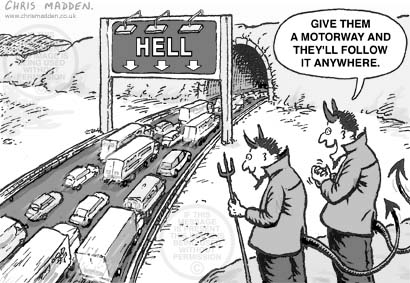
motorway-to-hell


Material infrastructure is fixed plant and equipment providing services considered basic to the functioning of society. That definition leaves plenty of room for interpretation, however. For example, it does not limit the meaning of “infrastructure” to facilities necessary for the provision of “public goods”, for which benefits are non-exclusive. And it encompasses facilities used by firms in certain competitive markets, such as some forms of telecommunication. The character of infrastructure tends to change over time, as new technologies lead to changes in our way of life (e.g., the cellular network). That’s even more evident when infrastructure is defined more broadly, as Walter Buhr does in “What Is Infrastructure?” His definition of material infrastructure encompasses all facilities enabling “the activation or mobilization of the economic agents’ potentialities.”

Infrastructure ≠ Government

There is a popular fallacy that infrastructure is the exclusive province of government. Infrastructure often does provide some public, non-exclusive benefits, but the willingness of users to pay is the key test of private benefits. As it happens, most infrastructure needs can be met privately and partly, if not fully, supported by user fees. That follows from the high degree of exclusivity of benefits yielded by the infrastructure. Today, privately-owned infrastructure includes communication networks, power generation and distribution, some water and sewer systems, toll roads, ports, and landfills. The presumed monopolistic nature of some infrastructural services probably encourages the notion that infrastructure must be public, but that view is largely unjustified: the services may be “monopolized” only to the extent that the relevant market is defined narrowly, such as road travel, rather than transportation. Indeed, certain kinds of infrastructure functions in markets that are fairly competitive (e.g., wireless networks).

The great thing about most private infrastructure is that owner-operators have an incentive to put it up and keep it up. So it kind of takes care of itself. I say “kind of” because there is always a degree of public involvement, from land use and environmental approval to construction permits, to licensing, to spectrum auctions, to rate regulation, and many other varieties of oversight. Aside from those considerations, if there is a need for infrastructure that is commercially-viable, the project is likely to be proposed by private interests. The funds necessary to pay for construction can be raised from private investors, rather than taxpayers. It’s not at all strange to say that private infrastructure is highly advantageous from a public finance perspective.

There are risks to private infrastructure developers, but those risks are too often borne publicly. A new facility, be it a water treatment plant or a road, might not prove to be profitable once a new revenue stream or reduction in operating costs is realized. Given those circumstances, private interests might seek additional incentives from public authorities to ensure profitbility. To the extent that the shortfall is due to an error in pricing administered by a public regulatory authority, it might be reasonable to make adjustments in the owner-operator’s favor. However, to the extent that demand falls short of the owner-operator’s expectations, it might be better to let the firm fail. That would allow the assets to be sold at a discount to a new operator who can make the cheaper investment profitable. No bailouts!

Trumpian Infrastructure Incentives

The coming Trump Administration is known to have certain steps in mind for encouraging infrastructure development. While the tax plan that has been discussed has a few questionable features, any policy that reduces corporate tax rates would increase the return to existing and prospective private infrastructure, and the profitability of private operation of public infrastructure. In addition, a proposal mentioned explicitly by Trump is a corporate tax credit for infrastructure development.

Here is where a more precise definition of infrastructure would be helpful. Would traditional categories of infrastructure investment by power, telecommunication, and water treatment companies qualify automatically? Moreover, the long timelines required in the planning and installation of most infrastructure might make it difficult to distinguish between new plans and those already in the works. Will the administration establish a bright line between infrastructure investment and run-of-the-mill corporate spending on new plant and equipment? Perhaps any form of corporate investment will qualify. These are questions that remain unanswered as we await Trump’s inauguration.

There is another public-finance dimension of the Trump infrastructure credit. Public infrastructure projects, such as roads, are frequently difficult for governments to fund because they face limits on the debt they can issue. This is emphasized by Randall O’Toole in a recent piece on the Trump credit. Instead of issuing its own debt, a government can take advantage of a large private road builder’s ability to raise funds in the capital market, agreeing to compensate the contractor over time. Thus, taxpayers will be obligated to pay-off the contractor’s debt. The term “Public-Private Partnership” has been invoked in this connection.

Private Incentives Or Central Planning?

I am never averse to reduced tax rates to the extent that taxation always distorts economic incentives. However, selective targeting of tax benefits at certain industries, specific forms of business organization (like corporations), or specific activities like capital investment is overt central planning. Overriding market incentives in this way is not desirable. (Neither are proposals to subsidize exporters and penalize importers. Tyler Cowen at the Marginal Revolution provides some salient quotes from Lawrence Summers on this point.) At this stage, Trump’s tax plan looks like central planning gone berserk.

Ideally, private investment and private infrastructure should be judged on its real merits, not on the prejudices of a central authority. To that end, I believe the Trump Administration’s intent to roll back regulatory distortions is commendable. A case in point is nuclear power generation. Despite the constant outcry against the burning of fossil fuels, there has been little emphasis on encouraging investment in new nuclear capacity. The lengthy approval process and costly regulatory requirements discourage this zero-carbon form of energy production relative to other forms of energy investment.

Users Are the Cost-Causers

I should note that O’Toole speaks favorably of “targeting” certain kinds of public infrastructure, but I think his point is that private operation of infrastructure, if not ownership, will allow markets to do the targeting more efficiently than government ever could. In particular, he notes that politicians tend to prefer new projects to the maintenance and repair of existing infrastructure, independent of the actual merit. Would relying on private operation and user fees encourage better maintenance?

“Unlike infrastructure paid for out of tax dollars, user-fee-funded projects tend to be well maintained because the agencies that manage them know they have to keep them in good shape to continue earning revenues.“

The cartoon above satirizes the consequences of providing free access to a costly facility. User fees encourage more rational patterns of use. For example, it is folly to think that projects like light rail can be financially viable when free alternatives exist. Specific highway routes under high demand must be priced in order for commuters to make rational decisions about the alternatives available to them, and for providers of transportation facilities, whether public or private, to rationally balance the resources dedicated to supporting various modes of travel.

Lower tax and regulatory burdens under the Trump infrastructure plan offer some encouragement for private development and operation of infrastructure projects. As a by-product, the plan might encourage greater reliance on user fees as a method of defraying the costs of infrastructure and promoting a more efficient allocation of resources toward infrastructure needs. However, there are unanswered questions about the details of the plan, and some of its heavy-handy features should be dispensed with.

Equality of Economic Freedom and the End of Poverty

30 Friday Dec 2016

Posted by Nuetzel in Capitalism, Liberty, Redistribution

≈ Leave a comment

Tags

central planning, Dependence, Dierdre McCloskey, Economic Freedom, economic growth, Ex Ante Equality, Ex Post Equality, Exchange-Tested Betterment, Poverty, Redistribution, Robert Sowell, Safety Net, Self-Sufficiency

poverty-econ-freedom

Should any form of equality be a central goal of society? Most certainly, but answers to this question often presume that government can set ground rules, ex ante, to ensure some form of ex post equality. Equality is a thing that can exist ex ante, as when rules are applied equally, and ex post, as when there are no differences in outcomes. The latter, however, always requires coercion and force of one form or another.

The great economist Deirdre McCloskey writes in the New York Times that forced equality will not save the poor; only growth can do it. Those who put their faith in the state to eliminate poverty lack an understanding of the underlying conditions and causes of the drastic improvements in the standard of living for even the world’s most impoverished inhabitants. It is all about economic freedom and capitalism. McCloskey explains:

“Eliminating poverty is obviously good. And, happily, it is already happening on a global scale. The World Bank reports that the basics of a dignified life are more available to the poorest among us than at any time in history, by a big margin. … Even in the rich countries, the poor are better off than they were in 1970, with better food and health care and, often, amenities like air-conditioning. …

… Free adults get what they need by working to make goods and services for other people, and then exchanging them voluntarily. They don’t get them by slicing up manna from Mother Nature in a zero-sum world. …

… We had better focus directly on the equality that we actually want and can achieve, which is equality of social dignity and equality before the law.“

Achievable equality has to do with ground rules, in the first instance. The rules must establish freedoms to which all participants are entitled. Many of these freedoms are enshrined in the U.S. Constitution, for example. With regard to strictly economic rules, we have: the right to private property, including the fruits of one’s own labor; the freedom to engage in exchange on terms of our choosing, and enter into contracts in pursuit of self-interest; and the freedom to take risks with real consequences.

Around the world, ex ante freedoms like these have been instrumental in lifting masses from the grips of poverty, not temporarily and artificially, but by encouraging self-sufficiency. That is the very ex post outcome that’s been so elusive for socialized economies and state-sponsored anti-poverty transfer schemes. By encouraging economic growth and an enhanced standard of living for those at the lowest end of the socioeconomic spectrum, ex ante freedoms achieve a crucial type of ex post equality: a life above penury.

McCloskey contrasts these kinds of equality with the utter failure of redistributive schemes to accomplish anything comparable:

“An all-wise central plan could force the right people into the right jobs. But such a solution, like much of the case for a compelled equality, is violent and magical. The magic has been tried, in Stalin’s Russia and Mao’s China. So has the violence.”

Not to mention the social and economic failures in Cuba, Venezuela, East Germany, Cambodia, Bulgaria, Ethiopia, Mozambique, Somalia, Romania, North Vietnam, North Korea, and too many others. And the sluggish growth to which many “social democracies” consign themselves by ceding dominance to the state. McCloskey continues:

As a matter of arithmetic, expropriating the rich to give to the poor does not uplift the poor very much. If we took every dime from the top 20 percent of the income distribution and gave it to the bottom 80 percent, the bottom folk would be only 25 percent better off. If we took only from the superrich, the bottom would get less than that. And redistribution works only once. You can’t expect the expropriated rich to show up for a second cutting. In a free society, they can move to Ireland or the Cayman Islands. And the wretched millionaires can hardly re-earn their millions next year if the state has taken most of the money.“

The following quote about poverty in the U.S. seems appropriate in this context. It is from Robert Sowell’s final column (having just announced his retirement from regular syndication):

“Most people living in officially defined poverty in the 21st century have things like cable television, microwave ovens and air-conditioning. Most Americans did not have such things, as late as the 1980s. People whom the intelligentsia continue to call the ‘have-nots’ today have things that the ‘haves’ did not have, just a generation ago.“

A sound argument can be made for the public provision of a safety net to cushion the blow of job losses in a market economy, or from the effects of catastrophic events on individuals or families. However, permanent status as a state-dependent must be discouraged for those capable of readjustment and self-reliance. Some such losses can and should be self-insured, not least by a willingness to pursue new opportunities, even those offering lower immediate rewards or requiring new training. Voluntary saving is another obvious form of self-insurance, of course. Nevertheless, few would deny the need for some form of social insurance to enable more comfortable transitions for those in need following certain kinds of losses.

McCloskey’s most powerful message involves the matter of value. Individuals trade with one another voluntarily only when it is of mutual benefit, which is dependent on the ex ante freedoms discussed above. There are mistakes in which parties are left unsatisfied by certain exchanges, but no one is compelled to repeat those mistakes. And they have every reason to innovate and seek alternatives. Participants may be happy to adjust the terms on which they are willing to trade, and they have every reason to imitate and repeat successes. These are the ways in which economic growth occurs:

“It is growth from exchange-tested betterment, not compelled or voluntary charity, that solves the problem of poverty.“

Capitalism and the market system have, by far, the best record of eliminating poverty in the sense of self-reliance. The only success against poverty that can be claimed by redistributionists is the substitution of lasting dependence on the state. Capitalism and the market hold the only real promise for eliminating poverty entirely.

Suspending the Economic Problem With Free Stuff

27 Saturday Aug 2016

Posted by Nuetzel in Central Planning, Socialism, Subsidies

≈ Leave a comment

Tags

Bernie Sanders, central planning, Confiscation, Contrived Scarcity, Don Boudreaux, Free Stuff, Hillary Clinton, incentives, Jeffrey Tucker, Nonprice Rationing, Overuse of Resources, Property Rights, Redistribution, Scarcity Deniers, Socialism

denial

When things are scarce, they can’t be free. That’s an iron law of economics. It’s true of everything we ever wish for and almost everything we take for granted. Things are naturally scarce, but when we are told that things can be free, it always comes from likes of whom Jeffrey Tucker calls “scarcity deniers”. Bernie Sanders and Hillary Clinton have told America that a college education should be free, and a large number of people take that seriously. They are scarcity deniers. On one level, the Sanders/Clinton claim is like any other promise that simply cannot be met at the stated cost — a rather garden-variety phenomenon among politicians. These promises are not harmless, as such initiatives usually involve budget overruns, compromised markets, underproduction and wasted resources.

The Sanders/Clinton claim, however, is a form of scarcity-denial that comes almost exclusively from the political left. That is really the point of Tucker’s article:

“This claim seems to confirm everything I’ve ever suspected about socialism. It’s rooted in a very simple error, one so fundamental that it denies a fundamental feature of the world. It denies the existence and the persistence of scarcity itself. That is to say, it denies that producing and allocating is even a problem. If you deny that, it’s hardly surprising that you have no regard for economics as a discipline of the social sciences.“

Our socialist friends (who otherwise claim to be defenders of science) contend that free things can be offered to a broad swath of the population with little consequence. The least cynical among them (perhaps including Sanders) believe that the costs can be shouldered by the wealthy and/or big corporations and banks. Others (including Clinton) know that the cost of “free things” must be met by higher taxes on a broader share of the population. Doesn’t that mean they recognize scarcity? Only superficially, because they fail to grasp the dynamics of resource allocation, the subtle forms in which costs are imposed, and the true magnitude of those costs.

If a thing is scarce, available supplies must be balanced against demand. The reward to suppliers at the margin must match the willingness of buyers to pay. That means there is no surplus and waste, nor any loss attendant to shortage and non-price rationing. The price creates an incentive for consumers to conserve and an incentive for producers to bring additional supplies to market when they are demanded.

A crucial prerequisite for this to work is the establishment of secure property rights. Then, absent coercion, one can’t overuse what isn’t theirs. One can’t simply take a thing from those who create it without a mutually agreeable payment. Creators cannot be forced to respond on demand without compensation. No one can be required to husband resources for others to simply take. No one can be asked to pay for a thing that will be commandeered by others. The establishment of property rights serves these purposes. Incentives become meaningful because they can be internalized by all actors — those consuming and those producing. And the incentives solve the problem of scarcity by balancing the availability of things with needs and desires, and balance them against all other competing uses of resources. Then, the market-clearing price of a thing reflects its degree of scarcity relative to other goods.

The socialist bluster holds that all this is nonsense. Would-be central planners propose that more of a thing be produced because they deem it to be of high value. Furthermore, it must be made available to buyers at a price the planners deem acceptable, or quite possibly for free to their intended constituency! Property rights are violated here in several ways: first, the owner/producer’s authority over their own resources is declared void; second, the owner has no incentive to care for their resources in a responsible and sustainable way; third, a confiscation of resources from others is required to pay at least some of the costs; fourth, the beneficiaries overuse and degrade the resource.

We know a scarce thing cannot be provided for free. Here are some consequences of trying:

  • Overuse of resources. When the buffet is free, the food disappears.
  • The “free thing” will be over-allocated to those who benefit and value it the least. (Example: the education of students for whom there are better alternatives.)
  • Supplies will evaporate unless producers are fully compensated. Otherwise, quality and quantity will deteriorate. This is a form of “contrived scarcity” (HT: Don Boudreaux).
  • If supplies dwindle, new forms of rationing will be necessary. This might involve time-consuming queues, arbitrary allocations, bribes, side payments and favoritism.
  • If suppliers are compensated, someone must pay. That means taxes, public borrowing or money printing.
  • Taxes weaken productive incentives and chase resources away. The consequent deterioration in productive capacity undermines the original goal of providing  something “for free” and inflicts costs on the outcomes of all other markets. This creates more contrived scarcity.
  • So-called progressive taxes tend to hit the most productive classes with the greatest negative force.
  • Government borrowing to fund “free stuff” today inflicts costs on future taxpayers. More fundamentally, it misallocates resources toward the present and away from the future.
  • Printing money to pay for a “free thing” might well cause a general rise in prices. This is a classic, hidden inflation tax, and it may involve the distortion of interest rates, leading to an inter-temporal misallocation of resources.

Scarcity denial is a carrot, but it inevitably becomes a stick. To voters, and to naive shoppers in the marketplace of ideas, the indignant assertion that things can and should be free is powerful rhetoric. Producers, too, might happily accept “free-stuff” policies if they expect to be fully compensated by the government, and they might be pleased to have the opportunity to serve more customers if they think they can do so profitably. However, serving all takers of “free stuff” will escalate costs and is likely to compromise quality. It is also likely to create unpleasant circumstances for customers, such as long waiting times and unfulfilled orders. The stick, on the other hand, will be brandished by the state, blaming and penalizing suppliers for their failure to meet expectations that were unrealistic from the start. The fault for contrived conditions of scarcity lies with the policy itself, not with producers, except to the extent that they allowed themselves to be duped by scarcity deniers. Tucker notes the following:

“Things can be allocated by arbitrary decision backed by force, or they can be allocated through agreement, trading, and gifting. The forceful way is what socialism has always become.“

Politicians and would-be planners with the arrogance to claim that naturally scarce things should be free are dangerous to your welfare. These scarcity deniers cannot provide for human needs more effectively than the free market, and ultimately their efforts will make you subservient and poor.

The Fascist Roader

04 Thursday Aug 2016

Posted by Nuetzel in Central Planning, fascism

≈ 1 Comment

Tags

Barack Obama, Benito Mussolini, central planning, competition, Dodd-Frank, fascism, Industrial Concentration, Industrial Policy, Innovation, Jonah Goldberg, Obamacare, rent seeking, Sheldon Richman, Socialism, Thomas Sowell

Obamas - fascist world government


President Obama is a believer in centralized social and economic management, despite the repeated disasters that have befallen societies whose leaders have applied that philosophy in the real world. Those efforts have often taken the form of socialism, with varying degrees of government ownership of resources and productive capital. However, it is not necessary for government to own the means of production in order to attempt central planning. You can keep your capital as long as you take direction from the central authority and pay your “fair share” of the public sector burden.

A large government bureaucracy can coexist with heavily regulated, privately-owned businesses, who are rewarded by their administrative overlords for expending resources on compliance and participating in favored activities. The rewards can take the form of rich subsidies, status-enhancing revolving doors between industry and powerful government appointments, and steady profits afforded by monopoly power, as less monied and politically-adept competitors drop out of the competition for customers. We often call this “corporatism”, or “crony capitalism”, but it is classic fascism, as pioneered by Benito Mussolini’s government in Italy in the 1920s. Here is Sheldon Richman on the term’s derivation:

“As an economic system, fascism is socialism with a capitalist veneer. The word derives from fasces, the Roman symbol of collectivism and power: a tied bundle of rods with a protruding ax.“

With that in mind, here’s an extra image:

Mussolini Quote

The meaning of fascism was perverted in the 1930s, as noted by Thomas Sowell:

“Back in the 1920s, however, when fascism was a new political development, it was widely — and correctly — regarded as being on the political left. Jonah Goldberg’s great book ‘Liberal Fascism’ cites overwhelming evidence of the fascists’ consistent pursuit of the goals of the left, and of the left’s embrace of the fascists as one of their own during the 1920s. … 

It was in the 1930s, when ugly internal and international actions by Hitler and Mussolini repelled the world, that the left distanced themselves from fascism and its Nazi offshoot — and verbally transferred these totalitarian dictatorships to the right, saddling their opponents with these pariahs.“

The Obama Administration has essentially followed the fascist playbook by implementing policies that both regulate and reward large corporations, who are only too happy to submit. Those powerful players participate in crafting those policies, which usually end up strengthening their market position at the expense of smaller competitors. So we have transformational legislation under Obama such as Obamacare and Dodd-Frank that undermine competition and encourage concentration in the insurance, health care, pharmaceutical  and banking industries. We see novel regulatory interpretations of environmental laws that destroy out-of-favor industries, while subsidies are lavished on favored players pushing economically questionable initiatives. Again, the business assets are owned by private cronies, but market forces are subjugated to a sketchy and politically-driven central plan designed jointly by cronies inside and outside of government. That is fascism, and that’s the Obama approach. He might be a socialist, and that might even be the end-game he hopes for, but he’s a fascist in practice.

As Sowell points out, Obama gains some crucial advantages from this approach. For starters, he gets a free pass on any claim that he’s a socialist. And however one might judge his success as a policymaker, the approach has allowed him to pursue many of his objectives with the benefit of handy fall-guys for failures along the way:

“… politicians get to call the shots but, when their bright ideas lead to disaster, they can always blame those who own businesses in the private sector.  Politically, it is heads-I-win when things go right, and tails-you-lose when things go wrong. This is far preferable, from Obama’s point of view, since it gives him a variety of scapegoats for all his failed policies, without having to use President Bush as a scapegoat all the time.

Thus the Obama administration can arbitrarily force insurance companies to cover the children of their customers until the children are 26 years old. Obviously, this creates favorable publicity for President Obama. But if this and other government edicts cause insurance premiums to rise, then that is something that can be blamed on the “greed” of the insurance companies.The same principle, or lack of principle, applies to many other privately owned businesses. It is a very successful political ploy that can be adapted to all sorts of situations.“

Obama’s most ardent sycophants are always cooing that he’s the best president EVAH, or the coolest, or something. But the economy has limped along for much of his presidency; labor force participation is now at its lowest point since the late 1970s; and median income has fallen on his watch. He has Federal Reserve policy to thank for stock market gains that are precarious, at least for those companies not on the fascist gravy train. Obama’s budgetary accomplishments are due to a combination of Republican sequestration (though he has taken credit) and backloading program shortfalls for his successors to deal with later. Obamacare is a disaster on a number fronts, as is Dodd-Frank, as is the damage inflicted by questionable environmental and industrial policy, often invoked via executive order.  (His failures in race relations and foreign policy are another subject altogether.)

Fascism is not a prescription for rapid economic growth. It is a policy of regression, and it is fundamentally anti-innovation to the extent that government policymakers create compliance burdens and are poor judges of technological evolution. Fascism is a policy of privilege and is regressive, with rewards concentrated within the political class. That’s what Obama has wrought.


Pay and Productivity

05 Sunday Jun 2016

Posted by Nuetzel in Living Wage, Markets, Minimum Wage

≈ 1 Comment

Tags

Automation, Carwasheros, central planning, Ecomomic Policy Institute, James Sherk, Labor Productivity, Labor Saving Technology, Living Wage, Low-Skilled Workers, Minimum Wage, Productivity and Wages, Resource Allocation, Veronique de Rugy

allaboutproductivity

Remember, the real minimum wage is zero, and state-imposed unemployment is not justice. In the private economy, wages rise with productivity, and that’s true across workers at any point in time, for workers over time, and for workers in different industries over time. Don’t think so? Contrary to the blithe pronouncements of Barack Obama and reports by the union-backed Economic Policy Institute (EPI), there has been no divergence in productivity and pay since the early 1970s. This is shown convincingly by James Sherk in “Workers’ Compensation: Growing Along With Productivity“. Sherk’s work shows that hourly productivity increased by 81% since 1973, while average employee compensation increased 78%. In contrast, the EPI has claimed that productivity grew 91% since 1973, but  employee compensation grew just 10%.

How did the EPI (and Obama) reach such a faulty conclusion? Sherk breaks the error into three major parts: 1) comparing the pay of a subset of workers to the productivity of all workers; 2) excluding the pay growth of the self-employed; and 3) inconsistent adjustments of pay and productivity for inflation.

The link between wages and productivity is immutable in a market economy. The state can attempt to short-circuit the relationship, but such intervention comes at the cost of dislocations in resource utilization and damage to well-being. Veronique de Rugy discusses Sherk’s findings and emphasizes the folly in thinking that the government can somehow divorce the pay of workers from their underlying contribution to the value of output:

“One of the assets of the American economic model is a relatively flexible labor market, especially when compared with labor markets in many European countries. It explains some of the consistently lower U.S. unemployment rates and higher economic growth. Unfortunately, this flexibility is increasingly threatened by government policies that would increase the cost of employing workers.“

Populists and statists share some destructive tendencies, such as a fixation on increasing the cost of labor to employers. The current debate over a “living wage” of $15 per hour involves more than doubling the minimum wage in many parts of the country. This is so far out of line with the productivity of low-skilled workers as to make absurd claims that it won’t have a serious impact on their employment. There are employers who won’t be able to survive under those circumstances. There are others who will have to scale back operations. Employers having access to capital in industries such as car washes and fast food know that automation is more than viable as a substitute for low-skilled labor. And new labor-saving innovations are inevitable when creative entrepreneurs are confronted with an obstacle like high-cost labor: necessity is the mother of invention. But premature automation is not an obvious consequence to living-wage advocates. And that’s to say nothing of the futures destroyed when low-skilled workers are denied opportunities for work experience.

The connection between wages and productivity is part of a well-functioning economy and it is just as alive and well in today’s economy as ever. The “right” wage cannot be determined by central planners, bureaucrats or legislators apart from productive reality, and the adverse consequences of their attempts to do so cannot be wished away. Only markets that price the real value of productive contributions can put resources such as low-skilled labor to their best use, avoiding the waste inherent in regulation that is always ignorant of dynamic preferences and resource availability.


Central Banks Stumble Into Negative Rates, Damn the Savers

01 Tuesday Mar 2016

Posted by Nuetzel in Central Planning, Monetary Policy

≈ 1 Comment

Tags

Bank of Japan, central planning, Federal Reserve, Helicopter Drop, Income Effect vs. Substitution Effect, Interest Rate Manipulation, Intertemporal Tradeoffs, Malinvestment, Mises Institute, Monetary policy, negative interest rates, NIRP, Printing Money, Privacy Rights, QE, Quantitative Easing, Reach For Yield, regulation, War on Cash, Zero Interest Rate Policy, ZIRP

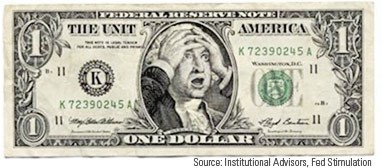
Dollar Cartoon

Should government actively manipulate asset prices in an effort to “manage ” economic growth? The world’s central bankers, otherwise at their wit’s end, are attempting just that. Hopes have been pinned on so-called quantitative easing (QE), which simply means that central banks like the U.S. Federal Reserve (the Fed) buy assets (government and private bonds) from the public to inject newly “printed” money into the economy. The Fed purchased $4.5 trillion of assets between the last financial crisis and late 2014, when it ended its QE. Other central banks are actively engaged in QE, however, and there are still calls from some quarters for the Fed to resume QE, despite modest but positive economic growth. The goals of QE are to drive asset prices up and interest rates down, ultimately stimulating demand for goods and economic growth. Short-term rates have been near zero in many countries (and in the U.S. until December), and negative short-term interest rates are a reality in the European Union, Japan and Sweden.

Does anyone really have to pay money to lend money, as indicated by a negative interest rate? Yes, if a bank “lends” to the Bank of Japan, for example, by holding reserves there. The BOJ is currently charging banks for the privilege. But does anyone really “earn” negative returns on short-term government or private debt? Not unless you buy a short-term bill and hold it till maturity. Central banks are buying those bills at a premium, usually from member banks, in order to execute QE, and that offsets a negative rate. But the notion is that when these “captive” member banks are penalized for holding reserves, they will be more eager to lend to private borrowers. That may be, but only if there are willing, credit-worthy borrowers; unfortunately, those are scarce.

Thus far, QE and zero or negative rates do not seem to be working effectively, and there are several reasons. First, QE has taken place against a backdrop of increasingly binding regulatory constraints. A private economy simply cannot flourish under such strictures, with or without QE. Moreover, government makes a habit of manipulating investment decisions, partly through regulatory mandates, but also by subsidizing politically-favored activities such as ethanol, wind energy, post-secondary education, and owner-occupied housing. This necessarily comes at the sacrifice of opportunities for physical investment that are superior on economic merits.

The most self-defeating consequence of QE and rate manipulation, be that zero interest rate policy (ZIRP) or negative interest rate policy (NIRP), is the distortion of inter-temporal tradeoffs that guide decisions to save and invest in productive assets. How, and how much, should individuals save when returns on relatively safe assets are very low? Most analysts would conclude that very low rates prompt a strong substitution effect toward consuming more today and less in the future. However, the situation may well engender a strong “income effect”, meaning that more must be saved (and less consumed in the present) in order to provide sufficient resources in the future. The paradox shouldn’t be lost on central bankers, and it may undermine the stimulative effects of ZIRP or NIRP. It might also lead to confusion in the allocation of productive capital, as low rates could create a mirage of viability for unworthy projects. Central bank intervention of this sort is disruptive to the healthy transformation of resources across time.

Savers might hoard cash to avoid a negative return, which would further undermine the efficacy of QE in creating monetary stimulus. This is at the root of central bank efforts to discourage the holding of currency outside of the banking system: the “war on cash“. (Also see here.) This policy is extremely offensive to anyone with a concern for protecting the privacy of individuals from government prying.

Another possible response for savers is to “reach for yield”, allocating more of their funds to high-risk assets than they would ordinarily prefer (e.g., growth funds, junk bonds, various “alternative” investments). So the supply of saving available for adding to the productive base in various sectors is twisted by central bank manipulation of interest rates. The availability of capital may be constrained for relatively safe sectors but available at a relative discount to risky sectors. This leads to classic malinvestment and ultimately business failures, displaced workers, and harsh adjustment costs.

With any luck, the Fed will continue to move away from this misguided path. Zero or negative interest rates imposed by central banks penalize savers by making the saving decision excessively complex and fraught with risk. Business investment is distorted by confusing signals as to risk preference and inflated asset prices. Central economic planning via industrial policy, regulation, and price controls, such as the manipulation of interest rates, always ends badly. Unfortunately, most governments are well-practiced at bungling in all of those areas.


Enduring A Dead-Weight Dominion

13 Wednesday Jan 2016

Posted by Nuetzel in Big Government, Macroeconomics

≈ Leave a comment

Tags

Anthony de Jasay, Automatic Stabilizers, Big government, Boom and Bust Cycle, central planning, Code of Federal Regulations, Double Taxation, Federal Reserve, Final Output, Government intervention, infrastructure, Intermediate Transactions, John Maynard Keynes, Keynesian Economics, Malinvestment, Mark Skousen, Mercatus Center, Shovel-Ready Projects, Spontaneous Order, Stabilization policy, Too big to fail, Underconsumption

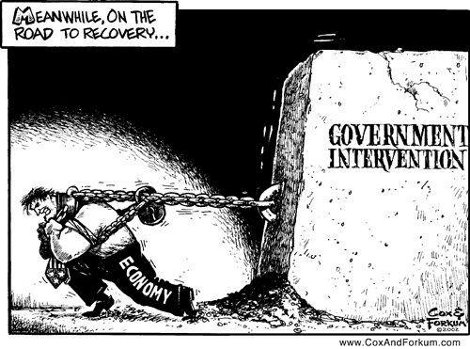
government-intervention

If you hope for government to solve economic problems, try to maintain some perspective: the state has unique abilities to botch it, and its power to distort and degrade the economy in the process of “helping” is vast. Government spending at all levels copped about 18% of the U.S.  economy’s final output in 2014, but the public sector’s impact is far more pervasive than that suggests. Private fixed investment in new structures and equipment accounted for only about 16% of Gross Domestic Product (GDP); the nonresidential portion of fixed investment was less than 13% of GDP. I highlight these two components of GDP because no one doubts the importance of capital investment as a determinant of the economy’s productive capacity. But government is a larger share of spending, it can divert saving away from investment, and it creates a host of other impediments to productivity and efficient resource allocation.

The private economy is remarkable in its capacity to satisfy human wants. The market is a manifestation of spontaneous order, lacking the conscious design of any supreme authority. It is able to adjust to dynamic shifts in desires and resource constraints; it provides reliable feedback in the form of changing prices to modulate and guide the responses of participants through all stages of production. Most forms of government activity, however, are not guided by these signals. Instead, the state imposes binding and sometimes immediate constraints on the decisions of market participants. The interference takes a number of forms, including price controls, but they all have the power to damage the performance and outcomes of markets.

The productive base at each stage of the market process is a consequence of the interplay of perceived business opportunities and acts of saving or deferred consumption. The available flow of saving depends on its rewards, which are heavily influenced by taxes and government intervention in financial markets. It’s worth noting here that the U.S. has the highest corporate tax rates in the developed world, as well as double taxation of corporate income paid out to owners. In addition, the tax system is used as a tool to manipulate the allocation of resources, drawing them into uses that are politically favored and punishing those in disfavor. The damaging impact is compounded by the fact that changes in taxes are often unknown ex ante. This adds a degree of political risk to any investment decision, thus discouraging capital spending and growth in the economy’s productive base.

The government is also a massive and growing regulator of economic activity. Over 100,000 new regulatory restrictions were added to the Code of Federal Regulations between 2008 and 2012. Regulation can have prohibitive compliance costs and may forbid certain efficiencies, often based on flimsy or nonexistent cost/benefit comparisons. It therefore damages the value and returns on embedded capital and discourages new investment. It is usually uneven in its effects across industries and it typically reduces the level of competition in markets because small firms are less capable of surviving the costs it imposes. Innovation is stifled and prices are higher as a result.

From a philosophical perspective, even the best cost/benefit comparisons are suspect as tools for evaluating government intervention. Don Boudreaux quotes Anthony de Jasay’s The State on this point:

“What could be more innocuous, more unexceptional than to refrain from intervening unless the cost-benefit comparison is favourable? Yet it treats the balancing of benefits and costs, good and bad consequences, as if the logical status of such balancing were a settled matter, as if it were technically perhaps demanding but philosophically straightforward. Costs and benefits, however, stretch into the future (problems of predictability) and benefits do not normally or exclusively accrue to the same persons who bear the costs (problems of externality). … Treating it as a pragmatic question of factual analysis, one of information and measurement, is tacitly taking the prior and much larger questions as having been somehow, somewhere resolved. Only they have not been.“

Poorly-executed and inappropriate stabilization policy is another way in which government distorts decisions at all stages of production. There are many reasons why these policies tend to be ineffective and potentially destructive, especially in the long run. Keynesian economics, based on ideas articulated by John Maynard Keynes, offers prescriptions for government action during times of instability. That means “expansionary” policy when the economy is weak and “contractionary” policy when it is strong.  At least that is the intent. This framework relies on the notion that components of aggregate demand determine the economy’s output, prices and employment.

The major components of GDP in the National Income and Product Accounts are consumer spending, private investment, government spending, and net foreign spending. In a Keynesian world, these are treated as four distinct parts of aggregate “demand”, and each is governed by particular kinds of assumed behavior. Supply effects are treated with little rigor, if at all, and earlier stages of production are considered only to the extent that their value added is included, and that the finished value of  investment (including new inventories) is one of the components of aggregate demand.

Final spending on goods and services (GDP) may be convenient because it corresponds to GDP, but that is simply an accounting identity. In fact, GDP represents less than 45% of all transactions. (See the end note below.) In other words, intermediate transactions for raw materials, business-to-business (B2B) exchange of services and goods in a partly fabricated state, and payments for distributional services are not counted, but they exceed GDP. They are also more variable than GDP over the course of the business cycle. Income is generated and value is added at each stage of production, not only in final transactions. To say that “value-added” is counted across all stages is a restatement of the accounting identity. It does not mean that those stages are treated behaviorally. Technology, capital, employees, and complex decision-making are required at each stage to meet demands in competitive markets. Aggregation at the final goods level glosses over all this detail.

The focus of the media and government policymakers in a weak economy is usually on “underconsumption”. The claim is often heard that consumer spending represents “over two-thirds of the economy”, but it is only about one-third of total transactions at all levels. It is therefore not as powerful an engine as many analysts assert. Government efforts to stimulate consumption are often thwarted by consumers themselves, who behave in ways that are difficult for models to capture accurately.

Government spending to combat weakness is another typical prescription, but such efforts are usually ill-timed and are difficult to reverse as the economy regains strength. The value of most government “output” is not tested in markets and it is not subject to competitive pressure, so as the government absorbs additional resources, the ability of the economy to grow is compromised. Programmatic ratcheting is always a risk when transfer payments are expanded. (Fixed programs that act as “automatic stabilizers”, and that are fiscally neutral over the business cycle, are less objectionable on these grounds, but only to the extent that they are not manipulated by politicians or subject to fraud.) Furthermore, any measure that adds to government deficits creates competition for the savings available for private capital investment. Thus, deficits can reduce the private economy’s productive capacity.

Government investment in infrastructure is a common refrain, but infrastructure spending should be tied to actual needs, not to the business cycle. Using public infrastructure spending for stabilization policy creates severe problems of timing. Few projects are ever “shovel-ready”, and rushing into them is a prescription for poor management, cost overruns and low quality.

Historically, economic instability has often been a consequence of poorly-timed monetary policy actions. Excessive money growth engineered by the Federal Reserve has stimulated excessive booms and inflation in the prices of goods and assets. These boom episodes were followed by market busts and recessions when the Fed attempted to course-correct by restraining money growth. Booms tend to foster misjudgments about risk that end in over-investment in certain assets. This is especially true when government encourages risk-taking via implicit “guarantees” (Fannie Mae and Freddie Mac) and “too-big-to-fail” promises, or among individuals who can least afford it, such as low-income homebuyers.

Given a boom-and-bust cycle inflicted by monetary mismanagement, attempts to stimulate demand are usually the wrong prescription for a weak economy. Unemployed resources during recessions are a direct consequence of the earlier malinvestment. It is better to let asset prices and wages adjust to bring them into line with reality, while assisting those who must transition to new employment. The best prescription for instability is a neutral stance toward market risks combined with stable policy, not more badly-timed countercyclical efforts. The best prescription for economic growth is to shrink government’s absorption of resources, restoring their availability to those with incentives to use them optimally.

The more that central authorities attempt to guide the economy, the worse it gets. The torpid recovery from the last recession, despite great efforts at stimulus, demonstrates the futility of demand-side stabilization policy. The sluggishness of the current expansion also bears witness to the counterproductive nature of government activism. It’s a great credit to the private market that it is so resilient in the face of long-standing government economic and regulatory mismanagement. A bureaucracy employing a large cadre of technocrats is a “luxury” that only a productive, dynamic economy can afford. Or can it?

~~~~~~~~~~~~~~~~~~~~~~~~~~~~~~~~~~~~~~~~~~~~~~~~~~~~~~~~~~~~~~~~~~~~

A Note On Output Measures

More complete aggregations of economic activity than GDP are gross output (GO) and gross domestic expenditures (GDE). These were developed in detail by economist Mark Skousen in his book “The Structure of Production“, published in 1990. GO includes all final transactions plus business-to-business (B2B) transactions, while GDE adds the costs of wholesale and retail distribution to GO. Or as Skousen says in this paper:

“GDE is defined as the value of all transactions (sales) in the production of new goods and services, both finished and unfinished, at all stages of production inside a country during a calendar year.“

GO and GDE show the dominance of business transactions in economic activity. GDE is more than twice as large as GDP, and B2B transactions plus business investment are twice the size of consumer spending. According to Skousen, GDE varies with the business cycle much more than GDP. Many economic indicators focus on statistics at earlier stages of production, yet real final spending is often assumed to be the only measure of transactions that matters.


ZIRP’s Over, But Fed Zombies Linger Over Seed Corn

24 Thursday Dec 2015

Posted by Nuetzel in Central Planning, Monetary Policy, Price Controls

≈ Leave a comment

Tags

Capital investment, Central Bank Intervention, central planning, negative interest rates, Price Ceilings, Price Controls, Ronald-Peter Stoferle, Saving Incentives, The Federal Reserve, Time Preference, Zero Interest Rate Policy, ZIRP, Zombie Banks

Fed Rate Cuts

The Federal Reserve plans a few more increases in short-term interest rates in 2016, which should be welcome to savers who are not overexposed to market risk. The Fed took its first step away from the seven-year zero-interest-rate policy (ZIRP) last week, increasing its target rate on overnight loans between banks (“federal” funds) for the first time in almost ten years. ZIRP was grounded in the Fed’s desire to stimulate the economy after the last financial crisis, an objective that met with limited success. ZIRP’s most profound “success” was to distort prices, with negative consequences for conservative savers, those dependent on retirement assets, and the long-term growth of the economy.

ZIRP necessarily constitutes a price ceiling when expected inflation is positive. It implies negative real rates of return, but real rates of time preference are not and cannot be negative. Given the choice, no one intends to forego present pleasure to purposefully suffer a loss later. The imperative to earn positive real returns does not end simply because the Fed and ZIRP make it more difficult. 

Anyone with funds parked in near zero-return assets, such as money market funds and certificates of deposit, earned a negative real return during the ZIRP regime, as inflation remained positive despite misplaced fears to the contrary. Those kinds of savings vehicles earn relatively low returns and should carry little risk to savers.

What are savers and retirees to do under a ZIRP regime? If they absolutely must defer consumption, they can accept the predicament and leave funds to decay in real value. They can dis-save in response to the disincentive, consuming their accumulated wealth. Some, for whom retirement is near, might even put more aside with the full knowledge that it will erode in real terms. But many will seek out yield in other ways, investing in assets bearing greater risk than they would otherwise prefer. All of these alternatives are likely to be less-preferred by the public than rates of saving and portfolios constructed in the absence of the Fed’s rate distortions.

The Fed’s policies and zero rates have contributed to inflated equity prices over the past six years as savers sought enhanced returns, and those valuations are certainly vulnerable. Over the past week, market jitters have shown the extent to which traders and investors feel threatened by the Fed’s tightening move.

The impact of ZIRP on the well-being of savers is only part of the story, however. Such a regime compromises the fundamental process of aligning preferences with the physical transformation of present resources into future consumption. Like any price distortion, ZIRP misallocates resources, but it misallocates across time and across sectors of the economy. When discounted at ultra-low rates, the values of future financial flows are grossly inflated, diminishing the need to set additional amounts aside today. At the same time, zero or near-zero rate borrowing confuses the evaluation of alternative capital investment projects. Resources may be committed to projects that would be rejected given accurate price signals. The artificially-enabled bidding for resources prompted by ZIRP, and the distortion of the risk-return trade off, might even cause more worthy projects to be rejected. And there is every reason to expect that saving by some individuals will be channeled into immediate consumption by others.

Who would do such wasteful things, undertaking projects with low or nonexistent future returns? Those facing distorted price signals, most prominently government technocrats for whom meaningful price signals are seldom a concern. And that also goes for the subsidy-hungry private beneficiaries of the state’s tax-extracted and borrowed largess. The ultimate consequence of this behavior is a deterioration in the economy’s growth potential.

Ronald-Peter Stoferle provides a short catalogue of ZIRP’s destructive impacts in the “Unseen Consequences of ZIRP“. One of his more interesting statements is the following, with reference to “zombie” banks:

“Low interest rates prevent the healthy process of creative destruction. Banks are enabled to roll over potentially non-performing loans practically indefinitely and can thus lower their write-off requirements.“

Thus, ZIRP promotes economic rot in several ways. Last week’s rate move by the Fed is a step in the right direction, away from zero rates and drastic overvaluation of consumption flows now and in the future. However, the monetary excesses of the past six years will not be reversed by this one move. The Fed is still imposing an artificial ceiling on rates. Even if that restriction is eased in further steps during 2016, the Fed is committed for the long-term to the manipulation of interest rates in the execution of policy. That sort of activist market manipulation is likely to continue; like all forms of central planning, it will be based on woefully incomplete information, a poor understanding of individual and market behavior, and bad timing. It will degrade economic conditions and have the classic boom-and-bust repercussions typical of central bank intervention.

Would You Tax Coastal Development?

14 Monday Dec 2015

Posted by Nuetzel in Central Planning, Global Warming

≈ Leave a comment

Tags

Carbon forcing, central planning, Climate Alarmism, Climate Change, Coastal development, Coastal tax, Federal Flood Insurance, FEMA, Glacier Melts, Glenn Reynolds, Pigouvian subsidies, Pigouvian Taxes, Robin Hanson, Sea Ice Extent, Strait of Gibraltar, Subsidies, Taxing development

Sea Level

If sea levels are truly rising due to climate change, then public policy should stop encouraging new development in coastal areas. Stipulating that this threat is real for the moment, serious and damaging encroachment of the seas might be 50 years away or more. By that time, many of today’s coastal buildings will be gone, or at least candidates for replacement, under realistic assumptions about the average lives of structures. A relatively low-cost approach to the threat of rising seas would be to stop building along the most vulnerable coasts right now and move new development inland. Yet no one wants to do that, least of all coastal property owners. But there is little discussion of this alternative even among the true believers of a coming global warming apocalypse. Why not?

This and related questions have been asked recently by several writers, including Glenn Reynolds and economist Robin Hanson. There are alternatives to discouraging new construction along coasts. Other expensive abatement projects can be pursued, now and later, such as sea walls or even adding land mass excavated from the sea floor or inland. In fact, the prospect of damming the Strait of Gibraltar to protect Mediterranean coastlines has been discussed. The expense of such an unprecedented public works project is what prompted Hanson’s post. To the extent that such remedial projects are not funded privately, they represent social costs arising from coastal development.

The federal government still subsidizes flood insurance on many coastal properties, though efforts to phase-out this FEMA program have been underway for a few years. However, governments seem only too willing to undertake the investment in public infrastructure and ongoing maintenance made necessary by new coastal development. And like other development projects, tax abatements and other subsidies are still granted for coastal development. Why do these policies escape notice from coastal green elites?  Public outlays with private beneficiaries along threatened coasts are an immediate drain on resources, relieving private developers and property buyers of shoreline risk.

Reynolds (perhaps tongue-in-cheek) and Hanson suggest that new development should be taxed in coastal areas. That, and ending subsidies for development along coasts, is an economically and ecologically defensible alternative to the public expense of ubiquitous sea walls. However, a coastal tax might not be in the immediate interests of elites  who claim that mankind faces an insurmountable global warming problem. Better to put off these sorts of remedial measures, especially while you can tax and regulate fossil fuels, and maybe live on the coast!

The position of the warmist community is that carbon emitters must cease and desist, in the hope that the seas will stop rising. They are willing to destroy entire industries (fossil fuels) in pursuit of their goals, but are unlikely to achieve them without inflicting drastic economic harm. If greens are so amenable to central control of economic activity and individual behavior (so long as they are at the controls), it would be prudent to take precautions now that will help to minimize the damage later. Discouraging coastal development with taxes and denial of subsidies is the sort of classic intervention that any Pigouvian planner should love. There is even evidence that sea levels have been much higher at times in the past. An earnest central planner might say that coastal development should always be discouraged to mitigate the risk of destruction.

I am skeptical of alarmist claims, including those related to rising sea levels. In fact, the connection between carbon emissions, global temperatures and sea levels is not well established, and whether sea levels are rising due to human activity is a matter of some dispute. Furthermore, global sea ice extent is not declining dramatically, if at all, and the storied glacier melts have been greatly exaggerated. Climate activists pursue their agenda despite the gross inaccuracy of past carbon-forcing forecasts, the gaping uncertainty surrounding model predictions going forward, and the crushing expense of the measures they advocate. The expense, however, is not one that activists expect to compromise their own standard of living. They either assume that it will be borne by others or that their draconian prescriptions will usher in an era of “sustainability”, powered by new, renewable energy sources. Not many of these alarmists would boast that their policies can quickly reverse the sea level rises they’ve told us to fear, but they dare not suggest taxes on coastal development until they see more convincing evidence. At least that much is sensible, if ironic!

Obamacare’s Left-Handed Monkey Wrench

20 Tuesday Oct 2015

Posted by Nuetzel in Central Planning, Obamacare

≈ Leave a comment

Tags

ACA, Accountable Care Organizations, Bending the Cost Curve, central planning, David Henderson, Exchange Enrollment, Ezra Klein, John C. Goodman, Medicare Advantage, Megan McArdle, Michael Schaus, Obamacare, Obamacare Coops, Obamacare Replacement, Pay For Performance, Risk corridors, Wharton ACA Study

ACA Zombies

Distorted overtures celebrating the great success of Obamacare continue, but no one who cares about the facts is buying the blather. Megan McArdle reminds us that even if we stipulate that the 9.9 million now enrolled on the exchanges have gained something, Obamacare has delivered far less than promised. McArdle also notes the high-risk skew of the population within the risk pools. That’s why insurers are losing money on Obamacare coverage, though their losses have been covered via government “risk corridors” thus far. In “Obamacare Bear Market” at wsj.com (links to a Google search result to get around the paywall — or just search “wsj Obamacare Bear”), we hear about the dismal financial performance of the Obamacare coops, which sell plans on the exchanges. The WSJ also reflects on a new working paper from Wharton economists:

“They conclude that, ‘even under the most optimistic assumptions,’ half of the formerly uninsured take on both a higher financial burden and lower welfare, and on net ‘average welfare for the uninsured population would be estimated to decline after the ACA [Affordable Care Act] if all members of that population obtained coverage.’

In other words, ObamaCare harms the people it is supposed to help. This is not a prescription for a healthy, durable program.“

Health economist John C. Goodman gives more detail on the Wharton study in “Obamacare is bad for the middle class“. Even Ezra Klein admits that the health plan is a failure. Whether Klein really gets it or not, the result is just another failure of central planning. Here’s a quote from Michael Schaus from the last link:

“The same people who failed miserably at launching a website will soon be regulating the sophisticated day-to-day decisions of hospitals, insurers and doctors.“

Anticipating another year of disappointing enrollments ahead, the White House now is low-balling its enrollment target for 2016. This an apparent attempt to present a better face to the public when the bad numbers roll in.

Another piece by Goodman explains that “bending the cost curve” with Obamacare was always a fool’s errand. Again, it has a lot to do with the folly of central planning:

“In a normal market, the entrepreneurs wake up every morning and ask themselves: How can I make costs lower, quality higher, and access to my product better today?

But in a bureaucratic system – where revenues are determined not by customer satisfaction, but by complicated payment formulas – they tend to wake up and ask: How can I get more money out of the payment formulas today?“

Goodman explains that an insurance firm providing coverage through Medicare Advantage would have nothing to gain by introducing cost-saving innovations: all of the extra profit would be turned over to Medicare. Incentives matter, but bureaucrats often fail to understand incentives and their power to improve performance. Goodman also describes the poor results of the so-called Accountable Care Organizations, the futile pilot programs and demonstration projects related to the practice of medicine, and the gaming that has taken place within the hospital “pay-for-performance” program. Ironically, the most certain outcome of any attempt to impose central planning on an industry is that there will be unintended and undesirable consequences.

Goodman has written a book proposing an Obamacare replacement, entitled “A Better Choice: Healthcare Solutions For America“. Here is David Henderson’s favorable review, in which he focuses on the negative labor market effects of Obamacare, including poor incentives for employers and work effort, among other things. To close, here’s an excerpt from Henderson’s introduction:

“If you think that the Patient Protection and affordable Care act (ACA, also known as Obamacare) is bad because of its expense, the distortions it causes in the labor market, its failure to provide people what they really want, and its highly unequal treatment of people in similar situations, wait until you read John C. Goodman’s A Better Choice: Healthcare Solutions for America. You will likely conclude that the ACA is even worse than you thought.

That’s the bad news. The good news is that Goodman … proposes reforms that would do more for the uninsured than the ACA does, and at lower cost, and also would make things better for the currently insured. and it would do all this while avoiding mandates, creating more real competition among insurers, and making the health care sector more responsive to consumers….“

← Older posts
Newer posts →
Follow Sacred Cow Chips on WordPress.com

Recent Posts

  • The Case Against Interest On Reserves
  • Immigration and Merit As Fiscal Propositions
  • Tariff “Dividend” From An Indigent State
  • Almost Looks Like the Fed Has a 3% Inflation Target
  • Government Malpractice Breeds Health Care Havoc

Archives

  • January 2026
  • December 2025
  • November 2025
  • October 2025
  • September 2025
  • August 2025
  • July 2025
  • June 2025
  • May 2025
  • April 2025
  • March 2025
  • February 2025
  • January 2025
  • December 2024
  • November 2024
  • October 2024
  • September 2024
  • August 2024
  • July 2024
  • June 2024
  • May 2024
  • April 2024
  • March 2024
  • February 2024
  • January 2024
  • December 2023
  • November 2023
  • August 2023
  • July 2023
  • June 2023
  • May 2023
  • April 2023
  • March 2023
  • February 2023
  • January 2023
  • December 2022
  • November 2022
  • October 2022
  • September 2022
  • August 2022
  • July 2022
  • June 2022
  • May 2022
  • April 2022
  • March 2022
  • February 2022
  • January 2022
  • December 2021
  • November 2021
  • October 2021
  • September 2021
  • August 2021
  • July 2021
  • June 2021
  • May 2021
  • April 2021
  • March 2021
  • February 2021
  • January 2021
  • December 2020
  • November 2020
  • October 2020
  • September 2020
  • August 2020
  • July 2020
  • June 2020
  • May 2020
  • April 2020
  • March 2020
  • February 2020
  • January 2020
  • December 2019
  • November 2019
  • October 2019
  • September 2019
  • August 2019
  • July 2019
  • June 2019
  • May 2019
  • April 2019
  • March 2019
  • February 2019
  • January 2019
  • December 2018
  • November 2018
  • October 2018
  • September 2018
  • August 2018
  • July 2018
  • June 2018
  • May 2018
  • April 2018
  • March 2018
  • February 2018
  • January 2018
  • December 2017
  • November 2017
  • October 2017
  • September 2017
  • August 2017
  • July 2017
  • June 2017
  • May 2017
  • April 2017
  • March 2017
  • February 2017
  • January 2017
  • December 2016
  • November 2016
  • October 2016
  • September 2016
  • August 2016
  • July 2016
  • June 2016
  • May 2016
  • April 2016
  • March 2016
  • February 2016
  • January 2016
  • December 2015
  • November 2015
  • October 2015
  • September 2015
  • August 2015
  • July 2015
  • June 2015
  • May 2015
  • April 2015
  • March 2015
  • February 2015
  • January 2015
  • December 2014
  • November 2014
  • October 2014
  • September 2014
  • August 2014
  • July 2014
  • June 2014
  • May 2014
  • April 2014
  • March 2014

Blogs I Follow

  • Passive Income Kickstart
  • OnlyFinance.net
  • TLC Cholesterol
  • Nintil
  • kendunning.net
  • DCWhispers.com
  • Hoong-Wai in the UK
  • Marginal REVOLUTION
  • Stlouis
  • Watts Up With That?
  • Aussie Nationalist Blog
  • American Elephants
  • The View from Alexandria
  • The Gymnasium
  • A Force for Good
  • Notes On Liberty
  • troymo
  • SUNDAY BLOG Stephanie Sievers
  • Miss Lou Acquiring Lore
  • Your Well Wisher Program
  • Objectivism In Depth
  • RobotEnomics
  • Orderstatistic
  • Paradigm Library
  • Scattered Showers and Quicksand

Blog at WordPress.com.

Passive Income Kickstart

OnlyFinance.net

TLC Cholesterol

Nintil

To estimate, compare, distinguish, discuss, and trace to its principal sources everything

kendunning.net

The Future is Ours to Create

DCWhispers.com

Hoong-Wai in the UK

A Commonwealth immigrant's perspective on the UK's public arena.

Marginal REVOLUTION

Small Steps Toward A Much Better World

Stlouis

Watts Up With That?

The world's most viewed site on global warming and climate change

Aussie Nationalist Blog

Commentary from a Paleoconservative and Nationalist perspective

American Elephants

Defending Life, Liberty and the Pursuit of Happiness

The View from Alexandria

In advanced civilizations the period loosely called Alexandrian is usually associated with flexible morals, perfunctory religion, populist standards and cosmopolitan tastes, feminism, exotic cults, and the rapid turnover of high and low fads---in short, a falling away (which is all that decadence means) from the strictness of traditional rules, embodied in character and inforced from within. -- Jacques Barzun

The Gymnasium

A place for reason, politics, economics, and faith steeped in the classical liberal tradition

A Force for Good

How economics, morality, and markets combine

Notes On Liberty

Spontaneous thoughts on a humble creed

troymo

SUNDAY BLOG Stephanie Sievers

Escaping the everyday life with photographs from my travels

Miss Lou Acquiring Lore

Gallery of Life...

Your Well Wisher Program

Attempt to solve commonly known problems…

Objectivism In Depth

Exploring Ayn Rand's revolutionary philosophy.

RobotEnomics

(A)n (I)ntelligent Future

Orderstatistic

Economics, chess and anything else on my mind.

Paradigm Library

OODA Looping

Scattered Showers and Quicksand

Musings on science, investing, finance, economics, politics, and probably fly fishing.

  • Subscribe Subscribed
    • Sacred Cow Chips
    • Join 128 other subscribers
    • Already have a WordPress.com account? Log in now.
    • Sacred Cow Chips
    • Subscribe Subscribed
    • Sign up
    • Log in
    • Report this content
    • View site in Reader
    • Manage subscriptions
    • Collapse this bar
 

Loading Comments...