• About

Sacred Cow Chips

Sacred Cow Chips

Tag Archives: Comparative advantage

AI Won’t Repeal Scarcity, Tradeoffs, Or Jobs

04 Monday Aug 2025

Posted by Nuetzel in Artificial Intelligence, Labor Markets

≈ 1 Comment

Tags

Absolute Advantage, AI Capital, Artificial Intelligence, Baby Bonds, Comparative advantage, Complementary Inputs, Human Touch, Opportunity cost, Robitics, Scarcity, Tradeoffs, Type I Civilization, Universal Basic Income, Universal Capital Endowments

Every now and then I grind my axe against the proposition that AI will put humans out of work. It’s a very fashionable view, along with the presumed need for government to impose “robot taxes” and provide everyone with a universal basic income for life. The thing is, I sense that my explanations for rejecting this kind of narrative have been a little abstruse, so I’m taking another crack at it now.

Will Human Workers Be Obsolete?

The popular account envisions a world in which AI replaces not just white-collar technocrats, but by pairing AI with advanced robotics, it replaces workers in the trades as well as manual laborers. We’ll have machines that cure, litigate, calculate, forecast, design, build, fight wars, make art, fix your plumbing, prune your roses, and replicate. They’ll be highly dextrous, strong, and smart, capable of solving problems both practical and abstract. In short, AI capital will be able to do everything better and faster than humans! The obvious fear is that we’ll all be out of work.

I’m here to tell you it will not happen that way. There will be disruptions to the labor market, extended periods of joblessness for some individuals, and ultimately different patterns of employment. However, the chief problem with the popular narrative is that AI capital will require massive quantities of resources to produce, train, and operate.

Even without robotics, today’s AIs require vast flows of energy and other resources, and that includes a tremendous amount of expensive compute. The needed resources are scarce and highly valued in a variety of other uses. We’ll face tradeoffs as a society and as individuals in allocating resources both to AI and across various AI applications. Those applications will have to compete broadly and amongst themselves for priority.

AI Use Cases

There are many high-value opportunities for AI and robotics, such as industrial automation, customer service, data processing, and supply chain optimization, to name a few. These are already underway to a significant extent. To that, however, we can add medical research, materials research, development of better power technologies and energy storage, and broad deployment in delivering services to consumers and businesses.

In the future, with advanced robotics, AI capital could be deployed in domains that carry high risks for human labor, such as construction of high rise buildings, underwater structures, and rescue operations. This might include such things as construction of solar platforms and large transports in space, or the preparation of space habitats for humans on other worlds.

Scarcity

There is no end to the list of potential applications of AI, but neither is there an end to the list of potential wants and aspirations of humanity. Human wants are insatiable, which sometimes provokes ham-fisted efforts by many governments to curtail growth. We have a long way to go before everyone on the planet lives comfortably. But even then, peoples’ needs and desires will evolve once previous needs are satisfied, or as technology changes lifestyles and practices. New approaches and styles drive fashions and aesthetics generally. There are always individuals who will compete for resources to experiment and to try new things. And the insatiability of human wants extends beyond the strictly private level. Everyone has an opinion about unsatisfied needs in the public sphere, such as infrastructure, maintenance, the environment, defense, space travel, and other dimensions of public activity.

Futurists have predicted that the human race will seek to become a so-called Type I civilization, capable of harnessing all of the energy on our planet. Then there will be the quest to harness all the energy within our solar system (a Type II civilization). Ultimately, we’ll seek to go beyond that by attempting to exploit all the energy in the Milky Way galaxy. Such an expansion of our energy demands would demonstrate how our wants always exceed the resources we have the ability to exploit.

In other words, scarcity will always be with us. The necessity of facing tradeoffs won’t ever be obviated, and prices will always remain positive. The question of dedicating resources to any particular application of AI will bring tradeoffs into sharper relief. The opportunity cost of many “lesser” AI and robotics applications will be quite high relative to their value to investors. Simply put, many of those applications will be rejected because there will be better uses for the requisite energy and other resources.

Tradeoffs

Again, it will be impossible for humans to accomplish many of the tasks that AI’s will perform, or to match the sheer productivity of AIs in doing so. Therefore, AI will have an absolute advantage over humans in all of those tasks.

However, there are many potential applications of AI that are of comparatively low value. These include a variety of low-skill tasks, but also tasks that require some dexterity or continuous judgement and adjustment. Operationalizing AI and robots to perform all these tasks, and diverting the necessary capital and energy away from other uses, would have a tremendously high opportunity cost. Human opportunity costs will not be so high. Thus, people will have a comparative advantage in performing the bulk if not all of these tasks.

Sure, there will be novelty efforts and test cases to train robots to do plumbing or install burglar alarm systems, and at some point buyers might wish to have robots prune their roses. Some people are already amenable to having humanoid robots perform sex work. Nevertheless, humans will remain competitive at these tasks due to the comparatively high opportunity costs faced by AI capital.

There will be many other domains in which humans will remain competitive. Once more, that’s because the opportunity costs for AI capital and other resources will be high. This includes many of the skilled trades, caregivers, and a great many management functions, especially at small companies. Their productivity will be enhanced by AI tools, but those jobs will not be decimated.

The key here is understanding that 1) capital and resources generally are scarce; 2) high value opportunities for AI are plentiful; and 3) the opportunity cost of funding AI in many applications will be very high. Humans will still have a comparative advantage in many areas.

Who’s the Boss?

There are still other ways in which human labor will always be required. One in particular involves the often complementary nature of AI and human inputs. People will have roles in instructing and supervising AIs, especially in tasks requiring customization and feedback. A key to assuring AI alignment with the objectives of almost any pursuit is human review. These kinds of roles are likely to be compensated in line with the complexity of the task. This extends to the necessity of human leadership of any organization.

That brings me to the subject of agentic and fully autonomous AI. No matter how sophisticated they get, AIs will always be the product of machines. They’ll be a kind of capital for which ownership should be confined to humans or organizations representing humans. We must be their masters. Disclaiming ownership and control of AIs, and granting agentic AIs the same rights and freedoms as people (as many have imagined) is unnecessary and possibly dangerous. AIs will do much productive work, but that work should be on behalf of human owners, and human labor will be deployed to direct and assess that work.

AIs (and People) Needing People

The collaboration between AIs and humans described above will manifest more broadly than anything task-specific, or anything we can imagine today. This is typical of technological advance. First-order effects often include job losses as new innovations enhance productivity or replace workers outright, but typically new jobs are created as innovations generate new opportunities for complementary products and services both upstream in production or downstream among ultimate users. In the case of AI, while much of this work might be performed by other AIs, at a minimum these changes will require guidance and supervision by humans.

In addition, consumers tend to have an aesthetic preference for goods and services produced by humans: craftsmen, artists, and entertainers. For example, if you’ve ever shopped for an oriental rug, you know that hand-knotted rugs are more expensive than machine-weaved rugs. Durability is a factor as well as uniqueness, the latter being a hallmark of human craftspeople. AI might narrow these differences over time, but the “human touch” will always have value relative to “comparable” AI output, even at a significant disadvantage in terms of speed and uncertainty regarding performance. The same is true of many other forms, such as sports, dance, music, and the visual arts. People prefer to be entertained by talented people, rather than highly-engineered machines. The “human touch” also has advantages in customer-facing transactions, including most forms of service and high-level sales/financial negotiations.

Owning the Machines

Finally, another word about AI ownership. An extension of the fashionable narrative that AIs will wholly replace human workers is that government will be called upon to tax AI and provide individuals with a universal basic income (UBI). Even if human labor were to be replaced by AIs, I believe that a “classic” UBI would be the wrong approach. Instead, all humans should have an ownership stake in the capital stock. This is wealth that yields compound growth over time and produces returns that make humans less reliant on streams of labor income.

Savings incentives (and negative consumption incentives) are a big step in encouraging more widespread ownership of capital. However, if direct intervention is necessary, early endowments of capital would be far preferable to a UBI because they will largely be saved, fostering economic growth, and they would create better incentives than a UBI. Along those lines, President Trump’s Big Beautiful Bill, which is now law, has established “Baby Bonds” for all American children born in 2025 – 2028, initially funded by the federal government with $1,000. Of course, this is another unfunded federal obligation on top of the existing burden of a huge public debt and ongoing deficits. Given my doubts about the persistence of AI-induced job losses, I reject government establishment of both a UBI and universal endowments of capital.

Summary

Capital and energy are scarce, so the tremendous resource requirements of AI and robotics means that the real world opportunity costs of many AI applications will remain impractically high. The tradeoffs will be so steep that they’ll leave humans with comparative advantages in many traditional areas of employment. Partly, these will come down to a difference in perceived quality owing to a preference for human interaction and human performance in a variety of economic interactions, including patronization of the art and athleticism of human beings. In addition, AIs will open up new occupations never before contemplated. We won’t be out of work. Nevertheless, it’s always a good idea to accumulate ownership in productive assets, including AI capital, and public policy should do a better job of supporting the private initiative to do so.

A, But Not-So-I: Altman’s Plan To Tax Wealth and Redistribute Capital

09 Tuesday Jul 2024

Posted by Nuetzel in Artificial Intelligence, Wealth Distribution, Wealth Taxes

≈ 2 Comments

Tags

Absolute Advantage, AGI, Alignment, American Equity Fund, Antitrust, ChatGPT, Chris Edwards, Comparative advantage, consumption tax, David Schizer, Defense Production Act, Direct Taxes, Inequality, Maxwell Tabarrok, Michael Munger, Michael Strain, Moore v. United States, Moore’s Law, Open AI, Patrick Hedger, Sam Altman, Scarcity, Scott Sumner, Sixteenth Amendment, Steven Calabresi, Tax Incidence, ULTRA Tax, Wealth Tax

In this case, the “A” stands for Altman. Now Sam Altman is no slouch, but he’s taken a few ill-considered positions on public policy. Altman, the CEO of Open AI, wrote a blog post back in 2021 entitled “Moore’s Law For Everything” in which he predicted that AI will feed an explosion of economic growth. He also said AI will put a great many people out of work and drive down the price of certain kinds of labor. Furthermore, he fears that the accessibility of AI will be heavily skewed against the lowest socioeconomic classes. In later interviews (see here and here), Altman is somewhat demure about those predictions, but the general outline is the same: despite exceptional growth of GDP and wealth, he envisions job losses, an underclass of AI-illiterates, and a greater degree of income and wealth inequality.

Not Quite Like That

We’ve yet to see an explosion of growth, but it’s still very early in the AI revolution. The next several years will be telling. AI holds the potential to vastly increase our production possibilities over the course of the next few decades. For that and other reasons, I don’t buy the more dismal aspects of Altman’s scenario, as my last two posts make clear (here and here).

There will be plenty of jobs for people because humans will have comparative advantages in various areas of production. AI agents might have absolute advantages across most or even all jobs, but a rational deployment would have AI agents specialize only where they have a comparative advantage.

Scarcity will not be the sort of anachronism envisioned by some AI futurists, Altman included, and scarcity of AI agents (and their inputs) will necessitate their specialization in certain tasks. The demand for AI agents will be quite high, and their energy and “compute” requirements will be massive. AI agents will face extremely high opportunity costs in other tasks, leaving many occupations open for human labor, to say nothing of abundant opportunities for human-AI collaboration.

However, I don’t dismiss the likelihood of disruptions in markets for certain kinds of labor if the AI revolution proceeds as rapidly as Altman thinks it will. Many workers would be displaced, and it would take time, training, and a willingness to adapt for them to find new opportunities. But new kinds of jobs for people will emerge with time as AI is embedded throughout the economy.

Altman’s Rx

Altman’s somewhat pessimistic outlook for human employment and inequality leads him to make a couple of recommendations:

1) Ownership of capital must be more broadly distributed.

2) Capital and land must be taxed, potentially replacing income taxes, but primarily to fund equity investments for all Americans.

Here I agree with the spirit of #1. Broad ownership of capital is desirable. It allows greater participation in the capitalist system, which fosters political and economic stability. And wider access to capital, whether owned or not, allows a greater release of entrepreneurial energy. It also diversifies incomes and reduces economic dependency.

Altman proposes the creation of an American Equity Fund (AEF) to hold the proceeds of taxes on land and corporate assets for the benefit of all Americans. I’ll get to the taxes in a moment, but in discussing the importance of educating the public on the benefits of compounding, Altman seems to imply that assets in AEF would be held in individual accounts, as opposed to a single “public” account controlled by the federal government. Individual accounts would be far preferable, but it’s not clear how much control Altman would grant individuals in managing their accounts.

To Kill a Golden Goose

Taxes on capital are problematic. Capital can only be accumulated over time by saving out of income. Thus, as Michael Munger points out, as a general proposition under an income tax, all capital has already been taxed once. And we tax the income from capital at both the corporate and individual level. So corporate income is already double taxed: corporate profits are taxed along with dividend payments to shareholders.

Altman proposed in his 2021 blog post to levy a tax of 2.5% on the market value of publicly-traded corporations each year. The tax would be payable in cash or in corporate shares to be placed into the AEF. The latter would establish a kind of UnLiquidated Tax Reserve Accounts (ULTRA), which Munger discusses in the article linked above (my bracketed x% in the quote here):

“Instead of taking [x%] of the liquidated value of the wealth, the state would simply take ownership of the wealth, in place. An ULTRA is a ‘notional equity interest.’ The government literally takes a portion of the value of the asset; that value will be paid to the state when the asset is sold. Now, it is only a ‘notional’ stake, in the sense that no shared right of control or voting rights exists. But for those who advocate for ULTRAs, in any situation where tax agencies are authorized to tax an asset today, but cannot because there is no evaluation event, the taxpayer could be made to pay with an ULTRA rather than with cash.”

This solves all sorts of administrative problems associated with wealth taxes, but it is draconian nevertheless. Munger quotes an example of a successful, privately-held business subject to a 2% wealth tax every year in the form of an ULTRA. After 20 years, the government owns more than a third of the company’s value. That represents a substantial penalty for success! However, the incidence of such a tax might fall more on workers and customers and less on business owners. And Altman would tax corporations more heavily than in Munger’s example.

A tax on wealth essentially penalizes thrift, reduces capital accumulation, and diminishes productivity and real wages. But another fundamental reason that taxes on capital should be low is that the supply of capital is elastic. A tax on capital discourages saving and encourages capital flight. The use of avoidance schemes will proliferate, and there will be intense pressure to carve out special exemptions.

A Regressive Dimension

Another drawback of a wealth tax is its regressivity with respect to returns on capital. To see this, we can convert a tax on wealth to an equivalent income tax on returns. Here is Chris Edwards on that point:

“Suppose a person received a pretax return of 6 percent on corporate equities. An annual wealth tax of 2 percent would effectively reduce that return to 4 percent, which would be like a 33 percent income tax—and that would be on top of the current federal individual income tax, which has a top rate of 37 percent.”

… The effect is to impose lower effective tax rates on higher‐yielding assets, and vice versa. If equities produced returns of 8 percent, a 2 percent wealth tax would be like a 25 percent income tax. But if equities produced returns of 4 percent, the wealth tax would be like a 50 percent income tax. People with the lowest returns would get hit with the highest tax rates, and even people losing money would have to pay the wealth tax.“

Edwards notes the extreme inefficiency of wealth taxes demonstrated by the experience of a number of OECD countries. There are better ways to increase revenue and the progressivity of taxes. The best alternative is a tax on consumption, which rewards saving and capital accumulation, promoting higher wages and economic growth. Edwards dedicates a lengthy section of his paper to the superiority of a consumption tax.

Is a Wealth Tax Constitutional?

The constitutionality of a wealth tax is questionable as well. Steven Calabresi and David Schizer (C&S) contend that a federal wealth tax would qualify as a direct tax subject to the rule of apportionment, which would also apply to a federal tax on land. That is, under the U.S. Constitution, these kinds of taxes would have to be the same amount per capita in every state. Thus, higher tax rates would be necessary in less wealthy states.

C&S also note a major distinction between taxes on the value of wealth relative to income, excise, import, and consumption taxes. The latter are all triggered by transactions entered into voluntarily. They are avoidable in that sense, but not wealth taxes. Moreover, C&S believe the founders’ intent was to rely on direct taxes only as a backstop during wartime.

The recent Supreme Court decision in Moore v. United States created doubt as to whether the Court had set a precedent in favor of a potential wealth tax. According to earlier precedent, the Constitution forbade the “laying of taxes” on “unrealized” income or changes in wealth. However, in Moore, the Court ruled that undistributed profits from an ownership interest in a foreign business are taxable under the mandatory repatriation tax, signed into law by President Trump in 2017 as part of his tax overhaul package. But Justice Kavanaugh, who wrote the majority opinion, stated that the ruling was based on the foreign company’s status as a pass-through entity. The Wall Street Journal says of the decision:

“Five Justices open the door to taxing unrealized gains in assets. Democrats will walk through it.”

In a brief post, Calabrisi laments Justice Ketanji Brown Jackson’s expansive view of the federal government’s taxing authority under the Sixteenth Amendment, which might well be shared by the Biden Administration. But the Wall Street Journal piece also describes Kavanaugh’s admonition regarding any expectation of a broader application of the Moore opinion:

“Justice Kavanaugh does issue a warning that ‘the Due Process Clause proscribes arbitrary attribution’ of undistributed income to shareholders. And he writes that his opinion should not ‘be read to authorize any hypothetical congressional effort to tax both an entity and its shareholders or partners on the same undistributed income realized by the entity.’”

Growth Is the Way, Not Taxes

AI growth will lead to rapid improvements in labor productivity and real wages in many occupations, despite a painful transition for some workers requiring occupational realignment and periods of unemployment and training. However, people will retain comparative advantages over AI agents in a number of existing occupations. Other workers will find that AI allows them to shift their efforts toward higher-value or even new aspects of their jobs. Along the same lines, there will be a huge variety of new occupations made possible by AI of which we’re only now catching the slightest glimpse. Michael Strain has emphasized this aspect of technological diffusion, noting that 60% of the jobs performed in 2018 did not exist in 1940. In fact, few of those “new” jobs could have been imagined in 1940.

AI entrepreneurs and AI investors will certainly capture a disproportionate share of gains from an AI revolution. Of course, they’ll have created a disproportionate share of that wealth. It might well skew the distribution of wealth in their favor, but that does not reflect negatively on the market process driving the outcome, especially because it will also give rise to widespread gains in living standards.

Altman goes wrong in proposing tax-funded redistribution of equity shares. Those taxes would slow AI development and deployment, reduce economic growth, and produce fewer new opportunities for workers. The surest way to effect a broader distribution of equity capital, and of equity in AI assets, is to encourage innovation, economic growth, and saving. Taxing capital more heavily is a very bad way to do that, whether from heavier taxes on income from capital, new taxes on unrealized gains, or (worst of all) from taxes on the value of capital, including ULTRA taxes.

Altman is right, however, to bemoan the narrow ownership of capital. As I mentioned above, he’s also on-target in saying that most people do not fully appreciate the benefits of thrift and the miracle of compounding. That represents both a failure of education and our calamitously high rate of time preference as a society. Perhaps the former can be fixed! However, thrift is a decision best left in private hands, especially to the extent that AI stimulates rapid income growth.

Killer Regulation

Altman also supports AI regulation, and I’ll cut him some slack by noting that his motives might not be of the usual rent-seeking variety. Maybe. Anyway, he’ll get some form of his wish, as legislators are scrambling to draft a “roadmap” for regulating AI. Some are calling for billions of federal outlays to “support” AI development, with a likely and ill-advised effort to “direct” that development as well. That is hardly necessary given the level of private investment AI is already attracting. Other “roadmap” proposals call for export controls on AI and protections for the film and recording industries.

These proposals are fueled by fears about AI, which run the gamut from widespread unemployment to existential risks to humanity. Considerable attention has been devoted to the alignment of AI agents with human interests and well being, but this has emerged largely within the AI development community itself. There are many alignment optimists, however, and still others who decry any race between tech giants to bring superhuman generative AI to market.

The Biden Administration stepped in last fall with an executive order on AI under emergency powers established by the Defense Production Act. The order ranges more broadly than national defense might necessitate, and it could have damaging consequences. Much of the order is redundant with respect to practices already followed by AI developers. It requires federal oversight over all so-called “foundation models” (e.g., ChatGPT), including safety tests and other “critical information”. These requirements are to be followed by the establishment of additional federal safety standards. This will almost certainly hamstring investment and development of AI, especially by smaller competitors.

Patrick Hedger discusses the destructive consequences of attempts to level the competitive AI playing field via regulation and antitrust actions. Traditionally, regulation tends to entrench large players who can best afford heavy compliance costs and influence regulatory decisions. Antitrust actions also impose huge costs on firms and can result in diminished value for investors in AI start-ups that might otherwise thrive as takeover targets.

Conclusion

Sam Altman’s vision of funding a redistribution of equity capital via taxes on wealth suffers from serious flaws. For one thing, it seems to view AI as a sort of exogenous boon to productivity, wholly independent of investment incentives. Taxing capital would inhibit investment in new capital (and in AI), diminish growth, and thwart the very goal of broad ownership Altman wishes to promote. Any effort to tax capital at a global level (which Altman supports) is probably doomed to failure, and that’s a good thing. The burden of taxes on capital at the corporate level would largely be shifted to workers and consumers, pushing real wages down and prices up relative to market outcomes.

Low taxes on income and especially on capital, together with light regulation, promote saving, capital investment, economic growth, higher real wages, and lower prices. For AI, like all capital investment, public policy should focus on encouraging “aligned” development and deployment of AI assets. A consumption tax would be far more efficient than wealth or capital taxes in that respect, and more effective in generating revenue. Policies that promote growth are the best prescription for broadening the distribution of capital ownership.

On Noah Smith’s Take Re: Human/AI Comparative Advantage

13 Thursday Jun 2024

Posted by Nuetzel in Artificial Intelligence, Comparative advantage, Labor Markets

≈ 3 Comments

Tags

Absolute Advantage, Agentic AI, Alignment, Andrew Mayne, Artificial Intelligence, Comparative advantage, Compute, Decreasing Costs, Dylan Matthews, Fertility, Floating Point Operations Per Second, Generative AI, Harvey Specter, Inequality, National Security, Noah Smith, Opportunity cost, Producer Constraints, Substitutability, Superabundance, Tyler Cowen

I was happy to see Noah Smith’s recent post on the graces of comparative advantage and the way it should mediate the long-run impact of AI on job prospects for humans. However, I’m embarrassed to have missed his post when it was published in March (and I also missed a New York Times piece about Smith’s position).

I said much the same thing as Smith in my post two weeks ago about the persistence of a human comparative advantage, but I wondered why the argument hadn’t been made prominently by economists. I discussed it myself about seven years ago. But alas, I didn’t see Smith’s post until last week!

I highly recommend it, though I quibble on one or two issues. Primarily, I think Smith qualifies his position based on a faulty historical comparison. Later, he doubles back to offer a kind of guarantee after all. Relatedly, I think Smith mischaracterizes the impact of energy costs on comparative advantages, and more generally the impact of the resources necessary to support a human population.

We Specialize Because…

Smith encapsulates the underlying phenomenon that will provide jobs for humans in a world of high automation and generative AI: “… everyone — every single person, every single AI, everyone — always has a comparative advantage at something!” He tells technologists “… it’s very possible that regular humans will have plentiful, high-paying jobs in the age of AI dominance — often doing much the same kind of work that they’re doing right now …”

… often, but probably transformed in fundamental ways by AI, and also doing many other new kinds of work that can’t be foreseen at present. Tyler Cowen believes the most important macro effects of AI will be from “new” outputs, not improvements in existing outputs. That emphasis doesn’t necessarily conflict with Smith’s narrative, but again, Smith thinks people will do many of the same jobs as today in a world with advanced AI.

Smith’s Non-Guarantee

Smith hedges, however, in a section of his post entitled “‘Possible’ doesn’t mean guaranteed”. This despite his later assertion that superabundance would not eliminate jobs for humans. That might seem like a separate issue, but it’s strongly intertwined with the declining AI cost argument at the basis of his hedge. More on that below.

On his reluctance to “guarantee” that humans will have jobs in an AI world, Smith links to a 2013 Tyler Cowen post on “Why the theory of comparative advantage is overrated”. For example, Cowen says, why do we ever observe long-term unemployment if comparative advantage rules the day? Of course there are many reasons why we observe departures from the predicted results of comparative advantage. Incentives are often manipulated by governments and people differ drastically in their capacities and motivation.

But Cowen cites a theoretical weakness of comparative advantage: that inputs are substitutable (or complementary) by degrees, and the degree might change under different market conditions. An implication is that “comparative advantages are endogenous to trade”, specialization, and prices. Fair enough, but one could say the same thing about any supply curve. And if equilibria exist in input markets it means these endogenous forces tend toward comparative advantages and specializations balancing the costs and benefits of production and trade. These processes might be constrained by various frictions and interventions, and their dynamics might be complex and lengthy, but that doesn’t invalidate their role in establishing specializations and trade.

The Glue Factory

Smith concerns himself mainly with another one of Cowen’s “failings of comparative advantage”: “They do indeed send horses to the glue factory, so to speak.” The gist here is that when a new technology, motorized transportation, displaced draft horses, there was no “wage” low enough to save the jobs performed by horses. Smith says horses were too costly to support (feed, stables, etc…), so their comparative advantage at “pulling things” was essentially worthless.

True, but comparing outmoded draft horses to humans in a world of AI is not quite appropriate. First, feedstock to a “glue factory” better not be an alternative use for humans whose comparative advantages become worthless. We’ll have to leave that question as an imperative for the alignment community.

Second, horses do not have versatile skill sets, so the comparison here is inapt due to their lack of alternative uses as capital assets. Yes, horses can offer other services (racing, riding, nostalgic carriage rides), but sadly, the vast bulk of work horses were “one-trick ponies”. Most draft horses probably had an opportunity cost of less than zero, given the aforementioned costs of supporting them. And it should be obvious that a single-use input has a comparative advantage only in its single use, and only when that use happens to be the state-of-the-art, or at least opportunity-cost competitive.

The drivers, on the other hand, had alternatives, and saw their comparative advantage in horse-driving occupations plunge with the advent of motorized transport. With time it’s certain many of them found new jobs, perhaps some went on to drive motorized vehicles. The point is that humans have alternatives, the number depending only on their ability to learn a crafts and perhaps move to a new location. Thus, as Smith says, “… everyone — every single person, every single AI, everyone — always has a comparative advantage at something!” But not draft horses in a motorized world, and not square pegs in a world of round holes.

AI Producer Constraints

That brings us to the topic of what Smith calls producer-specific constraints, which place limits on the amount and scope of an input’s productivity. For example, in my last post, there was only one super-talented Harvey Specter, so he’s unlikely to replace you and keep doing his own job. Thus, time is a major constraint. For Harvey or anyone else, the time constraint affects the slope of the tradeoff (and opportunity costs) between one type of specialization versus another.

Draft horses operated under the constraints of land, stable, and feed requirements, which can all be viewed as long-run variable costs. The alternative use for horses at the glue factory did not have those costs.

Humans reliant on wages must feed and house themselves, so those costs also represent constraints, but they probably don’t change the shape of the tradeoff between one occupation and another. That is, they probably do not alter human comparative advantages. Granted, some occupations come with strong expectations among associates or clients regarding an individual’s lifestyle, but this usually represents much more than basic life support. In the other end of the spectrum, displaced workers will take actions along various margins: minimize living costs; rely on savings; avail themselves of charity or any social safety net as might exist; and ultimately they must find new positions at which they maintain comparative advantages.

The Compute Constraint

In the case of AI agents, the key constraint cited by Smith is “compute”, or computer resources like CPUs or GPUs. Advancements in compute have driven the AI revolution, allowing AI models to train on increasingly large data sets and levels of compute. In fact, by one measure of compute, floating point operations per second (FLOPs), compute has become drastically cheaper, with FLOPs per dollar almost doubling every two years. Perhaps I misunderstand him, but Smith seems to assert the opposite: that compute costs are increasing. Regardless, compute is scarce, and will always be scarce because advancements in AI will require vast increases in training. This author explains that while lower compute costs will be more than offset by exponential increases in training requirements, there nevertheless will be an increasing trend in capabilities per compute.

Every AI agent will require compute, and while advancements are enabling explosive growth in AI capabilities, scarce compute places constraints on the kinds of AI development and deployment that some see as a threat to human jobs. In other words, compute scarcity can change the shape of the tradeoffs between various AI applications and thus, comparative advantages.

The Energy Constraint

Another producer constraint on AI is energy. Certainly highly complex applications, perhaps requiring greater training, physical dexterity, manipulation of materials, and judgement, will require a greater compute and energy tradeoff against simpler applications. Smith, however, at one point dismisses energy as a differential producer constraint because “… humans also take energy to run.” That is a reference to absolute energy requirements across inputs (AI vs. human), not differential requirements for an input across different outputs. Only the latter impinge on tradeoffs or opportunity costs facing an inputs. Then, the input having the lowest opportunity cost for a particular output has a comparative advantage for that output. However, it’s not always clear whether an energy tradeoff across outputs for humans will be more or less skewed than for AI, so this might or might not influence a human comparative advantage.

Later, however, Smith speculates that AI might bid up the cost of energy so high that “humans would indeed be immiserated en masse.” That position seems inconsistent. In fact, if AI energy demands are so intensive, it’s more likely to dampen the growth in demand for AI agents as well as increase the human comparative advantage because the most energy-intensive AI applications will be disadvantaged.

And again, there is Smith’s caution regarding the energy required for human life support. Is that a valid long-run variable cost associated with comparative advantages possessed by humans? It’s not wrong to include fertility decisions in the long-run aggregate human labor supply function in some fashion, but it doesn’t imply that energy requirements will eliminate comparative advantages. Those will still exist.

Hype, Or Hyper-Growth?

AI has come a long way over the past two years, and while its prospective impact strikes some as hyped thus far, it has the potential to bring vast gains across a number of fields within just a few years. According to this study, explosive economic growth on the order of 30% annually is a real possibility within decades, as generative AI is embedded throughout the economy. “Unprecedented” is an understatement for that kind of expansive growth. Dylan Matthews in Vox surveys the arguments as to how AI will lead to super-exponential economic growth. This is the kind of scenario that would give rise to superabundance.

I noted above that Smith, despite his unwillingness to guarantee that human jobs will exist in a world of generative AI, asserts (in an update) at the bottom of his post that a superabundance of AI (and abundance generally) would not threaten human comparative advantages. This superabundance is a case of decreasing costs of compute and AI deployment. Here Smith says:

“The reason is that the more abundant AI gets, the more value society produces. The more value society produces, the more demand for AI goes up. The more demand goes up, the greater the opportunity cost of using AI for anything other than its most productive use. 

“As long as you have to make a choice of where to allocate the AI, it doesn’t matter how much AI there is. A world where AI can do anything, and where there’s massively huge amounts of AI in the world, is a world that’s rich and prosperous to a degree that we can barely imagine. And all that fabulous prosperity has to get spent on something. That spending will drive up the price of AI’s most productive uses. That increased price, in turn, makes it uneconomical to use AI for its least productive uses, even if it’s far better than humans at its least productive uses. 

“Simply put, AI’s opportunity cost does not go to zero when AI’s resource costs get astronomically cheap. AI’s opportunity cost continues to scale up and up and up, without limit, as AI produces more and more value.”

This seems as if Smith is backing off his earlier hedge. Some of that spending will be in the form of fabulous investment projects of the kinds I mentioned in my post, and smaller ones as well, all enabled by AI. But the key point is that comparative advantages will not go away, and that means human inputs will continue to be economically useful.

I referenced Andrew Mayne in my last post. He contends that the income growth made possible by AI will ensure that plenty of jobs are available for humans. He mentions comparative advantage in passing, but he centers his argument around applications in which human workers and AI will be strong complements in production, as will sometimes be the case.

A New Age of Worry

The economic success of AI is subject to a number of contingencies. Most important is that AI alignment issues are adequately addressed. That is, the “self-interest” of any agentic AI must align with the interests of human welfare. Do no harm!

The difficulty of universal alignment is illustrated by the inevitability of competition among national governments for AI supremacy, especially in the area of AI-enabled weaponry and espionage. The national security implications are staggering.

A couple of Smith‘s biggest concerns are the social costs of adjusting to the economic disruptions AI is sure to bring, as well as its implications for inequality. Humans will still have comparative advantages, but there will be massive changes in the labor market and transitions that are likely to involve spells of unemployment and interruptions to incomes for some. The speed and strength of the AI revolution may well create social upheaval. That will create incentives for politicians to restrain the development and adoption of AI, and indeed, we already see the stirrings of that today.

Finally, Smith worries that the transition to AI will bring massive gains in wealth to the owners of AI assets, while workers with few skills are likely to languish. I’m not sure that’s consistent with his optimism regarding income growth under AI, and inequality matters much less when incomes are rising generally. Still, the concern is worthy of a more detailed discussion, which I’ll defer to a later post.

AGIs, Human Labor, and the Reciprocal Nature of Comparative Advantages

28 Tuesday May 2024

Posted by Nuetzel in Artificial Intelligence, Labor Markets

≈ 3 Comments

Tags

Absolute Advantage, AGI, Andrew Mayne, Artificial General Intelligence, Comparative advantage, Dyson Spheres, Energy Demand, Fusion Reactors, Megastructures, Opportunity cost, Production Possibilities Curve, Reason Magazine, Reciprocality, Scarcity, Specialization, Super-Abundance

You might know someone so smart and multi-talented that they are objectively better at everything than you. Let’s call him Harvey Specter. Harvey’s prospects on the labor market are very good. Economists would say he has an absolute advantage over you in every single pursuit! What a bummer! But obviously that doesn’t mean Harvey can or should do everything, while you do nothing.

Fears of Human Obsolescence

That’s the very situation many think awaits workers with the advent of artificial general intelligence (AGI), and especially with the marriage of AGI and advanced robotics (also see here). Any job a human can do, AGI or AGI robots of various kinds will be able to do better, faster, and in far greater quantity. The humanoid AGI robots will be like your talented acquaintance Harvey, but exponentiated. They won’t need much “sleep” or downtime, and treating wear and tear on their “health” will be a simple matter of replacing components. AGI and its robotic manifestations will have an absolute advantage in every possible endeavor.

But even with the existence of super-human AGI robots, I claim that work will be available to you if you want or need it. You won’t face the same set of pre-AGI opportunities, but there will be many opportunities for humans nonetheless. How can that be if AGI robots can do everything better? Won’t they be equipped to meet all of our material needs and wants?

Specter of the Super Productive

Let’s return to the example of you and Harvey, your uber-talented acquaintance. You’ll each have an area of specialization, but on what basis? Harvey has his pick of very lucrative and stimulating opportunities. You, however, are limited to a less dazzling array of prospects. There might be some overlap, and hard work or luck can make up for large differences, but chances are you’ll specialize in something that requires less talent than Harvey. You might wind up in the same profession, but Harvey will be a star.

Where will you end up? The answer is you and Harvey will find your respective areas of specialization based on comparative advantages, not absolute advantages. Relative opportunity cost is the key here, or its inverse: how much do you expect to gain from a certain area of specialization relative to the rewards you must forego.

For example, Harvey doesn’t sacrifice much by shunning less challenging areas of specialization. That is, he faces a low opportunity cost, while his chosen area offers great rewards for his talent.

You, on the other hand, might not have much to gain in Harvey’s line of work, if you can get it. You might be a flop if you do! Realistically, you forego very little if you instead pursue more achievable success in a less daunting area. You’ll be better off choosing an option for which your relative gains are highest, or said differently, where your relative opportunity cost is low.

A Quick Illustration

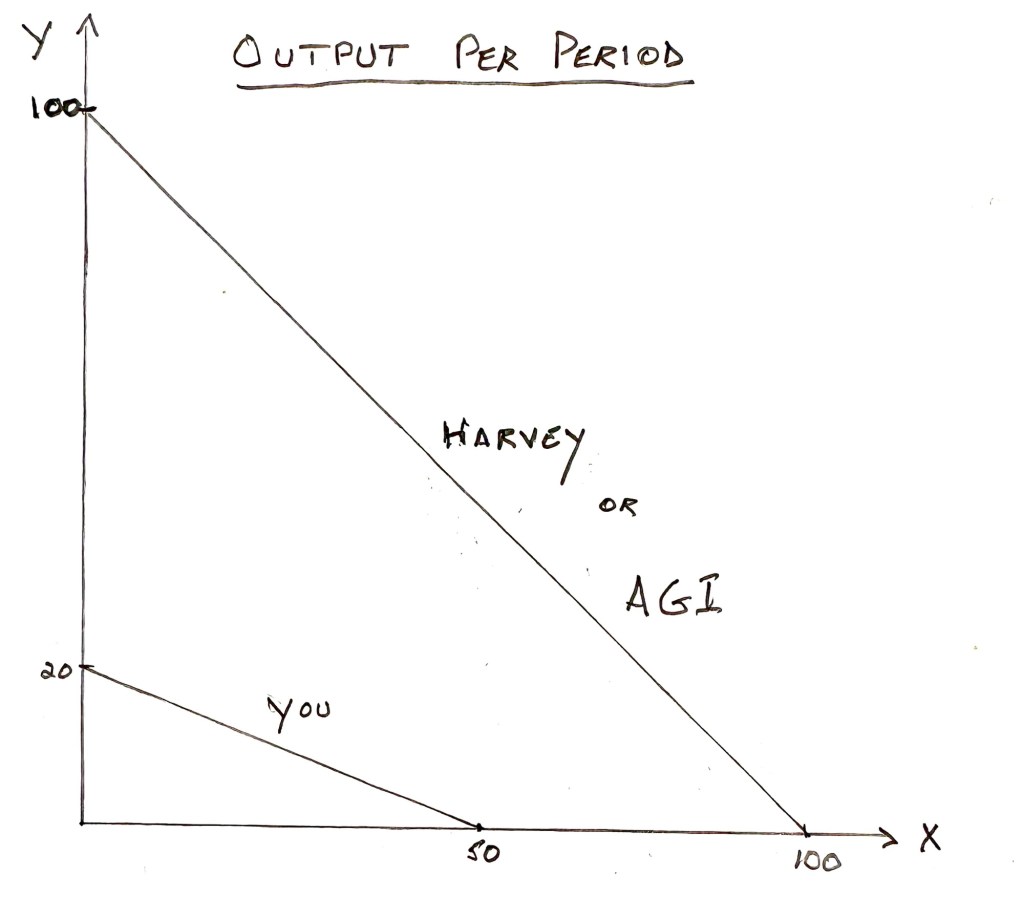
If you’re unwilling to slog through a simple numerical example, skip this section and the graph below. The graph was produced the old fashioned way: by a human being with a pencil, paper, ruler, and smart phone camera.

Here goes: Harvey can produce up to 100 units of X per period or 100 units of Y, or some linear combination of the two. Harvey’s opportunity costs are constant along this tradeoff between X and Y because it’s a straight line. It costs him one unit of Y output to produce every additional unit of X, and vice versa.

You, on the other hand, cannot produce X or Y as well as Harvey in an absolute sense. At most, you can produce up to 50 units of X per period, 20 units of Y, or some combination of the two along your own constant cost (straight line) tradeoff. You sacrifice 5/2 = 2.5 units of X to produce each unit of Y, so Harvey has the lower opportunity cost and a comparative advantage for Y. But it only costs you 2/5 = 0.4 units of Y to produce each additional unit of X, so you have a comparative advantage over Harvey in X production.

Reciprocal Advantages

In the end, you and Harvey specialize in the respective areas for which each has their lowest relative opportunity cost and a comparative advantage. If he has a comparative advantage in one area of production, and unless your respective tradeoffs have identical slopes (unlikely), the reciprocal nature of opportunity costs dictates that you have a comparative advantage in the other area of production.

Obviously, Harvey’s formidable absolute advantage over you in everything doesn’t impinge on these choices. In the real world, of course, comparative advantages play out across many dimensions of output, but the principle is the same. And once we specialize, we can trade with one another to mutual advantage.

No Such Thing As a Free AGI Robot

That brings us back to AGI and AGI robots. Like Harvey, they might well have an absolute advantage in every area of specialization, or they can learn quickly to achieve such an advantage, but that doesn’t mean they should do everything!

Just as in times preceding earlier technological breakthroughs, we cannot even imagine the types of jobs that will dominate the human and AGI work forces in the future. We already see complementarity between humans and AGI in many applications. AGI makes those workers much more productive, which leads to higher wages.

However, substitution of AGIs for human labor is a dominant theme of the many AGI “harm” narratives. In fact, substitution is already a reality in many occupations, like coding, and substitution is likely to broaden and intensify as the marriage of AGI and robotics gains speed. But that will occur only in industries for which the relative opportunity costs of AGIs, including all of the ancillary resources needed to produce them, are favorable. Among other things, AGI will require a gigantic expansion in energy production and infrastructure, which necessitates a massive exploitation of resources. Relative opportunity costs in the use of these resources will not always favor the dominance of AGIs in production. Like Harvey, AGIs and their ancillary resources cannot do everything because they cannot have comparative advantages without reciprocal comparative disadvantages.

Super-Abundance vs. Scarcity

Some might insist that AGIs will lead to such great prosperity that humans will no longer need to work. All of our material wants will be met in a new age of super-abundance. Despite the foregoing, that might suggest to some that AGIs will do everything! But here I make another claim: our future demands on resources will not be satisfied by whatever abundance AGIs make possible. We will still want to do more, whether we choose to construct fusion reactors, megastructures in space (like Dyson spheres or ring worlds), terraform Mars, undertake interstellar travel, perfect asteroid defense, battle disease, extend longevity, or improve our lives in ways now imagined or unimagined.

As a result, scarcity will remain a major force. To that extent, resources will have competing uses, they will face opportunity costs, and they will have comparative advantages vis a vis alternative uses to which they can be put. Scarcity is a reality that governs opportunity costs, and that means humans will always have roles to play in production.

Concluding Remarks

I wrote about human comparative advantages once before, about seven years ago. I think I was groping along the right path. The only other article I’ve seen to explicitly mention a comparative advantage of human labor vs. AGIs in the correct context is by Andrew Mayne in the most recent issue of Reason Magazine. It’s almost a passing reference, but it deserves more because it is foundational.

Harvey Specter shouldn’t occupy his scarce time performing tasks that compromise his ability to deliver his most rewarding services. Likewise, before long it will become apparent that highly productive AGI assets, and the resources required to build and operate them, should not be tied up in activities that humans can perform at lesser sacrifice. That’s a long way of saying that humans will still have productive roles to play, even when AGI achieves an absolute advantage in everything. Some of the roles played by humans will be complimentary to AGIs in production, but human labor will also be valuable as a substitute for AGI assets in other applications. As long as AGI assets have any comparative advantages, humans will have reciprocal comparative advantages as well.

White Racialism, Identity Politics, and Crippling DEI

09 Thursday Nov 2023

Posted by Nuetzel in DEI, Identity Politics

≈ 1 Comment

Tags

Anti-discrimination law, Christopher Rufo, Colorblind Society, Comparative advantage, DEI, Diversity, Equity, George Floyd, Hobbesian, Identity Politics, Inclusion, Jim Crow Laws, Protected Classes, Racial Preferences, Racialism, racism, rent seeking, Segregation, Slavery, Social Constructs, Structural Racism, Tribalism, Tyler Cowen, Victimhood, Victor Davis Hanson, White Racialism, Zero-Sum Thinking

I’ve taken an extended hiatus from blogging while moving to a different part of the country. I haven’t posted here in over 10 weeks, but a new post appears below. I’m still tying-up loose ends from the move, but I’ll be trying to get back to posting more regularly … trying!

~~~~~~~~~~~~~~~~~~~~~~~~~~~~~~~~~~~~~~~

Absurd ideas about race and identity politics come from extreme elements on both the Left and the Right. Some leftists insist that race has no natural basis — that it’s simply a “social construct”. On the Right, a “racialist” contingent is promoting the “celebration of whiteness” and embracing racial preferences for whites. Treated as alternative pathways, I’d take “social construct”. It’s nonsense, of course, but the beautiful irony is that it provides a basis for stripping away from our institutions the entire diversity, equity, and inclusion (DEI) straightjacket. It’s almost as if those promoting race as a social construct wish to build a “colorblind” society. On the other hand, I suppose some think they can have their DEI cake along with a side of free choice to identify as anything they want: black, white, or furry.

Who Are the Racists?

People of good faith don’t harbor or act on racist tendencies. The mere recognition of racial/ethnic/cultural differences is not evidence of racism and does not preclude the treatment of all with fairness and due respect. It’s possible to respect, value, or fall in love with someone outside one’s own racial, ethnic, or cultural group of origin, even while holding a general affinity for one’s own group, as nearly everyone does.

But a few real racists are sprinkled across all races, ethnicities, cultures, and the full political spectrum. The “popular” racist stereotype as white male has been kept alive by the lingering echos of slavery in America, which ended nearly 16 decades ago, and the long hangover that included Jim Crow laws and segregation. Today, however, “white society” or “whiteness” is hardly the sole domain of prejudice.

Is Racialism Different?

Now, a few whites are promoting the celebration of “white identity” as a counterbalance to identity politics among non-whites. Ostensibly, this “white racialism” might be similar to celebrations of identity often practiced by minorities, which are also forms of racialism. Should white racialism be viewed as less savory than racialism practiced by racial minorities?

For most Caucasians, “being white” does not have much salience relative to other affiliations defining identity. That’s why white racialism seems odd to me. Sure, when forced to check a box, whites will check “Caucasian”, but “white identity” seems overly broad. There are too many distinct cultures and subcultures that dominate self-identity, such as national ancestry, religion, and cultural membership.

The same could be said for many other racial categories, but minority status and historical events (e.g., American slavery) help explain why broad categories often form cohesive identity groups. And, as Christopher Rufo notes in his great discussion of the racialist viewpoint, broad categories tend to be the most closely associated with racialism:

“Yes, left-wing racialism is indeed now deeply embedded in America’s institutions, and the demographic balance of the country has shifted in recent decades. And yes, the basic racial classification system in the United States broadly delineates continental origin—Europe, Africa, Latin America, Asia—in a way that is not arbitrary or meaningless. Terms such as ‘white,’ ‘black,’ ‘Latino,’ and ‘Asian,’ while often obscuring important variations within such groupings, have become the lingua franca and are useful shorthand descriptors for many purposes.”

There are individuals from all groups or “classes”, including whites, who react critically to aggressive expressions of identity by members of other classes. Perhaps that’s excusable, depending on the degree of zealotry on either part. The line between pride in race/ancestry/culture and fractious racialism might be hard to discern in some cases, but the chief distinction is rooted in explicit, demeaning and/or envious comparisons to “out-groups”. This might be damaging enough, but from there it can be a very short step into outright racism.

A preoccupation with the historic disadvantages of one’s race can be disempowering to an individual and destructive in a social sense. I believe the white racialist phenomenon belongs in that category. The presumed “disadvantages” of whiteness are very contemporary, however, rooted in policies dating back only to the widespread adoption of racial preferences for non-white “protected classes” and DEI.

Preferences For All

Imagine the racialist policies now practiced widely in government, industry, and academia — particularly racial preferences on behalf of protected classes — but now applied on behalf of heretofore unprotected classes as well. For example, what if some proportion of jobs, admissions, or other coveted placements were set aside for whites? If whites represent 50% of the population, then 50% of hires or admissions would be reserved for whites.

Some might assume that this treatment is already implied by existing racial preferences, but that’s not the case. In the wake of George Floyd’s death, just 6% of new hires among S&P companies were white, according to Bloomberg News.

Nevertheless, such a white racialist turnabout would be a colossal mistake. Adding strict limits to the application of existing preferences might be a good thing, but white racial preferences would buttress the entire system of racial preferences as an institution and add more rigidity to the operation of labor markets. From an economic viewpoint, it would be just as pernicious as racial preferences generally.

Racial preferences of any kind freeze labor markets and impair the allocation of human resources to their most-valued uses. In fact, placing one individual into a position on any basis other than their qualifications implies that two individuals must be placed into positions in which they lack comparative advantage relative to each other. Little by little, that means lost output and upward price pressure. It is a mechanism that short circuits gains from trade, shriveling the benefits that the most and least talented confer on society at large. Extending preferences to whites would only serve to further institutionalize this damaging practice.

Adherence to numerical preferences is to pretend that people can be treated less as individuals and more like interchangeable parts… except with respect to their value as “class members”. Racial preferences are presumed to be a remedy for so-called structural racism, as opposed to racism by individuals. But they involve classification and favor the so-called “oppressed” at the expense of designated “oppressors”. The latter, almost without exception, had no role oppressive regimes of the past. Favoritism of this kind necessarily means reverse discrimination and fails to match individuals to roles in an optimal fashion.

Whether publicly or privately imposed, racial preferences often undermine those they are purported to help by placing individuals into positions for which they may not be competitive. This can sabotage an individual’s long-term success. It goes without saying that preferences build resentment among the “unprotected”, which goes to the impetus for “white racialism”. Indeed, preferences are not always popular with protected classes either. That’s because they interfere with merit-based decision-making and are perceived to stigmatize those presumed to benefit.

The Fixed Pie Is a Lie

Racialism reflects zero-sum thinking, a hallmark of DEI initiatives. Tyler Cowen quoted the abstract of a recent NBER working paper that found:

“… a more zero-sum mindset is strongly associated with more support for government redistribution, race- and gender-based affirmative action, and more restrictive immigration policies.”

Zero-sum thinking is fundamental to rent-seeking behavior, which is motivated by either malevolent greed or perceptions of victimhood. Victimhood and rent seeking is at the heart of calls for DEI, to say nothing of more radical proposals like reparation payments. White racialism attempts to get in on the action by positing that whites are oppressed under the current institutional dominance of DEI. But the misguided presumption that every identity group should have their own preferences or quotas broadens the emphasis on redressing perceived harms and redistributing rewards — zero-sum activities.

These zero-sum efforts waste energy and resources, harming our ability to produce things that enhance well being. Ultimately, they are actually negative-sum activities, and they also breed hatred.

Race is obviously determined by genetics, but I’d be happy to pretend it’s a mere social construct if that would help get us to a “colorblind” society.

Conclusion

There’s a huge irony in the racialism exercised by both traditional and “white racialist” DEI advocates: it neglects the most fundamental and just application of diversity: equality of opportunity. This principle incorporates the concept of diversity without sacrificing economic efficiency. We’ve largely abandoned it in favor of equality of outcomes via racial preferences, even at a time when society has become enlightened with respect to racial differences. In doing so, we’ve unintentionally chosen another form of explicit racial victimization.

To close, here’s a good summary of the dangers of racialism and identity politics offered by Victor Davis Hanson:

“Anytime one ethnic, racial, or religious group refuses to surrender its prime identity in exchange for a shared sense of self, other tribes for their own survival will do the same.

All then rebrand their superficial appearance as essential not incidental to whom they are.

And like nuclear proliferation that sees other nations go nuclear once a neighboring power gains the bomb, so too the tribalism of one group inevitably leads only to more tribalism of others. The result is endless Hobbesian strife.”

And that’s how white racialism fits right in with the pernicious politics of identity. When you can, vote for the elimination, or at least reform, of DEI policies and practices, not for a reinforcement of identity politics.

Musings and Misgivings of a Likely Trump Voter

24 Thursday Aug 2023

Posted by Nuetzel in Politics

≈ 2 Comments

Tags

Comparative advantage, corporate taxes, Corporatism, Donald Trump, eminent domain, Energy Production, Entitlement Reform, Illegal Immigration, Industrial Policy, Inflation tax, Legal Immigration, Medicare, Modern Monetary Theory, Nationalism, Populism, Protectionism, Social Security, Spending Growth, statism, The Wall

Choosing between the lesser of evils is a bummer, but that’s often the reality for voters. That goes almost without saying… our choices are politicians! I’ll certainly be in that quandary if Donald Trump is the Republican nominee for president in 2024, which looks increasingly likely. I held my nose and voted for him — twice — primarily because the Big Government solutions promoted consistently by Democrats are so awful.

At this point I’m not fully on board with any GOP candidate. That could change, but not yet. Now, if you’re a Trump supporter and you think the rambling opinions below are too critical of your guy, cut me some slack. I’m not a “Never Trumper”. I’m a “Never Statist”. And while I’ve never had much faith that Trump is with me on that count, he will almost surely be the lesser of evils.

The Abused Politician

Trump has been subjected to despicable treatment by political opponents since well before his inauguration in 2016, and his abusers in and out of government never let up. Many of the charges and accusations against him have been pure fiction and at this point represent obvious election interference. So I’m somewhat sympathetic to him despite some of his positions and often disagreeable manner. Still, I credit him for being a fighter, and as an aside, I’ll add that I actually enjoy some of his rants. He has the style of a nasty stand-up comic, which gives me some occasional laughs.

I agree with Trump on certain policy matters. On others, including some fundamental points, I find it hard to trust him as a leader, and I said that long before he was elected in 2016. He claims not to be a politician, but he is a politician through and through. He’s also a populist. And while populism can serve as a valuable check on certain excesses of government, it often cuts the wrong way, favoring what I like to call “do-somethingism”. That usually means public intervention. Populism is a perfectly natural home for a “pick-and-choose” statist like Trump, however. Moreover, I’m not happy that he refused to debate his opponents, and that too was a purely political decision.

Malign Neglect

If you need proof of Trump’s base instincts as a politician, look no further than his refusal to engage on the subject of entitlement reform. It’s no secret that both Social Security (SS) and Medicare are technically insolvent. This is probably the most important fiscal issue the country will face in the foreseeable future.

Without reform, SS benefits will be cut 23% in 2034. That would bring certain outrage among seniors and anyone approaching retirement. Sure, it’s a decade down the road, but addressing it sooner would be far less painful. Does Trump favor a huge cut in benefits? Probably not. Does he think benefits can simply continue without additional funding or reform of some kind? Does he prefer a greater inflation tax, rather than reform? Does he secretly favor “just print the money” like the modern monetary theorists of the Left? There are much better alternatives, but where is his leadership on this issue?

His unwillingness to discuss entitlements, and indeed, his denigration of anyone who so much as mentions the need for serious reforms, is a disgrace. He knows the train wreck is coming, but his focus is squarely on short-term politics. Why are so many on the Right willing to fall for this? Maybe they too understand it’s an elephant in the room, but an elephant that must not be named. After all, it’s not as if the Democrats have done a thing to address the issue.

False Fealty to Workers

Trump is a protectionist, given to the mercantilist fallacy that only exports are good and imports are bad. We import heavily because we are a high-income nation. The other side of that coin is that the world craves our assets, including the U.S. dollar (which is in absolutely no danger of losing its dominance as the primary currency of international transactions).

Here’s a little truth from “Trade Flows 101”: U.S. imports of goods and services correspond to purchases of U.S. assets by the rest of the world. In other words, U.S. trade deficits present opportunities for foreign investors to supply us with capital. That helps foster greater U.S. productive capacity, greater worker productivity, and higher wages.

On the other hand, government intervention to discourage imports via quotas or tariffs increases domestic prices and erodes real wages in the U.S. Furthermore, to favor certain industries (exporters) over others (importers) is a grotesque application of corporatist industrial policy. Why does the Right tolerate Trump’s advocacy for this sort of government central planning? Part of the answer is national security, which I accept to a limited extent, but not when “critical industries” are extended favors by government that are redundant to already powerful market forces.

Protectionism owes some of its popularity to the appeal of nationalism, as distinct from patriotism. However, it promotes sclerosis among domestic producers by shielding them from competition, causing direct harm to U.S. consumers. There is nothing patriotic about protectionism.

Real Stuff

A fallacy closely related to protectionism, and one to which Trump subscribes, is that the U.S. must produce more “things” — more commodities and manufactured goods. That’s not the market’s judgement, but one that appeals to the instincts of interventionists. In any case, services are often more highly valued than physical goods. If your comparative advantage is in producing a highly-valued service, don’t beat yourself up over neglecting to produce hard goods at which you’re comparatively lousy. Specialization and trade are under-appreciated as true social and economic miracles.

That said, we certainly have an advantage in the production of fossil fuels and should continue to produce them without interference. I’m with Trump on that. One day, reliable sources of “clean” energy will be economic, but we’re not there yet.

Corporate State

Well before his presidential run, Trump had a history of leveraging government to achieve his private ends. Eminent domain actions were useful to his development projects and expanding his own property rights at the expense of others. Naturally, he claimed his projects were in the public interest. Ah, the mindset of a rent seeker: government exists to actively facilitate the acquisitive interests of private business, or at least the “winners”. That thinking is thoroughly contrary to the libertarian view of the state’s role in establishing a neutral social environment under the rule-of-law.

In other ways, as President, Trump sought to bring major corporations under his political sway. Trump’s protectionist leanings as president were a prime example of corporatism in action. And read this account of a public meeting (and watch it at the link) at which one CEO after another, under Trump’s furrowed gaze, took turns describing something great they were doing for the country and committing to do more. It was one big, weird suck-up session intended to make the puffed-up Trump look like a great leader. As the author at the link says:

“These are corporate executives doing the President’s bidding for fear or favour.”

I supported Trump’s tax cuts, though they were certainly designed to reduce taxes on corporate income. Was this corporatist largess? That might have been part of his motivation. However, as I’ve argued before, corporate income is largely double-taxed. Moreover, shareholders do not bear the full burden of corporate taxes. Workers bear a significant portion of the burden, so Trump’s corporate tax cuts encouraged growth in real wages, whether he understood it or not.

It’s Still So Big

Tax cuts paired with reduced spending would have been a welcome approach. Unfortunately, Trump was a fairly big spender during his term in office, even if you exclude Covid emergency spending. Growth in the government’s dominance over resources did not slow on his watch. Fiscally disciplined he’s not!

It’s true that his administration made efforts to curtail regulation, but in retrospect, those steps at best arrested the growth of regulation, rather than achieving reductions. The hope of seeing any real deconstruction of the administrative state under Trump was fleeting.

Migration

Immigration is a complicated issue when it comes to assessing Trump’s candidacy. I’m strongly in favor of greater legal immigration because it would improve our demographics and labor supply while shrinking our entitlements deficits. Legal migrants are often technically proficient and many come with sponsorships. On the whole, legal migrants tend to be ready and willing to work,

This position is often condemned by Trump’s most ardent cheerleaders, however. I’ve generally supported Trump’s position on illegal immigration as a matter of national security, to eliminate human trafficking, and to reduce burdens on public aid and support systems. Unfortunately, during Trump’s presidency, he did more to reduce legal immigration than illegal immigration. I have no qualms about “the Wall” except for its expense and the likelihood that cheaper and superior technologies could be deployed for border security. Trump might prefer the Wall’s symbolic value.

Rightly or wrongly, Trump’s messaging on immigration strikes many as nativist, providing an easy excuse for the Left to accuse him of racism. That certainly won’t help his election prospects.

Conclusion

Trump will almost surely be the GOP nominee, unless Democrats succeed in putting him behind bars by then. If the choice is Trump vs. almost any Democrat I can imagine, I’ll have to vote for him. For all his faults and wild card qualities, I still consider him a safer alternative than the devils we know on the Left. But I’d feel much better about him if he’d take a responsible position on Social Security and Medicare reform, abandon protectionism except in cases of critical national security needs (and without overkill), commit to spending reductions, and adopt a more productive approach to legal immigration.

Tariffs, Content Quotas, and What Passes for Patriotism

10 Friday Mar 2023

Posted by Nuetzel in Free Trade, Protectionism

≈ Leave a comment

Tags

budget deficits, Buy American, CCP, CHIPS Act, Comparative advantage, Consumer Sovereignty, Content Restrictions, Critical Supply Chains, Domestic Content, Donald Trump, Dumping, Export Markets, Federal Procurement, Foreign Trade, Free trade, George Will, Import Waivers, Joe Biden, Made-In-America Laws, Mercantilism, National Security, Nationalism, Patriotism, Price Competition, Price Preference, Protectionism, Tariffs, Trade Retaliation, Universal Baseline Tariffs, Uyghur Muslims

If there’s one simple lesson in economics that’s hard to get across it’s the destructive nature of protectionism. The economics aren’t hard to explain, but for many, the lessons of protectionist failure just don’t want to sink in. Putting aside matters of national security, the harms of protectionism to the domestic economy are greater than any gains that might inure to protected firms and workers. Shielding home industries and workers from foreign competition is generally not smart nor an act of patriotism, but that sentiment seems fairly common nonetheless.

The Pathology of Protectionism

Jingoistic slogans like “Buy American” are a pitch for voluntary loyalty to American brands. I’m all for voluntary action. Still, that propaganda relies on shaming those who find certain foreign products to have superior attributes or to be more economical. This feeds a psychology of economic insularity and encourages those who favors trade barriers, which is one of the earliest species of failed central planning.

The cognitive resistance to a liberal trade regime might have to do with the concentrated benefits of protectionist measures relative to the more diffuse (but high) costs it imposes on society. Some of the costs of protectionism manifest only with time, which makes the connection to policy less obvious to observers. Or again, obstructing trade and taxing “others” in the hope of helping ourselves may simply inflame nationalist passions.

Both Democrats and Republicans rally around policy measures that tilt the playing field in favor of domestic producers, often severely. And again, this near unanimity exists despite innumerable bouts with the laws of economics. I mean, how many times do you have to be beaten over the head to realize that this is a mistake? Unfortunately, politicians just don’t live in the long-term, they leap to defend powerful interests, and they seldom pay the long-term consequences of their mistakes.

Joe Biden’s “Buy American”

The Biden Administration has pushed a “Made In America” agenda since the President took office, It’s partly a sop to unions for their election support. Much of it had to do with tightening waivers granted under made-in-America laws (dating back to 1933) governing foreign content in goods procured by the federal government. The most recent change by Biden is an increase in the requirement for domestic content to 60% immediately and gradually to 75% from there. Also, “price preferences” will be granted to domestic producers of goods to strengthen supply chains identified as “critical”, including active pharmaceutical ingredients, certain minerals including rare earths and carbon fibers, semiconductors and their advanced packaging, and large capacity batteries such as those used in EVs.

There’s a strong case to be made for developing domestic supplies of certain goods based on national security considerations. That can play a legitimate role where defense goods or even some kinds of civilian infrastructure are involved, but Biden’s order applies much more broadly, including protections for industries that are already heavily subsidized by taxpayers. For example, the CHIPS Act of 2022 included $76 billion of subsidies and tax credits to the semiconductor industry.

George Will describes the cost of protectionism and Biden’s “Buy American”:

“‘Buy American,’ like protectionism generally, can protect some blue-collar jobs — but at a steep price: A Peterson Institute for International Economics study concludes that it costs taxpayers $250,000 annually for each job saved in a protected industry. And lots of white-collar jobs are created for lawyers seeking waivers from the rules. And for accountants tabulating U.S. content in this and that, when, say, an auto component might cross international borders (U.S., Canadian, Mexican) five times before it is ready for installation in a vehicle.”

Biden’s new rules will increase the cost of federal procurement. They will squeeze out contracts with foreign suppliers whose wares are sometimes the most price-competitive or best-suited to a project. This is not a prescription for spending restraint, and it comes at a time when the federal budget is under severe strain. Here’s George Will again:

“This will mean more borrowing, not fewer projects. Federal spending is not constrained by a mere shortage of revenue. So, Biden was promising to increase the deficit. And this policy, which elicited red-and-blue bonhomie in the State of the Union audience, also will give other nations an excuse to retaliate (often doing what they want to do anyway) by penalizing U.S. exporters of manufactured goods. ….. Washington lobbyists for both will prosper.”

Domestic manufacturers who find their contracting status “protected” from foreign competition will face less incentive to perform efficiently. They can relax, rather than improve or even maintain productivity levels, and they’ll feel less pressure to price competitively. Those domestic firms providing goods designated by the government as “critical” will be advantaged by the “price preferences” granted in the rules, leading to a less competitive landscape and higher prices. Thus, Biden’s “Buy American” order is likely to mean higher prices and more federal spending. This is destructive and counter to our national interests.

Donald Trump’s Tariffs

In a recent set of proposals trialed for his presidential election campaign, Donald Trump called for “Universal Baseline Tariffs” on imported goods. In a testament to how far Trump has stumbled down the path of economic ignorance, his campaign mentions “patriotic protectionism” and “mercantilism for the 21st century”. Good God! Trump might be worse than Biden!

This isn’t just about China, though there are some specific sanctions against China in the proposal. After all, these new tariffs would be “universal”. Nevertheless, the Trump campaign took great pains to cloak the tariffs in anti-China rhetoric. Now, I’m very unfavorably disposed to the CCP and to businesses who serve or rely on China and (by implication) the CCP. Certainly, in the case of China, national security may dictate the imposition of certain forms of protectionism, slippery slope though it might be. Nevertheless, that is not what universal tariffs are about.

One destructive consequence of imposing tariffs or import quotas is that foreign governments are usually quick to retaliate with tariffs and quotas of their own. Thus, export markets are shut off to American producers in an escalating trade conflict. That creates serious recession risks or might reinforce other recessionary forces. Lost production for foreign markets and job losses in the affected export industries are the most obvious examples of protectionist harm.

Then consider what happens in protected industries in the U.S. and the negative repercussions in other sectors. The prices charged for protected goods by domestic producers rise for two reasons: more output is demanded of them, and protected firms have less incentive to restrain pricing. Just what the protectionists wanted! In turn, with their new-found, government-granted market power, protected firms will compete more aggressively for workers and other inputs. That puts non-protected firms in a bind, as they’ll be forced to pay higher wages to compete with protected firms for labor. Other inputs may be more costly as well, particularly if they are imported. These distortions lead to reduced output and jobs in non-protected industries. It also means American consumers pay higher prices for both protected and unprotected goods.

Consumers not only lose on price. They also suffer a loss of consumer sovereignty to a government wishing to manipulate their choices. When choices are curtailed, consumers typically lose on other product attributes they value. It also curtails capital inflows to the U.S. from abroad, which can have further negative repercussions for U.S. productivity growth.

When imports constitute a large share of a particular market, it implies that foreign nations have a comparative advantage in producing the good in question. In other words, they sacrifice less to produce the good than we would sacrifice to produce it in the U.S. But if country X has a comparative advantage in producing good X, it means it must have a comparative disadvantage in producing certain other goods, let’s say good Y. (That is, positive tradeoffs in one direction necessarily imply negative tradeoffs in the other.) It makes more economic sense for other countries (country Y, or perhaps the U.S.) to produce good Y, rather than country X, since country Y sacrifices less to do so. And that is why countries engage in trade with each other, or allow their free citizens to do so. It is mutually beneficial. It makes economic sense!

To outlaw or penalize opportunities for mutually beneficial trade will only bring harm to both erstwhile trading partners, though it might well benefit specific interests, including some third parties. Those third parties include opportunistic politicians wishing to leverage nationalist sentiments, their cronies in protected industries, and the bureaucrats, attorneys, and bean counters who manage compliance.

When Is Trade Problematic?

Protectionists often accuse other nations of subsidizing their export industries, giving them unfair advantages or dumping their exports below cost on the U.S. market. There are cases in which this happens, but all such self-interested claims should be approached with a degree of skepticism. There are established channels for filing complaints (and see here) with government agencies and trade organizations, and specific instances often prompt penalties or formal retaliatory actions.

There are frequently claims that foreign producers and even prominent American businesses are beneficiaries of foreign slave labor. A prominent example is the enslavement of Uyghur Muslims in China, who reportedly have been used in the manufacture of goods sold by a number of big-name American companies. This should not be tolerated by these American firms, their customers, or by the U.S. government. Unfortunately, there is a notable lack of responsiveness among many of these parties.

Much less compelling are assertions of slave labor based on low foreign wage rates without actual evidence of compulsion. This is a case of severely misplaced righteousness. Foreign wage rates may be very low by American standards, but they typically provide for a standard of living in the workers’ home country that is better than average. There is no sin in providing jobs to foreign workers at a local wage premium or even a discount, depending on the job. In fact, a foreign wage that is low relative to American wages is often the basis for their comparative advantage in producing certain goods. Under these innocent circumstances, there is no rational argument for producing those goods at much higher cost in the U.S.

Very troublesome are the national security risks that are sometimes attendant to foreign trade. When dealing with a clear adversary nation, there is no easy “free trade” answer. It is not always clear or agreed, however, when international relations have become truly adversarial, and whether trade can be usefully leveraged in diplomacy.

Conclusion

As I noted earlier, protectionism has appeal from a nationalist perspective, but it is seldom a legitimate form of patriotism. It’s not patriotic to limit the choices and sovereignty of the individual, nor to favor certain firms or workers by shielding them from competition while penalizing firms requiring inputs from abroad. We want our domestic industries to be healthy and competitive. Shielding them from competition is the wrong approach.

So much of the “problem” we have with trade is the infatuation with goals tied to jobs and production. Those things are good, but protectionists focus primarily on first-order effects without considering the damaging second-order consequences. And of course, jobs and production are not the ultimate goals of economic activity. In the end, we engage in economic activity in order to consume. We are a rich nation, and we can afford to consume what we like from abroad. It satisfies wants, it brings market discipline, and it leads to foreign investment in the American economy.

Biden and Trump share the misplaced objectives of mercantilism. They are both salesmen in the end, though with strikingly different personas. Salesmen want to sell, and I’m almost tempted to say that their compulsion causes them see trade as a one-way street. Biden is selling his newest “Buy American” rules not only as patriotic, but as a national security imperative. The former is false and the latter is largely false. In fact, obstructions to trade make us weaker. They will also contribute to our fiscal imbalances, and that contributes to monetary and price instability.

Like “Buy American”, Trump’s tariffs are misguided. Apparently, Trump and other protectionists wish to tax the purchases of foreign goods by American consumers and businesses. In fact, they fail to recognize tariffs as the taxes on Americans that they are! And tariffs represent a pointed invitation to foreign trading partners to impose tariffs of their own on American goods. You really can’t maximize anything by foreclosing opportunities for gain, but that’s what protectionism does. It’s astonishing that such a distorted perspective sells so well.

Do You Chronically Feel Cheated?

24 Tuesday Aug 2021

Posted by Nuetzel in Markets

≈ Leave a comment

Tags

Buyer’s Remorse, Classism, Comparative advantage, Consumer Surplus, Excise Taxes, Frank C. Keil, Free Markets, Intervention, Jiewen Zhang, Marxism, Mercantilism, monopoly, Producer Surplus, Reservation Price, Samuel B.G. Johnson, statism, Subsidies, Surplus, Use Value, Zero-Sum Thinking

Economists are rightfully astonished when people act as if they’ve come up losers in almost every transaction they make. It’s often when they’re on the buying end, but here’s the paradox: almost all transactions are voluntary, a major exception being the coerced payment of taxes. There are few private transactions in which free choice is absent. A truly voluntary choice is an absolute proof of gain. In those trades, buyers reveal that they assign less value to choices not made, and foregone choices almost always exist, including the possibility of doing nothing. By their very nature, voluntary transactions are mutually beneficial. So why do people feel cheated so often?

Free To Lose?

Yes, we are free to choose and free to lose! But this isn’t about cases in which a product proves defective or quickly becomes obsolete. Nor is it about making a purchase only to learn of a discount later. Those are ex post events that might have been impossible to foresee. Here, I refer only to the decision made on the day and hour of the purchase, including any assessment of risk. 

A recent study confirmed a pervasive “loser’s” mentality in transactions: “Win–win denial: The psychological underpinnings of zero-sum thinking”, by Samuel B.G. Johnson, Jiewen Zhang, and Frank C. Keil. They also found that people judge the seller as the “winner” in most transactions. The authors considered a few explanations for these findings discussed in psychological literature, such as socially-ingrained mercantilist attitudes and a tendency to zero-sum thinking.

Roots of “Never-a-Buyer-Be” Phobia

Mercantilism was borne of zero-sum thinking — a belief in a hard limit to total wealth. Under those circumstances, accumulating gold or other hard assets was seen as preferable to spending on imports of goods from other nations. Imports meant gold had to be shipped out, but exports of goods brought it in. 

That uncompromising view led to efforts by government on behalf of domestic industries to stanch imports, and it ultimately led to decline. One nation cannot buy another’s goods indefinitely without corresponding flows of goods in the other direction. Nations gain from trade only by producing things in which they have a comparative advantage and selling them to others. In turn, they must purchase goods from others in which they do NOT have a comparative advantage. It’s cheaper that way! And it’s a win-win prescription for building worldwide wealth.

If You Gotta Have It…

People do have a tendency to regret money spent on things they reluctantly feel they must have. They suffer a kind of advance buyer’s remorse, but it stems from having to part with money, which represents all those other nice things one might have had, covering an infinite range of possibilities. This is the same fallacy inherent in mercantilism. The fact is, we purchase things we must have because they represent greater value than doing without. The phantom satisfaction of opportunities foregone are simply not large enough to keep us from doing the “right” thing in these situations.

The Contest For Surplus

There’s a more basic reason why people feel swindled after having engaged in mutually beneficial trade. The seller collects more revenue than marginal cost, and the buyer pays less than the item’s full “use value”. The latter is the buyer’s reservation price: the most they’d be willing to pay under the circumstances. The seller’s gain (over cost) plus the buyer’s gain (under reservation price) is the total “surplus” earned in the exchange. It’s the surplus that’s up for grabs, and both buyer and seller might view the exchange as a contest over its division. Competitive instincts and thrift being what they are, both sides want a larger share of the spoils!

So there truly is a sort of zero-sum game in play. You can try to bargain to capture more of the surplus, but not every seller will do so, often as a matter of policy or reputation. Or you can spend more time and incur greater personal cost by shopping around. Ultimately, if the offer you face is less than your “reservation price”, you’ll extract an absolute benefit from the exchange. Both you and the seller are better off than without it. You both do it voluntarily, and it’s mutually beneficial. Whatever the division of the surplus, you haven’t really lost anything, even if you have the gnawing feeling you might have been able to find a better bargain and captured more surplus.

Exceptions?

You might think the parties to a stock trade cannot both win. However, buyers and sellers have different reasons for making stock trades, which usually involve other needs and differing expectations. Ex ante, both sides of these trades earn a surplus, unless either the seller or buyer is at the losing end of a previous option trade now forcing them to buy or sell the stock.

There are other cases worthy of debate: buyers in monopolized or captive markets are unlikely to collect much of the surplus. Buyers at an informational disadvantage will gain less surplus as well, and they might incur greater risk to any gain whatsoever. Excise taxes allow government to capture some of the surplus, while government subsidies deliver “fake” surplus to the buyer and seller that comes at the expense of taxpayers. Now I feel cheated!

Beware Marxist Sympathies

Buyers and sellers both benefit by virtue of voluntary exchange. The gains might not be divided equally, but the false perception that buyers always get the “short end of the bargain” is a fundamental misunderstanding about how markets work. It also undermines support for basic freedoms allowing autonomous economic decisions and activity, and it strengthens the hand of statists who would fetter the operation of free markets. Like short-sighted mercantilists, those who would intervene in markets create obstacles to human cooperation and the creation of wealth. In fact, the idea that buyers are always cheated is a classist, Marxist notion. Policies acting upon that bias are rife with unintended consequences: small and large market interventions often strike at property rights, which ultimately inhibits the supply of goods and harms consumers. 

The Comparative Human Advantage

10 Thursday Aug 2017

Posted by Nuetzel in Automation, Technology, Tradeoffs

≈ 1 Comment

Tags

Absolute Advantage, Automation, Comparative advantage, Elon Musk, Kardashev Scale, Minimum Wage, Opportunity cost, Scarcity, Specialization, Superabundance, Trade

There are so many talented individuals in this world, people who can do many things well. In fact, they can probably do everything better than most other people in an absolute sense. In other words, they can produce more of everything at a given cost than most others. Yet amazingly, they still find it advantageous to trade with others. How can that be?

It is due to the law of comparative advantage, one of the most important lessons in economics. It’s why we specialize and trade with others for almost all of ours needs and wants, even if we are capable of doing all things better than them. Here’s a simple numerical example… don’t bail out on me (!):

  • Let’s say that you can produce either 1,000 bushels of barley or 500 bushels of hops in a year, or any combination of the two in those proportions. Each extra bushel of hops you produce involves the sacrifice of two bushels of barley.
  • Suppose that I can produce only 500 bushels of barley and 400 bushels of hops in a year, or any combination in those proportions. It costs me only 1.25 bushels of barley to produce an extra bushel of hops.
  • You can produce more hops than I can, but hops are costlier for you at the margin: 2 bushels of barley to get an extra bushel of hops, more than the 1.25 bushels it costs me.
  • That means you can probably obtain a better combination (for you) of barley and hops by specializing in barley and trading some of it to me for hops. You don’t have to do everything yourself. It’s just not in your self-interest even if you have an absolute advantage over me in everything!

This is not a coincidental outcome. Exploiting opportunities for trade with those who face lower marginal costs effectively increases our real income. In production, we tend to specialize — to do what we do — because we have a comparative advantage. We specialize because our costs are lower at the margin in those activities. And that’s also what motivates trade with others. That’s why nations should trade with others. And, as I mentioned about one week ago here, that’s why we have less to fear from automation than many assume.

Certain tasks will be automated as increasingly productive “robots” (or their equivalents) justify the costs of the resources required to produce and deploy them. This process will be accelerated to the extent that government makes it appear as if robots have a comparative advantage over humans via minimum wage laws and other labor market regulations. As a general rule, employment will be less vulnerable to automation if wages are flexible. 

What if one day, as Elon Musk has asserted, robots can do everything better than us? Will humans have anywhere to work? Yes, if human labor is less costly at the margin. Once deployed, a robot in any application has other potential uses, and even a robot has just 24 hours in a day. Diverting a robot into another line of production involves the sacrifice of its original purpose. There will always be uses in which human labor is less costly at the margin, even with lower absolute productivity, than repurposing a robot or the resources needed to produce a new robot. That’s comparative advantage! That will be true for many of the familiar roles we have today, to say nothing of the unimagined new roles for humans that more advanced technology will bring.

Some have convinced themselves that a fully-automated economy will bring an end to scarcity itself. Were that to occur, there would be no tradeoffs except one kind: how you use your time (barring immortality). Superabundance would cause the prices of goods and services to fall to zero; real incomes would approach infinity. In fact, income as a concept would become meaningless. Of course, you will still be free to perform whatever “work” you enjoy, physical or mental, as long as you assign it a greater value than leisure at the margin.

Do I believe that superabundance is realistic? Not at all. To appreciate the contradictions inherent in the last paragraph, think only of the scarcity of talented human performers and their creativity. Perhaps people will actually enjoy watching other humans “perform” work. They always have! If the worker’s time has any other value (and it is scarce to them), what can they collect in return for their “performance”? Adulation and pure enjoyment of their “work”? Some other form of payment? Not everything can be free, even in an age of superabundance.

Scarcity will always exist to one extent or another as long as our wants are insatiable and our time is limited. As technology solves essential problems, we turn our attention to higher-order needs and desires, including various forms of risk reduction. These pursuits are likely to be increasingly resource intensive. For example, interplanetary or interstellar travel will be massively expensive, but they are viewed as desirable pursuits precisely because resources are, and will be, scarce. Discussions of the transition of civilizations across the Kardashev scale, from “Type 0” (today’s Earth) up to “Type III” civilizations, capable of harnessing the energy equivalent of the luminosity of its home galaxy, are fundamentally based on presumed efforts to overcome scarcity. Type III is a long way off, at best. The upshot of ongoing scarcity is that opportunity costs of lines of employment will remain positive for both robots and humans, and humans will often have a comparative advantage.

Mr. Musk Often Goes To Washington

31 Monday Jul 2017

Posted by Nuetzel in Automation, Labor Markets, Technology

≈ 1 Comment

Tags

Absolute Advantage, Comparative advantage, DeepMind, Elon Musk, Eric Schmidt, Facebook, Gigafactory, Google, Mark Zuckerberg, OpenAI, rent seeking, Ronald Bailey, SpaceX, Tesla

Elon Musk says we should be very scared of artificial intelligence (AI). He believes it poses an “existential risk” to humanity and  calls for “proactive regulation” of AI to limit its destructive potential. His argument encompasses “killer robots”: “A.I. & The Art of Machine War” is a good read and is consistent with Musk’s message. Military applications already involve autonomous machine decisions to terminate human life, but the Pentagon is weighing whether decisions to kill should be made only by humans. Musk also focuses on more subtle threats from machine intelligence: It could be used to disrupt power and communication systems, to manipulate human opinion in dangerous ways, and even to sow panic via cascades of “fake robot news”, leading to a breakdown in civil order. Musk has also expressed a fear that AI could have disastrous consequences in commercial applications with runaway competition for resources. He sounds like a businessmen who really dislikes competition! After all, market competition is self-regulating and self-limiting. The most “destructive” effects occur only when competitors come crying to the state for relief!

Several prominent tech leaders and AI experts have disputed Musk’s pessimistic view of AI, including Mark Zuckerberg of Facebook and Eric Schmidt, chairman of Google’s parent company, Alphabet, Inc. Schmidt says:

“My question to you is: don’t you think the humans would notice this, and start turning off the computers? We’d have a race between humans turning off computers, and the AI relocating itself to other computers, in this mad race to the last computer, and we can’t turn it off, and that’s a movie. It’s a movie. The state of the earth currently does not support any of these scenarios.“

Along those lines, Google’s AI lab known as “DeepMind” has developed an AI off-switch, otherwise known as the “big red button“. Obviously, this is based on human supervision of AI processes and on ensuring the interruptibility of AI processes.

Another obvious point is that AI, ideally, would operate under an explicit objective function(s). This is the machine’s “reward system”, as it were. Could that reward system always be linked to human intent? To a highly likely non-negative human assessment of outcomes? Improved well-being? That’s not straightforward in a world of uncertainty, but it is at least clear that a relatively high probability of harm to humans should impose a large negative effect on any intelligent machine’s objective function.

Those kinds of steps can be regarded as regulatory recommendations, which is what Musk has advocated. Musk has outlined a role for regulators as gatekeepers who would review and ensure the safety of any new AI application. Ronald Bailey reveals the big problem with this approach:

“This may sound reasonable. But Musk is, perhaps unknowingly, recommending that AI researchers be saddled with the precautionary principle. According to one definition, that’s ‘the precept that an action should not be taken if the consequences are uncertain and potentially dangerous.’ Or as I have summarized it: ‘Never do anything for the first time.’“

Regulation is the enemy of innovation, and there are many ways in which current and future AI applications can improve human welfare. Musk knows this. He is the consummate innovator and big thinker, but he is also skilled at leveraging the power of government to bring his ideas to fruition. All of his major initiatives, from Tesla to SpaceX, to Hyperloop, battery technology and solar roofing material, have gained viability via subsidies.

But another hallmark of crony capitalists is a willingness to use regulation to their advantage. Could proposed regulation be part of a hidden agenda for Musk? For example, what does Musk mean when he says, “There’s only one AI company that worries me” in the context of dangerous AI? His own company(ies)? Or another? One he does not own?

Musk’s startup OpenAI is a non-profit engaged in developing open-source AI technology. Musk and his partners in this venture argue that widespread, free availability of AI code and applications would prevent malicious use of AI. Musk knows that his companies can use AI to good effect as well as anyone. And he also knows that open-source AI can neutralize potential advantages for competitors like Google and Facebook. Perhaps he hopes that his first-mover advantage in many new industries will lead to entrenched market positions just in time for the AI regulatory agenda to stifle competitive innovation within his business space, providing him with ongoing rents. Well played, cronyman!

Any threat that AI will have catastrophic consequences for humanity is way down the road, if ever. In the meantime, there are multiple efforts underway within the machine learning community (which is not large) to prevent or at least mitigate potential dangers from AI. This is taking place independent of any government action, and so it should remain. That will help to maximize the potential for beneficial innovation.

Musk also asserts that robots will someday be able to do “everything better than us”, thus threatening the ability of the private sector to provide income to individuals across a broad range of society. This is not at all realistic. There are many detailed and nuanced tasks to which robots will not be able to attend without human collaboration. Creativity and the “human touch” will always have value and will always compete in input markets. Even if robots can do everything better than humans someday, an absolute advantage is not determinative. Those who use robot-intensive production process will still find it advantageous to use labor, or to trade with those utilizing more labor-intensive production processes. Such are the proven outcomes of the law of comparative advantage.

← Older posts
Follow Sacred Cow Chips on WordPress.com

Recent Posts

  • Immigration and Merit As Fiscal Propositions
  • Tariff “Dividend” From An Indigent State
  • Almost Looks Like the Fed Has a 3% Inflation Target
  • Government Malpractice Breeds Health Care Havoc
  • A Tax On Imports Takes a Toll on Exports

Archives

  • December 2025
  • November 2025
  • October 2025
  • September 2025
  • August 2025
  • July 2025
  • June 2025
  • May 2025
  • April 2025
  • March 2025
  • February 2025
  • January 2025
  • December 2024
  • November 2024
  • October 2024
  • September 2024
  • August 2024
  • July 2024
  • June 2024
  • May 2024
  • April 2024
  • March 2024
  • February 2024
  • January 2024
  • December 2023
  • November 2023
  • August 2023
  • July 2023
  • June 2023
  • May 2023
  • April 2023
  • March 2023
  • February 2023
  • January 2023
  • December 2022
  • November 2022
  • October 2022
  • September 2022
  • August 2022
  • July 2022
  • June 2022
  • May 2022
  • April 2022
  • March 2022
  • February 2022
  • January 2022
  • December 2021
  • November 2021
  • October 2021
  • September 2021
  • August 2021
  • July 2021
  • June 2021
  • May 2021
  • April 2021
  • March 2021
  • February 2021
  • January 2021
  • December 2020
  • November 2020
  • October 2020
  • September 2020
  • August 2020
  • July 2020
  • June 2020
  • May 2020
  • April 2020
  • March 2020
  • February 2020
  • January 2020
  • December 2019
  • November 2019
  • October 2019
  • September 2019
  • August 2019
  • July 2019
  • June 2019
  • May 2019
  • April 2019
  • March 2019
  • February 2019
  • January 2019
  • December 2018
  • November 2018
  • October 2018
  • September 2018
  • August 2018
  • July 2018
  • June 2018
  • May 2018
  • April 2018
  • March 2018
  • February 2018
  • January 2018
  • December 2017
  • November 2017
  • October 2017
  • September 2017
  • August 2017
  • July 2017
  • June 2017
  • May 2017
  • April 2017
  • March 2017
  • February 2017
  • January 2017
  • December 2016
  • November 2016
  • October 2016
  • September 2016
  • August 2016
  • July 2016
  • June 2016
  • May 2016
  • April 2016
  • March 2016
  • February 2016
  • January 2016
  • December 2015
  • November 2015
  • October 2015
  • September 2015
  • August 2015
  • July 2015
  • June 2015
  • May 2015
  • April 2015
  • March 2015
  • February 2015
  • January 2015
  • December 2014
  • November 2014
  • October 2014
  • September 2014
  • August 2014
  • July 2014
  • June 2014
  • May 2014
  • April 2014
  • March 2014

Blogs I Follow

  • Passive Income Kickstart
  • OnlyFinance.net
  • TLC Cholesterol
  • Nintil
  • kendunning.net
  • DCWhispers.com
  • Hoong-Wai in the UK
  • Marginal REVOLUTION
  • Stlouis
  • Watts Up With That?
  • Aussie Nationalist Blog
  • American Elephants
  • The View from Alexandria
  • The Gymnasium
  • A Force for Good
  • Notes On Liberty
  • troymo
  • SUNDAY BLOG Stephanie Sievers
  • Miss Lou Acquiring Lore
  • Your Well Wisher Program
  • Objectivism In Depth
  • RobotEnomics
  • Orderstatistic
  • Paradigm Library
  • Scattered Showers and Quicksand

Blog at WordPress.com.

Passive Income Kickstart

OnlyFinance.net

TLC Cholesterol

Nintil

To estimate, compare, distinguish, discuss, and trace to its principal sources everything

kendunning.net

The Future is Ours to Create

DCWhispers.com

Hoong-Wai in the UK

A Commonwealth immigrant's perspective on the UK's public arena.

Marginal REVOLUTION

Small Steps Toward A Much Better World

Stlouis

Watts Up With That?

The world's most viewed site on global warming and climate change

Aussie Nationalist Blog

Commentary from a Paleoconservative and Nationalist perspective

American Elephants

Defending Life, Liberty and the Pursuit of Happiness

The View from Alexandria

In advanced civilizations the period loosely called Alexandrian is usually associated with flexible morals, perfunctory religion, populist standards and cosmopolitan tastes, feminism, exotic cults, and the rapid turnover of high and low fads---in short, a falling away (which is all that decadence means) from the strictness of traditional rules, embodied in character and inforced from within. -- Jacques Barzun

The Gymnasium

A place for reason, politics, economics, and faith steeped in the classical liberal tradition

A Force for Good

How economics, morality, and markets combine

Notes On Liberty

Spontaneous thoughts on a humble creed

troymo

SUNDAY BLOG Stephanie Sievers

Escaping the everyday life with photographs from my travels

Miss Lou Acquiring Lore

Gallery of Life...

Your Well Wisher Program

Attempt to solve commonly known problems…

Objectivism In Depth

Exploring Ayn Rand's revolutionary philosophy.

RobotEnomics

(A)n (I)ntelligent Future

Orderstatistic

Economics, chess and anything else on my mind.

Paradigm Library

OODA Looping

Scattered Showers and Quicksand

Musings on science, investing, finance, economics, politics, and probably fly fishing.

  • Subscribe Subscribed
    • Sacred Cow Chips
    • Join 128 other subscribers
    • Already have a WordPress.com account? Log in now.
    • Sacred Cow Chips
    • Subscribe Subscribed
    • Sign up
    • Log in
    • Report this content
    • View site in Reader
    • Manage subscriptions
    • Collapse this bar
 

Loading Comments...