• About

Sacred Cow Chips

Sacred Cow Chips

Tag Archives: Cronyism

Public Debt and AI: Ain’t But One Way Crowding Out

17 Sunday Aug 2025

Posted by Nuetzel in Artificial Intelligence, Deficits

≈ Leave a comment

Tags

AI Capital Expenditures, Artificially Intelligence, Bradford S. Cohen, Carlyle, central planning, Cronyism, crowding out, Daren Acemoglu, Digital Assets, Federal Deficits, Goldman Sachs, Jason Thomas, Megan Jones, Productivity Growth, Public debt, Scarcity, Seth Benzell, Sovereign Wealth Fund, Stanford Digital Economy Lab, Tyler Cowen
There’s a hopeful narrative making the rounds that artificial intelligence will prove to be such a boon to the economy that we need not worry about high levels of government debt. AI investment is already having a substantial economic impact. Jason Thomas of Carlyle says that AI capital expenditures on such things as data centers, hardware, and supporting infrastructure account for about a third of second quarter GDP growth (preliminarily a 3% annual rate). Furthermore, he says relevant orders are growing at an annual rate of about 40%. The capex boom may continue for a number of years before leveling off. In the meantime, we’ll begin to see whether AI is capable of boosting productivity more broadly.

Unfortunately, even with this kind of investment stimulus, there’s no assurance that AI will create adequate economic growth and tax revenue to end federal deficits, let alone pay down the $37 trillion public debt. That thinking puts too much faith in a technology that is unproven as a long-term economic engine. It would also be a naive attitude toward managing debt that now carries an annual interest cost of almost $1 trillion, accounting for about half of the federal budget deficit.

Boom Times?

Predictions of AI’s long-term macro impact are all over the map. Goldman Sachs estimates a boost in global GDP of 7% over 10 years, which is not exactly aggressive. Daren Acemoglu has been even more conservative, estimating a gain of 0.7% in total factor productivity over 10 years. Tyler Cowen has been skeptical about the impact of AI on economic growth. For an even more pessimistic take see these comments.

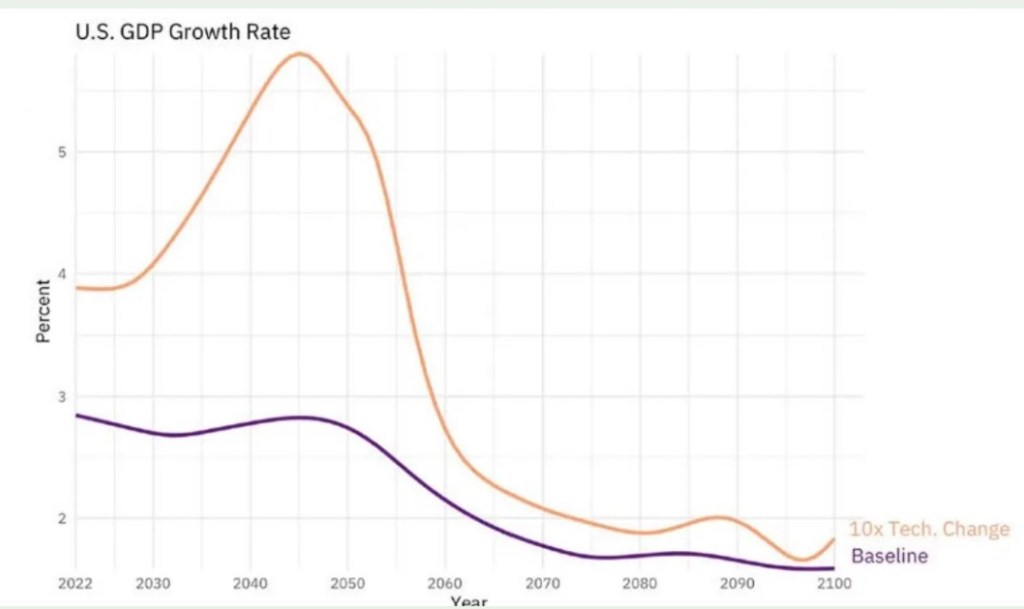
In July, however, Seth Benzell of the Stanford Digital Economy Lab discussed some simulations showing impressive AI-induced growth (see chart at top). The simulations project additional U.S. GDP growth of between 1% – 3% annually over the next 75 years! The largest boost in growth occurs now through the 2050s. This would produce a major advance in living standards. It would also eliminate the federal deficit and cure our massive entitlement insolvency, but the result comes with heavy qualifications. In fact, Benzell ultimately throws cold water on the notion that AI growth will be strong enough to reduce or even stabilize the public debt to GDP ratio.

The Scarcity Spoiler

The big hitch has to do with the scarcity of capital, which I’ve described as an impediment to widespread AI application. Competition for capital will drive interest rates up (3% – 4%, according to Benzell’s model). Ongoing needs for federal financing intensify that effect. But it might not be so bad, according to Benzell, if climbing rates are accompanied by heightened productivity powered by AI. Then, tax receipts just might keep-up with or exceed the explosion in the government’s interest obligations.

A further complication cited by Benzell lurks in insatiable demands for public spending, and politicians who simply can’t resist the temptation to buy votes via public largesse. Indeed, as we’ve already seen, government will try to get in on the AI action, channeling taxpayer funds into projects deemed to be in the public interest. And if there are segments of the work force whose jobs are eliminated by AI, there will be pressure for public support. So even if AI succeeds in generating large gains in productivity and tax revenue, there’s very little chance we’ll see a contagion of fiscal discipline in Washington DC. This will put more upward pressure on interest rates, giving rise to the typical crowding out phenomenon, curtailing private investment in AI.

Playing Catch-Up

The capex boom must precede much of the hoped-for growth in productivity from AI. Financing comes first, which means that rates are likely to rise sooner than productivity gains can be expected. And again, competition from government borrowing will crowd out some private AI investment, slowing potential AI-induced increases in tax revenue.

There’s no chance of the converse: that AI investment will crowd out government borrowing! That kind of responsiveness is not what we typically see from politicians. It’s more likely that ballooning interest costs and deficits generally will provoke even more undesirable policy moves, such as money printing or rate ceilings.

The upshot is that higher interest rates will cause deficits to balloon before tax receipts can catch up. And as for tax receipts, the intangibility of AI will create opportunities for tax flight to more favorable jurisdictions, a point well understood by Benzell. As attorneys Bradford S. Cohen and Megan Jones put it:

“Digital assets can be harder to find and more easily shifted offshore, limiting the tax reach of the U.S. government.”

AI Growth Realism

Benzell’s trepidation about our future fiscal imbalances is well founded. However, I also think Benzell’s modeled results, which represent a starting point in his analysis of AI and the public debt, are too optimistic an assessment of AI’s potential to boost growth. As he says himself,

“… many of the benefits from AI may come in the form of intangible improvements in digital consumption goods. … This might be real growth, that really raises welfare, but will be hard to tax or even measure.”

This is unlikely to register as an enhancement to productivity. Yet Benzell somehow buys into the argument that AI will lead to high levels of unemployment. That’s one of his reasons for expecting higher deficits.

My view is that AI will displace workers in some occupations, but it is unlikely to put large numbers of humans permanently out of work and into state support. That’s because the opportunity cost of many AI applications is and will remain quite high. It will have to compete for financing not only with government and more traditional capex projects, but with various forms of itself. This will limit both the growth we are likely to reap from AI and losses of human jobs.

Sovereign Wealth Fund

I have one other bone to pick with Benzell’s post. That’s in regard to his eagerness to see the government create a sovereign wealth fund. Here is his concluding paragraph:

“Instead of contemplating a larger debt, we should instead be talking about a national sovereign wealth fund, that could ‘own the robots on behalf of the people’. This would both boost output and welfare, and put the welfare system on an indefinitely sustainable path.”

Whether the government sells federal assets or collects booty from other kinds of “deals”, the very idea of accumulating risk assets in a sovereign wealth fund undermines the objective to reduce debt. It will be a struggle for a sovereign wealth fund to consistently earn cash returns to compensate for interest costs and pay down the debt. This is especially unwise given the risk of rising rates. Furthermore, government interests in otherwise private concerns will bring cronyism, displacement of market forces by central planning, and a politicization of economic affairs. Just pay off the debt with whatever receipts become available. This will free up savings for investment in AI capital and hasten the hoped-for boom in productivity.

Summary

AI’s contribution to economic growth probably will be inadequate and come too late to end government budget deficits and reduce our burgeoning public debt. To think otherwise seems far fetched in light of our historical inability to restrain the growth of federal spending. Interest on the federal debt already accounts for about half of the annual budget deficit. Refinancing the existing public debt will entail much higher costs if AI capex continues to grow aggressively, pushing interest rates higher. These dynamics make it pretty clear that AI won’t provide an easy fix for federal deficits and debt. In fact, ongoing federal borrowing needs will sop up savings needed for AI development and diffusion, even as the capital needed for AI drives up the cost of funds to the government. It’s a shame that AI won’t be able to crowd out government.
My Foolish Hopes For Free Trade Bargaining

24 Saturday May 2025

Posted by Nuetzel in Central Planning, Free Trade

≈ 2 Comments

Tags

Balance of Payments, Big Beautiful Bill, central planning, Coercion, Cronyism, Donald Trump, Eric Boehm, Fiscal Restraint, Foreign Investment, Free trade, Liberation Day, National Security, Non-Tariff Barriers, Price Pressures, Punitive Tariffs, Reciprocal Tariffs, Retaliatory Tariffs, Selective Tariffs, Tariff Exceptions, Tariff Incidence, Trade Deals, Trade Deficit

Just a few weeks back I engaged in wishful speculation that Trump’s drastic imposition of “reciprocal” and punitive tariffs could actually prove to be a free-trade play, but only if the U.S. used its universally dominant position in trade wisely at the bargaining table. I worried, however, that any notion Trump might have along those lines was eclipsed by his antipathy for otherwise harmless trade deficits. Another bad indicator was his conviction that manipulating tariffs could restore “fairness” in trade relations while raising revenue to pay for the selective tax cuts he promised for tips, overtime wages, and social security benefits.

Aside from that, I won’t repeat all of Trump’s fallacies about trade (and see here and here) except where they’ve impinged on recent developments.

One Raw Deal

My hopes for reduced trade barriers were dashed when the first “deal” (or really a “Memorandum of Understanding”) was announced with the United Kingdom. The U.S. runs a trade surplus with the UK, so one might think Trump would find it unnecessary to levy tariffs on U.S. imports from the UK. No dice! Clearly this was not motivated by the trade deficit bogeyman of Trump’s fever dreams. The White House stated that buyers of goods from the UK will pay the minimum 10% tariff (up from 3.3% before Trump took office).

Trump simply likes tariffs. Apparently he’s never given much thought to their incidence, which falls largely on domestic consumers and businesses. The MAGA faithful are in blissful denial that such a burden exists, despite ample evidence of its reality.

As Eric Boehm notes, the U.S. received a few concessions on British tariffs under the deal, but the reductions only amount to about a 2% equivalent. There are sharp reductions in special tariffs on U.S. agricultural products, especially meat. There are also exceptions to tariffs on certain British goods, like autos (up to 100,000 units). The selective nature of the concessions on both sides underscores the cronyist underpinnings of this style of economic governance, which amounts to ad hoc central planning.

Also troubling is the misleading spin the Administration attempted to put on news coverage of the deal. They claimed to have reduced tariffs of goods imported from the UK, which is true only in comparison to post-“Liberation Day” tariff levels established in early April. In fact, the baseline tariff now applied to most UK goods sold in the U.S. has more than tripled since last year! As Boehm states, American consumers and businesses are paying a lot more for this “deal” than their British counterparts.

Raw Deals To Be?

The “deal” with China is worse, partly because it’s only a 90-day pause in implementation (pending negotiation), and partly because the “reciprocal” tariff rate of 30% applied to Chinese goods is much higher than before Trump imposed the punitive rates. Still worse, the 10% tariff on U.S. exports to China applied during the pause is also much higher. What a deal! And it could get worse. These tariff hikes have little to do with “national security” and they are regressive, having disproportionately large burdens on lower-income consumers and small businesses.

The only other agreement announced thus far is with India. It is not a “trade deal” at all, but a so-called “Terms of Reference On Bilateral Trade Agreement”. It is a “roadmap” for future negotiations. Perhaps it will come together quickly, but it’s hard to expect much after the UK agreement.

Uniting Western Civilization

Just this week we had another hardball move by Trump: a 50% tariff on goods from the European Union starting in June, up from an average of about 3.8% on a trade-weighted basis. The new tariff rate is also higher than the 10% baseline tariff in place since the 90-day pause was announced in April. Trump claims the EU has been levying tariffs of 39% on U.S. goods, which might include what the Administration would call effective tariffs from non-tariff barriers to trade. Or it might refer to retaliatory tariffs announced by the EU in response to Trump’s Liberation Day announcement, but all of those have been paused. In any case, the World Trade Organization says EU tariffs on US goods average 4.8%. Quite a difference!

The move against the EU is much like Trump’s earlier ploy with China, but he says he’s “not looking for a deal”. He also says talks with the EU are “going nowhere”, though the Polish Trade Minister reassures that talks are “ongoing”. The outcome is likely to be a disappointment for anyone (like me) hoping for freer trade. The EU will probably make commitments to buy something from the U.S., maybe beef or liquified natural gas. But U.S. tariffs on EU goods will be higher than in the past.

So, thus far we have only one “deal” (such as it is), one roadmap for negotiations to follow, and a bunch of pauses pending negotiation (China included). The Trump team says about 100 countries hope to negotiate trade deals, but that is a practical impossibility. Even Trump says “… it’s not possible to meet the number of people that want to see us.” But it could be easy: just drop all U.S. trade barriers and allow protectionist countries to tax their own citizens, denying them access to free choice.

Bullying Enemies, Allies and Producers

Higher U.S. tariffs will put some upward pressure on the prices of imports and import-competing goods. We haven’t seen this play out just yet, but it’s early. In a defensive move, Trump is attempting to bully and shame domestic companies such as WalMart for attempting to protect their bottom lines in the face of tariffs. He also warned automakers about their pricing before carving out an exception for them. And now Apple has been singled-out by Trump for a special 25% tariff after it had announced plans to move assembly of iPhones to India, rather than in the U.S.

You better stay on Trump’s good side. This is a loathsome kind of interference. It encourages firms to seek favors in the form of tariff exemptions or to accept what amounts to state expropriation of profits. Cronyism and coercion reign.

Swamped By Spendthrifts?

The market seems to believe the negative impact of tariffs on economic growth will be more than offset by other stimulative forces. This includes the extension of Trump’s 2017 tax cuts. The so-called “big beautiful bill” passed by the House of Representatives also includes new tax breaks on tip and overtime pay, and an increase in the deduction for state and local taxes. While the bill reduces the growth of federal spending, there is disappointment that spending wasn’t reduced. The Senate might pass a version with more cuts, but the market sees nothing but deficits going forward. This is not the sort of “fiscal restraint” the market hoped for, particularly with escalating interest costs on the burgeoning federal debt.

Conflicting Goals

Trump has bargained successfully for some major investments in the U.S. by wealthy nations like Saudi Arabia and Dubai, as well as a few major manufacturing and technology firms. That’s wonderful. He doesn’t understand, however, that strong foreign investment in the U.S. will encourage larger trade deficits. That’s because foreign capital inflows raise incomes, which increase demand for imports. In addition, the capital inflows cause the value of the dollar to appreciate, making imports cheaper but exports more expensive for foreigners. It would be a shame if Trump reacted to these eventualities by doubling down on tariffs.

Conclusion

Alas, my hopes that Trump’s bellicose trade rhetoric was mere posturing were in vain. He could have used our dominant trading position to twist arms for lower trade barriers all around. While I worried that he massively misunderstood the meaning of trade deficits, and that he viewed higher tariffs as a magic cure, I should have worried much more!

Trade Charades and a Capital Crusade

15 Tuesday Apr 2025

Posted by Nuetzel in Balance of Payments, Federal Budget, Protectionism

≈ 4 Comments

Tags

Balance of Payments, Capital Account, Capital Deepening, Capital Surplus, central planning, Cronyism, Current Account, Donald Trump, Federal Budget Deficit, John Cochrane, Reciprocal Tariffs, Scott Lincicome, Trade Barriers, Trade Deficit

I’m nowhere near eating crow over the skepticism I’ve directed at Donald Trump’s trade offensive. The uncertainty created by his erratic policy changes is very likely to drag the U.S. into recession. However, there were signs last week of movement in a more promising direction, as he placed a 90-day pause on the targeted “reciprocal” tariffs announced in early April. However, a “baseline” universal tariff of 10% still applies to all imported goods. So do tariffs targeted at China, which have ratcheted up through a few rounds of retaliation. Now, he’s announced exemptions for some key electronics products, many of which come from China, and there are signs that he’s ready to exempt imports of auto parts. Needless to say, the tariffs and their exemptions represent an ill-advised escapade in central planning, replete with ample opportunities for politically-motivated favoritism and prejudice.

Why the Pause?

The pause in reciprocal tariffs was ostensibly intended to allow time to negotiate lower trade barriers with “more than 75 countries” that came forward to engage with Trump rather than retaliate. Now, there are said to be as many as 90 countries that wish to negotiate. This more or less aligns with an evolution of the strategy I described in my last post: game theory suggests that a dominant trading partner may be able to threaten or impose higher tariffs and ultimately achieve agreement on a regime with lower trade barriers on both sides. In Trump’s case, that would involve reaching many different bilateral agreements within a very short time, an imposing challenge given the history of trade negotiations. So far we have no deals, though Trump claims some are close. If only we didn’t have to reach formal agreements not to interfere with mutually beneficial trade!

A debate ensued almost immediately over whether Trump’s pause showed that he “caved” to the negative market reaction to his tariffs, but perhaps he acted primarily because a number of nations approached with hats in hand. Trump knew he had the leverage to force other nations to make concessions on trade barriers. They obviously responded.

The timing of the pause was surely a combination of those overtures, market reaction, advisor opinion, and Trump’s own instincts. This view is buttressed by the unaltered universal 10% tariffs, the remaining special tariffs on specific nations and product categories, and the punative tariffs on China. Furthermore, Trump knows he can reimpose a targeted tariff on any country that refuses a deal satisfactory to him. Let’s hope he’s reasonable and doesn’t allow his love affair with tariffs to color his position in these talks.

My hope is that the Trump Administration can negotiate a large number of new agreements with trading partners to reduce or eliminate tariffs and other barriers to trade. Obviously the pause is no guarantee of success, and severe challenges remain with more belligerent trading partners, especially China.

Disclaimer!

None of the foregoing is intended as a dispensation for the many apparent misconceptions Trump has about trade. In the MAGA cult clamor to defend all-things Trump, there have been a number of absurd claims about tariffs and trade, such as: tariffs are not a tax; tariffs don’t raise the price of imports; trade deficits are a deduction from GDP; tariffs can replace the income tax; trade deficits will bankrupt the country; high tariffs produced rapid growth in the late 19th century; “reciprocal” tariffs will eliminate our bilateral trade deficits; U.S. manufacturing is in crisis; value added taxes are trade barriers; it’s better to export goods than services; and trade deficits reduce investment. Every one a laugher, but I’ll leave most of them aside for now.

In the remainder of this post, I’ll focus on Trump’s aims for coaxing firms, via tariff avoidance, to make capital investment in the U.S., and the implications of that effort for the trade balance. An influx of capital might be construed as a strength of Trump’s policy agenda, though his effort to “cut deals” in this manner is a form of economic meddling as well as a vehicle for cronyism. Moreover, he doesn’t understand the nexus between foreign investment, the federal deficit, and the balance of payments. He’ll be disappointed to learn that his notion that trade deficits are ruinous conflicts with his vision of encouraging foreign accumulations of productive U.S. assets.

Oh No! A Capital Surplus!

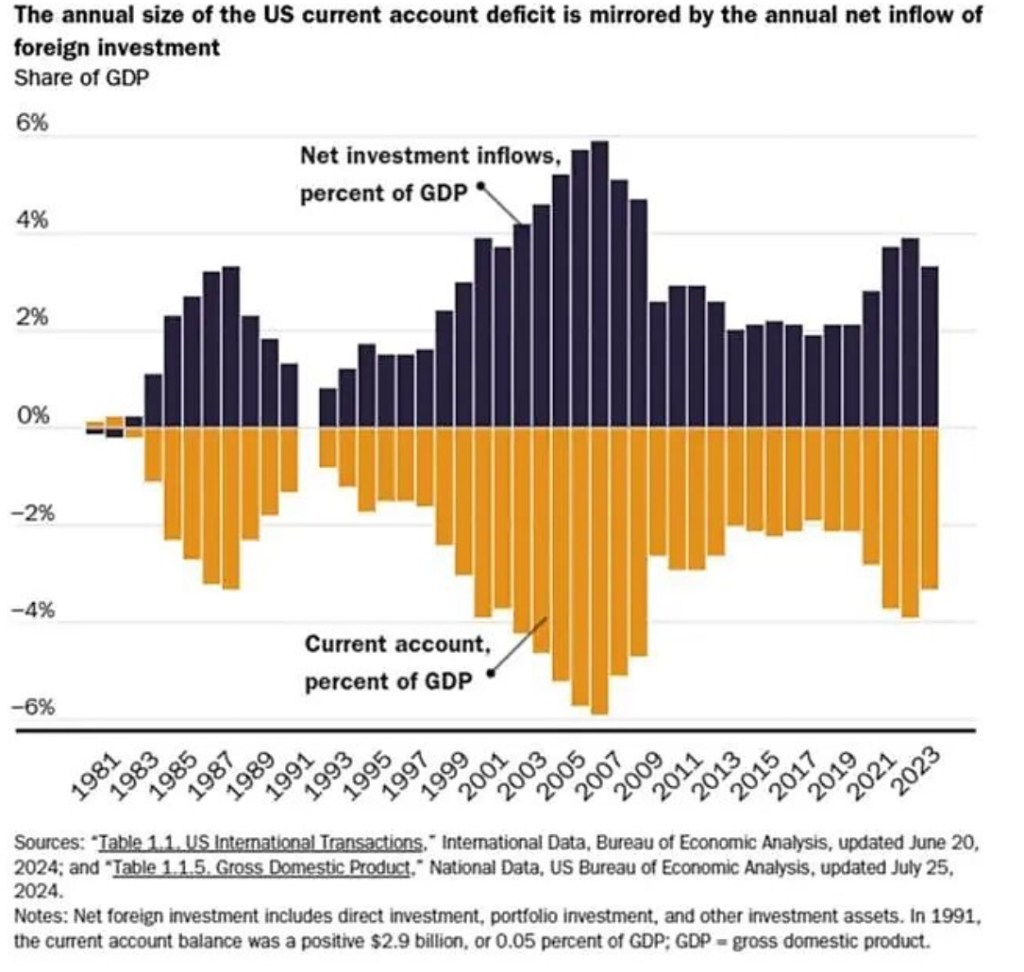
It isn’t a widely understood equivalence, but each year we have a surplus in foreign purchases of U.S. assets (the capital account surplus) that is roughly matched by a deficit in trade for foreign goods and services (the current account deficit). This is why the balance of payments (BoP) balances! Here is the near mirror image of these two sides of the BoP, from Scott Lincicome’s “Things Everyone Should Know about Trade Deficits”:

The two sides of the BoP are very much codetermined. One does not exclusively drive the other.

It’s wonderful to be in a position to avail ourselves of foreign savings to invest in our economy. Unfortunately, a large portion of this foreign investment finances our huge government budget deficit, and that is a real problem. Otherwise, the investment would make a greater contribution to U.S. growth.

Funding the Federal Deficit

As John Cochrane explains, transfer payments account for a large share of government spending and borrowing. In turn, these transfers are spent by recipients on consumer goods, some of which come from overseas. Cochrane emphasizes that we are borrowing from abroad, as shown by our capital surplus, to finance this consumption, rather than investing foreign capital in productive assets. While one might conclude that our capital surplus and our trade deficit are creating a long-term vulnerability, the root of the problem is the federal government’s largess.

There is a sense in which different prongs of Trump’s policy agenda could act to address this problem. These are his efforts to reduce government waste, deregulate, and encourage direct investment in new plant and equipment. Reducing the federal budget deficit is paramount, but huge doubts remain over his determination to control spending or undertake real entitlement reforms. Tariffs will generate some revenue, but part of that will be required to offset other tax breaks Trump is contemplating.

Deepening the Capital Base

Trump harps on the need for firms, both foreign and domestic, to produce goods here in the U.S. Currently he’s taking credit for $5 trillion of new investment in the U.S., though we really don’t know whether all of these are “new deals” or had already been planned. Deregulation can improve incentives to invest in physical capital and increase the speed with which it comes online. To the extent that investment in productive capital replaces government borrowing, the debt we accumulate (held by foreign and domestic lenders) will be more sustainable.

However, Trump seems oblivious to a fact made inescapable by the balance of payments relationship. This new investment, should it come to fruition, will bring with it future excesses of imports over exports. Foreign demand for U.S. capital assets lifts domestic income and leads to a stronger dollar, both of which boost imports and the trade deficit. The trade deficit will persist even if foreign investment in new factories fully replaces the bloated federal deficit as a use of foreign capital.

Of course, the intent of Trump’s reshoring campaign is for new domestic output to substitute for imports and increase exports. That would bring positive returns for domestic and foreign capital, but rising income and a stronger dollar will stimulate demand for other imports, while exports would flag with the strength of the dollar. In any case, the new investments and a larger capital surplus will increase the trade deficit.

It’s a Big Government Mess

22 Tuesday Nov 2022

Posted by Nuetzel in Big Government, Uncategorized

≈ 1 Comment

Tags

Campaign Spending, Carbon Footprint, central planning, Climate Risk, Compliance Costs, Cronyism, Debt Monetization, dependency, Diversity, Do-Somethingism, External Costs, Fiscal Illusion, Limited government, Malinvestment, monopoly, Price Controls, Public goods, Redistribution, Regulatory Capture, rent seeking, Wetlands, Willingness To Pay

I’m really grateful to have the midterm elections behind us. Well, except for the runoff Senate race in Georgia, the cockeyed ranked-choice Senate race in Alaska, and a few stray House races that remain unsettled after almost two weeks. I’m tired of campaign ads, including the junk mail and pestering “unknown” callers — undoubtedly campaign reps or polling organizations.

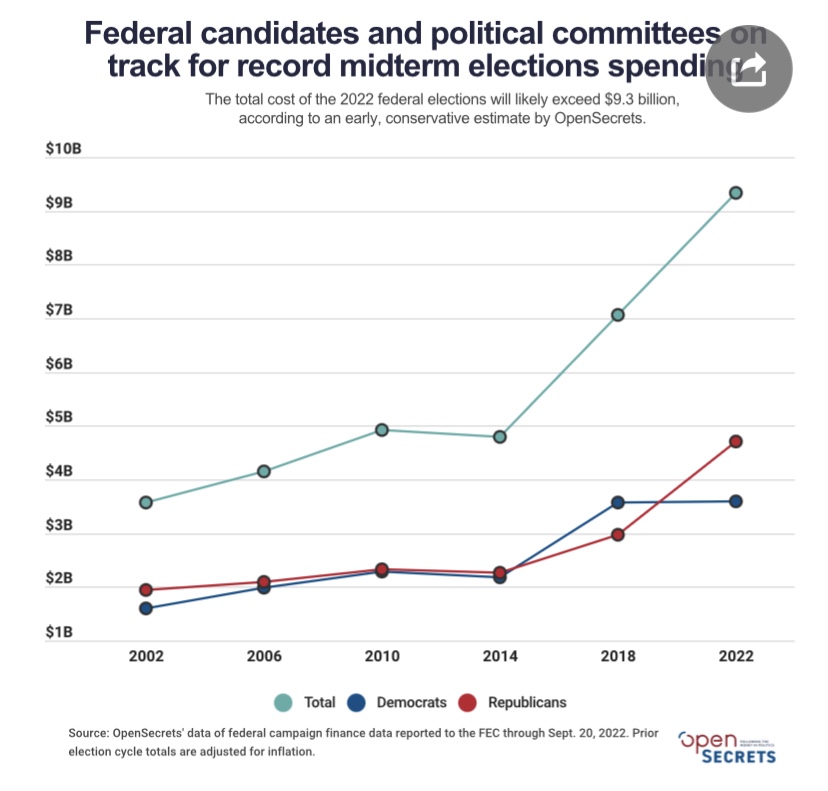
It’s astonishing how much money is donated and spent by political campaigns. This year’s elections saw total campaign spending (all levels) hit $16.7 billion, a record for a mid-term. The recent growth in campaign spending for federal offices has been dramatic, as the chart below shows:

Do you think spending of a few hundred million dollars on a Senate campaign is crazy? Me too, though I don’t advocate for legal limits on campaign spending because, for better or worse, that issue is entangled with free speech rights. Campaigns are zero-sum events, but presumably a big donor thinks a success carries some asymmetric reward…. A success rate of better than 50% across several campaigns probably buys much more…. And donors can throw money at sure political bets that are probably worth a great deal…. Many donors spread their largess across both parties, perhaps as a form of “protection”. But it all seems so distasteful, and it’s surely a source of waste in the aggregate.

My reservations about profligate campaign spending include the fact that it is a symptom of big government. Donors obviously believe they are buying something that government, in one way or another, makes possible for them. The greater the scope of government activity, the more numerous are opportunities for rent seeking — private gains through manipulation of public actors. This is the playground of fascists!

There are people who believe that placing things in the hands of government is an obvious solution to the excesses of “greed”. However, politicians and government employees are every bit as self-interested and “greedy” as actors in the private sector. And they can do much more damage: government actors legally exercise coercive power, they are not subject in any way to external market discipline, and they often lack any form of accountability. They are not compelled to respect consumer sovereignty, and they make correspondingly little contribution to the nation’s productivity and welfare.

Actors in the private sector, on the other hand, face strong incentives to engage in optimizing behavior: they must please customers and strive to improve performance to stay ahead of their competition. That is, unless they are seduced by what power they might have to seek rents through public sector activism.

A people who grant a wide scope of government will always suffer consequences they should expect, but they often proceed in abject ignorance. So here is my rant, a brief rundown on some of the things naive statists should expect to get for their votes. Of course, this is a short list — it could be much longer:

  • Opportunities for graft as bureaucrats administer the spending of others’ money and manipulate economic activity via central planning.
  • A ballooning and increasingly complex tax code seemingly designed to benefit attorneys, the accounting profession, and certainly some taxpayers, but at the expense of most taxpayers.
  • Subsidies granted to producers and technologies that are often either unnecessary or uneconomic (and see here), leading to malinvestment of capital. This is often a consequence of the rent seeking and cronyism that goes hand-in-hand with government dominance and ham-handed central planning.
  • Redistribution of existing wealth, a zero- or even negative-sum activity from an economic perspective, is prioritized over growth.
  • Redistribution beyond a reasonable safety net for those unable to work and without resources is a prescription for unnecessary dependency, and it very often constitutes a surreptitious political buy-off.
  • Budgetary language under which “budget cuts” mean reductions in the growth of spending.
  • Large categories of spending, known in the U.S. as non-discretionary entitlements, that are essentially off limits to lawmakers within the normal budget appropriations process.
  • “Fiscal illusion” is exploited by politicians and statists to hide the cost of government expansion.
  • The strained refrain that too many private activities impose external costs is stretched to the point at which government authorities externalize internalities via coercive taxes, regulation, or legal actions.
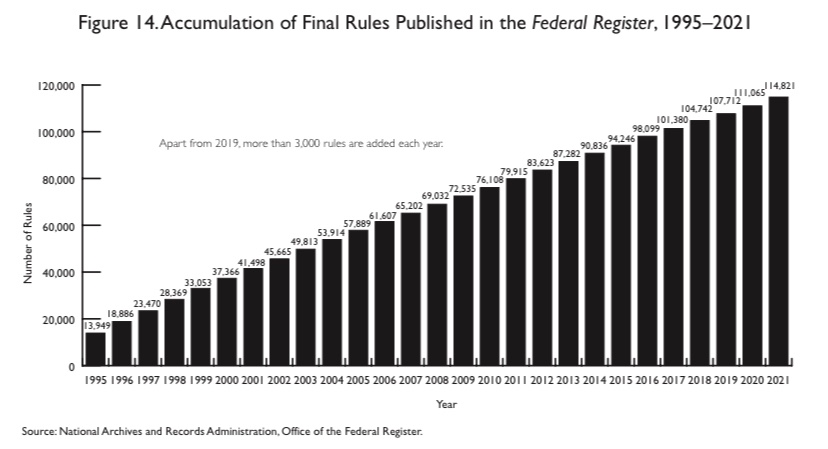
  • Massive growth in regulation (see chart at top) extending to puddles classified as wetlands (EPA), the ”disparate impacts” of private hiring practices (EEOC), carbon footprints of your company and its suppliers (EPA, Fed, SEC), outrageous energy efficiency standards (DOE), and a multiplicity of other intrusions.
  • Growth in the costs of regulatory compliance.
  • A nearly complete lack of responsiveness to market prices, leading to misallocation of resources — waste.
  • Lack of value metrics for government activities to gauge the public’s “willingness to pay”.
  • Monopoly encouraged by regulatory capture and legal / compliance cost barriers to competition. Again, cronyism.
  • Monopoly granted by other mechanisms such as import restrictions and licensure requirements. Again, cronyism.
  • Ruination of key industries as government control takes it’s grip.
  • Shortages induced by price controls.
  • Inflation and diminished buying power stoked by monetized deficits, which is a long tradition in financing excessive government.
  • Malinvestment of private capital created by monetary excess and surplus liquidity.
  • That malinvestment of private capital creates macroeconomic instability. The poorly deployed capital must be written off and/or reallocated to productive uses at great cost.
  • Funding for bizarre activities folded into larger budget appropriations, like holograms of dead comedians, hamster fighting experiments, and an IHOP for a DC neighborhood.
  • A gigantic public sector workforce in whose interest is a large and growing government sector, and who believe that government shutdowns are the end of the world.
  • Attempts to achieve central control of information available to the public, and the quashing of dissent, even in a world with advanced private information technology. See the story of Hunter Biden’s laptop. This extends to control of scientific narratives to ensure support for certain government programs.
  • Central funding brings central pursestrings and control. This phenomenon is evident today in local governance, education, and science. This is another way in which big government fosters dependency.
  • Mission creep as increasing areas of economic activity are redefined as “public” in nature.
  • Law and tax enforcement, security, and investigative agencies pressed into service to defend established government interests and to compromise opposition.

I’ve barely scratched the surface! Many of the items above occur under big government precisely because various factions of the public demand responses to perceived problems or “injustices”, despite the broader harms interventions may bring. The press is partly responsible for this tendency, being largely ignorant and lacking the patience for private solutions and market processes. And obviously, those kinds of demands are a reason government gets big to begin with. In the past, I’ve referred to these knee-jerk demands as “do somethingism”, and politicians are usually too eager to play along. The squeaky wheel gets the oil.

I mentioned cronyism several times in the list. The very existence of broad public administration and spending invites the clamoring of obsequious cronies. They come forward to offer their services, do large and small “favors”, make policy suggestions, contribute to lawmakers, and to offer handsomely remunerative post-government employment opportunities. Of course, certaIn private parties also recognize the potential opportunities for market dominance when regulators come calling. We have here a perversion of the healthy economic incentives normally faced by private actors, and these are dynamics that gives rise to a fascist state.

It’s true, of course, that there are areas in which government action is justified, if not necessary. These include pure public goods such as national defense, as well as public safety, law enforcement, and a legal system for prosecuting crimes and adjudicating disputes. So a certain level of state capacity is a good thing. Nevertheless, as the list suggests, even these traditional roles for government are ripe for unhealthy mission creep and ultimately abuse by cronies.

The overriding issue motivating my voting patterns is the belief in limited government. Both major political parties in the U.S. violate this criterion, or at least carve out exceptions when it suits them. I usually identify the Democrat Party with statism, and there is no question that democrats rely far too heavily on government solutions and intervention in private markets. The GOP, on the other hand, often fails to recognize the statism inherent in it’s own public boondoggles, cronyism, and legislated morality. In the end, the best guide for voting would be a political candidate’s adherence to the constitutional principles of limited government and individual liberty, and whether they seem to understand those principles. Unfortunately, that is often too difficult to discern.

A Fiscal Real-Bills Doctrine? No Such Thing As Painless Inflation Tax

14 Tuesday Jun 2022

Posted by Nuetzel in Fiscal policy, Inflation, Uncategorized

≈ Leave a comment

Tags

Biden Administration, Cronyism, Federal Debt, Fiscal Inflation, Fiscal policy, Friedrich Hayek, Hyperinflation, Inflation tax, Knowledge Problem, Modern Monetary Theory, Monetary policy, Money Printing, Nominal GDP Targeting, Pete Buttigieg, Real Bills Doctrine, Reichsbank, rent seeking, Ro Khanna

A remarkable proposal made recently by Representative Ro Khanna (D -CA) would have the Biden Administration impose price controls, which would be bad enough. Khanna also would like the federal government to cover the inflation losses incurred by Americans by having it directly purchase certain goods and services and resell them “cheap” to consumers. In fairness, Khanna says the government should attempt to take advantage of dips in prices for oil, food commodities, and perhaps other necessities, which of course would limit or reverse downward price changes. When asked about Khanna’s proposal, Pete Buttigieg, Joe Biden’s Transportation Secretary, replied that there were great ideas coming out of Congress and the Administration should consider them. Anyway, the idea is so bad that it deserves a more thorough examination.

Central Planners Have No Clothes

First, such a program would represent a massive expansion in the scope of government. It would also present ample opportunities for graft and cronyism, as federal dollars filter through the administrative layers necessary to manage the purchases and distribution of goods. Furthermore, price and quantity would then be shaded by a heavy political component, often taking precedence over real demand and cost considerations. And that’s beyond the crippling “knowledge problem” that plagues all efforts at central planning.

One of the most destructive aspects of allowing government to absorb a greater share of total spending is that government is not invested with the same budgetary discipline as private buyers. Take no comfort in the notion that the government might prove expert at timing these purchases to leverage price dips. Remember that government always spends “other people’s money”, whether it comes from tax proceeds, lenders, or the printing press (and hence future consumers, who have absolutely no agency in the matter). Hence, price incentives take on less urgency, while political incentives gain prominence. The loss of price sensitivity means that government expenditures are likely to inflate more readily than private expenditures. This is all the more critical at a time when inflation is becoming embedded in expectations and pricing decisions. Khanna thus proposes an inflation “solution” that puts less price-sensitive bureaucrats in charge of actual purchases. That’s a prescription for failure.

If anyone in Biden’s White House is seriously considering a program of this kind, and let’s hope they’re not, they should at least be aware that direct subsidies for the purchase of key goods would be far more efficient. It’s also possible to hedge the risk of future price increases on commodities markets, perhaps simply distributing hedging gains to consumers when they pay off. However, having the federal government participate as a major player in commodities options and futures is probably not on the table at this point … and I shudder to think of it, but it might be more efficient than Khanna’s vision.

A Fiscal Real Bills Doctrine

Khanna’s program would almost surely cause inflation to accelerate. Inflation itself a form of taxation imposed by profligate governments, though it’s an inefficient tax since it creates greater uncertainty. Higher prices deflate the real value of most government debt (borrowed from the public), assets fixed in nominal value, and incomes. Read on, but this program would have the government pay your inflation tax for you by inflating some more. Does this sound like a vicious circle?

Khanna’s concept of inflation-relief is a fiscal reimagining of a long-discredited monetary theory called the “Real Bills Doctrine”. According to this doctrine, rising prices and costs necessitate additional money creation so that businesses have the liquidity to pay the bills associated with ongoing productive efforts. The “real” part is a reference to the link between business expenses and actual production, despite the fact that those bills are expressed in nominal terms. The result of this policy is a cycle of ever-higher inflation, as ever-more money is printed. This was the policy utilized by the Reichsbank in Weimar Germany during its hyperinflation of 1922-23. It’s really quite astonishing that anyone ever thought such a policy was helpful!

In Khanna’s version of the doctrine, the government spends to relieve cost pressure faced by consumers, so the rationale has nothing to do with productive effort.

Financing and the Central Bank Response

It’s reasonable to ask how these outlays would be financed. In all likelihood, the U.S. Treasury would borrow the funds at interest rates now at 10-15 year highs, which have risen in part to compensate investors for higher inflation.

My bet is that Khanna imagines the Fed would simply “print” money (i.e., buy the new government debt floated by the Treasury to pay for the program). This is the prescription of so-called Modern Monetary Theory, whose adherents have either forgotten or have never learned that money growth and inflation is a costly and regressive form of taxation.

Most economists would say the response of the Federal Reserve to this fiscal stimulus would bear on whether it really ignites additional inflationary pressure. Of course, rather than borrowing, Congress could always vote to levy higher taxes on the public in order to pay the public’s inflation tax burden! But then what’s the point? Well, taxing at least has the virtue of not fueling still higher inflation, and the Fed would not have a role to play.

But if the government simply borrows instead, it adds to the already bloated supply of government debt held by the public. This borrowing is likely to put more upward pressure on interest rates, and the federal government’s mounting interest expense requires more financing. What then might the Fed do?

The Fed is an independent, quasi-government entity, so it would not have to accommodate the additional spending by printing money (buying the new Treasury debt). Either way, investors are increasingly skeptical that the growing debt burden will ever be reversed via future surpluses. The fiscal theory of the price level holds that something must reduce the real value of government debt (in order to satisfy the long-term fiscal budget constraint). That “something” is a higher price level. This position is not universally accepted, and some would contend that if the Fed simply set a nominal GDP growth target and stuck to it, accelerating inflation would not have to follow from Khanna’s policy. The same if the Fed could stick to a symmetric average inflation target, but they certainly haven’t been up to that task. Hoping the Fed would fully assert its independence in a fiscal hurricane is probably wishful thinking.

Conclusion

There are no choke points in the supply chain for bad ideas on the left wing of the Democratic Party, and they are dominating party centrists in terms of messaging. The answer, it seems, is always more government. High inflation is very costly, but the best policy is to rein it in, and that requires budgetary and monetary discipline. Attempts to make high inflation “painless” are misguided in the first instance because they short-circuit consumer price responses and substitution, which help restrain prices. Second, the presumption that an inflation tax can be “painless” is an invitation to fiscal debauchery. Third, expansive government brings out hoards of rent seekers instigating corruption and waste. Finally, mounting public debt is unlikely to be offset by future surpluses, and that is the ultimate admission of Modern Monetary Theory. A fiscal real bills doctrine would be an additional expression of this lunacy. To suggest otherwise is either sheer stupidity or an exercise in gaslighting. You can’t inflate away the pain of an inflation tax.

Health Insurance Profits Are Not the Problem

08 Thursday Jul 2021

Posted by Nuetzel in Health Insurance, Profit Motive

≈ Leave a comment

Tags

Capitalization, COBRA, Community Rating, Cronyism, Death Spiral, Economies of Scale, Health Insurance, Medical Loss Ratio, Monopsony, Obamacare, Premium Subsidies, Profit, Profit Motive, Single-Payer System

My dentist said, “Oh well, these days it’s really only about whether the insurance company makes a profit….” A giant appliance was in my mouth at the time, propping it open, so I couldn’t respond. But I made a mental note because it reminded me of the hypocrisy so common in how people regard the concept of profit. That’s especially true of the Left, and I happen to know that my dentist, whom I personally like very much, stands well to my left. 

Profit Is Income

It’s worth pointing out that profit is merely compensation. My dentist collects revenue, often paid to him by insurers. If he runs an efficient practice, then he earns an income after paying staff, office rent, various suppliers, and for equipment, including interest on any debt outstanding. You wouldn’t be wrong to call that profit, and he does pretty well for himself, but somehow he thinks it’s different.

My dentist probably feels locked into an adversarial position with my insurer, and of course he is in the short run. He says his price is $750; the insurer says, “Sorry Charlie, you get $250”. So as far as he’s concerned, it’s a zero-sum game. Not so in the long run, however. He needs to partner with insurers to get and keep patients, so the exchange is mutually beneficial. And while he might do some picking and choosing among insurers, he’s essentially a price taker. His “price” of $750 is something of a fiction, as he’s clearly willing to do the work for the insurer’s reimbursement. 

I think the key qualitative difference between my dentist’s income and that of any wage earner is that his income is always at risk. After all, profit is often regarded as a return to entrepreneurial risk-taking. As it happens, he’s taking a loss on my new crown because it cracked as soon as he put it in. Then, he had to start from scratch with new impressions, after painstakingly removing the cemented, cracked pieces with what felt like a tiny circular saw.

Middling Profitability

But what about those profit-hungry health insurers? In fact, they are not known for outrageously high profits, and their earnings are typically not valued as highly by the market as those of other industries, dollar for dollar. Competition helps restrain pricing and enhance performance, of course. And since the advent of Obamacare, profits have been subject to a loose “cap” (more on that below).

The profitability of health insurers improved in 2020, however, because so many tests and elective procedures were postponed or foregone due to the coronavirus pandemic. That also prompted the government to make more generous subsidies available to consumers to pay COBRA insurance premiums.

Profits Drive Efficiency

I’ll put aside concerns about the crony capitalism inherent in the health system-insurer-regulator nexus, at least for a moment. The profit motive is the fundamental driver of efficiency in the production of insurance contracts and pooling of risks, as well as efficient servicing and administration of those contracts. Absent the possibility of profit, these tasks would become mere bureaucratic functions with little regard for cost and resource allocation. Furthermore, managing risk requires a deep pool of capital to ensure the ability of the insurer to meet future claims. Reinvestment and growth of the enterprise also requires capital. That capital is always at risk and it is costly because its owners demand a return as fair compensation. 

Poor Alternatives

Eliminating profit from the insurance function implies that resources must be put at risk without compensation. That’s one of the reasons why non-profit insurers, over the years, have tended to be thinly capitalized and unstable, or limited in their offerings to “health maintenance” benefits, like primary or preventative care, as opposed to insuring against catastrophic events. Capital grants to non-profits (private or governmental) usually come with strings attached, which can severely limit the effectiveness of the capital for meeting existing or future needs of the operation. Growth requires reinvestment, so a profit margin must be earned in order to grow with internal funds. Where non-profits are concerned, you can call the “margin” whatever you want, but it is functionally equivalent to a profit margin. 

On the other hand, insurance provided by the public sector puts the taxpayer at risk, and the potential liability to taxpayer “capital” is never rewarded nor indemnified. But it is not free. Now, you might insist that we’d all benefit from government-sponsored health insurance because of the broader risk pool. The problem with that perspective is that it turns the pricing of risk into a political exercise. We’ve already seen the destructive effects of community rating. Younger, healthier, but budget-constrained individuals tend to opt out due to excessive premiums, leading to a systemic “death spiral” of the pool.

Administrative Costs

A puzzling contention is that private insurers drive up administrative costs, presumably when compared to a single-payer system. Obamacare regulations limit the so-called Medical Loss Ratio of a health plan. To simplify a bit, this requires rebates to customers if premiums exceed claims by a certain threshold, which varies across individual, small, and large group markets. This regulation obviously places a loose cap on profits. It is also arbitrary and probably has hampered competition in the individual market. And of course there have always been suspicions that the ratio can be “gamed”. 

Nevertheless, under a single-payer system, it would be shocking if economies of scale were sufficient to reduce administrative costs to levels below those incurred by private insurers (especially if we exclude profit!). After all, scale is seldom a prescription for government efficiency, and that’s largely due to the absence of a profit motive and any semblance of competition! What administrative savings might be achieved by a monopsony public payer are likely to derive mainly from “one-size-fits-all” decision-making and product design, with little heed to consumer preferences and choice.

I’ll Take the Profit-Maker’s Coverage

There is plenty to criticize about the health insurance industry. In important ways, it has already succeeded in shifting risks to taxpayers with the help of its policy-making cronies. The insurers are further protected by a flow of government premium subsidies to the individual market; and the largest insurers have benefitted from Obamacare regulations, which encourages increased market power by large hospital networks, which are happy to negotiate charges that benefit themselves and insurers. All else equal, however, I’d rather have a few choices from profit-making health insurers than a single, community-rated choice from the government. I’d rather see risk priced correctly, with direct subsidies made available to individuals in high-risk segments unable to afford their premiums. And I’d rather see less government involvement in health care delivery and insurance. We’d all be better off, including my dentist!

TikTok Tax: The Heavy Wants a Cut

05 Wednesday Aug 2020

Posted by Nuetzel in Industrial Policy, Regulation, Trump Administration

≈ Leave a comment

Tags

AOC, Barack Obama, CCP, Chinese Communist Party, Coyote Blog, Cronyism, Donald Trump, Hong Kong, Larry Kudlow, Likee, Microsoft, Muslim Uighurs, Peter Navarro, Regulatory State, statism, Steve Bannon, Taiwan, TikTok, Varney & Co, Video Sharing, Warren Meyer

I have a certain ambivalence toward Donald Trump, and I could go on and on about why it’s so “complicated” for me. One thing for which I’ve credited the Trump Administration is its effort to “deconstruct the administrative state”, as Steve Bannon so aptly put it shortly after the 2016 election. Of course, the progress thus far hasn’t always lived up to my hopes, but the effort to deregulate continues. And after all, the regulatory state is deeply entrenched and difficult to uproot.

Then my eyes glazed over as Trump floated an idea so bad, an intervention so awful, that I can hardly gather it in! It has to do with TikTok, the Chinese video sharing service that has gained popularity worldwide. Crazy as this might sound, it’s not so much Trump’s threat to shut down TikTok’s U.S. operations. Like most libertarians, I’d find that appalling in and of itself, except for the legitimate data security issues at stake. The company’s ties to the Chinese Communist Party (CCP) are a national security concern and an ethical blot on the company, given the CCP’s brutal treatment of Muslim Uighurs, its roughshod treatment of Hong Kong, and its threats to Taiwan. In any case, at least Trump said he’s amenable to a sale of the company’s U.S. operations to a domestic firm. Several large tech firms have expressed strong interest, including Microsoft. So, while any government imposed shutdown or forced sale makes me squirm, it’s not my main issue here.

What really stunned me was to hear Trump say the U.S. Treasury must get a cut of the deal! This is “Hall-of-Fame” statism. Where in the hell does the U.S. government get a legitimate financial claim to the value of any private business that changes hands? Well, Trump seems to think the federal government is adding value as the heavy:

“But if you buy [TicTok], the United States, which is making it possible to buy, because without us they can’t do anything, should be compensated.”

Yes, the buyer would be the beneficiary of a shakedown, and the demand is another poke in the eye to the Chinese. Of course, it might well threaten the transaction, and I’m not even sure it’s in Trump’s interest politically. But that’s not even the worst of it: as Warren Meyer explains, it would be hard to think of a better way to weaponize financial regulation than having the Treasury at the bargaining table in private negotiations for corporate control:

“Already there are too many regulatory hurdles to doing about anything, and Trump wants agencies to use regulatory approvals to hold up corporations for payments. And you can be sure this is a precedent the Democrats will be only too happy to latch onto — want a pipeline built, where’s our vig? Who wants [this to be] the first Trump decision AOC comes out in support of? The Republican Party sure has come a long way in my lifetime.”

The Left would certainly love to exercise this kind of coercion as a revenue source, as a cudgel of industrial policy to wield against disfavored firms and industries, and as a way to favor cronies. It’s a ready extension of Barack Obama’s deranged “You-didn’t-build-that” theme.

Is this one of trade advisor Peter Navarro‘s brainstorms? I was relieved to see Trump economic advisor Larry Kudlow cast some doubt on whether the government would follow through on Trump’s idea:

“‘I don’t know if that’s a key stipulation. …. A lot of options here,’ Kudlow told ‘Varney & Co.’ on Tuesday. ‘Not sure it’s a specific concept that will be followed through.’“

I think Trump would really like to kill TikTok. Maybe his grudge is driven in part by the presumptive role that TikTok played in his under-attended Tulsa rally. But there are domestic competitors to TikTok, so consumers will have alternatives. The most popular of those seems to be another Chinese app called Likee. In any case, downloads of other video sharing apps have spiked over the past few weeks. If Trump’s real aim is simply to shut down TikTok in the U.S., I’d almost rather see him do that than start making a practice of horse trading with cronies over shares of corporate booty.

Another Flop at the Impeachment Playhouse

04 Friday Oct 2019

Posted by Nuetzel in Impeachment

≈ Leave a comment

Tags

Adam Schiff, Australia, China, Cronyism, Donald Trump, FISA Abuse, House Intelligence Committee, Hunter Biden, Impeachment, Inspector General, Joe Biden, Michael Horowitz, Nancy Pelosi, Obama administration, Presidential Powers, Protectionism, Quid Pro Quo, Russia Investigation, Ukraine, Volodymyr Zelenskiy, Whistleblower

Listen, President Trump drives me crazy. His policy instincts often strike me as dangerous: trade protectionist, inflationist, and cronyist. I’m still suspicious that he might play ball with statists left and right on critical issues, when and if he perceives a political advantage in doing so. And Trump is hopelessly inarticulate and belligerent. Nevertheless, I will almost certainly vote for him in 2020 for several reasons, not least because the feasible alternatives are completely unacceptable. That view is reinforced by the behavior of the Democrat party in their effort to fabricate “high crimes and misdemeanors” on Trump’s part. That effort is not just dishonest, it is foolish, and they have a lot to lose. Their machinations are likely to blow up in their faces.

For one thing, the Democrats don’t seem to have much of a case. This time they are focused on a May 2019 phone conversation that took place between Trump and the recently-elected Ukrainian President Volodymyr Zelenskiy. The Democrats contend that Trump held up military aid in order to pressure Zelenskiy to investigate the Biden family’s activities in the Ukraine, a charge flatly denied by Zelenskiy. In fact, at the time of the call, the Ukrainians has no idea that military aid had been suspended, a fact first reported by The New York Times.

The Trump Administration released a transcript of the Zelenskiy call, which offers no evidence that a quid pro quo was offered by Trump. Even the text messages released this morning fail to support the claim. Joe Biden’s name came up during the call in connection with potential interference by the Ukraine in the 2016 U.S. presidential campaign. That’s reasonable in light of the events reported to have taken place, and it is certainly within the scope of presidential powers, as were Trump’s efforts to discuss election interference with Australia, the U.K., and other countries.

If you don’t know it already, a successful impeachment in the House of Representatives will not remove Trump from office. It will constitute a referral of charges to the Senate, which is controlled by Republicans, and a conviction requires a two-thirds majority. Ain’t gonna happen.

In the meantime, there really is no formal “impeachment” underway, despite what you think you’ve heard. This is a “proceeding” that House Speaker Nancy Pelosi really had no authority to initiate, and there is no set of rules or procedures guiding the spectacle. An impeachment investigation requires a House vote, but Democrats voted to table a resolution calling for such a vote because they really don’t want one, not yet anyway. Why? Because it would force them to go on record before they’re quite sure they want to, but more importantly it would demand due process for the accused. A House vote for an impeachment investigation would give House Republicans subpoena powers, something Democrats don’t want to take a chance on.

Again, the whole effort by the Democrats will ultimately be futile, and the trial proceedings in the Senate might be very ugly for them as well. It is likely to shed light on several matters that offer unflattering context for the impeachment effort and might well lead to criminal charges against prominent Democrats and their operatives:

  • Did members of the Obama Administration, the DNC, and Hillary Clinton’s campaign work with the Ukrainian government to undermine the Trump’s candidacy, hatching the Russian collusion narrative in the process? Politico said so in 2017.
  • Did the Biden family trade on Joe Biden’s position to attract capital from large investors for a venture in the Ukraine?
  • What was exchanged in order for Joe Biden’s son Hunter to land a $50,000/month job with a Ukrainian gas company?
  • Did Joe Biden use the authority of his office to strong-arm the Ukrainians into dropping the prosecution of the company that employed his son? “Son of a B“, Joe said, I threatened to walk away and they dropped the investigation. Son of a Biden?
  • Members of Congress sent a letter to the Ukrainian government in May of 2018 that threatened reductions in aid without Ukrainian cooperation with the Mueller investigation into the Trump campaign.
  • A member of the Obama Administration is known to have approached the Ukrainian Embassy in Washington in 2016 to solicit the Ukraine’s participation in a scheme to interfere with the U.S. election.
  • The Intelligence Community Inspector General’s report stated that the “whistleblower” or operative had a political bias. Well, might that have been a motive in the case?
  • Who authorized the change in requirements for whistleblower referrals from first-hand information to second-hand information, or hearsay? And when? Despite denials from left-wing fact-checkers, the Intelligence Community Inspector General’s narrative here doesn’t quite hang together. They gave the operative the wrong form? It’s been claimed that the operative provided first-hand information after all, but where is it?
  • Did members of Congress know about the operative’s complaint before it was formally referred to Congress? Apparently Adam Schiff, Chairman of the House Intelligence Committee, knew before the complaint was drafted, and he lied about it. Was there collaboration with the operative?
  • What are Adam Schiff’s connections in the Ukraine? Let’s find out!

These are all troubling questions that should be investigated. We may or may not get to the bottom of it before the impeachment vote in the House, if it ever occurs. Senate Republicans will undoubtedly be interested in pursuing many of these areas of inquiry, and Joe Biden will not come out of this unscathed. There is likely considerable evidence to support claims that he used political influence to gain his son Hunter favor in the Ukraine and China. 

This month, DOJ Inspector General Michael Horowitz is expected to release his report on the origins and conduct of the Russia investigation into Trump’s 2016 presidential campaign. including potential corruption of the FISA process. His report will reflect the findings of two U.S. attorneys conducting separate inquiries into various aspects of the matter. These reports are a potential disaster for Democrats. Perhaps the distraction of impeachment theatre seems desirable to them, but the longer they continue the fruitless effort to “get Trump”, which began well before he was elected, the more incompetent they look. They don’t seem to have noticed that the whole spectacle is strengthening Trump’s base of support.

Which brings me back to Trump’s belligerence, which I briefly decried above. And it’s true, I often wince, but then I often laugh out loud as well. His political opponents and the media are constantly aghast at his every unapologetic response to their attacks. I will readily admit that it’s deeply satisfying to witness him hurling the crap right back at them, right on the schnoz. In the case of the impeachment drama, his base of support and many others in the middle know the Dems richly deserve it.


The Bad News Industrial Complex

20 Friday Apr 2018

Posted by Nuetzel in Big Government, Corruption, Risk Management

≈ Leave a comment

Tags

Beepocalypse, Cronyism, Matt Ridley, NASA, News Media, Oxfam, Precautionary Principle, rent-seeking behavior, Risk Aversion, Risk Mitigation, The Lancet

Matt Ridley had an interesting piece on his blog last month entitled “Bad News Is Sudden, Good News Is Gradual“. It’s about the timing of news, as stated, and it’s about our bias toward bad news more generally. There is no question that bad news tends to be more dramatic than good news. But with steadily increasingly lifespans, growing prosperity, and world poverty at an all-time low, surely good news must come as much or more frequently than bad. But good news can be inconvenient to certain narratives. It is therefore often ignored, and some other purported disaster is found as a substitute:

“Poverty and hunger are the business Oxfam is in, but has it shouted the global poverty statistics from the rooftops? Hardly. It has switched its focus to inequality. When The Lancet published a study in 2010 showing global maternal mortality falling, advocates for women’s health tried to pressure it into delaying publication ‘fearing that good news would detract from the urgency of their cause’, The New York Times reported. The announcement by Nasa in 2016 that plant life is covering more and more of the planet as a result of carbon dioxide emissions was handled like radioactivity by most environmental reporters.“

Tales of bad outcomes can be alluring, especially if they haven’t happened yet. In fact, bad things might even happen gradually, but dark visions of a world beyond the horizon impart a spooky sense of immediacy, and indeed, urgency. Ridley notes the tendency of people to regard pessimists as “wise”, while optimists are viewed as Pollyannas. And he recognizes that risk aversion plays an important role in this psychology. That brings me to the point I found most interesting in Ridley’s piece: the many vested interests in disasters, and disasters foretold.

Risk management is big business in an affluent society. There is a lot to lose, and a squeamish populace is easily cowed by good scare stories. The risk management and disaster-prevention narrative can be wrapped around any number of unlikely or exaggerated threats, serving the interests of the administrative state and private rent-seekers. One particular tool that has been most useful to this alliance is the precautionary principle. It is invoked to discourage or regulate activities presumed to pose risks to the public or to the environment. But there are three dimensions to the application of the precautionary principle: it provides a rationale for public funding of research into the risk-du-jour, for funding projects designed to mitigate its consequences, and for subsidizing development of alternative technologies that might help avoid or reduce the severity of the risk, often at great expense. The exaggeration of risk serves to legitimize these high costs. Of course, the entire enterprise would be impossible without the machinery of the state, in all its venality. Where money flows, graft is sure to follow.

Well-publicized disaster scenarios are helpful to statists in other ways. Risk, its causes, and its consequences are not distributed evenly across regions and populations. A risk thought to be anthropomorphic in nature implies that wealthier and more productive communities and nations must shoulder the bulk of the global costs of mitigation. Thus, the risk-management ethic requires redistribution. Furthermore, wealthier regions are better situated to insulate themselves locally against many risks. Impoverished areas, on the other hand, must be assisted. Finally, an incredible irony of our preoccupation with disaster scenarios is the simultaneous effort to subsidize those deemed most vulnerable even while executing other policies that harm them.

Media organizations and their newspeople obviously benefit greatly from the subtle sensationalism of creeping disaster. As Ridley noted, the gradualism of progress is no match for a scare story on the nightly news. There is real money at stake here, but the media is driven not only by economic incentives. In fact, the dominant leftist ideology in media organizations means that they are more than happy to spread alarm as part of a crusade for state solutions to presumed risks. There are even well-meaning users of social media who jump at the chance to signal their virtue by reposting memes and reports that are couched not merely in terms of risks, but as dire future realities.

Mitigating social risks is a legitimate function of government. Unfortunately, identifying and exaggerating risks, and suppressing contradictory evidence, is in the personal interest of politicians, bureaucrats, crony capitalists, and many members of the media. Everything seems to demand government intervention. Carbon concentration, global warming and sea level changes are glaring examples of exaggerated risks. As Ridley says,

“The supreme case of unfalsifiable pessimism is climate change. It has the advantage of decades of doom until the jury returns. People who think the science suggests it will not be as bad as all that, or that humanity is likely to mitigate or adapt to it in time, get less airtime and a lot more criticism than people who go beyond the science to exaggerate the potential risks. That lukewarmers have been proved right so far cuts no ice.”

Other examples include the “beepocalypse“, genetic modification, drug use, school shootings, and certain risks to national security. Ridley offers the consequences of Brexit as well. There, I’ve listed enough sacred cows to irritate just about everyone.

In many cases, the real crises have more to do with government activism than the original issue with which they were meant to reckon. Which brings me to a discomfiting vision of my own: having allowed the administrative state to metastasize across almost every social organ and every aspect of our lives, a huge risk to our future well-being is continuing erosion of personal and economic liberties and our ability to prosper as a society. Here’s Ridley’s close:

“Activists sometimes justify the focus on the worst-case scenario as a means of raising consciousness. But while the public may be susceptible to bad news they are not stupid, and boys who cry ‘wolf!’ are eventually ignored. As the journalist John Horgan recently argued in Scientific American: ‘These days, despair is a bigger problem than optimism.'”

The Master Negotiator: I’ll Beat Myself Till You Accept My Terms!

07 Wednesday Mar 2018

Posted by Nuetzel in Free Trade, Tariffs, Trump Administration

≈ Leave a comment

Tags

Balance of Trade, Chinese Trade Policy, Coyote Blog, Cronyism, Donald Trump, Dumping, NAFTA, National Security, Panda Blog, Peter Navarro, Pierre Lenieux, Protectionism, Stephen Mihm, Tariffs, Trade Retaliation, Trade War, Warren Meyer, Wilbur Ross

As if you needed more evidence that governments are incompetent, look no further than trade policy: public officials the world over are almost universally ignorant regarding the effects of international trade and trade imbalances. In this sense, the Trump Administration’s new tariffs on imported steel and aluminum are in keeping with the long history of public sector foibles on trade. This phenomenon stems from an unhealthy and obsessive focus on the well-being of producers without regard to the implications of policy for consumers. Warren Meyer of Coyote Blog offers an evaluation of Chinese trade policy, which he mischievously (I believe) claims was written by a Chinese blogger on a “sister blog” called “Panda Blog“. Despite Meyer’s playfulness, the post is instructive:

“Our Chinese government continues to pursue a policy of export promotion, patting itself on the back for its trade surplus in manufactured goods with the United States. The Chinese government does so through a number of avenues, … each and every one of these government interventions subsidizes US citizens and consumers at the expense of Chinese citizens and consumers. A low yuan makes Chinese products cheap for Americans but makes imports relatively dear for Chinese. So-called ‘dumping’ represents an even clearer direct subsidy of American consumers over their Chinese counterparts. And limiting foreign exchange re-investments to low-yield government bonds has acted as a direct subsidy of American taxpayers and the American government, saddling China with extraordinarily low yields on our nearly $1 trillion in foreign exchange. Every single step China takes to promote exports is in effect a subsidy of American consumers by Chinese citizens.“

The very idea of a trade deficit is often used to intimate a threat to a nation’s economic health. Conversely, a trade surplus is used to suggest that a nation is achieving great economic success. Both contentions are nonsense. Here is more from “Panda Blog“:

“We at Panda Blog believe it is insane for our Chinese government to continue to chase the chimera of ever-growing foreign exchange and trade surpluses. These achieved nothing lasting for Japan and they will achieve nothing for China. In fact, the only thing that amazes us more than China’s subsidize-Americans strategy is that the Americans seem to complain about it so much. They complain about their trade deficits, which are nothing more than a reflection of their incredible wealth. … They complain about China buying their government bonds, which does nothing more than reduce the costs of their Congress’s insane deficit spending. They even complain about dumping, which is nothing more than a direct subsidy by China of lower prices for American consumers.

And, incredibly, the Americans complain that it is they that run a security risk with their current trade deficit with China! This claim is so crazy, we at Panda Blog have come to the conclusion that it must be the result of a misdirection campaign by CIA-controlled American media. After all, the fact that China exports more to the US than the US does to China means that by definition, more of China’s economic production is dependent on the well-being of the American economy than vice-versa.“

By the way, those “quotes” from “Panda Blog” appeared on Coyote Blog 12 years ago!

All nations tend to play these trade games to one extent or another. But protectionist actions always harm a nation’s consumers more than they help producers, a proposition that is easy to demonstrate using a simple supply and demand diagram. While the class of consumers is broader than the class of producers, ultimately “producer” and “consumer” are different roles played by the same individuals. So protectionism is always harmful to a nation, on balance. Furthermore, retaliation against another nation for its dim-witted trade barriers also harms the retaliating nation’s consumers more than it helps its producers, and that’s true regardless of whether retaliation begets reciprocal actions.

Of course, producers are generally in a better position than consumers to grease the political skids in their favor. In a separate post, Meyer notes that protectionist trade policies are rooted in cronyism. The costs to society are very real, but they tend to be diffuse and therefore less obvious to most consumers.

“A lot of the media seems to believe the biggest reason they are bad is that they will incite retaliatory tariffs from other countries, which they almost certainly will.  But even if no one retaliated, even if the tariffs were purely unilateral, they would still be bad. In case after case, they are justified as increasing the welfare of a certain number of workers in targeted industries, but they hurt the welfare of perhaps 100x more people who consume or work for companies that consume the targeted products. Prices will rise for everyone and choices will be narrowed.“

A couple of points deserve emphasis in relation to my last post on Trump’s tariff action:

  • In terms of jobs, the tariffs announced by President Trump present a very poor risk-reward tradeoff (WSJ article is gated):

“The policy point is that Mr. Trump’s tariffs are trying to revive a world of steel production that no longer exists. He is taxing steel-consuming industries that employ 6.5 million and have the potential to grow more jobs to help a declining industry that employs only 140,000.“

  • Stephen Mihm discusses ways in which the U.S. steel industry squandered its superiority in the post-World War II era. Much of Mihm’s article is devoted to the industry’s failure to upgrade to new production technologies. Interestingly, however, it fails to mention the damaging role played by unions in the process. “Dumping” had very little to do with it.
  • Finally, Pierre Lemieux takes a closer look at the national security argument for trade barriers. He concludes that it is fallacious. Of course, it is an excuse for cronyism. Protectionism harms the competitiveness of the protected industries, which actually undermines national security. And protectionism is usually unnecessary on close examination. In the case of steel, for example, national defense and homeland security use only about 3% of American steel production. Beyond that simple fact, the argument is dangerously open-ended. Almost anything can be represented as critical to national security: steel, food, clothing, and many other categories. Even human resources.

Today, Trump announced that Canada and Mexico will be exempt from the new tariffs while a renegotiation of the North American Free Trade Agreement (NAFTA) is underway. That’s better, but this carve-out exempts only 25% of U.S. steel imports. Perhaps Australia will be granted an exemption as well, but additional carve-outs will prompt further increases in tariffs on non-exempt imports. Trump also said that U.S. flexibility in applying the new tariffs to allies will depend on their commitments for military spending!

Thus, rather than maintaining the pretense that trade relationships are about economics, the administration has conceded that the tariffs and the exemption process will be transparently political, never a prescription for efficient resource allocation. Moreover, U.S. trading partners are likely to be reluctant to test the politics of modifying their own trade manipulations at home. Indeed, the politics may dictate retaliation, rather than concessions. In any case, the governments of our trading partners are as clueless on trade as Trump, his Commerce Secretary Wilbur Ross, and his economic advisor Peter Navarro, or they would never intervene in private trade decisions to begin with.

← Older posts
Follow Sacred Cow Chips on WordPress.com

Recent Posts

  • Immigration and Merit As Fiscal Propositions
  • Tariff “Dividend” From An Indigent State
  • Almost Looks Like the Fed Has a 3% Inflation Target
  • Government Malpractice Breeds Health Care Havoc
  • A Tax On Imports Takes a Toll on Exports

Archives

  • December 2025
  • November 2025
  • October 2025
  • September 2025
  • August 2025
  • July 2025
  • June 2025
  • May 2025
  • April 2025
  • March 2025
  • February 2025
  • January 2025
  • December 2024
  • November 2024
  • October 2024
  • September 2024
  • August 2024
  • July 2024
  • June 2024
  • May 2024
  • April 2024
  • March 2024
  • February 2024
  • January 2024
  • December 2023
  • November 2023
  • August 2023
  • July 2023
  • June 2023
  • May 2023
  • April 2023
  • March 2023
  • February 2023
  • January 2023
  • December 2022
  • November 2022
  • October 2022
  • September 2022
  • August 2022
  • July 2022
  • June 2022
  • May 2022
  • April 2022
  • March 2022
  • February 2022
  • January 2022
  • December 2021
  • November 2021
  • October 2021
  • September 2021
  • August 2021
  • July 2021
  • June 2021
  • May 2021
  • April 2021
  • March 2021
  • February 2021
  • January 2021
  • December 2020
  • November 2020
  • October 2020
  • September 2020
  • August 2020
  • July 2020
  • June 2020
  • May 2020
  • April 2020
  • March 2020
  • February 2020
  • January 2020
  • December 2019
  • November 2019
  • October 2019
  • September 2019
  • August 2019
  • July 2019
  • June 2019
  • May 2019
  • April 2019
  • March 2019
  • February 2019
  • January 2019
  • December 2018
  • November 2018
  • October 2018
  • September 2018
  • August 2018
  • July 2018
  • June 2018
  • May 2018
  • April 2018
  • March 2018
  • February 2018
  • January 2018
  • December 2017
  • November 2017
  • October 2017
  • September 2017
  • August 2017
  • July 2017
  • June 2017
  • May 2017
  • April 2017
  • March 2017
  • February 2017
  • January 2017
  • December 2016
  • November 2016
  • October 2016
  • September 2016
  • August 2016
  • July 2016
  • June 2016
  • May 2016
  • April 2016
  • March 2016
  • February 2016
  • January 2016
  • December 2015
  • November 2015
  • October 2015
  • September 2015
  • August 2015
  • July 2015
  • June 2015
  • May 2015
  • April 2015
  • March 2015
  • February 2015
  • January 2015
  • December 2014
  • November 2014
  • October 2014
  • September 2014
  • August 2014
  • July 2014
  • June 2014
  • May 2014
  • April 2014
  • March 2014

Blogs I Follow

  • Passive Income Kickstart
  • OnlyFinance.net
  • TLC Cholesterol
  • Nintil
  • kendunning.net
  • DCWhispers.com
  • Hoong-Wai in the UK
  • Marginal REVOLUTION
  • Stlouis
  • Watts Up With That?
  • Aussie Nationalist Blog
  • American Elephants
  • The View from Alexandria
  • The Gymnasium
  • A Force for Good
  • Notes On Liberty
  • troymo
  • SUNDAY BLOG Stephanie Sievers
  • Miss Lou Acquiring Lore
  • Your Well Wisher Program
  • Objectivism In Depth
  • RobotEnomics
  • Orderstatistic
  • Paradigm Library
  • Scattered Showers and Quicksand

Blog at WordPress.com.

Passive Income Kickstart

OnlyFinance.net

TLC Cholesterol

Nintil

To estimate, compare, distinguish, discuss, and trace to its principal sources everything

kendunning.net

The Future is Ours to Create

DCWhispers.com

Hoong-Wai in the UK

A Commonwealth immigrant's perspective on the UK's public arena.

Marginal REVOLUTION

Small Steps Toward A Much Better World

Stlouis

Watts Up With That?

The world's most viewed site on global warming and climate change

Aussie Nationalist Blog

Commentary from a Paleoconservative and Nationalist perspective

American Elephants

Defending Life, Liberty and the Pursuit of Happiness

The View from Alexandria

In advanced civilizations the period loosely called Alexandrian is usually associated with flexible morals, perfunctory religion, populist standards and cosmopolitan tastes, feminism, exotic cults, and the rapid turnover of high and low fads---in short, a falling away (which is all that decadence means) from the strictness of traditional rules, embodied in character and inforced from within. -- Jacques Barzun

The Gymnasium

A place for reason, politics, economics, and faith steeped in the classical liberal tradition

A Force for Good

How economics, morality, and markets combine

Notes On Liberty

Spontaneous thoughts on a humble creed

troymo

SUNDAY BLOG Stephanie Sievers

Escaping the everyday life with photographs from my travels

Miss Lou Acquiring Lore

Gallery of Life...

Your Well Wisher Program

Attempt to solve commonly known problems…

Objectivism In Depth

Exploring Ayn Rand's revolutionary philosophy.

RobotEnomics

(A)n (I)ntelligent Future

Orderstatistic

Economics, chess and anything else on my mind.

Paradigm Library

OODA Looping

Scattered Showers and Quicksand

Musings on science, investing, finance, economics, politics, and probably fly fishing.

  • Subscribe Subscribed
    • Sacred Cow Chips
    • Join 128 other subscribers
    • Already have a WordPress.com account? Log in now.
    • Sacred Cow Chips
    • Subscribe Subscribed
    • Sign up
    • Log in
    • Report this content
    • View site in Reader
    • Manage subscriptions
    • Collapse this bar
 

Loading Comments...