• About

Sacred Cow Chips

Sacred Cow Chips

Tag Archives: David Henderson

No Radar, No Rudder: Fiscal & Monetary Destabilization

31 Wednesday May 2023

Posted by Nuetzel in Fiscal policy, Monetary Policy

≈ 1 Comment

Tags

budget deficits, Credible Committments, crowding out, David Beckworth, David Henderson, Discretionary Spending, economic stimulus, Federal Reserve, Great Depression, Housing Bubble, Inflation Reduction Act, Long and Variable Lags, Lucas Critique, Mortgage Crisis, Pandemic Relief, Rational Expectations, Robert Lucas, Shovel-Ready Projects, Spending Multipliers, Stabilization policy, Tyler Cowen

Policy activists have long maintained that manipulating government policy can stabilize the economy. In other words, big spending initiatives, tax cuts, and money growth can lift the economy out of recessions, or budget cuts and monetary contraction can prevent overheating and inflation. However, this activist mirage burned away under the light of experience. It’s not that fiscal and monetary policy are powerless. It’s a matter of practical limitations that often cause these tools to be either impotent or destabilizing to the economy, rather than smoothing fluctuations in the business cycle.

The macroeconomics classes seem like yesterday: Keynesian professors lauded the promise of wise government stabilization efforts: policymakers could, at least in principle, counter economic shocks, particularly on the demand side. That optimistic narrative didn’t end after my grad school days. I endured many client meetings sponsored by macro forecasters touting the fine-tuning of fiscal and monetary policy actions. Some of those economists were working with (and collecting revenue from) government policymakers, who are always eager to validate their pretensions as planners (and saviors). However, seldom if ever do forecasters conduct ex post reviews of their model-spun policy scenarios. In fairness, that might be hard to do because all sorts of things change from initial conditions, but it definitely would not be in their interests to emphasize the record.

In this post I attempt to explain why you should be skeptical of government stabilization efforts. It’s sort of a lengthy post, so I’ve listed section headings below in case readers wish to scroll to points of most interest. Pick and choose, if necessary, though some context might get lost in the process.

  • Expectations Change the World
  • Fiscal Extravagance
  • Multipliers In the Real World
  • Delays
  • Crowding Out
  • Other Peoples’ Money
  • Tax Policy
  • Monetary Policy
  • Boom and Bust
  • Inflation Targeting
  • Via Rate Targeting
  • Policy Coordination
  • Who Calls the Tune?
  • Stable Policy, Stable Economy

Expectations Change the World

There were always some realists in the economics community. In May we saw the passing of one such individual: Robert Lucas was a giant intellect within the economics community, and one from whom I had the pleasure of taking a class as a graduate student. He was awarded the Nobel Prize in Economic Science in 1995 for his applications of rational expectations theory and completely transforming macro research. As Tyler Cowen notes, Keynesians were often hostile to Lucas’ ideas. I remember a smug classmate, in class, telling the esteemed Lucas that an important assumption was “fatuous”. Lucas fired back, “You bastard!”, but proceeded to explain the underlying logic. Cowen uses the word “charming” to describe the way Lucas disarmed his critics, but he could react strongly to rude ignorance.

Lucas gained professional fame in the 1970s for identifying a significant vulnerability of activist macro policy. David Henderson explains the famous “Lucas Critique” in the Wall Street Journal:

“… because these models were from periods when people had one set of expectations, the models would be useless for later periods when expectations had changed. While this might sound disheartening for policy makers, there was a silver lining. It meant, as Lucas’s colleague Thomas Sargent pointed out, that if a government could credibly commit to cutting inflation, it could do so without a large increase in unemployment. Why? Because people would quickly adjust their expectations to match the promised lower inflation rate. To be sure, the key is government credibility, often in short supply.”

Non-credibility is a major pitfall of activist macro stabilization policies that renders them unreliable and frequently counterproductive. And there are a number of elements that go toward establishing non-credibility. We’ll distinguish here between fiscal and monetary policy, focusing on the fiscal side in the next several sections.

Fiscal Extravagance

We’ve seen federal spending and budget deficits balloon in recent years. Chronic and growing budget deficits make it difficult to deliver meaningful stimulus, both practically and politically.
The next chart is from the most recent Congressional Budget Office (CBO) report. It shows the growing contribution of interest payments to deficit spending. Ever-larger deficits mean ever-larger amounts of debt on which interest is owed, putting an ever-greater squeeze on government finances going forward. This is particularly onerous when interest rates rise, as they have over the past few years. Both new debt is issued and existing debt is rolled over at higher cost.
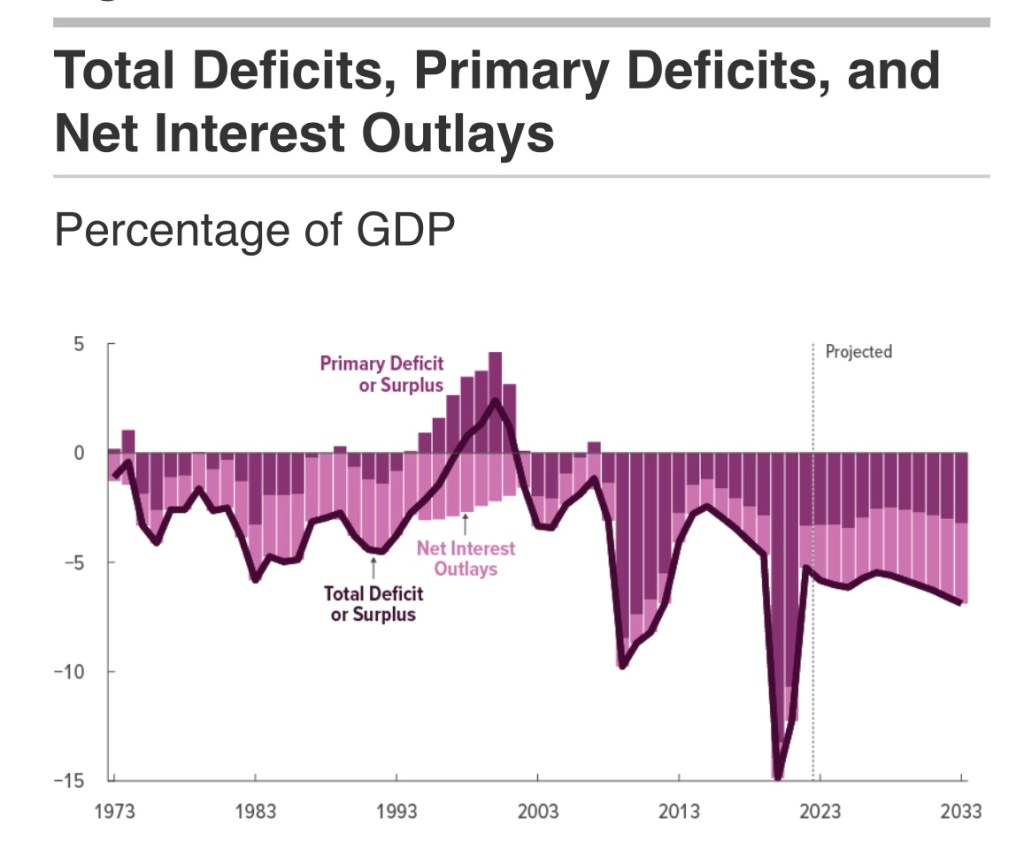
Relief payments made a large contribution to the deficits during the pandemic, but more recent legislation (like the deceitfully-named Inflation Reduction Act) piled-on billions of new subsidies for private investments of questionable value, not to mention outright handouts. These expenditures had nothing to do with economic stabilization and no prayer of reducing inflation. Pissing away money and resources only hastens the debt and interest-cost squeeze that is ultimately unsustainable without massive inflation.

Hardly anyone with future political ambitions wants to address the growing entitlements deficit … but it will catch up with them. Social Security and Medicare are projected to exhaust their respective trust funds in the early- to mid-2030s, which will lead to mandatory benefit cuts in the absence of reform.

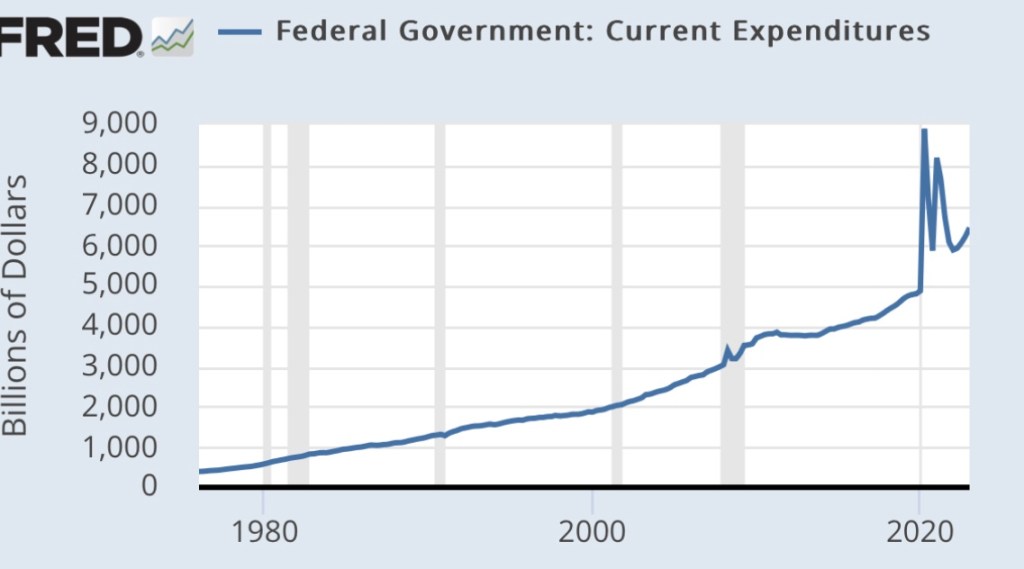
If it still isn’t obvious, the real problem driving the budget imbalance is spending, not revenue, as the next CBO chart demonstrates. The “emergency” pandemic measures helped precipitate our current stabilization dilemma. David Beckworth tweets that the relief measures “spurred a rapid recovery”, though I’d hasten to add that a wave of private and public rejection of extreme precautions in some regions helped as well. And after all, the pandemic downturn was exaggerated by misdirected policies including closures and lockdowns that constrained both the demand and supply sides. Beckworth acknowledges the relief measures “propelled inflation”, but the pandemic also seemed to leave us on a permanently higher spending path. Again, see the first chart below.

The second chart below shows that non-discretionary spending (largely entitlements) and interest outlays are how we got on that path. The only avenue for countercyclical spending is discretionary expenditures, which constitute an ever-smaller share of the overall budget.
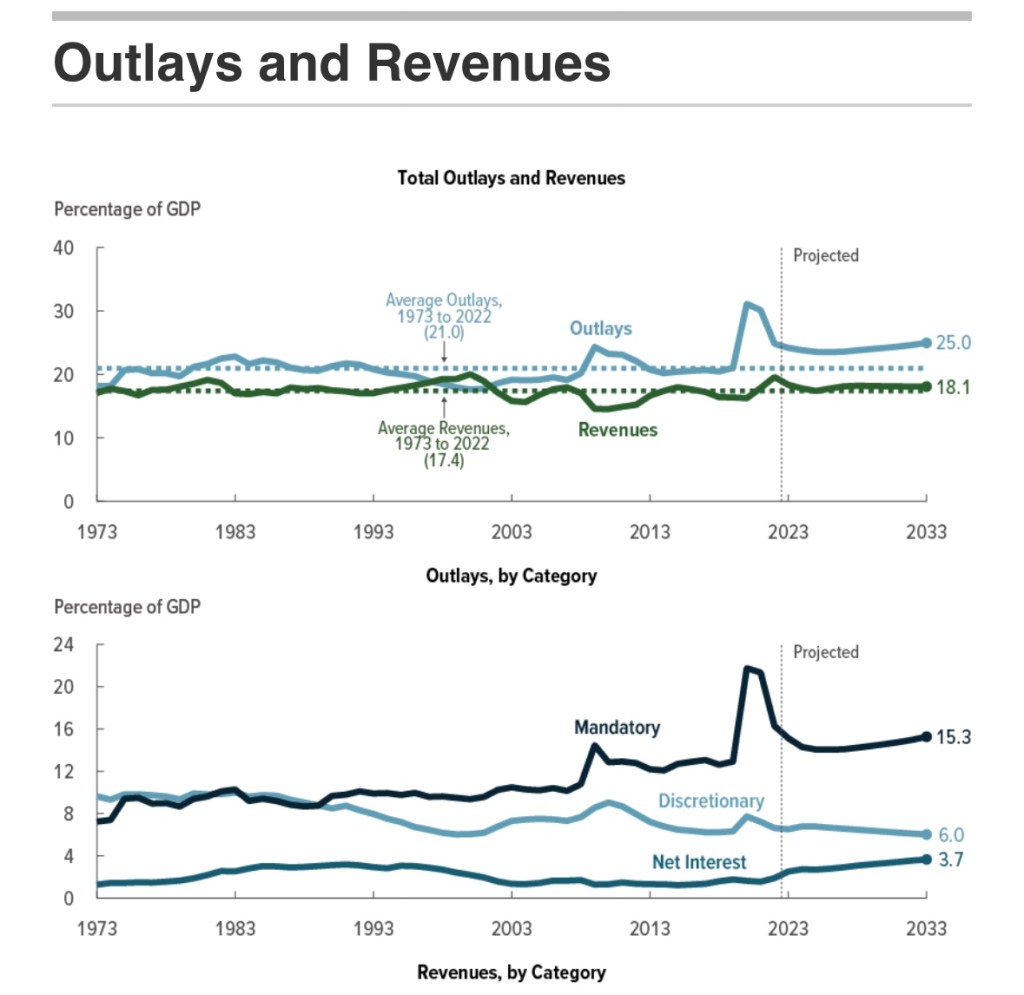
We’ve had chronic deficits for years, but we’ve shifted to a much larger and continuing imbalance. With more deficits come higher interest costs, especially when interest rates follow a typical upward cyclical pattern. This creates a potentially explosive situation that is best avoided via fiscal restraint.

Putting other doubts about fiscal efficacy aside, it’s all but impossible to stimulate real economic activity when you’ve already tapped yourself out and overshot in the midst of a post-pandemic economic expansion.

Multipliers In the Real World

So-called spending multipliers are deeply beloved by Keynesians and pork-barrel spenders. These multipliers tell us that every dollar of extra spending ultimately raises income by some multiple of that dollar. This assumes that a portion of every dollar spent by government is re-spent by the recipient, and a portion of that is re-spent again by another recipient. But spending multipliers are never what they’re cracked up to be for a variety of reasons. (I covered these in “Multipliers Are For Politicians”, and also see this post.) There are leakages out of the re-spending process (income taxes, saving, imports), which trim the ultimate impact of new spending on income. When supply constraints bind on economic activity, fiscal stimulus will be of limited power in real terms.

If stimulus is truly expected to be counter-cyclical and transitory, as is generally claimed, then much of each dollar of extra government spending will be saved rather than spent. This is the lesson of the permanent income hypothesis. It means greater leakages from the re-spending stream and a lower multiplier. We saw this with the bulge in personal savings in the aftermath of pandemic relief payments.

Another side of this coin, however, is that cutting checks might be the government’s single-most efficient activity in execution, but it can create massive incentive problems. Some recipients are happy to forego labor market participation as long as the government keeps sending them checks, but at least they spend some of the income.

Delays

Another unappreciated and destabilizing downside of fiscal stimulus is that it often comes too late, just when the economy doesn’t need stimulus. That’s because a variety of delays are inherent in many spending initiatives: legislative, regulatory, legal challenges, planning and design, distribution to various spending authorities, and final disbursement. As I noted here:

“Even government infrastructure projects, heralded as great enhancers of American productivity, are often subject to lengthy delays and cost overruns due to regulatory and environmental rules. Is there any such thing as a federal ‘shovel-ready’ infrastructure project?”

Crowding Out

The supply of savings is limited, but when government borrows to fund deficits, it directly competes with private industry for those savings. Thus, funds that might otherwise pay for new plant, equipment, and even R&D are diverted to uses that should qualify as government consumption rather than long-term investment. Government competition for funds “crowds-out” private activity and impedes growth in the economy’s productive capacity. Thus, the effort to stimulate economic activity is self-defeating in some respects.

Other Peoples’ Money

Government doesn’t respond to price signals the way self-interested private actors do. This indifference leads to mis-allocated resources and waste. It extends to the creation of opportunities for graft and corruption, typically involving diversion of resources into uses that are of questionable productivity (corn ethanol, solar and wind subsidies).

Consider one other type of policy action perceived as counter-cyclical: federal bailouts of failing financial institutions or other troubled businesses. These rescues prop up unproductive enterprises rather than allowing waste to be flushed from the system, which should be viewed as a beneficial aspect of recession. The upshot is that too many efforts at economic stabilization are misdirected, wasteful, ill-timed, and pro-cyclical in impact.

Tax Policy

Like stabilization efforts on the spending side, tax changes may be badly timed. Tax legislation is often complex and can take time for consumers and businesses to adjust. In terms of traditional multiplier analysis, the initial impact of a tax change on spending is smaller than for expenditures, so tax multipliers are smaller. And to the extent that a tax change is perceived as temporary, it is made less effective. Thus, while changes in tax policy can have powerful real effects, they suffer from some of the same practical shortcomings for stabilization as changes in spending.

However, stimulative tax cuts, if well crafted, can boost disposable incomes and improve investment and work incentives. As temporary measures, that might mean an acceleration of certain kinds of activity. Tax increases reduce disposable incomes and may blunt incentives, or prompt delays in planned activities. Thus, tax policy may bear on the demand side as well as the timing of shifts in the economy’s productive potential or supply side.

Monetary Policy

Monetary policy is subject to problems of its own. Again, I refer to practical issues that are seemingly impossible for policy activists to overcome. Monetary policy is conducted by the nation’s central bank, the Federal Reserve (aka, the Fed). It is theoretically independent of the federal government, but the Fed operates under a dual mandate established by Congress to maintain price stability and full employment. Therein lies a basic problem: trying to achieve two goals that are often in conflict with a single policy tool.

Make no mistake: variations in money supply growth can have powerful effects. Nevertheless, they are difficult to calibrate due to “long and variable lags” as well as changes in money “velocity” (or turnover) often prompted by interest rate movements. Excessively loose money can lead to economic excesses and an overshooting of capacity constraints, malinvestment, and inflation. Swinging to a tight policy stance in order to correct excesses often leads to “hard landings”, or recession.

Boom and Bust

The Fed fumbled its way into engineering the Great Depression via excessively tight monetary policy. “Stop and go” policies in the 1970s led to recurring economic instability. Loose policy contributed to the housing bubble in the 2000s, and subsequent maladjustments led to a mortgage crisis (also see here). Don’t look now, but the inflationary consequences of the Fed’s profligacy during the pandemic prompted it to raise short-term interest rates in the spring of 2022. It then acted with unprecedented speed in raising rates over the past year. While raising rates is not always synonymous with tightening monetary conditions, money growth has slowed sharply. These changes might well lead to recession. Thus, the Fed seems given to a pathology of policy shifts that lead to unintentional booms and busts.

Inflation Targeting

The Fed claims to follow a so-called flexible inflation targeting policy. In reality, it has reacted asymmetrically to departures from its inflation targets. It took way too long for the Fed to react to the post-pandemic surge in inflation, dithering for months over whether the surge was “transitory”. It wasn’t, but the Fed was reluctant to raise its target rates in response to supply disruptions. At the same time, the Fed’s own policy actions contributed massively to demand-side price pressures. Also neglected is the reality that higher inflation expectations propel inflation on the demand side, even when it originates on the supply side.

Via Rate Targeting

At a more nuts and bolts level, today the Fed’s operating approach is to control money growth by setting target levels for several key short-term interest rates (eschewing a more direct approach to the problem). This relies on price controls (short-term interest rates being the price of liquidity) rather than allowing market participants to determine the rates at which available liquidity is allocated. Thus, in the short run, the Fed puts itself into the position of supplying whatever liquidity is demanded at the rates it targets. The Fed makes periodic adjustments to these rate targets in an effort to loosen or tighten money, but it can be misdirected in a world of high debt ratios in which rates themselves drive the growth of government borrowing. For example, if higher rates are intended to reduce money growth and inflation, but also force greater debt issuance by the Treasury, the approach might backfire.

Policy Coordination

While nominally independent, the Fed knows that a particular monetary policy stance is more likely to achieve its objectives if fiscal policy is not working at cross purposes. For example, tight monetary policy is more likely to succeed in slowing inflation if the federal government avoids adding to budget deficits. Bond investors know that explosive increases in federal debt are unlikely to be repaid out of future surpluses, so some other mechanism must come into play to achieve real long-term balance in the valuation of debt with debt payments. Only inflation can bring the real value of outstanding Treasury debt into line. Continuing to pile on new debt simply makes the Fed’s mandate for price stability harder to achieve.

Who Calls the Tune?

The Fed has often succumbed to pressure to monetize federal deficits in order to keep interest rates from rising. This obviously undermines perceptions of Fed independence. A willingness to purchase large amounts of Treasury bills and bonds from the public while fiscal deficits run rampant gives every appearance that the Fed simply serves as the Treasury’s printing press, monetizing government deficits. A central bank that is a slave to the spending proclivities of politicians cannot make credible inflation commitments, and cannot effectively conduct counter-cyclical policy.

Stable Policy, Stable Economy

Activist policies for economic stabilization are often perversely destabilizing for a variety of reasons. Good timing requires good forecasts, but economic forecasting is notoriously difficult. The magnitude and timing of fiscal initiatives are usually wrong, and this is compounded by wasteful planning, allocative dysfunction, and a general absence of restraint among political leaders as well as the federal bureaucracy..

Predicting the effects of monetary policy is equally difficult and, more often than not, leads to episodes of over- and under-adjustment. In addition, the wrong targets, the wrong operating approach, and occasional displays of subservience to fiscal pressure undermine successful stabilization. All of these issues lead to doubts about the credibility of policy commitments. Stated intentions are looked upon with doubt, increasing uncertainty and setting in motion behaviors that lead to undesirable economic consequences.

The best policies are those that can be relied upon by private actors, both as a matter of fulfilling expectations and avoiding destabilization. Federal budget policy should promote stability, but that’s not achievable institutions unable to constrain growth in spending and deficits. Budget balance would promote stability and should be the norm over business cycles, or perhaps over periods as long as typical 10-year budget horizons. Stimulus and restraint on the fiscal side should be limited to the effects of so-called automatic stabilizers, such as tax rates and unemployment compensation. On the monetary side, the Fed would do more to stabilize the economy by adopting formal rules, whether a constant rate of money growth or symmetric targeting of nominal GDP.

Biden’s Rx Price Controls: Cheap Politics Over Cures

08 Tuesday Nov 2022

Posted by Nuetzel in Prescription Drugs, Price Controls, Uncategorized

≈ 1 Comment

Tags

Big Pharma, Charles Hooper, CMS, David Henderson, Drug Innovation, Drug R&D, FDA Approval Process, Inflation Reduction Act, Innovation, Insulin Costs, Joe Biden, Joe Grogan, Medicare, Medicare Part B, Medicare Part D, Opioids, Over-prescription, Patent Extensions, Prescription Drug Costs, Price Controls, Price Gouging, Pricing Transparency, Shortages, third-party payments

You can expect dysfunction when government intervenes in markets, and health care markets are no exception. The result is typically over-regulation, increased industry concentration, lower-quality care, longer waits, and higher costs to patients and taxpayers. The pharmaceutical industry is one of several tempting punching bags for ambitious politicians eager to “do something” in the health care arena. These firms, however, have produced many wonderful advances over the years, incurring huge research, development, and regulatory costs in the process. Reasonable attempts to recoup those costs often means conspicuously high prices, which puts a target on their backs for the likes of those willing to characterize return of capital and profit as ill-gotten.

Biden Flunks Econ … Again

Lately, under political pressure brought on by escalating inflation, Joe Biden has been talking up efforts to control the prices of prescription drugs for Medicare beneficiaries. Anyone with a modicum of knowledge about markets should understand that price controls are a fool’s errand. Price controls don’t make good policy unless the goal is to create shortages.

The preposterously-named Inflation Reduction Act is an example of this sad political dynamic. Reducing inflation is something the Act won’t do! Here is Wikipedia’s summary of the prescription drug provisions, which is probably adequate for now:

“Prescription drug price reform to lower prices, including Medicare negotiation of drug prices for certain drugs (starting at 10 by 2026, more than 20 by 2029) and rebates from drug makers who price gouge… .”

“The law contains provisions that cap insulin costs at $35/month and will cap out-of-pocket drug costs at $2,000 for people on Medicare, among other provisions.”

Unpacking the Blather

“Price gouging”, of course, is a well-worn term of art among anti-market propagandists. In this case it’s meaning appears to be any form of non-compliance, including those for which fees and rebates are anticipated.

The insulin provision is responsive to a long-standing and misleading allegation that insulin is unavailable at reasonable prices. In fact, insulin is already available at zero cost as durable medical equipment under Medicare Part B for diabetics who use insulin pumps. Some types and brands of insulin are available at zero cost for uninsured individuals. A simple internet search on insulin under Medicare yields several sources of cheap insulin. GoodRx also offers brands at certain pharmacies at reasonable costs.

As for the cap on out-of-pocket spending under Part D, limiting the patient’s payment responsibility is a bad way to bring price discipline to the market. Excessive third-party shares of medical payments have long been implicated in escalating health care costs. That reality has eluded advocates of government health care, or perhaps they simply prefer escalating costs in the form of health care tax burdens.

Negotiated Theft

The Act’s adoption of the term “negotiation” is a huge abuse of that word’s meaning. David R. Henderson and Charles Hooper offer the following clarification about what will really happen when the government sits down with the pharmaceutical companies to discuss prices:

“Where CMS is concerned, ‘negotiations’ is a ‘Godfather’-esque euphemism. If a drug company doesn’t accept the CMS price, it will be taxed up to 95% on its Medicare sales revenue for that drug. This penalty is so severe, Eli Lilly CEO David Ricks reports that his company treats the prospect of negotiations as a potential loss of patent protection for some products.”

The first list of drugs for which prices will be “negotiated” by CMS won’t take effect until 2026. However, in the meantime, drug companies will be prohibited from increasing the price of any drug sold to Medicare beneficiaries by more than the rate of inflation. Price control is the correct name for these policies.

Death and Cost Control

Henderson and Hooper chose a title for their article that is difficult for the White House and legislators to comprehend: “Expensive Prescription Drugs Are a Bargain“. The authors first note that 9 out of 10 prescription drugs sold in the U.S. are generics. But then it’s easy to condemn high price tags for a few newer drugs that are invaluable to those whose lives they extend, and those numbers aren’t trivial.

Despite the protestations of certain advocates of price controls and the CBO’s guesswork on the matter, the price controls will stifle the development of new drugs and ultimately cause unnecessary suffering and lost life-years for patients. This reality is made all too clear by Joe Grogan in the Wall Street Journal in “The Inflation Reduction Act Is Already Killing Potential Cures” (probably gated). Grogan cites the cancellation of drugs under development or testing by three different companies: one for an eye disease, another for certain blood cancers, and one for gastric cancer. These cancellations won’t be the last.

Big Pharma Critiques

The pharmaceutical industry certainly has other grounds for criticism. Some of it has to do with government extensions of patent protection, which prolong guaranteed monopolies beyond points that may exceed what’s necessary to compensate for the high risk inherent in original investments in R&D. It can also be argued, however, that the FDA approval process increases drug development costs unreasonably, and it sometimes prevents or delays good drugs from coming to market. See here for some findings on the FDA’s excessive conservatism, limiting choice in dire cases for which patients are more than willing to risk complications. Pricing transparency has been another area of criticism. The refusal to release detailed data on the testing of Covid vaccines represents a serious breach of transparency, given what many consider to have been inadequate testing. Big pharma has also been condemned for the opioid crisis, but restrictions on opioid prescriptions were never a logical response to opioid abuse. (Also see here, including some good news from the Supreme Court on a more narrow definition of “over-prescribing”.)

Bad policy is often borne of short-term political objectives and a neglect of foreseeable long-term consequences. It’s also frequently driven by a failure to understand the fundamental role of profit incentives in driving innovation and productivity. This is a manifestation of the short-term focus afflicting many politicians and members of the public, which is magnified by the desire to demonize a sector of the economy that has brought undeniable benefits to the public over many years. The price controls in Biden’s Inflation Reduction Act are a sure way to short-circuit those benefits. Those interventions effectively destroy other incentives for innovation created by legislation over several decades, as Joe Grogan describes in his piece. If you dislike pharma pricing, look to reform of patenting and the FDA approval process. Those are far better approaches.

Conclusion

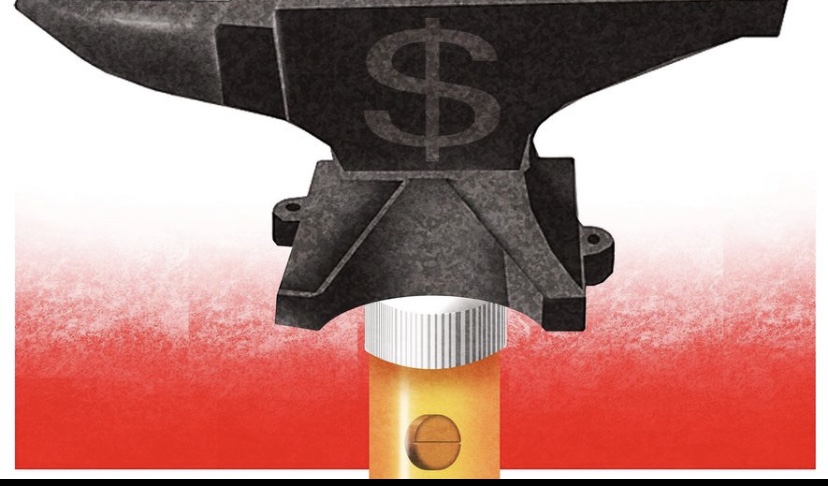
Note: The image above was created by “Alexa” for this Washington Times piece from 2019.

The Vampiric Nature of “Stakeholder” Capitalism

21 Thursday Jul 2022

Posted by Nuetzel in Capitalism, Human Welfare

≈ 1 Comment

Tags

Bank of America, Blackrock, Capital Markets, Consumer Surplus, David Henderson, Don Boudreaux, ESG Scores, Fiduciary Laws, George Will, Mark Joffe, Michael C. Jenner, Producer Surplus, Reservation Wage, Semantic Infiltration, Shareholder Value, Stakeholder Capitalism, Theory of the Firm, Virginia Postrel

When so-called “stakeholders” are in charge of a company, or when non-owner “stakeholders” receive deference to their various goals from management, the actual owners have been displaced and no longer have control. That represents a kind of taking in which managers are complicit, failing to keep proper vigilance in their duty to maximize value for shareholders.

Ceding control to stakeholders represents a severe dislocation in the principle-agent relationship between owners and corporate management. Virginia Postrel is on-point in her discussion of the failures of “stakeholder capitalism”, but she might as well just say that it isn’t capitalism at all! And she’d be right!

Stakeholder capitalism represents a “theory” of the firm that accepts an array of different goals that often stand in conflict. This is the key point raised by Postrel. She cites Michael C. Jenner’s 2010 paper on stakeholder theory in which he notes the impossibility of maximizing any single-valued objective in the presence of a multi-dimensional corporate objective function. Thus, stakeholder objectives nearly always subvert management’s most important responsibility: maximizing value for owners.

And just who are these “stakeholders”? The designation potentially includes just about anyone and everyone: managers, customers and potential customers, suppliers and potential suppliers, employees, the pool of potential job applicants, union organizers, regulators, community members and organizations, local governing bodies, “underserved” populations, anyone with a grievance, environmental activists, and the children of tomorrow. Sure, owners are part of the broad set of stakeholders as well, but as Jenner more or less noted, who’s got time to maximize profits in the face of the myriad “claims” on company resources by the larger, blood-sucking hoard?

George Will aptly refers to stakeholder capitalism as “parasitic progressivism”. In fact, in his opening sentence, he notes that the very term “stakeholder” is a form of semantic infiltration, whereby the innocent (and ignorant) adoption of the term is a gateway to accepting the agenda. Will also notes that management deference to stakeholders violates fiduciary laws intended to protect owners, which include worker pensions and 401(k)s, as well as small investor IRAs, charitable organizations, and insurance companies funding life insurance policies and annuities.

This behavior is not merely parasitic — it is truly vampiric. Once bitten by the woke zombie corpses of stakeholder capitalism, either from within the organization or without, the curse of this deadly economic philosophy spreads. Human resource organizations impose diversity, equity, and inclusion training, rules, and hiring practices on operations. Suppliers might be imposed upon to not only deliver valued inputs, but to do so in a way that pleases multiple stakeholders. Woke fund managers, upon whom the firm might rely for capital, will insist on actions that promote social and environmental “justice”. It can go on and on, and no amount of appeasement is ever sufficient.

Unfortunately, there really are activist investors — actual stockholders — who encourage this misguided philosophy. If the majority of a firm’s owners wish to be accountable to the whims of particular non-owner stakeholders, that’s their right. Other investors would be wise to sell their shares… fast! Wastrels and incompetents have blown many a great and small fortune over the years, but capital markets are well-equipped to punish them, and eventually they will. Get woke, go broke!

The best way for a firm to maximize its contribution to society is to do its job well. That task involves producing a good or service that is valued by customers. By doing it well and efficiently, shareholders, customers, employees and society all win. This is the magic of mutually beneficial trade! Produce something that customers value highly while being mindful of tradeoffs that allow resource costs to be minimized. In general, the customers extract surplus value; shareholders extract surplus value; suppliers extract surplus value; and employees extract a surplus value because they receive wages at least as high as the lowest “reservation” wages they’d find acceptable. Here are some comments from Don Boudreaux on this general point:

“… regardless of how well or poorly managers are at running their companies in ways that maximize share values, there’s every reason to believe that managers will be much less competent at running their companies in ways that adequately satisfy ‘stakeholder’ interests. Not only is the definition of ‘stakeholder’ inherently open-ended and ambiguous, even the most skilled managers have no way to know how to trade-off the well-being of one set of ‘stakeholders’ for that of another set.”

This is very nearly a restatement of Jenner’s conclusion, but Jenner’s applies even when managers know specifics about the tradeoffs. Generally they don’t! Remember too that the firm, its shareholders, suppliers, and its employees are all subject to taxes on their surplus values, so their contribution to society exceeds their own gain. Moreover, many firms are already regulated precisely because lawmakers believe government has an interest in protecting larger classes of “stakeholders”. But beyond meeting regulatory requirements, to further insist that firms devote less than their remaining energies and resources to doing their jobs well, and to ask them to focus instead on the varied interests of external parties, whomever they might be, is ultimately a prescription for social harm.

A monster child of stakeholder theory is so-called ESG scoring. ESG stands for Environmental, Social, and Governance, and the scores are intended as “grades” for how well a firm is addressing these concerns. Proponents claim that high ESG’s are predictive of future returns, but that’s true only if lawmakers and regulators look upon these firms with favor and upon others with disfavor. ESG is basically a political tool. Otherwise, it is an economically illiterate notion foisted upon investors by political activists embedded in “woke” financial institutions like Blackrock and Bank of America. There be some real vampires! As David Henderson and Marc Joffe write, ESG fuels higher prices and obstructs economic growth. That’s because it formalizes the effort to serve “stakeholders”, thus raising the cost of actually producing and delivering the good or service one naturally presumes to be the firm’s primary mission. The shareholders pay the cost, as do customers and employees.

When I hear business people talk reverently about serving their “stakeholders” (and when I hear naive investment advisors wax glowingly about ESG scores), it sends up huge red flags. These individuals have lost sight of their valid objectives. They should be trying to run a business, not serving as a grab-bag for other interests. Serve your customers well and efficiently so as to maximize value for shareholders. Do so within the bounds of the law and ethics, but stick to your business mission and the parties to whom you are ultimately accountable!

Gays and Bakers: Expression or Repression?

26 Monday Feb 2018

Posted by Nuetzel in Discrimination, Free Speech

≈ Leave a comment

Tags

Anti-discrimination law, CO Anti-Discrimination Act, Common Carrier, David Henderson, Eugene Volokh, Freedom of Association, Freedom of Speech, Gay Wedding Cake, Masterpiece Bakeshop, Public Accommodations, Richard Epstein, Unruh Act

A lot rides on the legal interpretation of “expression” in the gay-wedding-cake dispute. Eugene Volokh discusses a recent ruling in California in which a trial court judge ruled that the baker’s right to free expression, buttressed by her right to free exercise of religion, protected her from demands that she participate in a form of expression to which she objected. Specifically, she had no legal obligation to create a cake for the celebration of a gay couple’s wedding, according to the ruling.

The facts in the case, CA Dept. of Fair Employment and Housing v. Cathy’s Creations, are that the baker refused to bake the couple a wedding cake but expressed a willingness to sell them anything that was already available in the shop. Thus, she did not discriminate against the couple by denying them access to her “public accommodations”. She also gave the couple a referral to another baker whom she believed would be willing to produce the cake. So there were probable alternatives available to the couple, and the baker’s assistance in locating one mitigated against any harm suffered by the gay couple. That sort of mitigation is an important factor to consider in weighing the rights of conflicting parties. Courts have tended to view “dignitary harm” as less compelling than forced expression.

Volokh argues that the baker’s role in the episode did not demand expression on her part. He says the proposed cake was a pre-existing design and did not involve writing of any kind. Otherwise, Volokh would have supported the ruling. He and a coauthor discuss the distinctions between an artist (who expresses) and an artisan (who merely executes), and an expressive and a non-expressive cake, in an amicus brief, as noted in the article linked above. Here is Volokh’s summary of his view:

“While creating photographs, videos, and text would be constitutionally protected speech (so we support the right of, for instance, photographers not to photograph same-sex weddings), creating wedding cakes with no text or symbolic design on them is not.“

The Volokh article is a little confusing because the amicus brief seems to have been filed in a different but similar case, Masterpiece Bakeshop v. Colorado Civil Rights Commission, which is now before the U.S. Supreme Court. A ruling is expected this summer. Here is a transcript of the oral arguments in that case, which were heard late last year. It’s a fascinating discussion.

Volokh’s analysis is fine as far as it goes. However, a wedding cake is likely to be considered expressive to both the baker and the cake’s buyers. The baker’s effort in executing even a pre-existing design may involve meaning for her beyond mere execution, since the usual intent of a wedding cake is to celebrate a sacred union. Likewise, the baker knows that the buyers consider the cake to be expressive of their union. The baker doesn’t want any involvement in that expression, asserting that it is not for the government to intercede, forcing them to participate by producing the cake.

Does the baker’s offer to supply an existing cake (or any other bakery good) undermine their case? Does the necessity of baking a new cake for a gay wedding differ from offering a cake already on the shelf for the same purpose? That may be irrelevant to the cases at hand, because no other wedding cakes were available at the time, and freshness might demand the preparation of a new cake for such an occasion. Nevertheless, that sort of line between an acceptable sale for the baker and unacceptable expression strikes me as thin.

As for the matter of the baker’s religious beliefs and their importance to her expressive rights, Volokh derides some of the language of the ruling. Those beliefs, Volokh says, are irrelevant to the question of whether a particular kind of expression is protected or compelled:

“By the way, I take it that it’s clear that the Free Speech Clause issue can’t turn on whether Miller’s belief ‘is part of the orthodox doctrines’ of many religions, or whether it’s instead ‘trivial, arbitrary, nonsensical, or outrageous’ — the Free Speech Clause protects views regardless of whether they express views that are seen as orthodox, outrageous, or nonsensical.“

Bravo! However, when the rights of two parties are in conflict, it is appropriate to weigh any impingement upon other, secondary rights of both parties.

A disturbing aspect of these cases is that they do not turn in any way on freedom of association, a freedom that encompasses a right not to associate (since any association must be voluntary for both parties). The presumption is that the baker’s right to freely associate or not associate with whomever they please is superseded by their obligations under public accommodation laws, despite the fact that freedom of association is an enumerated right in the U.S. Constitution. While public accommodation laws have generally been found to be constitutional, those laws do not apply in all circumstances, such as when a particular product or service involves expression. But on its own, a violation of the baker’s freedom of association seems to matter less, in today’s legal environment, than abridgment of her free expression, and perhaps less than any obligation she has to provide public accommodation.

Richard Epstein gives a general treatment of the balance between freedom of association and anti-discrimination law. David Henderson has bemoaned the dilution of the freedom of association suffered in the name of non-discrimination. He does not defend discrimination on the basis of race, gender or sexual preference. Quite the contrary. However, as a matter of individual liberty, he prefers that we retain our right to associate on any basis of our choosing and pay the price imposed by the market for discrimination. For example, if you hang a sign outside your restaurant saying that you won’t serve African Americans, you are likely to suffer a loss of business from all who find your preference offensive, as many will. That solution is obviously unappealing to those who believe that participation in civil society requires public standards of equal access in private transactions. Still, there is some truth to a quote Henderson provides from an anonymous individual comparing the idea of non-discrimination in public accommodations to the “common carrier” designation:

“‘Either way, the theory boils down to “you brought forth a good or service and abracadabra you now have fewer rights”‘”.

The legal actions against the bakers in the cases discussed above rely on anti-discrimination law (in CA, the Unruh Act, and in CO, the Anti-Discrimination Act). Those laws must face limits in their application, as may be necessary in the case of compelled expression, especially expression against one’s most deeply-held convictions, religious or otherwise. The most basic question in this regard is whether the creation of the proposed wedding (or union) cakes can be described as expression. Whether the bakers are acting as mere fabricators or as artists, there is no doubt that the wedding parties desired the cakes as part of the celebration of their unions. That use of a cake constitutes expression on their part, and it is a kind of expression and an association from which the bakers would prefer to demure.

I support the right of homosexuals to enter into legal marriage, but I also support the bakers’ right to refuse the business. To invoke a phrase used by Richard Epstein in the article linked above, the world would be a better place if all agreed to simply “live and let live”.

“Freedom of Representation” Is a Better Name Than “Right To Work”

15 Friday Sep 2017

Posted by Nuetzel in Right to Work, Unions

≈ 1 Comment

Tags

Agency Fees, Compelled Riders, Competitive Enterprise Institute, David Boaz, David Henderson, Eric Greitens, Exclusive Representation, Free Riders, Gary Chartier, Holman Jenkins, Ivan Osorio, Joe Lehman, Mackinac Center for Public Policy, Missouri Right to Work, monopoly, Monopsony, National Labor Relations Board, Right to Work, Sheldon Richman, Taft-Hartley Act, Vinnie Vernuccio, Wagner Act

Missouri’s Right-to-Work (RtW) legislation, signed into law by Governor Eric Greitens in February of 2016, essentially states that no employee or prospective employee, with certain exceptions, can be required to join a union or to pay union dues or agency fees. But before the RtW law’s effective date on August 28th, well over 300,000 signatures were collected in opposition, which is believed to meet state requirements for a referendum on the issue. As a consequence, the law was put on hold, pending a vote in November.

A casual look at a variety of statistics by state “right-to-work” status shows an impressive advantage for RtW states, though that doesn’t imply causality. One can certainly think of reasons why the causality might be operative, and I find some of them plausible, but that’s not the line of argument I want to pursue here.

The Libertarian Divide

Libertarians are of divided opinion on the desirability of RtW laws. David Boaz wrote about this division back in 2012. On one side, it’s clearly an abrogation of an individual workers’ rights to require, as a condition of employment, entry into a third-party association against their will, or to coerce payment of dues or fees for collective bargaining and ongoing representation on a variety of job-related issues. Such a requirement would violate the constitutional protections on freedom of association, freedom of speech, and freedom of contract. Boaz quotes Vinnie Vernuccio and Joe Lehman of the Mackinac Center for Public Policy:

“Right to work does not change any aspect of collective bargaining other than preventing employees from getting fired for choosing not to join or remain in a union and pay union dues or agency fees, which may go toward political causes they don’t support. Collective bargaining still exists in right-to-work states, and workers are of course free to organize.“

This may overstate the consequences for workers who would rather not join a union. Non-union workers have so-called Beck rights, which allow them to opt out of “core membership” and  pay reduced dues covering only representation. An appropriate accounting for that portion of dues might not be straightforward, however, and it is still likely to represent an involuntary payment. Moreover, awareness of Beck rights is far from universal, and asserting them might not be straightforward.

Libertarians who disagree with the perspective expressed in the quote above emphasize the employers’ freedom of contract as though it takes primacy over worker autonomy in the shaping of voluntary and mutually beneficial employment relationships. The thinking is that an employer might actually prefer to host a union shop. There are presumed efficiencies of collective bargaining, standard and agreed-upon work rules, lower turnover, and perhaps even worker loyalty. Among this group of libertarians are Holman Jenkins, Sheldon Richman, and Gary Chartier:

“When a legislature interferes with voluntary employment contracts, it infringes people’s freedom to bargain with their own labor and possessions. Treating this kind of interference as acceptable means licensing arbitrary interventions into the market by politicians, who are ill-equipped to second-guess the decisions made by the real people making work agreements with one another.“

Labor Law

One could be forgiven for thinking that Chartier and the others view RtW as a form of government intervention in otherwise free labor markets. These critics acknowledge, however, that there is already intervention in labor relations via the Wagner Act (1935), which among other things prohibits any refusal “to bargain collectively with the representative of the employer’s employees.” Under the Act, the National Labor Relations Board (NLRB) is charged with:

“… overseeing the process by which employees decide whether to be represented by a labor organization and prosecuting violations. ... issue rules interpreting the labor legislation. This will generally be binding, unless a court deems it to have acted outside its authority. … prevent unfair labor practices, lead investigations, collect evidence, issue subpoenas, and require witnesses to give evidence.“

So, the NLRB is empowered to force employers, if it so chooses, to bargain collectively and even to rule on whether a vote by employees was “fair”. RtW laws are defended as a force to countervail against this federal power. The Wagner Act was later amended by the Taft-Hartley Act (1947) to curb union power and abuses. It created more balance in the relations between unions and employers and it offered some protection to non-union job seekers by prohibiting closed shops. It also allowed states to pass RtW laws to proscribe the forced payment of agency fees by non-union employees, if states so choose. Nevertheless, labor law continues to support monopoly union privileges and abusive tactics. Moreover, restrictions on unions’ use of dues and agency fees for political activities are difficult to enforce in the absence greater requirements for union financial transparency. The response from libertarian critics of RtW laws is that there are avenues for additional reform at the federal level without adding additional interventions (RtW) at the state level.

One of the clearest rebuttals to the above arguments against RtW laws comes from Ivan Osorio of the Competitive Enterprise Institute, who first quotes Chartier on prospective legislation in Indiana:

“‘If employers choose to conclude union-shop contracts with unions, what gives the Indiana legislature the right to interfere?‘”

Here is Osorio’s rejoinder:

“... there is no jurisdiction anywhere in the United States where there is no such interference at all. Simply replace “union shop” with “open shop,” and the one-sidedness of Chartier’s query … becomes clear. Why should the government forbid an employer from negotiating a voluntary membership agreement with a union?“

Exclusive Representation

Another side of the RtW debate is the contention that non-union workers receive the same benefits achieved via collective bargaining if they are employed by a firm having an otherwise unionized work force. Thus, the non-union workers are said to be “free riding” on the union’s efforts. This framing is highly misleading, however. Under the Wagner Act, a firm’s non-union workers are not entitled to pay for benefits negotiated by the union unless the union has opted for exclusive representation. In that case, those non-union workers are not so much free riders as “compelled riders“, who may be forced to accept certain terms, working conditions and particular representation in grievances against their wishes. The union’s exclusive power is thus flexed in two ways: as a monopoly seller of labor to the firm, and as a monopoly seller of agency services to the worker, extracting dues or agency fees in the process.

Balancing Rights

David Henderson’s perspective on the RtW issue is appealing, as he accounts for the tradeoff between emphasizing the rights of workers and employers:

“It’s true that [RtW] laws make it illegal for employers to do what some of them might want to do: namely hire only union workers, require everyone who works for them to join unions, or require everyone who works for them to pay dues to a union. But are there really likely to be many such employers? I don’t think so. …

Now, I don’t know that there are no such employers. Maybe there are some. If so, then it becomes a tradeoff. On the one hand, preserve the rights of many non-union workers, many union workers, and unionized employers but trample on the rights of those few unionized employers. On the other hand, trample on the rights of many union workers, non-union workers, and unionized employers but preserve the rights of those few unionized employers. I choose the first option because I think it tramples on way fewer people’s rights. And, remember, that if you say right-to-work is wrong and you get your way just on that issue, the federal government will continue to trample on many people’s rights. …

… the best solution is to abolish the law that gives government-enforced monopoly power to unions. Sheldon [Richman] and I agree on this. The issue here is whether we should just settle for saying that and pushing for that or do something else meanwhile.“

Union representation can protect workers from an imbalance of power between a large employer and individual workers. But it is not all sweetness and light for unionized workers, not to mention consumers who pay for the influence of unions on prices in general. While unions played a critical role in establishing and defending workers’ rights over the years, they have increasingly presented agency problems for their constituencies. They have also hastened declines in industries facing competitive pressures, which in turn have hastened the decline of union representation generally. (Public sector unions present a different set of problems involving conflicts of interest with taxpayers, but those are beyond the scope of this post.) In general, worker rights in the private sector are better served by allowing self-determination in the matter of union representation. To the extent that state RtW laws protect that autonomy, they are probably worthwhile at this point in the evolution of labor relations. However, if that is the primary effect, RtW is something of a misnomer.

Imprecision and Unsettled Science

21 Friday Apr 2017

Posted by Nuetzel in Global Warming, Propaganda

≈ 2 Comments

Tags

Abatement Cost, Carbon Abatement, Carbon Forcings, Carbon Limits, Charles Hooper, Climate models, Cloud Formation, Confidence Interval, David Henderson, Earth Day, Measurement Error, Natural Climate Variation, Solar Forcings, Statistical Precision, Surface Temperatures, Temperature Aggregation, William Nordhaus

Last week I mentioned some of the inherent upward biases in the earth’s more recent surface temperature record. Measuring a “global” air temperature at the surface is an enormously complex task, requiring the aggregation of measurements taken using different methods and instruments (land stations, buoys, water buckets, ship water intakes, different kinds of thermometers) at points that are unevenly distributed across latitudes, longitudes, altitudes, and environments (sea, forest, mountain, and urban). Those measurements must be extrapolated to surrounding areas that are usually large and environmentally diverse. The task is made all the more difficult by the changing representation of measurements taken at these points, and changes in the environments at those points over time (e.g., urbanization). The spatial distribution of reports may change systematically and unsystematically with the time of day (especially onboard ships at sea).

The precision with which anything can be measured depends on the instrument used. Beyond that, there is often natural variation in the thing being measured. Some thermometers are better than others, and the quality of these instruments has varied tremendously over the roughly 165-year history of recorded land temperatures. The temperature itself at any location is subject to variation as the air shifts, but temperature readings are like snapshots taken at points in time, and may not be representative of areas nearby. In fact, the number of land weather stations used in constructing global temperatures has declined drastically since the 1970s, which implies an increasing error in approximating temperatures within each expanding area of coverage.

The point is that a statistical range of variation exists around each temperature measurement, and there is additional error introduced by vagaries of the aggregation process. David Henderson and Charles Hooper discuss the handling of temperature measurement errors in aggregation and in discussions of climate change. The upward trend in the “global” surface temperature between 1856 and 2004 was about 0.8° C, but a 95% confidence interval around that change is ±0.98° C. (I believe that is probably small given the sketchiness of the early records.) In other words, from a statistical perspective, one cannot reject the hypothesis that the global surface temperature was unchanged for the full period.

Henderson and Hooper make some other salient points related to the negligible energy impulse from carbon forcings relative to the massive impact of variations in solar energy and the uncertainty around the behavior of cloud formation. It’s little wonder that climate models relying on a carbon-forcing impact have erred so widely and consistently.

In addition to reinforcing the difficulty of measuring surface temperatures and modeling the climate, the implication of the Henderson and Hooper article is that policy should not be guided by measurements and models subject to so much uncertainty and such minor impulses or “signals”. The sheer cost of abating carbon emissions is huge, though some alternative means of doing so are better than others. Costs increase as the degree of abatement increases (or replacement of low-carbon alternatives), and I suspect that the incremental benefit decreases. Strict limits on carbon emissions reduce economic output. On a broad scale, that would impose a sacrifice of economic development and incomes in the non-industrialized world, not to mention low-income minorities in the developed world. One well-known estimate by William Nordhaus involved a 90% reduction in world carbon emissions by 2050. He calculated a total long-run cost of between $17 trillion and $22 trillion. Annually, the cost was about 3.5% of world GDP. The climate model Nordhaus used suggested that the reduction in global temperatures would be between 1.3º and 1.6º C, but in view of the foregoing, that range is highly speculative and likely to be an extreme exaggeration. And note the small width of the “confidence interval”. That range is not at all a confidence interval in the usual sense; it is a “stab” at the uncertainty in a forecast of something many years hence.  Nordhaus could not possibly have considered all sources of uncertainty in arriving at that range of temperature change, least of all the errors in measuring global temperature to begin with.

Climate change activists would do well to spend their Earth Day educating themselves about the facts of surface temperature measurement. Their usual prescription is to extract resources and coercively deny future economic gains in exchange for steps that might or might not solve a problem they insist is severe. The realities are that the “global temperature” is itself subject to great uncertainty, and its long-term trend over the historical record cannot be distinguished statistically from zero. In terms of impacting the climate, natural forces are much more powerful than carbon forcings. And the models on which activists depend are so rudimentary, and so error prone and biased historically, that taking your money to solve the problem implied by their forecasts is utter foolishness.

Embracing the Robots

03 Friday Mar 2017

Posted by Nuetzel in Automation, Labor Markets, Technology

≈ 1 Comment

Tags

3-D Printing, Artificial Intelligence, Automation, David Henderson, Don Boudreaux, Great Stagnation, Herbert Simon, Human Augmentation, Industrial Revolution, Marginal Revolution, Mass Unemployment, Matt Ridley, Russ Roberts, Scarcity, Skills Gap, Transition Costs, Tyler Cowan, Wireless Internet

automation84s

Machines have always been regarded with suspicion as a potential threat to the livelihood of workers. That is still the case, despite the demonstrated power of machines make life easier and goods cheaper. Today, the automation of jobs in manufacturing and even service jobs has raised new alarm about the future of human labor, and the prospect of a broad deployment of artificial intelligence (AI) has made the situation seem much scarier. Even the technologists of Silicon Valley have taken a keen interest in promoting policies like the Universal Basic Income (UBI) to cushion the loss of jobs they expect their inventions to precipitate. The UBI is an idea discussed in last Sunday’s post on Sacred Cow Chips. In addition to the reasons for rejecting that policy cited in that post, however, we should question the premise that automation and AI are unambiguously job killing.

The same stories of future joblessness have been told for over two centuries, and they have been wrong every time. The vulnerability in our popular psyche with respect to automation is four-fold: 1) the belief that we compete with machines, rather than collaborate with them; 2) our perpetual inability to anticipate the new and unforeseeable opportunities that arise as technology is deployed; 3) our tendency to undervalue new technologies for the freedoms they create for higher-order pursuits; and 4) the heavy discount we apply to the ability of workers and markets to anticipate and adjust to changes in market conditions.

Despite the technological upheavals of the past, employment has not only risen over time, but real wages have as well. Matt Ridley writes of just how wrong the dire predictions of machine-for-human substitution have been. He also disputes the notion that “this time it’s different”:

“The argument that artificial intelligence will cause mass unemployment is as unpersuasive as the argument that threshing machines, machine tools, dishwashers or computers would cause mass unemployment. These technologies simply free people to do other things and fulfill other needs. And they make people more productive, which increases their ability to buy other forms of labour. ‘The bogeyman of automation consumes worrying capacity that should be saved for real problems,’ scoffed the economist Herbert Simon in the 1960s.“

As Ridley notes, the process of substituting capital for labor has been more or less continuous over the past 250 years, and there are now more jobs, and at far higher wages, than ever. Automation has generally involved replacement of strictly manual labor, but it has always required collaboration with human labor to one degree or another.

The tools and machines we use in performing all kinds of manual tasks become ever-more sophisticated, and while they change the human role in performing those tasks, the tasks themselves largely remain or are replaced by new, higher-order tasks. Will the combination of automation and AI change that? Will it make human labor obsolete? Call me an AI skeptic, but I do not believe it will have broad enough applicability to obviate a human role in the production of goods and services. We will perform tasks much better and faster, and AI will create new and more rewarding forms of human-machine collaboration.

Tyler Cowen believes that AI and  automation will bring powerful benefits in the long run, but he raises the specter of a transition to widespread automation involving a lengthy period of high unemployment and depressed wages. Cowen points to a 70-year period for England, beginning in 1760, covering the start of the industrial revolution. He reports one estimate that real wages rose just 22% during this transition, and that gains in real wages were not sustained until the 1830s. Evidently, Cowen views more recent automation of factories as another stage of the “great stagnation” phenomenon he has emphasized. Some commenters on Cowen’s blog, Marginal Revolution, insist that estimates of real wages from the early stages of the industrial revolution are basically junk. Others note that the population of England doubled during that period, which likely depressed wages.

David Henderson does not buy into Cowans’ pessimism about transition costs. For one thing, a longer perspective on the industrial revolution would undoubtedly show that average growth in the income of workers was dismal or nonexistent prior to 1760. Henderson also notes that Cowen hedges his description of the evidence of wage stagnation during that era. It should also be mentioned the share of the U.S. work force engaged in agricultural production was 40% in 1900, but is only 2% today, and the rapid transition away from farm jobs in the first half of the 20th century did not itself lead to mass unemployment nor declining wages (HT: Russ Roberts). Cowen cites more recent data on stagnant median income, but Henderson warns that even recent inflation adjustments are fraught with difficulties, that average household size has changed, and that immigration, by adding households and bringing labor market competition, has had at least some depressing effect on the U.S. median wage.

Even positive long-run effects and a smooth transition in the aggregate won’t matter much to any individual whose job is easily automated. There is no doubt that some individuals will fall on hard times, and finding new work might require a lengthy search, accepting lower pay, or retraining. Can something be done to ease the transition? This point is addressed by Don Boudreaux in another context in “Transition Problems and Costs“. Specifically, Boudreaux’s post is about transitions made necessary by changing patterns of international trade, but his points are relevant to this discussion. Most fundamentally, we should not assume that the state must have a role in easing those transitions. We don’t reflexively call for aid when workers of a particular firm lose their jobs because a competitor captures a greater share of the market, nor when consumers decide they don’t like their product. In the end, these are private problems that can and should be solved privately. However, the state certainly should take a role in improving the function of markets such that unemployed resources are absorbed more readily:

“Getting rid of, or at least reducing, occupational licensing will certainly help laid-off workers transition to new jobs. Ditto for reducing taxes, regulations, and zoning restrictions – many of which discourage entrepreneurs from starting new firms and from expanding existing ones. While much ‘worker transitioning’ involves workers moving to where jobs are, much of it also involves – and could involve even more – businesses and jobs moving to where available workers are.“

Boudreaux also notes that workers should never be treated as passive victims. They are quite capable of acting on their own behalf. They often act out of risk avoidance to save their funds against the advent of a job loss, invest in retraining, and seek out new opportunities. There is no question, however, that many workers will need new skills in an economy shaped by increasing automation and AI. This article discusses some private initiatives that can help close the so-called “skills gap”.

Crucially, government should not accelerate the process of automation beyond its natural pace. That means markets and prices must be allowed to play their natural role in directing resources to their highest-valued uses. Unfortunately, government often interferes with that process by imposing employment regulations and wage controls — i.e., the minimum wage. Increasingly, we are seeing that many jobs performed by low-skilled workers can be automated, and the expense of automation becomes more worthwhile as the cost of labor is inflated to artificial levels by government mandate. That point was emphasized in a 2015 post on Sacred Cow Chips entitled “Automate No Job Before Its Time“.

Another past post on Sacred Cow Chips called “Robots and Tradeoffs” covered several ways in which we will adjust to a more automated economy, none of which will require the intrusive hand of government. One certainty is that humans will always value human service, even when a robot is more efficient, so there will be always be opportunities for work. There will also be ways in which humans can compete with machines (or collaborate more effectively) via human augmentation. Moreover, we should not discount the potential for the ownership of machines to become more widely dispersed over time, mitigating the feared impact of automation on the distribution of income. The diffusion of specific technologies become more widespread as their costs decline. That phenomenon has unfolded rapidly with wireless technology, particularly the hardware and software necessary to make productive use of the wireless internet. The same is likely to occur with 3-D printing and other advances. For example, robots are increasingly entering consumer markets, and there is no reason to believe that the same downward cost pressures won’t allow them to be used in home production or small-scale business applications. The ability to leverage technology will require learning, but web-enabled instruction is becoming increasingly accessible as well.

Can the ownership of productive technologies become sufficiently widespread to assure a broad distribution of rewards? It’s possible that cost reductions will allow that to happen, but broadening the ownership of capital might require new saving constructs as well. That might involve cooperative ownership of capital by associations of private parties engaged in diverse lines of business. Stable family structures can also play a role in promoting saving.

It is often said that automation and AI will mean an end to scarcity. If that were the case, the implications for labor would be beside the point. Why would anyone care about jobs in a world without want? Of course, work might be done purely for pleasure, but that would make “labor” economically indistinguishable from leisure. Reaching that point would mean a prolonged process of falling prices, lifting real wages on a pace matching increases in productivity. But in a world without scarcity, prices must be zero, and that will never happen. Human wants are unlimited and resources are finite. We’ll use resources more productively, but we will always find new wants. And if prices are positive, including the cost of capital, it is certain that demands for labor will remain.

The Greening-Carbon Nexus

17 Saturday Dec 2016

Posted by Nuetzel in Environment, Global Warming

≈ 2 Comments

Tags

Atmospheric Carbon Concentration, Climate Change, Climate Consensus, David Henderson, Global Greening, global warming, Harrison H. Schmitt, Matt Ridley, Pollution, Rand Paul, Rodney W. Nichols, Roy Spencer, Thomas Malthus

carbon_sequestration

Satellite records show that our world is experiencing a remarkable “greening” in the 21st century, to the seeming chagrin of the environmental left. There is now more vegetation than two decades ago, and greener vegetation, across as much as 50% of the Earth’s vegetated surface area. That area is expanding as well, and the creeping greenery has improved soil moisture levels in some drylands. This bodes well for agricultural productivity, putting another nail in Malthus’ coffin. The satellite studies have concluded that most of the enhanced vegetation is attributable to greater concentration of CO2 in the atmosphere, as opposed to warming or other possible causes. An interesting feedback is that the enhanced vegetation increases natural absorption of CO2, providing an enhanced carbon sink. This, in turn, has caused a pause in the growth of atmospheric carbon cencentration.

The environmental left knows these developments tend to undermine their preferred narrative that human emissions of CO2 must be reduced — at any cost. In fact, already there are warnings that global greening will “outgrow its benefit” as the greater volume of plants begins to decay, releasing carbon. You just can’t make some people happy! But not all of the carbon release from plant decay adds to atmospheric carbon — some is soil-bound — so the greening should provide a fairly durable carbon sink.

Global greening was one of the major motifs in Matt Ridley’s 2016 Global Warming Policy Foundation Lecture. Ridley covered various evidence of greening, but he also discussed the failure of a large contingent of climate researchers to follow a legitimate scientific approach to the study of climate change. Instead, they have politicized their field of study, committing a few noteworthy frauds along the way:

“It is irresponsible not to challenge the evidence properly, especially if the policies pursued in its name are causing suffering. Increasingly, many people would like to outlaw, suppress, prosecute and censor all discussion of what they call ‘the science’ rather than engage in debate. …

No wonder that I talk frequently to scientists who are skeptical, but dare not say so openly. That is a ridiculous state of affairs. We’re told that it’s impertinent to question “the science” and that we must think as we are told. But arguments from authority are the refuge of priests. Thomas Henry Huxley put it this way: ‘The improver of natural knowledge absolutely refuses to acknowledge authority, as such. For him, scepticism is the highest of duties; blind faith the one unpardonable sin’. 

What keeps science honest, what stops it from succumbing entirely to confirmation bias, is that it is decentralized, allowing one lab to challenge another.“

It is all too true that policies advanced in the interests of curbing a slight warming trend cause real suffering, and the pain is heavily concentrated on the most impoverished. The presumed benefits of activist climate-change policies are speculative, at best. They have little chance of reversing atmospheric carbon concentration on their own.

Ridley makes note of the substantial evidence that sensitivity of the climate to airborne carbon concentration is low. This has become increasingly evident with the unfolding of a consistent record of over-forecasts of global temperatures by climate forcing models. Roy Spencer provides insights about these models in a recent discussion of global warming and “dodgy science” on his blog.

There is a widespread myth that 97 percent of climate scientists believe human activity is the main cause of global warming. In fact, that claim was based on a paper counting citations, not scientists; the methods used in the study and the citations themselves were also questionable. I have reviewed that evidence here on Sacred Cow Chips. David Henderson reviewed it here. A large number of studies find fault with so-called “consensus” pronouncements. They should always be viewed with suspicion.

There is also a lively debate underway over whether CO2 should be considered a pollutant! I exhale, therefore I pollute? To the extent that fecal matter is considered a pollutant, is it fair that to say that CO2 is, too? After all, both are anthropogenic. No, they are not even close in terms of an immediate threat to human health. As a philosophical matter, the idea that anything done by man is “unnatural” denies the fact that we are a very part of nature. Obviously, CO2 is not in the same class as pollutants like sulfur dioxide, ammonia, carbon monoxide or toxic metals. Today, these pollutants are very common in many parts of the world, and they are very threatening to human life. Effective mitigation technologies are available, but instead, in the developed West, we fixate on an increase in CO2 concentration of 100 parts per million over many decades, the climate implications of which are de minimis.

Rand Paul’s Facebook page has an ungated link to a WSJ.com commentary by Rodney W. Nichols and Harrison H. Schmitt on “The Phony War Against CO2”. Their commentary provokes questions as to the motives of the environmental left, and certain members of the research community, in shilling for the cause. That we would fight the greening of the globe, and the potential agricultural benefit it could bring, is bizarre. To devote enormous resources to an endeavor that is largely futile is a waste and a tragedy.


Mobility, Safety Nets & Sticky Webs

23 Thursday Jun 2016

Posted by Nuetzel in Big Government, Welfare State

≈ Leave a comment

Tags

Affordable Care Act, Andrei Schleifer, Basic Income Guarantee, Christopher Jencks, Curley Effect, David Henderson, Dependent Class, Don Boudreaux, Earned Income Tax Credit, Edward Glaeser, Employment Incentives, Extreme Poverty, Henry Hazlitt, Kathryn Edin, Labor Force Participation, Luke Shaefer, Marginal Revolution, Medicaid expansion, Michael Tanner, Milton Friedman, Mises Wire, Obamacare, Social Safety Net, Tyler Cowan, Universal Basic Income, Veronique de Rugy, War on Poverty, Welfare State, work incentives

image

We’re unlikely to reduce the share of the U.S. population living in economic dependency under the current policy regime. So many aspects of tax law, regulation and aid programs are designed as if to perpetuate or perhaps even worsen the situation. I’ve discussed this topic before on Sacred Cow Chips in “Degrees of Poverty and the Social Safety Trap“, and “Minority Politics and the Redistributionist Honey Trap“.

Many supporters of aggressive anti-poverty efforts take umbrage at any suggestion that government aid might discourage the poor from engaging in productive activities. They imagine an implication that the poor are “lazy”, perfidious or otherwise undeserving of assistance. Whether that is a misunderstanding or merely rhetorical bite-back, the fact is that it is rational to respond to incentives and there is no shame in doing so. Unfortunately, many assistance programs contain incentive traps or income “cliffs” that discourage work effort. This applies to food stamps, rent subsidies, Obamacare subsidies, and many more of the 120+ federal aid programs and other state and local programs.

Here’s a new example from a research abstract posted at Marginal Revolution: The Medicaid expansion had very negative effects on labor force participation. The funding for Medicaid expansion at the state level was authorized by the Affordable Care Act (ACA) — aka Obamacare, but only about half the states went along with it. From the abstract:

“I find a significant negative relationship between Medicaid expansion and labor force participation, in which expanding Medicaid is associated with 1.5 to 3 percentage point drop in labor force participation.“

The direction of impact is hardly unique, and as Tyler Cowen notes at the link:

“Work is good for most people, and it is even better for their future selves, and their future children too.“

The negative impact of Obamacare is more massive than the estimate above might suggest. Veronique de Rugy at Reason.com discusses how “Federal Programs Keep People Poor“. While most of her article is about the negative impact of high marginal tax rates on the employment prospects of the poor, she also recalls an ugly CBO estimate of the ACA’s impact:

“In 2014, the Congressional Budget Office—Congress’ official fiscal scorekeeper—revised its original estimate to report that because of the law, by 2024 the equivalent of 2.5 million Americans who were otherwise willing and able to work will have exited the labor force.“

There are several different channels through which the negative effects of the ACA operate: Small employers are incented to limit their hiring and the hours of employees, and federal subsidies (and sometimes state benefits) are available to individuals only so long as they remain below certain income thresholds. Again, this is typical of many government aid programs (the Earned Income Tax Credit (EITC) being an exception). More from de Rugy:

“When the government takes away a person’s benefits as his income goes up, it has the same effect as a direct tax. And remember, when you tax something, you usually get less of it. That means these programs can actually hinder income mobility: In order to continue receiving their government cash, individuals are forced to limit the amount they earn. Thus, they have an incentive not to try to climb the income ladder by putting in extra hours or signing up for job training and educational programs.“

Mises Wire recently carried a reprint of an essay by the great Henry Hazlitt, “How To Cure Poverty“. The gist of Hazlitt’s argument is that government largess simply cannot create wealth for society, but only diminish it. The mere process of redistributing the current “pie” consumes resources, but that is minor compared to the future reduction in the size of the pie brought on by the terrible incentives inherent in income taxation and many government benefit programs:

“The problem of curing poverty is difficult and two-sided. It is to mitigate the penalties of misfortune and failure without undermining the incentives to effort and success. … The way to cure poverty is … through … the adoption of a system of private property, freer trade, free markets, and free enterprise. It was largely because we adopted this system more fully than any other country that we became the most productive and hence the richest nation on the face of the globe. Through this system more has been done to wipe out poverty in the last two centuries than in all previous history.“

Harvard professors Edward Glaeser and Andrei Schleifer have written about “The Curley Effect: The Economics of Shaping the Electorate“, which posits that redistributive policies that are harmful to constituents can be rewarding to politicians. The paper deals with policies that encourage emigration of affluent voters away from cities, but which nevertheless reward politicians by increasing the proportion of their political base in the remaining constituency. It seems to apply very well to many major cities in the U.S. However, it certainly applies more broadly, across states and nations, when affluent people and their capital are mobile while the less affluent are not, especially when benefits are at stake. It’s no secret that promises of benefits are often attractive to voters in the short run, even if they are harmful and unsustainable in the long run.

The welfare state appears to have helped to sustain many of the poor at an improved standard of living after accounting for benefits, or it has prevented them from falling into “deep poverty”. However, it hasn’t succeeded in lifting the poor out of dependency on the state. Pre-benefit poverty rates are about the same as they were the late 1960s. In addition, Christopher Jencks observes that the “Very Poor” have in fact become poorer. That’s discussed in his review of “$2.00 a Day: Living on Almost Nothing in America” by Kathryn Edin and Luke Shaefer. Jencks presents statistics showing that those in the lowest two percentiles of the income distribution have suffered a fairly sharp decline in income since 1999. Many of these extremely poor individuals do not avail themselves of benefits for which they could qualify. In addition, the EITC requires earned income. A job loss is a wage loss and, if it goes on, a loss of EITC benefits. Unfortunately, work requirements are more difficult to meet in the presence of wage floors and other distortions imposed by heavy-handed regulation.

A guaranteed national income has become a hot topic recently. Michael Tanner weighs in on “The Pros and Cons…” of such a program. There are many things to like about the idea inasmuch as it could sweep away many of the wasteful programs piled upon each other over the years. It is possible to construct a sliding-scale guarantee that would retain positive incentives for all, as Milton Friedman demonstrated years ago with his negative income tax concept. However, as Tanner points out, there are many details to work out, and the benefits of the switch would depend upon the incentive structure built into the guarantee. As a political plaything, it could still be dangerous to the health of the economy and an impediment to income mobility. Don Boudreaux has registered objections to a guaranteed income, one of which is based on strengthening the wrongheaded argument that we derive all rights from government. Even more interesting is David Henderson’s take on a basic income guarantee. He finds that the budgetary impact of a $10,000 guarantee would equate to a 30% increase in government spending, and that assumes that it replaces all other assistance programs! Henderson also discusses the public choice aspects of income guarantees, as well as moral objections, and he concludes that there are strong reasons to reject the idea on libertarian grounds.

The economy is riddled with too many subsidies, penalties and bad incentives that distort the behavior of various groups. The well-to-do often benefit from subsidies that are every bit as distortionary as those inherent in many public assistance programs. They should all be swept away to restore a dynamic economy with the potential to lift even more out of poverty. There could be a role for a guaranteed income on the grounds that it is better than what we’ve got. But we should recall the words of Hazlitt, who reminded us that we’ve come so far on the strength of property rights, private initiative, and free trade. Left unfettered, those things can take us much farther than the ugly pairing of beneficence and coercion of the government behemoth.


Obamacare’s Left-Handed Monkey Wrench

20 Tuesday Oct 2015

Posted by Nuetzel in Central Planning, Obamacare

≈ Leave a comment

Tags

ACA, Accountable Care Organizations, Bending the Cost Curve, central planning, David Henderson, Exchange Enrollment, Ezra Klein, John C. Goodman, Medicare Advantage, Megan McArdle, Michael Schaus, Obamacare, Obamacare Coops, Obamacare Replacement, Pay For Performance, Risk corridors, Wharton ACA Study

ACA Zombies

Distorted overtures celebrating the great success of Obamacare continue, but no one who cares about the facts is buying the blather. Megan McArdle reminds us that even if we stipulate that the 9.9 million now enrolled on the exchanges have gained something, Obamacare has delivered far less than promised. McArdle also notes the high-risk skew of the population within the risk pools. That’s why insurers are losing money on Obamacare coverage, though their losses have been covered via government “risk corridors” thus far. In “Obamacare Bear Market” at wsj.com (links to a Google search result to get around the paywall — or just search “wsj Obamacare Bear”), we hear about the dismal financial performance of the Obamacare coops, which sell plans on the exchanges. The WSJ also reflects on a new working paper from Wharton economists:

“They conclude that, ‘even under the most optimistic assumptions,’ half of the formerly uninsured take on both a higher financial burden and lower welfare, and on net ‘average welfare for the uninsured population would be estimated to decline after the ACA [Affordable Care Act] if all members of that population obtained coverage.’

In other words, ObamaCare harms the people it is supposed to help. This is not a prescription for a healthy, durable program.“

Health economist John C. Goodman gives more detail on the Wharton study in “Obamacare is bad for the middle class“. Even Ezra Klein admits that the health plan is a failure. Whether Klein really gets it or not, the result is just another failure of central planning. Here’s a quote from Michael Schaus from the last link:

“The same people who failed miserably at launching a website will soon be regulating the sophisticated day-to-day decisions of hospitals, insurers and doctors.“

Anticipating another year of disappointing enrollments ahead, the White House now is low-balling its enrollment target for 2016. This an apparent attempt to present a better face to the public when the bad numbers roll in.

Another piece by Goodman explains that “bending the cost curve” with Obamacare was always a fool’s errand. Again, it has a lot to do with the folly of central planning:

“In a normal market, the entrepreneurs wake up every morning and ask themselves: How can I make costs lower, quality higher, and access to my product better today?

But in a bureaucratic system – where revenues are determined not by customer satisfaction, but by complicated payment formulas – they tend to wake up and ask: How can I get more money out of the payment formulas today?“

Goodman explains that an insurance firm providing coverage through Medicare Advantage would have nothing to gain by introducing cost-saving innovations: all of the extra profit would be turned over to Medicare. Incentives matter, but bureaucrats often fail to understand incentives and their power to improve performance. Goodman also describes the poor results of the so-called Accountable Care Organizations, the futile pilot programs and demonstration projects related to the practice of medicine, and the gaming that has taken place within the hospital “pay-for-performance” program. Ironically, the most certain outcome of any attempt to impose central planning on an industry is that there will be unintended and undesirable consequences.

Goodman has written a book proposing an Obamacare replacement, entitled “A Better Choice: Healthcare Solutions For America“. Here is David Henderson’s favorable review, in which he focuses on the negative labor market effects of Obamacare, including poor incentives for employers and work effort, among other things. To close, here’s an excerpt from Henderson’s introduction:

“If you think that the Patient Protection and affordable Care act (ACA, also known as Obamacare) is bad because of its expense, the distortions it causes in the labor market, its failure to provide people what they really want, and its highly unequal treatment of people in similar situations, wait until you read John C. Goodman’s A Better Choice: Healthcare Solutions for America. You will likely conclude that the ACA is even worse than you thought.

That’s the bad news. The good news is that Goodman … proposes reforms that would do more for the uninsured than the ACA does, and at lower cost, and also would make things better for the currently insured. and it would do all this while avoiding mandates, creating more real competition among insurers, and making the health care sector more responsive to consumers….“

← Older posts
Follow Sacred Cow Chips on WordPress.com

Recent Posts

  • Immigration and Merit As Fiscal Propositions
  • Tariff “Dividend” From An Indigent State
  • Almost Looks Like the Fed Has a 3% Inflation Target
  • Government Malpractice Breeds Health Care Havoc
  • A Tax On Imports Takes a Toll on Exports

Archives

  • December 2025
  • November 2025
  • October 2025
  • September 2025
  • August 2025
  • July 2025
  • June 2025
  • May 2025
  • April 2025
  • March 2025
  • February 2025
  • January 2025
  • December 2024
  • November 2024
  • October 2024
  • September 2024
  • August 2024
  • July 2024
  • June 2024
  • May 2024
  • April 2024
  • March 2024
  • February 2024
  • January 2024
  • December 2023
  • November 2023
  • August 2023
  • July 2023
  • June 2023
  • May 2023
  • April 2023
  • March 2023
  • February 2023
  • January 2023
  • December 2022
  • November 2022
  • October 2022
  • September 2022
  • August 2022
  • July 2022
  • June 2022
  • May 2022
  • April 2022
  • March 2022
  • February 2022
  • January 2022
  • December 2021
  • November 2021
  • October 2021
  • September 2021
  • August 2021
  • July 2021
  • June 2021
  • May 2021
  • April 2021
  • March 2021
  • February 2021
  • January 2021
  • December 2020
  • November 2020
  • October 2020
  • September 2020
  • August 2020
  • July 2020
  • June 2020
  • May 2020
  • April 2020
  • March 2020
  • February 2020
  • January 2020
  • December 2019
  • November 2019
  • October 2019
  • September 2019
  • August 2019
  • July 2019
  • June 2019
  • May 2019
  • April 2019
  • March 2019
  • February 2019
  • January 2019
  • December 2018
  • November 2018
  • October 2018
  • September 2018
  • August 2018
  • July 2018
  • June 2018
  • May 2018
  • April 2018
  • March 2018
  • February 2018
  • January 2018
  • December 2017
  • November 2017
  • October 2017
  • September 2017
  • August 2017
  • July 2017
  • June 2017
  • May 2017
  • April 2017
  • March 2017
  • February 2017
  • January 2017
  • December 2016
  • November 2016
  • October 2016
  • September 2016
  • August 2016
  • July 2016
  • June 2016
  • May 2016
  • April 2016
  • March 2016
  • February 2016
  • January 2016
  • December 2015
  • November 2015
  • October 2015
  • September 2015
  • August 2015
  • July 2015
  • June 2015
  • May 2015
  • April 2015
  • March 2015
  • February 2015
  • January 2015
  • December 2014
  • November 2014
  • October 2014
  • September 2014
  • August 2014
  • July 2014
  • June 2014
  • May 2014
  • April 2014
  • March 2014

Blogs I Follow

  • Passive Income Kickstart
  • OnlyFinance.net
  • TLC Cholesterol
  • Nintil
  • kendunning.net
  • DCWhispers.com
  • Hoong-Wai in the UK
  • Marginal REVOLUTION
  • Stlouis
  • Watts Up With That?
  • Aussie Nationalist Blog
  • American Elephants
  • The View from Alexandria
  • The Gymnasium
  • A Force for Good
  • Notes On Liberty
  • troymo
  • SUNDAY BLOG Stephanie Sievers
  • Miss Lou Acquiring Lore
  • Your Well Wisher Program
  • Objectivism In Depth
  • RobotEnomics
  • Orderstatistic
  • Paradigm Library
  • Scattered Showers and Quicksand

Blog at WordPress.com.

Passive Income Kickstart

OnlyFinance.net

TLC Cholesterol

Nintil

To estimate, compare, distinguish, discuss, and trace to its principal sources everything

kendunning.net

The Future is Ours to Create

DCWhispers.com

Hoong-Wai in the UK

A Commonwealth immigrant's perspective on the UK's public arena.

Marginal REVOLUTION

Small Steps Toward A Much Better World

Stlouis

Watts Up With That?

The world's most viewed site on global warming and climate change

Aussie Nationalist Blog

Commentary from a Paleoconservative and Nationalist perspective

American Elephants

Defending Life, Liberty and the Pursuit of Happiness

The View from Alexandria

In advanced civilizations the period loosely called Alexandrian is usually associated with flexible morals, perfunctory religion, populist standards and cosmopolitan tastes, feminism, exotic cults, and the rapid turnover of high and low fads---in short, a falling away (which is all that decadence means) from the strictness of traditional rules, embodied in character and inforced from within. -- Jacques Barzun

The Gymnasium

A place for reason, politics, economics, and faith steeped in the classical liberal tradition

A Force for Good

How economics, morality, and markets combine

Notes On Liberty

Spontaneous thoughts on a humble creed

troymo

SUNDAY BLOG Stephanie Sievers

Escaping the everyday life with photographs from my travels

Miss Lou Acquiring Lore

Gallery of Life...

Your Well Wisher Program

Attempt to solve commonly known problems…

Objectivism In Depth

Exploring Ayn Rand's revolutionary philosophy.

RobotEnomics

(A)n (I)ntelligent Future

Orderstatistic

Economics, chess and anything else on my mind.

Paradigm Library

OODA Looping

Scattered Showers and Quicksand

Musings on science, investing, finance, economics, politics, and probably fly fishing.

  • Subscribe Subscribed
    • Sacred Cow Chips
    • Join 128 other subscribers
    • Already have a WordPress.com account? Log in now.
    • Sacred Cow Chips
    • Subscribe Subscribed
    • Sign up
    • Log in
    • Report this content
    • View site in Reader
    • Manage subscriptions
    • Collapse this bar
 

Loading Comments...