• About

Sacred Cow Chips

Sacred Cow Chips

Tag Archives: Nancy Pelosi

Choosing DOGE Over a Prodigal State Apparatus

03 Thursday Apr 2025

Posted by Nuetzel in Big Government, DOGE

≈ Leave a comment

Tags

Al Gore, Barack Obama, Bernie Sanders, Bill Clinton, Border Security, Chuck Schumer, DEI, Department of Education, Department of Government Efficiency, Department of Interior, Discretionary Budget, DOGE, Donald Trump, Elon Musk, entitlements, FDA, Force Reductions, Fourth Branch, Fraud, Graft, HHS, Indirect Costs, Jimmy Carter, Joe Biden, Mandatory Budget, Medicaid, Medicare, Nancy Pelosi, NIH Grants, Obamacare, Provisional Employees, Public debt, Severance Packages, Social Security, U.S. Digital Service, U.S. Postal Service, USAID, Voluntary Separations, Waste
I prefer a government that is limited in size and scope, sticking closely to the provision of public goods without interfering in private markets. Therefore, I’m delighted with the mission of the Department of Government Efficiency (DOGE), a rebranded version of the U.S. Digital Service created by Barack Obama in 2014 to clean up technical issues then plaguing the Obamacare web site. The “new” DOGE is fanning out across federal agencies to upgrade systems and eliminate waste and fraud.

A Strawman

For years, democrats such as Barack Obama and Joe Biden have advocated for eliminating waste in government. So did Bill Clinton, Al Gore, Bernie Sanders, Chuck Schumer, and Nancy Pelosi. Here’s Mark Cuban on the same point. Were these exhortations made in earnest? Or were they just lip service? Now that a real effort is underway to get it done, we’re told that only fascists would do such a thing.

I’m seeing scary posts about DOGE even on LinkedIn, such as the plight of Americans unable to get federal public health communications due to layoffs at HHS, while failing to mention the thousands of new HHS employees hired by Biden in recent years. As if HHS was particularly effective in dispensing good public health advice during the pandemic!

Those kinds of assertions are hard to take seriously. For reasons like these and still others, I tend to dismiss nearly all of the horror stories I hear about DOGE’s activities as nitwitted virtue signals or propaganda.

Many on the left claim that DOGE’s work is careless, and especially the force reductions they’ve spearheaded. For example, they claim that DOGE has failed to identify key employees critical to the functioning of the bureaucracy. The tone of this argument is that “this would not pass muster at a well-managed business”. A “sober” effort to achieve efficiencies within the federal bureaucracy, the argument goes, would involve much more consideration. In other words, given political realities, it would not get done, and they really don’t want it to get done.

The best rationale for the ostensible position of these critics might be situations like the dismissal of several thousand provisional employees at the FDA, a few of whom were later rehired to help manage the work load of reviewing and approving drugs. However, thus far, only a tiny percentage of the federal force reductions under consideration have involved immediate layoffs.

Of course, DOGE is not being tasked to review the practices of a well-managed business or a well-managed governmental organization. What we have here is a dysfunctional government. It is a bloated, low productivity Leviathan run by management and staff who, all too frequently, seem oblivious to the predicament. Large force reductions at all levels are probably necessary to make headway against entrenched interests that have operated as a fourth branch of government.

Thus, I see the leftist critique of Trump’s force reductions as something of a strawman, and it falls flat for several other reasons. First, the vast bulk of the prospective reduction in headcount will be voluntary, as the separating employees have been offered attractive severance packages. Second, force reductions in the private sector always feel chaotic, and they often are. And they are sometimes executed without regard to the qualifications of specific employees. Tough luck!

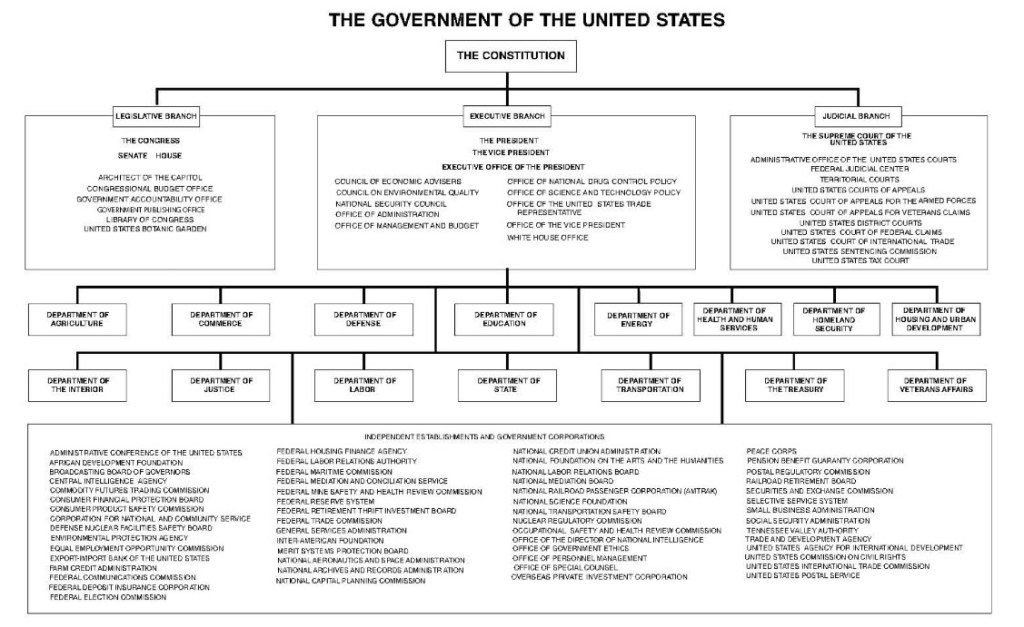
Duplicative functions, poor data systems, and a lack of control have led to massive misappropriations of funds. The dysfunction has been enabled by a metastasization of nests of administrative authority inside agencies with “incomprehensible” org charts, often having multiple departments with identical functions that do not communicate. These departments frequently use redundant but unconnected systems. A related problem is the inadequacy of documentation for outgoing payments. Needless to say, this is a hostile environment for effective spending controls.

It’s worth emphasizing, by the way, DOGE’s “open book” transparency. It’s not as if Elon Musk and DOGE are attempting to sabotage the deep state in the dark of night. Indeed, they are shouting from the rooftops!

Doing It Fast

Every day we have a new revelation from DOGE of incredible waste in the federal bureaucracy. Check out this story about a VA contact for web site maintenance. All too ironically, what we call government waste tends to have powerful, self-interested, and deeply corrupt constituencies. This makes speed an imperative for DOGE. In a highly politicized and litigious environment, the extent to which the Leviathan can be brought to heel is partly a function of how quickly the deconstruction takes place. One must pardon a few temporary dislocations that otherwise might be avoided in a world free of rent seeking behavior. Otherwise, the graft (no, NOT “grift”) will continue unabated.

The foregoing offers sufficient rationale not only for speedy force reductions, but also for system upgrades, dissolution of certain offices, and consolidation of core functions under single-agency umbrellas.

The Bloody Budget

It’s difficult to know when budget legislation will begin to reflect DOGE’s successes. The actual budget deficit might be affected in fiscal year 2025, but so far the savings touted by DOGE are chump change compared to the expected $2 trillion deficit, and only a fraction of those savings contribute to ongoing deficit reduction.

Uncontrolled spending is the root cause of the deficit, as opposed to insufficient tax revenue, as evidenced by a relatively stable ratio of taxes to GDP. The spending problem was exacerbated by the pandemic, but Congress and the Biden Administration never managed to scale outlays back to their previous trend once the economy recovered. Balancing the budget is made impossible when the prevailing psychology among legislators and the media is that reductions in the growth of spending represent spending cuts.

Federal spending is excessive on both the discretionary and mandatory sides of the budget. Ultimately, eliminating the budget deficit without allowing the 2017 Trump tax cuts to expire will require reform to mandatory entitlements like Social Security, Medicare, and Medicaid, as well as reductions across an array of discretionary programs.

DOGE’s focus on fraud and waste extends to entitlements. At a minimum, the data and tracking systems in place at HHS and SSA are antiquated, sometimes inaccurate, and are highly susceptible to manipulation and fraud. Systems upgrades are likely to pay for themselves many times over.

But all indications are that it’s much worse than that. Social security numbers were issued to millions of illegal immigrants during the Biden Administration, and those enrollees were cleared for maximum benefits. There were a significant number of illegals enrolled in Medicaid and registered to vote. While some of these immigrants might be employed and contributing to the entitlement system, they should not be employed without legal status. Of course, one can defend these entitlement benefits on purely compassionate grounds, but the availability of benefits has served to attract a massive flow of illegal border crossings. This illustrates both the extent to which the entitlement system has been compromised as well as the breakdown of border security.

On the discretionary side of the budget, DOGE has identified an impressive array programs that were not just wasteful, but by turns ridiculous or politically motivated (for example, the bulk of USAID’s budget). Many of these funding initiatives belong on the chopping block, and components that might be worthwhile have been moved to agencies with related missions. In addition, authorized but unspent allocations have been identified that seem to have been held in reserve, and which now can be used to reduce the public debt.

Research Grants?

Of course, like the initial scale of the FDA layoffs, a few mistakes have and will be made by DOGE and agencies under DOGE’s guidance. Many believe another powerful argument against DOGE is the Trump Administration’s 15% limit on indirect costs as an add-on to NIH grants. Critics assert that this limit will hamstring U.S. scientific advancement. However, it won’t “kill” publicly funded research. As this article in Reason points out, historically public funding has not been critical to scientific advancement in the U.S. In fact, private funding accounts for the vast bulk of U.S. R&D, according to the Congressional Research Service. Moreover, it’s broadly acknowledged that indirect costs are subject to distortion, and that generous funding of those costs creates bad incentives and raises thorny questions about cross-subsidies across funders (15% is the rate at which charities typically fund indirect costs).

No doubt some elite research universities will suffer declines in grants, but their case is weakened politically by a combination of lax control over anti-Semitic protests on campus, the growing unpopularity of DEI initiatives in education, and public awareness of the huge endowments over which these universities preside. Nevertheless, I won’t be surprised to see the 15% limit on indirect research costs revised upward somewhat.

More DOGE Please

I’ve criticized the numbers posted on DOGE’s website elsewhere. They could do a much better job of categorizing and reporting the savings they’ve achieved, and they have far to go before meeting the goals stated by Elon Musk. Be that as it may, DOGE is making progress. Here is a report on a few of the latest cuts.

As I’ve emphasized on numerous occasions, the federal government is a strangling mass of tentacles, squeezing excessive resources out of the private sector and suffocating producers with an endless catalogue of burdensome rules. There are many examples of systemic waste taking place within the federal bureaucracy. For example, since its creation by Jimmy Carter, the Department of Education has managed to piss away trillions of dollars while student performance has declined. The Small Business Administration has doled out millions of dollars in subsidized loans to super-centenarians as well as children. The U.S. Postal Service keeps losing money and mail while deliveries slow to a crawl. Big projects become mired in endless iterations of reviews and revisions, such as Obama’s infrastructure plan and Joe Biden’s infrastructure and rural broadband initiative.

And again, regulatory agencies are often our worst enemies, imposing burdensome requirements with which only the largest industry players can afford to comply. Indeed, the savings achieved through the DOGE process might pale in comparison to the resources that could be liberated by rationalizing the tangle of regulations now choking private business.

A significant narrowing of the budget deficit would be a major accomplishment for DOGE. Even one-time savings to help pay down the public debt are worthwhile. In this latter regard, I hope DOGE’s work with the Department of Interior helps facilitate the sale of dormant federal assets. This includes land (not parks) and buildings worth literally trillions of dollars, and sometimes costing billions annually to maintain.


Government Action and the “Your Worst Enemy” Test

03 Saturday Dec 2022

Posted by Nuetzel in Big Government, Censorship

≈ 3 Comments

Tags

Big government, Censorship, Donald Trump, Elon Musk, Michael Munger, Munger Test, Nancy Pelosi, regulation, Social Media, Twitter, Unicorn Governance, Your Worst Enemy Test

A couple of weeks back I posted an admittedly partial list of the disadvantages, dysfunctions, and dangers of the Big Government Mess seemingly wished upon us by so many otherwise reasonable people. A wise addition to that line of thinking is the so-called Munger Test articulated by Michael Munger of Duke University. Here, he applies the test to government involvement in social media content regulation:

“If someone says “The STATE should do X” (in this case, decide what is true and what can be published in a privately-owned space), they need to make a substitution.

Instead of “The STATE” substitute “Donald Trump,” and see if you still belief it. (Or “Nancy Pelosi”, if you want).”

If approached honestly, Munger’s test is sure to make a partisan think twice about having government “do something”, or do anything! In a another tweet, Munger elaborates on the case of Twitter, which is highly topical at the moment:

“In fact, the reporters and media moguls who are calling for the state to hammer Twitter, and censor all those other ‘liars’, naively believe that they have a 1000 Year Reich.

You don’t. 𝙔𝙤𝙪 𝙘𝙖𝙣 𝙤𝙣𝙡𝙮 𝙜𝙞𝙫𝙚 𝙩𝙝𝙚 𝙎𝙩𝙖𝙩𝙚 𝙥𝙤𝙬𝙚𝙧𝙨 𝙩𝙝𝙖𝙩 𝙮𝙤𝙪 𝙛𝙖𝙫𝙤𝙧 𝙜𝙞𝙫𝙞𝙣𝙜 𝙩𝙤 𝙮𝙤𝙪𝙧 𝙬𝙤𝙧𝙨𝙩 𝙚𝙣𝙚𝙢𝙮. Deal with it.”

The second sentence in that last paragraph is an even more concise statement of the general principle behind the Munger Test, which we might dub the “Worst Enemy Test” with no disrespect to Munger. He proposed the test (immodestly named, he admits) in his 2014 article, “Unicorn Governance”, in which he offered a few other examples of its application. The article is subtitled:

“Ever argued public policy with people whose State is in fantasyland?”

The answer for me is yes, almost every time I talk to anyone about public policy! And as Munger says, that’s because:

“Everybody imagines that ‘The STATE’ is smart people who agree with them. Once MY team controls the state, order will be restored to the Force.”

So go ahead! Munger-test all your friends’ favorite policy positions the next time you talk!

But what about the case of “regulating” Twitter or somehow interfering with its approach to content moderation? More on that in my next post.

Four More Years to MAGAA

28 Wednesday Oct 2020

Posted by Nuetzel in Big Government, Liberty, Politics

≈ Leave a comment

Tags

Abraham Accords, Affordable Care Act, Amy Coney Barrett, Brett Kavanaugh, corporate taxes, Covid-19, Critical Race Theorist, David E. Bernstein, Deregulation, Donald Trump, Dreamers, Election Politics, Federalism, Free trade, Gun Rights, Immigration, Impeachment, Individual Mandate, Joe Biden, Joel Kotkin, Living Constitution, Medicare, Middle East Peace, Nancy Pelosi, National Defense, Nationalism, NATO, Neil Gorsuch, Originalism, Paris Climate Accord, Pass Through Business, Penalty Tax, Social Security, United Nations

As a “practical” libertarian, my primary test for any candidate for public office is whether he or she supports less government dominance over private decisions than the status quo. When it comes to Joe Biden and his pack of ventriloquists, the answer is a resounding NO! That should clinch it, right? Probably, but Donald Trump is more complicated….

I’ve always viewed Trump as a corporatist at heart, one who, as a private businessman, didn’t give a thought to free market integrity when he saw rent-seeking opportunities. Now, as a public servant, his laudable desire to “get things done” can also manifest to the advantage of cronyists, which he probably thinks is no big deal. Unfortunately, that is often the way of government, as the Biden family knows all too well. On balance, however, Trump generally stands against big government, as some of the points below will demonstrate.

Trump’s spoken “stream of consciousness” can be maddening. He tends to be inarticulate in discussing policy issues, but at times I enjoy hearing him wonder aloud about policy; at other times, it sounds like an exercise in self-rationalization. He seldom prevaricates when his mind is made up, however.

Not that Biden is such a great orator. He needs cheat sheets, and his cadence and pitch often sound like a weak, repeating loop. In fairness, however, he manages to break it up a bit with an occasional “C’mon, man!”, or “Here’s the deal.”

I have mixed feelings about Trump’s bumptiousness. For example, his verbal treatment of leftists is usually well-deserved and entertaining. Then there are his jokes and sarcasm, for which one apparently must have an ear. He can amuse me, but then he can grate on me. There are times when he’s far too defensive. He tweets just a bit too much. But he talks like a tough, New York working man, which is basically in his DNA. He keeps an insane schedule, and I believe this is true: nobody works harder.

With that mixed bag, I’ll now get on to policy:

Deregulation: Trump has sought to reduce federal regulation and has succeeded to an impressive extent, eliminating about five old regulations for every new federal rule-making. This ranges from rolling back the EPA’s authority to regulate certain “waters” under the Clean Water Act, to liberalized future mileage standards on car manufacturers, to ending destructive efforts to enforce so-called net neutrality. By minimizing opportunities for over-reach by federal regulators, resources can be conserved and managed more efficiently, paving the way for greater productivity and lower costs.

And now, look! Trump has signed a new executive order making federal workers employees-at-will! Yes, let’s “deconstruct the administrative state”. And another new executive order prohibits critical race theory training both in the federal bureaucracy and by federal contractors. End the ridiculous struggle sessions!

Judicial Appointments: Bravo! Neil Gorsuch, Brett Kavanaugh, Amy Coney Barrett, and over 200 federal judges have been placed on the bench by Trump in a single term. I like constitutional originalism and I believe a “living constitution” is a corrupt judicial philosophy. The founding document is as relevant today as it was at its original drafting and at the time of every amendment. I think Trump understands this.

Corporate Taxes: Trump’s reductions in corporate tax rates have promoted economic growth and higher labor income. In 2017, I noted that labor shares the burden of the corporate income tax, so a reversal of those cuts would be counterproductive for labor and capital.

At the same time, the 2017 tax package was a mixed blessing for many so-called “pass-through” businesses (proprietors, partnerships, and S corporations). It wasn’t exactly a simplification, nor was it uniformly a tax cut.

Individual Income Taxes: Rates were reduced for many taxpayers, but not for all, and taxes were certainly not simplified in a meaningful way. The link in the last paragraph provides a few more details.

I am not a big fan of Trump’s proposed payroll tax cut. Such a temporary move will not be of any direct help to those who are unemployed, and it’s unlikely to stimulate much spending from those who are employed. Moreover, without significant reform, payroll tax cuts will directly accelerate the coming insolvency of the Social Security and Medicare Trust Funds.

Nonetheless, I believe permanent tax cuts are stimulative to the economy in ways that increased government spending is not: they improve incentives for effort, capital investment, and innovation, thus increasing the nation’s productive capacity. Trump seems to agree.

Upward Mobility: Here’s Joel Kotkin on the gains enjoyed by minorities under the Trump Administration. The credit goes to strong private economic growth, pre-pandemic, as opposed to government aid programs.

Foreign Policy: Peace in the Middle East is shaping up as a real possibility under the Abraham Accords. While the issue of coexisting, sovereign Palestinian and Zionist homelands remains unsettled, it now seems achievable. Progress like this has eluded diplomatic efforts for well over five decades, and Trump deserves a peace prize for getting this far with it.

Iran is a thorn, and the regime is a terrorist actor. I support a tough approach with respect to the ayatollahs, which a Trump has delivered. He’s also pushed for troop withdrawals in various parts of the world. He has moved U.S. troops out of Germany and into Poland, where they represent a greater deterrent to Russian expansionism. Trump has pushed our NATO allies to take responsibility for more of their own defense needs, all to the better. Trump has successfully managed North Korean intransigence, though it is an ongoing problem. We are at odds with the leadership in mainland China, but the regime is adversarial, expansionist, and genocidal, so I believe it’s best to take a tough approach with them. At the UN, some of our international “partners” have successfully manipulated the organization in ways that make continued participation by the U.S. of questionable value. Like me, Trump is no fan of UN governance as it is currently practiced.

Gun Rights: Trump is far more likely to stand for Second Amendment rights than Joe Biden. Especially now, given the riots in many cities and calls to “defund police”, it is vitally important that people have a means of self-defense. See this excellent piece by David E. Bernstein on that point.

National Defense: a pure public good; I’m sympathetic to the argument that much of our “defense capital” has deteriorated. Therefore, Trump’s effort to rebuild was overdue. The improved deterrent value of these assets reduces the chance they will ever have to be used against adversaries. Of course, this investment makes budget balance a much more difficult proposition, but a strong national defense is a priority, as long as we avoid the role of the world’s policeman.

Energy Policy: The Trump Administration has made efforts to encourage U.S. energy independence with a series of deregulatory moves. This has succeeded to the extent the U.S. is now a net energy exporter. At the same time, Trump has sought to eliminate subsidies for wasteful renewable energy projects. Unfortunately, ethanol is still favored by energy policy, which might reflect Trump’s desire to assuage the farm lobby.

Climate Policy: Trump kept us out of the costly Paris Climate Accord, which would have cost the U.S. trillions of dollars in lost GDP and subsidies to other nations. Trump saw through the accord as a scam under which leading carbon-emitting nations (such as China) face few real obligations. Meanwhile, the U.S. has led the world in reductions in carbon emissions during Trump’s term, even pre-pandemic. That’s partly a consequence of increased reliance on natural gas relative to other fossil fuels. Trump has also supported efforts to develop more nuclear energy capacity, which is the ultimate green fuel.

COVID-19 Response: As I’ve written several times, in the midst of a distracting and fraudulent impeachment attempt, Trump took swift action to halt inbound flights from China. He marshaled resources to obtain PPE, equipment, and extra hospital space in hot spots, and he kick-started the rapid development of vaccines. He followed the advice of his sometimes fickle medical experts early in the pandemic, which was not always a good thing. In general, his policy stance honored federalist principles by allowing lower levels of government to address local pandemic conditions on appropriate terms. If the pandemic has you in economic straits, you probably have your governor or local officials to thank. As for the most recent efforts to pass federal COVID relief, Nancy Pelosi and House Democrats have insisted on loading up the legislation with non-COVID spending provisions. They have otherwise refused to negotiate pre-election, as if to blame the delay on Trump.

Immigration: My libertarian leanings often put me at odds with nationalists, but I do believe in national sovereignty and the obligation of the federal government to control our borders. Trump is obviously on board with that. My qualms with the border wall are its cost and the availability of cheaper alternatives leveraging technological surveillance. I might differ with Trump in my belief in liberalizing legal immigration. I more strongly differ with his opposition to granting permanent legal residency to so-called Dreamers, individuals who arrived in the U.S. as minors with parents who entered illegally. However, Trump did offer a legal path to citizenship for Dreamers in exchange for funding of the border wall, a deal refused by congressional Democrats.

Health Care: No more penalty (tax?) to enforce the individual mandate, and the mandate itself is likely to be struck down by the Supreme Court as beyond legislative intent. Trump also oversaw a liberalization of insurance offerings and competition by authorizing short-term coverage of up to a year and enabling small businesses to pool their employees with others in order to obtain better rates, among other reforms. Trump seems to have deferred work on a full-fledged plan to replace the Affordable Care Act because there’s been little chance of an acceptable deal with congressional Democrats. That’s unfortunate, but I count it as a concession to political reality.

Foreign Trade: I’m generally a free-trader, so I’m not wholeheartedly behind Trump’s approach to trade. However, our trade deals of the past have hardly constituted “free trade” in action, so tough negotiation has its place. It’s also true that foreign governments regularly apply tariffs and subsidize their home industries to place them at a competitive advantage vis-a-vis the U.S. As the COVID pandemic has shown, there are valid national security arguments to be made for protecting domestic industries. But make no mistake: ultimately consumers pay the price of tariffs and quotas on foreign goods. I cut Trump some slack here, but this is an area about which I have concerns.

Executive Action: Barack Obama boasted that he had a pen and a phone, his euphemism for exercising authority over the executive branch within the scope of existing law. Trump is taking full advantage of his authority when he deems it necessary. It’s unfortunate that legislation must be so general as to allow significant leeway for executive-branch interpretation and rule-making. But there are times when the proper boundaries for these executive actions are debatable.

Presidents have increasingly pressed their authority to extremes over the years, and sometimes Trump seems eager to push the limits. Part of this is born out of his frustration with the legislative process, but I’m uncomfortable with the notion of unchecked executive authority.

•••••••••••••••••••••••••••••••••••••••••••••••••

Of course I’ll vote for Trump! I had greater misgivings about voting for him in 2016, when I couldn’t be sure what we’d get once he took office. After all, his politics had been all over the map over preceding decades. But in many ways I’ve been pleasantly surprised. I’m much more confident now that he is our best presidential bet for peace, prosperity, and liberty.

Portents of Harris-Biden Nation

22 Thursday Oct 2020

Posted by Nuetzel in Politics

≈ Leave a comment

Tags

#MeToo, Anthony Weiner, Antifa, Barack Obama, Black Lives Matter, Court Packing, Critical Race Theory, Donald Trump, Green New Deal, Harvey Weinstein, Hunter Biden, Jeffrey Toobin, Joe Biden, Kamala Harris, Lockdowns, Marxism, Nancy Pelosi, Public Health, Scientism

Joe Biden is a weak figurehead, a one-time moderate faltering over a coalition of leftists. If you wonder why Nancy Pelosi floated legislation to establish a committee on “presidential capacity,” don’t think so much about her loathing for Donald Trump; think about poor Joe Biden. He might be shunted aside just as soon as the power grab isn’t too obvious. They know well how Barack Obama famously said, “Don’t underestimate Joe’s ability to f*ck things up.” But whether Joe Biden is in control of anything, think about who he stands with:

The Violent Left: Marxist Antifa and Marxist BLM; opposed to law and order; burning cities; spewing eliminationist rhetoric; hissing n*g**r at black cops;

Police Defunders: won’t acknowledge good policing is needed more than ever, especially in minority communities;

“Ministers of Truth”: social media platforms exerting control over what we say and what we see;

Re-Educators: democrats push for a “Truth and Reconciliation Commission” to address the “issue” of Trump supporters;

Critical Race Theorists: a Marxist front whereby every word and action is viewed in the context of racial bias and victimization; they want reparations; on your knees.

The Scientistic: who labor under the delusion that “science” should guide all administrative and political decisions. Or someone’s version of science. The very idea is antithetical to the scientific domain, which deals only with falsifiable hypotheses. Few matters of value can be addressed using the tools of science exclusively, nor can they address matters of ethics.

Fear Mongers: would rule by precaution; risks are always worth exaggerating to existential proportions;

Lockdown Tyrants: refuse to acknowledge the steep public health costs of lockdowns; stripping individual liberties indefinitely, including the right to contract, free practice of religion, and assembly;

Insurrectionists: who fabricated a Russian collusion hoax to subvert the 2016 election, and later to overthrow a sitting president;

Gun Confiscators: they will if we let them;

Abortionists: would use federal tax dollars to fund the murder of millions of babies late into pregnancy, primarily black babies;

Fluid-Genderists: insist that children should be encouraged to explore transgenderism;

Taxers: won’t stop with punitive taxes on the wealthy and employers; it’s just not easy to milk high earners in a way that’s sufficient to pay for the fiscal debauchery demanded by the Biden-Harris constituency. Joe says he will raise taxes by $3.4 trillion.

Spenders: $2 trillion of new federal education outlays, including universal pre-K and free community college; the Green New Deal (see below). After all, the democrats are the party that can’t tell the difference between a cut in spending and a reduction in spending growth. If you think Trump is a big spender, their plans are astonishing;

Green New Dealers: would spend trillions to restrict energy choices, transfer U.S. wealth overseas in the name of international carbon reduction, and reduce our standard of living;

Redistributionists: would tax job creators not simply for the benefit of supporting the needy, but for anyone regardless of need (see UBI); this extends to plans to bail out blue states and cities with insolvent public employee pension funds;

Interventionists: would regulate all phases of life, including straws, sugary drinks, and your fireplace; they will burden private initiative; create artificial, politically-favored winners skilled at manipulating regulatory rules for competitive reasons; and create losers who are typically too small to handle the burden;

Medical Socialists: will strip your private health insurance, dictate the care you may receive, fix prices, and regulate physicians and other providers. You’ll love the care abroad, if you can afford to get out when your sick.

Public School Monopolists: poorly performing, beholden to teachers’ unions, unresponsive to taxpayers and often parents; they would happily revoke school choice;

Federal Suburb Rezoners: demanding low-income housing in every community;

Court Packers: to destroy the independent judiciary;

Iran Apologists: give them cash on the tarmac, let them develop their “peaceful” nuclear program; alienate the rest of the Middle East;

Grifters: marketing their influence as public servants for private gain; never exclusive to one side of the aisle, but the Biden family has certainly traded on Joe to enrich themselves;

Smear Merchants: fabricated allegations against Brett Kavanaugh; impugned Amy Coney Barrett’s religious faith;

Perverts: Harvey Weinstein, Anthony Weiner, Jeffrey Toobin, Hunter Biden, and Bill Clinton, to name just a few; even Joe has his #MeToo accusers;

I could go on and on, but Harris-Biden voters should get a strong taste of their compatriots from the list above. It reflects the overriding prescriptive, bullying, and sometimes violent nature of the Left. They’d have you think all material goods can be free. Presto! They presume to have the knowledge and wisdom to plan the economy and your life better than you, Better than free markets and free people. What they’ll need is a lot of magic, or it won’t go well. You’ll get poverty and tears. I’m not sure Joe has the desire or the wherewithal to rein in his coalition of idiots.

Private Social Distancing, Private Reversal

04 Monday May 2020

Posted by Nuetzel in Liberty, Pandemic, Uncategorized

≈ 1 Comment

Tags

Andrew Cuomo, Anthony Fauci, Apple Mobility, Bill De Blasio, Centre for Economic Policy Research, Donald Trump, Externalities, Forbes, Foursquare, Heterogeneity, John Koetsier, Laissez Faire, Lockdowns, Nancy Pelosi, Points of Interest, Private Governance, Safegraph, Social Distancing, Social Welfare, Stay-at-Home Orders, Vitamin D, Wal Mart, WHO

My original post on the dominance of voluntary social distancing over the mandated variety appears below. That dominance is qualified by the greater difficulty of engaging in certain activities when they are outlawed by government, or when the natural locations of activities are declared off-limits. Nevertheless, as with almost all regulation, people make certain “adjustments” to suit themselves (sometimes involving kickbacks to authorities, because regulation does nothing so well as creating opportunities for graft). Those “adjustments” often lead to much less desirable outcomes than the original, unregulated state. In the case of a pandemic, however, it’s tempting to view such unavoidable actions as a matter of compromise.

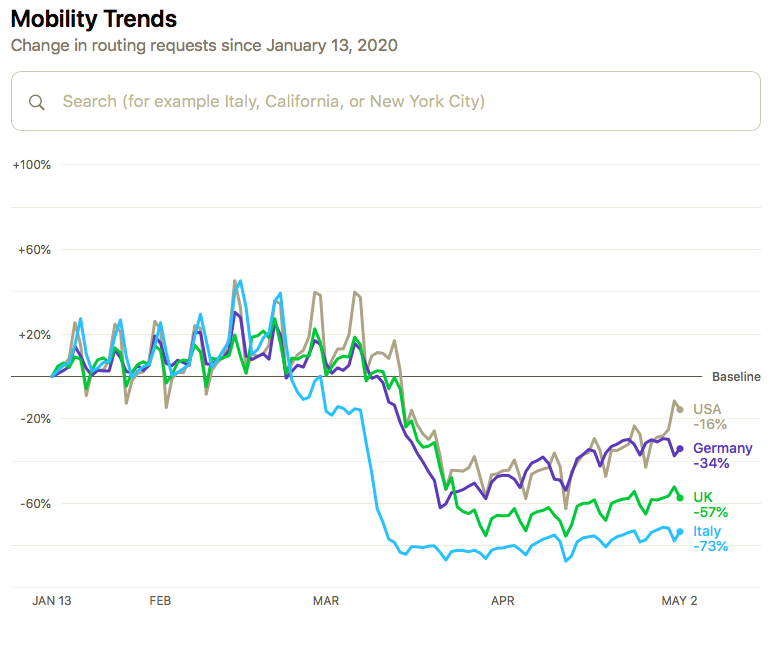
I say this now because the voluntary social distancing preceding most government lockdown orders in March (discussed in the post below) is subject to a degree of self-reversal. Apple Mobility Data suggests that something like that was happening throughout much of April, as shown in the chart at the top of this post. Now, in early May, the trend is likely to continue as some of the government lockdown mandates are being lifted, or at least loosened.

An earlier version of the chart above appeared in a Forbes article entitled, “Apple Data Shows Shelter-In-Place Is Ending, Whether Governments Want It To Or Not“. The author, John Koetsier, noted the Apple data are taken from map searches, so they may not be reliable indicators of actual movement. But he also featured some charts from Foursquare, which showed actual visits to various kinds of destinations, and some of theoe demonstrate the upward trend in activity.

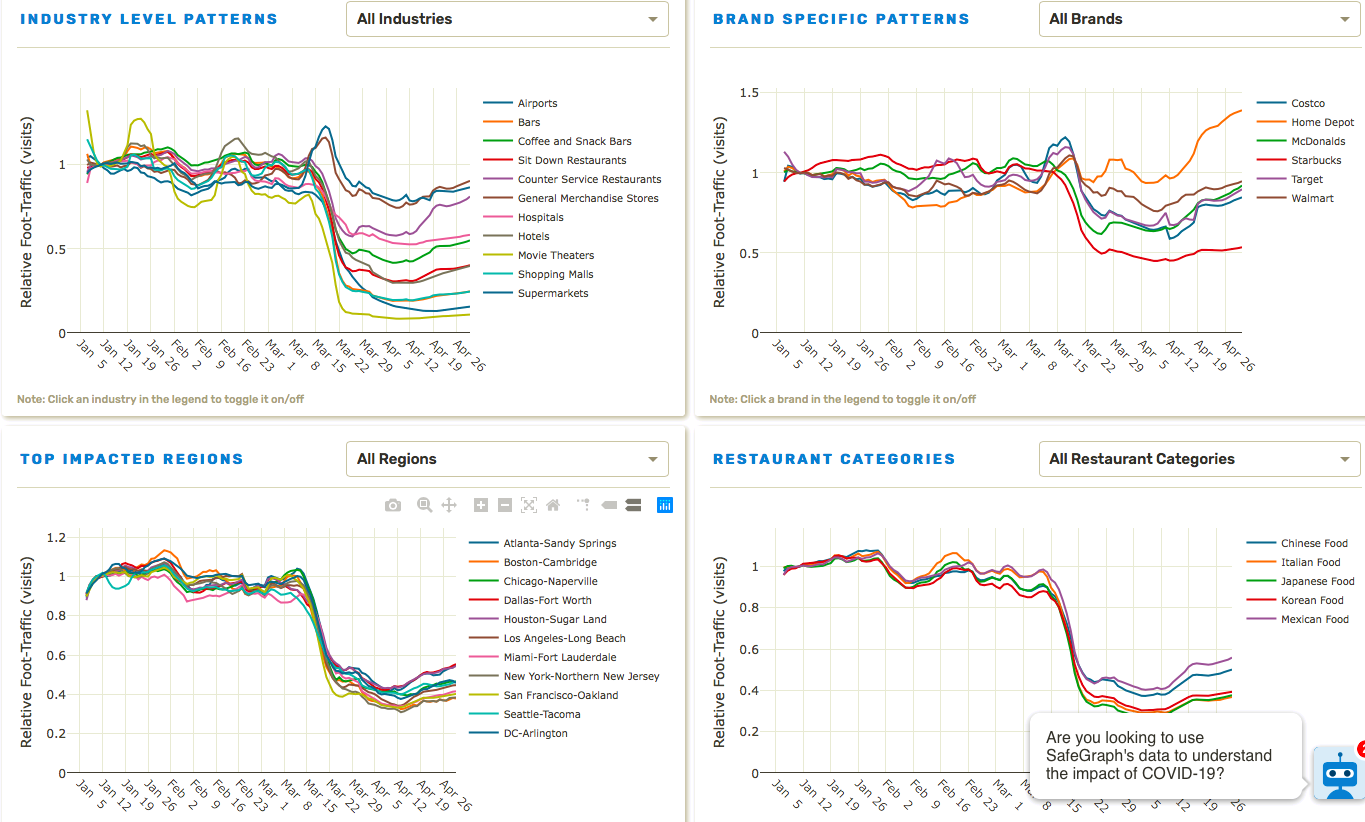
In the original post below, I used SafeGraph charts lifted from a paper I described there. The four charts below are available on the SafeGraph website, which offered the services of the friendly little robot in the lower right-hand corner, but I demurred. You’ll probably need to click on the image to read the detail. They show more granular information by industry, brand, region, and restaurant categories. The upward trends are evident in quite a few of the series.

I should qualify my interpretation of the charts above and those in my original post: First, nine states did not have stay-at-home orders, though a few of those had varying restrictions on individuals and on the operation of “non-essential” businesses. The five having no orders of any kind (that I can tell) are lightly-populated, very low-density states, so the vast majority of the U.S. population was subject to some sort of lockdown measure. Second, eight states began to ease or lift orders in the last few days of April, Georgia and Colorado being the largest. Therefore, at the tail end, a small part of the increase in activity could be related to those liberalizations. Then again, it might have happened anyway.

The authoritarian impulse to shut everything down was largely unnecessary, and it did not accomplish much that voluntary distancing hadn’t accomplished already (again, see below). Healthy people need to stop cowering and take action. That includes the non-elderly and those free of underlying health conditions. Sure, take precautions, keep your distance, but get out of your home if you can. Get some sunny Vitamin D.

Committing yourself to the existence of a shut-in is not healthy, not wise, and it might destroy whatever wealth you possess if you are a working person. The data above show that people are recognizing that fact. As much as the Left wishes it were so, government seldom “knows better”. It is least effective when it uses force to suppress voluntary behavior; it is most effective when it follows consensus, and especially when it protects the rights of individuals to make their own choices where no consensus exists.

Last week’s post follows:

~~~~~~~~~~~~~~~~~~~~~~~~~~~~~~~

How much did state and local governments accomplish when they decided to issue stay-at-home orders? Perhaps not much. That’s the implication of data presented by the authors of “Internal and external effects of social distancing in a pandemic” (starts on page 22 in the linked PDF). Social distancing began in the U.S. in a series of voluntary, private actions. Government orders merely followed and, at best, reinforced those actions, but often in ham-handed ways.

The paper has a broader purpose than the finding that social distancing is often a matter of private initiative. I’ll say a bit more about it, but you can probably skip the rest of this paragraph without loss of continuity. The paper explores theoretical relationships between key parameters (including a social distancing construct) and the dynamics of a pandemic over time in a social welfare context. The authors study several alternatives: a baseline in which behavior doesn’t change in any way; a “laissez faire” path in which actions are all voluntary; and a “socially optimal” path imposed by a benevolent and all-knowing central authority (say what???). I’d offer more details, but I’ll await the coming extension promised by the authors to a world in which susceptible populations are heterogenous (e.g., like Covid-19, where children are virtually unaffected, healthy working age adults are roughly as at-risk as they are to the flu, and a population of the elderly and health-compromised individuals for which the virus is much more dangerous than the flu). In general, the paper seems to support a more liberalized approach to dealing with the pandemic, but that’s a matter of interpretation. Tyler Cowen, who deserves a hat-tip, believes that reading is correct “at the margin”.

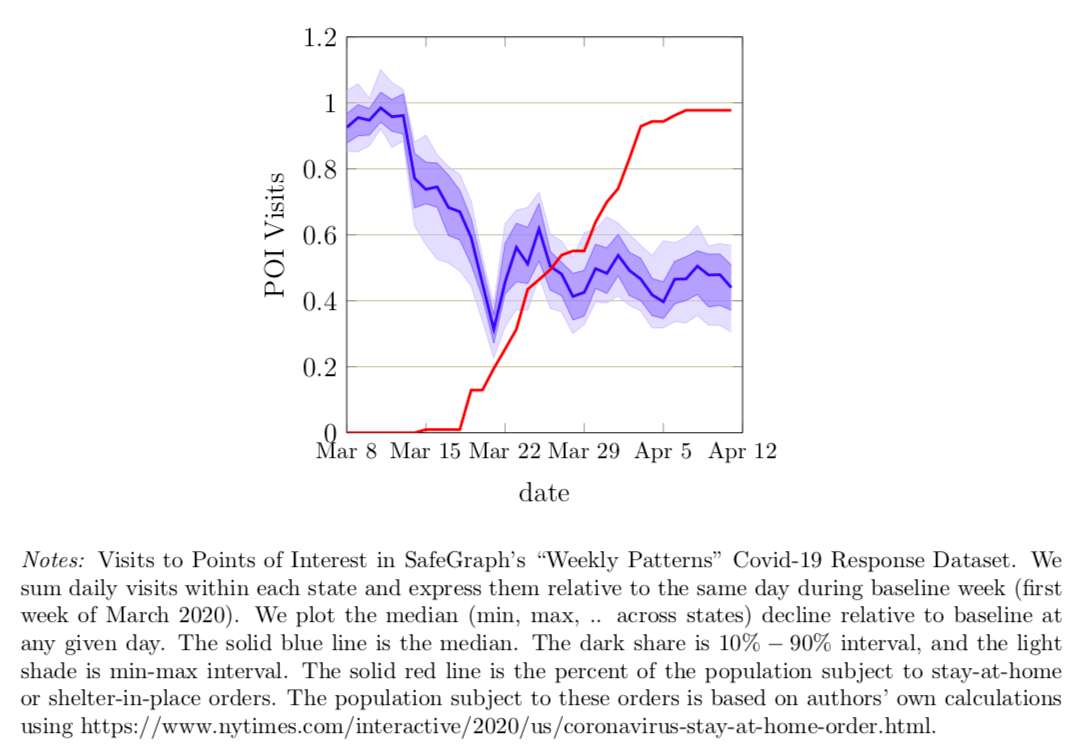
Let’s look at some of the charts the authors present early in the paper. The data on social distancing behavior comes from Safegraph, a vendor of mobility data taken from cell phone location information. This data can be used to construct various proxies for aggregate social activity. The first chart below shows traffic at “points of interest” (POI) in the U.S. from March 8 to April 12, 2020. That’s the blue line. The red line is the percentage of the U.S. population subject to lockdown orders on each date. The authors explain the details in the notes below the chart:

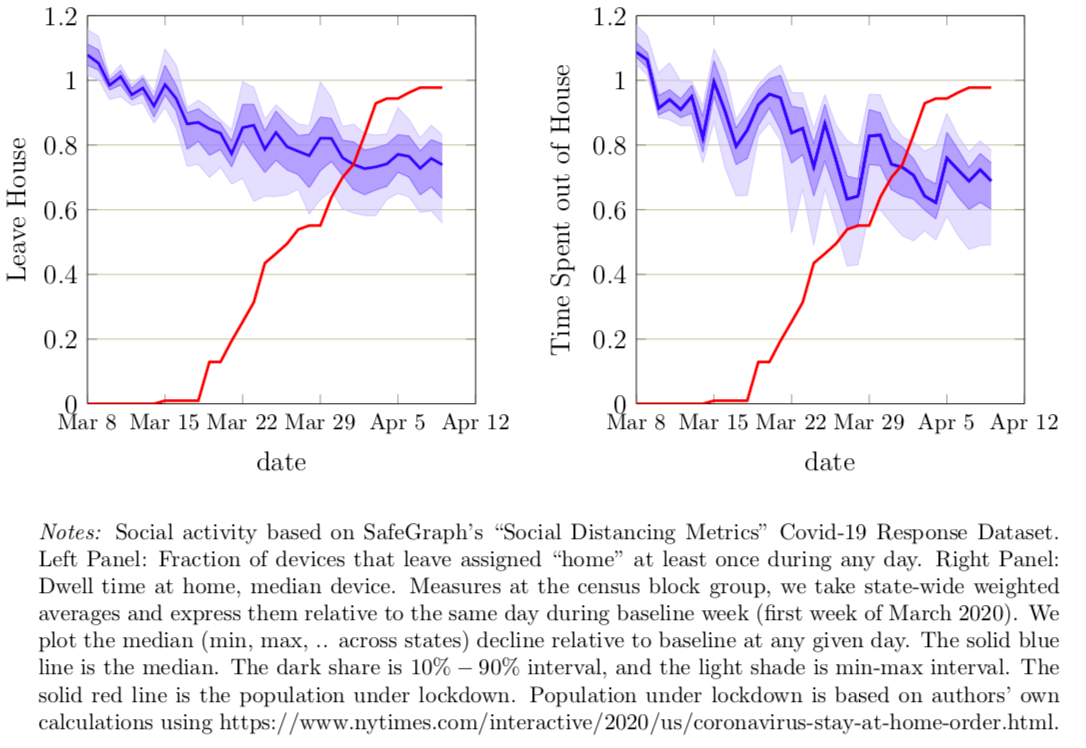
Clearly POI visits were declining sharply before any governments imposed their own orders. The next two charts show similar declines in the percent of mobile devices that leave “home” each day (“home” being the device’s dominant location during nighttime hours) and the duration over which devices were away from “home”, on average.

So all of these measures of social activity began declining well ahead of the government orders. The authors say private social distancing preceded government action in all 50 states. POI traffic was down almost 40% by the time 10% of the U.S. population was subject to government orders, and those early declines accounted for the bulk of the total decline through April 12. The early drops in the two away-from-home measures were 15-20%, again accounting for well over half of the total decline.

The additional declines beyond that time, to the extent they can be discerned, could be either trends that would have continued even in the absence of government orders or reinforcing effects the orders themselves. This does not imply that lockdown orders have no effects on specific activities. Rather, it means that those orders have minor incremental effects on measures of aggregate social activity than the voluntary actions already taken. In other words, the government lockdowns are largely a matter of rearranging the deck chairs, or, that is to say, their distribution.

Many private individuals and institutions acted early in response to information about the virus, motivated by concerns about their own safety and the safety of family and friends. The public sector in the U.S. was not especially effective in providing information, with such politicos as President Donald Trump, Nancy Pelosi, Andrew Cuomo, Bill De Blasio, and the mayor of New Orleans minimizing the dangers into the month of March, and some among them encouraging people to get out and celebrate at public events. Even Anthony Fauci minimized the danger in late February (not to mention the World Health Organization). In fact, “the scientists” were as negligent in their guidance as anyone in the early stages of the pandemic.

When lockdown orders were issued, they were often arbitrary and nonsensical. Grocery stores, liquor stores, and Wal Mart were allowed to remain open, but department stores and gun shops were not. Beaches and parks were ordered closed, though there is little if any chance of infection outdoors. Lawn care services, another outdoor activity, were classified as non-essential in some jurisdictions and therefore prohibited. And certain personal services seem to be available to public officials, but not to private citizens. The lists of things one can and can’t buy truly defies logic.

In March, John W. Whitehead wrote:

“We’re talking about lockdown powers (at both the federal and state level): the ability to suspend the Constitution, indefinitely detain American citizens, bypass the courts, quarantine whole communities or segments of the population, override the First Amendment by outlawing religious gatherings and assemblies of more than a few people, shut down entire industries and manipulate the economy, muzzle dissidents, ‘stop and seize any plane, train or automobile to stymie the spread of contagious disease,’…”

That is fearsome indeed, and individuals can accomplish distancing without it. If you are extremely risk averse, you can distance yourself or take other precautions to remain protected. You can either take action to isolate yourself or you can decide to be in proximity to others. The more risk averse among us will internalize most of the cost of voluntary social distancing. The less risk averse will avoid that cost but face greater exposure to the virus. Of course, this raises questions of public support for vulnerable segments of the population for whom risk aversion will be quite rational. That would certainly be a more enlightened form of intervention than lockdowns, though support should be offered only to those highly at-risk individuals who can’t support themselves.

Christopher Phelan writes of three rationales for the lockdowns: buying time for development of a vaccine or treatments; reducing the number of infected individuals; and to avoid overwhelming the health care system. Phelan thinks all three are of questionable validity at this point. A vaccine might never arrive, and Phelan is pessimistic about treatments (I have more hope in that regard). Ultimately a large share of the population will be infected, lockdowns or not. And of course the health care system is not overwhelmed at this point. Yes, those caring for Covid patients are under a great stress, but the health care system as a whole, and patients with other maladies, are currently suffering from massive under-utilization.

If you wish to be socially distant, you are free to do so on your very own. Individuals are quite capable of voluntary risk mitigation without authoritarian fiat, as the charts above show. While private actors might not internalize all of the external costs of their activities, government is seldom capable of making the appropriate corrections. Coercion to enforce the kinds of crazy rules that have been imposed during this pandemic is the kind of abuse of power the nation’s founders intended to prevent. Reversing those orders can be difficult, and the precedent itself becomes a threat to future liberty. Nevertheless, we see mounting efforts to resist by those who are harmed by these orders, and by those who recognize the short-sighted nature of the orders. Private incentives for risk reduction, and private evaluation of the benefits of social and economic activity, offer superior governance to the draconian realities of lockdowns.

Social Distancing Largely a Private Matter

26 Sunday Apr 2020

Posted by Nuetzel in Liberty, Pandemic, Uncategorized

≈ 1 Comment

Tags

Andrew Cuomo, Anthony Fauci, Bill De Blasio, Centre for Economic Policy Research, Donald Trump, Externalities, Heterogeneity, Laissez Faire, Lockdowns, Nancy Pelosi, Points of Interest, Private Governance, Safegraph, Social Distancing, Social Welfare, Stay-at-Home Orders, Wal Mart, WHO

How much did state and local governments accomplish when they decided to issue stay-at-home orders? Perhaps not much. That’s the implication of data presented by the authors of “Internal and external effects of social distancing in a pandemic” (starts on page 22 in the linked PDF). Social distancing began in the U.S. in a series of voluntary, private actions. Government orders merely followed and, at best, reinforced those actions, but often in ham-handed ways.

The paper has a broader purpose than the finding that social distancing is often a matter of private initiative. I’ll say a bit more about it, but you can probably skip the rest of this paragraph without loss of continuity. The paper explores theoretical relationships between key parameters (including a social distancing construct) and the dynamics of a pandemic over time in a social welfare context. The authors study several alternatives: a baseline in which behavior doesn’t change in any way; a “laissez faire” path in which actions are all voluntary; and a “socially optimal” path imposed by a benevolent and all-knowing central authority (say what???). I’d offer more details, but I’ll await the coming extension promised by the authors to a world in which susceptible populations are heterogenous (e.g., like Covid-19, where children are virtually unaffected, healthy working age adults are roughly as at-risk as they are to the flu, and a population of the elderly and health-compromised individuals for which the virus is much more dangerous than the flu). In general, the paper seems to support a more liberalized approach to dealing with the pandemic, but that’s a matter of interpretation. Tyler Cowen, who deserves a hat-tip, believes that reading is correct “at the margin”.

Let’s look at some of the charts the authors present early in the paper. The data on social distancing behavior comes from Safegraph, a vendor of mobility data taken from cell phone location information. This data can be used to construct various proxies for aggregate social activity. The first chart below shows traffic at “points of interest” (POI) in the U.S. from March 8 to April 12, 2020. That’s the blue line. The red line is the percentage of the U.S. population subject to lockdown orders on each date. The authors explain the details in the notes below the chart:

Clearly POI visits were declining sharply before any governments imposed their own orders. The next two charts show similar declines in the percent of mobile devices that leave “home” each day (“home” being the device’s dominant location during nighttime hours) and the duration over which devices were away from “home”, on average.

So all of these measures of social activity began declining well ahead of the government orders. The authors say private social distancing preceded government action in all 50 states. POI traffic was down almost 40% by the time 10% of the U.S. population was subject to government orders, and those early declines accounted for the bulk of the total decline through April 12. The early drops in the two away-from-home measures were 15-20%, again accounting for well over half of the total decline.

The additional declines beyond that time, to the extent they can be discerned, could be either trends that would have continued even in the absence of government orders or reinforcing effects the orders themselves. This does not imply that lockdown orders have no effects on specific activities. Rather, it means that those orders have minor incremental effects on measures of aggregate social activity than the voluntary actions already taken. In other words, the government lockdowns are largely a matter of rearranging the deck chairs, or, that is to say, their distribution.

Many private individuals and institutions acted early in response to information about the virus, motivated by concerns about their own safety and the safety of family and friends. The public sector in the U.S. was not especially effective in providing information, with such politicos as President Donald Trump, Nancy Pelosi, Andrew Cuomo, Bill De Blasio, and the mayor of New Orleans minimizing the dangers into the month of March, and some among them encouraging people to get out and celebrate at public events. Even Anthony Fauci minimized the danger in late February (not to mention the World Health Organization). In fact, “the scientists” were as negligent in their guidance as anyone in the early stages of the pandemic.

When lockdown orders were issued, they were often arbitrary and nonsensical. Grocery stores, liquor stores, and Wal Mart were allowed to remain open, but department stores and gun shops were not. Beaches and parks were ordered closed, though there is little if any chance of infection outdoors. Lawn care services, another outdoor activity, were classified as non-essential in some jurisdictions and therefore prohibited. And certain personal services seem to be available to public officials, but not to private citizens. The lists of things one can and can’t buy truly defies logic.

In March, John W. Whitehead wrote:

“We’re talking about lockdown powers (at both the federal and state level): the ability to suspend the Constitution, indefinitely detain American citizens, bypass the courts, quarantine whole communities or segments of the population, override the First Amendment by outlawing religious gatherings and assemblies of more than a few people, shut down entire industries and manipulate the economy, muzzle dissidents, ‘stop and seize any plane, train or automobile to stymie the spread of contagious disease,’…”

That is fearsome indeed, and individuals can accomplish distancing without it. If you are extremely risk averse, you can distance yourself or take other precautions to remain protected. You can either take action to isolate yourself or you can decide to be in proximity to others. The more risk averse among us will internalize most of the cost of voluntary social distancing. The less risk averse will avoid that cost but face greater exposure to the virus. Of course, this raises questions of public support for vulnerable segments of the population for whom risk aversion will be quite rational. That would certainly be a more enlightened form of intervention than lockdowns, though support should be offered only to those highly at-risk individuals who can’t support themselves.

Christopher Phelan writes of three rationales for the lockdowns: buying time for development of a vaccine or treatments; reducing the number of infected individuals; and to avoid overwhelming the health care system. Phelan thinks all three are of questionable validity at this point. A vaccine might never arrive, and Phelan is pessimistic about treatments (I have more hope in that regard). Ultimately a large share of the population will be infected, lockdowns or not. And of course the health care system is not overwhelmed at this point. Yes, those caring for Covid patients are under a great stress, but the health care system as a whole, and patients with other maladies, are currently suffering from massive under-utilization.

If you wish to be socially distant, you are free to do so on your very own. Individuals are quite capable of voluntary risk mitigation without authoritarian fiat, as the charts above show. While private actors might not internalize all of the external costs of their activities, government is seldom capable of making the appropriate corrections. Coercion to enforce the kinds of crazy rules that have been imposed during this pandemic is the kind of abuse of power the nation’s founders intended to prevent. Reversing those orders can be difficult, and the precedent itself becomes a threat to future liberty. Nevertheless, we see mounting efforts to resist by those who are harmed by these orders, and by those who recognize the short-sighted nature of the orders. Private incentives for risk reduction, and private evaluation of the benefits of social and economic activity, offer superior governance to the draconian realities of lockdowns.

Left’s Pandemic Response: Politics As Usual

17 Tuesday Mar 2020

Posted by Nuetzel in Health Care, Pandemic, Regulation

≈ 2 Comments

Tags

Biodefense, Breitbart.com, CDC, Centers for Disease Control, Coronavirus, ebola, FDA, Glenn Reynolds, Infectious Diseases, John Bolton, Legal Insurrection, Leslie Eastman, Nancy Pelosi, National Biodefense Strategy, National Security Council, NSC, Pandemic Response Team, Richard Goldberg, Ronald Bailey, Ronna McDaniel, Tim Morrison

The Left asserts that President Trump dismissed and dismantled the nation’s Pandemic Response Team. That’s bullshit. So is the claim that the CDC was defunded. The news media and certain pundits have helped to feed this narrative. Or, as Glenn Reynolds calls those pundits, “Democrat operatives with bylines”.

First of all, the team in question was not at the CDC, a fact that hasn’t always been clear from the commentary on this issue. It was a team of White House overseers at the National Security Council’s “Directorate for Global Health Security and Biodefense”. What happened was this: the senior director of that team resigned after John Bolton was appointed to head the NSC. Bolton might have wanted him out, but what we know is the director resigned. Subsequently, that team was folded into another directorate as part of an long-overdue consolidation. Health experts from the team remain on the NSC staff today. Yet Sen. Sherrod Brown (D-OH)—and many others since—had the temerity to charge that Trump had fired “the entire Whilte House pandemic team”. Well, at least he didn’t imply that it was the CDC.

Tim Morrison wrote the following in the Washington Post yesterday:

“Because I led the very directorate assigned that mission, the counterproliferation and biodefense office, for a year and then handed it off to another official who still holds the post, I know the charge is specious. …

When I joined the National Security Council staff in 2018, I inherited a strong and skilled staff in the counterproliferation and biodefense directorate. This team of national experts together drafted the National Biodefense Strategy of 2018 and an accompanying national security presidential memorandum to implement it; an executive order to modernize influenza vaccines; and coordinated the United States’ response to the Ebola epidemic in Congo, which was ultimately defeated in 2020.”

This assessment at Brietbart.com quotes former senior NSC official Richard Goldberg:

“Weird. A year later I was inside the NSC working with talented global health/biodefense professionals who coordinated an incredibly effective response to Ebola. They’re still there. Working hard. On #Covid_19.”

It’s true that Bolton sought to eliminate red tape, duplication, and bureaucracy within the NSC, and that was wholly justified. According to Morrison, the NSC staff quadrupled from the 1990s through the second Obama term. Pandemics are supposed to be the CDC’s purview, but the proliferation of administrative layers is what happens as government grows uncontrollably. Leslie Eastman at Legal Insurrection questions whether the U.S. needs a permanent “Pandemic Response Team” in the White House. She quotes GOP Chairwoman Ronna McDaniel:

“JAN 7: CDC established a coronavirus incident management system, two days before China announced the outbreak. … Pelosi began Week 3 of withholding her sham impeachment articles. 

JAN 21: The CDC activated its emergency operations center to provide ongoing support to confront coronavirus. …What were Congressional Democrats focused on? Writing their opening arguments for their bogus impeachment trial.”

Well, bully for the CDC. As for “defunding the CDC”, the facts are this: the proposed budget submitted to Congress by the Trump Administration in February, but never passed, did indeed include cuts to the CDC’s budget, which has grown over the years as it expanded its mission from fighting infectious diseases to matters like obesity, racism, and questions of social justice. The cuts proposed by Trump, however, were primarily to state grants. Actually, the proposal called for increased CDC staffing, and it funded all programs related to infectious diseases. But no matter, because that proposal is unlikely to become part of any appropriations bill that would pass Congress.

True to form, the Left plays politics in the middle of a national crisis. When the Trump Administration told airlines that it was considering banning flights from China in late January, it was called racist. Now, of course, he hasn’t done enough. A huge irony, however, is that Trump’s biggest mistake was in trusting the FDA and the CDC’s authority to develop and regulate testing for the coronavirus. They botched it. In a classic case of over-regulation, they prohibited hospitals and labs from conducting tests developed privately or by academic researchers, insisting that everyone wait for the “approved” test to be distributed. Then, the test they released in early February was flawed, costing additional weeks before testing was available.


The Impaired Impeachment

22 Sunday Dec 2019

Posted by Nuetzel in Impeachment

≈ Leave a comment

Tags

Abuse of Power, Burisma, Donald Trump, Due Process, Hunter Biden, Impeachment, Joe Biden, John Durham, Mitch McConnell, Nancy Pelosi, Nixon vs. United States, Obama administration, Obstruction of Justice, Steele Dossier, Ukraine, Volodymyr Zelensky, Walter Nixon

biden-impeach-trump

To avoid defections in their ranks, House Democrats had to pare back so much on the counts for impeaching Donald Trump that they laid bare the raw political motives for bringing the action. Not that their motives needed clarification. They’ve been dying to find grounds on which to impeach Trump since the day of his election. They also know the Senate will not remove Trump from office. Now, the real point is to stain the President as he seeks re-election, and that should strike anyone as an illegitimate purpose.

The two impeachment counts, abuse of power and obstruction of Congress, are flimsy. Proof of the first would require infallible mind-reading skills. It’s doubtful that the Democrats are any better at that than their inability to follow the simple facts of the case. During the controversial phone call with Ukrainian President Zelensky, Trump clearly expressed interest in whether the Ukraine would investigate possible interference in the 2016 U.S. presidential election, and whether the Bidens had been involved, given their involvement with Ukrainian organizations that may have had connections to the Steele dossier. That’s a fair question and a legitimate area of inquiry for the chief executive. It can’t be helped that Joe Biden happens to be running for the Democrat presidential nomination in 2020, as if running for office was enough to absolve one of crime.

The second impeachment count against Trump relies on vacating the constitutional privileges accorded to the chief executive, privileges to which President Obama, and others before him, generously availed themselves (also see here).

House Speaker Nancy Pelosi now has opted to delay transmitting the impeachment articles to the Senate. She said it was important for the House to wrap up their proceedings quickly, so much so that her party could not be bothered to bring a court challenge against Trump’s assertion of executive privilege. But now, Pelosi insists that she must be assured the Senate trial will be conducted “fairly”, as if the proceedings in the House were remotely fair to the President.

One of the House Democrats’ own expert witnesses asserts that the President’s impeachment is not official until the articles are transmitted to the Senate. That might be, but he overlooks the Supreme Court’s 1993 ruling in Nixon vs. the United States in which the Court said that no trial is required for the Senate to acquit anyone impeached by the House, and it may do so without judicial review. So, the Senate can acquit the President now, without a trial and without waiting for Speaker Pelosi to transmit the “charges”, should Senate Majority Leader Mitch McConnell decide to bring it to a vote. Of course, he might not want to as a matter of optics as well as pressure from an incensed Trump to air all of the laundry.

Like the misguided impeachment itself, Pelosi’s motive for holding the transmittal in abeyance is political. Democrats, quite possibly unaware of the Senate’s power under Nixon, and facing their comeuppance, might hope the public forgets the charade that took place in the House and blame Republicans for an “unfair” Senate process that would let Trump off the hook. Or, Pelosi might be hoping for a weakening of Republican resolve on establishing rules for a trial in the Senate, but even that calculation is chancy. It’s even possible Pelosi imagines she can delay the transfer through the 2020 election, hoping to use the House impeachment again and again as a cudgel with which to batter Trump’s re-election chances. Fat chance!

Or is the delay a form of damage control? Does it have something to do with Joe Biden’s vulnerability? He is perhaps at greater risk under a Senate impeachment trial of Trump than Trump himself. Biden is the one who gloated publicly of how he cowed the Ukrainians into dropping an investigation of Burisma, the gas company for which his son Hunter was a board member, by threatening to withhold loan guarantees. Quid Pro Joe!

Biden’s has stated that he would not comply with a subpoena to appear before the Senate in the matter of the Trump impeachment, apparently confusing Trump’s status as the executive with privilege with his own status as an out-of-office candidate for the Democrat nomination. Oh, wait! Now Biden says he would appear after all! Is the contrast between Trump’s phone conversation with the Ukrainian President and Biden’s gloating admission pertinent? You bet!

Or perhaps Pelosi believes it’s unwise to hand the impeachment counts over to the Senate with John Durham’s investigation still hanging in the balance. Durham is looking into the efforts of U.S. intelligence agencies to spy on the Trump campaign in 2016. An ill-timed and damaging outcome for the Obama Administration could make the impeachment trial into a catastrophic event for Biden and other Democrats.

The Democrats’ have brought their longstanding lust for impeaching Trump to fruition only to find that they’ve miscalculated. First, Trump is practically guaranteed an acquittal, so the whole effort was and is a waste of time. Second, public opinion is far from rallying to the Dems cause. According to Gallup, Trump’s approval now is higher than Obama’s at the same point in his presidency, and support for impeachment hasn’t responded as the Democrats had hoped. In fact, if anything, support has eroded, especially in swing states, and the effort has strengthened Trump’s base of support. I would argue that it’s much worse for Democrats than the polls show. Many anti-Democrats, like me, actively avoid participating in polls. That’s partly because the framing of questions is often biased, and partly because I don’t want to be bothered. Finally, the Democrats seem not to fathom the political risks they face with impeachment: 28 Democrat representatives from districts Trump won in 2016 may now face stiffer odds against reelection in 2020, having cast their votes for impeachment. More critically, there are severe risks of a Senate trial to the Bidens, potentially other Obama Administration officials, and the Clintons.

Note: An acknowledgement goes to the Legal Insurrection blog and A.F. Branco for the cartoon at the top.

Another Flop at the Impeachment Playhouse

04 Friday Oct 2019

Posted by Nuetzel in Impeachment

≈ Leave a comment

Tags

Adam Schiff, Australia, China, Cronyism, Donald Trump, FISA Abuse, House Intelligence Committee, Hunter Biden, Impeachment, Inspector General, Joe Biden, Michael Horowitz, Nancy Pelosi, Obama administration, Presidential Powers, Protectionism, Quid Pro Quo, Russia Investigation, Ukraine, Volodymyr Zelenskiy, Whistleblower

Listen, President Trump drives me crazy. His policy instincts often strike me as dangerous: trade protectionist, inflationist, and cronyist. I’m still suspicious that he might play ball with statists left and right on critical issues, when and if he perceives a political advantage in doing so. And Trump is hopelessly inarticulate and belligerent. Nevertheless, I will almost certainly vote for him in 2020 for several reasons, not least because the feasible alternatives are completely unacceptable. That view is reinforced by the behavior of the Democrat party in their effort to fabricate “high crimes and misdemeanors” on Trump’s part. That effort is not just dishonest, it is foolish, and they have a lot to lose. Their machinations are likely to blow up in their faces.

For one thing, the Democrats don’t seem to have much of a case. This time they are focused on a May 2019 phone conversation that took place between Trump and the recently-elected Ukrainian President Volodymyr Zelenskiy. The Democrats contend that Trump held up military aid in order to pressure Zelenskiy to investigate the Biden family’s activities in the Ukraine, a charge flatly denied by Zelenskiy. In fact, at the time of the call, the Ukrainians has no idea that military aid had been suspended, a fact first reported by The New York Times.

The Trump Administration released a transcript of the Zelenskiy call, which offers no evidence that a quid pro quo was offered by Trump. Even the text messages released this morning fail to support the claim. Joe Biden’s name came up during the call in connection with potential interference by the Ukraine in the 2016 U.S. presidential campaign. That’s reasonable in light of the events reported to have taken place, and it is certainly within the scope of presidential powers, as were Trump’s efforts to discuss election interference with Australia, the U.K., and other countries.

If you don’t know it already, a successful impeachment in the House of Representatives will not remove Trump from office. It will constitute a referral of charges to the Senate, which is controlled by Republicans, and a conviction requires a two-thirds majority. Ain’t gonna happen.

In the meantime, there really is no formal “impeachment” underway, despite what you think you’ve heard. This is a “proceeding” that House Speaker Nancy Pelosi really had no authority to initiate, and there is no set of rules or procedures guiding the spectacle. An impeachment investigation requires a House vote, but Democrats voted to table a resolution calling for such a vote because they really don’t want one, not yet anyway. Why? Because it would force them to go on record before they’re quite sure they want to, but more importantly it would demand due process for the accused. A House vote for an impeachment investigation would give House Republicans subpoena powers, something Democrats don’t want to take a chance on.

Again, the whole effort by the Democrats will ultimately be futile, and the trial proceedings in the Senate might be very ugly for them as well. It is likely to shed light on several matters that offer unflattering context for the impeachment effort and might well lead to criminal charges against prominent Democrats and their operatives:

  • Did members of the Obama Administration, the DNC, and Hillary Clinton’s campaign work with the Ukrainian government to undermine the Trump’s candidacy, hatching the Russian collusion narrative in the process? Politico said so in 2017.
  • Did the Biden family trade on Joe Biden’s position to attract capital from large investors for a venture in the Ukraine?
  • What was exchanged in order for Joe Biden’s son Hunter to land a $50,000/month job with a Ukrainian gas company?
  • Did Joe Biden use the authority of his office to strong-arm the Ukrainians into dropping the prosecution of the company that employed his son? “Son of a B“, Joe said, I threatened to walk away and they dropped the investigation. Son of a Biden?
  • Members of Congress sent a letter to the Ukrainian government in May of 2018 that threatened reductions in aid without Ukrainian cooperation with the Mueller investigation into the Trump campaign.
  • A member of the Obama Administration is known to have approached the Ukrainian Embassy in Washington in 2016 to solicit the Ukraine’s participation in a scheme to interfere with the U.S. election.
  • The Intelligence Community Inspector General’s report stated that the “whistleblower” or operative had a political bias. Well, might that have been a motive in the case?
  • Who authorized the change in requirements for whistleblower referrals from first-hand information to second-hand information, or hearsay? And when? Despite denials from left-wing fact-checkers, the Intelligence Community Inspector General’s narrative here doesn’t quite hang together. They gave the operative the wrong form? It’s been claimed that the operative provided first-hand information after all, but where is it?
  • Did members of Congress know about the operative’s complaint before it was formally referred to Congress? Apparently Adam Schiff, Chairman of the House Intelligence Committee, knew before the complaint was drafted, and he lied about it. Was there collaboration with the operative?
  • What are Adam Schiff’s connections in the Ukraine? Let’s find out!

These are all troubling questions that should be investigated. We may or may not get to the bottom of it before the impeachment vote in the House, if it ever occurs. Senate Republicans will undoubtedly be interested in pursuing many of these areas of inquiry, and Joe Biden will not come out of this unscathed. There is likely considerable evidence to support claims that he used political influence to gain his son Hunter favor in the Ukraine and China. 

This month, DOJ Inspector General Michael Horowitz is expected to release his report on the origins and conduct of the Russia investigation into Trump’s 2016 presidential campaign. including potential corruption of the FISA process. His report will reflect the findings of two U.S. attorneys conducting separate inquiries into various aspects of the matter. These reports are a potential disaster for Democrats. Perhaps the distraction of impeachment theatre seems desirable to them, but the longer they continue the fruitless effort to “get Trump”, which began well before he was elected, the more incompetent they look. They don’t seem to have noticed that the whole spectacle is strengthening Trump’s base of support.

Which brings me back to Trump’s belligerence, which I briefly decried above. And it’s true, I often wince, but then I often laugh out loud as well. His political opponents and the media are constantly aghast at his every unapologetic response to their attacks. I will readily admit that it’s deeply satisfying to witness him hurling the crap right back at them, right on the schnoz. In the case of the impeachment drama, his base of support and many others in the middle know the Dems richly deserve it.


Mueller’s Muddle

05 Wednesday Jun 2019

Posted by Nuetzel in Trump Administration

≈ Leave a comment

Tags

Christopher Steele, DOJ, Donald Trump, Impeachment, Inspector General, James Comey, Jonathan Turley, Mueller Report, Nancy Pelosi, Obstruction of Justice, Office of Legal Council, Robert Mueller, Rod Rosenstein, Russian Collusion, Steele Dossier, William Barr

The Mueller Report effectively put to rest allegations of collusion between the Trump campaign and Russia to influence the 2016 election, despite lingering wails from crestfallen Trump haters. But Trump lovers and haters alike might agree that the report should have settled much more, including whether there was evidence on which a charge of obstruction of justice could be brought against Trump. Robert Mueller demurred from that responsibility as a prosecutor, but he left a few tempting but ultimately dangerous crumbs for those still obsessed with toppling Trump.

Mueller’s statement last Wednesday wavered around the suggestion that Trump might be guilty of obstruction, a connotation colored more by politics than evidence. My conclusions, gleaned from both the report and a few other sources, are the following:

  • There was no evidence of collusion between the Trump campaign and Russia.
  • The original allegations were an attempted set-up of Trump. The scheme relied in part on the fraudulent Christopher Steele dossier, which was financed by the Clinton campaign, as well as a series of misrepresentations and suspicious contacts arranged by high-level officials at the Department of Justice and the FBI. That the entire investigation might have been compromised by such a conspiracy was not addressed by Mueller in the report, but we will learn more very soon when the DOJ’s Inspector General issues his findings. The IG will be interviewing Steele himself in the UK before long.
  • Mueller probably knew there was no collusion early in the investigation, but he persisted in “investigating” for two years. In my view, that created the appearance of an effort to entrap an angry Trump on obstruction charges.
  • Trump reacted to the collusion charges with a kind of raving petulance. Of course, it’s hard to blame him for his anger, and Mueller more-or-less acknowledged that. Trump did and said things that surely sounded intemperate, though some were within his prerogative (e.g., firing James Comey). Certain impulsive statements and actions might have risen to the level of obstruction had he not “changed his mind”, or had he bothered to follow-up on execution by aides. And Trump made statements (not under oath) that we’re intended to influence public opinion and possibly the willingness of certain witnesses to cooperate with investigators, but that sort of intent is hard to prove.
  • Of the ten instances of possible obstruction listed by Mueller in his report, two came dangerously close to qualifying as obstruction, two others were more of a stretch, and the rest were readily explained by motives other than an intent to obstruct, as Mueller sometimes indicated in the report.
  • Several of the possible obstruction issues were mitigated by Trump’s apparent willingness to cooperate with the investigation, including the provision to Mueller’s office of a huge volume of emails and documents, and by allowing members of the administration to be interviewed, some at great length.
  • Jonathan Turley has expressed his dismay at three underhanded actions taken by Mueller, one in the report itself and two in the wake of its delivery to his superiors at the DOJ (Attorney General William Barr and Deputy AG Rod Rosenstein). The first was an omission: Mueller chose not to identify grand jury material that had to be redacted before release to the public. This was contrary to instructions and with knowledge that the omission would delay the report’s release to the public and reflect badly on Barr.
  • The second action noted by Turley was a letter sent by Mueller to Barr complaining about the “impression” created by Barr’s summary of the report, despite the fact that Barr had invited Mueller to review the summary in advance. The letter also asked Barr to “release uncleared portions of the report”, which Mueller knew was prohibited. This also seems to have been intended to reflect badly on Barr.
  • Turley’s third point is Mueller’s legally incoherent statement that “he would have cleared Trump if he could have” but chose not to draw a conclusion. Mueller invoked an opinion from the DOJ’s Office of Legal Council (OLC), which he claimed prohibited the indictment of a sitting president. But over a period of two years, he failed to seek further guidance on the question from the OLC, his superiors, or the Inspector General.
  • A more obvious explanation for Mueller’s failure to seek an indictment is that he knew that no grand jury would indict on the evidence as described in the ten instances of possible obstruction he listed in the report.
  • Essentially Mueller left the ball in Barr’s court to decide whether to seek an indictment of Trump on obstruction changes, and Barr decided that the evidence did not support it.
  • However, the very idea of obstruction is moot, or should be, given the first three points above. And apparently Mueller never intended to seek an indictment on collusion, as he stated again last Wednesday.
  • Mueller strayed outside the role of a prosecutor and potentially subverted the cause of justice in stating that he could not exonerate the president of obstruction. There is no such thing as “exoneration” of an accused in U.S. criminal law. Mueller’s role as a prosecutor was to make a determination as to whether he should recommend an indictment against Trump. It was not his role to determine Trump’s guilt and certainly not his innocence, and innocence must always be the presumption.
  • The Mueller report could provide Congress with a “roadmap” for impeachment of Trump on charges of obstruction. If House Democrats decide to take that road, it would very likely be a prescription for their electoral suicide.

No matter how aggravating and uncouth you find Trump, and no matter how unwise his policies might prove to be, he was elected fair and square. Nevertheless, his opponents in Congress and on the campaign trail can’t easily give up the impeachment rhetoric without angering their leftist base. But not all congressional Democrats are voicing support for impeachment proceedings, and House Majority Leader Nancy Pelosi is doing her best to manage the division without making a commitment either way. The Senate will never go along with impeachment, of course. Now, a House vote to merely censure Donald Trump is mentioned as a possible “exit-ramp” to compromise that would let the hard-line impeachers down easy. Whatever they do, however, some Democrats might hope to drag out the process in an attempt to inflict maximal damage to Trump’s reelection prospects. And that, too, is probably ill-advised, because people are getting tired of all this.

← Older posts
Follow Sacred Cow Chips on WordPress.com

Recent Posts

  • Immigration and Merit As Fiscal Propositions
  • Tariff “Dividend” From An Indigent State
  • Almost Looks Like the Fed Has a 3% Inflation Target
  • Government Malpractice Breeds Health Care Havoc
  • A Tax On Imports Takes a Toll on Exports

Archives

  • December 2025
  • November 2025
  • October 2025
  • September 2025
  • August 2025
  • July 2025
  • June 2025
  • May 2025
  • April 2025
  • March 2025
  • February 2025
  • January 2025
  • December 2024
  • November 2024
  • October 2024
  • September 2024
  • August 2024
  • July 2024
  • June 2024
  • May 2024
  • April 2024
  • March 2024
  • February 2024
  • January 2024
  • December 2023
  • November 2023
  • August 2023
  • July 2023
  • June 2023
  • May 2023
  • April 2023
  • March 2023
  • February 2023
  • January 2023
  • December 2022
  • November 2022
  • October 2022
  • September 2022
  • August 2022
  • July 2022
  • June 2022
  • May 2022
  • April 2022
  • March 2022
  • February 2022
  • January 2022
  • December 2021
  • November 2021
  • October 2021
  • September 2021
  • August 2021
  • July 2021
  • June 2021
  • May 2021
  • April 2021
  • March 2021
  • February 2021
  • January 2021
  • December 2020
  • November 2020
  • October 2020
  • September 2020
  • August 2020
  • July 2020
  • June 2020
  • May 2020
  • April 2020
  • March 2020
  • February 2020
  • January 2020
  • December 2019
  • November 2019
  • October 2019
  • September 2019
  • August 2019
  • July 2019
  • June 2019
  • May 2019
  • April 2019
  • March 2019
  • February 2019
  • January 2019
  • December 2018
  • November 2018
  • October 2018
  • September 2018
  • August 2018
  • July 2018
  • June 2018
  • May 2018
  • April 2018
  • March 2018
  • February 2018
  • January 2018
  • December 2017
  • November 2017
  • October 2017
  • September 2017
  • August 2017
  • July 2017
  • June 2017
  • May 2017
  • April 2017
  • March 2017
  • February 2017
  • January 2017
  • December 2016
  • November 2016
  • October 2016
  • September 2016
  • August 2016
  • July 2016
  • June 2016
  • May 2016
  • April 2016
  • March 2016
  • February 2016
  • January 2016
  • December 2015
  • November 2015
  • October 2015
  • September 2015
  • August 2015
  • July 2015
  • June 2015
  • May 2015
  • April 2015
  • March 2015
  • February 2015
  • January 2015
  • December 2014
  • November 2014
  • October 2014
  • September 2014
  • August 2014
  • July 2014
  • June 2014
  • May 2014
  • April 2014
  • March 2014

Blogs I Follow

  • Passive Income Kickstart
  • OnlyFinance.net
  • TLC Cholesterol
  • Nintil
  • kendunning.net
  • DCWhispers.com
  • Hoong-Wai in the UK
  • Marginal REVOLUTION
  • Stlouis
  • Watts Up With That?
  • Aussie Nationalist Blog
  • American Elephants
  • The View from Alexandria
  • The Gymnasium
  • A Force for Good
  • Notes On Liberty
  • troymo
  • SUNDAY BLOG Stephanie Sievers
  • Miss Lou Acquiring Lore
  • Your Well Wisher Program
  • Objectivism In Depth
  • RobotEnomics
  • Orderstatistic
  • Paradigm Library
  • Scattered Showers and Quicksand

Blog at WordPress.com.

Passive Income Kickstart

OnlyFinance.net

TLC Cholesterol

Nintil

To estimate, compare, distinguish, discuss, and trace to its principal sources everything

kendunning.net

The Future is Ours to Create

DCWhispers.com

Hoong-Wai in the UK

A Commonwealth immigrant's perspective on the UK's public arena.

Marginal REVOLUTION

Small Steps Toward A Much Better World

Stlouis

Watts Up With That?

The world's most viewed site on global warming and climate change

Aussie Nationalist Blog

Commentary from a Paleoconservative and Nationalist perspective

American Elephants

Defending Life, Liberty and the Pursuit of Happiness

The View from Alexandria

In advanced civilizations the period loosely called Alexandrian is usually associated with flexible morals, perfunctory religion, populist standards and cosmopolitan tastes, feminism, exotic cults, and the rapid turnover of high and low fads---in short, a falling away (which is all that decadence means) from the strictness of traditional rules, embodied in character and inforced from within. -- Jacques Barzun

The Gymnasium

A place for reason, politics, economics, and faith steeped in the classical liberal tradition

A Force for Good

How economics, morality, and markets combine

Notes On Liberty

Spontaneous thoughts on a humble creed

troymo

SUNDAY BLOG Stephanie Sievers

Escaping the everyday life with photographs from my travels

Miss Lou Acquiring Lore

Gallery of Life...

Your Well Wisher Program

Attempt to solve commonly known problems…

Objectivism In Depth

Exploring Ayn Rand's revolutionary philosophy.

RobotEnomics

(A)n (I)ntelligent Future

Orderstatistic

Economics, chess and anything else on my mind.

Paradigm Library

OODA Looping

Scattered Showers and Quicksand

Musings on science, investing, finance, economics, politics, and probably fly fishing.

  • Subscribe Subscribed
    • Sacred Cow Chips
    • Join 128 other subscribers
    • Already have a WordPress.com account? Log in now.
    • Sacred Cow Chips
    • Subscribe Subscribed
    • Sign up
    • Log in
    • Report this content
    • View site in Reader
    • Manage subscriptions
    • Collapse this bar
 

Loading Comments...