• About

Sacred Cow Chips

Sacred Cow Chips

Tag Archives: Property Rights

Lords of the Planetary Commons Insist We Banish Sovereignty, Growth

29 Thursday Feb 2024

Posted by Nuetzel in Central Planning, Environmental Fascism, Global Warming, Liberty

≈ Leave a comment

Tags

Anthropocene, Beamed Solar Power, Carbon Capture, Carbon Forcings, Cliff Mass, Common Pool Resources, Elinor Ostrom, Externalities, Fusion Power, Geoengineering, Geothermal Power, global warming, Heat Islands, Interspecies Justice, IPCC, Lula Da Silva, Munger Test, Nuclear power, Orbital Solar Collection, Paris Climate Accords, Planetary Commons, Polycentrism, Private Goods, Property Rights, Public goods, Redistribution, Solar Irradiance, Spillovers, Tipping points

We all share Planet Earth as our home, so there’s a strong sense in which it qualifies as a “commons”. That’s one sensible premise of a new paper entitled “The planetary commons: A new paradigm for safeguarding Earth-regulating systems in the Anthropocene”. The title is a long way of saying that the authors desire broad-based environmental regulation, and that’s what ultimately comes across.

First, a preliminary issue: many resources qualify as commons in the very broadest sense, yet free societies have learned over time that many resources are used much more productively when property rights are assigned to individuals. For example, modern agriculture owes much to defining exclusive property rights to land so that conflicting interests don’t have to compete (e.g,, the farmer and the cowman). Federal land is treated as a commons, however. There is a rich history on the establishment of property rights, but within limits, the legal framework in place can define whether a resource is treated as a commons, a club good, or private property. The point here is that there are substantial economic advantages to preserving strong property rights, rather than treating all resources as communal.

The authors of the planetary commons (PC) paper present a rough sketch for governance over use of the planet’s resources, given their belief that a planetary crisis is unfolding before our eyes. The paper has two main thrusts as I see it. One is to broadly redefine virtually all physical resources as common pool interests because their use, in the authors’ view, may entail some degree of external cost involving degradation of the biosphere. The second is to propose centralized, “planetary” rule-making over the amounts and ways in which those resources are used.

It’s an Opinion Piece

The PC paper is billed as the work product of a “collaborative team of 22 leading international researchers”. This group includes four attorneys (one of whom was a lead author) and one philosopher. Climate impact researchers are represented, who undoubtedly helped shape assumptions about climate change and its causes that drive the PC’s theses. (More on those assumptions in a section below.) There are a few social scientists of various stripes among the credited authors, one meteorologist, and a few “sustainability”, “resilience”, and health researchers. It’s quite a collection of signees, er… “research collaborators”.

Grabby Interventionists

The reasoning underlying a “planetary commons” (PC) is that the planet’s biosphere qualifies as a commons. The biosphere must include virtually any public good like air and sunshine, any common good like waterways, or any private good or club good. After all, any object can play host to tiny microbes regardless of ownership status. So the PC authors characterization of the planet’s biosphere as a commons is quite broad in terms of conventional notions of resource attributes.

We usually think of spillover or external costs as arising from some use of a private resource that imposes costs on others, such as air or water pollution. However, mere survival requires that mankind exploit both public and non-public resources, acts that can always be said to impact the biosphere in some way. Efforts to secure shelter, food, and water all impinge on the earth’s resources. To some extent, mankind must use and shape the biosphere to succeed, and it’s our natural prerogative to do so, just like any other creature in the food chain.

Even if we are to accept the PC paper’s premise that the entire biosphere should be treated is a commons, most spillovers are de minimus. From a public policy perspective, it makes little sense to attempt to govern over such minor externalities. Monitoring behavior would be costly, if not impossible, at such an atomistic level. Instead, free and civil societies rely on a high degree of self-governance and informal enforcement of ethical standards to keep small harms to a minimum.

Unfortunately, the identification and quantification of meaningful spillover costs is not always clear-cut. This has led to an increasingly complex regulatory environment, an increasingly litigious business environment, and efforts by policymakers to manage the detailed inputs and outputs of the industrial economy.

All of that is costly in its own right, especially because the activities giving rise to those spillovers often enable large welfare enhancements. Regulators and planners face great difficulties in estimating the costs and benefits of various “correctives”. The very undertaking creates risk that often exceeds the cost of the original spillover. Nevertheless, the PC paper expands on the murkiest aspects of spillover governance by including “… all critical biophysical Earth-regulating systems and their functions, irrespective of where they are located…” as part of a commons requiring “… additional governance arrangements….”

Adoption of the PC framework would authorize global interventions (and ultimately local interventions, including surveillance) on a massive scale based on guesswork by bureaucrats regarding the evolution of the biosphere.

Ostrom Upside Down

Not only would the PC framework represent an expansion of the grounds for intervention by public authorities, it seeks to establish international authority for intervention into public and private affairs within sovereign states. The authors attempt to rationalize such far-reaching intrusions in a rather curious way:

“Drawing on the legacy of Elinor Ostrom’s foundational research, which validated the need for and effectiveness of polycentric approaches to commons governance (e.g., ref. 35, p. 528, ref. 36, p. 1910), we propose that a nested Earth system governance approach be followed, which will entail the creation of additional governance arrangements for those planetary commons that are not yet adequately governed.”

Anyone having a passing familiarity with Elinor Ostrom’s work knows that she focused on the identification of collaborative solutions to common goods problems. She studied voluntary and often strictly private efforts among groups or communities to conserve common pool resources, as opposed to state-imposed solutions. Ostrom accepted assigned rights and pricing solutions to managing common resources, but she counseled against sole reliance on market-based tools.

Surely the PC authors know they aren’t exactly channeling Ostrom:

“An earth system governance approach will require an overarching global institution that is responsible for the entire Earth system, built around high-level principles and broad oversight and reporting provisions. This institution would serve as a universal point of aggregation for the governance of individual planetary commons, where oversight and monitoring of all commons come together, including annual reporting on the state of the planetary commons.”

Polycentricity was used by Ostrom to describe the involvement of different, overlapping “centers of authority”, such as individual consumers and producers, cooperatives formed among consumers and producers, other community organizations, local jurisdictions, and even state or federal regulators. Some of these centers of authority supersede others in various ways. For example, solutions developed by cooperatives or lower centers of authority must align with the legal framework within various government jurisdictions. However, as David Henderson has noted, Ostrom observed that management of pooled resources at lower levels of authority was generally superior to centralized control. Henderson quotes Ostrom and a co-author on this point:

“When users are genuinely engaged in decisions regarding rules affecting their use, the likelihood of them following the rules and monitoring others is much greater than when an authority simply imposes rules.”

The authors of the PC have something else in mind, and they bastardize the spirit of Ostrom’s legacy in the process. For example, the next sentence is critical for understanding the authors’ intent:

“If excessive emissions and harmful activities in some countries affect planetary commons in other areas—for example, the melting of polar ice—strong political and legal restrictions for such localized activities would be needed.”

Of course, there are obvious difficulties in measuring impacts of various actions on polar ice, assigning responsibility, and determining the appropriate “restrictions”. But in essence, the PC paper advocates for a top-down model of governance. Polycentrism is thus reduced to “you do as we say”, which is not in the spirit of Ostrom’s research.

Planetary Governance

Transcending national sovereignty on questions of the biosphere is key to the authors’ ambitions. At a bare minimum, the authors desire legally-binding commitments to international agreements on environmental governance, unlike the unenforceable promises made for the Paris Climate Accords:

“At present, the United Nations General Assembly, or a more specialized body mandated by the Assembly, could be the starting point for such an overarching body, even though the General Assembly, with its state-based approach that grants equal voting rights to both large countries and micronations, represents outdated traditions of an old European political order.”

But the votes of various “micronations” count for zilch when it comes to real “claims” on the resources of other sovereign nations! Otherwise, there is nothing “voluntary” about the regime proposed in the PC paper.

“A challenge for such regimes is to duly adapt and adjust notions of state sovereignty and self-determination, and to define obligations and reciprocal support and compensation schemes to ensure protection of the Earth system, while including comprehensive stewardship obligations and mandates aimed at protecting Earth-regulating systems in a just and inclusive way.”

So there! The way forward is to adopt the broadest possible definition of market failure and global regulation of any and all private activity touching on nature in any way. And note here a similarity to the Paris Accords: achieving commitments would fall to national governments whose elites often demonstrate a preference for top-down solutions.

Ah Yes, Redistribution

It should be apparent by now that the PC paper follows a now well-established tradition in multi-national climate “negotiations” to serve as subterfuge for redistribution (which, incidentally, includes the achievement of interspecies justice):

“For instance, a more equal sharing of the burdens of climate stabilization would require significant multilateral financial and technology transfers in order not to harm the poorest globally (116).”

The authors insist that participation in this governance would be “voluntary”, but the following sentence seems inconsistent with that assurance:

“… considering that any move to strengthen planetary commons governance would likely be voluntarily entered into, the burdens of conservation must be shared fairly (115).”

Wait, what? “Voluntary” at what level? Who defines “fairness”? The authors approvingly offer this paraphrase of the words of Brazilian President Lula da Silva,

“… who affirmed the Amazon rainforest as a collective responsibility which Brazil is committed to protect on behalf of all citizens around the world, and that deserves and justifies compensation from other nations (117).”

Let Them Eat Cake

Furthermore, PC would require de-growth and so-called “sufficiency” for thee (i.e., be happy with less), if not for those who’ll design and administer the regime.

“… new principles that align with novel Anthropocene dynamics and that could reverse the path-dependent course of current governance. These new principles are captured under a new legal paradigm designed for the Anthropocene called earth system law and include, among others, the principles of differentiated degrowth and sufficiency, the principle of interconnectivity, and a new planetary ethic (e.g., principle of ecological sustainability) (134).”

If we’re to take the PC super-regulators at their word, the regulatory regime would impinge on fertility decisions as well. Just who might we trust to govern humanity thusly? If we’re wise enough to apply the Munger Test, we wouldn’t grant that kind of power to our worst enemy!

Global Warmism

The underlying premise of the PC proposal is that a global crisis is now unfolding before our eyes: anthropomorphic global warming (AGW). The authors maintain that emissions of carbon dioxide are the cause of rising temperatures, rapidly rising sea levels, more violent weather, and other imminent disasters.

“It is now well established that human actions have pushed the Earth outside of the window of favorable environmental conditions experienced during the Holocene…”

“Earth system science now shows that there are biophysical limits to what existing organized human political, economic, and other social systems can appropriate from the planet.”

For a variety of reasons, both of these claims are more dubious than one might suppose based on popular narratives. As for the second of these, mankind’s limitless capacity for innovation is a more powerful force for sustainability than the authors would seem to allow. On the first claim, it’s important to note that the PC paper’s forebodings are primarily based on modeled, prospective outcomes, not historical data. The models are drastically oversimplified representations of the earth’s climate dynamics driven by exogenous carbon forcing assumptions. Their outputs have proven to be highly unreliable, overestimating warming trends almost without exception. These models exaggerate climate sensitivity to carbon forcings, and they largely ignore powerful natural forcings such as variations in solar irradiance, geological heating, and even geological carbon forcings. The models are also notorious for their inadequate treatment of feedback effects from cloud cover. Their predictions of key variables like water vapor are wildly in error.

The measurement of the so-called “global temperature” is itself subject to tremendous uncertainty. Weather stations come and go. They are distributed very unevenly across land masses, and measurement at sea is even sketchier. Averaging all these temperatures would be problematic even if there were no other issues… but there are. Individual stations are often sited poorly, including distortions from heat island effects. Aging of equipment creates a systematic upward bias, but correcting for that bias (via so-called homogenization) causes a “cooling the past” bias. It’s also instructive to note that the increase in global temperature from pre-industrial times actually began about 80 years prior to the onset of more intense carbon emissions in the 20th century.

Climate alarmists often speak in terms of temperature anomalies, rather than temperature levels. In other words, to what extent do temperatures differ from long-term averages? The magnitude of these anomalies, using the past several decades as a base, tend to be anywhere from zero degrees to well above one degree Celsius, depending on the year. Relative to temperature levels, the anomalies are a small fraction. Given the uncertainty in temperature levels, the anomalies themselves are dwarfed by the noise in the original series!

Pick Your Own Tipping Point

It seems that “tipping point” scares are heavily in vogue at the moment, and the PC proposal asks us to quaff deeply of these narratives. Everything is said to be at a tipping point into irrecoverable disaster that can be forestalled only by reforms to mankind’s unsustainable ways. To speak of the possibility of other causal forces would be a sacrilege. There are supposed tipping points for the global climate itself as well as tipping points for the polar ice sheets, the world’s forests, sea levels and coastal environments, severe weather, and wildlife populations. But none of this is based on objective science.

For example, the 1.5 degree limit on global warming is a wholly arbitrary figure invented by the IPCC for the Paris Climate Accords, yet the authors of the PC proposal would have us believe that it was some sort of scientific determination. And it does not represent a tipping point. Cliff Mass explains that climate models do not behave as if irreversible tipping points exist.

Consider also that there has been absolutely no increase in the frequency or intensity of severe weather.

Likewise, the rise of sea levels has not accelerated from prior trends, so it has nothing to do with carbon forcing.

One thing carbon forcings have accomplished is a significant greening of the planet, which if anything bodes well for the biosphere

What about the disappearance of the polar ice sheets? On this point, Cliff Mass quotes Chapter 3 of the IPCC’s Special Report on the implications of 1.5C or more warming:

“there is little evidence for a tipping point in the transition from perennial to seasonal ice cover. No evidence has been found for irreversibility or tipping points, suggesting that year-round sea ice will return given a suitable climate.”

The PC paper also attempts to connect global warming to increases in forest fires, but that’s incorrect: there has been no increasing trend in forest fires or annual burned acreage. If anything, trends in measures of forest fire activity have been negative over the past 80 years.

Concluding Thoughts

The alarmist propaganda contained in the PC proposal is intended to convince opinion leaders and the public that they’d better get on board with draconian and coercive steps to curtail economic activity. They appeal to the sense of virtue that must always accompany consent to authoritarian action, and that means vouching for sacrifice in the interests of environmental and climate equity. All the while, the authors hide behind a misleading version of Elinor Ostrom’s insights into the voluntary and cooperative husbandry of common pool resources.

One day we’ll be able to produce enough carbon-free energy to accommodate high standards of living worldwide and growth beyond that point. In fact, we already possess the technological know-how to substantially reduce our reliance on fossil fuels, but we lack the political will to avail ourselves of nuclear energy. With any luck, that will soften with installations of modular nuclear units.

Ultimately, we’ll see advances in fusion technology, beamed non-intermittent solar power from orbital collection platforms, advances in geothermal power, and effective carbon capture. Developing these technologies and implementing them at global scales will require massive investments that can be made possible only through economic growth, even if that means additional carbon emissions in the interim. We must unleash the private sector to conduct research and development without the meddling and clumsy efforts at top-down planning that typify governmental efforts (including an end to mandates, subsidies, and taxes). We must also reject ill-advised attempts at geoengineered cooling that are seemingly flying under the regulatory radar. Meanwhile, let’s save ourselves a lot of trouble by dismissing the interventionists in the planetary commons crowd.
That Word “Liberal” … I Don’t Think That Means What You Think It Means

03 Wednesday Jan 2024

Posted by Nuetzel in Conservatism, Liberalism, Socialism

≈ Leave a comment

Tags

Adam Smith, Capitalism, Classical Liberal, Conservatism, Consumer Sovereignty, Corporatism, Free Markets, Freedom of Speech, Friedrich Hayek, Liberalism, Libertarianism, MAGA, monopoly, Monopsony, Nate Silver, Natural Rights, Non-Aggression Principle, Perfect Competition, Progressivism, Property Rights, Public goods, Religious Freedom, Right to Life, Scott Sumner, social engineering, Socialism, State Capacity, State Religion, statism, The Wealth of Nations

Leftism has taken on new dimensions amid its preoccupation with identity politics, victimhood, and “wokeness”. Traditional socialists are still among us, of course, but “wokeists” and “identitarians” have been on the progressive vanguard of late, rooting for the deranged human butchers of Hamas and the dismantling of liberal institutions. This didn’t happen overnight, of course, and traditional socialists are mostly fine with it.

An older story is the rebranding of leftism that took place in the U.S. during the first half of the 20th century, when the word “liberal” was co-opted by leftists. Before that, a liberal orientation was understood to be antithetical to the collectivist mindset long associated with the Left. Note also that liberalism retains its original meaning even today in much of Europe. Often we hear the term “classical liberal” to denote the “original” meaning of liberalism, but the modifier should be wholly unnecessary.

Liberalism Is Not “In-Betweenism”

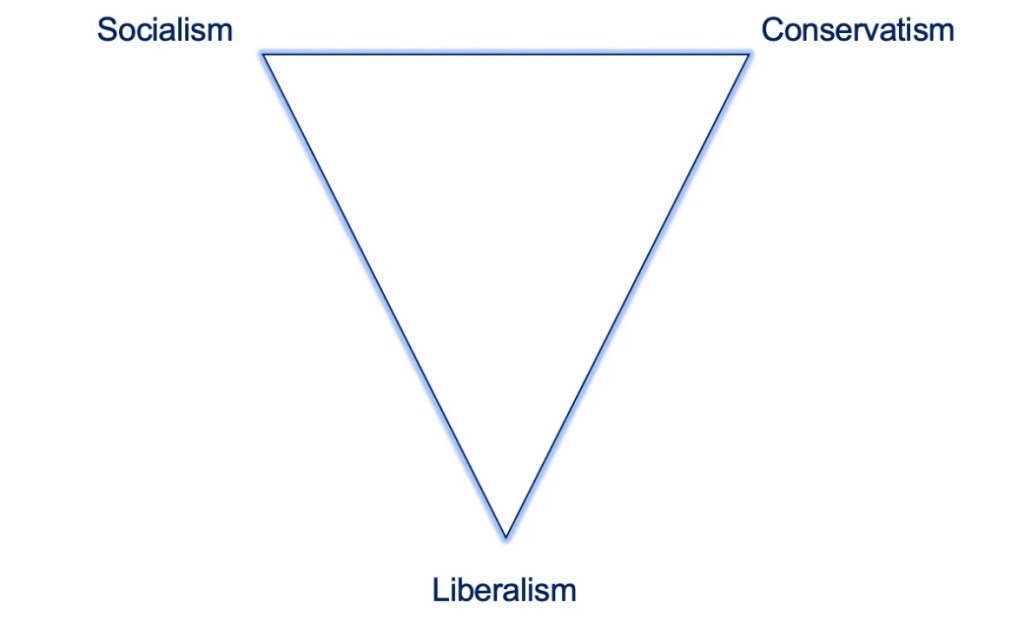
In this vein, Nate Silver presents a basic taxonomy of political orientation in a recent Substack post. It includes the diagram above, which distinguishes between socialism, conservatism, and liberalism. Silver draws on a classic essay written by Friedrich Hayek in 1945, “Why I am Not a Conservative”, in which Hayek discussed the meaning of the word “liberal” (and see here). Liberalism’s true emphasis is a tolerance for individual rights and freedoms, subject to varying articulations of the “nonaggression principle”. That is, “do as you like, but do no harm to others”.

We often see a linear representation distinguishing between so-called progressives on the left and conservatives on the right. Of course, a major hallmark of leftist thinking is extreme interventionism. Leftists or progressives are always keen to detect the slightest whiff of an externality or the slightest departure from the perfectly competitive market ideal. They seem eager to find a role for government in virtually every area of life. While it’s not a limiting case, we can substitute socialism or statism for progressivism on the far left, as Silver does, whereby the state takes primacy in economic and social affairs.

Conservatism, on the other hand, is a deep resistance to change, whether institutional, social, and sometimes economic. Conservatives too often demonstrate a willingness to use the coercive power of the state to prevent change. Hayek noted the willingness of both socialists and conservatives to invoke state power for their own ends.

Similarly, religious conservatives often demand state support beyond that afforded by the freedom to worship in the faith of one’s choice. They might strongly reject certain freedoms held to be fundamental by liberals. Meanwhile, socialists often view mere religious freedom as a threat to the power of the state, or at least they act like it (e.g. see here for an example).

Like conservatives, dedicated statists would doubtless resist change if it meant a loss of their own power. That is, they’d wish to preserve socialist institutions. On this point, witness the vitriol from the Left over what it perceives as threats to the public school monopoly. Witness also the fierce resistance among public employees to reducing the scale of the administrative state, and how advocates of entitlements fiercely resist decreases in the growth rate of those expenditures.

Silver, like Hayek, objects to the traditional, linear framework in which liberals are thought to occupy a range along a line between socialism and conservatism. He objects to that because real liberals value individual liberty as a natural human right, a viewpoint typically abhored by both socialists and conservatives. There is nothing “in between” about it! And of course, conservatives and progressives are equally guilty in their mistaken use of the word “liberal”.

Mapping Political Preferences

Liberty, statism, and conservatism are not exactly orthogonal political dimensions. Larger government almost always means less economic liberty. At a minimum, state dominance implies a social burden associated with public monopoly and monopsony power, as well as tax and welfare-state incentive problems. These features compromise or corrupt the exercise of basic rights. On the other hand, capitalism and its concomitant reliance on consumer sovereignty, individual initiative, free exchange and secure property rights is most in harmony with true liberalism.

For conservatives, resistance to change in support of a traditionally free market economy might offer something of a contradiction. In one sense, it corresponds to upholding market institutions. However, free markets allow new competitors and new technologies to undermine incumbents, who conservatives sometimes wish to defend through regulatory or protectionist measures. And conservatives are almost always too happy to join in the chorus of “price gouging” in response to the healthy operation of the free market in bringing forth supplies.

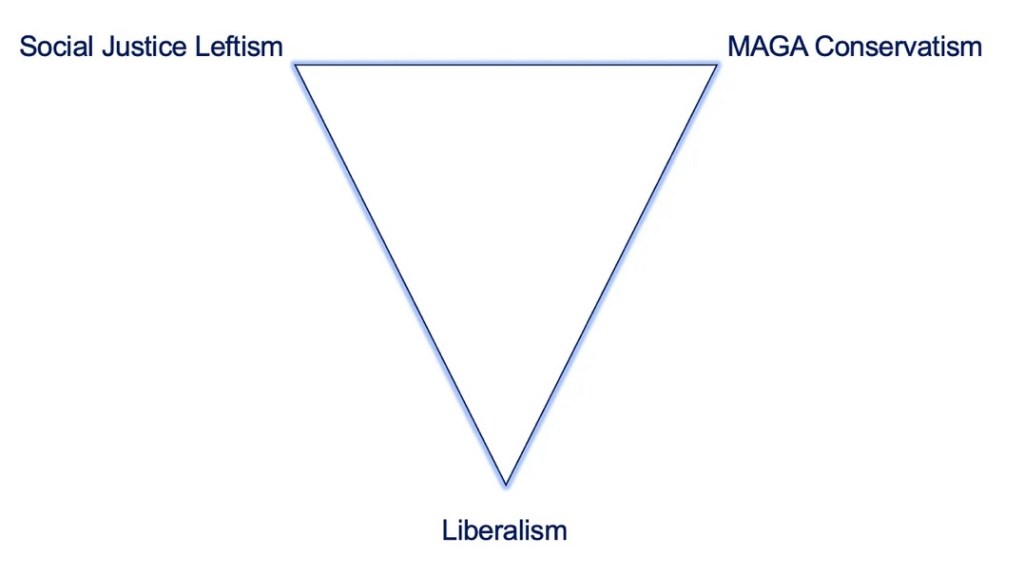
All that is to say that preferences involving liberty, statism, and traditionalism are not independent of one another. They cannot simply be mapped onto a three-dimensional space. At least the triangular representation gets liberalism out of the middle, but it’s difficult to visualize other ideological positions there. For example, “state religionism” could lie anywhere along the horizontal line at the top or even below it if certain basic liberties are preserved. Facism combines elements of socialism and a deformed version of capitalism that is properly called corporatism, but where would it fall within the triangle?

Big Government Liberalism?

Silver says he leans heavily toward a “big government” version of liberalism, but big government is hard to square with broad liberties. Granted, any well-functioning society must possess a certain level of “state capacity” to defend against private or public violations of individual rights, adjudicate disputes, and provide true public goods. It’s not clear whether Silver’s preferences lie within the bounds of those ambitions. Still, he deserves credit for his recognition that liberalism is wholly different from the progressive, socialist vision. It is the opposite.

The “New” Triangle

Silver attempts to gives the triangular framework a more contemporary spin by replacing conservatism with “MAGA Conservatism” and socialism with “Social Justice Leftism” (SJL), or “wokeism”. Here, I’m treating MAGA as a “brand”. Nothing below is intended to imply that America should not be a great nation.

The MAGA variant of conservatism emphasizes nationalism, though traditional conservatives have never been short on love of nation. For that matter, as a liberal American, it’s easier to forgive nationalist sentiments than it is the “Death to America” refrain we now hear from some SJLs.

The MAGA brand is also centered around a single individual, Donald Trump, whose rhetoric strikes many as nativistic. And Trump is a populist whose policy proposals are often nakedly political and counterproductive.

SJL shares with socialism an emphasis on various forms of redistribution and social engineering, but with a new focus on victimhood based on classes of identity. Of SJL, Silver says:

“Proponents of SJL usually dislike variations on the term ‘woke’, but the problem is that they dislike almost every other term as well. And we need some term for this ideology, because it encompasses quite a few distinctive features that differentiate it both from liberalism and from traditional, socialist-inflected leftism. In particular, SJL is much less concerned with the material condition of the working class, or with class in general. Instead, it is concerned with identity — especially identity categories involving race, gender and sexuality, but sometimes also many others as part of a sort of intersectional kaleidoscope.”

The gulf between liberals and SJLs couldn’t be wider on issues like free speech and “equity”, and equality of opportunity. MAGAns, on the other hand, have some views on individual rights and responsibility that are largely consistent with liberals, but reflexive populism often leads them to advocate policies protecting rents, corporate welfare, and protectionism.

Divided Liberalism

Liberalism emphasizes limited government, individual autonomy, and free exchange. However, there are issues upon which true liberals are of divided opinion. For example, one such area of controversy is the conflict between a woman’s right to choose and the fetal right to life. Many true liberals disagree over whether the rights of a fetus outweigh its mother’s right to choose, but most would concede that the balance shifts to the fetus at some point well short of birth (putting aside potential dangers to the mother’s life). Open borders is another area that can divide true liberals. On one side, the right to unrestricted mobility is thought to supersede any public interest in enforcing borders and limiting the flow of immigrants. On the other side, questions of national sovereignty, national security, as well as social and state capacity to absorb immigrants take primacy.

Don’t Call Lefties “Liberal”… They’re Not!

True liberalism (including most strains of libertarianism) recognizes various roles that a well-functioning state should play, but it also recognizes the primacy of the individual and individual rights as a social underpinning. As Hayek noted, true liberals are not resistant to change per se, unlike conservatives. But modern progressives demand changes of the worst kind: that the state should intervene to pursue their favored objectives, laying claim to an ever-greater share of private resources. This requires government coercion on a massive scale, the antithesis of liberalism. It’s time to recognize that “progressives” aren’t liberals in any sense of the word. For that matter, they don’t even stand for progress.

I’ll close with a quote from Adam Smith that I cribbed from Scott Sumner. Unfortunately, Sumner does not give the full reference, but I’ll take his word that Smith wrote this 20 years before the publication of The Wealth of Nations:

“Little else is requisite to carry a state to the highest degree of opulence from the lowest barbarism, but peace, easy taxes, and a tolerable administration of justice; all the rest being brought about by the natural course of things. All governments which thwart this natural course, which force things into another channel, or which endeavour to arrest the progress of society at a particular point, are unnatural, and to support themselves are obliged to be oppressive and tyrannical.”

Collectivism Is Not the “Natural” State

03 Tuesday May 2022

Posted by Nuetzel in Collectivism, Property Rights

≈ Leave a comment

Tags

Aché, Capitalism, Collectivism, Covid-19, Friedrich Engels, Hunter-Gatherers, Manvir Singh, Noble Savage, Paraguay, Primitive Communism, Property Rights

There is a great myth that primitive man was some sort of “noble savage”, perfectly attuned to the natural environment and disposed to an egalitarian principle. All that, of course, is balderdash. A related myth is that primitive societies were essentially collectivist and that private property was largely an unrecognized institution. This is something I’ve heard too often from individuals wishing to characterize leftist ideals as natural and wholesome. So I welcomed a recent piece in Aeon called “Primitive Communism”, by Manvir Singh, which reviews evidence on a number of hunter-gatherer societies and cites several scholars on the subject of ownership and the distribution of goods among those peoples. A preponderance of the evidence suggests that private property and private rewards were (and are) quite common in primitive societies, and those practices predated agriculture.

The assertion that the advent of private property and trade was somehow unnatural for mankind, or even unjust, might owe its widespread acceptance to Friedrich Engels’ “The Origin of the Family, Private Property and the State”. Singh summarizes one of the book’s primary arguments thusly:

“Once upon a time, private property was unknown. Food went to those in need. Everyone was cared for. Then agriculture arose and, with it, ownership over land, labour and wild resources. The organic community splintered under the weight of competition.”

While there were a few primitive societies in which economic output was shared, it is not clear whether any central authority was relied upon for determining the distribution of output. Instead, in those cases, sharing seems to have been a matter of social convention. Singh posits that interdependence played a major role in motivating output sharing, but mechanisms for dealing with interdependence differed in societies with stronger property rights, including voluntary sharing, which was often but not always based on reciprocity. Volunteerism still has a strong role in modern, developed economies, but for better or worse, social insurance is increasingly viewed as a function of the state, with its monopoly on legal coercion.

And how “natural” is social insurance? Not very in a world of extreme scarcity. One of the more interesting passages in Singh’s article has to do with the brutality of subsistence-level societies. The weak were often abandoned or killed, which Singh discusses in the context of the collectivist Aché people of Paraguay. This “culling” applied variously to orphans, the disabled, the unsightly, and the aged. It’s unclear whether these decisions were collective or left up to individual families. Noble savages indeed!

It’s astonishing how often Engels’ faulty premise is accepted as historical fact. The argument, however, often serves as a subtext for collectivist rationales in the modern era. As Singh says:

“For anyone hoping to critique existing institutions, primitive communism conveniently casts modern society as a perversion of a more prosocial human nature.”

I’m not sure whether it’s possible to marshall evidence that primitive societies with strong property rights were more successful than their collectivist counterparts. That would be a good topic of further research, but it would be tough to control for the difficulties posed by varying natural conditions faced by these societies.

On the other hand, suppose we stipulate that property rights developed as a consequence of, or in tandem with, organized production, as Engels would have had it. We’d have to categorize that development as a kind of technological breakthrough in its own right. By aligning incentives with production, property rights were critical to the phenomenal growth in prosperity the world has enjoyed over the past several centuries. Nevertheless, the evidence on primitive societies suggests that the alignment came more “naturally”.

It’s about time to put the fiction of “primitive communism” to rest. Private property was sensible for the denizens of most primitive societies. Even the most collectivist of the those societies made certain concessions to that reality. These facts comport with a view of property ownership as a natural right.

Feel the Nutzenfreude: Joy In Success of Others

06 Sunday Feb 2022

Posted by Nuetzel in Free markets, Human Welfare

≈ Leave a comment

Tags

David Sedaris, Duke University, Economic Efficiency, Exploitation, Free Markets, Freundschaftsbeziehungen, Gleichschaltung, Mark Twain, Marxism, Michael Munger, Nutzenfreude, Nutzenschmerz, Paretian, Pareto Improvements, Pareto Optimality, Privilege, Property Rights, Schadenfreude, Scottish Enlightenment, Social Justice, Tradenfreude, Tradenschmerz

Michael Munger is a professor of economics at Duke University who has coined a term for the distaste we observe, in some quarters, for the success of others. He calls it Nutzenschmerz, a conjunction of the German words “nutzen” (benefit) and “schmerz” (pain).

According to Munger, nutzenschmertz is an impulse of “indignant outrage over someone getting” … “an undeserved benefit”. Of course, “undeserved” is a key word here. I suspect those inflicted with nutzenschmerz apply definitions as flexible and arbitrary as the envy from which they suffer. Nutzenschmerz is a special kind of envy, however, because it doesn’t necessarily imply a personal want of the benefit. It’s simply a condemnation of another’s good fortune. Munger applies an additional twist to the definition, which I discuss below. As a mnemonic device, it might be helpful to think of nutzenschmerz as a hatred for anyone who “gets their nut”!

People of good spirit believe success in others is something to admire, at least if it doesn’t come at someone else’s expense. Perhaps success is more admirable as the fruit of hard work and talent, as opposed to dumb luck. But good luck is nothing to be ashamed of, and it’s often said we make our own luck. Well, maybe only lucky people say that! “Luck” doesn’t necessarily come at the expense of others, however, and no one “loses” things they have no right to expect.

Furthermore, one’s success, lucky or otherwise, often inures to the benefit of others in the form of better products, new jobs, and higher income. For example, if I were to find a deposit of some rare earth mineral on my property while digging a well, I’d consider myself quite lucky. I would then hire people to mine it. The new supplies of the mineral would be used in industry, bringing more plentiful supplies of certain products to consumers. New jobs! Cheaper products!

Economists have a particular framework for discussing “successes” of this kind. If a change occurs from which everyone benefits and no one loses, economists say the change is a Pareto improvement. If only only a few benefit and no one is made worse off, it is a weak Pareto improvement. When all such opportunities have been exhausted, we have reached a state of Pareto optimality. Free markets generally move society toward that state, externalities aside. This is an aspect of what’s meant when we say markets promote economic efficiency. And when technology, tastes, or resource availability change, as they do constantly, new opportunities arise for Pareto improvements.

The Left is selectively intolerant of success and even Pareto improvements from luck or effort. The attitude is usually couched in terms of undeserved “privilege” or some form of “exploitation”. They exempt their own gains, of course, especially when they find themselves in a position to pick winners (and that enterprise almost always involves picking losers as well). In fact, they are probably inclined to celebrate success that owes to subsidies for politically favored activities, which clearly come at the expense of others and are not Paretian in any sense. Social justice warriors demand a free pass on coveting what belongs to others, and they are often just as contemptible of successful effort as they are of dumb luck. Whatever it is you have, or have achieved, don’t expect them to respect it … or your right to have it.

The word Nutzenschmerz amuses me partly because the original German form of my name begins with the letters “Nütz“. Also, like Munger, I’ve always been charmed by the German linguistic practice of stringing words together, like the more familiar Schadenfreude, which means to take pleasure in the misfortunes of others. Or Freundschaftsbeziehungen (friendship demonstrations). Mark Twain said some German words are so long they have perspective! David Sedalis once commented that he heard lots of long words in Germany, but one of the few that stuck was Lebensabschnittspartner:

“This doesn’t translate to ‘lover’ or ‘life partner’ but, rather, to ‘the person I am with today,’ the implication being that things change, and you are keeping yourself open.”

Then, of course, take Gleichschaltung (the standardization of political, economic, and social institutions in authoritarian states). Er … no, please, not that!

In addition to nutzenschmirz, Munger has coined the term Tradenfreude, meaning “joy … at observing the ‘well-contrived machine’ of commercial society, with everyone trading with everyone else for conveniences and necessities.” By extension, he adds Tradenschmerz, meaning the hatred reserved for free markets by many leftists.

Nutzenschmerz is an emotive force that shapes the Marxist psyche. It could be dismissed as incidental to a shallow grasp of the mutually beneficial nature of voluntary trade. However, it also demonstrates a fundamental disrespect for property rights. It’s a rejection of the very things that motivate human action, and which enable cooperation on a scale unprecedented over nearly all of human history preceding the Scottish Enlightenment.

I propose that we should all practice a philosophy of Nutzenfreude, by which I mean taking pleasure in the Paretian successes of others. It might be vicarious, or it might signal the genesis of new opportunities for the rest of us! The thing is, those successes all represent human progress to one degree or another, from which we all derive incremental benefits. That doesn’t mean we shouldn’t be watchful for harms or externalities, but neither should we regard every success with suspicion, or worse, nutzenschmerz!

Do as Munger says: fight nutzenschmerz! And revel in nutzenfreude!

Central Planning With AI Will Still Suck

23 Sunday Feb 2020

Posted by Nuetzel in Artificial Intelligence, Central Planning, Free markets

≈ Leave a comment

Tags

Artificial Intelligence, central planning, Common Law, Data Science, Digital Socialism, Friedrich Hayek, Jesús Fernández-Villaverde, Machine Learning, Marginal Revolution, Property Rights, Robert Lucas, Roman Law, Scientism, The Invisible Hand, The Knowledge Problem, The Lucas Critique, Tyler Cowen


Artificial intelligence (AI) or machine learning (ML) will never make central economic planning a successful reality. Jesús Fernández-Villaverde of the University of Pennsylvania has written a strong disavowal of AI’s promise in central planning, and on the general difficulty of using ML to design social and economic policies. His paper, “Simple Rules for a Complex World with Artificial Intelligence“, was linked last week by Tyler Cowen at Marginal Revolution. Note that the author isn’t saying “digital socialism” won’t be attempted. Judging by the attention it’s getting, and given the widespread acceptance of the scientism of central planning, there is no question that future efforts to collectivize will involve “data science” to one degree or another. But Fernández-Villaverde, who is otherwise an expert and proponent of ML in certain applications, is simply saying it won’t work as a curative for the failings of central economic planning — that the “simple rules” of the market will aways produce superior social outcomes.

The connection between central planning and socialism should be obvious. Central planning implies control over the use of resources, and therefore ownership by a central authority, whether or not certain rents are paid as a buy-off to the erstwhile owners of those resources. By “digital socialism”, Fernández-Villaverde means the use of ML to perform the complex tasks of central planning. The hope among its cheerleaders is that adaptive algorithms can discern the optimal allocation of resources within some “big data” representation of resource availability and demands, and that this is possible on an ongoing, dynamic basis.

Fernández-Villaverde makes the case against this fantasy on three fronts or barriers to the use of AI in policy applications: data requirements; the endogeneity of expectations and behavior; and the knowledge problem.

The Data Problem: ML requires large data sets to do anything. And impossibly large data sets are required for ML to perform the task of planning economic activity, even for a small portion of the economy. Today, those data sets do not exist except in certain lines of business. Can they exist more generally, capturing the details of all economic transactions? Can the data remain current? Only at great expense, and ML must be trained to recognize whether data should be discarded as it becomes stale over time due to shifting demographics, tastes, technologies, and other changes in the social and physical environment. 

Policy Change Often Makes the Past Irrelevant: Planning algorithms are subject to the so-called Lucas Critique, a well known principle in macroeconomics named after Nobel Prize winner Robert Lucas. The idea is that policy decisions based on observed behavior will change expectations, prompting responses that differ from the earlier observations under the former policy regime. A classic case involves the historical tradeoff between inflation and unemployment. Can this tradeoff be exploited by policy? That is, can unemployment be reduced by a policy that increases the rate of inflation (by printing money at a faster rate)? In this case, the Lucas Critique is that once agents expect a higher rate of inflation, they are unlikely to confuse higher prices with a more profitable business environment, so higher employment will not be sustained. If ML is used to “plan” certain outcomes desired by some authority, based on past relationships and transactions, the Lucas Critique implies that things are unlikely to go as planned.  

The Knowledge Problem: Not only are impossibly large data sets required for economic planning with ML, as noted above. To achieve the success of markets in satisfying unlimited wants given scarce resources, the required information is impossible to collect or even to know. This is what Friedrich Hayek called the “knowledge problem”. Just imagine the difficulty of arranging a data feed on the shifting preferences of many different individuals across a huge number of products,  services and they way preference orderings will change across the range of possible prices. The data must have immediacy, not simply a historical record. Add to this the required information on shifting supplies and opportunity costs of resources needed to produce those things. And the detailed technological relationships between production inputs and outputs, including time requirements, and the dynamics of investment in future productive capacity. And don’t forget to consider the variety of risks agents face, their degree of risk aversion, and the ways in which risks can be mitigated or hedged. Many of these things are simply unknowable to a central authority. The information is hopelessly dispersed. The task of collecting even the knowable pieces is massive beyond comprehension.

The market system, however, is able to process all of this information in real time, the knowable and the unknowable, in ways that balance preferences with the true scarcity of resources. No one actor or authority need know it all. It is the invisible hand. Among many other things, it ensures the deployment of ML only where it makes economic sense. Here is Fernández-Villaverde:

“The only reliable method we have found to aggregate those preferences, abilities, and efforts is the market because it aligns, through the price system, incentives with information revelation. The method is not perfect, and the outcomes that come from it are often unsatisfactory. Nevertheless, like democracy, all the other alternatives, including ‘digital socialism,’ are worse.”

Later, he says:

“… markets work when we implement simple rules, such as first possession, voluntary exchange, and pacta sunt servanda. This result is not a surprise. We did not come up with these simple rules thanks to an enlightened legislator (or nowadays, a blue-ribbon committee of academics ‘with a plan’). … The simple rules were the product of an evolutionary process. Roman law, the Common law, and Lex mercatoria were bodies of norms that appeared over centuries thanks to the decisions of thousands and thousands of agents.” 

These simple rules represent good private governance. Beyond reputational enforcement, the rules require only trust in the system of property rights and a private or public judicial authority. Successfully replacing private arrangements in favor of a central plan, however intricately calculated via ML, will remain a pipe dream. At best, it would suspend many economic relationships in amber, foregoing the rational adjustments private agents would make as conditions change. And ultimately, the relationships and activities that planning would sanction would be shaped by political whim. It’s a monstrous thing to contemplate — both fruitless and authoritarian.

Space, Property Rights and Scarcity

14 Thursday Mar 2019

Posted by Nuetzel in Property Rights, Scarcity, Space Travel

≈ 1 Comment

Tags

Asteroid Mining, Barrack Obama, Capitalism, Central Economic Planning, Extraction Rights, Outer Space Treaty, Planetary Science Institute, Property Rights, Rivalrous Consumption, Roy Balleste, Susan J Buck, Terraforming, The Economic Problem, Tragedy of the Commons, William Hartmann

Rights in outer space are an area of unsettled international law, particularly the topic of exploiting resources in outer space. Today there is some consensus that assignment of mineral extraction rights to private firms will enhance the promise of these resources for mankind and expedite future space exploration. However, I happened upon two strikingly misinformed comments from otherwise learned individuals who might have known better had they ever taken a basic course in economics, or had they applied a little basic logic to the subject matter. Both comments were made in defense of a strict interpretation of the “global commons” theory embodied in the 1967 Outer Space Treaty. Under that dubious interpretation, the establishment of private property rights on celestial bodies would be prohibited.

I first stumbled across the following from Roy Balleste, a law professor at St. Thomas University, in “Interstellar Travel and the Mission for Outer Space: A Human Rights Perspective“:

“Any policy designed to explore future possibilities in outer space should avoid the plundering of resources through excessive claims of property rights, which causes scarcity and all its failings. If the focus of space exploration is on resource acquisition, i.e., property rights, then resource management will become as important as the exploration itself. The scarcity of resources is also known as the ‘tragedy of the commons.’” [my emphasis]

This poor guy is mixed up! He footnotes Susan J. Buck as a source for these ideas, but I won’t even bother to research Ms. Buck’s work. Belleste did quite enough to raise my pique. Before I say anything else, I’ll first note that the tragedy of the commons occurs only in the absence of defined property rights to scarce resources. “The commons” means that a resource is owned in common. When use of that resource is at all rivalrous and unpriced, common ownership leads to competition for use and ultimately to overuse. Contrary to Balleste’s implication, assignment of property- or use-rights helps to resolve this difficulty.

As a first approximation, it’s probably fair to say that Belleste, in his gut, thinks of scarcity as want of things belonging to others, or perhaps things that are beyond the reach of the state. Surely he knows that scarcity is fundamental to the nature of mankind’s existence. That’s the reality that gives rise to “the economic problem”: how can society allocate scarce resources to best meet the needs and unbounded wants of its people.

Individual property rights establish the basis for voluntary trade, pricing, and incentives for production and conservation, providing for a decentralized and efficient solution to the economic problem. The prices established under such a regime are an accurate reflection of the true scarcity of resources because they balance demands and available supplies. When valuable resources are difficult or risky to exploit, it is secure property rights that provide the incentives for entrepreneurs to go to work, unlocking the benefits of those resources only to the extent that they are “economic”. Risks are taken in exchange for the possibility of future profit that might be earned through trade with willing buyers. This is true whether the raw resources exist deep in the ground, in outer space, or in the fertile minds of entrepreneurs. Far from causing scarcity, property rights are actually necessary to manage efficiently in a world of scarcity. As already noted, a further implication is that property rights encourage conservation: only those quantities are extracted as needed to satisfy demands and minimize waste, and through market prices, those demands are themselves tempered by the physical limits and costs of extraction.

Attempts to solve the economic problem in the absence of individual property rights require a central decision-making authority. How can such an authority hope to know or keep abreast of changes in individual needs and wants? And how can that authority maintain adequate information on the requirements of productive endeavors? Without individual agency, incentives become inoperative and prices don’t correctly signal the degree of scarcity across innumerable resources, including each individual’s time. Thus, these centrally-made decisions take on an arbitrary and coercive nature. It’s no wonder that central economic planning meets with such consistent failure.

Belleste undoubtedly resents inequality, and whether you believe that redistribution of wealth is just or an unjust violation of property rights, the real damage is how it erodes prospective returns to talent, hard work, and risk-taking. Indeed, the exercise of confiscatory power creates risk, for then the rewards of any productive endeavor are subject to the winds of politics and the whims of politicians.

The second quote that caught my attention was this doozy, courtesy of William Hartmann of the Planetary Science Institute:

“The capitalist system works as advertised only when the resources are effectively infinite…”

Um… no. There can be no question of what “works best” in the absence of scarcity, for then there is absolutely no economic problem to solve. Why bother? Infinite resources imply that prices are zero, and that talent, effort, and risk-taking are unnecessary. As we know already, conditions of scarcity are what gives rise to the economic problem for which capitalism provides a benchmark solution: an efficient allocation of resources that does not rely on coercion by the state.

I still plan to address the topic of rights in outer space in a future post. For now, suffice it to say that exploiting resources that can be extracted from asteroids, the moon, or other planets for the benefit of mankind is likely to require private incentives. In fact, President Obama signed a bill authorizing rights to resources extracted in outer space, yet there is still some debate as to whether that is permissible under the Outer Space Treaty. Even stronger incentives, however, would be established by granting permanent rights to mine or terraform particular tracts on celestial bodies, presumably as an incentive to those who reach them first.

Economic Freedom and Mobility Reduce Poverty; Alms Are Impotent

02 Friday Nov 2018

Posted by Nuetzel in Free markets, Immigration, Property Rights

≈ Leave a comment

Tags

Direct Aid, Direct Assistance, Economic Freedom, Growth Accelerations, Immigration Quotas, Labor Markets, Labor Mobility, Lant Pritchard, Migration, Open Borders, Poverty Reduction, Property Rights

It’s very difficult to lift people out of poverty via redistribution or philanthropy. Small gains in income can be expected at best, but there are far more powerful ways to improve well being. These have to do with expanding the fundamental freedoms, rights and rewards available to private individuals. Harvard’s Lant Pritchard divides these efforts into two broad categories: policies that improve labor mobility, and those that lead to gains in-place via economic growth. His working paper, “Alleviating Global Poverty: Labor Mobility, Direct Assistance, and Economic Growth”, is available here.

Economic Benefits of Migration 

Pritchard first explains that the freedom to migrate across borders in pursuit of economic opportunity allows workers from low-productivity countries to contribute much greater output in high productivity countries. In so doing, the workers gain far more than can be practically accomplished via direct aid, and according to Pritchard, at zero or little cost. So granting this freedom is a much more effective anti-poverty measure than aid payments.

Pritchard seems to imply that this is a persuasive economic argument for open borders. On that question, I take the position that countries are sovereign entities and that their citizens possess the right to determine the extent of immigration flows. And in fact, there are real costs of immigration flows that must be considered. Pritchard’s paper offers a powerful rationale for liberalizing immigration quotas, but here again, he dismisses certain issues that limit even that more narrow argument.

The prospective economic gains of the immigrants themselves are important, of course, but the economic needs of the destination country matter too. In the U.S., employers in many markets face a shortage of low-skilled labor, so immigration quotas bind on those markets. Making them less binding would certainly encourage economic growth. A greater influx of younger workers from abroad would also help America weather its demographic crisis, narrowing the shortfall in funding entitlement programs like Social Security and Medicare. Unfortunately, to those who do not already recognize these needs, Pritchard’s contribution is likely to carry little weight.

Still, Pritchard’s assertion that the cost of liberalized immigration is zero needs further examination. First, there are the very real costs of vetting and processing new immigrants. Second, unless all immigrants and employers are matched ex ante, which is virtually impossible, there will be adjustment costs that continue at least until the matching is complete. In the interim, and even post-employment, new immigrants might well require public aid to support themselves and their families. It is also quite likely that new tax revenue generated by immigrants will be insufficient to pay the full incremental costs of public resources consumed in providing marginal infrastructure, education, and other public subsidies.

Pritchard employs static calculations of the net benefits to be gained through greater labor mobility “at the margin”, but as the absorption of new immigrants into the workforce takes place, excess demands for low-skilled workers may turn into excess supplies, creating downward pressure on wages. In the presence of a minimum wage, that implies unemployment and a probable drain on public resources. So the source of the benefits discussed by Pritchard should not be viewed as limitless. He offers some mild rebuttals of this point and references one of his own papers in so doing, but the possibility cannot and should not be dismissed.

Economic Benefits of Economic Freedom

Pritchard’ second major point of emphasis involves the effectiveness of different kinds of private and public direct assistance, or “treatments”, in producing income gains over time. He offers evidence that the gains are relatively weak. He contrasts this with the potential gains from “growth accelerations” stemming from a variety of causes. The upside of a normal business cycle is one form, but that doesn’t really count if the gains are lost on the downside.

The most profound form of growth acceleration occurs upon the advent of a liberalized social order. This may accompany the downfall of an authoritarian government, the stabilization of a formerly unsound monetary regime, or as more sophisticated market institutions take hold in a formerly primitive economy. The main point is that there are fundamental social underpinnings of growth. These are the many dimensions of economic freedom: secure property rights, freedom of contract, minimal regulatory interference, low taxes, and competitive markets for goods and capital. These conditions are so straightforward that in developed economies we take many of them for granted, through they are threatened even there. But these conditions are sadly lacking in much of the under-developed world.

Conclusion

Allowing workers to migrate freely in search of the best opportunities is undoubtedly more powerful in improving their welfare than any form of direct assistance. That is a fundamental truth put forward by Lant Pritchard. However, in-migration can come with significant costs for the destination country. Therefore, immigration laws should allow sufficient flexibility with respect to flows to enable the capture of economic gains from immigration when they exist. Pritchard also emphasizes that economic freedom and the growth acceleration it makes possible do far more to reduce poverty than massive private and public efforts at direct assistance, however well-intentioned. Several earlier posts on Sacred Cow Chips have highlighted the impotency of redistribution for eliminating poverty. The Left has a tendency to dismiss such views as mere ideological assertion, but it is much more than that: it is the difference between penury and prosperity.

Central Planning Fails to Scale, Unlike Spontaneous Order

05 Tuesday Jun 2018

Posted by Nuetzel in Central Planning, Markets, Price Controls

≈ Leave a comment

Tags

Bronze Age, central planning, Client-Server Network, Decentralized Decision-Making, Economies of Scale, Federalism, Francis Turner, Industrial Policy, Liberty.me, Markets, Peer-to-Peer Network, Price mechanism, Property Rights, Scalability, Spontaneous Order

The proposition that mankind is capable of creating a successful “planned” society is at least as old as the Bronze Age. Of course it’s been tried. The effort necessarily involves a realignment of the economic and political landscape and always requires a high degree of coercion. But putting that aside, such planning can never be successful relative to spontaneous order of the kind that dominates private affairs in a free society. The task of advancing human well-being given available resources has never been achieved under central planning. It always fails miserably in this regard, and it always will fail to match the success of decentralized decision-making and private markets.

There are various ways to explain this fact, but I recently came across an interesting take on the subject having to do with the notion of scalability. Francis Turner offers this note on the topic at the Liberty.me blog. To begin, he gives a lengthy quote from a software developer who relates the problems of social and economic planning to the complexity of managing a network. On the topic of scale, the developer notes that the number of relationships in a network increases with the square of the number of its “nodes”, or members:

“2 nodes have 1 potential relationship. 4 nodes (twice as many) has 6 potential relationships (6 times as many). 8 nodes (twice again) has 28 potential relationships. 100 nodes => [4,950] relationships; 1,000 nodes => 499,500 relationships—nearly half a million.“

Actually, the formula for the number of potential relationships or connections in a network is n*(n-1)/2, where n is the number of network nodes. The developer Turner  quotes discusses this in the context of two competing network management structures: client-server and peer-to-peer. Under the former, the network is managed centrally by a server, which communicates with all nodes, makes various decisions, and routes communications traffic between nodes. In a peer-to-peer network, the work of network management is distributed — each computer manages its own relationships. The developer says, at first, “the idea of hooking together thousands of computers was science fiction.” But as larger networks were built-out in the 1990s, the client-server framework was more or less rejected by the industry because it required such massive resources to manage large networks. In fact, as new nodes are added to a peer-to-peer network, its capacity to manage itself actually increases! In other words, client-server networks are not as scalable as peer-to-peer networks:

“Even if it were perfectly designed and never broke down, there was some number of nodes that would crash the server. It was mathematically unavoidable. You HAVE TO distribute the management as close as possible to the nodes, or the system fails.

… in an instant, I realized that the same is true of governments. … And suddenly my coworker’s small government rantings weren’t crazy…”

This developer’s epiphany captures a few truths about the relative efficacy of decentralized decision-making. It’s not just for computer networks! But in fact, when it comes to network management, the task is comparatively simple: meet the computing and communication needs of users. A central server faces dynamic capacity demands and the need to route changing flows of traffic between nodes. Software requirements change as well, which may necessitate discrete alterations in capacity and rules from time-to-time.

But consider the management of a network of individual economic units. Let’s start with individuals who produce something… like widgets. There are likely to be real economies achieved when a few individual widgeteers band together to produce as a team. Some specialization into different functions can take place, like purchasing materials, fabrication, and distribution. Perhaps administrative tasks can be centralized for greater efficiency. Economies of scale may dictate an even larger organization, and at some point the firm might find additional economies in producing widget-complementary products and services. But eventually, if the decision-making is centralized and hierarchical, the sheer weight of organizational complexity will begin to take a toll, driving up costs and/or diminishing the firm’s ability to deal with changes in technology or the market environment. In other words, centralized control becomes difficult to scale in an efficient way, and there may be some “optimal” size for a firm beyond which it struggles.

Now consider individual consumers, each of whom faces an income constraint and has a set of tastes spanning innumerable goods. These tastes vary across time scales like hour-of-day, day-of-week, seasons, life-stage, and technology cycles. The volume of information is even more daunting when you consider that preferences vary across possible price vectors and potential income levels as well.

Can the interactions between all of these consumer and producer “nodes” be coordinated by a central economic authority so as to optimize their well-being dynamically, subject to resource constraints? As we’ve seen, the job requires massive amounts of information and a crushing number of continually evolving decisions. It is really impossible for any central authority or computer to “know” all of the information needed. Secondly, to the software developer’s point, the number of potential relationships increases with the square of the number of consumers and producers, as does the required volume of information and number of decisions. The scalability problem should be obvious.

This kind of planning is a task with which no central authority can keep up. Will the central authority always get milk, eggs and produce to the store when people need it, at a price they are willing to pay, and with minimal spoilage? Will fuel be available such that a light always turns on whenever they flip the switch? Will adequate supplies of medicines always be available for the sick? Will the central authority be able to guarantee a range of good-quality clothing from which to choose?

There has never been a central authority that successfully performed the job just described. Yet that job gets done every day in free, capitalistic societies, and we tend to take it for granted. The massive process of information transmission and coordination takes place spontaneously with spectacularly good results via private discovery and decision-making, secure property rights, markets, and a functioning price mechanism. Individual economic units are endowed with decision-making power and the authority to manage their own relationships. And the spontaneous order that takes shape remains effective even as networks of economic units expand. In other words, markets are highly scalable at solving the eternal problem of allocating scarce resources.

But thus far I’ve set up something of a straw man by presuming that the central authority must monitor all individual economic units to know and translate their demands and supplies of goods into the ongoing, myriad decisions about production, distribution and consumption. Suppose the central authority takes a less ambitious approach. For example, it might attempt to enforce a set of prices that its experts believe to be fair to both consumers and producers. This is a much simpler task of central management. What could go wrong?

These prices will be wrong immediately, to one degree or another, without tailoring them to detailed knowledge of the individual tastes, preferences, talents, productivities, price sensitivities, and resource endowments of individual economic units. It would be sheer luck to hit on the correct prices at the start, but even then they would not be correct for long. Conditions change continuously, and the new information is simply not available to the central authority. Various shortages and surpluses will appear without the corrective mechanism usually provided by markets. Queues will form here and inventories will accumulate there without any self-correcting mechanism. Consumers will be angry, producers will quit, goods will rot, and stocks of physical capital will sit idle and go to waste.

Other forms of planning attempt to set quantities of goods produced and are subject to errors similar to those arising from price controls. Even worse is an attempt to plan both price and quantity. Perhaps more subtle is the case of industrial policy, in which planners attempt to encourage the development of certain industries and discourage activity in those deemed “undesirable”. While often borne out of good intentions, these planners do not know enough about the future of technology, resource supplies, and consumer preferences to arrogate these kinds of decisions to themselves. They will invariably commit resources to inferior technologies, misjudge future conditions, and abridge the freedoms of those whose work or consumption is out-of-favor and those who are taxed to pay for the artificial incentives. To the extent that industrial policies become more pervasive, scalability will become an obstacle to the planners because they simply lack the information required to perform their jobs of steering investment wisely.

Here is Turner’s verdict on central planning:

“No central planner, or even a board of them, can accurately set prices across any nation larger than, maybe, Liechtenstein and quite likely even at the level of Liechtenstein it won’t work well. After all how can a central planner tell that Farmer X’s vegetables taste better and are less rotten than Farmer Y’s and that people therefore are prepared to pay more for a tomato from Farmer X than they are one from Farmer Y.”

I will go further than Turner: planning can only work well in small settings and only when the affected units do the planning. For example, the determination of contract terms between two parties requires planning, as does the coordination of activities within a firm. But then these plans are not really “central” and the planners are not “public”. These activities are actually parts of a larger market process. Otherwise, the paradigm of central planning is not merely unscalable, it is unworkable without negative consequences.

Finally, the notion of scalability applies broadly to governance, not merely economic planning. The following quote from Turner, for example, is a ringing endorsement for federalism:

“It is worth noting that almost all successful nations have different levels of government. You have the local town council, the state/province/county government, possibly a regional government and then finally the national one. Moreover richer countries tend to do better when they push more down to the lower levels. This is a classic way to solve a scalability problem – instead of having a single central power you devolve powers and responsibilities with some framework such that they follow the general desires of the higher levels of government but have freedom to implement their own solutions and adapt policies to local conditions.” 

Francis, Papal Perónista, Courts Redistributional Mirage

15 Thursday Mar 2018

Posted by Nuetzel in Markets, Marxism, Redistribution, statism, Welfare State

≈ Leave a comment

Tags

Argentina, Che Guevara, Daniel J. Mitchell, Economic Freedom, Eva Peron, Juan Peron, Judialismo, Maureen Mullarkey, Pope Francis, Property Rights, Robert P. Murphy, Vatican, World Bank, World Poverty

Is world poverty really increasing? Actually, no, quite the opposite, and you can blame economic liberalism, capitalism, and free markets for that. Yet we hear exactly the contrary from Pope Francis who, despite his evident compassion, has an amazingly poor understanding of economics. He misstates basic facts, offers dimly reasoned analyses of human rights, and promotes ill-considered policies. Now that the Vatican is set to release the Pope’s first feature film, no doubt a stirring piece of social justice propaganda, it seems as good a time as any to review the confounded state of Francis’ economic reasoning. This is not the first time I’ve discussed the Pope’s policy views: this link contains three previous posts from SacredCowChips on which Francis was tagged.

The False Narrative

My inspiration for this post comes from Robert P. Murphy, whose recent commentary on Francis’ pronouncements is trenchant. Murphy covers this speech written by Francis for the World Economic Forum, but delivered by a Vatican proxy, in which the Pope asserts the following:

“… governments must confront … the growth of unemployment, the increase in various forms of poverty, the widening of the socio-economic gap and new forms of slavery, often rooted in situations of conflict, migration and various social problems.“

Francis refers to increasing unemployment and poverty, and I could let that phrase pass if he was referring to certain nations or locales that have experienced chronically depressed economic growth. But Francis’ description is rather general, as evidenced by his diagnosis of causes. More on that below. Regarding his statement about trends in poverty, he is flatly incorrect. Here is Murphy:

“As the World Bank reports, the global “extreme poverty” rate in 1990 was cut in half by 2010. Back in 1990, 1.85 billion people lived on less than $1.90 per day, but by 2013, the figure had dropped to 767 million such people—meaning that more than a billion people had been lifted out of crushing poverty.“

After the Great Recession, world unemployment decreased from 2009-2015, according to the World Bank, though it is estimated to have crept up slightly in 2016-17. Again, the Pope’s woeful tale of growing unemployment and increasing poverty is nonsense.

But the world is a difficult place. In the underdeveloped world, the range and quality of goods available is extremely limited, and $1.90 represents bare subsistence, yet it’s a condition that exceeds the historical norm in many places. Movement above that threshold can represent a meaningful improvement in economic well-being.

Francis may lack an appreciation for the general enrichment in material conditions that has been taking place over the last two centuries, which is ongoing, or perhaps he believes that even greater achievements are easily within reach but for certain injustices, though he offers no qualifications. Perhaps he is mistakenly generalizing specific instances of exploitation in the underdeveloped world, which often occur with the explicit blessing of the state apparatus in exchange for kickbacks.

Rights and Markets

Even more egregious is the Pope’s presumption that private markets are at fault for any stagnation that he has identified. A notable difference between countries with successful, growing economies and those mired in stagnation is the degree to which their citizens enjoy freedoms, especially economic freedom. That is a well-established empirical fact, as Murphy explains. But the Pontiff goes further with preposterous dogma on the meaning of human rights. Again, from Murphy:

“Although inspired by concern for the poor and the marginalized, the Vatican’s message is seriously flawed…. On a conceptual level, Pope Francis posits a false dichotomy between economic freedom and human rights. … ‘Economic freedom must not prevail over the practical freedom of man and over his rights, and the market must not be absolute, but honour the exigencies of justice.’ 

What does the concept of “economic freedom” entail? It means freedom to work in any occupation of one’s choice, without permission from the government, and certainly without being conscripted into service against one’s will. It means the freedom to start a business. It means the freedom to keep what you have produced, without having your assets seized by a rapacious regime. It means the freedom to trade with people who live in another country. It means the rule of law, where contracts are interpreted fairly and government officials can’t exercise arbitrary power.“

Economic freedom, more than anything else, means that individuals are endowed with property rights. To deny such rights is to banish any reward for work and differential rewards for work well done. If free individuals are rewarded, it is a matter of their own discretion as to whether they immediately consume the reward or save it in order to accumulate wealth. Yet Francis takes the misanthropic and childish view that economic freedom, private property and markets imply exploitation. He lacks a basic understanding of the revolutionary power of markets as a form of social organization.

Within just a few hundred years, a small fraction of the many millennia during which mankind was mired in poverty and pestilence, markets have dramatically transformed the existence of most human populations. Peaceful, arms length transactions made in mutual self-interest exploit only one thing: gains from trade that would otherwise be wasted. And only a form of social organization that enables those gains can dovetail with the human rights and justice that Francis so strongly desires. The denial of economic freedom, property rights, and self-interest prohibits those gains, however, denying humanity of the wealth necessary to achieve anything like justice.

Pope Francis is a redistributionist, and that goes well beyond the charitable giving, good works and service performed voluntarily by individuals. In fact, he is a statist, advocating an economic system in which property rights are abrogated, wholly or in part, and wages above a politically determined threshold are confiscated.

The Pope and Perón

Francis is often described as a “Perónist”, after Juan Perón of Argentina, the so-called “right-wing socialist” (and sometime associate of the murderous Che Guevara). Anyone familiar with the economic history of Argentina should know that’s not praise. Here is Maureen Mullarkey from the last link:

“Both Juan and Eva understood the enchantments of populism. A charismatic pair, they ruled more by dint of personality—personalismo—than democratic procedure. Ushers of an ‘option for the poor,’ they glorified the lower classes and denigrated the wealthy. (This, while they amassed a huge personal fortune from the Eva Perón Welfare Foundation.) …

When Francis speaks of ‘the people’ as a revolutionary vanguard that ‘overflows the logical procedures of formal democracy,’ he is lapsing toward that ecstatic Peronist vision of a Third Way—justicialismo. That the disposition and design of it ended in economic collapse and misery is nothing against the splendor of the mystique.

In his youth, Francis absorbed the myth but not its lessons. Chief among them is how much Argentina’s fiscal catastrophe owed to an extravagant welfare system that favored enforced wealth redistribution over development. Among the many factors of Argentina’s historic economic crisis, one cries for attention: Perón’s increasing reliance on redistributing income, not only between industries and occupations but between skilled and unskilled workers.“

For further perspective on Francis, Perónism, and the disastrous Argentine “experiment”, see this piece by Daniel J. Mitchell.

For many years, naive Marxists have accepted the myth that central economic planners could and would direct productive and distributional activities with foresight, efficiency, and integrity. None of those is possible. The only form of social organization capable of registering and processing the myriad and dynamic signals on preferences and scarcity is free market capitalism. It is the only system capable of spontaneously harnessing appropriate responses based on the complex incentives faced by consumers and producers, and all at a minimal administrative cost for society, free of the government intervention that typifies the Peronist welfare state and corporatism.

Conclusion

Pope Francis should know better than to make claims having no empirical support. He should also have the wisdom to understand and advocate for the empowering nature of private property rights and markets. Elevating the human condition is possible only by allowing people to be free — economically free — and endowed with opportunities to earn private rewards and build wealth. Francis should realize that the massive private gains afforded by the market mechanism enable rewards which spill over, inuring to the benefit of parties external to a given exchange. On the other hand, state domination and control of economic activity gives over decision-making to selfish and ill-informed public commandants, who are all too pleased to grant special advantages to those in a position to return private favors. Such graft and mismanagement of resources comes at the expense of others. That way lies decay and a return to the much more brutal conditions of the past, unlike the mutually beneficial promise of market exchange.

Sharing Apps and Market Benefits

24 Saturday Jun 2017

Posted by Nuetzel in Markets, Transaction Costs

≈ Leave a comment

Tags

Airbnb, Allocative efficiency, competition, Double Coincidence of Wants, Medium of Exchange, Michael Munger, Property Rights, Ride sharing, Sharing economy, Transaction Costs, Transactions Technology, Uber

Transaction costs prevent lots of trades. So many that we often aren’t aware of their potentiality. Michael Munger asserts that transaction costs are so prohibitive that we tend to accumulate a lot of stuff that we could otherwise do without. That’s what he says in “Why we can’t break up with our stuff — yet“.

Transaction costs of all kinds have fallen dramatically over time. One of the greatest innovations in “transactions technology” was the avoidance of barter with the broad acceptance of a medium of exchange (money). Without a medium of exchange, trade requires a “double coincidence of wants”, which often makes the effort to engage in trade impractical. No less important was the establishment of secure property rights such that the integrity of a contract or transaction was protected, whether enforced by possible repercussions from other traders or through the police power of the state. Secure property rights and the use of money facilitated the development of markets and pricing that conveyed better information about scarcity. Other historical developments that reduced transaction costs include better transportation, communication, packaging, and more efficient distribution and supply chain management. In a variety of complex transactions, such as real estate, standardization of contracts has reduced transaction costs.

Those costs have been reduced dramatically of late by new communication and computing technologies. The size of these reductions is difficult to quantify in such prominent examples as Uber ride-sharing and Airbnb home-sharing, but there is no question that the new supplies of rides and accommodations would not have materialized absent the enabling on-line “apps”. The ease, low-cost and minimal risk of these transactions is incredible.

Suppose that hotels in Soho average $400 per night for a suite and that Airbnb rentals in Soho average $300. It’s fair to say that the average Airbnb host in Soho, without Airbnb, faced transaction costs in arranging for qualified occupants of at least $100 plus Airbnb’s fees. Probably much more. Now, it’s true that the hotel suites and the Airbnb rentals are fundamentally different “products”, but they are alternatives for meeting a particular need.

Similar reductions in transaction costs are occurring across a wide variety of sectors besides transportation and vacation rentals: trading in new and used goods, handymen, concierge services, snow plowing, home-sitting, food delivery, and hook-ups are but a few examples.

Munger’s twist on this story is that dramatically lower transaction costs will mean we’ll all need to own much less “stuff” on average, because we can “share”, or at least buy what we need at minimal transaction cost. Or, what we have will be used more intensively because we can share it profitably.

Munger mentions the high cost of owning an auto that he uses for about 5 out of 168 total hours in a week. The costs include dedicated “storage” space, both at home and at work, and sometimes the extra cost of “storing” it in airport parking. He could certainly afford to arrange alternative forms of transportation. Is owning the auto worthwhile because the transaction costs of the alternatives are too high? Well, Munger owns a nice car and he probably likes to drive it, so there is more to it than transaction costs. Still, if we mention the “convenience” of having a car at one’s disposal, that is really an expression of transaction costs avoided via ownership.

If the cost of arranging an acceptable and ready alternative is minimal, why own a car? This decision is very real in certain congested locales with costly real estate (e.g., parking New York City). In short, Munger believes even fewer individuals will bother to own personal autos, or that those cars will be less idle (rented to users), as technology reduces transaction costs:

“Why do I pay to store my car rather than let other people use it and collect rent? Transaction costs. …But we are living in the beginning of a pivotal era that will transform our relationship to ‘stuff’ (we’ll need less of it) and to each other (we’ll share more). For all of human history until about 1995, the desire to reduce transaction costs was tied to the desire to sell a particular product. Now, entrepreneurs are combining three things — mobile platforms, software apps, and internet connections — to sell reductions in transaction costs with no product attached. And that combination will change everything.“

Will that also mean fewer personally-owned kitchen appliances? Home furnishings? Clothing? Power tools? Stereo components? Probably not. Even if it’s easy to find a willing renter for my power tools or stereo components from time-to-time, I might not want to bother with the required exchanges (at pick-up and return). I use power tools from time-to-time, but I won’t want to shlep back and forth to rent them from someone when I could own them myself at relatively low cost. Perhaps I’ll rent a tiller or a power washer, but not a power drill. Maybe I could hire a gopher on the Air-gopher app to get the tools I need and return them when I’m done, but that adds back to my transaction costs. So there are certain limits to how far this can go in reducing our “stuff”.

Nevertheless, there is no question that there will be many new trades and competitive opportunities to exploit as transaction costs fall, and that implies more choice, lower prices, and less waste in the larger allocative sense. Those, I believe, are the major benefits of sharing technologies. For example, if you enjoy cooking but are the sole member of your household, imagine an app that allows you to sell your extra preparations to other individuals, or to give them away at a minimal transaction cost. Or, if you are able to perform odd jobs but prefer to take them at your convenience, you will likely be able to bid for projects of your choice. If you have a talent for teaching guitar, you could solicit business and even provide the lessons remotely through an on-line app. The major impediment to the development of such market innovations is potential interference by government or other entrenched interests who wish to prevent competition. Licensing laws and various forms of regulation and taxes could easily smother or eliminate the benefits of sharing technologies, and that would be a shame.

I’ll close with a digression on Munger’s hypothesis: why do I own or keep a lot of “stuff? It’s not all about transaction costs. Most people harbor nostalgic feelings for their “stuff”. I hate parting with my old shirts, old drivers licenses, theater programs, and ticket stubs. Most of those things have approximately zero market value. Some people believe it’s just plain wasteful to pitch something that can be put back into working order, like an old lawnmower. Transaction costs might be to blame, but the failure to junk the mower in the first place may be driven by a depression-era instinct for penny-pinching. The hoarder might simply underestimate the benefits of a new mower, or perhaps they deserve credit for undertaking a restoration project they enjoy.

I find myself hoarding all kinds of things that I think might be useful to me somehow, someday. Particularly things like miscellaneous nuts & bolts, sundry pieces of hardware, wire, old fixtures, pieces of lumber, and my late Dad’s old tools. I’m certain I won’t ever use 95%+ of these items, but it’s reassuring to have the inventory. Then again, every time I need an odd item, I find myself in my basement work room searching through all that stuff. Invariably, I end up on my way to the hardware store to get what I need. So much for minimizing transaction costs. What would it cost me to pitch all of it? An afternoon of painful evaluation… yet that too represents a transaction cost!

← Older posts
Follow Sacred Cow Chips on WordPress.com

Recent Posts

  • Immigration and Merit As Fiscal Propositions
  • Tariff “Dividend” From An Indigent State
  • Almost Looks Like the Fed Has a 3% Inflation Target
  • Government Malpractice Breeds Health Care Havoc
  • A Tax On Imports Takes a Toll on Exports

Archives

  • December 2025
  • November 2025
  • October 2025
  • September 2025
  • August 2025
  • July 2025
  • June 2025
  • May 2025
  • April 2025
  • March 2025
  • February 2025
  • January 2025
  • December 2024
  • November 2024
  • October 2024
  • September 2024
  • August 2024
  • July 2024
  • June 2024
  • May 2024
  • April 2024
  • March 2024
  • February 2024
  • January 2024
  • December 2023
  • November 2023
  • August 2023
  • July 2023
  • June 2023
  • May 2023
  • April 2023
  • March 2023
  • February 2023
  • January 2023
  • December 2022
  • November 2022
  • October 2022
  • September 2022
  • August 2022
  • July 2022
  • June 2022
  • May 2022
  • April 2022
  • March 2022
  • February 2022
  • January 2022
  • December 2021
  • November 2021
  • October 2021
  • September 2021
  • August 2021
  • July 2021
  • June 2021
  • May 2021
  • April 2021
  • March 2021
  • February 2021
  • January 2021
  • December 2020
  • November 2020
  • October 2020
  • September 2020
  • August 2020
  • July 2020
  • June 2020
  • May 2020
  • April 2020
  • March 2020
  • February 2020
  • January 2020
  • December 2019
  • November 2019
  • October 2019
  • September 2019
  • August 2019
  • July 2019
  • June 2019
  • May 2019
  • April 2019
  • March 2019
  • February 2019
  • January 2019
  • December 2018
  • November 2018
  • October 2018
  • September 2018
  • August 2018
  • July 2018
  • June 2018
  • May 2018
  • April 2018
  • March 2018
  • February 2018
  • January 2018
  • December 2017
  • November 2017
  • October 2017
  • September 2017
  • August 2017
  • July 2017
  • June 2017
  • May 2017
  • April 2017
  • March 2017
  • February 2017
  • January 2017
  • December 2016
  • November 2016
  • October 2016
  • September 2016
  • August 2016
  • July 2016
  • June 2016
  • May 2016
  • April 2016
  • March 2016
  • February 2016
  • January 2016
  • December 2015
  • November 2015
  • October 2015
  • September 2015
  • August 2015
  • July 2015
  • June 2015
  • May 2015
  • April 2015
  • March 2015
  • February 2015
  • January 2015
  • December 2014
  • November 2014
  • October 2014
  • September 2014
  • August 2014
  • July 2014
  • June 2014
  • May 2014
  • April 2014
  • March 2014

Blogs I Follow

  • Passive Income Kickstart
  • OnlyFinance.net
  • TLC Cholesterol
  • Nintil
  • kendunning.net
  • DCWhispers.com
  • Hoong-Wai in the UK
  • Marginal REVOLUTION
  • Stlouis
  • Watts Up With That?
  • Aussie Nationalist Blog
  • American Elephants
  • The View from Alexandria
  • The Gymnasium
  • A Force for Good
  • Notes On Liberty
  • troymo
  • SUNDAY BLOG Stephanie Sievers
  • Miss Lou Acquiring Lore
  • Your Well Wisher Program
  • Objectivism In Depth
  • RobotEnomics
  • Orderstatistic
  • Paradigm Library
  • Scattered Showers and Quicksand

Blog at WordPress.com.

Passive Income Kickstart

OnlyFinance.net

TLC Cholesterol

Nintil

To estimate, compare, distinguish, discuss, and trace to its principal sources everything

kendunning.net

The Future is Ours to Create

DCWhispers.com

Hoong-Wai in the UK

A Commonwealth immigrant's perspective on the UK's public arena.

Marginal REVOLUTION

Small Steps Toward A Much Better World

Stlouis

Watts Up With That?

The world's most viewed site on global warming and climate change

Aussie Nationalist Blog

Commentary from a Paleoconservative and Nationalist perspective

American Elephants

Defending Life, Liberty and the Pursuit of Happiness

The View from Alexandria

In advanced civilizations the period loosely called Alexandrian is usually associated with flexible morals, perfunctory religion, populist standards and cosmopolitan tastes, feminism, exotic cults, and the rapid turnover of high and low fads---in short, a falling away (which is all that decadence means) from the strictness of traditional rules, embodied in character and inforced from within. -- Jacques Barzun

The Gymnasium

A place for reason, politics, economics, and faith steeped in the classical liberal tradition

A Force for Good

How economics, morality, and markets combine

Notes On Liberty

Spontaneous thoughts on a humble creed

troymo

SUNDAY BLOG Stephanie Sievers

Escaping the everyday life with photographs from my travels

Miss Lou Acquiring Lore

Gallery of Life...

Your Well Wisher Program

Attempt to solve commonly known problems…

Objectivism In Depth

Exploring Ayn Rand's revolutionary philosophy.

RobotEnomics

(A)n (I)ntelligent Future

Orderstatistic

Economics, chess and anything else on my mind.

Paradigm Library

OODA Looping

Scattered Showers and Quicksand

Musings on science, investing, finance, economics, politics, and probably fly fishing.

  • Subscribe Subscribed
    • Sacred Cow Chips
    • Join 128 other subscribers
    • Already have a WordPress.com account? Log in now.
    • Sacred Cow Chips
    • Subscribe Subscribed
    • Sign up
    • Log in
    • Report this content
    • View site in Reader
    • Manage subscriptions
    • Collapse this bar
 

Loading Comments...