• About

Sacred Cow Chips

Sacred Cow Chips

Tag Archives: Scarcity

Public Debt and AI: Ain’t But One Way Crowding Out

17 Sunday Aug 2025

Posted by Nuetzel in Artificial Intelligence, Deficits

≈ Leave a comment

Tags

AI Capital Expenditures, Artificially Intelligence, Bradford S. Cohen, Carlyle, central planning, Cronyism, crowding out, Daren Acemoglu, Digital Assets, Federal Deficits, Goldman Sachs, Jason Thomas, Megan Jones, Productivity Growth, Public debt, Scarcity, Seth Benzell, Sovereign Wealth Fund, Stanford Digital Economy Lab, Tyler Cowen

There’s a hopeful narrative making the rounds that artificial intelligence will prove to be such a boon to the economy that we need not worry about high levels of government debt. AI investment is already having a substantial economic impact. Jason Thomas of Carlyle says that AI capital expenditures on such things as data centers, hardware, and supporting infrastructure account for about a third of second quarter GDP growth (preliminarily a 3% annual rate). Furthermore, he says relevant orders are growing at an annual rate of about 40%. The capex boom may continue for a number of years before leveling off. In the meantime, we’ll begin to see whether AI is capable of boosting productivity more broadly.

Unfortunately, even with this kind of investment stimulus, there’s no assurance that AI will create adequate economic growth and tax revenue to end federal deficits, let alone pay down the $37 trillion public debt. That thinking puts too much faith in a technology that is unproven as a long-term economic engine. It would also be a naive attitude toward managing debt that now carries an annual interest cost of almost $1 trillion, accounting for about half of the federal budget deficit.

Boom Times?

Predictions of AI’s long-term macro impact are all over the map. Goldman Sachs estimates a boost in global GDP of 7% over 10 years, which is not exactly aggressive. Daren Acemoglu has been even more conservative, estimating a gain of 0.7% in total factor productivity over 10 years. Tyler Cowen has been skeptical about the impact of AI on economic growth. For an even more pessimistic take see these comments.

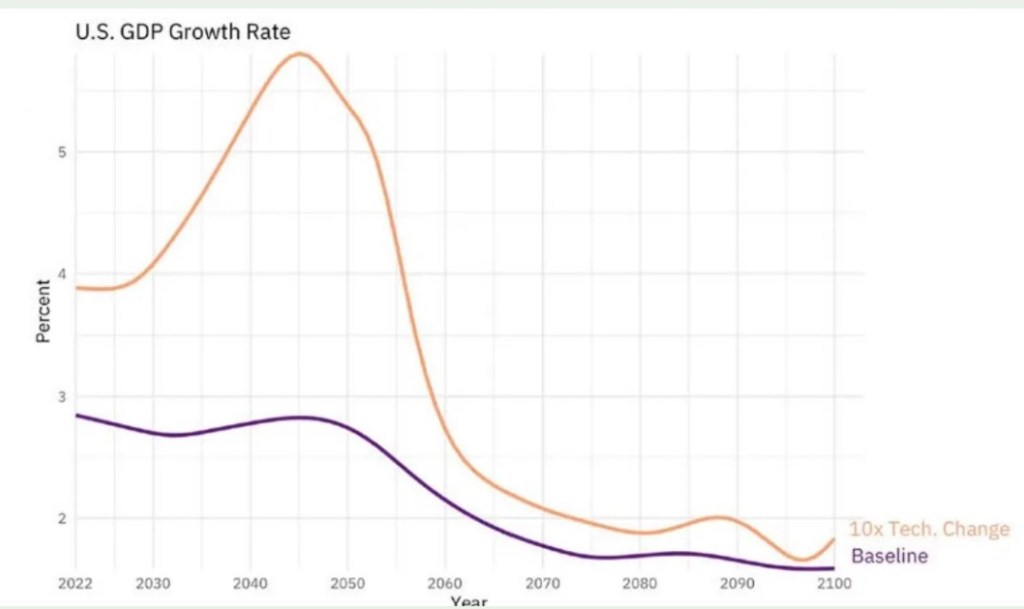
In July, however, Seth Benzell of the Stanford Digital Economy Lab discussed some simulations showing impressive AI-induced growth (see chart at top). The simulations project additional U.S. GDP growth of between 1% – 3% annually over the next 75 years! The largest boost in growth occurs now through the 2050s. This would produce a major advance in living standards. It would also eliminate the federal deficit and cure our massive entitlement insolvency, but the result comes with heavy qualifications. In fact, Benzell ultimately throws cold water on the notion that AI growth will be strong enough to reduce or even stabilize the public debt to GDP ratio.

The Scarcity Spoiler

The big hitch has to do with the scarcity of capital, which I’ve described as an impediment to widespread AI application. Competition for capital will drive interest rates up (3% – 4%, according to Benzell’s model). Ongoing needs for federal financing intensify that effect. But it might not be so bad, according to Benzell, if climbing rates are accompanied by heightened productivity powered by AI. Then, tax receipts just might keep-up with or exceed the explosion in the government’s interest obligations.

A further complication cited by Benzell lurks in insatiable demands for public spending, and politicians who simply can’t resist the temptation to buy votes via public largesse. Indeed, as we’ve already seen, government will try to get in on the AI action, channeling taxpayer funds into projects deemed to be in the public interest. And if there are segments of the work force whose jobs are eliminated by AI, there will be pressure for public support. So even if AI succeeds in generating large gains in productivity and tax revenue, there’s very little chance we’ll see a contagion of fiscal discipline in Washington DC. This will put more upward pressure on interest rates, giving rise to the typical crowding out phenomenon, curtailing private investment in AI.

Playing Catch-Up

The capex boom must precede much of the hoped-for growth in productivity from AI. Financing comes first, which means that rates are likely to rise sooner than productivity gains can be expected. And again, competition from government borrowing will crowd out some private AI investment, slowing potential AI-induced increases in tax revenue.

There’s no chance of the converse: that AI investment will crowd out government borrowing! That kind of responsiveness is not what we typically see from politicians. It’s more likely that ballooning interest costs and deficits generally will provoke even more undesirable policy moves, such as money printing or rate ceilings.

The upshot is that higher interest rates will cause deficits to balloon before tax receipts can catch up. And as for tax receipts, the intangibility of AI will create opportunities for tax flight to more favorable jurisdictions, a point well understood by Benzell. As attorneys Bradford S. Cohen and Megan Jones put it:

“Digital assets can be harder to find and more easily shifted offshore, limiting the tax reach of the U.S. government.”

AI Growth Realism

Benzell’s trepidation about our future fiscal imbalances is well founded. However, I also think Benzell’s modeled results, which represent a starting point in his analysis of AI and the public debt, are too optimistic an assessment of AI’s potential to boost growth. As he says himself,

“… many of the benefits from AI may come in the form of intangible improvements in digital consumption goods. … This might be real growth, that really raises welfare, but will be hard to tax or even measure.”

This is unlikely to register as an enhancement to productivity. Yet Benzell somehow buys into the argument that AI will lead to high levels of unemployment. That’s one of his reasons for expecting higher deficits.

My view is that AI will displace workers in some occupations, but it is unlikely to put large numbers of humans permanently out of work and into state support. That’s because the opportunity cost of many AI applications is and will remain quite high. It will have to compete for financing not only with government and more traditional capex projects, but with various forms of itself. This will limit both the growth we are likely to reap from AI and losses of human jobs.

Sovereign Wealth Fund

I have one other bone to pick with Benzell’s post. That’s in regard to his eagerness to see the government create a sovereign wealth fund. Here is his concluding paragraph:

“Instead of contemplating a larger debt, we should instead be talking about a national sovereign wealth fund, that could ‘own the robots on behalf of the people’. This would both boost output and welfare, and put the welfare system on an indefinitely sustainable path.”

Whether the government sells federal assets or collects booty from other kinds of “deals”, the very idea of accumulating risk assets in a sovereign wealth fund undermines the objective to reduce debt. It will be a struggle for a sovereign wealth fund to consistently earn cash returns to compensate for interest costs and pay down the debt. This is especially unwise given the risk of rising rates. Furthermore, government interests in otherwise private concerns will bring cronyism, displacement of market forces by central planning, and a politicization of economic affairs. Just pay off the debt with whatever receipts become available. This will free up savings for investment in AI capital and hasten the hoped-for boom in productivity.

Summary

AI’s contribution to economic growth probably will be inadequate and come too late to end government budget deficits and reduce our burgeoning public debt. To think otherwise seems far fetched in light of our historical inability to restrain the growth of federal spending. Interest on the federal debt already accounts for about half of the annual budget deficit. Refinancing the existing public debt will entail much higher costs if AI capex continues to grow aggressively, pushing interest rates higher. These dynamics make it pretty clear that AI won’t provide an easy fix for federal deficits and debt. In fact, ongoing federal borrowing needs will sop up savings needed for AI development and diffusion, even as the capital needed for AI drives up the cost of funds to the government. It’s a shame that AI won’t be able to crowd out government.

AI Won’t Repeal Scarcity, Tradeoffs, Or Jobs

04 Monday Aug 2025

Posted by Nuetzel in Artificial Intelligence, Labor Markets

≈ 1 Comment

Tags

Absolute Advantage, AI Capital, Artificial Intelligence, Baby Bonds, Comparative advantage, Complementary Inputs, Human Touch, Opportunity cost, Robitics, Scarcity, Tradeoffs, Type I Civilization, Universal Basic Income, Universal Capital Endowments

Every now and then I grind my axe against the proposition that AI will put humans out of work. It’s a very fashionable view, along with the presumed need for government to impose “robot taxes” and provide everyone with a universal basic income for life. The thing is, I sense that my explanations for rejecting this kind of narrative have been a little abstruse, so I’m taking another crack at it now.

Will Human Workers Be Obsolete?

The popular account envisions a world in which AI replaces not just white-collar technocrats, but by pairing AI with advanced robotics, it replaces workers in the trades as well as manual laborers. We’ll have machines that cure, litigate, calculate, forecast, design, build, fight wars, make art, fix your plumbing, prune your roses, and replicate. They’ll be highly dextrous, strong, and smart, capable of solving problems both practical and abstract. In short, AI capital will be able to do everything better and faster than humans! The obvious fear is that we’ll all be out of work.

I’m here to tell you it will not happen that way. There will be disruptions to the labor market, extended periods of joblessness for some individuals, and ultimately different patterns of employment. However, the chief problem with the popular narrative is that AI capital will require massive quantities of resources to produce, train, and operate.

Even without robotics, today’s AIs require vast flows of energy and other resources, and that includes a tremendous amount of expensive compute. The needed resources are scarce and highly valued in a variety of other uses. We’ll face tradeoffs as a society and as individuals in allocating resources both to AI and across various AI applications. Those applications will have to compete broadly and amongst themselves for priority.

AI Use Cases

There are many high-value opportunities for AI and robotics, such as industrial automation, customer service, data processing, and supply chain optimization, to name a few. These are already underway to a significant extent. To that, however, we can add medical research, materials research, development of better power technologies and energy storage, and broad deployment in delivering services to consumers and businesses.

In the future, with advanced robotics, AI capital could be deployed in domains that carry high risks for human labor, such as construction of high rise buildings, underwater structures, and rescue operations. This might include such things as construction of solar platforms and large transports in space, or the preparation of space habitats for humans on other worlds.

Scarcity

There is no end to the list of potential applications of AI, but neither is there an end to the list of potential wants and aspirations of humanity. Human wants are insatiable, which sometimes provokes ham-fisted efforts by many governments to curtail growth. We have a long way to go before everyone on the planet lives comfortably. But even then, peoples’ needs and desires will evolve once previous needs are satisfied, or as technology changes lifestyles and practices. New approaches and styles drive fashions and aesthetics generally. There are always individuals who will compete for resources to experiment and to try new things. And the insatiability of human wants extends beyond the strictly private level. Everyone has an opinion about unsatisfied needs in the public sphere, such as infrastructure, maintenance, the environment, defense, space travel, and other dimensions of public activity.

Futurists have predicted that the human race will seek to become a so-called Type I civilization, capable of harnessing all of the energy on our planet. Then there will be the quest to harness all the energy within our solar system (a Type II civilization). Ultimately, we’ll seek to go beyond that by attempting to exploit all the energy in the Milky Way galaxy. Such an expansion of our energy demands would demonstrate how our wants always exceed the resources we have the ability to exploit.

In other words, scarcity will always be with us. The necessity of facing tradeoffs won’t ever be obviated, and prices will always remain positive. The question of dedicating resources to any particular application of AI will bring tradeoffs into sharper relief. The opportunity cost of many “lesser” AI and robotics applications will be quite high relative to their value to investors. Simply put, many of those applications will be rejected because there will be better uses for the requisite energy and other resources.

Tradeoffs

Again, it will be impossible for humans to accomplish many of the tasks that AI’s will perform, or to match the sheer productivity of AIs in doing so. Therefore, AI will have an absolute advantage over humans in all of those tasks.

However, there are many potential applications of AI that are of comparatively low value. These include a variety of low-skill tasks, but also tasks that require some dexterity or continuous judgement and adjustment. Operationalizing AI and robots to perform all these tasks, and diverting the necessary capital and energy away from other uses, would have a tremendously high opportunity cost. Human opportunity costs will not be so high. Thus, people will have a comparative advantage in performing the bulk if not all of these tasks.

Sure, there will be novelty efforts and test cases to train robots to do plumbing or install burglar alarm systems, and at some point buyers might wish to have robots prune their roses. Some people are already amenable to having humanoid robots perform sex work. Nevertheless, humans will remain competitive at these tasks due to the comparatively high opportunity costs faced by AI capital.

There will be many other domains in which humans will remain competitive. Once more, that’s because the opportunity costs for AI capital and other resources will be high. This includes many of the skilled trades, caregivers, and a great many management functions, especially at small companies. Their productivity will be enhanced by AI tools, but those jobs will not be decimated.

The key here is understanding that 1) capital and resources generally are scarce; 2) high value opportunities for AI are plentiful; and 3) the opportunity cost of funding AI in many applications will be very high. Humans will still have a comparative advantage in many areas.

Who’s the Boss?

There are still other ways in which human labor will always be required. One in particular involves the often complementary nature of AI and human inputs. People will have roles in instructing and supervising AIs, especially in tasks requiring customization and feedback. A key to assuring AI alignment with the objectives of almost any pursuit is human review. These kinds of roles are likely to be compensated in line with the complexity of the task. This extends to the necessity of human leadership of any organization.

That brings me to the subject of agentic and fully autonomous AI. No matter how sophisticated they get, AIs will always be the product of machines. They’ll be a kind of capital for which ownership should be confined to humans or organizations representing humans. We must be their masters. Disclaiming ownership and control of AIs, and granting agentic AIs the same rights and freedoms as people (as many have imagined) is unnecessary and possibly dangerous. AIs will do much productive work, but that work should be on behalf of human owners, and human labor will be deployed to direct and assess that work.

AIs (and People) Needing People

The collaboration between AIs and humans described above will manifest more broadly than anything task-specific, or anything we can imagine today. This is typical of technological advance. First-order effects often include job losses as new innovations enhance productivity or replace workers outright, but typically new jobs are created as innovations generate new opportunities for complementary products and services both upstream in production or downstream among ultimate users. In the case of AI, while much of this work might be performed by other AIs, at a minimum these changes will require guidance and supervision by humans.

In addition, consumers tend to have an aesthetic preference for goods and services produced by humans: craftsmen, artists, and entertainers. For example, if you’ve ever shopped for an oriental rug, you know that hand-knotted rugs are more expensive than machine-weaved rugs. Durability is a factor as well as uniqueness, the latter being a hallmark of human craftspeople. AI might narrow these differences over time, but the “human touch” will always have value relative to “comparable” AI output, even at a significant disadvantage in terms of speed and uncertainty regarding performance. The same is true of many other forms, such as sports, dance, music, and the visual arts. People prefer to be entertained by talented people, rather than highly-engineered machines. The “human touch” also has advantages in customer-facing transactions, including most forms of service and high-level sales/financial negotiations.

Owning the Machines

Finally, another word about AI ownership. An extension of the fashionable narrative that AIs will wholly replace human workers is that government will be called upon to tax AI and provide individuals with a universal basic income (UBI). Even if human labor were to be replaced by AIs, I believe that a “classic” UBI would be the wrong approach. Instead, all humans should have an ownership stake in the capital stock. This is wealth that yields compound growth over time and produces returns that make humans less reliant on streams of labor income.

Savings incentives (and negative consumption incentives) are a big step in encouraging more widespread ownership of capital. However, if direct intervention is necessary, early endowments of capital would be far preferable to a UBI because they will largely be saved, fostering economic growth, and they would create better incentives than a UBI. Along those lines, President Trump’s Big Beautiful Bill, which is now law, has established “Baby Bonds” for all American children born in 2025 – 2028, initially funded by the federal government with $1,000. Of course, this is another unfunded federal obligation on top of the existing burden of a huge public debt and ongoing deficits. Given my doubts about the persistence of AI-induced job losses, I reject government establishment of both a UBI and universal endowments of capital.

Summary

Capital and energy are scarce, so the tremendous resource requirements of AI and robotics means that the real world opportunity costs of many AI applications will remain impractically high. The tradeoffs will be so steep that they’ll leave humans with comparative advantages in many traditional areas of employment. Partly, these will come down to a difference in perceived quality owing to a preference for human interaction and human performance in a variety of economic interactions, including patronization of the art and athleticism of human beings. In addition, AIs will open up new occupations never before contemplated. We won’t be out of work. Nevertheless, it’s always a good idea to accumulate ownership in productive assets, including AI capital, and public policy should do a better job of supporting the private initiative to do so.

A, But Not-So-I: Altman’s Plan To Tax Wealth and Redistribute Capital

09 Tuesday Jul 2024

Posted by Nuetzel in Artificial Intelligence, Wealth Distribution, Wealth Taxes

≈ 2 Comments

Tags

Absolute Advantage, AGI, Alignment, American Equity Fund, Antitrust, ChatGPT, Chris Edwards, Comparative advantage, consumption tax, David Schizer, Defense Production Act, Direct Taxes, Inequality, Maxwell Tabarrok, Michael Munger, Michael Strain, Moore v. United States, Moore’s Law, Open AI, Patrick Hedger, Sam Altman, Scarcity, Scott Sumner, Sixteenth Amendment, Steven Calabresi, Tax Incidence, ULTRA Tax, Wealth Tax

In this case, the “A” stands for Altman. Now Sam Altman is no slouch, but he’s taken a few ill-considered positions on public policy. Altman, the CEO of Open AI, wrote a blog post back in 2021 entitled “Moore’s Law For Everything” in which he predicted that AI will feed an explosion of economic growth. He also said AI will put a great many people out of work and drive down the price of certain kinds of labor. Furthermore, he fears that the accessibility of AI will be heavily skewed against the lowest socioeconomic classes. In later interviews (see here and here), Altman is somewhat demure about those predictions, but the general outline is the same: despite exceptional growth of GDP and wealth, he envisions job losses, an underclass of AI-illiterates, and a greater degree of income and wealth inequality.

Not Quite Like That

We’ve yet to see an explosion of growth, but it’s still very early in the AI revolution. The next several years will be telling. AI holds the potential to vastly increase our production possibilities over the course of the next few decades. For that and other reasons, I don’t buy the more dismal aspects of Altman’s scenario, as my last two posts make clear (here and here).

There will be plenty of jobs for people because humans will have comparative advantages in various areas of production. AI agents might have absolute advantages across most or even all jobs, but a rational deployment would have AI agents specialize only where they have a comparative advantage.

Scarcity will not be the sort of anachronism envisioned by some AI futurists, Altman included, and scarcity of AI agents (and their inputs) will necessitate their specialization in certain tasks. The demand for AI agents will be quite high, and their energy and “compute” requirements will be massive. AI agents will face extremely high opportunity costs in other tasks, leaving many occupations open for human labor, to say nothing of abundant opportunities for human-AI collaboration.

However, I don’t dismiss the likelihood of disruptions in markets for certain kinds of labor if the AI revolution proceeds as rapidly as Altman thinks it will. Many workers would be displaced, and it would take time, training, and a willingness to adapt for them to find new opportunities. But new kinds of jobs for people will emerge with time as AI is embedded throughout the economy.

Altman’s Rx

Altman’s somewhat pessimistic outlook for human employment and inequality leads him to make a couple of recommendations:

1) Ownership of capital must be more broadly distributed.

2) Capital and land must be taxed, potentially replacing income taxes, but primarily to fund equity investments for all Americans.

Here I agree with the spirit of #1. Broad ownership of capital is desirable. It allows greater participation in the capitalist system, which fosters political and economic stability. And wider access to capital, whether owned or not, allows a greater release of entrepreneurial energy. It also diversifies incomes and reduces economic dependency.

Altman proposes the creation of an American Equity Fund (AEF) to hold the proceeds of taxes on land and corporate assets for the benefit of all Americans. I’ll get to the taxes in a moment, but in discussing the importance of educating the public on the benefits of compounding, Altman seems to imply that assets in AEF would be held in individual accounts, as opposed to a single “public” account controlled by the federal government. Individual accounts would be far preferable, but it’s not clear how much control Altman would grant individuals in managing their accounts.

To Kill a Golden Goose

Taxes on capital are problematic. Capital can only be accumulated over time by saving out of income. Thus, as Michael Munger points out, as a general proposition under an income tax, all capital has already been taxed once. And we tax the income from capital at both the corporate and individual level. So corporate income is already double taxed: corporate profits are taxed along with dividend payments to shareholders.

Altman proposed in his 2021 blog post to levy a tax of 2.5% on the market value of publicly-traded corporations each year. The tax would be payable in cash or in corporate shares to be placed into the AEF. The latter would establish a kind of UnLiquidated Tax Reserve Accounts (ULTRA), which Munger discusses in the article linked above (my bracketed x% in the quote here):

“Instead of taking [x%] of the liquidated value of the wealth, the state would simply take ownership of the wealth, in place. An ULTRA is a ‘notional equity interest.’ The government literally takes a portion of the value of the asset; that value will be paid to the state when the asset is sold. Now, it is only a ‘notional’ stake, in the sense that no shared right of control or voting rights exists. But for those who advocate for ULTRAs, in any situation where tax agencies are authorized to tax an asset today, but cannot because there is no evaluation event, the taxpayer could be made to pay with an ULTRA rather than with cash.”

This solves all sorts of administrative problems associated with wealth taxes, but it is draconian nevertheless. Munger quotes an example of a successful, privately-held business subject to a 2% wealth tax every year in the form of an ULTRA. After 20 years, the government owns more than a third of the company’s value. That represents a substantial penalty for success! However, the incidence of such a tax might fall more on workers and customers and less on business owners. And Altman would tax corporations more heavily than in Munger’s example.

A tax on wealth essentially penalizes thrift, reduces capital accumulation, and diminishes productivity and real wages. But another fundamental reason that taxes on capital should be low is that the supply of capital is elastic. A tax on capital discourages saving and encourages capital flight. The use of avoidance schemes will proliferate, and there will be intense pressure to carve out special exemptions.

A Regressive Dimension

Another drawback of a wealth tax is its regressivity with respect to returns on capital. To see this, we can convert a tax on wealth to an equivalent income tax on returns. Here is Chris Edwards on that point:

“Suppose a person received a pretax return of 6 percent on corporate equities. An annual wealth tax of 2 percent would effectively reduce that return to 4 percent, which would be like a 33 percent income tax—and that would be on top of the current federal individual income tax, which has a top rate of 37 percent.”

… The effect is to impose lower effective tax rates on higher‐yielding assets, and vice versa. If equities produced returns of 8 percent, a 2 percent wealth tax would be like a 25 percent income tax. But if equities produced returns of 4 percent, the wealth tax would be like a 50 percent income tax. People with the lowest returns would get hit with the highest tax rates, and even people losing money would have to pay the wealth tax.“

Edwards notes the extreme inefficiency of wealth taxes demonstrated by the experience of a number of OECD countries. There are better ways to increase revenue and the progressivity of taxes. The best alternative is a tax on consumption, which rewards saving and capital accumulation, promoting higher wages and economic growth. Edwards dedicates a lengthy section of his paper to the superiority of a consumption tax.

Is a Wealth Tax Constitutional?

The constitutionality of a wealth tax is questionable as well. Steven Calabresi and David Schizer (C&S) contend that a federal wealth tax would qualify as a direct tax subject to the rule of apportionment, which would also apply to a federal tax on land. That is, under the U.S. Constitution, these kinds of taxes would have to be the same amount per capita in every state. Thus, higher tax rates would be necessary in less wealthy states.

C&S also note a major distinction between taxes on the value of wealth relative to income, excise, import, and consumption taxes. The latter are all triggered by transactions entered into voluntarily. They are avoidable in that sense, but not wealth taxes. Moreover, C&S believe the founders’ intent was to rely on direct taxes only as a backstop during wartime.

The recent Supreme Court decision in Moore v. United States created doubt as to whether the Court had set a precedent in favor of a potential wealth tax. According to earlier precedent, the Constitution forbade the “laying of taxes” on “unrealized” income or changes in wealth. However, in Moore, the Court ruled that undistributed profits from an ownership interest in a foreign business are taxable under the mandatory repatriation tax, signed into law by President Trump in 2017 as part of his tax overhaul package. But Justice Kavanaugh, who wrote the majority opinion, stated that the ruling was based on the foreign company’s status as a pass-through entity. The Wall Street Journal says of the decision:

“Five Justices open the door to taxing unrealized gains in assets. Democrats will walk through it.”

In a brief post, Calabrisi laments Justice Ketanji Brown Jackson’s expansive view of the federal government’s taxing authority under the Sixteenth Amendment, which might well be shared by the Biden Administration. But the Wall Street Journal piece also describes Kavanaugh’s admonition regarding any expectation of a broader application of the Moore opinion:

“Justice Kavanaugh does issue a warning that ‘the Due Process Clause proscribes arbitrary attribution’ of undistributed income to shareholders. And he writes that his opinion should not ‘be read to authorize any hypothetical congressional effort to tax both an entity and its shareholders or partners on the same undistributed income realized by the entity.’”

Growth Is the Way, Not Taxes

AI growth will lead to rapid improvements in labor productivity and real wages in many occupations, despite a painful transition for some workers requiring occupational realignment and periods of unemployment and training. However, people will retain comparative advantages over AI agents in a number of existing occupations. Other workers will find that AI allows them to shift their efforts toward higher-value or even new aspects of their jobs. Along the same lines, there will be a huge variety of new occupations made possible by AI of which we’re only now catching the slightest glimpse. Michael Strain has emphasized this aspect of technological diffusion, noting that 60% of the jobs performed in 2018 did not exist in 1940. In fact, few of those “new” jobs could have been imagined in 1940.

AI entrepreneurs and AI investors will certainly capture a disproportionate share of gains from an AI revolution. Of course, they’ll have created a disproportionate share of that wealth. It might well skew the distribution of wealth in their favor, but that does not reflect negatively on the market process driving the outcome, especially because it will also give rise to widespread gains in living standards.

Altman goes wrong in proposing tax-funded redistribution of equity shares. Those taxes would slow AI development and deployment, reduce economic growth, and produce fewer new opportunities for workers. The surest way to effect a broader distribution of equity capital, and of equity in AI assets, is to encourage innovation, economic growth, and saving. Taxing capital more heavily is a very bad way to do that, whether from heavier taxes on income from capital, new taxes on unrealized gains, or (worst of all) from taxes on the value of capital, including ULTRA taxes.

Altman is right, however, to bemoan the narrow ownership of capital. As I mentioned above, he’s also on-target in saying that most people do not fully appreciate the benefits of thrift and the miracle of compounding. That represents both a failure of education and our calamitously high rate of time preference as a society. Perhaps the former can be fixed! However, thrift is a decision best left in private hands, especially to the extent that AI stimulates rapid income growth.

Killer Regulation

Altman also supports AI regulation, and I’ll cut him some slack by noting that his motives might not be of the usual rent-seeking variety. Maybe. Anyway, he’ll get some form of his wish, as legislators are scrambling to draft a “roadmap” for regulating AI. Some are calling for billions of federal outlays to “support” AI development, with a likely and ill-advised effort to “direct” that development as well. That is hardly necessary given the level of private investment AI is already attracting. Other “roadmap” proposals call for export controls on AI and protections for the film and recording industries.

These proposals are fueled by fears about AI, which run the gamut from widespread unemployment to existential risks to humanity. Considerable attention has been devoted to the alignment of AI agents with human interests and well being, but this has emerged largely within the AI development community itself. There are many alignment optimists, however, and still others who decry any race between tech giants to bring superhuman generative AI to market.

The Biden Administration stepped in last fall with an executive order on AI under emergency powers established by the Defense Production Act. The order ranges more broadly than national defense might necessitate, and it could have damaging consequences. Much of the order is redundant with respect to practices already followed by AI developers. It requires federal oversight over all so-called “foundation models” (e.g., ChatGPT), including safety tests and other “critical information”. These requirements are to be followed by the establishment of additional federal safety standards. This will almost certainly hamstring investment and development of AI, especially by smaller competitors.

Patrick Hedger discusses the destructive consequences of attempts to level the competitive AI playing field via regulation and antitrust actions. Traditionally, regulation tends to entrench large players who can best afford heavy compliance costs and influence regulatory decisions. Antitrust actions also impose huge costs on firms and can result in diminished value for investors in AI start-ups that might otherwise thrive as takeover targets.

Conclusion

Sam Altman’s vision of funding a redistribution of equity capital via taxes on wealth suffers from serious flaws. For one thing, it seems to view AI as a sort of exogenous boon to productivity, wholly independent of investment incentives. Taxing capital would inhibit investment in new capital (and in AI), diminish growth, and thwart the very goal of broad ownership Altman wishes to promote. Any effort to tax capital at a global level (which Altman supports) is probably doomed to failure, and that’s a good thing. The burden of taxes on capital at the corporate level would largely be shifted to workers and consumers, pushing real wages down and prices up relative to market outcomes.

Low taxes on income and especially on capital, together with light regulation, promote saving, capital investment, economic growth, higher real wages, and lower prices. For AI, like all capital investment, public policy should focus on encouraging “aligned” development and deployment of AI assets. A consumption tax would be far more efficient than wealth or capital taxes in that respect, and more effective in generating revenue. Policies that promote growth are the best prescription for broadening the distribution of capital ownership.

AGIs, Human Labor, and the Reciprocal Nature of Comparative Advantages

28 Tuesday May 2024

Posted by Nuetzel in Artificial Intelligence, Labor Markets

≈ 3 Comments

Tags

Absolute Advantage, AGI, Andrew Mayne, Artificial General Intelligence, Comparative advantage, Dyson Spheres, Energy Demand, Fusion Reactors, Megastructures, Opportunity cost, Production Possibilities Curve, Reason Magazine, Reciprocality, Scarcity, Specialization, Super-Abundance

You might know someone so smart and multi-talented that they are objectively better at everything than you. Let’s call him Harvey Specter. Harvey’s prospects on the labor market are very good. Economists would say he has an absolute advantage over you in every single pursuit! What a bummer! But obviously that doesn’t mean Harvey can or should do everything, while you do nothing.

Fears of Human Obsolescence

That’s the very situation many think awaits workers with the advent of artificial general intelligence (AGI), and especially with the marriage of AGI and advanced robotics (also see here). Any job a human can do, AGI or AGI robots of various kinds will be able to do better, faster, and in far greater quantity. The humanoid AGI robots will be like your talented acquaintance Harvey, but exponentiated. They won’t need much “sleep” or downtime, and treating wear and tear on their “health” will be a simple matter of replacing components. AGI and its robotic manifestations will have an absolute advantage in every possible endeavor.

But even with the existence of super-human AGI robots, I claim that work will be available to you if you want or need it. You won’t face the same set of pre-AGI opportunities, but there will be many opportunities for humans nonetheless. How can that be if AGI robots can do everything better? Won’t they be equipped to meet all of our material needs and wants?

Specter of the Super Productive

Let’s return to the example of you and Harvey, your uber-talented acquaintance. You’ll each have an area of specialization, but on what basis? Harvey has his pick of very lucrative and stimulating opportunities. You, however, are limited to a less dazzling array of prospects. There might be some overlap, and hard work or luck can make up for large differences, but chances are you’ll specialize in something that requires less talent than Harvey. You might wind up in the same profession, but Harvey will be a star.

Where will you end up? The answer is you and Harvey will find your respective areas of specialization based on comparative advantages, not absolute advantages. Relative opportunity cost is the key here, or its inverse: how much do you expect to gain from a certain area of specialization relative to the rewards you must forego.

For example, Harvey doesn’t sacrifice much by shunning less challenging areas of specialization. That is, he faces a low opportunity cost, while his chosen area offers great rewards for his talent.

You, on the other hand, might not have much to gain in Harvey’s line of work, if you can get it. You might be a flop if you do! Realistically, you forego very little if you instead pursue more achievable success in a less daunting area. You’ll be better off choosing an option for which your relative gains are highest, or said differently, where your relative opportunity cost is low.

A Quick Illustration

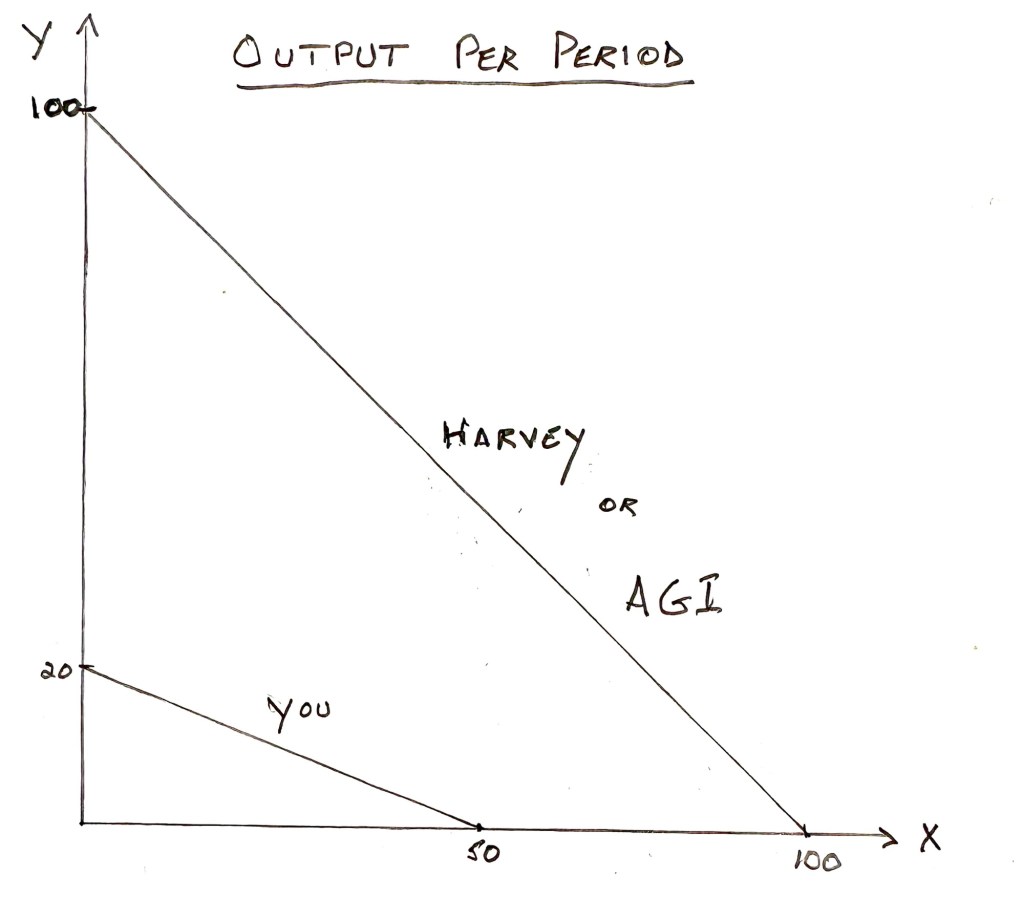
If you’re unwilling to slog through a simple numerical example, skip this section and the graph below. The graph was produced the old fashioned way: by a human being with a pencil, paper, ruler, and smart phone camera.

Here goes: Harvey can produce up to 100 units of X per period or 100 units of Y, or some linear combination of the two. Harvey’s opportunity costs are constant along this tradeoff between X and Y because it’s a straight line. It costs him one unit of Y output to produce every additional unit of X, and vice versa.

You, on the other hand, cannot produce X or Y as well as Harvey in an absolute sense. At most, you can produce up to 50 units of X per period, 20 units of Y, or some combination of the two along your own constant cost (straight line) tradeoff. You sacrifice 5/2 = 2.5 units of X to produce each unit of Y, so Harvey has the lower opportunity cost and a comparative advantage for Y. But it only costs you 2/5 = 0.4 units of Y to produce each additional unit of X, so you have a comparative advantage over Harvey in X production.

Reciprocal Advantages

In the end, you and Harvey specialize in the respective areas for which each has their lowest relative opportunity cost and a comparative advantage. If he has a comparative advantage in one area of production, and unless your respective tradeoffs have identical slopes (unlikely), the reciprocal nature of opportunity costs dictates that you have a comparative advantage in the other area of production.

Obviously, Harvey’s formidable absolute advantage over you in everything doesn’t impinge on these choices. In the real world, of course, comparative advantages play out across many dimensions of output, but the principle is the same. And once we specialize, we can trade with one another to mutual advantage.

No Such Thing As a Free AGI Robot

That brings us back to AGI and AGI robots. Like Harvey, they might well have an absolute advantage in every area of specialization, or they can learn quickly to achieve such an advantage, but that doesn’t mean they should do everything!

Just as in times preceding earlier technological breakthroughs, we cannot even imagine the types of jobs that will dominate the human and AGI work forces in the future. We already see complementarity between humans and AGI in many applications. AGI makes those workers much more productive, which leads to higher wages.

However, substitution of AGIs for human labor is a dominant theme of the many AGI “harm” narratives. In fact, substitution is already a reality in many occupations, like coding, and substitution is likely to broaden and intensify as the marriage of AGI and robotics gains speed. But that will occur only in industries for which the relative opportunity costs of AGIs, including all of the ancillary resources needed to produce them, are favorable. Among other things, AGI will require a gigantic expansion in energy production and infrastructure, which necessitates a massive exploitation of resources. Relative opportunity costs in the use of these resources will not always favor the dominance of AGIs in production. Like Harvey, AGIs and their ancillary resources cannot do everything because they cannot have comparative advantages without reciprocal comparative disadvantages.

Super-Abundance vs. Scarcity

Some might insist that AGIs will lead to such great prosperity that humans will no longer need to work. All of our material wants will be met in a new age of super-abundance. Despite the foregoing, that might suggest to some that AGIs will do everything! But here I make another claim: our future demands on resources will not be satisfied by whatever abundance AGIs make possible. We will still want to do more, whether we choose to construct fusion reactors, megastructures in space (like Dyson spheres or ring worlds), terraform Mars, undertake interstellar travel, perfect asteroid defense, battle disease, extend longevity, or improve our lives in ways now imagined or unimagined.

As a result, scarcity will remain a major force. To that extent, resources will have competing uses, they will face opportunity costs, and they will have comparative advantages vis a vis alternative uses to which they can be put. Scarcity is a reality that governs opportunity costs, and that means humans will always have roles to play in production.

Concluding Remarks

I wrote about human comparative advantages once before, about seven years ago. I think I was groping along the right path. The only other article I’ve seen to explicitly mention a comparative advantage of human labor vs. AGIs in the correct context is by Andrew Mayne in the most recent issue of Reason Magazine. It’s almost a passing reference, but it deserves more because it is foundational.

Harvey Specter shouldn’t occupy his scarce time performing tasks that compromise his ability to deliver his most rewarding services. Likewise, before long it will become apparent that highly productive AGI assets, and the resources required to build and operate them, should not be tied up in activities that humans can perform at lesser sacrifice. That’s a long way of saying that humans will still have productive roles to play, even when AGI achieves an absolute advantage in everything. Some of the roles played by humans will be complimentary to AGIs in production, but human labor will also be valuable as a substitute for AGI assets in other applications. As long as AGI assets have any comparative advantages, humans will have reciprocal comparative advantages as well.

The Wasteful Nature of Recycling Mandates

02 Thursday Mar 2023

Posted by Nuetzel in Markets, Recyclng

≈ 1 Comment

Tags

Bitumen, Blind Recycling, Landfill Space, NIMBY-ism, Plastic Roads, Rag Trade, Recycling, Recycling Fraud, Scarcity, Thomas J. Bruno

Materials recycling has been practiced for thousands of years, but typically only when it has made economic sense to do so. Thomas J. Bruno mentions several cases in which recycled inputs have been heavily relied upon, not because of mandates, but because of demand for reuse or as inputs to various kinds of production. For example, the “rag trade” provided an important input to “new” clothing till about 1900, and the trade still exists today. Here’s Bruno on some other prominent examples:

“Steel is highly recycled already, with structural steel being 93% recycled. Currently, 97% of discarded automotive steel is used in new cars and other products. The market position for aluminum is also good; 75% of all aluminum ever produced is still in use today.”

Bruno’s key point is that recycling anything is a process that uses resources. It involves fixed costs of plant and variable costs for other inputs like water, energy, various chemicals, and labor. Thus, recycling makes economic sense and is efficient only when the private demand for recycled end-products justifies the costs of processing the used materials. Otherwise, on balance recycling is a waste of scarce resources.

Yet recycling enthusiasts and too many policymakers proceed under the misapprehension that recycling anything always makes sense! This is blind recycling! They approach the question with a certain religious fervor, rather than sharp pencils and the minds to wield them effectively. The resource costs are borne by local taxpayers, and they are not insignificant. These include the cost of additional facilities, running multiple trucks, and further sorting. If industrial buyers of these materials fail in their assessment of demand for goods with recycled content, then they bear the cost of any additional transport, processing, and disposal. Recycling shouldn’t salve the guilt that anyone associates with producing waste when, as is so often the case, nobody wants that shit! It ends up in the landfill and the effort to reuse ends up as waste as well. But still, the green public veneer of recycling programs remains in place.

Plastics recycling has proven to be perhaps the greatest disappointment to recycling enthusiasts. According to Bruno:

“Mechanical recycling involves grinding and remelting the plastic into a stream suitable for molding, but only a few types (out of thousands) of plastics can be so reprocessed. … Chemically recycling waste plastics has been an unmitigated disaster, resulting in product streams with far worse properties than virgin feedstocks.”

Those difficulties might be surmounted with improved technology or novel uses for plastic waste. Read this for an interesting discussion of using plastic in roads in place of bitumen for binding asphalt, or as modular panels in forming road base, but there is a long way to go before these are viable and economic alternatives.

Regulating products to require recycled content is just as harmful an intrusion as mandates on consumers and businesses to recycle used materials having little or no value. Predictably, it leads to degradations in quality and/or higher processing costs, with the ultimate burden shared by producers and users of end products. If it made economic sense, producers would already use more recycled inputs, but that is often out of the question. Mandates only bring more harm.

Despite constant handwringing in the media and among environmentalists, landfill capacity in the U.S. is adequate. Landfill space is priced based on scarcity, like any other resource. More landfill space will be brought on-line when market prices signal its profitability, despite the power of NIMBY-ism even in desolate lands. That usually can be overcome by compensatory arrangements. Landfills are far better managed and sealed today than in the past. Meanwhile, solid waste compression and techniques that speed the process of decomposition are stretching the capacity of existing landfills.

Once again, this is all a matter of economics. The value of avoiding the use of landfills via recycling is often just not there. Uneconomic recycling is simply a waste of scarce resources.

Economic Growth and the Real Accretion of Resources

10 Friday Feb 2023

Posted by Nuetzel in Growth, Scarcity

≈ Leave a comment

Tags

Angus Maddison, Carbon Concentrations, Carbon Dial, Common Resources, Don Boudreaux, External Costs, Fusion Energy, Geothermal Energy, global warming, Grabby Civilization, Greening, Growth, Human capital, Human Ingenuity, Julian Simon, Known Reserves, Markets, Modular Reactors, Paleoclimate Data, Price Signals, Public Finance, Renewables, Resource Accretion, Risk Mitigation, S-Curve, Scarcity, Sea Levels, Space Mining, Urban Heat Islands

A few weeks ago I argued that raising living standards and eliminating poverty are human imperatives, and therefore growth is an imperative. Growth is a natural process for a free and creative people, and the alternative to growth is not zero growth. The coercion necessary to “achieve” a static economic environment would invariably lead to decline. It would be impossible to maintain average living standards while attempting a coerced leveling of those standards.

People have a notion, however, that it’s impossible to sustain growth due to the planet’s finite base of resources. If that is the case, we have available a mechanism to warn us as the time of hard limits approaches, which I’ll discuss below. So far, that signal hasn’t been activated. Moreover, the claim that growth is unsustainable can be challenged on several levels, which I’ll also address.

Effective Resources

First, a word about what I mean by the “accretion of resources”. The phrase refers to growth in the total effectiveness or productive potential of known resources given the rate of discovery and improvements in extraction and production technologies. Of course, if these discoveries and efficiencies are exceeded by current use, then there is no accretion, but depletion.

So let’s say we have a particular known stock of a resource we can readily draw on, so many pounds of resource X. In addition, we might know of the existence of another equally large quantity that can’t be readily drawn upon. Those are additional known (or proved) but undeveloped reserves. They might be difficult to exploit except at high cost, but we know they exist. We’d want to get on with the business of developing those reserves for extraction if they were needed any time soon, and we might want to begin prospecting for new reserves as well. As we’ve learned over the years. discoveries of previously unknown reserves of resources can be quite large. Prospectors are willing to bet that more resources exist, and they’ll undertake the risks of exploration if the potential rewards are adequate.

All of those concepts are straightforward. However, suppose we discover ways in which resource X can be used more efficiently, making things stronger or run longer or harder with less X. If we double the efficiency with which X is used, we have doubled the effective known reserves of X and, at least theoretically, unknown reserves as well. We’d have witnessed a doubling in the years that resource X can last. This is a form of resource accretion. Improvements in extraction or purification methods are also examples. Technological leaps like this, not to mention untold small increments in the efficiency of practices, have made economic growth possible in the past and will continue to do so in the future. Our effective resources seem to keep expanding. Accretion has occurred even with respect to resources like land as the world urbanized and the efficiency of farming advanced many-fold.

Growth In Real Time

Perceptions of growth are sometimes shaped by graphic depictions that some parties find alarming, so it might be helpful to take a quick look at some growth curves. First is an oldie-but-goodie chart showing GDP per capita taken from “Statistics on World Population, GDP, and Per Capital GDP, 1- 2008 AD” by Angus Maddison of the IMF:

This shows the explosion in the value of production that occurred during and after the industrial revolution, in contrast to very slow progress before that. The point I want to make here is how dramatic growth can look on a broad but visually compressed time scale. OMG! Look what we’ve done! How can we go on like this??? Often, the crux of the limits to growth argument is that such growth seems impossible assuming that we face fixed resource limits.

In fact, we experience growth in a very “local” way with respect to the passage of time. The two charts below illustrate a difference in perspectives using a hypothetically constant annual growth rate of 2.5%. The first chart shows 200 periods of growth, while the second expands only the last 20 periods of that time frame.

There is a great difference in the way the two vertical axes are scaled, which is important, but the second chart conveys that a respectable growth rate doesn’t really feel extreme when you’re in the middle of it, or, that is, in real time. It can look very extreme at the end of a long interval, depending on how severely the time axis is compressed. That’s not to discount the reality of much larger levels of activity (the vertical axes) and demands for resources as time goes on. However, those levels, and growth from those levels, is not at all alarming if our ability to achieve them has kept pace. So how can we know when we’re approaching a point at which resource limits will make it impossible to achieve those levels of activity? Market prices are the key signals, and they are the key to resource accretion.

Market Signals Light the Way

The market price is the best gauge of the scarcity of a resource. When resources become especially scarce, higher prices tell us so. That leads to conservation, which obviously extends the availability of those resources. Prices also function as an incentive for sellers to exploit new or harder-to-reach stores of a resource. That kind of resource accretion is one of the lessens the oil market has taught us again and again: oil exploration and known reserves tend to expand as the price rises, such that the prospect of oil depletion moves out to ever more distant horizons. There are certain minerals, elements, or isotopes (tritium?) that seem to be quite rare on Earth, but our ability to find them or extract them often improves with time. Space mining, which would vastly reduce the scarcity of resources like platinum, iron, nickel, cobalt, and many others, may become a reality in the near future. Interestingly, much of that activity could be in private hands. Space mining would lead to resource accretion on a whole new scale, and if we aspire to be a “grabby” civilization, it is a logical next step. So let’s go grab an asteroid!

When a price spikes due to greater scarcity, opportunities for substitution, exploration, and new efficiencies arise because the higher price justifies the cost of exploiting them. In addition to more difficult or costly extraction, a higher price encourages the use of close and even novel substitutes that may involve new technologies. In turn, that substitution reduces the relative scarcity of the original resource in question. And finally, back to conservation, users respond to price increases by finding their own innovative efficiencies in how a resource is utilized. The price response to scarcity is a channel through which much technological progress is encouraged.

While our earth-bound resources or even our star-system’s resources are finite, their effective quantity is highly flexible. Their potential at any time depends on our stage of discovery and the state of technology. Human ingenuity is a marvel at stretching the effective quantity of resources, and the greatest gains always occur when market forces are unleashed.

Thus, we see that prices, markets, and capitalism itself enable rational and sustainable responses to scarcity. Yet too often we hear claims that capitalism must be destroyed in order to save humanity. In fact, capitalism itself is the one system of social organization capable of achieving resource accretion, sustained growth, and lifting mankind from poverty. In fact, growth might well be an insurmountable problem without the dynamic energies of capitalism. Government planners are incapable of gathering and processing the vast information that markets process each and every day. Planners must substitute their own weak judgements, which prove flawed again and again.

Scarcity of the Commons

The environmental Left is quick to marshal a different kind of limits-to-growth argument. This one has to do with the scarcity of non-priced common resources and their overuse in production. For example, if a certain activity degrades the environment and those costs are not internalized by producers, they will tend to produce “too much”, leading to some degree of deterioration in human living conditions or the natural quality of the environment. In that case, we might not notice the limits to growth bearing down on us before corrective action is taken. Or so goes the theory that accumulating externalities lead to catastrophe. This is another front along which the limits to growth are asserted, particularly by climate alarmists and the environmental Left. Most prominently today, they contend that increases in atmospheric carbon concentration will lead to an unlivable warming of Earth’s climate.

Sense and Nonsense

The most glaring shortcoming of climate change advocacy is that the trends it decries are exaggerated. I’ve discussed the absurdly brief climate record cited by alarmists in several past posts (many of which appear here). We can start with the contention that carbon emissions are “poison”. In fact, carbon is life nourishing, as we’ve witnessed with the “greening” of the planet at current carbon concentrations of 4 parts per 10,000 of atmospheric gas. Furthermore, a longer historical temperature record using paleoclimate data shows that we are well within the range of past variation, even with the huge distortions to the record caused by urban heat islands and questionable downward adjustments to records of five to 15 decades ago.

The alarmist perspective is also inflamed by simplistic models of carbon forcing that ignore the impact of solar radiation, volcanic activity, and the behavior of aerosols in the atmosphere. Those models have consistently over-predicted temperature trends for decades. Equally troubling is that these models promote the fiction that mankind can control global temperatures by a little fiddling with a “carbon dial”, as if such fiddling could be accomplished without a massive centralization of political and economic power. The panicked narratives related to sea level increases and alleged increases in violent weather are equally flawed.

Growth Can Cure It

Another compelling response to climate arguments against growth is that technological advances have already enabled us to produce power without carbon emissions. Unfortunately, as a matter of public policy (regulation and bad choices by government industrial planners), we have increasingly failed to avail ourselves of these opportunities, instead choosing extremely wasteful methods of generating power. These are the windmill and solar “renewables”, which are resource-intensive, intermittent, low utilization, non-dispatchable, lacking storage for excess generation, intensive in land use (reversing prior accretions), and environmentally disastrous in fabrication, operation, and at disposal. Nuclear power is a far superior technology, especially with the advent of small, modular reactors and potential breakthroughs in fusion energy. These might help to rescue us from the spectacle of bone-headed industrial planning and greedy, renewable-energy rent seekers, but regulators have done seemingly all they can to prevent nuclear facilities from being built.

Just as human ingenuity is capable of expanding the exploitable stock of tradable, priced resources, it is also capable of inventing non-carbon power technologies that are more efficient and less environmentally destructive than ground-based solar and wind. Collection of non-intermittent solar energy in space arrays with wireless transmission to Earth is another promising alternative, as is geothermal energy. And carbon capture technologies show promise for neutralizing emissions or perhaps even reversing carbon concentrations one day, if that is deemed necessary. Much of this development work is in private hands, but barring drastic reductions in scale, the bulk of these efforts are (or will be) dependent on government funding.

It’s worth acknowledging here that resource accretion has a safety component in an expected value sense. Sometimes those risks can be internalized if risk reduction is of value to buyers. But the costs of “reasonable” risk mitigation cannot always be internalized without government action. For example, deflecting asteroid threats to the planet might be done best by private actors, but paying for that activity is a worthy application of public finance. The ability to deflect incoming asteroids is a noteworthy example of resource accretion via risk reduction.

Somehow, governments must be convinced to begin dedicating a larger share of the vast sums they spend on misguided climate interventions (including renewable technologies) to more sensible innovations. We might then benefit from accelerated breakthroughs that would settle not only our energy future, but a great deal of political strife as well. Like the market response to changes in scarcity, creative entrepreneurs will always step forward to compete for government funding. But if you pay them for crap, you’ll get a lot of crap!

Growth Once More

One day we might learn we are reaching the top of an s-curve. We aren’t there yet, if our ongoing accretion of resources is any guide, and there are new frontiers of space and technology to explore. The primary obstacles we face are not natural, but political and regulatory.

One area neglected above is the accretion of human capital. Certainly education is another way to expand our boundaries. However, population growth (and therefore labor force growth) tends to slow as living standards rise, and many argue that demographics have already become a drag on growth. A shrinking and aging population places a tremendous burden on young workers, making other sources of growth and productivity all the more critical. But new physical capital, resource development (including education), and new technologies can all continue to drive productivity and growth.

Growth depends on resource accretion, and there are many ways in which our effective stock of resources can be expanded. That includes enhancements in quantities, efficiencies, and safety. Private investment should be the primary avenue through which these are accomplished, which in turn requires flows of saving. Those flows are much more difficult to conjure without growth, so we have a chicken and egg cross-dependency. But chickens will lay eggs, just as saving and all kinds of investment will take place given the right incentives. Those would promote expansion in our effective stock of resources, improved adaptation to change, and enhanced well being. In the end, the rationale is simple: ending poverty requires growth.

Addendum: I just noticed that Don Boudreaux posted (and beautifully elaborated upon) this great Julian Simon quote:

“The quantity of a natural resource that might be available to us – and even more important the quantity of the services that can eventually be rendered to us by that natural resource – can never be known even in principle, just as the number of points in a one-inch line can never be counted even in principle.”

The Fed’s Balance Sheet: What’s the Big Deal?

08 Sunday May 2022

Posted by Nuetzel in Government Failure, Inflation, Monetary Policy

≈ Leave a comment

Tags

Allocation of Capital, Bank Reserves, crowding out, Debt Monetization, Fed Balance Sheet, Federal Funds, Federal Reserve, Fiscal Inflation, Inflation tax, Interest Rate Targeting, MBS, Monetary policy, Mortgage Backed Securities, QE, Quantitative Easing, Scarcity, Tapering

The Federal Reserve just announced tighter monetary policy in an attempt to reduce inflationary pressures. First, it raised its target range for the federal funds rate (on overnight loans between banks) by 0.5%. The new range is 0.75% – 1%. Second, on June 1, the Fed will begin taking steps to reduce the size of its $9 trillion portfolio of securities. These holdings were acquired during periods of so-called quantitative easing (QE) beginning in 2008, including dramatic expansions in 2020-21. A shorthand reference for this portfolio is simply the Fed’s “balance sheet”. It includes government debt the Fed has purchased as well as privately-issued mortgage-backed securities (MBS).

What Is This Balance Sheet You Speak Of?

Talk of the Fed’s balance sheet seems to mystify lots of people. During the 2008 financial crisis, the Fed began to inject liquidity into the economy by purchasing large amounts of assets to be held on its balance sheet. This was QE. It’s scope was unprecedented and a departure from the Fed’s pre-crisis reliance on interest rate targeting. QE had the effect of increasing bank reserves, which raised the possibility of excessive money supply growth. That’s when the Fed began to pay interest to banks on reserves, so they might be content to simply hold some of the reserves over and above what they are required to hold, rather than using all of that excess to support new loans and deposits (and thus money growth). However, that interest won’t stop banks from lending excess reserves if better opportunities present themselves.

The Fed has talked about reducing, “normalizing”, or “tapering” its balance sheet for some time, but it only recently stopped adding to it. With inflation raging and monetary policy widely viewed as too “dovish”, analysts expected the Fed to stop reinvesting proceeds from maturing securities, which amounts to about $95 billion per month. That would shrink or “taper” the balance sheet at a rate of about $1.1 trillion per year. Last week the Fed decided to cap the “runoff” at $47.5 billion per month for the first three months, deferring the $95 billion pace until September. Monetary policy “hawks” were disappointed by this announcement.

Monetizing Government

So, one might ask, what’s the big deal? Why must the Fed taper its securities holdings? Well, first, the rate of inflation is far above the Fed’s target range, and it’s far above the “average Joe’s” comfort range. Inflation imposes significant costs on the economy and acts as a regressive form of taxation, harming the poor disproportionately. To the extent that the Fed’s huge balance sheet (and the corresponding bank reserves) are supporting incremental money growth and fueling inflation, the balance sheet must be reduced.

In that connection, the Fed’s investment in government debt represents monetized federal debt. That means the Fed is essentially printing money to meet the Treasury’s financing needs. Together with profligate spending by the federal government, nothing could do more to convince investors that government debt will never be repaid via future budget surpluses. This dereliction of the government’s “full faith and credit”, and the open-armed acceptance of the inflation tax as a financing mechanism (à la Modern Monetary Theory), is the key driver of fiscal inflation. Reducing the balance sheet would represent de-monetization, which might help to restore faith in the Fed’s ability to push back against fiscal recklessness.

Buyer of First Resort

Perhaps just as critically, the Fed’s heavy investment in government debt and MBS represents an ongoing distortion to the pricing of financial assets and the allocation of capital. Some call this interference in the “price discovery process”. That’s because the Fed has represented a market-altering presence, a willing and inelastic buyer of government debt and MBS. Given that presence, it’s difficult for buyers and sellers to discern the true values of alternative uses of capital, or to care.

QE was, among other things, a welcome institutional development for the U.S. Treasury and for those who fancy that fresh money printing is an ever-valid form of government payment for scarce resources. The Fed’s involvement also means that other potential buyers of Treasury debt need not worry about interest rate risk, making public debt relatively more attractive than private debt. This is a dimension of the “crowding out” phenomenon, whereby the allocation of capital and flows of real resources between public and private uses are distorted.

The Fed’s presence as a buyer of MBS depresses mortgage rates and makes mortgage lending less risky for lenders and investors. As a result, it encourages an over-investment in housing and escalating home prices. This too distorts the allocation of capital and real resources, at the margin, toward housing and away from uses with greater underlying value.

Conclusion

The magnitude of the Fed’s balance sheet is an ongoing testament to an increasingly dominant role of central authorities in the economy. In this case, the Fed has served as a conduit for the inflation tax. In addition, it has unwittingly facilitated crowding out of private capital investment. The Fed’s purchases of MBS have distorted the incentives (and demand) for residential investment. These are subtle effects that the average citizen might not notice, just as one might not notice the early symptoms of a debilitating disease. The long-term consequences of the Fed’s QE activities, including the inflation tax and distorted allocations of capital, are all too typical of failures of government intervention and attempts at central planning. But don’t expect anyone at the Fed to admit it.

Supply-Gouging Laws Keep Goods Off Shelf

23 Monday Mar 2020

Posted by Nuetzel in Markets, Pandemic, Price Controls

≈ 2 Comments

Tags

Arbitrage, Conservation, Coronavirus, Hoarding, incentives, J.D. Tucille, Michael Munger, Price Gouging, Scarcity, Shortage, Speculation

“Low prices say, ‘Take all you want, there’s plenty more.‘”

— Duke economist Michael Munger

See the prices marked on those shelves above? They say infinity!

Nothing drives economists crazy like anti-price “gouging” sentiment, and especially politicians who play on it. Hoarders hoard under such laws precisely because prices are too low given demand and supply conditions. Scarcity is defined by demand relative to supply, and freely adjusting prices register the degree of scarcity quite well. To what purpose? First, to ration available supplies; second, to encourage conservation; third, to incentivize producers to bring more product to market.

But when hoarders hoard, does that not create artificial scarcity? Not really, because the scarcity itself was already a condition, or else the hoarder would not have acted. And the hoarder would not have acted if developing conditions of scarcity had not been contradicted by the low price.

But what if the hoarders are mere speculators? Doesn’t that prove their actions create artificial scarcity? No, again, scarce conditions existed. Speculators don’t speculate to lose money, and they would certainly lose money if they buy when a product is not truly in short supply relative to demand. Speculators operate on the principle of arbitrage: transacting in response to profit opportunities created by gaps between prices and real value. Markets tend to eliminate such opportunities. Anti-“gouging” laws create them in times of crisis.

Should we demand that respiratory therapists not accept higher offers to practice in areas hit hard by the coronavirus? That bears a certain equivalence to laws preventing retailers from raising prices sufficiently to discourage hoarding. After all, retailers know that their dwindling inventory has gained value in a crisis situation, just as the respiratory therapist knows that her services have gained value in a world ravaged by a lung-damaging viral disease. Should we arrest her?

In a functioning market, the respiratory therapist, the retailer, and producers who supply the retailer would all earn more based on the true value of their skills, inventories, or ability to produce. These parties get to keep any premium they earn when conditions create more scarcity. Speculators however, generally don’t share their gains with the producer, which some find regrettable. (In fact, commodity speculators often provide valuable hedging opportunities for suppliers, so my last statement is not quite true.) Nevertheless, speculators serve a valuable function because they often provide the first source of information about changes in scarcity. That information, the price signal, has social value because it embeds incentives for conservation and added production.

Yes, retailers should be able to restock with some time. But it can fairly be said they did not react quickly enough to the “demand shock” caused by the range of precautions taken in response to the coronavirus pandemic. Perhaps retailers placed additional orders with suppliers in an effort to deal with the crisis, and some might have hiked certain prices marginally. I don’t know. However, it’s certain they were chastened in their price response by fears of damaging their public image, and even cowed by short-sighted laws and regulations in some cases. It doesn’t take much imagination, however, to think of ways they might have be able to deal with crisis conditions via pricing policy, such as charging quantity premiums: first package of TP at regular price, second at 2x regular price, three-plus at 10x regular price.

As J.D. Tucille says, people think of price “gouging” as a matter of degree. But at what threshold does price flexibility become inappropriate as conditions of scarcity change? No price controller can tell you exactly. That’s a good reason to eschew shortage-inducing pricing laws. Is it fair when prices rise drastically? Well, the price is infinite when the shelf is empty. Is that fair? Better let markets do their job.

The Abolition of Wealth

12 Tuesday Feb 2019

Posted by Nuetzel in Free markets, Redistribution, Taxes

≈ Leave a comment

Tags

Abolish Billionaires, Don Boudreaux, Joseph Schumpetet, Negative-Sum Policy, Nick Gillespie, Paul McCartney, Redistribution, Scarcity, Wealth Creation, Wealth Taxes

Few weep for the wealthy when they are attacked by redistributionists, but perhaps we should. Recent expressions of hatred for the so-called super-rich extend to the merely affluent, of course, but billionaires are much less likely to find sympathy. Those proposing to “abolish billionaires” by laying public claim to their assets and incomes have little reason to expect a popular backlash. Nevertheless, there are strong reasons to defend the wealthy and their right to control the riches they accumulate. Don Boudreaux has some words we should all take to heart:

“While exceptions no doubt exist, the people who get rich in our economy are overwhelmingly people who have made the rest of us richer.”

Boudreaux is correct in noting that “anti-billionaire” sentiment is marked in people who know little of the complexities of actually producing things. Wealth creation is a two-way street. On one end is a cadre of innovators and risk-takers whose rewards are often concentrated. On the other end are the many beneficiaries of those innovations: eager buyers of value-enhanced products whose rewards are relatively diffuse but very meaningful nonetheless. The same dynamic takes place in generating lower levels of wealth, among hard-working small entrepreneurs and savers. Eliminate one set of rewards and the other will vanish.

Redistributionists are aware of scarcity at a basic level, but it’s as if they take for granted that a certain quantity of product will be on the shelves irrespective of the policy environment, incentives, and basic guarantees of economic liberty. As Boudreaux says:

“If food, clothing, medical care, automobiles, houses, diamond rings, airplane seats, rolls of paper towels, and all other good and services were randomly rained down onto earth by some heavenly being, it would then be true that the more of these goodies that I manage to grab, the fewer are the goodies available for you to grab, and vice versa. … And so if through simple luck or sinister cunning I grab more than you grab, then the resulting inequality in our wealth has no good justification. If the government seizes from me a chunk of ‘my’ stuff and gives it to you, no ethical offense is committed.”

That’s not how it works in a world in which effort and resourcefulness are required to satisfy wants. Under a truly liberal order, such efforts are voluntary, motivated by the promise and prospect of secure rewards. And so, as consumers, we can possess the riches made possible through the efforts of innovators and risk-takers. If successful, their rewards are earned by producing value that not only exceeds their own costs, but exceeds the prices buyers are asked to pay. Today’s most prominent billionaires have brought to market products, services, and ways of transacting that we’d never have imagined even a few years prior to their introduction. Computer operating systems, smart phones, on-line retailing, and room- and ride-sharing are just a few examples.

Nick Gillespie makes much the same point in quoting Joseph Schumpeter:

“The capitalist engine is first and last an engine of mass production which unavoidably also means production for the masses. . . . It is the cheap cloth, the cheap cotton and rayon fabric, boots, motorcars and so on that are the typical achievements of capitalist production, and not as a rule improvements that would mean much to the rich man. Queen Elizabeth owned silk stockings. The capitalist achievement does not typically consist in providing more silk stockings for queens but in bringing them within reach of factory girls.”

Then there are the highly popular musicians and actors of the day, with wealth approaching (and in a few cases exceeding) $1 billion. Gillespie uses Paul McCartney as a case in point. Rather than “cheating” his way to wealth, McCartney’s fans would heartily agree that his talents are well worth the wealth he’s managed to accumulate. Would advocates of “abolishing” billionaires deny all this? They contend, in their own arbitrary judgment, that the market’s objective assessment cannot justify wealth of this magnitude.

Redistributionists also resent that anyone of wealth might have the gall to hold it or invest it rather than give it away. First, as noted above, secure rights provide the necessary incentives to create, produce, and take risks ex ante, which help enrich us all ex post. But those rights also must be secure ex post, and not subject to the whims of the next generation of socialist nitwits. In addition, as Gillespie says:

“Would there be less suffering in the world if [McCartney’s] money is expropriated and transferred to the wretched of the earth via higher taxes rather than through his own charitable donations and investments? Probably not, especially when you think about how much suffering, especially in the developing world, is the direct result of government action.”

Gillespie also marshals statistics on changes in measures of inequality that do not support the claims of redistributionists. In a separate post, Boudreaux makes that case here. Furthermore, the U.S. already has arguably the most progressive tax system in the developed world, even if transfers to the poor are not as generous as in some countries.

The sheer ignorance of many progressives is well illustrated by the “war against billionaires“. These critics of wealth demonstrate all the economic sophistication of preening high-school social studies students. Unfortunately, they are now coddled by certain established officeholders too eager to seek approval from the fringe left than to bother with responsible policy analysis.

It’s a short rhetorical step from condemning billionaires to condemning mere millionaires and sub-millionaires, and coveting their wealth. The victims here will ultimately include successful small business people and professionals who not only employ large segments of the population but also provide many of the services and wares we rely on in our day-to-day lives. Their success is not only well-earned: it is continuously exposed to risk from competitive forces. Rapacious politicians will never cease in their efforts to apply confiscatory taxes to the wealth of the very affluent. Soon enough, tax policy will reach farther down into the wealth distribution. These are games better suited to children or even vicious animals. Redistributionists think in zero-sum terms, with no appreciation for the positive-sum outcomes enabled by secure rights and free markets. Their failure to grasp the dynamics of free markets is at the root of their advocacy for disastrously negative-sum policies.


The Comparative Human Advantage

10 Thursday Aug 2017

Posted by Nuetzel in Automation, Technology, Tradeoffs

≈ 1 Comment

Tags

Absolute Advantage, Automation, Comparative advantage, Elon Musk, Kardashev Scale, Minimum Wage, Opportunity cost, Scarcity, Specialization, Superabundance, Trade

There are so many talented individuals in this world, people who can do many things well. In fact, they can probably do everything better than most other people in an absolute sense. In other words, they can produce more of everything at a given cost than most others. Yet amazingly, they still find it advantageous to trade with others. How can that be?

It is due to the law of comparative advantage, one of the most important lessons in economics. It’s why we specialize and trade with others for almost all of ours needs and wants, even if we are capable of doing all things better than them. Here’s a simple numerical example… don’t bail out on me (!):

  • Let’s say that you can produce either 1,000 bushels of barley or 500 bushels of hops in a year, or any combination of the two in those proportions. Each extra bushel of hops you produce involves the sacrifice of two bushels of barley.
  • Suppose that I can produce only 500 bushels of barley and 400 bushels of hops in a year, or any combination in those proportions. It costs me only 1.25 bushels of barley to produce an extra bushel of hops.
  • You can produce more hops than I can, but hops are costlier for you at the margin: 2 bushels of barley to get an extra bushel of hops, more than the 1.25 bushels it costs me.
  • That means you can probably obtain a better combination (for you) of barley and hops by specializing in barley and trading some of it to me for hops. You don’t have to do everything yourself. It’s just not in your self-interest even if you have an absolute advantage over me in everything!

This is not a coincidental outcome. Exploiting opportunities for trade with those who face lower marginal costs effectively increases our real income. In production, we tend to specialize — to do what we do — because we have a comparative advantage. We specialize because our costs are lower at the margin in those activities. And that’s also what motivates trade with others. That’s why nations should trade with others. And, as I mentioned about one week ago here, that’s why we have less to fear from automation than many assume.

Certain tasks will be automated as increasingly productive “robots” (or their equivalents) justify the costs of the resources required to produce and deploy them. This process will be accelerated to the extent that government makes it appear as if robots have a comparative advantage over humans via minimum wage laws and other labor market regulations. As a general rule, employment will be less vulnerable to automation if wages are flexible. 

What if one day, as Elon Musk has asserted, robots can do everything better than us? Will humans have anywhere to work? Yes, if human labor is less costly at the margin. Once deployed, a robot in any application has other potential uses, and even a robot has just 24 hours in a day. Diverting a robot into another line of production involves the sacrifice of its original purpose. There will always be uses in which human labor is less costly at the margin, even with lower absolute productivity, than repurposing a robot or the resources needed to produce a new robot. That’s comparative advantage! That will be true for many of the familiar roles we have today, to say nothing of the unimagined new roles for humans that more advanced technology will bring.

Some have convinced themselves that a fully-automated economy will bring an end to scarcity itself. Were that to occur, there would be no tradeoffs except one kind: how you use your time (barring immortality). Superabundance would cause the prices of goods and services to fall to zero; real incomes would approach infinity. In fact, income as a concept would become meaningless. Of course, you will still be free to perform whatever “work” you enjoy, physical or mental, as long as you assign it a greater value than leisure at the margin.

Do I believe that superabundance is realistic? Not at all. To appreciate the contradictions inherent in the last paragraph, think only of the scarcity of talented human performers and their creativity. Perhaps people will actually enjoy watching other humans “perform” work. They always have! If the worker’s time has any other value (and it is scarce to them), what can they collect in return for their “performance”? Adulation and pure enjoyment of their “work”? Some other form of payment? Not everything can be free, even in an age of superabundance.

Scarcity will always exist to one extent or another as long as our wants are insatiable and our time is limited. As technology solves essential problems, we turn our attention to higher-order needs and desires, including various forms of risk reduction. These pursuits are likely to be increasingly resource intensive. For example, interplanetary or interstellar travel will be massively expensive, but they are viewed as desirable pursuits precisely because resources are, and will be, scarce. Discussions of the transition of civilizations across the Kardashev scale, from “Type 0” (today’s Earth) up to “Type III” civilizations, capable of harnessing the energy equivalent of the luminosity of its home galaxy, are fundamentally based on presumed efforts to overcome scarcity. Type III is a long way off, at best. The upshot of ongoing scarcity is that opportunity costs of lines of employment will remain positive for both robots and humans, and humans will often have a comparative advantage.

← Older posts
Follow Sacred Cow Chips on WordPress.com

Recent Posts

  • Immigration and Merit As Fiscal Propositions
  • Tariff “Dividend” From An Indigent State
  • Almost Looks Like the Fed Has a 3% Inflation Target
  • Government Malpractice Breeds Health Care Havoc
  • A Tax On Imports Takes a Toll on Exports

Archives

  • December 2025
  • November 2025
  • October 2025
  • September 2025
  • August 2025
  • July 2025
  • June 2025
  • May 2025
  • April 2025
  • March 2025
  • February 2025
  • January 2025
  • December 2024
  • November 2024
  • October 2024
  • September 2024
  • August 2024
  • July 2024
  • June 2024
  • May 2024
  • April 2024
  • March 2024
  • February 2024
  • January 2024
  • December 2023
  • November 2023
  • August 2023
  • July 2023
  • June 2023
  • May 2023
  • April 2023
  • March 2023
  • February 2023
  • January 2023
  • December 2022
  • November 2022
  • October 2022
  • September 2022
  • August 2022
  • July 2022
  • June 2022
  • May 2022
  • April 2022
  • March 2022
  • February 2022
  • January 2022
  • December 2021
  • November 2021
  • October 2021
  • September 2021
  • August 2021
  • July 2021
  • June 2021
  • May 2021
  • April 2021
  • March 2021
  • February 2021
  • January 2021
  • December 2020
  • November 2020
  • October 2020
  • September 2020
  • August 2020
  • July 2020
  • June 2020
  • May 2020
  • April 2020
  • March 2020
  • February 2020
  • January 2020
  • December 2019
  • November 2019
  • October 2019
  • September 2019
  • August 2019
  • July 2019
  • June 2019
  • May 2019
  • April 2019
  • March 2019
  • February 2019
  • January 2019
  • December 2018
  • November 2018
  • October 2018
  • September 2018
  • August 2018
  • July 2018
  • June 2018
  • May 2018
  • April 2018
  • March 2018
  • February 2018
  • January 2018
  • December 2017
  • November 2017
  • October 2017
  • September 2017
  • August 2017
  • July 2017
  • June 2017
  • May 2017
  • April 2017
  • March 2017
  • February 2017
  • January 2017
  • December 2016
  • November 2016
  • October 2016
  • September 2016
  • August 2016
  • July 2016
  • June 2016
  • May 2016
  • April 2016
  • March 2016
  • February 2016
  • January 2016
  • December 2015
  • November 2015
  • October 2015
  • September 2015
  • August 2015
  • July 2015
  • June 2015
  • May 2015
  • April 2015
  • March 2015
  • February 2015
  • January 2015
  • December 2014
  • November 2014
  • October 2014
  • September 2014
  • August 2014
  • July 2014
  • June 2014
  • May 2014
  • April 2014
  • March 2014

Blogs I Follow

  • Passive Income Kickstart
  • OnlyFinance.net
  • TLC Cholesterol
  • Nintil
  • kendunning.net
  • DCWhispers.com
  • Hoong-Wai in the UK
  • Marginal REVOLUTION
  • Stlouis
  • Watts Up With That?
  • Aussie Nationalist Blog
  • American Elephants
  • The View from Alexandria
  • The Gymnasium
  • A Force for Good
  • Notes On Liberty
  • troymo
  • SUNDAY BLOG Stephanie Sievers
  • Miss Lou Acquiring Lore
  • Your Well Wisher Program
  • Objectivism In Depth
  • RobotEnomics
  • Orderstatistic
  • Paradigm Library
  • Scattered Showers and Quicksand

Blog at WordPress.com.

Passive Income Kickstart

OnlyFinance.net

TLC Cholesterol

Nintil

To estimate, compare, distinguish, discuss, and trace to its principal sources everything

kendunning.net

The Future is Ours to Create

DCWhispers.com

Hoong-Wai in the UK

A Commonwealth immigrant's perspective on the UK's public arena.

Marginal REVOLUTION

Small Steps Toward A Much Better World

Stlouis

Watts Up With That?

The world's most viewed site on global warming and climate change

Aussie Nationalist Blog

Commentary from a Paleoconservative and Nationalist perspective

American Elephants

Defending Life, Liberty and the Pursuit of Happiness

The View from Alexandria

In advanced civilizations the period loosely called Alexandrian is usually associated with flexible morals, perfunctory religion, populist standards and cosmopolitan tastes, feminism, exotic cults, and the rapid turnover of high and low fads---in short, a falling away (which is all that decadence means) from the strictness of traditional rules, embodied in character and inforced from within. -- Jacques Barzun

The Gymnasium

A place for reason, politics, economics, and faith steeped in the classical liberal tradition

A Force for Good

How economics, morality, and markets combine

Notes On Liberty

Spontaneous thoughts on a humble creed

troymo

SUNDAY BLOG Stephanie Sievers

Escaping the everyday life with photographs from my travels

Miss Lou Acquiring Lore

Gallery of Life...

Your Well Wisher Program

Attempt to solve commonly known problems…

Objectivism In Depth

Exploring Ayn Rand's revolutionary philosophy.

RobotEnomics

(A)n (I)ntelligent Future

Orderstatistic

Economics, chess and anything else on my mind.

Paradigm Library

OODA Looping

Scattered Showers and Quicksand

Musings on science, investing, finance, economics, politics, and probably fly fishing.

  • Subscribe Subscribed
    • Sacred Cow Chips
    • Join 128 other subscribers
    • Already have a WordPress.com account? Log in now.
    • Sacred Cow Chips
    • Subscribe Subscribed
    • Sign up
    • Log in
    • Report this content
    • View site in Reader
    • Manage subscriptions
    • Collapse this bar
 

Loading Comments...