• About

Sacred Cow Chips

Sacred Cow Chips

Author Archives: Nuetzel

Science of the Spurious: Global Warming and Suicide

27 Friday Jul 2018

Posted by Nuetzel in Global Warming

≈ Leave a comment

Tags

Carbon Mitigation, Causality vs. Correlation, El Nino, Global Warming Hiatus, Inflammatory Chain Reaction, Marshall Burke, Nature Journal, P-Value Problem, Rare Events, Suicide Rate, Suicides and Global Warming
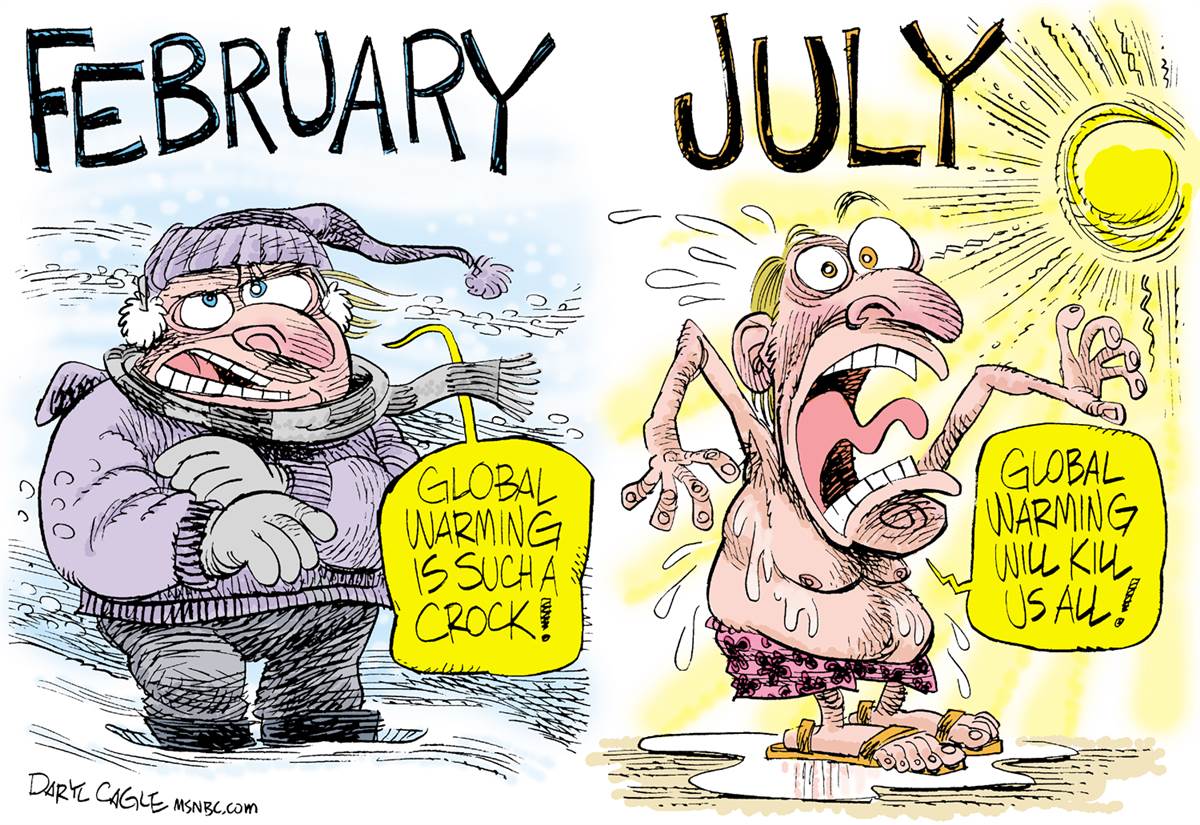
The latest entry in the scare-mongering literature of global warming, published this month in Nature, purports to show that warming will lead to more suicides! I’m not sure whether these researchers deserve an award for naiveté or cynicism, but they should get one or the other. The lead author is listed as Marshall Burke of Stanford University.

The basic finding of their research is that an increase in average monthly temperature of one degree Celsius (1.8 degrees Fahrenheit) increases the monthly suicide rate by 0.68% (or 0.42% when accounting for the previous month’s temperature as well). They might have used the preferred verbiage “is associated with”, rather than “increases”, because they surely know that correlation is not the same as causation, but perhaps they wished to impress the news media. Let’s put their result in perspective: the annual U.S. suicide rate per 100,000 persons was 11.64 over the years 1968-2004 in their sample. A 0.68% increase in the suicide rate would have brought that up to roughly 11.72. Of course, the average U.S. surface temperature did NOT increase by 1 degree Celsius over that period — it was about half that, and temperatures have been relatively flat since then.

The real problem here is that most of the variation in temperatures across the sample used by Burke and his co-authors is seasonal and geographical. While they claim to have accounted for such confounding influences using non-parametric controls, they give few specifics, so I am unconvinced. It has long been known that suicides tend to be seasonal and are higher in the warmer months of the year. The reasons cited vary, including a boost provided by warmth in the energy needed to execute a suicide plan, “inflammatory chain reactions” from high pollen counts, seasonal peaks in bipolar disorder, and stress from greater social interactions during warm weather. These are seasonal phenomena that are not even incidental to the question at hand. And let’s face it: if warmer weather gives you the energy to kill yourself, the temperature is probably not the problem.

The authors also report a positive “effect” of temperatures on suicides using annual data, but with a rather large variance. This result probably captures geographical variation in suicide rates, though again, the authors claim to have made adjustments. Southern states tend have high suicide rates, but no one has suggested that warm, southern climates are to blame. Instead, there are other socioeconomic factors that probably account for this regional variation. I suspect that this is another source of the correlation the authors use to project forward as a likely impact of global warming. (While the inter-mountain West tends to have high suicide rates relative to other regions, many of those states are lightly populated, so they would receive low weights in any analysis of the kind discussed here.)

Finally, the trend toward slightly warmer temperatures between 1968 and the late 1990s was spurred largely by a series of strong El Nino events, especially in 1997-98. Suicide rates in the U.S., on the other hand, reached a high in the mid-1970s, ran slightly lower until hitting another peak in the mid-1980s, and then tapered through the late 1990s even as temperatures spiked. Since 1998, suicides have trended up as temperature trends flattened during the so-called “global warming hiatus”, which is ongoing. This sequence not only contradicts the authors narrative; it reinforces the fact that the variation exploited in the samples may well be seasonal and geographical, and not related to climate trends.

An issue over which Burke, et al demonstrate no awareness is the exaggerated statistical significance of meaningless effects in very large samples. This has been called the “p-value problem” because large samples can lead to vanishingly small p-values (which measure statistical significance). In a very large sample, any small difference may appear to be statistically significant. It’s a well-known pitfall in empirical work. A suicide is what’s known in the statistical literature as a “rare event”, given it’s annual incidence of about 0.01% of the population. I submit that the estimated impact of a 1% change in that rate, a change of 0.0001%, is well-nigh meaningless.

But the authors, undaunted, do their very best to make it seem meaningful. First, they pick a sub-sample that yields a somewhat higher estimated effect. Then they apply it to a future climate change scenario that is considered extreme and “extremely unlikely”, by climate researchers. They calculate the cumulative increase in suicides implied by that estimate out to 2050 — 32 years — for the U.S. and Mexico combined: about 22,000 extra suicides (they give a confidence interval of 9,000 to 39,000). That would be a lot, of course, but aggregating over many years using a high-end estimate and an extreme scenario can make an otherwise tiny effect appear large. And remember, their confidence interval is tightened considerably via the use of many observations on essentially irrelevant seasonal and geographic variation.

Burke and his co-authors have succeeded in publishing a piece of research that is not just flimsy, but that they apply in a way that is grossly misleading. They made it as ripe and plump as possible for promotion by the news media, which seems to love a great scare story. I might just as easily claim that as declines in income are associated with higher suicides, efforts at carbon mitigation requiring high taxes and punitive consumer rates for electric power will lead to an increase in suicides. And I could “prove” it with statistics. Then we would have a double-warming whammy! But I have a better idea: let’s expose bad research for what it is, and that includes just about all of the literature that warns of catastrophe from global warming.

Deceits of the Climate Claimants

23 Monday Jul 2018

Posted by Nuetzel in Global Warming

≈ 1 Comment

Tags

Al Gore, Alpine Tree Lines, Armadillos, Desertification, Global Greening, global warming, Ocean Acidification, Polar Bears, Social Cost of Carbon, Steven Hayward

Well-meaning souls innocently parrot the global warming narrative but generally know little of the controversies surrounding its validation, or lack thereof. That includes much of the mainstream media. Every warm day is evidence of global warming. Every cold day is evidence of extreme volatility brought on by climate change. Every big storm, every forest fire, and every endangered species is attributed to warming. The poles are melting, the sea is rising, the sky is falling, and it is mostly bullshit. But in the meantime, the mythology of global warming has become an all-purpose cudgel for state oversight and “redistributive justice”, primarily to the benefit of the “climate change industrial complex. The myths are repeated so frequently that many accept them as facts. Here, I list a few of these myths along with information that should give pause to anyone tempted to take them too seriously.

The science is settled: There are a number of great scientists who dispute the global warming narrative (and see here). But a few studies have claimed incredibly widespread consensus (97%) among scientists that mankind drives climate change. These studies are generally plagued by biased samples of scientists (sometimes including non-scientists), faulty selection and classification of paper abstracts, and direct involvement of climate activists in the research process. These studies tend to present the “consensus” as one side of a stark dichotomy, with no nuance or middle ground for those subscribing to anything less than the inevitability of a warming catastrophe.

Record high temperatures: The temperatures that are almost always reported are surface temperatures that are subject to extreme bias. The most drastic bias is caused by increasing urbanization. Urban weather instruments are often sited in areas with an increasing amount of impervious ground cover, which absorbs sunlight and heat, leading to the so-called “urban heat-island effect”. This has imparted an upward trend in urban temperature readings. Moreover, urban temperature readings tend to be over-sampled in estimates of global surface temperatures, reinforcing the distortions in measured warming.

Melting poles: Arctic sea ice extent has been in modest retreat since 1980, when satellite measurement began to allow more accurate readings. The Antarctic, however, has shown a trend in the other direction, as shown in this piece by Judith Curry. In the same article, Curry shows that specific Arctic locations had less sea ice 6,000 to 8,000 years ago than today. For more complete information on satellite-era trends in sea ice extent, see this informative reference page (scroll way down for Antarctic information). Looks like Al Gore’s dire prediction that the poles would melt by 2007 was just a little off target.

Polar bear extinction: We are constantly seeing warnings of polar bear extinction on social media. Memes feature desperate-looking bears stranded on ice floes, drifting away from their cubs. Perhaps you aren’t supposed to know that polar bears are extremely strong swimmers. Or that the polar bear population is been thriving, increasing by an estimated 10-20% since 2001. So whether or not the past few decades have seen a decline in sea ice, the bears seem be doing just fine.

Rising sea levels: The rate of increase in sea levels over the past 8,000 years has been vey slow relative to the 10,000 years prior to that, when they rose at rates of up to 5.5 meters per century. That compares to recent rates of about one foot per century. Predictions that islands in the Pacific would be swallowed by the seas have not come to pass. In fact, satellite images show that more of the world’s sandy shorelines accreted than receded between 1984 and 2016, This does not appear to be a crisis by any means.

Increasing storms: No, the frequency and intensity of tropical cyclone activity has decreased since 1900, a trend that has continued unabated over the past 20 years. I know of at least one study suggesting otherwise, but it is based purely on modeled relationships, not hard data, and not tested against data. The frequency and intensity of droughts and floods has been flat to declining as well. And while more weak tornadoes are detected today than in the past, the frequency of moderate to strong tornadoes has decreased over the past 45 years.

Desertification: Increases in carbon concentration have not been associated with desertification, as the media seem to have concluded. As noted above, the frequency of drought has been steady to declining. In fact, precipitation data suggests that patterns of variability in rainfall do not square with the predictions of climate models. In fact, the world has seen an increase in green vegetation since 1985, even in arid regions.

Ocean acidification: The reported declines in ocean pH levels over the past few centuries are actually smaller than the normal seasonal variation in pH levels. The presumed negative impact on sea life appears, after all, to be minimal to nonexistent (see the same link).

Higher alpine tree lines: We’ve been waiting. It hasn’t happened, but that hasn’t stopped some activists from stating it as established fact.

Armadillo northward migration: I’ve heard this cited as “proof” of global warming. The range of armadillos extended as far north as southern Missouri and Kansas in the early 1970s, so this isn’t new. In fact, armadillos began their migration northward into the U.S. before the mid-1800s. Some biologists have attributed the migration to warming but acknowledge many other reasons, including more forested habitat in the north and factors such as movement of cattle by rail. Armadillos burrow and are able to keep warm underground in the winter. Of course, a series of warm winters can bring them further north along with other species, but a few cold winters can take a toll on the population and push them south again.

U.S. carbon criminality: U.S. CO2 emissions have been in almost steady decline on a per capita basis for at least seven decades, long before the carbon freak-out began. The declines have resulted largely from the normal market process of competitive efficiency in production. China leads the world in total annual CO2 emissions by a wide margin, about 80% ahead of the U.S. in 2017. Total U.S. emissions actually declined in 2017 for the third straight year, while emissions in China, the EU, and for the world all increased. In fact, China was actually in compliance with its pledge under the Paris Accord despite the increase, so the pledge was not especially ambitious.

High social cost of carbon: The estimates used by the Environmental Protection Agency are plagued by poor methodology and are subject to great uncertainty. Some studies rely on a series of tenuous causal links, such as CO2 emissions to global temperatures to ice melt to sea level to real dollars of coastal damage many years hence, all without considering variances at each stage, and assuming zero effort to adapt or mitigate damages over long time frames. A shortcut approach relies on historical correlations between temperatures and such measures as heat-related deaths, labor productivity and real output. These estimates extrapolate old relationships to the distant future and ignore the very real human tendency to adapt. The underlying assumptions are undercut by such basic facts as ongoing migration to warmer regions. The estimates also fail to account for the likelihood that warmer weather will improve agricultural productivity.

The public’s interest in climate change has waned, and no wonder: sensible people do not buy hype and demands for sacrifice in the face of contradictory evidence. Revelations of statistical fraud have led to even more skepticism. And when your “proof” is founded on model extrapolation, often theoretically-based rather than empirically-based, you’re skating on thin scientific ice. At this link, Steven Hayward has an interesting take on the public’s increasingly jaundiced view of global warming activism:

“Scientists who are genuinely worried about the potential for catastrophic climate change ought to be the most outraged at how the left politicized the issue and how the international policy community narrowed the range of acceptable responses. Treating climate change as a planet-scale problem that could be solved only by an international regulatory scheme transformed the issue into a political creed for committed believers. Causes that live by politics, die by politics.”

Pruitt Out At EPA; So Is Eco-Absolutism

13 Friday Jul 2018

Posted by Nuetzel in Environment, Regulation

≈ Leave a comment

Tags

Andrew Wheeler, Clean Air Act, Clean Power Plan, Clean Water Act, Compliance Costs, Endangerment Finding, Environmental Justice, Environmental Protection Agency, EPA, Ledyard King, Navigable Waters, Paris Climate Accord, Scott Pruitt, Social Cost of Carbon, Sue and Settle, Superfund, Transparent Science

Green munchkins celebrated the fall of a house of cronyism earlier this month when it crashed right on top of EPA chief Scott Pruitt. Not that the Environmental Protection Agency has ever been free of cronyism and wicked warlocks, but Pruitt stumbled into an awkward appearance of coziness with industry representatives and was seemingly too fond of his expense account. The munchkins, however, will be sorely disappointed to learn that Andrew Wheeler, Pruitt’s replacement on at least an interim basis, will press forward with the same deregulatory agenda. They might imagine Wheeler as the surviving Warlock of the West, but the munchkins are incapable of understanding the deeper nature of wickedness at the EPA.

The agency took an expansive role during the Obama Administration (see this note on “environmental justice”, and this on the use of the “social cost of carbon” in rulemaking, and this on water regulation). Aggressive action was directed at emissions of carbon, a trace greenhouse gas (four parts per 10,000), but one that is necessary for life. In 2009, the EPA reached its “endangerment finding” that greenhouse gases, including carbon, pose a threat to humanity that must be addressed under the powers conferred upon the agency by the Clean Air Act. The Obama Administration viewed this finding as a regulatory carte blanche, ushering in a series of draconian, high-cost measures to reduce U.S. carbon emissions. Unfortunately, the environmental lobby is notorious for its inability to see beyond first-order effects. It cannot come to grips with the fact that green policies often waste more resources than they save, undermine the economy, infringe on liberty, and have their greatest negative impact on the poor.

President Obama also pushed for American participation in the Paris Climate Accord, which would have required transfers of billions of dollars of wealth to the often-corrupt governments of less developed countries for alternative energy projects. Beyond green energy objectives, this was presumably restitution for our past carbon sins. Whatever shortcomings Pruitt might have had, I valued his leadership in opposition to the Paris Accord and his role in dismantling the EPA’s overzealous regulatory model.

Pruitt might have earned praise from the green lobby in at least one area. He placed particular emphasis on streamlining Superfund site remediation, including a radioactive waste site in the St. Louis area. It is one of the so-called “top-10” sites that have been given high priority by the EPA. But there are 1,300 Superfund sites across the country, so Andrew Wheeler will have to be creative to succeed with more than just a few of these cleanups.

Ledyard King discusses the likely course of Scott Pruitt’s legacy under Wheeler, including continued opposition to the Paris Accord, reversing or deemphasizing renewable power mandates, reduced staffing and fewer enforcement actions. The Clean Power Plan is slated for replacement with rules that are not prohibitive to coal-fired power. Emissions from coal-burning are already heavily regulated, and CO2 and its unproven harms do not offer a valid pretext for a wholesale shutdown of the coal industry. Actions under the endangerment finding, if there are any, are likely to be more circumspect going forward. However, there are disconcerting reports that the Trump Administration may seek to subsidize or protect coal interests from more cost-effective alternatives, like natural gas.

According to King, Wheeler will continue Pruitt’s effort to balance representation on EPA advisory boards between academicians and business and state interests, include more geographic diversity on these boards, and end grant awards to members. Wheeler will continue to push for EPA rule-making based on fully-transparent science, rather than studies relying on private data. There are also likely to be efforts to stop “sue-and-settle” actions used by partisans to gain court-ordered consent decrees, which subvert public participation in the regulatory process.

The endangerment finding combined with the dubious and notoriously uncertain “social cost of carbon” gave EPA regulators almost unbridled power to control private activity. This ranged from questionable efficiency standards, uneconomic mandates on energy sources, and prohibitive emissions standards. The EPA also promulgated an expansive definition of “navigable waters” as an excuse to regulate virtually any puddle, or sometimes puddle, as wetland under the Clean Water Act. This overzealousness is a consequence of over-application of the precautionary principle, under which any prospective risk to humanity or the environment provides a rationale for regulation, taxation, or prohibition of an activity. It is also a consequence of refusing to recognize that government regulation, when it offers any benefit, has diminishing returns. The compliance costs of EPA regulations have been estimated to exceed $350 billion annually, a substantial impediment to economic growth that imposes cruel penalties on business, workers, and consumers. It is all the worse that these effects are strongly regressive in their impacts across income levels. Scott Pruitt may have been his own worst enemy, but his departure at this point might well advance the much-needed deregulatory agenda, as it is now that it is in the competent hands of Andrew Wheeler.

Monstrous Mathematics: Selling Abortion As Fiscal Austerity

06 Friday Jul 2018

Posted by Nuetzel in Uncategorized

≈ Leave a comment

Nuetzel's avatarSacred Cow Chips

The pro-choice Left says, “Massive welfare benefits will be necessary to support the babies you’d force women to carry to term.” The remark is viewed as an argument clincher among pro-choicers, but it’s not a persuasive defense of abortion rights. In fact, it’s quite beside the point: human lives are at stake. The “welfare defense” suggests that there must be a valid tradeoff between public aid and lives that can otherwise be saved. Or indeed, between publicly-funded abortions and future public aid. By that logic, perhaps EMS service should be suspended in impoverished neighborhoods so that welfare payments might be reduced. These kinds of monstrous tradeoffs are not remotely on the table.

(The commentary that follows does not pertain to abortions that might be necessary to preserve a woman’s life or health, or in the case of pregnancies caused by rape.)

An operative assumption underlying the left’s suggestion is that additional…

View original post 799 more words

The Destructive Pooling of Risks and Outcomes

29 Friday Jun 2018

Posted by Nuetzel in Health Insurance, Obamacare, Uncategorized

≈ 2 Comments

Tags

Benefit Mandates, Catastrophic Coverage, Death Spiral, Flood Planes, Free Riders, High-Risk Pool, Individual Mandate, Insurability Rider, Obamacare, Portability, Pre-Existing Conditions, Rate Regulation, Social Safety Net

Forcing health insurers to cover pre-existing conditions at standard rates is like asking home insurers to cover homes in flood plains at standard rates. If the government says home insurers must do so, standard rates will rise as well as the cost of homeownership. Lenders generally won’t accept homes as collateral unless they are adequately insured against flooding, and by raising the cost of insurance, the government requirement that all must share in the burden of high flood risk would discourage homeownership generally. But you’ll get a break if you’re in a flood plain! Coercive government regulations like rate regulation and coverage mandates have destructive (but predictable) consequences.

The difference between flood plains and health conditions is that sooner or later, a lot of us will be burdened with the latter. The trick is to get underwritten for health insurance before that happens. If the government says that health insurers must offer standard rates to those already afflicted with serious health conditions, à la Obamacare, standard rates will rise, which will induce some potential buyers to opt out. In fact, it will lead the youngest and healthiest potential buyers to opt out. This is the genesis of the so-called insurance death spiral.

Some then ask why the government shouldn’t prevent opt-outs by requiring all individuals to carry health insurance… an individual mandate. Perhaps doubling down on government coercion via compelled coverage might rectify the ill effects of rate regulation. However, requiring low-risk individuals to pay rates that exceed their willingness to pay cross-subsidizes individuals who belong in a different risk pool. Aside from it’s doubtful constitutionality and infringement on individual liberty, this policy forces low-risk individuals to insure and pay as if they are high-risk, and high-risk individuals to pay as if they are low risk, and it leaves the task of pricing to the arbitrary decisions of bureaucrats. It may also lead to massive distortions in the use of medical resources.

Direct Subsidies Are Better

There is a better way to provide coverage for individuals with pre-existing conditions, one that does not destroy the risk-mitigating function of health insurance markets. High-risk individuals can be covered through a combination of self-paid standard premiums and a direct public subsidy that does not distort the market’s social function in pricing risk. Such a subsidy would be funded by individuals in their roles as taxpayers, not as premium payers. Now, I’m the last person to advocate big-government solutions to social and economic problems, but this approach requires only that government serve as a pass-through entity. Government need not play any role in providing or regulating health care, and it should not interfere with the pricing of risk in private markets for health insurance.

Insurability Protection

The high-risk segment’s reliance on subsidies can be minimized over time with certain innovations. In particular, healthy individuals should be able to purchase riders protecting their future insurability at standard rates. Their premium would include a component reflecting the discounted expected costs of developing health conditions in the future. The additional premium could even be structured as level payments over time. People will develop health conditions, of course, a few much sooner than others, but without an incremental impact on their future premiums, as the additional risk  would be covered by the cost of the rider for future insurability.

To see how the situation would evolve, suppose that the standard risk pool includes everyone free of pre-existing conditions, young and old, with guaranteed future insurability. The high-risk segment is already afflicted with conditions and mostly reliant on the direct subsidies discussed above, but that segment will shrink over time as the population ages and mortality takes its toll. Therefore, the proportion of individuals reliant on subsidies will decline. Meanwhile, the standard risk pool transforms into a combination of healthy and sick, but it is actuarily sustainable without subsidies. Of course, some fraction of individuals will always be born with serious health conditions, though one day prospective parents could conceivably purchase future insurability protection for their children at conception… well, perhaps just a little after. The point is that the initial level of subsidies should be transitional. For a permanently small share of individuals, however, it will be a part of the social safety net.

To extend the foregoing, there is considerable latitude in the composition of “standard risks” and the willingness of individual buyers to pay premiums that might reflect interpersonal differences. For example, individuals should be free to self-insure, foregoing participation in the insurance market altogether. If they do so, the insured risk pool will e of lower quality. Some people might prefer to purchase insurance covering catastrophic health events only, paying for health maintenance out-of-pocket as well as care for conditions less immediately threatening. Health maintenance is not really a risk anyway, but more of a constant, so excluding it from insurance contracts is sensible. In fact, less “comprehensive” insurance coverage keeps the cost of coverage down, encouraging wider participation and enhancing the quality of the risk pool.

Mandates

These insurability riders might not accomplish much under a regime of mandated comprehensive benefits. That would increase the cost of coverage as well as the cost of the insurability rider, making it more likely that healthy individuals would opt-out. That brings us back to the “elephant in the room”: whether a so-called individual mandate is required to ensure that 1) the “standard” risk pool is of high quality; and 2) the uninsured don’t “free-ride” by capturing the public subsidy once their health deteriorates for any reason. But again, the availability of less comprehensive coverage will keep premiums low and help to accomplish both objectives. Moreover, free-riders whose health fails could always be denied the public subsidy if they had been uninsured over a period of any length prior to their diagnosis. That would leave them with several less attractive alternatives: pay high-risk-pool premiums out of their own pockets, or rely on assistance from family, friends, charitable organizations and providers.

Dumb Intervention

Requiring insurers to cover pre-existing health conditions at standard rates is destructive to insurance markets. It imposes liabilities for more certain, costly events in a market for which sustainable operation depends on the pooling of events of similar risk. It harms consumers directly by increasing the cost of mitigating those risks. It worsens the uninsured free-rider problem, causing additional deterioration in the risk pool and adding more cost pressure. It also may lead to increases in out-of-pocket deductibles and copayment rates as insurers attempt to manage high claim levels. And it invites further regulatory intervention, as policymakers engage in misguided attempts to “fix” problems created by the original intervention (while blaming the market, of course).

A further question is whether the alternative I have outlined would involve federal subsidies or state outlays funded in part by federal block grants. I prefer the latter, but either way, it is less costly and distortionary to pay for insuring against the costs of pre-existing conditions via direct subsidies to needy individuals as part of the social safety net than by destroying insurance markets.

Monstrous Mathematics: Selling Abortion As Fiscal Austerity

27 Wednesday Jun 2018

Posted by Nuetzel in Abortion

≈ 2 Comments

Tags

Abortion, Artificial Womb, Conception, Eugenics, Fetal Viability, Fiscal Austerity, Gallup, Late-Term Abortion, Planned Parenthood v. Casey, Prohibition, Roe v. Wade

The pro-choice Left says, “Massive welfare benefits will be necessary to support the babies you’d force women to carry to term.” The remark is viewed as an argument clincher among pro-choicers, but it’s not a persuasive defense of abortion rights. In fact, it’s quite beside the point: human lives are at stake. The “welfare defense” suggests that there must be a valid tradeoff between public aid and lives that can otherwise be saved. Or indeed, between publicly-funded abortions and future public aid. By that logic, perhaps EMS service should be suspended in impoverished neighborhoods so that welfare payments might be reduced. These kinds of monstrous tradeoffs are not remotely on the table.

(The commentary that follows does not pertain to abortions that might be necessary to preserve a woman’s life or health, or in the case of pregnancies caused by rape.)

An operative assumption underlying the left’s suggestion is that additional human lives are problematic (or at least problematic for certain groups). There are two ways to think about this:

First, a single woman might have strong misgivings about the prospects of a child for economic reasons, or for fear of social ostracism; even couples can find a child economically burdensome. Fair enough. We won’t get into questions about personal responsibility. But leftists, under the spell of scientism, collectivism, and with more than a little hubris, insist there is no choice but for government to care for unaborted human beings and their families. They have devoted little thought to the reality that government programs intended to benefit the poor have in fact led to the disintegration of family units, a deteriorating housing stock, an explosion of the prison population, poorly functioning labor markets, and a cycle of mass dependency. But statists have not completely destroyed private institutions that can and do play a crucial role in helping impoverished new parents. That includes adoption agencies, churches, fraternal organizations, private charities, and free markets. These actors and institutions do not require any form of central planning by government.

Second, the Left holds that human beings are a burden on resources and a threat to “sustainability”. This is fundamentally incorrect. The world’s population has grown dramatically over the past several hundred years (from 0.9 billion in 1800 to 6.1 billion in 2000) while average income has increased much more dramatically (from less than $1.2 trillion in 1800 to $63.1 trillion in 2000). Humans are problem solvers, not problem makers, when they are free to create, produce, and take ownership in their surpluses. In fact, human ingenuity is the most critical renewable resource of all.

The abortion issue will not be settled on economic grounds. A plurality of adults in the U.S. believe that ending a pregnancy in its earliest stages is not murder, according to a recent Gallup poll. As I’ve argued in other contexts, bad or counter-productive laws are usually characterized by a lack of consensus in the general population over the question at issue. They are counterproductive because non-compliance leads to underground activity and unintended consequences. That’s true of prohibitions on alcohol, drugs and prostitution, and in the case of abortion, considerably greater danger may come to those seeking the services of an illegal abortionist. There is a fairly strong consensus, however, that late-term abortions should be illegal (see the link provided above). Unfortunately, the 20% that approve of late-term abortions is still rather significant.

The 80% share disapproving of late-term abortion corresponds roughly to the notion of fetal viability. At the time of the Roe v. Wade Supreme Court decision in 1973, viability was said to be reached between the 24th and 28th week of pregnancy. Technology shortened that time to less than 24 weeks, however, as the Court recognized in Planned Parenthood v. Casey in 1992. Some believe that the time to viability could be reduced much more with the development of artificial womb technology. That will upend the abortion debate, not only on account of challenges to the legal definition of viability, but because it will give expectant mothers an earlier alternative to terminating the life of the fetus. While artificial wombs might raise other ethical issues, I view the impact on the abortion debate as unambiguously positive.

Fetal viability does not offer much satisfaction to those whose views on abortion are heavily influenced by religion. Many Buddhists, Catholics, Eastern Orthodox Christians, Evangelical Protestants, and Orthodox Jews believe that life begins at the moment of conception; abortion is forbidden among Sikhs. (See this discussion for more detail.) Hindus often believe that personhood develops beginning at three months, while Islam teaches that life begins at about 120 days (though there is variation down to as little as seven weeks). On the other hand, Methodists, Presbyterians, Reform and Conservative Jews, Unitarians and Wiccans all support abortion rights, as do many (but not all) atheists and the strictly non-religious. It’s a safe bet that most of the world’s population affiliates with religions that either forbid abortion or believe in limits on the stage of pregnancy at which abortion is permissible. None of these distinctions is without exception, however. After all, there are many pro-choice Catholics, and abortions occur even in the Indian Sikh community.

Fetal viability at least provides something approximating an objective standard in the legal debate and prevents all but a small percentage of late-term abortions. Neither pro-choice nor pro-life activists will ever be satisfied with a given definition falling short of their respective ideals. Economic tradeoffs, however, have nothing to do with the pro-life position. Neither do cost-benefit calculations as the basis of public funding of abortions. Abortion advocates attempt to marshal its presumed economic benefits, but the effort smacks of the worst excesses of eugenics.

Exposing Children To Risk at the Border

19 Tuesday Jun 2018

Posted by Nuetzel in Immigration

≈ Leave a comment

Tags

Asylum, Border Control, Chy Lung v. Freeman, Commerce Clause, Coyote Smugglers, DACA, Deferred Action for Childhood Arrivals, Flores Consent Decree, Health and Human Services, Human Rights Watch, Human Trafficking, Immigration and Naturalization Service, Kristen Nielsen, Ports of Entry, Unaccompanied Children

Unaccompanied children (UACs) will be housed in temporary quarters at the border even in the wake of President Trump’s new executive order intended to end family separations. That order began the process of reuniting children and parents that were separated under the Administration’s earlier effort to discourage the recent deluge of illegal immigrants claiming asylum. But UACs were the original subject of the so-called Flores Consent Decree in 1997, which limited the length of a minor’s stay in a holding facility to 20 days before placement with a relative, other guardian, or foster shelter. Soon after, the decree was extended to accompanied children by a federal court.

There is no doubt that all of these minors are much safer in holding facilities than during their dangerous attempts to cross the border through rough, arid country, and perhaps over the Rio Grande. That seems rather obvious, and the geography isn’t the worst of it: UAC’s are highly likely to become victims of human trafficking, which runs rampant along the U.S.-Mexican border.

UACs have already separated from their families, deliberately or otherwise, before their journey north. But a family embarking on such an odyssey is likewise exposed to tremendous danger from physical hazards and criminal predation, and the children are more likely to be young. If detained by U.S. border security, they might be about as safe or safer in custody than they’ve ever been, given the lawlessness at many points of departure in Central America.

For these and other reasons, whether children should ever be separated from parent(s), or someone claiming to be a parent(s), is not as straightforward as many have suggested. The recent outrage over the treatment of immigrant children at the border is based on a number of misapprehensions. I attempt to address some of these in the points below:

>>Prior to President Trump’s executive order last week ending family separations, 10,000 (more than 80%) of the children housed by the U.S. government at the border were actually UACs, separated from their families before their journeys ever began, not after apprehension at the border. Most but not all of these kids are teenagers delivered into the hands of smugglers, who sometimes collect a premium on their charges via misuse and sexual abuse. Here is part of a statement from Kristjen Nielsen, Secretary of Homeland Security:

“The vast, vast majority of children who are in the care of HHS right now, 10,000 of the 12,000, were sent here alone by their parents. That’s when they were separated. So somehow we’ve conflated everything but there’s two separate issues. 10,000 of those currently in custody were sent by their parents with strangers to undertake a completely dangerous and deadly travel alone.“

>>2,000 (less than 20%) of the children housed by HHS were separated from their parents when the parents claimed asylum after attempting to cross illegally. However, a consequential share of those children were not biologically related to the supposed parents after all; some UACs are used by coyotes to pose as the children of adult immigrants, and vice versa, so that they all gain more favorable treatment if apprehended.

>>The ranks of “asylum seekers” have swollen by attempts to migrate for economic reasons. A preference for an illegal crossing is presumptive evidence that this is the case. Here is more from Nielsen:

“… in the last three months we’ve seen illegal immigration on our southern border exceed 50,000 people each month, multiples over each month last year. Since this time last year, there has been a 325 percent increase in unaccompanied alien children and a 435 percent increase in family units entering the country illegally. …Over the last ten years, there has been a 1700 percent increase in asylum claims, resulting in asylum backlog of 600,000 cases.“

>>Enforcing the Flores Consent Decree makes it almost impossible to meet the goals of 1) properly adjudicating an asylum claim by a parent detained after an illegal crossing, and 2) keeping the family together. As a result, before April of this year, prior to the Trump Administration’s effort to discourage frivolous claims, the reality was that most “credible fear” asylum claims at the border resulted in the immediate release of families.

>>Many of the separated children arrived with single parents, including female children with fathers. In fact, most illegal immigrants are male and mostly unaccompanied by children. Ensuring the safety of children is a challenge in any detention environment. Here is what Human Rights Watch‘s 1999 Report on Children’s Rights had to say on the matter:

“Despite the directive of Article 37(c) of the Convention on the Rights of the Child that “every child deprived of liberty shall be separated from adults unless it is considered in the child’s best interest not to do so,” children continued to be held with adults in many parts of the world. Human Rights Watch opposed the commingling of children and adults in detention because contact with adults was almost never in the children’s best interest. Children in adult facilities rarely received educational and vocational training appropriate to their needs. detention because contact with adults was almost never in the children’s best interest. Children in adult facilities rarely received educational and vocational training appropriate to their needs.”

None of this is easy. It is arguably prudent and in a child’s best interest to keep them housed separately from adults. The unfortunate reality is that the recent surge of illegal entrants cited by HSA Secretary Nielsen has placed a strain on existing facilities. However, assuming that family relationships can be verified, the designation of facilities for families-only would offer an alternative that has been lacking.

>>Ultimately, the border control separated detained “parents” from children at the volition of the parents. The parents were offered the opportunity to take their children back across the border, where they could head to an official port-of-entry to claim asylum. Of course, an asylum claim after an illegal crossing involves a lengthy delay. (And an attempt to re-enter illegally is a felony, which would all but guarantee separation.) Under Trump’s policy, if the parents refused to go back in the first instance, claiming asylum immediately, they were separated from their children until their cases were adjudicated. But after 20 days, the children must be transferred to a foster shelter, relative, or family friend in the U.S.

>>Legitimate asylum-seekers have alternatives to risky illegal crossings. They should go to a port of entry to claim asylum, not expose their children to a long, hazardous slog through the marchland. And many do, as this article makes clear. There are 50 ports-of-entry along the U.S. Mexican border.

>>The claim that UACs and children separated from their apparent guardians were mistreated has been accepted uncritically by the media. The shelters run by the Department of Health and Human Services (HHS) are not Auschitz, but you’d ever know it from listening to many news sources. The immigrants are provided with food, medical care and sanitary conditions far better than they may have ever experienced. References to Nazi Germany and the Holocaust are so shockingly off-base as to constitute a denial of the seriousness of the Holocaust.

>>The U.S. government is within its powers to regulate immigration, according to the Supreme Court’s ruling in Chy Lung v. Freeman (1875). That decision turned on the Article 1 Commerce Clause, which gives Congress the power to regulate commerce with foreign nations. The Court ruled that this applies to immigration, a practical solution to the conflicting and sometimes highly restrictive state regulations on immigration in place at the time.

My position is that U.S. citizens hold the right to freedom of association, which includes the right to exclude. In that sense, citizenship is a “club good”. Yes, such legal exclusions are binding on citizens who disagree, like most other laws, unless they emigrate, but such a policy does not prohibit travel abroad, foreign travelers, and guest workers. Immigration controls should be calibrated such that inflows meet the country’s economic needs and do not place an undue burden on public finances. I also support generous allowances for legitimate asylum seekers, subject to vetting. As for the surge in the number of immigrant families detained by border control, more facilities that are specifically designed to house families may be required. Finally, Congress must find a compromise to the issues of Deferred Action on Childhood Arrivals (DACA), border security, and eliminating the Flores Decree. There are avenues for a compromise solution, but raw political motives seem to be keeping Democrats away from the table.

Portugal’s Successful Détente With Drug Users

14 Thursday Jun 2018

Posted by Nuetzel in Liberty, Prohibition, War On Drugs

≈ 1 Comment

Tags

Addiction, Drug Legalization, Drug Policy, Drug Prohibition, Drug Treatment Programs, European Monitoring Centre for Drugs and Addiction, Needle Exchanges, Portugal, Portugal Decriminalization, Recreational Drugs, Rehabilition, War on Drugs

The U.S. wastes vast quantities of resources on the War on Drugs with nothing to show for it but counterproductive results. Drug use today is as commonplace as ever, despite the cumulative expenditure of many billions of dollars on law enforcement and judicial costs. We have ceded drug markets to organized crime, tolerated corruption of public officials, incurred the human and economic costs of millions of life-years wasted behind bars, and subjected users to impure and dangerous forms of contraband. And in the process, we have encouraged addiction, disease and death while dedicating relatively few resources to programs that might have helped these troubled souls.

Contrast that with Portugal’s approach to drug policy. The country’s decriminalization of drug use as well as harm reduction and treatment programs both deserve consideration in this context. Decriminalization took place in 2001: drugs are still illegal, but the penalties are very light. Treatment programs include a system of needle exchanges beginning in the early 1990s as well as various forms of outreach instituted in 2003-2005. Before the advent of these policies, Portugal had an extremely high rate of drug abuse; many feared that decriminalization would lead to further degeneracy, but no increase in drug use transpired, and the liberalized policies are credited with a drastic reduction in drug deaths and other tragic fallout. Consider the following:

  • a dramatic decline in the number of people who died from using an illicit drug to a rate of drug-induced death well below the EU average;
  • newly-diagnosed HIV cases among intravenous drug users fell by more than 95%;
  • drug-offenses declined by about 2/3;
  • the proportion of offenders imprisoned for offenses under the influence of drugs fell in half;
  • With the exception of cannabis, estimates of drug use among 15-34 year-olds have decreased, with lifetime and recent use rates below EU averages;

These facts are taken from this discussion of the effects of Portugal’s drug policies, this Wikipedia entry, and the 2018 Portugal Country Drug Report from the European Monitoring Centre for Drugs and Drug Addiction.

As a fiscal matter, some of the strongest objections to Portuguese drug policy have to do with the granting of public aid to drug addicts, who usually have themselves to blame for their predicament. And in fact, decriminalization was accompanied by a decision to transfer funds associated with enforcing drug laws and punishing offenders into treatment and rehabilitation of addicts. This includes subsidized housing and jobs as well as loans for certain productive efforts. These strike me as better uses of public funds than a drug war, and by all accounts the programs have been successful. And to the extent that recovered addicts are able to lead productive lives, they add to the strength of Portugal’s economy. In an ideal, classically-liberal order, privately-funded lifetime insurability would avoid the need for public funding of these programs, but that is a reform for another day.

Like any prohibition of activity in which a plurality engages, laws against drug use are generally ineffective and counterproductive (also see here). Portugal’s enlightened approach to drug policy is praiseworthy, sets a great example for other countries, and might be more politically feasible than full legalization. However, as long as there are any penalties for drug possession, there will be a wedge through which rents can be extracted by the underworld. Full legalization would do the most to attenuate crime and other risks associated with drug use, and it would also maximize the resources available to address problems faced by addicts and drug-dependents.

Note: the poster above is from 2014… the numbers are larger now!

Don’t Worry: Your IOUs To Yourself Are In a Trust Fund!

10 Sunday Jun 2018

Posted by Nuetzel in Medicare, Social Security, Socialism

≈ Leave a comment

Tags

Congressional Budget Office, Coyote Blog, FICA, Medicare, Social Security, Unfunded Obligations, Unified Budget, Warren Meyer

The Social Security and Medicare trust funds should offer no comfort as the obligations of those programs outrace revenues. Between them, the funds hold about $3.1 trillion of federal government bonds purchased with past surplus “contributions” from FICA and Medicare payroll taxes. In other words, those surplus contributions were used to pay for past government deficits. Here’s what Warren Meyer has to say on the topic:

“Imagine to cover benefits in a particular year the Social Security Administration needs $1 billion above and beyond Social Security taxes. If the trust fund exists, the government takes a billion dollars of government bonds out and sells them to private buyers on the open market. If the trust fund didn’t exist, the government would …. issue a billion dollars in bonds and sell them to private buyers on the open market. In either case, the government’s indebtedness to the outside world goes up by a billion dollars.”

Therefore, the trust funds do not provide any real cushion against future obligations. As Meyer says, you can write IOUs to yourself, put them in a piggy bank and call it a trust fund of your very own, but that won’t increase your wealth.

As it happens, last week the Trustees of the Medicare (MC) Trust Fund released the latest projections showing that it will be exhausted by 2026. Likewise, the Trustees of the Social Security (SS) Trust Fund reported that it will be depleted by 2036. But again, those trusts do not enhance the federal government’s fiscal position, so they really don’t matter. Even with the interest earned on the bonds held in trust, which is itself owed by the federal government, the trusts are merely placeholders for an equivalent dollar value of unfunded federal obligations. And in a very real sense, these funds hold no more than our own future tax liabilities: that debt is our debt.

Federal spending on discretionary and other on-budget entitlements is deeply in deficit on an ongoing basis, expected to be greater than $1 trillion annually by 2020, according to the Congressional Budget Office. Then add the bonds that will be sold to the public from the SS and MC trust funds, and total government borrowing from “the public” will become that much larger. After the trust funds are exhausted, accounting for the impact of the annual SS and MC system deficits will be more transparent.

The previous use of SS and MC contributions to pay for other government outlays strikes many as a violation of trust. Remember, however, that contributions to these systems are taxes, after all. And despite apparent impressions to the contrary, and perhaps for worse, individual vesting was never part of the SS system. But if the government must borrow a dollar (on a unified basis), is it always better to do it later? That was essentially the decision made (repeatedly) when FICA and Medicare taxes were used to purchase government bonds. The answer depends on whether the government has an immediate uses for the surplus that can be expected to earn returns superior to investment opportunities of suitable risk otherwise available to the trust funds. I would argue, however, that most of the “spent” funds from surplus FICA and Medicare taxes were put toward government consumption, and much less to investment in physical or social infrastructure. In fact, the availability of the SS and MC surpluses probably encouraged that consumption. To that extent, it was a certainly a mistake.

If the question is at what point must the government address the shortfall in its ability to pay future obligations to seniors, the answer is not “2026 and 2034”. It is now. The programs are racking-up obligations to future retirees that will be impossible to meet. The long-run (75-year) SS deficit projected by the trustees has a present value of $13.2 trillion, with an annual deficit growing to about 1.5% of GDP. By then, the Medicare deficit is expected to bring the combined shortfall of the two programs up to 2.3% of GDP. The trustees estimate that SS benefits would have to be cut by 25% in order to eliminate that deficit, with additional cuts to Medicare.

Oh, but those estimates treat the trust funds as if they are meaningful assets, and they are not! Of course, there are other solutions to the funding shortfall, but I truly hope that current workers have realistic expectations. They should adjust their saving rates to avoid excessive reliance on government social and medical insurance programs.

Central Planning Fails to Scale, Unlike Spontaneous Order

05 Tuesday Jun 2018

Posted by Nuetzel in Central Planning, Markets, Price Controls

≈ Leave a comment

Tags

Bronze Age, central planning, Client-Server Network, Decentralized Decision-Making, Economies of Scale, Federalism, Francis Turner, Industrial Policy, Liberty.me, Markets, Peer-to-Peer Network, Price mechanism, Property Rights, Scalability, Spontaneous Order

The proposition that mankind is capable of creating a successful “planned” society is at least as old as the Bronze Age. Of course it’s been tried. The effort necessarily involves a realignment of the economic and political landscape and always requires a high degree of coercion. But putting that aside, such planning can never be successful relative to spontaneous order of the kind that dominates private affairs in a free society. The task of advancing human well-being given available resources has never been achieved under central planning. It always fails miserably in this regard, and it always will fail to match the success of decentralized decision-making and private markets.

There are various ways to explain this fact, but I recently came across an interesting take on the subject having to do with the notion of scalability. Francis Turner offers this note on the topic at the Liberty.me blog. To begin, he gives a lengthy quote from a software developer who relates the problems of social and economic planning to the complexity of managing a network. On the topic of scale, the developer notes that the number of relationships in a network increases with the square of the number of its “nodes”, or members:

“2 nodes have 1 potential relationship. 4 nodes (twice as many) has 6 potential relationships (6 times as many). 8 nodes (twice again) has 28 potential relationships. 100 nodes => [4,950] relationships; 1,000 nodes => 499,500 relationships—nearly half a million.“

Actually, the formula for the number of potential relationships or connections in a network is n*(n-1)/2, where n is the number of network nodes. The developer Turner  quotes discusses this in the context of two competing network management structures: client-server and peer-to-peer. Under the former, the network is managed centrally by a server, which communicates with all nodes, makes various decisions, and routes communications traffic between nodes. In a peer-to-peer network, the work of network management is distributed — each computer manages its own relationships. The developer says, at first, “the idea of hooking together thousands of computers was science fiction.” But as larger networks were built-out in the 1990s, the client-server framework was more or less rejected by the industry because it required such massive resources to manage large networks. In fact, as new nodes are added to a peer-to-peer network, its capacity to manage itself actually increases! In other words, client-server networks are not as scalable as peer-to-peer networks:

“Even if it were perfectly designed and never broke down, there was some number of nodes that would crash the server. It was mathematically unavoidable. You HAVE TO distribute the management as close as possible to the nodes, or the system fails.

… in an instant, I realized that the same is true of governments. … And suddenly my coworker’s small government rantings weren’t crazy…”

This developer’s epiphany captures a few truths about the relative efficacy of decentralized decision-making. It’s not just for computer networks! But in fact, when it comes to network management, the task is comparatively simple: meet the computing and communication needs of users. A central server faces dynamic capacity demands and the need to route changing flows of traffic between nodes. Software requirements change as well, which may necessitate discrete alterations in capacity and rules from time-to-time.

But consider the management of a network of individual economic units. Let’s start with individuals who produce something… like widgets. There are likely to be real economies achieved when a few individual widgeteers band together to produce as a team. Some specialization into different functions can take place, like purchasing materials, fabrication, and distribution. Perhaps administrative tasks can be centralized for greater efficiency. Economies of scale may dictate an even larger organization, and at some point the firm might find additional economies in producing widget-complementary products and services. But eventually, if the decision-making is centralized and hierarchical, the sheer weight of organizational complexity will begin to take a toll, driving up costs and/or diminishing the firm’s ability to deal with changes in technology or the market environment. In other words, centralized control becomes difficult to scale in an efficient way, and there may be some “optimal” size for a firm beyond which it struggles.

Now consider individual consumers, each of whom faces an income constraint and has a set of tastes spanning innumerable goods. These tastes vary across time scales like hour-of-day, day-of-week, seasons, life-stage, and technology cycles. The volume of information is even more daunting when you consider that preferences vary across possible price vectors and potential income levels as well.

Can the interactions between all of these consumer and producer “nodes” be coordinated by a central economic authority so as to optimize their well-being dynamically, subject to resource constraints? As we’ve seen, the job requires massive amounts of information and a crushing number of continually evolving decisions. It is really impossible for any central authority or computer to “know” all of the information needed. Secondly, to the software developer’s point, the number of potential relationships increases with the square of the number of consumers and producers, as does the required volume of information and number of decisions. The scalability problem should be obvious.

This kind of planning is a task with which no central authority can keep up. Will the central authority always get milk, eggs and produce to the store when people need it, at a price they are willing to pay, and with minimal spoilage? Will fuel be available such that a light always turns on whenever they flip the switch? Will adequate supplies of medicines always be available for the sick? Will the central authority be able to guarantee a range of good-quality clothing from which to choose?

There has never been a central authority that successfully performed the job just described. Yet that job gets done every day in free, capitalistic societies, and we tend to take it for granted. The massive process of information transmission and coordination takes place spontaneously with spectacularly good results via private discovery and decision-making, secure property rights, markets, and a functioning price mechanism. Individual economic units are endowed with decision-making power and the authority to manage their own relationships. And the spontaneous order that takes shape remains effective even as networks of economic units expand. In other words, markets are highly scalable at solving the eternal problem of allocating scarce resources.

But thus far I’ve set up something of a straw man by presuming that the central authority must monitor all individual economic units to know and translate their demands and supplies of goods into the ongoing, myriad decisions about production, distribution and consumption. Suppose the central authority takes a less ambitious approach. For example, it might attempt to enforce a set of prices that its experts believe to be fair to both consumers and producers. This is a much simpler task of central management. What could go wrong?

These prices will be wrong immediately, to one degree or another, without tailoring them to detailed knowledge of the individual tastes, preferences, talents, productivities, price sensitivities, and resource endowments of individual economic units. It would be sheer luck to hit on the correct prices at the start, but even then they would not be correct for long. Conditions change continuously, and the new information is simply not available to the central authority. Various shortages and surpluses will appear without the corrective mechanism usually provided by markets. Queues will form here and inventories will accumulate there without any self-correcting mechanism. Consumers will be angry, producers will quit, goods will rot, and stocks of physical capital will sit idle and go to waste.

Other forms of planning attempt to set quantities of goods produced and are subject to errors similar to those arising from price controls. Even worse is an attempt to plan both price and quantity. Perhaps more subtle is the case of industrial policy, in which planners attempt to encourage the development of certain industries and discourage activity in those deemed “undesirable”. While often borne out of good intentions, these planners do not know enough about the future of technology, resource supplies, and consumer preferences to arrogate these kinds of decisions to themselves. They will invariably commit resources to inferior technologies, misjudge future conditions, and abridge the freedoms of those whose work or consumption is out-of-favor and those who are taxed to pay for the artificial incentives. To the extent that industrial policies become more pervasive, scalability will become an obstacle to the planners because they simply lack the information required to perform their jobs of steering investment wisely.

Here is Turner’s verdict on central planning:

“No central planner, or even a board of them, can accurately set prices across any nation larger than, maybe, Liechtenstein and quite likely even at the level of Liechtenstein it won’t work well. After all how can a central planner tell that Farmer X’s vegetables taste better and are less rotten than Farmer Y’s and that people therefore are prepared to pay more for a tomato from Farmer X than they are one from Farmer Y.”

I will go further than Turner: planning can only work well in small settings and only when the affected units do the planning. For example, the determination of contract terms between two parties requires planning, as does the coordination of activities within a firm. But then these plans are not really “central” and the planners are not “public”. These activities are actually parts of a larger market process. Otherwise, the paradigm of central planning is not merely unscalable, it is unworkable without negative consequences.

Finally, the notion of scalability applies broadly to governance, not merely economic planning. The following quote from Turner, for example, is a ringing endorsement for federalism:

“It is worth noting that almost all successful nations have different levels of government. You have the local town council, the state/province/county government, possibly a regional government and then finally the national one. Moreover richer countries tend to do better when they push more down to the lower levels. This is a classic way to solve a scalability problem – instead of having a single central power you devolve powers and responsibilities with some framework such that they follow the general desires of the higher levels of government but have freedom to implement their own solutions and adapt policies to local conditions.” 

← Older posts
Newer posts →
Follow Sacred Cow Chips on WordPress.com

Recent Posts

  • Grading Trump II, So Far
  • A Warsh Policy Scenario At the Federal Reserve
  • The Coexistence of Labor and AI-Augmented Capital
  • The Case Against Interest On Reserves
  • Immigration and Merit As Fiscal Propositions

Archives

  • March 2026
  • February 2026
  • January 2026
  • December 2025
  • November 2025
  • October 2025
  • September 2025
  • August 2025
  • July 2025
  • June 2025
  • May 2025
  • April 2025
  • March 2025
  • February 2025
  • January 2025
  • December 2024
  • November 2024
  • October 2024
  • September 2024
  • August 2024
  • July 2024
  • June 2024
  • May 2024
  • April 2024
  • March 2024
  • February 2024
  • January 2024
  • December 2023
  • November 2023
  • August 2023
  • July 2023
  • June 2023
  • May 2023
  • April 2023
  • March 2023
  • February 2023
  • January 2023
  • December 2022
  • November 2022
  • October 2022
  • September 2022
  • August 2022
  • July 2022
  • June 2022
  • May 2022
  • April 2022
  • March 2022
  • February 2022
  • January 2022
  • December 2021
  • November 2021
  • October 2021
  • September 2021
  • August 2021
  • July 2021
  • June 2021
  • May 2021
  • April 2021
  • March 2021
  • February 2021
  • January 2021
  • December 2020
  • November 2020
  • October 2020
  • September 2020
  • August 2020
  • July 2020
  • June 2020
  • May 2020
  • April 2020
  • March 2020
  • February 2020
  • January 2020
  • December 2019
  • November 2019
  • October 2019
  • September 2019
  • August 2019
  • July 2019
  • June 2019
  • May 2019
  • April 2019
  • March 2019
  • February 2019
  • January 2019
  • December 2018
  • November 2018
  • October 2018
  • September 2018
  • August 2018
  • July 2018
  • June 2018
  • May 2018
  • April 2018
  • March 2018
  • February 2018
  • January 2018
  • December 2017
  • November 2017
  • October 2017
  • September 2017
  • August 2017
  • July 2017
  • June 2017
  • May 2017
  • April 2017
  • March 2017
  • February 2017
  • January 2017
  • December 2016
  • November 2016
  • October 2016
  • September 2016
  • August 2016
  • July 2016
  • June 2016
  • May 2016
  • April 2016
  • March 2016
  • February 2016
  • January 2016
  • December 2015
  • November 2015
  • October 2015
  • September 2015
  • August 2015
  • July 2015
  • June 2015
  • May 2015
  • April 2015
  • March 2015
  • February 2015
  • January 2015
  • December 2014
  • November 2014
  • October 2014
  • September 2014
  • August 2014
  • July 2014
  • June 2014
  • May 2014
  • April 2014
  • March 2014

Blogs I Follow

  • Passive Income Kickstart
  • OnlyFinance.net
  • TLC Cholesterol
  • Nintil
  • kendunning.net
  • DCWhispers.com
  • Hoong-Wai in the UK
  • Marginal REVOLUTION
  • Stlouis
  • Watts Up With That?
  • American Elephants
  • The View from Alexandria
  • The Gymnasium
  • A Force for Good
  • Notes On Liberty
  • troymo
  • SUNDAY BLOG Stephanie Sievers
  • Miss Lou Acquiring Lore
  • Your Well Wisher Program
  • Objectivism In Depth
  • RobotEnomics
  • Orderstatistic
  • Paradigm Library
  • Scattered Showers and Quicksand
  • Jam Review

Blog at WordPress.com.

Passive Income Kickstart

OnlyFinance.net

TLC Cholesterol

Nintil

To estimate, compare, distinguish, discuss, and trace to its principal sources everything

kendunning.net

The Future is Ours to Create

DCWhispers.com

Hoong-Wai in the UK

A Commonwealth immigrant's perspective on the UK's public arena.

Marginal REVOLUTION

Small Steps Toward A Much Better World

Stlouis

Watts Up With That?

The world's most viewed site on global warming and climate change

American Elephants

Defending Life, Liberty and the Pursuit of Happiness

The View from Alexandria

In advanced civilizations the period loosely called Alexandrian is usually associated with flexible morals, perfunctory religion, populist standards and cosmopolitan tastes, feminism, exotic cults, and the rapid turnover of high and low fads---in short, a falling away (which is all that decadence means) from the strictness of traditional rules, embodied in character and inforced from within. -- Jacques Barzun

The Gymnasium

A place for reason, politics, economics, and faith steeped in the classical liberal tradition

A Force for Good

How economics, morality, and markets combine

Notes On Liberty

Spontaneous thoughts on a humble creed

troymo

SUNDAY BLOG Stephanie Sievers

Escaping the everyday life with photographs from my travels

Miss Lou Acquiring Lore

Gallery of Life...

Your Well Wisher Program

Attempt to solve commonly known problems…

Objectivism In Depth

Exploring Ayn Rand's revolutionary philosophy.

RobotEnomics

(A)n (I)ntelligent Future

Orderstatistic

Economics, chess and anything else on my mind.

Paradigm Library

OODA Looping

Scattered Showers and Quicksand

Musings on science, investing, finance, economics, politics, and probably fly fishing.

Jam Review

"If you get confused, listen to the music play."

  • Subscribe Subscribed
    • Sacred Cow Chips
    • Join 128 other subscribers
    • Already have a WordPress.com account? Log in now.
    • Sacred Cow Chips
    • Subscribe Subscribed
    • Sign up
    • Log in
    • Report this content
    • View site in Reader
    • Manage subscriptions
    • Collapse this bar
 

Loading Comments...