• About

Sacred Cow Chips

Sacred Cow Chips

Author Archives: Nuetzel

Trump Bumbles On Trade With Tariffs

02 Friday Mar 2018

Posted by Nuetzel in Free Trade, Protectionism, Tariffs

≈ 1 Comment

Tags

Carve-Outs, central planning, Fair Trade, Import Quotas, monopoly power, Protectionism, Tariffs, Trade Barriers, Trade War, Trading Partners, Trump Tariffs

You can get away with lousy policy by calling it a “negotiating tactic” for only so long. But that dubious ploy is one of the rationales offered last week by the Trump Administration for imposing a 25% tariff on imported steel and a 10% tariff on imported aluminum. Sure, the tariffs are like gifts rendered onto American steel and aluminum producers, their shareholders, and their unionized workers. The tariffs allow them to compete more effectively, without any effort, with foreign steel and aluminum in the domestic market, and the tariffs may also give them leeway to raise prices. The tariffs are also forgiving of degraded performance by domestic producers, since reduced competition relieves pressure for efficiency, a primary social cost of monopoly power.

So who pays for these gifts to the domestic steel and aluminum industries? A tariff, of course, is a tax, and a significant portion of it will be passed along into higher prices of both imported and domestically-produced steel and aluminum. Therefore, the burden of that tax will be borne to a large extent by domestics users, including every domestic industry that uses steel or aluminum as an input, and by consumers who purchase those products. That erodes the job security of many domestic workers outside of the steel and aluminum industries. In fact, the tariffs are unlikely to create more jobs even in the steel and aluminum industries given the negative impact of higher prices on the quantities of those metals demanded.

The desperate story line in support of tariffs also includes the assertion that the U.S. steel and aluminum industries are in such dire straits that they are in danger of vanishing. Statistics on U.S. production hardly suggest that is the case, however. Steel output in the U.S. has been reasonably steady since recovering from the last recession, though it has not achieved its pre-recession level. While aluminum output has been declining, it is hardly in a free fall. The stock prices of major steel and aluminum producers, which are forward-looking, have not demonstrated a particular need for government aid (as if that could ever justify a too-big or too-important-to-fail mentality).

Defenders of the tariffs claim that one effect will include additional direct investment in the U.S. by foreign producers of steel and aluminum, because they can avoid the tariffs by setting up production within our borders. Perhaps a few will, but capital is mobile in other sectors as well. Producers in other industries requiring intensive use of steel or aluminum inputs will now have an incentive to shift production overseas, where the tariffs won’t apply. Attempting to prevent such shifts via import tariffs on final products would quickly become a nightmare of central planning.

Apologists for the tariffs go even further, noting that our new regulatory and tax environment will bring foreign producers to the U.S., essentially making the tariffs irrelevant. If that’s the case, why bother imposing the tariffs at all? And why penalize consumers and industries requiring intensive use of steel or aluminum?

The argument that tariffs provide a stronger position from which to negotiate with foreign “trading partners” (or rather, their governments) is tenuous at best. More likely, the tariffs will prompt retaliation by foreign governments against a range of American products. The very notion that “trade wars are good”, tweeted by President Trump on Friday morning, is as nonsensical as a suggestion that voluntary exchange is destructive. Already, the EU has announced plans to retaliate by imposing tariffs  on bourbon and motorcycles produced in the U.S.

Negotiations are unlikely to be successful. Perhaps some foreign governments who subsidize their steel and aluminum producers could be persuaded to enter talks. Our own domestic producers are penalized by various tariffs and quotas in place abroad, and those might be used by foreign interests as a lever in negotiations. However, the most fundamental foreign trade advantages, when they exist, have to do with low wages, less regulation, more efficient production facilities, and sometimes a more favorable tax environment. Wage levels reflect labor productivity, but those wage levels are valued more highly in their home countries than in the U.S, and penalizing these countries with trade sanctions merely penalizes their workers. Not all dimensions of a cost advantage can be negotiated, and in any case, healthy competition in any industry is always in the interests of a nation’s consumers.

National security is another standard argument in favor of protectionist measures. We’re told, for example, that we cannot allow China to produce all of the steel, but China provides only a small fraction of U.S. steel imports. Canada, Brazil and Mexico provide far more. In fact, China was in 11th place on that list in 2017. So our sources of steel are fairly well diversified. A domestic shortage of steel or aluminum caused by a breakdown in relations with one or more steel-exporting countries would lead to higher prices, but it would bring forth greater supplies from other countries and even from high-cost domestic sources. That is not a national emergency.

It’s possible that the Trump Administration will create “carve-outs”, exempting goods from certain countries from the tariffs. Presumably, those would be based on an assessment of each country’s trade policies and whether they are consistent with “fair” trade, in the judgement of U.S. trade authorities. However, all nations play the protectionist game in one form or another, including the U.S. Any carve outs would be better than none at all, but the remaining tariffs imposed by the administration will be a net burden to the U.S. economy.

Up till now, I have been pleasantly surprised by the Trump Administration’s efforts to de-tax and deregulate the U.S. economy. However, the threat that Donald Trump would adopt protectionist trade policies was one of my major trepidations about his candidacy. And here it is, as he promised. The dilemma often expressed by protectionists is that foreign producers can put elements of the domestic economy out of business by selling below cost. That drain on a country’s resources cannot span all industries — the U.S. has a comparative advantage in many areas. Such an effort cannot last forever or else these nations would cannibalize their own industrial base. Foreign governments quite simply cannot afford it economically and politically. On our end, the best advice is to accept the gift of low-cost goods. With access to ultra-cheap goods, whether steel, sorghum, or some finished product, American consumers and producers who use those imports gain unambiguously, and the purchasing power released can be spent on other goods and services.

School Shootings, Distorted Trends, and Hysteria

28 Wednesday Feb 2018

Posted by Nuetzel in Gun Control

≈ 1 Comment

Tags

Columbine, Drug War, Gun Control, Gun Suicides, James Alan Fox, Marjory Stoneman Douglas High School, Mass Shootings, Parkland FL, School Shootings

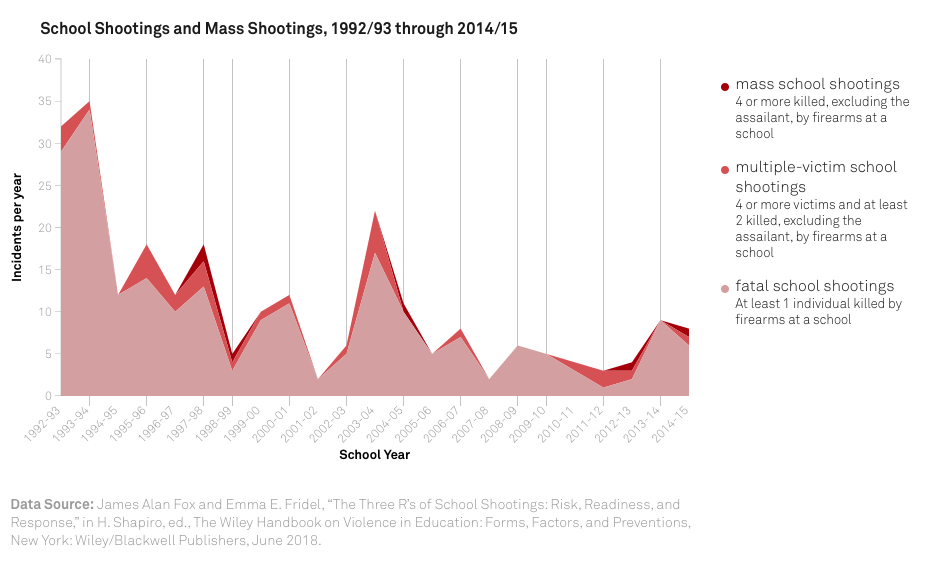
It’s not possible to exaggerate the tragic nature of a school shooting, but the frequency and trend in such events is often overstated. A wave of misinformation about mass shootings in schools is circulating in the wake of the massacre at Marjory Stoneman Douglas High School in Parkland, Florida. That awful day notwithstanding, the so-called epidemic of mass shootings underway in American schools is a fiction. Criminology professor James Alan Fox provides an illuminating discussion of statistics on school shootings since 1990:

“Since 1990, there have been 22 shootings at elementary and secondary schools in which two or more people were killed, not counting those perpetrators who committed suicide. … Whereas five of these incidents have occurred over the past five-plus years since 2013, claiming the lives of 27 victims (17 at Parkland), the latter half of the 1990s witnessed seven multiple-fatality shootings with a total of 33 killed (13 at Columbine).“

But what about reports that there have been 290 school shootings over the past five years? Fox addresses that claim:

“Nearly half of the 290 were completed or attempted suicides, accidental discharges of a gun, or shootings with not a single individual being injured. Of the remainder, the vast majority involved either one fatality or none at all.“

Some of the gun fatalities in schools are drug- and/or gang-related. I have written about the destructive effects of drug prohibition before, and school shootings are a dimension of that problem. The drug war has done much to keep the overall homicide rate elevated in the U.S. Suicides, in-school or not, are relatively insensitive to the availability of guns, as international data show.

Any shooting of an innocent should be mourned, particularly when it is a child. But there are many dangers in the modern world that loom larger than school shootings, once they are reported accurately. Fox notes the following:

“Over the past quarter-century, on average [of] about 10 students are slain in school shootings annually. ... Compare the school fatality rate with the more than 100 school-age children accidentally killed each year riding their bikes or walking to school. Congress might be too timid to pass gun legislation to protect children, but how about a national bicycle helmet law for minors? Half of the states do not require them.“

Anyone close to a victim can be forgiven for calls to action they might make in the midst of their grief. However, it’s wise to keep a proper perspective on events before rushing to legislate policy changes. The frequency and trend in mass shootings at schools has been greatly exaggerated, and largely in service to a political agenda. The news media does a disservice to the public by propagating this lie (and it is not the only falsehood in circulation). It would be appropriate to call it “fake news” and dispense with the false sense of urgency it creates in the debate. Reducing the risk of school shootings is an important objective, but let’s not distort the magnitude of the risk.

Gays and Bakers: Expression or Repression?

26 Monday Feb 2018

Posted by Nuetzel in Discrimination, Free Speech

≈ Leave a comment

Tags

Anti-discrimination law, CO Anti-Discrimination Act, Common Carrier, David Henderson, Eugene Volokh, Freedom of Association, Freedom of Speech, Gay Wedding Cake, Masterpiece Bakeshop, Public Accommodations, Richard Epstein, Unruh Act

A lot rides on the legal interpretation of “expression” in the gay-wedding-cake dispute. Eugene Volokh discusses a recent ruling in California in which a trial court judge ruled that the baker’s right to free expression, buttressed by her right to free exercise of religion, protected her from demands that she participate in a form of expression to which she objected. Specifically, she had no legal obligation to create a cake for the celebration of a gay couple’s wedding, according to the ruling.

The facts in the case, CA Dept. of Fair Employment and Housing v. Cathy’s Creations, are that the baker refused to bake the couple a wedding cake but expressed a willingness to sell them anything that was already available in the shop. Thus, she did not discriminate against the couple by denying them access to her “public accommodations”. She also gave the couple a referral to another baker whom she believed would be willing to produce the cake. So there were probable alternatives available to the couple, and the baker’s assistance in locating one mitigated against any harm suffered by the gay couple. That sort of mitigation is an important factor to consider in weighing the rights of conflicting parties. Courts have tended to view “dignitary harm” as less compelling than forced expression.

Volokh argues that the baker’s role in the episode did not demand expression on her part. He says the proposed cake was a pre-existing design and did not involve writing of any kind. Otherwise, Volokh would have supported the ruling. He and a coauthor discuss the distinctions between an artist (who expresses) and an artisan (who merely executes), and an expressive and a non-expressive cake, in an amicus brief, as noted in the article linked above. Here is Volokh’s summary of his view:

“While creating photographs, videos, and text would be constitutionally protected speech (so we support the right of, for instance, photographers not to photograph same-sex weddings), creating wedding cakes with no text or symbolic design on them is not.“

The Volokh article is a little confusing because the amicus brief seems to have been filed in a different but similar case, Masterpiece Bakeshop v. Colorado Civil Rights Commission, which is now before the U.S. Supreme Court. A ruling is expected this summer. Here is a transcript of the oral arguments in that case, which were heard late last year. It’s a fascinating discussion.

Volokh’s analysis is fine as far as it goes. However, a wedding cake is likely to be considered expressive to both the baker and the cake’s buyers. The baker’s effort in executing even a pre-existing design may involve meaning for her beyond mere execution, since the usual intent of a wedding cake is to celebrate a sacred union. Likewise, the baker knows that the buyers consider the cake to be expressive of their union. The baker doesn’t want any involvement in that expression, asserting that it is not for the government to intercede, forcing them to participate by producing the cake.

Does the baker’s offer to supply an existing cake (or any other bakery good) undermine their case? Does the necessity of baking a new cake for a gay wedding differ from offering a cake already on the shelf for the same purpose? That may be irrelevant to the cases at hand, because no other wedding cakes were available at the time, and freshness might demand the preparation of a new cake for such an occasion. Nevertheless, that sort of line between an acceptable sale for the baker and unacceptable expression strikes me as thin.

As for the matter of the baker’s religious beliefs and their importance to her expressive rights, Volokh derides some of the language of the ruling. Those beliefs, Volokh says, are irrelevant to the question of whether a particular kind of expression is protected or compelled:

“By the way, I take it that it’s clear that the Free Speech Clause issue can’t turn on whether Miller’s belief ‘is part of the orthodox doctrines’ of many religions, or whether it’s instead ‘trivial, arbitrary, nonsensical, or outrageous’ — the Free Speech Clause protects views regardless of whether they express views that are seen as orthodox, outrageous, or nonsensical.“

Bravo! However, when the rights of two parties are in conflict, it is appropriate to weigh any impingement upon other, secondary rights of both parties.

A disturbing aspect of these cases is that they do not turn in any way on freedom of association, a freedom that encompasses a right not to associate (since any association must be voluntary for both parties). The presumption is that the baker’s right to freely associate or not associate with whomever they please is superseded by their obligations under public accommodation laws, despite the fact that freedom of association is an enumerated right in the U.S. Constitution. While public accommodation laws have generally been found to be constitutional, those laws do not apply in all circumstances, such as when a particular product or service involves expression. But on its own, a violation of the baker’s freedom of association seems to matter less, in today’s legal environment, than abridgment of her free expression, and perhaps less than any obligation she has to provide public accommodation.

Richard Epstein gives a general treatment of the balance between freedom of association and anti-discrimination law. David Henderson has bemoaned the dilution of the freedom of association suffered in the name of non-discrimination. He does not defend discrimination on the basis of race, gender or sexual preference. Quite the contrary. However, as a matter of individual liberty, he prefers that we retain our right to associate on any basis of our choosing and pay the price imposed by the market for discrimination. For example, if you hang a sign outside your restaurant saying that you won’t serve African Americans, you are likely to suffer a loss of business from all who find your preference offensive, as many will. That solution is obviously unappealing to those who believe that participation in civil society requires public standards of equal access in private transactions. Still, there is some truth to a quote Henderson provides from an anonymous individual comparing the idea of non-discrimination in public accommodations to the “common carrier” designation:

“‘Either way, the theory boils down to “you brought forth a good or service and abracadabra you now have fewer rights”‘”.

The legal actions against the bakers in the cases discussed above rely on anti-discrimination law (in CA, the Unruh Act, and in CO, the Anti-Discrimination Act). Those laws must face limits in their application, as may be necessary in the case of compelled expression, especially expression against one’s most deeply-held convictions, religious or otherwise. The most basic question in this regard is whether the creation of the proposed wedding (or union) cakes can be described as expression. Whether the bakers are acting as mere fabricators or as artists, there is no doubt that the wedding parties desired the cakes as part of the celebration of their unions. That use of a cake constitutes expression on their part, and it is a kind of expression and an association from which the bakers would prefer to demure.

I support the right of homosexuals to enter into legal marriage, but I also support the bakers’ right to refuse the business. To invoke a phrase used by Richard Epstein in the article linked above, the world would be a better place if all agreed to simply “live and let live”.

Deficits Are a Symptom of Statist Excess

12 Monday Feb 2018

Posted by Nuetzel in Big Government, Taxes

≈ 4 Comments

Tags

central planning, crowding out, Dead Weight Loss, Debt Financing, Economic Rents, Government Waste, Inflation tax, Price Incentives, Ricardian Equivalence, Tax Cuts & Jobs Act, TCJA, Trump Budget Proposal

One thing’s clear with respect to President Trump’s budget proposal and the ongoing debate over appropriations: federal spending will increase and add to future budget deficits. This follows the Tax Cuts and Jobs Act (TCJA) enacted late last year, which many expect to add upwards of $1 trillion to deficits over the next 10 years. I have offered mixed praise of some of the reforms and rate cuts in the TCJA, though it does not accomplish much in the way of tax simplification and it will almost certainly require a large increase in federal borrowing. Ultimately, however, dollar for dollar, a tax cut giving rise to a deficit inflicts lower (or even negative) costs on the private sector than an unfunded spending binge, which is costly in the most basic terms: resources devoured by government.

Cost of Spending

The cost of an extra dollar of government spending at the most basic level is the value of lost opportunities to which the resources absorbed by government otherwise could have been put. When the government spends an extra dollar, and if the government pays a competitive market price, the goods and services exchanged for that dollar by private party “A” would be valued at more than one dollar by other private parties who lost the opportunity to trade with “A” for those same goods and services.

There might be a strong case for incremental spending in any particular instance, of course. Can we benefit from more national defense? Infrastructure? Grants of foreign aid? Subsidies for this industry or that? This technology or that? This cultural program or that? Public aid? Primary research? Regulatory budgets? I’d favor very few of those as general spending priorities. However, there are many subcategories and so many special interests that it is difficult to control spending as long as compromise is needed to accomplish anything.

The Trump budget is a mix of cuts in non-defense spending and large increases in defense, infrastructure outlays, and border security. On balance, it would lead to substantially higher budget deficits over the next ten years. He won’t get all of what he wants, but it would be astonishing if larger deficits are not an outcome.

Unfortunately, government is typically inefficient in the execution of its tasks and it is less responsive to price incentives than private buyers, who are fully vested in “ownership” of the dollars they spend. Government agents, no matter how honorable, simply do not have the same kind of stake in the outcome as a private owner. Obviously, spending by federal agencies is influenced by the political process, which creates opportunities for side rewards for those who direct or influence spending and those who receive the payments. These side rewards are pure private rents arising from public largess. For a private party, the profitability of transacting with government may well exceed the normal return to capital or entrepreneurship. The efficiency of government spending is compromised by its political nature and the uneconomic behavior of government agents. I therefore have strong doubts about the cost-benefit comparison of almost any public initiative.

Un-Taxing

The government ultimately acquires its funds from taxes enforced via coercive power. After all, tax collection requires a considerable enforcement effort. A tax payment of one dollar requires the sacrifice of things that would have been acquired, now or in the future, in voluntary, private transactions valued more highly than one dollar by the taxpayer. That is the nature of gains from voluntary trade foregone. The result is that one dollar of taxation extracts more than one dollar of value from the private sector. Conversely, a reduced tax liability of one dollar means that private parties can engage in an extra dollar of voluntary trade and benefit from the surplus.

There are few forms of taxes that don’t distort incentives in the private market. Taxes may blunt incentives for work, saving, and deployment of capital in productive uses. To the extent that these private decisions are twisted by taxes in ways that differ from fully voluntary decisions, there is a further loss of value and resource waste. Eliminating these distortions is always a worthy goal.

Funding Deficits

Government has ways other than immediate taxation of paying for excess spending. One is to borrow from the public, domestic or foreign. Those who purchase the government’s debt, loaning their money to the government, do so voluntarily. That debt carries an interest obligation by the government, and it must repay the principle some day. That will require new taxes and their attendant distortions, even more borrowing, and/or some other method of extracting value from the private sector. A principle known as Ricardian equivalence holds that the effects of government outlays are the same whether financed by taxes or borrowing, because taxpayers know that future taxes will be owed to pay off government debt, and so they discount that liability into their behavioral calculus.

Additional borrowing can create an unstable financial environment if borrowing occurs at interest rates higher than the economy’s rate of growth. Borrowing might also “crowd out” private borrowers, absorbing saving that would otherwise be used to finance investment in the economy’s productive capacity. In other words, the resources acquired with that extra dollar of government spending will lead to less private investment and a sacrifice of future production.

Sneaky Inflation Tax

Another way that government can pay for spending is by imposing an inflation tax. This amounts to a devaluation of privately-held assets accomplished by inducing unexpected inflation. It allows government debt to be extinguished in the future with dollars having reduced purchasing power. Essentially, more currency (or its electronic equivalent) is placed into circulation: money printing, if you like. That sets up the “too-much-money-chasing-too-few-goods” inflation cycle. But like any other tax, the inflation tax is involuntary and creates waste by inducing the public to respond to distorted incentives.

Summary

An additional dollar of government spending absorbs a dollar of resources, and destroys more value than that given lost surplus to those who would otherwise have benefited from those resources. Moreover, the spending often fails to return a full dollar in benefits, often lining the pockets of elite grifters in the process. Ultimately, the funding for incremental spending must be commandeered from private parties via taxes or an inflationary taking of assets. Public borrowing might conceal the reality of taxes for a time, but it may crowd out productive investment that would otherwise enhance economic growth. So a case against incrementally larger government can be made in terms of resource costs as well as the distortionary effects of taxes and dissipation of future private growth.

By the same token, an ostensible reduction in taxes might be illusory, to the extent that future taxes or an inflationary taking will be necessary to cover the debt one day. On the other hand, there is no direct resource cost involved, and a tax reduction unbinds constraints and distortions on private incentives, which is unambiguously beneficial. And that’s true as long as the tax reductions aren’t targeted to benefit particular sectors, parties or technologies in any new misadventures in government central planning.

Deficits, in and of themselves, are either irrelevant or possibly damaging to long-term economic growth. You’ll get them with either tax cuts or spending hikes. But spending hikes absorb real resources, whereas tax cuts release resources by transforming a dead weight loss in private markets into proper gains from trade. If deficits are a problem, and if eliminating them requires costly tax distortions, then the real problem is the expanse of the state.

Progressives: Paul Doesn’t Want Peter’s Money? What a Hypocrite!

08 Thursday Feb 2018

Posted by Nuetzel in Big Government, Federal Budget

≈ Leave a comment

Tags

Blue States, Federal Transfers, Medicaid, Medicare, Megan McArdle, Mortgage Interest Deduction, Progressive Income Tax, Red States, Social Security, State and Local Tax Deduction, Tax Cuts and Jobs Act

Red & Blue States

I’ve heard the following assertion over and over: blue states are “doners” of federal tax revenue and red states are donees. In other words, states dominated by Democrats contribute more than they take from the federal budget, while Republican states take more than they contribute. But the facts are somewhat ambiguous. And to the extent that it is true, policies that would improve the net position of blue states would be very unpopular with the progressive Left. Furthermore, progressives expose their confusion regarding the ethics of sound governance by calling the red state opposition to an expansive  federal government “hypocritical”.

The relative positions of red and blue states in terms of federal dollars is the topic of an excellent article by Megan McArdle, whom I haven’t featured on this blog for a while. Originally, the claim that blue states “gave” to red states via the federal budget was based on data from 2005, but a lot of fiscal water has passed under (and over) the bridge since then. Also, the original presentation used state totals of federal outlays minus revenues without accounting for differences in the size of state populations. Many blue states are relatively populous, so some the state rankings may shift when expressed on a per capita basis. McArdle reproduces a chart from a report by the New York State Comptroller using 2013 data:

“… deep-blue New Jersey is the biggest donor state. But red-blooded Wyoming is the next biggest, and North Dakota makes the list too. There is certainly a preponderance of blue states at that end of the spectrum, but it’s not a clear ‘Donor states are blue’ story. And if we match the 2013 data to the closest election (2012) we find that New Mexico, the biggest net recipient, went for Obama in 2012, as did Virginia, Maryland, Maine and Hawaii. What’s driving the net subsidies isn’t anything as simple as political identification.“

Wyoming and North Dakota contributed lots of federal revenue from taxes arising from the fracking boom.

McArdle goes on to consider policies that would reduce the flow of budget dollars to donee states:

“Most of the transfers do not come from ‘red state welfare’ like agricultural subsidies. They derive from Social Security, Medicare, Medicaid, unemployment insurance, food stamps, welfare, the maintenance of the national highway system, the purchase of goods and services for the federal government, and the operation of federal facilities and lands.

If blue state liberals consider this out of whack, what do they want to change?

  • Do they want to move toward a flatter, less progressive federal tax code?
  • Do they want to cut Social Security, Medicare and Medicaid?
  • Do they want to return unemployment insurance and similar entitlement programs entirely to the states?
  • Do they want to hand over the national parks to the states, or privatize them?
  • Would they like to downsize the federal workforce?
  • Should we redistribute military bases from red states to blue? (Those relocations might meaningfully alter the state electorate, making it easier for Republicans to get elected. …)“

Of course not! But like McArdle, I’m of the opinion that many of the policy changes on that list, or at least reforms of existing policies, are in order. Perhaps the allure of steeply progressive federal taxes has faded for blue state Democrats with the new reality of the Tax Cuts and Jobs Act. The law restricts deductions for mortgage interest, a hit on those borrowing against high-end homes. It also limits deductions for state and local taxes, eliminating a federal tax subsidy to high-earners living in states with high taxes. State and local politicians who support high taxes will no longer receive a “discount”, courtesy of taxpayers in  other states, on the natural political liability of high taxes.

The categorization of blue states and red states as federal donors and donees is not quite as unambiguous as most Leftists imagine. Be that as it may, the flows of revenue and spending between the federal government and states is a consequence of demographics, regional business environments, and many other factors, but most of all the set of policies promulgated over the years in Washington DC. An objective assessment of the federal government’s largess indicates that most of those policies are in need of drastic reform, yet statists resist, demand more, and act as if “red states rubes” should be grateful for the dysfunction and the federal cash it brings. To progressives, it is hypocritical to oppose an expansive federal government on this basis. The absurdity of that claim is self-evident, but such is the confused state of progressive discourse. Perhaps a better adjective for red state opposition to federal profligacy would be “principled”.


Rural Broadband and Federal Intrusion

06 Tuesday Feb 2018

Posted by Nuetzel in infrastructure, Technology

≈ Leave a comment

Tags

5G Wireless, Ajit Pai, Brian Whitacre, Broadband service, Digital Divide, Download Speed, FCC, Fiber, Fixed Wireless, Michael O'Reilly, Net Neutrality, Nick Gillespie, Rural Infrastructure, Satellite Service, Telecom Infrastructure, Universal Service Fund

Rural telecommunications service is often inferior in speed and quality to what is available in urban areas. This is one basis of the so-called “digital divide” in the U.S., the gaps that exist between various groups in terms of access to broadband telecom service. The urban rural “divide” is actually much smaller than the gaps that exist within urban areas, but much of the attention in public policy debates seems to focus on rural broadband availability. Telecom infrastructure is far more expensive to provide in the hinterlands due to the distances and occasional natural barriers that must be traversed. This was true before the revolution in wireless technology and still is, though wireless has reduced the severity of the tradeoff. Given the cost differential, it strikes me as unreasonable for rural users to expect the same levels of service at the same cost as urbanites. They can either pay the higher cost of provision to receive high-end service, make do with service levels that can be delivered at rates they are willing to pay, or go without. Or, if a high level of service is critical and the user is unwilling to pay the cost, they can move to a place at which it is available at lower cost.

For many years, however, public policy has been premised on the notion that rural telecom users deserve subsidies from the general user population, or from taxpayers, in order to promote equal access to basic telephony and, more recently, broadband access. The Universal Service Fund, to which telecom users pay a fee on their bills every month, is based on this premise. Its extension to broadband is a classic example of first-world luxury made necessity, now asserted to be an obligation owed by society to every individual. It is the philosophical underpinning for a huge allocation of federal funds for rural telecom spending that is now expected as part of President Trump’s infrastructure plan. 

Broadband Availability

The quality of telecom service includes speed and other factors (such as latency, which refers to data delays). Here, I’ll confine the discussion to the speed at which data can be downloaded (upload speeds are always a bit slower). Minimum speeds of 5 – 8 Mbps are required to stream HD video, according to the FCC. Higher speeds are necessary for heavy users with several devices or “running more than one high-demand application at the same time.”

Broadband speeds vary tremendously across the U.S., but it’s important to remember that speeds are increasing dramatically over time. Small towns are undoubtedly concentrated at the lower end of the distribution of speed availability at any point in time. Today, the gap between the availability of speeds in urban and rural areas is minimal up to about 10 Mbps, but it widens above that level. In fact, the speeds available via certain wireline technologies can vary significantly even within one small town (to say nothing of the significant variation within urban areas). Away from town, the availability of wireline broadband is much more limited. Fixed wireless broadband service (point-to-point) can often be deployed at speeds comparable to wireline service, and those speeds and their availability will increase with the rollout of new (5G) wireless technology. Still, that might not be an option in many isolated communities and remote locales without additional facilities like relay stations. Satellite service is often available at speeds up to 25 Mbps, in-town or out, but like wireless, it has some reliability issues.

Nevertheless, to one degree or another, broadband service is often available in rural areas, or can be available if customers are open to a range of alternative technologies (and again, available speeds are increasing). Obviously, some technologies are better suited to reaching particular areas, depending on distances and terrain. Many rural communities are finding affordable solutions that combine technologies that best leverage existing infrastructure and the natural features of the landscape.

Alms or Unfettered Choice

A reality of life in a hard-to-serve location is that broadband service will be costly… for someone. Enter the interventionists, who view “rurals” with paternalistic sympathy. Rural customers, and certain solutions for broadband delivery discussed above, are already subsidized by the federal government in some instances. And again, the Trump Administration is ready to throw more federal money at rural telecom infrastructure. These subsidies are questionable from a public finance perspective because they presume that rural areas are “underserved” on a cost-benefit basis, a case that is often dubious.

The biggest rub is that most people who live in rural areas do so by choice, a point recently articulated by Nick Gillespie. He recounts the experiences of his ancestors, who came from poor European villages to America to seek a better life. By comparison, today’s American rural population is highly privileged. Few are mired in circumstances beyond their control, contrary to the popular view. Gillespie notes that rural median income is only about 3.5% less than urban income (including suburbs), while rural homeownership rates are higher and poverty rates are lower than in urban areas. Indeed, it’s no secret that many urban elites purchase rural property to escape congested city life. Those are some of the would-be recipients of federally-funded rural broadband infrastructure.

In the end, Americans tend to live where they do by choice. Alternatives not acted upon generally reveal a preference for staying put. Some people prefer the amenities of small town or country life for any number of reasons, including a generally low cost of living. They accept the disadvantages of a rural life such as the lack of proximity to advanced emergency treatment facilities and, at least historically, less connectedness to media. Obviously, city dwellers tend to prefer urban amenities and accept the disadvantages of city or suburban life, like congestion. Those who wish to move from country to city, or vice versa, are free to do so, but they must pay the cost of the move. Likewise, it’s reasonable to expect that those desiring to transform the amenities of a place to their liking should pay the cost. Bringing almost any form of broadband infrastructure to areas with low population density is a costly proposition, but today’s rural consumers have more choices than ever before, and the speed and quality of broadband will continue to improve there without federal intervention.

Rural vs. Urban Adoption Gaps

The rural population is older on average, and it is less educated on average, so rural adoption rates are always likely to be lower. This point has been emphasized by Brian Whitacre, who has stated that the urban-rural “digital divide” might always exist to some extent. But this phenomenon is not unique to rural areas. Adoption rates within urban areas are highly variable, and the intra-urban broadband gaps by race, age, and income dwarf the urban-rural gap. That too is unlikely to change any time soon.

Federal Cash for Cronies & Conferees 

Last year, FCC Commissioner Michael O’Reilly warned of the dangers of direct federal involvement in broadband infrastructure investment. These include the market distortions caused by picking winners and losers among providers based on non-market assessments, the graft that such a process invites, discrimination in favor of high-cost fiber technology, poor coordination across government bureaucracies, and insufficient oversight leading to chronic overpayments. Sadly, however, even Ajit Pai, Chairman of the FCC and a man whose opposition to network neutrality I have applauded, has proposed more federal spending on rural telecom infrastructure. The big telecom recipients of the buildout funds don’t mind the subsidies, of course. The rural recipients of new services at artificially low cost can’t mind too much. But federal taxpayers and broadband ratepayers should question this activity. I’m hopeful that there will be a silver lining: it is likely to be private infrastructure.

5G Wireless: The NSA Wants You On Its Plan

30 Tuesday Jan 2018

Posted by Nuetzel in infrastructure, National Security, Privacy, Uncategorized

≈ Leave a comment

Tags

5G Wireless, Ajit Pai, central planning, FCC, incentives, Markets, National Security Council, Nationalized Wireless, Net Neutrality, NSA, Privacy, Scott Shackford, Wireless Infrastructure

Please no, Mr. President, do not even flirt with putting the federal government in charge of building and operating a new 5G wireless network! Sure, you’ll hate to disappoint the hawks on the National Security Council (NSC), but please let this remain outside the scope of your infrastructure plan!! For one thing, the private sector already has it underway, and the task is not straightforward. Excessive government involvement would almost surely botch the job. Let’s face it: while shrill calls for central planning of one form or another are constantly heard from leftists and populists, the government is really lousy at it. But then good central economic planning is impossible, given the impossibility of knowing and tracking the vast and dynamic information flows necessary to get it done, not to mention knowing and executing the appropriate responses to that information. There is a better tool for that called “markets”.

Scott Shackford reports that the chairman of the FCC, Ajit Pai, reacted with swift condemnation to the 5G discussions taking place within the NSC. Do read the whole Shackford piece. Apparently, there are some in the NSC who imagine government being good at building, maintaining, and securing a wireless network. This despite the antiquated nature of the federal government’s information systems and, as Shackford notes, their poor security. There is also the potential threat that communications over such a network would be subject to monitoring by nosey law enforcement and other public officials. If national security always implies state control, I’ll take less, but I don’t believe that’s the case for a minute.

The government tends to be a poor custodian of infrastructure — really public assets in general, and there is a reason: incentives are lacking. Private communication networks keep improving thanks to private incentives, like the prices and profits that promote efficient behavior and the market pressures to offer data plans that private users value. The government, on the other hand, struggles even to maintain the interstate highway system, which is simple technology by comparison. But statists tend to view the lack of private incentives as a feature: it’s free! And as a consequence, it is over-utilized and under-maintained. Ultimately the taxpayer is on the hook for capital costs and any upkeep that can be mustered, not the user, but the user suffers the degraded quality of those assets. A nationalized wireless network and its users would suffer the same fate.

Private infrastructure like wireless networks is best encouraged by eliminating regulatory roadblocks to private construction and operation of those assets. That includes the welcome rollback of the stifling network neutrality rules. Low taxes also help, not to say special incentives for wireless carriers.

Protectionist Ugly: Trump Makes Bad on Tariffs

29 Monday Jan 2018

Posted by Nuetzel in Free Trade, Tariffs

≈ Leave a comment

I’ve reacted favorably to much of the Trump Administration’s economic agenda, but foreign trade has been a huge area of concern. Trump’s rhetoric on trade was bellicose on the campaign trail. Thus far in office he has succeeded in upending or threatening trade agreements: he pulled the U.S. out of the Trans-Pacific Partnership (TPP) negotiations, a multilateral trade agreement involving 11 of our Asian trading partners; he has also promised that NAFTA will be renegotiated. This week, he imposed tariffs on solar panels produced in China and washing machines built in South Korea. You will now be forced to pay a penalty tax on any purchase of those products.

Renegotiating existing trade agreements is one thing (though my ideal is unilateral elimination of trade barriers), as is a general preference for bilateral agreements, particularly if they remain focused on trade and not extraneous social issues. But I sincerely hope that the latest move is not the start of a long rollout of tariffs and other protectionist measures. Unfortunately, more such moves are expected.

What possible logic can explain these actions? To hear Donald Trump tell it, the U.S. must enforce trade laws and establish a “level playing field”. So, perhaps this is a form of negotiation. If so, are the cards we hold so strong that we can afford to risk retaliation in the form of tariffs levied on our own exports? Do our trading partners value our business so much that they will not retaliate? Would those countries offer to remove any subsidies they grant their own export industries? Would they tell those industries they must be price followers regardless of cost structure and taxes, charging no less than their American competitors? Can we dictate the terms of trade with these parties? Trump apparently thinks so, but we shall see. I believe the answer is almost certainly no.

Retaliation is likely; this is how trade wars begin, and they have a way of precipitating economic contraction. But that risk represents only one part of the cost of Trump’s tariff action. The real problem is the likely impact of the Trump tariffs on American consumers, American production, and on America’s long-run competitiveness.

  1. Prices: Tariffs are essentially a tax on imports. A significant share of the burden of that tax will be borne by consumers. The price they pay for the import will rise to reflect a portion of the tariff. If, instead, they opt to purchase the American product after the imposition of the tariff, that is a coerced and suboptimal decision based on their existing preferences. They are likely to pay more to the American producer than in the absence of the tariff on the import because American producers will face less competitive pressure. Thus, American consumers will be penalized by the tariff whether they continue to purchase the import or not.
  2. Output: Quantities purchased fall when prices rise. That is the law of demand. American consumers will buy less of the import and less overall, so consumers lose on both price and quantity. But it’s worse than that, because domestic producers gain a degree of market power under the tariff. They have greater leeway to price above marginal cost, which implies output restraint. It is therefore quite possible that domestic output will decrease as well.
  3. Competitiveness: Handicapping foreign competitors eases the pressure on domestic producers to perform by reducing costs, pleasing customers, creating value, and innovating. This is not likely to be a sudden change. Rather, it would manifest in a gradual deterioration of competitiveness. Perhaps no one abroad will want our exports, but domestic consumers will have little recourse except to pay the tariff for the foreign good they preferred to begin with. Meanwhile, if other domestic industries are reliant on tariffed imports as inputs to production, they too will suffer a loss of competitiveness.

I tend to be skeptical of any claim that a foreign government facilitates (or engages in) predatory pricing on American markets. Of course they might. And I know… the U.S. itself has thrown subsidies at solar panels in the past. (Well how unfair!) However, the facts are that in a variety of industries, foreign producers actually have cost advantages over U.S. producers. The very idea of trade is to take advantage of such differences for mutual gain. We buy things from others precisely because we can’t do it all ourselves, at least not without great sacrifice (high cost).

It is all too easy for domestic producers to cry “protect us”, and to claim that national security demands protection. These claims are often accepted with little if any analysis. The pleas for protection are characteristic of rent-seeking crony capitalism. And it isn’t as if Americans have nothing to gain in the exchange: cheap consumer goods and cheap inputs for domestic producers. The income released via low foreign pricing is available for other uses, including saving, larger quantities, or spending on other goods.

American consumers pay the price of trade restrictions and tariffs in several ways. The restrictions not only cost them directly in terms of higher prices, but they also represent a violation of consumer sovereignty and tend to restrain output. That a central authority would deign to prohibit or penalize certain consumer decisions is abominable. One can assert that the actions protect workers, but that is a fiction and holds only in the short-run at best. Remember that workers are consumers in the first instance. Ultimately, the trade restrictions degrade the ability of those workers to compete on world markets. In short, they are destructive. At the link above, George Will quotes Henry George to that effect:

“What protection teaches us, is to do to ourselves in time of peace what enemies seek to do to us in time of war.“

Jordan Peterson Is Not Complacent

23 Tuesday Jan 2018

Posted by Nuetzel in Identity Politics, Individualism

≈ Leave a comment

Tags

Dan Sanchez, Freedom of Expression, Human Action, Identity Politics, Individualism, Jordan Peterson, Noah Smith, rent seeking, Tyler Cowen, University of Toronto, White Privilege

It’s a hoot to watch Jordan Peterson‘s videos — he stands before crowds doing … crisply-articulated philosophy, seemingly on the fly. He is an outspoken psychologist at the University of Toronto who covers a lot of intellectual ground with an impactful delivery. One of Peterson’s primary messages is so simple as to seem trite: take control of yourself, because you can and you should for your own sake and those around you! But his treatment is an empowering tonic for both men and women, and many are listening. He has toiled away as a professional psychologist, a professor, an author and a philosopher for many years; his ascent to notoriety has been recent and fairly meteoric. Luminaries like Tyler Cowen and Noah Smith now call Peterson one of the top public intellectuals in the western world.

However, Peterson takes positions that are seemingly hard for the Left to swallow: he believes in the power of individual action; that freedom of expression is the basis of personal and academic freedom; that identity politics is destructive (whether on the Right or the Left); and that white privilege is a lie.

Predictably, the Left has attacked Peterson and attempted to characterize him as a spokesman for the far-right. He meets challenges of this kind with a kind of charged equanimity, exposing falsehoods with quick-footed logic, empirics, and honest reflection. Dan Sanchez has written a nice summary of the attacks on Peterson and shows them to be wholly without foundation. He has critics in both ends of the political spectrum, as Sanchez observes:

“[Far right] critics don’t understand what Peterson is saying, because they are mired in the mindsets of politics and war. The way of politics and war is to confront an enemy horde by amassing your own horde: whether it be on the battlefield, in street demonstrations, or in voting booths. It is to fight tribal barbarism by tending toward the tribal and the barbaric yourself. But the way of the heroic, civilized individual is to lead by example and to lead by appealing to the interests of those whose behavior you want to influence.”

And in Peterson’s own words, quoted by Sanchez, tribal barbarism is the way to social ruin:

“…where we’re making your group identity the most important thing about you. I think that’s reprehensible. I think it’s devastating. I think it’s genocidal in its ultimate expression. I think it will bring down our civilization if we pursue it. We shouldn’t be playing that game.“

On those assertions, Sanchez notes the following:

“… Peterson’s claim that identity politics is ‘genocidal in its ultimate expression’ is no exaggeration. Hitler’s military invasions and death camps were the ultimate expression of the racialist and nationalist identity politics that spiritually drove Nazism. And Stalin’s weaponized famines and ‘gulag archipelago’ were the ultimate expression of the class warfare identity politics that spiritually drove Soviet communism.”

So Peterson clearly condemns groupthink on both the Left and Right. He celebrates the value of people as individuals, and he urges us all to realize our value through individual responsibility and productive effort. Help yourself, help those you love, and help others. That’s a call to real human action, as distinct from the seeking of rents through the political process. Peterson is both a fascinating personality and thinker. His ideas and passion can be a powerful antidote to the complacency that plagues so many today. I hope he continues to gain prominence.

Prohibition Disaster: Opioid Edition

18 Thursday Jan 2018

Posted by Nuetzel in Prohibition

≈ 2 Comments

Tags

Center for Disease Control, DEA Schedule II, Dilaudid, Drug Enforcement Administration, Fentanyl, Heroin, Jeffrey Miron, Jeffrey Singer, Medically-Assisted Treatment, Narcan, Needle Exchange Programs, Notre Dame, Opioid Overdose Deaths, OxyContin, Pill Mills, Prohibition, Safe Injection Rooms, William Halsted

Opioid deaths in the U.S. keep climbing inexorably. However, at the same time, prescriptions for all opioids have decreased for four straight years (2013-2016), according to the Center for Disease Control, and prescriptions for high-dose opioids have decreased for seven straight years (2010-2016). Further decreases are expected when prescriptions are reported for 2017. How does the declining supply square with the increasing death rate? Contrary to popular belief, opioid prescriptions are not now and never were the cause of opioid overdose deaths. The causes are  complex, but they have everything to do with ill-fated efforts to regulate prescriptions and prohibit some opioids.

Fatal Fun

In this informative interview, Dr. Jeffrey Singer explains that 75% of opioid deaths occur among “recreational” users who have never obtained a legitimate prescription. The recent increases in overdose deaths have been dominated by “other synthetic opioids” like fentanyl and heroin, both of which are illegal (except for fentanyl in patches or anesthesia). Oddly, heroin is not legal for medical use in the U.S., despite the fact that it is less than half as powerful as Dilaudid, which Singer says is used fairly routinely to relieve severe pain.

Singer debunks a widespread notion about the dynamic underlying opioid deaths:

“…first of all the narrative that everyone has bought into, and this is very frustrating to us practitioners, is that the opioid overdose death problem is a direct result of doctors prescribing pain medicine for patients. So, the popular notion is that I’d write a prescription for an opioid for my patient for pain, my patient becomes a drug addict, and then starts resorting to all sorts of illegal behavior in search of the drug. He becomes a dope fiend, and then he eventually overdoses and dies. … That is not what’s going on.“

From the very beginning, the problem of opioid use was driven by an appetite for recreational drugs. Certainly there are people with legitimate medical needs who develop a dependence or addiction and ultimately turn to the black market for continuing supplies. Dr. Singer does not deny that. But there are also individuals who manage to use these drugs recreationally without ever compromising their lives or livelihoods (see Singer’s anecdote about the “Father of American Surgery”, William Halsted). Unfortunately, however, there are recreational users who become dependent or addicted, just as some do with alcohol.

Where do the opioid supplies come from? Of course, heroin and fentanyl make their way onto the market from overseas, and supplies of prescription opioids also make their way onto the black market. For a real buzz, a lot of oxycodone can be extracted from a OxyContin capsule to bypass its slow release. In fact, illegally-obtained OxyContin became a major source of recreational opioid use following its introduction in the 1990s. At the time, physicians were encouraged to be more aggressive in addressing pain management. But the increase in legitimate use for pain brought a concomitant increase in leakage of pills onto the black market. Rx pads are stolen, a few patients might sell legitimate prescriptions, and pills are stolen from medicine cabinets at parties or over at Grampa’s place, for example.

We’re Watching You, Herr Doktor

Efforts to reduce the availability of opioids have been underway for a number of years now. The DEA has mandated reductions in the quantity of opioids manufactured (25% in 2016 and 20% in 2017). The crackdown on so-called “pill-mills” might have helped stem the flow of opioids to the illegal market, especially in Florida, but the measures included strict supply quotas that have harmed those with legitimate needs for the medications. The DEA reclassified hydrocondone as a Schedule II drug, imposing maximum dosages that are too low to relieve the pain experienced by some patients. All 50 states now have prescription drug monitoring programs (PDMPs), which follow prescribing doctors and patients. Singer says PDMPs have a chilling effect on doctors even when their patients’ needs are legitimate. Finally, the FDA has supported pharmaceutical companies in developing “abuse-deterrent formulations” that can’t be crushed or liquified. And those companies have a strong incentive to do so as they can obtain new patents in the process! Some states have required insurers to cover the new formulations, ending the sale of cheaper generics. That is a nice crony deal for big pharma!

While Endangering Lives

The restrictive policies have led to substitution of heroin for opioid pills, as this Notre Dame study shows. The policies endanger: 1) patients with legitimate needs for pain management; 2) occasional users who are otherwise productive members of society; and 3) heavy recreational users. With greater reliance on black market heroin, there is no way for users to tell exactly what they’re getting: it’s probably impure and it’s often amped with fentanyl, or fentanyl sold as heroin. Fentanyl is 50 times as powerful as morphine and 7 – 8 times as powerful as heroin! Singer describes the severe information problem facing users of black market intoxicants:

“… when I go into the supermarket or liquor store to buy a bottle of liquor and I see on the label it says, let’s say, ’80 proof,’ or ‘15% alcohol,’ the thought never crosses my mind that it may not be that, that it could be adulterated with all sorts of impurities or laced with something that could kill me. I believe what it says on the label, because it’s legal, and in the legal market. 

Number one, they have competitors and number two, I have recourse if I’ve been defrauded and injured. But, when were dealing with the illegal market, you go to somebody in a subterranean way who says, ‘Yeah, I have what you want.’ And you don’t know if it’s the dose, you don’t know if it’s pure, that’s what’s happening. In fact, what we’ve learned, because of the narrative that it’s a doctor’s prescribing, since about 2010, 2011, all of the policies of both the federal government and the state governments have been aimed at curtailing the amounts of opioids prescribed.“

Prohibition always creates more danger for users. Adulteration of is one side of it. In “Legalizing Opioids Would Dramatically Reduce Overdose Deaths“, Harvard economist Jeffrey Miron adds that prohibition leads to mixing with other legal or illegal substances:

“In 2013, 77 percent of deaths involving prescription opioids involved mixing with either alcohol or another drug. If opioids are easily accessible, people tend to use the substance they desire; when access is limited, however, some consumers obtain an insufficient quantity and therefore improvise with alcohol, benzodiazepines, and other drugs. Taking these drugs together increases the risk of overdose, especially when dealing with depressants like opioids ….“

Miron and Singer both discuss the risks created by prohibition for users who have developed tolerance to the drugs. Miron says:

“[Tolerance] makes usage less dangerous as the body develops resistance to opioids’ respiratory-depressing effects. … [but] under prohibition users who have developed tolerance get cut off, whether by legal or medical restrictions or by being forced into non-[Medically-Assisted Treatment] treatment. Tolerance then declines, according to medical experts in drug rehabilitation, so users who resume use are more prone to suffer an overdose.

One study proposes that environmental factors also influence tolerance, and that ‘a failure of tolerance should occur if the drug is administered in an environment that has not, in the past, been associated with that drug.’ Therefore, prohibition may increase the chance of overdose by driving users out of their routine into unfamiliar settings in which their tolerance against the respiratory effect of opioids is diminished. “

Finally, by encouraging the development of a black market, prohibition drives up prices, prompting some users to engage in crime to finance their highs. Prohibition itself cedes the market to underworld elements, whose competition culminates in gangsterism and violence.

Medically-Assisted Treatment

Singer believes resources should be redeployed: less drug regulation and interdiction efforts and more harm reduction programs and medically-assisted treatment (MAT):

“… when you take [Methadone] orally, it gets absorbed from the gut. It levels that bind with your opioid receptors enough so you won’t experience withdrawal symptoms. … And the idea behind methadone maintenance is that you get used to not, it’s sort of, behavior modification. You’re blunting withdrawal symptoms, but you’re getting used to not feeling the high. And then it’s hoped that over time, you can be tapered off the methadone. And now you don’t crave the high anymore, and you’re over your addiction problem. That’s the idea behind medical-assisted treatment, whether it’s methadone or Suboxone or others.“

While doctors, within limits, can prescribe drugs to treat pain, they aren’t authorized to prescribe Methadone or Suboxone to treat addiction. But MAT can actually prevent people from dying! In addition, Singer mentions needle exchange programs to prevent the spread of hepatitis and HIV, and safe injection rooms:

“…you go into the room, you inject there, and then you leave. The needle is then discarded by the people who run the place. And not only that, but you have the bonus of somebody being around there with Narcan so if you overdose, because again, you’re using an illegally obtained substance, so you don’t know really what’s in it. … in Switzerland, they reported that teen heroin use has come down, because when the kids see these people going in and out of the clinic to get their injection, it doesn’t look cool.“

Conclusion

There are solutions to the deadly nature of the opioid epidemic, but prohibition is not one of them and never will be. If anything, prohibition in varying degrees has aggravated the dangers of opioids. To truly solve the problem, we should eliminate restrictions on the production and distribution of legal opioids for pain management, legalize heroin, and stop interfering in markets. That would be merciful for patients in real pain, make recreational use of opioids dramatically safer, and put an end to the gangland violence associated with underground competition. Second, redirect those resources into MATs and other harm reduction programs. Miron notes that legalization has worked in other countries, like Portugal and France, to reduce overdoses and opioid deaths. As a political matter, however, these steps might not be feasible unless we get over the cultural bias stigmatizing recreational opioid use as “evil”, and the idea that laws and enforcement can actually prevent people from trying to get high.

← Older posts
Newer posts →
Follow Sacred Cow Chips on WordPress.com

Recent Posts

  • Is “Global Temperature” a Fiction?
  • ESG Contortions: Virtue, Returns, and Politics
  • Grading Trump II, So Far
  • A Warsh Policy Scenario At the Federal Reserve
  • The Coexistence of Labor and AI-Augmented Capital

Archives

  • May 2026
  • April 2026
  • March 2026
  • February 2026
  • January 2026
  • December 2025
  • November 2025
  • October 2025
  • September 2025
  • August 2025
  • July 2025
  • June 2025
  • May 2025
  • April 2025
  • March 2025
  • February 2025
  • January 2025
  • December 2024
  • November 2024
  • October 2024
  • September 2024
  • August 2024
  • July 2024
  • June 2024
  • May 2024
  • April 2024
  • March 2024
  • February 2024
  • January 2024
  • December 2023
  • November 2023
  • August 2023
  • July 2023
  • June 2023
  • May 2023
  • April 2023
  • March 2023
  • February 2023
  • January 2023
  • December 2022
  • November 2022
  • October 2022
  • September 2022
  • August 2022
  • July 2022
  • June 2022
  • May 2022
  • April 2022
  • March 2022
  • February 2022
  • January 2022
  • December 2021
  • November 2021
  • October 2021
  • September 2021
  • August 2021
  • July 2021
  • June 2021
  • May 2021
  • April 2021
  • March 2021
  • February 2021
  • January 2021
  • December 2020
  • November 2020
  • October 2020
  • September 2020
  • August 2020
  • July 2020
  • June 2020
  • May 2020
  • April 2020
  • March 2020
  • February 2020
  • January 2020
  • December 2019
  • November 2019
  • October 2019
  • September 2019
  • August 2019
  • July 2019
  • June 2019
  • May 2019
  • April 2019
  • March 2019
  • February 2019
  • January 2019
  • December 2018
  • November 2018
  • October 2018
  • September 2018
  • August 2018
  • July 2018
  • June 2018
  • May 2018
  • April 2018
  • March 2018
  • February 2018
  • January 2018
  • December 2017
  • November 2017
  • October 2017
  • September 2017
  • August 2017
  • July 2017
  • June 2017
  • May 2017
  • April 2017
  • March 2017
  • February 2017
  • January 2017
  • December 2016
  • November 2016
  • October 2016
  • September 2016
  • August 2016
  • July 2016
  • June 2016
  • May 2016
  • April 2016
  • March 2016
  • February 2016
  • January 2016
  • December 2015
  • November 2015
  • October 2015
  • September 2015
  • August 2015
  • July 2015
  • June 2015
  • May 2015
  • April 2015
  • March 2015
  • February 2015
  • January 2015
  • December 2014
  • November 2014
  • October 2014
  • September 2014
  • August 2014
  • July 2014
  • June 2014
  • May 2014
  • April 2014
  • March 2014

Blogs I Follow

  • Passive Income Kickstart
  • OnlyFinance.net
  • TLC Cholesterol
  • Nintil
  • kendunning.net
  • DCWhispers.com
  • Hoong-Wai in the UK
  • Marginal REVOLUTION
  • Stlouis
  • Watts Up With That?
  • American Elephants
  • The View from Alexandria
  • The Gymnasium
  • A Force for Good
  • Notes On Liberty
  • troymo
  • SUNDAY BLOG Stephanie Sievers
  • Miss Lou Acquiring Lore
  • Your Well Wisher Program
  • Objectivism In Depth
  • RobotEnomics
  • Orderstatistic
  • Paradigm Library
  • Scattered Showers and Quicksand
  • Jam Review

Blog at WordPress.com.

Passive Income Kickstart

OnlyFinance.net

TLC Cholesterol

Nintil

To estimate, compare, distinguish, discuss, and trace to its principal sources everything

kendunning.net

The Future is Ours to Create

DCWhispers.com

Hoong-Wai in the UK

A Commonwealth immigrant's perspective on the UK's public arena.

Marginal REVOLUTION

Small Steps Toward A Much Better World

Stlouis

Watts Up With That?

The world's most viewed site on global warming and climate change

American Elephants

Defending Life, Liberty and the Pursuit of Happiness

The View from Alexandria

In advanced civilizations the period loosely called Alexandrian is usually associated with flexible morals, perfunctory religion, populist standards and cosmopolitan tastes, feminism, exotic cults, and the rapid turnover of high and low fads---in short, a falling away (which is all that decadence means) from the strictness of traditional rules, embodied in character and inforced from within. -- Jacques Barzun

The Gymnasium

A place for reason, politics, economics, and faith steeped in the classical liberal tradition

A Force for Good

How economics, morality, and markets combine

Notes On Liberty

Spontaneous thoughts on a humble creed

troymo

SUNDAY BLOG Stephanie Sievers

Escaping the everyday life with photographs from my travels

Miss Lou Acquiring Lore

Gallery of Life...

Your Well Wisher Program

Attempt to solve commonly known problems…

Objectivism In Depth

Exploring Ayn Rand's revolutionary philosophy.

RobotEnomics

(A)n (I)ntelligent Future

Orderstatistic

Economics, chess and anything else on my mind.

Paradigm Library

OODA Looping

Scattered Showers and Quicksand

Musings on science, investing, finance, economics, politics, and probably fly fishing.

Jam Review

"If you get confused, listen to the music play."

  • Subscribe Subscribed
    • Sacred Cow Chips
    • Join 128 other subscribers
    • Already have a WordPress.com account? Log in now.
    • Sacred Cow Chips
    • Subscribe Subscribed
    • Sign up
    • Log in
    • Report this content
    • View site in Reader
    • Manage subscriptions
    • Collapse this bar

Loading Comments...