• About

Sacred Cow Chips

Sacred Cow Chips

Author Archives: Nuetzel

Taxes and the Labor “Discount”: What Could Go Wrong?

29 Wednesday Nov 2017

Posted by Nuetzel in Labor Markets

≈ 2 Comments

Tags

BEA, Bureau of Economic Analysis, CBO, Congressional Budget Office, Federal Discount, Federal Wages, Labor Discount, Labor Supply, Pass-Through Income, Private Sector Wages, Procyclical Effect, The CATO Institute, Tyler Cowan

A supposed labor market distortion that I’d never considered is that government receives a “discount” on labor services because public employees’ income tax liability is returned to the very government coffers from which they are paid. Tyler Cowen regards this as a “wacky” idea, but not easy to refute. Suppose the income tax rate is 20%. If the government pays a worker $10, then $2 is returned to that same government via the tax. The net cost to government is just $8. But a tax “discount” on cost is not unique to government, though the form it takes may differ.

Who Gets a Labor “Discount”?

Does it cost a private employer more than government to pay a worker $10? It depends on the situation. Maybe more, maybe less. If the private employer pays the same 20% tax rate on its profits, the wage payment creates a tax deduction worth $2 in avoided tax. The net cost is $8, so there is no difference. However, a firm must be profitable to get that deduction, so unprofitable startups, strugglers, and nonprofits do not get the same wage “discount” as government. Of course, losses can be carried forward to reduce taxes if the firm ever becomes profitable, and non-profits have tax advantages of their own.

The value of the tax deduction (the private “discount”) depends on the tax rate paid by the firm. A profitable C corporation with a marginal tax rate of 35% (under current law) gets a steeper discount than a small businessperson in the 28% tax bracket. To some extent, a steeper discount subsidizes the cost of hiring employees who are highly compensated. A highly successful pass-through entity like a sole proprietorship, partnership or S corporation can face the highest individual marginal rates, so the “discount” for such a firm could be the largest relative to wages.

Economic Distortions

There are a couple of potential distortions involved here: one is the standard wedge driven between the value of workers’ marginal product and the after-tax wage they receive. This discourages labor supply. There is a second distortion to the extent that the “discount” gives government and profitable firms an artificial competitive advantage of over unprofitable buyers of labor services. Furthermore, the loss of the labor discount for firms falling into unprofitable positions imparts an undesirable procyclical element into the tax system, potentially aggravating episodes of under-production and high unemployment.

The government’s labor “discount” may reduce the available supply of labor to the private sector. Government does not operate under the profit motive, and unlike private firms, it need not concern itself with efficiency standards for survival. Government production does not face a market test, so it is difficult to measure worker productivity, which is the key to the efficient pricing and use of labor in the private sector. The penalty to government for paying an above-market wage is zero.

The same “discount” argument can be made for government contracts with private firms. The profits earned on those contracts are taxed by the government payer, so the total cost to the government is essentially discounted. Contracts between private firms are on the same footing if the payer is profitable, since the paying firm can deduct its costs from taxable profits. A payer that is not profitable is at a disadvantage. The government “discount” might not be the primary reason to suspect that government contracting is subject to distortion and inflated values, but it is a reason nevertheless. One could be forgiven for thinking that the “discount” creates additional leeway for graft!

Does the government labor “discount” really impinge on the federal agency budget process? I doubt that anyone having a critical role in the Congressional or executive budget process thinks much about it, to say nothing of agency hiring and compensation managers. Yet spending levels may “bake-in” a certain amount of over-payment of wages or fat in government contracts. In any case, historically, federal spending has not been tightly constrained by the flow of tax revenue.

Federal Wages vs. Private Wages

There is empirical evidence on government vs. private wages. These data are of interest in their own right, but since so much of the private sector receives the same tax “discount” as government, it’s not clear that it should cause much if any differential in pay. The Congressional Budget Office (CBO) compared differences in compensation from 2005-2010 and again from 2011-2015 and found that federal wages and benefits exceeded private sector wages and benefits over both periods. The gap decreased with increases in education. For workers with a bachelor’s degree or less (71% of the CBO’s latest federal workforce sample), the gap was substantial. The difference was just a few thousand dollars for those with a master’s degree. The professional degree/Ph.D. category stood in fairly sharp contrast to the others, with private workers having a fairly large advantage. It is possible that the most highly-educated category, being the most scarce and probably the most specialized, has unique market characteristics. It should also be noted that the sample of federal workers was about 4 years older, on average, than the private sector sample, which might have skewed the results.

The CATO Institute used data from the U.S. Bureau of Economic Analysis (BEA) and found that federal civilian workers earned 80% more than private sector workers in 2016. The CATO report cites several other studies, including the CBO’s, which consistently find that federal workers earn more. This could be partly attributable to the government labor discount, bureaucratic laxity, the heavy unionization of the federal work force, and even the geographical distribution of federal workers.

Discount My Taxes, Please

The worst aspect of the tax “discount” on federal and many private-sector wage payments is the taxation itself. However, the fact that some firms and organizations don’t qualify for the discount represents a significant distortion. To some extent, labor input is discouraged for unprofitable startup firms, firms struggling for survival, and of course the non-profit sector. These organizations are at a distinct disadvantage in terms of resource allocation relative to those who qualify for the “discount”.

Nevertheless, this unevenly applied discount may be an unfortunate mathematical implication of a public sector with income-taxing and spending powers. The discount on wages and contract payments provides additional margin along which government can be wasteful. A partial solution is to maintain whatever firewalls exist between taxing and spending authorities, but that won’t unwind past distortions. Of course, the best solution is to shrink government: reduce taxes and reduce the federal role in everything from infrastructure to public health, dismantle the administrative state, and reduce military spending. I didn’t really need another reason to warn of the dangers of big government, but count this one as duly noted!

Stumbling Through Pass-Through Tax Reform

22 Wednesday Nov 2017

Posted by Nuetzel in Taxes

≈ 2 Comments

Tags

GOP Tax Reform, National Federation of Independent Business, Pass Through Business, Personal Service Business, Profits, Small Business Taxes, Tax Reform, Tax Simplification, Wage and Salary Payments

Small_tax

The GOP tax reform bill passed by the House of Representatives last week contains a reduced tax rate for “pass-through” business income. The discussion of this provision in my post of November 9 was accurate as far as it went, with one qualification: the highest marginal federal tax rate on pass-through profit income would be 25% under the bill, down from 39.6% currently. However, the bill contains complex rules for defining pass-through profit that qualifies for the lower rate, and my earlier treatment was woefully inadequate with regard to those rules.

The House bill seeks to address concerns that owners of personal-service businesses would be tempted to classify an “excessive” share of their income as profit rather than wages and salary. Profit would qualify for the new rate, but the wages and salary paid to the owner would not. Currently, all pass-through income is treated the same. Therefore, “safeguards” were inserted in the bill to prevent the presumed “abuse” that could occur under the bill (or see here or here). First, pass-throughs would be subject to a 70/30 rule: 70% of pass-through income would be treated as wage and salary payments; 30% would be treated as profit. That’s the simplest option. But it means that the true marginal rate on a dollar of income for an owner in the top bracket would be roughly 35.2% (0.7×39.6% + 0.3×25%). That’s much less favorable than my earlier post implied. It’s also less favorable than the corporate rate cut.

Alternatively, a business owner could use a schedule based on invested capital to determine a percentage of income qualifying for the 25% rate. This might benefit a physician invested in costly medical equipment, for example. However, other personal-service businesses are specifically assigned a percentage of zero. This list includes accountants, lawyers, financial advisors, and performers. Imagine that: the House approved a benefit for which lawyers cannot not qualify!!

Another important point is that many small businesses people do not earn enough to benefit from the 25% pass-through rate. Yes, they would see reductions in their marginal rates in lower brackets (and there would be fewer brackets), but in some cases the loss of deductions for items like state and local taxes would be more than offsetting. So it’s not clear how many pass-through business owners would actually benefit from the plan.

The Senate bill takes an entirely different approach. It reduces tax rates in lower brackets, but it would also allow pass-throughs to deduct a flat 17.4% from taxable income, effectively reducing the top marginal rate from 39.6% to 32.7%. Effective rates in all lower brackets would be reduced by the same percentage. There is no distinction in the Senate bill between wage and salary payments versus profits.

The post linked in the first paragraph left the impression that the House tax bill offered more relief for small businesses than the Senate bill, and that’s probably not true, at least for the most successful small businesses. However, the National Federation of Independent Business estimates that at least 85% of small business would not qualify for the 25% rate. Some businesses won’t qualify simply because they are too small to pay a rate exceeding 25%. And when a business qualifies, only 30% of its income will qualify for the reduced rate. Other pass-through businesses won’t qualify due to the nature of their services, another example of different tax treatment of different sources of income. The rules governing qualification for the 25% rate are distortionary and are hardly a simplification. The Senate bill, on the whole, probably does more for small business owners in lower brackets and probably many in higher brackets as well.

The Socially Seductive Tax Deduction

20 Monday Nov 2017

Posted by Nuetzel in Taxes

≈ Leave a comment

Tags

Edward Glaeser, Externalities, Home ownership, Jesse Shapiro, Medical Expense Deduction, Mortgage Interest Deduction, NBER, SALT, State & Local Tax Deduction, Student Loan Interest Deduction, Tax Deductions, Tax Foundation, Tax Reform

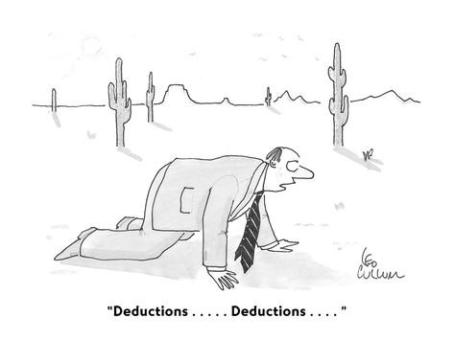
deductions desert

The rat’s nest that is the federal income tax code is a testament to the counter-productive nature of central economic planning. Not only does the tax code force citizens to waste time and other resources on compliance activities. It also encourages us to direct resources into uses that would not be worthwhile in the absence of tax incentives, uses that are not worthwhile in a societal context.

A general rationale for many provisions of the tax code is that they serve some “worthwhile” public purpose. A special tax provision is created to subsidize activities contributing to that purpose. Since that reduces the flow of revenue, tax rates must increase as an offset. However, high tax rates are damaging to economic health in and of themselves. They blunt incentives and drive wedges between the values and rewards that guide all economic decisions.

The competing tax plans under debate in the House and Senate would eliminate or pare back deductions to varying degrees, enabling a reduction in tax rates. I applaud steps in that direction, though a consequence of doing so piecemeal is to invite later tinkering of the sort that got us into this mess in the first place. Both the House and Senate bills are piecemeal. Here is a run-down of some of the deductions that are under review in the GOP plans:

State and Local Tax (SALT) Deductions: this deduction prevents the imposition of federal “taxes on taxes”, which is a worthwhile consideration. However, SALT also gives lower levels of government a “discount” on tax burdens they impose on their citizens, thereby forcing that burden to be shared by members of other jurisdictions. According to the Tax Foundation:

“The deduction favors high-income, high-tax states like California and New York, which together receive nearly one-third of the deduction’s total value nationwide. Six states—California, New York, New Jersey, Illinois, Texas, and Pennsylvania—claim more than half of the value of the deduction.“

Defenders of this deduction note peremptorily that it is used by taxpayers in all fifty states, as if that should come as a surprise. Well of course it is! And those who are taxed most heavily benefit the most from this deduction, and those benefits are most concentrated in high-tax states. The House GOP bill would limit the SALT deduction to $10,000, while the Senate version would eliminate it entirely.

Mortgage Interest (MI) Deduction: Long ago, the idea took hold that ownership of a home was of greater inherent value than mere occupancy. It’s obviously true that owners have greater rights than renters over use of a property. Those benefits are internalized, and owner-occupants might well be more inclined than renters to take pride in, care for, and improve a property. That suggests a social or external benefit from home ownership, one that at least benefits others in the vicinity of a given property.

The MI deduction creates an incentive for debt-financed home ownership, but only for the minority of taxpayers who can benefit from itemizing deductions. It therefore tends to subsidize the housing choices of those at higher levels of income and those with larger homes. It has contributed little, if anything, to the homeownership rate. Here are Edward Glaeser and Jesse Shapiro describing the findings of their NBER Working Paper:

“Externalities from living around homeowners are far too small to justify the deduction. … the home mortgage interest deduction is a particularly poor instrument for encouraging homeownership since it is targeted at the wealthy, who are almost always homeowners. The irrelevance of the deduction is supported by the time series which shows that the ownership subsidy moves with inflation and has changed significantly between 1960 and today, but the homeownership rate has been essentially constant.“

This deduction has fostered a massive over-investment in housing relative to other assets and forms of consumption. The House tax bill would allow a deduction on interest payments for up to $500,000 of mortgage debt, but this limit would apply only to new mortgages. The Senate bill would not alter the deduction in any way. These steps are severely limited in their reform ambitions.

Medical Expense Deduction: To take this deduction, you must 1) be an itemizer; and 2) have eligible medical expenses exceeding 10% of adjusted gross income (AGI). Then, you can deduct only the excess above 10%. A relatively small percentage of taxpayers actually take this deduction, mostly wealthy, older individuals or couples. It can be argued that the deduction encourages overuse of medical resources in some cases, but there are certainly others in which it provides relief from the hardship of an illness requiring expensive care. On the other hand, the deduction might serve to discourage the purchase of supplemental Medicare coverage by individuals who can afford it but are willing to bet that they won’t need it. Part of that bet is covered by the deduction.

The House bill would repeal this deduction in its entirety. The Senate bill would leave it untouched.

Student Loan Interest Deduction: Currently, up to $2,500 of student loan interest can be deducted “above the line” by non-itemizers, but only if their AGI is within certain limits. Higher education is often claimed to have social (external) benefits. To some extent, the student loan interest deduction helps bring the cost of an eduction to within reach of a broader swath of the citizenry. These considerations provide the rationale for public subsidies for funding tuition and other costs with debt. The tax deduction is only one of many forms of education subsidies. Another is provided by the below-market rates at which students are able to borrow from the federal government.

The social benefits of higher education are strongly associated with the value it adds for the individual. It can be argued that as a society, we may have pushed college education well beyond that point. A large number of indebted students decide, too late, that continued enrollment has little value, so they drop out and often default on their federally-subsidized debt. Moreover, these loan subsidies stimulate the demand for college education, which leads to a certain amount of escalation in tuition and fees. These ill effects make elimination of this deduction a tempting way to broaden the income-tax base, enabling a reduction in tax rates.

The House bill eliminates the deduction for student loan interest, but the Senate bill leaves it intact.

Conclusion: There are plenty of shortcomings in both the House and Senate versions of tax reform. Three liberalizing goals of reform are tax simplification, elimination of provisions that benefit special interests, and of course lower rates. Most of the complexities in the tax code benefit special interests in one way or another. The deductions discussed above fall into that category and necessitate higher tax rates on personal income. That in turn makes the deductions more valuable to those who claim them. In terms of the liberalizing goals of reform, the House tax bill is wider ranging than the Senate version, though the Senate bill’s complete elimination of the SALT deduction is better.

Happy Hour With Nanny: Cancer Cocktail or Cardio Cooler?

11 Saturday Nov 2017

Posted by Nuetzel in Prohibition

≈ Leave a comment

Last week brought news that even moderate alcohol consumption can increase your risk of cancer. I heard it over and over, so it must be true! A report from the American Society of Clinical Oncology (ASCO) cites research findings of elevated risk of several types of cancer for drinkers, especially for heavy drinkers. It’s good to be aware of those associations, but drinking alcohol responsibly confers certain benefits that are more than compensatory. I won’t change my drinking habits on account of ASCO’s statement, and the findings in the report do not justify some of ASCO’s public policy recommendations.

Ronald Bailey in Reason was quick to note that ASCO’s findings required some “cherry picking” of research findings. Aaron E. Carroll in The New York Times used the same words. ASCO’s conclusions relied upon studies that found increased risks between drinking alcohol and certain cancers without mentioning that some of the same studies found protective effects against other cancers. And both Bailey and Carroll point out that drinking mitigates other risks. Bailey quotes one influential study:

“… ‘light and moderate alcohol intake predicted reduced all-cause, cardiovascular, and cancer mortalities in both men and women.’ That’s right, light to moderate drinkers not only had lower risks of dying from any cause or from cardiovascular diseases, but also lower risks of dying from cancer.“

And evidently, as Bailey notes, there may be positive social and economic advantages associated with a bit of tippling.

The ASCO report contains a section called “PUBLIC HEALTH STRATEGIES TO REDUCE HIGH-RISK ALCOHOL CONSUMPTION”. Bailey flatly states that ASCO is a group of “public health nannies” and summarizes their positions thusly:

“The group treats consuming alcohol as a pure public health problem to which the only solutions are various forms of prohibition. They recommend regulating alcohol outlet density; increasing alcohol taxes and prices; maintaining limits on days and hours of sale; enhancing enforcement of laws prohibiting sales to minors; restricting youth exposure to advertising of alcoholic beverages; and resisting further privatization of retail alcohol sales in communities with current government control.“

Oh, please, calm down! Yes, there are risks to boozing, the most dangerous of which are well known. As Carroll emphasizes, ASCO’s statement doesn’t change the calculus much. There are few risks presented by moderate enjoyment of adult beverages, and the benefits are compelling. Please keep the nanny state out of my liquor cabinet!

The House GOP Tax Plan’s Disparate Treatment of Income Sources

09 Thursday Nov 2017

Posted by Nuetzel in Taxes

≈ 2 Comments

Tags

Bernie Sanders, Bubble Tax, corporate income tax, Double Taxation, FICA Tax, House GOP Tax Plan, Investment Incentives, Obamacare Surtax, Pass-Through Income, Scott Sumner, Tax Burden, Tax Incentives

Update: In writing the following post, I neglected to devote sufficient attention to the rules that would govern taxation of pass-through income under the House GOP tax plan. Those rules significantly alter some of the conclusions below. Those rules are discussed in a later post: Stumbling Through Pass-Through Tax Reform.

Double taxation of corporate income is a feature of the U.S. income tax code that is partially addressed in the tax reform bill proposed by the House GOP. Corporate income is taxed to the firm and again to owners on their receipt of dividends or when a company’s growth results in capital gains. Ultimately, the total rate of taxation matters more than whether it is implemented as single or double taxation of income flows. However, there is an unfortunate tendency to view corporate taxes as if they are levied on entitites wholly separate from their owners, so double taxation carries a stench of politically sneakiness. It also creates multiple distortions in the decisions of investors and the separately managed firms they own.

Non-corporate income taxation is reduced by the House plan even more substantially than the cut in taxes on corporate-derived income. However, the plan does not reduce taxes on high-earning professionals, many of whom are situated similarly to successful business owners and investors from an economic perspective.

Tax Burdens and Distortions

The federal corporate tax is not borne 100% by shareholders, as discussed in the previous post on Sacred Cow Chips. Some part of the burden is borne by labor via reduced wages. It is difficult to correct for this distortion in terms of calculating an effective marginal tax rate on corporate income. For example, suppose a new 35% tax would reduce corporate income from $100 to $65. The firm finds, however, that it can reduce wage payments by half of the expected tax payment, or $17.50. The firm would now earn $117.50 before tax and $76.38 after tax. Relative to the new level of pre-tax income, the tax rate is still 35%. It is no less than that by way of the reduction in wages, though the impact on the firm’s pre-tax income is mitigated.

The discussion here of tax rates, and even double taxation, is not intended as commentary on tax fairness. It might or might not be fair that the burden of the tax is shared with labor. Instead, the issue is the magnitude of the economic distortions caused by taxes. Tax rates themselves are a reasonable starting point for such a discussion, and they are easy to measure. Lower tax rates beget fewer distortions in economic outcomes than high tax rates. Low rates provide greater incentives to save and invest in productive assets, which enhances labor productivity, wages, and economic growth. Indeed, businesses go to great lengths to avoid taxes altogether, if possible, but typically those are non-productive uses of resources, which demonstrates the very distortions at issue.

Current and Proposed Marginal Tax Rates

Under current law, the top personal income tax rate on dividends is 20%. It is 23.8% if we include the Obamacare surtax. Adding that to the corporate rate yields the effective top tax rate paid by shareholders: 23.8% + 35% = 58.8%. The GOP bill does not alter the 23.8% top rate on dividends or capitals gains. By virtue of the corporate tax reduction, however, the plan would reduce the overall top rate on shareholders to 23.8% + 20% = 43.8%.

The income earned by investors in pass-through entities like proprietorships, partnerships and S-corporations is taxed as personal income under current law at rates ranging from 15% to 39.6% (43.4% at the top, including the surtax). Thus, under present law, the owner of a pass-through company is taxed less heavily at the top rate than the owner of a public company (43.4% vs. 58.8%). (I am ignoring the 15.3% FICA payroll tax owed by self-emloyed individuals in proprietorships or partnerships on incomes up to $127,200, and 2.9% above that level. The combined tax rates would be almost equal even if we include the FICA tax.)

The tax on pass-through business income would be reduced under the GOP bill via a cap of 25% on federal business income taxes. Presumably, this cap would nullify the House plan’s “bubble tax” of 6% on personal income between $1.2 million and $1.6 million of income, as well as the Obamacare surtax. Thus, the tax advantage for pass-through entities over corporations would be somewhat wider under the House plan than under current law (25% vs. 43.4%). (The FICA tax on owners of proprietorships and partnerships would not quite equalize the overall marginal tax rates over a certain income range.)

In addition, the House plan rewards the owners of pass-through businesses relative to individuals earning high levels of wage and salary income. If anything, the bill would penalize these individuals. For example, while the owner of a high-earning pass-through would face a 25% tax rate, a high-earning professional or corporate employee would pay the top marginal rate (39.6%) plus the surtax (3.8%) and possibly the bubble tax (6%). This is one reason why Scott Sumner says it looks as if the House plan was designed by Bernie Sanders!

The Upshot

The tax system should be neutral across different sources of income. Divergent effective tax rates on owners of corporations, pass-throughs, and high wage-earning individuals is undesirable and introduces arbitrary elements into private decision-making. If anything, the House GOP tax plan exacerbates those differences. By cutting marginal tax rates, it would reduce the magnitude of business tax distortions both for corporate and pass-through organizations and their owners, but the relative advantage of pass-throughs would increase relative to corporations, and owners of corporations and pass-throughs benefit relative to high-earning individuals. Let’s hope this is fixed as the bill evolves, but more balanced reductions in rates would require higher rates on business owners than contemplated in the current plan.

Labor Shares the Burden of the Corporate Income Tax

03 Friday Nov 2017

Posted by Nuetzel in Taxes

≈ 4 Comments

Tags

Alex Tabarrok, corporate income tax, Greg Mankiw, John Cochrane, Lawrence Summers, monopoly, Monopsony, Pass-Through Income, Paul Krugman, Tax Burden, Tax Discounting, Tax Incidence, Tax Reform

As expected, a reduction of the corporate income tax rate from 35% to 20% is included in the GOP’s tax reform bill, a summary of which was released today. That rate cut would be a welcome development for workers, consumers, and corporate shareholders. It should be no surprise that the burden of the U.S. corporate income tax is not borne exclusively by owners of capital. In fact, it might hurt workers and consumers substantially while imposing relatively little burden on shareholders.

John Cochrane’s post on the incidence of the tax on corporate income is very interesting, though by turns it rambles and may be too technical for some tastes. He notes that the incidence of the corporate tax can fall on only three different groups: shareholders, workers and customers:

“As an accounting matter, every cent [of taxes] corporations pay comes from higher prices, lower wages, or lower payments to shareholders. The only question is which one.“

Cochrane quotes Lawrence Summers and Paul Krugman, both of whom are of the belief that the incidence of the corporate tax must fall primarily on capital and not on labor. That’s consistent with their view that a reduction in corporate taxes amounts to a gift to shareholders. But Cochrane isn’t at all convinced:

“The usual principle is that he or she bears the burden who can’t get out of the way. So, how much room do companies, as a whole, have to raise prices, lower wages, lower interest payments, or lower dividends?”

In fact, owners of capital can get out of the way. Capital is very mobile relative to labor. Here’s a counterfactual exercise Cochrane steps through in order to illustrate the implications of ownership bearing the incidence of the tax: if equity markets are efficient, share prices reflect all available information about the firm. If wages and product prices are unchanged after the imposition of the tax, then shareholders would suffer an immediate loss. Once the tax is discounted into share prices, there would be no further impact on current or future shareholders. Thus, future buyers of shares would escape the tax burden entirely. As a first approximation, the share price must fall to the point at which the ongoing return on the stock is restored to its value prior to imposition of the tax.

Cochrane notes that evidence on the reaction of stock prices to corporate tax changes is mixed at best, which implies that the incidence of corporate taxation falls more weakly on shareholders than many believe. That leaves consumers or workers to bear a significant part of the burden. Workers and consumers are mostly one and the same: economy-wide, higher prices mean lower real wages; lower wages also mean lower real wages. So I’ll continue to speak as if the incidence of the tax falls on either labor or capital, and we can leave aside consumers as a separate category. Cochrane says:

“It used to be thought that it was easy to lower payments to shareholders — ‘the supply of savings is inelastic’ — so that’s where the tax would come from. The newer consensus is that companies as a whole have very little power to pay less to investors, … so the corporate tax comes from lower wages or, equivalently, higher prices. Then, indirectly, reducing the corporate tax would increase capital, which would result in higher wages.”

Cochrane’s post and another on his blog were prompted by an earlier piece by Greg Mankiw showing that real wages, in an open economy, will have a strong negative response to a corporate tax increase. Here is the reasoning: the tax reduces the return earned from invested capital in the short run. Ideally, capital is deployed only up to the point at which its return no longer exceeds the opportunity cost needed to attract it. Given time to adjust, less capital must be deployed after the imposition of the tax in order to force the return on a marginal unit of capital back up to the given opportunity cost. That means less capital deployed per worker, and that, in turn, reduces labor productivity and wages.

Another issue addressed by Cochrane has to do with assertions that monopoly power in the corporate sector is a good rationale for a high tax on corporate income. You can easily convince me that the “average” firm in the corporate sector earns a positive margin over marginal cost. However, a microeconomic analysis of monopoly behavior by the entire corporate sector would be awkward, to say the least. Despite all that, Cochrane notes that monopolists have more power than firms in competitive sectors to raise prices, and monopsonists have more power to reduce wages. Therefore, the “tax the monopolists” line of argument does not suggest that labor will avoid a significant burden of a corporate tax. A safer bet is that firms in the U.S. corporate sector are price-takers in capital markets, but to some degree may be price-makers in product and labor markets.

Cochrane also emphasizes the inefficiency of the corporate tax as a redistributional mechanism, even if shareholders bear a significant share of its burden. It is still likely to harm workers via lost productivity, as discussed above. It is also true that many workers hold corporate equities in their retirement funds, so a corporate tax harms them directly in their dual role as owners of capital.

The cut in the corporate tax rate is but one element of many in the GOP bill, but a related provision is that so-called “pass-through” income, of the type earned via many privately-owned businesses, would be taxed at a maximum rate of 25%. These businesses generate more income than C-corporations. Currently, pass-through income is taxed as ordinary income, so capping the top rate at 25% represents a very large tax cut. As Alex Tabarrok points out at the last link, tax treatment should be neutral with respect to the form of business organization, but under the GOP bill, the effective gap between the top rate for pass-throughs versus corporate income would be even larger than it is now.

Critics of a reduction in corporate taxes should bear in mind that its incidence falls at least partly on labor, perhaps mainly on labor. The U.S. has the highest corporate tax rate in the industrialized world. That undermines U.S. competitiveness, as does the complexity of corporate tax rules. Tax planning and compliance burn up massive resources while drastically reducing the tax “take”, i.e., the revenue actually collected. The corporate income tax is something of a “show” tax that exists to appease populist and leftist elements in the electorate who consistently fail to recognize the unexpectedly nasty consequences of their own advocacy.


Slam the Damn Brakes on the Regulatory Potentate

28 Saturday Oct 2017

Posted by Nuetzel in Regulation

≈ Leave a comment

Tags

Administrative State, Barry Brownstein, Corn Ethanol, crony capitalism, DARPA, Deregulation, Donald Trump, Drug Review, EPA, FCC, FDA, Greg Ip, Industrial Policy, Mercatus Center, NASA, Net Neutrality, Paris Climate Accord, Patrick McLaughlin, Puerto Rico, Renewable Fuel Standards, Steve Bannon, The Brookings Institution, Two-For-One Regulatory Order

The stock market’s recent gains have at least three plausible explanations: corporate earnings growth, the prospect of tax reform, and deregulation. Tax reform and deregulation are stated priorities of the Trump Administration and have the potential to lift the economy and generate additional earnings. Investors obviously like that prospect, though regulation itself is a tool used subversively by crony capitalists to stifle competition in their markets. Conceivably, some of the large firms that dominate major stock indices could suffer from deregulation. And I have to wonder whether the economic threat of Trumpian trade protectionism is not taken seriously by the equity markets. Let’s hope they’re right.

It’s no mystery that high taxes and tax complexity can inhibit economic growth. Let’s face it: when it comes to productive effort, we can all think of better things to do than tax planning, crony capitalist or not. The same is true of regulation: the massive diversion of resources into non-productive compliance activities stifles innovation, growth, and even the stability of the status quo. Regulation creates obstacles to activities like new construction and the diffusion of telecommunications services. And it discourages the creation of new products and services like potentially life-saving drugs and slows their introduction to market. The sheer number of federal regulations is so spectacular that one wonders how anything productive ever gets done! Patrick McLaughlin of The Mercatus Center and several coauthors tell of “The Impossibility of Comprehending, or Even Reading, All Federal Regulations“.

Regulation is more than a mere economic burden. It is the product of an administrative apparatus that is not subject to the checks and balances that are at the very heart of our system of constitutional government. That is a threat to basic liberties. Barry Brownstein offers an instructive case study of “The Tyranny of Administrative Power” involving violations of property rights in New Hampshire. The case involves the administrative machinations surrounding an installation of high-power lines.

Governmental efforts to spur innovation ordinarily take the form of spending on research, subsidies for certain technologies or favored industries (e.g., alternative energy), and large government programs dedicated to the achievement of various technological goals (e.g., NASA, DARPA). Together with regulatory rules that influence the allocation of resources, these governmental efforts are called industrial policy. An unfortunate recent example is Trump’s decision to retain the renewable fuel standard (RFS), but on the whole, industrial policy does not seem central to Trump’s effort to stimulate innovation.

It’s clear that a deregulatory effort is well underway: the so-called “deconstruction of the administrative state” hailed by Steve Bannon not long after Trump took office. First came Trump’s 2-for 1 executive order (also see here) requiring the elimination (or modification) of two rules for every new rule. In the Wall Street Journal, Greg Ip writes about changes at the FDA and the FCC that could dramatically alter the pace of innovation in the pharmaceutical and telecom industries. (If the link is gated, you access the article on the WSJ’s Facebook page.) Speedier and less burdensome reviews of new drugs will greatly benefit consumers. An end to net neutrality rules will support greater investment in broadband infrastructure and access to innovative services. There is a new emphasis at the FCC on enabling innovative solutions to communications problems, such as Google’s effort to provide cell phone service in Puerto Rico by flying balloons over the island. The Trump Administration is also reining-in an aggressive EPA, the source of many questionable rules that weaken property rights and inhibit growth. (Again, the RFS is a disappointing exception.) Health care reform could offer much needed relief from overzealous insurance regulation and high compliance costs for physicians and other providers.

But deconstructing the administrative state is hard. Regulations just seem to metastasize, so deregulatory gains are offset by continued rule-making. This is partly from new legislation, but it is also a consequence of the incentives facing self-interested regulators. With that in mind, it’s impressive that regulation has not grown, on balance, thus far into Trump’s first year in office. According to Patrick McLaughlin, zero regulatory growth has been unusual going back at least to the Carter Administration. In quoting McLaughlin, The Weekly Standard says that Trump might well earn the mantle of “King of Deregulation“, but he has a long way to go. Brookings has this interactive tool to keep track of his deregulatory progress. One item on the Brookings list is the President’s intention to withdraw from the Paris Climate Accord. That represents a big save in terms of avoiding future regulatory burdens.

I can’t help but be wary of other avenues through which the Trump Administration might regulate activity and undermine economic growth. Chief among these is Trump’s negative attitude toward foreign trade. Government interference with our freedom to freely engage in transactions with the rest of the world is costly in terms of both foreign and domestic prices. With something of a history as a crony capitalist himself, Trump is not immune to pressure from private economic interests, as illustrated by his recent cow-tow to the ethanol lobby. Nevertheless, I’m mostly encouraged by the administration’s deregulatory efforts, and I hope they continue. The equity market apparently expects that to be the case.

Choice, Federal Exchange Failure, and a Path to Health Insurance Reform

25 Wednesday Oct 2017

Posted by Nuetzel in Health Insurance, Markets, Obamacare

≈ Leave a comment

Tags

Association Health Plans, Avik Roy, Barack Obama, Bill Cassidy, Cost-Sharing Subsidies, Donald Trump, Exchange Markets, Health Status Insurance, Insurer subsidies, Jeffrey Tucker, John C. Goodman, John Cochrane, John McCain, Medicaid, Medicare, Obamacare, Patient Freedom Act, Pete Sessions, Pre-Existing Conditions, Short-Term Policies, Tax-Credit Subsidies, Universal Health Allowance

“… a government program that is ruined by permitting more choice is not sustainable.“

That’s Jeffrey Tucker on Obamacare. Conversely, coercive force is incompatible with a free society. Tucker, no fan of President Donald Trump, writes that the two recent executive orders on health coverage are properly framed as liberalization. The orders in question: 1a) eliminate federal restrictions on the sale of so-called association health insurance plans, including their availability across state lines; 1b) remove the three-month limitation on coverage offered under temporary policies; and 2) end insurer cost-sharing subsidies for policies sold to low-income (non-Medicaid) segments of the individual market.

The most immediately impactful of the three points above might be 1b. These temporary policies became quite popular after Obamacare took effect, at least until the Obama Administration placed severe restrictions on their duration and renewal in 2016 (see Avik Roy’s post in Forbes on this point). Trump’s first order rescinds that late-term Obama order. The short-term policies are likely to become popular once again, as things stand. Small employers can avoid many of the Obamacare rules and save significantly on premiums using temporary policies.

Association plans are already sold to small businesses having a “commonality of interest”, but Trump’s order would expand the allowable common interests and permit association plans to be sold across state lines. Avik Roy doubts that this will have a large impact, but to the extent that association plans avoid both state and federal benefit mandates, they could prove to be another important source of more affordable coverage for employees than the Obamacare exchanges. In any case, as Tucker says:

“In the words of USA Today: the executive order permits a greater range of choice ‘by allowing more consumers to buy health insurance through association health plans across state lines.’  … The key word here is ‘allowing’– not forcing, not compelling, not coercing. Allowing.

Why would this be a problem? Because allowing choice defeats the core feature of Obamacare, which is about forcing risk pools to exist that the market would otherwise never have chosen. … The tenor of the critics’ comments on this move is that it is some sort of despotic act. But let’s be clear: no one is coerced by this executive order. It is exactly the reverse: it removes one source of coercion. It liberalizes, just slightly, the market for insurance carriers.“

The elimination of insurer cost-sharing subsidies might sound like the most draconian aspect of the orders. Those subsidies were designed to keep the cost of coverage low for consumers with low incomes, but the subsidies are illegal because the allocation of funds was never authorized by Congress. And contrary to what has been alleged, eliminating the insurer subsidies will have virtually no impact on low-income consumers. First, a large percentage of them are on Medicaid to begin with, not the exchanges. Second, tax-credit subsidies for low-income consumers are still in place for exchange plans, and they will scale based on the premium charged for the “silver” plan (also see Avik Roy’s link above). Taxpayers will be on the hook for those increased subsidies, as they were for the insurer cost-sharing payments.

The exchange market will be weakened by the executive orders, but it has been in a prolonged decline since its inception. Relatively healthy consumers will have opportunities to buy more competitive coverage through short-term policies or association plans, so they are now more likely to exit the risk pool. Higher-income, unsubsidized consumers are likely to pay more for coverage on the exchanges, particularly those with pre-existing conditions. As premiums rise, some of the healthy will simply forego coverage, paying the penalty instead (if it is enforced). Of course, the exchange risk pool was already risky, coverage options have thinned, and premiums have been rising, but the deterioration of conditions on the exchanges will likely be hastened under Trump’s executive orders.

Dismantling some of the restrictions on health insurance choice, which were imposed by executive order under President Obama, could prove to have been a stroke of genius on Trump’s part. As a negotiating ploy, Trump just might have maneuvered Republicans and Democrats into a position from which they can agree … on something. The new orders certainly give emphasis to the deterioration of the exchange markets. The insurers probably viewed the cost-sharing subsidies as a better deal for themselves than having to recoup costs via risky and controversial rate increases, so they are likely to pressure Congress for relief. And higher-income consumers with pre-existing conditions will face higher premiums but won’t have new choices. They will be a vocal constituency.

Democrats just don’t have any ideas with legs, however: single-payer and Medicare-for-all are increasingly viewed as politically unacceptable alternatives by most observers. As John C. Goodman notes at the last link, Medicare is already an actuarial and financial nightmare. Another program of the like to replace existing coverage that most voters would like to keep is not a position likely to win elections. Here is Goodman:

“So, the Democrats’ dilemma is: (1) they are not getting any electoral advantage from Obamacare, (2) they can’t afford to criticize it for fear of upsetting their base and (3) they don’t have an acceptable solution in any event.“

So perhaps we have conditions that might foster a compromise, at least one that could win enough votes to fix the insurance markets. Goodman contends that a plan originally attributable to John McCain, and now in the form of the Pete Sessions/Bill Cassidy-sponsored Patient Freedom Act, could be the answer. It would create something like a Universal Basic Health Allowance, in the form of a tax credit, funded by eliminating all current federal spending on health care (excluding Medicare and Medicaid). Those with pre-existing conditions would purchase coverage the same way as others, but the plan would give insurers a strong incentive to retain them. According to Goodman, a “health status risk adjustment” would assure actuarially-fair pricing by forcing an existing insurer to pay the adjustment to a new insurer when sick individuals change their insurance plans.

The Sessions/Cassidy plan (and Goodman) describes a particular implementation of a more general concept called health status insurance, a good explanation of which is offered by John Cochrane:

“Market-based lifetime health insurance has two components: medical insurance and health-status insurance. Medical insurance covers your medical expenses in the current year, minus deductibles and copayments. Health-status insurance covers the risk that your medical insurance premiums will rise. If you get a long-term condition that moves you into a more expensive medical insurance premium category, health-status insurance pays you a lump sum large enough to cover your higher medical insurance premiums, with no change in out-of-pocket expenses.“

It would be a miracle if Congress can successfully grapple with the complexities of health care reform in the current legislative session. However, Trump’s executive orders have improved the odds that some kind of agreement can be negotiated to address the dilemma of the failing exchanges and coverage for pre-existing conditions. Let’s hope whatever they negotiate will leverage consumer choice and free markets. Trump’s orders are a step, but only one step, in reestablishing the patient/insured as a key decision maker in the allocation of health care resources.

The Ruinous Authoritarian Impulse: Rules For Housing and Diversity

20 Friday Oct 2017

Posted by Nuetzel in Affirmative Action, Housing Policy, Identity Politics

≈ Leave a comment

Tags

Admissions Quotas, Affirmative Action, Hiring Quotas, Historic Preservation, Housing Inequality, Land-Use Regulation, Mismatch Hypothesis, Randall O'Toole, Rent Control, School Choice, Stigmatization, Wendell Cox

I’m following up on an earlier post with a few thoughts on two topics: the “unexpected” harms of affirmative action and the left’s unwitting promotion of inequality via restrictive housing policies in many American cities. I mentioned both policies last week without much elaboration in “American Homicide Rates: Which America?” Both are efforts by government to apply centralized decision-making to complex social issues. Both reflect misdiagnoses of the problems they seek to address. Both are coercive and dismissive of the power of free individuals to help themselves and the power of markets to solve social problems. And both kinds of policies are failures.

Whether government is prescribing the rental value of a property, regulating forms of new construction, or imposing land-use regulations, zoning, historic preservation, and environmental rules, the result is higher housing costs and often lower-quality housing for the low end of the income distribution. The effects of some of these policies are discussed by Randall O’Toole in “Bringing Soviet Planning To New York City“. Wendell Cox notes that progressive cities are home to the worst inequality of housing opportunities for blacks and hispanics. The Cox piece is a bit dry, but it is instructive. These are results that reinforce the alienation described in the “Which America?” post linked above.

Allowing government to prescribe the appropriate matching of individuals to roles based on racial or identity group status is divisive and counter-productive. This is so-called affirmative action. Decisions based not on merit, but on skin color or membership in favored identity groups are discriminatory by their very nature. Members of non-favored groups, including non-favored minorities such as asians, are penalized, despite their lack of any connection to the injustices of the past. Human capital is a scarce resource, which is why merit has value. So group preferences in hiring involve tradeoffs, subverting goals such as productivity, profit and expense control. This inflicts a cost on society as a whole. 

In college admissions, affirmative action often compromises learning. This article on affirmative action at universities emphasizes the “mismatch hypothesis”, which asserts that individuals with lesser academic credentials who are placed as a consequence of preference programs often “suffer academically as a result”. The damage includes higher dropout rates among minorities and generally less learning than if these individuals had studied with peers having more similar credentials. A further implication is that these individuals probably experience less career success. In fact, an under-qualified employee’s job performance might permanently damage his or her career prospects. There may be other consequences of group preferences such as stigmatization and alienation of individuals within the academic community or workplace. 

Whether the topic is better housing, improved educational and economic prospects, trade, drugs, technology, or any other human endeavor, the best solutions do not involve decisions imposed by government coercion. Instead, allowing individuals to interact freely, gaining valuable employment experience and access to the bounty of markets, fosters organic gains in opportunities. Individual liberties and equality before the law are the real keys to broader success. The visible, iron hand of the state tends to diminish the supply of affordable housing. Forced quotas in hiring and academic admissions often harm their intended beneficiaries and poison the social environment. When placement decisions are in the hands of public institutions like state universities, it is in the best interests of both schools and students to make those decisions based on academic credentials. Opportunities for higher education will improve only with advances at lower levels of education, which requires parental choice rather than a collection of unresponsive mini-monopolies. In addition, higher education should lose it’s cachet as an elixir for economic prospects. Many individuals, regardless of group identity, would optimize their careers through vocational skills and entering the workforce to gain experience at an earlier age than the typical university graduate.

Our Homicidal Drug War

17 Tuesday Oct 2017

Posted by Nuetzel in Prohibition, War On Drugs

≈ 4 Comments

Tags

Britigne Shaffer, CATO Institute, Controlled Substances Act, Dan Kahan, DEA, Donald Trump, Drug War, Jeff Sessions, Jeffrey Miron, Mandatory Minimum Sentences, Michael Owen, Milton Friedman, On the Banks, Prohibition, Scott Sumner

Drug prohibition and the war on drugs are destructive policies and most burdensome to communities that can least afford it: impoverished and often minority neighborhoods. Drug laws and their enforcement likely account for the bulk of homicides that occur there, directly or indirectly. A post on SacredCowChips last week discussed the violence that frequently beleaguers communities that are home to unassimilated minorities. Drug prohibition compounds the tragedy in several ways: deadly rivalry among supplier organizations; violent confrontations with law enforcement; user criminality; drug-related incarceration; degraded user productivity; and tainted supplies that exacerbate health risks for users.

Ultimately, bad laws are distinguished by their failure to achieve broad compliance. The thing is, people who want to do drugs will do so regardless of their legality. Most recreational users are sufficiently imbued with a survival instinct and the self-control to govern their use effectively, without ostensible harm. Nearly all recreational users believe they are engaging in a harmless activity, and most of them are right. That is, quite simply, why the drug war just doesn’t work, and it won’t ever work. It doesn’t work for pot, LSD, cocaine, or anything else, including opioids and heroin. (Also see this.)

Prohibition, however, delivers the drug trade into the hands of gangs and mobsters. The supply side of the business attracts individuals having few legitimate market opportunities, who happen to be concentrated in economically depressed neighborhoods. The drug trade’s illegality transforms it into a risky and violent enterprise, and efforts to enforce prohibition magnify those dangers and expose law enforcement to great risk as well. Then, there are the effects of mass incarceration on individuals and their home communities. The situation is self-reinforcing, adding to the instability of these struggling areas.

There is ample evidence that drug prohibition is a driver of crime and responsible for a large number of homicides in the U.S. A Chicago prosecutor was quoted by HuffPo in 2013 as saying that 80% of homicides in the city were gang-related, and therefore primarily drug-related. Economist Jeffrey Miron has linked drug prohibition to international differences in violent crime rates. Scott Sumner has this take on the drug war and crime rates, including a brief analysis of the drop in homicides (40%) after alcohol prohibition was repealed. In 1991, Milton Friedman stated that the repeal of drug laws would eliminate about 10,000 U.S. homicides every year, which at the time would have been about a 40% reduction. And here is Yale’s Dan Kahan on the subject of drug laws and homicide:

“The weight of the evidence pretty convincingly shows that drug-related homicides generated as a consequence of drug prohibition are tremendously high and account for much of the difference in the homicide rates in the U.S. and those in comparable liberal market societies.“

In my last post on the U.S. homicide rate, I drew on Britigne Shaffer’s On the Banks blog post entitled “Michael Owen Nails the Gun Debate“. As log as we have prohibition and a drug war, the U.S. homicide rate is likely to exceed most other industrialized countries:

“We have a system in place where the government subsidizes poverty in urban areas, imposes economic blight in those same areas through heavy taxes and regulations, renders the residents permanently unemployable via the ‘criminal justice’ (sic) system, and creates a lucrative black market in drugs by restricting supply (not to mention increasing demand as people are desperate to escape their circumstances by getting high), meaning the only game in town is often entering the drug trade. The drug trade is violent because those in it have no access to courts to settle disputes. Powerful industries lobby to keep the drug war going; the top spenders are law enforcement unions, the prison industry, big alcohol, tobacco, and pharma.“

The CATO Institute‘s Handbook for Policymakers, Issue #23, advocates the following: repeal of the Controlled Substances Act; allowing states to pursue their own initiatives without federal interference; complete repeal of mandatory minimum sentences; and termination of the Drug Enforcement Administration (DEA). These actions would allow the federal government to focus its resources on real threats, rather than fighting an unending war with an underworld empowered by those very laws, and with Americans who wish to exercise freedom over their use of drugs for medicinal or recreational use. From the CATO Handbook:

“Repeal of prohibition would take the astronomical profits out of the drug business and destroy the drug kingpins who terrorize parts of our cities. It would reduce crime even more dramatically than did the repeal of alcohol prohibition. Not only would there be less crime: reform would also free federal agents to concentrate on terrorism and espionage and would free local police agents to concentrate on robbery, burglary, and violent crime. … The war on drugs has lasted longer than Prohibition, longer than the Vietnam War. Prohibition has failed, again, and should be repealed, again.”

Despite the destructive effects of prohibition, a great many Americans—and politicians—base their opinions about drug laws on flawed moral reasoning that somehow it is more “wrong” or more “dangerous” to do drugs than to drink alcohol, itself a drug posing great danger to abusers, but a legal one. Responsible drug use, like responsible drinking, is a victimless act, or would be without the engagement of underworld suppliers. But it’s clear that President Donald Trump and Attorney General Jeff Sessions are committed to a continuation of the failed drug war, as are a majority of both Democrats and Republicans in Congress. The drug-related killings will continue, as will the ongoing damage to so many American families and communities. The refusal to end the drug war is a tragedy of many tragedies past and future.

← Older posts
Newer posts →
Follow Sacred Cow Chips on WordPress.com

Recent Posts

  • Warsh and Fed Confront a Crossroads On Policies
  • Isotopes Point To Natural CO2 Origins
  • Is “Global Temperature” a Fiction?
  • ESG Contortions: Virtue, Returns, and Politics
  • Grading Trump II, So Far

Archives

  • June 2026
  • May 2026
  • April 2026
  • March 2026
  • February 2026
  • January 2026
  • December 2025
  • November 2025
  • October 2025
  • September 2025
  • August 2025
  • July 2025
  • June 2025
  • May 2025
  • April 2025
  • March 2025
  • February 2025
  • January 2025
  • December 2024
  • November 2024
  • October 2024
  • September 2024
  • August 2024
  • July 2024
  • June 2024
  • May 2024
  • April 2024
  • March 2024
  • February 2024
  • January 2024
  • December 2023
  • November 2023
  • August 2023
  • July 2023
  • June 2023
  • May 2023
  • April 2023
  • March 2023
  • February 2023
  • January 2023
  • December 2022
  • November 2022
  • October 2022
  • September 2022
  • August 2022
  • July 2022
  • June 2022
  • May 2022
  • April 2022
  • March 2022
  • February 2022
  • January 2022
  • December 2021
  • November 2021
  • October 2021
  • September 2021
  • August 2021
  • July 2021
  • June 2021
  • May 2021
  • April 2021
  • March 2021
  • February 2021
  • January 2021
  • December 2020
  • November 2020
  • October 2020
  • September 2020
  • August 2020
  • July 2020
  • June 2020
  • May 2020
  • April 2020
  • March 2020
  • February 2020
  • January 2020
  • December 2019
  • November 2019
  • October 2019
  • September 2019
  • August 2019
  • July 2019
  • June 2019
  • May 2019
  • April 2019
  • March 2019
  • February 2019
  • January 2019
  • December 2018
  • November 2018
  • October 2018
  • September 2018
  • August 2018
  • July 2018
  • June 2018
  • May 2018
  • April 2018
  • March 2018
  • February 2018
  • January 2018
  • December 2017
  • November 2017
  • October 2017
  • September 2017
  • August 2017
  • July 2017
  • June 2017
  • May 2017
  • April 2017
  • March 2017
  • February 2017
  • January 2017
  • December 2016
  • November 2016
  • October 2016
  • September 2016
  • August 2016
  • July 2016
  • June 2016
  • May 2016
  • April 2016
  • March 2016
  • February 2016
  • January 2016
  • December 2015
  • November 2015
  • October 2015
  • September 2015
  • August 2015
  • July 2015
  • June 2015
  • May 2015
  • April 2015
  • March 2015
  • February 2015
  • January 2015
  • December 2014
  • November 2014
  • October 2014
  • September 2014
  • August 2014
  • July 2014
  • June 2014
  • May 2014
  • April 2014
  • March 2014

Blogs I Follow

  • Passive Income Kickstart
  • OnlyFinance.net
  • TLC Cholesterol
  • Nintil
  • kendunning.net
  • DCWhispers.com
  • Hoong-Wai in the UK
  • Marginal REVOLUTION
  • Stlouis
  • Watts Up With That?
  • American Elephants
  • The View from Alexandria
  • The Gymnasium
  • A Force for Good
  • Notes On Liberty
  • troymo
  • SUNDAY BLOG Stephanie Sievers
  • Miss Lou Acquiring Lore
  • Your Well Wisher Program
  • Objectivism In Depth
  • RobotEnomics
  • Orderstatistic
  • Paradigm Library
  • Scattered Showers and Quicksand
  • Jam Review

Blog at WordPress.com.

Passive Income Kickstart

OnlyFinance.net

TLC Cholesterol

Nintil

To estimate, compare, distinguish, discuss, and trace to its principal sources everything

kendunning.net

The Future is Ours to Create

DCWhispers.com

Hoong-Wai in the UK

A Commonwealth immigrant's perspective on the UK's public arena.

Marginal REVOLUTION

Small Steps Toward A Much Better World

Stlouis

Watts Up With That?

The world's most viewed site on global warming and climate change

American Elephants

Defending Life, Liberty and the Pursuit of Happiness

The View from Alexandria

In advanced civilizations the period loosely called Alexandrian is usually associated with flexible morals, perfunctory religion, populist standards and cosmopolitan tastes, feminism, exotic cults, and the rapid turnover of high and low fads---in short, a falling away (which is all that decadence means) from the strictness of traditional rules, embodied in character and inforced from within. -- Jacques Barzun

The Gymnasium

A place for reason, politics, economics, and faith steeped in the classical liberal tradition

A Force for Good

How economics, morality, and markets combine

Notes On Liberty

Spontaneous thoughts on a humble creed

troymo

SUNDAY BLOG Stephanie Sievers

Escaping the everyday life with photographs from my travels

Miss Lou Acquiring Lore

Gallery of Life...

Your Well Wisher Program

Attempt to solve commonly known problems…

Objectivism In Depth

Exploring Ayn Rand's revolutionary philosophy.

RobotEnomics

(A)n (I)ntelligent Future

Orderstatistic

Economics, chess and anything else on my mind.

Paradigm Library

OODA Looping

Scattered Showers and Quicksand

Musings on science, investing, finance, economics, politics, and probably fly fishing.

Jam Review

"If you get confused, listen to the music play."

  • Subscribe Subscribed
    • Sacred Cow Chips
    • Join 128 other subscribers
    • Already have a WordPress.com account? Log in now.
    • Sacred Cow Chips
    • Subscribe Subscribed
    • Sign up
    • Log in
    • Report this content
    • View site in Reader
    • Manage subscriptions
    • Collapse this bar

Loading Comments...